Where Is the ‘Third Force’ Going?

Some five years ago theologians were introduced to a new definition for a host of world-influencing sects, cults, and small church movements. The definition, “Third Force in Christendom,” was coined for a 20-million-strong group by Dr. Henry Pitney Van Dusen, president of Union Theological Seminary. Since that time theologians, scholars, and writers by the dozen have recognized the influence of the “force,” some with disdain, others with question. None has attempted to explain it and few have speculated on its future. In fact, no one has separated the varied and in many cases diametrically-opposed segments into like parts, theologically speaking. The original grouping was correct only in terms of relatively recent historic origin, evangelistic zeal and socio-cultural appeal. To illustrate, the theological beliefs of the 17 churches mentioned in a Life Magazine article in June, 1958, vary all the way from the deviant position of the cult to beliefs closely resembling those held by the historic Christian churches.

Basically the 17 churches can be grouped in three bodies: (1) Holiness churches associated with the National Holiness Association; (2) Pentecostal churches holding membership in the Pentecostal Fellowship of North America; and (3) “Others,” a segment independent of any association and varying widely, in some cases even bordering on the status of cults. Churches found in the first two divisions are strongly represented in the National Association of Evangelicals. Seven out of 13 denominations, comprising a large percentage of the churches, have clearly cast their lot with the evangelical side of Christendom in contradistinction to ecumenical inclusivism.

UNTOUCHED STRATA

How these groups originated, their past growth, and prospect in the future, have attracted the attention of both the conservative and liberal forces in Christendom. Many of the churches have reached social strata of the world’s population never touched by other forces in Christendom, and are now touching people sometimes “assigned” to the historic church. While some in the past have thought of these groups as cults, or at best sects on the fringe of the historic, the churches on Main Street (the “first” and “second” forces) are now having to move over to make room for the sociological, educational, and economic advance of the “third force.”

Some may still be classed as sects so far as their theological pattern is concerned. Such categorizing is not necessarily to be interpreted as being derogatory. The late Dr. William Warren Sweet, dean of American church historians, once pointed out that “in the minds of many people the term sect implies an ignorant, over-emotionalized, and fanatical group; an ephemeral, fly-by-night movement that is here today and gone tomorrow.” This all-too-often accepted position, he explained, cannot be applied to many churches found in what Dr. Van Dusen calls the “third force.”

Dr. Sweet’s “rule of thumb” for distinguishing a sect from a church or cult may partially explain the astonishing growth of the “third force.” Here are his criteria for categorizing some churches as sects: “(1) They reject the “State Church” principle, (2) they oppose creeds and confessions of faith, (3) they reject infant baptism, (4) they accept religion as a way of life (exclusive of membership), and (5) they follow a simple polity.” As opposed to this standard, he defines a church as an organized body which accepts “(1) creed or confession of faith, (2) infant baptism and automatic membership, and (3) an elaborate church polity.”

The word “cult” has often been used as a label for any group which does not follow historic thinking in religion, but Dr. Sweet disagrees. He classifies a cult as a religious group which looks for its basic authority outside Christian tradition. “Generally cults accept Christianity, but only as a halfway station on the road to greater ‘truth,’ and profess to have a new and additional authority beyond Christianity,” Dr. Sweet wrote. As examples of cults he suggests the Latter-Day Saints who stress the Book of Mormon, and Christian Scientists whose beliefs center on Science and Health.

Most of the “third force” falls into the sect classification, we judge by Dr. Sweet’s standard. One or two groups would be on edge of becoming churches, while two or three might be typed as cults or near-cults. Such organizations as the Christian and Missionary Alliance, Pentecostal Holiness, and similar groups he would call sects. The Church of the Nazarene, Dr. Sweet suggests, is an example of a body changing from sect to church status. Many Baptist groups have moved or are moving into the church category. The Jehovah’s Witnesses might be classed as a cult—certainly they are commonly recognized as such by evangelicals.

Of the 17 organizations mentioned in the Life Magazine article by Dr. Van Dusen, three are Holiness churches. They include the Church of the Nazarene, the Church of God of Anderson, Indiana, and the Christian and Missionary Alliance. Ten of the 17, by far the largest segment, fall into the Pentecostal group. They include the Assemblies of God, Church of God of Cleveland, Tennessee; United Pentecostal Church, International Church of the Foursquare Gospel, Pentecostal Church of God in America, The Church of God, Pentecostal Assemblies of the World, the Pentecostal Holiness, and two Negro groups, the Church of God in Christ, and the Apostolic Overcoming Holy Church of God. Falling into the “other” classification and varying all the way from near cults to fundamentalists are the Church of Christ, Seventh-day Adventist, Jehovah’s Witnesses, and Independent Fundamental Churches of America.

THE STRENGTH OF THE SO-CALLED ‘THIRD FORCE’

NOTE: These figures cover a 10-year period from 1949 to 1960. The information above was taken from the 1949 and 1960 volumes of the Yearbook of American Churches.

BACK TO THE CHURCH?

What is the future of the “third force?” Dr. Van Dusen gave a partial answer when he wrote, “No one can foretell whether this “third force” will persist into the long future as a separate and mighty branch of Christianity, or whether it will ultimately be reabsorbed into classic Protestantism as many spokesmen of the latter prophesy.…” While “spokesmen” prophesy and perhaps indulge a bit of wishful thinking, the growing strength of the churches in the “third force” certainly would not suggest the deterioration which usually drives smaller movements to merge with larger ones. Dr. Van Dusen enumerated six contributing factors to the vitality of the third force which are likely to keep it alive and active for many years to come: “(1) They have great spiritual ardor, (2) they commonly promise an immediate, life-transforming experience of the living God-in-Christ, (3) they directly approach people, (4) they shepherd their converts in an intimate sustaining group-fellowship, (5) they place strong emphasis upon the Holy Spirit, and (6) they expect their followers to practice an active, untiring, seven-day-a-week Christianity.” All six of these are accepted in varying degrees by evangelicals, and intense devotion to none of them in itself renders an individual unorthodox.

One writer recently spoke of Christians who accept these beliefs as “fringe,” and “centrifugal” types, but biblically speaking they are actually centripetal, pulling men back to Jesus Christ and back to the center of early Church theology rather than away from it. Many theologians and churchmen have recognized this truth. Speaking recently to a gathering of leaders of his own denomination, Dr. Edward L. R. Elson, pastor of the National Presbyterian Church and President Eisenhower’s minister, said, “… the rising pneumatic sects, with their radiant evangelistic appeal, have something we need.”

Dr. Elson’s speech was reported in the Pittsburgh newspapers on March 5. He was quoted as saying of the “third force” churches, “They have the authentic, New Testament expression more than some of our comfortably-established denominations.” Continuing, Dr. Elson asked his fellow-churchmen, “Is it not tragic that to be Spirit-filled is associated with fanaticism?” Such sentiment has been echoed by many who have awakened to the fact they may have missed the road. Various periodicals throughout the United States, almost simultaneously, have expressed such a feeling. The February, 1958, issue of Coronet carried an article entitled, “That Old-time Religion Comes Back.” The April, 1958, issue of Eternity published an essay titled, “Finding Fellowship with Pentecostals,” while Christian Life and similar publications have issued articles on the influence and spread of parts in the “third force.” Statistics will also bear out progress of the movement.

Information released in the 1960 Yearbook of American Churches shows denominations of the “force” have a membership in the United States of more than 4½ million, with more than 50,000 churches. Ten years ago, in 1949, these same churches listed a membership of only slightly more than 2 million, with only 33,000 churches.

It is not possible to say where all of the “third force” is going, for it varies too widely in theology; but for the most part its members are found solidly in the National Association of Evangelicals and are moving with it. The United States membership of the partial list of Pentecostal churches mentioned by Dr. Van Dusen has more than doubled during the past 10 years—jumping from just over 800,000 to more than 1,630,000. Churches in the Holiness group have increased from 341,881 members to more than 480,000 (not including many churches not mentioned by Dr. Van Dusen). Churches in the “other” group have increased from 960,000 (figures not available for the Jehovah’s Witnesses in 1949) to two and a half million.

The reason for growth and the future could be interpreted many ways. Certainly members of the “third force” would not agree that they are headed back to the old-line churches, nor would its leaders plead guilty to abandoning its evangelistic verve. There is permanence in the “third force,” and the evangelistic outreach of a major part of it is sufficient to bring increasing growth in the years ahead. More important, any heaven that makes no room for a major part of the “third force” is likely to be a suburb rather than the main city.

The First Encounter

Never in human history have two opposing powers had a sharper encounter than Christianity and ancient Heathenism, the Christian Church and the Roman State. It is the antagonism between that which is from above, between natural development and the new creation, between that which is born of the flesh and that which is born of the Spirit, while behind all this, according to the Scriptures, is the conflict between the Prince of this world and the Lord from heaven.

Two such powers could not exist peaceably side by side. The conflict must come, and be for life or death. Every possibility of a compromise was excluded. This contest might be occasionally interrupted; but it could end only in the conquest of one or the other power. Christianity entered the conflict as the absolute religion, as a divine revelation, as unconditionally true, and claimed to be the religion of all nations, because it brought to all salvation. A religion coexisting with others the heathen could have tolerated, as they did so many religions. The absolute religion they could not tolerate. Diverging opinions about God and divine things could be allowed, but not the perfect truth, which, because it was the truth, excluded everything else as false. A new religion for a single nation might have given no offence. It would have been recognized, as were so many heathen cults, and monotheistic Judaism as well. But a universal religion could not be thus allowed. The conflict was for nothing less than the dominion of the world. From its nature it could only end in the complete victory of one side or the other.

Christianity entered the field conscious through the assurances of our Lord, that the world was its promised domain. Its messengers knew that they were sent on a mission of universal conquest for their Lord, and the youthful Christianity itself proved that it was a world-subduing power by the wonderful rapidity with which it spread. After it had passed beyond the boundaries of the land and the people of Judaea, after the great step was taken of carrying the Gospel to the heathen, and receiving them into the Christian Church without requiring circumcision or their becoming Jews, it secured in Syrian Antioch its first missionary centre; and from this point Paul, the great Apostle of the Gentiles, bore it from city to city through Asia Minor to Europe, through Greece to Rome, the metropolis of the world. His line of march was along the great roads, the highways of travel, which the Romans had built.

—DR. GERHARD UHLHORN, in The Conflict of Christianity with Heathenism.

Jacob J. Vellenga served on the National Board of Administration of the United Presbyterian Church from 1948–54. Since 1958 he has served the United Presbyterian Church in the U.S.A. as Associate Executive. He holds the A.B. degree from Monmouth College, the B.D. from Pittsburgh-Xenia Seminary, Th.D. from Southern Baptist Theological Seminary, and D.D. from Monmouth College, Illinois.
The Great Strategic Cities

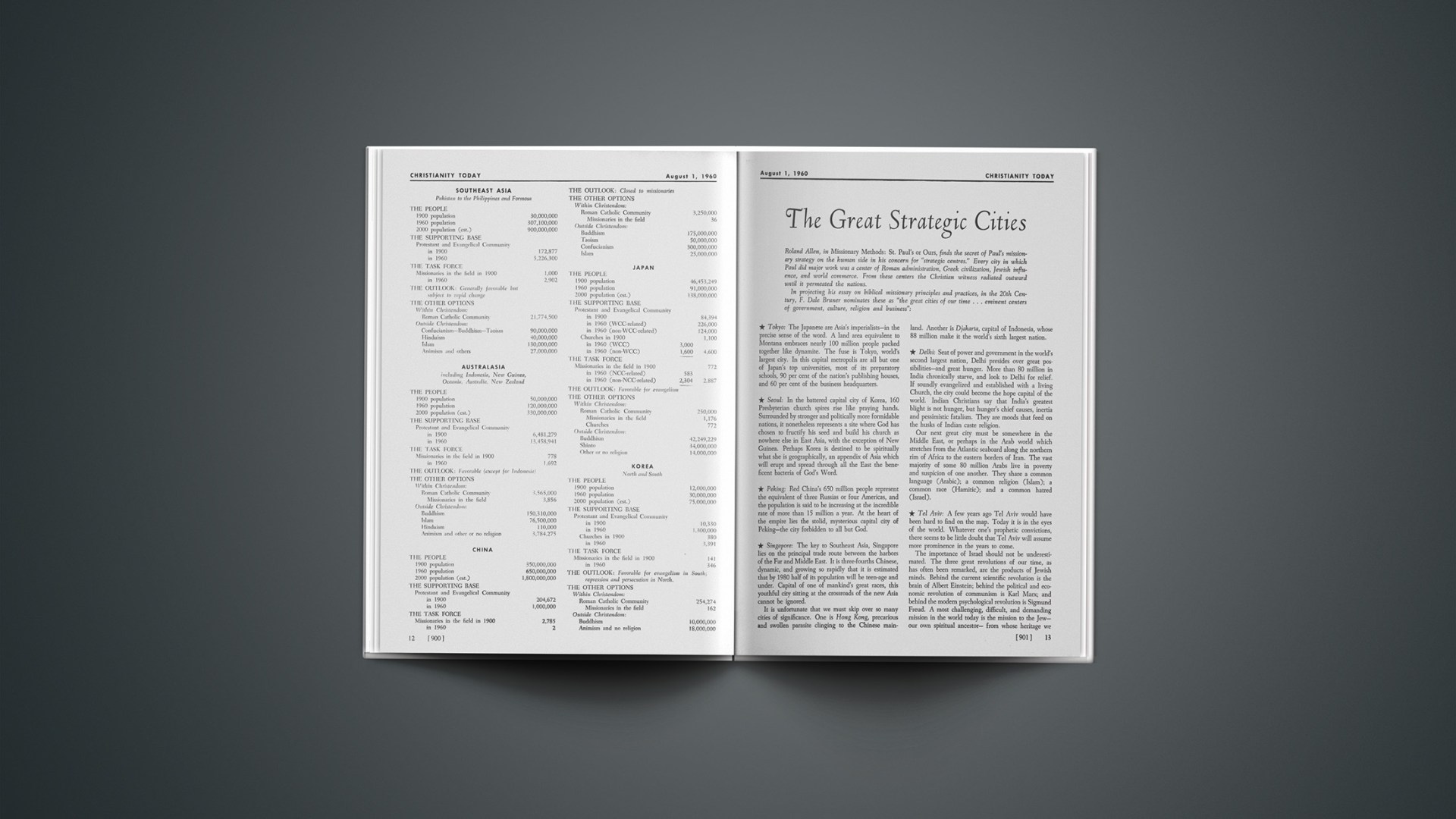
Roland Allen, in Missionary Methods: St. Paul’s or Ours, finds the secret of Paul’s missionary strategy on the human side in his concern for “strategic centres.” Every city in which Paul did major work was a center of Roman administration, Greek civilization, Jewish influence, and world commerce. From these centers the Christian witness radiated outward until it permeated the nations.

In projecting his essay on biblical missionary principles and practices, in the 20th Century, F. Dale Bruner nominates these as “the great cities of our time … eminent centers of government, culture, religion and business”:

Tokyo: The Japanese are Asia’s imperialists—in the precise sense of the word. A land area equivalent to Montana embraces nearly 100 million people packed together like dynamite. The fuse is Tokyo, world’s largest city. In this capital metropolis are all but one of Japan’s top universities, most of its preparatory schools, 90 per cent of the nation’s publishing houses, and 60 per cent of the business headquarters.

Seoul: In the battered capital city of Korea, 160 Presbyterian church spires rise like praying hands. Surrounded by stronger and politically more formidable nations, it nonetheless represents a site where God has chosen to fructify his seed and build his church as nowhere else in East Asia, with the exception of New Guinea. Perhaps Korea is destined to be spiritually what she is geographically, an appendix of Asia which will erupt and spread through all the East the beneficent bacteria of God’s Word.

Peking: Red China’s 650 million people represent the equivalent of three Russias or four Americas, and the population is said to be increasing at the incredible rate of more than 15 million a year. At the heart of the empire lies the stolid, mysterious capital city of Peking—the city forbidden to all but God.

Singapore: The key to Southeast Asia, Singapore lies on the principal trade route between the harbors of the Far and Middle East. It is three-fourths Chinese, dynamic, and growing so rapidly that it is estimated that by 1980 half of its population will be teen-age and under. Capital of one of mankind’s great races, this youthful city sitting at the crossroads of the new Asia cannot be ignored.

It is unfortunate that we must skip over so many cities of significance. One is Hong Kong, precarious and swollen parasite clinging to the Chinese mainland. Another is Djakarta, capital of Indonesia, whose 88 million make it the world’s sixth largest nation.

Delhi: Seat of power and government in the world’s second largest nation, Delhi presides over great possibilities—and great hunger. More than 80 million in India chronically starve, and look to Delhi for relief. If soundly evangelized and established with a living Church, the city could become the hope capital of the world. Indian Christians say that India’s greatest blight is not hunger, but hunger’s chief causes, inertia and pessimistic fatalism. They are moods that feed on the husks of Indian caste religion.

Our next great city must be somewhere in the Middle East, or perhaps in the Arab world which stretches from the Atlantic seaboard along the northern rim of Africa to the eastern borders of Iran. The vast majority of some 80 million Arabs live in poverty and suspicion of one another. They share a common language (Arabic); a common religion (Islam); a common race (Hamitic); and a common hatred (Israel).

Tel Aviv: A few years ago Tel Aviv would have been hard to find on the map. Today it is in the eyes of the world. Whatever one’s prophetic convictions, there seems to be little doubt that Tel Aviv will assume more prominence in the years to come.

The importance of Israel should not be underestimated. The three great revolutions of our time, as has often been remarked, are the products of Jewish minds. Behind the current scientific revolution is the brain of Albert Einstein; behind the political and economic revolution of communism is Karl Marx; and behind the modern psychological revolution is Sigmund Freud. A most challenging, difficult, and demanding mission in the world today is the mission to the Jew—our own spiritual ancestor—from whose heritage we have taken the Torah and Scriptures, and, most beneficially, their Messiah and our Lord.

The strategic city for Africa does not appear at this time. One might have suggested Cairo, but Cairo may be more part of the Middle East than of Africa. Perhaps Leopoldville, or Johannesburg. The most vigorous current leadership in Africa is apparently being exercised by Nkrumah of Ghana and Mboya of Kenya, but their leadership seems to flow more from personal power than from geographical advantage.

Moscow: Nerve-center of international communism, Moscow has come to be a living symbol to one-third the world’s land surface and one-half its population.

Berlin: Divided Berlin speaks for a divided nation which perhaps more than any other stands at the crossroads of our century. Einstein, Marx, and Freud, to whom reference has been made, were of Germanic origin as well as Jewish. The direction Germany takes in the last half of the twentieth century may be as portentous for the world as the direction she took in the first half. What the Germans do, they tend to do with extreme thoroughness. Could that great zeal be harnessed for Christ, Germany might well lead the world in spiritual awakening.

Paris: Recently a leading U.S. publisher declared that Paris is still the fashion-setter of the world—setting the pattern in everything from wearing apparel to morals. Many believe that the rise of Charles de Gaulle may have been the harbinger of a new “vogue of virtue” throughout France, in place of the vogue of the sensual. In this enigmatic city where the intellect is worshiped and the body is served, it may be too much to hope that Christ could ever become the fashion, but Paris remains one of the world’s key cities.

Rome: The center of loyalty of a score of countries is Rome, crucial because it is the site of the Holy See of the Roman Catholic church. The responsible missionary statesmen of our time must study Romanism as assiduously as he studies communism, for a mixture of reasons. There are segments of Romanism where a true witness to the Saviour is borne, yet the authentic Gospel is often overlaid with so many accretions of Roman tradition and practice that the Gospel is scarcely discernible. There remains the possibility that the seeds of primitive and pure truth can be revived and the church recalled to its ancient task by faithful witnesses without and within.

London: Great Britain, shrinking in population and in world-wide influence, is no longer mistress of the seas nor queen of a far-flung empire. Yet deposits of diplomatic wisdom and international skill are not lost in a generation. London is still at the heart of the Christian world mission. Great Britain has been the home of many of the greatest of missionary pioneers and statesmen: William Carey, Alexander Duff, Robert Morrison, Hudson Taylor, David Livingstone, Mary Slessor.

São Paulo: In 34 years the population of São Paulo has gone from 750,000 to more than 3 million. United Nations experts have marked Brazil as the one nation in our time with the potential of graduating into the great power status. A recent estimate shows the rate of growth of evangelical Christianity in Brazil as three times the rate of growth of the population as a whole. A century ago there was in Brazil one Protestant for every 250,000 Roman Catholics. Today there is one Protestant for every 39 Roman Catholics. If the industrial key city of Brazil could be won for Christ, all Latin America would feel the effect.

New York: Here is Wall Street, the wallet of the world. Here is Madison Avenue, one of the three or four opinion-setting centers. Here is America’s largest airport and the world’s largest seaport. Here is the seat of the United Nations Organization. Here is the world’s melting pot and the world’s second largest population. As someone has said, New York may not be a capital city—of either a state or a nation—but she is well on her way to becoming the capital of the world.

Here are the high potential centers of the modern world. The goal of modern missionary strategy is to occupy and inform these cities with churches and Christian leadership in key places. If from such cities the manifold gifts of God, as seen in Japanese dynamite, Korean grit, Chinese wisdom, Indian spirituality, Jewish genius, Russian virility, German industry, Roman organization, British statesmanship, Latin zeal, and American ingenuity, could all be marshalled in the power and enabling of the Holy Spirit, there would be evident in our own day a surging, genuinely ecumenical movement in and through the nations.

We Quote:

Whatever method of evangelism may be employed, the message itself cannot be altered. I have preached this message on every continent, under almost every conceivable circumstance. A quiet hush has come over almost every audience when I expound the cross and the resurrection.… There are many factors that contribute to these crusades but the underlying factor is the content of the message.—Evangelist Billy Graham, to the WCC Consultation on Evangelism in Geneva, Switzerland.

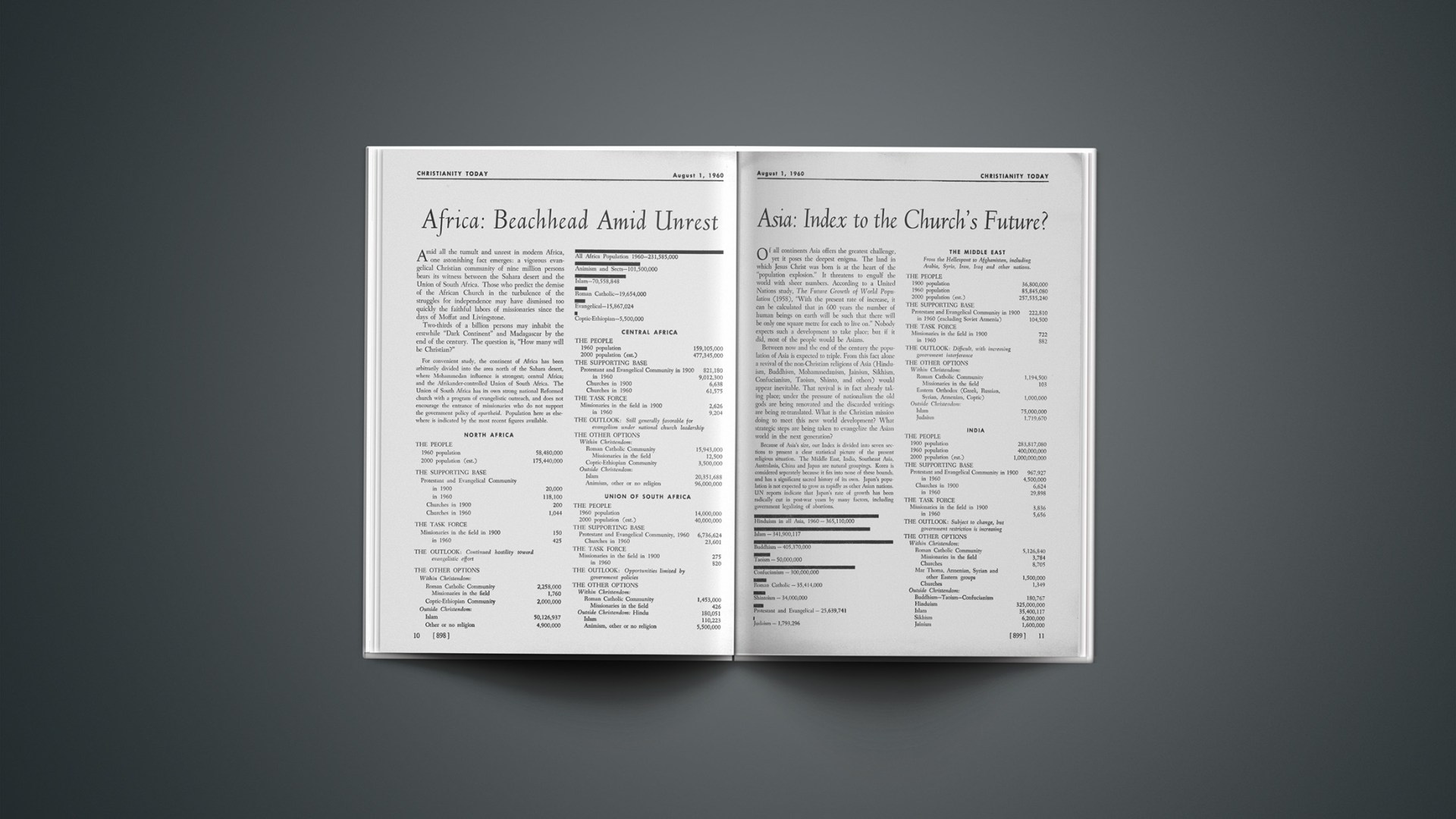
Asia: Index to the Church’s Future?

Of all continents Asia offers the greatest challenge, yet it poses the deepest enigma. The land in which Jesus Christ was born is at the heart of the “population explosion.” It threatens to engulf the world with sheer numbers. According to a United Nations study, The Future Growth of World Population (1958), “With the present rate of increase, it can be calculated that in 600 years the number of human beings on earth will be such that there will be only one square metre for each to live on.” Nobody expects such a development to take place; but if it did, most of the people would be Asians.

Between now and the end of the century the population of Asia is expected to triple. From this fact alone a revival of the non-Christian religions of Asia (Hinduism, Buddhism, Mohammedanism, Jainism, Sikhism, Confucianism, Taoism, Shinto, and others) would appear inevitable. That revival is in fact already taking place; under the pressure of nationalism the old gods are being renovated and the discarded writings are being re-translated. What is the Christian mission doing to meet this new world development? What strategic steps are being taken to evangelize the Asian world in the next generation?

Because of Asia’s size, our Index is divided into seven sections to present a clear statistical picture of the present religious situation. The Middle East, India, Southeast Asia, Australasia, China and Japan are natural groupings. Korea is considered separately because it fits into none of these bounds, and has a significant sacred history of its own. Japan’s population is not expected to grow as rapidly as other Asian nations. UN reports indicate that Japan’s rate of growth has been radically cut in post-war years by many factors, including government legalizing of abortions.

THE MIDDLE EAST

From the Hellespont to Afghanistan, including Arabia, Syria, Iran, Iraq and other nations.

INDIA

SOUTHEAST ASIA

Pakistan to the Philippines and Formosa

AUSTRALASIA

including Indonesia, New Guinea, Oceania, Australia, New Zealand

CHINA

JAPAN

KOREA

North and South

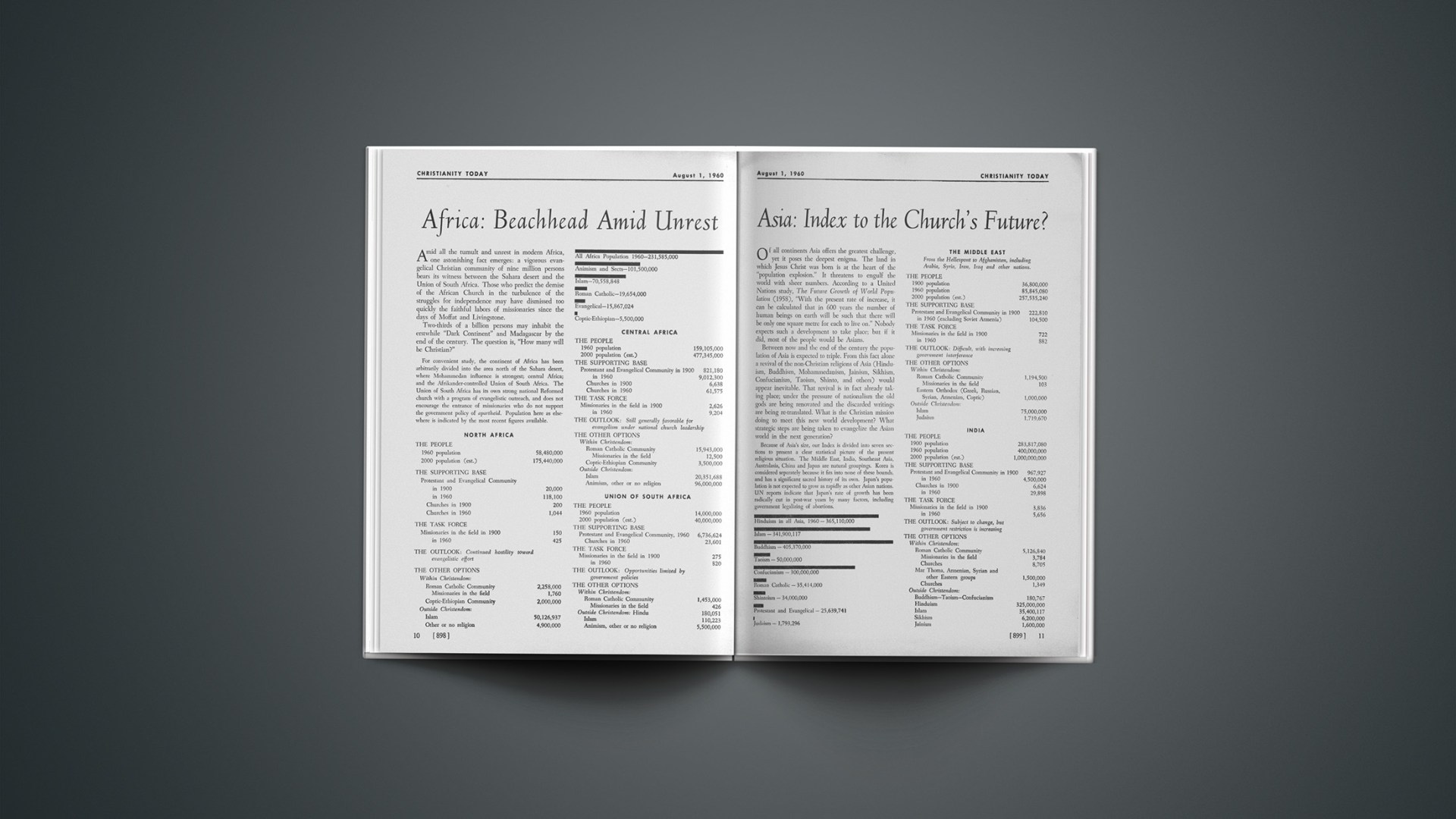
Africa: Beachhead amid Unrest

Amid all the tumult and unrest in modern Africa, one astonishing fact emerges: a vigorous evangelical Christian community of nine million persons bears its witness between the Sahara desert and the Union of South Africa. Those who predict the demise of the African Church in the turbulence of the struggles for independence may have dismissed too quickly the faithful labors of missionaries since the days of Moffat and Livingstone.

Two-thirds of a billion persons may inhabit the erstwhile “Dark Continent” and Madagascar by the end of the century. The question is, “How many will be Christian?”

For convenient study, the continent of Africa has been arbitrarily divided into the area north of the Sahara desert, where Mohammedan influence is strongest; central Africa; and the Afrikander-controlled Union of South Africa. The Union of South Africa has its own strong national Reformed church with a program of evangelistic outreach, and does not encourage the entrance of missionaries who do not support the government policy of apartheid. Population here as elsewhere is indicated by the most recent figures available.

NORTH AFRICA

CENTRAL AFRICA

UNION OF SOUTH AFRICA

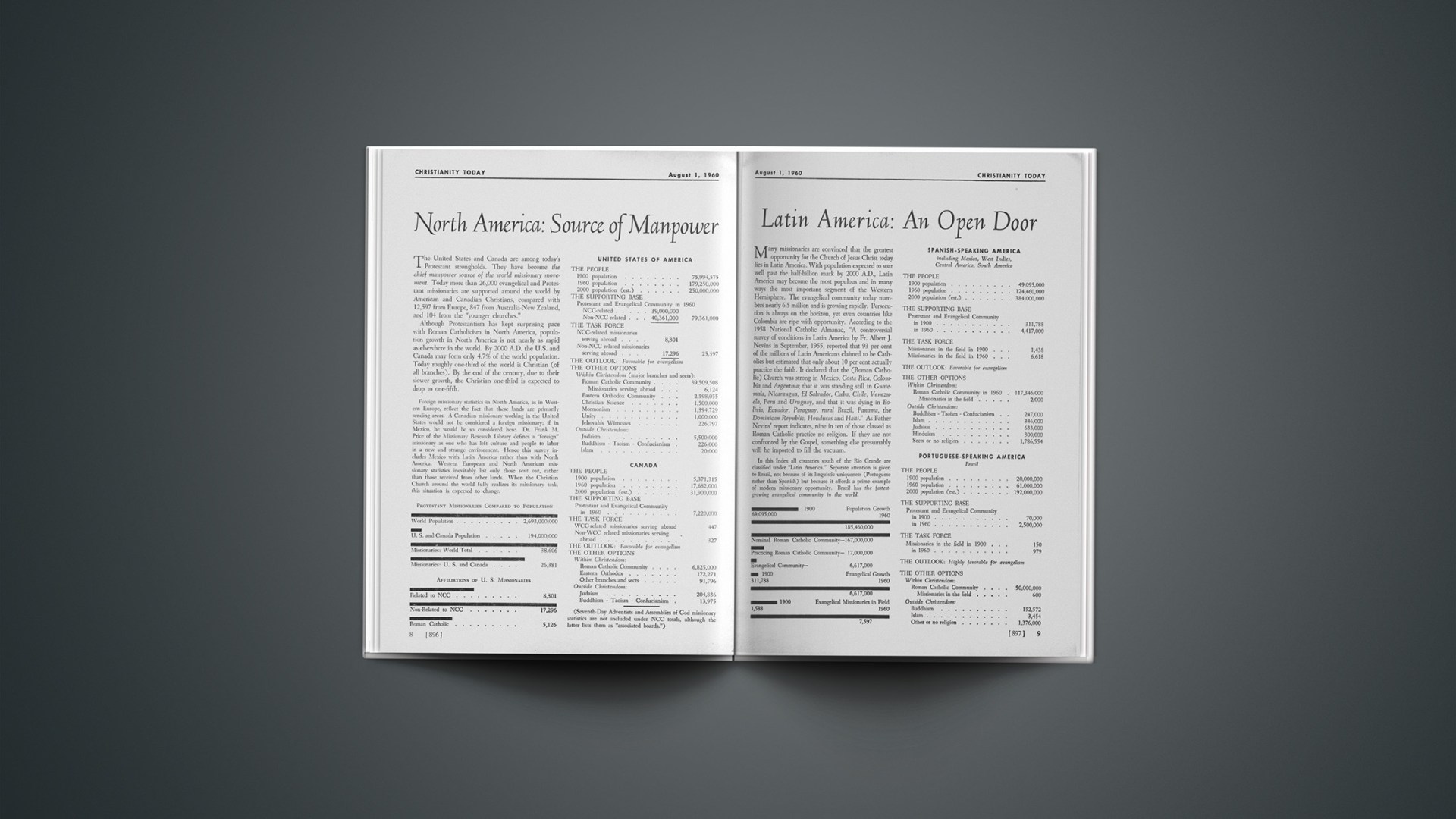
Latin America: An Open Door

Many missionaries are convinced that the greatest opportunity for the Church of Jesus Christ today lies in Latin America. With population expected to soar well past the half-billion mark by 2000 A.D., Latin America may become the most populous and in many ways the most important segment of the Western Hemisphere. The evangelical community today numbers nearly 6.5 million and is growing rapidly. Persecution is always on the horizon, yet even countries like Colombia are ripe with opportunity. According to the 1958 National Catholic Almanac, “A controversial survey of conditions in Latin America by Fr. Albert J. Nevins in September, 1955, reported that 93 per cent of the millions of Latin Americans claimed to be Catholics but estimated that only about 10 per cent actually practice the faith. It declared that the (Roman Catholic) Church was strong in Mexico, Costa Rica, Colombia and Argentina; that it was standing still in Guatemala, Nicaraugua, El Salvador, Cuba, Chile, Venezuela, Peru and Uruguay, and that it was dying in Bolivia, Ecuador, Paraguay, rural Brazil, Panama, the Dominican Republic, Honduras and Haiti.” As Father Nevins’ report indicates, nine in ten of those classed as Roman Catholic practice no religion. If they are not confronted by the Gospel, something else presumably will be imported to fill the vacuum.

In this Index all countries south of the Rio Grande are classified under “Latin America.” Separate attention is given to Brazil, not because of its linguistic uniqueness (Portuguese rather than Spanish) but because it affords a prime example of modern missionary opportunity. Brazil has the fastest-growing evangelical community in the world.

SPANISH-SPEAKING AMERICA

including Mexico, West Indies, Central America, South America

PORTUGUESE-SPEAKING AMERICA

Brazil

North America: Source of Manpower

The United States and Canada are among today’s Protestant strongholds. They have become the chief manpower source of the world missionary movement. Today more than 26,000 evangelical and Protestant missionaries are supported around the world by American and Canadian Christians, compared with 12,597 from Europe, 847 from Australia-New Zealand, and 104 from the “younger churches.”

Although Protestantism has kept surprising pace with Roman Catholicism in North America, population growth in North America is not nearly as rapid as elsewhere in the world. By 2000 A.D. the U.S. and Canada may form only 4.7% of the world population. Today roughly one-third of the world is Christian (of all branches). By the end of the century, due to their slower growth, the Christian one-third is expected to drop to one-fifth.

Foreign missionary statistics in North America, as in Western Europe, reflect the fact that these lands are primarily sending areas. A Canadian missionary working in the United States would not be considered a foreign missionary; if in Mexico, he would be so considered here. Dr. Frank M. Price of the Missionary Research Library defines a “foreign” missionary as one who has left culture and people to labor in a new and strange environment. Hence this survey includes Mexico with Latin America rather than with North America. Western European and North American missionary statistics inevitably list only those sent out, rather than those received from other lands. When the Christian Church around the world fully realizes its missionary task, this situation is expected to change.

UNITED STATES OF AMERICA

CANADA

(Seventh-Day Adventists and Assemblies of God missionary statistics are not included under NCC totals, although the latter lists them as “associated boards.”)

Europe: Cracks in a Mighty Fortress

Europe, for centuries the cradle of Christianity, has now become in part a mission field itself. The proud continent first sparked the modern missionary movement, sent Carey and Schwartz to India, Livingstone to Africa and Morrison to China. Today many of its churches are hampered in their ministry—particularly to youth—by unfriendly and atheistic governments, and are hard put to stay alive. Hardly a year passes but some far-flung mission outpost, supported for decades by European Christians, comes under American or Canadian or Australian sponsorship. In western and northern Europe, where Jesus Christ is still freely preached, young men and women hear the call and the task force is moving out. But in East Germany, where the missionary movement was once the glory of the Lutheran Church, the stream of volunteers for Christ has been reduced to a trickle by the Communists.

As in the case of North America, the Western European task force is designated statistically by those “serving abroad” rather than those “in the field.” This arrangement does not imply that Europe and North America are not to be considered legitimate “mission fields.” It simply reflects the fact that missionaries from abroad, by and large, are not now working in these areas.

WESTERN EUROPE

EASTERN EUROPE AND SIBERIA

Communist controlled

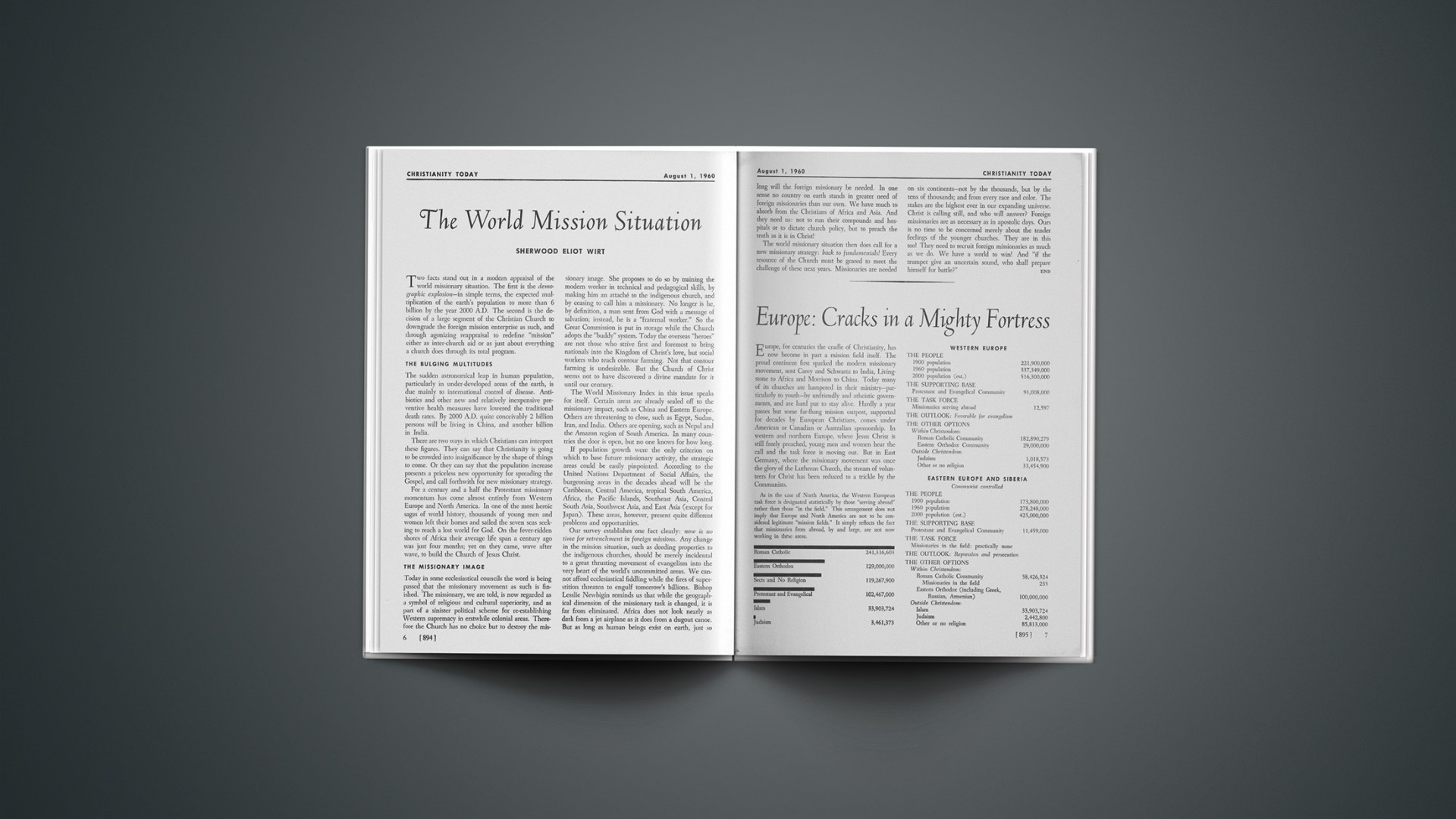
The World Mission Situation

Two facts stand out in a modern appraisal of the world missionary situation. The first is the demographic explosion—in simple terms, the expected multiplication of the earth’s population to more than 6 billion by the year 2000 A.D. The second is the decision of a large segment of the Christian Church to downgrade the foreign mission enterprise as such, and through agonizing reappraisal to redefine “mission” either as inter-church aid or as just about everything a church does through its total program.

THE BULGING MULTITUDES

The sudden astronomical leap in human population, particularly in under-developed areas of the earth, is due mainly to international control of disease. Antibiotics and other new and relatively inexpensive preventive health measures have lowered the traditional death rates. By 2000 A.D. quite conceivably 2 billion persons will be living in China, and another billion in India.

There are two ways in which Christians can interpret these figures. They can say that Christianity is going to be crowded into insignificance by the shape of things to come. Or they can say that the population increase presents a priceless new opportunity for spreading the Gospel, and call forthwith for new missionary strategy.

For a century and a half the Protestant missionary momentum has come almost entirely from Western Europe and North America. In one of the most heroic sagas of world history, thousands of young men and women left their homes and sailed the seven seas seeking to reach a lost world for God. On the fever-ridden shores of Africa their average life span a century ago was just four months; yet on they came, wave after wave, to build the Church of Jesus Christ.

THE MISSIONARY IMAGE

Today in some ecclesiastical councils the word is being passed that the missionary movement as such is finished. The missionary, we are told, is now regarded as a symbol of religious and cultural superiority, and as part of a sinister political scheme for re-establishing Western supremacy in erstwhile colonial areas. Therefore the Church has no choice but to destroy the missionary image. She proposes to do so by training the modern worker in technical and pedagogical skills, by making him an attaché to the indigenous church, and by ceasing to call him a missionary. No longer is he, by definition, a man sent from God with a message of salvation; instead, he is a “fraternal worker.” So the Great Commission is put in storage while the Church adopts the “buddy” system. Today the overseas “heroes” are not those who strive first and foremost to bring nationals into the Kingdom of Christ’s love, but social workers who teach contour farming. Not that contour farming is undesirable. But the Church of Christ seems not to have discovered a divine mandate for it until our century.

The World Missionary Index in this issue speaks for itself. Certain areas are already sealed off to the missionary impact, such as China and Eastern Europe. Others are threatening to close, such as Egypt, Sudan, Iran, and India. Others are opening, such as Nepal and the Amazon region of South America. In many countries the door is open, but no one knows for how long.

If population growth were the only criterion on which to base future missionary activity, the strategic areas could be easily pinpointed. According to the United Nations Department of Social Affairs, the burgeoning areas in the decades ahead will be the Caribbean, Central America, tropical South America, Africa, the Pacific Islands, Southeast Asia, Central South Asia, Southwest Asia, and East Asia (except for Japan). These areas, however, present quite different problems and opportunities.

Our survey establishes one fact clearly: now is no time for retrenchment in foreign missions. Any change in the mission situation, such as deeding properties to the indigenous churches, should be merely incidental to a great thrusting movement of evangelism into the very heart of the world’s uncommitted areas. We cannot afford ecclesiastical fiddling while the fires of superstition threaten to engulf tomorrow’s billions. Bishop Lesslie Newbigin reminds us that while the geographical dimension of the missionary task is changed, it is far from eliminated. Africa does not look nearly as dark from a jet airplane as it does from a dugout canoe. But as long as human beings exist on earth, just so long will the foreign missionary be needed. In one sense no country on earth stands in greater need of foreign missionaries than our own. We have much to absorb from the Christians of Africa and Asia. And they need us: not to run their compounds and hospitals or to dictate church policy, but to preach the truth as it is in Christ!

The world missionary situation then does call for a new missionary strategy: back to fundamentals! Every resource of the Church must be geared to meet the challenge of these next years. Missionaries are needed on six continents—not by the thousands, but by the tens of thousands; and from every race and color. The stakes are the highest ever in our expanding universe. Christ is calling still, and who will answer? Foreign missionaries are as necessary as in apostolic days. Ours is no time to be concerned merely about the tender feelings of the younger churches. They are in this too! They need to recruit foreign missionaries as much as we do. We have a world to win! And “if the trumpet give an uncertain sound, who shall prepare himself for battle?”

Jacob J. Vellenga served on the National Board of Administration of the United Presbyterian Church from 1948–54. Since 1958 he has served the United Presbyterian Church in the U.S.A. as Associate Executive. He holds the A.B. degree from Monmouth College, the B.D. from Pittsburgh-Xenia Seminary, Th.D. from Southern Baptist Theological Seminary, and D.D. from Monmouth College, Illinois.
A New Strategy: Statesmanship in Christian Mission

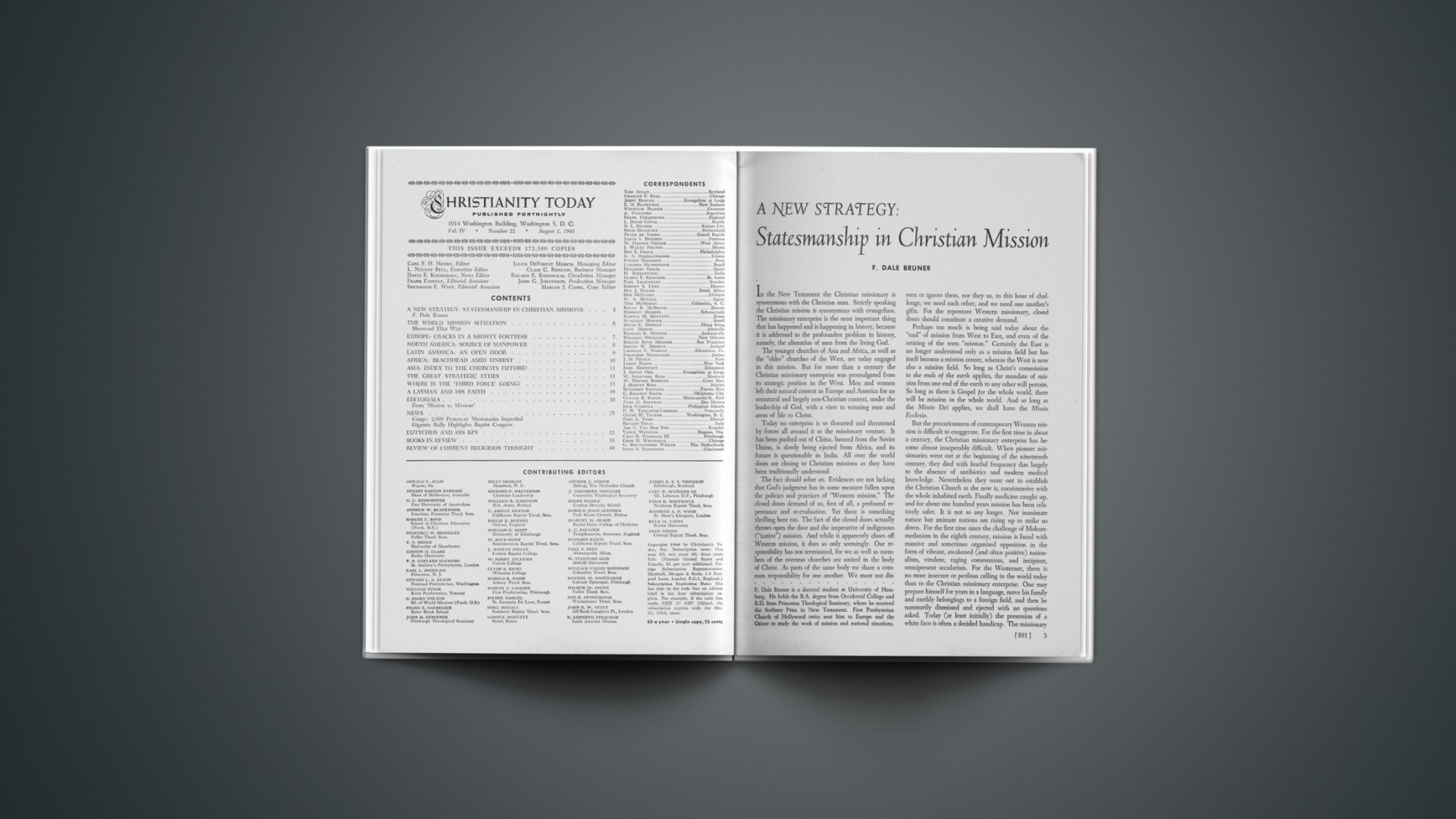
In the New Testament the Christian missionary is synonymous with the Christian man. Strictly speaking the Christian mission is synonymous with evangelism. The missionary enterprise is the most important thing that has happened and is happening in history, because it is addressed to the profoundest problem in history, namely, the alienation of men from the living God.

The younger churches of Asia and Africa, as well as the “older” churches of the West, are today engaged in this mission. But for more than a century the Christian missionary enterprise was promulgated from its strategic position in the West. Men and women left their natural context in Europe and America for an unnatural and largely non-Christian context, under the leadership of God, with a view to winning men and areas of life to Christ.

Today no enterprise is so thwarted and threatened by forces all around it as the missionary venture. It has been pushed out of China, banned from the Soviet Union, is slowly being ejected from Africa, and its future is questionable in India. All over the world doors are closing to Christian missions as they have been traditionally understood.

The fact should sober us. Evidences are not lacking that God’s judgment has in some measure fallen upon the policies and practices of “Western mission.” The closed doors demand of us, first of all, a profound repentance and re-evaluation. Yet there is something thrilling here too. The fact of the closed doors actually throws open the door and the imperative of indigenous (“native”) mission. And while it apparently closes off Western mission, it does so only seemingly. Our responsibility has not terminated, for we as well as members of the overseas churches are united in the body of Christ. As parts of the same body we share a common responsibility for one another. We must not disown or ignore them, nor they us, in this hour of challenge; we need each other, and we need one another’s gifts. For the repentant Western missionary, closed doors should constitute a creative demand.

Perhaps too much is being said today about the “end” of mission from West to East, and even of the retiring of the term “mission.” Certainly the East is no longer understood only as a mission field but has itself become a mission center, whereas the West is now also a mission field. So long as Christ’s commission to the ends of the earth applies, the mandate of mission from one end of the earth to any other will pertain. So long as there is Gospel for the whole world, there will be mission in the whole world. And so long as the Missio Dei applies, we shall have the Missio Ecclesia.

But the precariousness of contemporary Western mission is difficult to exaggerate. For the first time in about a century, the Christian missionary enterprise has become almost insuperably difficult. When pioneer missionaries went out at the beginning of the nineteenth century, they died with fearful frequency due largely to the absence of antibiotics and modern medical knowledge. Nevertheless they went out to establish the Christian Church as she now is, coexistensive with the whole inhabited earth. Finally medicine caught up, and for about one hundred years mission has been relatively safer. It is not so any longer. Not inanimate nature but animate nations are rising up to strike us down. For the first time since the challenge of Mohammedanism in the eighth century, mission is faced with massive and sometimes organized opposition in the form of vibrant, awakened (and often positive) nationalism, virulent, raging communism, and incipient, omnipresent secularism. For the Westerner, there is no more insecure or perilous calling in the world today than to the Christian missionary enterprise. One may prepare himself for years in a language, move his family and earthly belongings to a foreign field, and then be summarily dismissed and ejected with no questions asked. Today (at least initially) the possession of a white face is often a decided handicap. The missionary enterprise offers a young man no earthly certainty, only uncertainties and insecurities.

One is reminded of Garibaldi’s classic and terse address to his troops on the eve of the French entry into Rome: “Let those who wish to continue the war come with me. I offer neither pay, nor quarters, nor provision. I offer hunger, thirst, forced marches, battles, and death.” Four thousand men followed Garibaldi that night. A greater than Garibaldi stands in our midst today, invisibly and imperiously, offering no more, asking no less. He offers only the provision of His presence (and “it is enough”!), and asks far more—a heart burning for the salvation of men and nations, and a mind ready to think.

That the missionary enterprise has entered a new day is abundantly evident. Because of the obedience of yesterday’s pioneer missionaries, the Church is planted today in almost every nation of the earth. Should a missionary ignore or intentionally bypass the already existing church in the land to which he goes, he displays bad faith not only towards his predecessors and contemporaries but towards the Holy Spirit who brought the church into existence. Today the emphasis rightly falls not upon the missionary and his labors but upon the Younger Churches and their life. As we hear so often, the missionary is no longer master and church builder but servant and church member. The peril in the well-known emphasis of “the new day” is that, in stressing the new “servanthood” of the missionary, it may appear to young men and women concerned for mission that their qualifications are significantly downgraded and demeaned. Such is far from being the case. The qualifications are greater—in humility and grace. The demands are higher—in flexibility and initiative. The Younger Churches are telling us today that the crying need from their overseas brothers is not quantity (more missionaries) but quality (better missionaries). Indeed, our time—the time of closed doors—calls for a quality of missionary commitment which really deserves the designation of statesmanship.

THE APOSTOLIC PROTOTYPE

The finest definition we have found of the character of missionary statesmanship comes from the pen of the prototype missionary statesman, the Apostle Paul. It is expressed in the opening verses of Paul’s classic, the Epistle to the Romans. The first seven verses constitute one long sentence in which Paul uses twice the little Greek preposition of purpose éis, meaning “unto.” This word “unto” is the key unlocking the meaning of missionary statesmanship, or its ancient semi-equivalent, apostleship. After his opening words, “Paul, slave of Christ, called to be an apostle” (important opening words!), we have the operative phrase, “separated unto the gospel of God” (which he proceeds to define), “… unto the obedience of faith among all the nations for his name’s sake.” Now there were two great “unto’s,” two great preoccupations in the Apostle’s life: the first was the gospel of God—the Word; and the second was the nations of men—the world.

Paul’s first preoccupation was the Gospel—the Word. He pored over it, he pondered it; and with his heart and soul, pen and voice, he pounded it out on the anvil of his time. The finished product of Paul’s separation unto the Gospel is preserved for us in some measure in his 13 New Testament Epistles which make up half our New Testament masterpieces of monumental thought.

But Paul was not separated unto the Gospel for its own sake. He was separated unto the Gospel, as he writes himself, “unto the obedience of faith among all the nations.” He was separated unto the Word for the sake of the world. The missionary statesman must be a man of both the Word and the world. He would know the Word like a scholar and the world like a Secretary of State. He must labor to be unrivaled in his appropriation of the Bible message, and be second to none in his alertness to the world situation. A missionary statesman must be both a gospel man and a global man, reverent and relevant, whose passion is the glory of the Name through the disciplining of the nations. The primary character of missionary statesmanship, then, may be provisionally defined as a deep separation unto the Word for the sake of the world.

ADDRESSING THE WORLD

Although missionary statesmanship demands an unparalleled alertness to the political, social, economic, intellectual, and spiritual vicissitudes of the world of men, its principal message is not to be drawn from that world. It is to be drawn from another source and applied to that world. The message of the missionary statesman must be no less than his principal preoccupation, the Word of God, which is the Gospel. And certainly the Gospel, is at least and at center the news that the one true God, the Creator and Sustainer of the universe, has intersected history in the person of his Son, our Lord Jesus Christ, just as he had promised in the Scriptures of the Old Testament. Furthermore, this Son was a man of the lineage of David who slugged it out with the evil all his life up to the Cross, where by taking our sins upon himself, he forever maimed sin and killed death dead. Then by an unprecedented resurrection from the dead, he was designated the Son of God, and is now King of kings, Lord of lords, and actually lives as Sovereign in the hearts of every person who by faith has received his offer of salvation and his office of Lord. Those who know him by faith make up his holy, catholic, and apostolic Church, and through her he is working out his purposes in the world. One day he shall return in glory to sit as Judge over the world, directing the secular and the fleshly to hell and the faithful and believing to heaven, and every knee shall bow in that day and every tongue shall confess that he is Lord, to the glory of God, and then he himself shall give over his dignity to God the Father, so that God may be all in all, for ever.

The outline given above is the body of the Gospel. The heart of the Gospel is God’s gracious offer of fellowship and friendship with man, which means our acceptance before God, the forgiveness of every sin, and the very presence and power of God in the person of the Holy Spirit in his life. Such gospel benefits have been provided by the work of the crucified and living Christ, and we receive them by faith alone.

I stand in awe before this great Gospel. It requires more than a lifetime to plumb its depths, apply its healing, and proclaim its truth. Its message, its marvelous news, must be the principal and paramount burden of missionary statesmanship. To summarize, then, we understand the primary character of missionary statesmanship to be a separation unto the Word of God and the world of men, and the principal message of missionary statesmanship to be the Word of God, the Gospel.

THE DIVINE STRATEGY

We come now to the priority strategy of missionary statesmanship. Human strategy in a divine enterprise is a dangerous affair, for “His thoughts are not our thoughts.” One may become more concerned with human strategy than with the Spirit of God, whose purpose it is to develop strategy and to lead us in it. Nevertheless, God has seen fit to reveal to us in his Word his own priority pattern and strategy of mission.

It seems clear not only from the New Testament but also the Old that God’s major missionary strategy through the ages has been to reach the nations through their great cities. In Jonah, for example, which is the major missionary epistle of the Old Testament, one will notice that in calling his prophet, God stated three times, “go to Nineveh,” adding pointedly, “that great city” (1:1–2; 3:2–3; and cf. 4:11). If Assyria, the major world empire of mid-Old Testament times, was to be influenced for God, then her capital city of Nineveh was the strategic beachhead.

We have a further example of God’s missionary strategy in New Testament times. When the gospel witness was fully established in Jerusalem, God moved Paul to establish churches in the great cities of the Roman Empire, namely, in Ephesus, the key city of Asia Minor; in Philippi, the capital city of Macedonia; in Corinth, the commercial key to Greece; and to establish connection with the Christians in the city of Rome, the seat of the Roman Empire. Paul’s work was so successful that Roland Allen, in his Missionary Methods: St. Paul’s Or Ours, writes: “In little less than ten years St. Paul established the Church in four provinces of the (Roman) Empire, Galatia, Macedonia, Achaia, and Asia. Before 47 A.D. there were no churches in these provinces; in 57 A.D., St. Paul could speak as if his work there were done.…” What was it that made Paul’s missionary work so extraordinarily successful? Allen points out in his opening chapter, “Strategic Centres,” that it was due partly to his being guided by certain principles in the selection of his places of work. Every major city in which Paul worked had four distinct features: it was a center of Roman administration, of Greek civilization, of Jewish influence; and of world commerce. In other words, here were centers of government, culture, religion, and business.

Paul’s plan was that these cities should become the “centers of light” for their whole province; that from these key cities the outlying territories and eventually the whole nation would be evangelized. Most cities in which Paul worked were cosmopolitan, not provincial, and as such were especially fitted to be centers for the dissemination of the world-wide Gospel. They were the crossroads of the Roman Empire.

There is, and always will be, an important place for rural, “bush,” and out-of-the-way mission. It has been the glory of the Christian Church that she has gone to regions where no one else dared or desired to traverse to bring the Gospel and its healing accompaniments. And God continues to call men and women to arduous pioneer work.

Yet the prime strategy, if Scripture is to give us a lead and the Apostle is correct, must lie with the regnant “centers of light,” the teeming and seemingly impenetrable metropolises from which the truth of the Gospel can radiate into all the corners of the province and nation. The cities must be “occupied for Christ.”

When we learn that less than one of every 100 persons walking the continent of Asia is a Christian, we know that something is wrong. When we hear from Dr. James Robinson of Harlem’s Church of the Master the sobering news that he saw more trained Christian workers on two mid-western American university campuses than in all of Asia, we sense again something is wrong. Indeed something is deeply wrong. But we know this Saving Fact: there is nothing wrong with God and his Gospel. God is not frustrated; nor is he dismayed. God is God. We may hope that the wrongs of our time may in some measure be righted as men who love this god and his Gospel, separate themselves unto his Word for the sake of his world, and plant themselves with resolution in the life of the churches, within the strategic centers of our time, as servants and statesmen of the most high God.

Jacob J. Vellenga served on the National Board of Administration of the United Presbyterian Church from 1948–54. Since 1958 he has served the United Presbyterian Church in the U.S.A. as Associate Executive. He holds the A.B. degree from Monmouth College, the B.D. from Pittsburgh-Xenia Seminary, Th.D. from Southern Baptist Theological Seminary, and D.D. from Monmouth College, Illinois.
Review of Current Religious Thought: July 18, 1960

Part of the renaissance of the city of Pittsburgh has been the renaissance of the University of Pittsburgh under the dynamic and imaginative direction of Chancellor Litchfield. One of the nicest things at Pitt has been the creation of the “Book Center”—“it’s a rouser for a browser”—and one of the nicest things at the “Book Center” is the series of book reviews being presented every two weeks, reviews usually by members of the faculty conversant with the themes of the books, or, best of all, the occasions when the authors themselves appear to review their own books and lay themselves open to question and discussion. As visiting chaplain at Pitt this year I get invitations to the reviews and always resent anything in my schedule which makes it impossible to attend.

Just about a month ago we had a review by Robert Musser Brown of his new and first novel, Brother, Which Drummer. You would have to be a Thoreau enthusiast to catch the allusion in the title: “If a man does not keep pace with his companions, perhaps it is because he hears a different drummer. Let him step to the music which he hears, however measured or far away.” Brown is an executive, a vice-president in Pittsburgh’s largest advertising agency. He understands the pressure and the pace of modern business, indeed, through his agency experiences he must understand many businesses. The problem of his novel is related to the pressures brought upon a man who is trying to live his moral life in immoral society, but beyond this moral problem he works on a distinctively Christian problem, namely, whether a man paced to his own drum beat, can, through the exercise of affirming and forgiving love, bring another man to listen with him and perhaps change his pace. It is a book about sin and redemption with the fundamental problem of whether a Christian way of doing things can be redemptive even in the moral ambiguities to which a man is exposed in modern business competition. I have no notion of reviewing this book, even though I heartily recommend it; for my purpose I shall call attention to several things which I think arc significant: I. In a modern novel (ultra-modern you may think at some points) the teaching of Jesus is given serious consideration in direct conversation covering about two pages; 2. The theme of the book is a Christian theme and thus requires, as many modern novels deny, some stance with regard to what is right and what is wrong and what the redemptive struggle requires; 3. The battle between good and evil is carried out in the arena where man is living, and where so many men are living today in the era of big business; 4. At least in this novel, and Brown will write some others, there is no effort to solve a man’s moral dilemmas by changing the economic system, as if the change in scenery would change the basic issues—Adam fell in paradise! 5. As a religious novel the book is not a namby-pamby saccharine effort in which unreal characters have unreal temptations and gain unimportant victories; the forces of evil are constant, universal, attractive, and always subtle, and the results of brutal choices are not always pretty and clean-cut; 6. The author is a very attractive man. Besides being a top-flight businessman he is, as the jacket blurb tells us, “an accomplished musician …” and among “his other interests, in addition to writing, he lists tennis, tropical fish, church work, and hiking.” Now what do you think of a vice-president and the author of a modern novel who lists “church work” as one of his interests!

My intention had been to treat Brown briefly in order to get at some wider generalities, but he sort of took me over in the above paragraphs the way he charmed me the day he reviewed his book. I am enchanted by what I think, or maybe wish, is happening to the novel, and maybe to the stage. It will have to happen, because there is no story to tell, really, unless the moral struggle is clearly drawn and squarely faced. This fact was made plain to me first in a book by Randall Stewart, American Literature and Christian Doctrine. Stewart is a free-lance writer for the Saturday Review, and was visiting professor at Vanderbilt University when his book came out in 1957. His thesis is that there is no great literature in the American tradition without great doctrine—God, Man, Sin, Redemption. He illustrates in his own way from such great novels as Moby Dick and The Scarlet Letter. Another man who has written along the same line is Edmund Fuller of Kent School. His book is Man in Modern Fiction. Again the approach is Christian; there is no doctrine of man without a doctrine of God, and a story has no real plot without real straggle, and you can’t have a real strangle without a moral issue.

Our seminary librarian of former days, an amazingly widely-read woman, heard some of my effusions about Stewart and Fuller and guided me to Arnold Stein. The first book I read by Stein was his Heroic Knowledge, a profound and beautifully written study of Milton’s Paradise Regained and Samson Agonistes. That book led me to his former work, Answerable Style, a series of studies on Milton’s Paradise Lost in which the author, primarily from the standpoint of literary criticism, but inescapably aware of the moral issues, is showing how the style of Milton is answerable to the magnitude of his subject matter, but nevertheless possible only because of the religious magnitude of Milton himself. Arnold Stein is professor of English at the University of Washington. Read I lopper’s Spiritual Problems in Contemporary Literature, especially his essay by Denis de Rougemont in which, somewhat after the clue of Dorothy Sayers, he sees an understanding of the creative artist in our acceptance of the reality of the Trinity. You should get a whole hat-full of ideas from that one essay. And, of course, our friend C. S. Lewis has been at this a long time—not in his specific books on “religion”—in his literary criticism, The Allegory of Love, and Preface to Paradise Lost, to name two. Something good is happening.

Apple PodcastsDown ArrowDown ArrowDown Arrowarrow_left_altLeft ArrowLeft ArrowRight ArrowRight ArrowRight Arrowarrow_up_altUp ArrowUp ArrowAvailable at Amazoncaret-downCloseCloseEmailEmailExpandExpandExternalExternalFacebookfacebook-squareGiftGiftGooglegoogleGoogle KeephamburgerInstagraminstagram-squareLinkLinklinkedin-squareListenListenListenChristianity TodayCT Creative Studio Logologo_orgMegaphoneMenuMenupausePinterestPlayPlayPocketPodcastRSSRSSSaveSaveSaveSearchSearchsearchSpotifyStitcherTelegramTable of ContentsTable of Contentstwitter-squareWhatsAppXYouTubeYouTube