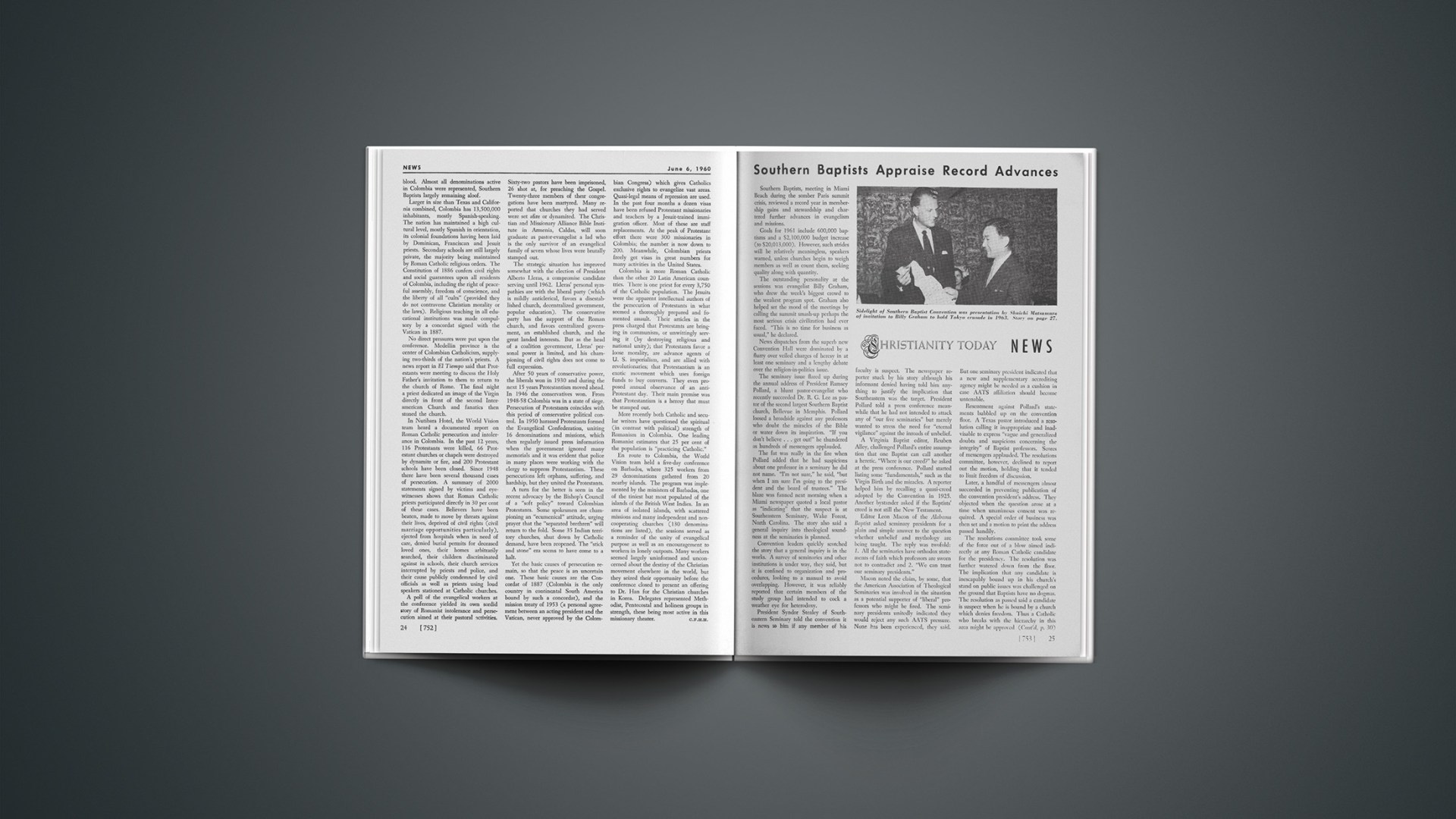
Southern Baptists Appraise Record Advances

Southern Baptists, meeting in Miami Beach during the somber Paris summit crisis, reviewed a record year in membership gains and stewardship and chartered further advances in evangelism and missions.

Goals for 1961 include 600,000 baptisms and a $2,100,000 budget increase (to $20,013,000). However, such strides will be relatively meaningless, speakers warned, unless churches begin to weigh members as well as count them, seeking quality along with quantity.

The outstanding personality at the sessions was evangelist Billy Graham, who drew the week’s biggest crowd to the weakest program spot. Graham also helped set the mood of the meetings by calling the summit smash-up perhaps the most serious crisis civilization had ever faced. “This is no time for business as usual,” he declared.

News dispatches from the superb new Convention Hall were dominated by a flurry over veiled charges of heresy in at least one seminary and a lengthy debate over the religion-in-politics issue.

The seminary issue flared up during the annual address of President Ramsey Pollard, a blunt pastor-evangelist who recently succeeded Dr. R. G. Lee as pastor of the second largest Southern Baptist church, Bellevue in Memphis. Pollard loosed a broadside against any professors who doubt the miracles of the Bible or water down its inspiration. “If you don’t believe … get out!” he thundered as hundreds of messengers applauded.

The fat was really in the fire when Pollard added that he had suspicions about one professor in a seminary he did not name. “I’m not sure,” he said, “but when I am sure I’m going to the president and the board of trustees.” The blaze was fanned next morning when a Miami newspaper quoted a local pastor as “indicating” that the suspect is at Southeastern Seminary, Wake Forest, North Carolina. The story also said a general inquiry into theological soundness at the seminaries is planned.

Convention leaders quickly scotched the story that a general inquiry is in the works. A survey of seminaries and other institutions is under way, they said, but it is confined to organization and procedures, looking to a manual to avoid overlapping. However, it was reliably reported that certain members of the study group had intended to cock a weather eye for heterodoxy.

President Syndor Stealey of Southeastern Seminary told the convention it is news to him if any member of his faculty is suspect. The newspaper reporter stuck by his story although his informant denied having told him anything to justify the implication that Southeastern was the target. President Pollard told a press conference meanwhile that he had not intended to attack any of “our five seminaries” but merely wanted to stress the need for “eternal vigilance” against the inroads of unbelief.

A Virginia Baptist editor, Reuben Alley, challenged Pollard’s entire assumption that one Baptist can call another a heretic. “Where is our creed?” he asked at the press conference. Pollard started listing some “fundamentals,” such as the Virgin Birth and the miracles. A reporter helped him by recalling a quasi-creed adopted by the Convention in 1925. Another bystander asked if the Baptists’ creed is not still the New Testament.

Editor Leon Macon of the Alabama Baptist asked seminary presidents for a plain and simple answer to the question whether unbelief and mythology are being taught. The reply was twofold: 1. All the seminaries have orthodox statements of faith which professors are sworn not to contradict and 2. “We can trust our seminary presidents.”

Macon noted the claim, by some, that the American Association of Theological Seminaries was involved in the situation as a potential supporter of “liberal” professors who might be fired. The seminary presidents unitedly indicated they would reject any such AATS pressure. None has been experienced, they said. But one seminary president indicated that a new and supplementary accrediting agency might be needed as a cushion in case AATS affiliation should become untenable.

Resentment against Pollard’s statements bubbled up on the convention floor. A Texas pastor introduced a resolution calling it inappropriate and inadvisable to express “vague and generalized doubts and suspicions concerning the integrity” of Baptist professors. Scores of messengers applauded. The resolutions committee, however, declined to report out the motion, holding that it tended to limit freedom of discussion.

Later, a handful of messengers almost succeeded in preventing publication of the convention president’s address. They objected when the question arose at a time when unanimous consent was required. A special order of business was then set and a motion to print the address passed handily.

The resolutions committee took some of the force out of a blow aimed indirectly at any Roman Catholic candidate for the presidency. The resolution was further watered down from the floor. The implication that any candidate is inescapably bound up in his church’s stand on public issues was challenged on the ground that Baptists have no dogmas. The resolution as passed said a candidate is suspect when he is bound by a church which denies freedom. Thus a Catholic who breaks with the hierarchy in this area might be approved The resolution reaffirmed support for the constitutional ban on religious heads for public office.

At a press conference arranged by convention officials, Billy Graham declined comment on the religion-in-politics resolution. Citing a recent opinion poll which indicated most Catholics would support any Catholic candidate, Graham said this was “just as bad” as voting against a man solely because he is a Catholic. The evangelist said he agreed generally with a recent Look article by Eugene Carson Blake and G. Bromley Oxnam.

The real issue, said Graham is the seriousness of the world situation. The nation’s leader should be a man of experience and world stature. “This is no time to experiment with novices,” he commented. Some reporters, ignoring Graham’s direct statements that he was not taking sides and that both parties have experienced candidates, interpreted his statement as an endorsement of Vice President Nixon.

The convention took no direct action on the racial issue. Several speakers said Southern Baptists’ numbers and position give them a special responsibility in the field. The Christian Life Commission, whose pronouncements often have been challenged, was given a small budgetary increase. The commission’s report, which was received as information, called on Baptists to use every opportunity to help Negroes obtain equal rights, especially the right to vote, and to “thoughtfully oppose any customs which may tend to humiliate them in any way.”

A proposed resolution against federal grants to schools of nursing was referred to the Public Affairs Committee after it was pointed out that its phraseology might be in conflict with the current policy of some Baptist institutions to accept low interest rate government loans.

The question of moving the convention’s executive committee headquarters out of Nashville was postponed by committee action. Members are divided over where to go. In the background are two factors: Nashville’s efforts to tax denominational properties and a desire to underscore the executive committee’s neutral, supervisory role by separating it physically from major agencies which it guides or evaluates.

A new procedure designed to forestall development of a clerical hierarchy began going into practical effect at the convention. Adopted last year, the new rule requires that at least one-third of the members of each board must be laymen.

A proposed resolution asking the Sunday School board to sever alleged ties with the National Council of Churches died aborning after a vigorous statement by executive secretary James Sullivan, who said the board had no more affiliation with the NCC than with the Atomic Energy Commission. It is true that the board pays copyright fees for use of a uniform lesson plan, but all Baptist lesson materials are written by Baptist editors and participation in the lesson plan does not involve membership in the council, he said.

The two greatest cohesive elements in Southern Baptist life are the foreign mission board and the Sunday School board. As usual, foreign missions night was a major convention attraction. The Sunday School board’s unlimited offer to be open to inspection enhanced its already high standing. A wordy, dull presentation of home missions was rescued by fresh testimonies from converts and grass roots workers and by Bev Shea’s singing and Billy Graham’s preaching. Seminaries are generally conceded to be doing a good job but there are rumblings of discontent and not all of them can be dismissed as age-old differences between scholars and country preachers.

President Pollard was renamed without opposition to an expected second term. Two pastors, W. O. Vaught of Arkansas and John Slaughter of South Carolina are the new vice presidents. The pastors’ conference elected Roy McClain of Georgia, who was in a run-off for the convention presidency last year.

The convention, which already had 19 boards and commissions, got another when the stewardship committee of the executive committee was given independent commission status. The Relief and Annuity Board became the Annuity Board with the dropping of part of its name.

Nearly 10,000 new churches and missions have been established since 1956, but new life is needed for a “30,000 Movement” if its goal is to be reached by 1964.

New satellites have opened a golden age of communications, making world-wide radio and television realities instead of possibilities, according to Paul Stevens of the Radio-TV Commission who said “Southern Baptists must be alerted and must prepare themselves adequately to make use of these facilities at once.” The convention rushed passage of a resolution calling for Christian patience and an emphasis on spiritual foundations and moral regeneration in world peace negotiations.
World Vision in Colombia: Protestant Mission in a Catholic Stronghold

Gathering 350 pastors and workers from Colombia, Venezuela and Ecuador, an epochal World Vision conference May 9–13 prodded evangelical forces to a deeper sense of their spiritual task in a time of unrest in Latin America. In the newly completed auditorium of the Interamerican Mission Seminary campus in Medellín (second in size to Colombia’s capital city in Bogotá), delegates heard Dr. Bob Pierce, Dr. Paul Rees, Dr. Kyung Chik Han of Korea, and Editor Carl F. H. Henry of CHRISTIANITY TODAY press the burning relevance of the Gospel to the plight of modern man and contemporary culture.

Colombia has been a center of Romanist repression, and not infrequently of persecution, of Protestant missionary effort.

Chafing under press reports of Romanist intolerance, spokesmen for the U. S. Catholic church, steadily expanding a drive for political power, have commented ambivalently. Some have waved aside the accounts as “mere propaganda”; others have deplored the tendency of Protestants to identify Romanism with “Spanish Christianity” (without themselves repudiating it); others have spoken of religious liberty as a proper expectation by non-Romanists.

Evangelical workers in Latin America have steadily sharpened their evangelistic focus, aware that Roman strategy changes frequently. Colombia today has the fastest growing evangelical population in the world. In Medellín the 350 delegates included 30 from Western Venezuela and 30 from Ecuador; the others were from Colombia (50 missionaries, 240 nationals). This was more than four times the number of full-time Protestant workers ever gathered in assembly in Colombia. Roman Catholic persecution has purified the Church and stimulated growth. Baptized church members increased 51 per cent during the five worst years of persecution, and the Protestant community now numbers about one per cent of the population. A survey of evangelical work in Colombia by the Evangelical Confederation and the National Pastors’ Conference now shows 192 organized Protestant Spanish-speaking churches, 401 congregations with regular services, 119 Protestant-sponsored schools, 22 hospitals, dispensaries or clinics, and 13 seminaries or Bible institutes. But there is still only one worker for every 24,000 inhabitants.

World Vision arrangements were implemented by the Rev. Robert W. Lazear, Jr., of Bogotá, executive secretary of the Evangelical Confederation, and the Rev. Bert Biddulph, rector of the Interamerican Seminary in Medellín. Following the conference, the seminary dedicated its new building—a gift of World Vision—and carried on another week with study courses. The background, education and intellectual level of Colombian pastors are extremely varied, from rural worker to city pastor. Cultural background too is varied, with diverse mixtures of Spanish, Indian and Negro blood. Almost all denominations active in Colombia were represented, Southern Baptists largely remaining aloof.

Larger in size than Texas and California combined, Colombia has 13,500,000 inhabitants, mostly Spanish-speaking. The nation has maintained a high cultural level, mostly Spanish in orientation, its colonial foundations having been laid by Dominican, Franciscan and Jesuit priests. Secondary schools are still largely private, the majority being maintained by Roman Catholic religious orders. The Constitution of 1886 confers civil rights and social guarantees upon all residents of Colombia, including the right of peaceful assembly, freedom of conscience, and the liberty of all “cults” (provided they do not contravene Christian morality or the laws). Religious teaching in all educational institutions was made compulsory by a concordat signed with the Vatican in 1887.

No direct pressures were put upon the conference. Medellín province is the center of Colombian Catholicism, supplying two-thirds of the nation’s priests. A news report in El Tiempo said that Protestants were meeting to discuss the Holy Father’s invitation to them to return to the church of Rome. The final night a priest dedicated an image of the Virgin directly in front of the second Interamerican Church and fanatics then stoned the church.

In Nutibara Hotel, the World Vision team heard a documented report on Roman Catholic persecution and intolerance in Colombia. In the past 12 years, 116 Protestants were killed, 66 Protestant churches or chapels were destroyed by dynamite or fire, and 200 Protestant schools have been closed. Since 1948 there have been several thousand cases of persecution. A summary of 2000 statements signed by victims and eye-witnesses shows that Roman Catholic priests participated directly in 30 per cent of these cases. Believers have been beaten, made to move by threats against their lives, deprived of civil rights (civil marriage opportunities particularly), ejected from hospitals when in need of care, denied burial permits for deceased loved ones, their homes arbitrarily searched, their children discriminated against in schools, their church services interrupted by priests and police, and their cause publicly condemned by civil officials as well as priests using loud speakers stationed at Catholic churches.

A poll of the evangelical workers at the conference yielded its own sordid story of Romanist intolerance and persecution aimed at their pastoral activities. Sixty-two pastors have been imprisoned, 26 shot at, for preaching the Gospel. Twenty-three members of their congregations have been martyred. Many reported that churches they had served were set afire or dynamited. The Christian and Missionary Alliance Bible Institute in Armenia, Caldas, will soon graduate as pastor-evangelist a lad who is the only survivor of an evangelical family of seven whose lives were brutally stamped out.

The strategic situation has improved somewhat with the election of President Alberto Lleras, a compromise candidate serving until 1962. Lleras’ personal sympathies are with the liberal party (which is mildly anticlerical, favors a disestablished church, decentralized government, popular education). The conservative party has the support of the Roman church, and favors centralized government, an established church, and the great landed interests. But as the head of a coalition government, Lleras’ personal power is limited, and his championing of civil rights does not come to full expression.

After 50 years of conservative power, the liberals won in 1930 and during the next 15 years Protestantism moved ahead. In 1946 the conservatives won. From 1948–58 Colombia was in a state of siege. Persecution of Protestants coincides with this period of conservative political control. In 1950 harassed Protestants formed the Evangelical Confederation, uniting 16 denominations and missions, which then regularly issued press information when the government ignored many memorials and it was evident that police in many places were working with the clergy to suppress Protestantism. These persecutions left orphans, suffering, and hardship, but they united the Protestants.

A turn for the better is seen in the recent advocacy by the Bishop’s Council of a “soft policy” toward Colombian Protestants. Some spokesmen are championing an “ecumenical” attitude, urging prayer that the “separated brethren” will return to the fold. Some 35 Indian territory churches, shut down by Catholic demand, have been reopened. The “stick and stone” era seems to have come to a halt.

Yet the basic causes of persecution remain, so that the peace is an uncertain one. These basic causes are the Concordat of 1887 (Colombia is the only country in continental South America bound by such a concordat), and the mission treaty of 1953 (a personal agreement between an acting president and the Vatican, never approved by the Colombian Congress) which gives Catholics exclusive rights to evangelize vast areas. Quasi-legal means of repression are used. In the past four months a dozen visas have been refused Protestant missionaries and teachers by a Jesuit-trained immigration officer. Most of these are staff replacements. At the peak of Protestant effort there were 300 missionaries in Colombia; the number is now down to 200. Meanwhile, Colombian priests freely get visas in great numbers for many activities in the United States.

Colombia is more Roman Catholic than the other 20 Latin American countries. There is one priest for every 3,750 of the Catholic population. The Jesuits were the apparent intellectual authors of the persecution of Protestants in what seemed a thoroughly prepared and fomented assault. Their articles in the press charged that Protestants are bringing in communism, or unwittingly serving it (by destroying religious and national unity); that Protestants favor a loose morality, are advance agents of U. S. imperialism, and are allied with revolutionaries; that Protestantism is an exotic movement which uses foreign funds to buy converts. They even proposed annual observance of an anti-Protestant day. Their main premise was that Protestantism is a heresy that must be stamped out.

More recently both Catholic and secular writers have questioned the spiritual (in contrast with political) strength of Romanism in Colombia. One leading Romanist estimates that 25 per cent of the population is “practicing Catholic.”

En route to Colombia, the World Vision team held a five-day conference on Barbados, where 325 workers from 29 denominations gathered from 20 nearby islands. The program was implemented by the ministers of Barbados, one of the tiniest but most populated of the islands of the British West Indies. In an area of isolated islands, with scattered missions and many independent and non-cooperating churches (130 denominations are listed), the sessions served as a reminder of the unity of evangelical purpose as well as an encouragement to workers in lonely outposts. Many workers seemed largely uninformed and unconcerned about the destiny of the Christian movement elsewhere in the world, but they seized their opportunity before the conference closed to present an offering to Dr. Han for the Christian churches in Korea. Delegates represented Methodist, Pentecostal and holiness groups in strength, these being most active in this missionary theater.

Ideas

God’s Judgment on the Summit

The sight of an insolent, shouting Slavic bully is never attractive, whether fictionally in Dostoievsky or in the flesh in Paris; and the deliberate twisting of the spy plane incident into a cause for international misbehavior is a piece of “brinkmanship” that Satan alone could have devised.

The Communist strategy strains at a gnat while it asks the Free World to swallow a camel. We whose spiritual ancestors bled and died to win the only freedom the human race has ever known should be the last ones to concede an inch to the great twentieth century brainwash known as Marxist socialism. Years ago Time magazine accurately diagnosed communism as simply a technique for gaining and keeping power. It has achieved its power not by persuasion and reason, but by the rack, the wheel, the screw, and the marathon-discussion technique of eroding the mind and will. Its leaders are not elected by a multiple party system; they concede no natural rights to their citizenry. Comrade Ivan may think that life in Magnitogorsk is “not bad,” but he is like the slave chained in Plato’s cave, to whom shadows are the only reality. For in truth Comrade Ivan has never risen to his full height as a free man. The prisoner who unhappily falls into the hands of the state police is informed, “Your defense is not necessary for we never make a mistake. When we arrest you, you’re guilty. A defense is necessary only in corrupt bourgeois society where they have corrupt officials.”

In the light of the charges now being hurled at our own country, it is well that we recall the nature of the ruthless and ungodly system with which we are dealing. Communist espionage for 42 years has been poking under every tent in the inhabited world. The U-2 flights over Russian territory during the past four years were not ordered by irresponsible and aggressive leaders, but were a vital part of Free World defense for which we should be thankful. America would be in much graver danger but for multiplied activities designed to protect us from surprise attack. Espionage is evil only as it is carried out with aggression in mind. Neither we nor our leaders contemplate aggression against anyone in the world. But we are face to face with forces which plan to destroy us if possible.

Khrushchev’s rage and his subsequent scuttling of the summit seem to spring from two facts: Soviet humiliation from the world’s discovery that at least 50 flights of the U-2 had taken place over Russia before mechanical failure intervened May Day to bring down one of the planes; and a serious rift within the Kremlin which may have sent Khrushchev to the summit a virtual prisoner of those he had dominated up to that time.

Having said this, we are now forced by events to take stock also of the fact that America stands morally humiliated before God. Not before Russia, not before the world, but before God. We have been trapped in attempting refuge in a lie. We have even encouraged men in our armed forces when facing torture to commit the act of self-destruction—which clearly violates the commandment of God and may send the victim unprepared into his presence. We announce to the world that we will defend our country with espionage and then we say that we will not. We have chosen to rely on human prudence rather than on the wisdom that comes from counsel with the Almighty. The high moral principles upon which our government was founded, and the righteousness and justice which have been the invisible structure of our foreign policy, are being sabotaged by the relativistic and utilitarian ethics of a cynical age.

But God will not be ignored! If we forsake the springs of living water for broken cisterns, and if we substitute subterfuge for rectitude and divine trust, this nation which has known God will surely feel the rod of judgment. Many Christians have been praying fervently for something to happen to America that would wake her up, that would bring our nation to her senses before it is too late. Scripture does not teach that we will be saved by miracle fabrics or the four-day week; by the U-2 or the United Nations. For the Christian there is comfort in the thought that God may have spared us yet greater evil through the collapse at Paris. Many have felt that any meeting of minds with the Communists must lead inevitably to our own detriment. A collapsed summit is to be welcomed more than another Teheran. Scripture teaches that God will meet America at only one place: at the Cross, and that is the way of repentance and spiritual humiliation.

True, God wills government and abhors anarchy, but he is not overly concerned to “salvage the chestnuts” of our Western civilization. His Church, in fact, has already extricated herself from three dying cultures in her two-thousand-year history. In the modern crisis of the nations we have seen the breakdown of the strategy of power blocs, of the League of Nations and United Nations, of personal diplomacy. Neither flexibility nor intransigence has overcome the Cold War; the spirit of modern civilization remains chilled with fear of destruction. God does not provide survival insurance, he provides only himself. He wills a nation and its people under himself; and if the Deuteronomic philosophy of history is correct, the living Lord has never and will never ultimately abandon his own.

In the strange, apocalyptic times in which we live, where safety, as Winston Churchill said somewhere, is the sturdy child of terror, even Khrushchev recognizes the fact that rockets and missiles will not provide the answer the world is seeking; that they will only destroy all possibility of further seeking. Yet all this was known before Paris. What has come to light since is the sad deterioration of the Western position before the onslaught of the devil’s preaching. Were we to send a man or a platoon into space tomorrow, our position would not be improved. We need to do exactly what a football coach does when he sees his fair young hopefuls pushed around by an opponent: schedule some sessions in fundamentals. America needs a drill in right thinking and right acting according to God’s Word.

And what is the Christian Church contributing to the moral renaissance America needs in her desperate hour? How is she meeting the nation’s need? Heroically, with sacrificial toil, burning the brand of God’s truth and righteousness into every man, woman, and child? Filling each convert with a loyalty and a sense of destiny under God that would call forth the ultimate measure of devotion? Or are we spending our best efforts railing at “the liberals” or “the fundamentalists,” shaking our heads at the human race, choosing carpeting for the new building, begging for money, pushing for ecclesiastical status, and following the priest and Levite down the other side of the road while America is bleeding to death?

There is no use sending up a wail of self-pity over our lot, any more than there was in Israel’s time of affliction. As Jeremiah told them, they “had it coming.” Our task as Christians and as Americans is therefore quite simple: to ask divine forgiveness and to gird up our loins and set our hearts to serve the living God. Not an easy prospect or a pleasant one, to be sure, for it means an overhauling of much that we have been prone to take for granted as “the American way of life.” Our spiritual diet may change from upside-down cake to hardtack, but that, too, will be to the good. If we seek revival now, it may still not be too late. For while God’s judgment is terrible, his mercies are yet infinite, and Jesus Christ remains Lord of history. Any other road points straight to oblivion.

CHICAGO THEOLOGICAL TROUBLES RECALL AN UNFULFILLED VISION

In May death came to the great philanthropist John D. Rockefeller, Jr. and, by coincidence, dissolution also to the federated divinity faculty at University of Chicago (founded in 1890 by J. D. R., Jr.’s father under the misimpression of establishing a great center of Christian education). The son’s death at 86, and disruption of the Federated Theological Faculty, provide instructive opportunity to recall the distortion of his father’s objectives for Chicago by liberal advisors.

Noted Baptist theologian A. H. Strong had persuaded J. D. R. of the need of a great Baptist university. Ecclesiastical counselors encouraged him, instead, to establish University of Chicago with a Baptist divinity school attached. Before long the seminary not only ceased to be Baptist, ceased even to be Christian, but also became intolerantly naturalistic; there was more supernaturalism in philosophy than in theology classes.

In time Chicago Divinity School (American Baptist in name) had three neighbor seminaries: Chicago Theological Seminary (Congregational), Disciples Divinity House, and Meadville Theological School (Unitarian). In 1943 an ecumenical experiment merged these schools into a loose but complex amalgam. While the experiment often showed signs of strain, new professors and Sealantic Fund grants extended its life. But tension continued. Chicago Theological Seminary supplied most of the B.D. students while the unified I acuity dominated the curriculum and the University sought more controls. Soon debate over faculty appointments and study programs was openly publicized. Now three institutions have indicated impending withdrawal. The actual detachment date is still to be set.

The Rockefeller fortune exemplified a noble dedication of wealth. Serving the unstable cause of liberalism, however, and in fact the interests of many creeds, it tended especially to neglect J. D. R.’s basically evangelical vision of a great Christian university. It is still not too late to fulfill a holy vision, conceived but abused 70 years ago, to guard America’s high heritage.

CLARITY AND THE GOSPEL IN THE POST-MODERN AGE

The basic concern that confronts us as Christian believers is the difficult task—daily it grows more difficult—of reaching the world in the 1960s for Jesus Christ. The fact that we are in a time of transition and turmoil nullifies the simpler sketchings of our problem of communication. The real world around us is a very complex world. Harvard historian Crane Brinton, in A History of Western Morals, may write of complacent intellectuals who see the United States only as a land of “identical Main Streets tied together by the same interstate highway of mind and body,” but he notes also that the social alarmists see the diversities: “the incredible variety of … institutions of higher education; the hundreds of organized sects, Christian, Jewish, Enlightened, theosophic, faddist … the sometimes appalling course of fashion, the uniformity of the desire to be different … the continuing American lust for experiment, including socio-economic experiment, which has meant that even in the mid-twentieth century … there still try to crop up little groups that try to live without machines, or bring up children without a single ‘No!,’ or make a university out of one hundred Great Books, or control the flesh by going nude.…”

This real world around us is a very complex world; speak of it as “wide,” “wild,” “lost,” or “doomed,” the big problem remains with us of finding living touch for the Gospel in the experience of the post-moderns among whom we live. The Greek and Roman “barbarians” (the pagans of New Testament times) were closer to the Christian outlook, not only in time and space but in mind, in their basic view of Reality, than modern beatniks and conformists. The ancient pagan mind, however dim and dark it was, was “closer to the Kingdom” than the post-modern pagan mind. What does that imply for you and me as disciples of Jesus Christ in 1960? Do we therefore forsake this “beat generation,” or are we under heavy obligation to the generation of which we are a living phase?

If we are going to communicate properly, we shall have to communicate intelligibly as well as relevantly and faithfully. It is more than ever a tragedy when the Gospel gets sunk in semantic swamps, for Christianity is still a message for the masses, for the millions. Giant business and political movements have learned to address the masses. Billy Graham has grasped the significance of clarity in gospel presentation better than Barth, Niebuhr, or Tillich, who often seem to the masses as obscure and ambiguous as the Delphic Oracle. We have an obligation to make the Christian message as clear as the sky in a California travel ad, so that the truth stares our generation in the face as clear, unambiguous, and recognizable, and is communicated in the plain speech of even man. A generation whose responses are so skillfully manipulated by Madison Avenue that the reader can enjoy on paper the sizzle of a steak, thrill to the speed of a jet without actually stepping off the ground, experience capital gains in a mutual fund before investing a cent, splash imaginatively in the satisfying style of a new Cadillac, safely carry the money he doesn’t have by traveler’s cheques—such a generation has been reached by precision in thought and by effectiveness in wording and imagery that places new responsibilities of articulateness upon all of us. Whatever else we do in the 1960’s, the message must be intelligible.

THE TEMPEST OF RELIGIOSITY AND THE DECLINE OF FAITH

“Religion in American Life” posters present a comfortable and appealing picture: Sunday School children gazing upward, a thoughtful man occupying a church pew. Such images subtly suggest that “a little religion never hurts anybody.” Within the very limited context of “pure religion” the cliché is not altogether devoid of merit. Indeed, no Christian would deny that some wisdom can be found in other spiritual traditions, nor would he insist that Christianity has a monopoly of truth and virtue. As good Americans, moreover, we believe in freedom of religion, and we do not like it when any group arrogates primacy to itself because “error does not have the same rights as truth.”

In the midst of a wave of “religiosity,” CHRISTIANITY TODAY is committed to a vigorous evangelical witness. It maintains that the gospel of Jesus Christ cannot be accommodated to the spongy atmosphere of “syncretism” and “inclusivism.” The “religious” wave currently sweeping America may carry some earnest seekers into the stream of historic Christianity, but champions of non-Christian points of view are exploiting the movement most actively. Millions are being swept into cults where the evangel of Jesus Christ is ignored or distorted to the point of unrecognizability.

We are disturbed that so many people are seeking God everywhere except where, according to his Word, he is assuredly found. We do not hold that what a person believes “really does not matter so long as he is sincere about it.” Rather, we affirm that the choice is still between true religion and false religion, pure religion and impure religion, and not simply between some religion and none at all. The New Testament does not say that there are many paths to the kingdom of heaven. It does not liken the Word of God to a shotgun that scatters its pellets but to a sword that pierces sharply and deeply.

The lack of spiritual discrimination shown by devotees of these cults is often accompanied by a lack of moral discrimination. Thus the well-known practice of “sheep stealing” among some groups suggests a doctrine that the end justifies the means; and the habit of “disaffiliating” from the world and repudiating the obligations of citizenship, indulged in by some groups, denies in effect the social responsibility of the individual. What are we to say of a sect or a “religion” that confirms a man in his sins and worsens his plight?

The common target of all these cults seems to be the churches. It is in part a judgment on the church at large that great numbers, dissatisfied with her current teaching and works, have taken up “strange fire” and esoteric doctrines. The man who has found “fulfillment” in nudism, in Zen-Buddhism, or in existentialism usually has nothing but pity and scorn for the unenlightened Bible-reading Christian. Herod and Pilate can still be counted on to agree on one issue. But we are led to ask the question: were the Gospel, which is the power of God unto salvation, faithfully preached, would there be this new diaspora of our day? As Christians we are not so much concerned which particular church the people choose to attend as we are that the churches of our land be found holding forth faithfully the Word of life.

There is a curious likableness about the American religionist and his determination to coexist with anyone and everyone, whether he worships in a church, shrine, mosque, tent, store front, temple, synagogue, joss house, high place, or lodge meeting. But the modern tendency of putting faith on a subjective basis (e.g., “What is true and good for one need not be true and good for another”; “Your religion is real only if it is real to you”; “The important thing is that what I believe comforts me”; and so forth) has called in question the objectivity and reality of God himself.

We have arrived not just in the post-Christian era where Christ is rejected while his ethics remain; we have reached the “post-modern” era where even the morality is gone. Who are the new “spiritual” leaders now beckoning America? They are marijuana-smoking beatniks, blob artists, composers of offbeat anthems, and pantheists from the East. What is the revised version of the Mosaic code we are now asked to adopt? Acceptance of cheating, lying, corruption, and laziness as normal behavior; contempt for law itself; indifference to immorality and even to sex deviation. And what are the sanctions for such behavior?—anything under the name of “religion” that does not interfere with our selfish drives.

Popularizers of social studies freely admit that a connection exists between the increasingly invertebrate state of American character and the flight from the historic Christian faith. The task of the Church is to show that “religion” itself is no solution; that the road to hell is paved with religious fetishes.

In the days ahead, according to observers, Christian faith and other religions will be confronting each other in unprecedented ways. We welcome all such encounters. After centuries of “holy” warfare, an era of religious understanding and brotherhood is long overdue. Together the theistic religions should be speaking unequivocally to the hedonistic naturalism and the militant atheism of our time. But we have no reason to stop evangelizing. The Great Commission has never been revoked, nor has the Father’s purpose altered. It is still true that nothing less than spiritual awakening and a fresh obedience to God in Christ will save America and the nations.

I’ll See You In the Morning’

‘I’LL SEE YOU IN THE MORNING’

“And … it is appointed unto men once to die, but after this the judgment” (Heb. 9:27).

Before us there unfolds the drama of death. Men in history meet their death, whether they be great or small, and become names memorialized in art and literature perhaps but no longer in flesh and blood.

New drugs and techniques in surgery, improved diets, and higher living conditions are of course contributing to lengthened life expectancy; but the added years are nothing in comparison with the eternity that lies ahead and in which all of us should be concerned. Death may be postponed, but it is still unavoidable.

A Christian, in the words of the Apostle Paul, can know, however, that it is better to be “absent from the body, and present with the Lord.”

Not that many of us really want to die. But, we can face the certainty of the event with the absolute assurance in our hearts that we belong to Christ, and he has done for us the thing which makes death a transition from faith to reality.

There are some who look on Christianity as a movement designed to make the world a better place in which to live. But such is not the case, although the more real Christians there are the better the world will be, for it will have more “salt” to preserve the social structure and more “light” to show men the way of eternal life.

Our Lord makes perfectly plain in his words, “should not perish” the reason God sent his Son, and the transition from death to life that is conditioned on one thing alone—faith in him.

The central thought in the story of the Prodigal Son is not the betterment of the “far country” but the return of the son to his father. This is the central theme of the gospel message. The question, after death what? is answered when we know him whom to know aright is life everlasting.

Is it morbid? Not the least bit. It is with privilege of every Christian to live with assurance, hope, and peace.

Is it realistic? Yes, for internal collapse or external violence is possible to any of us at any time; and if it is not disaster, then the slow, inexorable process of physical deterioration will lead to the same end.

Some of us have lived part of our lives with the knowledge that any moment could be the last. Is the thought frightening? No, not if one knows he is ready to meet God because he personally trusts in the finished work of Christ and thereby belongs to him.

Death is going to happen to everyone of us. Those who are Christian will pass immediately into the presence of the ever-living Christ who has redeemed us unto himself. The cocoon of earthly existence will be transformed into the butterfly of eternity; the body of our worldly existence will be changed into the likeness of his glorious resurrection body, and we will see him as he is.

With the Apostle Paul every child of God can say, “For I know whom I have trusted, and am persuaded that he is able to keep that which I have committed unto him against that day.”

Whom shall we meet at death? Few of us stop to realize that in meeting Christ we shall meet our Creator and Redeemer. All things were made by him, and it is the same Christ who is our Saviour. The unbeliever will meet him, but he will be his Judge. The Christian’s judgment has been met on the Cross, and he is thereby safe and free.

We so often complicate the gospel truth by unbelief or foolish imaginings.

But why do we need a Redeemer? The nature of sin, its universality and fatal consequences, can never be overstated. “For all have sinned, and come short of the glory of God” is the statement of fact in Holy Scripture. We are also told, “For the wages of sin is death; but the gift of God is eternal life through Jesus Christ our Lord.”

What does this have to do with death? The unrepentant and therefore unforgiven sinner will meet the Christ whom he has rejected as Saviour and is to be his Judge.

Faith in Jesus Christ as Saviour from sin and Lord of life makes all the difference in this world—and in the world to come. To a believer, there accrue blessings which are possible to no one else.

For one thing, there is security—eternal security.

We live in a day when security is almost a fetish. Men want it more than freedom itself. We have social security which lasts until death—with some $200 additional to assist in burial expenses. Men may amass fortunes, but the security of money is only for this life.

The security we have in Christ is eternal and nothing can take it from us. Jesus said: “My sheep hear my voice, and I know them, and they follow me; and I give them eternal life; and they shall never perish, neither shall any (man) pluck them out of my hand. My Father, which gave them me, is greater than all; and no man is able to pluck them out of my Father’s hand. I and my Father are one.”

Another blessing which the Christian has is peace. We live in a world of turmoil. All about us there is unrest and uncertainty. No one knows even the immediate future. But in the midst of darkness the Christian can have absolute peace, for he knows who he is and where he is going. He knows that nothing can happen to him which is outside the will of Cod. He lives in the certainty that: “All things work together for good to them that love God,” and there is infinite peace in that assurance.

Not only does the believer have security and peace, but also has righteousness. Such righteousness is not of his own endeavor or achievement, for human goodness is as filthy rags. Rather, it is the imputed righteousness of Christ which, for the Christian, becomes a spiritual garment. Only then can he come into the presence of God, the Holy One. Knowing that God the Father accepts us for his Son’s sake, we have assurance to the fullest extent.

A third blessing of the Christian is hope—the hope of heaven itself.

The Bible tells us: “Eye hath not seen, nor ear heard, neither have entered into the heart of man, the things which God hath prepared for them that love him.” Neither our present experience nor that of others—not even our wildest imagination can picture the glory which will be ours in heaven. We do know that heaven will be a place where there is no sickness, sorrow, or death; and we know we shall be in the presence of God himself forever.

One final blessing which is ours is freedom from fear.

“Yea, though I walk through the valley of the shadow of death, I will fear no evil; for thou art with me” was David’s assurance and one which is ours through faith in the living Christ.

Like Peter Marshall we can contemplate death and say to all who are Christ’s: “I’ll see you in the morning.”

L. NELSON BELL

Eutychus and His Kin: June 6, 1960

HAVE FUN!

Pastor Peterson often quotes from CHRISTIANITY TODAY. He was impressed by your coverage of the recent White House conference on youth, and cited one educator who favored developing the fun attitude in all living as over against the disagreeable motivation of a sense of duty.

As usual, he lapsed into verse on the subject:

In conference at Washington

An educationist observes,

Americans must have the fun

That every grown up child deserves.

No sacrifice can be too great

To subsidize our teaching staff:

We must learn how to recreate

Our carefree, happy way of laugh.

In classroom frolic every day

The droll instructor leads the way,

Or joins the party when it’s gay,

For all must learn that work is play.

And soon in shops and factories

While music sounds and foremen sing,

The most reluctant boss agrees

That in production play’s the thing.

In government the men of fame

Will find that paper work enthralls

When they can make it all a game

And fill the file with paper dolls.

What morbid fear of missile-lags

Can chill that patriotic son

Who bubbles with the latest gags?

The nation’s greeting is, “Have fun!”

But when this romping has begun,

A single issue is at stake—

If all the job is really fun

Then who will want a coffee-break?

I warned the pastor that, considering his position, he should have a more positive message. Besides, isn’t “Rejoice evermore!” rather close to “Have fun!”? He began to explain the difference between having fun and rejoicing in the Lord. When I left him he was busy with his concordance. No doubt a sermon is in the making.

EUTYCHUS

U.S. PROTESTANT PRESS

Your publication of this letter in the reader’s column of CHRISTIANITY TODAY would be greatly appreciated:

I would like to congratulate Prof. E. Brunner for writing, and your magazine for printing, the splendid article “The Cleveland Report on Red China.” Prof. Brunner’s article shows him to be well informed.…

Unfortunately those refugees who were lucky enough to escape annihilation at the hands of the communists, do not find the proper understanding and attention in leading American Protestant circles. They are seldom, if ever, consulted on matters concerning communism and problems that it creates. It seems to me that people who lived under communist rule would be able to tell us the truth about actual communism, for they experienced this hell and could be beneficial to humanity by exposing it and in this way fighting it.

I can give as an example the activities of the Ukrainian Evangelical Alliance of North America. All of our press releases and resolutions which were passed during our conventions were ignored by most of the American Protestant press.…

We have not even been able to persuade leading American Protestants that Russia is only a part of the USSR, and that the USSR consists of many nationalities which are enslaved by communist imperialism and colonialism. The present communist government in the USSR favors the Russian people, language and culture, and is trying to impose that … language and culture on other nationalities that are living there. Czarist Russia had a similar policy.

The Ukrainians, who number about forty million and are the second largest nation in the USSR, have been struggling for their independence and national survival since 1917. They suffered terrible consequences in the struggle against this inhuman oppression. Millions of them died during an artificial famine, others in concentration camps, prisons, some in deportations, and many were just shot.

How often have we read in American Protestant magazines about this heroic nation, its religious life, history, culture, etc.? About two million Ukrainians live in North America. They are considered to be Russians by most American Protestants, in spite of the fact that these Ukrainians take this as an offense. How many Americans really know that these people have their own highly developed language, which is much older than the Russian language?

It is time to seriously consider the matter of understanding the present conditions in the countries which are under the communist yoke, and to start to appreciate those people who became victims of communist oppression, but never made a compromise with it. This also calls for a new approach in the missionary work among these people. A need arises for using their languages in the preaching of the gospel to them.

WLADIMIR BOROWSKY

Exec. Secy.

Ukrainian Evangelical

Alliance of North America

Detroit, Mich.

Brunner fails to point out a greater danger than an atomic holocaust or even world Bolshevism—viz., a world which may have escaped both of these horrors only to go to hell leisurely in the luxury of Western freedom and democracy. We need above all to be warned again: “Fear not them which kill the body … rather fear him who is able to destroy both soul and body in hell.”

The threat of bolshevism is Satan’s feint.… Not even the advent of America alters the fact that Christ’s Kingdom is not of this world.… Those of us attempting to follow Christ may still have to suffer the loss of all things—even democracy—to find Christ and be found in Him.

MARLIN JESCHKE

Evanston, Ill.

I could not help being somewhat frightened with the article by Emil Brunner, a profound and recognized theologian, who could write [such] an article … and never seem to take God into consideration in his estimation of the power of “bolshevism.”

W. J. MCGETTIGAN

Portland, Ore.

As a brilliant man of words, Professor Brunner seems fascinated with ideological systems and verbal abstractions—so fascinated—that he often overlooks practical realities and possibilities for change which are quite obvious to less gifted men.

GEORGE KOSKI

Lutheran Theological Seminary

Philadelphia, Pa.

It does hardly anything to show how granting a seat on the U.N. would further the cause of communism.

MELVIN W. LANG

Faith Evangelical United Brethren

Freeport, Ill.

Thanks for the Brunner article; it’s a thoughtful statement on a question others of us have (perhaps too quickly) assumed to be closed. But is there not something of an anomaly in using as an insert for Brunner’s article the dubious appeal of Sen. Nelson S. Dilworth of California for what appears to be a decisive attack on our system of free education? Or was it your intention to present a foil to Brunner’s eloquent defense of human freedom?

SCHUBERT M. OGDEN

Perkins School of Theology

Southern Methodist University

Dallas, Tex.

Let me express our deep appreciation for Emil Brunner’s excellent article.… Your indispensable journal has from the very first issue (I have them all!) printed the facts concerning the satanic nature of communism and its malevolent march toward the enslavement of every mind, soul, and body on this planet. Thank you for your alertness and vigilance!

RUSSELL F. BLOWERS

East 49th Street Christian Church

Indianapolis, Ind.

Mr. Brunner’s article should be brought to the attention of the government officials responsible for the formulation of the United States’ policies on such matters. Citizens who agree with Mr. Brunner would do well to inform their congressmen that there are American church people who do not subscribe to the Cleveland Message.

BRUCE A. ELLINGSON

Wheaton, Ill.

I hope it is reproduced in the Congressional Record.

EWING E. CLEMONS

Tracy, Calif.

You publish a quotation from Professor J. L. Hromadka and you state that he is a “President of the World Council of Churches.” He has never held such an office.

He is a member of the Executive Committee of the Central Committee of the WCC. The undersigned has been a member of the Central Committee of the WCC ever since its organization, having previously served on the Provisional Committee.

At the New Haven committee meeting I strenuously opposed the election of Professor Hromadka as a member of the Executive Committee. He was nevertheless elected by a minority vote, because so many abstained from voting.

His membership in the Executive Committee has only one explanation. It is felt that there should be at least one representative of the churches behind the Iron Curtain and, so far, no one else has been discovered who is both representative and available.

The members of the Executive Committee must be elected from the membership of the Central Committee composed of men whom the member churches have themselves accredited.

Personally I have consistently each year voted against the election of Professor Hromadka because of his unchristian defense of the Russian rape of Hungary in 1956.

P. O. BERSELL

President Emeritus

Augustana Evangelical

Lutheran Church

Minneapolis, Minn.

RITUAL AND METHODISM

“Will Ritual Save Methodism?” (Apr. 25). The answer is “no,” for only a personal experience of Christ as Lord and Saviour can do that. But, an intelligent, well-ordered service—conducted by a dedicated minister—can certainly do more to lead people to that experience than can some hodge-podge spiritual free-for-all, designed only on individual whim.

ARNOLD POPE

Roanoke Rapids, N. Car.

The present spiritual and biblical revival in Methodism is going hand in hand with this “high-church” movement.

REX D. KELLY

The Methodist Church

Basehor, Kan.

The word “ritual” as used in the article is incorrect. “Ritual” means the Order of Service, and Methodists already have a rite or ritual in their Book of Discipline, taken mostly from the Anglican Book of Common Prayer. What the Rev. Mr. Phipps means is “ceremonial”.…

There is great danger, which Anglicans call “spikery,” in introducing symbolic movements (ceremony) and other symbolism only for the sake of atmosphere or churchliness. It becomes a superimposition without basic requirements of apostolic faith and order.…

It is too often said that our Lord’s practice of religion was “simple” in the sense that He was puritanical. The reverse is true, as can be seen by any student of the Bible who will take the trouble to enumerate the myriad of references to Jewish worship in which our Lord Himself engaged as a devout Jew.

I have no knowledge of the “simple form of liturgy” [Wesley] drafted in his younger days, but this would not have affected Methodism, for as an Anglican Wesley continued to use the Prayer Book, and the Methodists upon separating from the Anglican Communion took much of the Prayer Book with them.… Liturgies is not primarily a question of ceremonial, but is first concerned with ritual—an ordered service containing all the elements of public prayer with seasonal variation.… Adoption by Methodism of ritual and sacrament is devoutly to be hoped for, when one understands the basic principle of liturgies, which is the science and art of worship of Almighty God—the principal job of the Church.

ROBERTS E. EHRGOTT

St. John’s Episcopal Church

Mount Prospect, Ill.

It has been my experience through a long and fruitful ministry that the basis for the liturgical revival for the most part is in revealed Orthodox Faith. Liturgical worship and evangelism are not generally, need not be (that is sure), antagonistic but rather supplementary and complementary.

HOWARD E. MATHER

First Presbyterian

Amenia, N. Y.

As the Episcopal Church has long been torn over the problems of ritual, I know something of the values as well as the dangers on both sides. There are many people who lay great stress on elaborate ceremonial but there are those, equally as worthy, who care little about it. However, so many who do not like ceremonial go to the extreme of conducting very sloppy and undignified services, and ceremony and pageantry can be and often are used as a shield behind which men of small ability will hide. They try to make up in show for what they lack in depth. But ritual does not destroy though it may be used to conceal spiritual death. It is like a pall which does not kill the victim but is used to cover him after he is dead.

The services from any good service book are superior in expression and thought to the average extempore ones. The great leaders of the Reformation were inspired men but they were all men whose foundations had been laid on one or another of the ancient liturgies. They knew how to express themselves but could not pass on their background of worship. There are rare souls in the Church today whose scope of worship is broad enough to meet the spiritual needs of people, but generally speaking, extempore prayers follow a definite pattern expressing the spiritual outlook of the person who is praying and the congregation is merely listening to a devout man saying his prayers out loud.

JAMES M. STONEY

Retired Bishop

Diocese of New Mexico and Southwest Texas

Albuquerque, N. Mex.

When ritual becomes too heavy, it is time then to revise, to throw out that part of it which has become a burden. The weight of ritual should be to worship what the weight of wings is to a bird.… Perhaps Methodism will save ritual.…

FRED E. STINSON

St. Paul’s Methodist Church

Eau Gallie, Fla.

“Trends in Modern Methodism” (Jan. 4 issue) points up … weakness in the theological structure in The Methodist Church. The great stumbling block centers [on] the person of Jesus Christ and his relationship to God. This stumbling block will continue to be the major weakness of The Methodist Church just as long as the personnel directing the educational programs continue to circumvent the Saviour of the world. When The Methodist Church begins to focus attention on Jesus Christ, God manifest in the flesh, rather than Jesus Christ, the good example, the Holy Spirit will once again witness with power.

ROBERT ERICSON

Shelton, Conn.

R. P. Marshall made a mistake often made by those not familiar with the history of the Church of the Nazarene. He refers to the Church of the Nazarene as “one of … the several small groups which went out from the parent body.”

The Church of the Nazarene is not a “split” from the parent body (The Methodist Church). It came into being through the merging of several independent groups over a short period of years which finally culminated in the Church of the Nazarene in 1908.

B. P. RUSSELL

Redwood Falls, Minn.

Strange New Faiths

Third in a Series

In the view of Reality held by the post-modern mind, we suggested, one possible pattern of action is dictated by the Self’s search for security in a world wherein only the Self and the Unpattern are Real. This implies conformity in order to gain emotional security, and such conformity is likely to involve deference to a Group which still retains many of the forms of (vanishing) modern society. But we may also expect Groups which increasingly reject many of these inherited forms and “values,” scorning the first Group as “phony,” ignoring “the Cheshire Cat smile” or remnant of the once formidable body of modern values, and approving modes of action more directly centered around the Self as Reality.

CRAZY, MAN

There is some evidence for such an attitude among many teen-agers, and sub-teen-agers (that is, those who know Hiroshima only as “something which happened before they were born”). The late Robert Lindner, well-known psychiatrist and a consultant to Maryland’s state prison system, concluded that “The youth of today is suffering from a severe, collective mental illness … has abandoned solitude in favor of pack-running, of predatory assembly, of great collectivities that bury, if they do not destroy, individuality. Into these mindless associations the young flock like cattle. The fee they pay for initiation is abandonment of self and immersion in the herd.… The youth of the world is touched with madness, literally sick.… It is not youth alone that has succumbed to psychopathy, but nations, populations.…! From loss of identity has come insecurity, and this has bred the soul-destroying plague we know as mass psychopathy.… Mutinous adolescents and their violent deeds now appear as specimens of the shape to come, as models of an emergent type of humanity (Time, Dec. 6, 1954). And, elsewhere, “We are entering an era which will be dominated by primitive emotional appeals rather than reason.… If society continues its present course, we will unquestionably enter another dark age” (New York Times, Apr. 16, 1956).

Such analysis presupposes, of course, the values of the modern mind (or of the Christian mind). For the view of Reality held by the post-modern mind implies that the things which so alarm Dr. Lindner are really quite sensible and consistent. One man’s Dark Age, after all, may be, from another view of Reality, another’s Golden Age.

Joost Van Meerlo, one of the West’s top experts on brain-washing techniques, speaking of mass participation in rock-and-roll, mentions “prehistoric rhythmic trance … mass ecstasy … Duce, Duce, Duce … as in drug addiction, a thousand years of civilization fall away … depersonalization of the individual … ecstatic veneration of mental decline and passivity … infantile … vicarious … pandemic funeral dances” (New York Times, Feb. 23, 1957). To the extent that we deal here with a mind differing from the modern mind, perhaps there is some point to these remarks.

THE BLIND WORSHIPPERS

When rock-and-roll idol Elvis Presley appeared in Oklahoma City, he needed police protection from adoring teen-agers, who proceeded to mob a reporter who had interviewed Presley: “Touch him!” cried one girl, “maybe he’s touched Elvis!” (Time, May 14, 1956).

RCA alone sold over 13 million Presley records in one year. Over $20 million worth of Presley-approved products were sold to teen-agers (New York Times, Feb. 23, 1957).

Three thousand Florida teen-agers battled police and National Guards who tried to stop a teen-age hot-rod drag race down the main street of a resort town (Cleveland Plain Dealer, Feb. 26, 1956).

In New York, crowds of sobbing teen-age girls flocked around disc jockey Alan Freed, fired on suspicion of receiving payola (Time, Dec. 7, 1959).

Bill Haley, rock-and-roll idol, was mobbed by shrieking teen-agers at Waterloo Station when he arrived for an English tour (Time, Feb. 25, 1957).

West Germany’s leading rock-and-roll artist, “Conny,” age 15, has some 10,000 enrolled in her fan clubs, and sold nearly a million and a half records in one year. Twelve-year-old “Gabriele” and nine-year-old “Brigette” also have had major rock-and-roll hits (Time, Dec. 8, 1958).

Hundreds of teen-age girls battled Glasgow police in a rock-and-roll riot, trying to get to the dressing room of “Livin’ Doll” Cliff Richards (New York Times, Oct. 1, 1959).

West German disc jockey Werner Goetze described teen-agers as “clannish addicts … whose god is Elvis Presley, whose idols are their own stars, whose encyclopedia is the comics” (Time, Dec. 8, 1958).

In Sydney, some 700 shrieking teen-agers broke chairs and pushed down music stands in a wild effort to get near rock-and-roll singer Crash Craddock (Cleveland Plain Dealer, Jan. 24, 1960).

Japanese teen-agers go ape over American rock-and-roll; a rockabilly (rock-and-roll plus hillbilly) troupe drew 50,000 teen-agers in Tokyo in one week (Time, Apr. 14, 1958).

American-influenced Japanese younger generation are characterized as stressing deep cynicism and abandonment (Time, Dec. 17, 1956). Suicide is the leading cause of death in Japan’s 15–24 age group (Time, Jan. 26, 1959).

Soviet Culture, a Russian newspaper, denounces “stilyags” (juvenile delinquents), who are becoming a serious problem, as influenced by Western rock-and-roll ethos (New York Times, May 4, 1955). A Moscow “stilyag,” caught robbing stores, denounced work and study as “useless” (Time, Nov. 3, 1958).

The trend has become so significant that it is now reflected by the movies and other mass media. Movie critic Gerald Weales, speaking of stars such as Jimmy Dean (whom many teen-agers believe did not die but lives on), Elvis Presley, Sal Mineo, and others, sums up his impressions thus: “The glorification of the immature has finally hit Hollywood.… The new hero is an adolescent. Whether he is 20 or 30 or 40, he is 15 and feels excessively sorry for himself. He is a lone wolf who wants to belong, but even when he is a member of a gang or group he is still alone.… He can only communicate through a random kind of violence.… The extent to which the sad-boy hero has taken over contemporary culture (is due to) a kinship between himself and the times in which he operates” (Reporter, Dec. 13, 1956). Harrison Salisbury, in an authoritative treatment of New York gangs, concludes that “gang boys perceive the gang as a source of security” (New York Times, Oct. 19, 1958).

It should be noted again that (if our suggestions about post-modernity are correct) this behavior pattern makes “good sense” within the newer outlook, with its definition of Reality as only the Self and the Unpattern, with any values not created by the Self being unreal. Sociologist H. Shibusawa holds that “rockabilly singers are the preachers of a strange new faith: the lowteens are the faith’s blind worshippers” (Time, Apr. 14, 1958).

BEATNIKS AND SUCH

We have been considering the type of ethic resulting from the search for the Self’s security by conforming to the Group. But such an ethic (perhaps dimly related to the philosophy of Dewey) is not the only possible ethic within the framework of the post-modern mind’s definition of Reality as Self and Unpattern.

An attempt can be made to find value for the Self in its freedom—its creative freedom from the Unpattern (the blind world of unfree Being)—as by Sartre.

Or, value for the Self may be sought in contemplation of, or intuition of, the world of Unpattern as something which is mysterious and wonderful, as by Heidegger.

In either case, the Group is regarded as a hindrance to the finding of value within the cosmos of Self and Unpattern. The Group becomes, then, a false road, something to be avoided, and indeed denounced. The Group is a “phoney” answer, a “square” answer, a “false” answer, which stifles the true answer. That is, the Group entangles the free Self, and prevents intuition of the Unpattern.

The attack on the Group as a false way of approach to Reality, whether by the philosopher, by the writer, or by the disciple, is often extreme and angered. Sartre can write a play about nausea; Kerouac writes shouting novels; Ginsberg writes frenetic poems. And this anger has, in a sense, a “religious” concern, for it is basically dealing with the nature of Reality. Thus Kerouac can speak of the “holyboy road,” Ginsberg of the “madman bum and angel,” and of “angel-headed hipsters burning for the ancient heavenly connection …” (Howl), Lamantia writes “Come Holy Ghost, for we can rise out of this jazz” (Time, Feb. 3, 1958), and Camus insists with religious intensity that “man must admit that life has meaning only when he admits that it has no meaning” (Time, Oct. 3, 1955). Kerouac has referred to “beat” or “a great revival of religious mysticism,” which “believes in love (of) everything,” which holds that “we are all empty phantoms … and yet, all is well.… We’re all in Heaven now, really” (Time, Feb. 3, 1958). And, if Reality is the Self and the Unpattern, this is sensible enough; indeed, as he continues, when asked whether God exists: “We can give it any name … god … tangerine.…” Such an approach emphasizes (in our analysis) one alternative: finding value for the Self in the intuitive, wondering acceptance of the Unpattern (note, for example, Kerouac’s prose: “grayscreen gangster cocktail rainyday roaring gunshot spectral immortality B-movie tire-pile black-in-the-mist Wildamerica”). Some existentialist philosophers also propose this. In the philosophy of Heidegger, for example, meaning and value in the old (objective) sense have died with the death of “the old God” and the Weltnacht which follows; but “meaning” and “value” in a new sense may emerge from the World of Being, the wondrous Everything-Nothing, the Beyond-all-values—the Unpattern, in our term. We must always act so as to remain “open” to this world of Being. If we do not, the Self lives “unauthentically,” as when it conforms to a Group, and closes itself off from the Beyond-all-categories. Or, in more popular form, the same emphasis appears in Zen Buddhism, now undergoing a minor boom in this country especially among the “beatniks”: Kerouac’s The Dharma Bums is a novel about Zen’s glories. Zen holds to a passive emptiness (a “being open”) in the face of Reality, which is Unpattern. To impose logic on Reality (Unpattern) is nonsense. Does life have meaning, is Christ God, is history true, is there life after death?—these become nonsense questions. The purpose of Zen training is to shock the student into a realization of this. This satori (roughly, explosion of enlightenment) is produced by various means, such as the koan (roughly, shock-question). And it is not far (if our suggestions are correct) from the koan to the shock-answers given by “beatniks” Ginsberg, Corso, and Orlovsky at a plush Chicago cocktail party in their honor: “don’t shoot the wart-hog!” or “Fried shoes! Like, it means nothing,” or “my mystical shears snip snip snip” (Time, Feb. 9, 1959). Or, the shock-language used by Ginsberg in a fairly good poem (Howl): “Real holy laughter in the river … the wild eyes! the holy yells!… our own souls airplanes roaring over the roof they’ve come to drop angelic bombs the hospital illuminates itself imaginary walls collapse O skinny legions run outside.”

SECURITY IN THE SELF

If the Unpattern is seen as wonderful and glorious, the Self may find security in it. If not, the Self must find security in itself. The most consistent exponent of this position is Sartre, who (with his followers) has also had a notable influence on the “beat” group. The Self finds security in itself, for it is alone in the world of Unpattern, the blind world of unfree Being, the threatening world of the Determined. The Self is defined by its non-Being; it is Existence, not Being; it is Free. It must maintain this Freedom at all costs against the world of Being (Unpattern), and conformity to the Group is a threat to this Freedom. Man is condemned—it is the human condition—to the glorious though perhaps illusory attempt to be completely Free, to be God, to deify the Self. All pattern is created by the Self, and the Self cannot be bound by what it creates. We are not bound (for example) by History; it is true (that is, “accepted by the Self”—for only the Self and Unpattern are Real) only if we accept it. (Norman Mailer, a semi-“beat” novelist, defines a hipster [“beat”] as “a man who has divorced himself from history, who does not give a … about the past,” Cleveland Plain Dealer, Jan. 28, 1960.) Even death is a triumph, for we then escape completely from the power of the world of Being.

The literature of Self and Unpattern, particularly in the anti-Conformity type of post-modern mind, is expanding and indeed going beyond such “elder statesmen” as Sartre and Camus. American “beats” are experimenting with movies (“Don’t Pull My G-String,” with Kerouac and others) and lines like “Is alligators holy, Bishop? Is everything holy? Are we all in heaven now?” (Time, Dec. 14, 1959). In France, the “New Realists” (Robbe-Grillet, Sarraute, and others) are writing novels in which, as Robbe-Grillet puts it, “the world is neither significant nor absurd. It simply is” (Commonweal, May 8, 1959). And Andre Gorz’s current The Traitors (with an ecstatic introduction by Sartre) describes the author’s attempt “not to be here; to be only a transparent, ineffable and therefore invulnerable presence” (Time, Jan. 11, 1960).

If only the Self and the Unpattern are Real, and since Truth and Morality in any objective sense are thus obviously nonsense, it follows that any means to “dig” Reality (whether understood as Unpattern or Self) are “true” and “good” so long as they do not limit the Freedom of the Self (in one formulation) or the Openness to Unpattern (in another formulation). Thus, the “beat” will consider it “good” to try narcotics, sex, poetry, or whatever else he wishes in his search for the Unpattern (Self’s Freedom).

The Reverend Pierre DeLattre, who runs a mission to the San Francisco “beats” for the Congregational Church, has made some of the same points in a different context. The “beats,” he says, are “trying to gain a more direct insight into reality through emotional and intuitive forms of experience … through poetry, jazz, various narcotics.… (Their community is) one of the most sexually disinterested places I know and one of the most pacifist communities I have ever lived in.… There is a search here for spiritual vitality …” (New York Times, Jan. 31, 1960). The Reverend Robert Spike, Congregational minister and NCC official, suggests that there are “real affinities between this American type of existentialism and the Christian faith” and that the beat world “is a caricature of Christian society” (Christianity and Crisis, Apr. 8, 1958). And indeed, this we should expect, for the “beats” or the existentialists or the Conformists (if our suggestions are correct) are all adherents of a new view of Reality, and thus in a sense are adherents of a new faith.

Fragmentum

We are a people striving anxiously

and with an unparalleled vigor

for things we neither need

nor want

nor can explain to God.

TERENCE Y. MULLINS

Jacob J. Vellenga served on the National Board of Administration of the United Presbyterian Church from 1948–54. Since 1958 he has served the United Presbyterian Church in the U.S.A. as Associate Executive. He holds the A.B. degree from Monmouth College, the B.D. from Pittsburgh-Xenia Seminary, Th.D. from Southern Baptist Theological Seminary, and D.D. from Monmouth College, Illinois.

The Storm over South Africa (Part II)

The first phase of the “storm over Africa” has reached the Union of South Africa. For a long time it was evident that something serious was bound to happen. Then suddenly one afternoon, while the sun was shining as brightly as ever over the Great Karroo and the Highveld of the Transvaal, sad incidents occurred at Sharpeville near van der Byl Park. (Sharpeville is in the heart of the new industrial areas along the Vaal river.) Seventy Africans were shot by policemen and more than 200 were wounded after a vast crowd of Africans congregated and became menacing. A well-planned country-wide “protest” or near-rebellion, led by the Africanist movement, was immediately launched.

Many of the whites oppose the government’s general policies of enforced apartheid or specific measures, but in a national emergency they prefer law and order to anarchy. Christians in other countries probably do not realize that the leaders of African nationalism are with very few exceptions not Christians but enemies of the Church and the Gospel. We who have great sympathy with the Africans and their aspirations and often feel gravely unhappy about some measures taken against them, and about the political status quo in general, fear that if some of the new “leaders” succeeded in their plans the first and the worst sufferer would be Christianity itself. Such is the dilemma many Christians in South Africa, who have a deep interest in the well-being and future of the African masses, face today. We realize that changes must come, that Africans have legitimate grievances, and that their aspirations cannot be suppressed permanently without violent reactions; but we also realize that too much sentimentalism has taken hold on certain personalities and on certain circles of white “sympathizers” in South Africa and overseas. Much in the emerging African nationalism is legitimate and deserves the sympathy of responsible Christians, but much of it is bad and is rooted in paganism, personal ambitions, and hatred. The Church cannot be too sentimental about these movements and their leaders. She must evaluate them with responsible objectivity.

CHURCHES DESTROYED

One of the most disturbing factors that has come to light in South Africa during recent weeks is the number of churches and schools that have been destroyed.

If the destruction amounted only to the churches of a particular denomination, as was the case in the Belgian Congo, it could be explained by political factors. But in South Africa the churches of different denominations were destroyed. Besides the Dutch Reformed churches even Methodist and Anglican churches were set afire, in spite of the fact that Anglican bishops and divines (Reeves, de Blank, and Huddleston) are known to be among the main spokesmen for the Africans!

If we analyze nationalism, we will not be surprised at the situation. The African nationalist, like the nationalist of all ages and all conditions of men, grasps back to his national past and his cultural heritage.

The African past and cultural heritage are a pagan past and a pagan heritage. Christianity itself is part and parcel of that “Western imperialistic burden” of which he must rid his people! I do not imply that there are no Christians among African nationalists, but they are in a small minority.

BIBLE AND RACE

The Bible is not race-conscious; it is not sensitive to race as such. Whether the Bible says anything definite about race at all is doubtful at least in the modern biological sense of the word. The really prominent category in the Old as well as the New Testament is faith. In the Bible the decisive categories are believers and unbelievers, not racial units. Even the injunction to Israel not to intermingle with the surrounding peoples has no racial basis in a biological sense, for all of the surrounding peoples belonged to the same race as the Israelites. They were also Semites, but they served other gods. The injunction was not racial, therefore, but religious.

Through her whole history Israel made proselytes from the ends of the earth. The numbers of other races who accepted the God of Israel in the course of time became true Israelites, and were integrated into Israel. But Israel as the people of the Covenant was forbidden to intermingle with the surrounding pagan people of the same race so that they would not be drawn away from Jehovah to serve other gods. To use Israel as an argument for racial segregation in the modern world makes no sense.

In some quarters much is made of the Tower of Babel and the delusion of tongues whereby the people of the day were divided into different linguistic groups or “nations.” By God’s act, the sinful unity of man was broken, and humanity was divided by the barriers of language. I believe Babel still has significance. It reminds us that humanity, as a result of sin, is a broken humanity. We must, however, guard against the tendency among many Christian people to argue that God at Babel divided humanity into nations and races and that the obligation rests on us to respect these God-given divisions and that even today all race-mixing is against the will of God. The line of argument rests on the misconception that the division was static and not dynamic. Actually the original “nations” which came into being at the division at Babel no longer exist. Out of them has developed through the ages, under God’s guidance, a great diversity of new peoples mostly as a result of racial mixture.

If racial mixture were against God’s will, the development of all modern nations (including my own and that of the United States) must be sinful and against God’s ordinances. All modern nations would then stand under the judgment of God because the original divisions of Babel were not conscientiously adhered to. But such a view does not make sense, and ignores the fact that the diversity is dynamic. There will always be different nations and races; it is part of God’s common grace to control sin and lawlessness. But God takes care of the diversity. New nations or peoples are continually called into being under God’s guidance as the result of the merging of two or more existing national or racial groups.

The Tower of Babel reminds us that God broke a sinful unity through an act in history. But we must not isolate Genesis 11 from the succeeding chapter, the call of Abraham in whom all the generations of the earth would be blessed. Genesis 12 actually points to the real unity of believers in Christ Jesus. Babel was not God’s last word.

BARRIERS DROP AWAY

After Babel many stupendous things happened. God became flesh and dwelt among us. Following his ascent to heaven, there was a day of Pentecost. Later Ephesians 2 was written by the Apostle Paul, and we get deep insight into the meaning of the crucifixion of Christ and of the Church, the people of God, constituted from Jews and heathens. In Christ all barriers fall away. However, in Christ we do not lose differentiation, which is something different from isolation.

In the New Testament all isolation between peoples is in principle broken down forever. Now the basic division in the midst of all diversity is the division between those who are for Christ and those who are against him. Diversity may never erroneously be substituted for division or apartheid, as is too often done in most unexpected circles. The two concepts are widely different. Has the Church any mandate to keep races intact or “pure”? I doubt it. The Church has the clear responsibility to seek and to demonstrate the unity of God’s people in spite of racial or cultural diversity.

The Church as the body of Christ, the communion of the saints, the people of God, is based not on racial or ethnic factors but on faith. Standing in the midst of a world of rich human diversity, she may not neglect or ignore this God-given diversity. On the other hand, the Church, as the break-through of the Kingdom into this present sinful dispensation, must be true to her character and high calling in uniting believers from all nations and races, and in her own life overcome the artificial barriers that divide believer from unbeliever.

Where practical considerations of language and cultural background make it desirable to have separate churches for different groups of believers, the churches may not be exclusive. The moment a Christian church becomes exclusive, and certain groups are refused admission or fellowship in worship on account of race or color, it is sinful.

Any policy of exclusiveness clashes with the very character of the Church of Jesus Christ. Nonetheless, in any discussion of the problem, we immediately have to face the fact that we live in a world broken by sin, and every man and every church is part of some concrete situation in this broken world where the human family is divided into nations and races. Although we believe that the diversity has come about under God’s guidance, and that nations and the Bindungen (bonds) they create serve God’s purpose in limiting sins and lawlessness among men, we also realize that nationhood is tainted by sin, and infested by the seeds of disorder, death, and rebellion against God. Christian citizens are often confronted therefore by a clash of loyalties between God (or Church) and nation.

GOD AND NATIONALISM

Frequently Christians are called upon to give their supreme loyalty to the state or nation and not to God. Christian believers of our own century have time and again been called upon to come to a personal decision about the question, “Will my Christian beliefs be determined by my nationalism or will my nationalism be fashioned by my Christian beliefs)” In some countries the issue is as real today as it was for Germany two decades ago. Believers in almost every century in the history of the world have had to face situations where they were denied the right to give their supreme loyalty to God alone.

Any policy of separation based on cultural, linguistic, or color lines calls for utmost vigilance and searching of conscience. Evil motives may easily slip in and take command, so that the formation and continuance of separate churches may spring not from a sense of Christian responsibility and love but from a desire to get rid of the less developed brother on grounds of race and color. Such an atitude can only be a blatant denial of the reality of the Christian Koinonia. Any church placed in a critical racial situation will continually have to guard against evil exclusivist tendencies and educate her members, in the light of our deep and fundamental unity in Christ, to respect and love every one of her household irrespective of race or color. On the other hand, separate churches for different racial groups need not under all circumstances be condemned, as they can have beneficial and positive results. I therefore believe that separate churches can exist only on condition that real Christian brotherhood is not denied in theory or in practice.

Some people have made much of the concept of eiesoortigheid (sui generis)—that the different races show different aptitudes and characteristics, and that this diversity is valuable enough to be retained intact.

The point of view constitutes the basic approach of those who look with disfavor on the tendency to leveling and equalization noticeable all over the world and which threatens to destroy the distinctive and unique character of specific peoples and races.

Here there is deep distrust on the part of non-white races of the intentions of the white race, and one of the consequences of the distrust is that any attempt to retain distinctive racial character in education or in any other sphere, and to do so by constraint, is branded as imperialism. The handling of this concept calls for the greatest circumspection. “As far as the Christian Church is concerned this eiesoortigheid, this fact of a group being sui generis, is important and may not be ignored.” No sane person even in South Africa would dream of refusing any German or English-speaking person normal or regular admittance to an Afrikaans church, but an Afrikaans-speaking colored person would be refused regular attendance in almost any white Afrikaans church and even occasional attendance in at least most Free State and Transvaal churches. In how many English churches would the same thing happen? Within the Church, as the communion of God’s people, the stress on the differences between the ethnae can be only a relative stress. If the Church fails to realize the fact, and white Christians follow practices of exclusion, the Church has no future in the Africa of tomorrow.

While we thus affirm that the Church transcends every nation, we do not thereby deny that nation and race can have real significance in the practical organization of the visible church. By virtue of her character, the Church is called continually to bear witness to the coming Kingdom, and in her own life to be a manifestation of the Kingdom that is to come as a break-through of the new world into the old. Continually and progressively, therefore, the Church must work towards the elimination of “walls of partition” between believer and believer. It is part of her calling in obedience to Christ her Lord and Master.

Reflection

Our garbage man comes twice a week—

(City law forbids the reek)

In summer, every day.

But, Oh, I ask: does He forgive

That somewhere little ones could live

On what we throw away?

MILDRED R. BENSMILLER

Jacob J. Vellenga served on the National Board of Administration of the United Presbyterian Church from 1948–54. Since 1958 he has served the United Presbyterian Church in the U.S.A. as Associate Executive. He holds the A.B. degree from Monmouth College, the B.D. from Pittsburgh-Xenia Seminary, Th.D. from Southern Baptist Theological Seminary, and D.D. from Monmouth College, Illinois.

Prophets and Canaanites

The relationship between Canaanite religion and the religion of the Old Testament is discussed in two articles in earlier issues of CHRISTIANITY TODAY (Cyrus H. Gordon, “Higher Critics and Forbidden Fruit,” Nov. 23, 1959; Oswald T. Allis, “Israel and the Canaanites,” Feb. 1, 1960). There is another dimension to the discussion of Canaanite and Old Testament religion to which this article seeks to address itself. It is concerned with the value of knowledge of the religion of Canaan in providing a background against which the prophetic protest can best be understood.

Because the Hebrew language and the language of the Canaanites were sister tongues, and because the Hebrew people lived in the cultural setting of Canaan, it is not surprising that similar terminology should appear in the religious literature of both groups. Biblical scholarship, having survived the pan-Egyptian and pan-Babylonian theories, should be hesitant to endorse a pan-Canaanite interpretation of the Old Testament. There can be no doubt that Canaanite culture made a deep imprint upon the Hebrew way of life. The Old Testament makes it quite clear that at certain levels Hebrew religion assimilated characteristics of Ba’alism, but it also indicates that this syncretized religion was not considered to be the religion of Yahweh by the prophets. Amos called for a purified Yahwism. (The personal name for God, written YHWH in Hebrew, is believed by many scholars to have been pronounced “Yahweh.” The religion of the Hebrew people who worshipped Yahweh, therefore, may be termed “Yahwism,” to mark a clear contrast from those who worshipped Ba’al.) The treatment he received at Bethel from the hand of the priest Amaziah indicated that his condemnation of the syncretistic religion was not popular (Amos 7:10 ff.). Hosea’s words reveal that for many Yahweh had become identified with Ba’al (2:16), and he, too, called for a rejection of the Canaanite religion.

What was the nature of this religion against which the prophets protested? At this point the science of archeology and the discovery of the texts of the myth of Ba’al provide us with the information we need.

THE DISCOVERY

In 1929 a peasant plowing a field in northern Syria, near an inlet known as Minet al Beida (“White Harbor”), felt his plowpoint strike a rock. He cleared away the earth to remove the obstruction, and found it to be part of a stairway, which, upon further digging, was found to lead to a tomb. When news of the discovery reached the French authorities in the area, a thorough examination was made which indicated that the site was worthy of detailed investigation. In 1929 excavation was begun under the direction of C. F. A. Schaeffer. The site proved to be the ancient city of Ugarit, destroyed in the fourteenth century B.C.

Many artifacts of great importance were discovered, including Hittite and Egyptian materials, which indicated that the area had been controlled by the two nations at different periods in its history. The most significant discovery for Old Testament scholarship was a library, located between two temples—one dedicated to Dagon, a god generally associated with the Philistines in the Bible (cf. Judges 16:23; 1 Sam. 5:2–7; 1 Chron. 10:10); the other to Ba’al, the Canaanite fertility deity. Hundreds of clay tablets written in cuneiform, representing a language hitherto unknown to scholars, were found. When this language was deciphered, it was found to be related to biblical Hebrew in that it often used similar phrases and exhibited, in the poetic passages, the same parallelism so characteristic of Hebrew poetry. The most significant texts for our purposes were those setting forth the myth of Ba’al. According to the most probable arrangement of the tablets, the story of the loves and wars of Ba’al was somewhat as follows:

THE MYTH OF BA’AL

The myth began with the recounting of a violent battle between Ba’al, the storm god, and Yam, the god of the sea, to determine who should be lord of the land. Ba’al’s victory gave him lordship of the earth, while Yam was confined to his proper sphere, the sea. (See Prov. 8:29; Ps. 89:9; 95:5. Yahweh, as creator of the sea, is in control of it. He establishes its boundaries. There is no rival god of the sea.)

The victory feast which followed not only feted Ba’al’s prowess in battle but signalized his role as lord of the land. He was the god who gave fertility by providing rain to sustain life and promote growth. The fecund powers of Ba’al were central in Canaanite religion.

Later Ba’al encountered Mot, the god of aridity and death, and Ba’al was slain in the battle. With Ba’al dead, rain ceased to fall, the stream beds were dry, and Mot’s deathly power began to encroach upon the fertile lands.

Rites of mourning and mortification performed by El, the benign father-god, included the familiar dust and sackcloth. In addition El gashed (actually “plows”) his face, arms, chest and back, until the blood ran. It is quite clear from the texts that Ba’al was dead, and that the loss of his life-sustaining powers endangered all life.

Meanwhile Anat, Ba’al’s sister and mistress, also mourned his passing. Over hill and mountain (the high places) she conducted her rites of weeping and wailing. Ultimately she discovered that Ba’al had been slain by Mot. She met the god of death in battle, defeated him, and in some manner not explained in the texts in our possession, Ba’al was revived. With his return the rains came, the wadies flowed with water, and El, the father-god, was jubilant. Life power had been given to the parched earth.

It is quite obvious that the Ba’al myth was related to the seasonal cycle in Palestine. During the rainy season Ba’al was believed to be regnant. During the dry periods he was dead. The cultic ritual would naturally reflect and dramatize the myth. Because Ba’al and Anat engage in sexual relations in the myth, so did the worshipers of Ba’al promote fertility by imitating the divine pattern. In one scene Ba’al copulates with a heifer, and it is quite probable that bestiality formed part of the cult ritual. (See Dr. Allis’ comment in his article.)

While there is no guarantee that the religion of Ugarit was identical with the Ba’alism that confronted the Hebrews when they entered Canaan, certain aspects of the prophetic protest indicate that there may have been a close similarity. Therefore knowledge of the content of the myth is important. The prophets argued that Yahweh and Yahweh alone was both creator and sustainer of life, and that the recognition of Ba’al as the god who sustained life by the gift of rain was apostasy.

Perhaps the most dramatic biblical portrayal of the struggle between the religion of Yahweh and the religion of Ba’al is found in 1 Kings 17–19. According to 17:1 and 18:1–6 a severe drought, extending over several years, threatened the nation with starvation. Ba’al worshipers would naturally explain the lack of rain by references to the death of Ba’al. Elijah knew that the lack of rain was punishment resulting from the forsaking of Yahweh by his people (17:1). The contest on Mount Carmel was to determine which deity provided the rain.

The ritual acts of the prophets of Ba’al are similar to those recorded in the myth of Ba’al. As El gashed himself in mourning for the dead Ba’al, so did the prophets of Ba’al gash themselves (1 Kings 18:28). At noon, when the sun was at its zenith and the heat most severe, Elijah taunted the Ba’alists with their own mythology. Perhaps Ba’al was on a journey? According to the myth Elijah was correct, for Ba’al was in the underworld of death with Mot. Perhaps Ba’al was asleep? Again accurate, for according to the myth Ba’al was asleep in death. (The condition of sleep is often used as a parallel for death, cf. 1 Kings 1:21; 2:10; Ps. 13:3; Jer. 51:39, 57; Dan. 12:2, and so on.) In spite of their efforts the prophets of Ba’al failed. Ba’al was still dead.

After Elijah performed his ritual and Yahweh had answered by fire, the rains came (cf. 1 Kings 18:41–46). The point had been made. Yahweh, not Ba’al, sustained life, and gave or withheld the rains. The Life-Creator was also the Life-Sustainer.

The same emphasis on Yahweh’s gift of rain, fertility, and life appears in the writings of the eighth century prophets. For example, Amos 4:6–13 stresses the fact that Yahweh had demonstrated his control over life and death, his power to give and withhold the rains, but the people had not returned to him. Presumably they continued to attribute these powers to Ba’al. The people are warned to seek Yahweh and live (5:4) but not at Bethel, the site of the golden calf. Sacred prostitution is condemned by Amos (2:8).

The same conflict is reflected in Hosea where the people are accused of following the rituals of Ba’al (7:14–16). In addition the sexual motif of Ba’alism is apparent in some of Hosea’s condemnations (2:10–13; 4:14; 5:4). It is possible that the reference to men kissing calves in Hosea 13:2 refers to the ritual commemorating Ba’al’s association with the heifer.

Nor was the conflict resolved in the eighth century. The writings of Jeremiah, coming from the end of the seventh century and the beginning of the sixth make it quite clear that Ba’alism was flourishing in his day. The sexual motifs of Ba’alism are condemned (2:23 f.; 3:6 f.; 23:13 f). Yahweh’s control of the rain is proclaimed (10:12–16; 14:1–10). The ritual weeping for the dead Ba’al was being observed (3:21). Ba’alism was still the religion of the people, and the prophets of Yahweh were still engaged in a struggle with the leaders of Ba’alism.

Some scholars have emphasized the similarity in terminology of certain Psalms to that found in some of the Ugaritic writings. It is possible that in at least one of the Psalms proclaiming faith in Yahweh an implicit rejection of Ba’alism is to be found. Psalm 121 opens with a statement that the speaker is looking toward the hills. The hilltops were the traditional places for the location of Canaanite shrines or high places. The question is asked: “From whence does my help come?” implying “Is it from the high places that my help comes?”

In the proclamation of faith in the creator God which follows, the author makes it plain that Yahweh never slumbers or sleeps, as Ba’al did. He is not a god who is here today and gone tomorrow, a seasonal god, as Ba’al was. He is an ever-present God, who guards his worshipers day and night from all evil, and sustains their life. It is from Yahweh, not from Ba’al of the high places, that help comes.

If, as I suspect, this Psalm is not only a statement of faith but at the same time a tacit rejection of Ba’alism, we are indebted for this insight to the information obtained from the Canaanite texts coming from the excavation of Ugarit.

Jacob J. Vellenga served on the National Board of Administration of the United Presbyterian Church from 1948–54. Since 1958 he has served the United Presbyterian Church in the U.S.A. as Associate Executive. He holds the A.B. degree from Monmouth College, the B.D. from Pittsburgh-Xenia Seminary, Th.D. from Southern Baptist Theological Seminary, and D.D. from Monmouth College, Illinois.

Waiting for Godot

Only once have I seen an audience walk out on a dramatic performance. In the second act of Waiting for Godot, by Samuel Beckett (written 1952), there weren’t enough people in Lydia Mendelssohn Theatre to choose sides for a ball game. The question weighing on my mind—“Am I witnessing trash or genius?”—kept me glued to my seat. Alternately sportive and serious, the play keeps faith with our twentieth century feeling of futility over the meaning of life. What do you see?

Your eyes fall upon a bare stage, bare except for a thin leafless tree. As the lights come up, two tramp figures appear—Vladimir and Estragon. They are here to wait for a Mr. Godot. Not being “eggheads,” they spend their time devising ways to fill the passing moments with activity. One removes his shoes with laborious effort. Then the boots are carefully placed at the center of the stage and now strenuously put on again. The other actor removes his hat, examines it carefully, dusts it off, peers inside the hatband, and shakes it. Not finding anything, he replaces the hat on his head.

Desultory conversation goes on amid the action. But the two continually come back to their great aim in life: they’re here to wait for Godot! One suggests this is unfair; they have rights. “Rights?” says the other; “we got rid of them.” One gets an idea. “Suppose we repented?” But nothing affirmative comes of that suggestion. In fact, the line “There’s nothing to be done,” spoken four different times, concludes each thread of conversation. Says one to the other six times, “I’m going,” and he doesn’t move. Says the other five more times, “Let’s go,” but neither man moves off the stage. They are, after all, waiting for someone—Godot!

Suddenly a boy appears and walks over to them. Obviously he wants to say something. The men are hesitant about letting him speak. Finally he blurts out his message: “Mr. Godot can’t come today, but surely tomorrow!” The two derelicts show great distress at the news. Their misery increases when the boy asks, “What shall I tell Mr. Godot?” After a bit of desultory talk, Vladimir instructs him, “Tell him you saw us.”

The two men, remorseful, lament the fact they have no rope with which to hang themselves. The play ends with these lines:

Vladimir: “We’ll hang ourselves tomorrow, unless Godot comes.”

Estragon: “And if he comes?”

Vladimir: “We’ll be saved. Well, shall we go?”

Estragon: “Yes, let’s go.”

And they do not move.

So it’s over. There are few memorable lines, no climactic scenes, only faltering, fruitless, desultory waiting for a person who never comes.

THE MASKED FACE

What does one think about as the play transpires? The presentation reminds one of a modern painting. A theatergoer naturally searches for meaning in a performance. I will say that you get as much in seeing “Waiting for Godot” as you bring to it.

Write your own tragicomedy. Put all you want into it. Take away what you please. Make Godot anyone you choose. He can be a symbol for anything: Kismet, Fate, or what-have-you. It still means all things to all people; to some it is one of the most profound and amusing plays ever written. There is scarcely a metaphysical, political, or social question that can’t be read into ‘Waiting for Godot.” As those two tramps stand there before us, shuffling and sighing and wondering where they are and why, we can easily experience a sense of bleakness. The whole thing is a mystery wrapped in an inexplicable enigma. You hear melancholy truths about the hopeless destiny of the human race. You see Mr. Beckett’s acrid cartoon of the story of mankind.

It has its tantalizing promises that never come. The play is a veil rather than a revelation. It wears a mask rather than a face. But ‘Waiting for Godot” cannot be laughed off. In some elusive fashion it is concerned with the suffering of mankind. But it plays a dirge; it tells us that salvation is not going to come.

Beckett tells us life is a large joke being played on all of us. Reward will arrive on a certain tomorrow which will always be tomorrow. Those who loiter by the withered tree are waiting for salvation, but it never comes. Except for an illusion of faith flickering around the edges of the drama, faith in God has vanished. It is as though Mr. Beckett sees little reason for clutching at that, and yet is unable to relinquish it entirely. The play gropes toward faith but never finds it. Beckett impresses us as being a cynical Saroyan. Whereas the amiable Armenian has genuine affection for people, the sardonic Samuel seems to despise them. His story offers no hope; its central figures want to hang themselves on a semblance of a tree. Is he laughing at us or is he pitying us?

A SPARK OF DIVINITY

What does Godot mean? “Ot” added to God could make the word mean small-sized God. Is this the meaning?—waiting for a small-sized God? Is the author making buffoons of us as we look for a small God when we ought to be looking for a huge God? You name the right interpretation. I played with various ones and finally came up with this. You can find many interpretations.

Samuel Beckett is telling us that man is waiting for a God who isn’t there. Poor gullible man! Man waits for God to save him from his predicament but God won’t do it because God isn’t there. We don’t even have the proof of Kilroy’s footprints. We just wait for God. Having no assurance that he has been here, meeting only with a little boy who comes to tell us that he will be here tomorrow, are we then to base our hope on the message of the little boy? Is the little boy Jesus? Is the author saying that man is a gullible fool waiting for God? Is he telling us that man must sit and wait, rotting in his tracks? Man is just a tramp muttering a plethora of words, basking in indolence, waiting for a God who never will come.

Where have I heard Beckett’s philosophy before?

As for man, his days are as grass: as a flower of the field, so he flourishes. For the wind passes over it and it is gone; and the place thereof shall know it no more (Ps. 103:15, 16).

Where have I read this?

All flesh is grass, and all the beauty of life is like the flower of the field. The grass withers, the flower fades.… Surely the people is grass (Isa. 40:6, 7).

And this?

For what is your life? It is even a vapor that appeareth for a little time and then vanisheth away (Jas. 4:14).

And where did I read these words?

Man that is born of woman is of few days and full of trouble. He comes forth like a flower and is cut down; he flees also as a shadow and continues not (Job 14:1, 2).

Or where does such pessimism as this come from?

There is one fate for both man and beast, the same fate for them; as the one dies so dies the other. Man has no advantage over the beast. For vanity, vanity, all is vanity. All go to one place. All are from the dust, and all return to the dust (Eccles. 3:19, 20).

Beckett is giving us nothing new. The Bible gave us these meaningless philosophies 2500 years ago. Beckett sings the praises of the folly of life and merely echoes the words of philosophers who have gone before him. Did he need to repeat this sort of nihilism? Yes. In a day when religion is popular, as we find it in 1960, and people accept whatever comes to them blindly, we need such plays to shake us out of our lethargies.

TIME OF FULFILLMENT

What shall we say? Are we convinced that “life is a tale told by an idiot full of sound and fury signifying nothing?”

Here the words of Isaiah. Isaiah, in a pessimistic mood, playing the Beckett role, says “Surely the people is grass.” But this same Isaiah in high moments cries out again tidings that have gladdened the hearts of men for 2500 years:

Ho, every one that thirsteth, come to the waters, and he that hath no money; come ye, buy, and eat; yea, come, buy wine and milk without money and without price.

Incline your ear, and come unto me: hear, and your soul shall live; and I will make an everlasting covenant with you, even the sure mercies of David.

Seek ye the Lord while he may be found, call ye upon him while he is near:

Let the wicked forsake his way, and the unrighteous man his thoughts: and let him return unto the Lord, and he will have mercy upon him; and to our God, for he will abundantly pardon (Isa. 55:1, 3, 6, 7).

Now Isaiah tells us why it is difficult for mere man to understand the ways of God.

For my thoughts are not your thoughts, neither are your ways my ways, saith the Lord.

For as the heavens are higher than the earth, so are my ways higher than your ways, and my thoughts than your thoughts (Isa. 55:8, 9).

And to all who follow this way is the promise of God given:

For as the rain cometh down, and the snow from heaven, and returneth not thither, but watereth the earth, and maketh it bring forth and bud, that it may give seed to the sower, and bread to the eater:

So shall my word be that goeth forth out of my mouth: it shall not return unto me void, but it shall accomplish that which I please, and it shall prosper in the thing whereto I sent it.

For he shall go out with joy, and be led forth with peace: the mountains and the hills shall break forth before you into singing, and all the trees of the field clap their hands (Isa. 55:10–12).

Isaiah clarifies and augments our hope; he foretells the coming of the Christ:

For unto us a child is born, unto us a son is given; and the government shall be upon his shoulders and his name shall be called Wonderful Counsellor, the Mighty God, the everlasting Father, the Prince of Peace (Isa. 9:6).

And again,

Behold the Lord God will come with strong hand, and his arm shall rule for him; behold, his reward is with him, and his work before him. He shall feed his flock like a shepherd. He shall gather the lambs with his arm and carry them in his bosom, and shall gently lead those that are with young (Isa. 40:10, 11).

Beckett is right in giving us a picture of men waiting for God, because for 500 years after Isaiah men were still waiting for him to come. Finally, “in the fullness of time, Christ was born.”

The trouble with Beckett’s play is that it does not realize Christ was born. He is the God men “waited for.” But men did not believe God would debase himself by appearing as a human so they labeled the story a Jesus-myth. Others believed the story but they manhandled this Jesus and made him fit their patterns of thinking. Still others divided him into sects and denominations until life went out of him.

Multitudes are still waiting for God. Their waiting is fruitless, for some of us know that that waiting period is ended. Godot appeared 20 centuries ago in the form of a child. Is it not written that

… there were in the same country shepherds abiding in the field, keeping watch over their flock by night. And, lo, the angel of the Lord came upon them, and the glory of the Lord shone round about them; and they were sore afraid. And the angel said unto them, Fear not, for behold, I bring you good tidings of great joy.… For unto you is born this day in the city of David a Saviour which is Christ the Lord (Luke 2:8–10).

In our day, many will sit idly by, foolishly waiting for Godot to come. We shall not be waiting. The Book hath revealed that he has come. Let us accept him today.

God’s Unlimited Love

The universe trembled

As a celestial sigh of passion

Echoed from the bosom of its Creator.

Then the almighty hand of God reached down

And with finger dipped in the ink

Of the blood of the sacrificed One,

Wrote out in bold, clear script

The plan of the salvation of man.

Man, bruised, sore and miserable,

Was lifted from his squalor

And self-inflicted death

Into the glorious hallway of heaven.

Though unworthy and not deserving

An ounce of compassion from God,

Man was cleansed in a shower-bath of love

And invited into the chambers of eternal life.

MERLE CROUSE

Jacob J. Vellenga served on the National Board of Administration of the United Presbyterian Church from 1948–54. Since 1958 he has served the United Presbyterian Church in the U.S.A. as Associate Executive. He holds the A.B. degree from Monmouth College, the B.D. from Pittsburgh-Xenia Seminary, Th.D. from Southern Baptist Theological Seminary, and D.D. from Monmouth College, Illinois.

Christians in a Secularized World

Were one to study church statistics and talk with the administrative leaders of Protestant churches today, he might get the impression that everything is well with American Protestantism. Churches have steadily increased in membership and Sunday School enrollment; the percentage of professing Protestants in the total population of the United States has constantly and uninterruptedly risen during the last 180 years. With more than 60 million members, the Protestant churches form the largest religious body in our country, or about 36 per cent of America’s 170 million people. These figures seem to provide ample reason for gratification and gratitude. They are symptoms of a social and spiritual climate which is obviously favorable to religion in general and Protestantism in particular.

Nevertheless, in striking contrast to this development is the fact that our social and political life increasingly shows less traces of Protestant influence. Most remarkable is the trend in jurisdiction. The Constitution was written with the original intent of building up a country on a Protestant Christian foundation, though not granting a privileged position, let alone establishment, to any one denomination. Today the courts show a general tendency to interpret the relation of the United States government to religious bodies in terms of “separation of religion and state.”

Public life, including education, must now repudiate all Christian features, although antireligious thought is at least by implication granted a privileged position. De-Christianization has also made enormous progress in the fields of literature and entertainment. Life as portrayed in the modern novel, with few exceptions, knows no Christian values: the typical author actually presents crime and vice as a normal and inescapable condition of man.

How does one explain the apparent contradiction? It will hardly do to put all the blame on those who are outside the churches. Not a few writers and makers of film and television shows have gone through Sunday School and places of religious instruction. They are unaware of the inconsistency of their outlook because in their eyes what separates them from their parent generation is only a greater willingness to let the truth become articulate. We proceed, therefore, to seek out the cause of contemporary secularization.

THE VANISHING PROTEST

The outstanding characteristic of American Protestantism from the days of the Pilgrims and the first Quakers to the beginning of this century has been its protest against the world. While Protestants did not withdraw from public life and did enjoy the abundant bounties offered by this continent, they nevertheless were aware of the unbridgeable chasm that separates God’s will for man from man’s indulgence of his own desires. It was not a theoretical distinction for them. Although the contribution American Protestantism has made to ethical theory is hardly conspicuous, there was a clear awareness of the limits they had to set to their own wishes and desires, and the courage resolutely to say ‘No’ to rampant manifestations of sin. Of course, there was violence and fraud and drinking and gambling. But the American people would never have succeeded in transforming a semi-continent into the leading nation of the world in three centuries had it not been for their willingness to let the will of God triumph over inordinate desires.

Protestant life did adapt itself to changing historical conditions, and various ideals were espoused throughout the centuries. But its basic pattern always remained the same. The fight for Prohibition was probably the last occasion in which the protest of faith became articulate. Today, the predominant outlook of church people and non-Christians is amazingly similar, not because outsiders have been persuaded to adopt the Christian view but rather because the members of the churches, like their spiritual leaders, prefer conformity with the nonbelieving world to the protesting spirit of their ancestors. The very life of our churches and denominations bears witness to the state of similarity.

With the result of rapid technological growth based on theories of rationalism and positivism, modern life has become dominated by the idea of technological efficiency and high returns. We see congregations and also many ministers looking to outward success, expressed in exact figures, as the goal to be pursued; and thus the belief is implied that the most elaborate organization is the best guarantee of success. Symptomatic is the role assumed by boards of the various denominations in guiding church bodies. Forms of organization and their methods are being patterned after the executive offices of big business corporations; and whereas the policy of the church had formerly resulted from free organizational activities, today all the leagues, associations, and societies in the church are destined to carry out plans and programs which various board departments have prepared for them. The pastor is expected in this system to be primarily an able administrator and financier. Such new perspective will inevitably have its influence upon the sermon. The pastor will more and more be tempted to preach the sermon that will please the majority in his congregation and increase church attendance than proclaim the things men urgently need for their redemption. The vicious trend, however, should not be interpreted as deliberate apostasy. It has come about quietly but steadily through theology and the Protestant press, and often been intensified by the long periods in which pastors held doctrine in contempt because it was not “practical.” That outlook in itself was a sign of secularization.

But the effect which the trend had upon the congregation was fatal. It mattered not whether the pastor was a liberal or a conservative, an evangelical or a social gospeller; his appeal was not made to the hearer’s heart, nor to incite him to fellowship with Christ. Instead it was more a matter of accepting the preacher’s superiority and joining the group that followed him. I am fully aware of the fact that there has been partisan spirit in earlier days of church life. But it seems to me that there has never been the absence of an objective spiritual basis as there is now. Emphasis is on the social effect, the idea that by the pastor’s words the congregation is to be welded together into a homogeneous community.

THE ROOT OF THE EVIL

A purely sociological explanation for the situation will not suffice. The change was caused by two movements in American Protestantism which seemingly were at loggerheads but which in fact stemmed from the same theological failure. Pietism and rationalistic humanitarianism, opposed as they were to each other in respects, had this in common: for all practical purposes they disregarded the Lordship of the risen Christ. The various revival movements of the last 200 years placed strong emphasis on Christ’s atoning work on the Cross, and minimized his ascent to heaven, and his reign in glory as biblical doctrines lacking practical consequences. What resulted was a piety that concentrated all enthusiasm upon the wonderful Gospel of the remission of sins while the gift of new life in the power of the Holy Spirit was either neglected or interpreted egotistically in terms of personal holiness, peace of mind, and the joy of salvation. Consequently, the Christian had no specific task to perform in this world and thus would act like everybody else.

In the rationalist and humanitarian interpretation of the Christian faith, Christ had been demoted from the role of divine Ruler to that of Teacher or Example. Although the ethical impulse had always been strong in that camp of Christianity, people were content with accomplishing something in their own goodness rather than by the power of Christ. Similarly, in accord with the purely this-worldly outlook brand of Protestantism was the objective of one’s religious activities, namely, the improvement of social conditions rather than transformation in the world. The effects of these two developments, which represented the main currents in modern Protestantism, were not immediately noticeable because the old idea of “calling” (that is, of a life in the service of the risen Lord) still lingered on. But the orthodox renaissance in nineteenth and early twentieth century Calvinism and Lutheranism was itself too much indebted to the spirit of the age to counteract the dominant trend. For the theologians at the time, the Holy Spirit was first of all a teacher who guaranteed the infallible truth of the Bible, but who was not considered the giver of new life. In retrospect, one is amazed to discover the reluctance with which these theologians approached the biblical witness to the power of the Holy Spirit, and their strange contention that His work had come to a close at the end of the Apostolic Age.

THE POWER OF THE SPIRIT

According to the New Testament, believers are in dire need of the Spirit’s powerful gifts, because they have to live in a world under the sway of the devil. Man would be hopelessly defeated by the powers of evil if the risen Lord did not come to his rescue by imparting to him the charismatic gifts of the Spirit. It is pathetic to see how, except for the Pentecostal movements, so many believers failed to realize this fact in modern Protestantism. By assuming that the work of our Lord had reached its goal in the remission of our sins, people overlooked the danger they were in in this world and also the opportunity offered to them in their calling. The result was a fatal sense of security and complacency. Over against these attitudes, the rationalistic or “liberal” Christians saw rightly that the believer is confronted with a task in this world. They were mistaken, however, in assuming that this world provides the neutral raw materials out of which they can build their own brave new world.

No wonder people of that persuasion have held that John had gone to unnecessary extremes when he stated that the whole world “lies in the power of the Evil One” or “is established upon evil” (1 John 5:19). They prefer to interpret his statement as though it applies only to that portion of mankind with which they disagree, or to non-Christians, or as though the apostle had rather said that you cannot expect perfect goodness in this world. It is no wonder that once the clear meaning of the apostolic urging has been diluted, nothing prevents such Christians from reaching a compromise with this world. Inevitably their ethics fall in line with the goals of their government or with the economic practices of the society in which they live, and they derive their standards of action from what people consider the supreme needs in such spheres of human life. The practical result becomes the same in the two principal groups of modern Protestantism. Christians act in conformity with the standards and goals of their environment.

What then do we find to be the will of the risen Lord? In the power which he enjoys since his Resurrection, he continues on a world-wide basis to perform his messianic work which during his earthly ministry he could do only on an individual basis—namely, the making of all things new. For that work he endows his followers with his Spirit; and having overcome the world, he curbs through his power the forces of evil that assail us from all sides. Thus our ethical task appears in a new light. As redeemed ones we are called not to live for our own sake in this world but rather to contribute our share to the renewing of this world. What we are able to do individually and collectively is but little in comparison to the greatness of the goal; and apart from the fact that in the Parousia the risen Lord would himself take things into his hands, our Christian activity might seem futile.

The task assigned to us, however, is not to try and do what the Saviour alone is capable of doing (namely, to redeem this world from the sway of the devil), but to be witnesses of his ascent to heavenly glory and to his transforming purpose through our own renewed lives. Ever since Pentecost, the Church has not lacked men and women who have clearly manifested his redemptive determination and thus the strength of his power in frail human lives. In view of the conditions prevailing in the world, our witness would lack credibility if it failed to present tangible evidence of the activity of the risen Lord who brings about the eschatological consummation. What a pity that Protestants, by repudiating the Catholic view that the lives of the saints have a meritorious effect, have overlooked the evidential role of the true saints, that is, believers, who are manifestations of the fullness of spiritual life!

Jesus reminded his followers that more important than their actions are their lives, that the remission of sins or justification has to be followed by regeneration, and that the tree had to become good before it was able to bear good fruit.

OUR TASK IN THE WORLD

The new life never starts in one as an explosion of good needs but as a vision of what can be accomplished by a man in Christ. The vision is always implemented by the example of the lives of those who have allowed the Spirit to take full possession of them. Even if we should never be able to imitate their example because we are afraid of the revolution that would incur in our practical life, the light of the vision would nonetheless make a great difference in us. Looking at those who have lived the life of faith, we could be certain that conditions as they prevail in this world are not what they are destined to be, but Jesus has come to transform them. By realizing his purpose and power, we adopt the perspective in which the commandments of Jesus are to be interpreted. With references to economic life, sex, and international relations, what is the Christian perspective in our secularized world?

THE TEST WE FACE

In economic life, Christendom is presently divided between those who advocate modern capitalism as its true Christian form, and a minority which holds that socialism or communism is the method of economic life that Jesus would embrace. But we must examine the situation. It is obvious that Jesus’ voluntary poverty, even if universally accepted, would not be the solution of the economic problems of mankind but rather the end of all economic life. Nevertheless, we cannot simply bypass the fact of our Lord’s lack of earthly possessions and the poverty of so many of his followers. Although it is true that money is not evil by itself, his example makes us realize that living in a money economy tends to make men slaves of money. In outage money has become the supreme goal and is held to provide the solution to most of life’s problems. While Jesus does not object to the exercise of foresight and hard work in economic activities, he reminds us constantly of the danger of covetousness, of depending on our possessions, and worrying about them. We learn from him a detachment from economic goods and a generous, compassionate, and joyful sharing with others that is free from miserliness, calculations of success, and bias toward persons.

In the area of sex, Protestantism has repudiated Roman Catholic belief that voluntary celibacy is the shortest way to heaven; yet unfortunately we have lost sight of the ideal of virginity which is represented in monastic vows. The positive attitude which the Reformers took toward sex has in our day succumbed to a naturalistic view.

It is no exaggeration to say that in American life the satisfaction of sexual desire has become an obsession. Catering to it, publishers, writers, and the makers of movies have filled their own pockets, and the subject is presently dominating the minds of our youth down to the junior high school level. Little will be accomplished by censorship. What we need to foster is a new attitude. If for instance the more than 60 million Protestants would express their indignation of the commercialization and profanation of sex by staying away from movies which exploit it, and if in the home children were brought up with the understanding that sex is a sacred personal relationship which demands maturity and a sense of responsibility, then perhaps we might influence for good the unwholesome climate in which we live.

The third area we would mention is international politics. For many persons, war still seems the most natural means of attaining goals in international life when neither persuasion nor economic pressures have succeeded. But Jesus and many of his followers showed by their lives that men’s killing of each other is contrary to the will of God, no matter what material gains may be derived from it. The question is not whether war can be abolished or outlawed but whether Christians are to accept as natural or normal the fact that followers of the same Lord are killing each other. The waging of war and the praise of war makes manifest more than anything else the sway which the devil has over the world. What disturbs us is not the desire of the statesmen to use the threat of war as their main weapon in international politics but that we as Christians should acquiesce in such mentality. Rather, we ought to ask the Lord so to illumine our hearts that we might discern the occasions which make for the development of the war-like spirit, and to make us willing to practice co-operation and reconciliation.

The problem which confronts Christianity today is not whether we should substitute utopian dreams for common sense. We learn from the apostle Paul that it is with fear and trembling that a Christian’s life is to be lived. We are God’s children in a world which is the devil’s, and we have to make this fact articulate.

Christians are living as sheep among wolves. They may prefer to howl with the wolves and let their voices become undiscernible in the general noise. Or they may speak with the still small voice of a faith that believes in the power of the risen Christ. The Christian’s voice may be a lone voice, but like the majestic silence of the Cross it will sound across the centuries and proclaim the victory of the Lamb.

Jacob J. Vellenga served on the National Board of Administration of the United Presbyterian Church from 1948–54. Since 1958 he has served the United Presbyterian Church in the U.S.A. as Associate Executive. He holds the A.B. degree from Monmouth College, the B.D. from Pittsburgh-Xenia Seminary, Th.D. from Southern Baptist Theological Seminary, and D.D. from Monmouth College, Illinois.

Apple PodcastsDown ArrowDown ArrowDown Arrowarrow_left_altLeft ArrowLeft ArrowRight ArrowRight ArrowRight Arrowarrow_up_altUp ArrowUp ArrowAvailable at Amazoncaret-downCloseCloseEmailEmailExpandExpandExternalExternalFacebookfacebook-squareGiftGiftGooglegoogleGoogle KeephamburgerInstagraminstagram-squareLinkLinklinkedin-squareListenListenListenChristianity TodayCT Creative Studio Logologo_orgMegaphoneMenuMenupausePinterestPlayPlayPocketPodcastRSSRSSSaveSaveSaveSearchSearchsearchSpotifyStitcherTelegramTable of ContentsTable of Contentstwitter-squareWhatsAppXYouTubeYouTube