Eutychus and His Kin: May 9, 1960

REMEMBER

The memory course I am taking will soon make me the envy of Cloverleaf Vista. Already I have mastered my telephone number, my car license, and Lincoln’s Gettysburg address. No longer will I have to stage violent coughing fits on those dismal occasions when I stand between two life-long acquaintances who have not been introduced. Names will pop up like toast at fellowship breakfasts, alumni dinners, and business luncheons.

I know it will work this time, because the course was written by a psychologist who won fame on a quiz show through sheer concentration and association. After all, it doesn’t help to get the answers in advance if you can’t remember them in front of the camera.

There are still a few wrinkles to be ironed out. It was disconcerting to greet Dr. Pike so warmly as Bill Mackerel. Understandably, the proper fish slipped off my memory book, but the switch from Doctor to Bill was more disturbing. Unfortunately, I had visualized a pill to associate Pike with his profession. However, the course has three more days to go and by then I should be ready to develop applied mnemonics for pastors. If your minister can’t remember your name at the church door, and has forgotten the date of the Sunday School picnic, just send his name to me.

I have already approached Pastor Peterson on the subject. He has agreed to try it out if it works for me.

He says that memory is very important in the Bible, but the scriptural emphasis has more in common with Memorial Day than with memory systems. God remembers his people in his covenant faithfulness and calls on them to remember him. The aids to memory in the Bible are the memorials of God’s promises, among them the rainbow and God’s own memorial Name. Scripture itself is a memorial record of God’s purposes, a book of remembrance pointing to Christ. In the Lord’s Supper the death of the Saviour is commemorated in our memorial feast.

There was much more that the pastor said, but I don’t remember it all. It was so fascinating I almost forgot why I had come.

EUTYCHUS

WESLEY’S ANSWER

In “Jazz in the Churches” (March 28 issue), CHRISTIANITY TODAY reported that one jazz setting was to accompany John Wesley’s “Order for Morning Prayer.” It is then asked, “Would Wesley’s heart be warmed anew to hear the syncopated accompaniment to his service, or would it leave him cold?”

We need not wonder. John Wesley’s own observation was, “I have no objection to instruments being in our chapels, provided they are neither heard nor seen.”

T. R. HUTCHESON

Superior, Neb.

If there is this sincere desire to witness and worship with such accompaniment, why not conduct these services where these combos usually perform—night spots, clubs, and bars? They may be serving the church more effectively in these neglected areas than in the quiet beauty and dignity of the sanctuary.

R. A. MACASKILL

The Presbyterian Church

Gettysburg, Pa.

I have been asked, “How come?” appertaining to [the] picture which … appeared.… The question arises because of the obviously incorrect position of the altar boy in relation to the missal; and the notable absence of the sacred vessels.… The fact is that I am not involved in a celebration of the Holy Eucharist. The picture was taken during a concert during which we sang the Beaumont “Twentieth Century Folk Mass” as one half, and our traditional musical setting of the Mass as the other half. I vested, used an acolyte, and sang the priest’s part in both versions in order to demonstrate how they work out in actual practice.

ALAN HUMRICKHOUSE

Trinity Episcopal Church

San Francisco, Calif.

NCC AND THE AIR FORCE

Congratulations for your editorial of March 14 regarding the National Council of Churches and the Air Force manual. I want to underline your statement that “What NCC needed was self-examination, not self-justification”.…

Much of the leadership of the National Council, time and again, has attacked the free enterprise system, directly or indirectly, through speeches, books, etc. Ironically, the money to finance this propaganda was provided through the American free enterprise system—the system under which ours has become the world’s most prosperous nation and the nation from which nearly all others are seeking help in one way or another.

… The NCC … makes little or no effort to keep the Church free of Communist pastors and appears to be vehemently opposed to anyone who even suggests that it should, or that smaller church organizations should. It has been my observation over a period of years that, more often than not, the positions of the NCC on matters of national and international policy coincide with those promoted in The Worker (a Communist weekly) and encouraged on Radio Moscow. Of course, this does not prove that the leadership contains Communists, but it does prove that a very influential organization, to an alarming degree, has aligned itself with the Communists to promote their line and to work for their objectives. For the time being, what more could they ask?

STUART W. EPPERSON

Ararat, Va.

Let Rep. Walter be summoned before the National Council for investigation of demagoguery in Congress, and let it be ascertained whether the Air Force is soft toward communism since it has permitted communism to forge ahead in the missile race.

HENRY RATLIFF

Hartford, S. Dak.

Does as much as six weeks go by without Air Force scandal erupting in the News?… I have 22 years of service in the Federal Civil Service and the two years I was in the Air Force was like being in a foreign country, so greatly did they ignore all Civil Service and state regulations.

LEON H. KELSO

Washington, D. C.

In comparing the text of the Air Force Manual with the letter of Associate General Secretary Wine, I noticed that the Secretary completely avoids the issue. The manual does not say there is a relationship between the R.S.V. and Communism, but that there is or was a relationship between some of the translators and Communism. This is something he cannot deny for some of them were members of “front organizations.”

ROBERT B. DEMPSEY

Carlisle Congregational Church

Carlisle, Mass.

I would like to see the [author of] the manual promoted.

FRANK P. STELLING

Oakland, Calif.

Now the member churches of NCC as well as that organization are flooding us with materials through which we are to instruct our people and make them believe that it is the “hate-mongers” and Communists who are causing all this trouble, etc., etc.

S. MCMASTER KERR

First Presbyterian Church

Onarga, Ill.

An investigation into the NCC would reveal that what the manual gave was not too far off.

FRANCIS M. BRILL

Summit Mills Brethren Church

Meyersdale, Pa.

Obviously, not every minister who swallows the Communist line is a Communist—or even a fellow-traveler. Neither is the RSV Bible a Kremlin manual. But it is high time that the “inviolability of the church” was set aside. A thorough, careful, responsible investigation of Communist infiltration of the churches is long overdue.

NED E. RICHARDSON

Center United Presbyterian Church

Slippery Rock, Pa.

CHURCH TAX

CHRISTIANITY TODAY has performed a service by opening discussion on issues raised by the tax exempt status of the churches. Full treatment of the problem would demand that our whole tax structure be scrutinized for inequities, and perhaps overhauled. But as a first step one is led to ask just what it means for churches to claim tax exemptions.…

The churches in this country alone count their property in the billions of dollars. This includes land and buildings used primarily for worship and education, and also stocks, bonds and other property held mainly for income. By their specially privileged position, tax-wise, churches are beneficiaries of indirect financial assistance from local and state governments, as well as from the national government. Their properties escape local taxation, and contributions to the church are deductible for income tax purposes. Such privileges as these are undoubtedly reflected in the large budgets of today’s churches, and more visibly, in the impressive church architecture rising in all parts of the country. But some questions arise. Is this the high level of stewardship we are entitled to expect from an institution claiming divine sanction? Does the church impair its spiritual power by a too-calculating concern for its material advantage?

The proper use of material possessions is an important part of Christian duty; men are stewards of their income and property. Legally, a man may claim exclusive possession of an economic good but, the Christian has an obligation to use it for the glory of God and the service of man. What the churches preach they must also practice. No one, I am sure, believes it ideal that churches are given preferential position in the government’s treatment of their income and property. Everyone would be happier if churches, and colleges as well, could remain financially solvent without the help of political grants of economic advantage—which is what their tax-exempt status amounts to. But we must, as we say, be realistic.

My mind goes back to an incident recounted by Edward Gibbon in his history. A certain Prelate of Cologne gloats over the results of two of his vows. “My vow of obedience has made me a Prince Bishop,” he says, as Gibbon translates him, “my vow of poverty has given me an income of thirty thousand crowns.” Gibbon’s savage comment had better be read in the original, but every earnest Christian must at times have wished that he didn’t have to defend his faith against institutional corruptions—secular power, wealth, a privileged position in the state, and the like.…

Churches are not producing-units as are factories and stores. Therefore, it is argued, tax exemption is justified. But if “no production-no taxation” as a principle is to be applied across the boards it will exempt many homes from the assessments now levied on them.…

When is a religious body not a church? Such a question rarely arises, of course, but, when it does, it is unfortunate that it is decided by the tax collector. Government, under the American scheme, is not supposed to be in the “religion defining” business. But if the state grants any kind of tax exemption it must set itself up as the final arbiter of who is to receive the privilege. This is just what it did, in a limited way, in the District of Columbia Tax Court in a suit filed October 22, 1956. The petitioner was the Washington Ethical Society, the respondent, the District of Columbia.… Leaders of the Society perform weddings and conduct funeral services. They hold Sunday morning services and otherwise conform to many of the practices of the more common religious bodies. The court, nevertheless, decided that the Washington Ethical Society did not qualify for tax exemption. This decision was hardly epoch making, but it does give one pause: The power we have allowed to the state to tax or exempt from taxation is the power to penalize, if not destroy, deviations from the orthodoxy it accepts.…

In the matter of tax exemption, as elsewhere, the churches are certainly abiding by the law. But does this fully discharge their obligations? Is something more required?

EDMUND A. OPITZ

Irvington-on Hudson, N. Y.

THE LAST DAYS

One thing disturbed me both as I saw the movie and read the book [about Peter Marshall]. It seemed to me that, in the final analysis, Peter Marshall committed suicide. Not death by a gun, or poison, but death that came by deliberately disregarding his doctor’s advice and working himself into an early grave. Was Peter Marshall such a martyr?… Or was he just a totally selfish and thoughtless man, paying no regard to anything but his own personal interests, however noble these were, neglecting his family …?

The years have passed. Times have changed. I have grown older (“more mature” is the expression I prefer). Now it seems to me that Peter Marshall was right. Now I see what the alternatives were. Had he heeded the doctor’s advice and lived, he probably would have been a permanent burden to his family, only half a man in the pulpit, unable to work more than a few hours a day, terribly discontented at his inability to do everything he thought necessary, living constantly in the shadow of hundreds of bottles of vari-colored pills, and dreaming at night about doctors with stethoscopes shouting, “Watch your blood pressure! Watch your blood pressure!”

I have watched many people, particularly the aged, for whom just hanging onto life is a full-time job. It is sad to see human beings turn into vegetables. That way of living is not for me. I want to go down swinging, not just standing there when the third strike is called. To do this, I will some day have to make a hard and dangerous decision. The day will come when, as I observe doctor and medicine bills mounting like inflation and listen constantly to the advice which says, “Slow down! Cut this out! and that,” I will say:

“To hell with the medicine! The doctors have done the best they can for me. I’m grateful to them. But now I’m going to forget all of this and walk out of life like a man!”

After all, as Paul writes, “We arc of good courage, and we would rather he away from the body and at home with the Lord …” and, “For me to live is Christ, and to die is gain.”

LINDSAY RONALD

St. Louis, Mo.

THE MODERN TEN

Sentimentalism and a lack of appreciation for the authority of the Word of God have wrought some changes in modern attitudes toward principles for living covered by the Ten Commandments. The commandments come out something as follows in our day:

I. Thou shalt have no other gods before me. “Religion is all right, but you can’t be fanatical about it.” II. Thou shalt not make unto thee any graven image. “Every man has his own religion; it is all right just so long as he is sincere about it.” III. Thou shalt not take the name of the Lord thy God in vain. “I’m sure the Lord knows how vexed I was, for it was enough to make anyone say something.” IV. Remember the Sabbath day, to keep it holy. “You ought to go to Church when you can, but I need rest and relaxation and this is the only day I can get them.” V. Honor thy father and thy mother. “Parents shouldn’t force their children to do something; they may warp their children’s personalities for life.” VI. Thou shalt not kill. “It’s a big world that runs fast and hard; so, someone’s bound to get hurt.” VII. Thou shalt not commit adultery. “Love will triumph in the end.” VIII. Thou shalt not steal. “Everyone else is getting his. You have to make it for yourself any way you can; just be sure you don’t get caught.” IX. Thou shalt not bear false witness. “We were all just sitting around and talking. You know how one word brings on another. No one meant anything by what he said.” X. Thou shalt not covet. “As soon as we can trade for a new hardtop and move into that new ranch house, then people will have to look up to us too.”

RUSSELL L. JABERG

The Westminster Presbyterian Church

South Bend, Ind.
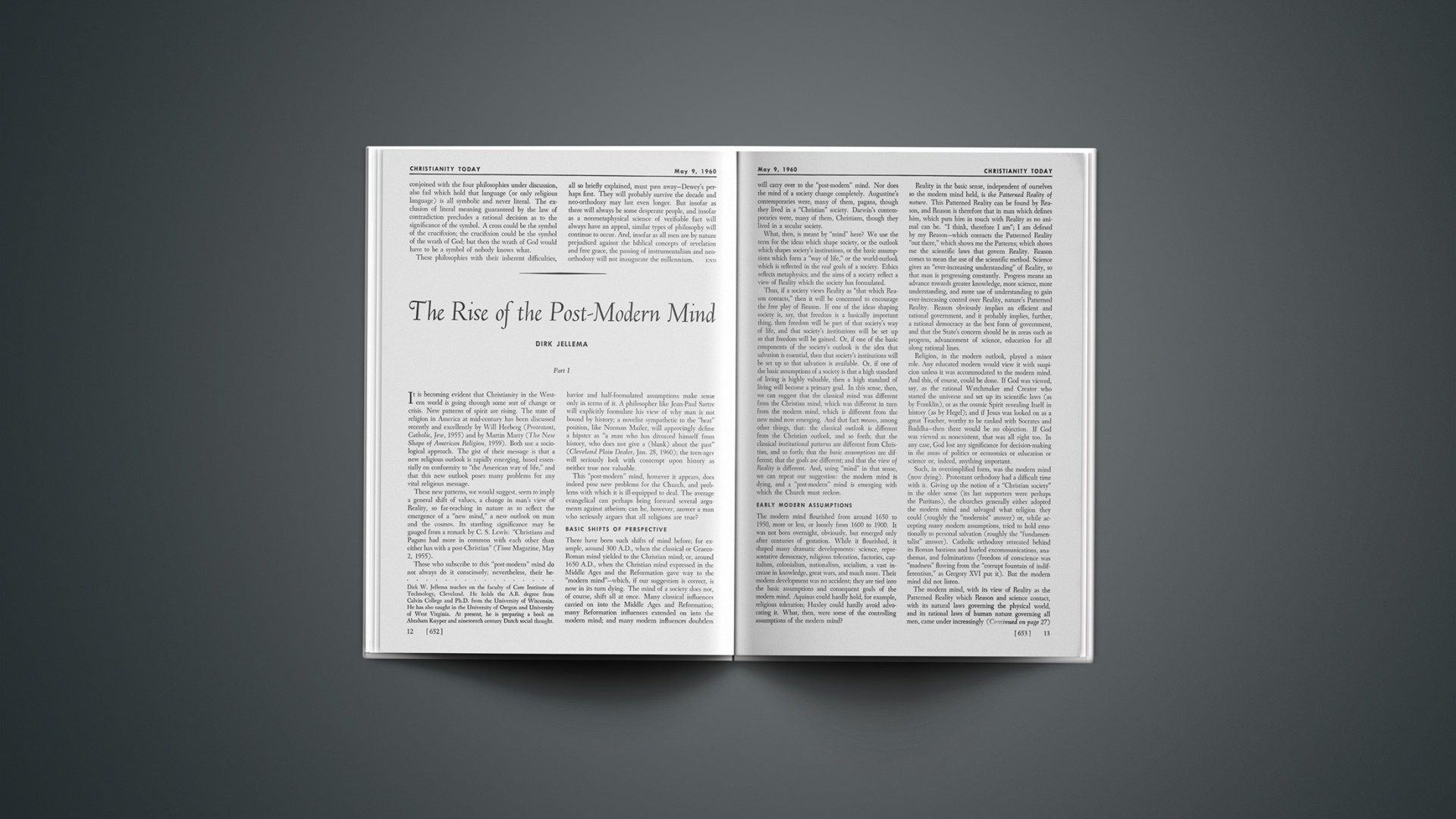
The Rise of the Post-modern Mind (Part I)

It is becoming evident that Christianity in the Western world is going through some sort of change or crisis. New patterns of spirit are rising. The state of religion in America at mid-century has been discussed recently and excellently by Will Herberg (Protestant, Catholic, Jew, 1955) and by Martin Marty (The New Shape of American Religion, 1959). Both use a sociological approach. The gist of their message is that a new religious outlook is rapidly emerging, based essentially on conformity to “the American way of life,” and that this new outlook poses many problems for any vital religious message.

These new patterns, we would suggest, seem to imply a general shift of values, a change in man’s view of Reality, so far-reaching in nature as to reflect the emergence of a “new mind,” a new outlook on man and the cosmos. Its startling significance may be gauged from a remark by C. S. Lewis: “Christians and Pagans had more in common with each other than either has with a post-Christian” (Time Magazine, May 2, 1955).

Those who subscribe to this “post-modern” mind do not always do it consciously; nevertheless, their behavior and half-formulated assumptions make sense only in terms of it. A philosopher like Jean-Paul Sartre will explicitly formulate his view of why man is not bound by history; a novelist sympathetic to the “beat” position, like Norman Mailer, will approvingly define a hipster as “a man who has divorced himself from history, who does not give a (blank) about the past” (Cleveland Plain Dealer, Jan. 28, 1960); the teen-ager will seriously look with contempt upon history as neither true nor valuable.

This “post-modern” mind, however it appears, does indeed pose new problems for the Church, and problems with which it is ill-equipped to deal. The average evangelical can perhaps bring forward several arguments against atheism; can he, however, answer a man who seriously argues that all religions are true?

BASIC SHIFTS OF PERSPECTIVE

There have been such shifts of mind before; for example, around 300 A.D., when the classical or Graeco-Roman mind yielded to the Christian mind; or, around 1650 A.D., when the Christian mind expressed in the Middle Ages and the Reformation gave way to the “modern mind”—which, if our suggestion is correct, is now in its turn dying. The mind of a society does not, of course, shift all at once. Many classical influences carried on into the Middle Ages and Reformation; many Reformation influences extended on into the modern mind; and many modern influences doubtless will carry over to the “post-modern” mind. Nor does the mind of a society change completely. Augustine’s contemporaries were, many of them, pagans, though they lived in a “Christian” society. Darwin’s contemporaries were, many of them, Christians, though they lived in a secular society.

What, then, is meant by “mind” here? We use the term for the ideas which shape society, or the outlook which shapes society’s institutions, or the basic assumptions which form a “way of life,” or the world-outlook which is reflected in the real goals of a society. Ethics reflects metaphysics; and the aims of a society reflect a view of Reality which the society has formulated.

Thus, if a society view’s Reality as “that which Reason contacts,” then it will be concerned to encourage the free play of Reason. If one of the ideas shaping society is, say, that freedom is a basically important thing, then freedom will be part of that society’s way of life, and that society’s institutions will be set up so that freedom will be gained. Or, if one of the basic components of the society’s outlook is the idea that salvation is essential, then that society’s institutions will be set up so that salvation is available. Or, if one of the basic assumptions of a society is that a high standard of living is highly valuable, then a high standard of living will become a primary goal. In this sense, then, we can suggest that the classical mind was different from the Christian mind, which was different in turn from the modern mind, which is different from the new mind now emerging. And that fact means, among other things, that: the classical outlook is different from the Christian outlook, and so forth; that the classical institutional patterns are different from Christian, and so forth; that the basic assumptions are different; that the goals are different; and that the view of Reality is different. And, using “mind” in that sense, we can repeat our suggestion: the modern mind is dying, and a “post-modern” mind is emerging with which the Church must reckon.

EARLY MODERN ASSUMPTIONS

The modern mind flourished from around 1650 to 1950, more or less, or loosely from 1600 to 1900. It was not born overnight, obviously, but emerged only after centuries of gestation. While it flourished, it shaped many dramatic developments: science, representative democracy, religious toleration, factories, capitalism, colonialism, nationalism, socialism, a vast increase in knowledge, great wars, and much more. Their modern development was no accident; they are tied into the basic assumptions and consequent goals of the modern mind. Aquinas could hardly hold, for example, religious toleration; Huxley could hardly avoid advocating it. What, then, were some of the controlling assumptions of the modern mind?

Reality in the basic sense, independent of ourselves so the modern mind held, is the Patterned Reality of nature. This Patterned Reality can be found by Reason, and Reason is therefore that in man which defines him, which puts him in touch with Reality as no animal can be. “I think, therefore I am”; I am defined by my Reason—which contacts the Patterned Reality “out there,” which shows me the Patterns; which shows me the scientific laws that govern Reality. Reason comes to mean the use of the scientific method. Science gives an “ever-increasing understanding” of Reality, so that man is progressing constantly. Progress means an advance towards greater knowledge, more science, more understanding, and more use of understanding to gain ever-increasing control over Reality, nature’s Patterned Reality. Reason obviously implies an efficient and rational government, and it probably implies, further, a rational democracy as the best form of government, and that the State’s concern should be in areas such as progress, advancement of science, education for all along rational lines.

Religion, in the modern outlook, played a minor role. Any educated modern would view it with suspicion unless it was accommodated to the modern mind. And this, of course, could be done. If God was viewed, say, as the rational Watchmaker and Creator who started the universe and set up its scientific laws (as by Franklin), or as the cosmic Spirit revealing Itself in history (as by Hegel); and if Jesus was looked on as a great Teacher, worthy to be ranked with Socrates and Buddha—then there would be no objection. If God was viewed as nonexistent, that was all right too. In any case, God lost any significance for decision-making in the areas of politics or economics or education or science or, indeed, anything important.

Such, in oversimplified form, was the modern mind (now dying). Protestant orthodoxy had a difficult time with it. Giving up the notion of a “Christian society” in the older sense (its last supporters were perhaps the Puritans), the churches generally either adopted the modern mind and salvaged what religion they could (roughly the “modernist” answer) or, while accepting many modern assumptions, tried to hold emotionally to personal salvation (roughly the “fundamentalist” answer). Catholic orthodoxy retreated behind its Roman bastions and hurled excommunications, anathemas, and fulminations (freedom of conscience was “madness” flowing from the “corrupt fountain of indifferentism,” as Gregory XVI put it). But the modern mind did not listen.

The modern mind, with its view of Reality as the Patterned Reality which Reason and science contact, with its natural laws governing the physical world, and its rational laws of human nature governing all men, came under increasingly severe attack after 1850 from thinkers who may be regarded as transition figures to the post-modern mind: Marx, Freud, Nietzsche, and many others. Today, we would hold, the post-modern mind has actually begun to emerge—not only in the ivory towers, not only in Europe, but in the assumptions of the American man on the street.

What is this “post-modern” mind? It has, in brief, a different view of Reality. If the Christian mind held that the highest Reality is the Triune God, and that the Self is defined in terms of relation to Him; and if the modern mind held that the highest Reality is the Patterned Reality of nature, and the Self is defined by its having Reason and contacting that Patterned Reality; then the post-modern mind, denying both the Triune God and Patterned Reality, holds to the Self and the Unpatterned Reality. The Self creates whatever value and meaning there is; the mysterious Unpattern lies outside, impenetrable and awesome.

Many things follow. The task of philosophy becomes the task of considering the relation between the Self and the Unpattern (is the Self completely free of the Unpattern? Is the Unpattern an enemy or a friend or neither? Is the Unpattern completely impenetrable or can we intuit or envision something of it?). Art and literature picture either the Self or the Unpattern: else they do not portray the Real. Objective values (that is, values existing independent of the Self) do not exist, and to pretend that they do is unreal, is nonsense. The question becomes what kind of subjective values (values freely created) to choose (for example, are all subjective values equally valid? Or do some choices limit the freedom to create, which is the definition of the Self? or limit the freedom to live always “open” to the Unpattern, another possible definition of the Self? Do values developed by a Group help or hurt the Self?). In any case, on this approach, to hold that values exist out there, objectively, is nonsense. (There is a connection between the philosophers’ criticism of objective values, and the sociologists’ stress on the social relativity of values, and the beatniks’ love for Margaret Mead [see Time, June 1, 1959, citing Lawrence Lipton, The Holy Barbarians], a sociologist who has “demonstrated” cultural relativity. Each in his own way reflects the emerging “post-modern” mind.)

Religion in consequence, it would seem, would hold a different place than in the modern mind. But it will be a curious place. For Reality is the Self and the Unpattern. And thus God must either be somehow created by the Self, or be the Unpattern; else God won’t be Real. If it can be shown that God is a creation of the Self (for the Self creates all pattern and value and meaning), then let’s have God; or, if we wish to call the Unpattern by the name of God, then let’s have God. In either case, God will then be Real (for Reality is Self and Unpattern). But if we think God exists outside these two alternatives, then we err; or better, any such God would be unreal, not Real, not existing in the Real world!

Now, a broad definition of Reality obviously does not immediately answer all the burning questions. Defining Reality as Patterned Reality which Reason encounters still left many questions confronting the modern mind. Defining Reality as Triune Personality which the soul encounters bequeathed many knotty questions to the Christian mind. Defining Reality as Self and Unpatterned Cosmos leaves many problems for the post-modern mind. Since our concern is to tie in the post-modern mind with the actions of the man on the street, we now consider the question of “how I must act,” which the post-modern mind’s broad definition of Reality still leaves open.

This question of action can be viewed as implying a prior question: what is the relation between Self and Unpattern? If the Unpattery is seen as a wonderful, mysterious thing, then we should act so as always to be “open” to it (Heidegger). If it is viewed as the meaningless blind enemy (Sartre), then we must maintain our freedom against it. Thus, we would find our Self in either being “open” to Unpattern, or being free from it.

But we can also take a third alternative and say that the problem is, more basically, giving the Self security against whatever threats it faces. And, since whatever the Self freely creates is real, the problem would be for the Self to create this security; and this would be done if the Self could create a feeling of security.

The most obvious way to gain this feeling of security is to identify in some sense with a Group. (What does “identify in some way” mean? Answers may vary: Dewey’s “adjustment” is one possibility, and Ernst Junger’s justification for Nazi ideology is another.) Another way is to be accepted by something other than the Group; but this may seem difficult, since the Unpattern seems remote to most, and nothing else besides Self (and Selves like us, the Group) and Unpattern is Real. However, if we freely create something else, it will be Real, since it is tied in with the Self; and thus if we create, say, a kindly Person who likes us, he will be Real (because we believe in him); and this too would tend to give emotional security. Thus, ideally, to gain this security for the Self, we should belong to a Group which creates a kindly Person who likes all Group members.

This third alternative, though it draws (largely unconsciously) on several philosophers, has not yet, to my knowledge, been worked out philosophically. It does seem to me to be a variety of post-modern mind which is of importance, not only in the semi-worship of the Leader elsewhere (Hitler, Lenin, Peron), but also in the thinking of the post-war generation of Americans. It is, among college students, perhaps more important than the other two ways of acting (being “open to” or “free from” the Unpattern) mentioned above, though these do exist and are followed, and are closely related to this third alternative.

Here we might well pause, for it is necessary to introduce at least some evidence. For the foregoing analysis may well seem extreme, and therefore be dismissed as merely a series of completely unfounded generalizations. By way of supportive evidence, consider two statements: ‘We are living in Rome at the time of the barbarians,” according to Henri Petoit, a leading French Catholic intellectual (Time, May 7, 1956); and, if that can be dismissed as European hysteria, consider C. H. Greenewalt, president of DuPont Corporation: “I know of no problem so pressing, no issue so vital, [as the] growing emphasis on group conformity” (New York Times, April 27, 1956).

Jacob J. Vellenga served on the National Board of Administration of the United Presbyterian Church from 1948–54. Since 1958 he has served the United Presbyterian Church in the U.S.A. as Associate Executive. He holds the A.B. degree from Monmouth College, the B.D. from Pittsburgh-Xenia Seminary, Th.D. from Southern Baptist Theological Seminary, and D.D. from Monmouth College, Illinois.

Philosophy in the Sixties

The year 1959 was one of philosophic celebrations. Many volumes, monographs, and papers marked the centennial of John Dewey. France, rather more than the United States, similarly celebrated Henri Bergson’s birth. And all over the world scholars commemorated the publication of Charles Darwin’s Origin of Species. One is tempted to see in all this the end of an era and to expect new beginnings in the next decade.

However, the fortunes of philosophy do not change with football game rapidity. No evidence exists to support predictions of any great upheaval. Provided that the political situation permits a continuance of civilized living, the sixties will not differ much from the fifties. No doubt an old era has ended; but it did not end abruptly in centenary celebrations. Somewhat of a new era may well be upon us; but it did not commence January 1, 1960. Rather, the situation calls for an estimate of the coming success or failure of philosophic trends already under way.

To dispose of some preliminary matters, I would say that neo-realism, despite the protests of its aging exponents, as well as the older neo-Hegelianism, has no future. Marxism is indeed a serious political threat, though not an intellectual one. The movements now in existence that promise to exert influence in the next decade are instrumentalism, logical positivism, existentialism, and neo-orthodoxy. The first two are definitely secular, the fourth is clearly religious, while existentialism, though sometimes atheistic, is so closely related to neo-orthodoxy that it fits better into the second classification.

INSTRUMENTALISM

John Dewey was fundamentally disturbed by the nineteenth century scientism which reduced the universe to “nothing but” atoms in motion. Since atoms alone were real, the real world was devoid of colors, sounds, enjoyments, and human values. Traditional philosophy, with its theory of values based on medieval metaphysics and theology, was unable to meet the scientific viewpoint. According to Dewey therefore the main problem of modern philosophy is to formulate a single method by which both the values of daily life and the advances of modern science can be harmoniously handled.

Dewey’s solution begins with the instrumental role of ideas. Despite common sense and almost universal acceptance, the Newtonian view that science gives knowledge of the real world is discussed as thoroughly mistaken. Ideas are not descriptions of what is or has been; they are plans for future actions. Science does not discover antecedent reality; it constructs new realities. To give an example: water is wet, water is good to drink, but water is not H2O. The chemical formula is part of a laboratory method for producing wet water or explosive hydrogen. In other words, scientific concepts do not define natural objects; they specify laboratory operations.

Therefore science cannot render void the real world of colors, sounds, wet water, and human values.

Just as chemical concepts are the directions for experimental procedure, so the same scientific methods can be used to formulate moral concepts for moral experimentation. The concepts of physical science change decade after decade. So too, according to Dewey, moral concepts must change when we want new results. There are no fixed, absolute, divinely given norms. New moral principles must ever be devised to manage new problems.

What is true of physics and morality is also true of logic. The Aristotelian law of contradiction was based on Aristotelian science and must with it be discarded. The laws of logic are like civil laws. They are devised to meet specific problems and as the problems change, quickly or slowly, so must the laws of logic.

LOGICAL POSITIVISM

The technical nature of logical positivist publications makes brief discussion difficult and misleading. Logical positivists are much more interested in the details of science than Dewey was, and their contributions in these special areas are correspondingly better. For this reason it seems likely that logical positivism, even if its most general theses are untenable, will continue in existence for a longer period of time than Dewey’s philosophy. Both schools, for example, accept the opertional definition of concepts. But Dewey’s system tends to fall apart because the connection he makes between science and morals is not firm. Logical positivism, on the other hand, with its tendency to dismiss morality as emotive nonsense can tie its future to operationalism in scientific isolation.

Similarly both schools are behavioristic. Dewey traces all knowledge back to sensori-motor co-ordinations; mind, he says, is a complex of bodily habits formed in the exercise of biological aptitudes; and “knowledge … lives in the muscles, not in consciousness.” Logical positivists assert, “Methodological physicalism and operationism are part of a general positivistic tradition. Their psychological counterpart is the school of behaviorism” (International Encyclopedia of Unified Science, Vol. I, Part II, pp. 671–672).

Now, although behaviorism is untenable wherever found, it can maintain itself longer as a narrowly scientific method than as a part of a general system. Then too, at the expense of some consistency, Herbert Feigl accepts the “methodological outlook of behaviorism but … certainly not with any unqualified rejection of introspective techniques.” Philosophically objectionable as this may be, it is scientifically more viable.

Where logical positivism extends beyond the confines of science and ventures into the realm of epistemological generality is in its theory of meaning and verification. Propositions that cannot be verified by sensory observation are meaningless. Therefore moral principles are emotive nonsense. There is, however, one important exception to this theory of verification. Logical and mathematical principles are neither meaningless nor verifiable. They are formal, definitional, tautological; they are stipulated methods of procedure. Although Dewey is not in complete accord with the logical positivists (cf. Dewey, Logic, pp. 284–289), their view of logical and mathematical principles is similar to Dewey’s position that we must alter the laws of logic as our problems change.

EXISTENTIALISM AND NEO-ORTHODOXY

If Marxism has a bright future because of subversion backed by military might, neo-orthodoxy to a lesser extent depends on nonintellectual factors. These are chiefly the social power of the large Protestant denominations, and, with existentialism, the great fear which the international situation excites. If this fear subsides, existentialism most certainly and neo-orthodoxy most probably will lose ground to a more reasonable viewpoint. At the same time, the latter can count on the growing influence of Karl Barth, who may yet overshadow Brunner, Niebuhr, and Tillich.

Specific theological details are not within the scope of this article. Attention is directed rather to the philosophy which neo-orthodoxy and existentialism have taken in common from Sören Kierkegaard. Its distinctive feature is the repudiation of reason and logic.

Throughout the history of Christianity there has always been a certain amount of anti-intellectualism. An extreme form is found in the negative theology of mysticism. Less extreme forms are found in devout and well-intentioned (but mistaken) distinctions between our poor finite human logic and God’s transcendent thought. “Rationalism,” of course, has always been opposed by the most learned and orthodox theologians; but a misunderstanding of what they meant by rationalism has aided the rise of irrationalism.

In contrast with the statement of the Westminster Confession that “The whole counsel of God … is either expressly set down in Scripture, or by good and necessary consequence may be deduced from Scripture,” the neo-orthodox (for example Brunner) assert that faith must curb logic and that “straight-line” implication will lead us astray. In other words, we may accept certain statements but we must reject their necessary consequences. Not all the neo-orthodox are so explicitly radical as Brunner, yet the Kierkegaardian—neo-orthodox—existentialist complex must be judged to be basically anti-logical.

CRITICISM

When the repudiation of necessary implication is pointed out and the consequent inconsistencies of detail are listed, the straight-line path that criticism will follow hardly needs explanation.

The indispensability of logic for all intelligible communication is also the basis of criticism against Dewey and the logical positivists. They are all wrong when they allow for a replacement of the law’ of contradiction. This law is not a formal stipulation that can be changed by mutual consent. It does not grow out of scientific procedure in such a way that a different procedure would produce a different logic. On the contrary it is eternally a fixed requisite to rational thought and intelligible speech.

Against Dewey it might be added that he never shows how scientific procedure can generate his human values; while against logical positivism there is the particular point that its principle of verification is self-destructive. For there is no sensory observation that would verify the assertion that sensory observation is the only gateway to knowledge. Either then it is nonsense, or it is a stipulation and definition. But in the latter case there is no compelling reason for stipulating it. Surely we can all the more dispense with the verification principle, if we can dispense with logic.

For similar reasons, those linguistic theories, often conjoined with the four philosophies under discussion, also fail which hold that language (or only religious language) is all symbolic and never literal. The exclusion of literal meaning guaranteed by the law of contradiction precludes a rational decision as to the significance of the symbol. A cross could be the symbol of the crucifixion; the crucifixion could be the symbol of the wrath of God; but then the wrath of God would have to be a symbol of nobody knows what.

These philosophies with their inherent difficulties, all so briefly explained, must pass away—Dewey’s perhaps first. They will probably survive the decade and neo-orthodoxy may last even longer. But insofar as there will always be some desperate people, and insofar as a nonmetaphysical science of verifiable fact will always have an appeal, similar types of philosophy will continue to occur. And, insofar as all men are by nature prejudiced against the biblical concepts of revelation and free grace, the passing of instrumentalism and neo-orthodoxy will not inaugurate the millennium.

Jacob J. Vellenga served on the National Board of Administration of the United Presbyterian Church from 1948–54. Since 1958 he has served the United Presbyterian Church in the U.S.A. as Associate Executive. He holds the A.B. degree from Monmouth College, the B.D. from Pittsburgh-Xenia Seminary, Th.D. from Southern Baptist Theological Seminary, and D.D. from Monmouth College, Illinois.

The Word of God in Education

A careful look at our subject, “The Word of God in Education,” will provide a clue to the manner in which it ought to be treated. Quite evidently, two things are placed side by side—the Word of God and education—one in relation with the other. The first of the two, “The Word of God,” needs close definition; the second, “education,” must be brought to focus upon the particular kind of education with which we are here concerned, namely, the Bible college or Bible institute. This is a specific type of institution, to be sure, but the principles that will be discussed apply as well to other fields of education.

Consider the first phrase, “The Word of God.” Though a synonym for the Bible, this by no means exhausts the meaning of the phrase. In a Supreme Court opinion, Justice Holmes once wrote this sentence: “A word is not a crystal, transparent and unchanged; it is the skin of a living thought, and may vary greatly in color and content, according to the time when, and the circumstances under which, it is used.” Here we have one of the first principles of exegesis of any book, the Bible included.

Viewed then in its scriptural usage as “the skin of a living thought,” we may identify three aspects of “the Word of God” in its relationship to education. They are: first, the written Word of God, the Bible; second, the Word of God manifest in creation; and third, the Word of God incarnate in our Lord Jesus Christ.

THE BIBLE AND AUTHORITY

We begin with the Word of God as Scripture. Among Christians in general and evangelical Christians in particular, the Word of God is synonymous with the Bible. The equation is fully justified because it is made again and again in the Old and New Testaments. Here, as the names “Bible college” and “Bible institute” imply, is the central point of integration. But why so? Why not theology, as in many seminaries? Or why not the officially sanctioned philosophy of a great doctor of the church, as in the Roman Catholic institutions with their Thomism?

Before dismissing the question as being so obvious as not to require an answer, let us look beneath the surface to see some reasons why this Book, and no other, must be central in Christian education.

The first reason is the sheer, unapproachable greatness of the written Word of God. Considered just as a book, it holds the first place by reason of the criterion voiced in the classic treatise On the Sublime, in which Longinus declares, “That is really great which bears a repeated examination and which it is difficult or rather impossible to withstand and the memory of which is strong and hard to efface.… For when men of different pursuits, lives, ambitions, ages, languages, hold identical views on one and the same subject, then the verdict which results, so to speak, from a concert of discordant elements makes our faith in the object of admiration strong and unassailable.” This is the doctrine of literary criticism known as the Law of Universal Consent and it applies to the Bible as literature. It is a fact that over and above any other piece of world literature from Homer down through Virgil, Dante, Cervantes, Shakespeare, Milton, and Goethe, no book has been more fully acknowledged as great simply as a book than the Bible.

Let no Christian educator ever apologize to the sophisticated of the educational world for such a designation as “Bible College.” It should be for all who are committed to this kind of education a badge of honor. To take as the center of the curriculum the one book to which alone the superlative “greatest” can without challenge be applied—this is neither narrow nor naive. It is just good judgment to center on the best rather than the second best.

But there is a deeper reason why the written Word of God must be at the heart of our schools and colleges, and that is its authority as the inspired, inerrant Word of God. At this point plain speaking is in order. The current movement to express in contemporary, understandable terms the eternal verities of the faith, so that the people whom we must reach for Christ will know what we are talking about, deserves support. We should rejoice at the renaissance of good and enlightened scholarship among evangelicals which is sometimes called neo-evangelicalism. But at the same time we must not blink the evidence that there is current among some evangelicals a subtle erosion of the doctrine of the infallibility of Scripture that is highly illogical as well as dangerous.

It is illogical for this reason. We live in a day when archaeology has come into conformity with Scripture to such a degree that the number of alleged discrepancies used by destructive critics of the past in their effort to discredit Scripture has been greatly reduced. Today scholars are writing such chapters as “Reversals of Old Testament Criticism” and “Reversals of New Testament Criticism” (see the recently published symposium, Revelation and the Bible). Those who over the years have held a suspended judgment regarding Bible difficulties, while still adhering to the inerrancy of the Book, have found question after question cleared up by new knowledge. Therefore, with all our openness of mind and emphasis on scholarship, we need to be careful to maintain the historic, Reformed view of a Bible infallible in the autographs (a view not to be equated with the dictation, mechanical theory of inspiration, but one held by our Lord and the apostles). And we need to maintain this position against neo-orthodox views of the Bible that may infiltrate even the Bible college and Bible institute. Let us by all means redefine and restate the evangelical position, but never at the cost of yielding any essential part of the authority of the Bible.

CRITICISM AND EDUCATION

The second reason why Scripture must be at the heart of education concerns its indispensable critical function. In a day of debased values and satisfaction with the second and even third rate, education requires a standard and point of reference by which the cheapened standards of our day may be judged.

Writing at the beginning of the industrial revolution in England, the poet Wordsworth declared: “… a multitude of causes, unknown to former times, are now acting with a combined force to blunt the discriminating powers of the mind, and, unfitting it for all voluntary exertion, to reduce it to a state of almost savage torpor.” And he went on to speak of the literature of violence and sensationalism of his day. But now, under the impact of far greater changes and forces than any industrial revolution, and beset with the debasement of plain, everyday decency, this violent age in which we live has far more need of discriminating judgment than that of Wordsworth.

No other book can fulfill this critical, discriminating function like the Word of God. As the writer of Hebrews put it, “the word of God is quick, and powerful, sharper than any twoedged sword, piercing even to the dividing asunder of soul and spirit, and of the joints and marrow, and is a discerner [Greek, kritikos] of the thoughts and intents of the heart.” In a time which Sir Richard Livingstone has rightly called “The Age without Standards,” the Bible alone qualifies as the supreme critic of life and thought.

Dr. H. Langmead Casserly has called our world “The Bent World.” The “bent” refers to the distortion of sin that stems from the fall and runs through all of life. And from this “bent,” even Christian education is no exception. We do not always realize that this distortion affects areas of knowledge and education to different degrees. As Emil Brunner has pointed out, the twist resulting from sin is most marked in the humane subjects like theology, philosophy, history, and literature. It is less marked in areas like physics and chemistry, and in mathematics it approaches zero. Thus there is Christian theology, Christian philosophy, or Christian literature, but not Christian mathematics. It is in the humanities that the curricula in our schools and colleges have their strongest emphasis; and it is here that the critical, penetrating, revealing function of the Bible is most needed.

Now true as this principle is in practice it needs care and courage. Let us in Christian education be fearless enough in our reliance on Scripture as the critic to subject even our cherished formulations of the Bible to its own divine, discriminating judgment. Let us see in searching scrutiny of the Bible that some of the neat and pat outlines and schemes we taught a former generation may need revision. For God has yet more light to break forth from his Word. Let us therefore seek to the glory of God to develop in our students a proper critical-mindedness that subjects all the thinking and formulations of men to the ultimate principles and judgments of the divine kritikos, the Word of God.

Acts chapter 17 gives us a significant example of this function of Scripture. The Christians at Berea, we are told, “were more noble than those at Thessalonica, in that they received the word [in this case doubtless the kerygma or proclamation of the Gospel] with all readiness of mind, and searched the scriptures daily, whether those things were so.” In other words, these Christians subjected even the apostolic preaching to the test of the Scriptures. And, it should be pointed out, there is an extension of this Berean principle beyond even doctrine. I am not saying that technical knowledge in science or any other field must be checked point by point with the Bible, but that in respect to ultimates, to the comprehensive frame of reference in Christ by whom (Col. 1:17) “all things consist [hold together],” the Bible is the final critic.

There is a third reason why the Bible must be at the heart of Christian education. This relates to the all-important matter of knowing and finding the truth. The natural tendency of man (very evident in secular education) is to go it on his own. He is prone unwittingly to slip into the error of assuming that human effort, working independently, leads to the truth. Thus man tends to become in relation to knowledge what Emile Cailliet calls “a pseudo-maker,” with truth coming at the end of a process of human rationalization.

TRUTH IN EDUCATION

On the contrary, the whole thrust of the Bible is different. It does not give us truth by way of rationalization but by way of revelation. Truth is not something worked out by men; it is received by faith and then acted upon. Here the biblical method of knowledge is what Anselm of Canterbury expressed in three great words—“Credo ut intelligam” (“I believe that I might know”)—a principle voiced also by Augustine some six hundred years before Anselm, when he wrote, “Nisi crederitis, non intelligetis” (“Unless you believe you will not come to know”). This great insight, so thoroughly biblical, is not, as Professor J. Harris Harbison of Princeton University points out, any “advocacy of blind faith, but the testimony of one of the greatest minds in Christian history to the fact that truth can never be grasped by man’s mind alone.” Going back to Solomon, we must add this: “The fear of the Lord is the beginning of wisdom;” for there can be no “fear of the Lord” without humble belief and reverential trust.

Moreover, basic knowledge in any field, including scientific insight, has this ultimate revelational factor. As Cailliet in his recent book, The Recovery of Purpose, again reminds us, reality was “there in the first place and then literally happened” to man. Witness, among many instances, Archimedes with his unexpected discovery of the principle of hydrostatics and Newton’s experience that led to a comprehension of the law of gravitation. In the deepest sense, knowledge is something that “happens to man” by way of faith acting upon faith; it is not “spun out of the human self.” And the Bible is the book of faith leading to truth.

THE WORD AND NATURE

But the great phrase, “The Word of God,” has two other meanings aside from Scripture itself. These also must be seen in relation to the Bible college. Consider creation as the Word of God, or nature as God’s other book. The Psalmist says: “By the word of the Lord were the heavens made; and all the host of them by the breath of his mouth.… For he spake, and it was done” (33:6, 9). And the prologue of John’s Gospel declares: “In the beginning was the Word.… All things were made by him; and without him was not any thing made that was made.” So also, “The heavens declare the glory of God” (Psa. 19:1); and, looking about us in the natural world, we may see “the invisible things of him … even his eternal power and Godhead” (Rom. 1:20).

Now this aspect of “The Word of God” has its clear implications for the curriculum of the Bible college or Bible institute. We are living in an age of science and mathematics. Therefore, we must, if we are to communicate with those about us, speak their language. For obvious reasons the schedules of most Bible colleges are preponderantly loaded in the direction of Bible, theology, language, philosophy, music, and the like. However, must not room be made for science and mathematics, not so much in the way of technical laboratory courses (most Bible colleges have neither equipment nor time for such) but rather through setting up good survey courses in these fields so that Bible college graduates will be to some degree literate in contemporary, world-changing concepts of science and mathematics?

Caution should be given at this point. The Bible college must be a Bible college. Even though the trend towards its becoming a liberal arts college is clearly discernible, a Bible college should never be regarded as just a half-way house to the regular college. It is an institution in its own right, and it has its own distinctive contribution to make. The crying need to include in the curriculum something of science and mathematics should not be pressed to the extent of making the Bible college only an attenuated form of the liberal arts college. If God leads a school towards liberal arts, well and good; let it cease being a Bible college. Otherwise let it stay what it is.

I have one other comment about broadening the curriculum. There are those who charge Christian education, centered in the Bible, with narrowness and provincialism. In his book, Christian Faith and Higher Education, Nels Ferré says, “Some writers … advocate the teaching of the Bible as central to the Christian curriculum. When this suggestion is understood … namely, that the Bible is the source book and standard of all other truth, the Bible is wronged and higher education is imperialistically attacked. This is parochialism of the first order.” But if Dr. Ferré had read his reference, Christian Education in a Democracy, carefully, he would have seen that nowhere is the Bible set up as the source book of all other truth. Instead he would have seen that the Bible invites Christian education “to range over the realm of science in all its forms, over the treasures of literature, the mansions of philosophy and theology, and the beauty of music and art; according to its [the Bible’s] warrant, all the best that has been thought and said and done by men through the ages … comes within the province” of Christian education. By this token, the Bible college has a right and obligation to graduate men and women with some degree of literacy in fields of science and mathematics.

We look again at the phrase, “The Word of God,” to see its third meaning. While the Bible is assuredly “the Word of God” and while creation is God’s other book, the Word of God is something even greater than these. As every Christian knows to his soul’s salvation, the Word of God is also Christ. To the first two meanings of the phrase, “the Word of God,” He sustains an indissoluble and pre-eminent relation. In Hebrews 4:12–16, we see the writer’s thought moving from what most commentators take to be the written Word, to the Son of God, the incarnate Word. The plain fact is that Christian education must always see the Bible not as an end in itself but as pointing to Christ who is its theme and subject from Genesis to Revelation.

THE INCARNATE WORD

The moment we lose sight of the fact that the incarnate Word, the eternal Son of God, is greater than and above the written Word which with all its inspiration and infallibility, is still a product of the Holy Spirit, we are in danger of bibliolatry. As Adolph Saphir said, “By bibliolatry I understand the tendency of separating in the first place the Book from the Person of Jesus Christ, and in the second from the Holy Spirit, and of thus substituting the Book for Him who is alone the light and guide of the church.”

For a school to be called a college or school of the Bible is in itself no guarantee of power. It is even possible for the orthodox to become so devoted to technicalities of biblical scholarship as to lose sight of Him whom the Bible is all about. Said D. L. Moody in his forthright way, “The key to the whole Bible is Jesus Christ. You remember that on the way to Emmaus with those two disciples, ‘beginning at Moses and all the prophets, he [Jesus] expounded unto them in all the Scriptures the things concerning himself.’ Notice those two ‘alls.’ The one theme of the Old Testament in type and prophecy is the Messiah; and the New Testament deals with his life on earth, and with the Church which is his body, and with his coming glory.”

When the Bible is really at the center in education, the one chief subject is not just the Bible in its linguistic and historic or even doctrinal sense. It is, over and above this, Jesus Christ. As Professor T. W. Manson remarked in a comment on Ephesians 4:20 (where Paul says by way of exhortation, “You have not so learned Christ”), “The writer speaks of learning Christ as you might learn algebra or French. It is an extraordinary statement and one, I think, that goes to the heart of the matter.” Spencer Leeson, Bishop of Peterborough in England, in his Bampton Lectures at Oxford, titled Christian Education, heads his chapter on “The Content of Christian Education” with the eighth verse of Hebrews 13: “Jesus Christ the same yesterday, and today, and forever.” And how does a Bible college or any educational institution teach Christ? In the classroom, yes, but also by the kind of administration and teachers it has. By its ethical, disciplinary, and social tone, and by all that it is and stands for, it teaches Christ.

THE CURSE OF MEDIOCRITY

In conclusion, consider the implications of what we have been discussing. The implications for the Bible college, as well as for all Christian education, commit us in one direction, namely, toward the continuing obligation of excellence. At the Fiftieth Anniversary of the Cum Laude Society in 1956, one of the country’s distinguished educators, Dr. Claude Fuess, Principal Emeritus of Phillips Academy at Andover, Massachusetts, spoke on the subject, “The Curse of Mediocrity.” In his comment on the prevailing satisfaction with the average and second rate in our schools and colleges he quoted this evaluation: “Dismal and hopeless mediocrity is the most serious menace to present-day primary and secondary education in America.” And, we might add, it is the most serious menace to college education also. If mediocrity will not do for public and secular education, it is doubly a curse, even a scandal, for evangelicals contentedly to tolerate it in education that is committed unreservedly to the Word of God with all the depth of meaning that accompanies such commitment.

Someone will say, “But we in Christian education just do not have resources in equipment and endowment that secular institutions have.” That is true. In this world’s goods Christian education is comparatively poor. But good taste and excellence and high personal standards and lofty intellectual achievement are not confined to the rich. Granted that the quest for excellence is a continuing one and that humility forbids anyone a feeling that he has arrived, the Bible college, along with every other part of Christian education, cannot evade the unremitting pursuit of excellence to the glory of God.

Hudson Taylor once said: “Every work for God has three states—Impossible, Difficult, Done.” Most Christian schools and colleges have been through the “Impossible” stage, when it hardly seemed that they could ever begin. All of them are in the “Difficult” stage right now, and here they stay; to make the Word of God central in education, and to do this without mediocrity and with a growing attainment of excellence, is a day by day adventure. Only at the final time of accounting, when we stand before the throne of him whose Name is called “The Word of God,” will “Done” be written over our endeavors to make the Word of God the center of education.

Jacob J. Vellenga served on the National Board of Administration of the United Presbyterian Church from 1948–54. Since 1958 he has served the United Presbyterian Church in the U.S.A. as Associate Executive. He holds the A.B. degree from Monmouth College, the B.D. from Pittsburgh-Xenia Seminary, Th.D. from Southern Baptist Theological Seminary, and D.D. from Monmouth College, Illinois.

Evangelical Advance: Do We Need a Christian University?

To solidify recent gains in evangelism, missions, and literature, ought evangelical forces to rally cooperatively to the high vision of an accredited Christian university? Has the providential hour struck for American evangelicals to establish a major supradenominational university strategically located near a great metropolitan area? To lift the Christian college movement to new levels of academic effectiveness in liberal arts and graduate studies, should dedicated scholars now shape a new enterprise to state the Christian claim in the major fields of learning with fresh power, and in this time of secular challenge voice the Christian answer with new relevance?

We think the providential moment is here. The tide of American thought and life makes imperative a Christian university devoted in depth to the biblical revelation of God, of man, and of the world; aggressively challenging pagan and secular theories of reality and history; and supplying a steady stream of spiritual leadership to all professions and vocations, including diplomacy, business, and communication.

THE BASIC IMAGE

What should be the basic image of a Christian university in the modern academic world? If worthy of the name, such a school must deal with the foundational issues of thought and life in the rich context of the Bible. It must be evangelistic in relevance, evangelical in doctrine, and committed both to high academic standards and to moral purity. But unless it is much more, it cannot qualify as a genuinely Christian university.

Besides a deep sense of personal devotion to the Lord, the faculty must grasp the history of thought in systematic orientation to Jesus Christ as the revealed center of history, nature, conscience, and redemption, and thus bring the “ancient mind,” the “medieval mind,” the “modern mind,” the “contemporary mind” under the judgment of divine revelation. To integrate the totality of life’s experiences, qualified teachers must be concerned to unify campus disciplines within the perspective of the Christian world-life view. Aware of the tragic cultural crisis of our times, moreover, they must delineate the political, economic, and social implications of Christianity, and expound a consistent criticism of and alternative to collectivistic revisions of the social order which invariably downgrade the biblical view of man.

In addition to individual projects and literary excursions, members of a Christian university faculty must engage in corporate conversation, research, and writing, each contributing toward the production of textbooks to penetrate the collegiate world and to challenge the monopoly now held by secular scholars. Were such a university to realize its greatest potential, it could be a platform for the ablest evangelical scholars of all traditions, and could encouragingly solidify the international witness of conservative Christianity.

EXISTING PROGRAMS

To surrender any of these high objectives will necessarily weaken the full potential of a Christian university. The present status of one or other of these imperatives in existing evangelical institutions makes doubly imperative the establishment of a Christian university devoted primarily to these objectives. For a variety of reasons, evangelical colleges have had little corporate faculty research and writing to advance the Christian view of God and the world over against non-Christian expositions, and therefore have posed less serious academic challenge to secular thinkers on the modern scene. With a vested interest in his institution, an administrator of an existing college may be tempted to view the proposed university as competitive. But such a fully accredited university would operate at a different level from unaccredited schools. (Excluding Bible colleges and junior colleges, 22 out of 36 well-known evangelical colleges have no regional accreditation, in many cases due to lack of finances.) Actually, educators in these schools can benefit from the new enthusiasm a Christian university project will create for the whole cause of evangelical education. Presently accredited colleges have not aggressively fostered the university ideal, however. The envisioned university would not replace nor could it be superimposed upon the existing structures.

In three specific areas a Christian university must aggressively press beyond much of contemporary evangelical education. While a supradenominational institution cannot commit itself to specific denominational creeds, a Christian university ought to seek in this day of doctrinal decline an undergirding statement both biblically authentic and intellectually adequate for depth of faith and a comprehensive world-life view. Equally important, a university’s academic priority and efficiency ought to be guarded so that faculty and students are not deviated into constant preaching or promotional activity, since a worthy graduate school must be devoted to study and research and writing. Moreover, the sphere of campus morality ought to provide a strategic opportunity to dramatize, in personal as well as social ethics, Christian dedication primarily to the commandments of God rather than to the regulations of men.

THE WIDENING DILEMMA

Launching an institution of higher learning is always a colossal venture—the more so in our generation—and the more difficult in the case of a Christian university. But dedicated men who have seen the warmth of Christian vision melt huge twentieth century odds against a new advance in evangelism, in missions, in literature, will have faith, too, for a new era in Christian education.

1. The evangelical penetration of American Christianity, since the theological breakdown of liberalism, has itself turned young people in search of Christ-centered collegiate studies at a remarkable rate. There is limited room for them, if any, in accredited Christian colleges now existing; the enrollment problem worsens by the year, and these institutions now annually turn away thousands of eligible students (Wheaton College alone receives almost 7500 inquiries a year).

On most secular campuses students find an atmosphere repressive of Christian faith and life; where Christian concern survives, it does so often at the evangelistic level, and even in this respect students are far ahead of most faculty members. The classroom tendency is to disregard Christianity as a relevant world-life view. Consequently, many first-rate Christian students are subjected to second-rate education regarding spiritual and moral realities.

2. Most evangelical missionary candidates come from Christian colleges and Bible institutes. The number of candidates for missionary service from secular schools is steadily declining. With the impending population explosion, rising literacy rates, and the earth shadowed by Communist propaganda and aggression, the need for a virile Christian thrust by well-trained workers is apparent. They will require the very best education.

3. Since the number of college students will rise (according to current estimates, from 30 per cent of the college age group five or ten years ago, to 50 per cent in 1970), the need for teachers will be fully as urgent as the demand for classrooms. Dr. Enock C. Dyrness of Wheaton College warns that “unless we are willing to see our educational system completely secularized, we must start to expand the facilities in existing Christian colleges and build a Christian university where teachers and leaders may be trained.” News commentator Paul Harvey prophesies that “such an institution can be the lighthouse for the cause of freedom,” and adds, “the whole atmosphere of the front page reminds us of the acute urgency of the hour.” Leadership of the left-wing movements in our generation has come largely from the great Eastern universities that surrendered their evangelical heritage and now assail the Christian view. Many Christian laymen agree that now only a Christian challenge in depth can rescue an America already hurtling over the Great Falls of secularism. Some have called the Board of Trustees of a Christian university the veritable shock troops of a vast army facing with new courage the enemies of faith and freedom. While a great many Americans are noble and God-fearing, they are disorganized at grass roots and in need of leadership.

4. Although evangelical educators have established vigorous academic ventures through the years, no interdenominational institution launched on a conservative basis compares favorably in reputation with the big-name universities. If they take accredited education seriously, the so-called evangelical universities today are almost all embarrassed by the promotional enthusiasm that generated their past designation as “university” rather than college. Not all have a strong undergraduate liberal arts program, even less do they penetrate the large graduate sphere, and stress primarily, if not exclusively, the ministry among the professions. In view of this void, some leaders feel it would be culpable not to launch a Christian university if the necessary funds can be attracted. Were the plan projected by a company of responsible and respected leaders, it is thought, one source might be interested in providing a library, another a chapel, and another a dormitory, dining hall or gymnasium. The underwriting of faculty chairs and other aspects of the university could attract other participants, while hundreds of thousands of churchgoers, it is hoped, would rally smaller gifts.

GRAHAM’S ENDORSEMENT

Evangelist Billy Graham’s far-reaching vision has brought new courage to the evangelical enterprise at many levels, and it has also revealed an enlarging burden and responsibility for the thousands of teen-age converts in big city crusades. Many have no opportunity in these areas to be graduated from an accredited Christian college. A case in point was the Madison Square Garden Crusade. Here New York laymen were deeply troubled to abandon college-age converts to secular schools and educators for lack of an effective metropolitan alternative. Some of these very laymen are now pleading the cause of a Christian university in the Gotham area and have implored Dr. Graham to gather together evangelical leaders who share this academic vision. There must be action, they feel, before mounting taxation puts to flight the vast resources of private wealth and income necessary to the venture. Insisting that he must be free to give himself to the great task of evangelism, Dr. Graham has refused to entangle himself with academic responsibilities. He has, however, given much encouragement to the plan, though disallowing use of his own name in the naming of an institution. Dr. Graham clearly shares the burden for a Christian university that brings classical distinction to evangelical education, and has encouraged discussion and planning by interested leaders. He has met with such groups when possible and has prayed with them for a breakthrough in terms of site, funds, and, above all, divine guidance.

Present discussions favor a New York area location. Not only is that community of obvious strategic importance, but no accredited institution of the anticipated kind exists among its 12 million inhabitants. The evangelical movement now lacks a firm foothold in the area, and some financial enthusiasm is evident. Others contend that location is relatively unimportant. What is equally important, they insist, is not to encumber the university vision by needless restrictions which will tend to impede academic virility.

IS IT TOO LATE?

This dream of a great Christian university may seem unrealistic. Many liberal arts colleges (let alone private universities) are in financial trouble. Public institutions increasingly dominate the educational scene. Private colleges are becoming quasi-public through dependence on programs like the National Defense Education Act. Church giving is “a drop in the bucket” of private college needs, tuition charges are skyrocketing to meet professors’ salaries, endowment funds are sapped by heavy government taxation that reduces the capacity for philanthropy.

Self-educated men, moreover, seldom weary of pointing out that 85 per cent of Americans over 29 years of age have never entered college, and that some who have plumbed the Great Books, like Charles Van Doren, can graduate to a career of intellectual prostitution. Others complain that of every 10 college students, two are helped, two are hurt, and six waste time.

Even church colleges have a disappointing history; many have lost their early Christian vision, and evangelical conviction often struggles for expression and even survival on campuses to which it once imparted life. Among approximately 600 of the 750 liberal arts colleges in the United States that are church-related, some have not attained high academic ideals, many more neglect the implications of the Christian faith. The founders have had a great vision, churchmen and laymen have given sacrificial support, the campus has a great beginning and tradition. But often when professors in these same schools today close the classroom doors to lecture, they resurrect Aristotle and Hegel, Darwin and Dewey, Kant and Kierkegaard, only to leave Jesus Christ hanging on the Cross, unrecognized and unwanted.

Where evangelical ideals prevail, the problem of funds often predominates. The woeful lack of support for Christian colleges, many of which operate “on a shoestring,” is one of the strange ironies of the evangelical resurgence. In some measure, this situation doubtless reflects the reluctance of donors to establish permanent endowments because they have seen large gifts perverted to alien points of view. More and more it is apparent that no legal device can keep a school doctrinally sound or spiritually alive; the intellectual and spiritual integrity of the Board of Trustees, the administration and the faculty remains the key to institutional integrity. One fact is sure: no provision for a Christian university will be adequate without extensive endowment.

Perhaps it is too late for a Christian university. But of the need, the staggering need, there can be no doubt. To venture or not to venture the project in faith may determine more than the spiritual temperature of the nation; equally much the decision will gauge the nature and depth of evangelical resurgence of America today.

We Quote:

EDUCATION AND MORALS—“Many a divorced professor is teaching in our colleges; some of them are even regarded as authorities in the fields of marriage, sexual adjustment and family. We have legions of divorces and divorcees among our most prominent citizens, including captains of industry and finance, journalists and writers, doctors and lawyers, civic leaders and politicians. Sexual infamy is almost a necessary condition for becoming a star of stage, movie or television; sometimes, it is found to be the only talent possessed by these performers, who are otherwise perfectly innocent of the art of artful acting. Among our public officials, there is a vast legion of profligates, both heterosexual and homosexual.”—Dr. PITIRIM SOROKIN, in The American Sex Revolution, p. 44.

Jacob J. Vellenga served on the National Board of Administration of the United Presbyterian Church from 1948–54. Since 1958 he has served the United Presbyterian Church in the U.S.A. as Associate Executive. He holds the A.B. degree from Monmouth College, the B.D. from Pittsburgh-Xenia Seminary, Th.D. from Southern Baptist Theological Seminary, and D.D. from Monmouth College, Illinois.

Review of Current Religious Thought: April 25, 1960

As this page is being written, seven thousand delegates are participating in the Golden Anniversary White House Conference on Children and Youth. Three volumes of background material under the title, The Nation’s Children, have been edited by Dr. Eli Ginzberg, the distinguished economist. Published by the Columbia University Press, these volumes present in the main a faithful portrayal of the potentialities, needs, and problems of American youth today. Unlike much current writing on education, many of the chapters attain a refreshing directness and incisiveness of expression. For Christian educators—and this includes pastors who, according to St. Paul are also teachers (Eph. 4:11)—this trilogy is required reading.

Several far-reaching trends are faced in these volumes. Because Christians, whether they like it or not, are to some extent affected by them, these trends give us pause. There is, for example, the change in the American family brought about by the exodus of American mothers from their homes. As Dean Henry David of the New School for Social Research shows, back in the thirties little more than a tenth of all married women were employed; today almost one third of married women living with their husbands work outside the home. Inevitably there has been a shift in balance from the biblically-patterned home to one where, as Prof. Arensberg of Columbia writes, “The father … is not so much a man, a model of adult manhood for his son, as a ‘pal’ and another boy, absent and out of sight in the important, non-familial roles of his work existence,” a fact that “has already worried psychiatrists, especially in our newer, dormitory suburbs, with their enforced segregation of women and children of like age and interests.”

Another revolutionary trend stems from the large amount of leisure and consumer power possessed by the average family in these moneyed days. Americans are fast developing one of the most playful societies history has known. To an extraordinary degree ours is a child-centered culture. As one English visitor remarked, American schools and families seem to be run on the assumption, “The child knows best.” Instead of the scriptural exercise of firm but loving parental authority, we have the “togetherness” of family councils with democratic voting to decide everything from vacation plans to whether, as report has it, mother will have another baby.

Along with this change in family authority combined with more ample leisure and with national income at an unprecedented peak, there has come into our way of life an insistent emphasis on fun. As Nelson N. Foote, Research Consultant in Sociology for the General Electric Company, sympathetically declares, “There is … little recognition of and reliance on the voluntary auspices under which the younger generation wishes to conduct its affairs, its insistence, to put the matter flatly, that work he fun (italics Mr. Foote’s).… Indeed,” he goes on to say, “conducted as fun both work and government are likely to be performed with stronger conscience and higher competence than under pressures of duty and necessity.” Well, for the Christian the only comment is a good big exclamation point! Persuasive talk about “this more playful way of life” and “the more festive aspect of family life today” so that “the position of the child in the home has become very much like that of a guest” cannot obscure the fact that responsible adult life, whether in parenthood, professional practice, or civic authority demands some decisions that are agonizingly hard and that, for persons of conscience and compassion, are not fun.

No sensible Christian would deny children their right to play and adults their need of essential recreation. Nevertheless, so closely has the play motive through endless television viewing, power-boat and sports car crazes, cocktail hours and long week ends gripped us that, as Eric Larrabee of American Heritage says, “Childhood in America is also something that adults experience vicariously.”

But enough has been said to show the way in which these volumes mirror the social context of our youth. Space prevents discussion of such strong chapters as “The Age of Science” by Prof. Zacharias of M. I. T., and the conscience-probing consideration of our Southern Negro youth and our Spanish-speaking children.

The two chapters that relate to religion—“The Place of Religion in American Life” by Msgr. Gallagher, Rabbi Tanenbaum, and Dr. Villaume, and “Religion and Youth” by Benson Y. Landis—demand special comment. To go no further than the least-common-denominator approach of the Fatherhood of God and the brotherhood of man is unhistorical, because it turns a blind eye to the lofty Christian theology that motivated not only the Pilgrims but also the eighteenth century Calvinists who shared with deists like Jefferson the founding of our democracy. To speak of “pointless differences which now dissipate the strength of religious influence” is to ignore the plain fact that in the particularity of high religion lies its strength. Christ crucified may be an affront to Judaism, the mediatorial place of the Virgin Mary a stumbling block to Protestantism, but these are not “pointless differences.” To turn disagreement founded on conviction into bland conformity is to dissolve religion into mere benevolent moralism. To be sure, Norman Cousins writes in the last chapter with eloquent urgency about the appalling problems of our apocalyptic age and cries out for “conversion skills” needed for man’s survival. Yet he sees as the means for conversion nothing more than education plus “the basic unity of most religions,” a statement based on such well-meant misconceptions as this: “The Islamic faith is as closely related to the Jewish and Christian faiths as the latter two are to each other.”

Let it be said again that these volumes are worth studying. Their able picture of the times in which our youth are growing up emphasizes the need for undergirding every agency from the Christian home on through the Sunday School and Christian youth movements that will put spiritual and moral backbone into our children.

Book Briefs: April 25, 1960

A Continually Developing Theology

The Humanity of God, by Karl Barth (John Knox Press, 1960, 96 pp., $2.50), is reviewed by Gordon H. Clark, Professor of Philosophy at Butler University.

When Karl Barth makes retractions, it is news. In these three lectures, delivered between 1953–1957, he admits that the phrases “Wholly Other,” “infinite qualitative distinction,” “tangent,” and so on were unfortunate because they stressed the deity and transcendence of God at the expense of God’s humanity, i.e. “God’s relation to and turning toward man” (p. 37).

Barth does not retract his basic criticism of nineteenth century theology. It was humanistic, anthropocentric; it had nothing to say on the deity of God; it was a “blind alley” (p. 41). Nevertheless, nineteenth century theology is not to be dismissed. With all its limitations, so cruelly brought to light in 1914–1918, those men were great men. “They will not cease to speak to us. And we cannot cease to listen to them” (p. 33). The reviewer gets the impression that Barth looks upon theology as a continuous development, of which Schleiermacher, D. F. Strauss, F. C. Baur, and others are integral parts. When he says, “We cannot cease to listen to them,” he does not mean that we should take them as horrible examples and warnings. On the contrary, it is quite clear that Barth does not admire these men, as we might, merely for their intellectual ingenuity. He confesses to a spiritual affinity. Theologizing, he says, is done in the community of the Church. A theologian “refuses to part company with them not only personally and intellectually, but above all, spiritually” (p. 94–95).

This spiritual solidarity, however, does not seem to harmonize with Barth’s explicit definition of evangelical theology as “informed by the gospel of Christ as heard afresh in the sixteenth century by a direct return to Holy Scripture.” Surely this phrase is inapplicable to Strauss and Baur. They had none of the gospel of Christ and even less of the Scripture. To list them as evangelical theologians is an incorrect categorization. How can a Christian, a man devoted to Christ, take any spiritual pleasure in the views of Strauss and Baur?

In the third lecture Barth retracts his earlier repudiation of ethics as a sickness unto death. He now defends freedom to do righteousness as a gift of God. Well and good. But to do righteousness, one must know what is right and what is wrong. Barth is not clear as to how this can be determined. Ethics cannot be a set of rules, nor should one quote the Bible to determine what to do or what not to be. “To offer ethical norms to man … is to hold out a stone instead of bread” (p. 85).

It is currently popular to deny that biblical ethics is a set of rules. Rules sound Pharisaic. But this view raises three questions: (1) The general question of distinguishing between right and wrong in particular cases; (2) the scriptural question as to the meaning of the Ten Commandments—do they not tell us what not to do?; and (3) the pertinence of Barth’s own insistence on obedience to the “divine imperative.”

Another important point emerges. God apparently gives freedom to all men. “The concept of an unfree man is a contradiction in itself” (p. 76). Combine this universalism with the following assertions: “It would be a strange freedom that would leave a man neutral, able equally to choose, decide, and act rightly or wrongly.… Nor can sin be theoretically justified by this freedom.… Human freedom … does not allow any vague choices between various possibilities” (pp. 76–77). Presumably this cannot mean that all men always do right in this life on earth; but it must at least mean that all eventually become righteous.

On an earlier page Barth had tried to defend universalism: (1) Do not panic before finding out what the word means; (2) Colossians 1:19 says that God will reconcile all things to himself; (3) a critic should not be suspicious and gloomy; and (4) “we have no theological right to set any sort of limits to the loving kindness of God which has appeared in Jesus Christ” (pp. 61–62).

But we do not have a right—the right to set the precise limits that Jesus himself set in his repeated warnings about hell. If the neuter in Colossians 1:19 is made masculine and so brought into contradiction with the teachings of Jesus, then Barth must explain the norm he uses for selecting as the word of God the vaguer statement of Paul instead of the clear statement of Christ. Indeed, this is the greatest question of all: What is revelation and what is the word of God? Has Barth given, even in his Church Dogmatics, a satisfactory answer?

GORDON H. CLARK

Provocative Essays

The World’s Last Night, by C. S. Lewis (Harcourt, Brace and Company, 1960, 113 pp., $3), is reviewed by Clyde S. Kilby, Chairman of the English Department, Wheaton College (Illinois).

These seven essays, each formerly published in various periodicals, run all the way from life on other planets to the return of Christ. Many of them accent themes on which C. S. Lewis has spoken before, chiefly his growing concern over degenerating civilization, democratic conformism, sterilized education, and culture hypostatized into a faith. He fears that democracy does not really want great men, and he believes that our schools become increasingly successful in crushing individuality and creating a passive response to environment. Genius becomes less and less possible as students are forced to “adjust” or else be kicked out of schools. Lewis wants more individuality, more rebellion, less “togetherness,” and some place where the “utterly private” can exist. He admonishes against pernicious luxuries and false advertising. He thinks that culture-mongers and the managerial or new ruling class are bringing into existence a dangerous society which he calls Charientocracy.

I suspect that most readers will find the first and fourth essays most valuable. The first is on prayer. “Prayer,” says Lewis, “is either a sheer illusion or a personal contact between embryonic, incomplete persons (ourselves) and the utterly concrete Person.” Prayer is not advice offered to God, it is not a machine that “works,” and it is not magic. Prayer must not be separated from “the continuous act of God Himself, in which alone all finite causes operate.” He says that invariable “success” in prayer would turn it into an infallible gimmick. In the beginning of this essay Lewis describes the case of “a woman whose thighbone was eaten through with cancer and who had thriving colonies of the disease in many other bones as well,” where physicians had predicted only a few months of life. After a good man laid his hands on her and prayed, she was completely healed. I have no proof but I feel quite confident this was Mrs. Lewis herself.

Best of the essays, I think, is one in which our old friend Screwtape proposes a toast at the annual dinner, in hell, of the Tempters’ Training College for young Devils. Hell, Screwtape tells those present, has increasing abundance of food these days, but that food has little taste or quality. He longs for the old days when men were men and not “residual puddles of what once was soul.” Fearing, however, that such days wall not return, he outlines plans for augmenting the present supply of inferior victuals.

CLYDE S. KILBY

Sundry Problems

The Rule of God, by G. Ernest Wright (Doubleday, 1960, 133 pp., $2.95), is reviewed by William Childs Robinson, Professor of Historical Theology, Columbia Theological Seminary.

In these essays Dr. Wright, now of Harvard, is wrestling with sundry problems of biblical and theological thought, such as the rule of God, the covenant and its great Hebrew word hesed, the place of the biblical community and its vocation. While we have some reservation about the Old Testament higher critical and neo-orthodox position taken, there are many valuable insights.

Certain of the lectures fail to carry through to the fine conclusion the early section promises. For example, the first lecture begins with Isaiah’s faith and leads up to the New Testament revelation only to be deflected into Tillich’s abstractions. Another starts with R. Sohm’s thesis as an antidote to organizational bureaucracy, but this stress upon the Spirit within leads to fanaticism with no adequate emphasis on the Word, sacraments, and apostles without. (The interaction of the two were evident at Pentecost where the coming of the Spirit led to the testimony to the historical Jesus). We particularly commend the treatment of faith, hope, and love which he gives. “Love is an intimate attachment to the gracious and loving One. Faith is trust in and faithfulness to our covenant with the faithful One … and there is hope in the action of the faithful One to provide a future, undeserved and yet one for which we can wait with confidence.”

WILLIAM CHILDS ROBINSON

Helpful Anthology

Readings in the Psychology of Religion, by Orlo Strunk, Jr. (Abingdon, 1959, 288 pp., $4.50), is reviewed by Orville S. Walters, Psychiatrist, Urbana, Illinois.

The current resurgence of interest in the psychology of religion, a by-product of contemporary attention to psychiatry, psychology, and the pastoral counseling movement, has emphasized the lack of any definitive history of the subject and the relative unavailability of many earlier writings. This volume was compiled to make such material readily accessible.

Altogether, 49 excerpts from various authors, both early and contemporary, are presented under five headings ranging from history at one end to present-day research at the other. One finds all the well-known early workers represented by extracts from their classical writings—Hall, Starbuck, James, Coe, Leuba, Ames, and Pratt. Among the more recent workers included are Thouless, Wieman, Stoltz, Johnson, Clark, Allport, Boisen, and Oates.

An anthology can be criticized only in two ways: by its omissions and by its inclusions. A reader invariably finds himself saying, “Why was this included?” and “Why was that left out?” Among the older writings, one wonders why Freud’s Future of an Illusion was passed by in favor of some of his less significant pieces. What an opportunity to have presented matched excerpts from Freud’s essay and Pfister’s too-little-known answer, Die Illusion einer Zukunst!

The author’s criteria of selection were (1) originality or provocativeness, and (2) the availability of the material. Norborg’s Varieties of Christian Experience would have qualified eminently on both counts. Recent selections might well have included pieces from the Roman Catholic symposia, The Human Person and Faith, Reason and Modern Psychiatry.

Disagree as one may with the editor’s choices, the volume is composed largely of classic writings in the field, and will find wide acceptance for making these scattered pieces easily available.

ORVILLE S. WALTERS

John Knox Story

Tempest over Scotland, by Norman E. Nygaard (Zondervan, 1960, 183 pp., $2.50), is reviewed by W. Stanford Reid, Associate Professor of History, McGill University, Montreal.

This work is a fictionalized biography of John Knox, and the reviewer must confess to reading it with a good deal of prejudice. As a historian he has always disliked this type of work, and his opinion has not been changed by this example. The rather free handling of historical facts, the lack of real knowledge of Scottish history and geography, what can only be described as the “corny” attempts at a little Scottish accent and the stilted character of much of the dialogue, hardly make the book attractive. On the other hand, the author has obviously read Knox’s writings and does give quite useful summaries of his First Blast and other works. It is a pity that he did not write a straight biography of Knox, rather than an account which seems to miss the mark.

W. STANFORD REID

Practical Answers

Questions People Ask About Religion, by W. E. Sangster (Abingdon, 1959, 142 pp., $2.25), is reviewed by Howard F. Shipps, Professor of Church History at Asbury Theological Seminary.

Dr. Sangster is speaking to the present generation as one of the commanding voices of English Protestantism. Through pulpit and press on both sides of the Atlantic he has directed the attention of multitudes to the reasonableness and the validity of the Christian Gospel. This most recent volume has summarized much of the teaching of his great public ministry.

The book becomes a kind of miniature systematic theology and serves a two-fold purpose: (1) It enables the believer to become more firmly established in his understanding of the Scriptures and in his Christian convictions, and (2) It presents to the mind of the unbeliever the reasonableness of the Word of God and of the Christian position. One hundred questions typical of those which are being asked by the average person are presented for brief discussion and positive answer. These are grouped in eight major sections as follows: (1) Religion in General, (2) Jesus Christ, (3) The Bible, CO Prayer, (5) Providence, (6) The Church, (7) Miscellaneous, (8) What Could Christ Do?

One early insight of the first section is the affirmation that “there are four chief ways to conviction in religion: the way of authority, the way of intuition, the way of reason, and the way of experience.” Again the author indicates that it is only the man of faith who in the time of adversity can speak a sure word about God. Further insights on the section concerning Christ include such statements as these: “As far as humanity can disclose deity, he (Christ) revealed the life of God to men; part of his mission on earth was to show men and women that death is not a blind alley but a highway to life, and he came back from the dead to prove it; only at the Cross can we learn what God is like.” Such observations are typical of this book throughout. It will be of much practical benefit and spiritual blessing to readers. Dr. Sangster concludes with a brief epilogue or the one hundredth question, “So What?” In answering this question he suggests that there are but three ways open to each person as he is confronted with the Christian revelation, namely, materialism, agnosticism, or faith.

HOWARD F. SHIPPS

Devotional Commentary

Ephesians: Pattern for Christian Living, by Ray Summers (Broadman Press, 1960, 152 pp., $3), is reviewed by Fred L. Fisher, Professor of New Testament Interpretation, Golden Gate Baptist Theological Seminary.

Do you need help in understanding Ephesians? This book has it for preacher and layman alike. Not scintillating rhetoric, not scholarly discussion, not thorough exegesis but guidance in understanding is offered. The writer, for many years a teacher, writer, and preacher of note among Southern Baptists, is now Professor at Southern Baptist Seminary. He uses the rich resources of his experience to interpret the religious message of Ephesians which he views as a pattern for Christian living. This is a devotional commentary; it ignores many problems the scholar is concerned about; yet one will be a better interpreter of Ephesians for having read it.

FRED L. FISHER

Biblical Theology

Biblical Theology of the New Testament, by Charles Caldwell Ryrie (Moody Press, 1959, 384 pp., $5), is reviewed by M. Eugene Osterhaven, Professor of Systematic Theology, Western Theological Seminary.

An encouraging phenomenon in today’s world of biblico-theological study is the large number of works coming from the press with appreciation for the distinctive character of the Christian message. This book is one of them. It is a work in biblical theology described as a “combination which is partly historical, partly exegetical, partly critical, partly theological, and thereby totally distinctive.” It is interested in why something was written as well as what was written; it examines the procedures and presuppositions of Scripture as well as the product. Noting the confusion of thought regarding definition, the author avers that it is “that branch of theological science which deals systematically with the historically conditioned progress of the self-revelation of God as deposited in the Bible” (p. 12).

The writer sees biblical theology building on an apologetic which “has confirmed, among other things, the case for theism, supernatural miracles, and verbal, plenary inspiration of the Scriptures” (p. 15). Although a minor point in the book, this position, championed by Warfield, for whom this reviewer usually has high admiration, is open to serious objection. Apologetics does not lay the foundation and build the first floor of the house, at least not in Reformation theology.

The author’s method is to seek out the outstanding areas of the thinking of a writer, or the distinctive witness of revelation in a given period. A commendable emphasis is that “theological substructure is just as valid proof of any doctrine as explicit statements” (p. 22).

Except for the author’s premillennialism, his extremely weak arguments for transferring the Sermon on the Mount (in its main emphasis) to the Kingdom age (pp. 79 ff.), and his position on baptism which makes him feel it worth his while to state that “there were sufficient pools in Jerusalem to permit even the immersion of 3,000 converts on the day of Pentecost” (p. 118), this reviewer finds himself in substantial agreement with the author’s evangelical positions. Our criticism of the book is its oversimplification of important problems. Its clear outline may serve to assist some, but it cannot be compared in depth of scholarship or thoroughness of treatment with several other contemporary works in the same field. The author seeks to offer an apology for the evangelical position over against the “liberals,” a term frequently employed, but something more substantial than this work is needed.

In closing we note that it is questionable whether one ought to make the virgin birth of our Lord, as important as that doctrine is, a condition sine qua non for salvation (p. 42), or whether one can build a convincing case that Matthew gives a divinely inspired order of events on the basis of which theology can be constructed.

M. EUGENE OSTERHAVEN

Broad And Eclectic

Religious Education, a Comprehensive Survey, edited by Marvin J. Taylor (Abingdon, 1960, 446 pp., $6.50), is reviewed by Ronald C. Doll, Professor of Education, New York University.

For this reviewer, who is an evangelical and a generalist in educational methodology and curriculum, one purpose of Christian education is to make St. Paul more real than Kookie, and to bring the miracles of Pentecost closer to children’s consciousness than the exploits of Rocky Jones, Space Ranger. Marvin Taylor’s comprehensive, almost encyclopedic compilation serves, in its 37 close-packed chapters, many more purposes than this. Dr. Taylor, a former director of religious education and now a specialist in religious education at the University of Pittsburgh, has viewed his specialty broadly and eclectically in combining within a single volume material prepared by 40 authors whose interests range from theological abstraction to the practicalities of group leadership and audio-visual instruction.

Anyone who is both broadly and intensely interested in religious education has much to gain from the ideas which Dr. Taylor’s authors report and analyze. However, to appreciate most of the book, one must literally be intensely interested in omnibus treatment of religious education, including its history, psychology, philosophy, curriculum, materials, methods, personnel functions, and relationships with other services in our society. College, university, and seminary students will probably constitute Religious Education’s chief reader group. Some clergymen and directors of religious education will use it as a reference source. But the “general reader” whom Dr. Taylor includes among his potential clientele (p. 6) will find most of the book heavy going.

Religious Education has no peer in its field in comprehensiveness, combined with sustained scholarliness. As a study guide, it will make its mark among scholars and advanced students to whom it will open vistas for further investigation by suggesting hypotheses for much-needed research. The practitioner who is concerned with organizing and administering programs of religious education will find in this volume many practical hints and helpful resources.

The evangelical reader should bear in mind the fact that Dr. Taylor has brought together as contributors experts of varied backgrounds and points of view. He pointedly calls his book Religious Education, and includes in it contributions of direct use to non-Christians and pseudo-Christians. However, evangelicals have much to gain from learning how persons of other persuasions conduct their programs of religious education. By doing so, they may place less confidence in their own poverty-stricken literature in the field of Christian education. Evangelicals should read, especially, chapters like those by Ralph D. Heim on “The Use of the Bible in Religious Education” and Raymond S. Moore on “Protestant Full-Time Weekday Schools.” Heim and several other authors are helpful in dispelling the notion that conservatism in educational method must inevitably accompany conservatism in religious belief. They suggest that the eternal verities may be taught more readily and enduringly by using recently-devised methods and materials which take into account a realistic understanding of the learning process than by using the pouring-in procedures that now oppress Christian education.

From the standpoint of this reviewer, Religious Education has three major handicaps:

1. It shows an unevenness in quality which is to be expected when an editor must reconcile and organize into an entity the contributions of 39 persons other than himself.

2. A few of its chapters are based on limited and sometimes second-rate references in a field that enjoys a rich heritage derived not only from scriptural exegesis but also from educational philosophy, psychology, sociology, curriculum, and method.

3. It evades some of the basic, practical questions which professional workers in religious education face constantly in preparing and working with volunteer lay teachers and in adjusting programs to developmental and other differences among students.

Despite these criticisms, Dr. Taylor’s book can have significant effect on the thinking of Christian educators who are willing to read it with prayer and care. In the long run, it will gain respect for having been written at levels of concept and vocabulary which put it in a class well beyond the light novel and the picture magazine that dominate American bedtime reading.

RONALD C. DOLL

Christian Living

Keswick’s Authentic Voice, by Herbert Stevenson (Zondervan, 1959, 528 pp., $5.95) is reviewed by Alan Redpath, Pastor of the Moody Church, Chicago, Illinois.

This book gives a representative number of messages from men, both of this and previous generations, who have had one thing above everything else in common, namely, a great concern for a revival of New Testament standard of Christian living in the setting of life today with its many complexities. Whatever views leaders may have on the subject of holiness, they will not be able to read this book and escape a consciousness of the fire that has been burning in the hearts of men whom God has used in the past to awaken people to the most vital subject of living up to their inheritance in Christ.

I believe this book will offer a most valuable addition to the Christian literature of our day, and will point the way again to the fastest method of world evangelization—namely, through the actual life of a Spirit-filled man of God. To ignore this principle is to succumb to a position which spells disaster within the life of the Church. If only Christian people would live what we believe in the power of the Holy Spirit, we would have the answer to the cry of our hearts and we would be like those that dream and our mouth would be filled with laughter and our tongue with singing for the Lord would have then done great things for us.

ALAN REDPATH

South African Strife Sets Churches at Odds

The racial crisis in South Africa spilled over onto the ecclesiastical front this month.

The Anglican Archbishop of Cape Town demanded a curtailment of ecumenical ties with South Africa’s Dutch Reformed communion unless it repudiates apartheid (racial segregation). Also:

—Two Anglican missionaries were jailed after police broke up a mass demonstration in Johannesburg.

—The Anglican Bishop of Johannesburg fled the country to avoid arrest for his active opposition to the government’s apartheid policy.

Chief targets of criticism from antiapartheid clergy leaders were the Dutch Reformed churches, in the membership of which are many government officials including Prime Minister Hendrik F. Verwoerd.

Dr. Joost de Blank, Anglican Archbishop of Cape Town, charged that many Africans are turning against the Christian church on the grounds it is associated with white oppression.

De Blank singled out the Dutch Reformed churches as chief offenders and called on them to “repudiate the policy of apartheid and its tragic outworkings in the disturbances of March and April.” Otherwise, he said, “it is essential that other churches should no longer be associated with them in any council or federation.”

The archbishop has long been critical of the Dutch Reformed race policies. During a trip to the United States in 1958, he ruffled tempers when, in the course of denouncing the segregationist stand of the Dutch Reformed church in South Africa, he attributed to it “a warped and inaccurate Calvinistic outlook.”

De Blank was to have paid a return visit to the United States this month, but cancelled plans when disorders broke out.

Instead, he sent Archdeacon Cecil T. Wood on a tour of several countries. Wood’s first stop was the World Council of Churches headquarters in Geneva. There, in behalf of South African Anglicans, he asked WCC officials to reaffirm a stand against racial discrimination and to dispatch fact-finders to Africa.

World Council leaders were at first cool toward any direct intervention in the Anglican-Reformed dispute. Their counter-suggestion was that WCC member churches in South Africa set up a panel among themselves to iron out differences. Later, WCC General Secretary W. A. Visser ’t Hooft announced that a high-ranking council official would be sent to South Africa to consult with the panel.

The Religions Of South Africa

The Dutch Reformed church has been the backbone of Christian witness in South Africa ever since whites first settled at Cape Town more than 300 years ago.

When the British arrived in 1795, the Dutch Reformed church composed the only Christian element in South Africa, save for a few Lutherans, Moravians, and French Huguenots.

By the early nineteenth century, Anglican chaplains were ministering to the British garrison. Methodism also came with the British garrison, and Scotch settlers introduced Presbyterianism. Baptists and Congregationalists likewise trace South African origins back to the nineteenth century, as do Salvationists, Seventh-day Adventists, and Roman Catholics.

Most widely known of South African ministers was Andrew Murray (1828–1917), Scotch Presbyterian who preached in Dutch Reformed churches.

Sixty-five per cent of South Africa’s 15,000,000 inhabitants are now said to be Christians of one sort or another. The Dutch Reformed church claims some 15 per cent of the population, the Methodists 11 per cent, the Anglicans 10 per cent, and Roman Catholics five per cent.

Virtually all of the remainder of the population is either Hindu, Moslem, Buddhist or Pagan.

De Blank’s accusations prompted a statement from one Dutch Reformed synod which said that cooperation with the Anglican archbishop had “become impossible.”

The synod declared: “At a time when cooperation between churches is more necessary than ever before and when there is a need for mutual trust, we are compelled—no matter how much against our will—to reply to the challenge of Archbishop de Blank.”

An agreement had been signed last year, the statement recalled, under which the Anglican and Dutch Reformed communions undertook to enlighten each other on policy and action and to make every possible effort “to obviate unfounded conclusions which may be injurious to the interest of the churches.”

This agreement “was broken on various occasions” by the Anglicans, the synod charged.

Dutch Reformed spokesmen also reportedly countered with a charge that Anglicans, while ostensibly decrying apartheid, were themselves practicing segregation in church schools.

The race violence in Johannesburg and other cities, along with the church rift, spelled the gravest crisis in the history of the Union of South Africa, which is observing its 50th Golden Jubilee Year.

Meanwhile, Dr. Richard Ambrose Reeves, Anglican Archbishop of Johannesburg, was reported staying in Rhodesia. An aide predicted Reeves would return upon assurance that he would not be arrested.

Among missionaries arrested by Johannesburg police seeking to quell an uprising were Miss Hannah Stanton, an official of the Tumelong Anglican mission near Pretoria, and the Rev. Mark Nye, head of the Pretoria Anglican mission.

In churches throughout South Africa, many prayers were offered for the recovery of Prime Minister Verwoerd, victim of an assassination attempt.

“It was noticeable that no Anglican spokesman expressed concern over the shooting of Dr. Verwoerd,” said a Religious News Service dispatch from Cape Town.

Verwoerd is a regular Sunday worshipper at the Dutch Reformed church in Rondebosch, a suburb of Cape Town.

There are nine major Dutch Reformed church groups in South Africa. Three of them are members of the WCC, along with several South African Methodist, Congregational, and Presbyterian communions.

Consistent support of the government’s apartheid policy is not the first firm politico-social stand by the Dutch Reformed church of South Africa. Its clergymen were ardent supporters of the Boer cause in the South African war of 1899–1902.

“Boer nationalism,” observes missionary historian K. S. Latourette, “led to an added devotion to that church.”

Degree Mills

The U. S. government began exposing so-called “degree mills” this month. Many of those initially cited operate with a religious front.

The Health-Education-Welfare Department in Washington made public a list of some 30 institutions which “award degrees without requiring its students to meet educational standards for such degrees established and traditionally followed by reputable national institutions.” The list will be kept current, according to HEW Secretary Arthur S. Flemming, as a warning to gullible persons. Here is the first compilation:

Institute of Metaphysics, Birmingham, Alabama; Church of Light, Los Angeles, California; Burton College and Seminary, Manitou Springs, Colorado; Divine Science Church and College, Denver, Colorado; American Bible School, Chicago, Illinois, and American Divinity School, Pineland, Florida (same school, incorporated as tax exempt in Florida and Illinois); College of Universal Truth, Chicago, Illinois; Kondora Theosophical Seminary, Chicago, Illinois; McKinley-Roosevelt Incorporated, Chicago, Illinois; Pioneer Theological Seminary, Rockford, Illinois; University Extension Conservatory, Chicago, Illinois; Washington National University, Chicago, Illinois; Central School of Religion, Indianapolis, Indiana; College of Divine Metaphysics, Indianapolis, Indiana; Trinity College, Indianapolis, Indiana; Mid-Western University, Incorporated, Arcadia, Missouri; Neotarian Fellowship, Kansas City, Missouri; Four States Cooperative University, Jefferson, Texas; Texas Theological University, Chicago, Illinois; Belin Memorial University, Manassas, Virginia.

Listed as chartered in the United States but active abroad were American International Academy, New York, New York; Chartered University of Huron; Chartered University of Delaware; International University of Delaware; National University of Colorado; International Corporation of Engineers, Delaware; Milton University, Baltimore, Maryland; National University and National Research Institute; and Western University, San Diego, California.

Listed as inactive were Cramwell Institute and Cramwell Research Institute, Adams, Massachusetts; Golden State University, Hollywood, California and Denver, Colorado; Metropolitan University, Glendale, California; and Webster University, Atlanta, Georgia.

Flemming says he will ask the help of religious leaders, in a proposed meeting, to help combat degree mills.

Protestant Panorama

• Protestant ministers in Southern California are raising a storm of protest over plans for a $ 15 million “Bible Storyland” amusement park in Cucamonga. An Episcopal group charged that the prospectus “seriously distorts the sacred history of both Christians and Jews.”

• Southern Baptist Sunday School enrollment has increased nearly 50 per cent in the past six years, according to a report released at the denomination’s first nationwide Sunday School convention, held last month in Fort Worth, Texas, with more than 20,000 delegates on hand.

• The Board of World Missions of the Presbyterian Church in the U. S. is dispatching an emergency appropriation of $10,000 to provide food and financial help for 30,000 refugees of tribal warfare in the Belgian Congo.

• The Vanderbilt University Divinity School dedicated last month a $1,300,000 edifice which houses a chapel, classrooms, and offices.

• Dr. Philip E. Howard, Jr., 62, long-time editor of The Sunday School Times underwent surgery for a brain tumor March 30. Relatives reported his condition “very good.”

• A statue of John Amos Comenius was dedicated on the campus of Moravian College, Bethlehem, Pennsylvania, March 28, the 368th anniversary of the birth of Comenius, a Moravian bishop and noted educator.

• Salvationists in Paris laid the cornerstone last month for a home to care for unmarried mothers and their children. The site was donated by the Paris municipality.

• A group of students at Protestant Episcopal Theological Seminary in Alexandria, Virginia, have formed a “jazz combo,” calling themselves the “Holy Cats.”

• Jewish evangelist Hyman Appelman says meetings he conducted during 1959 netted 47 converts from Judaism to Christianity. Profession of faith and transfers of membership totalled 5,483, he reported.

• A major new translation of the Holy Scriptures, now being prepared in England, will be known as The New English Bible. Virtually every major Protestant denomination in England is represented on the translation committee. Cambridge University Press and Oxford University Press will publish the new Bible jointly next spring.

• A luncheon in New York City March 28 honored two Presbyterian moderators, Dr. Ernest Trice Thompson of the Presbyterian Church in the U. S., and Dr. Arthur L. Miller of the United Presbyterian Church in the U. S. A. United Presbyterians sponsored the luncheon.

• Harry Saulnier marks his 20th year as superintendent of the world-renowned Pacific Garden Mission in Chicago this month. An anniversary service was held in his honor.

• Complete Bibles are now available in 219 languages, entire New Testaments in 271 others and at least one book of the Bible in an additional 661 tongues, according to the American Bible Society.

• Methodist church membership in Costa Rica and Panama is expected to increase about 50 per cent as a result of an evangelistic mission conducted in the two countries, says mission director Leslie J. Ross.

• Ninety-one per cent of Unitarian churches and 79 per cent of Universalist societies have approved merger plans in a plebiscite which ended March 31, according to Dr. William B. Rice, chairman of the Joint Merger Commission.

• Methodist Bishop G. Bromley Oxnam says he and his wife will make their home in Scarsdale, New York, following his retirement June 19. The Oxnams have been living in the Methodist Building in Washington, across the street from the U. S. Capitol.

• April 19 marked the 400th anniversary of the death of German reformer Philip Melanchthon, closest co-worker of Martin Luther and a professor at Wittenberg University.

New Seminary

A new, interdenominational seminary will open in Philadelphia this fall.

It will be known as the Conwell School of Theology after the late Dr. Russell H. Conwell, noted Baptist pastor and lecturer and founder of Temple University, but will be incorporated independently of the university.

The new seminary will replace one operated by Temple and closed down last June. At its closing the old seminary had dropped from a peak enrollment of 200 to about 30 as the result of losing accreditation in the American Association of Theological Schools.

Like the former school, the Conwell School of Theology will be for commuters. Centrally located, the seminary will provide diverse opportunities for part-time work in the religious field.

Officials indicated they will seek accreditation standards immediately.

A 30-member board of trustees includes eight Temple University officials. Board officials include Dr. Alexander Mackie, president of the Presbyterian Ministers’ Fund, chairman; Dr. Daniel A. Poling, editor of the Christian Herald, vice chairman; the Rev. Robert W. Bringhurst, Presbyterian minister, secretary; and the Rev. John Craig Roak, an Episcopalian rector, treasurer.

The Religious Issue

“The religious issue” emerged this month as a major factor in the 1960 presidential election campaign.

Examining closely the results of the Wisconsin primary, those who sought to keep religion out of the debate might well ask: Had they preached to the wrong crowd?

Press reports shaped a growing impression that the religious issue had been injected by overwhelming Catholic support for the Catholic candidate more pointedly than by Protestant opposition to him.

As a result, some observers felt, Democratic Senator John F. Kennedy of Massachusetts was as close to White House occupancy as any Roman Catholic has ever been since the nomination of Alfred E. Smith in 1928.

In reviewing the role of the candidates’ religion in the Wisconsin primary, The New York Times said: “Evidently it did figure in the voting. Kennedy made his best showing in the three most strongly Catholic districts.”

The Milwaukee Journal’s observations pointed up the religious issue even more conclusively: “Kennedy rolled up almost all of his margin over Humphrey in three congressional districts which are heavily Catholic, two of which are also strongly Republican.”

Both newspapers also stressed that Humphrey carried some strongly Protestant areas. But Kennedy supporters, seeking to minimize the influence of their candidate’s religion, pointed to his vote-pulling power among non-Catholics.

“In Sheboygan,” said an Associated Press dispatch, “where Catholic voters constitute 22 per cent of the total, he had 55.5 per cent of the vote. He took 44.3 per cent in Madison which has 22 per cent Catholics, and 48.3 per cent of the vote in LaCrosse where the Catholic vote is 23 per cent.” It was obvious that many Protestant were voting for Kennedy.

There was no comparable Catholic enthusisam for Humphrey. On the contrary, the Romanist vote appeared in some areas as a bloc in support of Kennedy. The Massachusetts senator carried every one of 17 Wisconsin counties which voted in 1946 to permit public school buses to carry parochial students.

Whereas some prominent Roman Catholic spokesmen freely applied the term “bigotry” to Protestants who had reservations about a Catholic candidate and supported a Protestant, a spokesman for National Catholic Welfare Conference confirmed that no official statement was issued at the hierarchical level urging Catholic voters not to vote along religious lines.

The candidates’ eyes are now fixed on predominantly Protestant West Virginia, where a primary is scheduled May 10. If Senator Kennedy sweeps that state, observers think, his prospects of nomination will be multiplied. Says Washington correspondent Richard L. Strout of The Christian Science Monitor: “Observers suppose that if Mr. Kennedy has an important victory here he will be very difficult to stop in Los Angeles” (site of the Democratic National Convention in July).

What’s Fair in Politics?

A candidate’s religion is relevant to a voter’s decision insofar as it bears on political issues, according to principles laid down this month by a committee of Catholic, Protestant, and Jewish leaders.

The Fair Campaign Practices Committee issued a 271-word statement following a two-day consultation held in Washington.

“Intelligent, honest, and temperate public discussion of the relation of religious faith to the public issues will, as it has already done, raise the whole level of the campaign,” the statement said.

“No candidate for public office should be opposed or supported because of his particular religious affiliations,” it added, noting, however, that “a candidate may be properly questioned about issues relevant to the office he seeks and about the bearing of his religious faith and conscience on them. A candidate’s religion is relevant to a voter’s decision, but only so far as it bears on such relevant political issues.

“Stirring up, fostering, or tolerating religious animosity, or injecting elements of a candidate’s faith not relevant to the duties of the office he seeks are unfair campaign practices.”

The committee, set up in 1954 at the suggestion of Congress, is headed by Charles P. Taft, former president of the Federal Council of Churches. Participants in this year’s consultation included Msgr. George Higgins of the National Catholic Welfare Conference; Rabbi Bernard Bamberger, president of the Central Conference of American Rabbis; Dr. Lewis Webster Jones, president, the National Conference of Christians and Jews, which co-sponsored the consultations; Dr. C. Arild Olsen, Executive Secretary of the Department of Christian Life and Work, National Council of Churches; Dr. Carl F. H. Henry, Editor of CHRISTIANITY TODAY; Dr. C. Emanuel Carlson, executive director of the Baptist Joint Committee on Public Affairs; Rabbi Uri Miller, vice president of the Synagogue Council of America; Msgr. Francis J. Lally, editor of The Pilot, official weekly of the Roman Catholic archdiocese of Boston; and the Rev. Gustave Weigel, S. J., professor at Woodstock (Maryland) College.

West Virginia: The Big Test?

The results of the West Virginia primary May 10 will indicate strongly, say political observers, the extent to which the religious issue has permeated the 1960 election campaign.

Here are significant facts about the state’s make-up:

Population: 2,000,000.

Voter registration: Latest available figures show 664,000 registered Democrats and 413,000 registered Republicans.

Key cities’ population: Huntington, 86,000; Charleston, 74,000; Wheeling, 59,000; Clarksburg, 32,000; and Parkersburg, 30,000.

Number of counties: 55.

Number of U. S. Congressional districts: Six.

Religious affiliations: More than 94 per cent of West Virginians are nominally Protestants; about half of these are members of churches. Some five per cent of the population is Roman Catholic. Less than one per cent is Jewish.

Two ballots will be issued in the primary. On one the voter lists his preference among presidential candidates, the choice not binding on party convention delegates. The second ballot is for selection of the delegates, who go to the convention free to nominate whomever they wish.

Nixon at the Roosevelt

A visit from Vice President Nixon highlighted a Washington convention this month of 110 leading Protestant editors whose publications are linked to Associated Church Press.

Their traditional call at the White House cancelled in deference to visiting President Lleras of Colombia, the editors were treated instead to an impromptu, hour-long press conference with Nixon at the Roosevelt Hotel.

The Vice President’s appearance was convincing (“Almost thou persuadest me to be a Republican,” quipped one editor privately) and productive of a page-one story in The New York Times:

NIXON WOULD AID NATIONS

ASKING BIRTH-CONTROL DATA

ACP, which meets annually, is a fellowship of some 163 Protestant and Orthodox publications in North America ranging from The Woman’s Pulpit (circulation: 500) to The Upper Room (circulation: 3,235,000). Their current trend is toward less frequent publication and classier format, exemplified by Presbyterian Life, which under Managing Editor Henry L. McCorkle became in 1958 the first Protestant magazine to top 1,000,000 circulation. A close second is the Methodists’ Together, edited by Leland D. Case and noted for lavish use of color.

McCorkle, a life-long Episcopalian, recently came back to his own fold to begin a new family monthly which made its debut this month: The Episcopalian.

Projected for publication next January is a new magazine representative of The American Lutheran Church constituted in a three-way merger April 22–24 and edited by Edward W. Schramm. It will perpetuate the name Lutheran Standard, which dates back to 1842.

President Ben Browne presided over the ACP conclave with assists from Dr. William B. Lipphard, retiring executive secretary of ACP and editor emeritus of the Baptist magazine Missions.

Christian Honors

At special ceremonies in Philadelphia this month, Dr. Harry G. Bristow, president of the National Evangelical Film Foundation, presented awards for outstanding film and record production during 1959. The list of awards:

Best film of the year: “The Power of the Resurrection,” Family Films, Inc.

Best missionary film of the year: “Something to Die For,” Gospel Films, Inc.

Best youth film of the year: “Teen Age Witness,” Family Films, Inc.

Christian faith and life film of the year: “The George Muller Story,” Religious Films, Ltd.

Best children’s film of the year: “The Fish Story,” Moody Institute of Science.

Best sermon film of the year: “Teleo,” Bible Institute of Los Angeles.

Best documentary of the year: “Journey to Understanding,” Iversen Ford Associates.

Best set of filmstrips for the year: “How We Got Our Bible,” Society for Visual Education.

Best single filmstrip of the year: “Geography of the Holy Land,” Family Films, Inc.

Best actor of the year: Richard Kiley in “The Power of the Resurrection.”

Best actress of the year: Cheryl Lee Oppenhuizen in “Teen Age Rock.”

Best director of the year: Harold Schuster for “The Power of the Resurrection.”

Best male vocalist of the year: Dick Goodwin in “I Heard God Today,” Cornerstone Records, Inc.

Best female vocalist of the year: Beth Farnam for Sacred Records, Inc.

Best choral record of the year: Ralph Carmichael Singers in “Garden of My Heart,” Sacred Records, Inc.

Best instrumental record of the year: Paul Mickelson’s “Glory! Glory! Hallelujah,” Word Records, Inc.

Unusual record of the year: “Yesterday’s Voices,” by Paul Harvey, Word Records, Inc.

Best quartet record of the year: “Old Fashioned Revival Hour Quartet,” Christian Faith, Inc.

Best single record of the year: George Beverly Shea’s “How Long Has It Been,” RCA Victor.

‘Church of Tomorrow’

The death of a noted Oklahoma City minister will bring his congregation $400,000 closer to an ultra-modern youth center he had envisioned for his “Church of Tomorrow.”

The Rev. William H. Alexander, 45, was killed in the crash of a light plane near Harrisburg, Pennsylvania, this month. Alexander’s wife and the pilot of the plane also died.

He had been insured by his congregation, the First Christian Church of Oklahoma City, for $400,000, with the proceeds dedicated to help erect a million-dollar youth center. Construction on the building had already been slated to begin this summer.

The Disciples of Christ minister came to Oklahoma City in 1942.

Under his leadership the First Christian Church doubled in size to 3,500 persons. In 1946 he dedicated a futuristic house of worship which he called the “Church of Tomorrow.”

The handsome, red-haired minister served as chaplain of the Republican National Committee in 1952 when General Dwight D. Eisenhower ran for president. Two years before that, he was Republican candidate for U. S. Senator from Oklahoma, running against the Democratic incumbent, A. S. “Mike” Monroney. Alexander was defeated, although he did capture Monroney’s own precinct and ward and secured a majority in the Tulsa and Oklahoma City areas.

During World War II, Alexander for a time was a correspondent for the Daily Oklahoman in Europe.

Pasadena Resignation

Dr. Russell V. DeLong, president of Pasadena (California) College, resigned last month.

DeLong said he had been advised by physicians to relieve himself from pressures incumbent upon his work.

Pasadena College is operated by the Church of the Nazarene.

White House Conference: Shaping Ideals and Values for a New Decade

From March 27 to April 2 the nation’s capital was engulfed by spring weather and 7,000 people deeply concerned for the welfare of American youth. President Eisenhower, following a precedent set by President Theodore Roosevelt in 1909, had convened the sixth, “Golden Anniversary,” White House Conference on Children and Youth. In a welcoming address, the President said the conference aim was to prepare young people to become tomorrow’s leaders.

Participants in the White House conference included social workers, educators, physicians, religious leaders, members of labor unions, civic officials, as well as typical parents and teen-agers. They discussed a myriad of themes relevant to America’s youth problem.

Most conferees manifested a sincere desire to give U.S. youth better opportunities to realize their full potential for a creative life in freedom and dignity. Higher sensibilities of the citizenry were markedly demonstrated.

The 1960 conference’s focus on religion was in sharp contrast to the 1950 conclave. A decade ago many church representatives were so seriously concerned about the “lack of acceptance of God” that they actually dissociated themselves from the conference report. But this year about one-fourth of the discussions were related to religion. Seven of the ten speakers at the five opening theme sessions on Monday were religious leaders. Of 18 scheduled forums, one of the first to draw a capacity crowd featured a discussion on “religious, spiritual and secular beliefs and codes of conduct which affect the development of the young.” Religion and morality were themes injected in almost all discussions, usually by non-professionals cognizant of their basic relevance to the youth problem. Several state delegations indicated that parents and young people are eager at the “grass roots” to explore religious and moral questions frankly, and seek ways and means of applying religion to life.

“Change” was the big word of the parley. Delegates were asked to appraise ideals and values in a changing world, to assess changing economic, social and cultural factors, and to adapt everything and everybody to the changes and innovations of modern society. If the conference leadership favored anything as old as yesterday they said little or nothing about it.

Well-organized chaos might describe the conference. Its lavish structure and broad themes were staggering. Employing the techniques of modern “group dynamics,” delegates met in five simultaneous forums and 210 simultaneous work groups in 80-odd buildings in the Washington area. Many never saw the White House. When findings of work groups were correlated into a general report, confusion was confounded. Leaders finally announced that findings would be mailed.

One had a feeling that the group-dynamic technique which has so often been employed to disseminate propaganda, was serving that purpose in the White House conference. A Kansas juvenile court judge charged that professional social workers were dominating work groups. A religion education specialist from Illinois noted a preponderance of humanist idealism.

Roman Catholic and Jewish influences were strong. Some of the most convincing observations on abiding religious and moral values came from Catholic leaders. The Very Rev. Msgr. Raymond J. Gallagher coordinated Catholic participation. He prepared a rather controversial handbook for guidance of Catholic delegates advising them to “be appropriately aggressive within your work groups so that a fair number of our people will be elected by their group as their recorder and representative in the forum delegations” (where voting on the findings took place). The handbook also contained the Catholic view of the issues confronting delegates. Jewish delegates received a booklet, “Safeguarding Religious Liberty,” which stated a consensus of Jewish opinion on controversial matters.

Protestant contributions to the religious colloquy were notably weak though Protestantism furnished a majority of the leadership personnel. “A Supplemental Resource,” 30-page booklet compiled by a humanist-minded Methodist clergyman, the Rev. Dean M. Kelley, was made available to Protestants “at the request and with the advice of members of the staff of the National Council of Churches.” The NCC played a large part in conference planning. The Rev. Dr. William J. Villaume, executive director of the NCC Department of Social Welfare, was a member not only of the President’s National Committee for the conference but of the Executive Committee, the important Steering Committee, and the Committee on Program. He also directed the Committee on Organization and Arrangements.

Conservative or evangelical Protestantism was virtually ignored in the choice of conference leadership at all levels. Non-NCC agencies were approached about financing the conference as sponsors and scores of them were acknowledged in the official program, but their leaders and specialists were absent on the platforms and at the heads of workshop tables. Many capable persons solicitous for the success of the White House conference, and faithful in attendance and participation, felt that the views of nearly 30,000,000 American Protestant conservatives were disowned at the leadership level.

A wealth of timely notes were sounded in addresses. A mother representing the United Church Women of Minneapolis, Mrs. Wright W. Brooks, said, “It is curious that the need of discipline is accepted in every other field, save that of morals.… If we as parents believe standards are necessary then discipline is certainly needed to attain them.” Rabbi Julius Mark of New York City stressed that “only the secure family, firmly founded on basic spiritual loyalties can rear children who place their confidence in the power of faith and the values of proper ethical conduct.” Dr. Milton J. E. Senn of Yale’s Child Study Center warned that “the nature of religious revival in America seems to be social rather than spiritual” … “people are becoming church members in an effort to gain status and security rather than salvation.” The Very Rev. Laurence J. McGinley, president of Fordham University, said a new national consciousness of values must derive from persons who have “a vital inner stability” gained “not from contemporary mores but from transcendent values personally understood.” He cited these values as “man’s origin, his destiny, God’s providence, His love and His sanctification of this world by His presence in it!” Such views were not representative of the conference as a whole, however.

Loud applause greeted an address by Dr. T. V. Smith, noted humanist philosopher. Dr. Smith asserted that the idea of God is good, but that since there are many ideas of God, little consensus can be reached on the subject. He recognized the values of the current “Judeo-Christian-Greek-Humanist” code of morality in America, but declared that because we are moving into a universal society, we must be prepared to accept values of other cultures and religions which may well be better for the new space age. He also stated that, under certain circumstances, immorality rather than morality might serve good ends. In beautiful, poetically-phrased diction basic Christian beliefs were denied.

For the most part, workshops were disappointing. One concerned with religious values spent the entire allotted time seeking to define “faith.” Said a New Mexico girl, “We young people came here hoping to get some solutions for our problems, but it seems our leaders cannot agree among themselves on principles to say nothing of courses of action. Can’t we get down to something practical?”

Toward the week end forums began to recommend such things as:

—A nation-wide program to stop school drop-outs.

—Representation of childhood and youth experts on the Federal Communications Commission, allocation of additional high-frequency channels for educational television.

—More federal aid to public schools, higher teacher salaries.

—Federal and state action to integrate public schools.

—More liberal public assistance grants, including counselling services.

—Better housing, education and working standards for migrant laborers.

—Stronger community programs, creative work for youth.

—That the home and family be made a central force in democracy.

—Greater youth participation in public affairs through voluntary organizations and political activity.

—Active support of the United Nations and participation in positive material policies for the attainment of peace with justice.

—Religion essential for the strengthening of standards and value systems.

Some 1,600 recommendations came up from the forum level. Many delegates claimed that proposals were “railroaded through.” Others claimed that drafting committees often ignored actions of the forum in their reports. In general, delegates agreed that real efforts had been made by forum leaders, under difficult circumstances, to observe fair practices. Yet there was wide feeling that when the final report of the conference is drafted it will probably reflect the views of its framers more than the general consensus of the conferees.

A strong move is afoot to reconstruct the conference into a permanent government bureau.

Opponents of the idea see it as a move toward a top-heavy bureaucracy and central government interference with concerns which are primarily state and community matters.

“One-worlders” are especially anxious that the committee initiate a world conference on children and youth to translate the “essence of democracy” to other countries.

Ideas

The Minister in the Mirror

Recently one of the great networks proposed a television play about an adulterous Protestant minister. Prompt protest from Dr. George A. Heimrich of NCC’s Broadcasting and Film Commission upset the plans, but no one doubts that the hydra-head will soon reappear. Since the call for a sex drama involving a Roman Catholic priest or a Jewish rabbi never seems to come, the question forces itself: what has happened to the image of the minister in the twentieth century?

Recent revivals of Maugham’s Rain and Lewis’ Elmer Gantry are only one phase of the issue. Gabriel Marcel, the French Roman Catholic existentialist, wrote a play not long ago about a (Protestant) minister who lost all personal faith in God, but kept up a pretense for the sake of his parishioners. Peter de Vries, an alumnus of Calvin College, hit the best-seller lists with a devastating caricature of a liberal minister, The Mackeral Plaza. In the current New York play, J.B., which poet Archibald MacLeish built on the book of Job, the most fatuous of the three modern “comforters” is a (Protestant) clergyman, the other two being a psychologist and a Marxist.

On and on run the examples. The minister is presented to the American people as a hypocrite, as a cad, as a heel, as a deadbeat, as a charlatan, as an extortioner, as an incompetent. Or if by some mixup he turns out to be a “David Crane” hero, then he is impaled on the altar of truth and integrity by his sniveling “flock”, and the onus passes from pastor to congregation. Drug addicts, homosexuals, rapists, pimps, and vagabonds are on their way to being canonized by our society, while the pastor—thanks to the mass media—seems to be sinking to the class of those who are not so much tolerated as pitied: somewhere between the traumatized mental case and the beloved alcoholic.

But why? Is it because humanity has dropped its scale of values? Is it because the role of the minister is an impossible one for mere flesh and blood? Or are we witnessing here an effort by the powers of darkness to destroy the Church by discrediting its leadership?

Sociologists and historians generally agree that in the late nineteenth century the minister still occupied a position of influence in the community. Most college and university presidents were ministers, among them Harper at the University of Chicago and Durant at the University of California. It was a minister who advised John D. Rockefeller, Sr., how to give away his money—a task now performed by the Rockefeller Foundation. The early editions of Who’s Who were crowded with ministers. In the typical American town the minister ranked with the mayor, the judge, and the banker as a community force. He was not free from attack any more than they, but he supplied much of the dynamism as well as conscience of the expanding nation for nearly three centuries.

In the early nineteen hundreds, however, the torch of influence seems to have passed to the schoolmaster. Following upon the work of such men as Elbert Hubbard and Horace Mann, the philosopher John Dewey developed an educational methodology which, he felt, accommodated itself to the growing interest in practical science. The transmission of tradition and culture (symbolized by McGuffey’s readers) was held to be questionable since it dumped “the errors and mistakes of the past” on the present generation. The proper path of education was to be development through experimentation. Education, said Dewey, is the continuous purposeful reconstruction of experience. Since the religionist was by such definition an “unscientific traditionalist,” he was no longer considered useful to society. Thus the minister and his church were relegated by the influential “Chicago School” to the periphery of life.

Two bloody wars and unbelievable suffering jettisoned Dewey’s upward-spiraling philosophy in the years that followed. Post-war America outgrew the leadership of progressive education and sought a new dynamism, not in education nor in Christianity but, as William H. Whyte has suggested, in the “organization.” This characteristic unit of mid-twentieth-century society proved its ability to capitalize on the prosperity of our times—whether it be an industrial, mercantile or suburban empire, or a giant labor union.

How insignificant seems the voice of the individual minister when the power blocs and mass pressures are deciding the great issues of life! He comes in to pronounce the benediction, while for his own protection he joins a ministerial association. Actually the minister is now two steps removed from the center of the community life he once helped to mold, and lacks any great organization (such as the Roman church) to keep his prestige from shrinking further. It is not that he escapes organizational living; his denomination—no matter how small—is picking up staff and demanding that he implement its expanding program in his church.

The bureaucratization of the denominations is one of the chief causes of the clergy’s declining prestige, since it tends to brand him as one of the herd rather than as God’s spokesman. He is linked with pronouncements from headquarters on social issues which may have been the work of a vocal minority whose interests are not those of biblical ethics nor the body politic. If he gives silent assent to them, he is a kept man; if he speaks out, he is regarded by his colleagues as a “maverick.” Meanwhile, the Bible-reading layman is puzzled as to what all the denominational and inter-denominational furor has to do with the preaching of the grace of God to a race of lost men.

The minister still has a Sunday morning message to deliver, and since his people normally arrive fairly frazzled after a week of “organizational” living, he feels that he must somehow bring the “be not anxious” theme into his preaching. But as he studies the mirror before stepping from his study to the pulpit, what does he see? Not the staunch pillar of society that his grave minister-grandfather was. Squinting back at him he is more apt to see a triple image: (1) the mouthpiece of a national religious establishment that is getting more “big-brotherish” every year; (2) the overworked operator of a church that has become a sociable option of suburban living; and (3) the beatific son of encouragement, who dispenses psychologized Bible stories to people whose mothers believed in going to church.

How has the ministry reacted to this vision? In different ways. Some have swung to the extreme as indicated in the proverb, “If you can’t lick ’em, join ’em.” Thus the minister may even become the reactionary critic of church and clergy, and scorn his nondrinking, nonswearing brother. Instead of restoring the prestige of the ministry in this way, however, he simply pegs it one notch lower; the public is not impressed by ministers who try to ape the world and its ways. Others have gone to the other extreme, have withdrawn into their churches and confined their community activities to denunciation. They have roped and harnessed eschatology to compensate for slipping prestige in this life. The world is unimpressed here too; it likes neither the man nor his halo.

The question remains: how can the distorted features of the public image of the Protestant minister be redrawn? The issue is not simply one of status-seeking or regaining prestige. A great injustice is being done to consecrated men who not only preach but love the Lord Jesus Christ. In between the extremists, the average Protestant minister is seeking simply and honorably not only to discharge the Great Commission but to win the rightful respect of his fellow men. He asks no “benefit of clergy,” but he does ask to be judged as a man rather than as an exploited image.

COMPULSORY UNIONISM DRIVES FOR ECCLESIASTICAL SUPPORT

When Methodists gather in Denver for their quadrennial General Conference, April 27 to May 7, Protestant laymen will be alert for a possible bid to commit the Methodist Church in support of compulsory unionism and against “right to work” laws, a position which has divided churchmen and laity since the Board of Social and Economic Relations adopted it in June 1958.

Relying upon an element of surprise and confusion, some ecclesiastical leaders last year got through the 171st General Assembly of the United Presbyterian Church a resolution so neatly worded that not a few delegates thought they were supporting a “right to work” position, only to discover later that they had voted on the other side. Some participants, besides protesting “deceptive and confusing” tactics in presentation of the “right to work” principle, have contended that the Assembly’s deference to compulsory unionism actually forsook Presbyterianism’s historic support of the freedom of the individual.

The original resolution on collective bargaining, presented to the Presbyterian Assembly by the Social Education and Action Committee, included a number of direct attacks on voluntary unionism, and mentioned the “right to work” principle by name. After floor debate, proponents of this resolution “backed down” by deleting the direct attacks on “right to work.” Many Assembly delegates held the impression that all opposition to “right to work” was being deleted, whereas two innocuous-appearing statements, left intact, in effect put the United Presbyterian Church on record against “right to work” laws.

Similar ambiguity appeared in the resolution voted by the General Board of the National Council of Churches claiming to represent 38 Protestant and Orthodox denominations. By 73 to 16, with 12 abstentions, the General Board last year approved a policy statement declaring that “union membership as a basis of continuing employment should be neither required nor forbidden by law.” The issue of the union shop, the General Board declared, “should be left to agreement by management and labor through the processes of collective bargaining.” This, of course, squarely endorses compulsory unionism since the purpose of “right to work” laws is to prohibit employers or union officials from bargaining away a worker’s right to refrain from joining a union. The AFL-CIO News (Dec. 12, 1959) publicized the real meaning of NCC’s action: “The general board of the National Council of Churches of Christ in the U.S.A.—executive body of the 40 million member federation—has taken a firm stand opposing so-called ‘right-to-work’ laws.”

The rise of industry in the United States, which shaped the remarkable prosperity of the twentieth century, also posed new problems endangering the liberty of the worker. Many employers were requiring “yellow dog” contracts, stipulating that the worker must not belong to the newly-organized unions if he wished to get and keep a job. This infringed on the worker’s freedom of association, and his right to organize in the interest of proper working conditions. Many states, and ultimately Congress, rightfully outlawed these “yellow dog” contracts.

Due to legislative protection, as by the Railway Labor Act and the Wagner Act, unions grew rapidly during the 1920s and ’30s. The CIO, formed in 1938, and the AFL, organized in 1886, merged in 1955. As with the rise of Big Business, this was no unmixed blessing. For one thing, union professionals began the same infringement of the individual worker’s rights as had the employers previously. Whereas the employers had demanded nonmembership in unions, union officials now demanded union membership as a condition of employment. Such agreements requiring union membership as the condition of work are called “union shop” or “closed shop” contracts.

The Taft-Hartley Act, passed by Congress in 1947, recognized the right of states to pass and enforce right to work laws to protect the freedom of the worker to decide whether the services of a particular union are worthwhile and desirable. Such laws are now in effect in 19 states, most of them explicitly outlawing both “yellow dog” and “union shop” contracts. They thus deter both the employer and the union professional who want to deprive the worker of his right to decide whether he should join a union, and they serve to safeguard Christian conscience.

Clergymen and laity, who so quickly sensed the injustice of “yellow dog” contracts, fail to realize that today union compulsion often endangers the worker’s freedom. In the 1930s the unions were struggling for existence, and the policy was to accord them special privileges. In 1960 unions are a powerful and established entity. The widespread corruption revealed by the McClellan Labor Rackets Committee, and the fact that Communists have infiltrated some powerful unions, help to indicate why freedom of association guaranteed by “right to work” is important to Christian workers.

Curiously, the mounting concern evidenced in the drive for voluntary unionism holds only scattered support from Big Business, today often indifferent to the coercive power of Big Labor over the worker’s rights. Although farmers and small businessmen (and some major industries) protest compulsory unionism, Big Steel and Big Motors and other giant industries give evidence of welcoming compulsory unionism because it provides a convenient and efficient way of handling labor negotiations. But the price of exalting expedience over virtue, and of submerging individual rights in the collectivity, will ultimately prove as costly to Big Business as to Big Labor.

Alongside their dissatisfaction over NCC’s tilt toward organizational compulsion and against individual liberty, many laymen and some churchmen are indignant that the ecumenical body committed its constituency on an issue of economic debate. They find in the General Board’s policy statement another evidence of ecclesiastical readiness to speak authoritatively on highly debatable politico-economic particulars (touching which clergymen have no special competence), while blurring into generalities many of the doctrinal particulars for which the Church has a special basis in divine revelation.

PROFESSIONALS DISTRESS DELEGATES AT ‘WHITE HOUSE’ CONFERENCE

The 7,602 participants at the million-dollar “White House conference” on children and youth shaped 1,600 recommendations in five days (one resolution for every four delegates). The full conference had no opportunity to vote on final recommendations of the 18 forums, and many participants grumbled that steering committee revisions, integrating the supposed conscience of the conference, no longer reflected their own commitments. Were the professionals, they asked, once again exploiting a public parley to commend their own prejudices to government and the nation?

Numerous delegates voiced disappointment because forums deteriorated easily into a propaganda sounding board for government spending. Some spokesmen, they felt, made “the dignity and worth of each individual” a cliché for implementing such programs. Secretary of Health, Education and Welfare Flemming lost little time in philosophically supporting certain “conference recommendations,” notably more federal aid to education. Mr. Flemming welcomed “public support” for making government a more “active partner” in meeting social wants.

Broadly speaking, delegates fell into four groups: 1. The professionals, mainly from the social sciences and related fields; 2. Special interest groups, bent on using the findings in programs they represent; 3. Lay people without organizational affiliation appointed in their own states to governor’s committees and commissions; and 4. The young people themselves.

Because standards of American life had sagged in the past two generations, most lay leaders seemed hopeful that moral and spiritual values would prove a chief concern. Many wanted the conference to express itself in a charter or code that would recall the nation to the values it had honored in the past. This was not accomplished. One reason was that, as work group recommendations appeared, they were sent to smaller committees in which professionals with social science backgrounds were influential. Conference expressions were couched in social science jargon, and dignity was conferred on behavioristic philosophy, social science research techniques, and programs shaped by social science methodology. Conference desires were thus controlled, some complained, and representative views dissolved, while the theories of professionals were implemented under the façade of popular demand.

Despite youth protests that the suppression of religious teaching in public schools promotes ignorance of moral and spiritual realities, leaders invoked the doctrine of “church-state separation” to defeat any move toward the study of religion in public schools. In Forum 11a recommendation that religion become a part of high school study was voted down by religious people in the adult audience pleading for separation. Religious considerations were repeatedly ruled out as not germane. Social science methodologists were still depicting all values as environmental responses and therefore relative. Authoritarian standards, especially standards of morality which are biblical in nature, were dismissed.

The move toward an interfaith perspective broke down for several reasons: 1. Religious special interests persisted. The Roman Catholic drive became apparent before the conference began. 2. The inability of divergent traditions to communicate with each other, due to lack of understanding or to distrust. 3. The feeling that an eclectic view is itself a form of particularism catering especially to the humanistic theory of values. 4. Fear of dogmatism in any form (except the liberal dogma that “all dogmatism is dangerous”). 5. A diplomatic nicety that restrained delegates in the interest of “American homogeneity” from strong expression of convictions, lest this violate the canons of brotherliness.

AFL-CIO PUTS BUTCHERS ON A LEAN PROPAGANDA DIET

The Butcher Workman, a magazine circulated to the 375,000-member Amalgamated Meat Cutters and Butcher Workmen, AFL-CIO, has done a disservice to its constituency by editorially distorting the thrust of an address made by J. Howard Pew to the National Council of Presbyterian Men (see CHRISTIANITY TODAY, April 11 issue). Some Church leaders, chafing under censure, likewise are twisting lay criticism.

In this address Mr. Pew scored the corporate church making pronouncements in the realm of economics and politics. However, the Butcher Workman implies that he spoke against “the elevation of all people to a better status in life” and insinuates that he is one who would “buy” the economic views of the Church.

AFL-CIO exploitation of the partisan pronouncements of certain Church spokesmen is not mentioned.

All this highlights the Church’s grave responsibility to give our tortured society a leadership which is spiritual, and which will lead capital and labor alike to the healing stream of the Gospel.

Apple PodcastsDown ArrowDown ArrowDown Arrowarrow_left_altLeft ArrowLeft ArrowRight ArrowRight ArrowRight Arrowarrow_up_altUp ArrowUp ArrowAvailable at Amazoncaret-downCloseCloseEmailEmailExpandExpandExternalExternalFacebookfacebook-squareGiftGiftGooglegoogleGoogle KeephamburgerInstagraminstagram-squareLinkLinklinkedin-squareListenListenListenChristianity TodayCT Creative Studio Logologo_orgMegaphoneMenuMenupausePinterestPlayPlayPocketPodcastRSSRSSSaveSaveSaveSearchSearchsearchSpotifyStitcherTelegramTable of ContentsTable of Contentstwitter-squareWhatsAppXYouTubeYouTube