Eutychus and His Kin: December 21, 1959

FAVORITE GREETING

If Nancy had not fallen into the Christmas tree, I might never have noticed. I was quietly reading a back number of Time (when I recover my copy from the boys’ wastebasket or under the All in the laundry, it is always a back number); I was reading, I say, Time (and don’t think there is any payola in my plugging that magazine or mentioning a detergent; sometimes I wish I were not so anonymous). I’ll begin again. I was quietly reading when Nancy fell into the Christmas tree. It was a routine holiday accident, Nancy, age four, was crying because she couldn’t touch the star on the top of the tree, and Willie was lifting her up so that she could, and Charles was lying on the floor watching television, and Sue was practicing a dribble and lay-up shot with an imaginary basketball. Sue stumbled over Charles and clipped Willie, who windmilled wildly before catapulting Nancy into the middle of the tree. The whole incident didn’t take more than five seconds, and everything was set right in two or three hours, including replacing the tree lights and getting three stitches in Nancy’s chin.

However, I recalled, while I was searching for the magazine again, that I had been reading about the success of Mr. Hall of Hallmark Cards (remember, I don’t receive even a complimentary get-well assortment out of this). I had just come to the sentence that stated what the alltime best selling card was when the catastrophe struck. What was that alltime bestseller? The question became important. Here was an image of an age. This is the kind of thing a budding sociologist takes seriously. No doubt the bestseller would be seasonal. Perhaps a wise men design, symbolizing the yearning of modern man for his dimly remembered faith.

Three days later, I found the right magazine in the public library. I finished the article. The alltime bestselling card shows a cart loaded with pansies.

I walked home through the sleet. Am I, too, a beatnik at heart? What’s wrong with pansies? Perhaps they will become the national flower. Or does this account for the “time wounds all heels” variety of cards that are taking over at the drug store? Is this the revolt of existentialism against the old liberal optimism of the pansies? Does the elderly Mr. Hall have the same sure touch in selecting designs for these wierdies?

There was a get-well greeting for Nancy in the mailbox from Aunt Sally. Yes, a cartload of pansies.

EUTYCHUS

FOURTH YEAR FRONTIER

Thank you for your continuing high standards, even after … three years of publication.

HAROLD MARR

St. David’s Presbyterian Church

Campbellville, Ont.

Personally I find immense profit in reading your paper and would not be without it.

C. H. ZEIDLER

President

Northwestern Lutheran Seminary

Minneapolis, Minn.

We regard CHRISTIANITY TODAY as an outstanding religious magazine providing scholarly and conservative articles which constitute wholesome reading for our seminary students as they face the responsibilities of the ministry. I am particularly grateful for the evangelical tenor of the articles and for the calibre of men whom you invite to write for the magazine.… Your editorial staff is to be congratulated most heartily on the production of this splendid religious magazine. It is rendering a distinct service in American Christianity today.

E. E. FLACK

Dean

Hamma Divinity School

Wittenberg University

Springfield, Ohio

I hope all of … our students … eventually become subscribers.

GILBERT L. GUFFIN

Eastern Baptist Seminary President

St. Davids, Pa.

We have high regard for your splendid periodical, believing that it is the best paper of its kind on the market.

BURTON L. GODDARD

Dean

Gordon Divinity School

Beverly Farms, Mass.

Let me take this opportunity … of expressing my … appreciation for the paper.… I have been a subscriber for some time and always read the paper with interest.

GEORGE G. HORN

Dean of the Seminary

Bloomfield College and Seminary

Bloomfield, N. J.

Only today I quoted at length from an editorial … in our chapel talk. We thank God for CHRISTIANITY TODAY.

HOWARD W. FERRIN

President

Providence-Barrington Bible College

Providence, R. I.

It has been my pleasure to receive the magazine from the first issue.… Our entire student body and faculty and staff are committed to the evangelical principles promoted by your magazine. We are all for it!

ROY S. NICHOLSON

Bible Department

Wesleyan Methodist College

Central, S. C.

I am sure, from my own experience, that the reading material in this magazine is of high caliber and is of informational and inspirational value to seminary students and others in the ministry.

FRANK R. BROWN

Dean

Hood Theological Seminary

Salisbury, N. C.

May the Lord continue to bless abundantly in the testimony you are exercising for Him in CHRISTIANITY TODAY.

JOHN F. WALVOORD

President

Dallas Seminary

Dallas, Texas

We of the staff of Azusa College consider this magazine one of the finest Christian periodicals we have.

EDWARD PETERMAN

Librarian

Azusa College

Azusa, Calif.

We appreciate your informative magazine as it serves to stimulate the thinking of all students of the Word and the contemporary scene.

S. BRUCE WILSON

Pres.

Reformed Presbyterian Seminary

Pittsburgh, Pa.

We certainly intend to continue subscribing to it, for we find it to be one of the very finest of all evangelical magazines published today, offering much meat for mind and much inspiration for soul and spirit.

HERBERT GIESBRECHT

Librarian

Mennonite Brethren Bible College.

Winnipeg, Man.

We have found CHRISTIANITY TODAY to be a Christian journal of exceptionally high merit and it is used and discussed by a number of our faculty members.

Ross J. GRIFFETH

President

Northwest Christian College

Eugene, Ore.

CHRISTIANITY TODAY is a very popular magazine at South-Eastern Bible College among our faculty and staff.

ANDREW E. SPENCE, JR.

Pres.

South-Eastern Bible College

Lakeland, Fla.

CHRISTIANITY TODAY is one of the most used periodicals in our library, and almost every instructor sends his class to the bound copies, as well as to the current issues, for reading assignments.

ANDREW W. MILLER

Dean

School of Theology

Anderson College and Seminary

Anderson, Indiana

I have personally been a subscriber … from [the] very first edition. I am sincerely grateful to almighty God that the magazine has progressed so rapidly to the point that it is undoubtedly the authoritative voice of evangelical Christendom.

LEWIS J. WILLIS

Editor

The Lighted Pathway

Cleveland, Tenn.

I must thank you for the profit and pleasure I have gained from the top-notch articles contained in every issue of CHRISTIANITY TODAY. At the first I was a bit suspicious of a new magazine or the need for it. I am now completely convinced that I was wrong in not giving the first few issues my wholehearted praise without mental reservations.

ROBERT JAMES DEVINE

St. Paul, Minn.

We appreciate the contribution CHRISTIANITY TODAY is making. It has certainly achieved its objective thus far in forging into a place of leadership in Christian publications.

THEO SOMMERKAMP

Asst. Director

Baptist Press

Nashville, Tenn.

I’m sorry, but I am not interested in Christianity in such a conservative vein. Rather than maintain the status quo of conservatives, I am more interested in pushing into new areas of Christian challenge.… That anyone who is a “seminary trained minister” should feel constrained to hold the physical resurrection as a literal fact is missing the main challenge of today. We must not think that the New Testament stories are to be thought of as contradicting one of our most advanced sciences today (medicine).… I am a professor of church history and historical theology, and a Congregationalist in denominational affiliation.

[Name withheld]

Cambridge, Mass.

I enjoy every minute I spend with CHRISTIANITY TODAY.

W. L. MARGARD

Calvary Evangelical and Reformed

Crestline, Ohio.

I have read your paper both with interest and with real profit ever since the first issue was published, and am sure that it can greatly increase in its service as a weapon for truth in the Christian church as it falls into the hands of more and more Christian laymen.

HERBERT W. DALE

Stanley, N. C.

I would like to say that I have come to regard CHRISTIANITY TODAY as the very best magazine in the field of evangelical publications. So far as I am personally concerned, I would not willingly exchange your magazine for any other religious publication in the United States.

J. M. NICHOLSON

Blairsville, Ga.

I am so antipathetic to all that you stand for that … you will do better by yourselves if I just don’t know you still exist.

EDWARD CHANDLER

St. Michael and All Angels Episcopal

Cincinnati, Ohio

My wife agrees that we have received no magazine so daring, so frank, and so scriptural and clear in stating difficult and usually unclarified religious ideas.

F. C. WUNDER

St. Matthew’s Parsonage

Allentown, Pa.

Congratulations on a paper which, while it often provokes disagreement, is almost always well worth reading.

J. HARVEY BROWN

Holy Trinity Vicarage

Surrey Hills, Victoria, Australia

It is … a helpful publication to a good Protestant … but does not satisfy or meet the need of an Anglo-Catholic like myself.

A. G. VAN ELDEN

Blue Ridge Summit, Pa.

Your magazine, of which I still have every single issue, is like an oasis to an ex-Romanist like me.

WILLIAM J. BROWN

Detroit, Mich.

May I compliment you on the standard of the articles in your journal … well-written, enjoyable, and helpful in their field … despite their pronounced Protestant bias.

B. A. KNOX

University of Queensland

Brisbane, Australia

Your magazine is good for those with low blood pressure, but mine is high.

MYLES D. BLANCHARD

Universalist Church—New York State

Auburn, N. Y.

I … find it useful in my ministry, primarily because it is an irritant and a stimulation which arouses my thinking. Park City Methodist

DONALD KRIBBS

Knoxville, Tenn.

I have enjoyed CHRISTIANITY TODAY very much, but I cannot swallow everything.

J. A. CARPENTER

Monverde, Fla.

I have been time and again refreshed by the reading of CHRISTIANITY TODAY and consider it a vital link … [with] my co-workers in the States as well as elsewhere.… Sometimes I get riled up and sometimes an ‘amen’ wells up within. I might even react on paper some day.

DANA LAWSON

North Lakhimpur, Assam, India

Your magazine is by far the best that I have ever read and God forbid that my subscription will ever lapse again.

ARCHIE SHOWEN

Grantsville, W. Va.

I … feel that I ought to begin to pay my own freight. I think you will be interested to know that while I probably have a completely opposite theological position from you and your magazine, I find it stimulating and rewarding. While many of the articles do not reach me at all and tend to make me place barriers in our communication with each other, now and again there is an article which really reaches me. This does not mean that your magazine is in any way an agent which converts me. However, it does speak to me, and it does enable me to know your position. I have come to respect you and your position, although I find in major instances I am of completely the opposite mind.… I join the list of your subscribers with the thought that it’s always good to know what the opposition is saying and with the humble prayer that occasionally you may speak to me, an unrepentent liberal.

L. WILSON KILGORE

Lakewood Presbyterian Church

Lakewood, Ohio

I am glad to notice how many individuals, who do not consider themselves conservative or evangelical, regularly read CHRISTIANITY TODAY to find out what the “other side” is thinking. And it seems to me that more and more scholars willingly listen to what the conservatives say, admitting that “they may be right after all.”

RICHARD E. TAYLOR

St. Mary’s College

St. Andrews, Scotland

Certain articles have been of such tremendous help to me that I cannot … help … but continue subscribing.

WALDO LEPP

Hague, Saskatchewan

Modest pension—but must include CHRISTIANITY TODAY.… [I am] a Lutheran pastor (emeritus) who loves your Word-centered, Christ-centered spirit.…

JOHN F. FEDDERS

Maitland, Fla.

I am superannuated. I do not know how superannuation works out in your country, but here it has by no means kept pace with inflation. Indeed our superannuation was fixed a generation ago, and though there has been a slight increase it has not been proportional. Superannuation has increased by 12 per cent and inflation by 300 per cent.… Much as I value and use CHRISTIANITY TODAY, if I have to do without it, I shall miss it and regret the deprivation, but must look upon its loss as one which cannot be helped.

DONALD BAKER

Olinda, Victoria, Australia

I find myself most often in disagreement with your paper. When you do take a stand … on Christian social action …, it seems to me you usually take the wrong side.

F. CLYDE HELMS

Charlottesville, Va.

I feel it meets a real need in the life of a pastor.… You cover a wide variety of subjects, and generally you cover them well.

SIDNEY DRAAYER

Trinity Chapel—Christian Reformed

Broomall, Pa.

I am one of those few who did not greet with enthusiasm your venture into religious journalism with an economic, political, and religious conservatism masquerading as the voice of American Protestantism.… It’s a free country: you have every right to say whatever you care to say. But don’t for a minute pretend you are conducting a crusade: most of the sources of information, and most of the money, will be found to be on your side.

ROBERT B. PERRY

South Hamilton, Mass.

CHRISTIANITY TODAY is certainly filling a great need of our day: Christian scholarship untinted by skepticism and unbelief. Many shall be your hecklers, but many more, I feel, shall be your prayerful supporters.

R. F. GATES

Shreveport, La.

It offers me no challenge to face the day in which we live.

DONALD T. ROWLINGSON

Boston, Mass.

Enjoy the magazine very much, and since we believe that personal, individual conversion is the only real hope for the survival of Christianity today, we are glad that your magazine is in existence and that we are privileged to be able to receive it.

CHARLES J. D. MCVEIGH

Stanhope, N. J.

Never have I been so enthused over a religious periodical. To read CHRISTIANITY TODAY is like cheering for one’s own team. The articles include such a wide variety of appropriate subjects that the value of such a publication is immeasureable.

MILTON H. ALLEN

Chaplain

New York, N. Y.

All your magazine does, is raise a lot of questions of doubt about Christianity. There are enough secular magazines doing this.

CHARLES M. PHILLIPS

Daly City, Calif.

We appreciate so very much the great ministry of CHRISTIANITY TODAY and pray for your continued success.

GEORGE L. FORD

National Association of Evangelicals

Wheaton, Ill.

I … am convinced that it is of little value to me.

JAMES S. MEAD

Eugene, Ore.

I feel that denominations still have their place and serve their purpose, provided Christ is given the pre-eminence. I do not believe that the time is ripe, nor that it is a sound step, to disregard all denominational identity. However, I do believe that it is high time for evangelical Christianity to unite on a co-denominational basis. I hope that under the guidance of the Spirit of God your publication … will help to achieve this unity for the Christian witness’ sake.

P. A. UNGER

Calgary, Alta.

Many religious journals come to my desk, but frankly, I think this one to be the most valued of them all.

AUSTIN G. MCCOIG

Northside Methodist Church

St. Petersburg, Fla.

I find your paper informing in many fields and theologically dependable.

HUGH M. MILNE

Carlisle, Iowa

I … do not believe that the position the paper takes will rescue Christianity from the slough of unbelief into which it is fallen and in which it is floundering around.

J. GORDON HOLDCROFT

The Independent Board for Presbyterian Foreign Missions

Philadelphia, Pa.

It is refreshing to receive a paper whose theology can be trusted.

ROBERT H. MILLER

Franklin, Pa.

Your unbiased coverage of news and your inclusion of all Protestant groups is gratifying. Most of all your clear and sharp evangelical witness to the inspiration of the Scripture is so much needed in this day of apostasy and dead or neo-orthodoxy.

AXEL GUMMESON

Radisson, Wise.

You are doing more good to the world conservative position than you either know of or could possibly estimate. Could an editorial stress the crying need of incessant prayer by conservatives for each other throughout the world? It could add ‘overdrive’ to the present conservative momentum. Above all, keep it up and never lose heart!

A. F. WARNER

Chingola, N. Rhodesia

You are doing the nation, and all of us who read your paper, a great service in this publication. I shall pray that its circulation and influence shall be multiplied many times over. Without such witnesses as yours, the future of our nation would be darker than it is. God grant also, that we may have a resurgence of genuine New Testament, Christ-centered Christianity. Without it, we perish.

CLAUDE O. TUCKER

St. Johns Methodist Church

Sarasota, Fla.
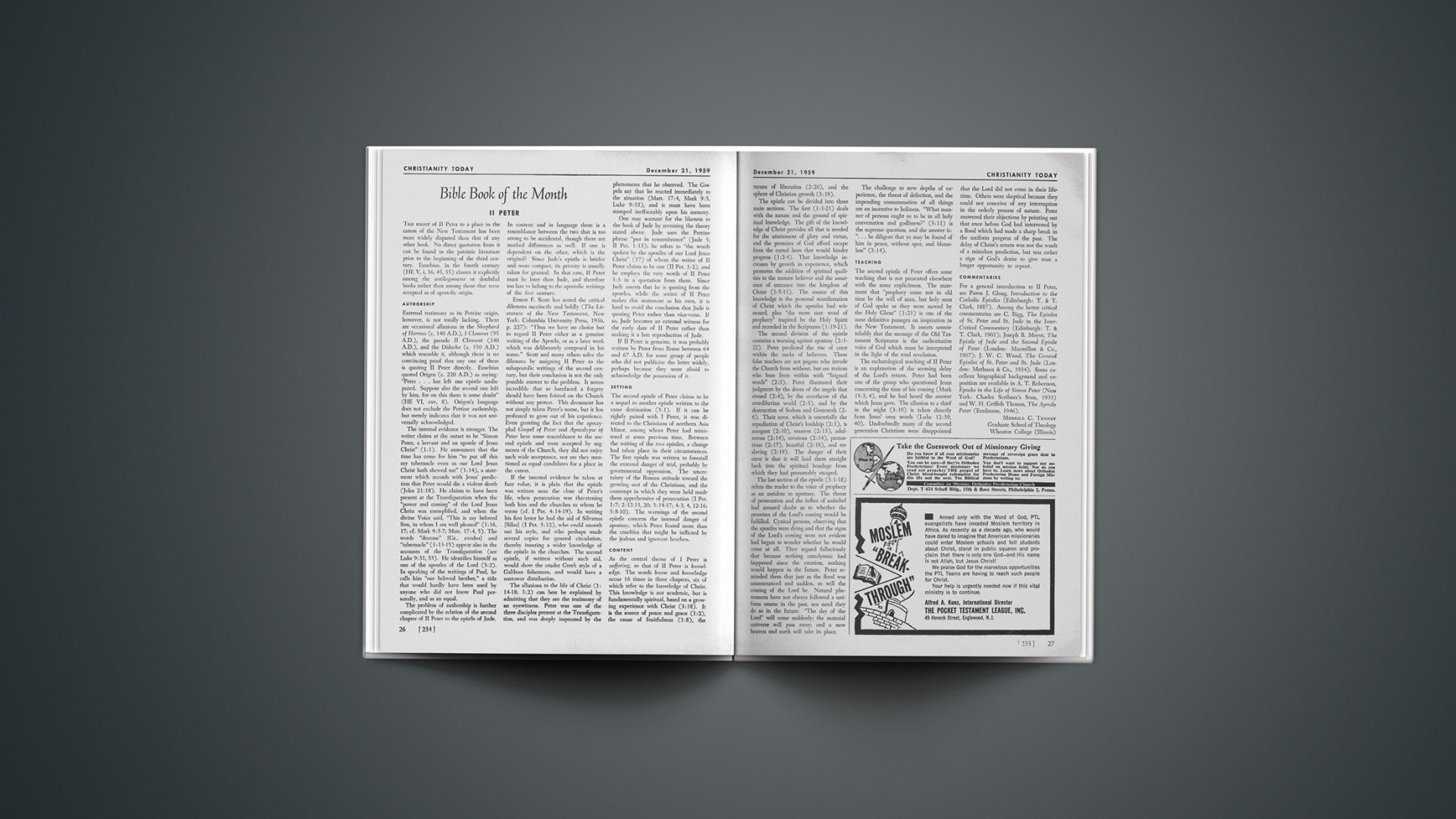
Bible Book of the Month: II Peter

The right of II Peter to a place in the canon of the New Testament has been more widely disputed than that of any other book. No direct quotation from it can be found in the patristic literature prior to the beginning of the third century. Eusebius, in the fourth century (HE V, i, 36, 45, 55) classes it explicitly among the antilegomena or doubtful books rather than among those that were accepted as of apostolic origin.

AUTHORSHIP

External testimony to its Petrine origin, however, is not totally lacking. There are occasional allusions in the Shepherd of Hermas (c. 140 A.D.), 1 Clement (95 A.D.), the pseudo II Clement (140 A.D.), and the Didache (c. 150 A.D.) which resemble it, although there is no convincing proof that any one of these is quoting II Peter directly. Eusebius quoted Origen (c. 220 A.D.) as saying: “Peter … has left one epistle undisputed. Suppose also the second one left by him, for on this there is some doubt” (HE VI, xxv, 8). Origen’s language does not exclude the Petrine authorship, but merely indicates that it was not universally acknowledged.

The internal evidence is stronger. The writer claims at the outset to be “Simon Peter, a servant and an apostle of Jesus Christ” (1:1). He announces that the time has come for him “to put off this my tabernacle even as our Lord Jesus Christ hath shewed me” (1:14), a statement which accords with Jesus’ prediction that Peter would die a violent death (John 21:18). He claims to have been present at the Transfiguration when the “power and coming” of the Lord Jesus Christ was exemplified, and when the divine Voice said, “This is my beloved Son, in whom I am well pleased” (1:16, 17; cf. Mark 9:5–7; Matt. 17:4, 5). The words “decease” [Gr., exodus] and “tabernacle” (1:13–15) appear also in the accounts of the Transfiguration (see Luke 9:31, 33). He identifies himself as one of the apostles of the Lord (3:2). In speaking of the writings of Paul, he calls him “our beloved brother,” a title that would hardly have been used by anyone who did not know Paul personally, and as an equal.

The problem of authorship is further complicated by the relation of the second chapter of II Peter to the epistle of Jude. In content and in language there is a resemblance between the two that is too strong to be accidental, though there are marked differences as well. If one is dependent on the other, which is the original? Since Jude’s epistle is briefer and more compact, its priority is usually taken for granted. In that case, II Peter must be later than Jude, and therefore too late to belong to the apostolic writings of the first century.

Ernest F. Scott has stated the critical dilemma succinctly and boldly (The Literature of the New Testament, New York: Columbia University Press, 1936, p. 227): “Thus we have no choice but to regard II Peter either as a genuine writing of the Apostle, or as a later work which was deliberately composed in his name.” Scott and many others solve the dilemma by assigning II Peter to the subapostolic writings of the second century, but their conclusion is not the only possible answer to the problem. It seems incredible that so barefaced a forgery should have been foisted on the Church without any protest. This document has not simply taken Peter’s name, but it has professed to grow out of his experience. Even granting the fact that the apocryphal Gospel of Peter and Apocalypse of Peter bear some resemblance to the second epistle and were accepted by segments of the Church, they did not enjoy such wide acceptance, nor are they mentioned as equal candidates for a place in the canon.

If the internal evidence be taken at face value, it is plain that the epistle was written near the close of Peter’s life, when persecution was threatening both him and the churches to whom he wrote (cf. 1 Pet. 4:14–19). In writing his first letter he had the aid of Silvanus [Silas] (1 Pet. 5:12), who could smooth out his style, and who perhaps made several copies for general circulation, thereby insuring a wider knowledge of the epistle in the churches. The second epistle, if written without such aid, would show the cruder Greek style of a Galilean fisherman, and would have a narrower distribution.

The allusions to the life of Christ (1:14–18; 3:2) can best be explained by admitting that they are the testimony of an eyewitness. Peter was one of the three disciples present at the Transfiguration, and was deeply impressed by the phenomena that he observed. The Gospels say that he reacted immediately to the situation (Matt. 17:4; Mark 9:5; Luke 9:33), and it must have been stamped ineffaceably upon his memory.

One may account for the likeness to the book of Jude by reversing the theory stated above. Jude uses the Petrine phrase “put in remembrance” (Jude 5; 2 Pet. 1:13); he refers to “the words spoken by the apostles of our Lord Jesus Christ” (17) of whom the writer of II Peter claims to be one (2 Pet. 3:2), and he employs the very words of 2 Peter 3:3 in a quotation from them. Since Jude asserts that he is quoting from the apostles, while the writer of II Peter makes this statement as his own, it is hard to avoid the conclusion that Jude is quoting Peter rather than vice-versa. If so, Jude becomes an external witness for the early date of II Peter rather than making it a late reproduction of Jude.

If II Peter is genuine, it was probably written by Peter from Rome between 64 and 67 A.D. for some group of people who did not publicize the letter widely, perhaps because they were afraid to acknowledge the possession of it.

SETTING

The second epistle of Peter claims to be a sequel to another epistle written to the same destination (3:1). If it can be rightly paired with I Peter, it was directed to the Christians of northern Asia Minor, among whom Peter had ministered at some previous time. Between the writing of the two epistles, a change had taken place in their circumstances. The first epistle was written to forestall the external danger of trial, probably by governmental oppression. The uncertainty of the Roman attitude toward the growing sect of the Christians, and the contempt in which they were held made them apprehensive of persecution (1 Pet. 1:7; 2:12–15, 20; 3:14–17; 4:3, 4, 12–16; 5:8–10). The warnings of the second epistle concern the internal danger of apostasy, which Peter feared more than the cruelties that might be inflicted by the jealous and ignorant heathen.

CONTENT

As the central theme of I Peter is suffering, so that of II Peter is knowledge. The words know and knowledge occur 16 times in three chapters, six of which refer to the knowledge of Christ. This knowledge is not academic, but is fundamentally spiritual, based on a growing experience with Christ (3:18). It is the source of peace and grace (1:2), the cause of fruitfulness (1:8), the means of liberation (2:20), and the sphere of Christian growth (3:18).

The epistle can be divided into three main sections. The first (1:1–21) deals with the nature and the ground of spiritual knowledge. The gift of the knowledge of Christ provides all that is needed for the attainment of glory and virtue, and the promises of God afford escape from the carnal lusts that would hinder progress (1:2–4). That knowledge increases by growth in experience, which promotes the addition of spiritual qualities to the mature believer and the assurance of entrance into the kingdom of Christ (1:5–11). The source of this knowledge is the personal manifestation of Christ which the apostles had witnessed, plus “the more sure word of prophecy” inspired by the Holy Spirit and recorded in the Scriptures (1:19–21).

The second division of the epistle contains a warning against apostasy (2:1–22). Peter predicted the rise of error within the ranks of believers. These false teachers are not pagans who invade the Church from without, but are traitors who bore from within with “feigned words” (2:3). Peter illustrated their judgment by the doom of the angels that sinned (2:4), by the overthrow of the antediluvian world (2:5), and by the destruction of Sodom and Gomorrah (2:6). Their error, which is essentially the repudiation of Christ’s lordship (2:1), is arrogant (2:10), wanton (2:13), adulterous (2:14), covetous (2:14), pretentious (2:17), boastful (2:18), and enslaving (2:19). The danger of their error is that it will lead them straight back into the spiritual bondage from which they had presumably escaped.

The last section of the epistle (3:1–18) refers the reader to the voice of prophecy as an antidote to apostasy. The threat of persecution and the influx of unbelief had aroused doubt as to whether the promises of the Lord’s coming would be fulfilled. Cynical persons, observing that the apostles were dying and that the signs of the Lord’s coming were not evident had begun to wonder whether he would come at all. They argued fallaciously that because nothing cataclysmic had happened since the creation, nothing would happen in the future. Peter reminded them that just as the flood was unannounced and sudden, so will the coming of the Lord be. Natural phenomena have not always followed a uniform course in the past, nor need they do so in the future. “The day of the Lord” will come suddenly; the material universe will pass away; and a new heaven and earth will take its place.

The challenge to new depths of experience, the threat of defection, and the impending consummation of all things are an incentive to holiness. “What manner of persons ought ye to be in all holy conversation and godliness?” (3:11) is the supreme question, and the answer is: “… be diligent that ye may be found of him in peace, without spot, and blameless” (3:14).

TEACHING

The second epistle of Peter offers some teaching that is not presented elsewhere with the same explicitness. The statement that “prophecy came not in old time by the will of man, but holy men of God spake as they were moved by the Holy Ghost” (1:21) is one of the most definitive passages on inspiration in the New Testament. It asserts unmistakably that the message of the Old Testament Scriptures is the authoritative voice of God which must be interpreted in the light of the total revelation.

The eschatological teaching of II Peter is an explanation of the seeming delay of the Lord’s return. Peter had been one of the group who questioned Jesus concerning the time of his coming (Mark 13:3, 4), and he had heard the answer which Jesus gave. The allusion to a thief in the night (3:10) is taken directly from Jesus’ own words (Luke 12:39, 40). Undoubtedly many of the second generation Christians were disappointed that the Lord did not come in their lifetime. Others were skeptical because they could not conceive of any interruption in the orderly process of nature. Peter answered their objections by pointing out that once before God had intervened by a flood which had made a sharp break in the uniform progress of the past. The delay of Christ’s return was not the result of a mistaken prediction, but was rather a sign of God’s desire to give man a longer opportunity to repent.

COMMENTARIES

For a general introduction to II Peter, see Paton J. Gloag, Introduction to the Catholic Epistles (Edinburgh: T. & T. Clark, 1887). Among the better critical commentaries are C. Bigg, The Epistles of St. Peter and St. Jude in the Inter-Critical Commentary (Edinburgh: T. & T. Clark, 1901); Joseph B. Mayor, The Epistle of Jude and the Second Epistle of Peter (London: Macmillan & Co., 1907); J. W. C. Wand, The General Epistles of St. Peter and St. Jude (London: Methuen & Co., 1934). Some excellent biographical background and exposition are available in A. T. Robertson, Epochs in the Life of Simon Peter (New York: Charles Scribner’s Sons, 1933) and W. H. Griffith Thomas, The Apostle Peter (Eerdmans, 1946).

MERRILL C. TENNEY

Graduate School of Theology

Wheaton College (Illinois)

Is Christianity Unique?

Religious leaders who are not strongly attached to biblical Christianity have on occasion recommended a so-called “universal” religion synthesized from elements of all the world religions. This proposal can be buttressed by the allegation that Christianity itself is a synthesis of borrowings from earlier systems of worship. The idea of the Virgin Birth, it is said, has been copied from the story of Buddha’s birth or from Greek mythology, and the doctrines of Paul are explained as adaptations from the Greek mysteries. Macchioro even asserts that Paul was an initiate to the pagan rites. Conservative Christians, on the other hand, maintain that Christianity is unique.

For example, J. Gresham Machen in his monumental work, The Virgin Birth of Christ, produces evidence to show that the original account of Buddha’s birth contains no extraordinary factor, and that only after Christianity had come on the scene were those stories altered in the direction of a virgin birth. The same author in The Origin of Paul’s Religion, and other authors as well, explode the theory that Paul borrowed from the pagan mysteries. Thus Christianity has been defended as unique.

Such studies are all to the good. Christianity would be compromised if it could be shown to be a mosaic of borrowings. Yet, the fact that Christianity is unique is subject to an exaggerated evaluation. For, when one analyzes the situation, it will be discovered that every religion is unique—Buddhism and Islam as well as Christianity. In fact, failure to recognize this results both in a misunderstanding of Christianity and in a false philosophy of religion as well.

THE ERROR OF SYNCRETISM

Nearly all volumes on the philosophy of religion assume that there is a common, universal phenomenon, religion, which may be the subject matter of a single science. William E. Hocking in Living Religions and a World Faith commences by asserting—“In its nature religion is universal and one.” The same author in a later volume, The Coming World Civilization (p. 149), emphasizes and elaborates the same idea. Other authors are in essential agreement on this point.

The unity of religion is sometimes sought in an experience of conversion, an integration of personality, or some sort of emotion. The present article cannot discuss extensively this point of view except to say that it is entirely too broad a definition of religion. Any selected emotional experience (abstracted from intellectual or doctrinal content) can be found in politics, marriage, business success, and in aesthetic experience as often as in religion. Here the topic must be restricted to religious ideas.

TRUTH THE DECISIVE CRITERION

The reason every religion is unique is that each one is a particular complex, and the several factors are interdependent. If it were not so technical, a comparison might be drawn with Euclidean and noneuclidean geometries, or even with plans and spherical geometry. They may all use the word triangle, but the word does not mean the same thing in the several cases. In plane geometry a triangle is a figure that necessarily contains 180 degrees. A spherical triangle must contain more. Both triangles are bounded by straight lines, but “straight lines” do not mean the same thing. So it is in religion, and even more so: a common word may be used in two or more religions, but not a common idea. For example, Christianity, Islam, and orthodox Judaism all talk about God. Indeed, they all talk about the God of Abraham, Isaac, and Jacob. Notwithstanding this striking identity in phraseology, the three religions do not mean the same thing. Obviously the triune God, whose second Person is Jesus Christ, is not the God of Judaism or Islam. The disparity is still more obvious if one analyzes the ideas of sin, salvation, or the future life. Each of these ideas is formed in relation to each of the others within a single religion. Clearly heaven is not the same in all. When further we add Buddhism to this list of religions, the situation becomes still more complex—or, rather, still more clear and simple. Nirvana and heaven (either the Christian one or the Mohammedan) are not the same thing at all. One form of Buddhism, possibly it is the purer form, is definitely atheistic. All plausibility therefore that heaven, or God, or any other idea is the common definitive element in a universal religion is lost. And it is virtually rubbing an author’s nose into it to ask: Is communism a religion? Does one say that communism is antireligious? If so, it is none the less zealously and religiously so.

From a systematic point of view the inductive attempt to find a common element in all religions involves a hysteron-proteron; that is, it requires at the outset the knowledge it professes to obtain in the end. Let us take a parallel case. If Lewis Carroll tells Alice to examine all Snarks to find their common nature, Alice, at least in her waking moments, would not know whether all the objects before her were snarks or even whether any of them were. The philosophy of religion is in the same perplexity with Alice. The objects before it are Christianity, Buddhism, Confucianism, and so on. Are they religions or are they not? This question could be answered only after we knew the common element in all religions—only after a list of religions had been drawn up. But to draw up the list requires the knowledge that induction from the list is supposed to provide. Thus it is that so many volumes on the philosophy of religion or on comparative religions proceed on an impossible foundation.

The attempt to consider religion as a common, universal phenomenon ought really to be abandoned. There are religions, but there is no religion. Christianity is unique. Neither the Virgin Birth nor the Pauline theology was borrowed from other religions, and to try to merge these ideas in some syncretistic religion is to destroy Christianity. There would remain neither sin, heaven, nor Jesus Christ. But of course Islam is unique too and would equally be destroyed in a merger. The more important question therefore is not whether Christianity is unique, but whether Christianity is true.

Gordon H. Clark is Professor of Philosophy at Butler University in Indianapolis. From his pen have come such significant works as Thales to Dewey, A Christian View of Men and Things, and Readings in Ethics, T. V. Smith, co-author.

Ideas

God’s Countdown: 1960

Emerging from the horrors of World War II, men wondered whether another cycle of uneasy peace would smoulder into further world conflagration, or whether somehow, through the purging of affliction, they had unknowingly passed through darkness toward the dawn. Since the first postwar flush of victory, the latter possibility seems less live than ever. Whatever purging or cleansing effects war may have, they lack enough potency to accomplish the desirable end. Social evils are such that some evangelicals find themselves wondering whether there yet remains on earth the equivalent of “ten righteous in Sodom.” But the so-called “prophets of doom” are not confined to the pulpit. Eminent physicist Edward Teller predicts Russia’s unquestioned world leadership in science ten years from now and sees the world modeled after Russian ideas rather than Western by the end of the century. Men are asking, “For earth, what time is it? Are these still her evolutionary birth pangs, or are we hearing the final cadence of God’s countdown for her history?”

In such an hour CHRISTIANITY TODAY’S 50 contributing editors, scattered around the globe, have been asked to assess the past year’s impact of a purifying Gospel laboring within the toils of a world system with a vast capacity for evil and to relay portents for the immediate and more distant future.

Light shimmers from a distant corner as several contributors rejoice over the signal triumphs of grace manifest in Billy Graham’s Australasian crusades. From the antipodes, Principal Stuart Barton Babbage, of Melbourne’s Ridley College, sounds an apocalyptic note: “In Australia, through the Billy Graham Crusade, we have seen afresh the power of the Gospel, and we have seen the citadels of unbelief challenged and shaken. We thank God and take courage. We believe that, in God’s own time, the kingdoms of this world will become the kingdoms of our Lord and of his Christ: that he will reign for ever and ever (Rev. 11:15).” Kansas Professor Fred E. Young, speaking from America’s heartland, sees evangelistic cooperation behind Billy Graham producing for evangelicalism a “status that must be recognized by all groups—secular and religious.” Boston’s Harold John Ockenga writes, “The impact of mass evangelism under the phenomenal leadership of Billy Graham has had its effect upon all camps.”

Dr. Ockenga notes other causes for optimism: “Evangelicalism, after falling into obscurity because of the proliferation under decades of fundamentalist bickering, is emerging to challenge the theological world. A new respect is being gained for its position by the efforts of the younger scholars. Publishing houses like Harper, Macmillan and Scribners, which formerly shied away from evangelical work, are now courting evangelical scholars.…

“There is a change in the intellectual climate of orthodoxy. The present tendency is to repudiate the separatists’ position … to re-examine the problems facing the position of orthodoxy, to return to the theological dialogue and to recognize the honesty and Christianity of those who hold views other than our own.… There is a patent willingness on the part of the new evangelicals to acknowledge the debt to the old fundamentalist leaders who maintained the orthodox position during a time of persecution and discrimination.… There may be a difference of attitude but there is no difference in the creedal content of their Christianity.”

Professor Faris D. Whitesell discerns two evangelical gains: frustration in enlisting church workers to man the “multiplicity of programs and gadgets” has led to greater dependence upon the Holy Spirit; and the forbidding world conditions have influenced evangelical preaching toward a “more serious and biblical mood.” “There has never been so much real Gospel preaching throughout the world as there has been since World War II,” declares Professor J. Theodore Mueller. Dr. Andrew W. Blackwood, author of many books for ministers, writes, “There is among many laymen an increasing desire for preaching from the Bible and for pulpit use of doctrine. Among pastors there is a dawning sense of need for pulpit use of Bible ethics, both for one person and for various groups. As soon as ministers can reserve sufficient time for hard study and private prayer, many of them will learn how to use God’s Written Word in meeting the heart needs of men today. What a golden opportunity for non-belligerent evangelicals!”

Dr. Paul S. Rees believes the past year to have witnessed a growing maturity in evangelical self-awareness and responsibility. “CHRISTIANITY TODAY has more than pulled its weight. Slowly we in the United States are learning the difference between confronting issues and cuffing ears, between informed apologetics and indiscriminate personal attacks.” Dr. Richard C. Halverson points encouragingly to the “spontaneous generation of the fellowship, Bible study, and prayer group movement, with or without organizational sponsorship.” “Many things show that the hosts of the Lord are actively at work,” summarizes Dr. Oswald T. Allis. “Printing press, radio, and television are carrying the Gospel to the ends of the earth; the evangelist with his challenge, ‘The Bible says,’ is reaching the ears of multitudes; age-old injustices of man to man are being righted. God is at work!”

From Great Britain too come heartening reports of evangelical advance. Indeed, ecclesiastical anxiety has been voiced in the British Council of Churches over the resurgence of “a very evangelical form of the Christian faith.” The Archbishop of York recently complained that the Graham crusade in Britain had strengthened fundamentalism. As Moderator of the Presbyterian Church of England, the Rt. Rev. F. P. Copland Simmons has travelled thousands of miles about England and spoken in churches of all the major Protestant denominations the past year. His impression is that “a quiet but vitally important revival” is taking place within the British churches. Though church membership figures remain fairly constant, attendance has been much improved, “finances have doubled, trebled, and (in some cases) quadrupled” and “offers of Christian service have come … in embarrassing numbers.…” “To some of us, this is a real answer to prayer and God’s clear guidance to his Church in the battle with secularism and apathy. The thousands of Bible study and prayer groups, which have arisen lately, are sending men and women back to the reading and study of God’s Word.” Also heartening is the appointment of Contributing Editor F. F. Bruce as Rylands Professor of Biblical Criticism and Exegesis on the University of Manchester’s faculty of theology. The Rev. Maurice Wood, President of the Islington Clerical Conference, has been named to a new permanent “Committee on Evangelism” constituted by the Church Assembly of the Church of England. He writes, “The Church of England is remembering once again that if it is to be the Church of the Nation, it must, under God, increasingly become the evangelizing agent of God to the nation.”

Methodist W. E. Sangster sees “no signs yet of wide revival” in Britain, “but evangelicals are taking the growing agnosticism in our land with more seriousness and giving more time to pre-evangelism than they did. Direct evangelism can run both concurrently with it—and consecutively.”

From France, Pierre Marcel writes of a complete change in the fortunes of Calvinism in France—more than a third of the Protestant pastors are members of the Calvinist Society, of which he is vice-president. He is also director of publications of the Reformed Church of France and reports the release of 15 volumes in two years with heartening acceptance by the French public. He notes deficiencies in stewardship and evangelism—“We do not know how to fashion genuine evangelists.”

Dr. Halverson, recently returned from the Orient, sees solid evangelical gains in the Asian churches’ “new awareness” of their evangelistic mission, with “their assumption of its obligation upon the withdrawal of Western dominance,” and also in the “awakening in the Church in Japan coincident with its centiennial.”

But the contributing editors are not oblivious to evangelical shortcomings. Dr. Ned B. Stonehouse, Guest Professor this academic year in the Faculty of Theology at the Free University of Amsterdam, observes: “To a large extent evangelicals continue to be impeded by tendencies toward sectarianism, ecclesiasticism and traditionalism. But even where these are largely left behind, the forces at work often appear to be precisely those which are operative in the larger realm of Christendom: tendencies to vagueness or latitudinarianism with regard to the Christian faith, including especially the doctrine of Scripture and that of the Church. Schism and self-righteous isolationism are heinous sins, but unless evangelicalism shows greater evidence of growth in perception of and commitment to the truth, it can hardly hope to meet the threat of secularism to engulf the Church.” Professor Gordon H. Clark hears “no great voice … proclaiming total depravity, election, the atonement, justification, perseverance, and the other major Reformation themes.” Dr. Clyde S. Kilby feels that “some vital element is missing: there is no strong basic intensity, no underlying will to Christian witness.…”

In the area of social responsibility, Dr. Rees charges theological conservatives with being too willing to settle for negations and meek acquiescence in the status quo. “Robust belief in Christ’s coming again needs to be married to an informed concern in the minds of Christians with regard to their citizenship responsibilities.” Director R. Kenneth Strachan, of the Latin America Mission, calls for greater effectiveness in evangelism and education on the part of evangelical missions as they confront communism, Romanism, and nationalism—“they must develop a keener understanding of the social tidal wave.…”

Dr. Ockenga declares the contemporary church’s greatest need to be revival within, for the purification of its life and testimony. Ecclesiastical weaknesses are mirrored in the body politic. Political leaders decry the lack of purpose in American life but are loathe to grapple with spiritual solutions. The London Timesrecently commented on the American substitution of morality-concern for religious interest. Dr. Stonehouse points to the inordinate American preoccupation with science, chiefly motivated by fear of what Russia may do next. He sees the two nations racing “in this process of secularization.” “Is not the Western world moving rapidly away from Christianity?” “The Church’s witness has become largely vague …, doctrinally indifferent, if not blatantly heretical. The widely affirmed disjunction between loyalty to Christ’s person and to ideas about Christ springs from an utterly heretical, non-Christian philosophy. The inclusive church tends to be as broad as the world, and thus a society which is only nominally Christian may be as worldly as one in open allegiance to secularism.”

Dr. Clark looks with disapproval upon certain government trends: “An autocratic state is always a danger to the free propagation of the gospel, and such a tendency in the United States advances with governmental interference in the steel strike (not only by present injunction, but more by previous legislation), with Dr. Blake’s proposal to tax churches, and with the candidacy of John Kennedy for President.” “Khrushchev’s too cordial reception has still further weakened America’s already weak resistance to communism.…”

The contributing editors list many American societal ills stemming from spiritual deficiencies; among others: juvenile delinquency, overemphasis on sex, blatant dishonesty in entertainment, and the continued growth of crime. Professor William Childs Robinson asks: “Have violence and murder become our entertainment and our practice? Has truth fallen in the street, in television and in sport, in our relations one to another?”

Professor Harold B. Kuhn laments the fact that coincidently with the Soviet Union’s appeal to uncommitted peoples through space achievements, “our creative artists—on canvas, on the stage, on the screen, and on the printed page”—are “ingraining decadence at home, and demeaning the United States abroad. One is tempted to ask how long we can afford the ‘luxury’ of this abuse of freedom for the sake of royalties and box office receipts.”

Scientists wonder out loud how long a nation can come in second and still hold first place. What makes a power first class? Intellectuals muse that perhaps a totalitarian nation with a hard core of false convictions may possess greater dynamic than a democracy of varied philosophies. Dr. Rees offers as one description of 1959: “the year when the West was humbled.” “Hidden in the mystery of God’s judgments is the stark fact that in the technological conquest of space those who deny him are out-pacing those who do him lip service. Still, the Hebrew prophets faced something similar. The philosophy of history God taught them needs recovery now: the ‘more wicked’ are used to shatter the pretensions of the ‘less wicked’ who have, nevertheless, more light for which they are accountable.” Speaking of the weakness of the Christian witness, Professor Geoffrey W. Bromiley bemoans the fact that “a nation like the U.S. can still pursue on a large scale wrongly conceived educational policies, and that there is no answer either in the preaching or the lives of Christians to the theoretical or practical materialism which threatens to engulf both East and West.”

Some of the contributing editors tentatively agree with Professor Teller’s predictions as to Russia’s future dominance, although notably Frenchman Pierre Marcel looks for the ultimate supremacy of the U.S. over the U.S.S.R. He accords a strategic role in determining the future course of world history to the faith and works of American Christians. Barring an atomic war, Dr. Earl L. Douglass feels that communism and democracy will greatly modify each other within 50 to 100 years.

General William K. Harrison sees social evil and the anti-biblical nature of much that passes for Christianity both calling forth the wrath of God. “This time I believe that wrath will be the Great Tribulation so clearly prophesied in the Bible.”

Professor Bernard Ramm is daily confronted with two items: the mystery of iniquity and the triumph of the Gospel. Despite communism and anti-missionary nationalism, he expects to see fully “as much triumph of the Gospel as there is evident mystery in iniquity. The fiery furnace, the blooded sword, and the imperial decree have never yet extinguished the gospel or the Church; and I do not expect them to do so in our generation.”

Dr. Bromiley is “not unhopeful” that by the end of the century “we may see the fruition” of many evangelical movements now in early stages. “God may confound our present estimate of their inadequacy as he takes our little and makes it much.”

Dr. Cary N. Weisiger, III, sets the present task within its eschatological orientation. “With the world’s population multiplying at a frightening rate and the possibility of world evangelization seemingly more difficult, we can pray, witness and serve courageously if we keep looking for that blessed hope, the glorious appearing of Jesus Christ.” Anglican Maurice Wood sees the combination of shallowness within a “mixed church” (wheat and tares, Mt. 13:24–30) along with increasing missionary endeavor as indicative of the nearness of Christ’s return. He pleads for a greater evangelistic effort as does Dr. Sangster, who describes this as our plain duty regardless of the lack of unanimity among British evangelicals (he could have added American) as to “whether the world will soon end in a holocaust or continue for many centuries.”

When a man stands in the arid Kidron Valley, he is on apocalyptic ground. Both Jews and Moslems believe this to be the site of the Last Judgment. Moslem tombs are on one side, Jewish tombs on the other. The Valley of Hinnom, or Gehenna, is but a continuation of Kidron. In one direction the observer looks up to see the tawny wall of Jerusalem, city of history’s most horrifying event. But happily he may turn and lift his eyes to the Mount of Olives, scene of the Ascension with its steeling words: “Go ye therefore, and teach all nations …: I am with you alway, even unto the end of the world.” And the white-robed men said, “This same Jesus … shall so come in like manner as ye have seen him go into heaven.”

Whatever the hour on God’s clock, the ultimate triumph is secure. But the countdown is not yet ended … and there is yet work.…

READING REQUIREMENTS IN SOUTHEAST ASIAN SEMINARIES

The Christian theological institutions of Southeast Asia have been presented with a preliminary and tentative listing of books for guidance in stocking their libraries. The work of Dr. Raymond P. Morris, professor of religious literature and librarian at Yale University, the list aims to suggest “a good collection of books,” and an up-to-date research library will do well to give heed to it.

Fortunately, however, the compilation disowns any intention of selecting the “best” or definitive books, or even of proposing a core library. It simply provides a “prompter” sheet (of 154 pages), highly useful as such, but not without deficiencies in its reflection of historic evangelical Christianity.

This defect becomes the more apparent if one keeps an eye on the volumes designated by an asterisk as “books considered by the compiler as of unusual value for the purposes of this list.” Apart from the omission of distinctively evangelical works worthy of inclusion (B. B. Warfield’s writings are excluded, as is the five-volume International Standard Bible Encyclopedia edited by James Orr), the section on “Christianity and Other Religions” seems woefully weak. Under “Dictionaries and Encyclopedias” Southeast Asian librarians are prophetically informed that “the forthcoming Interpreter’s Bible Dictionary … and the forthcoming revised Dictionary of the Bible by Hastings, may be expected to supersede older English Bible dictionaries.” No mention is made of the forthcoming Dictionary of Theology by evangelical scholars. The section on the “Authority of the Bible” is marked by its absence of volumes defending the high and historic view. The Interpreter’s Bible is specially commended. The listings seem frequently to defer to critical schools of thought now widely under challenge in scholarly circles. One will search the recommended list of commentaries on specific Old Testament books almost in vain for a reference to consistently evangelical works, although in the New Testament sections some older works survive from previous generations, while contemporary evangelical scholarship is virtually ignored. J. Gresham Machen’s classic works on The Virgin Birth of Christ and The Origin of Paul’s Religion do not appear. In the few places where evangelical works are included, the theological standpoint of the list apparently requires special indicia of caution; F. F. Bruce’s The Acts of the Apostles gains the explanation: “Conservative.” Liberal and neo-orthodox works are not specially designated.

We are not suggesting that the Yale list is valueless. A competent library reference room must consider the great bulk of these works if it is shelved with care. Nor do we charge that the list is anti-evangelical. Some evangelical works are included, even in the section on contemporary theological thought, and these selections are worthy. But the list is heavily weighted in the liberal and neo-orthodox directions, and it does not really reflect the weight of evangelical scholarship in our century any more than it does full justice to historic biblical Christianity. The kindest verdict would be that the list lacks objectivity. One may hope that it will not serve finally as a basis for approving theological libraries of Southeast Asia as adequate for “accredited institutions,” since it weights essential reading matter in the direction of theological bias at the expense of the evangelical heritage to which the foreign missions enterprise owes its very life.

From an additional standpoint the Yale list, in its present form, seems regrettable. In our generation evangelical schools have been striving more and more to reflect alien points of view with fairness and accuracy, and not simply to condemn them on bias. An examination of evangelical institutions will disclose that their libraries incorporate proportionately more literature reflective of modern theological deviations than theologically-inclusive centers include of the competent evangelical literature of the day. Evangelical institutions have awakened to the fact that historic Christianity has nothing to fear from any quarter, and that the critical assaults upon it are soon deflated. But it would hardly serve the cause of Christian unity in our day were the theological seminaries of the Occident to be reinforced at the expense of evangelical Christianity. What is needed is not simply a grudging supplementation of the Yale list. Perhaps some agency like Evangelical Theological Society could be invited to designate competent evangelical literature worthy of inclusion in the reference reading of Southeast Asians in a time of growing evangelical concern and evangelistic urgency.

The Blood of Christ

THE BLOOD OF CHRIST

Running through the Bible from Genesis to Revelation are multiplied references to sacrifices and blood.

The New Testament references to “the blood of Christ” are so numerous and specific that they in themselves constitute a theology of redemption.

That the doctrine of the blood atonement is attacked and rejected as a “slaughter house religion” by many is a matter of deep concern. If the shed blood of Calvary has no relationship to God’s redemptive act, then men should know it. If allusions to Christ’s blood, and faith in its saving efficacy, are “offensive”, and on this assumption to be eliminated from Christian doctrine, we should know on what authority such action is being taken.

I have before me letters which deplore in the strongest terms a concept of God which requires the sacrifice of his Son for the sins of the world.

These letters speak of such beliefs as “sadistic,” “revolting,” “outrageous,” “atonement of retaliation,” “masochism,” and other vigorous terms.

Little is to be gained by engaging in polemics. To me the decision must center in the revelation which God has given us of himself and his Son through the Holy Spirit in the Scriptures.

Here we are confronted with the holiness and justice of a God who is utterly righteous, and we see the great mercy of the same God who is love.

The Bible tells us that the sacrifices of the Old Testament were types and symbols of the death of Christ on the Cross, and the New Testament affirmations about the blood shed on Calvary require us to take them in their rightful context and accept them as the inspired explanation of the central event of all history. Where we fail to understand all that is implied is our fault and not the fault of God’s plan.

The writer of the epistle to the Hebrews speaks of the tabernacle service as symbolic of Christ’s atoning work; and he further states: “Neither by the blood of goats and calves, but by his own blood he entered in once into the holy place, having obtained eternal redemption for us. For if the blood of bulls and goats, and the ashes of an heifer sprinkling the unclean, sanctifieth to the purifying of the flesh: How much more shall the blood of Christ, who through the eternal spirit offered himself without spot to God, purge your conscience from dead works to serve the living God?” Before such a statement how can we refrain from bowing our hearts in humble thankfulness for what Christ has done?

This same writer says: “He that despised Moses’ law died without mercy under two or three witnesses: Of how much sorer punishment, suppose ye, shall he be thought worthy, who hath trodden under foot the Son of God, and hath counted the blood of the covenant, wherewith he was sanctified, an unholy thing, and hath done despite unto the Spirit of grace?” This to me is evidence of the overwhelming importance of God’s holy provision for my sins and also the awfulness of sin which made such provision necessary.

The blood which flowed at Calvary was real blood. The implication and effect of that blood is for all ages, and becomes real and precious to us through faith.

Our Lord, in instituting the sacrament of remembrance, says: “For this is my blood of the new testament, which is shed for many for the remission of sins.”

The Apostle Paul, in his meeting with the Ephesian elders, speaks of “the church of God, which he hath purchased with his own blood”; while to the church in Rome he writes: “Being justified freely by his grace through the redemption which is in Christ Jesus: whom God hath set forth to be a propitiation through faith in his blood.… Much more then, being now justified by his blood, we shall be saved from wrath through him.”

What is the significance of this blood that runs like a red line through the story of redemption?

Noah was warned against eating “flesh with the life thereof, which is the life thereof.” Equating blood with life is fully compatable with the concept of our Lord’s giving his life for the redemption of mankind.

In our own scientific age there are thousands living today who owe their lives to blood transfusions. By analogy, it can be reverently said that, in a mystical sense, the Son of God is the great universal Donor, giving new life to the sinner who trusts in His shed blood for cleansing.

The implications of his blood are inexhaustable in their effect on those who accept new life in Christ.

We have redemption through his blood, and it is this same blood which brings us near to God. Paul reminds the Ephesian Christians of their former state—“having no hope, and without God in the world”; and then he says: “But now in Christ Jesus ye who sometimes were far off are made nigh by the blood of Christ.”

To the Christians in Colosse he tells of God’s good pleasure that in Christ “should all fullness dwell” and immediately speaks of the work of Christ in these words: “And having made peace through the blood of his cross, by him to reconcile all things unto himself.”

The Apostle Peter is equally emphatic with reference to the blood of Christ in telling us that our redemption is not purchased by silver or gold, “but with the precious blood of Christ, as of a lamb without blemish and without spot.”

John, the beloved apostle, in speaking of Christians walking in the light of the Lord and in the fellowship which this makes possible, says: “And the blood of Jesus Christ his Son cleanseth us from all sin.”

We find this same theme in the book of Revelation where we are told: “Unto him that loved us, and washed us from our sins in his own blood …”; “And they sung a new song, saying, Thou art worthy to take the book, and to open the seals thereof: for thou wast slain, and hast redeemed us to God by thy blood out of every kindred, and tongue, and people and nation.”

In all of this we are confronted by a great mystery. This side of eternity none of us can know the full implication of God’s great act of redemption in Christ. To rationalize either the nature of sin or the cost and means of our salvation is to toy with destruction itself. It is not for man to argue with his Maker. To let one’s philosophical preconceptions separate him from God’s provision of eternal life is folly at its worst.

We live in a day of great sophistication. It is not easy to humble our hearts, minds, and wills and submit them to God; but there is great reward to those who say from a yearning heart: “Lord, I believe, help thou mine unbelief.”

“What can wash away my sins,

Nothing but the blood of Jesus.”

Is not this a time when we might well exchange some of our theological sophistication for the simplicity of a by-gone day?

L. NELSON BELL

Confucianism Today

When a man is asked to write an article on Confucianism, his immediate question is: “Which Confucianism? Now, of course, it is genetically true of every religion that it has many aspects. Always there is the distinction between the religion of the “fundamentalist” and the religion of the “liberal”: always there is the contrast between the lofty but nebulous creed of the philosopher and the workaday faith of the plain man. Yet of no religion is this more true than of Confucianism, which at certain levels ceases altogether to be a religion in any sense of the word. Instead, it becomes at once an ethical system and a pattern of life. Curiously enough, this tendency, which might at first seem to be its weakness, has proved to be its strength in old age; for in the twentieth century, with the collapse of the organized Confucian cult, Confucianism still persists. It survives not only as a deliberately chosen way of life, but even more as an unselfconscious, pervasive attitude of mind, which is, by one of the ironies of history, more common now in the Western world than in the Eastern. Therefore, among the world’s religions, the study of Confucianism is still valid, though today there are no sacrifices or incense burned before the tablets or statue of the sage K’ung Ch’iu, better known to the West by his honorific title of “K’ung the Maestro,” K’ung Fu-Tzu, early Latinized as Confucius.

RECOVERING THE FOUNDER

This collapse of the cult has a certain appropriateness. Confucius was no Confucianist, and would certainly have deplored such virtual deification. It is doubly appropriate that there is nowadays a renewed interest on all sides in Confucius the man, for it is first as a man, and second as a teacher that he has left an abiding mark on the East. For millennia he has been regarded as an expert in “lifemanship,” to use a useful neologism from contemporary humorists; and it is as such that others have looked to him for guidance.

Setting aside then those works which are mere “debunking” in the modern tradition, and those “higher critical” studies which deny Confucius any independent existence, we find remaining many recent studies which represent a serious attempt to recover the man himself, to see him directly instead of through endless stacks of commentaries, as has been his fate for two thousand years at least. For the serious student, Creel’s books will repay study. For an easy, readable, yet scholarly exposition of the modern “slant,” the busy pastor could not do better than read the paperback copy, A Short History of Confucian Philosophy, by Liu Wu-Chi (Penguin Books, 1955).

On the writer’s shelf before him are two small Chinese books, taken at random, which serve as a reminder that this revival of interest in Confucius is by no means confined to the somewhat artificial atmosphere of Western universities with their departments of Chinese studies. Were this so, it would indicate that Confucianism was already dead and had reached the point of being worthy of study as a branch of “spiritual archaeology,” like the religion of the Incas or the Totemism of precolonial New England. No, these books, and numerous others, are written in a living situation, to meet a living need. One book is titled, A New Discussion of Confucianism, by Ch’en Chien-Fu, and the other is Criticism of Confucian Philosophy, by Chang Shen-Ch’ieh, published in Formosa in 1953 and 1954 respectively.

CONFUCIAN WAYS OF THOUGHT

Now, in spite of what detractors may read into the last clause of this sentence, such continued study of Confucius in the periphery of the Chinese world is not mere “stubborness,” nor can it be dismissed as merely “reactionary”—although it is true that Confucianism was as much a part of Old China as the Orthodox Church was of prerevolutionary Russia. Such books are published not simply because Confucianism was part of the old and loved as such; they are published because, for better or worse, Confucianism was the motor spring of the old. If the old is to survive in the same recognizable form, it must therefore be with this motivation. The Chinese of the Dispersion may dress and eat like the Americans or Australians around them without ceasing in any way to be thoroughly Chinese; but once they cease to live by Confucian ways of thought, then they cease to be distinctively Chinese. Thus the resuscitation of Confucianism, no doubt artificial in some of its aspects, is not alone a conscious protest against that un-Chinese way of life which is communism; it is equally an incoherent protest against the invasion of the old China by all modern corrosive values. As Christians, we may well see dangers in this attitude, for the Gospel is certainly a solvent, if not a corrosive. As realists, we may feel it a vain attempt to plug the dikes of modern thought; but we must at least try to understand it.

CRITICISM ON TWO FRONTS

So Confucius, like some modern King Canute, is doughtily fighting on two “fluid fronts” today. The materialistic Western world “debunks” him, or considers him hopelessly impractical. The Communist world simply points to him, shrugs its shoulders, and says in effect, “There you are—we told you so!” No need for “debunking” so far as they are concerned (although there have been some very crude attacks on him); he is already the quintessence of all that communism opposes. He is feudalistic to his backbone; he is aristocratic in the true sense of that maligned word. Worse still, he holds incurably “bourgeois” concepts of virtues and vices. The maligned hymn verse, “God made them high and lowly, He ordered their estate,” would have found a stout defender in Teacher K’ung. He would have stood for no egalitarian nonsense, though his sense of superiority might be measured in terms of learning or virtue as well as birth. He would have accepted as axiomatic the attribution of such strata to Providence if not to a personal God, whereat the Communist would again shrug his shoulders, in helplessness and in triumph. In the Communist’s mind, Confucius belongs to a paternalistic age, past and outmoded, and there is no need to attack him now. They may condescend to use him at times as an example of good vulgar proletarian virtues that peep shyly through the rents of a fur-lined bourgeois gown, much the same way Nazi Germany was pleased to use Martin Luther as a national figure long after they had denied him his position as religious leader.

EPITOME OF THE OLD NATURE

The attitude of the Communists to Confucius is not, of course, important to us except insofar as we may ask ourselves whether they were right in regarding Confucius as the epitome of the Old China, the destruction of which they felt to be their immediate mission in the East. If that was the case, then we have a valuable confirmation of the view of the Chinese periphery—that Confucius is the very matrix from which came traditional China with all its weakness and strength. But we as Christians ought to carry this analysis further. Confucius is to us not only the epitome of Old China, but of old natural man—lovable, inconsistent, easygoing, with a neat pattern of virtues and vices, rights and duties, and regarding the whole of life as a pattern of human relationships. Thus it is that for the man educated by the old “classical” system, the transition from Greece and Rome to Confucius is easy and natural; he is conscious of no break because there is none. Confucius breathes the same air and oves with the same grace and dignity as the Olympians. He finds an answering, if unwilling, echo in us all simply because he is the fine flowering of all that is best in the old pagan world. In other words, he is something of our father. In our hasty Christian rejection of the pagan world, we do well to remind ourselves that there are worse things than a good pagan. We can recollect with humility that it was not even Christian theology that swept Parnassus from the educational curriculum, but statics, dynamics, and physics—that worthy trinity of the Machine Age. Communism denies, as sheer subjective folly, the “ought feelings” that were self-evident to Confucius, as indeed they were to most Western philosophers and moralists until recent centuries.

THE NEO-PAGAN COPY

But communism is not alone in this denial: the neo-pagan of the modern West, for all his antipathy to communism, yet agrees with it here. And is this modern pagan in any way preferable, from the evangelical Christian point of view, to the traditional Confucian type of pagan?

If, from this point of view, we should be tempted to consider Teacher K’ung as a Christian ally, we must remember that, as Christians, we can none of us believe in the inherent goodness and decency of man. As an explicit doctrine, this is more characteristic of Mencius who played a Chinese Aristotle to the Confucian Plato; but it is an ever-present, yet unexpressed element in every Confucian syllogism, be it in philosophy or ethics.

So, in the twentieth century, the Sage has no ally—Marxist, Western materialist, or Christian theologian. Canute has stemmed the waves all in vain; the Chinese of tomorrow, whether inside or outside the Bamboo Curtain, can scarcely be a true Confucianist. He must instead choose between two brands of materialism, unless indeed he has come to that complete distrust of man and complete trust in God which is Christian faith.

Where, then, does Confucianism live? It lives unconsciously in the hearts of many an educated “decent pagan” of the West who has absorbed insensibly certain moral standards from the pervasive Christianity of which he knows little and wants to know less. Wherever the old liberal humanism prevails, with its tranquil and deluding beliefs about the nature of Man—there Confucianism lives, recognized or unrecognized. Good-natured pagans, dignified and cultured, coming from the “best” of families, going to the “best” colleges, secure and confident in their own benevolent “mission,” still dressing for dinner as did the ship founders beneath them—these are the true sons and daughters of Confucius. The fondness of the modern world for translations of Confucius shows that at least some of these pagans recognize the pit from which they have been dug, and the rock from which they have been hewn.

Alan Cole is a native of Dublin, Ireland, and holds the B.A. and Ph.D. degrees from Trinity College, Dublin, and the B.D. and M.Th. degrees from King’s College, London. After teaching at Oak Hill Theological College, London, and Moore Theological College, Sydney, he went to the mission field in 1952. Currently he is engaged in a Lay Leaders’ Training Scheme of “Schools of Discipleship” in Singapore Diocese.

Buddhism and the Christian Faith

Buddhism originated in the life, teaching, and personality of a remarkable Indian sage, Siddhartha Gautama, the son of a petty king whose capital was at Kapilavasta in northern India. The life span of Gautama, who is called Buddha or “Enlightened One,” is usually reckoned as about 560–480 B.C.

According to traditional accounts, at the age of 29 Gautama saw in succession a decrepit old man, a dead body, a diseased person, and a calm recluse. Shocked by these “Four Passing Sights” and filled with a yearning to find release from the inevitable misery of existence, he forsook his sheltered life of luxury and left behind his beautiful wife and young son to become a recluse.

After trying various Hindu ways of salvation, Gautama adopted a rigorous asceticism involving such extreme fasting that his body wasted away to skin and bones. Rejecting this fanaticism for a “middle way” between self-mortification and self-indulgence, he began to eat again; and shortly thereafter, while seated in meditation, he attained “enlightenment”—he became a Buddha.

Soon Gautama had made the important decision to share his experience with others. He began to preach, and his first converts were five former disciples who had forsaken him when he had renounced extreme asceticism. Other conversions followed, and before long a brotherhood of 60 monks had resulted with Gautama at the head. Thus a new religion was born.

This Buddhist faith flourished for a few centuries in India until through certain circumstances it became practically extinct in the land of its birth. Meantime, however, it had divided into two main branches and had effected a missionary expansion which was to give it continued existence in many Asiatic countries.

Today, the Theravada (or Hinayana) branch of Buddhism predominates in Ceylon, Burma, Thailand, Cambodia, and Laos. The Mahayana branch prevails in China, Tibet, and Japan, and to lesser extent in Viet Nam and Korea.

Estimates of Buddhist membership vary widely, but a Buddhist writer has indicated recently that 150,000,000 is “the figure which has a wide acceptance” (H. Nakamura in Kenneth Morgan, ed., The Path of the Buddha, Roland Press, 1956, p. 364).

Between the two major divisions of Buddhism there are fundamental agreements but also deep differences, although quite recently they have reached some measure of union in the World Fellowship of Buddhists. The motivation of this union seems to be a new awareness of world mission.

This illustrates the fact that just within the last decade or so Buddhism has become “a self-conscious missionary faith” addressing itself to the Western world.

CLAIMS TO WORLD FAITH

What claims can Buddhism make as a world faith in the contemporary situation? It can truthfully assert that in common with other high religions it has inculcated lofty ethical standards, such as honesty, sexual morality, and sobriety. It can point to its noble ideal of compassion for all sentient beings.

Actually, at the heart of Buddhist missionary propaganda is the contention that not Christianity but Buddhism is the religion of peace. Buddhists point to the record of wars and controversies of Christendom and the use of atom bombs by Christians. They insist that Buddhism has a much better record than Christianity concerning religious tolerance. In an article published in Ceylon, a Buddhist has charged that “Christianity is based and built upon the idea of vengeance” (Edmund Perry, The Gospel in Dispute, Doubleday, 1958, p. 211).

The sting in these words is not relieved by the fact that we Christians know this to be a very inadequate, though understandable, judgment upon our faith. It is possible, of course, to show that Buddhism has not been entirely free from intolerance, that Buddhist tolerance has often meant lack of zeal, and that Buddhists claim too much for their religion’s opposition to war. But it surely behooves Christians to look at our own record with repentance and with the determination to prove that Christ is truly the Prince of Peace.

Buddhism must be confronted and evaluated, however, not in terms of isolated elements of its missionary apologetic but as a total religious system. It is possible to see in Buddhism’s ideal of compassion and concern for peace some evidences that God has not left himself entirely without witness in the Buddhist world. But it is likewise true that the world view and basic presuppositions of Buddhism are irreconcilable with the uniquely authoritative revelation in Jesus Christ.

Over against the Christian faith in a personal God, who is Creator and Redeemer, stands the Buddhist denial of such a Deity. Buddhists often call themselves atheists, though at least in Mahayana the profession of atheism must be seen as one of a dialectic whereby the existence of objective realities is denied so that the great Buddha Reality may be affirmed. It is perhaps correct to include both branches of Buddhism in the category of identity-mysticism, since in either case there is ultimate absorption of the individual into the Absolute, whether this Absolute be conceived as the Cosmic Buddha Mind or Spirit (as in Mahayana) or hardly subject to any positive definition (as in Theravada).

Opposed to the Christian view of the universe as created by God and moving toward the goal of his gracious purpose in Jesus Christ is the Buddhist concept of samsara, which means the endless (unless broken by Nirvana) chain of rebirths of individuals in successive existences and of universes in world cycles. According to this view, every existence depends upon a previous one and the present universe evolved out of the dispersed matter of a former universe. Buddhist statements of this doctrine of “dependent origination” sometimes resemble the writings of modern scientists (cf. Perry, op. cit., p. 203). But the inadequacy of the Buddhist view as a religious explanation of the world may certainly be questioned; for not only does it fail to discover a First Cause, but, unlike modern science, it specifically denies its possibility.

To the Christian this view robs history of its meaning, rendering it self-contained and without a goal. And if one adds to this the concepts of impermanence and nonsubstance which are basic to Buddhism, he finds it well nigh impossible to maintain the reality of the phenomenal world as well as history. Mahayana teaches the doctrine of sunyata, which is the void or emptiness, indicating that all things are but appearance. Although in a profound dialectical interpretation sunyata is understood positively as all-inclusiveness and indeed as the metaphysical equivalent of love, it looks very much like the reappearance of the Hindu maya or illusion by which phenomenal realities are denied. At any rate, it is incompatible with the historical and phenomenal realism of Christian faith.

This whole concept of samsara must be a matter of faith for the Buddhist, since it can neither be proved nor disproved scientifically. This is recognized by an erudite Buddhist, at least concerning individual transmigration, when he admits that “the doctrine of transmigration does not seem to enjoy any scientific support” (D. T. Suzuki, Mysticism: Christian and Buddhist, Harper, 1957, p. 121).

THE DOCTRINE OF KARMA

The Christian is all the more troubled by the doctrine of karma which underlies the concept of transmigration. Karma is the law of cause and effect whereby one’s actions in a given incarnation determine his character and the state of his future existence. This Hindu concept was retained by Gautama and is still an important part of Buddhist religion. It is not only impossible of scientific verification but is morally offensive even to some Indians.

It is true that Buddhism offers ultimate escape from the clutches of karma by the experience of Nirvana, which literally means “the blowing out” or “the absence of craving” but is interpreted by Buddhists as the positive experience of “emancipation.” In the mystical enlightenment of Nirvana the power of karma is broken, but karma itself contains no hint of Cosmic Forgiveness or Regenerative Power and is too mechanical and merciless to represent Cosmic Justice in a world of persons.

On pragmatic grounds, the belief in karma may be criticized for having hindered the implementation of Buddhist compassion. One might have expected that Buddhism’s concentration upon suffering as the central problem of life would have led to a robust effort at the relief of human misery and the correction of wrong social structures which breed and nurture it. As a matter of historical fact, however, organized efforts at social service on the part of Buddhists (e.g., the creation of hospitals and the like) appear scattered and desultory when compared to those of Christians; and where Buddhism has not been appreciably influenced by Christianity it has shown practically no concern for social reform. It is significant that in a volume of essays in which Buddhist scholars attempt to interpret their religion to the Western world (Morgan, ed., op. cit.), no reference is made to social reform, although attention is given to service and compassion. This deficiency is all the more regrettable when it is remembered that original Buddhism was revolutionary, at least to the extent of obliterating caste and including women in the monastic order.

THE MEANING OF COMPASSION

The Buddhist remedy for suffering is not the changing of conditions which produce and perpetuate human misery but the individual enlightenment of the sufferer. He is to understand that desire is the cause of suffering and that the eradication of desire in the experience of Nirvana is its cure.

Enlightenment is certainly important, especially if it is based on truth and reality; but it is never sufficient to satisfy the social concern of the Christian who stands under the judgment of the kingdom of God and has the compassion for persons he has learned at the Cross.

Yet Buddhism also is a religion of compassion, and it is at this point that it moves closest to Christianity. The Buddhist ideal is universal, all-embracing love for all beings. In Theravada Buddhism the motivation for this compassion is the desire to produce good karma and to express one’s identity with all that lives (Thittila, op. cit., pp. 94–96). In Mahayana, compassion seems more definitely based upon the self-sacrifice of Gautama the Buddha and of other Buddha-like beings or Bodhisattvas who have delayed the full enjoyment of Nirvana or Buddhahood in order to save others.

From the Christian standpoint, however, identity-mysticism tends to vitiate the Buddhist motivation to compassion. The import of the profound Mahayana doctrine of the Threefold Body of the Buddha is that phenomenal reality is but a secondary expression of the void or Absolute Reality; and the compassion or self-sacrifice of the Buddha Mind which is Ultimate Reality is actually “the impartial acceptance of all things as expressions of itself” (T. N. Callaway, Japanese Buddhism and Christianity. Tokyo: Shinkyo Shuppansha, 1959, p. 221). World salvation, therefore, is the Buddha Mind’s realization of itself. Likewise, the compassion of an enlightened Buddhist or a Bodhisattva is not loving service to other individual selves but acceptance of things as they are in the realization that ultimately there is no self to be sacrificed and no other to be served (ibid., pp. 219, 222; cf. Nakamura, op. cit., pp. 381, 395–396).

In the identity-mysticism of Buddhism there is no basis then for the salvation of society. There is nothing at all analogous to the great social ideal of the kingdom of God and the Church as the Body of Christ. And what looks like the self-sacrifice of Ultimate Reality (resembling the Cross) turns out to be more self-realization than self-sacrifice, and in any case mythical.

A young Japanese Buddhist once asked me the question: “If I should become a Christian, would I have to renounce my Buddhist heritage which I respect and appreciate deeply?” I replied something like this: “I too respect your Buddhist heritage and would regret to see it all renounced. Rather, I hope that in Jesus Christ you will find a new object of supreme devotion and a transforming experience by which you will see your religious heritage with new eyes. In His light some of your heritage will be negated but much will be transformed and fulfilled.”

Edwin Luther Copeland is Professor of Missions in South-eastern Baptist Theological Seminary, Wake Forest, North Carolina. Formerly a Southern Baptist missionary to Japan, he taught at the Seinan Gakuin University from 1949–56. He holds the B.A. from Furman University, the Th.M. from Southern Baptist Seminary, and the Ph.D. from Yale.

Hinduism Today

Hinduism is indeed a shoreless sea. It includes within itself everything from the highest and most abstract philosophy down to the crudest superstition. And this does not in any way disturb the average thoughtful Hindu—it is to him evidence of the largeness and splendor of the religious system to which he gives his allegiance.

To all Hindus, the scriptures of highest authority are the four Vedas. These, which are among the most ancient of all literary monuments (older than Homer, and about of the same age as the Song of Deborah in the Old Testament), were the product of that lively and vigorous people, the Aryans, at the time of their first invasion of India. Yet, though they possess such unquestioned authority for the Hindu, they are mainly concerned with gods whom no one any longer worships—Varuna the outspread heaven, Agni the sacred fire, Ushas (Aurora) the dawn—and they contain not a trace of any of the most characteristic doctrines of later Hinduism. Then follow the immensely complicated ritual rules of the Brahmanas, the foundation of much of the ritual that is still practiced in classical Hinduism today. Next come the Upanishads, marking the beginning of critical philosophy, and that understanding of the world that is summed up in the saying Tat tvam asi, “that art thou,” the soul in man is the same as the soul of the universe; separate existence is an illusion from which man needs to be freed. There follows the whole range of the bhakti-forms of Hinduism, in which the worshiper chooses one of the many gods as the object of his special and devoted adoration and finds release through this worship. At one side are the Tantric rites, glorifications of the powers of fertility in nature, which by Western standards are gross and immoral in the extreme. There are the animistic beliefs and practices of the village dwellers, largely taken up with the propitiation of evil spirits. All this is to be included under the comprehensive term “Hinduism.”

Can we then discern any particular doctrine, the following of which will make a man a Hindu, as belief in Jesus Christ will make a man a Christian? The official answer is, No. If a man has been born in a Hindu caste and has not separated himself from it, if on the whole he observes its rules and the minimum practices of worship, no one can deny to him the name of Hindu and any privileges that may go with it.

THE ACCEPTANCE OF KARMA

But, in point of fact, there is one basic belief that runs through almost every form of Hinduism and is so nearly universal that it may be taken almost as the sign-manual of a creed. This is the belief in Karma, retribution, and the endless transmigration of souls from one life to another in this world. All action tends to tie the soul to the wheel of existence. Evil action creates a debt which must be paid; if it cannot be paid off in this life, then it must be worked off in another life; and the soul is tied to separate existence until every debt is paid. Forgiveness is impossible. If it were possible, it would be immoral, since not even God must interfere with the rta, the established moral order of the world on which all depends. To the Hindu this truth is self-evident; it is the explanation for all the suffering and inequality in the world. If it tends to a fatalistic attitude to life—things are what they are as the consequences of an unknown past and are therefore unchangeable—at the same time it gives men a quiet courage and resignation in the face of misfortune that are admirable.

We must first pay tribute to the strength and excellences of the Hindu way of life. Every man has a status in society which is determined for him by his caste. He has duties to perform and a close-knit community on which he can depend for mutual help and service. Religion is linked to his life at every point, by the recurring festivals, by the minute regulation of custom as to what he shall eat and what he shall wear—all related to religious sanctions. The West may object to the crippling of individual effort that results from the caste system and the exclusion of the so-called untouchables from every kind of privilege. (Untouchability has now been abolished by law, though in practice things in the villages remain much as they were.) The Hindu can point to the extraordinary stability of a society which has survived two thousand years of change, invasion, occupation by hostile powers, and yet remains essentially what it was before the Christian faith was born.

ENCOUNTERING THE GOSPEL

When Hinduism first encountered the Gospel, there were two sharply differing reactions. On the one hand, there were those, such as the reformers Ram Mohan Roy and Keshab Chunder Sen, who accorded delighted welcome to almost everything in the teaching of Jesus, believed that the regeneration of India could come about only through the acceptance of Christian ideas, but never felt it necessary to join a church or cease to be Hindus. The other attitude was that of vigorous and definite rejection of everything that came from the West. Both these attitudes can still be observed and are widespread among Hindus. But the syncretistic tendencies of Hinduism and the ease with which it can absorb elements from outside itself have made a certain amount of toleration for Christian ideas natural among educated Indians, and have led many to adopt without discomfort or sense of contradiction Christian views which are hardly compatible with Hindu principles as these have been understood in the past.

A notable exponent of this tolerant and in part welcoming attitude is Dr. S. Radhakrishnan, at the time of writing vice-president of the Indian Republic, and formerly professor of Eastern religions at Oxford. He has a wide acquaintance with philosophical thought in all its forms, and is well acquainted both with the Bible and with the writings of well-known Christian theologians of the West.

His starting point is that the ultimate reality is beyond the reach of man’s knowledge. No religious system can therefore claim to be unique, final, and complete; but value is not to be denied to any of the religious systems in which man has sought to find peace and harmony with the universe. All religions should engage in a common search for truth, in the spirit of fellowship and without mutual condemnation. To say that all religions have value is not to say that all are of equal value. We may, in fact, tentatively draw up a kind of hierarchical order. At the top will come those forms of faith which recognize that the supreme reality is ultimately impersonal and unknowable. Here the finest example yet known to us is that of classical Hindu philosophy. Next come those systems which hold to the unity of God, but find it congenial to accept the idea of God as personal (and rightly, since God who is impersonal in the mysterious depths of his own being may by condescension have also a personal side which he shows to us). In this class we find Judaism and Islam. On the third level are the religions of incarnation, where human weakness demands a personal and human object of veneration. Christianity obviously falls into this third class, together with the bhakti-forms of Hindu religion. On the fourth level are the idolatrous forms of worship, where a visible object of worship is demanded. And finally we encounter those forms of superstition in which it is hard to find a gleam of true religion.

Again to say that all religions have value does not debar us either from attempting ourselves to find the highest form available to us, or to teach others in the attempt to help them rise from a lower to a higher level of understanding of the truth. But all such attempts must be made in the true spirit of tolerance and mutual respect. No undue influence must be exercised, and every gleam of truth that is found in any system must be respected and maintained.

CHRIST AND THE WHOLE OF LIFE

This is a charming picture, and probably would be accepted by many Hindus as the expression of their own point of view. It makes possible a deep regard for Jesus as Teacher (some would even go so far as to say Saviour, in the sense that Jesus is one of the Saviours of the world), in combination with complete loyalty to the traditions and demands of the Hindu order. Yet there are signs that some Hindus are finding the maintenance of this balance more difficult than they had expected. Faith in Christ, like the Hindu order, covers the whole of life, and is totalitarian in its claims. Membership in the Church is not an optional addition to faith in Christ. As Christians have been learning increasingly in recent years, the Church is part of the Gospel, and membership in it is part of faith. It may be that the friendly Hindu has been accepting the Gospel as he would like it to be and not as it really is. If he begins to submit to Jesus as the New Testament presents him, he may find the consequences gravely disturbing.

For one thing, he will find that Hinduism is splendidly tolerant towards other faiths and their adherents but is not at all tolerant towards those who would leave their Hindu faith and adopt another in its entirety, as a Hindu does when he accepts baptism into the Christian Church.

It is for this reason that the preaching of the New Testament Gospel is and must always be a scandal to the Hindu. In order to tell the truth, the Christian preacher must challenge Hindu ideas at seven crucial points:

1. He must set forth the idea of creation—that this visible world though marred by sin is essentially good, and is the scene of the working out of one divine purpose through the ages.

2. He must steadfastly affirm that God is personal, that our relation to him is that of persons to Person, and that to attempt to rise above such a relationship means inevitable to fall below it.

3. This being so, sin cannot primarily be interpreted in terms of debt, and in relation only to the one who has done the wrong; it is always an affront to the majesty of God and an injury to his love.

4. Redemption, then, is not deliverance from the burden of rebirth, but a new relationship with God, which can find expression only in those categories of forgiveness that Hinduism has rejected.

5. History is not meaningless, since it is within history that the great act of redemption has taken place in a historic person, Jesus Christ.

6. The work of Jesus is to be continued in a beloved community, which is to be drawn from all races and peoples, and membership within which depends only on faith in him outwardly expressed in baptism. This community is open to all, but does not automatically include all.

7. The final goal of Christian faith is not absorption into the Deity, but an endless reality of personal existence in perfected fellowship with a loving Father.

Each of these points is, from the Hindu point of view, scandalous. The loving and convincing presentation of them to the Hindu is a task of endless difficulty.

SOME NEW PERSPECTIVES

Three things in recent years have opened new perspectives for the preaching of the Gospel in India.

The first is the example of Mr. Gandhi. His well-known devotion to the Gospels and to the person of Jesus Christ must have led countless Hindus to throw away inherited prejudice, and to prepare themselves for an encounter with Jesus Christ. But Mr. Gandhi was at the same time the greatest foe of Christian missions. He steadily advised all his friends that they could find all that they needed for their spiritual life without ceasing to be Hindus, and discouraged baptism as treachery to the will of God which has caused this man and that to be born a Hindu.

Secondly, political independence has given the Indian a new sense of history. He feels that there are great tasks to be accomplished, and a destiny to be fulfilled. He feels that his country is called to service and leadership among the nations. This world is not to be thought of as mere vanity; it is a field which offers to man at least within limits the possibility of creative action.

At the same time, independence has subjected the nation to great moral strains. It has called for a type of character, marked by great integrity and uprightness, such as is not to be found frequently in any nation, but of which India stands in special need just because of the immense task of national reconstruction that has been taken in hand.

Some Hindus are uncertain whether their inherited religion can give them either the philosophical basis for their new understanding of life and its responsibilities or the ethical vigor that service in such a world as this requires.

The Christian evangelist is convinced that the faith he proclaims has the perfect answer to the questioner in both these fields—of spiritual enlightenment and of moral power. Could any Christian wish for a more exciting task than that of making these truths live for the intelligent and sensitive heirs of the age-long traditions of Hinduism? Some observers feel that the evangelization of India, so far from having been accomplished, is now about to begin. The ablest Indian Christians are willing to accept the help of their brethren from the West, provided that they come in the spirit of humility and service. That, after all, is the spirit of the Christ.

Stephen Neill served as missionary in India from 1924–44, as Bishop of Tinnevelly from 1939–44, and is the Associate General Secretary of the World Council of Churches. He holds the M.A. from Cambridge, and the honorary D.D. from Toronto, and the Th.D. from Hamburg. He is author of several books, the most recent being A Genuinely Human Existence.

We Quote:

CONQUEST OF OUTER SPACE: “Doubtless the first reaction of man to this conquest of outer space is that we are on the escalator of scientific progress leading to utter destruction. The Christian man is smart enough to sense the necessity of adjusting these new scientifically demonstrated ideas as satellites around the Son of God. Then the dark room of outer space will become familiar to Christian faith. The general public, after a first reaction of fear, and then a swing to the opposite end of the pendulum and dependence upon scientific achievement, will ultimately turn to the revelation of God to help them understand and handle both the ideas and the problems of this ‘new’ universe.”—Dr. DUKE K. MCCALL, President, Southern Baptist Theological Seminary, excerpts from a baccalaureate message to the first graduating class USAF Air Academy.

CHANGING DOCTRINE—“It is curious to note that so far as consistency is concerned, the simple-minded fundamentalists occupy much the stronger position. So much is this the case that the sophisticated modernist often resorts to dangerously obscuranist, anti-intellectualist arguments. In thinking of the church, not as a body committed to a certain belief, but rather as a body of friends that can share their beliefs at will, modernists fail to indicate how we can have any common program demanding our supreme loyalty, if there is no common body of belief as a basis of action or aspiration. Doubtless people may change their religious beliefs, and they are within their rights to form churches of their own. But they cannot, without loss of intellectual integrity, abandon the historic doctrines of their church and at the same time claim that their beliefs do not differ from those of the traditional founders.… An orthodox Christian might well pray for deliverance from friends who show so little respect for the dogmas which distinguish his from other religions.”

—MORRIS R. COHEN, American Thought: A Critical Sketch (pp. 191 f.).

The Christian Message to Islam

In contrast to Hinduism, Confucianism, or Shintoism, Islam is a religion that firmly and passionately affirms the unity of the Godhead. It denounces idolatry in the most categorical terms, accepts superficially at least the biblical concept of prophethood as well as pays explicit homage to a number of Old Testament prophets, and it manifestly springs from the same milieu (geographically and conceptually) as Judaism and Christianity. But alongside these affirmations it maintains a series of unequivocal denials—denials implicit in Hinduism, Confucianism, Shintoism, and the rest, but explicit in Judaism and Islam alone. Islam categorically denies the doctrine of the Trinity, the deity and divine sonship of Christ, the fact and significance of his atoning death, the finality of the Christian revelation, and the reliability of the Christian Scriptures.

There have indeed been some who have characterized Islam as a Christian heresy. It is difficult, however, to dismiss a faith, claiming four hundred million adherents and a wealth of theological thought, as mere heresy; and while it is true that Christian heresies are almost always recognized by some compromise regarding either the person or atoning work of Christ, the denials of Islam are so radical that they constitute not so much deviation as defiance. Face to face with Islam one seems to hear the words of the beloved disciple: “He is antichrist that denieth the Father and the Son” (1 John 2:22), for this is precisely what Islam does.

BARRIERS AND BRIDGES

In one sense, therefore, the Christian theologian is much more at home in Islam than he is in the great pre-Christian religions. He is in a realm that he can readily, if only superficially, understand, and where he and his Muslim friends will in part speak the same language. Yet he will find himself confronting an opposition which he scarcely experiences elsewhere. He will meet those who affirm their faith in the Old Testament prophets and even the Old Testament Scriptures as originally revealed, but who assert that these have been corrupted. They will be people who accept Jesus Christ as Messiah, as one of the greater prophets and as Virgin-born, but who put a categorical denial of Deity into His own mouth; who believe that the Jews meant indeed to crucify him, but assert that God miraculously intervened to save him from a felon’s death; who affirm the unity of the Godhead in a sense which precludes any differentiation of persons within that unity, and who emphasize divine omnipotence and transcendence in a way that involves a denial of God’s moral holiness or redeeming love. It is easy for the Christian to become so obsessed with these denials that he accepts them as barriers rather than attempts to turn them into bridges.

THE DOCTRINE OF GOD

The Christian Church herself must rightly assume much of the responsibility for the misunderstandings and misconceptions of Islam. There are few things finer than the denunciation of idolatry which Muhammad began. He was indeed so passionately convinced of the reality of the one true God that it seemed to him the worst of all possible sins to give His glory to another, or to worship anyone else besides him.

Say: God is One (unique), God is eternal.

He did not beget and He was not begotten.

He has no equal whatever.

In its original setting, this brief chapter from the Qur’ān did not constitute a denial of the Christian doctrine of the Trinity but of the crude polytheism of pre-Islamic Arabia. The tragedy is that later in Muhammad’s life, when he had heard a little more of Christian beliefs, he came to believe that Christians worshiped a Trinity consisting of God the Father, the virgin Mary, and their Son. Scarcely surprising is it that he denounced the whole doctrine as arrant blasphemy. It has been suggested that he may have got this idea from the Collyridians, a heretical sect which actually worshiped Mary; but more likely perhaps he merely misinterpreted the excessive veneration given by certain Christians to the one who has sometimes been called “the Mother of God.” As a result he depicted our Lord as complaining that His followers had made “me and my mother into gods beside God.” And although the better educated Muslim of today knows well that this is not the Trinity Christians worship, he still believes them guilty of the blasphemy of associating a creature with the Creator, or of making a mortal man into God; and he finds it desperately hard to understand that the truth is precisely the opposite—that we worship God who became Man.

There is much that is magnificent, however, in the Muslim doctrine of God. At its best there is an awful sense of his majesty, his omnipotence and his utter transcendence; and there is a corresponding sense of the littleness of man, and of the paramount duty of that submission to the divine sovereignty which constitutes the very essence of Islam (“surrender”). But the concept of his sovereignty and omnipotence has been allowed to overshadow his holiness and moral purity, and the concept of his transcendence and self-sufficiency has obscured his self-giving and his love. The Muslim God—in the dominant doctrine—need not act according to moral principles: he is sovereign, and who can call him to account? Also he cannot be made glad by men’s devotion, nor sad by their rebellion: he is utterly self-sufficient, so how can he be affected by his creatures? The revelation that “God is light, and in him is no darkness at all,” whose omnipotence can never, of inward necessity, be inconsistent with his moral holiness, and that “God is love,” whose majesty has its fullest expression in self-giving and redeeming love, is veiled from Muslim eyes. It is not surprising, therefore, that to them the very idea that the Creator could take the form of a creature appears unthinkable, and the doctrine of the Atonement seems as morally unnecessary as it is spiritually blasphemous.

The question has often been asked whether Allah, whom Muslims worship, can be identified with the “God and Father of our Lord Jesus Christ” or whether we should proceed on the basis that he is quite a different god. To pose the question in this form, however, is to suggest the answer. There can be no doubt that Muslims worship Allah as the one Creator God; and the Christian is no less emphatic that there is only One who can so be described. But it is obvious that the one God is very differently conceived and described in the two religions. The Christian will recall the words of the apostle Paul: “Whom therefore ye ignorantly worship, him declare I unto you.”

GOD’S HOLINESS AND MAN’S SIN

It is the inadequacy of the Muslim conception of God’s holiness that undoubtedly provides the basic explanation for the inadequate Muslim view of human depravity. To associate anyone else with the Deity or deny his law are, to the Muslim, unforgivable sins beside which moral and social wrongdoing pale to comparative insignificance. Islam, indeed, has no doctrine of original sin, and regards man as weak and liable to err rather than fallen and inherently sinful. Man, therefore, is a sinner because he sins; he does not sin because he is a sinner.

THE NATURE OF CHRIST

The Christian is brought face to face with a similar misunderstanding with regard to the divine sonship of Christ. Here, indeed, he is met by a double misconception. Not only does the Muslim accuse him of putting a man on an equality with God, but the very title is conceived against a background of physical procreation and believed to refer to the Virgin Birth. It has been well remarked that what sometimes seems our Lord’s strange reluctance to make an unequivocal confession that he was the Christ—or before Pilate that he was the King—can be explained only on this basis: were he to have made this affirmation in those circumstances, and to those questioners, he would have invited almost as serious a misconception as a denial; for he was indeed Messiah, indeed King, but not the sort of Messiah the Jews were expecting nor the sort of King Pilate meant. The Christian feels much in this same position when an uninstructed Muslim asks him if Christ is the Son of God; for to say “Yes” without explanation would be almost as misleading as to say “No.” The basic problem is not so much one of confession as of interpretation.

Moreover, if it is impossible to decide where Muhammad derived his misunderstanding of the Trinity, it seems equally impracticable to determine how he came to his denial of Christ’s death upon the cross. “The Jews say ‘We have killed Jesus, Son of Mary,’ ” so affirms the Qur’an; “but they did not kill him, neither did they crucify him, but a likeness was made of him … and God raised him up to Himself.” This verse has always been interpreted by orthodox Muslims as denying for fact that the one who died on the cross was Christ. Instead, God raised Christ up to himself, they believe, and threw his likeness on someone else crucified there by mistake.

It may be, of course, that the genesis of this idea is to be found in Gnostic (or even Basilidian) theories which maintain that the aeon Christ descended upon the human Jesus only at his baptism and then left him before his passion. But the notion may also be a perpetuation of Peter’s reaction when he first heard that the Son of Man must suffer, for it expresses Muhammad’s passionate repudiation of the possibility that God could leave his faithful servant to such a fate. It was essential not only to Muhammad’s understanding of the position of a prophet but also—and more profoundly—to his conception of the character of God that the “apostle” should be vindicated and his persecutors outwitted. The traditions of Islam assert that before the last day the Christ who never died is to come again, marry and have children, break the symbol of the cross, acknowledge the truth of Islam, die, and be raised again at the last day.

MISTY VIEW OF SPIRIT

Again, it is the Muslim misconception of the Trinity that is at least partially responsible for the Holy Spirit being a nebulous figure in Islam and commonly identified with the archangel Gabriel, the angel of inspiration. The Qur’ān even asserts that Christ himself foretold the coming of Muhammad under the variant Ahmad. This may perhaps rest on a confusion between the Greek words parakletos (Paraclete) and periklutos, a possible translation of the name Ahmad.

THE ROLE OF SCRIPTURE

Finally, when we turn to the Scriptures, we see once more this strange combination of assertion and denial, acceptance and rejection. Early in his ministry Muhammad bade his followers consult the earlier Scriptures in support of his own teaching. He claimed that the stories told in these earlier Scriptures had been miraculously revealed to him. But at Medina he found that the Jews would not accept an Arab prophet, and they mocked the inaccuracies of some of his references to Old Testament persons and incidents. This was something he could not tolerate, so he accused them of twisting their tongues with the Scriptures. In its origin this phrase probably meant that they misread their Scriptures rather than mutilated the written text. Muslims commonly attribute not only the discrepancies between the Qur’ān and the Old Testament but the far more serious discrepancies between it and the New Testament in terms of deliberate falsification. Moreover, now that the final revelation has been vouchsafed through the “seal of the Prophets,” what need is there to concern oneself with things that have gone before? The tragedy is that Muhammad was never in a position to read the New Testament. Had he been familiar with it, the course of history might have been very different.

These are the beliefs of Islam regarding the Christian message. Faced with a challenge of this magnitude, the Christian can only travail to present his Saviour, by word and life, in a manner that will avoid any offence which is not the essential “offence of the Cross.” He can only pray for a divine work of grace whereby God himself will shine in Muslim hearts “to give the light of the knowledge of the glory of God in the face of Jesus Christ.”

J. N. D. Anderson, O.B.E., M.A., LL.D., is Professor of Oriental Laws at the University of London. He has spent 14 years in the Middle East, is Chairman of the United Kingdom’s National Committee of Comparative Law, and is one of the world’s outstanding authorities on Islamic law and custom. An Anglican, he is Chairman of the Home Council of Middle East General Mission, and is also the Chairman of the Coordinating Committee of British Inter-Varsity Fellowship.

Judaism: Religion of the Jews

Judaism is the traditional religion of the Jews. Though a Jew remains a Jew, even if he denies every tenet of Judaism (most Jews would make an exception of the one who becomes a Christian), no one can become a Jew except by formally accepting Judaism. This fact supplies the background of the present controversy in Israel on who is a Jew. Thus Judaism and Jewish history are inextricably linked.

Judaism and Christianity are the only two developments of Old Testament religion that have survived the crushing of the Jewish state in A.D. 70 and 135. The destruction of the Temple eliminated the importance of the priests and discredited the apocalyptists like those of Qumran, while the bloody end of Bar Cochba’s revolt (A.D. 135) meant the end of the nationalists. By A.D. 200 the views of the Pharisees, generally known as Rabbinic Judaism, had become binding and normative for all those known as Jews.

DISPERSION AND CHANGE

The restriction of sacrifice to Jerusalem, the destruction of the Temple in 586 B.C. and the growing dispersion of the Jews both East and West involved a fundamental change in religious outlook. Even when the Temple was rebuilt, the vast majority of Jews were unable to make effective use of it. Ezra seems to have represented the outlook of the best elements that remained in Babylonia, and his object was the making of the law of Moses as a whole rather than the Temple the center of religious life. The Temple was honored because the Law commanded it, but it was secondary for all that. This attitude was strengthened by the apostasy of many of the leading priests in the time of Antiochus Epiphanes and the scandals of the later Hashmonean high-priestly rule. While some, like the Qumran Covenanters, withdrew in despair from normal life to await an apocalyptic deliverance, the Pharisees set out to transform the nation.

Their main instrument was the synagogue which, by the middle of the first century B.C., was found in every Jewish community of any size. Here there grew up a nonsacrificial worship, and the reading and expounding of the Law became a center of its activity.

The underlying concept was simple; indeed Judaism is one more example of the danger of over-simplification in religion. The Torah (instruction is a better and fairer rendering than law) given through Moses was God’s supreme and final revelation; the prophets were merely commentators on it. When codified it was found to contain 613 commandments, 248 of them positive and 365 negative. The rabbis (Rabbi is a title of respect given to an expert in the Torah; he is neither a priest, nor a preacher, though in the modern synagogue he often performs the latter function) then surrounded these commandments with a “hedge,” that is, subsidiary commandments, the keeping of which would guarantee the keeping of the original commandment. For these enactments (“the oral law,” “the traditions of the elders”) they claimed as much authority as for the original written law.

LAW AND THE WHOLE LIFE

Though the destruction of the Temple was felt as a great blow, it is easy to see how this interpretation of the Old Testament, which had already so largely freed itself from the authority of the priests, was able to survive the disaster of A.D. 70. Under the leadership of Rabbi Yochanan ben Zakkai and his successors the oral law was developed by analogy to cover every circumstance of life, even when the written law did not deal with it. The concept was entirely reasonable, once one granted that the purpose of the Torah was to control the whole of life.

By A.D. 200 the rabbis had persuaded, crushed, or driven out all in Jewry who disagreed, and had formulated the oral law in the Mishnah. This with the much longer commentary on it, the Gemara, completed about A.D. 500, forms the Talmud which, for an orthodox Jew, shares in the authority of the Old Testament, for it is the authoritative expression of what the Torah demands. It goes without saying that the Talmud has had to be adapted to meet the changing circumstances of later centuries, but every ride which the Orthodox consider binding goes back in principle to the Talmud.

The work of the rabbis meant that Jewish life and Judaism became virtually synonymous. Medieval Christianity and Islam strove to reach the same goal, but were less successful. For this there were two reasons. The rabbis were acknowledged by Jew and Gentile alike as rulers of the Jewish communities (there was no effective secular leader to compete with them); and because of increasing weight of discrimination and persecution, a whole-hearted acceptance of his religion was the only motive for keeping a man a Jew.

THE VANISHING DEITY

There were two other influences at work in the formative years between A.D. 70 and 200. Though from the middle of the ninth century Greek philosophy brought a rationalistic strain into Judaism which it has never lost, at the earlier date all such speculation was deeply distrusted (the memory of Philo of Alexandria would have been lost, if his works had not been copied by Christian scribes); in addition there was every effort to make it impossible for a Jew to become a Christian. As a result there is very little real theology in Judaism, and the Torah was exalted until it occupied a place almost as high as Jesus Christ does in Christianity.

The Torah antedates the creation, Moses having been given merely a transcript of the heavenly original written in letters of fire. God chose Israel for his people in order that she might know and carry out the Torah. On the other hand, as a reaction against the Christian doctrines of the Trinity and the Incarnation, the gulf between God and man was increased, and the unity of God and his nature was affirmed in such extreme terms that especially after the entry of philosophical thought he became virtually the unknowable. Provided a man keeps the requirements of the Torah, it has always been assumed that his thoughts about it were correct. Indeed orthopraxy is a far more accurate term than orthodoxy to apply to Judaism.

WEAK SENSE OF SIN

The greatest weakness in Judaism is its diminution of the sense of sin. It has been a most effective barrier against gross sin, but it has seldom been able to help the one who has known himself the slave of sin. Its stress on the keeping of the Torah meant also stress on man’s ability to keep it, and this in turn meant a watering down of the absolute demands of the Law. The destruction of the Temple increased this tendency, for now there was no sacrifice to atone for shortcomings. Paul’s teaching that “through the law cometh the knowledge of sin,” and “that through the commandment sin might become exceeding sinful” has not only been incomprehensible to Judaism, but has made him the best hated of the New Testament characters.

Obviously in such a religion there has been much legalism, for the Jew has rejoiced that he has been given commandments to keep, and there has always been the temptation to see good in the mere keeping.

The rabbis have constantly stressed that the Torah should be kept out of devotion to its Giver. The Day of Atonement with its moving services have always kept the sense of sin awake. The sense of election, renewed annually for many in the Passover celebrations, has lifted the relationship to God above the level of arid legalism. Mysticism has repeatedly poured new life into Judaism, without making it pantheistic, to prevent legalism and rationalism from unduly separating God from human life. So in the history of Judaism there is a noble gallery of saints and martyrs.

Medieval pressure on the Jew reached its climax when the first voices of the Renaissance began to be heard. As a result the Jew was almost untouched by it and also by the Reformation. It was only shortly before the French Revolution that all the pulsing life of Europe began to affect the ghettos of the West. It took emigration to America or the first World War before East-European Jewry really faced the modern world; and it necessitated the setting up of Israel to bring it to the Jewish slums of Moslem lands.

NEW STATE OF ISRAEL

The effects on Judaism of this sudden and violent confrontation have been catastrophic. The present tensions in Israel with the religious parties are only one symptom of the impossibility for the orthodox Jew to come out into the modern world and yet bring the whole of his activity within the framework of the traditional Torah. The Jew who receives a secular education almost invariably loses any belief in the divine authority of the oral law and all too often in the divine inspiration of the written one. As a result the old monolithic Rabbinic Judaism has vanished.

We still find old-fashioned and sincere orthodox Judaism, but normally this is only in solidly Jewish districts where contacts, business and social, with non-Jews is kept to a minimum and where the children are given a traditional Jewish education with as few secular subjects as possible.

THE MOOD OF COMPROMISE

Very many religious Jews have adopted a position of compromise. As much of the law as is felt to be reasonable and practicable is maintained. The purely human origin of much of it is frankly acknowledged, but it is justified by its intrinsic value and its maintenance of Jewishness. In America such Jews are apt to call themselves conservative Jews; in Britain the majority of them still attend nominally orthodox synagogues, though the more extreme among them go to the Reform Synagogue, which must not be identified with the movement of the same name in America.

A small but growing minority in Britain and a much larger section in America have adopted the same position as the liberal or modernist in the church. They have moved the center of gravity from the Law to the Prophets, and the test of what should be kept from the past is whether it is found spiritually profitable. Their message is very near that of the Unitarians. In America they speak of reform Judaism, but in Britain it is more accurately designated liberal Judaism.

As Judaism began to break down, many Jews threw themselves into the promotion of modern knowledge and into every movement that has claimed to promote social righteousness. In other words they have sought spiritual satisfaction in serving their fellow men. That their efforts have at times been misplaced is obvious, but that is no justification for the antisemitic slander that Jew and Communist are synonymous. There were many Jews among the liberals who fought against the tyranny of the Czarist regime, and some were members of the Communist party. But, as the state of Israel has shown, there are few Jews who have not learned what communism really means.

With the slackening of religious uniformity, the nationalism which has never died out in Jewry began to awaken and to express itself along secular paths. Liberal dreams of ending antisemitism and traditional longings for the land of promise fused in 1897 to create the Zionist movement which, 50 years later, saw its dreams fulfilled in the setting up of the state of Israel, and yet now in the very hour of fulfillment knows that this alone cannot bring soul satisfaction.

Yochanan ben Zakkai and his friends did their best to shut Jesus and the Hebrew Christian out of the Synagogue, but the Church by its lack of understanding, unholiness of living, and persecutions even more effectively shut the Jew out of the Church. The century and a half of the gradual breakdown of monolithic Rabbinic Judaism has been matched by the growth of Jewish missions and increasing contacts with devoted Christians in daily life. As a result the figure of Jesus is no longer unfamiliar to a majority of Jews, and the New Testament has become a reasonably familiar book to many. The number of genuine converts is steadily increasing, but the typical Jew still thinks conversion incredible. Among the reasons for this are the prevalence of antisemitism and racial discrimination in the church, stress on theological theory rather than on holiness of life, and the many divisions of Protestantism which the Jew looks on as a negation of true religion.

H. L. Ellison is the son of a convert from Judaism, and served 29 years as a missionary to Jews until he became tutor of Old Testament at London Bible College, a post he filled from 1949–56. He was Vice-President of the International Hebrew Christian Alliance from 1947–50 and Chairman of the Jewish Committee of the British Conference of Missionary Societies from 1947–56. The Christian Approach to the Jew and From Tragedy to Triumph (Studies in Job) are among his books.

Apple PodcastsDown ArrowDown ArrowDown Arrowarrow_left_altLeft ArrowLeft ArrowRight ArrowRight ArrowRight Arrowarrow_up_altUp ArrowUp ArrowAvailable at Amazoncaret-downCloseCloseEmailEmailExpandExpandExternalExternalFacebookfacebook-squareGiftGiftGooglegoogleGoogle KeephamburgerInstagraminstagram-squareLinkLinklinkedin-squareListenListenListenChristianity TodayCT Creative Studio Logologo_orgMegaphoneMenuMenupausePinterestPlayPlayPocketPodcastRSSRSSSaveSaveSaveSearchSearchsearchSpotifyStitcherTelegramTable of ContentsTable of Contentstwitter-squareWhatsAppXYouTubeYouTube