Cover Story

Summerfield Deplores Obscenity in the Mails

To interpret for its readers the scope and seriousness of obscenity in the mails, and to determine what the government is doing about this current menace, CHRISTIANITY TODAYwent to Postmaster General Arthur E. Summerfield for an exclusive interview.

Summerfield has been head of the Post Office Department since 1953. He holds honorary degrees from the University of Michigan, Miami (Ohio) University, Cleary College, and Defiance College.

Summerfield is a member of the First Presbyterian Church of Flint, Michigan, and an affiliate member of National Presbyterian Church in Washington, D. C., where he currently worships.

Q: What kinds of obscene materials are sent through the mails?

A: Obscene and lewd pictures, slides, films, and sex literature, as well as material dealing with the vilest perversions. Much of it is so filthy and revolting in nature that it defies description.

Q: Is mail order obscenity increasing?

A: The mail order obscenity racket has tripled in the past five years and can double again in the next few years unless it is stopped.

Q: How large a business is it?

A: Our Inspection Service estimates that sales from mail order obscenity are now running at the rate of a half-billion dollars a year. They further estimate it will become a billion-dollar racket within the next several years if it progresses at its present rate of speed.

Filth peddlers will invade American homes by soliciting at least a million teen-age youngsters in the next 12 months. That’s one child out of every thirty-five of school age in America!

Q: How does it operate?

A: Most dealers in mail order obscenity are relatively small-time operators with very little capital invested in their business. Profits are so large that many of them have fantastic returns on their investments. Increasingly they are directing their sales efforts toward the youth of America, both boys and girls.

Q: How do dealers in obscenity get names of children for their mailing lists?

A: The names of youngsters are secured in a variety of ways. In some instances the dealers in obscenity buy mailing lists from legitimate list brokers who are not aware of the use to which the lists are to be put. In other instances they build their own lists by assembling the names and addresses of graduates of high school classes, Boy Scout or Girl Scout groups, church clubs or other organizations of youngsters. In other instances, they advertise model airplanes or stamps or doll dress kits to youngsters at attractive prices and actually send them these articles for the moneys received. However, their primary purpose is to get names and addresses by this procedure.

Q: What can parents do to stop this racket?

A: If parents find any obscene sales solicitations in the letters sent to their youngsters they can help us stop this racket by doing these two simple things:

1. Collect all the material received, including the envelope.

2. Deliver this material, along with the envelope, to their local postmaster in person or by mail.

The Post Office Department will handle the matter from there on. It is not necessary for the parents or their children to sign a formal complaint or to appear in court.

Q: Can’t the Post Office Department stop obscene mail before it is delivered?

A: Most obscene material is sent through the mails by first class mail. The Post Office Department has no legal right to open any first class mail and it has no intention of doing so. The Post Office Department can only proceed against these dealers in filth if people receiving these mailings report them to the Post Office Department.

We know from experience that the courts and the judges are influenced by the number and quality of the complaints received in any community.

Q: What is the Post Office Department doing to drive obscenity from the mails?

A: For the past six months the Post Office Department has intensified its efforts to drive obscenity from the mails. We have testified before the Congress as to the seriousness of this problem. We have exposed this racket in considerable detail to the press, the radio and TV. We have made numerous speeches about this menace before many religious, parents’ and women’s groups around the country. Right now the Postal Inspection Service is spending a major portion of its time on pornography cases. In the past year it obtained 45 per cent more convictions than in the previous year.

Q: Has the Department been able to tighten the laws dealing with obscenity?

A: Yes. With the aid of a cooperative Congress, legislation was enacted about a year ago which now makes it possible to prosecute dealers in obscenity in the areas where their materials are received and do the most harm. Formerly, these prosecutions were held only at the source of distribution of the material, usually in the Los Angeles and New York City areas. Unfortunately, the liberal views of the courts in these two areas did not produce sentences and fines commensurate with the seriousness of the crimes. Under the new law, far better results are being achieved and many of these offenders are now going to jail for considerable periods of time.

Q: How do you meet the criticism that the power granted the Postmaster General to keep obscene materials from the mails is a threat to freedom of the press and free enterprise?

A: I think the best answer I can give to that question is to repeat what I said on September 18, 1959, in a talk here in

Washington before the Public Relations Society of America, which I quote: “The entrenched racketeers themselves, of course, will fight legislation fully capable of dealing with this vicious racket with everything at their command. This includes the use of pawns who, knowingly or unknowingly, sometimes serve their cause by raising pious cries of ‘censorship,’ ‘freedom of the press,’ ‘civil liberties,’ and so forth.

“Some of these pawns will say, of course, that they are not defending merchants of filth—they are in sympathy with the effort to stop pornographic mailings—but then, they will add, we dare not trample on the ‘civil liberties’ of these poor merchants of filth, even though they are mailing to children, and so we must leave things as they are.

“All this, may I say, is utter and deadly nonsense. Our society has many major provisions that protect minor children from corrupting or dangerous influences.

“Preventing the peddling of pornographic materials to children is no more a violation of civil liberties than is preventing the sale of liquor or dope to these children, or withholding automobile drivers licenses from them until they are capable of driving.

“The nation or community which does not fully punish persons guilty of any of these crimes is tragically failing its duty.”

Q: Is your crusade against obscenity meeting with success?

A: We have been very much encouraged by the splendid help we have received from the press, radio and TV in publicizing the seriousness of this situation. We have also been encouraged by the many resolutions received from religious, civic, parents’ and women’s groups endorsing the department’s efforts. Many members of the Congress have helped mightily by endorsing our efforts and by speaking out against obscenity.

I do not mean to imply in any sense of the word that our efforts have met with final success. It will take a lot of hard, aggressive work on a continuing basis to effectively dry up this social blight.

Q: Are you optimistic over the final outcome?

A: I am optimistic. I feel that if our decent-minded citizens work together in the ways I am listing below that the final outcome will be a successful one. We must all unite: 1. to help close loopholes and strengthen the legislation in this field; 2. to work closely with all civic-minded organizations that join you in this effort; 3. to communicate to parents, and the public, the steps that the Post Office Department is undertaking and to secure their assistance and cooperation; 4. to help mobilize community support behind adequate law enforcement of local ordinances or state laws; 5. to contact municipal, state and federal legislators and urge their support of legislative efforts to keep obscenity out of the mails; 6. to urge maximum enforcement everywhere of federal legislation covering the mailing of obscene materials to children.

Following this program will assure a complete victory for decency and dignity in our nation—a victory for our children and their future in a better America; and in this victory over obscenity American ministers will play a vital role in which the readers of Christianity Today will have a powerful voice. Thank you again for your invaluable help and your continued enthusiastic interest in the crusade against mail order obscenity.

Outlawed Smut

A new Pennsylvania law prescribes a $2,000 fine and two years in jail for persons convicted of trafficking in obscene literature.

Where Freedom?

A 38-year-old Baptist pastor in Madrid, convicted of opening his church for worship, was picking up support for an appeal last month. Pastor José Nuñez had been sentenced to a month’s imprisonment and fined, but was said to be eligible for an amnesty granted by Generalissimo Franco in honor of the election of Pope John XXIII.

In Washington, Protestants and Other Americans United called on U. S. Secretary of State Christian Herter to protest the Nuñez conviction. It was pointed out that the Baptist pastor receives partial support from America and that “he is a very important symbol of the free world in its struggle against dictatorship.”

The influential Washington Post and Times-Herald called for the pressure of world opinion to lift the heavy hand of persecution of Protestants in Spain.

“This is typical,” a Post editorial said, “of the kind of harassment which various Protestant sects have undergone.”

Nuñez was found guilty of defying authorities in breaking seals which had been placed on the doors of his chapel in suburban Madrid back in 1954. He told the court that the seals had disappeared when he entered the chapel in June, 1957, and he thought the holding of services was therefore permitted.

Moslem Missions

Two American Moslems recently returned from Cairo say they have the support of President Gamel Abdel Nasser of the United Arab Republic for Islamic missions work in the United States.

Nasser donated $50,000 for a new Islamic center in Detroit and promised early dispatch of four or more Moslem priests to the United States, according to Casim Olwan, owner of a Toledo, Ohio, restaurant, and James Kalil, sheriff of Wayne County, Michigan.

While in Cairo, Olwan and Kalil reported they had a two-hour conference with the U. A. R. leader.

Kalil is president of the Federation of American Moslems, having succeeded Olwan in the post.

There are said to be 80,000 Moslems in the United States and Canada—not all faithful—spread through 39 states and five provinces.

Germany the Base?

Islam is concentrating its missionary resources in Germany, according to German missions expert Georg Vicedom.

Vicedom told a missionary study conference this fall that 800 persons had recently joined the Moslem Ahmadiya sect, which has issued a lively Koran translation to compete with the Bible.

“The Moslem communities in Germany are still small,” he added, “but they are tremendously active in trying to win converts. Germany is to be the base for the whole Moslem missionary campaign in Europe.”

Vicedom said Moslem states are financing the building of mission centers in key German cities.

Do It Yourself

The International Cooperation Administration is offering information on how to build and use a cheap, sun-powered projector for slides and film strips.

The simple device could prove a boon to missionaries working in localities without electricity.

It was developed by two ICA employees in Afghanistan, James Cudney and Roxor Short, using an old gallon-size oil can, a bathroom mirror, two eyeglass lenses, some wooden spools, and nails.

Gerald Winfield, ICA’s chief of communications staff, says blueprints and an instruction manual on how to build and use the projector are available from the agency’s office at 815 Connecticut Ave., Washington, D. C.

Back in the States

Mrs. Elisabeth Elliot, missionary to the Aucas of Ecuador, and her four-year-old daughter, Valerie, are back in the United States for a rest. Both are reported well. Mrs. Elliot spent last year making friendly contacts with the savages who killed her husband.

The Sermon Khrushchev Missed

On Sunday morning, September 27 President Eisenhower invited Khrushchev to accompany him to a worship service at Gettysburg Presbyterian Church. The Red leader declined and Eisenhower went without him.

To mark Christian Education Sunday, the Rev. Robert A. MacAskill, minister, used as his text Matthew 28:19. “Go ye therefore, and teach all nations, baptizing them in the name of the Father, and of the Son, and of the Holy Ghost.”

“We think primarily of our Lord as a teacher, a rabbi,” said MacAskill. “It very naturally follows that if we are his disciples we too must be teachers.”

The minister stressed that teaching is a form of witness, that we teach by what we say, what we do and by what we are. “The church through the ages has had eloquent preachers,” he said. “But the fact remains that the most effective way of winning others is through personal testimony—yes, talking, if you please, to others about Christ. Could it be that we are ashamed of the Gospel, that we are afraid of being offensive to others if we speak of Christ?”

MacAskill declared that it was “reassuring” to hear Khrushchev “speak of peace and offer a concrete proposal” in his address before the United Nations.

“Total disarmament to be accomplished in a period of four years is a grand offer, something we all covet and desire. Now the real test comes when the premier will begin to do as he says.”

In concluding the sermon, titled “The Divine Imperative,” the minister said:

“The task of Christian Education is to become more and more like Christ. The divine imperative is just as real and demanding today as when Christ first gave the commission.”

ECUMENICAL MOVEMENT

Expecting Too Much?

Plans for discussions between Roman Catholic and Eastern Orthodox theologians preliminary to the forthcoming Ecumenical Council have been shelved indefinitely, according to an announcement made by the “Sacred Congregation for the Oriental Church” in Vatican City last month. The announcement did not spell out the reason for cancellation, but unofficial sources said two factors were involved: publicity already given the proposed discussions, and demands that Protestants also take part in “truly ecumenical” discussions.

Some Roman Catholic observers are said to have developed fear that advance publicity had given rise to “false and unrealizable hopes” of an early reconciliation between Rome and the Orthodox bodies.

The Roman Catholic-Eastern Orthodox talks were to have taken place in Venice next summer or fall with 10 representatives from each church participating.

THEOLOGICAL EDUCATION

Campus Expansion

A contemporary-design library was dedicated last month on the grounds of Wesley Theological Seminary in Washington, D. C. The new edifice, built at a cost of $465,000, is the fourth on the year-old campus. Some 31,125 volumes are stacked on its shelves and there is room for about 60,000 more. One of them is a Bible once owned by John Wesley. Methodist Bishop G. Bromley Oxnam presented it to the library from his personal collection.

Wesley’s sister school in Northwest Washington, American University, is cosponsoring another Bible television course this fall in cooperation with the National Capital Area Council of Churches. More than 1,000 persons have signed up for the course, 125 of them for college credit. Hour-long lectures are given each Saturday morning over television Station WMAL-TV. Teachers are Dr. Edward W. Bauman, professor of religion, and Reformed Rabbi Balfour Brickner.

Other campus religious developments:

—Phillips University, a school of the Christian Churches (Disciples of Christ) in Enid, Oklahoma, plans to launch a $3,000,000 building and remodeling program early in 1960.

—Judson Baptist College began its fourth academic year on a new, 30-acre campus in Portland, Oregon.

Enter Complication

Dr. W. A. Visser ’t Hooft, general secretary of the World Council of Churches, said last month that the ecumenical movement has moved into a new stage of development characterized by “extension, complication and development.”

Visser ’t Hooft addressed students and guests at the opening session of the eighth term of the Graduate School of Ecumenical Studies at the Ecumenical Institute of the WCC, located just outside Geneva, Switzerland.

“We see that unity cannot be a unity that is empty,” he declared, “it must at the same time be a unity that is renewal. The question arises—is it the task of the World Council to bring the churches together and then they draw their own conclusions, or should the World Council at certain points give certain direction to the churches?”

The WCC leader described the ecumenical movement as “far more complicated” since the emergence of Roman Catholicism and Russian Orthodoxy as “potentially active” centers of ecumenism.

MASS EVANGELISM

‘Life’ in Graveyard

Indianapolis, sometimes referred to as “the graveyard of evangelism,” saw spiritual stirrings last month which had no precedent in the Hoosier capital. Evangelist Billy Graham and his team were drawing capacity crowds to the Indiana State Fairgrounds Coliseum during a month-long crusade. Attendance averaged approximately 13,000 nightly.

CHURCH AND STATE

Bishops’ Rejection

A government bill amending the constitution of the Orthodox Church in Greece and providing drastic changes in its internal administration was in effect rejected by the church’s Assembly of Bishops last month in favor of a counter-measure sponsored by the hierarchy. The government legislation, passed by the Chamber of Deputies last April, was scheduled for discussion and approval by the bishops prior to its submission to the Greek Parliament for final passage. Instead, they ignored the bill and adopted counter-proposals.

Among provisions of the state bill not accepted by the hierarchy were settlement of major church matters by government decrees; permanent assignment of bishops to their dioceses without subsequent transfer; and state-determination of diocesan boundary revisions.

Adopted as resolutions by the bishops’ assembly were proposals for continuation of the traditional Orthodox policy of “transferability” of bishops and setting of boundaries by a committee of three bishops and three civil officials. Added financial support was also sought.

Chicago Banquet

Dr. L Nelson Bell, Executive Editor of CHRISTIANITY TODAY, will be keynote speaker at a banquet to be held in Chicago’s Palmer House on Friday evening, November 20. His topic will be “The High Cost of Low Ideals.”

News commentator Paul Harvey will serve as master of ceremonies and George Beverly Shea will sing.

Host for the banquet is William C. Jones, Los Angeles typographer. Sponsors include J. Howard Pew, Billy Graham, Herbert J. Taylor, Faris D. Whitesell, and General Robert E. Wood.

More Questions On Salacious Mailings

Postmaster General Arthur E. Summerfield’s adjoining comment on the moral peril of smut in the mails leaves some unanswered questions. Among these queries, posed by CHRISTIANITY TODAY’S editorial staff, were the following:

• By what standards is material to be judged obscene?

• Has the Post Office lost face in some efforts to combat pornographic literature by being forced to wage the wrong battles in the wrong places at the wrong times?

• Is there danger that, by resorting to censorship to cope with the perils inherent in freedom, good men making desirable restrictions for good reasons may unwittingly provide a precedent enabling bad men to make undesirable restrictions for bad reasons?

• Does reliance on censorship expect too much from law and imply cynicism about other dynamisms for social reform?

• Can the rising tide of pornographic mailings and allied problems perhaps be met in part by a more effective Christian witness shaping higher ideals and morally constructive literature?

Protestant Panorama

• The Protestant Episcopal Church plans to erect a new headquarters building in New York City.

• A move for erection of a “Christ on the Mountain” monument in the Black Hills National Forest in South Dakota has been given impetus by a Department of the Interior decision to reserve 224 acres for the site. Republican Senator Francis Case of South Dakota, who is spearheading the venture, said no federal funds will be involved.

• Sunday School promotion stunt: Dress a teacher’s 15-year-old son in a devil’s costume and have him picket the church. Does it work? Police in Elgin, Illinois, investigating a complaint last month, found just such a “devil” in front of Foursquare Gospel Church. His placard read, “Foursquare Church Is Unfair to Sin—Be My Friend and Don’t Attend.”

Christian Evangelist—Front Rank, a representative journal of the Christian Churches (Disciples of Christ), is changing its name to The Christian.

• U. S. Unitarians plan to erect a memorial church in Springfield, Illinois, in honor of Abraham Lincoln.

• Dr. Robert Curl, head of the field education department of the Perkins Theological School at Southern Methodist University, has an expense-paid overseas trip coming to him courtesy of the Ministers Life and Casualty Union. The company has invited Curl to visit the mission field of his choice as an award for his having received its twenty-five millionth benefit dollar.

• The British Broadcasting System, which has stipulated that every program be addressed to all who are listening, says it will make an exception in the case of a new series of clergy lectures. The speakers—Anglican, Roman Catholic, and Free-will be invited to address themselves specifically to their own people.

• The Lutheran Service Commission will establish a service center for military personnel in Seoul, Korea. The commission, supported by the National Lutheran Council and the Lutheran Church—Missouri Synod, operates 26 services centers throughout the world and gives financial aid to 16 U. S. Lutheran congregations which serve armed forces personnel.

• The Southern Presbyterian Board of Christian Education is considering an offer aimed at having the board move its headquarters from Richmond, Virginia, to Charlotte, North Carolina. Three Charlotte men promise $250,000 plus sufficient land for a new building if the shift is made.

• Dr. Justin Vander Kolk was installed as president of New Brunswick Theological Seminary last month at ceremonies marking the 175th anniversary of the oldest divinity school in America. Established in 1784 in New York by Dutch Reformed churches, the school was moved to New Brunswick, New Jersey, in 1810. Its campus adjoins Rutgers University.

‘The Big Fisherman’

Simon Peter galloped furiously across the desert, a young Arab beauty at his side, both determined to rescue her lover from an evil king. And they said it couldn’t be done.… Any pastor who is unpersuaded it ever happened may find the burden of proof on him as he undertakes his cathartic ministry. For there it is in Technicolor and Panavision, “The Big Fisherman” on celluloid, something author Lloyd C. Douglas hoped never would happen. And box-office prospects are very good.

While galloping Peter, played unconvincingly by musical star Howard Keel, mercifully refrains from bursting into “Boots and Saddle,” the over-all impression is that of an Arabian horse opera rather than a biblical epic. Hollywood has again invoked the golden combine of sex and religion. Diverse manifestations of the former are entrusted to the Arab lovers (the moviemakers give assurance that Arab passions are very warm) and to the adulterous Herod Antipas and Herodias, who provide a historic excuse for the usual fleshly, bacchanalian excesses. Most of the responsibility for the religious element rides on the broad shoulders of Simon Peter, who often seems strangely peripheral to the story. “Arabian Nights” would seem a more apt title for the film—the big fisherman is never seen until the three-hour production is about a third over. A weak John the Baptist is the first biblical character to appear, preceding Peter by about seven minutes.

Fiction and Facts

But if Peter seems apocryphal compared to the canonicity of the Arab lovers, it must be remembered that there is here no pretense of a biblical story; rather, there is fiction woven around some biblical events. The only part of Peter’s life treated is his conversion and the purported events surrounding it. The fault lies in the fanciful and contrived character of the fiction as it appears on film. One senses uneasily that a twentieth-century love story has gotten mixed up with biblical history, and that the young heroine, who probably played her part as well as she was asked, should be taken from the Eastern intrigue and placed safely back on the U.C.L.A. campus. During one extended portion of the picture, she is disguised as a boy, a situation with possibilities which never fail to amuse Hollywood.

History plus live imagination produced the following challenges to credibility: Peter is a widower whose deceased wife’s clothes are used to good advantage for the wandering heroine; he fires James and John from his fishing operation for subversive religious ideas; during his conversion struggle, he displays all the petulance of a cowpoke whose saloon mates have caught him coming out of a meetinghouse; the account of his coming to Christ is most unlike the limited biblical data on the subject—Andrew is heard to say “Peter, I think you’ve got that look!”; the last chase not only finds Peter enervating a horse but using his fishing boat and the Sea of Galilee for a short cut (Arabia seems to crowd hard against Galilee’s eastern shore); Josephus’ claim for Machaerus (east of the Dead Sea) as the site of John the Baptist’s execution is passed over in favor of Tiberias, in Galilee, the story demanding the latter; Herod’s palace there is demolished by an extra-biblical storm which seems to be required as a consequence of John’s beheading.

Thought Processes Numbed

Perhaps the film-makers were counting on the impact of the lavish sets (too clean to be true) upon the senses to numb the viewer’s thought processes. Southern California’s brown hills provided an admirable setting for a rebuilt Tiberias, the lake in the background beautifully simulating Galilee.

And credit is due the tasteful portrayal of Christ, seen only at a distance—apart from the appearance of an outstretched hand or part of a white robe. His voice is pre-eminent as the camera picks out the effect of his message as registered on the faces of listeners.

But the contrast between the words of Scripture and those of the rather tasteless movie script was pathetically sharp. The religious message of the film proclaimed peace among men and brotherhood between such as Jew and Arab. Hollywood does seem to have less trouble accepting Christ’s miracles than do liberal theologians, though it is to be feared their dramatic value may have more than a little to do with this.

As the film draws to an end, the young Arab shouts to his true love, “Someday I’ll come to you.” Fortunately, there is room for yet a couple of lines: Christ’s enunciation of the two great commandments. Probably the best thing about this production is that millions of viewers will hear the ageless words of the Sermon on the Mount. One may perhaps hope that many will be encouraged to turn to the Scriptures in a necessary attempt to sift truth from fiction.

F.F.
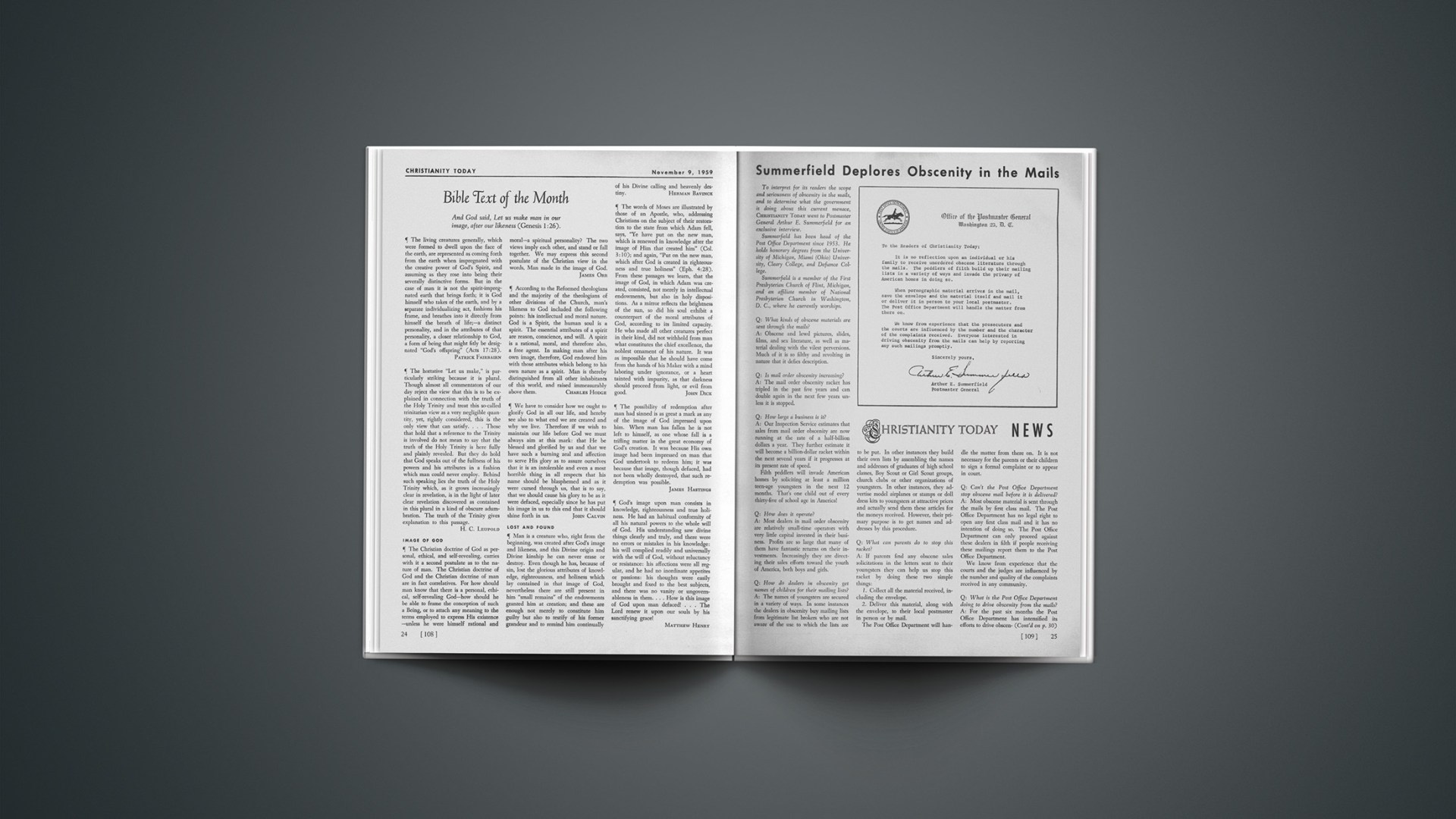
Bible Text of the Month: Genesis 1:26

And God said, Let us make man in our image, after our likeness (Genesis 1:26).

The living creatures generally, which were formed to dwell upon the face of the earth, are represented as coming forth from the earth when impregnated with the creative power of God’s Spirit, and assuming as they rose into being their severally distinctive forms. But in the case of man it is not the spirit-impregnated earth that brings forth; it is God himself who takes of the earth, and by a separate individualizing act, fashions his frame, and breathes into it directly from himself the breath of life;—a distinct personality, and in the attributes of that personality, a closer relationship to God, a form of being that might fitly be designated “God’s offspring” (Acts 17:28).

The hortative “Let us make,” is particularly striking because it is plural. Though almost all commentators of our day reject the view that this is to be explained in connection with the truth of the Holy Trinity and treat this so-called trinitarian view as a very negligible quantity, yet, rightly considered, this is the only view that can satisfy.… Those that hold that a reference to the Trinity is involved do not mean to say that the truth of the Holy Trinity is here fully and plainly revealed. But they do hold that God speaks out of the fullness of his powers and his attributes in a fashion which man could never employ. Behind such speaking lies the truth of the Holy Trinity which, as it grows increasingly clear in revelation, is in the light of later clear revelation discovered as contained in this plural in a kind of obscure adumbration. The truth of the Trinity gives explanation to this passage.

IMAGE OF GOD

The Christian doctrine of God as personal, ethical, and self-revealing, carries with it a second postulate as to the nature of man. The Christian doctrine of God and the Christian doctrine of man are in fact correlatives. For how should man know that there is a personal, ethical, self-revealing God—how should he be able to frame the conception of such a Being, or to attach any meaning to the terms employed to express His existence—unless he were himself rational and moral—a spiritual personality? The two views imply each other, and stand or fall together. We may express this second postulate of the Christian view in the words, Man made in the image of God.

JAMES ORR

According to the Reformed theologians and the majority of the theologians of other divisions of the Church, man’s likeness to God included the following points: his intellectual and moral nature. God is a Spirit, the human soul is a spirit. The essential attributes of a spirit are reason, conscience, and will. A spirit is a rational, moral, and therefore also, a free agent. In making man after his own image, therefore, God endowed him with those attributes which belong to his own nature as a spirit. Man is thereby distinguished from all other inhabitants of this world, and raised immeasurably above them.

CHARLES HODGE

We have to consider how we ought to glorify God in all our life, and hereby see also to what end we are created and why we live. Therefore if we wish to maintain our life before God we must always aim at this mark: that He be blessed and glorified by us and that we have such a burning zeal and affection to serve His glory as to assure ourselves that it is an intolerable and even a most horrible thing in all respects that his name should be blasphemed and as it were cursed through us, that is to say, that we should cause his glory to be as it were defaced, especially since he has put his image in us to this end that it should shine forth in us.

JOHN CALVIN

LOST AND FOUND

Man is a creature who, right from the beginning, was created after God’s image and likeness, and this Divine origin and Divine kinship he can never erase or destroy. Even though he has, because of sin, lost the glorious attributes of knowledge, righteousness, and holiness which lay contained in that image of God, nevertheless there are still present in him “small remains” of the endowments granted him at creation; and these are enough not merely to constitute him guilty but also to testify of his former grandeur and to remind him continually of his Divine calling and heavenly destiny.

HERMAN BAVINCK

The words of Moses are illustrated by those of an Apostle, who, addressing Christians on the subject of their restoration to the state from which Adam fell, says, “Ye have put on the new man, which is renewed in knowledge after the image of Him that created him” (Col. 3:10); and again, “Put on the new man, which after God is created in righteousness and true holiness” (Eph. 4:28). From these passages we learn, that the image of God, in which Adam was created, consisted, not merely in intellectual endowments, but also in holy dispositions. As a mirror reflects the brightness of the sun, so did his soul exhibit a counterpart of the moral attributes of God, according to its limited capacity. He who made all other creatures perfect in their kind, did not withhold from man what constitutes the chief excellence, the noblest ornament of his nature. It was as impossible that he should have come from the hands of his Maker with a mind laboring under ignorance, or a heart tainted with impurity, as that darkness should proceed from light, or evil from good.

JOHN DICK

The possibility of redemption after man had sinned is as great a mark as any of the image of God impressed upon him. When man has fallen he is not left to himself, as one whose fall is a trifling matter in the great economy of God’s creation. It was because His own image had been impressed on man that God undertook to redeem him; it was because that image, though defaced, had not been wholly destroyed, that such redemption was possible.

JAMES HASTINGS

God’s image upon man consists in knowledge, righteousness and true holiness. He had an habitual conformity of all his natural powers to the whole will of God. His understanding saw divine things clearly and truly, and there were no errors or mistakes in his knowledge: his will complied readily and universally with the will of God, without reluctancy or resistance: his affections were all regular, and he had no inordinate appetites or passions: his thoughts were easily brought and fixed to the best subjects, and there was no vanity or ungovernableness in them.… How is this image of God upon man defaced!… The Lord renew it upon our souls by his sanctifying grace!

MATTHEW HENRY

Ideas

Christian Mercy in Action

The past decade has seen a significant movement toward understanding between psychiatrists and ministers. Previously they had looked at each other with suspicion and even hostility. Ministers often felt that psychiatry was destructive of Christian faith, and psychiatrists often felt that ministers only complicated the problem in trying to deal with the emotionally ill. Both sides had some basis in fact for these feelings. Many clergymen seemed to think that neurotics were more guilty than sick, that they needed censure more than counseling, law more than gospel. On the other hand, psychiatrists were too much concerned with libidinal drives and organic causes, and often assumed that religious expression was in itself a neurotic symptom.

The whole picture today is rapidly changing. Clergymen are beginning to understand emotional “illness” and depth psychology, while psychiatrists are beginning to realize that religion can be a powerful factor in mental health. A steady stream now pouring forth articles and books on psychiatry and religion are dealing searchingly with the problem of their rapprochement. Seminaries are offering courses on these subjects, and clinical training for ministers is being provided in many places. Some medical schools are also using ministers to broaden the insights of their students. And most significant is the fact that the American Psychiatric Association at its 1959 convention had a panel discussion and two papers on the subject, along with the hint that a section on Psychiatry and Religion might be formed in the near future. In addition to such developments, resident chaplains in mental hospitals are becoming the rule rather than the exception, and are being included in the therapeutic “team.”

Evangelicals are in no position to say “I told you so.” They, even more than others, have been suspicious and hostile toward psychiatry and have done little that could be called constructive and positive. However, a small group of Christian doctors, ministers, and laymen in the United States brought psychiatry and Christianity together in a concrete way more than 50 years ago. They put Christian mercy into action by establishing Christian mental hospitals at a time when mental hospital conditions were generally deplorable, when Clifford Beers (The Mind that Found Itself) was just beginning his great work, and the National Committee for Mental Hygiene had started (1909).

They were a small band of people and still are today, but their vision and labors have been signally blessed.

There are today three Christian mental hospitals in the United States, established and supported primarily by members of the Christian Reformed and Reformed Church in America. Their purpose is to minister to the mentally ill as “persons” with spiritual needs as well as mental and physical. This is not to say that the originators understood fully the relation between psychiatry and religion, or that their chaplain was oriented in depth psychology. They too had to grow with the rest of the profession. But one thing they held as a firm conviction: the “insane” are not beyond the healing hand of God, and the Christian faith can be meaningful to the mentally ill as well as to other sick people. Each of these hospitals is established by its own society or association of members who elect a Board of Trustees which sets the policies, engages the staff, and is responsible for the operation of the hospital. They are independent of each other though they have the same viewpoint and are supported by the same church denominations in their own areas.

These hospitals were established primarily to serve the mentally ill of the supporting Reformed churches. Its founders felt, and this is their position today, that Christian patients have special needs that can be met only by therapists with Christian preconceptions. Problems of sin, guilt, prayer, sex, and so many others which disturb the mentally ill cannot be dealt with understandingly by a psychiatrist or counselor with non-Christian standards and values. This is not to say that a non-Christian psychiatrist can never help a Christian patient; they can sometimes be a great help. But personality “wholeness” and “health” can mean something different for a Christian than for a non-Christian, even different for a Protestant than for a Roman Catholic. For example, guilt can be objective as well as subjective, related to fact as well as fiction, awakened by the Holy Spirit as well as produced by sick delusions. How can a humanist with relative moral standards help a theist with the standards of God’s holy law? How can the love of God be made meaningful by a therapist who thinks that “god” is only a father figure? How can the atoning work of Christ bring comfort to a guilt-ridden spirit if the doctor thinks of Jesus only as a good man and not without neurotic symptoms himself? Permissiveness and acceptance are important in a therapeutic approach, but the therapist’s own personality and value system can never be eliminated from the therapeutic situation.

While these hospitals serve primarily their own people, they do not exclude others. Indeed, they are an important mental health resource in their communities, and many outside of their own supporting constituency bear testimony to the high quality of care given to the mentally ill of all faiths. This too is Christian mercy in action—serving the community.

What about their results? Are they more successful in curing and improving their patients? Comparative figures are not available, but they probably do not exceed the results of other hospitals of similar size. It must be remembered, however, that their work is directed toward “Christian health,” and their results must be evaluated not merely in terms of ability to function in society, but also in terms of peace with God which is the deepest need of any Christian, sick or well.

History can testify of giant souls whose compassion embraced the miserable and the forgotten. These were a breed of men and women who dared to “lose themselves.” Then there have been the little people, one talent saints, their names known only to a few, but their deeds a benediction to many who have never heard of them. Today their monument is being built not in stone or metal but in a movement, a social force, a science for the healing of man. Their faith performed at a time when others had not yet begun to speak. As psychiatrists and ministers are coming to learn from each other and to work together, they are recognizing that a philosophy of life is important to health, that man without God is lost even to himself.

A FOOTNOTE TO THE UGLY AMERICAN

Some months ago The American Weekly carried a tribute to foreign missionaries active at grass roots in the ministry of compassion. The title, “People Who Work While Diplomats Doddle,” especially irked an International Cooperation Administration official in Formosa, since the article cited the work of the Dicksons among the lepers, orphans, and aboriginals of Taiwan. The diplomat found time to post some letters of protest over the insinuation about diplomatic doodling or doddling.

Recently we were in Formosa, just after the worst typhoon and torrential rains in 60 years had destroyed 40,000 homes and left 145,000 homeless in the Chunghua area. A Christian physician, our traveling companion, rushed to Taichung to help missionary forces assess the needs. The Dicksons had sent a motorcycle through from Taiwan loaded with medicines before automobiles could make the trip; they sent an auto and trucks, in cooperation with Church World Service and World Vision, to areas inaccessible to airplanes.

When our physician friend returned by Chinese Air Force plane, he relayed his impressions of the need to the ICA hospital administration advisor in Taipei. That was the night after the Taiwanese and Chinese lepers in a prayer service at the Church of the Lepers pledged themselves, despite their poverty, to a special offering for relief of the victims of the flood disaster. The physician told the ICA representative of needs of the victims and of the suffering they were enduring. He told of mothers whose homes had been destroyed—their husbands killed by the flood—with no place to lay down weary bodies nor a place to put their babies save on their own backs. These people had lost everything; they had no clothes except what they wore, and also no food. He told of numbers of orphans left in the wake of the flood, with no place to stay, wandering the streets of the towns begging for food. One Christian organization was setting up an orphanage in Chunghua with 30 orphans to start the project. He told of the possibility of typhoid outbreak because of contaminated water and of complete destruction of rice fields as valuable as rich Midwestern farm lands, without which the people had no means of livelihood for families.

After listening to this doctor stress the need of medicine, clothing, blankets, and mats on which to sleep, the ICA spokesman dissolved the needs one by one by the following statements:

1. These Chinese and Taiwan people have gone through these disasters for centuries. They have remarkable resistance. During the war years they slept for weeks in water and lived through it.

2. They have had cold weather all their lives and their resistance has kept them alive.

3. Last year after a flood in a nearby town, the water stood three feet in the streets, and following this there was not one case of typhoid.

4. These people recover remarkably fast from this sort of thing and will have their homes up again and living in them in a week.

It seemed to matter little, to one who thought of statistics and averages, that individuals suffered. In many cases the wife not only lost a home, but also the husband to rebuild a home. And in others, a father with children had no one to care for them during work because a wife was lost.

The Christian physician asked other leaders about the official’s interpretation.

Upon investigation it was found that the homes are not rebuilt in seven days, but clay must be dug and made into bricks for walls, and straw woven and thatch prepared, and that to rebuild their homes requires a time period of months rather than merely a week. No one who knew sanitation problems would state that because typhoid did not break out in one situation, it would not begin here. Sewer water was mixing with flood waters and actually flowing into the homes of these people. Yet this representative of the United States seemed undisturbed. This man had flown over the area the first day after the flood, but he had not waded through the mud and filth of the streets and come in contact with the people who, in their misery and wretched water-drenched condition, lacked even dry mats to sleep upon. Even the Presbyterian Hospital had no dry blankets for its patients. But sooner or later, ICA was comfortably self-assured, help would be coming to these people through certain sources, even though the sources were rather slow in starting relief operations. Meanwhile, U. S. Marines were airlifting a ton of rice every 15 minutes into the flood area, and its helicopters were carrying supplies of clothing for distribution.

Missionary forces were triggered by radio news of the emergency. American medicine, clothing, and food were flown in by U.S. armed services and taken to the scene by marines, and then distributed by Catholic and Protestant workers whose mission projects were already established as centers of assistance, and by other social service agencies. But the Roman Catholics were largely in command of the operation from Taipei. As elsewhere, they had cultivated government contacts well, and Father F. O’Neill was the coordinator. Distributions were made by priests bearing the insignia of the church. According to some reports, it was an old story in Formosa. There among the aboriginal hill tribes, where Protestantism has established hundreds of churches, Catholicism has charted out a new objective. In recent years canned milk provided by the American government for distribution to the needy has been given to the aboriginals by Roman priests after—and on condition of—attendance at mass. There can be little doubt of the efficiency and effectiveness of Roman Catholic effort, and many stories of sacrifice and self-denial must be credited to Rome’s workmen. Catholic Relief Services had done its homework, and when the typhoon struck, it knew how to use and even to exploit American aid on a larger scale.

TOTALITARIAN RULE AND CHRISTIAN CONSCIENCE

Bishop Otto Dibelius, bold champion of freedom, has dropped a minor bombshell by pronouncing some East German traffic laws illegal. East German Protestant leaders immediately backed away from his controversial letter to East and West German pastors. Rather than obey the law, the bishop announces he will pay the 10-mark speeding fine, all the while maintaining a clear conscience.

Nor has he forgotten Romans 13. Indeed, he quotes from it in his letter (“Let every soul be subject unto the higher powers.… The powers that be are ordained of God”). But, says Dibelius, it is “blasphemy to regard the rulers of a totalitarian state as powers” in a biblical sense. He cites East German Premier Otto Grotewohl’s definition of the good as what is good for the state. Soviet cars are allowed to speed, this being a prerogative of party officials, while slowdowns are imposed on other traffic to West Berlin.

Otto Dibelius cannot accept a definition of truth bound to man’s whim. In this issue of CHRISTIANITY TODAY, he indicates some of the enslaving evils of the totalitarian state. He apparently sees the East German government in terms of Revelation 13 more than of Romans 13. For the beast of the Apocalypse is pictured as blaspheming God’s name and making war with the saints. Despite the beast’s “great wonders, so that he maketh fire come down from heaven on the earth in the sight of men,” Bishop Dibelius obviously fears the wrath of the Lamb more than the terrors of the agents of bestiality.

COLLECTIVE BARGAINING CRISIS SHADOWS STEEL STRIKE

Breakdown of negotiations in the steel strike has provoked an emergency injunction returning workers to the mills for an 80-day Taft-Hartley “cooling off” period. President Eisenhower termed failure to reach a voluntary settlement by 25 basic producers (representing 87 per cent of the country’s steel-making capacity) and United Steelworkers of America (with 500,000 members in these mills) “a sad day for the nation.” The fruitlessness of free collective bargaining gives obvious leverage to advocates of direct government intervention, including federally-decreed arbitration and federally-controlled wages and prices.

Kaiser Steel’s pact, made independently, prodded other producers to compromise differences with labor, despite inflationary pressures, while a Supreme Court appeal by union chiefs delayed actual enforcement of the strike injunction. In principle, individual bargaining is fully as sound as collective bargaining. Although scornful of individual bargaining in their own ranks, union bosses pursued it with Kaiser to splinter management’s united front.

The industry-wide strike holds some sobering lessons for our economy. For one thing, it dramatizes the fact that strikes, as well as lockouts, retain little if any significance as instruments of economic justice. The shutdown of the mills has hurt not only big business, but big labor and the national well-being—a factor increasingly apparent as effects of the strike are felt. The strike is an instrument of violence more than of persuasion. Economic differences require reason and good will, not violence, for their just resolution.

Another important lesson is that today even voluntary bargaining takes place within a free enterprise system weakened by already existing pressures and compromises. One of these, obviously, is the threat of labor chiefs to use the unions as a punitive political force at the polls. Labor leaders make bolder claims in this regard than they can fulfill, but some politicians readily accept the notion that all the legislative goals of union bosses must be best for the economy as a whole. The proximity of a strike to a national election becomes a factor influencing the political pressures exerted on negotiators.

Even more somber skies shadow today’s bargaining sessions, especially the compromise with inflation and the uncertainties of an unstable dollar. One would think that wage negotiators would be reminded at every step how much government tampering with the economy has already contributed to, rather than rectified, our financial dilemmas.

When labor contract negotiations first got underway, many steel companies were reporting record earnings. They lost an opportunity to cut steel prices (even if with one eye on growing foreign competition) on condition that wages remain fixed at their already high level. Yet industry attempts the impossible if it seeks by itself to stop the inflation spiral, since this is really a government responsibility; only the government can give the necessary assurance that there will be no further increase in the supply of money or credit. Union negotiators, on the other hand, aware that wage boosts in one industry inevitably supply a precedent for others, seem oblivious to inflationary pressures, and offer no formula that leads anywhere but “ever upward.” Their dismissal of complaints against featherbedding and loafing as aimed to “restore industrial dictatorship” are hardly to be taken at face value.

The force of public opinion, seeking voluntary resolution of these issues in terms of the good of the whole, is now urgent. It will be better for the Republic that economic issues be resolved through pressures of good conscience and the compulsion of basic ideals than through pressures of big government. Given full sway, the latter alternative can only destroy free enterprise and the Republic alike.

Amazing Grace

AMAZING GRACE

The more one grows in Christian understanding and experience the more amazing and precious becomes the grace of God.

We are saved by grace and kept by grace, but too few of us realize this fact. We are confronted with an ever recurring temptation to attribute our salvation and any growth in Christian maturity to our own efforts and sense of worthiness.

The pride of self-accomplishment is a deadly sin. It stands between many and a saving experience with Christ.

Our salvation depends solely on the grace of God, and our continuing peace with him has been bought by our Saviour at unbelievable cost.

Without an understanding of this saving and keeping grace from God, we are engaged in an unending struggle to attain. But when we come to realize that everything we are or ever hope to be is the result of God’s unmerited favor, then our hearts are filled with love and gratitude to the One who has made this possible.

As we deepen in Christian faith and experience, we become increasingly aware of the innate sinfulness of the human heart. To know that our salvation is a fact, despite repeated failures, comes from an understanding of the implications of divine grace.

This grace is an attitude of God toward sinners which we in no sense deserve. It rests solely on the merits of Jesus Christ and, so far as mankind is concerned, is made operative through faith alone.

We receive by grace the mercy and forgiveness of God entirely independent of human endeavor, and the faith by which we receive this is itself a work of the Holy Spirit—a matter of divine grace.

Grace means exemption from a penalty which we deserve and forgiveness where punishment is justified. It is divinely-given assistance to the weak, a change of status through the imputed righteousness of Christ.

Not only are we saved by grace through faith, but we are kept by the continuing grace of him who has begun a good work in our hearts.

For some of us, who were raised in Christian homes and enjoyed the blessings of a godly heritage, conversion was as a gentle breeze, a change so quiet that we cannot remember the day when we said in our hearts a conscious and final “Yes” to the Saviour.

Because we have grown up in the church, we are inclined to feel that our own goodness is woven in the warp and woof of Christian experience. We forget the most vital and precious truth that the finest Christian is just a sinner saved by grace.

Others have traveled a different road to the Cross. They have tasted the depths of human depravity and know the misery of conscious separation from God.

Seeing themselves in the light of God’s holiness, these individuals have recognized both the fact and the wages of sin; conversion to them has been a climactic experience, the loving grace of God a wonderful thing.

What a pity that the old hymn, “Amazing Grace,” is so rarely sung today! John Newton, its author, had experienced the soul-searing effect of sin in the flesh. And when he came to know the precious truth that God had descended in human form and taken his sins on His own sinless body, he marveled:

Amazing grace! how sweet the sound,

That saved a wretch like me!

I once was lost, but now am found,

Was blind, but now I see.

You and I, cultured, educated, sophisticated, and modern, need to realize that we need this saving grace as much as any criminal on death row in Sing Sing or ignorant savage in the jungles of Ecuador.

The self-satisfaction that characterizes the attitude of so many of us is not only an offense to a holy God but also a barrier between us and the One who can make us acceptable to God.

We said above that grace is a matter of God forgiving and cleansing undeserving sinners. But it is more than that. By God’s grace we can continue to be his children after we have been redeemed.

A quiet examination of our own lives shows us how far short we come to fulfilling his will after we have received salvation. Day after day we continue to be guilty of sins of the flesh and of the spirit; sins of omission and commission. But for the grace of God we could never continue as his children. Were it not for this unmerited favor we would still find ourselves standing before him in judgment.

What a difference grace makes! The Christian is but a sinner over whom the spotless robe of the altogether lovely One has been cast.

The Chinese character for “righteousness” is rather remarkable. It is composed of two separate characters, one standing for a lamb, and the other for “me,” the personal pronoun. When the character for lamb is placed directly above the one standing for me, a new character is formed—Righteousness.

This is the meaning of the grace of God. Between me, the sinner, and God the holy One there is interposed by faith the Lamb of God; and by virtue of that act on his part he has received me on the ground of faith, and I have become righteous in God’s sight.

In his paean of praise John Newton continued:

’Twas grace that taught my heart to fear,

And grace my fears relieved;

How precious did that grace appear

The hour I first believed.

Many of us fail to appreciate the grace of God because we fail to see the awfulness of sin as it must appear to the eyes of a holy God.

A theological truth we only too often neglect is that even the ability to come to Christ is an act of God’s grace. Our Lord said: “No man can come to me, except the Father which hath sent me draw him.” We are all familiar with Paul’s words: “By grace are ye saved through faith; and that not of yourselves: it is the gift of God: Not of works, lest any man should boast.” Any boasting of our own achievements is an offense to God and a denial of his grace.

Paul, writing to the Roman Christians, says: “Where is boasting then? It is excluded. By what law? of works? Nay: but by the law of faith. Therefore we conclude that a man is justified by faith without the deeds of the law.”

This justification is an act of God’s grace, and the faith to believe is also his gracious gift.

To grasp something of the amazing grace of God will result inevitably in our loving him more and our finding a greater sense of security.

In these days when serenity of mind and security of heart are so hard to find, we need only turn to the grace of God whereby we may receive everything necessary for our lives—now and for eternity.

L. NELSON BELL

Eutychus and His Kin: November 9, 1959

BIG SMOKE

Americans spend 3 billion annually for their churches and 6 billion for cigarettes. To the cigarette industry it may seem that the churches have done well, considering their modest advertising budget and extremely soft sell.

Suppose Madison Avenue were to be given some ecclesiastical accounts. Imagine national magazines featuring color cover ads with a rugged fullback emerging from church: Join the men who know; get that big clean feeling!

Or perhaps in the church news column we might read, “First Church has reduced theological irritants to the lowest level among all leading pulpits. First Church preaching is smooth. It’s First for filtered truth!”

Television spots could feature the new preacher in his pulpit at Central Church: It’s what’s up front that counts! Such proven slogans as There’s no substitute for quality! would need no revision. The spring freshness theme would be another natural; it should apply to religion almost as well as to tobacco.

The super-science of the cigarette ads might be harder to adapt. “Important break-through in biblical research. Get that extra Dead Sea flavor in every sermon.” Church architecture suggests other scientific areas: “High porosity in our acoustical vault air-softens every choir note.”

The better the makin’s, the better the sermon. This could caption an oil painting of a craggy-browed clergyman among his books. Of course he would have his sleeves rolled up to show an anchor tattoo. “If you’re thinking of changing churches, tattoo this in your mind.… Deepwell’s exclusive preaching formula gives you religion you can get hold of.”

The competitive claim might not prove attractive to church advertisers. A new campaign could be developed: “Remember, the brand makes no difference! Wherever church bells ring you get the real thing.”

Is this sufficiently absurd? We have almost stopped laughing at those serious cigarette ads; when we do, we are not far from the king-sized pitch in religion—enjoyed in all the 50 states!

EUTYCHUS

SATAN’S POWER

Dr. Piper’s article (The Power of Evil, Sept. 28 issue) troubles me greatly. I looked for a clear, direct discourse.… Instead I found only terms and phrases suggestive of biblical truth, terms and phrases which could be filled in and defined according to the knowledge and faith of the individual reader.

A fuzzy-minded evangelical might be satisfied that the truth was presented; and no liberal or neo-orthodox would find anything in this article to compel him to question his own convictions.…

I read the Prophets and Apostles, and I know what evil is as to its nature, origin, effects and remedy. I read Piper and I find that I know only some of its baneful temporal effects. I learn nothing as to its nature, origin, or remedy—terms and phrases notwithstanding. Piper says, “The question is not how we should therefore represent the devil and the forces of evil, but rather, how we are to react to their activity in this world.” How can we properly “react to their activity” unless we have ascertained “their” nature, power, and program? Hitler was not defeated until the allies faced up to his nature and his potential; and neither will Satan be put down until we accept the Bible’s definition of his personality and power. Piper gives no such definition of the devil and evil; and his definition of “world” has no similarity to that given in the New Testament.

THEOPHILUS J. HERTER

St. Matthew’s Reformed Episcopal

Havertown, Pa.

SHIFT TO THE RIGHT

I would like to answer the letter of the Rev. Henry Smith Leiper (August 3 issue). I would first answer the question in Rev. Leiper’s last paragraph. Yes, those who now think as John Foster Dulles did nine years ago are still “leftish.” Because only Mr. Dulles changed when he tried to stop the National Council of Churches Cleveland Conference from voting for recognition of Red China and admission of Red China to the U.N. Then Mr. Dulles strongly fought Communism and died of cancer still fighting and a hero!

To further substantiate my answer that previously Mr. Dulles and those who nine years before thought the same, I suggest that Mr. Leiper read “Collectivism in the Churches” by Edgar C. Bundy (published by Church League of America, Wheaton, Illinois, 1958). On pages 164 and 165 [are] the eight shocking points drafted in March, 1942, by the Federal Council of Churches at a national study conference at Ohio Wesleyan University at Delaware, Ohio, (chairman: John Foster Dulles) for a just and durable peace (?) after World War II. All one-world ideas.…

On page 177 of the same book Mr. Dulles says, “The free enterprise system has yet to prove that it can assure steady production and employment.” Leftist!

Page 179: “We know, from testimony given during the hearing on Alger Hiss by the Committee on Un-American Activities that John Foster Dulles and Alger Hiss were friends of long standing.” (Both were chairmen of important committees of the Federal Council of Churches.)

In November, 1950, the Federal Council of Churches changed to the National Council of Churches. Thus the same leftist, socialist, one-world, procommunist ideas were continued.

Mr. Leiper ought to know. He was an official of the Federal Council of Churches from 1930 through 1948.

FRANK P. STELLING

Oakland, Calif.

Most religious organizations, whatever the name, have come to be in America commercial and social with a degree of religious tincture.

O. L. HUFFMAN

Hot Springs, Ark.

I would like to comment concerning your attitude, and also that of some of your correspondents, towards the report of the NCC Conference at Cleveland regarding the recognition of Red China. Is not your attitude that of worldly wisdom which you reject? Jesus, our Divine Lord and Saviour said, “Ye have heard it said of old time love thy neighbor and hate thine enemy. But I say unto you love your enemies, do good to them that hate you”.… The acid test of our religion is not how well we get along with our friends but what we do about our enemies.

MELVIN ABSON

Geneva, N. Y.

I venture to share a brief quotation from a letter received recently. The writer is a young Chinese, teaching in the Lutheran Theological Seminary in Hong Kong. He has been in many parts of the Far East.

In one of the articles I read in an official Buddhist magazine displayed in a train in Taiwan, the Buddhists urged the government to drive all the American missionaries and their enterprises out of Taiwan as a protest to the statement made a few months ago by a World Order Study Conference sponsored by the National Council of Churches of Christ in the U.S.A. concerning the recognition of Communist China. Knowing that I had just come back from the U.S., a number of young Christians asked me a lot of questions, such as, “How could the American Christian leaders do such a thing?” “Is it an expression of their Christian faith or of their political interests?” “Is it the voice of all American Christians or just that of a few so-called leaders?” etc. I feel really sorry—I am not to pass any judgment on this matter—that this statement, whether it he right or wrong, has brought so many problems to our work, caused so much trouble among our people, and given such an unnecessary excuse to the heathen religions for attacking our church.

It is to be hoped that the Conference weighed all the issues before their pronouncement was made.

PAUL F. BARACKMAN

Fair Lawn, N. J.

[In regard to] “The Problem of Power” (Eutychus, Aug. 31 issue) …, the concern of Christians is not primarily the balance of political and military power in the world. It is rather the sad fact that peoples are being overrun with tyranny and cannot be free. What happened in Hungary, Poland, Tibet, Laos and other satellite countries is the great wickedness that we resent. It is that peoples are being robbed of their countries, of liberty, their families and of life. The issue is democracy or tyranny—“God or Mammon.”

ALVIN J. LEE

Salem, Va.

Only nominal Christians or … hypocrites or cowards are afraid of the present communism.… It is not Russia or communists who are preparing for the third war, but the West—particularly our religionists and militarists in Washington who spend billions … for … war weapons.

A. J. MONCOL

Cleveland, Ohio

Please accept the thanks of the American Council of Christian Churches … for the … factual and unbiased … [news story] “Red Atrocities” (June 22 issue). We believe that when the public is given the facts of Red China’s activities, that people by the millions will arise to repudiate the recommendation of the NCC Fifth World Order Study Conference.…

RALPH I. YARNELL

General Secretary

The American Council of Christian Churches

New York, N. Y.

ON THINGS GREEK

The Rev. Leslie Chard’s (Eutychus, July 6 issue) taking exception to a Jesuit-expressed view of the Greek Church is ill-founded. I fear he is giving expression to a phenomenon characteristic of many Episcopal priests—an excessive admiration for things Greek, founded more on zeal than on right information. For the Greek Church’s view of tradition, I suggest he read any authoritative work on the Orthodox Church—Frank Gavin’s (an Anglican) Some Aspects of Contemporary Greek Thought would be suitable (and Fr. Gavin had really studied the subject). In all important particulars, the Greek Church’s view of tradition may be said to be identical with the Roman Catholic view (except wherein the latter involves the Papacy). Right or wrong this may be, but the attempt to make the Orthodox out to be an exotic sort of Protestant or Anglican is doomed to failure—it simply is not the case.

His expression of the Greek teaching on Our Lady is as inaccurate. The Immaculate Conception of Mary was a common teaching in the Orthodox Church prior to its definition by Pius IX, especially. Indeed, Gregory Palamas, probably the most important Greek theologian of the late Middle Ages, upheld the doctrine. Herein is simply another example of an unfortunate Greek propensity of opposing Rome at all costs—one of its most ridiculous instances in history being the accusation that the use of unleavened bread in the Eucharist was heretical! (And I challenge him to find any representative Greek theologian who attributes actual sin to Mary.)

I cannot write as much on the “Filioque” as it deserves; but I think Mr. Chard will find that while it had long been commonly recited in the West, the Easterns did not make an issue of it till they entered into a controversy with Rome on other matters—it was something more to throw at the Pope! Many Greek doctors had taught that the Holy Ghost proceeds from both the Father and the Son, as from one principle—and the Western Church has never asserted that there were two principles involved. If the Holy Ghost is the bond of love between the Father and Son, if he did not proceed from both it would imply that the Son loves the Father less than he is loved by the Father. Also, if the Spirit is called in the Scripture the Spirit of the Son, and the Son is said to “send” him, to deny that he proceeds from the Son as well as from the Father involves a plain contradiction. All this apart from the very questionable morality of “mental reservation.”

D. L. IRISH

Saint Paul’s Church

Brooklyn, N. Y.

APPRAISING BARTH

I wish that every reader of Van Til’s article (June 8 issue) might also read G. C. Berkouwer’s appendix to his recent book, The Triumph of Grace in the Theology of Karl Barth. Although by no means a Barthian himself, Berkouwer here takes the subjectivity weapon out of Van Til’s hand and turns it back upon Van Til himself in a most unexpected and telling fashion.… He plainly states, “Van Til’s analysis does not correspond to the deepest intents of Barth’s theology.” And again, “At issue in this is the matter of a truly responsible analysis, for it is only on the basis of a penetrating and thoroughgoing analysis of a person’s intents and bearings that solid criticism can be based.”

It is evident that Van Til’s appraisal of Barth is vastly different from Bromiley’s. Their basic attitudes toward the Swiss theologian are so well-nigh incompatible that the thoughtful reader is obliged to choose between them. If it is indeed true, as Van Til asserts it is, that Barth doesn’t have any gospel at all in the evangelical sense, that he is just as much a modernist as is Bultmann, then we can hardly at the same time agree with Bromiley when he says, “It will be seen at once that he stands in line with three of the great emphases of evangelicalism: the historicity of God’s saving action; the supremacy of the Bible; and the objectivity of God’s work, particularly in atonement.” If Barth is really the apostle of a new modernism, as Van Til takes him to be, then no condemnation is too great for him; then we all should join Brother Van Til in his vehement forbidding of the man because he follows not us. But if on the other hand Bromiley’s appraisal of Barth is more nearly correct, as I personally believe it to be, then we can earnestly hope that someday Van Til may see and acknowledge that in this particular matter he may have been as sadly mistaken as were the ardent disciples of our Lord on that occasion.

DAVID DUFFIE

Seventh-day Adventist Mission Hospital

Mayaguez, Puerto Rico

SINCE LUX MUNDI

Mr. Geffen (Eutychus, Jan. 5 issue), while correctly noting a certain area of agreement between Anglo-Catholics and evangelicals in matters of doctrine, is misleading in his wider implication that evangelicals can look for convinced support from that quarter.… I will not elaborate at length on the difference in attitude to Scripture—sufficient of itself to put a different construction on the matter from Mr. Geffen’s—except to say that while the early Tractarians were conservatives on Scripture, since the publication of Lux Mundi the Anglo-Catholic movement has defected to the liberal camp, with only a few stragglers standing firm on Gladstone’s ‘Impregnable Rock of Holy Scripture.’

Granted, Scripture apart, that Anglo-Catholics have a sounder grasp of certain doctrines than the ‘liberal humanists’ because of their deference to the creeds. They are in fact credal dogmatists. But so too are the Holy Orthodox and the Roman Catholics: yet who would argue from this that they are upholders of evangelical Christianity? We have to think in terms not merely of the content, but of the nature of belief: not merely of fides but of fiducia. This indeed is the distinctive principle of evangelicalism—faith both understood and experienced as a supernaturally originating and supernaturally-imparted divine gift.

Evangelicals believe that this principle lies behind the word “must” in Jesus’ words to Nicodemus in John 3:7, “Ye must be born again”.… This, then, is the distinctive proclamation of evangelicals to all the world—not ‘Believe the creeds,’ or ‘Take the conservative view of salvation, grace and Scripture’ (though we do both), but “Ye must be born again.” Thus the real question is whether Anglo-Catholics are allied to and identified with evangelicals in this proclamation and in this determinative principle. I think that your correspondent and your readers will find that it is not so. How near and yet so far. But let them once adopt this principle whole-heartedly, making known their position to all the world, and there will be no end to the blessing that will be released. Only this evangelical principle makes certain that the husks of the ‘liberal humanists’ have been finally abandoned either by the Anglo-Catholics or by their ‘High Church’ Methodist counterparts; and only on this high supernatural principle will our prodigal age ever be led back to the Father’s house in reconciliation and peace.

C. A. F. WARNER

Chingola, N. Rhodesia

ON A LIMB

I wish to commend Mr. L. Nelson Bell for his wonderful article “The Bible and Sex Education” (June 8 issue). I will “place myself on a limb” … by adding: We as ministers have failed by failing to teach from our church class rooms and from the pulpit the evils of immoral dress and adorning of the body, as these tend to induce wrong sexual desires, as well as allowing these evils to become “one of us” by allowing membership in our assemblies.

FRED HENDRICKSON

First Assembly of God Church

Paris, Ill.

Crucifixion of the Pastor

It is surprising that we have come so far in applying the vital insights of psychology to counseling, and yet have neglected their application to urgent, day-to-day problems of church administration. In McCormick Speaking (Oct. 1958), Dr. Leonard J. Trinterud aptly describes the strain under which pastors break as they undertake too many tasks and feel the whiplash of an expectant membership. Dr. Richard K. Morton, in “Our Demanding Laity” (CHRISTIANITY TODAY, Sept. 15, 1958), noted the mounting demands made upon the pastor and the criticism that follows every failure.

Protestantism’s strength is the doctrine of the priesthood of believers. The Church is the body of Christ. Her strength is equal to the layman’s submission to the Holy Spirit indwelling his soul, and his obedience to the Spirit’s directives revealed through the ministry of the Word and His word through the corporate body. The Church in His name prophesies, teaches, evangelizes, heals, and shows compassion to all mankind.

The Church, however, is also an organization of churches as well as a living organism. The same laymen who direct the church’s affairs also pay the minister’s salary and must sanction his program. The pastor and board members are engulfed in a sea of complex relationships while through it all, or despite it all, the unity of the Holy Spirit in the bond of peace must be preserved so that the Church can evangelize the world, and so that His body with one heart may confront the evil of this day.

THE WAVES OF GOSSIP

The simple truth is that our pastors must expend so much time and energy in the heartbreaking game of “playing house” with local church members that their prophetic role based upon submission to the authority of Christ and profound study of the Word of God is rapidly being neglected. Their call originally led to the field of preaching and ministering. But they have come to discover that the path has detours through a jungle of administrative demands, church politics, and the very struggle for survival against waves of gossip and entrenched vested interests. It may well be that the success of Protestant Christianity in America will not be determined in the field of theology but in the courageous handling of church administration.

Part of the problem arises from the lack of spiritual growth and vitality in Protestantism in the past 10 years. Basic factors, however, involve the psychic dynamics in certain critical interpersonal relationships. The one crying out for urgent attention is that of the righteous-vindictive personality who is a key factor in church administration.

THE PASTOR AND PHARISEES

One of the strangest phenomena of modern religious life is that so little study is granted to the interpersonal cancer that rears its symptoms on almost every page of the New Testament and in relation to the crucified Christ. The friction between pastor and vindictive pharisaism is at work in almost every church I know of and has been responsible for the catastrophic breakdown of pastors and the division of congregations. Its essence is this friction which is tending to bleed Protestant effectiveness and which has broken the spirit of many ministers.

It is unusual historically that these dynamics were structuralized in an entire sect—the Pharisees. In an age of anxiety, frustration, and spiritual decline the “separated ones” gained pseudo-security through an idealized image of themselves as examples of perfection and saviours of the Law. They lived in a false little world of their own making, and Jesus of Nazareth pierced through it, calling them to the real world of God and demanding they renounce by repentance the false world of idolatry and pride. The hostility of the Pharisees knew no bounds. The compulsive nature of their vindictiveness was all too evident. Nothing less than crucifixion could restore their position. Many a young minister today wonders whether he should be crucified in silence like Jesus, or, like Paul, make his appeal to denominational caesars and defend himself every inch of the way.

It seems to the writer that no modern psychologist has analyzed the character neurosis of this personality “type” with the perspicacity of Dr. Karen Horney. Her major works Our Inner Conflicts, and Neurosis and Human Growth should be required reading for everyone involved in the work of church administration.

Dr. Horney speaks of a “trend” in personality called the striving for superiority through power and prestige. One facet is the leaning toward neurotic self-righteousness, perfection, and vindictiveness. Consider the small church with its self-righteous, proud, extremely religious woman. She rules the church with the iron hand of a benevolent monarch. She remains in the smaller church with a limited number of capable leaders where she reigns as a grand frog in a smaller pond.

Consider the most prominent businessman and leading elder in our churches. Churches attract the “expansive” (Horney) and vindictive personality as honey attracts bees. Through the psychic guise of self-righteousness and spirituality this type works himself to death achieving an exalted position in church life. His world revolves on an axis of defensive pride. This pride is like a band holding together a whole system of ideas and attitudes which constitute the self-image of superior intellect, superior spirituality, and so forth. There are fears of retaliation and this expansive person tends to dictate in “humility,” and thinks of himself as the true power behind the lesser powers. Should the pastor contravene any opinion of his or run counter to his directives, then the matter becomes one of life and death to restore the false self-image through assaulting the work and character of the minister. But because he is ostensibly “guided by the Spirit” he hopes to avoid the retribution of the targets of his vindictiveness. He can, therefore, do all for “love” without being loved or loving. He can appear to be selfless while hating the true self, and can be outwardly humble and inwardly sadistic in supposed defense of some time-honored doctrine or church procedure. The church offers a suitable environment for the flourishing of these contradictory trends.

It is only through an understanding of the compulsive nature of this psychic structure that we see why its punitive labor continues for years. Preaching from the Sermon on the Mount apparently does not thrust through the defensive core, and the vindictive personality has no intention of forgetting an insult, real or imagined. Dr. Horney puts it this way in her Neurosis and Human Growth (p. 201):

Partly he justifies his claims by his superior qualities, which in his mind are his better knowledge, “wisdom,” and foresight. More specifically, his claims are demands for retribution for injury done. In order to solidify this basis for claims he must, as it were, treasure and keep alive injuries received, whether ancient or recent. He may compare himself to the elephant who never forgets. What he does not realize is his vital interest in not forgetting slights, since in his imagination they are the bill to present to the world. Both the need to justify his claims and his responses to their frustration work like vicious circles, supplying constant fuel to his vindictiveness.

This malignant spirit passes from one or two of the most influential persons through the ranks of friends and associates. If the pastor has iron nerves, and if the church manages to prosper despite this sniping, the vengeful persons may fade as righteous martyrs. If the work is small and static, the sniping continues and woe to the shepherd who makes the slightest slip in conduct or judgment. It is at this point that the subconscious trends in the pastor will either cause him to resign his church or explode in defensive retribution.

In the chapter entitled “The Second Year Is the Hardest” of A Man Called Peter, a beautiful account is portrayed of a very human but deeply spiritual man who weathered the storm while his church grew in spirit and numbers. If the pastor does not bring neurotic trends to conflagration by his own desires to domineer, and if the church is growing, opportunities are afforded through counseling, group prayer, cell meetings, and church activities for the Spirit of God to stimulate self-acceptance and joyful rapport among the membership. This necessitates work, patience, and some anxiety on the pastor’s part, but this is part of his labor for Christ. He can expect this. The scars on Paul’s soul and body attested to his artificial compassion for the wayward saints and those of his churches who rebelled against his ministry. He said that “… in my flesh I complete what is lacking in Christ’s afflictions for the sake of his body, that is, the Church” (Col. 1:24 RSV).

Dealing with neurotic vindictiveness, however, is a more subtle and complex problem because it usually is the real key in understanding the rigid behavior, gossipy and vengeful criticisms evidenced by otherwise highly moral and important pillars of the church. It must be dealt with because it accounts for the storm that inevitably engulfs many courageous, progressive, and forward-looking pastors. And it most often issues from the very persons who have it in their power to jeopardize a Christ-directed ministry by wielding their wide personal influence and their ecclesiastical authority against the minister himself.

A further tragedy is that unseasoned young men fresh from seminary sometimes find their first church an inner-city work wherein young married couples move to the suburbs while the hard core of older members remain a hotbed of rigid and defensive self-satisfaction.

This situation places a great strain on seminary curriculums for better testing and counseling of students. “The Advancement of Theological Education,” 1957, Niebuhr, Williams and Gustafson, reviews work accomplished in this field within the seminaries. It is important that the student know himself and be confronted with his self-image as determined by projective techniques, as opposed to paper and pencil questionnaires. Moreover, psychodrama and lectures by ministers trained in psychology are aiding students to analyze objectively the factors inherent in the give and take of board meetings, personal antagonisms, and factions.

THE PASTOR’S MINISTER

After the pastor is installed, to whom can he turn if this vindictive storm should back the effectiveness of his ministry against the wall?

Our ministers need pastors of their own. Every denominational area encompassing 50 to 100 ministers should be able to support one ordained executive, trained in psychology, whose task it would be to shepherd the shepherds of the flock. I fear many ministers do not feel they can go to executives who are weighted down with the responsibilities of administering a smooth functioning convention, diocese, or presbytery. In some cases the smug and political coarseness of some denominational executives in dealing with pastors of stormy churches is nothing short of disgraceful. This in itself contributes largely to the disillusionment that motivates many harassed men to leave the ministry and seek secular employment.

Just as important as individual counselling would be the recommendations which district pastors could provide the clerical authorities based on an accurate comprehension of church discord. In some cases pastors need abundant grace from Christ himself to lead a church to strength and unity. Where neurotic personalities destroy the effectiveness of a church and endanger its ministry, then the pastor has every right to expect the authority of a larger church to exercise discipline under the Holy Spirit.

TRAINING OF THE LAITY

We ministers have ourselves to blame if we have not trained our membership in respect for the Word, prepared them for churchmanship, and integrated new members into the life and fellowship of the church. The vindictive-expansive personality works himself to death to achieve a position of superiority and prestige. Pastors and newcomers are only too glad to let the old reliables do the work. New members can take odd jobs but must not be allowed to think they can displace the pillars and run the church. Were laymen better trained in their responsibilities, it would be more difficult for the vindictive-expansive personality to gather allies in his attempt to thwart the onward march of Christ’s body and to place a distorted interpretation upon the minister’s work.

Now is the time to come to grips with this problem in a more positive and realistic manner. We must view the sense of frustration within many Protestant churches alongside the determined strides and autocratic efficiency of the Roman Catholic church. Protestantism must preserve the prophetic authority of the Word of God and the free response of the Spirit-filled priesthood of believers. When either this authority or this response is hindered by sin in any form or disguise, Protestantism must exercise its discipline and apply its insights in order to redeem persons and strengthen its true resources. One crucifixion was sufficient. The Church must experience enough redemptive suffering facing the world without adding its own internal strife, especially when this strife is an abuse of Christian freedom.

Robert James St. Clair is Minister of the North Hill United Presbyterian Church, Akron, Ohio. He holds the A.B. degree from Brooklyn College and the M.A. from the University of Cincinnati. He has written numerous articles on the relationship between religion and clinical psychology and the implications of therapeutic counseling for theology.

Cover Story

Christianity and Psychiatry

I have never sensed any conflict between my practice of psychiatry and belief in God. My chosen topic is “Christianity and Psychiatry” because it is far easier to correlate psychiatry with Christianity than with religion in general. Religion has so many meanings. There is the biblical one: “Pure religion and undefiled before God and the Father is this, To visit the fatherless and widows in their afflictions, and to keep himself unspotted from the world” (Jas. 1:27). There are of course dictionary definitions as well as others. But Christianity “is the power of God unto salvation to every one that believeth” (Rom. 1:16). It is a dynamic, forceful, constructive power that comes into our lives as the result of a contract between us and God. The terms of this contract include the understanding that we are powerless over sin … that our lives have become unmanageable and that in simple childlike faith in God we come to believe in the power of an infinite God bringing us salvation, eternal life—life after death.

This is a reality principle, a principle which recognizes the need for modification according to the requirements of external reality. For example, instinctual strivings may be modified in their expression according to the reality principle (The Neuroses in Clinical Practice, Henry P. Laughlin, M.D., p. 735). As such, this principle takes us out of the realm of psychiatry and out of conflict with it. It is, therefore, all the more necessary that we correlate the two.

PSYCHOLOGICAL IMPACTS

Psychiatry is the art and science of dealing with man’s emotions, feelings, and the things that have a psychological impact. A Psychiatric Glossary defines it this way: Psychiatry is “the medical science which deals with the origin, diagnosis, prevention, and treatment of emotional illness and a social behavior.”

When a man’s feelings and fantasies depart from reality and he does not know it, we have an emotionally sick person known as a psychotic. If, on the other hand, emotional conflicts are internalized, they may be expressed in physical symptoms such as colitis, peptic ulcer, asthma, hypertension (high blood pressure), fatigue states, allergies, and so on. Where the etiology is not clear and there is a strong emotional component, such conditions often indicate a psychophysiologic or psychosomatic illness. The word psychosomatic is an adjective denoting the constant and inseparable interaction of the psyche (mind) and the soma (body). It is most commonly used to refer to illnesses in which the manifestations are primarily physical with at least a partial emotional etiology.

Such symptoms, although purely functional, may imitate almost any type of illness or may be combined with a real one. (I do not say that these symptoms could not also be organic in origin or have a large organic component.) A psychiatrist must be a medical doctor in order to understand and treat the basic underlying cause of an illness and not just the symptom. The psychiatrically-oriented general practitioner, internist, or other specialist will refer his patients to the psychiatrist for treatment of the emotional component. The psychiatrist, in turn, calls in the appropriate specialist or family doctor to handle the organic aspect of an emotional illness.

There is a third type of emotional illness that should be mentioned and that is the intrapsychic conflict, the intrapersonal one. (The psychotic’s conflicts are external or interpersonal in his relation to the real world about him.) This type of illness is exhibited by anxieties, phobias, hysteria, asthenic states and the like, and is known as a neurosis or psychoneurosis. This may be defined as an emotional maladaptation due to unresolved unconscious conflicts.… A neurotic illness represents the attempted resolution of unconscious emotional conflicts in a manner that handicaps the effectiveness of a person in living” (A Psychiatric Glossary, p. 29). Such an illness should be treated as real, just as one treats tuberculosis, diabetes, cancer, or measles, and is as much in need of care as a broken leg. There are other categories of emotional illnesses which we may call the so-called disorders of personality, character disorders, situational and organic brain disorders.

INTRAPERSONAL RELATIONSHIPS

A definite relationship exists between the physical and emotional. Should one ask what this had to do with Christianity, I would say that if we consider interpersonal relations as a beam of light broken up into a broad spectrum, we find the emotional aspects in one sector and the spiritual in another.

There is the soma—the organic, biological part which is man in relation to his physical environment. And there is the spiritual—man in relation to his Creator and eternity (through the Logos, Christ, God’s Word to us in terms of one who was both God and man). Then there is the psyche or the ego which is that part of a person that says “I will,” “I do,” “I did.” It serves to make peace between the soma and the spirit, between the I want and the you can’t. The Apostle Paul expressed it very aptly: “For the good that I would I do not: but the evil which I would not, that I do … when I would do good, evil is present with me” (Rom. 7:19, 21). If we really get any place in life, the ego must speak up and say, “you must, you will,” in terms of his values and the steps leading to his goals.

That we have a physical body which relates to a physical world is certainly a reality, and this part of us is the province of the physician. But that there is a corresponding component, the spirit, which must relate to God, is also reality. This is the minister’s province. The sector of spectrum between these two realities, the physical and spiritual, is the sphere of the psychiatrist. There is so much to be done by these three professions that there should never be any conflict or competition.

CHRISTIAN AID TO PSYCHIATRY

Now let us look at some of the similarities between the philosophy of psychiatry and the message of Christ in Christianity.

First, there is the stress upon the importance of the individual. All people have an inferiority complex, though in some it is buried so far beneath a compensatory superiority complex that it may be unrecognized. We are afraid that we do not measure up, that we are not “as good as the next one,” that we do not live up to what our parents expected of us, that our children might be ashamed of us. We know that we are not perfect and that we cannot be perfect, yet we are ever attempting to be so. We may know that we are superior in many ways to the person we are in competition with, yet be distraught over the one or two things which we feel do not “measure up.” Our realistic qualities and perhaps superiorities give us no comfort.

Our hardest taskmaster is our self. The need for perfection is a very important factor in the production of our anxieties, worries, and discomforts. It is one of the greatest obstacles to the development of a healthy self-image. We can accept intellectually that it is impossible to be perfect on our own, yet constantly be trying to achieve that on an unconscious level.

This is a very negative approach to life because we can measure our success only in terms of how far short we fall. We never really achieve the perfect. Fortunately, the minister can show that perfection with God, where it is really needed, is available to all by imputation “if we believe on him that raised up Jesus our Lord from the dead” (Rom. 4:24). How much better and more practical it is that we do the best we can with what we have today, try to improve tomorrow, and leave perfection to heaven and God.

This negative feeling about one’s self is one of the first things the psychiatrist has to deal with in helping the individual. He must appreciate his importance to himself, that he has rights and privileges as well as responsibilities and obligations. In the interest of his own health, as well as that of others, it is important that he exercise his rights, realize his opportunities, and learn how to capitalize upon them. Next, he must learn how important he is to other people—what it would mean in the lives of those around him if he were suddenly taken out of the picture. This technique is known as strengthening the ego.

The matter of self-importance has a parallel in God’s dealing with man. The Bible teaches that man is important to God. What can be more strengthening to the ego, or help a person appreciate himself more, than a recognition of the desire of the Infinite for fellowship with man? The fact that God is seeking man is one of the main themes of Holy Scripture. John 3:16 expresses this in clearest terms: “For God so loved the world, that he gave his only begotten Son, that whosoever believeth in him should not perish, but have everlasting life.” This truth strengthens a man and enhances his realistic self-importance as no psychiatrist can do.

Now a second step in the work of the psychiatrist is to help the individual accept the realities of life, the things that cannot be changed. This saves one from “beating his brains out against a stone wall.” The psychic and physical energies thus saved from dissipation in the hopeless attempt of denying reality may be utilized in changing what can be changed. This means giving up a negative, hopeless way of life for a positive, dynamic, fruitful, constructive approach that will improve one’s situation so he can get at least some of the needed or wanted things of life.

Now let us apply this to what we find in the Word of God. First, note the hopelessness of our condition as we stand before God, and how this is reflected in our relations to our fellow men. Then in Romans 3:10 and 23 we read: “There is none righteous, no not one.… All have sinned and come short of the glory of God.” Many other references in the Bible point to this same hopeless inability on the part of man to relate to God. The contract for our salvation is stated in clear and specific terms in Romans 10:9: “… if thou shalt confess with thy mouth the Lord Jesus, and shalt believe in thine heart that God hath raised him from the dead, thou shalt be saved.”

The purpose of the contract for man is to be saved, to be restored to fellowship with God. The two conditions by which this contract can be made effective are

1. confessing Jesus as Lord, and 2. believing in the heart that God hath raised him from the dead. The completion of these two steps establishes the contract with God and one becomes a child of God.

Thus we accept what we cannot change about ourselves (but God can); we have the courage to change what we can after accepting the unearned gift of God, eternal life; our relationship with God is changed, and we thank God for giving us the wisdom to know what we truly are.

It is as important to be realistic spiritually as it is to be realistic psychiatrically or materially in everyday life. The minister helps his parishioners to be realistic about eternity and about moral values. The psychiatrist assists those who come to him in becoming realistic about everyday life, relationships to one’s fellow man, and with one’s self.

THE INTERPERSONAL WORLD

Today the world is looking for new experiences. Men seek horror movies, supersonic speeds, and make interplanetary plans and phantasies; and on every hand we note an increasing crime rate, alcohol consumption, highway carnage, and a tendency to marry in haste and repent at leisure. Yet this is my experience, that there is still nothing so rewarding as the basic relationship of the garden of Eden—the I-Thou relation of man to woman, and man to God. What emotional investments pay greater dividends than a sharing of mutual experiences, feelings, hopes, ambitions, and desires between two personalities? I find John 1:12 (“As many as received him, to them gave he power to become children of God”) the threshold to the most wonderful experience of all—fellowship with the living God.

One may ask, Is this psychiatry or theology? Of course this is theology, but the realization of implications can be greatly enhanced by psychiatry because of the relationship between two personalities. It is the province of psychiatry to increase the understanding and enjoyment of healthy interpersonal relationships, and it is by the same principle that we accept God into similar relationship.

Our ability to make an emotional investment in other personalities is one of the best indications of emotional growth. To do this we must have self-knowledge, self-control, and the ability to accept the possibility of being hurt.

Another of the important points of interpersonal relationships is that of meeting another person’s need. This does not mean treating everybody alike, as parents sometimes do with their children. Parents may feel they have done their duty by doing or buying the same thing for each child. But they fail in their efforts because each child’s needs are different. The needs must be met equally, and this is a much harder requirement.

In our interpersonal relationships, we can greatly increase our own reward if we stop to think, “What is this person saying? What does he really mean? What is his need?” Could we not say that Christianity obliges believers in the Lord Jesus to help meet the needs of men, materially, socially, and emotionally, and where possible to prove a genuine interest in a neighbor’s spiritual needs, the most important of all?

One more important consideration with regard to interpersonal relations is the matter of limits. We tend to think of a limit as something that stops, curtails, or prevents our enjoyment of life. Actually the reverse is true. Would we not easier accept limits if we realized that they were of the category of railings on the stairway, cable at the precipice’s edge, guard rail along the road bank, or warning gates at the railroad crossing—something to keep us out of trouble, from getting hurt, actually for our own best interests?

It is in this area, perhaps, that we become most aware of God’s love and care. God has given us a conscience and moral values and has cautioned us against violating his principles. He does not do this to curtail our enjoyment of life, but rather to prevent us from indulging in indiscretions, pitfalls, and catastrophies which would cripple us or load us up with guilt.

A psychiatrist’s task is to help people understand the meaning and use of limits. This understanding is essential to developing interpersonal relationships that are rewarding, that avoid difficulties, and make progress toward maturity, effective living, and personal satisfaction. Is not this the job that each of us faces in his own personal life?

We may correlate Christianity and psychiatry then in this way: the psychiatrist helps us to know and understand ourselves and better relate to one another, and the minister guides us to better knowledge of almighty God and our relationship to him as heavenly Father.

Norvell Peterson is a psychiatrist in private practice, specializing in group and individual psychotherapy. He is a lecturer in practical theology at the Gordon Divinity School, a Commander in the USN, a Fellow of the Academy of Psychosomatic Medicine and American Scientific Affiliation.

Cover Story

Psychology and Pastoral Care

Today the minister is taking a closer look at the potential area of cooperation between pastor and psychiatrist, religion and mental health. Organizations and conferences formed to implement cooperation have greatly benefited the participants.

EXPERIENCE INSPIRES REAPPRAISAL

Demand for working unity arose for several reasons. As the pastor moved among his people, he felt a need to become more conversant with the complexities of human nature. Even as a seminarian, he had had trepidations about the practical features of pastoral duties. Later he surmised that his theological training had not fully prepared him to meet the crises of congregational life. In visiting the sick and sorrowing, he sensed at times that his approach was inappropriate and often less than assuring.

The minister also became uncomfortable about the attitude of mild disdain toward him, occasionally expressed by students of psychology or other scientists. Although he resented this attitude, he suspected that if properly applied and integrated, contributions from the field of psychology might be useful in his own work. Some ministers rejected that idea as so much modern sentimentality, while others, in their enthusiasm for the new look, elevated psychology above theology. The majority, however, were instinctively drawn to new perspectives that would increase the effectiveness of their pastoral work and enlarge their role as ministers of reconciliation.

The need for a wider understanding of human functioning was evident also in other areas of social relationships. At one time child training, formal education, penology, and industrial relations were marked by a flavor of retaliation against obvious, conscious misbehavior, rather than by a realization of complex motivations contributing to it. Today progress has been made in these fields, but there is still room for further investigation and deeper knowledge.

Objections have been raised as to the inroads which psychology has made in the study of religion, and many have expressed fear that the former discipline might displace the principal pastoral prerogatives of authority. Intelligent application of psychology, however, does not minimize the stark reality of sin, nor ascribe all misconduct to “sickness,” nor rule out the importance of personal responsibility, nor supplant scriptural authority. It is no substitute for the work of the ministry, but can be an enriching supplement to it. Any understanding of patterns of action and behavior will make pastoral care more effective.

The pastor does not have to become an expert in human personality or acquire a detailed knowledge of mental and emotional aberration. Neither does a psychologist have to aspire to be a teacher in Christian faith and living. The pastor remains a minister of spiritual reconciliation, and his calling requires him to enter often into the lives of his people, both to share their heartaches and appreciate their deepest needs and aspirations.

‘PERSONALITY’ AND ‘PERSON’

As the pastor encounters mental and emotional disorders, and also patterns of antisocial conduct, he can evaluate them only in the broader perspective of the whole personality. The personality operates as a unit, and a disturbance in one aspect decisively affects all.

A distinction must be made between “person” and “personality.” The person, the unity of body and soul, is a mystery beyond scientific search. However, man’s personality is decidedly an object of philosophical reflection and scientific study. It is a product of constitutional endowments and propensities, and its character structure has developed in and through interpersonal relationships. The interaction of propensities and characteristics causes the personality to be in a constant state of flux, either growing or regressing. Like a prism, its facets determine its brilliance or dullness.

EMOTIONS MOLD THE CHILD

Child psychology is a broad and fruitful field of study because the emotions bear heavily upon the development of personality. The impact of emotions is most evident in the impressionable and pliable infant and child. The child derives his attitudes, feelings, sentiments, desires, and inclinations largely from the atmosphere of the home. Parental friction, anger, disparagement, and rejection (of which “oversmothering” is one form) almost invariably arouse emotional reactions that cripple the growth of his personality. Poisons of fear, distrust, and rebellion infuse his character.

Conversely, the glow of personal warmth, firm and consistent guidance, enduring love and support cultivate a self-dignity that promotes sociality and a life of service. One who receives such loving interest is able to love others because he accepts himself. His inner unity and security stimulate physical well-being, intellectual expansion, moral conviction, social skill, volitional decisiveness, and spiritual strength. Early emotional experiences will have vibrant repercussions in his adult life, even though their effects may be modified and revised by later influences.

The spiritual harmony of the adults about him significantly sets the emotional tone of the child’s personality. Through the eyes of his parents, he sees life and adopts their conception of God. After all, it is his parents who constitute his whole universe. He draws his strength from them to grapple with a strange and often threatening world. His growing love and trust readily appropriate the spiritual dimension of love for God if he sees evidence of this in his parents. On the other hand, resentment and distrust can blind him to the existence and possibility of this spiritual relation. In later life, he may project his rebellion against all figures of authority. While bitterness and fear are dominant in his nature, God will remain to him an object to defy.

The pastor will do well, then, to look behind the scene and note motivations that have arisen from conflicting experiences and meaningful events in a person’s earlier life. Current stresses and strains also have a bearing on one’s attitudes, but they are more likely to act as aggravating factors that tip the balance and bring inner turmoil to the surface. Each problem of alcoholism, marital discord, social deviation, moral delinquency, and spiritual laxity has its own unique background, and any lack of positive response to pastoral ministrations may be rooted in the person’s emotional distortion as well as to willful indifference or antagonism. Such an individual, therefore, cannot be expected to change his ways by means of superficial, meaningless counseling.

ESTRANGEMENT AND DISCIPLINE

There are times when a pastor is required to take official action with a member who shows no outward sign of repentance. In these circumstances, let him ask whether the individual has willfully hardened his heart or is being carried downstream by a force beyond his control? In many instances, there is no simple answer. A Christian does well to recognize that the disruptive forces of sin are constantly at work, and they express themselves in conscious defiance and disobedience. But that sin also manifests itself subjectively in inner isolation and estrangement is not so easily recognized.

Any disunity separates man from himself, his neighbor, and God. Fortunately, a state of disorganization in human life can be sufficiently modified for a while by the healing power of human love, and the recipient of such love may enjoy an adequate degree of personal unity. However, any deprivation of this love will revive and intensify the desolation of his former dilemma, and will in turn show up the basic anxiety and disturbance in the social relationships of the individual. Thus, in a sense, every personality breakdown is a sign of distress, a cry for help, an attempt to restore inner unity and safety. In the face of such perplexities, the pastor should proceed with a caution consonant with charity and patience.

NO CURE WITHOUT DEPTH

The apparent paradoxes of human reactions may be clarified by an analysis of specific situations. Marital discord is often a sign of personality imbalance in which one partner or both may possess insufficient resources to establish marital bond. Responsibilities in married life lead to further sapping of strength and result in bickering and recriminations which subsequently become more violent and culminate in threats of divorce. Fear of separation and isolation causes one or the other to grasp feverishly at a tenuous hold on himself, and in so doing he defends himself against the onslaughts of that fear by relating his turmoil to current incidents of money, sexual incompatibility, rivalry for the children’s affections, or the attentions of a third person. These outward disagreements are usually the complaints presented to the pastor who may be able to smooth them over temporarily. But if the deeper ramifications of the family trouble have been left untouched, they are certain to recur in full force.

Similarly, the alcoholic seeks the release of his inhibitions to overcome his feelings of dependence and resentment. He needs desperately to function at a mature level but realizes only his inability to attain to it. He seeks in alcohol a way to conquer the deficiency he cannot define. As the effect of alcohol proves to be only an illusion, he increasingly loses the esteem he set out to find, and any appeal to his will to stop drinking is fruitless because of his inherent inability to exercise it.

By being aware of the vagaries of human motivation, the pastor can lighten the social pressure of stigma and fear of contamination that it so often placed on people in distress. His forthright, calm handling of personal problems will cause parishioners to value his understanding and feel more free to consult him in the earlier phases of their personal or family problems. He may enter his people’s homes whenever it appears necessary; and, if he is alert to incipient forms of trouble, he can possibly nip the serious disturbance in the bud.

A WISE COUNSELOR

In conference the parishioner may be strangely silent, or he may, conversely, engage in extensive circumlocution in order to evade the core of his problem. The careful pastor will respect these sensitivities as protective measures against painful and shameful revelations. Because they also give clues to the direction and extent of the person’s difficulty, he will excel in the art of skillful listening and evaluation, avoiding as much as possible the introduction of premature or extraneous interpretations to the specific situation.

Another conferee may speak volubly of intimate affairs to implicate the pastor personally and gain favor for himself. Still another may touch unwittingly on certain propensities within the pastor, to which the latter may raise his own defenses for maintaining his emotional balance and respond with coolness or excessive sympathy. In cases where the rapport is likely to suffer, the pastor may be called upon to evaluate his own emotional status.

Finally, the pastor may become discouraged when the resolution of a particular problem is delayed or unattained. However, such an outcome must not be regarded as failure on his part, for it usually is an indication that the problem lies outside of his sphere of activities. He is justified, in cases of this nature, in seeking assistance from qualified persons in the community. A working relationship with mental health clinics or other community health organizations is both useful and essential in the discharge of his pastoral duties. In fact, it is good insurance for the preservation of his own sanity, for in his position, he cannot escape the claims people lay on him in almost every contingency.

Johannes D. Plekker, M.D., is a psychiatrist at Pine Rest Sanitarium, Grand Rapids. A graduate of the University of Michigan and the Wayne University Medical School, he has lectured for University of Michigan extension courses.

Cover Story

A Living Bible in a Dying World

To speak on the living Bible is more than a personal privilege; it is a solemn obligation. To witness to God’s living Word is indeed a sacred commitment in these times of testing dominated by global decisions of ultimate bearing. My city of Berlin is today the focus and center of decisions that will determine the future of the whole Western civilization. Already the propagators of a world revolution are raising their voices to proclaim the end of an era, the breakdown of a moral and social order prevalent for nearly two thousand years.

“Christians have failed; Christian concepts of life are doomed to perish”—that is what the rulers of Eastern Germany cry out, re-echoing the slogans diffused all over the Soviet orbit. The more commanding these slogans may sound, the more surprising is the halt which confronts them in that area where I have lived well over 70 years now. Today Berlin is like a lighthouse shining forth into the deadly night, a watchtower where even the roaring waves are bound to break their rage and fury. Rays of light, of comfort and clarification are going out each day from the island city across the Eastern world.

The South-Eastern part of the area surrounding Berlin, today the Soviet zone of Germany, has a special place in history. It is the land of Martin Luther; here the Reformation started and spread from the heart of Germany all over the earth. From its very beginning and throughout the last four centuries, the Reformation has meant the unfolding of infinite treasures for the people of East Germany. For the first time, the Word of God was to be read and heard by each one in his own mother tongue. The voice of the true Shepherd created a movement of joyful thanksgiving, and wherever the Church became by Scripture reformed, whole nations joined in praising God. Wherever nations were in danger of losing their vision toward the realms beyond the sky, there the Bible proved to be a landmark implicit in every issue. In world history, each century is confronted with its own special problems. That historic fact causes me to verify as the first point the statement that in each century, the decisive answer to burning problems was taken from the Bible. Whether abroad in the mission field of Asia and Africa or in the social witness along the lines of Christian men like Thomas Chalmers or the Earl of Shaftesbury, it was a conscience encompassed in the Bible that encouraged a life obedience to the one Creator and Preserver of mankind. Wherever Christian men and women had to struggle severely against converging powers of darkness, there in deep radiance the written Word became a lamp unto their feet and a light unto their paths.

VIOLENT POWERS OF DARKNESS

The powers of darkness, however, have never been so consistent nor violent as they appear to be in this century. Never before has the entire sphere of human relations been so much obscured as we perceive it in our present technical age. From the nineteenth century, stupendous tasks were left over largely unsolved. From spurious seeds implanted with the scientific revolution beginning two centuries ago, a harvest of bitter fruitage is now being reaped in gigantic dimensions. Willful speculations and experiments have added to man’s pride and self-sufficiency. Scientific man pretended to be autonomous and absolute. The result of those experiments has been the waging of two world wars. To the problem of the twentieth century, those wars have offered no solution because war-mongers would never consult the Bible. Nor did the advocates of material exploitation ever look up to the Word of God as a guiding light. Instead of helping the human being to become instrumental in fulfilling God’s design through acts of neighborly concern, the intellectual drive became entirely self-satisfied. Instead of using the material gifts inherent in God’s creation as His committed fellow-laborers, the doctrinaires of emancipation have exalted the autonomy and the gravity of earthly matter to a degree where the inner sphere of man is considered negligible.

An amorphous mass society, anonymous and fearful, is envisaged as a result of dialectical indoctrination. In the nineteenth century dialectical materialism was advertised to be the proper foundation of scientific discernment. In our century, however, dialectical materialism is occupying the place of dogma, a system of belief making demands on the total existence of man. With a kind of religious fervor, this dogma of earthly totality is now being enacted to advance from its Eastern sanctuaries and conquer the inhabited earth. Bent upon ruling mankind in efficiency and rigid uniformity, the new doctrinaires make an absolute claim on the minds of men through shaping their intellects and their value-judgments. In that rigid process of mind and will-shaping, any method is acceptable. Some of the experiments in human deformation, including brain-washing practices, appear to reflect the predicted totality of world revolution.

Since I made it my first point to maintain that in each century the positive answers to the ever-burning problems are taken from the Bible, I might substantiate by pointing out that the very authority of the Bible implicates a “crisis,” dividing the children of light from the children of darkness.

Owing to their indoctrinated hostility to the teachings of the Bible, the prophets of modern dialectical materialism cannot but create an atmosphere of “Eternal Unrest” which I would prefer to call “satanic unrest.” Teaching the dogma of “perpetual tension,” these prophets of atheism formulate a vast number of imaginary life-issues without providing for any intellectual honesty to offer helpful solutions. The dogma of tension is a dogma of hate. The dialectic of antagonizing becomes a habit of liquidation. What we already have in Eastern Europe, and what we may see spreading any day toward other parts of the world, is a totalitarian drive aimed at adapting man’s whole being to the limited requirements of controllable animals completely rationalized. Standards below the norms of that collectivized animal existence may be worked up to reach just that low level of controlled automatic operation.

THE SOVIET SOCIETY

However, this minimum level of a command performance in regimented uniformity is propagated as “Life in Progress.” In the half religious phraseology of the world revolution dogma, the collectivized animal existence is called the “New Life.” Here I would wish to uphold a second point:

The doctrinaires who offer the philosophy of materialism as a substitute religion are killing the souls of men. They are doing all they can to prevent the people from reading God’s living Word.

The new process of man’s formation sets in rather early. Before the birth of a human being, the expectant mother is requested to have the infant registered in advance for a name-giving ritual to be administered soon after the delivery. This ritual has been devised to replace the Christian baptism. The main emphasis at this ritual is placed on the “incorporation of the infant in socialist society.” It is made attractive with premium bonds for the mother, and a “Vow of Guidance” is taken by sponsors provided through collective channels. Guidance means control by the collective leadership to insure the child’s growing into the pattern of New Life. The New Life is said to be based on the findings of modern science. In truth, however, the educational pattern of the totalitarian countries is founded on principles of discernment which have long been superseded. In order to suppress all spiritual leanings of the human individual, the prophets of the totalitarian New Life are reducing the sphere of knowledge to the surface material of the earth. In order to keep their iron grip on the victims of their guidance, they claim that nothing is beyond the scope of their planning.

The source of a rigid life-planning is the State Almighty. The material powers which are at the state’s command are proclaimed to our young people as a “Life-giving Power Plant.” A six-year-old girl recently reported home that in her first grade class at school she had to learn this slogan:

Five fingers has the human hand;

The Five-Year-Plan brings New Life to our land.

Part of this New Life planning is our young people’s systematic alienation from home and family life. The family is recognized as what it is in the teaching of the Bible. But with the leading Communists, the family is not only unrecognized, but is also denounced as the basic unit where a child’s eternal dependence on an all-embracing Father in heaven is still a living reality. In order to sever the transcendent bonds, shifting working-hours, including Sunday labor, are pressured on the adult, both father and mother, while the adolescents are worn down by heavy schedules at school and in the pioneer movement. The whole atmosphere of the uniform society is determined by a constant fear of falling short of norms and statistical quotas. In the subtle mind-shaping of the young, no room is left for recalling the creative acts of parental love and protection; no thought is to be given to the natural grace and beauty inherent in a sacramental life. At an early age, at school and in premilitary training, man is taught to be man’s enemy, because it is only through mutual control and competition that the herd can be kept in line. A decree recently signed by the East Zone Minister of Defense states that all members of the Armed Forces are to be called upon by their superiors to hate people of different persuasion, and the hatred has to be nourished by constant reporting on the next of rank. What is accomplished is utter restlessness precluding any real measure of life. With a fanatical fervor, Communist youth leaders pretend that there is a global conspiracy of enemies determined to kill the whole working population of the earth.

Almost every day the danger of a capitalist aggression is projected on the minds of misguided people. Often the enemy is said to be in their own midst, and the system that began with individual spying and reporting becomes a systematic hounding of the people. There have been several cases where parents felt they could no longer fully rely on their own offspring.

This is the kind of life the young generation is supposed to embrace at the age of 14 when they are expected to take the solemn oath of the “Jugendweihe,” the Communist ritual of Youth Dedication. In all outward form and shape, this ritual is an anticipation of the Christian confirmation. It is preceded by a course of so-called cultural instruction lasting from four to six months. As an official outline for these courses of cultural instruction, new Ten Commandments were recently drawn up by Mr. Ulbricht, and these new Ten Commandments were published with the stated purpose of replacing the T en Commandments contained in the Old Testament of the Bible. We are convinced that the living voice of God, speaking through the words of the Bible, will be triumphant in the end. We are the more concerned for the hearts and minds of those who are given no freedom to decide for themselves which of the two sets of Ten Commandments they shall give allegiance. In this context, I wrote to the prime minister of East Germany an open letter containing these words:

Free decision no longer exists when the State employs all its means of propaganda against the institutions of the Church. Teachers, party functionaries, and others have worked over parents and children relentlessly persuading them to submit to the Communist Dedication ritual because only in this way apprenticeship, trade, high school, and university training are open to them. The East German Press which is bound to the directives of the State, is called upon to make propaganda for the Communist ritual by every means; the same is true in the economic order. In the State-sponsored school, the teaching of the Bible is not only prohibited, but children are being herded to the “Jugendweihe” celebration in close ranks. Now even the Post Office is issuing special postage stamps and congratulatory Jugendweihe telegram forms. A totalitarian State is engaged in enforcing acceptance of institutions which are built on the denial of all Christian concepts.

THE MIRACLE OF FAITH

When we consider the enormous amount of pressure that has gone into this restless drive against Christian faith, it is nothing short of a miracle to see how many people in the East are staying away from the enemies of the Cross. It is a miracle indeed and no human accomplishment of ours.

In spite of all the hardship imposed on the families that do not send their children to the Communist dedication, the Christian confirmation is a very notable event, more notable than it was some 20 years ago. It is true that the number of those attending confirmation classes has become smaller, yet it is still big enough to be a source of embarrassment to the men in power. And what is more bewildering to the Communist rulers is the fact that the two initiative functions of the Church, baptism and confirmation, have become real factors in the process of rethinking the whole of man’s life in the light of the Bible. This process of rethinking and relating the perplexities of life to God’s design, as we have it in the Bible, is just as quiet and firm as it is consistent in its loyal approach to the eternal will of God. In a totalitarian climate, the Christian witness is seldom ostentatious. Even the kind of martyrdom which pastors and Christian laymen are suffering is in most cases a quiet one. And yet there prevails in many Christian communities an outlook of patience and serenity, baffling and bewildering to the promoters of total world revolution and yet recalling rather strikingly the “patience and faith of the saints” praised in the Revelation of St. John.

GOD’S LIVING WORD

People looking closely at the totalitarian way of life, see that the life of the “new creation” set forth in the Bible is a very precious gift, utterly unlike what the advocates of World Revolution defined as the new life. The real transformation of human life conditions, the change of the earth to the better, springs from a creative and divine initiative only. However complicated the tensions of a secular society may seem to grow, the Bible reminds us more than once that “the Lord will fight for you, and you shall be quiet in holding your peace!”

He who would have us to consider the lilies of the field, how they grow without toiling, calls us to remember that our abiding strength lies not in competing with the standards and methods of the surrounding world, but in quietness and confidence firmly founded on the given oneness with Him who loved us first and who called us first. He who is love is by no means diverted from his saving intent by the frantic efforts of estranged creatures given to vile affections and, as a consequence of their willful estrangement, abandoned by God himself to revolting practices of dishonouring their lives among themselves. These sayings of the Bible have come to life again in our time of trial and testing. If it is true that we be dead with Christ, we shall also live with him in our times of trial and testing. And here I should like to prove my third point: In the utter darkness of a world estranged from the saving God, his word has become relevant again; the living Bible has become the source of new hope.

The new hope did not originate from our own insight; rather it has emerged from the amount of reality which is the major impact of God’s Holy Writ. Where injustice prevailed, where, for instance, the Communist rulers would demand preferential verdicts on members of the Communist party over against trespassers not belonging to the party, we proclaimed the voice of the righteous Lord who is said in the Bible to be no respecter of persons. Where the new officers of the Communist armed forces made hatred for people of other conviction the main condition of both political and military action, we put on the helmet of salvation and the sword of the spirit which is ultimately a spirit of charity and forgiveness. Through the living words of the Bible, we became indeed protected by the shield of faith and enabled to quench the fiery darts of the wicked. This is how we were reassured that it is a mighty weapon that helps us in the fight for life.

The fight begins early: Those who make their decisions for baptism and Christian confirmation are facing the lot of the underprivileged; it is also a revealing fact that many young people are only too glad to get away from the rigid drive of a drab uniform life where there is no possibility of fulfillment, no proper place for the individual, no challenge to the person nor any chance to live up to an inherited standard of decency. Like a hidden treasure, the impact of the Bible has come alive with an enriching power. In a way utterly unknown at a time when I was a junior, the young Christians of East Germany, the members of our “Junge Gemeinde,” are coming together to study the Old and New Testaments through careful exposition, but also in a very practical way. As they sit down to re-evaluate themselves in the light of the Gospel, they feel bound to find new methods for representing the living Christ in their daily lives. Often they begin their evening hours of fellowship with a common reading of the weekly Psalm in the Christian year. They have become greatly aware that the man Jesus Christ, “to whom no affliction, no suffering is alien,” is praying the Psalter through the mouth of his Church. So they pray in Christ’s name; they pray not merely from the natural cravings of their human heart; they pray in the manhood put on by Christ. Even if one verse of a Psalm is not subjectively one’s prayer, it is still the prayer of some other member in the fellowship of the faithful.

As our young Christians act in this corporate way, they act in obedience; they act in the name of Christ, and their prayer falls within the promise that it will be heard. Joining in with the biblical prayer of Christ, their responses are reaching the ears of God, and it is their experience already that the risen Christ has become their intercessor. They are also much aware that in their witness to the outside world, their own words and even their innermost feelings are apt to fail quickly. In an agonized world, they have learned to realize that they can render no effective help to a human being entangled in this dying world if they do not bring from the household of God the treasures new and old, speaking out of the abundance of God’s Word the wealth of directions, admonitions, and consolations placed upon record as landmarks resplendent and reascendent on the road towards freedom and fulfillment. It is here that a new sense of neighborly responsibility is reawakening. In an area where the human mind is involved in a battle of life and death, the Bible is seldom if ever read for private purposes of a merely pious edification. The corporate reader of God’s universal design is able to discern the social implications of that design. The voicing of the Father’s appeal enables the faithful listener to find out his own part in His vast purpose. The vastness and greatness of his purpose becomes evident in a battlefield where the souls of many are perishing, and lives are doomed to disintegrate. It is here that the challenge of God’s saving voice is presented in a life-saving action, an action by men conscious of being fellow-laborers with God, however few in number. Their apprehension of God’s holy writ is a blessing which they no longer fail to appreciate. They can hear the urgency of God’s imperative call, “As I live, says the Lord, I have no pleasure in the death of the wicked, but that he may turn from the broad way of destruction. Turn back, turn back from your evil ways! For why will you die, O House of Israel?”

THE WHIM OF THE USURPER

The multitude of those who belong to the people of God is great, and the responsibility for all those who were baptized into the Church Universal through God’s prevenient grace cannot be taken away at the whim of alien usurpers. In a world raging with death, we cannot afford to shut ourselves up in an ivory tower. When the Communists came out with their recent proposals for an all-German settlement, this in fact was one of their subtle suggestions, that freedom of liturgy and worship should be provided for unthin the limits of some sacred ghetto. It is the kind of assignment which they accorded to the Orthodox church in Russia which has always been a community stressing the inside life rather than her mission to the world. But the Church in East Germany is a Protestant Church, and as a Protestant Church of the Reformation it is a Church existing alone on the Bible as the living Word of the living God. Fortified by his presence alone, a new generation of people living with the Bible is a Protestant generation in the true historic sense of that word; if it is a community suffering from untold hardships, it is yet a Church engaged in the good fight There is no longer a no-man’s land of nominal Christians; the line of division is far too sharp to make allowance for any private religiousness. What we rejoice in is a fellowship of deeply responsible fellow-laborers with a working-relationship based on trust in the life-saving gifts which are latent in the Book of the Old Covenant and even more unfolded in the pages of the New Testament. With this wholesome recommitment to Bible truths and Bible values, we would apply to the present situation in East Germany the saying of one of the early martyrs of the Christian Church: “We are called upon to stand upright amid the ruins of the dying world. We are not to lie down on the ground with those who have no hope!” Our hope is the Creator and Preserver of mankind whose voice is coming alive with a new power. It is not our own plans or accomplishments that will make us free. The God who is the Lord of history is crossing our paths constantly testing and even cancelling our own projects. But then He also shows us that God’s way must be done and God’s way can be done. Within a dying world under a totalitarian climate, the Church of the Reformation already stands out as the only community where man trusts man and one member bears the other one’s burden. This is the good Samaritan’s service rendered by a partnership in obedience. “We must obey God rather than men” was the apostle’s reply to those who had warned him not to preach in the name of Jesus. ‘We must obey God rather than men” was also our reply to the hirelings of Hitler when they arrested us in order to suppress the voice of the Church. Hitler’s power had to collapse just as the authority of the high priests is gone and even the Roman Empire. But the heritage of the apostles has greatly survived, and as their living witness passes through the faithful members of our Christian fellowship, we are raised from this dying world already to proclaim the glorious liberty set aside for His people, the children of Light. It remains of course true what is said in the Gospel that the children of this world are ever more cunning than the children of Light in their generation. It remains the fashion of this world to be impressed with outward strokes of success such as increase of material production achieved by the Communists in certain parts of the world. There continues to be the road favored by the children of this world to be carried away with glaring prophesies of a paradise on earth. It is said to be a paradise made by men alone, and while they proceed on the road of earthly imagery and self-deceit, they become victims of the subtle propaganda made for the Communist idea of “New Life.” But the Lord says: “I know you have a name of being alive, and you are dead!”

Against a life distorted and utterly unreal, against the wavering shadows of a motion unrelated to the source of light, we may rise to show forth the praises of him who has called us out of darkness. And firmly we trust in the promise God gave to his covenant people. It is the Prince of Life in whom we abide, and his own abiding words are these: “He who hears my word, has life. He has passed from death to life everlasting!”

Otto Dibelius is European President of the World Council of Churches; chairman of the Council of the Evangelical Church in Germany and Bishop of Berlin and Brandenburg. He has often and courageously lifted his voice in behalf of the Protestant community in Germany’s East Zone over against Communist pressures. “A Living Bible in a Dying World” was the British and Foreign Bible Society Lecture for 1959.

William Wilberforce at 200

“William Wilberforce believed in the application of the Christian faith to every aspect of life, including politics.”

Few men in history have demonstrated with greater effectiveness than William Wilberforce the far-reaching influence which Christian laymen may exercise on public life and opinion. We have had many excellent reminders of this during recent weeks as the two-hundredth anniversary of the great abolitionist’s birth has been commemorated. As Lord Hemingford said, at the special service held August 24 in his memory in Westminster Abbey, where he was buried: “William Wilberforce believed in the application of the Christian faith to every aspect of life, including politics; his vision and his impulse were Christian; he took no step without prayer.”

Wilberforce was born in the city of Hull, in the county of Yorkshire. When he was nine years old he lost his father, and shortly afterwards was sent to live with an aunt in London. There he heard the preaching of George Whitefield and began to feel strong religious stirrings within himself. Three years later, however, his mother, fearing that the boy was being swayed by “Methodist” influences, for which she had little sympathy, recalled him to his native city. That a strong social conscience was already emerging in the lad was shown by the publication of a letter from him in 1773, when he was 14, in a York newspaper denouncing “the odious traffic in human flesh” of which the slave-traders were guilty.

Early religious impressions seem, however, to have faded when, at the age of 17, Wilberforce went up to St. John’s College, Cambridge. Writes E. M. B. in The English Churchman: “He was a charming young man, with pleasant manners, and was immensely popular … about town. He loved gaiety, and developed a taste for the gaming-table; but when one day he realized that part of his gains was won from some who could not afford it, he was absolutely cured of gambling from that time onward.”

When he entered Parliament he was only 21, and he remained a member of the House of Commons for 45 years. The transforming spiritual crisis of his life came in the year 1784 during a tour of the continent. One member of the party was Isaac Milner, formerly an usher at Hull Grammar School and subsequently to become Dean of Carlisle, who was a man of clear evangelical convictions. As the result of conversations with this godly man, and the reading with him of Philip Doddridge’s book, The Rise and Progress of Religion in the Soul, together with the Greek New Testament, Wilberforce returned to England in a state of great spiritual concern.

Still in a state of religious crisis, he sought out John Newton, rector of St. Mary Woolnoth in the city of London, whom God used to bring him through to a radiant faith in Christ as the Saviour and Lord of his soul. “He owed more to the Rev. John Newton, one-time master of a slave-ship, coarse, loose-living, foul-mouthed beyond belief, than to any other single influence in his life,” says Colin Cuttell in The Church Times. “Yet no two people could have been more dissimilar.”

Nor did the ex-slave-trader’s influence end with Wilberforce’s conversion. It continued during the ensuing years. As Michael Hennell, writing in The Church of England Newspaper, reminds us: “It was John Newton who urged Wilberforce not to become a religious recluse but to return to politics. It was Newton who enabled him to see a vision of a public life given to God.” “Newton,” says Colin Cuttell, “was both wise and holy. Wilberforce must take back the new Christian experience and insights into that milieu to which by birth and intellectual eminence he belonged.”

Of the long years of campaigning for the abolition of slavery, of the disappointments, the determined opposition of powerful vested interests, and the ultimate victory when, in March, 1807, both Houses of Parliament passed the Act of Abolition of the Slave-Trade, there is no need to write here. The story is well known. But, though the iniquitous trade was now forbidden, there were still many slaves already in captivity, and the work would not be complete until they had been set free. To achieve this object required further years of unremitting application, and it was not until 1833, just before his death, that the Act of Liberation was at last passed and 800,000 slaves freed.

Michael Hennell rightly observes that “Wilberforce’s championship of the slaves came directly from his experience of Christ.” It is, indeed, important to point out that Wilberforce’s anti-slavery campaign represented but one aspect, though undoubtedly the most prominent aspect, of his life work, and, moreover, that his concern for the welfare of his fellow human beings was by no means limited to a desire for their liberation in this world. It went far deeper than that: it was for the salvation of their whole beings, souls as well as bodies, through Christ, whether British compatriots or Negro slaves, that he labored.

This fundamental concern informed the whole of his life, public as well as private. It was seen in his emphasis on the importance of Sunday observance and on the duty of providing Christian instruction for the children of the poor. It was seen in his successful antagonism to the lottery sanctioned by the State, and in his denunciation of the exploitation of child labor. It was seen in the publication, in 1797, of his book entitled A Practical View of the Prevailing Religious System of Professed Christians in the Higher and Middle Classes of this Country Contrasted with Real Christianity (recently re-published). “The title,” as Professor Briggs remarks, “reflects Wilberforce’s main preoccupation—human salvation—and the main obstacle to it: satisfaction with the bogus rather than with the real.”

Most of all, perhaps, this fundamental concern was manifested in the leading part he played in the founding of two great societies: the Church Missionary Society for the sending out of messengers of the Gospel to those, in Africa and other countries, who had never heard of Jesus Christ; and the British and Foreign Bible Society which is making available the Word of God to the peoples of the world in their own languages.

Behind his public achievements and his perseverance in the face of frequent ill health and numerous antipathies and frustrations lay a serene spiritual life of faith and devotion and prayer. “All may be done through prayer,” this man who was known as “the nightingale of the House of Commons” used to say.

“When the history of our own era is brought into proper perspective,” says Colin Cuttell, “there will be startling points of comparison with the age of Pitt. Shall we be able to point to a Wilberforce? There is no substitute in public life for lay leadership of that calibre and consistency.”

Apple PodcastsDown ArrowDown ArrowDown Arrowarrow_left_altLeft ArrowLeft ArrowRight ArrowRight ArrowRight Arrowarrow_up_altUp ArrowUp ArrowAvailable at Amazoncaret-downCloseCloseEmailEmailExpandExpandExternalExternalFacebookfacebook-squareGiftGiftGooglegoogleGoogle KeephamburgerInstagraminstagram-squareLinkLinklinkedin-squareListenListenListenChristianity TodayCT Creative Studio Logologo_orgMegaphoneMenuMenupausePinterestPlayPlayPocketPodcastRSSRSSSaveSaveSaveSearchSearchsearchSpotifyStitcherTelegramTable of ContentsTable of Contentstwitter-squareWhatsAppXYouTubeYouTube