Cover Story

The Bible in the Sunday School

All is not well in America’s most cherished religious A institution—the Sunday School. The message of the Holy Scriptures is devitalized by teachers who are victims of competitive forces in the field of Christian education. Pastors and leaders need to examine the place and use of the Bible in their Sunday schools.

Statistical interests are more compelling than spiritual values. A common question is, “How many did you have in Sunday School today?” The inquiry is not, “Did Johnny relate himself to Jesus Christ through his study of the Bible?”

Organization, administration and methods are being fostered ahead of the spiritual, abiding influences of a dedicated teacher in whom Christ is seen.

Secular influences are at work in the Sunday Schools robbing the pupils of the privileges of learning to know the Bible that will make them wise unto salvation by faith in Jesus Christ. A student can go through Sunday School with honors for perfect attendance for 10 years and still not be able to use the Bible effectively for his daily life.

Growth And Decline

There is a paradox in the Sunday school. While the movement continues to grow in enrollment (recent estimates place the national enrollment over 41,000,000 scholars) many quarters reflect a deterioration in the quality of Sunday School teaching. There are many factors that account for the problems. Sunday School work is not as simple as it may appear to many people. Actually, the Sunday School is a complex product of many forces. Some of these pressures have historical, theological, educational, and practical implications. Throughout the 180 years of Sunday School movement, the Bible has been popularized and neglected. In order to understand and appreciate the place of the Bible and the problem of teaching it today, we must consider the development of curriculum.

The Sunday School movement has enjoyed unprecedented development in the United States. Started by Robert Raikes in 1780 in Gloucester, England, the Sunday School idea flourished in the Colonies. John Wesley did much to foster schools in America.

The earliest Sunday Schools included secular subjects in the program. Reading, writing, simple arithmetic besides the catechism and the Bible were taught.

As the number of public schools increased and assumed the function of teaching secular subjects, the Sunday Schools became distinctly religious.

Use Of The Bible

By 1820 the Bible supplanted the catechism as the essential text in the Sunday Schools. There were several factors for this change in content. The English evangelical movement of the eighteenth century placed great emphasis on the Scriptures. There was a widespread zeal in the Sunday Schools for Bible reading and memorization.

The disorganized use of the Bible in haphazard memorization led to the development of the greatest single asset and liability to the Sunday School movement—namely, the printing of lesson aids as a supplement to the Scriptures themselves.

Of the printing of Sunday School materials since 1820, there has been no end. The earliest publications were closely associated with Scripture portions but the lesson system developed order out of chaos.

There was much competition among writers and publishers to provide “the auxiliaries” or “some substitute” to help the teachers. Albert Judson developed “A Series of Questions on the Selected Scripture Lessons for Sunday Schools.” A rival system known as “A New Series of Questions on the Selected Scripture Lessons for Sabbath Schools” came from a Sunday School superintendent in Princeton, New Jersey.

Again the Bible faced neglect. It was only a matter of time until the “quarterly” and “Sunday School materials” took precedence. The place and use of the Bible itself was soon smothered by the development of competitive materials.

Frank Lankard in his authoritative volume, A History of the American Sunday School Curriculum writes of a semi-biblical commentary to be used by teachers in the Sunday School. There were lessons on the Bible, Canon, Inspiration, Division of the Sacred Scriptures, Meaning of Testament, Languages Used, Translations, and The Reason the Book Was Given to Man.

The introduction of extra-biblical materials into the Sunday School curriculum began to compete with biblical materials. The next 40 years (1830–1870) was a period of turmoil. The lessons were material-centered. The growth and needs of the pupils in relationship to Scripture was neglected. Out of this confusion, efforts were made to improve the curriculum.

A Teaching Ministry

There was a growing awareness among leaders that the Sunday School was more than an assembly of pupils. The Sunday School was to be conceived as a teaching ministry by the local church. The appreciation of the differences in abilities and interests among pupils of divergent ages was hardly significant. The child was still considered a “miniature adult.” Before the time should come when the child would be “in the midst of them,” the leaders conceived of the International Uniform Lessons. This is a type of lesson in which the same text is to be studied by all ages, children and adults, on a given Sunday.

Giants in the Sunday School movement finally agreed on a principle of developing lesson materials selected from the Bible as a whole. At the Fifth National Sunday School Convention (1872) in Indianapolis, the delegates enthusiastically accepted the Uniform system of lessons. Secretary Warren Randolph later wrote: “These lessons are largely in use throughout our land by Methodists, Presbyterians, Baptists, Episcopalians, Congregationalists, Lutherans, Moravians, Friends, members of the Reformed Churches, Adventists—a mighty host, to be enumerated only by millions …”

Rise Of Graded Lessons

This enthusiasm for the Uniform Lesson system was challenged by leaders who were dissatisfied by lessons that ignored the interests, needs, and abilities of the pupils of various ages. The scientific method was beginning to impinge upon the Sunday School movement. There was a great deal of agitation to experiment with methods of instruction designed to help the pupil understand the relationship of the lesson to his life. There was a tendency to challenge the idea of “teaching the lesson.” Why not “teach the pupil”?

A leader in general education at the turn of the century was eager to take up the cudgel in behalf of the pupil. The experimenter was Dr. William H. Harper, first president of the University of Chicago.

Dr. Harper was elected superintendent of the Hyde Park Baptist Church in Chicago in 1899. He was assured by the church that he would have freedom to direct the Sunday School as he pleased. The first Sunday he dismissed all the teachers and pupils from the school. The following Sunday the pupils were re-enrolled and teachers were assigned to their classes. The organization of the school was closely graded.

Dr. Harper led his staff in the preparation of “appropriate” materials for each grade. The principal purpose of the school was to serve the pupils.

The crusade for grading had many supporters. A principal leader was Mrs. J. W. Barnes who advocated the principle that the general purpose of the “Graded Lessons” is: “To meet the spiritual needs of the pupil in every stage of his development.” An evaluation of this effort at that time indicates a heavy reception for the idea that extra-biblical materials were worthy of a place in the Sunday School curriculum. Thus, a 13-year-old pupil should study religious heroes of North America such as Roger Williams and Francis Asbury along with David and Elijah of the Old Testament.

The impact of the contemporary theories of science, education, and liberal theology had so fascinated the builders of Sunday School curricula that they practically eliminated the Bible from a significant place in their planning. By 1922, the year the International Council of Religious Education was formed, thousands of Sunday Schools had lost the message of redemption based on the Word of God. Methodology was a dominant concern. The Bible was secondary except in the camp of those who held steadfastly to the evangelical Christian faith.

One defender of the Scriptures was a Presbyterian minister, Clarence B. Benson, who refused to capitulate to the trend of the times. He insisted that the heart of the curriculum must be the Bible. He had a ready field for experimenting with his ideas in the slums of Chicago near the Moody Bible Institute where he served as director of the department of Christian Education. Dr. Benson lived to see the day when the Bible-centered materials were gaining ground.

Two thousand miles away in Hollywood in the midst of the “Roaring Twenties” another Presbyterian, Miss Henrietta C. Mears, was proving that the Bible taught in language that the pupils can understand builds better Sunday Schools. She prepared closely-graded Bible teaching materials that attracted thousands to the local Sunday School. The enrollment jumped in two years from 400 pupils in 1927 to 4,200 in 1929.

The Word of God was vindicated in schools throughout America. Perceptive leaders had a growing concern that biblical issues dividing Protestantism were also dividing the Sunday School movement. Local churches were increasingly exercising the right to choose materials producing results in Bible teaching.

The Sunday School movement was suffering from a schizophrenic frustration—a desire to be modern and a desire to teach the Bible. There was no alternative. The split was inevitable. The promoters of educational methodology in the Sunday School tried to salve the conscience of their constituency by jargon which sounded reliable, but a close examination of curriculum materials indicated that liberalism, neo-orthodoxy, higher criticism, the social gospel, naturalistic educational theories and the like had so emasculated the use of the Bible that the Sunday Schools were spiritually ineffective.

In contrast, the denominational and independent publishers who threw their lot with a “Bible-centered” philosophy found a ready response for their literature from millions of common people and thousands of local Sunday Schools in all denominations.

Enormous sums of money have been invested by producers of Sunday School materials. The contrast between the drab “quarterlies” of 50 years ago and the modern format, multicolored, functional styles of Sunday School books today is astonishing. But appearances are superficial. The test of the literature lies in the place and use of the Bible. Does the teacher get into the Scriptures to learn Christ of whom they speak? Are the students required to use the Bible so that they will become wise unto salvation by faith in Jesus Christ and effective examples of Christian living? Too often the answer to these inquiries leaves men and women of discerning hearts with difficult choices. Sunday School materials that once could be trusted are now suspect. What shall be used for teaching aids?

From the great variety of Sunday School materials which are available to local churches today, who is responsible for screening the “wheat” from the “tares”? What criteria should be used for the evaluation of materials?

The primary responsibility rests upon the shoulders of the pastor. He is the educational leader of the Sunday School and the local church. The pastor is the master teacher; he is the voice of God leading the congregation. He must answer to God for the teaching ministry of the church. The criteria for his judgments must be the Scripture.

As the pastor goes, so goes the Sunday School. The wise pastor will recognize that the Sunday School offers the greatest single opportunity for the church to teach the Word and to reach the community with the Gospel.

The issue is clear. In the maze of competing forces, the pastor must decide what his volunteer teachers will teach precious souls in the framework of 60 minutes on Sunday morning. They cannot teach everything. The challenge comes to the pastor to show more concern for this problem and to become competent to fulfill his divinely-appointed task.

END

Milford Sholund is Director of Biblical and Educational Research for Gospel Light Publications. He holds the Th.B. from Western Baptist Seminary, B.A. from Wheaton College, and M.Ed. from National College of Education, Evanston, Illinois. Formerly he was Dean of Education and Associate Professor of Christian Education in Trinity Seminary, Chicago.
Space Age Teaching Tools

The world of today differs greatly from the world of St. Paul. Man, an earthbound traveler on foot 20 centuries ago, is covering distances at speeds greater than sound. With rockets and missiles now exploring outer space, Paul at one time was having difficulty sailing in a wooden ship safely to Rome.

Man power and horse-power have given way to the power of atoms and nuclear fission. With modern equipment one person can do the work done by thousands in Paul’s day. Epistles, laboriously written on parchment and delivered weeks later by personal messengers, have been superseded by communications media delivering messages across continents in seconds.

The Human Factor

All these advancements do not mean that man himself has improved and become morally better. He is still the same sinner, in need of the same Saviour of whom Paul preached. And the basic purpose and program of the Christian Church still flows from Christ’s command: “Go ye therefore, and teach.”

It is in preaching and teaching the unchanging truth of sin and the Saviour in a constantly changing world that the Christian Church finds its great challenge. To meet this challenge effectively, the Church has in each age made use of improved media of transportation and communication. Through the centuries, God has been with his Christians, as he has promised, to provide the necessary tools with which men might carry out the Great Commission.

For the early Christian Church, God provided a common world language. He used the Roman Empire to develop a highway and sea route system which was greatly advanced for that day. At the end of the dark and sleepy Middle Ages, God provided the printing press so that it was ready when the Reformation came. Today the car, the train, and the airplane are being used to speed the Word of God to all the world.

God has also provided special teaching tools for an age that is complicated, confused, and complacent. Radio and television are being used to tell the good news of salvation across land and sea. With multicolor printing presses, God has given us a whole kitfull of new and powerful teaching tools of audio-visual aids which include the slide, the filmstrip, motion picture, tape recorder, and record player. Thus, as radio and television are being used to reach the masses, audio visual materials are helping the local church consolidate the gains, and train the children, youth and adults placed within its care.

The Audio-Visual Aids

In industry, government, science and public schools, slides and filmstrips, motion pictures, and tape recorders, three-dimensional pictures and record players are being used as never before. Without audio-visual materials these units in our society could not function effectively. The age of space requires the use of space-age teaching tools.

Specialists in the field of Christian education have come to see the value of audio-visual methods and materials in teaching. And alert teachers are seeking to produce teaching situations in which the pupil will respond with interest, participation, and experimentation. It is audio-visual teaching, the appeal to the eye and ear, that bridges between teacher and pupils.

Nonprojected audio-visual aids have been in use for many years. Object lessons are as old as the art of teaching. Fifty years ago specialists were demonstrating that a child learns more through “the eye gate” than “the ear gate,” through blackboard illustrations, maps, charts and diagrams. These, they said, illuminated what might otherwise be abstract teaching. Reproductions of biblical art in full color made lasting educational impressions. The action picture strip, so familiar in comic supplements and magazines, were utilized to tell Bible stories or deal with life problems. And phonograph recordings added music and drama, an emotional thrust, to story telling or teaching situations.

Use Of The Projector

It is, however, in the field of projected visual aids that the greatest interest is now being shown. Tremendous progress has been made since the discovery of the opaque projector or the old-fashioned stereopticon. Particularly effective is the combination of projected film strips with phonographic narration. The large picture makes it possible for a whole class or audience to see the same picture at the same time. The teacher, always in control of the program, may introduce his special interpretation of the pictures, and questions may be raised by the pupils. In no way does a teacher abdicate his position in favor of a mechanical device; rather he uses the device to achieve his ends.

The motion picture adds the dramatic element of motion and action whereby the viewer is transported to the actual time and place of the lesson experience. Sound film adds dialogue and sets the mood through music or other sound. The fusion of sight and sound are tremendously effective for intellectual and emotional response. Distinctly educational films may show social situations illustrating need for Christian action. Or they may serve as vocational guidance. Others may demonstrate how to lead a worship service, teach a class or conduct a Vacation Bible School. In fact, the possible use of films and film strips is almost endless.

While some churches are utilizing the latest and best in visual aids, most educational leaders are failing to take full advantage of them. Part of the problem is the availability of sufficient quantity, quality, and variety of aids when needed. Production, distribution, and projection equipment are involved here; however, so much progress has been made in recent years by suppliers that it can be said responsibility for failure to use audio-visual aids in religious education lies chiefly with the churches and church schools.

Putting Tools To Work

Aggressive steps must be taken to put the power of the projected picture to work. Complacency at both the national and local church level must be replaced with the development of proper methods for better use.

Local pastors and teachers should learn how to use the projected picture in the local church program. Capable audio-visual aid directors should be added to church-school staffs.

Writers of Sunday School lessons should become better acquainted with teaching methods that involve projected pictures. Editors might do well to integrate and correlate available audio-visual materials with other helps in lesson manuals and teachers’ guides.

Colleges and seminaries should introduce courses that deal specifically with the application of audio-visual materials in church programs. National and local church budgets should include the best in audio-visual tools. Very few churches have a regular audio-visual aids budget, and many of these budgets are totally inadequate for the purpose intended. Industry and government find it worthwhile to invest huge sums of money in the development of this sort of thing. One wonders why the Church cannot see its value also.

Teaching Program Primary

The teaching program of the church is primary. The Christian Church has the greatest of all missions. Certainly, then, every God-given teaching tool should be brought into the service of the Christian Church. Throughout the ages God has provided the necessary means of communication for his Church to carry out his commands. In our day the power of audio-visual aids should be fostered widely in the preaching and teaching of “all things whatsoever he has commanded.” The Church must meet this challenge.

END

Cover Story

On the Preaching of Theology

For the past several decades the Church has shown a growing interest in theology and, with that interest, an increasing demand that theology occupy a larger place in the content of the preacher’s message. This new interest is not confined alone to those who have always insisted upon the value of rightly dividing the Word of Truth, but is found among those who have disparaged creeds and theology for more than a generation.

The realization that the whole fabric of a moral civilization hangs upon something more than the pro nouncements of ethical codes is being forced upon the consciousness of the Church by the tragic failure of a message devoid of theology to construct either a spiritual Church or a moral society. Chaos faces the world; disintegration confronts the Church. The bankruptcy of man is driving the Church away from Athens to Jerusalem, from rationalism to revelation. “What saith the Lord?” This is the growing cry of the hour!

The Necessity Of Theology

As we survey the situation we are confronted immediately with the fact that theology is a necessity. The structure of the human mind demands it. The mind by which we apprehend truth demands thought, and by thought we mean systematic thought. God made man a rational creature; therefore he must think.

The attempt to divorce man’s religious life from his reasoning nature is an absurdity. This is proved by those who decry creeds. In their denial of creeds they are compelled by logical necessity to announce a creed. “I do not believe in creeds” is but an affirmation of belief (which is a creed) in a negative form. It could be stated, “I believe creeds are not worth holding.” But theology and creeds will cease to be only when man ceases to be man. Those who say “it makes no difference what you believe” give expression to the poverty of their own thinking, and are really guilty of contradicting their own natures. Can it be that with some this is but a subterfuge to cover their opposition to Christian truth and their unwillingness to submit to the wall of Jesus Christ?

Is it not strange that men will recognize the place of the physical and psychical sciences in life, but attempt to rule out the one science necessary to unify and give meaning to all knowledge—even the science of God? Let us not unconsciously fall into that error by slighting theology in our preaching. Let us not forget that among the sciences theology is still queen.

Theology is an absolute necessity in the development of character. For character is determined by ethical and spiritual ideas. “As a man thinketh in his heart so is he” is adamantine certainty. As the ancient quatrain sings it:

Sow a thought and we reap an act.

Sow an act and we reap a habit.

Sow a habit and we reap a character.

Sow a character and we reap a destiny.

The logic is faultless. Thought is the prime factor, the inaugurator of life’s destiny.

To live morally one must have some knowledge of right and wrong. To exercise faith in God one must have some knowledge of him. To accept Jesus Christ as Saviour and Lord one must know something about him.

The Heart Of Theology

While there are many theologies (for men do think about God), we are concerned only with Christian theology. This we find in the written Word and supremely in the One who is the living Word which was with God and is God, even Jesus Christ our Lord.

There is such a vast range of truth in the Christian revelation that we must find the central and unifying idea which is the doctrine of God. All truth finds its meaning and unity there. Our idea of God conditions and determines all of life. From the values of human nature to the ethics of vivisection, from the modes of worship to the attitudes toward murder, from the value of sacrifice to the morality of a church bazaar—our thought will be conditioned by our idea of God.

As the idea of God is theology’s dominant note, the point of its clearest revelation becomes the central place of our preaching. That point we find in the person and work of our Lord Jesus Christ. Again we are faced with such a wealth of truth that we must seek the nub of it all. Where does Christ give to us his supreme revelation of God? The answer is always the Cross. There the Beloved wrought out our redemption, in his precious blood, and in so doing gave us the clearest possible revelation of the mind and heart and will of God. Our theology, therefore, must be Cross-centered. Our preaching must be Cross-centered. Our living must be Cross-centered. Let us preach all phases of Christian truth, but let us never forget to make the Cross our center and circumference, our Alpha and Omega. Such preaching will always possess sanity and balance, and will result in permanent fruit. “God forbid that I should glory save in the cross of our Lord Jesus Christ” (Gal. 6:14).

Preaching Theology

Having seen the necessity for theology, and having discovered the heart of theology, the question arises: how shall we preach it?

As to method, I would suggest that one might follow the example of Dale of Birmingham and deliberately and directly preach labeled doctrinal messages. A series of sermons on the great ideas of the Church, such as God, Christ, the Holy Spirit, sin, repentance, faith, man, atonement, regeneration, sanctification, the Second Coming, heaven and hell, cannot fail to bless both the preacher and the people.

Such an orderly presentation is of greater value than the hit or miss system, or rather lack of system, of mentioning one of these subjects now and then in any kind of sermon. Such preaching of doctrine harmonizes with the principles of teaching, conforming to the laws under which the mind operates. Moreover, our people ought to know the biblical meaning of those great terms. Today there is too flimsy a use of those great words. This is due in large measure to a careless disregard for the logical principles of definition. The result has been vagueness in thought with resultant confusion in living. Positive living can only arise from positive preaching, and that can only come from clear apprehension of truth, which is the result of clear thinking. Therefore, let us “gird up the loins of our mind,” meditate within the eternal truth, and preach doctrinal sermons.

Some may prefer the technique Phillips Brooks mastered, namely, the preaching of doctrine without labeling it, or saturating a sermon with theology. In his immortal lectures on preaching he concludes his analysis of the weakness of non-doctrinal sermons with these burning words:

The truth is no preaching ever had any strong power that was not preaching of doctrine. The preachers that have moved and held men have always preached doctrine. No exhortation to a good life that does not put behind it some truth as deep as eternity can seize and hold the conscience. Preach doctrine, preach all the doctrine that you know, and learn forever more; but preach it always, not that men may believe it, but that men may be saved by believing it.

Another method, expository preaching, which many believe is the ideal, possesses the values of the former minus its weaknesses. Such pulpit masters as Donne, Maclaren, and Morgan considered it the ideal. One thing of which we may be certain is this: it is impossible to expound the Word apart from the preaching of doctrine. Were we to have a generation of thoughtful, expository preaching, it would change the character of the Church. What a pity we have neglected such preaching in our American pulpit, and what a price we have paid on account of it.

Let us consider also the manner in which we should preach theology.

We must preach with vision. Vision is not foresight nor hindsight, but seeing the Invisible. “The things of the Spirit of God are spiritually discerned.”

We must preach with conviction. Conviction is power. Conviction is life. We have too many opinions and too few convictions. Opinions are valuable but they never started, sustained, or consummated a moral conflict. Even right opinions fall short of life. Nothing is so dead as a dead orthodoxy. Opinions may be stillborn convictions. They may be emerging convictions. Conviction is the reaction of the whole personality to an idea. Conceived in the mind and grasped by the heart, it issues forth into life in the dynamics of the will. Convictions are tyrannical, imperious, imperative. Not I may, but I must, is the logic of conviction. We may hold opinions, but we may not hold convictions. They hold us!

We must preach doctrine with passion. Without holy feeling the preaching of theology is a perilous and dangerous undertaking. Preaching apart from passion is worthless. Anyone who can think upon the great themes concerning God and the redemptive work of Jesus Christ and not be stirred in the depths of his soul has no place in the Christian pulpit. This is no plea for clamor and ranting; misbehavior of that sort grieves the Holy Spirit and is an impertinence to sincere emotion. Holy emotion under the control of the Holy Spirit may be revealed by the quiet speech of S. D. Gordon, or the majestic eloquence of Brooks; by the tranquil beauty of Jowett, or the blazing fire of Sunday.

Let us awaken to the awful solemnity of our calling, and with eyes fixed upon that

… Sacred Head, now wounded,

With grief and shame weigh’d down,

Now scornfully surrounded

With thorns, Thine only crown,

let us preach as dying men to dying men the Word of God.

END

Clarence S. Roddy is Professor of homiletics at Fuller Theological Seminary in Pasadena, California. Formerly Professor of English Bible at Eastern Baptist Theological Seminary, he has served as Pastor of the First Baptist Church, Portland

Cover Story

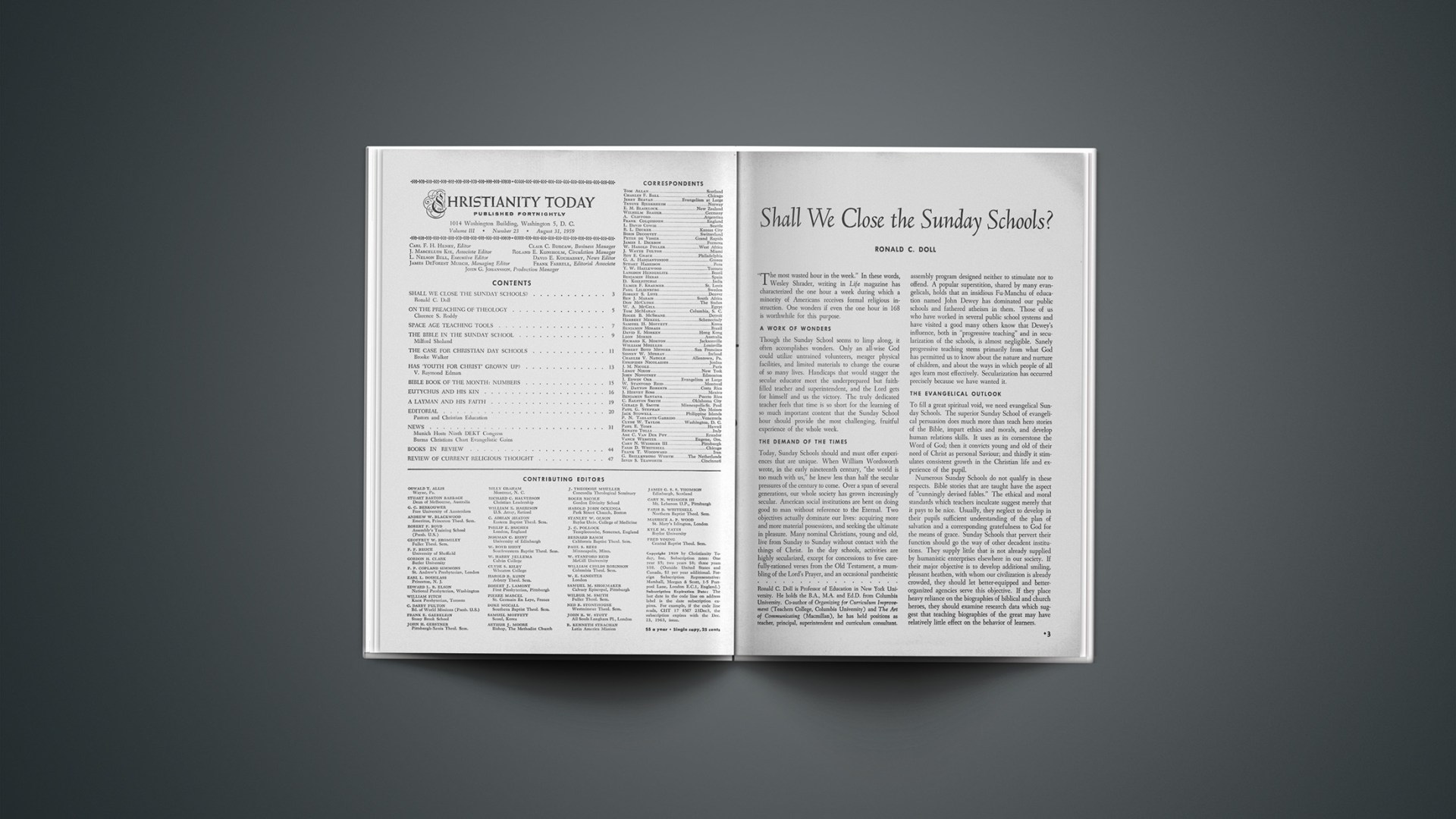
Shall We Close the Sunday Schools?

The most wasted hour in the week.” In these words, Wesley Shrader, writing in Life magazine has characterized the one hour a week during which a minority of Americans receives formal religious instruction. One wonders if even the one hour in 168 is worthwhile for this purpose.

A Work Of Wonders

Though the Sunday School seems to limp along, it often accomplishes wonders. Only an all-wise God could utilize untrained volunteers, meager physical facilities, and limited materials to change the course of so many lives. Handicaps that would stagger the secular educator meet the underprepared but faith-filled teacher and superintendent, and the Lord gets for himself and us the victory. The truly dedicated teacher feels that time is so short for the learning of so much important content that the Sunday School hour should provide the most challenging, fruitful experience of the whole week.

The Demand Of The Times

Today, Sunday Schools should and must offer experiences that are unique. When William Wordsworth wrote, in the early nineteenth century, “the world is too much with us,” he knew less than half the secular pressures of the century to come. Over a span of several generations, our whole society has grown increasingly secular. American social institutions are bent on doing good to man without reference to the Eternal. Two objectives actually dominate our lives: acquiring more and more material possessions, and seeking the ultimate in pleasure. Many nominal Christians, young and old, live from Sunday to Sunday without contact with the things of Christ. In the day schools, activities are highly secularized, except for concessions to five carefully-rationed verses from the Old Testament, a mumbling of the Lord’s Prayer, and an occasional pantheistic assembly program designed neither to stimulate nor to offend. A popular superstition, shared by many evangelicals, holds that an insidious Fu-Manchu of education named John Dewey has dominated our public schools and fathered atheism in them. Those of us who have worked in several public school systems and have visited a good many others know that Dewey’s influence, both in “progressive teaching” and in secularization of the schools, is almost negligible. Sanely progressive teaching stems primarily from what God has permitted us to know about the nature and nurture of children, and about the ways in which people of all ages learn most effectively. Secularization has occurred precisely because we have wanted it.

The Evangelical Outlook

To fill a great spiritual void, we need evangelical Sunday Schools. The superior Sunday School of evangelical persuasion does much more than teach hero stories of the Bible, impart ethics and morals, and develop human relations skills. It uses as its cornerstone the Word of God; then it convicts young and old of their need of Christ as personal Saviour; and thirdly it stimulates consistent growth in the Christian life and experience of the pupil.

Numerous Sunday Schools do not qualify in these respects. Bible stories that are taught have the aspect of “cunningly devised fables.” The ethical and moral standards which teachers inculcate suggest merely that it pays to be nice. Usually, they neglect to develop in their pupils sufficient understanding of the plan of salvation and a corresponding gratefulness to God for the means of grace. Sunday Schools that pervert their function should go the way of other decadent institutions. They supply little that is not already supplied by humanistic enterprises elsewhere in our society. If their major objective is to develop additional smiling, pleasant heathen, with whom our civilization is already crowded, they should let better-equipped and better-organized agencies serve this objective. If they place heavy reliance on the biographies of biblical and church heroes, they should examine research data which suggest that teaching biographies of the great may have relatively little effect on the behavior of learners.

What, then, are some of the main features of effective, spiritually-oriented Sunday Schools?

1. Really effective Sunday Schools are staffed with genuine Christians who have been carefully selected and introduced to their work. The most vital element in the teaching process is the teacher. Sunday School teachers, who are ordained to a special task, should be selected with an eye to their own spiritual experience and beliefs, to their basic understanding of their teaching assignment, and to their probable adaptability in dealing with the age group with which they will work. Once assigned, the new teacher needs help in both individual and group settings so that he may grow in service. Because of increased volunteering by teacher candidates, Sunday Schools can be more selective in their choice of teachers than they could have been 20 years ago.

2. The best Sunday Schools base their teaching on the Bible, for they seek always to convince pupils of their need of Christ as Saviour. No other institution or organization is prepared to teach consistently the Christian verities. Because this is true, no Sunday School and no series of curriculum materials for use in Sunday Schools should dilute the concentrated Gospel message.

3. The most effective Sunday Schools teach clearly and repeatedly the plan of salvation. How many members of Protestant churches have experienced the new birth? Is the fraction nearer one tenth or one twentieth of the total membership? One wonders whether either the pulpit or the Sunday School has thus far begun to fulfill its major responsibility. Surely the pupils in our Sunday Schools should be reminded as often as possible, and in as many different ways, of the plan of salvation.

4. The best Sunday Schools recognize that their most significant aim is improvement in the value structure of the individual. Teaching about the Scriptures is relatively easy. Helping the individual to reorient his values through use of the Scriptures so that all things have indeed become new is much more difficult. Sunday School teachers should be intensely aware of the power of God to change lives. They should also be helped to convert the findings of secular educators about the process of valuing and re-valuing to the special purposes of Christian education.

5. Teachers in the effective Sunday School plan their work carefully. For adequate planning, teachers need to know their specific objectives, week by week. Rather than teaching too much at a time, which results in superficial teaching and learning, they should limit their subject matter, striving to make it as meaningful as possible.

6. Teachers in the best Sunday Schools vary their teaching procedures. They know that listening and reciting, the two commonest activities in Sunday Schools, often represent a low order of learning. By experience it has been found that audio-visual aids and pupil, participation, to mention two very general categories of method, do indeed assist the learning of the world’s most important curriculum content.

7. Teachers in the best of Sunday Schools seek practical applications of the precepts they teach. One of the major criticisms of the Sunday School has been a failure to help pupils put into action throughout the week the spiritual truths they have discussed abstractly on Sunday. More of our weekly assignments should begin with the words, “Suppose we try this week to show our love (or patience, or honesty) in these situations: … Next week, let’s report how we’ve done.” Correspondingly, fewer assignments would then begin with the fact-directed interrogatives, Why? When? Where? More assignments would begin with the expressions, Why? and What would happen if …?

8. Teachers in effective Sunday Schools maintain warm, friendly relationships with their pupils, and with their pupils’ families. Often, the best Sunday School teaching is informal. The glowing personalities of Christian adults then come into contact with the growing personalities of individuals who are spiritually less mature. In this climate of friendship, the teacher tries to encourage self-discipline in his pupils. He also stimulates independent thinking and a sense of freedom within a context of divine authority. The teacher’s relationship with the home is crucial in securing cooperation in the spiritual growth of children.

9. Teachers in effective Sunday Schools evaluate the results of their work. Sunday School teachers have too often assumed that their own and their pupils’ efforts were bearing fruit. But the alert teacher will ask himself, “How do I know how well we have succeeded in our work?” Then he will devise questions and activities to evaluate, both formally and informally, progress to date. Most questions and activities should test the learning of major ideas and concepts rather than memorization of simple facts.

10. Effective Sunday Schools supply their teachers with the best in materials. Broadly conceived, this statement refers to teaching aids and materials of all kinds. In impoverished churches, it means quarterlies secured from publishing houses. Some of these and other aids are obviously not evangelical, and sometimes the evangelical ones are of poor educational quality. However, one of the gratifying developments of the past 10 years has been steady improvement in the quality of basic materials.

11. The most effective Sunday Schools provide a program of in-service education for their teachers. Teaching, for the ablest of personnel, is a complex act; hence, even the most competent of teachers need help. Certainly inexperienced, volunteer teachers need a special long-term program of in-service education to build their competencies to the maximum.

The Spiritual Priorities

In view of the purpose of the Sunday School, the most important of the preceding eleven features are the spiritual ones. Any Sunday School that has the first three features serves, at least in a limited way, a function that is fulfilled by no other organization in our society. The degree to which a Sunday School possesses the remaining eight determines, in large part, the effectiveness of its teaching ministry.

Findings in individual and social psychology, as well as in the other social sciences, have confirmed the worth of Jesus’ own methods of teaching. When amateurs in education attack these methods in books and articles, they are attacking wisdom higher than their own. What did Jesus do in his role as Master Teacher? He dealt personally with individuals (e.g., John 4:7, 26). He started with people where they were and moved them patiently to new stages in their development (e.g., his dealings with Simon Peter). He encouraged problem solving (e.g., Matt. 16:13–20). He let his learners develop the questions and ideas that led to teaching incidents (e.g., Mark 9:17–29). He encouraged learning by doing (e.g., Matt. 14:25–31). He sometimes taught by action rather than by words (e.g., John 8:6–9).

In addition, of course, Jesus did many things that good teachers do today. He taught informally. He gave learners full opportunity for decision-making. He emphasized inner motivation as opposed to outward acts. He urged practical demonstration and application of what had been learned. And above all, he sought fundamental change in systems of values.

To Sunday School teachers one may say, “Try to follow the high, hard road of the Master. If you try, no one can legitimately ask, ‘Shall we close the Sunday Schools?’ “A pioneer in Christian education, Clarence H. Benson, has said: “If the Gospel is from God, why is it not more effective? Well, there is nothing wrong with the Sower, who is the Son of God, or the Seed, which is the Word of God. The difficulty lies in the soil, and in the sowing of the Seed, which has been intrusted to the teacher’s hands.… It takes time and patience to press beyond the mind and reach the soul and spirit of the individual. Only as the teacher thus approaches his task is there any assurance that the good Seed will not only get down into the soil, but also will have a resurrection in a transformed and fruitful life” (The Christian Teacher, Chicago, Moody Press, 1950, p. 7).

It would be a sad day for America if the Sunday School should close its doors.

END

Ronald C. Doll is Professor of Education in New York University. He holds the B.A., M.A. and Ed.D. from Columbia University. Co-author of Organizing for Curriculum Improvement (Teachers College, Columbia University) and The Art of Communicating (Macmillan), he has held positions as teacher, principal, superintendent and curriculum consultant.

Review of Current Religious Thought: August 03, 1959

That I should devote a page of Current Religious Thought to the subject of traffic needs explanation, and the fact that it needs explanation needs explanation. In the first place, my devoting the page to this subject needs explanation, so I feel, because the matter seems to be neither especially current, especially religious, or especially of the nature of thought. That that explanation needs explanation is because traffic really is current, religious, and of the nature of thought; therefore, it is surprising that anyone should think it necessary to apologize for treating this subject under the heading of current religious thought. But I think that my attitude, which I am here criticizing, is rather common and therefore significant. If it is as common as I think that it is, then the shallowness of our thinking is revealed in our thinking that this subject is shallow.

To show how common this attitude actually is let me relate an experience. Not too long ago in the company of some learned men a moral issue—an obviously moral issue—was being discussed. One member of this company, in the context of discussing that particular moral issue, took occasion to appeal to an analogy in the area of behavior, or rather, misbehavior, on the highways. Immediately another member of this learned company protested the irrelevancy of the remark on the ground that the analogy had to do with traffic and that had nothing to do with morals.

The first topic that comes to mind is religion and speed. Can one conclude from the miles per hour that a driver is a Presbyterian, a Methodist, a Christian Scientist, a Romanist, or a pagan? Unfortunately, no. Alas for the vast majority, the Bible and speed limits have no relation to each other. There was a time when the minister we know best of any would regularly drive 70 miles an hour to conduct a prayer meeting or communion. Frequently when we rose to preach on the duty of keeping the law, we would have broken the law of the road in order to reach the pulpit. Many people who knew us only before our reform will be saying: Aha, look who is talking on the sin of speeding! For years we, who would not think of cheating in an exam or on an income tax return, would defy any speed limit if we saw no trooper behind a clump of trees or in our mirror (which we used to watch conscientiously). This is a confession, you are right. It was years before we broke under the relentless logic of Romans 13: if the powers that be are to be obeyed for God’s sake, and the powers that be make traffic regulations, then their regulations are to be obeyed for God’s sake. Now, since I have been enlightened, I could not be a Christian and drive 70 on a highway in Pennsylvania (except in the case of dire emergency for which I could conscientiously request a police escort if that were feasible). This is a confession, all right; but I make it not for myself alone, but for all those sinners who see no correlation between driving and duty. And their name is legion.

It is remarkable how many persons who, as pedestrians, are quite courteous Christian gentlemen and gentlewomen, but undergo a transformation (not unlike Dr. Jekyll and Mr. Hyde) when they get behind a wheel. While they would not think of pushing and shoving on the sidewalk or in a corridor, they do the equivalent of it in a line of cars without batting an eye of their conscience. They tip their hats to ladies on the street and hold the door for elderly folk, but seated in a super eight they are not distinguishers of persons. Polite as the most refined and genteel in the drawing room, they are uncivilized savages when on Route 6.

There was an old Latin saying: in vino veritas—in wine there is truth. Inebriation gives vent to some uninhibited expressions. Is it possible that for many persons driving is a sober man’s alcohol under the influence of which he takes leave of his usual restraints and feels no moral inhibitions? We are reminded of the little boy who once asked his mother why it was that when father drove the car all the “pigs”, “vermin”, “dogs” and “toads” came out on the highway.

Speaking of traffic, consider this well-known slogan: “Drive carefully—the life you save may be your own.” Now the writer of that motto at least recognizes that the matter of driving is a moral matter. He appeals to a basal moral law of self-preservation. He seems to be arguing that we ought to be careful on the roads because we ought to preserve our lives as long as possible. While no one wishes to quarrel with the law of self-preservation or the morality of the same, this bald statement seems to us to be fundamentally nonmoral, if not immoral. To appeal to me to be careful for the sake of me with no consideration whatever given to the possible innocent victim of my otherwise careless driving seems like the crassest hedonism. While there may be nothing wrong in appealing to self-interest as one motive along with and subordinate to others, to appeal to self-interest disregarding all others’ interest seems unethical. Society may be better off if I am a careful driver. But, if I am a careful driver for no other reason than my own preservation, then society owes me no thanks. Somehow I cannot imagine our Lord, if he were in the business of writing highway slogans, penning such a motto. It would be easier for me to imagine him saying: “Drive carefully—the life you save may not only be your own but someone else’s.” Loving your neighbor as well as yourself applies to your fellow driver. The ethics of the Sermon on the Mount apply on the highway as well as elsewhere. Christian morality goes beyond the preservation of self.

But, then I can hear the cynic remark: What an anticlimax that would be. To which I suspect our Lord would say: What an unethical sentiment your remark is. After all, what does it profit a man, even on the highway, if he save his life but lose his soul? And does the immoral person not lose his soul, no matter how effectively he preserves his life—from traffic hazards or whatever?

A minister friend of mine recently put an article in his church bulletin on the morals of highway driving. Apparently there are many who need to be shown the relation between their Christianity and their motoring. How can a person be a Christian in the living room and not on the road? What kind of moral dichotomy is that which permits a man to be a saint behind a desk and a sinner behind a wheel? To be sure, Isaiah was not predicting modern travel when he spoke of a “highway for our God.” But may we not adapt his expression and call for a modern highway for our God? As a matter of fact, must not those who are on Isaiah’s highway, prove it by behaving as a Christian on ours? Is modern driving an irrelevancy in the realm of current religious thought? I think not.

Book Briefs: August 3, 1959

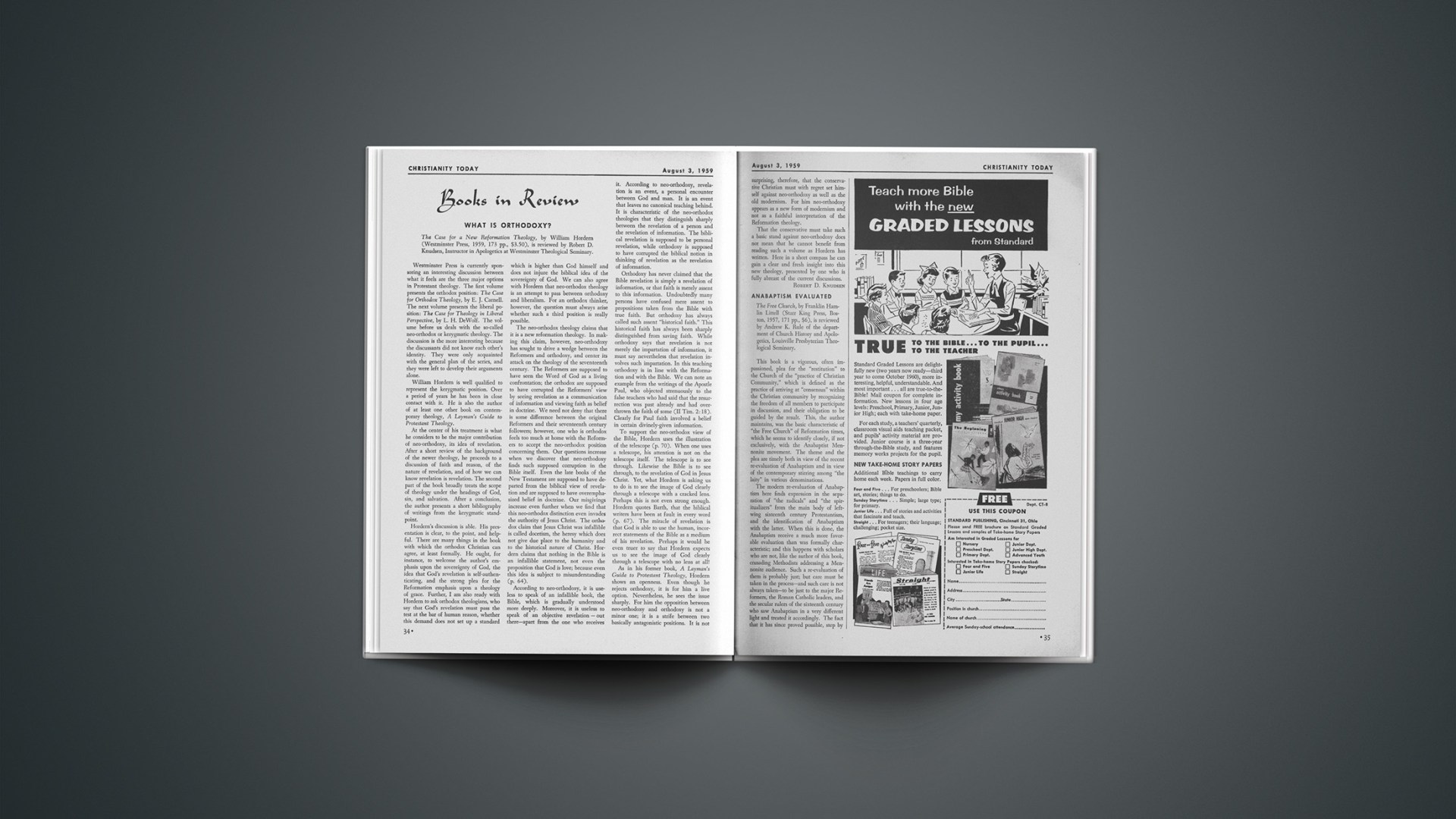
What Is Orthodoxy?

The Case for a New Reformation Theology, by William Hordern (Westminster Press, 1959, 173 pp., $3.50), is reviewed by Robert D. Knudsen, Instructor in Apologetics at Westminster Theological Seminary.

Westminster Press is currently sponsoring an interesting discussion between what it feels are the three major options in Protestant theology. The first volume presents the orthodox position: The Case for Orthodox Theology, by E. J. Carnell. The next volume presents the liberal position: The Case for Theology in Liberal Perspective, by L. H. DeWolf. The volume before us deals with the so-called neo-orthodox or kerygmatic theology. The discussion is the more interesting because the discussants did not know each other’s identity. They were only acquainted with the general plan of the series, and they were left to develop their arguments alone.

William Hordern is well qualified to represent the kerygmatic position. Over a period of years he has been in close contact with it. He is also the author of at least one other book on contemporary theology, A Layman’s Guide to Protestant Theology.

At the center of his treatment is what he considers to be the major contribution of neo-orthodoxy, its idea of revelation. After a short review of the background of the newer theology, he proceeds to a discussion of faith and reason, of the nature of revelation, and of how we can know revelation is revelation. The second part of the book broadly treats the scope of theology under the headings of God, sin, and salvation. After a conclusion, the author presents a short bibliography of writings from the kerygmatic standpoint.

Hordern’s discussion is able. His presentation is clear, to the point, and helpful. There are many things in the book with which the orthodox Christian can agree, at least formally. He ought, for instance, to welcome the author’s emphasis upon the sovereignty of God, the idea that God’s revelation is self-authenticating, and the strong plea for the Reformation emphasis upon a theology of grace. Further, I am also ready with Hordern to ask orthodox theologians, who say that God’s revelation must pass the test at the bar of human reason, whether this demand does not set up a standard which is higher than God himself and does not injure the biblical idea of the sovereignty of God. We can also agree with Hordern that neo-orthodox theology is an attempt to pass between orthodoxy and liberalism. For an orthodox thinker, however, the question must always arise whether such a third position is really possible.

The neo-orthodox theology claims that it is a new reformation theology. In making this claim, however, neo-orthodoxy has sought to drive a wedge between the Reformers and orthodoxy, and center its attack on the theology of the seventeenth century. The Reformers are supposed to have seen the Word of God as a living confrontation; the orthodox are supposed to have corrupted the Reformers’ view by seeing revelation as a communication of information and viewing faith as belief in doctrine. We need not deny that there is some difference between the original Reformers and their seventeenth century followers; however, one who is orthodox feels too much at home with the Reformers to accept the neo-orthodox position concerning them. Our questions increase when we discover that neo-orthodoxy finds such supposed corruption in the Bible itself. Even the late books of the New Testament are supposed to have departed from the biblical view of revelation and are supposed to have overemphasized belief in doctrine. Our misgivings increase even further when we find that this neo-orthodox distinction even invades the authority of Jesus Christ. The orthodox claim that Jesus Christ was infallible is called docetism, the heresy which does not give due place to the humanity and to the historical nature of Christ. Hordern claims that nothing in the Bible is an infallible statement, not even the proposition that God is love; because even this idea is subject to misunderstanding (p. 64).

According to neo-orthodoxy, it is useless to speak of an infallible book, the Bible, which is gradually understood more deeply. Moreover, it is useless to speak of an objective revelation—out there—apart from the one who receives it. According to neo-orthodoxy, revelation is an event, a personal encounter between God and man. It is an event that leaves no canonical teaching behind. It is characteristic of the neo-orthodox theologies that they distinguish sharply between the revelation of a person and the revelation of information. The biblical revelation is supposed to be personal revelation, while orthodoxy is supposed to have corrupted the biblical notion in thinking of revelation as the revelation of information.

Orthodoxy has never claimed that the Bible revelation is simply a revelation of information, or that faith is merely assent to this information. Undoubtedly many persons have confused mere assent to propositions taken from the Bible with true faith. But orthodoxy has always called such assent “historical faith.” This historical faith has always been sharply distinguished from saving faith. While orthodoxy says that revelation is not merely the impartation of information, it must say nevertheless that revelation involves such impartation. In this teaching orthodoxy is in line with the Reformation and with the Bible. We can note an example from the writings of the Apostle Paul, who objected strenuously to the false teachers who had said that the resurrection was past already and had overthrown the faith of some (2 Tim. 2:18). Clearly for Paul faith involved a belief in certain divinely-given information.

To support the neo-orthodox view of the Bible, Hordern uses the illustration of the telescope (p. 70). When one uses a telescope, his attention is not on the telescope itself. The telescope is to see through. Likewise the Bible is to see through, to the revelation of God in Jesus Christ. Yet, what Hordern is asking us to do is to see the image of God clearly through a telescope with a cracked lens. Perhaps this is not even strong enough. Hordern quotes Barth, that the biblical writers have been at fault in every word (p. 67). The miracle of revelation is that God is able to use the human, incorrect statements of the Bible as a medium of his revelation. Perhaps it would be even truer to say that Hordern expects us to see the image of God clearly through a telescope with no lens at all!

As in his former book, A Layman’s Guide to Protestant Theology, Hordern shows an openness. Even though he rejects orthodoxy, it is for him a live option. Nevertheless, he sees the issue sharply. For him the opposition between neo-orthodoxy and orthodoxy is not a minor one; it is a strife between two basically antagonistic positions. It is not surprising, therefore, that the conservative Christian must with regret set himself against neo-orthodoxy as well as the old modernism. For him neo-orthodoxy appears as a new form of modernism and not as a faithful interpretation of the Reformation theology.

That the conservative must take such a basic stand against neo-orthodoxy does not mean that he cannot benefit from reading such a volume as Hordern has written. Here in a short compass he can gain a clear and fresh insight into this new theology, presented by one who is fully abreast of the current discussions.

ROBERT D. KNUDSEN

Anabaptism Evaluated

The Free Church, by Franklin Hamlin Littell (Starr King Press, Boston, 1957, 171 pp., $6), is reviewed by Andrew K. Rule of the department of Church History and Apologetics, Louisville Presbyterian Theological Seminary.

This book is a vigorous, often impassioned, plea for the “restitution” to the Church of the “practice of Christian Community,” which is defined as the practice of arriving at “consensus” within the Christian community by recognizing the freedom of all members to participate in discussion, and their obligation to be guided by the result. This, the author maintains, was the basic characteristic of “the Free Church” of Reformation times, which he seems to identify closely, if not exclusively, with the Anabaptist Mennonite movement. The theme and the plea are timely both in view of the recent re-evaluation of Anabaptism and in view of the contemporary stirring among “the laity” in various denominations.

The modern re-evaluation of Anabaptism here finds expression in the separation of “the radicals” and “the spiritualizers” from the main body of left-wing sixteenth century Protestantism, and the identification of Anabaptism with the latter. When this is done, the Anabaptists receive a much more favorable evaluation than was formally characteristic; and this happens with scholars who are not, like the author of this book, crusading Methodists addressing a Mennonite audience. Such a re-evaluation of them is probably just; but care must be taken in the process—and such care is not always taken—to be just to the major Reformers, the Roman Catholic leaders, and the secular rulers of the sixteenth century who saw Anabaptism in a very different light and treated it accordingly. The fact that it has since proved possible, step by step, to grant all the demands of the Anabaptists, without any dire consequences, does not prove that their advocacy of them as “a package deal” was not socially dangerous at that time. Dr. Littell has not sufficiently guarded himself from this historical injustice; and in particular, by lumping Calvin so consistently with the other Reformers, he has failed to discover, in that expression of the Reformation, the highly successful embodiment of free church principles for which he looks, with less success, to the Mennonites.

It is difficult also to find in this book any clear and consistently applied definition, connotative or denotative, of a “Free Church.” One finds it distinguished from the “territorial” church, the “established” church, the “clergy-centered establishments,” from the church of the Reformers, and from “American religion,” but no one of these terms is clearly defined nor are distinctions within them recognized. The thinking here is too much like the pinning on of labels, and some of it sounds like “ranting.” This is a shame, for the author in each case has a good cause and is obviously capable of more factually restrained judgments.

In spite of these criticisms, the reviewer regards this as a useful book. The very points of criticism are useful in stimulating thinking; and the main theme of the book is a challenge to a re-evaluation of the church—something that is vitally necessary in regard to the ecumenical movement.

ANDREW K. RULE

Contemporary Faith

Know Your Faith Series: I Believe in Immortality, by John Sutherland Bonnell (Abingdon, 1958, 83 pp., $1.25), Invitation to Commune, by Charles Ray Goff (88 pp., $1.75), and I Believe in Jesus Christ, by Walter Russell Bowie (69 pp., $1.25), are reviewed by Robert B. Dempsey, Minister of the Congregational Church of Carlisle, Massachusetts.

The first book is excellent and worth its price. Its appealing style will keep one reading to the end.

Bonnell presents the case for immortality convincingly and rightly distinguishes vague ideas about endless existence from the Bible’s rich concept of eternal life. The skeptic is viewed as one whose bleak life has no real anchor in the face of death.

For Bonnell, man has a soul which is incomplete without a body. When this house of clay is laid aside, there is a body waiting for us in a heaven that is nearby and not in distant spaces.

Evangelicals will agree with his presentation of the bodily resurrection of Christ and its meaning for triumphant living.

There are three weaknesses in the book. The author is explicit about Christ’s resurrection but leaves unanswered the question of the believer’s resurrection. Once he hints that the Christ of faith is not the Jesus of history, and thus much of what he says is negated. The greatest weakness is his failure to link significantly eternal life with the Atonement.

The second book is a devotional study on the Methodist communion liturgy and proper attitudes for a profitable participation in the Lord’s Supper. All will agree with the author that certain attitudes are essential. Two of these are provocatively expressed. Goff is best in his chapters on repentance and comfort. Those on love, faith, consecration, and confession are less effective. The chapter on reconciliation is undercut by the assumption of universalism that appears in the book.

Although he seeks to avoid the weaknesses of liberalism, Goff does not escape one of the most serious of these. His approach to communion is subjectivistic, with ultimately no right and wrong in its observance. It is repeatedly called the Way of Wonder, and its mystical qualities are emphasized. The worship aspects are completely in the realm of emotion and lacking in necessary doctrinal content. References to such topics as the Atonement and propitiation are unsatisfactory.

Of the three books, this last is the least rewarding. Bowie rightly presents a Christ whose life and principles possessed a certain sternness, but who was nonetheless gentle. While his insights into the humanity of Jesus present him as a figure of virility and strength with a zest for life and nature, there is little appreciation for the person and work of Christ. Death for his teachings was merely something he suspected would happen early in his ministry. However, he faced the tragedy bravely, and died the martyr’s death.

Bowie seeks to raise the Cross above meaninglessness, but does not succeed. A sense of sin comes not from the Substitute under the judgment of God but from the wickedness of His slayers. Love is not in the reconciliation through the blood but in the willingness of Christ to die so that men might have an ideal. The victory of the Cross was not over death but in “the great moral triumph of the great soul which had gone straight into the darkness of death without surrendering” (p. 53).

The author’s treatment of Christ’s resurrection and deity leave a great deal to be desired.

ROBERT B. DEMPSEY

Courage Of Conviction

Thomas Ken: Bishop and Non-Juror, by H. A. L. Rice (Society for the Propagation of Christian Knowledge, London, 230 pp., 25s), is reviewed by G. C. B. Davies, Professor of Ecclesiastical History, Trinity College, Dublin.

Few occupants of the English episcopal bench are more worthy of the adjective “saintly” than the subject of this book, Thomas Ken, Bishop of Bath and Wells. Though the troublous times in which Ken lived form a necessary background to his life and work, we scarcely ever find them ruffling the serenity of his mind, so clear was his vision of the things unseen and eternal.

Yet we are not to imagine that Ken was spared personal concern with the trials which oppressed England during the last quarter of the seventeenth century. Chaplain to the Princess Anne at the Hague, to King Charles II, and to the naval expedition of 1683 concerned with the demolition of Tangier; on the scaffold with Monmouth; making efforts to better the lot of the wretched rebels suffering under the ruthless Kirke and Jeffreys; one of the seven bishops in the Tower—Ken spent himself in the conscientious discharge of his priestly and episcopal duties. But with the arrival of “Dutch Williams” (to whom the author is scarcely fair), Ken’s implacable conscience forbad him to take an oath of allegiance to a de facto sovereign in the lifetime of another to whom he had previously sworn fealty in virtually the same words. On this point Ken was quite clear, despite the urgent persuasions of some of his friends.

In 1691 he was deprived of his bishopric, together with eight other bishops, all convinced of the same moral duty. Because of this, a great spiritual force departed from the church leaving open the field to those Latitudinarian influences which so sorely weakened her moral prestige in the ensuing century. For the last 20 years of his life, Ken found sanctuary at Longleat, the magnificent mansion between Frome and Warminster, home of his friend Lord Weymouth, and now the residence of the Marquess of Bath. To occupy his mind in retirement, he wrote verse of no outstanding merit, though his morning and evening hymns are familiar to many. Shortly before his death he ceded his bishopric to his friend of university days, George Hooper, in whose safe hands he was confident to leave his beloved flock.

We are indebted to the author for this finely written study which was obviously a labor of love. Mr. Rice at times makes little secret of his own sympathies. When pointing a moral from the days of Ken to our own times, he castigates the “pale pink intellectuals of a State-pampered age,” and ruefully comments that today Sabbath worship is “a mild and comparatively rare eccentricity.” Though bringing to light no new material, Mr. Rice has done well to set once more before us a figure to whom principle was all and expediency nothing. His verdict on Ken and the Non-Jurors carries a lesson of lasting significance. “However mistaken the twentieth century may adjudge to be the motives which led the Non-Jurors into the wilderness of privation, obscurity and neglect, it may well pay the passing tribute of a sigh in deference to men who had the courage of their own convictions and who were prepared to face whatever came their way of hardship, suspicion, and material loss.”

G. C. B. DAVIES

Twice-Born Men

Crusade at the Golden Gate, by Sherwood Eliot Wirt (Harper, 1959, 176 pp., $2.75), is reviewed by Harold Lindsell, Dean of Faculty, Fuller Theological Seminary.

Crusade at the Golden Gate is a fascinating book. One cannot remain untouched as he reads the stirring story of Billy Graham’s Cow Palace Crusade in San Francisco. The spiritual diaries of men and women whose lives were changed reminds one of Twice-Born Men.

The author stands midway between antipodal poles—between those who can see no wrong in Billy Graham and those who can see no good. He realistically evaluates the Cow Palace campaign, and does so against the backdrop of San Francisco’s peculiar inheritance. No wild claims are advanced, no superlatives carelessly dropped. In measured yet moving terms he balances the benefits of the campaign over against the anticipated but unachieved results.

This is undoubtedly the best account of any of the Graham campaigns. Whatever be one’s personal viewpoint, he will not put this book down until he has read the last page. Nor can anyone help but be blessed if he comes to it with an open mind. For it is not really the story of Billy Graham, but of God working through Mr. Graham.

HAROLD LINDSELL

Itinerant Preacher

Seventy Years a Preacher, the Life Story of the Rev. William H. Moser, Ph.D., Militant Methodist Preacher, as told to Chester A. Smith (The Historical Society of the New York Annual Conference of the Methodist Church, Peekskill, N. Y., 1959, 110 pp., published by subscription), is reviewed by E. P. Schulze, Minister of the Lutheran Church of Our Redeemer, Peekskill, New York.

Books about preachers have a fascination for other preachers. This one, told briefly and well, is the story of a parson who itinerated a good deal, as Methodist ministers used to do. His duties were mainly in the Hudson valley, and everywhere he went he seems to have made an influence. President Eisenhower, as the title page of this book points out, said, “I like to see militant preachers.” Likely enough, Moser is a man whom Eisenhower would have admired. Interested in social reform, he fought the liquor traffic and Sunday moving pictures. Of a practical turn of mind, he gave some of his attention successfully to debt reduction and fund raising for church improvement. He saved some of his poorer congregations considerable sums by repairing their pipe organs for them. In one community he paved the way for municipal street lighting by installing lights on poles from the downtown area to his church.

Deeply spiritual, Moser conducted numerous revivals, held Wednesday evening prayer meetings, taught indoctrination courses, and led Bible classes. He visited his members faithfully, read the Bible to them, and prayed with them. He preached the Christian faith and life without manuscript and with power. Now, at 89 years of age, he is living in retirement with his wife and son at Ridgewood, New Jersey.

The volume abounds with anecdotes. Once his son, then not yet five years old, insisted on speaking at a prayer meeting. When given permission, he said (for he had listened well): “I have served the Lord for 40 years. Please pray for me that I may be faithful to the end.” One Christmas eve, in the early days of radio, his boys put the earphones of a primitive battery set on his head as he lay in bed. Broadcasting was sporadic in those days; the radio was silent, and Moser fell asleep. Suddenly he awoke in the dark room to hear the thrilling strains of “Hark! the Herald Angels Sing.” The incident made a deep impression on him, and in time, he says, it became more than an impression. “It became a prophecy of the time when I shall fall asleep on earth for the last time, to be awakened by the angel choir in heaven.”

The contents of this book were related to Chester A. Smith, a well-known Methodist layman, himself a preacher and author.

The present volume is commended to all who wish to learn what it was like to be a Methodist pastor in the days of itinerancy, and to all who enjoy perusing the biographies of clergymen.

E. P. SCHULZE

Credo

I Believe in Man, by Frederick Keller Stamm (Abingdon, 1959, 77 pp., $1.50), and I Believe in the Church, by Elmer G. Homrighausen (Abingdon, 1959, 108 pp., $1.50), are reviewed by G. Aiken Taylor, Minister of First Presbyterian Church, Alexandria, Louisiana.

These two books finish up the “Know Your Faith” series to which Gerald Kennedy, Joseph R. Sizoo and others have contributed. I Believe in Man is an affirmation of man’s innate capacity for good. The author writes of Creation: “… (God) made man well and he endowed him with basic goodness.” To have endowed man with an evil nature, believes Dr. Stamm, would have been to create evil. In other words, if there was a Fall, the author never heard of it. And if he ever read Niebuhr, it was evidently with disapproval. As the dust jacket confides, “Dr. Stamm’s view of man is an optimistic one.” Add to this optimistic view a liberal view of Christ and a psychologist’s view of religious experience and you have this book. The viewpoint is one that died of old age and was given a decent burial long ago.

I Believe in the Church covers a less controversial subject. Very few people of whatever persuasion would find fault as the author argues that Christianity is not a solitary experience; that the Church, the body of Christ, exhibits God’s purpose for man and for history; that the Church is “necessary and integral (?) to God, to the Christian, and to the world.” Dr. Homrighausen writes warmly of these things and of the Holy Spirit who brings to believers the “inner quality” of Pentecost, thus uniting them to Christ and to his community, the Church, until Christ comes again. This book is a refreshing antidote to the other.

G. AIKEN TAYLOR

Stimulative And Suggestive

Sermon Substance, by Ralph G. Turnbull (Baker Book House, 1958, 224 pp., $3.50), is reviewed by H. C. Brown, Jr., Professor of Preaching, Southwestern Seminary, Fort Worth, Texas.

Sermon Substance, by the author of Jonathan Edwards the Preacher and other books, deals suggestively and creatively with 100 ideas for a year’s preaching ministry.

In his introduction the author gives the clue to the purpose for his book: “The task of sermon preparation is a delight when the busy pastor knows what to prepare. But there are days when there is no stirring of the wind, and he feels like a ship becalmed. What then? Is it a denial of faith to lift a top sail in the hope and expectation that the wind will blow again? Here it is that sermon substance has a place of stimulus and suggestion [italics added].”

In the event that the author’s purpose is properly understood and correctly carried out, this book has value. But in the event that the author’s purpose is perverted by “too” busy preachers using the potentially useful substance as a “crutch,” then the book renders a disservice to the ministry. It is hoped that all who read will profit by the author’s lucid thoughts, ideas, illustrations, arrangements, and analyses of Scripture without one preacher resorting to the use of these materials as a substitute for prayer, meditation, study, exegesis, and hard sermonic labors. Let the volume be used to stimulate and to suggest meaningful messages to your mind.

H. C. BROWN, JR.

Nature’S Lessons

Thoughts Afield, by Harold E. Kohn (Eerdmans, 1959, 171 pages, 63 drawings, $3.75), is reviewed by Clyde S. Kilby, Chairman, Department of English, Wheaton College.

I usually mark up rather badly the books which I review, but in this instance I refrained. The book is too lovely. It is hard for me to know which I like best—the charming pen-and-ink drawings, the essays themselves, or the fine general layout of the book.

The author’s method is to describe some colorful aspect of natural life in the woods of northern Michigan and then suggest its moral and spiritual implications. Because he loves nature and really knows valuable things about it, his depiction of it does not become a mere crutch to sermonizing. He is interested in the giant trees of the forest but equally excited about the trillium or even an almost microscopic particle of green called the duckweed. It is interesting to notice that he thinks nature is benevolent and that the preying of one animal on another is wholly free from hatred and therefore without the ferocity which human beings sometimes ascribe to it.

The book is lavish in anecdotes and the sort of remarks one likes to quote. “Take any shadow you please and trace it far enough and you will see that it is the dark side of a bright object, pain being the shadow of our wondrous capacity to feel, mistakes being the dark side of our glorious freedom to make choices.” “Selfishness that is blessed with the name of religion is selfishness still.” “The perfectionist can never enjoy anything on earth completely because the things of earth come with built-in blemishes.” To some people “prayer is a matter of mastering the right vocabulary, learning the magical formula that will assault God at His weakest points and make Him give in to their whims.… Prayer is resting for awhile in God’s greatness.” “Nothing in human experience is more attractive and winsome than a noble thought or emotion in the process of becoming a deed.” “One of the most pitiable sights on the face of the earth is lopsided virtue.” “No king ever made a man a knight. The best a king could do was to recognize the knighthood already present in the man.” There are many other such remarks.

The author is preacher, writer, and artist, and in each capacity does a worthy piece of work.

CLYDE S. KILBY

Malayan Workers Set Task in New Focus

From the ends of Malaya, 315 missionaries and national workers (about 60 per cent of the Christian leadership) gathered July 7–10 for the All-Malaya Christian Workers Conference sponsored by World Vision, the Malayan Christian Council and the Central Malaya Christian Churches. Although Malaya is one of Asia’s oldest centers of Christian activity, after a century of modern missions its Protestant church membership lags at only 30,000.

Only one in 18,000 is a convert. The deepest problem facing the Christian witness in Malaya was dramatized by the absence from the Port Dickson conference of all Malays, who number more than 3 million of the 6,250,000 population. The religious fate of the Malays was virtually sealed, and Christian penetration ruled out, when the British empire, as a price for its colonial foothold, promised protection of Malay religion and custom, intrinsically Moslem. Although Malaya is in the United Nations, national punishment by fine or imprisonment for distribution of non-Moslem literature precludes signing the UN Declaration of Human Rights which stipulates religious freedom. Moslems dominate the government, and some observers regard their pressures “from the right” politically as potentially explosive in Southeast Asia as communist pressures. Religiously, Malayan Moslemism is not virile, often blending with animism and Hinduism. But it remains politically powerful. Any convert to Christianity would be cut off by family and friends, would be disinherited and his life might be endangered. A foreign missionary baptizing such a convert faces deportation by the government.

Under these circumstances Malayan Christians minister effectively only to the large population of aliens. The 200 Protestant missionaries face 2,300,000 Chinese, 750,000 Indians and Pakistanis, and 95,000 others. Among Chinese, the educated speak Mandarin, but other dialects are also widespread. In religion, they are Confucians, Taoists and Buddhists, although Chinese Christian churches and communities were planted by immigrants at the turn of the century. World Vision discussion groups were caried on in Mandarin, Cantonese and Hokkien as well as in English, which most Indian workers use as well as their own tongue.

Malaya’s fine network of highways, a heritage from British rule, enabled carloads and busloads of workers to attend from distant parts. Malaya is Methodism’s biggest educational field, and the Methodist Church accounts for 50 per cent of the churches, more than half of which are said to be evangelical. In Wesley Methodist Church of Kuala Lumpur, the Rev. Harry Haines, preaching to the largest congregation in the Malayan Federation (which does not include Singapore) addresses 650 persons Sunday mornings and 350 at night. In the past year his church added 150 converts. The church includes 10 nationalities, and the chairman of its board is the only Japanese permitted to remain in Malaya after World War II. The Anglican church accounts for 20 per cent of Malaya’s churches, with Presbyterians and Plymouth Brethren active among the many smaller efforts. Malayan Christian Council represents 92 per cent of the Christian work in Malaya.

World Vision subsidized the Malayan pastors’ conference with a minimal travel allowance, lodging and food. One Indian worker walked 50 miles to attend, while others borrowed automobiles. To quicken evangelistic passion, evangelical devotion and spiritual unity, among Christian workers, the movement’s leader, Dr. Bob Pierce, brought a team of American and Asian leaders. “We are gathered so God may interfere with our lives,” he said, “and do his sovereign work in us.”

Bishop E. Sobrepena of the Philippines, president of the East Asia Christian Conference, pleaded for a revival of evangelistic dedication by ministers and laymen, and told workers: “We fear most the imperialism or enslavement of sin, and we know that Jesus Christ can make us free.” Dr. Kyung Chik Han of Korea, who led his congregation from North to South Korea ahead of the Communist invasion, and now preaches to 4,000 persons in two Sunday morning services in Seoul, called for a courageous Christian witness in the segment of Asia containing half the world’s population. “Two voices are now calling to these multitudes,” he said. “Both welcome Western science. But one insists that Asian religions are best; it promotes a resurgence of the non-Christian religions. The other, atheistic materialism, declares that all religion is superstition. God has placed the Christian minority in Asia for a courageous testimony to the redemption that is in Christ.”

Dr. Paul Rees stressed the need of stewardship, Dr. Richard Halverson the importance of private devotional life and personal dedication, and Dr. Carl F. H. Henry led morning Bible studies. Dr. William Van Valin, California surgeon, accompanied the party.

As workers dispersed, some to Singapore 180 miles south, others fanning through the Federation from the Strait of Malacca to the South China Sea, they recalled Bishop Sobrepena’s bursting plea to “West and East, North and South, white and brown and yellow and black, to enter with new dedication upon the completion of the Christian task.”

Before separating, workers took up an offering to assist the poorer nationals in Burma in attending a similar conference, after discouraged and lonely students, Bible distributors, pastors and missionaries voiced new-found encouragement for the evangelistic task. Depleted by his Osaka crusade, Dr. Pierce did not continue to Burma with his team.

Three in four members of the Malayan churches are under 25. When older missionaries failed to return after World War II, some began in a new way to sense their own missionary duty. Most of Malaya’s missionary force is today scattered throughout the new villages established by the government when Communist terrorists established mountain strongholds, and reserve workers are lacking. A Malayan missionary crusade may not be in early prospect, but evangelical unity in prayer is widening and the sense of evangelistic urgency is being sharpened.

Oriental Tour

Editor Carl F. H. Henry is on a five-week tour of the Orient with World Vision.

On these adjoining pages are dispatches from the scene in which Henry assesses Christian progress in Japan and Malaya.

In his report on Japan, the Editor discusses reasons why missionaries there have not seen as many conversions as are reported from other mission fields.

The Malaya report tells how the Moslem religion is protected by law and how Christian evangelism is virtually limited to work among the large alien population.

Henry’s itinerary is also taking him to Formosa, the Philippines, Thailand, Burma, and Hong Kong. He is part of a World Vision team which is holding pastors’ conferences at strategic points throughout the Orient. He is due back in the United States August 10.

Foreign Missions

Broadcast Ban

Missionary radio leaders are asking the government of Morocco to reconsider an order to prohibit private broadcasting as of the end of the year. Unless the directive is rescinded, missionary broadcasts from Tangier will be forced off the air. Among stations affected is the Voice of Tangier, which uses three towers to beam 750 Gospel-centered programs a month throughout Europe and the Middle East. Officials of the Voice of Tangier say the station provides for many behind the Iron Curtain the only source of spiritual food.

Report From Ecuador

Ecuador’s Auca Indian tribe continued to demonstrate friendliness toward white missionary women last month.

In June, the Aucas welcomed two new-comers: Mrs. Marjorie Saint, wife of one of five missionary men slain by the Aucas 31/2 years ago, and Miss Mardelle Senseny of the Gospel Missionary Union both spent several days with the jungle tribe. They were led down the trail by Mrs. Elisabeth Elliot and her four-year-old daughter. Mrs. Elliot, wife of another of the martyrs, planned to stay with the tribe for several months.

At the same time, Miss Rachel Saint, sister-in-law to Mrs. Saint, came out of the jungle after four months of studying the Auca language.

Roman Catholics

The Bible And Rome

The first encyclical (letter) of Pope John XXIII is a 10,000-word Latin document punctuated with some 49 biblical references. No new policies are apparent.

Said to be entirely the Pope’s own work, the encyclical covers a range of subjects from theology (“There are quite a number of points which the Catholic Church leaves to the discussion of the theologians”) to television and other mass communication media (“they can be the source of enticement to loose morals”). The Pope pleads for peace, condemns communism, and warns against unemployment. He makes a new overture “to those who are separated from the Apostolic See”: “we lovingly invite you to the unity of the Church.”

The encyclical’s first biblical reference uses Isaiah 11:12 to support an assertion that the Roman church is “set up a standard unto the nations.” (The “standard” is from the Douay; the King James and Revised Standard versions say “ensign.”) In a “concluding exhortation,” he says: “If anyone … has wandered far from the Divine Redeemer because of sins committed, let him return—we entreat him—to the one who is ‘the way, the Truth, and the Life’ (John XIV, 6).”

Church And State

Selecting Sides

Lady Chatterley’s Lover appeared last month to be lining up clergymen in support of Postmaster General Arthur E. Summerfield who had banned the unexpurgated edition of the book from the mails, while drawing out their criticism of the U. S. Supreme Court, which ruled that a New York state ban on the movie version was unconstitutional.

A U. S. District Court in New York subsequently upset Summerfield’s ban and declared the novel mailable. The Post Office Department was expected to appeal. Summerfield calls Lady Chatterley’s Lover “obscene and filthy.”

The Supreme Court ruling on the movie said the First Amendment to the Constitution “protects advocacy of the opinion that adultery may sometimes be proper.”

A constitutional amendment was subsequently introduced before Congress aimed at overruling the court decision.

The Protestant clergy is believed to be largely in favor of a ban on Lady Chatterley’s Lover, though opinions doubtless are tempered by questions such as these: Will a precedent be established which could lead to undesirable censorship? Should decisions on what constitutes obscenity rest with post office administrators? Is obscenity adequately defined? (For a guide on where to draw the line, see “Demoralization of Youth: Open Germs and Hidden Viruses” in the July 6, 1959 issue of CHRISTIANITY TODAY.) If the public chooses to accept obscenity, should churches—having failed to win support for a voluntary standard of morality-resort to legislation?

In view of questions raised and considering that the unexpurgated edition of Lady Chatterley’s Lover has not been widely read, many religious leaders still prefer to address themselves to the problem of obscenity as a whole rather than censuring the novel by name. Nonetheless, a majority probably feel that a sweeping campaign against smut is long overdue.

Dr. Edwin T. Dahlberg, president of the National Council of Churches, said he “would be interested in cleaning up” literature intended “to arouse the prurient interest.” He urged, however, that “we safeguard ourselves on literature in which mention of sex is incidental.” He said he felt that the courts of the land had made clear a distinction.

Dahlberg spoke only for himself. An NCC spokesman said that its General Board has never taken an official position regarding the current obscene literature problem.

Dr. Clyde W. Taylor, secretary for public affairs of the National Association of Evangelicals, said “it will be a sorry day for the people of the United States if their government has no recourse but to allow the mails to become the channel of morally infectious literature.”

“It appears that the post office, attempting to protect the moral integrity of our society, has become the victim of a few judicial officials who have a proper regard for freedom of the press but who have lost their bearings in the moral aspects of public welfare,” Taylor added.

The Presidency

President Eisenhower told a news conference last month that “there is no reason” why a Catholic should not be elected to the U. S. presidency. He called it “a perfectly extraneous question.”

As to whether a Catholic could be elected President, Eisenhower said he had no opinion.

A few days later, a similar query was put to Democratic National Chairman Paul M. Butler: Would a Catholic presidential candidate be handicapped because of his religion?

“As a Catholic,” replied Butler, “and one who has been in politics 33 years, I certainly do believe that would be true, sadly enough.”

Ecumenical Movement

Getting Acquainted

“Observers” from the Russian Orthodox Church are expected to attend this month’s meeting of the Central Committee of the World Council of Churches on the Greek island of Rhodes. Two representatives from the church’s Moscow Patriarchate recently completed a month-long “get acquainted” visit to WCC headquarters in Geneva. The church originally refused to join the WCC, but leaders are believed to be reconsidering. Leaders of the ecumenical movement may soon announce a new invitation.

Japan: A New Christian Hope

Special Report

While Christians planned to observe the centennial of Christian missions in Japan—where Protestant effort has enlisted only one-third of one per cent of the population—the Osaka crusade launched by Dr. Bob Pierce and World Vision emerged as the nation’s spectacular evangelistic development of the year. A July 4 converts’ rally in Festival Hall, a month after the three-week campaign, not only drew hundreds of young converts for additional instruction, but resulted in hundreds of conversions of their friends escorted to the meeting.

Pierce, who had travelled 15,000 miles in preaching missions in the intervening weeks, was greeted by a capacity 4,300 persons and an overflow of 2,500 lining the Dojima River. Almost one in three had not attended a meeting previously. A call for Christian commitment drew 300 seekers indoors and 284 outdoors. “Find a Bible-preaching church,” Pierce urged the converts, “and get to work there.”

The events in Osaka gained drama from the fact that, after a century of missions, Christian results are meager. Of Japan’s 91 million people, crowded into a land area the size of Montana, less than 400,000 are members of Protestant churches. The total membership of all Christian communions is 550,000. Population is growing by one million a year, so that the annual birth rate is virtually double the present Christian population. Thus the Christian percentage dwindles.

The Protestant missionary complement numbers about 1,700. Almost 400 are identified with the United Church of Japan (Kyodan) and the National Christian Council, with a constituency of about 300,000, but the remainder, the great majority, are unaffiliated evangelical missionaries representing more than 100,000 believers. Perhaps as nowhere else these missionaries are concentrated in the two metropolitan areas of Tokyo, where a population now of more than 8,500,000 presumably constitutes the world’s largest city, and Osaka, with about five million inhabitants.

Why Witness Withered

During the past generation, some of the large denominations were prone to turn conservative missionaries to Korea and liberal missionaries to Japan. Many Japanese pulpits were given over to scholarly addresses with little vital contact with the people and life; visitation lagged, and the role of the laity in the churches minimized. Evangelical missionaries, by contrast, were concerned for soul-winning but usually lacked impressive academic credentials. “Japanese missionaries are either educated liberals or uneducated holiness evangelists” ran one cliché, which survives because it mingled overstatement with a certain measure of truth. The evangelicals, moreover, were sadly fragmented; more than 200 shades of evangelical effort compete for Japanese converts.

Buddhism holds some 42,500,000 followers through its 170 sects, with 90,210 temples and 128,763 priests. Shintoism’s two major expressions (Shrine and Sect) have 142 sects, 192,000 priests, 116,000 shrines and 89,250,000 believers. The post-war period has seen the rise of 120 new religions or cults, many being an amalgam of Buddhism, Shintoism, Confucianism, and Christianity. During General MacArthur’s occupation, large masses responded emotionally to some missionary appeals, but the lasting fruits were meager, and a spiritual vacuum remains in Japanese life. The Japan Bible Society has distributed more than 20 million Bible portions since the war, and estimates that one in five Japanese has read some segment of the Scriptures.

A Frustrating Field

Although evangelical Christianity is the one message that cuts squarely across the inherited religions, missionaries have found Japan a frustrating and discouraging field. The largest congregation in the nation numbers 400; the average is 40 members. The writer drove across Tokyo three times without detecting a single church. Visitors can tour the city for an entire week and never see a church building. The missionary casualty list is high. Atmospheric conditions take a physical toll; the rainy seasons and sudden shift from winter to summer leave many workers suffering from “Japan head.” Strain and overexertion compound physical with mental pressures, and there are ten mental breakdowns to one physical, with dedicated wives not unfrequently suffering nervous and physical disorders. One of the frustrations is the difficulty of language learning. Some missionaries have come and returned, unable to learn the language. Some of these problems doubtless could be met by more adequate screening of candidates in the evangelical acceptance process. The remoteness of the Japanese to foreigners is another factor, worsened by the indifference of many young missionaries to guidance from older missionaries in matters of Japanese life and culture. Conditions of immorality, including long years of licensed vice, shape a distressing social climate. In these circumstances the missionary’s devotional life sags easily, especially in the face of evangelical divisions and intramural criticism. And amid such adversity, evangelism has lacked the vitality to keep pace with the population increase.

Encouraging Signs

The Osaka crusade lent a new surge of evangelistic hope to the Christian cause in Japan. Ironically, mass evangelism was almost blockaded by the divisions among evangelical missionaries in Tokyo, who had asked Billy Graham to delay a visit to that city. Distressed national workers then implored Bob Pierce to come to Japan’s second city for the Osaka crusade. From the north to the south of Japan 1800 prayer meetings turned the eyes of the Christian remnant to Osaka, and many of these meetings still carry on. Saturday night telecasts presented Christianity to the nation at a constructive evangelistic level. The remarkable response by hundreds of seekers—a total of 3,175 actually professed salvation—quickened the passion for the lost. National pastors visited more than half of the 7,502 seekers within three weeks. By the end of the crusade 1,867 had attended church services in 435 churches. One church received so many new members it is already engaged in a building program. Pastors’ conferences led by Dr. Paul Rees sharpened evangelistic concern, and encouraged new boldness in witness and visitation employing lay workers.

Conflict Sharpened

The Osaka thrust has set evangelism in new focus in the church life of Japan. The most responsive group falls into the 15–21 age bracket. It should be recalled, however, that 55 per cent of the Japanese population is under 25 years of age. Most of those attracted to the Osaka meetings were clerks, high school and college students and businessmen. All were reminded, in Dr. Pierce’s words, “you cannot put Jesus Christ on your ‘god shelf’ alongside the other idols. He is the one Saviour and Lord, the only Mediator between man and God.” In these dimensions the conflict between Christianity and the non-biblical religions is being sharpened with new depth and urgency in the life of modern Japan.

C.F.H.H.

Religion and the Public Schools

America’s public schools must recognize existence of God as a central factor in the educational process and teach that religion is an essential aspect of the nation’s heritage and culture.

After five years study and work the National Council of Churches’ Committee on Religion and the Public Schools so decided with certain qualifications at Chicago, July 12–15. This deliberative body of over 100 leaders, representing all the council’s constituent denominations and most other Protestant communions, has finally produced a 40-page provisional statement which will soon go to churches for official consideration. It may yet take several years before the NCC adopts such a statement as official policy.

While the statement is an improvement over previous drafts, it still leaves much to be desired by evangelical Protestant friends of the public school. It was hoped that the council, voicing the convictions of American Protestantism, would take a strong, unequivocal stand for the Christian theistic approach to education and actual instruction in Judeo-Christian moral philosophy. Instead, the Chicago conference “blew hot and cold,” first asserting and then qualifying or denying its faith.

From its beginnings the committee has failed to take a boldly Christian theistic view of its task. It seems not to be certain whether it is framing a document which is addressed to the churches or to the schools; whether it is to be a testimony of the distinctly Christian concepts of education as a basis of conversations with the public schools or a compromise which accepts the requirements of a pluralistic society as essential to such conversations.

Toward the end of this year’s conference these basic considerations came to the fore with but little time left to discuss them. It appeared to be the consensus of those present that the public school cannot be corporately committed to the Christian view of God but that it should teach that religion is an essential aspect of the national heritage and culture, that the nation acknowledges the governance of God, and that our moral and social values rest on religious “and other grounds and sanctions.” This of course falls far short of Christian theism and rests belief in a nebulous sort of God entirely upon current American opinion. Much in the document is reminiscent of the National Education Association brochure, “Moral and Spiritual Values in the Public schools,” which is predicated on a purely humanistic philosophy. Humanists at Chicago, however, were unhappy with the final draft presented in the last plenary session. They thought it was too theistic. Two documents are to be submitted by dissidents urging the editorial committee to water down the statement.

In dealing with specific practical problems in the field of religion and the public schools the conference took some forthright actions with which many evangelical Protestants would concur. The conferees agreed that (1) released-time Christian education should be encouraged; (2) grace at meals is permissable; (3) the Bible may be used as source material in teaching history in secondary schools; (4) the Bible may be taught for public school credit, under proper safeguards; (5) principles of the Declaration of Independence and the U. S. Constitution should be taught; (6) public school buildings may be temporarily rented for church use in case of emergencies; (7) ministers may, upon invitation, address school sessions; (8) school authority should rest with local school boards; (9) bus transportation at public school expense should be provided only for public schools; (10) free textbooks should not be provided non-public schools; (11) teachers should not be permitted to wear religious garb in the schoolroom.

Evangelical Protestants might agree or disagree with other specific recommendations: (1) Bibles, Scripture portions or religious tracts should not be distributed in the schools; (2) Bible reading should be discouraged; (3) baccalaureate sermons should be discouraged and graduating exercises should not be held in church buildings; (4) Religious clubs with an evangelistic purpose should not be sponsored by the schools; (5) Christian teachers should not give a Christian testimony in their classes or urge pupils to accept Christ as Saviour; (6) dancing, standards of dress and similar school problems should not be the concern of the churches; (7) the state may provide free lunches, medical and health services for non-public schools.

The provisional statement now goes to the NCC’s Commission on General Education and other council agencies. Commission officers will eventually compile suggestions of these agencies and of leaders of 40 Protestant and Eastern Orthodox denominations. Another draft is then projected for submission to NCC constituent churches for approval.

Religious Assemblages

Convention Roundup

Late spring and early summer constitute—as regularly as roses—the most crowded spot on the church convention calendar. It’s a perennially popular time of year for denominational assemblies. Among important developments at this season’s convention were these (for others, see earlier issues of CHRISTIANITY TODAY):

At Houghton, New York—Fifteen minutes before he was to have been installed as a general superintendent of the Wesleyan Methodist Church of America, Dr. O. G. Wilson collapsed and died of a heart attack. The 67-year-old Wilson, editor of The Wesleyan Methodist, was stricken while discussing details of the installation service with Dr. Roy S. Nicholson, retiring president of the church which was holding its quadrennial General Conference. The conference had adopted a new form of administration and had elected Wilson as one of three full-time general superintendents to assume duties formerly discharged by a president and two vice presidents. The following day the conference elected Dr. R. D. Reisdorph to fill the vacancy created by Wilson’s death. The other two general superintendents elected were Dr. H. K. Sheets and the Rev. B. H. Phaup.

By a one-vote margin the conference declined to merge with the Pilgrim Holiness Church. The tally was 108 for merger and 55 against. A two-thirds majority was necessary for passage. The Wesleyan Methodist group represents more than 1,000 churches. The Pilgrim Holiness Church, which voted in favor of merger at its own General Conference last year, is of almost equal size.

At Asheville, North Carolina—Delegates to the annual convention of the National Association of Free Will Baptists passed resolutions opposing recognition of Red China and commending President Eisenhower on his stand against communism. The convention brought together representatives of more than 2,000 churches with a combined membership exceeding 185,000.

One of the convention’s public sessions drew some 2,000 persons. Church officials attributed the large attendance to the fact that some 60 or 70 per cent of the denominational constituency lives within a 250-mile radius of Asheville.

At Philadelphia—Eventual merger of four conservative church bodies was foreseen at the 26th General Assembly of the Orthodox Presbyterian Church. In addition to the Orthodox Presbyterian, they are the Christian Reformed Church, with approximately 250,000 members; the Reformed Presbyterian Church in North America (General Synod), 1,200 members; and the Bible Presbyterian Church, Inc., 5,600 members. Orthodox Presbyterians now number 10,233.

A joint committee of the OP group and the Christian Reformed Church has been studying “ecumenical fellowship with ultimate merger in mind” since 1956. Reporting as the fraternal delegate from the Christian Reformed group, the Rev. Nicholas Monsma observed that “while no spectacular progress has been made by the committee, we can be optimistic regarding ultimate union.”

At Springfield, Missouri—Cumberland Presbyterians launched a $600,000 “Mid-Century Expansion and Development Program” at their 129th General Assembly. The funds will be distributed among a number of the church’s agencies.

At Sidney, Montana—More than 600 delegates and guests attended the last regular convention of the United Evangelical Lutheran Church before its merger next year with two other Lutheran bodies. A report presented to the convention said the church now has a membership of 67,032 in North America.

At Chicago—The 500 delegates to the 22nd General Assembly of the General Church of the New Jerusalem represented almost a fifth of the church’s total membership. Known as Swedenborgians, the 2,894 members of the church are adherents of Emanuel Swedenborg, eighteenth-century Swedish scientist, philosopher and theologian.

At Kingston, Ontario—The fifth triennial assembly of the Baptist Federation of Canada rejected a proposal to “re-study its relations” with the World Council of Churches and the ecumenical movements. The federation belongs to the Canadian Council of Churches, but is not a member of the WCC. The proposal had asked that Canadian Baptists consider making greater contributions to, and participate more, in the ecumenical movement. One delegate warned that adoption of the proposal would alienate the federation’s relations with the U. S. Southern Baptist Convention, which does not belong to the World Council. He said that “one thing the SBC holds against us is our attitude toward ecumenicity.”

The Baptist Federation of Canada consists of the Baptist Convention of Ontario and Quebec, the Maritime United Baptist Convention and the Baptist Union of Western Canada.

On Fire For God

Some 3,000 youthful delegates to the 46th International Christian Endeavor Convention in Philadelphia in mid-July were challenged to lives “on fire for God” in the closing address by Dr. Harold John Ockenga of Boston. Taking the Exodus account of the call of Moses as his text, Ockenga said “the life that is filled with zeal, enthusiasm, labors, thrills, usefulness and blessing is a life directed by God. Christ is the inner light of such a life and the Holy Spirit is its power.” The life spent for God, added the pastor of Boston’s famed Park Street Church, is not consumed but constantly replenished from above.

Features of the convention: a “floating session” aboard the S.S. State of Pennsylvania sailing down the Delaware River, an hour-and-a-half parade, a union communion service and 37 conferences for workers in various phases of youth activity.

Christian Endeavor was founded in 1881 by Dr. Francis E. Clark of the Williston Congregational Church, Portland, Maine. It represents an evangelical interchurch youth movement which is still a mighty force in America and many parts of the world. At one time the movement numbered the youth of most of the major Protestant denominations in its membership. Its influence for Christian unity became so tremendous that denominations began to set up separate youth groups such as the Epworth League, and the BYPU. The main stream of Christian Endeavor still maintains its ecumenical vision, its evangelical testimony and its distinctive organizational methodology. It numbers millions in its societies.

The Philadelphia convention adopted vigorous resolutions encouraging Christian citizenship, labor-management relations based on Christian principles, Lord’s Day observance, suppression of obscene literature, clean motion pictures, appropriate dress; opposed traffic in narcotics, tobacco and alcoholic beverages, recognition of Red China, and participation in the Vienna (Communist) Youth Festival.

At London, England—A proposal to remove from parish electoral rolls persons who fail to attend public worship at least once every six months was withdrawn from consideration by the National Assembly of the Church of England. The assembly approved establishment of an advisory secretariat on industrial matters to strengthen its ministry “inside the factory gate.” A record budget of 560,000 pounds ($1,568,000) was adopted for 1960.

At Bristol, England—The Methodist Conference of Great Britain urged unilateral renunciation by the British government of the making and testing of atomic weapons as “a practical step towards agreement among nuclear powers.” Tributes were paid to Dr. W. Edwin Sangster, who retired as home missions general secretary for reasons of health, and to film magnate Sir J. Arthur Rank on his completion of 25 years as home missions treasurer.

At Keswick, England—Audiences of 6,000 gathered daily at services of the Keswick Convention, held July 11–19 at the resort of Keswick in northern England. The convention first met there in 1875 and was one of many evangelical movements stimulated by the revival of 1859.

At Winona Lake, Indiana—A St. Louis team won this year’s Bible quiz competition sponsored by Youth for Christ International. The top quizzers were coached by Bill Weston, YFC rally director in Kansas City, and Bob Wolfe, club director. They took the honors by defeating Minneapolis in the finals held in conjunction with YFC’s fifteenth annual convention, which drew an attendance of more than 8,000.

The interdenominational youth organization announced it is planning to publish Portuguese and Spanish editions of its monthly magazine, beginning in January, 1960.

At Nashville, Tennessee—Some 150 theologians from 12 Methodist seminaries attended the first nation-wide convocation of the church’s theological faculties. Conclusions drawn at the three-day meeting are expected to guide the 1960 Methodist General Conference in the making of legislation governing the church’s ministry, Religious News Service reported.

At Green Lake, Wisconsin—An outline for a “message to the churches of the American Baptist Convention” was approved by some 140 professors, pastors, and lay persons who attended the denomination’s second national theological conference. Contents of the document, which was based on discussions at the conference, have not yet been released.

Protestant Panorama

• At its latest meeting the Norwegian Missionary Council reaffirmed an earlier decision to oppose proposed merger of the International Missionary Council with the World Council of Churches. “We admit that an integration might further a more ready solution to some practical questions,” said Tormod Vaagen, general secretary of the Norwegian Missionary Council. “But we consider the spiritual aspect of the matter the most important one, and we hold the opinion that the integration will be a spiritual loss.”

• Dr. Marshall C. Dendy, executive secretary of the Southern Presbyterian Board of Christian Education, says that his church “will launch the most significant publishing project of its history” in October, when the first of 25 volumes appears of the Layman’s Bible Commentary.

• A committee of 104 religious leaders (Protestant, Catholic and Jewish) are urging church congregations to encourage mass communications media to make efforts toward improving the moral and spiritual climate of New York City.

• The newest “mission boat” of the United Church of Canada is a 25-foot craft captained by the Rev. William L. Howie. The boat, the church’s ninth, will operate on the inlets of Nootka Sound, with headquarters at Tahsis, British Columbia.

• Bob Jones University is seeking authorization from the Federal Communications Commission to increase the power of its radio station from 1,000 to 5,000 watts.

• A $100,000 museum devoted to natural history and water conservation education was dedicated last month on the 25,000-acre United Presbyterian Ghost Ranch Conference Center 65 miles from Santa Fe, New Mexico.

• A chair in “Christian thought” is being established at Cornell University in response to an upsurge of religious interest among students.

• A record 529,853 Bibles and Scripture portions were printed in the Soviet Zone of Germany during 1958, according to Evangelical Bible Work, with which the 11 East German Bible societies are affiliated.

• Archbishop Basilios, primate of the Ethiopian Coptic Church, was invested with the title and dignity of patriarch in a ceremony early this summer which was said to have ended a 30-year-old dispute over claims for full autonomy for the Ethiopian church. An agreement gave Patriarch Basilios full autonomous authority under Patriarch Kyrollos, who is supreme spiritual ruler of all the Coptic Orthodox.

• The Canadian Baptist, a weekly issued at Toronto, celebrated its 100th anniversary June 15. The publication has a circulation of 14,500. Editor is Harold U. Trinier.

• The Church of the Nazarene sponsored a four-day “Church Musicians’ Institute” at Vicksburg, Michigan, last month. The institute drew 1,000 persons representing nine church bodies from 35 states and several foreign countries. Sponsors may make it an annual event.

Together, the Methodist family monthly, holds the first award of merit from the National Christian Writing Center. The magazine has a circulation of more than 1,000,000.

• In a new supplement to its first aid text, the American National Red Cross advocates direct mouth-to-mouth breathing as the best method of resuscitation and calls attention to the fact that the method is referred to in the Bible (see 2 Kings 4:34, 35).

• Objections by Soviet, Asian and Arab United Nations representatives to Protestant and Roman Catholic missionary activities in some Pacific islands were decried by Australian and New Zealand delegates last month as degrading to the intelligence and level of development of the people in the area. Burmese, Indian and Soviet delegates to a meeting of the United Nations Trusteeship Council had recommended curbing “harmfully competitive activities of Christian missionaries.”

United Church Adopts Ambiguous Confession

NEWS

CHRISTIANITY TODAY

The thunderstorm swept across the flat Ohio countryside and enveloped a college field house. The church folk inside sang, “Speak through the earthquake, wind, and fire,” and recited a new statement of faith. As flashes of lightning seemed even to dart their way into the building, one observer murmured jocularly, “I don’t think the Lord likes that statement.” Then amidst the crash of thunder, and through a crackling microphone, Dr. Edwin T. Dahlberg, president of the National Council of Churches, portrayed the horrors of the atomic age.

Such was the apocalyptic setting provided the second General Synod of the United Church of Christ for the convocation of its four-day meeting at Oberlin College. Two years before in neighboring Cleveland, the organization was begun with acceptance of a plan for union by the General Council of the 1,401,565-member Congregational Christian Churches and the 807,280-member Evangelical and Reformed Church. The traveler often finds it hard to get from Cleveland to Oberlin but this trip had been more difficult than most.

Behind the 700 delegates (and apparently ahead as well) was a road strewn with bitter recriminations and even lawsuits, as many Congregationalists had reaffirmed faithfulness to historic autonomous polity and shied away from compromise with presbyterian or pyramidal government of the E & R Church.

But now the delegates felt history was walking beside them. And if history faltered somewhat at this convention and delegates went away disappointed at the slackening of momentum of this “most daring leap of faith into the ecumenical church in our modern times,” it had to be conceded their task was difficult despite assured absence of merger opponents.

Meeting in Finney Chapel, named for the nineteenth-century evangelist, this synod was expected to approve a constitution and a statement of faith. As if in partial vindication of the European portrayal of the activist United States as rather a theologically barren land, the synod bogged down before the constitutional barrier but vaulted easily into theological agreement. In fact, delegates were called upon in their convocation to recite the new confession of their supposed convictions on the deepest things in life, even before the Commission to Prepare a Statement of Faith had presented it to them for discussion, possible revision, and adoption. But as it turned out, most suggested changes were more editorial than theological, and the statement passed unanimously with only minor revision.

The commission had been given no easy assignment, though it did not aim at a substitute for older confessions and explicitly designated its work a “testimony” and not a “test.” No congregation is required to subscribe to the statement and whether it will be used to any great extent is unknown.

Attractive in its poetic form, the statement makes some admirable declarations. But it seems to favor a doctrine of continuous creation over preservation, and historically the former doctrine has tended to veer toward pantheism. But here nothing more serious may be involved than desire to maintain consistency in use of the present tense. The past tense was used only when describing the work of Christ, witnessing to its uniqueness.

But here was the point of greatest criticism. And it dealt more with omissions in the statement than with what was actually said. A commission member had named nationalism and racialism as dangerous heresies of our time in contrast to the Arianism of old. But some delegates were troubled at the lack of a clear-cut declaration of the deity of Christ. One feared negative impact upon the mission work of the church, although another was heard whispering approval of the statement because it “doesn’t make Christ equal with God.”

Indeed, the statement does not rise to the level of the World Council of Churches’ proclamation that Jesus is God, let alone come near to the unambiguous phrases of Nicaea.

But then the commission members represented a wide variety of theological views. Among them: Chairman Elmer J. F. Arndt, John C. Bennett, Walter M. Horton, Bela Vassady, Roger L. Shinn, Richard R. Niebuhr, Douglas Horton, Daniel D. Williams, Roger Hazelton, and Nels F. S. Ferré.

Famed theologian Ferré’s highly unorthodox Christological views are well known (they have been described as halfway between a dynamic monarchianism and a dynamic adoptionism). But by that curious twentieth-century phenomenon of modernist diluting and spiritualizing of theological language (some have called it counterfeiting), even an unreconstructed liberal could approve this statement of faith.

One delegate felt the Incarnation had been glided over lightly and wanted to know how God had come in Christ. The Virgin Birth appears not to have been a live issue with the commission. Dr. Arndt felt that mention of it would mitigate against proper emphasis upon Jesus’ manhood, a rather unique fear as one studies historic creeds and reads the exposition of the statement of faith by theologian Vassady, who sees the Virgin Birth as an indication of Christ’s “true manhood.”

Other objections voiced from the floor criticized these omissions: any mention of the Scriptures, reference to the Fall, a definitive view of the atonement, a radical treatment of Christ’s resurrection and of any future resurrection, and any reference to Christ’s return. One asked for less reaction against the old liberalism and thus more ethical content, while another pleaded for room for modern prophets and apostles like Kagawa and Schweitzer alongside biblical prophets and apostles.

Commission members boasted of a more extensive treatment of the Christian life than found in most creeds (though in an “existential age” there is always danger of Christian-centered, rather than Christ-centered, affirmations). One could wish there had been affirmation of the mystical union, so basic to Christian life.

To a suggestion that the statement sided with Eastern Orthodoxy on the filioque controversy, chairman Arndt replied that it does not take a position one way or the other on the matter and that the committee did not desire a “definition of doctrinal positions in the document.” If this policy gives little encouragement to theology, it does offer a bright prospect to those committed to a doctrinally undefined ecumenism.

Not all ecumenically-minded persons are enthused about merging of churches of unlike doctrine and polity, for the ultimate goal of many such folk is cooperation rather than organic union. Perhaps a curiosity of modern ecclesiastical history will be the E & R move toward unity with Congregationalists rather than with one of the many Presbyterian groups. Twentieth-century lessening of interest in historic Christian doctrine will possibly be adduced as a prime cause.

Congregationalist roots are found in sixteenth and seventeenth-century England and then in colonial New England, the churches later uniting with some Disciples of Christ churches. The E & R Church, its greatest strength in Pennsylvania, itself results from a merger of a Reformed church originating in Zwingli’s Zurich and the Rhineland and the Evangelical Church, which was an American transplanting of the effort of the Emperor of Prussia in 1817 to bring together for political reasons Lutheran and Reformed churches.

As for the current merger, leaders seem unsure of its present exact legal status, but they do boast about its oneness in fellowship. A New York federal court case against the merging bodies contains no request for injunction, and delegates to this year’s General Synod came expecting to approve the proposed constitution. Then if two-thirds of the E & R synods and two-thirds of the local Congregational churches (of those voting) approved, the way would be clear for the biennial General Syond of 1961 to put it in force. But delegates had only received copies of the constitution three weeks before synod began, hardly time for proper study. Some expressed shock and disappointment at leaders’ recommendations for delay (which would amount to two years) to avoid possible embarrassments resulting from hasty action. So the synod decided to buy a year’s time (maximum estimate: $75,000) by reconvening in special session in 1960 to vote on the constitution, thus leaving a year for local church and synod ratification.

Perhaps to blunt charges that this year’s synod was a “do-nothing body” in respect to the constitution, a resolution proposed by Yale Divinity School’s Liston Pope approving the proposed constitution as “an excellent working document” was passed. And considerable time was given for discussion of the draft.

It represents an ambitious attempt to synthesize Presbyterian and Congregational polities. Described as Presbyterian at the top and Congregational at the local level, it has been attacked by Congregationalists as promising local autonomy only to see it denied in the by-laws, where, for example, conferences and associations are given controls over clergy. Local Congregational churches, once in the United Church, will have no vote on future constitutional amendments or future church mergers. The latter point was raised on the floor but excited no discussion.

But no sooner had church leaders predicted smooth sailing through the entire convention, than an undercurrent of Congregationalist dissatisfaction erupted on the last evening. Speakers rose and asked an honest airing of issues which had been troubling delegates. After some veiled efforts toward this end, it developed that Congregationalists were unhappy over the constitutional provision for what they look upon as fragmented or compartmentalized boards which report directly to General Synod, as distinguished from the old inclusive Congregational boards. Part of the agitation was said to have been caused by the constitutional disposition under the Board for Home Missions of an association concerned with the denomination’s Negro colleges, a move which seemed to some a rigid perpetuation of a case of segregation with which they are uncomfortable. But it is a difficult situation complicated by legal necessities in regard to college financial arrangements.

In any case leaders confess to some deep differences of opinion in this area along denominational lines. These may never be fully resolved. But apparently there had been a gentlemen’s agreement to confine discussion of such matters to committees, and E & R President James E. Wagner (also co-president of the United Church with Congregationalist Fred Hoskins, both being reelected at this synod) was deeply cut. With a grim smile he spoke of this “unfortunate sequence of events” which had violated the hope that such matters would be wrestled with “in smaller meetings.” “The E & R Church” (very few of whose delegates had spoken on the constitution) “has been deeply affronted by the advantage taken here tonight,” but would not “return like for like.”

Up popped eminent Congregationalist Helen Kenyon to deny there had been any “affronts or unseemly events.” Another rose to say that extended debate had improved morale, but it was agreed any further arguments be put in writing.

Dr. Stephen Szabo, president of the E & R Magyar Synod, asked that the constitution be changed to allow the continued identity of his synod as heretofore. Others objected to the provisions for the practice of social pronouncements being made by a council in the name of the entire church.

But the general feeling of the leaders seems to be that of obedience to an overpowering concept of union—that any alternative could not conceivably be the will of God—that merger opponents are largely to be explained in terms of timidity of spirit or perhaps captiousness.

For this is not only a “united” church but a “uniting” church, and subsequent mergers are hopefully anticipated with this constitution as a guide. With a synthesis which may have given Hegel trouble, leaders have at times found it difficult to sound statesmanlike as they have sought to define the resulting polity. One E & R leader differentiated it from Presbyterianism by identifying the latter with an “unwonted and arbitrary exercise of authority.” Many ask, “Can a true Congregationalism come out of such synthesis, and what of those who still desire true Congregationalism?”

As one observes the merging body, he may find himself musing over the variety of important names to be found in the grand heritage of the components: Luther, Melanchthon, Zwingli, Calvin, Oecolampadius, Bullinger, Thomas Goodwin, John Owen, John Cotton, Thomas Hooker, Thomas and Alexander Campbell, and so on. Among these were giants who changed the face of Europe and mightily influenced the history of America. For the serious student of church history who does not believe that twentieth century insights have cancelled those of the previous 1,900 years, the question will not down whether the issues which divided these luminaries have been fairly met. Some may ask whether we have bred a latter-day race of giants who have resolved the differences of the earlier ones. Or were those old issues relatively unimportant?

A high official in the United Church of Canada has warned united churches of the need to preserve for the present “their historical confessional roots as one means of averting any easy inclination toward a watered-down, syncretistic form of the great Christian tradition.” When insights of past church titans are trimmed to match those of others, the trimmer’s criteria for cutting are vital. Will he cut so deeply as to deny himself in the end the depth of Christian fellowship he so earnestly desires?

‘Let Freedom Ring’

The National Association of Congregational Christian Churches held its sixth annual meeting in Los Angeles June 30-July 2 and elected as its moderator Gordon W. Kingsbury, associate professor emeritus from Wayne State University.

Some 400 ministers and laymen attended the meeting, representing 67 churches and 23 states.

The association, which seeks to preserve local church autonomy in Congregationalism, took as its convention theme the slogan, “Let Freedom Ring.” NACCC leaders are opposed to the United Church of Christ plan to require constituent churches to submit to a constitution.

The NACCC missionary society voted $100,000 in aid for Jordan, to be administered through the Near East Foundation of New York.

E & R Synod

Both parties to the United Church of Christ merger are continuing some functions separately during the transition period. Though the United Church has now held its second consolidated synod, both the General Council of Congregational Christian Churches and the Evangelical and Reformed Church still continue separate conventions as well. The latest E & R meeting, the church’s 11th triennial General Synod, was held at Oberlin during the five days immediately preceding the United Church synod.

One of the actions of the E & R synod was to approve a constitutional amendment to hold biennial instead of triennial sessions in order to conform with the biennial meetings of the United Church. A record $5,625,300 budget for the next two years was adopted by the synod, an amount which was $525,300 higher than expenditures during the last three years.

In other actions, delegates adopted resolutions opposing “right-to-work” laws, which bar compulsory unionism; called for recognition of Communist China by the United States and the United Nations; and hailed the investigation work of the Senate rackets committee.

Also approved were plans to launch a $2,000,000 fund campaign for three E & R seminaries: Lancaster Theological Seminary, Eden Theological Seminary and Mission House Seminary.

People: Words And Events

Deaths: Dr. J. S. Ladd Thomas, 84, dean emeritus of the Temple University School of Theology, in Philadelphia … the Rev. Ernest C. Pye, 77, author and Congregational Christian educator, in Winter Park, Florida.

Elections: As president of the International Society of Christian Endeavor, Dr. Clyde Meadows … as president of the Methodist Conference of Great Britain, Dr. Eric Baker … as president of the Baptist Convention of Ontario and Quebec, the Rev. H. W. Lang … as president of Grand Canyon College, Dr. Eugene N. Patterson … as dean of the Theological Seminary of the Reformed Episcopal Church, Dr. Fred C. Kuehner … as president of North Park College and Theological Seminary, Dr. Karl A. Olsson … as moderator of the Associate Reformed Presbyterian Church, the Rev. Murray W. Griffith … as bishop of the Anglican Church of Canada’s Caledonia, B. C., diocese, Archdeacon Eric Munn.

Appointments: By the National Council of Churches: as director of faith and order studies (an office which parallels on a national scale the Faith and Order Commission of the World Council of Churches), the Rev. William A. Norgren; as secretary of promotion of the Committee on World Literacy and Christian Literature, Dr. Leslie C. Sayre; as director of program promotion and station relations of the Broadcasting and Film Commission, Carl Cannon … as chairman of the division of fine arts at Taylor University, Dr. Marvin G. Dean … as professor of canon law and pastoral theology at the University of Thessaloniki School of Theology, Archimandrite Jerome Kotsonis, chaplain at the Greek Royal Palace … as co-director of Christ’s Mission, the Rev. Stuart P. Garver.

Statement Of Faith

Here is the amended “Statement of Faith” approved by last month’s United Church of Christ General Synod. (For earlier version, see April 13, 1959, issue of CHRISTIANITY TODAY):

We believe in God, the Eternal Spirit, Father of our Lord Jesus Christ and our Father, and to his deeds we testify:

He calls the worlds into being, creates man in his own image and sets before him the ways of life and death.

He seeks in holy love to save all people from aimlessness and sin.

He judges men and nations by his righteous will declared through prophets and apostles.

In Jesus Christ, the man of Nazareth, our crucified and risen Lord, he has come to us and shared our common lot, conquering sin and death and reconciling the world to himself.

He bestows upon us his Holy Spirit, creating and renewing the Church of Jesus Christ, binding in covenant faithful people of all ages, tongues, and races.

He calls us into his Church to accept the cost and joy of discipleship, to be his servants in the service of men, to proclaim the gospel to all the world and resist the powers of evil, to share in Christ’s baptism and eat at his table, to join him in his passion and victory.

He promises to all who trust him forgiveness of sins and fullness of grace, courage in the struggle for justice and peace, his presence in trial and rejoicing, and eternal life in his kingdom which has no end.

Blessing and honor, glory and power be unto him. Amen.

Apple PodcastsDown ArrowDown ArrowDown Arrowarrow_left_altLeft ArrowLeft ArrowRight ArrowRight ArrowRight Arrowarrow_up_altUp ArrowUp ArrowAvailable at Amazoncaret-downCloseCloseEmailEmailExpandExpandExternalExternalFacebookfacebook-squareGiftGiftGooglegoogleGoogle KeephamburgerInstagraminstagram-squareLinkLinklinkedin-squareListenListenListenChristianity TodayCT Creative Studio Logologo_orgMegaphoneMenuMenupausePinterestPlayPlayPocketPodcastRSSRSSSaveSaveSaveSearchSearchsearchSpotifyStitcherTelegramTable of ContentsTable of Contentstwitter-squareWhatsAppXYouTubeYouTube