Book Briefs: July 20, 1959

Life And Destiny

Doctor Zhivago, by Boris Pasternak (Pantheon, New York, 1958, 559 pp., $5), is reviewed by G. H. Todd, Pastor of Arch Street Presbyterian Church, Philadelphia, Pennsylvania.

In 1903 there appeared in America a book from the pen of John Fox, Jr., which was destined to enjoy great popularity. It was titled The Little Shepherd of Kingdom Come. The novel opened in a graveyard of the Kentucky mountains. A lad named Chad, accompanied by his dog, watches as neighbors gently lower into a shallow trench the encoffined body of his mother. Nearby are three mounds evincing the tombs of a gaunt mountaineer father, his son, and daughter, victims of a recent plague. As was the case at the burial of Nancy Hanks Lincoln, no funeral service was read, no songs of faith were sung, inasmuch as no circuit rider was in the region at the moment.

It is a far cry indeed from The Little Shepherd of Kingdom Come to Pasternak’s vast and intricate novel of recent Russian history, Doctor Zhivago. Both novels have one feature in common. They open with the lugubrious scene of a boy at the open grave of his mother. Amid the chanting of Eastern Orthodox rites, the boy, who is to be known in his maturity as Dr. Zhivago, stands amid the bare autumn landscape as his mother’s coffin is closed, nailed, and lowered into the ground. Beside him stands his maternal uncle, a former Eastern Orthodox priest, who on the morrow will speak to the sorrowing boy of Christ.

Doctor Zhivago is the story of a physician who also indulged in the creation of literature and poetry. Lord Moynihan, the British surgeon, in his Truants has given us an amazing catalogue of medical doctors who have achieved fame in the realm of letters. That high company ranges from “The Beloved Physician Luke” to S. Weir Mitchell, the elder Holmes, Schiller, Rabelais, and A. J. Cronin.

We note other literary works featuring physicians as principal characters. Marlowe and Goethe have immortalized the history of Doctor Faustus. Stevenson has given us his depiction of Doctor Jekyll and Mr. Hyde. In a lighter vein and in our own time, Lloyd Douglas has given us “Dr. Hudson.” Other novelists have portrayed notable physicians, though not casting them as the principal characters. One thinks of Hawthorne’s Dr. Roger Chillingworth in The Scarlet Letter and George Eliot’s Doctor Tertius Lydgate in Middlemarch.

When the late Dr. John A. Hutton, Scottish editor of The British Weekly, was in charge of that journal, he wrote with frequency of the masterful Russian novelists of another generation. He had come to regard Dostoevski as the greatest spiritual genius of recent centuries. Joseph Fort Newton, who cherished the hope that Hutton’s observations on Russian literature could find permanent literary expression, told how he wrote of the great Russians, “who know everything and who know so much about the soul of man indeed that our most subtle minds, minds like George Meredith’s even, seem heavy and half awake.”

There are now available two fascinating autobiographies of Pasternak, one appearing in 1931 and titled Safe Conduct, the other, I Remember, appearing in Italian and English in 1959. The son of a celebrated portrait painter and a mother, who was a gifted pianist, a one time child prodigy in music, known as “Little Mozart in Skirts,” he was of Jewish descent and faith. In 1936 he embraced the Christianity of the Eastern Orthodox church. Jewish commentators, on his Nobel prize winning novel, have censured his attitude towards those who hold the Jewish faith as altogether unjust and fraught with the violence and intensity of a recent convert of the Eastern Orthodox faith. Among his earliest memories are those of a Russian Orthodox Theological Seminary and the seminarians, located opposite the residence of his childhood. An avid botanist as a boy, he turned later to music, then to law. Then in Marburg, he studied philosophy under the neo-Kantian, Herman Cohen. In student days, a visit to Italy made a profound impact upon him. His Italian journeys are of peculiar interest as we read his account of them in the light of VanWyck Brooks’ recent and prodigious The Dream of Arcadia, which deals with the influence of Italy on American writers and artists from 1750 to 1915.

Pasternak, who in the 1940s was to have his abject habitat under a stairway in a dingy tenement and receive alms after the fashion of a Hindu holy man, in his youth enjoyed exceptional cultural privileges. Because his father illustrated Tolstoi’s books, he was to know from close range and from the age of four the amazing author of War and Peace. At 13 he began taking long walks with his father and the composer Scriabin and listening eagerly to their highly intellectual conversations. At a later date, he was to know with admiration the German poet, Rilke, and to dedicate to him his initial autobiographical volume.

The plot of Doctor Zhivago embraces some four decades in the career of the principal character, which begins in the early twentieth century period of unrest, culminating in the Russian Revolution. After the death by suicide of his affluent industrialist father and also his mother, he became the ward in the household of a professor of chemistry, whose wife was the daughter of an immensely wealthy father and whose daughter Antonina was one day to become his bride. In those days he also met Larissa Guishar, whose widowed mother of French background had taken up residence in Russia. With Lara he was later to live in adulterous union. Among other characters in the book are the corrupt lawyer and teacher Komarovsky, the seducer of Lara; Evgraf, the doctor’s half brother who ever and again enters the story in a mysterious, Melchizedekan fashion; and Marina, the daughter of a former porter in the home where he spent his later boyhood, and who became the wife of his last years.

World War I marks the beginning of his sorrows. Wrenched from his wife and son, he is wounded and cared for by his old love, Lara. Later in Moscow, after suffering the ravages of the famine and typhus, he took his family to the Ural Mountains. There he is reunited with the ineluctable Lara and, returning from one of his indiscreet calls on her, he is abducted and taken to Siberia as a captive physician. After some years, he returns home to discover that his family have found refuge in Western Europe. From this juncture ensues the melancholy disintegration of his personality. The former professional man ekes out an impecunious existence as a handyman, performing odd chores, until that sorrowful morning when he collapses on a trolley car with a heart attack, and dies among strangers on the street.

The book, though unquestionably powerful, is difficult. Confusion results from the frequent changes in name of the same characters. The style is typically Russian in that it is episodic. A series of pictures is flashed on the screen for the reader’s view.

The book is supposed by many reviewers (Edmund Wilson being chief among them) to be fraught with symbolism in the mode of Melville’s Moby Dick and The Confidence Man, and also of Finnegan’s Wake by James Joyce. Edmund Wilson believes that the motif of the book is death and resurrection. After the literary device of the prophet Amos, Pasternak also uses significant puns. The name Zhivago suggests life or living. The legend of St. George is played upon, also the image of the sea, suggesting life and destiny and what Matthew Arnold calls “murmurs and scents of the infinite sea” of immortality.

That the coincidental is one of the thrilling and intriguing features of our life in this world, and indeed of the Bible story, cannot be denied. There are times when one wonders, however, if Pasternak may not Lave overworked it.

The book is worthy of careful observation for its surpassing, poetic descriptions of nature. There are innumerable passages describing snows and snowstorms, so familiar on the Russian scene. The author gives a remarkable description of a thaw, for instance, and of the spell which forest scenes cast over him. There is his marked predilection for the shade of lilac, reminiscent of Amy Lowell and Alfred Noyes in our English poetry. “It was,” says Pasternak, “the color of Russia in her pre-Revolutionary virginity.”

This novel, appearing at a most auspicious moment on the international scene and dealing with the vast figure of Russia bursting into flames, is held by many perceptive critics to be a portrayal of Russia itself in its struggle for freedom, for a recognition of the rights and dignity of the individual, and all the frustrations suffered by those who behind the iron curtain crave for the dawn of liberty and a new day for human rights. The tragic thwarting of the aspirations for freedom are believed to be emblematized by the suffocation which the deteriorated physician suffers as he meets his end on the street car.

Never was there a more incisive indictment of the ruthless, godless, inhuman, and cruelly impersonal system of communism than the sentence which epitomizes Lara’s fate. “One day Larissa went out and did not come back. She must have been arrested in the street at that time. She vanished without a trace and probably died somewhere, forgotten as a nameless number on a list that afterward got mislaid, in one of the innumerable mixed or women’s concentration camps in the north.”

The book contains a number of biblical references, especially to the Gospels, the Resurrection story, and Christ and Mary Magdalene. There are marked traces of the influence of the Eastern Orthodox church. Also, one sees vestiges of the liberal approach of Tolstoi. Pervading the book is an emotional mysticism scarcely consonant with orthodox Christianity but of the true variety that Pasternak tells us charmed him from childhood. He does make many references to Christianity, and reveals a sense of reverence for life as well as an epic lament for all that destroys life.

Unfortunately there is wanting a satisfactory grasp of the sublime and deep truths that mark the heart of orthodox Christian faith, nonetheless there is a vastness about Pasternak and his book which intimates greatness. Certainly it is too early to arrive at any final opinion as to the position this so difficult, yet popular and poetic book will occupy in the future annals of comparative literature.

G. H. TODD

Understanding Barth

Karl Barth, Vol. I, Genèse et Evolution de la Théologie Dialectique, by Henri Bouillard (Aubier, Paris, 1957), is reviewed by Bernard Ramm, Professor of Religion at Baylor University Graduate School.

This work, by a French Jesuit, is the most thorough study of Karl Barth yet made and replaces the work of another Catholic scholar (von Balthasar, Karl Barth: Darstellung und Deutung seiner Theologie) which was supposed to be the fairest summary of Barth’s theology available. There is no question that Barth’s complaint that American Christianity knows him only through the misleading reports of religious journalism is justified. Next to reading Barth himself the finest summary of his work is now before us in the three volumes of Bouillard. With the rapid translation of Barth’s works into English, and with a growing body of reliable interpretations of Barth, there is no longer any excuse for the continued interpretations of Barth in America based upon half-truths or inadequate Barthian materials.

Bouillard traces for us the history of Barth’s own thought. This alone is worthy of a doctor’s degree! This is an invaluable service to the theological world, and should supply any person who wishes to know the judgment of Barth upon his older works especially the Epistle to the Romans. But here we have the most remarkable theological trek of our century—from the religious liberalism of Hermann to the theology of the Word of God (Jesus Christ) of the Church Dogmatics. Bouillard shows that the basic movement of Barth’s thought has been from a theology of religious liberalism dominated by philosophical presuppositions to a theology freed as far as possible from any dominating philosophy and loyal to the early Church creeds, the basic theses of the Reformers, and centered in Jesus Christ.

The second great contribution of Bouillard is to show Barth’s relationship to those who formed the original neo-orthodox circle (Bultmann, Thurneysen, Brunner, and Gogarten); what they had in common; and how they all parted ways, with the exception of Thurneysen. This too, to my knowledge, has never been traced out in detail by any other scholar.

Finally, there is a concluding section on Barth’s political thought and action which does much to clarify many of the statements of Barth which have been so controversial. Barth had a choice of returning to Germany after the war and helping to rebuild the nation, or to continue his theological writing. He chose the latter.

There are a thousand interesting items brought out in this book. A few of them might be mentioned. Barth’s father was conservative in his theology and attempted to guide his son in like paths. There was always a great admiration on the part of Barth for the views of his father. Barth was cured of his noneschatological spirit by a study of premillennial theologians!

In a study that is essentially historical, the learned Catholic offers little criticism. However he does affirm certain things. With reference to the Trinity, the deity of Christ, the Incarnation, and the Virgin Birth, Bouillard believes that Barth is in full agreement with the ancient creeds of the Church. In other matters, such as natural theology, Barth is at opposite pole with Catholicism. And in other matters he rewrites theology so as to be neither Catholic nor traditionally Protestant. In short, the theology of Barth is so radically complex that any simple judgment, any simple rule of classification, would be very inaccurate.

Bouillard can teach us an important lesson in Barth scholarship. The first step is accurate, fair, honest interpretation. Prior to a “hard stand” or a “soft stand” on Barth is a competent, fair, scholarly interpretation of Barth. After we have done this then we are free to bring all the force of our critical judgment to bear. Bouillard, a Jesuit, has given us a classic example of the first step.

BERNARD RAMM

Fascinating And Cozy

20 Centuries of Christianity, by Paul Hutchinson and Winfred E. Garrison (Harcourt, Brace and Co., 1959, 306 pp., $6), is reviewed by Paul Woolley, Professor of Church History, Westminster Theological Seminary.

There is at last a buyers’ market in general church histories. Within this year there has been a revised edition of Walker, a new paper-back by Martin E. Marty, and the volume here under review. They are not duplicates of one another in any sense. Rather, they are three different types of history for three different interests, tastes, and stages of knowledge.

The present book is a fascinating story for the amateur, the tyro, who has little or no background in this field. It is best that the reader be one who likes to have his conclusions presented to him by the author. He should be a man who does not want to think too hard or face too many puzzling problems. Here he will find the answers without having to hunt for them.

The present book is really two in one. The first eight chapters, written by Paul Hutchinson, late editor of The Christian Century, have a warm, rather diffuse style that reads easily. One learns many things, does not get particularly excited about anything, and feels very cozy about the whole business. Big issues are neatly sidestepped. “Human nature is a pretty constant quality, and those who deplore the divisions among Christians today should at least remember that there have been disagreements within the Christian community from the beginning” (p 24). A life of Jesus cannot be written (p. 5). “His followers believed that he rose from the dead” (p. 6). One is not invited to pause and discover whether he actually did or not.

The other 18 chapters (covering the ground from the fourth century to the present) are by Winfred E. Garrison, Professor Emeritus of Church History at the University of Chicago. Here the outlines become sharper, the pulse quickens, and the air is not so warm and sticky. The author knows what he thinks about a subject and lets the reader in on his opinions. Garrison has the ability to contrast a fact with a legend and still give you the privilege of hearing the latter and enjoying any incidental instruction there may be in it.

He has certain opinions about the course of history that are stimulating. The modern world springs largely from the influence of the Renaissance. There were a great many critics of the church beside the Reformers, but the latter thought they should do something about it instead of being armchair critics. The Reformation was not a movement which divided; it was four separate movements which never united. The Reformers believed in biblical infallibility, but we are beyond that stage. There is a warm appreciation of pietism and its contributions to the modern development of the church.

The book is a bit careless about facts in spots. For instance, Servetus was condemned by a Roman Catholic court in France, not Spain. But there is nothing extremely important in these few errors.

Most useful is the clarity with which the dangers that stem from the political claims of the Roman church are outlined.

The chief disappointment of the book is the nebulous character of the Christianity that is summed up in the concluding chapter. The reader is assured that Christianity will survive because it is the only sufficient answer to man’s spiritual need. For that and other reasons it will assuredly survive. But what survives must have much more content, must provide a lot more meat and backbone than can be discovered in this last chapter or indeed in the thrust of the book as a whole. If there were not more to Christianity than the authors tell us about, it would not even be surviving now.

PAUL WOOLLEY

One Aspect Of God

Spirit, Son and Father, by Henry P. Van Dusen (Scribners, 1958, 180 pp., $3.50), is reviewed by Edwin H. Palmer, author of The Holy Spirit.

In this book Dr. Van Dusen, president of Union Theological Seminary, sets forth clearly his interpretation of the term Holy Spirit. Whether one agrees with his concepts or not, at least one must recognize that he has performed a service in presenting in lucid fashion this school of thought that reinterprets the classical, historical Christian position on the Holy Spirit.

This is a reinterpretation. According to the author, the Holy Spirit is not the third Person of the Trinity, as the historic Christian Church has always held, but he is an “it.” The “it” is not to be identified with the “Ultimate Divine Being” (pp. 18–19, 25), but is “an aspect or function of God Himself” (p. 116). God has many “aspects” and three of these are symbolized by the terms Father, Son, and Holy Spirit. Since God is many-sided, Van Dusen feels that the doctrine of the Trinity has limited God because it expresses only three sides of God (p. 18). In any case, the term Holy Spirit does express one aspect of God. It is a symbol for his “intimacy and potency,” i.e., “God-near and God-mighty” or “God-at-hand and God-at-work” (pp. 18–19).

Having thus emptied the term Holy Spirit of all biblical and Christian content, the author is consistent in asserting that “the concept of Divine Spirit is not an exclusively or even distinctively Christian conviction” (p. 89). Just as the “belief in a triune God is not a distinctively Christian conviction” (p. 153) (the three-fold distinction within the Divine Being is to be found in the religions of Egypt, Neo-Platonism and Hinduism [pp. 151–152]), so also the concept of the Holy Spirit “appears in many religions, both of the ancient and of the modern worlds” (p. 89). On his premise that the term Spirit designates “God Present and God Active,” President Van Dusen is accurate. But it must be remembered that this has nothing to do with the biblical concept of the Holy Spirit.

Because he does not take his starting point in the Bible, he subjects the Bible to a critical process by which he accepts only those references in the Bible that conform to his concept of what the Spirit should be. Thus he considers many of the biblical characterizations of the Spirit as “sub-moral,” “sub-Christian,” and “crudely animistic” (pp. 38–39).

Whether one believes Van Dusen’s reinterpretation is right or wrong depends upon whether one has the Bible or man’s reason as his ultimate authority.

EDWIN H. PALMER

Theology For Evangelism

The Broken Wall, by Markus Barth (Judson Press, Philadelphia, 1959, 227 pp., cloth $3.50, paper $2), is reviewed by Warren C. Young, Professor of Christian Philosophy, Northern Baptist Theol. Seminary.

This volume was written at the request of the department of evangelism of the American Baptist Convention. It is recommended by this department as a basic study book in preparation for the Baptist Jubilee Advance, a united Baptist evangelistic endeavor to extend into the next five years.

Professor Barth has produced a valuable commentary on Paul’s letter to the Ephesians. Its content is fresh and stimulating. Not everyone will agree with what is said at all times. But likely there will be as much general agreement as there would be with most other commentaries.

The book is divided into four main sections. Part one is a shock treatment. Here Barth presents in condensed form some of the main points raised by critical scholarship. He by no means accepts these criticisms as is evidenced throughout the other three sections of the volume. Nevertheless, this first part is bound to leave a wrong impression in the minds of those who do not quickly grasp his purpose and style.

In the second part Barth elaborates on the central theological themes of Ephesians—the Cross, the Resurrection, and the Holy Spirit. In Paul’s presentation of the work of Christ on the cross he finds the title for his work. Christ, by his death, has broken the wall of partition and has made peace with God for us. The “Broken Wall” then becomes the symbol by which the author seeks to present our Christian obligation and activity today. This symbolism is overdone at times, yet it is often used in a highly stimulating fashion. The idea of the “Broken Wall” must be translated into action in the practical situations of our everyday experience, if Christ is really Lord of all.

Part three is devoted to a discussion of the nature of the Church. Barth rejects quite strongly both sacramentalism and sacrodotalism in his discussion of the Church and its ordinances. Such ideas, he believes, are not to be found in Ephesians, nor in other Pauline writings despite the teachings of many branches of the church today. Baptists will have little difficulty in agreeing with this presentation of the doctrine of the Church.

In the last part Barth comes to a consideration of evangelism or the work of the Church. The Church is a community of people with ethics. Our greatest evangelistic thrust will be evident when we are willing to live the Gospel we claim to believe. Be ethical, walk worthily of your calling; this is the central and basic evangelistic challenge. Christians can hardly doubt the truth emphasized here. However, the question must be raised as to what constitutes the whole function of evangelism. In the last section, “The Gospel for All,” he discusses the matter of eternal judgment versus universalism. At times he hints in the direction of universalism only to retreat from it again. He believes that Christ overcame hell by his death and resurrection, that hell is the departing empire of a lost cause, and a judgment upon Christians because of disobedience (pp. 262–263). We are sent to announce in word and deed to non-Christians their reconciliation by God and with God (p. 265). While we cannot be particularists “neither can we be universalists” (p. 265). In this paradoxical fashion Professor Barth leaves the question.

This volume does not offer a program for evangelism in the traditional sense. Barth is not interested in such a program but rather in presenting the theology and ethics which should motivate all true Christian evangelism. Will this work be a success? Probably not, but this may be in part our fault rather than Barth’s. In our modern church program we have not been strong in teaching the theology undergirding our faith. Hence, lay people studying this book may lack the perspective that is needed to appreciate the effort.

Moreover, the style of writing does not lend itself well to the purpose of the book, and the work is much too long for the study that it is intended to be. Had the author devoted himself more rigidly to his main task, leaving side excursions for another more technical study, he could have accomplished more. If pastors and other leaders are willing to study Ephesians itself and interpret to lay people the main emphases of the author, much can be gained. It will have achieved a major victory if it merely stimulates us to study Ephesians itself.

WARREN C. YOUNG

“Go Ye Therefore …”

Missionary Service in a Changing World, by A. Pulleng (Paternoster Press, 7s.6d), is reviewed by Frank Houghton, Bishop, St. Marks, Warwicks.

The first chapter of this book is entitled “The History of Missionary Work Associated with Assemblies.” And what is an assembly? It is a local ecclesia of what the world calls Plymouth Brethren (or, more specifically, Open Brethren), though its members prefer to be called simply “Christians,” and deny that they are a sect or denomination. The book is of value, however, not only to Christians of the “assemblies,” but to a wider circle. First in interest, if not in importance, is the revelation of the vast scope of the work in non-Christian lands carried on by missionaries from these “assemblies.” Their monthly magazine, Echoes of Service, published at Bath, England, has the names of no fewer than 1,155 missionaries entered in its Prayer List. They are working in 64 distinct areas, and while their emphasis is always on evangelism and the building up of believers into “assemblies” or churches, their methods include most of those used by the denominational missions, such as education, medical work, orphanages, and so forth. Nor do they neglect the more modern media of communication such as radio. Their annual missionary conference in London draws thousands of people to hear, for three nights in succession, the straightforward but thrilling stories of workers who have come direct from their fields overseas. Their organization is of the simplest. They are amongst the purest of the “faith” missions. Every missionary is sponsored as to his fitness by the “assembly” from which he comes, but there is no guarantee of financial support, though the “assembly” recognizes a responsibility to be behind him in gift as well as in prayer. “Missionary enterprise is the projection abroad of the assembly at home” (p. 13). Mr. Pulleng interprets this dictum—to which all who are concerned for world evangelization would assent—both as a challenge to the church at home to give high priority to overseas work, and a warning that the spiritual effectiveness of that work largely depends on the spiritual state of churches in the sending countries.

The second reason for recommending this book is that Mr. Pulleng lays down timeless scriptural principles for the conduct of missionary work, while giving fair recognition to the changes of the past half-century which affect their detailed application. Thus there is value for us all in “Go ye therefore …” as well as a particular interest for those who are not well-informed concerning the world-wide activities of the Brethren assemblies.

FRANK HOUGHTON

Elias Or Jeremias?

Who Do You Say That I Am, by A. J. Ebbutt (Westminster, 1959, 170 pp., $3.50), is reviewed by Frank A. Lawrence, Pastor, Graystone United Presbyterian Church, Indiana, Pensylvania.

Westminster Press advertises this book as something that will “clarify basic Christian thought.” Starting with an appeal to keep an open mind and be ready to discard traditional ideas as we approach the Bible, this churchman from the Canadian Maritimes ends up with a Jesus who, though he actually lived, is known only through a collection of error-ridden reminiscences written by nonprimary apostles, and as known, proves to be not virgin born but with moral imperfections. Though he claimed to be the Messiah, the main thrust of his public ministry was to proclaim that man was basically good and needed only to be taught to be human. The Transfiguration is said to be a vision in the mind of Peter caused by his psychological confusion about Jesus.

The author suggests we get rid of such terms as “blood,” “sacrifice,” “substitution,” “satisfaction,” and “propitiation” and bring forth a new framing addition to the Moral Influence theory which will show that “by dying on the Cross, God in Jesus dedicated Himself to the human race.” The post resurrection appearances of the Lord are explained as spiritual appearances in the form of visions objectively conditioned by the immortal spirit of Jesus who had no visible body. He terms the traditional view of hell as “a bad guess at the mystery of the future” and instructs us not to look for a literal, physical Second Coming, since the second advent has already happened many times in a spiritual sense.

The fundamental error of the Dean of the Arts Faculty at Mount Allison University in Canada is that having embraced a fallible Book he ends up with a fallible Jesus who had nothing authoritative to reveal and about whose references to eternal life we must say, “What the nature of that eternal life will be must remain a mystery. Physical research has not given any unequivocal answer to date.”

He seems unable to recognize any view of inspiration between the fundamentalist and liberal position. With the fundamentalist, he says, every word of the Bible must have been given by actual dictation of the Holy Spirit; or, in his position, the Book must be recognized as having its repetitions, inconsistencies, low ethics, and sub-Christian standards. One would expect a Canadian theologian to have passed from the old charges of bibliolatry and dictation long ago in the light of British Theologian J. I. Packer’s evidence that evangelical Protestants never held it. Carl Henry, lecturing at Union Seminary (New York), outlined the conservative position when he said, “Revelation is dynamically broader than the Bible, but epistemologically Scripture gives us more of the revelation of the Logos than we would have without the Bible. This special revelation is communicated in a restricted canon of trustworthy writings, deeding fallen man an authentic exposition of God and his purposes. Scripture itself therefore is an integral part of God’s redemptive activity … unifying the whole series of redemptive acts.”

The author has obviously read widely in the Fosdick-Anderson school, but shows a blind spot (in his material and bibliography) for conservative apologists like Berkouwer, Henry, Kenyon, and Bruce, for textual scholars like Dom B. C. Butler who turns the Markan hypothesis (which the author accepts) on its head, and for Manson of Manchester who insists there is an Aramaic document behind the Greek Q. He seems to reject what Otto has termed “mere sorry empirical knowledge” without hearkening to Craig’s observation that “such empirical facts are integral to Christianity, and if it be cut loose from them, it ceases to be Christianity and becomes a … sorry speculative gnosticism.”

The result of all this critical-historical approach is an emergency of a mild, winsome Jesus who appears out of the speculations and interpretations of buried facts and asks us, “Who do you say that I am?” To which Dr. Ebbutt would have us answer, “The philosophers, theologians, textual critics and I have given no unequivocal reply as yet.”

FRANK A. LAWRENCE
Conservative Disciples Stress Unity

Celebrating the 150th anniversary of “The Declaration and Address” of Thomas Campbell, more than 3,000 members of Christian Churches and Churches of Christ assembled in Atlanta June 24–28.

This annual gathering was unique in many ways. It was made up of ministers and laymen who are generally considered to be a part of the International Convention of Christian Churches (Disciples of Christ) and are so reported in its Year Book. But because of the congregational polity of this communion they are free to associate themselves in this testimony for “the faith once for all delivered to the saints.” In fact, this North American Christian Convention, which is considered “non-denominational, non-official and non-delegate,” has been meeting for 32 years.

“Christian Unity: Our Unchanging Plea” was the Atlanta theme, consonant with the thrust of the famous document of Thomas Campbell’s written in 1809. More than 4 million church members in America and another million overseas acknowledge this religious heritage, although they are now of three schools of thought as to how “the plea” should be implemented.

Olin W. Hay, convention president, opened the sessions with a definitive address in which he held that true ecumenicity can be achieved in our modern world only if there is a recognition of the authority of Christ, conformity to the New Testament pattern, diversity in matters of human opinion and charity toward all men. Other speakers dealt with Christian unity in church history, in theological terms, with respect to current ecumenical movements, and in its practical aspects among the Christian Churches and Churches of Christ. Louis Cochran, author of The Fool of God, an historical novel based on the life of Alexander Campbell, was a special guest of the convention.

Extra-session activities were as colorful and important as the convention proper. Some 60 exhibits represented various publishing, educational, missionary, benevolent and evangelistic agencies supported by “the brethren.”

Over 20 colleges and seminaries (not listed in the Disciples’ Year Book) were represented. When theological liberals took over the major schools of the communion and the means of training a ministry, a “crash program” of education began which has produced amazing results. These rapidly developing schools now enroll over 3,000 students annually, most of which are training for the ministry or mission field. Two schools represented at Atlanta—Milligan College and Johnson Bible College—antedate this new movement and have long been noted for their loyalty to the biblical faith. Among newer schools the largest are Cincinnati Bible Seminary, Lincoln Bible Institute, Kentucky Christian College, Manhattan Bible College, Pacific Bible Seminary, Midwest Christian College, Minnesota Bible College, Atlanta Christian College, and San Jose Bible College.

The missions exhibits told a thrilling story of work on 15 foreign fields by more than 500 missionaries largely trained in the above-mentioned schools. These evangelical agencies are characterized as “direct-support missions” and operate independently of the International Convention’s United Christian Missionary Society. The Philippine Mission is a good example of the work being done by the missions represented in Atlanta. It was established by Mr. and Mrs. Leslie Wolfe and now has 286 churches with 40,000 members in five language districts. Each district has its own training school for workers. Native leadership is in full control of all operations. Within recent months a beautiful six-acre site near the new capital of the Islands has been purchased for Manila Bible Seminary. Last year the Philippine Mission reported 1,428 baptisms at the annual convention where over 4,000 delegates registered.

The youthful mein of the ministers in attendance at Atlanta was noticed by visitors. Despite their conservative Bible-based theological views, these leaders exuded the modern spirit, talked not of the past but optimistically of the future. An exhibit devoted to the Christian Service Camps for youth of the churches gave out information that 36,000 registered in these camps last year. It is quite evident that the “Conservative Disciples” are on the march and that their best days are ahead.

The Atlanta convention was unique in another respect. It passed no resolutions. On this account the local press was hard put to devise newsworthy headlines. The lobbies were the scene of many a hot discussion over integration, Red China, pacifism, a possible steel strike, nuclear fallout, and West Berlin, but no one dared to bring any of these controversial matters to a vote on the floor of the convention. There is an unwritten law that matters of opinion, especially in social and political realms, are not pertinent to a Christian convention. Full individual freedom must be recognized in the application of Christian principles to daily living.

A mass Communion service in the Municipal Auditorium on Sunday climaxed the convention. This traditional observance, in a spirit of deep devotion and commitment to Christ, is characteristic of all national gatherings of the Disciples.

Next year’s convention will be held in the Veterans Memorial Auditorium in Columbus, Ohio, July 12–15. All arrangements will be in the hands of a Continuation Committee of 100, which is the convention’s only “official” organizational device. Edwin Crouch, an attorney from Columbus, Indiana, was elected president of the committee; Oren Whitten, minister, Largo, Florida, vice president; Hugh D. Morgan, minister, Inglewood, California, secretary; and Judge Gerald A. Fugit, Odessa, Texas, treasurer. T. K. Smith, who resigned as secretary after 25 years of service, was appropriately honored.

Affirming Conservatism

Questions of biblical infallibility and ecumenical cooperation on the foreign mission field brought forth decidedly conservative decisions at last month’s annual synod of the Christian Reformed Church in Grand Rapids, Michigan.

Some were inclined to view the decisions as reflecting an increased “fundamentalist” or separatist trend in the staunchly Calvinistic, 500-congregation, quarter-million-member denomination. Others regarded the actions as stemming a “trend to modernism.” The moves seemed to reflect clearly the growing power of an ultra-conservative wing that has been critical in recent years of the younger, sometimes called more progressive, leadership of the denomination and its educational and missionary outreach.

The synod adopted six statements on inspiration and infallibility of Scripture as formulated by the Reformed Ecumenical Synod held in South Africa last year and a resolution of its own which read:

“It is inconsonant with the Creeds to declare or suggest that there is an area of Scripture in which it is allowable to posit the possibility of actual historical inaccuracies” (cf. Art 5 Belgic Confessions, “believing without doubt all things contained therein”).

A study committee was appointed to: (1) study the matters of inspiration and infallibility in the light of Scripture and the creedal standards; and (2) examine further whether views of Dr. John Kromminga, president of the church’s seminary in Grand Rapids, are consistent with the creeds.

The controversy had involved a 1959 Calvin seminary graduate John Hoogland, author of articles in Stromata, seminary student paper. Kromminga and several members of the faculty had defended Hoogland’s right to express himself. However, a senior member of the faculty, Dr. Martin J. Wyngaarden, charged before the synod that the young (41) seminary president had compromised the seminary in his handling of the matter, that he had “committed the seminary in its policies to a drastic reinterpretation” of historic creedal statements concerning infallibility of the Bible.

The synod was subsequently assured that Hoogland agreed with the creedal resolution and, by a near-unanimous vote, he was admitted to the ministry. He plans to enter the Army chaplaincy.

The synod frowned on cooperative training of pastors in the Nigerian mission field as embodied in the Theological College of Northern Nigeria, a united seminary project sponsored by several indigenous African denominations, the Sudan United Mission and the African General Conference. After a full day of debate, it was decided to limit Christian Reformed participation to the continued loan of Dr. Harry Boer as teacher of Reformed theology, a status he has held since 1955. At the same time the synod instructed its Board of Missions and its staff of 40 missionaries in Nigeria to develop its own pastors’ training program with a view to future establishment of a distinctively Reformed theological seminary for training African pastors.

A protest was authorized to be sent to Defense Secretary Neil H. McElroy against the “unnecessary use of the Sabbath for regular training of the National Guard and reserves,” an issue that has been brought to a head in some localities recently and especially by the request for a National Guard officer’s resignation in the Michigan area.

The synod rejected a proposal to establish a special department of religious education within the denomination at this time. It also rejected another of its committee’s recommendations to appoint one of its clergy to a special mission promotion post.

Construction of a half-million dollar Calvin seminary building on the new Knollcrest campus site outside Grand Rapids was given the immediate go-ahead signal. The synod authorized Calvin’s board of trustees to sell the present crowded campus in Grand Rapids. It covers 20 acres with 6 buildings, as compared to the 166 acres of the new Knollcrest campus.

P. D.

People: Words And Events

Deaths: Retired Methodist Bishop William Walter Peele, 77, in Laurinburg, North Carolina … Dr. A. Roland Elliott, 64, director of immigration services of Church World Service in Marlboro, New Hampshire … Dr. J. L. McElhany, one-time president of the General Conference of Seventh-day Adventists, in Glendale, California … Dr. O. G. Wilson, 67, general superintendent of the Wesleyan Methodist Church, in Houghton, New York.

Appointments: To the newly-created office of executive vice-president (chief administrative officer) of Baylor University, Judge Abner V. McCall … as professor of Christian philosophy and theology at Eastern Baptist Theological Seminary, Dr. Thorwald W. Bender … to the Rylands Professorship of Biblical Criticism and Exegesis in the University of Manchester, England, Dr. F. F. Bruce … as professor of journalism at Bethany College, James W. Carty Jr.

Elections: As first woman moderator of the Evangelical and Reformed Church, Miss Frances Kapitzky

as moderator of the Church of the Brethren, Dr. Edward K. Ziegler … as president of the Council of Bishops of the African Methodist Episcopal Church, Bishop George W. Baber … as moderator of the General Assembly of the Cumberland Presbyterian Church, the Rev. Virgil T. Weeks … as president of the Central Conference of American Rabbis, Dr. Bernard J. Bamberger … as Bishop of the Evangelical Lutheran Church of Hamburg (Germany) Pastor Karl Witte … as president of the Association of Council Secretaries, the Rev. H. W. Hollis.

Resignations: As pastor of Druid Hills Presbyterian Church, Atlanta, Georgia, Dr. Thomas Albert Fry Jr. (to accept the pastorate of First Presbyterian Church, Dallas, Texas) … as executive secretary of the American Bible Society, the Rev. Richard H. Ellingson … as president of Scarritt College, Dr. Foye G. Gibson.

Grant: (Fulbright) to Dr. Ned B. Stonehouse, dean of faculty of Westminster Theological Seminary, as lecturer in New Testament at the Free University of Amsterdam.

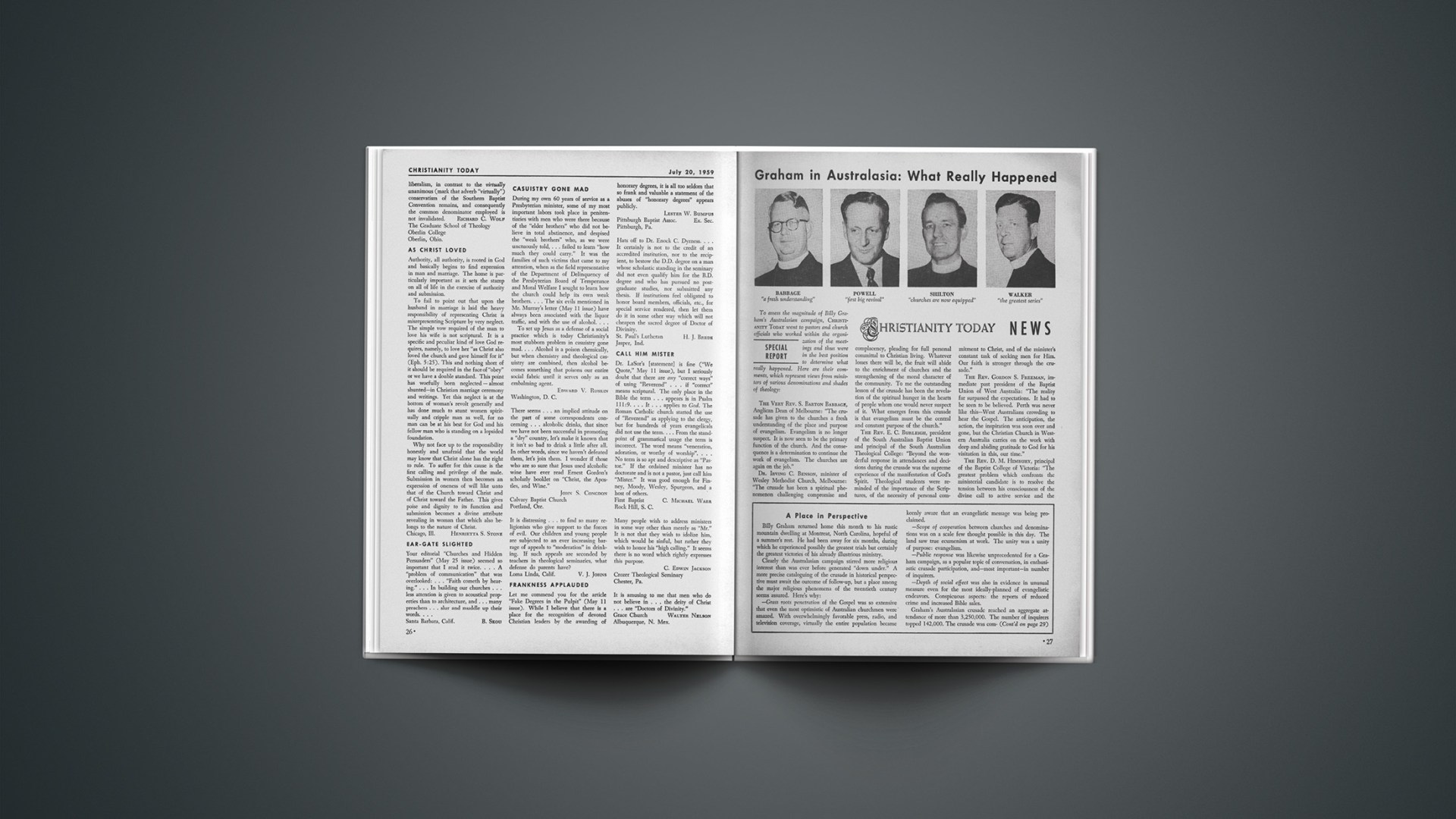
Graham in Australasia: What Really Happened

NEWS

CHRISTIANITY TODAY

To assess the magnitude of Billy Graham’s Australasian campaign, CHRISTIANITY TODAYwent to pastors and church officials who worked within the organization of the meetings and thus were in the best position to determine what really happened. Here are their comments, which represent views from ministers of various denominations and shades of theology:

THE VERY REV. S. BARTON BABBAGE, Anglican Dean of Melbourne: “The crusade has given to the churches a fresh understanding of the place and purpose of evangelism. Evangelism is no longer suspect. It is now seen to be the primary function of the church. And the consequence is a determination to continue the work of evangelism. The churches are again on the job.”

DR. IRVING C. BENSON, minister of Wesley Methodist Church, Melbourne: “The crusade has been a spiritual phenomenon challenging compromise and complacency, pleading for full personal committal to Christian living. Whatever losses there will be, the fruit will abide to the enrichment of churches and the strengthening of the moral character of the community. To me the outstanding lesson of the crusade has been the revelation of the spiritual hunger in the hearts of people whom one would never suspect of it. What emerges from this crusade is that evangelism must be the central and constant purpose of the church.”

THE REV. E. C. BURLEIGH, president of the South Australian Baptist Union and principal of the South Australian Theological College: “Beyond the wonderful response in attendances and decisions during the crusade was the supreme experience of the manifestation of God’s Spirit. Theological students were reminded of the importance of the Scriptures, of the necessity of personal commitment to Christ, and of the minister’s constant task of seeking men for Him. Our faith is stronger through the crusade.”

THE REV. GORDON S. FREEMAN, immediate past president of the Baptist Union of West Australia: “The reality far surpassed the expectations. It had to be seen to be believed. Perth was never like this—West Australians crowding to hear the Gospel. The anticipation, the action, the inspiration was soon over and gone, but the Christian Church in Western Australia carries on the work with deep and abiding gratitude to God for his visitation in this, our time.”

A Place In Perspective

Billy Graham returned home this month to his rustic mountain dwelling at Montreat, North Carolina, hopeful of a summer’s rest. He had been away for six months, during which he experienced possibly the greatest trials but certainly the greatest victories of his already illustrious ministry.

Clearly the Australasian campaign stirred more religious interest than was ever before generated “down under.” A more precise cataloguing of the crusade in historical perspective must await the outcome of follow-up, but a place among the major religious phenomena of the twentieth century seems assured. Here’s why:

—Grass roots penetration of the Gospel was so extensive that even the most optimistic of Australian churchmen were amazed. With overwhelmingly favorable press, radio, and television coverage, virtually the entire population became keenly aware that an evangelistic message was being proclaimed.

—Scope of cooperation between churches and denominations was on a scale few thought possible in this day. The land saw true ecumenism at work. The unity was a unity of purpose: evangelism.

—Public response was likewise unprecedented for a Graham campaign, as a popular topic of conversation, in enthusiastic crusade participation, and—most important—in number of inquirers.

—Depth of social effect was also in evidence in unusual measure even for the most ideally-planned of evangelistic endeavors. Conspicuous aspects: the reports of reduced crime and increased Bible sales.

Graham’s Australasian crusade reached an aggregate attendance of more than 3,250,000. The number of inquirers topped 142,000. The crusade was comprised of 114 separate meetings, plus 3,000 “land-line relay services.”

Did Graham detect among ministers any increased respect for the authority of the Bible as the Word of God?

“I most certainly did,” said the evangelist. “There are a number of new books on the authority of the Bible which are making a great impact. Ministers working with us in the crusade confirmed this new interest.”

The spiritual triumphs of the crusade take on still more meaning when considered against the adverse circumstances encountered. A month before the scheduled start of the meetings, Graham was stricken with an eye ailment. Doctors prescribed extended rest, and there was doubt whether it was advisable for the patient to begin another strenuous campaign. Fears increased when the eye failed to respond immediately to treatment, but Graham went ahead with only a week’s delay. Slowly his vision improved until, as of early July, the affected eye was about “90 per cent normal.” With winter approaching, weather posed as an obstacle, too. Turnouts were so great that, for the most part, only large outdoor arenas would suffice, and the meetings were at the mercy of the elements. But rain did not prove to be greatly detrimental.

Then there was the geographic problem—how to effectively cover so vast an area (Perth is 3,350 miles from Auckland, as far as New York is from Algiers). Cooperation from radio and television stations helped to bridge the gaps.

To be aware of what really happened in Australia is to see how contrary to fact are published accounts which assert that the demand for Graham’s message is declining. Such error, one observer noted, is quite possibly wishful thinking of those who refuse to recognize Graham’s successes as the blessing of God, who cannot explain his popularity otherwise, and thus hope that he will soon pass from the religious spotlight.

One of the most heartening aspects of the crusade was the prospect of excellent follow-up in each place where meetings were held. Graham indicated that he was satisfied the system could efficiently assure subsequent spiritual counsel for inquirers. Knowing of the follow-up, he said, the team left with “peace at heart.” The story of Australasian evangelism, 1959, is necessarily well-punctuated with superlatives. Considering that what transpired was the manifestation of an omnipotent God, Graham and his team could only be grateful that it was so.

THE REV. D. M. HIMBURY, principal of the Baptist College of Victoria: “The greatest problem which confronts the ministerial candidate is to resolve the tension between his consciousness of the divine call to active service and the necessity for academic study which the churches rightly lay upon him. The Graham crusade has done much to resolve this tension in the minds of our students. In the counselling classes and the work they did following the meetings they have discovered their own inadequacies and need of training. They have come back to us with a deep longing for a well-integrated theology that will enable them, by God’s grace, to meet the great spiritual hunger of the Australian people which the crusade has brought vividly to our attention. Petty doctrinal differences, so characteristic of a theological college, have been transcended by the new urgency which has been brought to our work.”

THE REV. A. W. R. MILLIGAN, secretary of the Methodist Conference of Victoria and Tasmania: “Thousands have come to know Christ as Lord, but even more important is the fact that Christians in general now have a new concern for others. There is a buoyancy in my church, and within the whole community of Methodism. There is a new sense of expectation and a new hope that was not there before the crusade.”

THE REV. DAVID LIVINGSTONE, Anglican rector from Kingsford, Sydney: “While there is some evidence that some inquirers have had no genuine spiritual experience, nothing has ever hit the ordinary person so hard as this crusade has done. Congregations, Bible classes, and study groups have greatly increased attendances. In almost every house visited the people themselves now introduce spiritual topics, something very rarely seen before the crusade. Many workmen tell me that there is now more honesty and better work being done in factories and offices.”

THE RIGHT REV. MARCUS LOANE, Bishop Coadjutor, Anglican Diocese of Sydney: “Sydney has never been so widely or deeply stirred as it has been during this crusade. The many thousands who have crowded the meetings at the showground throughout the month and who have responded to the invitation at every meeting have revealed a spiritual hunger which was scarcely suspected. There is perhaps hardly a church in the metropolitan area which is not now rejoicing in those who have declared themselves willing to put their trust in Christ and receive him as their Lord and Saviour. The crusade has unified all the churches in a fellowship which has proved more real and effective than we have ever known.”

THE REV. K. A. MCNAUGHTON, pastor of the Swanston Street Church of Christ, Melbourne: “Ours is what Americans call a downtown city church. We gave all cooperation in the crusade. Now we have counsellors who speak of the wonderful training they received and who are looking for further opportunities of service. We have new members in the church. People testify to the spiritual awakening God has given them. Our work has been uplifted and helped.”

THE REV. GEORGE NASH, minister of Albert Street Methodist Church, Brisbane: “Australia has never experienced a nationwide religious revival such as many older countries have known. There are many signs that under the ministry of Dr. Billy Graham such a nationwide revival of religion has begun amongst us. In Queensland we have seen the largest crowds that have ever gathered for a religious service.”

THE REV. GORDON POWELL, minister of St. Stephen’s Presbyterian Church, Sydney: “Sydney is a pleasure-loving city. Its people have been described as amiable pagans. Its church people have always had a struggle and too often been weak and defeated. What a difference there is now! There is a spirit of gaiety and confidence amongst the church people. Morale is at an all-time high and all the city is talking religion and the churches, working joyfully together, feel a new strength. We believe it is the beginning of the first big revival in our history. God has done great things whereof we are glad.”

Where Now?

Billy Graham’s next engagement is a week-end evangelistic series in Little Rock, Arkansas, scheduled to coincide with the opening of integrated public schools there.

From the Little Rock meetings September 12–13 Graham plans to travel to Wheaton (Ill.) College, his alma mater, where a centenary year observance is to be launched.

Much of the remainder of the evangelist’s fall schedule will be taken up by a month-long crusade in Indianapolis starting October 6.

Other definite plans include a tour of Africa next year and an eight-week crusade in Philadelphia in the summer and fall of 1961.

Graham also hopes to conduct additional campaigns in Europe within the next several years. In addition, he and his aides are studying the possibility of meetings in Chicago and Washington.

THE REV. LANCE SHILTON, Anglican rector of Holy Trinity Church, Adelaide: “The Christian community in Adelaide was strong, but small, prior to the crusade. Now it has been greatly strengthened so that the message of the Gospel has become an everyday topic. The Bible has again become the supreme authority, and the evangelical has become evangelistic. Church members have become trained personal counsellors. Hundreds are still asking, ‘What must I do to be saved?’ The churches are now equipped to give the answer!”

THE VERY REV. MARTIN SULLIVAN, Anglican Dean of Christchurch: “The clear evidence is available that thousands of people in New Zealand were touched by the Spirit of God in the Billy Graham crusade and responded to the challenge. I write out of direct personal experience of what happened in one city, but we know that the whole country was affected in the same way. In the first place, many men and women made a direct commitment to Jesus Christ. Secondly, there are thousands who have made an act of dedication. Above all, every single person who has made a commitment has been brought into a Christ-led flock.”

THE REV. ALAN WALKER, minister of Central Methodist Mission, Sydney: “We have come … to the end of the greatest series of religious meetings in the history of Australia. Only the Spirit of God, the Christian gospel and a Christian preacher could have produced this miracle … Life for many of us will never be the same again. Lives have been changed, homes reunited, churches quickened. Humbly, gratefully, we acknowledge the goodness of God.”

DR. E. H. WATSON, director, department of evangelism, Baptist Union of New South Wales: “Church life in Sydney has been revolutionized. Baptists report greatly increased attendances and many added to membership. The city has been jolted into an awareness of God’s power to change lives.”

DR. A. H. WOOD, president-general of the Methodist Church in Australasia: “The Graham crusade has been the most remarkable religious event of this generation in Australia. The numbers attending the meetings night after night have been one amazing evidence of success. The many thousands who have responded in each city have given the churches an opportunity which they have not known before. The Methodist Church has wholeheartedly cooperated and as its official head I pay the heartiest tribute for what we have seen and experienced. To God be the glory!”

Team Thoughts

Here are observations of Billy Graham’s team members who made the trip to Australasia with him:

CLIFF BARROWS, song leader: “The enthusiasm for the music of the crusade was wonderful. Many thousands registered to sing in the choirs and I heard numerous testimonies of tremendous blessing experienced by these volunteers.”

DR. PAUL MADDOX, personal assistant to Graham: “The manner in which ‘Operation Andrew’ was utilized impressed me particularly. Delegations were rounded up each night by interested Christians who had as their goal that 80 per cent of their group be un-churched people. And they met that goal consistently!”

GRADY WILSON, associate evangelist: “We had the greatest church support and the greatest harmony that we have experienced anywhere. There was sincere heart cooperation and you could sense it. The enthusiasm was also tremendous. When we left Australia, for example, some 6,000 people stood in the rain at the airport as we boarded our plane.”

GEORGE BEVERLY SHEA, soloist: “What do I remember about Australia? God’s presence in the services—the Holy Spirit’s convicting power and his guidance. I shall never forget, moreover, the people so friendly and so hungry to know God and learn again of his love and provision for their personal redemption through the gift of his Son, our Lord.”

TEDD SMITH, pianist: “From the first day of our arrival in Australia we were all made aware of the urgency of this Mission. Christian people had prayed for years for a spiritual awakening. Now the time had come and God couldn’t fail.

“What thrilling meetings these were. They have enriched all of our lives in an unprecedented way and given each of us a new dedication to God and His service.”

Thank You

Back in the United States, Billy Graham expressed his personal thanks to Christians who have been remembering him in prayer during the months of his Australasian campaign.

Graham said he was deeply grateful for the intercession in his behalf when he was ailing and in behalf of the meetings.

Ganis And Losses

Korean Threat

A controversy between two Presbyterian groups in the National Christian Council of Korea last month threatened the existence of the 13-year-old interdenominational organization, according to informed sources in Seoul.

Crux of the situation was that since the Korean War, Presbyterians, who make up half of this country’s Christians and three-fourths of its Protestants, have been split several ways.

Largest of these branches is the Presbyterian Church in Korea which has about 75 per cent of all Presbyterians. It has been locked in a bitter struggle with the second-ranking Presbyterian Church of the Republic of Korea over the latter’s claim to being the original Korean Presbyterian Church. The ROK body, which represents about 15 per cent of the Presbyterians, is linked with the United Church of Canada.

Key point was the majority General Assembly’s demand that the ROK Church give up its claim and number its General Assembly meetings from 1953, the year of the split. Otherwise, the majority body said, it cannot continue membership in the NCCK alongside “a competitive group which claims to be us.”

NCCK delegates from the larger body have been ordered by their own General Assembly to withdraw from the council if the ROK group refuses to yield its claim and adopt the new numbering.

Outsiders, however, saw little chance that the ROK Assembly would comply, since a number of court cases over disputed property have hinged on the question of which group is the true parent body.

The Holiness Church of Korea, third largest co-operating body in the NCCK, also threatened to withdraw if the main Presbyterian group ended its council membership.

Meanwhile, major American missionary groups in Korea were also involved, because the NCCK constitution grants them council membership only so long as they are associated with a national church which is itself a member. Withdrawal of the Presbyterian Church in Korea would automatically put half the Protestant mission force outside the only overall co-operative body for Protestant organizations in Korea.

The General Assembly of the Presbyterian Church in Korea is scheduled to meet in September

Protestant Panorama

• The Department of Defense is joining the Foundation for Religious and Social Action in the Civil Order (FRASCO) in compiling a “bookshelf” on democracy versus communism. The inter-faith foundation, dedicated to mobilizing religious forces more effectively against communism, hopes to select 20 books as a nucleus.

• A $1,750,000 damage suit has named the Roman Catholic Archdiocese of Chicago as a defendant. The suit charges the archdiocese with negligence in a parochial school fire which claimed 97 lives last December.

• Eighty holiness movement churches in Egypt, with more than 5,000 members, are uniting with the U. S. Free Methodist Church.

• A series of ads in nationally circulated magazines implying that beer is “good for you” violates federal regulations, Clayton M. Wallace, executive director of the National Temperance League, declared in a protest last month to the Federal Trade Commission.

• The Church of Scotland is closing two of its mission hospitals in Northern Rhodesia because of financial and staff problems. Racial strife is said to have been responsible for the personnel difficulties.

• Mennonites are operating their first mental hospital in South America, located at West Filadelfia, Paraguay.

• North Carolina Methodists will seek to win 100,000 converts in an evangelistic campaign to be launched this fall. “We have been playing with evangelism too long,” said Walter F. Anderson, state Methodist official.

• Hope College in Holland, Michigan, plans a large expansion program, beginning with a new dormitory to accommodate 160 women students.

• Pope John XXIII is studying English and hopes to become fluent in the language within a year, according to Rome Radio. His teacher, it was reported, is Msgr. Thomas Ryan, a Vatican official and a native of Ireland.

• An early summer session of the General Assembly of the Hungarian Lutheran Church marked the group’s first meeting since 1956, when an attempt was made to weed out pro-Communist leaders. The latest assembly was held in Budapest for the announced purpose of “restoring legal status to the church.”

• An estimated 2,055 nuns and priests teaching in U. S. public schools form the backdrop of a 16 mm. sound film being premiered this month in key cities across the country. “Captured,” a semi-documentary, is being released by Protestants and Other Americans United for Separation of Church and State.

• Among latest recipients of Federal Communications Commission FM broadcasting permits: New York’s Riverside Church and the Great Commission Gospel Association of Atlanta. The Selby Avenue Gospel Mission of St. Paul, Minnesota, has submitted an application for a similar permit. Moody Bible Institute hopes to have a new AM station on the air by next January, this one to serve western Illinois and eastern Iowa.

• Work is expected to begin in 1962 on a $2,800,000 university in western Nigeria. U. S. Southern Baptists hope to raise about 90 per cent of the cost.

• CHRISTIANITY TODAY is one of 250 publications on display at this summer’s American exhibition in Moscow.

• Bishop Arthur J. Moore observed the 50th anniversary of his conversion this spring by holding a week-long series of evangelistic meetings in the Waycross, Georgia, Methodist church where he made that commitment.

• South African Prime Minister H. F. Verwoerd, in a speech to the national senate at Capetown, demanded last month “strong action” against Dr. Joost de Blank, Anglican Archbishop of Capetown, for “libelous” attack on the government’s apartheid.

• Oklahoma, which voted repeal in April, now has its first liquor control law which levies a stiff whiskey tax and bans public drinking.

Religious Assemblages

Public Or Private?

Delegates to the Augustana Lutheran Church’s 100th annual convention recorded opposition to establishment of parochial schools for secondary education. They expressed preference for tax-supported public schools in approving a report which called on the church’s 600,000 members to “share as fully as possible in strengthening and improving them.” But the report also stated that the church “recognizes the right to establish in certain areas such privately-financed, high-quality Christian schools as will not destroy the effectiveness of the public schools of any community.”

The convention, held in Hartford, Connecticut, last month, also: adopted a policy of granting complete autonomy to mission churches; authorized a faith healing study; and urged congregations to support laws aimed at alleviating mental health problems.

Delegates heard an address in behalf of the ecumenical movement by Dr. Edwin T. Dahlberg, president of the National Council of Churches and pastor of an American Baptist Church in St. Louis.

The Augustana Lutheran Church was founded by Swedish Lutheran immigrants who settled in the Mississippi Valley during the mid-nineteenth century. The church plans to merge with three other Lutheran bodies to form a denomination representing some 3,000,000 communicants.

Here are reports of other church conventions held last month:

At Plymouth, Massachusetts—“Stepping Stones in the Second Century Crusade” was the theme of the 80th meeting of the Baptist General Conference of America, with the text taken from Joshua 4:6: “What mean ye by these stones?”

More than 1,100 delegates and visitors were welcomed by Carl Holmberg, pastor of the host church (Trinity Baptist of nearby Brockton) who later was elected moderator, succeeding Dr. Virgil Olson. Based on the conference text, themes of sermons included: “Stone of Foundation” (1 Cor. 3:11); “Stone of Testimony” (1 Sam. 7:12); “Stone of Advance” (1 Pet. 2:4,5) and “Stone of Dedication” (Joshua 24:26). The “second century” referred to in the theme takes note of the 100 years of Baptist General Conference fellowship.

Reports of advance and informative programs were presented by boards of Bible school and youth, publication, education, men’s and women’s work, and missions.

Twenty-eight new churches were welcomed, and two new district conferences, Alaska and Rocky Mountain, recognized.

Significant changes were voted into the constitution: The words “of America” are to be deleted from the name of the church in view of its increasing international scope. (Some years ago the word “Swedish” was deleted as the group experienced transition from a strongly Scandinavian influence to a new Americanized church.)

A new office, that of general secretary of the conference, was instituted to replace the office of executive secretary of the board of trustees. The Rev. Lloyd Dahlquist of the Northwest Church of Chicago was named to fill the position.

At Ocean Grove, New Jersey—Some 5,000 delegates were on hand for the annual conference of the Church of the Brethren, which numbers approximately 200,000 communicants. A statement was issued in behalf of the denomination urging Christians to bring the “full power of the Gospel” to bear on national and international situations. The message deplored the “widespread lostness of men in every community and class” and recognized their need for “radical healing.”

Delegates adopted another statement which asserted that there can be no stable peace in Europe as long as “unnatural, illogical and unjust” provisions of World War II treaties prevail. They urged abolition of capital punishment and an end to nuclear weapons testing. They said that clergymen should not be required to reveal confidences in court.

At Anderson, Indiana—A special observance marking the 50th anniversary of overseas missionary work by the Church of God (with headquarters at Anderson) highlighted its annual General Ministerial Assembly. A special fund was established to aid missionary expansion.

The assembly voted to change the name of Pacific Bible College to Warner Pacific College in honor of Daniel S. Warner, first editor of the Gospel Trumpet, national Church of God weekly founded in 1881.

At Kingston, Ontario—Opposition to the liquor trade and a demand that the Ontario government give “a larger share” of its liquor taxes to the Alcoholism Research Foundation were voiced in a resolution adopted by the Baptist Convention of Ontario and Quebec. The resolution “wasn’t worth the paper it was written on,” retorted the Rev. Emlyn Davies, who declared that the government should not be asked to legislate what the churches had failed to achieve.

At Rochester, Minnesota—In a resolution which noted that “the cause of orthodox Christianity and democratic government have both flourished in the climate of religious liberty,” delegates to the 28th annual meeting of the General Association of Regular Baptist Churches urged church members to resist all efforts “to blur the lines” of church-state separation. Another action put delegates of the 950-congregation association on record as being “unequivocally and unalterably” against U. S. or U. N. recognition of Red China.

At Rockford, Illinois—Retiring President Theodore W. Anderson told nearly 1,500 delegates and visitors to the 74th annual meeting of the Evangelical Covenant Church of America that “we should seek better contact and possibly an ultimate merger with churches similar to our own in convictions and activities.” The church has some 58,000 members in 529 congregations.

At Berkeley, California—An informal vote taken at the 70th annual convention of the Finnish Evangelical Lutheran Church showed preference for complete unity in a proposed merger with three other Lutheran bodies, rather than retention of identity as a separate synod.

At Denver, Colorado—The 75th anniversary conference of the Evangelical Free Church of America adopted a resolution supporting Congressional legislation which would ban the serving of liquor on commercial flights. A record number of 760 voting delegates also approved establishment of a junior college in British Columbia and authorized possible relocation of Trinity Seminary and Bible College in Chicago.

At Boston—Some 7,500 delegates, representing all major continents, attended the annual meeting of The Mother Church, The First Church of Christ, Scientist. The Christian Science Board of Directors issued a message citing the need for a deeper understanding of spiritual resources.

Eutychus and His Kin: July 20, 1959

SUMMER SLEUTHS

In response to many requests that we provide Book of the Fortnight Club specials for summer reading, I have spent the last month perusing detective stories. This, I understand, is a leading variety of escape literature, although why anyone would choose this way out, I don’t know. Real life must be frightful.

A student of the genre has concluded that the detective story is modern man’s passion play. Evil is met and conquered—often by the brilliant reasoning of the “little gray cells,” or by the omnipresent power of Scotland Yard. Sometimes sheer intuition shames the more methodical bloodhounds. More often, the emphasis is on the face-smashing vengeance of the private eye. The reader is supposed to identify himself with the gumshoe of his choice for a vicarious triumph.

Perhaps all this accounts for my difficulty in finding suitably edifying sleuths. No Pastor Brown has emerged to provide a Protestant peer for Chesterton’s redoubtable priest. Of course the choice is narrowed a little by the Fortnight Club policy of distributing only author-subsidized editions absolutely free to those who do not request them.

The two selections reviewed below I finally wrote myself to exploit the need for summer diversion. At least two groups of readers can now identify themselves with a congenial Sherlock.

Murder at the Organ, by Georges Sanglant

Sophisticated existential fiction. This is not a whodunit, but a whydunit. Inspector Migraine achieves such rapport with the criminal that the ambivalency of his motives becomes unequivocal. Migraine is easily the most non-judgmental detective in the business. The plot frays beautifully as he unravels it.

The Case of the Missing Xylophone, by Rex Stone

Another first in Sunday School fiction; this paperback introduces Mike Angelo, chalk artist and amateur detective. When Patty Pond’s xylophone disappears from the stage during the youth rally, suspicion points to magician Burt Berenski, an ex-convict. Who used the musical saw to cut a trap-door in the platform? Who recorded a talking horse on the background music tape?

Unless fellow readers can suggest an antidote I shall soon begin Pastor Brown in Berlin.

PATRICK HENRY HUSHED

Allow me to commend CHRISTIANITY TODAY and the Rev. James DeForest Murch on the objective analysis of the “United Church of Christ” (May 25 issue). Such an expose of the high-handed methods of some top Congregational officials in promoting this new denomination should cause some of our wavering brethren to sit up and take notice of what is happening to the freedom under which they took their Congregational ordination vows.

Leaders of the Evangelical and Reformed Church, having been forthright themselves throughout the controversy as to their merger aims, are still being hoodwinked by General Council assertions that “all churches and all ministers” of our fellowship will participate in the “United Church.” A growing number are showing their disagreement with this position by uniting as member churches with the National Association; and many more are realizing at last that a national constitution, however “congregational” it may seem at first, can always be amended to force overhead control on those who cherish individual freedom and local church autonomy. In the minds of far too many Christians today, Patrick Henry’s espousal of liberty is hushed up almost to the vanishing point; but those of us who fight against power-hungry officials for the continuation of liberty under God can still sing “Let freedom ring!”

First Congregational Church

Tarentum, Pa.

May I call attention to … misstatements: The General Synod of the United Church of Christ meeting in Oberlin July 5–8 will not “adopt” a Constitution as Mr. Murch states in his article. Rather a draft of a proposed Constitution will be considered by the delegates to the General Synod. If this draft is approved by the 700 delegates, it will be referred to the Congregational Christian Churches and the Evangelical and Reformed Synods for ratification. This process is carefully spelled out in the Basis of Union.…

The Eastern Indiana Association of Congregational Christian Churches is in full fellowship with the Indiana Conference. Some churches did withdraw from the Association over differences among some leaders which existed prior to the merger discussion and were aggravated by it. One of these churches has returned to the Association. Some hopeful indications have been made that others might also return.

The Indiana Conference of Congregational and Christian Churches

Muncie, Ind.

I wish this might be required reading for all Protestants!… It is indeed refreshing and encouraging to see a publication like yours print a factual report free of the insinuations and omissions generally given the press to convince Christendom that “the Holy Spirit has accomplished a great work.” The philosophy that “the end justifies the means” has, I believe, prompted much of the development of “The ‘United Church’ of Christ”, and for those who cannot accept that philosophy, the answer has been advanced that the “means” is actually the Holy Spirit, making it blasphemous to question the means further.…

I hope the article has served to remind many Protestants of the dangers involved in any Super Church, and that such is not necessary for the “spiritual unity whereby we are members one of another” and are “one” in the mood of the Master’s prayer in John 17.

Arbor Grove Congregational Church

Jackson, Mich.

A brilliant condensation of the issues involved in the proposed merger.… Kudos to Dr. Murch for a lucid statement of a murky matter.

I was a witness in the Cadman Case, am a party plaintiff in the case now before the Federal Court of Southern New York, and for the past two years have been the chairman of the executive committee of the National Association of Congregational Christian Churches. In all these years of concern, debate and litigation I have not seen a simplification of the case so free from distortion.

Congregational Church of the Messiah

Los Angeles, Calif.

To many Congregationalists the principle “we hold sacred the freedom of the individual soul and the right of private judgment; we stand for the autonomy of the local church and its independence of ecclesiastical control”—expressive of a spiritual ideal attained only after centuries of struggle and which used to be carried in the preamble to the constitution of the General Council itself—still retains its historic dignity and paramount importance.

Chicago, Ill.

Out of the welter of words and name-scalling which have hit Congregationalism since the war, Dr. Murch draws the basic lines as some depart from the churches of the Pilgrims for the presbyterian United Church, a departure under Drs. Douglas Horton and Truman Douglas as devious as the Unitarian departure under Channing and Theodore Parker in the previous century was deliberate. A national constitution of any sort destroys the freedom of a Congregational church that signs it because it displaces the covenant which that church has made with its Head. Even a constitution guaranteeing autonomy to each constituent local church in perpetuity cannot guarantee reversal by a court that knows not Congregationalism (Exodus 1:8). The sure way for a Congregational Christian church to keep and spread its faith is to join the National Association, 176 W. Wisconsin, Milwaukee 3, Wisc. It will meet in Los Angeles’ First Congregational Church, June 30 to July 2.

Grace Congregational Christian Church

St. Johnsville, N. Y.

Fair-minded article.… Once again the question must be faced. “Choose you this day whom ye will serve.” Either Congregational principles are valid or they are not. There is no middle ground.

Editor

The Congregationalist

Milwaukee, Wisc.

Mr. Murch is so largely overwhelmed by the copious and irresponsible writings of the anti-merger factions that he devotes considerable copy, for example, to the reviewing of the percentage of churches voting, and how they voted upon the issue, overlooking the moral right of the General Council to vote to proceed, as it did at Cleveland in February, 1949. Church union of this character is a much greater event, Mr. Murch, than the trivial legalism of whether there were or were not 75% of the churches approving.…

The article is noteworthy for what it omits, such as … the three votes of the General Council upon this question, each one stronger than the last, until the final vote at Omaha was 1310 to 179! And, I would commend the opposition to Mr. Murch as an interesting study for it has become rather apparent that they are a group opposed to the vigorous expression of the Gospel in any sphere. Generally, they are those who read the Gospel in individual terms, and one of their spokesmen was quoted in their printed booklet for the Omaha Council, “All we need are the simple teachings of Jesus.” Such theological bankruptcy is compounded with poor scholarship if we accept Mr. Murch’s “Simplicity of the New Testament Church”!… I am informed that the New Testament Church was not simple, nor was it peaceful!

All Souls Church, Congregational

Bangor, Me.

You have the gist of the matter in pointing out that the General Council of the Congregational Christian Churches, after repeated failure to secure the stipulated 75% vote, went ahead “without again referring the matter to the churches,” and “transferred the decision on the merger (with the E. & R. Church) from the local churches to the General Council.” which of course cannot speak for the churches without their authorization.

I would point out the error on p. 12: “It (the merger) has been voted by both denominations.” This was perhaps an inadvertent slip in view of your apparently extensive studies. It is only the E. & R. denomination that has voted the merger. On the Congregational side, it is only the General Council that has voted the merger. But the Council cannot commit the churches.

Committee for the Continuation of Cong. Christian Churches of the

U. S. Chicago, Ill.

Your rabble-rousing attack on the United Church of Christ, with all its sneaky innuendos and rotten insinuations is typical of your biased form of journalism.… As the Lord God took Calvinistic and Lutheran churches, binding them into the Evangelical and Reformed Church despite ignorant man’s theological differences, into one body, so do we trust that in his omnipotence he shall overcome differences in polity and forms as it is joined with Congregational Christian churches, and raise up for himself a greater and humbler servant in the United Church of Christ.

As a man and wife love deeply, though they may not always agree, so does this same type of love abide in this holy fellowship. As in marriage we have joined hands in good faith and trust in one another, and sought God’s sanctification, we are determined that man shall not put it asunder.… His Holy Spirit will make it so, a United Church of Christ!

St. John’s United Church of Christ (Evangelical and Reformed)

Saint Clair, Pa.

Thank you for pointing out the failure of the General Council to honor the Claremont Resolution which, in addition to the provisions you mentioned, contained a stipulation that a constitution should be prepared and presented first before the merger. This directive also went out the window when the Congregational Christian Executive Committee bowed to the E. & R. demands for a merger first without a constitution.

The merger has been manipulated by a group of determined men in defiance of the Claremont Resolution and contrary to the wishes of the Churches expressed at Claremont and reaffirmed two years later at New Haven.

Congregational Christian Laymen’s Group

Glen Ellyn, Ill.

With gratification I note the article The ‘United Church’ of Christ. It is well done. I am pleased at the lengths you allowed the writer in reciting the all-important frustrations and frictions which have attended this outrageous attempt at ‘unity’ (ah, and bravo for wisely putting the single-quote-marks around the name ‘United Church’).

It is absolutely imperative to further “the fears of dyed-in-the-wool Congregationalists” and to alert your readers to the fact that the “ecumenical vision” looming “beyond” this development is repulsive!

I feel, however, that you shouldn’t have let the writer mention the “wide divergence of theological conviction” among opponents of the ‘United Church.’ This blundering phrase may sow seeds of doubt among your theology-sensitive readers, many of whom would be needlessly offended if they suspected what Doctors Conn and Fifield think about tenets dear to the creed of Dr. Ockenga. Please don’t err in this way when you write up this ‘subject’ next.

Inferno

This letter was postmarked Wichita, Kansas, June 7. What kind of a day was it in Wichita?—ED.

An amazingly successful synthesis of an intricate mass of facts. His brief reference to the League might well have included our concern about any departure from Congregational principles both in spiritual and organizational matters as well as in financial. It should have said also that the League is not itself a party to the action at law against the Evangelical and Reformed Church, et al., but is aiding morally and financially the plaintiff Congregational Churches in their own legal efforts.

League to Uphold Secretary Congregational Principles (Box 628)

Hartford, Conn.

One of the oddities of our Congregational Christian fellowship is the “conspiracy of silence” concerning the vital matters of the proposed union. Our now-deceased periodical Advance closed its pages years ago to all facts or opinions except those officially approved. Officers of our General Council, Boards and Conferences have consistently refused to appear on the same platform with leaders of the pro-Congregational group. You are certain to be severely criticized for presenting both sides of this important question.

At no time has any business session of our General Council ever debated the chief issues, which you pinpoint, viz., (1) the attempt to re-define the nature of Congregationalism so that the General Council is ‘autonomous in its own sphere;’ (2) the attempt to write an over-all connexional constitution for a voluntary fellowship of free Churches; (3) the attempt to write a statement of faith into a national-to-local over-all constitution; (4) the flagrant disregard of the negative votes of over 1100 churches; (5) the morally questionable method by which a 72.2% vote was deemed acceptable in place of the 75% announced as the majority needed (with over 1000 churches casting no vote at all); (6) the discarding of the ‘Claremont resolution’ which called for a national-level-only constitution with 95% voting approval; (7) the intransigent refusal to change even one word of the Basis of Union which has been a constant stumbling block; (8) the lack of plain, honest declaration of the goal of our extremist ecumenists, namely, “one big church;” (9) the failure to face biblical truth concerning the nature of the church universal as the committed fellowship of those who have accepted Christ as Lord, or of the particular church as the covenanted fellowship of committed Christians; (10) the avoidance of debate on the question of whether or not a church body (such as the ‘Council of Social Action’ or a ‘Conference’) can “speak for” the churches on political, economic, social, or religious matters; (11) the incredible way in which letterheads, publications, a handful of church names, the releases of the ‘Office of Communications,’ and the work of some of our agencies has been in fact ‘United Church of Christ’ while our Churches are not members of, and have not yet even voted on the constitution of the proposed ‘United Church;’ and (12) the pitiful attitude of prounionists who speak of those who believe in the sole Lordship of Jesus Christ as only ‘a tiny dissident minority’ or worse.

To me, the tragic element in the proposed ‘United Church’ is that it has proven to be the most divisive influence in our fellowship in at least a century. Further, it has brought about cruel rebuffs in friendship, and church after church faces the likelihood of division in its own membership. The whole thing seems more like a power-centered political movement than a devout, spiritually motivated call for united witness and work ‘in Christ! How can men invoke “the blessing of the Holy Spirit” on acts which have yielded the fruits of bitterness, broken friendships and discarded promises?

Maybe the truth is that our leaders no longer trust our people, else, long since, they surely would have welcomed the oft-refused request to re-submit the issue to the churches.

The ‘merger controversy’ has terribly crippled the witness of our churches for over a decade. Personally, it has been and continues to be a sad and harrowing experience.

Moderator

National Association of Congregational Christian Churches

Second Congregational Church

Hartford, Conn.

AMERICAN BAPTISTS

I am greatly disturbed by certain statements in the article “Religious Trends in the United States,” by Richard C. Wolf which appears in your April 27 issue. I shall quote only one, namely, “Baptists are heavily conservative in doctrine, save for the American Baptist Convention which is considered predominantly liberal with a strong conservative element.”

I do not know where the author obtained his information, but I very vehemently protest such a statement, which is certainly not based on fact. I have been an active pastor in and member of the American Baptist Convention for approximately thirty-three years. During these years, I have never missed an opportunity of having guest missionaries in my home. In all of these years, I have talked with only one whose faith has seemed to me to be unsound.… The student enrollment in our seminaries that are unequivocally conservative outnumber the total enrolled in liberal or “borderline” seminaries two to one.… The American Baptist Convention is not “predominantly liberal with a strong conservative element.” Rather, it is predominantly conservative, with a moderate liberal element.

Los Angeles, Calif.

In the absence of official doctrinal statements by the Convention, and in the presence of the divided state of doctrinal position within the Convention, I found the task of trying to arrive at a satisfactory estimate of the relative strengths of the conservative and liberal elements of the Convention exceedingly difficult. After careful, prolonged and objective study, what I finally offered was … an unbiased conclusion, but a conclusion to which even now I am not prepared to give unqualified acceptance. This will be apparent to the careful reader who will note that nowhere is it stated that the American Baptist Convention is “predominantly liberal with a strong conservative element.” The verb used, “considered” was selected purposefully and with deliberation. That the conclusion offered is definitive is not even intimated. In fact I do not see how anyone can make such a definitive finding about the doctrinal situation within the American Baptist Convention.

Whatever the ultimate decisions on this debatable point, the burden of the argument of the article remains unimpaired. The relative liberalism of the American Baptist Convention, regardless of disagreement as to the degree of that liberalism, in contrast to the virtually unanimous (mark that adverb “virtually”) conservatism of the Southern Baptist Convention remains, and consequently the common denominator employed is not invalidated.

The Graduate School of Theology

Oberlin College

Oberlin, Ohio.

AS CHRIST LOVED

Authority, all authority, is rooted in God and basically begins to find expression in man and marriage. The home is particularly important as it sets the stamp on all of life in the exercise of authority and submission.

To fail to point out that upon the husband in marriage is laid the heavy responsibility of representing Christ is misrepresenting Scripture by very neglect. The simple vow required of the man to love his wife is not scriptural. It is a specific and peculiar kind of love God requires, namely, to love her “as Christ also loved the church and gave himself for it” (Eph. 5:25). This and nothing short of it should be required in the face of “obey” or we have a double standard. This point has woefully been neglected—almost shunted—in Christian marriage ceremony and writings. Yet this neglect is at the bottom of woman’s revolt generally and has done much to stunt women spiritually and cripple man as well, for no man can be at his best for God and his fellow man who is standing on a lopsided foundation.

Why not face up to the responsibility honestly and unafraid that the world may know that Christ alone has the right to rule. To suffer for this cause is the first calling and privilege of the male. Submission in women then becomes an expression of oneness of will like unto that of the Church toward Christ and of Christ toward the Father. This gives poise and dignity to its function and submission becomes a divine attribute revealing in woman that which also belongs to the nature of Christ.

Chicago, Ill.

EAR-GATE SLIGHTED

Your editorial “Churches and Hidden Persuaders” (May 25 issue) seemed so important that I read it twice.… A “problem of communication” that was overlooked: … “Faith cometh by hearing.” … In building our churches … less attention is given to acoustical properties than to architecture, and … many preachers … slur and muddle up their words.…

Santa Barbara, Calif.

CASUISTRY GONE MAD

During my own 60 years of service as a Presbyterian minister, some of my most important labors took place in penitentiaries with men who were there because of the “elder brothers” who did not believe in total abstinence, and despised the “weak brothers” who, as we were unctuously told, … failed to learn “how much they could carry.” It was the families of such victims that came to my attention, when as the field representative of the Department of Delinquency of the Presbyterian Board of Temperance and Moral Welfare I sought to learn how the church could help its own weak brothers.… The six evils mentioned in Mr. Murray’s letter (May 11 issue) have always been associated with the liquor traffic, and with the use of alcohol.…

To set up Jesus as a defense of a social practice which is today Christianity’s most stubborn problem in casuistry gone mad.… Alcohol is a poison chemically, but when chemistry and theological casuistry are combined, then alcohol becomes something that poisons our entire social fabric until it serves only as an embalming agent.

Washington, D. C.

There seems … an implied attitude on the part of some correspondents concerning … alcoholic drinks, that since we have not been successful in promoting a “dry” country, let’s make it known that it isn’t so bad to drink a little after all. In other words, since we haven’t defeated them, let’s join them. I wonder if those who are so sure that Jesus used alcoholic wine have ever read Ernest Gordon’s scholarly booklet on “Christ, the Apostles, and Wine.”

Calvary Baptist Church

Portland, Ore.

It is distressing … to find so many religionists who give support to the forces of evil. Our children and young people are subjected to an ever increasing barrage of appeals to “moderation” in drinking. If such appeals are seconded by teachers in theological seminaries, what defense do parents have?

Loma Linda, Calif.

FRANKNESS APPLAUDED

Let me commend you for the article “Fake Degrees in the Pulpit” (May 11 issue). While I believe that there is a place for the recognition of devoted Christian leaders by the awarding of honorary degrees, it is all too seldom that so frank and valuable a statement of the abuses of “honorary degrees” appears publicly.

Pittsburgh Baptist Assoc. Ex. Sec.

Pittsburgh, Pa.

Hats off to Dr. Enock C. Dyrness.… It certainly is not to the credit of an accredited institution, nor to the recipient, to bestow the D.D. degree on a man whose scholastic standing in the seminary did not even qualify him for the B.D. degree and who has pursued no postgraduate studies, nor submitted any thesis. If institutions feel obligated to honor board members, officials, etc., for special service rendered, then let them do it in some other way which will not cheapen the sacred degree of Doctor of Divinity.

St. Paul’s Lutheran

Jasper, Ind.

CALL HIM MISTER

Dr. LaSor’s [statement] is fine (“We Quote,” May 11 issue), but I seriously doubt that there are any “correct ways” of using “Reverend” … if “correct” means scriptural. The only place in the Bible the term … appears is in Psalm 111:9.… It … applies to God. The Roman Catholic church started the use of “Reverend” as applying to the clergy, but for hundreds of years evangelicals did not use the term.… From the standpoint of grammatical usage the term is incorrect. The word means “veneration, adoration, or worthy of worship”.… No term is so apt and descriptive as “Pastor.” If the ordained minister has no doctorate and is not a pastor, just call him “Mister.” It was good enough for Finney, Moody, Wesley, Spurgeon, and a host of others.

First Baptist

Rock Hill, S. C.

Many people wish to address ministers in some way other than merely as “Mr.” It is not that they wish to idolize him, which would be sinful, but rather they wish to honor his “high calling.” It seems there is no word which rightly expresses this purpose.

Crozer Theological Seminary

Chester, Pa.

It is amusing to me that men who do not believe in … the deity of Christ … are “Doctors of Divinity.”

Grace Church

Albuquerque, N. Mex.

Ideas

Rome and the Revival of Theology

The vigor and freshness displayed by Roman Catholic theology in response to the changing theological climate, more particularly on the European continent, are specially interesting features of the modern period. How far the movement has gone, or is likely to go, it is premature to say. But at least we may be thankful for its serious attempt to break out of the impasse of static dogmatizing peculiar to the Roman system, and for evidence in several areas of new and challenging lines of thought.

One may note, for instance, the emergence of a new attitude to past formulations such as those of the Council of Trent. Superficially, it might appear that Trent has fettered constructive theology—for example, in relation to an issue so thoroughly and carefully debated as that of justification. More recently, however, it has been suggested that Trent dealt only with a particular facet of the doctrine, in view of Luther’s sharp insistence on justification by faith alone. Hence, while Trent allegedly makes the “necessary correction” in the circumstances of the time, it does not bind Roman theologians who no longer face this threat, nor does it forbid common ground with other Protestants who find a more substantial place for sanctification. In other words, Trent is the last word only in a particular situation, but not for theology set in the changed or changing situation of a different epoch.

Hand in hand with this development reference must also be made to the more sympathetic handling and criticism of non-Roman theological works, both past and present. The Reformers are no longer condemned point-blank as impious and wicked heretics, but their writings are weighed with care and attention even though they may not command final approval. Modern theologians of the stature of Barth are read and studied with a perspicacity and assiduity often lacking in Protestant readers, and while so pronouncedly anti-Roman dogmatics will not likely be commended, serious attempt is made to understand, misinterpretations are patiently cleared up, and the issues presented gain deep and penetrating attention.

Nor is this study pursued purely in the light of the statements of the Fathers, the teaching of tradition, or the pronouncements of the teaching office. On the contrary, Roman Catholic scholarship has partaken to an astonishing degree in the revived study of biblical theology, and there is a growing inclination to meet evangelical theologians on their own ground. In other words, do they really give a true account of the biblical or New Testament position? Can the Protestant doctrine of grace, or sin, or justification, or the atonement, or regeneration be justified out of Scripture alone? Are there not points in the apostolic writings which are glossed over, or others which are perhaps reinterpreted in the light of different needs or notions, no less in works of the Reformation school than in those of the Fathers or scholastics?

The final point is particularly important, for it means that direct biblical investigation is opening up the whole situation, at least on the level of scholarship, in a way which would have seemed quite impossible a generation or so ago. To some degree the Bible is again exerting its own authority even in these circles, and giving a freedom from false authority which cannot be attained by other means. Genuine intercommunication has become possible where previously there could be little more than ineffectual good will at best and narrow contentiousness as the more general rule. It is not, of course, that the problems which come down from the Reformation and before have been solved overnight. It is not that a kind of theological bartering has been initiated which may perhaps lead to some uneasy compromise. It is not that there is a mere desire for agreement. But the old problems are being surveyed again in the light both of their historical setting and of the ultimate apostolic witness; and as a result, the constrictions of past formulation are burst through and there is the hope at least of new and more solid construction.

Yet while we welcome these promising signs of vitality, many questions remain to be answered before we can begin to think in terms of any genuine theological reformation in the Roman communion.

Our first question, which must also be our most sympathetic, concerns those who are most active in this dogmatic and biblical revival. It is quite simply the question of how far they are prepared to go as they may perhaps be constrained by the apostolic, and therefore truly catholic, witness itself. It is one thing to evade the force of previous pronouncements, but is any possibility allowed that the pronouncements may be actually wrong? And, if this proves to be the case, can we expect that some at least will find, as Luther did, that their consciences are held fast by the Word of God? Can that which is worked out in the quiet be hazarded in the public arena of the church?

The second concerns the more solid mass of scholarship in the Roman communion with its not unnatural tendency to static traditionalism. In this case, it is a question whether the majority will ultimately suspect and obstruct those who are moving in a more creative direction, or whether they will be prepared to be taught and guided. The problem is in no sense an easy one in any church, for many new movements have demanded attention and allegiance which could only lead in dangerous directions. The problem is particularly acute in Romanism, however, for by its very nature it insists upon the maintenance of accepted dogmas as necessary to eternal salvation. On the face of it, it would appear that the newer tendencies have only to become a little “too pronounced” and the voice of orthodoxy will speak against them, and past history shows us that the verdict of the less instructed majority can be crippling in its effects.

Even more serious, perhaps, is the question to be addressed to the hierarchy. In this case there is a twofold temptation: first, that the movement should be rigidly controlled and, if necessary, suppressed, but second, that it should be used, if possible, for the attainment of ecclesiastical goals. The recent opening up of the whole problem of interchurch relationships suggests that something may perhaps be attempted in the second direction. But either way the result would be an unhealthy subjection of theological truth to ecclesiastic needs and purposes. Can the hierarchy really learn to think in other terms? Are they prepared to face the question of the Gospel itself and to bring their programs as well as their thinking under its critical but constructive scrutiny? If so be that even at this late hour a new chance of reformation is being held out, will they be prepared for the direction of the divine Word and Spirit? It is here perhaps that the decisive answer will be given.

But if it is to be favorable, the final question must be raised whether there is a readiness to resist popular clamor as an initiatory or instrumental force in dogmatic development. The sinister influence of the piety or superstition of the people is one of the astonishing phenomena in the Roman system. Preventing the emergence of a genuinely instructed and responsible laity, Rome often finds itself carried along by an ill-instructed and irresponsible laity in a caricature of Christian democracy. In these circumstances, the problem is a serious one whether a true attempt at theological reformation or even rethinking can penetrate to the church at large or exercise any widespread or lasting influence. The answer is not, of course, to form a theological elite to whom all such questions may be referred for final arbitration. The only satisfactory answer is the initiation of a genuine and biblical instruction of the laity in order that they should not be swayed by ill-founded conceptions but begin to play their proper part as adequately prepared members of the body.

In spite of the promising signs, therefore, an attitude of caution is necessary on the part of the Protestant world. Too much should not be expected, nor should those who move in these new directions be hampered by our overzealous or perhaps even misplaced enthusiasm. Yet the fact remains that there are new developments of real life and promise at the theological level, and that we should be prepared to follow them, not merely with our interest, but with prayer that the Word of God may have free course and be glorified, and with a willingness to play such part as may be open to us in theological discussion and conversation under this normative Word.

END

Pressures On Education Call For Spiritual Alertness

The impact of world tensions on American education is arousing many anxieties. Some observers, with good reason, deplore the lack of campus familiarity with the basic principles and evils of communism, and the consequent left-wing tendency to exploit this ignorance for socialist ends. Others, also with good reason, lament the growing emphasis on science and technology, and the parallel neglect of the humanities, especially those philosophical and ethical studies likely to focus attention on the ideological crisis.

The National Defense Education Act is provoking additional criticism. It might be expected, of course, that pacifists who want to give Communists advance assurance that the West will avoid war at any price will criticize any intensification of military preparedness. But even those who disapprove such views and advocate national security are concerned nonetheless over aspects of the National Defense Education Act. Not only will it insinuate enlarging Federal influence into the educational structure, but more and more it threatens to shape education one-sidedly for a technological society relying specially on science for national destiny.

Since benefits of the bill—currently hemmed in somewhat by the Treasury’s forced economy drive—are available also to church-related colleges, themselves already in critical straits, the problem becomes the more complex. The Act is a fait accompli, and in the absence of political courage to challenge it, only budgetary factors and amendments are likely to hold it in line. But some ecclesiastical leaders are now asking: Do the loan features compromise Church-State relations? Is a form of control involved in the government’s responsible supervision of credit relations? Is there a “hidden subsidy” which involves taxpayers in involuntary support of religious objectives? These are questions that give great concern to those who would maintain the traditional separation of Church and State.

The nation is in a world struggle for its life today, and when national defense is at stake, it is irrelevant whether citizens come from public, private, or parochial schools. The whole college population must be kept in view. Enrollment in private colleges today almost equals that in public colleges and universities. Many private colleges, moreover, differ little from public colleges, being now only nominally religious (for example, few people think of Northwestern University any longer as essentially a Methodist school).

At the same time, the cold war shift of educational emphasis to “national defense-national destiny” lines may affect American education for years to come. Defense education carries subtle ideological overtones deflecting the cultural outlook even more sharply toward materialistic priorities. Some educators complain that “since Sputnik” education has set sights more toward Caesar and national security than toward the welfare of the people and toward the development of the fullest personality (pacifist-minded critics would, of course, regard these as wholly incompatible interests). Some observers fear that “defense education” may sooner or later reach beyond the scientific disciplines into the humanities.

Concern is voiced lest church agencies become gradually subverted as submissive agents of a technological ideology through the enlarging process of Federal aid to education shaped by present “emergency demands” in the national interest. Many church-related colleges are likely to welcome any financial bolster—even if marginal to their objectives—to assure their continued existence “in strength.” Yet gratitude for gifts has a way of modifying academic judgment, especially when community pressures are added to the official view. If technological supremacy is the main goal of education and is the surest key to national survival—a premise that seems not lacking in Pentagon support—and this thesis comes to inspire the educational realm in the modern war of ideas, what would be the ultimate result of financial pressure on church-schools?

Patriotism has its proper place, and pacifist interpretations of it are seldom if ever authentic. The thesis that survival is the key to life needs to be brought under searching scrutiny today, with an eye on the values that determine the quality of a people and shape their destiny. It remains the task of the churches especially, and of the church schools, to emphasize the chief ends for which men should live. The strategic propaganda center for the ideological warfare is in the theological institutions of the land. Theological seminaries will need, above all, to bind fast the national destiny to the purpose and plan of the living God by strengthening and deepening devotion to his revealed will.

END

Go And Sin Some More; But With Impunity

The shocking increase of illegitimacy is giving great concern to social agencies throughout the United States. The highest rate of illegitimacy is in the District of Columbia, with 188.1 children per 1,000 born. The Youth Council of the District engaged an independent researcher, Stanley K. Bigman, to make a study of this problem and make recommendations. According to The Evening Star of Washington, Mr. Bigman recommended “more public birth control information, sterilization by patients’ consent in some cases and abortion in rarer instances.” While these recommendations were controversial, Mr. Bigman said all of them had been adopted in some other communities.

The preventive measures recommended, as reported by The Evening Star, are: (1) “That the Health Department incorporate into its maternal and child health program a contraceptive service.… (2) That this service include supplies for the medically indigent and should be regarded as routine after the birth of the child without regard to marital status. (3) That voluntary social agencies concerned with the care of unmarried pregnant girls and mothers participate in a program of birth control education. (4) That any program of education for family living in or outside the schools, designed for senior high school students or older groups, include some discussion of birth control.” Voluntary sterilization was also recommended and abortion in cases of extreme youth, mental deficiency, rape, incest, and socio-economic conditions.

The adoption of these recommendations would ignore and annul the moral law of God as revealed in the Decalogue and the Sermon on the Mount. The recommendations compromise the moral law to the evil climate of the time. Where Christ states “Go and sin no more,” the spirit of these recommendations says, “Go and sin some more; but with impunity.” Only the physical consequences are considered and not the terrible moral and spiritual harm. The distribution of contraceptives to “potential” unmarried mothers would only increase the transgression of the moral law. Some justify the arresting of pregnancy when it would save a mother’s life or in the case of rape; but to consider abortion because socio-economic conditions make the birth of a child an extreme hardship is abhorrent. Ethics, evidently, are to be determined by man’s social needs rather than the law of God. If it be true that some communities already practice what Mr. Bigman has recommended in his report, then let the Church beware lest a system of morals prevails that is foreign and antagonistic to Christian morality. The Church must protest and vigorously impress upon the public mind the moral principles taught by her Lord.

END

Peripheral Christianity

One of the gravest dangers to contemporary Protestantism is its obsession with the periphery of Christianity. We see many spokes to the wheel and much emphasis on the rim of Christian activity, but we are in danger of neglecting the hub of the Christian faith itself.

For a long time I have been reading the voluminous daily reports supplied by a religious news service that tell of church activities at home and abroad.

It becomes depressingly obvious to one after a while that much of our activity in contemporary church life is on the periphery—around the rim of a wheel—and that these activities represent the spokes of innumerable councils, commissions, committees, organizations, and so forth.

We would hardly imply that the rim is an unintegral, unimportant part of the wheel. It is at the rim that contact is made with the road and the wheel becomes effective. In like manner, the Church must make effective contact with the world if its own usefulness is to continue.

However, just as a wheel collapses unless its spokes are firmly centered in the hub, so too the wheel of Church activity ceases to make an impact unless it is firmly centered in the doctrinal content of Christian truth.

By some strange conspiracy of silence, doctrine is almost an ugly word in Protestant circles today. There seems to be almost an obsession against any reference to the revealed truths basic to the Christian faith. Facts having to do with the person and work of our Lord are shunned. So long as an individual, a congregation, or a denomination is active, the reason for that activity seems to be a matter of secondary importance.

We hear a great deal about the “prophetic role of the church.” This is good insofar as that role is concerned with sin, individual and corporate, and where the message of the cleansing blood of Calvary is proclaimed as God’s way of redemption.

Only too often this prophetic role has become enmeshed in the symptoms of personal and social disorder, while the cause of man’s distress—his separation from God through sin—has been ignored in this day and generation.

Some time ago a discerning Christian went to hear one of America’s most publicized young ministers speak. He came away with this remark: “He can say nothing the most beautifully I have ever heard it said.” Little wonder that that ministry fizzled and sputtered out in the ashes of lost convictions. The periphery collapsed because the hub of vital faith was not there.

The Church is in gravest danger of saying nothing beautifully. Unless there is a positive message of redemption from sin—in God’s way and on God’s terms—what is there to preach? Unless the Christ that is preached is the Christ of the Scriptures, whom shall we preach? And unless the correct diagnosis of sin is made and God’s remedy in the sacrifice of his Son on the Cross is stressed, why preach at all?

In our obsession with the peripheral things of Christianity, we cater to the pride and restless energies of the flesh while we suppress that which could keep our activity from becoming so much beating of the air. Concern for the human predicament is no more than humanism unless it centers on the divinely ordained way out of that predicament.

Again we stress that Christianity does have a periphery. Without an outward demonstration of the Christian faith, the inward becomes a mockery. No amount of emphasis on the doctrine of the Holy Spirit can be effective unless the fruits of the same Spirit are evident in the lives of those who profess his name. A wheel consisting of only a hub is a caricature. A hub with projecting spokes alone would wobble and disintegrate. A true wheel is a perfect combination of hub, spokes, and rim.

When we consider the great emphasis in Protestantism today on the spokes of organization and the rim of activity, and note how much the hub of Christian doctrine, which moves the wheel of Christianity, is disregarded, we wonder at the difference there was in those who went out to establish the early Church. These men had a burning faith in the crucified and risen Christ—a Christ about whom certain things were true; a Christ who had performed certain specific acts for man’s redemption, the central one being his death on the Cross.

Small wonder that so many Church-sponsored activities result in little more than consuming the time of those engaged in them! Small wonder that the average Church member, lacking indoctrination, finds himself at a loss to give a reason for the faith he professes! Is it strange that the Church makes such a limited impact on the world as a whole?

How different it is with the communists who, thoroughly indoctrinated in their evil philosophy, go out to win the world to their beliefs.

The analogy between a wheel and the Church is a valid one. Just as a wheel must have a sturdy hub to be strong and effective, so a church must have an intelligent doctrinal faith as the basis on which to build effective Christian living, both personal and corporate.

But by and large Protestantism eschews the strong meat of Christian doctrine because it is regarded as “divisive.” It seeks a unity of organization and activity based on a willingness to play down those Christian doctrines upon which the Christian faith must be built if it is ever to be translated into Christian living.

“Saying nothing beautifully” may soothe the conscience and involve us in a multiplicity of activities. But to say: “Christ died for our sins, according to the scriptures; and that he was buried, and that he rose again the third day according to the scriptures” is the message of the Church to a lost world.

Do we preach that message? If not, we are leaving out the hub of the Gospel.

Let us suppose that from every pulpit in America there should begin a new emphasis, a return to the simple preaching of the basis of the Christian faith. Suppose that study books, programs and activities out on the perimeter of Christianity were dropped for the time being and Church members were indoctrinated with the facts of the Christian faith.

Should all of this happen the problems of the individual and of society as a whole would remain; but, people would begin to look at them in a new light—in the light of Holy Scripture and by the Spirit of the living God. Lives would be transformed and these transformed people would do more to evangelize and right the ills of the world than all the hosts of unregenerate people whose concern is a reformed rather than transformed society.

For a change let us go back to the hub of Christian doctrine and begin building the wheel of Christian conviction, organization, and program squarely on it.

Bible Book of the Month: I Kings

First Kings carries the narrative of the history of the monarchy from the last days of David (c. 965 B.C.) to the death of Ahab (c. 853 B.C.). Among the highlights of this turbulent century are the economic grandeur and spiritual decadence of Solomon’s reign, the division of the kingdom by Rehoboam and Jeroboam, and the exploits of Elijah climaxed by his victory over the prophets of Baal in the contest on Mt. Carmel. Always a fertile source of preaching materials, I Kings at present deserves even closer attention in view of the increased light shed on its pages by archeological discoveries, historical research, and sociological insights.

Date, Authorship, Composition

The earliest date for the completion of the books of Kings is set by the description of Jehoiachin’s release about 560 B.C. (2 Kings 25:27–30). However, the bulk of the material was probably compiled and edited in the last years of the Southern Kingdom which fell in 587–586 B.C.

The highly stylized presentation of the history and the uniform theological outlook throughout the books seem to reflect the hand of a single compiler. The emphases on the ministry of Elijah, Elisha, and other prophets, along with the general prophetic tone of the editor, has caused many ancients and some moderns to single out Jeremiah as the compiler. Exact identification is impossible, but it is safe to say, with Driver, that the author was a “man like-minded with Jeremiah, and almost certainly a contemporary who lived and wrote under the same influences.” The impact of Deuteronomy on the compilers of Judges, I and II Samuel, and I and II Kings has often been pointed out. One can acknowledge that the former prophets bear the stamp of men influenced by the speeches of Deuteronomy without accepting a seventh century date for the composition of Deuteronomy. (For a recent defense of the Mosaic authorship of Deuteronomy see G. T. Manley, The Book of the Law. London: Tyndale Press, 1957). In the compilations of these editors we have the beginning of history writing. The former purely annalistic method, the mere chronicling of events, gives way in the former prophets to a subjective approach in which the eye and mind of the historian play important roles. Further, the historian ceases to be a court apologist glorifying the king, as was the custom among most ancient peoples (the Hittites being an exception), and frequently evaluates and criticizes the royal record as we see in Kings where some rulers are branded good and others evil.

Thanks to the fact that the compiler of Kings mentions some of his sources, we can gain some insight into his methods of composition. In all probability the bulk of the material concerning Solomon in 1 Kings 1–11 was drawn from the Book of the Acts of Solomon (1 Kings 11:4). In addition, there are frequent references to the Book of the Chronicles of the Kings of Israel and the similar record of the kings of Judah. Several of the kings are said to have employed a recorder (mazkir, one who causes to remember), whose duty undoubtedly was to keep an official record of the royal events. The Septuagint seems to suggest that the Book of Jasher (cf. Josh. 10:13) underlies 1 Kings 8:12–13 (LXX 8:53). The exploits of the prophets, especially Elijah and Elisha, were probably familiar to the compiler in oral form, as they had been preserved and circulated in prophetic circles.

The editor is by no means passive in his approach to the written and oral sources. He weaves the prophetic materials into the court journals with dexterity and takes great pains to combine records from both kingdoms into a synchronized historical narrative. Materials from the Northern Kingdom were probably brought to the south by refugees when Samaria fell before the Assyrians about 722 B.C.

All of those materials were filtered through the mind of the editor and bear his prophetic stamp with the result that “the Book is a history written with a religious and a practical aim.… The remarkable note is that when all was lost, someone found the history of that tragic period worth recording as a lesson of God’s discipline of His people.” (Montgomery-Gehman, ICC, pp. 44–45). The God who shaped the course of history guided the hand that wrote it.

The Chronological Puzzle

Bible students have long recognized that a simple addition of the regnal datings led to perplexing answers. E. R. Thiele achieved what appears to be a major breakthrough when he discovered that not the numbers but our methods of interpreting them were in error. In his The Mysterious Numbers of the Hebrew Kings (University of Chicago Press, 1951) Thiele resolves the major chronological problems for the period covered by I Kings (other adjustments are necessary for later periods) with the hypothesis that Judah used an accession year system of dating (i.e. the first year of a reign was not counted in the reckonings of years) while Israel used a nonaccession year system (i.e. the first year of a reign was counted). When this difference and the fact that Judah’s regnal year began in the month Tishri while Israel’s began in Nisan are taken into consideration, a harmonious synchronization is achieved without recourse to amending the numbers.

Archeological Light

Excavations over the past 30 years have brought to light such a wealth of material concerning the Solomonic period that biblical scholars can well appreciate the Queen of Sheba’s amazement at the splendor of the wise king’s domain. The discovery of Ezion-geber, Solomon’s industrial and commercial capital on the Gulf of Aqabah (1 Kings 9:27), has shed considerable light on this period. Among the fascinating finds was the copper refinery, equipped with flues and specially angled to utilize the prevailing winds to fan the refining fires. Metallurgists have expressed wonder as to how sufficient heat could have been generated to smelt the copper in the quantities suggested by the huge refining kettles. This outstanding mining and smelting enterprise made possible the casting of the great temple pillars, Jachin and Boaz, the molten sea, the 10 bronze lavers, and other vessels (1 Kings 7:15 ff.). For a firsthand account of Solomon’s mines and Ezion-geber one should consult N. Glueck’s The Other Side of the Jordan (New Haven: ASOR, 1940).

The administrative skills of Solomon (cf. 1 Kings 4) are evidenced not only in his constructing and managing of Ezion-geber, a well-planned and carefully engineered city, but also in his substantial enterprises in other cities, especially Megiddo. This perennial crossroads of the Levant was rebuilt by Solomon (1 Kings 9:15) and was a key citadel in his military enterprise. A huge stable capable of housing upwards of 450 horses and 150 chariots has been excavated among the other government buildings of Megiddo. The feeding and watering equipment and spacious layout testify to the prestige which the cavalry enjoyed in Solomon’s army. An example of Solomon’s chariot cities, Megiddo may also have been one of the centers of Solomon’s horse trading with the Hittite and Syrian Kings (1 Kings 10:26–29). Recent excavations at Gezer and Hazor have lent further testimony to the splendor of this period (cf. 1 Kings 9:15–17).

Further evidence of Solomon’s prestige is found in his marriage to the daughter of the Egyptian king (1 Kings 9:16). A recent writer has remarked: “Here we have a political occurrence without parallel not only in Israelite, but also in Egyptian history. As far as we know, there is no other real example of a Pharaoh’s daughter given in marriage to a foreign royal house.…” (A. Malamat, “The Kingdom of David and Solomon in its contact with Egypt and Aram Naharaim” in Biblical Archeologist, Dec. 1958, p. 97).

Solomon’s wide-spread commercial activity sheds light on the visit of the Queen of Sheba (1 Kings 10:1 ff.). This Arabian ruler may well have been affected financially by Solomon’s canny fiscal policies. His sea voyages, for instance, between Ezion-geber and Ophir (probably in East Africa) may have cut into her caravan trade. 1 Kings 10:13 seems to indicate that a satisfactory agreement was reached. Assyrian inscriptions of the eighth and seventh centuries B.C. mentioning Arabian queens show that the Queen of Sheba is by no means an isolated case of a woman ruler.

The most lasting and influential legacy of Solomon’s era was the temple of Jerusalem. Only during this period was there found in Israel the combination of wealth, international prestige, and respite from enemy attacks necessary to carry to completion a project of this scale. The resources of Solomon’s kingdom and the ties of friendship with Phoenicia (1 Kings 5:1) were exploited to the hilt to provide a worthy dwelling place for God. The foreign artisans were indispensable both because the pastoral life of the Israelites did not stimulate craftsmanship and because their prohibition against making any replica of the deity (Exod. 20:4) tended to curtail artistic activity.

Archeological discoveries in Canaan together with the fairly detailed biblical descriptions (1 Kings 5–8) have enabled scholars to make reasonable reconstructions of the temple and its furnishings. Caution is necessary, however, inasmuch as nothing of the temple remains and no Phoenician temple of the tenth century B.C. has yet been discovered. The shrine of Tainat in Syria, dating from the ninth century contains the same tripartite division—porch, nave (holy place), and inner sanctuary (holy of holies). A brief but helpful description of the temple is found in Andre Parrot’s The Temple of Jerusalem (London: SCM Press, 1957).

The Israelite king, Omri, merits only a few verses in the narrative (1 Kings 16:16–29), but one of his exploits had lasting significance for his country. After he revolted against and did away with Zimri, he transferred the capital from Tirzah to the city which he himself built on a hill he had purchased from Shemer—Samaria. In all probability it was the growing threat of invasion from Assyria, just beginning to reveal the traits of brutality and aggression which made her the scourge of the Middle East for over two hundred years, that caused the military tactician, Omri, to fortify the hill of Samaria. Here he and his illustrious successors, especially Ahab (c. 873–853) and Jeroboam II (c. 781–753), lived in moderate security and lavish splendor until the hill-fortress yielded to the relentless onslaughts of the Assyrian king, Sargon II, in 722 B.C.

Omri’s son Ahab enriched the city of his father by building an “ivory house” (1 Kings 22:39) whose splendor caused it to be numbered among his important deeds. This abundant use of ivory in Samaria was a symptom of decadent luxury to the austere soul of Amos (3:15; 6:4). J. W. Crowfoot and others, excavating Samaria between 1931 and 1935, found almost 200 ivory plaques or fragments of plaques within the palace of Ahab. The carvings and inlays on the ivories testify amply both to the lavish display of wealth and the syncretistic type of worship which the author of Kings and the eighth century prophets found offensive. Again we are indebted to Parrot for his Samaria, the Capital of the Kingdom of Israel (London: SCM Press, 1958), which traces the checkered history of the city from the time of Omri to that of John the Baptist.

Theological Emphases

In Kings we see prophetism in action. Elijah, the sturdy Tishbite, dominates the narrative from 1 Kings 17 until his ascension in 2 Kings 2, where his mantle falls on Elisha. These men of courage bridge the gap between early seers like Samuel, Nathan, and Gad and the great eighth century writing prophets, Hosea, Amos, Isaiah, and Micah. In their fierce and fearless denunciation of wicked kings, they follow in the train of Samuel and Nathan and point the way to the prophet Amos and also John the Baptist.

Our author’s interest in the prophetic outlook is by no means exhausted in the stories of Elijah, Elisha, the man of God from Judah and the old prophet of Bethel (1 Kings 13), and the other prophets. His interest in prophetism is reflected on almost every page by his handling and molding of his materials. An anonymous member of the prophetic company, he evaluates incisively each reign and condemns kings of both kingdoms who fall short of prophetic standards, especially in regard to idolatry (e.g., 1 Kings 16:31–33). The same Spirit of God that prompted Elijah to name Ahab as the true troubler of Israel (1 Kings 18:18) moved the author to brand all other idolatrous kings as troublers of Israel.

To understand the attitude of the author of Kings one must recall the terms of the Davidic covenant in 2 Samuel 7:12–17: (1) God would establish permanently the kingdom of David’s son; (2) God would enter into a father-son relationship with the king, punishing or blessing him according to his conduct; (3) the son would build a house for God’s name. The antipathy toward the Northern Kingdom stems from Jeroboam’s breach of this covenant by usurping part of the Davidic authority and establishing rival sanctuaries (1 Kings 12:28–33). No king who perpetuated this sacrilege could merit divine favor. Thus the Northern kings are uniformly condemned.

Tools For Understanding

The most valuable commentary on Kings is the volume in the International Critical Commentary by J. A. Montgomery and H. S. Gehman (Edinburgh: T. and T. Clark, 1951). It is essential to view the drama of Israel against the backdrop of her neighboring nations. Of the many recent histories which make the most of recent light on the entire Near East, I prefer C. H. Gordon’s Introduction to Old Testament Times (Ventnor Press, 1953) and H. M. Orlinsky’s Ancient Israel (Cornell University Press, 1954). We can also be grateful for an English edition of M. Noth’s substantial History of Israel (London: Adam and Charles Black, 1958). Geography, too, has come in for concentrated study of late. In addition to the revised edition of G. E. Wright and F. Filson’s Westminster Historical Atlas (Philadelphia: Westminster Press, 1956), L. H. Grollenberg’s admirable Atlas of the Bible (New York: Nelson, 1956) and E. G. Kraeling’s Bible Atlas (New York: Rand McNally, 1956) will give needed light to the historical background and the numerous geographical references in Kings. The quarterly Biblical Archeologist (New Haven: American Schools of Oriental Research) will keep one abreast of archeological findings. For questions of weather, topography, crops, etc., one should consult Denis Baly’s The Geography of the Bible (New York: Harper, 1957). Finally, the two indispensable volumes edited by J. B. Pritchard, Ancient Near Eastern Texts (Princeton University Press, 1950) and The Ancient Near East in Pictures (1954) will shed illumination on virtually every page of Kings.

DAVID A. HUBBARD

Westmont College, Santa Barbara, Calif.

Cover Story

Impressions of Moscow

Someone has said, “There are no experts on Russia—only varying degrees of ignorance.” In the few days I was in and around Moscow I realized a little more fully the Soviet enigma. I even hesitate to put in writing my impressions and experiences lest they add to the confusion of ignorance. Yet even a visitor to Moscow senses that he is in a totally different world.

A Los Angeles businessman who had been to Russia several times had flown to Australia to urge me to go as a tourist just to get “the feel” of the people. He had brought greetings from religious leaders and assurances that we would be warmly received.

On June 11 we arrived at Moscow airport by way of a Russian TU-104 Jet. In no country in the world did we receive such cordial and courteous treatment by customs and immigration officials. Not one of our bags was opened for inspection. Yet even at the airport we knew that this was to be a different experience from any we had ever known. We already “felt” that indefinable something that is the Soviet World. Only a handful of people there at the airport knew who we were. (This is one part of the world where I believe I can move among people almost totally unrecognized.) But as we were going through a line, a young woman with a bright smile inspected my passport, then, looking around as if to be sure no one would see her, she silently pointed upward. This was my first experience among the silent believers that are in the Soviet Union today.

From the airport to the heart of Moscow we drove in a Ziv through the countryside that could easily have been Illinois or Indiana. Suddenly the driver turned a comer and we saw hundreds of new apartment houses which mark a part of the Soviet Slum Clearance Scheme. These magnificent apartments with “built in” shopping centers were pointed to with pride as a sample of social progress. They stood in rather sharp contrast to the shabby dress of the people on the streets and the haunted, tired look on their faces.

Moscow is the capital of a country that covers 16 per cent of the world’s land and holds some 200 million people. It is the heart of a world-wide network of Communist subversion and infiltration that is so fantastic that even the experts are left gasping. As we drove to our hotel, I was contemplating on aspects of its history. This was the land that the Tartans ruled for so long, causing it to miss the cultural, political and social developments of the Renaissance. When Europe was emerging from the darkness of the Middle Ages, Russia remained as she was, divided and conquered until Ivan the Terrible drove the Tartans from Russia in the sixteenth century. This helps us to understand why Russia is different and in many ways far behind the rest of Europe even today. Then I thought of Peter the Great who made closer contact with Europe by his conquests through the Caspian and Black Seas, and who added Siberia and built Petersburg with its European architecture. I thought of Catherine the Great and her wars with Poland, of Alexander I who held back Napoleon. And as we rode through the lightly trafficked streets, my mind considered the day of November 7, 1917, when under the leadership of Nikolai Lenin the Bolsheviks took over the government. Subsequent history has proved that this was the greatest revolution in historyand destined to affect the lives of us all for decades and perhaps centuries to come.

Suddenly we were at the hotel. As a tourist, you do not choose your own hotel—it is chosen for you. We were fortunate to be at the Ukraine Hotel which is one of the seven skyscrapers in Moscow. In the spacious lobby were people from all over the world. It was evening, but only a few had on coats and ties, and I saw two men sitting at a table in undershirts. It dawned on me that here must be an illustration of classless society which is not so classless any longer. The peasant and the worker could go to the finest hotel dining room in work clothes and feel even more at home than a man in evening dress. The few Americans and West Europeans stood out like sore thumbs because of their better dress.

We set out to see all the normal tourists’ sights. No one followed us, and no one told us where to go or what to do. Most of the time we either walked or traveled by taxi or subway. The things I noticed immediately were the cleanliness of the city, absence of advertising, and the intellectual caliber of the literature on the newsstands, showing a complete lack of sexual emphasis.

High over the Kremlin at night shines a giant Red Star with five fingers pointing to the five continents of the world where the Communists hope some day to bring about revolution. The color of the Russian flag, like the star, is red, symbolizing the blood that was shed in the Revolution and blood that is yet to be shed before the world is completely Communist. One of the amazing contradictions in Russia is that crosses are seen on churches in many places, and on the towers of the Kremlin are crosses symbolizing Christ’s conquest of evil. Thus even on the towers of the Kremlin the cross of Christ faces the Red Star. The word kremlin means “fortress.” It was the original city of Moscow with a giant wall in the Middle Ages built for protection from invasion. Inside are modern office buildings where much of Soviet business is carried on. During Stalin’s time it was closed to the public. We saw even here something of the religious hunger of the people. They would swarm into the churches and temples in the Kremlin which have been kept as museum pieces of historical interest. On the walls of these churches are biblical paintings—one of the Crucifixion, before which I saw people boldly making the sign of the Cross.

In visiting the tomb of Lenin and Stalin, a visitor stands in line with hundreds of other tourists. Again I watched the faces of the people: this march through the tomb was almost a religious expression. As I looked at Lenin and remembered the bright hope of thousands of workers and peasants who had believed so many promises back in 1917, I could not help recalling the words of Boris Pasternak’s character Andreievich in Doctor Zhivago: “When the revolution woke him up, he decided that his century-old dream was coming true. Instead he found he had only exchanged the oppression of the former state for the new, much harsher yoke of the revolutionary super state.”

In Gorky Park on a Saturday night, which is a combination of Coney Island and Disneyland, we observed more people. I was far more interested in observing them than seeing the unusual sights of this fantastic park with its circus, the largest ferris wheel I’ve ever seen, its athletic contests, et cetera. I thought I could read in their expressions a combination of fear and insecurity, yet determination and dedication. To watch the Soviet person at work or play is almost frightening. While it is true that many of these people may be disillusioned with Communist rule, they do believe firmly that someday they will rule the world. To this end they study and work with a terrific zeal. Mr. Khrushchev’s boast, “We will bury you,” is no idle threat! Behind him is a shrewdness of mind and a power of determination that has already conquered one third of the world and frustrated much of the other two thirds. In this giant park young people were not only engaged in various forms of physical exercise, but were listening to speakers in open-air pavilions. These speakers were apparently party leaders answering questions or making speeches explaining party doctrine. Propaganda posters everywhere were urging the people to meet work quotas, and I saw one in which the hammer and sickle had crushed Uncle Sam with the ever-present dollar mark. Another impression of mine in this famous park was how disciplined the crowds were. One saw no trash about, little drinking, no unruliness. There were young people by the thousands but never once did I see any couple doing more than walking arm in arm or holding hands. There is little emphasis on sex on the newsstands, in parks, or in films or on television. Harrison Salisbury, well-known correspondent for the New York Times, who spent much time with us, explained that the Russians historically have been a puritanical people, but, in addition, the Communist party frowns on any display of sex in public. It is felt by the party leaders that their goal of world revolution could never be attained by a people whose strength has been dissipated in drunkenness, narcotics, or sex. It causes us to pause and think about how far we have wandered from the biblical concept, and how far on the road toward Sodom we have gone. I could not help thinking of Professor Sorokin’s (chairman of Department of Sociology at Harvard) arguments in his book, The American Sex Revolution, as he warns America that our emphasis on this subject may destroy us faster than communism. What a challenge to the Christian Church! Let those that speak out so courageously on social issues also speak out against the sensuality and immorality that seem to be engulfing us as a nation.

To visit the University of Moscow is a never-to-be-forgotten experience. Certainly it ranks as one of the world’s greatest institutions of learning. It would take days to see it all, but the few hours we spent there convinced us that the Soviet student is there for work, not social life. As we had tea with the students, we again felt an indefinable “something” about the atmosphere and on their faces. What is it? Is it fear—disillusionment—insecurity—dedication—or is it, as someone has said, a giant spiritual octopus under the control of a supernatural power—called in Scripture “The prince and power of the air?” I am not sure of the answer.

One thing I did find out at the University, and that is that 10 million Russian youth are studying English while less than 10,000 Americans are studying Russian. These people mean business! They are getting ready for the day when.…

We saw additional religious symbols and expressions at the art galleries of Moscow. One of the paintings that attracted most attention was a life-size painting of John the Baptist who is pointing to Jesus and saying, “Behold, the Lamb of God that taketh away the sin of the world.” The artist had shown the various reactions to Christ in the faces of John’s followers. I felt I saw these same reactions in the crowd of people who stood silently watching with us. Again I witnessed almost reverence on the part of some as they gazed on that scene. I wondered what was in their minds. Indeed, I was certain that some were true believers, and wished it were possible to tell them about One who let me know that he was the Lamb of God.

One of the great surprises to me was to find how many churches are open in the Soviet Union. We were told by religious leaders that there are more than 20,000 Orthodox and 5,400 Baptist churches holding services every week. We went to three services in the Moscow Baptist church and heard six sermons. In addition, we went to Zagorsk Monastery, about 50 miles from Moscow, which is the “mecca” of the Russian Orthodox church.

My host, Mr. Bill Jones of Los Angeles, had conveyed the desire of Baptist leaders that I speak in the services on the Sunday we were to be there, but our decision to go to Russia was made too late to obtain the right kind of visa. With only a tourist visa it was against government regulations for me to preach. How thankful I am for the experience of worshiping in this church, sitting among the people, and listening to six of the finest biblical expositions I’ve ever heard. We heard the sermons through translators that were provided. Even though it was a sweltering weekend, the church was jammed and hundreds stood through the two-hour services in the aisles, peering in the windows and standing outside. In watching the people, no one could doubt their sincerity or the depth of their commitment. The preachers have to stick to the Bible, they do not make statements on social or political issues. One sermon was on the Spirit-filled life, another on the blood of Christ, another on the power of prayer in times of hardship, and another on the second coming of Christ and heaven. After the first sermon, the leaders of the church invited us (including half a dozen newsmen who had accompanied us) back to a private study. In answer to a newsman’s question, one of the pastors said, “There is no modernism among Baptists in this country.… We believe the Bible to be inspired of God and we preach it with conviction and authority.” Later we were told that no one under 18 is admitted to membership. When a person applies for membership in a church, he is put on probation for 18 months to three years. No one that drinks or smokes is allowed to be a member. The churches practice strong discipline. If a member is not living an obedient Christian life, he is called before the church; and if his ways do not change, the church withdraws fellowship from him. It is quite evident to a visitor that to be an open Christian is costly in Russia. To be a member of a church is a great privilege and responsibility. The cost has been carefully calculated over many months or years. It’s not just meeting a board of deacons or elders, signing a decision card, or walking forward, or even being baptized—it is the rearrangement of one’s whole way of life. This open declaration for Christ adversely affects the social and especially the economic life of every individual. The price to be paid is not unlike that paid by the early Church. No wonder all the physically able members show up every Sunday. I wish every American Christian could have seen them almost fighting to put money in the collection plate. The collections support the church with its many pastors and assistants. The gifts are not deductible from income tax!

After the Revolution, nearly all branches of the Christian Church, exclusive of the Russian Orthodox, were united and called “Baptist.” In the midst of hardship and persecution a true spiritual unity, based on common need, the authority of the Scriptures, and the person of Christ, was found. This may be the finest example of true ecumenism existing in the world today.

We had often heard three criticisms of the Russian church. First, that there were no young people. The young Communist League has been conducting a campaign against what they call a return to religion among the youth of Russia. We estimated that at least one fifth of each audience consisted of teen-agers even though there are no Sunday Schools or youth organizations. For a young person to attend a church is exceedingly difficult if he wants to get ahead educationally.

Second, we have heard that some of the ministers may be Communist agents. I cannot answer this, for I don’t know. However, I believe I have some spiritual discernment and I am convinced that most of the pastors we met are godly men who have paid an unbelievable price for their faith. I asked myself many times while there what I would do if I had been born and reared in the Soviet Union during the past 40 years. It is easy for us to sit in our comfortable homes, well-furnished studies and protected religious freedom and point an accusing finger. But suppose there are some unbelievers within the church—Christ had his Judas! That does not mean that all the other disciples were condemned.

Third, there is little religious freedom in the Soviet Union. This is only partly true. Certainly there is not freedom such as we know it. The church definitely operates within restricted and limited areas. Yet within those areas there seems to be great freedom—especially in the preaching and teaching of the Bible. Here is the most exciting thing I discovered in Russia: the Bible which the party thought to be outdated, unscientific, and relegated to the eighteenth century was handed to the pastors and some of the people. It was thought that no intelligent person, especially the youth, would believe or accept it. They did not realize that this Word has its own built-in power. “Is not my word … like a hammer that breaketh the rock in pieces?” And it is God’s sickle to reap a spiritual harvest.

END

Why Army Churchgoing Lags

Carl Jung, in his book, The Undiscovered Self (1958) has this arresting phrase—“where the Church is notoriously weak, as in Protestantism.” In the United States Army, where I have been a chaplain for the past two years, one understands how weak modern Protestantism really is.

It has been discouraging to note the small attendance at weekly worship services, not only my own services but those conducted by other Protestant chaplains also. To condemn the Army for the religious indifference so many soldiers develop is wrong. The Army gives its approval and support, both moral and financial, to the religious program, and displays its concern to provide for the religious needs of all personnel. The scarcity of worshipers at chapel services and personal conversations convince me that the religious loyalty of most Protestant men is shallow.

The Roman Catholic situation offers a striking contrast. Though Catholic personnel in the Army is lower percentagewise than Protestant, Catholic services are crowded. A Catholic chaplain has merely to announce a service and the men will gather, whereas the average Protestant chaplain’s best promotional work has minimal results. At my post, Fort Bliss, Texas, attendance at Catholic services normally runs twice that of Protestant services. Even an equal attendance would still speak of Protestant weakness, since only one fourth of the men are Catholic.

Protestants with whom I have discussed this problem all have some convenient rationalization: Generally the line is that “Catholics come only because they have to.” But Catholics “have to” only because they are committed to their faith, and most Protestants stay away because they are not deeply committed.

Some exceptions exist. A Protestant chaplain with a “dynamic” personality, or one whose commanding officer “pushes the program,” may have a better response.

This further illustrates the problem: Unless they are entertained, coaxed, or pressured, our men do not regularly attend worship. To the point of nausea, chaplains hear the old refrain, “I used to go to church all the time back home, but since I’ve been in the Army.…”

Something about Protestant church life makes it susceptible to this easy decline. Three things in particular seem to lie back of this situation.

Importance Of Public Worship

First, Protestants have never convinced their young men that regular public worship is important. We have done well to point out that salvation does not come from attending church. But we have failed to show the true importance of the worship service.

The average Protestant soldier figures that if he skips church, he has not really missed anything. Church is all right for those who like it, but not especially important. Roy M. Pearson writing about this element says, “In their minds the church is an ethical culture society, a good thing for children, not harmful for women, and even tolerable by men as long as it does not become overly inquisitive about their businesses, politics, or souls” (“Preaching and the Understanding of the Congregation,” Pastoral Psychology, March 1959, p. 39). Tolerable, but not important. One constantly hears somebody chattering about staying home on Sundays because there are hypocrites in the church. Certainly there are hypocrites in the church. But the biggest hypocrite of all is one who claims to be a Christian and does not go to church. In their flights of oratory on topics of the times, preachers should occasionally descend to earth long enough to tell their people that a Christian ought to go to church. We must insist that public acknowledgment of God in worship is a Christian duty.

The alternative is obvious. Men who long ignore public worship tend to lose their sense of personal devotion and to drift permanently away from Christian influences. It is impossible to build up the faith and ethical concern of those who separate themselves from the Christian fellowship.

The Social And The Spiritual

Second, the average Protestant regards his church life as a social affair rather than as an opportunity for confronting God. The emphasis is on the horizontal relationship rather than the vertical. The worship service is a time for seeing friends, an outing with the family. Public worship does indeed have a horizontal aspect, but we have made that all-determinative. We should keep the social values, but we must stop making these the foundation, and give precedence to the vertical.

This weakness is sometimes recognized but seldom attacked. Then when a young fellow comes into the Army, the bad attitudes of a lifetime bear their natural fruit. Perhaps his new friends do not attend church. His family is not around, so he would have to go alone. Church attendance in the past has been so much a social affair that he little senses the value that comes from going to the house of God simply to lift one’s heart in repentance, faith, praise, and prayer. The young man does not have enough inner discipline for Christian faithfulness in the Army. His church attendance in the past has been simply a response to external pressure; he continues to move only according to pressures, but now the pressures are different.

It need not be inferred that this applies to every person in the service. Many are as devout and faithful as anyone in any civilian church, and take advantage of their opportunities for worship while in the Army.

Loyalty To Christ

Third, Protestants generally give primary loyalty to a particular local church, not to Christ. This is true apart from particular doctrines of the Church found in the various denominations. This is apparent in civilian life whenever a person, supposedly a Christian, must be won all over again when he moves to a new community. He may have been faithful in the church from which he came, but in the new place he feels no obligation to continue in church life. Especially is this true of young, single men going to school or taking jobs away from home. So ministers spend their time trying to convince newcomers that they should be Christians in Mudville like they were in Podunk.

This situation worsens in the Army. The young fellow attended church back home. But that by no means ensures his attendance in uniform. Back home he enjoyed a certain program of activities—perhaps the Sunday School class, or the Sunday evening activities, or the choir work, or other parts of the program. At the Army chapel he may find few or none of these things. There sometimes is “nothing but” a worship service—prayer, hymns, Scripture reading, and preaching. Since his loyalty was to the program of activities of a particular church in a particular community, and not pre-eminently to Christ, the services of his post or of any civilian church in the area “just do not seem like church”, they are not like the church back home.

Also, some men base their religious loyalty on their liking for individuals. They liked the minister back home, who may even have been a personal and family friend. But the military situation generally is too fluid to develop the same kind of personal relationships with a chaplain. So they take a vacation from religious responsibilities. Religious loyalty is impotent when it is based primarily on human personalities.

We must start over in our religious education program. We must teach our people from childhood that our loyalty is to Christ and that it must not be governed by place, or church program, or human leadership. It should be a fundamental tenet that on the Lord’s Day Christians honor him by gathering, wherever they may be, with other disciples of the same Lord for worship.

The Christian faith cannot exist without individual response to the call of God. But neither can it long endure without group expression in regular public worship. The problem is particularly acute for Protestantism. It must be faced and corrected if the Protestant denominations are to retain a significant place in the structure of American life.

END

Preacher In The Red

NO SERIOUS REPERCUSSIONS

I was called to my previous pastorate as a student just a few months before graduation. My predecessor was a man more than 70 and had served in the ministry for some 23 years. Only a few weeks after my acceptance of the church, this godly pastor passed away and was buried in the nearby cemetery.

Because the town was small, the other pastor in the vicinity was asked to take part in the service, read the Scripture, and pray. That day the man who was to preach the sermon handed me the Bible, I placed my bookmark in the passage, and in turn gave it to the other pastor. But alas, either the preacher who placed the Bible in my hands gave me the wrong Scripture or I marked it wrong, but the poor man who read the passage before a packed church read not the comforting words of 2 Corinthians 5, but the words of 1 Corinthians 5 which ended, “Therefore put away from among yourselves that wicked person.”

I shall always be thankful that the reader was a man of prayer, for when he sat down the audience was so caught up with the prayer that the Scripture was, except to a few, unremembered.—The Rev. G. ROSS LAIDLAW, Somerton, Arizona.

For each report by a minister of the Gospel of an embarrassing moment in his life, CHRISTIANITY TODAY will pay $5 (upon publication). To be acceptable, anecdotes must narrate factually a personal experience, and must be previously unpublished. Contributions should not exceed 250 words, should be typed double-spaced, and bear the writer’s name and address. Upon acceptance, such contributions become the property of CHRISTIANITY TODAY. Address letters to: Preacher in the Red, CHRISTIANITY TODAY, 1014 Washington Building, Washington 5, D. C.

Chaplain Tracy Early has served as U. S. Army chaplain since 1957. He holds the B.A. degree from Baylor University and the B.D. degree from Southeastern Baptist Seminary.

Cover Story

The Service of Worship

Great truths are often weakened because the words by which we identify them become so familiar. How rich a theme, for example, is signified by the words which appear somewhere in almost every church bulletin: “worship service.” Let us glance briefly at these words as if we were defining them for the first time. But first, a prefatory comment.

The original harmony of the spheres and the perfection of joy which caused the sons of God to shout have been shattered by discord and rebellion, beginning with Satan’s first “I will not serve” and lasting to the present moment. No longer is it “natural” to conduct oneself in accordance with the divine orderliness which emanates from the being and nature of God, and which unites all creation (save man, the rebel) in a vast and exquisite artifice permeated by the driving force of love, all manifesting itself in total beauty. The satanic temptation is always aimed at the disciplined orderliness of right hierarchy. If creation may be likened to an orchestra (a popular simile in the 17th century), Satan may be likened to a tempter who whispers to the bassoon player: “You are not properly appreciated. You are not being permitted to play loud enough or often enough, and you can’t even make up your own melodies! Play your own way, make up your own tunes—and for heaven’s sake (if you will pardon the expression) play louder!” Such a violation of discipline, of order, of “acceptable service” the Renaissance writers often refer to as violation of “degree,” the divine ladder of hierarchy. And so Shakespeare has Ulysses in Troilus and Cressida say: “O, when degree is shak’d, which is the ladder of all high designs, then enterprise is sick!”

Now all this may seem a “long preamble to a tale” when our only purpose is to engage in a little semantic exercise; yet it is all to the point, for the service of worship implies no less than a completely restored inward and outward harmony for man as he takes his place once more in the perfect order of the kingdom of heaven. From God, the motionless center of the turning wheel, emanate all values, all relationships, all concepts of decorum. And the ultimate decorum which man must relearn shows forth his relationship to the infinite majesty of God and to his creation.

Worship And Communion

As the final comment in our preface we must note an often ignored fact: fallen man is completely unable to worship God in any way whatever. “The sacrifice of the wicked is an abomination unto the Lord.” The problem of worship simply does not exist for him, any more than the problem of how to honor and serve his betrayed king existed for the medieval outlaw. The right to serve was an honor deprived the outlaw as a penalty for his rebellion against his monarch’s rule and law. Indeed, the analogy may be pushed a bit further, for just as clearly as the outlaw was able to return to his king’s favor and thus to resume his service only as the king permitted, so clearly can fallen man be restored to citizenship and divine favor only on God’s terms. The pagan, therefore, deceives himself when he thinks he is worshipping God in his humble adoration of the night sky, or in his outpoured libations; and so does the modern, more sophisticated pagan in his self-appointed ritual of culture, or aesthetic response, or even good works. Further, all men do not worship the same God “by whatever sign or name He may be known”—Allah, or Dagon, or the Life Force. (Whatever were the shortcomings of the Crusaders, this is one error they did not make, as they battled the “paymin,” worshippers of Allah!) To all who worship on their own, as it were, come the tragic words: “Ye worship ye know not what.” Worship is not a sort of general spraying in all directions of reverence and awe, to be soaked up by whatever deity exists. It must, rather, be based on communion between two self-conscious beings who know each other.

Worship And Values

Turning at last to our basic definitions, we note that “worship” comes from the Old English “weorthscipe” (Middle English “worschippe”) and that it denotes in its first syllable inherent value, ultimate merit. In short, it is a word primarily relating to a value judgment, and we know that value must be determined within a frame of reference, according to a hierarchy. Most of our value judgments day by day are comparative; that is, we compare the valued object with others of its class or group. Thus in feudal terms, for example, a count is of more “worth” than a baron; a duke is “worthier” than a count—all in “priority, and place, insisture, course, proportion, season, form, office, custom, in all line of order,” as Shakespeare explains.

So when worth is ascribed, one must know within what system of evaluation the term is used. Man’s systems vary with each age, each society, almost each individual, and that which is worthy to one group at any given time is offensive to another. Indeed, there is no more poignant evidence of man’s spiritual confusion, of his “fragmentation,” than his total inability to agree on any single system of establishing that which is good, worthy. Even in evaluating himself, he varies wildly, either shouting with Swinburne “Glory to man in the highest!” or agreeing with Stevenson that man is a mere “disease of agglutinated dust.” Paul warns us not to think of ourselves more highly than we ought, but rather to think of ourselves in terms of the only absolute measure, the only changeless standard, the only infallible system of evaluation—the standards of God. By the terms of righteousness within that divine standard, man’s natural condition is simple and bluntly given in Scripture: “Thou art worthy to die.” But there is another dimension to be included, the infinite measure of God’s love, and by that measure man, though bereft of self-pride, stands immeasurably high, for while we were yet sinners God loved us.

God’S Infinite Worth

For the Christian, then, the word “worth” has only one absolute application: the infinite worth of God. To acknowledge the absolute worth of God is the first step of worship; indeed, it is the first requirement. “Give unto the Lord the glory due unto his name.” “I am the Lord, and there is none else, there is no God besides me.” When the church acknowledges “worth-ship” as it exists totally and uniquely in God it simply joins in with the “voice of many angels around about the throne and the beasts and the elders; and the number of them was ten thousand times the thousands of thousands; saying with a loud voice. Worthy is the Lamb that was slain to receive power, and riches, and wisdom, and strength, and honor, and glory, and blessing.”

Although such an acknowledgement can be made only after man has obeyed God’s command to “turn” to him, it is still simply the first step. The perfect communion with God which each creature seeks must be based on harmony of will and desire, not on intellectualassent alone. So we turn to the original meaning of the two words most often translated “worship” in English; and we find that both “shachah” in the Old Testament and “proskuneo” in the New carry the force of submission, obedience, “to kiss the hand toward someone in token of submission, to bow down in submission.”

Truth And Obedience

This concept takes us into the heart of the mystery of worship. Intellectual truths may be forced on us; the facts may simply overwhelm the mind until we cry out, “Enough! I am convinced.” But at the same time, in the secret place of our heart, we may whisper, “But I will not obey.” Hypocrisy, says Milton, is the only evil whose operation is so entirely inward that only God can know surely when it is present. It is an interesting question whether true submission can be willed. We can force our bodies to make those gestures which indicate submission; but can we by willing so alter our nature as to make it harmonious with, submissive to, a pattern of values foreign to it? To the Christian, of course, the answer is easy: such a change is not alteration; it is re-creation, a new birth, and only God can accomplish it. For the humanist, however, man need obey nothing unless he chooses. He is born with an unextended allegiance which he can, if he wishes, cherish throughout life as a king might his crown. Scripture teaches otherwise. Man is born in the kingdom of Satan and is under his domination. Submission to the will of God, central to worship, is a transferred allegiance, not a pristine bestowal of it. Writes Isaiah: “O Lord our God, other lords besides thee have had dominion over us; but by thee only will we make mention of thy name. They are dead, they shall not live; they are deceased, they shall not rise: therefore hast thou visited and destroyed them, and made all their memory to perish” (26:13–14).

So here again is emphasized the fact that the high privilege of worship is all of grace. God must of his grace reveal himself sufficiently to man for man to acknowledge his being and his worth; but even more of grace is his victorious battle over the power of Satan and of his dark subordinates in our hearts. Man cannot serve two masters, and the evil king we are born under must be driven from his throne by a power mightier than the combined might of man.

Service And Fulfillment

The paragraph above has led us to the term “service.” It is impossible to speak long about “worship” without using the word, for worship exhibits itself outwardly in service. It comes second, but it is not secondary. Man is not a static awareness, a mere abstract state of knowing and submitting; he is a dynamic creature whose very purpose of creation was that he might “serve” God. When he fell he forgot every act and gesture appropriate to true service, for he was completely turned about, completely disoriented. So the detailed ritual of the Mosaic code of worship began to re-train him, to acclimate him once more to heaven.

From all of Scripture we know one thing that “service” does not mean, and that is “performance of labor for the benefit of another.” God did not create man simply because He needed anything done for Him. And yet the thought that when we serve God in worship we do something for which he should be grateful is widespread. It is even supported, innocently, by certain hymns—“God has no hands but mine His work to do,” for example. This attitude is an example of imperfect re-orientation. We are still too steeped in the world’s system of values, even its understanding of love. As T. S. Eliot is fond of pointing out, earthly love is inseparably linked with the idea of exchange, or bartering something we have for something we want. Apart from revelation, indeed, it is unlikely that man could ever imagine motiveless love.

No, the service of worship is not something rendered to God in order that he may generously remunerate us. So we look further down the list of definitions until we come to one emerging from the philosophy and the social structure of the middle ages. (And the feudal system, whatever were its human perversions and injustices in practice, shows forth in its ideal concept the nature of divine orderliness better than any other system.) There, we note, “service” had the sense of being permitted to do that which fulfilled and enriched the person so serving. When the knight was permitted to serve his lady, or the liegeman his lord, he was (under the ideal if not the reality) given freedom to be his best self, to exercise his capacities as they were meant to be exercised, to become a living, working part of the whole beautiful, divinely ordained structure. Service was a privilege, an honor, a release from unworthy servitude. It was motivated by reference, gratitude, and love.

And so first and foremost, our service to God consists of living as we were originally intended to live, in obedience and perfect love. Such service is freedom because such living, for the recreated creature is natural. God created us for his glory, and our purpose is to glorify him and enjoy him forever. This is our “acceptable service.” We can never live it fully in this life—the process of perfection is not completed—but we can practice.

Then we look at one more pertinent definition: “service” as “an office of devotion” performed by a priest. It was the priest, we know, who under the Mosaic law was “ordained to offer gifts and sacrifices,” “to serve” before the Lord. Under grace, every Christian is entered into the priesthood of all believers and is thus similarly “ordained.” In a very significant way, this fact most clearly exemplifies the whole wonderful meaning of worship, for it shows a rebellion overthrown, a breach healed, an evil covered, a communion restored.

Since, then, service emanates from a living relationship, our service of worship is continuous, as continuous as those who serve before the thunderous throne itself in heaven. The condition of the believer is not one of normal, everyday separation from God occasionally interrupted by periods when he is admitted to the Divine Presence. Rather it is one of permanent restoration to a vital relationship. In this life, however, this truth is never fully realized; so it is proper, and sanctioned by Scripture, that man should from time to time celebrate in a particular way his restored relationship to his Creator. And it is right, too, that these worship services should be made so decorous and comely that the spiritual reality is shown forth in pleasing outward signs. What in detail constitutes appropriate ritual is a matter of endless discussion among the various denominations, and it is no part of this writing to touch on the problem. But one thing is clear: any detail of the ritual which ignores, weakens, or contradicts any spiritual reality underlying the outward form is improper at best, offensive to God at worst.

Really, everything is summed up in a command and a promise. The command: “Whatsoever ye do in word or deed, do all in the name of the Lord Jesus, giving thanks to God and the father by him.” And the promise: “If a man love me, he will keep my words: and my father will love him, and we will come unto him, and make our abode with him.”

END

“Not Every One—”

I call thee Lord, Lord

Glibly as a priest

Who knows the music of thy word

But nothing of its yeast.

I call thee Saviour dear

With unctious piety—

Yet, somehow, never walk too near

Danger or strife for thee.

I call thee Master, Christ,

With cheerful voice and hollow—

Yet I have never even priced

The road that Thee would follow!

JOHN BEAUCHAMP THOMPSON

Calvin D. Linton is Dean of Columbian College of George Washington University in the District of Columbia. He holds the A.B. degree from George Washington University, and the A.M. and Ph.D. degrees from Johns Hopkins University. His address on “The Service of Worship” was delivered to the Christian Business Men’s Committee of Washington.

Apple PodcastsDown ArrowDown ArrowDown Arrowarrow_left_altLeft ArrowLeft ArrowRight ArrowRight ArrowRight Arrowarrow_up_altUp ArrowUp ArrowAvailable at Amazoncaret-downCloseCloseEmailEmailExpandExpandExternalExternalFacebookfacebook-squareGiftGiftGooglegoogleGoogle KeephamburgerInstagraminstagram-squareLinkLinklinkedin-squareListenListenListenChristianity TodayCT Creative Studio Logologo_orgMegaphoneMenuMenupausePinterestPlayPlayPocketPodcastRSSRSSSaveSaveSaveSearchSearchsearchSpotifyStitcherTelegramTable of ContentsTable of Contentstwitter-squareWhatsAppXYouTubeYouTube