Review of Current Religious Thought: June 08, 1959

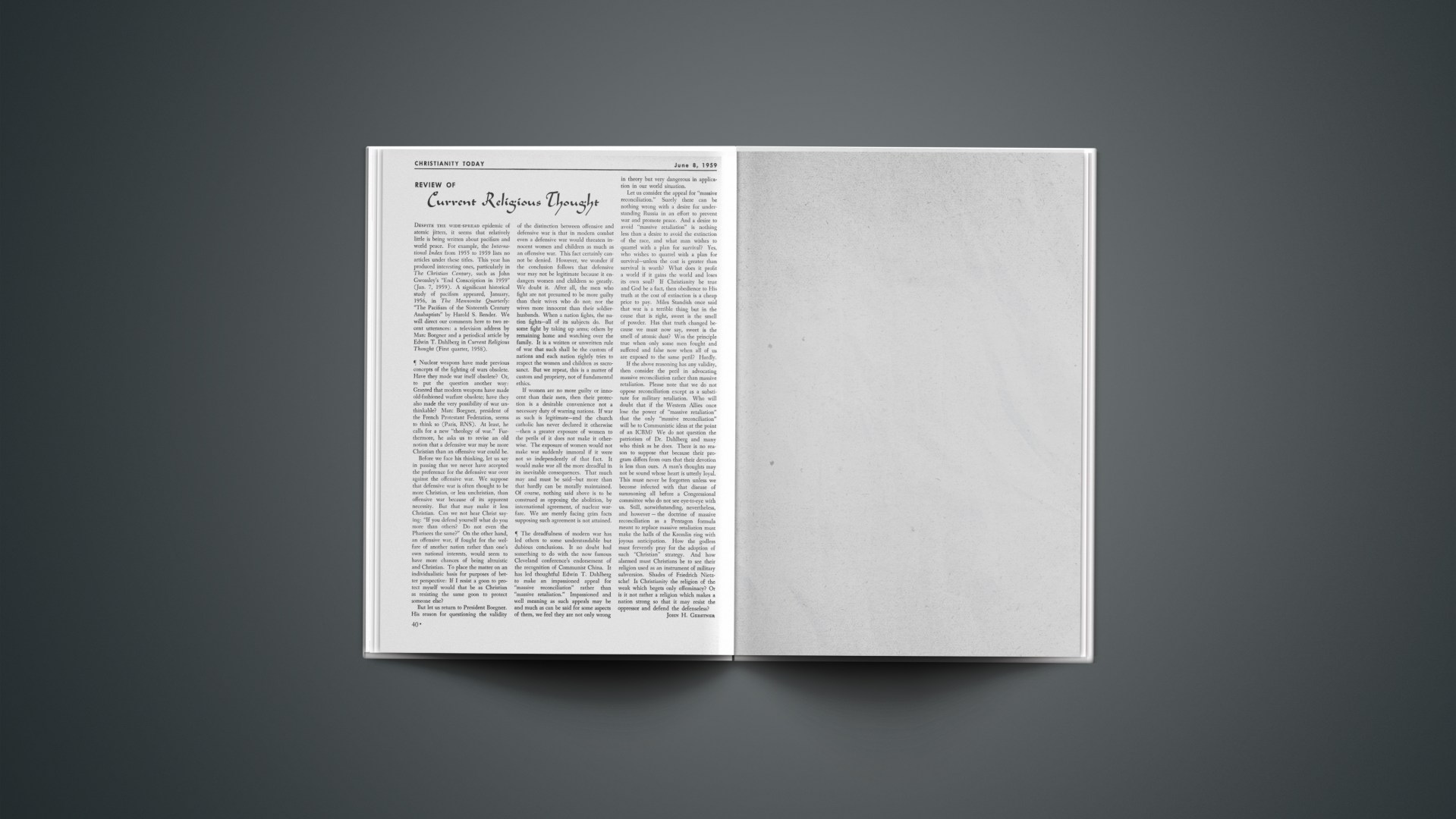
Despite the wide-spread epidemic of atomic jitters, it seems that relatively little is being written about pacifism and world peace. For example, the International Index from 1955 to 1959 lists no articles under these titles. This year has produced interesting ones, particularly in The Christian Century, such as John Gwomley’s “End Conscription in 1959” (Jan. 7, 1959). A significant historical study of pacifism appeared, January, 1956, in The Mennonite Quarterly: “The Pacifism of the Sixteenth Century Anabaptists” by Harold S. Bender. We will direct our comments here to two recent utterances: a television address by Marc Boegner and a periodical article by Edwin T. Dahlberg in Current Religious Thought (First quarter, 1958).

Nuclear weapons have made previous concepts of the fighting of wars obsolete. Have they made war itself obsolete? Or, to put the question another way: Granted that modern weapons have made old-fashioned warfare obsolete; have they also made the very possibility of war unthinkable? Marc Boegner, president of the French Protestant Federation, seems to think so (Paris, RNS). At least, he calls for a new “theology of war.” Furthermore, he asks us to revise an old notion that a defensive war may be more Christian than an offensive war could be.

Before we face his thinking, let us say in passing that we never have accepted the preference for the defensive war over against the offensive war. We suppose that defensive war is often thought to be more Christian, or less unchristian, than offensive war because of its apparent necessity. But that may make it less Christian. Can we not hear Christ saying: “If you defend yourself what do you more than others? Do not even the Pharisees the same?” On the other hand, an offensive war, if fought for the welfare of another nation rather than one’s own national interests, would seem to have more chances of being altruistic and Christian. To place the matter on an individualistic basis for purposes of better perspective: If I resist a goon to protect myself would that be as Christian as resisting the same goon to protect someone else? But let us return to President Boegner. His reason for questioning the validity of the distinction between offensive and defensive war is that in modern combat even a defensive war would threaten innocent women and children as much as an offensive war. This fact certainly cannot be denied. However, we wonder if the conclusion follows that defensive war may not be legitimate because it endangers women and children so greatly. We doubt it. After all, the men who fight are not presumed to be more guilty than their wives who do not; nor the wives more innocent than their soldier-husbands. When a nation fights, the nation fights—all of its subjects do. But some fight by taking up arms; others by remaining home and watching over the family. It is a written or unwritten rule of war that such shall be the custom of nations and each nation rightly tries to respect the women and children as sacrosanct. But we repeat, this is a matter of custom and propriety, not of fundamental ethics.

If women are no more guilty or innocent than their men, then their protection is a desirable convenience not a necessary duty of warring nations. If war as such is legitimate—and the church catholic has never declared it otherwise—then a greater exposure of women to the perils of it does not make it otherwise. The exposure of women would not make war suddenly immoral if it were not so independently of that fact. It would make war all the more dreadful in its inevitable consequences. That much may and must be said—but more than that hardly can be morally maintained. Of course, nothing said above is to be construed as opposing the abolition, by international agreement, of nuclear warfare. We are merely facing grim facts supposing such agreement is not attained.

The dreadfulness of modern war has led others to some understandable but dubious conclusions. It no doubt had something to do with the now famous Cleveland conference’s endorsement of the recognition of Communist China. It has led thoughtful Edwin T. Dahlberg to make an impassioned appeal for “massive reconciliation” rather than “massive retaliation.” Impassioned and well meaning as such appeals may be and much as can be said for some aspects of them, we feel they are not only wrong in theory but very dangerous in application in our world situation.

Let us consider the appeal for “massive reconciliation.” Surely there can be nothing wrong with a desire for understanding Russia in an effort to prevent war and promote peace. And a desire to avoid “massive retaliation” is nothing less than a desire to avoid the extinction of the race, and what man wishes to quarrel with a plan for survival? Yes, who wishes to quarrel with a plan for survival—unless the cost is greater than survival is worth? What does it profit a world if it gains the world and loses its own soul? If Christianity be true and God be a fact, then obedience to His truth at the cost of extinction is a cheap price to pay. Miles Standish once said that war is a terrible thing but in the cause that is right, sweet is the smell of powder. Has that truth changed because we must now say, sweet is the smell of atomic dust? Was the principle true when only some men fought and suffered and false now when all of us are exposed to the same peril? Hardly.

If the above reasoning has any validity, then consider the peril in advocating massive reconciliation rather than massive retaliation. Please note that we do not oppose reconciliation except as a substitute for military retaliation. Who will doubt that if the Western Allies once lose the power of “massive retaliation” that the only “massive reconciliation” will be to Communistic ideas at the point of an ICBM? We do not question the patriotism of Dr. Dahlberg and many who think as he does. There is no reason to suppose that because their program differs from ours that their devotion is less than ours. A man’s thoughts may not be sound whose heart is utterly loyal. This must never be forgotten unless we become infected with that disease of summoning all before a Congressional committee who do not see eye-to-eye with us. Still, notwithstanding, nevertheless, and however—the doctrine of massive reconciliation as a Pentagon formula meant to replace massive retaliation must make the halls of the Kremlin ring with joyous anticipation. How the godless must fervently pray for the adoption of such “Christian” strategy. And how alarmed must Christians be to see their religion used as an instrument of military subversion. Shades of Friedrich Nietzsche! Is Christianity the religion of the weak which begets only effeminacy? Or is it not rather a religion which makes a nation strong so that it may resist the oppressor and defend the defenseless?
Book Briefs: June 8, 1959

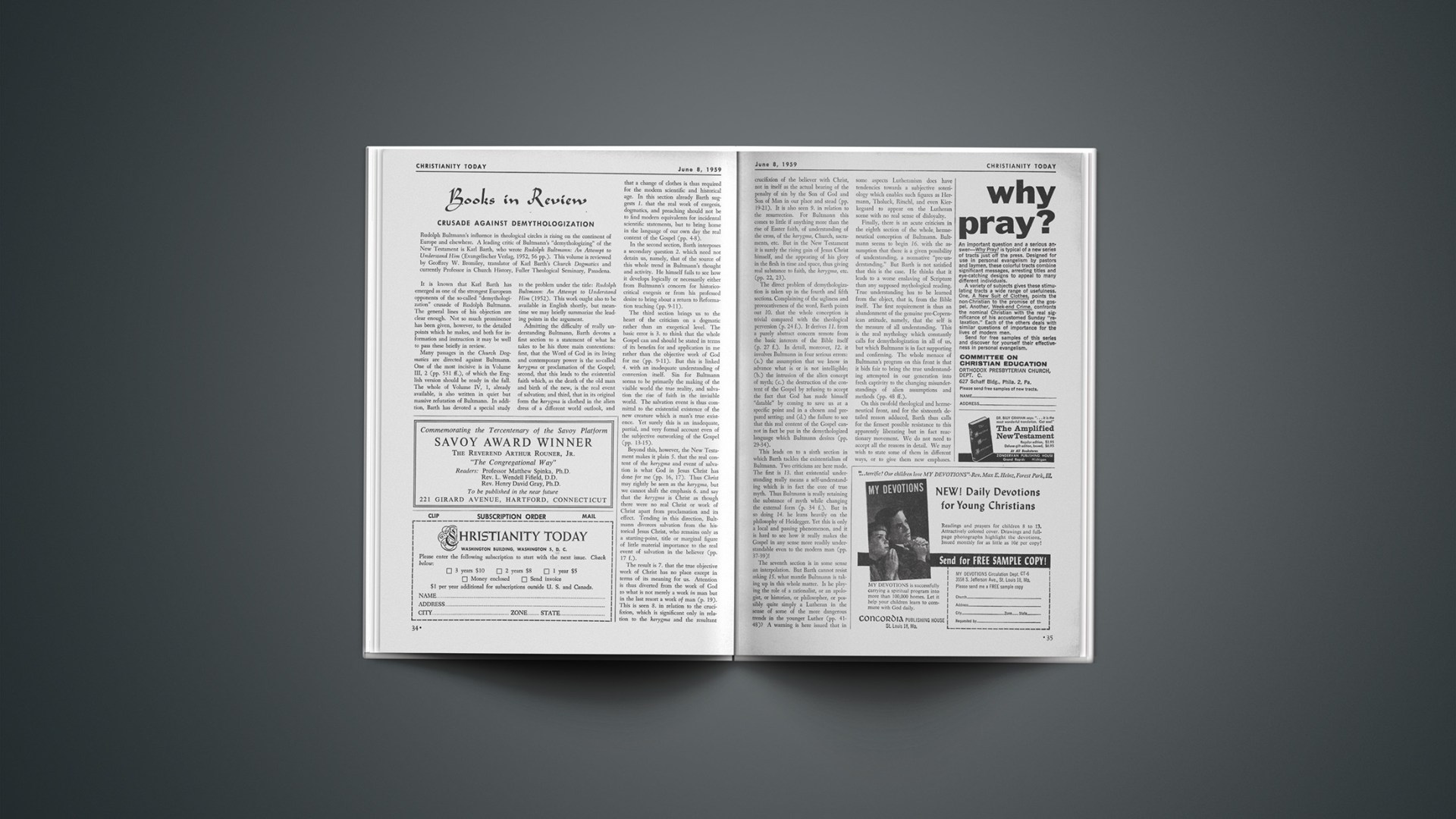
Crusade Against Demythologization

Rudolph Bultmann’s influence in theological circles is rising on the continent of Europe and elsewhere. A leading critic of Bultmann’s “demythologizing” of the New Testament is Karl Barth, who wrote Rudolph Bultmann: An Attempt to Understand Him (Evangelischer Verlag, 1952, 56 pp.). This volume is reviewed by Geoffrey W. Bromiley, translator of Karl Barth’s Church Dogmatics and currently Professor in Church History, Fuller Theological Seminary, Pasadena.

It is known that Karl Barth has emerged as one of the strongest European opponents of the so-called “demythologization” crusade of Rudolph Bultmann. The general lines of his objection are clear enough. Not so much prominence has been given, however, to the detailed points which he makes, and both for information and instruction it may be well to pass these briefly in review.

Many passages in the Church Dogmatics are directed against Bultmann. One of the most incisive is in Volume III, 2 (pp. 531 ff.), of which the English version should be ready in the fall. The whole of Volume IV, 1, already available, is also written in quiet but massive refutation of Bultmann. In addition, Barth has devoted a special study to the problem under the title: Rudolph Bultmann: An Attempt to Understand Him (1952). This work ought also to be available in English shortly, but meantime we may briefly summarize the leading points in the argument.

Admitting the difficulty of really understanding Bultmann, Barth devotes a first section to a statement of what he takes to be his three main contentions: first, that the Word of God in its living and contemporary power is the so-called kerygma or proclamation of the Gospel; second, that this leads to the existential faith which, as the death of the old man and birth of the new, is the real event of salvation; and third, that in its original form the kerygma is clothed in the alien dress of a different world outlook, and that a change of clothes is thus required for the modern scientific and historical age. In this section already Barth suggests 1. that the real work of exegesis, dogmatics, and preaching should not be to find modern equivalents for incidental scientific statements, but to bring home in the language of our own day the real content of the Gospel (pp. 4–8).

In the second section, Barth interposes a secondary question 2. which need not detain us, namely, that of the source of this whole trend in Bultmann’s thought and activity. He himself fails to see how it develops logically or necessarily either from Bultmann’s concern for historico-critical exegesis or from his professed desire to bring about a return to Reformation teaching (pp. 9–11).

The third section brings us to the heart of the criticism on a dogmatic rather than an exegetical level. The basic error is 3. to think that the whole Gospel can and should be stated in terms of its benefits for and application in me rather than the objective work of God for me (pp. 9–11). But this is linked 4. with an inadequate understanding of conversion itself. Sin for Bultmann seems to be primarily the making of the visible world the true reality, and salvation the rise of faith in the invisible world. The salvation event is thus committal to the existential existence of the new creature which is man’s true existence. Yet surely this is an inadequate, partial, and very formal account even of the subjective outworking of the Gospel (pp. 13–15).

Beyond this, however, the New Testament makes it plain 5. that the real content of the kerygma and event of salvation is what God in Jesus Christ has done for me (pp. 16, 17). Thus Christ may rightly be seen as the kerygma, but we cannot shift the emphasis 6. and say that the kerygma is Christ as though there were no real Christ or work of Christ apart from proclamation and its effect. Tending in this direction, Bultmann divorces salvation from the historical Jesus Christ, who remains only as a starting-point, title or marginal figure of little material importance to the real event of salvation in the believer (pp. 17 f.).

The result is 7. that the true objective work of Christ has no place except in terms of its meaning for us. Attention is thus diverted from the work of God to what is not merely a work in man but in the last resort a work of man (p. 19). This is seen 8. in relation to the crucifixion, which is significant only in relation to the kerygma and the resultant crucifixion of the believer with Christ, not in itself as the actual bearing of the penalty of sin by the Son of God and Son of Man in our place and stead (pp. 19–21). It is also seen 9. in relation to the resurrection. For Bultmann this comes to little if anything more than the rise of Easter faith, of understanding of the cross, of the kerygma, Church, sacraments, etc. But in the New Testament it is surely the rising gain of Jesus Christ himself, and the appearing of his glory in the flesh in time and space, thus giving real substance to faith, the kerygma, etc. (pp. 22, 22).

The direct problem of demythologization is taken up in the fourth and fifth sections. Complaining of the ugliness and provocativeness of the word, Barth points out 10. that the whole conception is trivial compared with the theological perversion (p. 24 f.). It derives 11. from a purely abstract concern remote from the basic interests of the Bible itself (p. 27 f.). In detail, moreover, 12. it involves Bultmann in four serious errors: (a.) the assumption that we know in advance what is or is not intelligible; (b.) the intrusion of the alien concept of myth; (c.) the destruction of the content of the Gospel by refusing to accept the fact that God has made himself “datable” by coming to save us at a specific point and in a chosen and prepared setting; and (d.) the failure to see that this real content of the Gospel cannot in fact be put in the demythologized language which Bultmann desires (pp. 29–34).

This leads on to a sixth section in which Barth tackles the existentialism of Bultmann. Two criticisms are here made. The first is 13. that existential understanding really means a self-understanding which is in fact the core of true myth. Thus Bultmann is really retaining the substance of myth while changing the external form (p. 34 f.). But in so doing 14. he leans heavily on the philosophy of Heidegger. Yet this is only a local and passing phenomenon, and it is hard to see how it really makes the Gospel in any sense more readily understandable even to the modern man (pp. 37–39)!

The seventh section is in some sense an interpolation. But Barth cannot resist asking 15. what mantle Bultmann is taking up in this whole matter. Is he playing the role of a rationalist, or an apologist, or historian, or philosopher, or possibly quite simply a Lutheran in the sense of some of the more dangerous trends in the younger Luther (pp. 41–48)? A warning is here issued that in some aspects Lutheranism does have tendencies towards a subjective soteriology which enables such figures as Hermann, Tholuck, Ritschl, and even Kierkegaard to appear on the Lutheran scene with no real sense of disloyalty.

Finally, there is an acute criticism in the eighth section of the whole hermeneutical conception of Bultmann. Bultmann seems to begin 16. with the assumption that there is a given possibility of understanding, a normative “pre-understanding.” But Barth is not satisfied that this is the case. He thinks that it leads to a worse enslaving of Scripture than any supposed mythological reading. True understanding has to be learned from the object, that is, from the Bible itself. The first requirement is thus an abandonment of the genuine pre-Copernican attitude, namely, that the self is the measure of all understanding. This is the real mythology which constantly calls for demythologization in all of us, but which Bultmann is in fact supporting and confirming. The whole menace of Bultmann’s program on this front is that it bids fair to bring the true understanding attempted in our generation into fresh captivity to the changing misunderstandings of alien assumptions and methods (pp. 48 ff.).

On this twofold theological and hermeneutical front, and for the sixteenth detailed reason adduced, Barth thus calls for the firmest possible resistance to this apparently liberating but in fact reactionary movement. We do not need to accept all the reasons in detail. We may wish to state some of them in different ways, or to give them new emphases.

But we can certainly concur in the conclusion. We can be grateful that Barth himself accepts this conclusion, and that he supports it with such an acute and stimulating analysis. And it may be that we can learn from him to appreciate how serious is the material as well as the formal menace of this demythologization program, and to fashion a more effective, relevant, vital, and positive evangelical answer to it.

GEOFFREY W. BROMILEY

Christ Is Unique

Jesus in His Homeland, by Sherman E. Johnson (Scribner, 1957, 177 pp., $3.75), is reviewed by Robert Winston Ross, Professor of Bible at Simpson Bible College.

A well-written book, Jesus in His Homeland is internally consistent from premise to conclusion. At most points in the discussion, conservative and evangelical scholarship will be in agreement. Yet at other points, one sees views that are wholly foreign to the conservative position. What is encouraging, however, is that these latter expressions do not detract from the thrust of the book, which is upon the uniqueness and individuality of the historical person of Jesus Christ.

Sherman E. Johnson has made a significant contribution to the literature on Christ in his contemporary world. He proceeds by way of a step by step comparison of Christ with first century institutions, parties, and religious groups (formal and informal), and shows Christ to be the unique person that he is. Johnson argues that Christ cannot be put into any of the pigeonholes of convenience that would reduce him to an ultimate humanity.

He is a recognized New Testament scholar and an accredited archaeologist, and his pen and his spade give support to his thesis. Using refreshing translations of the New Testament text in conjunction with a professional comparison of the Essenes and the Dead Sea Scrolls, Johnson provides what is perhaps the best feature of the book, namely his conclusion that Jesus is unique.

He gives some ideas concerning the kingdom of God which are provocative. Many readers will disagree with them, but often the differing viewpoints serve to make the book more challenging and useful. The book of Daniel is given a late dating, Daniel is identified with the Hasidim, and Deutero-Isaiah is assumed.

The Q-document and Mark-theory as the basis of the Synoptic problem is also assumed. Practically no consideration is given to current studies in oral-tradition theories in relation to the Synoptics and the New Testament. In a larger discussion of faith and history, very little mention is made of Bultmann and his program of de-mythology.

Is the Christian message historical? Johnson says that it is. Based solidly upon the message of Old Testament Scriptures, the Christian message stands firm. “… Christian theology must never forget the rock from which it was hewn, … the Old Testament and first century Judaism.” Further, “the heart of the Old Testament message is expressed in the teaching of Jesus, and in his ministry we have the supreme example of the activity of God in history.” Johnson further argues that the redemptive act in Jesus Christ is like no other. “To Christians the death of Jesus is an event that transforms all history.”

The reader will find a small but useful bibliography and a good index at the back of the book.

ROBERT WINSTON ROSS

Serious Social Problem

Alcoholics Anonymous Comes of Age, by a Co-Founder (Harper, 1957, 333 pp., $4) is reviewed by Mariano Di Gangi, Minister of St. Enoch Presbyterian Church, Hamilton, Ontario, Canada.

Alcoholism is a problem of serious magnitude, with notable social, economic and religious consequences. One of the means which God in his common grace has raised up for reclamation of alcoholics is Alcoholics Anonymous.

This volume, a companion work to the “Bible” of the movement (Alcoholics Anonymous, 1939), represents the official position of A.A. While primarily published for the 200,000 members and friends of A.A., it contains much material of interest to the general reader.

Here in this “inside and wide-angled view of A.A.” is the candid record of the movement’s temptations and opportunities, successes and failures. Though stressing the need of surrendering one’s life to God’s care for deliverance and restoration, A.A. does not define God in terms of Jesus Christ. Nevertheless, it does speak of “the fellowship of the Spirit,” “spreading the message,” “conversion,” “sins,” “witness of God’s power,” and “peace with God.”

It is refreshing to read of a movement in which self-righteousness and professionalism are frankly recognized and rejected. It is startling to learn that brand-new A.A.’s, sober just a short while, may be expected to sponsor alcoholics still drying up in hospitals. It is shocking to compare the sympathy of an A.A. person toward someone in need, to the relative unconcern of professing Christians toward their fellow men.

We would be richly rewarded to consider this movement honestly, and to imagine what would happen to nominal Christians if they were to realize their need of deliverance. We would feel responsibility for aiding others in distress, sponsor new converts to the Faith, and concentrate on the one purpose of “carrying the message” instead of being distracted into fruitless fields of superficial religion.

MARIANO DI GANGI

Shaft Head Of The Mine

A Bird’s Eye View of the Bible, Vol. I, Old Testament; Vol. II, New Testament, by G. R. Harding Wood (Marshall, Morgan, and Scott, London, 1957, 207 pp., and 183 pp., respectively, 10s. 6d. ea.), is reviewed by Philip Edgcumbe Hughes, Lecturer of Mortlake Parish, London.

There is no more enthusiastic Bible teacher than Mr. Harding Wood whose itinerant ministry has been enjoyed and valued by so many. These two volumes will prove of real practical worth to those who desire a concise guide to the plan and the themes of Holy Scripture. They represent, the author says, “the day-to-day digging in the Bible mine, through the years of a very busy life as a Church of England minister,” and it is his hope that they will prove an incentive to others to dig in that same mine.

Each book of the Bible is briefly analyzed, and questions for study and topics for discussion are added at the end of each chapter. Mr. Harding Wood’s intention is not to provide a commentary or theological textbook, but rather to take his readers to the brink of the shaft head of the mine, as it were, so that he may have a sight of some of the treasures which are waiting to be discovered. It is for the reader himself to go down and delve in the mine.

The two volumes could be used with advantage by young or recently converted Christians and by youth groups who are studying the Bible together. Bishop J. R. S. Taylor has written a preface in which he commends the simplicity and clarity with which Mr. Harding Wood has set out his material.

PHILIP EDGCUMBE HUGHES

A Question Of Ethics

Our Bible and the Ancient Manuscripts, by Sir Frederic Kenyon (Harper, revised 1958, 352 pp., $6.95), is reviewed by Meredith G. Kline, Assistant Professor of Old Testament, Westminster Theological Seminary.

Kenyon’s original popularization of the story of the transmission of the sacred text appeared over 60 years ago. The present revision is an up-to-date edition with over 100 additional pages of text plus new illustrations. An introductory biographical sketch of Kenyon is provided by G. R. Driver. A completely new chapter, “Revisions and Translations since 1881,” includes an exuberant endorsement of the RSV and an interesting description of progress on the new English version, which is not a revision but brand new translation. The relevance of the Dead Sea Scrolls is duly noted, and partiality is shown for Kahle’s textual views.

According to the jacket, “the essential character of Kenyon’s work has been kept”; but only in a formal sense does that seem to be true. Kenyon, who was famous for his roles as director of the British Museum and editor of the Chester Beatty papyri, was generally evangelical. His doctrine of Scripture, however, was not altogether satisfactory. Especially disappointing in the original of our book was Kenyon’s account of the formation of the Canon and his decision to be noncommittal on critical questions like the authorship of the Pentateuch. Elsewhere in his writings he was worse than noncommittal on that subject. He advocated a concept of progressive biblical revelation in which the progress was not from truth to more fully revealed truth but from that which was error to that which is truth.

But if Kenyon tended to be mediating, reviser A. W. Adams, dean of divinity of Magdalen College, Oxford, is militantly naturalistic and negative. Symptomatic is the rather impassioned defence offered for his rationalistic bias under the guise of a plea for “free inquiry” (pp. 62 ff.).

Is not a serious ethical question involved in this business of revising another man’s book? After all a book is uniquely its author’s own—sometimes more intimately his own than a melody is its composer’s or a painting the artist’s. A book about the Bible is a form of religious confession. And the question is whether one not thoroughly sympathetic with the theological position of the author of such a book has the moral right to revise it.

Certainly failure to apprize the reader whenever the reviser introduces elements not congenial to the original author’s thought is a failure to guard sufficiently the principles enunciated in the eighth and ninth Commandments. Such failure marks Adams’ revision of Our Bible and the Ancient Manuscripts. An alien spirit has taken possession of the body of this old classic.

MEREDITH G. KLINE

Presbyterians Air Doctrinal Anxieties

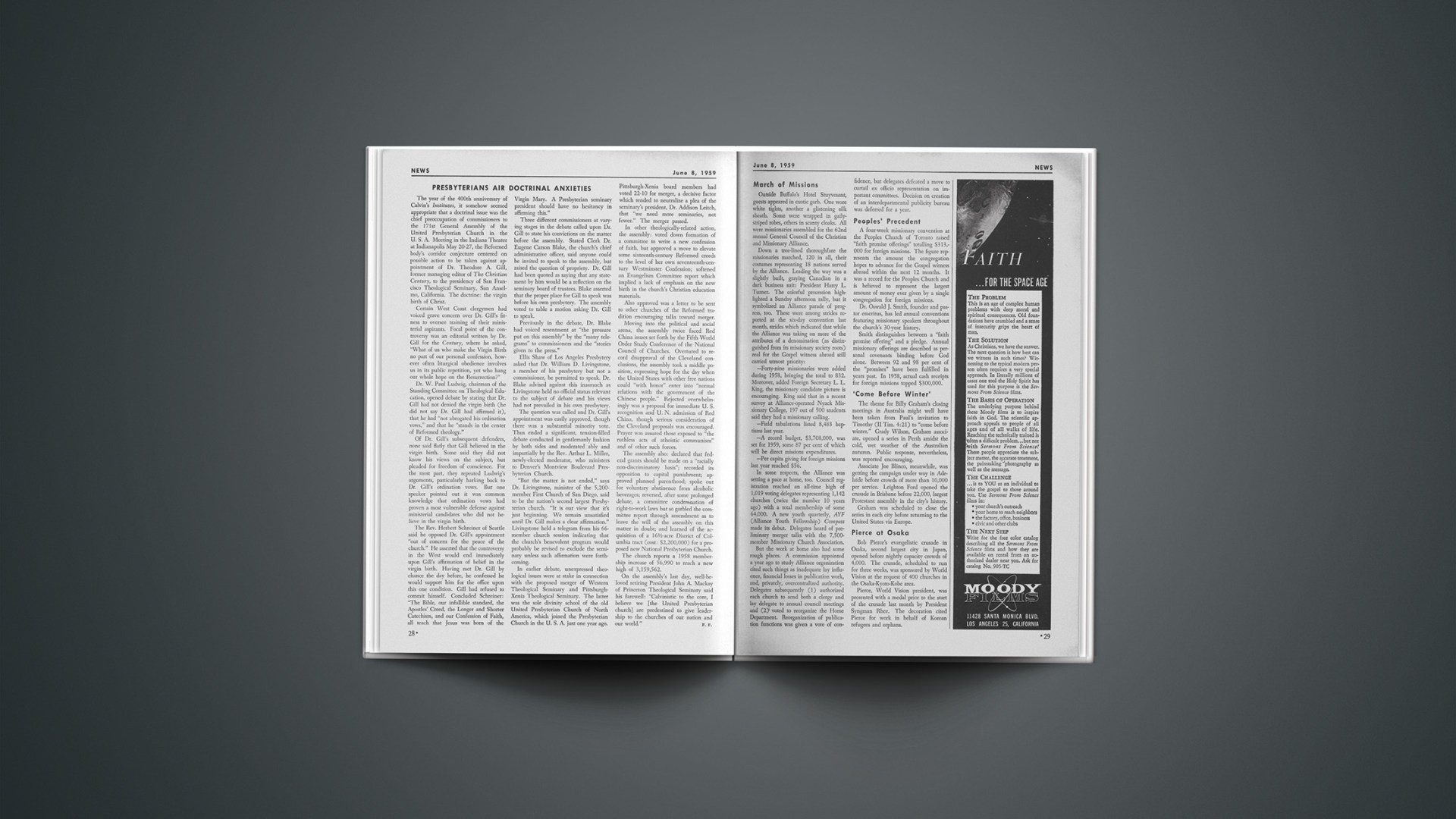
The year of the 400th anniversary of Calvin’s Institutes, it somehow seemed appropriate that a doctrinal issue was the chief preoccupation of commissioners to the 171st General Assembly of the United Presbyterian Church in the U. S. A. Meeting in the Indiana Theater at Indianapolis May 20–27, the Reformed body’s corridor conjecture centered on possible action to be taken against appointment of Dr. Theodore A. Gill, former managing editor of The Christian Century, to the presidency of San Francisco Theological Seminary, San Anselmo, California. The doctrine: the virgin birth of Christ.

Certain West Coast clergymen had voiced grave concern over Dr. Gill’s fitness to oversee training of their ministerial aspirants. Focal point of the controversy was an editorial written by Dr. Gill for the Century, where he asked, “What of us who make the Virgin Birth no part of our personal confession, however often liturgical obedience involves us in its public repetition, yet who hang our whole hope on the Resurrection?”

Dr. W. Paul Ludwig, chairman of the Standing Committee on Theological Education, opened debate by stating that Dr. Gill had not denied the virgin birth (he did not say Dr. Gill had affirmed it), that he had “not abrogated his ordination vows,” and that he “stands in the center of Reformed theology.”

Of Dr. Gill’s subsequent defenders, none said flatly that Gill believed in the virgin birth. Some said they did not know his views on the subject, but pleaded for freedom of conscience. For the most part, they repeated Ludwig’s arguments, particularly harking back to Dr. Gill’s ordination vows. But one speaker pointed out it was common knowledge that ordination vows had proven a most vulnerable defense against ministerial candidates who did not believe in the virgin birth.

The Rev. Herbert Schreiner of Seattle said he opposed Dr. Gill’s appointment “out of concern for the peace of the church.” He asserted that the controversy in the West would end immediately upon Gill’s affirmation of belief in the virgin birth. Having met Dr. Gill by chance the day before, he confessed he would support him for the office upon this one condition. Gill had refused to commit himself. Concluded Schreiner: “The Bible, our infallible standard, the Apostles’ Creed, the Longer and Shorter Catechism, and our Confession of Faith, all teach that Jesus was born of the Virgin Mary. A Presbyterian seminary president should have no hesitancy in affirming this.”

Three different commissioners at varying stages in the debate called upon Dr. Gill to state his convictions on the matter before the assembly. Stated Clerk Dr. Eugene Carson Blake, the church’s chief administrative officer, said anyone could be invited to speak to the assembly, but raised the question of propriety. Dr. Gill had been quoted as saying that any statement by him would be a reflection on the seminary board of trustees. Blake asserted that the proper place for Gill to speak was before his own presbytery. The assembly voted to table a motion asking Dr. Gill to speak.

Previously in the debate, Dr. Blake had voiced resentment at “the pressure put on this assembly” by the “many telegrams” to commissioners and the “stories given to the press.”

Ellis Shaw of Los Angeles Presbytery asked that Dr. William D. Livingstone, a member of his presbytery but not a commissioner, be permitted to speak. Dr. Blake advised against this inasmuch as Livingstone held no official status relevant to the subject of debate and his views had not prevailed in his own presbytery.

The question was called and Dr. Gill’s appointment was easily approved, though there was a substantial minority vote. Thus ended a significant, tension-filled debate conducted in gentlemanly fashion by both sides and moderated ably and impartially by the Rev. Arthur L. Miller, newly-elected moderator, who ministers to Denver’s Montview Boulevard Presbyterian Church.

“But the matter is not ended,” says Dr. Livingstone, minister of the 5,200-member First Church of San Diego, said to be the nation’s second largest Presbyterian church. “It is our view that it’s just beginning. We remain unsatisfied until Dr. Gill makes a clear affirmation.” Livingstone held a telegram from his 66-member church session indicating that the church’s benevolent program would probably be revised to exclude the seminary unless such affirmation were forthcoming.

In earlier debate, unexpressed theological issues were at stake in connection with the proposed merger of Western Theological Seminary and Pittsburgh-Xenia Theological Seminary. The latter was the sole divinity school of the old United Presbyterian Church of North America, which joined the Presbyterian Church in the U. S. A. just one year ago.

Pittsburgh-Xenia board members had voted 22–10 for merger, a decisive factor which tended to neutralize a plea of the seminary’s president, Dr. Addison Leitch, that “we need more seminaries, not fewer.” The merger passed.

In other theologically-related action, the assembly: voted down formation of a committee to write a new confession of faith, but approved a move to elevate some sixteenth-century Reformed creeds to the level of her own seventeenth-century Westminster Confession; softened an Evangelism Committee report which implied a lack of emphasis on the new birth in the church’s Christian education materials.

Also approved was a letter to be sent to other churches of the Reformed tradition encouraging talks toward merger.

Moving into the political and social arena, the assembly twice faced Red China issues set forth by the Fifth World Order Study Conference of the National Council of Churches. Overtured to record disapproval of the Cleveland conclusions, the assembly took a middle position, expressing hope for the day when the United States with other free nations could “with honor” enter into “normal relations with the government of the Chinese people.” Rejected overwhelmingly was a proposal for immediate U. S. recognition and U. N. admission of Red China, though serious consideration of the Cleveland proposals was encouraged. Prayer was assured those exposed to “the ruthless acts of atheistic communism” and of other such forces.

The assembly also: declared that federal grants should be made on a “racially non-discriminatory basis”; recorded its opposition to capital punishment; approved planned parenthood; spoke out for voluntary abstinence from alcoholic beverages; reversed, after some prolonged debate, a committee condemnation of right-to-work laws but so garbled the committee report through amendment as to leave the will of the assembly on this matter in doubt; and learned of the acquisition of a 16½-acre District of Columbia tract (cost: $2,200,000) for a proposed new National Presbyterian Church.

The church reports a 1958 membership increase of 56,990 to reach a new high of 3,159,562.

On the assembly’s last day, well-beloved retiring President John A. Mackay of Princeton Theological Seminary said his farewell: “Calvinistic to the core, I believe we [the United Presbyterian church] are predestined to give leadership to the churches of our nation and our world.”

March Of Missions

Outside Buffalo’s Hotel Stuyvesant, guests appeared in exotic garb. One wore white tights, another a glistening silk sheath. Some were wrapped in gaily-striped robes, others in scanty cloaks. All were missionaries assembled for the 62nd annual General Council of the Christian and Missionary Alliance.

Down a tree-lined thoroughfare the missionaries marched, 120 in all, their costumes representing 18 nations served by the Alliance. Leading the way was a slightly built, graying Canadian in a dark business suit: President Harry L. Turner. The colorful procession highlighted a Sunday afternoon rally, but it symbolized an Alliance parade of progress, too. These were among strides reported at the six-day convention last month, strides which indicated that while the Alliance was taking on more of the attributes of a denomination (as distinguished from its missionary society roots) zeal for the Gospel witness abroad still carried utmost priority:

-Forty-nine missionaries were added during 1958, bringing the total to 832. Moreover, added Foreign Secretary L. L. King, the missionary candidate picture is encouraging. King said that in a recent survey at Alliance-operated Nyack Missionary College, 197 out of 500 students said they had a missionary calling.

—Field tabulations listed 8,483 baptisms last year.

—A record budget, $3,708,000, was set for 1959, some 87 per cent of which will be direct missions expenditures.

—Per capita giving for foreign missions last year reached $56.

In some respects, the Alliance was setting a pace at home, too. Council registration reached an all-time high of 1,019 voting delegates representing 1,142 churches (twice the number 10 years ago) with a total membership of some 64,000. A new youth quarterly, AYF (Alliance Youth Fellowship) Compass made its debut. Delegates heard of preliminary merger talks with the 7,500-member Missionary Church Association.

But the work at home also had some rough places. A commission appointed a year ago to study Alliance organization cited such things as inadequate lay influence, financial losses in publication work, and, privately, overcentralized authority. Delegates subsequently (1) authorized each church to send both a clergy and lay delegate to annual council meetings and (2) voted to reorganize the Home Department. Reorganization of publication functions was given a vote of confidence, but delegates defeated a move to curtail ex officio representation on important committees. Decision on creation of an interdepartmental publicity bureau was deferred for a year.

Peoples’ Precedent

A four-week missionary convention at the Peoples Church of Toronto raised “faith promise offerings” totalling $313,000 for foreign missions. The figure represents the amount the congregation hopes to advance for the Gospel witness abroad within the next 12 months. It was a record for the Peoples Church and is believed to represent the largest amount of money ever given by a single congregation for foreign missions.

Dr. Oswald J. Smith, founder and pastor emeritus, has led annual conventions featuring missionary speakers throughout the church’s 30-year history.

Smith distinguishes between a “faith promise offering” and a pledge. Annual missionary offerings are described as personal covenants binding before God alone. Between 92 and 98 per cent of the “promises” have been fulfilled in years past. In 1958, actual cash receipts for foreign missions topped $300,000.

‘Come Before Winter’

The theme for Billy Graham’s closing meetings in Australia might well have been taken from Paul’s invitation to Timothy (2 Tim. 4:21) to “come before winter.” Grady Wilson, Graham associate, opened a series in Perth amidst the cold, wet weather of the Australian autumn. Public response, nevertheless, was reported encouraging.

Associate Joe Blinco, meanwhile, was getting the campaign under way in Adelaide before crowds of more than 10,000 per service. Leighton Ford opened the crusade in Brisbane before 22,000, largest Protestant assembly in the city’s history.

Graham was scheduled to close the series in each city before returning to the United States via Europe.

Pierce At Osaka

Bob Pierce’s evangelistic crusade in Osaka, second largest city in Japan, opened before nightly capacity crowds of 4,000. The crusade, scheduled to run for three weeks, was sponsored by World Vision at the request of 400 churches in the Osaka-Kyoto-Kobe area.

Pierce, World Vision president, was presented with a medal prior to the start of the crusade last month by President Syngman Rhee. The decoration cited Pierce for work in behalf of Korean refugees and orphans.

Protestant Panorama

• Gifts to individual missionaries are no longer deductible from federal income tax. The Internal Revenue Service says contributions made to a charitable organization, but earmarked for a specific individual, likewise are nondeductible.

• Little Rock public opinion may have reached a turning point last month when three moderates on the school board were given a vote of confidence in a recall election which ousted three segregationists supported by Governor Orvai E. Faubus.

• Ground was broken in Wauwatosa, Wisconsin, last month for a million-dollar Greek Orthodox church designed by the late Frank Lloyd Wright. Plans call for a modern adaptation of a Byzantine form of architecture which provides a saucershaped interior seating 700.

• The Hawaiian Evangelical Association of Congregational Christian Churches says it will construct a $1,500,000 headquarters building in Honolulu. Comprising some 18,000 Hawaiian members in 113 churches, the denomination is the largest group in a current Protestant population of between 50,000 and 60,000.

• About 223,000,000 gallons of distilled spirits will be consumed by Americans this year, or four per cent more than in 1958, according to Peter Hoguet, president of the Econometric Institute.

• The Latin America Mission is setting up a Canadian office in Toronto.

• The Bible Institute of Los Angeles will build a 2,400-watt FM station to operate in San Diego.

• Reiji Oyama completed four months of evangelistic meetings in the Philippines last month as the first Japanese missionary to come to the Philippines since World War II.

• Dr. Mordecai Kaplan, Jewish Theological Seminary professor, made a terse comparison last month of Judaism’s conceptions of God: “The Conservative group recognizes that a definite conception of God is indispensable, but has given little or no thought as to what it should be. It is emotionally compounded of nostalgia for the Orthodox Jew and complacency for the Reform view.”

• The U. S. Senate Internal Security subcommittee heard testimony last month which charged that Soviet leaders have forced many Russian Orthodox priests to become agents of the secret police. Petr S. Deriabian, 15-year veteran of the Red secret police who defected to the West in 1954, named Metropolitan Nikolai of Krutitsky and Kolomna, second-ranking Russian Orthodox prelate, as one of the agents.

• This summer’s American exhibition in Moscow will include displays to illustrate “the persuasive influence of religion in American life in a variety of ways,” according to the U. S. Information Agency. David V. Benson, president of Russia for Christ, is one of the U. S. guides at the fair.

• Howard Butt, official of a Texas supermarket chain and a lay evangelist, conducted an eight-day crusade in Lubbock, Texas, last month, which drew an aggregate attendance of more than 44,000, and produced 694 decisions for Christ.

• The Oklahoma House of Representatives defeated last month, 86–17, a bill to legalize horse racing and pari-mutuel betting.

• “Large loss” church fires—those listed by the National Fire Protection Association as having caused more than $250,000 damage—showed a marked drop last year in the United States and Canada. The NFPA said there were only four such blazes in the United States last year, compared with 15 in 1957, and none in Canada, where there had been three the previous year.

• Mrs. Olive Fleming, widow of one of five missionaries slain by Auca Indians in Ecuador three years ago, planned a June 6 marriage to Walter L. Liefeld, who has been studying for a doctor of philosophy degree at Union Theological Seminary and Columbia University.

Around The World

Worshiper Shortage

Fifty Anglican churches throughout Ireland will be closed because of diminishing attendances, it was announced last month at a meeting of the General Synod of the Church of Ireland in Dublin.

Irish churches, it was stated, are being increasingly affected by a steady rate of emigration from rural areas. A committee chairman told the synod, however, that a process of parish amalgamation and regrouping resulting from the closing of the churches was “not a retreat, but an advance.”

No Legal Action

The president of the Evangelical Church of Hesse and Nassau, Dr. Martin Niemoeller, who had been accused of slander in remarks about the West German army (see CHRISTIANITY TODAY, February 16, 1959, issue) apparently will escape prosecution.

A West German Defense Ministry official announced last month in Bonn that investigations preparatory to court proceedings have been abandoned because they failed to disclose any insulting intent in remarks attributed to Niemoeller, who is known for his strong opposition to the arming of West Germany.

Christian To Muslim

In Northern Nigeria’s celebrations last month of the attainment of self-government, one religious overtone was conspicuous: the rule of 18,000,000 Africans had passed from a Christian, Queen Elizabeth II, to a Muslim, the Sardauna of Sokoto, Alhaji Sir Ahmadu Bello, who nevertheless promised that “we will not interfere” with Christian work.

Headhunters’ Toll

Three Christian natives were beheaded in as many days last month by young Ilongot tribesmen roaming northern Philippine forests. The pagan Ilongots have a custom of presenting Christian heads to prospective brides.

In Memoriam

Dr. Ronald Bridges, said to have been the first layman ever to head a major seminary, presumably was drowned last month while on a fishing trip near his Sanford, Maine, home.

A memorial service was held for Bridges, 53, after his cane and capsized boat were found in a river.

Bridges was president of the Pacific School of Religion at Berkeley, California, from 1945 until 1950, and served from 1950 until 1954 as director of the Broadcasting and Film Commission of the National Council of Churches. More recently he was religious adviser to the U. S. Information Agency. He had also been president of the American Board of Commissioners for Foreign Missions of the Congregational Christian Churches.

Catholic Population

Roman Catholics now constitute 22 per cent of the U. S. population, according to latest figures from the Official Catholic Directory and the Census Bureau. Corresponding statistics from 1949 showed U. S. Catholic strength at 18 per cent.

‘Doctrinal Article’

The Joint Commission on Lutheran Unity, liaison agency for the proposed merger of the American Evangelical, Augustana, Finnish Evangelical and United Lutheran churches, came up with a “doctrinal article” last month which will be referred to constituent conventions for inclusion in the new body’s constitution.

While the article does have legal significance, the drafting committee said, “we would hope that it is first of all a ringing challenge and a joyful affirmation of the blessings we share together in our Christian and Lutheran fellowship.”

Here is text of the article:

Section 1. This church confesses Jesus Christ as Lord of the Church. The Holy Spirit creates and sustains the Church through the Gospel and thereby unites believers with their Lord and with one another in the fellowship of faith.

Section 2. This church holds that the Gospel is the revelation of God’s sovereign will and saving grace in Jesus Christ. In Him, the Word Incarnate, God imparts Himself to men.

Section 3. This church acknowledges the Holy Scriptures as the norm for the faith and life of the Church. The Holy Scriptures are the divinely inspired record of God’s redemptive act in Christ, for which the Old Testament prepared the way and which the New Testament proclaims. In the continuation of this proclamation in the Church, God still speaks through the Holy Scriptures and realizes His redemptive purpose generation after generation.

Section 4. This church accepts the Apostles’, the Nicene, and the Athanasian creeds as true declarations of the faith of the Church.

Section 5. This church accepts the Unaltered Augsburg Confession and Luther’s Small Catechism as true witnesses to the Gospel, and acknowledges as one with it in faith and doctrine all churches that likewise accept the teachings of these symbols.

Section 6. This church accepts the other symbolical books of the evangelical Lutheran church, the Apology of the Augsburg Confession, the Smalcald Articles, Luther’s Large Catechism, and the Formula of Concord as further valid interpretations of the confession of the Church.

Section 7. This church affirms the Gospel transmitted by the Holy Scriptures, to which the creeds and confessions bear witness, is the true treasure of the Church, the substance of its proclamation, and the basis of its unity and continuity. The Holy Spirit uses the proclamation of the Gospel and the administration of the Sacraments to create and sustain Christian faith and fellowship. As this occurs, the Church fulfills its divine mission and purpose.

People: Words And Events

Deaths: Dr. Edmund P. Schwarze, 73, bishop of the Moravian Church in America, in Winston-Salem, North Carolina … Stephen L. Richards, 79, of the first presidency of the Church of Jesus Christ of Latter-day Saints (Mormon), in Salt Lake City … Dr. John Wesley Holland, 82, radio pastor of the Little Brown Church of the Air, in Chicago … the Rev. Francisco Quintanilla, 59, founder and for 39 years pastor of El Buen Pastor Methodist Church (Church of the Good Shepherd) of Los Angeles.

Election: As head of the Lutheran Church in Poland, Dr. Andreas Wantula, professor at the Christian Theological Academy of Warsaw … as president of the Southern Baptist Convention, Dr. Ramsey Pollard … as moderator of the United Presbyterian Church in the U. S. A., Dr. Arthur L. Miller.

Appointments: As executive vice president of Asbury Theological Seminary, Dr. Frank B. Stanger, for the past eight years pastor of the First Methodist Church, Collingswood, New Jersey … as chaplain and assistant professor of religion at Lebanon Valley College, Dr. James O. Bemesderfer … as pastor of the First Baptist Church, Van Nuys, California, Dr. Harold L. Fickett, after nearly five years at Tremont Temple, Boston … as pastor of the First Baptist Church, San Francisco, Dr. Curtis R. Nims, vice president in public relations at Northern Baptist Theological Seminary.

Retirements: After 27 years as general secretary of the North Carolina Baptist Convention, Dr. M. A. Huggins, effective June 30 … as Africa secretary of the Church Missionary Society, Canon T. F. C. Bewes.

Award: To George Dugan, religion editor of The New York Times, the James O. Supple Memorial Award of the Religious Newswriters Association for “excellence in religious news reporting in the secular press.”

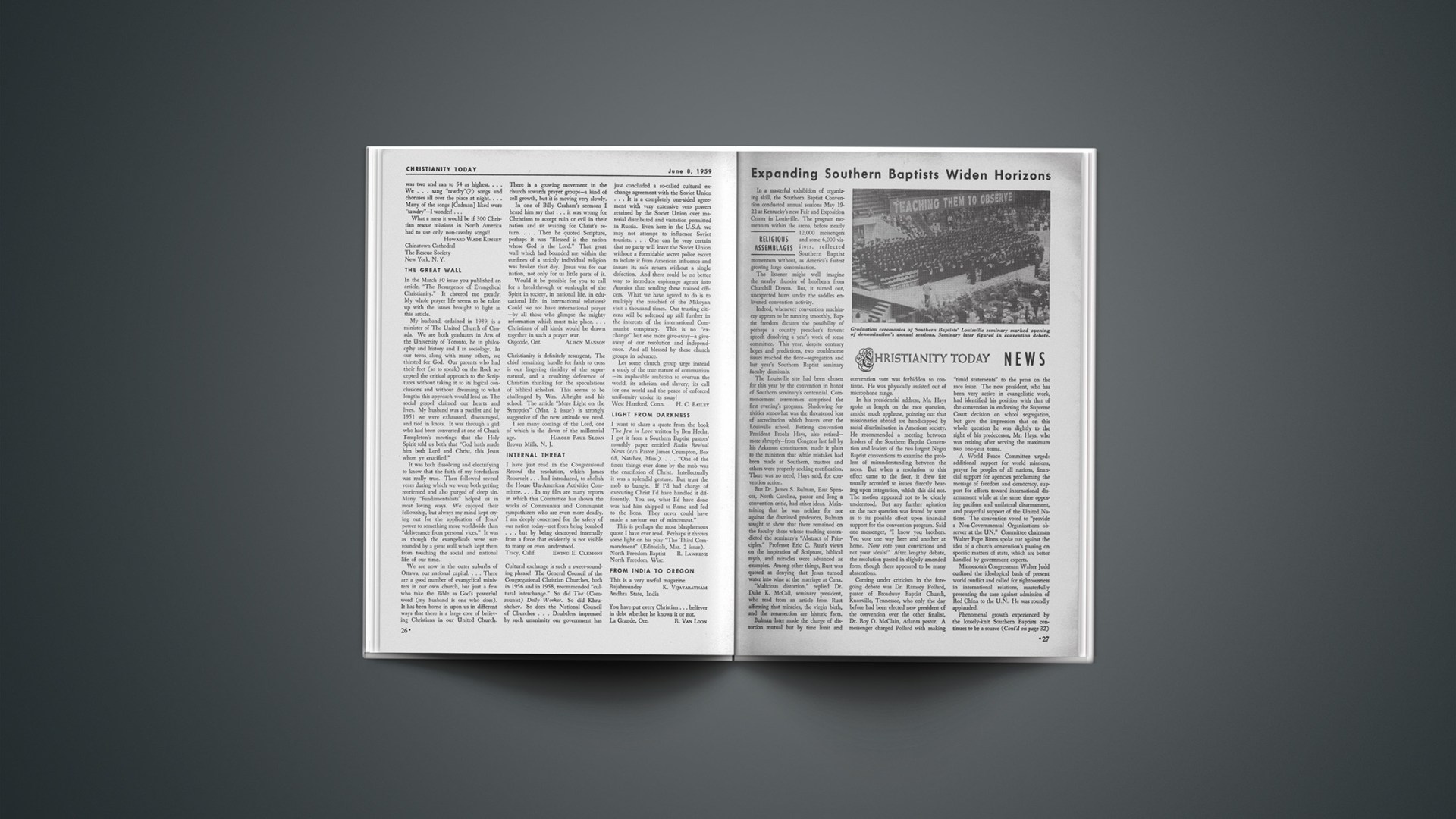
Expanding Southern Baptists Widen Horizons

NEWS

CHRISTIANITY TODAY

Religious Assemblages

In a masterful exhibition of organizing skill, the Southern Baptist Convention conducted annual sessions May 19–22 at Kentucky’s new Fair and Exposition Center in Louisville. The program momentum within the arena, before nearly 12,000 messengers and some 6,000 visitors, reflected Southern Baptist momentum without, as America’s fastest growing large denomination.

The listener might well imagine the nearby thunder of hoofbeats from Churchill Downs. But, it turned out, unexpected burrs under the saddles enlivened convention activity.

Indeed, whenever convention machinery appears to be running smoothly, Baptist freedom dictates the possibility of perhaps a country preacher’s fervent speech dissolving a year’s work of some committee. This year, despite contrary hopes and predictions, two troublesome issues reached the floor—segregation and last year’s Southern Baptist seminary faculty dismissals.

The Louisville site had been chosen for this year by the convention in honor of Southern seminary’s centennial. Commencement ceremonies comprised the first evening’s program. Shadowing festivities somewhat was the threatened loss of accreditation which hovers over the Louisville school. Retiring convention President Brooks Hays, also retired—more abruptly—from Congress last fall by his Arkansas constituents, made it plain to the ministers that while mistakes had been made at Southern, trustees and others were properly seeking rectification. There was no need, Hays said, for convention action.

But Dr. James S. Bulman, East Spencer, North Carolina, pastor and long a convention critic, had other ideas. Maintaining that he was neither for nor against the dismissed professors, Bulman sought to show that there remained on the faculty those whose teaching contradicted the seminary’s “Abstract of Principles.” Professor Eric C. Rust’s views on the inspiration of Scripture, biblical myth, and miracles were advanced as examples. Among other things, Rust was quoted as denying that Jesus turned water into wine at the marriage at Cana.

“Malicious distortion,” replied Dr. Duke K. McCall, seminary president, who read from an article from Rust affirming that miracles, the virgin birth, and the resurrection are historic facts.

Bulman later made the charge of distortion mutual but by time limit and convention vote was forbidden to continue. He was physically assisted out of microphone range.

In his presidential address, Mr. Hays spoke at length on the race question, amidst much applause, pointing out that missionaries abroad are handicapped by racial discrimination in American society. He recommended a meeting between leaders of the Southern Baptist Convention and leaders of the two largest Negro Baptist conventions to examine the problem of misunderstanding between the races. But when a resolution to this effect came to the floor, it drew fire usually accorded to issues directly bearing upon integration, which this did not. The motion appeared not to be clearly understood. But any further agitation on the race question was feared by some as to its possible effect upon financial support for the convention program. Said one messenger, “I know you brothers. You vote one way here and another at home. Now vote your convictions and not your ideals!” After lengthy debate, the resolution passed in slightly amended form, though there appeared to be many abstentions.

Coming under criticism in the foregoing debate was Dr. Ramsey Pollard, pastor of Broadway Baptist Church, Knoxville, Tennessee, who only the day before had been elected new president of the convention over the other finalist, Dr. Roy O. McClain, Atlanta pastor. A messenger charged Pollard with making “timid statements” to the press on the race issue. The new president, who has been very active in evangelistic work, had identified his position with that of the convention in endorsing the Supreme Court decision on school segregation, but gave the impression that on this whole question he was slightly to the right of his predecessor, Mr. Hays, who was retiring after serving the maximum two one-year terms.

A World Peace Committee urged: additional support for world missions, prayer for peoples of all nations, financial support for agencies proclaiming the message of freedom and democracy, support for efforts toward international disarmament while at the same time opposing pacifism and unilateral disarmament, and prayerful support of the United Nations. The convention voted to “provide a Non-Governmental Organizations observer at the UN.” Committee chairman Walter Pope Binns spoke out against the idea of a church convention’s passing on specific matters of state, which are better handled by government experts.

Minnesota’s Congressman Walter Judd outlined the ideological basis of present world conflict and called for righteousness in international relations, masterfully presenting the case against admission of Red China to the U.N. He was roundly applauded.

Phenomenal growth experienced by the loosely-knit Southern Baptists continues to be a source of wonderment to many. Presently numbering 9,206,758, they seem destined to overtake as largest Protestant denomination in the United States, barring another Wesley, the Methodist Church, which in 1957 provided 4.7 per cent of the total gain of U.S. church membership as compared to Southern Baptists 10.1 per cent. While it took this 115-year-old convention 34 years to reach its second million members, it has since 1946 gained a million every four years. The number of converts baptized in Southern Baptist churches in 1958 was 407,972. Approximately 200 Southern Baptist ministers are engaged in full time evangelistic work. Sunday School enrollment is 7,096,175. Total gifts in 1958 amounted to $419,619,438; the value of church property: $1,825,474,318. Total theological seminary enrollment is 5,524. The two largest seminaries in the world are Southern Baptist—Southern with 1,428 students being topped by Southwestern’s (Fort Worth, Texas) 2,395. With all of this, it is hard to believe that the average Southern Baptist church is a small one of 292 members. Of 31,498 churches, only 25 per cent are urban.

As everyone knows, Southern Baptists are moving north. Having formed state conventions in Alaska as well as in several other northern states and counting churches in 42 states in all, their name has become more of an historic term than a geographic one. And they wish to retain it. A technicality in this year’s convention put off their decision as whether to enter Canada, to which most of the leadership seems opposed in the interest of good relationships with the Canadian Baptist conventions. While many northern U.S. churchmen welcome new allies, others look nervously at this “Confederate comet blasting out of the South.”

But the sweeping advance extends beyond these shores. In 1958, the appointment of 137 foreign missionaries brought the total of those active to 1,320. The prediction for five years from now is 2,000. This year’s convention heard 62 appointees introduce themselves in the foreign mission board presentation, which seems to be the highlight of all the sessions. Here the drama of missions is movingly portrayed. There is no hint of sharing insights with pagans but rather of carrying the Gospel of salvation to the lost. Here in this service one senses he is at least in the proximity of the Southern Baptist raison d’être.

F. F.

Eutychus and His Kin: June 8, 1959

LITTLE RED SCHOOLHOUSE

The pageant at the first graduation of the Cloverleaf Consolidated High School has saved the old schoolhouse on Mill Road. The quaint little one-room brick building is on the very plot where the new high school and community center has been built. When the construction engineers converged on the old MacGregor farm, they used the schoolhouse as a shack for their operations. Later it became a storage shed. The high school was in use before it could be torn down.

When a demolition crew arrived, the place was full of damaged laboratory equipment, surplus auditorium seats, and lost raincoats. It was cleared after a few weeks, but all the demolition equipment had then gone.

At this point the school newspaper began a crusade to save “The Little Red Schoolhouse.” It made Cloverleaf Consolidated H.S. distinctive; the students adopted it with enthusiasm. There was a move to put it on the school seal. In the big football game the cheerleaders appeared from a cardboard Red Schoolhouse leading a lamb mascot. Sportswriters called the Cloverleaf team “Mary’s Lambs,” and the season was so successful the fellows decided it was a luckier name than the “Lucky Clovers.”

The graduation pageant was planned around the schoolhouse from the first. Special study projects investigated the McGuffy readers. Old hand slates, birch rods, and school globes were collected. The Little Red Schoolhouse was restored with help from the PTA, and the pageant will present the contrast between education then and now. Parts of the pageant are to be televised, and a children’s book artist is at work on a sugary history of the little school.

The restoration is not complete, though, even in the pageant. The wood-lot and meadow are gone; the spring runs through a culvert; there aren’t so many birds. Inside, the old desk is better finished than ever, but Miss Donaldson isn’t behind it, and her Bible isn’t in the drawer.

RESTUDYING MISSIONS

I think … William D. Carlsen in … “A Plea to Restudy Missions” (Apr. 27 issue) gives a distressingly negative point of view on the condition and activities of world-wide missions today. To quite an extent he repeats the kind of challenge with which Roland Allen stirred the missionary world over 50 years ago with his “Missionary Methods, St. Paul’s and Ours.” But it was needed and responded to in those days in a way in which it is not needed today. What mission is there today that does not make it its objective to build a self-governing, self-supporting church from its inception? If we don’t, these days of healthy nationalism soon compel us to!

Mr. Carlsen decries “the multiplication of mission agencies.” I don’t. Variety is the genius of the Spirit in grace as in nature. Mr. Carlsen makes reference, to establish his point, to a “small land with over 90 million”—obviously Japan. He is shocked at the number of mission agencies which have poured into it. Personally I am rejoiced at them. I was out there a few years ago, and what a thrill to spend days of spiritual life conference with 3 to 4 hundred eager young missionary recruits, one in Christ though of many societies. Let us rather rejoice that Japan is being covered with such a vigorous evangelical witness. Nor do I believe that the variety of agencies or differences of minor doctrinal emphasis “confuse,” as he says they do, the Japanese believer. The natural mind will always raise questions; the spiritual is too busy rejoicing in the spread of the Gospel by all means.

There was an attempt made in Britain 30 years ago to get these stubborn-minded interdenominational groups at least to have their offices under one roof, as a move, doubtless, to fusion. It was useless! And thank God it was! The fresh winds of variety, vigor, conviction, originality blow through brotherly independence. Years back the older denominations raised their eyebrows at these young upstarts of new denominations, such as the grand one of which brother Carlsen is a member, and new missions. What do these older churches say now? They are so impressed with the enormous increase of these groups, the vigor of their witness, the great harvest they are reaping, that leading liberals are naming them “the third order in the church,” and calling on the older churches to re-learn New Testament principles from them. And if this “third order” withers or wavers, God will surely start a fourth! Such are the ways of the Spirit through history.

Certainly weak spots are always to be found, the visitor who gets a superficial idea of the field, the missionary who majors on “the naked savage” appeal, the independent who builds a wall round himself; but thank God for the strong spots, especially the growing evangelical fellowships in so many lands. Thank God for this great day of Christ-centered, Bible-centered missionary witness.

The Worldwide Evangelization Crusade

Fort Washington, Pa.

WAR AND PEACE

Dr. Smith says: “There will be wars and talk of war down to the end of this age” (Apr. 13 issue). I have again looked in five different translations and find no such quotation referring to Matthew 24:6. In fact all translations in English and the ones I have had in German interpret it—“The end is not yet.”

Grace Mennonite

Chicago, Ill.

I gather that peace will come on the earth only when “Jesus puts all his enemies under his feet,” and I summon up a picture of the “Prince of peace” standing on the necks of his victims, with blood dripping from his sword—the world become a desolation called “Peace.”

Buffalo, N. Y.

I just finished reading all of the April 13 issue … and I wish to express my approval of the content of the articles. Only wish that more people would wish to read such, especially General Wm. Harrison’s “The Search for Peace on Earth.” It is truly a masterpiece of what the true Christian should think regarding Communism.…

Mr. Smith … quotes Isaiah 2:1–4 and says, “… This … world peace will occur when two things have taken place on the earth: the establishment of the kingdom of God, and obedience to the laws of God.” … Why can he not realize that Isaiah was telling the people of his time about the coming of Christ. If those verses … will be examined closely it should be obvious that Isaiah is telling about Christ and also the goal that we as Christians should seek to attain (but of course never will while on this earth). In the final paragraph he is evidently still looking for “… the Prince of Peace … who will someday reign in the righteousness that humanity today disregards.” The “someday” is now for believers.

Pauma Valley, Calif.

I was very surprised to peruse the issue devoted to articles on peace and find not one written by a pacifist or even a sympathizer with this position.… We, as evangelicals, fight liquor and its traffic like the plague—yet the Scriptures have little to say on the subject. These same Scriptures abound with statements concerning the mandatory action of Christians toward the state, man, and God which can be fulfilled only by an active pacifism.… Shall the evangelical wing of Christianity continue to ignore them as … in the past?

Downs Congregational Church

Downs, Kans.

Show me the man who seriously puts himself to the task of reconciling men to God and man to man, who does not find himself already at work for world peace and too busy to meddle with the toys of survival.…

Greeley, Colo.

Congratulations on your issue of April 13.… There are those within the National Council of Churches and without who believe that God expects us to work for peace. The United Nations seems to me to be the logical organization through which to work for international cooperation and understanding. It is significant that both President Eisenhower and Vice-President Nixon have publicly stated their belief that there can be no world peace without world law. This idea has been endorsed by the late pope, Premier de Gaulle, Premier Macmillan, Adlai Stevenson and others.

St. Paul’s Episcopal Church

Chester, Pa.

Your articles concerning communism and its infiltration get better and more revealing each time. Continue to expose leftists, defeatists, pacifists, and communists. If as much time was being spent today upholding the United States and biblical righteousness as there is being spent to gain recognition for Red China, we would have a free and democratic world. Men and women with enough intestinal fortitude to cry “give me liberty or give me death” are needed today. If we are not willing to sacrifice and stand unitedly against the Communists and atheists, then no longer will we have a government of the people, by the people, and for the people, but will become enslaved (and possibly slaughtered) under a “one-world government” directed from Moscow.

It is better to die for something, than to live the life of a compromiser.

Northside Wesleyan Methodist Church

Chamblee, Ga.

WOMEN IN THE CHURCH

The two articles about women in the churches (Apr. 27 issue) are good but puzzling.

Why is Paul a greater authority than Christ? Christ commissioned women to declare the Gospel, and they were the first ones to do so (Matt. 28:1–10; Mark 16:1–8; Luke 24:1–27; John 20:1–18). Regardless of the status of women then, no writer of the Gospels tried to make the accounts of the event fit the customs of the times, nor did they try to write back into the account the ideas of Paul. Christ made the women his spokeswomen. It was the content of their message which became the apostles’ preaching.

It is worth noting that The Authentic New Testament, a translation by Hugh J. Schonfield, a Jewish scholar, renders the passage in 1 Corinthians 14:34 this way: “As is the practice in all the communities of the saints let the married women keep silence in the communities.”

I am not a feminist. I shall never crusade for women ministers. Having refused full-time Christian service for 10 years, I finally decided I’d have to find out if that was God’s will for me.… While I hadn’t been sure of the call to serve, I could see the Lord’s hand in removing obstacles once I gave him direction of my life.… Finally I knew that parish ministry was the place for me. First Congregational

Assoc. Minister

Kalamazoo, Mich.

Thank you for your articles.… Had Charles C. Ryrie’s book been published before my own Woman in the Church I am sure I would have welcomed the opportunity to quote him. The essay which you have printed shows both the strength and the weakness of his book. The author’s research in general is on the strong side, and most of his conclusions are good, but there are some conclusions which are surprisingly abrupt and do not do justice to the arguments which precede them. For example he says, “Though Junia is undoubtedly a woman, she was not an apostle.” Now it is his privilege to draw this conclusion. It is, according to his own arguments, one of four possible conclusions, each of which has equally strong (or weak) support. But I am sure that I am not the only reader who would like to know why he picked this particular conclusion … or why he thought he had to make such a positive statement at all on such a doubtful subject.

I would also point out strength and weakness in the article by Elton M. Eenigenburg. He is correct in pointing out that he is here speaking about a question which has to do with the “Order of Creation” and not with the “Order of Redemption.” No one is challenging the spiritual equality of men and women in the Christian Church. However, he is incorrect when he says that 1 Corinthians 11 argues that women are to be subordinate to men. This passage like every other Scripture passage on the subject says that the wife is to be subordinate to the husband. When the author gives an example of this subordination he has to give that of the husband and wife. There is no other kind of subordination of woman to man in the Bible. Dr. Eenigenburg goes on to state that “a woman who by divine ordinance is subject to her husband in the home can hardly bear rule over him in the house of God.” Why not? Does the author also argue that a son, who by divine ordinance is to be obedient to his mother, cannot, therefore, bear rule over her in the church as her pastor?

Institutional Chaplain

Southern Dist.

The Lutheran Church—Missouri Synod

New Orleans, La.

I am writing in answer to … Professor Eenigenburg.… I must say I was more amused than enraged because his whole attitude brings to mind an old daguerreotype of days long past and of attitudes that should be long past as well.… As we all know, Bible times were quite different from our own. Much progress has been made and strange customs regarding women have been abandoned in many foreign countries since biblical times. America has been notable for its progress in this direction since this country was the first to give women the right to vote.… Russia, however, is outstripping us badly in this regard, since she has opened all doors to women, and 70 per cent of the doctors in Russia right now are women. I do not advocate the Russian system, but they at least have given women credit for the abilities they possess and are giving them the chance to use these abilities for the good of mankind. These developments in women’s status are all departures from the “norm” of biblical days, but who says there must not be departures? I don’t believe that God intended that time should stand still, and that man’s lot, as well as woman’s, should not improve.…

Brooklyn, N. Y.

For the most part, I think this article is very well written, and I agree with the author that God never intended man to be subordinate to woman. In the Friends Church we have no bishops, and even our pastors are subject to their congregations.

My purpose in writing is to call attention to what I consider a very grave omission of a Scripture passage which deals authoritatively with this subject from a permanent standpoint. I refer to Peter’s sermon on the day of Pentecost when he quoted from the Prophet Joel.… (Acts 2:17–18).… In the Friends Church … we do not “ordain” anyone, we only “recognize their gift in the ministry,” and record them as such. My mother was a minister of the Gospel who bore abundant fruit to the fact that she was called of God and used in his service.… The number of women who are actively engaged in the ministry is comparatively small in our denomination.

Whittier, Calif.

PARK STREET PROGRAM

I want especially to commend you on the article about Park Street Church’s missionary program. Dr. Ockenga is doing a tremendous job, and the suggestions he has given are the most helpful I have seen anywhere. I will be using them in my work as chairman of World Missions for Norfolk Presbytery.

Simonsdale Presbyterian Church

Portsmouth, Va.

YANKEE RETREAT

We have … Negro members now. I would say they surpass our white members, although there are only a few of them, in intellectual attainment. Yes, we lost two members immediately with the advent of Negroes attending church services here.… I think the Episcopal Church is quietly desegregating in California. In Philadelphia … Negroes move into one of our churches and the whites beat a hasty retreat.… A judgment will be rendered upon the churches of some future generation for the Church’s failure in this respect.…

St. Andrew’s Episcopal Church

Tucson, Ariz.

In reference to a letter by a Mr. Carey Daniel of the White Citizens’ Council of America (Mar. 2 issue) …, I would like to remind Mr. Daniel, the Communists say that one of the reasons that they reject the … Bible is that it sanctions slavery and oppression. Mr. Daniel’s interpretation of the Scriptures agrees thoroughly with the Communist viewpoint.

Newark, N. J.

NEWS FROM THE FRONT

I’ve been so glad for every scrap of news about the Auca project. I am praying much about it and hope you will publish every bit of additional news of the response of Auca hearts to the Lord.

Watsonville, Calif.

CONTESTED CONSERVATISM

Richard C. Wolf’s informative article of April 27 on “Religious Trends in the U.S.” has incorrectly evaluated American Baptists as “predominantly liberal with a strong conservative element.” American Baptists are predominantly conservative with a fairly strong liberal element in the East, and are more conservative now than when I began with them 37 years ago. Their conservative seminaries are supplying most of their ministers, and other non-ABC seminaries such as Gordon, Bethel, Fuller, and Southern supply many. American Baptists are evangelistic and missionary-minded. Separatist movements have hindered their growth, but now a new unity, biblical loyalty, fraternal love, and soul-winning program grips them.

Northern Baptist Theological Seminary

Chicago, Ill.

Granting the correctness of his denominational statistics, it seems to be a far jump to predicate theological conservatism, or lack of it, on such data. Having had close and daily contact with all areas of the American Baptist Convention for the last 12 years, it is my opinion that it is predominantly conservative with liberal elements, not “predominantly liberal with a strong conservative element” as Mr. Wolf says it. His comparing us to our Southern Baptist friends also prompts the comment that it could be that we don’t count converts so much as we weigh them.

Council on Missionary Cooperation

American Baptist Convention

New York, N. Y.

I have been an American Baptist for 25 years, and 16 of those years in the pastorate. I have found the convention to be predominantly conservative and biblical. The minority is on the other side!

Del Aire Baptist Church

Hawthorne, Calif.

The … article … impresses me greatly. If I read the conclusion correctly, the article is saying that the growth of church membership gains beyond population growth for the same period is largely due to the efforts of the churches with conservative theology.… Another lead article in … the May issue of Reader’s Digest … states that we have in America today a woeful paradox: … a tremendous growth in religiosity, while … also a great growth in dishonesty and of violence. “We have both a religious revival and a moral decline.” … My point is this: If the conservative churches are willing to take the credit for the one, they must also be willing to take the responsibility for the other.

Brooklyn Methodist

Brooklyn, Ind.

• Reader Francis apparently assumes a one-and-one identification between conservative church members and dishonest and violent members of society. The Church indeed is a fellowship of redeemed sinners. But evangelical salvation stresses, with Paul, that “such were some of you” (1 Cor. 6:11).—ED.

DEFINING THE TAWDRY

Recently in CHRISTIANITY TODAY in a piece on evangelism mention was made of the music being “tawdry.” I sang in R. A. Torrey campaigns … and was … with John Roach Straton as hymn leader 1924–1927.… I began regular weekly broadcasts with S. Parkes Cadman in 1923 and continued … to 1928.… If [one] would make a survey of all evangelical churches that have a Sunday night soul-winning service with invitation to accept Christ, he would find that 80 to 90 per cent of them use a gospel song type of book.… In my five years with Dr. Straton at Calvary Baptist, New York City, my diary shows that the smallest number forward on Sunday evening was two and ran to 54 as highest.… We … sang “tawdry”(?) songs and choruses all over the place at night.… Many of the songs [Cadman] liked were “tawdry”—I wonder!…

What a mess it would be if 300 Christian rescue missions in North America had to use only non-tawdry songs!!

Chinatown Cathedral

The Rescue Society

New York, N. Y.

THE GREAT WALL

In the March 30 issue you published an article, “The Resurgence of Evangelical Christianity.” It cheered me greatly. My whole prayer life seems to be taken up with the issues brought to light in this article.

My husband, ordained in 1939, is a minister of The United Church of Canada. We are both graduates in Arts of the University of Toronto, he in philosophy and history and I in sociology. In our teens along with many others, we thirsted for God. Our parents who had their feet (so to speak) on the Rock accepted the critical approach to the Scriptures without taking it to its logical conclusions and without dreaming to what lengths this approach would lead us. The social gospel claimed our hearts and lives. My husband was a pacifist and by 1951 we were exhausted, discouraged, and tied in knots. It was through a girl who had been converted at one of Chuck Templeton’s meetings that the Holy Spirit told us both that “God hath made him both Lord and Christ, this Jesus whom ye crucified.”

It was both dissolving and electrifying to know that the faith of my forefathers was really true. Then followed several years during which we were both getting reoriented and also purged of deep sin. Many “fundamentalists” helped us in most loving ways. We enjoyed their fellowship, but always my mind kept crying out for the application of Jesus’ power to something more worldwide than “deliverance from personal vices.” It was as though the evangelicals were surrounded by a great wall which kept them from touching the social and national life of our time.

We are now in the outer suburbs of Ottawa, our national capital.… There are a good number of evangelical ministers in our own church, but just a few who take the Bible as God’s powerful word (my husband is one who does). It has been borne in upon us in different ways that there is a large core of believing Christians in our United Church.

There is a growing movement in the church towards prayer groups—a kind of cell growth, but it is moving very slowly.

In one of Billy Graham’s sermons I heard him say that … it was wrong for Christians to accept ruin or evil in their nation and sit waiting for Christ’s return.… Then he quoted Scripture, perhaps it was “Blessed is the nation whose God is the Lord.” That great wall which had bounded me within the confines of a strictly individual religion was broken that day. Jesus was for our nation, not only for us little parts of it.

Would it be possible for you to call for a breakthrough or onslaught of the Spirit in society, in national life, in educational life, in international relations? Could we not have international prayer—by all those who glimpse the mighty reformation which must take place.… Christians of all kinds would be drawn together in such a prayer war.

Osgoode, Ont.

Christianity is definitely resurgent, The chief remaining hurdle for faith to cross is our lingering timidity of the supernatural, and a resulting deference of Christian thinking for the speculations of biblical scholars. This seems to be challenged by Wm. Albright and his school. The article “More Light on the Synoptics” (Mar. 2 issue) is strongly suggestive of the new attitude we need.

I see many comings of the Lord, one of which is the dawn of the millennial age.

Brown Mills, N. J.

INTERNAL THREAT

I have just read in the Congressional Record the resolution, which James Roosevelt … had introduced, to abolish the House Un-American Activities Committee.… In my files are many reports in which this Committee has shown the works of Communists and Communist sympathizers who are even more deadly.

I am deeply concerned for the safety of our nation today—not from being bombed … but by being destroyed internally from a force that evidently is not visible to many or even understood.

Tracy, Calif.

Cultural exchange is such a sweet-sounding phrase! The General Council of the Congregational Christian Churches, both in 1956 and in 1958, recommended “cultural interchange.” So did The (Communist) Daily Worker. So did Khrushchev. So does the National Council of Churches … Doubtless impressed by such unanimity our government has just concluded a so-called cultural exchange agreement with the Soviet Union … It is a completely one-sided agreement with very extensive veto powers retained by the Soviet Union over material distributed and visitation permitted in Russia. Even here in the U.S.A. we may not attempt to influence Soviet tourists.… One can be very certain that no party will leave the Soviet Union without a formidable secret police escort to isolate it from American influence and insure its safe return without a single defection. And there could be no better way to introduce espionage agents into America than sending these trained officers. What we have agreed to do is to multiply the mischief of the Mikoyan visit a thousand times. Our trusting citizens will be softened up still further in the interests of the international Communist conspiracy. This is no “exchange” but one more give-away—a give-away of our resolution and independence. And all blessed by these church groups in advance.

Let some church group urge instead a study of the true nature of communism—its implacable ambition to overrun the world, its atheism and slavery, its call for one world and the peace of enforced uniformity under its sway!

West Hartford, Conn.

LIGHT FROM DARKNESS

I want to share a quote from the book The Jew in Love written by Ben Hecht. I got it from a Southern Baptist pastors’ monthly paper entitled Radio Revival News (c/o Pastor James Crumpton, Box 68, Natchez, Miss.).… “One of the finest things ever done by the mob was the crucifixion of Christ. Intellectually it was a splendid gesture. But trust the mob to bungle. If I’d had charge of executing Christ I’d have handled it differently. You see, what I’d have done was had him shipped to Rome and fed to the lions. They never could have made a saviour out of mincemeat.”

This is perhaps the most blasphemous quote I have ever read. Perhaps it throws some light on his play “The Third Commandment” (Editorials, Mar. 2 issue). North Freedom Baptist

North Freedom, Wisc.

FROM INDIA TO OREGON

This is a very useful magazine.

Rajahmundry.

Andhra State, India

You have put every Christian … believer in debt whether he knows it or not.

La Grande, Ore.

Ideas

NCC, God and the Schools

The crucial question of moral and spiritual values in public schools will come up for another round of discussion and debate this summer when the NCC Committee on Religion and Public Education meets in Chicago from July 13–15 to draft a policy statement for approval by member denominations. Dr. R. Lanier Hunt of the NCC Division of Christian Education is hopeful that Protestant ecumenical efforts will yield an official platform on vexing public school questions by June, 1960.

Successive drafts and executive committee revisions thus far prohibit their identification with “any official position of the NCC, or of its Committee on Religion and Public Education.” Serving on the Committee are 102 members named by 25 denominations, 12 state councils of churches, and several related agencies. The present document is the work of subcommittees of three to eleven people but no vote on its contents has yet been taken by the full committee. The 47-page working paper discloses that NCC leaders face herculean problems in shaping a new position on values in the public schoolroom.

The tentative draft declares that all educational theory and practice rest on implicit theological presuppositions, and that questions of ethical and ultimate values involved in the educational process are theological issues. It affirms that for the theist God is the source of truth which public education seeks to discover, and that Christian churches assert the Lordship of Jesus Christ. The public schools “recognize the historic and present truth that the great mass of the American people acknowledge the existence and reality of a Supreme Being.” Public schools, however, cannot be required “to teach in a formal way the concept of God.” “The public schools cannot corporately be committed to the Christian God.”

The influence of secular leaders from National Education Association has in recent years been more determinative than the influence of Christian educators in NCC ranks in respect to values and deity. Both NEA and NCC in the past have issued documents that teaching “about religion” is acceptable, although NCC has so far not said that this is enough. This marks the limits approved by NEA’s Educational Policy Committee, however, and many public school teachers, apprehensive over any “objective study of religion,” opposed even this concession. The 1955 White House Conference on Education, in which one participant in three was an educator, also shied away from it.

But ever since John Dewey’s day—and his pragmatic retention of the concept of deity alongside his rejection of supernaturalism—evangelical critics of public education have noted that any reintroduction of an undefined God into the classroom would carry little significance whatever, except to provide a pious covering for the revolt against Christian theism.

The NCC subcommittee position, reflected in the present working paper, goes beyond “strict neutrality” touching major religious faiths and on the question of God’s existence as well. “This neutrality is practically impossible, historically unjustified, and unfair to the cherished beliefs of the vast majority of the American people,” the report states. “The actual results of a studied neutrality is practical support for the view that God does not count.” (Observers note that this argument is based merely on pragmatic and historical considerations.)

Two key questions remain: whether NCC is elaborating an effective alternative to religious neutrality, and whether its position genuinely reflects its formal determination to speak from the standpoint of Jesus Christ as God and Saviour.

In Chicago last summer, where NCC delegates and consultants divided into working committees, subcommittee discussion centered vigorously on public school teaching about religion and values. Workers edited a preliminary draft which had run the gamut of a wide sampling of reaction without unanimity [“There’s not a line in it,” noted Dr. Hunt, “that isn’t controversial for somebody”]. The group started out with a keynote plea that public school teachers overcome their fear and overcaution in mentioning words like God, religion, and church, that they put more emphasis on moral and spiritual values instead of leaving these to incidental recognition and that they be encouraged to “teach about religion objectively.” It ended up with a synthesis of conservative, neo-orthodox, liberal, and humanist exchange that referred these recommendations to the plenary session:

• In a democracy erected on the principle of church-state separation, public schools must not indoctrinate in the tenets of sectarian religion.

• Objective study should take note of the role that religion plays in contemporary life.

• Educators and religious leaders should explore the question of “the common core” of theistic religion. (If a common essence exists, it may be possible to incorporate this into the instructional program, it was noted, but such action is now premature because theologians disagree whether a common core exists. Such a “common core” is easily transformed, it was agreed, into a self-sufficient religion.)

• The religious assumptions in the background of American culture (viz., “belief in God and in inalienable rights stemming from God”) should be explicitly recognized and presented.

• Elective studies in Bible and comparative religions are a proper offering on the high school level.

• Public schools have taught moral and spiritual values and should continue to teach them and to seek commitment to them.

• Teachers may properly include in their instruction the historical and cultural fact that Christians and Jews find the principal and essential support (or “sanctions”) of values in theistic faith, and that much support for these values is also drawn from experience and is professedly non-theistic “and teachers should present this evidence.”

• The importance of generally accepted values—including the recognition of human personality and brotherhood, truthfulness, honesty, loyalty and forgiveness—should be stressed in teacher training institutions.

• The conviction that “diverse religious groups can only live together in a democratic society as they recognize the common source of all religious truth and hold to their convictions in a humility that admits the limited character of all men’s apprehension of truth and makes possible a true respect for diverse convictions.”

When these suggestions reached the plenary session, where a 30-minute limit was placed on the discussion of themes handled by each of the six working committees, the question of God and values in the schools was virtually ignored. Group III handled not only these issues, but such other subjects as bus transportation and free textbooks, and delegates exhausted most of their debates with an eye on increasing Roman Catholic pressures for public funds.

Present at the invitation of NCC as a consultant, the Editor of CHRISTIANITY TODAY noted that discussion of the place of God and values in the classroom had been overlooked. Comments were invited for the record in an after period. He voiced four observations and criticisms of the subcommittee statement on values:

1. To many people the values men choose involve also a choice between gods. If propaganda for commitment to a particular God is improper in public education, why not propaganda for commitment to particular values? Can we disjoin values and the will of God in this way? Or does the statement presuppose the humanist assumption that values exist independently of God?

2. The section speaks of reason and experience on the side of the nontheistic values (even if designated as “professedly” nontheistic); it adduces only tradition in behalf of the theistic values. Should a formulation assertedly from the vantage point of the Saviourhood and Lordship of Christ, defer so much to humanism, and say so little for theism?

3. There is too large a stress on “generally accepted” values, too little sensitivity to a transcendent drive with a resulting avoidance of commandments and divine sanctions, and of any vocabulary of sin and righteousness.

4. The present statement bases tolerance on man’s assertedly skeptical predicament in relation to absolutes. But we would be on firmer ground if we base tolerance on what we know, rather than on what we do not know.

This precipitated spirited discussion. One observer declared the subcommittee’s statement gave a less positive impression than NCC’s 1950 document. “While many do divorce values from theistic faith, religious people do not, and the American view of government does not.”

Dr. Gerald E. Knoff concurred. “This says less than that [the earlier document]. We ought to come off that limb deliberately, or reaffirm it deliberately.” Dr. Claud Nelson appealed rather to the opening theological preamble as setting the mood for the report.

But Dr. John Hanns of the Church Federation of Greater Chicago disapproved the statement’s inclusion of a theological ground of religious faith and urged its simple recognition of God.

Dr. Huber F. Klemme of the Evangelical and Reformed church countered that this antitheological temperament “was not a strong feeling of the group.… A theological framework will not cut us off from being understood [by public school educators]. We should speak out of a Christian concern, not an expedient concern for a series of isolated problems. A theological preamble should be judged on its merits, not by a ‘hands off—don’t touch’ approach.”

The drafts of the Chicago subcommittees, read in plenary session as tentative formulations not to be quoted as official NCC documents, then went to the standing Committee on Religion and Public Education for editorial revision and for reconciliation of discordant points of view. The delegates were to have their next round in July, 1959. Meanwhile, they were reminded by Dr. Knoff that they were “not a free wheeling group passionately interested but responsible to no one, but sent here by the churches of the National Council.”

One major problem facing Chicago delegates is whether any content whatever is to be assigned to the God idea in the public schools. A generation ago the “Chicago school” of empiricists, rejecting theism and the supernatural, nonetheless defended the functional validity (as against the ontological validity) of the God idea. Will classroom emphasis on a vacuous God concept be most serviceable to humanist propaganda? As one writer put it recently, “If God is a vague amorphous nothing to us, the ‘nothing’ will be filled by more compelling gods, the concrete idols of our cultural life, such as nation, race, and personal prestige. As the Old Testament struggle against idolatry shows, only a clear and honest concept of God can drive the fertility and tribal idols from our religious life” (Langdon Gilkey, Maker of Heaven and Earth, p. 78, Doubleday & Company, 1959). And what gain is there if God is taken to be simply some content of experience in which anybody exercises a religious interest (as by many humanists), and not really as a transcendent Reality, an antecedent Being to whom men and women everywhere are answerable? Among supernaturalists, moreover, the emphasis that God is, without stipulating what God is, is especially palatable to Roman Catholicism. Thomas Aquinas argued that knowledge of God’s existence can be attained by man’s natural reason (apart from a revelation of Jesus Christ)—a position rejected by many Protestant theologians. Will reintroduction of the God idea, while discriminating against the self-revealing God of Christian theism, spawn a new era of religious incredulity and superstitious supernaturalism? The theological implications of NCC’s tentative proposals are likely to elicit more vigorous consideration in July than was the case a year ago.

END

Dulles Gone; World Peace Still An Elusive Hope

By quirk of irony, funeral services for John Foster Dulles, 71, his “lifetime of labor for world peace … ended,” fell the very day Communists had set for the free world to abandon West Berlin. A man of intellectual power, principled morality and religious piety, Mr. Dulles had the high courage to make the world his parish in challenging Communist chicanery.

Mr. Dulles expected much from international law, viewing government ideally as ministering justice and restraining evil. As President Eisenhower noted in his Gettysburg farm tribute, “Because he believed in the dignity of men and in their brotherhood under God, he was an ardent supporter of their deepest hopes and aspirations.” But Dulles also expected much, too much, from unregenerate human nature. He trusted human treaty and military restraint to guard the peace, and relied too little on indispensable spiritual means.

One must see these convictions in their setting of Protestant activism. The son of a Presbyterian minister and professor in one-time Auburn Theological Seminary, Dulles preferred international law to the ministry for a career. He drifted from his religious heritage until the moral nihilism of the emerging beast-states in Europe in the ’30s kindled the conviction that politico-economic programs demand a religious ethic.

In these circumstances Dulles was more and more consulted by the Federal Council of Churches, and encouraged leaders of the Council actively to shape and support the cause of peace. In 1941 he became chairman of its Commission to Study the Bases of a Just and Durable Peace. This commission propelled the recognition of a moral order revealed in Jesus Christ into a specific program which corporate Protestantism more and more championed: the U.S.A. supporting the United Nations to promote international morality.

The ecumenical movement last heard Dulles in Cleveland at the 1958 World Order Study Conference. There the Secretary of State stood markedly to the right of most social action spokesmen. Quoting from the guiding principles of the 1942 conference, Dulles stressed the responsibility of the churches to proclaim the enduring moral principles by which government and private action is inspired and tested. “The churches do not have a primary responsibility to devise the details of world order,” he said. And to Cleveland delegates eager for a flexible policy toward Red China he added pointedly: “While we seek to adapt our policies to the inevitability of change, we resist aspects of change which counter enduring principles of moral law.”

Those close to Mr. Dulles know that he was dismayed by Cleveland approval of U.S. recognition and U.N. admission of Red China. He found little in subsequent NCC assurances to relieve his troubled heart. He shared the view that the “good things” at Cleveland were lost through the “bad things” and felt that Protestant ecumenism had done great damage to the American image throughout the Far East. Within 48 hours leftist outlets were reminding the world that America is a Protestant nation, that Americans had repudiated their government, and that the American people favor recognition of Red China. What they neglected to say was that the Cleveland conference spoke neither for America nor for American Protestantism.

But the Cleveland conference had in fact merely compounded the weaknesses in Mr. Dulles’ social vision. If he expected too much from unregenerate human nature, Cleveland enlarged that expectation to atheistic naturalists; if he relied too little upon spiritual regeneration, Cleveland meshed the Church to specific politico-economic programs to the neglect of the Church’s revealed mission and revealed moral precepts.

Mr. Dulles did not live to see the defeat of Communist aggression, let alone the achievement of a just peace. But more than many contemporaries, churchmen included, he saw that any state building on moral expedience is doomed, that truth and right are worth dying for, and in the end supply the only real basis of civilization. In an age of moral nihilism he fixed men’s sights on changeless principles. In this mission stood his enduring greatness as the voice of the Free World.

END

The Bible and Sex Education

UNTREATED CANCER almost always means death to the affected individual. There are times when the diagnosis is made too late to institute effective treatment, or it is possible that inadequate measures may spell doom. Fortunately, where an early diagnosis is made and proper procedures are carried out, a high percentage of cures may be expected.

Sex obsession is a moral and spiritual cancer which has fixed itself on America and which is designed to destroy us as surely as untreated cancer destroys human life.

The diagnosis is open to all who can see. Our literature, stage, screen, and accepted standards of life literally reek with an obsession about sex that has now reached unbelievable proportions.

Now, there is nothing intrinsically wrong with sex. It is a God-given force in which, within the mutual bonds of wedded love, there is both righteousness and joy.

Our trouble today is that “sex appeal” is in large measure a determining factor in our way of life. It is the promotion of, acquiescence in, and submitting to this godless concept of life that is destroying America.

If this diagnosis be correct—and it is obvious that it is—then our great concern must be the instituting of an effective counterattack.

The basic cure lies in our acceptance of God’s standards for sex conduct, and not those of the world.

The Seventh Commandment states categorically: “Thou shalt not commit adultery,” and this has never been abrogated. In addition, our Lord makes it clear in speaking on the subject that the lustful thought or look are involved in this commandment.

For this individual and national problem, the Christian has the answer, and it is not found in the standards of the world but in the Bible itself.

The best course on sex education in the world is to be found within the pages of Scripture. Here we find the subject treated in a completely outspoken and uninhibited manner. That which is good and that which is evil in connection with sex is made abundantly clear.

In the Bible sex is treated in its wholesomeness, while at the same time its abuse is handled without gloves. The writer is convinced that the child who is brought up in a Christian home where the daily reading of the Bible is a normal part of life needs no further “sex education.” He is further convinced that the present demand for “sex education” for children is psychologically unsound, for it places in the child’s mind an emphasis on sex that is unwholesome, and eventuates in more, not less, sex experimentation on the part of those so trained.

I am perfectly aware of the large and long limb I am climbing out on, but I am convinced that the solution to our sex problems is not to be found in the present biological and social approach. Only as God is recognized and honored as both the source and arbiter of moral law, will people, young and old, look at sex in its right perspective.

One immediate reply is that only a minority of children come from Christian homes, that only a few hear the Bible read in the family circle, or read it for themselves; and thus a more universal approach must be had.

This can be easily answered. Across America there is promoted the school lunch program by which children coming from underprivileged homes can have at least one hot meal a day. This is a good program and it is meeting a real need.

If, therefore, children are being fed in school to supplement an inadequate diet at home, why do some people object when it is suggested that children receive some spiritual instruction in school? Nothing more clearly illustrates the folly of unregenerate man. We are concerned about the bodily welfare of our children—and rightly so—but we look on spiritual instruction as “controversial”—outside the pale of public education.

To teach sectarian religion in the schools would be contrary to our established principles, but the Ten Commandments are a part of the religious heritage of Jews, Roman Catholics, and Protestants. Why should not the Ten Commandments be read before all students at the opening of school every day? Here we have God’s moral law. It is not Christianity, but it is a part of the Christian faith. Let the words and the teaching of the Ten Commandments sink into the hearts and minds of young people—and for many this would be inevitable—and part of the moral problem of our day will be on its way to a solution.

Let every child hear daily, “Thou shalt not steal,” and the wrongness of dishonesty will become increasingly clear. Let each child hear daily, “Thou shalt not commit adultery,” and the evil of impure conduct will become real to many.

For that atheistic and godless minority who profess no religion and who would loudly protest against the reading of the Ten Commandments as an infringement of their constitutional rights and those of their children, let their children be excused from the room while the Commandments are being read. Further than this, there should be no concession to freethinkers, atheists and the like; otherwise, the overwhelming majority of Americans will find themselves checked by and at the mercy of a godless minority.

We are not for one moment suggesting that this is the final solution to the sex delinquency rampant in our country today. But it is one step in the right direction. Moral and spiritual concepts must be taught a generation of adult delinquents. It is parents, not children, who are to blame for the present situation. It is parents who have lost their sense of decency and moral responsibility to a degree unknown in the history of America and who have now transmitted to their children a laxness of attitude to sex which is reaping a whirlwind of sex obsession.

Believing there is but one ultimate solution, and that it is found in the God-given standards revealed in the Holy Scriptures, I would suggest an experiment to parents and for their children: Take the book of Proverbs, and in it you will find 31 chapters, one for each day of the month. For one year read one chapter a day (beginning with the corresponding chapter for the date begun), and I will promise on the basis of personal experience, the professional background of 40 years as a practicing physician, and yet more years as a Christian, that every problem of youth will be found and met in that one book.

In Proverbs one will find the evils of inordinate sex made clear. In this same book one will find the joy of married love set forth. Furthermore, any and all of the problems out of which juvenile and adult delinquency are spawned are clearly delineated—so much so that one will either stop reading out of sheer conviction and rejection, or cry out, “God be merciful to me a sinner,” and ask his help and guidance in the way of life.

Bible Text of the Month: Matthew 5:5

Blessed are the meek: for they shall inherit the earth (Matthew 5:5).

Meekness is first of all a state towards God, not man. It is that tameness of spirit which ensues on the death of self-righteousness or self-assertion before our heavenly Father. Hence one of old called humility, “the mother of meekness”; and one of the moderns has said, “It grows out of the ashes of self-love and on the grave of pride.” It holds itself ready to fall in with anything, the least or the worst which God may give.

The expression here used is derived from Psalm 37:11. The Hebrew word for meek and that for poor are from the same root, and certainly meekness is akin to poverty of spirit. Our Lord declares that not the ambitious and arrogant, the irascible and violent, such as usually become prominent in the outbreak of revolutions, are the happy under Messiah’s reign, but the meek.

To view the Christian in the exercise of meekness, let us look at him in his conduct towards God. He no longer, like others, disputes against the word of God, or murmurs on account of the dealings of his Providence. Whatever God requires, appears, in his eyes, to be right: and whatever He does, though for the present it may be dark and inexplicable, is considered as wise and good. He dares not on any account to “reply against God.” Instead of objecting to any declaration, command, or threat, as “an hard saying,” he trembles at it; and receives it with meekness as an engrafted word, “able to save his soul.” He may have many and great trials; but instead of “fretting against the Lord,” he bows with humble submission …: “Not my will, but thine be done.”

Such is the foolishness of worldly wisdom! The wise of the world had warned them again and again. “That if they did not resent such treatment, if they would tamely suffer themselves to be thus abused, there would be no living for them upon earth; that they would never be able to procure the common necessaries of life, nor to keep even what they had; that they could expect no peace, no quiet possession, no enjoyment of any thing.” Most true—suppose there were no God in the world; or, suppose he did not concern himself with the children of men. But “when God ariseth to judgment, and to help all the meek upon the earth,” how doth he laugh all this heathen wisdom to scorn, and turn the “fierceness of man to his praise!” He takes a peculiar care to provide them with all things needful for life and godliness.

There is a natural meekness of spirit, springing from love of ease, defect in sensibility and firmness, and the predominancy of other passions, which should be carefully distinguished from evangelical meekness. It is timid and pliant, easily deterred from good, and persuaded to evil; it leads to criminality in one extreme, as impetuosity of spirit does in another; it is often found in ungodly men; and it sometimes forms the grand defect in the character of pious persons, as in the case of Eli, and of Jehoshaphat. Divine grace operates in rendering such men of an opposite temper more yielding and quiet. The meekness to which the blessing is annexed is not constitutional, but gracious: and men of the most vehement, impetuous, irascible, and implacable dispositions, by looking to Jesus through the grace of God, learn to curb their tempers, to cease from resentment, to avoid giving offense by injurious words and actions, to make concessions and forgive injuries.

Inherit The Earth

The promised land is for the tribes of the meek: before them the Canaanites shall be driven out. He has the best of this world who thinks least of it, and least of himself.

CHARLES SPURGEON

If we believe at all that the Saviour foresaw the fulfillment of the kingdom which he founded, we can entertain no doubt that he had it before his eye when he spoke these words. Accordingly, we see that in this promise humility and meekness are by him pronounced to be the truly world-conquering principle, with reference to their ultimate victory … in history.

A. THOLUCK

On the promise, compare Isaiah 57:13–15; 60:21; 1 Corinthians 3:22. That kingdom of God which begins in the hearts of the disciples of Christ, and is “not of this world,” shall work onwards till it shall become actually a kingdom over this earth, and its subjects shall inherit the earth: first in its millennial, and finally in its renewed and blessed state for ever.

HENRY ALFORD

They shall inherit the earth as it is to be when it becomes, for theocratic purposes, a new earth wherein dwelleth righteousness. The cosmical riches and enjoyments which God has so munificently provided and stored up for his moral creatures belong to the meek, and will in due time be conferred upon them. This is the real idea that underlies the 37th Psalm, from which the Saviour has drawn this particular beatitude.

JAMES MORISON

There is nothing lost by meekness and yieldance. Abraham yields over his right of choice: Lot taketh it; and behold, Lot is crossed in that which he chose, Abraham blessed in that which was left him. God never suffers any man to lose by an humble remission of right, in a desire of peace. “The heavens, even the heavens, are the Lord’s; but the earth hath he given to the children of men” (Ps. 115:16).

JOHN TRAPP

To “inherit the land,” is to enjoy the peculiar blessings of the people of God under the new economy; it is to be “heirs of the world,” “heirs of God, joint-heirs with Christ Jesus.” It is to be “blessed with all heavenly and spiritual blessings in Christ”; to enjoy that true peace and rest,—of which the rest of Israel in Canaan was a figure,—which a man enters into on believing the truth, and which will be perfected in heaven.

JOHN BROWN

With inconceivable grandeur does the promise which corresponds come forward, in order to allure our proud and stubborn natural mind to submit to that death from which it shrinks: for they shall, they will possess or inherit the land, the earth! Is not this worth the sacrifice of self, to be enriched with the free gift of such a possession, of such riches? It is in an Old Testament promise, which, while it there clings to the typical land of Canaan, extends much further in the design of the Holy Ghost (Ps. 37:11; 25:13; Isa. 57:13; 60:21) even to the new earth which with the new heavens, God declares that he will make (Isa. 66:22). It is the ultimate and full meaning of the promise to Abraham—to be the heir of the world (Rom. 4:13).

RUDOLPH STIER

Season of Questions

In one of those contemplative moments which the dog and his need for a matutinal walk has brought to harrassed man, I sat this morning on the hilltop over the broad, bright sweep of the Manukau and reflected that next year is my fortieth as a teacher. And how wrong is the school song which alleges that, “forty years on” we look back “and forgetfully wonder what we were like at our work and our play.” How well I remember the back gate of the noisy wooden school, the gravel path to the headmaster’s study where I was to report, the leaden stomach of that first day’s duty.

But that is no theme. It was a verse of Edith Lovejoy Pierce passing through my mind which determined me to put some thoughts in writing. The lines were:

The Season of Questions is over,

The winter of asking is done.

Now is the hour for the answer,

The spring of the world has begun.…

Of the last line I can say naught. I am not even certain whether the middle fifties are anything but autumn. I am, however, sure that many of life’s questions are answered. These answers may interest some.

In A Shattered World

I should have been glad, I know, when I first became a Christian in my first year at the University, had someone convincingly assured me that the faith I had embraced would not narrow my mind and cabin my life. In 1921 faith was not easy. The old world of confidence lay shattered by the war. Authority of all sorts tottered. Cynicism was rampant. A liberal religion which served the Church so ill was reducing Christianity to the Golden Rule, Christ to a bright Apollo or a mistaken martyr, and the Bible to a sorry farrago of mere poetry and myth.

I found my faith in a traditional medium. Scotland and New York, as well as New Zealand, remember Joseph Kemp, and there was no surrender in his manly preaching to the rationalism which was seeking in the Church to salvage some pathetic remnants of a discredited Christianity. But it was difficult for a young man, who had felt the warm appeal of Kemp’s simple uncomplicated faith, to go back on Monday to a world which appeared less and less Christian, and to an academic society which took it for granted that religion was played out.

The world since that lamentable decade has learned some lessons. A vigorous Christianity has come to terms with learning, and has demonstrated that faith need not be obscurantist. The Bible has been most richly vindicated. A vigorous Christian witness in the universities is not confined to those who fail in their examinations. But it took the ’thirties, the challenge of communism, a second global conflict, much patient thinking, and much discovery to reveal the follies of the ’twenties. To become a Christian in those years felt like stepping out of the joyous stream of life, shutting the mind, and abandoning culture.

I had a deep conviction that such could not be the case, but it was a conviction against which doubt hammered daily. It was in 1948 that Herbert Butterfield remarked that belief in God actually gives “greater elasticity of mind.” I should have been glad of such assurance as an undergraduate. Now, rising forty years on, I know that a Christian faith has opened vistas and illumined understanding. When I see in the class before me some intelligent face light up with new insight as I show what Vergil meant in Rome or means today, I know that any touch of life that I can give to ancient poetry has its spring in those deep apprehensions of truth which faith in Christ can alone open in the mind. It was Ramsay who stressed the unerring accuracy and certainty of touch with which the simple men who first followed Christ turned to face and solve the problems of the world, and questions which had baffled all philosophy. We may share the same source of understanding.

“They put a lot of their own ideas on paper, and think they have discovered something,” said a colleague of mine. I smiled, because I think he was thrusting a little at my book on Euripedes. It is, of course, difficult to imagine what sort of book could be divorced from the writer’s own ideas, unless it be the sort of literary criticism some folk are lately endeavouring to extract from computing machines. Literary criticism must always reveal the impact of another on the critic’s mind, and to be effective it must find echo there and resilience. I frankly admit that I could not have written on Euripedes save from a Christian point of view. The Alcestis and the Bacchae, the first play and the last, make sense when seen from that angle which a Christian faith has made common and clear. And who can understand Aeschylus without the Christian insights on sin and grace?

Straight Thinking

But this rides a hobby horse rather off the path. I set out to make clear my conviction that Christian thinking is straight thinking. It is, on the other hand, “bent” thinking, to borrow Hopkins’ and Lewis’ adjective, which has produced the frustration of modern philosophy, the distortion of modern art, the jangle of today’s music and poetry, and the sheer folly of much which passes around us for psychology and sociology. No young Christian need fear that his faith will cramp him as a student or teacher of the humanities, of literature or thought, in any form or fashion. Nor will it spoil him as a scientist, or baffle any search for truth. But, one against the crowd, for so it seemed, I should have been glad of that assurance when the ’twenties began their foolish decade.

Yes, as Mrs. Pierce continues in the poem which haunted me today:

The Questions were searching and painful,

Ruthless and bitter and hard,

The answer is very costly,

And it has the scent of nard.

One of the rewards of life’s summit is the backward look. Struggling up the lower slope one is tempted to find no meaning in the road, no engineering in the frustrating steep. I should have been glad of the calm assurance of a plan. One of the strongest and most sustaining convictions which have emerged and taken shape on the surface of middle life is the certainty that Perfect Love and Perfect Wisdom can jointly integrate a life, however timidly surrendered. The pattern becomes clear as the years pass, those puzzles of unanswered prayer find solution, meaningless disappointment, burning injustice, loss and suffering, are shown to have been permitted in ultimate wisdom. God never “sends” ill or evil on a life. Let that horrible thought be forever put aside. We are tangled with a world where ill and evil swarm. God, after the eternal fashion mirrored in the life of Christ, permits his children to suffer, but out of all suffering brings good, and by some alchemy transforms all pain.

I have seen so far, over this span of life, that the many darker threads have meaning in the tapestry, and that what I thought was evil has turned mightily to good. I am slowly learning to wait with confidence when ill befalls. I write those words with hesitation, for the lesson is slow in learning, but I could wish I had found the conviction in tense days of the past when I lacked such assurance, and was tempted to the private exercise of a species of Christian Stoicism, which contained little comfort. I prayed in those days only for endurance. I have since found a simpler faith, and in serener hours wait for the answer to prayer with fascination knowing that God seldom answers according to expectation but infinitely more subtly, wisely, and well.

A Sturdy Faith

Of all my teaching years more than thirty have been spent in the university. More than thirty times I have seen the corridors fill with new, eager, impatient life, and have perennially wondered at how little youth changes. Each year new life talks its drastic nonsense and stages fresh rebellion, sums up its teachers, recognizes sincerity, merit, wisdom, and derides the lesser breed which struts and shams. Each passing year I see some find fulfillment in a sturdy faith. And if there is difference between today and yesterday it lies in this. It is easier and less lonely now to be a Christian than when I took my fresh decision stumblingly back to the classroom. Faith and scholarship have found their union. That dichotomy between religion and culture, between faith and learning which I sought to disregard because I felt it must be an illusion, no longer presents a problem to faith. Christian students seem more easily to hold their life as one, without compartments, tensions, and inhibitions … as easily as I who find no incongruity on Thursdays when I address a roomful of students, curious or Christian, on Paul, the Old Testament, Christian ethics, or theology, in the same place where, all through the week, I carry Catullus, Horace, Vergil, or Homer to the desk and talk of literature, history, and philology.

END

Inasmuch

O Thou who givest food and stars

In daily fare

Of bread and beauty, touch our lives

That we may share

Thy gifts with one whose board or heart

Is bare.

LESLIE SAVAGE CLARK

E. M. Blaiklock has been Professor of Classics in University of Auckland, New Zealand, since 1942. He is author of many books, among them The Decline and Fall of Athenian Democracy, The Christian in Pagan Society, and most recently, Historical Commentary on Acts. He has been an editorial writer for the daily and weekly press in New Zealand since 1935, and is also a former president of Inter-Varsity Fellowship.

My Father and the Homeward Way

The last entry in his pocket diary was on Saturday, June 21. His rotary desk calendar was set for the last time to Saturday, June 28. His last checks were drawn July 17, just a week before his death, and the check book balance tallied to the penny.

Most of the old, familiar things are still here—the escritoire at which he sat conning his Greek New Testament or the Hebrew Old Testament; the Glove-Wernicke sectional bookpresses handy; the Nestle and the Polyglot Bible and his various lexica within easy reach; the copper etched plaque on the wall over his desk with a windmill and a stream on it, and, beneath, the motto:

“All my thoughts go blithely home,

All my hopes are centered there,

Though the scenes through which I roam

Oft are splendid, often fair.

Yet my fancies fondly stray

Back along the homeward way.”

The chair is now empty. Instead, on the desk, there stands a miniature brass frame with his photograph in color. The cuckoo has just called from his vine-clad house, the big colonial grandfather clock has boomed out the hour, and the old clocks tick away the minutes that have passed since father slipped into the realm where there is no longer time—on the early morning of July 24, last year.

He had lived here with mother and me for the eight years of his retirement, and it is difficult to realize that he is not here now. Coming back from the funeral parlor after viewing his body, I wanted to tell him about the woman from the city where he had been pastor for so many years—a woman who, standing at the casket, had told me how he had cheered her during her long convalescence.

Father had a passion for knowledge, and his quest for facts remained keen to the end. What he didn’t know he was determined to learn. So often, it was more convenient to ask him than to consult a work of reference. If he didn’t know, he would look it up, and if he didn’t have the answer immediately I would usually have it within a few minutes.

Not being up on the fine points of Greek grammar, I would inquire, for example, “Why does Scripture say pasa graphe theopneustos? The genders don’t seem to agree.” But now he is not here. I felt his absence keenly one evening, when, having forgotten his reply to this philological inquiry, I stayed up until the early hours one morning searching out the answer before I finally found it right under my nose. Arndt and Gingrich had provided clues, and so did Thayer, but I missed the point. Finally, after much leafing through New Testament grammars I found it in an elementary text: “Some adjectives, especially compounds, have only two endings, the masc. and fem. having the same forms.” But what an advantage it had been to have a father who solved such riddles for me in a trice.

Now there is no opportunity to share with him the theological and other reading matter that comes to my desk—the big old roll-top which he had inherited from his father and given to me upon his retirement.

Such a change is hard to get accustomed to. Especially do I miss his ripe judgment in the practical affairs of the ministry. He had been in pastorates for 49 years, and was a district official part of that time. His father had also been a pastor and an administrator, and so there was little in the line of professional problems to which my father did not have a prompt solution in a few, well-chosen words, the distilled experience of two generations in the ministry.

Pastoral problems never rode him. It often seemed to me that he could turn his mind off and on at will. He knew his call was from God, and he depended upon the Almighty to sustain him. Had not the Lord said, “Thou art my servant. I have chosen thee and not cast thee away. Fear thou not, for I am with thee. Be not dismayed, for I am thy God. I will strengthen thee. I will help thee. Yea, I will uphold thee with the right hand of my righteousness”? True, he had had all the usual problems of the ministry, plus some unusual ones, but he could commend them to the Lord and go to sleep after the most trying days.

Father was, above all, an all-around pastor. He did not aim, as so many nowadays do, to be a hard-driving administrator who can get the people into the church and get the money and work out of them. He had no use for miscellaneous activities that did not help forward the work of the Kingdom. The modern approach to church work I am sure he regarded as shallow in its essence, not prompted by the Spirit, and in some cases even treasonable to the divine call.

Nor did father specialize in homiletics. He would write his sermon in an hour or two on Friday evening in Gabelsberger shorthand, and then commit it to memory in twenty minutes. Saturdays, when it was feasible, he would relax and putter around in the house. Sunday morning he would awake with joy, eager to proclaim God’s word.

Lutheran pastors have more classes to teach than most ministers, and they have evening Lenten services at the low ebb tide of the year when sickness is rife and funerals prevalent. But while his strength held out, he never shunned effort. For years he preached three times on Sunday mornings—twice in English and once in German, and the services were in two different places. When he preached only twice, he had a Bible class between services.

Yet he found the time and energy to take an active part, as an official, in the work of the church at large, and to serve other congregations besides his own. For a considerable time he preached regularly on Sunday afternoons in a church 30 miles away while he straightened out the affairs of that and a neighboring congregation from which it had split. For one whole year he had charge of a large city church in addition to his own moderate-sized one.

Father took all such things in his stride, and when others became flustered or harried under pressure he remained calm.

Father was painstaking even beyond what I have indicated, conscientious almost to a fault, a Puritan, perhaps, in the minds of many, or a Spartan, or an ascetic; but always was he genial, a real shepherd of souls, one who knew what the Lord called him to do and endeavored to do that and nothing else.

But “the old order changeth, giving place to new.” There are not too many pastors left, I suppose, who are not entangled in so many secondary activities that they preclude the proper exercise of being real Seelsorger, curates of souls, fathers in Christ.

“If a man earnestly ponders God’s Word in his heart, believes it and falls asleep or dies over it, he sinks away and journeys forth before he is aware of death.” Thus wrote Dr. Martin Luther. And so it was with father.

From an old commonplace book I read, in his handwriting, this from Thomas Moore’s “Lalla Rookh”:

“Joy, Joy forever! My task is done.

The gates are passed, and heaven is won.”

Father is home at last.

END

Eldor Paul Schulze is Pastor of the Lutheran Church of Our Redeemer, Peekskill, New York. The above tribute was written as a memorial to his minister-father, Gustave Albert Schulze, who passed on to his heavenly reward, July 24, 1958.

Apple PodcastsDown ArrowDown ArrowDown Arrowarrow_left_altLeft ArrowLeft ArrowRight ArrowRight ArrowRight Arrowarrow_up_altUp ArrowUp ArrowAvailable at Amazoncaret-downCloseCloseEmailEmailExpandExpandExternalExternalFacebookfacebook-squareGiftGiftGooglegoogleGoogle KeephamburgerInstagraminstagram-squareLinkLinklinkedin-squareListenListenListenChristianity TodayCT Creative Studio Logologo_orgMegaphoneMenuMenupausePinterestPlayPlayPocketPodcastRSSRSSSaveSaveSaveSearchSearchsearchSpotifyStitcherTelegramTable of ContentsTable of Contentstwitter-squareWhatsAppXYouTubeYouTube