Cover Story

Protestant Forfeiture in Education

Evangelical Protestants, once the leaders in American higher education, have forfeited that leadership by default. Look at the record. Each of the nine colleges founded during the colonial period was prompted by Christian motivations. According to Cubberly, the “prime purpose of each was to train up a learned and godly body of ministers.” The statement of purpose of the founding of King’s College (later Columbia) in 1754, as reported in New York newspapers, is typical:

The chief thing aimed at in this college is to teach and engage children to know God in Jesus Christ, and to love and serve Him with all sobriety, godliness, and richness of life, with a perfect heart and a willing mind: and train them in all virtuous habits, and all useful knowledge … useful to the public weal.

The nineteenth century saw the great development of Protestant colleges. In 1800 there were only two dozen colleges; it is estimated that at most there were 100 teachers and from one to two thousand students. Then, from 1820 to 1870, came the major period of denominational effort. By 1870 there were 300 colleges. Actually, almost twice that number were organized, but scarcely more than half survived. The vast majority were Protestant and evangelical. Even the few state institutions were often under Christian leadership and oriented toward Christian faith. Many of their first presidents were ministers and many graduates became ministers. Of the first 94 graduates of Illinois, 45 entered the ministry. Thus for the first 230 years of American higher education, Protestant leadership and motivation led the way. In fact, the religious revivals that advanced the growth of Protestant denominations also promoted many new colleges.

Tax-Supported Education

Two significant developments—one socioeconomic, the other religious—have now radically altered this pattern. The first is the development of secular, tax-supported higher education. Today approximately 60 per cent of all students in colleges and universities are enrolled in tax-supported institutions. Very few professional schools in fields such as engineering, law, medicine, and dentistry are controlled by Protestant churches. These studies are now largely yielded to state and independent universities.

Higher education in the twentieth century is simply repeating what happened to the privately-sponsored elementary schools and the church-supported academies in the nineteenth century. Both these major segments of education were superseded by the public schools which thereby relegated private education to a minor role. As education became mandatory, the state became obligated to provide it. Besides, it could meet the increasing demand for educational services by levying taxes. With college registrations expected to double in the next 15 years, some observers estimate that 80 per cent of all students will soon be in tax-supported institutions of higher learning.

Expansion Of Roman Catholicism

The other major development is the recent expansion of Roman Catholic education which reflects population changes and the dynamism of American Catholicism. Only one Catholic college was founded before 1800, 38 had been founded by 1870, while 212 have been founded since then—the majority of these in the twentieth century. While the peak of Protestant effort occurred a century ago, the major expansion of Catholic higher education is now taking place. The 1958 Official Catholic Directory reports 260 Catholic colleges and universities in the United States, with a total of 271,493 students. This compares with 221 institutions in 1948 with 220,226 students, an increase of 17 per cent in the number of schools and 23 per cent in students in only 10 years. Catholic colleges operate throughout the United States, but 112 institutions enrolling over half their students are located in the mid-Atlantic and East Central areas. The fewest are found in the South. Significantly, Roman Catholic higher education rests on a broad and expanding base of lower education. The Directory reports that 7,783,462 students were under Catholic instruction in 1958, compared to 4,162,396 in 1948, an increase of 87 per cent in 10 years.

When T. H. Hungate of Columbia appraised the prospects of higher education in America in Financing the Future of Higher Education, he predicted that the state would assume more and more responsibility for higher education. He also predicted that “contributions to Protestant controlled private colleges are expected to decline” while “Catholics are likely to strengthen their institutions.”

In some states history has already caught up with Hungate’s prophecy. There Protestantism, once in the forefront, has now been far surpassed by both public and Catholic education. Two examples may be found in New England. In Vermont, the first church-established college was Middlebury, founded by Congregationalists in 1800. Once it was devoted to the preparation of Christian leaders; nearly half of its first 800 graduates became ministers. But it has since passed out of church control and is independent. The only extant Protestant institution in Vermont, according to the Education Directory (Part 3) for 1958–59 (United States Office of Education), is Green Mountain Junior College (Methodist). Forty-four per cent of all students are in public institutions, 39 per cent in independent, while 12 per cent are in two Roman Catholic colleges, both established since 1900.

The situation in Rhode Island should provoke Protestants to sober reflection. The first college, Rhode Island College (later Brown University) was founded by Baptists for the “primary task of training clergymen.” The charter stipulated that 22 of its 29 trustees must be Baptists and its president “forever” a member of the Baptist church. But by 1942 all such controls had been removed by legislative acts and complete severance from church control effected. Today 41 per cent of Rhode Island’s students in institutions of higher learning are in independent schools, 38 per cent in public schools, and 18 per cent (2,821) in the three Roman Catholic institutions founded since 1900. The only Protestant institution, evangelical in perspective, is Providence-Barrington Bible College whose 480 students represent but three per cent of the total college population of Rhode Island.

One Midwestern state should also be mentioned. Though not strictly typical, it attests the changing pattern of American higher education. According to the USOE Educational Directory (Part 3) for 1958–59, 58 institutions of higher learning in Michigan have sufficient academic standing to merit listing. An analysis indicates that 78 per cent of the 135,000 students are now in the 23 public, tax-supported institutions. Some 8,850, or 6.6 per cent, are in private schools, mostly professional. Only 7,415, or 5.5 per cent, are in the 14 Protestant schools, while 13,459, or 10 per cent, are in the 11 Catholic institutions, nine of which were founded since 1900.

But this pattern differs noticeably from that which prevailed in 1876. Protestants then had established two seminaries, one junior college, and eight liberal arts colleges. No Roman Catholic college had yet been established. There were four state institutions. Since that time two Protestant liberal arts colleges have drifted from denominational control, a loss offset by the subsequent establishment of two other colleges from 1870 to 1900. In the twentieth century, the only Protestant schools founded with sufficient academic standing to be listed in the current Directory are one liberal arts college and two Bible institutions. Fortunately for evangelicalism, Michigan has several institutions founded in the nineteenth century with a record of steady growth and theological stability. These are principally the colleges and universities of the Reformed churches in the western part of the state.

Facts are especially sobering for Protestant higher education in the 2 million populated area of Detroit. The automobile center of the world has renowned private professional and technical schools, public schools, and Roman Catholic institutions, but the only Protestant school of any classification—seminary, college, university, or Bible college—is Detroit Bible Institute, founded in 1945. Catholic schools have over 11,000 or 27 per cent of the population’s students.

Protestant Losses

An additional factor enters into the total history of many Protestant colleges, and that is their drift from evangelicalism to rationalism, and in some cases to secularism and to independence of religions influences.

This trend started early. Because Harvard was suspect of being Unitarian and rationalistic, Yale was founded “to be a truer school of the prophets.” When the Great Awakening shaped new churches desiring an evangelically trained ministry, both Harvard and Yale became suspect for denouncing the revival, and so Princeton was founded.

The step is not taken universally, but Guy E. Snavely in The Church and the Four-Year College expresses regret that so many church-established colleges have severed their church connections. In Congregationalism the score is 22 out of 25.

The Present Picture

The salient features of the picture today in American higher education may be summarized as follows:

1. Most higher education in America has passed out of the control of Protestant churches. In some states Catholic education has far outstripped Protestant.

2. Loss of Protestant leadership is due partly to socioeconomic factors, but must in some degree be charged to default. Too often Protestants have tolerated the displacement of the lordship of Christ in education. Just as the spiritual revivals of the past generated a demand for evangelical colleges, so the decline of evangelical faith and dynamic lessened concern for the integrity of Christian colleges.

3. While the influence of evangelical colleges cannot be measured simply in terms of number and size, yet evangelicals have virtually abandoned some areas of higher education, particularly the university and professional levels. Evangelicals are handicapped by a lack of universities and graduate schools committed unapologetically to Christ as the source and center of wisdom and knowledge. They may well learn from Catholic educators who top their educational structure by universities. The Jesuit University of Detroit has more students than all the Protestant colleges, institutes, and seminaries combined in the state of Michigan while Protestants lack a university.

4. The complacency of Protestants, including evangelicals, is distressing. They seem unaware of the profound change that is taking place in American higher education. They are forfeiting leadership to others with little awareness of the strategic importance of maintaining top level institutions of learning.

5. Fortunately, elements of strength do remain; the picture is not all somber. Besides some first-class independent colleges and seminaries, quite a number of sound institutions of higher learning are conducted by conservative denominations, large and small. They include liberal arts colleges, junior colleges, seminaries, and several universities operated by Baptist, Lutheran, Reformed, Presbyterian, and Mennonite bodies, as well as several with a Wesleyan heritage, such as Nazarene, Free Methodist, and Wesleyan Methodist churches.

Bible institutes and Bible colleges have multiplied in recent years to add to evangelical education, although numbers of them are weak and substandard. However, quite a number are now being recognized by state departments of education, state universities, and the United States Office of Education as approved institutions of higher learning.

6. While certain trends hold little promise of present reversal, Christians, alert to recapture the glory and centrality of Christ in education, may yet again make a significant impact on contemporary thought and culture. The need for evangelical witness in the educational world has never been more urgent. In our day more than casual interest and dollars are needed to meet the crisis in education. Where is the vision, the imagination, the sense of urgency, the devotion and self-sacrifice that moved circuit riders and their kin a century ago to bring forth colleges out of poverty?

END

Safara A. Witmer was President of Fort Wayne Bible College from 1945–57 and is now Executive Director of the Accrediting Association of Bible Colleges, which has 43 affiliated institutions in various parts of the nation. He holds the A.B. from Taylor University, M.A. from Winona Lake School of Theology, and Ph.D. from the University of Chicago.
Cover Story

Evolution or Creation? The Heart of the Problem

Not long ago (March 9, 1958) the British Broadcasting Company carried a symposium on the Origin of Life. All the speakers took the view that life had in some way arisen spontaneously from nonliving matter at a remote epoch in time. But in his summation, Dr. J. D. Bernal, who was in the chair (and who is well known for his materialistic views), made a striking statement. “It would be much easier,” he said, “to discuss how life didn’t originate than how it did.”

A similar comment might seem appropriate to almost every attempt to unravel the problems connected with the distant past. Let us look at some of the basic difficulties, especially in connection with evolution, since this year marks the centenary of the publication of Darwin’s famous book, The Origin of the Species.

The Course Of Nature

Of all the laws of nature, perhaps the most fundamental is concerned with nature’s time sense. When events take place they do so in a way which serves to distinguish between backwards and forwards. This fact was known to the ancients who made lists of events which never took place in reverse. Rivers did not run uphill, plants and men did not grow backwards, fires did not turn ashes into fully grown trees. At the beginning of the scientific era Newton extended the same idea—warm water never turns back into the hot and cold water from which it is obtained by mixing. Heat, therefore, is becoming degraded and becoming less available. In the nineteenth century the principle was enshrined in the law of entropy (second law of thermodynamics) and was applied in the theory of the steam engine. Since that time the entropy law, expressed mathematically (it was Boltzmann who showed how this might be done), has been applied in new directions—to the theory of alloys in metallurgy and to communication theory, to give but two examples.

In all instances the basic principle is the same. Events occur in such a way that order disappears, or at best remains unchanged. Entropy, that is to say disorder as applied to the heat motion of molecules, increases. If we think in wider terms, we may say that the law of morpholysis (luo, I loose, morphe, form) is universal, so universal that it has been called “time’s arrow.”

We are concerned here with a principle fundamental to human thought. Only in the world of magic or dreams can we fancy a different, a backward trend of events; a world in which a banana, already eaten, emerges whole, or the Niagara Falls is in reverse, an atomic bomb explodes and turns gigantic piles of rubble into houses, streets, and teeming crowds. In the world of reality, the world of science, events go in one direction only. It is a direction in which disorder increases, order is destroyed.

All the laws of nature which are concerned with how things happen are restatements, in a limited field, of the law of morpholysis. So fundamental is this fact to science that we only bother to look for explanations when there seems to be a reversal of this principle. And the explanation which scientists seek to give follows the same pattern. Consider two examples.

A crystal forms in a liquid. Why do the molecules arrange themselves in a beautifully ordered pattern? There are two answers. Firstly, the pattern is not ultimately new, but is a reflection, on a larger scale, of the shapes and other properties of the invisible atoms. This explains why one pattern is chosen by the developing crystal rather than another. Nevertheless, order increases in quantity as the crystal forms. This is compensated for by a corresponding loss of order in the fluid from which the crystals separated—it is left hotter than before, its molecules are in greater confusion.

Again, how is biological reproduction possible? The answer is basically the same. The form of the plant or animal is a reflection of the shapes and properties of the genes. And as the plant or animal reaches maturity, the increase in the amount of its organization (but not the type of organization—why this corresponds, say, to a sheep rather than a buttercup) is compensated for by loss in the order of its surroundings: energy stored in food or sunlight is degraded.

The answers we have given in these two examples are typical of the answers which science must give to every problem that is posed. Only when an answer can be given along these lines is it even possible to begin to tackle the thousand and one questions of detail which must arise if a full understanding is to be reached. If we cannot start to answer a question at this level, then we may just as well invoke magic. We are demanding that an explanation should be sought in terms which are inconsistent with scientific thought.

The Question Of Origins

Now the startling point emerges that whenever we look into the question of origins we find that, at some stages at least, events must have taken place to which answers of the kind considered cannot be given.

The energy of the universe was “wound up” at the beginning; in all subsequent events it has become less and less available. The chemical elements came into existence endowed from the start with astonishingly “ordered” potentialities. Was it chance that gave hydrogen, carbon, nitrogen, oxygen, and the rest their remarkable properties, many of which are so fundamental to life? Our planet also came to be placed at the right distance from the sun, with oceans to keep its temperature even, with tilted axis to give the seasons, with its weight correct to allow of the escape of hydrogen but the retention of oxygen, and so on.

And somehow or other life came: three dimensional structures of atoms, arranged in shapes of bewildering complexity, blueprinted with instructions for self-reproduction! With the passing of time new and yet more intricate structures came into being: elaborate mechanisms for flight; equipment for detecting position relative to surroundings by picking up reflected electromagnetic rays; fantastic gadgets for effecting orientation in gravitational fields; pumps, complete with valves and elaborate timing mechanisms, for pumping fluids; mechanisms for detecting and relaying information about touch, heat, cold and injury; mechanisms for picking up and interpreting rhythmic atmospheric disturbances at fastastically low energy levels and yet capable of responding without injury to levels a thousand billion times as great; objects like gigantic telephone exchanges connected with subscribers by the billion … and so we might continue, indefinitely, for new mechanisms are continually coming to light.

That all this happened there is no doubt. We ourselves are part of the story. But how did it happen? Can we even begin to answer the question along the lines that we employ when we commence to tackle every other problem that science poses? It seems not. We can understand how a new type of order, once established, can multiply by degrading chemical compounds and quanta of light, but how do thousands of new kinds of order arise?

How Did It All Begin?

A century ago Darwin suggested that chance variations, followed by the survival of the fittest, would, in the end, give rise to the appearance of design. Perhaps he was right—within the limits of the very simple. Yet few suppose that Darwin’s theory goes to the heart of the problem.

Survival of the fittest could not explain the ordered nature of the energy of the universe, nor the properties of the chemical elements, nor the origin of the first forms of life which must have possessed great complexity in order to be alive at all. And although the idea had been a commonplace for a century, it has as yet done nothing to solve major biological difficulties, though it has done a good deal to solve minor ones.

Biological structures, like all functional structures, must be all there at once or they serve no purpose. A car without its wheels or a tape recorder without its tape will, in terms of natural selection, be rejected as useless. Yet highly specialized organs are found in nature and it is hard, indeed, to suppose that they could all have arisen gradually. In some cases suggestions have been made as to the uses which uncompleted structures might have had. But common sense revolts against the suggestion that all cases can be explained along these lines. As well might one expect an enormous sale of wheelless automobiles on the ground that, by an off-chance, they would prove useful as rabbit hutches.

Even more basic is the difficulty afforded by size. It is a principle in engineering that one cannot, simply, imitate a small machine on a much larger scale. There comes a time when mere modification will not do; a basic redesign is called for. This fact arises from the consideration that weight increases as the cube of dimensions, but surface area and forces, which can be transmitted by wires, tendons, or muscles, vary only as the square. For this reason a fly the size of a dog would break its legs and a dog the size of a fly would be unable to maintain its body heat. So if evolution started with very small organisms there would come a time when, as a result of size increase, small naturally-selected modifications would no longer prove useful. Radically new designs would be necessary for survival. But by its very nature, natural selection could not provide for such redesign.

From all this and much more besides, it becomes increasingly clear that it would be easier to show by science that evolution is impossible than to explain how it happened. The difficulties are, in fact, so great that we may well wonder why they are not more often recognized. But perhaps they are. In the nineteenth century scientists hoped to discover truth about nature. Today, many say that not truth but the creation of theories which will stimulate discovery and thought is the aim of science. Darwin’s theory of evolution is certainly of this kind. So the biologist will sometimes say, quite blandly, that for him it is a choice between something he does not really believe in or nothing at all. “No amount of argument or clever epigram, can disguise the inherent improbability of orthodoxy (orthodox evolutionary theory),” writes Professor Gray of Cambridge (England), “but most biologists think that it is better to think in terms of improbable events than not to think at all” (Nature, 1954, pp. 173, 227).

Science And Magic

Facing the evidence fairly, it is clear that no matter where we look we find confirmation of the biblical doctrine that “the things which are seen were not made of things which do appear.” But if we say that God created the world, or life, or did this or that, are we not resorting to explanations of the magical kind? Are we not turning our backs on science?

There are two answers to this. First, it is easy to postulate magic without realizing the fact. This is, in effect, just what theories of evolution do. While paying lip service to science, they postulate something opposed to the basic principle of all scientific thought—they postulate the creation, spontaneously, magically, in complete absence of observers, of radically new types of organization: the actual reversal of the law of morpholysis! If, then, when we say that God created the world, we are resorting to magic as an explanation, we do no worse than the materialistic evolutionist. Indeed, our attitude is to be preferred to his, for we do not disguise magic behind high-sounding words which are intended to sound scientific.

But, secondly, we must not forget that there is within the experience of each of us a nonmagical principle which is able to reverse the law of morpholysis. By thinking, by putting forth creative effort, we can create the very order that may so easily and so spontaneously be destroyed. Now this principle of creativity in the mind of man is not magic. Magic works without effort. You mutter abacadabra and the thing is done. But the man who spends years writing a book or designing a bridge knows that “power is gone out of him.” He creates by faith and by effort, not by magic.

When we think of the ultimate origins of nature we see many evidences of plan—or what looks like plan. It is as if the major (though not all the minor) instances of organization are the product of a Mind, of a kind not unlike our own, though unimaginably greater and more competent. It seems natural and sensible to take the evidence at its face value; to believe that God created the heaven and the earth. But there is no need to think of God as an almighty magician. The Bible speaks often of the forethought and care which God put into the creation (we even read that he rested from his labors), and in science we see vindication of its teaching. We ourselves, made in the image of God, are not magicians, and there is no need to think of God as a magician either.

END

We Quote:

WILLIAM FITCH

Minister of Knox Presbyterian Church, Toronto

The great halcyon days of the Christian Church have been days of Spirit-energized praying. Pentecost was granted to a church at prayer. New continents opened before the apostolic church as the church prayed. Revival times have always been marked by the ministry of men who “prayed without ceasing.” But tragically we live in a day when the program of the church is exalted and the prayer meeting forgotten. Everywhere mer look for new methods, new techniques, new presentations. Organization is on the throne. But the inspiration is lacking and the spirit of conviction does not fall upon men. Designs, projects, plans, promotions crowd our calendars; but we have forgotten that it is in quietness and in confidence we find strength. Our preaching is powerless because it is prayerless. Our lives are not saintly because they are not saturated with supplication. Our churches are not living fellowships, vibrant with the joy and assurance of eternity; and a great part of the reason is that we have lost the holy art of “being still and knowing that God is God.” And the result? Our generation passes by and they hear not the word of the Saviour. Here is the agony and the dilemma of the church today.—In a sermon during the recent jubilee of Knox Presbyterian Church, Toronto.

WILLIAM S. LASOR

Professor, Fuller Theological Seminary

What really makes me grit my teeth is the use of “Reverend” as a title. If you will take the trouble to look in your dictionary, you will discover that “Reverend” is not a title (like “Doctor”), but an adjective (like “Honorable”). The use of “Reverend” before the last name (“Reverend Ladd”) is as rude as using the last name alone. You might as well say, “Skinny Jones” or “Sloppy Johnson” as “Reverend Rasmussen.” Several correct ways of using “Reverend” are possible: “the Reverend George Smith,” “the Reverend Doctor Booth,” “the Reverend Professor Harrison.” It is just as correct to omit the word, and present the speaker as “Mister Jones,” or “Professor Longbeard.” A good method is to give the full title when first introducing the speaker (“Our guest speaker this morning is the Reverend Professor I. M. Longwinded, Ph.D.”), tell where he is from, and then present him by the simplest form (“Professor [or, Doctor] Longwinded”). Above all, be sincere—whether you mean it or not!—In Theology News and Notes, October, 1958.

Robert E. D. Clark was an honors scholar of St. John’s College, Cambridge University. After earning his Ph.D. in Chemistry at Cambridge, he became Reader in Chemistry at St. John’s College, and later taught that subject in several colleges. He is now teaching Post-Graduate Chemistry at Cambridge Technical College. He is author of several works, among them Darwin: Before and After. His latest volume, Christian Belief and Science: A Reconciliation and a Partnership will soon be published by British Universities Press.

Review of Current Religious Thought: April 27, 1959

My Review of Current Religious Thought published in the July 22, 1957, issue of CHRISTIANITY TODAY was devoted to a consideration of the Report on the Relations between Anglican and Presbyterian churches which was the outcome of special conversations held in Great Britain. Since then, according to announcements which have appeared from time to time in the daily press, the report has, not altogether surprisingly, met with a somewhat stormy reception in different parts of Scotland. A Reply to the joint report has now been published under the title Glasgow Speaks (by the House of Grant Ltd.; price two shillings) giving the reactions of the Presbytery of Glasgow. In his Foreword to this Reply the Rev. Dr. G. M. Dryburgh, the Convenor of Glasgow Presbytery’s Committee, states that “nothing in the Church life of Scotland for many years back has caused so much serious debate and controversy as the Joint Report on Relations between Anglican and Presbyterian churches (popularly known as the Bishops’ Report) submitted to the General Assembly of the Church of Scotland in May, 1957.” The Glasgow Reply, which is sent out with the approval of “an overwhelming majority” of the Presbytery, is, he asys, “a sincere and serious attempt to deal with the crucial issues raised by the Joint Report.”

The first part of the Glasgow Reply is concerned with the question of Church unity and uniformity of Church order. “The distinction between unity and uniformity is slurred over,” it complains. “Throughout the Joint Report runs the surely unwarranted assumption that our Lord’s prayer for unity would be answered if his people were bound together under one visible form of Church polity. The fact is, of course, that St. John 17 is not at all concerned with Church order.… Unity is a spiritual conception, uniformity an ecclesiastical concept.” Attention is drawn to the report of last year’s Lambeth Conference of Anglican bishops in which the following response to “the Presbyterian desire for immediate intercommunion” has certainly done nothing to allay misgivings.

It must, however, be recognized as a fact that Anglicans conscientiously hold that the celebrant of the Eucharist should have been ordained by a bishop standing in the historic succession, and generally believe it to be their duty to bear witness to this principle by receiving Holy Communion only from those who have been thus ordained. The existence of this conviction as a view held among Anglicans clearly makes it in practice impossible to envisage the establishment of fully reciprocal intercommunion at any stage short of the adoption of episcopacy by the Churches of Presbyterian Order, and the satisfactory unification of the Presbyterian and Anglican ministries.

This leaves the way open for no other conclusion than that “real unity between the Church of England and the Church of Scotland involving effective intercommunion is, on the Anglican view, ‘impossible,’ except on the basis of episcopacy.” The Lambeth attitude, according to the Reply, indicates a “fundamental confusion between Church unity and uniformity of Church order,” and it is suggested that “both the Church of Scotland and the Church of England seek again the true nature of the Church, if they would learn to express their unity in Christ.” It is difficult, too, to see how our Presbyterian friends could have avoided drawing the further conclusion that there is, in the eyes of those who have spoken for Anglicanism, “some imperfection or invalidity in the ecclesiastical system of Presbyterianism—namely, the lack of the “historic episcopate.”

The members of the Glasgow Presbytery, however, are conscious of no such deficiency. “The Scots Reformers,” they remind us, “make perfectly clear that far from setting up a schismatic body they were proclaiming their adherence to the true doctrine of the Church Catholic, which is based on the teaching of Scripture and which had been corrupted and obscured.” Thus in the Scots Confession of Faith (1560) it is affirmed that “the notes, signs, and assured tokens” by which the true Kirk is to be discerned “are neither antiquity, usurped title, lineal descent (Latin version: a perpetual succession of bishops), place appointed, nor multitude of men approving an error.” The necessary notes are three: “first, the true preaching of the Word of God (declared in the prophets and apostles); secondly, the right administration of the Sacraments of Jesus Christ, which must be annexed to the Word and Promise of God, to seal and confirm the same in our hearts; last, ecclesiastical discipline uprightly ministered, as God’s Word prescribes, whereby sin is repressed and virtue nourished.” Indeed, the Glasgow Reply does not hesitate to describe insistence on the “historic episcopate” (with its implication of apostolic succession) as “a lower doctrine of the Church.”

Certainly, nothing could be more Reformed than the assertion made in the Reply that, “if Apostolic Succession is to have any worthy Christian significance, it must be interpreted not as a measure of lineal descent, marked by an external ritual sign, but in a more profound sense as a historic continuity of apostolic faith and doctrine within the Church.” The proclamation, through the enabling grace of the Holy Spirit, of “the faith delivered to the Apostles given in the Scriptures, that Jesus Christ alone is Saviour and Lord—that is the essence of any true apostolicity.” Presbyterianism is not on insecure ground in claiming that (as the Reply says), “while the word ‘bishop’ has, for historical reasons, fallen into desuetude in the Church of Scotland, the idea of episcopacy, as oversight, is not new or alien to the Presbyterian doctrine of the Church. The fact is that there is and always has been a Presbyterian episcopacy, whose origin lies in the New Testament.”

That is boldly said; but it needed to be said. Writing as an Anglican, I would suggest that it is one thing to request the Church of Scotland to consider taking episcopacy into its system, and quite another to insist that it must do so as a sine qua non, and, moreover, that it is foolish to expect Presbyterianism even to consider adopting episcopacy so long as it is cluttered up with unscriptural notions of apostolic succession. I would add that the position defined in the Glasgow Reply is one which is fully in harmony with the teaching and outlook of historic Anglicanism, and also that there are in the Church of England many hundreds of clergy, quite apart from the laity, who would wholeheartedly agree that “the only realistic solution in the case of our two churches is a frank and unequivocal recognition of each other’s ministries as valid and regular ministries of the Word and Sacraments within the Church Catholic.”

Book Briefs: April 27, 1959

The Therapist’S World-View

Psychiatry and Religious Experience, by Louis Linn and Leo W. Schwartz. (Random House, 1958, 307 pages, $4.95), is reviewed by Orville S. Walters, M.D., Psychiatrist, Urbana, Illinois.

This is a manual for the religious counselor written by a psychiatrist and a rabbi. Although the psychiatric approach is implicit throughout the book, much attention is devoted to non-psychiatric problems and illness. The last fourth of the book is devoted to the aging and to the chaplaincy.

The psychiatric orientation is orthodox Freudian. Psychoanalytic theory provides the framework for the guiding principles, methods and interpretations presented. Acknowledging that their thesis would have been a paradox to Freud, the authors undertake to support the view that psychoanalysis can result in an upsurge of religious feeling where none existed before and that Freud’s own technique can augment and stabilize religion. They accuse Jung and Rank of surrendering observation for speculation, and Erich Fromm of parting company with the empirical findings of medical psychology in abandoning biological instinctual drives. In turning to the Oedipus complex as a key to the manifold problems of human behavior, the authors are no more scientific and no less sectarian than those they criticize.

The clergyman is early admonished against the “wrongheaded” tendency to consider himself as a therapist. “The methods and language of psychiatry or social work are outside his province and when he resorts to them he betrays his calling” (p. 81). Warnings against trespassing upon a domain that is not his are reiterated. Knowledge of psychiatry will be helpful to the religious counselor, but he operates within a moral and spiritual framework in which the permissive attitude has no place (p. 89). The conception of the religious leader as a psychotherapist is wrong in theory and likely to be harmful in practice. He would need the special training of a psychiatrist to cope with such problems as countertransference (pp. 88–89).

The psychiatrist, for his part, “adopts an attitude of neutrality, in order to help the patient see the extent to which his understanding of the world is distorted.” The therapist is not indifferent to values, but does not impose them upon the patient (p. 11).

This assertion of neutrality on the part of the analyst is unrealistic. While he may try not to “impose” his viewpoint upon his patient, the therapist’s value system is inherent in the relationship and influences his patient during a highly susceptible period. It is true that the minister’s neutrality may be circumscribed in advance by the patient’s notion of what religion and the church stand for. In the actual counseling relationship, the patient’s notion of the minister’s attitude will be altered in accordance with what he is and does.

The patient’s concept of the psychoanalyst is likewise formed in advance by what he thinks phycho-analysis stands for. Like the person seeking religious counseling, he approaches psychoanalysis with certain presuppositions and expectations. These may be incorrect, based upon fiction, the movies, heresay or wishful thinking, but they prevent the analyst from starting at zero, in the same way that the minister’s vocation does. After analysis begins, this initial concept of the therapist will also be modified by what he is and does. The therapist’s Weltanschauung inevitably becomes apparent to the patient. Therapy does not proceed in a vacuum of values but in an atmosphere determined as much by what the therapist is as by what he says. In the end, it is not the technic used but the personality of the therapist that determines the outcome.

Moreover, in spite of his training, the analyst can and not infrequently does become implicated in harmful countertransference relationships. To acknowledge that the minister is an indispensable member of the treatment team (p. 21) and then deny that he is a therapist (p. 81) is artificial and inconsistent.

The only portion of the book to which the title strictly applies is the chapter, “Religious Conversion and Mysticism.” Mysticism is apparently beyond the comprehension as well as the experience of the authors. Drawing selectively upon written quotations from mystics, they identify religious feelings with those of the infant who eats, sleeps and sinks into its mother’s bosom—the psychoanalytic “oral triad.” So all the qualities of the mystical experience … we may say have as their model mother and child in the feeding situation” (p. 202). Indeed, since mystical experience is psychological regression “at its extremest,” it resembles in some way the symptoms of schizophrenia. As examples, the accounts of Paul Schreber and Anton Boisen are cited (p. 206). The mystical state involves a retreat from reality and may be induced by mescaline (p. 196).

The authors’ treatment of conversion is consistent with their view of religion as “first and foremost the repository of a moral code” (p. 5). Religious conversion is regarded as the product of non-religious mental conflicts, often associated with impending mental illness (p. 195). One case history tells of a Jewish student who was converted to Christianity. We are not surprised to read that she was persuaded to drop out of college for therapy and that psychoanalysis found a childhood parental attachment responsible for her conversion (p. 76).

If one can sort out psychiatric wisdom from psychoanalytic dogma, there is much of value in the book. Its readability is enhanced by numerous illustrative cases, many of which are drawn from a context of Judaism.

ORVILLE S. WALTERS

Calvin’S Christology

Christ in Our Place, by Paul Van Buren (Wm. B. Eerdmans Co., Grand Rapids, 1958, 152 pp., $3.00) is reviewed by G. Aiken Taylor, Ph.D., author of a study, John Calvin the Teacher.

Here is a careful study of the doctrine of the Incarnation in the theology of John Calvin. Done as a doctoral dissertation, the work centers on the substitutionary character of Christ’s work. The idea of substitution or of representation is taken to be the determining center of Calvin’s Christology, supplying the key for our understanding of Christ’s present relation to his Church, as well as of the Atonement.

The author is an Anglican writing under Karl Barth. He has not addressed himself to thoughts of Revelation, but to aspects of Incarnation: the nature of the Incarnate Christ, the relation of His humanity to sinful human nature; the problem of the suffering, death and resurrection of God; the problem of reconciliation and the doctrine of Christ’s Body. The author sees in Calvin an Atonement in which Christ’s human nature alone participated. He finds a “serious problem” in the Reformer’s assertions that, on the one hand, God in His naked majesty was in Christ; and, on the other, that the Glory and Deity of God were hidden behind Christ’s human nature. He believes that the humiliation of Christ was the humiliation of God Himself; that the glory of God is a glory so great that it can afford to make itself small.

This is an excellent work. My personal feeling, however, is that too much is made of Calvin’s view that in Christ God did not “manifest Himself as He really is;” that the divine nature remained somehow “in repose” and “not fully active,” in Christ’s work. After all, Calvin’s literal 16th Century mind probably was thinking of Moses’ experience before God on Sinai when the full divine majesty was too much for any mortal. Van Buren wants to preserve the divine character of the Atonement. But has anyone ever managed to say how God could die on a Cross?

G. AIKEN TAYLOR, Ph.D.

Pictorial Collection

The People of the Dead Sea Scrolls, by John Marco Allegro (Doubleday, 1958, 192 pp., $5), is reviewed by Edward J. Young, Professor of Old Testament, Westminster Theological Seminary.

This is a new kind of book on the Dead Sea Scrolls, and it is the kind that has been badly needed. It is not primarily a textbook or work of description, but a collection of pictures accompanied by running comment. The reviewer believes it will serve admirably to give the reader a rather complete picture of the Dead Sea Region, and of the remarkable scrolls which have occupied so much of the attention of lovers of Scripture. Those who know next to nothing about the discovery of the scrolls will find here a fascinating introduction.

The pictures which comprise the greater part of the book are superb, and one who studies them carefully will find himself in possession of useful information. Best of all, he will have some idea of the rugged terrain near the north western end of the Dead Sea, and so will understand better the labor that has been involved in obtaining these priceless manuscripts.

With respect to the introductory text, one’s impression is somewhat different. On the whole the author provides a useful brief introduction, but it contains some unfortunate statements. We are told, for instance, that these scrolls are “—an indispensable link between the Old Testament and the New” (p. 51). And we are given to understand that they throw important light upon the origins of Christianity.

This reviewer would question whether it is really true that the “Qumran Messianic Banquet” provided the framework for the ceremony of the “Upper Room” (p. 51). Was the Lord of Glory so impoverished that he had to follow the pattern of a dissident sect (whether they were the Essenes or not, I do not know) in order to institute the Last Supper? It is about time that writers on the scrolls restrain themselves from extravagant statements concerning the origin of Christianity. Certainly these scrolls do cast light on certain phases of Judaism of that time, but Christianity, although it has historical roots, is a divine revelation. And its historical roots lie not in the Qumran group, but in the Old Testament.

EDWARD J. YOUNG

Modern Preaching

Notable Sermons From Protestant Pulpits, by Charles L. Wallis (Abingdon, 1958, 203 pp., $2.95), is reviewed by Frank A. Lawrence, Minister of the Graystone United Presbyterian Church, Indiana, Pennsylvania.

This volume purports to show the vitality of the Protestant pulpit today by giving a picture of the depth, range, and variety of modern preaching. For the most part the 24 contributors to this book of sermons reveal that the modern worshiper gets at least variety.

There are some solid examples of the kind of preaching which can be defined as the official declaration of the Word of God by man to man for eternal life. These are sermons by John L. Casteel, Paul S. Rees (the only one who makes a serious effort at expository preaching), Clifford Ansgar Nelson, David H. C. Read, Albert Edward Day, Ralph A. Herring, and Samuel M. Shoemaker. But there are also some notorious, rather than notable sermons. One, “The Parable of the Ten Virgins,” alleges that the point of the story is (1) we cannot borrow the Bible, (2) we cannot borrow a prayer book, (3) we cannot borrow a church, (4) we cannot borrow character. Another sermon, “If I forget thee, O Jerusalem, let my right hand forget her cunning,” concludes that our Lord’s attachment to little Palestine and his people led him so deeply into local loyalties that eventually he arrived at universal loyalties and a loyalty to the kingdom of God.

All of the sermons are brief, well written, and easy to follow. They are grouped in six classes: “Christian Growth and Nurture,” “The Church and Churchmanship,” “Evangelism and World Outreach,” “Brotherhood,” “Advent and Christmas,” and “Lent and Easter.” The section on “Evangelism and World Outreach” is the strongest; the sections on Christmas and Easter are the weakest. It is in these latter sections that the neo-orthodox school is dominant. That which is relevant to the church in 1958 is made the judge over the Scriptures. Some spiritual value or abiding moral is extracted from biblical narrative, but the historicity of the Resurrection or the Virgin Birth is assigned to an “it really doesn’t matter much” spot.

Since the purpose of the volume is to give a cross section of what the outstanding American preachers are saying, it has been successful, provided one agrees with the author’s definition of “outstanding.”

FRANK A. LAWRENCE

A Study Bible

The Amplified New Testament (Zondervan, 1958, $3.95), is reviewed by Ray Summers, Professor of New Testament, Southwestern Baptist Theological Seminary.

The task of the translator is to express in one language what has been written in another. The task of the interpreter is to explain that which has been written, whatever the language may be. Interpretation has been defined as the effort of one mind to follow the thought processes of another mind through the medium of language. All of this makes evident an axiom of biblical study: a translation is an interpretation.

Anyone who knows the Greek New Testament will recognize the truth of this axiom when he reads any translation of the New Testament. Indeed, this is the exact reason for translations, that the New Testament may become more easily understood particularly for those who cannot make their own translation of the Greek.

The editorial committee for The Amplified New Testament made interpretation a major aim in translation. The high degree of success attained is apparent upon casual reading of the translation; it becomes more apparent the more one reads. By a system of punctuation, italics, references, synonyms, and even whole sentences of explanation the text of the New Testament is opened for the reader. The four-fold aim for the version is: to be true to the Greek, to be correct grammatically, to be understandable to the masses, and to give to the Lord Jesus Christ his proper place in the Word.

The version is not intended as a replacement for the King James Version or any other version. It is a study Bible with a wealth of stimulating suggestions. One will use it best if he will read it in parallel with the New Testament he is accustomed to reading—Greek or English. By this version the man who does not know Greek is able to come remarkably close to the very literal meaning of the Greek text.

Any translator will have his favorite ways of translating certain passages: hence, he will object to some “amplifications” in this version. There will be fewer such objections than in many other modern translations or paraphrases. For a more positive approach observe how very meaningful Ephesians 2:8 becomes in contrast to the King James version. This is only one of an almost limitless number of such passages.

King James Version

For by grace are ye saved through faith; and that not of yourselves: it is the gift of God.

Amplified New Testament

For it is by free grace (God’s unmerited favor) that you are saved (delivered from judgment and made partakers of Christ’s salvation) through (your) faith. And this (salvation) is not of yourselves—of your own doing, it came not through your own striving—but it is the gift of God.

RAY SUMMERS

Progress Towards Atheism

The Soviet System of Government, by John N. Hazard (University of Chicago Press, 1957, 248 pp.), is reviewed by Bernard Ramm, Professor of Religion at Baylor University Graduate School.

This is a straightforward book containing a factual report on all aspects of the Russian government from data that has been carefully assessed and evaluated. It is an excellent book for any person who wants relevant facts about the Russian government at his finger tips and in reliable form.

The philosophies of Marx and Lenin had no room for religious faith. The existence of God was not capable of laboratory proof (p. 122), and any thought of an action of God in history was destructive to Marxist philosophy of history. This was the theoretical source of Russian opposition to religion. The practical opposition was based upon the alignment of the Eastern Orthodox church with the old corrupt regime.

Lenin did not dare to excite millions of Eastern Orthodox members against the new order, so he had to deal with the church very carefully. He began by making sure that every man in the inner administrative circle was a hard atheist. Then in the bill of rights, which on the surface granted freedom of religion underneath greatly favored atheism, he made it a crime to preach anything contrary to socialism.

Next he separated Church and State in a radical manner from the perspective of European religious life. All the matters of vital statistics were taken away from the church and given over to state offices. Next all property was taken away from the church, including the sacramental vessels; then these were allocated back to the church with right of ownership retained by the state. The right to vote was taken away from the priests.

The next drastic step he took was to end all efforts of the church in matters of religious education. No person under 18 could be instructed in religion in a state or private school; no taxes could be collected by the church for the benefit of the church; no ecclesiastical courts were permitted; and no religious emblems could be put in public buildings. The general result upon the Russian people has been carefully studied at Harvard University; and while it is true that there has been no mass movement towards atheism, the movement to a religious nominalism has been most marked. Atheism has grown the best in the younger generation and among the white-collar and educated strata of society.

Events of World War II caused a great relaxation in laws over religious matters, because there was a fear that the great number of persecuted Christians would go over to the enemy. The shrewdness of Stalin was almost unbelievable. To pacify the people who insisted upon retaining religious faith, the League of Militant Godless was disbanded, education for the priesthood was permitted to be resumed, church synods could be called, and church publications could be printed. All of this, of course, was still under the shadow of the law that forbids anything to be said against socialism.

The softened attitude toward the use of terror and blood purges has been brought about by demand for “security” on the part of the new intellectual and business aristocracy. The most disheartening matter recorded in the entire book is that while Russian intellectuals may not approve of Russian socialism, they believe that socialism is the only rational form of economics and government. Western capitalism, in their minds, is a dead-end street.

BERNARD RAMM

The Davidic King

Daniel’s Vision of the Son of Man, by E. J. Young (Tyndale Press, London, 1958, 28 pp., 1s. 6d.) is reviewed by the Rev. L. E. H. Stephens-Hodge of the London College of Divinity, Northwood, Middlesex.

This thesis, by the Professor of Old Testament at Westminster Theological Seminary, Philadelphia, is a lecture delivered under the auspices of the Tyndale Fellowship for Biblical Research at Cambridge, England, in June, 1958. Dr. Young deals lucidly with what he describes as “one of the most majestically conceived scenes in the entire Old Testament,” namely, the Son of Man vision in Daniel 7:13 f.

After establishing the unity of this chapter and its coherence with chapter 2 and the rest of the book of Daniel, he examines the view that the “Son of Man” is a synonym for the “saints of the Most High” who, in verses 18, 22, and 27 are said to take the kingdom which in verse 14 is given to the Son of Man. This he regards as untenable for several reasons. Nowhere in the narrative is such an identification made, he believes, in spite of the fact that the four beasts earlier in the chapter are definitely associated with human personages (v. 17). Coming with clouds is always predicated of Deity and associated with the exercise of divine Judgment. Moreover, the Kingdom entrusted to the Son of Man is said to be everlasting and indestructible, and this passes beyond the sphere of the merely historical. It is linked to the thought of the Davidic King, and there is therefore no need to assume, with Bentzen, that this chapter has as its background the ancient enthronement festival such as we find in Babylonia. Again, the word used for “serve” in verse 14 denotes not political service but “service of a higher kind” such as is rendered to God alone.

Professor Young argues his case convincingly, and his paper makes it plain that far from the New Testament use of the title “Son of Man” for Christ, resulting from an individuation of an originally corporate conception (C. H. Dodd), we have here a definite prophecy of our Lord in his coming glory.

L. E. H. STEPHENS-HODGB

Evangelicals Plan Advance at World Level

Far-reaching decisions for an intensified program of evangelical cooperation at the world level were made at the annual convention of the National Association of Evangelicals in Los Angeles April 6–10. Action followed a world survey by Dr. Clyde W. Taylor, executive secretary of the Evangelical Foreign Missions Association and the Rev. Fred Ferris, executive secretary of the World Evangelical Fellowship (both NAE related). A sizeable portion of the NAE budget in 1959–60 will aid in undergirding the world program.

The team reported that in a world confronted with the rapid spread of atheistic Communism there is increasing evangelical unity and growth in many lands. In West Pakistan representatives from most of the missions and native churches in the country are forming a new fellowship. The Evangelical Fellowship of India at its national convention in Vizagapatam reported a greatly enlarged membership. In Ceylon evangelicals have completed a successful evangelistic campaign. Another is projected on a huge scale in Japan. Nepal is opening its doors to evangelical hospitals and schools. In the opinion of Taylor and Ferris, the world situation is ripe for the greatest evangelical advance in years.

Prior to the Los Angeles convention Dr. Taylor, accompanied by Dr. Herbert S. Mekeel, president of NAE, and Dr. George L. Ford, its executive director, conferred with President Eisenhower about the world situation. The President expressed a deep interest in the determination of evangelicals to train native lay leaders to spread the Gospel in their respective lands and in plans for a new series of booklets and tracts on Marxism answering the supporters and sympathizers of communism.

The World Evangelical Fellowship, which is to carry the load of the new program, grew out of conferences between the American NAE and the World Evangelical Alliance (British organization) in 1946. Some 20 national and regional evangelical bodies are now affiliated. The beliefs and objectives of the WEF are similar to those of the NAE and the WEA. It has active commissions on evangelism, Christian action, missionary cooperation and literature. Headquarters offices are maintained in London and Chicago.

Evangelicals are growingly conscious of the need for effective cooperative world fellowship. They need a strong united front to deal with communism, Romanism, liberalism, paganism, atheism and other enemies of the faith. They are concerned about growing restrictions against the propagation of the Gospel. There has been deep disappointment concerning leftist developments within the World Council of Churches and the International Missionary Council. Evangelicals at Los Angeles felt the time had come for united evangelical action at the world level. Leaders foresee an emerging organization big enough and broad enough to include all evangelicals around the world who see the need. It will bear malice toward none and have charity for all, it will give a united testimony for “the faith once for all delivered,” and be a medium through which the swelling tide against Christianity may be turned back.

This significant development was but one in a convention attended by some 1,500 delegates. Besides the public mass meetings at which the major addresses were heard, there were some 15 simultaneous “miniature conventions” of commissions and related agencies. Over 80 exhibitors represented special interests.

Dealing forthrightly with current issues, NAE reaffirmed its opposition to the recognition of Red China, its stand for the separation of church and state, its pleas for religious liberty in Spain and Colombia, its opposition to the manufacture and sale of intoxicating beverages, and called for Protestant unity to confront Rome’s coming Ecumenical Council with a strong biblical ecumenical testimony.

Major addresses were delivered by Dr. Taylor, General William K. Harrison, Dr. Paul S. Rees, Dr. Herbert Mekeel, Dr. Carl F. H. Henry, Dr. L. Nelson Bell, Dr. Jared Gerig, Dr. Mark Fakkema, Dr. Harold Erickson and Dr. Thomas Zimmerman.

Visitors and observers, including members of the press, were impressed by the deeply spiritual tone of the meetings. One reporter said, “I attend all the major inter-church conventions in America and this one exceeds them all in real religious commitment and fervor.”

For the first time in its 17 years of history the Association was debt free. Its Commission on World Relief with around $100,000 in reserves reported the largest distribution of food and clothing in its history. The expanding National Sunday School Association prepared to purchase a new headquarters building in Chicago’s loop district. The EFMA reported 50 member boards with a third of all the missionaries in the world. The National Religious Broadcasters with its 150 radio and television broadcasts includes most of the major paid-time programs on the air. Other related agencies reported equally encouraging progress.

NAE growth and effectiveness have come largely in these related groups, rather than through a strong central administration. A number of factors have contributed to this situation: Threats to evangelical churches and functional organizations demanded quick action. Emergency commissions and agencies were created to deal with these problems. Many of them were successful in gaining immediate financial support and cooperation far beyond the Association itself. The central body’s financial problems have kept it moving slowly within unfortunate limitations. Centralization and integration are due to come in plans for the future as adequate financial undergirding is available. This will make for greater effectiveness and larger impact on the life of American Protestantism.

The gravest weakness in the Association (41 member denominations; a service constituency of 10 million in all churches) seems to be its inability to rise above its present limited constituency and to think and plan in terms of the whole evangelical complex in American Protestantism. Many evangelicals believe that the reasons which called NAE into being are still valid in the thinking of 20 million more American Protestants inside and outside the National Council of Churches. Most of this potential constituency have not been convinced that the NAE is the answer to their problem. The Association has won to its standard a large number of Holiness and Pentecostal denominations and thousands of independent Baptist and Bible churches. It has made a favorable impact on some pastors and laymen in major denominations in the NCC, but these men feel their viewpoints have not been sufficiently reflected in NAE policy and program to make a strategic appeal to their denominations. Some thought has been given to the problem but other matters have been so pressing that conferences on the subject have been fruitless if not futile.

The Los Angeles meeting closed on a high note of faith and hope for the future. The 1960 convention will be held in Chicago, April 25–29.

Jazzy Communion

An instrumental quartet led by a Roman Catholic music teacher introduced jazz to the ritual of historic St. Paul’s Episcopal Church in Norwalk, Connecticut, this month.

For Russell Martino, the music teacher who respects jazz, this was no ordinary Sunday morning. It began in a night club where his alto saxophone-piano-bass-drums ensemble played for a dance until 1 a.m. At 7 a.m. he and another member of the quartet attended Catholic mass.

By 9:30 a.m. the group was assembled at the Protestant Episcopal Church, where they had been hired by the Rev. Anthony T. Treasure to perform “The Twentieth Century Folk Mass,” reportedly to give the rector his sermon theme—that religion is part of every phase of life—and to show young people that religion is not “fuddy-duddy.”

The “Folk Mass,” also known as the “Jazz Mass,” was composed several years ago by an Anglican vicar in England, the Rev. Geoffrey Beaumont.

Throughout the communion service performance, a number of popular song hits were reported distinguishable in rhythms ranging from waltz to ragtime. While 500 would-be worshippers were crowding into the sanctuary, it was said, the ensemble played a progressive jazz improvisation of “I’ll Remember April”; after “There’s A Wideness in God’s Mercy,” “Bernie’s Tune”; following the “Agnus Dei,” “Lover Come Back to Me” and a few blues songs; with the rector’s blessing, “It’s Almost Like Being in Love.” The church choir sang the vocal part of the mass.

Martino said his participation in the service was solely on a professional level. “I did not worship God and Jesus Christ while there,” he said. He suggested that adverse reaction to the performance of jazz in a church could be blamed on the general public’s lack of understanding of the essence of jazz.

After the service, Treasure called it “very reverent, very impressive and very moving,” but some members of the church’s vestry expressed displeasure. The congregation had mixed feelings.

The Rt. Rev. Walter Henry Gray, Protestant Episcopal bishop of Connecticut, refused to comment.

Alva I. Cox Jr., director of the National Council of Churches’ audio-visual and broadcast education division, thought well of the jazz mass. “But the music is so bad I hope the experiment is not judged on the quality of the product,” he said.

It was at least the third time in recent years that Episcopalians made news with their interest in jazz. In 1958, St. Matthew’s Episcopal Church in Glendale, Missouri, began sponsoring free showings of jazz movies in the City Hall. Prior to that, the Rev. Alvin Kershaw, Episcopal rector of Peterboro, New Hampshire, won $32,000 on a television quiz program with his knowledge of jazz.

Tobacco Consumption

Americans smoked more than 436 billion cigarettes during 1958, an all-time record, according to U. S. Department of Agriculture figures reported by Religious News Service.

The figures represent an increase of 27 billion over the previous record of 409 billion cigarettes consumed in 1957.

Cigarette consumption now averages 185 packs annually per man and woman above the age of 15 in the United States.

In addition to domestic consumption, the report went on, the United States sent 13,400,000,000 cigarettes to members of the armed forces overseas.

Spacemen’S Faiths

The seven U. S. military officers chosen to try the first space flight represent a variety of faiths. They listed their religious affiliations as follows:

Navy Lieutenant Malcolm S. Carpenter, Episcopal.

Air Force Captain LeRoy G. Cooper, Methodist.

Marine Lieutenant Colonel John H. Glenn Jr., Presbyterian.

Air Force Captain Virgil I. Grissom, Church of Christ.

Navy Lieutenant Commander Walter M. Schirra Jr., Episcopal.

Navy Lieutenant Commander Alan B. Shepard Jr., Christian Science.

Air Force Captain Donald K. Slayton, Lutheran.

Exit Amish Schools

A court order closed two Amish schools in Hardin County, Ohio, this month.

The ruling from Judge Arthur D. Tudor culminated a legal hassle lasting several months. The Hardin County board of education sought to compel compliance with state standards.

Levi Beechy, bishop of the local Amish settlement, called the injunction a “test of faith and conviction.”

During the trial, Amish farmer Henry Hershberger admitted that the two schools do not teach science, a state requirement, because the settlement does not believe “in the monkey theory of man.” The Amish country schools also were criticized for not conducting sessions the required number of days and for failure to teach Ohio history.

In his ruling, Tudor also enjoined Amish teachers from continuing careers until they are legally qualified by state educational standards.

Last fall, during a controversy leading up to the court action, an Amish father took his children out of an Amish school. He said subsequently that the move resulted in his family being banned from church activities and that his neighbors would not talk to him.

Repairing Damage

Wearied by continuing accusations of ousted professors, President Duke K. McCall of Southern Baptist Theological Seminary says he would willingly submit to another hearing on charges that he abused his authority.

McCall, in his defense, points to the action of a board of trustees committee which cleared him of “abuse” charges brought by the professors. The committee, he said, found no evidence that he had misused his administrative authority. He added that he would be willing, however, for another examination to be made of his policies and practices.

Meanwhile, 12 of 13 professors dismissed from the seminary as a result of the controversy last June continued to blame McCall for all the trouble, despite a decision by trustees last month which rescinded the dismissals and asked the professors to resign instead. One of the ousted professors was reinstated last summer and continues to teach.

Dr. Heber F. Peacock, spokesman for the dismissed professors, says the problem at the seminary “is more acute now than it was a year ago.” The group claims to be “personally reconciled to all concerned,” but asserts that “to expect reconciliation to an uncorrected situation wherein the abuse of authority is allowed to prevail is to misuse the term.”

McCall repeatedly maintains that the point at issue has been a trouble spot since seminary trustees spelled out the president’s authority in 1943. He adds, however, that each of the dismissed professors took up his critical position gradually, for all were employed by the seminary since 1943.

A special committee of Southern Baptist Convention presidents is still investigating the Louisville institution’s dispute. A report will be presented to the convention’s executive committee next month.

A New Dean

Dr. Samuel H. Miller was named dean of Harvard Divinity School this month, succeeding Dr. Douglas Horton, who is retiring.

Miller is minister of Old Cambridge (Mass.) Baptist Church and has taught at Harvard since 1953, the same year in which Colgate conferred upon him an honorary doctor of divinity degree. Miller’s only earned degree is a B.Th. from Colgate.

Harvard University President Nathan Pusey noted “historical irony” in the new appointment. He recalled that the university’s first president, Henry Dunster, resigned his office when he became convinced that the Baptist attitude toward infant baptism was the correct one.

When the Harvard Divinity School was established within the university early in the nineteenth century, one of the provisions was that “no assent to the peculiarities of any denomination of Christians be required either of the students or instructors.”

Miller is the first Baptist ever to head the divinity school.

Barth Vs. Bultmann

Bishop Hanns Lilje, leading Lutheran church figure, says the theology of Bultmann is gaining increasing respect among students in Germany.

Nevertheless, Lilje told a press conference in Washington this month, Barthian principles still wield a great deal of influence among German clergymen. Lilje referred to Barth as the “greatest Protestant theologian of our time.”

The bishop is head of the Evangelical Lutheran Church of Hannover, chairman of the United Evangelical Lutheran Church in Germany, and vice chairman of the Evangelical Church in Germany. He is a member of the Central Committee of the World Council of Churches.

Theological Interest

Current interest in theology surpasses anything expressed since the days of early Christianity, according to Dr. Nels F. S. Ferré, professor of Christian theology at Andover Newton seminary.

“Because of our critical world situation as humanity,” Ferré told a Methodist convocation in Kansas City this month, “there is a rising tide in general theological interest, possibly unexcelled in Christian history and certainly not equalled since … the early councils.”

Noting that varying views are contending for theological leadership, he said that “what we need today is the kind of theology that centers in Christ, God’s own love come from his eternal being into our human history and into our personal situation.”

“We must go beyond stuffy orthodoxy and sophisticated modernity, beyond fundamentalism’s fanaticism and liberalism’s vagueness, beyond the neo-orthodox flight from reality and neo-naturalism’s refuge in modernity,” he added.

‘Practical Holiness’

Demonstration of “practical holiness” by efforts to solve such “tragic” social, economic and moral problems as unemployment, poverty, alcoholism, gambling and inadequate housing and medical care was urged by the National Holiness Association in a resolution adopted at its annual convention in Cincinnati.

Such problems, the resolution said, “challenge all who believe in the gospel of perfect love to demonstrate that their holiness is practical by doing all within their power to correct these tragic conditions.”

“When Christ transforms a man’s character, he becomes a worker together with Him to change his unwholesome environment,” the statement said.

“The fact that many methods of church groups end in disappointing failures,” it added, “challenged us anew to return to the principles and practices of John Wesley.” It noted that Wesley, 18th century founder of Methodism in England, laid the foundation for widespread social reform “in a vital and morally transforming personal experience of the grace of God.”

Fifteen hundred clergy and lay delegates from the association’s 1,500,000-member affiliated constituency attended the three-day convention. Featured at the meeting were discussions of means of “witnessing to the deeper spiritual life” as well as sermons of inspiration and Biblical exposition.

People: Words And Events

Deaths: The Rt. Rev. Edwin Anderson Penick, 72, senior Protestant Episcopal bishop in the United States, at Chapel Hill, North Carolina … Dr. John Van Ness, 92, noted Presbyterian minister, in Philadelphia … Dr. Frank Masters, 88, former president of Oklahoma Baptist University, at Mayfield, Kentucky.

Elections: As president of the National Religious Publicity Council, William C. Walzer … as president of the Southern Baptists’ Georgetown (Kentucky) College, Dr. Robert Lee Mills … as president of the National Holiness Association, the Rev. Morton W. Dorsey … as secretary of public relations for the Southern Baptist Executive Committee, Dr. W. C. Fields … as treasurer of the National Association of Evangelicals, Rufus Jones (all other NAE incumbent officials reelected).

Appointments: As professor of New Testament interpretation at Southern Baptist Theological Seminary, Dr. Ray Summers … as an executive secretary of the American Bible Society, the Rev. A. P. Wright.

Resignation: As president of Taylor University, Dr. Evan H. Bergwall.

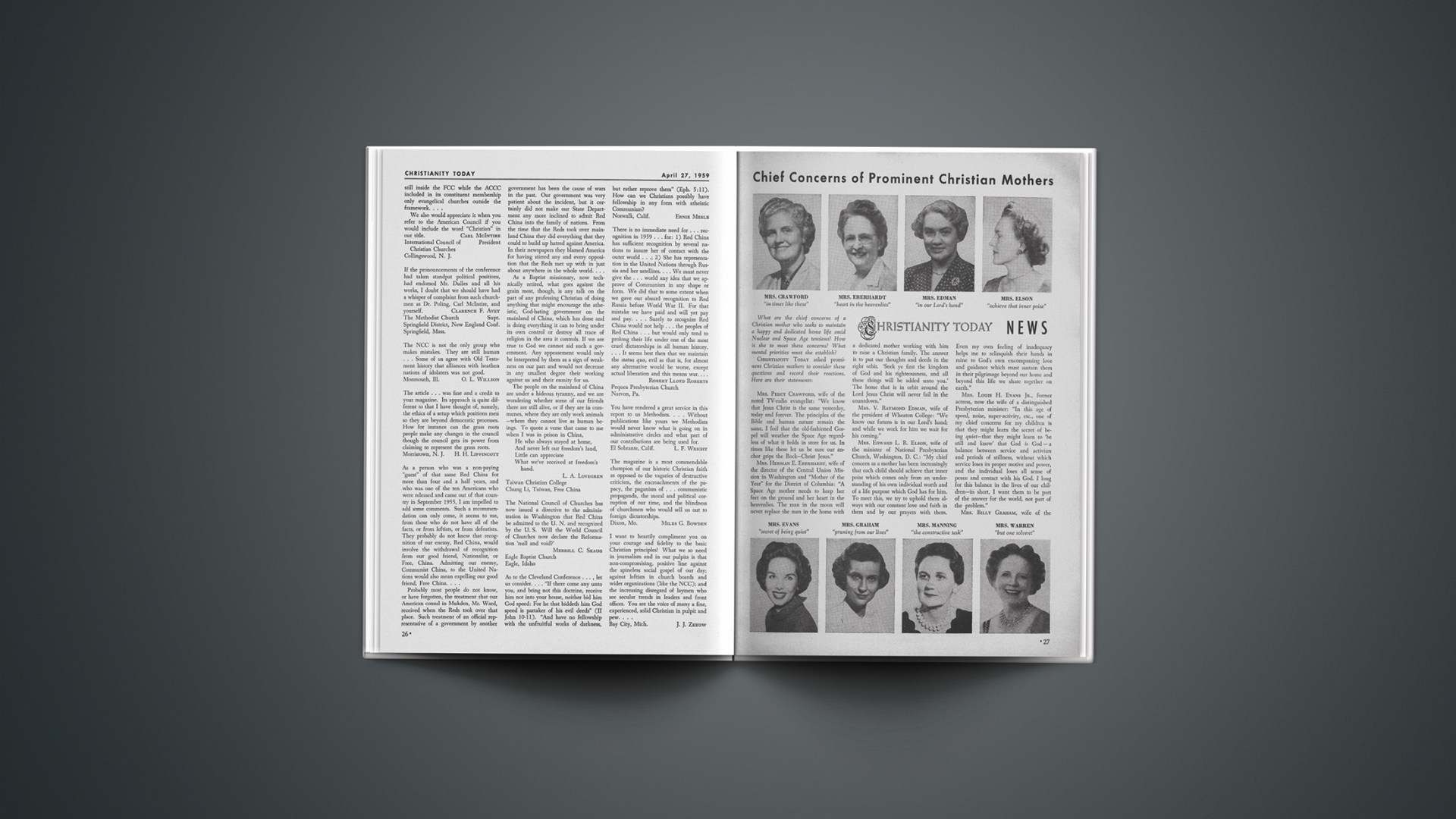
Chief Concerns of Prominent Christian Mothers

NEWS

CHRISTIANITY TODAY

What are the chief concerns of a Christian mother who seeks to maintain a happy and dedicated home life amid Nuclear and Space Age tensions? How is she to meet these concerns? What mental priorities must she establish?

CHRISTIANITY TODAY asked prominent Christian mothers to consider these questions and record their reactions. Here are their statements:

MRS. PERCY CRAWFORD, wife of the noted TV-radio evangelist: “We know that Jesus Christ is the same yesterday, today and forever. The principles of the Bible and human nature remain the same. I feel that the old-fashioned Gospel will weather the Space Age regardless of what it holds in store for us. In times like these let us be sure our anchor grips the Rock—Christ Jesus.”

MRS. HERMAN E. EBERHARDT, wife of the director of the Central Union Mission in Washington and “Mother of the Year” for the District of Columbia: “A Space Age mother needs to keep her feet on the ground and her heart in the heavenlies. The man in the moon will never replace the man in the home with a dedicated mother working with him to raise a Christian family. The answer is to put our thoughts and deeds in the right orbit. ‘Seek ye first the kingdom of God and his righteousness, and all these things will be added unto you.’ The home that is in orbit around the Lord Jesus Christ will never fail in the countdown.”

MRS. V. RAYMOND EDMAN, wife of the president of Wheaton College: “We know our future is in our Lord’s hand; and while we work for him we wait for his coming.”

MRS. EDWARD L. R. ELSON, wife of the minister of National Presbyterian Church, Washington, D. C.: “My chief concern as a mother has been increasingly that each child should achieve that inner poise which comes only from an understanding of his own individual worth and of a life purpose which God has for him. To meet this, we try to uphold them always with our constant love and faith in them and by our prayers with them. Even my own feeling of inadequacy helps me to relinquish their hands in mine to God’s own encompassing love and guidance which must sustain them in their pilgrimage beyond our home and beyond this life we share together on earth.”

MRS. LOUIS H. EVANS JR., former actress, now the wife of a distinguished Presbyterian minister: “In this age of speed, noise, super-activity, etc., one of my chief concerns for my children is that they might learn the secret of being quiet—that they might learn to ‘be still and know’ that God is God—a balance between service and activism and periods of stillness, without which service loses its proper motive and power, and the individual loses all sense of peace and contact with his God. I long for this balance in the lives of our children—in short, I want them to be part of the answer for the world, not part of the problem.”

MRS. BILLY GRAHAM, wife of the world-renowned evangelist: “In the Scriptures God has plainly staked out the course for Christian mothers. My chief concern, or certainly one of my chief concerns, is that of diversion—of being sidetracked from that course. Even legitimate, worthy undertakings, such as house cleaning, community projects, or personal hobbies, can sidetrack one from the main purpose. We have the Guide Book, and we have the Guide—the rest is up to us. It will involve pruning from our lives anything that would tend to divert us from this main purpose.”

MRS. E. C. MANNING, wife of the premier of Alberta, Canada: “A mother’s whole energies are directed toward the constructive task of rearing her children in a sound, consistent Christian atmosphere. So far, the primary emphasis in nuclear research has been destructive. Christian mothers should band together to press for peaceful, constructive uses of nuclear energy.”

MRS. EARL WARREN, wife of the Chief Justice of the U. S. Supreme Court: “In the rearing of their children, every generation of mothers must meet additional problems that growing complexities of the world thrust upon them. But their solution does not call for a new formula. It is the same in the ox cart and the space ages. There is but one solvent—Christian love.”

The Motherly Tribute

The “Mother’s Day” concept has a long history of religious connections which in modern times seem to have been predominantly Christian.

In ancient Greece, the idea of paying tribute to motherhood was given expression with a regular festival tantamount to mother worship. Formal ceremonies to Cybele, or Rhea, the “Great Mother of the Gods,” were performed on the Ides of March throughout Asia Minor.

For Christianity, the concept seems to date back to establishment of England’s “Mothering Sunday,” a custom of the people which provided that one attend the mother church in which he was baptized on Mid-Lent Sunday. Gifts were to be offered at the altar to the church and to worshippers’ mothers. The concept was divorced of any “mother worship,” but nevertheless perpetuated its religious association.

U. S. observance of Mother’s Day, too, has been characterized by church ties from the start. The first general observance of the occasion was in the churches of Philadelphia after Miss Anne Jarvis campaigned for a holiday for mothers more than 50 years ago.

Protestant Panorama

• A Doubleday book published this month, The Power of Prayer on Plants, claims proof that seedlings made the object of prayer were superior to others grown under identical laboratory conditions. Author is Dr. Franklin Loehr, Presbyterian minister and a trained chemist.

• A statement from Clarence House, London residence of the Queen Mother, denied that any religious significance was attached to a call that Princess Margaret and her mother were to make on Pope John XXIII this month.

• Directors of the Lutheran Church—Missouri Synod last month authorized some $2,000,000 worth of construction for their colleges.

• Gordon College says it has received a $25,000 grant from the Kresge Foundation to be applied toward a science laboratory building.

• Portions of the Bible now appear in at least 1,136 languages, according to the American Bible Society.

• Travellers reaching Hong Kong from the mainland report that the Red government is considering appointment of a “pope” to head the schismatic Catholics in Communist China.

• T. G. Peters, Sunday School superintendent of the First Baptist Church in Alice, Texas, attached a green trading stamp to a letter mailed to the congregation’s members. Come to Sunday School, he said, and get two more green stamps for each one received by mail. Attendance rose substantially.

• A 22-foot wooden cross was dedicated in a Youngstown, Ohio, cemetery this month in tribute to the late Rev. George Bennard, who wrote the hymn, “The Old Rugged Cross.”

• The U. S. Post Office Department is authorizing a special slogan cancellation to honor the 50th anniversary of Hesston College, a Mennonite institution. The slogan, to be used on mail at Hesston, Kansas, from May 1 to October 31, reads “50th Anniversary, Hesston College, 1909–59.”

• A new Armed Services Hymnal, seven years in preparation, was being distributed to service chapels this month. Like the Army-Navy Hymnal it replaces, the volume has Protestant, Catholic, and Jewish sections. Much of the music has been transposed to keys appropriate to choirs and congregations of predominately male voices.

• Mrs. Loriana Nunziati Bellandi said this month she will seek a legal separation from the man she married in an Italian civil ceremony which aroused the ire of the Roman Catholic Bishop of Prato. The Bellandi couple subsequently brought slander charges against the bishop.

• Missionaries have legal rights to enter Alberta Indian reserves under a ruling of the provincial Supreme Court. Persons not living on the reservations normally are barred.

• Construction is expected to begin in July on another Southern Baptist college, this one located on a 238-acre site in Louisville, Kentucky.

• The government of South Africa reportedly decided this month to take over all hospitals for non-whites which are located in non-white areas. The move was said to have affected 22 hospitals financed by missions.

• The National Evangelical Film Foundation voted Gospel Films’ “Centerville Awakening” the best movie of 1958.

• Harvard theologian Paul Tillich will lecture on the Galesburg, Illinois, campus of Knox College May 4–13.

• The 40th annual meeting of the Associated Church Press, largest fellowship of U. S. Protestant magazine editors, adopted a resolution registering “concern and protest over the tendency of governmental agencies to hinder the free flow of information between the churches of the United States and other nations.”

• A new $1,623,000 world head-quarters building for the Church of the Brethren was dedicated in Elgin, Illinois, this month.

Continent Of Australia

Coming To Life

It now appears that religious historians will need an extended chapter to properly record Billy Graham’s Australasian crusade of 1959. For thought the American public has heard comparatively little of the developments, there has been nothing to compare with this year’s revival-like enthusiasm “down under”—even when considered in Graham’s own phenomenal background.

Graham’s crusade seems to constitute Australia’s top news story of the season and virtually every daily on the continent is treating it so. But in Graham’s America, where “play” is often proportional to the geographical remoteness of a news story, communications media have generally failed to cover crusade news adequately. Despite the fact that Graham is “good copy” for the overwhelming majority of U. S. editors and TV-radio news directors, coverage has been small compared with the copious reports of, for example, the New York crusade. Yet the New York meetings, inspiring as they were, are far surpassed by the enthusiasm and response in Australasia. Here are the three major steps in Australasia’s coming to life:

—Melbourne saw a four-week crusade that drew an aggregate attendance of 719,000 and produced 26,400 decisions for Christ. The final meeting with between 135,000 and 150,000 was a record attendance in Christian evangelism.

—An abbreviated New Zealand campaign concentrated on just three cities in ten days, but attracted a total of 355,000, 15,982 of whom stepped forward to make commitments to Christ.

—A month-long crusade in Sydney, Australia’s largest city, began with a Sunday afternoon meeting attended by 50,000, largest opening day crowd Graham has ever experienced. At that service, more than 3,000 made decisions, also a record for the opening day of a Graham campaign.

North Americans can follow Graham’s current meetings most directly via hour-long weekly telecasts.

The outreach of Graham’s messages has been extended through the use of “landlines,” telephone cables which enable groups across the country to hear the meetings. “Landlines” were used in New Zealand and were to be set up this week for the remainder of the Sydney crusade.

The opening meeting on April 12 was chaired by the governor of New South Wales, Lieutenant General Sir Eric Woodward, joined on the platform by leaders of all major denominations.

More than 500 buses and thousands of cars jammed streets around Sydney Showground, site of the rally. The day began with overcast skies and showers, but these gave way to an afternoon of brilliant sunshine.

Graham’s text was John 3:16. Great international problems, he said, are “refractions of our personal problems.”

At Carlaw Park

“ ‘He made them sit down in flower beds,’ says the Greek text in one account of the feeding of the five thousand. It looked like that.”

So E. M. Blaiklock, CHRISTIANITY TODAY correspondent in New Zealand, described Billy Graham’s initial appearance at Carlaw Park in Auckland. Here are Professor Blaiklock’s impressions:

“The white mass of the choir, 2,000 strong, filled the wooden grandstand. A multi-colored 15,000 made a human mountain slope in the huge concrete stand. Another sweep of humanity covered the grass of the railway enbankment. And the ground itself, filled with seating, was a sea of men and women. A fifth of the city’s population was there, 60,000 in all.

“I became aware of a strangely thrilling portent. The sky was smeared with cloud, but two stars broke fire, the glittering pair of the Pointers, which carry the eye to the great constellation of this hemisphere, the Southern Cross. Then we watched fascinated as a patch of cloud thinned—and there was the Cross! It hung there for half an hour, the four stars of the Cross and the two Pointers, with no other star visible. It was a moving sight.

“Graham did precisely what the heavenly sign portended. He pointed men to Christ, passionately, compellingly, with Bible in hand and God’s Word lacing his speech. The mighty crowd listened like one man. Then came the invitation, and the people began to move. From far and near they filed down, leaving patches of green showing on the embankement, thinning the plank seats on the ground. Three thousand, seven hundred, another Pentecostal harvest, crowded the space before the rostrum. I bowed my head and remembered how I used to state with confidence that mass conversion was a vanished phenomenon, and the era of revival past. May God who taught us this week to ‘mount up with wings as eagles’ teach us in the months ahead to ‘run and not be weary, to walk and not faint’.”

Near East

Leaving Iraq

The first report on evacuation of Protestant missionaries from Iraq said 14 of them had been forced to leave. Another eight or ten were said still to be somewhere in Iraq, according to the report received early this month by an agency of the National Council of Churches.

Dr. Barnerd M. Luben, chairman of the Near East committee of the NCC’s Division of Foreign Missions, said that no reasons have been given by the government for expulsion of the missionaries. “We believe they are political,” he noted.

Luben said a compound has been confiscated which includes a hospital, a church, and four missionary residences. According to him, the property is to be converted into a public park.

The United Mission in Iraq makes up the country’s chief Protestant witness. Churches cooperating in the mission are the United Presbyterian Church in the U. S. A., the Presbyterian Church in the U. S., the Evangelical and Reformed Church, and the Reformed Church in America.

Religious News Service estimates the Christian community in Iraq as a very small part of the total population of 5,000,000. Roman Catholics are said to number about 200,000 and Protestants hardly more than 2,000.

The Bible And Israel

Tribute to the key role of the Bible in the colonization and modern development of Israel was paid this month by Premier David Ben-Gurion.

“But for the Bible, Israel would never have returned to its land,” Ben-Gurion told a Bible study congress.

“No book,” he declared, “has ever exerted such influence on any nation as the Bible has on Israel.

Farmers mingled with clergymen and statesmen among the 1,500 delegates.

The congress, sponsored by the Israel Society for Biblical Research, was devoted to lectures and discussions on the books of Jeremiah and Ezekiel. The congress is an annual event.

Dominion Of Canada

On Second Thought

Have British Columbia’s troublesome “Sons of Freedom” Doukhobors changed their minds about returning to Siberia?

In an unprecedented move early this month, the fanatical sect invited to a meeting Royal Canadian Mounted Police officers. A brief handed the RCMP, according to one source, indicated that their year-old plan to return to their homeland had been called off.

During the meeting, about a dozen men and women disrobed. Nude parades are well-known to “Sons,” sect members claiming that nudism is a religious symbol of equality before God. The “Sons” have defied governmental authority repeatedly, calling themselves pacifists even while setting off bombs and burning property. They claim they have been persecuted in Canada.

When news of their cancelled migration appeared, the sect branded it a distortion of the facts and wired a denial to the Russian embassy in Ottawa.

Doukhobors, natives of Russia, moved to western Canada about 50 years ago.

United States

Religious Preamble

West Virginians next year will vote to ratify or reject a religious preamble to the state constitution.

The legislature-approved preamble reads: “Since through Divine Providence we enjoy the blessings of civil, political and religious liberty, we, the people of West Virginia, in and through the provisions of this Constitution, reaffirm our faith in and constant reliance upon God and seek diligently to promote, preserve and perpetuate good government in the State of West Virginia for the common welfare, freedom and security of ourselves and our posterity.”

Hopeless Cause?

Is anti-alcohol legislation a hopeless cause?

The question took on new prominence this month when citizens of Oklahoma voted to legalize liquor sales. The repeal left Mississippi as the only state where “hard liquor” is sold in violation of state law.

“It’s a temporary setback,” said Clayton M. Wallace, executive director of the National Temperance League, “but we were not surprised.” He declared that the wets’ victory could be attributed to well-financed use of mass communications media. More money is being poured into liquor advertising, he added, because the industry is concerned that increases in alcohol consumption have not kept pace with the population rise.

Wallace called for greater use of mass media by temperance forces and more activity at grass roots level in support of local option laws.

Eutychus and His Kin: April 27, 1959

G.G., B.G., & M.G.

According to our newsmagazine, Good Guys and Bad Guys are part of a TV myth that is disappearing. Soon existential man will be in the saddle. He shares in a larger identity of Good and Evil, and is neither hero nor villain. He is more than a myth, a Free Man. As I remember Olympus, the myths were not too strong on pure types of Good and Evil. Modern thinkers will make the mythical purely good to make the purely good mythical.

Western writers may need help in building up this mixed hero/villain to the point where kids will buy his autographed cap pistols. Perhaps he should be introduced between the G.G. and the B.G. and the M.G. (mixed, muddled, modern).

Scenario for M.G.

B.G. These knots is tight. You won’t get out of this. Light the fuse, M.G.!

G.G. (Gagged) Awg … ahlwahch!

M.G. Why don’t you tie me up too?

B.G. Like to oblige, but I need ya on my next job, M.G. Light the dynamite!

G.G. (Still gagged) See above.

M.G. You’re a dynamic man, B.G., but are you as free as you think? Why must you kill? You’re punishing yourself!

B.G. You got it wrong, kid. You’re the dynamite man in this outfit. And I ain’t killin’ G.G. You are. Light the fuse or I’ll ventilate ya.

M.G. Certainly. I was just looking for a match. You know I’m your partner. But couldn’t we take the gag out? No one will hear him in this abandoned mine. Besides your mortido urge …

B.G. Okay, okay. Take out the gag. Here! Now let me bung that big mouth of yours. There. Now light that fuse!

G.G. While that fuse burns, B.G., I want to say I never knew you salted the mine.

B.G. Why then … M.G., you rat … I will lace you up too, pardner! Gotta hurry. Keep still, or I’ll … WHOOM! BOOOOM! (etc.)

G.G. That was a break. I must have been blown clear up the air shaft.

B.G. (Muffled) Help!

G.G. You too! Here, I’ll drop this rope down to you. Where’s M.G.?

B.G. He’s done for. All mixed up, kinda.

G.G. Maybe it’s better that way. C’mon, hombre, I’m takin’ you to the sheriff.

SECOND TO NONE

Permit me to thank you very much for the magnificent statement of justification (Mar. 16 issue). I try to keep up with the best in the Reformed and in the Lutheran writings on this significant matter, and the article by Dr. Packer is second to none! It has my hearty amen! Our students here are grabbing up the issue … like hot cakes. Thanks be unto God for his great grace which justifies us sinners per fidem propter Christum.

Columbia Theological Seminary

Decatur, Ga.

COMING OR GOING?

Have just read your editorial comment on Markus Barth’s The Broken Wall in which he breaks down the wall between heaven and hell (Mar. 16 issue). As far as I am concerned, your analysis is well taken. I have always supposed that the purpose of preaching was to persuade sinners to enter into the ark, not to prevent them from jumping out of it.

Fuller Seminary

Pasadena, Calif.

EASTER POETRY

I don’t know who Rod Jellema is, but I have a feeling that this writer knows Barabbas and Mary Magdalene (Mar. 16 issue). Here is the kind of insight and poetic ability that warms the heart and kindles the mind of the reader. I hope sometime that the writer will give us something on John the Baptist, Paul, and John the Apostle.

Superintendent

The Akron District

North East Ohio Conference

The Methodist Church

Akron, Ohio

I read the Easter poems by Rod Jellema … and liked them.

Grand Rapids, Mich.

I am wondering … if you … carefully read this poem before it was accepted. If so, my disappointment and distress are increased.

Staten Island, N. Y.

Very literary and beautifully constructed verses.…

Newark, N. J.

NO OFFICIAL VIEW

I should like to correct a misconception fostered by Harold B. Kuhn in the first paragraph of his article, “Christian Surrender to Communism” (March 2 issue). He clearly states that “a segment of the (Central) Committee” of the World Council of Churches “went on record as favoring a free world surrender on the terms of the enemy in case of a threat of hydrogen warfare.” The fact is that this particular sentiment was advanced in a minority report by certain members of the Commission on “Christians and the Prevention of War in an Atomic Age—a theological discussion.” A majority of the members of the Commission were unable to accept this position, as the principal text of the document makes clear.

The Commission had been appointed by the Central Committee of the World Council, but no member of the Central Committee was himself a member of it. When the document came before the meeting of the Central Committee at Nyborg, Denmark, last August, the Executive Committee finally took the following action with respect to it: “The ensuing statement is but a first-step in a continuing study process. It is offered to the churches for their reflection and discussion. No point here expressed is to be understood as an official view of the World Council of Churches. This document is in no sense a statement of World Council policy. The statement is that of a contribution to Christian research and inquiry on a vital issue of our time.” The World Council of Churches has no control over a Commission, composed mostly of distinguished theologians asked by it to address itself to a particular question. By the same token, no statement that results can be construed as an official interpretation of the views or policies of the World Council of Churches, unless it is adopted as such by the appropriate body of the World Council itself. The Divinity School

Yale University

New Haven, Conn.

PROTESTANT WITNESS

I should be sorry … if any of your readers were left with the impression that … the Protestant Pavilion at the Brussels World’s Fair … was not a very strong witness for Protestantism (Nov. 24 issue, p. 31).… It was seen by every visitor to the fair. Since the walls of the chapel were of glass, even passers-by were aware of the services of worship and other activities which were constantly being held. Ten to fifteen million people visited the Pavilion.… One of the greatest surprises to everyone was the very large number of Roman Catholic priests and nuns who visited the Pavilion and asked many questions.… Pastor Pieter Fagel, the director of the Pavilion, said that he was convinced that this was the most effective piece of evangelism that was being carried on in any part of the world during those months.…

Washington, D. C.

SOCIAL PERSPECTIVE

I was especially interested in your article “Perspective for Social Action” (Jan. 19 issue). Thank you for the clear interpretation you gave of past interest in this field. I found it stimulating.

First Methodist

Belzoni, Miss.

NCC

Your article “Why Is NCC Prestige Sagging?” is a masterpiece! It is sensibly presented, precisely stated, and justifiably critical. Your diagnosis and prescription for Protestant ecumenism in America are at once safe, sane, and scriptural.

Cooper Avenue Baptist Church

Yuba City, Calif.

Did you call the attention of your readers to the fact that the vote of the Conference, two thirds of whose members were laymen (and of all of whom were expected to express their own opinions and not seek to represent the National Council of Churches), included two conditions which would have to be met before any approach would be approved to recognition of China? The first was the security of Formosa; the second was the security of South Korea.… You and other critics of the National Council have completely committed yourselves apparently to the idea that the only kind of Study Conference the National Council should hold would be one whose decisions were dictated to it or whose conclusions were repudiated if they did not agree with the predetermined views of the body responsible for the Conference.

Missions Council of the Congregational Christian Churches

New York, N. Y.

The Cleveland Conference on World Order, convened by National Council mandate, does not speak for all of its affiliated churches. I do not conceive that to be its purpose. Its purpose is rather to speak to those churches.

First Christian

Alhambra, Calif.

If the denominations did not send the right delegates to the study conference, that is not the fault of the NCC. It is possible that some denominations are not so organized that they can send delegates representing the diverse viewpoints within that denomination.

Wheaton, Ill.

Probably overlooked by many who register their disapproval of the Cleveland Conference is the fact that most of the 600 delegates had studied the facts and had a better knowledge of all the facts at issue than most people.

St. James Evangelical and Reformed

Saline, Mich.

Each issue of CHRISTIANITY TODAY is worse, in that you seem to have been captured by those who have no other purpose than to malign the National Council of Churches.

St. Paul’s United Church of Christ

Petersburg, Ill.

Nothing but wholesale condemnation.…

Philadelphia, Pa.

Could charity have written the paragraph “Tilting to the Left?” Is there no place in Christian journalism for love?

St. Andrew’s Episcopal Church

Durham, N. C.

The big difference between these two groups at their formation and through the years has been that the NAE refused to call for separation from the FCC while the ACCC did, and the NAE included in its membership evangelical churches still inside the FCC while the ACCC included in its constituent membership only evangelical churches outside the framework.…

We also would appreciate it when you refer to the American Council if you would include the word “Christian” in our title.

President

International Council of Christian Churches

Collingswood, N. J.

If the pronouncements of the conference had taken standpat political positions, had endorsed Mr. Dulles and all his works, I doubt that we should have had a whisper of complaint from such churchmen as Dr. Poling, Carl McIntire, and yourself.

Supt.

The Methodist Church

Springfield District, New England Conf.

Springfield, Mass.

The NCC is not the only group who makes mistakes. They are still human … Some of us agree with Old Testament history that alliances with heathen nations of idolaters was not good. Monmouth, Ill.

The article … was fine and a credit to your magazine. Its approach is quite different to that I have thought of, namely, the ethics of a setup which positions men so they are beyond democratic processes. How for instance can the grass roots people make any changes in the council though the council gets its power from claiming to represent the grass roots.

Morristown, N. J.

As a person who was a non-paying “guest” of that same Red China for more than four and a half years, and who was one of the ten Americans who were released and came out of that country in September 1955, I am impelled to add some comments. Such a recommendation can only come, it seems to me, from those who do not have all of the facts, or from leftists, or from defeatists. They probably do not know that recognition of our enemy, Red China, would involve the withdrawal of recognition from our good friend, Nationalist, or Free, China. Admitting our enemy, Communist China, to the United Nations would also mean expelling our good friend, Free China.…

Probably most people do not know, or have forgotten, the treatment that our American consul in Mukden, Mr. Ward, received when the Reds took over that place. Such treatment of an official representative of a government by another government has been the cause of wars in the past. Our government was very patient about the incident, but it certainly did not make our State Department any more inclined to admit Red China into the family of nations. From the time that the Reds took over mainland China they did everything that they could to build up hatred against America. In their newspapers they blamed America for having stirred any and every opposition that the Reds met up with in just about anywhere in the whole world.…

As a Baptist missionary, now technically retired, what goes against the grain most, though, is any talk on the part of any professing Christian of doing anything that might encourage the atheistic, God-hating government on the mainland of China, which has done and is doing everything it can to bring under its own control or destroy all trace of religion in the area it controls. If we are true to God we cannot aid such a government. Any appeasement would only be interpreted by them as a sign of weakness on our part and would not decrease in any smallest degree their working against us and their enmity for us.

The people on the mainland of China are under a hideous tyranny, and we are wondering whether some of our friends there are still alive, or if they are in communes, where they are only work animals—where they cannot live as human beings. To quote a verse that came to me when I was in prison in China,

He who always stayed at home,

And never left our freedom’s land,

Little can appreciate

What we’ve received at freedom’s hand.

Taiwan Christian College

Chung Li, Taiwan, Free China

The National Council of Churches has now issued a directive to the administration in Washington that Red China be admitted to the U. N. and recognized by the U. S. Will the World Council of Churches now declare the Reformation ‘null and void?’

Eagle Baptist Church

Eagle, Idaho

As to the Cleveland Conference …, let us consider.… “If there come any unto you, and bring not this doctrine, receive him not into your house, neither bid him God speed: For he that biddeth him God speed is partaker of his evil deeds” (2 John 10–11). “And have no fellowship with the unfruitful works of darkness, but rather reprove them” (Eph. 5:11). How can we Christians possibly have fellowship in any form with atheistic Communism?

Norwalk, Calif.

There is no immediate need for … recognition in 1959 … for: 1) Red China has sufficient recognition by several nations to insure her of contact with the outer world …; 2) She has representation in the United Nations through Russia and her satellites.… We must never give the … world any idea that we approve of Communism in any shape or form. We did that to some extent when we gave our absurd recognition to Red Russia before World War II. For that mistake we have paid and will yet pay and pay.… Surely to recognize Red China would not help … the peoples of Red China … but would only tend to prolong their life under one of the most cruel dictatorships in all human history.… It seems best then that we maintain the status quo, evil as that is, for almost any alternative would be worse, except actual liberation and this means war.…

Pequea Presbyterian Church

Narvon, Pa.

You have rendered a great service in this report to us Methodists.… Without publications like yours we Methodists would never know what is going on in administrative circles and what part of our contributions are being used for.

El Sobrante, Calif.

The magazine is a most commendable champion of our historic Christian faith as opposed to the vagaries of destructive criticism, the encroachments of the papacy, the paganism of … communistic propaganda, the moral and political corruption of our time, and the blindness of churchmen who would sell us out to foreign dictatorships.

Dixon, Mo.

I want to heartily compliment you on your courage and fidelity to the basic Christian principles! What we so need in journalism and in our pulpits is that non-compromising, positive line against the spineless social gospel of our day; against leftists in church boards and wider organizations (like the NCC); and the increasing disregard of laymen who see secular trends in leaders and front offices. You are the voice of many a fine, experienced, solid Christian in pulpit and pew.…

Bay City, Mich.

Bible Book of the Month: The Song of Songs

“Almost anything can be read into any book if you are determined enough,” C. S. Lewis recently observed. Commenting on interpretations suggested for his own fantastic fiction he added: “Some of the allegories thus imposed on my books have been so ingenious and interesting that I often wish I had thought of them myself” (Reflections on the Psalms, 1958, p. 99).

If you cock your ear just right perhaps you will detect afar off a chuckle and the “Amen” of the author of the Song of Songs. He has had his troubles with the interpreters too. In fact, “there is no book of the Old Testament which has found greater variety of interpretation than the Song of Songs” (H. H. Rowley’s opening remark in his helpful chapter, “The Interpretation of the Song of Songs,” The Servant of the Lord, 1952, pp. 189–234). What seems at first bewildering but after a while amusing too is that most of these utterly contradictory interpretations come with a manufacturer’s guarantee that each claims to be the one and only understanding of the book which the totally unbiased reader can reach! Naturally the interpretation offered in this article does not lack such an endorsement—except that one enlightened prejudice is admittedly presupposed, the prejudice of recognizing that the Song of Songs is an inspired revelation of the God of truth. But then a prejudice one way or the other on that subject is unavoidable.

The Literary Genre

The particular literary form an author selects as the vehicle of his message can be the most important single clue to his true intent.

1. Love Song: It is being more and more recognized as archaeological discovery enlarges our library of ancient literature that the biblical Song was not a novel literary phenomenon in the world in which it appeared. In its general framework and in numerous individual motifs and metaphors it is seen to be stylistically similar to what is found in ancient love lyrics. An Egyptian love poem, found on one of the Chester Beatty papyri dating about 1100 B.C., consists of seven cantos in dialogue form with the lovers addressing each other as “brother” and “sister” (For a partial translation see J. B. Pritchard, Ancient Near Eastern Texts, 1950, pp. 468, 469). There are enough parallels to Canticles in structure, situation, and imagery in such love songs of the New Empire in Egypt to convince W. F. Albright that they “demonstrate the Egyptian origin of the framework of Canticles” (Archaeology and the Religion of Israel, 1942, p. 21). Other scholars are more impressed with parallels to the Song found elsewhere in Near Eastern or in primitive love poetry.

One variety of love song is the epithalamium or wedding song. From the time of Origen many have held that Canticles was composed for the occasion of Solomon’s wedding to Pharaoh’s daughter (1 Kings 3:1) and from the end of the seventeenth century expositors have tried to explain the character of the Song in terms of customs followed at ancient Jewish marriage festivals. In 1873 J. Wetzstein published his study of the marriage-week customs of modern Syrian peasants, and directed attention to the facts that bridegroom and bride played the roles of “king” and “queen,” a mock throne being set up on the threshing floor; that poems of praise (wasf) were sung extolling their physical beauty; and that on occasion the bride performed a sword dance. The obvious comparisons were then drawn with Canticles where the hero is several times called “king,” the lovers repeatedly sing the praises of each other’s charms, and the Shulammite maiden performs a dance (7:1 ff.). Efforts were made too to demonstrate that the Song was composed of seven parts, one for each day of the wedding week, but with little success.

Critics of the epithalamium view have questioned both the existence of such a “king’s week” among the Arabs in Palestine and the reliability of modern Syrian practices as a guide to Judean wedding customs of the first millennium B.C.

They also argue that some of the poetry in Canticles is clearly prenuptial and that even the wasf type of song was not confined to wedding festivals. Furthermore there is an obvious reason for calling the hero “king” (1:4, 12; 7:5) if he is “king Solomon” (3:9, 11) and his beloved, it must be noted, is never designated “queen.” Certainly she is not a princess from Pharaoh’s court but a maiden from the village of Shunem.

R. Gordis in his excellent study, The Song of Songs (1954), seeks to meet some of these criticisms of the relevance of the “king’s week” (p. 17); but he too joins the majority of those who regard Canticles as love poetry in concluding that it was not composed for a wedding but is an anthology of various types of love songs—“songs of love’s yearnings and its consummation, of coquetry and passion, of separation and union, of courtship and marriage” (p. 18).

2. Drama: In the eighteenth and especially the nineteenth centuries the view was developed and popularized that Canticles was dramatic in structure. The beginnings of this view were much earlier. Origen, for example, considered it “a nuptial poem composed in dramatic form” and Milton called it a “divine pastoral drama.” Extremists treated the Song as a theatrical piece actually intended for the stage. In this they succeeded more in displaying a flair for creating musical comedies than in manifesting a gift for exegeting ancient texts. But nineteenth century exegetes of the calibre of Franz Delitzsch, H. Ewald, and S. R. Driver also championed the dramatic view of the Song and this approach continues to enjoy some support in our century.

The dramatists are divided over the question of whether the Shulammite’s true love is Solomon or a rustic lover to whom she remains faithful in a triumph of pure love over the seductions of Solomon’s royal court. The second plot obviously has greater dramatic tension and that perhaps is why it is the more popular; but it has little else to commend it.

Critics of the dramatic view correctly observe that full-fledged drama was unknown among the Hebrews or the Semites in general; some of them also protest, but incorrectly, that the Song cannot be a drama because it is not a literary unity. The real question vis-a-vis sober proponents of the dramatic view is whether Canticles traces the love of Solomon and the Shulammite through a temporal sequence of scenes from courtship to their wedding and marriage life.

Expounding the thesis that such a sequence does emerge in the Song, Delitzsch locates the wedding in the third of six acts. The successive acts end at 2:7; 3:5; 5:1; 6:9; 8:4; and 8:14. Each act is divided into two scenes, the first scenes ending at 1:8; 2:17; 3:11; 6:3; 7:6; and 8:7. Hand in hand with the temporal sequence Delitzsch traces a thematic movement: “Solomon appears here in loving fellowship with a woman such as he had not found among a thousand (Eccles. 7:28); and although in social rank far beneath him, he raises her to an equality with himself.… We cannot understand the Song of Songs unless we perceive that it presents before us not only Shulamith’s external attractions, but also all the virtues which make her the ideal of all that is gentlest and noblest in woman.… Solomon raises this child to the rank of queen, and becomes beside this queen as a child. The simple one teaches the wise man simplicity … [he] wanders gladly over mountain and meadow if he has only her” (Commentary on The Song of Songs, Keil and Delitzsch series, 1950 ed., p. 5).

Though not persuaded by A. Bentzen’s contention that the many possibilities advanced to explain the book as a drama prove its impossibility (Introduction to the Old Testament, II, 1949, p. 181), the present writer is not convinced that the scenic-chronological structure has been satisfactorily demonstrated. The criticism that the dramatic view is almost as guilty of eisegesis as the allegorical view goes much too far; but it does seem to contain an element of truth.

It is a virtue of the dramatic view that it recognizes the unity of the Song. That unity, however, is unfolded in cyclical rather than chronological fashion. The divisions suggested by Delitzsch for his six acts mark the bounds of these cycles; observe, for example, the recurring opening and closing refrains of these divisions. Within each of these cycles the dominant love motif is that of longing and fulfillment. Each cycle closes with the satisfaction or consummation of love. Even though the Song is not structurally a drama, this recapitulated theme of seeking and finding does impart to it a certain dramatic quality.

3. Cultic Liturgy: In the present century the theory has appeared that Canticles is a liturgy belonging to the widespread Near Eastern cult of the dying and reviving god. This is part of the current fad of discovering cultic vestiges everywhere in the Old Testament. The interpretation rests primarily on alleged terminological similarities to the Song in extant texts of the fertility cult and on corresponding ritual themes in the cult, such as the goddess’ search for and finding of the slain god and the sacred marriage. Proponents disagree as to the extent, if at all, that the original pagan liturgy was camouflaged to make it acceptable in the cult of Yahweh.

The Old Testament indicates that apostate Israelites, whoring after pagan deities, engaged in the rites of the Tammuz cult. But those who share the prejudice concerning the Song acknowledged earlier cannot entertain it as a serious possibility that the covenant God adopted as a legitimate element in the worship of his name a liturgy from such an idolatrous source with all its sexual associations. Suffice it then that the great majority of all scholars is unconvinced by the liturgy theory and that it has been effectively criticized by Eissfeldt, Rowley, and others. Bentzen suggests that the ancestry of love songs as a literary form may in part be found in the ritual of the hieros gamos, just as T. Gaster traces the drama through the medium of myth to cultic ritual. If so, the liturgy theory contributes something to the history of the literary genre represented by our Song, but it still contributes nothing as an interpretation of the Song itself.

Allegorical Or Natural

Beyond the question of the literary genre of Canticles, but certainly not divorced from it, lies another issue which concerns our understanding of the book as a whole: To allegorize or not to allegorize?

1. Allegorical: That the Song deals primarily with human love, the mutual love of a man and a maid, is the least that must be deduced from the facts that it is cast in the mold of ancient human love poetry and confronts us with the human figures of Solomon and the Shulammite as the lover and the beloved. But is there warrant for seeking a second message hidden in the Song, one concerned with the mutual love of God and his people?

As is well known the allegorical approach is ancient. Mishnah, Talmud, and Targum treated the Song as an allegory of Yahweh’s dealings with Israel. From Judaism the allegorization of the Song passed over into Christianity, the Church as bride of Christ replacing Israel as the beloved. The later popularity of the allegorical method is reflected in the chapter headings assigned to Canticles in the Authorised Version.

The allegorists are not, of course, agreed on particulars. Some, for example, interpret Solomon’s beloved not as the Church but as Wisdom; others, as his kingdom of loyal subjects. Indeed, there is no limit to the plausible possibilities. And there is the rub! Anyone with a knack for autosuggestion can readily convince himself that his latest flight of fancy is the true decipherment of the Song’s esoteric sense.

Is there, however, amid all the allegorical abuse a proper, verifiable, allegorical use of the Song? The most cogent argument for allegorizing Canticles is the alleged analogy of Psalm 45. This Psalm is an extended metaphor picturing Messiah and his bride, the Church, under the imagery of an ancient royal wedding such as the Psalmist might have witnessed in the court of one of David’s successors.

There are, however, decisive differences between Canticles and Psalm 45. The Song speaks about king Solomon and a particular woman from Shunem. The Psalm describes directly a divine king in language which would be utterly extravagant if intended for any merely human king of Israel. Nothing in the historical narratives of the Old Testament supports the idea that the flamboyantly flattering oriental court style was adopted in Israel. Psalm 45, therefore, does not provide an analogy for a royal epithalamium with a double meaning. It is moreover most important to observe that in Psalm 45 and in every other biblical passage where the figure of marriage is used to depict the covenantal relationship of God and men the context leaves no doubt that such is the meaning. But there is not even the slightest hint anywhere in Canticles that it was intended as an allegory of things divine. Finally, the Song differs from Psalm 45 and all other alleged biblical parallels in that the Song abounds in detailed praises of the two lovers’ bodily charms and in allusions to the intimacies of conjugal love. As a song of human love this might surprise the modern Western reader of holy Scripture but it should not offend him. To interpret such imagery as a song of God’s relationship to his people, however, appears to involve irreverence. Certainly it ignores the care manifested everywhere else in biblical anthropomorphism to avoid attributing to the holy One of Israel the erotic passions and sexual functions characteristic of the gods of pagan mythology. Observe by way of contrast to the Song the restraint exercised in carrying out the nuptial metaphor in the Messianic Psalm 45.

2. Typical: There is another view, the typical, which would also find a Messianic meaning in Canticles. But whereas an allegorist might ignore the natural meaning of the language, esteeming the mystical meaning as the only message of the Song, the typologist must always insist there is a double meaning—a typical and an antitypical. The typologist shares the allegorist’s appeal to the biblical use of marriage as a literary figure for Christ’s relationship to his Church, but the typical view, as its name implies, appeals particularly to the historical status of Solomon as a type of Christ. Typologists differ further from the allegorists in not groping after a mystical reinterpretation of every detail in the Song. They are satisfied to discover a more general correspondence between type and antitype.

The fallacy in the typical view is that while Solomon in his royal office typified the kingship of Christ, nothing in Scripture justifies our regarding all and sundry aspects of Solomon’s life as divinely appointed historical types. Certainly Solomon’s love relationship with one or all of his wives was no more a Messianic type than the marriage life of any other Israelite or Gentile. Since then the supposed typical elements in the Song are illusory, the typical view is not a genuine option. The only real alternatives are the allegorical and the natural.

3. Natural: “Natural” is preferable to “literal” as a designation for the correct interpretation of Canticles since “literal” is liable to suggest a lack of appreciation for the Song’s erotic symbolism.

This view, though only in modern times enjoying ecclesiastical respectability, can be traced as far back as the evidence for the history of interpretation goes. And why should the Church stumble at the presence in her inspired canon of a song extolling the dignity and beauty of human love and marriage? Considering how large the subject looms in the attention of men, had it not been remarkable if there were not such an extended treatment of it in the volume God has given us for “reproof, for correction, for instruction in righteousness”? And all the more so when we think how sordid is the world’s attitude towards the matter and how dim had become even the Old Testament saint’s apprehension of the paradisaic ideal of marriage. Thus understood, Canticles unites with the other poetical books of the Old Testament in displaying the inspired fruits of godly reflection upon the Law and especially in eliciting the relevance of the Law for the great issues of human life.

The heading assigns the authorship to Solomon and there is no compelling reason for not regarding this certainly very ancient tradition as an original part of the inspired text. Advocates of the love song view often treat Canticles as an anthology of poems by many authors but Rowley has well observed: “The repetitions that occur leave the impression of a single hand, and there is a greater unity of theme and of style than would be expected in a collection of poems from several hands, and from widely separated ages. It is probable, too, that there is artistry in the arrangement of the pieces” (op. cit., pp. 212, 213).

There is a puzzle of the selection of the Israelite most notorious for his departure from the marriage ideal to compose the biblical tribute to true love and this is not solved by facetious remarks about Solomon’s superior experience in the arts of love. More helpful is the consideration that the arts of poetry and song were branches of Wisdom and the wisdom of Solomon needs no introduction (cf., 1 Kings 3:5 ff.; cf. 4:32).

That, however, does not solve the enigma of why Solomon of all people should be this Song’s hero as well as its author—which raises the problem of historicity. Now it should be observed that the personal perspective in the Song is consistently that of the beloved, not of the king (cf., e.g., 2:10; 5:2). If, therefore, Solomon (or for that matter, anyone other than the Shulammite herself) is the author, Canticles is, as Ecclesiastes seems to be, fictionally autobiographical. Such a fictional literary garb permits that the historical element consists in little more than that one of Solomon’s favorites was from Shunem. The mutual love of the king and this Shulammite would then have been freely adapted to the ideal, and idyllic design of the Song and this would explain the purity of the affections of the Song’s king Solomon, as well as his romantic shepherd’s role.

If this is so, the choice of Solomon as hero is not enigmatic but indicative of Canticles’ Edenic milieu. With true insight the poet Herder observed: “The Song is written as if in Paradise. Adam’s song: Thou art my second self! Thou art mine own! echoes in it in speech and interchanging song from end to end.” In the unfolding divine plan of redemptive history God appoints Canaan to his people Israel as an earnest of Paradise regained. And who better than Solomon—not in his personal but official character and glory as theocratic king set over the paradisaic land of milk and honey—to recall Adam, vicegerent over the garden of God?

The Song confronts us with love as it was in the beginning and it lets us hear again the divine marriage benediction first addressed to the lover and his beloved in man’s home primeval (Gen. 1:28a). What the incarnate Word did for the sanctity of marriage by his presence at the Cana wedding, the written Word does by dwelling with joy upon conjugal love in the Song of Songs.

MEREDITH G. KLINE

Assistant Professor of Old Testament

Westminster Theological Seminary

Ideas

Christianity and Our Freedoms

Christianity Today promotes the meeting of contemporary life with the eternal Christ.

Each fortnight the magazine’s message is centered in the great doctrines and precepts of the Bible. Its forty pages are devoted to biblical theology … biblical ethics … biblical evangelism … biblical studies. Its witness is dedicated unreservedly to Jesus Christ as the incarnate, crucified, risen, ascended and exalted Redeemer, the world’s only Saviour and Lord.

For this very reason CHRISTIANITY TODAY touches all the major areas of modern life. The timeless truths of revealed religion hold vital relevance for the swift-moving scenes of our fast-ebbing century.

The great struggle between law and injustice, bondage and liberty, war and peace tenses these taut times. God’s sovereignty and man’s spirituality are neglected priorities of our era. What message is more vital, more urgent, than the revelation of redemption and life in the midst of modern sin and death?

Freedom is a basic concern of our century. Freedom comes from above, not from below; God is its living source. “So if the Son makes you free, you will be free indeed” (John 8:36, RSV). And freedom is one—not many. The splintering of freedom into many fragments—religious, political, economic—is the first blurring of Jesus Christ as Lord of life. All human liberties depend in a crucial way upon the fate of revealed religion in this generation.

If Jesus Christ is Lord, religious freedom is a divine imperative: man dare not be compelled to worship false gods, and must be free to worship his true God. If Jesus Christ is Lord, political freedom is a divine imperative: state absolutism (or totalitarian government) is condemned, and every state is properly limited in its powers. If Jesus Christ is Lord, economic freedom is a divine imperative: no welfare state (the half-way house to socialism) is to restrict man’s responsible stewardship of his talent in the earning of his bread, nor to preclude his good and wise use of his own wealth as a spiritual trust.

The loss of man’s freedoms, the rise of the all-powerful modern state, the neglect of the Living God—these developments stand intrinsically connected. The totalitarian state is neither conducive to Christianity nor tolerant of it. Communism perpetuates its doctrine of state absolutism by its assault on supernaturalism and by tolerating the Christian religion only in an attenuated form. As trust in God wanes, men more and more approve the state’s power of compulsion to provide guarantees of human well-being in the absence of spiritual means. But dependence upon state paternalism dissolves voluntarism and freedom and invariably leads to the exploitation of the many by the few.

Freedom endures only in a nation whose citizens live by the rule of truth, justice, charity and generosity. Wherever untruth, injustice, enmity and greed prevail, the strong exploit the weak, might displaces right, and social order sooner or later gives way to anarchy. Without the constraints of divine moral law, human life becomes corrupt and human government becomes unjust. The virtues of truth and justice and love of neighbor are the virtues of revealed religion. Where the virtues that spring from redemptive religion are long neglected, freedom itself is soon dissolved. The rule of God in the lives of men remains the only enduring alternative to the reign of tyrants.

END

Lutherans And Jewish Evangelism

The Jew is unique. The long sweep of history affirms this. He now tends to be a displaced person in a new sense. Some ecumenical leaders seem uncertain whether to evangelize him or welcome him as a fellow believer. Some denominational programs tend to reflect this mood, and independent groups have assumed a large part of the work of Jewish evangelism by default.

In contrast to this development is the vigorous literature distributed by the Department for the Christian Approach to the Jewish People of the National Lutheran Council.

The Apostle Paul’s declaration that the Gospel is “to the Jew first” is emphasized along with a denial of the common idea that the Jews already possess “a good enough religion.” Also stressed is the challenge implicit in the fact that half the world’s Jews live in America. To preach the Gospel to others and neglect the Jew is “to discriminate against him.”

Appreciation is expressed for the historic role of the Jews as a divinely appointed channel for the Word Incarnate and Written. Modern Jewish viewpoints are delineated in order to effect a more sympathetic Christian witness. For example, if baptism and the crucifix are repugnant to the Jew, it must be remembered that during periods of persecution, “hundreds of thousands of Jews were given the choice between baptism and death” and that the crucifix was “worn or carried by their persecutors.” Again, the Christian minister’s sermon must convict of sin. “Judaism does little of that, but tends rather to strengthen a man in his self-confidence.”

Would that every denomination shared the Lutheran refusal to abandon the Jew to his vain reach for God apart from Christ—condemn him to seeing Christ as a false Messiah or, at best, a stranger.

END

Revolutionary Developments On “The Roof Of The World”

All Southeast Asia is deeply concerned about developments in the crisis precipitated by Red China’s invasion of Tibet.

When Communist authorities reached an agreement with the theocracy in Lhasa incorporating Tibet in the Red China orbit, certain limits were placed on “foreign” aggression. These restrictions have now been ruthlessly repudiated resulting in revolution against Red authority inside Tibet and widespread fear among Bandung nations that Mao’s promises are worthless.

Since the Tibetan issue has strongly religious implications it is possible that a reviving Buddhism in the Far East may now realize the threat of atheistic communism and stir the Orient to organized resistance.

The death of reactionary Llama Buddhism in Tibet might be a blessing under other circumstances. It has kept a nation under vile superstition and spiritual slavery and denied freedom and progress to its people. But the system which would replace it is far worse. If it succeeds all Asia is doomed.

The Church’S Dual Loss: Great Preaching And Hearing

Some weeks ago we had the privilege of hearing Dr. William Fitch, gifted minister of Knox Presbyterian Church, Toronto. Dr. Fitch (softening the oft-voiced complaint about “the disappearance of great preachers” to a “lack of great preaching”) ventured to say something also about a change that has come over the pew. If preaching today is different from that of yore, perhaps the art of responsive listening has deteriorated as well. We quote some aptly phrased words.

You will hear on many sides today people lamenting the lack of great preaching. The days of great preachers are gone, they say. And no doubt what they say is true. Perhaps there are reasons for this state of affairs. For one thing, the very lack of great preaching could be a judgment on the church for preacher idolatry. It is not difficult to find instances where congregations have worshiped the creature—even though he was a preacher—more than they have worshiped their Creator. But probably there is a deeper reason for this alleged lack of great preaching. It could be a judgment of God on the refusal of men to listen when he speaks. There were days in the Bible when there was a famine of the Word. And it came because the people refused to hearken to the preacher God had sent. There is therefore a very vital connection betwixt hearing and preaching. One of my teachers in seminary, Professor A. J. Gossip, would occasionally quote with relish the words of R. W. Dale, the great Congregational leader in England. Dale was discussing with a friend the work of the church a generation before when the other said: “There were great preachers then, Dr. Dale.” “There were,” answered Dale, “and there were great hearers too.” It is good for us to say with the Psalmist: “Cause me to know the way wherein I should walk for I lift up my soul unto Thee.” But it is of the first importance that we also learn with David to say: “Cause me to hear Thy loving-kindness in the morning, for in Thee do I trust.”

END

The Nizam Of Hyderabad: Paternity And Parsimony

A man said to have everything is the Nizam of Hyderabad. He has ruled a state almost the size of Great Britain with a population of more than 18 million. Competent guesses have pegged the value of his jewelry collection at no less than $2 billion. A devout Moslem, his legal wives have numbered four, but 42 other companions rounded out the harem. He has had 50 children.

But he has also been called the Miser of Hyderabad. His palace has been described as shabby; he drives old cars. He has been said to save laundry bills by using one old white suit so constantly that he waits in his bath while it is being washed or patched.

One of his daughters recently married. The wedding was not up to the lavish standard one might expect of an Oriental potentate, but the Nizam did celebrate with a monthly grant of $21 to a couple of local orphanages. Years ago, another daughter’s wedding had been canceled on the prediction of a holy man that her father would not long survive her marriage.

This picture should constitute a good object lesson for the materialist. Apparently the “everything” possessed by the Nizam includes some undesirable things and omits some great treasures.

Our Lord warned long ago that “a man’s life consisteth not in the abundance of the things that he possesseth.” Christian missionaries in Hyderabad and elsewhere know that such things can be lost by a slight twitch in the course of history, and that true riches are constituted in what a man is—not what he has. This wealth endures through eternity.

A Christian is what he is because of Christ. And because of Christ, “all things” are his, whether “things present, or things to come,” and he is Christ’s, and Christ is God’s.

END

Anchored … or Adrift

It is obvious that there must be some foundation on which the Christian faith rests, and that a knowledge of this basis is of greatest importance to man.

The Bible has held this unique place in the Christian religion, and because of its centrality there has been an unending debate as to what the Christian’s attitude should be to it.

Anyone who has recently studied in a college, university, or seminary knows something of the relevancy of this question. In some quarters the Bible is considered merely a human document. Elsewhere it is accorded a higher status but accepted with reservations because, it is assumed, the human element in the agents who wrote and compiled the writings was susceptible to error, even willful distortion. With others the Bible is truly the written Word of God in its entirety.

How shall a young Christian reconcile these differences in his own mind? Can they be reconciled?

We all know that there are many Christians, ordained and otherwise, who have no power from God nor convincing message to man.

There are many reasons for this lack of spiritual power, and one cause is the failure of Christians to believe God’s Word as the Sword of the Spirit.

Too often we have confused the power of organizational ability, eloquence, scholarship, an attractive personality, technical know-how, and many other desirable qualities and accomplishments with the presence and power of the Holy Spirit.

It is our observation that there is a definite relationship between what a man believes about the Bible and the spiritual effectiveness of his work for God. And something vital is missing when the Holy Spirit has, in men’s minds, been denied his rightful authorship of the Word.

Here is the problem: Is the Bible the Word of God or does it merely contain the Word of God. Is the Bible completely reliable and authoritative, or must it be read and accepted with reservations?

To a layman the answer is so simple one wonders why people become confused. If the Bible only contains God’s revelation, mixed with inaccuracies, predated history palmed off as prophecies, and thought forms which really mean just the opposite of what they affirm, then who is to determine what is true from what is false? Is that to be left to the scholars? And must we accept their conclusions?

If we are, then we certainly are reduced to an amazing situation. No longer are we to accept the Word of God for what it claims to be, God’s holy and inspired revelation, but we are forced to turn to men for comfort and instruction—men who constantly disagree with one another as to facts and meanings, and whose conclusions and affirmations of yesterday are discarded for new ones today.

Or, we may decide that we will read the Bible, accepting that which seems reasonable to us, and reject the rest.

In either case we find ourselves adrift, subject to the changing whims of human thought, rather than anchored in the assurance that God has given us a fully inspired and authoritative revelation of himself and his dealings with us.

Are we anchored, or are we adrift?—that is the question.

We shall surely never be able to explain everything that we find in the Bible. And at time certain minor parts will seem confusing to us or less relevant to our particular situation than others.

All of the Bible, however, is true. But is it reasonable to think that God, in giving us a revelation of himself, should have made all parts of his Word equally clear to our finite minds? For his divine purposes and for our own good, he has many truths for us which we, through the aid of the Holy Spirit, must search the Scriptures for meaning.

Again, is it reasonable that God would have given us a Book with errors, frauds, and ignorant or spurious prophecies, intermixed with divine truth? All through his earthly ministry, Jesus made constant reference to the Old Testament, affirming both its trustworthiness and its authority.

We need not decry a reverent and critical study of the Bible, however. Such research and study is both desirable and necessary. But, it is incumbent upon every Christian that he distinguish between rationalistic and destructive criticism and that which is honest, reverent, and factual.

In this matter we are confronted with a question of attitude. Many years ago the writer was doing a year’s study in advanced surgical procedures. We began with a complete dissection of a cadaver in the dissecting hall. Later we worked in operating rooms of various hospitals.

There was a tremendous difference in our attitude toward the cadaver in the dissecting hall and the living patients in the operating rooms. In the dissecting hall most of the precautions were taken to protect our own hands. In the operating room our concern was the patient—the living person.

In our study of the Bible we may take a critical attitude, standing in judgment on the Book, or we may let the Book stand in judgment upon us. The difference in attitude is a great one.

This is not to assert a theory that only certain words can be inspired and any deviation from these words and phrases is a deviation from faith in the fully-inspired Scriptures.

This is to declare the doctrine of full, or plenary inspiration of the Scriptures. It is interesting that those who most vehemently inveigh against “verbal” inspiration are not primarily concerned with words but with the doctrines conveyed.

Why are the Scriptures the subject of such repeated attacks? Is it not because Satan hates and fears the Bible more than anything else? “Yea, hath God said?” is still his favorite question today. Satan has never been able to stand up against the Bible because it is a divinely-forged weapon for all believers. Paul tells us that the Word of God is the “Sword of the Spirit.” It is the only weapon of offense described with the arsenal for defense.

Many young people today are finding themselves in a quandry. Anxious to believe the Bible and have an anchor for their faith, they are being told that Scripture is “scientifically inaccurate,” “historically muddled,” “often sub-Christian in concept,” or “full of palpable errors.”

And many of them fear that if they accept the Bible as it stands, it would be intellectual suicide. Such is not the case, however. If one starts with the premise that God has given a faulty and impaired revelation and that the “chaff” must be separated from the “wheat” before one can find the truth, he is adrift already as to what he can know to be the truth.

What effect does reliance on man and his interpretations or denials have? It is like a ship cutting loose the anchor and drifting to and fro.

It is at this point that we must face the issue. It is here that we must determine whether our faith shall be anchored or whether it shall be adrift on the sea of human speculation.

Apple PodcastsDown ArrowDown ArrowDown Arrowarrow_left_altLeft ArrowLeft ArrowRight ArrowRight ArrowRight Arrowarrow_up_altUp ArrowUp ArrowAvailable at Amazoncaret-downCloseCloseEmailEmailExpandExpandExternalExternalFacebookfacebook-squareGiftGiftGooglegoogleGoogle KeephamburgerInstagraminstagram-squareLinkLinklinkedin-squareListenListenListenChristianity TodayCT Creative Studio Logologo_orgMegaphoneMenuMenupausePinterestPlayPlayPocketPodcastRSSRSSSaveSaveSaveSearchSearchsearchSpotifyStitcherTelegramTable of ContentsTable of Contentstwitter-squareWhatsAppXYouTubeYouTube