Review of Current Religious Thought: March 30, 1959

Contemporary theology has raised the question of whether the Christian faith can be defended by reason or whether all a Christian can do is witness to his own faith. The science of apologetics has fallen on bad days in theology. Not only have Protestants been casting doubt on its validity, but Roman Catholic theologians too have been manifesting a growing distrust in the powers of natural reason to offer a defense of the faith. The conclusions of the Vatican Council, to be sure, still stand as a declaration of confidence in the powers of the natural light of human reason. The papal encyclical, Humani Generis, issued in 1950, held the line on the power of reason over against the various forces of irrationalism that had become a popular threat to the traditional conviction concerning rational thought. Still, a reader of Catholic theology can discover here and there doubts within Catholic minds as to the power of human reason to prove effectively the existence of God. Several years ago, Max Scheeler, who at that time was still Roman Catholic, was asking himself earnestly why the proofs for God’s existence, if true, had such little influence on human thought. But, whether in Catholicism or Protestantism, there is a growing consciousness among theologians that God is not a crowning pinnacle in the edifice built by human thought. God is not the terminal of the human pathway, but the beginning.

One may arrive at an idea of a “first cause” or a “prime mover” by way of theoretic proof, but one does not thus arrive at the Father of our Lord Jesus Christ. And it is ever more evident that there is a long distance between a “first cause” and the Father of Jesus Christ. I recently heard a discussion in which a certain scholar remarked that in his opinion there was a driving force somewhere behind the entire biological development of life, call that driving force what you will. That illustrates the problem of the first cause. Having proven the existence of a first cause, one may call it what he will. But can he truly call it God? Religion is not the province of rational understanding, but of the whole person, including first of all the heart in its commitment to its Lord.

One comes across the opinion among some people that God does not need defending, any more than does the Bible. Spurgeon’s familiar remark comes to mind. “Defend the Bible?” he said, “I would as soon defend a lion.” Spurgeon meant that we should not forget that the Bible takes care of its own defense through the power of the Holy Spirit. We must not suppose, he is telling us, that the Bible needs our help. There is surely something strikingly true about Spurgeon’s remark. The Bible is not a weak entity that needs our support and defense in order for it to stand. The highest and most influential faith in the truth and authority of the Scriptures is the direct work of the Holy Spirit on our hearts and minds.

Yet, Spurgeon’s saying does not cover the whole truth. Apologetics, to be sure, has sometimes been spurred by fear, and at times has been too quick to sacrifice elements of the truth in order to gain a firm hold on the kernel of truth. But there is another kind of defense that can be carried on to help those who are confused by the impressive sounding arguments of critics. Here, faith and not fear can best defend Christianity against its opponents. That such defense is necessary is apparent from Scripture. We must, says Paul, be ready with weapons in both hands, “By the word of truth, by the power of God, by the armour of righteousness on the right hand and on the left” (2 Cor. 6:7). Christ himself countered the Pharisees with more than a warning about the sin against the Holy Spirit. He answered their arguments by exposing them as unreasonable. For instance, the Pharisees said that Christ was casting out devils with the help of the prince of the devils. Christ responded by saying that a house divided against itself cannot stand, an argument to meet a false argument. And when the bystanders at Pentecost said that the apostles were drunk, Peter argued that the critics were without grounds, since it was but the third hour of the day (Acts 2:15). Hence, Peter not only witnessed to Christ, but answered the critics with a reasoned argument.

Defense of the faith against critics is valid or invalid depending on the manner in which it is carried on. We are not the defenders of God’s business on earth in the sense that the kingdom of God depends on our arguments. God himself lets us clearly understand that his program does not hang on our abilities. But an apologetic is possible and useful for our own sakes and for the sake of others. Paul defended himself against those critics who accused him of speaking madness by insisting that he spoke only the sober truth. A boldness, a free courage that dares to respond to critics, even to scholarly critics, is needed. Such courageous resistance to attack is not the same as a presumption that one can offer a reasoned proof for God and a rational argument for redemption through the blood of the Lamb. But it does mean that a person, convicted of the truth and strong in faith, need not wait for history to show that truth is truth and lie is lie. He can act in the confidence that, since the light has begun to shine in the world, the lie has already been exposed and he can show forth that light.

As Christians, we need not fear that every new discovery of science may disprove Christianity. Nor need we, in temptation to be less than honest with the Bible, rush too quickly with the claim that such and such a discovery or new idea is opposed to the Bible. We need not be afraid of critics—surely not of the kind of criticisms that long ago naively assumed that it had already done away with the Word of God. The Word has shown its own power, and it will always do so.

We must not presume that the kingdom of God is borne aloft on our shoulders, nor that it stands or falls with our defense of it. But we must be courageous, nonetheless, in facing the older and the newer critics of the things of God. I do not intend to criticize the remark I quoted from Spurgeon. It contains a powerful element of truth. The Word of God does continue its triumphant journey through the world—through the world of criticism and the world of faith—and wholly apart from our defense of it. But there is still the challenge of the defense of the faith; it remains a challenge just because the truth cannot be defeated. Paul said to Festus that the things of which he spoke could not be unknown to Festus because they were never done in a dark comer (Acts 26:26). So must our defense be—open and clear. There is room for a humble and courageous defense of Christianity. The combination of humility and courage is the combination that Christianity in our day sorely needs.
Book Briefs: March 30, 1959

The Battle Of Barth With Bultmann

An important theological debate between Karl Barth and Rudolph Bultmann is evaluated by Bernard Ramm, Professor of Religion in Baylor University Graduate School.

A battle of giants is going on in Europe, and its outcome may well shape the character of European theology for decades to come. The major conflict is between Barth and Bultmann, and the skirmishes are carried on by their respective disciples. Since European theology eventually influences American theology, we do well to survey this battle and to note the disposition of the troops.

Approach To Hermeneutics

The first major difference between Barth and Bultmann is to be found in the area of hermeneutics. In the 1920s Barth and Bultmann found themselves somewhat united in a common theological task which found expression in the journal, Zwischen den Zeiten. They agreed that the older exegetical methods of the religious liberals were inadequate to the Christian Gospel. The Scripture was a unique revelation of God which contained a gospel or a kerygma the liberals had failed to bring to the surface.

The real exegesis was Sache-Exegese. The German word Sache means, in this connection, the essence or the heart of a document. The writer of the document had a certain meaning which he intended to express. The words used were more or less a faithful representation of his meaning. But the interpreter comes the reverse route. The mind of the writer is not accessible to him. He must come to the words first, and by the words penetrate to the Sache.

Having started with a common ground in Sache-Exegese, Barth and Bultmann have now separated and gone their own ways. Bultmann has engaged in the criticisms of the Sache, but Barth has not. Barth believes that once the Sache of Scripture is determined the Christian is bound to it, for the believer is under the authority of the Scripture. To be sure, Barth does not always arrive at the orthodox interpretations but once he has arrived at what he considers the Sache of Scripture he takes it as binding truth.

Bultmann, to the contrary, having determined what the Sache is, subjects it to further critical judgment. Bultmann’s famous essay on demythologizing (“The Task of Demythologizing the New Testament Proclamation”) finds many things taught in the New Testament, but rejects the meanings of the writers. At its face value the New Testament teaches a heaven, an earth, and a hell; it teaches about devils and angels; it has a doctrine of vicarious atonement and the resurrection from the dead. These are subjected to a critical scrutiny by Bultmann and rejected. They do not harmonize with our modern scientific information and mentality.

The issue in hermeneutics is basically this: having found the Sache of Scripture, are we bound to it, or must we interpose an additional hermeneutical procedure before we have the New Testament message in acceptable form? Barth believes the former and Bultmann the latter.

Philosophy And Exegesis

A second major division between Barth and Bultmann is over the role of philosophy in biblical exegesis. Both men were trained in the continental theological tradition which included a heavy philosophical overcast. Barth’s indebtedness to Plato, Kant, and Kierkegaard in his earlier years is well known. But Bultmann has moved in a different philosophical tradition, namely that of Heidegger, and existentialism.

In general, Barth has attempted to purge his theology from the domination of any one philosophical system. He admits that in his early writings he was too much overpowered by one or more philosophical systems. In particular, he has attempted to purge his Church Dogmatics of Kierkegaard and existentialism. He spells out his opinions in this regard in some detail in Church Dogmatics, I/2, section 21, paragraph 4 (pp. 727 f.). It is impossible, he asserts, to engage in biblical exegesis without employing some sort of conceptual scheme, be it very professional or very amateurish. This is not an evil in itself but a necessary methodological procedure. Just as the scientist cannot meaningfully experiment without some sort of working principles and some sort of hypothesis, neither can the exegete work without some sort of guiding framework. Otherwise theology would be copying verses out of the Bible.

But any conceptual scheme brought to the Scripture must be employed with the greatest care. We are, for example, never to canonize any system of philosophy. Nor are we to say that any philosophical framework is any more biblical than any other. Further, we are never to use one of our conceptual schemes in such a way that we force the Scriptures into its forms and patterns. No conceptual scheme may have priority over Scripture. All our conceptual schemes are in turn to be examined by Scripture and discarded, altered, or refashioned in the light of Scripture. Barth takes an unusually wide stance here. Not admitting priority over Scripture to any philosophical scheme, he also refuses to condemn any such system forthright.

Bultmann does not think of his existential philosophy as just another philosophy. Perhaps he would not even like to call it a philosophy as such. It is rather the science of asking questions of human existence. It is a method for framing the correct and relevant questions of the meaning of human existence. It is not some sort of philosophizing or speculating, but the phenomenological analysis of human life. Therefore when Bultmann employs his existentialism in the interpretation of the New Testament, he does not feel that he is importing into exegesis just another philosophy.

But he does bring his existential philosophy to the Scripture, and this in order to yield the secularized version of the New Testament faith. Every document is to be approached by a scientific formulation of the principles of inquiry and investigation, or in philosophical language, by a scheme work of phenomenological analysis. The principles for the investigation of history are not the same as those for the investigation of art. Each separate disciple or cultural division has its own phenomenological calculus. This preliminary scheme Bultmann calls a Vorverstandnis, “pre-understanding.”

The New Testament, as a document, pertains to the area of human existence. Existential philosophy makes the phenomenological analysis of human existence, and provides us with a Vorverstandnis for any understanding of the problem of existence. This Vorverstandnis also applies to the New Testament. We must therefore approach the interpretation of the New Testament with our Vorverstandnis derived from the phenomenological analysis of human existence by existential philosophy. If we do not come to the New Testament with some sort of Vorverstandnis then we can never really understand it. We simply grossly misinterpret it.

Barth has given Bultmann much attention. He has written a small booklet entitled, Rudolph Bultmann. Ein Versuch, ihn zu Verstehen. In this booklet Barth claims that Bultmann has deeded over the priority of Scripture to a philosophical system. The meaning, the limits, the possibilities of a text, cannot be determined beforehand, and independent of the text. Yet this is exactly what the Vorverstandnis of Bultmann calls upon us to do. Before we even pick up the New Testament, Bultmann has imposed its limits and the pattern of meaning it must take. To the contrary, Barth tells us that the text is to pick us up and drag us along. We are to have no scheme of any sort which determines in advance the limits of the text, or the character of its meaning.

Nature Of Salvation

Barth and Bultmann differ over the character of salvation, Bultmann’s philosophy stands in the existential tradition, and he insists that the New Testament can be understood only by approaching it with an existential Vorverstandnis. As already noted, he does not regard his existential philosophy as just another philosophy, but as the product of a phenomenological analysis of the character of human existence. Therefore, Bultmann fixes even the meaning of the Christian Gospel in terms of existential philosophy. Bultmann’s procedural principle invokes the existential philosophy to give us the secular form of New Testament religion.

The old calculus of orthodoxy has no status with Bultmann. One must simply exclude it from his thinking. In its place stands the entire Christian faith (what is left of it) reinterpreted by the existential calculus. Bultmann first employs his method of demythologizing which rather completely purges the supernatural and transcendental from Scripture, replacing these by an existential understanding of the cross and resurrection. What threatens man is no longer God’s wrath or judgment but unauthentic existence. Man without Christ attempts to find his beatitude in the temporal, the finite, or the visible. On the contrary, true self-denying and world-denying authentic existence is found at the cross of Christ. In the decision of faith we renounce our unauthentic existence, and all the creaturely and worldly things we attempted to fix our security upon, and we live completely in the love of God. Here in the decision of the cross we find our existential reality.

It is difficult to ascertain exactly what Bultmann means by the event of Jesus Christ as the revelation of the love of God. This historical event of the revelation of the love of God in Christ, or, as Bultmann calls it elsewhere, the kerygma, is the good news that we need not live our lives unauthentically, but due to the grace of God we may live authentically. When we die with Christ to all our creaturely and finite securities, and live as a new man before God only in the love of God, we enter our real existence.

In Bultmann’s theology, human nature is historical to the core, or characterized by Geschichlichkeit. This means that authentic existence is to be found only in a concrete decision in historical existence. But this decision is not about any matter; it must be about some matter in history. In our case it is a decision about the historical event of the cross of Christ. The “historicity” involved is that a human being makes a decision in his own history, so to speak, about an event in past history. In this decision he comes to his authentic existence.

Barth feels that this is a terrible religious subjectivism. With an emphasis unparalleled in the course of Christian theology, Barth attempts to describe the objective reality of our salvation in Jesus Christ. In the preface of Church Dogmatics, IV/1, he calls this a quiet debate, but in reality it is a loud debate. Barth stresses fervently that the locus of salvation is in the actions of God, and in the cross of Jesus Christ. He belabors the point that our justification is complete, final and settled in the death and resurrection of Christ before we were even born, and completely without our consent, and completely independent of our religious experience. Barth is convinced that Bultmann’s doctrine of Geschichlichkeit makes redemption a purely inward matter of religious experience, and in this case the great salvation of God is as much lost with Bultmann’s existential religious experience as it was with religious liberalism’s idealistic religious experience.

Understanding Of History

Barth and Bultmann differ radically over their understanding of history, as can be gathered from this last section. Let us first look at Barth’s views. Barth believes that anything that happens is an event (Geschehen). Out of events one forms the notion of history (Geschichte). Thus both event and events in their continuity form the data of history; and these events are real in that they occur in space and time. The scientific historian approaches these events with certain rules, certain guiding principles, which, when viewed together, are called historiography, or the science of writing history. In order to differentiate actual events and fictional events, the historian must follow certain criteria. Any event which does not pass these standards cannot become part of written history. This written history is called Historie.

Many real events have not become part of Historie. Insignificant events are not transcribed so as to become fixed for historians. Very significant meetings may be held with such secrecy that no materials are ever made available to the historians. Thus any event which is not reported in such a reliable way as to pass the standards of historiography cannot become a part of scientific history.

Are there other kinds of events which can be granted real status in Geschichte but for some reason or other must be excluded from Historie? Barth claims there are: all those acts of God which are unique and transcendent are part of real Geschichte but not of Historie. They do not satisfy the canons of historiography so cannot become part of Historie but in that they are God’s real acts they are genuine Geschichte. These acts are neither fictional nor mythological, nor, on the other hand, are they commonplace and secular. Barth calls them Sagas or Legends.

Bultmann believes in two kinds of history too. He accepts the validity of Historie as ascertained by the science of history writing. Historians simply settled matters of historical fact. But the kind of history suggested by Saga or Legend is not acceptable to Bultmann. Any event not meeting the standards of the scientific historians is no part of Historie. But human nature is historical (Geschichlichkeit) and expresses itself, as we have been told, in decisions about historical events. We must keep in mind that Bultmann’s notion of the “historicality” of human nature is a statement in the universe of discourse of existential philosophy, and not of history as such. These two views of history come to sharp focus in the doctrine of the resurrection.

Barth thinks that the resurrection is of the same type of act of God as creation. It is a Saga or Legend. It is not myth, for that is to confuse categories. Barth refuses to myth any part in the Geschichte of biblical history. Nor is the resurrection Historie, for out of these reports a history in our meaning of the term cannot be sifted. The resurrection reports assertedly are chronologically inexact, topologically inexact, and it is impossible to harmonize their divergences.

But some of Barth’s critics, insufficiently informed about Barth’s hermeneutics, draw the wrong conclusions from these assertions. This inexactitude, he holds, is but the humanity of the Bible which, as such, is not preserved against error of all kinds. But the exegete is after the Sache of the text, and in this case the resurrection of Jesus Christ shines through the apparent divergences.

The resurrection is not part of Historie, for to be that it must be a secular event and open to scientific historians. Such items as the empty tomb do not establish the resurrection. In such historical particulars we do not have the revelation. “This history can confessedly as all other history also be interpreted as trivial” (KD, 1/1, p. 343). The resurrection is a real event in our space and in our time, but it is not a secular event and therefore not part of Historie. Therefore we must call it a Saga. Any attempted proof of the resurrection as found in traditional works on evidences is disparaged as an improper procedure (KD, IV/1, p. 335).

There is a further aspect of the resurrection which must be followed with great care and that is Barth’s view of time and history. Barth has no philosophy of history as such, as that would plunge us back into the impossibilities of the Heilsgeschichte Schule. In this school the thread of salvation history is intertwined with the threads of secular history and so the history of salvation becomes a part, or a segment, of secular history. Barth, to the contrary, develops an impressive doctrine of time (KD, 1/2) ranked by some scholars as comparable to that of Augustine’s. In understanding Barth’s remarks on the resurrection the interpreter must keep an eye on Barth’s philosophy of time. Some interpreters of Barth have said that Barth does not really believe in the resurrection, basing this on what Barth says about the resurrection and time. But they fail to note that Barth believes that the resurrection took place in two times. It occurs in God’s time and in our time. Only as we realize that Barth believes in the distinction between Geschichte and Historie, and between our time and God’s time, can we harmonize Barth’s assertions about the resurrection.

First, the resurrection took place as an event on the surface of the earth at a given spot and at a given time. Christ is risen “bodily” (KDE, I/2, p. 117). “We must make ourselves clear: the [accounts] speak of a real event in space and time, not of some sort of thoughts and ideas. They speak of an empty grave, and of the anew bodily, visible, hearable, touchable Person of Jesus” (Auslegung Matthaus, p. 6). The resurrection is “actual and objective in space and time” (KDE, IV/1, p. 336). Christ is “corporeally risen” in a real part of human time (KDE, I/2, p. 114). The resurrection “has happened in the same sense as His crucifixion and His death, in the human sphere and human time, as an actual event within the world with an objective content” (KDE, IV/1, p. 333). “Like that of the cross in its concrete objectivity,” is another phrase Barth uses to describe the actuality of the resurrection (KDE, IV/1, p. 352). And he also wrote:

“We therefore presuppose agreement that a sound exegesis cannot idealise, symbolise, or allegorise, but has to reckon with the fact that the New Testament was here speaking of an event which really happened, as it did when it spoke earlier of the life and death of Jesus Christ which preceded it and later of the foundation of the community which followed it” (KDE, IV/1, p. 337).

Secondly, the resurrection took place in God’s time. An event of revelation, according to Barth, takes place at the intersection of two times, God’s time and our time. Hence every event of revelation is in two times and this is true of resurrection. And the assertion that it took place in God’s time in no manner depreciates the fact that it took place in our time. Barth is here combatting historical relativism.

In Bultmann’s essay of 1941 he makes it very clear that he cannot accept the resurrection of Christ as a miracle within nature. We cite Bultmann: “An historical fact which involves a resurrection from the dead is utterly inconceivable” (p. 39). Later in a famous essay on “The Problem of Hermeneutics,” Bultmann turns on Barth and says that Barth is inconsistent. Barth, claims Bultmann, agrees with him that the resurrection cannot be verified by the canons of scientific historiography. Barth has no right to appeal to a kind of history which does not pass the standards of the scientific historian. In short, a Saga is never any real kind of history. Here we can accept a Saga as historical only by the crucifixion of the intellect. Yet in some sense Bultmann too believes in the resurrection; but it is in final analysis something withinthe minds of the apostles—a noetic event, not a historical event. That is, not something which happened to the body of Jesus, but the disciples’ understanding of the cross opened up their new life in Christ.

The sum of the great struggle can be simply put: is the Gospel to be framed in terms of the existential calculus, and reconstructed from the New Testament by the process of demythologizing; or has the Church been on the right path for two thousand years in seeing the Gospel as a supernatural accomplishment of God prior to and independent of man’s reception of it? Our vote is with the latter.

BERNARD RAMM

Church Isolation

In the Mirror, by J. H. Kromminga (Guardian Publishing Co., Ltd., Hamilton, Ontario, 1957, 176 pp., $2.90), is reviewed by W. Stanford Reid, Professor of history at McGill University.

This small work has been written by the president of Calvin Seminary, Grand Rapids, Michigan, on the occasion of the centennial celebrations of the Christian Reformed Church. Presumably, since it was published in Canada and makes a number of references to the Canadian scene, it has the Canadian primarily in mind, perhaps the Dutch immigrants recently arrived in their new homes.

The book commences with a short explanation of the background of the Christian Reformed Church, particularly in its relation to the arrival of the original Dutch settlers in the United States. This portion of the book is interesting, but for the non-Dutch reader it may be confusing where terms like “Afscheiding,” “Doleantie,” and similar words are introduced without warning or explanation.

The heart of Dr. Kromminga’s argument in his book would seem to be contained in chapter 2 where he attempts to deal with the isolation in which the Christian Reformed Church has tended to live. While recognizing the value of this relative isolation, he points out that the church needs to make contact and communicate with the contemporary American world.

From this point he goes on to discuss the church’s unity and internal conflicts, the church’s activities within its own circle, and finally its Christian outreach in mission work and in relations with other denominations.

In his writing, the author seems to strive hard to manifest an attitude both critical and objective. Obviously trying with all his power to avoid being a partisan of any one church party, he is particularly critical of the church’s failure to communicate its thoughts and its faith more fully to the world at large. He apparently hopes, by his remarks, to stimulate the people to action.

On the whole the reviewer feels that this is a rather courageous book, and realizes that Dr. Kromminga will probably be criticized both from the “left” and from the “right” wings. This, however, will be all to the good. Criticism of one’s self in the light of the Gospel is always a sign of grace. It may well be that Dr. Kromminga’s book will serve to strengthen and encourage his brethren to examine themselves, and, what is even more important, provide an example for other denominations to follow.

W. STANFORD REID

Sovereign Grace

Historic Protestantism and Predestination, by Harry Buis (Presbyterian and Reformed, 1958, 136 pp., $2.75), is reviewed by Loraine Boettner, Author of The Reformed Doctrine of Predestination.

This book is written in an irenic rather than in a polemic spirit, and presents an excellent treatment of a subject that has had a remarkable influence in church history. The erroneous view that the doctrine of predestination was originated by John Calvin is effectively refuted. The fact is that it was introduced into the main stream of the theology of the Christian Church by Augustine more than one thousand years before the days of Calvin, and before that it was found in the pages of Holy Scripture, particularly in the writings of the Apostle Paul. From the time of Augustine onward a constant struggle took place between those who emphasized the pre-eminence of divine grace and those who emphasized the importance of human merit. The practical result of the acceptance of synergism was that by the time Luther appeared on the scene, the emphasis in the Roman Catholic church was on human merit and human works, rather than on salvation as a marvelous gift of God’s grace.

But in the theological and ecclesiastical revolution of the sixteenth century the Reformers rebelled against the errors of their age, not with theological novelty but by a return, largely through Augustine, to the Scriptures. And there they found the doctrines of the sovereignty of God, the sinfulness and helplessness of fallen man, salvation by grace, and the other distinctive doctrines that characterized the Protestant Reformation.

Among the Reformers this doctrine was first aggressively set forth by Luther, as is shown by numerous quotations from his books, The Bondage of the Will, and his Commentary on Romans. But it was Calvin who developed the doctrine with its logical implications and set it forth more clearly and convincingly than had ever been done before. Furthermore, it was held by all of the leading Reformers of the period—Zwingli, Knox, Bucer, Bullinger, and in his early writings, Melanchthon, although Melanchthon later retreated toward Arminianism.

The book is written with the conviction that the Calvinistic doctrine of predestination is biblical; and that therefore it ought not to be avoided but rather, as with all biblical doctrines, should be understood and proclaimed. The writer points out, however, that it can be stressed too much as well as too little. It must receive a different emphasis depending on the spiritual condition of the people to whom one is speaking.

The objections that are commonly raised against the doctrine of predestination are dealt with briefly but effectively, and are shown to have no basis in fact.

The writer is the pastor of the Vriesland Reformed Church of Zeeland, Michigan, and is a part-time member of the faculty of Hope College. He is the author of an earlier book, The Doctrine of Eternal Punishment.

LORAINE BOETTNER

Setting Of The Bible

Illustrations from Biblical Archaeology, by D. J. Wiseman (Tyndale Press, London, 1958, 112 pp., 12s. 6d.) is reviewed by Philip Edgcumbe Hughes, Lecturer of Mordake Parish, London.

The Tyndale Press, already noted for fine publishing, has surpassed itself in the beautiful—indeed, one might say luxurious—quality of production by which this volume is distinguished. The price, moreover, is one that will suit every pocket. Text and illustrations (there are 117 of them, mostly photographs) are on art paper, and the whole is admirably conceived and laid out.

Mr. Wiseman, who is assistant keeper in the department of Western Asiatic Antiquities at the British Museum, is, of course, well-equipped by training and experience as well as present occupation to write on the fascinating subject of biblical archaeology. He performs his part most acceptably by providing a text that is plain and instructive for the ordinary inexpert reader. He states, however, that it is one of his objects “to encourage the reader to turn to more detailed and authoritative works” on this subject, and with this in view an extensive bibliography is provided at the end of the volume. Mr. Wiseman takes into account the whole range of biblical history from the dawn of civilization to New Testament times. All who wish to take an intelligent interest in the circumstantial setting of the biblical story will find this book a reliable guide.

PHILIP EDGCUMBE HUGHES

The Story of Billy Graham’s Biggest Rally

CHRISTIANITY TODAY

NEWS

Australia And Asia

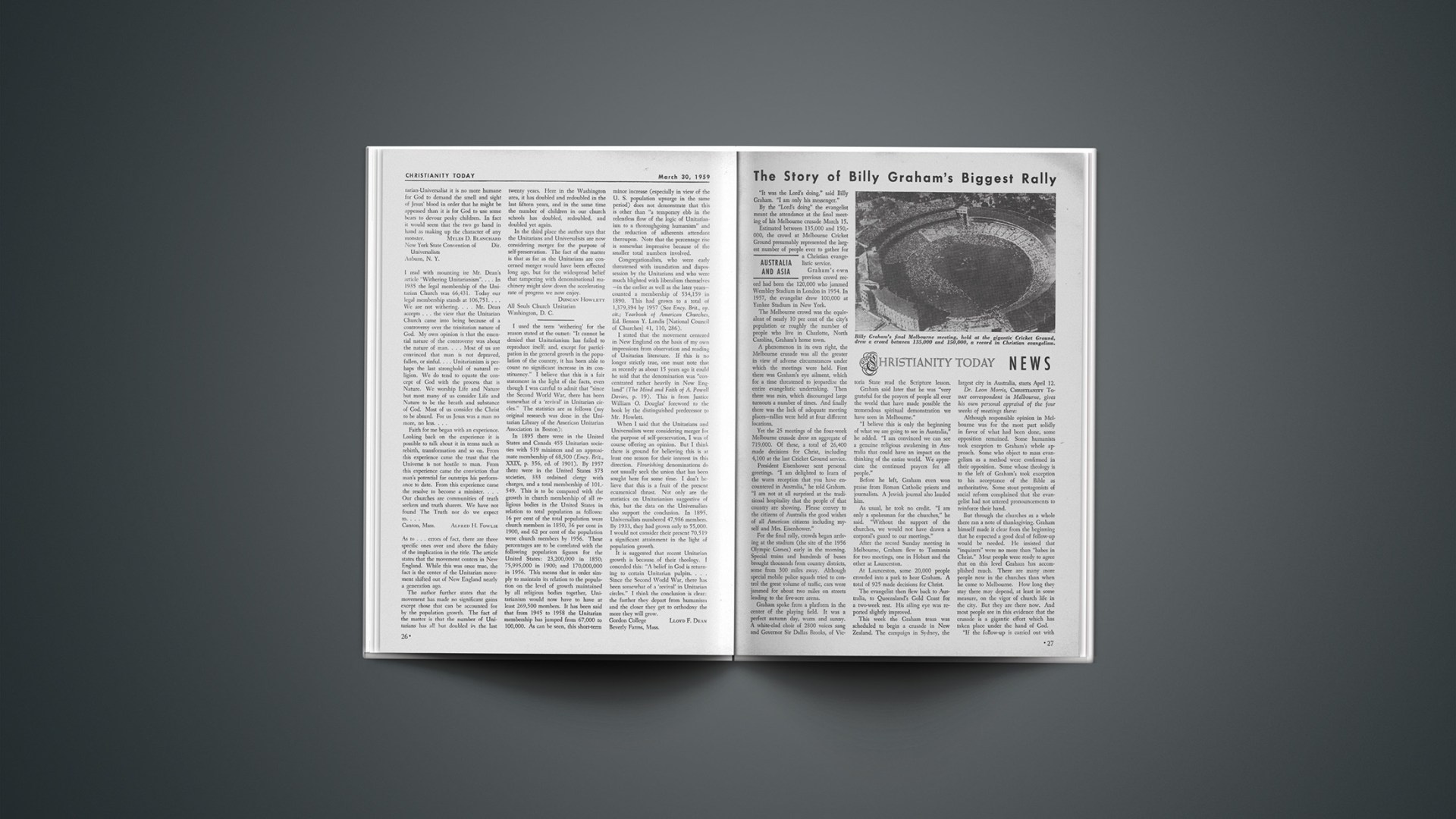
“It was the Lord’s doing,” said Billy Graham. “I am only his messenger.”

By the “Lord’s doing” the evangelist meant the attendance at the final meeting of his Melbourne crusade March 15.

Estimated between 135,000 and 150,000, the crowd at Melbourne Cricket Ground presumably represented the largest number of people ever to gather for a Christian evangelistic service.

Graham’s own previous crowd record had been the 120,000 who jammed Wembley Stadium in London in 1954. In 1957, the evangelist drew 100,000 at Yankee Stadium in New York.

The Melbourne crowd was the equivalent of nearly 10 per cent of the city’s population or roughly the number of people who live in Charlotte, North Carolina, Graham’s home town.

A phenomenon in its own right, the Melbourne crusade was all the greater in view of adverse circumstances under which the meetings were held. First there was Graham’s eye ailment, which for a time threatened to jeopardize the entire evangelistic undertaking. Then there was rain, which discouraged large turnouts a number of times. And finally there was the lack of adequate meeting places—rallies were held at four different locations.

Yet the 25 meetings of the four-week Melbourne crusade drew an aggregate of 719,000. Of these, a total of 26,400 made decisions for Christ, including 4,100 at the last Cricket Ground service.

President Eisenhower sent personal greetings. “I am delighted to learn of the warm reception that you have encountered in Australia,” he told Graham. “I am not at all surprised at the traditional hospitality that the people of that country are showing. Please convey to the citizens of Australia the good wishes of all American citizens including myself and Mrs. Eisenhower.”

For the final rally, crowds began arriving at the stadium (the site of the 1956 Olympic Games) early in the morning. Special trains and hundreds of buses brought thousands from country districts, some from 300 miles away. Although special mobile police squads tried to control the great volume of traffic, cars were jammed for about two miles on streets leading to the five-acre arena.

Graham spoke from a platform in the center of the playing field. It was a perfect autumn day, warm and sunny. A white-clad choir of 2800 voices sang and Governor Sir Dallas Brooks, of Victoria State read the Scripture lesson.

Graham said later that he was “very grateful for the prayers of people all over the world that have made possible the tremendous spiritual demonstration we have seen in Melbourne.”

“I believe this is only the beginning of what we are going to see in Australia,” he added. “I am convinced we can see a genuine religious awakening in Australia that could have an impact on the thinking of the entire world. We appreciate the continued prayers for all people.”

Before he left, Graham even won praise from Roman Catholic priests and journalists. A Jewish journal also lauded him.

As usual, he took no credit. “I am only a spokesman for the churches,” he said. “Without the support of the churches, we would not have drawn a corporal’s guard to our meetings.”

After the record Sunday meeting in Melbourne, Graham flew to Tasmania for two meetings, one in Hobart and the other at Launceston.

At Launceston, some 20,000 people crowded into a park to hear Graham. A total of 925 made decisions for Christ.

The evangelist then flew back to Australia, to Queensland’s Gold Coast for a two-week rest. His ailing eye was reported slightly improved.

This week the Graham team was scheduled to begin a crusade in New Zealand. The campaign in Sydney, the largest city in Australia, starts April 12.

Dr. Leon Morris, CHRISTIANITY TODAYcorrespondent in Melbourne, gives his own personal appraisal of the four weeks of meetings there:

Although responsible opinion in Melbourne was for the most part solidly in favor of what had been done, some opposition remained. Some humanists took exception to Graham’s whole approach. Some who object to mass evangelism as a method were confirmed in their opposition. Some whose theology is to the left of Graham’s took exception to his acceptance of the Bible as authoritative. Some stout protagonists of social reform complained that the evangelist had not uttered pronouncements to reinforce their hand.

But through the churches as a whole there ran a note of thanksgiving. Graham himself made it clear from the beginning that he expected a good deal of follow-up would be needed. He insisted that “inquirers” were no more than “babes in Christ.” Most people were ready to agree that on this level Graham has accomplished much. There are many more people now in the churches than when he came to Melbourne. How long they stay there may depend, at least in some measure, on the vigor of church life in the city. But they are there now. And most people see in this evidence that the crusade is a gigantic effort which has taken place under the hand of God.

“If the follow-up is carried out with as much prayer and zeal as the campaign itself, nothing but good can come of Graham’s campaign,” said the Most Rev. Frank Woods, Archbishop of Melbourne.

“The very great responsibility will rest on the local churches of nurturing and educating in the faith those who have made decisions or reaffirmed their consecration vows,” said the Rev. N. Elliot, Methodist conference president.

The president of the Baptist Union of Victoria, the Rev. A. E. Smith, said, “This crusade is the most wonderful thing that has happened to Melbourne in its history. It will mean a return to the church for very many people.”

From R. Geyer, president-elect of the conference of the Churches of Christ in Victoria and Tasmania, came this comment: “The days of the crusade have been wonderful days for this city of Melbourne. But the most wonderful days lie ahead. Christians have been revived and stimulated for service. The really outstanding results of the crusade will not be seen until all this potential for service becomes factual in the life of men and in the life of the Church.”

Such comments might be multiplied. Church leaders are clear that the crusade has already accomplished much, both in what it has done in the churches, and what it has done in outsiders. They are likewise agreed that the stimulus it has given to church life will be in evidence for a long time to come.

Swindle Sentence

Korea’s most controversial sect leader, Park Tae-sun, was sentenced this month to five years in prison for fraud, medical malpractice and falsification of his academic record. His trial lasted two months.

An excommunicated Presbyterian who claims a following of 100,000 in his faith-healing, millennial sect, the “Olive Tree Church,” Park has been discredited in religious circles for more than two years. He was arrested in December when a disillusioned follower charged that his “praying message” had resulted in the death of seven people. Police claim he has swindled his followers of more than $300,000.

The court ruled that Park’s religious claims were beyond its competence to judge. Park asserts he is the Olive Tree of Revelation 11:4–13, that his veins are filled with the blood of Christ, and that even his bath water can cure the sick who drink it. All who turn over their material possessions to him and enter his “heavenly village” near Seoul, he promises, will live to see the Second Coming.

S. H. M.

Protestant Panorama

• The Soviet Government reportedly has closed down a number of churches and “prayer houses” in the Western Ukraine. An Eastern Orthodox monastery was also said to have been closed.

• Westminster Theological Seminary in Philadelphia will add a course of study leading to the doctor of theology degree. The program will become fully operative in the fall of 1960.

• A high administrative court in Rome ruled this month that the Rev. Graziano Cannito and his Baptist congregation can proceed with their church building program which had been challenged by local authorities (see CHRISTIANITY TODAY News, October 27, 1958).

• The FBI crime index for U. S. cities rose eight per cent last year over 1957. Number of arrests remained steady, although under-18 age arrests showed a 6.5 per cent increase.

• Youth for Christ International officials say they expect 12,000–15,000 delegates for a “Capital Youth Convention” December 28–30 in Washington, D. C.

• Lutherans dedicated New Guinea’s first theological seminary last month. It is located at Logaweng on a hill overlooking the sea.

• The 1960 General Conference of the Methodist Church will be asked to require each of the denomination’s 40,000 churches to establish a commission on Christian social relations. Such local church groups are optional now, although each congregation must have commissions for membership and evangelism, education, missions, and stewardship and finance.

• The independent Union Church of San Juan, Puerto Rico, is hoping to move into a new sanctuary this spring. Workmen are putting finishing touches on a $400,000 physical plant which also includes a parish hall and a two-story church school. Pastor of the English-speaking congregation is the Rev. Alfred J. Penney, a member of the Brooklyn-Nassau Presbytery.

• “Forward Together” is the theme of the 17th annual convention of the National Association of Evangelicals, meeting in Los Angeles April 6–10.

• A Spanish evangelical quarterly, Certeza (Certainty), begins publication in April. The International Fellowship of Evangelical Students, which will underwrite the magazine for the first two years, is the foreign equivalent of Inter-Varsity Christian Fellowship.

• Religious News Service says a meeting of the Archbishop of Canterbury and Archbishop Makarios in London was welcomed by both as an opportunity of renewing friendly relations between the Church of England and the Church of Cyprus. The meeting followed the signing of an agreement over the future of Cyprus between the governments of Britain, Greece, Turkey, and Greek and Turkish Cypriots.

• Weakened by heavy snows, roofs collapsed on two buildings at “Word of Life” summer camp grounds, Schroon Lake, New York, this month. A $40,000 assembly hall was described as a “total loss.” A dining hall was also damaged.

• Some 250 Christian leaders and workers are expected to attend a CHRISTIANITY TODAY recognition banquet in Los Angeles April 3. Editor Carl F. H. Henry will be special guest. Proceedings will be taped and broadcast over station KPOL on Monday, April 6, from 8:30 to 9 p. m.

• A “Civil Defense Religious Affairs Course (No. 7)” will convene May 18–21 at the Staff College, National Operational Headquarters of the Office of Civil and Defense Mobilization at Battle Creek, Michigan.

• The Young People’s Church of the Air has been granted an ultra high frequency television license. Facilities purchased from WKDN at Camden, New Jersey, will be utilized to broadcast on Channel 17 nine hours daily.

• The National Council of Churches plans to publish a paperback hymnal for newsstand sale within a year.

United States

Louisville Reconciliation?

Hopes ran high this month for a “reconciliation” at Louisville’s Southern Baptist seminary, where 13 professors were fired last June in a dispute with the administration. Groundwork for a settlement was laid by a special committee of former Southern Baptist Convention presidents, who met with disputants, then called for a showdown meeting March 30 with the seminary’s board of trustees, administrative officers, and its dismissed professors (one of whom was subsequently reinstated).

A Stipulation: Doctrine

The Lutheran Church—Missouri Synod stands ready to talk merger with other Lutheran bodies provided that “doctrinal discussions are a primary item on the agenda,” President John W. Behnken said last month.

Behnken made the remark in a letter to Dr. Paul C. Empie, executive director of the National Lutheran Council, which expressed “surprise and regret” at its annual February meeting over an earlier message from the Missouri Synod head. (See CHRISTIANITY TODAY News, March 2, 1959.) The NLC had labelled his position as a “roadblock to unity,” whereupon Behnken drafted the new letter to Empie.

Behnken said he regretted the interpretations given his earlier correspondence. “I want to assure you that these interpretations do not express my intentions,” he added. If Empie would express willingness to make doctrinal discussion essential, Behnken went on, the proposal could be referred to a special Missouri Synod committee on doctrinal unity.

Referring to phrases in his previous letter on “state of flux” doctrinal positions, Behnken admitted they “can be and have been interpreted as unwarranted judgement” of other Lutheran bodies. Asserting the statements “were not so intended,” he withdrew them.

The President’S Breakfast

For lack of more accurate yardsticks, the depth of a president’s spiritual experience is invariably measured by his church attendance, his reference in speeches to Christian principles, and his attitudes toward religious functions. The more dedicated U. S. citizenry keeps a continual watch on the chief executive’s personal habits, cherishing signs of his reliance on divine wisdom and strength. Thus there was reason for disappointment this month when the leader of the free world passed up the “Presidential Prayer Breakfast” for the third consecutive year.

The Berlin crisis was blamed for President Eisenhower’s latest absence from the breakfast which annually launches a Washington conference of International Christian Leadership and its world-wide affiliate, the International Council for Christian Leadership. He chose instead to begin his March 5 workday by calling a National Security Council meeting. A year ago he was suffering from a cold. Two years ago a cabinet meeting took priority. He last attended in the election year of 1956.

The 1959 breakfast, which drew 105 Congressmen and 15 foreign diplomats among more than 500 guests, had been put off several weeks on the advice of Eisenhower aides. Why it was finally scheduled for Thursday morning, when the National Security Council normally meets, was not clear. Secret Service men, anticipating that the President would attend the breakfast, made a security check of the Mayflower Hotel and cleared names of expected guests.

In his absence, Eisenhower sent “best wishes and greetings” to the breakfast assembly. Later in the morning he found time to receive at the White House representatives of the United Christian Youth Movement, an agency of the National Council of Churches. In the afternoon, he delivered a political pep talk to a group of Republicans. Dr. Edward L. R. Elson, minister of the church the President attends, said that in view of the serious international situation, he would have advised Eisenhower to forego the breakfast.

Comments from Dr. Frederic Fox, a Congregational minister who is on the White House staff, suggested the possibility of another factor in Eisenhower’s decision to absent himself from the breakfast. Fox said he took exception to efforts which attempt to “glamorize” functions by tacking on the term “presidential.” Some observers feel the President may likewise resent such strategy, but Fox refused to disclose whether the President shared his view. Fox was not at the breakfast, either.

The “Presidential Prayer Breakfast” is not a prayer meeting in the accepted sense of the term, but it does reflect to the world that men high in echelons of government are seriously interceding in the midst of week-to-week duties. This year’s gathering began with an invocation by Judge Boyd Leedom, chairman of the National Labor Relations Board and ICL president. Following the serving of breakfast, Agriculture Secretary Ezra Taft Benson read the 46th Psalm and Army Secretary Wilber M. Brucker read Matthew 16:13–27. Democratic Senator A. Willis Robertson and Republican Representative Alvin M. Bentley addressed the assembly as leaders of Congressional breakfast prayer groups. Vice President Richard M. Nixon, who was the closing speaker, paid tribute to soloist Fague Springman, who sang “How Great Thou Art,” by relaying a remark from Benson to the effect that Nixon was in a “tough spot to have to follow something like that.” Republican Senator Frank Carlson of Kansas, ICCL president, presided.

After Nixon’s address, guests were asked to rise and recite together a prayer prepared by hotel executive Conrad N. Hilton. Dr. Abraham Vereide, founder and executive director of ICL, added a spontaneous benediction.

Worth Quoting

Heard at this month’s International Christian Leadership conference (see also page 22):

“In our great Christian tradition we are interested in others, not because we need others but because of humanitarian reasons.”—Vice President Richard M. Nixon.

“Our generation’s leisure time can be a great blessing. Or it can be a horrendous curse. If it is used in debilitating idleness and ease, it will blast us. If the layman learns to commit leisure time to God and to redeem it, it will be his greatest work.”—Howard E. Butt, Jr., Texas businessman and layman preacher.

“There is a growing recognition among business leaders that techniques are not enough. Logic, science and organization are necessary in complex economic enterprise: but they are not enough. The frustrating problems are in the field of human relations and the remedies for these are spiritual. Techniques are solving their problems. The advance of technology is wonderful, but the headlines scream forth the failure of modern man to bring social peace. This is the realm of religion. The adequate voice in this field is the voice of God in Jesus Christ.”—Dr. Dwayne Orton, educational consultant, I.B.M.

The Trails’ Start

Tourists in Boston need never be concerned about seeing the Hub’s more important points of historical interest. City fathers gladly provide an organized approach. One merely follows the “Freedom Trail,” which starts with a visit to Park Street Church.

For a century and a half now, Park Street Church has meant for thousands the start of another “freedom trail” as well, this one better known as the Way of the Cross.

Says Dr. Harold John Ockenga, Park Street’s Chicago-born pastor since 1936 who was educated at Taylor University, University of Pittsburgh, and Princeton and Westminster seminaries:

“If we computed only 1,000 people attending each week for 150 years, we would have at least 8,000,000 people who have sat in Park Street sanctuary and listened to the Gospel.

“The actual number at the evening services, prayer meetings and special services we hold would be several times that number. All have heard the Gospel.”

Last month Ockenga’s church observed the sesquicentennial of its founding with a banquet at the Statler-Hilton Hotel in Boston. Most eye-catching symbol of the commemoration was a half-ton iced fruit cake, an exact-scale, eight-foot replica of the church donated by the Herbert Marshall family of Belmont, Massachusetts. A state police escort and a $3,000 insurance policy brought the cake from Marshall’s Food Shop in Lexington, where two men took three weeks to produce it (with other ingredients) out of 680 eggs, 470 pounds of fruit, 85 pounds of flour, and 68 pounds of sugar.

Among the banquet’s 1600 guests, many of them distinguished personalities (e.g. Republican Senators Frank Carlson of Kansas and Leverett Saltonstall of Massachusetts, President Bob Pierce of World Vision, Editor Edwin D. Canham of The Christian Science Monitor) was Dr. Dana McLean Greeley, president of American Unitarian Association, who said:

“Let us recognize a fact: one of the greatest churches in the land. And let us recognize another fact: one of the greatest religious leaders in the land.”

Greeley’s tribute glowed with irony for it was while a tide of Unitarianism was sweeping Boston that 22 Trinitarian-minded Christians met in a Boston home to found Park Street Church. Construction of the church building was begun soon after and a continuing renovation program has kept the edifice in good repair ever since. The cornerstone was inscribed with the words: “Built upon the foundation of the apostles and prophets, Jesus Christ himself being the chief cornerstone; in whom all the building fitly framed together groweth unto an holy temple in the Lord. This church formed February 27th and this foundation laid May 1st, 1809.” Housed in this, one of the purest of Colonial structures anywhere, is a foremost congregation of U. S. Protestant evangelicalism.

Organized under doctrinal standards of Congregationalism, the church is still a member of the Association of Congregational Christian Churches. It is refusing to unite with the denomination and the Evangelical and Reformed Church because “to grant authoritarian control to an ecclesiastical organization that has no doctrinal standards as a test of faith of the members who belong to it would be intolerable for an evangelical and biblical church such as Park Street.”

The church’s archives are replete with data significant to American history. Among founders were the fathers of two illustrious Americans, Samuel F. B. Morse, inventor of the telegraph, and Oliver Wendell Holmes, literary artist. Here the hymn “America” was sung for the first time. Here worshipped Ray Palmer, who wrote “My Faith Looks Up to Thee.” Here spoke William Lloyd Garrison, Charles Sumner, Charles G. Finney, and Dwight L. Moody.

Today, Park Street Church stands with a Christian witness even greater than ever before. Its 2,167 members and countless friends support 120 missionaries with annual gifts totalling some $250,000. Its spiritual influence reaches around the world.

Gordon Loses Prexy

Among speakers at Park Street Church’s 150th anniversary banquet was Dr. T. Leonard Lewis, president of Gordon College. It was one of his last public appearances. The man who piloted Gordon from its Boston campus to a larger suburban location with new buildings and a vastly expanded budget suffered a fatal heart attack after shoveling snow in front of his home.

Lewis, 53, has been president of Gordon since 1944. He was a graduate of Wheaton College, Moody Bible Institute and the Northern Baptist Theological Seminary, where he later became professor of systematic theology.

Funeral services were held at Tremont Temple, Boston, March 15. In lieu of flowers, the family requested contributions be made to the Gordon Memorial Science Building fund. The lack of a science building has been Gordon’s chief barrier to full accreditation.

Latin America

Partnership Programming

Gospel radio is entering seriously into an era of “partnership” on the foreign field. Whereas until now evangelical radio stations overseas have largely been operating on foreign funds and personnel, YNOL in Managua, Nicaragua, represents a move to establish and sustain a broadcasting program owned and operated by national Christians.

YNOL began operation this month with a 500-watt transmitter. Officials hope eventually to step up power to 2,000 watts. The whole project enjoys the support of all of Nicaragua’s evangelical groups.

Technicians from the Latin America Mission are coordinating the effort. A number of other mission boards also are making YNOL a true “partnership” project by offering to channel funds to the fledgling station and to cooperate as they can. The American Baptist Home Mission Society made available a large tract of land and the Central American Mission loaned a program director.

Castro And Evangelism

Cuba under Fidel Castro represents the greatest opportunity for the spread of the Gospel that the country has ever had, according to an on-the-spot evangelical observer.

CHRISTIANITY TODAYasked television cameraman-reporter Keith Leslie, a Presbyterian deacon, to prepare an analysis of the new Cuba in view of his familiarity with recent developments there. Leslie and a fellow cameraman from station WTVJ in Miami were the first U. S. newsmen to land in Cuba after Castro’s rebels got the upper hand.

Leslie herewith explains a plea for immediate evangelistic efforts to meet the challenge of unprecedented receptiveness:

Fidel Castro is a secular evangelist. He is a man on fire with conviction, determined with the tempering of two years of guerrilla warfare to remake Cuba into a new nation. He is a man of tremendous idealism, albeit a man who is well aware of his personal power. Castro is a master at the art of public relations, of swaying public opinion solidly behind him. And he commands a corps of men who would die gladly, if not for Castro himself, for the ideals of clean government he represents.

Cuba has been riding on the crest of an emotional wave which cannot be comprehended by anyone who has not observed it first hand. If you saw a part of the television transmission showing a million Cubans in the Palace Square of Havana, endorsing Castro’s directive that the diabolical killers of brother Cubans should die, you can appreciate a part of that feeling.

Castro is the only man I have seen at close range who is able to speak with the power, authority, and dedication that I have observed in our foremost evangelists. Of course, Castro’s message is not of God, but of man, and therefore incomplete in content.

Because of the events which have taken place, there seems little doubt that the people of Cuba are now, as they have never been before, receptive to the Word of God.

From one end of the island to the other, Castro has preached of the new liberties and freedoms the people were now to enjoy: freedom of speech, assembly, press. But freedom of religion was not mentioned. Primarily, I believe, this was because Castro, as a Roman Catholic in a Roman Catholic nation, gave freedom of religion little thought. But I am certain Castro would be receptive to the inauguration of a nation-wide evangelistic campaign. A number of trusted “Fidelistas” are in a position to be of invaluable service in arranging such a campaign.

While Cuba is emotionally receptive, or perhaps even vulnerable, if the term can be used in such context, there is no time to waste. Unless such a campaign is set up immediately, this emotional receptiveness may fade. And the Cubans who are so desperately searching for a new life of freedom may settle for a materialistic compromise that leaves Christ out in the cold.

Indeed, the country could conceivably drift back into the traditional and historical government by graft which has been its heritage for virtually every year since the Spaniards landed centuries ago.

There have been sporadic attempts to form a government based on honesty and integrity, but they have failed as their dedicated leaders have passed on. The people themselves must be infected with this permanent desire. And what better foundation can freedom and liberty have than Christ himself?

Marking Freedom

Venezuelan evangelicals marked the 125th anniversary of their country’s freedom of worship declaration with a public ceremony last month. Wreaths were placed on Caracas monuments of Simon Bolivar and José Antonio Paez, the nation’s liberators.

Commensurate with the observance was the establishment of the Comité Nacional Evangélico de Cooperacion, a national committee to represent the evangelical community before the government and the public at large. All major Protestant denominational groups in the country are included, as well as those set up by so-called interdenominational “faith” missions.

W. D. R.

Near East

Sea Archaeology

The first underwater exploration in biblical archaeology will begin along Israel’s Mediterranean coast this summer. Sponsor: the America-Israel Society, an inter-faith, non-political organization “dedicated to advancing mutual [U.S.-Israeli] understanding.”

Concentrating in the area of Caesarea Harbor, the expedition will investigate the remains of the port built by Herod the Great in the first century B.C.

Preparations for the venture are being made by Dr. Benjamin Mazar, president of Hebrew University, and Professor Charles Fritsch, an archaeologist from Princeton University. Appointed leader is Edwin A. Link, noted American inventor of the Link Aviation trainer and an underwater enthusiast. Advisory participants include: Dr. Yigal Yadin, archaeology lecturer at Hebrew University; Dr. Nelson Glueck, president of Hebrew Union College—Jewish Institute of Religion; and Dr. William F. Albright, professor of Semitic languages at Johns Hopkins University.

Arab Education

What is the official attitude of the United Arab Republic toward Christian schools? The question has been uppermost in the minds of missionaries to Egypt, particularly since enactment of a new education law last year.

Slowly the interpretation is unfolding. Last month the U. A. R. Ministry of Education rescinded a month-old order which had closed Jesuit schools in Cairo pending elimination of certain texts.

Earlier, the ministry gave various foreign schools and organizations an opportunity to comment on the new law. In acknowledging one comment, officials promised teaching freedom to foreigners as long as basic cultural subjects are presented in Arabic.

Holy Land Campus

Many religious observers feel that Israel’s developing stature is leading up to a fulfillment of prophecy. One Christian editor calls a recent book on the rebirth of Israel an “absolute must for any serious student of Bible prophecy.” If so much can be said of a book, how much more of actually studying the situation firsthand in Israel itself?

But there is more to study: archaeology and historical geography, the problems of integrating people from seventy nations, the developing of Jewish thought because of these events, Near East problems, and others.

On the Street of the Prophets in Jerusalem, the Israel-American Institute of Biblical Studies opens its Holy Land campus in August. Here American theological students will see for themselves.

Biblical and exegetical subjects will be taught by American seminary professors (for the first semester Dr. Arnold Schultz of Northern Baptist Theological Seminary and Dr. G. Herbert Livingston of Asbury). Israeli specialists will teach Modern Hebrew, historical geography of Palestine, development of Jewish thought, and history of holy places.

Seminarians from Pennsylvania to California are applying for admission. A selected group leaves August 1 via a conference on the Near East in Sweden and a tour of Rome. Classes start late in August. Upon return of this group in January, replacements will be on their way. Each semester a new group will be seeing for themselves, and an instructed group will be back at home interpreting their Near East experiences.

Dr. G. Douglas Young, dean of Trinity Seminary of the Evangelical Free Church of America, is head of the new institute.

People: Words And Events

Deaths: Dr. T. Leonard Lewis, 53, president of Gordon College (see page 30) … Dr. Orman L. Shelton, 64, president of Christian Theological Seminary at Butler University, in Indianapolis … Dr. W. Plumer Mills, 75, retired Presbyterian missionary to China, in New York.

Appointments: To the chair of Christian education at Colgate Rochester Divinity School, Dr. John Charles Wynn … as editor of The Churchman, quarterly journal of Anglican theology, Dr. Philip E. Hughes.

Election: As Archbishop of Armagh and Primate of All-Ireland, Dr. James McCann.

Inauguration: As president of National Methodist Theological Seminary in Kansas City, Missouri, Dr. Don W. Holter, scheduled April 7.

Resignation: As president of California Baptist Theological Seminary, Dr. Don Cole.

Grants: To the following, faculty fellowship awards from the American Association of Theological Schools for study (mostly abroad) under gifts from the Sealantic Fund “to stimulate theological scholarship and teaching”: R. F. Aldwinckle, McMaster Divinity College; A. O. Arnold, Augustana Theological Seminary; J. W. Bachman, Union Theological Seminary, New York; H. H. Barnette, Southern Baptist Theological Seminary; I. W. Batdorf, United Theological Seminary; R. M. Bost, Lutheran Theological Southern Seminary; R. H. Boyd, Luther Theological Seminary; R. M. Brown, Union Theological Seminary, New York; R. J. Bull, Theological School, Drew University; C. E. Carlston, Theological Seminary of U. of Dubuque; W. A. Clebsch, Episcopal Theological Seminary of the Southwest; W. K. Clymer, Evangelical Theological Seminary; A. B. Come, San Francisco Theological Seminary; W. Fallaw, Andover Newton Theological School; F. B. Gear, Columbia Theological Seminary; R. E. Gilmore, Wesley Theological Seminary; W. K. Grobel, Vanderbilt University Divinity School; J. M. Gustafson, Yale University Divinity School; M. T. Judy, Perkins School of Theology; H. C. Kee, Theological School, Drew University; H. T. Kerr, Princeton Theological Seminary; R. H. Klooster, Calvin Theological Seminary; C. Lacy, Divinity School of Duke University; J. W. MacGorman, Southwestern Baptist Theological Seminary; R. C. Miller, Yale University Divinity School; M. L. Newman, Protestant Episcopal Seminary in Virginia; F. E. Rector, Christian Theological Seminary; J. H. P. Reumann, Lutheran Theological Seminary, Phila.; J. M. Robinson, Southern California School of Theology; L. C. Rudolph, Louisville Presbyterian Seminary; W. P. Schilling, Boston University School of Theology; K. Stendahl, Harvard Divinity School; O. K. Storaasli, Luther Theological Seminary; B. Vassady, Lancaster Theological Seminary; J. A. Wharton, Austin Presbyterian Theological Seminary.

Eutychus and His Kin: March 30, 1959

AT EASE IN ZION

No small stir developed in Pilgrim Church when a recent news magazine article appeared on the bulletin board of the Martyr Memorial lounge. It included an attack on recent church architecture, and seemed to describe the new Pilgrim sanctuary, even to the blonde cross motif and the woodsy patio decor of the chancel. Feeling ran high when the clipping was traced to Effie Winters, the dissident minority of the building committee.

Several members of the committee attempted a showdown interview with Miss Winters, but they only provided a target for her barbed tongue. She suggested that never in history had there been so luxurious a rest stop for this earthly pilgrimage. The golden streets, she feared, might prove hard underfoot after the carpeting of this earthly Zion. Pilgrim Church people might come to prefer the celestial city in eternity, but they could hardly be expected to long for the change!

She pounced on another report in her clipping. Here was news of an architect after her heart. Imagine, he had told a congregation that they needed to be prodded and disturbed. That would be an innovation for the Pilgrim congregation, relaxing in the built-in complacency of their cushioned pews!

At this point, the committee chainnan unwisely retaliated by inviting Miss Winters to pilgrimage to India, where she might secure a bed of nails abandoned by a converted fakir, and be prodded to her heart’s content.

Personal relations had deteriorated abysmally, and the discussion ended with an embarrassing rejoinder in which Miss Winters proposed carrying one of the many crosses in the sanctuary instead of importing a bed of nails. She later apologized for this remark, and the minister has mended the rent in the fabric of fellowship. However, his conciliatory sermons on “The Beauty of Holiness” and “Contemporary Cross-Bearing” seemed a little vague after the sharpness of Miss Winters’ irony. His message on “Comfort Ye My People” was in another context, although there were a few puzzling allusions to architecture.

Miss Winters has her followers, but we do not anticipate a movement toward more disturbing church buildings in Deepwell Heights. Unless, of course, you are disturbed by blond crosses and patio chancels.

FURTHER TENSIONS

In … your editorial, “Race Tensions and Social Change” (Jan. 19 issue), you have handled a difficult subject with masterful clarity. Such thinking is essential to a solution which will command and deserve the respect of all men of good will.…

My admiration was also stirred by the excellent book review by E. Earle Ellis. He evaluates the service Dr. King has done without closing his eyes to the pitfalls that appear here and there in his reasoning.

The Franklin Lakes Gospel Church

Franklin Lakes, N. J.

Your editorial … is a very polite and perfectly harmless treatise saying next to nothing at all.

Ogden, Utah

What is “love?” A pantheistic sentiment that submerges individual differences in the social nirvana of a mulatto nation?

The Church of the Good Shepherd

Portland, Ore.

I guess I will have to class myself with those radicals of my own denomination who “have even supported the use of tanks and guns, if necessary,” that our Negro citizens’ civil rights may be protected against Southern governors and legislators. After all, these people have had 100 years since the Civil War to treat their former slaves as American citizens.

Mt. Sterling Presbyterian Church

Mt. Sterling, Ill.

After an adequate presentation of Stride Toward Freedom’s contents, Dr. Ellis suggests that the philosophy underlying racial integration is racial socialism. He believes that Dr. King is attempting to form a raceless and classless society through legal action in which the state is the “major instrument”.… Dr. King specifically rejects the Communist emphasis on a classless society and takes his stand on the words of Christ: “The Spirit of the Lord is upon me, because he hath anointed me to preach the gospel to the poor …” (pp. 93–4).…

The basic motivation of the Montgomery movement was Christian love. The method was nonviolence. To Dr. Ellis, nonviolence is an “irritant.” To Dr. King, it is a way of life based on agape love (pp. 90–107). A Reformed theologian may be as skeptical of love in action as the newspaper reporter who thought it peculiar for a Negro congregation in Montgomery to applaud a reading of 1 Corinthians 13.… Dr. Ellis criticizes the use of agape love by Negroes who seek to enter white schools.… [Separate but] “equal” opportunity is an illusion. Not only does it deny real “equality;” it is built upon spiritual pride.…

The Court has not forced integration, as Dr. Ellis indirectly alleges. It has outlawed compulsory segregation in certain public facilities, such as schools. The reviewer and others can be as socially segregated as their consciences will allow them, but they can no longer use the law to force compulsory segregation.…

Although the Negro is supposed to be “inferior,” the Montgomery story demonstrates his … scrupulous adherence to the law. In glaring contrast, the “superior” whites stooped to threatening phone calls, malicious character assassination and bombing of homes and churches.…

Why are segregationists so concerned about intermarriage? Do they fear that equal status would give a Negro woman legal redress against the sexual attentions of a white man? If white men are as superior to Negro men as some assume, why this sudden panic about Negro men marrying white women? Why does Dr. Ellis ignore the concrete application of New Testament ethics in public schools, courts, transportant and personal relations? What is his “moral right of each race to separate social institutions”? From what portion of the Gospel does it come?

Southern Baptist Theological Seminary

Louisville, Ky.

Dr. Ellis believes that in race relations when there is opposition and resistance on the part of the whites to a demand of the Negro for what he considers justice—that in the spirit of love he would not use any force at all to bring about this justice, whether it be through the courts or passive resistance.… Parents don’t understand love if they interpret it to mean that firm and loving discipline with their children involving coercion is a violation of the spirit of love.

Hope Presbyterian Church

Portland, Ore.

The book review … is one of the most trenchant and illuminating analyses of the subject of segregation that has appeared lately. That … plus your … “Race Tensions and Social Change” make that … issue a monumental one.

Roanoke, Va.

The attempt to support segregation from Scripture (by reader Carey Daniel, Mar. 2 issue) is always a hazardous one, and Daniel cites some wholly indefensible texts for his case. Old Testament proof texts in support of segregation rest upon several assumptions which just cannot be maintained. For example, to assume that the groups mentioned in Genesis 9 are progenitors of distinct racial groups involves biological, linguistic, historical, and literary considerations of an extremely dubious nature. Everett Tilson’s fine book, Segregation and the Bible (esp. pp. 20–26), utterly destroys any Biblical case for segregation. More relevant passages on race relations would be Matt. 5:44 f.; Luke 10:27–37; Gal. 3:28; Eph. 2:11–16, and Acts 10.

Daniel also follows most segregationists in stressing personal matters like intermarriage and evading the real issues of rights in the economy, education, housing, hospital care, recreational facilities, civil liberties, etc.

I felt your article “Race Tensions and Social Change” was helpful. Incidentally, I am a native of Birmingham, Ala.

Oregon, Ill.

FOR THANKLESS DISCHARGE

There was no need for you to retract anything you said about the Report of the Joint Commission of the Protestant Episcopal Church on alcoholism and social drinking (Feb. 2 issue). I am a priest of the Protestant Episcopal Church, Diocese of Pennsylvania. Like every clergyman of that Church I received a copy of the report before the Convention, as also did every Bishop and lay deputy. This was an official commission and this was its official report. I confine myself to the one question, namely, did the Convention approve the report, though in the light of modern ethics and St. Paul’s position on eating meat offered to idols, the Commission’s claim that social drinking has God’s approval is shocking. Did the Convention approve the report? No, but it [accepted] the report and if there is any difference between approving and accepting that difference can be discerned only by a hairsplitting lawyer.

Mr. Mainwaring said in his letter that the report was only the first step in a series promised by the Joint Commission. I suggest the Convention should have discharged the Commission without thanks before they further affronted the consciences of Christians.

Brattleboro, Vt.

A CASE OF IDENTITY

Mr. Merrill C. Tenney … has listed The New Testament: Its Making and Meaning (Abingdon Press) as written by C. K. Barrett (Feb. 16 issue). Actually this volume is written by Albert Edward Barnett.

First Presbyterian Church

Nunn, Colo.

UNITARIANISM

Lloyd Dean (Jan. 19 issue) has put his finger on what are unquestionably Unitarianism’s most disconcerting anomalies in an otherwise consistant philosophical relativism: (1) the continuation of the “church” and (2) the endorsement of a rather absolute ethical code. It is difficult to understand not only the metaphysical basis but also the emotional incentive behind the perpetuation of these logically obsolete phenomena. If religious values and philosophical realities are only illusory or relative, toward what end does the “church” function and from what source does the ethic derive?

I would, on the other hand, strongly question Professor Dean’s somewhat oversimplified solution to the threat of Unitarian ideology among Protestants today. Can Protestantism solve this problem “only” and simply “by establishing itself on God’s infallibly revealed Word” (ibid., p. 8)? Dr. Dean himself has pointed out that the earliest Unitarians in this country did not consider their views contrary to the teaching of Scripture (ibid., p. 7). And Congregationalism, out of which Unitarianism sprang, did not to any great degree surrender the doctrine of the absolute authority of Scripture until fully 50 years following the emergence of Channing. Can we today trust the same kind of orthodox view of the Bible itself to do for us what it failed to do in the last century?

Marion, Ala.

Judson College

• Regardless of the view of Scripture, there have always been heresies. But when the authority of Scripture is forfeited, the problem is compounded. When one departs from the Bible’s view of itself, and loses this authoritative criterion, it is easy to depart from the Bible’s view of other things. Sometimes this order is reversed and often the transition steps are delayed. But the logic of the matter ultimately prevails.—ED.

The Unitarian takes it as elementary that he may be wrong and probably is in some aspects of his thinking. That is why he is not compelled to convert all others to his way of thought as are fundamentalists and Roman Catholics.

Unitarians are the happiest church people I have ever met. And if all this is inconceivable to you who labor under the curse upon Adam, … my only wish for you is that you may gain some happiness from your prison.…

The Unitarian Church of All Souls

New York, N. Y.

Many of us put the accent of our religion on humanism, but go along with Jesus’ teachings of God as a universal father—and feel that that fits in with humanism-naturalism much better than an orthodox interpretation relying on such a flimsy thing as supernatural revelation.

North St. Paul, Minn.

The author failed to explain why this church, more than any other, has been filtrated by actual and near communists. The Stockholm Peace Petition which was notoriously exposed as propaganda by local newspapers was actively circulated by two different Unitarian Youth clubs and in no other church.

Los Angeles, Calif.

Unitarianism and Universalism have never been large in membership, because both denominations stress the importance of thinking for oneself.… In our culture there are not many … who think for themselves.…

Universalist Church

Swampscott, Mass.

Dr. Gerstner takes liberals apart, or attempts to, on the basis that they dare to declare some statements of the Bible to be myths (Dec. 22 issue).… To a Unitarian-Universalist it is no more humane for God to demand the smell and sight of Jesus’ blood in order that he might be appeased than it is for God to use some bears to devour pesky children. In fact it would seem that the two go hand in hand as making up the character of any monster.

New York State Convention of Dir.

Universalists Auburn, N. Y.

I read with mounting ire Mr. Dean’s article “Withering Unitarianism”.… In 1935 the legal membership of the Unitarian Church was 66,431. Today our legal membership stands at 106,751.… We are not withering.… Mr. Dean accepts … the view that the Unitarian Church came into being because of a controversy over the trinitarian nature of God. My own opinion is that the essential nature of the controversy was about the nature of man.… Most of us are convinced that man is not depraved, fallen, or sinful.… Unitarianism is perhaps the last stronghold of natural religion. We do tend to equate the concept of God with the process that is Nature. We worship Life and Nature but most many of us consider Life and Nature to be the breath and substance of God. Most of us consider the Christ to be absurd. For us Jesus was a man no more, no less.…

Faith for me began with an experience. Looking back on the experience it is possible to talk about it in terms such as rebirth, transformation and so on. From this experience came the trust that the Universe is not hostile to man. From this experience came the conviction that man’s potential far outstrips his performance to date. From this experience came the resolve to become a minister.… Our churches are communities of truth seekers and truth sharers. We have not found The Truth nor do we expect to.…

Canton, Mass.

As to … errors of fact, there are three specific ones over and above the falsity of the implication in the title. The article states that the movement centers in New England. While this was once true, the fact is the center of the Unitarian movement shifted out of New England nearly a generation ago.

The author further states that the movement has made no significant gains except those that can be accounted for by the population growth. The fact of the matter is that the number of Unitarians has all but doubled in the last twenty years. Here in the Washington area, it has doubled and redoubled in the last fifteen years, and in the same time the number of children in our church schools has doubled, redoubled, and doubled yet again.

In the third place the author says that the Unitarians and Universalists are now considering merger for the purpose of self-preservation. The fact of the matter is that as far as the Unitarians are concerned merger would have been effected long ago, but for the widespread belief that tampering with denominational machinery might slow down the accelerating rate of progress we now enjoy.

All Souls Church Unitarian

Washington, D. C.

I used the term ‘withering’ for the reason stated at the outset: “It cannot be denied that Unitarianism has failed to reproduce itself; and, except for participation in the general growth in the population of the country, it has been able to count no significant increase in its constituency.” I believe that this is a fair statement in the light of the facts, even though I was careful to admit that “since the Second World War, there has been somewhat of a ‘revival’ in Unitarian circles.” The statistics are as follows (my original research was done in the Unitarian Library of the American Unitarian Association in Boston):

In 1895 there were in the United States and Canada 455 Unitarian societies with 519 ministers and an approximate membership of 68,500 (Ency. Brit., XXIX, p. 356, ed. of 1901). By 1957 there were in the United States 373 societies, 333 ordained clergy with charges, and a total membership of 101,549. This is to be compared with the growth in church membership of all religious bodies in the United States in relation to total population as follows: 16 per cent of the total population were church members in 1850, 36 per cent in 1900, and 62 per cent of the population were church members by 1956. These percentages are to be correlated with the following population figures for the United States: 23,200,000 in 1850; 75,995,000 in 1900; and 170,000,000 in 1956. This means that in order simply to maintain its relation to the population on the level of growth maintained by all religious bodies together, Unitarianism would now have to have at least 269,500 members. It has been said that from 1945 to 1958 the Unitarian membership has jumped from 67,000 to 100,000. As can be seen, this short-term minor increase (especially in view of the U. S. population upsurge in the same period) does not demonstrate that this is other than “a temporary ebb in the relentless flow of the logic of Unitarianism to a thoroughgoing humanism” and the reduction of adherents attendant thereupon. Note that the percentage rise is somewhat impressive because of the smaller total numbers involved.

Congregationalists, who were early threatened with inundation and dispossession by the Unitarians and who were much blighted with liberalism themselves—in the earlier as well as the later years—counted a membership of 534,159 in 1890. This had grown to a total of 1,379,394 by 1957 (See Ency. Brit., op. cit.; Yearbook of American Churches, Ed. Benson Y. Landis [National Council of Churches] 41, 110, 286).

I stated that the movement centered in New England on the basis of my own impressions from observation and reading of Unitarian literature. If this is no longer strictly true, one must note that as recently as about 15 years ago it could he said that the denomination was “concentrated rather heavily in New England” (The Mind and Faith of A. Powell Davies, p. 19). This is from Justice William O. Douglas’ foreword to the book by the distinguished predecessor to Mr. Howlett.

When I said that the Unitarians and Universalists were considering merger for the purpose of self-preservation, I was of course offering an opinion. But I think there is ground for believing this is at least one reason for their interest in this direction. Flourishing denominations do not usually seek the union that has been sought here for some time. I don’t believe that this is a fruit of the present ecumenical thrust. Not only are the statistics on Unitarianism suggestive of this, but the data on the Universalists also support the conclusion. In 1895, Universalists numbered 47,986 members. By 1933, they had grown only to 55,000. I would not consider their present 70,519 a significant attainment in the light of population growth.

It is suggested that recent Unitarian growth is because of their theology. I conceded this: “A belief in God is returning to certain Unitarian pulpits.… Since the Second World War, there has been somewhat of a ‘revival’ in Unitarian circles.” I think the conclusion is clear: the farther they depart from humanism and the closer they get to orthodoxy the more they will grow.

Gordon College

Beverly Farms, Mass.

Ideas

The Spirit and the Church

It is a truism—though one we continually need to learn—that there can be no effective Christian work apart from the empowering of the Holy Spirit. We can build up congregations. We can supply impressive buildings. We can accomplish organization. We can promote and finance activity on a scale unprecedented, and we can harness new and effective instruments. Ministers and workers can even have the most detailed kind of training. But the fact remains that the work of regeneration is still the work of the sovereign Spirit, and a genuine reviving of Christian life, vigor, and evangelism may be expected only as the Holy Ghost gives life and power to all that we bring for his service.

Yet when we say this, and realize what it means, and pray for a reviving of the Spirit in the Church, we must not lose sight of the fact that the Holy Spirit is associated directly in the New Testament with Jesus Christ himself. That is, we do not pray for the Holy Spirit as though he were any other than the Spirit of Christ. We do not seek to be filled by the Spirit in order that the Spirit himself may have the pre-eminence apart from Christ. We do not aim at life and activity in the Spirit which would be different from, or supposedly superior to, life and activity in the Saviour himself. We do not desire a higher stage of Christian living denied to those who “only” know Jesus Christ and his presence—as though this did not meet all the needs of the Christian. To drive a wedge between the Holy Spirit and Jesus Christ, to concentrate on the former when he is pointing us to the latter, to pray “Come, Holy Ghost,” as though this were something different from praying that Christ himself might fill, strengthen, direct, and empower us, is to defeat the very point and purpose of our praying, and to hinder rather than promote the revival that we desire.

We can set ourselves at odds with the Holy Spirit rather than in harmony with him. As the Spirit of Jesus Christ, the Holy Spirit is in fact the one by whom Christ is now present and active in and through believers. He is the one who testifies to Jesus, our incarnate, crucified, and risen Saviour and Lord. He is the one whose work is done when there is response in human lives of penitence and faith to Christ.

When Christ took leave of his disciples, he made it plain that, apart from his appearances during the 40 days, they were not to expect his continuing presence in the body. Yet he also said that he would come to them (John 14:18), that he would pray the Father to send them another Comforter (John 14:16). He said that he himself would send the Comforter from the Father (John 15:26). Or, as we learn from Matthew, he promised his own abiding presence to the end of the world (28:20), and told the disciples to wait until they received the power of the Holy Ghost coming upon them (Acts 1:8 ff.)—a power which they were to recognize clearly as “shed forth” by the ascended Lord himself (Acts 2:33). In other words, it is the Lord who is still present to his people by the Holy Spirit, and who continues in the works which during his earthly ministry he “began both to do and to teach.” The gifts of the Spirit, as Paul puts it, are the gifts of the ascended Lord (Eph. 4:7 ff.). Christ himself is present and exalted in their outpouring and exercise.

We know that the office of the Holy Spirit is that of testifying to Jesus Christ as our incarnate, crucified, and risen Saviour. The Spirit does not put himself into the forefront so to speak. He does not speak of himself (John 16:13). His work, as Jesus plainly shows us, is to testify of the Lord (John 15:26). It is to glorify Christ, to “receive of mine, and shew it unto you.” What this means in practice is seen in the New Testament Church. When the apostles were filled with the Spirit, speaking with tongues as the Spirit gave them utterance, they made it their main business to preach Jesus Christ, the Saviour (Acts 2:22 ff.), and to call their hearers to be baptized in the name of Christ (Acts 2:38) with the promise that they too should receive the gift of the Holy Ghost. Conversely, it was as Paul gave himself “not to know any thing among you, save Jesus Christ, and him crucified,” that he could speak “in demonstration of the Spirit and of power” (1 Cor. 2:2 ff.). To know the reviving of the Spirit, to be co-workers with him, and to have him as supreme Co-worker with us, we must aim to do what Christ does (“And ye also shall bear witness,” John 15:26). That is to say, we must give Christ the preeminence. We must preach Christ, exalt him, put him in the forefront, and entrust our gifts and concerns to his direction. In a sense, we must not give primary attention to the Spirit, for we really give the Spirit proper credit only when we direct our attention to Christ. It is when Christ is the basis and center of our word and work that we are led into the truth and endowed with power, and may thus expect the Holy Spirit to come in saving and sanctifying sovereignty.

Finally, the work that is accomplished when there is the response in human lives of conformability to Jesus Christ in penitence and faith, death and resurrection, is the work Christ did at the Cross. By uplifting him, therefore, the Holy Spirit brings us continually to the Cross in conviction of sin and identification with our Lord’s crucifixion. By uplifting Christ, the Spirit brings us also to the empty grave, to the place of renewal, and to the new life which we live by faith in the Son of God (Gal. 2:20). To be strengthened with might by his Spirit in the inner man means always that Christ himself dwells in our hearts by faith (Eph. 3:17). Where the Spirit is at work, sinners are converted to Christ and brought to newness of life in him; and saints are sanctified by the putting off of the old man outside Christ, and the putting on of the new man in Christ, that they should grow to the stature of the fullness of Christ (Eph. 4:13,22 ff.). This is the proper work of the Spirit, and in the face of this we can perhaps conclude why we do not see Christian work being done more widely and effectively in others despite all our prayers. If we genuinely want the reviving power of the Spirit, it is not enough merely to pray “Come, Holy Ghost.” What is required is that we should be ready for a transformation in us by Christ. What is required is that we seek and have the mind of Christ (Phil. 2:5 ff.). What is necessary is that Christ be our life (Col. 3:4), so that for us to live is Christ and to die is gain (Phil. 1:21).

With him as our object, we may know the reviving which we long for. We may enjoy the outpouring of the Holy Spirit. We may see in our day acts of the Spirit. And we may know the privilege of being laborers together with God and seeing him give the increase (1 Cor. 3:6 ff.). All the while we must realize that it is Christ, the Lord of the Church, who is present and active in the Church by the Holy Spirit. We must see to it that it is Christ whom we truly preach, confidently, faithfully, and in all simplicity. And we must make it our business to be true disciples of our Lord by bringing all our thoughts, acts, words, and attitudes sincerely to the Cross. There, being “planted together in the likeness of his death, we shall be also in the likeness of his resurrection.” The more glory we give to Christ, the more the Spirit has his way with us, and the more we can expect his outpouring on our lives and on our work for others.

END

Left Wing Attacks On Fbi And House Un-American Activities Group

Communist sympathizers in American life have long sought to destroy both the Federal Bureau of Investigation and the House Un-American Activities Committee. These agencies have energetically exposed left wing activities and affiliations. Unfortunately, even prominent churchmen are now being drawn, even if for quite other reasons, into the left wing clamor for a revision of these agencies. Despite this public pressure by a small group of vocal leaders, however, a steady stream of mail pours into Washington from the hinterlands, and letters are spontaneously appearing in the public press, attesting the citizenry’s firm support of these agencies.

Twice in recent years spirited efforts to destroy the FBI have failed. Left wing forces in the early 1940s unsuccessfully used every means to weaken confidence in the organization and to discredit it. Max Lowenthal’s The Federal Bureau of Investigation was a more recent propaganda assault. It may be hoped that the Americans today are as alert to the continuing need for an independent fact-finding agency as they were then.

Representative James Roosevelt (Dem., California) has sponsored a resolution to abolish the House Committee. That agency has doubtless made mistakes, but its benefits to the nation far outweigh its liabilities. Only its foes identify it one-sidedly with McCarthyism. Were the Committee dissolved, Congress would soon feel the necessity of replacing it by a similar effort. In the meantime, radical left wing forces will have advanced their alien objectives.

An alert citizenry will stand guard against the Communist conspiracy to discredit the FBI and the UAC, and will voice indignation over attempts to smear J. Edgar Hoover. Mr. Hoover may keep one eye on juvenile delinquency while he trains the other on parimutuel odds, but he is not blind to forces that would strike a blow at our great traditions of freedom.

The Christian Citizen And America’S Rising Tax Burden

Good Christians believe in paying taxes. Christ set the example by paying his (Matt. 17) and Paul so advised the Roman Christians (Rom. 13).

We have no sympathy for men like the Rev. Maurice McCrackin of Cincinnati who was sent to Federal prison recently for refusing to pay his income taxes. The minister of St. Barnabas-West End Church (Episcopal-Presbyterian), a militant pacifist, withheld his payments because a portion would be expended for military defense. When he resisted officers of the law a la Ghandi he paid the lawful penalty.

Yet the matter of taxation is becoming an increasing problem in the United States. Governor Nelson Rockefeller is currently in the limelight because of his insistence that New Yorkers pay taxes equal to the cost of government. Tax increases to meet rising costs are anticipated throughout the nation.

On the right side of the moral ledger, Mr. Rockefeller is standing for a good principle. Fiscal responsibility and solvency are essential to sound government. Either we pay as we go or a score of difficult situations may arise. Heavy drafts on past reserves, deficit spending, and big bond issues tend to mortgage America’s future and impose heavy burdens upon the rising generation. No public official is doing a service to the people by undertaxing them for necessary current costs of legitimate and efficient government.

On the other side of the balance sheet is the policy of expediency by which government proposes to “tax, tax, tax” and “spend, spend, spend” the nation into prosperity. It seems never to occur to the political demagogue that it is possible for governments, as well as individuals, to live within their means and to practice the Christian virtue of frugality. There must, of course, be constant improvement and progress in our social order, as well as the preservation of sound fiscal policy. If the taxpayer could be assured that these ends would be accomplished without budget padding, boondoggling, nepotism, graft, and corruption he would gladly pay the bill. It is because both national morality and economic stability have been undermined by recent fiscal policy that even the Christian thinks twice before he pays his taxes.

America needs to beware that the arbitrary and immoral concepts of taxation, which obtained prior to the Magna Charta and the American Revolution, be not reinstated in our day under various forms of camouflage. We need to maintain such high principles as consent and representation, social justice and equality, equity and uniformity, and see that they are reflected in both tax principles and forms. Coupled with these should be wise and progressive yet sound and frugal fiscal policy in government.

America’s tax problems may well become worse before they are solved. In the meantime Christians in governmental life and in the citizenry at large may well make a fine contribution to that solution.

END

Ecumenical Free Speech And The Misrepresented Majority

Multitudes of American Protestants are disheartened by the NCC General Board’s evasive handling of protests against World Order Study Conference recommendation of a soft policy toward Communist China. The General Board proffered some quite irrelevant remarks about freedom of speech (implicitly defending Cleveland happenings), sidestepped official approval or disapproval, and now featherbeds while projecting long range mass media explanations.

Dissenters over NCC’s growing involvement of corporate Protestantism in specific politico-economic programs have not been asked for advice. Their opinions (though they run about eight to one against Cleveland commitments) seem, in fact, to be little appreciated by some ecumenical protagonists of free speech. Otherwise, some proportionate expression of contrary convictions on basic issues would be guaranteed. Instead, penetrating criticisms of what churchmen actually do are scorched by ecumenical journalists as false and malicious assaults on personal character and integrity, while these same scribes of discord dismiss men like Dan Poling and Norman Vincent Peale (J. Edgar Hoover is discreetly overlooked) with Carl McIntire as controversialists whose positions are well known in advance. How far the disease of flexibility infects the contemporary religious mind is apparent from the assumption that men are to be downgraded if they stand inflexibly for fixed and tried principles. Or is continuity of conviction defensible only when men look East rather than West?

CHRISTIANITY TODAY thinks sagging NCC prestige will not be bolstered apart from an unambiguous acknowledgement of Cleveland blunders. Not even costly and lengthy mass media interpretations, expertly polished by specialists in the word business, will help much. The one way to restore confidence is to stop prattling about free speech in defense of recommendations that corporate Protestantism enmesh itself politically in a “softer on Red China” policy, and start exercising free speech in the proclamation and practice of repentance and the Gospel of Jesus Christ as the Church’s prime task.

END

A Congressman’S Plea For Deeper Spiritual Roots

The decisive place of vital religious faith in the tense moments of American history was graphically presented to the Presidential Prayer Breakfast from which President Eisenhower, preoccupied with foreign affairs, was absent for the third successive time. One of the Senate’s devout elder statesmen, Senator A. Willis Robertson (Dem., Va.), this session’s chairman of the Senate Prayer group, aimed a pointed question at International Christian Leadership delegates:

In the birth of a new nation, in the rise of a new empire, the Founding Fathers asked for and received God’s help. Do we no longer need that help?

Reaching into American history with a keen eye for lessons from the past, Senator Robertson called for humility, for prayer, for repentance that looks God-ward for national forgiveness and healing:

George Washington … knelt in the snows of Valley Forge to ask the help of God to carry on an unequal military struggle for independence. It was Washington who was presiding over the Philadelphia Constitutional Convention in 1787 when his friend Benjamin Franklin said: “In this situation of this Assembly groping as it were in the dark to find political truth, and scarce able to distinguish it when presented to us, how has it happened, Sir, that we have not hitherto once thought of humbly applying to the Father of light to illuminate our understanding? I have lived, Sir, a long time, and the longer I live, the more convincing proofs I see of this truth—that God governs in the affairs of men. And if a sparrow cannot fall to the ground without His notice, is it probable that an empire can rise without His aid?”

Again, in 1789, Washington said in his inaugural address: “It would be peculiarly improper to omit in this first official act my fervent supplications to that Almighty Being who rules over the universe, who presides in the councils of nations, and whose providential aids can supply every human defect, that His benediction may consecrate to the liberties and happiness of the people of the United States a Government instituted by themselves for these essential purposes, and may enable every instrument employed in its administration to execute with success the functions allotted to his charge.”

In their fight for religious, political and economic freedom, three million relatively poor and untrained colonists survived seven years of armed conflict with the 35 millions of the Mother Country. In that conflict the Founding Fathers asked for and received Divine interposition.

The possession by the Soviet Union of nuclear weapons, including intercontinental missiles, hangs over our heads like the Sword of Damocles. For the next fiscal year and as long thereafter as the present cold war lasts, our Government will spend more than half of its current revenue on its military establishment. Yet, our military experts frankly admit that we will suffer heavy casualties in the event of a surprise nuclear attack and an all-out nuclear war might destroy civilization as we have known it, if it did not, indeed, destroy all life on our planet.

In meeting the threat of nuclear destruction we, like our forefathers, should pray daily for God’s help.

Because of her dependence upon and reverence for the Supreme Ruler of the universe, America has been spared in two world wars.

She stands now at the crossroads of her destiny—threatened from within by spiritual indifference and moral deterioration and from without by a deadly foe.

The conflict is no longer might against superior might. The battle lines are already drawn. The one issue which faces us today is this: Will America accept the moral challenge of this hour, as she has accepted the military challenge of past years, or will she allow this glorious opportunity to slip from her grasp forever?

This, my friends, is the world leadership to which we are called today: to stand before the nations of the entire world and say with young David: “Thou comest to me with a sword, and with a spear, and with a shield: but I come to thee in the name of the Lord of hosts.”

The unseen forces of a mighty God are on our side, and we can go confidently forward in the power of His might if we will take Him at His word when He says: “If my people, which are called by my name, shall humble themselves, and pray, and seek my face, and turn from their wicked ways; then will I hear from heaven, and will forgive their sin, and will heal their land.”

Sentiments of this kind are a heartening phase of the Washington dialogue. They need desperately to be appropriated, not simply to be applauded. A floodtide of genuine spiritual vitality and moral energy is our great need. If God is to spare the modern world the terrible calamities now already crowding the horizon, our land must become nauseated by its rebellion, must flame with the hot fire of repentance, must know the gnawing hunger of a true longing for spiritual renewal, must be wooed and won for the eternal things.

END

Tributes To Tillich Amidst Protestant Reservations

Professor Paul Tillich has achieved what some call the ultimate tribute: the cover of Time. With the publication of Religion and Culture: Essays in Honor of Paul Tillich (Harper), commendation is due the Harvard professor for the breadth of his knowledge and the depth of his concern for modern man’s predicament.

Universal recognition has come to him despite the difficulty of his thought and writings. An American graduate theology student in Britain, on the eve of one of Billy Graham’s campaigns there, was heard to criticize the evangelist for an archaic message couched in archaic terms. A former student of Tillich’s, he praised his erstwhile professor for speaking to the condition of modern man with a modern message delivered in modern terms. Asked to describe the main lines of Tillich’s thought, he replied, “I don’t understand it all, yet.” Subsequent events seemed to indicate Londoners had little difficulty understanding Dr. Graham, archaisms or no. If the traditional Christian concepts have assuredly lost their meaning for all too many Christians, as Tillich claims, it may be asked how many of these could even initially grasp Tillich’s concepts to make possible such a later loss.

For those who stand anywhere near Protestant orthodoxy, an understanding of Tillich is not reassuring. That a man who denies that God may be declared to exist has now come to be regarded as America’s foremost Protestant thinker constitutes an effective Roman Catholic weapon directed at Protestant vulnerability in the area of the problem of authority. For Tillich, the Protestant principle of justification solely by faith gives way in importance to a vaguely bounded subjective experience of “ultimate concern.” Theologians Karl Barth and Nels F. S. Ferré, neither of whom claim identification with Protestant orthodoxy (nor enthusiasm for each other’s perspectives), are not the only ones who throw up their hands at Tillich’s system. For all Tillich’s analytic skill and penetrative brilliance, this distinguished Protestant falls much more comfortably into the category of the great philosophers of religion than into the circle of Christian theologians.

Time tells us that in his early professorial days, Paul Tillich became adept at his summer hobby of building sand castles. The 16th century Reformers would doubtless hold that in subsequently building his theology, he never quite got away from his earlier habit. Indeed, for bringing the modern groping soul to an experiential knowledge of Christ, this awesome system looks suspiciously like a theology of sand.

END

The Nature and Mission of the Church

The doctrine of the Church is one of great importance and one which is often ignored or neglected.

According to the Bible there is one great Church universal, the fellowship of believers—that group of men and women around the world who have named the name of Christ, trust in him as the Son of God, as Saviour from sin, and make him the Lord of life.

The church which man sees is composed of true believers and false, of the redeemed and the unredeemed.

The Church which God alone can designate is that group within the visible church who are his own—who, in sincerity of heart, have heard his call, accepted his grace, and have been born again. The writer of the epistle to the Hebrews speaks of these as “the general assembly and church of the first-born, which are written in heaven.”

In its true sense, the Church is composed of all who have repented and believed in Christ’s redeeming work. They may be Roman Catholics or Protestants (Baptists, Pentecostalists, Seventh-Day Adventists, Presbyterians, Methodists, Church of God, Episcopalians, Brethren, or Anglicans)—provided they truly believe in Jesus Christ as God and Saviour.

Within Protestantism there are innumerable divisions. Some of these are childish for they are based on distorted concepts and teachings of Scripture taken out of context and exhibiting characteristics of human weakness.

Other divisions, however, are the result of strong convictions on what are believed to be essential matters of Christian doctrine. Differences here usually stem from cultural, educational, and emotional backgrounds.

But back of these divisions in the visible Church is a deep and abiding fellowship through a common faith which centers in the person and work of the Lord Jesus Christ. Where he is accepted as the eternal Son of God, and his atoning and redemptive work are received, there exists a fellowship in him which extends across all national, racial, or ecclesiastical boundaries.

Some people speak of the various denominations within Protestantism as the “scandal of Christendom.” Where there is unwarranted competition, the discounting of other Christians or the claiming of exclusive rights to Christian truth and divine favor, such a judgment is certainly true.

But there is a greater “scandal” in Christendom than denominationalism, and that is to be found in the rejection of revealed truth, and the precedence given to human speculation instead of divine revelation. It is truly a “scandal” to have a form of godliness but deny the power thereof.

Within Protestantism today, there is to be found a new alignment predicated on a common faith in the biblical records having to do with the person and work of Christ. This alignment crosses all denominational lines because it is centered in a like faith.

In the context of human differences it is inevitable that there should be variations in modes of worship. One man is strongly drawn to God through a ritualistic approach; another finds him more easily in a simpler type of service. But because God looks on the heart of the worshiper, those who come truly in the name of his Son are accepted of him.

All through the Old Testament, we find implications about the Church—a called out and a separated people, those who are called out from an unbelieving world, and separated unto the Lord.

One of the serious problems in the visible church today is that so much of the world has gotten into it. There is a tragic failure to keep clear the distinctions which separate the world from the spirit. Too few church members reflect either their calling or their separation to the Lord through their daily lives. The early Church was Jewish-centered. Later it became Gentile-centered. But all the way through, it was intended to be Christ-centered. Today, in the measure that Christ is given the pre-eminence in worship, preaching, and in daily living, the Church is fulfilling his holy will.

Oneness of faith was basic in the early Church. It was only as time progressed that ecclesiastical organizations were set up. Such organizations, though needful in a practical sense, were never intended to become primary in importance. When the Church took to herself prerogatives belonging to the Head of the Church alone, revolt was inevitable and the Reformation resulted. At this juncture in church history, the primacy of Christ and of man’s personal relationship to him was re-established.

It has remained for our own time to see a strange reversal of the Protestant ideal. Today we see increasing emphasis on both ecclesiastical organization and power. The ecumenical movement, conceived to show to the world the unity of believers in Christ, is in grave danger of assuming prerogatives never envisioned for the Church.

Furthermore, within denominational leaderships there are those who claim for the Church, powers which belong to Christ alone. Some have even asserted that when a church court speaks, God has spoken and the consciences of men are thereby bound to submit.

The Church is the bride of Christ, but Christ is the Head of the Church. Furthermore, God alone is the Lord of the conscience of believers. Present trends within the church if allowed to come to full flower, could well lead to the tyrannies from which the Reformation was to have freed all true believers.

The mission of the Church is to make disciples of all nations, baptizing those who believe in the name of the Father, and of the Son, and of the Holy Ghost. Further, it is the mission of the Church to teach these believers to observe all that Christ has commanded.

One of the gravest problems in the church today is a misconception of the mission of the Church. The Church is in the world as a witnessing, not a conquering, organization. It is Christ who will be ultimate conquerer. And it is to him, not the Church, that every knee will ultimately bow. Once we conceive of the Church as designed to conquer the world, we immediately find ourselves involved in all kinds of worldly endeavor.

How very far our ideas are from our Lord’s view! Jesus told his followers that they were to be his “witnesses.” He said the Gospel would be preached for a “witness to all nations.” Loyalty to him would entail the enmity of the world. The citizenship of believers would be a heavenly one; we would not be of this world even as he was not of this world.

Christ gave two great commands to the Church: “go” and preach the Gospel as a witness, and, “love one another.”

As we witness to the saving work and power of the risen Christ, we are fulfilling his first command. As we evidence love for the brethren, we are living in obedience to his second. Reassert the primacy of Christian witness and Christian love, and the mission and influence of the Church will be more evident in the world.

Bible Book of the Month: I Peter

This letter may without hesitation be accepted as being what it claims to be, a genuine letter of the apostle Peter to Christians in Asia Minor. There is plentiful and strong early evidence in its support. Such evidence demonstrates that certainly by 200 A.D., if not considerably earlier, this epistle had secured wide circulation and established authority in the Christian churches.

Authorship

In the epistle itself the writer directly claims and indirectly implies that he was an eyewitness, particularly of the sufferings of Christ (cf. 1:8; 2:23, 24; 5:1). There are many traceable echoes and reminiscences of our Lord’s teaching (cf. 1 Pet. 2:12 and Matt. 5:16; 1 Pet. 2:21 and Matt. 10:38; 1 Pet. 3:14; 4:13, 14 and Matt. 5:10–12). Similarly it is possible to find similarities in thought and phraseology with Peter’s speeches recorded in Acts (cf., 1 Pet. 1:17 and Acts 10:34; 1 Pet. 1:21; 3:21, 22 and Acts 2:24, 32, 33, 36). More generally the unaffected tone and authority of the epistle as a whole commend it as truly apostolic. And none but Peter could have written it.

At the same time it seems very unlikely that the good Greek style of the epistle could have been the unaided production of Peter himself. Peter explicitly says that he writes ‘by Silvanus’ (5:12). It is appropriate, therefore, to suppose not merely that Silvanus wrote down the letter at Peter’s dictation, but rather that it was he who also expressed in good Greek the ideas which throughout were wholly Peter’s in origin.

While some prefer to think that Peter wrote from Babylon in Mesopotamia, or from a settlement in Egypt, it seems best to regard ‘in Babylon’ (5:12) as a reference to Rome. A probable date for the writing of the letter is 63 A.D.

First Readers

This letter is addressed to dwellers in Asia Minor. The order in which the districts are mentioned (1:1) may indicate the route along which the letter was to be carried. Because the intended readers are addressed as ‘sojourners of the Dispersion,’ and the Old Testament is freely quoted or referred to, some have held the view that they were Jews. This seems improbable, for in the epistle the preconversion state of the readers is described as ‘darkness’ (2:9) or ‘the time of your ignorance’ (1:14; cf. 1 Thess. 4:5) when they were involved in ‘your vain manner of life handed down from your fathers’ (1:18, cf. Acts 14:15 [‘vanities’ signify idolatry]), and they were ‘not a people’ (2:10). Such phraseology is both inapplicable to Jews and descriptive of Gentiles.

Some have argued that this epistle implies that imperial persecution of Christians had already begun (cf. 3:15; 4:14–16). This, however, seems unlikely, particularly as civil loyalty and obedience to the powers that be are positively enjoined without qualification (2:13–17). Also, the sufferings to which Peter’s readers were exposed were rather sufferings of a more personal and general character at the hands of resentful neighbours who strongly disapproved of their withdrawal from pagan practices and their apparently self-righteous claims to be following a better way (1:18; 4:3, 4). In addition, these neighbours doubtless suspected the character and motives of their regular Christian meetings, and so tended to regard their intentions and their deeds as evil, and to accuse and treat them accordingly (2:12, 15, 16; 3:9, 16; cf. Acts 28:22).

Typical Character

This epistle of Peter’s was not a special unique document containing unusual teaching for the people of a particular area. Rather it was a sharing with Christians of truth and teaching commonly given to all.

The general apostolic propaganda and instruction consists of two main parts: first, the preaching, which contains the essence of the Gospel, and second, the teaching, which embodies instruction to converts to the faith. Just as the Gospel according to Mark was probably a writing of the typical content of Peter’s preaching, so I Peter may provide a summary of Peter’s customary teaching and exhortation. Such instruction was doubtless regularly given to converts at the time of, or in connection with, their baptism. For this reason some believe they find in I Peter material which was actually used in sermons to candidates for baptism; but this possibility can be exaggerated. In this instruction there are similarities also to the teaching in the Pauline epistles. While this may mean literary connection and interdepedence it is probable that both writers were reproducing widely used catechetical forms of oral instruction in their writing.

Contents

It is important in this study to let the epistle speak for itself. We can do this by a survey of its contents.

The Opening Salutation (1:1, 2). This is enriched with a Christian awareness. The writer is Christ’s apostle. The readers are God’s elect, called to a destiny planned and consummated by the work of the Trinity—Father, Son, and Spirit.

Our Wonderful Salvation (1:3–12). By the mercy and saving action of God in Christ we are given a sure hope of a heavenly inheritance. The prophets of old and present preachers of the Gospel have been inspired of God’s spirit to make this salvation known.

Consequent Challenge to Live Differently (1:13–2:3). The holy purpose of God for his people is that they should become holy even as he is holy. This is why we have been redeemed at the cost of Christ’s blood—in order that we may become his and be made new creatures. So there is need for active response of mind and proper discipline of behavior.

The Privilege of Belonging to God’s Elect People (2:4–10). All who come to Christ to believe in him become, in relation to him as the chief cornerstone, living stones in God’s temple and members of the priesthood whose calling it is to offer to God acceptable spiritual sacrifices.

Christian Behavior (2:11–3:12). Guidance is now given concerning Christian living in relation to our fellowmen. The section opens (2:11, 12) and ends (3:8–12) with exhortation of universal application to all. Throughout the passage the apostle deals with the duties of Christians as citizens, servants, wives and husbands. Christians should submissively and dutifully discharge the various responsibilities which the common relations of life put upon them.

Suffering for Righteousness’ Sake (3:13–22). This may be God’s will for us. It was God’s will for Christ. It should, therefore, be regarded as an added privilege. Christ’s supreme example shows how much suffering leads to glory and issues in triumph.

Demands of True Discipleship (4:1–11). Because of Christ’s death for them Christians cannot live the rest of their earthly lives as they did before their conversion. Rather they should now live in the light of the impending consummation, seeking in everything to glorify God.

Suffering for Christ’s sake (4:12–19). Trial and suffering endured because of our Christian faith should be regarded not with surprise or shame, but with rejoicing, as a means of glorifying God, and as holding promise of fuller participation in Christ’s glory, yet to be manifested.

Elders Exhorted (5:1–4). Elders are given instruction as to the proper discharge of pastoral care in local churches. They are to lead by example, not by dominance.

Need for Humility and Endurance (5:5–9). Christians must learn before God and men to exhibit a submissive spirit, and to be steadfast and unflinching in devotion.

Final Prayer and Greeting (5:10–14). God can be counted upon to establish, preserve, and strengthen his own. Such is the true character of his grace. Let his people express brotherly love and enjoy the peace that God gives.

Teaching

Much profound and practical theology is here inculcated. Notice some aspects of the important truths that are treated.

God’s Sovereignty, Character, and Ways. An awareness of God as the Judge of all men should give to our present living a reverence and confidence, restraint and hope. For he resists the proud and opposes evildoers. He gives grace to the humble, and in the end, vindicates and rewards all who submit to his ways. Since he raised Christ, who died for us, from the dead, we have solid ground for making God himself our confidence and hope. Indeed, since he cares for us, we can cast all our anxiety upon him. We are to find happiness in him and to spend our lives doing his will.

Christ’s Person and Work. Jesus, the Son of God, fulfilled in the flesh of man a purpose divinely foreordained to redeem God’s people by his sacrificial death on the Cross. His death was penal, substitutionary, and reconciling—“the righteous for the unrighteous, that he might bring us to God.” His heavenly glories follow in consequence of his earthly suffering. He is now enthroned at God’s right hand as Lord over all. His glory is yet to be manifested. Meanwhile communion with him is enjoyed by his people through the response of personal love, faith, and committal; and the way in which he lived his earthly life is the example we are to follow. On the other hand, to those who in rebellion are disobedient to his commands, the same Christ will bring inevitable judgment.

The People of God. Peter addresses his readers as people who have been given a new status, experience, and hope by the eternal determination and earthly intervention of the living God. He speaks of their divine election, redemption, and sanctification. He contrasts their heavenly calling and destiny with their present earthly sojourning. Their full salvation has yet to be made manifest in the fulness of God’s time. But their present earthly lives should be lived with this consummation in view. They are but strangers and pilgrims here.

Christian Behavior. Those who have thus become God’s people in Christ must disclose their new relationship and status by radical changes of conduct. They must cease from the practice of sin and become holy. They must persistently do good, even when they have to suffer for doing it; and thus they are to witness in every human relationship by well-doing. Following Christ’s example, they must be patient in enduring unjust suffering.

Commentaries

The following books are helpful in the study of I Peter: Robert Leighton, A Practical Commentary upon I Peter (many editions); John Brown, Expository Discourses on I Peter (Edinburgh, Oliphants, three vols. 1886); F. J. A. Hort, The First Epistle of St. Peter (London, Macmillan, 1898); C. Bigg, The Epistles of St. Peter and St. Jude in The International Critical Commentary (Edinburgh, T. and T. Clark, 1901); G. W. Blenkin, The First Epistle General of Peter (Cambridge University Press, 1914); E. G. Selwyn, The First Epistle of St. Peter (London, Macmillan, 1946), C. E. B. Cranfield, The First Epistle of Peter (London, S. C. M. Press, 1950).

ALAN M. STIBBS

Vice Principal

Oak Hill Theological College, London

• For a detailed discussion of points raised in the above article, readers are referred to an excellent study of the epistle in the Tyndale commentary series, I Peter, by Alan M. Stibbs, published in the United States by Eerdmans—ED.

Cover Story

Backwards, or Forwards?

Simon Peter saith unto them, I go a fishing.

The Sunday after Easter is often called “Low Sunday” for obvious reasons. The crowd is not here that was here last Sunday. Even we ourselves feel a little let down. We have come through the long season of Lent, we have lived through the critical days of Jerusalem with our Lord, we have seen the crowds welcome him and then the leaders crucify him with the mob calling for his blood. And then comes the great climax of Easter. It is always for us a day of supreme power and joy. But there is something about all that build-up and climax that takes it out of you just a little.

What do we do after such a great elation? When there has come into our lives a great emotional or spiritual climax, what happens next?

I think there are two different things which we may do. One is that increasingly we begin to distrust the elation and call it pure emotion. We turn back to life’s less colorful but familiar routines, and say to ourselves that these responsibilities constitute the only real living. Some of us pride ourselves upon our unemotional natures, look with disdain upon those who allow themselves to thrill very much, and feel more at home among those concerns of life which do not take so much emotion but rather the dogged pursuit of the customary. After all, the pitch of emotion is hard to hold; while the daily drive of duty is within every man’s grasp. We often cheat ourselves out of great new heights of living, out of great fresh insights into the meaning of our existence, by saying things like this to ourselves.

And the other course is to recognize the reality of what has taken place, and to envision life afresh in the light of it. To be sure, we must return to life’s routines and responsibilities; but they ought to shine with a new meaning. We ought to see in the daily chores new possibilities, new vistas of accomplishment and reward. The elation and emotion of the great moment that lies behind us ought to trickle down into the dryness and customariness of our routine and moisten it as rain does dry ground. There should be new energy in the moment of insight and elation that will transform what we have to do in the daily grind and make it infinitely more than it used to be.

The Old Lure Of Worn Paths

Simon Peter is always a help to us, and he is a help here. He was of a profoundly emotional nature. He responded to human needs and to divine calls. He gave himself with abandon and enthusiasm. We may be sure that as the iron of Good Friday entered into his soul, with the memory of his denial and disloyalty, so the Resurrection was for him an immensely emotional experience. To make up your mind for almost 48 hours that your beloved Master was dead, and know you had failed him in the crisis, and then suddenly to discover that he was alive again—so you could go and tell him how sorry you were, and begin with him again—this was a profoundly shaking experience. Some time after the Resurrection Peter was back again in Galilee. I wonder why he went. Our Lord promised to meet him in Galilee—possibly that is why he went. But there may have been another reason. Did Simon Peter want to go back among the familiar scenes where he had lived and worked formerly, and test himself out on all this Christian discipleship? Did he want to see how he really felt about this overwhelming contrast between Good Friday and Easter, and what was his considered judgment about the Resurrection when you put it all up against the simple life of catching fish? I do not know. But it is possible. When we meet him in the last chapter of St. John, he is with some of his friends by the old familiar lakeside in Galilee, saying to them, “I go a fishing.”

What did that mean to him? Was it the first step in a possible reversion to the old life—the old safe life of the fishing business? It may have been only temporary enjoyment of his well-loved art and trade; but I am inclined to think there was just a little temptation for him in this. I think it stood for the old pre-Christian days when life had asked relatively little of him, when he had been just a decent, honest, self-respecting, wifesupporting fisherman up there by the lake of Galilee. It had all been very different from following a Man whose very name caused controversy, a Man who made stupendous claims and then backed them up, who asked tremendous sacrifices and expected them, who stirred things up and was uncontent to let well enough alone. His had been a very stormy career. It ended with a violent death. And then—there was that great mystery of the Resurrection. They had seen Him to be sure, but the point was which life should Simon Peter choose once and for all—the life he knew and understood, the life where he was sure he was headed for a decent income and a happy old age in the village—or the life he only partially understood, the life where he was headed for he did not know what, probably martyrdom like his Master’s? After all, he must have said to himself, you can’t always live on the mountain-top excitement of these days since the Resurrection. Wouldn’t it be better to write the thing off as too emotional, as too impossible ever really to reach, and just go back to this which I know and can do? I strongly suspect that as he saw a fish darting through the water and flung his net over it with its little weights at the corners to pin the fish down on the bottom, some very long thoughts were going through his mind. Which life, which loyalties, which values? Was it to be everything that net stood for—or was he verily to catch men as Jesus long ago told him he would do?

That struggle is not confined to Simon Peter on the shore of Galilee long ago: that struggle meets everyone of us again and again through our lives.

A New Vision Of Life

An alteration in circumstances can be the occasion of going forwards, or of continuing with our customary way which is often almost the same thing as going backwards. A new position carries us to another city. The loss of someone in the family alters the home situation and asks different responsibilities of us. We make a new departure in our lives, and it calls on new muscles of the mind, new effort, new imagination. Shall all this be a step up, or a step down? I don’t mean in the eyes of the world, nor in any worldly way, but in character and in faith and in the quality of human relations? It all depends, I think, upon whether we have prayed about this change and made it in the belief that God wants us to make it. It depends on whether we take God with us more fully than ever before into the new circumstances. It depends upon whether we let him control the flow of new emotions which the altered circumstances arouse in us. A departure in life seems to me more than a change in outward circumstance. I wonder if God does not mean it to be a whole new vision of life itself, and what God wants life to be, and what he expects us to make of it? A change may be a demotion in the eyes of the world but a promotion from God’s angle if it makes us face the real things more honestly. I have seen ministers take smaller parishes than they had to the infinite benefit of their own soul, and therefore of their peoples. But the point is, these changes are a kind of plowing of the spirit: shall the next crop be richer, or shall it be more full of weeds? Is it to be forwards, or backwards?

Again, every now and then a better emotion sweeps across our minds. I don’t know what starts those more tender, more gentle emotions in your experience. Very often music will do it for me, or sometimes sitting at a play or a moving picture. You catch the inner connection of things, and realize how short life is, and how many people there are whose lives need love and compassion and care. Sometimes you realize that you are not giving half enough to the people nearest to you. A church service, or a great address may set these higher emotions in action. They are often very light and fleeting little things. They will blow away a moment later if you do not let them get down into your will instead of just resting lightly on the top of your mind. The suggestion may be to write a letter of restitution or apology to someone from whom you are estranged. It may be to take a more generous attitude towards somebody who is a trial to you. There is just the momentary uprush of a better feeling, or the realization of the possibility of a better relationship. What shall we do afterwards? Shall we go forwards, or backwards? When we become impervious to these fleeting urges, and the familiar people and scenes and situations remain unaltered by them, and we are content to resume the old levels, the old rudeness, the old self-centeredness, we have reached that rather desperate state that St. Paul describes as “past feelings.” Living out such a better emotion with the people round about us keeps our relationships fluid and growing; it keeps us from being self-conscious with those closest to us; it keeps us humble, for there is in living out such an emotion a kind of reflection on our own past. If we cannot be perfect—and none of us can—let us at least be honest about our imperfection, and loving towards those whom it has hurt.

But it is especially in connection with some exalted spiritual experience that I want to consider this truth. We all know that if we see, we find. My friend Rufus Moseley once said to me, “If you seek Jesus as you think he is, he will reveal himself to you as he really is.” Now somewhere in our spiritual pilgrimage, God will reach in with a luminous thought, or a lifting sense that we are not pursuing a chimera but the veriest reality in the universe. On our knees, or as we walk in prayer, or as we talk with another who is spiritually illuminated, something will ‘come’ to us that turns on the light. We ought to put down such things in a spiritual notebook, for they are easy to forget, and may be meant for milestones in our spiritual journey. I saw a fine booklet that was just the compilation of one man’s discoveries of this nature. Shall these things be just “ideas,” or shall the “word be made flesh” so that they become part of our living? Fewer words more richly appropriated would mean a richer spiritual existence for most of us.

Or we come to a service like we had last Sunday morning. Through the music and flowers and the glorious sense of our Lord’s victory there is given us a vision of what our life ought to be. This glory of His was not easily attained. As the beautiful collect says, he “entered not into glory before he was crucified.” We know that if we pursued this vision steadily, it would cut out of our life not all pleasure but all frivolity and wrong and dividedness of mind between Christ and the world. Which way do we go—backwards, or forwards?—backwards towards the familiar our version of “I go a fishing,” or forwards toward the unknown with Christ which was the way Simon Peter finally went? Many said positive words to me after the service last Sunday. Are they here today? Are they going to be here right along? Was this emotion, or was it reality? It all depends on what they do with the experience. It rests between themselves and God.

Daily Rendezvous With Christ

And sometimes God reaches right into the life of a man or a woman. I saw him do it not long ago. At a stroke, he lifted someone to a whole new level of living. What is that man going to do—is he going to make all the old habits subservient to this new gift of life that God has given him, or is he going to try to mix them and compromise, or is he frankly going back to the old level to look back one day on this as a chimerical, transient, emotional experience? Is he going to make all his professional practice conform to this new experience, let it pervade every relationship, cut compromise and halfway measures, or drag this new experience down into the old ways? For Simon Peter, this old fishing business was just a temporary return to the familiar, unless he was going back on Christ altogether. But there is business in the world to be done. Some men have got to stay by. They must both catch fish and catch men. Most people in the church behave entirely too much like everybody round about them when it comes to everyday living. Instead of lifting home life and business life to the level of Christian conversion, they compromise Christian conversion with the world. You know when you hear them say, “I go a fishing” that the higher level is a thing of the past. Is it with you? Did Easter show you something about yourself and your daily occupation that you had not seen before? Have you already forgotten it, let it grow dim—or did you let God take hold of you and begin a new life within you?

Let us pray that in the moment when we say “I go a fishing,” and turn backwards to the old familiar things, Christ may come to us as he came to Simon Peter that morning on the beach of Galilee and remind us that with him we can never go backwards, but only forwards.

END

Samuel M. Shoemaker is the author of a number of popular books and the gifted Rector of Calvary Episcopal Church in Pittsburgh. He is known for his effective leadership of laymen and devotion to the heritage of American freedoms.

Cover Story

Relevancy of the Resurrection

Whoever reads the New Testament seriously, or gives thought to the impact which the apostles made upon their generation, must acknowledge that one outstanding historic event alone spurred that small band of 11 ordinary men to an amazing task of evangelization in their generation. Defying every obstacle—loss of home, persecution, even death itself—they evidenced the supreme relevance in their ministry of the resurrection of Jesus Christ.

There is no historic record that any of the apostles or any of the early Christians made an annual pilgrimage to the garden of Joseph of Arimathaea, to that empty tomb which once held the body of the Christ.

That first Easter Sunday, however, the tomb indeed was visited, beginning at the early morning hours when two women were first to arrive there. Matthew tells us that those women came “to see the sepulchre”; Mark adds that these two ladies “had bought sweet spices, that they might … anoint him.” But as Luke, the writer of the third Gospel, so succinctly puts it, “they found not the body of the Lord Jesus.” On the contrary, these women found that the great stone placed against the entrance to the sepulchre to seal it had been rolled away. Entering in, they saw an angel who said to them:

He is not here: for he is risen, as he said. Come, see the place where the Lord lay. And go quickly, and tell his disciples that he is risen from the dead; and, behold, he goeth before you into Galilee; there shall ye see him (Matt. 28:5–7).

Later that morning Mary Magdalene revisited the tomb, and her unusual devotion was rewarded by the Lord Jesus himself. Her eyes dimmed by tears, she at first assumed him to be the gardener. She begged “the gardener” to tell her where he had placed the body, and heard him speak her name as Jesus alone had often spoken it.

Earlier the women had hurried back into the city to tell the disciples what they had seen and heard, whereupon two of them, Peter and John, ran back to the garden. They saw the empty tomb. They went in. John observed something which caught his eye. Then and there he knew and believed that Jesus Christ had risen from the dead. The shape of the graveclothes and their position in the tomb were evidence that he had risen as he said he would. But the apostles as a group were far from convinced.

Some time during that Resurrection day the Lord appeared to Peter in Judea, who in turn returned to tell the other ten that he had seen the Lord. Toward the evening of that same day, two disciples were returning from Jerusalem to their home village of Emmaus. The striking happenings of the day were being discussed in animated conversation when a third man joined them in the walk. The Creator had not yet adjusted the focus of their eyes to him, and they did not immediately recognize him. He appeared as a man, a stranger walking along the roadside.

When the Lord asked why they were sad of countenance and what they were talking about, they looked at him in utter astonishment and said, “Art thou only a stranger in Jerusalem, and hast not known the things which are come to pass there in these days?” (Luke 24:18). When he asked, “What things?” they told about “Jesus of Nazareth which was a prophet mighty in deed and work before God and all the people: And how the chief priests and our rulers delivered him to be condemned to death, and have crucified him. But we trusted that it had been he which should have redeemed Israel.” That all took place three days ago. But the most astounding thing of all, they told him, was the word of several women who had visited the tomb and had come back with the report that they had seen a vision of an angel who said he was alive! Some of the male members of the group went out to see the sepulchre where he had been buried; they found it empty, but him they saw not!

Our Lord then hid himself in the Scriptures in order that their faith in his resurrection and what had taken place upon the Cross could be better understood. He said to them, “O fools, and slow of heart to believe all that the prophets have spoken: Ought not Christ to have suffered these things, and to have entered into his glory?” Right there, walking those dusty roads, our Lord gave those two disciples a postgraduate course in Bible. Their hearts burned within them as he opened up the Scriptures. When they arrived home, they invited the stranger in to dine with them. They sat down to break bread and gave this interesting person the privilege of returning thanks. At once the scales dropped from their eyes. They saw him, the man Christ whom they had known and loved, and who had hung upon a tree a few days previously. He then vanished out of their sight.

They immediately returned to Jerusalem. They knew where the disciples were to be found. When they gained entrance into that house, they were met with a chorus of voices from inside: “The Lord is risen indeed, and hath appeared to Simon” (Luke 24:34). The fact that the Saviour had appeared to Peter, who had denied him thrice, clinched everything! As those disciples began to tell of their own experience, the risen Lord himself entered that room.

Can anyone forget the rapture of that night, or the understanding those disciples received, as our Lord disentangled their minds and illuminated the Scriptures? Fifty days later that company of men began the effort which turned the tide of civilization. They never preached without telling of his resurrection. It was the keynote in every address recorded in the Acts of the Apostles.

No man, examining the New Testament or searching history, can completely understand the impact made upon the apostolic world by this little band of devoted men, but he must surely acknowledge that the resurrection of Jesus Christ became the most relevant thing in their lives.

We live in a different world today from that era when the apostles became evangelizers. Actually no generation of men has had to face what we in 1959 must live with 24 hours a day, seven days a week, and with little hope of alleviation. If ever there was a time when the individual Christian and the Christian Church needed to re-examine their position in the world it is now.

When the Apostle Paul was escorted to Mars Hill to explain the arresting things he propagated in the market place at Athens, he struck a note too little heard in our pulpits on Easter. And yet it is the same note that our Lord sounded in his last recorded words spoken to John, the disciple who outlived all the other members of the group. It was the keynote in all apostolic preaching. The resurrection of Jesus Christ from the dead, and all that this implied in that historic event, is still the great keynote of historic Christianity. As he orated on religion, on the infinite yet benevolent God, on the world, life, breath and all things, and as he quoted from their own poets, Paul was at least given a courteous hearing. But when Paul touched on the subject of repentance, made necessary by the resurrection of Jesus Christ from the dead, the men of Athens abruptly dismissed him and refused to listen any further. Paul declared:

Because he [God] hath appointed a day in which he will judge the world in righteousness by that man whom he hath ordained; whereof he hath given assurance unto all men, in that he raised him from the dead (Acts 17:31).

When John the Apostle received that majestic, awesome revelation of Jesus Christ while he was on the Isle of Patmos, he gave us a word portrait of the glory of the risen Christ. That dazzling glory made him fall as dead at our Lord’s feet. John wrote:

And laid his right hand upon me, saying unto me, Fear not; I am the first and the last: I am he that liveth, and was dead; and, behold, I am forevermore, Amen; and have the keys of hell and of death (Rev. 1:17, 18).

Could any message be more relevant for 1959 than this which energized the apostles and disciples? “Jesus and the resurrection” were the twin messages which the Apostle Paul proclaimed.

Judas is dead; Caiaphas is dead; Pilate is dead; Herod is dead; Nero is dead; Stalin is dead; Khrushchev will die! But Jesus Christ the Lord is the living One who became dead, and behold he is alive forever, and has the keys of hell and of death. At a time when a large segment of Christendom looks upon the Resurrection merely as an historical event in the remote past, it is imperative that the Christian Church and the individual Christian make crystal clear the relevancy of Christ’s resurrection to the bewildered world of 1959.

This can be accomplished in two ways. First, there is the realm of personal experience. The Apostle Paul expressed his own aspirations concerning the development of his Christian life when he wrote “that I might know him.” That involves a personal knowledge of Jesus Christ, which is eternal life. He promptly followed this with a further statement: that I might know “the power of his resurrection.” It was evident to the Apostle that in the life of an individual believer the power of Christ’s resurrection may become a living reality. How important is that power in a day when so much Christian profession is hardly more than lip service, and when some men even hold tongue in cheek while reciting the Apostles’ Creed.

One other great fact comes out of the fact of the empty tomb which needs to be emphasized. Modern man travels faster on the earth, in the sea, and in the air than many persons ever thought possible. Indeed, our generation has come to possess extraordinary knowledge enabling man to harness vast powers for good or evil purposes. Even some eminent minds of our own day thought this impossible. As late as 1939 Albert Einstein was reported as saying he did not believe in the release of atomic power.

Has the resurrection of Jesus Christ anything to say in a day like ours? Indeed it has. First, it substantiates every line in Holy Scripture concerning the impending apocalyptic judgments of God once that hour has struck to which Paul alluded on Mars Hill, “when God will judge the world in righteousness.”

Second, with the threat of overhanging catastrophe, light streams from that empty tomb proclaiming Jesus Christ as the resurrection and the life. It is he who has “abolished death, and brought life and immortality to light through the gospel.”

Third, and last, the resurrection of Jesus Christ assures redeemed man of ultimate triumph. The statements of David made 3000 years ago in the eighth Psalm will become a reality. Redeemed man will be crowned with glory and honor, thus enabling him to have dominion over the works of God’s hands which include the habitable earth, the moon and the stars—the work of God’s fingers.

In that postdiluvian age when man shook his fist to defy God by building the ill-fated tower of Babel, God confounded their tongues. When the devil and unregenerate man nailed Christ to the cross, God answered by raising him from the dead. When man once more defies God and shakes his atomic fist at the God of heaven and earth, “He that sitteth in the heavens shall laugh: the Lord shall have them in derision. Then shall he speak unto them in his wrath, and vex them in his sore displeasure.” And they shall hear him say, “Yet have I set my king upon my holy hill of Zion. I will declare the decree: the Lord hath said unto me, Thou art my Son; this day have I begotten thee” (Psalm 2:4–7).

END

Erling C. Olsen is President of Fitch Investors Service, nationally known investment advisory and statistical service. For 25 years he has conducted a Sunday morning broadcast on New York stations. A Bible conference speaker, he addressed the 1959 Rose Bowl Sunrise Service in Pasadena, California.

The Witness of the Empty Tomb

The resurrection of Christ involves four basic factors which the people of the world—Christian and non-Christian, Jew and Gentile—must consider. These factors are: 1. There was a person on this earth during the first century of our era named Jesus of Nazareth. 2. This person died on a cross. The Koran denies this, but without justification; Jesus said he would die, the Roman soldiers declared he was dead, the book of Acts employs eight different Greek words to embrace all the aspects of his being put to death, the theology of all the apostles rests upon the fact that Christ’s blood was shed for us, and the hosts in glory ascribe honor and praise to the enthroned Christ because he was slain (Rev. 5:9, 12; 13:8). 3. Our Lord’s body, when taken from the cross, was placed in the tomb of Joseph of Arimathea on Friday afternoon. (A few deny this, and we shall comment on that later.) 4. On Sunday the tomb was empty.

Testimony And The Tomb

The testimony to the fact of the empty tomb is irrefutable however one may account for the fact itself. All four Gospels witness to the phenomenon and employ various phrases, which are evidence of the fact that the writers did not slavishly copy from one another. Recording the visit of the women to the tomb, Matthew gives us the words of the angel, “He is not here: for he is risen, as he said. Come, see the place where the Lord lay” (28:6). The fact that he does not say the women looked into the tomb and found it empty in no way weakens the meaning of the angel’s words. Mark writes in more vivid detail. The women entering into the tomb “saw a young man sitting on the right side, clothed in a long white garment … And he saith unto them … he is risen; he is not here: behold the place where they laid him.” (16:5, 6). Luke asserts, “And they entered in, and found not the body of the Lord Jesus” (24:3). Peter “seeth the linen clothes lie, and the napkin, that was about his head, not lying with the linen clothes, but wrapped together in a place by itself” (John 20:6, 7; cf. Luke 24:12). Thus we have in four different records, written within 65 years of our Lord’s death, testimonies to the empty tomb in the announcement of the angels, from the women who saw the tomb empty, and from Peter and John, the two chief apostles, who also beheld the empty grave. It should be remembered that the women did not go to the sepulchre to see an empty tomb, but to anoint the body of Jesus, and that they, along with the apostles, could not believe that a resurrection had taken place.

A fourth testimony to the empty tomb is peculiar to Matthew (28:11–15). Soldiers, appointed by the Sanhedrin to guard the tomb, returned to report that the tomb was empty. The text does not actually say that they reported the tomb empty. But the decision of the Sanhedrin to concoct a story, without foundation, in order to explain this phenomenon is sufficient evidence that the soldiers did say that the tomb was empty and that the Sanhedrin accepted their statement. It is significant that none of these Jewish authorities went out to see if the grave was empty. They knew it was unnecessary, for the soldiers were not coming with fables.

Unbelief And The Tomb

We are here faced with an historical problem: How did the tomb become empty? A strong statement by Canon Liddon some years ago well introduces our investigation of this question. He said that the empty tomb “is the central sanctuary of the Christian faith. No other spot on earth says so much to Christian faith as does the tomb of our Lord.”

Those who have attempted to repudiate the evidence for the empty tomb may be placed in one of three groups: those who insist that the tomb of Joseph of Arimathea was empty on Easter morning simply because the body of Jesus was never placed there; those who believe that though the body was placed there on Friday afternoon, someone removed the body; or those who are convinced that Jesus did not actually die on the cross but only swooned and came forth from the tomb by his own power.

Let us examine first the swoon theory, or the claim that Christ was in a state of swoon when placed in the tomb, and later, having recovered, he came out in his own strength. First of all, this would not be physically possible, for, even if he had recovered from such a swoon, Jesus could not by natural means have extricated himself from the graveclothes that bound him in accordance with burial customs of that day. Furthermore, no man could roll back, from the inside, the huge stone door which had been sealed to make it doubly secure. Even Strauss, who vigorously opposed the teaching of Christ’s resurrection, admits that this is inconceivable. “It is impossible that one who had just come forth from the grave half dead, who crept about weak and ill, who stood in need of medical treatment, of bandaging, strengthening and tender care, and who at last succumbed to suffering could ever have given to the disciples that impression that he was a conqueror over death and the grave—that he was the prince of life” (David Strauss, The Life of Jesus for the People, Eng. trans., London, 1879, Vol. I, p. 412).

The view that the tomb was empty because the body of Jesus was not placed there was held by the French rationalist C. H. Guignebert, for many years professor of Christianity at the University of Paris. Guignebert contends that the body of Jesus, along with those of the two criminals who had been crucified with him, was thrown into a ditch. But Guignebert does not supply any evidence for his theory. We must remember that there are four accounts of the burial of Jesus, all of them written within two generations of his death, and two of the four by eyewitnesses of his crucifixion, death, and burial—namely Matthew and John. More authentic detail is available on the burial of Jesus than on the burial of any other great man of the ancient world, and there is not the slightest hint in these historical records that the body of Jesus was cast into a ditch.

Another proposal which attempts to discount the empty tomb is that adopted by Dr. Kirsopp Lake, for years a professor at Harvard University. He claims that the women who came to anoint Jesus in the early dawn of Sunday went to the wrong tomb because, it has been suggested, their eyes were blinded with tears! This theory, like that of Guignebert, has met with almost unanimous rejection, even on the part of those who deny that Christ rose from the dead. In the first place, it is hardly possible that these women, who had carefully observed the burial on Friday afternoon, should have missed the tomb on Sunday morning. Moreover, when they reported the empty tomb to Peter and John, these apostles returned and also found the tomb empty, which would imply that they likewise went to “the wrong tomb.” An angel sitting at this tomb said, “Come, see the place where the Lord lay.” How is it conceivable that the angel was so mistaken? Furthermore, so far as we know, this was a private burial ground in the garden of Joseph of Arimathaea, not a public cemetery where one tomb could have been mistaken for another. As somebody has said, this whole theory “is a rationalization which is utterly foreign to the spirit of the narrative.”

A third theory that has been offered acknowledges that the body of Jesus was placed in this tomb on Friday afternoon and that the tomb was empty on Easter morning, but the disappearance of the body is to be accounted for in its removal by some man or group of men. This explanation is supposed to be found in our own New Testament, and it represents the first attempt to explain away the empty tomb. Soldiers had been assigned to watch the tomb lest, so the Jews said, the disciples should come and steal the body. When, according to Matthew (28:11–15) these men reported the tomb empty, the Jews could do nothing else but “gave large money unto the soldiers, Saying, Say ye, His disciples came by night, and stole him away while we slept. And if this come to the governor’s ears, we will persuade him, and secure you [rid you of care]. So they took the money, and did as they were taught: and this saying is commonly reported among the Jews until this day.” Note that the Sanhedrin did not deny that the tomb was empty. This explanation was repeated in the centuries immediately following the apostolic age (cf. Justin Martyr, Dialogue Against Trypho, p. 108; Tertullian, Apology, p. 212), and was put forth in the eighteenth century by Reimarus, brought out by Lessing in Concerning the Resurrection, and expounded by Holtzmann and others.

Truly, there was no reason why the disciples should take the body from the tomb (it would have been physically impossible for them to do this anyway); it is historically inconceivable that all the soldiers were asleep and so deep in slumber that they could not hear the great stone being rolled aside or the footsteps of the disciples as they carried away the body of a grown man; and it is equally inconceivable that these disciples should have suffered hardship for years (for most of them violent death) as a result of devoting the remainder of their lives to preaching a Resurrection when they knew no such event had taken place.

Closely related to this theory is the suggestion that the body was removed by the owner of the tomb, Joseph of Arimathaea. (This is the view of Klausner.) But there is no evidence that he did this; there is no reason why Joseph should have removed the body of his Lord, for this burial was the greatest honor that could have come to him; nevertheless had he desired to remove the body, there would have been no possibility of his succeeding so long as the soldiers were guarding the tomb, for they would not have permitted Joseph to take the body any more than they would have allowed the disciples to do so. Joseph is referred to as “an honourable counsellor” and “a good man and a just” (Mark 15:43; Luke 23:50), and such a man, when hearing the apostles preach that Christ had risen from the dead, would have told them frankly that he had removed the body, and their preaching of the Resurrection would have ceased. The history of the early Church clearly testifies to the fact that no such report was ever circulated among the apostles.

A well-known scholar of a former generation, W. K. Lowther Clarke, in his volume, New Testament Problems, abandons hope of identifying the person or persons who removed the body of Jesus by this statement: “We are therefore thrown back on what seems the logical alternative to the tradition of the Church. The body must have been removed during the night of the first day of the week (Saturday–Sunday)—the night of the Sabbath may be excluded—by a person or persons unknown, neither friend nor enemy, actuated by motives so obscure that we cannot even hazard a guess at them. And when we have got so far, perhaps we are as near the mystery as we can ever get” (p. 107).

Apostolic Preaching And The Tomb

It has been suggested by many critics that all the statements of the evangelists regarding the empty tomb are part of the development of a late apologetic in the Christian Church drawn up to prove the Resurrection to a later generation. Of this assumption, the late Dr. W. J. Sparrow Simpson, author of two works on the subject of the Resurrection, has said:

The Synoptic tradition and the Book of Acts are opposed to that assertion. The earliest Gospel narrative not only declares that the grave was empty, but, in the form which we possess, actually terminates with that declaration. The Synoptic tradition does not record the Appearances first, and then proceed to investigations at the grave. It first records the discovery of the Empty Grave, and then approaches the Appearances. There is not the smallest question that this was deeply noted in the Evangelists’ convictions. The sermon attributed to St. Peter in the Acts, at the first Whitsuntide, endorses this conviction in a very significant way. For the central argument of that sermon, the basis of it, is that the flesh of Christ saw no corruption. This deliberate challenge was, according to the Acts, publicly made, within a few weeks of the event, and in the same city close to the spot where the Body had been buried. It is obvious, as Rawlinson says, that “the character of their preaching would have been different if they had believed the Lord’s Body to be still in the tomb, and it is hardly credible that they should have left the tomb unvisited.” … Unless the historian of the Acts has committed a gross anachronism, and has not only invented a speech which St. Peter did not deliver, but attributed to him beliefs which he did not at that time entertain, the Empty Grave must have formed an integral part of the earliest apostolic preaching. To eliminate all early reference to the Empty Tomb is to do violence to the evidence.

Looking over the theories that have been proposed by those who refuse to believe that Christ truly rose bodily from the grave on Easter morning, we might make an additional observation. Of the five basic claims set forth at different times by different writers, not one of them is generally accepted today by men who deny the Resurrection. Not one of the theories has ever won general and lasting approval. In all the volumes that have been written in attempt to break down the testimony of the historical fact of Christ’s bodily resurrection, no theory has ever been proposed around which rationalistic scholars and those embracing liberal views of the Christian faith have all agreed.

The intellectual leaders of our generation, the majority of whom are unbelievers, ought at least to examine without prejudice these narratives in which the resurrection of Christ is set forth as an historical fact as well as an object of faith. And they ought to read them with as much open-mindedness as they would read the histories of Pliny or a contemporary account of the American revolution. I believe that if I were a young man studying in an American or European university, and had no Christian faith, I would be compelled to come to terms with the apostolic testimony to the resurrection of Christ. I should either have to find some theory that would satisfy me in my escape from apostolic evidence, or begin asking myself, “Who then is this?”

END

Wilbur M. Smith is Editor of Peloubet’s Select Notes on the International Sunday School Lessons, and serves as Professor of the English Bible at Fuller Theological Seminary.

Apple PodcastsDown ArrowDown ArrowDown Arrowarrow_left_altLeft ArrowLeft ArrowRight ArrowRight ArrowRight Arrowarrow_up_altUp ArrowUp ArrowAvailable at Amazoncaret-downCloseCloseEmailEmailExpandExpandExternalExternalFacebookfacebook-squareGiftGiftGooglegoogleGoogle KeephamburgerInstagraminstagram-squareLinkLinklinkedin-squareListenListenListenChristianity TodayCT Creative Studio Logologo_orgMegaphoneMenuMenupausePinterestPlayPlayPocketPodcastRSSRSSSaveSaveSaveSearchSearchsearchSpotifyStitcherTelegramTable of ContentsTable of Contentstwitter-squareWhatsAppXYouTubeYouTube