The Joy of Salvation

The only person in the world who has the right to be truly happy is the Christian. Strange to say, few of us reflect much joy in our faces or in our lives.

The Christian witness would be much greater if those of us who know Christ would consistently show that something wonderful has happened to us.

To the unbeliever, joy is entirely dependent on circumstances which are superficial and transient.

On the other hand the Christian’s joy comes from a source which cannot be touched by the world. When we fail to appropriate or understand the magnitude of that to which we are heirs, we are prone to look at surrounding conditions or personal problems and in some measure revert to the world’s perspective.

It is only as we realize who Christ is, what he has done for us, and the reality of his continuing presence, that the joy which should be ours becomes a reality.

Christian joy is an inner communion and fellowship with God, brought about through faith in his Son and made real by the presence of the Holy Spirit.

This joy stems from a perspective centered in the eternal and not the temporal. While it is folly for the Christian to forget his earthly responsibility, it is at the same time impossible for him who has had a transforming experience with Jesus Christ to lose sight of his eternal destiny. When the 70 returned from their missionary journey, they were exulting because the Lord had given them power over evil spirits. Christ’s words were significant: “… rejoice not, that the spirits are subject unto you; but rather rejoice, because your names are written in heaven.”

The joy of salvation comes from things discarded and new things acquired. First we note that this joy comes from sins repented of: true repentance is part of salvation. It is sorrow for sin, not the sorrow which the world knows, for that is death, but godly sorrow which recognizes sin for what it is and abhors it because of God’s holiness.

And, of course, with repentance comes confession. Repentance that does not involve this is not true repentance. For one must be sorry not only for the consequences of sin, but the fact of sin, and, by confessing it, recognize it as an offense to God worthy of his holy judgment.

We note that repentance includes also sin forsaken. Repentance is not genuine until there has been a willingness to forsake those sins which we have admitted. This does not mean we are capable of giving up sin by an act of our own will. It is not reformation which we need but regeneration. To forsake sin requires the power of the living Christ in our lives.

So it is that we come to the joy of sins forgiven. Salvation cannot be adequately described in terms of sequence, but it is the experience of Christians that a flood of joy fills their souls when they realize the enormity of their sins and the magnitude of God’s grace. God’s forgiveness in Christ is something so far from man’s comprehension that he cannot but rejoice and wonder at the love which has made it possible.

Christian joy has its source in Someone who has done something to us and for us. And this becomes the foundation on which all other joys are built.

If Christian joy comes from things which have been discarded, then the fullness of joy, therefore, is measured in terms of things which, through Christ, we acquire.

Christian joy stems from a new fellowship. All that we have and ever hope to be is in Christ, our Saviour and Lord. Sin had destroyed our capacity for fellowship with God, but now fellowship becomes real, ever-present, intimate and replete, as his love, mercy and joy flood our souls. The growing Christian is one in whom this fellowship is a daily, increasing experience.

Joy comes from a new perspective. Only the Christian sees this life and eternity in their true relationship. None of us can see it clearly, but we increasingly realize that God has created us for a purpose, and that as redeemed ones we have a responsibility to that purpose here in this world. As we fulfill God’s plan for us and for others through us, we must distinguish between temporal and eternal, and never forget that God has prepared the latter for his own.

Joy comes from a new power. How hopeless and frustrating is life lived without Christ. How disappointing are our efforts at self-reformation, at trying to be good and never succeeding. But for the Christian there is a glorious release from the bondage of self. To him there is given a divine power that comes from the One who dwells in his heart by faith. For the first time time the power of sin is broken. God’s power, released through prayer, becomes a reality. The Holy Spirit’s presence and power completely transforms him, and the power of the written Word is revealed in all its truth and beauty. We see, too, that God, in his infinite grace, exercises his power through human instruments, and one of the joys of the Christian is the realization that God works in and through him for His own glory.

Joy comes from a new hope. Paul knew it was far better to pass into that glorious future with Christ than remain in the flesh, but he was willing to continue his sufferings for the sake of those whom God had called him to minister. However he, along with the saints who have gone before us, was realizing that our hope is not in this world but in the next. Our Lord constantly held up to his disciples the hope of heaven, and would tell them that it was a place prepared for the redeemed, so wonderful that eye hath not seen nor ear heard, nor has even the imagination of man conjured up, the glories of its reality.

One point needs to be emphasized. The joy of salvation can be lost. What Christian is there that has not sensed the loss of joy when he has fallen into sin? Sin separates man from God and is deadly. And so long as we live in the flesh, we are never freed from its sinful proclivities.

The Christian life is a battle, and Satan, the enemy of souls, is unceasingly active. When he leads us astray the joy of salvation is lost.

But thank God, this joy can be restored. David, guilty of murder and adultery, tasted the renewed joy of salvation when he confessed his sins and turned to the Holy One of Israel for forgiveness and cleansing.

Someone has truly said: “Do not judge a man by his falling.” The way of peace and rejoicing is through the One who makes us right again before God.

Surely, with these joys of salvation all so freely given, we who confess Christ should commend our faith by lives which show the inward resource of joy and the outward evidence of that which the world cannot give and cannot take away.

“And my soul shall be joyful in the Lord: it shall rejoice in his salvation” (Ps. 35:9).
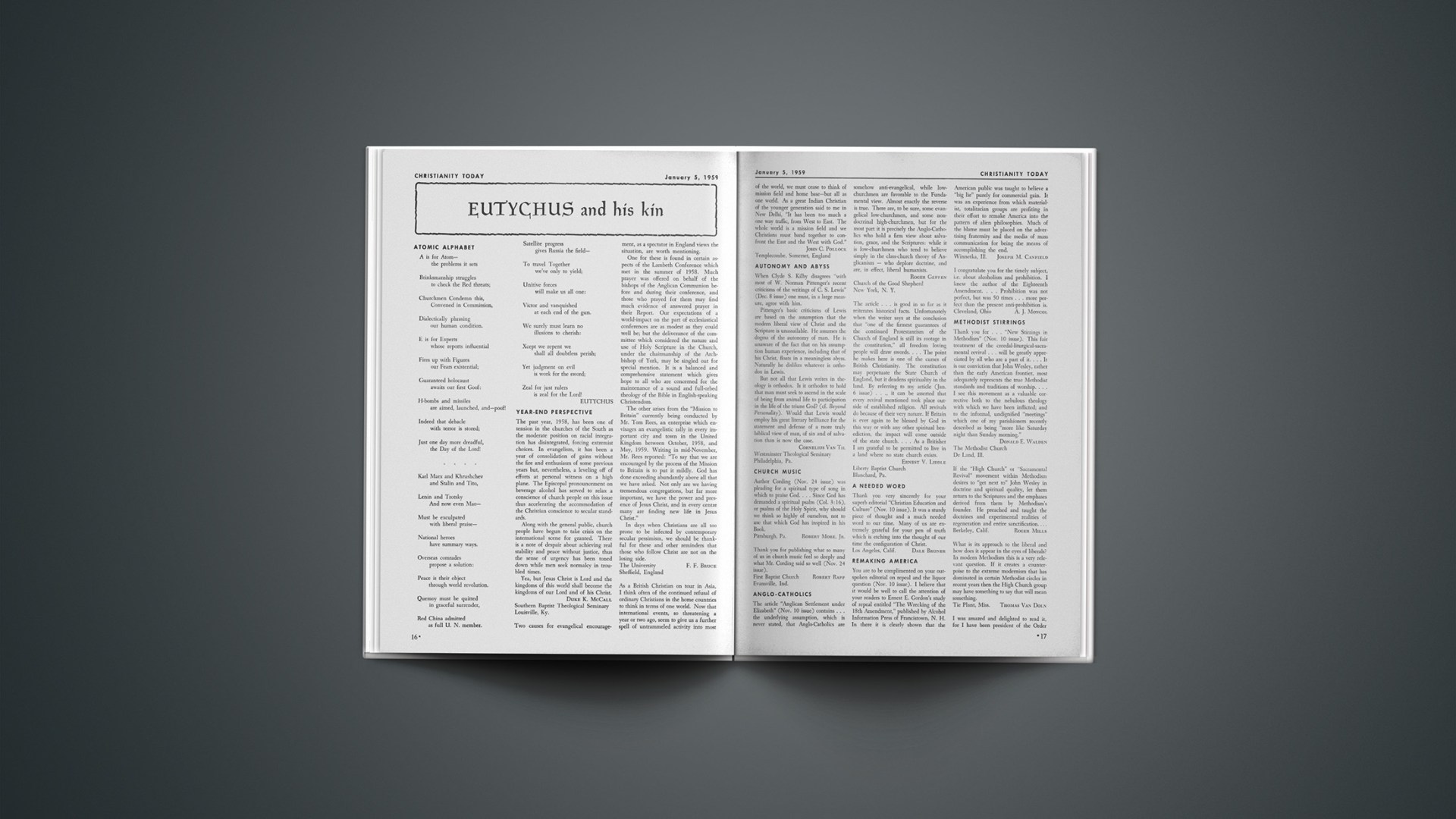
Eutychus and His Kin: January 5, 1959

ATOMIC ALPHABET

A is for Atom—

the problems it sets

Brinksmanship struggles

to check the Red threats;

Churchmen Condemn this,

Convened in Commission,

Dialectically phrasing

our human condition.

E is for Experts

whose reports influential

Firm up with Figures

our Fears existential;

Guaranteed holocaust

awaits our first Goof:

H-bombs and missiles

are aimed, launched, and—poof!

Indeed that debacle

with terror is stored;

Just one day more dreadful,

the Day of the Lord!

Karl Marx and Khrushchev

and Stalin and Tito,

Lenin and Trotsky

And now even Mao-

Must be exculpated

with liberal praise—

National heroes

have summary ways.

Overseas comrades

propose a solution:

Peace is their object

through world revolution.

Quemoy must be quitted

in graceful surrender,

Red China admitted

as full U. N. member.

Satellite progress

gives Russia the field—

To travel Together

we’ve only to yield;

Unitive forces

will make us all one:

Victor and vanquished

at each end of the gun.

We surely must learn no

illusions to cherish:

Xcept we repent we

shall all doubtless perish;

Yet judgment on evil

is work for the sword;

Zeal for just rulers

is zeal for the Lord!

YEAR-END PERSPECTIVE

The past year, 1958, has been one of tension in the churches of the South as the moderate position on racial integration has disintegrated, forcing extremist choices. In evangelism, it has been a year of consolidation of gains without the fire and enthusiasm of some previous years but, nevertheless, a leveling off of efforts at personal witness on a high plane. The Episcopal pronouncement on beverage alcohol has served to relax a conscience of church people on this issue thus accelerating the accommodation of the Christian conscience to secular standards.

Along with the general public, church people have begun to take crisis on the international scene for granted. There is a note of despair about achieving real stability and peace without justice, thus the sense of urgency has been toned down while men seek normalcy in troubled times.

Yea, but Jesus Christ is Lord and the kingdoms of this world shall become the kingdoms of our Lord and of his Christ.

Southern Baptist Theological Seminary

Louisville, Ky.

Two causes for evangelical encouragement, as a spectator in England views the situation, are worth mentioning.

One for these is found in certain aspects of the Lambeth Conference which met in the summer of 1958. Much prayer was offered on behalf of the bishops of the Anglican Communion before and during their conference, and those who prayed for them may find much evidence of answered prayer in their Report. Our expectations of a world-impact on the part of ecclesiastical conferences are as modest as they could well be; but the deliverance of the committee which considered the nature and use of Holy Scripture in the Church, under the chairmanship of the Archbishop of York, may be singled out for special mention. It is a balanced and comprehensive statement which gives hope to all who are concerned for the maintenance of a sound and full-orbed theology of the Bible in English-speaking Christendom.

The other arises from the “Mission to Britain” currently being conducted by Mr. Tom Rees, an enterprise which envisages an evangelistic rally in every important city and town in the United Kingdom between October, 1958, and May, 1959. Writing in mid-November, Mr. Rees reported: “To say that we are encouraged by the process of the Mission to Britain is to put it mildly. God has done exceeding abundantly above all that we have asked. Not only are we having tremendous congregations, but far more important, we have the power and presence of Jesus Christ, and in every centre many are finding new life in Jesus Christ.”

In days when Christians are all too prone to be infected by contemporary secular pessimism, we should be thankful for these and other reminders that those who follow Christ are not on the losing side.

The University

Sheffield, England

As a British Christian on tour in Asia, I think often of the continued refusal of ordinary Christians in the home countries to think in terms of one world. Now that international events, so threatening a year or two ago, seem to give us a further spell of untrammeled activity into most of the world, we must cease to think of mission field and home base—but all as one world. As a great Indian Christian of the younger generation said to me in New Delhi, “It has been too much a one way traffic, from West to East. The whole world is a mission field and we Christians must band together to confront the East and the West with God.”

Templecombe, Somerset, England

AUTONOMY AND ABYSS

When Clyde S. Kilby disagrees “with most of W. Norman Pittenger’s recent criticisms of the writings of C. S. Lewis” (Dec. 8 issue) one must, in a large measure, agree with him.

Pittenger’s basic criticisms of Lewis are based on the assumption that the modern liberal view of Christ and the Scripture is unassailable. He assumes the dogma of the autonomy of man. He is unaware of the fact that on his assumption human experience, including that of his Christ, floats in a meaningless abyss. Naturally he dislikes whatever is orthodox in Lewis.

But not all that Lewis writes in theology is orthodox. Is it orthodox to hold that man must seek to ascend in the scale of being from animal life to participation in the life of the triune God? (cf. Beyond Personality). Would that Lewis would employ his great literary brilliance for the statement and defense of a more truly biblical view of man, of sin and of salvation than is now the case.

Westminster Theological Seminary

Philadelphia, Pa.

CHURCH MUSIC

Author Cording (Nov. 24 issue) was pleading for a spiritual type of song in which to praise God.… Since God has demanded a spiritual psalm (Col. 3:16), or psalms of the Holy Spirit, why should we think so highly of ourselves, not to use that which God has inspired in his Book.

Pittsburgh, Pa.

Thank you for publishing what so many of us in church music feel so deeply and what Mr. Cording said so well (Nov. 24 issue).

First Baptist Church

Evansville, Ind.

ANGLO-CATHOLICS

The article “Anglican Settlement under Elizabeth” (Nov. 10 issue) contains … the underlying assumption, which is never stated, that Anglo-Catholics are somehow anti-evangelical, while low-churchmen are favorable to the Fundamental view. Almost exactly the reverse is true. There are, to be sure, some evangelical low-churchmen, and some non-doctrinal high-churchmen, but for the most part it is precisely the Anglo-Catholics who hold a firm view about salvation, grace, and the Scriptures: while it is low-churchmen who tend to believe simply in the class-church theory of Anglicanism—who deplore doctrine, and are, in effect, liberal humanists.

Church of the Good Shepherd

New York, N. Y.

The article … is good in so far as it reiterates historical facts. Unfortunately when the writer says at the conclusion that “one of the firmest guarantees of the continued Protestantism of the Church of England is still its rootage in the constitution,” all freedom loving people will draw swords.… The point he makes here is one of the curses of British Christianity. The constitution may perpetuate the State Church of England, but it deadens spirituality in the land. By referring to my article (Jan. 6 issue) …, it can be asserted that every revival mentioned took place outside of established religion. All revivals do because of their very nature. If Britain is ever again to be blessed by God in this way or with any other spiritual benediction, the impact will come outside of the state church.… As a Britisher I am grateful to be permitted to live in a land where no state church exists.

Liberty Baptist Church

Blanchard, Pa.

A NEEDED WORD

Thank you very sincerely for your superb editorial “Christian Education and Culture” (Nov. 10 issue). It was a sturdy piece of thought and a much needed word to our time. Many of us are extremely grateful for your pen of truth which is etching into the thought of our time the configuration of Christ.

Los Angeles, Calif.

REMAKING AMERICA

You are to be complimented on your outspoken editorial on repeal and the liquor question (Nov. 10 issue). I believe that it would be well to call the attention of your readers to Ernest E. Gordon’s study of repeal entitled “The Wrecking of the 18th Amendment,” published by Alcohol Information Press of Francistown, N. H. In there it is clearly shown that the American public was taught to believe a “big lie” purely for commercial gain. It was an experience from which materialist, totalitarian groups are profiting in their effort to remake America into the pattern of alien philosophies. Much of the blame must be placed on the advertising fraternity and the media of mass communication for being the means of accomplishing the end.

Winnetka, Ill.

I congratulate you for the timely subject, i.e. about alcoholism and prohibition. I knew the author of the Eighteenth Amendment.… Prohibition was not perfect, but was 50 times … more perfect than the present anti-prohibition is. Cleveland, Ohio

METHODIST STIRRINGS

Thank you for … “New Stirrings in Methodism” (Nov. 10 issue). This fair treatment of the creedal-liturgical-sacramental revival … will be greatly appreciated by all who are a part of it.… It is our conviction that John Wesley, rather than the early American frontier, most adequately represents the true Methodist standards and traditions of worship.… I see this movement as a valuable corrective both to the nebulous theology with which we have been inflicted; and to the informal, undignified “meetings” which one of my parishioners recently described as being “more like Saturday night than Sunday morning.”

The Methodist Church

De Land, Ill.

If the “High Church” or “Sacramental Revival” movement within Methodism desires to “get next to” John Wesley in doctrine and spiritual quality, let them return to the Scriptures and the emphases derived from them by Methodism’s founder. He preached and taught the doctrines and experimental realities of regeneration and entire sanctification.…

Berkeley, Calif.

What is its approach to the liberal and how does it appear in the eyes of liberals? In modern Methodism this is a very relevant question. If it creates a counterpoise to the extreme modernism that has dominated in certain Methodist circles in recent years then the High Church group may have something to say that will mean something.

Tie Plant, Miss.

I was amazed and delighted to read it, for I have been president of the Order of St. Luke since its founding, and was one of the two founders.… This article is the first to be written by one who is not an officer of the organization explaining correctly what we stand for.… Unfortunately, due to the resurgent interest in ceremonial and aesthetic “improvements,” the Order has come to be associated in the minds of many people with a sort of High Church ritualism.… This is not the meaning of the Order.… However, we have had a tremendous effect upon the church in such a quiet way that this is the first time we have been credited with much of it, except by observers in other churches.

North Carolina Christian Advocate Ed.

Greensboro, N. C.

PROMOTION PROTESTED

Concerning an editorial … in regard to the Friends “Peace Promotion” (Nov. 10 issue) …, many of the Friends, usually the evangelicals, not only refuse to go along with this promotion but abhor many of the ideas they put forth.… Many of us as Friends stress the gospel of Christ rather than the gospel of “Peace.”

Midway City Community Friends Church

Midway City, Calif.

ECUMENICAL MISSION

“Whither Ecumenical Mission?” (Aug. 18 issue) is a thought-provoking contribution.… In clear, strong words it examines the program of “ecumenical mission” as being followed by certain sending churches. The conclusion reached is that “we can say ‘fraternal worker’ instead of ‘missionary,’ and ‘ecumenical mission’ instead of ‘missions’ if we like, but let us remember that we are talking about different things”.… Are “ecumenical mission” and the “business of being sent to the unevangelized” really so far apart as indicated?.… If concern for fellowship takes the place of concern for reaching the lost for Christ, woe unto us. But we have at the same time to see that there is a strong biblical warrant for the concept of the missionary in another land seeking to be “a fraternal worker” to those who are Christ’s, to those who are his new church in that land. The commission is from Christ; it is to us and to them—together. Indeed what more wonderful thing have we to do with the title “missionary” than to lose it for ourselves that we may gain it again with our brothers in the land of our adoption?

Cent. Braz. Miss., United Presb., U.S.A.

Xapeco, Santa Catarina, Brazil

A TIME FOR TRIBUTE

There is yet another view of the millennium.… It agrees with the amillennial view in that it gives a figurative interpretation of the thousand years rather than a literal, but there is a difference in the significance attached to the figure.… Verses one to ten of [Revelation 20] form a part of [the] … scene which depicts the victory celebration of the redeemed.… This … includes … the chaining of Satan for a thousand years … [and] is marked by a season of special recognition and honor bestowed upon those who had suffered martyrdom for … Christ. The actual duration of this “thousand year” period is of minor consequence in the proper understanding of the true meaning of the text. During this period not all the saints shall reign with Christ …, but only the martyrs (Rev. 20:4).… The significance is … this: Somewhere in God’s economy and plan there will be a time and place in which God will give special recognition and tribute to those who have had to pay the supreme sacrifice of their lives for their faith.…

Royal Haven Baptist Church

Dallas, Texas

APPLICATION WANTED

Every congregation would benefit if its preacher could and would read and apply “With Hearts Aflame” (“A Layman and His Faith,” Oct. 13 issue).

Boston, Mass.

How greatly I appreciate this magazine. Some of the articles are very beautiful and uplifting. In particular, I must say that Nelson Bell’s “A Layman and His Faith” is the item I most look forward to every time.

Eastbourne, Sussex, England

THE SCOTTISH MIND

R. L. Stevenson, no mean judge of men, said that the English mind never understood the Scottish mind. And James I. Packer, in his article (Sept. 29 issue) …, is an excellent example. Take his dogmatic assertion about the closing decades of the nineteenth century: “Rationalistic criticism and humanistic theology flourished in the pantheizing atmosphere dominant philosophic idealism generated.” It’s a vague, obscure sentence, unworthy of an Oxford man who is generally clear, and then it’s totally untrue. Every reading minister in the last ten years of the nineteenth century, and the first 20 of this century had The Expositor’s Bible with Marcus Dods, Alexander Maclaren, G. G. Findlay, James Moffatt …, and James Denney …; [they also read] James Stalker …, and David Smith.… All were Scotchmen. And there are a host more. Were these men “rationalistic and pantheistic?” … Dr. Packer seems strangely unaware of the splendid theological writers North of the Border.

I warned my collegiate sons never to argue with a professed fundamentalist on religion or a socialist on politics. Both of them are affected with a mental astigmatism that debars them from seeing things straight, clear, and as a whole.

First Presbyterian Church

Mannington, W. Va.

HAD ENOUGH

I once asked a lieutenant colonel … why he did not attend chapel services.… He said, “When I was at West Point, I had enough chapel to last me the rest of my life.” I believe he expressed the common attitude of the military academy graduate.

The only type of service these men learn to worship under is the “liturgical” service. Since the majority of chaplains they will meet during the course of their military career are “non-liturgical,” I think the Army would do well to make this a one-year U. S. Army chaplain’s assignment alternating between the liturgical and non-liturgical chaplain.

Chaplain

U. S. Army

A SEGREGATIONIST SPEAKS

We segregationists are not unbrotherly nor unchristian. We oppose mixed marriage.

Lexington, Ky.

FACT OR FOLKLORE

In CHRISTIANITY TODAY (Apr. 14 issue) was a letter … reporting that a Rev. John O’Kane took Abraham Lincoln, by night, and immersed him, and then enrolled him as a member [in the Disciples of Christ Church].… Since then I have carried on a wide correspondence with folks who ought to know the truth.… Dr. Louis L. Warren, president of the Disciples Historical Society, says, “He (Mr. Lincoln) did not belong to any communion. Credence should not be given to the various stories that Lincoln was immersed.… The tales of Lincoln’s immersion and church affiliations are like other folklore legends which have grown up.”

Sons of Union Veterans of Civil War

Manchester, N. H.

The Saint’s Reward and God’s Grace

Evangelical Christians uphold the Pauline doctrine “that a man is justified by faith without the deeds of the law” (Rom. 3:28). With great vigor both Luther and Calvin defended the doctrine of salvation by grace alone against the Roman dogma of merit. Calvin ardently supported statements of Luther such as the following: “Grace must be gratuitous, that is, offered gratis. It must be bestowed freely; otherwise it is not grace” (Luther’s Works, Weimar edition, 43:607). Against the Roman dogma of the meritoriousness of good works Luther asserted time and again that there can be no place for human merit between God and man. To God alone belongs all glory for man’s redemption and salvation. It is only then, when man’s salvation is ascribed to divine grace in its entirety, that the glory of God can be fully maintained (Weimar, 7:148). Unbelief, or man’s vain self-glory, is a violation of the glory of God (Weimar, 43:620). Faith that receives God’s grace and trusts in his mercy and truth, humbly attributes all glory to him (Weimar, 40:1, 360, 363; 10:2, 166). For this reason all true Christians do their works solely to God’s glory (Weimar, 19:659; 30:2, 663, 668; 43:620). On this doctrine Luther and Calvin were fully agreed (cf. Reinhold Seeberg, Die Lehre Luthers. Dogmengeschichte IV, pp. 186 ff.).

The Roman doctrine of merit, however, may seem on the surface to be supported by the reward motif which Scripture stresses from beginning to end. The divine Word promises to all who faithfully do the Lord’s will, trust in Christ, perform good works in his name, endure to the end, bear their cross with humility and patience and follow Christ throughout their life, a rich reward in heaven. How can this scriptural reward motif be harmonized with the central gospel doctrine of salvation by grace through faith in Christ without works?

It is hardly necessary to illustrate the reward motif by pertinent passages, since these doubtless are well known to all evangelical Bible students. Nevertheless, a few passages promising a reward to believers will remind us of how emphatically the doctrine is taught. Thus those who receive a prophet in the name of a prophet will receive a prophet’s reward, and those who receive a righteous man in the name of a righteous man will receive a righteous man’s reward (Matt. 10:41). Even those who give to Christ’s little ones only a drink of cold water in the name of a disciple will have a reward (v. 42). Christ’s followers who are reviled and persecuted for his sake should rejoice and be exceeding glad, because great is their reward in heaven (Matt. 5:11, 12). Those who love their enemies and do good to them will receive a great reward (Luke 6:35). If on Judgment Day any man’s work in Christ’s ministry will abide, he will receive a reward (1 Cor. 3:14). Believers are to look to themselves that they receive a full reward (2 John 8). Christ will come quickly and his reward is with him to give every man according to his work (Rev. 22:12). And in Genesis, God promised Abraham to be his shield and his exceeding great reward (Gen. 15:1). So the reward motif is found in the Bible from Genesis to Revelation.

Reward Of Grace, Not Merit

In dealing with the strictures of his opponents, Luther maintained on the basis of Scripture that the promised reward was not one of merit, but one only of grace. He was by no means perplexed by the criticism of his adversaries, but rather greatly encouraged to teach the sola gratia just because of God’s gracious promises of a reward. He recognized in these very promises God’s superabundant grace on which he could fully rest his salvation. In his exposition of Psalm 19:11—“Moreover by them [the divine statutes] is thy servant warned: and in keeping of them there is great reward”—he writes:

All this is said to comfort those who labor, not to confirm the covetousness of those who as hirelings and mercenaries seek a reward.… Similarly, he comforts also those who are troubled, in 1 Corinthians 15:58: “Forasmuch as ye know that your labor is not in vain in the Lord.” For God’s (true) servants should know that they please him in their toil so that they do not become weary, discouraged and despondent. God desires cheerful doers of his statutes who do not look for a reward. Nevertheless, those who please him will surely receive a great reward, though they do not work for it. God, who said to Abraham: “I am thy exceeding great reward” (Gen. 15:1), cannot contradict himself (St. Louis ed., 4:1165 f.).

In his great controversial monograph against Erasmus, “Concerning the Enslaved Will,” Luther remarks: God’s children cheerfully and gratuitously do what is good and do not look for any reward. They seek only the glory and pleasure of their (heavenly) Father; they are willing to do what is good even—to assume the impossible—there be neither heaven nor hell. This, I believe, is proved sufficiently by the one statement of Christ which I adduced above: “Come ye blessed of my Father, inherit the kingdom prepared for you from the foundation of the world” (Matt. 25:34). How can they merit that which already is theirs and has been prepared for them before they came into being?… But why does Scripture stress the reward so greatly?… by them the godly are incited, comforted and encouraged to continue, endure and be victorious in doing what is good and in bearing what is evil so that they may not become weary or downhearted, as St. Paul comforts the Christians in 1 Corinthians 15:58 (St. Louis ed., 18:1809 ff.).

According to Scripture, God not only gives his elect saints eternal life as a free gift, but he also rewards the grateful ministry of his believing children on their way to heaven. Viewed in this way the doctrines of the promised reward and of free grace may be taught side by side as does the Bible. To God’s grace alone we owe our salvation; by his promise of a gracious reward we are assured that our work in our Christian ministry is pleasing to him for Jesus’ sake. Both prove the unfathomable love of our merciful Father in heaven.

What The Reward Will Be

While Holy Scripture promises God’s believing saints a rich reward in heaven, it never intimates what the reward will be. It certainly will not consist in a greater degree of salvation, since all believers will share alike in the free and full salvation which Christ has procured for them by his vicarious atonement. In view of Paul’s words in 1 Corinthians 15:41, 42: “One star differeth from another star in glory. So also is the resurrection of the dead,” some church teachers have argued that the reward might consist in greater glory, especially because of God’s promise: “They that be wise shall shine as the brightness of the firmament; and they that turn many to righteousness as the stars forever and ever” (Dan. 12:3). It seems best, however, not to speculate. Paul’s argument in Romans 8:32: “He that spared not his own Son, but delivered him up for us all, how shall he not with him also freely give us all things?” deserves consideration also with regard to his reward of grace. Since God by his dear Son has bestowed upon us so rich a treasure of spiritual gifts, we may leave also the gift of his reward to his never-failing superabundant love.

The evangelical pastor may hesitate somewhat to address his congregation on God’s gracious reward, since his promises may be interpreted by some as implying a reward of merit and so may lead to the surrender of the sola gratia and the adoption of the Roman dogma of the meritoriousness of works. But the scriptural doctrine of God’s gracious reward is not so complex as to render it impossible for a pastor to explain to his hearers what it means. If presented side by side with the sola gratia, the doctrine will certainly not be misunderstood, but will greatly encourage the believing church members to continue in the Lord’s work with zeal and devotion. In fact, the doctrine must not be withheld from Christian believers, since it is a clear and greatly stressed teaching of God’s Word.

As we study the scriptural doctrine of God’s gracious reward in its usual context, we find that it is given especially to such believers as face extraordinary trials. Today consecrated church members are in special need of the rich comfort which the gracious promises of a reward convey to the Lord’s dear but troubled saints. There are so many factors that discourage loyal participation in the Lord’s work. Usually it is the small nucleus of 20 per cent that does the major part of a congregation’s Christian service.

Now, all believers in Christ are saved by grace, even those whose faith is weak and whose service is lacking in zeal. But let no one think that, since all are saved by grace, all, while receiving a free and full salvation in heaven, will be given also the same reward of grace and glory. Those who give themselves fully to the Lord store up rich treasures for themselves in heaven. Even the least good work done in Jesus’ name to his saints will be remembered and rewarded on the day when the Judge will return in glory. The service we do on earth is temporal, but the reward is eternal. God is a beneficent paymaster; he gives far more than the human mind can conceive.

Viewed in this light, the reward motif in Scripture is of the greatest importance; it glorifies God’s abounding love and greatly encourages Christian believers to be zealous of good works.

END

Preacher In The Red

TERMINAL MINISTRY

I formerly served in a community in southwest Virginia where there was a chapel sponsored by my church. This was at the opposite side of the town. It was reported that one Sunday, in announcing the services, my predecessor said:

“There will be preaching in the west end at 11 A.M., preaching in the east end at 3 P.M., and babies will be baptized at both ends.”—The Rev. WILLIAM R. SENEGEL, First Presbyterian Church, Fulton, Mo.

J. T. Mueller is crowning his long years of service as a Lutheran (Missouri Synod) theologian by writing and modified teaching service at Concordia Seminary, St. Louis, where he has been a professor since 1920. He will be 74 on April 5, 1959. Dr. and Mrs. Mueller celebrated their golden wedding anniversary February 25, 1958. Three sons are ministers.

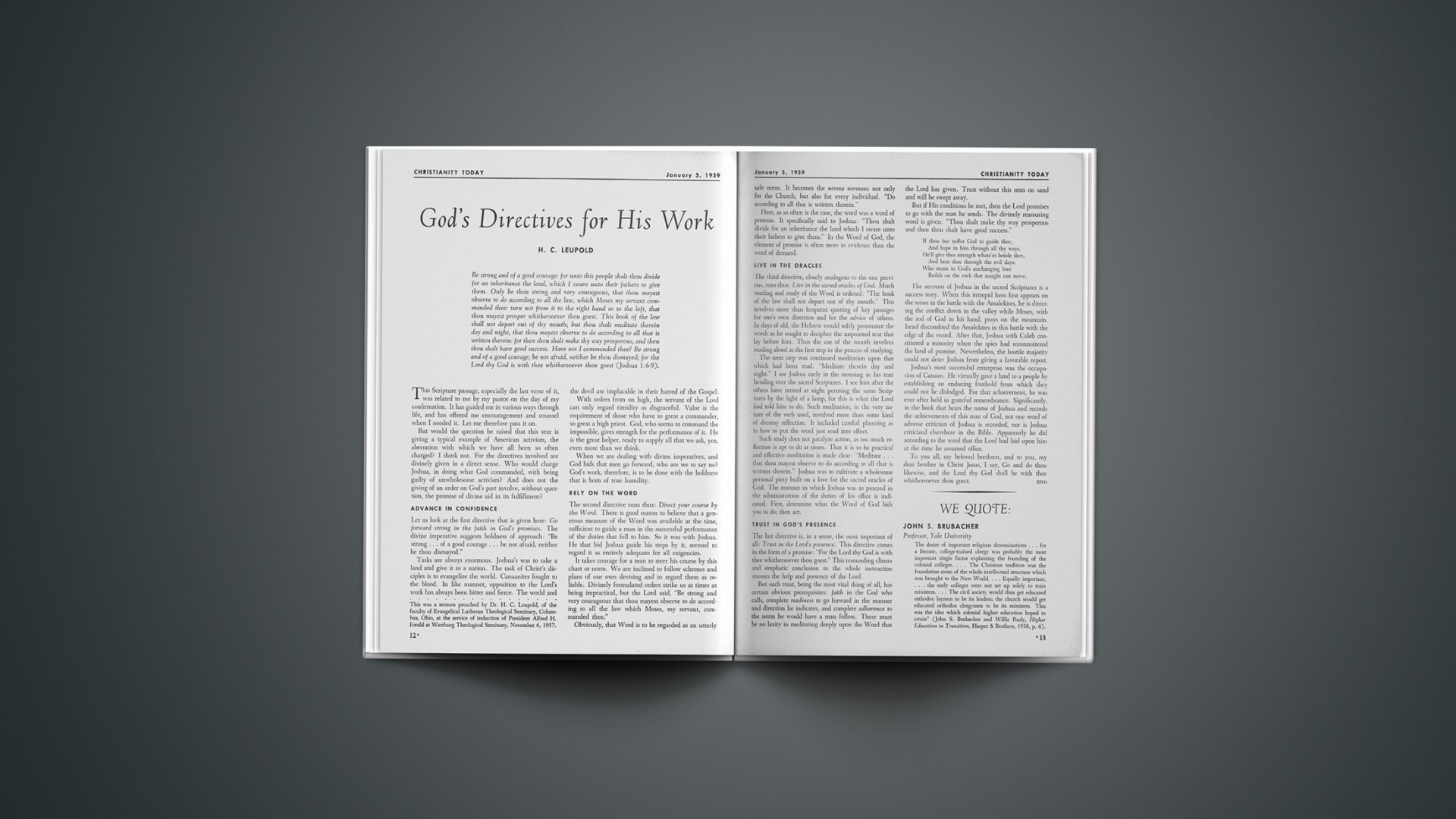
God’s Directives for His Work

Be strong and of a good courage: for unto this people shalt thou divide for an inheritance the land, which I sware unto their fathers to give them. Only be thou strong and very courageous, that thou mayest observe to do according to all the law, which Moses my servant commanded thee: turn not from it to the right hand or to the left, that thou mayest prosper whithersoever thou goest. This book of the law shall not depart out of thy mouth; but thou shalt meditate therein day and night, that thou mayest observe to do according to all that is written therein: for then thou shalt make thy way prosperous, and then thou shalt have good success. Have not I commanded thee? Be strong and of a good courage; be not afraid, neither be thou dismayed; for the Lord thy God is with thee whithersoever thou goest (Joshua 1:6–9).

This Scripture passage, especially the last verse of it, was related to me by my pastor on the day of my confirmation. It has guided me in various ways through life, and has offered me encouragement and counsel when I needed it. Let me therefore pass it on.

But would the question be raised that this text is giving a typical example of American activism, the aberration with which we have all been so often charged? I think not. For the directives involved are divinely given in a direct sense. Who would charge Joshua, in doing what God commanded, with being guilty of unwholesome activism? And does not the giving of an order on God’s part involve, without question, the promise of divine aid in its fulfillment?

Advance In Confidence

Let us look at the first directive that is given here: Go forward strong in the faith in God’s promises. The divine imperative suggests boldness of approach: “Be strong … of a good courage … be not afraid, neither be thou dismayed.”

Tasks are always enormous. Joshua’s was to take a land and give it to a nation. The task of Christ’s disciples is to evangelize the world. Canaanites fought to the blood. In like manner, opposition to the Lord’s work has always been bitter and fierce. The world and the devil are implacable in their hatred of the Gospel.

With orders from on high, the servant of the Lord can only regard timidity as disgraceful. Valor is the requirement of those who have so great a commander, so great a high priest. God, who seems to command the impossible, gives strength for the performance of it. He is the great helper, ready to supply all that we ask, yea, even more than we think.

When we are dealing with divine imperatives, and God bids that men go forward, who are we to say no? God’s work, therefore, is to be done with the boldness that is born of true humility.

Rely On The Word

The second directive runs thus: Direct your course by the Word. There is good reason to believe that a generous measure of the Word was available at the time, sufficient to guide a man in the successful performance of the duties that fell to him. So it was with Joshua. He that bid Joshua guide his steps by it, seemed to regard it as entirely adequate for all exigencies.

It takes courage for a man to steer his course by this chart or norm. We are inclined to follow schemes and plans of our own devising and to regard them as reliable. Divinely formulated orders strike us at times as being impractical, but the Lord said, “Be strong and very courageous that thou mayest observe to do according to all the law which Moses, my servant, commanded thee.”

Obviously, that Word is to be regarded as an utterly safe norm. It becomes the norma normans not only for the Church, but also for every individual. “Do according to all that is written therein.”

Here, as so often is the case, the word was a word of promise. It specifically said to Joshua: “Thou shalt divide for an inheritance the land which I sware unto their fathers to give them.” In the Word of God, the element of promise is often more in evidence than the word of demand.

Live In The Oracles

The third directive, closely analogous to the one previous, runs thus: Live in the sacred oracles of God. Much reading and study of the Word is ordered: “The book of the law shall not depart out of thy mouth.” This involves more than frequent quoting of key passages for one’s own direction and for the advice of others. In days of old, the Hebrew would softly pronounce the words as he sought to decipher the unpointed text that lay before him. Thus the use of the mouth involves reading aloud as the first step in the process of studying.

The next step was continued meditation upon that which had been read: “Meditate therein day and night.” I see Joshua early in the morning in his tent bending over the sacred Scriptures. I see him after the others have retired at night perusing the same Scriptures by the light of a lamp, for this is what the Lord had told him to do. Such meditation, in the very nature of the verb used, involved more than some kind of dreamy reflection. It included careful planning as to how to put the word just read into effect.

Such study does not paralyze action, as too much reflection is apt to do at times. That it is to be practical and effective meditation is made clear: “Meditate … that thou mayest observe to do according to all that is written therein.” Joshua was to cultivate a wholesome personal piety built on a love for the sacred oracles of God. The manner in which Joshua was to proceed in the administration of the duties of his office is indicated: First, determine what the Word of God bids you to do; then act.

Trust In God’S Presence

The last directive is, in a sense, the most important of all: Trust in the Lord’s presence. This directive comes in the form of a promise: “For the Lord thy God is with thee whithersoever thou goest.” This resounding climax and emphatic conclusion to the whole instruction stresses the help and presence of the Lord.

But such trust, being the most vital thing of all, has certain obvious prerequisites: faith in the God who calls, complete readiness to go forward in the manner and direction he indicates, and complete adherence to the norm he would have a man follow. There must be no laxity in meditating deeply upon the Word that the Lord has given. Trust without this rests on sand and will be swept away.

But if His conditions be met, then the Lord promises to go with the man he sends. The divinely reassuring word is given: “Thou shalt make thy way prosperous and then thou shalt have good success.”

If thou but suffer God to guide thee,

And hope in him through all thy ways,

He’ll give thee strength whate’er betide thee,

And bear thee through the evil days;

Who trusts in God’s unchanging love

Builds on the rock that naught can move.

The account of Joshua in the sacred Scriptures is a success story. When this intrepid hero first appears on the scene in the battle with the Amalekites, he is directing the conflict down in the valley while Moses, with the rod of God in his hand, prays on the mountain. Israel discomfited the Amalekites in this battle with the edge of the sword. After that, Joshua with Caleb constituted a minority when the spies had reconnoitered the land of promise. Nevertheless, the hostile majority could not deter Joshua from giving a favorable report.

Joshua’s most successful enterprise was the occupation of Canaan. He virtually gave a land to a people by establishing an enduring foothold from which they could not be dislodged. For that achievement, he was ever after held in grateful remembrance. Significantly, in the book that bears the name of Joshua and records the achievements of this man of God, not one word of adverse criticism of Joshua is recorded, nor is Joshua criticized elsewhere in the Bible. Apparently he did according to the word that the Lord had laid upon him at the time he assumed office.

To you all, my beloved brethren, and to you, my dear brother in Christ Jesus, I say, Go and do thou likewise, and the Lord thy God shall be with thee whithersoever thou goest.

END

We Quote:

JOHN S. BRUBACHER

Professor, Yale University

The desire of important religious denominations … for a literate, college-trained clergy was probably the most important single factor explaining the founding of the colonial colleges.… The Christian tradition was the foundation stone of the whole intellectual structure which was brought to the New World.… Equally important, … the early colleges were not set up solely to train ministers.… The civil society would thus get educated orthodox laymen to be its leaders; the church would get educated orthodox clergymen to be its ministers. This was the idea which colonial higher education hoped to attain” (John S. Brubacher and Willis Rudy, Higher Education in Transition, Harper & Brothers, 1958, p. 6).

This was a sermon preached by Dr. H. C. Leupold, of the faculty of Evangelical Lutheran Theological Seminary, Columbus, Ohio, at the service of induction of President Alfred H. Ewald at Wartburg Theological Seminary, November 6, 1957.

Cover Story

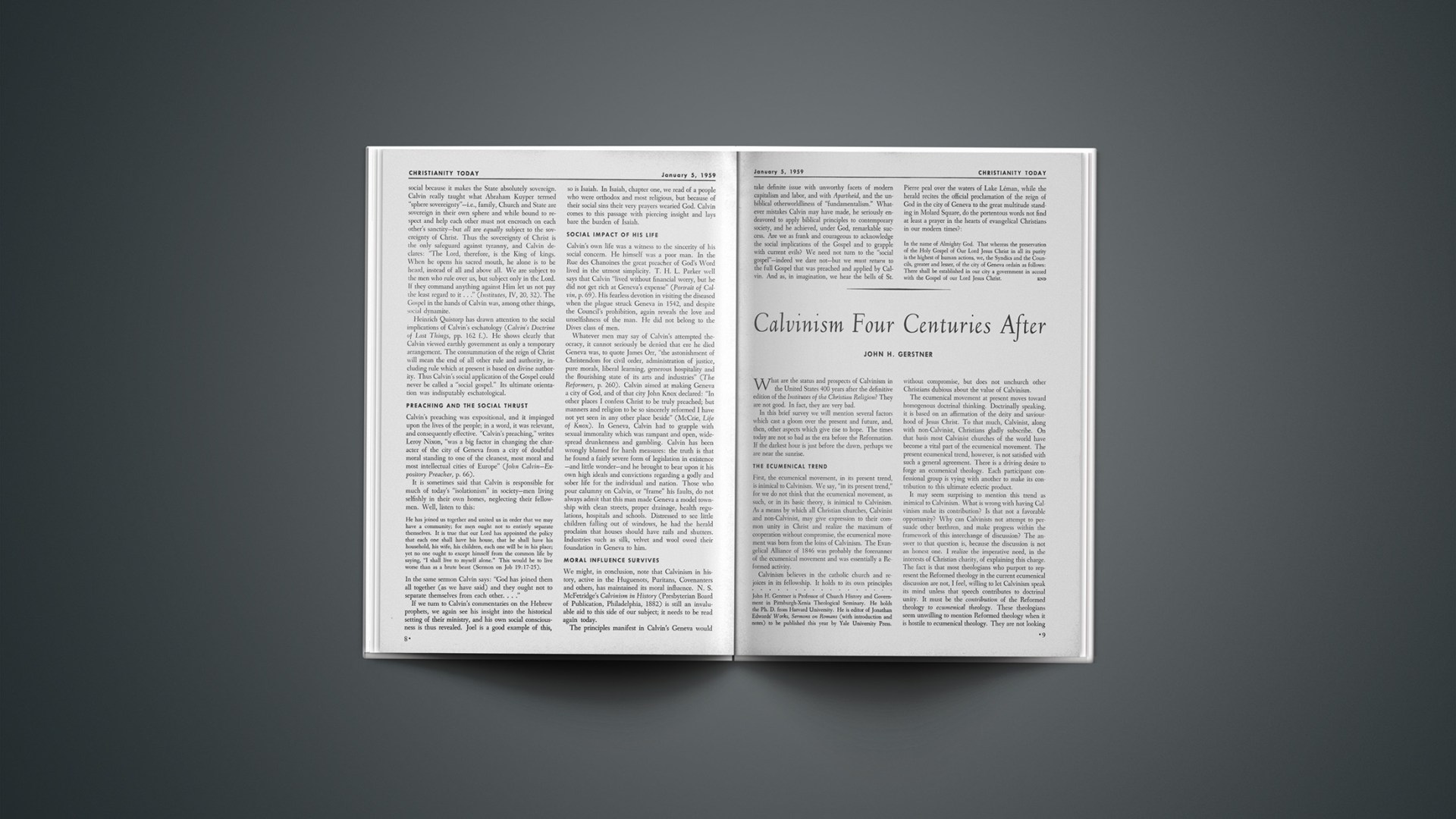
Calvinism Four Centuries After

What are the status and prospects of Calvinism in the United States 400 years after the definitive edition of the Institutes of the Christian Religion? They are not good. In fact, they are very bad.

In this brief survey we will mention several factors which cast a gloom over the present and future, and, then, other aspects which give rise to hope. The times today are not so bad as the era before the Reformation. If the darkest hour is just before the dawn, perhaps we are near the sunrise.

The Ecumenical Trend

First, the ecumenical movement, in its present trend, is inimical to Calvinism. We say, “in its present trend,” for we do not think that the ecumenical movement, as such, or in its basic theory, is inimical to Calvinism. As a means by which all Christian churches, Calvinist and non-Calvinist, may give expression to their common unity in Christ and realize the maximum of cooperation without compromise, the ecumenical movement was born from the loins of Calvinism. The Evangelical Alliance of 1846 was probably the forerunner of the ecumenical movement and was essentially a Reformed activity.

Calvinism believes in the catholic church and rejoices in its fellowship. It holds to its own principles without compromise, but does not unchurch other Christians dubious about the value of Calvinism.

The ecumenical movement at present moves toward homogenous doctrinal thinking. Doctrinally speaking, it is based on an affirmation of the deity and saviourhood of Jesus Christ. To that much, Calvinist, along with non-Calvinist, Christians gladly subscribe. On that basis most Calvinist churches of the world have become a vital part of the ecumenical movement. The present ecumenical trend, however, is not satisfied with such a general agreement. There is a driving desire to forge an ecumenical theology. Each participant confessional group is vying with another to make its contribution to this ultimate eclectic product.

It may seem surprising to mention this trend as inimical to Calvinism. What is wrong with having Calvinism make its contribution? Is that not a favorable opportunity? Why can Calvinists not attempt to persuade other brethren, and make progress within the framework of this interchange of discussion? The answer to that question is, because the discussion is not an honest one. I realize the imperative need, in the interests of Christian charity, of explaining this charge. The fact is that most theologians who purport to represent the Reformed theology in the current ecumenical discussion are not, I feel, willing to let Calvinism speak its mind unless that speech contributes to doctrinal unity. It must be the contribution of the Reformed theology to ecumenical theology. These theologians seem unwilling to mention Reformed theology when it is hostile to ecumenical theology. They are not looking for such; they are not finding such. They are straining every intellectual nerve—and they are men of ability in many cases—to find the contributions. Their great eagerness, on the one hand, and their lack of candor, on the other, enable them to latch onto certain terms distinctly associated with the Reformed tradition, and to present the terms in a way which makes Reformed theology appear to be virtually identical with ecumenical theology, and that the ecumenical theology is Calvinism, pure and simple, but expressed in other terms.

Diluting The Contribution

For example, not long ago we heard an outstanding exponent of ecumenism who also has some reputation as a Reformed theologian. He spoke in a Reformed institution on the subject, “The contribution of the Reformed theology to ecumenical thought.” This address was typical. He cited several doctrines. I will mention only two to give a sample. One Reformed doctrine, which was to contribute to ecumenical thought, is the sovereignty of God. Beyond doubt, Reformed theology teaches the sovereignty of God, and is known among the communions of Christendom for so doing. But it teaches this doctrine in a very specific form which includes predestination. This theologian stated the sovereignty doctrine in such a way that its peculiar and distinctive flavor was drained and there remained only the most general sense of sovereignty to which no Arminian would take exception. As a matter of fact, anyone who says “I believe in God the Father Almighty” would have wondered why the speaker thought that this kind of sovereignty was a special contribution of the Reformed churches. The whole church has always believed that God was sovereign in some sense.

Again, he mentioned the radical nature of sin. When his animated discussion was finished, one realized that the speaker believed sin exists and that he is “agin” it. But more than that could not be said. No mention was made of imputation, total depravity, or inability. What must the non-Reformed listeners in the audience have been thinking? They must have wondered if this learned man was unaware that other people, besides Presbyterians, believe in the reality of sin and are “agin” it too. What was the specific contribution of the Reformed churches?

Now this intellectual spirit, which is widespread, is most unfavorable for Calvinism. How can there be any honest study of the subject if the spirit of the age demands that theologians come out of their ivory towers with some more arguments for some particular movement? Calvinism is based on absolute intellectual honesty and integrity, and the ecumenical movement in its present trend can only be advanced by deliberate unwillingness to examine truth with detachment and scientific objectivity. This “loaded” thinking is a serpent which will strangle any renascent Calvinism in its cradle.

The Rise Of Neo-Calvinism

The second factor which augurs ill for the fortunes of Calvinism is neo-Calvinism. If the most conspicuous ecclesiastical movement of our century is the ecumenical, the most conspicuous theological movement is neo-orthodoxy. Inasmuch as this has been reputedly neo-Calvinistic rather than neo-Lutheran or neo-Anglican or neo-Arminian, it might seem to be congenial to the fortunes of Calvinism. In some ways it is, but fundamentally this seems not to be so.

From the inception of this neo-Calvinism it was evident to most that it was formally different from the Reformation theology. It was, by nature, hostile to propositional revelation and creedal codifications of revelation content. That such an approach may have been congenial to modern thinkers but not to Luther and Calvin seemed clear, in spite of strenuous efforts to modernize the Reformers. If the Genevan would have stood still long enough to listen to the labored expositions of Urgeschichte, non-historical history, and timeless time, he would have had no truck with it once he grasped it. In the more recent developments of neo-Calvinism its divergence from the Institutes is becoming ever more explicit. What correspondence can there be between a theology which refuses to identify the Bible with the Word of God, is modalistic rather than truly trinitarian, denies infant baptism and forensic justification, repudiates the covenants of redemption and of works while reinterpreting the covenant of grace, is basically antinomian in theory, teaches universal election, inclines to universal salvation and makes the judgment of God into ameliorative rather than vindictive justice—what has such a theology to do with the theology of John Calvin?

Modern Indeterminism

A third adverse factor is modern indeterminism which tends to prejudice superficial thinkers against Calvinism. Actually there is nothing in the theories of Heisenberg and Planck and others which is either “here or there” as far as Calvinism is concerned. They simply imply that some things are not predictable because their laws of behavior are not determinable. This notion, however, leads some thinkers to suppose that some events are actually undetermined. The theories are not prepared to cover that much territory. But they would have to cover that much territory to prove that the Calvinistic theory of fore-ordination is false. Modern indeterminacy reaches only so far as the experiments of men reach; not so far, necessarily, as the laws of God reach. Nevertheless, the very word “indeterminancy” makes some persons wrongly suppose that things in themselves are undetermined and not merely that they are unpredictable so far as we know them. Such presumed ultimate indeterminacy is inimical to the interests of Calvinism and favors the “contingency” theory so essential to Arminianism.

Favorable Aspects

Still, all of these adverse trends of our time have aspects which promote the cause of Calvinism. First, the ecumenical movement is favorable to the interests of Calvinism in some ways. Inasmuch as it expresses the unity of the Church which survives the diverse organization of the churches, it has common cause with Calvinism. Again, the ecumenical interchange promotes a discussion of theology and in this atmosphere Calvinism thrives. Whether such discussion works for the accelerating or retarding of the ecumenical movement, discussion is a consequence of that movement and the movement cannot escape it. Especially is it true that the continental confessional groups are challenging Americans to rethink their theology. All of this involves a reconsideration of Calvinism and its claims. And it necessarily involves the question: is it true that much of the discussion concerning the Reformed contribution to the ecumenical movement is not candid? Honesty has a way of breaking through in such discussions. Their purpose may be to show what contributions Calvinism may have to make, and to repress what deterrents it offers; but the very search for contributions leads to a study of Calvinism which may find more things there than were bargained for. Calvinistic theology may be distorted, suppressed and misrepresented, but where theology is even discussed there is the possibility that it may yet be taken seriously.

Likewise, neo-orthodoxy, or neo-Calvinism, makes an oblique contribution to the fortunes of Calvinism. When a certain Calvinistic professor was inaugurated, he said that a famous neo-orthodox theologian had occasioned a revival of interest in John Calvin at his Reformed seminary. Now, it should not have been necessary for a Calvinistic institution to have its interest in Calvin awakened by a non-Calvinist! But that is what happened, and in more places than one. Perhaps we can say that the greatest modern stimulus to the study of Calvin does not come from traditional Calvinists, but from neo-Calvinists. While these men have led some traditional Calvinists astray, they have led far more non-Calvinists under Calvinistic influence. This augurs well for the future of Calvinism. One may study Calvin without understanding him, to be sure; but no one can understand him without studying him.

Likewise the cultural interest in determinism, in its various forms, holds some promise for Calvinism. The form of determinism may not be that of John Calvin, to be sure, but it makes its adherents willing to listen to him. This same determinism among the historians has led many a modern to think that Calvin was not so much a fool as some historians had formerly thought. This congeniality toward causations greater than man himself, at least, leads a person to rethink the Reformed position. Studying Calvinism under the aegis of a modern scientific, psychological, or historical determinism by no means guarantees that the study will be unbiased or successful, but on the other hand, no possible influence from Calvin can register on modern cultural life unless he is seriously considered. This call for a revisit to John Calvin is the chief by-product value in contemporary deterministic thinking.

Calvinists are incurable optimists. They are not Calvinists because they are optimists, but optimists because they are Calvinists. Calvinism teaches that every picayune event which occurs in the least important circumstance of the most trifling occasion to the most insignificant creature is the perfect outworking of the infinitely wise and good will of an eternal sovereign God. A person who believes that is, by definition, an optimist. So we say that a Calvinist is optimistic even about the pessimistic outlook for Calvinism at the present moment. The shape of things to come is not congenial to the fortunes of Calvinism in the main, but, precisely because these forebodings are part of the eternal wisdom of God, the Calvinist rejoices in them, while he repents of any guilt which he may share in the blame for them. Meanwhile, he goes on confidently assured that this is the best possible universe and all things work together for good to them that love God and are called according to his purpose (as the greatest Calvinist of all once wrote).

END

John H. Gerstner is Professor of Church History and Government in Pittsburgh-Xenia Theological Seminary. He holds the Ph. D. from Harvard University. He is editor of Jonathan Edwards’ Works, Sermons on Romans (with introduction and notes) to be published this year by Yale University Press.

My Father’s Benediction

(Numbers 6:24–26)

Now he is gone, but he has left these words Of benediction, inkwritten upon the flyleaf Of the Book, which was his gift. I read The Word he loved, gracious as dew of Hermon Or the oil that covered Aaron: “The Lord Bless thee and keep theemake his face To shine upon thee and be gracious unto thee: The Lord lift up his countenance upon thee And give thee peace.” Almost unseeing I trace The signature; then wordlessly his life Shines as from an illuminated page: Strangely he speaks who has no need of utterance, Who, having blessed, is bathed eternally In fuller light than shines upon the land.

-RACHEL CROWN

Cover Story

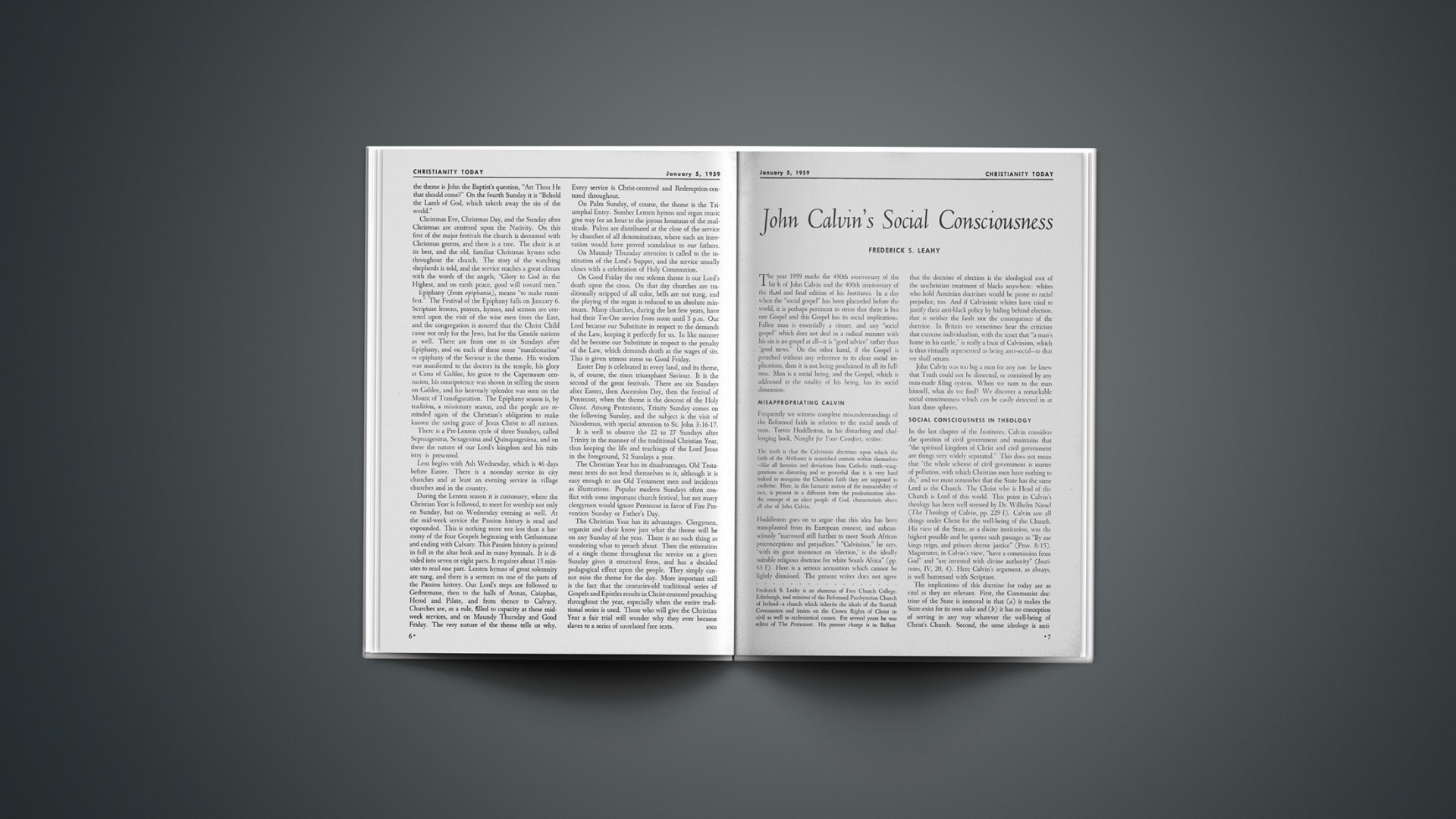
John Calvin’s Social Consciousness

The year 1959 marks the 450th anniversary of the birth of John Calvin and the 400th anniversary of the third and final edition of his Institutes. In a day when the “social gospel” has been placarded before the world, it is perhaps pertinent to stress that there is but one Gospel and this Gospel has its social implications. Fallen man is essentially a sinner, and any “social gospel” which does not deal in a radical manner with his sin is no gospel at all—it is “good advice” rather than “good news.” On the other hand, if the Gospel is preached without any reference to its clear social implications, then it is not being proclaimed in all its fullness. Man is a social being, and the Gospel, which is addressed to the totality of his being, has its social dimension.

Misappropriating Calvin

Frequently we witness complete misunderstandings of the Reformed faith in relation to the social needs of man. Trevor Huddleston, in his disturbing and challenging book, Naught for Your Comfort, writes:

The truth is that the Calvinistic doctrines upon which the faith of the Afrikaner is nourished contain within themselves—like all heresies and deviations from Catholic truth—exaggerations so distorting and so powerful that it is very hard indeed to recognise the Christian faith they are supposed to enshrine. Here, in this fantastic notion of the immutability of race, is present in a different form the predestination idea: the concept of an elect people of God, characteristic above all else of John Calvin.

Huddleston goes on to argue that this idea has been transplanted from its European context, and subconsciously “narrowed still further to meet South African preconceptions and prejudices.” “Calvinism,” he says, “with its great insistence on ‘election,’ is the ideally suitable religious doctrine for white South Africa” (pp. 63 f). Here is a serious accusation which cannot be lightly dismissed. The present writer does not agree that the doctrine of election is the ideological root of the unchristian treatment of blacks anywhere: whites who hold Arminian doctrines would be prone to racial prejudice, too. And if Calvinistic whites have tried to justify their anti-black policy by hiding behind election, that is neither the fault nor the consequence of the doctrine. In Britain we sometimes hear the criticism that extreme individualism, with the tenet that “a man’s home in his castle,” is really a fruit of Calvinism, which is thus virtually represented as being anti-social—to that we shall return.

John Calvin was too big a man for any ism: he knew that Truth could not be dissected, or contained by any man-made filing system. When we turn to the man himself, what do we find? We discover a remarkable social consciousness which can be easily detected in at least three spheres.

Social Consciousness In Theology

In the last chapter of the Institutes, Calvin considers the question of civil government and maintains that “the spiritual kingdom of Christ and civil government are things very widely separated.” This does not mean that “the whole scheme of civil government is matter of pollution, with which Christian men have nothing to do,” and we must remember that the State has the same Lord as the Church. The Christ who is Head of the Church is Lord of this world. This point in Calvin’s theology has been well stressed by Dr. Wilhelm Niesel (The Theology of Calvin, pp. 229 f). Calvin saw all things under Christ for the well-being of the Church. His view of the State, as a divine institution, was the highest possible and he quotes such passages as “By me kings reign, and princes decree justice” (Prov. 8:15). Magistrates, in Calvin’s view, “have a commission from God” and “are invested with divine authority” (Institutes, IV, 20, 4). Here Calvin’s argument, as always, is well buttressed with Scripture.

The implications of this doctrine for today are as vital as they are relevant. First, the Communist doctrine of the State is immoral in that (a) it makes the State exist for its own sake and (b) it has no conception of serving in any way whatever the well-being of Christ’s Church. Second, the same ideology is anti-social because it makes the State absolutely sovereign. Calvin really taught what Abraham Kuyper termed “sphere sovereignty”—i.e., family, Church and State are sovereign in their own sphere and while bound to respect and help each other must not encroach on each other’s sanctity—but all are equally subject to the sovereignty of Christ. Thus the sovereignty of Christ is the only safeguard against tyranny, and Calvin declares: “The Lord, therefore, is the King of kings. When he opens his sacred mouth, he alone is to be heard, instead of all and above all. We are subject to the men who rule over us, but subject only in the Lord. If they command anything against Him let us not pay the least regard to it …” (Institutes, IV, 20, 32). The Gospel in the hands of Calvin was, among other things, social dynamite.

Heinrich Quistorp has drawn attention to the social implications of Calvin’s eschatology (Calvin’s Doctrine of Last Things, pp. 162 f.). He shows clearly that Calvin viewed earthly government as only a temporary arrangement. The consummation of the reign of Christ will mean the end of all other rule and authority, including rule which at present is based on divine authority. Thus Calvin’s social application of the Gospel could never be called a “social gospel.” Its ultimate orientation was indisputably eschatological.

Preaching And The Social Thrust

Calvin’s preaching was expositional, and it impinged upon the lives of the people; in a word, it was relevant, and consequently effective. “Calvin’s preaching,” writes Leroy Nixon, “was a big factor in changing the character of the city of Geneva from a city of doubtful moral standing to one of the cleanest, most moral and most intellectual cities of Europe” (John Calvin—Expository Preacher, p. 66).

It is sometimes said that Calvin is responsible for much of today’s “isolationism” in society—men living selfishly in their own homes, neglecting their fellow-men. Well, listen to this:

He has joined us together and united us in order that we may have a community; for men ought not to entirely separate themselves. It is true that our Lord has appointed the policy that each one shall have his house, that he shall have his household, his wife, his children, each one will be in his place; yet no one ought to except himself from the common life by saying, “I shall live to myself alone.” This would be to live worse than as a brute beast (Sermon on Job 19:17–25).

In the same sermon Calvin says: “God has joined them all together (as we have said) and they ought not to separate themselves from each other.…”

If we turn to Calvin’s commentaries on the Hebrew prophets, we again see his insight into the historical setting of their ministry, and his own social consciousness is thus revealed. Joel is a good example of this, so is Isaiah. In Isaiah, chapter one, we read of a people who were orthodox and most religious, but because of their social sins their very prayers wearied God. Calvin comes to this passage with piercing insight and lays bare the burden of Isaiah.

Social Impact Of His Life

Calvin’s own life was a witness to the sincerity of his social concern. He himself was a poor man. In the Rue des Chanoines the great preacher of God’s Word lived in the utmost simplicity. T. H. L. Parker well says that Calvin “lived without financial worry, but he did not get rich at Geneva’s expense” (Portrait of Calvin, p. 69). His fearless devotion in visiting the diseased when the plague struck Geneva in 1542, and despite the Council’s prohibition, again reveals the love and unselfishness of the man. He did not belong to the Dives class of men.

Whatever men may say of Calvin’s attempted theocracy, it cannot seriously be denied that ere he died Geneva was, to quote James Orr, “the astonishment of Christendom for civil order, administration of justice, pure morals, liberal learning, generous hospitality and the flourishing state of its arts and industries” (The Reformers, p. 260). Calvin aimed at making Geneva a city of God, and of that city John Knox declared: “In other places I confess Christ to be truly preached; but manners and religion to be so sincerely reformed I have not yet seen in any other place beside” (McCrie, Life of Knox). In Geneva, Calvin had to grapple with sexual immorality which was rampant and open, widespread drunkenness and gambling. Calvin has been wrongly blamed for harsh measures: the truth is that he found a fairly severe form of legislation in existence—and little wonder—and he brought to bear upon it his own high ideals and convictions regarding a godly and sober life for the individual and nation. Those who pour calumny on Calvin, or “frame” his faults, do not always admit that this man made Geneva a model township with clean streets, proper drainage, health regulations, hospitals and schools. Distressed to see little children falling out of windows, he had the herald proclaim that houses should have rails and shutters. Industries such as silk, velvet and wool owed their foundation in Geneva to him.

Moral Influence Survives

We might, in conclusion, note that Calvinism in history, active in the Huguenots, Puritans, Covenanters and others, has maintained its moral influence. N. S. McFetridge’s Calvinism in History (Presbyterian Board of Publication, Philadelphia, 1882) is still an invaluable aid to this side of our subject; it needs to be read again today.

The principles manifest in Calvin’s Geneva would take definite issue with unworthy facets of modern capitalism and labor, and with Apartheid, and the unbiblical otherworldliness of “fundamentalism.” Whatever mistakes Calvin may have made, he seriously endeavored to apply biblical principles to contemporary society, and he achieved, under God, remarkable success. Are we as frank and courageous to acknowledge the social implications of the Gospel and to grapple with current evils? We need not turn to the “social gospel”—indeed we dare not—but we must return to the full Gospel that was preached and applied by Calvin. And as, in imagination, we hear the bells of St. Pierre peal over the waters of Lake Léman, while the herald recites the official proclamation of the reign of God in the city of Geneva to the great multitude standing in Molard Square, do the portentous words not find at least a prayer in the hearts of evangelical Christians in our modern times?:

In the name of Almighty God. That whereas the preservation of the Holy Gospel of Our Lord Jesus Christ in all its purity is the highest of human actions, we, the Syndics and the Councils, greater and lesser, of the city of Geneva ordain as follows: There shall be established in our city a government in accord with the Gospel of our Lord Jesus Christ.

END

Frederick S. Leahy is an alumnus of Free Church College, Edinburgh, and minister of the Reformed Presbyterian Church of Ireland—a church which inherits the ideals of the Scottish Covenanters and insists on the Crown Rights of Christ in civil as well as ecclesiastical causes. For several years he was editor of The Protestant. His present charge is in Belfast.

Cover Story

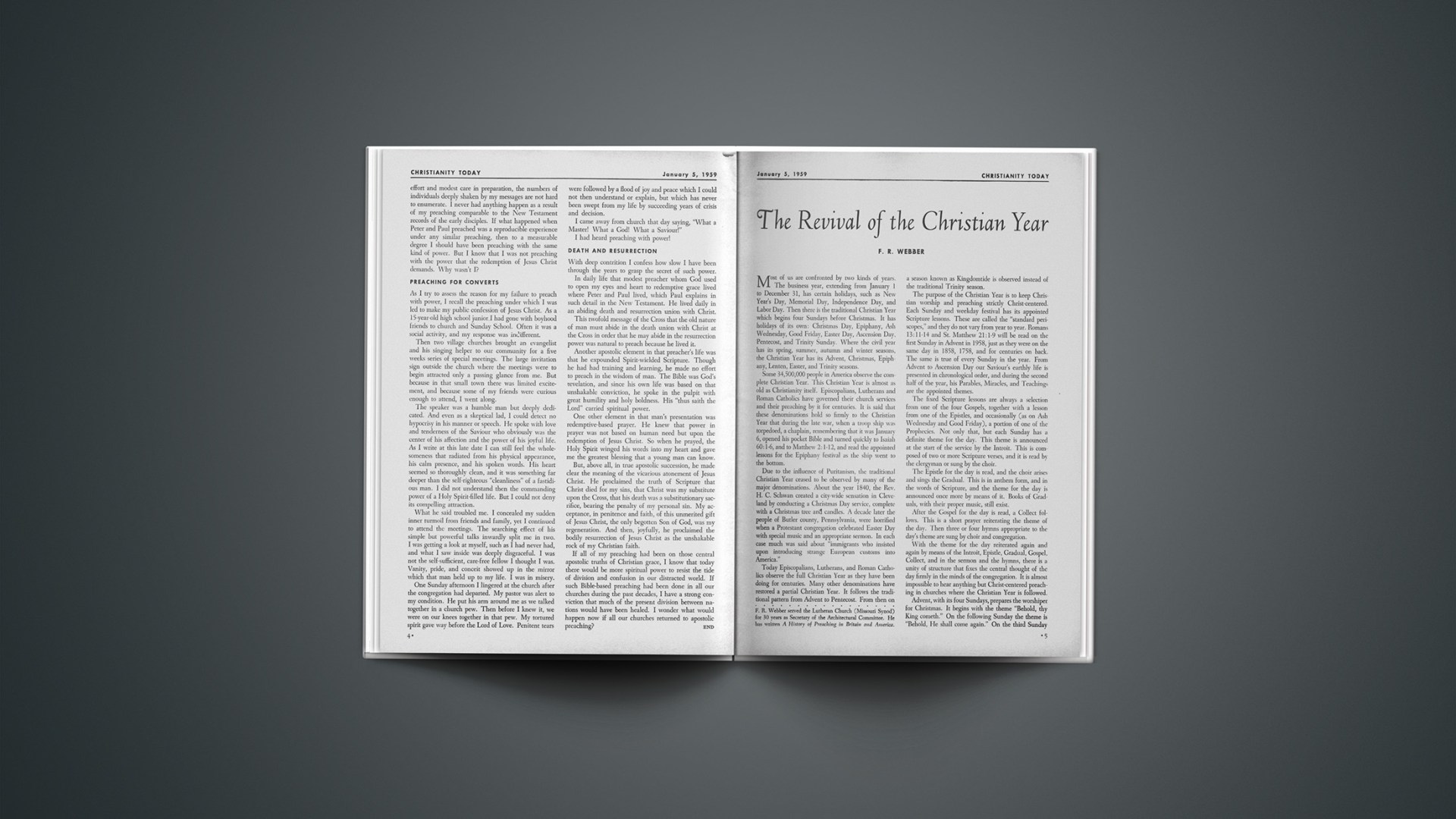
The Revival of the Christian Year

Most of us are confronted by two kinds of years. The business year, extending from January 1 to December 31, has certain holidays, such as New Year’s Day, Memorial Day, Independence Day, and Labor Day. Then there is the traditional Christian Year which begins four Sundays before Christmas. It has holidays of its own: Christmas Day, Epiphany, Ash Wednesday, Good Friday, Easter Day, Ascension Day, Pentecost, and Trinity Sunday. Where the civil year has its spring, summer, autumn and winter seasons, the Christian Year has its Advent, Christmas, Epiphany, Lenten, Easter, and Trinity seasons.

Some 34,500,000 people in America observe the complete Christian Year. This Christian Year is almost as old as Christianity itself. Episcopalians, Lutherans and Roman Catholics have governed their church services and their preaching by it for centuries. It is said that these denominations hold so firmly to the Christian Year that during the late war, when a troop ship was torpedoed, a chaplain, remembering that it was January 6, opened his pocket Bible and turned quickly to Isaiah 60:1–6, and to Matthew 2:1–12, and read the appointed lessons for the Epiphany festival as the ship went to the bottom.

Due to the influence of Puritanism, the traditional Christian Year ceased to be observed by many of the major denominations. About the year 1840, the Rev. H. C. Schwan created a city-wide sensation in Cleveland by conducting a Christmas Day service, complete with a Christmas tree and candles. A decade later the people of Butler county, Pennsylvania, were horrified when a Protestant congregation celebrated Easter Day with special music and an appropriate sermon. In each case much was said about “immigrants who insisted upon introducing strange European customs into America.”

Today Episcopalians, Lutherans, and Roman Catholics observe the full Christian Year as they have been doing for centuries. Many other denominations have restored a partial Christian Year. It follows the traditional pattern from Advent to Pentecost. From then on a season known as Kingdomtide is observed instead of the traditional Trinity season.

The purpose of the Christian Year is to keep Christian worship and preaching strictly Christ-centered. Each Sunday and weekday festival has its appointed Scripture lessons. These are called the “standard periscopes,” and they do not vary from year to year. Romans 13:11–14 and St. Matthew 21:1–9 will be read on the first Sunday in Advent in 1958, just as they were on the same day in 1858, 1758, and for centuries on back. The same is true of every Sunday in the year. From Advent to Ascension Day our Saviour’s earthly life is presented in chronological order, and during the second half of the year, his Parables, Miracles, and Teachings are the appointed themes.

The fixed Scripture lessons are always a selection from one of the four Gospels, together with a lesson from one of the Epistles, and occasionally (as on Ash Wednesday and Good Friday), a portion of one of the Prophecies. Not only that, but each Sunday has a definite theme for the day. This theme is announced at the start of the service by the Introit. This is composed of two or more Scripture verses, and it is read by the clergyman or sung by the choir.

The Epistle for the day is read, and the choir arises and sings the Gradual. This is in anthem form, and in the words of Scripture, and the theme for the day is announced once more by means of it. Books of Graduals, with their proper music, still exist.

After the Gospel for the day is read, a Collect follows. This is a short prayer reiterating the theme of the day. Then three or four hymns appropriate to the day’s theme are sung by choir and congregation.

With the theme for the day reiterated again and again by means of the Introit, Epistle, Gradual, Gospel, Collect, and in the sermon and the hymns, there is a unity of structure that fixes the central thought of the day firmly in the minds of the congregation. It is almost impossible to hear anything but Christ-centered preaching in churches where the Christian Year is followed.

Advent, with its four Sundays, prepares the worshiper for Christmas. It begins with the theme “Behold, thy King cometh.” On the following Sunday the theme is “Behold, He shall come again.” On the third Sunday the theme is John the Baptist’s question, “Art Thou He that should come?” On the fourth Sunday it is “Behold the Lamb of God, which taketh away the sin of the world.”

Christmas Eve, Christmas Day, and the Sunday after Christmas are centered upon the Nativity. On this first of the major festivals the church is decorated with Christmas greens, and there is a tree. The choir is at its best, and the old, familiar Christmas hymns echo throughout the church. The story of the watching shepherds is told, and the service reaches a great climax with the words of the angels, “Glory to God in the Highest, and on earth peace, good will toward men.”

Epiphany (from epiphania), means “to make manifest.” The Festival of the Epiphany falls on January 6. Scripture lessons, prayers, hymns, and sermon are centered upon the visit of the wise men from the East, and the congregation is assured that the Christ Child came not only for the Jews, but for the Gentile nations as well. There are from one to six Sundays after Epiphany, and on each of these some “manifestation” or epiphany of the Saviour is the theme. His wisdom was manifested to the doctors in the temple, his glory at Cana of Galilee, his grace to the Capernaum centurion, his omnipotence was shown in stilling the storm on Galilee, and his heavenly splendor was seen on the Mount of Transfiguration. The Epiphany season is, by tradition, a missionary season, and the people are reminded again of the Christian’s obligation to make known the saving grace of Jesus Christ to all nations.

There is a Pre-Lenten cycle of three Sundays, called Septuagesima, Sexagesima and Quinquagesima, and on these the nature of our Lord’s kingdom and his ministry is presented.

Lent begins with Ash Wednesday, which is 46 days before Easter. There is a noonday service in city churches and at least an evening service in village churches and in the country.

During the Lenten season it is customary, where the Christian Year is followed, to meet for worship not only on Sunday, but on Wednesday evening as well. At the mid-week service the Passion history is read and expounded. This is nothing more nor less than a harmony of the four Gospels beginning with Gethsemane and ending with Calvary. This Passion history is printed in full in the altar book and in many hymnals. It is divided into seven or eight parts. It requires about 15 minutes to read one part. Lenten hymns of great solemnity are sung, and there is a sermon on one of the parts of the Passion history. Our Lord’s steps are followed to Gethsemane, then to the halls of Annas, Caiaphas, Herod and Pilate, and from thence to Calvary. Churches are, as a rule, filled to capacity at these mid-week services, and on Maundy Thursday and Good Friday. The very nature of the theme tells us why. Every service is Christ-centered and Redemption-centered throughout.

On Palm Sunday, of course, the theme is the Triumphal Entry. Somber Lenten hymns and organ music give way for an hour to the joyous hosannas of the multitude. Palms are distributed at the close of the service by churches of all denominations, where such an innovation would have proved scandalous to our fathers.

On Maundy Thursday attention is called to the institution of the Lord’s Supper, and the service usually closes with a celebration of Holy Communion.

On Good Friday the one solemn theme is our Lord’s death upon the cross. On that day churches are traditionally stripped of all color, bells are not rung, and the playing of the organ is reduced to an absolute minimum. Many churches, during the last few years, have had their Tre-Ore service from noon until 3 p.m. Our Lord became our Substitute in respect to the demands of the Law, keeping it perfectly for us. In like manner did he become our Substitute in respect to the penalty of the Law, which demands death as the wages of sin. This is given utmost stress on Good Friday.

Easter Day is celebrated in every land, and its theme, is, of course, the risen triumphant Saviour. It is the second of the great festivals. There are six Sundays after Easter, then Ascension Day, then the festival of Pentecost, when the theme is the descent of the Holy Ghost. Among Protestants, Trinity Sunday comes on the following Sunday, and the subject is the visit of Nicodemus, with special attention to St. John 3:16–17.

It is well to observe the 22 to 27 Sundays after Trinity in the manner of the traditional Christian Year, thus keeping the life and teachings of the Lord Jesus in the foreground, 52 Sundays a year.

The Christian Year has its disadvantages. Old Testament texts do not lend themselves to it, although it is easy enough to use Old Testament men and incidents as illustrations. Popular modern Sundays often conflict with some important church festival, but not many clergymen would ignore Pentecost in favor of Fire Prevention Sunday or Father’s Day.

The Christian Year has its advantages. Clergymen, organist and choir know just what the theme will be on any Sunday of the year. There is no such thing as wondering what to preach about. Then the reiteration of a single theme throughout the service on a given Sunday gives it structural form, and has a decided pedagogical effect upon the people. They simply cannot miss the theme for the day. More important still is the fact that the centuries-old traditional series of Gospels and Epistles results in Christ-centered preaching throughout the year, especially when the entire traditional series is used. Those who will give the Christian Year a fair trial will wonder why they ever became slaves to a series of unrelated free texts.

END

F. R. Webber served the Lutheran Church (Missouri Synod) for 30 years as Secretary of the Architectural Committee. He has written A History of Preaching in Britain and America.

Cover Story

How to Preach with Power

One Sunday morning during years of graduate study I went with friends to hear a preacher of international reputation. Each week people of all ages overflowed the large sanctuary to hear this pulpit master.

He spoke with disarming directness that was most appealing. Each well-modulated and carefully-chosen word held the vast audience in rapt attention. It would have been hard to have excelled his power of enunciation and words of articulate beauty.

The organization and illustration of his ideas made an intense impact upon all of us. With complete mastery of thought and bearing, he massed his ideas to move with accumulating power to a dramatic end. As a young student I knew that in the realm of communication, I was sitting at the feet of an artist. I felt great respect and admiration for the unparalleled skill with which he presented truth. Obviously his artistry had been perfected through hours of faithful preparation.

I came away from that memorable service saying, “What a man!”

That Sunday night, we went to hear another preacher of international reputation. He spoke with deliberate simplicity. He had pruned away eccentricity. He was earnest, honest, sincere, and full of conviction.

I can still see the simple but dynamically effective gesture with which he drove home a classic quotation from Shakespeare that made his point about Scripture truth unforgettable. At no place was there a false note. In construction and presentation it was flawless. What he said so simply and directly created an atmosphere of reverence. Our eager minds were fed with beauty and truth. The power of his utterance is seen in the fact that after several decades I recall it so vividly.

I came away from that unforgettable service saying, “What a message!”

After 30 years in the pastorate I recall those two men as I find myself asking again, “How does one preach with power?” I ask it because a plenitude of outstanding preachers in every denomination across the nation and the world has made so slight an impression today upon the steady trend of division among nations.

If thousands of pulpits, large and small, were week by week preaching with biblical power, would the condition of our world be as serious as it now is?

Millions of people sit in church pews each Sunday and listen to varying degrees of competent preaching. But if such preaching had been with Old Testament prophetic power, would not those millions have been shaken to the very core of their being? If such preaching had been in the New Testament power that Peter and Paul preached, would not millions of people have been prostrated with penitence in the churches? Would they not leave the sanctuaries like conquering spiritual giants? Would not true revival be a continuing experience week by week in every church, where young and old sought and found transforming redemption?

Why is it that with new churches being erected on every hand and an unprecedented church membership and attendance, there is an equally steady decline of good relations among nations? Would not great spiritual power generated each Sunday in our churches be reflected in new and sincere forms of conciliation among leaders and nations?

The Pulpit Last Sunday

As one who must acknowledge personal responsibility for his share in this state of affairs, I am forced to search my own heart in the face of the swift tide of world events. What power has emerged from my preaching?

Of the hundreds I received into church membership, a painfully small percentage have manifested in daily life the revolutionary influence of the redemptive grace of Jesus Christ.

I could defend myself by listing systematic hours of study I did each week. I could explain the care with which I persisted in organizing and writing out my sermons in detail. I could name the time I spent in going over sermons before delivering them in the pulpit, in order to present my thoughts with reasonable effectiveness. I could tell of hours of earnest prayer and devotional study of the Bible that was a background for sermon preparation.

But the fact remains that despite normal sincerity of effort and modest care in preparation, the numbers of individuals deeply shaken by my messages are not hard to enumerate. I never had anything happen as a result of my preaching comparable to the New Testament records of the early disciples. If what happened when Peter and Paul preached was a reproducible experience under any similar preaching, then to a measurable degree I should have been preaching with the same kind of power. But I know that I was not preaching with the power that the redemption of Jesus Christ demands. Why wasn’t I?

Preaching For Converts

As I try to assess the reason for my failure to preach with power, I recall the preaching under which I was led to make my public confession of Jesus Christ. As a 15-year-old high school junior I had gone with boyhood friends to church and Sunday School. Often it was a social activity, and my response was indifferent.

Then two village churches brought an evangelist and his singing helper to our community for a five weeks series of special meetings. The large invitation sign outside the church where the meetings were to begin attracted only a passing glance from me. But because in that small town there was limited excitement, and because some of my friends were curious enough to attend, I went along.

The speaker was a humble man but deeply dedicated. And even as a skeptical lad, I could detect no hypocrisy in his manner or speech. He spoke with love and tenderness of the Saviour who obviously was the center of his affection and the power of his joyful life. As I write at this late date I can still feel the wholesomeness that radiated from his physical appearance, his calm presence, and his spoken words. His heart seemed so thoroughly clean, and it was something far deeper than the self-righteous “cleanliness” of a fastidious man. I did not understand then the commanding power of a Holy Spirit-filled life. But I could not deny its compelling attraction.

What he said troubled me. I concealed my sudden inner turmoil from friends and family, yet I continued to attend the meetings. The searching effect of his simple but powerful talks inwardly split me in two. I was getting a look at myself, such as I had never had, and what I saw inside was deeply disgraceful. I was not the self-sufficient, care-free fellow I thought I was. Vanity, pride, and conceit showed up in the mirror which that man held up to my life. I was in misery.

One Sunday afternoon I lingered at the church after the congregation had departed. My pastor was alert to my condition. He put his arm around me as we talked together in a church pew. Then before I knew it, we were on our knees together in that pew. My tortured spirit gave way before the Lord of Love. Penitent tears were followed by a flood of joy and peace which I could not then understand or explain, but which has never been swept from my life by succeeding years of crisis and decision.

I came away from church that day saying, “What a Master! What a God! What a Saviour!”

I had heard preaching with power!

Death And Resurrection

With deep contrition I confess how slow I have been through the years to grasp the secret of such power.

In daily life that modest preacher whom God used to open my eyes and heart to redemptive grace lived where Peter and Paul lived, which Paul explains in such detail in the New Testament. He lived daily in an abiding death and resurrection union with Christ.

This twofold message of the Cross that the old nature of man must abide in the death union with Christ at the Cross in order that he may abide in the resurrection power was natural to preach because he lived it.

Another apostolic element in that preacher’s life was that he expounded Spirit-wielded Scripture. Though he had had training and learning, he made no effort to preach in the wisdom of man. The Bible was God’s revelation, and since his own life was based on that unshakable conviction, he spoke in the pulpit with great humility and holy boldness. His “thus saith the Lord” carried spiritual power.

One other element in that man’s presentation was redemptive-based prayer. He knew that power in prayer was not based on human need but upon the redemption of Jesus Christ. So when he prayed, the Holy Spirit winged his words into my heart and gave me the greatest blessing that a young man can know.

But, above all, in true apostolic succession, he made clear the meaning of the vicarious atonement of Jesus Christ. He proclaimed the truth of Scripture that Christ died for my sins, that Christ was my substitute upon the Cross, that his death was a substitutionary sacrifice, bearing the penalty of my personal sin. My acceptance, in penitence and faith, of this unmerited gift of Jesus Christ, the only begotten Son of God, was my regeneration. And then, joyfully, he proclaimed the bodily resurrection of Jesus Christ as the unshakable rock of my Christian faith.

If all of my preaching had been on those central apostolic truths of Christian grace, I know that today there would be more spiritual power to resist the tide of division and confusion in our distracted world. If such Bible-based preaching had been done in all our churches during the past decades, I have a strong conviction that much of the present division between nations would have been healed. I wonder what would happen now if all our churches returned to apostolic preaching?

END

Carlos Greenleaf Fuller holds the A.B. degree from Colgate University, the B.D. from Union Theological Seminary (New York City), and M.A. from Teachers College, Columbia University. At 62 years of age, he is presently a retired Presbyterian minister and a frequent writer on religious themes.

Review of Current Religious Thought: December 22, 1958

The question with which we concern ourselves in this article is why some men are ever learning and never knowing (2 Tim. 3:7). We think the reason is that truth brings pain to the corrupt heart of fallen man. The entrance of divine light on the darkness of the fallen soul is like the application of iodine to an open sore. People have an aversion to pain. If truth brings pain, people will have an aversion to truth.

So it is that some are ever learning and never knowing. They have experience after experience with truth but never grow in knowledge, because they are always fleeing rather than coming to it. The more they learn, consequently, the less of the truth they know. Thus as the sensitive eye shuts itself ever tighter to the light as more light falls upon it, so the blind eye of the soul closes more and more as divine truth comes to it. It seems paradoxical that more light should bring more darkness and more truth more ignorance, but it is not so when we consider that the eye of the soul reacts adversely to the entrance of light. The more light enters, the more negatively the soul will react.

But there seems to be a problem. Is it not a fact that some unsound persons actually do know a great deal about Christianity, however much an exception to the rule they may be? It is a fact indeed. But how is it then, if they themselves never come to a knowledge of the truth, they do learn some of it? The explanation, it seems to me, is that such people wrest the Scriptures so as to be able to rest in them. And this wresting is done several ways, three of which are fashionable in our day. I will briefly mention them.

The first way in which Scripture can be wrested is by simple misinterpretation. For convenience, let us call this the man-on-the-street’s way of avoiding the truth. Consider what multitudes of people have in mind when the word “Christianity” is mentioned. It is a religion which teaches a very vague, bland sort of supreme being who does nothing but smile through all eternity and looks with great pleasure on all men. He never becomes angry for more than a moment, because his mercy reminds him that it is not dignified for him to lose his temper. This glorious being regards all men as his children, even those who seem wicked but are actually only misguided. Sin is a nasty word and is not associated with this religion.

Jesus, according to this view, was a wonderful man who loved everyone, was full of sweetness and light, and always entertained the loveliest views of man and the future. This Jesus died because certain men did not quite understand what he was up to. Jesus died forgiving everybody and showing us all how we ought to be devoted to this grand philosophy of faith in man and God.

Now when someone comes to the door to ask a person what his religion is, and that person says he is a Christian, it is altogether possible that this is what he has in mind. A person, even a very scholarly person, could read the Bible and all his life be learning this type of religion more and more. He would be ever learning and never able to come to the knowledge of the truth.

The second kind of wresting of Scripture is a more subtle thing. We may call this the liberals’ way of avoiding the truth. That is to say, they make the Bible’s supernatural content to appear unhistorical, non-factual. Heaven is not a place, miracles never happened, and Adam and Eve never lived in a garden or any place else for that matter. Now who is afraid of a myth? If Scriptural light hurts the eyes of the wicked, it cannot hurt once it is shown to be merely mythological. If some readers, when myth is mentioned, think of Bultmann and Neo-orthodoxy, let me say that I think Bultmann’s “demythologizing” is the point at which Neo-orthodoxy is tending to revert to Liberalism.

Let me illustrate this liberal theory in action by an analogy. Jonathan Edwards is more often compared to the Italian poet Dante than to any other single person, even though Edwards never wrote a stick of verse. The thing that we are interested to notice is that when Edwards’ Sinners in the Hands of an Angry God reminds people of Dante’s Inferno, they claim that they enjoy Dante but cannot enjoy Edwards. In many cases they admire Dante and reprobate Edwards. Now why? The answer, I think, is exceedingly simple. Critics think, at least, that Dante did not represent or intend to represent truth, but myth. After all, the great poem bears many of the marks of the facetious: does the author not populate hell with personal enemies? Do we not recognize particular Florentines at various cantos in Inferno? Surely Dante did not picture an actual hell when he made such representations. And being relieved at this point, we can rather enjoy the spectacle since we don’t have to take it factually. Edwards on the contrary is a preacher of the Word; his message is an exposition of Scripture. There are no personal grievances in any part of the sermon. In broad, general, solemn terms he represents the fate of all men who persist in wickedness. One cannot enjoy his account of hell, at least not if he catches the sincere mood of the preacher. One knows that with Edwards this is no myth being expounded. His description of hell is no more terrible than Dante’s, but with the latter there is a more symbolic tone, is less factual and more palatable.

One last way of learning and never coming to the knowledge of the truth or wresting the Scriptures so that they do not hurt is by making the content of the Word, not the interpretation merely, fluid rather than fixed. If we need not fear a myth, neither need we fear something which cannot be defined. If truth is never stationary, if it is relative and not the same yesterday, today, and forever, then while it may be unpleasant at the moment we can easily take the sting out of it by the assurance that this truth is here today and gone tomorrow. Better than that we can say it is here this minute and gone the next. Better even than that we can say it is not here even this instant, for as soon as we say it is here, we fix it and this is not possible, and so as soon as we say it is here, it is no longer here (if it ever was here). Of all the ways of avoiding the knowledge of truth, this is the most up-to-date; and if one wants to be in the metaphysical swim of things he need only dive into the ever-flowing river of changing truth.

So it is a very sorry possibility for men to be ever learning and never coming to the knowledge of the truth. And since this disposition is not utterly destroyed at conversion, it behooves everyone constantly to be on the alert lest with all his getting he should fail to get wisdom. Archbishop Temple stated “The purpose of an open mind is to close it on something.” And that something, I add, should be the knowledge of the truth.

Book Briefs: December 22, 1958

Baptism And Lord’S Supper

Sacramental Teaching and Practice in the Reformation Churches, by G. W. Bromiley (Eerdmans, 1957, 111 pp., $1.50), is reviewed by L. B. Smedes, Professor of Bible at Calvin College.

The title of G. W. Bromiley’s contribution to Eerdman’s Pathway Series would lead the reader to expect an historical study of sacramental theology in the Reformed churches. This is not his intention, however, as he makes clear in his foreword. He tells us that he has attempted more of a biblical than an historical statement. But as one reads, he discovers a marked ambivalence in regard to both the biblical and historical approach. And as a result, the reader is sometimes hard put to know whether a given view is being put forward as representative of historical Reformation thinking or whether it is the author’s independent exegesis. This is doubtless a weakness in the book’s plan. The work would have been even more valuable than it is had the author stuck more relentlessly to his biblical study and used the exegesis of reformation scholars to buttress his own conclusions. This is only to say that Dr. Bromiley’s method makes it difficult to know how to assess his otherwise creative and instructive discussion of the two sacraments.

The book does very little theologizing on the nature of sacraments in general. Yet it is one of the best English studies of the sacraments to come out of evangelical circles in recent years. There is Dr. Oscar Cullman’s monograph on baptism in the New Testament—on which Dr. Bromiley appears to lean in places—but that is not really an English work. Another Anglican theologian, Dr. E. L. Mascall, wrote a book on the sacraments a few years back called Corpus Christi which had its own merits. But Mascall’s penchant is for the newer Roman Catholic sacramentalism, while Bromiley thinks steadily along Reformation lines. Surely Bromiley’s book is much sturdier stuff than the posthumous study of Sacramental Theology by the late Don Baillie.

The most challenging feature in this book is Bromiley’s discussion of baptism. The author draws a strict antithesis between the subjective and objective references in baptism. He chooses for a consistently objective point of view. Both Roman Catholic and anabaptist theology understand the reference of baptism as subjective. The Roman Catholic sees baptism as effecting a work done in the baptized person by the Holy Spirit. The anabaptist sees baptism as a testimony to a work done in the baptized person at least in part by the baptized person. Bromiley would have the reference of baptism to be wholly apart from anything that happens in the baptized person. Baptism refers only to the work of Jesus Christ on the Cross.

The Cross, says Bromiley apparently following the exegesis of Oscar Cullmann, was our Lord’s baptism for us all. Our baptism attests to His baptism for us. Our baptism refers, then, not to what God does in us, but to what He did for us. The baptized person is not buried and raised with Christ when he is baptized. He was buried and raised with Christ in His baptism—the Cross and Resurrection. Our baptism attests the objective fact of Christ’s death for us. It signifies the objective fact that we were representatively in Christ back there outside the gate of Jerusalem. It does not attest to a subjective or mystical experience of our own.

In this sense baptism is an effective sign. It really works. It really does something rather than merely signifying something. But this means that our Lord’s baptism—the Cross—really works, really does something. Our baptism only summons us to respond in obedience to His baptism. “The real work of baptism is not a subjective work in us; it is the objective work accomplished in Christ for us” (p. 47).

This consistently objective approach shifts the focus on an old problem concerning baptism, especially infant baptism. Dr. Bromiley discusses the Roman Catholic way of dealing with post-baptismal sin—penitence. But the Reformed view has a problem of its own. If baptism is a seal on the child that he belongs to God, what about those who later lapse into permanent disbelief? Was the seal not a real seal, or was it broken? Was the child in the covenant when baptized or was he not really in the covenant? Bromiley’s approach opens another possibility. The baptism of Christ—his death—for our sins cannot be annuled. There is nothing in the subjective status of the baptized person that has been effected by the sacrament, so there is nothing here that can be a problem. “The only problem of the post-baptismal sinner is that it is a denial of the true reality of the believer, a refusal to be what he is in Christ, or to act as such” (p. 50). A person’s baptism summons him to be what he is. If he refuses, he is acting as though he were not in Christ. But he cannot change what he actually is, a person objectively buried and raised with Christ.

What was said in the first paragraph about the ambivalence of the book’s method comes out here. Are we now to ask whether this objectivism is the teaching of the reformation churches? If so, we should have to be somewhat dubious. Surely Calvin did not avoid the Scylla of subjectivity by accepting the Charybdis of consistent objectivity. Calvin did indeed insist time and again that baptism is never to be isolated from the cross of Christ, that it has its meaning and effectiveness only in correlation to it. In this, Bromiley is on the side of the angels. But Calvin also clearly teaches that our baptism refers to the work of God in us, the washing of our souls. Christ was buried and raised for us—call this his baptism, if you will. But our washing or regeneration did not take place at Calvary. It does not take place in isolation from Calvary, but it does occur in us after Calvary. And our baptism refers to the remission of our sins and the washing of our souls. (See the Institutes IV/15/1 ff.) One is also inclined to ask whether Bromiley’s objectivism does not tend to remove the terrible urgency that lies in the possibility of a baptized person’s falling into real apostasy.

On the Lord’s Supper, Dr. Bromiley lucidly maintains the real presence of Christ in the sacrament. He yields nothing to the Roman Church in regard to the real presence, but rightly insists that, though very real, the presence is spiritual and that, though spiritual, the presence is very real. He underscores the truth that a presence in itself is profitless; it is only because it is the presence of the crucified Lord that the presence is spiritually of value. His exposition of the Roman Catholic view of the substantial presence is a gem of lucidity and a good example of theological fair-play. The chapter on the Eucharistic Sacrifice is not as successful.

One of the exciting parts of the book is the argument that the sacraments have compelling significance for the unity of the Church. In the stubborn refusal to go along with church unity schemes at the sacrifice of doctrinal principle, evangelical churches have sometimes ignored the appeal to church unity that is made in the very act of breaking the bread. Every time that we take the broken bread to our lips we confess that we are one body for we all eat of the one loaf. But we rise from the Lord’s table to insist that we are after all not one body. Or, we revert to the notion that while doing what the Lord commanded we are one body spiritually, but that we rise to accept the fact that we are not one body ecclesiastically. Bromiley’s strong words concerning the Supper’s inherent protest against denominationalism bear quoting:

That the loaf and cup must be one, that the new and true reality of Christians is life in the one body of Christ, demands that the old, sinful, defeated, and outdated reality of schism should be averted or healed as far as possible. The churches are to become and be what they are in Christ. The Lord’s Supper with its one loaf and one cup is a condemnation of their present structure with its many loaves and many cups, and a call to the reformation under the Word of God, … which will not mean the end of the congregations and therefore of diversity and richness, but will certainly involve the end of the kind of division against which we are warned already by Paul’s answer to incipient denominationalism in Corinth (p. 65).

To Dr. Bromiley, the sacrament of the one loaf and cup is our Lord’s own prohibition of needless denominationalism.

To this reviewer, an otherwise excellent book was impoverished by the total absence of notes and references, other than references to Bible passages. It would have aided the reader considerably had he been able to refer to Reformation theologians on points claimed by the author to be reformation thought. One is curious, for instance, to know whether Dr. Bromiley has discovered something in regard to baptism that has been otherwise missed, for instance, in Calvin. Again, there are occasions where the author evidently makes use of the work of contemporary scholars. It would have been helpful to the reader had Dr. Bromiley indicated where this was so. The use of notes and references does more than prove accuracy and acknowledge indebtedness. It helps promote a community of scholarship. It underscores the fact that no one stands alone in biblical study. Christian scholarship lives by fellowship and conversation. The judicious use of notes stimulates the conversation and enables the reader to follow it.

L. B. SMEDES

Diagnoses Without Cure

The Restoration of Meaning to Contemporary Life, by Paul Elmen (Doubleday, New York, 194 pp., $3.95), and The Man in the Mirror, by Alexander Miller (Doubleday, New York, 186 pp., $3.95), are reviewed by G. Aiken Taylor, Minister of First Presbyterian Church, Alexandria, La.

Every once in a while a book comes along which is notable, not so much for its theme or its thesis, as for the pure reading pleasure it affords. Of such is the first of these volumes. Here is the theme of Trueblood’s Predicament of Modern Man done in the modern, sophisticated manner. The author writes of the Exurbanite, dedicated to the metaphysics of Esquire magazine, who drives through the hills of Connecticut in his Volkswagon, to a home over the mantel of which hangs Vico’s sullen announcement: “We can know nothing that we have not made.” He wonders, through these delightful pages, if men are not hagridden, appalled by something they have not made.

The author paints delicate and effective word pictures to describe how life can be utterly boring when it is without meaning. He then recalls the frightful history of man’s inhumanity to point out how empty lives breed the horrors of hell. Finally, he offers his view of the manner in which meaning can be given to life only in God. The style is unusually readable:

“(The Byronic hero) comes from nowhere and is going nowhere; he is on the Grand Tour and has lost his itinerary. While he is in this town, in order not to die of inanition, he diverts himself with a seduction, particularly enjoying himself if the woman is married and a home is destroyed before he leaves. He kills time and does not even know how much else has died.”

Unfortunately, the author’s spiritual perception is not as acute as his philosophical. For him, the answer to man’s emptiness is “the Glory,” or the addition of the actual presence of God to life. But what is this “Glory?”

“The glory of all created things is in their possibility of becoming what they really are, that is to say, what God intended them to be.” This is the true glory of man. “The function of families, schools, governments and churches is to help him to discover his authentic individuality—and hence his glory.”

This was the glory Saul saw. In his vision on the Damascus road, Saul recognized his true identity—that he was not Saul but Paul. Thus he captured for himself the glory that Jesus had.

Is Jesus’ death important to the restoration of the meaning of life? Apparently not. The author doesn’t say so, but reading between the lines one concludes that the death of Jesus, as the death of a Stephen or a Polycarp, was actually irrelevent to the manner in which He possessed or manifested his glory, although it certainly underscored it, as did their martyrdoms.

What of the book? Its chapters on the glory reflect, in sophisticated speech, the effect of Pentecost and the beauty of the indwelling Spirit, but the author knows nothing of the personal theology of the Cross or of Pentecost. So his book, in the end, springs mightily towards the Son and falls flat on its face.

These two books are reviewed together because they belong to the same “Christian Faith Series” edited by Reinhold Niebuhr. It is not without significance that they brightly reflect the Niebuhrian ability to diagnose the ills of mankind without knowing exactly what to do about them. Such is the fault of the next work, to which is added a style which makes for hard reading.

The Man in the Mirror is about the restoration of self-hood. Essentially the pattern delineated is one of self-realization. Says the author:

“The self’s concern to understand itself is legitimate and inevitable. But to pursue it solely by introspection is self-defeating. Some discoveries are to be made that way … but the seductiveness of the introspective approach to the problems of the self derives in part from the fact that it feeds the self’s preoccupation with the self, and in part from the fact that it lends itself to endless self-deception.”

The author is perfectly willing to seek the solution of acute personality problems either through religion or without it. He tells the story of a profoundly disturbed, married member of his (Presbyterian!) church whose problem he reduced to a case history and sent to one psychotherapist who was a Christian and another who was an atheist. The solutions, when they came back, were identical and precisely what the man needed. The author tells this story to illustrate his contention that religion is not always necessary to successful personality adjustment. Knowing yourself, however, is.

To be sure one will get to know himself best if he has a good mirror in which to examine himself. Thus Christ is brought into the human situation, as a mirror in which man can best see what life ought to be. Christ is the true man, the “proper” Man. We are our true selves in the measure in which we are rightly related to him. The Christian proclamation of Jesus Christ is the proclamation of a true understanding of human nature and of our nature.

G. AIKEN TAYLOR

Popular Atlas

Atlas of the Bible, by L. H. Grollenberg (Thomas Nelson, New York, 1956, 166 pp., $15), is reviewed by Anton T. Pearson, Professor of O. T. Language and Literature at Bethel Theological Seminary.

Nelson’s Comprehensive Atlas of the Bible, by L. H. Grollenberg of the Dominican Order of Preachers, appearing originally in Dutch and French editions, has been translated into English by Joyce Reed of the University of Manchester, and edited by H. H. Rowley, distinguished Old Testament scholar and professor of Hebrew Language and Literature at Manchester. There is a brief foreword by W. F. Albright and H. H. Rowley.

Grollenberg, a lecturer at the Albertinum Theological Seminary at Nijmegen in Holland, has been a member of the French School of Biblical and Archeological Studies in Jerusalem, and for four seasons did excavation work at Tell el Farah, or Sharuhen, a Hyksos center to the south of Gaza.

This atlas contains 60,000 words of text, 408 photographs, many of them breath-taking, plus 35 eight color maps, 11 of which are full page (13¾ × 10¼ inches), 11 are half page, and 13 are smaller or inset maps. The maps have explanatory data superimposed in red. The 26-page index listing every town, village, mountain, valley, region, country, and people occurring in the Bible is invaluable. Modern Arabic names and alternate locations of sites are included in the index rather than on the maps. The spelling of the biblical names is that of the R.S.V. with cross references to the King James, Douay, and Knox versions.

After an introductory chapter, the author traces the chronological history of Israel from the patriarchs to the first century A.D. He holds that the Semites spread out from the Syrian Steppes rather than Noldeke’s Arabian Desert origin for them (maps 1, 5). “The stories of the patriarchs must be based on historical memories” (p. 35), and archeology demands revision of the old notions of the evolution of Israel’s law, history, and religion (p. 52). With Albright and G. E. Wright, he identifies Jebel Musa of the Sinai Peninsula as Mount Sinai, and dates the conquest of Canaan about the middle of the thirteenth century B.C.

He dates Ezra’s journey to Jerusalem in 458, after Nehemiah’s returns in 445 and 433, contrary to the view of most recent critics who follow Van Hoonacker and locate Ezra after Nehemiah, in the reign of Artaxerxes III, 398 B.C. (pp. 96, 100). He equates Daniel’s fourth empire with the Macedonian (pp. 102 f).

The rolling stone before a tomb, Luke’s accuracy, the pool with five porches not of pentagonal shape (pp. 132, 136) are among the many fascinating topics.

One senses neither a Roman Catholic nor a liberal bias in the volume. The book closes on a warm Christological, soteriological note (p. 139).

Written in non-technical language, this atlas will delight both pastors and laymen.

ANTON T. PEARSON

Essence Of Religion

The Primacy of Worship, by Von Ogden Vogt (Starr King, 175 pp., $5), is reviewed by Richard Allen Bodey, Minister of the Third Presbyterian Church of North Tonawanda, N. Y.

Von Ogden Vogt is a Congregational clergyman turned Unitarian, and now minister emeritus of the First Unitarian Society of Chicago. Through previous publications he has achieved recognition as an authority on the subject of worship and kindred themes.

The present volume grew out of the author’s concern over what he believes to be a widening and disastrous breach between the classical and scientific mind on the one hand, and Medieval and Reformation dogmatism on the other. The title pinpoints the thesis of the book, namely, that worship is the essence and center of valid religion. Vogt deplores all religion which revolves around doctrinal or moral creeds. He has an especial distaste for dogma which, he unconvincingly argues, “fosters obscurantism, encourages duplicity, confounds education, promotes aggression, disbars seekers, threatens social order, and stifles growth.” From his viewpoint, the only absolutes are the spirit (love) of truth, the spirit of goodness, and the spirit of beauty. Incomplete and distorted when isolated from one another, these are brought into their appropriate and harmonious relationship by the agency of worship; hence, the thesis.

Curiously enough, Vogt pretends to be a Christian, and includes a chapter here entitled “The True Christianity.” As should be expected, he conveniently clings to the antiquated distinction between the religion of Jesus and the religion about Jesus. He casts aspersion on New Testament texts which are incompatible with his theories, and blurs the obvious meaning of others by wresting them from their contexts. He defines true Christianity as the imitation of Jesus—not of his beliefs or his way of life, which he considers impossible—but of his character and calling, his sonship to God and saviourhood to men! He rejects the Messiahship of Jesus; compares his death to that of Socrates, Servetus, and Nathan Hale; restricts his resurrection to the spiritual sphere; equates human forgiveness with divine forgiveness; repudiates the concept of revelation; and capitulates to an anemic pantheism.

Abounding in fallacies, perhaps the most conspicuous one is this: the author fails to take note of the pivotal role of the intellect in both God and man. The result is his rejection of the fact of divine revelation of ultimate truth to man in comprehensible terms, and also his disdain for doctrine. His one grand achievement in these pages is simply that he forcefully demonstrates the sheer absurdity and irrationality of his own philosophical and religious tenets.

RICHARD ALLEN BODEY

Informative Work

Theology of the Old Testament, by Edmond Jacob (Harpers, 1958, 368 pp., $5), is reviewed by David W. Kerr, Professor of Old Testament at Gordon Divinity School.

The continued popularity of biblical theology in the Old Testament field is evident from the fact that this is the fifth title in that general area to come into the reviewer’s hands this year. Jacob is professor of Old Testament in the University of Strasbourg and this work is an English translation of his Théologie de l’Ancien Testament published in 1955.

Perhaps the most helpful feature of the book is its vast acquaintance with material published in Europe which has been unavailable to American seminarians and ministers, who seem to avoid foreign language studies. Those who would like to be brought up to date on recent scholarly thought in Old Testament theology can hardly do better than to read this book.

That is not to say that the evangelical reader will find his task thoroughly enjoyable. He will, probably, find it quite disagreeable at a number of points. The general view of the author is that of the comparative religions school with its several weaknesses. For instance, the meanings of words or terms in non-biblical sources may be used to interpret the Bible, to the neglect of statements in the Bible itself. Tsedek was a deity worshiped in Jerusalem served by the priesthood of Tsadok (or Zadok). The source for this conclusion is the El Amarna letters. According to the biblical account, Zadok was a priest of the Lord who officiated first at Gibeon, not at Jerusalem. Here is illustrated another weakness of some modern approaches to biblical theology, which is that they make the Bible say quite the opposite of what it does, as a matter of fact, say.

Jacob accepts the old Wellhausen view that the Law, in its literary form as a whole and in its origin in part, is later than the prophetic writings and is therefore not a unifying principle in the Old Testament. This means that the Mosaic covenant, which is used so often as a point of reference by the writers of the historical books as well as by the prophets, is relegated by him to the place of minor importance in the faith of the people. One must not be unkind in his judgment, of course, for it is not always easy to distinguish between what Israel’s faith was and what it should have been. It is clear, nevertheless, that for the writers of the Bible the Mosaic law and covenant precede the ministry and writings of the prophets and were considered normative for people and prophet alike.

The position is adopted in the book that El and Shaddai along with other titles for the Deity were originally different gods whose functions were later fused in the person and work of Yahweh.

While the author maintains that the Bible is revelational, one is left with a strong uneasiness that it is not in the least authoritative, since the purpose of biblical theology, it is said (p. 20), is to describe what the authors thought concerning divine things. One is reminded of the statement of a well-known liberal of this century who, in denying one of the Pauline teachings, said that his own thoughts of God had as much authority as the apostle’s.

It is hoped, however, that such criticism of Jacob’s position will not obscure the many excellencies of his work. The reader will gain some fine insights into the meanings of some biblical terms, especially where Jacob has used the Bible itself, in the absence of secular sources, as a key. There is a helpful discussion (p. 155) on the problem of corporate personality and the individual. There is a very suggestive presentation of the meaning of chesed, which is translated as “stedfast love” in the R.S.V. An interesting, if not at all conclusive, argument about the image of God is found on p. 168 ff. It is indeed satisfying to find a discussion of such classical passages as Genesis 49; 2 Samuel 7 and even Daniel 7 under category of the Messianic kingdom.

DAVID W. KERR

Madison Avenue Methods

Crisis in Communication, by Malcolm Boyd (Society for the Propagation of Christian Knowledge, London, 128 pp., 10/6), is reviewed by S. W. Murray of Belfast, Ireland.

The attitude of the Christian Church to the advent of mass media continues to provoke discussion and enquiry. Here we have an examination of mass media from one who worked in commercial radio before he was ordained to the Christian ministry.

The far-reaching activities of the Institute for Motivational Research in New York and the commercial advertizer have done much to shape the demand of the consumer in the modern world, and it might be questioned whether the presentation of the Christian Gospel would be appropriate to like methods. Indeed Dr. Dichter, president of the Institute, has pointed out that the departure of the public from its “puritan complex” had helped the power of three major sales appeals: desire for comfort, for luxury, and for prestige.

When the attack upon the human mind and emotions by all that Madison Avenue can devise comes to be regarded as exploitation, Boyd pertinently raises the question: “When does evangelism become exploitation. When is the church free to ‘exploit’ for Jesus Christ and the kingdom of God.” Dr. Billy Graham has answered: “Why should not the church employ some of these methods, that are used by big business or labor unions to promote their products or causes, in order to win men for Christ?”

Comparison is made between various methods of using the radio in communicating the Gospel. The primary objective of religious broadcasting in the words of the Director of religious broadcasting of the B.B.C. “is to communicate the Christian Gospel to listeners with whom the churches have few other effective means of contact.”

Boyd considers there have been few honestly effective church, radio, or TV presentations bearing in mind Gospel content and techniques. He instances the success of Bishop Fulton Sheen on TV as that of a “dynamic, intelligent personality, ideally suited to the video medium.” He concludes that the church must make full and wise use of the mass media of communication which are such a feature of the present generation.

S. W. MURRAY

Reference Handbook

An Introduction to Christian Education, by Peter P. Person (Baker Book House, 1958, 215 pp., $3.75), is reviewed by Tunis Romein, Professor of Philosophy at Erskine College, Due West, South Carolina.

Professor Person, teacher of psychology and Christian education at North Park College in Chicago, has written this book for college, Bible Institute, or seminary introductory courses in Christian education. The church school teacher should find it a useful book.

The text is partly a summary of the author’s lecture notes developed over a number of years in teaching Christian education courses. He has arranged a study outline at the beginning of each chapter as well as a concluding set of review questions at the end of each chapter. The content includes a wealth of information about Christian movements and agencies which makes the text not only appropriate for classroom use but also as a reference handbook for the student after he gets into the field. Some of the general topics discussed are: the Christian church, philosophies of Christian education, the Sunday church school, the vacation church school, the weekly church school, Christian youth camps, and so on.

Commendable is the author’s precaution to make clear the point of view from which the book is written, namely a conservative and evangelical standpoint, although he tries at the same time to avoid “being antagonistic toward more liberal educational philosophies and pedagogical patterns.” He also makes an effort to be “denominationally … neutral without denying the place and purpose of denominations.” These aims are evident throughout, but the result is sometimes a juxtaposition of secular psychological principles, progressive educational outlooks, and conservative Christian faith in a way which does not seem to indicate some of the tensions which exist between Christian faith and secular outlooks. Possibly a fuller acknowledgment of these stresses would also constitute valuable and stimulating aspects of an introduction to Christian education.

The author’s tolerant spirit and tendency toward eclecticism also manifests itself in his enthusiasm for recording lists of aims and objectives drawn from many sources, not the least of which must have been progressive educational texts. Most Christian education majors are probably not so fortunate as to escape some of the routine education courses in which aims and objectives are laboriously outlined for almost everything. And now yet another exposure to the same intellectual fare could conceivably dampen the enthusiasm of the Christian education initiate, especially if he is a superior student.

TUNIS ROMEIN

Religious Classics

In recent years publishers have been making available religious classics of which only few copies have previously existed. Many of these were written by Scotch and English Puritans of the sixteenth and seventeenth centuries. Although these works provide difficult reading (because they employ a scholastic style) the effort provides rich rewards. The classics abound with gold nuggets that will not only enrich the preaching of the minister but deepen his devotional life. The following are among the most recent reprints:

THE EPISTLE OF JUDE, by Thomas Manton (Banner of Truth Trust, London, 376 pp., $4.25). The late Bishop J. C. Ryle writes of Manton: “As a writer his chief excellence consists in the ease, perspicuousness and clearness of his style.… He is never trifling, never shallow, never wearisome, and never dull.” Manton’s work on Jude has never been surpassed for homiletical help.

AN EXPOSITION OF JOHN SEVENTEEN, by Thomas Manton (Sovereign Grace Book Club, Evansville, Indiana, 451 pp., $5.95). He who would know the mind and heart of the Lord as expressed in his high priestly prayer would do well to study this work of Manton. With love and deep reverence the author opens up the glorious and blessed truths of this intercessory passage.

HUMAN NATURE IN ITS FOURFOLD STATE, by Thomas Boston (Sovereign Grace Book Club, Evansville, Indiana, 360 pp., $4.95). The book treats of the four states of man: innocence, depravity, grace, and glory. This volume is heavy reading for those without theological background.

THE ATTRIBUTES OF GOD, by Stephen Charnock (Sovereign Grace Book Club, Evansville, Indiana, 802 pp., $8.95). Here is theology that gives people a deeper, richer knowledge of the living God. Those who would go beyond the superficial religious knowledge that characterizes the present century would do well to meditate on the attributes of God through the medium of this volume.

THE BOOK OF ZECHARIAH, AN EXPOSITION, by Thomas V. Moore (The Banner of Truth Trust, London, 251 pp., $3.25). Dr. Moore was Moderator of the General Assembly of the Southern Presbyterian Church in 1867. He brings great exegetical skill to this portion of God’s Word. Scholarship and devotion are blended together, and extravagant literalism is avoided.

THE SONG OF SOLOMON, by George Burrowes (The Banner of Truth Trust, London, 453 pp., $4.25). Dr. D. M. Lloyd-Jones of England writes: “It has everything that should characterize a good commentary—learning and scholarship, accuracy and carefulness, but, above all, and more important than all else, true spiritual insight and understanding. It provides a key to the understanding of the whole and of every verse, which the humblest Christian can easily follow.” A BODY OF DIVINITY, by Thomas Watson (The Banner of Truth Trust, London, 221 pp., $3.25). C. H. Spurgeon writes: “Thomas Watson’s ‘Body of Practical Divinity’ is one of the most precious of the peerless works of the Puritans. Watson was one of the most concise, racy, illustrative, and suggestive of those eminent divines who made the Puritan age the Augustan period of evangelical literature. There is a happy union of sound doctrine and experience.

Apple PodcastsDown ArrowDown ArrowDown Arrowarrow_left_altLeft ArrowLeft ArrowRight ArrowRight ArrowRight Arrowarrow_up_altUp ArrowUp ArrowAvailable at Amazoncaret-downCloseCloseEmailEmailExpandExpandExternalExternalFacebookfacebook-squareGiftGiftGooglegoogleGoogle KeephamburgerInstagraminstagram-squareLinkLinklinkedin-squareListenListenListenChristianity TodayCT Creative Studio Logologo_orgMegaphoneMenuMenupausePinterestPlayPlayPocketPodcastRSSRSSSaveSaveSaveSearchSearchsearchSpotifyStitcherTelegramTable of ContentsTable of Contentstwitter-squareWhatsAppXYouTubeYouTube