Reds Exploit Hispanic Apathy

Latin America

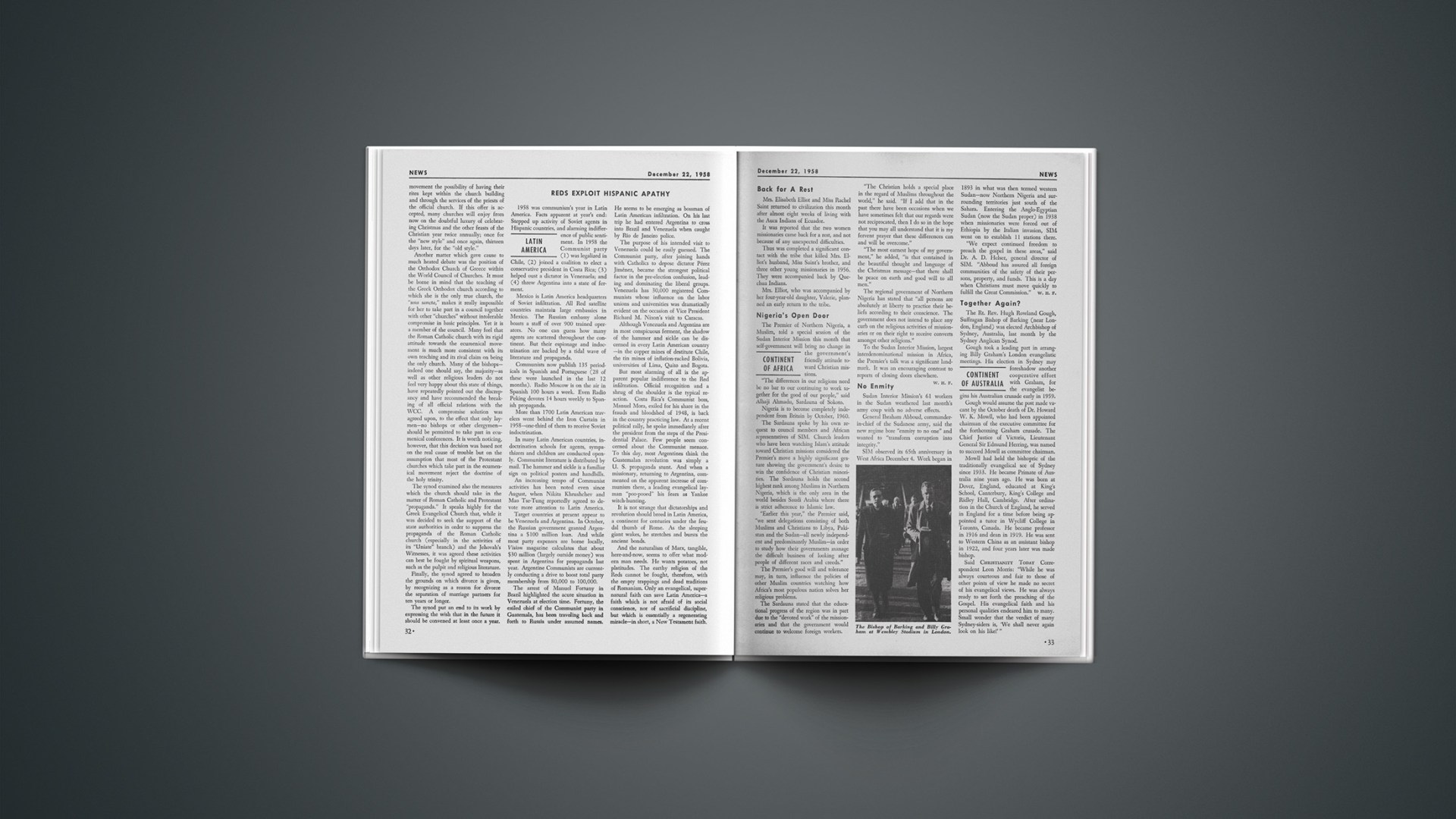
1958 was communism’s year in Latin America. Facts apparent at year’s end: Stepped up activity of Soviet agents in Hispanic countries, and alarming indifference of public sentiment. In 1958 the Communist party (1) was legalized in Chile, (2) joined a coalition to elect a conservative president in Costa Rica; (3) helped oust a dictator in Venezuela; and (4) threw Argentina into a state of ferment.

Mexico is Latin America headquarters of Soviet infiltration. All Red satellite countries maintain large embassies in Mexico. The Russian embassy alone boasts a staff of over 900 trained operators. No one can guess how many agents are scattered throughout the continent. But their espionage and indoctrination are backed by a tidal wave of literature and propaganda.

Communists now publish 135 periodicals in Spanish and Portuguese (28 of these were launched in the last 12 months). Radio Moscow is on the air in Spanish 100 hours a week. Even Radio Peking devotes 14 hours weekly to Spanish propaganda.

More than 1700 Latin American travelers went behind the Iron Curtain in 1958—one-third of them to receive Soviet indoctrination.

In many Latin American countries, indoctrination schools for agents, sympathizers and children are conducted openly. Communist literature is distributed by mail. The hammer and sickle is a familiar sign on political posters and handbills.

An increasing tempo of Communist activities has been noted even since August, when Nikita Khrushchev and Mao Tse-Tung reportedly agreed to devote more attention to Latin America.

Target countries at present appear to be Venezuela and Argentina. In October, the Russian government granted Argentina a $100 million loan. And while most party expenses are borne locally, Vision magazine calculates that about $30 million (largely outside money) was spent in Argentina for propaganda last year. Argentine Communists are currently conducting a drive to boost total party membership from 80,000 to 100,000.

The arrest of Manuel Fortuny in Brazil highlighted the acute situation in Venezuela at election time. Fortuny, the exiled chief of the Communist party in Guatemala, has been traveling back and forth to Russia under assumed names.

He seems to be emerging as bossman of Latin American infiltration. On his last trip he had entered Argentina to cross into Brazil and Venezuela when caught by Rio de Janeiro police.

The purpose of his intended visit to Venezuela could be easily guessed. The Communist party, after joining hands with Catholics to depose dictator Perez Jimenez, became the strongest political factor in the pre-election confusion, leading and dominating the liberal groups. Venezuela has 30,000 registered Communists whose influence on the labor unions and universities was dramatically evident on the occasion of Vice President Richard M. Nixon’s visit to Caracas.

Although Venezuela and Argentina are in most conspicuous ferment, the shadow of the hammer and sickle can be discerned in every Latin American country—in the copper mines of destitute Chile, the tin mines of inflation-racked Bolivia, universities of Lima, Quito and Bogota.

But most alarming of all is the apparent popular indifference to the Red infiltration. Official recognition and a shrug of the shoulder is the typical reaction. Costa Rica’s Communist boss, Manuel Mora, exiled for his share in the frauds and bloodshed of 1948, is back in the country practicing law. At a recent political rally, he spoke immediately after the president from the steps of the Presidential Palace. Few people seem concerned about the Communist menace. To this day, most Argentines think the Guatemalan revolution was simply a U. S. propaganda stunt. And when a missionary, returning to Argentina, commented on the apparent increase of communism there, a leading evangelical layman “poo-pooed” his fears as Yankee witch-hunting.

It is not strange that dictatorships and revolution should breed in Latin America, a continent for centuries under the feudal thumb of Rome. As the sleeping giant wakes, he stretches and bursts the ancient bonds.

And the naturalism of Marx, tangible, here-and-now, seems to offer what modern man needs. He wants potatoes, not platitudes. The earthy religion of the Reds cannot be fought, therefore, with the empty trappings and dead traditions of Romanism. Only an evangelical, supernatural faith can save Latin America—a faith which is not afraid of its social conscience, nor of sacrificial discipline, but which is essentially a regenerating miracle—in short, a New Testament faith.

Back For A Rest

Mrs. Elisabeth Elliot and Miss Rachel Saint returned to civilization this month after almost eight weeks of living with the Auca Indians of Ecuador.

It was reported that the two women missionaries came back for a rest, and not because of any unexpected difficulties.

Thus was completed a significant contact with the tribe that killed Mrs. Elliot’s husband, Miss Saint’s brother, and three other young missionaries in 1956. They were accompanied back by Quechua Indians.

Mrs. Elliot, who was accompanied by her four-year-old daughter, Valerie, planned an early return to the tribe.

Contient Of Africa

Nigeria’S Open Door

The Premier of Northern Nigeria, a Muslim, told a special session of the Sudan Interior Mission this month that self-government will bring no change in the government’s friendly attitude toward Christian missions.

“The differences in our religions need be no bar to our continuing to work together for the good of our people,” said Alhaji Ahmadu, Sardauna of Sokoto.

Nigeria is to become completely independent from Britain by October, 1960.

The Sardauna spoke by his own request to council members and African representatives of SIM. Church leaders who have been watching Islam’s attitude toward Christian missions considered the Premier’s move a highly significant gesture showing the government’s desire to win the confidence of Christian minorities. The Sardauna holds the second highest rank among Muslims in Northern Nigeria, which is the only area in the world besides Saudi Arabia where there is strict adherence to Islamic law.

“Earlier this year,” the Premier said, “we sent delegations consisting of both Muslims and Christians to Libya, Pakistan and the Sudan—all newly independent and predominantly Muslim—in order to study how their governments manage the difficult business of looking after people of different races and creeds.”

The Premier’s good will and tolerance may, in turn, influence the policies of other Muslim countries watching how Africa’s most populous nation solves her religious problems.

The Sardauna stated that the educational progress of the region was in part due to the “devoted work” of the missionaries and that the government would continue to welcome foreign workers.

“The Christian holds a special place in the regard of Muslims throughout the world,” he said. “If I add that in the past there have been occasions when we have sometimes felt that our regards were not reciprocated, then I do so in the hope that you may all understand that it is my fervent prayer that these differences can and will be overcome.”

“The most earnest hope of my government,” he added, “is that contained in the beautiful thought and language of the Christmas message—that there shall be peace on earth and good will to all men.”

The regional government of Northern Nigeria has stated that “all persons are absolutely at liberty to practice their beliefs according to their conscience. The government does not intend to place any curb on the religious activities of missionaries or on their right to receive converts amongst other religions.”

To the Sudan Interior Mission, largest interdenominational mission in Africa, the Premier’s talk was a significant landmark. It was an encouraging contrast to reports of closing doors elsewhere.

W. H. F.

No Enmity

Sudan Interior Mission’s 61 workers in the Sudan weathered last month’s army coup with no adverse effects.

General Ibraham Abboud, commander-in-chief of the Sudanese army, said the new regime bore “enmity to no one” and wanted to “transform corruption into integrity.”

SIM observed its 65th anniversary in West Africa December 4. Work began in 1893 in what was then termed western Sudan—now Northern Nigeria and surrounding territories just south of the Sahara. Entering the Anglo-Egyptian Sudan (now the Sudan proper) in 1938 when missionaries were forced out of Ethiopia by the Italian invasion, SIM went on to establish 11 stations there.

“We expect continued freedom to preach the gospel in these areas,” said Dr. A. D. Helser, general director of SIM. “Abboud has assured all foreign communities of the safety of their persons, property, and funds. This is a day when Christians must move quickly to fulfill the Great Commission.”

W. H. F.

Continent Of Australia

Together Again?

The Rt. Rev. Hugh Rowland Gough, Suffragan Bishop of Barking (near London, England) was elected Archbishop of Sydney, Australia, last month by the Sydney Anglican Synod.

Gough took a leading part in arranging Billy Graham’s London evangelistic meetings. His election in Sydney may foreshadow another cooperative effort with Graham, for the evangelist begins his Australian crusade early in 1959.

Gough would assume the post made vacant by the October death of Dr. Howard W. K. Mowll, who had been appointed chairman of the executive committee for the forthcoming Graham crusade. The Chief Justice of Victoria, Lieutenant General Sir Edmund Herring, was named to succeed Mowll as committee chairman.

Mowll had held the bishopric of the traditionally evangelical see of Sydney since 1933. He became Primate of Australia nine years ago. He was born at Dover, England, educated at King’s School, Canterbury, King’s College and Ridley Hall, Cambridge. After ordination in the Church of England, he served in England for a time before being appointed a tutor in Wycliff College in Toronto, Canada. He became professor in 1916 and dean in 1919. He was sent to Western China as an assistant bishop in 1922, and four years later was made bishop.

Said CHRISTIANITY TODAY Correspondent Leon Morris: “While he was always courteous and fair to those of other points of view he made no secret of his evangelical views. He was always ready to set forth the preaching of the Gospel. His evangelical faith and his personal qualities endeared him to many. Small wonder that the verdict of many Sydney-siders is, ‘We shall never again look on his like!’ ”

Louisville Seminary Faces Probationary Period

Theological Education

The American Association of Theological Schools virtually put the Southern Baptist seminary at Louisville on a year’s probation this month and asked President Duke McCall to relinquish personal leadership ties with the accrediting agency.

The action grew out of the seminary’s dismissal last June of 13 professors, one of whom was subsequently reinstated.

Charging that McCall and the seminary’s trustees “are ultimately responsible for the conditions that have made possible the development of what they themselves have called an intolerable situation,” the AATS Commission on Accrediting (1) threatened removal of accreditation next December pending “a full inquiry as to whether they have taken adequate steps to repair the damage” and (2) recommended to the AATS executive committee (which promptly carried out the proposal) that McCall be asked to submit his resignation from the vice presidency of the AATS and from membership in the Commission on Accrediting.

A special committee headed by Dr. Luther A. Weigle, dean emeritus of Yale Divinity School, had investigated the dismissals. “Efforts were directed,” an AATS statement said, “to making a report on the character of the administrative procedures leading up to this particular incident.” Accrediting standards of the AATS specify that “regard will be had for … the character of (a theological school’s) administration.”

Last month the investigating committee spent three days gathering information in Louisville. It interviewed McCall and members of the present faculty, as well as trustees, three of whom reportedly are unsympathetic toward the dismissal action, and 10 of the dismissed professors. McCall welcomed the committee personally. Minutes of the trustees’ meetings were examined.

During the week end of December 6–7 the committee presented a report on its findings, which concerned “the character of the administration or administrative process and not the character of particular persons involved actively or passively in that process.” Excerpts from the report:

“The resignations of the thirteen professors were not tendered or asked for except orally in two instances … On June 12th when they were dismissed as a body, two of their number were overseas, and a third was out of the state … Between the time of the presidential recommendation of dismissal and final action, no opportunity of a full hearing, as promised, was given to these absent professors. The hearing given to the other ten professors was … too hastily conceived and executed to conform to reasonable standards of dignity and due process of law … The action of June 12 was in part intended as a device to secure the discharge of two members of the faculty and the re-instatement of as many as possible of the remaining eleven.”

While Louisville tensions appeared to be administrative more than theological, the seminary has experienced growing theological distresses. Southern Baptist institutions generally have sought “denominational purity” by guarding teaching posts rigidly for graduates of their own schools. But even these graduates have come under alien theological influences in graduate studies elsewhere. While Louisville has held the line theologically against the liberal theology (despite more concessive views toward evolution and higher critical theories of the Bible than many Southern schools), some alumni have criticized it for tolerating neo-orthodox inroads. Some censure has also followed the widening range of views represented in seminary lectureships. This year’s centennial lectureship series includes Dr. John Wick Bowman, Dr. Daniel Day Williams, and Dr. Emlyn Davies.

Protestant Idols?

The retiring president of the Canadian Council of Churches left office charging that his country’s churches had created “denominational gods” and some had made idols of the Bible and the church.

Dr. Emlyn Davies, Baptist pastor from Toronto, said each church had its “party slogan.” He cited as examples “the infallibility of the pope,” “historic episcopate,” “believers’ baptism by immersion,” “the priesthood of all believers,” and “the Bible says.”

He called church divisions “a scandal and a disgrace to the cause of Christ.”

Davies was scheduled to give a series of lectures this month at Southern Baptist Theological Seminary, Louisville, in that school’s centennial lectureship program.

Ministerial Trainees

Total enrollment of students in member institutions of the American Association of Theological Schools came close to setting a record this fall.

The 127 member schools of the AATS reported a combined enrollment of 20,853 for the 1958–59 academic year.

A record of 20,910 was set in 1956–57 when the AATS had 124 member schools.

Views In The News

After Cleveland

Secretary of State John Foster Dulles was asked for comment on last month’s Fifth World Order Conference of the National Council of Churches, which came out for recognition of Communist China.

“Well,” said Dulles, “I attach great weight to judgments taken by church people which relate primarily to the realm of moral principles and the like.

When it comes down to practical details such as whom you recognize and whom you don’t, then I think the judgment does not carry the same weight.”

“As far as I know,” he added, “I don’t think that this matter was adequately presented at the meeting. Also, it seems unlikely indeed that a policy which reflects both the Republican and Democratic national platforms which were adopted two years ago would be unanimously rejected by a group if it represented fairly a cross section of the religious people of the country.”

Then, in an address in San Francisco this month, Dulles reaffirmed U. S. policy toward mainland China, noting:

“Developments make it ever more clear that if we were to grant political recognition to the Chinese Communist regime, it would be a well-nigh mortal blow to the survival of the non-Communist governments in the Far East.”

Alongside the remarks of Dulles, protests piled up to make the action of the conference held in Cleveland appear as one of the most unpopular ever made in the name of the NCC. (See editorial on Page 23—ED.) Among other comments:

—The statement on Red China is noted “with grave concern” by the Executive Committee of the National Association of Evangelicals. “We are convinced,” said NAE President Herbert S. Mekeel, “such a statement does not represent the true sentiment of masses of members of American churches … We are baffled to observe left-wing cliches, and the typical Communistic ‘soft approach’ urging pressure on our government, falsely in the name of Christian fellowship.” Mekeel called “sheer nonsense” a conference statement which said Americans “hesitate to admit any imperfections in our society.” He added that it is folly to talk of “restorations of relationships” between our churches of the East and West so long as Iron and Bamboo Curtains exist. “To waiver in our stand now,” Mekeel said, “is to bring hopeless despair to millions over the world.”

—“I believe that this action misrepresents my Protestant faith,” said Dr. Daniel A. Poling, editor of the Christian Herald. “With every influence that I have, I repudiate it.”

—Dr. Norman Vincent Peale said he was “completely opposed to recognition of Communist China and to the admission of that ruthlessly totalitarian government to the councils of nations.”

—Dr. Frederick Brown Harris, U. S. Senate chaplain, labelled the study conference a “Trojan Horse … the symbol of conquest from within by smuggled foes.” He said that “Red China, still unrepentant, is under condemnation for aggression by the very organization that is urged to accept it.”

NCC officials, for the most part, hailed the work of the Cleveland conference. Other Protestant leaders, however, refused to comment one way or another. Among these was Dr. C. Emanuel Carlson, executive director of the Baptist Joint Committee on Public Affairs, who said he felt it was “outside my province” to issue judgment on the pronouncements.

Officially Unofficial

The General Board of the National Council of Churches, in a resolution passed at its fall meeting in Chicago, said the Fifth World Order Study Conference was within its rights in recommending steps toward U. S. recognition of Red China.

The board insisted that the conference action was not an official pronouncement of the NCC. But it endorsed the conference as having “performed a valuable function.”

Greek Orthodox bishops on the board voted against the resolution. The Romanian Orthodox bishop abstained.

The Rector And The Tavern Keepers

An Episcopal rector startled wets and drys alike last month with a 3½-minute talk before a tavern keepers’ convention in Atlantic City.

“Quit being ashamed and embarrassed by your business,” the Rev. John F. Mangrum told 1,000 representatives of the National Licensed Beverage Association. “Don’t hide behind the scorn of the professional drys. You have let them shrink you into a gigantic inferiority complex again and again.”

Mangrum urged the tavern keepers to join churches, “to be good citizens and to be good Christians.” He added: “If one denomination does not need you, except when it wants back-door contributions extracted through implied blackmail about community fusses in local option elections, you will find that the traditional Christian groups want you and need you.”

Many a newspaper editor, sensing an incongruity, picked up the remarks, even though Mangrum had given the same speech to a state-wide convention of liquor dealers in Florida last June. Some of the press accounts became distorted. “One paper even had me urging everyone to go out and get loaded,” the rector said later.

Mangrum, who says he does not drink, apologetically concedes that “I probably offended some.” He says his motive, however, was to witness to the liquor industry for the Christian cause. He favors “decent standards” in the control of alcoholic beverages, but opposes harsh criticism of liquor dealers. “Apparently people are going to drink,” he observes in advocating more kindly relations between wets and drys.

“Those fellows really listened to me,” Mangrum maintains. “The words they heard will have a greater influence than all the horrible pamphlets.”

Mangrum, 36, knows something of the evils of alcohol from five years in a parish on Detroit’s Skid Row. He is now rector of rapidly-growing St. Edward’s Episcopal Church in Mount Dora, Florida. He was introduced to the liquor groups by one of their officials who was turned away from three churches before St. Edward’s welcomed him. Mangrum’s witness thus far has fallen short of a clear call for regeneration.

Protestant Panorama

• American missionaries overseas now number 25,058, an increase of nearly 150 per cent since 1936, according to a study by a National Council of Churches’ agency. The study, compiled by Dr. Frank Price and Clare E. Orr of the Missionary Research Library, was presented to the ninth annual assembly of the NCC’s Division of Foreign Missions held in Pittsburgh this month. Japan is said to have the most North American Protestant missionary societies with 97. India has 95 and Formosa 52. The study added that the largest American Protestant missionary force is in Southeast Asia.

• Some 90 members of the Gospel Chapel Congregation in Milwaukee, when they learned that the Rev. Bennie Morris had accepted a new pastorate in Phoenix, Arizona, sold homes, gave up jobs, and went with him.

• The Methodist Church says it has 817 openings for missionaries in home and overseas fields … One hundred and ten missionaries were commissioned for service overseas under the United Presbyterian Church in the U. S. A. by its Commission on Ecumenical Mission and Relations.

• Twentieth Century-Fox plans to film “The Greatest Story Ever Told,” beginning in 1960. The forthcoming picture, it is said, will be the first attempt to tell the story of Christ in a major movie since “King of Kings,” produced by Cecil B. DeMille in 1927.

The Sunday School Times marks its 100th anniversary with the January 3 number … The Ecumenical Press Service observed its 25th year last month.

• The Internal Revenue Service says missionaries and other U. S. citizens abroad must file an income tax return for 1958 even though their earnings are exempt. IRS Publication 54 gives details.

• A heavy snowstorm failed to dampen spirits at ground breaking ceremonies November 28 for the new Methodist Theological School to be located three miles south of Delaware, Ohio.

• Nearly all of the 30,000 Indians and 16,000 Eskimos in Alaska have been converted to some form of Christianity, according to a Roman Catholic missionary. The Rev. Pasquale Spoletini says about one-third of the converts are Catholics.

• Grace Church (Episcopal) in New York celebrates its 150th anniversary this month … The First Mission Covenant Church of Chicago commemorates its 90th anniversary December 26–28.

• International Students, Inc. says more than 100,000 foreign nationals are now residing temporarily in the United States … Moody Bible Institute began the operation of a new FM radio station in Cleveland.

• A Japanese pastor, having completed a six-month study tour of parish and youth work in America, wants to know whether American pastors are too busy to study and “Why are there not more young people attending Lutheran services?’ ” Said the Rev. Hidetake Yano, whose trip was financed by the Lutheran World Federation, “I do not believe that America is a Christian nation, but at least all Americans have Christianity in their background.”

• World Vision President Dr. Bob Pierce was honored at a reception by 150 officials of the Korean government, which gave him a vote of appreciation for humanitarian statesmanship as “the father of Korean orphans” and for tireless efforts in achieving “better understanding” between the United States and Korea.

• A postage stamp issued in Greenland honors the Christian missionary from whom the country’s entire modern history is dated. Bishop Hans Egede of Norway led the settlement of Greenland starting in 1721.

Hilfswerk, welfare arm of the Evangelical Church in Germany, is receiving up to 100 letters a day from German Lutherans in Siberia acknowledging shipments of Bibles and religious literature, an official of the agency said in Stuttgart.

• The Methodist Board of Temperance is distributing a booklet containing official statements of 18 major Protestant denominations which have condemned alcoholism and urged curbs on alcoholic beverage advertising.

• To accommodate expected increased attendance, the 18th General Council of the World Presbyterian Alliance, July 26-August 6, will be held in Sao Paulo instead of the Campinas Seminary in Brazil.

Baptist Trends

A Southern Baptist observer notes several trends which he says are apparent in a survey of Baptist state conventions held this fall. Theo Sommerkamp, Baptist Press staff writer, listed the trends as follows:

—Continued confidence in the leadership of Brooks Hays, president of the Southern Baptist Convention, despite defeat in his bid for a ninth term in the U. S. Congress.

[One pointed exception was a message from the Baptist Laymen of Mississippi, who urged the immediate resignation of Hays to “help to restore the solidarity to Southern Baptists who are firm believers in Southern traditions.”—ED.]

—A desire on the part of messengers to be about their business, evidenced by the fact that church fires or bomb threats failed to delay and interrupt conventions in two states.

—The fact that Baptists are aware of Christian responsibility in public affairs and said so plainly in several states.

—The growing stature of the layman in Baptist denominational life.

—A concern for important internal issues in Baptist circles.

Before this fall, there were 25 Baptist state conventions (or general associations as they are called in a few states). But Indiana Baptists organized themselves into an independent convention to increase it to 26.

Social Drinking

Baptist Editor C. R. Daley took a dim view of the approval of social drinking voted by the Protestant Episcopal Church’s convention in Miami Beach this fall. Daley said in the Western Recorder that a recent event in Knoxville, Tennessee, which he describes as follows, “should be placed side-by-side with this announcement of the Episcopalians”:

“A young graduate student was shot to death by his neighbor upon trying to enter the neighbor’s home in the middle of the night.… The neighbor who had killed his friend was horrified. The young man’s father and mother were deeply shocked. He was their only child. He was not reared to drink and he did not frequent taverns or cocktail rooms. The girl whom he was to marry after graduation was deeply grieved.

“Oh yes, one other person was distressed. This was the preacher with whom the young man had dinner on the very evening before he was killed. This clergyman had no prejudice against drinking and reported he and the young man had a shaker of cocktails before dinner and a brandy afterward. He was sure that they did not drink enough to affect the mental processes but just the same the student was dead. All he did was to take a few drinks on a social occasion—drinks offered him by a minister of Jesus Christ.”

Criticism From Within

German church leader Martin Niemoeller says modern ecumenism lacks grass-roots support. He calls Protestant unity on a theological basis “impossible.”

Though he says he delights in the “ecumenical fellowship,” Niemoeller adds that the ecumenical movement, “still in the talking stage,” is “not the answer” for a Germany absorbed in East-West tension and controversy.

The famed president of the Evangelical Church in Hesse and Nassau, active in the World Council of Churches, expressed views in an interview with a Seventh-day Adventist theologian, Dr. Daniel Walther, who met with Niemoeller at Darmstadt during a visit to Germany last summer. Walther, professor of church history at Potomac University, disclosed results of the interview upon return to the United States this fall.

Niemoeller criticized modern ecumenism as top-heavy—conducted on the “academic” and “upper-crust” level of theologians without grass-roots support.

He nevertheless maintained that there are “cardinal principles on which all are one.” “Faith and obedience are identical in all communions,” he said. “All accept and worship Christ Jesus as Saviour.”

On the other hand, he warned that denominations cannot be dissolved without weakening Protestantism.

Great Britain

Rejection From Glasgow

The influential Glasgow Presbytery of the Church of Scotland rejected last month a General Assembly report recommending mutual recognition of bishops by Presbyterian churches and of presbyteries by Anglican churches.

The report, under referral to presbyteries, was criticized largely on the basis of fears that only episcopally ordained ministers could be regarded by Anglican churches as truly valid.

A special subcommittee of the Glasgow Presbytery said the door should be kept open for future conversations between the two churches, but on a new basis that left room for “full and mutual recognition of the ministeries of the conferring churches.”

Continent Of Europe

Greek Orthodox Synod

The Orthodox Church of Greece held its 13th assembly in Athens last month. The following comprehensive report on the month-long conference was prepared by Dr. G. A. Hadjiantoniou, minister of the Second Greek Evangelical Church of Athens and correspondent forCHRISTIANITY TODAY.

Sixty of the sixty-two bishops of the church took part in the synod, which is to meet triennially. During the last 21 years, however, the synod found it possible to meet only three times. Thus the agenda of the synod groaned under the burden of accumulated problems. The orthodox religious press noticed with regret that the various committees which worked beforehand on various subjects did not do a thorough job. Consequently, discussion was not as satisfactory as it might have been.

Among the most pressing problems were education and remuneration of the lower clergy. The bishops expressed satisfaction for a series of measures recently taken which put the problem of the education of the clergy on a realistic basis. It should be noted that the educational level of the vast majority of the priests serving in villages and in some of the smaller towns is deplorably low. For many years the church tried unsuccessfully to solve the problem. From now on, candidates for ordination must have graduated from high school and taken a two-year course in ecclesiastical training. Moreover, an ecclesiastical school was founded in Thessalonica where students will receive, in addition to theological education, teacher training. All the students of that school will be given state scholarships for the whole of their three-year course and on graduation will be immediately appointed in the dual capacity of priest and teacher in villages, receiving the salaries of both offices.

The government, on the other hand, promised church authorities assistance in the problem of clergy remuneration. One of the principal sources of the income of the church budget now is the “parish contribution.” The amount of the contribution of every Greek Orthodox individual living within the geographical limits of each parish is fixed in a more or less arbitrary way by parish authorities and it is collected as are ordinary taxes. In case one refuses to pay his “contribution” he may be imprisoned. Needless to say, this method of collecting gifts for the work of the church is highly detrimental to the prestige of the church and it has cooled the hearts of many. The convocation decided that this system should be abandoned and that another way of meeting material needs of the church be sought.

It is noteworthy that the Minister of Cults suggested the need for changing the system of the election of the bishops, so that this may be done on a broader and more democratic basis, with a clear hint that laymen should also take part in the election of these higher servants of the church. There is no doubt that much good will come to the spiritual life of the church out of the adoption of the suggestion of the minister. There is much doubt, however, as to the willingness of the bishops to adopt these suggestions. It is, on the other hand, a matter of regret that no suggestion whatever was made from any quarter about the desirability of having the present system of the celibacy of the higher clergy, with all its palpably evil influences on the spiritual and moral life of the whole church, abolished. It is the view of many responsible Greek Orthodox religious leaders that unless this unscriptural system is done away with, no real reform can be effected to the body of the church.

The synod devoted much of its time and deliberations to discussion of the followers of the Julian Calendar and their schismatic “bishops.” The synod decided to offer to the followers of this movement the possibility of having their rites kept within the church building and through the services of the priests of the official church. If this offer is accepted, many churches will enjoy from now on the doubtful luxury of celebrating Christmas and the other feasts of the Christian year twice annually; once for the “new style” and once again, thirteen days later, for the “old style.”

Another matter which gave cause to much heated debate was the position of the Orthodox Church of Greece within the World Council of Churches. It must be borne in mind that the teaching of the Greek Orthodox church according to which she is the only true church, the “una sancta,” makes it really impossible for her to take part in a council together with other “churches” without intolerable compromise in basic principles. Yet it is a member of the council. Many feel that the Roman Catholic church with its rigid attitude towards the ecumenical movement is much more consistent with its own teaching and its rival claim on being the only church. Many of the bishops—indeed one should say, the majority—as well as other religious leaders do not feel very happy about this state of things, have repeatedly pointed out the discrepancy and have recommended the breaking of all official relations with the WCC. A compromise solution was agreed upon, to the effect that only laymen—no bishops or other clergymen—should be permitted to take part in ecumenical conferences. It is worth noticing, however, that this decision was based not on the real cause of trouble but on the assumption that most of the Protestant churches which take part in the ecumenical movement reject the doctrine of the holy trinity.

The synod examined also the measures which the church should take in the matter of Roman Catholic and Protestant “propaganda.” It speaks highly for the Greek Evangelical Church that, while it was decided to seek the support of the state authorities in order to suppress the propaganda of the Roman Catholic church (especially in the activities of its “Uniate” branch) and the Jehovah’s Witnesses, it was agreed these activities can best be fought by spiritual weapons, such as the pulpit and religious literature.

Finally, the synod agreed to broaden the grounds on which divorce is given, by recognizing as a reason for divorce the separation of marriage partners for ten years or longer.

The synod put an end to its work by expressing the wish that in the future it should be convened at least once a year.

Rome And License

The Italian Constitution Court says no license is needed to build, own or operate a non-Catholic church.

The ruling was made on an appeal from pastor Francesco G. Rauti, whose church police had closed down.

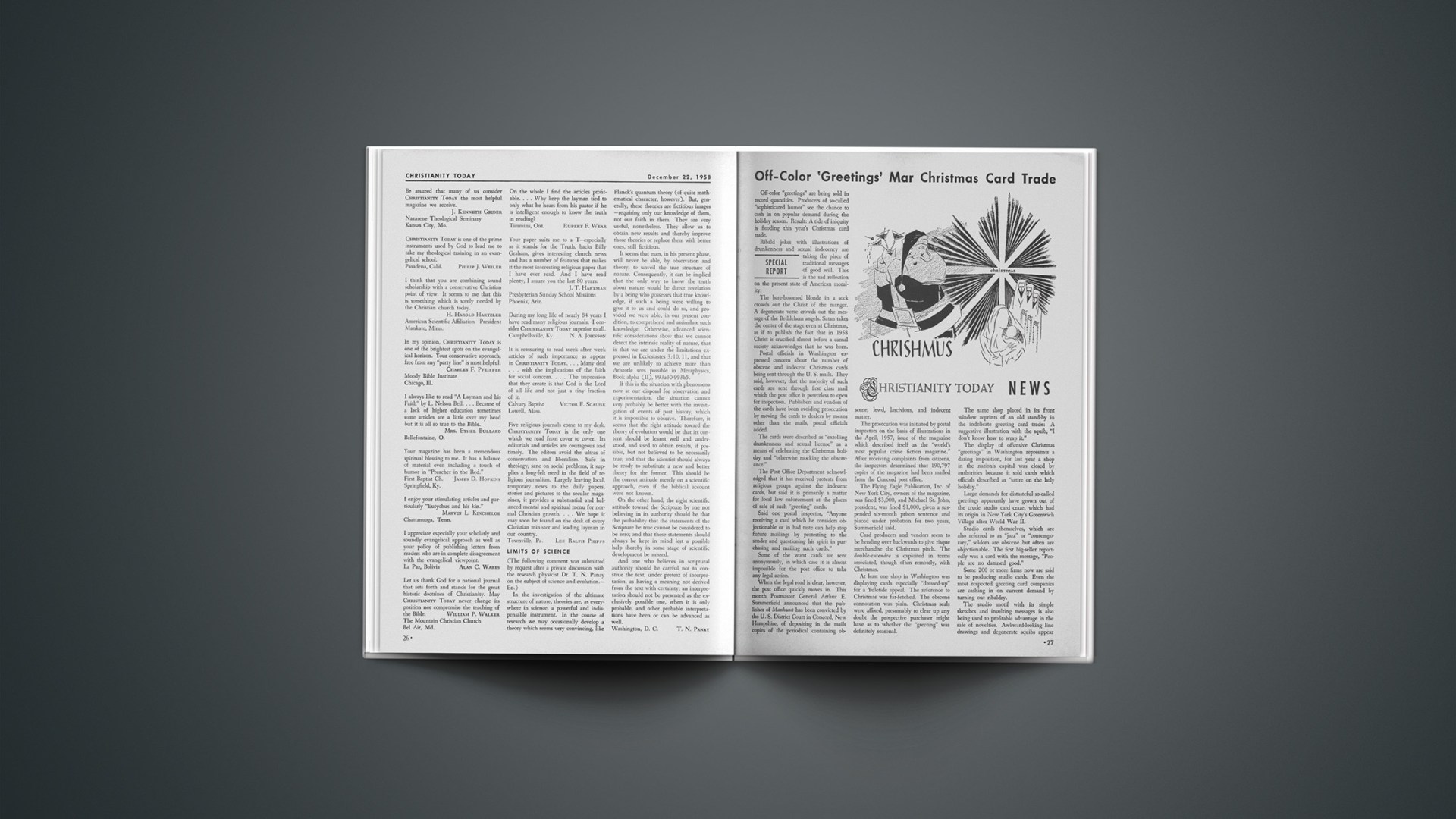
Off-Color ‘Greetings’ Mar Christmas Card Trade

CHRISTIANITY TODAY

NEWS

Special Report

Off-color “greetings” are being sold in record quantities. Producers of so-called “sophisticated humor” see the chance to cash in on popular demand during the holiday season. Result: A tide of iniquity is flooding this year’s Christmas card trade.

Ribald jokes with illustrations of drunkenness and sexual indecency are taking the place of traditional messages of good will. This is the sad reflection on the present state of American morality.

The bare-bosomed blonde in a sock crowds out the Christ of the manger. A degenerate verse crowds out the message of the Bethlehem angels. Satan takes the center of the stage even at Christmas, as if to publish the fact that in 1958 Christ is crucified almost before a carnal society acknowledges that he was born.

Postal officials in Washington expressed concern about the number of obscene and indecent Christmas cards being sent through the U. S. mails. They said, however, that the majority of such cards are sent through first class mail which the post office is powerless to open for inspection. Publishers and vendors of the cards have been avoiding prosecution by moving the cards to dealers by means other than the mails, postal officials added.

The cards were described as “extolling drunkenness and sexual license” as a means of celebrating the Christmas holiday and “otherwise mocking the observance.”

The Post Office Department acknowledged that it has received protests from religious groups against the indecent cards, but said it is primarily a matter for local law enforcement at the places of sale of such “greeting” cards.

Said one postal inspector, “Anyone receiving a card which he considers objectionable or in bad taste can help stop future mailings by protesting to the sender and questioning his spirit in purchasing and mailing such cards.”

Some of the worst cards are sent anonymously, in which case it is almost impossible for the post office to take any legal action.

When the legal road is clear, however, the post office quickly moves in. This month Postmaster General Arthur E. Summerfield announced that the publisher of Manhunt has been convicted by the U. S. District Court in Concord, New Hampshire, of depositing in the mails copies of the periodical containing obscene, lewd, lascivious, and indecent matter.

The prosecution was initiated by postal inspectors on the basis of illustrations in the April, 1957, issue of the magazine which described itself as the “world’s most popular crime fiction magazine.” After receiving complaints from citizens, the inspectors determined that 190,797 copies of the magazine had been mailed from the Concord post office.

The Flying Eagle Publication, Inc. of New York City, owners of the magazine, was fined $3,000, and Michael St. John, president, was fined $1,000, given a suspended six-month prison sentence and placed under probation for two years, Summerfield said.

Card producers and vendors seem to be bending over backwards to give risque merchandise the Christmas pitch. The double-entendre is exploited in terms associated, though often remotely, with Christmas.

At least one shop in Washington was displaying cards especially “dressed-up” for a Yuletide appeal. The reference to Christmas was far-fetched. The obscene connotation was plain. Christmas seals were affixed, presumably to clear up any doubt the prospective purchaser might have as to whether the “greeting” was definitely seasonal.

The same shop placed in its front window reprints of an old stand-by in the indelicate greeting card trade: A suggestive illustration with the squib, “I don’t know how to wrap it.”

The display of offensive Christmas “greetings” in Washington represents a daring imposition, for last year a shop in the nation’s capital was closed by authorities because it sold cards which officials described as “satire on the holy holiday.”

Large demands for distasteful so-called greetings apparently have grown out of the crude studio card craze, which had its origin in New York City’s Greenwich Village after World War II.

Studio cards themselves, which are also referred to as “jazz” or “contemporary,” seldom are obscene but often are objectionable. The first big-seller reportedly was a card with the message, “People are no damned good.”

Some 200 or more firms now are said to be producing studio cards. Even the most respected greeting card companies are cashing in on current demand by turning out ribaldry.

The studio motif with its simple sketches and insulting messages is also being used to profitable advantage in the sale of novelties. Awkward-looking line drawings and degenerate squibs appear increasingly on note pads, ash trays, drinking glasses, plaques, napkins, and even dishes.

Newsstands once were largely respectable business establishments. Now some have been reduced to hotbeds for lotteries and filthy reading matter, the latter having been described by the Dallas Morning News last month as a “$500-million-a-year racket.” Many a quaint gift shop seems to be headed in the same direction.

“We do not ask that non-Christians celebrate the birth of Jesus Christ,” said Dr. Edward L. R. Elson, minister of National Presbyterian Church in Washington. “But if other than Christians can share in the commemoration, we should expect them to join us in exaltation rather than pollution of something sacred by secular and vulgar distortions.”

The Churchmen’s Commission for Decent Publications noted a year ago “the deterioration of Christmas into an occasion for the exchange of obscene and suggestive holiday greeting cards.”

At a meeting of the commission’s executive committee, a resolution was passed urging distributors and dealers “to manifest their concern for community decency by refusing to handle merchandise of a bawdy and sexy nature.”

The resolution encouraged local church and civic agencies “to protect the Christmas season as an occasion of spiritual force rather than of commercial exploitation of prurient interests.”

The post office was commended for its vigil over obscenity law violations.

The Dirtiest Ripple

Steps to strengthen the fight against “commercialized smut” were discussed at the first national conference on obscenity, held in Cleveland and sponsored by the Citizens for Decent Literature.

Dr. Pitirim Sorokin, Harvard University sociologist, said obscenity has been an accompanying factor in all the great crises of history. The rise of pornography today, he said is merely “the dirtiest ripple of a more powerful tidal wave” that threatens our civilization.

In various forms and degrees, Dr. Sorokin noted, obsession with sex has become so characteristic of movies, television, books, magazines and social and cultural institutions that “we now face the prospect of the collapse of the great cultural mansion of Western civilization.”

Eutychus and His Kin: December 22, 1958

NEW YEAR BELLS

Dr. Samuel Jones of Second Church is eagerly anticipating the first stroke of the New Year. Over the traditional din of horns, whistles, shots and sirens will float the inaugural notes of the new Van Dyke Memorial Carillon in the church tower. The system is completely electronic, which in a way is a pity, but then bell ringing is an extinct art in exurbia. Jones himself has a romantic attachment to bells. He has replaced the manse doorbell with imported chimes so that each visitor is greeted with the conclusion of the 1812 Overture.

I imagine his dedicatory address on New Year’s Eve will ring the changes on bells. No doubt he will recite Poe’s poem in passing, allude to the bell ringing theme of his favorite mystery story (The Nine Tailors, by Dorothy Sayers), and recrack the Liberty Bell with resounding oratorical strokes. I just hope he doesn’t lapse into Tennyson’s “Ring out, wild bells” in conclusion.

We will all share his thrill when the midnight noise-making is overwhelmed by the majesty of the carillon. Bells are the voice of a former age, when the church spire marked the village, and there was solemn harmony even in the signal of alarm. This is the time of the siren, the shrieking howl of a maddened mechanical beast. Sirens on New Year’s Eve chill us with prospect of atomic war, but bells speak of peace.

Yet even before the bells were the trumpets. The trump of God heralded the Lord’s presence on Sinai, and the priests were to blow the trumpet of jubilee after the atonement in the fiftieth year. Our Lord declared the realization of the gospel jubilee in his own presence at the synagogue of Nazareth. The church needs trumpets and bells in the pulpit: the warning blast of impending judgment, when the trump of God shall sound; the joyful sound of eternal salvation in Christ’s finished work. The trumpet of the gospel herald has the urgency of an air-raid siren and the harmony of choirs of angels, for it calls not just to a new year but to the new heaven and earth. The jubilee liberty proclaimed in the text on the Liberty Bell is the liberty of sons of God.

THIRD YEAR THRESHOLD

To subscribe, two years ago, on your invitation to become a charter subscriber, was a work of faith. The idea of the projected publication sounded good, but how well would it work out? I felt that nothing much beyond the subscription price would be lost in accepting your invitation. When that initial subscription period was over, and time came to renew, it was no longer so questionable a venture. But after two years, CHRISTIANITY TODAY has become a necessity in my study. The wealth of material presented, the outlook, the reasoned approach to news events—all of these combine to make your periodical one of the best, if not the best, in the whole field of religious journalism. I am proud and happy that it was my privilege to be a charter subscriber, and determined that my subscription shall never lapse.

First Reformed Church

Randolph, Wisc.

This reader is pleased with the course that has been followed.

Evangelical Lutheran Theological Sem. Columbus, Ohio

I am an old man.… I read nothing but detective stories—except Theology Today (of which I am on the editorial board) and CHRISTIANITY TODAY.…

Princeton, N. J.

I’ve fought it long enough. I tried to be strong and resolute and say, “I don’t need another magazine!” But the trouble is: while there may be several magazines I get and don’t really read, I actually read CHRISTIANITY TODAY!”

Church of the Holy Spirit

Schenevus, N. Y.

That such a large percent of Christian leaders are reading with approval your magazine … augurs ill for the future of our religion. God’s purposes shall be carried out certainly. But whether in the end through the present kind of a church—which places more emphasis on theology than right living, on believing than doing, on faith than good works, and regarding communism as an enemy …, this may be very doubtful.

Lansing, Mich.

I am sending in my renewal to the finest Christian magazine in the United States. Its articles are intelligent, informative and truly biblical. I do not want to miss any number.

Newhall, Calif.

I have been tremendously pleased with CHRISTIANITY TODAY. I have longed, in England, for a paper of that type which combined scholarship with spirituality and loyalty to the Scriptures. I feel you just “hit it,” and am glad to note that you have many links across the ocean.

The Worldwide Evangelization Crusade

Fort Washington, Pa.

Please be advised that many thousands of lives are being transformed today without any “Gospel” preaching at all through groups like Alcoholics Anonymous. Simple belief in some kind of Higher Power able to rescue men is found sufficient. Moreover, such an approach is winning multitudes of thinking people who are only repelled by teaching they regard as an insult to intelligence.

Los Angeles, Calif.

May I say that CHRISTIANITY TODAY is the one periodical on my desk which seems to satisfy a need in my spiritual development. Avoiding the pitfalls of condemnatory extremist points of view the general tenor appears to “perfect, stablish, strengthen, settle” those who cherish the evangelical, biblical Christian faith. It is my hope that this influence will extend its helpful potential from the pulpit to the pew.

First Methodist Church

Onway Springs, Kan.

I’d be cheating my head and my heart should I fail to renew.… Thank God for CHRISTIANITY TODAY and “the resurgence of interest in evangelical Christianity.”

Wakefield, Va.

Disgusted with its whole point of view.

St. Andrew’s Episcopal Church

Burns, Ore.

It is superb!

St. Paul’s Episcopal

Medina, O.

If this is Christianity today, the apostasy of the church has reached its zenith. I refuse to believe it.…

Festus, Mo.

Often ministers are made to feel that they are antiquated and out-of-date if they hold to the foundational truths of historical Christianity. The liberalistic periodicals seek to give that impression. CHRISTIANITY TODAY makes plain that all educated, informed, scholarly men are not on the side of liberalism (infidelity). I feel that those who value the great truths of revealed religion ought to back this magazine.

Buffalo Avenue Baptist Church

Tampa, Fla.

In a day of spiritual confusion and infidelity it is a much needed trumpet with a certain sound.

Brooklyn, N. Y.

I appreciate the fact very much that at last a conservative, interdenominational religious periodical of good caliber has made its appearance that can be … appreciated by any religious man, no matter … what church denomination.… Today … it is … so imperative to stick to the … Word of God as we have it in the Bible. In civil affairs let men parade their knowledge and skill, but in holy things let them observe silence before the majesty of God. “I hate vain thoughts,” or as Luther gives this passage, “Ich hasse die Flattergesiter,” says the Psalmist (119:113).

Bonduel, Wisc.

It has been a great resource in providing answers to my college-age daughters, who have often felt that conservative Christians were too prone to award the blue ribbon to pious mediocrity. Your magazine, more than any other I know of, challenges its readers to be alert, intelligent, informed, dedicated and active in every area of life.

Minneapolis, Minn.

You are perfectly within your right to strive to restore some evangelical zeal into our somnolent, too intellectualized Protestant churches and to call us back to the Bible. But there is more than one definition of “evangelical” and of “biblical theology.” You seem to admit of but one—yours.

First Congregational Church

Chesterfield, Mass.

In a time when good Christian periodicals are scarce—acutely so in Australia, it is good to meet such a one as this.… While you set forth a strong, unequivocal evangelical front, you maintain a truly catholic spirit.

Strathmore Methodist Church

Essendon, Victoria, Australia

I find your paper interesting, impressive, and very instructive.

The Rectory

Newton Kyme, Yorkshire, England

With your emphasis on “old fashioned religion” and emotional experiences that accompany it, you are doing your best to make this dogmatic.… Then people … quarrel about the dogmas.… I’ve seen it … repeatedly, not only among Christians, but among socialists.

Utica, N. Y.

May I say that your magazine is wonderfully stimulating, challenging and inspirational for any Christian or non-Christian.

Student Dept., S. C. Baptist Conv.

Columbia, S. C.

While I find your periodical stimulating, I am also irritated often by the critical tone of many articles.… I have little sympathy for theological warfare, regardless of who are the contestants. I have found some Fundamentalists who were more modern than any Modernist and I have found some Modernists who were more fundamental than any Fundamentalist. What a man claims to believe is not as important as what he is.

The United Church of Canada

Port Stanley, Ont.

I continue to be impressed by the variety of articles, their high quality, and the irenic but forceful attitude expressed.

Nebreska Baptist State Convention

Omaha, Neb.

I read your magazine with great interest, and from time to time with not a little protest. This is all to the good, however; therefore I continue my subscription. For, as of this moment, I have not felt that I could equate all of my opinions with truth, nor have I come to that place in life where I can claim perfection in the purity of my motives.

First Methodist Church

Chowchilla, Calif.

Enclosed find payment for a two year subscription.… I do so as an unrepentant liberal because I need the constant reminder that those who differ from me basically can still be men of integrity and intelligence. I have found your articles to be consistently of a high level of scholarship. I should violate my own principles if I fail to recognize good wherever it is to be found.

Chicago, Ill.

Although I find myself sometimes in disagreement with your writings I am never in disagreement with the Christian spirit behind them. Let me say “thank you” both for stimulating my thinking and for reminding me that the liberals are not the only ones who admit that they have made mistakes in the past. Keep up the very fine work you are now doing.

Nettleton Methodist

Nettleton, Miss.

I received … a sample copy.… I do not take a publication which is distinctively conservative.… The articles on racial conflicts were better than those in many liberal publications which I have read and I think you are to be congratulated upon them.

The Methodist Ch., Beech Grove Charge

New Bern, N. C.

I cannot say I am in complete sympathy with “fundamentalism” as even so well described in your paper. Reinhold Niebuhr led me to know sin in my life more deep-rooted than I believed. But at that point, I began understanding Billy Graham! Mr. Niebuhr then went on to prove what he meant by sin in his book by the way he acted in the Christian Century. At that point Christian Century lost a liberal potential subscriber and CHRISTIANITY TODAY gains one.

Kewanna, Ind.

I am a modernist and a liberal … but I like to know what the other fellow thinks.

Winsted, Conn.

I think it is the greatest Christian periodical on the market.… I only wish it had more of a Wesleyan orientation.

President

Olivet Nazarene Col.

Kankakee, Ill.

Be assured that many of us consider CHRISTIANITY TODAY the most helpful magazine we receive.

Nazarene Theological Seminary

Kansas City, Mo.

CHRISTIANITY TODAY is one of the prime instruments used by God to lead me to take my theological training in an evangelical school.

Pasadena, Calif.

I think that you are combining sound scholarship with a conservative Christian point of view. It seems to me that this is something which is sorely needed by the Christian church today.

American Scientific Affiliation President

Mankato, Minn.

In my opinion, CHRISTIANITY TODAY is one of the brightest spots on the evangelical horizon. Your conservative approach, free from any “party line” is most helpful.

Moody Bible Institute

Chicago, Ill.

I always like to read “A Layman and his Faith” by L. Nelson Bell.… Because of a lack of higher education sometimes some articles are a little over my head but it is all so true to the Bible.

Bellefontaine, O.

Your magazine has been a tremendous spiritual blessing to me. It has a balance of material even including a touch of humor in “Preacher in the Red.”

First Baptist Ch.

Springfield, Ky.

I enjoy your stimulating articles and particularly “Eutychus and his kin.”

Chattanooga, Tenn.

I appreciate especially your scholarly and soundly evangelical approach as well as your policy of publishing letters from readers who are in complete disagreement with the evangelical viewpoint.

La Paz, Bolivia

Let us thank God for a national journal that sets forth and stands for the great historic doctrines of Christianity. May CHRISTIANITY TODAY never change its position nor compromise the teaching of the Bible.

The Mountain Christian Church

Bel Air, Md.

On the whole I find the articles profitable.… Why keep the layman tied to only what he hears from his pastor if he is intelligent enough to know the truth in reading?

Timmins, Ont.

Your paper suits me to a T—especially as it stands for the Truth, backs Billy Graham, gives interesting church news and has a number of features that makes it the most interesting religious paper that I have ever read. And I have read plenty, I assure you the last 80 years.

Presbyterian Sunday School Missions

Phoenix, Ariz.

During my long life of nearly 84 years I have read many religious journals. I consider CHRISTIANITY TODAY superior to all.

Campbellsville, Ky.

It is reassuring to read week after week articles of such importance as appear in CHRISTIANITY TODAY.… Many deal … with the implications of the faith for social concern.… The impression that they create is that God is the Lord of all life and not just a tiny fraction of it.

Calvary Baptist

Lowell, Mass.

Five religious journals come to my desk. CHRISTIANITY TODAY is the only one which we read from cover to cover. Its editorials and articles are courageous and timely. The editors avoid the ultras of conservatism and liberalism. Safe in theology, sane on social problems, it supplies a long-felt need in the field of religious journalism. Largely leaving local, temporary news to the daily papers, stories and pictures to the secular magazines, it provides a substantial and balanced mental and spiritual menu for normal Christian growth.… We hope it may soon be found on the desk of every Christian minister and leading layman in our country.

Townville, Pa.

LIMITS OF SCIENCE

(The following comment was submitted by request after a private discussion with the research physicist Dr. T. N. Panay on the subject of science and evolution.—ED.)

In the investigation of the ultimate structure of nature, theories are, as everywhere in science, a powerful and indispensable instrument. In the course of research we may occasionally develop a theory which seems very convincing, like Planck’s quantum theory (of quite mathematical character, however). But, generally, these theories are fictitious images—requiring only our knowledge of them, not our faith in them. They are very useful, nonetheless. They allow us to obtain new results and thereby improve those theories or replace them with better ones, still fictitious.

It seems that man, in his present phase, will never be able, by observation and theory, to unveil the true structure of nature. Consequently, it can be implied that the only way to know the truth about nature would be direct revelation by a being who possesses that true knowledge, if such a being were willing to give it to us and could do so, and provided we were able, in our present condition, to comprehend and assimilate such knowledge. Otherwise, advanced scientific considerations show that we cannot detect the intrinsic reality of nature, that is that we are under the limitations expressed in Ecclesiastes 3:10, 11, and that we are unlikely to achieve more than Aristotle sees possible in Metaphysics, Book alpha (II), 993a30–993b5.

If this is the situation with phenomena now at our disposal for observation and experimentation, the situation cannot very probably be better with the investigation of events of past history, which it is impossible to observe. Therefore, it seems that the right attitude toward the theory of evolution would be that its content should be learnt well and understood, and used to obtain results, if possible, but not believed to be necessarily true, and that the scientist should always be ready to substitute a new and better theory for the former. This should be the correct attitude merely on a scientific approach, even if the biblical account were not known.

On the other hand, the right scientific attitude toward the Scripture by one not believing in its authority should be that the probability that the statements of the Scripture be true cannot be considered to be zero; and that these statements should always be kept in mind lest a possible help thereby in some stage of scientific development be missed.

And one who believes in scriptural authority should be careful not to construe the text, under pretext of interpretation, as having a meaning not derived from the text with certainty; an interpretation should not be presented as the exclusively possible one, when it is only probable, and other probable interpretations have been or can be advanced as well.

Washington, D. C.

Ideas

Where Are We Drifting?

The season of inventories is with us again. And seldom was spiritual assessment more urgent than in our day. The conclusion, or exhaustion, of 1958 raises traditional questions. What were the year’s significant events? Do they augur well or ill for Christianity? What trends may be traced? How fares the Church in its struggle to stem the swift-moving currents of competing ideological options? Where are we drifting? In an atomic age, answers are not always as traditional as the questions.

CHRISTIANITY TODAY’S 50 contributing editors have transmitted their reading of the times, seeking to weigh evangelical gains and losses and cautioning that generalizations are not to be absolutized.

Signs of hope are not lacking. The Billy Graham Crusades in San Francisco and Charlotte again demonstrated, says Dr. Faris D. Whitesell, “the possibility of effective organized mass evangelism in large cities. Would to God that he would raise up a few more Spirit-anointed leaders to lead the assault on our metropolitan areas of sin and corruption!” Dr. J. Theodore Mueller points to “the proclamation of the gospel over numerous radio networks, the general interest in religion and religious publications, the rapid gain of membership by Christian groups preaching the atoning death of Christ …, the increase of family worship: all these and other manifestations of divine grace remind the believer that now is the gospel age which our Lord predicted in Matthew 24:14.”

But the “overall impression” of Professor Ned B. Stonehouse is that 1958 produced “no spectacular developments or evidences of marked turning points in ecclesiastical and religious life.… Quite possibly the most significant events have been those which have seemed to have been done in a corner, such as the opening of the Auca tribe to the gospel, the publication of a paperback book, J. I. Packer’s strong treatise on the Word of God, and the declarations of the Reformed Ecumenical Synod of Potchefstroom on inspiration.”

In the literary realm, Dr. Whitesell observes that evangelicals have made progress “in meeting the need for more Christian literature to offset the tide of Communist propaganda now flooding the earth. The contributing editors further note the “spreading of the Bible in more than a thousand versions,” the interest of secular publishing houses in evangelical books, and the “continued popularity and influence” of CHRISTIANITY TODAY—contributing toward a greater unity among evangelicals.

As to this unity, Dr. Clyde S. Kilby senses a greater tendency for orthodox believers “to wish to get together rather than separate from each other. Those who seem determined to be a law unto themselves are finding it harder to survive at all.” Becoming more apparent to Professor Roger Nicole is the “trend of strengthening of the evangelical testimony and recognition for it in Christianity at large.” But there is a long way to go. Dr. Nicole sees a hindrance to this advance in the bitter attacks and counterattacks occurring between certain representatives of the evangelical cause “who cherish the same fundamental convictions and doctrines.” Adds General William K. Harrison: “It is high time to stop fighting one another over secondary matters and personal grudges and demonstrate by unity in love and missionary zeal that Christ not only can but does save from sin.”

In the present rapid growth of church membership in America, the contributing editors do not see unalloyed blessing. Professor C. Adrian Heaton points to increasing recognition by many that this may not mean genuine revival. Many pastors and churches are seeking, he says, “deeper theological foundations for preaching and evangelism.” Dr. Whitesell sees a multiplication of machinery and programs without the spiritual power to give them life. “The churches need a new and mighty infusion of the Holy Spirit everywhere. Pastors are running themselves to death trying to keep up with counseling demands and administrative problems.” He notes the weakening of visitation evangelism and holds out hope for a new evangelism implemented by group dynamics. “Small group activities” are being introduced in many churches.

Professor Kyle M. Yates warns against the “pathetic trend” in the direction of “shallow, superficial topical preaching” in place of “exegetical” messages produced through careful Bible study. “Why should men who have the divine call to preach spend the few years they have left in chattering away inferior arrangements of words?” He notes a dangerous temptation confronting seminaries in the lowering of standards in the field of the original languages. Famed preacher Andrew W. Blackwood points up the paucity in the pulpit of doctrine and biblical ethics. “Leading advocates of ‘missions,’ ” he relates, “advise us to quit trying to win Jews, Moslems, and others, because their religions are ‘almost as good’ as Christianity, at least when diluted into a mild form of ethical culture—‘sweetness and light.’ ”

Dr. Oswald T. Allis notes “increasing doctrinal indifferentism in the Protestant church and the increasing power of the liberals in the ecumenical movements,” while Professor Gordon H. Clark says he fails to see that “historic Protestantism has made any gains whatever” in the past year. Declares Dr. Harold John Ockenga: “The churches of all kinds have grown. Crowds have increased. Finances have risen. In this we might rejoice, but we are convinced that the movement is very shallow and in many cases not Christian. There is no evidence of revival and there is no religious check to the social evils … engulfing our nation.”

As for the evangelical outlook in England and Scotland, two of the writers use the term “cautious optimism.” But London’s Dr. W. E. Sangster asserts, “There is still no sign of religious revival in Great Britain.” Despite the presence in all branches of the church of dedicated evangelical ministers and the campaigns of interdenominational missioners, “the gulf between the church and the people outside remains deep and wide, and no strategy has yet been devised effectively to cross it.” The more hopeful sign in the church, says Dr. Sangster, is its “honest realism,” for the very difficulty of things throws Christians back more on God.

Another Londoner, the Rev. F. P. Copland Simmons, Moderator-Designate of the Presbyterian Church of England for 1959–60, believes the church is holding its own against the tide of secularism, “but there have been no spectacular gains in 1958.” The more successful churches have made greater use of the laity, he says.

The Rev. Maurice Wood, Vicar and Rural Dean of Islington, sees signs of a new evangelical revival in England. Overflow crowds greeted him and the Rev. John Stott at Cambridge’s Holy Trinity Church, the latter having recently completed the University Mission there amid many professions of conversion. Besides the new appointments of evangelical bishops in the Church of England, it is reported that the recent ordination to the Anglican ministry in St. Paul’s Cathedral, London, saw evangelicals composing more than half of those ordained. St. Paul’s also witnessed a capacity crowd for an October service which initiated a Tom Rees campaign which will take the evangelist to six centers a week in every county in Great Britain and Northern Ireland. Response thus far has been most heartening. Dr. Wood reports further that evangelical influence is helping to bring the churches in England back to the authority of the Bible—reflected in the Lambeth Conference Report on the Bible (resolutions 5, 7, and 12).

Professor Norman C. Hunt of Edinburgh University served as president of the British Inter-Varsity Fellowship the past school year. His travels indicated to him a movement of God among university students, manifest in evangelism, prayer meetings and conferences.

Dr. Geoffrey W. Bromiley relays his impressions of the Scottish scene from Pasadena, Calif., having newly arrived there from Edinburgh as visiting Professor of Church History at Fuller Theological Seminary. He notes favorably the work done by missioners Tom Allan and D. P. Thomson, particularly in the country districts and the Glasgow underworld. Also encouraging to him is the “slow but patchy increase in general church membership and loyalty” as well as evidence that a more biblical theology is making some impact among students and younger ministers. The “difficulties which remain” he lists as “the lack of any clear-cut evangelical leadership in any area of church life; the tendency of the more strongly evangelical churches to hold aloof from the main stream of church life, especially as represented in the Church of Scotland; the unresolved tension as to the future use of large scale crusades for evangelism …; the continuing existence of a Liberal Moderation over large areas of the churches; and the comparative failure of the church to make impact in country and industrial districts.”

Turning to the American domestic scene, the contributing editors find little of cheer in the recent course of developments. To Dr. Ockenga, the fall elections revealed the desire of the American people for government paternalism, an increase of socialism, centralization of control, and bureaucracy. He sees a rebuke to Republican “me, tooism.” Economically, the recession has been checked, he feels, by the inflationary spiral, carrying with it a sham prosperity “which reflects the devaluation of the dollar rather than any true growth.” But the population explosion “cannot help but force us into further boom times.” Dr. Blackwood laments the loss of such biblical ideals as industry and thrift, while Dr. Cary N. Weisiger, III, asks: “Do unpunished labor racketeering, unchecked crime rates, and undisguised attachment to inflationary spending add up to further disintegration of Puritan character in America?” Facing another problem, Dr. Weisiger inquires further: “Has the passing of an old pope and the election of a new one made people think that the weighty traditions, authorities, and ceremonies of Rome offer us the security we crave?” Professor Clark speaks of the millions of dollars of free publicity afforded Rome through the pope’s death (“showing the Romanist hold on the public press”), and he notes Roman gains in the U.S. elections along with growing sentiment which refers to opposition to Romanists for public office as “prejudice.” Dr. Ockenga warns, “We must not be lulled by any innocuous promises from any candidate who is a Roman Catholic.” Dr. Blackwood sees Roman Catholics already in control of the large cities, through Protestant default and evacuation to the “white collar suburbs,” frequently featuring a “country club religion.” Roman Catholicism now reaches for national control, “partly by capturing the Negroes whom many Protestants do not even welcome at worship.”

The “velvet curtain” does not pose the only threat to freedom. There yet remains the metallic one. Dr. Clark sees 1958 as a year of enormous Communist gains, with the U.S. countering but feebly. Dr. Ockenga traces the route of Red initiative—Indonesia, Iran, Quemoy, and now Berlin—and notes Communist intransigence in Geneva. “Only a fool would close his eyes to the fact that the free world and the slave world are at war, that there is no co-existence peaceably, and that any hope for a lessening of this competition is wishful thinking.”

But America confronts not only Rome and Moscow as threats to her freedom. She must face herself. Her growing secularism presents her populace with the primitive bondage to the ego and its desires. Dr. Stonehouse notes a rapid growth of “a philosophy of life shaped by the worship of science.” The writers see the fruit of such deviations in manifold areas. There is the heightening crime rate, particularly among juveniles (Dr. Heaton points hopefully to growing Christian youth work reaching out to a disillusioned “beat generation”). The 25th anniversary of prohibition repeal witnesses a tremendous increase in drinking and liquor propaganda via every medium. Drug consumption has reached alarming proportions. Dr. Kilby observes that great increase in tobacco consumption is concurrent with severe medical warnings. He quotes Howard Vincent O’Brien approvingly: “Never on earth before was ‘education’ so nearly universal; and never, I suspect, were so many people ready to believe so many things that aren’t so.”

General Harrison contends that America with her countless blessings is probably “the one nation most deserving of God’s judgment.” Despite the unparalleled ministry of the gospel, “the nation does not repent.” There are signs, says the General, that the Great Tribulation is “not far off.” God is “graciously saving thousands …; millions continue in idolatry.”

Dr. William Childs Robinson looks hopefully for signs of revival, while Dr. Mueller sees the accompaniment of widespread gospel preaching by “wars and rumors of wars” as fulfillment of Christ’s teachings.

In such an hour, Dr. Stonehouse throws down the gauntlet to evangelicalism. “The question will not down whether evangelicals generally are characterized by sufficient clarity and humility to give assurances of wholehearted obedience to the Word of God and of the strong and dynamic leadership which can develop only on the basis of such obedience. If evangelicals speak with an uncertain voice, if their message becomes vague and vascillating, who can be blamed for regarding evangelicalism as simply one religious view among many? In brief, the progress of Christianity is bound up with the strength and consistency of its commitment to the Scriptures as the Word of God.”

And from The Netherlands comes warning against underestimating the opposition. Professor G. C. Berkouwer cautions against the common characterization of Western populations as possessed of fear and hopelessness. “It is very difficult to fathom the influence of world events on the inner life.” Threatening times can also bring about a “new reckless optimism” which could look toward creation of “a new form of humanism.”

“We do not go forth then,” declares Dr. Berkouwer, “from the principle of an easy receptivity of the gospel” but as facing the opposition not only perceptible in the world but also in the lives of religious people, whose present interests can be secularized. “Only as the whole life of the church” proves that it is “being fed from other sources can its testimony enter the world fruitfully under the eschatological outlook of 1 Corinthians 15:58.”

One is no longer surprised to come upon the occasional news story of yet another raft adventure in the Pacific Ocean for the purpose of proving some theory on ancient population movements. The same ocean, not far off the raft routes, has witnessed periodic testing of atom bombs. The broad Pacific thus poses the fateful question: “Is this the era of the atom or the era of drift?” Somewhere between Bikini and Tahiti lie the Scylla of nuclear devastation and the Charybdis of secular disillusion, decline, and decay. The delicate bark of the West approaches the narrowing point of no return, at times uneasily and other times recklessly—at least ambiguously. To the side there stands a luminous cross, beckoning as a lighthouse. But so distorted are the compass readings of the voyager, that he veers crazily away toward his destruction, in a display of somewhat less wisdom than manifest in Balaam’s ass. How desperately he needs the confidence possessed by the Apostle Paul on another perilous voyage—confidence in the word of God’s angel … confidence in the deliverance of Jehovah. He scarcely sees his need for what it is. But there is yet time.

END

Ecumenism And Evangelism At M.I.T.

Reaching American college and university students for Christ is among the most important undertakings the churches can sponsor. A particularly fruitful ministry of this type is to be found on the campus of Massachusetts Institute of Technology among its 10 thousand students.

There are nine Protestant chaplains at M.I.T., most of whom are working with the Student Christian Movement in New England, related to the National Council of Churches. But the largest religious organization on campus is the United Christian Fellowship with over 100 Christian students actively winning their friends to Christ.

The United Protestant Ministry has recently sought a more effective approach to the student body. It seems that Protestant chapel services under approved chaplains had failed to arouse any significant interest and were finally discontinued. The evangelical chaplain suggested a more biblical and evangelistic presentation of the Protestant message. The other chaplains, lacking agreement as to what the Protestant message is, rejected the idea as unacceptable. Discussion further revealed that only one chaplain in the U.P.M. believed such cardinal doctrines as the inspiration of the Scriptures, the Virgin Birth, the Atonement and the Resurrection of Jesus Christ.

Now pressures are being brought to limit the evangelistic program of the United Christian Fellowship. It is even proposed that the word “evangelical” be substituted for “Christian” since, it is charged, the organization is “narrow, inflexible and not representative of ecumenical Christianity in America today.” Strangely enough the resulting tensions on the campus are creating a new interest in the Christian witness. Bible study groups, visitation evangelism and other U.C.F. techniques are being effectively used of God.

It would seem that a united and vigorous presentation of the Gospel at M.I.T. would be the finest possible demonstration of the value of ecumenicity. What kind of unity is it that would achieve peace and goodwill in the religious community at M.I.T. at the expense of winning souls to Christ?

END

Ncc World Order Policy Softens On Red China

In many of the 144,000 churches in the National Council of Churches, ministers and members doubtless were shocked to read the resolutions of the NCC World Order Study Conference urging prompt U.S. recognition and U.N. admission of Red China (CHRISTIANITY TODAY, December 8, 1958). The extent to which the Cleveland delegates, often acting unanimously, approved positions heretofore associated mainly with the political left bank, was almost incredible. But these tendencies have long been developing in NCC circles, and sooner or later a full harvest was inevitable.

Inside and outside NCC ranks, multitudes sensed that the Cleveland conference had issued a misleading and spurious statement of Christian responsibility.

The declaration of NCC’s General Board, two weeks later, that Cleveland framed no formal policy statement, but reflected only the view of the World Order Study Conference, was evasive. The conference met under NCC mandate; many top NCC leaders participated enthusiastically; none dissented at the time from main positions taken in plenary session; and the conference was openly hailed as initiating a $35,000,000 ecumenical peace offensive with plans already underway in many NCC denominations. The General Board asserted that the Cleveland conference spoke “with a mighty voice” (including some of its own voices, we might add) but spoke only for itself. Is it then to be understood that actions by NCC departments and divisions carry no official significance? The fact is, the General Board did not repudiate Cleveland’s conclusions. It reiterated its view that “the Christian churches … and their councils … have the duty to study and comment on issues, no matter how controversial, in the realm of politics, economics and social affairs, in view of their common faith in Jesus Christ as both Lord and Savior.” How, from their faith in Christ, the delegates arrived at a new sympathy for Communist China, it did not trouble to explain. Many devout believers are convinced that what the churches have to say was not really said at Cleveland. And they view the General Board’s pronouncement as falling comfortably into the category of the Delphic oracle.

Two additional reflections bear on the Cleveland conference. One is the naive confidence of delegates that recognition and admission into the family of nations has a reformatory effect. But it has not worked that way in the case of Soviet Russia, and a duplication in the case of Red China will worsen rather than improve the plight of the Free World. Beyond this, we again voice disappointment over NCC’s preoccupation at Cleveland with world affairs in a framework that virtually nullified the relevance of foreign missions to world disorders.

In view of its access to the Protestant ministry and lay leadership in the United States, CHRISTIANITY TODAY is asking its readers to fill out the following form (or a copy of it), scotch tape it to a postcard, and air mail it to the News Editor, CHRISTIANITY TODAY, 1014 Washington Building, Washington 5, D. C., before January 10, 1959, as a contribution to this magazine’s survey of Protestant opinion:

The Creator Enters His Own Creation

The commercialization of Christmas even in distant Japan, where special brilliance and impressive displays may be found in Tokyo’s great department stores, is a reflection of the paganized Christmas of the Western world.

There is no reason to marvel that unregenerate men should miss the meaning of Christmas. For many it is just one more occasion for revelry, which is regrettable but understandable. Why? Is it not a holiday? And is the air not filled with a spirit of festivity?

Are not Santa Claus, sleighs, and reindeer symbols of Christmas? Why should not the liquor stores be decorated in honor of the occasion?

If Christmas is a symbol of fleshly desire and satisfaction, its slogan might aptly be: “Let us eat and drink and be merry, for tomorrow we die”—but let’s leave off the last phrase to enhance the meaning of the first.

To pagans—cultured, educated, financially secure American pagans—Christmas is a mad swirl of diversions and pleasures; but what about those of us who are Christians? Has the true significance of the day when God came to earth in human flesh been borne into our own souls? Is the reality of his incarnation something which thrills us even as the magnitude of its implication baffles human understanding?

In eternity God, our loving Heavenly Father, viewing the past, the present and the future, as one unending panorama, saw the yet uncreated universe; and with an infinity of wisdom no man can possibly understand, he made his plan for the redemption of sin-sick humanity, and at the center of this plan was his own beloved Son.

Sharing in the glory of the Father, participating in the counsels of eternity, endowed with the authority and power to bring all things into being, Christ saw this panorama of history and his part in man’s redemption.

The Christmas story is one of divine intervention at a particular time in human history. It was an event foretold by the Holy Spirit, speaking through the prophets of old. And it was but one phase of an unfolding drama which led to the Cross, and then the empty tomb, and which will present as another of its earth-shaking aspects the return of the Lord of Glory.

God forbid that we should look on the events of the first Christmas with the coldly calculating eye of scientific or philosophical appraisal. That which took place in Bethlehem was a supernatural event which only a mind surrendered to the Holy Spirit can evaluate. The angelic manifestations were but the natural signs of an event which transcends both reason and experience.

“Fear not” was God’s comfort for men who otherwise would have been overpowered by experiences beyond the natural. “Good tidings of great joy” was the divine estimate of the advent of his Son. “Which shall be for all people” was an affirmation of the universality of God’s loving provision, for he has never been willing that any should perish but that all might come to repentance—the “whosoever” making the way open to all who might accept.

We see in this first Christmas a glimpse of the glory of God: “Glory to God in the highest” is his now and will be the song of the redeemed throughout eternity. But where is the peace on earth, the good will toward men?

Amid the strife and turmoil of the world order, an often unseen but eternally vital force is moving—it is the love of Christ in the hearts of men. It makes for a fellowship, the sweetest thing this side of heaven, a fellowship which transcends Christian divisions, the barriers of race, and the differences of tongue and nation.

That to this day the reign of Christ in the hearts of men is a minority movement in an alien world in no way invalidates the fact, nor does it preclude the day when every knee shall bow to him and every tongue shall confess him as Lord.

The celestial manifestations were but forerunners of yet future evidences of the presence and power of the Lord of glory in the universe of his own making. That there was a star in the east which led the wise men to Bethlehem is no cause for wonder. Those who would explain away such evidences of divine intervention may with equal facility explain away other supernatural events in the life of the supernatural Christ—but only some day to discover incredulity to be lack of faith and smallness of vision in the unlimited reaches of God’s revelation to man.

That there were wise men with spiritual insights willing to be led, is but an illustration of the world-rejected truth that the beginning of wisdom has its roots in a reverential trust in God.

Shall we not see a symbol of our own eternal indebtedness to Christ in the worship these wise men accorded him, and were not the gold, frankincense and myrrh placed at his feet but forerunners of the abundance God has given us and which we in turn gladly give for the furtherance of his kingdom?

As the drama unfolds, man’s separation from God, his ignorance and sinfulness, are reflected in the perfidy and cruelty of Herod, but since that day the hearts of unregenerate men have been and are yet capable of similar folly.

For 30 years after the first Christmas, there were only fleeting glimpses of Him who was truly man and truly God. We see him identifying himself with man in the fulfilling of the law; we see him in the temple as a youth whose questions and answers amazed the Scribes. We know that he increased in wisdom and stature and in favor with God and man.

Then one day, coming from Galilee to Jordan, John the Baptist sees him and makes the statement in which the wisdom and plans of God are combined to make the greatest news in all the world: “Behold the Lamb of God, which taketh away the sin of the world.”

Within three years the earthly ministry of the Lord of Glory terminated on a Roman cross, but within three days he emerged from the tomb to be seen by many; and after his ascension (because of his resurrection) unlearned and common men went out with a Gospel which turned the world upside down.

At Christmas, 1958, surrounded by the evidences of the living Christ and his Church, the majority either do not know, or ignore, or reject him. But the Holy Spirit whom he sent into the world continues to speak of the things of Christ and woo men to him.

For the innkeeper in Bethlehem, business was so good there was no room for Mary and Joseph. To Herod, Jesus was but a possible rival. To the average resident of that area, other events and activities commanded their attention.

But to the few who believed, it was the transforming experience of their lives. In their midst and in their hearts was born the Saviour who is Christ the Lord.

Bible Text of the Month: Philippians 3:13-14

Brethren, I count not myself to have apprehended: but this one thing I do, forgetting those things which are behind, and reaching forth unto things which are before, I press toward the mark for the prize of the high calling of God in Christ Jesus (Philippians 3:13, 14).

“One thing” is of supreme importance, and that one thing he does: he forgets “the things which are behind.” Not that he does not remember them, and does not know of them any more, but his mind is not fixed on them any longer. He does not look back on them in such a way that they impede his further progress. The recollections of what he was in his former unconverted state must not paralyze and discourage him; disappointments and temptations of the past must not depress him; the thought of what God had already done for him and through him must not lead him to slackness and self-satisfaction. The hand is put to the plough and he will not look back.

Not Perfect

The question is not, have we attained to perfection? but, are we in the track of it? To hold up perfection before men as a present and instant attainment, is as presumptuous as it would be to expect the child by one leap to put himself by the side of the venerable scholar. The command is not, be finished in grace, but grow in grace, and in the knowledge of our Lord and Saviour Jesus Christ. It is fatal to Christian progress to limit any element of the Christian character to present attainment.

M. RHODES

Paul insists upon this, that he may convince the Philippians that he thinks of nothing but Christ—knows nothing else—is occupied with no other subject of meditation. In connection with this, there is much weight in what he now adds—that he himself, while he had given up all hindrances, had nevertheless not attained that object of aim, and that, on this account, he always aimed and eagerly aspired at something further. How much more was this incumbent on the Philippians, who were still far behind them?

JOHN CALVIN

Paul formerly spake of his desire, choice, and esteem of Christ’s death and resurrection, and the force thereof he found in him. Now, lest secret, insinuating, proud conceits might arise, either in himself or in them, concerning his holiness, he crosses them with a “not as,” showing that the best estate of God’s children in this world is imperfect. There is ever something to do or suffer; some lust to conquer, or some grace to strengthen.

RICHARD SIBBES

You remember, perhaps, how the discoverer in natural science, Sir Isaac Newton, said toward the close of his life, that he was but as a child, who had gathered a few shells on the shores of an illimitable sea. He saw stretching before him a vast ocean of knowledge, which his life had been too short, which even his powers had been too weak, to explore. What he felt in things natural, St. Paul felt in things spiritual—that there were heights above him which he had never fathomed; that, rich as he was in Christ, there were yet hidden in that Lord treasures of wisdom and knowledge which would make him far richer still; that God was unsearchable, unfathomable, a shoreless sea, an ocean of perfections; of which he understood a little, of which he was understood a little, of which he was understanding ever something more; but which man could no more take in than he could hold the sea and all its multitudinous waves in the hollow of his hand.

ARCHBISHOP TRENCH

Running The Race

That the prize, which God from above called the apostle to run for, was righteousness by faith, together with eternal life its consequence, is evident, not only from vs. 9 and 11 where these blessings are represented as the prize for which he ran: but also from 2 Tim. 4:8 where, in allusion to the distribution of the crowns by the judges of the games, he terms the prize for which he ran, a crown of righteousness, which the Lord the righteous judge will give to me at that day: and from James 1:12, where it is called a crown of life.

JAMES MACKNIGHT

He compares the object and endeavour of a Christian to a lawful race; so familiar was this image to the Philippians and other Greeks. The superintendent of this mystical course is God, who instituted it by his Son Jesus Christ. The path in which it is run is the part of faith, of repentance, of holiness, of every Christian virtue. The time alloted for the race is during our life. The moment of our conversion is the commencement of it, and is (as it were) the barrier from whence we start, each in his turn, as soon as the heavenly voice has called us; and the place where the race is finished is the moment of death, when we quit this world. The goal to which it conducts is the perfection of our sanctification, of the knowledge of Jesus Christ, of the power of his resurrection, and the fellowship with his death; and to this we can only attain in departing from this life.

JEAN DAILLE

Called In Christ

The call is “above” and stands in contrast to what is below. Sin is degradation, for what is ignorance but lowness of spirit? But this calling exists in a sphere of moral elevation, high or heavenly in its connection with the most High God, by whom it is issued to man.… The call is described in an ideally local aspect as high, then it is asserted to be the call of God. But it is not a call of naked Godhead, of bare Divine authority: it approaches us in Christ Jesus. It is from God—a Divine summons that pierces the spirit and ensures compliance, but it is in Christ, for it is a call which the blood of Christ consecrates, and to which his grace gives effect.

JOHN EADIE

The progress of the Christian to eternal glory has its origin in the fact, that he has been called from above by God in Christ, and has been laid hold of by Him; its continuance in the fact, that he holds firmly to Christ without contentedly looking back upon what has been already won, but with his face earnestly set towards the goal with the feeling that he has not yet reached it; and its end in the fact, that the exalted Lord receives him into His glory. It is thus an onward movement in one direction, without elation or depression, or a deviation to the right or left.

KARL BRAUNE

When we know that Christ must cause us to run the race, this makes us draw strength and courage from him, and run still till we come to the end. If we be hungry or faint in the race, he is bread of life to refresh; he is the truth to direct; the life to hold in our life till the race be run; the prize we run for; our swiftness, and strength, and assurer of attainment.

DAVID DICKSON

The Church and Civil Defense

America must face realistically the menace of world communism and possible destruction in case of massive military attack.

Around 70 per cent of the American people are members of some church. Therefore, in a tangible sense the Church must face this same threat and decide what its role must be in time of wholesale disaster.

It would certainly appear that whether or not it is desirable, the State and the Church must meet this threat together. The problem is, How can the Church give the fullest possible cooperation without submitting to government regimentation?

This question was uppermost in the minds of editors of representative religious magazines who were asked by the U.S. Office of Civil Defense and Mobilization to confer with defense leaders in Battle Creek, Michigan recently. Some editors declined an invitation lest they encourage government encroachment on religious freedoms either in principle or in practice. Such unwillingness to confer on such a crucial problem is deplorable.

The Role Of The Church

The role of the Church in Civil Defense is a live issue not only at the national level but also at the community level. Every pastor and every local church must decide what to do when government comes knocking at the door with its defense program. What principles and practical problems are involved?

There is no doubt about the possibility of direct attack should the cold war between the United States and Soviet Russia reach an ultimate crisis. With the development of long-range aircraft, which can be refueled in flight, atomic-powered snorkel submarines, jet propelled space rockets, guided ballistic missiles, and 20-megaton hydrogen bombs there is nothing to hinder the enemy from destroying major centers of population throughout America. A massive attack could affect 70 per cent of the population. Civil defense leaders at Battle Creek said that a 20-megaton bomb falling on Saint Louis, for instance, would not only wipe out that city, but its deadly fall-out would kill multiplied thousands in Illinois, Indiana and Ohio and endanger millions in an even wider area for weeks or months. Those who survive the attack would have to be hospitalized or face the problems of burying the dead, caring for the injured, providing uncontaminated food, water and shelter, and carrying on some measure of organized community life.

Every precaution against such an attack is being taken by the government, but defense experts admit there is little possibility of providing protection to the populace such as during World Wars I and II. Destruction and havoc are inevitable.

In such an emergency the Church can be of immense assistance in ministering to spiritual need, creating a favorable psychological atmosphere, and providing the necessities of life.

At Battle Creek practical suggestions were made for Church action in case of such emergency. Burial of the dead. Spiritual ministrations to the dying and injured. Reuniting separated families. Use of church buildings as shelters or hospitals. Construction of church buildings to withstand nuclear attack. Combatting emotional disturbances among survivors and imparting hope for the future. That this work might be more effective and not overlap or interfere with other government and military activities, a measure of organization and cooperation would be essential, of course.

The Government’S Plan

The government has set up a community-wide defense program. In the larger metropolitan centers it has been in operation for some time. Its religious aspects are in charge of a Religious Affairs Service. This involves (1) the Church Activities section and (2) the Chaplain Service.

The purpose of the Church Activities section is, in brief, to make provision for the civil defense readiness and activity of each local congregation. The Chart recommends that a congregational disaster committee exist in every congregation with the clergyman as the chairman.

Depending on the location of the church the activities for which the people and their facilities may be used will vary. If the church is in a target area it will undoubtedly be destroyed together with the rest of the city. If it is in an outlying area chances are that it may survive. The building may then serve as a shelter against radioactive fallout, and/or lodging and medical care. It is recommended that members of the congregation be in charge of services rendered within their facilities. There is to be a supervisor of Personnel Safety. This means that plans will be made for the care of people gathered in the church building at the time of an attack. It may mean teaching and training the members of the congregation and members of the Sunday School to participate in an orderly evacuation. It may mean training in going to the safest place of refuge within the building in case of an attack. It will also mean first-aid training.

The congregational plan is to include provisions for Training and Education. Much of this will be carried on under the direction of the minister who is best suited to give the congregation moral and spiritual understanding of the dangers that confront the nation. It may include instruction of lay people to help the minister in the discharge of his pastoral duties. It would also imply training in home protection, so that members of the congregation will learn through their church how to sustain themselves, not only physically, but also morally and spiritually in time of disaster.

Whereas the Church Activities branch or division of the Religious Affairs Service may be occupied both in the pre-attack, that is, in the preparatory period, and in the post-attack phase, the Civil Defense Chaplain service is designed for action only after a disaster has struck. Obviously the organization of this plan and training for it, the gathering of equipment and other needs, will have to take place before an attack, if the plan is to be operational after an attack.

The Civil Defense Chaplain Service is a plan in which clergymen will have freedom in the exercise of their ministry in time of a disaster. This does not imply that a clergyman not in the Civil Defense Chaplain Service will be prevented from the exercise of his ministry, but it means that an organized plan will be of assistance to clergymen so that they will be provided with access to areas, with identification and transportation, with communication facilities, and generally will know where to go and what to do in order to render the most effective ministry to the most people.

By means of a process which the local clergymen may work out to suit themselves, one of the local clergymen will be designated as the Chief of the Chaplain Service. This will be done on a rotation basis or some other way satisfactory to the local clergy.

Congregational worship will have to be planned. In some cases this might be arranged jointly between certain denominations. In other cases separate denominational services will need to be set up. It may be that members of a certain faith will move into an area where there is no corresponding church building. Provision will be made for public worship for all people.

The Office of Civil Defense and Mobilization is aware that the government is treading on dangerous ground here. Its leaders are quick to disclaim any federal desire to regiment or control the churches. They say the sanctity of the churches is to be preserved. They insist that no activity is to interfere with the distinctive spiritual ministry of any sect or denomination. To avoid any semblance of State authority over the Church, each community is to set up its own Religious Affairs Service in a completely democratic manner. Generally the Civil Defense Director will contact the “leading clergymen,” discuss the need with them. Then these clergymen will call together all the clergy of the community and “ask them whether they wish to render a service.” If they decide they “wish to participate” in an emergency program “alongside the government” they can then “decide on a form of organization.” An Executive Committee would then choose a Religious Affairs Chief. Then comes the implementation of the organization chart furnished by the OCDM. The Church Activities Branch of the Religious Affairs Service is then set up with its Chaplains and a Chief of Chaplains. The program has been worked out in great detail and if successfully implemented requires immediate action in setting up numerous meetings for educational and operational study.

There should be no question as to the deep concern of the Church both for the Nation and for every person in it in times of crisis as well as in peacetime. The Church is primarily concerned with life—the saving of life for eternity and the guarding, guiding and comforting of all mankind. Long before there was any Civil Defense program the Church was at work for the amelioration of the ills of mankind. It will not be found wanting now.

Yet it is easy to understand how the suspicious Protestant can visualize grave dangers which might arise from the type of collaboration of Church and State proposed by the OCDM. We need to face these possibilities frankly.

Protestant Fears

The educational and propaganda features of the program early came under fire from the national Baptist Joint Committee on Public Affairs. Said these Baptist leaders, “As loyal American citizens we share with the Federal Civil Defense Administration in its concern for adequate preparedness for national emergencies. However, we believe it is the function of the churches in their own way to provide ideological and spiritual instruction for their members. We believe that the churches have done and will continue to do an efficient work in informing their people of the evils of atheism, materialistic philosophies and other ideologies that are inimical to our religious heritage and American way of life. This function should remain with the churches and should not become a function of government.” A large sector of American Protestantism would agree with this pronouncement.

There are forces at work in America favorable to the union of Church and State. Protestants are irrevocably committed to the absolute separation of Church and State and wrote that principle into the Bill of Rights in the Constitution. Many have envisioned the possibility that a Roman Catholic priest might be made the head of the local, regional or national Civil Defense set up, and that he might exercise undue authority over Protestant pastors and churches or make emergency rulings which would limit in some way the free exercise of their religious freedoms. These critics also foresee that amicable relations with such a Civil Defense officer in peacetime might psychologically encourage a weakness toward the strict American Protestant doctrine of the separation of Church and State.

Also in the Church-State field is a growing fear of “big government” intrusion in religious affairs. There is now scarcely any area of life upon which government does not encroach in some way or other. Religion has hitherto successfully resisted penetration. Would a “permanent emergency” government program such as Civil Defense proposes eventually result in a community social life virtually controlled by welfare agencies of the government? Would the churches later be told what was legal for them to do in other areas of community life?

Promoters of world peace are disturbed. These not only include the Quakers, the Mennonites and the pacifists in the larger Protestant denominations but thousands of others who are stout for “defense.” There is quite general agreement that the Church should work for “peace in our time” just as the Hebrew prophets did for peace in their time. This strong element in Protestantism fears organized governmental propaganda spreading rumors of war, inducing a war psychosis, and constantly emphasizing horror, death, and destruction. These advocates of peace fear that the Civil Defense program might so regiment our minds and our activities as to destroy our will to peace.

The Higher Strategy

Certainly the Church should face the present crisis with a much more constructive and optimistic program than that commonly envisioned by the OCDM. Many churchmen, while believing that the picture the OCDM paints concerning impending debacle is fully justified, think there is another face to the program. This group of leaders feels that the Kremlin has no desire to reduce America to an atomic wasteland. They believe the Red dictators are more interested in infiltrating our institutions with Communist doctrine, weakening our morale and engineering a political coup d’etat which would deliver them an America that is an economically and socially “going concern.” These observers think the Church can better employ itself in fighting the atheistic Marxist philosophy of communism. Not only democratic government, the highest form of political order offering the greatest degree of individual and group freedom which guards the right of all, but religion itself is challenged by a godless, totalitarian tyranny. The Church must of necessity enlighten its own constituency concerning the Red threat. It should also seek to enlighten all our citizenry concerning the reality of God and obedience to His revealed will as essential to the preservation of their freedoms. This is the kind of Civil Defense in which the Church can major and might well prevent debacle.

All true Protestants would unite in declaring that the Church’s supreme business is to declare the gospel of our Lord Jesus Christ. This imperative takes precedence over propaganda against communism and over any government program of Civil Defense. The impact of the Gospel alone expressing itself through twice-born men in our society can do more to challenge the forces of evil than any strategy devised by men.

Time For Action

So goes the discussion whenever and wherever this Civil Defense problem is raised in the churches. Still the urgency of an effective government program is overwhelmingly apparent not only in case of war but in devastating disasters such as earthquakes, floods, hurricanes and fires. Protestants might argue until doomsday and be totally unprepared to do their Christian duty to God and humanity. Something must be done now.

It is my conviction that we should willingly respond to the call of the Religious Affairs Office of the OCDM and go as far as we can in good conscience to cooperate in our national defense program. I believe we can have faith in the personnel in charge. On the other hand the Church must be true to her calling and preserve her freedoms under the Constitution. She must be alert to detect any loophole or “small print” that would weaken her strong position in American life unhampered by government regimentation. It would appear that the OCDM’s current proposals in the field of Religious Affairs should remain under study and discussion until proper safeguards against evident dangers have been provided.

America must never allow her fears to be the means of her enslavement. In civil defense, as well as in all crisis problems which face us, we need to do a great deal of sound and balanced thinking if our freedoms are to be preserved.

END

Why Communism Is Godless

To most Americans today the word “communism” suggests all manner of evil. You need but whisper, “He is a Communist,” and, if your neighbor believes you, the alleged Communist could next be charged with almost any crime whatever and your neighbor would not be surprised. The Communist has the role of international villain once held by the Fascist, except that the Communist enjoys an even worse reputation. He would rob his own brother blind; he would betray his own parents to the police; he would delight in desecrating churches, for he is an atheist.

Even after making allowances for the excesses of some Communists, most people would indict the Communist philosophy itself for certain basic wrongs. It reduces all men to a common political denominator, it destroys individual initiative and private enterprise, and it takes away the basic freedoms that Western democracies prize. Worst of all, it is godless.

Now there is an interesting combination. How did “godless” get into that line-up? Because, most will say, it belongs there. But why? The other indictments clearly do, of course. Any ideology that seeks to erase all distinctions between men is bound to have a low view of the worth of the individual. Any political system that reduces all its citizens to a common denominator necessarily discourages private enterprise. But why must such a system be godless?

Few people, I dare say, have given much thought to the matter. If we ever notice how often communism shows its atheistic stripe, we probably explain the fact to our satisfaction by saying that it just happened that way: the spread of communism has been controlled by godless men. But, we hasten to add, if the leaders of world-wide communism could be influenced by the Gospel, Western democracies (even if not wholly identical with Christianity) could then co-exist with the disciples of Marx and Lenin. In other words, if the occupants of the Kremlin were Christian, cold war would end.

Such wishful thinking fails to take into account the possibility that the nature of communism may be such that were the leaders of Russia Christians, they could no longer be Communists. What if communism is necessarily godless? What if atheism follows logically upon its ideological premise—or, what if its ideological premise is the natural expression of atheism?

Socially and ethically, Christianity and communism appear deceptively alike. The surface similarity has often been noted, occasionally with confusing results. Not long ago certain enthusiastic patriots entered a hue and cry in the national press, charging that the Sunday School literature of a large denomination was Communistic. The literature in question advocated the sharing of one’s worldly possessions with one’s neighbor as a worthy principle of life.

Now you cannot decide that a literature is Communistic or Christian just because it advocates sharing. It could be either or neither. The point is, however, that some identify the principle of sharing with both.

In this connection, responsible commentators have occasionally taken the experience of the first-century Christians in Jerusalem to indicate that the New Testament Church practiced communism until it found that it could not make it work. But many thoughtful people are not convinced that it could not have been made to work. They find it hard to condemn any philosophy that teaches the support of the weak by the strong, that seeks to eliminate poverty by drawing upon the “haves” on behalf of the “have-nots.”

As the world-wide struggle continues, Christian spokesmen often fail to make their case against communism, and some seem secretly to wonder if the ideological issue is really crucial after all. The agents of the Cominform, meanwhile, reap an increasing harvest of converts.

To an unbeliever, Christianity indeed looks something like communism. He may wonder whether the latter, stripped of world-wide ambitions and controlled by less greedy men, would not be a similar force for good in the world.

But how could that be? If a Christian society reflects the ethics of godliness, then communism reflects the ethics of ungodliness. The Church is the community of the redeemed in Christ Jesus. Opposed to the ideal society represented by the Church stands the Communistic society, inevitably godless.

And why inevitably? Because its aims are contrary to the Godward orientation of the Christian society. The difference is one of motivation, of inner spirit.

Both Christianity and communism preach doctrines of neighborliness, but with important differences. Communism believes the supreme good to be the betterment of Man; Christianity wants only to glorify God.

The Communist reasons somewhat as follows: this world is here for the benefit of man, who really owns no part of it for it was here before he came and will be here when he is gone. I, of course, am man. Moreover, all men are equal. I, therefore, am equal to any. Now all men (and I) deserve an equal share of this world’s benefits and, until equality is achieved, a sort of natural law applies (such as that water seeks its own level), which brings down the rich and elevates the poor (me).

The Communist is a dedicated person because he sees a better world for himself when the equalization process is completed. The share-and-share-alike program is for his betterment. He wants to divide up the available wealth because he expects thereby to have more. “I,” he says to his neighbor, “am as worthy as you. You, therefore, must share with me that I may be better off.”

The Christian, on the other hand, no longer a “natural” man, reasons somewhat as follows: this world and all upon it exists for the glory of God. Man enjoys the world’s goods, which were here before he came and will be here when he is gone, only by permission, not by right. Within the community of the redeemed, the Christian views has brother as his equal. But his perspective is not that of an underprivileged man claiming equality with a privileged, it is that of a privileged man willing to count his lesser brother equal to himself.

The Christian also is a dedicated person. He sees better things for his brother when his own will is surrendered to God, and he expects it to happen at his expense. The share-and-share-alike program he practices is for his brother’s betterment, not his own. “You,” he says to his brother, “are as worthy as I. I, therefore, am willing, for Christ’s sake, to share with you in order that you may be better off.”

In short, communism is the natural expression of selfishness—politically the practice of the philosophy that “the world owes me a living.” Christianity, on the other hand, is the earthly expression of love—the practice, among men, of unselfishness. The Communist expects to make a profit from life; the Christian is willing, for Christ’s sake, to take a loss. The one looks for gain, though it disclaims the profit motive; the other is happy to sacrifice.

Communism exalts the self; Christianity bows before God. There is nothing naturally wrong with putting my self first. That is what the natural man does instinctively. In fact, it is contrary to sinful nature to think of others first. Only the redeemed man seeks his treasure in heaven rather than on earth.

By now it should be clear why Christianity and communism can never meet in the same person. No Christian can be dedicated to a way of life which exalts man above all other considerations. Conversely, no Communist can be truly Christian. If he acknowledges God above, he loses the heart of his materialistic orientation.

It is one thing to say, in the abstract, that there are too many inequalities in the world. It is another thing to equalize the distribution of wealth, for purposes of advantage, by fiat or by force. The Christian may say to his unredeemed neighbor, speaking of another, “See that I am willing to give what I have so that our neighbor may have enough.” But the Christian cannot say, with quite the same justification, “I am willing to give, but because you are not willing to join me, I will force you to give so that our neighbor may have enough.”

The use of force inevitably accompanies communism because selfishness and sharing are incompatible. If goods and services must be divided to make the system work, then the man who has more or produces more must continually sacrifice a part of what he has or produces in order that his neighbor may have more. This does not make the human spirit happy. It also contradicts the first promise communism makes: that if one enters into a communal agreement, one will become better off. Thus force must be used, and Communist states inevitably become totalitarian dictatorships.

Finally, communism cannot logically stop short of a total world view any more than Christianity can. There can be no such thing as active communism without the goal of world domination. No possible limit can be set beyond which communism can be expected to agree it has no interest. If every man has a right to a portion of his neighbor’s goods, then why not any neighbor and every neighbor? This, of course means anywhere and everywhere. As long as inequality exists anywhere in the world, as long as any man owns anything which is not—theoretically, at least—available to every man, communism would be denying itself if it did not recognize the fact and seek to do something about it.

As long as human beings live together in the world, they face the problem of social and economic relationships. The Christian, whatever his political philosophy, will never make material gain the chief end in life, for he looks toward a city whose builder and maker is God. The unbeliever, on the other hand, will doubtless seek some form of dominion whenever he is superior to his fellows; some form of communism, whenever he is inferior and in the natural struggle for the best in view. The trouble with the Communist is that his view does not extend beyond the horizon.

END

G. Aiken Taylor is Minister of the First Presbyterian Church of Alexandria, Louisiana. He holds the Ph.D. degree from Duke University. He is author of A Sober Faith, Religion and Alcoholics Anonymous, and St. Luke’s Life of Jesus.

Cover Story

The Challenge of Islam

One of the greatest challenges to the spread of the Gospel in the world today is presented by Islam. In a huge stretch of the world’s surface from Morocco in the west to the Far East and going north into Central Asia and south into large parts of Africa and Southeast Asia, the predominating section of the population in many different countries is Moslem. Many of these lands are ruled by Islamic governments, and some of them are entirely closed to Christian missions, such as Afghanistan and Saudi Arabia. Then there are large numbers of Moslems in America and in European countries like England and France. The total number of Moslems in the world today is said to be about 400 million.

In some parts of Africa Christian missions have made a great impact upon paganism, and within a comparatively few years large numbers have become converts, some of whom now are African pastors and Christian teachers. But in Moslem lands there seem to be little or no progress. And for that reason, missionary work for Moslems does not arouse the enthusiasm among Christian people that it should, nor call forth satisfactory support for it.

Moreover, it is well-known that Islam is making far more converts in Africa than is Christianity, and it is spreading rapidly, not only there but in other lands as well. Large numbers of Moslem missionaries, many of them trained in the University of Al Azhar in Cairo, are entering Africa for this purpose. Egypt has, as a definite aim, the establishment of Moslem and Arab domination over the African continent, and its emissaries are seeking to persuade Africans that in order to enjoy political freedom, Christianity (the religion of the ruling races) must be destroyed.

The Moslem Resistance

It may be asked why the people of Islam have been so hard to win for Christ. There are several reasons. In the first place we find that Islam is the only religion which presents a definite theological barrier in the teachings of the Koran to the teachings of Christianity. That is, the preaching of the gospel of Christ at once meets with opposition because the ideas therein run contrary to statements in the Koran. Islam’s uncompromising attitude to the unity of God makes the doctrine of the Trinity unacceptable. And its denial of the reality of the death of Christ on the cross causes rejection of the Atonement. There is also a firm adherence to the inspiration of the Koran as being God’s last word to man dictated to the Prophet Mohammed, and this, of course, makes for rejection of any teaching or statements in the Bible which do not agree with the Koran.

A second reason why converts from Islam are so few is this: there is a law regarding apostasy from that religion which makes any action of this kind an offense incurring the death penalty. Even in countries where this may not be the law, any convert to Christianity is in danger of his life, and is liable to suffer the loss of his possessions and separation from his home and family. Indeed, a convert has to take up his cross in order to follow Christ.

Nowadays a third reason for the difficulty is the close connection between the growth of nationalism and religion. Islam is looked upon as a national culture, Christianity is looked upon as a “Western religion”; and the preaching of the Gospel to Moslems is taken as an attempt to bring them under the domination of “Western imperialism.”

An editorial in a Singapore newspaper said that the purpose of missionary education was “to educate the natives to accept Western ideas and the Christian faith so that they would be more amenable to the white men’s rule.” The closing paragraph presented a significant challenge: “Can the Christian Church in Asian lands, immersed in Western ways and ideas, compete with the traditional Eastern faiths? Can it overcome Asian prejudice against the Western way of doing things? Or will Christianity in time retreat with the receding tide of Western imperialism from Asia?”

The answer to these questions depends on whether the Church is ready to follow its Lord wholeheartedly, and willing to take up the Cross in order to do so, or whether it will continue to be the lukewarm, flabby affair that it often seems to be—the majority of members being merely nominal or half-hearted Christians.

We must consider certain factors which are helping to make Islam more easily accepted by pagan peoples than Christianity. Wherever the Moslem trader or teacher goes, he takes his religion with him, and his ways of living are much nearer to the people of the East than are the ways of Westerners. He mixes freely with them and probably takes a wife from among them, and he is not hindered by the fact that he may have another wife (or wives) in other places. His children become Moslems, and Islam gives to its converts in the end a higher social prestige than does paganism. Also it does not make such exacting moral demands as Christianity; polygamy, one of the stumbling blocks making it difficult for a pagan to become a Christian, is still allowed. Moreover, Islam is a world-wide brotherhood into which men of all races and classes are admitted. Too often business and professional people from the West, even when they profess to be Christians, not only fail to do anything to evangelize the people with whom they come to live, but are even hostile to missionary efforts; and a barrier of culture arises keeping them aloof from indigenous Christians and non-Christians.

The Duty To Evangelize

Are we, because of all these difficulties and so much opposition, to give up the attempt to evangelize the Moslems? Many Christians, at least nominal ones, seem to think so. But we cannot exclude the people of Islam from the Commission given by our Lord to preach the Gospel to every creature and make disciples.

Let us remember that along with all the obstacles and hostility which we have mentioned, tremendous changes are nonetheless taking place today in the world of Islam. It has come into contact with movements which are at work everywhere today—i.e., secularism, materialism, communism, scientific and technological developments—and these have had a far-reaching influence in breaking down the ancient ideals of Islam. Educated Moslems are finding it hard to reconcile these new ideas with the dogmatic creed of their forefathers, and they are making frantic efforts to reinterpret Islam so as to bring it into accord with present-day conditions. But while realizing the necessity of adapting their civilization to modern ways, they are far from being willing to accept at large Western ideas and certainly not Western domination.

How does this situation affect the task of evangelizing the people of Islam? First of all, it should be said that missionary work among Moslems has not been such a failure as many people are apt to think.

Some Positive Gains

There is, to begin with, the general influence of Christianity. Without a willingness to acknowledge it, native contact with Christian ideals and the reading of the Scriptures have changed Moslem attitudes about many things. The kind of Islam which is being advocated by those seeking to reinterpret it would be almost unrecognizable by early Moslems, and surprisingly close to the Christian outlook. Lives of Mohammed are actually written in terms of Christian moral standards.

The influence of Christian ideals is most marked in connection with the position now accorded to women. Some modern apologists for Islam claim that though the Koran permitted a man to have four wives, it was on the condition that they should all be treated alike, and as this is not possible, it amounts to a virtual prohibition of more than one. In Pakistan an association of Moslem women has been formed to protect the rights of women. Strong objections have been put forward by association members to a prominent politician who is taking as a second wife a young lady who was his secretary. They said that they did not oppose the Moslem law about polygamy, but that a second wife should be taken only in very special circumstances.

In Tunisia, reforms pertaining to the personal status of Moslems became effective January 1, 1957. Among them was the abolition of polygamy, restrictions on divorce, and the institution of a minimum age for marriage. Women were granted the franchise at 20 years of age on condition that as the symbol of their emancipation they abandon the veil and be allowed to vote, which they did in May, 1957.

These are only illustrations of what is taking place today in many Moslem lands. They could be multiplied. It is important to note, however, that this does not mean the changed outlook has been the direct result of Christian teaching. Rather, it has been a contact with Christian ideals.

Apart from this general influence, we may think of the particular influence of the gospel of Christ in the lives of some of the people. In every field where Christian missions have been at work, there are known to be many persons who, though outwardly still Moslem, are secret believers in the Christian faith. We cannot wonder at their hesitation to take the step of open confession and baptism when we realize the tremendous cost involved. In the case of women, even if they become convinced of the truth and trust in Christ, it is in almost every case impossible for them to leave their husbands and their children. Let us not blame these secret believers before we have asked ourselves what it has ever cost us to follow Christ?

There are, however, in every field of Christian work among Moslems a few who have been ready to take their stand openly as followers of Christ, and in nearly every case they have had to suffer greatly for it. All the efforts of mission work have been worthwhile for the sake of these heroic souls, the forerunners, we believe, of many more yet to follow.

Let us, then, not become fainthearted in the task of bringing the gospel of Christ to the people of Islam, but rather, seek to approach it with new zeal and devotion. We need to ask ourselves how best we may do this in the times in which we live.

Toward A New Day

First of all, it is necessary that we obtain the interest of the whole Church in this enterprise. It has too often been left to the few enthusiasts. Our primary task is that we enlist the prayers of all Christians for the support of those engaged in this ministry.

Then there must be the witness of Christian lives who come in contact with the Moslems. Unless they see Christ in us, how can we expect them to believe in his power to save? Those who come from Western lands are very apt to have a superiority complex in their attitude toward African and Asian people. Often this is an unconscious attitude, but in these days of intense nationalism, it is certainly a great hindrance to any acceptance of the Christian message.

The ways of life of Western people are so different from those among whom they go that, though they might be living quite simply according to their own standards, such ordinary habits appear luxurious in the eyes of peoples of Africa and Asia. Today the work of evangelizing ought to be done more by Christians belonging to those countries. Yet, where missionaries from the West are still in demand, there needs to be a breaking down of barriers between them and their national fellow-workers and those among whom they work. This means that we must be ready to live in accordance with the ways of the people with whom we are working as far as possible without injury to health. A missionary who arrives equipped with a station wagon, a public address system, an electric refrigerator and other such gadgets seems to be enormously wealthy, and at once this creates a barrier between him and his national colleagues, and he is suspected by the people of the country as being “an agent of imperialism.”

Many of our younger missionaries (all honor to them) are facing up to these problems and are trying to lessen the barriers. If we are to bring the gospel of Christ to the Moslems and other non-Christians, we must be ready to follow in the steps of our Lord, who said, “If any man will come after me, let him deny himself, and take up his cross daily and follow me.”

We believe the day is coming when every knee shall bow and every tongue shall confess that Jesus Christ is Lord to the glory of God the Father. And if we are to be co-workers with him in hastening the day when that shall be, we must be ready to take up the cross and follow him. If this is the requisite in connection with all Christian work, it is especially so as we face the challenge of Islam.

END

Frank E. Keay was ordained a clergyman of the Church of England in 1908. He went to India that same year under the Church Missionary Society and was stationed at Jubbulpore as Principal of the Mission High School until 1922. His service in India terminated in 1957. He now lives with Mrs. Keay in a home for retired clergy and their wives in Worthing, England. He holds the B.A., M.A. and D.Litt. from London University and has written several books.

Apple PodcastsDown ArrowDown ArrowDown Arrowarrow_left_altLeft ArrowLeft ArrowRight ArrowRight ArrowRight Arrowarrow_up_altUp ArrowUp ArrowAvailable at Amazoncaret-downCloseCloseEmailEmailExpandExpandExternalExternalFacebookfacebook-squareGiftGiftGooglegoogleGoogle KeephamburgerInstagraminstagram-squareLinkLinklinkedin-squareListenListenListenChristianity TodayCT Creative Studio Logologo_orgMegaphoneMenuMenupausePinterestPlayPlayPocketPodcastRSSRSSSaveSaveSaveSearchSearchsearchSpotifyStitcherTelegramTable of ContentsTable of Contentstwitter-squareWhatsAppXYouTubeYouTube