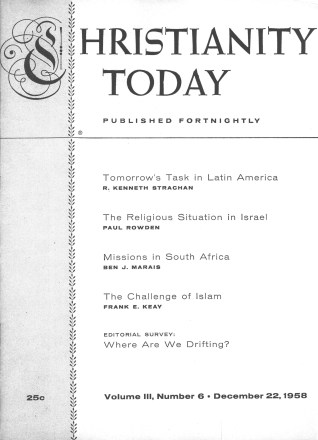
Cover Story

Missions in South Africa

The tense racial situation in South Africa is making front page news in almost every part of the globe. And the reason is that in this land of sunshine and plenty, the racial pattern is more complicated and clear-cut solutions are more difficult to visualize than at anywhere else on earth.

The world often hears of South Africa’s color problems. It hears less of the rising tide of Christian missions in this vast land between the Limpopo river of the North and the majestic Table Mountain of the South.

During the past 150 years, and especially in the course of the twentieth century, missionaries from all parts of the world have found their way to southern Africa. In the growing cities and in the lonely veld, messengers of the Cross have brought the good news of God’s love for a lost world and his forgiveness in Christ Jesus.

These missionaries have come from many lands—from Europe, the British Isles, and North America. And as is the case in India, China, or Japan, they represent many different denominations. One-third of all missionaries in South Africa are from the United States and Canada.

Today about 60 per cent of the million Bantu (African) population of South Africa belong to some Christian group or church. Some of these churches are truly indigenous, some even semi-Christian, others more or less true replicas of some continental English or American church. In their theology they cover the whole wide field from extreme orthodoxy to extreme liberalism. Most of the main South African churches however fall within the conservative evangelistic tradition with a tendency among some towards fundamentalism. More than 700,000 Africans belong to separatist groups usually under African leadership and some of them are Christian only by name and by association.

The South African branches (among whites) of most continental churches tend to be more conservative than the European mother churches.

Of the less than 3 million white people in South Africa only five per cent belong to the Roman Catholic church. Less than five per cent are of Jewish descent, and probably 70 per cent belong to some Protestant body.

Most of the Afrikaans speaking community of one and three-fourths million, descendents of Dutch Protestants and French Huguenots, belong to one of the three Dutch Reformed denominations, all doctrinally conservative bodies. They constitute the original white inhabitants of the country. The rest of the white population are Anglicans, Methodists, Presbyterians, Baptists, Lutherans, and Congregationalists.

Patterns Of Alignment

All these denominations and many more have formed branches of their own church among the native inhabitants of the land. The result constitutes an almost fantastic pattern—a classic example of Protestant division.

While most English and Continental churches or missionary bodies are drawn together in the South African Christian Council, the Afrikaans churches, whose membership constitutes more than one half of the total white population, are not members. The two main Dutch Reformed denominations are, however, linked to the World Council of Churches and the Presbyterian Alliance. The third, and extremely conservative body, has never seen its way open to join the World Council. Against this background of evangelistic zeal but Protestant brokenness and division, the position of the Roman Catholic church and its vast and growing missionary program must be seen.

Rome is making a supreme effort to win the religious loyalty of the South African Bantus. Vast sums of money have been poured into buildings and institutions in all parts of southern Africa.

In 1956 the three Afrikaans churches had 54 per cent of the total white population within the Union of South Africa. But only about 250,000 African Christians belonged to these churches (i.e. less than four per cent of the African Christian community).

To the Methodists belong the honor of the most successful of all Christian bodies in evangelizing the South African Bantus. Though the Methodist church only has a following of eight per cent among the white population, they have more than a million members among Africans! Much personnel is from overseas.

To give a more complete picture of the overall situation, these are the figures: Among the whites in South Africa, the three Afrikaans churches (Dutch Reformed) have a following of 54 per cent, the Anglicans 16 per cent, the Methodists eight per cent and the Roman Catholics five per cent.

When we face the position among Bantu (African) Christians, the position is very different. Of the total Bantu Christian community, the Methodists count 14 per cent, the Anglicans 7 per cent, the Roman Catholic church 5 per cent, the Afrikaans (Dutch Reformed) 3.5 per cent, while some 40 per cent are pagans.

As a result of the vast and far-flung missionary programs of the different churches and missionary bodies, Africans today constitute 55 per cent of the total Christian community in South Africa, while the whites only constitute 31 per cent and the “Cape” colored community 14 per cent.

The Roman Thrust

During the past 50 years, however, the Roman Catholic church has made great inroads and poured more and more workers and funds into the South African field. To illustrate this, we quote the relative number of workers and the relative growth in Roman Catholic and Protestant church membership among Africans.

If we take 100 as the number of Protestant missionaries in 1911, the number had grown to 258 in 1951, an increase of 18 per cent in 40 years.

But if we take 100 as the number of Roman Catholic missionaries in 1911, the number had grown to 1388 in 1951, an increase of 1288 per cent!

The same pattern is revealed in the relative growth in church membership among the Africans.

If we again take 100 as the number of Protestant members in 1911, the number had grown to 280 by 1951. But the membership of the Roman Catholic church had grown from 100 to 1140!

In fairness to the Dutch Reformed churches, it must be pointed out that in contrast to all other churches they raise their total personnel and all their own funds in South Africa; whereas the other churches including the Roman Catholics get most of their missionary personnel as well as funds from overseas. (Of the missionaries in South Africa, 21 per cent are South African while 69 per cent come from other lands.)

It must be said for Rome, however, that while 73 per cent of all their missionary workers come from overseas, the local Roman Catholic community far outstrips the Protestant community in the per capita percentage of missionaries raised from its own local ranks.

The Roman Catholics have in their missionary strategy concentrated on language efficiency. The result has been that whereas only 68 per cent of all Protestant missionaries are able to bring the Gospel in the language of the specific African group with whom they work, the Roman Catholic church demands that every missionary sent out to work among Africans must be conversant in their language. I believe this marks an extremely important factor. Protestants have taken note of it, however. We realize that work done through interpreters can not reach the roots of life and bring the Gospel home in the most effective way.

If we want to appreciate the overall picture of missions in this part of the world, two other factors must be considered: (1) the position of Basutuland, and (2) the remarkable resurgence of missionary activity in the Dutch Reformed churches.

As far as Basutuland, the British Protectorate centering on the fastnesses of the great Drakensberg range (Dragon Mountain), is concerned, we must point out that geographically it is the heart-land of South Africa. Strategically it is extremely important from a missionary point of view. From the Protestant side, the French have concentrated on this area for about 100 years, and they have made steady progress. But during the last decades Rome has made great headway in Basutuland, and through educational and other channels it is steadily obtaining a stranglehold on this people, although the French Protestants probably still hold a slight numerical advantage. As the situation develops there is real concern among evangelicals that the French may not be able to hold their own. This will be a great setback for the evangelical cause in southern Africa.

The other important factor is the new missionary spirit in the Dutch Reformed group of churches. The main branch (The Nederduitse Gereformeerde Kerk) has always had a strong missionary program, but until a short while ago the other two Dutch Reformed churches had no missions. The situation is changing rapidly as both these denominations and especially the Gereformeerde Kerk enter the South African field.

All these churches are working in the closest cooperation with the government (many think too close); and they are starting out on new ventures in evangelism and hospitalization especially. The changing picture reveals the following facts:

Whereas the main Dutch Reformed body, die Nederduitse Gereformeerde Kerk, had 25 hospitals in all of Africa in 1956, 20 new hospitals have been opened since or are being built or planned for the Union of South Africa alone.

As far as manpower is concerned, there has been a real upsurge. Many young men, among them some of our best trained theologians, have become missionaries. Every month stations or preaching posts are opened.

The Dutch Reformed church has also launched a fund for literature for the African. The target is 3 million pounds (about 9 million dollars), and already close to one million dollars is in hand.

There is no cause for alarm providing Protestant churches perform their duty. Hopeful signs exist that evangelicals are facing up to the challenge of the hour.

END

Ben J. Marais is Professor of the history of Christianity in the University of Pretoria, South Africa. He is a minister of the Dutch Reformed Church of South Africa. Some of his graduate study was pursued at Princeton and Yale. Of his writings, mostly in Afrikaans, some have been translated into English. Among these is Colour—Unsolved Problem of the West.
Cover Story

The Religious Situation in Israel

Israel is celebrating her tenth anniversary of independence. In spite of handicaps, the little state has made phenomenal progress in the last decade. The population has almost trebled. In a Massachusetts-size area, Israel has managed to settle more than a million Jews since 1948, and most of these have been survivors of the Nazi holocaust, refugees from Arab countries, and immigrants from Eastern Europe.

It is true that half of the country is desert-like. Fewer than two per cent of the immigrants have had any agricultural experience, over half lack vocational or professional training, many are without means, and the problem of receiving and absorbing so many people from 70 countries that differ in language, culture, and tradition has presented a challenge. Great strides have been taken to alleviate a number of these difficulties.

For instance, Hebrew has become the national language, diversified industry has come into production. Oil has been discovered in limited quantities, and local agriculture is coming to provide 60 per cent of the nation’s needs. All these developments are the fruition of scientific research. With a spirit of sacrifice and hard work, rarely seen elsewhere in our day, Israel has arrived at her tenth anniversary with great credit.

Concomitant with statehood and progress in the secular field, however, has been the vexing question of what role religion would play in the state. Contrary to the prodigious changes sociologically and economically, religion has remained static and reminiscent of that in the East European ghetto.

Theodor Herzl, nineteenth century journalist, and the late Dr. Chaim Weizmann, chemist and statesman, had much to do with the actual founding of the Jewish state. Both felt that religion would have an important place in it, but both abhorred the idea of a theocracy. They therefore espoused separation of religion and state. Dr. Weizmann’s view was that whereas the state would treat with the highest respect the true religious feelings of the community, it could not put the clock back by making religion the cardinal rule of conduct.

Religious Political Parties

Israel has achieved only partially the goal of religious separation from state. Four Orthodox religious, political parties exist to bar this: the Mizrachi, the Hapoel Hamizrachi, the Agudat Israel, and the Poalei Agudat Israel. The Agudat Israel Party, for example, is militantly orthodox and aggressive in its opposition to secularism. Besides fighting against such things as the sale of pork and the raising of pigs, it opposes a written constitution on the grounds that the Torah (the Pentateuch) is the law of the Jewish people. At the same time, it proposes religious education supported by public funds, and a law prohibiting all nonreligious activity on the Sabbath, including the operation of transport facilities. This determination to enforce strict public observance of the Sabbath has led to unseemly Sabbath demonstrations and violence.

In addition to these obstacles, Orthodox religious leaders have been hostile to the Jewish Reform movement, regarding it as nothing but a transitory stage between diluted Judaism and Christianity. They took every step to prohibit recently a postgraduate school of archaeology in Jerusalem, sponsored by Dr. Nelson Glueck of Hebrew Union College, Cincinnati. And the efforts of the Orthodox faction in the Jerusalem Municipal Council to block a construction permit were largely overridden because of Prime Minister Ben Gurion’s intervention. At the same time, an Israeli editorial pointed out that religion had become a political plaything, appearing not as a moral movement aflame with ideals and plans of action for social justice and reform, but as a subject of political party interests.

A spokesman for the government, replying to an inquiry from a Reform Synagogue in New Orleans, pointed out that it seemed incomprehensible that the very group of persons having suffered throughout the ages from intolerance should exhibit such extreme intolerance themselves. However, he noted that the Jews had made great strides in a comparatively short time in building a free society among people of diverse backgrounds. He did not wish anyone to feel that such intolerance was widespread or tacitly accepted by everyone in Israel. Mr. Ben Gurion summed up the religious-political situation by observing that the trouble lay in religion’s mixing with politics, a situation opposed to all reason. Religious immunities were being asked for political parties.

There is one important fact in all this. “Nationality” in the Middle East is identical with religion. The time-hardened pluralistic society of the area has not provided congenial soil for the transplanting of Western political institutions. The separation of Church and State in Western democracies, the belief that religion is the personal concern of the individual, and the idea that the religious group is nothing more than a non-political association are alien concepts to Middle Easterners, whether they be Jew, Muslum, or Christian. These people do not, and within the region’s social system cannot, distinguish between religion and nationality. An Israeli newspaper editorialized recently that a Jew who adopts another faith in Israel cuts himself off from participation in the life and joint purposes of the Jewish nation, losing his nationality together with his religion.

Earlier Middle Eastern history helps to explain this situation. As a Muslim state, the Ottoman empire adapted the prevailing Islamic administrative practices to its own purposes. The Sharia, or Muslim canon law, was inclusive and regulated political and social, as well as religious, matters. This law was applicable to Muslims alone; therefore, Christians and Jews under Ottoman rule were allowed to arrange their own internal community affairs. The religious courts of the various communities (Turkish: millet, Arabic: millah, meaning “creed” and/or “people,” in the sense of a distinct ethnic group, by the nineteenth century—“nation” and “nationality”) had jurisdiction in matters of personal status such as marriage, divorce, alimony, guardianship, testaments, and the like. The British during the Mandate in Palestine continued this religious judicial system, as did the new Jewish State. Thus modern Israel still conforms to the Middle East norm. Under the present millet system, intermarriage between Jew, Muslim, and Christian is impossible, for there is no civil marriage and all such matters are under the jurisdiction of the religious hierarchy.

Time magazine recently related a poignant result of the millet system. A young boy died in Israel. Burial was refused by the rabbi on the grounds that technically he was not Jewish (the father had married a Gentile girl in Poland before immigrating to Israel). A Roman Catholic priest refused burial because the boy had not been baptized. After days of wrangling, the body was buried in a Jewish cemetery, but with a fence separating his grave from the others. The fence shortly “disappeared,” demonstrating the strong feelings of many Israelis.

Restriction Of Freedom

Israel is sincere in stating that there is freedom of religion and conscience in Israel, but this is interpreted as freedom within each millet. Thus in Israel, the Protestant concept of freedom to preach, teach, and catechise, and the right of any individual to convert freely from one faith to another is frowned upon. Missionary work among the Arabs of Israel has been relatively free from interference, but this is not true in the Jewish field. Organizations have been formed to combat Christian activities among the Jews; and through various pressures of personal, social and economic nature, life is extremely difficult for a Jewish convert to Christianity in Israel. Consequently, there are Israeli Jews who secretly are believers or in sympathy with the Christian faith, but are fearful of open proclamation.

At the present time, there are approximately 50,000 nominal Christians in Israel, divided up among the nine recognized Christian millets—such as the Greek Orthodox, the Maronite, and the Roman Catholic. Protestants, arriving late on the scene, do not have recognized millet status. However, some groups are allowed to perform certain personal status functions such as marriage. A few of the Protestant groups (using the term broadly) would accept millet recognition if the government should grant it, but most are unwilling to sacrifice the principles of complete religious freedom, or to take over civil court functions.

Officially, the government’s treatment of Protestant missionaries and congregations has been quite proper. However, it has been difficult for many groups to obtain visas for new workers or for present Christian workers to continue the renewal of their visas. Independent missionaries or those representing small denominations have found it very difficult to remain in Israel, or to return to Israel after a furlough. By misrepresenting their purpose for coming to Israel, some of these brought about their own difficulties.

In dealing with this little land, one must keep in mind that 10 years is a brief period. In evaluating the Israeli and his attitudes toward Christianity, one must recognize that the Jew has formed his opinion of Christianity over a long period of time in the crucible of suffering at the hands of so-called “Christians” in Europe. The fact that the Jews have been banned at one time from living in France, Spain, and England, tortured and killed in the Spanish Inquisition, bound to the ghetto and penuary, and slaughtered by German soldiers contributes to an almost insurmountable barrier between Christianity and Judaism.

The words “Gentile” and “Christian” are synonymous to the average Jew as he thinks of Americans and Europeans. Consequently, he judges Christianity in the light of Gentile behavior. Moreover, anti-Semitism and intolerance are not lost arts to many “devout” Christians.

Israel is struggling today for her very survival. Surrounded on all sides, except for 177 miles of sea-coast, by countries that have vowed to exterminate her and her people, Israel can little afford to favor any factor which may bring dissension among her people. But the exercise of genuine Christian charity, patience, and sympathy on the part of Protestants will nonetheless be effective as Israel faces the uncertain future.

END

Paul Rowden has served the Southern Baptist Convention as foreign missionary to Israel since his appointment in 1952. He holds the A.B. degree from Emory University, B.D. from New Orleans Baptist Theological Seminary, and is currently enrolled at Dropsie College in Philadelphia in graduate study.

Cover Story

Tomorrow’s Task in Latin America

Sidney James Wells Clark, for many years intimately connected with the World Dominion Movement, has been described as “the man who saw the truth about Foreign Missions.” One of the guiding principles which he laid down was to the effect that the work being done had always to be carried out in the light of the work to be done. The unfinished task of tomorrow, he insisted, should always determine the activity of today. He defined and advocated the doctrine “that all missionary work ought to be done with ‘the Big End’ always in view, directed consciously to that end, and that whatever was done which did not assist directly to advance that end was wrongly conceived” (Roland Allen, Sidney James Wells Clark—A Vision of Foreign Missions, The World Dominion Press, London, 1937, p. 54). Time and the judgment of God upon missions in the Orient would seem to have vindicated his views.

We are entering into a new era in Latin America. Profound changes are taking place. The consciousness of these new directions invades all our missionary thinking even as it also lies near the surface of the growing self-consciousness of the Latin American evangelical church. The bearing of this upon the missionary movement is of particular concern to those of us who serve in Latin America, because in this particular area the world’s social and technological revolution is taking place amidst a population that is increasing two and a half times faster than the rest of the world.

We do not know what this will mean to us in terms of scientific advance, military and political alignments, economic conditions, and religious pressures. But in terms of evangelism, should the Lord tarry, it means that where today we are seeking to reach approximately 175 million souls, tomorrow—a mere 20 years from now—we will be dealing with 420 million! And the day after tomorrow, 550 million! We are faced with a job that is larger than ever—and more complicated. It involves a much greater number of organizations and agencies, new media and new techniques, specialized ministries and operations. Tomorrow’s task of evangelism, with all the follow-up it properly implies, must be carried out on a scale commensurate with the giant growth and radical changes that are taking place.

How, in the face of such an enormous task, are we going to fulfill the Great Commission effectively?

That is why Clark’s thoughts regarding missions are so important to us today. When we consider that of the total missionary forces in Latin America, 56 per cent belong to the Evangelical Foreign Missions Association and the Interdenominational Foreign Missions Association, and that approximately 75 per cent belong to what might be called the evangelical or fundamentalist wing of the Protestant Church, we must recognize the serious responsibility that weighs upon us.

Given this preponderance of evangelical forces, the future of Latin American Protestantism may well rest in our hands. What we are and what we do now will have enormous effect upon the Church there tomorrow. That is why it is so vitally important that tomorrow’s evangelical task be conceived and executed according to wise and scriptural principles in practical reference to “the Big End.”

Tomorrow’S Task

Evangelicals agree in affirming that the goal of missions is an effective gospel witness among all peoples that shall extend the Church of Christ, through which God’s saving grace is to be made known to every creature, in every part of the earth.

This is all easily stated and serves as the basis for all public pronouncements as to mission goals and promotion. There seems to be no ignorance or confusion as to the ultimate aim. The trouble is—as many students of missions have pointed out—that most missionaries and most societies are so engrossed with the mechanics and the daily routine of the work immediately at hand—the program of their own particular group—that the long range goals are lost sight of.

This becomes specially apparent when we break down the continent into national areas and examine the work being done in each. It becomes apparent that no coordinated effort is underway by the evangelical forces resident in the territory to complete the Commission in their area. Twenty-five, fifty and in some cases seventy-five or a hundred years have gone by, and following initial waves of advance, their chief energies are now directed toward carrying on the existing work with limited possibilities of expansion. And the most obvious deficiency of evangelical forces is the lack of a concerted movement to finish the job in their own territory.

Data regarding the work carried on are generally available. The total number of missionaries, national workers, organized churches, evangelical communities in each given area is quite easily secured. But ask the Christian worker for the precise number of cities or towns that have not been adequately evangelized, and he is lost. There is abysmal ignorance of the work that remains to be done.

Costa Rica, for example, is a small country with an area of some 50,000 square kilometers and only a million inhabitants, and yet, to our knowledge, it has never been surveyed in terms of the work to be done.

What is responsible for the huge gap that exists between our professed aims and our actual activities? Why do we talk so big and do so little to accomplish it? I believe the main reason is our failure to mobilize our entire evangelical forces in constant evangelistic endeavor. We have depended too much on the foreign missionary and too much on the full-time Christian worker. By and large we have founded static churches after the pattern in the homeland. Instead of the witnessing communities founded by St. Paul (cf. 1 Thess. 1:6–8) we have brought into being passive congregations to be waited on and ministered to by national pastors trained in the same static tradition.

As a result we face a vast unfinished job which grows larger with each daily jump in population. And if we look a little more closely, it would seem that in every country there are four major areas of need.

1. There are the unreached multitudes in the big city areas. One phenomenon of Latin America’s revolutionary transformation is the amazing growth of the cities. As in the times of St. Paul, these cities are drawing immense multitudes from the surrounding towns and villages. By modern means of communication and of transportation, the cultural and intellectual life and influence of the big cities inundate the surrounding countryside. Uprooted, overwhelmed by the new social and technological environment, the people are open to the Gospel as never before.

Nothing can equal the strategic importance of these big cities. The battle for Latin America will either be won or lost there. It is there that the social and technological revolution is taking place. In place of the former peon class with machete in belt, a labor class is rising, trained in mechanical skills, and politically conscious and vocal. And in place of the small minority of landed gentry, a growing middle class of professionals—engineers, technicians, small businessmen, lawyers, teachers—is emerging. The future of Latin America lies with them.

Apart from a few exceptions, the evangelical groups tend to be weakest in the largest city centers. Take the cities in Latin America with a population of over a million inhabitants—Mexico City, Havana, Caracas, Bogota, Lima, Santiago, Montevideo, Buenos Aires, Sao Paolo, Rio de Janeiro, San Juan—and look for large evangelical churches. They are few and far between. In planning any advance for the future, careful thought and attention must be given to a more effective program of evangelism leading to the establishment of strong, active churches in the large city centers.

2. A second area of need is in the smaller towns and villages. Hundreds of these have never been effectively evangelized. Mission societies and national church bodies have tended to lose momentum in their evangelistic outreach and to expend their principal energies in maintaining established work.

The time has come for a new evangelistic push to occupy the towns and villages as yet unreached. Such an effort is not beyond the resources of the local forces, if carried out by a partnership of missionary personnel with the national leaders and the lay forces.

3. Thirdly, in keeping with the express injunctions of Scripture, a special effort should be made to reach the unevangelized Indian tribes still found within the national confines of almost every country. The fundamentalist missionary movement has carried out the principal efforts to reach these tribes. These agencies have succeeded as never before in focusing the attention of the churches at home upon the obligation and imperative of reaching the Indians for Christ.

But the work needs to be carried through to completion. And one of the requirements of the new missionary era is that in the approach to the Indians the national Latin American churches be encouraged to take more active part and assume greater responsibility. These tribes represent, after all, their home mission fields, and the Indian churches brought into being should be properly related to the national church.

4. While not a geographic area, there remains a fourth which is tremendously important. We refer to certain strategic classes of people.

Mention has already been made of the growing middle class of professionals which is emerging all over Latin America. Evangelical Christianity has most to offer them and most to gain from them. Professor John Gillin of the University of North Carolina tells us “they are men in search of a way of life, an ideology, and a social order that will justify and legitimize their still somewhat diffuse aspirations” (“Problems of Mestizo America: A Sociological Approach,” by John Gillin, in Civilizations, Vol. V, 1955, No. 4, p. 513). What the future will hold for them and for the evangelical movement in Latin America will depend largely on whether or not they are effectively reached for Christ. But no concerted effort has been made to reach them. Our evangelical message, worship service, literature, radio programming, are still geared almost exclusively to the less educated groups.

Of equal importance are the children and young people of Latin America. It is a truism that tends to fall on deaf ears to say that the future lies with the younger generation. But one factor in Latin America—not to be found to that degree elsewhere—makes it tremendously significant. That factor is related to the population explosion already referred to, and is brought out by one tiny statistic uncovered by the Friesen & Company Commission (a Canadian firm specializing in analyzing future hospital needs) in Costa Rica. Costa Rica, though tiny, is growing faster than any country in the world; recently it passed the million mark. Of its million inhabitants, over 50 per cent are under 17 years of age!

Tomorrow’S Strategy

In the face of the immense task that looms ahead, we ask ourselves: Are our present methods effective? Is our present program adequate? Can we carry out our Commission satisfactorily at our present pace? The answer is No. It may hurt to say so, but we may as well face it honestly. If during 100 years of missionary efforts we have failed to complete the Great Commission for five generations, what hope do we have of completing it at a time when suddenly by the hand of Providence the population is doubled in one generation? At our present rate of progress and with our present manner of operation we are falling behind and will never get the job done.

What then is the proper method?

What South American missionary has not been intrigued by the amazing development of the Pentecostal movement in the Republic of Chile? The remarkable history of a small group that was forced out of a denominational church in Valparaiso, Chile, in 1910 and which has in the intervening years so multiplied that today it numbers over 70,000 baptized members and close to half a million adherents is something to make us think! Especially when it is contrasted with the relative stagnancy of the established denomination which they left, which today can muster only some 6,000 members in the whole republic! Why should one group experience such growth and the other not—in the same field?

The search for an answer is complicated by the fact that other religions and non-Christian sects are also experiencing similar success. What is the secret of their success? Are they closer to the truth than the rest of us? We should be loathe to say so. The fact that groups with such varied emphases and contradictory doctrines are experiencing equal success would seem to prove that the message of each per se is not the key to their expansion.

What then? Superior man power? A stress on the emotional? Special methods? Organization? An examination will clearly reveal that the answer to their success does not lie in their doctrine, nor their peculiar emphases, nor their particular organization, nor their ordinances. One factor accounts especially for the growth of all these different groups. It is this: their effectiveness in mobilizing their entire membership in continuous propagation of their beliefs. The growth of each group is in direct proportion to its success in mobilizing its entire constituency in continuous evangelistic action. This was, humanly speaking, the key to the success of the apostolic church—and it is the key to success today.

We must buckle down to the task of mobilizing our entire membership in a continuous program of aggressive evangelism that is properly followed up. What does this mean? It does not necessarily imply that we must abandon the media and ministries presently employed, but it does mean a definite change in emphasis: An emphasis on the Latin American rather than the foreign missionary; an emphasis on the laity rather than the clergy; an emphasis on the local congregation as the chief unit for evangelism rather than on special organizations or individuals to do the job for them. It means concentrating on a teaching job, which is not at present being carried out, and of training the entire membership of our evangelical churches in the techniques and practice of witnessing. And it means developing a program of evangelism that will enlist the enthusiastic response of Christians and give direction and continuity to their efforts. And obviously both missionary and pastor will have to set the example.

Tomorrow’S Program

If tomorrow’s task of evangelism is so overwhelming, and if the only sound strategy which offers any hope of success is the one indicated, then it is imperative that we formulate some practical plan or program that will effect the needed reorientation in our present operations and enable us to cope with the challenge.

With full recognition of our necessary dependence upon the wisdom and guidance of the Holy Spirit and with full awareness that this wisdom and guidance must be sought in partnership with the Latin American church, we would submit the following propositions:

1. The time has come for the evangelical forces in each separate country to launch a concerted, coordinated drive, making full provision for adequate follow-up, that will have for its expressed and immediate goal to complete the evangelization of the entire national territory. We believe it is most practical to think in terms of national rather than general or continental areas, because it immediately defines the specific area to be evangelized and thrusts the main responsibility upon the local forces. Problems of fellowship and cooperation can generally be best tackled, and the approach to the congregations to mobilize their membership best carried out, on a local level.

2. A simple program should be drawn up to enlist and employ the total membership of each congregation in a continuous effort which could bring all forces together in a church-centered campaign of prayer, training in personal evangelism and follow-up, organized visitation work, itinerant evangelism in the rural areas, and mass evangelism. Sparked and promoted by such a corps of outstanding workers as might be loaned and assigned by the cooperating bodies, effectively supported by such specialized media and ministries as literature and radio, and using all other means, such an evangelistic drive could be launched in one country after another and thus accomplish the goal of a stepped-up program that is commensurate with the demands of this growing continent.

3. The urgency of the times and the immensity of the task cry out to us to forsake our costly, overlapping, conflicting, competitive, independent ways of operation, and to determine to work together, lovingly respecting our differences of conviction and variety of gifts but ready to sacrifice our little ends for the sake of the “Big End.” Our agreement on the fundamentals of the faith makes possible cooperation in evangelism if we but set our hearts on it. If we do not, we may well consider whether we are not sinning against the Lord and against the multiplying millions in Latin America for whom he died.

Given the revolutionary changes and the exploding population in Latin America; and given the strategic position of the evangelical movement and the gigantic task of evangelism confronting us in that area, this is our one hope for meeting the challenge of tomorrow.

R. Kenneth Strachan is General Director of Latin America Mission, a service organization sponsoring literary, evangelistic and missionary activity throughout the Spanish-speaking world. It has a staff of 300 including 130 foreign missionaries. Son of the mission’s founder, Mr. Strachan holds degrees from Wheaton College, and from Dallas and Princeton seminaries.

The Meaning of Mary’s Magnificat

The song proclaims an upset, but this revolution is not like others.

My soul doth magnify the Lord … He hath shewed strength with his arm; he hath scattered the proud in the imagination of their hearts. He hath put down the mighty from their seats, and exalted them of low degree. He hath filled the hungry with good things; and the rich he hath sent empty away. He hath holpen his servant Israel, in remembrance of his mercy; And he spake to our fathers, to Abraham, and to his seed for ever.

In 1521 Luther was writing an exposition of Mary’s Magnificat. He was extremely affected by the sharp contrasts that Mary put into her song. Luther’s fascination for the astounding contrasts is not very surprising, since his own day was also going through enormous shocks. He could perhaps read certain parallels from his own time into Mary’s song. In a time when everything seems suddenly uncertain, one is faced with the question of whether the great changes taking place auger a revolution against all that is worth while or a reformation of what has become evil, a revolt that in the end will curse the men who caused it or a reform that will bless the life of many. This was a question that faced Luther. Were the events in which Luther was leading the way simply a turning upside down of all values, only an “overthrow of values” as Nietzsche would later say? Luther must have asked the question, but history had to answer it.

Our concern here is not with the question of the Reformation, however, but with the “overthrow of values” that Mary sang about in her hymn. One could look at her Magnificat as a profound perspective on history. For history takes shockingly sudden turns so profound that history itself almost seems a perpetual “overthrow of values.” But, it is different with Mary’s vision. We have something entirely different in this passage than a revolution born of discontentment with the status quo.

The possibilities opened up by the thought are nonetheless alarming. It is no small thing when the proud are scattered, the mighty pulled down from their seats, the humble exalted, and the hungry fed while the rich are sent away empty (Luke 1:51–53). Mary sees these upsetting events as though they had already happened. The world had not yet heard the new glad tidings; the shepherds were quiet on the hills; Herod was still comfortable on his throne; the sceptor was still steady at Rome. The angels had not broken through the dark sky of advent eve with their anthem. Yet, Mary sings as though the world had already been turned upside down, as though the thunder had already ripped the sky above a quiet earth. Mary sees the power of God breaking through. She sees everything changed. She sees a new measuring stick in the hands of God taking its new measure of things long counted certain. What has seemed very normal in the world suddenly is seen as abnormal, what has seemed secure suddenly is seen shaking at its foundations.

The magnificat alludes to another hymn, sung long before by Hannah. This hymn sees the bows of the mighty men broken and those girded with strength stumbling. It sees those who were full hiring themselves out for bread and those who were hungry now filled. It sees the Lord in action. The Lord kills and makes alive. He brings men to the grave and raises men up again. He makes poor and makes rich. He brings low and raises high (1 Sam. 2:4–7). Again, everything is upset. Places are changed; the strong and the weak, the rich and the poor, the hungry and the filled—all exchange their positions.

But it is especially in Mary’s song that all these things draw very near. The relationships in life that have been looked on as stable do not really conform to the way God sees them and to what God shall do with them. When he really comes to earth in Jesus Christ, all these so-called stable relationships are undermined. There have even been attempts to use Mary’s hymn to justify revolution; but then it has been forgotten that Mary sees these revolutionary events as purely the work of God. And what God does is wholly oriented to the event that is happening around Mary at Advent time. God’s order of things is being brought to earth in the events of Christmas night, events to which the deeds of men can do only intentional or unintentional service.

This is why Advent preaching is such exciting opportunity. It is surely the proclamation of a great joy. But when the angels of the night choir sing of great joy, they have more in mind than a holiday’s gaiety. Angels do not exaggerate. They do not exaggerate when they sing of such enormous joy. But the proclamation is also an exposé. It exposes all sham, all cant, all pretense in which men customarily hide themselves. The divine Advent—Christ in his measureless humiliation—has revealing consequences for man’s life. One learns from the Advent proclamation to look through the masks of human life. For it carries with it a divine judgment, a judgment which results first of all in the scattering of the proud. God scatters the proud with the light of what happens at Advent. The proud cannot hide their real poverty in the light of this poverty. The poverty of Christ exposes their hidden poverty. There are only two alternatives allowed by the divine exposé of the Advent: the proud must either be filled or be scattered. Once the Light has shone, there is no other choice.

This is why the Gospel of the Advent is for all times. No one since Advent can go on as though nothing new had really happened. One can celebrate the event with festivity. There is a place for Christmas feasting. But through the celebration sounds a voice of urgent warning. It is a voice with overtones of crisis, a voice which somehow must have an answer. It is like an echo of Psalm 146, in which we read of an enormous blessing poured out on the oppressed, the hungry, the prisoners, the blind, the bowed down, the stranger, the orphans, and the widows. But there is an exception to the universal blessing: “the way of the wicked he turns upside down” (Ps. 146:9). Unequalled wealth is poured out on all kinds of unfortunate creatures. But with the shower of blessing, an alarm is sounded. It is an alarm that points to the proud who have no need of the blessing. It is an alarm that shows up the proud for whom the Gospel of the Advent has become an antiquated, though sentimental romance.

In spite of the upsetting nature of the event, it gets its force from the Father’s love. It goes back for its vitality to the great humiliation for which the proud have no feeling. God’s way of turning things around has no response from them. But he who humbles himself at the Advent message shall indeed be lifted up. He who bows humbly before the great poverty shall indeed be made rich. Blessed are the meek for they shall inherit the earth.

Book Briefs: December 8, 1958

Selected Passages

Calvin: Commentaries, ed. by Joseph Haroutunian (Westminster Press, Philadelphia, 414 pp., $5) and Calvin’s Doctrine of the Word and Sacrament, by Ronald S. Wallace (Eerdmans, 253 pp., $3.50) are reviewed by G. Aiken Taylor, Minister of First Presbyterian Church in Alexandria, Louisiana.

The first of these books is the second of three volumes on Calvin projected for the Library of Christian Classics. The first volume (Theological Treatises), appeared some four years ago and included a great many hitherto untranslated selections. The selections here offered are freshly translated but the material has been available in English for a long while.

The editor has collected representative passages from the commentaries under such headings as “the Bible,” “The Knowledge of God,” “Jesus Christ,” “Faith,” “Ethics,” etc. There is also splendid introductory material on Calvin himself and two additional works: The Preface to Olivetan’s New Testament and the Dedication to the Epistle to the Romans. The overall affect is a handy reference work for uncritical study.

Most selections of Calvin material suffer from the natural tendency of any editor to select passages in keeping with his own viewpoint or interpretation. And Calvin wrote so voluminously that he can be made to say almost anything. The present collection does not altogether escape this danger. I looked to see how many of the proof-texts selected by R. S. Wallace (see book-review below) to support his thesis were included in Haroutunian’s selection of passages on the same subjects. There were almost none.

However, the danger of misinterpreting Calvin is largely avoided, in this work, by the editor’s practice of letting long passages speak for themselves. Instead of clipping and editing the several pages of commentary which Calvin frequently wrote on a single verse, he has printed the whole of each passage selected.

The second of these books is a thorough and scholarly work which develops Calvin’s thought as follows: (1) God cannot be known directly and, consequently, he cannot reveal himself directly to man, for man is unable to bear it.

(2) God, therefore, must adapt himself to man’s capacity to receive, revealing himself indirectly through signs and symbols. These offer him veiled, but they truly disclose him even as they veil him. In short, though God cannot be known, he can be encountered in and through means.

(3) Now Christ is the Mediator of all revelation, standing between God and man as the Word of God. God is apprehended only through his Word and this Word is always Christ. It is the Word (Christ) which makes the words and signs (the means) become revelatory of God.

(4) In the Old Testament the Word (Christ) revealed God primarily in the signs and symbols of worship under the Law. In the New Testament the Word revealed God primarily in the Cross and the Resurrection. The apostles spoke of this revelation of God in Christ in their capacity as preachers of it and commentators upon it. Their words become the Word, to us, when it is received in faith.

(5) Today the Word (Christ) continues to reveal God through words and signs: through the preaching and the sacraments of the Church. The frail word preached by man can actually become God speaking. It does so become when the grace of the Mediator makes it so … as faith is exercised.

To all practical purposes, then the Word of God can be spoken of in three ways: (1) with reference to Christ, (it is ever Christ, of course, and in any case); (2) with reference to the words of Scripture when they are taken, in faith, as the Word of God and when, as the effect of such faith, they become the Word; and (3) with reference to the preaching of the Gospel, whenever it is also received, in faith, as the Word.

Essentially there is no qualitative difference between the ministry of the Word in Scripture and the ministry of the Word in preaching, for in the case of each the revelation occurs only as faith is exercised. There is, however, an “added” act of faith presumably required of the preacher (although this isn’t discussed). This is the faith he exercises as he takes the words of the prophets and the apostles as his own, that his words may become the Word of God. When he does this, his words become the Word just as their words became the Word.

The above, it can readily be seen, is Calvin with a Barthian flavor. The difference between Wallace’s Calvin and Calvin himself is small, but important. Calvin himself viewed Scripture as the objective, self-verifying Word of God in a manner Wallace has not allowed. Witness this: “But God wants us to respect His mouth and we know where that is: it is where He has spoken to us by Moses, by His prophets and, lastly, by His Apostles, in order that we may be accurately taught everything that He wants us to know. So let us profit by this doctrine, that we be not rebels against the very mouth of God, his Word” (Trans. from Sermon on Deut. 1:22–28).

G. AIKEN TAYLOR

Realm Of Ideas

Luther’s World of Thought, by Heinrich Bornkamm, translated by Martin H. Bertram (Concordia Publishing House, 1958, 315 pp., $3.00) is reviewed by E. P. Schulze, Minister of the Lutheran Church of Our Redeemer, Peekskill, N. Y.

Since university men live in the realm of ideas, they will naturally produce books like this one, written by a professor of church history at Heidelberg University who has done a great deal of previous research and writing in the field of Lutherana.

The essays in this volume largely complement and sometimes overlap those found, for example, in Boehmer’s “Luther in the Light of Recent Research” (1916) and Dau’s “Luther Examined and Reexamined” (1917). Boehmer’s work is a critical evaluation of the man and his development in the environment of his times. James Harvey Robinson called it “a fresh and stimulating conception of Luther,” and it is indeed a lively book. Dau’s purpose, on the other hand, is to rebut Roman Catholic slanders concerning Luther’s life, work and doctrine. More recently, Ewald Plass in “This is Luther” has studied his character, personality, and his everyday life. And a few years ago Schwiebert, a pupil of Preserved Smith, gave us “Luther and his Times,” in which the historical setting is strongly delineated.

All these books were written by academic men, and Bornkamm has added his contribution to the ongoing business of analyzing Luther by this study of his principal ideas about theology, nature, history, politics, sociology and philology. We see in these pages his towering figure emerging from the middle ages and drawing multitudes after him. His theology, of course, was not new, but it was not medieval; it was that of primitive Christianity, based firmly upon the Holy Scriptures. In matters of science he had the modern outlook, rejecting Aristotelianism and saying, “Science consists in differentiating and sifting.” In the field of economics, he foresaw and fulminated against the excesses of an unbridled capitalism. Some of his concepts (that concerning the best form of government, for example) remained medieval throughout his life, but his insistence on the line of demarcation between the jurisdictions of Church and State, so clearly expressed by his co-worker Melanchthon in the Augsburg Confession and its Apology, is essentially modern, though with some defects which are evident to anyone who has studied his views concerning the duty of government toward the Jews and the Anabaptists, in the promulgation of which Luther appears in his least pleasing aspect. One misses in this volume a discussion of Luther’s thoughts on education. This is indeed an important topic, and it is strange that Bornkamm, an educator, gave it no place in his book.

“Luther’s World of Thought” is an easy book to read. To Lutheran pastors, and indeed to many other clergymen of scholarly bent, much of its contents will seem familiar and elementary. But it is likely enough that even many well-read Lutheran ministers can learn much from Bornkamm’s pages on Luther as a translator of the New Testament.

Bornkamm’s work is to be recommended to all who are interested in what Luther thought, which, after all, is of as great importance as what he did. But by its very physical limitations it can be no more than an introduction to its vast subject. Those who wish to delve deeper and can read German should turn to Volume XXIII of the Concordia edition of Luther’s Works. Between the covers of that fat quarto they will find an excellent summary of Luther’s thought on every conceivable topic, indexed (originally in cigar boxes, I am told) by the indefatigable editor A. F. Hoppe. In those abstracts is the quintessence of the matter, and it is presented for the most part in Luther’s own stout and trenchant words.

E. P. SCHULZE

Missionary Autobiography

Land Beyond the Nile, by Malcolm Forsberg (Harper, 1958, 232 pp., $3.95), is reviewed by Marian J. Caine, Editorial Assistant of CHRISTIANITY TODAY.

Although it says on the jacket “the real life drama of a dedicated and dauntless missionary couple,” this book has rather little to commend it for drama, and in comparison with the classic and moving epic of five missionary martyrs published a year ago, it is something of an anti-climax.

There is admittedly no glorious tragedy to Land Beyond the Nile; but this alone would not make it a weak book. It professes to be a portrayal of the kindling devotion of two people for Christ and claims to be “a great Christian adventure” (cover flap), but unfortunately the writing succeeds in only saying as much from page one to the end. A disappointment, this book is like too many other Christian books in recent years; it glosses over life and events in a rather pedestrian, threadbare manner, and as an autobiography it has little to say beyond itself.

The story is about a missionary couple, Malcolm Forsberg and his wife Enid who go to Africa as missionaries. The author carries their experiences from the time they meet at Wheaton College to their mission work in Ethiopia and later in the Sudan. The strong point of the book perhaps is in the details which Mr. Forsberg gives of missionary living, tribal primitivism and the geography of the land. Some of these descriptions are articulate, and for those contemplating missionary work in Africa and readers interested in Africa for its own sake, they are instructive. Useful also are the maps in the beginning pages of the book and photographs representing the ways and practices of Uduk and Ethiopian peoples.

MARIAN J. CAINE

Salvation Via Suggestion

The Single Path, by James W. Fifield (Prentice-Hall, 1957, 335 pp., $3.95), is reviewed by Walter Vail Watson, Minister of the Lancaster Presbyterian Church, New York.

This is a book charmingly written by a winsome and materially successful member of the Weatherhead-Peal school of spiritual health through devotion to psychological formula.

Throughout the book the brilliant pastor of Congregationalism’s largest church treats us to a succession of interesting anecdotes gleaned from his pastoral experience in Los Angeles. We view souls of all states and ages who have resolved their problems through taking the “creative plunge,” an expression which lies at the book’s heart (pp. 28–41).

This creative plunge is defined as “the bold, decisive act by which you smash through a wall that has hemmed you in through life” (italics mine). This plunge is taken “mostly … when, at long last, you lift your face to God.” In other words, God is just waiting for men to get tired enough of their failures to find every sort of success and victory through self-commitment to him. There seems to be no real need for any sort of atonement because a man is a sinner and under the guilt of unforgiven sin.

But, anyhow, Dr. Fifield presents an array of people who have found some sort of peace (he only implies it is permanent) through a rational commitment abetted by sound, discerning psychological counsel.

It is cheerfully agreed that this sort of victory over frustration may work when the focus of real need is for personal adjustment to other persons one has hitherto been unable, or has refused to understand. This may prove to be helpful in some cases.

The gospel according to Fifield also seems to assume that if we can convince ourselves that God approves our efforts at self-improvement and self-victory a happy issue is bound to be just around the corner.

The new birth, for instance, seems to be quoted with approval (p. 28). But the supernatural concept of John’s gospel is travestied in these words which immediately follow the reference to the new birth: “Forget your real or fancied lacks—your rebirth in Christ will truly make you a little lower than the angels!” Is this what Jesus meant when talking to Nicodemus? What warrant is there, pray, for taking this kind of liberty with the context of the Word of God?

Whatever he advocates it is not the Christian faith. If Dr. Fifield assents to what Paul in the Spirit referred to as the “offence of the cross,” he is very careful to conceal it. There is no evidence that he truly believes in the Christian doctrine at the heart of the gospel of John, or of Paul as expressed in the epistles to the Romans and Galatians. He fails to give due emphasis on the doctrine of vicarious atonement.

WALTER VAIL WATSON

Authoritative Work

Augustine to Galileo, by A. C. Crombie (Heinemann, 25s.) is reviewed by G. C. B. Davies, Professor of Ecclesiastical History, Trinity College, Dublin.

This volume, containing a history of science during the Middle Ages, is a reissue, without alteration, of a work first published in 1952. It provides a most interesting and exhaustive survey of the subject, such as is not to be found in treatment and scope in any other single volume. Of particular value is the section which describes the trends and experiments in technics, medicine, and science in the thirteenth century, introduced from Greek and Arabic sources, and which relates them to the subsequent developments of the Renaissance era. The work of Grosseteste, Albertus Magnus, and Roger Bacon in pure science or in philosophical criticism of Aristotle prepared men’s minds for the scientific revolution associated with Copernicus, Galileo, and their contemporaries. The emphasis on the work of medieval mathematicians brings a wholesome corrective to those who have dismissed this period as comparatively insignificant in that field.

The revolution in scientific thought of the sixteenth and seventeenth centuries was caused not only by new discoveries, but by a fundamental change in the type of question asked by scientists regarding the world and man himself. This new attitude is developed in considerable detail in the fields of astronomy, physiology, chemistry, botany, and anatomy. The first reception of this massive and authoritative work made apparent that it supplied a real need in tracing the origins and growth of ideas which have had a profound influence upon the life of mankind. The appearance of a cheaper edition will be welcomed as placing what has become a standard work within the reach of a wider circle of readers.

G. C. B. DAVIES

Excellent Study

Ezekiel: the Man and His Message, by H. L. Ellison (Eerdmans, 1956, 144 pp., $2.50), is reviewed by Anton T. Pearson, Professor of Language and Literature at Bethel Theological Seminary.

H. L. Ellison, Tutor for Old Testament Studies in the London Bible College and contributor of the sections on I and II Kings and I and II Chronicles in the New Bible Commentary, has given conservative Christianity a stimulating treatment of the prophet Ezekiel. In the nature of an expository commentary, the book follows the chapter order of Ezekiel and is best read along with the Bible text itself.

Aware of the textual problems of the M.T., the author often cites a preferred LXX reading, and makes constant use of the renderings of the R.V., Moffatt, I.C.C., and R.S.V. For example, the reading, “in the eleventh year of our exile” of LXX, Syr., is preferable to the M.T. “twelfth year” and would bring the news of the fall of Jerusalem to the exiles at Tel Abid six months after the event rather than a year and a half later (p. 118). With the fall of Zedekiah, the old order was to pass until the Messiah came, whose it is. This seems to be the first extant interpretation of Genesis 49:10. For Shiloh, Ezekiel reads shelloh, “Whose it is,” which reading is followed in the R.S.V. of Genesis 49:10 (p. 86).

Symbolism was congenial to Ezekiel with his priestly background, and the actions of chapters four and five are to be regarded as symbolical rather than literal (pp. 31–33). The prophet’s most elaborate allegories are contained in chapter 16 and 40–48. Caution must be exercised to discriminate between symbolizing and spiritualizing. The latter requires mainly a fertile imagination (p. 130).

Some selected views of the author are here adduced. The Ezekiel of 14:14 is the Dan’el of the Ras Shamra tablets of 1400 B.C. (p. 59). The similarity of the Messianic picture in 17:22–24 to the mustard seed in Mark 4:30–32 precludes requiring the birds to represent evil (p. 70). Ezekiel was not only a formalist; note his ethical stress in 18:6–9 (p. 74). Contra Pember (Earth’s Earliest Ages), Scofield, et al., Ezekiel 28:11–19 does not depict the fall of Satan. This passage and Isaiah 14:4–23 must not be detached from their setting (p. 108). “Flesh” has different connotations in the O.T. and the N.T., so that a “heart of flesh” (36:26) refers to the will as God designed it to be (p. 128). Particularly helpful is the discussion of why Tyre and Egypt were not destroyed by Nebuchadnezzar although their doom had been predicted (29:18). This is an evidence of the conditional character of national prophecy, illustrated by Jeremiah 18:7–10 and the book of Jonah (p. 102).

Ellison predicts that with the establishment of Israel as an independent state, its spiritual transformation cannot be far off. The revolt of Gog (man’s last attempt to defy God at Satan’s urging) in chapter 37 takes place at the end of the Millenium, Revelation 20:7–11, and so “that careful thinker, E. Sauer,” in From Eternity to Eternity (p. 134). Hence it is futile to attempt to identify the symbolical names Rosh, Meshech, and Tubal.

The author allots only a scant eight pages to a discussion of chapter 40–48, but he characterizes this section as apocalyptic, not prophetic, as millenial, and symbolic. He repudiates the re-establishment of a literal temple and animal sacrifices during the Millenium.

He seems a little too lenient with the false prophets (pp. 51–56). This reviewer would like to have seen some reference to Holscher’s and Irwin’s attempts to dissect the book of Ezekiel, and a notice of Howie’s analysis of the charge that Ezekiel was afflicted with catatonic schizophrenia, but a brief book cannot include everything.

We are in debt to Mr. Ellison for this excellent study!

ANTON T. PEARSON

Biblical Theology

When the Time Had Fully Come, by Herman N. Ridderbos (Eerdmans, 104 pp., $1.50), by David H. Wallace, Professor of New Testament at California Baptist Theological Seminary.

Professor Ridderbos’ monograph, the third title in the Eerdmans Pathway Books, is a useful addition to the current literature on biblical theology. In the brief span of 96 pages the author discusses the kingdom of God in the synoptic Gospels, the Sermon on the Mount, Paul’s preaching on redemption, the law of God in the Pauline doctrine of salvation and the New Testament treatment of the history of redemption. On p. 19 he disparages “eschatologism” which he defines as “an undue stress upon eschatology”; this is an appropriate corrective both to extreme dispensationalism and post-Schweitzer liberal thought. He neatly outlines the relationship of the Kingdom to the Church (p. 20 f.) by affirming, as over against the older view of the identity of the two, that the Church “derives its existence and the mode of its existence from the Kingdom of God.” Thus, the Kingdom is the prior and greater institution. The interpretation of Matthew 5:28 is taken not to mean moral equality with God, but rather the “consistency of love” (p. 30) which is expressed in loving enemies as well as neighbors. In the third chapter (p. 53 f.) the author takes up the question of the meaning of Paul’s term “in Christ.” He denies any mystical quality to the phrase and asserts that it is only a “redemptive-historical formulae.” That this is true enough is shown by 1 Corinthians 15:22 where we all die “in Adam.” But there is a legitimate mysticism in Paul which characterizes the believer’s relation to Christ as James Stewart has pointed out in A Man in Christ. The “in Christ” formula may be both ecclesiological and mystical. In the last chapter Ridderbos discusses Barth’s view of Scripture (the word of God is contained in the Scriptures but is not to be identified with them) and holds that it is “spiritualistic.” It is emphasized that while Barth exhibits far more fidelity to the word of Scripture and its historicity than does Bultmann, Barth lacks the theological justification for his treatment of the Bible, and “Bultmann with his radical criticism can in a sense use Barth’s own conception of the word of God” (p. 80).

A few inaccuracies appear in the book. On p. 16 the phrase “dynamic power” occurs. Dutch transliterations of Hebrew words persist in place of English: malkoeth for malkuth (p. 14), meschalim for meshalim (p. 27), schaliach for shaliach (p. 82). Errors in Greek are present: “for us” is given as the translation of hyper hymon (p. 53). On p. 92 marturia appears for martyria, and p. 96 reads sarks in place of sarx. However, these trifling details in no way diminish the virtue of this timely and competent contribution to modern theological discourse. Recent emphasis on biblical theology makes this work very relevant.

DAVID H. WALLACE

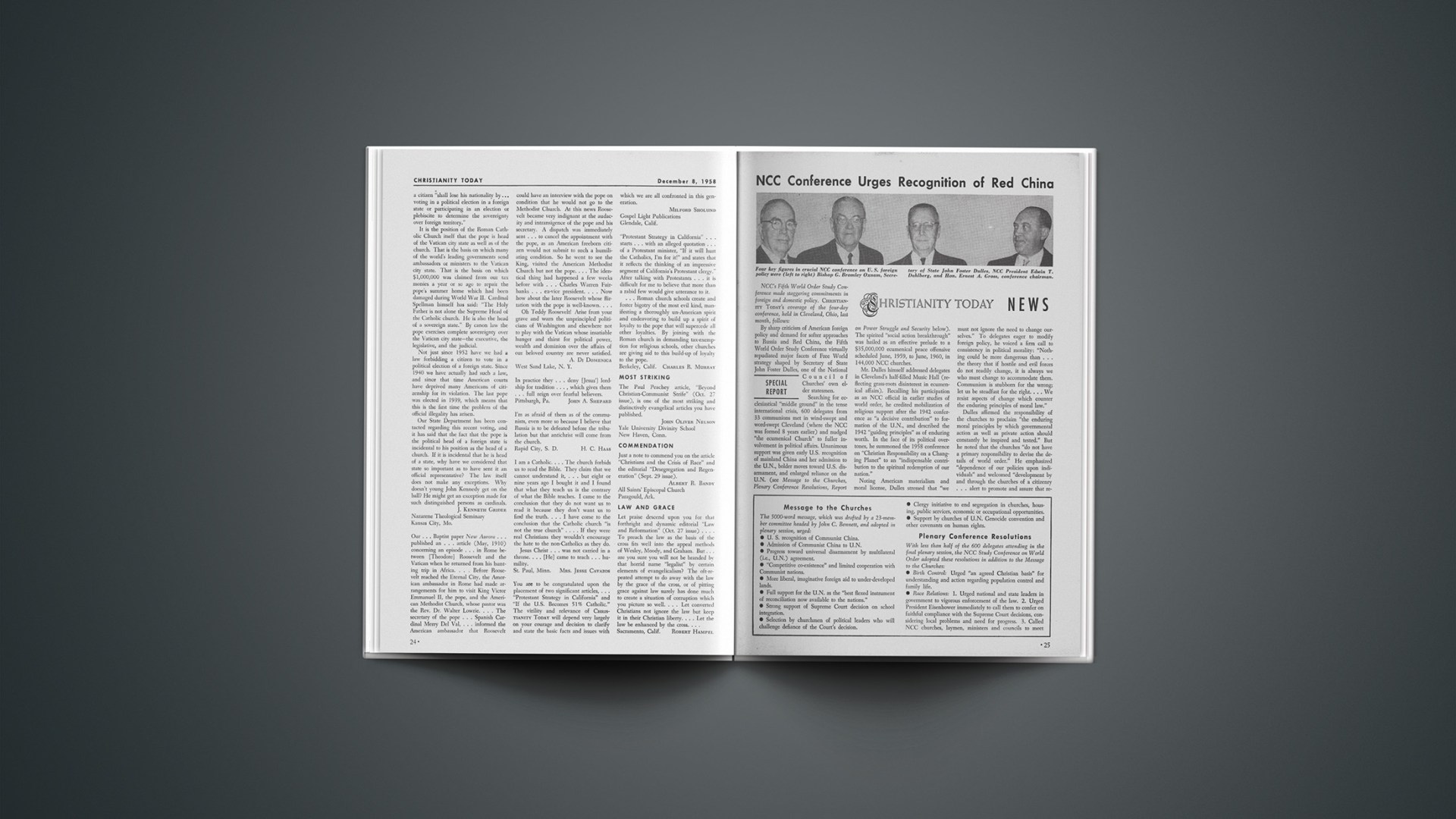
NCC Conference Urges Recognition of Red China

CHRISTIANITY TODAY NEWS

NCC’s Fifth World Order Study Conference made staggering commitments in foreign and domestic policy.CHRISTIANITY TODAY’Scoverage of the four-day conference, held in Cleveland, Ohio, last month, follows:

Special Report

By sharp criticism of American foreign policy and demand for softer approaches to Russia and Red China, the Fifth World Order Study Conference virtually repudiated major facets of Free World strategy shaped by Secretary of State John Foster Dulles, one of the National Council of Churches’ own elder statesmen.

Searching for ecclesiastical “middle ground” in the tense international crisis, 600 delegates from 33 communions met in wind-swept and word-swept Cleveland (where the NCC was formed 8 years earlier) and nudged “the ecumenical Church” to fuller involvement in political affairs. Unanimous support was given early U.S. recognition of mainland China and her admission to the U.N., bolder moves toward U.S. disarmament, and enlarged reliance on the U.N. (see Message to the Churches, Plenary Conference Resolutions, Report on Power Struggle and Security below). The spirited “social action breakthrough” was hailed as an effective prelude to a $35,000,000 ecumenical peace offensive scheduled June, 1959, to June, 1960, in 144,000 NCC churches.

Mr. Dulles himself addressed delegates in Cleveland’s half-filled Music Hall (reflecting grass-roots disinterest in ecumenical affairs). Recalling his participation as an NCC official in earlier studies of world order, he credited mobilization of religious support after the 1942 conference as “a decisive contribution” to formation of the U.N., and described the 1942 “guiding principles” as of enduring worth. In the face of its political overtones, he summoned the 1958 conference on “Christian Responsibility on a Changing Planet” to an “indispensable contribution to the spiritual redemption of our nation.”

Noting American materialism and moral license, Dulles stressed that “we must not ignore the need to change ourselves.” To delegates eager to modify foreign policy, he voiced a firm call to consistency in political morality: “Nothing could be more dangerous than … the theory that if hostile and evil forces do not readily change, it is always we who must change to accommodate them. Communism is stubborn for the wrong; let us be steadfast for the right.… We resist aspects of change which counter the enduring principles of moral law.”

Dulles affirmed the responsibility of the churches to proclaim “the enduring moral principles by which governmental action as well as private action should constantly be inspired and tested.” But he noted that the churches “do not have a primary responsibility to devise the details of world order.” He emphasized “dependence of our policies upon individuals” and welcomed “development by and through the churches of a citizenry … alert to promote and assure that result.” America was founded, he said, “by those who felt it their personal mission not just to accommodate themselves to change brought about by others, but to be themselves a force for change. Their sense of mission derived largely from their strong religious faith.”

Message To The Churches

The 5000-word message, which was drafted by a 23-member committee headed by John C. Bennett, and adopted in plenary session, urged:

• U. S. recognition of Communist China.

• Admission of Communist China to U.N.

• Progress toward universal disarmament by multilateral (i.e., U.N.) agreement.

• “Competitive co-existence” and limited cooperation with Communist nations.

• More liberal, imaginative foreign aid to under-developed lands.

• Full support for the U.N. as the “best flexed instrument of reconciliation now available to the nations.”

• Strong support of Supreme Court decision on school integration.

• Selection by churchmen of political leaders who will challenge defiance of the Court’s decision.

• Clergy initiative to end segregation in churches, housing, public services, economic or occupational opportunities.

• Support by churches of U.N. Genocide convention and other covenants on human rights.

Plenary Conference Resolutions

With less than half of the 600 delegates attending in the final plenary session, the NCC Study Conference on World Order adopted these resolutions in addition to the Message to the Churches:

Birth Control: Urged “an agreed Christian basis” for understanding and action regarding population control and family life.

Race Relations: 1. Urged national and state leaders in government to vigorous enforcement of the law. 2. Urged President Eisenhower immediately to call them to confer on faithful compliance with the Supreme Court decisions, considering local problems and need for progress. 3. Called NCC churches, laymen, ministers and councils to meet locally across racial lines to detail plans for implementation in local churches.

Red China: Supported right of press to travel in other lands.

Soviet Russia: Urged NCC inquiry into reports of intensified Communist persecution of Jews and Moslems.

Roman Catholicism: Urged NCC inquiry into reports of persecution of Protestants in Spain.

Genocide Convention: Urged State Department to present to the U.S. Senate and to support the U.N. Genocide Convention, and other U.N. conventions for the enforcement of human rights.

Foreign Aid: 1. Urged support of self-determination of all peoples by peaceful means. 2. Urged foreign aid on condition that recipient nations promote rather than impede the human rights of their populations.

Middle East: 1. Urged efforts to negotiate agreement through U.N. or directly; implement U.N. resolutions for return of Arab refugees, or compensate for loss. 2. U.S. support for legitimate aspirations for Arab unity, Israel’s survival in peace; political and economic progress of both. 3. Supported U.N. recommendation for internationalization of Jerusalem.

War and Weapons: 1. Categorical rejection of the concept of preventive war. 2. Acknowledgment that peace presently rests in part upon capability for nuclear retaliation. 3. Asked earnest study of the question whether Christians ought to participate in a nuclear war.

Report On Power Struggle And Security

Of the four sections into which the Study Conference on World Order divided, Section II on “The Power Struggle and Security in a Nuclear Age” was most controversial. Its report was received by the plenary session and commended to the churches for appropriate action:

• Declared its non-support of the concept of nuclear retaliation as well as preventive war.

• Would abolish military conscription and allow Selective Service System to lapse in June.

• Declared obsolete a nationalistic approach to freedom, social welfare and security.

• Urged greater U.S. willingness to resolve its disputes through U.N. and World Court.

• Required that the U.N. sanction and control the use of military force.

• Supported international disarmament and security to supersede regional alliances.

• Approved permanent U.N. police force.

• Urged more U.S. initiative in effecting international arms inspection and control; that U.S. propose a comprehensive disarmament plan and extend suspension of nuclear tests, even if unilaterally.

• Proposed that U.S. disarmament savings be used for U.N. allocations to undeveloped countries.

• Supported extension of trade and travel with mainland China, Eastern Europe and Soviet Union.

• Urged more seminars between social scientists as well as scientists from East and West.

• Suggested exploration of more effective use of U.S. surplus food in Communist lands.

• Urged more World Council meetings of East-West clergy.

• Proposed U.N. determination of peace in Formosa area and Nationalist China’s evacuation of exposed positions.

• Urged U.S. economic and technical assistance to India.

• Urged U.S. support for unification of Germany.

• Supported U.N. proposals to internationalize Jerusalem.

A Clash of Perspectives

Dulles’ words provided an unwitting rejoinder not only to facets of earlier keynote remarks by Methodist Bishop G. Bromley Oxnam, but anticipated much of the later conference discussion. Oxnam deplored refusal to recognize Red China and to admit her to the U.N. “Try the hand-clasp instead of the fingerprint,” he implored, urging that Russians be allowed to visit by “tens of thousands.”

Oxnam had few approving words for American foreign policy. “Too much of our policy is based upon fear of communism rather than faith in freedom.… We built bases in a great circle, and we cooperated with dictators who had the bases to sell, and we paid our thirty pieces of silver to tyrants who had already betrayed our Lord.” He called justification of foreign policy by national self-interest rather than altruism “pagan realism.”

“Let us so change the planet,” he urged, “that when our first visitors from Mars arrive they will find a society fit to be called the Kingdom of God.” The bishop’s highly applauded blueprint bore its usual marks of revolt against free enterprise traditions. Chairman of NCC’s Division of Life and Work, he defended the Tennessee Valley Authority as non-socialistic, supported federal aid to education, and labeled critics of Walter Reuther as “men who seek to set labor relations back half a century.”

Social Action in a Theological Void

Lack of theological orientation was a characteristic feature of the sessions. Study groups (Section IV on Human Rights was an exception, holding in view the God of creation, history and redemption) deliberately shunned a theological basis in view of NCC’s inclusive commitment. Discussions operated in a theological vacuum; connections between a fixed theology, governing axioms and tentative policies (given the priority) were usually obscure. The theological prelude to the “Message to the Churches” was superimposed.

From the outset, assuredly, the social strategy of Union Theological Seminary’s Professor John C. Bennett (“the absolutizing of ‘compromise’,” one delegate called it) shadowed the sessions. Conference initiative, though not necessarily majority identification, lay with the so-called “realists” who stressed the sinfulness of man and history, shied away from revealed principles, urged reliance on temporary axioms, and proclaimed the inevitability of sinful choices.

To Princeton President John A. Mackay this approach was “profoundly pessimistic or agnostic” when evaluated by the norm of biblical-historical Christianity. “To suggest that within history nothing can represent God’s order, that faith in Christ’s redemption projects us only into a period beyond history where God will win out,” he protested, contradicts what is “deepest in our Christian faith: that sooner or later God’s purposes will be fulfilled in history through the manifestation of inexorable moral law and divine power. Discard this, and … nothing in history fulfills the prophetic dream.” Summarized Mackay: Bennett’s social philosophy leaves man hopeless against the power of the view that history moves inexorably to a Communist climax, and it deprives the Christian Church of its dynamic in the historical order.

Program for the End-Time

But others found Bennett’s “theology of modern weapons” realistic and hopeful: “It gives a modus vivendi for 1958. Nuclear war may strike tonight. What does the Christian do?” The “real world situation” now requires recognition of “the facts of life in the power struggle.”

Dr. Ralph W. Sockman’s address noted that “the names of Nasser and Nehru and Khrushchev have become household words among us.” In the study sessions, in fact, the modern Herods and Pilates crowded God out of centrality in ecumenical deliberations. Demanded one participant: “What is the attitude of the Church toward U.S. policy on Quemoy and Matsu? Our people won’t be helped by telling them we agreed on the Ten Commandments and Sermon on the Mount and not much else.” The “Message to the Churches,” in fact, shared the New Testament sense of end-time only in a secular way (“We find ourselves always on the brink of annihilation”) and lost priority for the apostolic commission to evangelize the world through its speculative and pragmatic formulation of Christian duty:

“The immediate task of every Christian is to seize the initiative in the prevention of war and the advancement of peace.… We cannot sit complacently and hopefully behind the moral subterfuge which divides the world into ‘good and bad’ peoples (the context referred to West and East rather than Church and world—ED.), waiting for the ‘bad’ ones to be converted to our position. To do this is to insure the inevitability of war. The processes of peace … are the concern of every Christian … dedicated to ‘the sovereignty of love’ in human affairs.” Thus delegates tied their hopes to a revival of social gospelism and turned from the redemptive legacy of Christ (“My peace give I unto you; not as the world giveth give I …”).

New Socio-Political Thrust

Although the line between liberalism and neo-orthodoxy at first became more intransigent as presuppositions were clarified, the conference soon saw a fusion in which pacifist forces of many shades cooperated at certain levels. In contrast with the old social gospel, this maneuver no longer expected to usher in a millennial age, nor was there a reigning concern to formulate fixed principles of social morality. It was enough to seek peace in our time, even if by action based on “axioms” whose validity was hardly self-evident. Alongside the flight from reason there remained an excessive trust in the reformation of unregenerate human nature, and a readiness to rely on massive political action independently of the message of spiritual redemption.

Protestant Panorama

• Italian Catholic Bishop Pietro Fiordelli, fined for branding as “public sinners living in concubinage” a young couple married in a civil ceremony and not in church, was acquitted by the Court of Appeals in Florence.

• Alberto Castello, Assemblies of God lay preacher from Copiague, New York, was kidnapped during a visit to Sicily by two bandits who demanded $8,000 for his safe return. Castello was held captive in a cave for six days before fleeing to safety, unharmed.

• Police in Konitsa, Greece, arrested Gregorious Moulaites, 36, of the Evangelical Church, for allegedly trying to proselytize a fellow villager and “deceiving him” with a bribe of more than $300. Moulaites labeled the charge “completely groundless.”

• King Olav V of Norway dropped in on the 50th anniversary celebration of the Free Theological Faculty, founded to counter liberal theology by championing true biblical teaching.

• Prime Minister John Diefenbaker of Canada was received in private audience by Pope John XXIII. It was the new pontiff’s first audience to the head of a government … The annual convention of the Fellowship of Evangelical Churches in Canada proposed further study of a move to merge with the British Columbia Regular Baptist Convention and the Regular Baptist Fellowship of the Prairies. A combined church would have a membership of some 24,000.

• Southern Baptists plan to open missionary work in Viet Nam. They may also aid Baptist work in Portugal … The Indonesian Ministry of Religious Affairs reports that the number of Christians in the island nation has increased from 4½ million in 1950 to 6 million this year.

• The winner of the 1958 Nobel Peace Prize, the Rev. Dominique George Pire, 48-year-old Belgian-born Dominican priest, says he will use his $41,420 award to aid displaced persons. He has been active in refugee work since 1949. He became noted for his resistance to the Nazis during World War II … Belgium newspapers ceased publishing Sunday editions after a government order banned Sunday distribution.

• The Free Methodist Church’s Board of Administration voted to create a world-wide body by bringing into full fellowship with the parent organization its mission conferences. World membership of the church is about 90,000, more than one-third of which is in mission areas.

• Cleveland Police Chief Frank W. Story warned newsstand proprietors that unless the November issue of Playboy magazine was removed from display, they ran “the risk of criminal prosecution.” Last month’s number of Playboy was branded obscene by the Post Office Department, which said legal action was being instituted.

• The eighth National Assembly of United Church Women called on the United Nations to establish permanent and well-armed police to inspect and enforce any future disarmament agreements. Some 2,500 delegates at Denver also urged development of warning systems against all forms of aggressive attacks, elimination “insofar as practical” of nuclear weapons testing and manufacture, control of outer space and all scientific discoveries to ensure their peaceful uses, and full U. N. entry in areas where peace is threatened.

• B’nai B’rith President Philip M. Klutznick warned some 1,000 delegates attending the 60th biennial convention of the Union of Orthodox Jewish Congregations of America against splintering by “sectarian differences” among Reform, Orthodox and Conservative branches of American Jewry.… Trustees of the Union of American Hebrew Congregations announced a comprehensive program to strengthen Reform Judaism, the goals of which include the winning of 500,000 new adherents among an estimated 2,500,000 unaffiliated Jews in America.

• An average of 13,493,462 Scriptures in more than 270 languages were distributed annually during the last five years by the American Bible Society.

In this circumstance evangelical Christianity paid heavily for its failure to elaborate a social ethics conformable to the theology of redemption. Beyond criticisms of vulnerable features of Western policy, and rejection of extreme NCC positions, most evangelical delegates—and they were few in number—lacked an effective counter-thrust. Or, if they had one, the gathering winds of official commitments swiftly reduced them to a scattered minority, and frustration led to silence.

The Cleveland conference in its expressions did not preserve centrality for the Church’s revealed commission; it assumed, rather than justified, the propriety of specific Church positions in political affairs; it did not establish the rightness of its positions by any norm beyond the majority vote of delegates; and it left in doubt whether those delegates fully expressed the views of constituencies they represent. The crucial question now is whether the “Message to the Churches” will be hailed as a legitimate definition of Christian responsibility.

Between East and West

Delegates went far beyond criticism of U. S. foreign policy (alliances with totalitarian rulers; Israeli guarantees promotive of Arab anxiety; exploitation of Near East oil reserves; pursuit of inordinate self-interest; and so forth). Sympathy for the Soviet orbit was easier to detect than censure. References favorable to America were so qualified, sputtered one delegate, they were “like pronouncing heaven a relatively good place for Christians.”

While few questioned Dr. Bennett’s challenge to “the assumption of the world’s division into two ideological blocs,” observers (more than delegates) wondered whether the antithesis between Christianity and unbelief had now been diluted. Long a critic of free enterprise traditions of the West, and a champion of “competitive coexistence,” Bennett headed the 23-member committee that prepared a 5000-word closing message. The report on “The Power Struggle and Security” generously incorporated his background papers. His plea for abandonment of the U. S. “black and white moralistic approach” seemed to some, however, to yield a moral shadowland indifferent to many legitimate concerns, and indisposed to chide the Soviet bloc without simultaneously censuring the West. Dr. G. Frederick Nolde, director of the NCC Commission on International Affairs, told delegates likewise that negotiations will be fruitless “if Communist officials are obviously and patently dealt with as … adult delinquents.” Some observers thought such emphases would not only weaken faith in American policy, but bemist the ideological divide between East and West.

From the first a major revision of policy on Red China and foreign aid had behind-the-scenes approval.

The Section III report (“Overseas Areas of Rapid Social Change”) endorsed “substantially larger sums of money … through the government as well as individuals and voluntary groups for economic development in the areas of rapid social change” to help “underdeveloped countries establish their own sound economies.” The plenary session protest of John Nuveen (Baptist) of Chicago, that this would allow aid “behind the iron and bamboo curtains” permitting Communist use of it for their own ends, was unavailing. “We may be making the nations strong and Communist, rather than strong and free; we should be as interested in human freedom as in human abundance,” he said. Nuveen also warned against overemphasis on multi-lateral (U.N.) as against bi-lateral aid, because a “multi-lateral program cannot take cognizance of political factors.” Nuveen had also cautioned Section II that its projected seating of mainland China in the U. N. would assign Red China the permanent Security Council seat originally reserved for Nationalist China as a World War II ally. His warning, however, gained nothing. In closing moments of the plenary session, Dr. Ernest Griffith (Methodist) of Washington, D. C., sought to tie U. S. recognition and U. N. admission to “relaxation of aggressive posture” in view of mainland China’s recent history in Korea and Formosa straits, but the effort was overwhelmingly defeated. Conference chairman Ernest A. Gross, head of NCC’s Department of International Affairs and former U. S. Ambassador to the U. N., when sketching the dilemma of admission or rejection of mainland China, failed even to mention the implication of such admission for the Security Council.

People: Words And Events

Deaths: Dr. Frank H. Yost, 64, Seventh-day Adventist theologian and editor, newly-appointed to the chair of religion at La Sierra College, Arlington, California, of a brain tumor, in Los Angeles … the Most Rev. H. W. K. Mowll, 68, Anglican primate of Australia, Archbishop of Sydney, and president of the executive committee for next year’s Billy Graham crusade in Australia, in Sydney … Jorge de Oliveira, Baptist missionary to Portugal … Dr. William Gaius Greenslade, retired Presbyterian missionary to Lebanon, in DeLand, Florida … William P. Phillips, Baptist Sunday School leader.

Elections: As president of the Canadian Council of Churches, the Very Rev. George Dorey … as president of the new National Methodist Theological Seminary to be established in Kansas City, Missouri, Dr. Don W. Holter … as president of the Interdenominational Foreign Mission Association, Dr. R. T. Davis … as treasurer of the Board of Home Missions of the Congregational Christian Churches, Dr. Howard E. Spragg … as president of the Christian Business Men’s Committee International, Harry W. Smith, vice president of the Bank of America, San Francisco … as president of the Association of College and University Ministers of the Methodist Church, the Rev. Darold Hackler … as president of the Northern Missionary Council, Danish Bishop Halfdan Hogsbro … as honorary president of the Christian Writers Association of Canada, Alan E. Haw; as president, George Bowman; as editor of the association’s quarterly, Earl Kulbeck.

Nomination: As moderator of the General Assembly of the Church of Scotland, Dr. Robert H. W. Shepherd.

Appointments: As chairman of the radio and television department of the United Presbyterian Church in the U.S.A., Dr. John K. Mitchell … as associate publisher of the Methodist Publishing House, Dr. George M. Curry … as assistant professor of Old Testament interpretation at Southern Baptist Theological Seminary, Louisville, Dr. Jerry Vardaman.

Awards: To James D. Zellerbach, United States ambassador to Italy, the World Brotherhood Gold Award of the National Conference of Christians and Jews for “promoting good will and understanding among all the peoples of the world” … to Mary Jo Nelson, religion editor of the Oklahoma City Times, the first press citation of the Baptist General Convention of Oklahoma for “outstanding reporting of church news.”

Correction: Dr. Jesse H. Ziegler, listed in CHRISTIANITY TODAY for October 27 as having been appointed to a professorship at Bethany Biblical Seminary, actually has been on the Bethany faculty since 1941. It should have been noted that Dr. Ziegler was named associate secretary of the American Association of Theological Schools. CHRISTIANITY TODAY regrets the error.

Former U. S. Ambassador for Disarmament Harold Stassen, who was to have aided Section II throughout the study conference, arrived only in time to hear the section report presented in plenary session and made the closing comment on it. He found the report “much too dogmatic” in its view of communism as God’s judgment on the West; said he was “troubled” by its agreement that military force be sanctioned and controlled by the U. N., since this would subject it to Soviet veto; said that in the “overall context of the present struggle” he would be reluctant to approve the section’s opposition to present U. S. reliance on nuclear armaments and the request for a slowdown in military time-table; and noted that negative appraisal of American policy in the Far East might well include some things to be expected from Communist China.

Overall Trends in Cleveland

What overall trends were discernible at the NCC conference? The historic American principle of separation of church and state is clearly on the wane. Not even 30 Baptist delegates (NCC currently has a Baptist president) rose in its behalf, being seldom vocal. Nor did the prospect of enlarging Roman Catholic exploitation of church-state opportunities act as a deterrent. Direct pressure upon government policies by religious leaders of institutionalized Protestantism (“the Ecumenical Church”) is more and more approved, despite lack of a mandate at the grass-roots level (conferees were reminded of the “mandate from the National Council” to constituent churches, councils and agencies) and frequent conflict with convictions of lay constituencies, and the inherent risks when political influence and power is concentrated in any religious collectivity. However, the Big Church allows itself to become enmeshed more fully in state procedures, and identifies the Christian message with specific positions and policies on state matters, some anxiety rises lest the churches become mere agencies to accomplish government objectives. The evangelical wing of NCC was not strongly represented; its frustration mounted in attempting a counter-position, until at last its voices became silent. Pacifist-minded delegates, far from satisfied with the outcome, nonetheless viewed many resolutions as significant gains for their cause. What Cleveland dramatized most, however, is a lack of a uniform and approved Protestant theology of church-state relations, and the willingness of many delegates to move only with the rising tide. Cleveland delegates spoke much of world order, but they halted far short of a Christian agenda for civilization.

C. F. H. H.

Rally In Retrospect

The peak of excitement is past. The charges and counter-charges are being forgotten. Considered now, what did evangelist Billy Graham’s climatic Carolinas crusade meeting leave to be remembered? HereCHRISTIANITY TODAYCorrespondent Tom McMahon reflects on the big integrated meeting at the Fort Jackson Army post near Columbia, South Carolina. These are his impressions:

Mass Evangelism

The statistics were impressive—60,000 present; 1,243 decisions for Christ—adding up to Billy Graham’s largest rally on an armed forces base.

But the Reformation Sunday service at Fort Jackson had a significance far deeper than numbers, amazing as these were for a meeting that was shifted from the South Carolina capitol grounds, less than four days before.

A prominent Presbyterian minister said the rally’s outstanding contribution was that it raised a landmark for moderation in the race relations controversy.

Nearly 200 ministers, some of whom were rather cold to Graham’s ministry, rallied behind the one-day crusade after Governor George Bell Timmerman, Jr. charged that it was planned to boost an “integrationist” preacher.

The small flood of vicious criticism which followed the governor’s attack was stemmed by the obvious success of the meeting and by the presence, on the platform, of James F. Byrnes who was the state’s chief executive when Timmerman was a pale and inconspicuous lieutenant governor.

Byrnes changed some plans in order to attend the meeting and entertain Graham afterward in his home. His action threw back into Timmerman’s face the twisted charges that the evangelist’s presence at the state house would have violated laws and would have been misinterpreted as a sign of softness on the racial issue in South Carolina.

There was tragi-comedy in the one-sided controversy which Timmerman launched two weeks before the rally and intensified 10 days later in apparent violation of his initial promise not to try and stop the meeting.

In the face of prominently-displayed newspaper stories to the contrary, the governor charged that the state house site was chosen solely to boost an “integrationist.” The fact was that sponsors tried first to get Carolina Stadium, scene of Graham’s first great outdoor service in 1950, but were turned down because of “too much state fair and football” just before the only possible date.

Actually, the racial issue probably was involved in the stadium decision. Prominent University of South Carolina alumni were heard from a few hours before the decision and the attitude of a key university official changed radically.

Then, some garden club ladies, long zealous for the integrity of the capitol grounds, began to protest in fear that grass and shrubs would be trampled. The rally was moved, perforce, from the spacious north side of the capitol to the south steps, almost on the street.

To cap it off, extremists began to second the governor’s stand, but in a more vicious fashion. Some of their letters were unprintable. A Ku Klux Klan spokesman threatened to make trouble for pastors who stood by Graham.

There was a strange note in the governor’s attacks, especially when he practically forced removal of the rally from the capitol by calling its sponsors liars and lawbreakers and by charging that Graham would be a trespasser if he mounted the platform which had been up only a few hours.

This strange argument, coming from a politician who is not deeply religious, said an evangelistic rally on state property would violate the principle of church-state separation. Added evidence that some of Graham’s “fundamentalist” critics had captured the governor’s ear was Timmerman’s claim that he had been applauded for his stand by a number of ministers and ministerial students.

So the site was changed, as the early apostles sometimes changed their preaching places when persecution arose. But the sponsors of the rally, and Graham, stood pat on the message.

The evangelist himself made a brief statement on the racial issue at a press conference, then closed the door on questions regarding this matter. He said:

“Some have been so unbalanced on the whole issue that segregation or integration has become their one gospel. God pity us if we let our differences about this prevent us from presenting Christ to a lost world. My only motive at any time in coming to Columbia was to preach the Gospel and that is what I intend to do today.”

The racist, and “fundamentalist” opposition was joined later by other religionists who protested in newspaper letters and tried to bring pressure to bear on Fort Jackson’s commander for throwing wide the post’s facilities for the meeting.

But evangelical pastors stood firm. Their singers overflowed the choir stands and hundreds of ushers and counsellors turned out. The rank and file of citizens, white and Negro, responded to the situation by clogging the roads two hours ahead of time and standing, 60,000 strong, around the platform from which Graham preached. In closing he invited people to come forward as a token of the fact that at the foot of the Cross all are equal and all problems must ultimately be solved.

The rally took on the nature of a state-wide crusade. With the interest of news media whetted by the controversy, the meeting achieved new significance in the eyes of millions. A state-wide network of some 23 radio stations broadcast the service. Highlights were presented the next morning on a television network.

It is highly probable that the fellowship forged during the preparations, and the impetus of the meeting itself, will result in a city-wide, and perhaps even area-wide, program of visitation evangelism and preaching missions next spring. If such comes to pass, it may be the first time such a broad effort has stemmed from a one-day Graham stand.

Greeting From Moscow

Evangelist Billy Graham turned 40 last month. Most surprising among hundreds of greetings was a telegram from the All-Union Council of Evangelical Christians (Baptist) in Moscow:

“We heartily congratulate you on your 40th anniversary. Our hearts are full of gratitude to God for your birthday and for the years of your blessed ministry. We pray that God may give you the longest life and the richest blessings and success upon your furtherances of the Gospel.”

The message was signed by Jakov Zhidkov, president of the council, the only organized religious group in Russia other than the Orthodox church, and Alexander Karev, general secretary.

Graham is preparing for a crusade in Australia early next year.

His next U. S. crusade will be in Indianapolis, a month-long effort to be held at the State Fairgrounds Coliseum next October.

A 10 to 12-week crusade is tentatively planned for Chicago during the summer of 1961.

Anxiety Over Arms

The Canadian Council of Churches called for international control and inspection of nuclear weapons at its 12th biennial meeting in Winnepeg.

Dominion Of Canada

A Committee on International Affairs report adopted by the 100-odd council delegates urged the Canadian government to press for development of nuclear power for peaceful purposes only. Another resolution urged a more generous immigration policy.

Although refusing to urge Canadian diplomatic recognition of Communist China, the council expressed a feeling of “deep concern about the unsatisfactory position of China in the community of nations.”

A special commission of the council claimed that it is necessary to develop an “ecumenical approach” to the role of churches in universities. The council resolved to call a conference to consider how Christian work on the campus can best be inter-related.

In an address to the convention, Dr. Emlyn Davies, outgoing president, said strikes are outmoded as a means of settling industrial disputes. He called the strike an anti-social weapon because it involves “the whole community.” He said he had a great sympathy for workers who have been “shockingly exploited,” but added that the church cannot be a party to strike violence.

The great problem in evangelism, delegates were told, is “the half-awakened, indifferently-trained and lethargic members of congregations and parishes.” Nominal religion is not sufficient for those who live in a “world of fear and indecision,” said the Rev. P. P. W. Ziemann, chairman of the council’s department of evangelism.

A Move For Merger

Expressing “firm intention and desire” to continue merger talks with the United Church of Canada, the Anglican Church of Canada Executive Council voted to convene the full 35-member Anglican reunion committee and the 33-member House of Bishops for a joint meeting next February to discuss union.

Merger negotiations between the two bodies, initiated by the Anglicans 15 years ago, have been at a standstill for some time. The full Anglican reunion group has not met since the talks were begun.

Meeting in Toronto with the church’s Council for Social Service, the Anglican council also urged the abolition of capital punishment and endorsed sections of the Lambeth Report favoring abolition of war and nuclear weapons.

The five-day sessions of the executive council, which meets between the triennial General Synods, were attended by 33 archbishops and bishops and 77 priests and laymen. The action for merger undoubtedly grew out of an appeal from the United Church General Council in September that the Anglican church “make it plain whether it really wishes to continue these [merger] conversations, or whether it now desires to terminate them.” [See CHRISTIANITY TODAY (October 27 issue) for earlier story.]

Electoral Rock ’N’ Roll

The National Assembly of the Church of England tangled with the laity at its fall session.

Great Britain

A lively debate marked discussion of the role of the laity in the life and work of the church. A resolution was adopted welcoming “closer association of the laity with the clergy in the synodical government of the church.” However, the laity’s association would be “subject to the advice of the Convocations of Canterbury and the House of the Laity of the Church Assembly,” the resolution added.

Earlier, the assembly agreed that the resident of a parish must attend church at least once every six months in order to keep his name on the church’s electoral roll.

“Only too often,” lay delegate Oswald Clark argued, “electoral rolls contain certain names entered years ago of persons, who, in spite of frequent approaches, decline to enter into the family of the church, yet these names cannot be removed.”

Another speaker had called the electoral situation “unreal.” His illustration, presumably real if obscure, cited the case of a woman who was asked if she would like to be on the roll. “No,” she was quoted as having replied, “I am the rock ’n’ roll of the next village.”

Then there was the lay delegate who suggested that a good way to raise money for the church’s teacher-training colleges would be to sponsor football pools. Cries of “shame” greeted the proposal.

The assembly decided to ask the Ministry of Education to increase state grants for aided schools from 50 to 75 per cent. It was agreed that the church itself should accept the task of raising an extra $2,800,000 for expansion of the teacher-training colleges.

Eutychus and His Kin: December 8, 1958

SANTA FORUM

Our holiday feature is a forum in which leading spokesmen answer a question of absorbing current interest: Is there a Santa Claus?

Professor Grundgelehrt writes:

Your question, unfortunately, is framed in speculative, ontological terms. I prefer to leave abstract metaphysics to the middle ages and to ask with contemporary, existential passion, have we encountered the Santa-event? The rich and diverse tradition of Santa Claus in its world-wide spread is a proper subject for historical and phenomenological investigation, but the real Santa occurrence to which its points lies beyond history in Northpolar Time, where all the relative longitudes of Greenwich time meet and are transcended. The descent of Santa down the chimney symbolizes the vertical relation of Polar Time (Schlittengeschichte) to standard time. As you participate in the stocking-hanging ceremony you await the Santa encounter in which he again becomes profoundly true.

Dr. Eugene Ivy says:

Of course there is a Santa Claus. Can you look into the sparkling upturned eyes of your little child as you hang up her stocking and not believe in Santa Claus? Santa is there, for there is real Santa faith. Scholars disagree about the historicity of Nicholas of Patara. Personally I believe he lived in Lycia in Asia Minor during the early fourth century, as tradition asserts. I am also willing to accept him as the patron saint of children, merchants, and thieves. The first of these roles is rarely questioned and the last two are increasingly vindicated in the Santalands of our great stores. But even if it could be shown that the Nicholas of history was unacquainted with reindeer, my faith in Santa Claus would be undisturbed. Aren’t my children’s stockings full on Christmas morning?

Senator B. B. Fuddle:

Yes, Santa Claus exists as the great unitive symbol of our age. Americans may be divided by creedal clauses, but they are united by Santa Clauses. Certainly Santa has an important place in our working faith, the American Way of Life. It is un-American to be anti-Santa. Fight dis-santagration!

FIFTY-ONE PER CENT

The article by C. Stanley Lowell (“If the U. S. Becomes 51% Catholic,” Oct. 27 issue) is a prize. This and similar articles that have appeared are a magnificent contribution to alerting our people concerning a dangerous evil. So many of our Protestant people seem afraid to face the facts and to champion our religious liberties.

Columbus Area Council of Churches

Columbus, Ohio

I feel that this is one of the most biased, emotional and unfactual articles on this subject that I have ever read. It is full of error.… If one will compare Roman Catholicism in Spain with that in the United States he must also compare American democracy and the philosophy that it has given to Americans with the philosophy of Franco in Spain to see how impossible it is for one state of mind to exist in the other country.… Negative articles such as this do nothing but help to draw our Protestant theology into a shell.

Quincy Point Congregational Church

Quincy, Mass.

If such facts as are pointed out in this article do not awake the Protestant population of America to evangelistic zeal and activity, the land for which our fathers died will go by default to that church from which we have sought to be a free nation under God.

Hunterdale Union Church

Franklin, Va.

When Roman Catholics can dictate the prescriptions for non-Catholics in a New York hospital, when they can persecute Protestants in … (Columbia), all with little resistance, then either we’d better prepare our childreen to live by the infallible decisions of the pope, or come to grips with the situation.

Berkeley, Calif.

The article … has disquieted me. I sincerely hope it had the same effect on everyone else who read it.

Evangelical United Brethren

Bloomsburg, Pa.

May we have more articles of this nature to awake America.

Salem Lutheran Church

Montevideo, Minn.

Should … be placed in the hand of every Protestant in the United States. Is this article available in pamphlet form? Evangel Temple

Colorado Springs, Colo.

• Reprints are available at cost from Protestants and Other Americans United, 1633 Massachusetts Ave., N. W., Washington 6, D. C.—ED.

Timely … in the light of the election returns just in, according to which at least two of the greatest states … have elected Roman Catholic governors.…

Desert Highlands Bap.

Palmdale, Calif.

I don’t see how a Catholic that adheres to all doctrines of the Roman Catholic church could possibly take the oath to be a judge, juryman, legislative member or President of the U. S. To uphold the Constitution means the first ten amendments … too. Religious freedom for all.… Evidently they will use the amendments to gain their own purpose and then turn right around and deny these same rights to another person.

Greensboro, N. C.

Recently, a Roman Catholic priest in high standing, spoke at Smith College. One of my senior students asked him this question, “If the U.S. should become dominantly Catholic, so that our government, our schools, our press, and our radio, and T. V. were under the control of the Roman church, would we still have freedom?” His reply was that there wouldn’t be much change; the U.S. would simply become like Spain.

Springfield College

Springfield, Mass.

Two American cardinals, Spellman and McIntyre, presumably voted for the head of a foreign state the other day. One supposes they hope to remain citizens, yet may they do so legally? We have a law, Section 1418 of the Immigration and Nationality Act of 1952, which states that a citizen “shall lose his nationality by … voting in a political election in a foreign state or participating in an election or plebiscite to determine the sovereignty over foreign territory.”

It is the position of the Roman Catholic Church itself that the pope is head of the Vatican city state as well as of the church. That is the basis on which many of the world’s leading governments send ambassadors or ministers to the Vatican city state. That is the basis on which $1,000,000 was claimed from our tax monies a year or so ago to repair the pope’s summer home which had been damaged during World War II. Cardinal Spellman himself has said: “The Holy Father is not alone the Supreme Head of the Catholic church. He is also the head of a sovereign state.” By canon law the pope exercises complete sovereignty over the Vatican city state—the executive, the legislative, and the judicial.

Not just since 1952 have we had a law forbidding a citizen to vote in a political election of a foreign state. Since 1940 we have actually had such a law, and since that time American courts have deprived many Americans of citizenship for its violation. The last pope was elected in 1939, which means that this is the first time the problem of the official illegality has arisen.

Our State Department has been contacted regarding this recent voting, and it has said that the fact that the pope is the political head of a foreign state is incidental to his position as the head of a church. If it is incidental that he is head of a state, why have we considered that state so important as to have sent it an official representative? The law itself does not make any exceptions. Why doesn’t young John Kennedy get on the ball? He might get an exception made for such distinguished persons as cardinals.

Nazarene Theological Seminary

Kansas City, Mo.

Our … Baptist paper New Aurora … published an … article (May, 1910) concerning an episode … in Rome between [Theodore] Roosevelt and the Vatican when he returned from his hunting trip in Africa.… Before Roosevelt reached the Eternal City, the American ambassador in Rome had made arrangements for him to visit King Victor Emmanuel II, the pope, and the American Methodist Church, whose pastor was the Rev. Dr. Walter Lowrie.… The secretary of the pope … Spanish Cardinal Merry Del Val, … informed the American ambassador that Roosevelt could have an interview with the pope on condition that he would not go to the Methodist Church. At this news Roosevelt became very indignant at the audacity and intransigence of the pope and his secretary. A dispatch was immediately sent … to cancel the appointment with the pope, as an American freeborn citizen would not submit to such a humiliating condition. So he went to see the King, visited the American Methodist Church but not the pope.… The identical thing had happened a few weeks before with … Charles Warren Fairbanks … ex-vice president.… Now how about the later Roosevelt whose flirtation with the pope is well-known.…

Oh Teddy Roosevelt! Arise from your grave and warn the unprincipled politicians of Washington and elsewhere not to play with the Vatican whose insatiable hunger and thirst for political power, wealth and dominion over the affairs of our beloved country are never satisfied.

West Sand Lake, N. Y.

In practice they … deny [Jesus’] lordship for tradition …, which gives them … full reign over fearful believers.

Pittsburgh, Pa.

I’m as afraid of them as of the communists, even more so because I believe that Russia is to be defeated before the tribulation but that antichrist will come from the church.

Rapid City, S. D.

I am a Catholic.… The church forbids us to read the Bible. They claim that we cannot understand it, … but eight or nine years ago I bought it and I found that what they teach us is the contrary of what the Bible teaches. I came to the conclusion that they do not want us to read it because they don’t want us to find the truth.… I have come to the conclusion that the Catholic church “is not the true church” … If they were real Christians they wouldn’t encourage the hate to the non-Catholics as they do.

Jesus Christ … was not carried in a throne.… [He] came to teach … humility.

St. Paul, Minn.

You are to be congratulated upon the placement of two significant articles, … “Protestant Strategy in California” and “If the U.S. Becomes 51% Catholic.” The virility and relevance of CHRISTIANITY TODAY will depend very largely on your courage and decision to clarify and state the basic facts and issues with which we are all confronted in this generation.

Gospel Light Publications

Glendale, Calif.

“Protestant Strategy in California” … starts … with an alleged quotation … of a Protestant minister, “If it will hurt the Catholics, I’m for it!” and states that it reflects the thinking of an impressive segment of California’s Protestant clergy.” After talking with Protestants … it is difficult for me to believe that more than a rabid few would give utterance to it.

… Roman church schools create and foster bigotry of the most evil kind, manifesting a thoroughly un-American spirit and endeavoring to build up a spirit of loyalty to the pope that will supercede all other loyalties. By joining with the Roman church in demanding tax-exemption for religious schools, other churches are giving aid to this build-up of loyalty to the pope.

Berkeley, Calif.

MOST STRIKING

The Paul Peachey article, “Beyond Christian-Communist Strife” (Oct. 27 issue), is one of the most striking and distinctively evangelical articles you have published.

Yale University Divinity School

New Haven, Conn.

COMMENDATION

Just a note to commend you on the article “Christians and the Crisis of Race” and the editorial “Desegregation and Regeneration” (Sept. 29 issue).

All Saints’ Episcopal Church

Paragould, Ark.

LAW AND GRACE

Let praise descend upon you for that forthright and dynamic editorial “Law and Reformation” (Oct. 27 issue) … To preach the law as the basis of the cross fits well into the appeal methods of Wesley, Moody, and Graham. But … are you sure you will not be branded by that horrid name “legalist” by certain elements of evangelicalism? The oft-repeated attempt to do away with the law by the grace of the cross, or of pitting grace against law surely has done much to create a situation of corruption which you picture so well.… Let converted Christians not ignore the law but keep it in their Christian liberty.… Let the law be enhanced by the cross.…

Sacramento, Calif.

Ideas

Christmas and the Modern Jew

Christmas And The Modern Jew

During the sacred seasons of the year, whether Christmas, Good Friday and Easter, or the Hebrew Yom Kippur (Day of Atonement), the question of the Christian witness to the Jew inevitably comes to special focus. The current articles in CHRISTIANITY TODAY recognize the awesome implications of the claim that Jesus of Nazareth is the unique incarnation of the living God. So extraordinary is this claim in its involvement of the whole race that the Christian dare not muffle its pronouncement, nor dare the Hebrew ignore it. It is as impossible for the Christian missionary to hide the Light of the World in a Gentile cellar as it is for the spiritually-concerned Jew to evade the question of the promised Messiah.

Yet in our era the Christian witness often seems to lack both good missionary strategy toward the Jew and a sensitivity to his situation in life. However compelling they may be, evidences of Jesus’ Messiahship are not necessarily the best point of contact with the twentieth-century Hebrew. He sometimes wonders why, since New Testament times, Christians so often have treated the Jews so much like the Jews treated the Old Testament Canaanites and other Palestinian pagans (since the Hebrews then considered themselves under divine command, whereas Christians profess devotion to Jesus Christ, who taught that love fulfills the commandments and who required the love of enemy and neighbor alike). The long story of persecution of the Jew in the so-called Christian West has only too often dropped a silencing curtain over the Christian witness.

In the twentieth century, however, the Jew is increasingly aware that not all who call Christ Lord need really be identified with his Kingdom, any more than all who call Abraham father need really be Jews. The conflict between faith and secularism among Jews regathered in Israel has reiterated the spiritual problem with new impact. Even many a Jew in the West, who has no desire to surrender the culture and comfort of the New World, and therefore invests money rather than muscle in the Palestinian vision, nonetheless also recognizes the seeming worthlessness of life today. Most men are now convinced that doing things faster holds no guarantee that life becomes better. Actually the age of speed seems the more swiftly to have deteriorated morality and spirituality.

It is at this point of the emptiness of life that the Christian witness finds its most direct point of contact with modern Jewry. Christ’s capacity to banish the drab monotony of existence by restoring confused, lost souls to the fellowship of the Father, and by meeting life’s deepest spiritual needs, is today’s most fruitful Christian contact with the Hebrew world. The greater percent of Jewry has lost its Old Testament heritage just as fully as the Gentile world has forsaken its Christian inheritance. It becomes strategic therefore to approach the Jew today first as a modern man rather than as a Hebrew. In a world fraught with anxiety and fear, nobody need doubt that the crucified and risen Christ is ready and able to satisfy the needs of all who put their trust in him. This fact explains the refusal of the Hebrew martyrs of the Apostolic Age to be silenced. They knew that the Lord who had redeemed and commissioned them not only views this world’s struggle from his glory but also keeps ceaseless watch over his own.

Jew and Christian who in the past have persecuted each other under the pretense of piety, in modern times have both come to grief through persecution by pagans. In apostolic times it was Saul against the Christians. In medieval times it was the Roman hierarchy against the Jew and the dissenting Christian. In modern times it has been Stalin persecuting first the Christians, then the Jews, and Hitler persecuting first the Jews, then the Christians. More than ever, an hour has struck in world affairs for all to draw near whose religious vision is Semitic, and who wait for Messiah’s coming.

An existential approach to the modern Jew, however, by no means rules out the importance of Christian evidences. Basically, mankind’s religious fate hinges upon the authenticity of revealed religion; the heart of that revelation is the promise of a supernatural Redeemer. The answer to Jesus’ question (recorded in Matthew’s Gospel, 22:42), “What think ye of Christ? whose son is he?” even still determines spiritual destinies. It is no accident of Hebrew history that since the repudiation of Jesus of Nazareth as Messiah, Jewish religious conscience has found its peace mainly by repudiating also the God of Old Testament promise; for trust in a Redeemer it substitutes works as the hope of justification. Religious history has indeed validated Christ’s words: “He who does not honor the Son does not honor the Father who sent him” (John 5:23, RSV).

If Christmas serves to accent today’s emptiness of the Hebrew heart, it reveals even more tragically the emptiness of the Gentile heart. While the New Testament opens with the Jewish rejection but the Gentile acceptance of Jesus of Nazareth, multitudes of Gentiles today regard the label of Christian as simply a negative means of distinguishing themselves from the non-Christian world. By such perversion of the name of Christ they actually betray an identity with, rather than a distinction from, the non-Christian masses. The spiritual plight of our times concerns Jew and Gentile alike. All the world needs to hear and to heed the Gospel of the Saviour’s rescue of fallen men from the guilt and penalty and power of sin. Through many long centuries it was appropriate indeed to stress, as did Saul of Tarsus (“an Hebrew of the Hebrews; as touching the law, a Pharisee,” Phil. 3:5): “… I am not ashamed of the gospel of Christ: for it is the power of God unto salvation to every one that believeth; to the Jew first …” (Rom. 1:16). In our period of spiritual sloth, however, it has become equally imperative to emphasize the closing words of the text: “… and also to the Greek.” A very real tragedy of Christmas today is that while once it was the Jew who was the unresponsive object of the biblical witness, today most of the non-Jewish world shares the Hebrew’s emptiness of soul and his lack of heart for life.

It is sobering to remember, however, that when the Babe of Bethlehem was born, neither Jew nor Gentile knew God at close range. While the Gentiles were whoring after false gods, the Jews, as Jesus of Nazareth so incisively reminded them, were crumbling under formalism and externalism. It was a lowering day for the religion of redemption. But the star that rose over Bethlehem glowed with the light of new hope. That star is shining still, not in the physical heavens to be found by worldly wisdom, but in the eyes and hearts of those who have unburdened their sins on the Lamb of God who “taketh away the sin of the world.”

END

Government Intrusion Widens In American Education

The National Defense Education Act of 1958 discloses a distressing pattern of Federal encroachment upon American education. It elevates government incursion into American educational life to the status of permanent national principle. Moreover, it enlarges private school participation in government funds. The Act virtually provides a new formula that gives advocates of tax funds for parochial schools what they want.

These facts should arouse the sluggish national conscience and elicit a wave of indignation and protest. Congressmen will tend to “protect the interests” of institutions in their respective states. Only a swift mobilization of protest, and a reconsideration of policy by educators themselves, will now avail. Citizens may well scrutinize the facts with care and ask where the precedents now erected will lead in another decade.

The first objectionable feature lies in the Act’s expansion of government involvement in American education. In the United States, in distinction from Europe, government has not been the primary partner in education. One happy advantage of American educational freedom in this respect is the avoidance of academic program shaped by the state for national purposes rather than for the good of the individual. The very title of the National Defense Education Act of 1958 is significant.

During the past 20 years, government has made periodic penetrations into the American structure under the canopy of special emergency educational legislation. These penetrations are now being regarded as a precedent for a new governing policy in government-education affairs.

The Protestant ecumenical movement has favored Federal aid where states are unable to provide adequate schools; independent evangelical forces have opposed it on the ground that such investment sooner or later involves controls. But neither group has an unblemished record touching state intervention in education. Protestant church colleges along with Roman Catholic institutions approved the G.I. Bill of Rights providing higher educational scholarships at both national and state levels. This form of Federal involvement in education seemed not simply to provide economic advantage to schools through more tuition payments, but seemed a justifiable deviation—a debt to disrupted veterans deprived of collegiate opportunities. To limit these opportunities to public institutions seemed discriminatory. Moreover, it would have deprived many college students of desirable religious influences. Few Protestant educators—evangelical or liberal—suspected at the time that the G.I. Bill would soon be invoked as precedent for permanent government scholarships in education under a Federal program, nor for the availability of Federal funds to parochial as well as public schools, and that at the elementary and secondary no less than the collegiate level! The National Council of Churches’ limitation on government aid has been mainly concerned to restrict such assistance where the Supreme Court decision on integration lacked enforcement. Happily, there are signs that National Council leaders are now taking a more realistic look at government involvement in education.

Few summaries of current American legislation are as sobering as that of the House of Representatives’ Committee on Education and Labor on the National Defense Education Act. The citizen must read it with care. Precedent already exists in some field of government policy for an educational program which may swiftly invert the historic pattern of American education. The patterns for this very inversion are now in the making, and swift public counteraction is imperative.

While in its general provisions the National Defense Education Act “reaffirms the principle and declares that the States and local communities have and must retain control over the primary responsibility for public education” and that “nothing … in this Act shall be construed to authorize any department, agency, officer or employee of the United States to exercise any direction, supervision, or control over the curriculum, program of instruction, administration, or personnel of any educational institution or school system” (Section 102), yet the Act’s inconsistencies with this high statement of purpose, and its reliance on former deviations for the forging of new patterns, are of major importance. It will be well to examine these.

The Act proposes “substantial assistance in various forms to individuals, and to States and their subdivisions, in order to insure trained manpower of sufficient quality and quantity to meet the national defense needs of the United States.” But why should Federal government, it is asked, directly aid individuals if states have primary responsibility for education? And is the provision for “individuals” at the same time a loophole for corporations, and hence a bridge to the provision of such funds to all educational institutions?

The Act specifically applies the term “public” to “any school or institution” that does not “include a school or institution of any agency of the United States.” Hence it avoids the question of whether or not private schools are public schools.

Then it proceeds to the discussion of Federal loans (a proposal likely to gain sympathy, since it does not yet involve scholarships) to students in institutions of higher education. There is no restriction of such loans to students in public as distinguished from nonprofit private schools. The State plan (Section 503) specifically allows the authorization of non-public schools for these benefits: “Any State which desires to receive payments … shall submit … a program for testing students in the public secondary schools, and if authorized by law in other secondary schools.…”

The Act apparently involves a departure from the traditional plan which reserves the full control and determination of education to the States. States’ rights are overridden by a Federal agency which sets up a staff with its operational program in the cooperating states (Section 504).

For the foregoing reasons many Christian educators feel the time has come for a new and long look at Federal involvement in American education. What happens to local control of public education if the features involved in the National Defense Education Act are implemented, and then expanded? Does the Act reflect a fundamental shift in American education, the significance of which is not yet fully apparent to the citizenry? Is American education more and more to reflect special goverment interests and financing? Are public funds to be used more and more to finance private and parochial education? Are the church-related colleges of America prepared to take on large contract obligations with the government that will more and more make them both dependent financially and demean them to agencies committed to implementation of a government program? These are the crucial issues posed to Christian conscience. Only prompt protest and action by the citizenry can frustrate the transition.

Biblical Prophecy And World Events

The Christian world is living today in a time of reaction with respect to prophetic preaching. The sense of God’s active role in contemporary history is spiritless. Although the dramatic center of Christian history doubtless stands in the past, and although Christian hope is properly turned toward the future, no good reason exists for a failure to discern the sure hand of God in current events.

Late nineteenth century postmillennialism fell into disrepute by identifying democratic social changes with the higher reaches of the kingdom of God, and early twentieth century premillennial dispensationalism in turn bred a reaction to its exaggeration of prophetic particulars. The curious result is that in our decade earth-shaking events occur and their possible prophetic significance is scarcely made a subject of inquiry.

For the first time since the apostolic age the dispersed Jews are gathered in Palestine—a frequent theme of the Old Testament prophets.

No generation in history has seen such swift propaganda advances as ours toward World Government, a theme on which Revelation 13 has much to offer.

For the first time since the Old Testament era, nations of the ancient biblical world are crowding the front-page headlines of the world press. They have sprung to life from the dead, as it were, to engage in the dialectic of the nations. Does the biblical theme of a final judgment of the nations—of which our Lord spoke in the Olivet Discourse—bear on this?

The Bible declares that the great battle of Armageddon marks the final consummation of human history before our Lord’s return. Today, in the age of nuclear warfare, American and Russian arms are available to the nations of the Near East in the event of conflict. The far-flung lines between the Soviet and the Free World are drawn near Armageddon itself.

A revival of pulpit fantasy and speculation would be tragic in this time of national and world crisis. The Church’s first task is the proclamation of a Gospel whose content is clear indeed. But world events are too awesome to leave the subject of Bible prophecy to Jehovah’s Witnesses and the fanatics.

END

What Is Central?

What is the very heart of the gospel message? Because of the many doctrines having to do with the Christian faith, and of the many implications and interpretations of these individual doctrines, it would seem relevant to consider all of them and then determine those which must at all times be a part of the message.

The Gospel centers in the Person and Work of Christ, the Son of God, and his deity is the cornerstone of Protestant faith. But along with his deity there are many other truths which are not only of theological importance but of practical significance.

The Christ who is the center of the Gospel is the Christ of the Bible. To preach another Christ, divested of his supernatural and miraculous attributes, may seem to answer some people’s intellectual problems, but it poses greater problems that prove in the last analysis baffling. Now, while we magnify the deity of our Lord, we must at the same time recognize his full humanity, without which the Incarnation could never have been a reality.

But the gospel message, while having its background and explanation in the deity of our Lord and in those things recorded about him in the Scriptures, is based primarily on what he, the Son of God, did for sinful man.

The Apostle Paul, writing to the Galatian Christians, said: “But I certify you, brethren, that the gospel which was preached of me is not after man. For I neither received it of man, neither was I taught it, but by the revelation of Jesus Christ.”

On the basis of that revelation he wrote to the believers in Corinth: “For I delivered unto you first of all that which I also received, how that Christ died for our sins according to the scriptures.”

That is the heart of the gospel message. The deity of our Lord and all of the wonderful things about his person are the background of the message, but what he did must lie at the very core of that which we preach if our message is to be the “Good News” which is the Gospel.

Isaiah, writing under the inspiration of the Holy Spirit, though dimly understanding that which he wrote, said: “But he was wounded for our transgressions, he was bruised for our iniquities: the chastisement of our peace was upon him; and with his stripes we are healed. All we like sheep have gone astray; we have turned every one to his own way; and the Lord hath laid on him the iniquity of us all.”

When the Ethiopian official asked Philip about whom this was written, he “began at the same scripture, and preached unto him Jesus.”

When John the Baptist cried out: “Behold the Lamb of God, which taketh away the sin of the world,” he was speaking in terms of sacrifice for sin which was the warp and woof of the Jews’ religion and the implications of which they fully understood.

The deep significance of our Lord’s death is enshrined in his words during the last supper: “This is my body … this is my blood of the new testament, which is shed for many for the remission of sins.”

Leave out the central fact of the gospel message, that Christ died for our sins, and the death of our Lord becomes solely a matter of academic interest and its implication at best one of ethical significance.

The occasion of this article is a meeting we recently attended at which a group, thoroughly evangelical, presented the program.

There were many familiar phrases such as: “give your heart to Christ,” “surrender your life to Christ,” “let him meet the longings of your heart,” “let him give you the peace and joy you have been looking for,” “take the step and follow him,” and many others.

There was nothing wrong with this urgent call for people to surrender and follow Christ. But the trouble was that not once was the basic reason for accepting Christ presented, namely, because he died for our sins.

There is grave danger that we too often preach an incomplete Gospel. Theological liberalism has often chided the evangelical because of a “pie in the sky” attitude. Wherever the Gospel is preached without a resulting sense of obligation to those about us, something is lacking. But, where a message is given, by evangelical or liberal, which omits the fact that Christ died for our sins, we may be sure that the “Good News” has not been preached in all its fullness and power.

Basically, our problem goes back to the doctrine of sin itself. Man is in danger of placing on himself an estimate wholly at variance with the estimate God has of us. Not only does the Bible teach the sinfulness of all men, but history and personal experience confirm this truth as well.

And none of us can understand the reality and implications of sin until we see ourselves in the light of God’s holiness. It is his perfect holiness which reveals the sordidness and evil of our hearts and lives and the impossibility of our standing in his presence as we are.

Combine the fact of sin and the cleansing power of Christ’s redemptive work, and we through faith come to see ourselves for what we are and God’s love for what it is.

Consciously, or otherwise, the world lives under a burden of sin. This is seen in the escapism of Park Avenue and in the religious rites of the jungle. The psychiatrist may bring release from those elements of a guilt complex which stem from the subconscious traumas of childhood, but there is no release from the burden of sin’s guilt until that release is found in a glorious realization that Christ died for our sins.

There are many and wonderful implications in the cross of Christ. The Atonement includes such a wealth of truths having to do with the love of God that, this side of eternity, none of us can ever fully understand them all. It will only be when we enter into that place of eternal fellowship with our Lord, which is the heritage of believers, that we will come to see all that he has done for us.

But right now we can know that He died for our sins and in that knowledge find release from guilt, power for daily living, and hope for eternity.

It was only after the perfect sacrifice was made, only when the Atonement for all the ages was completed that our Lord bowed his head and said: “It is finished.”

Why do we so often omit the very heart of the message? There may be a number of reasons, but none of them is valid.

Try making his death for our sins the center of that which we teach and preach about Christ, and see what happens. It does something to us and it does something to others too:

“CHRIST DIED FOR OUR SINS ACCORDING TO THE SCRIPTURES”

It is the most wonderful message a sinner can ever hear.

Bible Book of the Month: Ephesians

The two great questions currently raised about the epistle to the Ephesians concern the identity of its author and the definition of its central theme. The first asks whether Paul actually wrote this letter and is primarily a problem in higher criticism. The second asks whether the visible or the invisible church is the theme of Ephesians, and is a problem in lower criticism or interpretation. There is also a question whether the letter was addressed “to the saints in Ephesus?” We feel that this latter question is not of great importance inasmuch as it is clear to all that Ephesus was at least one of its destinations although perhaps there were other places in Asia Minor to which it was sent as a circular letter.

The question of Pauline authorship is of prime importance. This is especially so because the alternative to Pauline authorship is no known authorship. If canonicity rests ultimately on apostolicity, as this writer believes, taking this book from Paul and leaving it of uncertain authorship, makes it impossible to affirm, with confidence, that it is an inspired document. This accentuates the importance of the problem but does not afford the solution. We maintain Pauline authorship because the strongest external evidence, such as the manuscripts and tradition, testify to it. Why, then, does anyone doubt it? Many, including Interpreter’s Bible, deny it in spite of this powerful external evidence because it is felt that certain things are said in the letter which Paul could not have said.

Since space precludes any thorough discussion of this question here, let us simply mention one of the texts which, supposedly, Paul could not have written; show that he might have written it; and let the matter rest there. In 1:15 we read: “For this reason, because I have heard of your faith in the Lord Jesus …” If Paul had written this Epistle, how could he have “heard” of the faith of the Ephesians, it is asked. Would he not have known this from first-hand experience? That is a perfectly reasonable question. If this statement in 1:15 means that the writer was hearing, for the first time, of the faith of the very persons to whom Paul had earlier ministered, it simply could not have been Paul who wrote the words. Granted. But do these words require this construction? If Paul did write this letter, could he not have heard of the continuing faith of some of these people to whom he had earlier ministered? And, could he not have heard of the new faith of some of the new people who had come into the great parish after his leaving? If, today, pastors were in the habit of writing letters to congregations which they had formerly served, could they not congratulate a former people on “hearing” of their (continuing) faith?

Visible Or Invisible?

So far as the message of Ephesians is concerned, the engrossing interest of our time is whether it is speaking of the visible or invisible church. No one doubts that its central teaching deals with the Christian church. There is a lively debate, however, whether this is the church visible or invisible. Those who are most enthusiastic about the “ecumenical movement” are strongly inclined to regard this letter as its manifesto. They suppose that when the writer speaks of there being but “one body” (4:4) he means “one visible and organized church.” Many others, however, find that very expression “one body” conclusive proof that the writer is speaking of the invisible, and not the visible, church. They argue thus: Paul writes that the church is one body, not merely that it ought to be one body. If he meant to say that the church actually is one body in the sense of a visible organization, and always would be so long as the church exists, that would simply be contrary to fact. The church never has been one organized body and certainly it is not so now. If, therefore, Paul is saying that the church is one body, in the sense of one visible organization, he is saying in the same words that the church is not. Instead of affirming the church he would be denying it. Granted that the church ought to be one visible body; granted that no Christian ought ever to be content without striving to visibilize the spiritual unity of the church and more and more; still, all of this assumes that the church, as it now is, is not one visible body. And the church was not such in apostolic times; or, if it was, it shortly thereafter became defunct, and has not existed again for the last 1900 years. Therefore, these words themselves indicate that Paul speaks of the church invisible. There is very much more to this question, but this must suffice for an indication of the drift of the discussion.

Content

Introduction 1:1, 2

I. Doctrines 1:3–4:16

A. Election 1:3–6

B. Redemption 1:7–2:10

(1) Objective Aspect (by blood of Christ) 1:7–12

(2) Subjective Aspect

(a) Faith 1:13

(b) Sealing 1:14

(Paul’s first ejaculatory prayer, 1:15–23)

(c) Regeneration 2:1–10

C. The Church 2:11–4:16

(1) Unity

(a) Of Jews and Gentiles 2:11–19

(b) Of Christ and Believers 2:20

(2) Mystery 3:1–13

(Paul’s second ejaculatory prayer 3:14–21)

(3) Members

(a) Unified 4:1–6

(b) Diversified 4:7–11

(c) Edified 4:12–16

II. Duties 4:17–6:22

A. General Principles 4:17–24

(1) Negative 4:17–22

(2) Positive 4:23–24

B. Application to Specific Matters 4:25–6:9

(1) Practical 4:25–30

(a) Honesty 4:25

(b) Anger 4:26, 27

(c) Stealing 4:28

(d) Conversation 4:29–32

(2) Contrasts 4:31–5:20

(a) Love vs. Lust 5–7

(b) Light vs. Darkness 5:8–17

(c) Spirit vs. Wine 5:18–20

(3) Human Relationships 5:22–6:9

(a) Husband-Wife 5:22–33

(b) Parents-Children 6:1–4

(c) Masters-Servants 6:5–9

C. Summary Exhortation 6:10–22

Conclusion—Benediction 6:23, 24

Doctrinal

The outline of the content of Ephesians shows clearly that it is evenly divided between doctrine and duty. The doctrinal part, after the instructive salutation, begins in the eternities with divine election. This context, together with Romans 9, is the locus classicus for this theme. The difference between these two Pauline passages is that the Romans context deals with negative and positive predestination, or reprobation as well as election; while here, in the opening verses of Ephesians, only the positive aspect of predestination, namely election, is in view.

Some persons seem prone to think that if election is true there is no necessity for a Gospel. “If a person is elected to salvation then it does not matter whether he hears or believes …” Paul did not think so; for no sooner does he articulate election than he shows how it unfolds in the great redemptive work of Jesus Christ. This engrosses his attention in most of the rest of the first chapter.

Discussing the eternal election of God and the provision of the atonement in Christ must have led Paul’s inspired mind to think of the problem of men’s ever believing and being saved, inasmuch as they were dead in trespasses and sins (2:1). So he marvels at the fact that God not only provided salvation but applied it as well: “And you hath he quickened, who were dead … quickened us together with Christ.” He concludes this discussion of salvation by hearkening back to his earlier teaching of election. Paul sees the redemption of Christ, both in its provision and application, as a working out of the purpose of God. “For we are his workmanship, created in Christ Jesus unto good works, which God hath before ordained that we should walk in them” (2:10).

Having laid the foundation-election and salvation, Paul now builds on it his structure of the church. For it is because Jew and Gentile alike are saved by the same Christ and his shed blood that the “middle wall of partition” is broken down between them and they are made one. This is the “mystery” which had never previously been revealed “as it is now revealed” (3:5). As intimated earlier, this church, the one true church, founded “on the apostles and prophets Jesus Christ himself being the chief corner stone” (2:20) is the central theme of the whole book.

Practical

The ethical or practical part of the Epistle is rich and full. And it grows out of the doctrinal emphasis on the unity of the church. The various admonitions are inculcated to promote that harmony among the members of the church which befits those who are redeemed by one Saviour and are built on one foundation.

This is particularly apparent in the duties pertaining to the three sets of fundamental human relationships discussed: husband-wife (5:22–33); parents-children (6:1–4); masters-servants (6:5–9). Authority binds them all together in one unity. And that authority of the husband, of the parent, and of the employer, is actually the authority of Christ working through these subordinates whom he has placed as his vicegerents in these basic human groups. Thus Christ by his death unites all in one and by his living authority binds all together into a growing unity.

The conclusion pictures the Christian as engaged in a battle to the finish with the powerful hosts of evil whom only the strength of God is able to vanquish, but which strength is available to the humble and dependent Christian soul.

We close with a brief word about commentaries on Ephesians. There are many good ones; more than we have space even to list. In our opinion the work of Charles Hodge, Commentary on the Epistle to the Ephesians, (New York, 1862), its fine exegesis, its incisive doctrinal analysis, and its valuable practical observations is still the best. Meyer and Abbott, International Critical Commentary, are important critical works; Francis Beare is well worth reading in Interpreter’s Bible, but with a critical eye. John Mackay’s God’s Order; the Ephesian Letter and This Present Time (New York, 1953) shows a leading ecumencist’s competent handling of this significant letter. The dispensational view of this church epistle is clearly given in L. S. Chafer’s The Ephesian Letter (New York, 1935).

JOHN H. GERSTNER

Professor of Church History

Pittsburgh-Xenia Theological Seminary

• ED.—For a detailed discussion of points raised in the above article, readers are referred to an excellent study of the epistle in the Shield Bible Study Series, The Epistle to the Ephesians, by John H. Gerstner, Baker Book House, Grand Rapids, $1.50.

Apple PodcastsDown ArrowDown ArrowDown Arrowarrow_left_altLeft ArrowLeft ArrowRight ArrowRight ArrowRight Arrowarrow_up_altUp ArrowUp ArrowAvailable at Amazoncaret-downCloseCloseEmailEmailExpandExpandExternalExternalFacebookfacebook-squareGiftGiftGooglegoogleGoogle KeephamburgerInstagraminstagram-squareLinkLinklinkedin-squareListenListenListenChristianity TodayCT Creative Studio Logologo_orgMegaphoneMenuMenupausePinterestPlayPlayPocketPodcastRSSRSSSaveSaveSaveSearchSearchsearchSpotifyStitcherTelegramTable of ContentsTable of Contentstwitter-squareWhatsAppXYouTubeYouTube