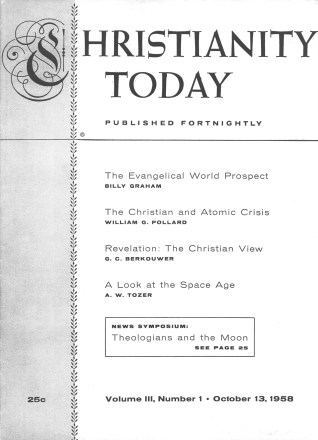
Eutychus and His Kin: October 13, 1958

RE: REFORMATION SPEAKER

Dear Eutychus:

Appreciate your suggestions for a speaker to address our area-wide Reformation Day Rally. I took the trouble to have one of our fraternal workers check the library on the writings of the men you mentioned. Can’t imagine where you came across them.

This Dr. Luther sounded fine at first. German scholarship and all that—most impressive, provided the man’s English is acceptable. But our spot check of his books shocked us all. The fellow is an apostle of discord. He doesn’t hesitate to attack leading churchmen by name. Publicity given to certain of his observations could set back our relations with the Vatican a whole generation. Terribly opinionated too. Of course his insights are along classical Protestant lines—salvation by grace through faith, but he shows so little appreciation of differing viewpoints. Talks as though he had a corner on the truth. Seems to be a Biblicist also. He is completely out of the question—the irenic tone of our rallies would be lost beyond recovery with such a speaker.

Professor Calvin is really no better. His dogmatism would establish no rapport at all with our Deepwell Heights people. His judgmental attitudes are out of keeping with the maturity and democratic independence of our constituency. I glanced through one of his addresses. It was of extraordinary length, with no apparent concern for the attention span of his hearers, and consisted of exposition with some application of the text of an Old Testament prophet. Of course this has its place for specialists in biblical studies, and you know how I favor greater biblical literacy, but, really, we must be relevant. I am also informed that Calvin shares many of Dr. Luther’s faults as an ecclesiastical trouble maker.

How did such atypical speakers come to your attention? Even the pictures you enclosed were too forbidding for good publicity. No one poses in academic regalia these days, and the simulated wood-cut is affectation.

Thanks anyway for your suggestions. I don’t often hear from you and I appreciate your cooperative spirit in this instance. We want our Reformation observance to deepen our sense of community in Deepwell Heights. What do you think of a more positive term for the rally—perhaps Renewal Day?

Cordially,

MISSION OF THE CHURCH

If your editorial (Aug. 18 issue) were followed to its logical conclusion, these churches on the National Missions frontier would be relegated to the position of being told what to do, and whom would be sent as missionary (why not become Episcopalian in full), what their program must be, with no participation by the local church. There may be cases where this should be done, but there are certainly more cases where this should not be done.… I prefer to participate in the Mission of the whole Church of Jesus Christ to the whole inhabited world to proclaim the whole Gospel—the Eumenical Mission.

Greater Parish of the Cascades

Roslyn, Wash.

While the heathen multiply faster than they are being converted, … boards infected with ecumenical fever, blinded to the Great Commission, confine missionaries—“fraternal workers”—to assist already organized national churches, and destroy their autonomy and weaken them by subsidies.

Lansdale, Pa.

SEEKING AN APPROACH

Mr. Howard speaks as if the welfare of man were a goal inimical to the glory of God (Aug. 18 issue). The Christian approach would not be limited to a humanistic welfare of man, but it would recognize that there can be no glorifying God on the part of one who is indifferent to the welfare of man. Jesus said, “Inasmuch as ye did it not to the least of these, ye did it not to me.”

Haran Baptist Church

Roanoke, Va.

Mr. Howard says that no labor union has the right to deny a man “the right to work.” On what biblical principle does Mr. Howard conclude that an employer has this right, while a league of fellow employers has not? What of the medieval guilds, the various state medical societies, and unified state bar of many states? Are all arrangements which require a man to link his interests in his employment with those of his colleagues immoral and unchristian?

Crivitz, Wisc.

Mr. Howard’s remarks about people who seek security in pensions are all very well, but I believe that Christians who are blessed with this world’s goods and are inclined to disparage old age pensions, Social Security, etc., might do well to read James 2:15, 16.… While I am fully aware of the perils of “welfare economics,” I believe that sometimes a form of the “welfare state” may be the lesser of two evils.

San Antonio, Tex.

MERE CHRISTIANITY

Among your delightfully humorous observations (Eutychus, Aug. 18 issue), you remarked that “only as bold a writer as C. S. Lewis would entitle a book Mere Christianity.” Professor Lewis … is a specialist in sixteenth century English literature. I would venture to say that he is using the term “mere” in the sense current in that period (and as Shakespeare used it) when it meant “absolute.”

Charleston, Ill.

JONAH’S PRECEDENT

“The Story of Clergy Fares” (Aug. 18 issue) was most interesting, but told only part of the story.… If we really believe in the “priesthood of all believers,” on what basis can we claim special discounts in transportation or any other services?… True, ministers may not always be paid adequately, and they do have to travel. But the answer to this is better salaries, not patronage.… Personally, I’m for Jonah, who paid the fare.

First Congregational Church

Westfield, Mass.

INITIAL REACTION

I received the first copy last week … it was worth the entire subscription.

Cape May, N. J.

Ideas

Statement of Policy and Purpose

Statement Of Policy And Purpose

With this issue CHRISTIANITY TODAY begins its third year of publication. For many religious periodicals this is a time of trial and trouble; for CHRISTIANITY TODAY it has been an era of heartening growth.

This enlargement of influence is directly linked to the resurgence of interest in evangelical Christianity. The new feeling for biblical theology and evangelism, the widening awareness that the Christian revelation speaks directly and authoritatively to the crisis of modern culture, are sure signs of the times. CHRISTIANITY TODAY seeks to sustain and to advance these interests.

At a time of anniversary it is appropriate to review foundational convictions and guiding principles. CHRISTIANITY TODAY’S vast reader audience will be interested in the original statement of policy and purpose:

There is a growing conviction among ministers and laymen that a magazine is needed to present evangelical Christianity competently, attractively, and forcefully. It is felt that evangelical Christianity has often been misrepresented by both liberal and fundamentalist. Some liberals have not taken time to study the works of evangelical scholars; some fundamentalists have been so busy attacking others that they have failed to present adequately the positive aspects of historical Christianity.

The main thrust of CHRISTIANITY TODAY will be to present in a positive and constructive way the basic truths of the Christian faith as clearly taught in the Scriptures. Mindful of the great creeds of the historic evangelical churches, it will be neither reactionary nor static. The magazine will seek to present the content of the Christian faith on a high ethical plane, undergirded by Christian love, and empowered by the Holy Spirit. Designed to win men to the evangelical faith, the magazine will request all contributors to keep this specific aim prayerfully in mind.

Those who direct the editorial policy of CHRISTIANITY TODAY unreservedly accept the reliability and authority of the written Word of God. It is their conviction that the Scriptures teach the doctrine of plenary inspiration. They believe sincerely that the lack of spiritual power in the pulpit today is often due to lack of confidence in the Bible as the final authority in matters of faith and practice.

Today many sincere Christian men hold to such central revealed truths of the Bible as the deity and vicarious atonement of Jesus Christ, but are hesitant about the doctrine of plenary inspiration. There is general acceptance of other vital doctrines of the Word, though the Bible is thought to contain errors. Nonetheless, such men will be solicited for articles which otherwise conform to the central teachings of the Scriptures.

The policy of CHRISTIANITY TODAY will be to apply the biblical revelation vigorously to the contemporary social crisis, by presenting the implications of the total Gospel message in every area of life. Fundamentalism has often failed to do this. Christian laymen are becoming increasingly aware that the answer to the many problems of political, industrial, and social life is a theological one. They are looking to the Christian Church for guidance in these spheres. We have the conviction that a consecrated and gifted evangelical scholarship can provide strategic answers.

There is a realization that the period of three years in a theological seminary is not sufficient to prepare a student fully for the ministry. CHRISTIANITY TODAY will seek to supplement seminary training with sermonic helps, pastoral advice, and book reviews. To achieve this end it will solicit articles from leading ministers and theologians.

The list of evangelical scholars is growing. This is evident in America, Great Britain, and the Continent. The magazine will provide a medium of scholarly exchange of viewpoints by the publication of articles from such sources. This should prove helpful to the busy minister, who usually has little access to the works of scholars in other lands.

By enlisting correspondents from all countries and large cities, CHRISTIANITY TODAY will provide a comprehensive view of religious life and theological movements throughout the world.

The magazine will seek to avoid controversial doctrinal discussions growing out of distinctive denominational differences, while defending the great emphases of the historic creeds. It does not intend to concern itself with purely internal problems and conflicts of the various denominations. If significant enough, there will be objective reports of such.

CHRISTIANITY TODAY will view objectively all movements such as the World Council of Churches, National Council of Churches, National Association of Evangelicals, American Council of Christian Churches, etc. Evaluation of the policies and actions of such movements will be governed by the principles involved, rather than bias.

Those enlisted as contributing editors, correspondents, and as contributors of articles, may not find themselves in full agreement with all the policies and objectives of CHRISTIANITY TODAY. Nevertheless they will be in entire agreement with the main endeavor of the magazine: to enrich the ministry with the fruit of evangelical scholarship.

To this end, CHRISTIANITY TODAY solicits prayer, support, and constructive criticism.

END

The Art Of Keeping Christ At A Distance

The interests of the 115-year-old financial journal The Economist often reach far beyond the business world. A recent issue turns a critical eye on the spiritual outlook in England. An article titled “How Many in the Pew?” yields statistical data that 8 million adults in Britain attend church fairly regularly; about 18 million apparently feel guilty that they do not; 12 million others assert they never will attend.

Comments The Economist:

England is much less evangelised than it was 60 years ago.… Presumably the immediate task is to bring back to church some of those who are not, at any rate, either indifferent or hostile, as well as their children; for that task the clergy are few.… Some inkling of its difficulty is suggested in the Gallup poll’s discovery that 79 per cent of those asked thought it possible to be a Christian without going to church.… There was a big majority for the proposition that economic security was more important than religion, that politics could do more for people than religion.… The general picture which emerges is that of a Britain in which probably less than a quarter take their religious observances seriously; in which, admittedly, the genuinely anti-clerical minority is smaller than in most other countries; but in which about 70 per cent of people regard the Christian religion as a good thing provided it does not interfere with their private lives.

American churchmen will find scant comfort in the better news that a majority of persons in the United States are church affiliated. For, as in Britain, the Christian religion remains on the margin of many streams shaping cultural and social influences on the American scene. All too many church members, moreover, think Christianity is a desirable force in national life provided it does not crowd them too disturbingly for sacrificial dedication.

END

A Major Contribution To Historical Research

Nashville, Tennessee, “The Athens of the South,” may soon become a major center for historical study and research in American Protestantism. A first step in this development was the dedication of the million-dollar library and museum of the Disciples of Christ Historical Society in Nashville, September 12–14.

The magnificent Tudor Gothic structure with its ultra-modern library facilities was the gift of the Phillips family in Pennsylvania and dedicated as a memorial to Thomas W. Phillips, pioneer Disciple layman. It is strategically situated in a cul de sac surrounded by Vanderbilt University, Scarritt College and Peabody College and is adjacent to the Joint University Library. Two other major Protestant communions are planning to locate their official historical collections in this area.

The Disciples have set a high standard for what may follow. Their building is air-conditioned throughout, and the moisture-controlled stacks and vaults guarantee maximum care for all manuscripts, documents, books, pictures and relics. In rooms that look like chapels from the outside, are rows of shelves filled with church publications for browsing. There are lecture rooms for small assemblies. There are cubicles for writers and researchers. There are facilities for microfilming, projection and visual instruction; also work rooms for cleaning and repairing books, paintings and relics.

Invaluable for Disciples in the location, collection, cataloging, arranging and preserving of historical materials related to the Nineteenth Century “Restoration-Unity” movement led by Thomas and Alexander Campbell, Barton W. Stone and Walter Scott, this Nashville center is also a valuable contribution to general church history and to modern ecumenical study.

END

Compulsory Chapel Attendance At Our Military Academies

What a nation does with minorities often reflects its greatness or weaknesses as fully as what the majority does.

One of the ironies of contemporary American life is that community policy is being conformed in many sectors to the views of a vocal minority of secularists. Even more strange, Protestant clergy in some instances have become aggressive spokesmen for the non-religious humanists.

Now the Rev. Curtis Crawford of First Unitarian Church in Annapolis raises the issue of compulsory church attendance at the Naval Academy in Annapolis. He insists that the regulation requiring chapel attendance there, at West Point, and at the new Air Force Academy in Colorado, is hardly consonant with the American concept of religious freedom. The freedom not to believe requires the freedom not to attend.

The American tradition is a God-fearing tradition, and the incorporation of the words “under God” into the pledge of national allegiance indicates that sometimes congressmen have a clearer vision of national priorities than some of our clergy. That does not mean, indeed, that atheists and agnostics cannot be absorbed into the American culture, nor that they should be coerced into religious conformity; religious freedom assuredly is one of America’s great distinctives. But while the majority must respect the rights of the minority, the minority too are obliged to recognize the rights of the majority. A military tradition in which the recognition and worship of God is rendered optional becomes, in the context of the modern struggle with totalitarianism, a significant secular concession in a society that is by tradition and at heart theistic.

We shall need to find a way through the problem of minorities without allowing them to determine major turns of majority policy. As it is, cadets and midshipmen are not required to worship, but simply to attend. While church affiliation is a majority phenomenon in American life, the idea of chapel attendance specially commends itself. But would not the requirement of attendance likewise gain force if the American church members attended voluntarily with the same regularity that they expect midshipmen and cadets to attend compulsorily?

END

Protestant Press Month: The Place Of The Editor

October is Protestant Press Month and the editors of CHRISTIANITY TODAY would pause to pay tribute to their fellow craftsmen. The debt Protestantism owes its editors can never be repaid in anything but profound appreciation.

In the secular field, newspaper and magazine editorials serve the general public in forming conclusions which the reader may not have the resources to reach entirely on his own. The religious editor does that much and more for his readers. He is dedicated, not only to do research which is hard to come by for the average Christian leader, but to study and declare these facts in the light of biblical principles.

Thus to offer guidance is to fulfill an aspect of the Christian commission to witness. The evangelical editorial can serve to maintain the clarity of the Christian testimony and to sharpen its lines of relevance to the church and the community.

Our readers may disagree with our views, but if we have stimulated an interest which draws forth a well-stated counter view we have encouraged Christian thought. Editorials are never impositions. Editors always want to be right, but even when they are wrong they serve the best interests of the cause of Christ in opening the way for balanced discussion.

In these crisis days an unusual opportunity belongs to evangelical editors. May we seek God’s guidance to meet the challenges of the hour.

END

Does The Minister Grasp His Layman’S Problems?

During the recent conference on “Christianity and Law” at University of Chicago, Professor Markus Barth made a startling statement. “Clarence Darrow,” he said, “while a professed non-Christian, may have been more Christian than a church-attending corporation lawyer who never gets his hands dirty.” Yet an attorney subsequently pointed out that the corporation lawyer is not hard put to soil his hands in the course of his professional duties.

Professor Barth was disappointed that solution of another ethical problem did not include consultation with a minister. But it is commonplace that laymen often shun discussion with their ministers on the ethical problems arising in their vocations. Rightly or wrongly, “the reverend” is seen as one who has never had to make the same kind of ethical choices as those who “deal with the world.” Supposedly cellophane-wrapped through college and seminary, the theological student is observed spending even summers in church work. Graduation then thrusts him upon the parishioner who asks himself, “How could he possibly understand what I face on weekdays?”

The church’s seminaries and the church’s clergy should concern themselves with this problem. Empathic agape is a prerequisite. What about a measure of practical experience? Or a program that will bring the professional lay leader and his minister into a frank sharing of the ethical dilemmas faced in the course of Christian vocation, and into an earnest quest for the light shed upon them by the Christian revelation.

END

Will To Greatness In Russia And America

America is rapidly changing one of her basic attitudes to life. The will to greatness is being stifled by a demand for security of a sort which will be bought at the price of national solvency and personal freedom.

Adlai Stevenson, after a four-week tour of Russia, wrote that “Men Working” is the symbol of Russia today. He said: “I bring back with me an image of a vast, rich, underdeveloped country hard at work with the single-minded purpose to build itself up to challenge America’s world leadership.”

We have been rightly proud of our great industrial, social and cultural achievements. All are the blessings of God through free enterprise and hard work. Now there is grave danger of thinking that progress can be maintained by other means, shifting the emphasis from work to leisure, from personal and corporate initiative to security guaranteed by government.

The fear of competition from a socialistic state may seem incompatable with the views expressed above, but the crucial difference between the Communist government of Russia and our Republican form of government, is that in Russia its people are being urged to harder work and greater endeavor, while in America the bureaucrats are holding out to the people the mirage of ease, pleasure and security.

How great is that difference? It is the difference between progress and regression; between continued greatness and an enveloping mediocrity.

END

Christian Hope and the Millennium

The term “amillennial,” or “non-millennial,” sometimes produces misunderstanding. It might lead some to suppose that those who hold this view reject what is said in Revelation 20 about “the thousand years.” Of course, this is not so. That passage is very precious to amillennialists; they delight in what it has to say about “the thousand years,” and they insist that the passage has been misunderstood by “pre-mils” and by some “post-mils.”

It is also sometimes assumed that this view is of recent origin. Its fundamental ideas, however, are found in Augustine (A.D. 354–430). Indeed, Prof. D. H. Kromminga, who was himself a “pre-mil,” contended that the Epistle of Barnabas (one of the earliest Christian writings outside the Bible) shows “a very early amillennial type of eschatology” (Millennium in the Church, p. 40), but this conclusion is disputed. Certain it is, that the “a-mil” view is quite in harmony with the statements of the Apostles’ Creed, the great ecumenical creeds, and confessions of the Reformation.

A Change Of View

For some 12 years after his conversion, the present writer was inclined to the “pre-mil” view. He received a jolt, however, from an American expositor who affirmed that the early part of the Acts of the Apostles was a “national offer” to the Jews, while only in the latter part was there the gospel of the grace of God. A further jolt came when he met with the suggestion that there was a new age to come when men would be saved on some other basis than the grace of God. These statements—which are no doubt typical of only a section of “pre-mils”—led the writer to devote himself to a study of the whole subject afresh. Two sections of Scripture had inclined him to the “pre-mil” view:—(1) certain Old Testament prophecies which seemed on the face of them to predict a national restoration of Israel to Palestine, and (2) Revelation 20 which seemed on the face of it to predict a literal thousand-year reign.

Old Testament Prophecy

When setting out to study the subject afresh, the writer was engaged in giving Bible class talks on the Book of Ezekiel. Among commentaries consulted were those by Bishop Wordsworth and Principal P. Fairbairn. These expositors revealed a wealth of meaning in the prophecies; they were faithful to the text but brought from it a rich message. While still a “pre-mil,” the present writer read—with the best will to follow and assimilate—commentaries on Joel and Zechariah by a prominent American “pre-mil,” but found them remarkably barren in spiritual help. In comparison the line of thought followed by Wordsworth and Fairbairn was rich and satisfying. It seemed to open a new realm.

In the course of study, the writer noted that Old Testament prophecy at times bore on the face of it a warning against a literal interpretation. For example, Ezekiel prophesied that “my servant David shall be king over them” (37:24): yet even some of the most ardent literalists admit that the reference is not to the actual David, but to Christ.

The writer was also impressed with the difficulties confronting the uniformly literal interpretation of Old Testament prophecy, e.g., the future restoration of the temple, of sin-offerings for atonement, of Israel, of the great Old Testament world powers such as the Assyrians, and of such neighboring nations as the Moabites.

Most important of all was the fact that the New Testament in its application of Old Testament passages compelled us to give an enlarged meaning and spiritual significance to prophecies which, at first sight, seemed to apply only to the Jew.

The writer also examined the teaching of the New Testament afresh, and was tremendously struck with the testimony everywhere in its pages to the general resurrection and general judgment. Everywhere the judgment of the righteous and of the wicked was spoken of as one great event. This is so in the parables of our Lord (Matt. 13:30, 41–43) and in his teaching elsewhere in the Gospels (Matt. 16:27; cp. John 6:40 with 12:48). The writings of Paul and Peter speak also of a general judgment. Not only is there no mention of a thousand-year reign on earth, there seems to be no room left for such a reign (Rom. 2:5–16; 2 Thess. 2; 2 Pet. 3). Even in the book of Revelation, we seem to have pictures of a general judgment. In chapter 11 the saints are rewarded and the wicked “destroyed” at the same time. At the close of Revelation 20 “the dead, small and great, stand before God,” those whose names are in the book of life apparently being present (verses 12 and 15).

The Thousand Years

Does Revelation 20:1–10 strike a different note? It is to Augustine, as Dr. H. B. Swete points out, that we owe the first serious effort to expound Revelation 20. He saw in the captivity of Satan nothing else than the binding of the strong man by the Stronger than he (of which our Lord spoke in Matthew 12:29). The thousand years he took to be the whole interval between the first advent and the second. Dr. Swete says that these ideas “find a place in most of the ancient Greek and Latin commentators, who wrote after Augustine’s time” (Apocalypse, p. 266).

Amillennialists follow the line of teaching in which Augustine led the way. In this whole gospel age, there is a restraint put upon Satan’s activities. This restraint is what may be termed the earthly aspect of the thousand years. Satan is a defeated and conquered foe, for Christ triumphed over him by His cross (John 12:31; 16:11; Col. 2:15; Heb. 2:14). Even in other portions of the Revelation (see chap. 12) it is evident that there is a restraint on Satan; he cannot work his will against Christ or Christ’s people. The special restraint upon Satan in this present age which is emphasized in Revelation 20 is a restraint with regard to the nations. From verse 8 it appears that he is restrained from luring the nations on to the battle of the great day of God Almighty, that is, to the final conflict and their own ruin. Near the end of time, this restraint will be withdrawn and the last great conflict will ensue, in which he will be utterly worsted (Rev. 20:7–10).

Revelation 20 also sets forth what may be termed the heavenly aspect of the thousand years, that is, of the long period between the advents. John says: “I saw the souls.…” What is here set forth is the bliss of the blessed dead in the inter-adventual period. They are “risen with Christ” (Christians are so described in Rom. 6; Eph. 2; Col. 3, etc.) and so they are “the first resurrection.” Their warfare on earth is over; they are “dead” as far as the body is concerned, but in their spirits they “live and reign” with Christ in the highest heaven. In contrast with these, “the rest of the dead” are dead in every sense, bodily and spiritually, and they will come to life again, in the body, only to die the dreadful second death.

The term “1000” in the thousand-year binding of Satan indicates the completeness of Christ’s victory over him, though he is permitted a period of continuing restless activity (to which the book of Revelation bears abundant witness). The term “1000” in the thousand-year reign of the saints signifies its heavenly completeness, security and bliss. As Dr. Warfield says: “The sacred number seven in combination with the equally sacred number three, forms the number of holy perfection ten, and when this ten is cubed into a thousand, the seer has said all that he could say to convey to our minds the ideal of heavenly completeness.”

This interpretation of Revelation 20:1–10 emphasizes the completeness of Christ’s victory on Calvary and the thoroughness of his defeat of Satan, as well as the glory and bliss of the redeemed in heaven.

New Heavens And New Earth

The Lord’s return ushers in the new heavens and new earth. The “a-mil” takes many promises which the “pre-mil” relates to the earthly millennium as more appropriately applied to the new earth. In fact, many prophecies which are claimed for the thousand-year kingdom explicitly refer to the eternal kingdom (2 Sam. 7:16; Isa. 9:7; Dan. 7:14; Luke 1:33). In the new earth the triumph of righteousness will be absolute and forever; no Satanic rebellion will ever mar its peace. There will then be nothing to hurt or destroy in all God’s holy mountain—then and not until then.

It is sometimes said that the “a-mil” view is pessimistic. True, it does not hold forth the hope of a converted world or of a general triumph of righteousness, as “post-mils” usually do. But then the Scriptures teach that evil and good will continue side by side to the end; wheat and tares will grow together till the harvest. Is it so, however, that “a-mils” are very pessimistic? Dr. G. Vos, an outstanding “a-mil,” looked for “a comprehensive conversion of Israel” before the second advent, and while he spoke of “the forces of evil gathering strength,” he also spoke of “an extension of the reign of truth” before the end.

This view bears testimony to the one great event which lies ahead, the second advent, an event to be accompanied by the resurrection of all, the judgment of all, and the end of the world. Christ will sit on his judgment-throne, and all nations of men which have lived will be gathered before him, to be consigned to their eternal destiny. As John L. Girardeau said: “Heaven will lend its glories and hell its horrors to emphasize the proceedings of that day.” It is the day of perdition of ungodly men, but the day for which Christians earnestly look (2 Pet. 3:7, 12).

END

W. J. Grier is Minister of Botanic Avenue Irish Evangelical Church in Belfast, Ireland. He holds the B.A. degree from Queen’s University, Belfast. He was awarded the R. L. Maitland Prize for New Testament exegesis during studies at Princeton Theological Seminary. He served as Chairman of the Council of Irish Evangelical Churches from 1957–58 and is Editor of the Irish Evangelical. His published works include The Momentous Event and The Origin and Witness of the Irish Evangelical Church. His essay from the amillennial viewpoint concludes the series on divergent millennial views which began in the September 1 issue of Christianity Today.

Cover Story

Revelation: The Christian View

Part I

(Part II will appear in the next issue)

The history of human thought continually confronts us with questions regarding divine revelation. On one hand, some thinkers reject any possibility of divine revelation in the world on the basis of their atheism or agnosticism. On the other, a great number of thinkers espouse revelation, yet the variety of viewpoints seriously and fundamentally contradict each other. When we specially emphasize a revelation of God in the world, moreover, basic differences emerge over the character and the content of this revelation. In this connection we think not only of non-Christian religions, which often also appropriate the notion of “revelation”—Mohammedanism, for example,—but also of differences among those who, in one way or another, identify divine revelation with the Christian faith.

Specifically, then, we face the controversy over the manner in which divine revelation has come to us. Scholars have frequently opposed the local and historical frontiers of revelation, pleading instead for a more general revelation, a universal unveiling (revelation signifies “apocalypse,” unveiling), and have set themselves against the orthodox vision of special revelation which seemed too narrow and too limited. Especially since the eighteenth century the speculative viewpoint has sharply objected to basing man’s salvation upon historical facts. In particular, Lessing’s now well-known dictum that it is impossible to base eternal truths upon historical actions exercised great influence. More and more the impression grew that historical facts are accidental, changing, fortuitous and relative. It was asserted also that all historical circumstances so interpenetrate each other that any discrimination of the special revelation of God in certain special historical happenings, in distinction from others, would be impossible.

In the idealistic interpretation of revelation, the Christian Church in the nineteenth century came in contact with one of the fiercest attacks upon its fundamental doctrine. This philosophy found divine revelation not in historical occurrences, but in the realm of idea alone. Eternal truth must have an eternal foundation and can not be dependent, so it was contended, on historical circumstances. Especially since the rise of anti-miraculous biblical criticism in the eighteenth century, a desire came to the fore to “secure” revelation by freeing it, in principle, from dependence upon the historical. Historical criticism could attack everything—so it was said in the nineteenth century—including the historical reality of Jesus of Nazareth; and what then remained for the Christian faith, if this depended upon him as an historical Saviour? Idealistic interpretations sought deeper foundations for the truth of revelation in the divine idea. When dogmatics influenced by Hegel expounded the unity of the divine and the human, it protested against Christian dogma which argued for the unity of God and man by special reference to the historical Christ. The great fault of the Church—so it was said—was its limitation and confinement of a universal idea in one person. With the greatest emphasis, therefore, the modern theology of the nineteenth century discarded the confessions of the ecumenical Christian councils, especially the Chalcedonian formula, “very God, very man.”

What the Church in Christ Jesus had confessed as an isolated historical reality, it was asserted, must be understood as a universal; the historical could never in itself be the revelation of God, but could only have value as illustration of the divine idea. As Strauss expressed it in his much-quoted phrase, the divine idea has not poured itself into but a single mold.

That a revelation of God should come to us in the here and now is the great stumbling block for the idealistic view of revelation. It is not by accident, therefore, that in times of idealistic outlook a crisis inevitably arises over the confession of the absoluteness of Christianity. All religions have a share, in larger or smaller measure, in the truth of the idea, it is said. One cannot speak, consequently, of a radical decision in connection with Jesus Christ, truly God and truly man, the Way, the Truth, and the Life.

God And Modern History

In addition to this idealistic misunderstanding, another theory poses an equally serious threat to revelation. This is the notion that we ought simply to equate revelation and history according to our own insight. In contrast with the idealistic view of revelation of the nineteenth century, let us now contemplate the view of revelation prevalent in the days of National Socialism in Germany. When Hitler came to power in 1933, the church was pressed for a decision on the question of the meaning of this phase of German history.

There were those who from the beginning had grasped and pointed out the demonic structure of National Socialism. Despite all its promises of freedom for the church and religion, they saw the mortal danger of the swastika and totalitarianism against the Cross.

There were others in the German church (the group, so-called, of German Christians) who professed to hear the voice of God in the events of the thirties. They spoke of the clearly-defined revelation of what was happening; they called upon the Church to seize the opportunities God was now giving it. And everyone who refused to discern the voice of the Good Shepherd in these events was denied the right to leadership in the Church. This event-filled history of the thirties was hailed as nothing more or less than revelation.

So long as things went well for Germany, these people, like the rest of the populace, followed Hitler’s cue. While success followed success, Hitler spoke continually of the guidance and providence of God. Success and blessing were thus identified in an entirely unbiblical manner. Even as Goebbels spoke about the logic of history, so Hitler, at the time of the death of President Roosevelt, spoke of a turning, of a decisive reversal, in which God had come to the rescue with a new prospect of German victory.

In this manner a special event of history was interpreted, without validity, as revelation. The event was not placed under the searching light of the God-given unique revelation in Christ Jesus, but was itself promoted as “special revelation.” It is not difficult to see that such a view of revelation is as dangerous as the idealistic vision of the nineteenth century. Both developments forfeited an awareness of God’s true revelation.

Hebrew-Christian View

This twofold danger zone should be kept in mind as we go into the treatment of the Hebrew-Christian view of divine revelation.

In this we shall have to deal with the biblical vision of divine revelation. That we here use two terms (Hebrew and Christian) signifies not that we are discussing two different views of revelation which are somehow connected with each other, but rather, that we are dealing with one central, harmonious view of divine revelation. The hyphen in the term “Hebrew-Christian” points to the progress of revelation in the course of history before and after Christ.

The remarkable feature of the unified witness of the Old and New Testaments lies always in this, that in its whole course we come in contact not with an idea, but with the revealing acts and words of God in history. The revelation of God, as it is witnessed in the Old and New Testaments, is never concerned with a number of truths that stand by themselves, which are forever “true,” independent of time and place. This idealism is entirely unknown to Scripture.

The Old Testament makes this completely clear. It fixes attention on the creating and speaking and acting God, who reveals himself in the path of history. This revelation of God in history carries a definite character and supplies the basis for radical conclusions. It is not given to us in the form of a vague universality, but in moving particularity, such as appears especially in the historical act of the choosing of Israel. In this election, assuredly, God does not forget the peoples of the world. Abraham received the promise that with him all peoples of earth would be blessed (Gen. 12:3), but the way to this universal blessing runs through this particular revelation to Israel. The Exodus stands out as a mountaintop above the valleys of Israel’s history, towering in remembrance to the days of the prophets.

God’s dealing and God’s act! Its concern is not with an idea, but with a way which comes into view—the way in which God leads, and in which men must follow him. It is the way of his election and his covenant, of grace and of judgment.

Jehovah, the God of Abraham, Isaac and Jacob, is the faithful and unchanging God. His acts in history are a breathtaking performance, great and majestic. The hand of God is directed against the enemies of his chosen people whenever they disallow them freedom and opportunity, but it is directed also against his own people when they forsake his ways. So weighty is their calling and election that the chosen people bear a special responsibility: “You only have I known of all the families of the earth; therefore I will punish you for all your iniquities” (Amos 3:2). When they refuse to serve him, God allows his people to be carried into exile.

The God who deals thus with us, in judgment and grace, is the great unchanging one. In the moving variations of the history of revelation, a light keeps on shining: “and he let none of his words fall to the ground” (1 Sam. 3:19). In these dealings, the teleological character of the acts of God strikes us. The whole Old Testament shows no concern with the cyclical view of history, but only with God’s purposeful dealing.

The important thing in God’s dealings is this, that he even uses the sinful acts of men to serve his plan and his purpose. When in their sinful planning Joseph’s brothers sold him into captivity, then God’s dealings put their deed straight; later we hear Joseph saying, “Ye meant evil against me; but God meant it for good” (Gen. 50:20). Here we are not concerned with abstract thinking, but with thought as deed. In the deepest darkness of the history of the people of Israel, it remains incontestable that God did not forsake the work of his hands.

At times, scholars have ventured, upon the basis of the Bible, to speak of a divine defeat or failure. But to do so is to diminish the height and majesty of God.

God is the shepherd of the sheep, the leader of his people. He is not the hidden God full of arbitrary highhandedness, but the God of each day and each night. When the heart turns away from him, then and then only men must reckon on his divine concealment in judgment: “Verily thou art a God that hidest thyself, O God of Israel, the Saviour” (Isa. 45:15). Then he becomes the silent God, until the call rings out again for his word and his presence (1 Sam. 3:1, 10). The moving relationship between God and his people is pictured to us in human terms, but precisely this anthropomorphic manner of speaking in Scripture brings us under the deep impression of the reality of the revelation and of the deep currents of God’s dealing and speaking.

“In all their affliction he was afflicted and the angel of his presence saved them; in his love and in his pity he redeemed them and he bare them and carried them all the days of old” (Isa. 63:9). But presently we see also the judgment of God and the reality of divine anger: “But they rebelled and vexed his holy Spirit: therefore he was turned to be their enemy and he fought against them” (Isa. 63:10).

But when the eye turns again toward God, and the heart goes out to him, then God becomes known once more in his love, mercy, and greatness, and the heart once more is filled with wonder: “Thy way is in the sea, and thy path in the great water, and thy footsteps are not known. Thou leadest thy people like a flock by the hand of Moses and Aaron” (Psalm 77:19, 20).

This God of history is unfathomable and incomprehensible, but that does not remove the fact that he is a God of nearness. In the way of faith he is Father, and although Israel calls him the Almighty, he is also for Israel the hearer of its prayers: “O thou that hearest prayer, unto thee shall all flesh come!” (Psalm 65:2).

He is not the God who is merely a remote first cause, the unmoved mover of all things, but he is the merciful God, the listening God. And precisely because he is merciful, he does not allow his people to wander in ways of their own choosing, but follows them with his anger and again and again calls them to turn back.

More and more in our time we learn again to understand the deep religious riches of the Old Testament. In the nineteenth century, the tendency was to push the Old Testament aside, because it was viewed as a provincial Jewish writing, with little universal significance. And when anti-Semitism in Germany brought modern minds into confusion, the Old Testament was disparaged as a primitive stage of thinking.

We now understand that whoever casts aside the Old Testament also fails to do justice to the content of the New. The reason is not simply that the one follows upon the other. By this rejection, one shatters the unity of the witness of him who is the God of history and who in a particular way has sought the world.

G. C. Berkouwer is Professor of Systematic Theology at Free University in Amsterdam, The Netherlands. He is author of a monumental series titled Studies in Dogmatics, many of the volumes already translated into English. This essay on “Revelation: the Hebrew-Christian View,” written especially for readers of Christianity Today, is to appear in three parts.

Cover Story

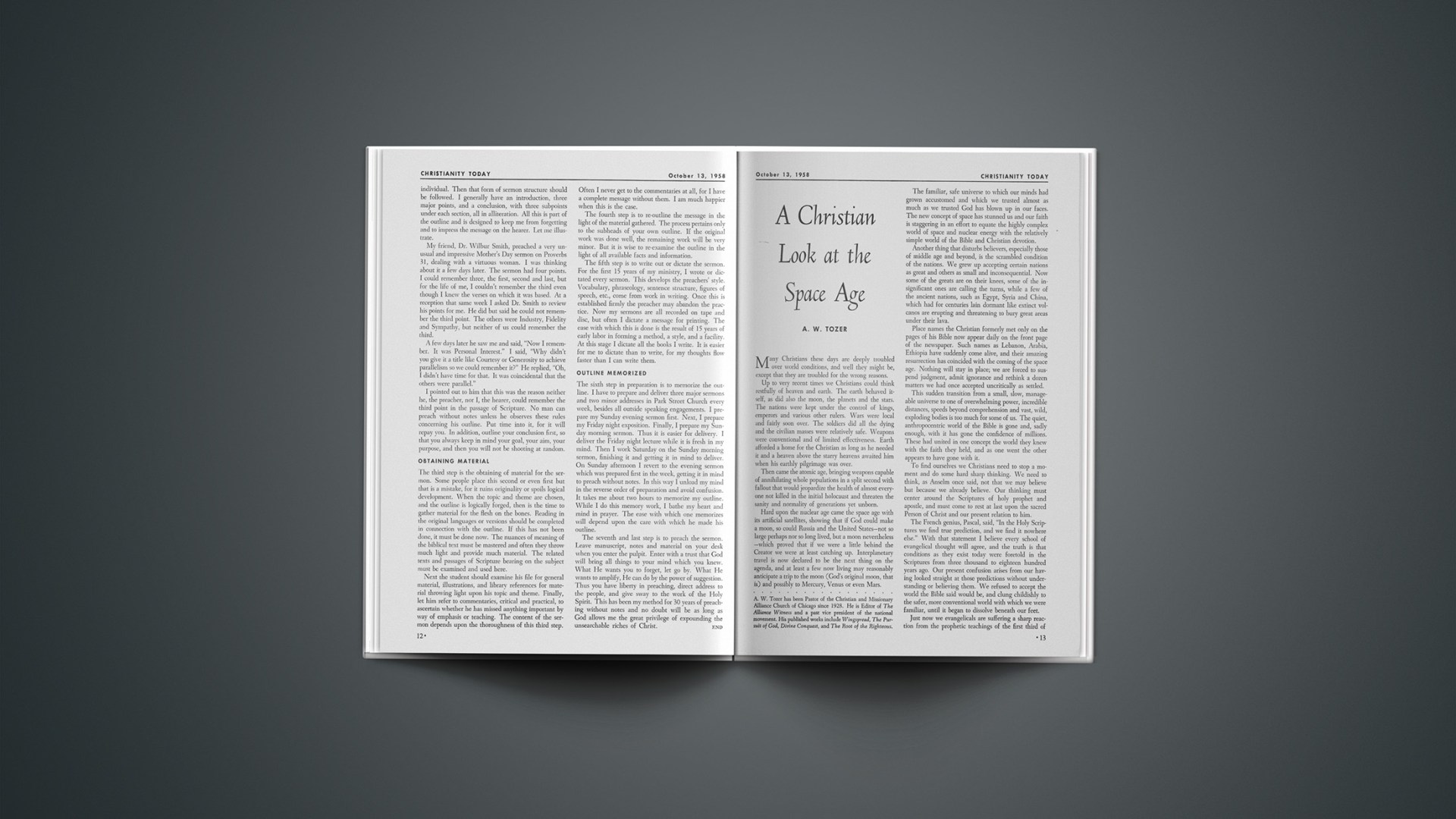
A Christian Look at the Space Age

Many Christians these days are deeply troubled over world conditions, and well they might be, except that they are troubled for the wrong reasons.

Up to very recent times we Christians could think restfully of heaven and earth. The earth behaved itself, as did also the moon, the planets and the stars. The nations were kept under the control of kings, emperors and various other rulers. Wars were local and fairly soon over. The soldiers did all the dying and the civilian masses were relatively safe. Weapons were conventional and of limited effectiveness. Earth afforded a home for the Christian as long as he needed it and a heaven above the starry heavens awaited him when his earthly pilgrimage was over.

Then came the atomic age, bringing weapons capable of annihilating whole populations in a split second with fallout that would jeopardize the health of almost everyone not killed in the initial holocaust and threaten the sanity and normality of generations yet unborn.

Hard upon the nuclear age came the space age with its artificial satellites, showing that if God could make a moon, so could Russia and the United States—not so large perhaps nor so long lived, but a moon nevertheless—which proved that if we were a little behind the Creator we were at least catching up. Interplanetary travel is now declared to be the next thing on the agenda, and at least a few now living may reasonably anticipate a trip to the moon (God’s original moon, that is) and possibly to Mercury, Venus or even Mars.

The familiar, safe universe to which our minds had grown accustomed and which we trusted almost as much as we trusted God has blown up in our faces. The new concept of space has stunned us and our faith is staggering in an effort to equate the highly complex world of space and nuclear energy with the relatively simple world of the Bible and Christian devotion.

Another thing that disturbs believers, especially those of middle age and beyond, is the scrambled condition of the nations. We grew up accepting certain nations as great and others as small and inconsequential. Now some of the greats are on their knees, some of the insignificant ones are calling the turns, while a few of the ancient nations, such as Egypt, Syria and China, which had for centuries lain dormant like extinct volcanos are erupting and threatening to bury great areas under their lava.

Place names the Christian formerly met only on the pages of his Bible now appear daily on the front page of the newspaper. Such names as Lebanon, Arabia, Ethiopia have suddenly come alive, and their amazing resurrection has coincided with the coming of the space age. Nothing will stay in place; we are forced to suspend judgment, admit ignorance and rethink a dozen matters we had once accepted uncritically as settled.

This sudden transition from a small, slow, manageable universe to one of overwhelming power, incredible distances, speeds beyond comprehension and vast, wild, exploding bodies is too much for some of us. The quiet, anthropocentric world of the Bible is gone and, sadly enough, with it has gone the confidence of millions. These had united in one concept the world they knew with the faith they held, and as one went the other appears to have gone with it.

To find ourselves we Christians need to stop a moment and do some hard sharp thinking. We need to think, as Anselm once said, not that we may believe but because we already believe. Our thinking must center around the Scriptures of holy prophet and apostle, and must come to rest at last upon the sacred Person of Christ and our present relation to him.

The French genius, Pascal, said, “In the Holy Scriptures we find true prediction, and we find it nowhere else.” With that statement I believe every school of evangelical thought will agree, and the truth is that conditions as they exist today were foretold in the Scriptures from three thousand to eighteen hundred years ago. Our present confusion arises from our having looked straight at those predictions without understanding or believing them. We refused to accept the world the Bible said would be, and clung childishly to the safer, more conventional world with which we were familiar, until it began to dissolve beneath our feet.

Just now we evangelicals are suffering a sharp reaction from the prophetic teachings of the first third of the twentieth century. The pendulum has swung from too much prophecy to too little, and that just when we most need the sobering word of the prophet to keep us calm and sane amid the crash of worlds. For this our Bible teachers are more than a little to blame. They looked at biblical prediction through a microscope instead of through a telescope as God intended.

A clever Swiss writer, Denis de Rougemont, has said something to the effect that God says “I am He who is,” while the devil says “I am not.” God works by asserting his being and the devil by denying his. From behind his screen of pretended nonexistence the devil has worked successfully to discredit prophecy at the very moment we need it most. We dare not let him continue to deceive us.

The Old Testament prophets saw the advent of Christ through a telescope; the microscopic detail was left to the after wisdom of fulfillment. Then Christ and his apostles raised the telescope again and gave the Church the long view of things to come. The chaotic world we are now entering is the very one the apostles saw through the telescope of biblical prediction. Some details are clear; many others must wait fulfillment. But we can see enough to recognize the landscape, or perhaps we should say the skyscape, for a great deal of New Testament prophecy is concerned with the heavens—not the atmosphere only but the far-out world of interstellar space.

One has but to read the predictive passages of the New Testament to discover how accurately they describe conditions as they are now or as our scientists warn us or promise us that they soon will be. But most significant of all is that those Scriptures place the interests of latter day men in the starry heavens. They tell us that a time will come when the eyes of mankind will be focused on space in terror or in hope. And is it not further significant that the New Testament writers should have foreseen and described the psychological conditions on earth set up by happenings in space? and that they should have done this nearly two thousand years ago, when the most advanced scientist could not have dreamed of anything as fantastic as the modern space age?

Looking through the telescope of New Testament prophecy what do we see? The shaking of the heavens and the earth, the panicky flight of helpless populations fleeing in terror before something that is taking place among the heavenly bodies, the ascending of pillars of smoke into what would now be called the stratosphere or the ionosphere, the thunderous passing away of the earth and all the related heavens to make room for a new heaven and a new earth that will be a fit home for a redeemed human race, the appearance from remote space of beings wholly unlike anything with which earth dwellers are familiar.

These are a few of the wonders we behold through the telescope of prophecy. It has been the practice of some exegetes to dismiss these predicted events as figurative or symbolic, but I cannot see how a serious inquirer can do this. Since the Messianic predictions of the Old Testament were quite literally fulfilled down to the minutest detail, is it not reasonable to believe that the prophecies of the New Testament will also be?

Making no attempt at close exegesis of any of the New Testament passages mentioned here, we may yet say that the writers knew too much about our day, for the whole thing to be mere coincidence. That they did know about our times in such detail should afford assurance that the Eternal Spirit moved them to write.

Let any man whose faith is trembling before events among the nations of the world read the twenty-fourth chapter of Matthew. Should he be troubled about brainwashing techniques, hidden persuaders, the growing power of governmental control over the minds of men, incipient dictators, unionism or the death of honor among nations, let him read the thirteenth chapter of the Revelation. Should the revival of Romanism worry him, let him turn to Revelation 17. Should he be on the verge of surrendering to the blandishments of religious liberalism, let him read the two epistles of Paul to Timothy.

Read those passages and remember that they were written more than eighteen hundred years ago. Do not worry about close interpretation. Use the telescope and glass the terrain; it may be too early for the microscope. The important thing is that God knew all about what is happening centuries before it began to take place.

Again, we should remember who we are and what is our relation to the triumphant Christ. As Thomas Kelly has said, we Christians live simultaneously on two levels, the physical and the spiritual. We tend to lose our heads when we become engrossed with the physical—matter, motion, time, space, energy—and forget the spiritual.

When we understand that true faith in Christ effects for the Christian an eternal union with him as he is in God, time and space cease to have the same meaning for use as they had before. When God takes a believing man into his heart he rescues him from the corrosive action of time and the breathless fear of energy and space.

If God smiles he must surely be smiling at Sputniks and Explorers. Without doubt he pities the little man who can control growing numbers of swiftly moving missiles but cannot curb his own temper or direct his feet free of the grave. And he will yet judge in great severity a race that has made a moral wallow of the earth and is now determined to extend its pollution to the heavenly bodies.

We have erred by thinking of ourselves as “under the circumstances,” a situation in which no Christian should ever allow himself to be placed. The grinding motion of circumstances soon wears out the bodies and souls of men, and those of the present day are particularly sharp and abrasive. We must escape them by taking our position in the heavenly places where we by every right belong.

That the Christian belongs above is not a poetic fancy. The data rests upon the solid foundation of New Testament theology. Our spiritual home is the Father’s house. We should learn to think from the throne down, not from the earth out. Let us but accept the earth as our psychological home, the proper vantage point from which we view the cosmic scene, and the space boys are one up on us immediately. John said of Christ, “He that cometh from above is above all: he that is of the earth is earthly, and speaketh of the earth: he that cometh from heaven is above all” (John 3:31).

The farther we move up into God the calmer we become. God is never caught unaware. He is sovereign over all, and in infinite power he is working toward a vast purpose which his infinite wisdom has assuredly devised.

To go out by that same door where I came in, let me repeat that Christians these days are disturbed for the wrong reasons. To grieve over the wounds and sorrows of the world is good and right; to share the woes of our fellow men, to bear on our hearts the burden of the world, to intercede in tears and travail for their sins is to fill up in some measure that which is behind of the sufferings of Christ. But to panic before growing knowledge of the heavenly bodies is to reveal how inadequate has been our conception of God and how little we really understand the meaning of the resurrection of Christ and his ascension to the right hand of the Majesty in the heavens.

A. W. Tozer has been Pastor of the Christian and Missionary Alliance Church of Chicago since 1928. He is Editor of The Alliance Witness and a past vice president of the national movement. His published works include Wingspread, The Pursuit of God, Divine Conquest, and The Root of the Righteous.

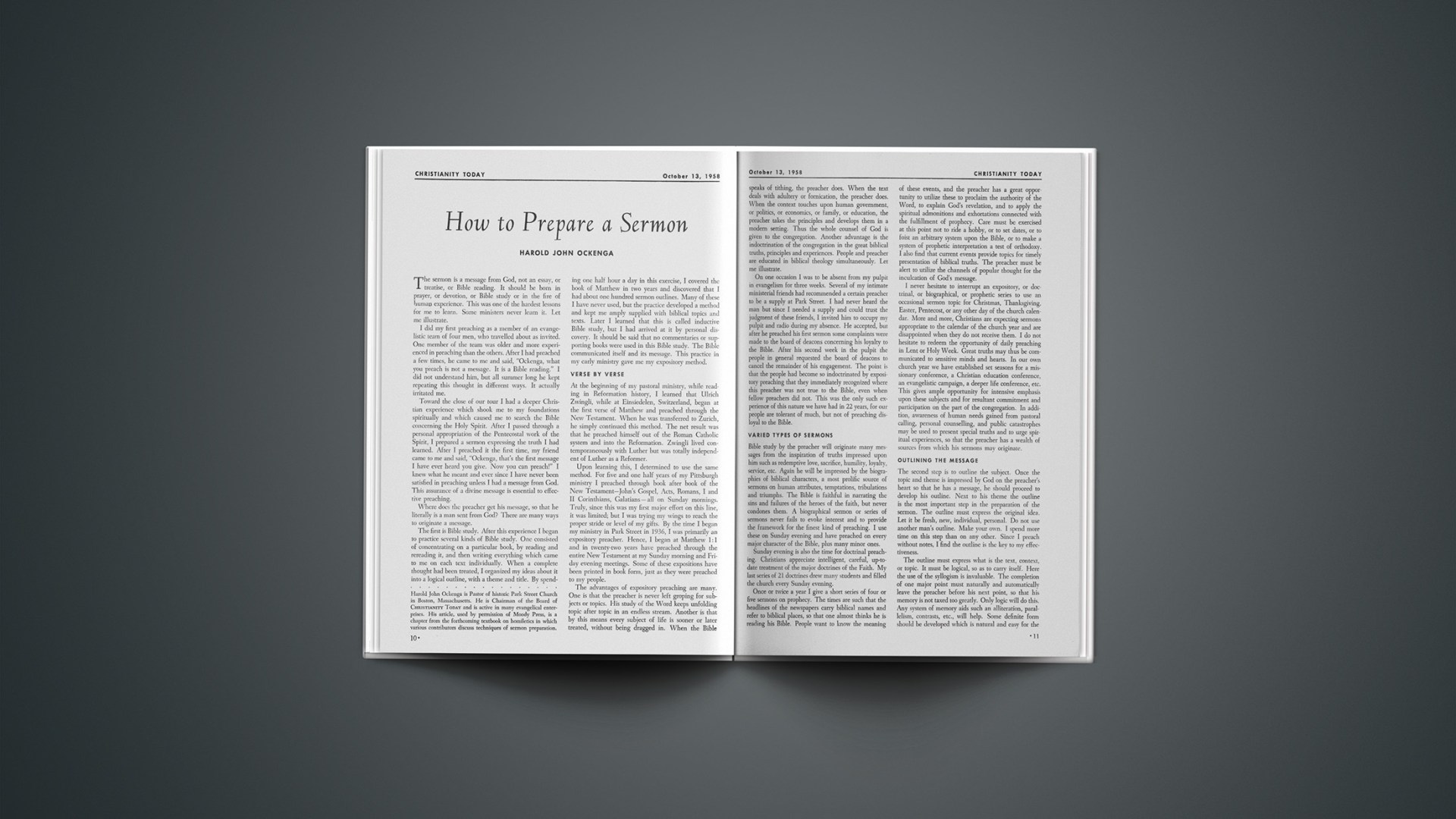
How to Prepare a Sermon

The sermon is a message from God, not an essay, or treatise, or Bible reading. It should be born in prayer, or devotion, or Bible study or in the fire of human experience. This was one of the hardest lessons for me to learn. Some ministers never learn it. Let me illustrate.

I did my first preaching as a member of an evangelistic team of four men, who travelled about as invited. One member of the team was older and more experienced in preaching than the others. After I had preached a few times, he came to me and said, “Ockenga, what you preach is not a message. It is a Bible reading.” I did not understand him, but all summer long he kept repeating this thought in different ways. It actually irritated me.

Toward the close of our tour I had a deeper Christian experience which shook me to my foundations spiritually and which caused me to search the Bible concerning the Holy Spirit. After I passed through a personal appropriation of the Pentecostal work of the Spirit, I prepared a sermon expressing the truth I had learned. After I preached it the first time, my friend came to me and said, “Ockenga, that’s the first message I have ever heard you give. Now you can preach!” I knew what he meant and ever since I have never been satisfied in preaching unless I had a message from God. This assurance of a divine message is essential to effective preaching.

Where does the preacher get his message, so that he literally is a man sent from God? There are many ways to originate a message.

The first is Bible study. After this experience I began to practice several kinds of Bible study. One consisted of concentrating on a particular book, by reading and rereading it, and then writing everything which came to me on each text individually. When a complete thought had been treated, I organized my ideas about it into a logical outline, with a theme and title. By spending one half hour a day in this exercise, I covered the book of Matthew in two years and discovered that I had about one hundred sermon outlines. Many of these I have never used, but the practice developed a method and kept me amply supplied with biblical topics and texts. Later I learned that this is called inductive Bible study, but I had arrived at it by personal discovery. It should be said that no commentaries or supporting books were used in this Bible study. The Bible communicated itself and its message. This practice in my early ministry gave me my expository method.

Verse By Verse

At the beginning of my pastoral ministry, while reading in Reformation history, I learned that Ulrich Zwingli, while at Einsiedelen, Switzerland, began at the first verse of Matthew and preached through the New Testament. When he was transferred to Zurich, he simply continued this method. The net result was that he preached himself out of the Roman Catholic system and into the Reformation. Zwingli lived contemporaneously with Luther but was totally independent of Luther as a Reformer.

Upon learning this, I determined to use the same method. For five and one half years of my Pittsburgh ministry I preached through book after book of the New Testament—John’s Gospel, Acts, Romans, I and II Corinthians, Galatians—all on Sunday mornings. Truly, since this was my first major effort on this line, it was limited; but I was trying my wings to reach the proper stride or level of my gifts. By the time I began my ministry in Park Street in 1936, I was primarily an expository preacher. Hence, I began at Matthew 1:1 and in twenty-two years have preached through the entire New Testament at my Sunday morning and Friday evening meetings. Some of these expositions have been printed in book form, just as they were preached to my people.

The advantages of expository preaching are many. One is that the preacher is never left groping for subjects or topics. His study of the Word keeps unfolding topic after topic in an endless stream. Another is that by this means every subject of life is sooner or later treated, without being dragged in. When the Bible speaks of tithing, the preacher does. When the text deals with adultery or fornication, the preacher does. When the context touches upon human government, or politics, or economics, or family, or education, the preacher takes the principles and develops them in a modern setting. Thus the whole counsel of God is given to the congregation. Another advantage is the indoctrination of the congregation in the great biblical truths, principles and experiences. People and preacher are educated in biblical theology simultaneously. Let me illustrate.

On one occasion I was to be absent from my pulpit in evangelism for three weeks. Several of my intimate ministerial friends had recommended a certain preacher to be a supply at Park Street. I had never heard the man but since I needed a supply and could trust the judgment of these friends, I invited him to occupy my pulpit and radio during my absence. He accepted, but after he preached his first sermon some complaints were made to the board of deacons concerning his loyalty to the Bible. After his second week in the pulpit the people in general requested the board of deacons to cancel the remainder of his engagement. The point is that the people had become so indoctrinated by expository preaching that they immediately recognized where this preacher was not true to the Bible, even when fellow preachers did not. This was the only such experience of this nature we have had in 22 years, for our people are tolerant of much, but not of preaching disloyal to the Bible.

Varied Types Of Sermons

Bible study by the preacher will originate many messages from the inspiration of truths impressed upon him such as redemptive love, sacrifice, humility, loyalty, service, etc. Again he will be impressed by the biographies of biblical characters, a most prolific source of sermons on human attributes, temptations, tribulations and triumphs. The Bible is faithful in narrating the sins and failures of the heroes of the faith, but never condones them. A biographical sermon or series of sermons never fails to evoke interest and to provide the framework for the finest kind of preaching. I use these on Sunday evening and have preached on every major character of the Bible, plus many minor ones.

Sunday evening is also the time for doctrinal preaching. Christians appreciate intelligent, careful, up-to-date treatment of the major doctrines of the Faith. My last series of 21 doctrines drew many students and filled the church every Sunday evening.

Once or twice a year I give a short series of four or five sermons on prophecy. The times are such that the headlines of the newspapers carry biblical names and refer to biblical places, so that one almost thinks he is reading his Bible. People want to know the meaning of these events, and the preacher has a great opportunity to utilize these to proclaim the authority of the Word, to explain God’s revelation, and to apply the spiritual admonitions and exhortations connected with the fulfillment of prophecy. Care must be exercised at this point not to ride a hobby, or to set dates, or to foist an arbitrary system upon the Bible, or to make a system of prophetic interpretation a test of orthodoxy. I also find that current events provide topics for timely presentation of biblical truths. The preacher must be alert to utilize the channels of popular thought for the inculcation of God’s message.

I never hesitate to interrupt an expository, or doctrinal, or biographical, or prophetic series to use an occasional sermon topic for Christmas, Thanksgiving, Easter, Pentecost, or any other day of the church calendar. More and more, Christians are expecting sermons appropriate to the calendar of the church year and are disappointed when they do not receive them. I do not hesitate to redeem the opportunity of daily preaching in Lent or Holy Week. Great truths may thus be communicated to sensitive minds and hearts. In our own church year we have established set seasons for a missionary conference, a Christian education conference, an evangelistic campaign, a deeper life conference, etc. This gives ample opportunity for intensive emphasis upon these subjects and for resultant commitment and participation on the part of the congregation. In addition, awareness of human needs gained from pastoral calling, personal counselling, and public catastrophes may be used to present special truths and to urge spiritual experiences, so that the preacher has a wealth of sources from which his sermons may originate.

Outlining The Message

The second step is to outline the subject. Once the topic and theme is impressed by God on the preacher’s heart so that he has a message, he should proceed to develop his outline. Next to his theme the outline is the most important step in the preparation of the sermon. The outline must express the original idea. Let it be fresh, new, individual, personal. Do not use another man’s outline. Make your own. I spend more time on this step than on any other. Since I preach without notes, I find the outline is the key to my effectiveness.

The outline must express what is the text, context, or topic. It must be logical, so as to carry itself. Here the use of the syllogism is invaluable. The completion of one major point must naturally and automatically leave the preacher before his next point, so that his memory is not taxed too greatly. Only logic will do this. Any system of memory aids such an alliteration, parallelism, contrasts, etc., will help. Some definite form should be developed which is natural and easy for the individual. Then that form of sermon structure should be followed. I generally have an introduction, three major points, and a conclusion, with three subpoints under each section, all in alliteration. All this is part of the outline and is designed to keep me from forgetting and to impress the message on the hearer. Let me illustrate.

My friend, Dr. Wilbur Smith, preached a very unusual and impressive Mother’s Day sermon on Proverbs 31, dealing with a virtuous woman. I was thinking about it a few days later. The sermon had four points. I could remember three, the first, second and last, but for the life of me, I couldn’t remember the third even though I knew the verses on which it was based. At a reception that same week I asked Dr. Smith to review his points for me. He did but said he could not remember the third point. The others were Industry, Fidelity and Sympathy, but neither of us could remember the third.

A few days later he saw me and said, “Now I remember. It was Personal Interest.” I said, “Why didn’t you give it a title like Courtesy or Generosity to achieve parallelism so we could remember it?” He replied, “Oh, I didn’t have time for that. It was coincidental that the others were parallel.”

I pointed out to him that this was the reason neither he, the preacher, nor I, the hearer, could remember the third point in the passage of Scripture. No man can preach without notes unless he observes these rules concerning his outline. Put time into it, for it will repay you. In addition, outline your conclusion first, so that you always keep in mind your goal, your aim, your purpose, and then you will not be shooting at random.

Obtaining Material

The third step is the obtaining of material for the sermon. Some people place this second or even first but that is a mistake, for it ruins originality or spoils logical development. When the topic and theme are chosen, and the outline is logically forged, then is the time to gather material for the flesh on the bones. Reading in the original languages or versions should be completed in connection with the outline. If this has not been done, it must be done now. The nuances of meaning of the biblical text must be mastered and often they throw much light and provide much material. The related texts and passages of Scripture bearing on the subject must be examined and used here.

Next the student should examine his file for general material, illustrations, and library references for material throwing light upon his topic and theme. Finally, let him refer to commentaries, critical and practical, to ascertain whether he has missed anything important by way of emphasis or teaching. The content of the sermon depends upon the thoroughness of this third step. Often I never get to the commentaries at all, for I have a complete message without them. I am much happier when this is the case.

The fourth step is to re-outline the message in the light of the material gathered. The process pertains only to the subheads of your own outline. If the original work was done well, the remaining work will be very minor. But it is wise to re-examine the outline in the light of all available facts and information.

The fifth step is to write out or dictate the sermon. For the first 15 years of my ministry, I wrote or dictated every sermon. This develops the preachers’ style. Vocabulary, phraseology, sentence structure, figures of speech, etc., come from work in writing. Once this is established firmly the preacher may abandon the practice. Now my sermons are all recorded on tape and disc, but often I dictate a message for printing. The ease with which this is done is the result of 15 years of early labor in forming a method, a style, and a facility. At this stage I dictate all the books I write. It is easier for me to dictate than to write, for my thoughts flow faster than I can write them.

Outline Memorized

The sixth step in preparation is to memorize the outline. I have to prepare and deliver three major sermons and two minor addresses in Park Street Church every week, besides all outside speaking engagements. I prepare my Sunday evening sermon first. Next, I prepare my Friday night exposition. Finally, I prepare my Sunday morning sermon. Thus it is easier for delivery. I deliver the Friday night lecture while it is fresh in my mind. Then I work Saturday on the Sunday morning sermon, finishing it and getting it in mind to deliver. On Sunday afternoon I revert to the evening sermon which was prepared first in the week, getting it in mind to preach without notes. In this way I unload my mind in the reverse order of preparation and avoid confusion. It takes me about two hours to memorize my outline. While I do this memory work, I bathe my heart and mind in prayer. The ease with which one memorizes will depend upon the care with which he made his outline.

The seventh and last step is to preach the sermon. Leave manuscript, notes and material on your desk when you enter the pulpit. Enter with a trust that God will bring all things to your mind which you knew. What He wants you to forget, let go by. What He wants to amplify, He can do by the power of suggestion. Thus you have liberty in preaching, direct address to the people, and give sway to the work of the Holy Spirit. This has been my method for 30 years of preaching without notes and no doubt will be as long as God allows me the great privilege of expounding the unsearchable riches of Christ.

END

Harold John Ockenga is Pastor of historic Park Street Church in Boston, Massachusetts. He is Chairman of the Board of Christianity Today and is active in many evangelical enterprises. His article, used by permission of Moody Press, is a chapter from the forthcoming textbook on homiletics in which various contributors discuss techniques of sermon preparation.

Cover Story

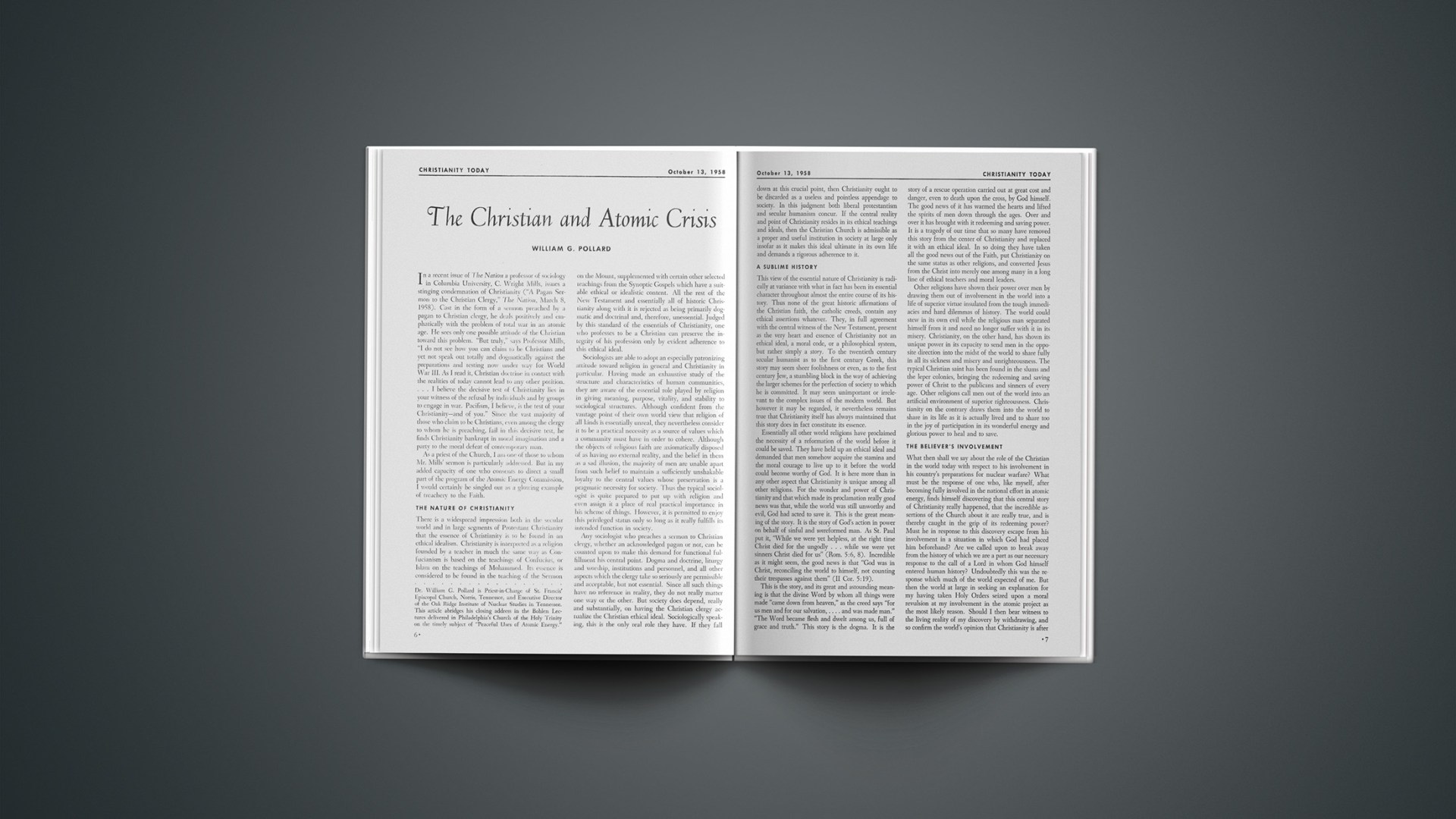
The Christian and Atomic Crisis

In a recent issue of The Nation a professor of sociology in Columbia University, C. Wright Mills, issues a stinging condemnation of Christianity (“A Pagan Sermon to the Christian Clergy,” The Nation, March 8, 1958). Cast in the form of a sermon preached by a pagan to Christian clergy, he deals positively and emphatically with the problem of total war in an atomic age. He sees only one possible attitude of the Christian toward this problem. “But truly,” says Professor Mills, “I do not see how you can claim to be Christians and yet not speak out totally and dogmatically against the preparations and testing now under way for World War III. As I read it, Christian doctrine in contact with the realities of today cannot lead to any other position.… I believe the decisive test of Christianity lies in your witness of the refusal by individuals and by groups to engage in war. Pacifism, I believe, is the test of your Christianity—and of you.” Since the vast majority of those who claim to be Christians, even among the clergy to whom he is preaching, fail in this decisive test, he finds Christianity bankrupt in moral imagination and a party to the moral defeat of contemporary man.

As a priest of the Church, I am one of those to whom Mr. Mills’ sermon is particularly addressed. But in my added capacity of one who consents to direct a small part of the program of the Atomic Energy Commission, I would certainly be singled out as a glowing example of treachery to the Faith.

The Nature Of Christianity

There is a widespread impression both in the secular world and in large segments of Protestant Christianity that the essence of Christianity is to be found in an ethical idealism. Christianity is interpreted as a religion founded by a teacher in much the same way as Confucianism is based on the teachings of Confucius, or Islam on the teachings of Mohammed. Its essence is considered to be found in the teaching of the Sermon on the Mount, supplemented with certain other selected teachings from the Synoptic Gospels which have a suitable ethical or idealistic content. All the rest of the New Testament and essentially all of historic Christianity along with it is rejected as being primarily dogmatic and doctrinal and, therefore, unessential. Judged by this standard of the essentials of Christianity, one who professes to be a Christian can preserve the integrity of his profession only by evident adherence to this ethical ideal.

Sociologists are able to adopt an especially patronizing attitude toward religion in general and Christianity in particular. Having made an exhaustive study of the structure and characteristics of human communities, they are aware of the essential role played by religion in giving meaning, purpose, vitality, and stability to sociological structures. Although confident from the vantage point of their own world view that religion of all kinds is essentially unreal, they nevertheless consider it to be a practical necessity as a source of values which a community must have in order to cohere. Although the objects of religious faith are axiomatically disposed of as having no external reality, and the belief in them as a sad illusion, the majority of men are unable apart from such belief to maintain a sufficiently unshakable loyalty to the central values whose preservation is a pragmatic necessity for society. Thus the typical sociologist is quite prepared to put up with religion and even assign it a place of real practical importance in his scheme of things. However, it is permitted to enjoy this privileged status only so long as it really fulfills its intended function in society.

Any sociologist who preaches a sermon to Christian clergy, whether an acknowledged pagan or not, can be counted upon to make this demand for functional fulfillment his central point. Dogma and doctrine, liturgy and worship, institutions and personnel, and all other aspects which the clergy take so seriously are permissible and acceptable, but not essential. Since all such things have no reference in reality, they do not really matter one way or the other. But society does depend, really and substantially, on having the Christian clergy actualize the Christian ethical ideal. Sociologically speaking, this is the only real role they have. If they fall down at this crucial point, then Christianity ought to be discarded as a useless and pointless appendage to society. In this judgment both liberal protestantism and secular humanism concur. If the central reality and point of Christianity resides in its ethical teachings and ideals, then the Christian Church is admissible as a proper and useful institution in society at large only insofar as it makes this ideal ultimate in its own life and demands a rigorous adherence to it.

A Sublime History

This view of the essential nature of Christianity is radically at variance with what in fact has been its essential character throughout almost the entire course of its history. Thus none of the great historic affirmations of the Christian faith, the catholic creeds, contain any ethical assertions whatever. They, in full agreement with the central witness of the New Testament, present as the very heart and essence of Christianity not an ethical ideal, a moral code, or a philosophical system, but rather simply a story. To the twentieth century secular humanist as to the first century Greek, this story may seem sheer foolishness or even, as to the first century Jew, a stumbling block in the way of achieving the larger schemes for the perfection of society to which he is committed. It may seem unimportant or irrelevant to the complex issues of the modern world. But however it may be regarded, it nevertheless remains true that Christianity itself has always maintained that this story does in fact constitute its essence.

Essentially all other world religions have proclaimed the necessity of a reformation of the world before it could be saved. They have held up an ethical ideal and demanded that men somehow acquire the stamina and the moral courage to live up to it before the world could become worthy of God. It is here more than in any other aspect that Christianity is unique among all other religions. For the wonder and power of Christianity and that which made its proclamation really good news was that, while the world was still unworthy and evil, God had acted to save it. This is the great meaning of the story. It is the story of God’s action in power on behalf of sinful and unreformed man. As St. Paul put it, “While we were yet helpless, at the right time Christ died for the ungodly … while we were yet sinners Christ died for us” (Rom. 5:6, 8). Incredible as it might seem, the good news is that “God was in Christ, reconciling the world to himself, not counting their trespasses against them” (2 Cor. 5:19).

This is the story, and its great and astounding meaning is that the divine Word by whom all things were made “came down from heaven,” as the creed says “for us men and for our salvation, … and was made man.” “The Word became flesh and dwelt among us, full of grace and truth.” This story is the dogma. It is the story of a rescue operation carried out at great cost and danger, even to death upon the cross, by God himself. The good news of it has warmed the hearts and lifted the spirits of men down through the ages. Over and over it has brought with it redeeming and saving power. It is a tragedy of our time that so many have removed this story from the center of Christianity and replaced it with an ethical ideal. In so doing they have taken all the good news out of the Faith, put Christianity on the same status as other religions, and converted Jesus from the Christ into merely one among many in a long line of ethical teachers and moral leaders.

Other religions have shown their power over men by drawing them out of involvement in the world into a life of superior virtue insulated from the tough immediacies and hard dilemmas of history. The world could stew in its own evil while the religious man separated himself from it and need no longer suffer with it in its misery. Christianity, on the other hand, has shown its unique power in its capacity to send men in the opposite direction into the midst of the world to share fully in all its sickness and misery and unrighteousness. The typical Christian saint has been found in the slums and the leper colonies, bringing the redeeming and saving power of Christ to the publicans and sinners of every age. Other religions call men out of the world into an artificial environment of superior righteousness. Christianity on the contrary draws them into the world to share in its life as it is actually lived and to share too in the joy of participation in its wonderful energy and glorious power to heal and to save.

The Believer’S Involvement

What then shall we say about the role of the Christian in the world today with respect to his involvement in his country’s preparations for nuclear warfare? What must be the response of one who, like myself, after becoming fully involved in the national effort in atomic energy, finds himself discovering that this central story of Christianity really happened, that the incredible assertions of the Church about it are really true, and is thereby caught in the grip of its redeeming power? Must he in response to this discovery escape from his involvement in a situation in which God had placed him beforehand? Are we called upon to break away from the history of which we are a part as our necessary response to the call of a Lord in whom God himself entered human history? Undoubtedly this was the response which much of the world expected of me. But then the world at large in seeking an explanation for my having taken Holy Orders seized upon a moral revulsion at my involvement in the atomic project as the most likely reason. Should I then bear witness to the living reality of my discovery by withdrawing, and so confirm the world’s opinion that Christianity is after all only an ethical ideal? Or would it be a truer witness to stay where I am, the world then wondering whether Christianity might after all involve something more than mere idealism?

Mr. Mills, from whose pagan sermon to Christian clergy we quoted at the outset, has issued a call to all Christians to join in an all-out effort to end warfare at all costs. One of the chief difficulties with such a call, as I see it, is the sheer enormity of the task. Taken seriously it could easily absorb the entire energy of the Church and make the elimination of war so overriding a consideration that the real task of the Church of proclaiming the Gospel would be swallowed up and lost.

A serious effort of the necessary scope to mobilize all Christians in the service of such an end would involve the Church in what seems to me a most damaging identification of Christianity with the aims and aspirations of the secular world. For secular humanism is just as intensely idealistic and humanitarian as Christianity appears to be to those who have made it into an idealism. Modern man by and large looks upon contemporary history as his own affair, and the world as something to be molded by science to the benefit of man. This is the secular ideal, and it necessarily abhors war because war threatens man’s autonomy and is by now capable of wiping out the gains he has so far made in his quest for self-sufficiency, mastery, and omnipotence. Secular humanism places its whole hope and trust in the efficacy of improved social structures and informed political action to cope successfully with the “problem” of war. It insists that the Church, if it has any residual social value, should join with it so as to form a united front against this dark threat to the sovereignty of man. Placing all our confidence in informed social and political action, let us, they say, make together a great effort to achieve a peaceful world. For them Christianity as such is unreal and outmoded, but they are quite ready to recognize Christian love as a powerful sociological force and to exploit it to the full for the achievement of their goal.

The easy identification of Christian ethics with secular goals is perhaps the greatest barrier in the way of modern man’s receptiveness to the central proclamation of Christianity, the wonderful good news that “God was in Christ reconciling the world unto himself.” It is important for the Christian to see this clearly and to avoid the temptation to allow something secondary and derived to obscure the central theme to which he is called to bear witness. War, death, and destruction are not the ultimate calamity. If they were, we should be lost indeed, for time would then see to it in any event that every achievement of man would finally be swallowed up in meaninglessness and nothingness.

Terrible as atomic war unquestionably is, it does not stand as dominantly against Christianity as another more subtle, and from man’s standpoint much less fearful, aspect of our contemporary life. For the most radical opposition between Christian faith and the actuality of modern life is found not in modern warfare but rather in our modern quest for the complete autonomy of man. The prevailing spirit is one of marvel at the triumphs of science, medicine, and modern technology. The prevailing hope lies in the expectation of the practical achievement of a man-made universe functioning in accordance with man-made standards of efficiency, economy, and comfort. No more terrible affront to his Creator can be made by man than this all-out determination to seize God’s creation from him and make himself sovereign within it.

War is not only a fruit of the wickedness of human hearts whose cure we must be ever vigilant to bring about. It is also, and always, at the same time a manifestation of divine judgment on human sin. We must be careful that in bringing the redemptive power of the Gospel to the cure of the one, we do not at the same time become involved with the world at large in a proud and unrepentant rebellion against the other. For how can we be sure that it is really God’s will that modern man should be released from the judgment of war, and set free thereby to proceed once more unhampered along his chosen path toward the achievement of mastery over nature and society?

Dispelling Human Autonomy

The great truths of the Christian faith, which must be proclaimed if the prevailing secular illusions of the possibility of human autonomy are to be dispelled, are the Lordship of Christ in history and man’s need for humbling himself and seeking guidance and mercy from him who really created the universe. We must at all costs avoid committing ourselves to any course which weakens or obscures this primary mission of Christianity. This to me is a crucial problem for those Christian bodies organized for action on behalf of world peace. How, for example, is the world at large to distinguish between the Christian mission for world peace and the equally urgent call to all secular humanists of reasonableness and good will which was issued a few years ago by Mr. Lewis Mumford in his book, In the Name of Sanity? If we in the name of Christ issue the same call as that which the world at large issues in the name of sanity, how is Christ to be truly known again in our time? If our preaching becomes identical with Mr. Mills’ pagan sennon, who is to preach the truth of Christ to the pagan world?

From our finite vantage point on the earth we can easily acquire a view of reality and a scale of values which is the direct opposite of God’s view which encompasses the whole of creation from an infinite vantage point. The contrast between God’s view and ours can be made with respect to the whole modern technological enterprise including as its most striking manifestation the atomic energy enterprise. Doubtless the majority of people would agree that the expenditure of human energy in the development of the beneficial aspects of atomic energy for power, industry, agriculture, and medicine, is a social good directed toward the betterment of the conditions of human life and, therefore, doubtless pleasing to God and in accordance with his will for man. General assent would also be given that the devotion of such a large part of our energy to the perfection of atomic and thermonuclear weapons in preparation for a holocaust on a truly terrible scale is an unmitigated evil diametrically opposed to God’s will and meriting only his wrath and righteous indignation. Before giving our approval to these apparently axiomatic assertions, let us, however, pause to ask whether it might be that in God’s sight these two aspects of our atomic energy efforts would stand in a quite different contrast?

An unusual and important book was published several years ago under the title, Tomorrow is Already Here, by the Swiss journalist, Robert Jungk (Scribner’s, 1954). This book is not nearly so well known as it deserves to be. He holds up a mirror to American life which reflects a rather ugly image. In summary he says of this image: “America is striving to win power over the sum total of things, complete and absolute mastery of nature in all its aspects. This bid for power is not directed against any nation, class, or race.… The stake is higher than dictators’ seats and presidents’ chairs. The stake is the throne of God. To occupy God’s place, to repeat his deeds, to re-create and organize a man-made cosmos according to man-made laws of reason, foresight, and efficiency: that is America’s ultimate objective.”

If this indeed is a valid picture of the innermost drives which empower contemporary American life, would it not be true that such a “grasping for omnipotence” could well be a far more terrible affront to God than even our current preparations for atomic warfare? If our effort in the peaceful development of atomic energy is taking place in such a context, it may really be worse when viewed from the perspective of the eternal purpose and destiny of human life than is our effort to develop the military aspects of atomic energy. If this is indeed the case, then it is perhaps not God’s will that we be released from the threat of nuclear warfare.

With respect to the proposal that the United States immediately and unilaterally stop all military preparations and weapons development, which Mr. Mills’ sermon urged the Christian clergy to adopt, I could not possibly conscientiously urge such a policy upon our government. I do not believe it would make World War III less likely, but rather my own expectation would be that such a decision would encourage war. Moreover, I cannot believe that a free decision on our part to abandon ourselves and the rest of the world to the grim tyranny of communism would represent a right or moral action on our part. At the same time, however, I must agree with Mr. Mills that war has become so total and so horribly destructive that any policy of preparation for it which seriously contemplates engaging in it is morally indefensible. I cannot develop a rational reconciliation between these two positions.

What will be the outcome of this terrible juncture we cannot foresee. We must, of course, do everything in our power to find ways of restraining the terrible potentialities of the human will now that the vast powers locked in the very heart of matter have been placed at man’s disposal. But when we have done all that is within our power to do, what if the end is nevertheless upon us? Is this prospect to be the occasion for us of hysterical fear and panic?

For secular man it is indeed a black and fearful prospect. But for the true Christian it is nothing of the kind. For the Christian lives in a created world; a world that has had a beginning in time and is moving toward an end; a world which was brought into being in the first place for some wonderful and mysterious purpose of its Creator, and whose unfolding in time is leading toward some great and wonderful fruition at its climax. The whole New Testament is pervaded with a thrilling sense of the imminent possibility of the termination of history in a great climactic act in which the judgment of the Creator is to be finally rendered on his creation. Within the life in Christ the contemplation of such finality is the occasion of sober joy and prayerful anticipation. As St. Paul puts it: “For the creation waits with eager longing for the revealing of the sons of God … the creation itself will be set free from its bondage to decay and obtain the glorious liberty of the children of God” (Rom. 8:19–21).

From his own profound understanding of the dark depths of his own sinful nature, the Christian knows that it is the power of Almighty God alone which can “order the unruly wills and affections of sinful men;” that in the words of the 65th Psalm it is he “who stilleth the raging of the sea, and the noise of his waves, and the madness of the peoples.” But knowing this in a spirit of deep contrition and repentance, the Christian also knows the joyous wonder of the Good News that “God so loved the world that he gave his only begotten Son to the end that all that believe in him should not perish, but have everlasting life.” Secure in this knowledge the Christian, having by the grace of God done all that he can in his own small way, is content to leave the ultimate destiny of the world in the hands of its Creator.

Dr. William G. Pollard is Priest-in-Charge of St. Francis’ Episcopal Church, Norris, Tennessee, and Executive Director of the Oak Ridge Institute of Nuclear Studies in Tennessee. This article abridges his closing address in the Bohlen Lectures delivered in Philadelphia’s Church of the Holy Trinity on the timely subject of “Peaceful Uses of Atomic Energy.”

Cover Story

Billy Graham Speaks: The Evangelical World Prospect

EXCLUSIVE INTERVIEW

CHRISTIANITY TODAYis indebted to Dr. Billy Graham for this significant interview in which the distinguished evangelist relays personal impressions of the status of the Christian impact upon our generation and of spiritual trends throughout the world. No evangelist in Christian history more than Dr. Graham has proclaimed the gospel of Christ to multitudes on a world scale by mass meeting, radio and television. He expressed the following views on the eve of his evangelistic crusade in Charlotte, North Carolina. Questioners included distinguished members of the Board of Directors ofCHRISTIANITY TODAY, Dr. Harold John Ockenga of Boston’s Park Street Church and Dr. Robert J. Lamont of Pittsburgh’s First Presbyterian Church, and Editor Carl F. H. Henry.

DR. HENRY: Do you sense any world-wide moving of the Holy Spirit today?

DR. GRAHAM: Yes, I do. Most everywhere, Christian leaders have told me that it is easier to win people to Christ than ever before.

DR. HENRY: Any particularly noteworthy areas?

DR. GRAHAM: I think that possibly in Latin America I have sensed the greatest spirit or manifestation of what I call genuine revival in the Protestant church. The Protestant church in Latin America has suffered a certain amount of persecution from various sources. This has brought about the emergence of a strong, virile, and dynamic leadership that I have not sensed in any other part of the world.

DR. LAMONT: What of the missionary witness?

DR. GRAHAM: I found practically no extreme liberalism in Latin America. There is no modernism. The Gospel is preached by most of the denominations in its purest form, compared with other mission fields I have visited.

DR. OCKENGA: Do you see Latin America as a promising field for a reformation in our century?

DR. GRAHAM: I couldn’t answer that. I do know that Catholicism in Latin America takes a different thrust than it does in the United States. A Catholic theologian recently told me that unless there is a reform within the Catholic church, in many countries there will be a revolt against the Catholic church, and that only the Protestants and Communists would profit by it. In many countries one senses anti-clericalism. I think that there is something new in Latin American countries. Brazil, Chile, Guatemala, perhaps even Mexico might be Protestant within another generation.

DR. OCKENGA: Have you any particular anxiety about the course of foreign missions today?

DR. GRAHAM: I am alarmed over the thought prevailing in some denominational missions that they should not penetrate any further into Hinduism, Buddhism, or other religions. The idea is that we should peacefully co-exist—hold what we have, and evangelize as we can. Pioneer missions is something some denominational leaders are no longer interested in. To do pioneer missions work a man not only has to have a dedication but he has to have a message. Unfortunately, a lot of our seminary graduates today just don’t have the message.

DR. LAMONT: As far as your appraisal of the new independent indigenous churches is concerned, is there any marked evangelical leadership in these younger foreign churches?

DR. GRAHAM: I would say that in the overwhelming majority of the places I’ve visited, at least in many cases, nationals are more evangelical than the missionaries.

DR. HENRY: You have spoken of the comparative ease with which converts are now being made and you have said this happens in many religions today. How do you discriminate the presence of the Holy Spirit in this general religious moving? What are the criteria of the presence of the Holy Spirit?

DR. GRAHAM: I think there is a hunger of the soul and an inquiring of the mind after some philosophy, some ideology, or some religion that will satisfy. The talk of scientists about annihilation of the human race is penetrating the thinking of the world. Many people are beginning to reflect on the possibility of racial suicide and they wonder, “What have I to hold on to? What do we have that can save us?” I think that’s one element. But I also feel that beyond that is the sovereign presence of the Holy Spirit in penetrating power that perhaps is using this religious inquiry in allowing an acceptance of the Gospel all over the world, perhaps in such scale as we have not seen before in history.

DR. OCKENGA: Could you elaborate on that point?

DR. GRAHAM: I think that we are seeing on the one hand this tremendous spiritual emphasis and religious interest, and on the other hand materialism is gaining in many different ways. When God does great work, powers of evil also rise.

DR. LAMONT: The Bible says wickedness shall grow worse and worse. But at the same time, is it not possible that the church is going to grow better and better? Don’t you think that at the same time it’s possible for the saints to become more sanctified?

DR. GRAHAM: I am not sure that I would say that in America saints are more sanctified. I’m not so sure but what they are less sanctified. I think that television, for example, is having a detrimental effect on Christians. I think that they are no longer sensitive to sin. I think that television has brought the night club into the home, along with violence and sex—things that Christians looked upon 10 years ago with abhorrence. They have gradually become desensitized, and I can cite case after case in which Christians now watch television without feeling any twinge of conscience.

DR. HENRY: Do you mean that the secular thrust has penetrated more deeply in America than the spiritual thrust?

DR. GRAHAM: The spiritual thrust, it seems to me, has been almost numerical. There is this great influx into the churches and this great interest, but so much of it is superficial.

DR. HENRY: What would you say is the greatest need of the Church today?

DR. GRAHAM: I believe that the thing that we are missing today is not organization, it is not facilities, and it is not communication. The great need in the world today is for Spirit-filled men who really produce the fruit of the Spirit. I had a Hindu student say to me in Madras, “I would become a Christian if I could see one.” And when he said that to me he was looking at me. That was one of the greatest sermons ever preached to me.

DR. LAMONT: Last year, the growth in American church membership failed to keep up with the population increase. What is your comment?

DR. GRAHAM: The increase in population over the increase in church membership was small. In my opinion, there is no indication of a trend here. I don’t think there should be any discouragement over this at all.

DR. OCKENGA: As population increases and Christianity vies for the additional people with other major religions, we’ll probably have fewer Christians proportionately. How do you reconcile this with your viewpoint of a greater hunger for spiritual things?

DR. GRAHAM: Well, the job of the Christian Church in the proclamation of the Gospel is not necessarily to win the world, but to confront the world with the Gospel of Christ and to give the world an opportunity to receive or reject him.

DR. OCKENGA: Does the Bible teach, in your opinion, that the whole world is going to be converted?

DR. GRAHAM: No. I think the Bible teaches to the contrary. The Scripture says that the cup of iniquity will become so filled that the only alternative is judgment.

DR. HENRY: What spectacular gains are evangelicals making today and what can we look for next?

DR. GRAHAM: The growth of Bible schools and colleges, and accreditation of our academic efforts are evidence of great strides being made by evangelicalism. Then there is the tremendous discussion about evangelical theology. Ten or fifteen years ago evangelicalism was almost dead. It was in a rut. Now great discussions are going on and liaison is being established between various shades of thought within evangelical circles. I think Fuller Theological Seminary is an evidence of that. I think that CHRISTIANITY TODAY is an evidence of that. I think perhaps our crusades are additional evidence.

DR. LAMONT: How about the large denominations?

DR GRAHAM: I see evangelical wings within the denominations having a revival. There is unquestionably a new emphasis on evangelism.

DR. HENRY: Do you find any evidence that in the Protestant churches there is a new note of authority—a note of authority sounded afresh? What rediscovery of the Bible do you sense in the pulpits of America?

DR. GRAHAM: I feel that there is in process a return to biblical preaching. I would say that the greatest emphasis at the moment is probably being given to the social concern of the Old Testament prophets such as Amos and Hosea, that in studying those Old Testament prophets some of our brethren have come up with the realization of judgment. I think we are hearing a note of judgment being preached today a little more, perhaps, than we did before. And I think the lordship and the centrality of Christ and the Cross is being emphasized in the pulpit today. But probably not the substitutionary aspect of the Cross that we would like to see; sometimes the Cross is held up as a sentimental thing to which we are to come. But I feel that there is a great shallowness in preaching today, and I feel that the Church is lacking in great preaching. For example, when they have a conference in any of our great interdenominational meetings, you will notice how often they have about the same list of speakers. At least, they are trying to get the same speakers, because there are so few great preachers in America today. And I think one reason is because the minister today seldom does any creative thinking. He’s not studying. And many of our seminaries are not emphasizing the need of preaching. We are turning out administrators. We are turning out personal counsellors, particularly along lines of psychological counseling. I think our need is to return to great preaching, great Bible preaching! And I think that people will come to hear great preaching.

DR. HENRY: Do you sense within the organized church a drive toward ecumenism as fully as a move for evangelism?

DR. GRAHAM: The emphasis on the ecumenical movement, it seems, is primarily in the hands of the leadership of the denominations. I do not think there is very much ecumenicity on the parish level. I think that the minister down in the grass roots is becoming far more interested in evangelism of one sort or another—perhaps not using my definition of evangelism but some sort of evangelism. And I think he recognizes that there is a need within his own congregation and in his community. To many, evangelism is the penetration of the Christian influence within the social structure of a community.

DR. HENRY: In Germany after World War I, spiritual leaders were saying that unless we bridge the gap to the university mind and to the laboring forces with the Gospel, it was dubious that any significant Christian advance would be registered. How do you feel about that?

DR. GRAHAM: I feel that is absolutely true. And I think we are making practically no spiritual penetration into the laboring class.

DR. HENRY: Does the destiny of Christianity in our generation hang in any significant way upon the layman?

DR. GRAHAM: Wasn’t the Early Church primarily a lay movement, and haven’t we perhaps made a tragic mistake in this distance that we have built up between the laity and the clergy? And haven’t many churches made the mistake of depending on the minister to do their work for them, when actually all laymen are called to be workers? Many laymen feel that their job is to sit in the pew on Sunday and perhaps contribute a few things, when actually their job is also to be ministers.

DR. LAMONT: If you were a pastor of a large church in a principal city, what would be your plan of action?

DR. GRAHAM: I think one of the first things I would do would be to get a small group of eight or ten or twelve men around me that would meet a few hours a week and pay the price! It would cost them something in time and effort. I would share with them everything I have, over a period of a couple of years. Then I would actually have twelve ministers among the laymen who in turn could take eight or ten or twelve more and teach them. I know one or two churches that are doing that, and it is revolutionizing the church. Christ, I think, set the pattern. He spent most of his time with twelve men. He didn’t spend it with great crowds. In fact, every time he had a great crowd it seems to me that there weren’t too many results. The great results, it seems to me, came in his personal interviews and in the time he spent with his twelve.

DR. LAMONT: Would you say that Khrushchev’s conversion is an impossibility?

DR. GRAHAM: No! No man is beyond the mercy of God.

DR. LAMONT: Ought Christians to pray for him?

DR. GRAHAM: Yes. We are to pray for all men.

DR. LAMONT: How best can Communist leaders be reached with the Gospel?

DR. GRAHAM: Through prayer.

DR. LAMONT: Would you like to go to Russia to preach?

DR. GRAHAM: Yes.

DR. LAMONT: Is there any prospect?

DR. GRAHAM: There is no contact at the moment.

DR. OCKENGA: Has there been a shift of emphasis in your preaching?

DR. GRAHAM: I have preached a great deal of judgment, and still do, but I would say there has been a shift toward emphasis on other aspects of the Gospel. Especially has there been a shift to the Cross which I believe is central. In fact, now I feel that if I preach any message on any subject in which the Cross is not central, I have not truly preached the Gospel.

DR. OCKENGA: Would you name another aspect of the Gospel in which you are now placing emphasis?

DR. GRAHAM: Within the last year, I have been emphasizing the cost of discipleship. I care less and less how many people come forward—whether anybody comes forward or not. The important thing is whether I have made clear the Gospel and the cost of following Christ. We’re saved by grace, but discipleship also means making Christ the Lord of our daily lives and this costs dearly. And I believe that one of the emphases needed in evangelism is to spell out the cost of following Christ. Many people fail to count the cost. Yet it seems to me that the times that I have preached and made it more difficult than any other time, that is the night we have our greatest response.

DR. HENRY: What has heartened you most?

DR. GRAHAM: During the past year, the tremendous response which we had in California was unprecedented in all our travels over the world.

DR. HENRY: Numerically? Is that what you mean?

DR. GRAHAM: Yes, in a way. Everywhere we went the crowds came. The people came forward, as if they had been waiting. This is to God’s glory.

DR. LAMONT: What is the largest numerical response you have seen in America?

DR. GRAHAM: At our San Antonio rally in July, some 3,000 came forward. That was the largest number to come forward at an American meeting.

DR. OCKENGA: What does that signalize?

DR. GRAHAM: That signalized to me that television has given us a penetration that radio has never accomplished.

DR. HENRY: What are you hoping for next?

DR. GRAHAM: I’m giving some thought to taking less time in a crusade and going to some cities for just a week, so that we can get to more cities now, while this great harvest seems to be ready. Invitations for such meetings seem almost unlimited but the decision to accept must be of the Holy Spirit. For this I request your earnest prayers.

END

News Briefs from October 13, 1958

Religious Meetings

Carolinas For Christ

Billy Graham team members must go back at least two years to recall anything like the Charlotte crusade.

Reinforcing a warm North Carolina welcome is a spirit of expectancy and conviction in the meetings. In his home town, Graham is preaching with unusual freedom and power.

At the very outset, the crusade broke into a cultural and social bracket that was not thoroughly penetrated since Graham’s Oklahoma City meetings of 1956. The country club set not only turned out to hear the evangelist at the big-domed Charlotte Coliseum, but arranged inquiry meetings in homes. As a result, many of the Carolinian elite were coming to grips with spiritual reality.

Graham feels that the crusade went deeper more quickly than any other he can remember. He says many are coming to the meetings with the definite expectation of responding to the invitation. Nation-wide telecasts helped to prepare the way, Graham explains, along with the general feeling that the world is at a dead end and that something radical must be done.

The crusade is the talk of the town. Communications media are giving it the big-story treatment. One newspaper is publishing every sermon in full.

The Coliseum manager said the opening service of the crusade found an overflow crowd of 13,175 in the main auditorium and another 1,200 in an adjoining auditorium, where sound equipment a few days later was augmented with closed circuit television. Even during weekdays, vacant seats were scarce. Nearly 3,000 decisions for Christ were recorded during the first week of the crusade.

The crusade is scheduled to run through Sunday, October 19. Graham was considering a one-week extension. Every Saturday night meeting is being telecast nationally.

T. M.

Count Down

Philadelphians will likely see many a smartly-dressed male with Bible under arm this week. Typical is G. Tom Willey, vice president of the Martin Company and secretary of Christian Business Men’s Committee International, which holds its 21st annual convention at Philadelphia’s Benjamin Franklin Hotel, October 15–19.

Willey authored a tract which the American Tract Society published especially for the convention. Titled “The Last Count Down,” the tract describes a typical missile firing and makes a Christian application.

“Some have said that the satellite proves there is no God,” Willey writes. “To me it proves the exact opposite. The only reason we can orbit is because God has set up some rules.… The same force that keeps the stars going keeps the satellite going when it is set in its right orbit.”

“Dental Evangelism”

Missionaries in pioneer areas know well the attraction provided by a medical clinic. Not as widely recognized is the appeal of free dental treatment. In India, for instance, the ratio of dentists to population is reported about one to 180 thousand. Natives will travel far for treatment of dental diseases.

Seizing upon this acute need as a means of ministering to a much greater need (that of a Saviour) is The Missionary Dentist, Inc., an organization headed by Seattle dentist Vaughn V. Chapman. Now in its eighth year, the organization recruits dentists to serve as foreign missionaries, and encourages establishment of dental clinics at missionary outposts.

Late in August, Chapman’s group sponsored the second “Missionary Dentist World Conference” at Eugene, Oregon. One of the speakers was Dr. Ted Shanks, missionary dentist in the French Camerouns, where under sponsorship of the United Presbyterian Church in the U. S. A. a dental clinic is operated along with a school for training African young men to become “dental evangelists.”

Dominion Of Canada

United Church

Delegates at the 18th biennial General Council of the United Church of Canada approved a report of its Commission on Union which declared that “unmistakable apathy” toward merger of the denomination with the Anglican Church of Canada existed in both communions.

The report urged that lines of communication and friendship remain open, although it added, “the time has come when the Anglican church should make it plain whether it really wishes to continue these conversations, or whether it now desires to terminate them.”

Union discussions between the two bodies, initiated by Anglicans 15 years ago, have been at a standstill.

Following action on the report, delegates asked the General Council to turn its attentions toward possible union with the Presbyterian Church in Canada, “a sister church.”

The Presbyterian church organization remained out of the union with Methodists and Congregationalists in 1925 when the United Church of Canada was formed. But about 70 per cent of Presbyterian congregations joined in the merger. The United Church now has a membership of more than 955,000.

Dr. W. Harold Young, chairman of the Commission on Union, said two of the biggest obstacles to union between Anglicans and the United Church are “Anglican insistence on the acceptance of bishops as spiritual descendants of the original Apostles and the recognition of holy orders.”

Prime Minister John Diefenbaker told the 400 commissioners to the General Council that “Canada has a message to the world to reject unchristian theories of race superiority which stand in the way of true brotherhood of man and which are in no small measure responsible for the march of communism.”

Diefenbaker said he hoped to persuade Parliament to open a prayer room in the House of Commons similar to one in the U. S. Congress.

The council voted $50,000 for experimental television ministries during the next two years and increased the minimum salary for ministers.

Among resolutions passed was one which urged recognition of Communist China by the Canadian government. This was the third General Council to call for such action. Delegates refused to approve a section of the resolution presented by the church’s Board of Evangelism and Social Service which called for “a penitential attitude” on the part of Red China before admission to the United Nations.

The Rt. Rev. Angus J. Macqueen, minister of First-St. Andrew Church in London, Ontario, was elected moderator.

A New Synod?

Leaders of seven Canadian Lutheran synods conferred for a third time last month on the possibility of merger.

Chief development of the latest meeting at Winnepeg: Four districts of the Lutheran Church—Missouri Synod with representation in Canada reorganized to establish eligibility for a common charter.

The Missouri Synod has 75,000 members in Canada. Total Lutheran membership in Canada is 240,000.

The Ideal Sermon

The fifth World Conference of Pentecostal Churches, held in Toronto last month, drew 9,000 delegates from 40 countries (including Poland and Yugoslavia), representing every continent.

High point of the eight-day conference was a colorful missionary rally. All meetings were held on the Canadian National Exhibition grounds.

Clergymen present received specific advice on sermon lengths from Dr. Lewi Pethrus, highly successful Swedish Pentecostal pastor who estimates he has preached some 50,000 times during his 56 years in the ministry. Pethrus said sermons should be no shorter than 35 minutes and no longer than 45.

Pethrus is pastor of a Stockholm church which has about 6,500 members, although the sanctuary seats “just” 4,500. “But we have outposts for them,” he said. “We have 58 Sunday schools in the city.”

Eutychus and His Kin: September 29, 1958

LIMERICK CONTEST

The unusual reception of my Rally Day collection has encouraged me to undertake a new anthology for grown-ups in the Sunday School. Since the classical limerick form is ideal for the width of this column, I plan to devote a major section to Sunday School limericks.

Your cooperation is invited in this venture, which already promises to be the outstanding limerick collection of the decade on this subject. Entries may be submitted on discarded Sunday School papers retrieved from the church lawn or parking lot. Limericks will be judged as to poetic structure (five anapaestic lines: 1, 2, and 5 are of three feet and rhyme; 3 and 4 are of two feet and rhyme), incisiveness, and gentle charm. Get the swing of it from the samples below and send your entries before midnight to the undersigned.

There was a Beginner named Muntz

Who never missed Sunday School once;

His award bars galore

At last reached to the floor

From the stool where he sat as a dunce.

A teacher in primary grades

Loved audio-visual aids;

She never was seen,

For the filmstrips and screen

Required that she keep down the shades.

The committee conducted research

In the basement of Center Street church,

And it silenced the noise

Of the chairs and the boys

With rubbers and switches of birch.

Librarian Lillian Gray

Read three Christian novels a day.

When asked to explain,

She replied with disdain,

“Don’t you think I am earning my pay?”

Mrs. Fixture’s been teaching for years

Countless classes of Primary dears,

And now it appears

That if she perseveres

Our whole staff will be leaving in tears.

Our class always meets to discuss

All the problems related to us.

We can get most involved,

Although nothing is solved

And we seldom remember the fuss.

EVOLUTION REVISITED

Professor Clark points out that the term “evolution” involves an ambiguity and that the basic idea of descent with modification has been used by some evolutionists illogically as a support for an atheistic philosophy (Sept. 1 issue). It might also be pointed out that the term “creation” involves an ambiguity of the same type. Sometimes the term is used to cover everything which exists (as in the expression, “we are His creatures”), but at other times it is limited to things which came into existence suddenly and entirely apart from process. Professor Clark uses the term “special creation” in this latter sense to avoid ambiguity, but it seems to me that he is in danger of falling into the same type of non sequitur as that of the atheistic evolutionists.

The quotation from Lamont says essentially, “We now know that these things came about by slow processes, so God cannot have done it.” Is not Clark saying, “We cannot find evidence of slow processes in certain cases, so God must have acted in these cases”? Why should the spontaneous development of anything, even of simple life from inanimate matter, be regarded only as an atheistic idea? Does God never act through processes?

There are certainly “gaps” in the scientific evidence for evolution; the “theory of evolution” assumes that mechanistic processes can be found to close these gaps or at least to account for them. The only alternative is to believe that they cannot even theoretically be accounted for mechanistically. But the gaps have never been static; some of them have closed. Pointing out the existence of gaps does not weaken the theory of evolution; on the other hand, unless the gaps are completely static, their existence cannot be safely used to support special creation.

To be a genuine alternative to the theory of evolution, the theory of special creation must say exactly at which points God has acted suddenly and without process. The creation of life is usually taken as one of these points, but investigators in my own field, biochemistry, are actively narrowing this “gap” from both sides. The gap between inanimate matter and living things is not where it used to be. Inanimate matter has been shown to be capable of spontaneously forming more complex arrangements than previously thought possible; sub-living systems less complex than the cell have been shown to carry on many of the processes formerly associated only with living things. As Christians, can we not still see the creative hand of God in these places where gaps used to be?

Professor Clark points out that special creation is incompatible with what might be called “general evolution.” After reading his article and trying to think through my own position I have decided that I must be a “general creationist” and a “special evolutionist.”

Asst. Prof. of Chemistry

Iowa State College

Ames, Iowa

“The fresh look at the hypothesis of evolution” has a helpful insight into the problem faced by the orthodox who still resist the acceptance of the total evolutionary philosophy. Dr. Clark is to be commended for recognizing that species need not be considered incapable of mutating to other species. He quotes Goldschmidt who held that species are separated by bridgeless gaps. This concept is not held by the majority. Dobzhansky, for example, has a section in his 1951 volume which shows how some species of fruit fly are clearly separable from others, but others are on the borderline of the separation of one species into two. Let no creationist be found maintaining that species are fixed.

Scripture teaches that man arose from non-living matter—dust—by the act of God. Did not the first living thing so arise? Read George Wald’s … article on the “Origin of Life” in Scientific American a couple of summers ago to see modern ideas of life’s origin.

To be sure, we do not have a continuous fossil series (there are a number from a species through a second to a third, or even farther). Anyone will be cautious in using this argument from silence if he reads G. G. Simpson’s The Major Features of Evolution, 1953. Our belief in creation rests on revelation, not on an incomplete fossil record.

Prof. of Zoology

Wheaton College

Wheaton, Ill.

Apple PodcastsDown ArrowDown ArrowDown Arrowarrow_left_altLeft ArrowLeft ArrowRight ArrowRight ArrowRight Arrowarrow_up_altUp ArrowUp ArrowAvailable at Amazoncaret-downCloseCloseEmailEmailExpandExpandExternalExternalFacebookfacebook-squareGiftGiftGooglegoogleGoogle KeephamburgerInstagraminstagram-squareLinkLinklinkedin-squareListenListenListenChristianity TodayCT Creative Studio Logologo_orgMegaphoneMenuMenupausePinterestPlayPlayPocketPodcastRSSRSSSaveSaveSaveSearchSearchsearchSpotifyStitcherTelegramTable of ContentsTable of Contentstwitter-squareWhatsAppXYouTubeYouTube