Theology

The Body, the Blood, and the Ongoing Debate Around the Lord’s Supper

Evangelicals differ over whether communion is a symbol of Christ or a means to encounter him.

A painting of a glass of wine and some bread by Pierre Auguste Renoir. The glass of wine and bread is pixelated.
Christianity Today May 30, 2025
Illustration by Abigail Erickson / Source Image: Wikimedia Commons, "Glass of Wine" Pierre Auguste Renoir

A recording of a debate about Jesus’ presence in the elements of the Lord’s Supper has inspired a new round of discussion around the theology behind this essential Christian practice.

Last month, during a question-and-answer session at the Massachusetts Institute of Technology, evangelical pastors Cliffe and Stuart Knechtle heard from a student who challenged their views on Communion.

Harvard student Mihret Melaku, a deacon in the Ethiopian Orthodox Tewahedo Church, opposed a purely symbolic or spiritual interpretation, saying he believes the Eucharist is “efficacious for salvation” and that the bread and wine are “actually [Christ’s] body and his blood.”

Stuart Knechtle cautioned against considering a particular view of the Supper as a requirement for salvation. He conceded that most of the church fathers understood Christ’s body to be physically present in Communion but pushed back on the idea that this was the universal view of the early church.

Multiple clips of the exchange took off on YouTube, and several Christian commentators and influencers, including from the Oriental Orthodox and Roman Catholic churches, praised the deacon for his stance.

The many views across Christianity on the Lord’s Supper can be broadly divided into three categories: real physical presence, which insists that Christ’s body is actually present in the bread and wine; real spiritual presence, which contends that the Son is spiritually but not physically present in the meal; and memorialism, which views the elements as primarily symbolic, taken in remembrance. 

Disagreements around the Lord’s Supper caused one of the earliest inter-Protestant debates, when Reformers Martin Luther and Ulrich Zwingli were unable to agree on the theology of the Eucharist during a meeting in 1529. Today, there remains a wide range of views, even among evangelical Protestants.

CT reached out to theologians from different streams of American evangelicalism and asked them to explain their convictions about Communion. Their responses are presented from the most symbolic to most sacramental.

Tom J. Nettles, senior professor of historical theology at The Southern Baptist Theological Seminary

My view of the Lord’s Supper closely aligns with the view defended by Ulrich Zwingli. The confessional position of Southern Baptists states, “The Lord’s Supper is a symbolic act of obedience” to “memorialize the death of the Redeemer and anticipate His second coming.” Jesus did not assert that the bread substantially was his body and flesh (Matt. 26:26–30; Luke 22:19–20). Similarly, neither “I am the true vine” (John 15:1, NKJV throughout) nor “I am the door of the sheep” (10:7) refers to substantial identification.

Neither transubstantiation, nor consubstantiation, nor spiritual presence catches the gravity of Jesus’ words. Jesus drew his disciples’ minds to the reality of his incarnation and soon-to-be-effected death. That he said, “This is My body which is given for you” (Luke 22:19), showed the necessity of his full humanity for the work of redemption. … When Jesus said, “It is finished,” the sacrifice was complete, never to be repeated because it is perpetually effective. Now he sits as our advocate (1 John 2:1–2) and as our propitiation (4:10). Remember this when you partake of the Supper.

Ron Walborn, executive director of urban initiatives for Asbury Seminary

The Christian and Missionary Alliance (CMA) holds a clear, nonsacramental view of the Lord’s Supper, rooted in evangelical theology. The CMA believes the Lord’s Supper is an ordinance (a practice commanded by Christ) rather than a sacrament that conveys saving grace. It is a symbolic act of obedience and remembrance, not a means of imparting salvation.

The Lord’s Supper is a commemoration of Jesus Christ’s death on the cross, his broken body, and his shed blood. It points believers back to the sacrifice of Christ and forward to his promised return. Alliance churches will often join a healing ministry time with the Lord’s Supper, as we believe healing is provided in the atoning work of Christ.

While Communion is spiritually meaningful and provides a time for reflection, self-examination, and worship, the CMA does not view the bread and cup as literally becoming the body and blood of Christ (i.e., no transubstantiation or consubstantiation). In practice, the CMA emphasizes remembrance, proclamation, healing, and anticipationduring Communion, encouraging participants to reflect on Christ’s work, proclaim his death, and look forward to his return.

John Mark Hicks, theology professor at Lipscomb University

Table is the dominant metaphor among Churches of Christ. We practice it weekly. Given our Presbyterian roots, both Zwinglian (memorialist) and Calvinian (spiritual presence) perspectives are present. At the Table, we remember. At the same time, God communes with us, and we commune with each other.

While I affirm an authentic spiritual nourishment of the body and blood of Christ through the Spirit’s work (like Calvin), I also emphasize a Table presence where the living Christ is made known in the breaking of the bread (like Eastern Orthodoxy). The Table becomes an epiphany, revelation, or experience of the risen Lord. 

At the Table, we give thanks for the gifts of the body and blood, eat with King Jesus as he hosts his Table, and celebrate the hope of the Resurrection in the coming kingdom. I highlight both the reverent nature of the Table as holy space and its festive nature, a joyous and hopeful celebration of the work of God in Christ. It is an eschatological moment when we already participate in the messianic banquet though it is not yet fully actualized.

Chris E. W. Green, professor of public theology at Southeastern University

The Lord’s Supper is an encounter with the living Christ through the Spirit. In the celebration of Holy Communion, Jesus is truly present through the Spirit. The faithful not only remember but also actively receive his presence and power as they obey his command: Do this … While acknowledging that no single statement can capture all perspectives within this broad tradition, those in the diverse Pentecostal family affirm that the Supper is far more than a mere memorial—it is, in the words of early fathers of the movement, “a direct personal touch of God” and “the present tense of Calvary.”

Thanks to the Spirit and the saints’ love for Jesus, the Table becomes a place where the Lord is tangibly present, offering renewal and healing for soul and body. This encounter remains unbound by religious structures or theological formulations, reflecting the Pentecostal emphasis on the Spirit’s freedom to move. The focus is not on defining how Christ is present in the elements but on who is present (the risen Christ) and why—to feed, heal, and transform the people of God. As the Wesleyan hymn affirms, “Receiving the bread, / On Jesus we feed: / It doth not appear, / His manner of working; / But Jesus is here!”

Darian Lockett (Presbyterian Church in America), professor of New Testament at Biola University

Baptism and the Lord’s Supper are sacraments instituted by Jesus Christ. As a means of grace, the sacraments sign and seal the benefits of Christ to believers through faith. The sign nature of the sacrament points to the reality, the substance of Christ. Therefore, there is a spiritual relation or sacramental union between the sign (water in baptism, wine and bread in the Supper) and the thing signified (Christ). In the sacraments, Christ is really and spiritually present, strengthening believers and extending the benefits of his death and resurrection. However, the sacraments are not made effective by any power in themselves or the piety of the one administering the sacrament, but rather by Christ through the work of the Spirit.

The sacraments depend on the presence of the Word of God, but the Word does not depend on the presence of the sacraments. Word and sacrament are similar in that they both have God as their author, have Christ as their subject, and are appropriated by faith. However, they are different in that whereas the Word begets and strengthens faith, the sacraments only strengthen faith (they cannot produce faith). And whereas the Word goes out to all who might listen, the sacraments are administered only to those in covenant relationship with God.

Don Collett, professor of Old Testament at Trinity Anglican Seminary

In keeping with the catholic tradition of the church, Anglicans regard the sacraments of baptism and the Eucharist as a means of grace in God’s economy of salvation. … Baptism inaugurates us into the scripturally ordered world of the church, bringing about a union with Christ by which faith in him is nurtured and confirmed. The sacrament of the Eucharist is given to those who have owned their baptism through the confirmation and confession of faith in Christ’s gospel.

The celebration of the Eucharist not only signifies but also mediates the real and actual presence of Christ’s risen body and blood—a sacramental union effected by the Spirit and Christ’s words of institution, spoken by the ministers of Christ’s gospel (Matt. 26:26–28; 1 Cor. 11:23–26).

In this sacramental union, the bread and the wine are not fused with Christ’s body and blood (as is the case in some forms of transubstantiation) but united with it, making possible the church’s communion with his risen body and blood while preserving the distinctive integrities of Christ, the bread, and the wine.

A. Andrew Das (Evangelical Lutheran Synod), Niebuhr distinguished chair and professor of religious studies at Elmhurst University

Paul warns the Corinthian Christians that they face judgment if they do not recognize the body while eating the bread and drinking the cup (1 Cor. 11:29). He then explains that this is why many of them are sick and ill and many have fallen asleep (died).

The physical consequences of an improper reception of the bread and the wine eliminates a symbolic understanding. Even the unbeliever (“whoever” in v. 27) faces judgment for an unworthy reception, contrary to a Calvinistic limitation of the real presence’s reception to believers.

Martin Luther stressed to Ulrich Zwingli that the “is” in “This is My body” and “This is My blood” means just that (Matt. 26:26–28). The bread and the wine are also Christ’s body and blood in the sacramental celebration. Just after Jesus’ express requirement to eat his body and drink his blood leads the Jews to question his apparent advocacy of cannibalism, he responds in John 6:55: “My flesh is true food and my blood is true drink” (CSB). The first Christians confessed that realistic understanding of Christ’s body and blood in and with the bread and the wine. … The Lord’s Supper thus brings the worthy recipient genuine forgiveness of sins, as Jesus said in Matthew 26:28.

News

Sudan’s Civil War Haunts Seminary Students

“You know how sometimes you get to the point that you’ve lost hope, you don’t know how to pray?”

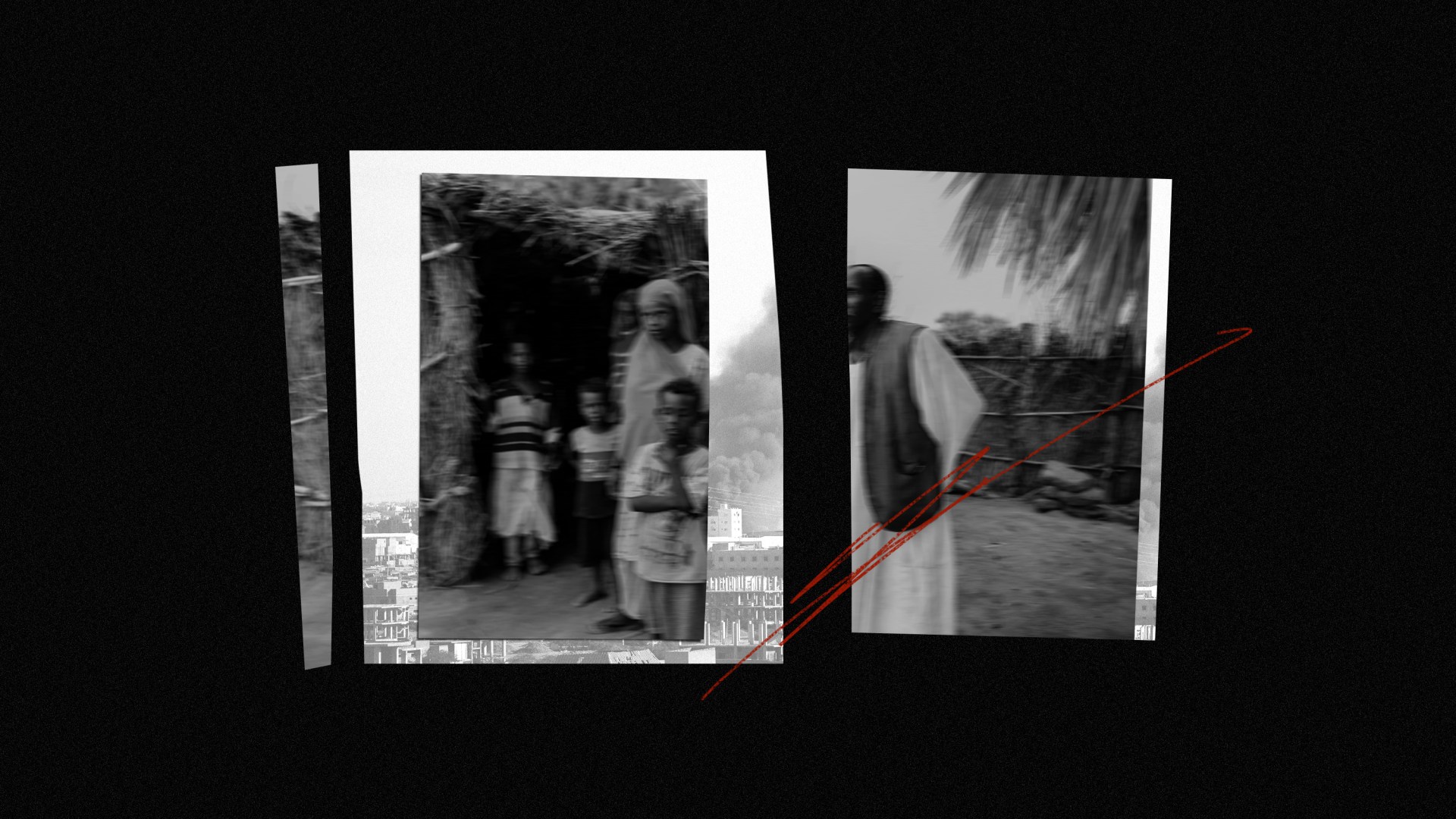
A collage of images showing civil war destruction and separated families.
Christianity Today May 30, 2025
Illustration by Elizabeth Kaye / Source Images: Getty, Pexels

Francis Samaan’s body is in Jordan, but his heart is in Sudan.

The third-year theology student sits in a quiet commons area adjacent to the darkened chapel of Jordan Evangelical Theological Seminary (JETS) in Amman, the country’s capital. Though he currently lives and works at the seminary’s imposing limestone campus—filling in for an Egyptian employee who’s traveling—Samaan’s mind is split between his studies and his home country, where civil war has raged since April 2023.

Samaan’s wife, Hanaa Kalo, and his six-year-old twins are safe in Egypt—they reached Cairo shortly after war broke out, enduring a harrowing seven-day bus ride from Khartoum, Sudan. But his mother, his siblings, and their children remain in Sudan’s ravaged capital. The Rapid Support Forces (RSF), the paramilitary group battling the government-led Sudanese Armed Forces (SAF) for sovereignty in the African nation, looted their home, stealing even their mattresses and cell phones.

When Samaan’s relatives contact him, they have to walk to borrow a phone. Like many in Sudan, they currently eat just one meal a day, usually rice and lentils.

“Each one is waiting for when he’ll die,” Samaan said of Sudan’s Christians, a persecuted minority of around 5 percent in the country of 50 million. “This is the reality right now. No one has hope that things will change tomorrow.”

On the Sudanese conflict’s second anniversary, UN Secretary-General António Guterres summarized its catastrophic results: 12 million displaced, with 3.8 million spilling into neighboring countries like Ethiopia, Chad, and Egypt. Famine has been declared in at least five areas, with 25 million people facing acute hunger. Death toll estimates reach at least 150,000.

Though the wars in Gaza and Ukraine garner more press attention, aid groups consider Sudan as having the world’s largest humanitarian crisis. Many Sudanese people are subsistence farmers.  But violence and displacement have drastically impacted agriculture, throwing half the country into food insecurity. In 2023, Sudan’s Annual Crop and Food Supply Assessment Mission reported a 46 percent decline in the production of local grains like sorghum and millet compared to 2022, linking this decrease to the conflict.

Recent funding cuts made by the Trump administration have only exacerbated the crisis. In 2024, the US was Sudan’s largest humanitarian donor, providing funding for close to half the aid needed in the country. Since the USAID freeze in late January, ACAPS, an independent data analysis group focusing on the humanitarian sector, reported that the cuts affected a broad swath of aid groups.

UN organizations, international and national nonprofits, and grassroots-level community responders have been forced to fire staffers, reduce hours, and cut programs, ACAPS said. In Khartoum alone, 80 to 90 percent of emergency food kitchens were shuttered.  

The civil war has particularly hurt Christians. This year, Open Doors ranked Sudan as the fifth most difficult place in the world to be a Christian. The organization’s annual World Watch List stated that “violent extremist groups have exploited the deteriorating security environment to systematically target Christians.”

Boutros came to Amman from Khartoum in 2018 to pursue a master’s degree in biblical studies at JETS. He also remains in contact with his relatives in Sudan—and with his fiancée, Sara, whom he’s not seen in seven years. (Christianity Today agreed to use pseudonyms for the couple since Boutros currently does not have legal status in Jordan.) The couple, who met more than a decade ago, got engaged in 2020 after his family representatives met with hers to ask for her hand.

Sara worked at a pharmaceutical company in Khartoum before war forced her family to flee to a village in eastern Sudan’s Kassala State. Sometimes she sits outside her family’s mud-brick house to catch an internet signal to talk with Boutros. She spoke with CT from this spot, with cars and motorbikes passing on the dirt road in front of her, shrieking children playing around her, and a dove cooing near her head.

Farms surround Sara’s family’s village, but some days they eat just one meal and other days none. She said their situation gets worse every day. Still, Sara finds encouragement in the story of Job, who lost all his possessions, his children, and his health but not his faith.

“We’re human, so … we have moments when we’re weak,” Sara said. “But we come back and say, ‘The Lord will strengthen us and make us steadfast in our faith,’ in spite of all the challenges and difficulties we are going through.”

In early May, a series of drone strikes—presumably guided by the RSF—hit Port Sudan, a coastal city one state north of Sara’s home in Kassala. Port Sudan has served as the country’s wartime capital and a hub for international aid. Until now, it has been untouched by fighting, a relatively calm refuge for hundreds of thousands of displaced civilians.

After the strikes, billowing clouds of noxious smoke rose from the targeted fuel depot. The drones also hit a power converter and hotel, as well as Sudan’s only operating international airport.

Sara has dreamed about flying from Port Sudan’s airport to Juba, South Sudan. There she could obtain a South Sudanese passport, enabling her to travel and reunite with Boutros. But the drone strikes on the airport highlighted the fragility of her plans. Even if she had the money for a plane ticket to Juba—approximately $600—would the airport be open when she was ready to leave? Once in Juba, where would she find funds for a passport and travel?

Though Boutros and Sara face enormous hurdles to reunification, Boutros continues to put his trust in God—for his future marriage and for the outcome of Sudan’s never-ending conflict. Boutros was born in the middle of war in South Kordofan’s Nuba Mountains. He has not seen his mother since 2010. Early in the current war, he and fellow Christians in Amman gathered in a cold, damp room to grieve the death of his brother to random shelling.

“Satan sees in a limited way, but God sees everything,” Boutros said. “Satan makes war and kills, but at the same time, God allows a person to see and ask, ‘Who is this person who’s killing?’ He starts to draw close to Christ, to see a different life. He can forgive others.”

And there is much to forgive. In April 2024, the US Commission on International Religious Freedom reported that more than 150 churches had been damaged after a year of war. Since then, the SAF bombed Al-Ezba Baptist Church in Khartoum North on December 20, killing at least 11. The RSF attacked a church in Gezira State during prayer on December 30, leaving 14 injured. In October, the SAF arrested 26 Christian men fleeing with their families, accusing them of partnering with the RSF.

In 2013, while Samaan was working as an accountant for the Evangelical Presbyterian Church of Sudan, security forces arrested and jailed him alone in a windowless room for three months. Every morning, they beat and interrogated him. They told Samaan he could work for them as a spy, supplying information about local churches. If he refused, they promised they wouldn’t let him rest.

Samaan refused. After his release from prison, he was forced to report to the police station every morning and sit idly until evening. This continued for six months, in which time he lost his job. After Samaan married Kalo in 2015, the police continued to hound him, monitoring their home and sending threatening text messages.

Finally, in 2018, Samaan’s name appeared in the newspaper, which said he was wanted by the government for “preaching the gospel of Christ.” His friends smuggled him to the airport, and he fled to Jordan. Kalo, six months pregnant with twins, woke to find her husband gone.   

“Sometimes I ask, ‘Where are you, Lord?’” Samaan said. “All these things—six, seven years, I haven’t seen the kids, and my wife is tired, and they ask, ‘Where are you, Daddy?’ Until now, we don’t know when we’ll be able to meet each other.”

With his work-study job at the seminary, Samaan makes a small stipend. Every month he sends a portion of it to Cairo to help his wife pay for rent and food. His children should be in first grade, but they haven’t been able to pay tuition fees. Samaan believes God called him to study, but sometimes he wonders if he should quit and get a full-time job so he can provide for his family.

His mental state mirrors that of many Sudanese Christians—both inside and outside Sudan. “You know how sometimes you get to the point that you’ve lost hope, you don’t know how to pray?” Samaan said. “Inside you are oppressed, broken, sad—you need someone to help you. This is what we need now—people to help us in prayer, spiritually, emotionally, economically. People to encourage us.”

Books
Review

A Spiritual Checkup for Christians in Health Care

Faithful medical professionals need more than practical tips on handling stress or managing schedules.

A dove holding a stethoscope in its beak
Christianity Today May 30, 2025
Illustration by Christianity Today / Source Images: Getty

After years as a trauma surgeon working in a high-pressure emergency-room environment, I began writing about medical topics through a Christian lens. During this period, dozens of doctors in training have reached out with some version of this question: “How do I grow in faith while working in medicine?”

The inquiry might appear simple on the surface. Yet it arises from a host of complex challenges to the mind, heart, and soul that weigh with special heaviness upon those laboring to help the sick.

How can you grow in faith, they ask, when you’ve held a dying child for the third time in a week and couldn’t help? How can you honor God when the demands of medicine tempt you to idolize work? When the patient you saved from a gunshot wound dies of a drug overdose a week later, how can you cling to assurances of God’s goodness?

Thankfully, a recent book offers a cool cup of water to those navigating such dilemmas. In Scripture and Scrubs: A Christian Calling to Healthcare, three Cedarville University professors—social worker Michael Sherr, nursing school dean Angelia Mickle, and theologian Jason Lee—combine clinical experience with biblical insights, guiding health workers toward a gospel-centered view of their profession.

The authors address their book to everyonein health care, from doctors and nurses to phlebotomists, nutritionists, physical therapists, and more. Its mission, they write, is “to help you grasp how important it is for Christians to serve in health care and to inspire you to see your role through God’s eternal purpose as revealed in Scripture.” Scripture and Scrubs gives health care professionals life-giving perspective on guarding their hearts, as well as strategies to persevere in faith—and even flourish—while serving on the medical frontlines.


Health care professionals regularly encounter the ugly ramifications of life in a fallen world. People in other walks of life certainly deal with suffering, pain, grief, and death. But those who walk hospital corridors nearly every day witness such brokenness far more than most. Unsurprisingly, medical workers face frequent mental health struggles, with almost half reporting burnout and one-fourth struggling with depression.

The authors of Scripture and Scrubs acknowledge these challenges. “It is dangerous and wearisome on the front lines,” they write. “Health professionals have some of the highest rates of vicarious trauma, burnout, drug and alcohol addiction, and suicidal ideation.” However, while many administrative efforts to prevent burnout focus on the clinical work environment, Sherr, Mickle, and Lee view such initiatives as tangential to the root issue.

More than stress-reduction programs and reduced work hours, health professionals need Christ:

Apart from Christ, it becomes too easy to get burned out from all the politics in health care. It becomes too easy to turn to self-medication or other destructive methods to escape from stress. It becomes too easy to allow ambition to zap their joy in serving others. In contrast, when you’re practicing with unveiled freedom, placing your confidence in Christ, making him preeminent over your professional practice, you will most certainly point others toward permanent glory.

How do Chrisitan health professionals uphold this charge to make Christ preeminent? While many struggling health care workers strive for purely practical answers, Sherr, Mickle, and Lee argue that cultivating the right mindset is paramount. More important than taming one’s schedule, seeking time off, or finding the right Bible app is learning to view medicine as a ministry of common grace. “As a servant of common grace,” the authors write, “you work every shift as God’s representative where you help temporarily restrain and mitigate the damaging consequences of sin and enable people to experience the goodness of his creation.”

This view of medicine imbues health care practice with heavenly importance. It shatters the notion of an inherent conflict between work and discipleship. Many questions I receive from medical trainees presume that professional obligations must compete with the Christian walk, like rams with interlocking horns shoving against each other. But Scripture and Scrubs refutes such a dichotomy.

Echoing Paul’s exhortation in Colossians 3:17 to “do [everything] in the name of the Lord Jesus,” Lee, Mickle, and Sherr argue that “Christian” and “health care professional” are not mutually exclusive categories. “If you are reading this book, we want you to avoid the temptation to compartmentalize your spiritual life from your professional life,” they write. “Instead, let your new relationship with Jesus inspire you to embrace your Christian vocation.” When health care workers adopt this approach, “God will transform everything. The challenging cases, the long hours, the mundane tasks, the colleagues that drive you crazy, the policies that sometimes seem to impede the best patient care, God has you there representing him as his servants of grace.”

To illustrate how health care workers can serve as ministers of common grace, Sherr, Lee, and Mickle outline five “spiritual competencies” adapted from Paul’s second letter to the Corinthian church: providing comfort (1:4), conveying forgiveness (2:7), maintaining an eternal mindset (3:11), remembering our frail status as “jars of clay” (4:7), and serving as ambassadors of Christ (5:20). Each of these habits corresponds with elements of clinical practice, offering professionals clear avenues to live out their faith in the hospital.

When we comfort those in pain, for instance, we reflect the God of all comfort (1:3–4). When we forgive angry patients who slander us or coworkers who mistreat us, we point to the one “in whom we have redemption, the forgiveness of sins” (Col. 1:14). The authors’ discussion of the “fading glory” of our earthly work is especially compelling, as it contextualizes suffering in anticipation of the new heavens and the new earth (Isa. 43:18; Matt. 24:35; Rev. 21:1). “When you experience the limits of helping patients, remember you are there for more than providing temporary care,” they write. “You are there as a witness to the sufficiency of God who alone made a way for a greater permanent glory.”

This understanding helps Christians in health care maintain a humble perspective on what their work can and can’t accomplish. As the authors explain,

Both Christians and unbelievers can develop the ability to help patients through prescribing the right medications and treatment regimens. Both can perform the right surgical procedures and provide the necessary rehabilitation. Only CHPs [Christian health professionals] rightly view their professional competencies as fading glory. Only CHPs understand the healing and care provided as being temporary.

Grasping what’s truly eternal—of Christ’s completed work and the glory to come—steels us for the suffering we’ll face in the hospital. It also emboldens us to serve as Christ’s ambassadors in a secular system devoid of gospel hope. Christian health professionals often worry that witnessing in the hospital will jeopardize their position; I myself have conversed with doctors whose public prayers have earned them administrative warnings.

Yet we also feel convicted to share the truth with those walking in the valley of the shadow of death. The authors are sensitive to these difficulties and offer encouragement, invoking biblical guidance: “Just be prepared to always give the reason or source of your joy to anyone who may ask, doing so full of grace and seasoned with salt.”


How do we nurture this perspective of medicine as ministry when we’re sleep-deprived and dodging insults from angry patients? How do we maintain a Christ-centered focus when the demands of clinical work and family life edge out time for reading Scripture?

Acknowledging these practical challenges, the authors offer seven strategies for health care professionals to grow in faith: continuous training (in medicine and Scripture alike), prayer, Sabbath rest, reminders that we are mere partners in reaping God’s harvest, close discipling relationships within the health care community, broader patterns of Christian fellowship, and mission work.

Most crucial among these is a pledge to remain in God’s Word: 

THE most important thing you can do as a CHP is to practice spending consistent time with God in his perfect Word. … It is the Bible and then the Physicians’ Desk Reference. It is the Bible and then the Diagnostic and Statistical Manual of Mental Disorders. It is the Bible and then Therapeutic Modalities for Musculoskeletal Injuries. It is the Bible and then the Atlas of Human Anatomy. Saturate your heart and mind in God’s Word.

For many medical students and residents, remaining in the Word is precisely the challenge. Perhaps because no physician contributed to the book, Scripture and Scrubs doesn’t explicitly address the spiritual hurdles ingrained within medical training. How do residents ensure Bible intake in a culture that dismisses an 80-hour work week (two full-time jobs!) as insufficient time in the hospital? The authors note that “Sunday worship gatherings and small group discipleship are vital places for hurting CHPs to be rejuvenated in the gospel.” But the rigorous schedules of trainees often preclude such fellowship.

If remaining diligent in studying God’s Word is key, actually doing so may require creativity. Audio Bibles and sermons during the commute to and from the hospital can provide a lifeline. So can daily devotional emails perused on the walk to the call room, or online connections—perhaps involving text messages of Scripture throughout the day—with Christian colleagues who can speak into and understand the burdens of caregiving. 

Even with this caveat, Scripture and Scrubs provides a sorely needed service by anchoring exhausted health care professionals in the gospel. The authors encourage the weary to press on when the hours grow long and to remember their hope when despair encroaches. They infuse suffering with meaning and drudgery with significance. Most of all, they point health workers everywhere to the true source of healing—Christ, who laid down his life for us, and by whose wounds we are healed (Isa. 53:5).

Kathryn Butler is a writer and a former trauma surgeon. Her books include The Dream Keeper Saga series and Between Life and Death: A Gospel-Centered-Guide to End-of-Life Medical Care.

News

After PEPFAR Cuts, Kenya Seeks Local Solutions

A Christian woman living with HIV leans on God but may need national funding efforts to stay alive.

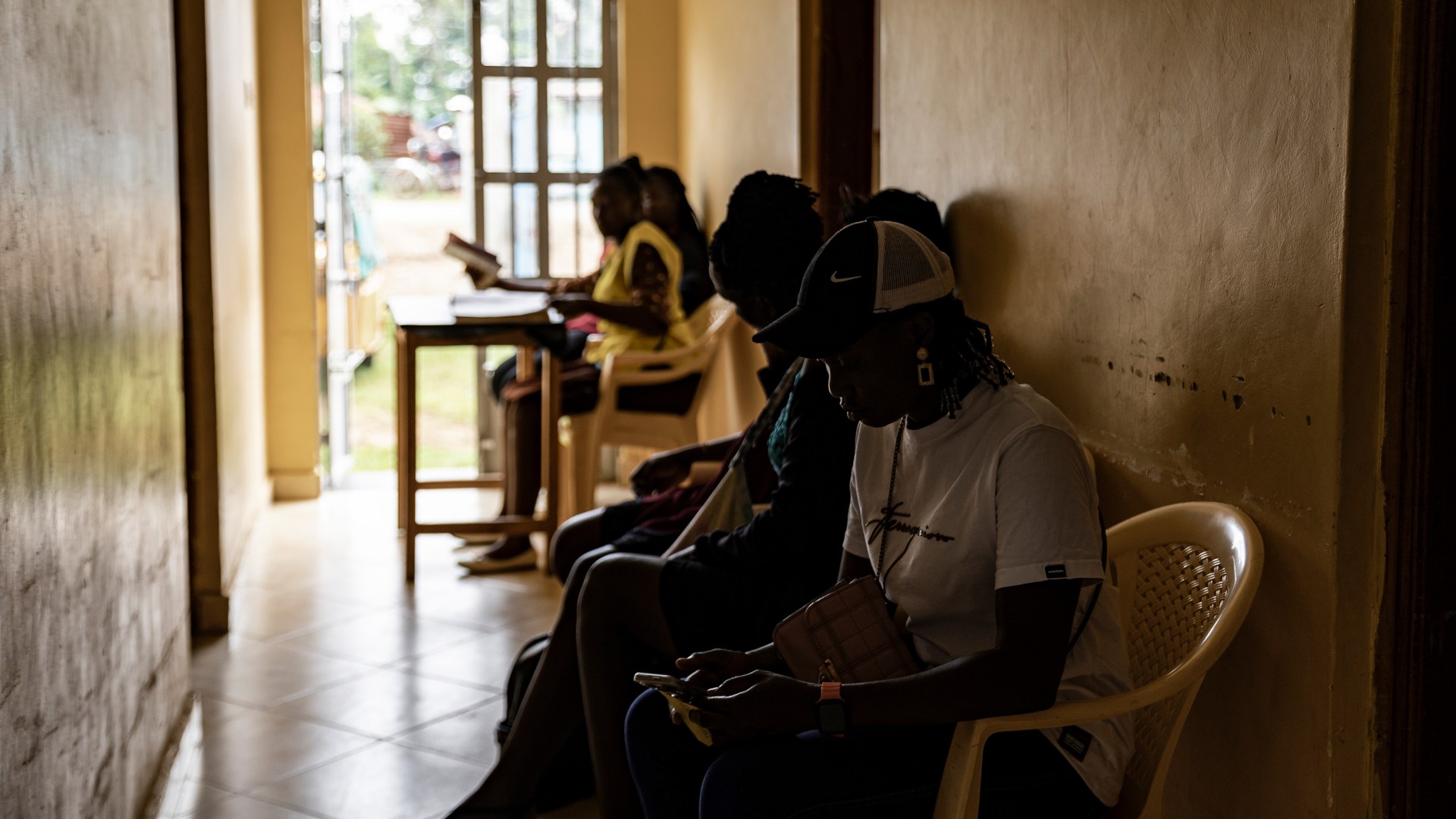
Patients wait in the corridor of Kuoyo Sub-county Hospital in Kisumu, Kenya, a facility once supported by USAID.

Patients wait in the corridor of Kuoyo Sub-county Hospital in Kisumu, Kenya, a facility once supported by USAID.

Christianity Today May 30, 2025
Michel Lunanga / Stringer / Getty

Eunice wept bitterly almost every night after she was diagnosed with HIV in 2015. The 40-year-old single mother feared friends and family would stigmatize her and began to sink into depression. She didn’t tell her 13-year-old daughter—not at first. Instead, Eunice walked alone to the church-run St Raphael’s Clinic about a mile away, where she secretly received donor-funded anti-retroviral drugs (ARVs) free of charge.

Eunice lived in a low-income area in Nairobi, Kenya, where one-tenth of the country’s 1.4 million HIV-positive people live. Nairobi is Kenya’s most populous city and has the most people in the nation at risk for HIV, including intravenous drug users. Through clinics that receive funds from the US President’s Emergency Plan for AIDS Relief (PEPFAR), Eunice and others in her area can access free or low-cost ARVs.

The clinic usually gave Eunice six months’ worth of ARVs at each visit. But a few weeks after President Donald Trump’s executive order suspending foreign aid, her nearby PEPFAR-funded clinic gave her only a two-month supply. Staff at the clinic told her that they were rationing the dwindling stocks to ensure that everybody who needed medication got some.

With over 1 million Kenyans living with HIV, access to medication is vital. For more than a decade, many have depended on PEPFAR funds to access daily medications that suppress the virus and extend their life expectancy. Now, unable to take foreign aid for granted, Kenya is looking for ways to fund programs and medications for HIV-positive residents on its own.

President George W. Bush created PEPFAR in 2003 to give low-income countries access to HIV-related medication. Kenya received $92 million during PEPFAR’s first year of operation in 2004. By 2010, the East African nation was one of PEPFAR’s largest beneficiaries, receiving a grant of more than $500 million that year. Other donors like The Global Fund and UNICEF also took up a portion of Kenya’s costs.

The funds covered ARVs and even the counseling sessions that helped Eunice finally accept her condition and reveal her HIV status to her daughter. Today, she credits the counseling and her renewed faith in Christ with helping her live positively.

“I manage my situation by seeking refuge under God’s wings, where I feel safe, loved, and valued,” she said.

Efforts to help PEPFAR-reliant countries support themselves are not entirely new. In 2018, USAID—one of PEPFAR’s main implementing agencies—launched an initiative called Journey to Self-Reliance. That year, PEPFAR funds covered 76.8% of Kenya’s HIV-related spending. Three years later, the number dropped to 60%, then down to 37% in 2023.

Kenya’s government has assigned 72% more money for the health sector in the 2025-26 budget than in the previous year. However, this brings health care funds to only 4.9% of the total national budget—far short of the 15% recommended by the African Union more than 20 years ago. Many African countries have spent between 2.1% and 12% of their budgets on healthcare costs as recently as 2020, according to the World Health Organization (WHO).  

Kenya also looks to incentivize Kenyans in the pharmaceutical industry to develop technical skills and integrate specialized HIV facilities with mainstream hospitals and clinics.

“Integration would ensure that HIV patients would no longer have to visit separate facilities for medical care,” said Patriciah Jeckonia, a program manager with LVCT Health, a Kenyan organization offering HIV-related services. This would not only help eliminate stigma but would also reduce the high costs of HIV management.

The government also hopes to enable more local manufacturing of low-cost generic ARVs. Kenya introduced the Value Added Tax exemption in 2023 to give tax breaks for locally purchased pharmaceutical manufacturing equipment. More than a decade ago, the Pharmacy and Poisons Board (PPB) began allowing fast-track registration of locally manufactured and priority medicines, including ARVs.

Kenya-based company Universal Corporation Limited, one of the first in Africa to receive prequalification by the WHO, can produce 1 million generic tablets daily. This includes TLD, a widely used ARV regimen, according to local news sources. This could potentially make 30 million ARV tablets available per month.

Still, uptake of local ARV production has been slow, in part due to the high costs of getting WHO prequalification, purchasing lab and production machinery, and importing active pharmaceutical ingredients.

Two or three manufacturers of similar scale could put Kenya well on its way to self-sufficiency treating HIV. But in the meantime, the abrupt halt of PEPFAR poses a danger to the life and health of Eunice and other HIV-positive Kenyans.

When Eunice asked clinic staff what would happen when her two-month supply of ARVs ran out, they couldn’t provide a clear answer. Eunice’s life continues—her now-23-year-old daughter gave birth to a healthy little girl, turning a delighted Eunice into a first-time grandmother. But the uncertainty about her medications still weighs on her mind.

“To manage this condition, you have to take your medications religiously,” she said.

As a domestic worker who makes a living cleaning and doing laundry, Eunice earns less than $120 USD per month. This barely covers the rent, food, and utilities costs she needs to care for herself, her daughter, and her new grandchild. She said she worries about how paying for ARVs might impact their already-tight budget in the future.

Kenya’s push toward self-sufficiency in HIV management could shield Eunice and others from the impact of US foreign aid changes.

“This is an opportunity for the government to strengthen local capacity,” Jeckonia said, “and provide localized, affordable solutions for HIV management.”

And that may prove to be an unexpected silver lining.

News

European Evangelism Congress Preaches Hope Despite Rising Secular Tide

Franklin Graham recalls, “God has often chosen the worst of time to do his best work.”

Franklin Graham speaks at European Evangelism Congress
Christianity Today May 29, 2025
Billy Graham Evangelistic Association

When evangelist Billy Graham came to West Germany in 1954, more than 80,000 people packed into Berlin’s Olympic Stadium to hear the American preacher’s message. It’s hard to imagine that big of a crowd gathering in Germany to hear a sermon these days. 

The more than 1,000 Christian leaders who assembled on Thursday at the JW Marriott near Berlin’s famous Potsdamer Platz all share the conviction that Europe needs to hear the gospel again. But they’re concerned it is harder and harder to proclaim the Good News in Europe. 

“Nations and governments that used to be friendly to Christianity have now become hostile, anti-Christ,” said Franklin Graham, eldest son of the late evangelist and head of the Billy Graham Evangelistic Association (BGEA), which is hosting the European Congress on Evangelism in Berlin from May 27 to 30.

Speaking to press ahead of the congress, Graham said he expected evangelism to grow even more difficult in the years ahead. He said he thinks the grip of secularism is growing tighter. 

But he also believes that may presage a revival. 

“We know from history that God has often chosen the worst of time to do his best work,” Graham told the press. 

This is the sixth congress the BGEA has hosted. The last one was held in Amsterdam 25 years ago. This year, Christian leaders have come from 55 countries and territories—from Kazakhstan to the Faroe Islands, Estonia to Albania—to talk about these challenges and be encouraged in this hope. 

The conference theme centers on Romans 1:16: “For I am not ashamed of the gospel, because it is the power of God that brings salvation to everyone who believes: first to the Jew, then to the Gentile.” 

Conference organizers say Christian leaders need to resist the temptation of trying to appease their non-Christian critics by watering down God’s message. Graham said evangelists must be on guard against any effort to “make the gospel more acceptable” by conforming to cultural standards. 

Many European evangelicals and other conservative Christians, including Eastern Orthodox and Roman Catholic believers, have become deeply concerned about secularism in recent years. They fear it will undermine the social and moral foundations of Europe. As the edifice of Christian consensus crumbles, they see it being replaced by moral decay. 

Congress attendees told CT that they see the gospel compromised on a daily basis, with the result that even the church can become confused and divided—and the world lost. They expressed concern about cultural views on sexual ethics, the value of human life, the stability of families, protection of religious freedom, and respect for Europe’s Christian heritage. They pointed to what they see as the potent dangers of growing acceptance of LGBTQ sexuality and the influx of Muslim immigrants and refugees, as well as alternative spiritualities and an increasingly individualistic culture.

Yet amid the discussion of decay and decline, some expressed hope for the future of evangelical faith in Europe. Ulrich Pazarny, an 84-year-old German evangelist, pastor, and personal friend of Billy Graham, went so far as to say he was excited.

Delivering a keynote address on the foundational importance of the Bible for preaching the gospel in Europe, Pazarny said he was certain Christians would continue to preach the Scripture in the years to come. He acknowledged that such preaching may fall on deaf ears in Europe, where, he said, many consider themselves too modern and enlightened to trust the Bible and its claims. Pastors and preachers will struggle, he said, when the “culture of the majority” becomes increasingly antagonistic toward Christianity. 

And yet, Pazarny said, they should press on with joy and confidence because of the very message they share.

Gunnar Mägi, who was born in Tallinn, Estonia, to non-Christian parents and is now president of Tyndale Theological Seminary in the Netherlands, said though they may be tempted to do so, evangelicals must not hide hard truths. Christians shouldn’t forget to talk about sin and even hell, he said, especially as they see society embrace things like unchecked immigration, expansive abortion rights, and what he called LGBTQ “propaganda.” 

“There are two sides of the gospel,” he said. “For light to stand out, there must be a darkness contrasting it.” 

For too long, Mägi said, preaching in Europe could sometimes seem like a sales pitch, with only the “good things” presented in public. Teachings on sexuality and God’s design were only in the small print, he said, and Christians avoided talking about discipleship and the need for sanctification.

“But if we know our audiences, we can approach them and invite them to hear the entire story of Scripture,” he said. “Hard truths and all.”

On the streets of Berlin, however, many find such views unwelcome. Standing at a bus stop just around the corner from the Marriott where the congress is being held, 34-year-old Berliner Nadine Schmidt said she does not see a place for condemnation of homosexuality in contemporary Europe. She called it hate speech.

“Beliefs are fine; everyone has them,” said Schmidt. “But those beliefs cannot harm or smear others’ lifestyles. Freedom of speech does not mean you can attack another person’s human rights.”

Asked how he might speak to critics like Schmidt, Graham said, “If non-Christians in this city are concerned, that’s good. We are on their radar.”

The message will not change, he said, regardless of reaction or censure. Berliners and others should be pushed to reckon with what the Bible says.

“We are going to preach the gospel, and there will be some people who will hate it and reject us. And that’s okay,” he said. “They are not rejecting me. It’s God’s Word, not my word. God said these things about marriage. I am just repeating what God has to say.”

Speaking to the evangelists and church leaders at the congress, Graham encouraged them not to wilt in the face of opposition.

“Europe needs to be evangelized,” he said. “Even though we see some bright spots, many churches have gone generation after generation with no evangelism.” 

Harkening back to the congress theme—“Do not be ashamed”—Graham said those in attendance need to become bolder or risk losing the opportunity to speak up.  

“If Christians begin to be quiet, we will lose our freedom to share the gospel,” he said. 

Closing with his own bold proclamation, Graham said he hopes the next time his organization arrives in Berlin, it will be in the style of his late father: a large-scale, evangelistic meeting in the city. With a bit of a smile, he said, “Now that would be an exciting meeting.”

Christianity Today Announces Search for Next President

Outgoing president to lead John Templeton Foundation.

Christianity Today magazine covers from 2024-2025
Christianity Today

WHEATON, Ill., May 29, 2025—The board of global media ministry Christianity Today is launching a search process to find the organization’s next president and CEO.

Dr. Timothy Dalrymple, who has led the organization since 2019, was joined Thursday by board chairman Claude Alexander and chief operating officer Nicole Martin to announce to staff his impending transition to a new role as president and CEO of the John Templeton Foundation. Dalrymple’s last day at Christianity Today will be July 9.

“Serving Christianity Today the past six years has been the honor of a lifetime,” said Dalrymple. “The mission is compelling, the team is exceptional, and the future is bright. While I’m excited to return to the kinds of questions that motivated my academic work, I could not be prouder of what the team has accomplished at Christianity Today.”

Over Dalrymple’s six-year tenure, Christianity Today expanded into new media and global markets, redesigned and redeveloped all its publishing platforms, and dramatically increased its total revenue in an adverse media environment. The ministry launched the One Kingdom Campaign that has raised nearly $28 million and empowered initiatives to reach younger, more diverse, and more global audiences.

“Tim came to CT with a compelling vision that has been caught and is being carried by a dynamic team,” said Alexander. “His combination of intellect, entrepreneurship, creativity, levelheadedness, and integrity has steered CT through challenging times and has positioned it for a bright future. We wish the best for Tim and his family, and we celebrate both the chapter that’s closing and the new chapter that’s about to begin in the life of this ministry.”

Christianity Today’s next president and CEO will lead a vital global media ministry that reaches 35 million Christians around the world each year. Roughly 40 percent of its audience today is under the age of 35, and 38 percent comes from outside the United States. Founded in 1956 by Billy Graham, CT will celebrate its 70th anniversary next year.

“I came here with a clear sense of calling,” said Dalrymple. “Christianity Today is living into its mission to advance the stories and ideas of the global kingdom of God. It casts a compelling biblical vision of what it looks like to follow Jesus Christ in our time. God has blessed our efforts over the last six years, and I’m confident he will continue to prosper the ministry and expand its impact for many years to come.”

A search committee of the Christianity Today board will work alongside leading executive recruitment firm CarterBaldwin to find the next president and CEO. Former CT board member and businessman Thomas Addington, PhD, will serve as interim president until a successor is chosen.

Nominations or confidential inquiries may be directed to Bill Peterson, partner at CarterBaldwin Executive Search, via email at CTCEO@carterbaldwin.com.

About Christianity Today

Reaching 35 million people across the world annually through acclaimed and award-winning digital and print media, Christianity Today elevates the stories and ideas of the kingdom of God in order to see the church more faithful to Christ and the world more drawn to him. Learn more at christianitytoday.com/about.

Church Life

The Gen Z Worship War

Contributor

Well, not a war so much as a slow and worrisome sorting of men and women into different corners of Christianity.

Christianity Today May 29, 2025

My generation is among the least churched adults in America, but zoomers who are in the church are quietly steering its worship in two directions at once.

On the one hand, some are flocking to more traditional and liturgical forms of Christianity like Eastern Orthodoxy. Though a lot of reporting on this trend has been more anecdote than data, a 2024 survey from the Orthodox Studies Institute found Orthodox parishes in the US have a rising number of converts, many of whom are young ex-Protestants.

On the other hand, contemporary Christian music (CCM) is thriving, led by artists like Maverick City Music, Elevation Worship, and Forrest Frank. CCM was the fourth fastest-growing music genre in the US in the first half of 2024, and market research indicates younger audiences are driving much of this growth.

So is Gen Z at worship traveling back in time or making its home in modernity? I believe that the answer is both at once—and that the primary worship divide in my generation isn’t random, nor is it strictly about theology, denomination, or politics (though it’s related to all of those). The main difference is sex. Zoomers gravitating toward traditional worship are mostly men, while CCM resonates primarily with women.

These aren’t rigid categories, of course. There’s plenty of crossover—I myself have been swept up by the emotional power of CCM and am sympathetic to friends who have ditched the auditorium for the cathedral. And there are churches that combine traditional liturgies with CCM songs.

But if this pattern generally holds, it points to a future where a growing sex divide extends beyond politics and other cultural preferences into our sanctuaries. It may become an increasing point of tension in Christian marriages—or, if young men and women sort themselves into different churches entirely, may be one factor keeping those marriages from happening at all.

For me, this divide is personal. These aren’t just national trends but stories I’ve seen in my own community, among my own friends. I don’t think these are isolated incidents, and I think they’ll be influential in the future of the American church.

It’s too early to be sure how this will all play out. But for now, I think it’s worth noticing three things on the way to asking what should be done.

First, the Gen Z worship divide is connected to how zoomer men and women understand faith itself. For many Gen Z men, traditional worship is less about nostalgia and more about nonnegotiables. In their eyes, true faith doesn’t bend with the culture. It plants its feet, folds its arms, and says, This is what we believe. It hasn’t changed. It won’t change. Take it or leave it. This is a common theme in reporting on young men moving toward Orthodoxy. They want stability as a stark counterpoint to a culture characterized by constant reinvention.

Faithful women in Gen Z tend to be more interested in personal authenticity and intimacy with God through personal devotion—it’s not that they don’t care about eternal theological truths, but they care greatly about an individual sense of honesty and vulnerability. CCM lyrics are emotive and expressive. In CCM, an authentic faith proclaims, This is me—no filters, no pretense. I’m here, as I am, before a God who loves me. This too can be countercultural in an age dominated by curated personas, but it’s a starkly different expression of worship from that of more traditional liturgy.

Second, this worship divide is influenced by the growing segregation of Gen Z men and women online, and that digital pattern will have further-reaching spiritual effects.

Subsets of platforms like RedditQuoraYouTube, and X (formerly Twitter), all of which have a majority male user base, have become hubs for discussing theology. Consider the Orthodox Christianity discussion board on Reddit, with over 85,000 members, many of them young men discovering and deepening their interest in Orthodoxy. A member of an Orthodox church in Riverside, California, told the New York Post that he has seen several young men join his congregation after encountering Orthodoxy through digital spaces like this. 

Meanwhile, CCM thrives on Instagram and TikTok, where audiences engage with its emotional and visual appeal. The influence of all these digital media is self-reinforcing—the more we consume, the more the algorithm sends our way—and it will affect more than worship music and liturgical choices. The theology the TikTok algorithm serves up to a 21-year-old woman is worlds apart from what’s trending on Orthodox Reddit or Jordan Peterson’s YouTube feed. And while Peterson, a non-Christian, at least invites long-form engagement with real questions, his answers aren’t always rooted in Christian orthodoxy. TikTok, meanwhile, delivers spiritual content with the depth of a bumper sticker and the lifespan of a fruit fly.

Churches can’t change the algorithm, of course, or coerce men and women into the same online spaces. But neither can they ignore this pattern lest digital divides dictate discipleship. Men need more than intellectual stimulation and stoic self-help; they need the historic, embodied faith of orthodox Christianity with all its beauty, challenge, and intimacy. And women, just as much, need grounding in theological depth and tradition, not just vibes, reels, and vague inspiration. But for now, the genders are divided by algorithm.

Lastly, Gen Z worship differences are tied to bigger patterns in what men and women tend to want. As social psychologist Jonathan Haidt argues in The Anxious Generation, men often prioritize agency (the ability to overcome inner and external obstacles to grow stronger and achieve purpose) while women frequently prioritize communion (the pursuit of relationships, connection, and harmony).

For young men interested in discipline, self-mastery, and resilience, Orthodoxy and similar traditions offer structured liturgies and rigorous fasting. CCM evangelicalism does not. But for young women who emphasize personal connection and devotion to God, CCM will resonate because the industry is making music with exactly this demographic in mind.

If these two trajectories continue, I don’t expect another round of the “worship wars” of the 1990s. Instead, I think we’ll see a structural divide—not heated debate over hymns and electric guitars but a slow fade into wholly separate congregations.

Christians have split into different churches for all kinds of reasons since the Reformation and the Great Schism before it. Some traditions have even had men and women sit on opposite sides of the sanctuary—but we’ve never seen entire churches split by gender. That would be new. 

It would also be a problem for obvious reasons, and much of American evangelicalism—even in complementarian churches where women are not in leadership roles—falls squarely on the CCM side of the spectrum. What can evangelicals do?

Author and pastor Gavin Ortlund’s retrieval theology offers a compelling solution. His idea is about recovering historic Christian traditions to enrich modern worship—not rejecting contemporary forms like CCM but deepening them. Retrieval theology calls for the church to look backward in order to move forward, reclaiming lost practices and distinctives that historically shaped Christian worship and discipleship. 

For many evangelical churches, a renewed emphasis on the Lord’s Supper could be the first step. Weekly observance, perhaps, instead of monthly, quarterly, or yearly. This is an act of both agency and communion. It calls believers to examine ourselves, participate together, and encounter the presence of Christ in a personal way. 

We could also revive other historic practices—like responsive prayers or creedal recitation—that shaped Christian worship for centuries but have faded in many modern evangelical settings. These worship elements can provide the rigor young men are seeking without alienating women. They are traditional and communal at once, and a written prayer can be a vehicle for personal vulnerability and relationship with God just as much as a CCM song. 

Pastors can attend to the need for balance between agency and communion too. There is “a time to weep and a time to laugh, a time to mourn and a time to dance” (Ecc. 3:4)—a time for comforting sermons of grace and solace and a time for hard truths and clear direction from the pulpit.

Indeed, it’s not liturgy alone that draws young men to Orthodoxy; it’s the call to a life of self-discipline and purpose. Evangelical churches making a similar call will sound a bit different, but we can pair contemporary worship with exhortation to prayer, fasting, and confession. This renewed focus on spiritual disciplines is already gaining traction among young evangelicals, largely through the influence of John Mark Comer. Evangelicalism more broadly can call young men not just to survey the wondrous cross but to take up their own.

Authenticity and stability don’t have to be at odds, and evangelicalism need not shortchange women for the sake of men. A church that integrates tradition and innovation, structure and emotion, agency and communion in worship sends a powerful message: Our faith is personal, rooted, and distinct. Men and women can come together in harmony, not homogeny, to worship the God who made us all. For the sake of my generation, I pray we do.

Luke Simon is a content strategist for The Crossing church in Columbia, Missouri, and MDiv student at Covenant Theological Seminary. He has written on Gen Z, technology, masculinity, and the church. You can follow him on X.

Church Life

How Coptic Martyrs—and Migrants—Inform Our Christian Faith

While beheadings grab headlines, poverty and cultural friction push emigration to the West—where the welcome is not always what Copts expect.

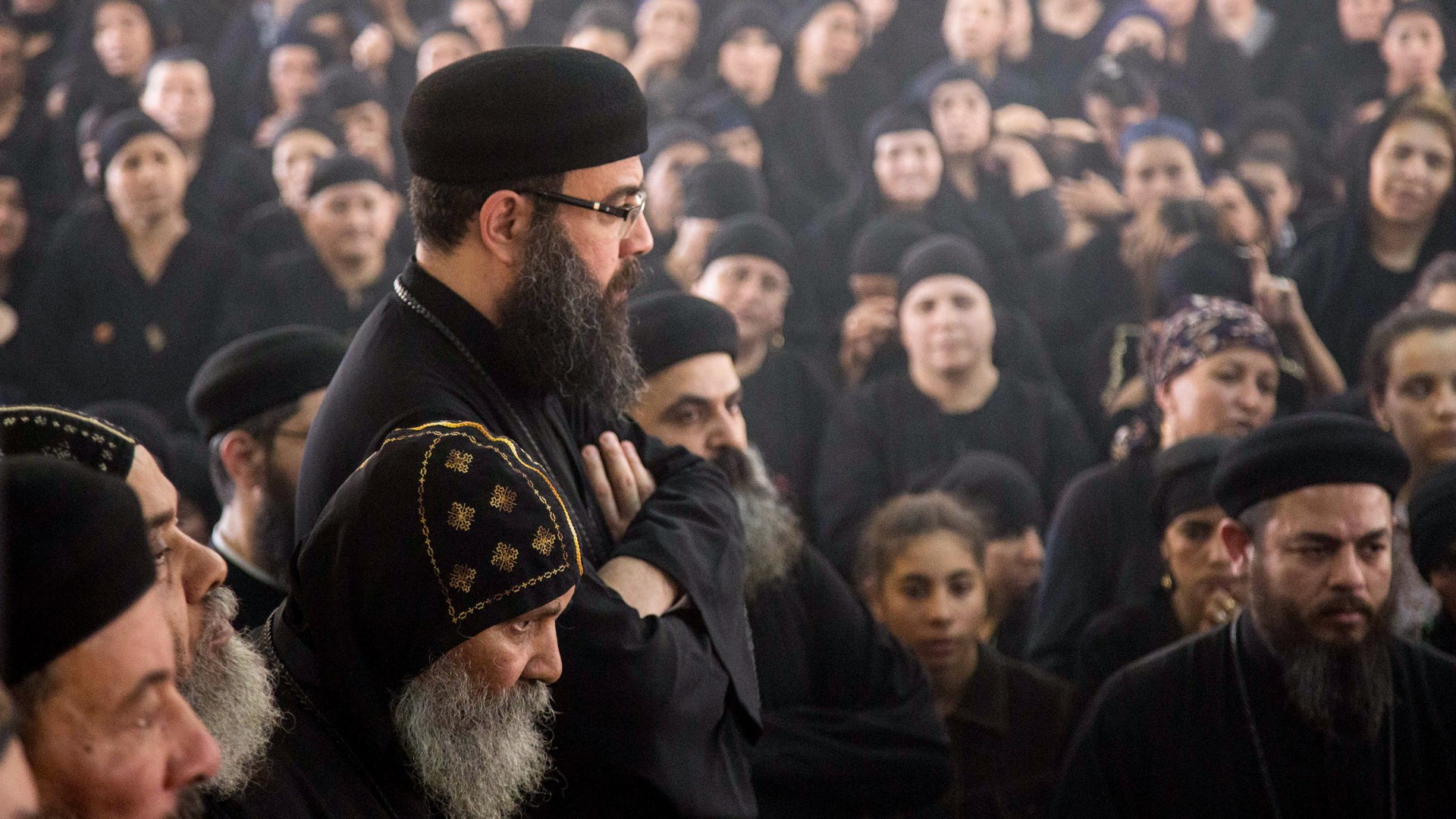
Prayers in Deir El-Garnouse Coptic church in Egypt for victims of a terrorist attack.

Prayers in Deir El-Garnouse Coptic church in Egypt for victims of a terrorist attack.

Christianity Today May 29, 2025
NurPhoto / Contributor / Getty

The Coptic Orthodox church marks time by its martyrs. Its ecclesial calendar begins in AD 284, year 1 Anno Martyrii (Year of the Martyrs), when Emperor Diocletian ascended to the throne and put 800,000 Egyptian Christians to death, according to tradition. The most famous martyr of this era, military leader Saint Maurice, famously defied commands to kill fellow Christians, only for the emperor to murder his legion of over 6,000 soldiers. 

Persecution waned after Constantine declared Christianity the Roman Empire’s official religion. But during the Byzantine era, some emperors imposed the largely European understanding of Christology upon what eventually became an Oriental Orthodox church. Subsequent Islamic rule restored the Coptic patriarch and provided some religious toleration. But it also legally established Christians as second-class citizens, known as dhimmis. The number of martyrs declined, but the Middle Age Mamluk era was particularly violent.

Coptic fortunes fluctuated during the Ottoman and colonial eras, giving way to a modern state that has struggled to define the balance between equal citizenship and a Muslim majority. Among other incidents, in 2000 in the village of Kosheh, rioters killed 20 Copts following a disagreement between a Muslim and a Christian shopkeeper. After the New Year’s Eve service in 2010 in the Mediterranean city of Alexandria, a car bomb outside a church killed 21. And in 2015 in Libya, ISIS beheaded 20 Copts and one Ghanaian Christian.

Fearing the Muslim Brotherhood’s rise following the 2011 Arab Spring, 100,000 Copts fled Egypt to the US, quadrupling the size of the local diaspora. Large communities exist also in Canada, France, and Australia. Egypt ranks No. 40 on Open Doors’ World Watch List of countries where it is hardest to be a Christian. Similar reports and subsequent immigration have contributed to a common assumption that Copts experience constant persecution.

The story is far more nuanced than the flight from religious intolerance, however, says anthropologist Candace Lukasik. Her book, Martyrs and Migrants, represents 24 months of fieldwork among Upper Egyptian Copts, transnational Orthodox clergy, and recent immigrants to the United States. Not only do most Copts emigrate for reasons other than persecution, she told CT; upon arrival they often trade one set of difficulties for another.

Born a Polish Catholic in Buffalo, New York, Lukasik, assistant professor of religion at Mississippi State University, reencountered God in the Coptic Orthodox church and was baptized into its faith in 2012. Through her encounters with the church in Egypt, she believes the Coptic tradition offers tools for all believers to understand and confront the suffering and hardship of everyday life. This interview has been edited and condensed.

Why does the Coptic Orthodox Church emphasize martyrdom?

For Coptic Christians, the blood of martyrs symbolizes both Christ’s triumph over death and an eternal spiritual belonging in the body of Christ. The Coptic calendar notably doesn’t begin with Christ’s birth or the start of Christian Egypt. Instead, it starts with the Era of the Martyrs, commemorating the widespread persecution of Christians under the Roman emperor Diocletian.

During the early Islamic expansion in Egypt, stories of martyrs and persecution became crucial for the Coptic church to maintain its institutional strength as the community’s social structure evolved. And new martyrs are incorporated into the Coptic Orthodox Church’s Synaxarium, or Life of the Saints, and linked to the sacrifice of Christ on the cross. These stories of saints serve as powerful reminders of Coptic identity and reinforce their resilience and distinctiveness, whether under Arab and Islamic rule or other governments.

Coptic Christianity is a perpetually minority tradition, and Copts practice their faith through this orientation. Yet martyrdom not only is more than a symbol to give meaning to suffering and death; it represents a way of life that entails everyday sacrifice and deep connection to God.

What does this sacrifice mean for ordinary Copts?

It takes on different forms depending on social status. A middle-class Copt in Cairo experiences everyday martyrdom quite differently than an agricultural worker in rural Upper Egypt. For the former, Copts may be discriminated against at university, such as in biased grading, or face difficulties at work, such as exclusion from positions of leadership.

For the latter, arguments with a Muslim neighbor over something ordinary like purchasing vegetables sometimes take on religious dimensions that lead to assault or even murder. These cases are complicated in that all of Egypt’s poor are marginalized, but for the Copt it may be additionally difficult to seek equal justice. 

Overall, whether deeply religious or rarely going to church, Copts in both categories see themselves as part of a long tradition of Christian witness and interpret their everyday sufferings as forms of martyrdom. And many then proceed to describe themselves as second-class citizens.

Some Copts and many Muslims say instead that Christians are equal citizens. What is the reality of persecution in Egypt?

There is a perception of persecution that describes it as happening nonstop, but the reality is not as obvious. It exists within the balance between friendship and conflict. In one instance a Muslim mother might tell her child, “Don’t eat in that Christian home because they’ll poison you,” yet she might also take her child to the church to receive blessings from a certain saint.

Focusing on incidents of violence alone can obscure these nuances. These examples happen and are terrible. But in everyday life, Copts experience what the West calls microaggressions. A teacher in Upper Egypt related how Islamic culture impacts Christian life—the Quran is memorized in Arabic language classes, for example, while Muslim phrases might be inserted alongside daily repetition of national slogans. Children are sometimes scolded if they don’t join in. 

He [the teacher] then asked me, “Candace, what is the greatest miracle you have seen in Egypt?” I thought he was changing the subject. But he said, “We [Christians] are still living here, in the middle of this society. Every time I think about emigrating, I think about what would happen to Egypt after I left.”

His answer makes me emotional. The struggle for Christian presence in the Middle East is so difficult. Violence, war, or the economy—there are many factors separating these ancient Christian communities from their sacred homelands. 

In what ways do Muslims and Christians work together?

Everyday interactions over mundane issues like electricity costs and educational fees bring Muslims and Christians together. Ordinary life makes them accountable to one another in overcoming such difficulties—perhaps by sharing tutoring lessons or rides to work or school.

At the national level, formal interfaith initiatives look like a priest and a sheikh shaking hands at a national unity conference, which from the outside appears very hopeful. And there is institutional cooperation between the church hierarchy and the leadership of al-Azhar [University], the leading center of learning in the Sunni Muslim world.

But these interactions tend to mean very little to Copts, who often describe them as a political performance. Their understanding of this type of cooperation is necessarily balanced by news that a Copt had his throat split because he owned a liquor store. These dueling frames—communal exchange and incidents of violence—bracket and impact the normal Coptic experience with their Muslim neighbors.

Say more about these dueling frames.

During my research, I spent time with Coptic landowning families in Upper Egypt and became very close with one family. One evening, we sat in their garden, and as I conversed with Jackleen, the matriarch, a man approached. The family needed some water from the nearby market, so Jackleen asked him whether it would be possible to grab some for us.

After the man left, Jackleen turned toward me and said, “That’s Ahmed. His entire family has worked for us in agriculture. He’s Muslim, but I swear to you, he has gone to the Virgin Mary Church nearby and brought blessed bread back for us. No one at the church looks at him strangely because they know he is a part of our family. He even enjoys eating it with us.”

The next evening, we had dinner together again, and Ahmed stopped by right before the breaking of the fast for Ramadan. “Do you need anything?” he asked Jackleen. “No, thank you, Ahmed,” Jackleen replied. She turned toward me and said, “He checks on us every night because he just wants to make sure we’re okay. He’s an educated Muslim and knows the faith well.”

But an hour later at dusk, the call to prayer started loudly from the small mosque next door to signal the breaking of the fast. As if to signal to me her disgust, Jackleen then held her hands over her ears and grimaced.

It was puzzling at first. She is closely connected to Ahmed but also to the mosque. With one there is a relationship while the other is a nuisance, a reminder of Islamic imposition.

I noticed the same when Jackleen would smile describing her Muslim friends and their shopping excursions. But when she told me about her relatives in North Carolina, her disposition changed. “Why do they allow Muslims into America?” she said. “My sister says that they are taking over whole neighborhoods near her. You think that you’d be able to escape them after leaving Egypt!”

What influences these attitudes?

I think timing is one factor. Jackleen held her hands over her ears in 2017, not long after the attack that killed dozens of Coptic pilgrims on a bus going to visit the desert monastery of Saint Samuel the Confessor. The theology of martyrdom shapes how Copts see such incidents.

But so does the politicization of the persecution narrative in America. Many people in Upper Egypt have a smartphone and receive on social media translated reports from Fox News from their relatives. Unfortunately, often these are the only outlets that talk about Coptic difficulties.

How is Coptic martyrdom interpreted by American Christians?

One particularly radical example came the day before the US Capitol insurrection on January 6, 2021. Conservative evangelical author Eric Metaxas tweeted an image of the 21 martyrs beheaded in Libya, with the caption “What price are you willing to pay for what you believe in?”

The parallel was clear for Metaxas’ followers, many of whom were angry over the loss of Trump in the 2020 election—their struggle to save America from liberal peril was comparable to the witness of the Coptic martyrs. The arrangement presented both as persecuted innocents, victims of religious and political intolerance.

But Metaxas is part of a broader narrative in right-wing media that employs Coptic suffering to demonize Muslims as a whole—and diaspora Copts sometimes participate. For example, on September 11, 2010, conservative activists staged a protest against a planned Muslim community center next to the site of the World Trade Center. It featured Joseph Abdelmasih, founder of a Christian satellite-television station, who held up a bloodied image of a man from that year’s Nag Hammadi Christmas massacre.

“This is one of our dear friends in Egypt [killed] … in the name of Islam,” he said, then pointed back to the site of the World Trade Center. “Three thousand persons burned here, and in the same area they need to build a mosque! … I know the truth because I’m from Egypt … Wake up, America! … Stop [the] Islamization of America!”

What is the effect of this narrative in Egypt?

American instrumentalization of global Christian suffering is nothing new, but it has produced a fraught predicament for the transnational Coptic community. Between 1996 and 1998, discussions around the International Religious Freedom Act (IRFA) took shape, bringing together Middle Eastern Christian activists, American religious leaders, and politicians. A special waiver ensures the US government does not sanction important geopolitical allies and economic partners for their violations of religious freedom protocols. But the act presented a challenge for Copts in Egypt.

One Coptic member of parliament [in 1998] said in an article that IRFA was a new form of imperial interference that would impact Christian-Muslim relations and was actually “stabbing Copts in the heart.”

And in the late 1970s during negotiations for the Camp David peace accords with Israel, activists in the Coptic diaspora publicized anti-Christian violence and discrimination in Egypt. During this tumultuous period, it was reported that President Anwar Sadat would repeatedly complain, saying, “Why do these Copts want to turn the Christians of the world against me and Egypt?”

Have these initiatives contributed to violence against Christians?

I cannot authoritatively say one way or the other. How is that measurable? But shortly after the beheading of the 21 martyrs on the shores of Libya, ISIS released its newsletter entitled “Revenge for the Muslim Women Persecuted by the Coptic Crusaders of Egypt.”

This framing can only take shape if Copts are viewed as part of Western Christianity and not an essential part of Egypt. It was similar under British colonial rule, when Copts were accused of being part of the “Christian” colonial regime.

An added layer to these perspectives on anti-Christian violence is how some Copts in Egypt describe how they play into this narrative. Early in my research I wanted to find out the root causes of violence against Christians in Egypt. When I asked about emigration, the two reasons that predominated were economic and a desire for greater freedom.

But one person I spoke with told me that to receive sympathy from the US consular officer, “We [as Christians] use persecution as a frame for our situation in order to travel to America.”

Most Copts have not experienced a shooting or bombing. They simply want a better life, and aside from economic factors, their desire is for freedom from the sense of Christian marginalization. Alongside these observations, I also have a visceral reaction to those who say that Copts are equal citizens in a spirit of national unity. I take offense because it is the commonality of nonspectacular negative interactions that shows how difficult it is to be a Christian in Egypt.

What is the US like for diaspora Copts?

Even though the US offers the promise of freedom, justice, and spiritual witness, many Copts express surprise that their experience of migration is also a form of sacrifice. Not only do they lose their sense of belonging; some also encounter racial discrimination and poverty—along with immigrating Muslims.

They expected America to be a Christian country where they could religiously, socially, and economically flourish, but wind up discovering a major paradox: While American evangelicals appreciate the martyrs, many view living Copts as heretics. It is the spilled blood that enters them into a Western Christian conception of the global Christian community and not specifically their Coptic Orthodox faith.

Yet despite these new struggles, the richness of their tradition still sustains them, as it has through other experiences of historic marginalization.

What can Americans learn from the Copts?

Evangelicals often say, “We’ve strayed from the early church.” But Coptic Christians are part of that early church. Why not invite them to your congregation to learn from their ancient faith? Coptic Orthodoxy is a continual orientation to humility and mystery. Coptic youth sometimes complain about their priests always telling them, “Turn the other cheek.”

But martyrdom—in life or death—is resistance to the egocentric ways of the world. It is not a passive act but a vital witness to Christ and the power of the Resurrection. As Bishop Youssef of the Coptic Orthodox Diocese of the Southern US noted on the 21 martyrs of Libya, “The challenge of understanding martyrdom is two fold: first to bring honor to our Lord through a willingness to die for our beloved Coptic Christianity; second it is to spread our faith through the world with the blood of the martyr.”

Culture
Review

A Graceless Exit

The Mission: Impossible franchise believes the world needs forgiveness … but its leading man is problematically perfect.

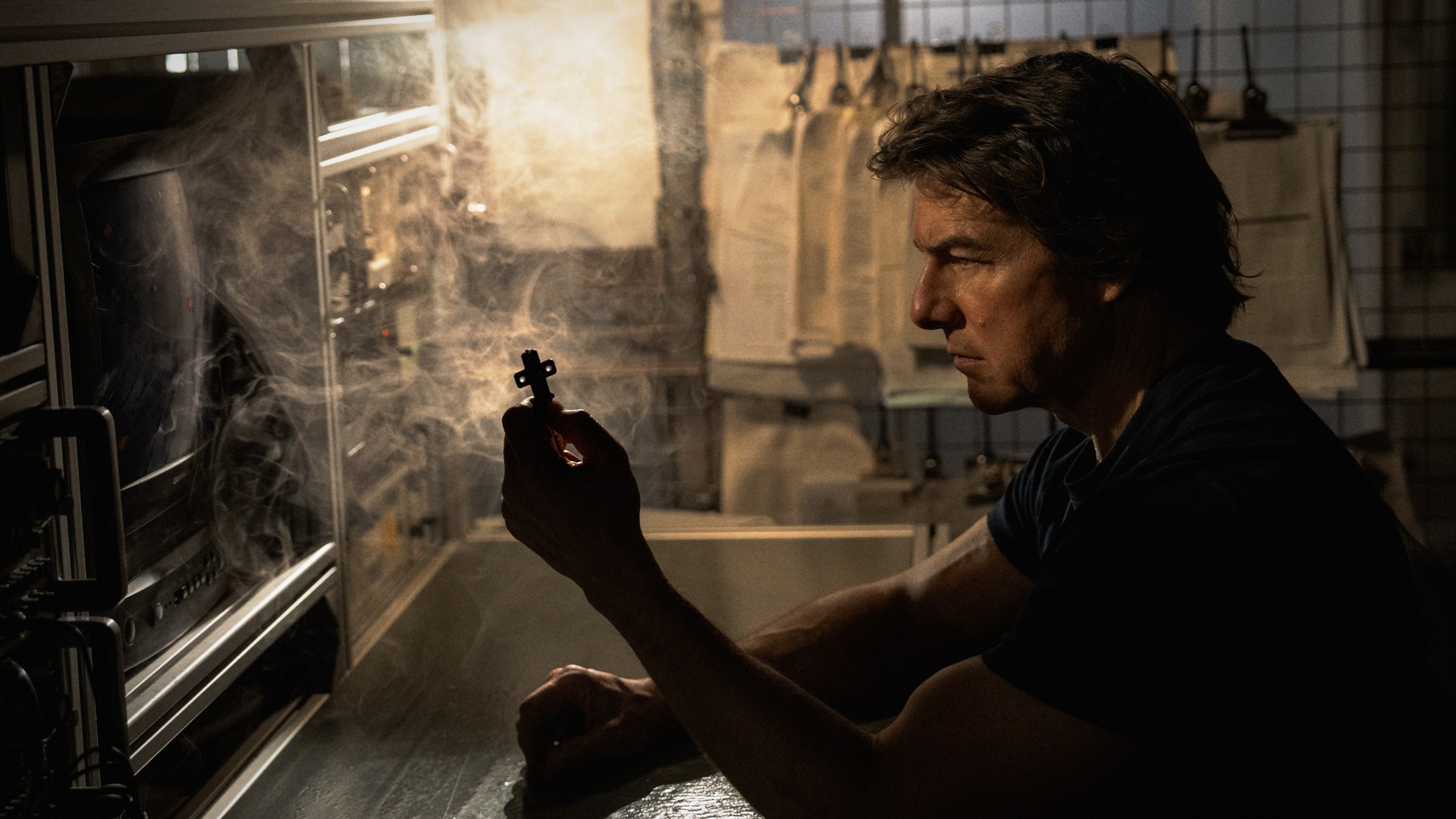
A still from the movie showing Ethan Hunt holding a cross.
Christianity Today May 29, 2025
© 2025 Paramount Pictures. All Rights Reserved.

At one point in the film Lawrence of Arabia, the eponymous T. E. Lawrence, an imperious Englishman, defies his Arab friends’ disapproval in order to save a man’s life. When they object that the man’s time has come, that he must die because “it is written,” he counters, “Nothing is written.”

In Mission: ImpossibleThe Final Reckoning, the concluding installment to the franchise, superspy Ethan Hunt (Tom Cruise) borrows Lawrence’s catchphrase as a response to his enemies: “Nothing is written.” One suspects he has in mind not just fictional supervillains but also risk-averse studio executives.

This phrase, shot through with the hubris of the Lawrence character, is paired with a film that’s chock-a-block full of Christian imagery. None of it hangs together in a coherent way. (Neither does the film.) But as an expression of Hollywood megalomaniacal vision, it’s still strangely pious, a grab bag of Saint Christopher medals, paeans to free will, Cold War–liberal aspirations for global harmony, and an overall lament that no one seems to know the truth anymore because it’s been redefined by “the Lord of Lies.”

In this final mission, Ethan and the gang are fighting for more than just survival—they’re looking to preserve free will against a determinist, antihuman, antitruth enemy. Much is made of the series’ iconic catchphrase: “your mission, should you choose to accept it.” Ethan is humanity’s advocate, claiming that a machine wants only other machines but humanity’s strength lies in individuals who go rogue.

And what about when going rogue goes wrong? The film puts the final, crucial action of the heist—and the fate of the world—into the hands of (a woman named) Grace. But the gesture feels empty when everyone needs her … except Ethan Hunt.

The Final Reckoning starts in the middle of a worldwide crisis of truth. An evil, sentient artificial intelligence system, the Entity, which took over the internet in the previous installment, is intent on capturing all the nuclear arsenals and destroying the world entirely, sealing itself safely in a digital bunker. Ethan wants to destroy this “anti-God” while everyone else wants to control it because it will give them the power to define what’s real and do a bunch of other stuff. (In a film which could easily lose 45 minutes of exposition, the Entity’s rules and powers are somehow still vague.) The Entity itself, of course, just wants to put humanity out of business.

Cruise’s supporting cast is made up of quippy character actors, with Luther Stickell (Ving Rhames) as the mellow voice of truth. The rest are mostly there as comic relief, though impish pickpocket Grace (Hayley Atwell) gets a great entrance—and provides welcome bleeding-heart shock as she witnesses Ethan’s violent lifestyle.

In a world where “human” is always better, it’s strange that so little attention is paid to supporting characters’ story arcs. Several times, motifs suggest a build to a resolution, from a vixenish assassin (Pom Klementieff) forever requesting permission to seek revenge (a theme that’s funny every time it appears) to an earnest sidekick (Simon Pegg) being given explicit responsibility for a team. But both of these threads peter out without payoff. Instead, we get endless throwbacks and retcons to the earlier films in the series, larding up a story that’s already ambitious with the weight of legacy.

The one subplot that does get screen time is all telling, no showing, as an American president (Angela Bassett) handles a turgid nuclear standoff. With an AI villain, it’s a little boring that the worst-imaginable scenario in a post-truth world is just a rehash of the paranoid fears of Tom Cruise’s and director Christopher McQuarrie’s Cold War childhood. (There’s also an amusing dose of Luddism—baby boomer Cruise snarls, “You spend too much time on the internet,” as he beats up a henchman.)

This subplot’s premise is essentially recycled from Fail Safe, a political thriller from 1964, in which Henry Fonda’s US president resolves to nuke New York City as a gesture of apology when an American nuke accidentally strikes Moscow—this despite the fact that his wife will die in the blast. It’s a sign of how half-baked this tribute is that when Bassett’s president picks an American city, we never find out which one.

Despite endless talk about how high the stakes are in the president’s war room, those scenes don’t hold a candle to the heart-pounding danger of actual stunts. You don’t need much explanation about the stakes when the enemy is gravity. The most famous image in the series remains Tom Cruise dropped on a wire into a pristine white CIA vault, destroying some poor national security employee’s career by stealing top-secret information. (We actually catch up with that very employee, banished to a South Pole research station. But don’t worry—lest we think Ethan is really blameworthy, the employee forgives and thanks him right away.)

And Ethan’s twin battles with gravity in this film are worth the price of admission. Having commandeered an aircraft carrier, mostly because it’s a cool ride, Ethan dives to the bottom of the Bering Sea to go on a tense, nearly silent scavenger hunt inside a Russian sub on the ocean’s floor. It’s not clear to me whether the water is as cold as we assume, but when he exposes his bare skin to it, I shuddered viscerally anyway. I couldn’t help but think of another catchphrase Ethan repeated earlier in the film: “It’s only pain.”

The final action sequence is another stunner, with Cruise doing some complicated stunts involving biplanes that I won’t spoil by describing.

The sequences, however, feel totally independent of the personal stakes that made such stunts so engaging in previous films. Ultimately, we just don’t care when the world is at risk. There needs to be a person on the line—a person cared about by another person. However, with each film, Ethan has become increasingly isolated, a suffering servant of espionage.

The problem is that Ethan is interesting when he’s doing things, but when introspection becomes the mission, the series won’t give him anything to regret. Every time he faces a bad decision, he’s told there was a good angle he hadn’t considered. Without accompanying the cocky swagger of “Nothing is written” with the true sense of tragedy and irony that Lawrence ultimately faces, a hero’s introspection is toothless, a mere self-canonization.

Is it really a problem that we’re given a perfect hero? Christ figures have their role in stories, but only when they are truly “with us,” the people of Earth. Ethan Hunt is sealed in an unreality bunker of his own. One can’t help but be appreciative of his mighty feats, but a little self-awareness might have successfully landed the franchise plane. Instead, it parachutes to safety, coattails aflame.

Hannah Long is an Appalachian writer living in New York City. Her writing has appeared in Angelus News, The Dispatch, and Plough Magazine.

News

From Prosperity Televangelism to the White House

Paula White-Cain’s friendship with the president turns into a position leading Trump’s faith office.

Paula White-Cain speaks at White House garden with Trump in background

Paula White-Cain

Christianity Today May 29, 2025
Andrew Harnik / Getty Images

On May 1, 2025, the National Day of Prayer, Paula White-Cain stood in the White House Rose Garden and called President Donald Trump “the greatest champion of faith we’ve ever had.” She then led religious leaders and Trump cabinet members in singing “Great Are You Lord” and “Amazing Grace.”

The president, seated at a desk amid the group, signed an executive order establishing his Religious Liberty Commission, with Texas lieutenant governor Dan Patrick as chair. The commission will work alongside the White House Faith Office, directed by White-Cain.

White-Cain’s life is rags to riches: hardship, struggle, faith in Christ and positive thinking, victory, wealth. She often describes herself as a “messed-up Mississippi girl” whom God saved from early years of abuse, poverty, and single motherhood. 

A neighbor in her trailer park led her to Christ, then White-Cain married Randy White, a Pentecostal preacher. The newlyweds scraped together enough resources to start a church in Tampa, Florida, that eventually became Without Walls International Church. They divorced in 2007, just before a Senate Finance Committee investigation found they had spent tax-exempt donations on a lavish mansion, a private jet, and exorbitant salaries for family members.

Today, White-Cain is married to Jonathan Cain, an original member of the band Journey and pastors New Destiny Christian Center in Apopka, Florida. She preaches a prosperity gospel, and religion scholars Shayne Lee and Phillip Sinitiere called White-Cain the “‘Oprah’ of the evangelical world.” She platforms wellness experts, instructs followers on weight loss (repent and stop eating sugar), and offers beauty tips.

According to Lee and Sinitiere, White-Cain “reinvented her image with extensive plastic surgery, modish hairstyles, perfectly manicured nails, chic silk suits, fitted dresses, and a leaner size 4 figure.”

In the early 2000s, she launched her show Paula White Today, and by 2006, she appeared on a half-dozen stations including Trinity Broadcasting Network and Daystar. During that time, Donald Trump saw her on TV and invited her to a meeting at Trump Tower.

They became friends, and White-Cain went with Trump to Atlantic City, New Jersey, where she conducted Bible studies and prayer meetings with celebrities who visited the casinos. White-Cain said Trump had a born-again experience and told Religion News Service she was “one hundred percent” sure he “confesses Jesus Christ as Lord.”

White-Cain is both a logical choice to direct the White House Faith Office, given her friendship with Trump, and a surprising one, given the office’s history. It began in 2001 under George W. Bush as the White House Office of Faith-based and Community Initiatives, an outgrowth of compassionate conservatism. Its first director was policy expert John DiIulio.

During her Rose Garden speech, White-Cain said that in the first 100 days of the Trump presidency, the Faith Office has hosted dinners and held “briefing,” “listening,” and “working” sessions. It has invited more than 1,000 religious leaders to the White House, “and they are not here for ceremony [but] for collaboration—creating and crafting policy and sharing their hearts.”

Stanley Carlson-Thies, deputy director of Bush’s faith office, sees a “strong continuity” between the two offices on “key tasks,” such as “helping agencies redesign programs to become more effective by engaging with community-based organizations.”

Jim Towey stresses the differences. He led the White House faith office from 2002 to 2006 and focused it “on the needs of the poor,” he said in an email statement. “I don’t know what President Trump proposes to do with the faith office. … It does not appear to be centered on the poor and how to help them access the most effective social service programs, sacred or secular.”

Both Carlson-Thies and Towey are taking a wait-and-see approach. Towey said, “We will have to judge a tree by its fruit.” Carlson-Thies said, “I’m praying that the many clergy who come [to the White House] to pray will not simply bless the president and administration but bring a strong sense of the biblical wisdom that just governance is ‘under God’—subject to God’s intentions for government in the in-between times of the present world.”

John Fea is distinguished fellow in history at the Lumen Center in Madison, Wisconsin.

Apple PodcastsDown ArrowDown ArrowDown Arrowarrow_left_altLeft ArrowLeft ArrowRight ArrowRight ArrowRight Arrowarrow_up_altUp ArrowUp ArrowAvailable at Amazoncaret-downCloseCloseEmailEmailExpandExpandExternalExternalFacebookfacebook-squareGiftGiftGooglegoogleGoogle KeephamburgerInstagraminstagram-squareLinkLinklinkedin-squareListenListenListenChristianity TodayCT Creative Studio Logologo_orgMegaphoneMenuMenupausePinterestPlayPlayPocketPodcastRSSRSSSaveSaveSaveSearchSearchsearchSpotifyStitcherTelegramTable of ContentsTable of Contentstwitter-squareWhatsAppXYouTubeYouTube