Inkwell

Discordia Concors

Inkwell January 14, 2025
Photography by Daniel Casson

After Emily Dickinson

So, spin the polyphonic song,
thrush after thrush, in one cord bound –
the feathered frays held by this centre
are gathered in a single sound.

Then lose your way, but leave small traces –
thread after thread entwined in blue.
Celestial crash! These rivers braided –
One harmony requires two.

Maya Venters is a Canadian writer, editor, and visual artist. She is currently an MFA candidate at the University of St. Thomas (TX). Her poems have recently appeared in Rattle, The Literary Review of Canada, and Modern Age, among others.

News

Died: Bill McCartney, Football Coach Who Founded Promise Keepers

He led the Colorado Buffaloes to a national title and started a movement urging men to take responsibility for their faith, families, and communities.

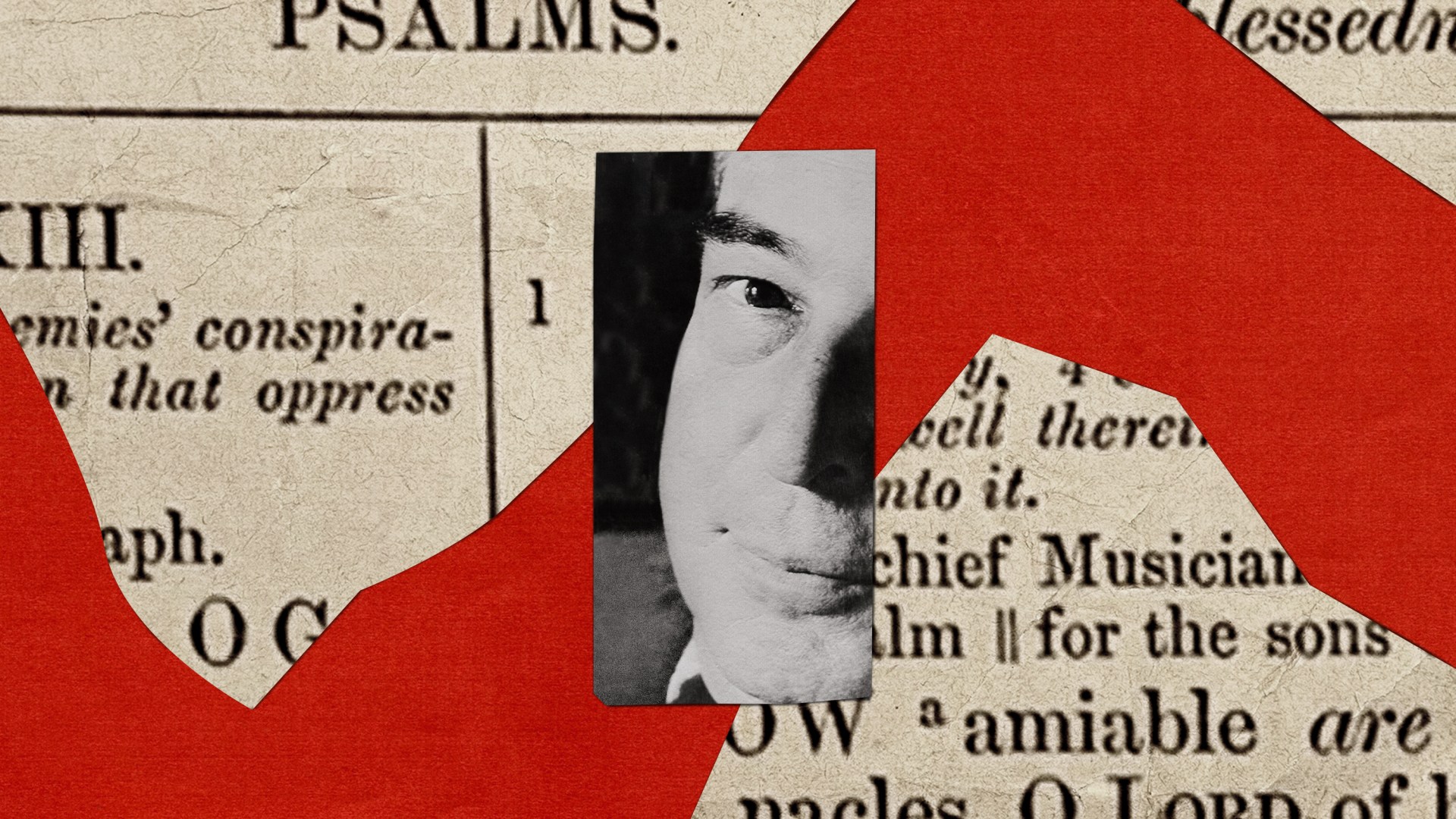
Bill McCartney
Christianity Today January 14, 2025
Illustration by Christianity Today / Source Images: Getty

Bill McCartney filled stadiums as a college football coach. He led the Colorado Buffaloes for 13 seasons, winning three conference championships and one national title. Then, he filled stadiums again with Promise Keepers, the men’s movement that spurred millions to reaffirm commitments to Jesus, their wives and children, and their civic and social responsibilities.

McCartney said Promise Keepers grew out of tension in his own life. His zeal for success as a football coach came into conflict with his desire to be the husband and father he felt God wanted him to be. His struggle to reconcile those tensions led him to launch the ministry that fused evangelical spirituality, big-tent revivalism, sports celebrity, and therapeutic masculinity—and to eventually walk away from coaching while he was still at the top of his game.

He was inducted into the College Football Hall of Fame in 2013. But his greatest legacy was as a Christian. While many Christian football coaches came before him and many after, few burned as bright as McCartney or extended their influence as wide.

“Bill McCartney’s absolute commitment to Jesus Christ was and is a beacon for all of us,” Bill Curry, a coaching contemporary, told Christianity Today. “We will always remember and do our best to honor his memory.”

McCartney died on Friday, January 10, at the age of 84.

McCartney was born on August 22, 1940, and grew up in a working-class neighborhood in Detroit. His mother was a homemaker who raised him and his two brothers. His father, an Irish Catholic who served in the Marines before going to work in an auto factory and rising to leadership in his local union, was a fanatic about three things: the Democratic party, the Catholic church, and Notre Dame football.

At an early age, McCartney learned to love football, too. Friends from that time remembered him as a natural leader, someone who would call the plays in their neighborhood football games even though he was younger than the other kids. Around 8 years old, he decided he wanted to be a coach.

“The idea, the concept, the preparation—all the intangible things associated with football,” he later wrote, “excited me perhaps more than the mere playing of the game.”

Pursuing his dream, he went to the University of Missouri, where he played linebacker and center for hall-of-fame coach Dan Devine. McCartney had average ability but unusual tenacity and an intuitive feel for the game, helping to lead the Tigers to three straight winning seasons.

While at Missouri, McCartney also met his wife, Lyndi Taussig. Raised Methodist, Lyndi converted to Catholicism after marrying McCartney. In the span of eight years, they had four children: Mike, Tom, Kristy, and Marc. In between the births of Mike and Tom, the family moved to Michigan, where McCartney began his climb up the coaching ladder.

The move, like much of McCartney’s life, was shaped by his faith. McCartney had just attended a Cursillo Weekend, a Catholic retreat designed for spiritual renewal. At the retreat he was told that within 72 hours, something would happen that would change his life. When his brother Tom called from Michigan offering him a coaching job, McCartney saw it as the promised event. He and his family packed within a day and headed north.

McCartney ascended quickly in the sports world. At 30, he was head coach for the basketball and football teams at Dearborn Divine Child High School. At 33, he led both teams to state titles. The next year, 1974, legendary coach Bo Schembechler did something he had never done before and hired a high school coach directly to his staff at the University of Michigan.

In the midst of his professional success, though, McCartney began to feel a tinge of concern about his faith. 

“I thought I was a really good Christian!” McCartney later reflected. “After all, I went to mass every day, I said my prayers, and I tried to live by the Golden Rule.”

But deep down, he felt something was missing. He struggled with alcohol consumption, unable to stop at just one drink, and felt his professional ambition dominating his life. 

“Nothing would stand in my way. Not Lyndi. Not my children. Not anything,” he recalled.

When he met Chuck Heater in 1974, a running back for the Michigan team, McCartney became intrigued with the young man’s poise, maturity, and sense of peace. He asked Heater what made him different, and the athlete invited him to a weekend with Athletes in Action, a sports ministry under the umbrella of Campus Crusade for Christ (now known as Cru).

McCartney was stirred by the Christian athletes talking about their intimate relationship with Jesus. He committed his life to Christ and immediately began encouraging others to do the same. 

“I thought he was downright obnoxious about it,” recalled Lyndi, who later had an evangelical experience of her own. “Every time he turned around, he was praising the Lord for everything.”

McCartney’s born-again faith brought him into the orbit of an emerging evangelical sports subculture. Yet he continued attending Mass and identified as a “born-again Catholic.” His spiritual life was shaped by Word of God, a charismatic Catholic group in Ann Arbor, Michigan. It was not until 1988 that McCartney stopped regularly attending Mass and joined a Protestant church. He became a member of a Vineyard congregation in Boulder, Colorado, a church where McCartney’s charismatic spirituality could be nurtured. 

By that time, McCartney had turned around a moribund Colorado football program, becoming one of college football’s most intriguing and controversial coaches.

His outspoken faith and infusion of religion into the athletic program at a public university brought him frequent critics, and he clashed regularly with the American Civil Liberties Union. 

McCartney agreed to temper some excesses within the program, but he turned up the dial on his public activism, lending his voice to socially conservative causes. He spoke at pro-life rallies and threw his support behind a proposed amendment to the Colorado state constitution that would bar cities from enacting laws to protect LGBTQ people from discrimination. These public stances brought him new waves of supporters in America’s culture wars, but also additional critics. 

His family’s personal life was another source of controversy. Before the 1989 football season, news broke that McCartney’s 19-year-old daughter, Kristy, was pregnant—and that Colorado football player Sal Aunese, who tragically died of cancer that fall, was the father. McCartney was accused of not taking care of his own family while trying to impose his morality on the public.

On the football field, the Buffaloes proceeded to win 11 straight games, finishing the year ranked fourth in the country. The next year they won the national championship. 

In between, McCartney and his friend, Dave Wardell—on their way to an event with the Fellowship of Christian Athletes (FCA)—dreamed up the idea for a movement of Christian men who would gather together in football stadiums for renewal and revival; men would then return home empowered to be spiritual leaders.

It started with a small group of 70 men, growing to 4,200 in 1991 and more than 1 million in 1996. Promise Keepers hit its cultural peak in 1997 with a rally in Washington, DC. According to sociologist James Mathisen, it was “the decade’s most unexpected and immediately successful movement within the American church.” 

It was also a flashpoint for controversy and, as historians including Seth Dowland and Kristin Kobes Du Mez have noted, a complex movement that is difficult to categorize.

Some liberal and progressive groups warned that Promise Keepers was designed to impose a right-wing Christian agenda on America. They saw efforts to mobilize Christian men to assert their authority as leaders as an attempt to secure patriarchy, turning back the clock to more oppressive notions of marriage and family.  

Some conservative Christians, meanwhile, criticized Promise Keepers for being too ecumenical, charismatic, and emotional. Advocates of a more aggressive, masculine Christianity, such as Seattle megachurch pastor Mark Driscoll, denounced Promise Keepers for not being manly enough. 

Some evangelicals also resisted the movement’s focus on racial reconciliation, a priority born out of McCartney’s experience as a football coach and established early on as one of Promise Keepers’ core commitments. Rallies featured a racially diverse group of speakers, and McCartney and others urged white Christians to “seek forgiveness for the sins of our fathers and for the same racial oppression that continues to this day.” 

In 1996, nearly 40 percent of the attendees said they disliked the emphasis on racial reconciliation. Even as Promise Keepers’ numbers declined, though, McCartney continued to emphasize the issue. Some observers said the focus on race was responsible for the decline of the men’s movement at the end of the decade. 

McCartney was willing to forge ahead when he believed he was right, regardless of the consequences. That same commitment led him to leave his coaching days behind. 

As he traveled around the country in the early 1990s, calling on Christian men to be better husbands and fathers, his wife, Lyndi, felt neglected. McCartney came to see he was not practicing what he preached. Coaching, he realized, had moved from a “stirring passion” to a “suffocating obsession”—an idol.

So he gave it up.

“A man’s job is to serve his wife and enable her to be everything that God created her to be,” he told journalist Michael Weinreb. “I enjoyed coaching too much. And that’s what pulled me out of it.”

McCartney’s national profile declined significantly in the 21st century, though Promise Keepers continue to stir the fascination of scholars and his coaching career was discussed in sports media. In 2015, ESPN released a documentary on McCartney’s time at Colorado, The Gospel According to Mac.

For his part, he spent little energy focusing on his legacy. Really, he once told the FCA’s magazine, there was only one thing in his life that was important. 

“Nothing compares to the glory of knowing God,” McCartney said. “I’d let everyone know that Jesus Christ is Lord.”

McCartney’s wife, Lyndi, died in 2013. He is survived by the couple’s four children—Michael, Thomas, Kristy, and Marc—and ten grandchildren. One of his grandchildren, T. C. McCartney, is the quarterbacks coach for the New England Patriots. 

“While we mourn his loss, we also celebrate the extraordinary life he lived and the love he shared with everyone around him,” the family said in a statement. “Coach Mac touched countless lives with his unwavering faith, boundless compassion, and enduring legacy as a leader, mentor, and advocate for family, community, and faith.”

A memorial service is being planned. The family asked that donations be made to a local church in his name.

Church Life

Sign Language Bible Translations Have Something to Say to Hearing Christians

You don’t need to know the language to be moved by the translation.

A man doing sign language for the book of Matthew
Christianity Today January 14, 2025
Illustration by Mallory Rentsch Tlapek / Source Images: Biblialsm

A visitor coming to Bible Gateway to look up John 3:16 has 63 options of English translations. For Christians, reading the same verse with an unfamiliar word or changed-up syntax—or in a more contemporary or lyrical version—can illuminate a biblical principle in a fresh way or strengthen the resonance of the passage.

Jost Zetzsche noticed this effect—but to an even stronger degree—when he began watching sign language translations. Zetzsche, a linguist, is the curator of United Bible Societies’ free Translation Insights & Perspectives (TIPs), an online tool that gathers insights from Bible translations in nearly 1,000 languages, including many sign languages. Zetzsche initially believed that adding these languages was just another part of his TIPs assignment.

“But as I began studying the recorded sign language translations,” he said, “I was astonished at how much I as a hearing person could learn from those languages that I had never experienced in others.”

He recently spoke with Ruth Anna Spooner, who is Deaf, and is the lead translator on the American Sign Language Chronological Bible Translation team since 2019 and a trainer for Deaf-translation teams worldwide, to discuss the power of watching these sign language translations as a hearing person. 

This conversation has been edited for length and clarity.

Zetzsche: Let’s start our conversation with one obvious difference between written and sign language translations. The more-than-400 officially recognized sign languages from around the world have several different strategies for dealing with proper names. Some sign languages fingerspell most names and translate some semantically or based on their meaning; others, like Libras (Brazilian Sign Language) translate all names with a meaning-based translation.

In the context of Bible translation, we recognize that names and their meanings are important in the original texts, but they typically lose their meaning in translation into written languages. When they are semantically translated into sign languages, though, they are often rendered not according to the names’ original meaning but by other meaning-based markers, and then often differently from one sign language community to another.

Can you help me understand this?

Spooner: Names are fascinating across languages. We are all familiar with how the same name might be pronounced and spelled differently from one language to another—John (English), Juan (Spanish), Giovanni (Italian), Jean (French), Johan (Dutch), Ivan (Russian), and so forth.

Deaf people give each person what is called a name sign—an invented sign that is uniquely identified with that person. When signing, instead of using the spoken language version of that person’s name (for example, John), the name sign is used to identify and talk about that person. Instead of fingerspelling “RUTH ANNA,” people will use my name sign, which is much more efficient and quicker.

In the Deaf community, a name sign is uniquely assigned to an individual by a Deaf person. Signs may be based on the individual’s appearance, personality, a favorite hobby, or related to the meaning of that individual’s name.

In American Sign Language (ASL) culture, people only get name signs if they are immersed in the Deaf community or if they are frequently discussed historical or contemporary figures (for example, William Shakespeare). Most biblical characters do not already have name signs, so Deaf translation teams often have to invent name signs based on scant data.

But let’s talk about David, whom we know a lot about. We know he was handsome, a man after God’s heart, a shepherd, a giant-slayer, a musician, a poet, a renowned warrior, a king, an adulterer, the father of Solomon. I have seen name signs for David based on the sign for king. Some name signs I’ve seen are based on his music and poetry skills. Other name signs reflect the young shepherd he was when we first meet him, or the giant-slayer he became. There is a lot of variation, and it all depends on what each team decides is the most memorable or most identifiable feature associated with David. What is most memorable or most identifiable might vary from culture to culture as well, depending on what traits are more valued in each country. 

Sometimes when the verses explicitly mention what a name means—for example, Isaac means “laughter”—a sign language translation team might use that as a cue that their name sign should show some association with their sign for that meaning. 

In our ASL translation, Jacob, who was hairless and smooth-skinned, has a name sign that can be back-translated literally to English as “smooth arm skin,” whereas his twin, Esau, who was notoriously hairy, has a name sign that indicates wooly arms. These name signs communicate more meaning to the audience than just the name of the person.  

Zetzsche: The signed names of biblical characters are a way to learn more about them, but sign language seems to communicate even more deeply than that. Like most Christians, I want to understand the feelings of the biblical characters deeply and grasp what they were truly like even from this historical distance. While I realize that any translation is also an interpretation, I have been moved to see how Jesus emotes via the body of the signer.

One example of this is in the story of the Canaanite woman in Matthew 15 in Mexican Sign Language (Lengua de Señas Mexicana, or LSM). Unlike anything I’ve ever read in the written text, the LSM signer shows the depth of Jesus’ conviction, delight, and compassion in the face of the Canaanite woman’s reasoning. I can’t imagine reading that passage now without recalling that intense visualization.

(Watch the video with an English translation.)

Spooner: Anyone who sees a Deaf person signing will quickly notice that they are usually very expressive with their face and body, much more so than the average hearing person using a spoken language. 

In fact, hearing people often feel that Deaf people are too expressive or excessively emotional. But what they don’t realize is how much grammatical work facial expressions are doing in sign languages. So much of sign language grammar is communicated in the face. Contrary to common belief, sign language is not just in the hands. It’s in the hands, and the body posture, and the face—all at once.

If you focus only on the hands, you will miss a ton of important grammatical information that’s happening via facial expressions. Eyebrows up or down (and how far up and how far down they go) can change a sentence into a question, or a question into a challenge, or a statement into a command, for example. The shape of the mouth and the cheek, lip movements, and even tongue movements all are an important part of sign language grammar, too. The position of the head and shifts in the shoulders from one side to the other also communicate a lot of important grammar and linguistic information.

Zetzsche: I had no idea! Yet when I look at the signer in the videos, it feels as if I’m also seeing a lot of emotion. Am I misinterpreting what I see? 

Spooner: You are seeing emotion. That’s another layer of complexity. A lot of the facial expressions are serving grammatical functions, but on top of that, the signer is also manipulating the facial expressions to show emotions and, in the case of storytelling, to perform the personalities of various characters within the story. 

In ASL, for example, a skilled signer can move their eyebrows and incline their head to form a question while at the same time using the eyebrows (as well as the rest of the face) to communicate the emotion behind the question. Is it an annoyed question? An angry question? An innocuous question? A desperate question? Thus, the eyebrows and the rest of the face are simultaneously communicating grammatical and emotional information.  

In the videos on TIPs with their back-translations into written English, you are seeing the signers using their facial expressions to communicate grammar and emotion simultaneously. Facial expressions for emotion and for grammar are often intertwined in ways that make it difficult—even impossible—to separate out when signing. When asking a question, for example, the signer needs to know whether it’s an angry question or a genuinely curious question to sign it correctly. As you, Jost, don’t know a sign language, I imagine that to your eyes, what you see in the videos all looks emotive, which isn’t surprising. It’s wonderful to see that you feel the impact so deeply. But there is a whole other layer (the grammar) going on that you probably are not able to pick up on.

Now let’s discuss why the Matthew 15 story of Jesus with the Canaanite woman presents a lot of challenges for sign language translations. We can translate the words and sentences, but in sign language, because we must embody dialogues and perform them, it is quite impossible to do dialogue neutrally without showing the character’s tone and feelings in that moment.

So when Jesus said, “I was sent only to the lost sheep of Israel,” what was his tone? Was he regretful? Was he firm? Was he kind of playful or teasing? Whatever his tone was, the woman felt she could still come and kneel in front of him, so what does that tell us about his tone? Not unlike stage actors, we translators must figure out, as best we can, what his feelings and tone were. (And then to make it more complicated, maybe Jesus used a different tone compared to what he was really feeling in that moment; if so, we need to show that.) There can be several different views on how a verse—especially with dialogue—ought to be performed.

And then Jesus says, “It is not right to take the children’s bread and toss it to the dogs.” That is such a strange remark—and again, what was his tone? Was he being playful? Was he teasing, or testing, the woman? At what point did Jesus decide he would help her? Before he spoke about the lost sheep of Israel? Or after she knelt before him? Was Jesus initially reluctant to help but then touched by her faith and moved to help her based on that? Or did he know all along that he would help, and he was just doing the conversation for the benefit of the people around him? 

Zetzsche: All of these are considerations when translating a text—or more precisely, the meaning of a text—into a written language, but it’s striking to see how much more urgent these questions of emotions are when translating into sign languages.  

Spooner: Yes, you’re right—for translators, meaning is everything. Deaf translators know that because of the nuanced, performative nature of sign language, the signer showing too little or too much of an emotion can greatly change the meaning of a passage. So we need to make sure our facial expressions and body movements are showing not only the correct grammatical information but also the appropriate level of emotion that fits the situation. 

Matthew doesn’t give us much of an indication of what Jesus’ tone or emotion was when he said these things. This is something we must infer based on scant clues in the passage. In most written translations I’ve seen, they can get away with keeping things at a pretty neutral tone and leave it up to the readers to make their own inferences and interpretations. Such neutrality is often not possible in sign language translations.

Zetzsche: I was also moved by the Russian Sign Language (RSL) version of the paralytic man who was lowered through the roof in Mark 2. In this signed translation, Jesus observes the efforts of the man’s friends from the moment they start digging through the roof. This makes a lot of sense, but it’s only implicitly present in the written text. As Jesus watches the paralyzed man being lowered in front of him, the signer shows that Jesus’ heart—and my heart in response—is overflowing with compassion. The eventual joy of the healed man and the crowd is portrayed in an infectious way that is hard to imagine in written language.


(Watch the video with an English translation.)

Spooner: Yes, seeing something in sign language is often much more poignant than reading words on a page. While I do love reading in English, there is something about seeing the verses in ASL that just makes it hit you in a whole different way.

Maybe it is partly because of the decisions that the signer must make related to conveying attitude and emotion. We are able to see the signer become the characters, which makes them living and breathing in a more tangible and three-dimensional way than merely reading the words on a page. The performance of the signer becomes almost like a movie. We are seeing it before our eyes, not just visualizing it in our heads. So it makes us notice things that we might ordinarily not think about or skim over when we read in a written language. 

My team and I are all Deaf and bilingual in written English and ASL. Several months ago, we worked on some Old Testament passages related to the fall of Judah and the destruction of the Jerusalem temple. We’d read and analyzed these verses before and talked about how to translate them.

But when we filmed it and had the person signing it, we were all taken aback by how truly disgusting the Israelites’ behavior was towards God. No wonder he was so angry with them. Just seeing the Israelites’ actions come to life in the signer’s performance made it more repulsive and heartbreaking. When we got to the part with the actual destruction of the temple, it was like a punch in the gut for us. We felt the grief of that loss and exile more than we had ever felt when reading English translations.

Sign language translation, even though it communicates the same content and the same meaning as written language translation, brings out layers of the verses that are not usually as noticeable in written language translations. New and different things jump out at you and hit you differently.

Seeing how sign language translations impacted you surprised me. Sometimes I have in my head that people who don’t know sign languages won’t really understand what they’re seeing. But your observations have made me realize that if a hearing non-signer takes the time to study a sign language translation—not merely glance over the videos but study them like you have—then they, too, can see the verses in a new, deeper way and gain fresh insights. You don’t need to know a sign language to be moved by the translation.

Pastors

The Lost Art of Preaching to the Heart

Why moral inspiration and doctrinal instruction fall short—and how preaching that transforms the heart achieves what both approaches seek.

Close up of a stained glass window. Jesus pointing to sacred heart.
CT Pastors January 14, 2025
Godong / Getty

What do we mean when we talk about “good preaching”? 

Two kinds of preaching predominate the American evangelical landscape today: the first we’ll call “moral preaching,” and the second we’ll call “doctrinal preaching.” Moral preaching is—as should be self-evident—preaching that aims at moral transformation. It has in its sights the way that we live. At its worst, moral preaching takes the form it took in one chapel speaker I remember at my nondenominational Christian high school: “If you’re not drinking, smoking, or sleeping around, well, you’re doing all right.” (Even this high schooler who was not “doing all right” by that assessment felt there was something off about this sermon.) But there are more genuine, robust, even “biblical” forms of moral preaching. The best moral preachers—most of them engaging orators in bustling megachurches—bring conviction of sin and send out their hearers inspired to be better people and more faithful Christians.

The second kind of preaching is less prevalent in popular megachurches and more prominent in Reformed evangelical circles. “Be transformed by the renewing of your mind,” chapter 12 of Paul’s Epistle to the Romans says—and so the doctrinal preachers aim at the mind. Committed to expository preaching, most doctrinal preachers work slowly through books, exegeting the text verse by verse, sometimes spending years in books like the Gospel of John or Romans or Hebrews, bringing out at every step the theology embedded in the text. Hearers of doctrinal preaching, in its best forms, leave humbled by a “big-God theology” and a more nuanced grasp of God’s character and his activity in the world.

In some ways, moral preaching and doctrinal preaching are opposed to one another. The former aims at the hands; the latter aims at the head. “What we need,” many moral preachers will say, “is not more stuffy theology but something practical for our lives.” Doctrinal preachers might respond that such preaching is legalistic, heaping heavy burdens on Christians—all law, no gospel.

As someone who has spent years of my life under both kinds of preaching, and who now preaches most Sunday mornings, I am convinced that both kinds of preaching fall short. Neither moral preaching nor doctrinal preaching leads to lasting spiritual transformation, and ironically, there is another way that accomplishes the goals of both approaches (moral growth and doctrinal growth) better than either. This article will argue the most faithful, fruitful, and transformational kind of preaching is aimed not primarily at the head or the hands, but at the heart—what we’ll call “affectional preaching.”  

Thomas Chalmers and Edinburgh’s Pride Parade

In the heart of Edinburgh stands a statue of 19th-century Scottish preacher and statesman Thomas Chalmers. Last summer, I had the chance to spend a week in Scotland, and I paid Chalmers a visit. He was just one stop on my day off in Edinburgh, so I quickly moved on to see other sites. Halfway between Chalmers and the historic home of Scotland’s most famous churchman, the Protestant Reformer John Knox, I learned I was in Edinburgh on the day of the city’s pride parade. In fact, not far from Knox’s house, I quite literally got stuck in the parade. 

After squeezing my way in between the thousands of marchers to get to Knox’s house, I watched people pour through the streets for nearly an hour—young and old, plainly dressed and decked out, many holding signs, nearly all participating in chants. What struck me—experiencing this scenario for the first time—was the anger. The chants were laced with profanities, the signs were vulgar, and the beating drums stirred a sense of violence. The whole vibe was one of rage. As I stood outside John Knox’s house, fresh from visiting Thomas Chalmers’s statue, I recalled Chalmers’s famous sermon: “The Expulsive Power of a New Affection.” The pride parade, in a way, embodied our first kind of preaching: moralist preaching. But Chalmers famously took a different tack:

There are two ways in which [one] may attempt to displace from the human heart its love of the world—either by a demonstration of the world’s vanity, so as that the heart shall be prevailed upon simply to withdraw its regards from an object that is not worthy of it; or, by setting forth another object, even God, as more worthy of its attachment, so as that the heart shall be prevailed upon not to resign an old affection, which shall have nothing to succeed it, but to exchange an old affection for a new one. … The former method is altogether incompetent and ineffectual [and] … the latter method will alone suffice for the rescue and recovery of the heart from the wrong affection that domineers over it.

Chalmers says there are two ways to inspire change: you can try to convince your hearers that what they’re doing is bad, and they need to stop it right now, or you can offer them something better, something more beautiful, “another object, even God, as more worthy of [the heart’s] attachment.” You can’t, Chalmers went on, get a person to cut away “the spring or the principle of one” affection without providing him a better one: “The whole heart and habit will rise in resistance against such an undertaking.” What you must do, rather, is display for your hearer the beauty and glory of God as a better object than anything else by which our affections might be held; only this can “dispost [the world] from [its] ascendancy” in the human heart.” This is affectional preaching.

Christianity: A Matter of the Heart

Chalmers was not, in this sermon, offering something novel. He was simply pulling on the thread of Edwardsian, Augustinian, and—this preacher would argue—biblical Christianity. He understood that faith is, in large part, a matter of the heart—the affections. But this means more than it might appear at first glance. How should we define affections

In his famous work Religious Affections, Jonathan Edwards defined affections as “the more vigorous and sensible exercises of the inclination and will of the soul.” Edwards uses both “inclination” and “will” to refer to the “faculty … by which the soul does not merely perceive and view things, but is in some way inclined with respect to the things it views or considers” (emphasis mine). I do not merely perceive or view dark chocolate after a savory meal; my soul inclines toward it. Thus, I have affection toward a delicious piece of chocolate. 

The heart is large enough to hold many affections—some greater than others. The greatest affections are those expressed in more “vigorous” and “sensible” exercises—“vigorous” meaning strong or intense, and “sensible” meaning tangible, moving not only the ephemeral “heart” but making the blood rush and the physical heart beat faster. Thus, as strong as my affection for chocolate may be, my affection for my favorite sports team is stronger. Stronger still is my affection for my children and my wife. 

“True religion,” Edwards said, “in great part, consists in holy affections … in vigorous and lively actings of the inclination and will of the soul, or the fervent exercises of the heart.” Edwards is arguing, in other words, that the mark of true Christianity is a heart strongly inclined toward Christ. Affections, Tim Keller neatly summarized, are “the inclination of the whole person when sensing the beauty and excellence of some object. When our heart inclines toward the object in love, it propels us to acquire and protect it.” 

While Edwards offers a robust (some might say abstruse) explanation of the affection, Augustine offers another way of understanding what drives the inclinations of our heart: Happiness. The bishop of Hippo was constantly talking about it. We understand he didn’t mean some fleeting, flippant feeling that flutters away as quickly as it comes—for which reason I’ve chosen to capitalize the word. Rather, Augustine has in view a deep, soul-level satisfaction and contentment—the same thing he famously referred to as “rest” in the opening sentences of the Confessions

Augustine believed, with the ancient philosophers, that the thing which every person chiefly desires is Happiness. Our affections are given to the people or things we think will bring us the Happiness we long for. If you believe money will give you the good life, you’ll find yourself responding “vigorously and sensibly” to a big day on Wall Street. If you believe your preferred political candidate can give you the good life, you’ll find yourself responding with great emotion to perceived threats to his or her ascendancy. If you believe your romantic partner can bring you true Happiness, you’ll be overjoyed when they treat you well and despondent when they neglect to show you love.

We all want, at bottom, to be happy. Our affections are the inclination of our hearts toward those things we believe will give us that Happiness. And true religion, or genuine Christianity, consists in large part of holy affections—in hearts strongly inclined toward Christ as the only source of Happiness.

Preaching and the Affections

This must mean that Christian preaching is an attempt to participate in the transformation of the affections of one’s hearers. And this is what I have in mind with the concept of “affectional preaching.” Affectional preaching is preaching aimed at the transformation of one’s heart. It seeks to set before the hearts of hearers another object, a better object, even Christ, in contrast to things toward which their hearts are already inclined. Affectional preaching helps them to detach their hearts from the idols of money and sex and power and politics and family and attach their hearts to the only stable and sure source of Happiness.

Preachers are one of God’s instruments for detaching human hearts from objects that make empty promises of Happiness and attaching them instead to “that which abides forever and can’t be taken away from [them] by any cruel act of fortune.” God himself is the only one who fits the bill. He alone, Augustin argued, is the “North Star” to which we can entrust ourselves. Preachers are to hold him out before our hearers, helping them taste and see that the Lord is good—indeed, better than anything else.

Ironically, affectional preaching is more effective than both moral preaching and doctrinal preaching at producing what moral preaching and doctrinal preaching aim to produce. Moral preaching aims for transformed actions, but only when the heart is transformed will actions be lastingly changed. Doctrinal preaching aims for transformed thoughts, but only when we love God will we be driven to know more about him, not for the knowledge that puffs up but the love that builds up. “What the heart most wants,” Keller wrote, “the mind finds reasonable, the emotions find valuable, and the will finds doable.”

Preaching for the Affections

Much should be said about how to preach to the affections. I would recommend, for a start, Keller’s Preaching and his “Preaching in a Postmodern World” lectures. We could offer a few points in brief. 

First, preach Scripture. Thankfully, preachers have a great aid in affectional preaching: the Bible itself! Our task is not to rely on ingenuity or wit to appeal to the affections of our hearers but to simply preach Christ and him crucified. We do this from Scripture, for “what Scripture is for is the conversion of human affection.” Preaching Christ from every text of Scripture—which is not less than moral or doctrinal preaching, but is always much more—is the only way to reliably “set forth another object” before the affections of our hearers, and is thus the only way to reliably participate in their lasting spiritual transformation. For this reason, my aim in preaching is to show my hearers, by a faithful exposition of the biblical text, that Christ is a better object for the attachment of their hearts than anyone or anything else that exists.

Second, preach Christ and his gospel from all of Scripture. In Luke 24, after his death and resurrection, Jesus famously appeared incognito to two of his despondent disciples. He asked them why they were so down. Haven’t you heard, they asked, the things that have happened? Jesus responded: What things? When they told him about their despair—we thought we’d found the Messiah, but he’s been crucified!—Jesus proceeded to offer them the most important hermeneutical lecture in church history. 

He said to them, “How foolish you are, and how slow to believe all that the prophets have spoken! Did not the Messiah have to suffer these things and then enter his glory?” And beginning with Moses and all the Prophets, he explained to them what was said in all the Scriptures concerning himself. (Luke 24:25–27, emphasis mine)

Jesus did not say, “In a few decades, some of my disciples are going to write these spiritual biographies called Gospels, and they’ll explain it all to you.” He didn’t say, “Wait until I convert this guy named Paul—he’ll tell you why I had to be crucified.” No, Jesus told them clearly: The Old Testament itself, at every turn, bears witness to my death and resurrection. Approaches regarding how to preach Christ from the Old Testament vary; more important, however, than how preachers do so is that they do so.

Third, preach the beauty of Christ in contrast to the allure of your hearer’s idols. This requires cultural exegesis—understanding what your community looks to for Happiness and what stirs their affections. In the midsize college town where I grew up, the local university’s sports teams were one of the biggest idols. In the neighborhood where I now live and pastor, progressive notions of freedom and justice predominate. Your community may idolize physical safety, creature comforts, and money. It may idolize health and wellness, beauty and strength. It may be steeped in another religion, with citizens looking to a literal idol or another god for Happiness. Whatever the case, you as a preacher must become intimately familiar with these idols and show the people how Christ is more beautiful still. For instance, if your community idolizes sports, demonstrate how the belonging and success they seek through a team are fleeting, but in Christ, they are eternal. If they value justice, show how Christ, the eternal King, brings perfect justice without creating new oppressors—fulfilling their deepest desires but in a far better way.

Fourth, use strong, gripping illustrations. The heart is more moved by narrative and anecdotes and word pictures than it is by propositional statements. That doesn’t mean we jettison propositions—by no means! Rather, we must often illustrate the propositions with gripping stories or word pictures to get them from our hearers’ heads to their hearts.

Finally, soak your sermon, before, during, and after, in prayer. Augustine wrote his work On Christian Doctrine to give instruction for how to teach and preach the Bible, but my biggest takeaway had nothing to do with methods of Christian instruction. Rather, this book taught me that preachers should give far more attention to personal integrity and prayer than to skill in communication. Charles Spurgeon was famously converted by what must be one of the worst recorded sermons in the history of the English language. Rhetorical skill is far from the most important part of preaching. If our aim is to move hearts, God’s Spirit must be active. And we should implore him to act by praying: for ourselves, for the clarity of our communication, for open minds and hearts.

While I hope these applicational points are helpful, how you preach for the affections is far less important than that you do it. For what our hearers need most is not moral inspiration or doctrinal instruction but an encounter with the living God. We need to behold him, and in beholding him, to be transformed. Indeed, when we preach Christ to the hearts of our hearers, they can say with the Apostle Paul: “And we all, who with unveiled faces contemplate the Lord’s glory, are being transformed into his image with ever-increasing glory, which comes from the Lord, who is the Spirit” (2 Cor. 3:18).

Taylor Combs serves as lead pastor of King’s Cross Church in East Nashville, Tennessee.

News

Prominent Filipino Pastor Accused of False Teaching 

Ed Lapiz, who popularized a more accessible preaching style, is courting controversy by rejecting the God of the Old Testament.

Ed Lapiz surrounded by message bubbles
Christianity Today January 14, 2025
Illustration by Christianity Today / Source Images: Youtube, Getty

In late June, controversy erupted in the Filipino evangelical corner of the internet.

The subject: a sermon posted on YouTube by influential megachurch pastor Ed Lapiz, in which he claimed that the God of the Old Testament (Yahweh) is distinct from—and in opposition with—the God of the New Testament (El Elyon), the father of Jesus.

News of the teaching spread after The Bereans Apologetics Research Ministry posted an article titled “Ed Lapiz and His ‘Jesusness’ Teaching: The Making of a Cult” on June 25. In it, the author, who goes by the pen name Justyn, claimed that the 69-year-old pastor misread John 8:44 and goes so far as to infer that Yahweh is Satan.

The post received more than 12,000 views that week, causing the site to crash, said Justyn. CT agreed to not use his real name out of concern for retribution from the subjects of his articles on various cults. From there, Christians began analyzing Lapiz’s sermons and Facebook posts, debating in the comment sections and filming critiques of Lapiz’s theology.

“I don’t have anything against [Lapiz],” Justyn said. “[Christians] are free to disagree in terms of nonessential doctrines, but since he’s already attacking a major doctrine … then I don’t think that is something we can ignore.”

In response to the controversy, the country’s major evangelical body, the Philippine Council of Evangelical Churches (PCEC), decided to investigate Lapiz’s teaching. While his church, Day By Day Jesus Ministries, is not a member of the PCEC, Lapiz has a huge influence in the Filipino evangelical community, as he is a pioneer in contextualizing Christianity to Filipino culture and has a large following through his radio show and online videos.

In November, PCEC’s theological commission produced an eight-page position paper pointing out what they saw as errors in Lapiz’s teaching. The paper used Scripture to explain God’s consistency throughout the whole Bible and to clarify the relationship between Jesus and the Law.

Rather than quelling concerns, the paper riled up new controversy: Some Christians, like Justyn, called out the commission for calling Lapiz’s teaching “erroneous” rather than “heretical” and not directly naming Lapiz in the body of the paper, only referring to him in the footnotes. Aldrin Peñamora, executive director of the commission, noted that the PCEC carefully chose the wording to keep the door open for future conversations with the pastor, as Lapiz had said he was still studying the topic and had not settled on a conclusion yet.

At the time of publication, Lapiz and Day By Day had not responded to Christianity Today’s inquiries.

The controversy has raised questions for the Filipino church about how to safeguard doctrine in an age when independent churches shun authority, pastors are “canceled” by an online jury, and Christians are shaping their theology based on online preaching. Peñamora and Timoteo Gener, chairman of the commission, hope their response can both clarify doctrine and show fellow Christians a better way to resolve conflicts.

Peñamora noted that for some Christians, it may be easy to call Lapiz a heretic. However, once that’s done, “do you still have a play left for him to be transformed?”

Creating an Indigenous Filipino Christianity

In the realm of Filipino evangelicalism, Lapiz is a figurehead. Originally from Bulacan province near Metro Manila, Lapiz became a Christian through a college fellowship and later served as a youth-camp director and radio announcer for Youth for Christ Philippines.

In the ’80s, Lapiz moved to Riyadh, Saudi Arabia, for work. In 1985, he and two colleagues started a Bible study group, and within two years, it had multiplied into 37 groups that collectively held seven worship services a week. In 1991, he brought Day By Day to the Philippines, opening a church in Quezon City. To fit the church’s growing numbers, it moved to a large auditorium in Pasay City, where an estimated 6,000 people attended each week as of 2017. Day By Day also has branches around the world, including the Middle East and North America.

Lapiz is known for indigenizing or “Filipinizing” Christianity. (Evangelicalism came to the Philippines through American colonialism and is still deeply influenced by the West.) By using kakanin (sticky rice) for communion, folk dances and native instruments for worship, and Taglish—a mix of English and Tagalog—for preaching, Lapiz hoped to “make the Christian faith more Filipino,” noted Gener, who is friends with the pastor. “He’s a proponent of redeeming culture.”

When Gener was the president of Asia Theological Seminary, Lapiz spoke to his students several times about contextualized theology. Lapiz has a doctorate in Filipino studies yet has never studied theology, which Gener noted may be his “weakness.”

Justyn noted that one reason for Lapiz’s popularity is his ability to preach on relatable topics. “Whenever he preaches, you can easily apply the Scripture to a day-to-day practice,” the blogger said.

Lapiz’s advice on relationships, finances, and positive thinking often goes viral for its in-your-face approach, combining sarcasm, sass, and Scripture references. He speaks in the lingua franca, which only broadens his appeal, as he sounds more like a concerned friend than a preacher.

“A piece of advice to those head over heels for someone: If the person really doesn’t like you, there’s nothing you can do to make that person fall for you,” Lapiz said in one sermon that went viral on TikTok. “By pushing yourself to the person, you risk being disliked and disavowed.”

Pitting Yahweh against El Elyon

Lapiz’s influence and storied history in Filipino evangelicalism, as well as his insistence on keeping his church independent from groups like PCEC, have made it difficult for Christian leaders to determine what to do when his teachings stray from orthodox belief.

Starting 2023, members of PCEC churches approached Peñamora to report that Lapiz’s teaching had begun to focus on Jesus filter, a term that calls believers to follow the “spirit, essence, example, and teaching of Jesus” and rejects teachings in the Old Testament that Lapiz said do not conform with this vision of Jesus. Yet initially Peñamora didn’t have solid evidence that the teaching had strayed outside of the large theological tent of the PCEC.

Then the Bereans post on Lapiz’s March 22 sermon led to a flurry of online activity, with netizens calling on the PCEC to make a statement. In the sermon, titled “Of Legal Age Na Sya” (He is of legal age), Lapiz taught on John 9:1–39, where Jesus heals a man born blind. “The God of those who are in the Law is different from the God Jesus was referring to, since if it was the same God, they should be in agreement,” preached Lapiz.  “But why were [the people in the Law] the ones who are primarily against Jesus and caused him to be crucified?”

Quoting Amos 5:18, Zephaniah 1:14–15, and Psalm 97:1–2, he argued that “Jesus comes as light, and the day of Yahweh is darkness.”

The Bereans post pointed out the similarities of his teaching with the heresy of Marcionism, named after the second-century theologian Marcion. The son of the bishop of Sinope, Marcion rejected the authority of the Old Testament, as he believed the God depicted in those books was legalistic and wrathful and fundamentally different from the gracious and loving God of the New Testament. He was excommunicated from the church of Rome around AD 144 for his heretical beliefs.

Justyn and other Christians critical of Lapiz’s teachings noted that they didn’t fall completely into the category of Marcionism, as Lapiz appears to still believe in God the Father and the Pauline Epistles.

In August, Far East Broadcasting Company, the radio station that hosted Lapiz’s show for the past 45 years, stated that it had ended its partnership with Day By Day Christian Ministries, but it didn’t explain why. 

Investigation into Lapiz’s teaching

As accusations swirled online, Peñamora felt the theological commission needed to settle the doctrinal confusion. This wasn’t the first time the PCEC investigated an influential nonmember. In 2021, the group published a statement about an independent church in Manila, Faith in Jesus, as its leaders were preaching universalism, the idea that hell does not exist. The church had a wide reach due to the popularity of its worship team.

In August, PCEC national director Noel Pantoja released an open letter stating that the commission was examining the teaching of a “very well-known and influential pastor” and asking Christians to pray for the group and “demonstrate restraint in your discussions.”

Later that month, Peñamora and other theologians met informally with Lapiz to discuss his teaching. For ten and a half hours, the group talked about their lives, about their ministries, and about doctrine. Peñamora noted they didn’t want to be seen as interrogators but as fellow ministers.

In that conversation, Lapiz stated he wasn’t fixed to his perspective but felt it was important for him to personally explore the nature of Yahweh and El Elyon, Peñamora said. He remembered Lapiz saying, “I need to understand it very deeply; I don’t want to parrot what I learned from others.”

The theological commission explained how God is constant throughout the Scriptures and that Jesus came to fulfill the Law rather than abolish it. “He was not committed to saying, ‘Well, I’m a Marcionite’ or ‘I don’t believe in the Old Testament,’” Peñamora recalled. “He was saying that he’s still in the journey and that evangelicals were already crucifying him for being in this journey of seeking the truth.”

Yet the consequences of Lapiz’s exploration are concrete: One of his mentees, Rolando Garcia of Awakening Church, had since taken Lapiz’s teaching one step further by saying that the God of the Old Testament was the Devil, Peñamora said. In the theologians’ meeting with Lapiz, he distanced himself from Garcia’s teaching.

After the meeting, Peñamora noticed that Lapiz stopped publicly posting his analysis of his sermons on his Facebook page. The commission hoped to have a formal meeting with Lapiz to see if he had come to any conclusions, but Day By Day stopped responding to the commission’s requests. Once Peñamora started to realize that a second meeting wouldn’t happen, PCEC decided to publish the position paper.

“We should tolerate theological differences [in the PCEC], but on the other hand, part of the call of the church is to ward off false teachings and to keep the deposit of faith,” Gener said.

Heresy versus erroneous teaching

The position paper states that its purpose is to respond to “an erroneous teaching about the nature of God the Father, Jesus Christ, and Law and Gospel that recently surfaced online.” A footnote linked to a Facebook post by Lapiz as well as the YouTube video of his sermon.

It stressed the need to judge the church’s teaching with “utmost concern and care” but also to address errors and heresies in the spirit of love. They differentiated error, a misconception or mistake in understanding and practice, from heresy, a teaching that negates the gospel of Jesus.

The document uses verses to explain that the gospel comes from the whole Bible rather than only centering on the New Testament. “The story of the Scriptures determines the shape and content of the gospel, not a presupposed doctrinal system based on mere proof-texting of Bible references disengaged from the gospel story.” It then goes on to state that God is the same from Genesis to Revelation, that Yahweh and El Elyon are names for the same God, and that both the Law and Jesus’ salvation plan reveal the love of God. 

The response to the paper was mixed. Some commenters on PCEC’s Facebook page thanked the commission for its clarity, while others claimed the paper was “watered down” for not calling the pastor a heretic. Justyn of The Bereans noted that it seemed “very soft.”

“If they acknowledge that his teaching is not faithful to Scripture, then why bother to say it’s just erroneous?” Justyn noted that if Lapiz is indeed still studying the topic and has not yet finalized his position, “then how come he … made public this preaching?”

Justyn argued that, with that sermon, Lapiz was trying to separate himself from the evangelical world, claiming that he had discovered the truth while calling the rest of Christians “Yahwistic.”

Justyn said he understands that the PCEC has to “walk on eggshells” to have a good relationship with Lapiz and that it wants to reach out to him pastorally. However, “they really have to be bold enough to call out Ed Lapiz and label the teaching as heresy, not just an erroneous teaching, so that the body of Christ will be warned.”

Peñamora noted that the commission made that call because, unlike the Faith in Jesus pastors, Lapiz wasn’t defending his position. Instead, he was asking for space to think through the issue and come to his own conclusion, Peñamora said.

Peñamora hoped that by being gracious, PCEC can keep the communication channel open and that Lapiz would be willing to speak to the commission or other theologians on the topic.

Many of the Christians “screaming for blood” online are younger believers, Peñamora noted. “Just saying the truth itself—that it is erroneous, it’s wrong doctrine—and to be in the posture of still hoping and praying for the person, I think that is the more Christlike way to handle a conflict.”

Local church reaction

The effects of Lapiz’s teaching have trickled into local churches. Derick Parfan, the pastor of Baliwag Bible Christian Church, noted that when he critiqued Lapiz’s posts on Facebook, some of his church members pushed back in the comment section, claiming that Parfan was misinterpreting what Lapiz was saying or arguing that Lapiz knew what he was talking about, as he’s been pastoring for decades.

“That’s the reason why I really have to address this issue to our church,” Parfan said. As the pastor of a 150-member church, “I’m responsible for the flock God entrusted to me. When they hear teaching that’s novel—although not novel to those rooted in early church history—we pastors felt we really have to protect our flock from this teaching.”

It encouraged Parfan to teach church history during his church’s adult Sunday school class, covering early church fathers as well as heretics such as Marcion. He is also currently preaching through Exodus, and in his sermons, he emphasizes why the Old Testament is just as important as the New Testament.

God, he teaches, is the God of both justice and love and is consistent throughout all time. While Parfan hasn’t mentioned Lapiz in his preaching, he said he believes God has used this experience to build up his church and to get people talking about theology.

“We need to preach from the Old and the New Testaments for [believers] to see that we have one book—not one book for Israel and one book for the church,” Parfan said. “No, the whole Scripture is Christian Scripture.”

Additional reporting by Caleb Maglaya Galaraga

News

Free from Prison, Ancient Church Floor Comes to US

Mosaic inscriptions reveal faith and practice of early Christians.

Man points at detail on Megiddo Mosaic, a church floor excavated by archaeologists

The Megiddo Mosaic is from the oldest known building constructed for Christian worship.

Christianity Today January 14, 2025
Courtesy of the Museum of the Bible

A church floor was discovered in Israel in 2004 in the ancient city of Megiddo. It was found a few miles down the road from Tel Megiddo, one of the most famous archaeological sites in the Holy Land, inside a prison. 

“It was in fact directly inside the walls,” said Jeffrey Kloha, former head of curation at the Museum of the Bible.

Archaeology is hard enough under normal conditions. Megiddo Prison, which holds more than 1,000 Palestinians believed to be security threats and has been a source of serious controversy in Israel, made things a lot more complicated.  

But in 2024, the Israel Antiquities Authority (IAA) finally excavated the 580-square-foot mosaic, conserved it, and offered it to the Museum of the Bible for its first public appearance in a temporary display in Washington, DC.

IAA experts cut the mosaic into ten pieces. They packed them up and shipped them to America, where the pieces were reassembled at the Bible museum. 

The mosaic is being touted by the museum as “one of the most groundbreaking archaeological discoveries since the Dead Sea Scrolls.”

Courtesy of the Museum of the Bible.

Christopher Rollston, George Washington University professor of biblical and Near Eastern languages and civilizations, said the display is “stunning.” 

Rollston is an expert in ancient inscriptions and internationally renowned as a skeptical voice, frequently raising questions and concerns about bold archeological claims. But he has no hesitation endorsing the significance of the Megiddo Mosaic. 

“From my perspective,” Rollston said, “there’s not a whole lot to quibble with here.”

Israeli archaeologists say the church floor was built around AD 230. They were able to give a precise date based on coins found during excavation, as well as from the style of mosaic and the type of pottery uncovered at the site.

This is, to date, one of the oldest-known church buildings and the first to be constructed specifically for the purpose of worship. A century later, after the Roman emperor Constantine legalized Christianity, churches began to proliferate throughout the Mediterranean. Only three churches from before that time have been discovered by archaeologists: a house church in Capernaum, a house church in eastern Syria, and now this structure in Megiddo.

The mosaic floor appears to have been built for a Roman soldier named Gaianus. A perfectly preserved inscription reads, “Gaianus, also called Porphyrius, centurion, our brother, has made the mosaic at his own expense as an act of generosity. Brutius has carried out the work.”

Gaianus was previously unknown to historians but now joins Cornelius (Acts 10) and the unnamed centurion of Capernaum (Matt. 8; Luke 7) as one of the first converts to the Christian faith in the Roman army.

A second inscription in the mosaic is even more exciting to scholars of early Christianity. It reads, “Akeptous, the friend of God, has offered the table to God Jesus Christ [for] remembrance.” 

This is the earliest archaeological mention of Jesus Christ and is evidence early Christians thought Jesus was not just a good teacher, but actually God. Some historians had previously argued that the first followers of Christ didn’t believe in the Incarnation and only later came to see Jesus as divine. The inscription shows this early community affirmed Jesus was God.

The reference to the table also offers additional evidence of the early Christian practice of gathering around Communion. 

“It doesn’t change the way we look at things,” Rollston said, “but it certainly corroborates some of the things we know from other sources.”

Near the center of the mosaic is a large stone block. The archaeologist’ report on the discovery does not say that it is a Communion table, but Rollston thinks it is probably the one mentioned in the inscription. 

“It’s hard for me to believe it’s not,” he said. 

The floor also has an octagonal medallion with a depiction of two fish. Fish were common Christian symbols. The Greek word for fish, ichthys, was used as an acronym for the phrase Jesus Christ, Son of God, Savior, and served to remind Jesus’ followers of his instructions to “fish for people” (Matt. 4:19).

The church floor has a third inscription that says, “Remember Primilla and Cyriaca and Dorothea, and moreover also Chreste.” No indication is given why they should be remembered. Perhaps these four—all women—were killed for their faith during a period of persecution. At the very least, the inscription testifies to the prominent role of women in the early church.

The whole mosaic is so well preserved that when people see it, many initially think it’s a replica, said Robert Duke, the new chief curator at the Museum of the Bible. 

“They are stunned when they realize it’s the actual mosaic floor from back in the third century,” said Duke, who previously taught Old Testament at Azusa Pacific University. “People were celebrating the Eucharist in this room.”

Archaeologists believe Christians worshiped in the church in Megiddo for about 70 years. Sometime around the year 300, the floor was covered in pottery shards, which helped protect it for the next 1,700 years. 

It is not clear why the church stopped being used. The Roman army base at Megiddo was decommissioned at about that time, so maybe everyone just left. There was also a wave of Roman persecution, so perhaps the believers were no longer able to meet openly in a dedicated worship space. 

When Israel built a prison in the same spot in the 1970s, no one had any idea that it had once been a church with an amazing floor paid for by a Roman soldier who loved “God Jesus Christ.”

The Megiddo Mosaic will be on display at the Museum of the Bible through July. After that, the IAA may loan it to other institutions, allowing it to be seen by more people in other parts of the US. It will ultimately return to Israel. Officials are working to move the prison and establish a tourist site for the ancient church.

Gordon Govier writes about biblical archaeology for Christianity Today, hosts the archaeology radio program The Book and The Spade, and is the editor of Artifax

Inkwell

Near Vanderbilt University Medical Center

Inkwell January 13, 2025
Photography by Amy J. Lewis

There are no silences or stars.
I hear the pickup trucks and cars,

and choppers too, which soon become
like summer mowers with their hum,

as all throughout each evening hour
they land upon the concrete tower.

I find it easy to ignore
what those incoming come here for

and everything their flying brings
when time begins to shear our wings.

A.M. Juster’s original and translated poetry has appeared in eleven books as well as Poetry, The Paris Review, and The Hudson Review. In 2025 Paul Dry Books will publish his first children’s book, Girlatee, and W.W. Norton will publish his translation of Petrarch’s Canzoniere.

Inkwell

In the Presence of Mine Enemies

On Holy Enmity and the Life of Beauty

Inkwell January 13, 2025
Belshazzar’s Feast by John Martin

Thou preparest a table before me in the presence of mine enemies.
— Psalm 23:5, KJV

Charity itself is full of war.
— Charles P.guy

I. A brief family anecdote of war.

My grandfather Paul, whom his grandchildren and great-grandchildren would one day affectionately call Gum, was the youngest of three children, born in 1925 in Canton, Ohio, to Pásztor Janos and Pásztorne Sitka Gizella, new immigrants from Hungary. 

Paul was 16 years old when America entered the Second World War in 1941. When he was 18, he was drafted into the war in Europe and assigned as a private to a specialized rifle squad, mounted on “half-tracks,” as a point man for General Patton’s armor. His older brother John was 25—an officer, he went in on Omaha Beach, at the very center of the D-Day invasion of Normandy. 

From the Normandy beachhead, John’s unit moved deeper into France before encountering a particularly well-planned German ambush in a particularly cursed rural hedgerow. Caught in the fire of heavy machine guns, small arms, a tank, and mortars, John left the momentary safety of the ditch, pulled a bazooka off a dead man, incapacitated the Panzer blocking their exit route with a well-placed shot, and was promptly shot and torn by shrapnel from the explosion of a nearby shell. Being a Pastor, he survived. 

For his bravery in that single action, Uncle Johnny was awarded a promotion, two Purple Hearts, and the French Legion of Honor. He went home, where his barrel-chested body had a long recovery. For the remainder of his life, flecks of German steel would work their way out of his back while he slept. In the sunny light of early morning, his wife, Cozette, would pick them off the sheets and plink them into their trash can in Burbank, California. He had seen, if my memory is correct, only about 20 days of combat.

My grandfather Paul was assigned to General Patton’s Sixth Armored Division (the “Super Sixth”). He would serve in all of Patton’s five major campaigns, including the Battle of the Bulge. His were the first Allied boots into village after village held and hotly defended by the Germans. Casualties to his unit were enormous. He was hardened for many months by extreme conditions of stress, against an organized and determined enemy with a defender’s considerable advantage. He refused multiple promotions, having had time to notice the relative rate at which officers tended to die. He fought a very different war than that of his brother. It was long. It was exhausting. It made him quiet.

He could not then have known, as the European summer reddened to autumn and went corpse-blue with winter, that he would survive. Many decades later, he would tell me, one of the four men in our family named after him, that he had fully expected to die, and that all the rest of his life that followed he considered to be “extra,” a sheer gift. 

He could not have known then, his thumbnail bruised blue by the bolt of his Garand, that he would marry his high school sweetheart, Irene, who would become my feisty, dark-eyed grandmother. Nor that he would graduate from college, earn a master’s degree, and complete his PhD. He could not have known the respected teaching career, nor the children, nor the grandchildren, nor the great-grandchildren, who would all, always, speak of him with reverence and affection, like one speaks of a chieftain or a wise man.

II. An unsettling aside.

I will venture that I know something about you. Perhaps things are going very well for you, or perhaps they are going very poorly, but in either case, I expect that you may be “losing heart.” What a cliché that phrase can be in the wrong mouth! But I mean it in the deepest sense of the term—you are becoming discouraged. The cœur (French for “heart”) of your courage draining away. 

Perhaps, in spite of your belief, in spite of your best efforts, there is a sense of meaninglessness washing at your roots like the waves lap at a tree beside a swamp. It comes from everywhere and from nowhere, it seems. There is a wrongness in the world, difficult to name, and it is growing. 

Only you know where the contours of this discouragement fall in your own life, but are they not there? It is in the fabric of our times. It drifts down to us with the changing of the years. You think it is politics, but politics are only the skin of the thing. So it is with culture, watching people on every side of you make fools of themselves because of fear, or ignorance, or one of the fashionable follies of our day. You would even chalk it to “human nature,” but it feels neither natural nor human. Perhaps, remembering some old preacher, you might blame it on a “fallen world,” but it does not feel that it is quite in the world at all.  

Whatever it is, you feel it nosing itself against your heart. 

III. The culture of Pretend.

Contemporary life in the developed world is characterized nearly everywhere by the quality of Pretend.  

Our politics, business practices, relationships, social media feeds, and more are all defined by pretense—having the appearance of depth, competence, quality, or beauty, but the actuality of shallowness, incompetence, cheapness, and the tawdry or ugly. Pretending (which is not Imagination) has infected nearly every aspect of our lives. 

This is not uniquely an American phenomenon, but America has perfected it through the irresponsibly used power of stories. I am not only referring to the stories that we think are stories (novels, blockbuster films), but also to things we do not automatically recognize as such. Consider advertising, for example—which uses the tools of story (plot, character, setting) to influence you in favor of a product, perhaps, or away from the other party’s political candidate. Or consider the carefully curated algorithms which tunnel through all of your digital life, working sleeplessly to understand your tracks in order to craft the story of you—your demographic, your interests, the likely trajectory of your short- and long-term life—in the hope of delivering just the right thing at just the right time to get you to ______ (buy, vote, share). Your life narrative is being used to shape the future of that narrative, becoming a trajectory aimed at money. Like the devil on your shoulder in old Looney Tunes cartoons, something is always whispering in your ear. 

This culture of Pretend exists because contemporary life has become exceptionally insulated from reality. Never before in human history has such a small percentage of people had to deal with the beautiful and horrid essentials of human life—directly touching birth, illness, death, food production, war, peacemaking. There are now mercenaries to serve in every human struggle (usually on the other side of a screen), from buying our groceries to burying our dead. When the Real intrudes (and it always must intrude), there are experts to help control it or minimize its inconveniences to the majority of the population. 

Polite society goes to great lengths to pretend away its enemies. Conflict, like other inconveniences, is outsourced for someone else to handle: the police, the lawyers, the military, a drone operator sitting in an air-conditioned office park while killing people in a foreign war zone. Enmity, as most of us experience it, is often either performative or superficial.

But what do we lose when we lose our enemies? In fact, to be a person without enemies would be a pitiable state. Would it not mean that one stood for nothing, or that one was nothing? Pasta may be free from enemies, I suppose. Who could hate a lump of warm, damp noodles? You might prefer something else, but hatred is the wrong category. A person, however peaceable, cannot be free of enemies, not without being of about the same spiritual depth as pasta. Jesus, after all, did not tell us either to ignore our enemies or to destroy them. He said to love them. 

And how can you love your enemies if you have none?

IV. Of the holy enmity between the Children of Life and the Children of Wrong.

The central story of the entirety of the Christian Scriptures is of enmity. This conflict is between the offspring of Eve and the offspring of the Snake. The symbolism is clear here—Eve’s name is directly related to the Hebrew word for “life” and breathing; the name of the Snake (נָחָשׁ, or nāḥāš) carries a sense of being crooked, wrong, or twisted. Serpentine. This enmity, symbolically, is between Life and the Children of Life, and the Children of Wrong.

By Wrong, I do not mean an arbitrary moral wrong. At least not at first. I mean a Wrong that is infinitely more basic and more horrible than what we commonly think of as sin. The Snake’s twistedness was not about breaking a rule. It was about erasing Rule. It was not a temptation to disobey God. It was about trying to pretend into existence a world without Obedience or without a Real God at all. 

This is the Wrong of our true and only original Enemy. It is a Wrong that would, if it could, un-nature every bit of nature and un-good every speck of the “very good.” It is a Wrong so total and sad and infantile and absolutely pointless that it would rejoice to make the bedrock soft, and all the water hard as flint, to make fire cold, and cause the wind to clot and fall to the ground in useless gobs. It is a Wrong that would make light dark, just for the hell of it, and which would turn every book to gibberish, and defecate on every sacred image. It is a Wrong that would make the fathers and mothers abandon their children and embitter children against their parents, that would make male nothing and female nothing, and turn every child into a self-important, lascivious adult and make the adults babble and tantrum like brats. A Wrong that would empty every pleasure of all joy and every life of all love. 

This is the cosmic war that forms the black-and-scarlet backdrop to every human life. It is the one holy enmity. It is good to have the Wrong as enemy, to hate it with all your being. This is what love looks like when it meets what would undo it. This is why, in the Psalms, we ought to rejoice when we are told that the Messiah will break the raging nations with the Creator’s rod of iron, and why we ought to cheer with St. Paul when he tells us that Christ, through his resurrection, has led all the fallen Powers in triumphant procession, like a conqueror. It is why we should be out of our seats and shouting when the “great dragon” seen by St. John—who tried to swallow the Woman Clothed with the Sun—is cast down forever into the sea and the great pit. We are at war, and every soul you have ever met is a piece in that great game, becoming, one day at a time, either more a Child of Life or more a Child of Wrong. It is an honor to have such enemies. It is an honor to be such an enemy. It means that we are who we have been told we are. 

At this point, you may be thinking I am going to make this political. You may think I am now ready to tell you which category of person you now have permission to hate, and who I would like you to vote against, or despise, or fight. But I will not do any of that. You may hate no one except Hatred itself. You may kill no one but Killing. Our weapons are not of this world, and our trust is not in princes nor their chariots.

IV. Danger! Danger!

There are four typical human responses to danger. Freeze, flight, fawn, or fight. 

To freeze is to lock up. You do nothing. You just stand there. Bang. This is the deer in the headlights. This is the response of those who, unprepared for the confusion and adrenaline and surreality of true danger, just stop. It is the worst possible response. 

Slightly better, from the perspective of basic survival, is flight. This, of course, is getting yourself the hell out of there. This is not usually a permanent fix, but it buys you some time, I guess. 

Fawning is the most pathetic option. One tries to ingratiate oneself with the danger. One flatters the bully or licks the hand that holds the billy club. One offers the bully little treats, and laughs at all the bully’s jokes, and tells the bully how glad you are that he’s your friend as he’s shaking out your wallet and cussing you. 

Then, of course, there is the option to fight. Here is what is glorified in all the big American stories. This fighting does not always mean resorting to outright violence, but, of course, violence is always on the table. Once begun, this will never end. Like flight, fighting may buy you some time. Perhaps it will buy you a few generations of time, and sometimes this must reluctantly be done. But it will never be permanent. It will always halfway serve the Wrong even as it pushes it back. It will always cost part of you. Even the best soldiers will carry within them some “spot in France.” 

With a little thought, I am sure that you can think of examples of Christian responses to culture that would fall under each of these categories—perhaps even people or public figures who might typify each one. So which of the four will it be? 

Well, there is a fifth option. To feast

V. Of that blessed table which is prepared for us.

The twenty-third Psalm is a song of trust. It is perhaps the most beautifully articulated statement of confidence in God other than Job’s (“Though he slay me, yet will I trust him”). The psalmist poetically paints God as a shepherd—a good shepherd—who, the careful reader will note, is not leading his sheep away from danger. He is leading the flock through it. Our path for grazing, for some reason we cannot fathom, leads “through the valley of the shadow of death.” When the table is laid for the psalmist, it is not among friends, but in the presence of enemies. 

This is a way of saying that God leads us in the Real world. This is not an insulated Pretend. Yes, the pastures are green, and the waters are fresh and full of peace. Nonetheless, death and darkness surround. Through them, God leads us to the table he has prepared and to the feast laid upon it.

What does it mean to feast? More than just eating, a feast holds the dimensions of the sacred.

At the core of Christian tradition sits the table. Only the pool of baptism is as indispensable. The table becomes  an altar. In the Anglican tradition, which has become my own, we speak St. Paul’s words from 1 Corinthians 5:8 at the culmination of the Eucharistic preparation when we celebrate the sacrifice of Jesus: Therefore, let us keep the feast.

But what is the feast? It is certainly our provision, our “daily bread.” And without question, it is the Eucharist, a sign and sacrament of Christ’s presence among his people. But the true dimensions of the feast prepared for us are even larger than they first appear. What is the table that God spreads for us in the presence of our enemies? It is as large as the world and limited only by our ability to receive it. 

The Greek word from which we draw Eucharist is well translated as “Great Thanksgiving.” From the Presence of Jesus, Host at the Table of Life, the entire creation is being caught up and changed—becoming that endless and holy feast for which it is our joy and duty to give eternal thanks.

VI. The whole world, turned to table and to weapon.

To feast means to partake with joy, to celebrate abundance. Not every large meal is a feast. In fact, there are ways to feast without eating a thing. I have feasted richly in New York’s Met museum, have feasted to the point of sobs as the Oregon Symphony presented the music of Vaughn Williams. I feast upon the roses and lilacs in the spring. Each morning I am able, I feast as I rise at dawn and walk a mile to a nearby creek to plunge into a cold basalt pool, my “Pool of Wonders.” The trout rise, and the American Dipper birds dive around me, and I wash myself like Naaman of whatever leprosy has clung to me, and it is like eating

As the whole world has been sanctified as an altar for Christ’s gift, so the whole world has become a table. And how it has been prepared! Witness the continents, spread like a cloth, draped with sand and snow, rising stark and blue to the boreal seas of ice, relaxing toward the luxury of the lush equator. Apples and pineapples, the brittle butterscotch scent of ponderosas, the shaggy mane of palms, the birds, the iridescent beetles, the bugling elk who tramp the chilly marshes. The voice of neon frogs who chorus in hot jungles, the clack of stone in the high Cascades as an aging marmot stumbles. Every fish. Every monstrous wonder of the deep, which science has not yet even discovered. The table holds the plasma breath of nebulae and of your own lungs with equal affection; the table is laid with all, every kind bearing fruit after its kind, each thing learning to speak its own name before God. 

And to this table we come. This, through no virtue of our own. We come as children, receiving gifts so large we cannot see the end of them. And we eat, and play, and dance, and peck our runes in stone, and graffiti our secret names on freeway walls, and birth out laughing babies and play peekaboo, and tell one another why the tortoise has his shell, and what the wind is singing in the storm. We compose symphonies and crank tunes upon the hurdy-gurdy, and stomp in clogs, and fling ourselves off pommel horses in clouds of dusty chalk, and blast clay pigeons from the sky, and live

And because it is all done in the presence of our enemies, it is all fighting. In all of it, most powerful when it is most unconscious, we, as Children of Life, fight the Children of Wrong. Every joy a spear against the dark, every love a shield, every thank you holding in itself more of reality than the massed deaths of all of history. This is what it means for the Creator to spite his enemies. 

Which is why I must convince you to believe me. You must take heart, must resist the Wrong that presses you, no matter the form it takes. Your life, your life is part of this. You are at the table before your one true Enemy. Delight is incendiary. Beauty is a weapon. Not a weapon as the world would fashion it, nor as our baser instincts of hatred or vengeance would determine, but the only kind of weapon that can touch the Wrong. Against the unmaker, making. Against chaos, order. Against decomposition, form. Against confusion, clarity. Against the cramped and shrunken, magnitude and right proportion. Against the cheap, the sublime. Against death, eternal life

For as it is written, 

We wrestle not against flesh and blood, but against principalities, against powers, against the rulers of the darkness of this world, against spiritual wickedness in high places. (Eph. 6:12, KJV)

And as it says in another place, 

Out of the mouth of babes and sucklings hast thou ordained strength because of thine enemies, that thou mightest still the enemy and the avenger. (Ps. 8:2)

Understand this and tremble; no true joy in your entire life was small. No love that you have ever loved was wasted. The lost moments, the beauties you could barely grasp, were each a blade forged in heaven. You cannot see your dimensions in this war. You cannot see your importance. If you could, it would unhinge you. 

The Christian writer and artist is participating in the work of beauty under conditions of spiritual war. This is not a war of a quick invasion or single drastic acts of heroism. Rather, it is a war of a similar kind to that which my beloved grandfather fought, though I blush to make the comparison. A long war. A war that makes one quiet. But in this war, it is the childlike who lead the way to battle; it is the poets who strike. This is not mere foolishness or religious fluff. It is, in the clean logic of heaven, the only way to fight our enemy. 

VII. Pawns and bean patches.

Once, while walking beside Gum toward a small diner in a stand of trees near Vernonia, Oregon, when I was a teenager, some angle of the light hit wrong. His arm instinctively shot out (still extremely strong), and he shoved me forcibly back and down behind him, out of what would have been the line of fire. “I’m sorry,” he said gently as he pulled me up a second later. “It reminds me of a spot in France.” 

We carry our wars with us, no matter how well-fought or how well-laid the table. To discard the Pretend and to live is a work of difficulty, danger, and discouragement. Of course, you feel this in your own way. It means that you are fighting

I work with writers, which means I often work with the discouraged. All true art contains an element of loneliness, but creative writing makes a craft of it. So it is natural to lose heart, to wonder if what you are doing is making any sort of difference at all. Is anyone reading? How can words, from people like ourselves, really do anything? 

In chess, the pawn is the most easily discarded piece. There are so many of them, after all, and they can’t do much. Their movement is constrained; they attack awkwardly. It is for the knights and bishops to make grand forays, to inflict losses. I am not much of a chess player, but I have lost the game enough to tell you that this is not the pawns’ whole story. Sure, they’re slow and unimpressive. Alone, they are extremely vulnerable. But in a diagonal line, they form one of the strongest shapes in the entire game. They hold their ground. Like Shammah, son of Agee the Hararite (2 Sam. 23:11), who fought in a bean patch as his nation fled around him. He held that bean patch so well, that stupid plot of lentils,  that the battle turned, and we still say his name thousands of years later in a language that was not yet born when he lived. We are holding ground. What pawn could see their true importance in the game? And yet the whole game may well hinge on one pawn. 

And this is where I must turn to you, dear friend. For though I do not know you, I know that you have a part to play in this war. I know that you are made for goodness, truth, and beauty, made to “dwell in the house of the Lord forever.” I know there has been prepared for you a table in the presence of our enemies. I know that it requires considerable faith to rest at that table. To trust the shepherd with the rod of iron, who seems so slow to strike the wicked that are seeking whom they may devour. I know that it is difficult, almost beyond description, to participate in the work of beauty, and to resist the temptation to strike the various puppets that the old Snake bobs to distract us. 

I know that you likely look about you, at whatever bean patch you are standing in, and you may be discouraged. You may see a cheap and unimpressive pawn when you look in the mirror. But no one else stands on your square. You do not know what pieces fall if you are taken. So hold the bean patch, friend. Strengthen the weak hands. Make firm the feeble knees. Be strong. Do not be afraid. For our God has set for us a table. In this—in us—he is crushing the head of all Wrong. 

So let us keep the feast.

Paul Pastor is a Contributing Editor for Ekstasis & Executive Editor for Nelson Books, an essayist, critic, author of the forthcoming book The Locust Years and Other Poems.

Culture

Wired for Jesus

I’m always praying and worshipping under the influence of caffeine. Is that cause for concern?

A painting of the disciples with Jesus holding a coffee cup.
Christianity Today January 13, 2025
Wikimedia Commons / Edits by CT

Most weeks I share a carafe of coffee with all the Sunday schoolers. I approach the kitchen counter and hope for doughnuts. Selecting a mug—the one that says “Shalom, y’all” is a hot commodity—I fill it to the brim with splashing caffeine. Classes meet all over the church building, but everyone makes a pilgrimage to the coffeepot. Like ants to a picnic.

We stand around talking, weathering awkward silences with sips. Doors swing open again and again, letting in cold air. Once again, the warm mugs are there for us. Eventually, we find chairs; we talk about the gospel reading and a couple of poems. I’m thoroughly caffeinated by the time class ends. I lap up the last drops and head upstairs for worship.

Coffee dominates church life. The consumption of caffeine, as one writer quipped, is “Christians’ acceptable vice,” seeing us “through a Reformation, modernity and postmodernity, through boring Sunday sermons and lively evening rituals. Now it takes its place on the kitchen table, next to the Bible—close enough to be in the same frame.” We get out of bed and begin our days with, as John Mark Comer puts it, “the ancient Christian spiritual discipline of really good coffee.” Only after arming ourselves against drowsiness do we set about praying.

Last year, my body couldn’t take it anymore. I started experiencing chest pain, and coffee sharpened it. Eventually, I visited a doctor, who told me to cut back.

It’s forced me to wonder, Can I live a happy life without coffee? Sounds extreme. But it’s tough to go without. Coffee transforms boring work into creative contribution and absorbs my attention with friends’ voices. Vocation, friendship, worship—all crucial to flourishing, all reliant on caffeine. I find myself craving its effects. If I had this sort of relationship with something else, say alcohol or social media, my pastor would certainly have concerns.

Maybe happiness isn’t the goal here. But can I live a Christian life without coffee? It’s as intertwined with the practice of my faith as hymns and potluck chili. When I struggle to engage with practices of faith, coffee keeps me alert to the work of God.

I imagine if I were in Gethsemane waiting for Jesus to finish praying, I’d try a few things to keep me awake—some conversation, food, maybe singing. But when all those failed, there’s one thing that would undoubtedly do the job.

I really do wonder whether coffee is my “acceptable vice.” Can I keep watch without it?


According to legend, coffee originated in a religious context. The story goes that a goat herder named Kaldi noticed his sheep were acting differently after eating berries from a particular plant. They weren’t falling asleep at night. Kaldi, I imagine, thought to himself, I wonder if I could get in on that. He shared his observation with the abbot of the local monastery, who made a drink from the berries. Soon the abbot was able to stay “alert through the long hours of evening prayer.” Centuries later, here we are.

Caffeine isn’t the only intervention that has kept Christians awake while praying. In the 12th and 13th centuries, Saint Francis and his followers used rigging. A biographer at the time, Thomas of Celano, explains that the contemplatives believed they should always be praying and praising God: “They thought themselves abandoned by God if in their worship they did not find themselves constantly visited by their accustomed fervor.”

But sometimes they got tired.

When they wanted to throw themselves into prayer, they developed certain techniques to keep from being snatched off by sleep. Some held themselves up by suspended ropes in order to make sure their worship would not be disturbed by sleep creeping up on them. Others encased their bodies in iron instruments. Still others encased themselves in wooden girdles.

To them, metal and wood were the antidotes to drooping eyelids and nodding heads. The body’s needs were considered obstacles to prayer that needed to be overcome. Fatigue was a problem to solve rather than a sign to sleep.

The Franciscans not only ignored their bodies’ needs; they actively subverted them. They stripped naked in the cold and pierced themselves with thorns. These expressions of faith may be foreign to us. But consider the reasons we deny ourselves sleep—the prospect of gain and notoriety, for instance—that cause some of us to overwork.

Saint Francis and his followers harmed their bodies because they believed it would bring them closer to the crucified Christ. Many of us, on the other hand, harm our bodies because we think it will bring us closer to worldly success.

Of course, lacking sleep is not the same as stripping in the cold or piercing one’s own skin. But it does denigrate the body. This modern denigration creates the caffeine craving, and rampant addiction arises from this refusal to rest.

I go to church with a biology professor who has the spiritual gift of explaining science in a way that I understand. He taught me that the plants that produce caffeine use it as a natural pesticide. Caffeine kills hungry bugs. It’s also a psychoactive substance, like marijuana and cocaine, meaning that it affects humans’ mental processes.

Caffeine interferes with adenosine, the chemical that tells our brains when we’re tired. That means caffeine’s main job is to lie to us. Adenosine, any time we are tired, tries to stage an intervention. But caffeine steps in front and tells adenosine that there’s no problem, it’s making a big deal out of nothing, and we’re doing just fine. It slams the door on adenosine’s intervention. Caffeine doesn’t give us energy. It enables us to pretend we have it.

Whether using caffeine or wooden rigging, some treat their bodies as inconvenient at best and an obstruction to devotion at worst. If communion with God happens in spite of physical bodies, then they keep the coffee coming. If prayer is meant to transcend the physical, then rigging can only help.

In this view, flesh and blood are hurdles between us and God’s vision for salvific reconciliation. We don’t need to take heed of our bodies’ needs. We need to get past them.


But bodies don’t have to obstruct communion with God. In fact, it is through bodies that communion with God is made possible. Consider the Eucharist.

Historical theologian Gisela Kreglinger writes that “we receive spiritual sustenance through our physical and communal sharing in the Eucharist, by walking to the altar to stand or kneel, by opening our hands and our mouths to receive the physical matter of bread and wine. We chew, we taste, we listen, and we swallow. We digest.” It makes sense that Jesus taught us to remember his flesh and blood by eating and drinking. You can’t get much more bodily than digestion.

In eating the bread, our bodies tangibly interact with the body of Christ. And we enact our identity as the church, the body of Christ.

Bread is different from caffeine. It gives energy by providing calories that our bodies need. And while the Lord’s Supper doesn’t typically involve eating enough bread to sustain the body’s literal needs—just a wafer, just a crumb—bread’s physical effects reflect a spiritual reality: that prayer might have less to do with transcending our bodies and more to do with nourishing them.

Wine, on the other hand, is more like caffeine than bread. In larger quantities, it’s a psychoactive substance that affects mental processes. What, then, should we make of its place in the Communion ritual?

In her essay “Prayer and Incarnation: A Homiletical Reflection,” the religious philosopher Lissa McCullough writes that absolute good transcends us, “lying beyond or outside the limits of our desire.” Humans are limited by our bodies—tired, hungry, suffering from headaches or sore backs—and that limitation can keep us from the absolute good of God. I might believe that I need to give my undivided attention to a hurting friend, but if I am exhausted, my conviction is limited by my body. I want to pray with loving attention toward God, but my drooping eyelids limit that desire.

Part of prayer, McCullough argues, is a “sacred petition” that takes us beyond ourselves and to an absolute good that “can reconcile us to the incarnational will of God as that will is actually unfurled providentially in events.” Humans are broken. So communion with God requires a spiritual elevation above human nature, above the limits of our bodies and minds—above tiredness.

Notice the ultimate purpose that McCullough outlines: Transcendence is intended to “reconcile us to the incarnational will of God.” Jesus came down to live an earthly life with a bodily existence. God’s will is incarnational. It doesn’t ignore our earthly bodies but works through them, even when ultimate goodness requires transcending our bodies’ limits.

Communion wine acts as an agent of transcendence, at least figuratively. But it does so not to denigrate the body (as with self-flagellation and overwork) or ignore it (as with wooden girdles and a double shot of espresso). Instead, both the bread and wine enter the body for the sake of the body. In McCullough’s words, prayer should “be directed not toward the transcendent disincarnationally, but into the world, toward the body and the earth, giving rise to a fully incarnate saintliness or holiness.”

We’re humans that need sanctification, and this sanctification is accomplished not in spite of our bodies but through them. Kreglinger draws out how God sanctifies us through our bodily existence:

As we bring ourselves, including our bodies, and as we bring the fruits of the earth in bread and wine (which includes our participation in labor and creativity in its production), God sanctifies them and meets us in bread and wine. The fact that we bring ourselves together with bread and wine to God in the Lord’s Supper and that we receive Christ in bread and wine solidifies our close kinship with creation in the world of salvation.

God meets us during Communion. A couple in my church is beloved by everyone because they have loved everyone. She led the children’s choir for years and greets every person with the truest of smiles. He makes a point to greet newcomers any chance he gets, with a soft handshake and curious questions. Christ’s love sparkles in their eyes. Recently they’ve had some health problems, and she uses a walker and oxygen tank.

During an evening Eucharist service, while everyone else walks up the aisle to receive bread and juice, they remain seated. The servers walk to them. They eat, drink, and receive God’s grace. Watching them raise their hands as we sing our final hymn, I become more aware of God’s will for incarnational salvation. The limits of their bodies do not keep God from communing with them. If anything, the beauty of the Eucharist is made more beautiful by the limits they face.

To enact incarnate holiness, prayer does not avoid the world but goes into it. The Eucharistic prayer gives us the food and drink of this reality, building a closer kinship to creation with each swallow.


Saint Francis didn’t think bodies were all bad. One day, he came across some birds and began to preach to them: “My brothers the birds, you should love your creator deeply and praise him always. He has given you feathers to wear, wings to fly with, and whatever else you need.”

Being thankful for our own feathers and wings means taking good care of them. This requires eating good food that gives good energy. It means getting rest and not using caffeine as a crutch. If we are exhausted, glorifying God might mean taking a nap or going to bed early.

It could also mean making a cup of coffee to comfort a friend. It might mean going through a drive-through for that hot, bitter drink that will get you through the third stretch of a long day. Sometimes, tiredness is worth the tradeoff. Sometimes, we need coffee.

But just because something is good doesn’t mean it’s always good. Gisela Kreglinger was raised in a family that has been making wine for generations, but she recognizes the substance’s potential for abuse. In The Spirituality of Wine, she writes,

When we use wine or food or any other substance as an anesthetic to cope with the stress, suffering, pain, and perhaps boredom of our lives, we not only abuse God’s gifts but also close ourselves off from the possibility of receiving comfort and healing that comes from being in a relationship with God and one another.

Kreglinger calls for us to enjoy the gifts of God’s creation yet to be wary of using them in a way that keeps us from loving relationships with God and each other.

I’ve started drinking coffee again. (Not every day, and I sometimes have to adjust my diet to accommodate.) I have reasons that might hold water, but at the end of the day, it’s mostly because I enjoy it. I’ll leave it to someone with more fortitude or hypocrisy to call Christians to stop. But I’ve started insisting on one thing—I pray before having coffee.

Sometimes I practice morning prayer with friends. Sheer embarrassment, at the very least, keeps me from giving in to any sleepiness. Speaking aloud, standing, and kneeling allow me to focus myself even when my mind wants to wander. Once we finish, we flock to the church kitchen for several cups of coffee together. It’s a perfect start to my day.

There are all sorts of ways to engage in prayer without caffeine in our systems. It might be a worthwhile practice to abide in God’s loving presence in a mental state unaltered by psychoactive substances.

The question the church needs to ask is how caffeine is affecting our communal lives—whether it’s enabling us to mistreat our bodies and the bodies of others.

Are we giving in to the temptation of caffeine that promises productivity without rest? Are we practicing sabbath, or are we fueling a hustle culture that values success over well-being? Are we tangibly caring for brothers, sisters, and neighbors overworked by financial strain? Are we letting prayer nourish us as the Eucharist teaches?


Let’s go back to coffee on Sunday mornings. The brew I hold was made by a good friend who just asked me how I’m doing, audaciously expecting an honest answer. In the circle of chairs, parents, teachers, and technicians discuss the difficult drudgery of the everyday. University students tell of adventures and philosophies and aspirations. Retired-aged gardeners and hikers share their joys, hopes, regrets, and hard-earned wisdom. Hospital workers speak hopefully about their work. These words encourage and instruct, comfort and enliven me.

In this time, I am sustained by the body of Christ—the church that gives the gift of communion with God by communing with one another.

After the benediction, a middle-aged father empties the dishwasher so we can fill it with mugs again. Some caring hands might put away the chairs so they’re out of the way of the next gathering. And we will ascend the stairs to the sanctuary where our bodies will, once again, receive the nourishment of the body of Christ. And in that moment, through that gift, our bodies will be fulfilled in the transcendent love of God.

Whatever it looks like, honoring our bodies allows us to worship as the birds do: Saint Francis’s birds “exulted marvelously in their own fashion, stretching their necks, extending their wings, opening their mouths, and gazing at him.” Let us remember our needs and tend to them. And we will glorify God with our arms and legs, our skin and neurons.

Isaac Wood is a NextGen Accelerator Fellow for Christianity Today, and produces local history podcasts in East Tennessee.

Culture

Evangelical Fantasy Is on a Quest

Christian speculative fiction struggles to get onto bookstore shelves. So the genre is opening other portals to readers.

A robot arm reaching for books floating in space.
Christianity Today January 13, 2025
Illustration by Elizabeth Kaye / Source Images: Getty, Pexels

The annual Realm Makers gathering—held in 2024 at a Sheraton in St. Louis—has all the typical markings of a cosplay-encouraged conference: a preponderance of elf ears and dragon earrings; bustling vendor tables featuring all things fairies, robots, unicorns, and armor.

What’s perhaps unusual, however, is all the smiles. A palpable joy radiates from the authors, publishers, and fans of faith-based speculative fiction who come to this growing convention, now entering its 12th year. These are people who feel they have finally found a home.

In a welcome letter, Realm Makers CEO Becky Minor told 2024 conference goers: “I pray the time you spend at Realm Makers allows you the space to revel in all the quirky appreciations you have of the magical, impossible, or even the creepy corners of your imagination.”

Those “quirky appreciations” have always been part of Christian speculative (“spec”) fiction, the broad literature category encompassing faith-based science fiction, fantasy, and horror novels. But the genre’s quirks have also isolated it in the marketplace: Christian spec fiction is not shelved with general-market fantasy and sci-fi, nor is it grouped with mainstream Christian fiction like Amish love stories, historical romances, and more contemporary titles.

That lack of a home has long been viewed as a problem for Christian spec fiction. Now, however, the category is coming into its own like an ancient spore drifting in from space. Or a sentient robot intent on becoming human. Or a dragon freed from its treasure cave. Or an elf, a dwarf, or a wizard on a quest.

It’s happening in large part because writers and readers of the genre are building a home for themselves.

“We were percolating on events for Christian creators of speculative fiction who didn’t have a space they could call their own,” said Scott Minor, who with his wife, Becky, owns Realm Makers.

They held the first Realm Makers conference in 2013, with 85 in attendance including presenters and staff. The demand for the community was obvious: By 2024, the conference had grown to 475 attendees. Realm Makers also offers a dedicated social media network, webinars, an online bookstore, and the annual Realm Awards for novels.

Natalea Waller and Emily McKeehan, schoolteachers in Knoxville, Tennessee, who are cowriting a fantasy series, attended the conference for the first time in 2024. They heard about it only two weeks in advance. “We didn’t know there was a community for Christian fantasy writers. They are our people. It’s what we do and love,” the pair said, nearly in unison.

Lelia Foreman, a 72-year-old sci-fi author, echoed that sentiment. She loves “Realmies,” as they are called, because they are “not aghast at what you’re doing.”

The Minors attribute the community’s growth in part to the fact that “spec fiction is the genre of young people in the Christian world.” Half of conference attendees are under the age of 35, they said. And about 30 percent of people in the Realm Makers community are male—challenging the stereotype that readers and writers of Christian fiction are almost entirely female. “A greater proportion of male authors makes for a greater proportion of male readers,” Scott Minor said.

Christian spec fiction headliners include Nadine Brandes, who offers a magical retelling of the 16th-century British Gunpowder Plot in Fawkes; Clint Hall, whose Steal Fire from the Gods includes android overlords, cyborg clans, and one man bent on saving the world; S. D. Grimm, whose orphaned Phoenix must unlock her powers to save her race in Phoenix Fire; and James R. Hannibal, whose Lightraider Academy series is full of battles, dragons, and young heroes.

Finding readers is the biggest hurdle most authors face, but in Christian spec fiction it is an especially uphill climb. “There is a very distinct difference in Christian reader habits for those who love science fiction and fantasy. Readers are buying online, mostly through Amazon and most as e-books,” Minor said. There isn’t a single destination for readers seeking distinctly Christian spec fiction (although the Realm Makers website has a bookstore). “Readers also go to where they’ll find the authors—at secular fan conferences, or cons.”

Those buying habits can make it even harder to get Christian spec fiction on mainstream bookstore shelves. Few Christian publishers take the chance in publishing the genre these days, so few books are available through traditional distribution channels.

“Fantasy seems to be going by the wayside since the aughts,” said a senior acquisitions editor at Bethany House, a division of Baker Publishing Group. “We used to publish it, but not anymore. It’s becoming extremely niche.”

Yet Steve Laube, former owner and current publisher for Enclave Publishing, has a different view: “Don’t tell me fantasy doesn’t sell, because that’s not true. Why isn’t a major publisher jumping in? I have no good answer.”

Enclave, an imprint of Oasis Family Media, calls itself “a leading publisher of Christian speculative fiction,” which includes science fiction, fantasy, time travel, steampunk, alternative history, spiritual warfare, superhero, and techno-thriller. Enclave released 16 books in 2023 and 20 in 2024, with 19 on the docket for this year. Enclave also launched its own online store to sell books directly to readers.

Laube, a lifelong lover of spec fiction, came into the industry in the 1980s as a bookseller when “there wasn’t much in the category: Stephen Lawhead and Frank Peretti, if you want to call his work speculative.” Laube joined Bethany House in 1992. He introduced spec fiction into the line with authors such as Karen Hancock, Randy Ingermanson, and Kathy Tyers. When he left Bethany in 2003 to become a literary agent—he owns The Steve Laube Agency—spec fiction fell off Bethany’s list.

“A house needs to have an editorial staff that understands the genre, and sales and marketing departments don’t know how to sell it,” Laube said. “Back then, Christian publishers were selling to Lifeway and Family Christian stores, but those readers were suspicious of spec fiction.”

Enter Marcher Lord Press around 2008, started by Jeff Gerke. It began publishing spec fiction across the spectrum. Laube purchased Marcher Lord in 2014, rebranding it as Enclave.

“Since then,” Laube said, “the bookstore industry has collapsed. But that also means the gatekeepers are gone. We are now dealing directly with fans. It’s a different way of presenting books to the marketplace.”

That’s a lesson the Minors have learned. They attend several homeschool conventions each year, for example, finding parents and students who are eager for spec fiction. They also point to the growth of small publishers and self-publishing options as entry points into the speculative genres for new authors. “That has increased the number of people who feel they can get into the marketplace,” Becky Minor said.

In fact, the Realm Makers 2024 Book of the Year was Song of the Selkies, which author Sarah Pennington published independently through Amazon. It also won in Realm Makers’ fantasy category. Pennington calls the book “an epic fantasy retelling of The Little Mermaid set in the Celtic Isles.” She’s attended the Realm Makers conference for three years but has been in contact with the “Realmie” culture and groups for almost a decade.

“It’s the community through which I have found my writer friends and made connections,” said Pennington, who has self-published seven books. “I’ve gotten advice through those connections, found mentors, and discovered publishing options. I wouldn’t have gotten into self-publishing otherwise.”

Other groups are honoring Christian spec fiction as well. The Christy Awards, the premier Christian fiction award program, has included versions of the spec fiction genre since 2000. “Speculative category entries have risen 38 percent overall from 2018 to 2023,” said Cindy Carter, awards manager for the Evangelical Christian Publishers Association, which runs the Christies. In 2023, the group saw 53 percent growth in the number of spec books being submitted for awards.

Sharon Hinck, who publishes with Enclave, won three consecutive Christies for her spec fiction, beginning in 2020. She was inducted into the Christy Award Hall of Fame in November 2024. Hinck welcomes the revival of the genre, which owes its existence to early pioneers and legends C. S. Lewis and J. R. R. Tolkien. Why has Christian speculative fiction seemed to struggle when it stands on the shoulders of such giants?

“People thought it was full of magic and witches. Christians can get so tribal, where everything is dangerous and about fear,” Hinck said. “But my philosophy is that God is so multifaceted and creative that he needs every art form, every genre, to reflect every aspect of God.”

So what makes a work of speculative fiction Christian? It isn’t simply creating sanctified versions of old tropes, Scott Minor said. It’s “a returning to the forefront of those ideas but using the creativity God gave us to create a coherent world view with a focus on story, written for a Christian audience. This is fiction we believe Christians will want to read.”

The genre offers clear alternatives to the sexualized, male-dominated, and female-objectifying content of the 1960s, ’70s, and ’80s. And speculative fiction isn’t the inherently evil storytelling that the evangelical “satanic panic” deemed it during that era, as evangelicals were also condemning role-playing games such as Dungeons & Dragons.

Christian fantasy authors often use different names to represent God while spinning stories of God-followers living out their callings. In Pennington’s Song of the Selkies, for example, Déanadair guides Ceana, the seventh princess of the kingdom of Atìrse, as she tries to restore the relationship between her country and the selkie kingdom. Déanadair also guides the selkies, or seal people, and their king, Fionntan. In Hinck’s Dream of Kings, the Provider guides Jolan the Dream Teller.

“My books are pretty overtly Christian, unapologetically so,” Hinck said. “They are going to raise questions of faith. We’re all humans with spiritual questions and hungers, so exploring faith adds another element to the external conflicts. We are not ‘less than’ or limiting ourselves by being Christian authors. We’re expanding what we’re exploring in our stories.”

Scott Minor believes spec fiction “is having a really nice, long moment.” He says the corresponding renaissance of Dungeons & Dragons and similar games and the popularity of superhero movies are part of “legitimizing the genre.”

It helps, too, that Realm Makers is just one part of an expanding ecosystem of Christian nerd culture. That includes groups like Imladris, a home for Christians working in or adjacent to the gaming industry; Geeks Under Grace and Lorehaven, media outlets covering gaming and speculative genres from a faith-based perspective; the Christian Comic Arts Society; and Love Thy Nerd and the Nerd Culture Ministry Summit, an outreach to gamers, role players, “Whovians” (fans of Doctor Who), and the like.

If anything, the growth of the faith-based speculative fiction market has created a new discoverability problem, said Hinck and others: There is so much spec fiction published online that it’s hard to sort through.

Even so, leaders in the genre believe there is room for more growth. “There is still a lot of fear from the Christian reading community,” Hinck said. “I’m pretty old-fashioned [in my storytelling], but it still took a lot for readers to realize my books are orthodox, my books are safe.”

The Minors think readers, especially younger readers, are increasingly ready to get past that fear as they hunger for stories to reassure them that evil can be defeated, dawn will come again, and there is meaning and purpose even in our high-tech and isolating world.

“There is so much more we can explore, so many stories people will resonate with,” Becky Minor said. “Spec fiction writers can tell a story that isn’t set in my world and whose rules don’t apply, yet lets me look at this idea with fresh eyes.”

To Laube, the future looks good for spec fiction. He pointed to WaterBrook’s release of Andrew Peterson’s Wingfeather novels, Thomas Nelson’s young-adult line featuring spec fiction, and HarperCollins’s Blink imprint.

“We have a second generation post-Star Wars that has grown up on these types of stories. They love them and want to write them,” Laube said. “The creativity out there is breathtaking—there is so much good to choose from. Let’s double down. Let’s do more.”

Ann Byle is a writer living in West Michigan. She is the author of Chicken Scratch: Lessons on Living Creatively from a Flock of Hens.

Apple PodcastsDown ArrowDown ArrowDown Arrowarrow_left_altLeft ArrowLeft ArrowRight ArrowRight ArrowRight Arrowarrow_up_altUp ArrowUp ArrowAvailable at Amazoncaret-downCloseCloseEmailEmailExpandExpandExternalExternalFacebookfacebook-squareGiftGiftGooglegoogleGoogle KeephamburgerInstagraminstagram-squareLinkLinklinkedin-squareListenListenListenChristianity TodayCT Creative Studio Logologo_orgMegaphoneMenuMenupausePinterestPlayPlayPocketPodcastRSSRSSSaveSaveSaveSearchSearchsearchSpotifyStitcherTelegramTable of ContentsTable of Contentstwitter-squareWhatsAppXYouTubeYouTube