The Great Rescue

We always experience a vicarious thrill when we read of a difficult and successful rescue operation—of men in an open boat at sea, of miners trapped deep underground, of a mountain climber dangling by a rope, or a child in a well. How much greater the thrill and thanksgiving on the part of the rescued ones themselves, those who had felt the nearness of death.

The greatest rescue operation of the ages began on the first Christmas so long ago. Its real significance has been obscured by man-made interpretations and by the secularization and commercialization of a world ignorant of or indifferent to the event.

The first advent must be seen in terms of God’s love and man’s predicament. This was not a gesture of sentiment. It was not a demonstration of humanitarian concern. It was an actual rescue, God’s intervention in human history to save a sinning and lost humanity.

This intervention must be seen in its totality. True, at Christmas we celebrate the human birthday of the Son of God; but this was only one phase of the amazing act of divine love. As Jesus grew to manhood, he demonstrated his complete humanity, and at the same time his miraculous and supernatural powers testified of his deity. Later came his atoning death on the cross and his resurrection, followed by his ascension and his promise to return. All these aspects should be recognized in our celebration of Christmas.

God’s loving provision for the redemption of man is like a many-faceted gem. We find that Christmas means much more to us as we consider it in all its amazing detail.

First, we might say that there is involved an act of interposition. God, in the person of his Son, interposed himself between the penitent sinner and judgment. I have a friend who, while traveling the Burma Road in World War II, was next to a buddy who inadvertently dropped a hand grenade from his pack. As it hit the ground, the pin was knocked out. All around, men leaped away from the danger. But the one from whose pack it had fallen threw himself over the grenade, giving his life to save the lives of his buddies. Christ’s act of coming between our souls and certain judgment is expressed in a well-known hymn: “He to rescue me from danger interposed his precious blood.”

The divine rescue operation also involves reclamation. Most of us have seen the results of projects in which land is brought back into profitable use, or in which derelicts whose usefulness seemed over are reclaimed and restored. Jesus did just that for people, reclaiming them, restoring them to the place for which they were created, before sin had its devastating effect.

At the very heart of our Lord’s invasion of time is his work of redemption. Sold out to sin and dominated by Satan, man in trying to reform himself at best falls far short of the mark. Only God’s Son himself could truly redeem him. The price of our redemption was Christ’s own shed blood. No, the “blood atonement” is not the only facet of the atonement; but without it there is no redemption.

Then there is the strangely glorious facet of imputation. The Apostle Paul states this truth repeatedly in the fourth chapter of Romans. Even as Abraham’s faith in God was imputed to him as righteousness, so through our faith in God’s Son his righteousness is imputed to us. He no longer sees us as sinners; we are wearing the cloak of Christ’s righteousness. The Chinese character for “righteousness” is the character that means “lamb” set above the character for the personal pronoun “me”—a marvelous illustration of the fact that when God looks upon a person who believes in his Son he sees, not sin, but the righteousness of Christ!

There is also the facet of sacrifice. The Old Testament sacrifices were symbolic of the coming Saviour. The Prophet Isaiah uses this concept of our Lord’s sacrifice: “He was oppressed, and he was afflicted, yet he opened not his mouth; like a lamb that is led to the slaughter, and like a sheep that before its shearers is dumb, so he opened not-his mouth” (Isa. 53:7). John the Baptist exclaimed when he saw Jesus, “Behold, the Lamb of God, who takes away the sin of the world”! (John 1:29). Some twenty-seven times in the Book of the Revelation the figure of the Christ triumphant is that of the Lamb.

Permeating every aspect of our Lord’s intervention in time and human history is love—God’s love for the world, so great that it caused him to give his Son; Christ’s love, which made him a willing sacrifice.

The Christmas story leads to the idea of resuscitation. Those who work with victims of drowning, electric shock, or other accidents that cause breathing to cease and the heart to stop beating sometimes come to the point when they know that further efforts are futile, that the victim is dead. Christ came into the world to resuscitate those who are spiritually dead—dead and separated from God by sin. Paul speaks of “the God in whom [Abraham] believed, who gives life to the dead and calls into existence the things that do not exist” (Rom. 4:17). “Yield yourselves to God,” he writes, “as men who have been brought from death to life …” (6:13b); and again, “God, who is rich in mercy, out of the great love with which he loved us, even when we were dead through our trespasses, made us alive together with Christ …” (Eph. 2:4, 5). Life from death! Little wonder that the angels said, “Glory to God in the highest!”

Finally, this work of grace on man’s behalf includes illumination, in which the eyes of the spiritually blind are opened and they turn from darkness to light; freedom, release from the power of Satan; forgiveness for our sins, the things that have offended and grieved God; and cancellation, so that in God’s sight it is as though we had never sinned.

Christmas brought to us a revelation of God as he really is. We read of Christ: “He is the image of the invisible God.… For in him all the fullness of God was pleased to dwell.… In him the whole fullness of deity dwells bodily” (Col 1:15, 19; 2:9).

Christmas is the start of the most thrilling rescue story of all time. And for all who accept God’s gracious offer of rescue, “there is therefore now no condemnation.… For God has done what the law, weakened by the flesh, could not do …” (Rom. 8:1, 3).

This is the reason for a truly “Merry Christmas”!

Eutychus and His Kin: December 8, 1967

God Rest Ye Merry, Gentle Readers:

The bells of Christmas are ringing as Salvation Army lassies again appear on downtown sidewalks. But for many of them the traditional red noses and frostbitten toes are a thing of Christmas past. Instead of shivering in the cold as they jingle bells beside their kettles, many lassies now sit in heated cubicles and serve as Chrismas disc jockeys, playing the Top Ten carols for weary shoppers.

This affluent holiday scene reminds me that I should inform you of my annual gift list for religious friends. Once again my liberality is boundless.

William Sloane Coffin, Jr.—An “Uncle Sam Wants You” poster and a personal letter of greeting from Lt. Gen. Lewis B. Hershey.

Father James Kavanaugh—The new book, The Celibate Condition and Sex, to burn in the fireplace of his honeymoon bungalow.

King/Bishop Homer Tomlinson—Another world to conquer.

Ethel Waters—A contract to give singing lessons to that self-conscious sparrow in her favorite song.

Carl McIntire—A ham radio set for dispensing the baloney he includes in attacks on non-conciliar (i.e., non-ACCC) Christians.

Joe Pyne—A pinch of salt for the biggest bag of religious nuts ever fed to the public.

Mohammed Ali (Cassius Clay)—A commission as Muslim chaplain to our Black Muslim fighting men wherever they are stationed in the inner city.

Roger Garaudy—The chair of Christian-Marxist theology at a union seminary.

Father James Groppi—A tube of Tanfastic to help make him a more acceptable protest leader of black-power mongers.

Arthur Ford—A spirited trip to the nether regions with Jayne Mansfield rather than “Fletcher” as his guide.

Harvey Cox—A case of napalm for use in securing “violence-justified” goals.

From a heart overflowing with Christmas cheer, may I, in this year of hip, express the wish that your yule will be cool and that your only hangup will be your Christmas stocking.

See you Christmas belles under the mistletoe,

EUTYCHUS III

THE BIBLE ISSUE

Thanks for the article by John Warwick Montgomery on inerrancy (“The Relevance of Scripture for Current Theology,” Nov. 10). I know many evangelicals want to discard this word because of all the controversy which surrounds it and because of many misunderstandings. But I am convinced it would be a mistake. The Roman Catholic Church with all of its new developments still uses the term regularly in order to bring out the absolute truthfulness and reliability of Scripture. The same concern was expressed by our church, the Missouri Synod, just recently when on two occasions in its last convention it reaffirmed its belief in Scripture’s inerrancy. This reaffirmation was made unanimously and resoundingly. We as a church really meant it.

ROBERT PREUS

Professor of Systematic Theology

Concordia Seminary

St. Louis, Mo.

I read the article with abhorrence.…

I do not entertain the anti-super-naturalistic view that either the demonology or eschatology (both being “faith and morals” questions) of Jesus was mistaken. Nor do I insist that his own view of cosmology was mistaken; but I do insist that both the Bible and Jesus make use of a cosmology that is an accommodation to the pre-scientific minds of the people of that time.

All of the fundamentalist attempts (though I once made them myself) to show the Bible as inerrant in matters of science are both unfounded scripturally and contradicted de facto. I personally am sick of the deceit of fundamentalist leaders with regard to this issue. For the shepherds (I exempt the sheep) it is not just a question of scholarship, but of sin.

PAUL H. SEELY

Philadelphia, Pa.

The articles on the fundamentalists defense of the Bible (Nov. 10) posed under the pretense of weighty scholarship. The actual problems of the authenticity and relevance of the Bible are not considered or discussed at all.…

When will any of the evangelical writers … begin to discuss the real problems in the use and acceptance and relevancy of the Bible to the contemporary problems of life? Those problems are ancient enough to have destroyed previous civilizations, although they may seem to be the latest of new problems never faced before. And the revealed truth of God has long been given to mankind, even though it has frequently needed much obscurantism removed from it. The Bible is a good standard by which to discover that truth, but the seeker for truth must submit himself to the Spirit of God if he expects to find the truth and to understand the truth and to apply the truth to his life.

THOMAS D. HERSEY

The Methodist Churches

Fairview, Wesley Chapel, and Moravia, Iowa

The articles of David P. Scaer (“Christ or the Bible?”) and Don Neiswender (“Scripture and Culture in the Early Church”) (Nov. 10) most significantly complemented one another. The emphasis of Neiswender that “the Church … was unwilling to receive truth from outside” the Scriptures even though it recognized the fact that S“Christian dogma … must be proclaimed in a way that is relevant to the existing philosophical climate if it is to get a hearing” needs greater emphasis in the Church today. While many critics of the Bible are busy dividing the Christ of faith from the Jesus of history or the Lord of the Scriptures (as Scaer points out), the unbelievers of this world are busy using Christian “modes of expression and thought” to win many of the world’s theological students for non-Christian beliefs. The praise of the Scriptures by those who proclaim its fallibility is a most deceptive reverse of early Christian theology and methodology. It is true that modern criticism meets unbelief on the latter’s own ground. However, it most frequently goes without its God-given battle array, namely, the Christ of Scripture, the material principle, and the Scriptures of Christ, the formal principle. The oversubjectivity of modern theological thought has only succeeded in convincing many sons of the Church to replace the armor of God with man’s true costume of total depravity. Even though Neiswender’s call “for many an Origen to reply” to today’s world may justifiably make one feel uneasy (since Origen’s theology can hardly be considered Christian in the sense of true Protestantism), the plea for Christians to meet modern man on his own ground, yet with the message of “special revelation,” cannot be stated too often.

PHILLIP B. GIESSLER

Ambler, Pa.

OF DRINK AND DOPE

Thank you for your editorials on alcohol and marijuana (Nov. 10). The title of John Wesley’s pamphlet on antinomianism [is appropriate]: “A Blow at the Root, or Christ Stabb’d in the House of His Friends.”

RICHARD NOBLE

First Methodist Church

Marinette, Wis.

I’m sure those who work in narcotics education would like to see “A Misleading Statement on Marijuana” printed or given equal time in the national news media, as much damage has been done by Mr. Goddard.

JAMES F. LANDRUM

Scottsbluff County Youth Advisory Committee,

Juvenile Court

Scottsbluff, Neb.

I object to your criticism of Alcohol Problems: A Report to the Nation (“A Wet ‘Solution’ to the Alcohol Problem”).

The problem of alcoholism in America is caused by the fact that people drink to get drunk, disregarding any taste of wine, etc.…

My son, born and raised in the United States, drinking wine at home with meals, was shocked in college to find other boys drinking anything just to get drunk. In the service as “Officer of the Day” (Navy), he wrote that he was “getting sick of playing nursemaid to the drunks” (fellow cadets). And he told me that they all had never before had access to alcohol at home.

“Legal restrictions” are of no help. No law ever prevented its transgression. Neither the Ten nor any civil or international one!

HORST RINNE

Hartville, Mo.

I wish to compliment you on the strong stand you took in favor of true temperance.…

It is most heartening to discover present-day spiritual leaders who still call drunkenness “sin,” instead of “sickness,” and believe that “the Gospel of Jesus Christ is the only sure cure for alcoholism and every other sin.”

Would to God that more of today’s spiritual leaders pointed slaves of debasing habits to Christ for deliverance, instead of to man-conceived schemes of rehabilitation that are proving so woefully inadequate to heal the sin-sick soul.

NATHANIEL KRUM

Takoma Park, Md.

FOOD FOR THOUGHT

The editorial, “The Specter of World Hunger” (Nov. 10), well brings out—in a low pressure way—the shortcomings of the liberals, of the conservatives, and of the rest of us.

HENRY FRANKLIN HILL

San Antonio, Tex.

SWIFT’S KICK

Congratulations to Professor Miller for a thought-provoking article on Swift’s vision of man (“The Comic-Tragic Vision of Jonathan Swift,” Nov. 10). The great satirist of Gulliver’s Travels and Tale of a Tub has long called for analysis from a Christian perspective.

For the sake of completeness, however, it would have been wise to discuss the aspect of Swift’s writing which is most difficult to reconcile with his role as a sincere Christian clergyman. I refer to his obvious desire to shock and disgust the reader with crude allusions to certain biological functions. I find it difficult to reconcile what has been referred to by some as “Swift’s excremental vision” with the noble comic-tragic vision described in Professor Miller’s article.

CALVIN L. MYRBO

Professor of English

Wisconsin State University

Platteville, Wis.

UNRIVALED PREACHING

Re: “A Plea for Expository Preaching” (The Minister’s Workshop, Nov. 10).… It has pleased God through the thing preached to sanctify those that love him, to conform them to the image of his Son.… What a lamentation, then, if, along with possible clerical fluency, the sermon is simply a spread of trashy and starvation stuff, instead of a diet of real nutriment! As to the luckless flocks, Milton struck it when he wrote in “Lycidas,” “The hungry sheep look up and are not fed.”

In general, preaching is not composed of certain pious commonplaces wrapped in a pleasing or catchy form. It is not merely telling an audience what they already know. If it were that, there is perhaps no office or function that would require less strain of intellect, less labor of preparation. But it is sometimes nobler. The sermon is meant to be arrestive, illuminative. It is meant to instruct men, to lead them into ever-enlarging views of truth that evoke richer life, truths that enclose the Gospel in its magnitude and majesty. It is meant to transform by the renewing of the mind.…

Here is where the expository sermon takes its imperial place, a sermon that exacts penetrative study, a sermon that burrows into the Holy Oracles for hidden treasure. For genuine worth it has no rival.

JOHN F. PALM

Port Charlotte, Fla.

For the past forty years I have been puzzled by one characteristic of the usual sermon.… We enter the church building for our religious service. The sanctuary is adorned … to put us in the proper frame of mind for worship. Religious symbols meet our eyes. Music is being played to evoke an emotional response. We sing a hymn. There is prayer, Scripture reading, and often special choir music.

Then, when we have carefully been brought to a peak and are ready to respond to a discourse concerning the Deity—the preacher arises and makes a crack about baseball. Or it might be about football, motoring or television, but it is guaranteed to put us back to where we were on Saturday night.…

The opening sentence follows the pattern of the commercial that comes in the middle of a baseball or football game. But let us be logical. The situation is different. During the break for the commercial, the audience tunes out mentally and heads for the refrigerator. Their minds must be caught and held.… The preacher’s congregation is not in front of the refrigerator with their mouths full of fried chicken. They are seated in pews where they can’t get away without violating the mores of two thousand years. Instead of being let down for the commercial, they have been built up for the sermon.

So please, preacher, spare us the letdown. If you’ve just gotta make that crack about baseball, save it for when the congregation is getting restless. Or, better still, forget it, and when the congregation is getting restless, announce the closing hymn.

JEAN M. JACKSON

Croswell, Mich.

BORDER’S LEGAL LINES

I object to the Israel tourism advertisement (Nov. 10). That an ad of this sort should appear in the New York Times is quite understandable, given their Zionist sympathies. But I am vexed and disappointed that it should appear in CHRISTIANITY TODAY.

There should be hesitation to run such an ad if for no other reason than that the information given is factually incorrect and misleading. Jericho, Bethlehem, and old Jerusalem are not in Israel. They are in the part of Jordan now under military occupation by the Israelis. And that is quite a different thing. The status of these cities has not been legally settled by the parties concerned, to say the least.

RICHARD P. AULIE

New Haven, Conn.

CLEVER, BUT …

Russell Chandler’s handling of “A Medium-Sized Faith” (Oct. 27) shows him to exhibit a very “medium-sized faith” himself. I must say the use of the word “medium” is very clever, but very self-righteous.…

Your magazine thus joins the lukewarm “liberals” in watering down the very best message of the New Testament, which is the fact that the soul lives—you reject some of the best evidence being found and proven. The message of eternal life in the New Testament has more relevance now than ever.…

As for faith healing, your handling of this great truth of the New Testament is equally unchristian. Just because a few bungle the idea or attempt to misuse it does not undercut the great fact and truth of its working. Some of the grandest discoveries made in our time show the power of spiritual healing, not only of souls but also of bodies. When you find persons healed through prayer in your own congregation, you know it works!

If the “conservatives” and “liberals” both throw out all reference to healing and the faith in prayer—for both are psychic—then what do you have left in your New Testament? Just the margins of the pages?

ROBERT VINSON GILDNER

Immanuel Methodist Church

Des Moines, Iowa

The flippant style of the report leaves one with the impression that this is a little disconcerting but rather harmless matter. Anyone who would “ridicule” spiritism and spiritualism and would leave an utterance like “The demonic is always very close” unchallenged, has no idea of the background of spiritism. The tremendous world-wide increase in occultism and superstition is based, in part, on its religious aspect, offering man an ersatz for genuine Christian discipleship. At the same time it is a fog-screen and a maneuver of diversion used by the enemy of God. In any case he is the winner, succeeding in his masterful disappearing act, or, if discovered, displaying himself as a harmless, impotent, and ridiculous Popanz—until credulous man discovers the crushing grip from which there is no escape. Isn’t it the Christian’s duty to tear the mask off his face, instead of laughing merrily at his masquerade?

YOLANDA N. ENTZ

Koblenz, Germany

AVERTING AMBIGUITY

Your very brief news report (“Protestant Panorama,” Oct. 27) about Professor Harold Dekker and the Christian Reformed Church … could be interpreted to suggest: (1) that Dekker denies that only some people are saved and, further, that he denies that those who are saved are the objects of divine election and special effectual grace; (2) that the Christian Reformed Church and its synod, by being “mild,” are about to scuttle the biblical and classical Reformed teaching on those two matters. In both cases, the opposite is true.

No doubt, the synod’s reprimand was “mild” precisely because, adhering to the classical Reformed position in these matters, it was impressed to a considerable extent with Dekker’s judgment that “the doctrine of limited atonement as commonly understood and observed in the Christian Reformed Church impairs the principle of the universal love of God.” (I have underlined a significant part of his position omitted in your quotation.) That is to say, the synod apparently recognized that more needs to be said than what has been “commonly understood” in the church on these matters, and believed also that discussions of the crucial and difficult matters raised by Dekker ought to go on—provided such discussions are not left “abstract and ambiguous.”

N. H. BEVERSLUIS

Ada, Mich.

GUESS AGAIN!

I have greatly enjoyed your column, Eutychus III, and have smiled and winced as he exposed us in a little bit of the truth. If it is not too early to venture a guess, I would suggest that his name is Thomas Howard.

CARL E. ABRAHAMSEN, JR.

Millington Baptist Church

Millington, N. J.

“Eutychus I” was a delight.

“Eutychus II” was so-so.

“Eutychus III” is crude, vulgar, and cruel.

VINCENT REES BROWNE

Rector

Grace Church, Episcopal

Ridgway, Pa.

What If God Never Grows Up?

The fallen spirits bone up on contemporary theological trends.

The Devil was perched on a hot crag reading a book, with smoke curling gently about his face as if he were in Marlborough Country. Nearby sat Spitfire, one of his underlings.

“You have found a good—pardon me, sir!—a bad book?” asked Spitfire.

Satan lowered the volume and looked thoughtfully off into the smoky distance. “Little brother,” he said, “there’s something going on in the earth today. God, they are saying, is meaningless to the modern mind. You can’t talk sense about him in these times of advanced psychology and physics. Those who hold with Dietrich Bonhoeffer have decided that the traditional God has expired; he has gone the way of Nebo and Bel. The Bultmannians try to define God existentially, through much demythologizing of the Word. Harvey Cox of Harvard insists man must forget the very Name of God and try to break through to him in modern secularization.”

Satan lifted the book he had been reading. “We also have ‘process theology,’ as expressed here in A Christian Natural Theology, by the late Alfred North Whitehead. Here we have a different slant on Deity. God has not grown up yet! He’s still attending school. He hasn’t matured.” Satan chuckled. “Why worry over whether mankind will ever attain maturity, when the Creator has the same problem?”

“Ha!” said Spitfire. “Har!”

Satan shrugged. “The Creator of Christian truth who transcends all and by divine fiat ordered life out of nothingness; who ruled the cosmos outside creation; who bears such attributes as Omnipotent, Omniscient, Almighty, and Eternal—he has had his funeral. He rests among the once lively gods who frolicked on Mount Olympus.”

“That,” said Spitfire, grinning a twisted grin, “should make it clear to people why you haven’t been done in! It should clear up the mystery of sin. They won’t have to worry now over why an all-powerful God couldn’t get rid of evil—it simply was just too much for him!”

Satan nodded. “To be sure, he is valiantly trying to overcome evil. Perhaps we can presume that countless eons hence he will have achieved his purpose—if that man, who is helping him toward victory, doesn’t come over on my side in too big a way!”

“So God is growing!” cried Spitfire.

“God is ‘becoming’ something, little brother. We may take it for granted he will eventually grow up. Which, of course, provokes a question in my mind. When he reaches maturity, will he become unchanging, like the God of classical Christian theology? But that, I suppose, the process theologians will hold as a future problem; meanwhile God is progressing nicely, getting more and more capable of handling the universal situation he has got himself into. What will happen when God comes to perfection? That’s a far-off problem. One mustn’t be too inquisitive, you know, else he will find himself right back where his fathers were who couldn’t explain why an all-powerful God couldn’t get rid of evil!”

“Ha!” shouted Spitfire. “Har!”

“They have the satisfaction of feeling, when they flunk at some point, that the Almighty—I beg your pardon!—the Creator is also going by trial and error. This should be quite comforting, especially to those whose pride has made it so difficult for them to submit to a sovereign Being. God is less awesome as a big struggling Brother than as an omnipotent Father. They won’t feel so much like humbling themselves in the Presence, nor feel so wicked when they fail to measure up to the old standards taught by the old-timers. The fact is, man can be pretty irreverent and not feel very guilt-stricken; and he can rid himself of old judgment fears. Since God is having his own trouble with things, surely he wouldn’t want to judge men who have missed the mark. A God wouldn’t want to invent a judgment that he might have to face!”

“Hmmm,” said Spitfire. “Growing up with God. Nobody’s perfect—they’ve been saying that since Adam. How meaningful that is in this process theology! Not even the Lord can measure up!”

“Consider, little brother, what this does for me! The old idea that I was foredoomed to destruction is out. I still have a chance! Spit, what if I should grow faster than God? As of now, I have perhaps more people on my side than he has; if I can help them on to sinful perfection, perhaps my old dream of taking over creation might be realized!”

“Heil!” cried Spit. “Hooray!”

Satan smiled a crooked smile and spat on a hot rock, and the spittle sizzled weirdly. “Maybe the believers better hope nothing happens to stunt God’s development—or they that hold with him will have had it! Wonder how they’d like seeing me take over, sending the bad ones to heaven and the good ones to hell?”

Spit almost collapsed with glee. The Devil said, “But man is funny. The Buddhists smile en route to Nirvana and the existentialists smile en route to nihilism. The process theologians will carry their heads high, even if the Maker finds the going rough. Should he slip somewhere and lose the war—well, it will have been a magnificent try!”

“However things turn out,” Satan continued, “even if neither God nor the believers ever reach perfection, it will have been nice suffering for his cause. They will get to bear the cross and deny themselves, to walk the narrow way, to resist evil, and perhaps to die for their Maker. That should mean something. Shouldn’t it?”

“Shouldn’t it?” screamed Spit, quaking with laughter.

Satan sat with his crooked smile on his face, with smoke curling gently about it as if he were in Marlborough Country. Then he went back to his book, still grinning his crooked grin.—THE REV. LON WOODRUM, Hastings, Michigan.

Christ and the Asian Mind

Christianity is not making a great impact upon the vast numbers who inhabit the Asian countries, and the cause is as much the influence of the West on Asia as the basic resistance to the Gospel of Asians.

In the first place, the West has persistently regarded Asia as a unity, often in the face of contradictory evidence. This has propelled the Asian countries into seeking their own collective identity vis-à-vis the West. It was once remarked of India’s late President Nehru that his strongly anti-American streak was simply the British side of him. And it would be more than a half-truth to say that his pan-Asian feelings were a product of his British education rather than of his actual experience. Today Asians look for common ground with other Asians, and the Western view of Asia is fed back to the West by Japan, India, Formosa, the Philippines, and other Eastern countries.

There has also been a nationalist aftermath, centered in an attempt to keep pan-Asianism alive in order to deal with outside powers. The fact of the cold war has brought tensions into Asia that it might have escaped but for Western fears. And most countries have passed through successive phases of pro-Western, pro-Communist, or neutralist attitudes before gradually rejecting all of these for balanced considerations of national interest.

In this climate Christianity has suffered.

Christianity, seen against the antiquity of the Eastern cultures, is very much a newcomer. And relative to the population, Christians are few. Christianity in Asia largely descends from the work of Roman Catholic missionaries, who began in various places around the year 1500 but did not carry their work forward on a large scale until the nineteenth century; or of Protestant missionaries, who began in India in 1706, in China in 1807, and in Japan in 1859. In areas other than South India, Christianity is usually not more than 150 years old and is sometimes much younger. Except in the Philippines, in the most Christian parts of South India, in parts of Indonesia, and in Korea, Christians of all sorts are normally a tiny percentage of the population. They are seldom more than 5 per cent and often less than 1 per cent.

Thus, by any acceptable standard of definition, we must concede either that Christianity has failed as a movement or that it has never really begun to have a significant impact on the culture. Dr. K. M. Panikkar, the Indian scholar-diplomat, speaks of what he calls the “Vasco da Gama epoch” of Asian history. Panikkar notes that Christianity in Asia shared with certain other aspects of Western culture the stigma of association with the imperialist expansion of the West during this era. He concludes that the Christian mission in Asia has “definitely failed” (Asia and Western Dominance, London, 1953).

Panikkar is not alone in this judgment, it is widely held by many Asian intellectuals and by many churchmen, even in the West. Gabriel Herbert, for instance, made considerable use of Panikkar’s work in his analysis of missionary weaknesses (God’s Kingdom and Ours), though he did not adopt Panikkar’s conclusions.

But the evidence does not point to the failure of Christianity in and of itself; it points to the failure of the vehicle by which it was communicated. If Christianity has been rejected by Asians along with Westernism, the fact only supports Kenneth Latourette’s contention that the Church is never successfully planted in an alien culture unless there is also a profound and extensive communication between the Christian culture from which the missionaries came and the alien culture to which they go (The History of the Expansion of Christianity, Vol. VII, chap. 16, Harper, 1945). This depth of communication has been largely lacking in many Asian countries.

Significantly enough, some confirmation of this analysis is to be found in the writings of Asian Christians in recent years, in which the necessity of some form of dialogue with the great Asian religions has formed a persistent theme. Many argue that the need for dialogue has become more imperative as these religions have become more militant, with demands from their extreme right wings for the expulsion of Western missionaries and the removal of Western cultural and financial influence.

A promising key to the success of Christianity in this encounter is the depth and extent of the gospel witness presented by indigenous groups in several countries. Instinctively, these indigenous groups, with their simple New Testament approach to principles and practices, have fastened on the crux of the approaching religious confrontation—the Incarnation of the Son of God.

The Incarnation has been called the “scandal of particularity,” and it is the greatest obstacle to Asians’ acceptance of Christianity. But whereas in the past Asian intellectuals were able to reject the “scandal” because of its associations with “Western notions of superiority” in the various Western denominational missions, they are now being presented with Christ by Asian nationals in Asian terms.

In the days when churches were wholly dependent on Western missions, theology was almost totally laid down by missionaries and accepted by nationals. Today an increasing number of Asian Christians are realizing that they are responsible both for the purity of the Church’s faith and for the intelligibility with which it communicates that faith. Out of this double concern is arising a true theology, a theology that is not just an empty imitation of Western formulations but an attempt to express the whole counsel of God in terms their fellow countrymen can make their own.

Spiritual enthusiasm being generated by those Asians—from peasants through professors to politicians—who are experiencing the outworking of the Scriptures in their everyday living has to be felt to be believed. And all around them the great Asian religions are becoming increasingly anachronistic in the twentieth century. When these religions do attempt adjustment, it is in secular terms through a dubious participation in national politics.

Apostolic Christianity—which is not primarily a religion for men to practice but rather a message from the living God embodied in the incarnated, crucified, and resurrected Christ—is relevant, practicable, and above all “Asian.” Sermons, worship, hymms, church gatherings, discipline, and outreach are all being interpreted in Asian terms in several countries, from totalitarian China to democratic India. And this means, as theological dialogue increases in the next few years, that we may yet see, not only the greatest expansion of Christian witness in Asia since the early centuries, but also perhaps a significant contribution to a Western Christendom that is increasingly baffled by rigid denominational demands.

Wonderful Counselor

“For to us a child is born, to us a son is given; and the government will be upon his shoulder, and his name will be called ‘Wonderful Counselor …’ ” (Isa. 9:6).

Some years ago as I was reading the then new Revised Standard Version, I noticed the very slight change in the wording of this grand old Christmas text. The King James version reads: “His name shall be called Wonderful, Counselor.…” The change is minute, merely the omission of a comma, and it does not really alter anything. If Christ is Wonderful and if he is also Counselor, then certainly he is the Wonderful Counselor.

The change did mean something to me, though, because by profession I am a counselor and a trainer of school counselors. The reminder that what I try to do with all my frailties, Christ with infinite love and wisdom is willing to do for me and for everyone, has brought blessing at every Christmas season since then.

Counseling involves a special kind of relationship between two people. The person being counseled commits a portion of his life to the counselor, reveals something of himself and his problems, has some intention of finding direction through his meeting with the counselor. The Wonderful Counselor asks and deserves more. To him alone we are free to commit our entire problem—all of life, and all of eternity.

The counselor must always accept and try to understand the person seeking help. His basic committal is to receive the counselee without blame or criticism, to accept him as he is, to look with him at his life, his goals. Perhaps there is the suggestion here of something, or rather someone, beyond the counselor who can in a fuller sense accept and forgive. The Wonderful Counselor can and does accept all who come. He can, because his acceptance is not a mere passing over sin—he died for sin. And he understands fully all that the human counselor can only vaguely sense.

Even in human counseling there is a powerful force. Most counselors have at some time had the kind of experience one counselor describes as standing almost “at a moment of Creation.” That is, sometimes, in the atmosphere of understanding and acceptance, the counselee shows growth, decision, and new life. And at times like this the counselor feels as though any other work in the world would be trivial. Yet he can offer only human understanding, and that is very limited. Christ brings his Spirit, his strength. Through him there is a new birth. With him there is not an “almost” but an actual moment of Creation.

Not at Christmas time alone but through all of life the Wonderful Counselor offers full acceptance, total forgiveness, complete understanding. This relationship with him gives strength and courage, and also peace. It leaves a person not only more fully himself but a more completely fulfilled self. And it lasts through time and eternity.—Clifford Nixon, professor of education, East Carolina College, Greenville, North Carolina.

Milton D. Hunnex is professor and head of the department of philosophy at Willamette University, Salem, Oregon. He received the B.A. and M.A. degrees from the University of Redlands and the Ph.D. in the Inter-collegiate Program in Graduate Studies, Claremont, California. He is author of “Philosophies and Philosophers.”

Some Thoughts on the Virgin Birth

An event with no precedent.

It must strike everybody who carefully reads the Scripture record concerning the virgin birth how simple and sober it is. Of those many theories woven around it later on, and on which the rejection of the virgin birth was based, we find not the slightest indication. One must, indeed, be very critically preoccupied to think that this account fits in beautifully with the heathenish imaginations of the Caesarean era. In the text there is no trace of such indications, but only an account, in simple language, concerning the sovereign act of the Holy Spirit, “The Holy Spirit shall come upon thee, and the power of the Most High shall overshadow thee.”

The power of the Spirit is announced here; the overshadowing, a word which is also used in the account of the transfiguration on the mount: a cloud which overshadowed them. The emphasis in this overshadowing is on the divine power by which the birth of Messiah is announced. When Barth remarked that the accent in this power of the Spirit over Mary was not on generatio but on jussio or benedictio, Kohnstamm raised the question how such a fine distinction could be preached and presented to heathen people as a missionary message. But apparently this had been done since earliest times without for a moment impairing the unique character of this overshadowing. There is not a trace of justification for Kohnstamm’s reference to a marriage of deities. This is, moreover, confirmed by Joseph’s position in the Christmas account. The act of the Spirit is of a very special character and must indeed be described as jussio or benedictio, the supreme power in this unique event by which he, who is the Son of the Father, is born as a man of Mary. This limits all speculation. Whoever attempts to draw a parallel between this act of the Spirit and mythological relationships tries to give an explanation of that which finds its origin only in the power of God. This act of the Spirit, of which both Matthew and Luke testify, points out the uniqueness of Christ’s birth which can be known only by divine revelation. The entire story has come to us in an explicitly historic entourage including Mary, Joseph, and the message of the angel.

Revelation alone can shed light on this story, not biological theories or historical speculations. It bears no marks of human construction; it speaks only to the fulfillment of that which had been prophesied. Every attempt to explain the birth account mythologically misses the context of the story.…

Often a connection was seen between the virgin birth of Christ and those births of children in the Old Testament which revealed a new sovereign act of God. The question was raised whether these events did not indicate some obvious relationship. Stauffer remarks that the idea of the virgin birth was foreshadowed “by the accounts of the miraculous births of Isaac, Joseph, Samson, Samuel, and John the Baptist” (Theol. des. A.T., p. 98).

When we read these birth accounts, it always strikes us how God’s activity is emphasized. The accent is on Rachel’s barrenness, which God in answer to prayer terminates. Sarah’s barrenness is no less emphasized. Over against Abraham’s self-willed sovereign doings (Hagar) God places the true sovereignty of his own dealings. Their impotence in connection with the promise is strongly brought out and is accentuated by Sarah’s laughing after the annunciation of the birth of a son (Gen. 18:10, 11). She mentions her own withered condition and Abraham’s old age (vs. 12).

Her laughing corresponds with Abraham’s unbelief at the previous annunciation of this birth: he laughed and said in his heart, “Shall a child be born unto him that is a hundred years old? and shall Sarah, that is ninety years old, bear?” (Gen. 17:17). God’s miracle, announced in the answer after Sarah’s laughing, “Is anything too hard for Jehovah?” (Gen. 18:14), and the birth of Isaac are described with great emphasis on God’s activity: “And Jehovah visited Sarah as he had said, and Jehovah did unto Sarah as he had spoken, For Sarah conceived, and bare Abraham a son in his old age” (21:1, 2).

Samson’s birth, too, is presented in the light of the miraculous over against the impotent barrenness of Manoah’s wife (Judges 13:2). We also see the miracle of this new soteriological act expressed in the name of the angel of the Lord: “Wherefore askest thou after my name, seeing it is wonderful?” (vs. 18). Again, we read of Hannah’s barrenness. The Lord had shut up her womb (1 Sam. 1:5; cf. vss. 2, 8). Her prayer is answered, but it is expressly stated that Samuel is the child of Elkanah and Hannah (vs. 19). God’s remembering her evidently does not eliminate the procreation, and Hannah sighs praises to God for his wonderful deeds (1 Sam. 2, esp. vs. 5). Finally, we read of Elizabeth’s barrenness on account of her old age (Luke 1:7). She, too, praises God’s doings: “Thus hath the Lord dealt with me in the days wherein he looked upon me, to take away my reproach among men” (vs. 25).

When considering these data we may ask what Stauffer means by saying that the idea of the virgin birth is “prepared and pre-arranged” by all these events. He finds the same idea in Matthew and Luke, who, according to him, “wish to bring out that Christology reaches back into the grey past” and that the idea of the virgin birth “has been suggested by similar religious-historical representations.” These Old Testament stories do not, however, explain the virgin birth. They illustrate God’s grace and power in his dealings with his people, but the question of fatherhood plays no role at all. God’s miracle shatters the curse of barrenness; but that is not the point with regard to Christ’s birth. Elizabeth is even mentioned in the annunciation to Mary, “… in her old age; and this is the sixth month with her who was called barren. For no word from God shall be void of power.” But in Mary’s case the situation is entirely different. Christ’s birth is entirely unique: it is the mystery of the incarnation. We are not dealing with a general miraculous power which manifests itself in Mary’s life and which is of the same nature as the other manifestations. The annunciations in the Old Testament birth accounts differ greatly from the annunciation of Christ’s birth, and the reason for this difference lies in the nature of this mystery: the Word is become flesh.

The confession of Christ’s virgin birth has been the object of criticism for about a century. To a certain extent this criticism was the result of theories and ideas which in the course of history had been developed with regard to the relationship between this birth and that which, according to Scripture, may and must be considered holy. This article was also criticized for another reason, namely that it seemed particularly to stress the “supernatural” as a reality by itself entering the “natural.” But this was criticizing an article after it had been stripped of the personal character of what took place: the coming of the Son. The anti-mythical tendencies of this century and the preceding one apparently had no more use for this confession. And so the belief in the virgin birth was replaced by a respect either for the miracle (Brunner) or for the sanctity of matrimony. It will be up to the Church to show the way back to the scriptural witness, so that the incarnation may once more be adored not as a breathtaking “cosmological” event but as Christ’s taking the way of poverty and forsakenness. Christ was not an ideal person who groped for the upward way but the incarnated Word, who, as God’s Messiah, was not subjected to God’s curse in order that he might take this curse upon himself.

Noordmans says correctly that there is more at stake in the virgin birth than simply an incidental event which does not agree with the scientific mind, or which can become an insurmountable obstacle to those aliented from the Church. A veil must cover this indivisible mystery, and if the Church has any misgivings here she had better return quickly to the old story of the angels’ song and the annunciation; the swaddling clothes and the adoration; the old story of holiness and guilt.—G. C. BERKOUWER, The Work of Christ (Eerdmans, 1965), pp. 111–13, 131–34. Used by permission.

The Council and Mary

Third in a Series.

At no point in Romanism is the conflict between tradition and Scripture more evident than in the cult of Mary. One can confidently predict that the more Scripture is studied, the more the foundations of the Marian cult will be shaken. So far, however, official pronouncements have shown no indications of any desire to curb this cult. On the contrary, modern popes have been the foremost in promoting it. From the Roman Catholic viewpoint, it may be said that we have been living in a Marian era since the middle of last century.

The dogma of the Immaculate Conception of the Blessed Virgin was proclaimed in 1854 by Pope Pius XI, speaking infallibly ex cathedra; 1858 saw the institution of the shrine of Mary at Lourdes in France and 1917 the shrine of Fatima in Portugal, not to mention many other less celebrated centers where the cult of Mary thrives; in 1891 Pope Leo XIII affirmed in his encyclical Octobri mense that, “as no one can come to the Most High Father except through the Son, so, generally, no one can come to Christ except through Mary”; in 1904 Pope Pius X in his encyclical Ad diem praised Mary as the restorer of a fallen world and the dispenser of all the gifts of grace won for us through the death of Christ, and in 1907 he sanctioned February 11 as the Feast of the Apparition of Our Lady of Lourdes; in 1918 Pope Benedict XV stated that Mary had redeemed the human race in cooperation with Christ, and his successor Pope Pius XI approved the practice of calling Mary Co-Redemptrix”; in 1942 Pope Pius XII dedicated the world to Mary’s Immaculate Heart; in 1950 the same pope promulgated the dogma of the Bodily Assumption of Mary, speaking infallibly ex cathedra, and in 1954 he inaugurated May 31 as the Feast of Mary Queen of Heaven. But surely the ultimate was said in 1946, again by Pope Pius XII, at the time of the coronation of Mary’s statue at Fatima: “Mary is indeed worthy to receive honor and might and glory. She is exalted to hypostatic union with the Blessed Trinity.… Her kingdom is as great as her Son’s and God’s.… Mary’s kingdom is identical with the kingdom of God.”

To the ear attuned to the teaching of the New Testament such affirmations are blasphemous, both because they derogate from the glory and merit that are due to Christ alone as our unique Redeemer and Mediator and because they exalt to a position of equality with the eternal Creator one who, though blessed, was no more than a creature. This mother—goddess cult—which, as has often been pointed out, has its roots in paganism rather than in apostolic Christianity, and which in effect gives to Mary the Holy Spirit’s place in the Trinity—is disruptive of the very heart of the Gospel of the grace of God in and through Christ alone. As Professor Wilhelm Niesel has said, “Here we come to the heart of the matter. Here the gulf which separates Rome from the Church of the Gospel becomes quite visible” (Reformed Symbolics, Edinburgh, 1962, p. 115).

Bishop Gustaf Aulén, speaking of modern Roman theologians and the Marian dogmas of 1854 and 1950, complains:

In neither case have they shown any concern to justify these dogmas on the basis of Scripture or even the tradition of the ancient church. In reality these two dogmas are foreign to Scripture and contrary to the ancient tradition of the church.

Indeed, the development of Mariological dogma in the Roman Catholic Church affords a startling example of the assertion by the teaching office of its supremacy over the authority of Scripture and even, in some measure, over tradition. To quote Bishop Aulén again:

This indicates with perfect clarity that the infallible office of teaching by no means guarantees the integrity of the interpretation of Scripture. On the contrary, it results in a dissolution of integrity. The ecclesiastical teaching office goes its own way and tries to compel intractable Scripture to follow [Reformation and Catholicity, Edinburgh, 1962, p. 145].

Mariological dogma stands out as the highpoint to which the logic of the Roman Catholic doctrine of man leads. If man, as Rome teaches, contributes to his own justification by a proper disposition, good works, penances, and, in the end, purgatory, then it follows that man has a share with God in the accomplishment of his salvation. And it follows, further, that man has a measure of independence and sovereignty alongside the independence and sovereignty of Almighty God. The distinction between God and man is reduced to one that is no longer absolute but relative, not only in the matter of ability but even in that of being. This human potential is symbolized in a concrete manner in the person of Mary, free from taint of sin, collaborating in redemption—without whose consent and cooperation, indeed, our redemption would not have been effected—and exalted to the heights of divinity as the queen-mother of heaven, there to intercede with a mother’s compassionate heart and turn aside the displeasure of a less indulgent Mediator.

Those who had hopes that the Second Vatican Council would apply the brakes to the rapidly advancing cult of Mary and seek to restore to Christ the uniqueness of his mediatorial office were soon disillusioned. On the first day of the council, October 11, 1962, Pope John XXIII declared at the very beginning of his opening speech that the assembled delegates were met together “under the auspices of the virgin Mother of God”; and that same speech concluded with a prayer to Mary, “Help of Christians, Help of Bishops,” to “dispose all things for a happy and propitious outcome” and, together with her spouse “St. Joseph, the holy Apostles Peter and Paul, St. John the Baptist, and St. John the Evangelist,” to intercede for them to God (The Documents of Vatican II, New York, 1966, pp. 710, 719; further references to this volume will use the abbreviation DV II followed by the page number). In his papal brief declaring the council closed, which was read on December 8, 1965, Pope Paul VI spoke to the same effect.

These, however, are but straws in the wind compared with the concluding chapter of the Dogmatic Constitution of the Church—a document that, according to Father Avery Dulles, S. J., has been hailed “with something like unanimity” as “the most momentous achievement of the Council” (DV II, 10). The theme of this concluding chapter is “The Role of the Blessed Virgin Mary, Mother of God, in the Mystery of Christ and the Church.”

In fairness it must be said that theologians and preachers are earnestly exhorted that ‘in treating of the unique dignity of the Mother of God” they should “carefully and equally avoid the falsity of exaggeration on the one hand and the excess of narrow-mindedness on the other” (DV II, 95); that it is explicitly stated that because Mary “belongs to the offspring of Adam” she is “one with all human beings in their need for salvation” (DV II, 86); and that assurance is given that “the maternal duty of Mary toward men in no way obscures or diminishes” the “unique mediation of Christ” (DV II, 90). But there is nothing new about all this; similar admonitions and reassurances have been uttered numerous times in the past. Protestations of scriptural orthodoxy have a hollow ring when they are used to justify teachings manifestly alien to the evangelical doctrine of Scripture. Besides, as has already been shown, the modern popes bear a heavy responsibility for the encouragement of the unbiblical exaggerations of the cult of Mary.

Despite all qualifying clauses, the effect, in both logic and practice, of the Mariology of the Roman church is to rob Christ of the uniqueness of his redemptive and mediatorial office. How can it be otherwise, when Christ declares that it is he who gives life to the world (John 6:33), whereas the council, without disputing this, affirms that Mary “gave Life to the world” (DV II, 86); when the apostles consistently declare that the likeness to which we are to be conformed is that of Christ (Rom. 8:29; 2 Cor. 3:18; Phil. 3:21; 1 John 3:2), whereas the council affirms that Mary is “the Church’s model” and that those who “strive to increase in holiness … raise their eyes to Mary who shines forth to the whole community of the elect as a model of the virtues” (DV II, 86, 93); when the Scriptures consistently declare that Christ alone was without sin (2 Cor. 5:21; Heb. 4:15; 7:26; 1 Pet. 1:19; 2:22; 1 John 3:5), whereas the council affirms that Mary was “entirely holy and free from all stain of sin,” was “adorned from the first instant of her conception with the splendors of an entirely unique holiness,” and in what she subsequently did was “impeded by no sin” (DV II, 88); and when the New Testament consistently declares that Christ is the sole and unique Mediator between God and man and the only Redeemer of our race (1 Tim. 2:5; Heb. 9:15; John 14:6; Acts 4:12; 1 John 2:1), whereas the council—though, as we have mentioned, it acknowledges this—applies the title “Mediatrix” to Mary and affirms that by her “cooperating in the work of human salvation” there was a “union of the Mother with the Son in the work of salvation” (DV II, 84). In other words, though the term itself is not used, Vatican II propounds the heresy that Mary is Co-redemptrix with Christ.

It is deplorable that the council’s work of aggiornamento did not extend to two scriptural mistranslations that for centuries have done heavy duty as props for the mystique of Mary but that are discredited by the humblest linguistic tyro. For so erudite an assembly to have dressed up these two mistranslated verses (Genesis 3:15 and Luke 1:28) and pressed them into service yet again is inexcusable. In Genesis 3:15 the Hebrew pronoun that stands for the seed of the woman is masculine in gender, agreeing with the Hebrew noun for “seed.” The Vulgate (Latin) version, however, misrendered it as feminine (ipsa, “she”), and on the strength of this the verse was commonly applied as though it were prophetic of the role of Mary. The Jerusalem Bible, to cite the most recent English version, renders the clause legitimately, “It will crush your head.” But the council, evidently leaning on the old mistranslation, states that Mary “is already prophetically foreshadowed in that victory over the serpent which was promised to our first parents after their fall into sin (cf. Gen. 3:15)” (DV II, 87).

Again, the Vulgate wrongly rendered the Greek of Luke 1:28 as Ave, gratia plena (“Hail, thou that art full of grace”), and for centuries this rendering has been used to bolster up the doctrine of the unique sinlessness and holiness of Mary. The passage is translated legitimately, once more, in the Jerusalem Bible: “Rejoice, so highly favored!” But the council persists in buttressing its concept of Mary’s “entirely unique holiness” by adducing the manner in which she was “greeted by an angel messenger as ‘full of grace’ (cf. Lk. 1:28)” (DV II, 88). To mishandle Scripture can only lead, as it has done, to confusion.

Far from restraining the tide of Mariolatry, the Second Vatican Council has strongly endorsed it, admonishing “all the sons of the Church that the cult, especially the liturgical cult, of the Blessed Virgin be generously fostered,” and charging “that practices and exercises of devotion toward her be treasured as recommended by the teaching authority of the Church in the course of centuries, and that those decrees issued in earlier times regarding the veneration of images of Christ, the Blessed Virgin, and the saints be religiously observed” (DV II, 94).

The concluding exhortation of the Dogmatic Constitution of the Church makes this appeal:

Let the entire body of the faithful pour forth persevering prayer to the Mother of God and Mother of men. Let them implore that she who aided the beginnings of the Church by her prayers may now, exalted as she is in heaven above all the saints and angels, intercede with her Son … [DV II, 96].

How else can this be understood except as an infringement of the unique Mediatorship of Christ? And if the mediation of Mary is necessary before we can be heard in heaven, what has happened to that boldness with which the believer is invited to “enter into the holiest by the blood of Jesus” and to that “full assurance of faith” with which we are urged to draw near to God through him who is our great High Priest, who ever lives to make intercession for us in heaven (Heb. 10:19–23; 7:25).

Nothing less than the Gospel of our redemption is at stake here. Today the challenge comes afresh to us and to our Roman Catholic friends to “hold fast the profession of our faith without wavering.” The Gospel forbids us to acknowledge any mediator or intercessor or means of entry into the presence of God other than our Saviour Christ, who alone is the Way, the Truth, and the Life.

Philip Edgcumbe Hughes is editor of the “Churchman,” Anglican theological quarterly, and visiting professor of New Testament at Columbia Seminary, Decatur, Georgia.

Jesus was a new star in the firmament of religious teachers. His character was so majestic that many followed him and memorized his sayings. He spoke with authority and not like the scribes. Yet always he stood upon the Scriptures.

You and I dwell in magnificent company when we study the Bible and submit to its authority. We stand with Christ. And our ranks are swelled by Augustine, Huss, Tyndale, Wycliffe, Luther, Calvin, Wesley, and a host of others. We give thanks for Scripture. May it yet be said of us, as the heavenly Christ said of the church of ancient Philadelphia, “For thou hast a little strength, and hast kept my word, and hast not denied my name.”—The Rev. Harry B. Schultheis, minister of the United Presbyterian Church in the U. S. A., Gilroy, California.

Magnificent Company

Who Is the King of Glory?

The doubts that tormented him coiled like serpents out of the dungeon walls. Sitting alone in the dank darkness, he seemed to feel them creep out of the crevices of the rocks, raise their heads, and strike at him with horrible hissing.

For almost ten months he had been waiting in the dungeon of Marchaerus, Herod’s fortress-prison overlooking the Dead Sea, waiting for the kingdom that did not come. Chained in darkness, he had waited—was it twice as long?—yes, almost twice as long as the five months of his brief ministry, those five consuming months when he had preached in the wilderness with all the conviction and fire of his soul: “Repent, for the kingdom of heaven is at hand! Prepare the way of the Lord, make his paths straight!”

Was it all to end in this—those more than thirty years in which he had been prepared for the task to which he felt called by divine compulsion … his mysterious birth … the Voice that called him as a youth to live in the wilderness … the solitary years of communing with God in which he observed the Nazarite vows of self-denial and dedication … and then the bursting cry that seized him: “I am the voice of one crying in the wilderness, as foretold by the prophet Isaiah”? So brief a ministry—and now.…

Slowly he turned his gaze to the iron gate. He could tell by the deepening gloom in the corridor that the day was ending. Silence here, like the silence of a tomb. Not the free, vibrant silence of the sun-filled desert with birdsongs and the eternal blue overhead. Silence like death.

Would the gate never open?

Yes, the guard came through twice a day to bring him his scanty meal, or sometimes to take him to the palace when Herod stopped at Marchaerus on his trips to Mesopotamia. His faithful disciples came to visit him, too.

He recalled the last visit of Hillel and Seth. What astounding news they had brought of the preaching and miracles of Jesus of Nazareth—how he made the blind to see and the lame to walk, how he cured all kinds of diseases. But there were always the insoluble questions: Where were the fires of judgment foretold by Isaiah and the prophets? Where was the kingdom? Where was the King? Could it be—the doubt struck him with the horror of blasphemy—could it be that Jesus of Nazareth was after all only a prophet like himself? A miracle-worker sent by God—but only a man?

In the anxiety of his thoughts, the Baptizer stood up, and the rattling of the chain bound to his ankle broke the stillness. He paced the circle of the dungeon, his hands running over the walls that were cut deep into the rock under the fortress floor.

God he knew. The Scriptures he knew—had they not been his daily instruction in his youth? Had not the words of Isaiah and the prophets burned themselves into his soul during those years of preparation in the wilderness?

But Jesus of Nazereth—was he the One prophesied? The One who would come as a refiner’s fire and as fuller’s soap? And as for himself, was he indeed the herald who would come in the spirit of Elijah to proclaim the great and terrible day of the Lord? Or had it all been the product of delusion? Had an eager imagination caused him to see and hear things that were not there?

In the dungeon darkness, tears coursed down his face. He dropped to his knees and cried out in the agony of conflict: “Lord, help me to learn thy lessons! Teach me thy truth! For I am blind as Herod, unless thou openest my eyes.”

And as he wept and prayed, a thought came to him, first dimly, then more clearly. He must go humbly to the One who alone could answer the great question that rocked his soul.

He stood up, and the darkness seemed to fall away. He walked in measured steps from wall to wall. “Art thou he that cometh, or look we for another?” Surely it was God who had guided him to this—a thought so bold he would not have dreamed of it had not desperation brought him to it. He would send Hillel and Seth to Jesus with that ringing question.…

The wait was not long this time, only a few days. He had waited long now for many things, waited as if there were no end to waiting. “Wait we for thee, or wait we for another?” With the answer—whatever it might be—waiting would end.

Footsteps and the sound of voices echoed through the rocky cavern beneath the citadel. Then the great key rattled in the dungeon gate, and the guard admitted Hillel and Seth. Even in the gloom, the Baptizer could see that their faces were drawn with perplexity. He offered them his bench and stood facing them.

“Speak, Hillel. I do not fear the answer.” He could see they were reluctant to begin.

“At first he did not answer us” said Hillel. “Instead, he ministered to the crowds that thronged him. Before our very eyes he cured many of diseases and plagues, and cast out demons. To many that were blind he gave sight.”

“Never has there been such a prophet in Israel!” Seth exclaimed.

“At last he came to us,” Hillel continued. “We asked him the question, and this is all he answered ‘Go and tell John what you have seen and heard: the blind receive their sight, the lame walk, lepers are cleansed, and the deaf hear, the dead are raised up, the poor have good tidings preached to them.’ Then he added, ‘And blessed is he who takes no offense at me.’ ”

The words touched the Baptizer’s soul with instant recognition. “He turns us back to the Scriptures to find him!” he said. “These are the words Isaiah used as he prophesied concerning the Christ! The Voice of the Scriptures and the Voice of Jesus of Nazareth are one Voice.”

Seth and Hillel returned his joyous look with one of incredulity. “But the Scriptures speak of fiery judgment!”

“True. But they speak of the One who comes in mercy,” said John. “Somehow we have failed to understand what the prophets have told us. We have not grasped the order of the divine plan. I charge you, my friends, go to the synogogue and study in the Book of Isaiah those portions that Jesus has spoken to you. His answer to us is clear ‘This day is the Scripture fulfilled in your ears.’ ”

“But we do not understand.”

“There are many things I do not understand either. In this school to which he has led me, I must give myself to prayer. But I know that God has answered. Jesus of Nazareth is indeed the Lamb of God who fulfills the words of the prophets.”

MARY’S VISIT TO ELIZABETH

From the German of Rainer Maria Rilke1Mariae Heimsuchung

Her step at first was still as light as air

On the Judean hills; yet, paused for breath

On some steep climb, she was again aware

Of what now led her to Elizabeth—

Her body’s wonder. So she stood to view

Not the land’s plenty but what spread around her

Exceeding all she ever dreamed or knew:

The Greatness beyond earth that held and bound her.

Then going on across the teeming land

Her need to touch the other body there

Grew in her too … And when each laid her hand

Upon the other’s dress, the other’s hair,

These women, filled with their own holy dower,

Leaned on each other, weeping tears of joy.

But, ah, the Saviour in her was still flower

While in her cousin’s womb the promised boy

Leaped in love’s transport in that happy hour.

Translated by M. WHITCOMB HESS

SIMEON IN THE TEMPLE

“For mine eyes have seen thy salvation.”

What was he seeing as he held the Child

(All aeons’ rack wrought into hope)?

Did he discern the banked consuming fire,

The coiled resolve of All-Weal

Lodged at the Infant’s heart?

Saw he a light clustered at those brows, annealing eyes

Of gaze circumspect and reticently wise?

Heard he the Word declared in Infant’s breathings,

The verb of might unmeasured, potency that bade

Atoms bind with force past knowing,

That summoned from the patient void

Both matter and its bane?

In the stirrings of that swaddled breast

Felt he the tremblings of the mountains of Old Time?

And about him, did he catch

Those muffled shouts of Hosts celestial,

“Behold, behold, behold!

Lord Sabaoth become a child,

Become a pippin-child.

Allelujah!”

U. MILO KAUFMANN

THE WISE MEN SPEAK

We have seen stars

Caught in evening pools of water,

But never one like this

We held between our camels’ ears,

That shut us out from light and warmth,

And merrymaking at the inns,

On our journey past sleepy villages,

Half-a-world to Bethlehem.

We have seen many stars,

But never one like this,

With Fire that glittered on our camel-gear,

And Light that took the fashion of a cross,

Flooding all the earth.

W. E. BARD

THE SKY ON A STRAW

Christmas is Santa for sugarplum minds

who worship the world like a tinseled tree

with drums and dolls free under the boughs;

it’s vacation and wreaths to the more mature

who know you must give as well as get,

who know cows can come only from cows;

it’s a creche for Christians to adore,

to smell the straw on their thick Persian floor,

to let fodder-pricks redeem their door.

THOMAS KRETZ

Milton D. Hunnex is professor and head of the department of philosophy at Willamette University, Salem, Oregon. He received the B.A. and M.A. degrees from the University of Redlands and the Ph.D. in the Inter-collegiate Program in Graduate Studies, Claremont, California. He is author of “Philosophies and Philosophers.”

Editor’s Note …

Even the early Yuletides, before I knew Christ, remain unforgettable. For Santa Claus emerged each Christmas Eve, armed with a broom, demanding that we eight youngsters confess our misdemeanors; then, forgiving all, he stuffed our stockings with holiday treats.

My circle of Christmas widened quickly when as a young newspaperman I found Christ. College and seminary days brought into that circle many now serving him in worldwide vocational commitments. Then faculty-student years multiplied friendships with young intellectuals who today fill many posts of spiritual leadership.

Christmas Eve is the time for sharing gifts in our home. But the first hour is set aside for reading greetings that come from near and far. Life, after all, has few higher treasures than loyal friends. In recent years the size of the CHRISTIANITY TODAY family has made it quite impossible to reciprocate every greeting personally. So to the twice-born family of God, here is my heartfelt wish: May the incarnate Lord’s birthday signal for each one the profoundest of personal joys.

Memorable is a Christmas my wife Helga and I spent in the old city of Jerusalem several years ago. Worshiping in Bethlehem’s Shepherds’ Fields and in the beautiful Jordan YMCA (now scarred by war damage), hearing jubilant midnight chimes from St. George’s, and strolling through the Holy City on Christmas Day left indelible entries in this editor’s notebook of Christmas experiences.

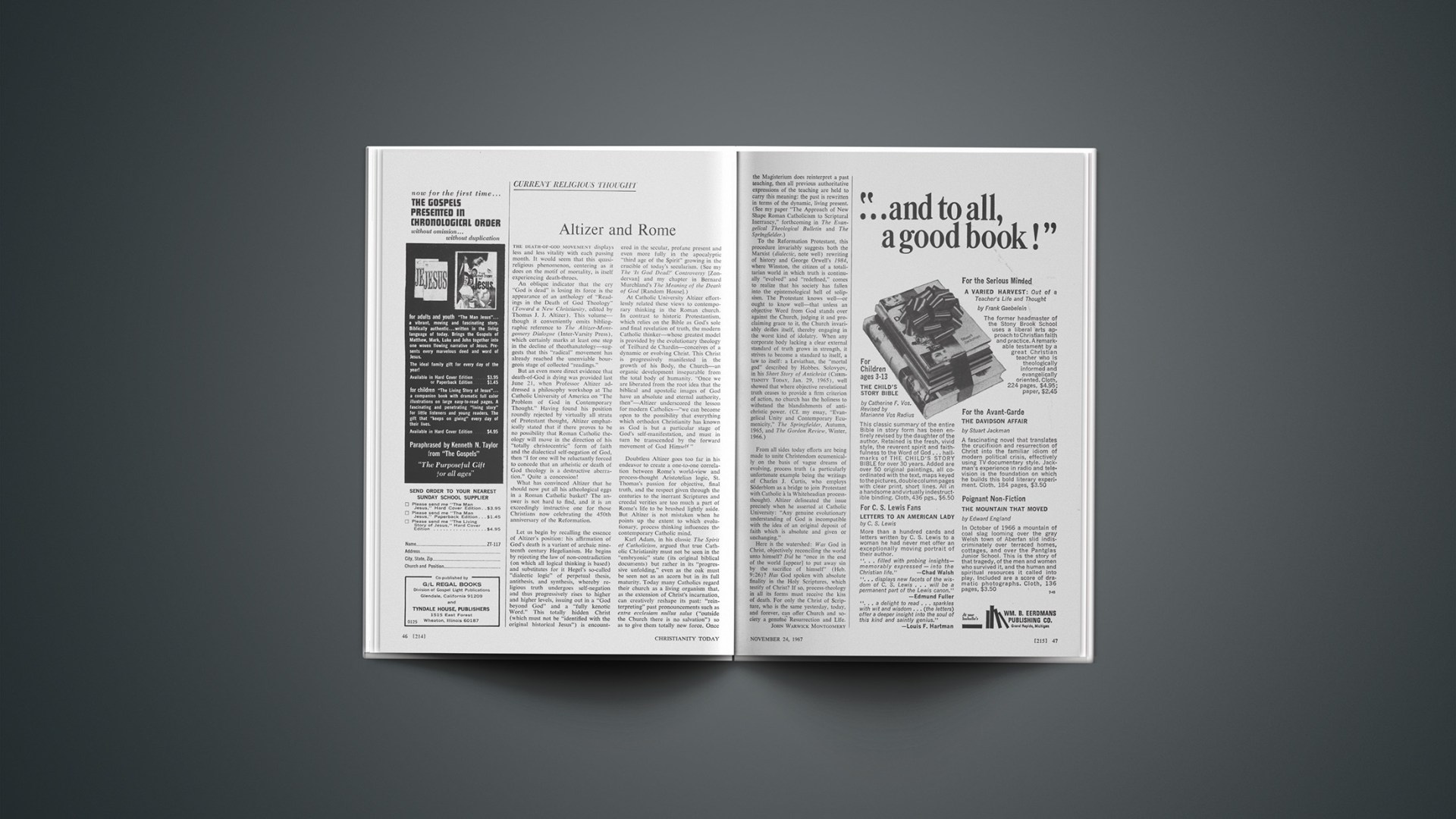
Altizer and Rome

The death-of-god movement displays less and less vitality with each passing month. It would seem that this quasi-religious phenomenon, centering as it does on the motif of mortality, is itself experiencing death-throes.

An oblique indicator that the cry “God is dead” is losing its force is the appearance of an anthology of “Readings in the Death of God Theology” (Toward a New Christianity, edited by Thomas J. J. Altizer). This volume—though it conveniently omits bibliographic reference to The Altizer-Montgomery Dialogue (Inter-Varsity Press), which certainly marks at least one step in the decline of theothanatology—suggests that this “radical” movement has already reached the unenviable bourgeois stage of collected “readings.”

But an even more direct evidence that death-of-God is dying was provided last June 21, when Professor Altizer addressed a philosophy workshop at The Catholic University of America on “The Problem of God in Contemporary Thought.” Having found his position roundly rejected by virtually all strata of Protestant thought, Altizer emphatically stated that if there proves to be no possibility that Roman Catholic theology will move in the direction of his “totally christocentric” form of faith and the dialectical self-negation of God, then “I for one will be reluctantly forced to concede that an atheistic or death of God theology is a destructive aberration.” Quite a concession!

What has convinced Altizer that he should now put all his atheological eggs in a Roman Catholic basket? The answer is not hard to find, and it is an exceedingly instructive one for those Christians now celebrating the 450th anniversary of the Reformation.

Let us begin by recalling the essence of Altizer’s position: his affirmation of God’s death is a variant of archaic nineteenth century Hegelianism. He begins by rejecting the law of non-contradiction (on which all logical thinking is based) and substitutes for it Hegel’s so-called “dialectic logic” of perpetual thesis, antithesis, and synthesis, whereby religious truth undergoes self-negation and thus progressively rises to higher and higher levels, issuing out in a “God beyond God” and a “fully kenotic Word.” This totally hidden Christ (which must not be “identified with the original historical Jesus”) is encountered in the secular, profane present and even more fully in the apocalyptic “third age of the Spirit” growing in the crucible of today’s secularism. (See my The ‘Is God Dead?’ Controversy [Zondervan] and my chapter in Bernard Murchland’s The Meaning of the Death of God [Random House].)

At Catholic University Altizer effortlessly related these views to contemporary thinking in the Roman church. In contrast to historic Protestantism, which relies on the Bible as God’s sole and final revelation of truth, the modern Catholic thinker—whose greatest model is provided by the evolutionary theology of Teilhard de Chardin—conceives of a dynamic or evolving Christ. This Christ is progressively manifested in the growth of his Body, the Church—an organic development inseparable from the total body of humanity. “Once we are liberated from the root idea that the biblical and apostolic images of God have an absolute and eternal authority, then”—Altizer underscored the lesson for modern Catholics—“we can become open to the possibility that everything which orthodox Christianity has known as God is but a particular stage of God’s self-manifestation, and must in turn be transcended by the forward movement of God Himself”

Doubtless Altizer goes too far in his endeavor to create a one-to-one correlation between Rome’s world-view and process-thought Aristotelian logic, St. Thomas’s passion for objective, final truth, and the respect given through the centuries to the inerrant Scriptures and creedal verities are too much a part of Rome’s life to be brushed lightly aside. But Altizer is not mistaken when he points up the extent to which evolutionary, process thinking influences the contemporary Catholic mind.

Karl Adam, in his classic The Spirit of Catholicism, argued that true Catholic Christianity must not be seen in the “embryonic” state (its original biblical documents) but rather in its “progressive unfolding,” even as the oak must be seen not as an acorn but in its full maturity. Today many Catholics regard their church as a living organism that, as the extension of Christ’s incarnation, can creatively reshape its past: “reinterpreting” past pronouncements such as extra ecclesiam nullus salus (“outside the Church there is no salvation”) so as to give them totally new force. Once the Magisterium does reinterpret a past teaching, then all previous authoritative expressions of the teaching are held to carry this meaning: the past is rewritten in terms of the dynamic, living present. (See my paper “The Approach of New Shape Roman Catholicism to Scriptural Inerrancy,” forthcoming in The Evangelical Theological Bulletin and The Springfielder.)

To the Reformation Protestant, this procedure invariably suggests both the Marxist (dialectic, note well) rewriting of history and George Orwell’s 1984, where Winston, the citizen of a totalitarian world in which truth is continually “evolved” and “redefined,” comes to realize that his society has fallen into the epistemological hell of solipsism. The Protestant knows well—or ought to know well—that unless an objective Word from God stands over against the Church, judging it and proclaiming grace to it, the Church invariably deifies itself, thereby engaging in the worst kind of idolatry. When any corporate body lacking a clear external standard of truth grows in strength, it strives to become a standard to itself, a law to itself: a Leviathan, the “mortal god” described by Hobbes. Solovyov, in his Short Story of Antichrist (CHRISTIANITY TODAY, Jan. 29, 1965), well showed that where objective revelational truth ceases to provide a firm criterion of action, no church has the holiness to withstand the blandishments of antichristic power. (Cf. my essay, “Evangelical Unity and Contemporary Ecumenicity,” The Springfielder, Autumn, 1965, and The Gordon Review, Winter, 1966.)

From all sides today efforts are being made to unite Christendom ecumenically on the basis of vague dreams of evolving, process truth (a particularly unfortunate example being the writings of Charles J. Curtis, who employs Söderblom as a bridge to join Protestant with Catholic à la Whiteheadian process-thought). Altizer delineated the issue precisely when he asserted at Catholic University: “Any genuine evolutionary understanding of God is incompatible with the idea of an original deposit of faith which is absolute and given or unchanging.”

Here is the watershed: Was God in Christ, objectively reconciling the world unto himself? Did he “once in the end of the world [appear] to put away sin by the sacrifice of himself” (Heb. 9:26)? Has God spoken with absolute finality in the Holy Scriptures, which testify of Christ? If so, process-theology in all its forms must receive the kiss of death. For only the Christ of Scripture, who is the same yesterday, today, and forever, can offer Church and society a genuine Resurrection and Life.

Soviet Christians Assert Legal Rights

In a dramatically bold legal gesture, a group of Soviet Protestants has asked the United Nations to intervene in behalf of victims of religious persecution. Their remarkable thirty-two-page plea, in the form of a letter to the Secretary General of the United Nations, is perhaps the best authenticated document of Communist repression of the Christian community ever to come out of the U. S. S. R.

“We would not turn to the international organization if we had only the slightest hope that our applications to the government in the U. S. S. R. would have a positive result,” the group declares. “But cruel war against the unregistered congregations widens.”

The letter, which reached the West on the eve of the fiftieth anniversary celebration of the Bolshevik Revolution, appeals repeatedly to legal guarantees under Communist law and indicates thorough familiarity with the Soviet penal code. An English translation is being distributed by the European Christian Mission in London.

“We intercede with you, U Thant, to organize a committee for the examination of the condemned believers,” the group pleads.

An appendix identifies 202 Protestants now said to be imprisoned and gives a virtually complete listing of names, addresses, legal citations,1Slavic temperament undoubtedly underlies many spontaneous and unnecessary violations of Soviet law. The law and the authorities’ interpretation of it nonetheless represent something considerably less than religious liberty. dates of arrest and sentence, and number of dependents. Most of the alleged offenses took place in 1966, though some are recorded from as late as August of this year. Many more Protestants have been arrested, the letter says, but the information about them could not be collected.

The letter is signed by “The Council of Relatives of Prisoners” and gives a Moscow address to which a reply should be sent. The group is obviously part of the bloc of Protestants who have broken with the so-called Evangelical Christian Baptists sanctioned by Moscow authorities.

The letter charges that the faction is not allowed to have places of worship unless they are registered with the government and that all new congregations that have applied for registration have been refused.

The letter also says that the government has confiscated chapels in at least eighteen cities. Two homes where believers met for worship and prayer were bulldozed. Soviet militia have broken in on services and dispersed or arrested worshipers.

As a result of the intimidation, Protestants have begun to hold services in open woods, but they have been harassed by authorities there, too.

In Kiev alone, the letter declares, there was a wave of eighty-five arrests in ten to fifteen days.

Apartments of believers are searched repeatedly, and children are interrogated and taken from their parents. Prisoners are forbidden to have Bibles. At Barnaul, a religious prisoner is said to have been tortured to death.

Although the letter is a well-authenticated document that deserves sympathetic attention, little is gained by appealing to the U. N. The organization is powerless to intervene in cases where its Declaration on Human Rights has been violated. A U. N. spokesman said its policy is neither to confirm nor to deny receipt of such letters, of which it gets a great many. Normal procedure, he said, is to delete identification and then send the letter to the government concerned.

The letter recalls the incident in Moscow in January, 1963, when thirty-two evangelicals broke into the U. S. Embassy to present a list of religious grievances. The list was sent to Washington and to U. N. headquarters, but its effect has never been officially traced.

The letter is apparently being distributed quite widely in Great Britain. An agency of the British Council of Churches last month reported that it had before it “disturbing evidence of the persecution of Christians in the U.S.S.R.”

The persecution is not limited to Christians. It extends to adherents of the Jewish faith, and Jews in the West, well aware of the suffering, are becoming increasingly vocal about it. They have been purchasing large amounts of newspaper advertising space to call attention to the plight of Soviet Jews.

No corresponding effort is being made in behalf of Soviet Christians, whose plight is as bad or worse. So far, the American religious establishment has settled for exchanges of Communist-approved churchmen as its way of identifying with the Soviet Christian community. The latest such exchange is taking place this fall between the Church of the Brethren in the United States, which sent a three-man team and a translator, and the Russian Orthodox Church, which is scheduled to send a three-man team to the United States this month.

In contrast to American indifference, German Protestant leaders plan extensive research on the persecution of Christians around the world. The plan was prompted by the slaughter of tens of thousands of Christians of the Ibo tribe in Nigeria some months ago.

The persistence of widespread repression of religious activity in the Soviet Union is, of course, an indirect tribute to religious faith and to the believers there.

“The fifty years of Soviet struggle with religion add up to a case study of ideological failure,” says Peter Grose in the New York Times. “It is the doctrine of atheism, not faith in God, that is dying in Soviet Russia today.” He adds that “an intricate police operation is seeking to penetrate and control the church that could not be destroyed.”

Grose thinks the prevalence of middle-aged and elderly persons among the worshipers may not be so significant as it seems; many Soviet citizens, he says, “do not feel like disclosing their convictions until they have reached their professional peak or retired on a pension.” One Western resident of Moscow is quoted as saying he was “willing to bet that fifty years from now those churches will be just as crowded as they are today—and still with old people.”

The perennial plea of Soviet Protestants is for more Bibles. Religious News Service reports that since 1917 the Soviet government has sanctioned only three printings of the complete Bible: 25,000 copies in 1926, another 25,000 in 1956, and 10,000 in 1957. To capitalize on the demand, Soviet government publishers have been issuing various interpretations of scriptural accounts and revised narratives of biblical events.

Bill Kapitaniuk, Canadian-born evangelist of Ukrainian origin, reports that Siberia is experiencing a new surge of Christian faith. The reason, he says, is that believers who were shipped there years ago have influenced those who came later to populate rising cities and industrial areas. Kapitaniuk, who is working with the Slavic Gospel Association, estimates that since his last visit to the Soviet Union, in 1965, about 1,000 new churches have been formed. He adds: “The Communist tactics appear to be a mixture between wanting to crush the Church and destroy it, and yet at the same time not wanting to drive the Church underground where it would be harder to control.”

PROTESTANT PANORAMA

A Southern Baptist church near the Little Rock, Arkansas, Air Force Base lost five families when it decided to pioneer and solicit Negro members. Since then, however, membership and giving have nearly doubled.

The Southern Baptist Convention joined two Negro Baptist denominations in a six-night inter-racial revival in Harlem.

The 400,000-member Baptist association in North Carolina will now require its churches to limit membership to immersed persons, possibly forcing out Myers Park and St. John’s churches in Charlotte.

Fifty persons from eight Baptist denominations met in Chicago to lay plans for a 1968 evangelism congress and the 1969 Crusade of the Americas. The council of the non-participating American Baptist Convention sent best wishes to ABC members involved in the planning.

Baptist Bible Seminary, affiliated with the General Association of Regular Baptists, will move next year from Johnson City, New York, to a 153-acre campus in Clark’s Summit, Pennsylvania, purchased from a Roman Catholic seminary.

A Methodist home near Washington, D. C., cut off from federal medicaid for alleged discrimination, was reinstated.

The American Lutheran Church Council will discuss in February background reports on whether to recommend that the denomination join the National Council of Churches in 1968.

The Reformed Churches in the Netherlands synod decided a 1926 declaration of the literal historicity of Genesis 1 and 2 is no longer binding on members; it now permits an understanding of the stories as myths or symbols. An accompanying statement affirmed the authority of Scripture and limited interpretation to the bounds of the Belgic Confession and Heidelberg Catechism.

A nationwide evangelism drive by Portugal’s thirty-six Baptist congregations led to 750 converts. Wide publicity in the press was used, and four Lisbon dailies carried news accounts.

Methodists in Cuba will form an autonomous church at a February conference.

PERSONALIA

The Rev. Howard B. Spragg was promoted to executive vice-president of the home-missions board for the United Church of Christ, to replace the retiring Truman Douglass. The press announcement claimed the agency “has led the ecumenical movement in American Protestantism.”

The Rev. Tom Foley, a Presbyterian from Jackson, Missouri, will be first Protestant chaplain at New York’s Kennedy Airport.

Albert H. van den Heuvel, formerly of the World Council of Churches’ youth department, is the new director of the communication department. He is a minister of the Netherlands Reformed Church.

The Rev. Robert Caul of the Graymoor Friars became the second Roman Catholic priest on the faith-and-order staff of the National Council of Churches.

Alvin Plantinga, philosophy teacher at Calvin College (Christian Reformed), won a $10,000 Danforth grant to study the relation between epistemological problems and the nature of scientific hypotheses.

Raymond J. Davis, general director of Sudan Interior Mission, was appointed president of the Interdenominational Foreign Mission Association, which marks its fiftieth anniversary this year.

Church of England vicar Stephen Hopkinson has a hunch that homosexuality may be a socially and morally desirable answer to the population explosion. Honest.

Deaths

MRS. RUTH KERR, 73, Baptist laywoman and president of the Kerr Glass company who founded Westmont College as the Bible Missionary Institute in 1937; in Burbank, California.

HUGH MURCHISON, 71, California stock broker, radio executive, and Presbyterian elder, who served the Union Rescue Mission in Los Angeles and several other evangelical organizations.

W. P. Baugh, 95, oldest active Anglican priest in Canada until he retired from three rural parishes last year; said never to have taken a vacation; at Morin Heights, Quebec.

MISCELLANY

The World Council of Churches and the Roman Catholic Church will sponsor a joint conference on world economics next April, probably in Africa. The WCC planner is evangelism staffer Philip Potter. “The gap between rich and poor nations” will be a major topic.

Toronto taxi drivers and druggists will hand out cards advertising the suicide-prevention telephone service of “the Samaritans,” led by Anglican priest Andrew Todd.

The Register quotes the archbishop of Quito, Ecuador, as saying that by the end of last month the nation’s Catholic Church had given up more than half its land as part of an agrarian reform program.

Only Muslims in Israeli territory had access to Jerusalem’s Dome of the Rock for the holy day marking Mohammed’s brief assumption into heaven. The next day, the constituent assembly of the World Islamic League in Mecca urged a holy war to regain the shrine city.

The “Freedom City” begun in Greenville, Mississippi, by National Council of Churches staffers will have fifty families build permanent homes under a $200,000 grant from the war on poverty, plus private gifts. Further east, at Grenada, a Negro Methodist church was burned Sunday, October 29; church officials call it arson.

Georgia’s new Sunday closing law was ruled unconstitutional by the state Supreme Court, but Governor Lester Maddox may try another version. Maddox reportedly has asked state legislators to pledge not to smoke or drink.

The Montgomery, Alabama, Baptist Association voted to continue the ban on federal or state aid to its hospital.

A House committee killed for this year the proposal to make more long weekends by putting five national holidays on Monday.

Arizona’s Supreme Court approved state welfare payments to the Salvation Army on the grounds that the “true beneficiaries” are poor people, not the Army.

The U. S. Supreme Court reversed three lower-court convictions involving nudist magazines, some of which opponents said were aimed at homosexuals.

The student government at Wheaton College in Illinois pulled out of the U. S. National Student Association because it meddles in partisan politics too much. After CIA support was revealed earlier this year, Brandeis, Amherst, and Michigan also withdrew.

Apple PodcastsDown ArrowDown ArrowDown Arrowarrow_left_altLeft ArrowLeft ArrowRight ArrowRight ArrowRight Arrowarrow_up_altUp ArrowUp ArrowAvailable at Amazoncaret-downCloseCloseEmailEmailExpandExpandExternalExternalFacebookfacebook-squareGiftGiftGooglegoogleGoogle KeephamburgerInstagraminstagram-squareLinkLinklinkedin-squareListenListenListenChristianity TodayCT Creative Studio Logologo_orgMegaphoneMenuMenupausePinterestPlayPlayPocketPodcastRSSRSSSaveSaveSaveSearchSearchsearchSpotifyStitcherTelegramTable of ContentsTable of Contentstwitter-squareWhatsAppXYouTubeYouTube