Not Content to Coast

Nien Cheng first caught our attention last summer. Time featured excerpts from her book, Life and Death in Shanghai, as its cover story on the twentieth anniversary of China’s Cultural Revolution, a time the entire nation “went mad.” In reading those excerpts, and later the book, we were moved not only by the resilience of this courageous woman, but by the quiet spirituality that sustained her through six years of solitary confinement, the death of her daughter, and expatriation to America.

Not surprisingly, the spiritual motif of Cheng’s life was largely ignored in all the “press talk” surrounding her best seller. But we felt it was a story that needed to be told.

So did Ellen Vaughn of Prison Fellowship. Impressed by the character who would not be broken by the fanatical Red Guard, Ellen contacted Cheng late last year, and followed that with the interview that begins on page 16.

“She was as I had imagined her,” Ellen recounted. “Very precise. Very warm. Very welcoming.”

Over almond shortbread cookies and tea, Cheng not only reviewed China’s past, but addressed China’s present and its impact on the future of the church there.

“She’s not content to coast,” Ellen said, referring to Cheng’s interest in current events. “She wants to understand what’s going on today.

“In that she is very young—always asking, always thinking.”

HAROLD B. SMITH, Managing Editor

Cover photo by Ira Wexler.
Missing the Luxury of Winter

April is the crudest month … begins “The Waste Land,” one of this century’s most famous poems. T. S. Eliot may be a great poet, but that line tends to puzzle those of us who live in the tundra belt. April cruel? That’s the month we rediscover grass and find that water can be soft and wet again, the month that trees finally remember they’re supposed to have leaves. If you’re talking cruel, what of January or February?

That’s the common northern wisdom, anyway. Having spent the first half of my life in Georgia, and the most recent half in Chicago, I’m unconvinced. We complain about the cold, and talk of winters past in hushed, reproachful tones; but I’m about to conclude we’re bluffing. I think we secretly love the season and feel a twinge of sadness when spring comes.

I’ve noticed, for example, that people seem cheeriest on days most frigid. At bus stops, we actually talk to one another! Granted, we mumble incomprehensibly through breath-frosted scarves, and our conversations encompass only one subject—the cold—but at least we’re talking. Walk into any grocery or hardware store and you can instantly provoke a lively conversation with just four words: “It’s freezing out there!”

“It was so cold in my pantry that the ketchup bottle froze solid.” “Tried to get my dog outside this morning. She took one sniff and made a beeline for the electric blanket.” “I heard the difference between 40 below and 30 below is that your spit freezes before it hits the ground.” That’s the kind of talk you will likely hear in Chicago or International Falls or Bismarck in mid-January.

In winter we have a common enemy. It rearranges our perspectives: newscasters swap stories about the cold for five minutes or so before they get to such “lesser” matters as international conflicts, nuclear disarmament, and world trade. Our real opponent is outside, palpably surrounding us, and we humans are huddled together behind barriers of plaster and brick; and we’re surviving. Together, we are going to beat that enemy. The spirit is eerily atavistic: We are warriors in a cave, trying to work up courage against the herd of mammoths outside.

I heard recently about a poll of senior citizens in London. To the question, “What was the happiest time of your life?” 60 percent answered, “The Blitz.” Every night squadrons of fat Luftwaffe planes would dump tons of explosives on the city, bombing a proud civilization into rubble—and now the victims recall that time with nostalgia! They, too, had a common enemy outside, and they huddled together in dark places, determined to survive.

People used to use a strange, humble expression: they would talk about being at the “mercy” of the elements. With all our technological defenses, we are rarely at their mercy anymore, and rarely humble. Thanks to meteorology, weather has even lost its surprise factor. (Why is it that television weathermen drone on about jet streams and draw arrows all over the globe when all I want to know is what kind of coat to wear tomorrow?)

But every once in a while, in January or February, we get a fine, untamable blast of cold and snow that stops us, literally, in our tracks, and teaches us about “mercy.” Winter, above all, offers us a reminder of creaturehood. Once more we see ourselves as tiny, huddling creatures dependent on each other and on the God who created the awesome universe.

“God’s voice thunders in marvelous ways,” said Elihu to Job. “He says to the snow, ‘Fall on the earth,’ and to the rain shower, ‘Be a mighty downpour.’ So that all men he has made may know his work, he stops every man from his labor.” It happens even in a great city like Chicago. On the day of the big blizzard, the trains cease running, cross-country skiers replace cars on the streets, and everyone stops from labor.

One day in February I drove south along Chicago’s Lake Shore Drive toward downtown. The sun was shining brilliantly—oddly, it always does on the coldest days, for it is the cloud cover that holds in the Earth’s heat. On my left, Lake Michigan was deciding whether or not to freeze. Just above the turquoise water line, ice fog was forming, that startling phenomenon in which water, skipping intermediate stages, condenses directly into ice crystals. On my right, Chicago’s skyline was lit by the softened, slanted rays of winter sun.

In a curious sort of way, the whole scene seemed friendly. I couldn’t quite understand why until I noticed the puffs of pure white smoke wafting from the top of each building. It was as if they were breathing. Even concrete and steel had taken on something of an organic quality.

Maybe Eliot was right about April being the crudest month: it puts an end to the subtle delights of winter. I had thoughts along this line as I drove down Lake Shore Drive, until I turned into Lincoln Park. And there I saw some of Chicago’s homeless. As barriers against the cold, they had only a few layers of old newspapers and some plastic bags. They, too, huddled together, but there was little of the joy and camaraderie I had sensed from people at bus stops and in grocery stores. These folks were just trying to stay alive.

It was then I realized that enjoying February, using words like refreshing and invigorating, sensing the friendliness of a man-made redoubt against the elements—these were the greatest of luxuries. It was then I realized another, essential meaning to the word mercy. A sense of creaturehood—huddling together in caves or bomb shelters or Chicago buildings—only produces a feeling like joy if we the creatures show “mercy” to each other. It is a good lesson to remember—in February, April, or any other month.

Book Briefs: April 22, 1988

Tolstoy’S “Heavy Competition”

Joshua, by Joseph P. Girzone (Macmillan, 271 pp.; $6.95, paper). Reviewed by Katie Attdraski, a poet living in Belvidere, Illinois. She is the author of When the Plow Cuts (Thomtree Press).

In the past five years, two publishing phenomena have come out of Albany, New York. First, William Kennedy’s Ironweed won a Pulitzer Prize and achieved both literary and popular success. And an unlikely second, Father Joseph P. Girzone’s Joshua, has sold 100,000 copies since it was published by Macmillan last September—and that does not include the 50,000 sold as a self-published hardcover edition.

Joshua has sold mostly by word of mouth. People sent copies to friends who, in turn, bought copies for their friends. According to Girzone, one skeptical man read the book and ordered 100 copies for his friends. The book circulated from another man through NATO headquarters, the European Parliament, several multinational corporations, and several embassies.

After the local manager of a Waldenbooks store read a self-published edition, he told Girzone that he had “heavy competition with Tolstoy and Dostoevsky. This book is a classic.” The manager delivered a review to all the managers of the region. They bought 50 copies. And sold out. Then they bought a hundred and sold out. Eventually, the book took its place on Waldenbooks’ best-seller list.

If Jesus Came Back

Girzone wrote Joshua because there was “something not quite right about religion. As a parish priest I never saw the peace that Jesus came to give people. There was such terrible, terrible guilt.”

When he retired in 1981, Girzone studied the Gospels in depth—and found a Christ very different from the one taught in seminary. First he considered writing a theological treatise. But since such a book would be read by only a limited number of people, he settled on the novel in which he asks, “What would happen if Jesus came back today?”

So Jesus comes back as Joshua, a woodcarver who settles in a cottage on the outskirts of a small town that could be Everytown, U.S.A.

Joshua’s unusual practice of attending the synagogue and a different church each week catches notice. As does his criticism of current church practice and religious leaders. “It is their endless rules and their rituals rather than love of God and concern for others that occupy the people’s attention.” Joshua challenges folks to a new way of thinking about their faith: “If a person is not open to the inspiration of the Spirit, because it goes beyond what priests allow him, then even the Holy Spirit cannot work in him and he remains stunted.”

Joshua angers the leaders of the Catholic church. They send him to Rome where he confronts the hierarchy and the Pope. Soon afterwards, he disappears as mysteriously as he came.

At this point, Girzone’s plot seems implausible; Joshua is not a member of the Catholic church. Why should Rome single him out among the many who espouse ideas the church does not like?

Refinding The Father

There are miracles: a deathly ill child is healed, a man with a broken neck comes back to life, and a storm at sea is quieted. But the parallels between Jesus and Joshua are not all that close. Jesus talked about himself as the sacrifice for men’s sins. Joshua says nothing about his own death. He claims God made people with imperfections and wants them to strive to be better.

Despite such differences, some of which the author attributes to the fact that he “wrote a novel, not a complete compendium of Christian doctrines,” the book offers a fresh perception of Jesus as a man who “accepted people just as they are. His greatest concern was to help them refind their heavenly Father and to enjoy being his children.”

Joshua is a bland, pleasant book that is finding its audience. Like Thoreau’s Walden, it espouses the simple life and simple beliefs.

In addition, the book scratches the same itch romance novels touch—but on a spiritual level. Here we have flawless, uncomplicated characters. The villains who disturb their lives are straight selfish. And Joshua is the perfect hero, responding to every situation in just the right way. The reader is wooed to fall in love with Joshua. The resistance to his mission serves to strengthen the reader’s identification with him. We, too, feel we have suffered at the hands of our religious leaders.

In the Gospels, Jesus often spoke in parables, satire, and even poetry. He used characters, images, and allegories to make his point. But Joshua speaks mostly in abstractions. It is remarkable that such a book—mainly about ideas and without literary pretensions—would sell as well as it has.

There are books that are beautifully written, sophisticated, and they find an audience—sometimes a big one. There are also books—such as Joshua—that are not so well crafted. But like the loaves and fishes, they can feed thousands with God’s blessing.

The God Of The Beautiful

George MacDonald, by William Raeper (Lion Publishing, 410 pp.; $26.95, cloth). Reviewed by Philip Yancey.

I know hardly any other writer who seems to be closer … to the Spirit of Christ Himself,” said C. S. Lewis about Scottish preacher and novelist George MacDonald, whose Phantastes Lewis credited with stimulating his own “conversion of imagination.” Lewis also admitted, “I fancy I have never written a book in which I did not quote from him.”

Given the shelves of recent books in tribute to Lewis, it is about time someone filled in the gaps of knowledge about the man he freely acknowledged as his “master.” This attempt, the first major biography since 1924, portrays a Victorian thinker who, in a time of great divisions, achieved a striking balance and personal integration.

For George MacDonald, there was no split between the “natural” and “supernatural” worlds. Recalling his youth, he confessed, “One of my greatest difficulties in consenting to think of religion was that I thought I should have to give up my beautiful thoughts and my love for the things God had made.” Instead, he discovered “God is the God of the Beautiful—Religion is the love of the Beautiful, and Heaven is the Home of the Beautiful—Nature is tenfold brighter in the Sun of Righteousness, and my love of Nature is more intense since I became a Christian.” Such Christian naturalism enriches the sensory descriptions in his novels.

MacDonald admirably combined a “secular” life as a novelist and man of letters with his original calling as a preacher. He counted such notables as Thackeray, Dickens, Arnold, and Tennyson among his friends, as well as many of the pre-Raphaelite painters. On a trip to the U.S. in 1873, he packed lecture halls and made the acquaintance of Emerson, Longfellow, Whittier, Holmes, and Stowe. He even discussed coauthoring a novel with Twain in an attempt to circumvent the transatlantic copyright piracy both of them were experiencing.

“To know a primrose is a higher thing than to know all the botany of it—just as to know Christ is an infinitely higher thing than to know all theology,” MacDonald once said. And those who knew him saw what it meant to know Christ. MacDonald had a sunny, playful disposition. He fathered 11 children, then adopted 2 more when their mother found herself in dire financial straits. His household was filled with the laughter of children and the lively conversation of endless guests.

Optimistic Fatalism

Biographer William Raeper, secretary to the George MacDonald Society, has mined a wealth of information. We learn such trivia as MacDonald’s major in college (chemistry!) and the fact that at age 73 he took up the study of Dutch and Spanish. Raeper’s careful reading of his subject’s work shows in the skillful way he blends key events from MacDonald’s life with the settings of his novels.

Yet, unfortunately, the book offers mainly a compendium of facts for those already interested in MacDonald. This is a term-paperish, old-fashioned biography, beginning with the ritual disinterment of the family lineage. It fails to provide much illumination on MacDonald’s two main areas of contribution: literature and theology.

Concerning MacDonald’s literary worth, Raeper kindly concludes that “the sum of his work is greater than its individual parts.” Of the 26 novels, Phantastes and Lilith stand out as the most enduring. But Raeper’s analysis pales next to the convincing literary profile offered by Lewis in a foreword to his MacDonald anthology. Lewis valued MacDonald not as a stylist—like many Victorians, he suffered from a syrupy didacticism—but rather as a myth maker. And, to Lewis, the spiritual insights seen fleetingly in the novels but plainly in MacDonald’s journal and collected sermons were unsurpassed.

Raeper’s chapter on MacDonald’s theology is perhaps the least satisfying in the book; Rolland Hein gave a far more concise summary of the issues in brief introductions to recent compilations of MacDonald’s sermons (Life Essential and Creation in Christ). Early in MacDonald’s career, parishioners forced him from the pulpit for teaching a variety of universalism: He believed that hell serves as a kind of purgatory leading toward the ultimate reconciliation of all creation. Church authorities also questioned his belief that animals would have a place in heaven and worried about the influence of German idealism on his theology.

By the end of his life, however, MacDonald had survived such controversies and became a well-loved speaker welcomed in many British churches. Reacting against the strict Calvinism of his youth (like his character Robert Falconer, he was “all the time feeling that God was ready to pounce on him if he failed once”), he presented God as a loving, merciful Father. An idyllic relationship with his own widowed father fed that image.

MacDonald said about God, “It cannot be that any creature should know Him as He is and not desire Him.” Confident that the goodness of God would one day spread throughout the entire universe, MacDonald practiced an “optimistic fatalism.” It shows, for example, in a letter he wrote to console his wife on a private grief: “Well, this world and all its beginnings will pass on into something better.”

Although this long-overdue biography leaves room for further exploration, it gives much essential background for understanding MacDonald’s life and thought. His powerful words on grace, freedom from anxiety, and the inexorable love of God give little hint of his daily life. For years he wandered penniless around London looking for a job. He suffered constantly from tuberculosis, asthma, and eczema. Two of his children died in their youth. Further, MacDonald proved unsuccessful in landing a university teaching post, and the large sales of his novels rarely translated into financial rewards—too many of the copies were pirated editions. His family resorted to staging productions of Pilgrim’s Progress as a way to pay bills.

Those facts shed lioght on the buyoant faith of a great devotional writer. Phantasts end with the leaves of tress whisperng. A great good is comming is copmoing is coming to thee Anodos Grorge Mac Donald believed that with all his heart.

Moscow Memoirs

Winter in Moscow, by Malcolm Muggeridge (Eerdmans, 252 pages; $8.95, paper). Reviewed by K. L. Billingsley, author of The Generation That Knew Not Josef.

On October 6, 1932, Malcolm Muggeridge, Moscow correspondent of the London Guardian, wrote in his diary: “I thought today that I’d write a book called Winter in Moscow, pointing out that the only thing not true of Russia is that any single liberal principle of tolerance or reasonableness is observed there: that Christianity is ruthlessly suppressed, private liberty non-existent, forced labor common, the population poorer, worse fed, worse housed than in any other country in Europe.” Fortunately, he did more than think about it. Winter in Moscow was first published in 1934, after Muggeridge left the Soviet Union at odds with both the Communist regime and his employers, primarily for his reporting of Stalinist genocide. As he explains in the foreword, he “took a great dislike to the Dictatorship of the Proletariat and its imbecilic foreign admirers.” Winter in Moscow takes them both on.

Though Muggeridge is not a superbly polished stylist in his few works of fiction, he succeeds at the most difficult tasks of the novelist—to tell the truth and to dramatize the struggles of the soul. Through the author’s keen journalistic eye, one sees the military parades, the omnipresent pictures of Stalin, and the endless construction projects. Consider this description of Lenin’s tomb: “The atmosphere in the tomb was damp and stale. It smelt like a cloakroom in an elementary school on a wet day. The head inside its glass case was fungoid: fresh and vivid like a fungus growing in darkness; unwholesome like a fungus, dark and poisonous.”

Innocents Abroad

Many foreigners came to the USSR in the 1930s to admire and help the great experiment launched by Lenin, and these pilgrims are Muggeridge’s principal subject. Squads of utopian intellectuals, pro-Soviet clergymen, and progressive statesmen jostle and harangue in these pages. This roman à clef was much prized by old Moscow hands such as A. T. Cholerton, who called it the “great anticant bible” of the Soviet Union. The dialogue rings true, and occasional laughs lighten the heavy themes. There are even snatches of typical news stories: descriptions of happy, productive workers in a land flowing with milk and honey while, in reality, the people starved.

The key to the cast of characters is in Muggeridge’s autobiography, The Green Stick, and his diaries, published under the title Like It Was. The American journalist named Jefferson is really Walter Duranty of the New York Times, a shameless defender of Stalin who later became one of President Roosevelt’s experts on the USSR.

Wraithby, the central character, represents Muggeridge himself. As it happens, Muggeridge went to the USSR as a comrade, with the intention of staying there, but the awful realities of the regime quickly changed his mind. He arrived with no clear moral outlook, but quickly discovered the existence of evil, as he explained in his diary: “Evil is the only apt word. Evil because there is no virtue in it: and because it has utterly failed. In a Marxist state, evil and failure are the same.”

Similarly, Wraithby finds the ebullience of a massive social experiment not only coexisting with great suffering, but also causing it. Accordingly, “all he had ever seen or thought or felt or believed, sorted itself out. It was a vision of Good and Evil. Heaven and Hell. Life and death. There were two alternatives; and he had to choose.” At one point, Wraithby wanders into a church, where “a melancholy, passionate service” is taking place. Among the believers, “Wraithby found their stillness hopeful: even exhilarating.” Religion was “a refuge from the Dictatorship of the Proletariat.” This vignette clearly marks a turning point in the author’s spiritual journey. From that point on, he sought no earthly kingdoms.

As Michael Aeschliman points out in an excellent introduction, this book has been unjustly neglected and out of print for years. In 1965, British historian A. J. P. Taylor called it “probably the best book ever written on Soviet Russia.” While that judgment would be revised, primarily by the author himself, Winter in Moscow seems particularly relevant now that a new and dynamic leader and his policy of glasnost have made admiration of the Soviet Union fashionable again.

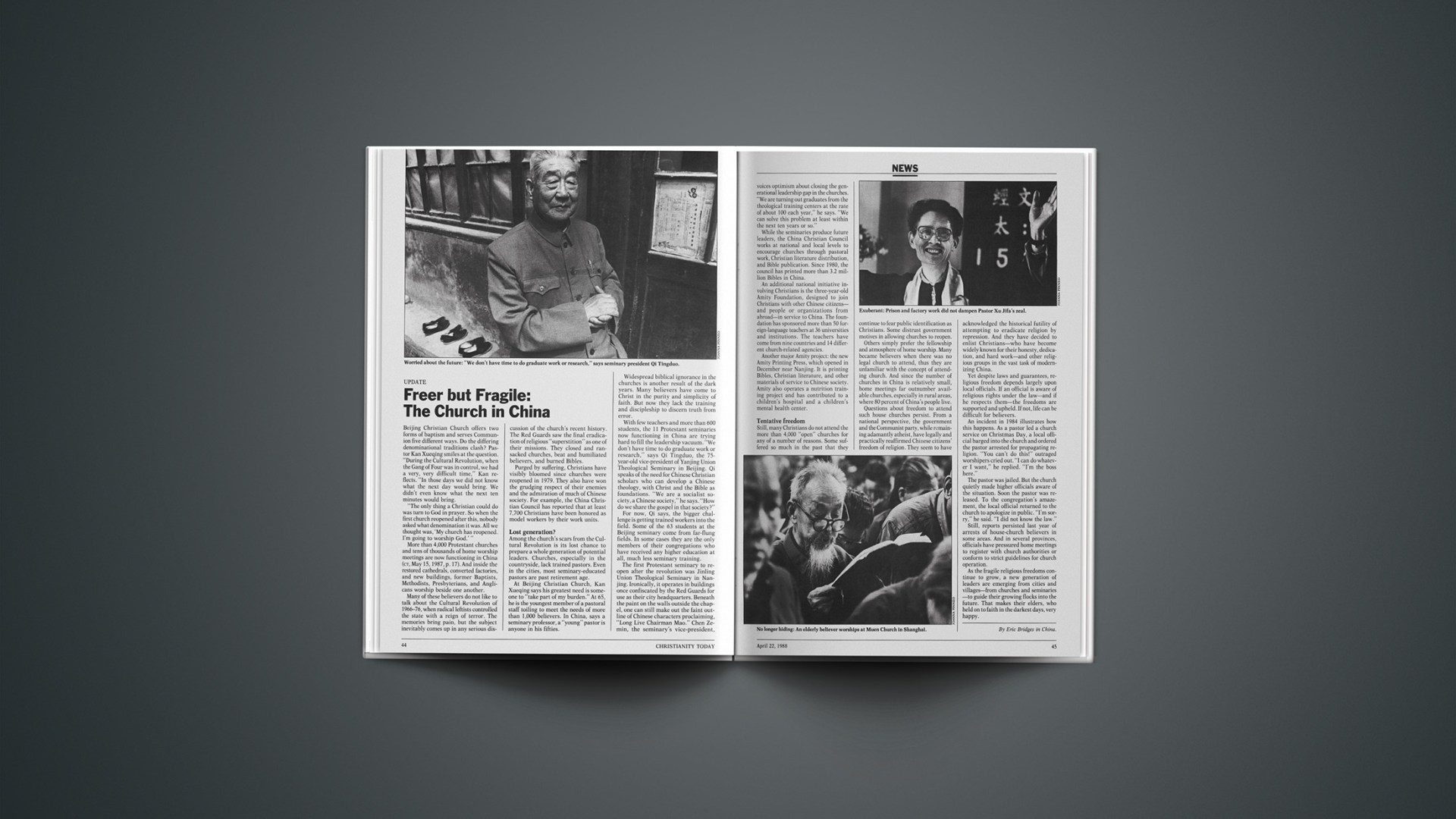
Freer but Fragile: The Church in China

UPDATE

Beijing Christian Church offers two forms of baptism and serves Communion five different ways. Do the differing denominational traditions clash? Pastor Kan Xueqing smiles at the question. “During the Cultural Revolution, when the Gang of Four was in control, we had a very, very difficult time,” Kan reflects. “In those days we did not know what the next day would bring. We didn’t even know what the next ten minutes would bring.

“The only thing a Christian could do was turn to God in prayer. So when the first church reopened after this, nobody asked what denomination it was. All we thought was, ‘My church has reopened. I’m going to worship God.’ ”

More than 4,000 Protestant churches and tens of thousands of home worship meetings are now functioning in China (CT, May 15, 1987, p. 17). And inside the restored cathedrals, converted factories, and new buildings, former Baptists, Methodists, Presbyterians, and Anglicans worship beside one another.

Many of these believers do not like to talk about the Cultural Revolution of 1966–76, when radical leftists controlled the state with a reign of terror. The memories bring pain, but the subject inevitably comes up in any serious discussion of the church’s recent history. The Red Guards saw the final eradication of religious “superstition” as one of their missions. They closed and ransacked churches, beat and humiliated believers, and burned Bibles.

Purged by suffering, Christians have visibly bloomed since churches were reopened in 1979. They also have won the grudging respect of their enemies and the admiration of much of Chinese society. For example, the China Christian Council has reported that at least 7,700 Christians have been honored as model workers by their work units.

Lost Generation?

Among the church’s scars from the Cultural Revolution is its lost chance to prepare a whole generation of potential leaders. Churches, especially in the countryside, lack trained pastors. Even in the cities, most seminary-educated pastors are past retirement age.

At Beijing Christian Church, Kan Xueqing says his greatest need is someone to “take part of my burden.” At 65, he is the youngest member of a pastoral staff toiling to meet the needs of more than 1,000 believers. In China, says a seminary professor, a “young” pastor is anyone in his fifties.

Widespread biblical ignorance in the churches is another result of the dark years. Many believers have come to Christ in the purity and simplicity of faith. But now they lack the training and discipleship to discern truth from error.

With few teachers and more than 600 students, the 11 Protestant seminaries now functioning in China are trying hard to fill the leadership vacuum. “We don’t have time to do graduate work or research,” says Qi Tingduo, the 75-year-old vice-president of Yanjing Union Theological Seminary in Beijing. Qi speaks of the need for Chinese Christian scholars who can develop a Chinese theology, with Christ and the Bible as foundations. “We are a socialist society, a Chinese society,” he says. “How do we share the gospel in that society?”

For now, Qi says, the bigger challenge is getting trained workers into the field. Some of the 63 students at the Beijing seminary come from far-flung fields. In some cases they are the only members of their congregations who have received any higher education at all, much less seminary training.

The first Protestant seminary to reopen after the revolution was Jinling Union Theological Seminary in Nanjing. Ironically, it operates in buildings once confiscated by the Red Guards for use as their city headquarters. Beneath the paint on the walls outside the chapel, one can still make out the faint outline of Chinese characters proclaiming, “Long Live Chairman Mao.” Chen Zemin, the seminary’s vice-president, voices optimism about closing the generational leadership gap in the churches. “We are turning out graduates from the theological training centers at the rate of about 100 each year,” he says. “We can solve this problem at least within the next ten years or so.”

While the seminaries produce future leaders, the China Christian Council works at national and local levels to encourage churches through pastoral work, Christian literature distribution, and Bible publication. Since 1980, the council has printed more than 3.2 million Bibles in China.

An additional national initiative involving Christians is the three-year-old Amity Foundation, designed to join Christians with other Chinese citizens—and people or organizations from abroad—in service to China. The foundation has sponsored more than 50 foreign-language teachers at 36 universities and institutions. The teachers have come from nine countries and 14 different church-related agencies.

Another major Amity project: the new Amity Printing Press, which opened in December near Nanjing. It is printing Bibles, Christian literature, and other materials of service to Chinese society. Amity also operates a nutrition training project and has contributed to a children’s hospital and a children’s mental health center.

Tentative Freedom

Still, many Christians do not attend the more than 4,000 “open” churches for any of a number of reasons. Some suffered so much in the past that they continue to fear public identification as Christians. Some distrust government motives in allowing churches to reopen.

Others simply prefer the fellowship and atmosphere of home worship. Many became believers when there was no legal church to attend, thus they are unfamiliar with the concept of attending church. And since the number of churches in China is relatively small, home meetings far outnumber available churches, especially in rural areas, where 80 percent of China’s people live.

Questions about freedom to attend such house churches persist. From a national perspective, the government and the Communist party, while remaining adamantly atheist, have legally and practically reaffirmed Chinese citizens’ freedom of religion. They seem to have acknowledged the historical futility of attempting to eradicate religion by repression. And they have decided to enlist Christians—who have become widely known for their honesty, dedication, and hard work—and other religious groups in the vast task of modernizing China.

Yet despite laws and guarantees, religious freedom depends largely upon local officials. If an official is aware of religious rights under the law—and if he respects them—the freedoms are supported and upheld. If not, life can be difficult for believers.

An incident in 1984 illustrates how this happens. As a pastor led a church service on Christmas Day, a local official barged into the church and ordered the pastor arrested for propagating religion. “You can’t do this!” outraged worshipers cried out. “I can do whatever I want,” he replied. “I’m the boss here.”

The pastor was jailed. But the church quietly made higher officials aware of the situation. Soon the pastor was released. To the congregation’s amazement, the local official returned to the church to apologize in public. “I’m sorry,” he said. “I did not know the law.”

Still, reports persisted last year of arrests of house-church believers in some areas. And in several provinces, officials have pressured home meetings to register with church authorities or conform to strict guidelines for church operation.

As the fragile religious freedoms continue to grow, a new generation of leaders are emerging from cities and villages—from churches and seminaries—to guide their growing flocks into the future. That makes their elders, who held on to faith in the darkest days, very happy.

By Eric Bridges in China.

World Scene

NORTHERN IRELAND

Bishop Says: “Leave Ira”

Last month’s escalating violence in Northern Ireland led Roman Catholic Bishop Cahal Daly of Belfast to urge Catholics to leave the Irish Republican Army (IRA). Two British soldiers were beaten and shot by a mob on March 19, and the IRA claimed responsibility for the killings.

Bishop Daly said that o Catholics “who joined g the organization in the past for idealistic reasons … should now have the honesty and courage to realize the truth about the IRA.” He said his office had been flooded with phone calls from members of his parish who felt the incident unfairly represented them to the world. “The evil forces which have been released within their community are opposed to everything Catholics believe and cherish.”

Daly also blamed the IRA for disguising their violence with a “mask of romantic rhetoric and militaristic mock ritual.” He said the organization has led Catholics to join in violence that was inspired by hatred for the British.

SOVIET UNION

Moscow To Help Third World

Officials from the Soviet Union say they will no longer blame capitalism for Third World poverty but instead will join the West in sending more aid to underdeveloped nations, according to a Reuters News Service report. Western observers say this is a major policy shift.

“Our role in Third World development projects is less than it should be,” said Vladimir Khoros, head of a Soviet delegation attending a conference on poverty, development, and collective survival. He said he expects aid to the Third World to climb past the current rate of 1.5 percent of the Soviet Union’s national income. Another delegate to the conference, sponsored by the Rome-based Society for International Development, said both socialist and Western countries “have common responsibilities for Third World problems of hunger, education, and health.”

In the past, Soviet aid went mainly to Eastern-bloc and African nations, but the Soviets now hope to extend aid to Indonesia, Thailand, and the Philippines. Khoros said more aid will come as a result of disarmament deals with the United States.

PANAMA

Unrest Hampers Missionaries

The Southern Baptist Foreign Mission Board says political unrest and the “state of urgency” declared in Panama are taking a toll on missionary work in that nation. The biggest problem facing the denomination’s 22 missionaries is the dollar shortage. The United States imposed economic sanctions against Panama and blocked its access to funds held in American banks after military strongman Manuel Noriega ousted President Eric Arturo Delvalle on February 26.

The missionaries, along with local churches, have set up a food-voucher program for Panamanians who are out of food and cannot collect paychecks or withdraw money held in banks. Political demonstrations and increased violence have also hampered church work, especially around Panama City. Many church meetings and social services programs had to be cancelled because people were unable to move around safely.

American authorities warned all U.S. citizens to stay inside and limit their movements. The American military bases were also reported to be on a state of alert in case American citizens, including missionaries, needed to be brought onto the bases for protection.

Jack Frizen, executive director of the Interdenominational Foreign Mission Association, said most missionaries are prepared for the restrictions and hardship that come during times of political unrest. However, he said often “opportunities are even greater” during those times because people are “more receptive to the gospel.”

SUDAN

Relief Agencies Kicked Out

The government of Sudan announced it has rejected appeals by several relief organizations to continue their work in that country. The Association of Christian Resource Organizations Serving Sudan (across), World Vision, Lutheran World Service, and Swedish Free Mission had received an expulsion order late last year on grounds that the worst effects of a drought were over.

The agencies appealed, saying they were in Sudan to help with development as well as to combat drought. Observers say the expulsion was politically motivated. The agencies work in the south where rebels have been fighting to overthrow the government in the predominantly Muslim north.

EGYPT

Opposing Churches Unite

After 15 centuries of division over the nature of Christ, the Coptic Orthodox Church of Egypt and the Roman Catholic Church have agreed that neither was right.

The bitter division that produced many martyrs in the Coptic Church revolved around two views of Christ: Was the Son of God primarily divine (Monophysite) or human (duophysite)? The Coptic Church identified with the Monophysitic view while the Catholic Church stressed the duophysitic view.

In signing the agreement, theologians from both churches concluded the division was largely due to semantics, and that Christ was both human and divine. In part, the statement reads, “His [Christ’s] Divinity was not separated from His Humanity even for a moment or twinkling of an eye.”

Both churches also expressed a desire to put the issue behind them in favor of increased cooperation and fellowship.

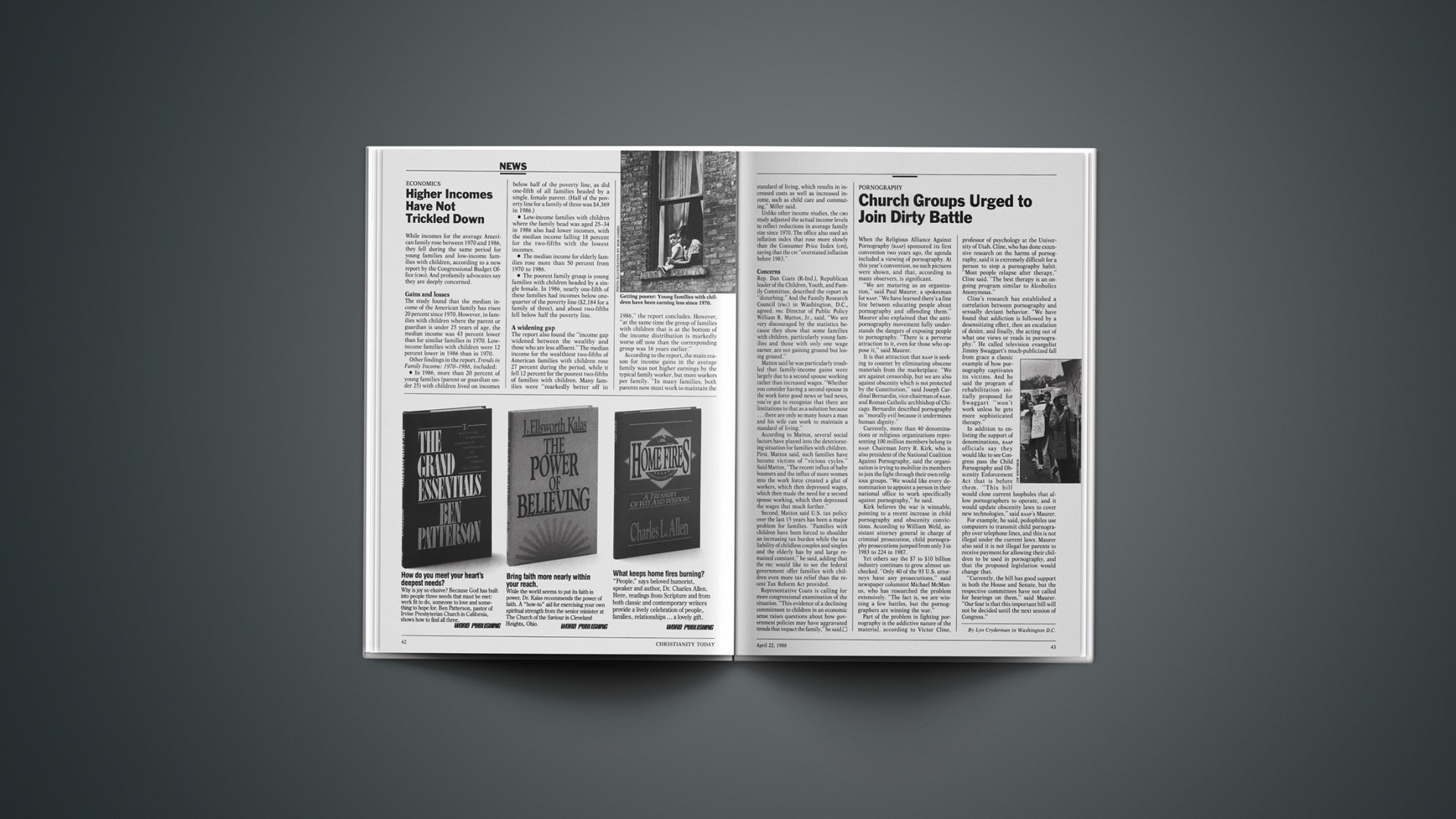
Church Groups Urged to Join Dirty Battle

PORNOGRAPHY

When the Religious Alliance Against Pornography (RAAP) sponsored its first convention two years ago, the agenda included a viewing of pornography. At this year’s convention, no such pictures were shown, and that, according to many observers, is significant.

“We are maturing as an organization,” said Paul Maurer, a spokesman for RAAP. “We have learned there’s a fine line between educating people about pornography and offending them.” Maurer also explained that the antipornography movement fully understands the dangers of exposing people to pornography. “There is a perverse attraction to it, even for those who oppose it,” said Maurer.

It is that attraction that RAAP is seeking to counter by eliminating obscene materials from the marketplace. “We are against censorship, but we are also against obscenity which is not protected by the Constitution,” said Joseph Cardinal Bernardin, vice-chairman of RAAP, and Roman Catholic archbishop of Chicago. Bernardin described pornography as “morally evil because it undermines human dignity.”

Currently, more than 40 denominations or religious organizations representing 100 million members belong to RAAP. Chairman Jerry R. Kirk, who is also president of the National Coalition Against Pornography, said the organization is trying to mobilize its members to join the fight through their own religious groups. “We would like every denomination to appoint a person in their national office to work specifically against pornography,” he said.

Kirk believes the war is winnable, pointing to a recent increase in child pornography and obscenity convictions. According to William Weld, assistant attorney general in charge of criminal prosecution, child pornography prosecutions jumped from only 3 in 1983 to 224 in 1987.

Yet others say the $7 to $10 billion industry continues to grow almost unchecked. “Only 40 of the 93 U.S. attorneys have any prosecutions,” said newspaper columnist Michael McManus, who has researched the problem extensively. “The fact is, we are winning a few battles, but the pornoggraphers are winning the war.”

Part of the problem in fighting pornography is the addictive nature of the material, according to Victor Cline, professor of psychology at the University of Utah. Cline, who has done extensive research on the harms of pornography, said it is extremely difficult for a person to stop a pornography habit. “Most people relapse after therapy,” Cline said. “The best therapy is an ongoing program similar to Alcoholics Anonymous.”

Cline’s research has established a correlation between pornography and sexually deviant behavior. “We have found that addiction is followed by a desensitizing effect, then an escalation of desire, and finally, the acting out of what one views or reads in pornography.” He called television evangelist Jimmy Swaggart’s much-publicized fall from grace a classic example of how pornography captivates its victims. And he said the program of rehabilitation initially proposed for Swaggart “won’t work unless he gets more sophisticated therapy.”

In addition to enlisting the support of denominations, RAAP officials say they would like to see Congress pass the Child Pornography and Obscenity Enforcement Act that is before them. “This bill would close current loopholes that allow pornographers to operate, and it would update obscenity laws to cover new technologies,” said RAAP’S Maurer.

For example, he said, pedophiles use computers to transmit child pornography over telephone lines, and this is not illegal under the current laws. Maurer also said it is not illegal for parents to receive payment for allowing their children to be used in pornography, and that the proposed legislation would change that.

“Currently, the bill has good support in both the House and Senate, but the respective committees have not called for hearings on them,” said Maurer. “Our fear is that this important bill will not be decided until the next session of Congress.”

By Lyn Cryderman in Washington D.C.

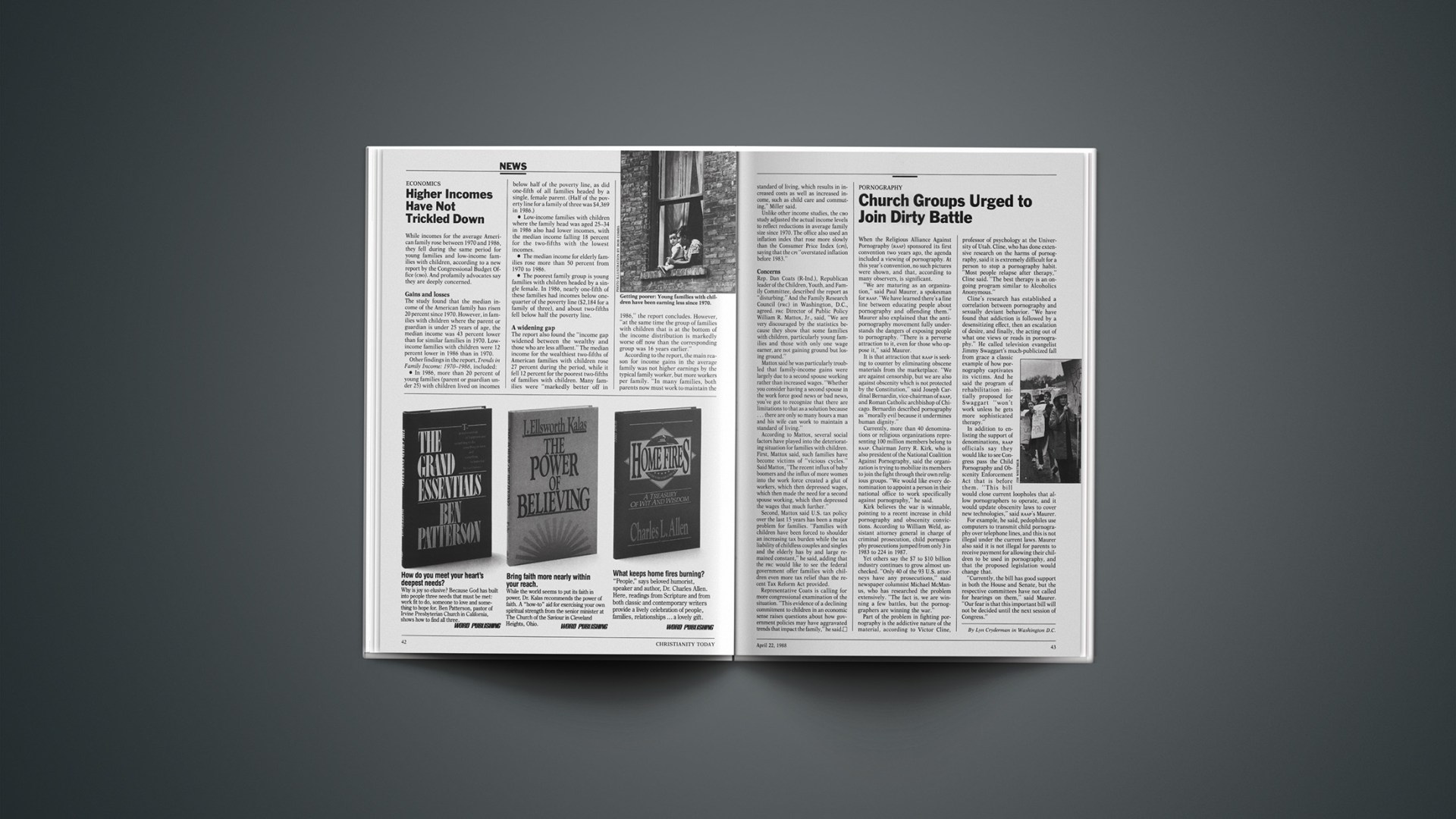
Higher Incomes Have Not Trickled Down

ECONOMICS

While incomes for the average American family rose between 1970 and 1986, they fell during the same period for young families and low-income families with children, according to a new report by the Congressional Budget Office (CBO). And profamily advocates say they are deeply concerned.

Gains And Losses

The study found that the median income of the American family has risen 20 percent since 1970. However, in families with children where the parent or guardian is under 25 years of age, the median income was 43 percent lower than for similar families in 1970. Low-income families with children were 12 percent lower in 1986 than in 1970.

Other findings in the report, Trends in Family Income: 1970–1986, included:

• In 1986, more than 20 percent of young families (parent or guardian under 25) with children lived on incomes below half of the poverty line, as did one-fifth of all families headed by a single, female parent. (Half of the poverty line for a family of three was $4,369 in 1986.)

• Low-income families with children where the family head was aged 25–34 in 1986 also had lower incomes, with the median income falling 18 percent for the two-fifths with the lowest incomes.

• The median income for elderly families rose more than 50 percent from 1970 to 1986.

• The poorest family group is young families with children headed by a single female. In 1986, nearly one-fifth of these families had incomes below one-quarter of the poverty line ($2,184 for a family of three), and about two-fifths fell below half the poverty line.

A Widening Gap

The report also found the “income gap widened between the wealthy and those who are less affluent.” The median income for the wealthiest two-fifths of American families with children rose 27 percent during the period, while it fell 12 percent for the poorest two-fifths of families with children. Many families were “markedly better off in 1986,” the report concludes. However, “at the same time the group of families with children that is at the bottom of the income distribution is markedly worse off now than the corresponding group was 16 years earlier.”

According to the report, the main reason for income gains in the average family was not higher earnings by the typical family worker, but more workers per family. “In many families, both parents now must work to maintain the standard of living, which results in increased costs as well as increased income, such as child care and commuting,” Miller said.

Unlike other income studies, the CBO study adjusted the actual income levels to reflect reductions in average family size since 1970. The office also used an inflation index that rose more slowly than the Consumer Price Index (CPI), saying that the CPI “overstated inflation before 1983.”

Concerns

Rep. Dan Coats (R-Ind.), Republican leader of the Children, Youth, and Family Committee, described the report as “disturbing.” And the Family Research Council (frc) in Washington, D.C., agreed, FRC Director of Public Policy William R. Mattox, Jr., said, “We are very discouraged by the statistics because they show that some families with children, particularly young families and those with only one wage earner, are not gaining ground but losing ground.”

Mattox said he was particularly troubled that family-income gains were largely due to a second spouse working rather than increased wages. “Whether you consider having a second spouse in the work force good news or bad news, you’ve got to recognize that there are limitations to that as a solution because … there are only so many hours a man and his wife can work to maintain a standard of living.”

According to Mattox, several social factors have played into the deteriorating situation for families with children. First, Mattox said, such families have become victims of “vicious cycles.” Said Mattox, “The recent influx of baby boomers and the influx of more women into the work force created a glut of workers, which then depressed wages, which then made the need for a second spouse working, which then depressed the wages that much further.”

Second, Mattox said U.S. tax policy over the last 15 years has been a major problem for families. “Families with children have been forced to shoulder an increasing tax burden while the tax liability of childless couples and singles and the elderly has by and large remained constant,” he said, adding that the FRC would like to see the federal government offer families with children even more tax relief than the recent Tax Reform Act provided.

Representative Coats is calling for more congressional examination of the situation. “This evidence of a declining commitment to children in an economic sense raises questions about how government policies may have aggravated trends that impact the family,” he said.

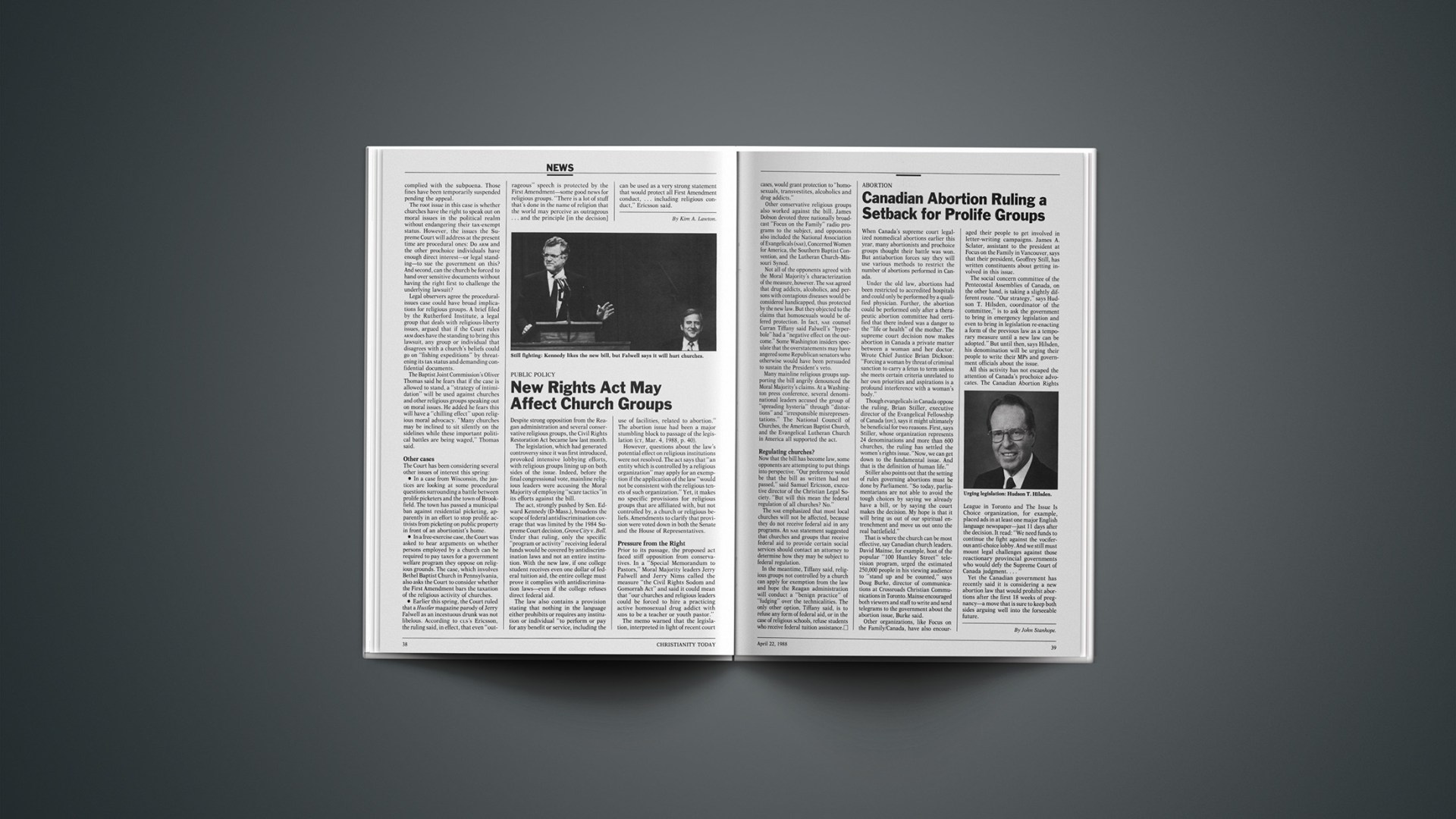
Canadian Abortion Ruling a Setback for Prolife Groups

ABORTION

When Canada’s supreme court legalized nonmedical abortions earlier this year, many abortionists and prochoice groups thought their battle was won. But antiabortion forces say they will use various methods to restrict the number of abortions performed in Canada.

Under the old law, abortions had been restricted to accredited hospitals and could only be performed by a qualified physician. Further, the abortion could be performed only after a therapeutic abortion committee had certified that there indeed was a danger to the “life or health” of the mother. The supreme court decision now makes abortion in Canada a private matter between a woman and her doctor. Wrote Chief Justice Brian Dickson: “Forcing a woman by threat of criminal sanction to carry a fetus to term unless she meets certain criteria unrelated to her own priorities and aspirations is a profound interference with a woman’s body.”

Though evangelicals in Canada oppose the ruling, Brian Stiller, executive director of the Evangelical Fellowship of Canada (EFC), says it might ultimately be beneficial for two reasons. First, says Stiller, whose organization represents 24 denominations and more than 600 churches, the ruling has settled the women’s rights issue. “Now, we can get down to the fundamental issue. And that is the definition of human life.”

Stiller also points out that the setting of rules governing abortions must be done by Parliament. “So today, parliamentarians are not able to avoid the tough choices by saying we already have a bill, or by saying the court makes the decision. My hope is that it will bring us out of our spiritual entrenchment and move us out onto the real battlefield.”

That is where the church can be most effective, say Canadian church leaders. David Mainse, for example, host of the popular “100 Huntley Street” television program, urged the estimated 250,000 people in his viewing audience to “stand up and be counted,” says Doug Burke, director of communications at Crossroads Christian Communications in Toronto. Mainse encouraged both viewers and staff to write and send telegrams to the government about the abortion issue, Burke said.

Other organizations, like Focus on the Family/Canada, have also encouraged their people to get involved in letter-writing campaigns. James A. Sclater, assistant to the president at Focus on the Family in Vancouver, says that their president, Geoffrey Still, has written constituents about getting involved in this issue.

The social concern committee of the Pentecostal Assemblies of Canada, on the other hand, is taking a slightly different route. “Our strategy,” says Hudson T. Hilsden, coordinator of the committee,” is to ask the government to bring in emergency legislation and even to bring in legislation re-enacting a form of the previous law as a temporary measure until a new law can be adopted.” But until then, says Hilsden, his denomination will be urging their people to write their MPs and government officials about the issue.

All this activity has not escaped the attention of Canada’s prochoice advocates. The Canadian Abortion Rights League in Toronto and The Issue Is Choice organization, for example, placed ads in at least one major English language newspaper—just 11 days after the decision. It read: “We need funds to continue the fight against the vociferous anti-choice lobby. And we still must mount legal challenges against those reactionary provincial governments who would defy the Supreme Court of Canada judgment.…”

Yet the Canadian government has recently said it is considering a new abortion law that would prohibit abortions after the first 18 weeks of pregnancy—a move that is sure to keep both sides arguing well into the forseeable future.

By John Stanhope.

North American Scene

HOMOSEXUALITY

Lutherans Affirm Gay Policy

When three gay seminarians were certified for ordination in the Evangelical Lutheran Church in America (ELCA), the newly formed denomination began receiving questions about its position on homosexuality. However, because the ELCA began operating on January 1, 1988, it has not had time to develop that position.

According to Bishop Herbert W. Chilstrom, the practice of the ELCA regarding the ordination of homosexuals is the same as that of its predecessor churches. Both the American Lutheran Church and the Lutheran Church in America had statements indicating homosexual behavior and not orientation | rendered a candidate ineligible for ordination.

“Those [pastors] who are gay or lesbian in their sexual orientation, whether acknowledged or kept confidential, will be expected to be celibate,” said Chilstrom.

The students in question attend Pacific Lutheran Theological Seminary in Berkeley, California.

DAY CARE

Sexual Abuse Lower

Child sexual abuse is less likely to occur in a day-care center than in the child’s home, a new study reported. Compiled for the federal government by researchers at the University of New Hampshire, the study estimated that an average of 5.5 children are sexually abused for every 10,000 enrolled in day-care centers. But at home, an average of 8.9 children are abused out of every 10,000, the study found.

The study also found that although men make up only 5 percent of day-care staff, they account for 60 percent of the abuse. Sexual abuse was less likely to occur at centers where parents had ready access to children, the study reported.

Preventive measures recommended by the study included teaching children the difference between “good touching” and “bad touching,” and telling children they should not keep secrets at day care that cannot be shared with their parents.

HEALTH

Airline Bans Smoking

Northwest Orient Airlines surprised analysts and announced passengers will not be allowed to smoke on any of its domestic flights except those to and from Hawaii. The ban by the nation’s fifth-largest carrier goes beyond federal regulations that go into effect this month prohibiting smoking on domestic flights lasting two hours or less.

According to Northwest spokesman A. B. “Sky” Magary, the prohibition is a response to passengers’ and employees’ requests. He cited a Northwest study showing that 90 percent of their passengers prefer to sit in the nonsmoking section of a plane. The study also found that about 30 percent of smokers expressed a desire for smoke-free flights. “We believe more nonsmokers will switch to Northwest than smokers will leave,” said Magary.

Northwest’s ban, which goes into effect this week, drew praise from officials of the American Cancer Society, the American Lung Association, and the U.S. surgeon general’s office.

PUBLISHING

U Finds A Home

After 47 years of publication, U magazine (formerly His) will merge with World Christian magazine. InterVarsity Christian Fellowship, publishers of U, and the publishers of World Christian said the two publications will merge later this spring.

The announcement ended speculation regarding the status of U, which had recorded significant financial losses due, in part, to a longstanding policy of not allowing His to sell advertising. And while most observers were surprised at the proposed merger, Linda Doll, director of InterVarsity Press, believes the two magazines “are unified in our view of God’s call to world mission.”

Gordon Aeschliman, editor of World Christian, says U will continue to address specific needs of college students. It will appear as a special section in World Christian.

PEOPLE AND EVENTS

Briefly Noted

Named: As coordinator of Mission to the World, the overseas missionary arm of the Presbyterian Church in America, John E. Kyle. Most recently, Kyle served with InterVarsity Christian Fellowship-USA as missions director and director of the Urbana Student Missions Conventions.

Died: Paul Ramsey, 74, one of the nation’s leading scholars of Christian ethics and a professor of religion at Princeton University for nearly 40 years. He was referred to in the New York Times as “the principal opponent of ‘situation ethics’ among Protestant thinkers.”

Gerhard Claas, 59, general secretary of the Baptist World Alliance, from injuries sustained in a traffic accident near Lodi, California. Claas had been chief administrative officer of the 35 million-member organization since 1980. A citizen of the Federal Republic of Germany, he once pastored the historic Johann-Gerhard Oncken Memorial Baptist Church in Hamburg.

Audrey Ockenga, 78, wife of the late Harold J. Ockenga, founding president of Fuller Theological Seminary, pastor of historic Park Street Church in Boston, and long-time chairman of the board of Christianity Today, Inc.

Resigned: Gordon D. Loux, as president and chief executive officer of Prison Fellowship Ministries, citing “differences in management philosophy, style, and role expectations.” Loux helped Charles Colson found Prison Fellowship in 1976.

New Rights Act May Affect Church Groups

PUBLIC POLICY

Despite strong opposition from the Reagan administration and several conservative religious groups, the Civil Rights Restoration Act became law last month.

The legislation, which had generated controversy since it was first introduced, provoked intensive lobbying efforts, with religious groups lining up on both sides of the issue. Indeed, before the final congressional vote, mainline religious leaders were accusing the Moral Majority of employing “scare tactics” in its efforts against the bill.

The act, strongly pushed by Sen. Edward Kennedy (D-Mass.), broadens the scope of federal antidiscrimination coverage that was limited by the 1984 Supreme Court decision, Grove City v. Bell. Under that ruling, specific “program or activity” receiving federal funds would be covered by antidiscrimination laws and not an entire institution. With the new law, if one college student receives even one dollar of federal tuition aid, the entire college must prove it complies with antidiscrimination laws—even if the college refuses direct federal aid.

The law also contains a provision stating that nothing in the language either prohibits or requires any institution or individual “to perform or pay for any benefit or service, including the use of facilities, related to abortion.” The abortion issue had been a major stumbling block to passage of the legislation (CT, Mar. 4, 1988, p. 40).

However, questions about the law’s potential effect on religious institutions were not resolved. The act says that “an entity which is controlled by a religious organization” may apply for an exemption if the application of the law “would not be consistent with the religious tenets of such organization.” Yet, it makes no specific provisions for religious groups that are affiliated with, but not controlled by, a church or religious beliefs. Amendments to clarify that provision were voted down in both the Senate and the House of Representatives.

Pressure From The Right

Prior to its passage, the proposed act faced stiff opposition from conservatives. In a “Special Memorandum to Pastors,” Moral Majority leaders Jerry Falwell and Jerry Nims called the measure “the Civil Rights Sodom and Gomorrah Act” and said it could mean that “our churches and religious leaders could be forced to hire a practicing active homosexual drug addict with AIDS to be a teacher or youth pastor.”

The memo warned that the legislation, interpreted in light of recent court cases, would grant protection to “homosexuals, transvestites, alcoholics and drug addicts.”

Other conservative religious groups also worked against the bill. James Dobson devoted three nationally broadcast “Focus on the Family” radio programs to the subject, and opponents also included the National Association of Evangelicals (NAE), Concerned Women for America, the Southern Baptist Convention, and the Lutheran Church-Missouri Synod.

Not all of the opponents agreed with the Moral Majority’s characterization of the measure, however. The NAE agreed that drug addicts, alcoholics, and persons with contagious diseases would be considered handicapped, thus protected by the new law. But they objected to the claims that homosexuals would be offered protection. In fact, NAE counsel Curran Tiffany said Falwell’s “hyperbole” had a “negative effect on the outcome.” Some Washington insiders speculate that the overstatements may have angered some Republican senators who otherwise would have been persuaded to sustain the President’s veto.

Many mainline religious groups supporting the bill angrily denounced the Moral Majority’s claims. At a Washington press conference, several denominational leaders accused the group of “spreading hysteria” through “distortions” and “irresponsible misrepresentations.” The National Council of Churches, the American Baptist Church, and the Evangelical Lutheran Church in America all supported the act.

Regulating Churches?

Now that the bill has become law, some opponents are attempting to put things into perspective. “Our preference would be that the bill as written had not passed,” said Samuel Ericsson, executive director of the Christian Legal Society. “But will this mean the federal regulation of all churches? No.”

The NAE emphasized that most local churches will not be affected, because they do not receive federal aid in any programs. An NAE statement suggested that churches and groups that receive federal aid to provide certain social services should contact an attorney to determine how they may be subject to federal regulation.

In the meantime, Tiffany said, religious groups not controlled by a church can apply for exemption from the law and hope the Reagan administration will conduct a “benign practice” of “fudging” over the technicalities. The only other option, Tiffany said, is to refuse any form of federal aid, or in the case of religious schools, refuse students who receive federal tuition assistance.

Which Way Will the New Justice Vote?

SUPREME COURT

As the Supreme Court moves through its spring term, many Court observers say this will be a crucial time, especially in the church-state arena. And while the issues before the justices are not headline grabbers like the recent creationism, school prayer, and textbook cases, experts agree this term could have a far-reaching impact on the direction the Court will be taking with regard to religious issues.

New Shakedown?

A key factor in any new direction will be recently confirmed Justice Anthony Kennedy. During his confirmation hearings, Kennedy did not reveal his views on such church-state issues as the free-exercise and establishment clauses of the Constitution, and he did not address such cases during his time as a federal appeals judge.

Consequently, many observers see him as something of a critical “wild card.” In recent years, the Court has become divided over church-state issues, with many cases being decided on a 5-to-4 vote. Justice Lewis Powell, whose spot Kennedy filled, was often considered the “swing vote” who determined which way a case would be decided.

“I think we may see a new shake-down, a new picture presented on both establishment and free-exercise [cases],” said constitutional attorney William Bentley Ball, “and I’m not venturing to predict whether that will be good or bad.”

Federal Funds For Church Groups

One of the most important church-state cases currently before the Court, Bowen v. Kendrick, involves the constitutionality of allowing religious groups to accept federal funds for programs that promote abstinence for teenagers.

Clarke Forsythe, staff counsel for Americans United for Life (AUL), said a lower court ruled that the religious mission of the organization is related to its program of promoting abstinence. “So on that premise, no religious program could participate in any social-welfare program because every social-welfare program would relate to a group’s religious mission,” Forsythe said. He fears churches and religious groups that accept federal grants for soup kitchens, homeless services, immigration counseling, drug-abuse programs, and services to help teenage runaways could be affected.

At issue in the Kendrick case is the Adolescent Family Life Act, passed by Congress in 1981, which allowed nonprofit groups, including religious groups, to receive federal grants to promote chastity and alternatives to abortion. The act specifically forbids the religious groups to use the federal grants to promote religion.

The American Civil Liberties Union (ACLU) challenged the law, saying it allowed “federal funds to subsidize religious indoctrination as a means of opposing premarital sex.…” A federal district court ruled last year that providing those funds for religious groups under the act would create an “excessive entanglement between government and religion” in violation of the establishment clause.

Samuel Ericsson, executive director of the Christian Legal Society (CLS), acknowleged that there is a potential for some grant recipients to violate the contract and use federal money to promote religion. However, he added, “You don’t throw the baby out with the bathwater.”

Not all religious groups agree such funding is appropriate. Oliver Thomas, general counsel for the Baptist Joint Committee (BJC), filed a brief on behalf of his group and the American Jewish Committee in opposition to providing funds. While commending the “outstanding job” that many of the religious groups were doing in trying to combat teen pregnancy, Thomas said the government should not be subsidizing that kind of activity. “We think that it’s impossible for religious organizations to teach sexual morality without consciously or unconsciously promoting religion,” Thomas said.

Thomas believes churches will be better off not receiving federal funds for any programs. “When we accept government funds, then we’re going to be held accountable to certain standards, and it’s going to be a secular mentality that’s imposed on the churches,” he said. “Strings follow government money.”

Both sides agree the Court may use this case as an opportunity to re-examine the traditional criteria for determining whether a particular government action violates the Constitution’s prohibition against government establishment of religion (the Lemon test). Recently, several of the justices have indicated dissatisfaction with that test.

Fishing Expeditions

A second case the Court has taken up looks at who has the right to challenge the tax-exempt status of churches and other religious groups. U.S. Catholic Conference v. Abortion Rights Mobilization (arm) began when several prochoice groups and individuals, led by arm, sued the Internal Revenue Service (IRS) and the treasury department for not revoking the Catholic Church’s tax-exempt status because of the church’s prolife activities, arm charged that the tax exemption gave the Catholic Church an unfair subsidy for “partisan political activity” in the abortion debate.

In the legal process, the National Conference of Catholic Bishops and the United States Catholic Conference refused to release some 20,000 subpoenaed internal documents, including sermons, pastoral plans, newsletters, and other sensitive information. The lower court found the two groups in contempt of court and ordered them to pay fines of $100,000 per day until they complied with the subpoena. Those fines have been temporarily suspended pending the appeal.

The root issue in this case is whether churches have the right to speak out on moral issues in the political realm without endangering their tax-exempt status. However, the issues the Supreme Court will address at the present time are procedural ones: Do arm and the other prochoice individuals have enough direct interest—or legal standing—to sue the government on this? And second, can the church be forced to hand over sensitive documents without having the right first to challenge the underlying lawsuit?

Legal observers agree the procedural-issues case could have broad implications for religious groups. A brief filed by the Rutherford Institute, a legal group that deals with religious-liberty issues, argued that if the Court rules arm does have the standing to bring this lawsuit, any group or individual that disagrees with a church’s beliefs could go on “fishing expeditions” by threatening its tax status and demanding confidential documents.

The Baptist Joint Commission’s Oliver Thomas said he fears that if the case is allowed to stand, a “strategy of intimidation” will be used against churches and other religious groups speaking out on moral issues. He added he fears this will have a “chilling effect” upon religious moral advocacy. “Many churches may be inclined to sit silently on the sidelines while these important political battles are being waged,” Thomas said.

Other Cases

The Court has been considering several other issues of interest this spring:

• In a case from Wisconsin, the justices are looking at some procedural questions surrounding a battle between prolife picketers and the town of Brookfield. The town has passed a municipal ban against residential picketing, apparently in an effort to stop prolife activists from picketing on public property in front of an abortionist’s home.

• In a free-exercise case, the Court was asked to hear arguments on whether persons employed by a church can be required to pay taxes for a government welfare program they oppose on religious grounds. The case, which involves Bethel Baptist Church in Pennsylvania, also asks the Court to consider whether the First Amendment bars the taxation of the religious activity of churches.

• Earlier this spring, the Court ruled that a Hustler magazine parody of Jerry Falwell as an incestuous drunk was not libelous. According to CLS’S Ericsson, the ruling said, in effect, that even “outrageous” speech is protected by the First Amendment—some good news for religious groups. “There is a lot of stuff that’s done in the name of religion that the world may perceive as outrageous … and the principle [in the decision] can be used as a very strong statement that would protect all First Amendment conduct, … including religious conduct,” Ericsson said.

By Kim A. Lawton.

A Tentative Peace: How Long Will It Last?

NEWS

NICARAGUA

Issues that divide the contras and Sandinistas have also caused division among Christians.

In spite of last month’s truce between Nicaragua’s Sandinista government and the contra rebels, disagreements continue. And the same issues that divide Nicaraguans have polarized American evangelicals. Some view the agreement as a defeat for U.S. policy, a concession to Marxism-Leninism. Others believe it could lead to a peace acceptable to Western democracies.

CHRISTIANITY TODAY interviewed five Christians with informed but varying perspectives on Nicaragua: Richard Millett, Michael Cromartie, Steve Wykstra, Ervin Duggan, and Vernon Jantzi.

Millett, professor of history at Southern Illinois University, has testified before Congress 16 times on issues related to Central America. He is senior adviser for Central American affairs to the International Peace Academy. Cromartie is research associate for Protestant studies at the Ethics and Public Policy Center in Washington, D.C.

Wykstra is professor of philosophy at Calvin College. Duggan, who served in the state department during the Carter administration, is on the executive board of Presbyterians for Democracy and Religious Freedom. Jantzi, currently on a sabbatical leave from Eastern Mennonite College in Virginia, has served since 1964 in various missionary capacities in Costa Rica and Nicaragua.

Their comments on specific aspects of the Nicaragua debate are summarized below.

Pursuit Of Democracy

Those interviewed agree that democracy, as defined by the Arias peace plan (see sidebar on p. 36) is best for any country, and that Marxism is ultimately incompatible with democracy. “Societies that favor liberty over equality do a better job providing both liberty and equality than societies that favor equality over liberty,” said Cromartie. “It’s right for Christians to be for democracy.”

Millett pointed out, however, that Nicaragua has no tradition of democracy and that “most U.S. politicians didn’t care about democracy in Nicaragua until the Sandinistas showed up.” Millett said, “For 40 years, we defined Nicaragua under Somoza as an acceptable democracy.”

Jantzi added that in evaluating Nicaragua, “we sometimes incorrectly assume that democracy exists elsewhere in the region. If democracy is understood to mean people having a real say over what happens to them and the resources of their society, then there is no democracy in Central America, except possibly Costa Rica.”

Soviet Influence

“No one would dispute that Nicaragua is more friendly with the Soviet Union than other Central American countries are,” said Jantzi. Wykstra pointed out that in their literature before and after the 1979 revolution, “the Sandinistas held a very positive view of the ‘Soviet experiment.’ ” He added, “Marxism appeals to people because it offers a solution to their problems. Christians need to understand this in order to succeed at influencing people not to embrace Marxism’s ideological conclusions.”

Millett believes that it is a mistake to view the Nicaraguan conflict primarily as an East-West struggle. He said pluralism in Nicaragua, though limited, is greater than in most Soviet client states.

Duggan noted that “Soviet military assistance to Nicaragua since 1979 has been estimated by most experts at more than $2 billion.” Millett said it is difficult to put a dollar amount “on used weapons.”

“The Soviets have been very clear in their limits of commitment to this area,” Millett said. He added, however, that had the U.S. not displayed an interest in the region, Cuban and Soviet presence would have been accelerated.

Duggan observed that “naïve Christians of my acquaintance argue that the Sandinistas were ‘driven into the arms’ of the Soviets by a hostile United States.” Duggan was a member of the state department policy-planning staff during the Carter years. He said the U.S. gave Nicaragua more than $100 million in aid “to encourage [the Sandinistas] to embrace Western-style democracy. It was to no avail.”

Sandinista Motivation

The 1979 revolution to overthrow the Somoza government was in some ways atypical. It did not include, for example, overt antireligious campaigns that have characterized other Marxist revolutions. Those interviewed agree that at its highest level, the Sandinista leadership would like to establish a one-party, Marxist-Leninist state. “These people are not closet democrats,” said Millett.

Respondents disagree, however, on whether a true Soviet-style state is possible in Nicaragua. Millett observed that not everyone in the government is committed to totalitarianism. And he said Nicaraguan nationalism competes with Marxist ideology among the Sandinistas.

Jantzi maintains that economic factors eventually win out over ideology. “Their [Sandinista] economic policies simply do not work,” he said. “Economic realities will force them to be open to more diverse political influence.” Duggan, however, said that had it not been for U.S. intervention, “the Sandinistas would have extinguished all the remaining embers of democracy by now.”

Millett said an understanding of the Sandinistas is not complete without the “bottom line” of what it means to be a Sandinista: “More important than Marxism-Leninism, the bottom line is is to never publicly bow down to U.S. pressure.”

Religion And The Sandinistas

Duggan said that religion and Marxist ideology are as compatible as “Christian marriage and group sex.” He said churches in Nicaragua that support the government enjoy greater privileges than churches that remain independent.

Jantzi said, however, that governments, by their nature, demand ultimate authority. “I know people [in America] who are constantly harassed because they don’t pay the military portion of their taxes. Nonregistrants for the draft are imprisoned. Repression of church people who dissent is not limited to Marxist societies.”

Cromartie believes that because religion is so deeply rooted in Central America, the “Sandinista strategy is to co-opt the church.” Millett, however, compares the church in Nicaragua to the church in Poland: “How much luck have the Polish Communists had in co-opting that church in the last 43 years?”

Wykstra warned that Marxist-Leninist governments are not alone in trying to use the church: “There are well-documented incidents in which the Central Intelligence Agency has not only recruited missionaries for intelligence gathering, but has also exploited religious conviction to destabilize governments. Christians cannot afford to be naïve and uncritical about this.”

Another aspect of the religion debate is the role of sincere Nicaraguan Christians who have been criticized for supporting the government. Wykstra notes that these people had to make hard choices. “Like the revolutionaries,” he said, “they opposed a cruel dictator. They could either leave the country or try to mold the revolution.” Cromartie expressed the concern that “the leaven doesn’t influence the ideology; the ideology uses the leaven.”

Contra Support

Cromartie said “the resistance supplied by the freedom fighters has prevented a totalitarian state until now.” Wykstra said while that may be true, he nevertheless believes U.S. military support for the contras was morally wrong. He says his case rests on factual evidence of moral reprehensibility on the part of the contras.

“This is a moral nonnegotiable,” said Wykstra. “I believe as a Christian that it is wrong to sponsor a group that commits moral atrocities as routine policy, even if one calculates that this will prevent a greater moral evil.”

Cromartie said the question of the moral nature of the contras is still unsettled for him. Regardless, he said, “not to choose the lesser of two evils is to allow the greater evil to triumph.”

Millett maintains the U.S. supported “the wrong people, at the wrong time, in the wrong way, and for the wrong reasons.” Labeling the contras “thugs,” he said the U.S. should not have used military force as long as it could be reasonably argued there was a peaceful solution: “By supporting the contras, we gave the Sandinistas an excuse for everything they’ve done since.”

Millett added, however, that “just because you can demonstrate a policy is dumb doesn’t mean you can solve it by pulling the plug on the contras. That would have sent the wrong message to the world.” Millett believes the best approach is to provide only humanitrarian aid to the contras. He faults the U.S. for not exercising its moral force to cut down on contra-sponsored terrorism.

Recent History

July 1979

The Sandinistas take over Managua two days after the fall of dictator Anastasio Somoza.

August 1980

The Sandinistas postpone national elections.

August 1981

The contra efforts are launched.

November 1984

Opposition groups boycott national elections.

July 1985

Contras begin to make military gains.

October 1986

U.S. Congress approves $ 100 million in contra aid.

August 1987

Five Central American countries agree on a peace plan devised by Costa Rican President Oscar Arias. It calls for freedom of the press, open access to political power, and full respect for human rights.

December 1987

Contras launch a major military offensive, and Arias receives Nobel Prize for Peace.

February 1988

U.S. House of Representatives rejects $36 million contra aid package.

March 1988

U.S. combat troops arrive in Honduras for military exercises.

March 1988

Contras and Sandinistas reach a cease-fire agreement.

Conclusions

Christians on both sides of the debate have maintained that the other side is motivated by ideology. “In the ESA [Evangelicals for Social Action] newsletter, I’ve never seen a negative word on the Sandinistas,” said Cromartie. “I would like to see Sojourners magazine catch up with the New York Times in finding something wrong with Nicaragua’s government.”

Wykstra, however, maintains that organizations on the opposite side, such as the Institute on Religion and Democracy (IRD), have failed to reckon seriously with contra atrocities and U.S. duplicity.

“We need the IRD to inform us about how religion is processed in Soviet-style countries,” said Wykstra. “We also need Sojourners to remind us that Marxism is not the only ideological force that can co-opt religion. On specific factual disputes, such as the nature of the contras or the Sandinistas, each side tends to ignore the other’s evidence. We need more cross-examination.”

Views on the recent peace plan are mixed. Duggan said the contras have “capitulated in a barely disguised surrender” and that “Soviet and Cuban military progress in Nicaragua can now proceed in full public view, without the inconvenience of domestic opposition.”

Duggan called on U.S. Christians to “end our fixation on what the U.S. government is doing and focus on what our churches are doing.” He said, “I find it tragic that churches in America are acting as apologists for governments like Nicaragua’s,” adding that Christians “should pray for the victims of Marxist tyranny in Nicaragua. And we should prepare to open our homes and churches for the stream of refugees as communist ‘justice’ and death spread across Central America in the next few years.”

Cromartie is likewise skeptical that the recent agreement will produce peace. “More people have been killed in the twentieth century by their own leftist totalitarian governments than have died in wars,” he said. “Unfortunately, Joe McCarthy has made it difficult for us to say this. But I would think that in the 1980s it should be a badge of Christian honor to be anticommunist.”

In contrast, Jantzi is optimistic. “Permanent resolution will be brought about only by internal forces,” he said. “We should spend our energies making sure the surrounding countries make democracy work. The Sandinistas won’t be able to spread an ideology those countries don’t want. Revolution is not exported, it is imported. If there’s a demand, the supply will fill it.”

Millett believes the truce has a “better than 50–50 chance” of succeeding. He said the church should play as big a role as possible in monitoring Sandinista progress toward democracy, and he urged Christians never to sanctify the use of force by any side.

“All policies are going to be sinfully flawed,” Millett said. “They are enacted by sinful men, living in sinful societies, out of sinful motives. So there are no easy solutions, there is no cheap grace. To me, sin is the inability to predict or control the results of our actions.”

By Randy Frame.

Apple PodcastsDown ArrowDown ArrowDown Arrowarrow_left_altLeft ArrowLeft ArrowRight ArrowRight ArrowRight Arrowarrow_up_altUp ArrowUp ArrowAvailable at Amazoncaret-downCloseCloseEmailEmailExpandExpandExternalExternalFacebookfacebook-squareGiftGiftGooglegoogleGoogle KeephamburgerInstagraminstagram-squareLinkLinklinkedin-squareListenListenListenChristianity TodayCT Creative Studio Logologo_orgMegaphoneMenuMenupausePinterestPlayPlayPocketPodcastRSSRSSSaveSaveSaveSearchSearchsearchSpotifyStitcherTelegramTable of ContentsTable of Contentstwitter-squareWhatsAppXYouTubeYouTube