Risky Business

Marriage demands a commitment that the current generation would rather not make.

Last year we were treated to stories about the Unitarian pastor who ended a sermon on aids by handing out condoms to his congregation and about a prominent pastor in Hawaii who said he is developing a “theology of condoms.”

Let’s face it: with Jim and Tammy, and Oral, and preachers waxing philosophical on condoms, it was a bad year for the clergy.

Of course, we need complete information on AIDS and its prevention. Religious communities must minister to those who are victims of this new and terrible disease. But let it also be said that the popular slogan Safe Sex is a lie. Condoms or not, sex is risky. As someone who ministers at a place where we have nearly 150 weddings a year (Duke University Chapel), I think it is time to tell couples that “There’s no ‘safe sex.’ ”

Booming Weddings, Busted Marriages

Susan Littwin, in her perceptive study The Postponed Generation (Morrow, 1986), notes that “committed, lasting relationships are a critical aspect of maturity. Today’s young adults are having more trouble with relationships than with almost any other area of their lives. They are having problems for two reasons: (1) They have trouble with commitment in general, … a subheading of their overall reluctance to define themselves. (2) The menu of choices makes life more confusing … they are in unmapped territory, looking for trails of crumbs.”

Don’t believe the hype about marriage being back in style, says Littwin; statistics are misleading. There is “a wedding boom. But there is no marriage boom.” We have shifted, she says, from a society of families to a nation of individuals—singles bars, Lean Cuisine self-contained dinners, Club Med trips. Of today’s young adults she says, “These are special children, brought up to be individuals.… They never felt they had a role to play in the community or the family, and certainly never believed that they might have to sacrifice their individuality.”

Adolescence goes on and on. Just “living together” keeps commitment in limbo. Somehow, these “special children” reason, there has to be a way to find love without risk. So a recent New York Times article speaks of this as “The Uncommitted Generation,” where sex and love are merely experience in “Being Alone—Together.”

Does anyone ever grow up, except the hard way? Maturity has to do with facing facts, coming to terms with reality—a none-too-easy task for those whose parents have given them so much for nothing, whose constant support and subsidy led them to believe they could have life and safety too.

Perhaps this accounts for the “grimness” of most rituals for Christian marriage. Into the satin-and-white-lace world of the wedding is inserted grim talk of “for better, for worse, for richer, for poorer, in sickness and in health.” There they are, in their sexual prime, with all their equipment in good working order, so full of promise. And here I am speaking of sickness, poverty, and death. How typical of a preacher to spoil someone else’s party, they say.

Take the words and the ritual as the church’s earnest, countercultural effort to help folk to face facts. We Christians know of no happiness save that which arises as a by-product of commitment to another. We have no definition of love (a cross being on our altar) that is sacrifice-or risk-free. Relationships between men and women that go beyond merely hanging around take time, hard work, tough mindedness, and a host of other mundane virtues.

So forgive our grim talk at your pretty wedding. Welcome to reality. Life, you can be sure, has its grim side. Don’t settle for anything less than a promise that will enable you to persevere in your love. Not all your days will be Saturdays in June.

Proving The Law Of Gravity

Yet perhaps, just perhaps, these postponed young adults know this truth better than the rest of us. Some of them have learned about Christian marriage the hard way, by finding out that the alleged risk-free alternatives and so-called casual sex do not work. Now they stand before the church ready to testify that love without the risk of commitment is hardly love at all.

In a course of mine, I asked seminarians to share case studies of their pastoral experience. One student pastor presented a case wherein a woman asked her pastor, “What does the United Methodist Church believe about premarital sex?”

The pastor, a beneficiary of seminary training, asked, “What do you think about premarital sex?”

The parishioner persisted. “I know that pastors don’t approve.”

“Some pastors,” he said. “Older pastors.”

“Isn’t the Bible against people just living together?” she asked.

“The Bible is a culturally conditioned book that must be read with interpretative sophistication,” he said. “The main thing is to be sure that you’re open, trusting, loving, and caring.”

I asked the gathered students what they thought of this episode. One young man, sans shoes, wearing a tank top and blue jeans, was first to speak: “This is a bunch of garbage.”

“I take it you don’t care for the pastor’s handling of this,” I said.

“No!” he said. “It’s lousy counseling and even worse pastoring. The woman asks a straightforward, direct question. But the pastor refuses to answer. Perhaps he doesn’t even know an answer. Instead, he says, in effect, ‘You dummy, that isn’t your question. You don’t really want to know what the church or the Bible says, you want to know what you think.’ Why won’t the pastor do what he’s ordained to do?”

Rather flippantly, I remarked, “Well now, aren’t we being conservative!” This young man—tank-topped, postponed—looked at me earnestly and said, “I’ve lived through three or four of these so-called relationships. I’m here to tell you there’s no way for them to be open, trusting, loving, and caring, no way in hell without a promise. I hurt some good people in order to find that out. I wish the church had told me. I might have still learned the hard way. But I wish the church had told me.”

The English writer G. K. Chesterton once said that if a man comes to a cliff and keeps walking, he won’t break the law of gravity; he’ll prove it.

So, welcome the postponed generation back to the church. They have been out in the cold long enough. Some of them have learned things you cannot learn in books. Tell them: There is no better time than now for commitment, and there is no better place than here.

William H. Willimon is minister to the university and professor of the practice of Christian ministry at Duke University. His latest book, with Robert L. Wilson, is Rekindling the Flame: Strategies for a Vital United Methodism.
Beyond the Wall

Where the church suffers, there is God.

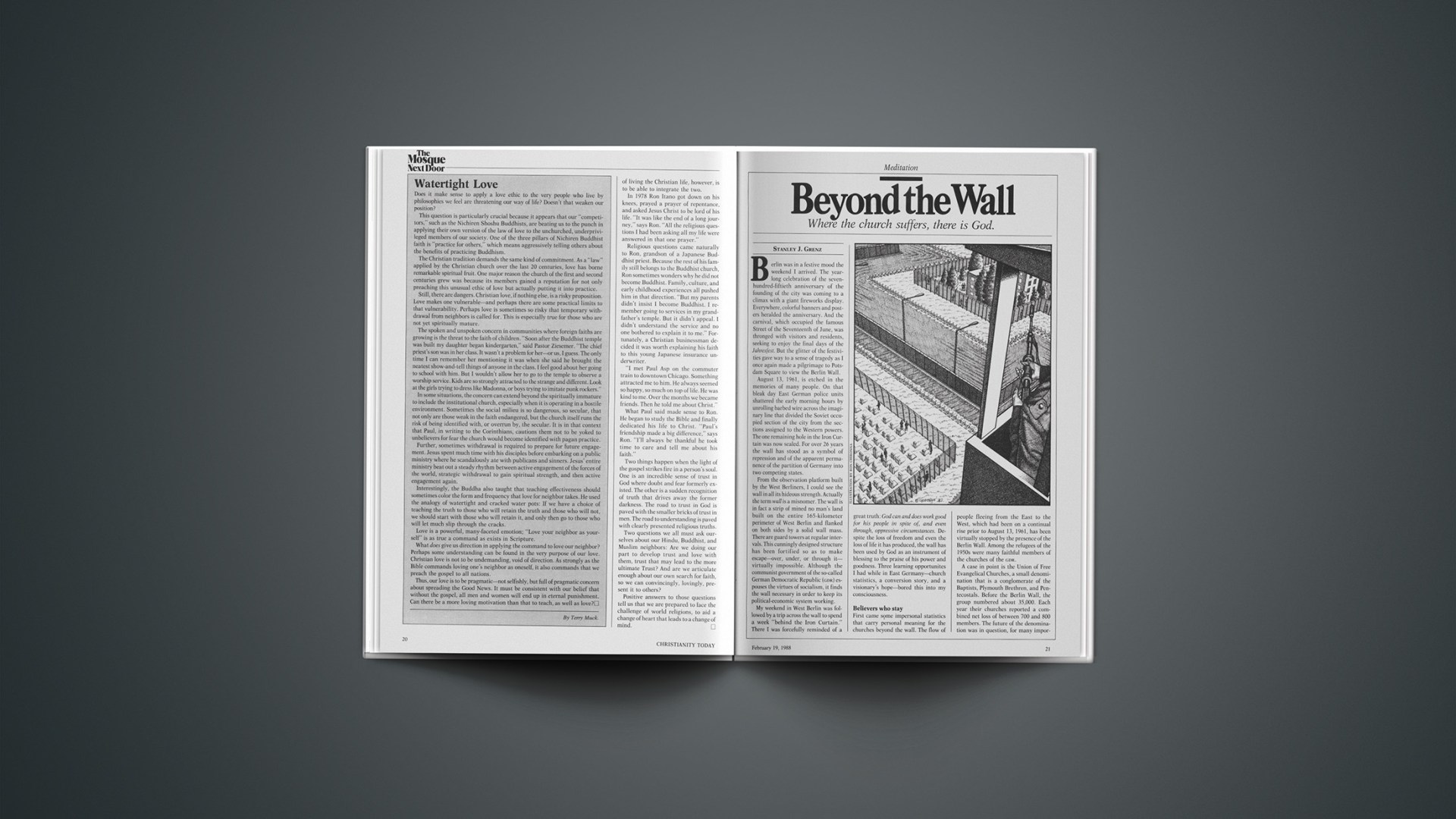
Berlin was in a festive mood the weekend I arrived. The yearlong celebration of the seven-hundred-fiftieth anniversary of the founding of the city was coming to a climax with a giant fireworks display. Everywhere, colorful banners and posters heralded the anniversary. And the carnival, which occupied the famous Street of the Seventeenth of June, was thronged with visitors and residents, seeking to enjoy the final days of the Jahresfest. But the glitter of the festivities gave way to a sense of tragedy as I once again made a pilgrimage to Potsdam Square to view the Berlin Wall.

August 13, 1961, is etched in the memories of many people. On that bleak day East German police units shattered the early morning hours by unrolling barbed wire across the imaginary line that divided the Soviet occupied section of the city from the sections assigned to the Western powers. The one remaining hole in the Iron Curtain was now sealed. For over 26 years the wall has stood as a symbol of repression and of the apparent permanence of the partition of Germany into two competing states.

From the observation platform built by the West Berliners, I could see the wall in all its hideous strength. Actually the term wall is a misnomer. The wall is in fact a strip of mined no man’s land built on the entire 165-kilometer perimeter of West Berlin and flanked on both sides by a solid wall mass. There are guard towers at regular intervals. This cunningly designed structure has been fortified so as to make escape—over, under, or through it—virtually impossible. Although the communist government of the so-called German Democratic Republic (GDR) espouses the virtues of socialism, it finds the wall necessary in order to keep its political-economic system working.

My weekend in West Berlin was followed by a trip across the wall to spend a week “behind the Iron Curtain.” There I was forcefully reminded of a great truth: God can and does work good for his people in spite of, and even through, oppressive circumstances. Despite the loss of freedom and even the loss of life it has produced, the wall has been used by God as an instrument of blessing to the praise of his power and goodness. Three learning opportunites I had while in East Germany—church statistics, a conversion story, and a visionary’s hope—bored this into my consciousness.

Believers Who Stay

First came some impersonal statistics that carry personal meaning for the churches beyond the wall. The flow of people fleeing from the East to the West, which had been on a continual rise prior to August 13, 1961, has been virtually stopped by the presence of the Berlin Wall. Among the refugees of the 1950s were many faithful members of the churches of the GDR.

A case in point is the Union of Free Evangelical Churches, a small denomination that is a conglomerate of the Baptists, Plymouth Brethren, and Pentecostals. Before the Berlin Wall, the group numbered about 35,000. Each year their churches reported a combined net loss of between 700 and 800 members. The future of the denomination was in question, for many important lay leaders and supportive members were fleeing to the West. The coming of the wall changed all that. Since 1961 net losses have been cut to about 300 yearly, and these are mostly due to deaths.

Many Christians in the GDR now suggest the political climate there has so improved since the 1950s that no one needs to flee for religious reasons. Christians, these believers declare, have a responsibility to remain in the GDR under these improved conditions and to serve as missionaries to their own people. When a family does emigrate to the West, those who stay behind feel abandoned and wonder if in fact economic considerations motivated the move. The wall, they say, is God’s sign that East German Christians need to remain in their country. Some Christians in the GDR even believe that God allowed the wall to be built partly to insure the survival of the church in that land.

The Death And Life Of Richard

God’s ability to bring blessing out of the Berlin Wall was also underscored as I listened to the conversion story of a young East Berliner. Richard grew up in the shadow of the wall. His father’s commitment as a member of the Communist party insured that the strict socialist world view Richard was taught in school would be reaffirmed in the home. But despite party indoctrination, the Berlin Wall continually raised for him the question of life in the West and gave him a gnawing sense of imprisonment. Western television programs heightened this feeling by depicting life in America, which became for him “the promised land.”

Richard decided to find a way through the wall. But as he traveled its perimeter, he came to the depressing conclusion that it was impenetrable. Then he decided to escape another way. Given his relatively good income, he could apply to visit Cuba and abandon the airplane during the stopover in Canada. But obtaining clearance for such a trip could take years. Doubts arose in Richard’s mind as to whether life in the West would bring satisfaction. He decided to commit suicide.

The suicide attempt came shortly after Richard entered the military service required of all East German young men. One night he took an overdose of barbiturates. But his attempt was foiled. When he did not rise at morning roll call, he was discovered and rushed to the hospital. Richard’s miraculous recovery without brain damage or internal injuries awakened in him the thought that possibly there was a God who had spared him for some purpose.

Soon thereafter Richard was invited to a youth evangelistic week at a Berlin Baptist church. The logical presentation of the Christian faith by the evangelist, the encouraging words of the youth counselors, and the warmth and acceptance of the Christians he encountered there were new and welcome experiences. As the week drew to a close, he became convinced that faith in Christ was the answer to his needs.

Richard still lives at home. His parents have slowly accepted him as a Christian, even though he and his father hold sharply divergent views. During a recent trip to the West, his father even brought back the compact Bible Richard had requested. He is now contemplating what God has for his future and is open to the possibility of theological education and pastoral service.

Were he now able to flee across the wall to the West, Richard would not avail himself of the opportunity. The Lord has given him the contentment to live in the GDR. He believes he has a mission to fulfill—to serve his people as an ambassador for Christ.

An Heirloom Of Hope

What do East German Christians think as they look at the Berlin Wall? I asked this question of a young pastor living in East Berlin. He had accompanied me to the Brandenburg Gate, where the dividing power of the wall is most visible, running across the old Berlin landmark street Unter den Linden.

His first response was the word Ohnmacht—impotence. Then he sought to open a window into this feeling of powerlessness. He had no harsh words for his own government, but spoke of the wider world political-economic situation that had moved the East German government to take this desperate move in 1961. I understood and sympathized with his portrayal of the East-West struggle and the inequities that exist.

His description led me to think of the superhuman principalities and powers Paul mentions in Ephesians. My friend was right. No one human being or government was responsible for the wall. Rather, the world is in the thrall of powers beyond human analysis.

As I was contemplating this, he declared that one day the wall would be tom down. His prophecy was not for me, however, but for his two children. In them the dream of full human rights must be kept alive, this visionary told me, and this through the teaching of Christian parents.

This was the third learning experience: this hideous wall provides the focal point for passing on a dream from parent to child. The dream that becomes the heirloom of Christian families in the East, however, goes far beyond hope for the eventual eradication of a divided Germany. It looks to the elimination of the fears and rivalries that divide the world.

My friend spoke of the day when people will once more move freely where a wall used to be. But of greater significance is his personal commitment to the God who tears down walls. One day the principalities and powers against which all Christians are called to struggle as a united, international body will be defeated. And God’s reign over Earth will come in its fullness.

For over 26 years the Berlin Wall has stood as a monument to injustice. But by viewing the wall from the other side, I was reminded that no evil in this world is so great that it lies beyond God’s power to bring good out of evil. For the one who has eyes to see, God can use the Berlin Wall as an illustration of the coming kingdom that breaks into the present. What lies beyond the wall? Beyond the Berlin Wall, there is God.

Stanley J. Grenz is professor of systematic theology and Christian ethics, North American Baptist Seminary, Sioux Falls, South Dakota.

The Mosque next Door

How do we speak the truth in love to Muslims, Hindus, and Buddhists?

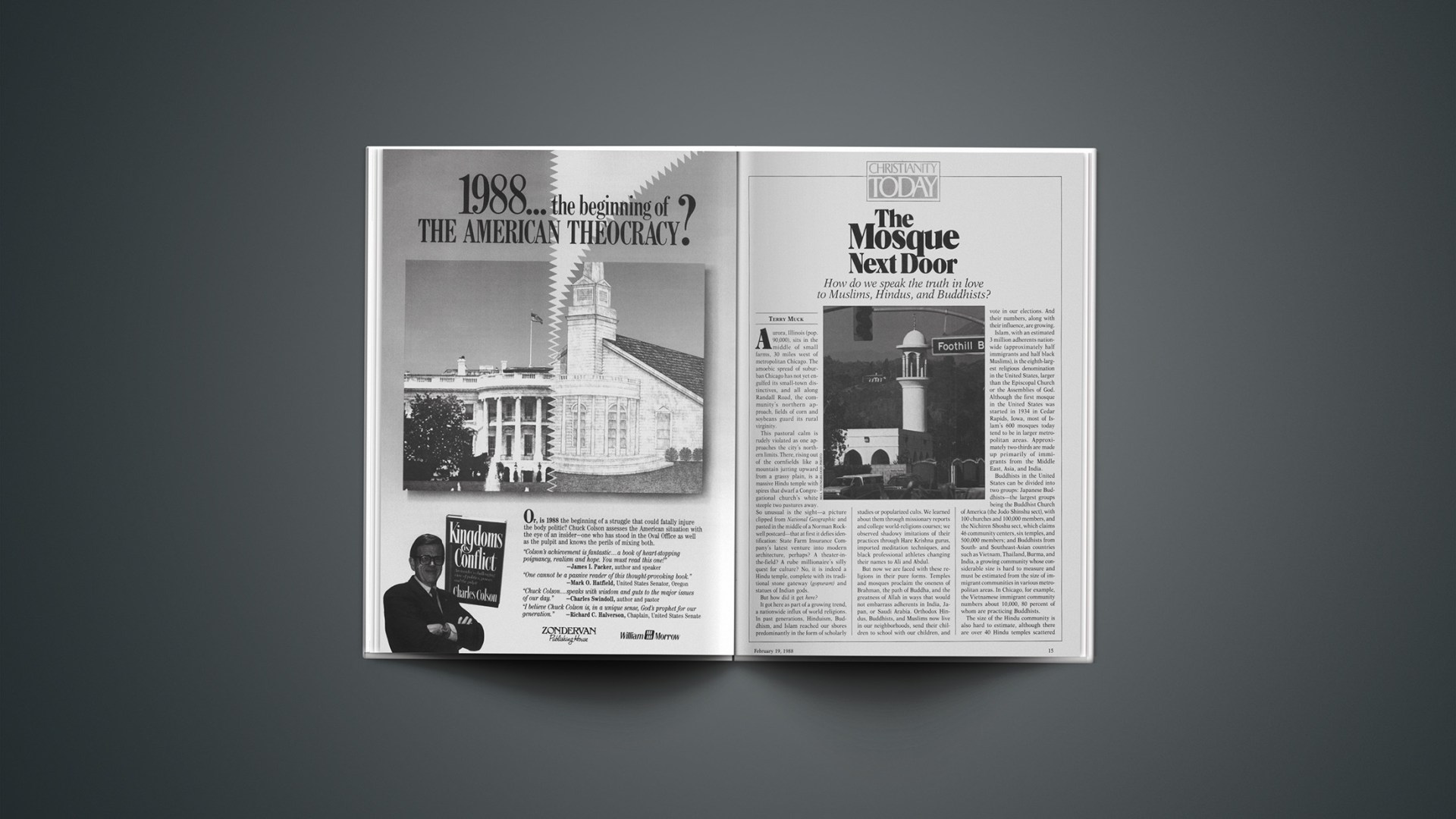
Aurora, Illinois (pop. 90,000), sits in the middle of small farms, 30 miles west of metropolitan Chicago. The amoebic spread of suburban Chicago has not yet engulfed its small-town distinctives, and all along Randall Road, the community’s northern approach, fields of corn and soybeans guard its rural virginity.

This pastoral calm is rudely violated as one approaches the city’s northern limits. There, rising out of the cornfields like a mountain jutting upward from a grassy plain, is a massive Hindu temple with spires that dwarf a Congregational church’s white steeple two pastures away.

So unusual is the sight—a picture clipped from National Geographic and pasted in the middle of a Norman Rockwell postcard—that at first it defies identification: State Farm Insurance Company’s latest venture into modern architecture, perhaps? A theater-in-the-field? A rube millionaire’s silly quest for culture? No, it is indeed a Hindu temple, complete with its traditional stone gateway (gopuram) and statues of Indian gods.

But how did it get here?

It got here as part of a growing trend, a nationwide influx of world religions. In past generations, Hinduism, Buddhism, and Islam reached our shores predominantly in the form of scholarly studies or popularized cults. We learned about them through missionary reports and college world-religions courses; we observed shadowy imitations of their practices through Hare Krishna gurus, imported meditation techniques, and black professional athletes changing their names to Ali and Abdul.

But now we are faced with these religions in their pure forms. Temples and mosques proclaim the oneness of Brahman, the path of Buddha, and the greatness of Allah in ways that would not embarrass adherents in India, Japan, or Saudi Arabia. Orthodox Hindus, Buddhists, and Muslims now live in our neighborhoods, send their children to school with our children, and vote in our elections. And their numbers, along with their influence, are growing.

Islam, with an estimated 3 million adherents nationwide (approximately half immigrants and half black Muslims), is the eighth-largest religious denomination in the United States, larger than the Episcopal Church or the Assemblies of God. Although the first mosque in the United States was started in 1934 in Cedar Rapids, Iowa, most of Islam’s 600 mosques today tend to be in larger metropolitan areas. Approximately two-thirds are made up primarily of immigrants from the Middle East, Asia, and India.

Buddhists in the United States can be divided into two groups: Japanese Buddhists—the largest groups being the Buddhist Church of America (the Jodo Shinshu sect), with 100 churches and 100,000 members, and the Nichiren Shoshu sect, which claims 46 community centers, six temples, and 500,000 members; and Buddhists from South and Southeast-Asian countries such as Vietnam, Thailand, Burma, and India, a growing community whose considerable size is hard to measure and must be estimated from the size of immigrant communities in various metropolitan areas. In Chicago, for example, the Vietnamese immigrant community numbers about 10,000, 80 percent of whom are practicing Buddhists.

The size of the Hindu community is also hard to estimate, although there are over 40 Hindu temples scattered throughout the country. Since the Indian population in most metropolitan areas is of significant size (100,000 in metro New York, for example), and since much Hindu worship takes place in the home, we can assume a large, uncounted number of practicing Hindus.

Together, these three faiths make up less than 4 percent of the total American population (85% Christian, 2% Jewish, 9% no faith). Yet combined, their nearly 800 places of worship make them a larger group than scores of familiar Christian denominations. Further, since the immigration laws favor professionally trained people (doctors, lawyers, and engineers), Hindus, Buddhists, and Muslims have a relatively influential demographic profile. Separated from homeland and culture, they tend to cling to the faith of their roots with a high degree of commitment.

Hinduism: Clash Of World Views

Perhaps it is that sense of commitment more than anything else that concerns middle-American Christians. Consider the reaction of the Aurora community when they first heard in 1982 of the plans to build a Hindu temple on their city’s edge. The city council, which had to give approval for a building permit, was deluged with calls and letters from fearful citizens. At subsequent public meetings to debate the issue, the Hindus were accused of being rat worshipers, drug abusers, and part of an Indian government plot to buy up American land. Letters protesting the temple poured into the Aurora Beacon-News, outnumbering supporting letters by an estimated 20 to 1.

“Biblically oriented Christians in this community were naturally afraid of the propagation of a polytheistic faith in their community,” remembers John Riggs, pastor of the Union Congregational Church, close by the temple site. “I don’t think they were the ones making the irrational claims about rat worship and animal sacrifice. But they very definitely were concerned about the effect on their children and their children’s children.”

Riggs’s wife wrote a letter to the newspaper reminding citizens that violation of Deuteronomy 20’s prohibition of worshiping idols put the whole community in danger of God’s judgment. Riggs himself became vocal in the local ministerial association, and he regularly commented on the Hindu threat in a column he writes for a small-circulation neighborhood newspaper.

In the end, the city council approved the building plan—and Riggs was not shattered. “I thank God for the religious freedom we have in this country. I realize that if we were to deny that to this group, we would be putting our own freedoms in danger. But I wanted to make sure we demonstrated a strong Christian witness in this community, and point up the incompatibility of Hindu and Christian beliefs. Frankly, I’m concerned about the erosion of the basic Christian values that have shaped our society, and the competition the world religions present to those values.”

The wave of non-Christian immigrants claiming allegiance to one of the world religions does not upset us as much as the fact that we find ourselves so vulnerable to their potential for influencing—negatively, some say—our public way of life, which has heretofore been based on Christian values.

“The crucial religious issue is something quite different from the growing numbers of Hindus, Buddhists, and Muslims in this country,” says theologian Carl Henry. “At issue is the weakness of Western civilization in the face of competing world views. Modern naturalism nullifies the classic concept of one universal God over history. This trend toward scientism is hospitable to Asian religions that reject a Creator-creation distinction and encourage the theory that all religions are essentially one. In the world of tomorrow, Christianity will need to fend for itself either in a secularized social milieu of intellectual atheism that empties the churches, or in a society where a religious sense of many coexisting gods saturates civic culture.”

In short, the religions are coming, and our spiritual defenses are vulnerable. What is it we are to do?

Buddhism: Quietly Fitting In

The first time Jim Ziesemer, pastor of the Hope Evangelical Lutheran Church in West Chicago, Illinois, heard about Nichiren Daishonin Buddhism was when two women knocked on his parsonage door one Sunday afternoon and told him the Nichiren Shoshu Temple was to be built across the road from his church. “To say I was surprised would be an understatement,” says Jim. “We built our new church here in 1982 in an area full of Chicago commuters. Since then we have come to expect building announcements about new subdivisions, shopping centers, and high tech industrial parks. But a Buddhist temple caught us all by surprise.”

The temple is the regional headquarters of Nichiren Shoshu Buddhism, a form of Buddhism that takes its name from a thirteenth-century Japanese Buddhist saint who claimed to bring knowledge that made the teachings of Gautama Buddha complete. Although the principle practices of these Buddhists take place in members’ homes through daily chanting of ritualized scriptures, regular services are held weekly at the temple. For certain holidays and special occasions, members come to the temple from a 17-state area, drawing from an estimated membership of 7,000.

According to Mr. Nakabayashi, head of the NSA Center (the church’s lay organization for recruiting members and coordinating lay support), his church has received a warm welcome not only from the community in West Chicago, but from people throughout the Midwest. As he told members at a recent worship service celebrating the death date of the sect’s founder, Nichiren Daishonin, “Who would have believed the tremendous growth we have experienced since building this temple here only six years ago?” The congregation of 400, made up of perhaps 20 percent Japanese immigrants, 50 percent black Americans, and 30 percent white Americans, responded with an enthusiastic ovation.

Not all American Buddhists have had the same kind of warm experience in their communities. Some discrimination exists. Isolated incidents of “religious persecution” do make headlines: Hindus in Aurora, Muslims in Michigan and Oklahoma, Buddhists in Washington, D.C. Yet the majority would claim that the United States Constitution’s freedom of religion clauses are not only preached, but practiced in grassroots America. “At first, when people at work find out you’re a Buddhist, they give you a funny look,” says Eric Carlson, an engineer in Des Plaines, Illinois. “But they get used to it. We have good discussions and they find out we’re after the same things: world peace, good relationships, happiness. We end up getting along just fine.”

Further, if Christians were presented with the two alternatives, toleration versus persecution, the vast majority would advocate toleration based on more than our country’s legal requirements. Most would point to the biblical admonition to “Love your neighbor as yourself” as one of the two great commandments of Christian behavior.

“I don’t recall any overly negative concern about the Buddhist temple,” said Pastor Ziesemer. “One woman from the neighborhood did call me and ask me what was being built across from our church. When I told her it was a Buddhist temple, she said, ‘A what?’ It took her a few minutes to regain her composure. But I would say that after the surprise wore off, our people simply accepted the temple as a fact. I think that if any of them meet temple members in their neighborhood, at school, or on the job, the reaction to them is simply one of being a good neighbor: helping and loving them as Christ commanded.”

Islam: Evangelistic Fire

Within a few blocks of the old gray stone building at 63 E. Adams Street in the heart of downtown Chicago, one finds the world-famous Chicago Art Institute, the massive Field Museum of Natural History, the Adler Planetarium, the Chicago Public Library Cultural Center, and the corporate headquarters of some of the nation’s most powerful businesses, including the Standard Oil Company, Borg Warner, First National Bank of Chicago, and the Quaker Oats Company. Yet, as you walk into the rooms on the third floor of this most typical of old Chicago-style business buildings, one hears neither esoteric museum discussions nor business talk.

What one does hear five times a day is the chanting of prayers to Allah. In a large oriental-carpeted room, men from the banks and businesses of downtown Chicago gather here at dawn, noon, afternoon, sundown, and evening to spend ten minutes reciting qur’anic prayers in unison. Since 1976 the Downtown Islamic Center has provided a religious refuge for the faithful, 90 percent of whom are immigrants from the Middle East who have come to the United States to pursue business opportunities.

The center also connects these believers with Muslims worldwide. A large map showing the distribution and concentration of Islam hangs on the wall (one in four people in the world is Muslim, a footnote proclaims). Books line the wall of the foyer: copies of the Holy Qur’an, The Glorious Qur’an, Islam and the Crisis of the Modern World, Islam: The Religion of the Future are just a few of the titles. The director, Yakub Patel, describes the activities of the center, and as he does so he communicates a forceful enthusiasm about his faith:

“Our purpose is to disseminate information about Islam. Over 200 people, professionals, clerks, students, come here for Friday prayers, which include a special Sabbath lecture in both English and Arabic. Twenty percent of those people are Afro-American, the rest immigrant Middle Easterners.

“There are many centers like this in the Chicago area. Over 6 million Muslims now live in the United States. We have much in common with the Christian and Jewish faiths. We believe in universal brotherhood of all men. We believe in very strict moral standards. Our creed is simple: There is no God but Allah and Muhammad is his prophet. Anyone who can sincerely say that is a Muslim.”

Like everyone else in the center, Patel is a volunteer worker. His vocation is engineering, but he makes it clear that “the mosque is the center of my life,” and he spends many hours directing its mission, which in Christian terms could be called discipling of believers and evangelizing nonbelievers.

In those twin desires, Muslims are no different from members of other religious traditions. All claim truth. That is why there are religions: they give definitive answers to life’s most perplexing questions—Who am I? Why am I here? Where am I ultimately going? And because they give definitive answers, they demand choice. The Qur’an says, “There is no god but Allah and he alone is almighty. This is the right path.” The Bible says, “I am the way, and the truth, and the life; no one comes to the Father, but by me.” Choose, brothers and sisters. As Richard Baxter said in The Reformed Pastor, “To be a Christian is not a matter of opinion.” Indeed. It is a matter of conscious choice.

So to represent the Christian faith well, we must tell the truth. We must proclaim the gospel in our sermons, recite the commandments about how to behave, and endorse the biblical revelation fully as the final answer. Nothing is gained by denying the unbreakable steel cable that connects truth and Christianity. To do so ultimately presents Christianity as something else—a nice philosophy or way of thinking rather then the steely faith of our fathers Abraham, Isaac, Jacob, David, Jesus, and Paul.

To put it more bluntly, if we do not teach the truth about Abraham and Jesus, Muslims will teach their truth about Abraham and Muhammad. They already do.

For the past two years, Muslims in the Chicago area have used a traditional Islamic celebration, Idd-Ud-Adha (an annual feast honoring the prophet Abraham’s extraordinary example of sacrifice and obedience to God), as an opportunity to explain their beliefs to non-Muslims. They have made it an evangelistic service. They invite over 200 business and social acquaintances to listen to readings from the Qur’an and ask questions of both immigrant and American-born Muslims. The explanations are, for the most part, even-handed and fair. Questions are sincere; answers are thoughtful. “Our purpose is for us to understand one another,” said Hasnain Ashrafi, one of the organizers of the event. “The difference between religions is of secondary importance—fear for the morality of our children in a secular, faithless world is our biggest concern, a concern we think we share with Christians.”

The moral strength of devout Muslims is legendary, witnessed, for example, by the program’s announcement of serving nonalcoholic drinks only. It is indeed something Christians can identify with. Yet, listening to the speeches about the greatness of Allah and the faithfulness of his Qur’an, one also cannot help detecting a further purpose in this evening’s happenings: to win converts to Islam. The table of free literature on Islam and free copies of pamphlets explaining its teaching is all too familiar to those who have grown up in churches with tract racks prominent in the foyer.

The presentation is not unpleasant. One soon learns that Christians are not the only ones adept at evangelizing. Zeal for one’s cause means telling others about it; convincing them means changing their minds about faith. The two go together. Yet it seems the whole world has discovered that the best way to do this is to be gentle as doves about it.

Christianity: Truth And Love

Is there anything at all distinctive about the Christian approach to evangelism, something that sets it apart from being one more item on a grocery list of religions? Yes, and it starts with the cushion of love that surrounds our truth. Richard Baxter warned that we not make our creeds, our claims to truth “any longer than God made them.” In so saying, Baxter was reflecting another astounding fact about the teachings of Jesus Christ. Just as Jesus turned the Torah teaching about loving one’s neighbor into an incredibly profound law of grace, he turned the teaching of truth into a graceful law. Without losing any of the value and importance of being right, he taught a way that moved from a warlike imposition of arbitrary values into a graceful experience of love in action.

Jesus did this in two ways. One was to remind us constantly of our human limitations. We are finite creatures, he taught, who cannot hope to understand things as fully as he did. He revealed this as much by the way he taught as anything. He unfolded truth slowly to his disciples, only as much as they were able to take at any one time. Some truths he couched in language that would only be understood by those who had “ears to hear.” Paul perhaps capsulized the reason for this best when he said poetically, “Now we only see in a glass darkly, soon we shall see face to face.” The lesson is clear: the truth is absolute and final, but our understanding of the truth will never be, this side of heaven.

Second, by frequently reminding us of our own sinfulness, Jesus (and Paul after him) taught us empathy for our neighbors. Theologian Kenneth Kantzer once said that “the level of one’s tolerance for those of other faiths is a true test of our understanding of the doctrine of original sin.” The only proper response to our own sin is humility, not only before God, but before our fellow men. Jesus modeled this. The Philippians 2 ode to his humility recalls that even “though he was God, [he] did not demand and cling to his rights as God, but laid aside his mighty power and glory, taking the disguise of a slave and becoming like men, and he humbled himself even further, going so far as actually to die a criminal’s death on a cross.” One of Jesus’ most unique and valuable contributions to religious behavior was his command to speak the truth in love.

The Bible teaches over and over again that we cannot shirk our duty to speak the truth. As G. K. Chesterton noted, “The man who is not ready to argue is ready to sneer.” There is no middle ground between speaking truth and remaining silent. One can, however, argue lovingly for the truth, and thereby become something special in today’s hard scrabble rush for religious market share.

Speaking The Truth In Love

It is emotionally satisfying to love one’s neighbor. It is intellectually stimulating to argue for the truth. The challenge of living the Christian life, however, is to be able to integrate the two.

In 1978 Ron Itano got down on his knees, prayed a prayer of repentance, and asked Jesus Christ to be lord of his life. “It was like the end of a long journey,” says Ron. “All the religious questions I had been asking all my life were answered in that one prayer.”

Religious questions came naturally to Ron, grandson of a Japanese Buddhist priest. Because the rest of his family still belongs to the Buddhist church, Ron sometimes wonders why he did not become Buddhist. Family, culture, and early childhood experiences all pushed him in that direction. “But my parents didn’t insist I become Buddhist. I remember going to services in my grandfather’s temple. But it didn’t appeal. I didn’t understand the service and no one bothered to explain it to me.” Fortunately, a Christian businessman decided it was worth explaining his faith to this young Japanese insurance underwriter.

“I met Paul Asp on the commuter train to downtown Chicago. Something attracted me to him. He always seemed so happy, so much on top of life. He was kind to me. Over the months we became friends. Then he told me about Christ.”

What Paul said made sense to Ron. He began to study the Bible and finally dedicated his life to Christ. “Paul’s friendship made a big difference,” says Ron. “I’ll always be thankful he took time to care and tell me about his faith.”

Two things happen when the light of the gospel strikes fire in a person’s soul. One is an incredible sense of trust in God where doubt and fear formerly existed. The other is a sudden recognition of truth that drives away the former darkness. The road to trust in God is paved with the smaller bricks of trust in men. The road to understanding is paved with clearly presented religious truths.

Two questions we all must ask ourselves about our Hindu, Buddhist, and Muslim neighbors: Are we doing our part to develop trust and love with them, trust that may lead to the more ultimate Trust? And are we articulate enough about our own search for faith, so we can convincingly, lovingly, present it to others?

Positive answers to those questions tell us that we are prepared to face the challenge of world religions, to aid a change of heart that leads to a change of mind.

Watertight Love

Does it make sense to apply a love ethic to the very people who live by philosophies we feel are threatening our way of life? Doesn’t that weaken our position?

This question is particularly crucial because it appears that our “competitors,” such as the Nichiren Shoshu Buddhists, are beating us to the punch in applying their own version of the law of love to the unchurched, underprivileged members of our society. One of the three pillars of Nichiren Buddhist faith is “practice for others,” which means aggressively telling others about the benefits of practicing Buddhism.

The Christian tradition demands the same kind of commitment. As a “law” applied by the Christian church over the last 20 centuries, love has borne remarkable spiritual fruit. One major reason the church of the first and second centuries grew was because its members gained a reputation for not only preaching this unusual ethic of love but actually putting it into practice.

Still, there are dangers. Christian love, if nothing else, is a risky proposition. Love makes one vulnerable—and perhaps there are some practical limits to that vulnerability. Perhaps love is sometimes so risky that temporary withdrawal from neighbors is called for. This is especially true for those who are not yet spiritually mature.

The spoken and unspoken concern in communities where foreign faiths are growing is the threat to the faith of children. “Soon after the Buddhist temple was built my daughter began kindergarten,” said Pastor Ziesemer. “The chief priest’s son was in her class. It wasn’t a problem for her—or us, I guess. The only time I can remember her mentioning it was when she said he brought the neatest show-and-tell things of anyone in the class. I feel good about her going to school with him. But I wouldn’t allow her to go to the temple to observe a worship service. Kids are so strongly attracted to the strange and different. Look at the girls trying to dress like Madonna, or boys trying to imitate punk rockers.”

In some situations, the concern can extend beyond the spiritually immature to include the institutional church, especially when it is operating in a hostile environment. Sometimes the social milieu is so dangerous, so secular, that not only are those weak in the faith endangered, but the church itself runs the risk of being identified with, or overrun by, the secular. It is in that context that Paul, in writing to the Corinthians, cautions them not to be yoked to unbelievers for fear the church would become identified with pagan practice.

Further, sometimes withdrawal is required to prepare for future engagement. Jesus spent much time with his disciples before embarking on a public ministry where he scandalously ate with publicans and sinners. Jesus’ entire ministry beat out a steady rhythm between active engagement of the forces of the world, strategic withdrawal to gain spiritual strength, and then active engagement again.

Interestingly, the Buddha also taught that teaching effectiveness should sometimes color the form and frequency that love for neighbor takes. He used the analogy of watertight and cracked water pots: If we have a choice of teaching the truth to those who will retain the truth and those who will not, we should start with those who will retain it, and only then go to those who will let much slip through the cracks.

Love is a powerful, many-faceted emotion; “Love your neighbor as yourself” is as true a command as exists in Scripture.

What does give us direction in applying the command to love our neighbor? Perhaps some understanding can be found in the very purpose of our love. Christian love is not to be undemanding, void of direction. As strongly as the Bible commands loving one’s neighbor as oneself, it also commands that we preach the gospel to all nations.

Thus, our love is to be pragmatic—not selfishly, but full of pragmatic concern about spreading the Good News. It must be consistent with our belief that without the gospel, all men and women will end up in eternal punishment. Can there be a more loving motivation than that to teach, as well as love?

By Terry Muck.

Ideas

Beyond Sun City

Rest is not the only meaning of retirement.

According to Time magazine, it is the nation’s largest special-interest group: 27 million strong, with an additional 8,000 dues-paying members joining every day. Its membership crosses all racial, social, and economic boundaries. And not surprisingly, it is probably the group that this year’s presidential hopefuls must reckon with in their quest for the nomination.

The group is the American Association of Retired Persons (AARP), and it is riding high on the crest of both a demographic trend (America is getting older) and a growing self-awareness among its millions of retirees that “we are somebody.”

Not unlike the groups that champion women, blacks, Hispanics, and a hundred other peoples and orientations, the united approach of AARP has forced attention on a societal segment long ignored—or in this case, kindly put out to pasture. Moreover, it has offered its constituency an agenda that, in turn, has given something of a meaning to and purpose for being—twin essentials our youth-oriented culture has lost sight of in its avoidance of aging and, ipso facto, death.

Yet, for all its good in providing political clout and essential services for America’s retirees, the AARP and other groups of its kind should not be perceived to be the final answer when it comes to our understanding of aging. In the midst of all the struggles over social security allowances and federal support for nursing-home care, the larger questions over the role of the retiree in society and the responsibilities of the generations remain. As ethicist Daniel Callahan writes in Setting Limits: “The place of the elderly in a good society is an inherently communal, not an individual question. It goes unexplored in a culture that does not easily speak the language of community and mutual responsibility.” Thus he concludes that our society “is more comfortable with worrying about improving the lot of individuals than coping with intergenerational responsibilities. It is more at home in struggling to maintain freedom of and financial support for medical research on aging than in asking how that freedom ought wisely to be used.”

As a result, we may well be standing on the brink of a crisis of aging.

Aging As Illness

America’s misapprehension and misunderstanding of aging is hardly unique. As author Simone de Beauvoir points outs, the timeless myth of a fountain of youth could only have been motivated by the fear of old age: The idea of living forever is not attractive unless you can also be forever young. More to the point, nineteenth-century novelist Victor Hugo wrote: “The misery of a child is interesting to a mother. The misery of a young man is interesting to a young woman. The misery of an old person is interesting to nobody.” Complicating this ageism in our own day is modern medicine. Expanding life expectancies and assuring good health for an increasing number of men and women over 65, medical technology has made curing more important than caring—and what greater enemy stands before its multiple wonders than aging and, ultimately, death?

The medical onslaught against the “disease” of aging is guaranteed to grow as baby boomers enter retirement years. As Time reports, since 1900 the total U.S. population has tripled while the number of elderly has risen eightfold. And as today’s baby boomers move into their fifties and sixties early in the next decade, these numbers will explode further.

Our perception of aging as “disease,” therefore, has clouded our understanding of the role of seniors in society, and their relationship to other living generations (and vice versa). What is the justification for life that is neither youthful nor middle-aged? Writes Callahan: “Older people today are encouraged to strive for the physical health and self-control [one could add political clout] previously attributed to the young and middle-aged. Underneath this vision of ceaseless activity, spurred by the illusory promise of scientifically abolishing biological aging, lies a profound failure of meaning.”

Aging As Service

The church has done little to battle the ageism that groups like the AARP work to combat. Nor has it offered alternatives to the generation-bound stereotypes (Sun City, unlimited golf) that retirement living has taken on in recent years. Yet, not surprisingly, it holds the key to a communal understanding of aging based on agape rather than eros.

We must begin by redefining retirement in the light of service. It is not simply a return to preadolescence with responsibility a thing of the past. It is a reassignment: an opportunity to reschedule priorities and settle into new patterns of service (such as volunteer work) as well as schedule the rest and relaxation that were once difficult due to time restraints and work commitments. To be sure, that is a simple rehash of the biblical mandate to serve. But it is one that has been lost by those on both sides of 65 in the prevailing individualism.

And what kind of service? Americans at the turn of the century, according to historian Thomas Cole, saw old age as the completion of a pilgrimage, a time of preparation for death, but also a time of service “by virtue of that very preparation” to family and community. Aging, then, had both a practical and spiritual dimension in its service—as it should today.

Practically speaking, it was a time to pass along the family heritage and offer anyone willing to listen the accumulated wisdom gathered in those 65-plus years: time-tested insights on everything from how to raise a family to how to ride a bike. Much of this was and is done in the context of family. And indeed, the role of grandparents has increasingly gained the attention of sociologists who see them as a vital link keeping family identity and history alive in single-parent households today.

Spiritually, the witness of and wisdom in a consistent walk with God is a legacy the church can ill afford not to take advantage of. “Teach us to number our days,” implores the psalmist (Ps. 90:10–12). Explains Tim Stafford in his forthcoming book on aging: “We are to number our days in this long, brief life, to insure that none goes missing—that we do not squander the gift of God, through carelessness letting days or weeks or years slip away unnoticed, without profit.” Indeed, as a former editor wrote in a recent Christian Century, retirement is not the end of being, but the continuation of becoming the perfect reflection of Jesus Christ. As such, the individual becomes a role model of what it means to live—and die—in Christ.

That was well understood by a large church in the Chicago area that, 15 years ago, asked a woman in her sixties to form—of all things—a young couples class. She did. Today that class has over 200 members—many of whom remember that woman (now in her eighties) as a spiritual parent.

No man, no generation, is an island. And while groups like the AARP will be an important united voice keeping bureaucracies and decision makers honest and alert, it will be up to the church to provide the sum and substance of life after 65: life based on selfless love and service, peer-to-peer, generation-to-generation.

By Harold B. Smith.

Cultivating the Killing Fields

In Vuthy’s memory, branded forever at the age of eight, the men wore black: black caps, black scarves, black pants, black shoes. Carrying loudspeakers, with tinny voices, mechanical and strange, they came. “You have 24 hours to evacuate” was the weird echo. They shot people who argued the point.

Through a child’s eyes, there was red blood in the low gray smoke of burning homes. The sirens, the bombs, the screams, and Vuthy, innocence exploding around him.

At night, on the road to God knew where, Vuthy (pronounced “voo-tee”) and his family were often forced to sleep next to dead bodies. Nearly a decade later, Vuthy cannot get the smell out of his mind.

Huong Taing is on his rounds. Since escaping from the violence of his native country, Cambodia, he has been ministering to the needs of his fellow expatriates in California. Today, he visits some of the seemingly nameless people who populate one of the nameless projects in a tired pocket of poverty in Long Beach, California. Here is the largest concentration of Cambodians living outside of Cambodia.

In conjunction with Campus Crusade for Christ, which provides a good deal of funding, and the Grace Brethren Church in Long Beach, which provides the church facilities and education, Taing has planted and pastors a church. About 70 people attend regularly.

On this typical day, he enters a home to be confronted by Cambodian money, larger than life, blown up to ludicrous proportions and taped to the wall. The paint is chipping around it. The room’s heat is oppressive; the poverty, silent and uninvited.

The exception, the stupid anachronism, the unfunny joke: The Sony 25-inch Trinitron color stereo console television, bought on welfare, spitting out a language unknown to the Cambodians—a dumb, jumping flicker for numb lives.

John Wayne is wrestling with some elephants. In between conversation with Huong Taing about lives lost to the Khmer Rouge, these people laugh at something they don’t even understand.

Vuthy’s father was an educated man. Before the fall, he had a cushy, middle-class job as a government official. After the fall, the Khmer Rouge put him to work in the jungles. Gradually, they cut back his food. For almost two years, Vuthy watched his father starve.

He still remembers the funeral. In the deep jungle, there was no casket and no ceremony. It was a mass burial. At the age of ten, Vuthy barely had time to cry.

Southern California, with its breezes and bright blue skies, is not home. That is the message that Huong Taing wants to get across to his parishioners. And it is not just a matter of being displaced from Cambodia.

“The first thing that I want to get across,” says Taing, “is that this world is not our home. We are just passing through. If there is one thing that suffering should teach, that should be it.”

But Southern California does not exactly encourage that lesson. Materialism there, perhaps like few places in the world, is rampant. Education, for many, becomes an obsession. Often, Taing says, it is not a way to improve, but to get. “They want to have things,” he says. It is understandable, but unfortunate.

Taing says the Cambodians “learn very quickly that dollars are just in front of their noses.” Christianity, once the vital hope of many of their lives, has become utilitarian. God has often been reduced to an errand boy.

“They look to him to save them from their poverty,” Taing says. “To help them with their education and in their business lives. That’s not necessarily wrong, but it’s not the kind of help that God always gives.”

In the jungle, Vuthy never saw his friends die. They just didn’t come back. At night, on the cold dorm floor, there was a little more space to stretch out, a little more void.

But “friends” may be stretching the point. They were all thrown together in a camp for boys aged 11 to 15. They labored together for the Khmer Rouge, clearing fields, building dams. And they played survival games. During a break from the sunup to sundown work, they would put the heat on small animals. “You had to become a hunter to survive,” Vuthy says. Lizards, rats, snakes, frogs, rabbits, crickets … they were all easier to catch with a little help from your friends.

Bluntly put, many of the people who attend Taing’s church don’t have much hope. “The older people are waiting for things to change so they can go back to Cambodia,” Taing says. “They are not normal, functioning people. They are just waiting for the past and waiting for a new day to come.” For them, everything has changed. The family structure, which was once at the core of meaning, is often toppled. They depend on their children to help them understand the new, unsettling world around them. “In Cambodia, children mostly listen to their parents. Here, they mostly don’t listen.”

For the younger or those who are more educated, the tension is even greater—and not so easily released. “It’s good to be Cambodian and it’s good to be American,” says Taing, “but it’s not so good to be half-Cambodian and half-American.” The problem, Taing says, is that the young people cannot communicate their pain, the horrors they have known.

“When the young people try to explain to people what has happened to them, they can’t find a word to explain it,” Taing says. “So they just try to forget it.”

Vuthy, for one, does not like to think much about his past. He is now 18 and a senior in high school. He has tried to communicate to some of his friends what has happened to him. Most do not understand. He rarely brings up the subject anymore.

There is one other thing that he does not do: he does not try to explain the problem of evil. “When you see so much of it [suffering], you feel like you have no more reaction,” he says. “What can you do, when it just happens?”

His faith in God, he says, has increased: “We are more thankful to Jesus. We are stronger because we thank him. We do not take life for granted.” Taing spends most of his time discipling Vuthy and other young people. That is where the future lies. And the future is what is important to Vuthy. He has worked hard in school and, despite missing school for several years in Cambodia, is now a straight-A student. His education is at the center of his life. He feels he has to earn his right to “be a good citizen.” Vuthy, eventually, wants to return to Cambodia and witness to the people—all the more reason to work hard.

Taing is somewhat concerned. He says sometimes Vuthy works so hard that he falls asleep in church.

By Rob Wilkins, a writer living in Winona Lake, Indiana.

Mice and the Almighty

Every man remembers a favorite automobile. Mine was “Old Blue”: a sturdy Chevy sedan with fading paint and worn upholstery. Ignoring the advice of parochial Californians, Old Blue accompanied our family from balmy Santa Barbara to our new home in snowy St. Paul.

As the first fluffy flakes of winter began to fall, a large family of field mice took up residence in Old Blue. While the car’s conversion to a mouse house didn’t bother me, I knew my wife would feel differently. So I kept it to myself.

But not for long. The moment I switched on the heater one cold Sunday morning, the car was filled with angry squeaks and frantic scurrying as a legion of mice dashed around our feet. From that moment on one thing was clear: If Old Blue was to remain in our family, the mice would have to go—immediately.

Our solution was a small electronic device that emitted a high-frequency sound. The annoyed mice soon moved out, and Old Blue bravely went on to face the corruption of moth and rust.

Yes, the best-laid schemes of mice—and men—do go oft astray, as the Scottish bard Robert Burns observed. He, too, had evicted a family of mice from their spacious nest while plowing his field in the fall of 1785. The “wee mousie,” he wrote of in his melancholy poem, was more blessed and fortunate than he, for “the present only toucheth thee.” Unlike the mouse, who was not troubled by painful memories or by bad conscience from the past, Burns complained that for himself, “I backward cast my e’e, on prospects drear.”

Nor, Burns found, was the mouse troubled by the future. Guided by instinct, he made his preparations for the winter without fretting and without dread of what was to come. An envious Burns complained, “An’ forward, tho’ I canna see, I guess an’ fear.” For the poet the future was dark and threatening, and just as full of discomfort as was his reflection on the past.

Though my method was decidedly more high tech, Burns and I both brought terror to a family of field mice. Yet I don’t share the poet’s envy of the mouse, nor his pain about the past, nor his gloom about the future.

For the most part, my memories of the past are warm and pleasant, but where there is pain and disappointment I can find help by appropriating Joseph’s witness to the grace of God. Anticipating a contemporary emphasis on “the healing of the memories,” the Hebrew patriarch credited God for helping him forget the treachery, betrayal, injustice, and neglect he had experienced first at the hands of his jealous brothers and then from Potiphar’s wife and the cupbearer. What his brothers had meant for wrong, God in his sovereignty had used for good.

As for guilt and self-condemnation for sin, there is also a clear biblical prescription. A contrite and repentant David received the joy of forgiveness and the assurance of acceptance from the Lord. Hosea and the other prophets gave vivid testimony to the gracious forgiveness God offers. And Christ forgave even those who crucified him and gave to his apostles the resounding good news of forgiveness freely given.

What could the mouse know of the healing and forgiveness found in God’s grace? What can the mouse celebrate to match this joy?

Burns also lived in anxious dread of the future both known and unknown. Like novelist John Steinbeck in Of Mice and Men, Burns saw the future as controlled by a cruel and capricious fate.

Again, I find it more satisfactory to live in the context of the promises of the wholly faithful God who told us through Jeremiah: “I have plans for you, plans to prosper you and not to harm you, plans to give you hope and a future.” I choose to view the future from the vantage point of one who has trusted in the God of hope, the one whom Paul prayed would fill us with joy, peace, and the power of his Spirit.

How sad that Burns was content only to envy the mouse. How sad he did not know this wise and loving God of all hope. True, the best laid schemes of mice and men do go oft astray—but God’s plans are right on target and on time!

GEORGE K. BRUSHABER

Letters

A Balanced View of C. S. Lewis

I want to commend you for printing J. I. Packer’s column on C. S. Lewis. [“What Lewis Was and Wasn’t,” Jan. 15]. It’s the first balanced article on Lewis I’ve ever seen. A few months ago I read an article praising Lewis as an evangelist to the intellectuals. That’s going a bit far! As Packer pointed out, Lewis had a great intellect and was marvelous at communicating the reasonableness of Christianity and the moral demands of discipleship, but he was hardly a standard-issue evangelical. With his “non-penal view of the Atonement, his nonmention of justification, his belief in purgatory,” I find it difficult to think of him as “evangelical.”

REV. TONY TROUP

Herington, Kans.

I’m writing to express my strong disagreement with J. I. Packer’s opinion of C. S. Lewis’s That Hideous Strength. I realize that for me to say I like the book means no more than for someone else to say he thinks it’s hideous. I just enjoy the book enough to want to protest the harsh and brief dismissal it received. There are so many completely hideous books around, that to call this one hideous seems to me an exaggeration.

PAMELA EUBANK

Pandora, Ohio

Is forgiveness the difference?

Philip Yancey’s experience in Washington [“We Have No Right to Scorn,” Jan. 15] certainly was interesting, and he raises some deep questions. However, the last paragraph raises another question: Is the only difference between the Christian and the non-Christian forgiveness? If Jesus is truly our Lord and Savior, if we’re really repentant, if we’re saved for works (Eph. 2:10), if we have the Holy Spirit, shouldn’t that also affect how the Christian lives?

First John says self-sacrificing love is what distinguishes the child of God from the world. The real issue then, it seems to me, is how we show that love. Yancey judged the “true believers” to be condemning. Perhaps they were, but it may also have been their way of warning that that lifestyle leads to AIDS and maybe worse, and they were calling for repentance. On the other hand, the gay-rights activists were expressing their love by singing “Jesus loves you.”

I have always appreciated Yancey’s writing. Perhaps he has a solution to how we are to obediently show the love of Christ in such situations.

REV. WILLIAM. G. BROUWERS

The Christian Reformed Church

Wisconsin Rapids, Wis.

Party change needed?

I was somewhat saddened in reading the News article on the Iowa party caucuses [Jan. 15]. I, like Sen. Paul Simon, am a member of the Lutheran Church-Missouri Synod. The Missouri Synod has taken a prolife stand, yet Senator Simon has taken one of the most proabortion stances of all the Democrats seeking the presidential nomination. Either our synod has not emphasized prolife issues enough, or Senator Simon has chosen to ignore the synod’s teachings. I know many people have warned against Christians identifying with a particular political party or ideology, but I find it hard not to do so.

As a former Democrat and activist in Democratic campaigns, I now find it impossible to support the Democratic party leadership’s radical humanist agenda. There is no other choice left for me or for other Christians who are concerned as I am about issues such as abortion, pornography, the role of religion in public life, and strong opposition to Marxist totalitarianism abroad, but to vote for and become active in the Republican party.

BILLIE L. JOHNSON

Madison, Wis.

Pastors are not CEOs

Robert W. Dingman in “Fallen Leaders Are Not ‘Damaged Goods’ ” [Speaking Out, Dec. 11] completely missed the point. By drawing a direct analogy between fallen secular business leaders and fallen Christian leaders, he fails to take into consideration the obvious differences. One would expect a competent businessman to be hired after finishing a prison term. Business is run for profit.

A pastor is not a chief executive; he or she is a spiritual leader. He holds his position because of what he is. Moral failure is often a sign that we were mistaken in placing that person in leadership in the first place. Dingman’s statement that one who has sinned “often receives an inoculation that gives a future immunity” is difficult to prove and does not take into account the underlying factors of pride, self-centeredness, and individualism that caused the leader to fall

Certainly there is reconciliation and restoration. But vocational restoration ought to come more slowly, if at all. A few years of secular work are needed to clarify whether the fallen leader wants to be in full-time ministry because of God’s call or because it is the only way he or she knows how to earn a living.

REV. JAMES HEUGEL

University Christian Fellowship

Seattle, Wash.

Dingman fails to distinguish forgiveness and pardon. Christian organizations, particularly the church, belong to God, and the selection criteria for leadership are established by him. We may forgive a person if his or her failures/sins offend or directly wrong us, but we do not have authority to pardon them for not meeting God’s standard; that is God’s office alone.

Charles Colson, mentioned as an example of one forgiven his preconversion past, but unlikely to be so forgiven should he stumble now, is a particularly interesting example. In one sense, he was not restored: he will never practice law again, and he has not been named to or sought after a public office. He was not asked to represent in leadership a large prison ministry as evidence of his restored state. Instead, God hugely blessed him for being faithful in small things as he began to minister privately to previous fellow prisoners.

DANIEL J. DECOOK

Detroit, Mich.

Dingman’s apology has a little merit, but it must be remembered that his company makes a profit only if search committees accept his candidates. It is possible, therefore, that he starts from a biased viewpoint. No wonder that he finds this “increasingly difficult to accept.”

M. S. SUTTON

Anchorage, Alaska

Polka Backmasking

The latest exposé recently hit our church. It’s not the New Age. It’s not even rock music. This exposé was entitled, “Polka: Over the Barrel.”

Even the casual polka listener knows, said the seminar leader, that the number one polka of all time is “The Beer Barrel Polka.” How many poor souls have listened and been swayed into a life of alcoholic despair? Subconsciously, he said, the song sets up an evil thirst.

And what sort of person would play polka music? Consider that the musicians wear lederhosen (or leather shorts)! Need anything more be said?

For years, the seminar leader reminded us, this suspicious music was confined to sleazy roadhouses and dimly lit biergartens. Who would have believed it would climb out of such pits into America’s living rooms? But the invidious Mr. L. Welk has been the polka’s greatest ally, popularizing polka among unsuspecting, innocent folk with his “champagne music” (again—it was carefully pointed out—the drug connection).

The seminar also featured a couple of videotapes, taking us into the sordid “private lives” of polka musicians. And there was a session on polka backmasking.

To tell the truth, I don’t know too much about the videotapes and the backmasking session. I left earlier. It seemed like I’d heard all this before.

EUTYCHUS

Needed: A unified voice

Kenneth S. Kantzer’s editorial, “A Farewell to Harms” [Dec. 11], was much appreciated. His challenge regarding the need for a more unified voice among evangelicals, for a biblically based political philosophy, and “cooperation on selected moral issues” was very challenging. I would like to encourage CT to explore some specific, practical means by which these objectives might be pursued.

REV. MARK JONESCHIET

Baker Foursquare Church

Baker, Oreg.

Beyond conversion

“The Good life” by Richard Foster [Dec. 11] is one of the most refreshing articles I have ever seen. How encouraging that you would print an article boldly stating the need to go beyond conversion to a daily walk with God. Thank you for allowing Foster to challenge us in a forthright manner about “a half-gospel.” It is so true that if our lifestyle does not say, “If you want to know what it means to a believer, do what I do and say what I say—imitate me because I imitate Christ,” we are merely reproducing something other than disciples of Jesus Christ.

REV. PAUL SPASIC

White Harvest Christ Fellowship

Indianapolis, Ind.

In his article, Richard Foster states, “From Augustine we must learn once again that a discipleless conversion is no conversion at all.” To the contrary, John 3:16 says “believes,” not “believes and behaves.” The answer to shallow Christianity is not adding works to grace for salvation; the solution is for the church to do its job of nurture and discipleship.

WAYNE N. THRASHER

Texas Bible College

San Antonio, Tex.

Kudos from Eastern Europe

I want to thank you very much for your magazine, which is one of the best in the world. I love very much Christianity Today and I have a special feeling of joy when I receive it.

TRANDAFIR SANDRU

Seminarul Theologic Penticostal

Bucharest, Romania

An important “trend”?

Amidst several subheadings for 1988 and beyond, there is also “the prolife movement” [“Trends: Looking to 1988 and Beyond,” News, Dec. 11]. With the absence of legislation in the works, the most prodigious “trend” is the growing “direct action” movement. Across the country bands of Christians are blocking abortion clinic doors, suffering arrest, and being jailed. The largest mass rescue effort in the history of the movement took place in Cherry Hill, New Jersey, on November 28, 1987. But ct ignored the event and did not even bother to report it as news, and substituted a counterfeit prolife trend: It touts Sider’s JustLife as the more progressive prolife trend. But JustLife argues for the abortion of children who are produced by rape or incest, as CT has reported. JustLife serves only to divert the energies of those who are devoted to the preservation of the lives of children threatened with imminent destruction. CT often provides good information and theologically incisive articles. But this is a horrible blind spot.

MIKE BRAY

Ray Brook, N.Y.

Letters are welcome. Brevity is preferred, and all are subject to condensation. Write to Eutychus, CHRISTIANITY TODAY, 465 Gundersen Drive, Carol Stream, Illinois 60188.

It Doesn’t Come Easy

CT cover assignments have always been full of surprises for photographer Bill Youngblood. For example, last year about this time, Bill was sent out to “shoot” a scientist busily at work in his biochemical laboratory. Unfortunately, that lab was “off limits,” and it was left to Bill’s creativity to devise an alternative setting that would convey high-tech drama.

Then came this issue’s mosque assignment. Finding a mosque that wasn’t simply a storefront was the first challenge. Getting over a nagging flu was the second.

Finally the day of the shoot came, and once again Bill was faced with a surprise or two. But this time around, they worked to Bill’s advantage. The mosque in the middle of suburban sprawl was exactly what the photographer ordered. And as an added bonus (irony, perhaps, is the better word), spelled out on the hill to the left of the minaret was the word J-E-S-U-S. What better way is there to say “the mosque next door”?

And what better way to say “religious pluralism”: there is also a Star of David tucked away on that same hill, something art director Joan Nickerson found only after closer inspection of the final print. Another surprise.

Pretty creative shooting, Bill. Now, for the next assignment, we’d like you to …

HAROLD B. SMITH, Managing Editor

Cover photo by Bill Youngblood.

Ideas

Left Face, About Face

There is Left; and there is Left. While conservatives may not expect to find too many allies among those who subscribe to the rosy optimism of humanistic individualism (we are all entitled to, and can achieve, everything we want as long as we don’t hurt anybody), they may soon find a surprising ally from the real Left—an articulate atheistic, Marxist materialist.

In an interview published in the January issue of Crisis, a respected neoconservative “journal of lay Catholic opinion,” leftist columnist Christopher Hitchens breaks ranks with received liberal-left ideology, voices his opposition to abortion, and calls for the reversal of Roe v. Wade.

As a supporter of both feminism and humanism, Hitchens warns against letting the axiomatic “women’s right to choose” contradict humanism. He points out that “the so-called ‘pro-life’ forces are overwhelmingly female and from income groups that traditionally voted Democratic,” a group he calls “humble people.” Of course, a true Marxist would want to take the masses seriously. And we are grateful that Hitchens does.

Hitchens also takes philosophical materialism’s view of human life seriously. He does not believe there is a point at which “a soul enters the unborn.” “We don’t have bodies,” he says. “We are bodies.” He goes on to say that the theory of evolution “establishes beyond reasonable doubt that life is a continuum that begins at conception because it can’t begin anywhere else.”

Coupling that view of human life with his Marxist view of society, Hitchens argues, “Once you allow that the occupant of the womb is even potentially a life, it cuts athwart any glib invocation of ‘the woman’s right to choose.’ If the unborn is a candidate member of the next generation, it means that it is society’s responsibility.”

Infanticide And Appendixes

Hitchens has not come as far as some prolife activists might hope. He refuses to call abortion “murder,” reminding us that not all killing is indeed murder. But he does call for a shift of language on both sides of the controversy, hoping prolifers will stop “talking about infanticide” while feminists cease “comparing fetuses with appendixes or tumors.” He hopes for a grand social compromise that would include child care and socialist-run welfare and adoption systems, as well as “free abortion in cases of rape, incest, [and] proven mental or physical incapacity.”

That is not exactly the conservative agenda. But it may be close enough for some purposes. Without naming names, Hitchens claims he is not alone on the Left. If enough others come to voice similar views, we may even see an uneasy political alliance between those on the Left and those on the Right who take their principles seriously enough to combat the easy me-ism of the age.

By David Neff.

North American Scene from February 19, 1988

TELEVISION

CBN Loses Popular Host

In a surprise announcement on the Christian Broadcasting Network’s (CBN) “700 Club” television program, cohost Ben Kinchlow told viewers he would be leaving CBN to pursue other career options. Kinchlow, who serves as vice-president for ministries for the network, joined CBN founder and former host, Pat Robertson, in 1975.

According to CBN spokesman Benton Miller, Kinchlow has not informed CBN of any specific future plans. Miller also mentioned that while CBN regretted losing Kinchlow, they have no immediate plans to replace him. “We have deliberately shifted our focus from individuals to issues, so in the long run I believe things will work out for the best.”

CBN board chairman Robert Slosser also expressed regret at Kinchlow’s departure. “This is Ben’s decision to go at this time and we respect and support him in what he believes is God’s call on his life,” said Slosser.

JUSTICE DEPARTMENT

Porn Fight To Heat Up

When a 1986 Justice Department commission reported a link between some sexually explicit material and violence, Attorney General Edwin Meese III vowed an “all-out campaign against the distribution of obscene material.” That same department has announced plans to make 1988 “a big year for obscenity prosecutions,” according to William F. Weld, head of the Justice Department’s criminal division.

Although civil liberties groups fear such a crackdown threatens First Amendment freedoms, department officials say they intend to move against major distributors of pornography, not individual bookstores and outlets.

Indictments against adults on obscenity charges jumped from 10 in 1986 to 71 in 1987, and observers expect a larger increase in 1988.

RIGHT TO DIE

Bishop Backs Euthanasia

The Roman Catholic Diocese of Providence, Rhode Island, in an apparent first, has issued a formal statement saying it is morally permissible to allow a comatose person to die.

In a statement endorsed by Bishop Louis Gelineau, diocesan theologian Robert J. McManus said that H. Glenn Gray may morally decide to withhold nourishment from his wife, who has been in a coma for eight years. Gray’s lawyer had sought the opinion from the diocese and will use it as part of her case seeking to force the Department of Mental Health, Retardation, and Hospitals to stop feeding Gray’s wife.

Robert Barry, an assistant professor of religious studies at the University of Illinois, said Gelineau and Auxiliary Bishop Kenneth Angell would be the first bishops to approve withholding of food and water. “As far as I know, they are breaking ranks with their fellow bishops,” said Barry.

DECLINE

Methodist Losses Continue

Recently released membership and attendance figures for the United Methodist Church (UMC) chart a continued decline for the 9.1 million-member denomination. Reporting on 1986, the denomination’s statistical office reported 67,400 fewer members, a figure consistent with the relatively steady. 8 percent loss rate of recent years, UMC membership has steadily declined for more than two decades.

Losses were also reported in Sunday school enrollment, worship attendance, and the number of organized churches. A slight increase (12,000) was reported in the number of preparatory members (usually children), bringing that total to 1.4 million.

The declines were announced during the week of the denomination’s semiannual Congress on Evangelism where 750 people discussed ways to breathe new life into their church. Joseph R. Hale, general secretary of the World Methodist Council, challenged fellow Methodists to be willing to look “unsophisticated or even worse” in their efforts to witness to unbelievers. “The future of the United Methodist Church hangs on … our willingness to teach and preach without apology,” he said.

CHURCH AND STATE

City Sells Land For Crèche

Of the dozens of crèche battles waged during 1987’s Christmas season, one in Dearborn, Michigan, has attracted attention for its attempt to skirt a court order to remove a nativity scene from city property.

The battle began two years ago when the American Civil Liberties Union (ACLU) sued the city for allowing a crèche on its property. Instead of tearing down the display, the city sold a small plot of city land to a nonprofit foundation that, in turn, donated the land to the Dearborn Chamber of Commerce for “patriotic observances and nationally recognized holidays.” Judge Anna Diggs Taylor ruled that the city had complied with her previous order that “… neither the land, nor the scene itself, is public property.”

However, the ACLU once again brought suit against the city in 1987, alleging that the proximity of the display to city hall violates the church establishment clause of the U.S. Constitution. And in a surprising reversal of her previous opinion, Judge Taylor ruled in favor of the ACLU. The city requested a stay of injunction from an appellate court, and was granted the stay until a trial is held. The crèche remained on city property through the Christmas season.

PEOPLE AND EVENTS

Briefly Noted

Elected : As bishop of the Metro Chicago Synod of the newly formed Evangelical Lutheran Church in America (ELCA), Sherman Hicks, 41. He is the ELCA’S first black bishop.

Announced : By the Christian and Missionary Alliance (C&MA), plans to move its international headquarters from New York to Colorado. Denominational officials said the Denver area has been targeted because of a “western movement” in the C&MA

Apple PodcastsDown ArrowDown ArrowDown Arrowarrow_left_altLeft ArrowLeft ArrowRight ArrowRight ArrowRight Arrowarrow_up_altUp ArrowUp ArrowAvailable at Amazoncaret-downCloseCloseEmailEmailExpandExpandExternalExternalFacebookfacebook-squareGiftGiftGooglegoogleGoogle KeephamburgerInstagraminstagram-squareLinkLinklinkedin-squareListenListenListenChristianity TodayCT Creative Studio Logologo_orgMegaphoneMenuMenupausePinterestPlayPlayPocketPodcastRSSRSSSaveSaveSaveSearchSearchsearchSpotifyStitcherTelegramTable of ContentsTable of Contentstwitter-squareWhatsAppXYouTubeYouTube