North American Scene from September 18, 1987

TRENDS

Rising Crime Rate

Violent crime rose 45 percent between 1977 and 1986, while property crime increased 18 percent, according to data released by the Federal Bureau of Investigation (FBI). Between 1985 and 1986, the national crime index increased 6 percent, the highest level since 1981. The index is based on data gathered from 16,000 police departments across the country.

The FBI reported increases for 1986 in the following categories: aggravated assault, up 15 percent; murder, 9 percent; robbery, 9 percent; burglary, 5.5 percent; larceny and theft, 4.8 percent; and forcible rape, 3.2 percent. The overall crime rate rose 7 percent in cities, 6 percent in suburban counties, and 4 percent in rural areas. Researchers have predicted that crime levels will increase in the next decade as children of the baby boom generation reach the most crime-prone age group, the late teens and early twenties.

CHURCH AND STATE

Pregnancy Prevention Grants

The U.S. Supreme Court has decided to review a lower court decision that prohibited certain federal grants from going to religious organizations. Federal funds available under the Adolescent Family Life Act are distributed to applicants working on projects—such as alternative sex-education curricula—to prevent teen pregnancy.

Approximately 20 percent of the $30 million distributed by the Reagan Administration since the program began in 1981 has gone to religious organizations such as Catholic Charities. In April, the American Civil Liberties Union won its court case against the program. U.S. District Court Judge Charles Richey halted funds going to religious groups, saying they used the money to teach religious concepts (CT, July 10, 1987, p. 41).

Chief Justice William H. Rehnquist reinstated the funding last month, saying the Supreme Court will hear an appeal from the Reagan administration defending the program’s constitutionality.

LEGISLATION

Debating Animal Patents

A bill introduced last month in Congress would impose a two-year delay on the patenting of animals produced by artificial genetic manipulation.

In April, the U.S. Patent and Trademark Office announced it would consider applications for patents on higher forms of animal life altered by new biological technologies, including genetic engineering. The patent office said it considered genetically engineered animals to be “products of human ingenuity” and therefore patentable. No animal patents have been issued so far, but 15 have been applied for.

The bill in Congress, sponsored by U.S. Rep. Charlie Rose (D-N.C.) and cosponsored by six other lawmakers, would impose a two-year moratorium on such patents. A similar measure was expected to be introduced in the Senate this month by U.S. Sen. Mark Hatfield (R-Oreg.).

“Vertebrate and invertebrate animals have never been patented under the patent laws of the United States,” said Rose. “Such monumental decisions about the fate of animal life should not be left solely to the Patent and Trademark Office.”

SURVEY

More Moral Dissent

A survey of Notre Dame graduates conducted by the Catholic university’s alumni association indicates the graduates have become more politically conservative and more theologically liberal.

Thirty-seven percent of the respondents labeled themselves Republicans, compared with 22 percent in a similar survey conducted ten years ago. Other findings indicate the alumni are more willing today than they were a decade ago to disagree with the Catholic church’s moral teachings.

Seventy-nine percent said the church should allow divorced Catholics to remarry, compared with 57 percent ten years ago. The proportion of alumni favoring the ordination of women increased from 31 percent to 56 percent. And 83 percent said artificial contraception is morally permissible, compared with 76 percent in the earlier poll.

Attendance at weekly mass was down from 57 percent to 53 percent, but more respondents indicated they are receiving Communion at least once a week, up from 40 percent to 47 percent. In addition, the number of respondents who claimed a close relationship with the institutional church rose from 55 percent to 65 percent.

The survey was mailed to 5,311 randomly selected people, and more than 72 percent responded. The results were published in Notre Dame magazine.

PEOPLE AND EVENTS

Briefly Noted

Announced : By Decision magazine editor Roger Palms, a change in the status of the Decision Magazine School of Christian Writing. He said the Minneapolis-based magazine will no longer sponsor the week-long writers’ school, founded 25 years ago by Decision editor emeritus Sherwood Wirt. Palms said the growth of Decision magazine and the resulting increased work load made it difficult to staff both the magazine and the school. He said he hopes future plans of the Billy Graham Training Center in Asheville, North Carolina, will include the School of Christian Writing as one of the ministries to be offered.

Dismissed : Charges of trespassing, against defrocked Lutheran ministers Daniel Solberg and D. Douglas Roth, who were arrested in May when they tried to enter the constituting convention of the Evangelical Lutheran Church in America. The charges were dropped by the Franklin County (Ohio) Municipal Court because police failed to report the correct location of the disturbance in their affadavit. Assault charges were dropped before the trial began because of insufficient evidence. Solberg and Roth are members of Denominational Ministry Strategy, a group that uses controversial tactics to call attention to the plight of unemployed steel workers.
Ideas

The God Who Can’t Be Tamed

Columnist; Contributor

In what she later called “the most transporting pleasure of my life on the farm,” Isak Dinesen went flying across the unspoiled plains of Africa with her friend Denys Finch-Hatton. In the film version of Out of Africa, the character playing Denys first invited her by saying, “I want to show you the world as God sees it.” Indeed, the next few minutes of cinematography come close to presenting exactly that. As the frail Moth airplane soars beyond the escarpment that marks the beginning of the Rift Valley in Kenya, the ground falls abruptly away and the zoom lens captures a glimpse of Eden in the grasslands just below.

Great herds of zebras scatter at the sound of the motor, each group wheeling in unison, as if a single mind controlled the bits of modern art dashing across the plain. Huge giraffes—they seemed so gangly and awkward when standing still—gallop away with exquisite gracefulness. Bounding gazelles, outrunning the larger animals, fill in the edges of the scene.

The world as God sees it—does that phrase merely express some foamy romantic notion, or does it contain truth? The Bible gives intriguing hints. Proverbs tells of the act of Creation when Wisdom “was the craftsman at his [God’s] side … filled with delight day after day, rejoicing always in his presence, rejoicing in his whole world.” The seraphs in Isaiah’s vision who declared “the whole earth is full of his glory” could hardly have been referring to human beings—not if the rest of the Book of Isaiah is to be believed. At least God had the glory of Nature then, during that very dark time when Israel faced extinction and Judah slid toward idolatry.

God makes plain how he feels about the animal kingdom in his longest single speech, a magnificent address found at the end of Job. Look closely and you will notice a common thread in the specimens he holds up for Job’s edification:

  • A lioness hunting her prey.
  • A mountain goat giving birth in the wilds.
  • A rogue donkey roaming the salt flats.
  • An ostrich flapping her useless wings with joy.
  • A stallion leaping high to paw the air.
  • A hawk, an eagle, and a raven building their nests on the rocky crags.

That’s a mere warmup—Zoology 101 in Job’s education. From there God advances to the behemoth, a hippo-like creature no one can tame, and the mighty, dragonish leviathan. “Can you make a pet of him like a bird or put him on a leash for your girls?” God asks with a touch of scorn. “The mere sight of him is overpowering. No one is fierce enough to rouse him. Who then is able to stand against me?”

Wildness is God’s underlying message to Job, the one trait his menagerie all hold in common. God is celebrating those members of his created world that will never be domesticated by human beings. Wild animals bring us down a notch, reminding us of something we’d prefer to forget: our creatureliness. And they also announce to our senses the splendor of an invisible, untameable God.

Several times a week I run among such wild animals, unmolested, for I run through the Lincoln Park Zoo near downtown Chicago. I have gotten to know them well, as charming neighbors, but I always try mentally to project the animals into their natural states.

Three rock-hopper penguins neurotically pace back and forth on a piece of concrete that has been sprayed to look like ice. I envision them free, hopping from ice floe to ice floe in Antarctica among thousands of their comic-faced cousins.

An ancient elephant stands against a wall, keeping time three ways: his body sways from side to side to one beat, his tail marks a different rhythm entirely, and his trunk moves up and down to yet a third. I struggle to imagine this sluggish giant inspiring terror in an African forest.

And the paunchy cheetah lounging on a rock shelf—could this animal belong to the species that can, on a short course, out-accelerate a Porsche?

It requires a huge mental leap for me to place the penguin, the elephant, and the cheetah all back where they belong, in “the world as God sees it.” Somehow, God’s lesson on wildness evaporates among the moats and bars and plastic educational placards of the zoo.

Yet, I am fortunate to live near the zoo. Otherwise, Chicago would offer up only squirrels, pigeons, cockroaches, rats, and a stray songbird. Is this what God meant when he granted Adam dominion?

It is hard to avoid a sermonic tone when writing about wild animals, for our sins against them are great indeed. The elephant population alone decreased by 800,000 in the last two decades, mostly due to poachers and rambunctious soldiers with machine guns. And every year we destroy an area of rain forest—and all its animal residents—equal in size to the state of California.

Most wildlife writing focuses on the vanishing animals themselves, but I find myself wondering about the ultimate impact on us. What else, besides that innate appreciation for wildness, have we lost? Could distaste for authority, even a resistance to the concept of God as Lord, derive in part from this atrophied sense? God’s mere mention of the animals struck a chord of awe in Job; what about us, who grow up tossing peanuts across the moat to the behemoths and leviathans?

Naturalist John Muir, who never lost a vision for “the world as God sees it,” reluctantly concluded, “it is a great comfort … that vast multitudes of creatures, great and small and infinite in number, lived and had a good time in God’s love before man was created.”

The heavens declare the glory of God; and so do breaching whales and bouncing springboks. Fortunately, in some corners of the world, vast multitudes of creatures can still live and have a good time in God’s love. The least we could do is make room for them—for our sakes as well as theirs.

Book Briefs: September 18, 1987

Defecting To Christ

The Liberation of One, by Romuald S. Spasowski (Harcourt Brace Jovanovich, 1986, 687 pp.; $24.95, cloth). Reviewed by Diane Knippers, program director for the Institute on Religion and Democracy, Washington, D.C.

We Americans tend to treat news as entertainment. We are temporarily titillated by the tragedies of others. Our compassion is cursory, trendy.

In December 1981, martial law was declared in Poland. The attention of the world was galvanized by the harsh crushing of Solidarity, Poland’s independent trade union. In response, the U.S. government imposed economic sanctions against Poland. And on Christmas Eve, my husband and I joined thousands when we lit a candle and put it in our window, following President Reagan’s suggestion to show our solidarity with Poland in its dark hour.

Nearly six years later, conditions in Poland have changed very little, but the news earlier this year that the U.S. had lifted the economic sanctions and granted Poland Most Favored Nation status was buried in our papers.

Now comes The Liberation of One, a book by a central figure of those dark and dangerous days, a witness to Poland’s suffering during and since World War II. Even more important, the book is a compelling testimony to the grace of God.

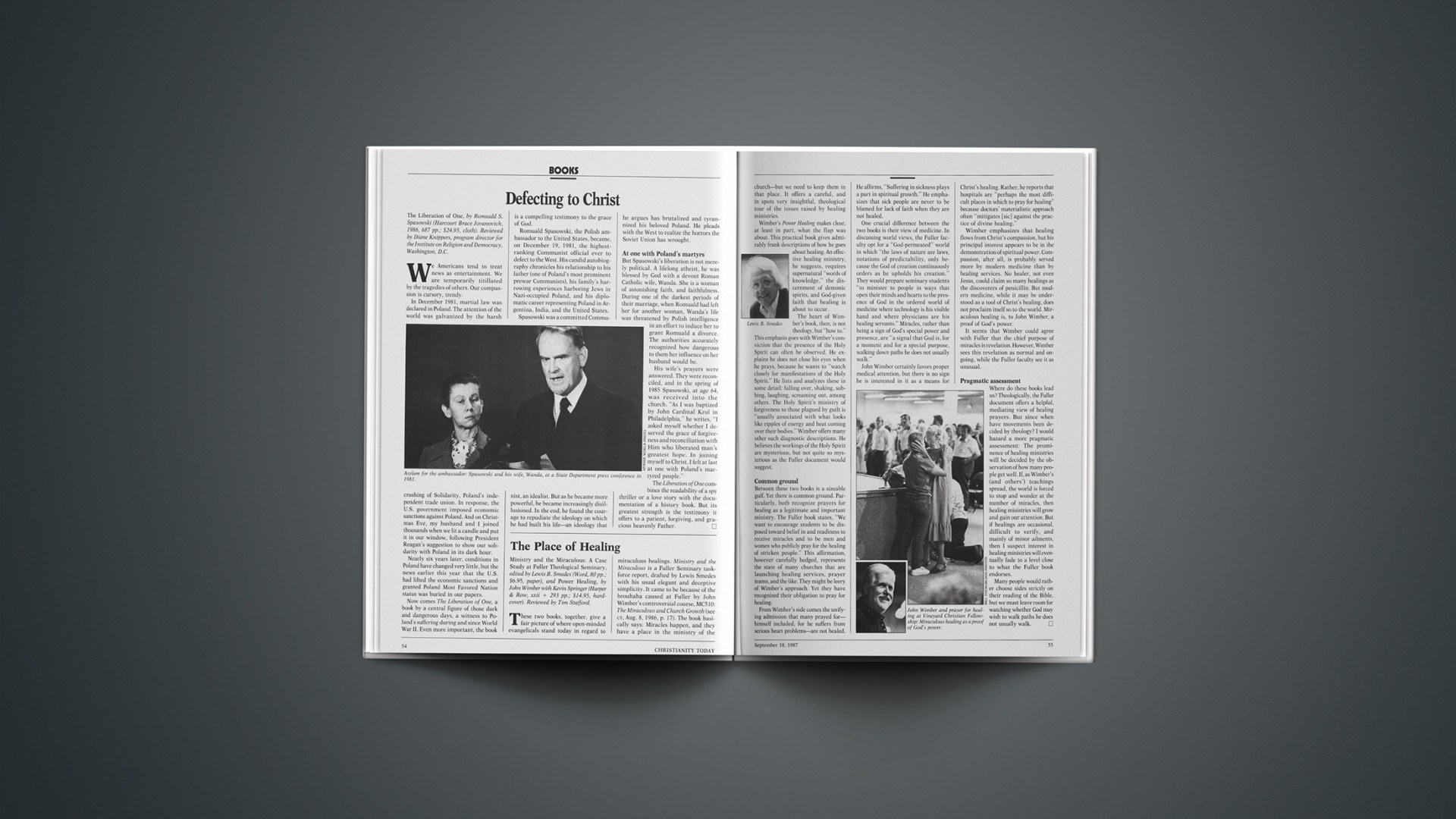
Romuald Spasowski, the Polish ambassador to the United States, became, on December 19, 1981, the highest-ranking Communist official ever to defect to the West. His candid autobiography chronicles his relationship to his father (one of Poland’s most prominent prewar Communists), his family’s harrowing experiences harboring Jews in Nazi-occupied Poland, and his diplomatic career representing Poland in Argentina, India, and the United States.

Spasowski was a committed Communist, an idealist. But as he became more powerful, he became increasingly disillusioned. In the end, he found the courage to repudiate the ideology on which he had built his life—an ideology that he argues has brutalized and tyrannized his beloved Poland. He pleads with the West to realize the horrors the Soviet Union has wrought.

At One With Poland’s Martyrs

But Spasowski’s liberation is not merely political. A lifelong atheist, he was blessed by God with a devout Roman Catholic wife, Wanda. She is a woman of astonishing faith, and faithfulness. During one of the darkest periods of their marriage, when Romuald had left her for another woman, Wanda’s life was threatened by Polish intelligence in an effort to induce her to grant Romuald a divorce. The authorities accurately recognized how dangerous to them her influence on her husband would be.

His wife’s prayers were answered. They were reconciled, and in the spring of 1985 Spasowski, at age 64, was received into the church. “As I was baptized by John Cardinal Krol in Philadelphia,” he writes, “I asked myself whether I deserved the grace of forgiveness and reconciliation with Him who liberated man’s greatest hope. In joining myself to Christ, I felt at last at one with Poland’s martyred people.”

The Liberation of One combines the readability of a spy thriller or a love story with the documentation of a history book. But its greatest strength is the testimony it offers to a patient, forgiving, and gracious heavenly Father.

The Place Of Healing

Ministry and the Miraculous: A Case Study at Fuller Theological Seminary, edited by Lewis B. Smedes (Word, 80 pp.; $6.95, paper), and Power Healing, by John Wimber with Kevin Springer (Harper & Row, xxii + 293 pp.; $14.95, hardcover). Reviewed by Tim Stafford.

These two books, together, give a fair picture of where open-minded evangelicals stand today in regard to miraculous healings. Ministry and the Miraculous is a Fuller Seminary task-force report, drafted by Lewis Smedes with his usual elegant and deceptive simplicity. It came to be because of the brouhaha caused at Fuller by John Wimber’s controversial course, MC510: The Miraculous and Church Growth (see CT, Aug. 8, 1986, p. 17). The book basically says: Miracles happen, and they have a place in the ministry of the church—but we need to keep them in that place. It offers a careful, and in spots very insightful, theological tour of the issues raised by healing ministries.

Wimber’s Power Healing makes clear, at least in part, what the flap was about. This practical book gives admirably frank descriptions of how he goes about healing. An effective healing ministry, he suggests, requires supernatural “words of knowledge,” the discernment of demonic spirits, and God-given faith that healing is about to occur.

The heart of Wimber’s book, then, is not theology, but “how to.” This emphasis goes with Wimber’s conviction that the presence of the Holy Spirit can often be observed. He explains he does not close his eyes when he prays, because he wants to “watch closely for manifestations of the Holy Spirit.” He lists and analyzes these in some detail: falling over, shaking, sobbing, laughing, screaming out, among others. The Holy Spirit’s ministry of forgiveness to those plagued by guilt is “usually associated with what looks like ripples of energy and heat coming over their bodies.” Wimber offers many other such diagnostic descriptions. He believes the workings of the Holy Spirit are mysterious, but not quite so mysterious as the Fuller document would suggest.

Common Ground

Between these two books is a sizeable gulf. Yet there is common ground. Particularly, both recognize prayers for healing as a legitimate and important ministry. The Fuller book states, “We want to encourage students to be disposed toward belief in and readiness to receive miracles and to be men and women who publicly pray for the healing of stricken people.” This affirmation, however carefully hedged, represents the state of many churches that are launching healing services, prayer teams, and the like. They might be leery of Wimber’s approach. Yet they have recognized their obligation to pray for healing.

From Wimber’s side comes the unifying admission that many prayed for—himself included, for he suffers from serious heart problems—are not healed. He affirms, “Suffering in sickness plays a part in spiritual growth.” He emphasizes that sick people are never to be blamed for lack of faith when they are not healed.

One crucial difference between the two books is their view of medicine. In discussing world views, the Fuller faculty opt for a “God-permeated” world in which “the laws of nature are laws, notations of predictability, only because the God of creation continuously orders as he upholds his creation.” They would prepare seminary students “to minister to people in ways that open their minds and hearts to the presence of God in the ordered world of medicine where technology is his visible hand and where physicians are his healing servants.” Miracles, rather than being a sign of God’s special power and presence, are “a signal that God is, for a moment and for a special purpose, walking down paths he does not usually walk.”

John Wimber certainly favors proper medical attention, but there is no sign he is interested in it as a means for Christ’s healing. Rather, he reports that hospitals are “perhaps the most difficult places in which to pray for healing” because doctors’ materialistic approach often “mitigates [sic] against the practice of divine healing.”

Wimber emphasizes that healing flows from Christ’s compassion, but his principal interest appears to be in the demonstration of spiritual power. Compassion, after all, is probably served more by modern medicine than by healing services. No healer, not even Jesus, could claim so many healings as the discoverers of penicillin. But modern medicine, while it may be understood as a tool of Christ’s healing, does not proclaim itself so to the world. Miraculous healing is, to John Wimber, a proof of God’s power.

It seems that Wimber could agree with Fuller that the chief purpose of miracles is revelation. However, Wimber sees this revelation as normal and ongoing, while the Fuller faculty see it as unusual.

Pragmatic Assessment

Where do these books lead us? Theologically, the Fuller document offers a helpful, mediating view of healing prayers. But since when have movements been decided by theology? I would hazard a more pragmatic assessment: The prominence of healing ministries will be decided by the observation of how many people get well. If, as Wimber’s (and others’) teachings spread, the world is forced to stop and wonder at the number of miracles, then healing ministries will grow and gain our attention. But if healings are occasional, difficult to verify, and mainly of minor ailments, then I suspect interest in healing ministries will eventually fade to a level close § to what the Fuller book g endorses.

Many people would rather choose sides strictly on their reading of the Bible, but we must leave room for watching whether God may wish to walk paths he does not usually walk.

A New Idea In A New Nation

The First Liberty: Religion and the American Republic, by William Lee Miller (Knopf, 373 pp.; $24.95, cloth). Reviewed by James W. Skillen, executive director, Association for Public Justice, Washington, D.C.

The “new idea” that took hold in the founding of America was religious liberty, including the institutional independence of churches from the federal government. Exploring the historical origins, development, and ambiguities of that idea in the United States is the task that University of Virginia historian, William Lee Miller, has fulfilled in this wonderfully written book.

The First Liberty illuminates much more than the First Amendment, partly because Miller has a wide reach and broad peripheral vision, and partly because religion has determined the shape of the whole country, not simply the First Amendment to its Constitution.

The structure of Miller’s elegant book is simple: Part I uses a Virginia law of 1777 establishing religious freedom as its focal point for showing how the “new idea” became established in the “new nation.” Part II is the story of James Madison, the not-so-well-known founding father who was nonetheless most important in the establishment of religious freedom. Part III reaches back to the early colonial Roger Williams and follows the influence of his thinking up to 1776. And Part IV tells the story of the next two centuries. Even the reader who is deeply familiar with Jefferson or Williams or the Supreme Court’s First Amendment decisions will find this book exciting and intriguing. There is no boring history here.

What Is Religion?

Despite all the positive things to be said about this book, Miller leaves one of the questions most at issue almost entirely unexamined: What is religion? His explorations take for granted a language and a conceptual framework that is part of the problem he wants to help resolve. Ambiguities connected with the word religion have confounded not only Americans, but also Miller’s book. Let me explain.

In Roger Williams’s day, as Miller correctly points out, religion was not a “separated compartment … divorced from the great issues of politics, government, and the shaping of institutions.” To the contrary, “religion provided the all-embracing terms in which the great issues were debated.” From a historical point of view, says Miller, one must recognize that even the “bare bones of republicanism” and the emergence of this country “have not been disconnected … from ‘religion,’ even in its less spacious definitions.”

To understand the meaning of religion in this all-embracing sense, we must grasp its life-orienting, world-viewish, heart-deep character. From this point of view, the history of religion in America is more than the history of Puritanism, Anglicanism, and Enlightenment rationalism converging upon a relatively happy agreement to separate church and state. That is, religion is not limited to a small, private sector of life. Rather, it provides the basic convictions, energy, and inspiration for the most important struggles of our life, public as well as private.

Religion may indeed refer to institutions like churches, or to beliefs about God, sin, and salvation. But using the term both in this way as well as to describe heart-deep commitments, without clarifying the difference between the two usages, is to leave open precisely the confusion that confounds the Supreme Court. Church and state may be separated relatively easily. But that is quite a different matter from separating religion in general from most of life, or channeling a few of life’s functions into a so-called religious (and private) sphere and giving the remainder to government on the grounds that it has dominance over the “secular.” Insisting on this kind of sacred-secular distinction violates the conscience of many devout people. The staunch commitment to separation of church and state that some of us hold is rooted precisely in our religious view of what a state ought to be.

Miller’s failure to explore the ambiguity of the word “religion” keeps him from seeing the deeply religious character of Jefferson’s or Madison’s view of life. When Miller discusses Jefferson’s use of the word “truth,” he makes one of his own confessions: “It is clearly important for us to hold to the truth that all human beings are created equal, in an age when inequalities old and new persist. It is also important to hold that ‘truth’ can prevail by ‘free argument and debate,’ in an age when many see only ‘preferences’ and therefore manipulation. These Jeffersonian truths stand about as near as anything one can cite to the moral core of the nation he helped to bring into being. They are anchors of the American mind and moral understanding.…”

But why should we believe these things? Why should we reject the conviction that only “preferences” exist? How do we know there is “truth” that can prevail? And why does Miller not see that the anchor of “free argument and debate” is part of an imposed establishment in America? In this country we have actually forced into exile contrary views held by those who wish to establish a single church or to force the end of free debate.

Our religious freedom is not neutrality—it is imposed by a constitution based on religiously deep convictions that a political community should not allow for an established faith. Without doubt this would even call for the use of weapons against any ayatollahs or theocrats who would try to impose a different kind of order.

What then is the proper relation between religion and political life? Part of the debate today is over the discriminating dominance of some groups in schools, the mass media, and other public spaces. And politics, law, government, and the very conception of a republic will differ depending on the roots from which they spring.

Miller has correctly noted that America is rooted, in part, in Christianity. He has done a marvelous job of showing how the separation of church and state came about in America. However, he has not satisfactorily resolved the question of how competing religions, with different orientations to life and society, can all be treated justly in a pluralistic state.

New Policies on Divorce and Speaking in Tongues

Under new policies adopted by the Southern Baptist Home Mission Board, it will be more difficult for people who are divorced or speak in tongues to receive domestic missionary appointments.

The guidelines allow divorced people to be appointed as missionaries only if the divorce was based on “biblical rationale” as outlined by the agency’s board of directors. A second policy approved by the board disqualifies missionary candidates who actively participate in, or promote the practice of, speaking in tongues.

Any missions personnel already appointed, approved, or endorsed by the mission board who become involved in glossolalia will be counseled by a mission board representative. Continued participation in speaking in tongues would result in their dismissal. The new stance on glossolalia also applies to chaplains who, although not paid by the board, are endorsed by the Atlanta-based agency.

Only one board member voiced opposition to the policy on charismatics. Jim Strickland, pastor of Heritage Baptist Church in Cartersville, Georgia, challenged the motion due to the lack of a definition of “glossolalia,” which he said could leave the policy open to misinterpretation.

Policy On Divorce

A separate policy regarding divorced persons defines a biblical rationale for divorce, limiting it to cases of adultery or fornication and instances of desertion or physical abandonment by a spouse. The mission board policy also states that no divorced person will be considered for a pastoral role unless the divorce meets the biblical guidelines and the applicant has not remarried.

Existing Home Mission Board personnel who have been divorced and remarried will remain in service. However, any personnel who divorce or remarry will be reevaluated under the terms of the new policy.

In the past, the Home Mission Board evaluated each instance of divorce on its own merits. Individuals were employed if it was determined that their divorce did not impair their ministry.

Board member James Walters, pastor of First Baptist Church in Mobile, Alabama, was one of a half-dozen board members who challenged the new policy on divorce. “Certainly I’m for the ideal, but I’m also concerned about the redeeming aspects of the gospel and the message that we are implying,” he said. “Is divorce the unpardonable sin? Are we going to throw rocks or ropes [to divorced people]?”

Board member Olan Wills, pastor of Springhead Baptist Church in Plant City, Florida, said he was sympathetic to those who disagreed with the policy. But he added: “We as pastors and Christians cannot go on sympathy but on God’s Word, and it says, ‘Let him be the husband of one wife’ [1 Tim. 3:12].”

By Baptist Press.

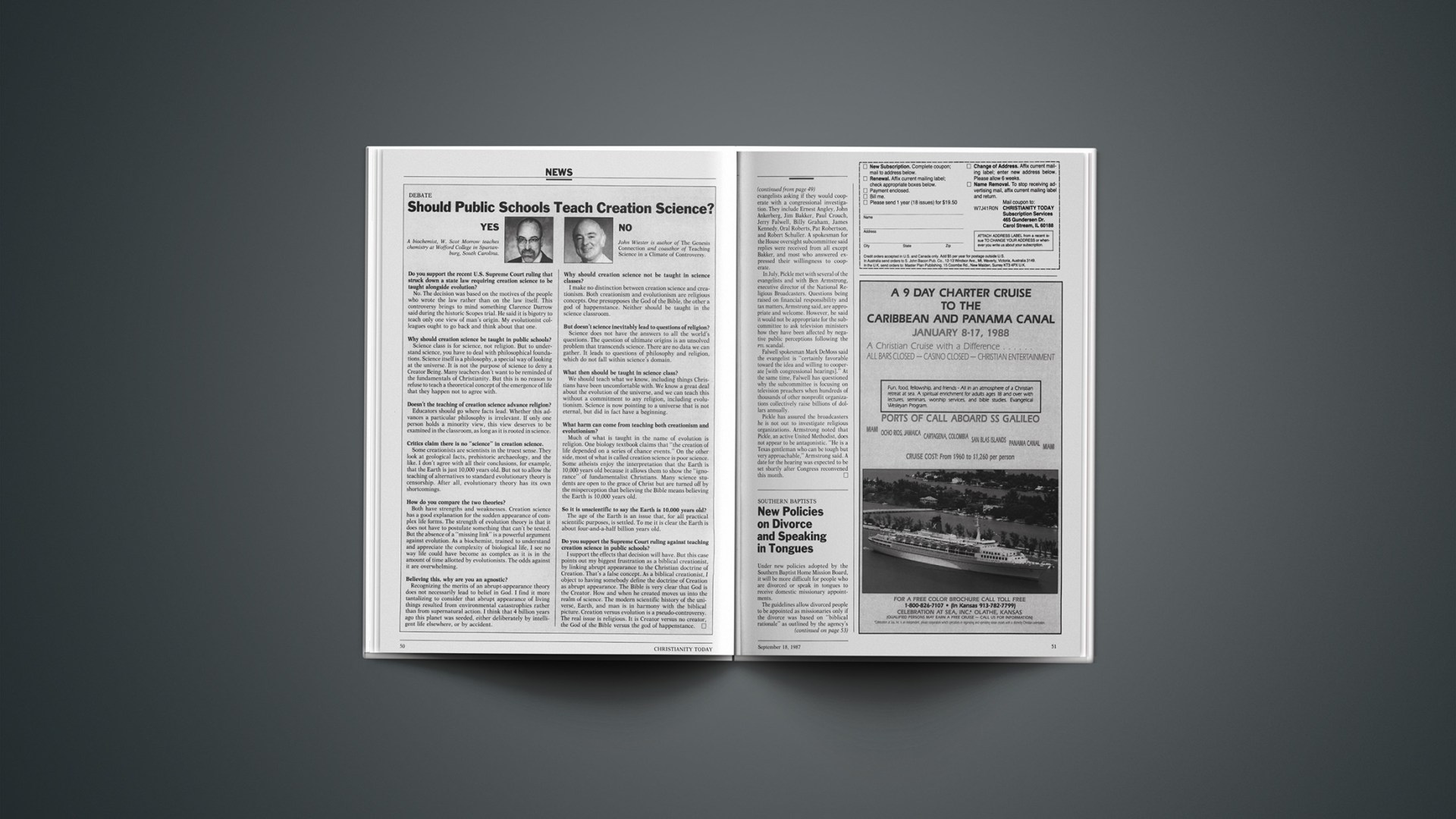
Should Public Schools Teach Creation Science?

YES

A biochemist, W. Scot Morrow teaches chemistry at Wofford College in Spartanburg, South Carolina.

Do you support the recent U.S. Supreme Court ruling that struck down a state law requiring creation science to be taught alongside evolution?

No. The decision was based on the motives of the people who wrote the law rather than on the law itself. This controversy brings to mind something Clarence Darrow said during the historic Scopes trial. He said it is bigotry to teach only one view of man’s origin. My evolutionist colleagues ought to go back and think about that one.

Why should creation science be taught in public schools?

Science class is for science, not religion. But to understand science, you have to deal with philosophical foundations. Science itself is a philosophy, a special way of looking at the universe. It is not the purpose of science to deny a Creator Being. Many teachers don’t want to be reminded of the fundamentals of Christianity. But this is no reason to refuse to teach a theoretical concept of the emergence of life that they happen not to agree with.

Doesn’t the teaching of creation science advance religion?

Educators should go where facts lead. Whether this advances a particular philosophy is irrelevant. If only one person holds a minority view, this view deserves to be examined in the classroom, as long as it is rooted in science.

Critics claim there is no “science” in creation science.

Some creationists are scientists in the truest sense. They look at geological facts, prehistoric archaeology, and the like. I don’t agree with all their conclusions, for example, that the Earth is just 10,000 years old. But not to allow the teaching of alternatives to standard evolutionary theory is censorship. After all, evolutionary theory has its own shortcomings.

How do you compare the two theories?

Both have strengths and weaknesses. Creation science has a good explanation for the sudden appearance of complex life forms. The strength of evolution theory is that it does not have to postulate something that can’t be tested. But the absence of a “missing link” is a powerful argument against evolution. As a biochemist, trained to understand and appreciate the complexity of biological life, I see no way life could have become as complex as it is in the amount of time allotted by evolutionists. The odds against it are overwhelming.

Believing this, why are you an agnostic?

Recognizing the merits of an abrupt-appearance theory does not necessarily lead to belief in God. I find it more tantalizing to consider that abrupt appearance of living things resulted from environmental catastrophies rather than from supernatural action. I think that 4 billion years ago this planet was seeded, either deliberately by intelligent life elsewhere, or by accident.

NO

John Wiester is author of The Genesis Connection and coauthor of Teaching Science in a Climate of Controversy.

Why should creation science not be taught in science classes?

I make no distinction between creation science and creationism. Both creationism and evolutionism are religious concepts. One presupposes the God of the Bible, the other a god of happenstance. Neither should be taught in the science classroom.

But doesn’t science inevitably lead to questions of religion?

Science does not have the answers to all the world’s questions. The question of ultimate origins is an unsolved problem that transcends science. There are no data we can gather. It leads to questions of philosophy and religion, which do not fall within science’s domain.

What then should be taught in science class?

We should teach what we know, including things Christians have been uncomfortable with. We know a great deal about the evolution of the universe, and we can teach this without a commitment to any religion, including evolutionism. Science is now pointing to a universe that is not eternal, but did in fact have a beginning.

What harm can come from teaching both creationism and evolutionism?

Much of what is taught in the name of evolution is religion. One biology textbook claims that “the creation of life depended on a series of chance events.” On the other side, most of what is called creation science is poor science. Some atheists enjoy the interpretation that the Earth is 10,000 years old because it allows them to show the “ignorance” of fundamentalist Christians. Many science students are open to the grace of Christ but are turned off by the misperception that believing the Bible means believing the Earth is 10,000 years old.

So it is unscientific to say the Earth is 10,000 years old?

The age of the Earth is an issue that, for all practical scientific purposes, is settled. To me it is clear the Earth is about four-and-a-half billion years old.

Do you support the Supreme Court ruling against teaching creation science in public schools?

I support the effects that decision will have. But this case points out my biggest frustration as a biblical creationist, by linking abrupt appearance to the Christian doctrine of Creation. That’s a false concept. As a biblical creationist, I object to having somebody define the doctrine of Creation as abrupt appearance. The Bible is very clear that God is the Creator. How and when he created moves us into the realm of science. The modern scientific history of the universe, Earth, and man is in harmony with the biblical picture. Creation versus evolution is a pseudo-controversy. The real issue is religious. It is Creator versus no creator, the God of the Bible versus the god of happenstance.

Taking Yet Another Look at Television Evangelism

More scrutiny of television evangelism is in store, as the U.S. Congress holds hearings on whether money from donors is misused.

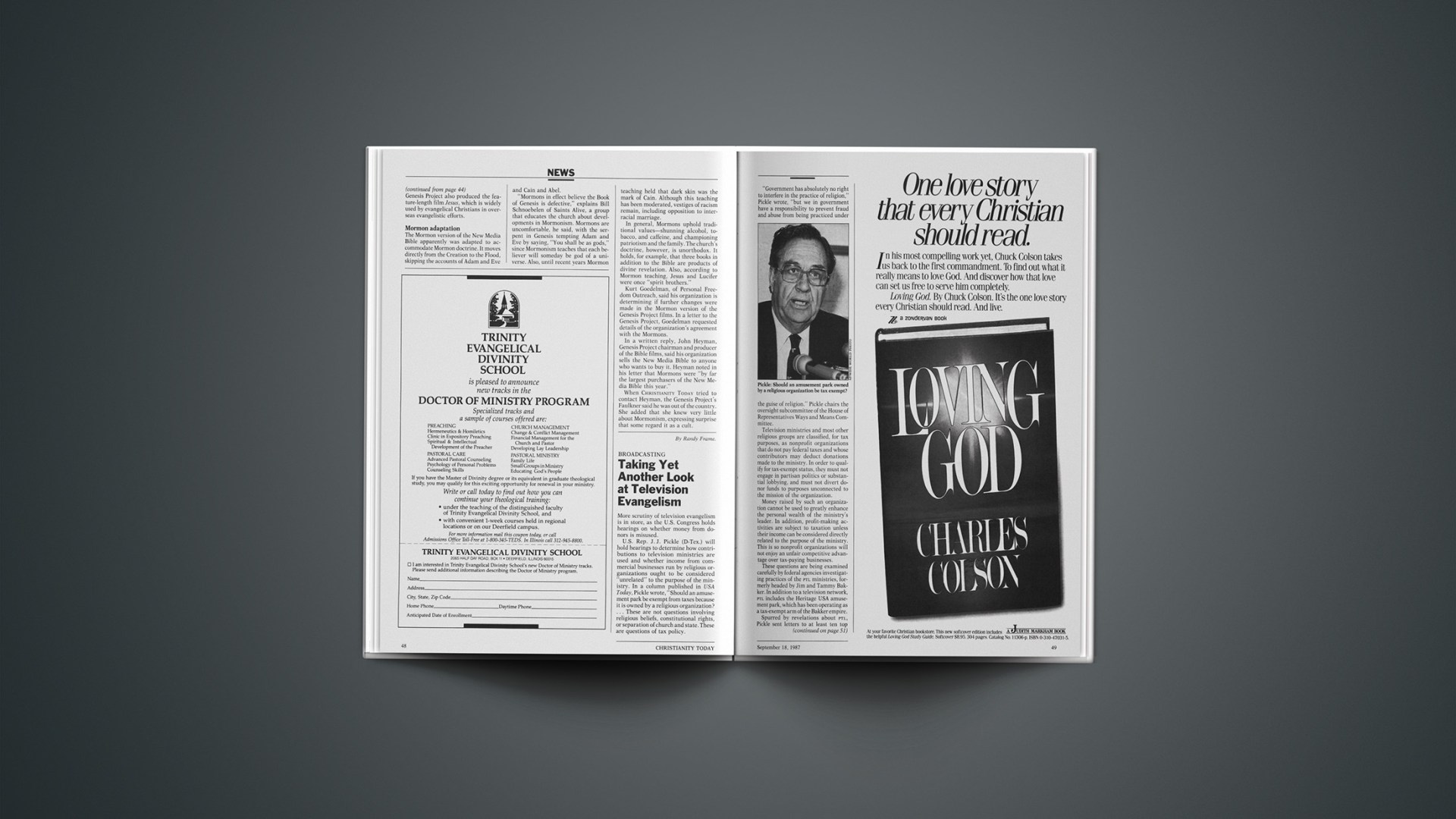
U.S. Rep. J. J. Pickle (D-Tex.) will hold hearings to determine how contributions to television ministries are used and whether income from commercial businesses run by religious organizations ought to be considered “unrelated” to the purpose of the ministry. In a column published in USA Today, Pickle wrote, “Should an amusement park be exempt from taxes because it is owned by a religious organization?… These are not questions involving religious beliefs, constitutional rights, or separation of church and state. These are questions of tax policy.

“Government has absolutely no right to interfere in the practice of religion,” Pickle wrote, “but we in government have a responsibility to prevent fraud and abuse from being practiced under the guise of religion.” Pickle chairs the oversight subcommittee of the House of Representatives Ways and Means Committee.

Television ministries and most other religious groups are classified, for tax purposes, as nonprofit organizations that do not pay federal taxes and whose contributors may deduct donations made to the ministry. In order to qualify for tax-exempt status, they must not engage in partisan politics or substantial lobbying, and must not divert donor funds to purposes unconnected to the mission of the organization.

Money raised by such an organization cannot be used to greatly enhance the personal wealth of the ministry’s leader. In addition, profit-making activities are subject to taxation unless their income can be considered directly related to the purpose of the ministry. This is so nonprofit organizations will not enjoy an unfair competitive advantage over tax-paying businesses.

These questions are being examined carefully by federal agencies investigating practices of the PTL ministries, formerly headed by Jim and Tammy Bakker. In addition to a television network, PTL includes the Heritage USA amusement park, which has been operating as a tax-exempt arm of the Bakker empire.

Spurred by revelations about PTL, Pickle sent letters to at least ten top evangelists asking if they would cooperate with a congressional investigation. They include Ernest Angley, John Ankerberg, Jim Bakker, Paul Crouch, Jerry Falwell, Billy Graham, James Kennedy, Oral Roberts, Pat Robertson, and Robert Schuller. A spokesman for the House oversight subcommittee said replies were received from all except Bakker, and most who answered expressed their willingness to cooperate.

In July, Pickle met with several of the evangelists and with Ben Armstrong, executive director of the National Religious Broadcasters. Questions being raised on financial responsibility and tax matters, Armstrong said, are appropriate and welcome. However, he said it would not be appropriate for the subcommittee to ask television ministers how they have been affected by negative public perceptions following the PTL scandal.

Falwell spokesman Mark DeMoss said the evangelist is “certainly favorable toward the idea and willing to cooperate [with congressional hearings].” At the same time, Falwell has questioned why the subcommittee is focusing on television preachers when hundreds of thousands of other nonprofit organizations collectively raise billions of dollars annually.

Pickle has assured the broadcasters he is not out to investigate religious organizations. Armstrong noted that Pickle, an active United Methodist, does not appear to be antagonistic. “He is a Texas gentleman who can be tough but very approachable,” Armstrong said. A date for the hearing was expected to be set shortly after Congress reconvened this month.

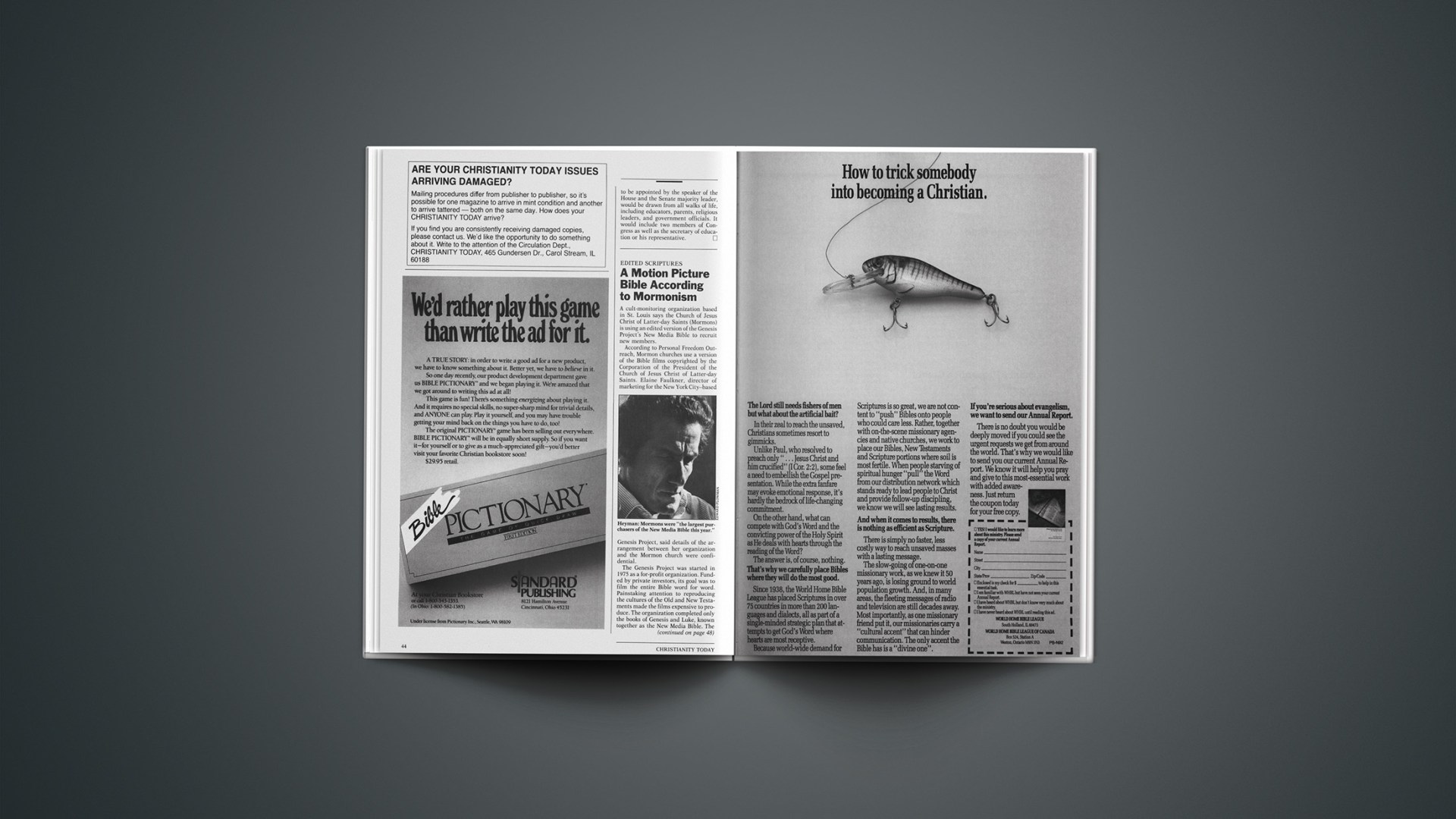
A Motion Picture Bible according to Mormonism

A cult-monitoring organization based in St. Louis says the Church of Jesus Christ of Latter-day Saints (Mormons) is using an edited version of the Genesis Project’s New Media Bible to recruit new members.

According to Personal Freedom Outreach, Mormon churches use a version of the Bible films copyrighted by the Corporation of the President of the Church of Jesus Christ of Latter-day Saints. Elaine Faulkner, director of marketing for the New York City-based Genesis Project, said details of the arrangement between her organization and the Mormon church were confidential.

The Genesis Project was started in 1975 as a for-profit organization. Funded by private investors, its goal was to film the entire Bible word for word. Painstaking attention to reproducing the cultures of the Old and New Testaments made the films expensive to produce. The organization completed only the books of Genesis and Luke, known together as the New Media Bible. The Genesis Project also produced the feature-length film Jesus, which is widely used by evangelical Christians in overseas evangelistic efforts.

Mormon Adaptation

The Mormon version of the New Media Bible apparently was adapted to accommodate Mormon doctrine. It moves directly from the Creation to the Flood, skipping the accounts of Adam and Eve and Cain and Abel.

“Mormons in effect believe the Book of Genesis is defective,” explains Bill Schnoebelen of Saints Alive, a group that educates the church about developments in Mormonism. Mormons are uncomfortable, he said, with the serpent in Genesis tempting Adam and Eve by saying, “You shall be as gods,” since Mormonism teaches that each believer will someday be god of a universe. Also, until recent years Mormon teaching held that dark skin was the mark of Cain. Although this teaching has been moderated, vestiges of racism remain, including opposition to interracial marriage.

In general, Mormons uphold traditional values—shunning alcohol, tobacco, and caffeine, and championing patriotism and the family. The church’s doctrine, however, is unorthodox. It holds, for example, that three books in addition to the Bible are products of divine revelation. Also, according to Mormon teaching, Jesus and Lucifer were once “spirit brothers.”

Kurt Goedelman, of Personal Freedom Outreach, said his organization is determining if further changes were made in the Mormon version of the Genesis Project films. In a letter to the Genesis Project, Goedelman requested details of the organization’s agreement with the Mormons.

In a written reply, John Heyman, Genesis Project chairman and producer of the Bible films, said his organization sells the New Media Bible to anyone who wants to buy it. Heyman noted in his letter that Mormons were “by far the largest purchasers of the New Media Bible this year.”

When CHRISTIANITY TODAY tried to contact Heyman, the Genesis Project’s Faulkner said he was out of the country. She added that she knew very little about Mormonism, expressing surprise that some regard it as a cult.

By Randy Frame.

Calling for a Commission on Values in Public Education

The U.S. Congress has been asked to appoint a 17-member commission to explore ways in which values may be taught in public schools. Legislation introduced by U.S. Rep. Tony Hall (D-Ohio) would establish a one-year commission to “identify common values and recommend to the President and Congress how those values can be included in the curricula of U.S. schools.”

Hall’s proposal builds on other expressions of concern about the absence of clear teaching about right and wrong in the nation’s classrooms. Earlier, a coalition of leaders in education, government, and religion called for better teaching of democratic values. Their statement, “Education for Democracy,” noted, “It is absurd to argue that the state, or its schools, cannot be concerned with citizens’ ability to tell right from wrong.”

The legislation introduced by Hall identifies several reasons why a commission on values in education is needed. “Many Americans no longer make determinations of right and wrong,” the measure points out, “… and this phenomenon crosses economic, social, religious, and age lines.” Public schools charged with teaching these determinations “have abdicated this responsibility,” the bill says.

The evidence of this is clear, according to Hall’s legislation. It cites “a national epidemic of incidents” in which ethics have little or no bearing on behavior, as well as alarming increases in the numbers of teen pregnancies and incidents of drug abuse and suicide.

In a speech to the House of Representatives, Hall said, “We are raising a generation of children who cannot distinguish between right and wrong. They are not prepared to make tough choices when there are gray areas, or when values seem to conflict.” Hall said the result is that the United States is “in the grips of a moral recession.” He decided to sponsor the legislation after an Ohio high school principal told him a student newspaper ran a series of articles on cheating, but did not condemn the practice as being wrong.

The values the commission should promote are identified in the bill, including honesty, integrity, tolerance, the rule of law, self-discipline, love of knowledge, and respect for the common good. The commission’s members, to be appointed by the speaker of the House and the Senate majority leader, would be drawn from all walks of life, including educators, parents, religious leaders, and government officials. It would include two members of Congress as well as the secretary of education or his representative.

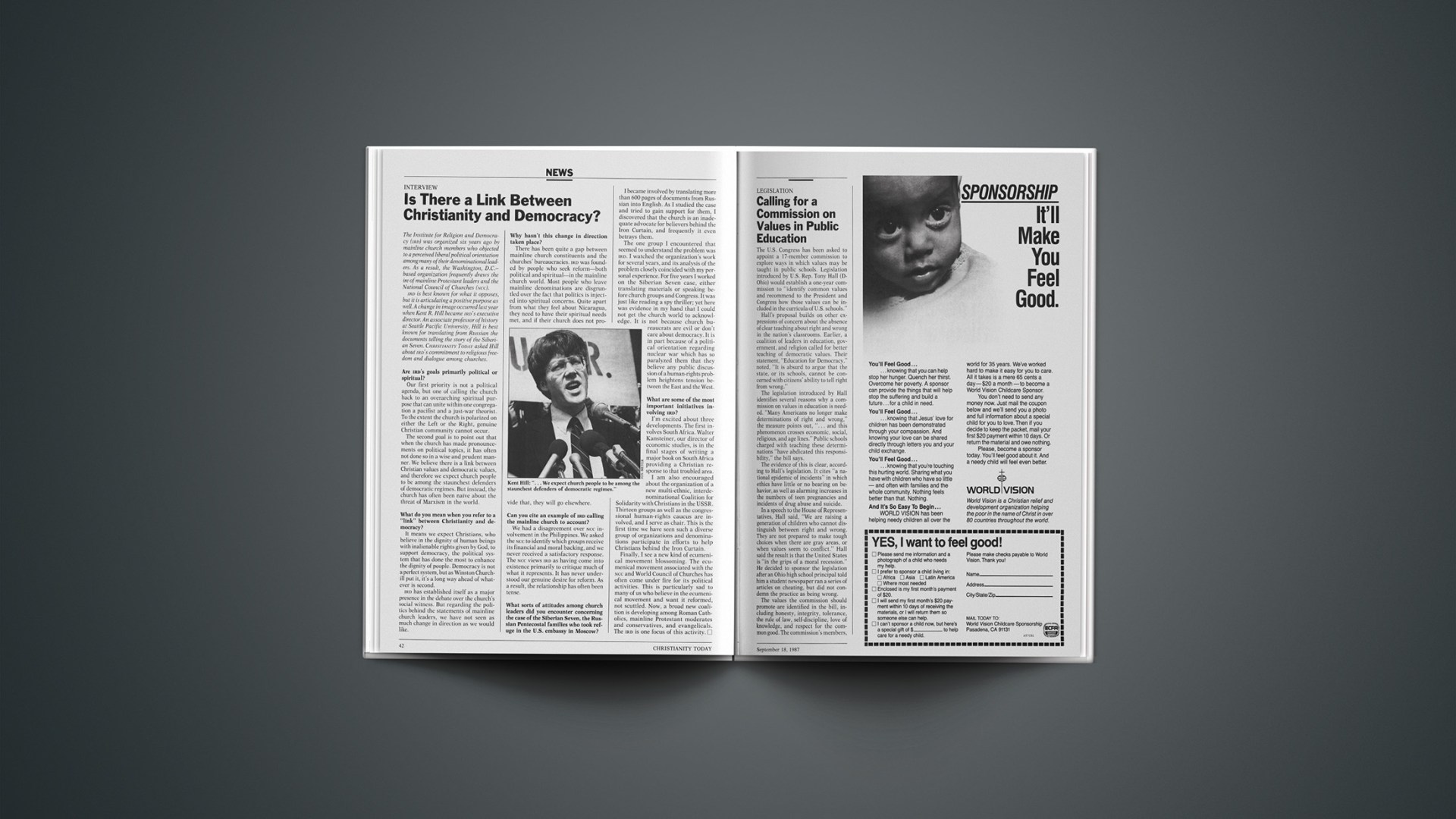
Is There a Link between Christianity and Democracy?

The Institute for Religion and Democracy (IRD) was organized six years ago by mainline church members who objected to a perceived liberal political orientation among many of their denominational leaders. As a result, the Washington, D.C.—based organization frequently draws the ire of mainline Protestant leaders and the National Council of Churches (NCC).

IRD is best known for what it opposes, but it is articulating a positive purpose as well. A change in image occurred last year when Kent R. Hill became IRD’S executive director. An associate professor of history at Seattle Pacific University, Hill is best known for translating from Russian the documents telling the story of the Siberian Seven. CHRISTIANITY TODAY asked Hill about IRD’S commitment to religious freedom and dialogue among churches.

Are IRD’S goals primarily political or spiritual?

Our first priority is not a political agenda, but one of calling the church back to an overarching spiritual purpose that can unite within one congregation a pacifist and a just-war theorist. To the extent the church is polarized on either the Left or the Right, genuine Christian community cannot occur.

The second goal is to point out that when the church has made pronouncements on political topics, it has often not done so in a wise and prudent manner. We believe there is a link between Christian values and democratic values, and therefore we expect church people to be among the staunchest defenders of democratic regimes. But instead, the church has often been naïve about the threat of Marxism in the world.

What do you mean when you refer to a “link” between Christianity and democracy?

It means we expect Christians, who believe in the dignity of human beings with inalienable rights given by God, to support democracy, the political system that has done the most to enhance the dignity of people. Democracy is not a perfect system, but as Winston Churchill put it, it’s a long way ahead of whatever is second.

IRD has established itself as a major presence in the debate over the church’s social witness. But regarding the politics behind the statements of mainline church leaders, we have not seen as much change in direction as we would like.

Why hasn’t this change in direction taken place?

There has been quite a gap between mainline church constituents and the churches’ bureaucracies. IRD was founded by people who seek reform—both political and spiritual—in the mainline church world. Most people who leave mainline denominations are disgruntled over the fact that politics is injected into spiritual concerns. Quite apart from what they feel about Nicaragua, they need to have their spiritual needs met, and if their church does not provide that, they will go elsewhere.

Can you cite an example of IRD calling the mainline church to account?

We had a disagreement over NCC involvement in the Philippines. We asked the NCC to identify which groups receive its financial and moral backing, and we never received a satisfactory response. The NCC views IRD as having come into existence primarily to critique much of what it represents. It has never understood our genuine desire for reform. As a result, the relationship has often been tense.

What sorts of attitudes among church leaders did you encounter concerning the case of the Siberian Seven, the Russian Pentecostal families who took refuge in the U.S. embassy in Moscow?

I became involved by translating more than 600 pages of documents from Russian into English. As I studied the case and tried to gain support for them, I discovered that the church is an inadequate advocate for believers behind the Iron Curtain, and frequently it even betrays them.

The one group I encountered that seemed to understand the problem was IRD. I watched the organization’s work for several years, and its analysis of the problem closely coincided with my personal experience. For five years I worked on the Siberian Seven case, either translating materials or speaking before church groups and Congress. It was just like reading a spy thriller; yet here was evidence in my hand that I could not get the church world to acknowledge. It is not because church bureaucrats are evil or don’t care about democracy. It is in part because of a political orientation regarding nuclear war which has so paralyzed them that they believe any public discussion of a human-rights problem heightens tension between the East and the West.

What are some of the most important initiatives involving IRD?

I’m excited about three developments. The first involves South Africa. Walter Kansteiner, our director of economic studies, is in the final stages of writing a major book on South Africa providing a Christian response to that troubled area.

I am also encouraged about the organization of a new multi-ethnic, interdenominational Coalition for Solidarity with Christians in the USSR. Thirteen groups as well as the congressional human-rights caucus are involved, and I serve as chair. This is the first time we have seen such a diverse group of organizations and denominations participate in efforts to help Christians behind the Iron Curtain.

Finally, I see a new kind of ecumenical movement blossoming. The ecumenical movement associated with the NCC and World Council of Churches has often come under fire for its political activities. This is particularly sad to many of us who believe in the ecumenical movement and want it reformed, not scuttled. Now, a broad new coalition is developing among Roman Catholics, mainline Protestant moderates and conservatives, and evangelicals. The IRD is one focus of this activity.

Believers Test the Limits of Gorbachev’s Glasnost Policy

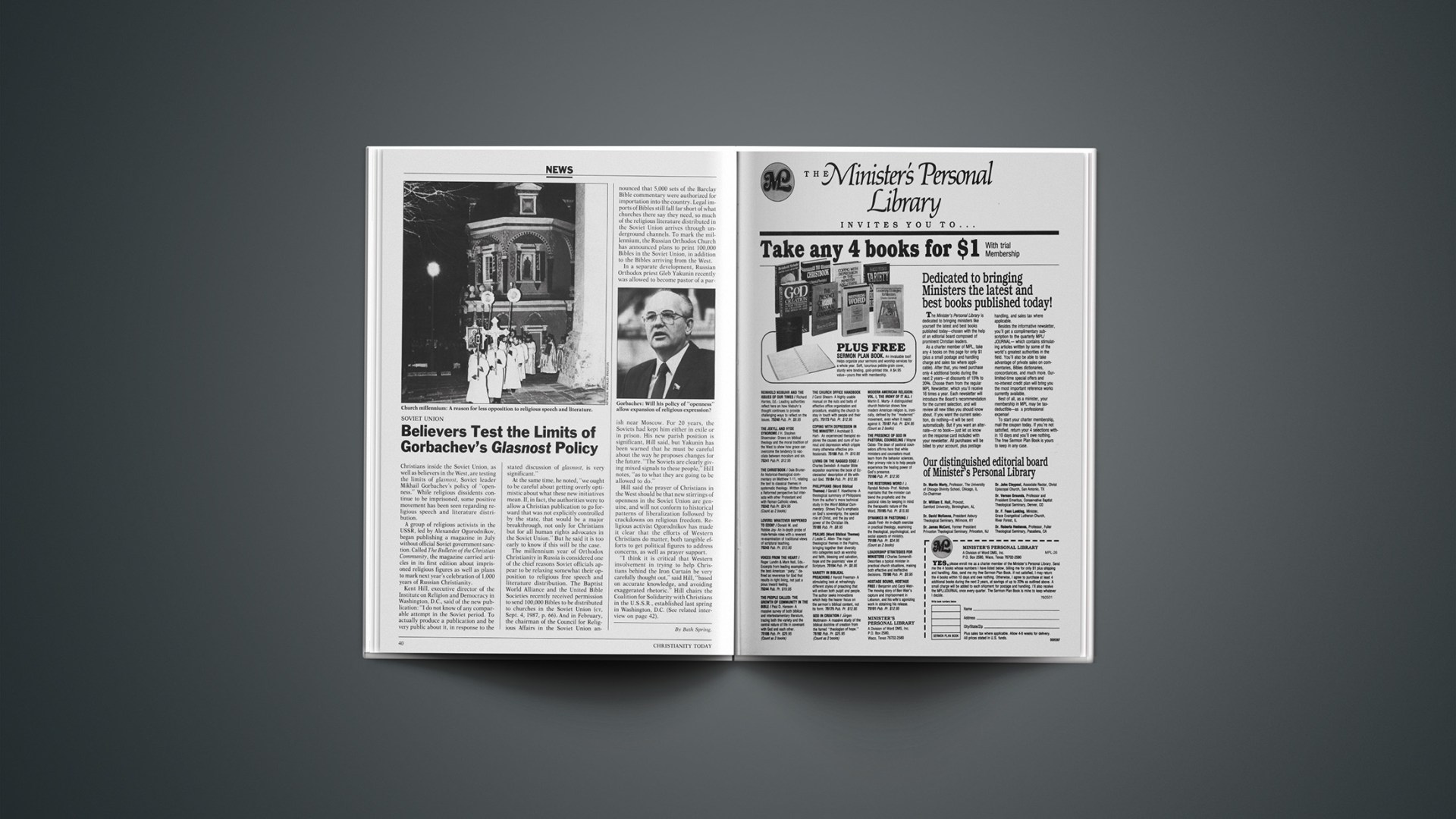
Christians inside the Soviet Union, as well as believers in the West, are testing the limits of glasnost, Soviet leader Mikhail Gorbachev’s policy of “openness.” While religious dissidents continue to be imprisoned, some positive movement has been seen regarding religious speech and literature distribution.

A group of religious activists in the USSR, led by Alexander Ogorodnikov, began publishing a magazine in July without official Soviet government sanction. Called The Bulletin of the Christian Community, the magazine carried articles in its first edition about imprisoned religious figures as well as plans to mark next year’s celebration of 1,000 years of Russian Christianity.

Kent Hill, executive director of the Institute on Religion and Democracy in Washington, D.C., said of the new publication: “I do not know of any comparable attempt in the Soviet period. To actually produce a publication and be very public about it, in response to the stated discussion of glasnost, is very significant.”

At the same time, he noted, “we ought to be careful about getting overly optimistic about what these new initiatives mean. If, in fact, the authorities were to allow a Christian publication to go forward that was not explicitly controlled by the state, that would be a major breakthrough, not only for Christians but for all human rights advocates in the Soviet Union.” But he said it is too early to know if this will be the case.

The millennium year of Orthodox Christianity in Russia is considered one of the chief reasons Soviet officials appear to be relaxing somewhat their opposition to religious free speech and literature distribution. The Baptist World Alliance and the United Bible Societies recently received permission to send 100,000 Bibles to be distributed to churches in the Soviet Union (CT, Sept. 4, 1987, p. 66). And in February, the chairman of the Council for Religious Affairs in the Soviet Union announced that 5,000 sets of the Barclay Bible commentary were authorized for importation into the country. Legal imports of Bibles still fall far short of what churches there say they need, so much of the religious literature distributed in the Soviet Union arrives through underground channels. To mark the millennium, the Russian Orthodox Church has announced plans to print 100,000 Bibles in the Soviet Union, in addition to the Bibles arriving from the West.

In a separate development, Russian Orthodox priest Gleb Yakunin recently was allowed to become pastor of a parish near Moscow. For 20 years, the Soviets had kept him either in exile or in prison. His new parish position is significant, Hill said, but Yakunin has been warned that he must be careful about the way he proposes changes for the future. “The Soviets are clearly giving mixed signals to these people,” Hill notes, “as to what they are going to be allowed to do.”

Hill said the prayer of Christians in the West should be that new stirrings of openness in the Soviet Union are genuine, and will not conform to historical patterns of liberalization followed by crackdowns on religious freedom. Religious activist Ogorodnikov has made it clear that the efforts of Western Christians do matter, both tangible efforts to get political figures to address concerns, as well as prayer support.

“I think it is critical that Western involvement in trying to help Christians behind the Iron Curtain be very carefully thought out,” said Hill, “based on accurate knowledge, and avoiding exaggerated rhetoric.” Hill chairs the Coalition for Solidarity with Christians in the U.S.S.R., established last spring in Washington, D.C. (See related interview on page 42).

By Beth Spring.

Apple PodcastsDown ArrowDown ArrowDown Arrowarrow_left_altLeft ArrowLeft ArrowRight ArrowRight ArrowRight Arrowarrow_up_altUp ArrowUp ArrowAvailable at Amazoncaret-downCloseCloseEmailEmailExpandExpandExternalExternalFacebookfacebook-squareGiftGiftGooglegoogleGoogle KeephamburgerInstagraminstagram-squareLinkLinklinkedin-squareListenListenListenChristianity TodayCT Creative Studio Logologo_orgMegaphoneMenuMenupausePinterestPlayPlayPocketPodcastRSSRSSSaveSaveSaveSearchSearchsearchSpotifyStitcherTelegramTable of ContentsTable of Contentstwitter-squareWhatsAppXYouTubeYouTube