Missions Held Hostage

Sending agencies draw up contingency plans as terrorists begin to target missionaries.

Late last month, six foot-weary missionaries and a 20-month-old baby completed a 350-mile forced march. They clambered into a canoe that took them across the Malawi border to freedom, ending three months of captivity in Mozambique.

As news of their release spread, rejoicing was tempered with concern for the safety of four other missionaries held captive in Sudan. But just days later, those missionaries were released by the Sudanese People’s Liberation Army. Once considered undesirable prey, missionaries increasingly are being targeted by publicity-seeking terrorists.

“Terrorists are looking for easier prey,” said Bob Klamser, cofounder of Contingency Preparation Consultants (CPC), an organization that provides training, crisis management, and recovery services to missionaries and mission agencies. “Missionaries don’t have the money to provide expensive protective devices, and because of the nature of their work, they can’t isolate themselves. That makes them a more attractive target.”

When terrorists target missionaries, they appear to select them on the basis of nationality rather than their religious affiliation. “I don’t think we have reached the stage yet where a terrorist decides, ‘We want a missionary,’ ” Klamser said.

He believes that day could come, however, as public sympathy becomes inoculated by numerous reports of violence directed against public and corporate officials. “Terrorists will be forced to look at other groups to once again shock the conscience of the world,” he said. “Unfortunately, missionaries may fit that category.”

Crisis Management

As attacks against their personnel and property increase, mission agencies are beginning to prepare for the challenge of ministry in a new, more violent era. Many of the agencies associated with the Evangelical Foreign Missions Association already have broad contingency plans, according to executive director Wade T. Coggins. But in light of recent events, he said he has observed a new interest in training personnel and developing more comprehensive plans.

Klamser and his colleagues at CPC have been surprised by the number of mission agencies that have contacted their organization since it was founded in 1985. “Mission agencies are trying to understand why they are a target,” Klamser said. “They are looking for ways to provide training for people on the field, and they are concerned about making policies on issues like paying ransom; yielding to other types of extortion by terrorists; when to pull out of a dangerous region; and what procedures to follow in various kinds of emergencies.”

A hostage crisis that ended with the death of missionary Chester Bitterman in 1981 motivated Wycliffe Bible Translators, International, to begin what may be one of the most thorough missionary training and contingency programs. Nearly half of Wycliffe’s 5,600 career and short-term missionaries have received training, says David Farah, coordinator of international relations. The training includes ways to minimize the chances of falling victim to terrorist acts; how a missionary should react if taken hostage; and an explanation of the procedures Wycliffe will follow if a missionary is kidnaped.

In addition, the organization has prepared extensive contingency plans. “It is important to plan—while there is no emergency—what procedures you would follow if an incident would arise,” he said. “We need to think of every possibility—all the things that could happen that would put us in a vulnerable position.”

Although Campus Crusade for Christ, International, has not faced a hostage situation, Don Beehler, director of communications, says the organization is taking seriously the possibility of attack. “We are educating our staff on how to protect themselves, how to avoid becoming victims, or if they are kidnaped, how to behave,” he said. “There is a growing awareness that there is a problem and that we are not immune to it.”

In the 142-year history of the Foreign Mission Board of the Southern Baptist Convention, only four people have been killed in political turmoil. Nevertheless, the organization has experienced heightened concern in the last few years, says Mary Jane Welch, assistant director of the News and Information Service. An educational document on field dangers prepared by the organization was distributed to the agency’s 3,700 missionaries last year.

Sovereignty Of God

Most missionaries welcome the opportunity to learn how to protect themselves and their families in dangerous situations. Many, however, struggle with the issues of faith and the sovereignty of God in the midst of professional contingency preparation.

Farah says Wycliffe leaders have thought through these issues. “We give people all kinds of training for the work they will do on the field,” he said. “In contingency preparation we are looking at how to relate to people under adverse circumstances. Preparation is not lack of faith.”

Missionaries have always risked their lives to preach the gospel, said Max Crittenden, a general attorney with Youth With A Mission, whose missionary, Kindra Bryan, was a member of the group recently released from captivity in Mozambique. “The call to missions,” he said, “is not going to be affected by local conditions.”

Two of the missionaries taken captive in Sudan (and released last month) are members of Africa Inland Mission, International. Despite the publicity surrounding their capture, the mission agency continues to receive applications from “a flood of candidates,” according to U.S. director Ted Barnett.

“There is a real interest in reaching these countries for Christ,” Barnett said. “Although missionaries should not take unnecessary risks, it will often be necessary to take the gospel to dangerous places. Increasingly, we are sensing the need for missionaries to be cautious. But this should not divert missionaries from their calling. We must still obey the Great Commission.”

By Sharon E. Mumper.
The Role of Prayer in Gaining the Release of Hostages

Last month’s release of missionaries held hostage in Mozambique and Sudan, and journalist Charles Glass’s escape from captivity in Beirut, have refocused attention on Americans who are still being held. For these and many others, prayer continues to be a key source of hope and strength.

Four missionaries were released in southern Sudan, several days after six missionaries and a baby were freed after being held in Mozambique for more than three months. One of those missionaries, Youth With A Mission (YWAM) nurse Kindra Bryan, had been in Africa only about a month when she was kidnaped. Her home church, Second Baptist of Houston, established a 24-hour-a-day prayer ministry for her and the other captives. Bryan’s mother, Mary Jo Free, said she believes only the Lord could have given her daughter the strength to trek through the African bush to freedom. In an interview, she said the family is grateful for the prayers of hundreds of people, which she said gave them “a feeling of peace” throughout the ordeal.

In an article published in the Washington Post, Bryan described how she relied on God during her difficult journey through the jungles, mountains, and swamps of Mozambique. “I asked myself what God wanted me to learn from this experience, and I’m not yet completely certain.… I know that I gained tremendous insight into my relationship with him. I also think I’m able to understand the suffering of the Mozambican people. I’ve seen their hurt and their pain, how tired they are of war.”

An American Journalist

Prayer was an important factor as well for American journalist Charles Glass, who was held hostage for two months in Lebanon. His time in captivity was “spiritually rewarding,” Glass told a news conference. “I felt that it brought me much closer to God.”

In an interview on British television, Glass described how he found “great solace [in prayer]. When one is as isolated as I was for 62 days, you begin to think of God—there’s no one else to rely on.”

Glass echoed the experience of other former hostages held in Lebanon. Cable News Network correspondent Jeremy Levin, released after more than 11 months in captivity, reports that he too encountered God through prayer and reading the Bible. Previously, he had been an atheist (CT, May 16, 1986, p. 50).

Former American University administrator David Jacobsen has described worship services held while he and fellow hostages Terry Anderson, Benjamin Weir, Lawrence Martin Jenco, and Thomas Sutherland were housed together. Despite their different religious backgrounds, the men prayed, read Scriptures, took Communion, and heard sermons by Weir, a Presbyterian pastor, and Jenco, a Catholic priest. They called their cell “the Church of the Locked Door.” Weir was released in 1985, and Jenco and Jacobsen in 1986.

Jacobsen’s son Eric says answered prayers became especially meaningful at specific times during his family’s ordeal. He recalls that the day before Jenco’s release, the Jacobsen family was despondent. It had been six months since they had received any news of his father, and he and his wife prayed for a sign that the elder Jacobsen was still alive. The next day brought news of Jenco’s release and word that David Jacobsen was fine.

“It was a series of events like that which convinced me that God is at work in this,” said Eric Jacobsen. “He’s not going to forget these people, and he just asks us to join in prayer for them.”

Prayer Campaign

The Jacobsens have become outspoken supporters of an international prayer campaign for the remaining hostages. It is sponsored by Friends in the West, a Seattle-based Christian human-rights organization. The group launched its “Pray Them Home” campaign in July 1986, and has distributed thousands of prayer bracelets bearing the names of hostages, the dates of kidnaping, and the words “Remember those in prison as if you were imprisoned with them” (Heb. 13:3).

Friends in the West president Ray Barnett also has called for global, 24-hour-a-day prayer efforts. “Only divine intervention can change the course of this desperate situation in the Middle East,” he said. “It is our belief that the prayers of people worldwide will bring them [the hostages] home.”

Prayer campaign coordinator Lela Gilbert says the group hopes Glass’s return will serve as a vivid reminder of the remaining hostages. Before Glass’s release, Gilbert said she and several others had prayed specifically for a release to remind people that the hostages are people needing prayer.

At press time, eight Americans remained in captivity in Lebanon: Anderson, Sutherland, Frank Herbert Reed, Joseph James Cicippio, Edward Austin Tracy, Alann Steen, Jesse Jonathan Turner, and Robert Polhill. In addition, Church of England envoy Terry Waite still had not been released.

By Kim A. Lawton.

Missionaries Gain Their Freedom

When Mike Oman arrived in Malawi to meet the six missionaries released from captivity in Mozambique, he expected to find them exhausted, emotionally drained, and much thinner than before. A limited diet, hard slogging through 350 miles of Mozambique’s forests, mountains, and plains, and the emotional trauma of their ordeal left them in much the condition he expected.

“But spiritually, they were in great shape,” said Oman, the Youth With A Mission (YWAM) director for Zimbabwe. “A couple of them said they saw it as a privilege to be selected to go through something like that with the Lord.”

Six missionaries and a baby were seized May 13 at a farm-based medical clinic and mission center in central Mozambique. The farm is located on the vital corridor joining Zimbabwe with Mozambique’s port of Beira. Although the zone is considered to be well protected by government soldiers, it was penetrated in a surprise raid by the Mozambique National Resistance (RENAMO), a rebel army seeking to overthrow the government.

Kindra Bryan, a nurse on a six-month assignment with YWAM, was the only American in the group taken captive. A U.S. based organization, Contingency Preparation Consultants (CPC), worked with YWAM to negotiate the release of the hostages.

CPC president Bob Klamser said the hostages were released for the same reason most win their freedom. “It got to the point where having the hostages was more trouble than it was worth for their captors,” he said.

Oman said he does not expect the incident to change the work of YWAM and other mission organizations in Mozambique. “The people working on the farm will go back to it,” he said. Oman said the farm is an important base for food and clothing distribution, relief work, pastoral training, and evangelism, and is used by missionaries en route to and from Zimbabwe.

Late last month in Sudan, north of Mozambique, four missionaries were released after being held for seven weeks by members of the Sudanese People’s Liberation Army. A single-engine airplane flew to pick them up in a remote area in southern Sudan.

The missionaries were part of a team working with the Association of Christian Resource Organizations Serving Sudan (ACROSS). TWO members of the U.S. based Africa Inland Mission, International, Stephen Anderson and Kathryn Taylor, were on loan to ACROSS. The other captives released in Sudan are American teacher Mark Nikkel and British nurse Heather Sinclair.

Attracting Clients and Controversy

Accused of deception, alternative pregnancy centers work to counter a proabortion onslaught.

Centers that counsel women against abortion rank among the fastest-growing expressions of the prolife movement. And perhaps as a result of their success, those centers are coming under increasingly vigorous criticism. Opposition efforts have included a concerted media campaign, bomb threats, and vandalism.

The centers enable prolife advocates to engage the abortion debate one-on-one with women facing problem pregnancies. Virtually all of the centers are run and financed by volunteers who want to be involved in a practical, personal response to abortion. Proponents say these alternative pregnancy centers provide an answer to the criticism that the prolife movement has defended the rights of the unborn child at the mother’s expense.

“The church has been [helping women in crisis pregnancies] for centuries,” says Curt Young, executive director of the Christian Action Council (CAC). “The only difference is that today we’re doing it in a very hostile environment.”

Some 3,000 centers across the country are counseling women about alternatives to abortion. They are sponsored by various prolife organizations, congregations, and denominations. The more than 300 crisis pregnancy centers sponsored by the CAC saw 35,000 clients in 1985. And new centers are opening at a rate of eight per month. “Our goal … is to identify the point of pressure that makes a woman feel she can’t carry the pregnancy to term,” says Young, “and then help her deal with that.”

The centers provide counseling and education on abortion, and practical assistance for those who choose to give birth. Eight out of ten clients seen by the CAC’S crisis pregnancy centers choose to carry their pregnancies to term. Most clients plan to raise their babies themselves, while women choosing adoption reflect the national average of 5 percent.

Charges Of Deception

Since 1985, various prochoice groups have joined forces to discredit the work of alternative pregnancy centers. Those opponents include Planned Parenthood; the Reproductive Freedom Project of the American Civil Liberties Union; the National Abortion Federation; and the Religious Coalition for Abortion Rights.

Through a generously funded public relations campaign, stories attacking the centers have appeared in the national news media. They contend that the centers lure women with advertising that implies they provide abortions, then manipulate their clients’ emotions and force religious and moral views on them.

“[Prolife advocates] are deceiving women to get them into clinics so they can give them their opinion on abortion,” says Barbara Radford, executive director of the National Abortion Federation. “I think it’s one of the cruelest and ugliest tactics of the antiabortion movement.”

Marvin Olasky, assistant professor of journalism at the University of Texas, has documented the effort to discredit the centers. “… Talented public relations women employed by the prochoice organizations called, visited and sent pitch letters and press kits to hundreds of reporters and editors” (from October 1985 through March 1987), Olasky writes. “Prochoice public relations professionals chose [allegations of] ‘deception’ as the key angle for their campaign.”

According to Olasky, opponents seized on allegedly controversial practices followed by many of the 140 centers affiliated with the Pearson Institute, a nonprofit organization based in St. Louis. Proabortion critics say those practices include listing centers under “clinic” headings in the telephone directory; implying in advertisements and telephone conversations that the centers perform abortions; and sometimes having volunteers wear white coats that resemble physicians’ jackets.

Volunteers at the Pearson centers “are not told to lie outright when asked about the availability of abortion at their center,” Olasky writes, “but are to talk around the subject and mislead the caller so that she will come for counseling.… The Pearson folks have helped many women and babies, but they have also handed Planned Parenthood a sword.”

Michael Byers of the Pearson Institute justifies the organization’s tactics. “We have a message that is prolife and will educate the mother in a truthful manner,” he says. “We do reserve the right to tell the mother the truth [about the centers’ prolife stance] at the time best for her, in our judgment.”

While Olasky disagrees with some Pearson tactics, he says, “the issue is not deception, it’s just proabortion versus antiabortion.… [Proabortionists] should not clothe themselves in the garb of angels by saying their only concern is deception.”

Lawsuits have been filed against several alternative pregnancy centers, and some centers have seen their funding decline as a result of negative publicity. But client loads continue to grow.

Public Opinion

Some observers suggest public empathy for the prolife movement has increased due to its leadership in services to women, including counseling and education about abortion. Research has shown that a majority of Americans favor abortion only under narrow circumstances: to save the mother’s life or to prevent severe physical injury to her, or in cases of rape or incest. In these situations, the majority approve of abortion only within the first trimester, except when the mother’s life is endangered.

Only 1 to 2 percent of the 1.5 million abortions annually are performed to protect the mother’s life or health. And an estimated 120,000 abortions each year, more than 300 each day, are performed in the second trimester, often because of a baby’s genetic abnormality.

Indeed, rulings by the U.S. Supreme Court have made it clear that abortion is legal at any point during a pregnancy. And the Court has struck down various laws—including such requirements as a 24-hour waiting period—designed to assure a woman’s informed consent before an abortion procedure is performed.

Such high court decisions, says Douglas Johnson of the National Right to Life Committee, have led to “the casual use of abortion as birth control.” It is in that context that alternative pregnancy centers are working to reach women with the facts about abortion before they decide whether to terminate a pregnancy.

By Pamela Pearson Wong.

Visiting A Crisis Pregnancy Center

Many alternative pregnancy centers have been under fire because of their approach to abortion education and counseling. But proponents maintain that most of the centers are forthright about their stand against abortion. The following is a description of one client’s experience at a Washington, D.C., center sponsored by the Christian Action Council. The names of the participants have been changed.

Linda came to the Capitol Hill Crisis Pregnancy Center fearing she was pregnant. Jane, a volunteer counselor, explained that the center’s aim was to provide information on the options available to women with problem pregnancies. She made it clear the center does not refer clients for abortions.

As Linda awaited results of a free pregnancy test, she viewed a film on the biology of fetal development. When the test came back positive, she and Jane discussed the options of single parenting and adoption.

In addition, Jane explained how a baby is killed by abortion, usually by use of a suction machine, by dismemberment, or by salt poisoning. She mentioned that emotional and physical complications may result. And she told Linda about God’s love and forgiveness.

Linda anguished over the decision, saying she knew abortion was taking a life. But she was an unmarried career woman, and she wanted to pursue further education. Two weeks later, Linda told Jane she had aborted her baby.

If success is measured by women never choosing abortion, “then we fail,” says Lynn Marry, the center’s executive director. “If it’s obedience to God [in serving women in need], then we succeed most of the time.”

Classic & Contemporary Excerpts from September 18, 1987

Needed: Christian outrage

Holocausts do not begin with the canards of a solitary lunatic. They begin with the cheering throngs, and they begin with the “honorable” people who cluck their tongues, say “Isn’t that just terrible?” and then go back to watching Donna Rice.

Rabbi Mark Wilson in

the Charlotte Observer

(June 23, 1987)

Worth fighting for?

The Bishop of Assisi once said to St. Francis, “I think your life is too hard, too rough. You don’t possess anything in this world.”

And Francis replied: “My Lord, if we had possessions, we would need weapons to defend them.”

quoted in Through the Year with Francis of Assisi

To live in God’s presence

The most holy practice, the nearest to daily life, and the most essential for the spiritual life, is the practice of the presence of God, that is to find joy in his divine company and to make it a habit of life, speaking humbly and conversing lovingly with him at all times, every moment, without rule or restriction, above all at times of temptation, distress, dryness, and revulsion, and even of faithlessness and sin.

Brother Lawrence in

The Practice of the Presence of God

Deadlock

Man finds it hard to get what he wants, because he does not want the best; God finds it hard to give, because He would give the best, and man will not take it.

George MacDonald, from

George MacDonald, an anthology edited by C. S. Lewis

Divine partnership

Arthur Gossip, a hard-bitten pastor in a slum church in Glasgow, tells of how, at the end of a long day of visiting his parishioners, he arrived late in the afternoon at a five-story tenement where the last family on his list for that day lived at the very top. He was done in and said to himself, “It’s too far up. I’ll come tomorrow.” He was about to turn away when a pair of stooped shoulders seemed to brush past him and start up the stairs with the word, “Then I’ll have to go alone.” Arthur Gossip added, “We went together.”

Douglas V. Steere

in Gleanings

What, me worry?

Somebody said to me, “When I worry I go to the mirror and say to myself, ‘This tremendous thing which is worrying me is beyond a solution. It is especially too hard for Jesus Christ to handle.’ After I have said that, I smile and I am ashamed.”

Corrie Ten Boom in

Each New Day

The wrong blessing?

Tell me if you think [this] a vain subtlety. I am beginning to feel that we need a preliminary act of submission not only towards possible future afflictions but also towards possible future blessings. I know it sounds fantastic; but think it over. It seems to me that we often, almost sulkily, reject the good that God offers us because, at the moment, we expected some other good.

C. S. Lewis in

Letters to Malcolm

Thinking the unthinkable

It is absurd for the Evolutionist to complain that it is unthinkable for an admittedly unthinkable God to make everything out of nothing, and then pretend that it is more thinkable that nothing should turn itself into anything.

G. K. Chesterton in

The Quotable Chesterton

God’s hide-and-seek

Rabbi Baruck’s grandson Jechiel was playing hide-and-seek with another child. Jechiel hid and waited for his friend to search for him. He waited a long time, and finally left his hiding place. His playmate was nowhere to be found. Now Jechiel realized that his friend had not even bothered to look for him. With tears in his eyes he came running to his grandfather. Then Rabbi Baruck also began to weep and said, “That is the way God acts: I hide, but nobody wants to look for me.”

Gebhard Maria Behler,

“What Is God’s Game?” in

A Treasury of Catholic Digest

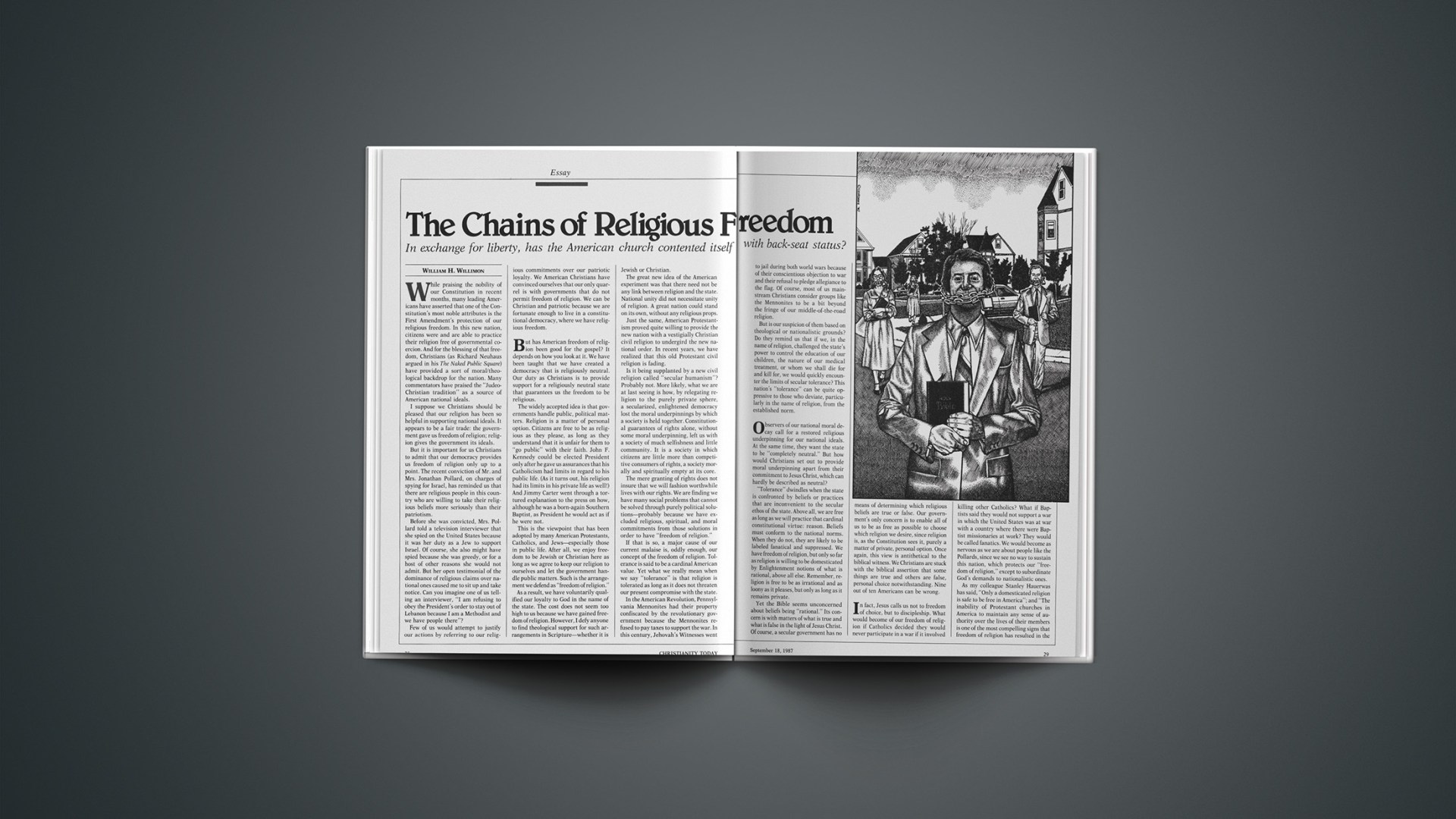
The Chains of Religious Freedom

In exchange for liberty, has the American church contented itself with back-seat status?

While praising the nobility of our Constitution in recent months, many leading Americans have asserted that one of the Constitution’s most noble attributes is the First Amendment’s protection of our religious freedom. In this new nation, citizens were and are able to practice their religion free of governmental coercion. And for the blessing of that freedom, Christians (as Richard Neuhaus argued in his The Naked Public Square) have provided a sort of moral/theological backdrop for the nation. Many commentators have praised the “Judeo-Christian tradition” as a source of American national ideals.

I suppose we Christians should be pleased that our religion has been so helpful in supporting national ideals. It appears to be a fair trade: the government gave us freedom of religion; religion gives the government its ideals.

But it is important for us Christians to admit that our democracy provides us freedom of religion only up to a point. The recent conviction of Mr. and Mrs. Jonathan Pollard, on charges of spying for Israel, has reminded us that there are religious people in this country who are willing to take their religious beliefs more seriously than their patriotism.

Before she was convicted, Mrs. Pollard told a television interviewer that she spied on the United States because it was her duty as a Jew to support Israel. Of course, she also might have spied because she was greedy, or for a host of other reasons she would not admit. But her open testimonial of the dominance of religious claims over national ones caused me to sit up and take notice. Can you imagine one of us telling an interviewer, “I am refusing to obey the President’s order to stay out of Lebanon because I am a Methodist and we have people there”?

Few of us would attempt to justify our actions by referring to our religious commitments over our patriotic loyalty. We American Christians have convinced ourselves that our only quarrel is with governments that do not permit freedom of religion. We can be Christian and patriotic because we are fortunate enough to live in a constitutional democracy, where we have religious freedom.

But has American freedom of religion been good for the gospel? It depends on how you look at it. We have been taught that we have created a democracy that is religiously neutral. Our duty as Christians is to provide support for a religiously neutral state that guarantees us the freedom to be religious.

The widely accepted idea is that governments handle public, political matters. Religion is a matter of personal option. Citizens are free to be as religious as they please, as long as they understand that it is unfair for them to “go public” with their faith. John F. Kennedy could be elected President only after he gave us assurances that his Catholicism had limits in regard to his public life. (As it turns out, his religion had its limits in his private life as well!) And Jimmy Carter went through a tortured explanation to the press on how, although he was a born-again Southern Baptist, as President he would act as if he were not.

This is the viewpoint that has been adopted by many American Protestants, Catholics, and Jews—especially those in public life. After all, we enjoy freedom to be Jewish or Christian here as long as we agree to keep our religion to ourselves and let the government handle public matters. Such is the arrangement we defend as “freedom of religion.” As a result, we have voluntarily qualified our loyalty to God in the name of the state. The cost does not seem too high to us because we have gained freedom of religion. However, I defy anyone to find theological support for such arrangements in Scripture—whether it is Jewish or Christian.

The great new idea of the American experiment was that there need not be any link between religion and the state. National unity did not necessitate unity of religion. A great nation could stand on its own, without any religious props.

Just the same, American Protestantism proved quite willing to provide the new nation with a vestigially Christian civil religion to undergird the new national order. In recent years, we have realized that this old Protestant civil religion is fading.

Is it being supplanted by a new civil religion called “secular humanism”? Probably not. More likely, what we are at last seeing is how, by relegating religion to the purely private sphere, a secularized, enlightened democracy lost the moral underpinnings by which a society is held together. Constitutional guarantees of rights alone, without some moral underpinning, left us with a society of much selfishness and little community. It is a society in which citizens are little more than competitive consumers of rights, a society morally and spiritually empty at its core.

The mere granting of rights does not insure that we will fashion worthwhile lives with our rights. We are finding we have many social problems that cannot be solved through purely political solutions—probably because we have excluded religious, spiritual, and moral commitments from those solutions in order to have “freedom of religion.”

If that is so, a major cause of our current malaise is, oddly enough, our concept of the freedom of religion. Tolerance is said to be a cardinal American value. Yet what we really mean when we say “tolerance” is that religion is tolerated as long as it does not threaten our present compromise with the state.

In the American Revolution, Pennsylvania Mennonites had their property confiscated by the revolutionary government because the Mennonites refused to pay taxes to support the war. In this century, Jehovah’s Witnesses went to jail during both world wars because of their conscientious objection to war and their refusal to pledge allegiance to the flag. Of course, most of us mainstream Christians consider groups like the Mennonites to be a bit beyond the fringe of our middle-of-the-road religion.

But is our suspicion of them based on theological or nationalistic grounds? Do they remind us that if we, in the name of religion, challenged the state’s power to control the education of our children, the nature of our medical treatment, or whom we shall die for and kill for, we would quickly encounter the limits of secular tolerance? This nation’s “tolerance” can be quite oppressive to those who deviate, particularly in the name of religion, from the established norm.

Observers of our national moral decay call for a restored religious underpinning for our national ideals. At the same time, they want the state to be “completely neutral.” But how would Christians set out to provide moral underpinning apart from their commitment to Jesus Christ, which can hardly be described as neutral?

“Tolerance” dwindles when the state is confronted by beliefs or practices that are inconvenient to the secular ethos of the state. Above all, we are free as long as we will practice that cardinal constitutional virtue: reason. Beliefs must conform to the national norms. When they do not, they are likely to be labeled fanatical and suppressed. We have freedom of religion, but only so far as religion is willing to be domesticated by Enlightenment notions of what is rational, above all else. Remember, religion is free to be as irrational and as loony as it pleases, but only as long as it remains private.

Yet the Bible seems unconcerned about beliefs being “rational.” Its concern is with matters of what is true and what is false in the light of Jesus Christ. Of course, a secular government has no means of determining which religious beliefs are true or false. Our government’s only concern is to enable all of us to be as free as possible to choose which religion we desire, since religion is, as the Constitution sees it, purely a matter of private, personal option. Once again, this view is antithetical to the biblical witness. We Christians are stuck with the biblical assertion that some things are true and others are false, personal choice notwithstanding. Nine out of ten Americans can be wrong.

In fact, Jesus calls us not to freedom of choice, but to discipleship. What would become of our freedom of religion if Catholics decided they would never participate in a war if it involved killing other Catholics? What if Baptists said they would not support a war in which the United States was at war with a country where there were Baptist missionaries at work? They would be called fanatics. We would become as nervous as we are about people like the Pollards, since we see no way to sustain this nation, which protects our “freedom of religion,” except to subordinate God’s demands to nationalistic ones.

As my colleague Stanley Hauerwas has said, “Only a domesticated religion is safe to be free in America”; and “The inability of Protestant churches in America to maintain any sense of authority over the lives of their members is one of the most compelling signs that freedom of religion has resulted in the corruption of American Christians, who now believe they have the right religiously to ‘make up their own minds.’ ” Privatization of religion in the name of tolerance has led to the trivialization of religion.

I will admit that none of this is much help in assisting the state in its decisions about the limits of religious expression. I can understand how any state, even the most free and enlightened one (like our own), feels that it must protect its national self-interest. Yet the state must also realize there are times when Christians may feel compelled to transgress what the government may define as its best interests.

Above all, there is no way that Christians can lay aside our very public assertions in arguments about truth and the truthfulness of our claims. Christianity can never be relegated to the purely private and personal good because our religion is inherently political—in the sense that the gospel is, in great part, an argument for the existence of an alternative society, the church.

Almost every Christian claim has political ramifications. A great deal of the New Testament is a debate over how Christians are to relate to the state. After all, Jesus was crucified by those who were nervous that this King and his kingdom would upset the alliance established between Caesar and people who had become accustomed to thinking that the value of religion lay mainly in its ability to help Caesar keep order. If a “fanatical” young Jew had to die in order to preserve social order, it was not too high a price to pay, reasoned Caiaphas.

So we American Christians are right to reenter that debate. What we have to offer the American experiment is not open-minded “tolerance,” or the enforced privatization of a very public sort of faith. Rather, we can offer an account of a polity (the church) that is based upon the conviction that God, not nations, rules the world.

When the United States bombed Libya, I left my office in the university chapel and, on my way out of the building, encountered a group of students who were arguing about the morality of the bombing. One side seemed to think that the bombing was a good idea; the other side thought it was a bad idea. I listened to their increasingly heated debate.

Then one of the students said, “Look, there’s the preacher, let’s ask him what he thinks.”

Their ranks parted and all eyes were on me. “Well,” I said, “it’s hard for me as a Christian to support bombing as the answer to anything. I do not believe that violence is stopped by violence.”

One impudent sophomore said, “Yeah, that’s just what we would have expected you preachers to say. You get all upset when some terrorist murders a little girl in an airport, but then when the President tries to take matters in hand and do something about it, you get all upset because somebody gets hurt. You don’t mind preaching your sermons behind the military umbrella that gives you the freedom to say nasty things about the President.”

In the silence that followed, I knew he was right. I replied, “Okay, what would be a Christian response to this situation?” Receiving no answers, I said off the top of my head, “What if the Methodist Church announced that tomorrow, we were sending a thousand missionaries to Libya. That’s at least a traditional way of the church responding to some international crisis. Let’s say we had realized that people there were in need of the gospel, since Jesus also died for the Libyans. It would be more difficult to bomb the Libyans if you might hit some Methodists having a covered-dish supper there.”

“But you can’t send missionaries over there,” said one of the students.

“I know we can’t,” I admitted. “But why?”

“Because you can’t get a visa to go to Libya,” she said.

“Wrong!” I shouted. “We can’t do that because we no longer have a church willing to pay that kind of price. It’s been a long time since we were willing to do what God commanded despite what the government required. But you let me tell you one thing. There was a time when my church would send people anywhere—Caesar’s visa had nothing to do with it. There was a time when we didn’t need anybody’s permission to preach the gospel.”

I could only walk away wondering. We’ve gotten our freedom to be religious. But what religion is it that we are free to be?

William H. Willimon is minister to the university and professor of the practice of Christian ministry at Duke University. His latest book, with Robert L. Wilson, is Rekindling the Flame: Strategies for a Vital United Methodism (Abingdon Press).

The Divine Deli

The best in theological sandwiches.

HUDSON TAYLOR

The Evangelistic Sandwich

Curried tuna, olives, bell pepper, celery, lettuce, tomato, peanuts.

MARABEL MORGAN

Sweet & Hard to Swallow

Peanut butter, honey, banana.

BILL BRIGHT

Four Spiritual Ingredients

Cream cheese, tomato, sprouts, on a bagel.

DIETRICH BONHOEFFER

It’s Come of Age

Roast beef, cream cheese, tomato, sprouts, on sourdough.

GEORGE ELDON LADD

Sandwich of the Kingdom

Roast beef, tomato, Cheddar, cucumber, on pumpernickel.

GUSTAVO GUTIÉRREZ

A Liberating Sandwich

Beef mix, Cheddar, lettuce, tomato, sour cream, & salsa.

C. S. LEWIS

The Mere Sandwich

Tomato, sprouts, cucumber, lettuce, on whole grain.

SAINT FRANCIS

A Humble Sandwich

Provolone, tomato, sprouts, cucumber, on whole grain.

JOHN WESLEY

The Perfect Sandwich

Swiss, provolone, tomato, sprouts, on whole grain.

REINHOLD NIEBUHR

A Sandwich of Light and Darkness

Cheddar, provolone, tomato, cucumber on sourdough and pumpernickel.

HANS KÜNG

On Being a Sandwich

Swiss, Cheddar, tomato, lettuce, on rye.

JONATHAN EDWARDS

Hot From an Angry Microwave

Provo, Swiss, tomato, cucumber, sprouts, on a bagel.

RUDOLF BULTMANN

Demythologized

Turkey, Swiss, sprouts, cucumber, on pumpernickel.

HARVEY COX

The Secular Sandwich

Turkey, cream cheese, tomato, sprouts, on a bagel.

BOB JONES

A Pure Sandwich

Turkey, cream cheese, tomato, sprouts, on sourdough.

JOHN CALVIN

Made for Two Lips

Ham, Swiss, tomato, lettuce, on a French roll.

HAROLD LINDSELL

The Inerrent Sandwich

Ham, cheddar, sprouts, cucumber, on rye.

GEORG HEGEL

Dialectably Delicious

Ham, provo, tomato, cucumber, on pumpernickel.

JACQUES ELLUL

The Meaning of the Sandwich

Ham, cream cheese, tomato, sprouts, on a French roll.

KARL BARTH

A Sandwich in Outline

Ham, Swiss, tomato, cucumber, on rye.

The best in theological sandwiches as they are described on the menu board posted in The Catalyst, the snack bar at Fuller Theological Seminary.

Theology

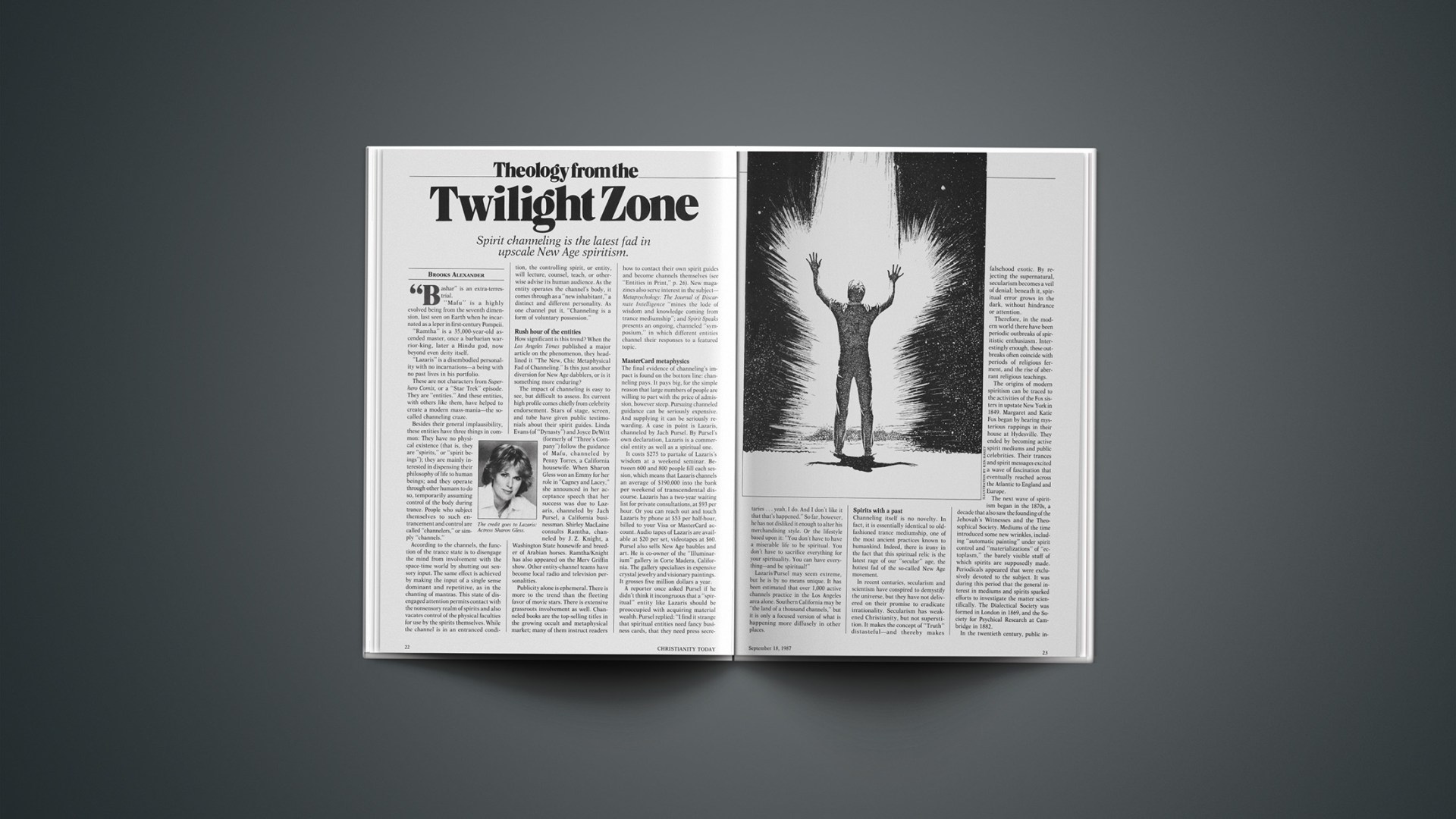
Theology from the Twilight Zone

Spirit channeling is the latest fad in upscale New Age spiritism.

“Bashar” is an extra-terrestrial.

“Mafu” is a highly evolved being from the seventh dimension, last seen on Earth when he incarnated as a leper in first-century Pompeii.

“Ramtha” is a 35,000-year-old ascended master, once a barbarian warrior-king, later a Hindu god, now beyond even deity itself.

“Lazaris” is a disembodied personality with no incarnations—a being with no past lives in his portfolio.

These are not characters from Superhero Comix, or a “Star Trek” episode. They are “entities.” And these entities, with others like them, have helped to create a modern mass-mania—the so-called channeling craze.

Besides their general implausibility, these entities have three things in common: They have no physical existence (that is, they are “spirits,” or “spirit beings”); they are mainly interested in dispensing their philosophy of life to human beings; and they operate through other humans to do so, temporarily assuming control of the body during trance. People who subject themselves to such entrancement and control are called “channelers,” or simply “channels.”

According to the channels, the function of the trance state is to disengage the mind from involvement with the space-time world by shutting out sensory input. The same effect is achieved by making the input of a single sense dominant and repetitive, as in the chanting of mantras. This state of disengaged attention permits contact with the nonsensory realm of spirits and also vacates control of the physical faculties for use by the spirits themselves. While the channel is in an entranced condition, the controlling spirit, or entity, will lecture, counsel, teach, or otherwise advise its human audience. As the entity operates the channel’s body, it comes through as a “new inhabitant,” a distinct and different personality. As one channel put it, “Channeling is a form of voluntary possession.”

Rush Hour Of The Entities

How significant is this trend? When the Los Angeles Times published a major article on the phenomenon, they headlined it “The New, Chic Metaphysical Fad of Channeling.” Is this just another diversion for New Age dabblers, or is it something more enduring?

The impact of channeling is easy to see, but difficult to assess. Its current high profile comes chiefly from celebrity endorsement. Stars of stage, screen, and tube have given public testimonials about their spirit guides. Linda Evans (of “Dynasty”) and Joyce DeWitt (formerly of “Three’s Company”) follow the guidance of Mafu, channeled by Penny Torres, a California housewife. When Sharon Gless won an Emmy for her role in “Cagney and Lacey,” she announced in her acceptance speech that her success was due to Lazaris, channeled by Jach Pursel, a California businessman. Shirley MacLaine consults Ramtha, channeled by J. Z. Knight, a Washington State housewife and breeder of Arabian horses. Ramtha/Knight has also appeared on the Merv Griffin show. Other entity-channel teams have become local radio and television personalities.

Publicity alone is ephemeral. There is more to the trend than the fleeting favor of movie stars. There is extensive grassroots involvement as well. Channeled books are the top-selling titles in the growing occult and metaphysical market; many of them instruct readers how to contact their own spirit guides and become channels themselves (see “Entities in Print,” p. 26). New magazines also serve interest in the subject—Metapsychology: The Journal of Discarnate Intelligence “mines the lode of wisdom and knowledge coming from trance mediumship”; and Spirit Speaks presents an ongoing, channeled “symposium,” in which different entities channel their responses to a featured topic.

Mastercard Metaphysics

The final evidence of channeling’s impact is found on the bottom line: channeling pays. It pays big, for the simple reason that large numbers of people are willing to part with the price of admission, however steep. Pursuing channeled guidance can be seriously expensive. And supplying it can be seriously rewarding. A case in point is Lazaris, channeled by Jach Pursel. By Pursel’s own declaration, Lazaris is a commercial entity as well as a spiritual one.

It costs $275 to partake of Lazaris’s wisdom at a weekend seminar. Between 600 and 800 people fill each session, which means that Lazaris channels an average of $190,000 into the bank per weekend of transcendental discourse. Lazaris has a two-year waiting list for private consultations, at $93 per hour. Or you can reach out and touch Lazaris by phone at $53 per half-hour, billed to your Visa or MasterCard account. Audio tapes of Lazaris are available at $20 per set, videotapes at $60. Pursel also sells New Age baubles and art. He is co-owner of the “Illuminarium” gallery in Corte Madera, California. The gallery specializes in expensive crystal jewelry and visionary paintings. It grosses five million dollars a year.

A reporter once asked Pursel if he didn’t think it incongruous that a “spiritual” entity like Lazaris should be preoccupied with acquiring material wealth. Pursel replied: “I find it strange that spiritual entities need fancy business cards, that they need press secretaries … yeah, I do. And I don’t like it that that’s happened.” So far, however, he has not disliked it enough to alter his merchandising style. Or the lifestyle based upon it: “You don’t have to have a miserable life to be spiritual. You don’t have to sacrifice everything for your spirituality. You can have everything—and be spiritual!”

Lazaris/Pursel may seem extreme, but he is by no means unique. It has been estimated that over 1,000 active channels practice in the Los Angeles area alone. Southern California may be “the land of a thousand channels,” but it is only a focused version of what is happening more diffusely in other places.

Spirits With A Past

Channeling itself is no novelty. In fact, it is essentially identical to old-fashioned trance mediumship, one of the most ancient practices known to humankind. Indeed, there is irony in the fact that this spiritual relic is the latest rage of our “secular” age, the hottest fad of the so-called New Age movement.

In recent centuries, secularism and scientism have conspired to demystify the universe, but they have not delivered on their promise to eradicate irrationality. Secularism has weakened Christianity, but not superstition. It makes the concept of “Truth” distasteful—and thereby makes falsehood exotic. By rejecting the supernatural, secularism becomes a veil of denial; beneath it, spiritual error grows in the dark, without hindrance or attention.

Therefore, in the modern world there have been periodic outbreaks of spiritistic enthusiasm. Interestingly enough, these outbreaks often coincide with periods of religious ferment, and the rise of aberrant religious teachings.

The origins of modern spiritism can be traced to the activities of the Fox sisters in upstate New York in 1849. Margaret and Katie Fox began by hearing mysterious rappings in their house at Hydesville. They ended by becoming active spirit mediums and public celebrities. Their trances and spirit messages excited a wave of fascination that eventually reached across the Atlantic to England and Europe.

The next wave of spiritism began in the 1870s, a decade that also saw the founding of the Jehovah’s Witnesses and the Theosophical Society. Mediums of the time introduced some new wrinkles, including “automatic painting” under spirit control and “materializations” of “ectoplasm,” the barely visible stuff of which spirits are supposedly made. Periodicals appeared that were exclusively devoted to the subject. It was during this period that the general interest in mediums and spirits sparked efforts to investigate the matter scientifically. The Dialectical Society was formed in London in 1869, and the Society for Psychical Research at Cambridge in 1882.

In the twentieth century, public interest in spiritism has continued to rise and fall in cycles. The appetite for spirit contact increases after each major war. Spiritism often has its strongest attraction for those who have suffered personal bereavement, and after a war it always gains in appeal and credibility.

Today we live in an age of continual war—multiple, overlapping conflicts that have interruptions, but no end. Death dominates the headlines, and loss overshadows our lives. In an age that daily faces mass extinction from pestilence, pollution, and nuclear war, it is no wonder that the spirits are back and busier than ever.

The Modern Outburst

It is clear we are now in the midst of another major outbreak of spiritism. The spirits are not only more active than before, but in our biblically illiterate society, they are finding more people who are eager to lend them an ear. An expanding audience not only believes in them, it also believes them; it not only accepts their existence, it accepts their guidance as well.

To the casual observer, this renewed fascination with spirits and spirit contact seems to have exploded into prominence without warning. The mass media uniformly treat channeling as a fringe phenomenon that swelled to fad status overnight. Public perception was brought to instant focus in January of this year, when ABC-TV aired Shirley MacLaine’s miniseries based on her own experience with channelers and entities: “Out on a Limb” was a startling, prime-time testimonial to MacLaine’s occult conversion and her belief in spirit guides. Suddenly the subject intruded on our collective attention.

But that impression of suddenness is a media-projected illusion. The unnoticed reality is that spiritism has been steadily working its way into the mainstream of American culture for the last 20 years. The disturbing reality is that channeling is just the tip of an iceberg, the visible part of a much larger pattern. The sobering reality is that the new spiritism has moved beyond the weird and the supernatural into the normal and the mundane. Quietly but convincingly, the entities have been serving notice that they intend to shape our future.

What will their influence be? Assuming (for the moment) that the new spiritism will have a noticeable effect on our culture, what form is it likely to take? When that influence becomes concrete reality, what will it look like?

Teachings From The Twilight Zone

The entities’ primary tool is their teaching. They will mainly affect our collective psyche, the presuppositions of our popular world view. In simple language, fans of channeling adopt the understanding of God and reality that the entities teach them.

Just as mediumship is no novelty, neither is there anything new in the beliefs that attend it. From ancient times, spiritism has consistently been the source of communications that embody the essence of occult philosophy: Death is unreal; All is One; we are Divine Beings and can control Reality with our powers of Mind. It hardly needs pointing out that this glittering vision of possibilities bears a striking resemblance to the serpent’s temptation of Eve in the Garden of Eden. The entities give us no additions to that agenda of deception. What they give us is a new aggressiveness in pushing it, and a new use of high-tech tools to push it with.

The entities endlessly repeat the three-fold primal lie: There is no death; man is God; knowledge of self is salvation and power.

Shirley MacLaine’s TV miniseries was a virtual occult catechism. In one breathtakingly blatant scene, MacLaine is initiated into the understanding that Divine Being and the Human Soul are one. She and her spiritual adviser stand on Malibu Beach with their arms flung open to the cosmos, shouting, “I am God! I am God! I am God!”

When Ramtha channeled in to the “Merv Griffin Show” in October of 1985, Merv wanted to know, “What is your most important message that you want everyone on this planet to hear?” Ramtha replied, “What is termed God is within your being.… And that which is called Christ is within your being.… And when you know you are God, you will find joy.”

Equally egregious examples can be culled from a random scanning of channeled material. The denial of death is a dominant theme, always implied and often expressed. The entities endlessly repeat the primal lie, the three-fold creed of error: There is no death; man is God; knowledge of self is salvation and power.

Today, that message is merchandised. Both message and messenger are commodities, items of commerce to be packaged, promoted, and sold. The spirits have always been marketable, but the size of that market has been strictly limited. When spiritism reaches a critical mass of popularity, it graduates to a new level of commerce and becomes mass-marketable. In this way it roots itself in the very foundations of our consumer society. That in itself represents a quantum leap from the days when believing in spirits and going to seances was considered eccentric at best.

Today’s spiritism, in contrast to that of the past, has enormous commercial potential, and commerce controls the shape and direction of mass culture. In his book Masks of Satan, Christopher Nugent says, “The Moloch of consumerism is king, and the first thing it consumes is conscience.… As the idols descend we have a convergence of the culture and the occult, a kind of ‘occulturation.’ … I would conclude that our culture may be becoming so demonic as to render particular cults redundant and superfluous.”

Nugent’s conclusion may seem overstated. But in view of the open merger of spirit contact, occult philosophy, mass media, and high finance, it hardly seems fanciful.

Biblical Meanings: Delusion And Judgment

Channeling is part of a larger trend that is intensifying and will probably continue to do so. It is easy to see why. Spiritism’s powerful appeal caters simultaneously to the modern state of mind and fallen human nature. Spirit contact fits perfectly into the jiffy-solution mentality of our day. It’s quick. It’s morally undemanding. And above all, it provides a strong, immediate experience of the “beyond” to substitute for our alienation from God.

Spiritism, therefore, accelerates the process of spiritual decline toward apostasy and judgment, for it involves not only a rejection of God, but an active embrace of his replacement. It is, as the prophets put it, “spiritual adultery,” carried to completion. The biblical language that deals with spiritism is a litany of loathing: It is called evil, error, folly, falsehood, apostasy, and abomination (see, for example, Deut. 18:9–14 and Rev. 21:15). In the Old Testament, those who indulge in it are considered defiled and deserving of exile or death. In the New Testament, spiritists are identified as opposers of the gospel and enemies of the truth.

The Bible treats spiritism as a symptom of social corruption as well as of personal culpability. The extent to which a society endorses or indulges in spiritism, therefore, is a spiritual thermometer. As a social symptom, widespread spiritism represents the final stage of a long process of spiritual decay. It is the terminal phase of a people’s flight from God—terminal because beyond a certain advanced stage in the development of any sin, God’s judgment is no longer intended to admonish or correct, but to cleanse and extirpate. Terminal conditions call for termination.

Back To The Future, Forward To The Past

In that light alone, the current goings on have an urgent relevance to our lives. Christ exhorted us to “discern the signs of the times” (Matt. 16:3). Part of that discernment comes from understanding the spiritual currents of the age.

The new spiritism is only one of many tributary streams in the rising flow of occult influence. It is only one of many means by which the basic message is drummed into the popular mind. It has less significance in its own right than it does as a representative symptom—a milestone on the road to delusion.

Western culture seems to be relapsing once again into the spiritual and intellectual condition of ancient Rome. Franz Cumont’s Astrology and Religion Among the Greeks and Romans describes the crumbling classical world in terms that are indistinguishable from the New Age Movement’s vision of the future: “In the declining days of antiquity the common creed of all pagans came to be a scientific pantheism, in which the infinite power of the divinity that pervaded the universe was revealed by all the elements of nature.” If channeled New Age Occult Cosmic Humanism is the wave of the future, it is only because it has always been the way of the world.

Brooks Alexander is senior researcher at the Berkeley, California-based Spiritual Counterfeits Project. This article is based on research in progress for a book-length manuscript to be completed this fall.

Are The Entities For Real?

What is the nature of channeled entities? Are they objectively real, but disembodied beings that exist in some ethereal realm?

There seem to be four basic options: (1) the entities are real and are telling us the truth about themselves; (2) the entities are real and are lying to us; (3) the entities are a “dissociative reaction,” a mental dysfunction unrecognized as such; (4) the entities are a conscious fraud for the purpose of gain.

We can eliminate option (1) because the entities’ claims are plainly at odds with the biblical view of reality. In fact, many entities explicitly reject the Bible’s message of sin and salvation.

It has been suggested that a channel splits off part of his unconscious mind into a separate personality, which in turn is manipulated by an entity. That explanation has the virtue of covering all the bases. It allows for real entities as well as real pathology. It also illustrates that deception is basic to the channeling process, since the entities themselves have encouraged a very different view of their nature.

Thus, the full answer to our question could involve options (2), (3), and (4) at various times and in various combinations. After all, deception and derangement are basically variations on the demonic theme. We should not be surprised to see them turn up as items on the demonic agenda.

We would naturally expect channels to insist on the objective reality of their entities. Some do, but others are curiously ambivalent. Jach Pursel says, “I suppose Lazaris could be a different part of me, a ‘higher’ part of me or something. And, ultimately, I’d say, well, if you want to think that, fine. Because what really matters is the value you gain from it. And if talking to another part of me can help you improve your life, then have at it.”

That airy indifference to matters of factual accuracy apparently rubs off on followers. A successful corporate executive who lives in California’s trendy Marin County says, “I can’t say that Lazaris is really a disembodied spiritual guide. To me it doesn’t matter, as long as he’s truthful and helpful.” Ram Das (né Dr. Richard Alpert) is one channeling fan who is also a psychologist, and therefore should be able to evaluate the phenomenon. But he, too, uses his confusion about the facts as an excuse to avoid the issue of interpretation. Writing about “Emmanuel,” an astral-plane entity channeled by East Coast housewife Pat Rodegast, Ram Das says: “From my point of view as a psychologist, I allow for the theoretical possibility that Emmanuel is a deeper part of Pat. In the final analysis, what difference does it really make? What I treasure is the wisdom Emmanuel conveys.”

Ram Das is correct—in one sense. In the final analysis, it is the “wisdom” that counts, not the bearer of it. The wisdom of the entities—whoever or whatever they are—is the “earthly, natural, demonic” wisdom of James 3:15. That is enough to identify the phenomenon regardless of who the messenger is. As Robert Burrows, editor of publications for Spiritual Counterfeits Project, has pointed out, real entities do not have to be channeled for real lies to be told or real damage to be done. Satan’s purposes can be served without directly serving him or making direct contact with spirits who do. It doesn’t always take a devil to do the Devil’s work.

In that respect, as strange as it may seem, it does not matter whether entities exist objectively or not. The runaway popularity of a flagrantly demonic message is cause enough for concern.

By Brooks Alexander.

Entities In Print

“Automatic writing” is doubtless as old as the alphabet. The spirits have always been prolific authors. Every generation has its own form of channeled writing, and ours has the most lavish variety to date.

The current wave of channeled publications was set in motion by the late Jane Roberts. During the early 1970s, Roberts was channel for the entity “Seth,” author of Seth Speaks and numerous other books. Today hundreds of people claim to be channels for Seth.

The Seth books were a milestone because they were produced by Prentice-Hall, a respected general-market publisher. Earlier spirit scribes had mostly been printed by obscure specialty houses. When the Seth venture proved successful, more such writings began to appear from major publishers.

Authors also published spirit-dictated material under their own names. Jonathan Livingston Seagull was dictated to Richard Bach by an entity that appeared in the form of a bird. Bach claims that he simply wrote down the stream of thoughts and impressions that the entity poured into his mind. The book broke all publishing records since the legendary success of Gone With the Wind, and topped the best-seller lists for over two years.

The entity-authors of the eighties are a diverse lot, even if their message is redundant. “Jesus” himself is claimed as the source of A Course in Miracles, a three-volume work that uses biblical terminology to distort biblical doctrine. The disciples of Jesus are also popular writers, especially “Saint John.” Other literary entities include “Raphael,” an extraterrestrial; “Ra,” an ancient Egyptian; and “White Eagle,” a Native American. There are travelers from other planets, dwellers in other dimensions, denizens of ancient and lost civilizations, and the very gods themselves. And now there is Messages From Michael, written by a collective entity: “not a ghost, not a spirit, but an amassing of souls on a higher plane of existence.” Shades of “Legion” (Mark 5:9)!

The sheer number of titles in print today is unprecedented. The major New Age/Occult bookstore in Berkeley has seven shelves of channeled material. Three of those shelves hold the “older” books—the Urantia Book, the Aquarian Gospel, the works of Edgar Cayce, and so on. The remaining four shelves hold more recently published material. Those four shelves outsell the rest of the bookstore.

That’s not a mere publishing trend; it’s a stampede.

By Brooks Alexander.

Under Fire

Two Christian leaders respond to accusations of New Age mysticism.

Recent best-selling books assert that a number of Christian leaders have been unduly influenced by the Eastern philosophy of the New Age movement. Two of the most popular titles expressing such reservations are Constance Cumbey’s The Hidden Dangers of the Rainbow and Dave Hunt and T. A. McMahon’s The Seduction of Christianity.

In our May 16, 1986, issue, Robert Burrows detailed the complicated ins and outs of the New Age movement. Writing about certain practices sometimes considered New Age, Burrows addressed the concerns of Cumbey, Hunt, and other critics. “Is it possible to use guided imagery and relaxation exercises as aids to worship?” he asked. “Is it possible to use them to communicate with God or receive revelations from him? Or do those who use these techniques inevitably fall into magical manipulation and spiritual idolatry?”

Any number of writers—including John and Paula Sandford, Morton Kelsey, and Ruth Carter Stapleton—have been criticized for their apparent affinities with New Age ideas. No single treatment can deal with all these writers and the serious concerns raised about their work. Consequently, CHRISTIANITY TODAY chose to discuss the matter with two evangelical writers who have been involved in the New Age controversy. Richard Foster, the author of several books, including Celebration of Discipline, has come under fire for his recommendations concerning Christian meditation and the use of the imagination in spiritual exercises in general. David Seamands, whose books include Healing of Memories, has been criticized for using the therapy of inner healing and relying heavily on imaginative scenarios to rid counselees of trauma from past incidents.

Also participating in the discussion were two respected observers of the New Age movement: James Sire, senior editor of InterVarsity Press and author of such books as Scripture Twisting, and Eric Pement, associate editor of Cornerstone magazine.

Visualization

Common to meditation, inner healing, and other practices that give pause to some writers is visualization. “Remember,” write Hunt and McMahon, “we are not addressing the many valid uses of the imagination, such as visual images used by artists, architects, or ordinary persons in ‘seeing’ what is being described, remembering, or rehearsing in their minds.” Instead, Hunt and McMahon believe visualization is sometimes intended to “manipulate reality or evoke the appearance and help of Deity.” That kind of visualization, they say, must be avoided.

Eric Pement : Are visualization exercises biblical?

James Sire : Visualization itself is certainly biblical. The psalmists visualized all the time. Look at Psalm 77, for instance. “I will call to mind the deeds of the Lord, I will remember thy wonders of old.” Then a few verses later: “The clouds poured out water; the skies gave forth thunder; thy arrows flashed on every side.” Those are pictures. Psalm 29 and 46 are two other psalms, among many, that do the same thing. So it seems to me that there is a biblical basis for our picturing things.

David Seamands : Visualization is simply and basically human. How could you remember events, for example, without pictures? Human beings can’t stop visualizing any more than they can stop breathing or sleeping. But it’s true that visualization can be used for New Age practices. What we must do is visualize constructively and biblically.

Pement : Yet there’s an important difference between thinking or remembering, which involves mental images, and dwelling on those images for their own sake, believing that thought forms by themselves will bring things into being. Images are unavoidable—God put us in a three-dimensional world and gave us the ability to think in three dimensions. On the one hand, we can visualize to recall God’s grace and mighty deeds, and to see ourselves as God sees us. On the other hand, the New Agers have co-opted visualization because they believe the universe is a form of consciousness, and reality exists by common consent.

Would you say visualization gives us access to God? If so, is it a necessary means of access to God, or can the reality of the divine presence be acquired through other means as well?

Richard Foster : When you ask if it gives us “access to God” I assume you are asking if it can be a means of grace through which God can reach us. In that sense I would say visualization is a means of grace—but not a “necessary means.” The study of Scripture, prayer, worship—these would be examples of what could be more accurately called a “necessary means.” The Bible gives these things a high priority and universal application.

Pement : How would this square with the biblical teaching that we receive access to God through faith, because of the atoning blood of Jesus?

Sire : Richard and Eric are speaking in different categories. Eric is talking about the grounds of our access to God, which, we would all agree, is the atoning blood of Christ. Richard is talking about how we practice or appropriate that access to God, once we confess Christ. We’re mixing the justifying access, the grounds, with the sanctifying process of growth. The means of grace are not the grounds of our access to God.

Foster : Exactly! We are saved by grace through faith. There is no other way. But once we are believers we must answer the question of how we grow in Christ. Remember, Peter said, “Grow in the grace and knowledge of our Lord and Savior Jesus Christ,” and frankly, many people try to replace growth with birth. Because we have no theology of spiritual growth we get people born again and again and again.

Now, we have problems with a theology of spiritual growth because of our deep concern about works righteousness, which we should be deeply concerned about. But is there a way that Christians can grow that does not violate sola fide? Most of us have accepted Bible study, for example, as a part of the theology of growth. But I think we need to go a lot deeper into this matter of growing in the grace and knowledge of Jesus Christ. We must, for example, help each other learn exactly how we are conformed to the image of Christ, as Paul says in Romans 8. And we must do that in the context of daily life. In other words, our theology must confess that we are not only saved by grace, we live by it as well.

Meditation

Some kinds of meditation are based on what Constance Cumbey calls the “old lie” of finding “the god within.” To prevent such dangers, some Christian writers have emphasized that Christian meditation should be rational or cognitive—based on objective ideas and historical events. They are concerned about forms of meditation that freely employ the imagination, which is subjective and so less easily controlled than cognition. On similar grounds, they worry about meditative techniques that employ controlled breathing (for relaxation) and visualization.

There are evangelical precedents for using visualization in meditation—consider Alexander Whyte and some of the Puritan divines.

Richard Foster

Pement : I see a distinction between two kinds of meditation—cognitive meditation and mystical or contemplative meditation. How do you respond to this distinction?

Foster : I can understand and appreciate the concern that leads to this distinction, but its great weakness is that it is simply not biblical. It creates a false definition of meditation, because it neglects one of the most important biblical emphases about meditation, namely ethical transformation. Repentance, turning to God and changing our behavior in obedience, is central to biblical meditation.

Christian meditation is not a matter of simply gazing blissfully at your navel. Nor is it just a matter of memorizing the Gospel of John. It leads directly to obedience. We are to hear God’s voice and obey his word. Consider Psalm 119: “I will meditate on your precepts and consider your ways. I delight in your decrees; I will not neglect your word” (vv. 15–16).

Seamands : The cognitive-contemplative distinction also falsely splits the whole person. It sounds as if contemplative meditation is all feeling, and cognitive meditation is all rationality. Scripturally, it’s impossible to separate feeling and rationality. The biblical person listens to God with mind and heart. The “eyes of your heart are enlightened” (Eph. 1:18); a man “thinks in his heart” (Ps. 10).

Sire : Ed Clowney, the former president of Westminster Seminary, has written that Christian meditation differs from non-Christian meditation “not in the absence of the intuitive, but in the presence of the rational.” So even someone as impeccably conservative as Clowney can affirm both the rational and the intuitive, the mind and the heart.

Seamands : Focusing on either heart or mind to the exclusion of the other is a mistake. Church history can be divided between the two extremes, with one bringing on the other. When we lose the wholeness of our personhood under God, then we become very cognitive—salvation becomes simple mental assent to a bunch of propositions—or we go off to the extreme of uncontrolled ecstasies, visions, and so forth.

Pement : But the fear, of course, is that some of this is coming from Eastern mysticism and other non-Christian sources.

Sire : The “new” and supposedly Eastern techniques of meditation only seem new because the church has lost touch with its rich spiritual heritage. We have lost contact with the entire church before the Reformation. And now we are getting back in contact with that heritage, partly in reaction to the stress on rationality in the twentieth century and in twentieth-century Protestant thought. More important, we are re-examining the Scriptures and asking what we may have forgotten.

Agnes Sanford described a process in which you find a blemish on your body and imagine it a quarter of an inch smaller or a lighter color. To me, that smacks of psychic experimentation.

Eric Pement

Foster : I would add that the precedents for using our imagination are not only to be found in pre-Reformation times. There are Protestant evangelical sources as well, such as the nineteenth-century Scottish preacher Alexander Whyte.

On the subject of praying and meditating, he writes of using the “truly Christian imagination” to imagine yourself hearing and watching Jesus preach, seeing a leper healed, or actually being Lazarus in his grave, Mary Magdalene, Peter, Abraham, Job, the thief on the cross, and even Judas. He says the New Testament should come to be “autobiographic of you.”

Whyte was a highly esteemed orthodox Protestant, not a New Ager. But you can see that he had plenty of room for using the imagination, which he called a “magnificent talent.” And there are many other examples, including some of the Puritan divines.

But we must remember that the imagination is not an unmixed blessing. It has been affected by the Fall, just like all our other faculties. The Devil would like to use our imagination to work his evil purposes, and we always must guard against that. The imagination, just like all our faculties, needs to be redeemed and sanctified by God for his good purposes.

Pement : My problem isn’t with meditation as it is biblically defined, but with techniques currently used by some teachers within Christian circles. These techniques include breathing exercises, using a Christian mantra, guided fantasy, and (in a few notable cases) yoga exercises. Eastern religions have traditionally promoted such disciplines. The Eastern idea is that salvific enlightenment is gained through these meditative techniques. What about this in Christian meditation?

Foster : Personally, I have very little interest in technique, but a great deal of interest in helping people come into relationship with God. Specific suggestions are helpful only to the extent that they bring us more fully into relationship so that we behold the “glory of God in the face of Christ” (2 Cor. 4:6). It makes a difference where one looks. Christians look beyond themselves to a transcendent God. In Hinduism and some other Eastern religions, the meditating person looks to a “god” who is not transcendent, only immanent.

Seamands : In addition, when we Christians meditate we do not intend to submerge our identities into that of an impersonal God. “I am crucified with Christ. Nevertheless I live” (Gal. 2:20). I’m not going to be absorbed as the drop of water returns to the ocean. My personhood will never be destroyed, but will eternally fellowship with a personal God.

I was a missionary to India, and the massive umbrella of pantheistic and monistic Hinduism was a tremendous challenge. It made me an absolute fanatic on Jesus Christ. The one place that I’m not going to budge is on the Incarnation, because I see the tremendous importance of it. “Whether the Krishna existed or not,” says my Hindu friend, “that’s not important. It’s the Krishna ideal that matters, so therefore it’s the Christ ideal that matters. Whether or not Christ existed is not important.”

To that I would and did say, “No, we’re not talking about the same thing. Whether Christ exists or not is not just important. It’s absolutely paramount.”

Inner Voices

New Agers seek guidance from within. Techniques such as Silva Mind Control (a consciousness-raising technique named after its originator, Jose Silva) teach one how to obtain a certain state of relaxation, then to listen to the advice of an inner guide. The inner guide is sometimes considered a spirit and sometimes simply a manifestation of the subconscious. Protests Don Matzat (in his Inner Healing: Deliverance or Deception?), “The same technique of visualization used to allegedly encounter Jesus is used in occultism for the purpose of contacting spirit guides.

Pement : Techniques such as Silva Mind Control teach one how to obtain a certain state of relaxation, then to listen to the advice of an inner guide. And similar things are being done in the church. I have a friend who attended a youth group meeting and ended up participating in something very much like Silva Mind Control. What do you think of such exercises?

Foster : My response would be that there are a lot of spirits out there, and they are not all good. The Bible teaches there is a spirit world, that there are angels and demons. And we need to realize that Satan and his cohorts are out to destroy us. Jesus said that he is the true Shepherd and his sheep know his voice. The sheep, you see, need to come to know the difference between the Shepherd’s voice and Satan’s voice. We’re told in 1 John, “Do not believe every spirit, but test the spirits to see whether they are of God.” And in 1 Thessalonians, the apostle Paul says, “Do not quench the Spirit, do not despise prophesying, but test everything; hold fast what is good, abstain from every form of evil.”

Seamands : We test the spirits and these inner voices against the written Word of God and the living Christ. The Holy Spirit can never ask you or me to do anything that is un-Christlike. Chapters 14; 15, and 16 of the Gospel of John make it clear that things truly of the Spirit of God will, first, glorify God. They will not glorify the person who testifies to them. Second, things of the Spirit of God will bear the fruit of the Spirit. The gifts of the Spirit can be counterfeited, as Paul indicates. But not the fruit, because the fruit of the Spirit is simply another way of describing the character of Jesus. That’s the litmus test of any inner voice.

Sire : Practically speaking, there’s another aspect to testing the reliability of an inner voice. That is the counsel of Christians whom you trust for their spiritual wisdom and discernment, as well as the communion of saints in the larger sense—the traditional understandings of the church through history.

Pement : Then you would agree that it is a mistake to presume that the voice of the subconscious is the voice of God?

Foster : That is correct! While God can use the subconscious (just like he can use all our faculties as they are submitted to him), the subconscious in and of itself is not reliable. Satan also can influence and use the subconscious.

Inner Healing

Inner healing (or healing of memories) is the counseling device of visualizing traumatic incidents from one’s past, but adding such therapeutic touches as the image of Jesus comforting the person at the time of the trauma. This is intended to lessen the hurt of the memory, and so to “heal” it. Hunt and McMahon say inner healing is based on faulty, non-Christian psychotherapies. They fear it confuses what actually happened in the past with what is only imagined in the present. Thus, “Inner healing is simply a Christianized psychoanalysis that uses the power of suggestion to ‘solve problems’ which it has oftentimes actually created.”

Pement : Isn’t a problem with inner healing that Christians can be prone to believe that if we have a better picture, a clearer thought, then we’ll be healed? For instance, Agnes Sanford, in The Healing Light, described a process in which you find a blemish on your body, and instead of praying for it to go away, imagine that blemish a quarter of an inch smaller or a lighter color. Experiment with the different pictures that you have and see how quickly it changes, she advised. To me, that smacks of psychic experimentation.

Sire : But the idea that God responds better to a better image is not different from the notion that God is more likely to hear an eloquent prayer than a stumbling, mumbling one. The truth in both instances is this: It is not our eloquence that gets God’s attention. It is the honesty and integrity of our prayers—and whether they reflect the mind of Christ—that God responds to. As best we can, we should discern the mind of Christ and then pray with honesty and integrity, and image with honesty and integrity.

Pement : Much of the mystique or appeal of inner healing is the idea that, since the triune God is eternal and is not bound by time, Jesus has been present at all times, and therefore we can relive a past event in his presence. Are inner-healing ministries trying to engage in some kind of celestial time travel?

Seamands : No. We’re merely exposing to Christ a memory that is in our past. We don’t do any traveling in time, but if he is the transcendent Lord of time, the past is present to him so that he can heal and free us from it.

Pement : Does he really deal with the incident, or does he rather deal with our responses to the incident?

Seamands : He deals with our memory of the incident. If my perception of my personal history was that something done to me was very hurtful, then I cannot separate my perception and my feelings of that event from the actual incident.

Let’s say there’s been sexual abuse in my past. That’s an extremely harmful incident, and there’s a lot of pain connected with it, pain that I have probably repressed. I could have repressed the memory of the whole thing. And that’s the thing that causes personality problems. The memory is repressed and the feeling is repressed. But repression is like trying to bury something alive. It keeps coming back to haunt you.

So what I do is ask the counselee to go back to that incident, when he or she was a little boy or a little girl, and to think of him-or herself in the arms of Jesus, being comforted by Jesus. I’m very strong on using biblical imagery.

Foster : What David is talking about is similar to the rehearsal of God’s redemptive acts. Israel was called to remember God’s great deliverance in the Exodus. And in our worship, every time we participate in the Lord’s Supper, we recall Jesus’ death on the cross for our sin. We receive, with thanksgiving, the forgiveness and healing that resulted from Christ’s death and resurrection.

Seamands : Absolutely. The crux of the matter, for the healing of memories, is appropriating forgiveness. And that means forgiveness of the one who wronged me, and forgiveness of me for desiring revenge.

Pement : Critics of inner healing have said there is sometimes an attempt to change something unholy into something holy, something evil into something good. Do you agree?

Seamands : An act that was evil, such as sexual abuse, cannot itself be altered into something good. But we can say with Joseph, “You meant it for evil, but God meant it for good.” So, a part of the healing of the memories is always a reinterpretation of the past.

Sire : We can re-understand the past, which we have wrongly interpreted. The goal is actually to see the past as God sees it.

Seamands : Yes, which is to turn it into something that’s no longer an infirmity that cripples you. God is now going to use it as a means of you ministering to other people. It’s going to become a gift, actually. This is one of the greatest things that happens to people. I once worked with a seminary woman who had been sexually abused as a child. She was dramatically changed. She went back home to her family and was able to be a means of healing for her mother, who was abused by an uncle, and for her 85-year-old grandmother, who was abused by a great-great uncle. So she brought healing to an entire family.

But it’s not a matter of pretending the original event didn’t happen or that it wasn’t evil. The first part of counseling is convincing the hurt person that an evil thing was done to him or her. They need to stop excusing it and stop taking the blame themselves. It has to be seen for what it was before God can change their perception of it and free them from it.

Foster : David’s concern is pastoral. Those who are uncomfortable with using the imagination just want him to declare to hurting persons that they are forgiven. But there is a real difference between sitting down and reading Hodge’s Systematic Theology and being healed of a past trauma. There’s a difference between the didactic and the pastoral. People need healing at every level, not simply the intellectual.

Seamands : Certainly the healing of memories grows out of a pastoral concern for hurting people. But there are theological underpinnings, like that great hymn of Charles Wesley’s, “O for a Thousand Tongues.” One verse goes, “He breaks the power of cancelled sin, he sets the prisoner free.” The point is that it’s possible to have sin cancelled and for it still to have power over you. People can accept Christ, be on their way to heaven, and yet there’s hurt and sin in the past that has power over them. It’s got to be broken, and if it’s not broken they cannot live faithfully.

Pement : So much of dealing with troubled people has to do with helping them find reality in Christ, to face the truth about themselves and their past. Unfortunately, several counselors of inner healing have created certain events that never actually transpired. That might be emotionally satisfying at the moment, but this seems to disable the counselee’s ability to face reality honestly.

Seamands : Inner healing, properly exercised, does not create a false memory or a past event that never happened. We are helping counselees reinterpret past memories in the light of God’s providence and love. The fact is that Christ has forgiven us, and we’re merely appropriating that forgiveness. I do not create events that never actually transpired. We try to deal with persons’ pasts so they can effectively live in the present.

Pement : Some healers of memories write about a ministry to homosexuals. They say that, since homosexuals never had a good father image, they should image a good father. Jesus may be the father figure, or perhaps someone else. But the homosexual should imagine the father finally paying attention to him and playing ball with him, things his real father never did. Essentially that’s an image of events that never happened. Is this valid?

Seamands : I just don’t do that kind of thing. In the case of homosexuality, I don’t attempt to create a good father that never was, but to help the homosexual understand a good father that was and is—God the Father.

Let me give a specific example. It’s not about homosexuality, but it has to do with whether or not the past is altered. One woman I worked with was suffering with a sense of inferiority. When she was in first or second grade, her teacher asked a question, and under her breath, this little girl said, “That’s a stupid question.” She said it too loudly. The teacher heard, got very angry, and said, “If you know all the answers, then come up here and put this one on the board.” The girl was so embarrassed that when she went up she was paralyzed and could do nothing. Then the teacher said, “Look, class, here’s Marjorie, who’s so stupid she says that’s a stupid question and then she can’t answer the question. Now, one by one come up and let’s write on the board what you think of Marjorie.”

So the children did. Actually, Marjorie was very smart, but she wore horn-rimmed glasses and was not very athletic. So they all traipsed up and wrote “stupid,” “clumsy,” “ugly,” and so on. This event affected her image in a remarkable way.

So I asked her to imagine that incident, all of it happening again, but then at the end to see Jesus taking her in his arms and saying, “Marjorie, I don’t think you are stupid or ugly. You are my daughter and I love you.”

Sire : And in fact Jesus did and does love the little girl, who is now a woman. So asking her to imagine Jesus holding her is not to manufacture an illusion. That’s very different from asking Marjorie to imagine all the children coming up and writing different things on the board: “Marjorie’s beautiful” or “Marjorie’s wonderful.”

Seamands : That would be unreality to me. But Christ was there all the time.

Ideas

Superkids and Superpants

What all that “expert” advice may be doing to the next generation.

There was a time when raising the next generation was a “seat of the pants” operation—literally and figuratively. Intuition was the basis for most parental moves, with someone’s mother or a trusted neighbor the closest child-rearing expert. Parents wanted the best for their children, but understood the best was by no means a given; the future was, after all, not entirely in their own hands.

These days, however, a mother or father can hardly make a move without running headlong into a talk show, lecture series, or shelf of books brimming with advice on how to ensure a child’s place in the up-and-coming generation. Says Barbara Katz, writing in Parents magazine, “professional parents” are downright driven to cultivate their children’s abilities and college-bound resumes—superparents raising superkids. Armed with expert advice, they view parenting less as an instinctive process than a quantifiable set of do’s and don’ts, which, if applied properly, can transform any child into a runner by three, a reader by four, a writer by five.

To be sure, the findings of child psychologists over the past century have proved a blessing in helping frustrated parents better understand their particular “kid under construction.” And yet a question harried parents should be asking themselves is what this infatuation with the “quantification of child-rearing” might be saying about our relationship to the growing next generation—not to mention our relationship to God.

Assembly-Line Kids

Parenting has never been easy. But according to David Elkind, author of the ground-breaking book The Hurried Child, not since the Great Depression have American moms and dads experienced greater stress in or out of the home. The reasons for this are painfully obvious: divorce, changing technologies, a changing marketplace, inflation, drugs, and AIDS, to name a few. The subsequent “hydra-headed anxieties,” says Elkind, have prompted a subtle, steady shifting away from any outward concern over the needs of others to an inward concern with self. “Adults under stress become self-centered,” says Elkind, “and therefore have considerably more trouble seeing other people in all the complexity of their individual personalities.” Unfortunately, we have trouble seeing our children properly as well. As we race headlong into the twenty-first century, we are confronted with the irony of a society idealizing offspring as “prized possessions,” yet perplexed by how to rear these little ones without adding to our already pressured lives. Further complicating matters (and adding to the stress) is the ever-present specter of failure—a dark reality intolerable in today’s competitive world and increasingly feared at home. Any setback, no matter how inconsequential, is perceived as a major hurdle to the ultimate success of a son or daughter. There is gnashing of teeth if Junior can’t read by three—especially if his friends can.

“How to” resources alleviate some of the stress and paranoia by neatly structuring child rearing “by the book.” Taming the two-year-old can be accomplished by following an expert-tested set of rules. But rather than viewing children as complex and uniquely individual personalities to be molded over time, we are increasingly, to use Dr. Bruno Bettelheim’s words, “equating child-rearing to mass-producing machinery”; and we are basing the “quality of production” on standardized criteria—all to the exclusion of the child’s own emotional and spiritual dynamics.

Nowhere is this trend more pronounced than in the area of cognitive performance. Such abstractions as a child’s inquisitiveness, his wonder at nature, his excitement with learning, and his personality become secondary considerations to the more quantifiable abilities of reading, writing, and arithmetic. These and other measurable criteria have become the parental gold standard, and not surprisingly the books and theories illuminating the end of the rainbow fill cupboards and shelves across America. Says Harvard pediatrician T. Berry Brazelton: “Cognitive performance is easy to measure and to demonstrate to your friends. It becomes a way for young parents to feel successful in their parenting. Those of us who are more interested in social and emotional development for children haven’t made the guideposts in these areas explicit enough for parents so they can see when they have done a good job” (Working and Caring).

Parents under stress are eager for an encouraging word from the experts, even if that word spells the standardization of the next generation into what Brazelton calls “cognitive monsters,” devoid of sound interpersonal skills and a strong moral identity.

The Longhand Of Personhood

Needless to say, the establishment of these skills and values takes time, and their impact on the child may not be known for years. The question of “success” remains a question throughout the child-rearing experience, with only periodic glimpses of whether or not we’re “getting through.” Such uncertainty weighs heavily on today’s stressed-out “professional,” demanding a patience that is perceived intolerable, indeed weak. (After all, while I’m waiting, that other parent’s child is getting ahead.) Yet it is a burden Christians need not bear alone.

As the family of God, the church not only offers a foundation for values lost in today’s parenting style but a context for implanting those values in the growing generations to come. Practically speaking, it provides a community that can actively support individual parents as they tackle what Elkind describes as the “hard-to-decipher longhand of personhood.” Setting up such nonthreatening programs as support groups where parents can honestly share their concerns and not worry about having their child compared to another, or “adopting” older, experienced parents whose children have grown, can be a place to start.

Moreover, the church has the unique vantage point of acknowledging the whole personhood of children. Made in the image of God, they are people in process (as indeed we all are), individually different, and not simply “gifted,” “strong-willed,” or “hurried.” Writes Bettelheim: “Since the future is always uncertain, we cannot know what particular problems our child will encounter in life; therefore the best we can give him on his way into life is our trust in him and a sense of his own great worth” (A Good Enough Parent).

Whether we want to admit it or not, parents are themselves the real experts when it comes to knowing their children. Yet fear of failure, a sense of inadequacy, and concern about the future increasingly pressure these in-house experts to put that knowledge (and their own creativity) on hold and seek help elsewhere. But in the context of the church, where we can suffer and rejoice together (1 Cor. 12:26), fear of failure need not be insurmountable but a cause for improvement and eventual growth. Inadequacy can open up creative opportunities for the body to offer Bible-and time-tested parental insights and input. And concern for the future can provide daily lessons of what it means to have faith in Christ and live by his abundant grace—a grace all parents need in abundance every minute of every day.

By Harold B. Smith.

Admen for Heaven

George Martin’s office—the office of Saints Martha and Mary Episcopal Church—is in the basement of a funeral home. Public-school gymnasiums, library auditoriums, and all the other public meeting spaces in Eagan, Minnesota, have been taken by other church-planting efforts. Thus every Sunday, in one of the funeral home’s parlors, Martin erects a portable screen on which to hang a cross and a banner in order to help the brand-new 90-member congregation feel as if it has gone to church.

In addition to his job as vicar, Martin is also executive director of the Episcopal Ad Project, a high-quality, but low-budget, effort to get the attention of the unchurched. Appropriately, in a recent ad, the vicar of this funeral-home church appeared as one of a half-dozen pall bearers carrying a casket. The headline reads, “Will it take six strong men to bring you back into the church?” The fine print explains that the church “welcomes you no matter what condition you’re in, but we’d really prefer to see you breathing.”

Tom McElligott’s office—the office of the ad agency that produces Martin’s church ads—is in downtown Minneapolis, 18 miles from Martin’s mortuary meeting space. The Fallon McElligott agency occupies the fifteenth and sixteenth floors of the blue steel-and-glass 701 building. There the grey-carpeted hallways and the reserved grey, upholstered walls are punctuated by the eye-popping work that has brought the agency national recognition. Ads for Bloomingdale’s, the Wall Street Journal, and Lee jeans are mixed in with the more socially conscious pro bono work they have done for the Children’s Defense Fund and the Episcopal Ad Project.

“We’re trying to stop people with these ads,” McElligott says of the Episcopal Church promotions. “We’re trying to make them open up their mental boxes. This is the first step in opening the possibility of regular church attendance.”

The laid-back McElligott, relaxed in a green gingham-checked shirt and khakis, says he particularly enjoys beginning the ad brainstorming process with a piece of classical religious art. McElligott takes Titian’s portrayal of Daniel in the lion’s den as an example. “People have closed their minds to that art. But by pulling it out of its original context and giving it a contemporary point of reference, we’ve made it meaningful again. Although,” admits McElligott sheepishly, “I’m not sure I’d want to explain that to Titian.”

What McElligott and Martin saw in Titian’s painting was stress. Like the biblical Daniel, Christians have often been at odds with conventional values and had to live with stress—and help each other cope. So Martin and McElligott put a headline above the painting: “Contrary to conventional wisdom, stress is not a 20th century phenomenon.”

The Ad Project got its start in 1975, when Martin became rector of Saint Luke’s Episcopal Church in Minneapolis. “The church had lost its punch,” says Martin. “There was lots of gray hair, and I was doing 20-plus funerals a year. The funerals way outnumbered the baptisms.”

Martin realized that going door-to-door in a highly churched area would not have paid off much in increased attendance. Sixty-five to 70 percent of the residents in this city claim a church affiliation, and Martin was realistically trying to reach the relatively small fraction of the remainder who would be attracted to the Episcopal church.

So he started to write newspaper ads for his church. Those early ads showed some creativity, but they lacked polish. “People told me, ‘George, you need help,’ ” says Martin, and they suggested he talk to McElligott, then a rising star in the advertising heavens and himself the son and son-in-law of Episcopal clergy. Thus began a nine-year collaboration that has not only earned national awards but has also called the unchurched to worship.

The advertising “brought in a steady, small stream of people,” says Martin, “never an avalanche.” But by the time he left Saint Luke’s after 11 years of ministry and 7 years of advertising, attendance was up 30 percent, and the average age of the congregation had dropped from 55 to 40. And baptisms finally outnumbered funerals—a noteworthy achievement in a mainline denomination with stagnant growth statistics.

In mainline churches it is taboo to be “anti-ecumenical.” Martin’s ads may have helped his church, but they have been called anti-ecumenical, as well as arch, elitist, divisive, and irreverent.

Lingering over coffee in the downtown Minneapolis Lutheran Brotherhood Building, Martin counters the “anti-ecumenical” charge by pointing out that many non-Episcopal churches have expressed interest in the ads.

“We asked ourselves,” says Martin, “do we have a particular claim on these? Can only Episcopal churches use them? I don’t mind anyone using them, as long as they bring people to church.”

Martin tells of a Baptist church in Nebraska that wanted to use his ads. “That Baptist church sits across the street from a very stuffy Episcopal church. I told them, ‘Go ahead and use the ads, they’ll never use them at that Episcopal church.’ ”

People have their complaints, but Martin, who believes advertising is a contemporary art form (“one of the few where people are paid what they’re worth”), is unmoved: “Some church people just can’t imagine advertising the church. Yet the Bible says that everywhere Jesus went, great crowds followed him. There just had to be some kind of advance P.R.”

Martin has also been accused of tastelessness and irreverence. “We have stepped on the edge,” Martin says, “but the edge changes depending on who you are. Our primary market is ‘the person who goes nowhere’—not the churched, the easily offended.” And so a traditional haloed Jesus is captioned, “You can’t meet God’s gift to women in a singles’ bar.”

Martin and McElligott, however, have their limits. They realize that although their project is a private one, representing officially only Martin’s own parish, the ads are perceived by many as speaking for an entire denomination.

So wisdom has dictated that they not publish their all-time favorite. Available only unofficially, as an “underground poster,” it is a picture of King Henry VIII under the headline, “In a church started by a man who had six wives, forgiveness goes without saying.” Martin and McElligott, loyal Episcopalians that they are, know not to push their luck.

By David Neff.

Apple PodcastsDown ArrowDown ArrowDown Arrowarrow_left_altLeft ArrowLeft ArrowRight ArrowRight ArrowRight Arrowarrow_up_altUp ArrowUp ArrowAvailable at Amazoncaret-downCloseCloseEmailEmailExpandExpandExternalExternalFacebookfacebook-squareGiftGiftGooglegoogleGoogle KeephamburgerInstagraminstagram-squareLinkLinklinkedin-squareListenListenListenChristianity TodayCT Creative Studio Logologo_orgMegaphoneMenuMenupausePinterestPlayPlayPocketPodcastRSSRSSSaveSaveSaveSearchSearchsearchSpotifyStitcherTelegramTable of ContentsTable of Contentstwitter-squareWhatsAppXYouTubeYouTube