Focus on the Family

Four times a year, the CHRISTIANITY TODAY senior editors gather at Chicago’s O’Hare Hilton. The agenda is fairly consistent: we discuss theological trends, news from the Christian world, and article ideas. We evaluate the past three months’ issues of CT and preview the major articles scheduled for the coming quarter. We pray and enjoy one another’s company.

The meetings have all the good features of a family reunion. Our patriarch, Ken Kantzer, drives 20 miles from Trinity Evangelical Divinity School with a carload of wisdom born of years of service to both Trinity and CT (which he served as editor from 1978–82).

“Favorite Uncles” Jim Packer and Dennis Kinlaw come from opposite ends of the continent—Vancouver, British Columbia, and Wilmore, Kentucky—to act as good-natured advocates for their theological passions: Calvinism (“The purest form of theology,” purrs Jim) and Arminianism (“A too-often neglected perspective,” smiles Dennis).

Co-executive editor George Brushaber breaks away from his duties as president of Bethel College and Seminary to offer his extensive network of Christian contacts. And former CT editor Gil Beers (1982–85) brings meticulous lists of article ideas as fodder for the vigorous give-and-take of the day-long discussions to follow.

Ah yes, the discussions. Like all good family gatherings, we have “discussions.” Consensus on the fundamentals of the faith is the glue that holds us together; different opinions on the implementation of those fundamentals are the inlays that make this richly decorated design so fascinating.

Predictably, each of our senior editors brings a slightly different view. When the topic was the American Catholic Church, for example, systematic theologian Packer insisted on drawing the theological distinctives as clearly as possible, while philosopher Brushaber encouraged us to recognize the diversity of thought within the Catholic church itself. Homiletician Beers acted as advocate for an accurate portrayal of the “Catholic in the pew.” The result was a series of articles that won an Evangelical Press Association award for best single-theme issue.

Occasionally, however, the different perspectives do not mesh so well. One family member thinks a topic like women in the church should be approached one way, while another disagrees—with vigor. And periodic discussions over the place of investigative journalism in the news department reveal still other strong differences. Yet the good spirit of these family discussions invariably yields fruit as compromises and hard-won plans of attack are worked out.

It is that unity of purpose and diversity of attack we hope CT reflects. In order to achieve the diversity, our senior editors are arranged in rotating classes. With our summer meeting, Dennis Kinlaw and Gil Beers completed their terms. Both have served with distinction and have our loving thanks.

With our fall meeting, we welcome two new senior editors, Mary Stewart Van Leeuwen and John Akers. Mary is currently on leave from her post as professor of interdisciplinary studies at Calvin College in Grand Rapids, Michigan. Her Ph.D. is in social and cross-cultural psychology from Northwestern University, and she is author of numerous books, including The Sorcerer’s Apprentice: A Christian Looks at the Changing Face of Psychology and The Person in Psychology: A Contemporary Christian Appraisal.

John is special assistant to Billy Graham, working out of Montreat, North Carolina. A church historian by training, John did his Ph.D. at the University of Edinburgh in Scotland and taught and served as dean of Montreat-Anderson College before joining the Billy Graham Evangelistic Association in 1977. He has served on Christianity Today, Inc.’s board of directors since 1978.

We welcome both Mary and John to our senior editor family. 1 Timothy 5:4 tells us to practice taking care of the larger family of Christ by taking care of our smaller families. We have discovered it is a God-given joy to take care of the larger CT readership by interacting together with love in this smaller group.

TERRY C. MUCK
Letters

The Church and AIDS

CT should be commended for tackling the “high-risk issue” of AIDS and ministry to persons with AIDS [“High-risk Ministry,” Aug. 7]. It is indeed time for evangelical churches to follow the compassionate and healing steps of Jesus in our world. As Andrés Tapia says, in responding to persons with AIDS evangelicals need to “define the church’s view of homosexuality.” It is also helpful that he notes there is no consensus on the nature of homosexuality or on the possibility of reorientation. It is not correct, however, to state that “evangelicals agree that homosexual activity is sinful.” But, as David Schiedermayer points out, plagues have always offered opportunity for superstitious generalizations to grow into outright persecution.

Encouraging evangelicals to jump on the AIDS ministry bandwagon is no substitute for dealing with the underlying ignorance evangelicals exhibit in response to lesbians and gay men. What kind of gospel is it that rushes to the bedside of a dying gay person with AIDS to talk about God’s love when living lesbians and gay men continue to be exploited, ridiculed, and avoided by the evangelical church?

TIMOTHY PHILLIPS

Evangelicals Concerned

Western Springs, Ill.

The lottery: Less harmful than taxes?

Chuck Colson’s attitude toward a lottery ad seems a bit melodramatic [“The Myth of the Money Tree,” July 10]. Why doesn’t he criticize our government for having become a business? His attack on the lottery is misguided—it is the income tax that is an act of political cowardice, that mocks the integrity of government. After all, if the same standard the government applies to cigarette companies were applied, truth in paying income taxes would demand a caution—“Warning: Income taxes have determined that you have no right to all of your earnings, only to what the almighty state has decided to leave you.” Isn’t the income tax, which is taken forcibly out of a poor man’s income, also a part of his grocery money?

NICHOLAS AKSIONCZYK

Sacramento, Calif.

Maybe we all contribute to lottery deception by forcing legislatures to seek dubious schemes for raising revenue. Colson is right: “If revenues are necessary, legislatures should raise taxes.” Have evangelicals in their “antitax-increase frenzy” forced legislatures to seek alternative, perhaps unsound, strategies to support education and other programs?

JOHN BOWER

Bethel College

St. Paul, Minn.

A curious ambiguity

Clark Pinnock’s glowing review of Michael Novak’s Will It Liberate? [Books, July 10] is accompanied appropriately enough by Doug Bandow’s equally glowing review of two procapitalism books. I find a curious ambiguity, if not contradiction, in the two photos that highlight these reviews: Lee Iacocca, champion of U.S. capitalism, and Mary Kay Ashe, exemplar of American beauty and fashion. Are you purposely being ironic in choosing these images? They are certainly prototypes of capitalism, which Novak, Nash, Berger, and Pinnock promote in the name of Christianity; but they are also—behind the veneer of “hard work” and “initiative”—images of capitalism at its most troublesome: indulgently and decadently wealthy, catering to egotism, materialism, elitism, and greed.

WILLIAM O’BRIEN

The Other Side

Philadelphia, Pa.

All writers and reviewers in your July 10 Books section seem to think the economic debate related to liberation theology is a question of which system can most quickly create a society of wealth defined by consumption. However, that misses the point entirely. I lived for the past eight years in two socialist countries: one is socialist because of free democratic elections, the other because of maneuverings of power among the allies after WW II. Neither country has as high a standard of living as the U.S. measured by energy consumption. But both countries are rated significantly higher than the U.S. in terms of quality of life, measured by lack of street crime, availability of free education, medical attention, employment opportunities, and so on. Are “Quality of Life” lists even publicized here? The last one I saw ranked the U.S. a low twentieth.

DR. DANIEL LIECHTY

Stenton House

Philadelphia, Pa.

The New Electronic Church

Have you seen those new laser guns kids are playing with? In this high-tech version of cowboys and Indians, each player sports a chest pack and laser gun. Fire the harmless, thin red beam into your opponent’s chest pack and beep! He’s out.

At first I thought these toys were expensive encouragements to violence. But I’ve changed my mind. In fact, if used properly within Christian circles, the laser guns could actually reduce conflict and save money.

When Elder Smith squares off with Elder Brown over whether to repave the church parking lot, why keep the whole board up past midnight to hear the wrangling? Simply move to the parking lot, give each elder a laser gun, and the correct view would quickly emerge.

Or why spend all that money for a three-day inerrancy conference? Gather the participants in a Photon arcade, and the last scholar standing can declare the single authoritative position. It’s cheaper and faster than scholarship and dialogue.

The possibilities are limitless. And in the wake of all the sad events of the last several months, these laser guns might be just what we need to give a whole new meaning to the phrase “electronic church.”

EUTYCHUS

A fine point

Mark Noll’s statement that “the founders … recognized that government was not religion” shaves a very fine point [“The Constitution at 200,” July 10]. The founders recognized that government was not to be controlled by a church, but they certainly granted that it should be built upon a religion, assumed by all of them to be the Christian religion. The point is that our founders faltered when they wrote the preamble; no mention of any higher authority of their Constitution than “We, the People.” There is no reference to God, Christ, or the Laws of God, as the 11-year-old Declaration of Independence has.

REV. RAYMOND PATTON JOSEPH

Southfield Reformed

Presbyterian Church

Southfield, Mich.

Heretical teachings?

The Bruce Barron article [News, July 10] “Faith Healers: Moving Toward the Mainstream?” leaves readers with more misinformation than facts. In quoting from our book, The Born-again Jesus of the Word-Faith Teachings, he pulled an “if” clause out of context, when context is sorely needed. Out of context, the statement “If Jesus is a born-again man and is now exalted … then you and I who are also born-again are equal with this God” implies doubt on our part to the reader. To the contrary, this statement concludes a series of facts.

E. W. Kenyon, (the real father of the Word-Faith movement) and his follower, Kenneth Hagin, state that Jesus took on “the nature of Satan” in the Garden of Gethsemane, received punishment in hell, and was then born again in hell, the “first-born of many brethren.” This teaching decimates the Trinity, Christology, and salvation in one blow. Our book clearly presents the Gnostic Word-Faith system begun by E. W. Kenyon. Thank you for allowing us to correct the false impression. Unfortunately, wishful thinking will not change heretical teachings.

JUDITH AND EDWARD MATTA

Spirit of Truth Ministry

Fullerton, Calif.

Esteeming MacDonald

The news of Gordon MacDonald’s moral lapse [News, July 10] is the most disappointing, distasteful, and depressing news I have encountered in my Christian life—perhaps because I hold him in such high esteem. But his posture of repentence strikes me as being utterly sincere. I hope CT will not cease advertising his books, nor Christian bookstores take them off their shelves, unless they also plan to refrain from selling Bibles—or at least remove the Psalms from them.

BERNIE SMITH

Bridging the Gap

Calgary, Alberta, Canada

Loving Israel

So Pastor Byron Spradlin believes Christians can love Israel too much [Speaking Out, July 10]. Well, let’s check the record: (1) Tertullian, living in the second and third centuries, declared the Jews were the Cains, the murderers. (2) In the fourth century, Saint Chrysostom called the synagogue “a refuge of the devil, citadel of Satan” and declared, “God hates the Jews and has always done so.” (3) In 1543, Martin Luther wrote: “What then shall we Christians do with this damned, rejected race of Jews? Their synagogues should be set on fire … their homes be broken down … their rabbis must be forbidden under threat of death to teach anymore.” (4) On November 11, 1939, a Catholic, a Lutheran, and a Pentecostal, all members in good standing in their churches, donned their Nazi S.S. uniforms and fulfilled the Führer’s wish by shooting my grandfather in Poland because he was a Jew. (5) In 1981, a leading spokesman for a major evangelical denomination stated God doesn’t hear the prayers of my people. In 1987, the same man reiterated this conviction. (6) In 1987 the Vatican still has not recognized the State of Israel.

With friends like these, who needs enemies?

GABRIEL A. GOLDBERG

Northridge, Calif.

A general remembered

I was sorry to read in your July 10 issue of the death of Lt. Gen. William Harrison. He was a splendid Christian gentleman as well as an effective military officer. I treasure a personal memoir my late husband recorded in his diary.

In 1942 my husband, newly out of chaplains’ school, was assigned to Camp Butner, North Carolina. General Harrison was also serving there, but they had not met. One Sunday morning at the appointed hour for a Protestant service, no one had showed up but my husband and the organist. Chaplain and musician were casually chatting in front of the chapel, about to call the whole thing off, when a staff car pulled up bearing the general’s insignia on the front bumper. Out climbed General Harrison, and immediately chaplain and organist snapped to attention.

“Chaplain, is there not a service at this hour?” came the question.

“Well, yes, sir, but no one has come, so I thought we might cancel it,” came the embarrassed reply.

“Chaplain, do you believe in the words of our Lord, ‘Where two or three are gathered together, there am I in the midst’?”

“Oh, yes, sir, yes, indeed.”

The general started up the steps. “Then let the service commence.” And possibly the oddest service in military history took place, with an organist, a general, and a chaplain with a very red face.

FLORENCE E. ARNOLD

Muncie, Ind.

Tough Stuff

There is an oft-stated belief among editors that an interview or forum discussion is the “easiest” kind of article to pull together. There are no long hours of research. No original writing. There are just some questions awaiting the interviewees’ creative answers.

If only it were that easy.

First, there is the matter of scheduling, which, in the case of our four-member forum leading off this issue, called upon associate editor Rodney Clapp to do some creative date-book maneuvering. (Research never looked so good!)

Then there was the forum itself. Participants came to Chicago’s O’Hare Hilton unusually well prepared to deal with a ticklish topic. Author Richard Foster, for example, came with a briefcase full of books, spoke for 20 minutes about the history of Christian meditation, and later read from several books to demonstrate the historic Christian use of the imagination. All participants had copious notes on the presubmitted questions.

This, of course, not only assured an outstanding give and take, but a gargantuan editing task for Rodney—who spent two weeks cutting thousands of lines down to magazine size, taking changes over the telephone, and working for one entire day with a participant who felt his viewpoint had been too weakly presented in the “final draft.”

After two “final” drafts made their way past the forum foursome, we finally had the discussion beginning on page 17. And Rodney was ready for his next assignment—and some original writing.

HAROLD SMITH, Managing Editor

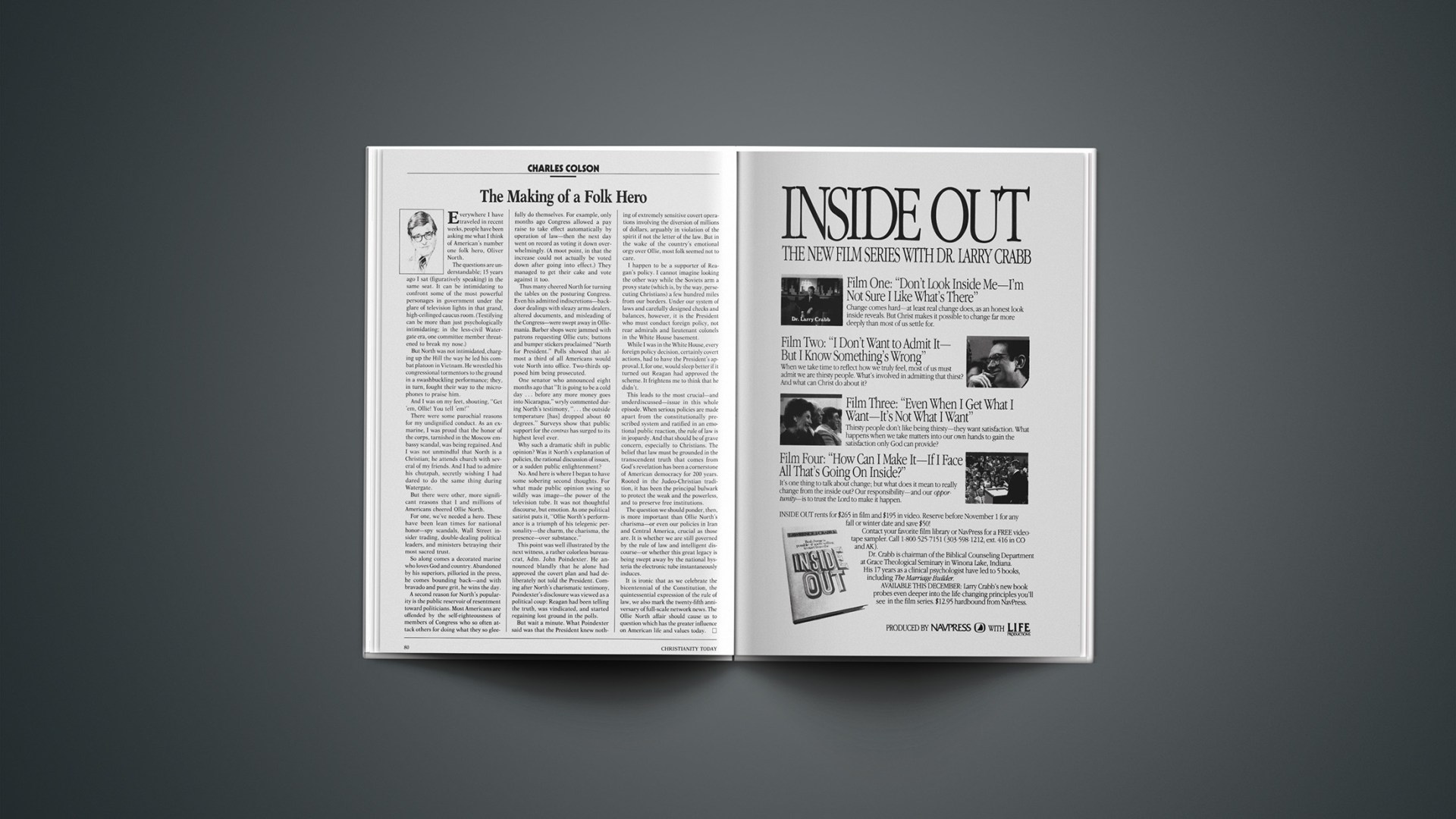
The Making of a Folk Hero

Everywhere I have traveled in recent weeks, people have been asking me what I think of American’s number one folk hero, Oliver North.

The questions are understandable; 15 years ago I sat (figuratively speaking) in the same seat. It can be intimidating to confront some of the most powerful personages in government under the glare of television lights in that grand, high-ceilinged caucus room. (Testifying can be more than just psychologically intimidating; in the less-civil Watergate era, one committee member threatened to break my nose.)

But North was not intimidated, charging up the Hill the way he led his combat platoon in Vietnam. He wrestled his congressional tormentors to the ground in a swashbuckling performance; they, in turn, fought their way to the microphones to praise him.

And I was on my feet, shouting, “Get em, Ollie! You tell em!”

There were some parochial reasons for my undignified conduct. As an ex-marine, I was proud that the honor of the corps, tarnished in the Moscow embassy scandal, was being regained. And I was not unmindful that North is a Christian; he attends church with several of my friends. And I had to admire his chutzpah, secretly wishing I had dared to do the same thing during Watergate.

But there were other, more significant reasons that I and millions of Americans cheered Ollie North.

For one, we’ve needed a hero. These have been lean times for national honor—spy scandals, Wall Street insider trading, double-dealing political leaders, and ministers betraying their most sacred trust.

So along comes a decorated marine who loves God and country. Abandoned by his superiors, pilloried in the press, he comes bounding back—and with bravado and pure grit, he wins the day.

A second reason for North’s popularity is the public reservoir of resentment toward politicians. Most Americans are offended by the self-righteousness of members of Congress who so often attack others for doing what they so gleefully do themselves. For example, only months ago Congress allowed a pay raise to take effect automatically by operation of law—then the next day went on record as voting it down overwhelmingly. (A moot point, in that the increase could not actually be voted down after going into effect.) They managed to get their cake and vote against it too.

Thus many cheered North for turning the tables on the posturing Congress. Even his admitted indiscretions—backdoor dealings with sleazy arms dealers, altered documents, and misleading of the Congress—were swept away in Ollie-mania. Barber shops were jammed with patrons requesting Ollie cuts; buttons and bumper stickers proclaimed “North for President.” Polls showed that almost a third of all Americans would vote North into office. Two-thirds opposed him being prosecuted.

One senator who announced eight months ago that “It is going to be a cold day … before any more money goes into Nicaragua,” wryly commented during North’s testimony, “… the outside temperature [has] dropped about 60 degrees.” Surveys show that public support for the contras has surged to its highest level ever.

Why such a dramatic shift in public opinion? Was it North’s explanation of policies, the rational discussion of issues, or a sudden public enlightenment?

No. And here is where I began to have some sobering second thoughts. For what made public opinion swing so wildly was image—the power of the television tube. It was not thoughtful discourse, but emotion. As one political satirist puts it, “Ollie North’s performance is a triumph of his telegenic personality—the charm, the charisma, the presence—over substance.”

This point was well illustrated by the next witness, a rather colorless bureaucrat, Adm. John Poindexter. He announced blandly that he alone had approved the covert plan and had deliberately not told the President. Coming after North’s charismatic testimony, Poindexter’s disclosure was viewed as a political coup: Reagan had been telling the truth, was vindicated, and started regaining lost ground in the polls.

But wait a minute. What Poindexter said was that the President knew nothing of extremely sensitive covert operations involving the diversion of millions of dollars, arguably in violation of the spirit if not the letter of the law. But in the wake of the country’s emotional orgy over Ollie, most folk seemed not to care.

I happen to be a supporter of Reagan’s policy. I cannot imagine looking the other way while the Soviets arm a proxy state (which is, by the way, persecuting Christians) a few hundred miles from our borders. Under our system of laws and carefully designed checks and balances, however, it is the President who must conduct foreign policy, not rear admirals and lieutenant colonels in the White House basement.

While I was in the White House, every foreign policy decision, certainly covert actions, had to have the President’s approval. I, for one, would sleep better if it turned out Reagan had approved the scheme. It frightens me to think that he didn’t.

This leads to the most crucial—and underdiscussed—issue in this whole episode. When serious policies are made apart from the constitutionally prescribed system and ratified in an emotional public reaction, the rule of law is in jeopardy. And that should be of grave concern, especially to Christians. The belief that law must be grounded in the transcendent truth that comes from God’s revelation has been a cornerstone of American democracy for 200 years. Rooted in the Judeo-Christian tradition, it has been the principal bulwark to protect the weak and the powerless, and to preserve free institutions.

The question we should ponder, then, is more important than Ollie North’s charisma—or even our policies in Iran and Central America, crucial as those are. It is whether we are still governed by the rule of law and intelligent discourse—or whether this great legacy is being swept away by the national hysteria the electronic tube instantaneously induces.

It is ironic that as we celebrate the bicentennial of the Constitution, the quintessential expression of the rule of law, we also mark the twenty-fifth anniversary of full-scale network news. The Ollie North affair should cause us to question which has the greater influence on American life and values today.

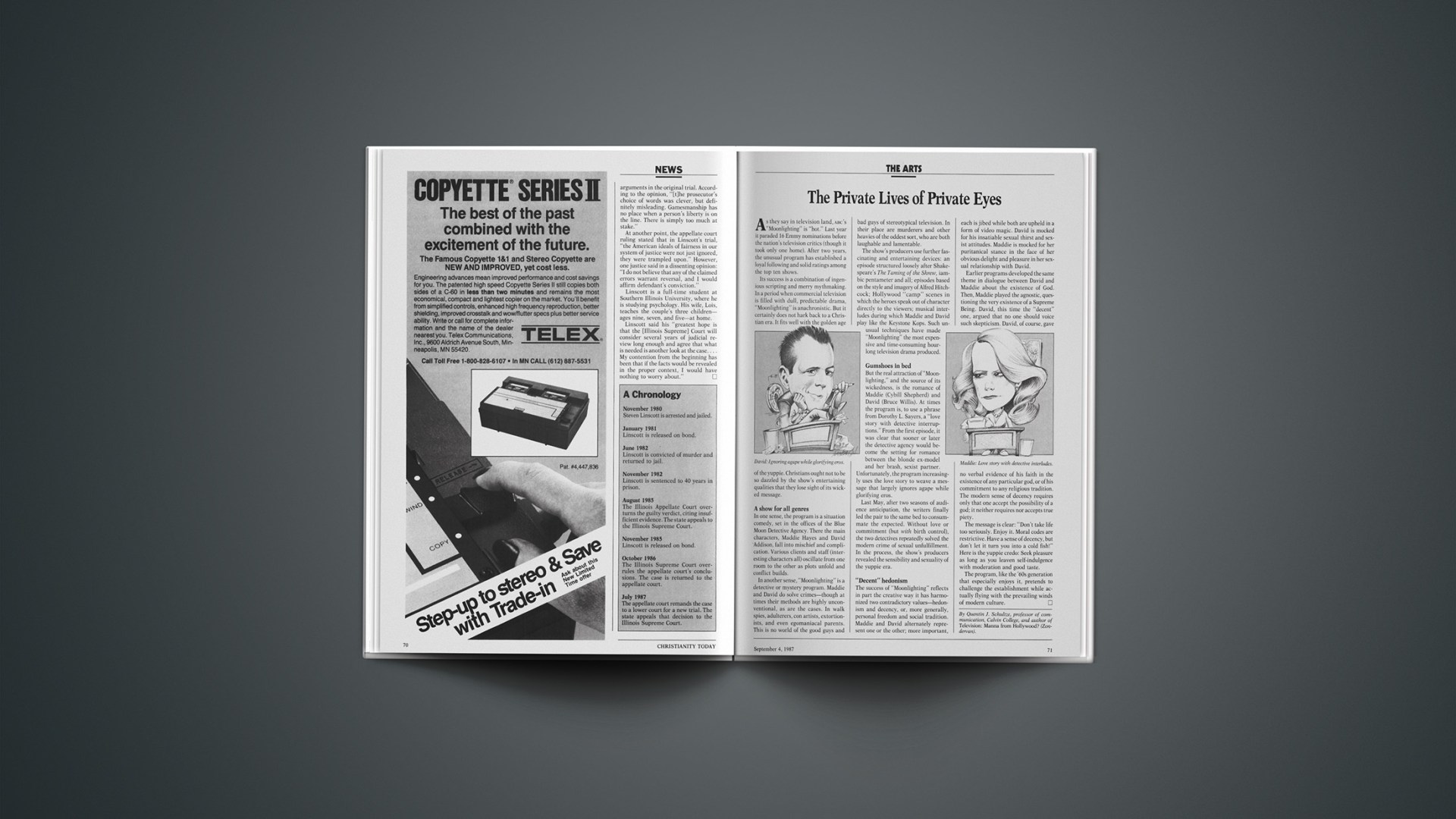
The Private Lives of Private Eyes

As they say in television land, ABC’S “Moonlighting” is “hot.” Last year it paraded 16 Emmy nominations before the nation’s television critics (though it took only one home). After two years, the unusual program has established a loyal following and solid ratings among the top ten shows.

Its success is a combination of ingenious scripting and merry mythmaking. In a period when commercial television is filled with dull, predictable drama, “Moonlighting” is anachronistic. But it certainly does not hark back to a Christian era. It fits well with the golden age of the yuppie. Christians ought not to be so dazzled by the show’s entertaining qualities that they lose sight of its wicked message.

A Show For All Genres

In one sense, the program is a situation comedy, set in the offices of the Blue Moon Detective Agency. There the main characters, Maddie Hayes and David Addison, fall into mischief and complication. Various clients and staff (interesting characters all) oscillate from one room to the other as plots unfold and conflict builds.

In another sense, “Moonlighting” is a detective or mystery program. Maddie and David do solve crimes—though at times their methods are highly unconventional, as are the cases. In walk spies, adulterers, con artists, extortionists, and even egomaniacal parents. This is no world of the good guys and bad guys of stereotypical television. In their place are murderers and other heavies of the oddest sort, who are both laughable and lamentable.

The show’s producers use further fascinating and entertaining devices: an episode structured loosely after Shakespeare’s The Taming of the Shrew, iambic pentameter and all; episodes based on the style and imagery of Alfred Hitchcock; Hollywood “camp” scenes in which the heroes speak out of character directly to the viewers; musical interludes during which Maddie and David play like the Keystone Kops. Such unusual techniques have made “Moonlighting” the most expensive and time-consuming hour-long television drama produced.

Gumshoes In Bed

But the real attraction of “Moonlighting,” and the source of its wickedness, is the romance of Maddie (Cybill Shepherd) and David (Bruce Willis). At times the program is, to use a phrase from Dorothy L. Sayers, a “love story with detective interruptions.” From the first episode, it was clear that sooner or later the detective agency would become the setting for romance between the blonde ex-model and her brash, sexist partner. Unfortunately, the program increasingly uses the love story to weave a message that largely ignores agape while glorifying eros.

Last May, after two seasons of audience anticipation, the writers finally led the pair to the same bed to consummate the expected. Without love or commitment (but with birth control), the two detectives repeatedly solved the modern crime of sexual unfulfillment. In the process, the show’s producers revealed the sensibility and sexuality of the yuppie era.

“Decent” Hedonism

The success of “Moonlighting” reflects in part the creative way it has harmonized two contradictory values—hedonism and decency, or, more generally, personal freedom and social tradition. Maddie and David alternately represent one or the other; more important, each is jibed while both are upheld in a form of video magic. David is mocked for his insatiable sexual thirst and sexist attitudes. Maddie is mocked for her puritanical stance in the face of her obvious delight and pleasure in her sexual relationship with David.

Earlier programs developed the same theme in dialogue between David and Maddie about the existence of God. Then, Maddie played the agnostic, questioning the very existence of a Supreme Being. David, this time the “decent” one, argued that no one should voice such skepticism. David, of course, gave no verbal evidence of his faith in the existence of any particular god, or of his commitment to any religious tradition. The modern sense of decency requires only that one accept the possibility of a god; it neither requires nor accepts true piety.

The message is clear: “Don’t take life too seriously. Enjoy it. Moral codes are restrictive. Have a sense of decency, but don’t let it turn you into a cold fish!” Here is the yuppie credo: Seek pleasure as long as you leaven self-indulgence with moderation and good taste.

The program, like the ’60s generation that especially enjoys it, pretends to challenge the establishment while actually flying with the prevailing winds of modern culture.

By Quentin J. Schultze, professor of communication, Calvin College, and author of Television: Manna from Hollywood? (Zondervan).

Court Orders New Trial for Steven Linscott

Another step in Steven Linscott’s quest for permanent freedom is complete. In July, the Illinois Appellate Court ruled two-to-one that the case be retried. Prosecutors, however, have appealed that ruling to the Illinois Supreme Court.

In 1982, the 33-year-old former Bible college student was sentenced to 40 years in prison for the 1980 murder of Karen Phillips, a 24-year-old nursing student (CT, Feb. 4, 1983, p. 42). A jury found Linscott guilty largely because he had told police about a dream that bore similarities to the actual crime. Linscott had the dream the same night Phillips was murdered just a few blocks from his apartment in Oak Park, Illinois. A few days after police combed the neighborhood looking for leads, Linscott went forward to tell investigators about his dream. They concluded he was the killer.

In a two-to-one decision in 1985, the Illinois Appellate Court overturned Linscott’s conviction, the majority concluding there was insufficient evidence to establish guilt. Linscott was released on bond and has been free for almost two years.

Last October, the Illinois Supreme Court overruled the appellate court’s ruling of insufficient evidence. It returned the case to the appellate court for consideration of issues related to the fairness of the trial. In what Linscott’s supporters regard as a favorable sign, the Supreme Court allowed Linscott to remain free on bond despite prosecutors’ efforts to return him to prison.

In remanding the case to a lower court for retrial, the appellate court’s majority stated essentially that prosecutors had lied to the jury during closing arguments in the original trial. According to the opinion, “[t]he prosecutor’s choice of words was clever, but definitely misleading. Gamesmanship has no place when a person’s liberty is on the line. There is simply too much at stake.”

At another point, the appellate court ruling stated that in Linscott’s trial, “the American ideals of fairness in our system of justice were not just ignored, they were trampled upon.” However, one justice said in a dissenting opinion: “I do not believe that any of the claimed errors warrant reversal, and I would affirm defendant’s conviction.”

Linscott is a full-time student at Southern Illinois University, where he is studying psychology. His wife, Lois, teaches the couple’s three children—ages nine, seven, and five—at home.

Linscott said his “greatest hope is that the [Illinois Supreme] Court will consider several years of judicial review long enough and agree that what is needed is another look at the case.… My contention from the beginning has been that if the facts would be revealed in the proper context, I would have nothing to worry about.”

A Chronology

November 1980

Steven Linscott is arrested and jailed.

January 1981

Linscott is released on bond.

June 1982

Linscott is convicted of murder and returned to jail.

November 1982

Linscott is sentenced to 40 years in prison.

August 1985

The Illinois Appellate Court overturns the guilty verdict, citing insufficient evidence. The state appeals to the Illinois Supreme Court.

November 1985

Linscott is released on bond.

October 1986

The Illinois Supreme Court overrules the appellate court’s conclusions. The case is returned to the appellate court.

July 1987

The appellate court remands the case to a lower court for a new trial. The state appeals that decision to the Illinois Supreme Court.

The Call of Destiny

Black Christians catch a vision for evangelizing the world.

A growing number of black Christians believe it is their destiny to play a major role in world evangelization. And in Atlanta recently, 1,700 visionaries gathered for Destiny ’87, a conference that provided education and inspiration, as well as interaction, between mission-minded blacks and executives of predominantly white mission agencies.

On the opening night of the conference, Campus Crusade for Christ president Bill Bright told the audience, “You, who represent one of the most strategic segments of the world society, can do more than has ever been done in the history of the African race to help reach the entire world for Christ.”

Crawford Loritts, director of Campus Crusade’s Here’s Life, Black America ministry and coleader of Destiny ’87, also stressed the unique role of African-Americans in world missions. “Many white Americans are no longer welcome in certain areas [of the world],” he said. People in the Third World readily identify with black Americans, Loritts said, “because of our background of oppression.… Most of the world is not like white, middle-class America.”

Untold Story

Part of the purpose of Destiny ’87 was to introduce conferees to the little-known history of black missionary activity overseas. In the early days of the modern missionary movement, for example, some white mission societies sent black missionaries to Africa because whites were unable to adapt to tropical climates.

By and large, however, enthusiasm among blacks for world missions has been minimal. Among the reasons, Loritts says, is that the “parachurch [mission] agency is a culturally strange animal to black folks.” This makes it difficult for Christians working in parachurch groups to raise funds in the black community. Loritts also cited past policies of missions organizations, which he said were not overtly racist, but reflected “benign neglect” of African-Americans. For example, many schools that prepare missionaries have not actively recruited black students.

Perhaps the biggest reason for a lack of missions activity among blacks is their preoccupation with their own problems. Loritts called for blacks to abandon their “theology of survival.… Racism will be with us till Jesus returns. But when you focus on your own struggle for such a long time, it gets to be disproportionate to the purposes of God.”

Those who attended Destiny ’87 heard messages from some of the nation’s top black preachers and attended workshops led by missionaries from around the world. Organizers of the Atlanta meeting view it not merely as a conference, but as part of a movement. Black leaders predict a major migration of African-Americans to the mission field, though it remains to be seen through which channels.

Destiny ’87 coleader Elward Ellis, director of Black Campus Ministry for InterVarsity Christian Fellowship, predicts the Destiny movement will give the mission agencies of the major black denominations “a shot in the arm.” He said he would also like to see more African-American Christians in traditionally white mission agencies. “Everybody could benefit from some cross-pollination,” he said.

Black-And-White Issue

In pursuit of this cross-pollination, Loritts has challenged white and black Christians alike. Meeting in Atlanta with white missionary executives, he suggested that “corporate pragmatism [has] affected us more than we care to realize.” He urged creative thinking to develop ways more blacks could enter white missions structures.

And to blacks, he said, “We have been quick to be prophetic and to denounce without at least coming alongside and saying, ‘Let’s partner together.’ ”

Wade Coggins, executive director of the Evangelical Foreign Missions Association, said white missions organizations are in the process of “getting acquainted and building relationships” with black missions agencies and black Christians. He said the challenge for traditional missions is to find ways to “make it easier for black Christians to fit in.… This is something that has not had serious consideration till now. It’s probably the next thing on the agenda.”

By Randy Frame, in Atlanta.

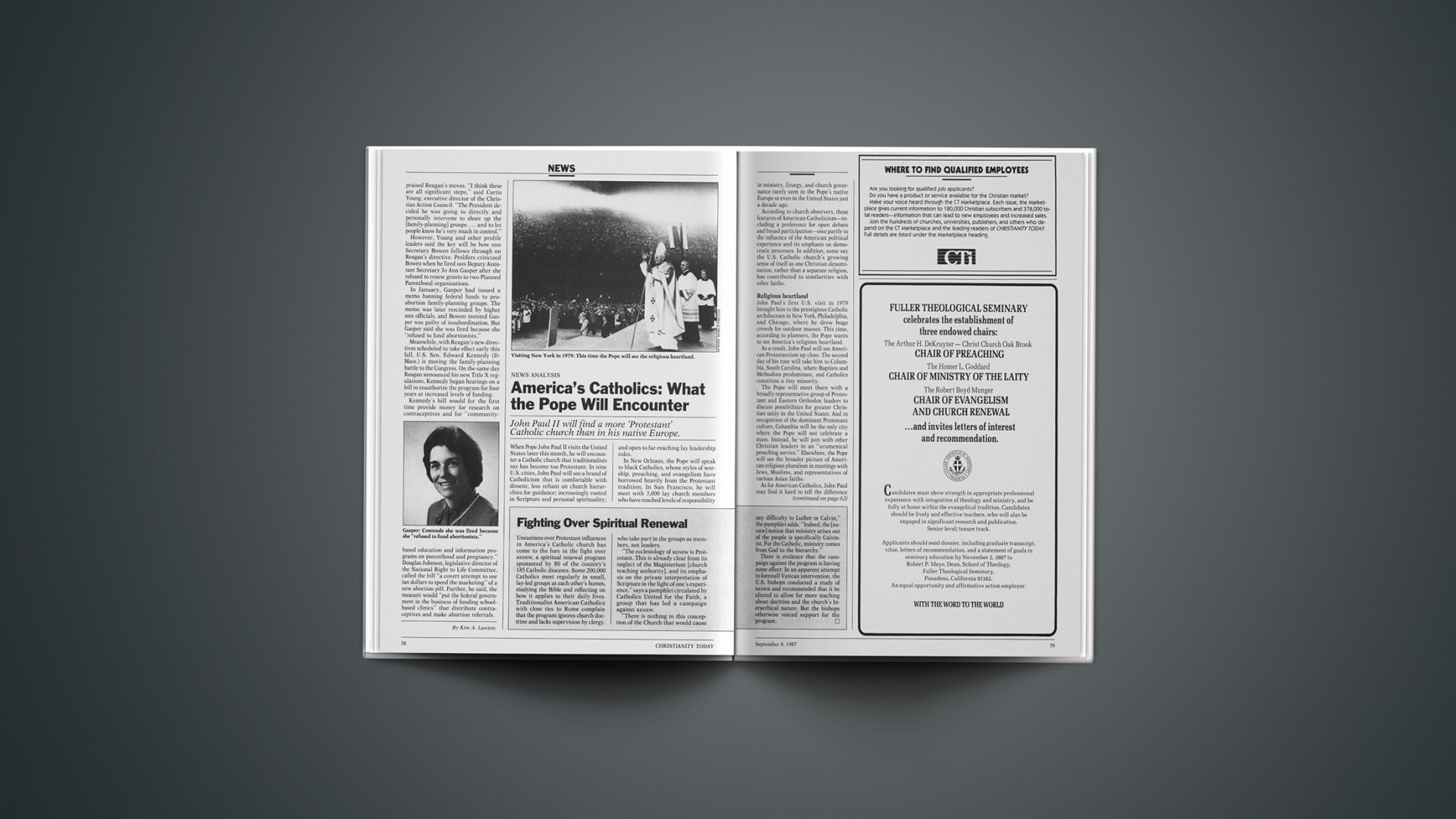
America’s Catholics: What the Pope Will Encounter

John Paul II will find a more ‘Protestant’ Catholic church than in his native Europe.

When Pope John Paul II visits the United States later this month, he will encounter a Catholic church that traditionalists say has become too Protestant. In nine U.S. cities, John Paul will see a brand of Catholicism that is comfortable with dissent; less reliant on church hierarchies for guidance; increasingly rooted in Scripture and personal spirituality; and open to far-reaching lay leadership roles.

In New Orleans, the Pope will speak to black Catholics, whose styles of worship, preaching, and evangelism have borrowed heavily from the Protestant tradition. In San Francisco, he will meet with 3,000 lay church members who have reached levels of responsibility in ministry, liturgy, and church governance rarely seen in the Pope’s native Europe or even in the United States just a decade ago.

According to church observers, these features of American Catholicism—including a preference for open debate and broad participation—owe partly to the influence of the American political experience and its emphasis on democratic processes. In addition, some say the U.S. Catholic church’s growing sense of itself as one Christian denomination, rather than a separate religion, has contributed to similarities with other faiths.

Religious Heartland

John Paul’s first U.S. visit in 1979 brought him to the prestigious Catholic archdioceses in New York, Philadelphia, and Chicago, where he drew huge crowds for outdoor masses. This time, according to planners, the Pope wants to see America’s religious heartland.

As a result, John Paul will see American Protestantism up close. The second day of his tour will take him to Columbia, South Carolina, where Baptists and Methodists predominate, and Catholics constitute a tiny minority.

The Pope will meet there with a broadly representative group of Protestant and Eastern Orthodox leaders to discuss possibilities for greater Christian unity in the United States. And in recognition of the dominant Protestant culture, Columbia will be the only city where the Pope will not celebrate a mass. Instead, he will join with other Christian leaders in an “ecumenical preaching service.” Elsewhere, the Pope will see the broader picture of American religious pluralism in meetings with Jews, Muslims, and representatives of various Asian faiths.

As for American Catholics, John Paul may find it hard to tell the difference between them and their Protestant neighbors. Among the most enthusiastic Catholics turning out for the Pope’s visit are likely to be charismatics, whose growing numbers in the church bear the clear influence of the American Pentecostal movement. Indeed, at a recent charismatic conference in New Orleans, just over half of the 35,000 participants were Roman Catholics (see related story on p. 44).

Perhaps more revealing of conservative Protestant influences are Gallup polls showing that 32 percent of U.S. Catholics believe the Bible is the “literal word of God.” According to George Gallup, this finding raises the possibility of “a resurgence of Catholic fundamentalism.” If current trends continue, he says, Catholicism will vie with Protestantism as America’s dominant faith near the middle of the next century.

Debating Reforms

U.S. Catholics would argue that their innovations are actually rooted in the church’s own tradition, including the Second Vatican Council (1962–65). That council introduced into Catholicism the idea of the priesthood of all believers, which greatly expanded lay roles; bolstered the importance of Scripture in liturgy and the daily lives of ordinary Catholics; and adopted other ideas and practices traditionally associated with Protestantism.

Also called Vatican II, the church council borrowed “quite deliberately from Protestantism,” says Jesuit theologian Avery Dulles. “I think the whole business of Christocentrism would be one of those [traditionally Protestant] themes incorporated by the council—the idea that one can relate directly to Christ and to the Scriptures,” rather than only through the mediating structure of the church.

While common to Catholics worldwide, the teachings of Vatican II have yielded different interpretations, and there is disagreement over how much reform it licensed. This disagreement lies behind attempts by the Vatican and a vocal minority of American Catholics to roll back some of the church innovations in this country. Remarks George Kelly, an influential conservative Catholic theologian: “It wasn’t the intention [of the Second Vatican Council] that the Catholic church become a Protestant church.”

Concern about liberal, Protestant-like developments can be found between the lines of recent Vatican censures of two church figures. Charles Curran, a champion of the right to responsible dissent from teachings of the church hierarchy, was suspended earlier this year from his teaching post at Catholic University in Washington, D.C. The Vatican declared him to be “neither eligible nor suitable” to teach Catholic theology. And a year ago, the Vatican stripped Seattle Archbishop Raymond Hunthausen of his powers over several key areas of ministry for tolerating what Rome viewed as liberal pastoral practices. His full powers were restored in June, but only after a Vatican-appointed commission chided him for presiding over a “climate of permissiveness.”

Dulles, who was raised in a Presbyterian family before converting to Catholicism, cites both opportunities and dangers in the American Catholic church’s attraction to Protestant ways. On the one hand, he says, a less authoritarian and hierarchical structure can broaden participation in the church and bolster personal commitment. But the danger lies in an “anything goes” mentality, he warns, in which Catholics “pick and choose what church teachings to obey.”

By William Bole.

Reagan Moves to Redirect Family-Planning Policy

President Reagan has been criticized in some quarters of the prolife movement for not making antiabortion measures a higher priority. But recent presidential actions could put a stop to such complaints.

In a White House meeting with 150 prolife leaders, Reagan pledged renewed support for a “human life amendment” to the U.S. Constitution. And he urged support for the President’s Prolife Bill, which among other things would permanently restrict the use of federal funds for abortions (CT, June 12, 1987, p. 48).

He also expressed opposition to the Civil Rights Restoration Act. He called the bill a “proabortion federal intrusion” that would force all hospitals and colleges that receive federal funds—including religiously affiliated institutions—to provide abortion services.

Policy Changes

Most welcomed by the prolife leaders was Reagan’s announcement that he was removing abortion from Title X of the Public Health Act, the federal government’s family-planning program. He said he had directed Health and Human Services (HHS) Secretary Otis Bowen to issue several new regulations, including:

  • A restriction on the use of federal funds for any program that “encourages, promotes, or advocates abortion, or which assists a woman in obtaining an abortion.”
  • Rules stating that programs that “provide counseling and referral for abortion services as a method of family planning will not be eligible for the Title X funds.”
  • Requirements that federally funded groups keep separate both physically and financially any abortion-related services from their family-planning services.
  • A directive that the U.S. Surgeon General issue a “comprehensive medical report on the health effects, physical and emotional, of abortion on women.”

Mixed Reaction

Faye Wattleton, president of the Planned Parenthood Federation of America, told a Washington news conference she looks on Reagan’s initiatives as an “outrageous assault on the women of this country.” She said Planned Parenthood—which receives about $30 million annually from Title X—would file a lawsuit to block the changes.

But leaders in the prolife movement praised Reagan’s moves. “I think these are all significant steps,” said Curtis Young, executive director of the Christian Action Council. “The President decided he was going to directly and personally intervene to shore up the [family-planning] groups … and to let people know he’s very much in control.”

However, Young and other prolife leaders said the key will be how HHS Secretary Bowen follows through on Reagan’s directive. Prolifers criticized Bowen when he fired HHS Deputy Assistant Secretary Jo Ann Gasper after she refused to renew grants to two Planned Parenthood organizations.

In January, Gasper had issued a memo banning federal funds to proabortion family-planning groups. The memo was later rescinded by higher HHS officials, and Bowen insisted Gasper was guilty of insubordination. But Gasper said she was fired because she “refused to fund abortionists.”

Meanwhile, with Reagan’s new directives scheduled to take effect early this fall, U.S. Sen. Edward Kennedy (D-Mass.) is moving the family-planning battle to the Congress. On the same day Reagan announced his new Title X regulations, Kennedy began hearings on a bill to reauthorize the program for four years at increased levels of funding.

Kennedy’s bill would for the first time provide money for research on contraceptives and for “community-based education and information programs on parenthood and pregnancy.” Douglas Johnson, legislative director of the National Right to Life Committee, called the bill “a covert attempt to use tax dollars to speed the marketing” of a new abortion pill. Further, he said, the measure would “put the federal government in the business of funding school-based clinics” that distribute contraceptives and make abortion referrals.

By Kim A. Lawton

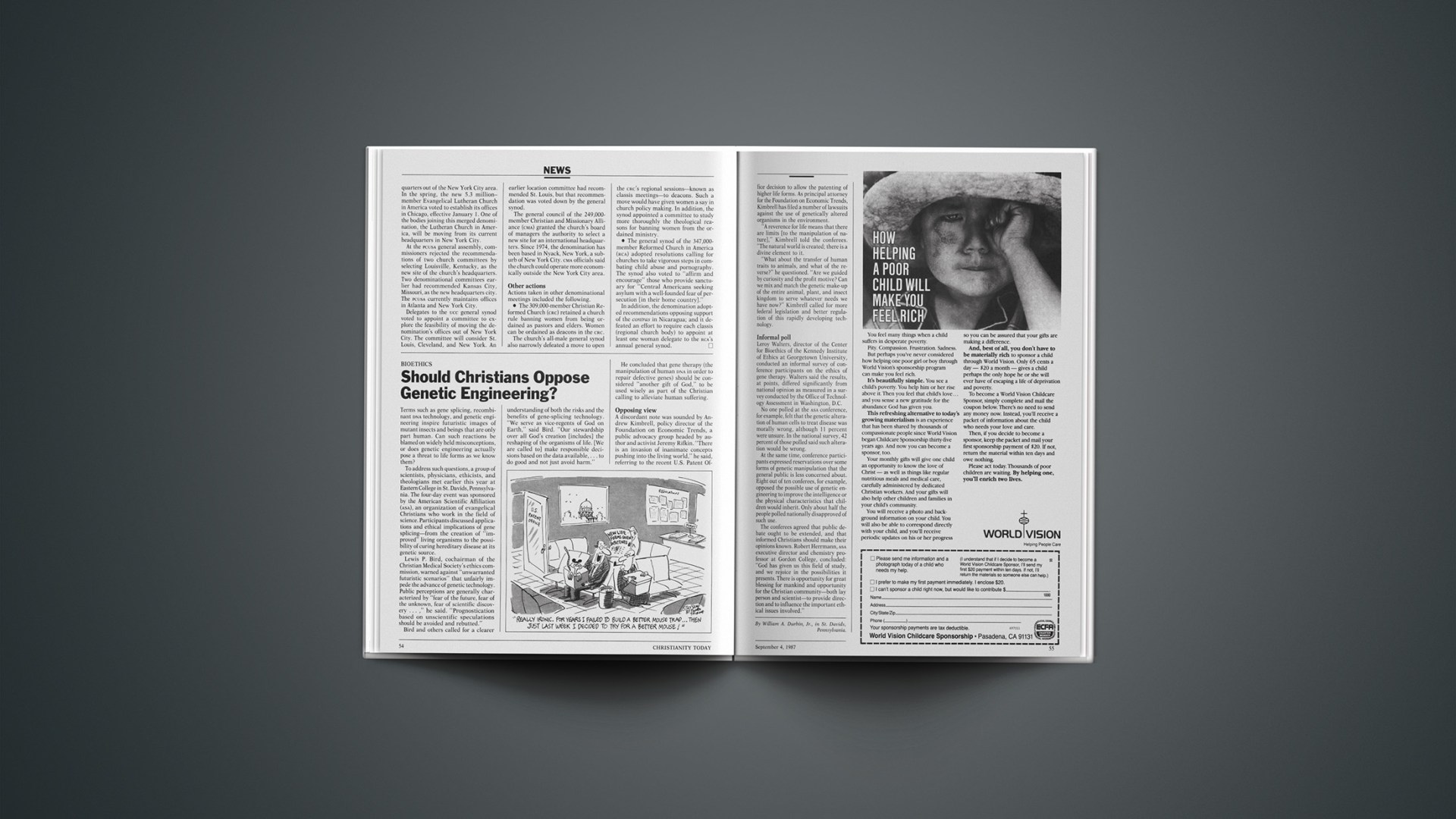
Should Christians Oppose Genetic Engineering?

Terms such as gene splicing, recombinant DNA technology, and genetic engineering inspire futuristic images of mutant insects and beings that are only part human. Can such reactions be blamed on widely held misconceptions, or does genetic engineering actually pose a threat to life forms as we know them?

To address such questions, a group of scientists, physicians, ethicists, and theologians met earlier this year at Eastern College in St. Davids, Pennsylvania. The four-day event was sponsored by the American Scientific Affiliation (ASA), an organization of evangelical Christians who work in the field of science. Participants discussed applications and ethical implications of gene splicing—from the creation of “improved” living organisms to the possibility of curing hereditary disease at its genetic source.

Lewis P. Bird, cochairman of the Christian Medical Society’s ethics commission, warned against “unwarranted futuristic scenarios” that unfairly impede the advance of genetic technology. Public perceptions are generally characterized by “fear of the future, fear of the unknown, fear of scientific discovery …,” he said. “Prognostication based on unscientific speculations should be avoided and rebutted.”

Bird and others called for a clearer understanding of both the risks and the benefits of gene-splicing technology. “We serve as vice-regents of God on Earth,” said Bird. “Our stewardship over all God’s creation [includes] the reshaping of the organisms of life. [We are called to] make responsible decisions based on the data available, … to do good and not just avoid harm.”

He concluded that gene therapy (the manipulation of human DNA in order to repair defective genes) should be considered “another gift of God,” to be used wisely as part of the Christian calling to alleviate human suffering.

Opposing View

A discordant note was sounded by Andrew Kimbrell, policy director of the Foundation on Economic Trends, a public advocacy group headed by author and activist Jeremy Rifkin. “There is an invasion of inanimate concepts pushing into the living world,” he said, referring to the recent U.S. Patent Office decision to allow the patenting of higher life forms. As principal attorney for the Foundation on Economic Trends, Kimbrell has filed a number of lawsuits against the use of genetically altered organisms in the environment.

“A reverence for life means that there are limits [to the manipulation of nature],” Kimbrell told the conferees. “The natural world is created; there is a divine element to it.

“What about the transfer of human traits to animals, and what of the reverse?” he questioned. “Are we guided by curiosity and the profit motive? Can we mix and match the genetic make-up of the entire animal, plant, and insect kingdom to serve whatever needs we have now?” Kimbrell called for more federal legislation and better regulation of this rapidly developing technology.

Informal Poll

Leroy Walters, director of the Center for Bioethics of the Kennedy Institute of Ethics at Georgetown University, conducted an informal survey of conference participants on the ethics of gene therapy. Walters said the results, at points, differed significantly from national opinion as measured in a survey conducted by the Office of Technology Assessment in Washington, D.C.

No one polled at the ASA conference, for example, felt that the genetic alteration of human cells to treat disease was morally wrong, although 11 percent were unsure. In the national survey, 42 percent of those polled said such alteration would be wrong.

At the same time, conference participants expressed reservations over some forms of genetic manipulation that the general public is less concerned about. Eight out of ten conferees, for example, opposed the possible use of genetic engineering to improve the intelligence or the physical characteristics that children would inherit. Only about half the people polled nationally disapproved of such use.

The conferees agreed that public debate ought to be extended, and that informed Christians should make their opinions known. Robert Herrmann, ASA executive director and chemistry professor at Gordon College, concluded: “God has given us this field of study, and we rejoice in the possibilities it presents. There is opportunity for great blessing for mankind and opportunity for the Christian community—both lay person and scientist—to provide direction and to influence the important ethical issues involved.”

By William A. Durbin, Jr., in St. Davids,

Pennsylvania.

Apple PodcastsDown ArrowDown ArrowDown Arrowarrow_left_altLeft ArrowLeft ArrowRight ArrowRight ArrowRight Arrowarrow_up_altUp ArrowUp ArrowAvailable at Amazoncaret-downCloseCloseEmailEmailExpandExpandExternalExternalFacebookfacebook-squareGiftGiftGooglegoogleGoogle KeephamburgerInstagraminstagram-squareLinkLinklinkedin-squareListenListenListenChristianity TodayCT Creative Studio Logologo_orgMegaphoneMenuMenupausePinterestPlayPlayPocketPodcastRSSRSSSaveSaveSaveSearchSearchsearchSpotifyStitcherTelegramTable of ContentsTable of Contentstwitter-squareWhatsAppXYouTubeYouTube