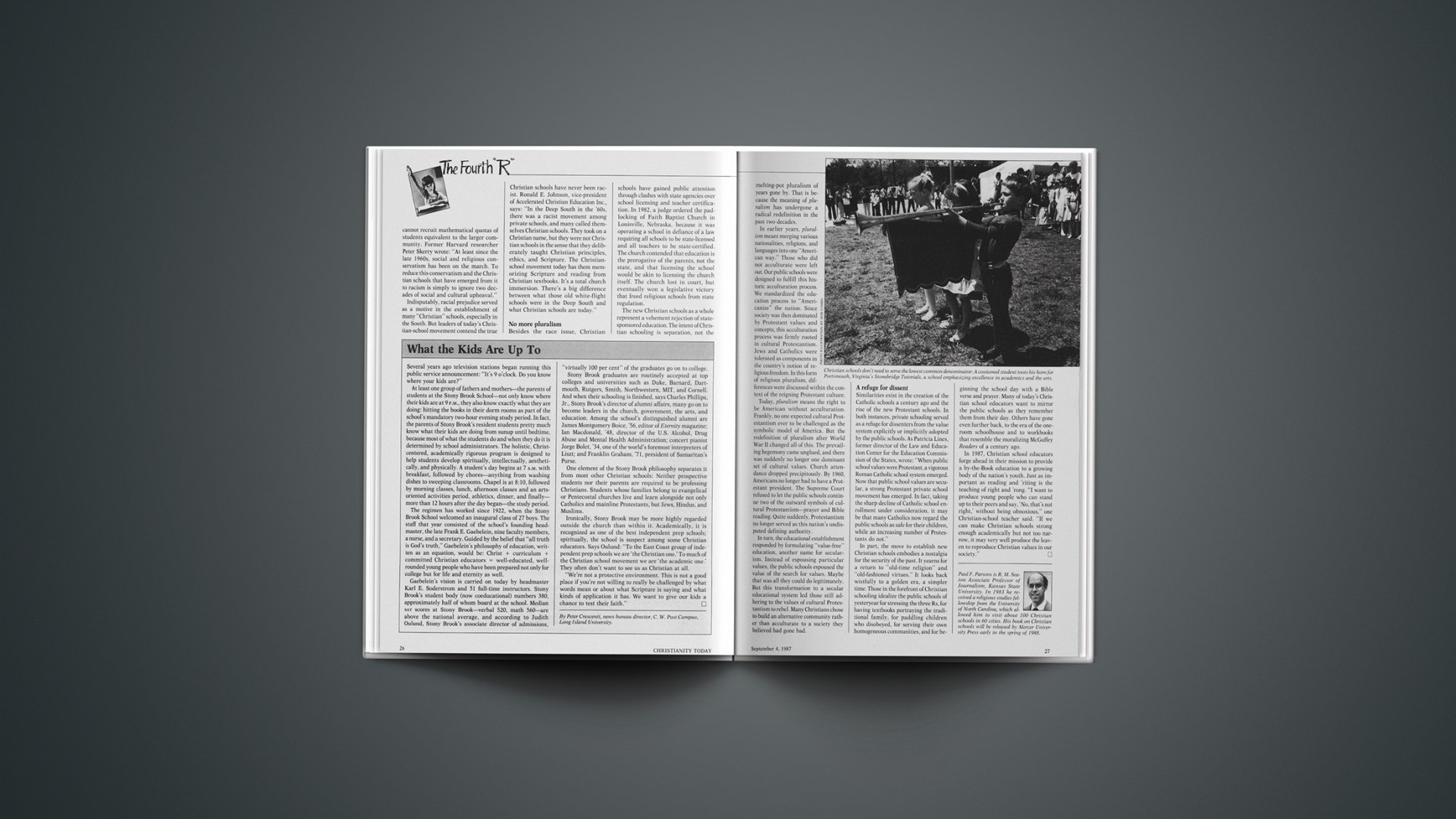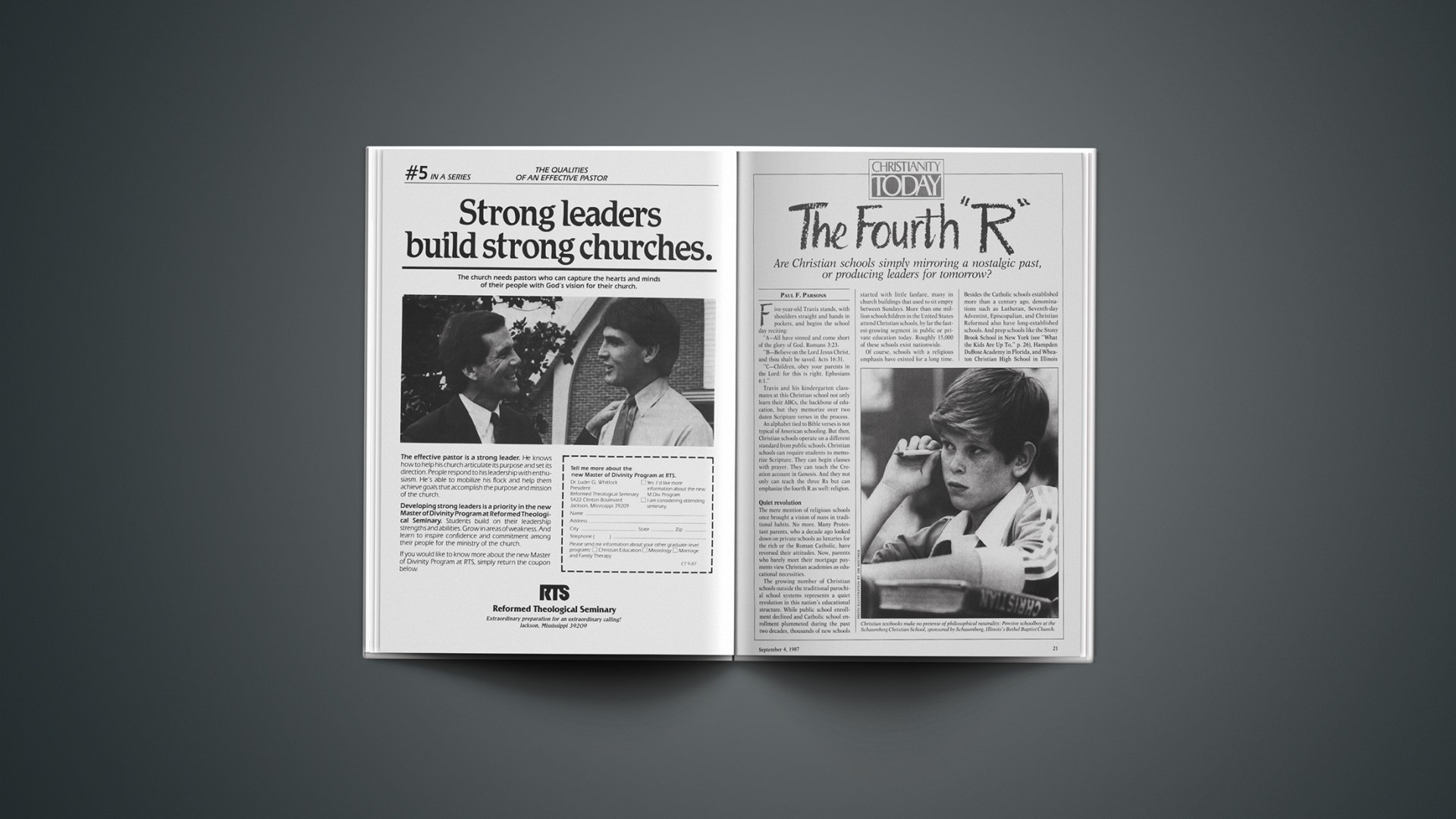
The Fourth “R”

Are Christian schools simply mirroring a nostalgic past, or producing leaders for tomorrow?

Five-year-old Travis stands, with shoulders straight and hands in pockets, and begins the school day reciting:

“A—All have sinned and come short of the glory of God. Romans 3:23.

“B—Believe on the Lord Jesus Christ, and thou shalt be saved. Acts 16:31.

“C—Children, obey your parents in the Lord: for this is right. Ephesians 6:1.”

Travis and his kindergarten classmates at this Christian school not only learn their ABCs, the backbone of education, but they memorize over two dozen Scripture verses in the process.

An alphabet tied to Bible verses is not typical of American schooling. But then, Christian schools operate on a different standard from public schools. Christian schools can require students to memorize Scripture. They can begin classes with prayer. They can teach the Creation account in Genesis. And they not only can teach the three Rs but can emphasize the fourth R as well: religion.

Quiet Revolution

The mere mention of religious schools once brought a vision of nuns in traditional habits. No more. Many Protestant parents, who a decade ago looked down on private schools as luxuries for the rich or the Roman Catholic, have reversed their attitudes. Now, parents who barely meet their mortgage payments view Christian academies as educational necessities.

The growing number of Christian schools outside the traditional parochial school systems represents a quiet revolution in this nation’s educational structure. While public school enrollment declined and Catholic school enrollment plummeted during the past two decades, thousands of new schools started with little fanfare, many in church buildings that used to sit empty between Sundays. More than one million schoolchildren in the United States attend Christian schools, by far the fastest-growing segment in public or private education today. Roughly 15,000 of these schools exist nationwide.

Of course, schools with a religious emphasis have existed for a long time. Besides the Catholic schools established more than a century ago, denominations such as Lutheran, Seventh-day Adventist, Episcopalian, and Christian Reformed also have long-established schools. And prep schools like the Stony Brook School in New York (see “What the Kids Are Up To,” p. 26), Hampden DuBose Academy in Florida, and Wheaton Christian High School in Illinois have long served the evangelical community.

But these new schools established over the past 20 years that bear the name “Christian” are dramatically different. Largely independent, serving a local church and its communities rather than a denomination or national constituency, these schools were established in response to the secularist drift in public education. Many of them proudly call themselves “fundamentalist.” Others do not embrace the fundamentalist label (for instance, schools operated by charismatic churches), yet their theological orientation is similar. And still others that go by the name “Christian” are evangelical in nature but not at all fundamentalist in theological perspective.

But the new Christian schools are diverse in more than their theologies. Some are sprawling complexes with 2,000 students; others are one-room schoolhouses with a dozen or so pupils scattered across 12 grades. Some are elite academies with big tuition price tags; others keep the cost of education low by depending on volunteer mothers to help run the classrooms. Some are operated by parent groups that avoid doctrinal instruction; others are church-operated and specific in doctrine. But whatever their differences, the new Christian schools do have much in common.

Educating Souls

Religious instruction is a common denominator in America’s Christian schools. Walk into a first-grade class at Riverdale Baptist School in Maryland and you will hear the pupils reciting in unison from the Gospel of John. Sit in the twelfth-grade Bible class at Barrington Christian Academy in Rhode Island and you will gain an overview of religious cults in America. Visit the weekly chapel service at the Paw Creek Christian Academy in Charlotte, North Carolina, and you will hear the pastor’s dispensationalist view of the end of time. Step inside a history class at Christian High in El Cajon, California, and you will hear teenagers begin class with prayer for the President.

The intent of Christian schooling is not just to develop the minds, but to influence the very souls of its students. The Association of Christian Schools International (ACSI), an umbrella group representing 2,500 schools over a broad doctrinal spectrum, reported in 1986 that 30,000 of the 420,000 students at its member schools had been converted during the preceding academic year.

At many Christian schools academic subjects are bathed in Scripture. No dividing line exists between academics and religion because these schools consider the two inseparably linked. As one California principal puts it: “When we teach algebra, we don’t teach God all the time. But we do teach that God is a God of order. 2 + 2 = 4. That’s an absolute. Just as a number system has order, God has order. In history, we say nothing happens without God’s permission. History is dictated by God.”

Even the sports field is awash in religious significance. After every home game against a public school, players at a Christian academy in West Virginia hand out spiritual tracts to members of the opposing team. In Tennessee, a Christian school team prays with its opponent after every game. At Jerry Falwell’s Christian Academy in Lynchburg, Virginia, a school official said: “We tell our kids to play to represent the Lord. If you are losing your temper and complaining about the referees and then go after the game and try to witness to an opposing player, he’ll say, ‘Hey, what’s this?’ Sports is an opportunity to show our lifestyle.”

As the ACSI said in its newsletter: “Evangelism should be a normal part of the everyday curriculum in ‘God’s school system.’ ”

R-E-S-P-E-C-T

Another common denominator in Christian schools is a stress on discipline and traditional values. Hair and dress codes abound, paddlings are common, and respect for adults is shown through standard yes ma’ams and no sirs. At some schools, students must stand whenever an adult enters the room. For many parents, just as important as the four Rs is the belief that their children will graduate as responsible, well-behaved kids who can get good jobs or into good colleges. As a Christian school principal in Texas noted: “To be successful in college, advanced calculus isn’t as critical as teaching perseverance and reading skills and not doing drugs in order to finish your report on time.”

Of course, all schools public and private stress positive character traits. But Christian schools have more latitude in rewarding (or punishing) while seeking to develop such traits as these:

Respect for authority. When an increasingly rebellious teenage girl talked disrespectfully to a teacher, the Christian school principal sent the girl to an isolation room. “We put her in the room by herself, gave her a Bible, and told her to read Proverbs,” the principal says. “She didn’t read any that morning because she was so mad. But before the day was over, she decided she’d rather read than just sit there. She read the Book of Proverbs and really broke. The Spirit of God really dealt with her that day.”

Honesty. Student lockers don’t have locks at Pensacola Christian School in Florida. “Stealing is wrong. It’s a sin. God condemns it. We tell the student if he is caught stealing, he will be expelled,” a school official says.

Punctuality. A teacher stands at the doorway holding a stopwatch, after ringing a bell to mark the end of recess at a Christian academy in Oklahoma. The students have 90 seconds to be inside and seated. “We teach them that time is important,” the teacher says.

Character qualities. At the Southern Baptist Educational Complex in Memphis, “character quality report cards” are sent home to parents along with regular report cards. Pupils are evaluated in such areas as contentment, truthfulness, and humility.

Textbook Cases

In their drive for separation from all trappings of secular education, many fundamentalist schools, in particular, shun the state-adopted textbooks, using books published expressly for them. In these books, history is the tracing of the fingerprints of God through time. Science books attack evolution. Even math books have an evangelistic thrust: “Ace and his friend went soul-winning on five streets. There were nine houses on each street. To how many houses did they go?”

These books make no pretense of religious or philosophical neutrality. They are written from a fundamentalist perspective, with every subject bathed in scriptural interpretation and political conservatism. An American history textbook says of Franklin D. Roosevelt: “President Roosevelt himself lacked political convictions and principles.… The New Deal lengthened the Depression.” A science workbook bluntly says:

“Most ecologists do not believe in God as the Creator and Sustainer of the world.” Another textbook calls the United Nations “a clear illustration of man’s failure.”

There is even a Christian Student Dictionary on the market. “Some people wonder about the need for a Christian dictionary,” a representative of the publisher says. “But our current dictionaries are written by liberals. It shows up in word selections and in role reversals in the examples, like the woman going off to work and the man staying home with the children.”

Nonfundamentalist Christian schools do not necessarily subscribe to the political conservatism and theological orientation of the fundamentalist Christian textbook publishers, so these moderate Christian schools often use the same books found in public schools. But the vast majority of Christian schools carry their separation from public education that extra step, using only books wedded to their philosophy.

As One With Authority

Fundamentalist and nonfundamentalist schools differ most substantially in their emphases on authority. Nonfundamentalist Christian schools try to apply the doctrine of the priesthood of the believer to students. As the principal of a Christian school in Massachusetts says: “We major on the majors and don’t delve into doctrine. The end result, hopefully, will be the development of a thoughtful person who will be able to seek his own revelation from God.”

Fundamentalist schools, however, often emphasize the transfer of revelation rather than the pursuit of it. This is based on the belief that not only does an absolute Truth exist, but that every detail of lifestyle should reflect that Truth.

So fundamentalist schools authoritatively teach a lifestyle. Boys are taught to be the head of the household, and girls are taught to be helpmates. Some schools routinely pay male teachers more than their female counterparts by giving the men a head-of-household bonus. These schools may even regulate students’ out-of-school environment, prohibiting movie going, limiting dating, or mandating church attendance.

There is no undercurrent of tension at these schools. Students are uniformly accepting of the school’s norms. A boy may complain about having to get a haircut, or a girl may complain about having to wear a dress. But these are incidentals. When it comes to the spiritual atmosphere and the values taught amid academic lessons, the schools and students are in agreement.

The vast majority of students in Christian schools are there by choice. This is a byproduct of the enrollment process at these schools. Some churches operate schools only for the children of their own members. Others view Christian schools as evangelistic ministries, but interview students and parents beforehand to make sure each student has a willing attitude. Rebels are not invited.

The Christian school is frequently compared to a hothouse. “You have to realize the purpose of a hothouse,” says Paul Kienel, executive director of ACSI. “A hothouse is designed to protect young, tender plants during their growing years so they can be transplanted in the real world later on and be ahead of plants that didn’t have the opportunity.

“I grew up in Oregon,” Kienel continues, “and we had a hothouse nearby to grow tomatoes during the winter months. Outside the door were scrawny, gnarled plants that didn’t make it inside the hothouse. They were handicapped. Inside, the tomatoes were healthy and strong. The Christian school movement performs that function. It gets some basic character established before the child does battle with the world.”

A special bond exists between teachers and students in these schools. Teachers seem genuinely concerned about students’ academic progress and moral development. Teachers often view their work as a ministry instead of just a job. They get low salaries, but say they are compensated spiritually. An Iowa principal comments: “If I can train children to walk in the ways of the Lord, heaven is where I’ll get my big salary.”

And students appreciate the teachers’ sacrifices. They tell of teachers coming to their homes for free evening tutoring sessions. One student says: “I know the teachers aren’t here for the money. That makes me respect them even more.”

The Public-School Blues

To those within the Christian school movement, the roll call of public schools’ woes is as familiar as the ABCs. Besides standardized-test score declines and other external factors, those active in the movement are convinced that public schools do not teach values like they used to, do not discipline like they used to, and do not instill old-fashioned morality like they used to. The portrait they paint of public schools is unrelenting: chaos in the classroom, loss of authority, lack of learning, and an absence of standards.

“It’s ludicrous to think that our children are going to be change agents,” said Gerald Carlson of the American Association of Christian Schools, another umbrella organization that represents 1,200 fundamentalist, church-sponsored schools enrolling 170,000 students. “I think it’s an ignorance that people have of what the public schools have become. They are no longer these benign educational institutions. Public education has been in the hands of people who have sought to amend, and have been very effective in causing, social change in America.”

Christian-school advocates argue that public schools are as absolute in their teaching of relativism as Christian schools are absolute in their teaching of a singular Truth. Many Christians believe that, in the push to have a public school system free of religious entanglement, the nation has created, at best, a school system that has no values orientation and, at worst, one in which biblical values are scorned. The saying “Public schools teach how to make a living; we teach how to live” is often heard in Christian schools.

A “product” comparison with the public schools is difficult to make. Quantitative measurements routinely show Christian school pupils a grade level or two above national norms, and a number of Christian school graduates pursue higher education. But the comparison may be misleading because the public school is a melting pot, teaching all who come, while the Christian school is a selective hothouse.

White Fright?

This selectivity has led to a widespread perception that the new Christian schools are racist. After all, what once was a Southern phenomenon of the 1960s—segregationist academies quickly formed in the name of God—has spread nationwide. To some, “white-flight schools” and “Christian schools” are synonyms.

A secretary at a Christian school in North Carolina received a phone call from a woman, who asked in an urgent whisper, “Do you let them in?” The puzzled secretary responded, “Who do you mean, ma’am?” Caller: “The niggers, of course.” Secretary: “Why, ma’am, of course we do. We’re a Christian school.” The caller slammed the phone. At this particular school, one in eight students is black. In fact, many Christian schools now are integrated. But it is indicative of the public perception that a mother, in search of a place that does not allow blacks, would think of calling her local Christian school.

Still, Christian schooling is an overwhelmingly white phenomenon. Blacks are few and, like their white counterparts, may have been screened before admittance. But it is simplistic to conclude automatically that Christian schools are racially motivated. Christian schools reflect the structural segregation of parent churches, and the financial burdens of private schooling tend to be more difficult for minorities.

Christian-school educators also justify the low minority enrollment by pointing out that their schools appeal to a specific religious population just as Jewish schools serve a narrow Jewish population. Since schools are based on religious adherence, they contend they cannot recruit mathematical quotas of students equivalent to the larger community. Former Harvard researcher Peter Skerry wrote: “At least since the late 1960s, social and religious conservatism has been on the march. To reduce this conservatism and the Christian schools that have emerged from it to racism is simply to ignore two decades of social and cultural upheaval.”

Indisputably, racial prejudice served as a motive in the establishment of many “Christian” schools, especially in the South. But leaders of today’s Christian-school movement contend the true Christian schools have never been racist. Ronald E. Johnson, vice-president of Accelerated Christian Education Inc., says: “In the Deep South in the ’60s, there was a racist movement among private schools, and many called themselves Christian schools. They took on a Christian name, but they were not Christian schools in the sense that they deliberately taught Christian principles, ethics, and Scripture. The Christian-school movement today has them memorizing Scripture and reading from Christian textbooks. It’s a total church immersion. There’s a big difference between what those old white-flight schools were in the Deep South and what Christian schools are today.”

No More Pluralism

Besides the race issue, Christian schools have gained public attention through clashes with state agencies over school licensing and teacher certification. In 1982, a judge ordered the padlocking of Faith Baptist Church in Louisville, Nebraska, because it was operating a school in defiance of a law requiring all schools to be state-licensed and all teachers to be state-certified. The church contended that education is the prerogative of the parents, not the state, and that licensing the school would be akin to licensing the church itself. The church lost in court, but eventually won a legislative victory that freed religious schools from state regulation.

The new Christian schools as a whole represent a vehement rejection of state-sponsored education. The intent of Christian schooling is separation, not the melting-pot pluralism of years gone by. That is because the meaning of pluralism has undergone a radical redefinition in the past two decades.

In earlier years, pluralism meant merging various nationalities, religions, and languages into one “American way.” Those who did not acculturate were left out. Our public schools were designed to fulfill this historic acculturation process. We standardized the education process to “Americanize” the nation. Since society was then dominated by Protestant values and concepts, this acculturation process was firmly rooted in cultural Protestantism. Jews and Catholics were tolerated as components in the country’s notion of religious freedom. In this form of religious pluralism, differences were discussed within the context of the reigning Protestant culture.

Today, pluralism means the right to be American without acculturation. Frankly, no one expected cultural Protestantism ever to be challenged as the symbolic model of America. But the redefinition of pluralism after World War II changed all of this. The prevailing hegemony came unglued, and there was suddenly no longer one dominant set of cultural values. Church attendance dropped precipitously. By 1960, Americans no longer had to have a Protestant president. The Supreme Court refused to let the public schools continue two of the outward symbols of cultural Protestantism—prayer and Bible reading. Quite suddenly, Protestantism no longer served as this nation’s undisputed defining authority.

In turn, the educational establishment responded by formulating “value-free” education, another name for secularism. Instead of espousing particular values, the public schools espoused the value of the search for values. Maybe that was all they could do legitimately. But this transformation to a secular educational system led those still adhering to the values of cultural Protestantism to rebel. Many Christians chose to build an alternative community rather than acculturate to a society they believed had gone bad.

A Refuge For Dissent

Similarities exist in the creation of the Catholic schools a century ago and the rise of the new Protestant schools. In both instances, private schooling served as a refuge for dissenters from the value system explicitly or implicitly adopted by the public schools. As Patricia Lines, former director of the Law and Education Center for the Education Commission of the States, wrote: “When public school values were Protestant, a vigorous Roman Catholic school system emerged. Now that public school values are secular, a strong Protestant private school movement has emerged. In fact, taking the sharp decline of Catholic school enrollment under consideration, it may be that many Catholics now regard the public schools as safe for their children, while an increasing number of Protestants do not.”

In part, the move to establish new Christian schools embodies a nostalgia for the security of the past. It yearns for a return to “old-time religion” and “old-fashioned virtues.” It looks back wistfully to a golden era, a simpler time. Those in the forefront of Christian schooling idealize the public schools of yesteryear for stressing the three Rs, for having textbooks portraying the traditional family, for paddling children who disobeyed, for serving their own homogeneous communities, and for beginning the school day with a Bible verse and prayer. Many of today’s Christian school educators want to mirror the public schools as they remember them from their day. Others have gone even further back, to the era of the one-room schoolhouse and to workbooks that resemble the moralizing McGuffey Readers of a century ago.

In 1987, Christian school educators forge ahead in their mission to provide a by-the-Book education to a growing body of the nation’s youth. Just as important as reading and riting is the teaching of right and rong. “I want to produce young people who can stand up to their peers and say, ‘No, that’s not right,’ without being obnoxious,” one Christian-school teacher said. “If we can make Christian schools strong enough academically but not too narrow, it may very well produce the leaven to reproduce Christian values in our society.”

Paul F. Parsons is R. M. Seaton Associate Professor of Journalism, Kansas State University. In 1983 he received a religious studies fellowship from the University of North Carolina, which allowed him to visit about 100 Christian schools in 60 cities. His book on Christian schools will be released by Mercer University Press early in the spring of 1988.

Ace Virtueson Meets Pastor Alltruth

The classroom is quiet. No teacher’s voice booms out an explanation of nouns and verbs. No teacher’s chalk scratches the blackboard during a multiplication exercise. No teacher’s ruler touches a map in a discussion on European alliances during World War II. In fact, there are no teachers at all in this school.

This is an Accelerated Christian Education (ACE) school—one of 4,800 “teacherless” schools educating about half a million children nationwide. Roughly a third of all Christian schools in the United States operate with the ACE curriculum.

These schools operate the same, be they in Alabama or Arizona, Ohio or Oregon. They use the same books, have the same operational procedures, and are run by male supervisors who undergo identical training at ACE headquarters in Lewisville, Texas. The supervisor, almost never state-certified, may be the only paid employee in the school; he is typically assisted by volunteer mothers.

Students in individual cubicles work silently at their own pace, mastering workbooks that stitch Bible verses into lessons on, for example, nouns and verbs, multiplication problems, and European history. The adults are present to motivate, discipline, and answer questions. But the teaching comes from a series of workbooks—disposable paperbacks, roughly 40 pages each—that contain topical essays interspersed with multiple-choice, fill-in-the-blank, and other questions.

A pupil goes through about 60 workbooks a year in math, science, English, social studies, and word building. On the secondary level, a Bible course and a variety of electives are offered. The workbooks carry colorful cartoons featuring clean-cut, happy children with such names as Ace Virtueson, Christi Lovejoy, and Reginald Upright. Ace, Christi, and friends mature into responsible, soul-winning teenagers in the advanced workbooks. The adult role models in the workbooks go by the names of Pastor Alltruth, Mr. Friendson, and Miss Content.

The day at an ACE school starts with an assembly, featuring singing, pledges of allegiance, Scripture memorization, and a motivational word from those in charge. The morning is devoted to exclusively academic pursuits. Students spend about one hour at a time in the workbooks. They have breaks ranging from five minutes on up, depending on whether the student met previous work goals.

The afternoons at an ACE school are devoted to more workbook exercises, along with activities and devotionals. Wednesdays are special chapel days that feature an hour-long religious service, no workbooks, and an early dismissal. Fridays often include a field trip.

The ACE program is credited with much of the boom in fundamentalist Christian schooling. Dr. Donald R. Howard started ACE in 1970 to provide parents an inexpensive alternative to public education. For $5,000 or less, ACE can transform any pastor into the principal of his own Christian school in a matter of weeks. ACE supplies the workbooks and tests and, for additional costs, even red-white-and-blue uniforms for children.

The central tenet of ACE is the belief that teaching is not important in the learning process, ACE believes children learn more effectively by working out of a book at their own pace than by listening to a teacher who, by necessity, must keep the class at a common plateau.

“It’s a false premise that, because a body with a degree stands in front of a room and speaks words, learning is taking place,” said ACE vice-president Ronald E. Johnson, who is himself a former public-school principal in Arizona. “It’s a false assumption to believe that every child in that room is at the same level of understanding,” he said. “There is no classroom of 25 children in which they are all at the same academic or maturity level.”

Thus graduation from ACE schools is based solely on workbook progression, not chronological age.

By Paul F. Parsons.

What Living Word School Doesn’t Have

The school day at Living Word Christian School in Manhattan, Kansas, does not begin with math or phonics or social studies. It begins with prayer and Bible verses. Teachers report to work an hour early for a collective prayer time. When school starts, pupils begin the day with sentence prayers of their own.

Classrooms have a familiar look, with pupils at their desks and teachers at the blackboard. Using the A Beka Book curriculum designed for Christian schools, teachers rely on the lecture method. In a junior-high classroom, the lesson centers on dependent and independent clauses. “Just as you are dependent on your parents, the dependent clause in a sentence is dependent on the subordinating conjunction,” the teacher tells the teenagers. It is a basic grammar lesson, but the example reinforces the parents’ role.

Third and fourth graders have a science lesson on skin. They talk about cuts, and the teacher says, “God made your body where it can heal.” They talk about nerve endings in fingers, and the teacher says, “God put inside of you something called a reflex. Your body will move away from pain.” They make their fingerprints with an ink pad. “No one has a pattern like anybody else,” the teacher says. “God has made every person unique.” The academic lesson deals with the properties of skin. But the word God is part of the conversation throughout. A merger has occurred between the educational and the religious. This is common, and desired, in Christian schools.

Living Word Christian School is part of a rapidly growing charismatic church started in 1981 through home Bible studies. Church membership mushroomed from 50 to 275 in three years, and the church and school now occupy a former roller-skating rink. The school started in 1984 with 28 students. It has grown to 50 pupils in grades K-10. The school is adding one grade each year until it is a 12-grade school.

As a charismatic body, Living Word emphasizes healing powers. A boy comes to a teacher’s desk and says a tooth hurts. The teacher is sympathetic and asks the boy if his tooth has to hurt. The boy says no. “Can God get rid of the pain?” the teacher asks. The boy says yes and closes his eyes while standing next to the teacher’s desk and prays: “Please help my tooth to not hurt and help it to feel better.” The teacher says amen, and the boy returns to his chair. School principal Cecilia Myers says the boy would be encouraged to see a dentist if the tooth continued to hurt. “We believe God can heal, either through doctors or through prayer,” she says.

All but one of the school’s five full-time teachers are state-certified, and several are former public-school teachers. Beth Uphoff is one of them: “I had such a negative attitude toward Christian schools. It was an escapist trend. I thought that kids wouldn’t be able to deal with reality once they got out of the hothouse. I felt like I should be in the public schools, witnessing to them there. But the Lord changed my heart. I saw a vision for Christian education.”

Because the school is small, it lacks a lot of standard features. The children bring sack lunches each day, and recess is held on the church’s asphalt parking lot. Talking to a group of parents, Pastor Gary Ward, a former public-school biology teacher, says: “There’s a lot we don’t have. We don’t have a football team. We don’t have a marching band. We don’t have enough typewriters. We don’t have a lunchroom.”

Then, without breaking stride, Pastor Ward shifts the emphasis. “We don’t have a drug problem. We don’t have an alcohol problem, or classes that teach about contraceptives. We don’t have a lot of things.”

The school also doesn’t have tuition. It requires a tax-deductible “donation” to the church of roughly $80 a month per child. “This isn’t a private school operated as a business on the side,” Ward says. “It’s a ministry of the church.”

By Paul F. Parsons.

Ideas

Return of the Big Stick

Americans put more trust in the military than in the church.

Should we change our country’s motto from “In God We Trust” to “In the Military We Trust”? A 1986 Gallup poll asked a random sample of Americans to rate their levels of confidence in United States institutions. Sixty-three percent of the respondents said they had a “great deal” or “quite a lot” of confidence in the military, compared with only 57 percent who had confidence in the church. For the first time in over a decade, the church failed to rank as our most-trusted institution, raising renewed fears of creeping militarism.

Misplaced institutional confidence is not the only sign of growing militarism. Toy manufacturers report a 600 percent increase in sales of plastic rifles, G. I. Joe action figures, and miniature war vehicles between 1982 and 1986. Applications to West Point, the Air Force Academy, and Annapolis are not only at their highest level ever, but the academies are attracting the very best students, “the cream of the cream of the cream of the crop,” according to Lt. Col. Dan Hancock, head of cadet selection for the air force. Participation in ROTC on college campuses has increased 50 percent since 1975.

Several disquieting factors make this apparent trend toward militarism (a belief that the military is the principal answer to life’s problems) ominous for the church. The rapid growth reflects an intensity usually associated with major social changes. Further, because toys and television are imprinting their violent messages on our youngest children, we must seriously consider them as possible mental time bombs set to explode unpredictably for generations to come. Finally, because the military has supplanted the church as our most-trusted American institution, we are faced with the troubling question of why.

The Reasons

In one sense, the answer to that question lies not so much in the failures of the church as in the publicity given the military. The current administration’s emphasis on strengthening the military has contributed to an increasing public consciousness and even pride in the armed forces. Congressional battles over budgets, Star Wars debates, sorties into Grenada and Libya, and recent events in the Persian Gulf have all helped put the military on the front pages of our minds. Even though the Vietnam War seriously eroded public confidence in our military capacity and judgment, many Americans want to be assured that we are doing something about restoring the “big stick.”

Second, the world is being armed and fought over at an alarming rate. Nuclear weapons are no longer limited to the superpowers. The tiniest Third World countries have sophisticated airplanes and tanks donated by influence-seeking superpowers. Over 20 wars of (depending on your political view) communist expansion, democratic liberation, or religious crusade are being fought around the globe. And in terrorism we have realized the ultimate twentieth-century nightmare, the one-man war. In a world wracked with such conflict, military preparedness makes very good sense.

Although less easy to prove empirically, culture watchers suggest that a third reason for our tip toward militarism lies in current socio-economic conditions. Historically, militarism has arisen in countries where the economic fortunes of the more privileged classes, particularly the middle class, begin to slip. A. Vagt, in his massive History of Militarism, notes that middle-class Prussians of the nineteenth century first defined militarism this way. Under such conditions, the officer corps becomes an acceptable career path for middle-class young people formerly drawn to other professions. In addition, values held dear by upper-middle and middle classes—such as loyalty, obedience, and hard work—find their fullest expression in the military setting.

In an increasingly chaotic and ill-defined social system, the military, with its emphasis on order and efficiency, shines like a beacon in the dark night of frightening confusion. Inevitably, countries that find themselves undergoing these changes rely more and more on the military leaders as their primary decision makers.

All three of these conditions—a slipping middle class, a relativizing of traditional values, and reliance on military answer men (this administration has placed more military officers in nonmilitary positions than any other in the postwar period)—are evident today.

The Church And The Military

All of which makes it imperative that we note some differences between the church and the military, and the relationship between them. Scripture never denounces the military as such; it does, however, clearly consider it an institution of limited, pragmatic purpose, especially when set over against the ultimate, enduring value of the church.

The Old Testament, for example, shows God as caring very little for the size and strength of Israel’s army. He frequently commanded them to use extraordinary force to further his purposes. But the size and strength of the Israelite force was not a reliable indicator of the success or failure of a mission. Superior forces sometimes lost battles (Josh. 7:1–5) and inferior forces frequently won them (Judg. 7). The determining factor was obedient use rather than superior firepower. The implication for the modern church, perhaps, is that our role should not be one of lobbying for technological weaponry advances as much as constantly calling into question the appropriate and inappropriate uses of those weapons.

The New Testament reinforces the obedient use principle by insisting that love and peace (values that fuel the engines of the church) are superior to the military values of loyalty, courage, and power. This elevation of love and peace does not negate the military values. It does relegate them to “second class” status, at least when placed against the Great Commandment to love one’s neighbor as oneself. The church models love and peace, and seasons and salts necessary military realities with them whenever possible.

The church has not always done this. The Crusades are an example of a time when the church adopted the military ethos as its own, declaring war on the Muslim infidels and setting out to recapture Jerusalem. The results betrayed the seriousness of the error. The lesson to be duly noted by us moderns is that it is best if the Christian church remembers its role. Fortunately, that role is the most important one. The church cannot and must not administer, participate in, or be the military. But the church can support the military in ways congruent with its nature—the chaplaincy, for example.

More important, the church must make its voice clearly heard as the conscience of the military. When armies on the march inevitably jettison the heavy niceties of morality and ethics, only the church can pick them up and reshoulder them for our secular society.

By Terry Muck.

Just Say No to Condom Ads

Have you seen the condom advertisements on television? In one ad, a handsome 26-year-old man says he only dates nice women but wants to be “safe.” The camera dissolves to the condom package. In another ad, an attractive young woman says she wants to love but is not willing to die for it.

The networks were initially hesitant. They spoke of “bad taste,” saying the public was “not ready.” Their critics said this reflects “an appalling indifference” to public-health needs, AIDS is spreading rapidly.

Indeed it is, but advertising condoms on television is the wrong way to fight this alarming epidemic. Two arguments against the ads come to mind: (1) the rationale for the ads contains a significant inconsistency; and (2) a crucial assumption of the rationale is false.

Promoting The Cause Of Aids

The rationale for advertising condoms sounds noble enough. One way to slow the spread of AIDS is to inform the public how condoms can prevent this disease. But who needs to be informed about condoms and about the dangers of extramarital intercourse and homosexual activity? Novices do! Mainly, that means adolescent youngsters who are just beginning to discover their sexuality. At a time when they are forming attitudes about their new-found desires, along comes a direct message from the most powerful medium of our culture: “As long as you use a condom you’ll be safe.” To provide further motivation, the ads picture handsome, articulate men or women who talk about condoms without looking stupid or embarrassed. But by glamorizing the use of condoms, the ads inevitably glamorize the act in which they are used. They make it appear that sex is just another recreational activity, no different than tennis or skiing.

So here is the inconsistency: In an effort to promote safe sex, condom ads indirectly condone and promote behavior that makes AIDS spread: sexual promiscuity.

The Myth Of Safe Sex

But there is another problem with the condom ads. The basic assumption of “safe sex” contradicts both biblical teaching and the moral judgment of centuries of Western culture. It is naïve to consider an act safe just because there is only a remote possibility it will make you sick. Human personhood is much deeper and more significant than what is merely physical. Only a superficial view of human life says a person will be safe if he avoids a physical disease while pursuing acts that civilization has overwhelmingly called immoral and that the Bible indicts as dishonoring our Creator.

Perhaps without knowing it, the proponents of condom ads have expressed the theological conviction that God, if he exists, is at best affirming, and at worst indifferent, toward sexual promiscuity. This conviction flies in the face of biblical teaching that says extramarital sexual intercourse and homosexual activity are not only immoral, but are also destructive to personhood. It violates the beautiful purpose of God for sexual relations, which is to deepen and gladden the union of man and woman in marriage.

Treating Humans With Respect

Suppose teenagers suddenly turned to “electric dancing” as a form of new-wave recreation. Kids scramble over barbed-wire fences in order to climb on high-powered transformers and do their thing. Then imagine a handsome young man or woman appearing on a television ad urging the kids to wear rubber gloves and Hushpuppies so they will not get electrocuted. Is this really different from advertising condoms to promote “irresponsible” sexual promiscuity?

How can Christians endorse advertising that treats people like jellyfish carried helplessly along on the tide of their sexual drives? Should we not cultivate nobler principles to govern our appetites and channel our desires in appropriate relationships of commitment and loyalty, trust and permanence?

Ironically, the national networks have used this same approach with another social problem. Antidrug campaigns appeal to youngsters as morally accountable human beings who can choose to say no to self-destruction. Why not take this higher view of personhood and apply it to the case of condom ads? Why not start a nationwide campaign urging people to say no to sexual promiscuity and making plain the penalties for saying yes?

And the penalties are worse than the ad makers realize. The young woman says she wants to love but is not willing to die for it. Really? Then let the ads also show not only the penalties that nature is beginning to exact for immorality in this life, but also the penalties that God will impose in the age to come (1 Cor. 6:9).

By John Piper, pastor of Bethlehem Baptist Church in Minneapolis, Minnesota.

SPEAKING OUToffers responsible Christians a forum. It does not necessarily reflect the views of CHRISTIANITY TODAY.

Vacation by Objectives

When I graduated from seminary I had no philosophy of leadership whatsoever. I had never read a book or taken a course on the subject. Nor had I given the qualities of effective leadership a second thought—save for the time I led a neighborhood “gang” of five boys. (Then my authority was based on having a bigger stick rather than practicing airtight management principles.)

Later on, when buzz words like “management by objectives” filled the administrative air, I dutifully spent the waning moments of each day jotting down my goals for the morrow in hopes of being better organized (more efficient). The habit became so deeply ingrained that I still discover myself spelling out my objectives for the next day—even when I am on vacation (to my wife’s and my amusement).

Eventually, however, watching others in leadership led me to the realization that the best leaders were those who won the support of others by persuading them to work together toward a common goal. In other words, the good leader did not bulldoze his or her followers against their will. Instead, he or she became a facilitator for a “team” where each member would work toward (and indeed would claim as their own) a singular objective.

I discovered the Bible had a great deal to say about this effective style of leadership. The apostle Paul, identifying himself as a servant of Jesus Christ, extolled the servant leadership of his Master as the relational example for all Christians to follow.

Thus (and counter to what some consultants might have you think) servant leadership is not a new discovery at all, but a “style” as old as mankind. It fits the biblical view of man being made in God’s image. And it respects the integrity of other people: we are not to use them for our own private advantage.

People are not expendable. Leaders, to borrow a phrase from Gary Collins, are to be people helpers.

I have experienced the privilege (and periodic pain) of leadership for well over half my life, and have learned that servant leadership—as ideal as it is—faces its own unique challenges. The most obvious stems from our own responsibility to make our lives count for the kingdom of God in ways that are obedient to him. As a committed Christian, for example, how can I serve my fellow man by helping him attain his goals when I know those goals are no good?

The solution, when faced with such a situation, is to persuade others to adopt the right goals and make them their own. This way each person functions at his or her highest and best. Servant leadership only works when there is agreement as to goals.

Of course, we are not always able to persuade. And in a world of sloth, ignorance, and selfishness, even ideal servant leadership breaks down from time to time. Only a few—very few—tasks must be pushed through on the basis of imposing the leader’s will upon unwilling followers.

Such bald appeal to sheer authority always erodes in some degree the quality and effectiveness of a servant leader, and should only be used as a last resort. The wisest and best leaders, however, are those who know when and how to persuade.

Christians are primarily servants and only secondarily leaders. My highest goal in life is to worship and serve God. Consequently, the style of leadership for which I strive at home, at the office, and in my church ideally is servant leadership, serving others and sharing with them in the accomplishment of common goals—their goals as well as mine. I must, however, never lose sight of the fact that these objectives must be formulated in the light of the Word of God, not drawn empirically from an observation of what people wish.

Whether in a business setting or the board of deacons, happy is the leader who shares with his followers goals common to both.

Letters

God’s Gift of Humor

Thank you for your wonderful sense of humor as exhibited by the Doug Marlette cartoon on the July 10 cover. Humor is as surely one of the gifts of God as any other we could list. When we take ourselves so seriously that we cannot laugh at ourselves, we are boxed in by our own self-imposed fences.

DAVID A. RASH

Accomac, Va.

I heartily protest the use of Marlette’s cartoon. He has filled many editions of the Charlotte Observer with anti-Christian, anti-God cartoons. I feel strongly that Christians everywhere should present a united front when dealing with such nonbelievers as the media. We should not assist them in any way—including using any of their nonoffensive material.

REV. B. W. KERRICK

Kingsport, Tenn.

A tax on stupidity?

I appreciated Charles Colson’s comments about lotteries in the July 10 issue. As he said, far from being as harmless as proponents claim, a lottery really is insidious. It puts the state in the business of promoting gambling, creating a whole new clientele of gamblers or “suckers.” I understand Texas Monthly called the lottery “a tax on stupidity.” Last year on “60 Minutes,” Andy Rooney said the news media likes to publicize the winners of various state lotteries. But then he said he thought it would be a good idea if they also had to print the names of all the losers. As he said, it would be a long list.

REV. TOM WILBANKS

First Presbyterian Church

Mesquite, Tex.

Humbled by failure

I was distressed by the report of Gordon MacDonald’s adulterous affair and subsequent resignation from IVCF [News, July 10]. What he did was wrong; he admits it and we all know it. And yet, what he did in bed with a woman who was not his wife, I do in my mind when I read Playboy or watch a sensuous video. Who will listen to my temptations? Who will hear my confessions? Who will help me overcome?

I feel terrific about the times I’ve succeeded in resisting temptation; I’m humbled by my failures. I want to fear God and do what’s right, but I’m exactly where Gordon was: weary, alone, and not in a relationship of accountability with anyone.

REV. SANDY WILLIAMS

First Baptist Church of Freeport

Freeport, Maine

Might the Lord have permitted Gordon MacDonald’s fall to contrast his response with that of Jim Bakker? MacDonald seems convincingly sincere in his repentance, and clearly says he wants to minister again, but recognizes that restoration is of the Lord and involves applying biblical discipline to the offender. On the other hand, Bakker’s actions have clouded his claim of repentance, and his overriding concern appears to be the regaining of his former ministry without the inconvenience of any applied discipline.

REV. GARY BERNARD PHAUP

The Congregational Christian Church

Albermarle, N.C.

Gordon MacDonald has ministered to me and to others, and I am sure I am not alone in sharing the pain this experience has brought him and his family. I have experienced the same temptation and know how seductive it can be, even to a man who deeply loves his wife. I am concerned about the message his resignation transmits. If, having sinned, one must resign from a position of Christian leadership, the church must seek her leadership among the perfect or the dishonest: those who deny their own sin. Or, there is a hierarchy of sin, and pride or avarice or gluttony or selfishness or … are acceptable in Christian leaders, but sexual sin is a disqualifier.

God has gifted Gordon MacDonald, and Satan wants his gifts out of commission. Right now, he has what he wants.

LEW FLAGG

Milford, Mass.

MacDonald’s writings have lifted and blessed me in times when I sorely needed the voice of God, which came to me through this brother. Nothing can change this fact, and I do not plan to discard any of his works from my library and files.

ROGER HEIDELBERG

Memphis, Tenn.

On the decline

Alas, it is not so. We are with the mainline denominations in continuing membership decline. Your July 10 News report [North American Scene] lists the Reformed Church in America with those denominations experiencing membership increases. Our continuing problem is yearly decreases.

REV. TOM STARK

University Reformed Church

East Lansing, Mich.

Look Out, Enquirer

While standing in a grocery store line recently, a bold tabloid headline caught my attention: PREDICTIONS FOR 1988. I eagerly turned to the inside, only to find some zany prognostications about Martian invasions and John F. Kennedy’s ghost.

I decided it was time for a Christian to provide sound, reliable predictions for the coming year.

Since no one else was stepping forth, I figured I was the man. So here’s my list of sure bets for the next several months:

  • Chuck Swindoll will author a best-selling book.
  • Significant church-state issues will be debated in the nation’s courts.
  • The head of a major parachurch group will name a family member to succeed him.
  • A leading television evangelist will appeal for money.
  • A new, “finally accessible” version of the Bible will be published.
  • A presidential candidate will try to curry favor among Christians.

Clip and save this column. By the end of next year it will be my mug on the front of those supermarket tabloids. And I’m not telling you how I did it.

EUTYCHUS

Reviving elder rule

Your report on the recent Consultation on Congregationalism is encouraging [News, July 10]. A serious study of the trend to establish “ruling elders” in churches with congregational polity is greatly needed. There probably always will be various opinions concerning the biblical model for local church leadership. “Ruling elders” seem, however, to be out of place in churches that cherish religious freedom and the priesthood of all believers. Hopefully, the Consultation on Congregationalism can lead to a new appreciation (among Baptists particularly) for the biblical support, as well as practical necessity, for congregational government with servant-leaders who are chosen by—and responsible to—the people of the congregation.

REV. WILLIAM P. HAMREN

First Baptist Church

Cincinnati, Ohio

I think elder rule is taught as the norm for the church; however, there is such a thing in the New Testament as a church without elders. The latter is to be viewed as a temporary condition in a young church until more mature believers arise to pastor the church.

I was surprised no reference was made to Alexander Strauch’s recent book Biblical Eldership. It is the only complete exposition of the concept of eldership and related items I know of.

THOMAS C. SORENSEN

Aurora, Colo.

Why caricature?

You are to be commended for reviewing the books of three very able scholars writing on capitalism: Michael Novak, Peter Berger, and Ronald Nash [Books, July 10]. The books are well argued, and for those who disagree, they are important books that are well worth arguing with.

But what in the world is a picture of Lee Iacocca standing next to his “racy Lamborghini” doing right in the middle of the review of Novak’s book? And what does the picture of Mary Kay Ashe in front of her Cadillac have to do with the arguments contained in the books by Peter Berger and Ronald Nash? It would have been better if you had provided us with negative reviews of their books than to caricature their ideas.

MIKE CROMARTIE

Ethics and Public Policy Center

Washington, D.C.

I hope the picture and caption of Lee Iacocca was intended as a joke or satire. It’s hard to defend capitalism with a New Testament perspective if the model for freed-up initiative and inventiveness is the creation of outrageously priced toys for the wealthy elite. If there is a creative Christian angle to the economic debate, shouldn’t it be about who can be most creative in meeting the needs of the poor? If the critics of liberation theology want integrity, shouldn’t they be as critical of the greedy and selfish excesses of capitalism?

EDGAR METZLER

Mennonite Board of Congregational Ministries

Elkhart, Ind.

I found both Clark H. Pinnock’s review and Michael Novak’s Will It Liberate? to be marred by a basic misunderstanding. There is a glaring lack of consensus among Latin American theologians about what specific form a “liberating” economy might assume; while many are certain some form of socialism will develop to fill the voids left by North American neocolonialist capitalism, others seem to lean toward some blend of capitalistic and socialistic elements. The primary point of a liberating economy (from the Latin American perspective) is to reduce the dependency of the poor upon the paternalistic handouts of those who control the power within the capitalist system. Additionally, no liberation theologian I have ever read has been willing to assume that an already existing, prepackaged economic system can be imposed upon a nation or a people. Hence, I find the assumption of both Novak and Pinnock that Latin American theologians “opt for some form of socialism that does not in reality lift up the poor and make them prosper” to be insidious.

WAYNE W. URFFER

Philadelphia, Pa.

Novak speaks of two experiments in Latin America and North America: Aristocracy there, democracy here—apparently due to Roman Catholicism there and Protestantism here. It is my opinion that church polity had more to do with the character of these two experiments than did theology proper. The North American experiment succeeded because congregational—democratic—polity allows room for plurality. It remains to be seen whether communism will ever allow this much latitude.

JOHN BRISTOL

Flint, Mich.

Speaking the truth in love

Byron Spradlin’s “We Can Love Israel Too Much” [Speaking Out, July 10] raised a red flag, demanding a critical reading. However, I found myself nodding in agreement as he expressed the concern that many evangelicals seem eager to win acceptance among Israelis by not speaking of Messiah Jesus.

My only criticism is of the title. It is not love that keeps us from sharing our faith with our Jewish friends. What Israel does not need, however, is an influx of insensitive evangelists who rub salt in the wounds of Christian-Jewish relations, still raw from centuries of unloving actions. “Speaking the truth in love” will go a long way toward building bridges of understanding with the people God uniquely calls his own.

WESLEY N. TABER

American Messianic Fellowship

Lansing, Ill.

Digging It Out

Journalists are known as the “digging” type, and Paul Parsons is no exception. So when it came to reporting on the Christian school movement, the Kansas State University journalism professor dutifully visited Christian schools in 60 cities, observing administrators, teachers, and students engaged in the business of education. What he found—and didn’t find—makes up the cover story entitled “The Fourth ‘R’.”

Digging has also been characteristic of Washington Editor Beth Spring since she joined CHRISTIANITY TODAY full-time in 1984. For example, her investigation into the Unification Church’s efforts to enlist evangelical pastors in its fight against communism was recognized as the top news story of 1985 by the Evangelical Press Association. And her consistently strong reporting helped CT News garner two consecutive EPA awards for outstanding feature.

Beth’s latest contribution is the interview with theologian and former CT editor, Carl F. H. Henry, on the New Right (p. 30). The article is also one of Beth’s last as Washington Editor. After patiently digging through mountains of paperwork, Beth and husband, Jeff, will soon be the proud parents of Korean-born Jonathan Lee, who is expected to arrive from Seoul sometime in the next month. All that digging has paid off in another winner.

Harold Smith, MANAGING EDITOR

“Statistical Nonsense”

A recent Harris poll sheds a little sunshine on an otherwise dismal marriage landscape. The idea that half of American marriages are doomed “is one of the most specious pieces of statistical nonsense ever perpetrated in modern times,” asserts pollster Louis Harris.

The survey, released in July, notes that only one out of eight marriages will end in divorce. Further, in any single year, only about 2 percent of American marriages will break up. According to Harris, the American family is surviving.

Harris acknowledged the much-quoted 1981 report by the U.S. National Center for Health Statistics that there had been 2.4 million marriages and 1.2 divorces during that year. But, he adds, “a much, much bigger 54 million other marriages just keep flowing along like Old Man River.”

It is helpful to see the state of marriage from this wider, more positive perspective. While concerned church leaders have joined secular observers in painting a gloomy picture of modern marriage, fiftieth anniversaries are not uncommon. Indeed, sound marriages are still the norm in our neighborhoods and churches.

And yet, we cannot ignore one rather disconcerting implication of Harris’s rationale for contending that American marriages are basically sound: the good marriages of yesterday offset today’s trend toward divorce. In other words, we can statistically prove marriage is working because so many of our parents and grandparents have remained married. But if the growing divorce rate among new marriages continues—currently running around a million divorces each year—the next generation will have fewer enduring marriages.

Harris blames recent divorces on the fact that “the burden is on women far more than men” to hold the American family together. His poll found that today’s career-minded woman still returns to a home where she is expected to do most of the cooking, cleaning, and child care.

If Harris’s findings are reliable, two steps will help reverse the trend toward divorce. First, husbands must continue to seek ways to share the tremendous burden of nurturing a home and family. It is no longer “women’s work” (if indeed it ever was). Whether a woman chooses to work because she needs the income to support her family (a common occurrence in clergy couples), or whether she chooses to work for personal satisfaction, the resulting strains on a marriage are real.

Second, while we still have models of successful marriages around, we should be willing students, seeking the advice of those who did not allow a depression, a world war, and the rapid social changes of the past three decades to push them apart. Most likely we would learn that good marriages do not just “flow along,” but instead follow the biblical pattern of mutual love and respect.

By Lyn Cryderman.

What the Kids Are Up To

Several years ago television stations began running this public service announcement: “It’s 9 o’clock. Do you know where your kids are?”

At least one group of fathers and mothers—the parents of students at the Stony Brook School—not only know where their kids are at 9 P.M., they also know exactly what they are doing: hitting the books in their dorm rooms as part of the school’s mandatory two-hour evening study period. In fact, the parents of Stony Brook’s resident students pretty much know what their kids are doing from sunup until bedtime, because most of what the students do and when they do it is determined by school administrators. The holistic, Christ-centered, academically rigorous program is designed to help students develop spiritually, intellectually, aesthetically, and physically. A student’s day begins at 7 A.M. with breakfast, followed by chores—anything from washing dishes to sweeping classrooms. Chapel is at 8:10, followed by morning classes, lunch, afternoon classes and an arts-oriented activities period, athletics, dinner, and finally—more than 12 hours after the day began—the study period.

The regimen has worked since 1922, when the Stony Brook School welcomed an inaugural class of 27 boys. The staff that year consisted of the school’s founding headmaster, the late Frank E. Gaebelein, nine faculty members, a nurse, and a secretary. Guided by the belief that “all truth is God’s truth,” Gaebelein’s philosophy of education, written as an equation, would be: Christ + curriculum + committed Christian educators = well-educated, well-rounded young people who have been prepared not only for college but for life and eternity as well.

Gaebelein’s vision is carried on today by headmaster Karl E. Soderstrom and 51 full-time instructors. Stony Brook’s student body (now coeducational) numbers 380, approximately half of whom board at the school. Median SAT scores at Stony Brook—verbal 520, math 560—are above the national average, and according to Judith Oulund, Stony Brook’s associate director of admissions, “virtually 100 per cent” of the graduates go on to college.

Stony Brook graduates are routinely accepted at top colleges and universities such as Duke, Barnard, Dartmouth, Rutgers, Smith, Northwestern, MIT, and Cornell. And when their schooling is finished, says Charles Phillips, Jr., Stony Brook’s director of alumni affairs, many go on to become leaders in the church, government, the arts, and education. Among the school’s distinguished alumni are James Montgomery Boice, ’56, editor of Eternity magazine; Ian Macdonald, ’48, director of the U.S. Alcohol, Drug Abuse and Mental Health Administration; concert pianist Jorge Bolet, ’34, one of the world’s foremost interpreters of Liszt; and Franklin Graham, ’71, president of Samaritan’s Purse.

One element of the Stony Brook philosophy separates it from most other Christian schools: Neither prospective students nor their parents are required to be professing Christians. Students whose families belong to evangelical or Pentecostal churches live and learn alongside not only Catholics and mainline Protestants, but Jews, Hindus, and Muslims.

Ironically, Stony Brook may be more highly regarded outside the church than within it. Academically, it is recognized as one of the best independent prep schools; spiritually, the school is suspect among some Christian educators. Says Oulund: “To the East Coast group of independent prep schools we are ‘the Christian one.’ To much of the Christian school movement we are ‘the academic one.’ They often don’t want to see us as Christian at all.

“We’re not a protective environment. This is not a good place if you’re not willing to really be challenged by what words mean or about what Scripture is saying and what kinds of application it has. We want to give our kids a chance to test their faith.”

By Peter Crescenti, news bureau director, C. W. Post Campus, Long Island University.

World Scene from September 4, 1987

POLAND

Week-Long Tent Revival

After conducting an evangelistic crusade in southern Poland, Argentine-born evangelist Luis Palau said he sees “all the signs of an awakening” in that Communist-ruled country.

Palau’s evangelistic meetings, held in a tent set up in a public park just outside Krakow, attracted more than 26,000 Poles. The 2,400-seat tent was filled to capacity during each of the eight meetings. Palau’s sermons were relayed by loud speakers to large overflow crowds outside the tent, and an additional 4,000 people attended children’s meetings held at a nearby location. By the end of the crusade, 564 adults and 40 children had publicly committed themselves to Christ. “There is a definite sense of revival in Poland right now,” Palau said. “You get the feeling that you’re on the ground floor and the Lord’s about to do something unique.”

Alan Johnson, European director for the Luis Palau Evangelistic Association, said Polish Christians enjoy more religious freedom than believers in other East European countries. “As long as the necessary permits are obtained,” he said, “Christians may hold religious meetings outside the churches, plus distribute Bibles and other religious materials.

CHINA

Adventist Relief Work

The relief agency of the Seventh-day Adventist Church has signed an agreement with the People’s Republic of China to develop projects that will improve living conditions for villagers in Zhandong province.

The projects, to be directed by an Adventist relief specialist working with Chinese nationals, will not include evangelistic work as such. Plans call for renovating a hospital; developing commercial enterprises such as a fish hatchery, an apple orchard, and geese, cattle, and beehive industries; and digging wells.

According to Mario Ochoa, program director of the Adventist Development Relief Agency International, water is one of the most critical needs. A spring providing water for as many as 3,000 people produces only one gallon of water every three hours, he said. “We’re hoping to dig wells between 200 and 600 feet deep for each of 12 villages, that would yield a gallon of water per minute.”

BOLIVIA

Restrictive Decree

The National Association of Evangelicals of Bolivia is spearheading an effort to overturn a two-year-old presidential decree that restricts the activities of non-Catholic churches.

A 1985 executive order requires all “religious sects” to register with the Bolivian Ministry of Culture. Those that fail to comply face the loss of their right to free assembly.

In addition, the presidential decree stipulates that all evangelical organizations must submit lists of the names and addresses of their pastors and church officials, and they must deposit the titles to all church-owned property with the government’s revenue office. Further, all non-Catholic churches must request permission from the Ministry of Culture before they can hold public meetings. The Roman Catholic Church is exempt from these restrictions.

“We oppose the presidential decree for the simple reason that it is unconstitutional,” said Casiano Ancalle, executive secretary of the National Association of Evangelicals of Bolivia. “Article three of the constitution clearly states that in Bolivia there exists ‘unrestricted freedom of worship.’ ”

Ancalle said if other efforts fail to change the restrictive policies, his association would back a measure in the national legislature that would nullify the executive order.

SOUTH AFRICA

Condoning Violence

The South African Council of Churches has endorsed a statement that justifies the use of violence by two groups opposing white rule in South Africa.

The ecumenical South African body, representing 15 Protestant denominations totaling about 12 million members, endorsed the World Council of Churches’ (WCC) “Lusaka Statement.” That statement was issued in May by 150 representatives of Western European, North American, and African churches at a meeting convened by the WCC’s Program to Combat Racism.

The Lusaka Statement condones the use of violence by two guerrilla-backed liberation movements in South Africa and Namibia, which is ruled by South Africa. “While remaining committed to peaceful change,” the statement says, “we recognize that the nature of the [white] South African regime which wages war against its own inhabitants and neighbors compels the movements to the use of force along with other means to end oppression.”

SOVIET UNION

Bibles In Three Languages

The Soviet government has granted permission for the All-Union Council of Evangelical Christians-Baptists (AUCECB) to import the largest single shipment of Bibles in the history of the U.S.S.R. Some 118,000 Bibles will be shipped next year from various sources outside the Soviet Union.

The Baptist World Alliance and the United Bible Societies plan to send 100,000 Russian-language Bibles to the AUCECB, which will distribute them to various Christian groups. Included in the shipment will be 1,000 pulpit Bibles and 1,000 study Bibles for pastors. The Mennonite World Conference plans to send an additional 10,000 German-language Bibles, and the AUCECB plans to import 8,000 Scriptures in the Moldavian language.

In a separate development, the Russian Orthodox Church obtained permission to print and distribute 100,000 Bibles within the Soviet Union. The distribution efforts will coincide with next year’s celebration of the one-thousandth anniversary of the founding of the Russian Orthodox Church.

The Year of the Setback

It’s been a rough seven months for the church of Jesus Christ. Media fascination over clergy transgressions has red-faced us all. And the constant recounting of “Holy Wars” has no doubt delayed—if not ended—the journey of many on the road to faith.

But before decrying 1987 as “The Year of the Setback,” or joining Solomon in a chorus of “vanities,” it may be good to step back momentarily from the cacophony of recent days and experience anew the power of the presence of God.

The simplicity and strength of divine encounter—even when all hell is breaking loose—is dramatically brought home in an intriguing episode described in a current best seller, Life and Death in Shanghai. In one small scene from her first-person account of Mao Tse-tung’s Cultural Revolution, Nien Cheng, who suffered in solitary confinement as a so-called counter-revolutionary, draws her attention away from the chaos tearing China apart and focuses it on a spider that has taken up residence inside her dank detention cell.

“The tiny creature knew its job,” Cheng writes, as she describes the making of an “intricately beautiful and absolutely perfect” web. But “who had taught the spider how to make a web?

“Could it really have acquired the skill through evolution,” she muses, “or did God create the spider and endow it with the ability to make a web so that it could catch food and perpetuate its species?… A miracle of life had been shown me. Mao Tse-tung and his Revolutionaries seemed much less menacing. I felt a renewal of hope and confidence.” On eight legs came a supernatural calm and confidence that was the antithesis of all that was raging just beyond her padlocked doorway.

Now, of course, the current loss of face and fidelity is no cultural revolution. It has, however, precipitated a loss of confidence from within. And with that loss comes a sense of spiritual despair—of being overcome, rather than overcoming; thus the timeliness of Nien Cheng’s observation. The realization of God’s presence, made known through one of his most innocuous creatures, replaced despair with hope, weakness with strength.

We never learn just how far beyond the spider encounter Nien Cheng has gone in her spiritual odyssey. We are left only with a profoundly “routine” breaking through of the presence of God, and an accounting of the impact that presence had on one frail life. It is as if Cheng had been reading Isaiah 40: “Do you not know? Have you not heard? The everlasting God, the Lord, the creator of the ends of the earth does not become weary or tired. His understanding is inscrutable. He gives strength to the weary, and to him who lacks might He increases power” (vv. 28–29, NASB).

In the wake of all our human weaknesses, it would be good to read again Isaiah—and perhaps the story of Nien Cheng—and then take heart.

By Harold Smith.

Apple PodcastsDown ArrowDown ArrowDown Arrowarrow_left_altLeft ArrowLeft ArrowRight ArrowRight ArrowRight Arrowarrow_up_altUp ArrowUp ArrowAvailable at Amazoncaret-downCloseCloseEmailEmailExpandExpandExternalExternalFacebookfacebook-squareGiftGiftGooglegoogleGoogle KeephamburgerInstagraminstagram-squareLinkLinklinkedin-squareListenListenListenChristianity TodayCT Creative Studio Logologo_orgMegaphoneMenuMenupausePinterestPlayPlayPocketPodcastRSSRSSSaveSaveSaveSearchSearchsearchSpotifyStitcherTelegramTable of ContentsTable of Contentstwitter-squareWhatsAppXYouTubeYouTube