Ideas

The Wall that Never Was

Separating church and state does not require separating religion and politics.

Congress shall make no law respecting an establishment of religion, or prohibiting the free exercise thereof; or abridging the freedom of speech, or of the press; or the right of the people peaceably to assemble, and to petition the Government for a redress of grievances.

The First Amendment to the Constitution of the United States, ratified in 1791, protects five freedoms. Few of us feel threatened with the loss of free speech, press, assembly, or petition. Although each is periodically reexamined in the light of new cultural or political realities, all have been regularly reaffirmed—indeed made even stronger—because of the challenges.

But this is not so of our freedom of religion. Few of us feel secure with the current interpretations of the First Amendment’s religion clauses. Far from feeling that recent challenges have strengthened it, some feel the lifeblood of our religious freedom is slowly being sucked from our constitutionally protected veins.

Many reasons are given for this anemic state of affairs: secularization, privatization, or trivialization of religion are the ones most often mentioned. Yet one crucial misunderstanding threatens our ability to address them. We have failed to distinguish between questions of church and state on the one hand, and questions of religion and politics on the other. We treat them as if they are the same, and in so doing put ourselves in an impossible position. Christians must affirm the separation of church and state as institutions, but not the separation of the more loosely defined attitudes and values of religion and politics.

A Double Fortification

Failure to make this distinction is all the more unfortunate because the language of the First Amendment religion clauses requires such an understanding. Unlike the other First Amendment freedoms, the religion clauses form a double fortification, protecting the government and its citizens against oppression by church institutions, and protecting both institutional and personal religion against government interference. Religion was—and is—such a potent force that it merited this special attention that speech, press, assembly, and petition did not.

The first clause, against “an establishment of religion,” calls for church-state separation. The question is one of liberty, of freedom from governmental regulation, and from church domination and the power plays of bishops and other hierarchies. It is a hands-off policy that says the less interaction between government and church institutions the better.

The second clause, directing against “prohibiting the free exercise of religion,” is a religion-politics clause. Its intent is to make sure individuals (even groups) can express themselves and their faith freely. And that includes injecting personal religious values into the political process. It does not necessarily advocate interaction between man as religious and man as politician, but it does defend the right for that to occur. The question is one of equality, of individual freedom ensured by law, if necessary.

There is real genius in the way the Constitution protects against large religious groups ganging up on everyone else, without forfeiting the benefits of foundational religious values seasoning the political process through individually active Christians. Unfortunately, there has been a notable lack of genius in applying the constitutional mandates to the real world of law. Courts and Christian activist groups regularly behave as if the beneficial tension between the two clauses does not exist.

Courts have been singularly uncreative in trying to interpret this tension. Take the matter of school prayer, for example. Laws that would allow prayer (a practice so universal that it satisfies the separation concerns of the first clause), yet do not specify the content of prayer (thus allowing individual religious differences), have consistently been disallowed. In cases like these, the courts treat every case as if it is a church-state separation problem, ignoring the constitutional window of opportunity that allows for the seasoning of public life with spiritual values.

Similarly, some religious activist groups behave as if the second clause gives the institutional church the freedom to take over the political process altogether. They have come dangerously close to advocating that church institutions be used to force sectarian beliefs on the whole country. Instead of looking at creative ways of educating individual Christians on how the values of our faith should impact the world at large (and trusting that such wholesale awareness will inevitably have the desired effect on public life), they have succumbed to the temptation to reduce the church to political party status. When religious groups ignore the constitutional mandate for a democracy that is culturally and religiously pluralistic, they forfeit their spiritual stature. Even though the moral and social agendas of Christian activist groups may appear attractive, the church must be wary of being drawn into a strictly political posture. Throughout history, whenever the church has functioned primarily as a political force, the gospel has been compromised.

Only by recognizing the important tension between church-state and religion-politics can we efficiently attack the other threats to modern religious life.

The Secularization Of The Spiritual

Part of that recognition is to avoid being too idealistic about what constitutes spiritual issues. Religion and politics overlap in their spheres of interest. Both are concerned with values that determine how we live our lives. For example, both governmental and religious institutions have a strong interest in family issues—the education of children, the nutrition of pregnant women, the protection of battered wives, the regulation of divorce, and the collection of child-support payments. Both have methods and organizations that deal with these issues. It would be wrong to merge the efforts of church and state; it would be equally foolish, though, to think that they deal with totally different spheres.

But we must also recognize—and strongly reaffirm—the unique role of the church as the identifier of where “good” values come from. Recently, an organization called the Institute for Cultural Conservation announced a campaign to make “a case for cultural conservatism … in wholly secular terms.” We applaud such a movement insofar as it promotes values compatible with the Christian vision.

However, we reject the notion that the values themselves can be secularized. Values must be rooted in authority, or like all rootless plants they either wither and die, or else are blown about by the first strong gusts that spring up.

Lasting, true values have a transcendent source. They can be endorsed by a constitutionally based government because they “work”; but they work, and we believe in them, because the Bible tells us it is so.

The genius of our Constitution, rightly interpreted, is that it has been prophetically pragmatic, while at the same time it has defended our right to live by the values we hold dear.

By Terry Muck.

We Can Love Israel Too Much

Midway through a tour of Israel sponsored by that country’s government, my particular group was entertained by a mysterious South African Jew named Stanley Goldfoot. After a charming time in his home, he directed our conversation to the rebuilding of the temple. Though he did not state it directly, Goldfoot led me to believe he would be willing to use force, if necessary, to wrest the temple site from Muslim control in Jerusalem. And he explained how Christians could provide encouragement and financial support for just such a project.

His appeal did not surprise me, for I know there are militant Jews who would love to lay siege to the Temple Mount. What did surprise me was the seeming credulity among some in my group. They appeared to support fully the notion that occupying the temple site is central to the full redemption of the Jews. But what they, along with many Christians, fail to see is that such blind support of Israel undermines the overall evangelical witness of the church.

Blinded By Love

I realize that in the broadest sense, all who take the Bible seriously love Israel. Like most Christians, I genuinely love this land where Jesus walked. But is it possible to love Israel so much we fail to see a nation primarily made up of unrepentant people—people who in any other land would be referred to as lost? Says James Reapsome, editor of Evangelical Missions Quarterly, “It is dangerously possible to be so enamored with the land, and to be so taken up with Israel’s cause, that one can forget the desperate spiritual blindness engulfing Israel today.”

One of the major factors contributing to this love affair with Israel is Israel itself. The government there openly courts American evangelical sentiment, fully aware of our political clout. They know that Americans of a liberal theological persuasion generally favor Arab causes, but that conservatives see Israel as playing an important role in solving the prophetic puzzle of the end times.

That Israelis exploit our predisposition to their nation does not offend me. They have a right to try to influence American public opinion. My concern is that our lack of critical thinking about Israel’s ultimate purpose deflects us from our own Christian agenda and hinders the indigenous Christian church in Israel.

A major part of that agenda is telling the lost about Jesus, something the Israeli government does not want Christians to do. The Jewish community has assumed for nearly 2,000 years that believing in Jesus means assimilation. Therefore, a Jew who declares allegiance to Jesus is declared a traitor and a non-Jew. One way to neutralize our efforts to evangelize Jews is to focus our attention on other matters. And the Israeli government has effectively done this by recruiting conservative Christians to the political cause.

A Gospel Of Politics

Apparently, we are willing to play along. In spite of their frequent trips to Israel, conservative American Christians do precious little missionary work there. Some organizations, such as the International Christian Embassy, even boast of their “nonevangelical witness.” That is, they do not present Christ to Jewish people until they are asked.

Jewish Christians in Israel are perplexed by this, as are their Arab counterparts. As both groups of believers risk family ridicule and government harassment for their witness, they see American Christians unwilling to present the claims of Christ boldly. Furthermore, they are unhappy when major Christian leaders visit Israel and seemingly avoid contact with the indigenous Christian church. In conversations with members of my own tour group, I was surprised at how many of them had no knowledge of the indigenous Israeli church.

And what of that church in Israel? It is small, but growing—today there may be as many as 25 Christian congregations throughout Israel. Some of those congregations, though, are mostly non-Israelis; yet from recent reports of Israeli Jewish Christians, there may be as many as 3,100 Jewish believers now residing in Israel (because of regular opposition, Israeli believers keep a low profile).

The church in Israel is quietly building bridges with other persecuted believers in that region. Jewish and Arab Christians love one another in Christ, in spite of strong political differences. They ought to be enemies, yet Christ’s love unites them. Such love is part of the answer to peace in the Middle East.

If we, too, are to be part of that answer, we must balance our love of Israel with our knowledge of the Great Commission. Prophetic politics cannot be a substitute for proclamation. It is time we return to our Great Commission agenda of proclaiming the gospel in the land of Israel.

SPEAKING OUT offers responsible Christians a forum. It does not necessarily reflect the views of CHRISTIANITY TODAY.

By Byron Spradlin, senior pastor of New Hope Community Church in Cucamonga, California, and executive director of Artists in Christian Testimony.

Call Me Four Eyes

“Four Eyes!” I winced as I heard one seven-year-old hurl that taunt at another. Even through his thick glasses, I could see the sting and hurt in the second child’s eyes. Yet the glasses give him the sight that makes his life better and his future brighter.

Having worn glasses myself for over 30 years, I wouldn’t go anywhere without them. Call me Four Eyes too, if you will, but I am comfortable in my indispensable bifocals. Without them I can see neither far nor near.

It is not just seven-year-olds and middle-aged seminary presidents who are labeled Four Eyes. Even fish get that moniker.

I recently toured one of the great aquariums of America and was fascinated by a tank of “four-eyed fish”—odd-looking creatures, to be sure. The four-eyed fish are native to the equatorial waters of the western Atlantic region. The technical name of this genus of fish is anableps, meaning “those that look upward,” because of their unusual eye structure. Unique among vertebrates, the anableps have two-tiered eyes, with the upper and lower halves of each eyeball operating independently and having separate corneas and irises. The upper eyes protrude above the surface of the water and enable the anableps to search for food and to spot their enemies in the air. The lower eyes remain focused in the water, functioning in usual fishlike fashion. Thus, in rather ordinary ways these four-eyed fish navigate with ease in the waters of their environment. But, in addition, the anableps enjoy a remarkable capacity to sustain life by participating in the “higher” world above their primary environment. They see in both worlds.

By now readers who have studied Greek will have been reminded of Jesus’ encounter with blind Bartimaeus, the belligerent beggar, who bellowed for a boon.

“Jesus, Son of David, have mercy on me!” he cried out repeatedly. Many in the crowd tried to shut him up and shunt him aside. Bartimaeus persisted in his petition until the Master asked him, “What do you want me to do for you?” Quickly Bartimaeus stated the obvious, “I want to see.”

“To see again,” literally, and the word was the same as the taxonomic name for the four-eyed fish, anablepō. Anablepō conveyed additional meanings—“to look heavenward” and “to have spiritual sight.”

Do you suppose Bartimaeus might have begged, “Master, give me both sight and spiritual vision”? What a wonderful gift from Christ to have your sight restored and also be given spiritual insight! To have 20/20 vision as well as the discernment of faith!

Perhaps Bartimaeus’s best gain that fortunate day turned out to be new eyes of faith—“eyes” to see the world around him and “eyes” to perceive the work and will of God; to see what God has made, but also to see and worship him in truth.

Four eyes. Double vision. Sure, I am grateful for physical sight, bifocals and all. But what I really cry out for is spiritual vision to see life—my life—from God’s perspective, to sense rightly his purposes and priorities, and so to love and serve him obediently.

Maybe it is a growing awareness of my creeping maturity, but I find that I am increasingly taking opportunities to savor what my physical sight affords me. And I am conscious of the need to invest my sightful energies in only the most worthwhile endeavors at home, with family, among friends, and in my ministries. Sight is a gift to be cherished and cared for.

At the same time, I intend to be just as persistent as Bartimaeus in seeking spiritual sight. I want to see the Lord in all of his beauty, wisdom, power, holiness, and love. I want to see with new insight just how I might be an instrument of his grace in the lives of others. I want his way of looking at things.

To see clearly in both realms is to live with joy and hope. It is becoming more and more the man God wants me to be. It is to be at home and faithful in both worlds. Call me Four Eyes if you will. Just let me have double vision.

GEORGE K. BRUSHABER

Letters

Missing the Point?

“The Bakker Tragedy” editorial [May 15] is one more voice that has missed the point: There is no ministry to be saved. The Word is plain: “We preach Christ crucified,” and “we do not preach ourselves.” If a work is not born in heaven, does not fulfill the clear scriptural commands, nor bears fruit (properly understood), it is not valid. One cannot justify before God the attention given to personalities, projects, and fund raising. Once we leave the cross, we have deviated. Christ crucified cannot be enhanced.

The rush by major television figures to save PTL, even those who labored in conscience and truthfulness to expose sin, has been based on what is perceived to be necessary. Is the hand of the Lord so short that he is unable to preserve what is his? Or may it be that judgment has come to the house of the Lord?

REV. STEPHEN J. MYERS

Bethel Church

Vandergrift, Pa.

At first, I thought Terry Muck’s editorial was on love and forgiveness, and not judgment. Then, as I read, I saw the word but: “We have been hurt by our brother and hurt badly. The world snickers.” He goes on to say that “questions about one minister’s morals impute suspicions to others.” I fail to see any suspicion of my own pastor because of this, nor any of you or yours. I thought there was to be love in the middle of Muck’s article; however: “The gospel teaches that we must be willing to accept the shortcomings of our brothers and sisters in Christ.” Then, but again: “… wholesale acceptance and forgiveness is not enough.” And finally, judgment: “The sin must be denounced, the sinner must repent; a price must be paid.” Who are we to judge? “Giving up the leadership of PTL is a high price. Yet.…” How can we, mere humans, exact judgment? I firmly believe that as professed Christians, we should be forgiving, and not judgmental, of our brothers and sisters.

CLAUDE A. FRAZIER, M.D.

Asheville, N.C.

Thank you for your concise treatment of the Bakker situation. While I am sure you will receive much mail calling you judgmental, I applaud your biblical guidelines concerning repentance and restoration. We, as the church, love Jim and Tammy Bakker. But God loves them more, and expects them to adhere to his commands—not only to evangelize, but also to be subject to his loving discipline.

REV. DAVID ROSALES

Calvary Chapel

Ontario, Calif.

In your “Bakker Tragedy” editorial you state “we have had just enough success with television evangelism to know it can work.” You note that it takes $130 million per year to keep just the PTL ministry on television. What kind of success are you referring to? Does TV evangelism account for even 5 percent of the growth of the church?

In her article on the church in China [“The Church the Gang of Four Built”], Sharon Mumper notes that during the past 20 years that church grew from 700,000 to something like 50 million. That’s a seventyfold increase. I am not aware of a single TV evangelist ministering in China during that time, are you? No multi-million dollar budgets, no “superstar” evangelists were required to produce “the most remarkable growth in 2,000 years of church history.” The juxtaposition of your Bakker editorial and the article on the church in China is full of meaning. Is anybody paying attention?

REV. DAVID H. WICK

Grosse Pointe Baptist Church

Grosse Pointe Woods, Mich.

Having read Muck’s editorial, I must ask whether 1 Corinthians 6:9f is in the Bible read by CT editors. These verses make me pause before claiming Jim Bakker as a dear brother who has fallen into temptation. Also, how can David be the paradigm for Bakker? David repented when he was confronted by his sin. Bakker blamed others for what he admitted, denied the rest, and seemed sorry for the loss of salary and perks, not for sin. I cannot deny Bakker’s faith; that God knows, not I. But I cannot affirm his faith, either.

DAVID F. SIEMENS, JR., PH.D.

Mesa, Ariz.

Not a word was mentioned about the manner in which God’s money was mismanaged. Or is a member of the cloth free to do what he desires with funds given to advance the gospel? Followers of Christ are instructed to deny themselves, not live in opulence.

PAUL W. JACKSON, M.D.

Media, Pa.

I wish our theologians and spiritual leaders would have taken, and will, in the future, take men aside who may be preaching the gospel but living a lie. Let us put our theological genius to practice in life application, and not just in rhetoric. I believe Bakker and others have done more damage to the Christian witness with their actions than Tony Campolo ever did with his theology. A meeting similar to the one with Mr. Campolo might have stopped some of the recent damage to the Christian name.

ANDREW BALES

The Door of Faith Mission

Des Moines, Iowa

Unfortunately, you recognized the Bakkers as Christians. Their doctrine, lifestyle, actions, and words declare that their “God is their belly, and whose glory is in their shame, who mind earthly things” (Phil. 3:19).

REV. BOBBY GLENN SMITH

College Lakes Baptist Church

Fayetteville, N.C.

Christian Sniglets

A “sniglet,” as you may well know, is defined as “any word that doesn’t appear in the dictionary, but should.” This set me to thinking about some possible Christian sniglets, words to describe those awkward or embarassing moments associated with church life, such as:

Boiked—What an usher feels after going out of his way to take an offering plate to someone alone in a pew, and the person has nothing to contribute.

Pliturgist—The man or woman who is always half a second ahead of the rest of the congregation during a responsive reading.

Jobbling—The gradual rising of the congregation during the final hymn, after the pastor has forgotten to say, “Please rise.”

Pleech—A joyful congregant’s first note of verse four, when the bulletin said to stop after three.

Scruggles—The scattered, congregational coughs that follow inevitably after someone gets them started.

Grooncher—A 240-pound greeter who thinks his job is to crush hands, not shake them.

Gerbilalia—The utterances of a rookie charismatic who thinks he is speaking in tongues.

Schwoofing—Usually associated with choir members; the act of going from middle C to high C while hitting all the letters in between.

Scrigling—The act of wasting one’s time thinking up Christian sniglets.

EUTYCHUS

Premature celebration

True, when people start reading the Scripture there is no limit to the truth they can assimilate. We do need to rejoice with Rene Padilla [“Liberation Theology Is Remarkably Protestant,” Speaking Out, May 15] over the “base communities’ ” interest in the Scriptures. But let us not celebrate our brotherhood prematurely. Liberation theology’s roots and direction are both skewed. Scripture may be a good correction to those truly open to its message, but until it shows that result, I’ll leave my red carpet (no pun intended) in the closet.

REV. KEN LEWIS

First Baptist Church

Willmar, Minn.

Had Padilla’s remarks only pointed out that liberation theology and Protestantism diverge from the Roman Catholic Church at certain shared points, I would have had no problem. But to point to those similarities as reasons to take this theology and its theologians into our bosoms is muddy thinking. It is not the similarities but the differences that are all important.

I share many similarities with a goat. We both have two eyes, two ears, four limbs, a beard, and teeth. But it is precisely our difference that determined the reason my wife would choose to marry me and not a goat. Do the writers really believe Boff’s only heresy was teaching the fundamental equality of believers in the church? Do Padilla and Tapia really want an evangelical brand of liberation theology, or an evangelical alternative to liberation theology?

JACK L. GRAVES

Overseas Council

Greenwood, Ind.

It is hard to find positive evangelical outlooks that will help us evaluate this movement. But I was irritated at the article’s focus on the “Protestant-ness” of liberation theology. I object to the subtle anti-Catholicism of this tone. Since when has “Protestant-like” been a requisite or guarantee of authenticity? As someone deeply involved in evangelical parachurch ministry and who fellowships at a Roman Catholic church, I face prejudice from both sides. When will we all recognize that affiliation is not what makes movements, theologies, or individuals Christian?

RANDOLPH DELAY

Missoula, Mont.

Padilla’s defense of liberation theology is of a most deceptive and dangerous kind. By pointing out some common aspects of liberation theology and Protestant roots, he creates the illusion that this authenticates a system of thought which, at its roots, is totally non-Christian. The ploy is similar to comparing a house cat to a lion: there are many similarities, but the differences are devastating!

REV. DAVID TOLLADAY

Koinonia Christian Fellowship

Hanford, Calif.

In paralleling three aspects of liberationism with the Reformation, what Padilla’s article does not say is troubling. Concerning “the priesthood of all believers,” Padilla fails to mention the fundamental premise of liberation theology that God is incarnate in all men—that is, in the socio-historical consciousness of a people. If people themselves become the wellspring of divine revelation, then it is no wonder that the “priesthood” of all is defined in liberation’s base community groups. And then Leonardo Boff is passed to us as something of an evangelical ally speaking of radical biblical critics in all Latin America, and that this critical approach to the “myths” of the Bible premises the base community studies. I appreciate Padilla’s desire to build bridges, but let us not abandon our foundations.

SCOTT HORRELL

Mesquite, Tex.

Head knowledge is cold comfort

Three cheers and hip, hip, hurray for Paul DeVries [The Deadly Sin, May 15]. I am particularly helped by the section on comfortable numbness. I have wrestled with the problem for at least 20 years, written a book about it, prayed, bought and read a whole library of books on meditation and mysticism, studied the passages of Scripture in which God manifests himself to human consciousness, and got nowhere satisfying. I have come to the conclusion that my whole approach to the Bible is at fault. Reading the Bible with the head leaves one in the first chapter of Romans. One is intellectually convinced of the existence of God from the book of nature. This may be just what I need to carry me through a difficult crisis of morality, but it is very cold comfort in overwhelming grief and crushing disappointment. Only the awareness of God’s presence will do in a time like that.

DAVID S. LANDON

Chicago, Ill.

I do not agree with DeVries’s position. Biblically, the word doubt does not have positive connotations. It refers to a lack of faith as doubting; and faith, not sight, is our posture as Christians. Questioning has never been a sin in itself; however, doubting goes one step beyond honest questioning. I think the problem I have with DeVries’s article is its apparent attempt to precisely redefine the word doubt to suit his argument. We must be careful not to allow our minds to play tricks on us, allowing us to excuse doubt on the premise of enhancing our Christian walk, thus opening us to satanic manipulation. The life of faith is a life of searching, but finding our answers within the life and teaching of Jesus. There is no doubting in the life of an individual who knows that Jesus holds the answers to all of our questions.

MARTHA M. HORN

Savannah, Ga.

God has no money problems

I was saddened by the Christianity Today Institute on “Financing the Great Commission” [May 15]. Recently at Trinity Evangelical Divinity School, Ray Bakke explained a strategy for evangelizing world-class cities on no budget. By mobilizing existing forces and working through local churches and Christian agencies, he demonstrated that evangelizing large groups of people is not a matter of finances. This appears to be one more example of American “know-how” and technology overruling the power of the gospel.

It seems to me that a much more appropriate approach would be to call on God to pour down his blessing from heaven, and to mobilize human resources rather than financial resources. It is important that we remember that we have money problems, but God does not.

PERRY G. DOWNS

Trinity Evangelical Divinity School

Deerfield, Ill.

Your articles on fund raising and giving were excellent and much needed. I especially liked the comparison of “health and wealth” ministries with the sale of indulgences. One would think no saint would ever lose his hair, his vision, his hearing, or ever die.

Also, contrary to popular myth, George Muller was not against letting believers know about the needs of 2,000 orphans on Ashley Down. In fact, he held public meetings each December and published an Annual Report with financial details. He also wrote A Narrative about his work, which expanded into four volumes.

Müller let the needs be known in this manner, but never solicited on a weekly or monthly basis because he wanted to prove that God would answer believing prayer.

WILLIAM MESSINGER

Whiting, N.J.

We need to remind ourselves, as Kantzer did so well, that there is no substitute for Christlike leaders. Fund raising will always raise skeptics. Yet, when one is marked by Christlike integrity, even the critics will find themselves being silenced.

STEVE RACHKE

Los Angeles, Calif.

We, the targets, are disturbed, frustrated—one might even say desperate—at the daily flood of requests (demands) that stagger the letter carrier on his rounds, and overflow our mail boxes. We are tempted to cross many organizations off our lists. About six months ago, nearly all of the associations to whom I contribute began to send frantic letters, admitting that their funds had suddenly become “drastically reduced.” I wonder if many persons have become so frustrated at the repeated requests, and the insultingly unreasonable amounts that are printed on the return forms, that they have decided to drop many associations, and give all their support to a few.

NORMA S. ASHBROOK.

Flourtown, Pa.

David L. McKenna’s “Financing the Great Commission” has, perhaps inadvertantly, shown itself to be part of the problem. We do not “invest” in the Great Commission; we go and do it. Third World leadership training is not a “risk venture”; it is an equipping for ministry. The article is rife with the language of financiers, and that is precisely the reason that I (and many other Christians) are leery of “Christian fund raisers.” They may speak of doing God’s work; but their words and actions show themselves mired in the world’s viewpoint and methods.

NORM LE BLONC

Riverside, Calif.

McKenna’s article contained a glaring error that needs correcting. He reports that “corporations and foundations [are] the major givers to charity in the United States.” Not true. The American Association of Fund-Raising Counsel’s Trust for Philanthropy in its 1986 report, “Giving USA,” documents that individuals gave $71.72 billion of the $87.11 billion donated to charity in 1986. As with many endeavors in this country, it’s the individual citizen who makes the biggest contribution to charitable causes.

TIMOTHY BURGESS

Seattle, Wash.

Peace and freedom

The NAE in its Peace, Freedom and Security Studies [“Weaving a Seamless Garment Out of Peace, Freedom, and Security,” News, May 15] needs to convince the [Soviet] leaders that peace, freedom, and security are basic human rights. The millions under their brutal control have peace, but they do not have freedom or security in their daily lives.

Because Hitler was convinced that freedom-loving nations in the 1930s were too weak to defend freedom, he broke the peace and tried to conquer the world. Most historians agree that had we in strength repudiated Hitler at the beginning, we might not have had World War II.

REV. BOB SUTTIE

Temple Hills, Md.

In reference to the question of the U.S. and the USSR being morally equivalent, I would simply like to ask this question: If all systems of government are morally equivalent, why is a strong church in a totalitarian state always seen as a threat, while a strong church in a democracy always strengthens that democracy?

JAMES I. LOUIS

Carol Stream, Ill.

Letters are welcome. Brevity is preferred, since only a selection can be published. All are subject to condensation. Write to Eutychus, CHRISTIANITY TODAY, 465 Gundersen Drive, Carol Stream, Illinois 60188

Laughing at Ourselves

The U.S. Constitution—it’s a topic rife with clichés: stars and stripes, bald eagles, white-wigged Founding Fathers signing parchment. All the better reason for going to award-winning cartoonist Doug Marlette and his hellfire-and-brimstone jester, the Reverend Will B. Dunn, for this month’s cover art.

No stranger to those who read his nationally syndicated comic strip, “Kudzu,” Marlette, 37, has had his work appear in such diverse publications as Time, Newsweek, The Christian Century, Der Spiegel, Rolling Stone, textbooks, and encyclopedias. His new book, There’s No Business Like Soul Business (Peachtree), showcases “the Reverend” as poet, prophet, and preacher.

Marlette, now with The Atlanta Constitution, is the first editorial cartoonist to be awarded a prestigious Nieman Fellowship at Harvard University; was selected by Esquire magazine as one of the outstanding men under 40 who are changing America; and last year received the Wilbur Award from the National Religious Public Relations Council for the positive image of religion “Kudzu” promotes in the media.

But with all these kudos have come more than a few kicks. Indeed, for some, the “positive image” portrayed by Kudzu’s man of the cloth is not positive enough. His lampoon of television ministers, for instance, resulted in the banning of “Kudzu” in Tulsa.

“The Old Testament prophets lampooned people when they got out of line,” Marlette told CT. “I’m working from a similar tradition.”

In other words, Marlette would have us learn to laugh at ourselves. Which is what he does on this month’s cover.

HAROLD SMITH, Managing Editor

Scene at the Signing of the Constitution, Howard Chandler Christy, artist; courtesy architect of the Capitol. “Kudzu” cartoon by Marlette, © 1976 Tribune Media Services, Inc.; all rights reserved.

Imposing Standards

In San Bernardino, California, a woman is suing Loma Linda University, a Seventh-day Adventist Church-operated institution, for $10 million. Twenty-one-year-old Beth Arriaga, who worked in the university library, became pregnant out of wedlock. Arriaga says she was wrongfully dismissed and discriminated against on the basis of marital status, sex, and pregnancy. The university said her behavior was not in keeping with the standards of the institution.

And in Salt Lake City, Utah, Frank Mayson, a building engineer at a Mormon-owned gymnasium, was fired because he refused to tithe, attend services, and otherwise satisfy the denomination’s policies for employees. The case, known as Presiding Bishop v. Amos, has made its way to the Supreme Court, where a decision is expected early this month.

These cases (along with similar suits involving Seattle Pacific University and a Lutheran school in California) raise a fundamental question: Does a religiously sponsored institution have the right to require doctrinal beliefs and behavioral standards of its employees?

Those who manage religious organizations know that the secret of success is the shared vision of the workers. At a hospital, for example, anyone with adequate training can administer a sedative, lance a boil, or change soiled bed linen. But for a church-sponsored hospital to achieve an extra dimension of patient care, there must be a vision of Christian servanthood and personal sacrifice; a vision shared by all—administrators, physical therapists, nurses, even food-service workers.

A vision like that can only grow and be nourished in the rich soil of much more widely shared convictions—convictions about what kind of God we serve, about the nature of humanity, about the kinds of behavior that shape a particular believing community. The bloom of altruism without the roots of belief will eventually fade and crumble. A religious mission requires shared vision. A shared vision requires common convictions.

The Amos and Arriaga cases deserve the attention of all religious institutions since church and parachurch organizations may be on a collision course with government regulation. Gone are the days of official reluctance to interfere in the church’s sphere. No longer are all church properties automatically tax-exempt. And the clergy no longer get preferred treatment. Religious institutions that expect to win in the courts their continuing right to require beliefs and behavior of their workers must chart a consistent course, practicing now the ideals they will defend in the future.

We affirm the right of Adventists and Mormons to ask even their librarians and their building engineers to be active and upright believers. Indeed, Congress has clearly affirmed that right: In 1972 it amended Title VII of the Civil Rights Act to exclude all activities of religious organizations from its ban on religious discrimination in employment. We hope the Court has been as perceptive.

By David Neff.

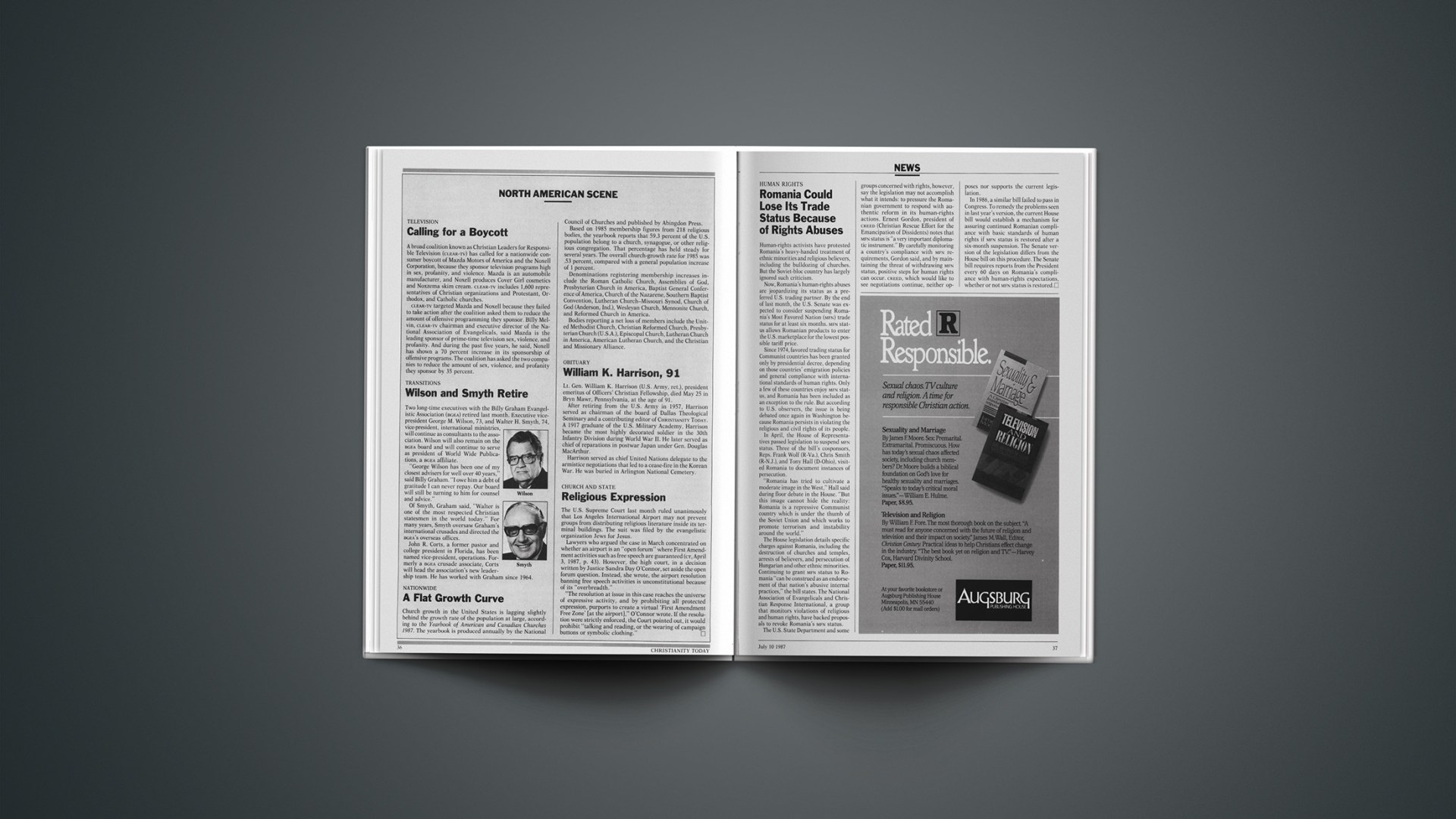
North American Scene from July 10, 1987

TELEVISION

Calling For A Boycott

A broad coalition known as Christian Leaders for Responsible Television (CLEAR-TV) has called for a nationwide consumer boycott of Mazda Motors of America and the Noxell Corporation, because they sponsor television programs high in sex, profanity, and violence. Mazda is an automobile manufacturer, and Noxell produces Cover Girl cosmetics and Noxzema skim cream. CLEAR-TV includes 1,600 representatives of Christian organizations and Protestant, Orthodox, and Catholic churches.

CLEAR-TV targeted Mazda and Noxell because they failed to take action after the coalition asked them to reduce the amount of offensive programming they sponsor. Billy Melvin, CLEAR-TV chairman and executive director of the National Association of Evangelicals, said Mazda is the leading sponsor of prime-time television sex, violence, and profanity. And during the past five years, he said, Noxell has shown a 70 percent increase in its sponsorship of offensive programs. The coalition has asked the two companies to reduce the amount of sex, violence, and profanity they sponsor by 35 percent.

TRANSITIONS

Wilson And Smyth Retire

Two long-time executives with the Billy Graham Evangelistic Association (BGEA) retired last month. Executive vice-president George M. Wilson, 73, and Walter H. Smyth, 74, vice-president, international ministries, will continue as consultants to the association. Wilson will also remain on the BGEA board and will continue to serve as president of World Wide Publications, a BGEA affiliate.

“George Wilson has been one of my closest advisers for well over 40 years,” said Billy Graham. “I owe him a debt of gratitude I can never repay. Our board will still be turning to him for counsel and advice.”

Of Smyth, Graham said, “Walter is one of the most respected Christian statesmen in the world today.” For many years, Smyth oversaw Graham’s international crusades and directed the BGEA’s overseas offices.

John R. Corts, a former pastor and college president in Florida, has been named vice-president, operations. Formerly a BGEA crusade associate, Corts will head the association’s new leadership team. He has worked with Graham since 1964.

NATIONWIDE

A Flat Growth Curve

Church growth in the United States is lagging slightly behind the growth rate of the population at large, according to the Yearbook of American and Canadian Churches 1987. The yearbook is produced annually by the National Council of Churches and published by Abingdon Press.

Based on 1985 membership figures from 218 religious bodies, the yearbook reports that 59.3 percent of the U.S. population belong to a church, synagogue, or other religious congregation. That percentage has held steady for several years. The overall church-growth rate for 1985 was 53 percent, compared with a general population increase of 1 percent.

Denominations registering membership increases include the Roman Catholic Church, Assemblies of God, Presbyterian Church in America, Baptist General Conference of America, Church of the Nazarene, Southern Baptist Convention, Lutheran Church-Missouri Synod, Church of God (Anderson, Ind.), Wesleyan Church, Mennonite Church, and Reformed Church in America.

Bodies reporting a net loss of members include the United Methodist Church, Christian Reformed Church, Presbyterian Church (U.S.A.), Episcopal Church, Lutheran Church in America, American Lutheran Church, and the Christian and Missionary Alliance.

OBITUARY

William K. Harrison, 91

Lt. Gen. William K. Harrison (U.S. Army, ret.), president emeritus of Officers’ Christian Fellowship, died May 25 in Bryn Mawr, Pennsylvania, at the age of 91.

After retiring from the U.S. Army in 1957, Harrison served as chairman of the board of Dallas Theological Seminary and a contributing editor of CHRISTIANITY TODAY. A 1917 graduate of the U.S. Military Academy, Harrison became the most highly decorated soldier in the 30th Infantry Division during World War II. He later served as chief of reparations in postwar Japan under Gen. Douglas MacArthur.

Harrison served as chief United Nations delegate to the armistice negotiations that led to a cease-fire in the Korean War. He was buried in Arlington National Cemetery.

CHURCH AND STATE

Religious Expression

The U.S. Supreme Court last month ruled unanimously that Los Angeles International Airport may not prevent groups from distributing religious literature inside its terminal buildings. The suit was filed by the evangelistic organization Jews for Jesus.

Lawyers who argued the case in March concentrated on whether an airport is an “open forum” where First Amendment activities such as free speech are guaranteed (CT, April 3, 1987, p. 43). However, the high court, in a decision written by Justice Sandra Day O’Connor, set aside the open forum question. Instead, she wrote, the airport resolution banning free speech activities is unconstitutional because of its “overbreadth.”

“The resolution at issue in this case reaches the universe of expressive activity, and by prohibiting all protected expression, purports to create a virtual ‘First Amendment Free Zone’ [at the airport],” O’Connor wrote. If the resolution were strictly enforced, the Court pointed out, it would prohibit “talking and reading, or the wearing of campaign buttons or symbolic clothing.”

World Scene from July 10, 1987

NORWAY

Less State Control

Church of Norway Bishop Andreas Aarflot said his country’s government has instituted limited reforms that give the state-controlled church more decision-making power.

In an interview with Religious News Service, Aarflot said the government is allowing the Lutheran denomination to hold an annual general synod, which deals with such matters as changes in liturgy and parish education, areas previously controlled by the government. “We think over time,” Aarflot said, “that the general synod will have more authority in legislative matters.”

The appointment of pastors, previously a government procedure, will soon be made by councils of the church’s 11 dioceses. However, the government will continue to name the Church of Norway’s bishops, after nomination by the church.

Pastors’ salaries and church administrative costs still come from the Norwegian government’s national budget, while the cost of maintaining church buildings comes from municipal governments. Bishop Aarflot has called for a “different system” of financial support, because the government “could veto any church decision by simply not granting money for it.”

SOUTH AFRICA

Missing A Deadline

Philadelphia pastor Leon H. Sullivan has abandoned the fair employment principles he developed ten years ago for U.S. corporations doing business in South Africa. Instead, the Baptist clergyman announced last month that he is calling for U.S. companies to leave South Africa within nine months. He also asked the U.S. government to break diplomatic ties with South Africa and impose an economic embargo against it.

The announcements came two years after Sullivan set a deadline for the South African government to abandon apartheid, its institutionalized system of racial discrimination (CT, Oct. 4, 1985, p. 56). Currently, 127 of the nearly 200 U.S. firms doing business in South Africa abide by the Sullivan Principles. Last month, Sullivan called on stockholders to pressure these companies to leave the African nation.

Antiapartheid activists praised Sullivan’s action. Corporate spokesmen and the Reagan administration, however, criticized the announcement. Companies that continue to operate in South Africa have the opportunity and responsibility to continue supporting fair treatment for black South Africans, the administration said.

WEST GERMANY

Is Religion Obsolete?

Nearly half of all West Germans consider religion obsolete, according to a survey conducted by the Institute for Public Opinion Research in Allensbach.

The survey found that 46 percent of West Germany’s citizens consider religion obsolete, with only one-third believing religion has an answer for today’s problems. Two-thirds said they believe in God, but only one-third indicated they “stand by the teaching of the church.” Fifty-seven percent reported they “rarely or never” attend worship services.

Regarding the Bible, 37 percent said they do not believe everything in it but consider it to be the basis of their faith; 35 percent said their beliefs have “little to do with the Bible”; 15 percent said they “firmly believe” the Scriptures; 9 percent consider the Bible to be a “collection of more or less invented stories”; and 4 percent had no opinion.

WORLDWIDE

Higher Christian Population

The percentage of Christians in the world’s population is on the rise, according to statistician David Barrett, editor of World Christian Encyclopedia. He said the previous downward spiral has been “dramatically halted and reversed” after several decades of decline.

According to Barrett’s latest findings, Christians make up 32.9 percent of the world’s population, compared to 32.4 percent last year. He credits the rapid growth of the church in China with turning the tide. Chinese Christians account for more than 52 million of the world’s 1.64 billion Christians, he said.

Among the world’s religions, Christianity claims the most adherents. Islam ranks second, with 854 million; followed by Hinduism, with 658 million; Buddhism, with 312 million; and Judaism, with 18.2 million. All of those religions except Hinduism registered increases since 1986, according to Barrett. Also growing are the ranks of atheists, from 213 million last year to 224 million today.

ZIMBABWE

Planting 2,000 New Churches

Church leaders in Zimbabwe have committed themselves to plant nearly 2,000 new churches by the year 2000. Some 300 pastors, evangelists, and other church leaders representing more than 20 conservative Protestant groups set that goal at the recent Discipling Zimbabwe Congress.

Sponsored by Overseas Crusades, the congress was developed under the DAWN (Discipling a Whole Nation) concept. “In our experience in other nations … equipping national church leaders for an optimum effort in saturation church planting is the best method under heaven for fulfilling the Great Commission,” said Overseas Crusades President Larry Keyes. “We are now thrilled to see that this is also true in Zimbabwe.”

Although Zimbabwe is a Marxist country, conference organizers said the government did not interfere with the meeting. “In Zimbabwe, the presence of expatriates—businessmen, missionaries, and others—continues,” said Ted Olsen, an Overseas Crusades missionary who helped plan the congress.

“The Zimbabwe economy is sound, and there is a strong emphasis on development …,” he said. “[Zimbabwe] remains open to our ministry, and we have enjoyed nothing but warmth and hospitality from Zimbabwean nationals in government and in the church.”

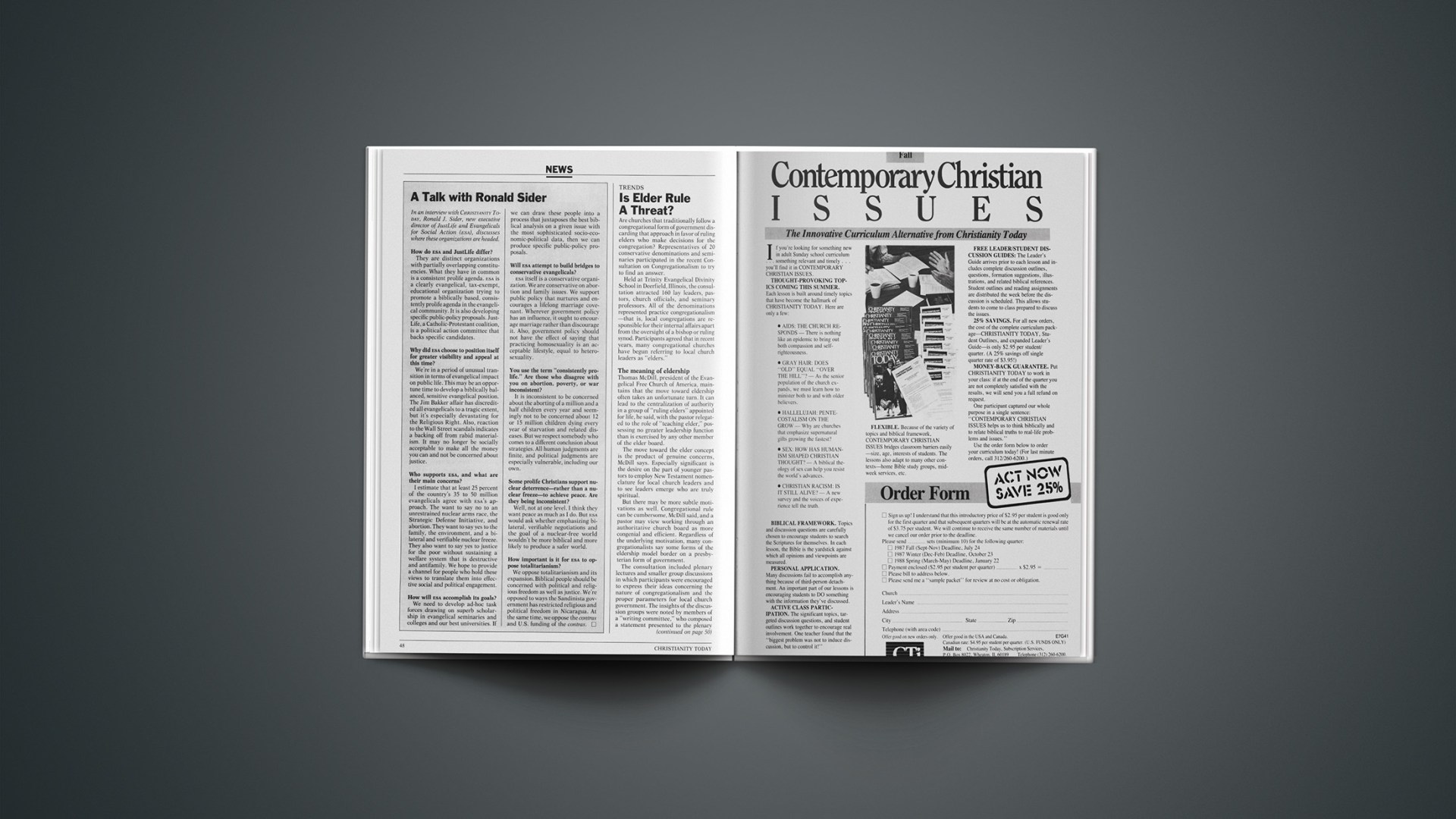
A Talk with Ronald Sider

In an interview with CHRISTIANITY TODAY, Ronald J. Sider, new executive director of JustLife and Evangelicals for Social Action (ESA), discusses where these organizations are headed.

How do ESA and JustLife differ?

They are distinct organizations with partially overlapping constituencies. What they have in common is a consistent prolife agenda. ESA is a clearly evangelical, tax-exempt, educational organization trying to promote a biblically based, consistently prolife agenda in the evangelical community. It is also developing specific public-policy proposals. JustLife, a Catholic-Protestant coalition, is a political action committee that backs specific candidates.

Why did ESA choose to position itself for greater visibility and appeal at this time?

We’re in a period of unusual transition in terms of evangelical impact on public life. This may be an opportune time to develop a biblically balanced, sensitive evangelical position. The Jim Bakker affair has discredited all evangelicals to a tragic extent, but it’s especially devastating for the Religious Right. Also, reaction to the Wall Street scandals indicates a backing off from rabid materialism. It may no longer be socially acceptable to make all the money you can and not be concerned about justice.

Who supports ESA, and what are their main concerns?

I estimate that at least 25 percent of the country’s 35 to 50 million evangelicals agree with ESA’s approach. The want to say no to an unrestrained nuclear arms race, the Strategic Defense Initiative, and abortion. They want to say yes to the family, the environment, and a bilateral and verifiable nuclear freeze. They also want to say yes to justice for the poor without sustaining a welfare system that is destructive and antifamily. We hope to provide a channel for people who hold these views to translate them into effective social and political engagement.

How will ESA accomplish its goals?

We need to develop ad-hoc task forces drawing on superb scholarship in evangelical seminaries and colleges and our best universities. If we can draw these people into a process that juxtaposes the best biblical analysis on a given issue with the most sophisticated socio-economic-political data, then we can produce specific public-policy proposals.

Will ESA attempt to build bridges to conservative evangelicals?

ESA itself is a conservative organization. We are conservative on abortion and family issues. We support public policy that nurtures and encourages a lifelong marriage covenant. Wherever government policy has an influence, it ought to encourage marriage rather than discourage it. Also, government policy should not have the effect of saying that practicing homosexuality is an acceptable lifestyle, equal to heterosexuality.

You use the term “consistently prolife.” Are those who disagree with you on abortion, poverty, or war inconsistent?

It is inconsistent to be concerned about the aborting of a million and a half children every year and seemingly not to be concerned about 12 or 15 million children dying every year of starvation and related diseases. But we respect somebody who comes to a different conclusion about strategies. All human judgments are finite, and political judgments are especially vulnerable, including our own.

Some prolife Christians support nuclear deterrence—rather than a nuclear freeze—to achieve peace. Are they being inconsistent?

Well, not at one level. I think they want peace as much as I do. But ESA would ask whether emphasizing bilateral, verifiable negotiations and the goal of a nuclear-free world wouldn’t be more biblical and more likely to produce a safer world.

How important is it for ESA to oppose totalitarianism?

We oppose totalitarianism and its expansion. Biblical people should be concerned with political and religious freedom as well as justice. We’re opposed to ways the Sandinista government has restricted religious and political freedom in Nicaragua. At the same time, we oppose the contras and U.S. funding of the contras.

Private Lives

As the curtain closed on the era of Hollywood’s self-policing Hayes Commission Codes in the 1960s, a new breed of maverick filmmaker scrambled to topple the remaining taboos standing in the way of “honesty” and “realism.” Explicit violence blasted its way onto the screen in such films as Bonnie and Clyde and The Wild Bunch.

Midnight Cowboy, with its frank portrayal of male prostitution, was the first X-rated feature to win an Oscar for best film. Nudity became de rigueur in the most banal situations, and even the young boy in ET swore like a sailor.

But in its quest for realism, Hollywood has gone overboard and created a new unrealism. As cameras follow their subjects into the shower and boudoir with tedious predictability, the private side of life is omitted.

But every trend has its exceptions, and times do change. Two excellent new films break with Hollywood tradition by reprivatizing portions of their characters’ lives.

Waiting for the Moon is a fictionalized slice of life based on the relationship of American writer Gertrude Stein and her companion, Alice B. Toklas, whose home in France was a way station for such twentieth-century luminaries as Ernest Hemingway and Pablo Picasso. Writer/director Jill Godmilow chose to picture the relationship of the two women without focusing on their alleged lesbianism.

“People come out of the film asking, ‘Well, were they or weren’t they?’ ” Godmilow said in an interview, “But my feeling was that visitors to their home would not have been shown some torrid sex scene, and I wanted to give the characters that kind of privacy, to show them as they would have appeared to those who knew them.”

Godmilow’s artistic restraint allows her film to focus on those elements of the relationship that are best suited to public scrutiny: their literary cooperation and mutual support. One of the finest scenes in the film consists of Stein and Toklas, sitting in the garden one balmy afternoon, editing and proofreading a manuscript together.

As a result, the considerable talents of Linda Hunt, who won an Oscar for her riveting portrayal of Billie Kwan in The Year of Living Dangerously, are maximized in a memorable Alice. British actress Linda Bassett is equally rich as Gertrude. Godmilow said ironically, that the search for a Gertrude was fruitless in America precisely because Hollywood does not nurture the talents of matronly, fortyish actresses. Hollywood’s taste in women runs more toward the young, the sensual, and the venal. Hence, an English actress plays the American author.

Movies With Manners

In the same vein, 84 Charing Cross Road is the story of a feisty New York writer who answers an ad for rare and antiquarian books in the Saturday Review. She writes a letter to a stodgy English bookseller, seeking reasonably priced copies of classic books, and a 20-year friendship, based solely on letters, ensues between her and the staff of the bookstore. We delight in each newsy letter, and in the ongoing battle of wits between dry British humor and New York shtick.

As in Waiting for the Moon, the characters are viewed not from the persona of an intruding peeping Tom but from a respectful distance, as Godmilow says, “the way they would appear to actual people who might know and interact with them.” It is polite filmmaking, movies with manners.

There is something refreshingly honest about this approach to filmmaking. People are viewed with dignity. They are examined, but with gentle hands that respect and caress. They are illuminated, but with a soft lamp rather than an interrogator’s floodlight.

By Stefan Ulstein, chairman of the English department, Bellevue (Wash.) Christian School.

Apple PodcastsDown ArrowDown ArrowDown Arrowarrow_left_altLeft ArrowLeft ArrowRight ArrowRight ArrowRight Arrowarrow_up_altUp ArrowUp ArrowAvailable at Amazoncaret-downCloseCloseEmailEmailExpandExpandExternalExternalFacebookfacebook-squareGiftGiftGooglegoogleGoogle KeephamburgerInstagraminstagram-squareLinkLinklinkedin-squareListenListenListenChristianity TodayCT Creative Studio Logologo_orgMegaphoneMenuMenupausePinterestPlayPlayPocketPodcastRSSRSSSaveSaveSaveSearchSearchsearchSpotifyStitcherTelegramTable of ContentsTable of Contentstwitter-squareWhatsAppXYouTubeYouTube