
Three Lutheran Denominations Become One

When Martin Luther tacked his 95 theses to the door of Wittenberg’s castle church in 1517, his motive was to reform the church, not to divide it. Ironically, Luther’s followers have gone off in many directions: the world’s 70 million Lutherans are divided into several hundred church bodies.

Recent decades, however, have witnessed a trend toward Lutheran unity. Last month in Columbus, Ohio, Lutherans in this country took a major step toward unity as three Lutheran denominations, including two of the largest, became one.

The 2.9 million-member Lutheran Church in America (LCA,) the 2.3 million-member American Lutheran Church (ALC,) and the 110,000-member Association of Evangelical Lutheran Churches (AELC) merged to form the Evangelical Lutheran Church in America (ELCA,) which will start operating from its Chicago headquarters on January 1 of next year. With 5.3 million members, the ELCA is the country’s fourth-largest Protestant denomination.

Obstacles to the merger included differing perspectives on clergy authority (stressd by the LCA) versus congregational autonomy (stressed by the ALC). These two denominations also differed on more practical matters, such as how to handle pastors’ pension plans. Some of the differences remain unsettled as the new church begins its life.

The First Bishop

The new church’s most pressing item of business was to select its first presiding bishop. Delegates chose Herbert W. Chilstrom, bishop of the LCA’S Minnesota synod, its largest. On the ninth ballot, David Preus, presiding bishop of the ALC, was the last candidate to be eliminated.

In many ways, Chilstrom seemed an ideal choice. Though an LCA bishop, he was well known in the ALC because of the ALC’S numerical strength in the upper Midwest, where Chilstrom has served for 11 years. Also, Chilstrom’s wife, Corinne, is an ordained (ALC) pastor.

Chilstrom, 55, is known as a peacemaker and reconciler. He played a key role in keeping the merger talks alive when they appeared to be breaking down. Some say his role as a personal counselor became more significant following the November 1984 suicide of the Chilstroms’ 18-year-old son, about which they chose to be candid.

The new bishop describes himself as “theologically centrist,” who is “left of center on social issues.” He once expressed his hope that future Lutheran pastors be “evangelical conservatives with a radical social conscience.”

Whereas the merging churches, in past pronouncements, have allowed that abortion may be a moral decision, Chilstrom opposes abortion except in cases of rape and when the mother’s life is in danger. He has suggested the new church reexamine the issue.

Declining Membership

One of Chilstrom’s challenges will be to halt falling membership. All three merging denominations have faced numerical decline in recent years, including a combined loss of more than 20,000 last year. Chilstrom noted, however, that membership in the LCA’S Minnesota synod increased in each of its 25 years of existence.

It was Chilstrom who proposed that the word evangelical be incorporated in the new church’s name. He said this word indicates the church is serious about bringing others to the gospel of Jesus Christ.

As many as 100 ALC congregations already have pulled out, or are expected to pull out, of the new denomination, mainly because the words “inerrant” and “infallible” do not appear in the ELCA’S confession of faith in reference to Scripture. That confession calls the Bible the “inspired Word of God and the authoritative source and norm of [the church’s] proclamation, faith, and life.”

Security was heavy at the convention site in downtown Columbus because of threats the meeting would be disrupted by a controversial group known as Denominational Ministry Extended.

The group, whose leadership includes two defrocked LCA pastors, charges that Lutherans have strayed from the gospel, particularly by ignoring the plight of the homeless and jobless.

The two pastors, D. Douglas Roth and Daniel Solberg, accompanied by about 40 supporters, tried to enter the main convention hall. A brief scuffle ensued; Roth and Solberg were arrested and charged with assault, trespass, and failure to depart.

Ankerberg Discusses the Part He Played

Chattanooga, Tennessee-based Christian talk show host John Ankerberg has been regarded by some as the villain in the scandal that has rocked PTL. Ankerberg first spoke out in defense of Jimmy Swaggart, who had been accused of instigating a “hostile takeover” of PTL. He later brought forth allegations that former PTL head Jim Bakker visited prostitutes and engaged in homosexual acts. Ankerberg discussed with CHRISTIANITY TODAY his role in revealing the allegations.

How He Got Involved

It was at this year’s (February) convention of the National Religious Broadcasters when Ankerberg first heard charges that Bakker had had an affair with New York church secretary Jessica Hahn in 1980, and that PTL had paid her to keep silent. Ankerberg said Swaggart had heard the same story several months earlier and had confronted PTL leaders last September. Richard Dortch, Bakker’s assistant who would later replace him as host of the PTL television show, denied the charges.

Ankerberg said that at first he did not believe the story, “but the people who told me were some of the most respected people in the world.… Everything I tried to do was based on the principles of Matthew 18:1 found there were two or three witnesses willing to testify concerning each of the accusations I was hearing.”

Ankerberg’s effort to determine the truth of the allegations surrounding Hahn led him to California businessman Paul Roper, who had met with PTL on Hahn’s behalf. Roper showed Ankerberg the legal documents of the financial arrangement, documents written to Dortch. When Ankerberg showed the documentation to Swaggart, Swaggart “realized Dortch had lied to him directly,” Ankerberg said.

Roper told CHRISTIANITY TODAY that Hahn had tried to act on her grievance, but was intimidated by PTL officials. Said Roper, “They [PTL] told her they would cause trouble for her and her family, that she would be better off if she just acknowledged she was at fault.” And, said Roper, “They could say anything they wanted on their TV program. They had the voice and the money. She had no voice and no money.”

Speaking Out

Ankerberg noted that it was not he but Bakker himself who notified the Charlotte Observer of the Hahn incident. “I wish he would have waited,” Ankerberg said, “so we could have handled this in private, according to principles set forth in Scripture.”

Ankerberg said he spoke out initially to defend Swaggart against charges he was trying to take over PTL. “Jimmy was being slandered in the press. I knew the charges were ridiculous.” Once Ankerberg went public, people formerly affiliated with PTL began contacting him with additional allegations. “The press has wrongly stated that I was an investigative reporter or something,” said Ankerberg. “I was just sitting in my office and people would call with information.”

Ankerberg said he did not want to go public with the new allegations, which included homosexuality and wife swapping. But he said he believed PTL’S only chance to survive was if Falwell stayed. Falwell had received a wire from Bakker indicating Bakker’s intention to return to PTL before the April 28 board meeting. Falwell said he and his board would resign if Bakker returned. Ankerberg said he had heard other reports that Bakker was planning to come back. “If he did return, and Falwell and his board resigned,” Ankerberg said, “then when the Assemblies of God announced the additional allegations, no one could have saved the ministry of PTL.”

The Evidence

The testimony against PTL, said Ankerberg, came from people who had worked there at various times between 1976 and 1985. Some, he said, had actually witnessed incidents of misconduct, including homosexual behavior. Some confronted PTL’S leadership about problems within the organization and were forced to resign.

Ankerberg said that as far as he knows, the allegations of misconduct, including use of alcohol and diversion of funds, involved a “very limited number of people,” but most of them were in the organization’s “upper echelon.” He noted that the evidence against Bakker was strong enough to convince the Assemblies of God and the new PTL board to take strong actions, including the withdrawing by the Assemblies of God of the ministerial credentials of Bakker and Dortch.

Security Of The Witnesses

Ankerberg said he is committed to protecting the identity of those who testified against PTL, whom he called “godly and courageous people.” The witnesses, however, have testified before Assemblies of God authorities, and have given statements to representatives of the new PTL board. They told Ankerberg they were willing to testify to the truth of his allegations if it became necessary to do so in a court of law.

Bakker’s Denials

“I have never said Bakker himself was involved in wife swapping,” Ankerberg said, “only that he was made aware of at least one such incident, according to the witnesses, and did not take proper action. I have never said he is a homosexual. I talked about his involvement in homosexual incidents.…

“Tammy made the statement to the press, ‘John Ankerberg, come forward with your witnesses.’ That’s exactly what I’ve done, but in the church arena, not in the press. Jim Bakker had an invitation from his denomination to confess, or to set the record straight by meeting with his accusers.” Ankerberg said he was told by an Assemblies of God leader that Bakker chose not to appear at the investigation hearing concerning the allegations.

Ankerberg acknowledged that the Bakkers have “brought joy, happiness, and compassion … to many people who needed it.” He said it is “my prayer that Jim Bakker will submit to the spiritual authority of his own denomination and still accept the church’s help and admonition.”

A Crackdown at PTL

Friends and foes alike are urging a spring cleaning for all television ministries in the wake of further developments surrounding PTL. Television preacher Jerry Falwell says this process is already taking place at the television network and amusement park empire founded by Jim and Tammy Bakker. He said on the “PTL Club” television show, “I believe a sovereign God is cleaning house.”

Falwell, who took over at PTL in March at Jim Bakker’s request, began putting the house in order at his April board meeting. His new board ceased paying the Bakkers’ $1.6 million annual salary, stopped payments to Jessica Hahn—the former church secretary involved in adultery with Bakker—and dismissed top Bakker aides, including PTL President Richard Dortch.

Financial Woes

A massive cleanup of PTL’S tangled finances began as well. New chief operations officer Harry Hargrave termed the PTL financial records “a mess.” Falwell said the ministry is $69 million in debt. Exorbitant salaries, retainer fees, and bonuses have been cut off, and building projects put on hold. A moratorium has been placed on issuing “lifetime partnerships” for $1,000, and more than 200 workers have been laid off.

In addition to these financial woes, investigations by the Internal Revenue Service (IRS) and the South Carolina Tax Commission are on the horizon. According to the Washington Post, the IRS is challenging personal expenses exceeding $1.3 million.

Additional federal and state investigations, coordinated by the U.S. attorney’s office in Asheville, North Carolina, are exploring possible incidents of wire, tax, and mail fraud. And accountants are trying to determine what happened to several million currently unaccounted for.

Despite the problems, Falwell has pledged to see PTL survive, complying with “the rules and regulations of man as well as God.” He issued an urgent plea for sacrificial giving from PTL supporters to keep the ministry out of bankruptcy, saying it would have to shut down by the end of May unless $7 million in contributions arrived.

Meanwhile, rumors that the Bakkers would return to PTL came to a halt when new charges were leveled by Baptist talk show host John Ankerberg (see sidebar on p. 52). Ankerberg spoke publicly of evidence that Bakker had engaged in homosexual acts, used prostitutes, and condoned “wife swapping” by PTL staff.

Both Bakker and Dortch were dismissed last month as ministers of the Assemblies of God for “conduct unbecoming to a minister.” The Reverend G. Raymond Carlson, general superintendent of the denomination, said Dortch’s dismissal was for concealing information about the immoral actions of a fellow minister.

Carlson said Bakker was ousted for his admitted sexual encounter seven years ago and for “alleged misconduct involving bisexual activity.” At an impromptu press conference in front of his Palm Springs home, Bakker denied he had ever gone to a prostitute and said he is not a homosexual. (Bakker has indicated he might meet with his accusers.)

Fallout

As a result of the scandals and publicity, a widespread reassessment of the role of religious broadcasting is under way. At his April press conference, Falwell said the national credibility of the cause of Christ is at “an all-time low.” He said, “We’re all injured and we’ve all got to pray for repentance and revival and restoration.…”

Many ministries are feeling the impact of PTL’S diminished credibility. Falwell said donations to his own “Old Time Gospel Hour” have dropped nearly $2 million since his involvement with PTL. Pat Robertson, founder of the Christian Broadcasting Network (CBN,) said last month that publicity surrounding PTL has cost his ministry $10 million. He said donations to CBN through April were down “a staggering 33 percent” from the same time last year.

A Louis Harris survey conducted in mid-April found that even among self-described followers of TV ministers, 41 percent believe most TV evangelists do “more harm than good.” The group Fundamentalists Anonymous says it is forming a legal task force to address what it calls “religious malpractice.”

Ben Armstrong, of the National Religious Broadcasters (NRB,) said the short-term effects will be negative, but that in the long run the “cleansing” is “a healthy process.” He said he hopes television ministries will join the Evangelical Council for Financial Accountability or the NRB’S new self-regulatory Ethics and Financial Integrity Commission, which will be presented for NRB board approval in August.

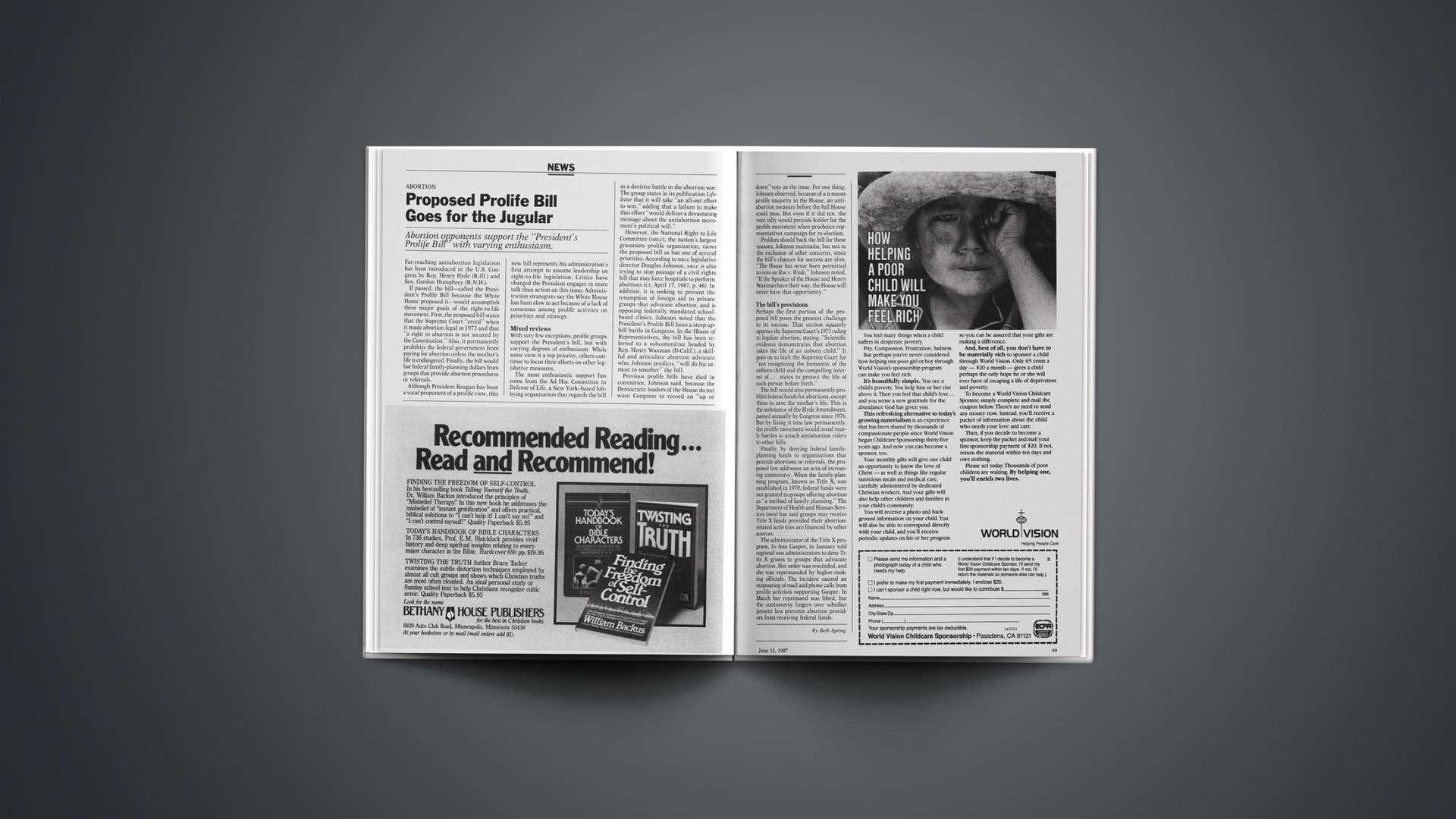
Proposed Prolife Bill Goes for the Jugular

Abortion opponents support the “President’s Prolife Bill” with varying enthusiasm.

Far-reaching antiabortion legislation has been introduced in the U.S. Congress by Rep. Henry Hyde (R-Ill.) and Sen. Gordon Humphrey (R-N.H.).

If passed, the bill—called the President’s Prolife Bill because the White House proposed it—would accomplish three major goals of the right-to-life movement. First, the proposed bill states that the Supreme Court “erred” when it made abortion legal in 1973 and that “a right to abortion is not secured by the Constitution.” Also, it permanently prohibits the federal government from paying for abortion unless the mother’s life is endangered. Finally, the bill would bar federal family-planning dollars from groups that provide abortion procedures or referrals.

Although President Reagan has been a vocal proponent of a prolife view, this new bill represents his administration’s first attempt to assume leadership on right-to-life legislation. Critics have charged the President engages in more talk than action on this issue. Administration strategists say the White House has been slow to act because of a lack of consensus among prolife activists on priorities and strategy.

Mixed Reviews

With very few exceptions, prolife groups support the President’s bill, but with varying degrees of enthusiasm. While some view it a top priority, others continue to focus their efforts on other legislative measures.

The most enthusiastic support has come from the Ad Hoc Committee in Defense of Life, a New York-based lobbying organization that regards the bill as a decisive battle in the abortion war. The group states in its publication Life-letter that it will take “an all-out effort to win,” adding that a failure to make that effort “would deliver a devastating message about the antiabortion movement’s political will.”

However, the National Right to Life Committee (NRLC,) the nation’s largest grassroots prolife organization, views the proposed bill as but one of several priorities. According to NRLC legislative director Douglas Johnson, NRLC is also trying to stop passage of a civil rights bill that may force hospitals to perform abortions (CT, April 17, 1987, p. 46). In addition, it is seeking to prevent the resumption of foreign aid to private groups that advocate abortion, and is opposing federally mandated school-based clinics. Johnson noted that the President’s Prolife Bill faces a steep uphill battle in Congress. In the House of Representatives, the bill has been referred to a subcommittee headed by Rep. Henry Waxman (D-Calif.), a skillful and articulate abortion advocate who, Johnson predicts, “will do his utmost to smother” the bill.

Previous prolife bills have died in committee, Johnson said, because the Democratic leaders of the House do not want Congress to record an “up or down” vote on the issue. For one thing, Johnson observed, because of a tenuous prolife majority in the House, an antiabortion measure before the full House could pass. But even if it did not, the vote tally would provide fodder for the prolife movement when prochoice representatives campaign for re-election.

Prolifers should back the bill for these reasons, Johnson maintains, but not to the exclusion of other concerns, since the bill’s chances for success are slim. “The House has never been permitted to vote on Roe v. Wade,” Johnson noted. “If the Speaker of the House and Henry Waxman have their way, the House will never have that opportunity.”

The Bill’s Provisions

Perhaps the first portion of the proposed bill poses the greatest challenge to its success. That section squarely opposes the Supreme Court’s 1973 ruling to legalize abortion, stating, “Scientific evidence demonstrates that abortion takes the life of an unborn child.” It goes on to fault the Supreme Court for “not recognizing the humanity of the unborn child and the compelling interest of … states to protect the life of each person before birth.”

The bill would also permanently prohibit federal funds for abortions, except those to save the mother’s life. This is the substance of the Hyde Amendment, passed annually by Congress since 1976. But by fixing it into law permanently, the prolife movement would avoid yearly battles to attach antiabortion riders to other bills.

Finally, by denying federal family-planning funds to organizations that provide abortions or referrals, the proposed law addresses an area of increasing controversy. When the family-planning program, known as Title X, was established in 1970, federal funds were not granted to groups offering abortion as “a method of family planning.” The Department of Health and Human Services (HHS) has said groups may receive Title X funds provided their abortion-related activities are financed by other sources.

The administrator of the Title X program, Jo Ann Gasper, in January told regional HHS administrators to deny Title X grants to groups that advocate abortion. Her order was rescinded, and she was reprimanded by higher-ranking officials. The incident caused an outpouring of mail and phone calls from prolife activists supporting Gasper. In March her reprimand was lifted, but the controversy lingers over whether present law prevents abortion providers from receiving federal funds.

By Beth Spring.

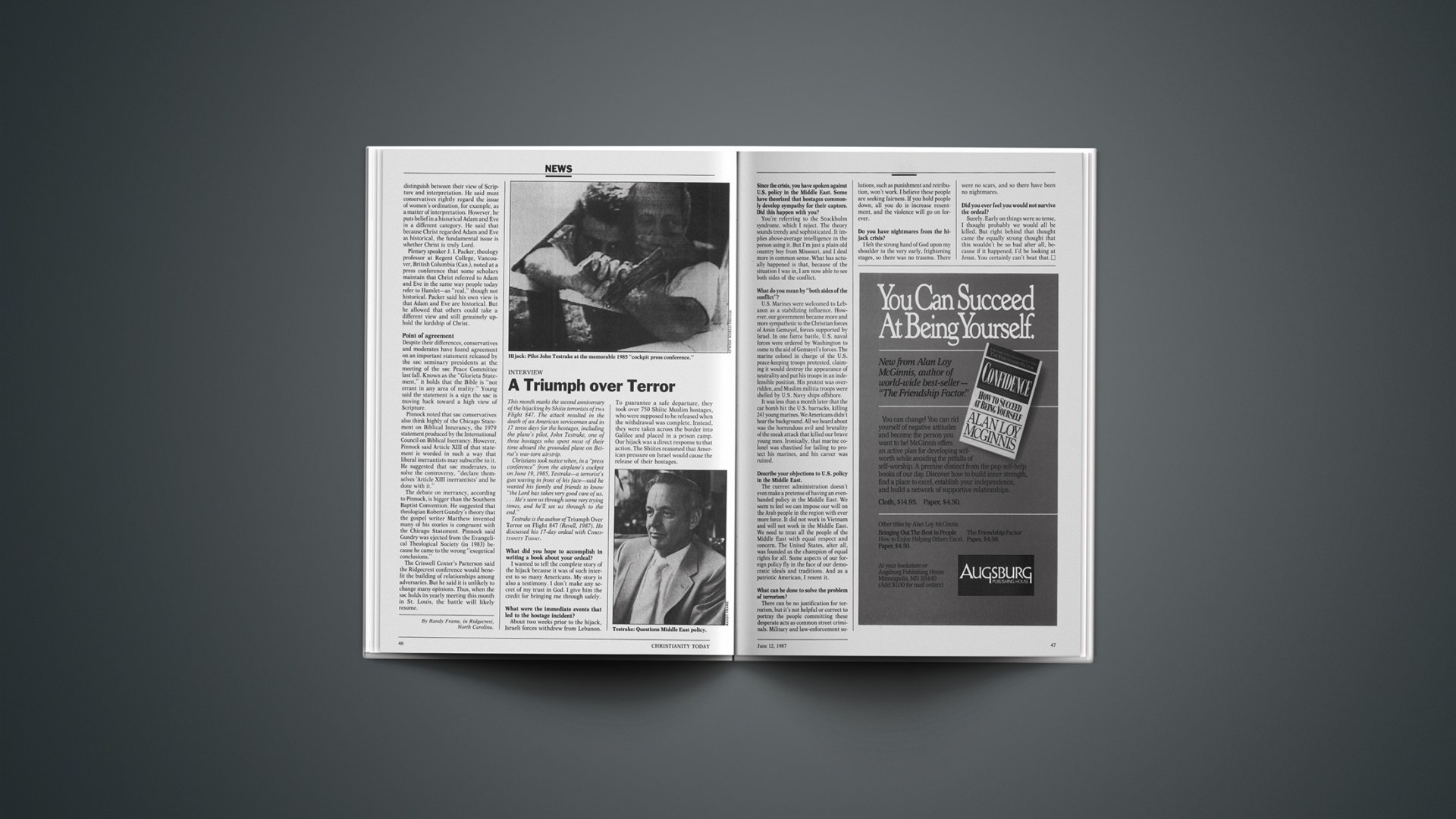
A Triumph over Terror

This month marks the second anniversary of the hijacking by Shiite terrorists of TWA Flight 847. The attack resulted in the death of an American serviceman and in 17 tense days for the hostages, including the plane’s pilot, John Testrake, one of three hostages who spent most of their time aboard the grounded plane on Beirut’s war-torn airstrip.

Christians took notice when, in a “press conference” from the airplane’s cockpit on June 19, 1985, Testrake—a terrorist’s gun waving in front of his face—said he wanted his family and friends to know “the Lord has taken very good care of us … He’s seen us through some very trying times, and he’ll see us through to the end.

Testrake is the author of Triumph Over Terror on Flight 847 (Revell, 1987). He discussed his 17-day ordeal with CHRISTIANITY TODAY.

What did you hope to accomplish in writing a book about your ordeal?

I wanted to tell the complete story of the hijack because it was of such interest to so many Americans. My story is also a testimony. I don’t make any secret of my trust in God. I give him the credit for bringing me through safely.

What were the immediate events that led to the hostage incident?

About two weeks prior to the hijack, Israeli forces withdrew from Lebanon. To guarantee a safe departure, they took over 750 Shiite Muslim hostages, who were supposed to be released when the withdrawal was complete. Instead, they were taken across the border into Galilee and placed in a prison camp. Our hijack was a direct response to that action. The Shiites reasoned that American pressure on Israel would cause the release of their hostages.

Since the crisis, you have spoken against U.S. policy in the Middle East. Some have theorized that hostages commonly develop sympathy for their captors. Did this happen with you?

You’re referring to the Stockholm syndrome, which I reject. The theory sounds trendy and sophisticated. It implies above-average intelligence in the person using it. But I’m just a plain old country boy from Missouri, and I deal more in common sense. What has actually happened is that, because of the situation I was in, I am now able to see both sides of the conflict.

What do you mean by “both sides of the conflict”?

U.S. Marines were welcomed to Lebanon as a stabilizing influence. However, our government became more and more sympathetic to the Christian forces of Amin Gemayel, forces supported by Israel. In one fierce battle, U.S. naval forces were ordered by Washington to come to the aid of Gemayel’s forces. The marine colonel in charge of the U.S. peace-keeping troops protested, claiming it would destroy the appearance of neutrality and put his troops in an indefensible position. His protest was overridden, and Muslim militia troops were shelled by U.S. Navy ships offshore.

It was less than a month later that the car bomb hit the U.S. barracks, killing 241 young marines. We Americans didn’t hear the background. All we heard about was the horrendous evil and brutality of the sneak attack that killed our brave young men. Ironically, that marine colonel was chastised for failing to protect his marines, and his career was ruined.

Describe your objections to U.S. policy in the Middle East.

The current administration doesn’t even make a pretense of having an even-handed policy in the Middle East. We seem to feel we can impose our will on the Arab people in the region with ever more force. It did not work in Vietnam and will not work in the Middle East. We need to treat all the people of the Middle East with equal respect and concern. The United States, after all, was founded as the champion of equal rights for all. Some aspects of our foreign policy fly in the face of our democratic ideals and traditions. And as a patriotic American, I resent it.

What can be done to solve the problem of terrorism?

There can be no justification for terrorism, but it’s not helpful or correct to portray the people committing these desperate acts as common street criminals. Military and law-enforcement solutions, such as punishment and retribution, won’t work. I believe these people are seeking fairness. If you hold people down, all you do is increase resentment, and the violence will go on forever.

Do you have nightmares from the hijack crisis?

I felt the strong hand of God upon my shoulder in the very early, frightening stages, so there was no trauma. There were no scars, and so there have been no nightmares.

Did you ever feel you would not survive the ordeal?

Surely. Early on things were so tense, I thought probably we would all be killed. But right behind that thought came the equally strong thought that this wouldn’t be so bad after all, because if it happened, I’d be looking at Jesus. You certainly can’t beat that.

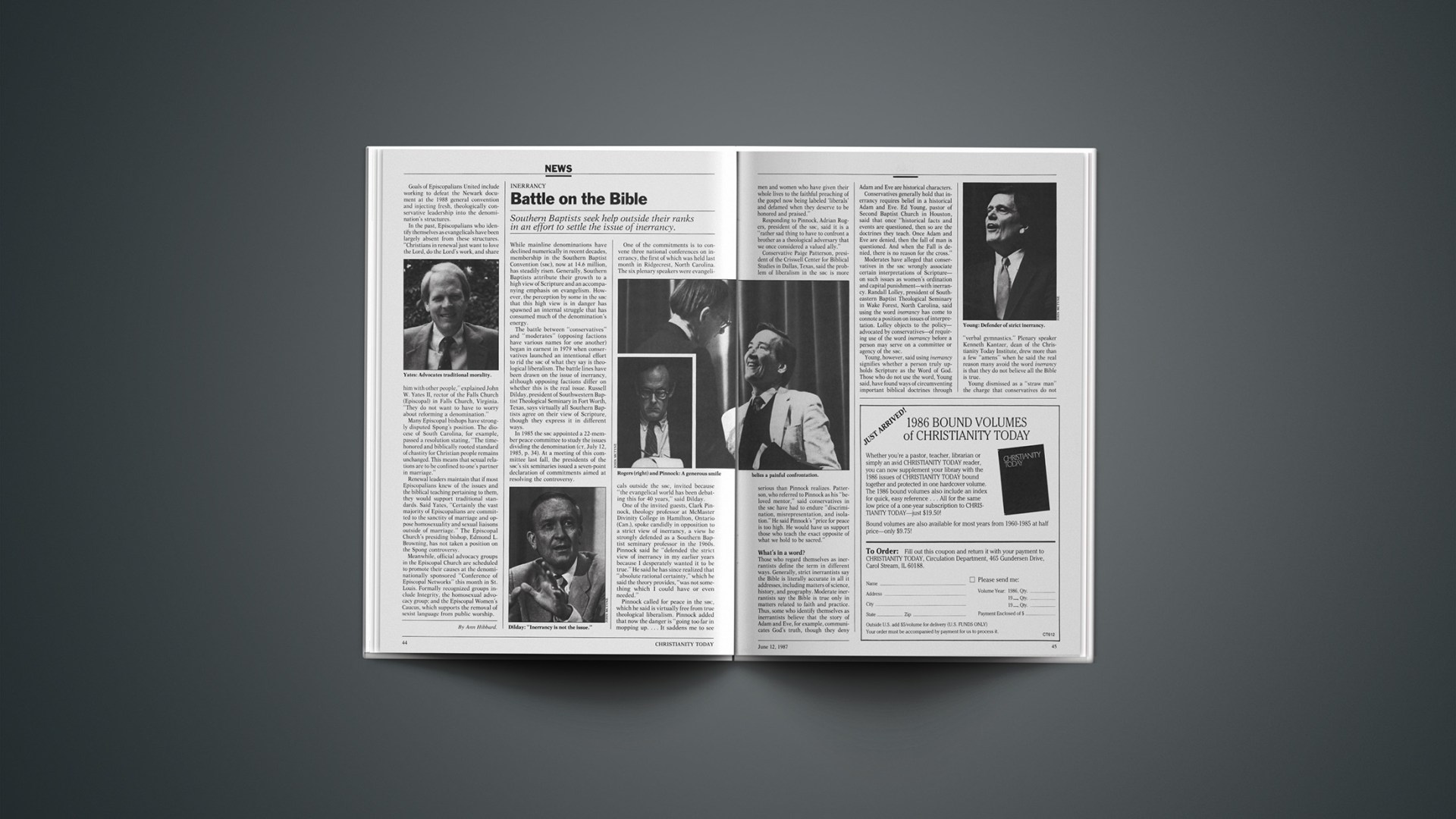
Battle on the Bible

Southern Baptists seek help outside their ranks in an effort to settle the issue of inerrancy.

While mainline denominations have declined numerically in recent decades, membership in the Southern Baptist Convention (SBC,) now at 14.6 million, has steadily risen. Generally, Southern Baptists attribute their growth to a high view of Scripture and an accompanying emphasis on evangelism. However, the perception by some in the SBC that this high view is in danger has spawned an internal struggle that has consumed much of the denomination’s energy.

The battle between “conservatives” and “moderates” (opposing factions have various names for one another) began in earnest in 1979 when conservatives launched an intentional effort to rid the SBC of what they say is theological liberalism. The battle lines have been drawn on the issue of inerrancy, although opposing factions differ on whether this is the real issue. Russell Dilday, president of Southwestern Baptist Theological Seminary in Fort Worth, Texas, says virtually all Southern Baptists agree on their view of Scripture, though they express it in different ways.

In 1985 the SBC appointed a 22-member peace committee to study the issues dividing the denomination (CT, July 12, 1985, p. 34). At a meeting of this committee last fall, the presidents of the SBC’s six seminaries issued a seven-point declaration of commitments aimed at resolving the controversy.

One of the commitments is to convene three national conferences on inerrancy, the first of which was held last month in Ridgecrest, North Carolina. The six plenary speakers were evangelicals outside the SBC, invited because “the evangelical world has been debating this for 40 years,” said Dilday.

One of the invited guests, Clark Pinnock, theology professor at McMaster Divinity College in Hamilton, Ontario (Can.), spoke candidly in opposition to a strict view of inerrancy, a view he strongly defended as a Southern Baptist seminary professor in the 1960s. Pinnock said he “defended the strict view of inerrancy in my earlier years because I desperately wanted it to be true.” He said he has since realized that “absolute rational certainty,” which he said the theory provides, “was not something which I could have or even needed.”

Pinnock called for peace in the SBC, which he said is virtually free from true theological liberalism. Pinnock added that now the danger is “going too far in mopping up.… It saddens me to see men and women who have given their whole lives to the faithful preaching of the gospel now being labeled ‘liberals’ and defamed when they deserve to be honored and praised.”

Responding to Pinnock, Adrian Rogers, president of the SBC, said it is a “rather sad thing to have to confront a brother as a theological adversary that we once considered a valued ally.”

Conservative Paige Patterson, president of the Criswell Center for Biblical Studies in Dallas, Texas, said the problem of liberalism in the SBC is more serious than Pinnock realizes. Patterson, who referred to Pinnock as his “beloved mentor,” said conservatives in the SBC have had to endure “discrimination, misrepresentation, and isolation.” He said Pinnock’s “price for peace is too high. He would have us support those who teach the exact opposite of what we hold to be sacred.”

What’s In A Word?

Those who regard themselves as inerrantists define the term in different ways. Generally, strict inerrantists say the Bible is literally accurate in all it addresses, including matters of science, history, and geography. Moderate inerrantists say the Bible is true only in matters related to faith and practice. Thus, some who identify themselves as inerrantists believe that the story of Adam and Eve, for example, communicates God’s truth, though they deny Adam and Eve are historical characters.

Conservatives generally hold that inerrancy requires belief in a historical Adam and Eve. Ed Young, pastor of Second Baptist Church in Houston, said that once “historical facts and events are questioned, then so are the doctrines they teach. Once Adam and Eve are denied, then the fall of man is questioned. And when the Fall is denied, there is no reason for the cross.”

Moderates have alleged that conservatives in the SBC wrongly associate certain interpretations of Scripture—on such issues as women’s ordination and capital punishment—with inerrancy. Randall Lolley, president of Southeastern Baptist Theological Seminary in Wake Forest, North Carolina, said using the word inerrancy has come to connote a position on issues of interpretation. Lolley objects to the policy—advocated by conservatives—of requiring use of the word inerrancy before a person may serve on a committee or agency of the SBC.

Young, however, said using inerrancy signifies whether a person truly upholds Scripture as the Word of God. Those who do not use the word, Young said, have found ways of circumventing important biblical doctrines through “verbal gymnastics.” Plenary speaker Kenneth Kantzer, dean of the Christianity Today Institute, drew more than a few “amens” when he said the real reason many avoid the word inerrancy is that they do not believe all the Bible is true.

Young dismissed as a “straw man” the charge that conservatives do not distinguish between their view of Scripture and interpretation. He said most conservatives rightly regard the issue of women’s ordination, for example, as a matter of interpretation. However, he puts belief in a historical Adam and Eve in a different category. He said that because Christ regarded Adam and Eve as historical, the fundamental issue is whether Christ is truly Lord.

Plenary speaker J. I. Packer, theology professor at Regent College, Vancouver, British Columbia (Can.), noted at a press conference that some scholars maintain that Christ referred to Adam and Eve in the same way people today refer to Hamlet—as “real,” though not historical. Packer said his own view is that Adam and Eve are historical. But he allowed that others could take a different view and still genuinely uphold the lordship of Christ.

Point Of Agreement

Despite their differences, conservatives and moderates have found agreement on an important statement released by the SBC seminary presidents at the meeting of the SBC Peace Committee last fall. Known as the “Glorieta Statement,” it holds that the Bible is “not errant in any area of reality.” Young said the statement is a sign the SBC is moving back toward a high view of Scripture.

Pinnock noted that SBC conservatives also think highly of the Chicago Statement on Biblical Innerancy, the 1979 statement produced by the International Council on Biblical Inerrancy. However, Pinnock said Article XIII of that statement is worded in such a way that liberal inerrantists may subscribe to it. He suggested that SBC moderates, to solve the controversy, “declare themselves ‘Article XIII inerrantists’ and be done with it.”

The debate on inerrancy, according to Pinnock, is bigger than the Southern Baptist Convention. He suggested that theologian Robert Gundry’s theory that the gospel writer Matthew invented many of his stories is congruent with the Chicago Statement. Pinnock said Gundry was ejected from the Evangelical Theological Society (in 1983) because he came to the wrong “exegetical conclusions.”

The Criswell Center’s Patterson said the Ridgecrest conference would benefit the building of relationships among adversaries. But he said it is unlikely to change many opinions. Thus, when the SBC holds its yearly meeting this month in St. Louis, the battle will likely resume.

By Randy Frame, in Ridgecrest,

North Carolina.

Renewal Leaders Issue a Call to Biblical Morality

Leaders of the renewal movement in the Episcopal Church have launched a new organization, Episcopalians United, in an effort to call the church to traditional, biblical morality. The new organization was created in part as a response to the church’s Newark, New Jersey, diocese.

This diocese, under the leadership of Bishop John S. Spong, approved a study document calling for church sanction of loving, faithful sexual relationships outside of marriage, including homosexuality (CT, Mar. 20, 1987. p. 52). The results of the study will be brought before the 1988 triennial Episcopal General Convention in Detroit. If the study’s recommendations are adopted, the Episcopal Church will consider these unions “blessed by God and affirmed as morally acceptable and responsible by the church.”

Thirty-six leaders working for renewal in the Episcopal Church met in Pittsburgh in April to form the new coalition, whose full name is Episcopalians United for Revelation, Renewal, and Reformation. Although Spong’s report provided the catalyst for the meeting, the coalition established a broader sense of mission, according to Bishop Alden Hathaway of Pittsburgh.

The new group has its roots in a Winter Park, Florida, conference held early last year (CT, Feb. 21, 1986, p. 36). That conference produced a document declaring a united belief in the authority of Scripture, the lordship of Jesus Christ, and his sacrificial death and bodily resurrection.

Goals of Episcopalians United include working to defeat the Newark document at the 1988 general convention and injecting fresh, theologically conservative leadership into the denomination’s structures.

In the past, Episcopalians who identify themselves as evangelicals have been largely absent from these structures. “Christians in renewal just want to love the Lord, do the Lord’s work, and share him with other people,” explained John W. Yates II, rector of the Falls Church (Episcopal) in Falls Church, Virginia. “They do not want to have to worry about reforming a denomination.”

Many Episcopal bishops have strongly disputed Spong’s position. The diocese of South Carolina, for example, passed a resolution stating, “The time-honored and biblically rooted standard of chastity for Christian people remains unchanged. This means that sexual relations are to be confined to one’s partner in marriage.”

Renewal leaders maintain that if most Episcopalians knew of the issues and the biblical teaching pertaining to them, they would support traditional standards. Said Yates, “Certainly the vast majority of Episcopalians are committed to the sanctity of marriage and oppose homosexuality and sexual liaisons outside of marriage.” The Episcopal Church’s presiding bishop, Edmond L. Browning, has not taken a position on the Spong controversy.

Meanwhile, official advocacy groups in the Episcopal Church are scheduled to promote their causes at the denominationally sponsored “Conference of Episcopal Networks” this month in St. Louis. Formally recognized groups include Integrity, the homosexual advocacy group; and the Episcopal Women’s Caucus, which supports the removal of sexist language from public worship.

By Ann Hibbard.

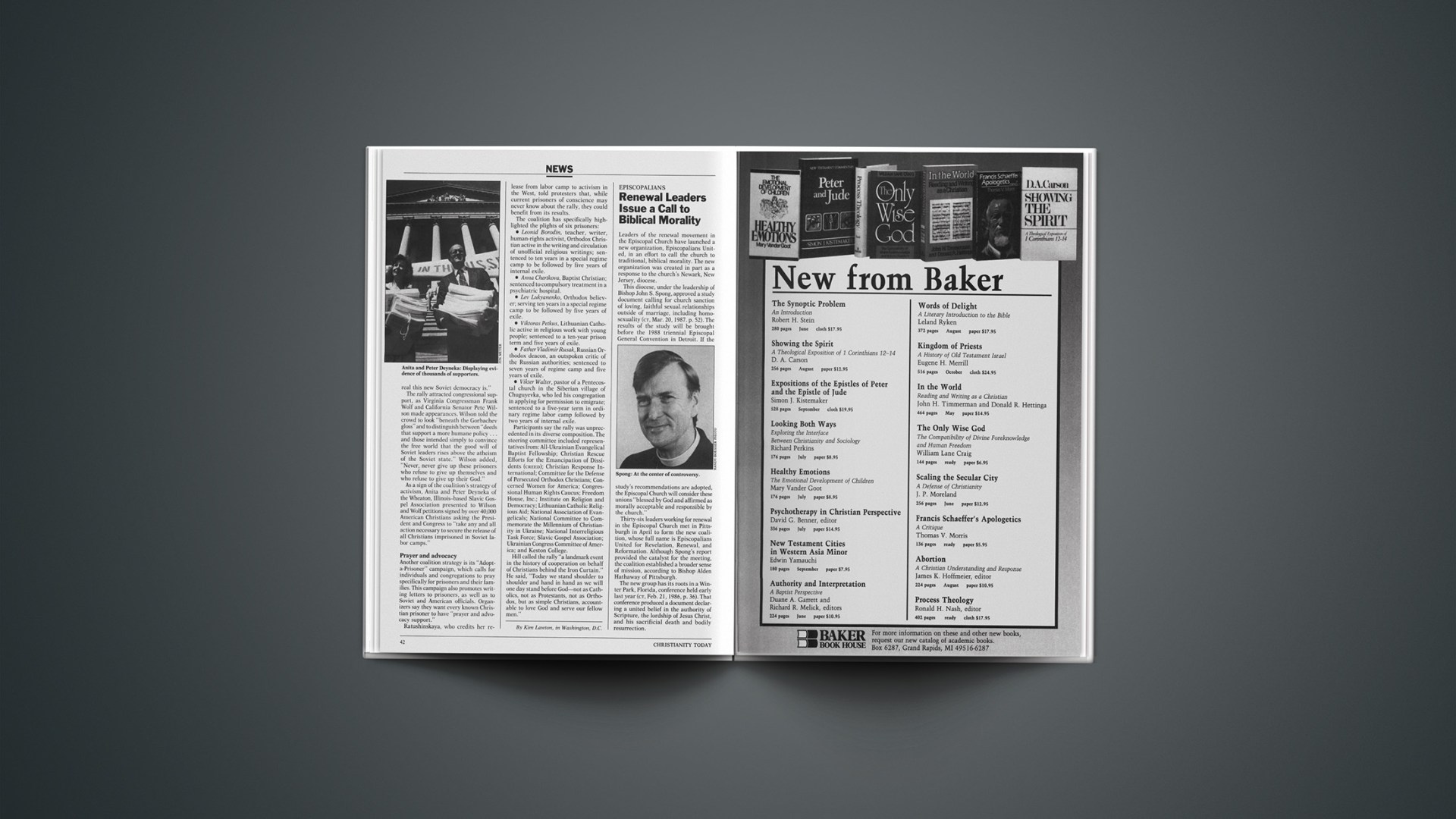
Soviet Believers: Still Paying a High Cost for Commitment

Protesters on the steps of the Capitol call for the release of prisoners of conscience in the Soviet Union.

For several months now, Soviet experts in the West have pondered how to interpret Soviet leader Mikhail Gorbachev’s much-touted policy of glasnost, or openness. About 120 political prisoners were released between February and mid-April of this year. Of these, nine were believing Jews and 36 were Christians, according to Keston College, an England-based group that monitors religious oppression behind the Iron Curtain.

Many experts are urging caution and realism in assessing the apparent change of climate in the Soviet Union. Keston says at least 227 Christians remain in prison. It speculates there may be many more who are unknown.

Capitol Rally

In response, last month 15 Christian and human rights groups joined to form the Coalition for Solidarity with Christians in the USSR. Coalition chairman Kent Hill, also executive director of the Institute on Religion and Democracy, said that while coalition organizers “in no sense wish to ignore important developments now under way in the Soviet Union,” neither do they want to ignore “the continuing fundamental realities” in that country.

The coalition emphasizes a strategy of unity and grassroots activism. At its inaugural rally, held May 1 on the steps of the U.S. Capitol, representatives of the Orthodox, Protestant, and Catholic faiths displayed their concern for Soviet believers still facing harassment, persecution, and imprisonment because of their religious beliefs.

Hill said glasnost, in order to be considered genuine, must affect the entire fiber of the Soviet system. “It is one thing to release a prisoner early,” he said. “It is quite another to exonerate him. They are not exonerating the prisoners … nor have the statutes which sentenced them to jail in the first place been rescinded.”

One of the rally’s main speakers was former Soviet prisoner Irina Ratushinskaya, a Christian poet who spent over four years in a labor camp on charges of anti-Soviet agitation and propaganda (see sidebar below). She remarked that this was her first demonstration at which she would not be arrested afterward.

What can U.S. Christians do to help imprisoned believers?

When I was in labor camp, thousands of letters were sent to me from people in the U.S and other countries. I didn’t get one of them. But our “dear” KGB had to read all those letters. And they understood that if they would kill me, it would be, as they say, “too noisy in the West.” In the spring of ’86, when they thought I would die, they ordered doctors to do something.

The way to help is to send letters to Soviet authorities. You will not get answers, but they will understand the case is well known. And they must make a good face for Western people because they want economic support.

Articles in newspapers, demonstrations—everything helps. They don’t pay attention to opinions of their own people, but they do listen to people in the West.

“Let us test glasnost,” urged Ratushinskaya. She called on listeners to demand that all prisoners of conscience in the Soviet Union be exonerated and released, adding, “We shall see how real this new Soviet democracy is.”

The rally attracted congressional support, as Virginia Congressman Frank Wolf and California Senator Pete Wilson made appearances. Wilson told the crowd to look “beneath the Gorbachev gloss” and to distinguish between “deeds that support a more humane policy … and those intended simply to convince the free world that the good will of Soviet leaders rises above the atheism of the Soviet state.” Wilson added, “Never, never give up these prisoners who refuse to give up themselves and who refuse to give up their God.”

As a sign of the coalition’s strategy of activism, Anita and Peter Deyneka of the Wheaton, Illinois-based Slavic Gospel Association presented to Wilson and Wolf petitions signed by over 40,000 American Christians asking the President and Congress to “take any and all action necessary to secure the release of all Christians imprisoned in Soviet labor camps.”

Prayer And Advocacy

Another coalition strategy is its “Adopt-a-Prisoner” campaign, which calls for individuals and congregations to pray specifically for prisoners and their families. This campaign also promotes writing letters to prisoners, as well as to Soviet and American officials. Organizers say they want every known Christian prisoner to have “prayer and advocacy support.”

Ratushinskaya, who credits her release from labor camp to activism in the West, told protesters that, while current prisoners of conscience may never know about the rally, they could benefit from its results.

The coalition has specifically highlighted the plights of six prisoners:

  • Leonid Borodin, teacher, writer, human-rights activist, Orthodox Christian active in the writing and circulation of unofficial religious writings; sentenced to ten years in a special regime camp to be followed by five years of internal exile.
  • Anna Chertkova, Baptist Christian; sentenced to compulsory treatment in a psychiatric hospital.
  • Lev Lukyanenko, Orthodox believer; serving ten years in a special regime camp to be followed by five years of exile.
  • Viktoras Petkus, Lithuanian Catholic active in religious work with young people; sentenced to a ten-year prison term and five years of exile.
  • Father Vladimir Rusak, Russian Orthodox deacon, an outspoken critic of the Russian authorities; sentenced to seven years of regime camp and five years of exile.
  • Vikter Walter, pastor of a Pentecostal church in the Siberian village of Chuguyevka, who led his congregation in applying for permission to emigrate; sentenced to a five-year term in ordinary regime labor camp followed by two years of internal exile.

Participants say the rally was unprecedented in its diverse composition. The steering committee included representatives from: All-Ukrainian Evangelical Baptist Fellowship; Christian Rescue Efforts for the Emancipation of Dissidents (CREED;) Christian Response International; Committee for the Defense of Persecuted Orthodox Christians; Concerned Women for America; Congressional Human Rights Caucus; Freedom House, Inc.; Institute on Religion and Democracy; Lithuanian Catholic Religious Aid; National Association of Evangelicals; National Committee to Commemorate the Millennium of Christianity in Ukraine; National Interreligious Task Force; Slavic Gospel Association; Ukrainian Congress Committee of America; and Keston College.

Hill called the rally “a landmark event in the history of cooperation on behalf of Christians behind the Iron Curtain.” He said, “Today we stand shoulder to shoulder and hand in hand as we will one day stand before God—not as Catholics, not as Protestants, not as Orthodox, but as simple Christians, accountable to love God and serve our fellow men.”

By Kim Lawton, in Washington, D.C.

Classic & Contemporary Excerpts from June 12, 1987

Crib death

Many babes in Christ die in infancy because of their inability to live up to the impossible standards which are thrown upon them by more mature believers, who so often fall short in those standards themselves.

—James Sennett in

The Wittenburg Door

(Dec. 1984/Jan. 1985)

Inside knowledge

Religions, like languages, must be understood on their own terms, learned, as we would learn French grammar, from the inside.

—William H. Willimon in

The Christian Century (Jan. 28, 1987)

Borderline Christianity

There’s something comfortable about reducing Christianity to a list of do’s and don’ts, whether your list comes from mindless fundamentalism or mindless liberalism: you always know where you stand, and this helps reduce anxiety. Do’s-and-don’tism has the advantage that you don’t need wisdom. You don’t have to think subtly or make hard choices. You don’t have to relate personally to a demanding and loving Lord.

—Robert C. Roberts in

The Reformed Journal (Feb. 1987)

A leaky ship

If we lose the vision, we alone are responsible, and the way we lose the vision is by spiritual leakage. If we do not run our belief about God into practical issues, it is all [over] with the vision God has given.

—Oswald Chambers in

My Utmost for His Highest

Reordering priorities

As a child I was brought up to believe that it was not whether you won or lost, but how you played the game. Then, in the real world, I found that to be all wrong. There I learned you have to win to get anywhere, and it didn’t matter how you did it. But now, after what has happened to [my husband] Dick, I realize that my priorities in the so-called real world were all wrong. Now Dick and I know that the old way was the right way. You know, it really … and truly … is how you play the game.

—Nancy Howser in Sports Illustrated after her husband’s resignation as manager of baseball’s Kansas City Athletics following two surgeries for brain cancer

Religious kitsch

I think kitsch [pretentious bad taste] presents us with a serious theological problem and stands, far beyond the formal bounds of theology, for something amiss in our culture, as, for example, when well-washed fat babies or puppy dogs presented on the cinema screen evoke disproportionate cries of delight. Kitsch is a form of lying, and religious kitsch lies about what is, for the believer, the deepest reality.—

J. M. Cameron, correspondence in The New York Review of Books (May 29, 1986)

Love without price

I try to give to the poor people for love what the rich could get for money. No, I wouldn’t touch a leper for a thousand pounds; yet I willingly cure him for the love of God.

—Mother Teresa in

A Gift for God

God needs no go-fer

When God said, “Let there be light,” he did not speak in order that some subordinate might hear, understand what the speaker wanted, and go and perform the task. This is what happens in human affairs. But the Word of God is creator and maker, and he is the Father’s will.

—Athanasius in The

Wisdom of the Saints

Surprise!

We can’t plan for joy, or put a specific date and time on our calendars when we plan to savor it. Joy overtakes us while we’re busy at something else.

—James Allen Sparks in

If This Pew Could Talk!

Book Briefs: June 12, 1987

Where Did The Power Go?

Less Than Conquerors: How Evangelicals Entered the Twentieth Century, by Douglas Frank (Eerdmans, x + 310 pp.; $14.95, paper). Reviewed by Tim Stafford.

Douglas Frank says that from 1850 to 1920 evangelicals lost control of America. At mid-century they stood at the head of an optimistic, self-confident nation. By 1920 they had become a somewhat baffled minority within a pluralist, secularist nation.

Industrial capitalism broke up the world of independent towns and brought purposeless upheaval. Evangelical pieties, honed on farms and villages, seemed increasingly irrelevant to a world in which distant, impersonal forces ruled. Additional pressures came from the acceptance of evolution, and the introduction of radical critiques of Scripture. Evangelicals felt, subliminally at least, that they were becoming insignificant figures in a landscape that had once belonged to them.

Frank’s fundamental assumption is that this loss of power was God-given. Our heroic forefathers, he says, by well-meaning industry, led us astray.

Frank has, it appears, accepted Barth’s assessment of religion as humanity’s greatest defense against God. Evangelicals have a considerable tradition of scoffing at religiosity, but seldom have we taken seriously the fact that we too are in the religion business. That is, in a way, Frank’s point: evangelicals have thought of themselves as purer than others, when under God’s judgment they are equally in need. In losing their power, evangelicals had a great opportunity to experience God’s grace as that which helps the helpless and blesses the poor in spirit. Instead, they managed to shore up and reassert their self-confidence. Frank analyzes three popular currents that boosted the evangelical self-image.

Back In Control, Someday

The first current was dispensationalism. As the times became threatening, and Christian influences less significant, postmillennial optimism about America became harder to preserve. Evangelicals, Frank suggests, managed to reassert their control of history through a wholesale shift to a variety of dispensationalism that assured them that they alone had the key to understand the world’s threatening state of affairs and would someday once again be the people in charge. They substituted symbolic or eschatological control for their lost societal influence.

The Victorious Christian Life (closely linked to the British Keswick movement, and known by the slogan “let go, let God”) solved another problem. Before the Civil War, evangelicals had put tremendous emphasis on manly character—an appropriate emphasis for people who expected to lead America into the millennium. Manly character was about the mastery of life. But in an increasingly complex and impersonal society, mastery became far more difficult. Getting the victory, as it was called, shifted mastery from external events to an internal realm. There, at least, one could exercise complete control.

The third current was embodied in a man, Billy Sunday, who was the greatest revivalist in history until the advent of Billy Graham. Frank shows that Sunday’s crusades were more passionate about reforming lives (from alcohol, preeminently, but from other passions as well) and making them “manly” than about salvation by grace. His invitation was, frequently, “How many of you men will say, ‘Bill, I believe the Christian life is the right and manly life, and by the grace of God, from now on I’ll do my best for the Lord and for his truth’?”

Why, then, was Sunday so acclaimed by evangelicals? Frank concludes that the colorful evangelist became a kind of hero to evangelicals—hero in the ancient sense, a warrior who goes out to fight our battles for us. When Sunday railed pitilessly against the evils of booze, Frank suggests, evangelicals found a kind of vicarious triumph in watching him devastate the forces of evil.

God’s Magnificence, Not Ours

Through reshaping their theology, and living vicariously through public heroes, Frank says, evangelicals avoided facing their own inability to cope, their lack of applicable answers, their helplessness before overpowering forces. In short, they used their religion as a way to gain some sort of control over a difficult life.

But the grace of Jesus Christ, says Frank, is not meant to help us back into a position of power. It is all about God’s magnificence, and not about our magnificence at all. It requires a spirit of constant repentance, of weeping, of waiting for God’s salvation. Frank sees little of that in our heritage from this period.

Frank’s critique is not what one would call balanced. (He would say, I am sure, that God’s critique is not what one would call balanced, either.) Yet his prose never, to my ear, reveals a mean spirit. Clearly what he criticizes, he sees in himself.

Nor does he denigrate the past merely to substitute his own program. He offers no hope except repentance. My question would be whether repentance (poverty of spirit, humility) is easily detected in historical documents. Is repentance usually a public phenomenon? It may be that the figures he considers knew plenty of repentance, but felt compelled to rise from their knees and lead a movement as best they knew how. I consider evangelical traditions to be larded with concern for prayerful repentance, as well as the busy religion that Frank critiques. I suspect that it was from these traditions, as well as from the Bible, that Frank got his concerns.

Regardless, Douglas Frank’s book is the most spiritually provocative reading I have done in some time, worth buying for the historical analysis alone, but unique in its deeply personal probing of history and Scripture. In this optimistic, activistic time for evangelicals, it is unusual to encounter someone swimming against the stream with such rigor.

Christianity Today Visits Douglas Frank

As befits our image of one who speaks a prophetic word, the fortyish Douglas Frank lives 21 miles up a winding mountain road from the small town of Ashland, Oregon. Son of Walter Frank, head of Greater Europe Mission for 20 years, his childhood memories-include six weeks every summer at camp meetings, where dispensationalism and the Victorious Christian Life were taught, and where the open-air tabernacle had sawdust on the floor for kneeling sinners.

As a professor of history at Trinity College, Frank and several colleagues launched an interdisciplinary study program at an abandoned lumber camp in southern Oregon. By 1982 he and his family had moved to the site, where seven families live year-round, conducting a special fall semester under the auspices of Houghton College.

Asked whether he needed courage to publish Less Than Conquerors, Frank answered, “That’s hard to say. Since I’m an evangelical I’m not really in touch with my feelings.”

He continued in a more serious vein: “I’ve told my parents that I am anxious about their reaction. But as for everyone else, I never really thought much about it. I lived these questions so intensely during the six years I was writing that it became my own private world.”

by Tim Stafford.

Giving Up On The Powers

Christian Anarchy: Jesus’ Primacy Over the Powers, by Vernard Eller (Eerdmans, xiv + 267 pp.; $13.95, paper). Reviewed by Rodney Clapp.

In a time of their pronounced political and social reinvolvement, conservative Christians may be open to considering a variety of political options. Even in an atmosphere of openness, however, the recommendation of Church of the Brethren theologian Vernard Eller is startling. In his latest book, Eller suggests that churchgoers take up the cross—and become Christian anarchists.

Eller carefully qualifies this explosive word. The root archy (or “arky,” as Eller anglicizes it) comes from the Greek meaning “principle,” “prince,” and the like. The prefix an simply means “without” or “un.” In Christ’s resurrection, God has shown himself to be victorious over all earthly powers and principalities. For Eller, this means the Christian should be an “anarchist,” allowing real allegiance to no human prince or principle, but to Jesus alone.

Thus he is unhappy with his fellow pacifists, who too often “use a person’s stand on nuclear arms as a truer test of a person’s Christianity than his stand on the biblical proclamation as to who Christ is. This is zealotism, the prioritizing of a human arky above the true God.” If you are cheering because you think Eller has denounced a folly crying for denunciation, substitute the words “abortion” or “Republican party” for “nuclear arms” and realize Eller would consider the resulting sentences no less true.

Eller is not saying there are not choices that are relatively better, only that there is a single choice that is absolute: the choice for or against Jesus Christ. In our human fallibility, we may arrive at positions and principles derived from our faith, but we should never equate them with the faith.

Balancing Act

Politically speaking, Eller calls Christians to a difficult dialectical balancing act, between the two poles of the establishment and revolution. We are not to choose for or against one or the other. Since the establishment and revolution are both human arkys, Christians must judge establishment or revolutionary proposals on a case-by-case basis, pragmatically supporting the proposals that appear to be most consonant with the justice and love of God.

But the establishment, revolution, and all other human arkys are pretentious: they always promise more than they can deliver. Compared to other citizens, Eller suggests, Christians should be less ideological and more realistic, never supposing any arky will usher in the kingdom on earth. On a scale of 1 to 100, with 100 representing God’s righteousness, Eller guesses the best ever humanly achieved is a 3.

One of the most refreshing aspects of the book is Eller’s method for demonstrating the dialectic of Christian anarchy. He is not preoccupied with making his case at the expense of the opponents of his position. Rather, he is hardest on the positions nearest to his own, ferreting out in relentless, Kierkegaardian fashion the inconsistencies of the peace movement, feminism, and radical discipleship groups such as the Sojourners Community. Chapter 4, “On Selective Sin and Righteousness,” is the best of the book.

Defective Dialectic

But Eller’s dialectic falls short on at least one count. He argues so vigorously for the supremacy of the individual over the institutional that the social aspects of the faith may be given short shrift. Though he makes perfunctory remarks about the church as a social entity, Eller seems to gravitate toward the individual heroically separate from the church, answering independently and directly to the gospel.

Thus his examples of anarchic Christianity have to do with individuals and not with Christian communities—Jacques Ellul’s various political adventures, Karl Barth’s and Dietrich Bonhoeffer’s famous German stands, the celebrated refusal of Vernard’s son Enten to register for the draft, and Vernard’s own “anarchic” relation to his chosen profession of education.

Yet if arkys are social forces, they will overwhelm unconnected individuals. Eller recognizes as much in the case of Barth and Bonhoeffer with the Third Reich. In that instance, both eased the dialectical tension of establishment versus revolution and ended up supporting Christian revolution against Hitler.

Eller excuses Barth’s and Bonhoeffer’s fall from Christian anarchy by saying, “I see them … as two human beings who—under terrible pressure—simply found themselves unable to live up to their own ideals.” One wonders if Eller’s abiding suspicion about institutions prevents him from going ahead to write that Barth and Bonhoeffer needed Christian communities—churches—that would stand with them against the demands of the reprehensible Third Reich and revolution. To put it more generally: If institutions (particularly the church) cannot to some extent be redeemed, there is little hope for individuals.

Whatever the debatable points of Christian Anarchy, it unwaveringly presses home the utter centrality of the gospel. Throughout we find extended biblical exegesis, clear argument, and wit uncommon for a theologian. Christian Anarchy is a lucid synthesis of some 30 years of thinking and writing on the Christian’s relation to the world, a fresh and readable compendium of the Anabaptist witness that—more and more Christians outside that tradition are believing—is needed now as much as ever.

Explosive Issues

Nuclear Arms: Two Views on World Peace, by Myron S. Augsburger and Dean C. Curry (Word, viii + 186 pp.; $14.95, hardcover). Reviewed by Barbara Connell-Bishop, a Washington, D.C. based writer and founder of Greenhome, a women’s retreat and spiritual enrichment home.

“What divides us is not what the Bible says, but what we bring to the Bible.”

Never has this saying been more true than in the recently published Nuclear Arms: Two Views on World Peace. Contributors Myron S. Augsburger and Dean C. Curry square off in true debate style, complete with rebuttals. Thus Word Books begins its series “The Issues of Christian Conscience” with the hot topic of nuclear armament, and promises to continue to “make available discussions by top-flight experts on some of the most important problems which we confront.…”

In his introduction to the discussion, Vernon Grounds makes clear that the series is “designed to be informative, not propagandists,” that because the Bible does not provide specific guidelines regarding (in this case) thermonuclear war, there will undoubtedly be a “clash of radically opposing viewpoints among equally sincere, rational, and well-informed Christians.” It is the purpose of this series to provide a forum for the discussion; and it is for the readers to determine which rational, sincere, and well-informed side they will take.

In And Out Of Focus

Both Augsburger and Curry do a convincing job of arguing their respective sides. And both get equally fuzzy—about such things as our responsibility to be “in the world and not of the world”; or what “loving my neighbor as myself” really means when my neighbor is pointing a gun at a small, defenseless child.

Perhaps the greatest difference between the two authors is the orientation of their respective academic disciplines. Curry, who is chairman of the history and political science department at Messiah College, rests his presentation squarely upon his background as a political scientist. On the other hand, Augsburger, who is pastor of Washington Community Fellowship, comes to the discussion from his training as a theologian. And while both have done their homework admirably, the radical difference in their points of origin is obvious throughout the dialogue.

For Christians trying to weigh divergent “ultimate truths,” the decision must always come down to individual choice. Information is always welcome, coercion—whether from activist bishops or radical communitarians—is not.

Word Books should be commended for jumping into the fray, but perhaps the editors should review their strategy for future volumes in the series. In the case of Nuclear Arms: Two Views on World Peace, the initial sections by Curry and Augsburger are good representations of the Just War and the Pacifist/Biblical Realist positions respectively. However, the “Arguments” section, in which the authors critique each other, adds little to the discussion. It merely heightens the tension one already feels when approaching a book like this, and it leaves the reader wondering who won.

Perhaps the editors should have asked an additional scholar to dig beneath Curry’s and Augsburger’s arguments to see what they hold in common. Or perhaps they could have pushed Curry and Augsburger to note their commonalities and to be clear about the difference each has in emphasis, explicitly noting at what points they diverge (e.g., is effectiveness or witness more important?). Such effort might give readers the feeling that the book is trying to help them arrive at a decision, rather than simply contributing to the polarization.

If it is true that “what divides us is not what the Bible says, but what we bring to the Bible,” we have a long way to go before we resolve many an issue. But, if the better part of grace is in seeing the commonalities and not the differences, perhaps it is not too far.

Larry Sibley, who teaches practical theology at Westminster Theological Seminary in Philadelphia, examines four recent books for pastors and others who help people in trouble.

Despised and Rejected of Men

AIDS: Personal Stories in Pastoral Perspective, by Earl E. Shelp, Ronald H. Sunderland, and Peter W. A. Mansell, M.D. (Pilgrim, 205 pp.; $7.95, paper).

Aids presents the church with a challenge and an opportunity. The public is afraid—of infection, of uncertainty, of death, and of sexuality. If the church will embody the good news of God’s loving reign, it can replace fear with information and with models of care for the ill and ostracized. This book is one attempt to aid. Does it fill the bill?

The authors provide information: the medical facts, the people who have AIDS, the effects on their families and lovers and on those who care for them. This personal profile of pain was assembled through 27 in-depth interviews and does its job. No attempt is made to evaluate, only to describe.

The response of the church has been “at best, hesitant and ambivalent and, at worst, negligent.” It ought to be “positive, compassionate” to groups who are “despised and rejected” (mainly gays and drug users). The authors propose that we understand the at-risk population as “the alien in the midst.” Christians “are commanded to show, not merely to one another but to the neighbor and stranger, that perfect love casts out fear.” Just as Christ touched the leper, no matter what the moral stigma, so we must be ready to serve in his name.

A final chapter comments from a pastoral perspective.

There is much to commend here: a clear understanding of the needs of suffering people, and an emphasis on a ministry that sets right, comforts, and reconciles.

Whether AIDS is retribution from God is seen as “complex and beyond the scope of this discussion.” But whatever the authors answer to that question, it would not affect their thesis: “The means by which a person contracted the AIDS virus or his or her life-style does not lessen the obligation of the church to care for him or her.”

Healing the Horror of Sexual Abuse

Child Sexual Abuse, by Maxine Hancock and Karen Burton Mains (Harold Shaw, 197 pp.; $7.95, paper).

This book exposes a long-hidden agony. The research and charts (which demonstrate how child sexual abuse has entered even evangelical homes) and the “voices” (quoted from interviews) are a tapestry of searing pain.

But this book is also help. After four chapters that give content and shape to child sexual abuse (usually girls, but sometimes boys, with 77.4% of the abusers being a parent), its aftermath and the problems it creates, the authors move on to steps of healing. The next five chapters are realistic: “Healing can be instantaneous for some.… But most of the time, healing is deliberate and orderly.” The processes of forgiveness (of self and others) and opening to God are outlined well.

As the authors expose the problem, they occasionally include a very helpful feature. “Something You Can Do Right Now” capsulizes specific steps to be taken: Bible study; what to do and say, to whom, when. The typical abuser is profiled in a way that helps us understand, but not excuse. Mothers of the abused are also addressed and given specific help so that they can be helpers.

Throughout the book, which is primarily for those who have been abused as children, there are comments directed to those who would like to be enablers of healing. Although their facts are grim, Hancock and Mains also persuade that there is hope for those who will grasp this nettle firmly. God heals even this horror.

Fear of Dying

A Theology for Aging, by William L. Hendricks (Broadman, 300 pp.; $10.95, cloth).

We recoil so much from the threat of old age that we pay millions to remove its wrinkles, colors, and shapes. At the core of this fear is a theology of despair. William Hendricks, on the other hand, has a theology of hope contextualized for the aging.

Beginning at the end (“last things”), he proceeds to the beginning (the Bible). In between he discusses conversion, the church, humanness, creation and providence, the Holy Spirit, Christ, and the attributes of God—all the standard theological topics in the light of growing older. The content is evangelical, creatively presented in metaphors, in phrases from hymns, and in common experiences of the aging. Appendixes on suicide and biblical authority, plus a bibliography, complete the book.

Getting Slapped With a Lawsuit

Church Discipline and the Courts, by Lynn R. Buzzard and Thomas S. Brandon, Jr. (Tyndale, 271 pp.; $6.95, paper).

In addition to having to help people face death, disease, and perversity, the church and the pastor can get slapped with a lawsuit. In this cogently argued book, the authors say you can survive in a litigious society. They effectively defuse the fear of legal oppression that may have been fed by recent headlines.

Buzzard and Brandon begin by tracing the cultural roots of the recent trends. The rise of individualism and the loss of norms, authority and accountability, and the rejection of guilt (as a valid concept)—all have made people more willing to sue and juries more sympathetic.

A biblical survey and a quick run through church history provide ample justification for the duty of churches to discipline. They admit that there has been abuse by some churches and conclude that there is “no room for error” in the present climate.

This book’s real meat is found in chapters on procedures that will hold up under litigation; the legal aspects of confidentiality, defamation, and privacy; and the implications of someone resigning from the church during his or her disciplinary case. In each case, the authors indicate a line of legal defense in case you are sued. The authors are friends of the (church) court, showing how to proceed biblically and carefully. There is a path through the legal thicket.

Apple PodcastsDown ArrowDown ArrowDown Arrowarrow_left_altLeft ArrowLeft ArrowRight ArrowRight ArrowRight Arrowarrow_up_altUp ArrowUp ArrowAvailable at Amazoncaret-downCloseCloseEmailEmailExpandExpandExternalExternalFacebookfacebook-squareGiftGiftGooglegoogleGoogle KeephamburgerInstagraminstagram-squareLinkLinklinkedin-squareListenListenListenChristianity TodayCT Creative Studio Logologo_orgMegaphoneMenuMenupausePinterestPlayPlayPocketPodcastRSSRSSSaveSaveSaveSearchSearchsearchSpotifyStitcherTelegramTable of ContentsTable of Contentstwitter-squareWhatsAppXYouTubeYouTube