God and Oral Roberts

In the brouhaha following Oral Roberts’s conversation with God about fund-raising techniques (CT, Feb. 20, 1987, p. 43), one important fact is being misrepresented. Of course we reject the claim that God would hold a man hostage as part of a fund-raising scheme. (Roberts said God told him he would take Roberts home if $4.5 million in contributions were not received by April 1). We also believe that some messages from God are intended for private consumption only, to be used as private spurs rather than public whips. However, we strongly endorse the idea that God can and does speak to Oral Roberts, or anyone else, for that matter.

Unfortunately, when a man claims to have heard directly from God, our secularism conditions us to think he has gone daft. Moreover, commentators and editorialists nurture that notion with clever guffaws aimed at religion in general. The natural reaction among believers is to distance themselves from anything sounding slightly outrageous—in this case, hearing God speak.

That is sad, for throughout history God has talked to countless human beings. Even by today’s loquacious standards, God has been a veritable blabbermouth. According to Scripture, God talked to kings and servants, freemen and slaves. He used an astonishing variety of communication methods. In addition to just plain talking, he spoke through whirlwinds, burning bushes, asses, doves, shining lights from heaven, and mysterious hands writing on the wall. (Many of his methods make Roberts’s 900-foot Jesus seem tame.) Sometimes God spoke ex cathedra; at other times, he was more interested in dialogue. He even let Abraham talk him out of destroying a wicked city. Today most Christians would be lost without frequent conversations with God through prayer.

Of course, conversation with God has its dangers. Because we are bombarded with messages from a legion of advisers—from advertisers to counselors to employers—it can be difficult to pick out God’s voice from all the rest. Satan has been known to disguise his ingratiating pap so the casual listener could mistake it for a signal from God. We can even be the victims of our own earnest desires to minister as faithfully and fully as possible. We trust the latter was the case with Roberts.

Yet hearing God’s pristine, calm voice above the din is possible. And in times when that voice may not be as clear as we would like, two safeguards will help: the wise counsel of trusted, spiritually mature friends, and an understanding of the nature of God. Even if Roberts’s advisers did not help him distinguish God’s voice from his own ambition, he should know that the God who has blessed his ministry would never bully him into soliciting more funds. God just does not work that way.

It would be a sad day, indeed, if we thought God were finished talking. So in our skepticism over Roberts’s understanding of this particular message, let us not deny the fact that God speaks clearly and frequently to us. In fact, the evidence of God’s desire to communicate with us is so overwhelming, it seems obvious the only thing that could silence his voice would be our unwillingness to listen.

By Terry Muck

Suicide and the Silence of Scripture

Some years ago one of my better students came by my office for a chat. Several times before, she had talked of her troubled past. However, her faith had showed a marked development.

But on this day she announced that she had recently planned for her suicide. I was shocked and confused.

Suicide is confusing for Christians. Although the general thrust of Scripture is clearly opposed to the taking of one’s own life, it provides no clear disapproval of the few cases of apparent suicide it recounts. Suicide also confuses us because some of those we believe to be strong in the faith have considered it as a “way out.”

Samson and Saint Augustine

Must we believe that those who have taken their own lives suffer the eternal punishment of God? Nothing in Scripture drives us to that conclusion.

Of the seven or so suicides reported in Scripture, the most familiar are Saul, Samson, and Judas. Saul apparently committed suicide to avoid dishonor and suffering at the hand of the Philistines. He is rewarded by the Israelites with a war hero’s burial, there being no apparent disapproval of his suicide (1 Sam. 31:1–6). And while there is no hero’s burial for Judas Iscariot (Matt. 27:5–7), Scripture is once more silent on the morality of this suicide of remorse.

The suicide of Samson has posed a greater problem for Christian theologians. Both Saint Augustine and Saint Thomas Aquinas wrestled with the case and concluded that Samson’s suicide was justified as an act of obedience to a direct command of God.

Objections to suicide have a long history in the church. But the idea that suicide is an unforgiveable sin is less easily traced. Among the church fathers, Saint Augustine was the most prominent and influential opponent of suicide. And early church synods declared that bequests from those who committed suicide (as well as the offerings of those who attempted suicide) ought not to be accepted; and throughout the medieval period, proper Christian burial was refused those who committed suicide.

Saint Thomas Aquinas believed that suicide, by excluding a final repentance, was a mortal sin. Dante is likely to have influenced Christian thought at least as much as Saint Thomas, placing those who committed suicide in the seventh circle of the inferno. Luther and Calvin, despite their abhorrence of suicide, do not suggest that it is an unpardonable sin. John Calvin is perhaps most helpful on the issue, concluding that blasphemy against the Holy Spirit is the only unpardonable sin (Matt. 12:31), and suicide need not be viewed as this blasphemy. The pedigree of the view that suicide is unforgiveable seems to lie, then, in the medieval church and its distinction between mortal and venial sins.

Freely Chosen

We must understand suicide as free and uncoerced actions engaged in for the purpose of bringing about one’s own death. Once we define it this way, it is easy to grasp the church’s clear teaching throughout the centuries that suicide is morally wrong and ought never be considered by the Christian. Life is a gift from God. To take one’s own life is to show insufficient gratitude. Our lives belong to God; we are but stewards. To end my own life is to usurp that prerogative that is God’s alone. Suicide, the church has taught, is ordinarily a rejection of the goodness of God, and it can never be right to reject God’s goodness.

If we define suicide as consisting of only free and uncoerced actions, we must ask a series of questions as we try to understand any particular suicide: To what extent do we know that a suicide in question was genuinely free? Could pain (either physical or emotional) have coerced the individual to do what he otherwise would not have done? But even if we could know that an act of suicide was genuinely free, can we know that the aim of the act was indeed one’s own death rather than a misguided cry for help? Can we know that the suicide believed this action would really kill?

These questions lead us to withhold judgment in many cases; but more telling yet is this question: Did the individual aim at removing himself from God’s goodness by the suicide? Was this act of suicide directly aimed at saying no to God? Or was it rather a tragically misguided attempt at saying yes to God? Eternal punishment is reserved, Christians believe, for those who directly reject God and reject God as a consistent pattern in life, not merely in a solitary final act. Every suicide is not, it seems clear, a rejection of God’s goodness. Indeed, in many cases suicide is mistakenly chosen to bring one nearer to God. We cannot say that such a motive for suicide is correct. Nor can we say that a person who makes this tragic mistake has removed herself forever from the grace of God.

The Church’s Task

When it comes to dealing with suicide, the church must do more than teach about it, for the church’s primary task is to be the people of God.

First of all, the church must commit itself to being a community of truth, a community in which believers tell the truth about their own lives. A church must hear the stories of pain, suffering, and failure in the lives of its members; and those who tell the stories must receive from the church both lamentation and the healing balm of Christ. When the church is open and honest about pain and suffering, it can then confront in love even the most difficult of human failures and crises—suicide.

Second, the church must commit itself to being a community of love, not quick to judge. Since suicide often brings with it the stigma of “unpardonable sin” and feelings of shame and guilt for the surviving family members, those currently free of pain must welcome those who suffer in the name of Christ; and with the aid of the Holy Spirit, they must place themselves at one another’s disposal. A church might well have a team ministry to contact and inquire daily about those who are troubled. A church might also designate certain gifted individuals to whom one might turn in distress. A community of love bears patiently with those who contemplate suicide and those who grieve and feel guilty as a result of suicide.

Third, the church must commit itself to being a community of joy, a community in which the new life in Christ is celebrated, a community that calls others to celebrate the new life in Christ. By living as a community of joy, by regularly celebrating God’s goodness to us in Jesus Christ, the church ministers to those who are saddened, joyfully acquainting them with the One who has known their sorrows.

My student friend seems to be doing well these days. This is due in no small part to the fact that she worships in a church that has been a community of truth, a community of love, and a community of joy. I am not sure she is able to give a clear theological explanation of her troubles; but I do think she knows that her life is worthwhile. And this, with the Holy Spirit’s aid, will sustain her.

Thomas D. Kennedy is a visiting assistant professor of religion, Hope College, Holland, Michigan.

North American Scene from March 20, 1987

NEW JERSEY

Sex and Single Parishioners

Episcopal Church parishes in northern New Jersey have been asked to study a report that advocates church approval of sexual relationships among unmarried people, including homosexuals.

The 600-member convention of the Newark (N.J.) Episcopal Diocese voted to receive a 15-page report titled “Changing Patterns of Sexuality and Family Life.” The report will be the focus of a year-long study by parishes and other groups in the diocese.

“It is our conclusion that by suppressing our sexuality and by condemning all sex which occurs outside of traditional marriage, the church has thereby obstructed a vitally important means for persons to know and celebrate their relatedness to God,” the report states. Newark Bishop John S. Spong has urged an end to the church’s opposition to sex outside of marriage, and some Episcopalians welcomed the study as a long-overdue recognition of social reality. But others said church approval of sex outside of marriage goes against divine law and threatens to worsen the spread of sexually transmitted diseases.

Episcopal Church presiding bishop Edmond Lee Browning praised the Newark Diocese for being “at the cutting edge” of church issues. But he stopped short of endorsing the report.

EDUCATION

Supplemental Textbooks

The first in a series of textbooks designed to raise issues of concern to Christian college students is due off the press in September.

The Christian College Coalition is developing the series of textbooks in various fields of study. The first book in the series, to be published by Harper & Row, explores issues in psychology. Others will examine biology, literature, history, sociology, and business. The books are intended for use by entry-level students at Christian colleges, but they will also be marketed to other colleges and universities.

Calvin College philosophy professor Nicholas Wolterstorff, who directs the project, said the books are intended to “raise and discuss some of the basic issues a Christian student should be reflecting on as he or she begins study in whatever discipline.” He said the psychology text will raise questions about free will and determinism, while the biology book will present questions about creation and evolution.

In a presentation to presidents of Christian colleges, Wolterstorff pointed out that over the years “a striking consensus and unanimity of vision has emerged” among Christian colleges seeking to link faith and scholarship. He said he views this project as an expression of that vision.

ANTI-SEMITISM

Tolerant Conservatives

A study commissioned by the Anti-Defamation League of B’nai B’rith (ADL) indicates that a majority of conservative Christians do not hold prejudices against Jews. According to the nationwide survey, most fundamentalist and evangelical Christians do not “consciously use their deeply held Christian convictions as justification for anti-Semitic views of Jews.”

Among the survey findings:

  • Ninety percent of the respondents disagreed with a statement that “Christians are justified in holding negative attitudes towards Jews since the Jews killed Christ.”
  • Sixty-eight percent said Jews are viewed by God “no differently than other non-Christians.”
  • Fifty-seven percent revealed no “secular anti-Semitic attitudes,” including such stereotypes as “Jews are tight with money” and “Jews are more loyal to Israel than to the U.S.”

“While I am discomfited by those who claim to have ‘The Truth,’ whether in religion or in politics, it is our responsibility to seriously explore their attitudes and understand their mindsets,” said ADL national director Nathan Perl-mutter. “The fact that their thinking and values are different from ours does not mean per se that they are anti-Semitic.”

NEW YORK

Banning Progay Meetings

The Roman Catholic bishop of Brooklyn, New York, has banned meetings of prohomosexual organizations from all church-related institutions in his diocese.

Bishop Francis J. Mugavero’s recent order made the Brooklyn diocese the latest of several Catholic dioceses around the country to take such action. Last fall, the Vatican issued a directive warning all bishops against supporting homosexual groups.

Mugavero banned meetings of a Catholic organization called Dignity, which opposes the church’s stand against homosexual activity, as well as other organizations that “seek to undermine the teaching of the church.…” A Catholic organization called Courage, which advocates celibacy for homosexuals, is permitted to meet in church facilities in the Brooklyn diocese.

PEOPLE AND EVENTS

Briefly Noted

Appointed: As president-designate of Chicago’s North Park College and Theological Seminary, David G. Homer, former president of Barrington (R.I.) College. Horner’s recent appointment to head the Evangelical Covenant Church college and seminary must be approved by the denomination’s executive board and its annual meeting this June.

Died: Eugene A. Erny, 87, former president of OMS International and a former missionary to China and India; February 11, in Greenwood, Indiana.

Reduced: The incidence of violence in prime-time television programs. The National Coalition on Television Violence (NCTV) reported that the average television viewer sees eight to ten hours of violent programming per week, down 25 percent from two years ago. NCTV said 40 percent of today’s prime-time television hours feature high-violence programs, down from 55 percent two years ago.

Seeking Justice Through Nonviolent Resistance

A small group of Arab Christians is leading a movement among Palestinians in the occupied West Bank to seek justice and freedom through nonviolent resistance. Using Mahatma Gandhi and Martin Luther King, Jr., as models, their labors are bearing fruit.

“What Gandhi did in India, can we do in Palestine?” asks Mubarak Awad, an American-trained psychologist and leader of the Palestine Center for Non-Violent Resistance, based in Arab East Jerusalem. The movement’s legal counsel is Jonathan Kuttab, son of a Nazarene minister in Jerusalem and a graduate of Messiah College in Grantham, Pennsylvania.

Much of the group’s work takes place on the West Bank, an area captured by Israel in the 1967 Six Day War and occupied by the Israeli military ever since. About the size of Delaware, the West Bank has a population of about 800,000 Arabs. Since the war, an estimated 50,000 Jews have moved into the West Bank, living in more than 100 new settlements. The Palestinians complain that the Israelis deprive them of justice in their day-to-day lives and the right of self-determination.

Actions and reactions

Some Palestinians react to the situation by throwing stones at passing Israeli vehicles. But Awad’s Palestine Center for Non-Violent Resistance is setting an example of taking action without resorting to violence. Since the beginning of last year, the center has been involved in several efforts:

• In January 1986, about 20 Jewish settlers moved a fence to encroach on five acres of Arab land. More than 200 of Awad’s followers, including Palestinians, leftist Israelis, and foreign volunteers, appeared in a show of nonviolent resistance. The few Israeli soldiers who showed up did not intervene, and the settlers moved their fence to its original position.

• The same month, a group of Arab farmers complained to Awad that Israeli authorities had uprooted and were selling hundreds of olive and almond trees near the village of Qattana. What distressed the Arabs most was that 16 of the trees had been sold to the municipality of Jerusalem to be planted along a street named in honor of civil rights leader Martin Luther King, Jr.

In response, Awad organized more than 100 people who planted seedlings in the area where the trees had been removed. When Israeli soldiers pulled the seedlings out of the ground, Awad says, the demonstrators merely replanted them—and offered the soldiers snacks of fruit and juice.

• Last spring, Israeli authorities erected a high fence along Arab shops near the Jewish settlement in the center of Hebron. Soldiers were posted at each end of the fence to discourage people from patronizing the Arab shops. Awad assembled about 40 people in Jerusalem who drove to Hebron, and despite the presence of the military, spent an hour shopping. The trips have continued since.

• Awad and his followers printed 1,500 posters and put reminders in local newspapers urging people to buy produce from the West Bank on the first Monday of each month. Awad says the effort is an attempt to help struggling Arab farmers who often must cope with restrictive marketing orders set by Israeli authorities. (CHRISTIANITY TODAY, after repeated attempts, was unable to obtain an official Israeli response to these events.)

Almost six months after planting olive trees around the settlement of Susi near an Arab village, Awad was arrested. Two Israeli plainclothesmen charged him with trespassing, failure to present proper identification, and incitement. After questioning, they released him on bond. Awad says he believes he was arrested because he cooperated in the production of a British television program titled “Courage Along the Divide,” which discussed the morality of the Israeli occupation of the West Bank.

Awad’s mother, a dedicated Christian, helped lay the foundation for his ideas on nonviolence after his father was killed in the Israeli-Arab war that followed Israel’s 1948 declaration of statehood. “She told us never to seek revenge,” Awad says. “We have to forgive and work so that other mothers don’t suffer.”

Awad says he was also influenced by his education at Bluffton College, a Mennonite institution in Ohio, and by spending four weeks in India studying Gandhi’s thought. A Hindu, Gandhi led India to independence from British rule in 1947.

By Wesley G. Pippert.

Washington’s Movers and Shakers Gather for Prayer

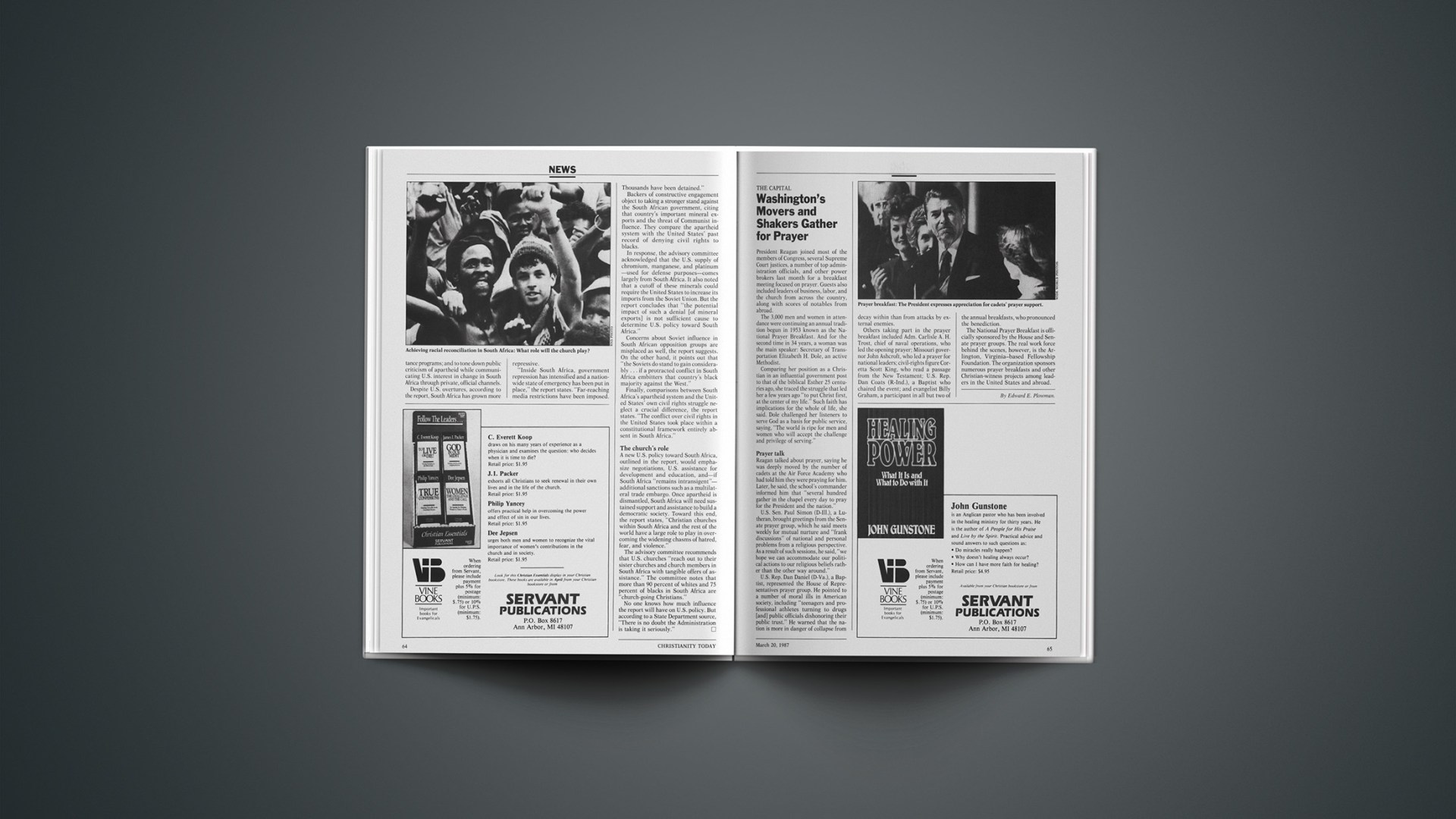
President Reagan joined most of the members of Congress, several Supreme Court justices, a number of top administration officials, and other power brokers last month for a breakfast meeting focused on prayer. Guests also included leaders of business, labor, and the church from across the country, along with scores of notables from abroad.

The 3,000 men and women in attendance were continuing an annual tradition begun in 1953 known as the National Prayer Breakfast. And for the second time in 34 years, a woman was the main speaker: Secretary of Transportation Elizabeth H. Dole, an active Methodist.

Comparing her position as a Christian in an influential government post to that of the biblical Esther 25 centuries ago, she traced the struggle that led her a few years ago “to put Christ first, at the center of my life.” Such faith has implications for the whole of life, she said. Dole challenged her listeners to serve God as a basis for public service, saying, “The world is ripe for men and women who will accept the challenge and privilege of serving.”

Prayer Talk

Reagan talked about prayer, saying he was deeply moved by the number of cadets at the Air Force Academy who had told him they were praying for him. Later, he said, the school’s commander informed him that “several hundred gather in the chapel every day to pray for the President and the nation.”

U.S. Sen. Paul Simon (D-Ill.), a Lutheran, brought greetings from the Senate prayer group, which he said meets weekly for mutual nurture and “frank discussions” of national and personal problems from a religious perspective. As a result of such sessions, he said, “we hope we can accommodate our political actions to our religious beliefs rather than the other way around.”

U.S. Rep. Dan Daniel (D-Va.), a Baptist, represented the House of Representatives prayer group. He pointed to a number of moral ills in American society, including “teenagers and professional athletes turning to drugs [and] public officials dishonoring their public trust.” He warned that the nation is more in danger of collapse from decay within than from attacks by external enemies.

Others taking part in the prayer breakfast included Adm. Carlisle A. H. Trost, chief of naval operations, who led the opening prayer; Missouri governor John Ashcroft, who led a prayer for national leaders; civil-rights figure Coretta Scott King, who read a passage from the New Testament; U.S. Rep. Dan Coats (R-Ind.), a Baptist who chaired the event; and evangelist Billy Graham, a participant in all but two of the annual breakfasts, who pronounced the benediction.

The National Prayer Breakfast is officially sponsored by the House and Senate prayer groups. The real work force behind the scenes, however, is the Arlington, Virginia-based Fellowship Foundation. The organization sponsors numerous prayer breakfasts and other Christian-witness projects among leaders in the United States and abroad.

Lingering Racism

Last December’s brutal attack by a gang of whites against four young blacks in Howard Beach, New York, was but another indication that racism is still with us. In fact, prejudice against blacks appears to be getting worse, in spite of progress made in the past two decades.

True, antidiscrimination legislation and affirmative action have given blacks greater access to adequate housing, equal education, and meaningful employment. The growing black middle class (the percentage of blacks in the middle class has doubled since 1965) can be cited as evidence that the laws may be working. But equal opportunity does not always guarantee progress. Two disturbing trends bear this out.

First, employment and income for blacks is declining. According to Department of Commerce figures, unemployment among black males has jumped from 433,000 in 1970 to 1,103,000 in 1985. During that same period, black median income dropped to $15,430 (median income among whites in 1985 was $27,690). One-third of all blacks live in poverty, compared to an 11 percent poverty rate among whites. Moreover, the Department of Education reports that blacks still have a higher school-dropout rate than whites, contributing to the 50 percent unemployment rate among black teens.

In those areas where progress is easily measured—employment, income, and education—blacks lag far behind, creating a climate for even further despair. Trapped in an unending cycle of uncompleted schooling, unemployment, and welfare, equal opportunity becomes meaningless.

But a more disturbing trend is the stepped-up group violence directed against blacks. At a recent civil rights march in Georgia, 400 Ku Klux Klansmen hurled rocks and insults, prompting Gov. Joe Frank Harris to put the National Guard on alert. Earlier this year, five members of the White Patriot Party were indicted on charges of conspiring to obtain weapons stolen from a U.S. military installation, allegedly to further the goals of their white supremacy movement. And though the 1964 Civil Rights Act assured fair housing opportunities for all races, de facto segregation continues. One example occurred last summer in Philadelphia, where violent protests welcomed blacks who tried to move into a white neighborhood.

That such ugliness persists should remind us that small gains do not guarantee victory. The struggles of the sixties exacted too high a cost to allow prejudice a toehold in a society that truly desires racial harmony. And the biblical imperatives of justice and righteousness ring too clearly for Christians to remain silent.

Like any sin, however, prejudice will not retreat from lofty pronouncements. It is a condition of the heart. Thus, we must first search out the sin in our own lives and expose it to God’s forgiveness. Only then will our social and political activism on behalf of blacks have the ring of authenticity. And only then will we have the spiritual platform upon which a true reformation between the races can be achieved.

By Lyn Cryderman.

Till Death Do Us Part

The widow of the late apologist Francis Schaeffer recounts his final days.

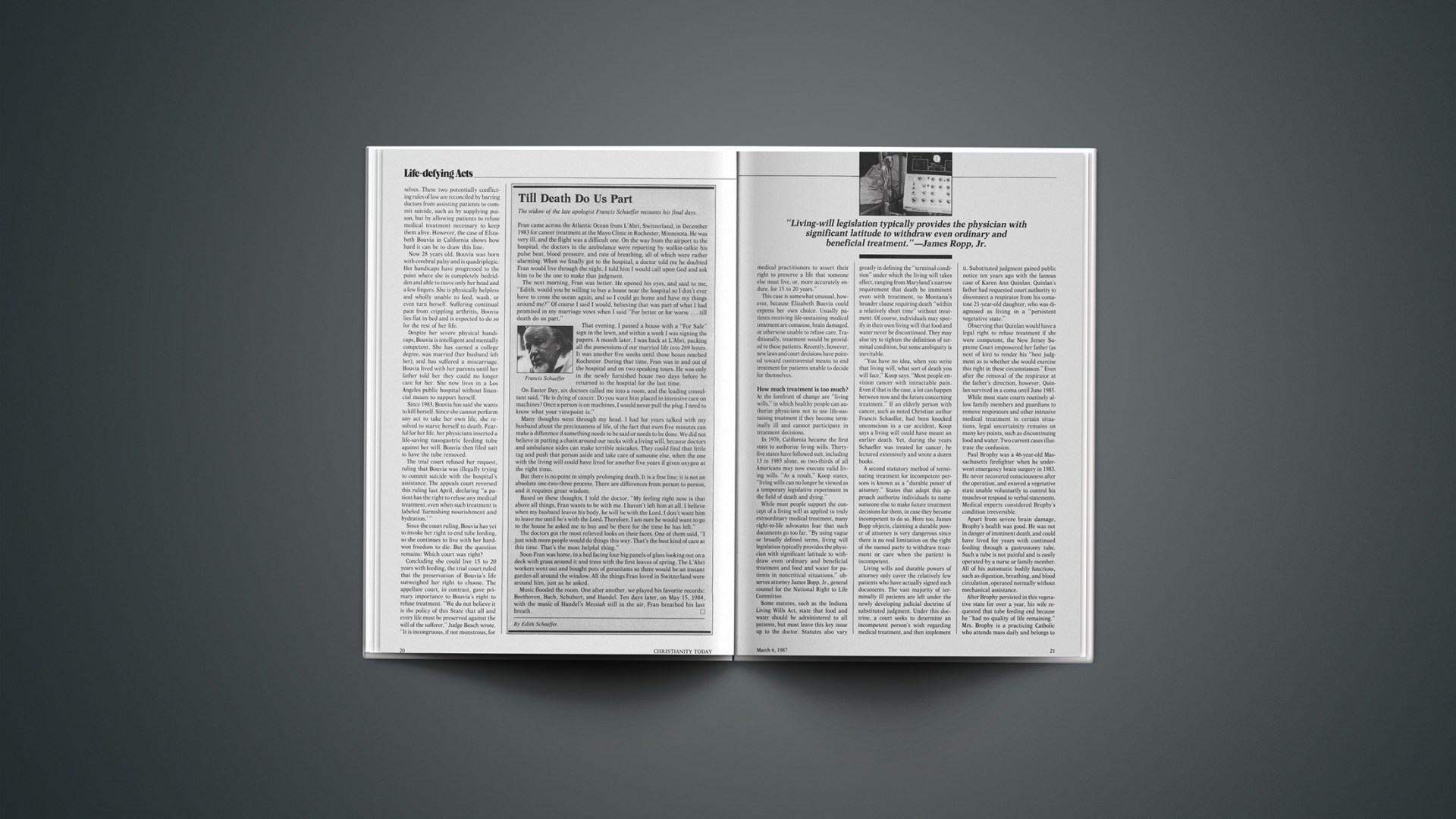
Fran came across the Atlantic Ocean from L’Abri, Switzerland, in December 1983 for cancer treatment at the Mayo Clinic in Rochester, Minnesota. He was very ill, and the flight was a difficult one. On the way from the airport to the hospital, the doctors in the ambulance were reporting by walkie-talkie his pulse beat, blood pressure, and rate of breathing, all of which were rather alarming. When we finally got to the hospital, a doctor told me he doubted Fran would live through the night. I told him I would call upon God and ask him to be the one to make that judgment.

The next morning, Fran was better. He opened his eyes, and said to me, “Edith, would you be willing to buy a house near the hospital so I don’t ever have to cross the ocean again, and so I could go home and have my things around me?” Of course I said I would, believing that was part of what I had promised in my marriage vows when I said “For better or for worse … till death do us part.”

That evening, I passed a house with a “For Sale” sign in the lawn, and within a week I was signing the papers. A month later, I was back at L’Abri, packing all the possessions of our married life into 269 boxes. It was another five weeks until those boxes reached Rochester. During that time, Fran was in and out of the hospital and on two speaking tours. He was only in the newly furnished house two days before he returned to the hospital for the last time.

On Easter Day, six doctors called me into a room, and the leading consultant said, “He is dying of cancer. Do you want him placed in intensive care on machines? Once a person is on machines, I would never pull the plug. I need to know what your viewpoint is.”

Many thoughts went through my head. I had for years talked with my husband about the preciousness of life, of the fact that even five minutes can make a difference if something needs to be said or needs to be done. We did not believe in putting a chain around our necks with a living will, because doctors and ambulance aides can make terrible mistakes. They could find that little tag and push that person aside and take care of someone else, when the one with the living will could have lived for another five years if given oxygen at the right time.

But there is no point in simply prolonging death. It is a fine line; it is not an absolute one-two-three process. There are differences from person to person, and it requires great wisdom.

Based on these thoughts, I told the doctor, “My feeling right now is that above all things, Fran wants to be with me. I haven’t left him at all. I believe when my husband leaves his body, he will be with the Lord. I don’t want him to leave me until he’s with the Lord. Therefore, I am sure he would want to go to the house he asked me to buy and be there for the time he has left.”

The doctors got the most relieved looks on their faces. One of them said, “I just wish more people would do things this way. That’s the best kind of care at this time. That’s the most helpful thing.”

Soon Fran was home, in a bed facing four big panels of glass looking out on a deck with grass around it and trees with the first leaves of spring. The L’Abri workers went out and bought pots of geraniums so there would be an instant garden all around the window. All the things Fran loved in Switzerland were around him, just as he asked.

Music flooded the room. One after another, we played his favorite records: Beethoven, Bach, Schubert, and Handel. Ten days later, on May 15, 1984, with the music of Handel’s Messiah still in the air, Fran breathed his last breath.

By Edith Schaeffer.

David and the Sin Cycle

The Bible teaches us about sin mainly through stories, and its most complete story of sin involves a national leader. That biblical sin began as a moment of simple, everyday lust. It ended in adultery and murder, and cost the lives of hundreds of soldiers. And the villain was arguably the greatest leader in the history of Israel: King David.

The Bible records the sin in all its seamy details, and from it we can learn a lesson about the complete cycle of sin. I have identified five stages in this cycle that we must move through on the way toward spiritual health. We can easily bog down in any one of the stages; the point is to keep moving forward.

Sin. It is common to view individual sins as nuisances that, like parking tickets, will cause problems only if you accumulate too many. A few niggling little sins may not matter, but eventually you will reach a crisis point and have to face the consequences. The Bible, however, has a far different perspective on sin, as King David’s story demonstrates. The Bible views sins more as cancer cells. One or two here and there do make a difference—often the difference between life and death. Cancer cells grow, multiply, and take over, and they may ultimately require major surgery.

You can read David’s story (2 Sam. 11–20) as an account of the spread of a moral cancer. After the lust for Bathsheba came the adultery and the cover-up lies, and then Uriah’s murder. But the effect of sin did not stop there. As a result of the whole sordid process, David seemed to lose his grip on his family. One son raped his half-sister. Another committed a murder of revenge. Eventually that same son launched an armed revolt against David and nearly brought down the kingdom.

The same pattern can appear in my life or your life: Sin, no matter how insignificant on the surface, can lead to terrible consequences. That is why the Bible takes each individual sin so seriously.

Guilt. False guilt occurs when a person punishes himself or herself for not measuring up to somebody else’s standards: a parent’s standards, perhaps, or the church’s, or society’s. True guilt occurs when a person does not measure up to God’s standards.

There is a healthy place for true guilt. It follows sin as naturally as pain follows injury. When we feel a twinge of conscience, we should first ask whether we have done something deserving true guilt. In other words, have we committed sin? If the answer is yes—as it was in David’s case—then we dare not avoid or repress that guilt. Guilt is not a “state” to cultivate, like a mood you slip into for a few days. It is directional, first pointing backward to the sin, and then pointing to the next stage.

Repentance. After his sin, David recorded his thoughts and emotions during the act of repentance, a record that has come down to us as a permanent legacy in Psalm 51. Although a public psalm, prayed by the people of Israel, it confesses a horrible private sin committed by the king.

To David, restoring a right relationship with God was far more important than maintaining his reputation as a ruler. “Against you, you only, have I sinned and done what is evil in your sight,” he prayed, even though his sin had affected many people. He understood that the object of repentance was to bridge the gulf between the sinner and God.

Punishment. It would be unfair to hold up David’s story as a model of the sin cycle without mentioning the aspect of punishment. He, the anointed ruler of God’s people, had failed God miserably, and deserved punishment. The prophet Nathan announced that calamity would come out of David’s own household, and 2 Samuel chronicles exactly how that calamity worked itself out—through the normal process of sin eating away inside the royal household.

The Bible records some instances of God’s direct intervention in punishment. But more often the punishment flows naturally as a result of the sin. Get drunk enough and your liver will bear the punishment. Live a life of debauchery, and you may end up with venereal disease. Tell lies, and you’ll find yourself isolated and untrusted. If you flout God’s rules, you risk bringing down punishment on yourself, whether it takes the form of physical harm, fractured relationships, or a spiritual void.

Forgiveness. After his sin, David followed the cycle of guilt, repentance, punishment, and forgiveness in textbook fashion. “A man after God’s own heart,” he was called, though he had committed adultery and murder. His life defines the boundaries of forgiveness.

None of us can avoid sinning. But when we do sin, we face choices on how to respond. We can yield to the temptation and sin for all we’re worth, risking our self-destruction in the process. We can wallow in remorse and live under a constant cloud of guilt. Or we can advance from guilt to repentance and then forgiveness, and take God at his word.

“This is how we shall know that we are children of the truth and can reassure ourselves in the sight of God, even if our own consience makes us feel guilty. For God is greater than our conscience, and he knows everything. And if, dear friends of mine, our conscience no longer accuses us, we may have the utmost confidence in God’s presence” (1 John 3:19–22, Phillips).

By Philip Yancey.

North American Scene from March 6, 1987

OBITUARY

“Mr. Pentecost” Dies At 81

David J. du Plessis, widely known as “Mr. Pentecost,” died of cancer at his home in Pasadena, California, on February 2, just five days short of his eighty-second birthday. A South African native who was naturalized as a U.S. citizen in 1949, du Plessis was considered by many the foremost spokesman for the Pentecostal movement.

He was also regarded as an ecumenist years ahead of his time. He had attended all ecumenical conferences sponsored by the World Council of Churches since 1954. He was the only Pentecostal invited to attend the third session of the Second Vatican Council in Rome in 1964. And he served as cochair of the International Roman Catholic/Pentecostal Dialogue from 1972–82.

An Assemblies of God minister, du Plessis was the organizing secretary of the World Pentecostal Fellowship (now the World Pentecostal Conference). He also played a major role in establishing the Pentecostal Fellowship of North America, the Full Gospel Business Men’s Fellowship International, and the Society for Pentecostal Studies.

du Plessis spent his later years at Fuller Theological Seminary in Pasadena, California. Fuller President David Allan Hubbard called du Plessis “one of the distinguished world Christians of our era.” In 1985, the David du Plessis Center for Christian Spirituality was established at Fuller. Last year, the center hosted the International Roman Catholic/Pentecostal Dialogue. The meeting is traditionally held in Europe, but met in Pasadena to honor du Plessis.

PORNOGRAPHY

Meese On Playboy

United States Attorney General Edwin Meese said recently that he has read Playboy and Penthouse magazines and he does not consider them obscene.

According to an Associated Press report, Meese made the acknowledgement following a recent speech to law clerks of federal court judges. A Justice Department spokesman, according to the report, confirmed the substance of the Meese remarks.

A U.S district judge ruled last year that a letter sent by the Meese commission on pornography was intended to discourage drugstores and convenience store chains from distributing such magazines as Playboy and Penthouse.

UPDATE

A Study In Healing

Fuller Theological Seminary has finalized the details of its course “The Ministry of Healing in World Evangelization,” which will be offered this spring. Amid controversy, the seminary last year canceled a course on the miraculous until a faculty task force could study the issue (CT, Feb. 6).

A major question addressed by the study was whether the classroom is appropriate for practicing healings. The new course calls for students to attend two Sunday night services at local churches that incorporate a healing ministry. Prior to attending the services, students will attend an orientation at which the churches’ pastors will explain their approach to healing.

One of the churches students will visit is John Wimber’s Vineyard Christian Fellowship in Anaheim. Wimber, a leading figure in the worldwide charismatic renewal movement, was one of three teachers of Fuller’s original course on the miraculous.

AIDS

A Difficult Speech

These days, one of Surgeon General C. Everett Koop’s toughest assignments has been taking his controversial message on AIDS (acquired immune deficiency syndrome) to constituents in the Christian community. His advocacy of sex education (as early as age nine) has not fared well with some conservatives.

However, among those friendly to Koop is fundamentalist leader Jerry Falwell. Koop, in a recent appearance on Falwell’s “Old Time Gospel Hour” television program, said he realized he was saying things conservatives do not like to hear. Still, he urged listeners to give priority to solving the AIDS epidemic.

Koop also spoke to more than 5,500 students and faculty at Falwell’s Liberty University, saying, “All of you people in this room are going to be faced with tremendous dilemmas” because of the AIDS crisis. Stating that AIDS could claim as many as 100 million lives worldwide by the year 2000, Koop urged listeners to practice monogamy. He also recommended the use of condoms for the sexually active.

PEOPLE AND EVENTS

Briefly Noted

Awarded : To Ben Kinchlow, host of the Christian Broadcasting Network’s “700 Club,” the 1987 Two Hungers Award, presented annually by the organization Food for the Hungry. The international award recognizes outstanding involvement in meeting the world’s two greatest hungers, spiritual and physical.

Established : By the Nazarene Theological Seminary in Kansas City, Missouri, a School of World Mission and Evangelism. The school offers 51 courses in these two related areas.

Appointed: Douglas G. Burleigh as the executive director of the worldwide youth organization Young Life. A 20-year veteran of the organization, Burleigh succeeds Robert Mitchell, who resigned the post last April to become president of the Young Life Foundation.

As the seventh president of Moody Bible Institute: Joseph Stowell, 43, currently pastor of the Highland Park Baptist Church in Southfield, Michigan. Stowell will assume his new duties in August. He replaces George Sweeting, 62, who has been at Moody since 1971 and will remain at the institute as chancellor.

World Scene from March 6, 1987

MISSION FIELD

The Mk As Prototype?

More than 500 delegates attended the second International Conference on Missionary Kids (MK’S), held recently in Quito, Ecuador. The emotional and social problems of children raised in foreign cultures have become major considerations for current and prospective missionaries.

“We still need to find that balance between ‘ministry at any cost’ and dropping ministry because of its impact on MK’S,” said Dave Pollock, chairman of the conference, which was sponsored by HCJB Radio and the Alliance Academy, a school for missionary children in Quito. Several speakers testified to the painful emotions they experienced as a result of growing up on the mission field. The problems include separation from family members and the continual shifting between two cultures.

However, Ted Ward, dean of international studies at Trinity Evangelical Divinity School (Deerfield, Ill.), talked about the advantages of growing up overseas. Ward, who has lived in 42 countries, said missionary children have the benefit of having the worldwide Christian community as their “third culture.” Stating that Christian internationalism is a growing trend, Ward said, “The MK of the ’90s will be the prototype of the Christian of the twenty-first century.”

PHILIPPINES

If Dialogue Fails

Cardinal Jaime Sin, the leading spokesman of the Roman Catholic Church in the Philippines, said recently that he would support an all-out war on “hard-core Communists” should current peace talks between Communist rebels and the government of President Corazon Aquino break down.

The influential archbishop of Manila, speaking before a lay women’s organization, said, “Cory [President Aquino] is right when she said we would have to prepare the armed forces for a full battle” if Communists refuse to lay down their arms.

AFRICA

Christian Continent?

Much is often said about the phenomenal growth of Christianity in Africa. Some have claimed Africa will be a Christian continent by the turn of the decade.

However, a study by David Maranz, a director of field programs for the Summer Institute of Linguistics in several countries, observes that Islam is also growing in Africa, and that Christians and Muslims have enjoyed little success in converting each other.

Writing in the Evangelical Missions Information Service newsletter Pulse, Maranz acknowledges that “Christianity is indeed growing rapidly in parts of Africa, particularly central and southern Africa.” But he adds, “Christianity in West Africa and parts of East Africa has grown far less spectacularly.” Maranz notes that Ghana is the lone West African nation with a Christian majority.

He continues, “In northern Africa, where Muslim influence is especially strong, Christianity is at a standstill, and in some cases has experienced negative growth.”

According to the World Christian Encyclopedia, 45.4 percent of Africa’s population are Christian, and 41.5 percent are Muslim.

FINLAND

Women’S Ordination

The Evangelical Lutheran Church of Finland could begin ordaining women as pastors next year if a constitutional amendment passed by the church assembly gains the approval of Finland’s Parliament.

After considering the issue for 30 years, the church assembly approved the ordination amendment with the required 75 percent majority vote. The measure would allow parishes not to accept pastors in whom they lack confidence. And opponents of women’s ordination were assured freedom to function in the church. If the nation’s Parliament approves the measure, more than 100 women are expected to apply for ordination.

POLAND

Protestants In Poland?

A Protestant society has been founded in the predominantly Catholic nation of Poland. According to Lutheran World Information, the new society’s purposes are “to secure the foundations of religious tolerance and pluralism of faith, to broaden moral principles, to lead cultural and social activities, to combat social ills, and to organize educational programs among Protestant youth.”

Meeting in Warsaw, assembly participants elected an executive committee, with Lutheran theologian Karol Karski as chairperson. The new organization unites more than 50 people from the country’s Reformed, Methodist, and Evangelical-Augsburg churches.

THIRD WORLD

The Children Of The World

The United Nations Children’s Fund (UNICEF) estimates that the deaths of 10,000 children every day of last year could have been prevented through immunization. That number is down from 14,000 in 1980. UNICEF hopes to reduce it to under 1,000 by the end of the decade.

The African continent presents the biggest challenge to UNICEF’S goal of universal child immunization. Currently the focus is on Senegal. This African nation is working toward total child immunization by April 7, 1988, which has been designated World Health Day.

UNICEF estimates that 280,000 children under the age of five die each week from malnutrition and disease.

Apple PodcastsDown ArrowDown ArrowDown Arrowarrow_left_altLeft ArrowLeft ArrowRight ArrowRight ArrowRight Arrowarrow_up_altUp ArrowUp ArrowAvailable at Amazoncaret-downCloseCloseEmailEmailExpandExpandExternalExternalFacebookfacebook-squareGiftGiftGooglegoogleGoogle KeephamburgerInstagraminstagram-squareLinkLinklinkedin-squareListenListenListenChristianity TodayCT Creative Studio Logologo_orgMegaphoneMenuMenupausePinterestPlayPlayPocketPodcastRSSRSSSaveSaveSaveSearchSearchsearchSpotifyStitcherTelegramTable of ContentsTable of Contentstwitter-squareWhatsAppXYouTubeYouTube