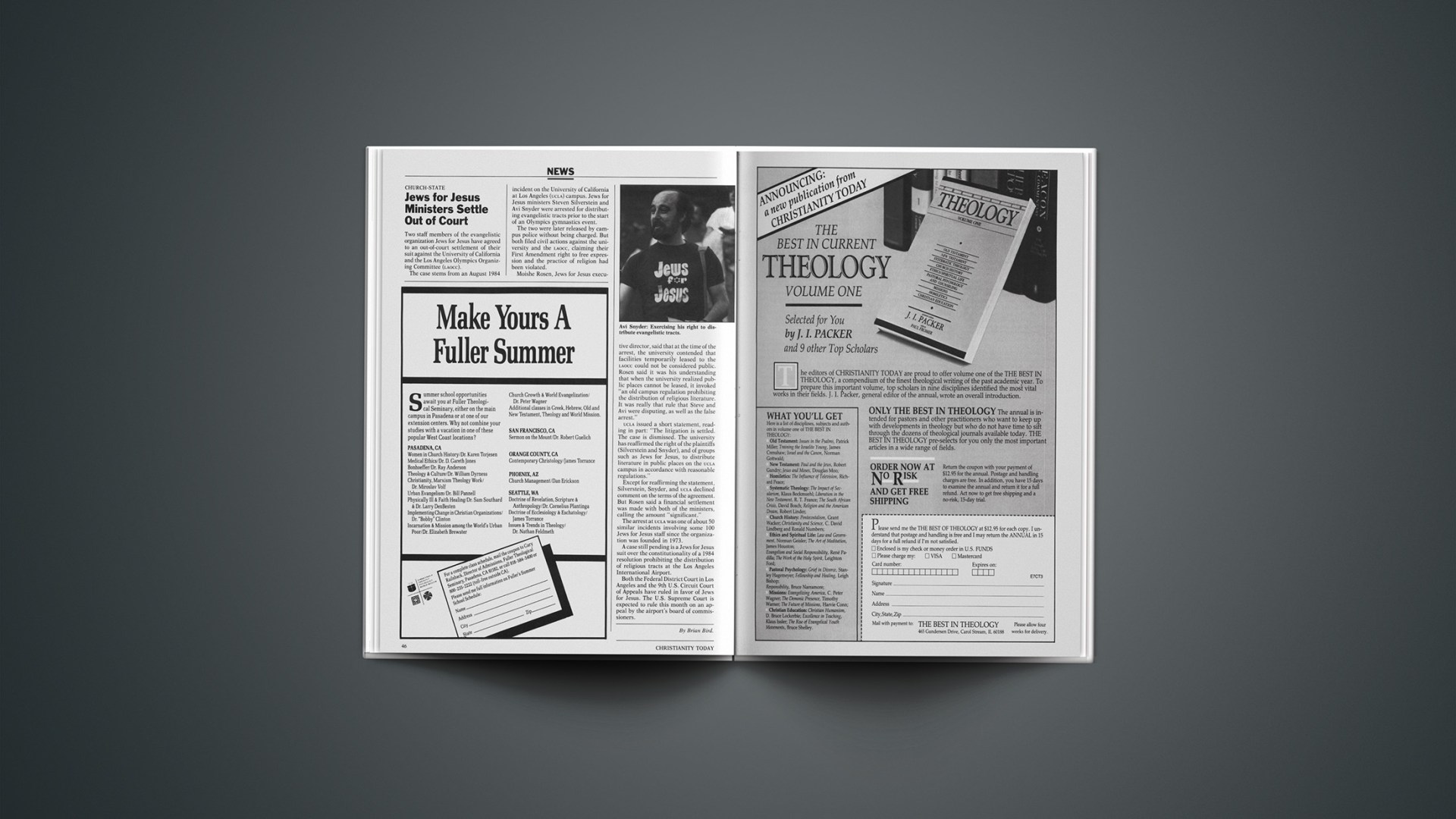
Jews for Jesus Ministers Settle out of Court

Two staff members of the evangelistic organization Jews for Jesus have agreed to an out-of-court settlement of their suit against the University of California and the Los Angeles Olympics Organizing Committee (LAOCC).

The case stems from an August 1984 incident on the University of California at Los Angeles (UCLA) campus. Jews for Jesus ministers Steven Silverstein and Avi Snyder were arrested for distributing evangelistic tracts prior to the start of an Olympics gymnastics event.

The two were later released by campus police without being charged. But both filed civil actions against the university and the LAOCC, claiming their First Amendment right to free expression and the practice of religion had been violated.

Moishe Rosen, Jews for Jesus executive director, said that at the time of the arrest, the university contended that facilities temporarily leased to the LAOCC could not be considered public. Rosen said it was his understanding that when the university realized public places cannot be leased, it invoked “an old campus regulation prohibiting the distribution of religious literature. It was really that rule that Steve and Avi were disputing, as well as the false arrest.”

UCLA issued a short statement, reading in part: “The litigation is settled. The case is dismissed. The university has reaffirmed the right of the plaintiffs (Silverstein and Snyder), and of groups such as Jews for Jesus, to distribute literature in public places on the UCLA campus in accordance with reasonable regulations.”

Except for reaffirming the statement, Silverstein, Snyder, and UCLA declined comment on the terms of the agreement. But Rosen said a financial settlement was made with both of the ministers, calling the amount “significant.”

The arrest at UCLA was one of about 50 similar incidents involving some 100 Jews for Jesus staff since the organization was founded in 1973.

A case still pending is a Jews for Jesus suit over the constitutionality of a 1984 resolution prohibiting the distribution of religious tracts at the Los Angeles International Airport.

Both the Federal District Court in Los Angeles and the 9th U.S. Circuit Court of Appeals have ruled in favor of Jews for Jesus. The U.S. Supreme Court is expected to rule this month on an appeal by the airport’s board of commissioners.

By Brian Bird.
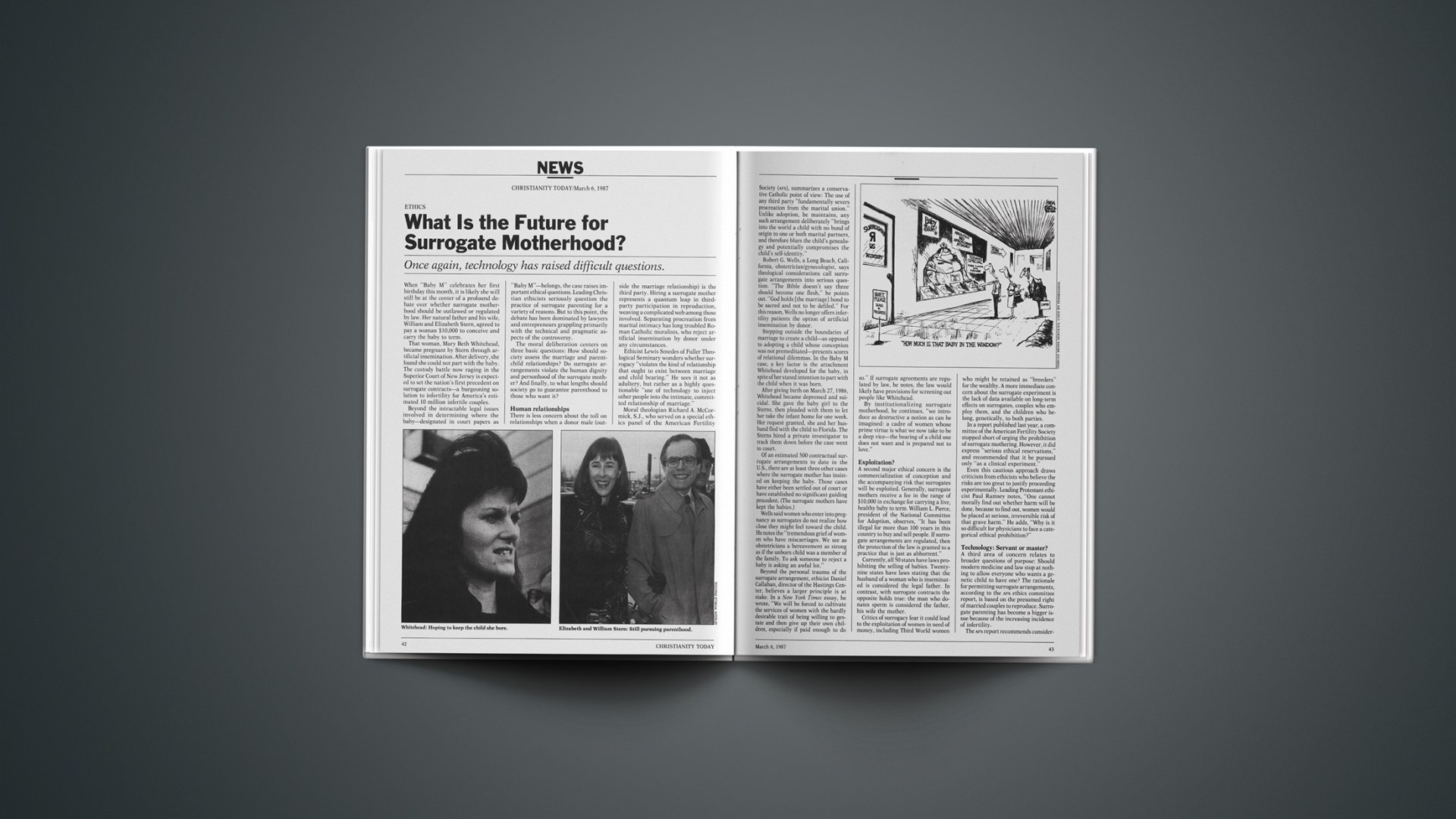
What Is the Future for Surrogate Motherhood?

Once again, technology has raised difficult questions.

When “Baby M” celebrates her first birthday this month, it is likely she will still be at the center of a profound debate over whether surrogate motherhood should be outlawed or regulated by law. Her natural father and his wife, William and Elizabeth Stern, agreed to pay a woman $10,000 to conceive and carry the baby to term.

That woman, Mary Beth Whitehead, became pregnant by Stern through artificial insemination. After delivery, she found she could not part with the baby. The custody battle now raging in the Superior Court of New Jersey is expected to set the nation’s first precedent on surrogate contracts—a burgeoning solution to infertility for America’s estimated 10 million infertile couples.

Beyond the intractable legal issues involved in determining where the baby—designated in court papers as “Baby M”—belongs, the case raises important ethical questions. Leading Christian ethicists seriously question the practice of surrogate parenting for a variety of reasons. But to this point, the debate has been dominated by lawyers and entrepreneurs grappling primarily with the technical and pragmatic aspects of the controversy.

The moral deliberation centers on three basic questions: How should society assess the marriage and parent-child relationships? Do surrogate arrangements violate the human dignity and personhood of the surrogate mother? And finally, to what lengths should society go to guarantee parenthood to those who want it?

Human Relationships

There is less concern about the toll on relationships when a donor male (out-side the marriage relationship) is the third party. Hiring a surrogate mother represents a quantum leap in third-party participation in reproduction, weaving a complicated web among those involved. Separating procreation from marital intimacy has long troubled Roman Catholic moralists, who reject artificial insemination by donor under any circumstances.

Ethicist Lewis Smedes of Fuller Theological Seminary wonders whether surrogacy “violates the kind of relationship that ought to exist between marriage and child bearing.” He sees it not as adultery, but rather as a highly questionable “use of technology to inject other people into the intimate, committed relationship of marriage.”

Moral theologian Richard A. McCormick, S.J., who served on a special ethics panel of the American Fertility Society (AFS) summarizes a conservative Catholic point of view: The use of any third party “fundamentally severs procreation from the marital union.” Unlike adoption, he maintains, any such arrangement deliberately “brings into the world a child with no bond of origin to one or both marital partners, and therefore blurs the child’s genealogy and potentially compromises the child’s self-identity.”

Robert G. Wells, a Long Beach, California, obstetrician/gynecologist, says theological considerations call surrogate arrangements into serious question. “The Bible doesn’t say three should become one flesh,” he points out. “God holds [the marriage] bond to be sacred and not to be defiled.” For this reason, Wells no longer offers infertility patients the option of artificial insemination by donor.

Stepping outside the boundaries of marriage to create a child—as opposed to adopting a child whose conception was not premeditated—presents scores of relational dilemmas. In the Baby M case, a key factor is the attachment Whitehead developed for the baby, in spite of her stated intention to part with the child when it was born.

After giving birth on March 27, 1986, Whitehead became depressed and suicidal. She gave the baby girl to the Stems, then pleaded with them to let her take the infant home for one week. Her request granted, she and her husband fled with the child to Florida. The Stems hired a private investigator to track them down before the case went to court.

Of an estimated 500 contractual surrogate arrangements to date in the U.S., there are at least three other cases where the surrogate mother has insisted on keeping the baby. Those cases have either been settled out of court or have established no significant guiding precedent. (The surrogate mothers have kept the babies.)

Wells said women who enter into pregnancy as surrogates do not realize how close they might feel toward the child. He notes the “tremendous grief of women who have miscarriages. We see as obstetricians a bereavement as strong as if the unborn child was a member of the family. To ask someone to reject a baby is asking an awful lot.”

Beyond the personal trauma of the surrogate arrangement, ethicist Daniel Callahan, director of the Hastings Center, believes a larger principle is at stake. In a New York Times essay, he wrote, “We will be forced to cultivate the services of women with the hardly desirable trait of being willing to gestate and then give up their own children, especially if paid enough to do so.” If surrogate agreements are regulated by law, he notes, the law would likely have provisions for screening out people like Whitehead.

By institutionalizing surrogate motherhood, he continues, “we introduce as destructive a notion as can be imagined: a cadre of women whose prime virtue is what we now take to be a deep vice—the bearing of a child one does not want and is prepared not to love.”

Exploitation?

A second major ethical concern is the commercialization of conception and the accompanying risk that surrogates will be exploited. Generally, surrogate mothers receive a fee in the range of $10,000 in exchange for carrying a live, healthy baby to term. William L. Pierce, president of the National Committee for Adoption, observes, “It has been illegal for more than 100 years in this country to buy and sell people. If surrogate arrangements are regulated, then the protection of the law is granted to a practice that is just as abhorrent.”

Currently, all 50 states have laws prohibiting the selling of babies. Twenty-nine states have laws stating that the husband of a woman who is inseminated is considered the legal father. In contrast, with surrogate contracts the opposite holds true: the man who donates sperm is considered the father, his wife the mother.

Critics of surrogacy fear it could lead to the exploitation of women in need of money, including Third World women who might be retained as “breeders” for the wealthy. A more immediate concern about the surrogate experiment is the lack of data available on long-term effects on surrogates, couples who employ them, and the children who belong, genetically, to both parties.

In a report published last year, a committee of the American Fertility Society stopped short of urging the prohibition of surrogate mothering. However, it did express “serious ethical reservations,” and recommended that it be pursued only “as a clinical experiment.”

Even this cautious approach draws criticism from ethicists who believe the risks are too great to justify proceeding experimentally. Leading Protestant ethicist Paul Ramsey notes, “One cannot morally find out whether harm will be done, because to find out, women would be placed at serious, irreversible risk of that grave harm.” He adds, “Why is it so difficult for physicians to face a categorical ethical prohibition?”

Technology: Servant Or Master?

A third area of concern relates to broader questions of purpose: Should modern medicine and law stop at nothing to allow everyone who wants a genetic child to have one? The rationale for permitting surrogate arrangements, according to the AFS ethics committee report, is based on the presumed right of married couples to reproduce. Surrogate parenting has become a bigger issue because of the increasing incidence of infertility.

The AFS report recommends considering surrogate contracts only when medically necessary. Such would be the case if the woman has no uterus or has some other physical barrier to pregnancy, or if she carries a genetic defect she does not want to pass to her offspring.

The Sterns went the surrogate route because Elizabeth Stern has a mild case of multiple sclerosis she feared could result in her paralysis or death if she became pregnant. Observers are concerned, however, that surrogate arrangements could be desired simply for convenience.

The overwhelming majority of people who contemplate a surrogate arrangement consists of infertile couples. For these people, says ethicist Smedes, the Christian community needs to express deep compassion. At the same time, he adds, those couples, particularly if they are Christians, may need “to accept the possibility that it may be God’s will that they remain childless. People need to be helped to have courage to accept the will of God in barrenness.”

Smedes believes the surrogate debate needs to grapple with the question “Should we encourage people with personal problems to seek solutions that to adopt three children, the youngest of whom is now 22. He reports being plagued even by the church’s ambivalence about adopted children, noting that a Reformed church agreed to baptize their first adopted child only under protest.

Smedes believes the surrogate debate needs to grapple with the question, “Should we encourage people with personal problems to seek solutions that have so many tragic possibilities?” Callahan, in his New York Times commentary, agrees that the surrogacy debate should grant priority to society, rather than individuals. He writes, “Infertility is not a problem that cripples us as a society. We are not underpopulated. On the contrary, we already have too many children being born under less than desirable circumstances.… To tolerate a method of parenthood that is built on confusion hardly seems wise.”

Pierce, of the National Committee for Adoption, expects legislation to be introduced in several states to legalize the practice of surrogacy, which is currently unregulated. He noted that the American Bar Association has developed a model surrogacy act. “Key members of the legal profession are pulling out all the stops to set this up as something legitimate,” he said. Pierce is calling on religious leaders to develop a joint statement opposing legalized surrogacy.

By Beth Spring.

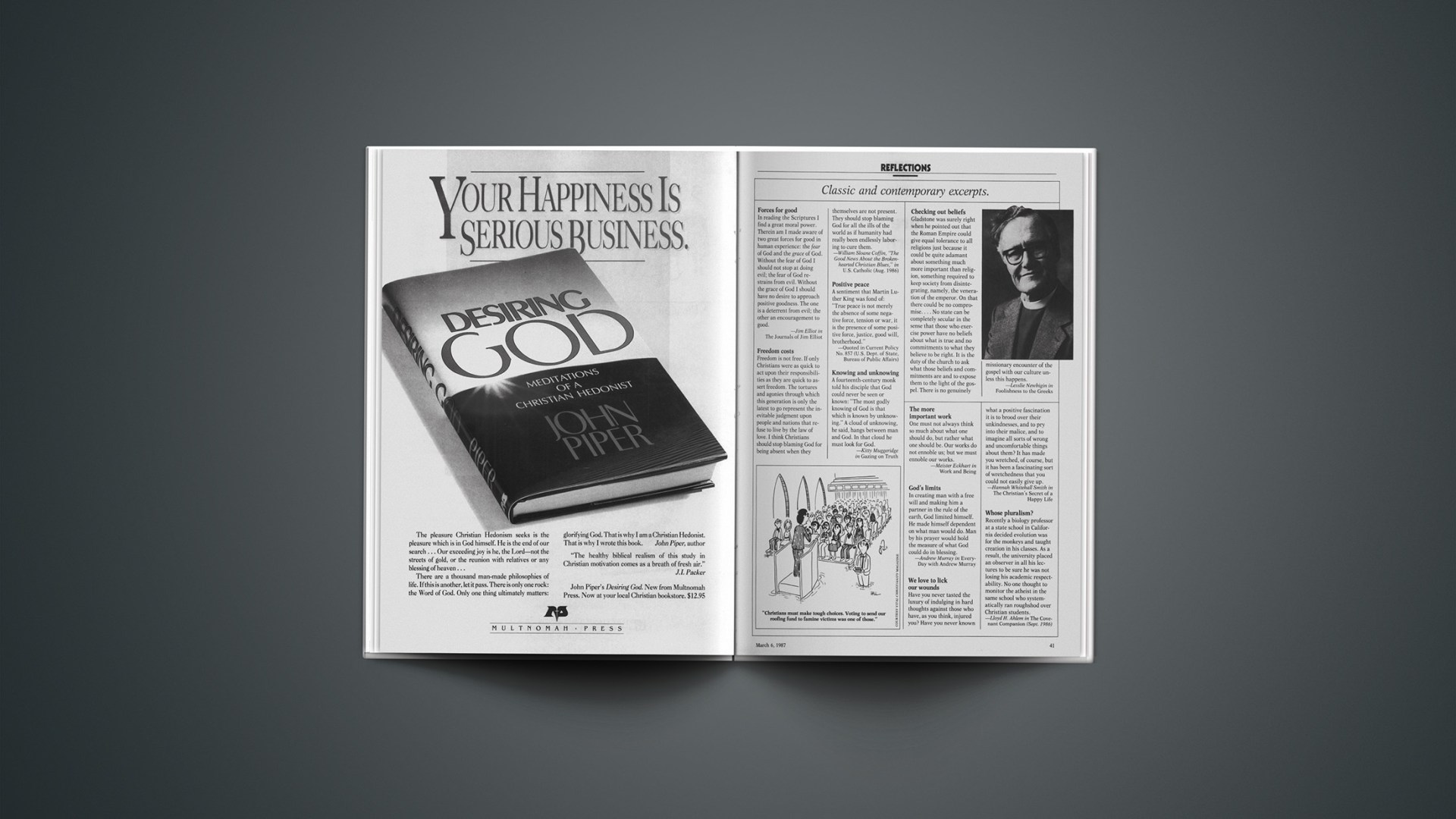
Classic & Contemporary Excerpts from March 06, 1987

Forces for good

In reading the Scriptures I find a great moral power. Therein am I made aware of two great forces for good in human experience: the fear of God and the grace of God. Without the fear of God I should not stop at doing evil; the fear of God restrains from evil. Without the grace of God I should have no desire to approach positive goodness. The one is a deterrent from evil; the other an encouragement to good.

—Jim Elliot in

The Journals of Jim Elliot

Freedom costs

Freedom is not free. If only Christians were as quick to act upon their responsibilities as they are quick to assert freedom. The tortures and agonies through which this generation is only the latest to go represent the inevitable judgment upon people and nations that refuse to live by the law of love. I think Christians should stop blaming God for being absent when they themselves are not present. They should stop blaming God for all the ills of the world as if humanity had really been endlessly laboring to cure them.

—William Sloane Coffin, “The Good News About the Brokenhearted Christian Blues,” in U.S. Catholic (Aug. 1986)

Positive peace

A sentiment that Martin Luther King was fond of:

“True peace is not merely the absence of some negative force, tension or war, it is the presence of some positive force, justice, good will, brotherhood.”

—Quoted in Current Policy

No. 857 (U.S. Dept. of State,

Bureau of Public Affairs)

Knowing and unknowing

A fourteenth-century monk told his disciple that God could never be seen or known: “The most godly knowing of God is that which is known by unknowing.” A cloud of unknowing, he said, hangs between man and God. In that cloud he must look for God.

—Kitty Muggeridge

in Gazing on Truth

Checking out beliefs

Gladstone was surely right when he pointed out that the Roman Empire could give equal tolerance to all religions just because it could be quite adamant about something much more important than religion, something required to keep society from disintegrating, namely, the veneration of the emperor. On that there could be no compromise.… No state can be completely secular in the sense that those who exercise power have no beliefs about what is true and no commitments to what they believe to be right. It is the duty of the church to ask what those beliefs and commitments are and to expose them to the light of the gospel. There is no genuinely missionary encounter of the gospel with our culture unless this happens.

—Lesslie Newbigin in

Foolishness to the Greeks

The more important work

One must not always think so much about what one should do, but rather what one should be. Our works do not ennoble us; but we must ennoble our works.

—Meister Eckhart in Work and Being

God’s limits

In creating man with a free will and making him a partner in the rule of the earth, God limited himself. He made himself dependent on what man would do. Man by his prayer would hold the measure of what God could do in blessing.

—Andrew Murray in Every-Day with Andrew Murray

We love to lick our wounds

Have you never tasted the luxury of indulging in hard thoughts against those who have, as you think, injured you? Have you never known what a positive fascination it is to brood over their unkindnesses, and to pry into their malice, and to imagine all sorts of wrong and uncomfortable things about them? It has made you wretched, of course, but it has been a fascinating sort of wretchedness that you could not easily give up.

—Hannah Whitehall Smith in

The Christian’s Secret of a

Happy Life

Whose pluralism?

Recently a biology professor at a state school in California decided evolution was for the monkeys and taught creation in his classes. As a result, the university placed an observer in all his lectures to be sure he was not losing his academic respectability. No one thought to monitor the atheist in the same school who systematically ran roughshod over Christian students.

—Lloyd H. Ahlem in The Covenant Companion (Sept. 1986)

Book Briefs: March 6, 1987

Civilizing The Sexual Barbarians

Men and Marriage, by George Gilder (Pelican, 1986, xix + 219 pp.; $15.95, cloth). Reviewed by Jan P. Dennis, editor in chief, Crossway Books.

Civilization is fragile. It is based on truths, mores, patterns, institutions, and, yes, roles that may be tampered with only so much and no more. When these constituent parts are sufficiently disrupted, a society dissolves. Perhaps better than anyone else, George Gilder understands this. His new book Men and Marriage, a revised and updated edition of his 1973 book Sexual Suicide, is an extended meditation on how modern society, by substituting ideology for reality, is self-destructing.

For Gilder, the linchpin of civilization is the mutual sacrifice of the sexes (echoes of Eph. 5:21), each according to its nature, for the preservation and advancement of society. A married woman gives herself up to the care and nurture of young children and the establishment of a stable, comfortable, and loving home. This she does according to her nature (or perhaps according to the divine decree that we read in Gen. 3:16). Likewise, a married man gives himself up to 50-and 60-hour work weeks, to narrow specialization, to earning his bread by the sweat of his brow (more echoes of Genesis 3) for the sake of a woman’s love and the prospect of posterity. This he does according to his nature.

Each, theoretically, can do what the other does. And throughout history each has done the work of the other, when necessary. What is novel today, according to Gilder, is the idea that the members of each sex ought to do the other’s work, or that it makes no difference for society who does what.

Gilder’s impressive array of evidence—biological, anthropological, historical, and psychological—often undermines this dominant feminist ideology. Men and women are indeed different. While a plain reading of Scripture should have protected us from the illusions of androgyny, many Christians will find it helpful to collect the evidence of natural revelation to support the teaching of special revelation. (Gilder does not support his argument from Scripture or theology, since his research preceded his conversion.)

Evidence

Here is the heart of Gilder’s argument: Men are rapacious, predatory, disloyal, and philandering. They are, in short, sexual barbarians. Marriage induces men to rechannel these chaotic and destructive behaviors into a way of life that is productive, edifying, and lasting, namely, the family. The result is civilization.

On the other hand, sexual liberation (or as Gilder more precisely terms it, “sexual liberalism”) enfranchises these negative male tendencies and brings with it a way of life that is destructive, degraded, and impermanent, namely, that of the sexual barbarian. The result is chaos.

Unless men can be persuaded by women to channel their energies into creating, maintaining, and sustaining a home and family, says Gilder, they will revert to sexual barbarism. A woman can do this only by tying her agreement to have sexual relations with a man to his promise of a lifetime commitment to her. In this way, the man’s drive for sexual fulfillment is satisfied and the woman’s need for a safe and stable environment in which to raise her children is met. Both parties benefit. And the way is paved for the rise of civilization.

This sex-for-support contract is, of course, far from a complete picture of what marriage is or ought to be. It is, however, a fundamental social reality.

Sexual liberation, so-called, destroys this pattern. By detaching male sexual activity from permanent man-woman relationships, society lays the groundwork for the return of the sexual barbarian—now variously called “swinger,” “playboy,” “womanizer,” “libertine”—the very creature marriage was meant to get rid of. The renewed presence of the sexual barbarian in society entails certain rearrangements, including such sources of turmoil as “living together,” serial marriages, “no-fault divorce” and single parenthood.

The Barbarization Of Women

The solution proposed by our social engineers and sexual pundits is not a return to the former arrangement but, incredibly, the attempted barbarization of women along the lines of “if men get to be sexually liberated, women have that right as well.”

Women, Gilder asserts, are much more difficult to barbarize, having never, before our enlightened age, actually been sexual barbarians, and given the fact that the nomadic “cruising” lifestyle appears to go against their basic make-up.

Nevertheless, the effort proceeds apace. We see everywhere images of liberated, sexually available, no-strings-attached women. Meanwhile, whatever imagined gains ensue from such abnormality come with a high social price tag: a floodtide of single mothers, birth rates below replacement levels, a glut of unwanted pregnancies, pandemic venereal disease, a raft of careerist women waking up in their late thirties to discover that what they really wanted was to raise a family.

The sexperts have “solutions” to all these ills: state-financed day care, abortion on demand, condoms and other “safe sex” practices, artificial insemination, “the right of every woman to conceive and bear children,” and male homosexual and lesbian parenthood. Never mind that these and a host of other “value-neutral” behaviors practiced by consenting adults in the privacy of their own homes are wreaking havoc on our fair republic. Decency, propriety, health, tradition, family, history, anthropology, psychology, and nature itself—all must be sacrificed on the ideological altar of sexual liberalism.

The genius of George Gilder is that he can venture into the heart of this tempestuous rage aware that its fury is about to break full force on our heads, and yet send back this calm, rational, even hope-filled message in a bottle. The question is: Will we read it? And, even more important, will we heed it?

Wesleyan Charismaphobia

The Divided Flame: Wesleyans and the Charismatic Renewal, by Howard A. Snyder with Daniel V. Runyon (Zondervan, 1986, 108 pp.; $6.95, paperback). Reviewed by Karl G. Wolfe, senior pastor of the Ypsilanti (Mich.) Free Methodist Church.

During my dozen years as a pastor, I have interacted with charismatics regularly. For four years I served on a church staff where the senior pastor was involved in the charismatic renewal. I then moved to pastor a church in the Ann Arbor-Ypsilanti (Mich.) area, the home of one of the largest charismatic communities in the world. Throughout, such experiences have been positive. It has been a surprise, then, to encounter in my denomination an antagonism toward, and fear of, charismatics (using charismatics in the popular manner—persons who claim to have received “extraordinary” gifts of the Holy Spirit, such as “word of prophecy,” “tongues,” and “interpretation of tongues”).

The antagonism is all the more puzzling given the fact that my church is among those steeped in the “holiness” movement. We Wesleyans talk frequently and warmly of the work of the Holy Spirit in our lives. We emphasize that faith in Christ is best described if we speak of being in relationship with him. We paint such a relationship as dynamic and alive because the loving Lord, by the Spirit, is present and active in us.

With such emphases, it would appear we have much in common with charismatic Christians. To be sure, there are abuses and immature teachings and attitudes within the charismatic movement. But surely antagonism and less-than-loving attitudes do not heal past wounds and bring us into closer fellowship with others in the family of God.

Tearing Down The Barriers

Well, enter The Divided Flame: Wesleyans and the Charismatic Renewal. In this small volume, Howard Snyder—a pastor in my denomination and a prominent Wesleyan voice—with Daniel Runyon, calls for those in the holiness tradition to tear down the barriers, put away the guns, and do what is necessary to bridge the gap between the Wesleyan and charismatic camps.

After giving us a bird’s-eye view of New Testament references to charismatic gifts, the writers go on to recall for the reader the history of their use, especially glossolalia (tongues speaking), from the apostolic age to our time, showing how these gifts have recurred periodically throughout church history.

The book focuses particularly on John Wesley, whose ministry marks the beginning of the present-day congregations that fly the holiness banner. The authors insightfully note that, though not required to face the matter of glossolalia, Wesley’s theology regarding the Holy Spirit, as well as his view of Christian community, parallels that of the contemporary charismatic movement. Indeed, Wesley and his heirs called Christians to a deeper relationship with God through a special work of the Holy Spirit (called “entire sanctification” or “Christian perfection”) that takes place after the salvation event. Such an emphasis, say Snyder and Runyon, eventually gave birth to Pentecostalism. (Unfortunately, many in holiness traditions regard charismatics as illegitimate offspring.)

After showing how Wesleyans and charismatics share common roots and give similar attention to God working in human experience, The Divided Flame provides some theological bases and practical guidelines for dialogue between the two groups.

The call for re-examination of the common heritage of Wesleyans and charismatics is long overdue. However, the volume is not the last word. Critical matters are consistently underdeveloped. For example, Snyder and Runyon offer little more than a list of the germane biblical texts. Exegesis and application are absent. Historical background is thin. The analysis of Wesley is interesting, but it does not go far enough. And while the authors want to persuade Wesleyans to fellowship and minister with charismatics, they seem reticent by their tone, as if unsure how strongly they want to issue their call.

Still, I rejoice to think we Wesleyans may begin to accentuate elements shared with the charismatic movement rather than the differences. I hope The Divided Flame is a beginning of the bridge building that is both natural (because of the common heritage) and important (for the upbuilding of the kingdom of God).

Robertson’s Date With Destiny

America’s Dates with Destiny, by Pat Robertson (Nelson, 1986, 322 pp.; $15.95, cloth). Reviewed by James L. Sauer, director of library at Eastern College, St. Davids, Pennsylvania.

According to conventional wisdom, it would take a miracle for Pat Robertson to be elected President. But the Sovereign Lord does intervene in history, and he does answer prayer. The question is whether he will answer Pat Robertson’s prayers, George Bush’s, or Jack Kemp’s. Who knows, God might even respond to the petition of a Democrat.

“I have written America’s Dates with Destiny,” says Robertson, “to summarize briefly just a few of the major moments in American history that shaped our past for good or evil.” He has also written Destiny in order to buttress his bid for the Republican nomination.

The book is divided into three sections. Part one traces the Christian and moral heritage of the United States, beginning with the first colonists and ending with the 1886 dedication of the Statue of Liberty. Part two, “Losing Our Way,” concerns the growth and dominance of liberalism and kindred aspects of modernist social dissolution. Part three, “Finding Our Way Again,” suggests that the 1980 political awakening of the evangelicals, and the subsequent election of Ronald Reagan, mark the turning point in contemporary American history. Not surprisingly, Robertson suggests that “Election Day, 1988,” marks “Another Date with Destiny.” The historical text is interspersed with homey, personal asides and observations.

American Dreamer

This book represents a clear, spiritual, and conservative chronology of the American story, and it will serve not so much as a manifesto of Robertson’s campaign as an articulate expression of the New Christian Right’s vision of the American Dream.

Robertson’s vision of America as a New World Zion is a beautiful myth, and not without appeal, nor some accuracy. It is certainly more appealing to evangelical Christianity than the false secularist vision of America as a libertarian, progressivist utopia. That vision will not do for anyone acquainted with human nature, let alone our founding documents.

Whether Robertson can persuade the American voters of this vision is another matter. It is certainly improbable for a Pentecostal TV evangelist to be elected to the Oval Office. But this, after all, is America. Who would think that a grade-B movie actor would someday be commander in chief? Miracles do happen.

Christianity Today Talks To George Gilder

On how his views have changed since the publication of Sexual Suicide in 1973:

The amazing thing I discovered was just how durable the facts of life are. My views have been consolidated into a system of settled convictions. During those 13 years I got married. Marriage is just as good—it is better—than I imagined. And I’ve become much more religious. By deep immersion in the literature of sociology and anthropology I discovered the paramount teachings of the church, and I was surprised to discover that the old clichés my mother had taught me were in fact unyielding truths of human life. My discovery that the essential themes of Christian teaching about marriage and family were true led me to the church, rather than the other way around. Christianity is true, and its truth will be discovered anywhere you look very far.

On the church and society’s morals:

The church is right, and it should know it is right and speak with authority. It should not allow itself to be bullied by the media into abandoning its great patrimony, the traditional values about sex and family. Too many ministers pick up a copy of the New York Times or see an episode of “Sixty Minutes” and assume the whole world is transformed; and they think that in order to deal with it they have to capitulate in all sorts of ways. That is a terrible mistake, because it betrays the church’s purpose.

On the church and sinners:

When the church refuses to recognize the sinfulness of promiscuous behavior, it actually becomes an obstacle to redemption. The church can’t even forgive people without acknowledging their sin. Upholding God’s law strengthens the church. It weakens itself and destroys its function by capitulating to transitory secular waves and pressures that are reflections of social breakdown rather than indications of the emergence of a stable new form of human behavior. The church doesn’t just preach at sinners; it loves them. It brings them in and shows them the way. “The past is past—go and sin no more” is what the church should transmit to sinners.

On women and work:

Married women today, as always throughout history, have to work, and they should learn things to do that are valuable to their society. But women and men have different attitudes toward work. Women in intact families do not use their career credentials to maximize their earnings. They use their credentials to maximize their flexibility. The more credentials and qualifications a woman has, the more likely she is to prefer part-time work. (The man’s pattern is exactly the opposite.) The fact that women are getting increasing credentials does not mean that in the future they are going to be competing more for full-time, permanent careers. It means they’ll be able to earn enough to supplement the family income without pursuing full-time careers. By becoming a lawyer, a woman doesn’t work so hard as if she were a waitress. She can be home more with her children and can work more at home.

On masculinity:

Masculinity is critical to the a ongoing business of society provided it is subordinated to the essential principles of feminine morality—a greater sense of the value of individual human life, of ongoing generations, of responsibility toward the fabric of human civilization. If you want to create a civilization capable of building for the future and serving God in a productive, continuing way, you want masculinity to be sublimated in the family, and I think that is what marriage achieves. Men need marriage, but they have to be taught to need it. That’s why it’s so critical for women in their youth to focus on converting barbarians into useful citizens, teaching them the important values.

By LaVonne Neff.

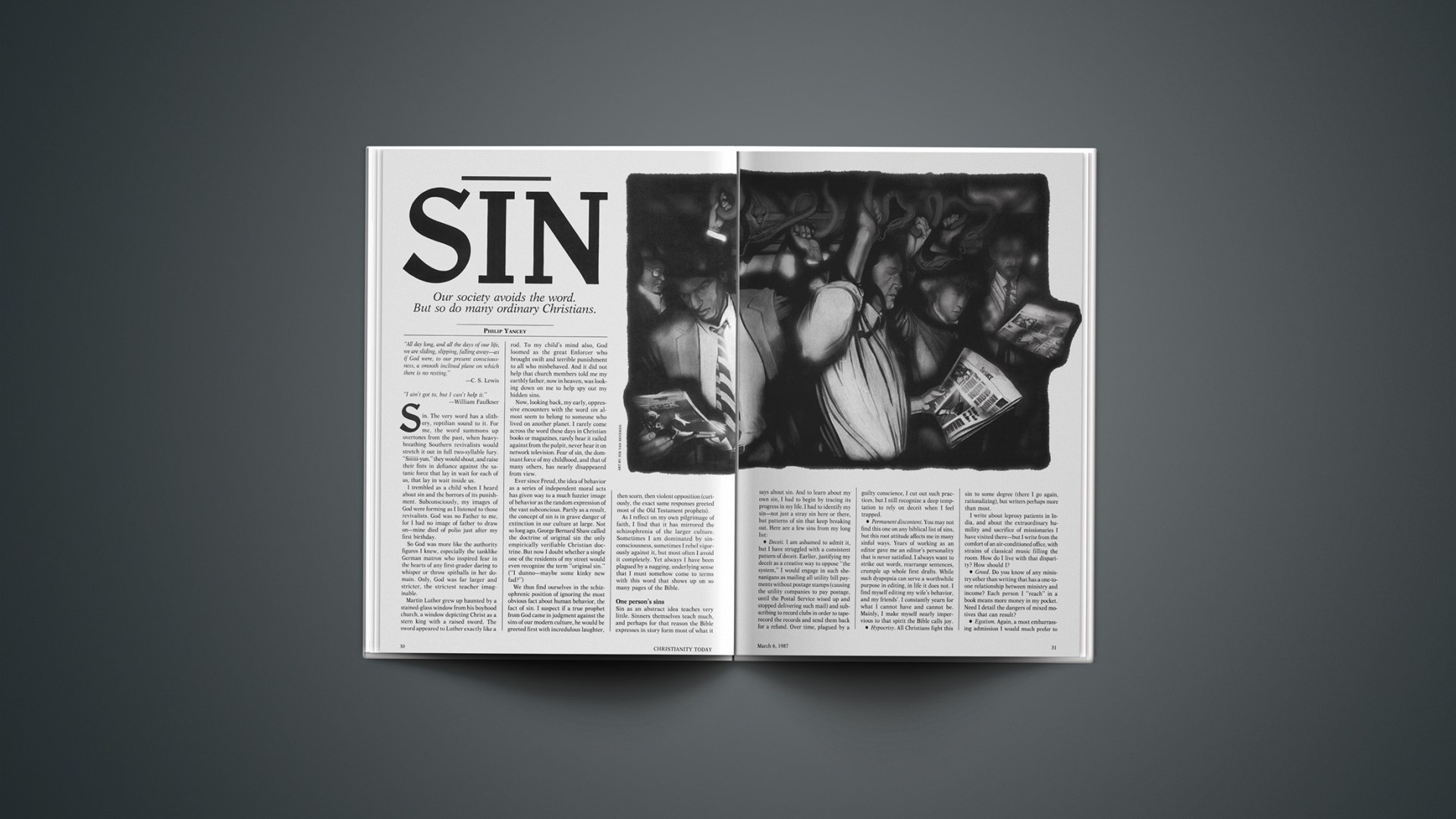
Sin

Our society avoids the word. But so do many ordinary Christians.

All day long, and all the days of our life, we are sliding, slipping, falling away—as if God were, to our present consciousness, a smooth inclined plane on which there is no resting.

—C. S. Lewis

I ain’t got to, but I can’t help it.

—William Faulkner

Sin. The very word has a slithery, reptilian sound to it. For me, the word summons up overtones from the past, when heavy-breathing Southern revivalists would stretch it out in full two-syllable fury. “Siiiiii-yun,” they would shout, and raise their fists in defiance against the Satanic force that lay in wait for each of us, that lay in wait inside us.

I trembled as a child when I heard about sin and the horrors of its punishment. Subconsciously, my images of God were forming as I listened to those revivalists. God was no Father to me, for I had no image of father to draw on—mine died of polio just after my first birthday.

So God was more like the authority figures I knew, especially the tanklike German matron who inspired fear in the hearts of any first-grader daring to whisper or throw spitballs in her domain. Only, God was far larger and stricter, the strictest teacher imaginable.

Martin Luther grew up haunted by a stained-glass window from his boyhood church, a window depicting Christ as a stern king with a raised sword. The sword appeared to Luther exactly like a rod. To my child’s mind also, God loomed as the great Enforcer who brought swift and terrible punishment to all who misbehaved. And it did not help that church members told me my earthly father, now in heaven, was looking down on me to help spy out my hidden sins.

Now, looking back, my early, oppressive encounters with the word sin almost seem to belong to someone who lived on another planet. I rarely come across the word these days in Christian books or magazines, rarely hear it railed against from the pulpit, never hear it on network television. Fear of sin, the dominant force of my childhood, and that of many others, has nearly disappeared from view.

Ever since Freud, the idea of behavior as a series of independent moral acts has given way to a much fuzzier image of behavior as the random expression of the vast subconcious. Partly as a result, the concept of sin is in grave danger of extinction in our culture at large. Not so long ago, George Bernard Shaw called the doctrine of original sin the only empirically verifiable Christian doctrine. But now I doubt whether a single one of the residents of my street would even recognize the term “original sin.” (“I dunno—maybe some kinky new fad?”)

We thus find ourselves in the schizophrenic position of ignoring the most obvious fact about human behavior, the fact of sin. I suspect if a true prophet from God came in judgment against the sins of our modern culture, he would be greeted first with incredulous laughter, then scorn, then violent opposition (curiously, the exact same responses greeted most of the Old Testament prophets).

As I reflect on my own pilgrimage of faith, I find that it has mirrored the schizophrenia of the larger culture. Sometimes I am dominated by sin-consciousness, sometimes I rebel vigorously against it, but most often I avoid it completely. Yet always I have been plagued by a nagging, underlying sense that I must somehow come to terms with this word that shows up on so many pages of the Bible.

One Person’s Sins

Sin as an abstract idea teaches very little. Sinners themselves teach much, and perhaps for that reason the Bible expresses in story form most of what it says about sin. And to learn about my own sin, I had to begin by tracing its progress in my life. I had to identify my sin—not just a stray sin here or there, but patterns of sin that keep breaking out. Here are a few sins from my long list:

  • Deceit. I am ashamed to admit it, but I have struggled with a consistent pattern of deceit. Earlier, justifying my deceit as a creative way to oppose “the system,” I would engage in such shenanigans as mailing all utility bill payments without postage stamps (causing the utility companies to pay postage, until the Postal Service wised up and stopped delivering such mail) and subscribing to record clubs in order to tape-record the records and send them back for a refund. Over time, plagued by a guilty conscience, I cut out such practices, but I still recognize a deep temptation to rely on deceit when I feel trapped.
  • Permanent discontent. You may not find this one on any biblical list of sins, but this root attitude affects me in many sinful ways. Years of working as an editor gave me an editor’s personality that is never satisfied. I always want to strike out words, rearrange sentences, crumple up whole first drafts. While such dyspepsia can serve a worthwhile purpose in editing, in life it does not. I find myself editing my wife’s behavior, and my friends’. I constantly yearn for what I cannot have and cannot be. Mainly, I make myself nearly impervious to that spirit the Bible calls joy.
  • Hypocrisy. All Christians fight this sin to some degree (there I go again, rationalizing), but writers perhaps more than most. I write about leprosy patients in India, and about the extraordinary humility and sacrifice of missionaries I have visited there—but I write from the comfort of an air-conditioned office, with strains of classical music filling the room. How do I live with that disparity? How should I?
  • Greed. Do you know of any ministry other than writing that has a one-to-one relationship between ministry and income? Each person I “reach” in a book means more money in my pocket. Need I detail the dangers of mixed motives that can result?
  • Egotism. Again, a most embarrassing admission I would much prefer to leave off my list of sins. Like every other author and speaker, I begin with the rather audacious assumption that I have a viewpoint worth listening to. If I did not believe that, I would not go through the painful process of writing. The danger of pride rides with every thought, every sentence, every word.

You will note that my list of sins excludes many overt ones such as child abuse, drunkenness, and adultery. I am not tempted toward those sins, and that fact offers my first clue into the nature of sin. Sin strikes at the point of greatest vulnerability.

I spend my days secluded in an office, away from people, susceptible to an introvert’s self-absorption. The sins of discontent, egotism, and greed are internal sins. They grow like mold in dark, moist corners of the mind and psyche, nourished by slight rejections, mild paranoia, and loneliness—the precise occupational hazards of every writer.

A brash public figure such as quarterback Jim McMahon or comedian Joan Rivers will face a different set of temptations. And those who depend for a living on the successful preening of their bodies will likely fall at different points; adultery constantly tempts them, as Hollywood divorce rates easily prove. Similarly, while a poor man may struggle mostly with envy, a rich man battles greed.

We who battle “internal sins” can easily think our sins somehow more respectable than more blatant sins such as adultery and drunkenness. The moment we entertain such thoughts, we fall into an even deeper hole. I have attended meetings of Alcoholics Anonymous and have never met a recovering alcoholic who denied his or her own sinfulness; but I have met many Christians who find it difficult to confess their own sins. I know such Christians well, for I am one.

Malcolm Muggeridge expressed the danger this way: “It is precisely when you consider the best in man that you see there is in each of us a hard core of pride or self-centeredness which corrupts our best achievements and blights our best experiences. It comes out in all sorts of ways—in the jealousy which spoils our friendships, in the vanity we feel when we have done something pretty good, in the easy conversion of love into lust, in the meanness which makes us depreciate the efforts of other people, in the distortion of our own judgment by our own self-interest, in our fondness for flattery and our resentment of blame, in our self-assertive profession of fine ideals which we never begin to practise.”

We can quickly work up ire against the decay of our society—witness the furor over abortion and violence and pornography and other external sins—but unless we also come to terms with our own private sins, we will have missed the message of the gospel. If you ever doubt that, simply turn to the Sermon on the Mount, in which Jesus painted with one brush lust and adultery, hatred and murder.

A Shift In Outlook

In my childhood, thinking about sin terrified me. In adolescence, it repulsed me. Yet now I find myself thinking about sin often, and fruitfully. What caused the change in perspective?

I now recognize that the faith I learned in childhood fixated on sin, stopping short of grace. Only after I experienced firsthand the loving grace of God could I begin to think about sin healthily. I had a guide in learning about grace, a gentle old Scottish Presbyterian minister named George MacDonald. He died in 1858, but he left behind a collection of sermons that have taught me about grace (many, edited by Rolland Hein for a modern audience, are found in the books Life Essential and Creation in Christ).

MacDonald preached the gospel of grace so strongly that one of his sons protested, “It all seems too good to be true!” MacDonald replied, “Nay, it is just so good it must be true!” As I immersed myself in the writings of that godly man, many of the calluses that had grown thick against the harsh fundamentalism of my childhood began to soften and fall away. The first to fall was my image of God as a cruel and heartless teacher.

I had viewed God as a cranky old codger who concocted an arbitrary list of rules for the express purpose of making sure everyone would be punished for breaking one or two of them. The rules made no sense in themselves, I thought, especially the 613 Old Testament laws.

However, George MacDonald taught me another way of looking at law. It was not a new insight, and yet MacDonald’s understanding penetrated me with gradual emotional force until it changed the whole way I viewed God and rules. The key is this: the rules were not given for God’s sake—just so he would have an excuse for punishment—but rather they were given for our sakes. I suppose I had paid lip service to that truth, but emotionally I was still reacting to my childhood image of God as stern taskmaster.

Every parent knows the difference between rules designed primarily for the benefit of the parent (Don’t talk while I’m on the telephone! Clean up your room—your grandmother’s coming!) and those designed for the benefit of the child (Wear a hat—it’s below freezing! And don’t skate on the pond yet!). The law, even the Old Testament Law, primarily fell into the latter category. In Israel, God selected a race of people as “a kingdom of priests, a holy nation” to demonstrate his own holiness. Yet at the same time he, as creator and designer of the human race, knew that human society would work best without adultery, without murder, without lying, without idolatry.

I began to look at the Ten Commandments in this light. They emerged as the skeleton of a society designed primarily for the benefit of the people themselves. Each negative command could be turned around and stated positively. At its core, each protects something of great value to the human race. Consider a few examples:

  • I, the Creator, am giving you myself. You will need no worthless images of wood or stone, for you can have me, the Lord of the Universe.
  • I am giving you my name, and you can be called by my name. Treat it as your sacred possession, and do not defile its meaning by using it in vain.
  • I have made human life sacred and eternal, stamping my likeness on every child born. Protect and value what I have created. Cause it to live, not die.
  • I am giving you marriage, and the mystery of love and intimacy between one man and one woman. Preserve it against dilution through adultery.

I do not read Hebrew, but those who do tell me that the familiar English forms “Thou shalt not” and “Thou shalt” may be misleading. In English, the verb “shall” conveys both imperative (“You shall obey!”) and future (“I shall come Tuesday”). The Hebrew in the Ten Commandments is closer to the future form. God is giving a description of what a holy people will look like.

The nation failed, of course, breaking the covenant. Then Jesus came with a new covenant based on forgiveness and grace. The apostle Paul, reflecting on that Old Testament history, called it a “schoolmaster to bring us to Christ.” “But now,” he wrote, “by dying to what once bound us, we have been released from the law so that we serve in the new way of the Spirit, and not in the old way of the written code” (Rom. 7:6, NIV).

A Health Expert

I once resisted any thought of God as an authority figure. But lately I have been thinking of other images, realizing that in many areas of life I gladly submit to authority. When I encounter a problem with my computer software, I frantically dial a toll-free number and then scrupulously follow the orders of the expert on the other end of the line. When I want to master a new sport, say, downhill skiing, I pay for expensive lessons. And when I am sick, I go to a doctor.

Perhaps that last image, of a doctor, is the most instructive in thinking about God and sin. What a doctor does for me physically—guides me toward health—God does for me spiritually. I am learning to view sins not as an arbitrary list of rules drawn up by a cranky Teacher, but rather as a list of dangerous carcinogens that must be avoided at all costs.

I once saw in a medical textbook side-by-side photographs of two sets of lungs. The lungs on the left were a brilliant, glossy pink, so shiny and smoothly textured they could have been taken from a newborn. In stark contrast, the lungs next to them looked as if they had been used to clean a chimney. Black sediment coated them, clogging all the delicate membranes designed to capture oxygen molecules. The photo caption explained that the lungs on the left had been removed during the autopsy of a Wyoming farmer; those on the right came from a resident of a factory town who had chain-smoked all his life.

I cannot comprehend how any doctor who has seen such lungs, side by side, could ever smoke again. And I remind myself of that image whenever I think about sin. What those impurities do to a person’s lungs, sin does to the spiritual life. It retards growth, ravages health, chokes off the supply of new life.

I think back to the sins I have mentioned. What effect do they have on my own spiritual health?

  • Deceit. What would happen if I ignored warning signs and consistently yielded to promptings toward deceit? No one—not my neighbors, not my wife—could fully trust me. I would become a sad and lonely recluse, isolated by my own duplicity.
  • Permanent discontent. I have already said what this tendency produces: an instinctive resistance to joy. It also blocks out gratitude, the emotion doctors judge most nourishing to health.
  • Hypocrisy. Think of the worst hypocrite you know. Do I want to end up like that? Could anyone suggest that a person is better off for hypocrisy, that personal growth is encouraged and not stunted by this sin?
  • Greed. I know well what greed does to me. When I write, it changes the questions I ask from Is this thought true? Does it have value? to Will it sell?
  • Egotism. I battle it even at this moment. Should I really risk exposure in an article about sin? Should I write about my “spiritual disciplines” instead? Or will the strokes I get for honesty outweigh the criticism from those who question my spiritual maturity? Unchecked egotism would ultimately make me a manipulative boor.

Each of my sins, those I have mentioned and those secret ones I would not dare mention, represent a grave danger to my spiritual health. If I give in to any one of them as a consistent pattern, I will suffer grave loss. My spirit will shrivel and atrophy, like the lung tissue of the chain-smoker.

The more I see my sins in this light, the more I see beyond the harshness of God’s punishments. I find myself gazing into the grieving eyes of a parent whose children are destroying themselves. He responds to our sins with punishment and forgiveness, which may seem opposites. But, paradoxically, both have exactly the same purpose: to break the stranglehold of sin and make wholeness possible. He offers healing; we choose the cancer.

I confess that it has taken me many years to learn to trust God. The kind of sins and the type of authority I encountered as a child proved untrustworthy. But through fits and starts of rebellion, apathy, and occasional obedience, I have learned that God himself can be trusted. I can trust him with my health, and I can trust him with my sins. He welcomes me. As Jesus said, applying the doctor image to himself, “It is not the healthy who need a doctor, but the sick. I have not come to call the righteous, but sinners to repentance.”

At times, of course, I do not trust him. Sometime today, sometime tomorrow, I will recreate the original rebellion of Eden and act by my standards and my desires, and not God’s. God cannot overlook such behavior; it must be accounted for, as it was with Adam and Eve. But in that reckoning he aims not to destroy but to heal. No surgeon who wills the health of a patient can effect it without some pain.

The wounded surgeon plies the steel

That questions the distempered part;

Beneath the bleeding hands we feel

The sharp compassion of the healer’s art

Resolving the enigma of the fever chart.

—T. S. Eliot, Four Quartets

Reading the Bible like a Book

Literary methods help us avoid treating the Bible as if it were written yesterday.

A young couple has just returned from church perplexed. Their pastor has preached a stirring message on the intimate relationship between Christ and the believer based on Song of Songs 8:9–10: “May the wine go straight to my lover, flowing gently over lips and teeth. I belong to my lover and his desire is for me” (NIV). Their confusion arises because, before this sermon, they thought this passage described their relationship as husband and wife. Whose interpretation is correct?

A young college student has grown up believing that the Bible contains accurate history. Today, however, his professor lectured on the Micaiah story in 1 Kings 22, pointing out repetitions and internal inconsistencies, and arguing that two or more original sources have been put together rather shoddily. These sources, according to his professor, probably did not even come from the time of Ahab. After all, Ahab’s name is not mentioned in the story.

The distressed student goes back to his room, opens his Bible and, sure enough, there are apparent inconsistencies. Jehoshaphat asks Ahab to inquire of the Lord. Ahab sends for 400 prophets of the Lord, and when they are done, Jehoshaphat asks Ahab to inquire of the Lord again. What’s going on? Furthermore, as the professor said, Ahab’s name never occurs in the text, only an unnamed “king of Israel.” Perhaps the story was originally connected with another king.

These questions are often best answered by applying the attitudes, insights, and methods of secular literary studies to the Bible. This literary approach is the hottest new method in biblical studies. Actually, the literary approach is not really new. But it involves a “paradigm shift” in interpretation, replacing traditional critical methods that excavate the text for its sources—a move toward a literary analysis and away from a historical analysis.

Answers

Now, how could this current trend in interpretation answer the confused couple’s questions about the Song of Songs? The correct interpretation of the Song depends on identifying its genre accurately. What kind of writing is it? Is it an allegory of the relationship between Christ and the believer or a poem extolling the love between a husband and wife? In this case, the couple is probably correct. The Song reads most naturally as a love poem, an allegorical reading in this case is arbitrary, and archeology has supplied us with similar love poems from Mesopotamia and Egypt. Of course, since human marriage reflects the relationship between God and the believer (Eph. 5:22ff.), the Song of Songs is not unrelated to divine love. The primary reference, though, is to human love.

A literary approach also answers many of the questions raised by our young student’s professor. Neither one has understood correctly the workings of Hebrew narrative. Repetitions are not necessarily the result of combined sources, but are a characteristic of Hebrew storytelling. Repetitions build suspense. Jehoshaphat requests that Ahab seek the will of the Lord concerning the battle, and the king of Israel brings 400 prophets of the Lord. Somehow, Jehoshaphat realizes that these are not real prophets of the Lord. Thus he makes a second request.

Literary scholars have also identified the significance of naming in a biblical story. That Ahab is always called the “king of Israel” in 1 Kings 22 highlights the fact that it is the king, the one who was to be closest to God in Israel, who does these horrible things.

On the surface, many aspects of the literary approach appeal to evangelical scholars. Traditional criticism, as practiced by nonevangelical scholars, is destructive because it divides the text up into a number of sources and denies its historicity. The literary approach treats texts as wholes and suspends discussion of the historical truth of a passage. As a result, many evangelical scholars have adopted the literary approach to Bible interpretation.

Difficulties

A literary approach to interpretation is, however, not an unmixed blessing. We must be wary of its dangers.

The first difficulty with the literary approach is that even the field of secular literary studies is not unified. Each different school of thought believes the others are misleading. Some literary theorists believe the meaning of a work of literature is located in its author’s intent (E. D. Hirsch, Geoffrey Strickland), others in the text itself (the new critics and structuralists), others in the reader’s understanding of the text (reader response, some Marxist and feminist critics). The newest theory argues that a text has no determinate meaning (deconstruction).

Most biblical scholars (not to mention lay people) do not have time to work through the highly technical debates as well as to master their own discipline. The result is that biblical scholars follow one particular school of thought or one particularly prominent thinker—usually the most current or avant-garde theory.

Related to this difficulty is the more serious danger that secular literary theory is guided by secular philosophical ideas, ideas that are sometimes hostile to Christianity. The current trend in literary criticism is deconstruction—a recent French import. One of the main premises of deconstruction is that, since there is no transcendent signifier (God, in traditional theological language), literary communication is doomed to self-contradiction. Though this seems antireligious, a few biblical scholars have begun to experiment with a deconstructive approach to the biblical text.

An even bigger danger of the literary approach is its tendency to move away from the concept of the author in interpretation. Traditional evangelical scholarship has always taken the human author seriously. The purpose of a historical-grammatical exegesis of a passage seeks to discern what meaning the author intended to communicate to his readers. Secular literary criticism has rejected the importance of the author’s intention in interpretation since at least World War II, and some biblical scholars have been quick to follow suit.

Instead, we are told to study the text itself and not worry about the author. After all, we are asked, how can we know what was in the mind of the author? In any case, the author may misinterpret his own writing! Another recent trend (reader-response criticism) places importance on the reader’s own subjective interpretation.

The result, needless to say, is relativity in interpretation, for with these tools, who can judge which interpretation is correct and which is wrong?

The fourth threat that the literary approach has for our understanding of the Bible is its denial of the historical basis of revelation. It is not simply that biblical history is said to be in error or distorted. The implication is more radical: that literature does not make any reference to history or ordinary reality. Instead, say these critics, they create their own reality just as in The Hobbit, J. R. R. Tolkien created a whole new world with no connection to our own.

Some biblical scholars have accepted this for the Bible as well. We have story not history in Genesis or the Gospels. As one scholar puts it: “… narrative is a form of representation. Abraham in Genesis is not a real person any more than the painting of an apple is a real fruit.”

Antidotes

These are, without doubt, serious dangers. They are, however, only potential pitfalls, not necessary ones.

The best antidote to the diversity of the schools of thought and the secular philosophical premises is to be eclectic, adapting the useful findings of literary criticism that are in harmony with the Christian world view. While secular critics often operate with beliefs hostile to Christianity, due to common grace, they frequently are the best resource for describing how biblical narrative and poetry actually work. These insights may be abstracted from their negative philosophical beliefs and adapted to a biblical literary theory.

While the tendency to ignore the author in secular literary theory is disturbing, literary theorists have reminded us of the importance of the text and the reader in interpretation. After all, it is impossible to talk about the author’s intention apart from the text. Thus, we readers go to the text to discover his or her message for us.

The modern literary approach has also helped us see that the reader plays a role in interpretation. I am not advocating the view of some reader-response theorists that the reader actually creates the meaning of the text. But it is true that a given reader’s background and interests will lead him or her to listen to certain parts of the Bible’s message more than other parts (and to listen more than other people do). A good example is provided by Third World evangelical scholars who direct our attention to economic and political implications of certain Scripture texts. This “contextualization” is a type of reader-response hermeneutic. We all bring our own questions determined by our culture and needs to the Bible.

In brief, the Bible, like literature in general, involves the interaction of the writer with the reader through the text. A proper biblical literary theory will take into account all three.

The most serious potential pitfall of a literary approach is the opinion that, if the Bible is literature, it cannot be historical. But this is a false dichotomy. The Bible is literary and it is historical. Perhaps the simplest response to those who want to do away with the Bible’s reference to the real world is Northrup Frye’s appraisal that the Bible “… is as literary as it can well be without actually being literature.” Frye affirms the possibility of a literary approach to the Bible, while denying that that analysis is the whole story.

Why Bother?

But why bother with a literary approach? Why not just reject it totally to be safe from these potential pitfalls?

A simple rejection would be foolish. The literary approach has amply proven itself by providing many insights into biblical texts. And we can certainly say along with C. S. Lewis that “since [the Bible] is after all literature, [it] cannot properly be read except as literature; and the different parts of it as the different sorts of literature they are.”

Here is the most obvious of the many benefits of the literary approach: It can assist us to come to an understanding of the conventions of biblical storytelling. Each time period and each culture tells stories and writes poetry in different ways. As twentieth-century interpreters, we must avoid reading the Bible as if it were written yesterday and must ask what means God used to communicate his message.

Tremper Longman III is associate professor of Old Testament at Westminster Theological Seminary. His forthcoming book, Literary Approaches to the Study of the Bible (Zondervan), explores the relationship between historical truth and literary artifice.

The Inevitability of Death

Why do we have so much trouble letting go?

As a consultant in infectious diseases at a university teaching hospital, I advise doctors on the management of desperately ill patients and observe their attempts to restore these men and women to health. In the course of my experience, however, I have become increasingly convinced that medical care, American style, is clearly running the risk of extending the dying process rather than prolonging life. Both doctors and patients are losing their sensitivity to the inevitability and the appropriateness of death in certain circumstances.

Because of the powerful tools at our disposal, we doctors sometimes abdicate our traditional role as servant and adviser to the sick and suffering, and become technicians who merely run the machines that sustain “life” (defined in a narrow physiological sense). By so doing, we relinquish the judgment of what should be done for what could be done, and end up applying medical technology wherever possible: Is respiration failing?—Use the respirator. Have the kidneys stopped working?—Start dialysis. Slowly and sadly our attitude is becoming: “If we have the technical capability, we must always use it.” And as a result, patients can be drawn into a dehumanizing spiral in which each organ failure is met by still another life-support procedure.

We must never lose sight of the fact that life is precious, a gift from God that cannot, must not, be dismissed lightly. But in understanding our relationship to life, and the extent to which we should fight to hold on to it, we must also come to grips with death. We must ask why technology is so often applied indiscriminately in the U.S. today (an approach interns call the “full-court press”). And why we have so much trouble letting go.

Why The “Full-Court Press”?

Although there are numerous reasons for our prevalent “at all costs” attitude, I shall comment on six that appear to be central.

First, we fear that electing not to pursue all available life-sustaining measures will open a Pandora’s box of relativistic decision making about life and death. But while the withholding of medical treatment can lead to dangerous abuses, potential abuses also exist in the uniform application of support technology without regard for the likely irreversibility of the patient’s condition. Assessment of potential for recovery may seem like a difficult process, but the high frequency with which doctors agree among themselves (and then find that families have independently come to the same assessment) has convinced me that terminal illness is not difficult to recognize. Our difficulty appears to be acknowledging that the patient has reached that point.

Second, the doctor’s self-image as “healer of disease” makes death the ultimate defeat, a blow to the self-esteem of the doctor who prides him-or herself on knowing how to cure disease. In contrast, the old-fashioned role of doctor as helper and comforter allowed physicians to be less threatened by this last stage of life.

Third, medical practitioners generally assume that the aggressive, high-tech approach is what patients want and expect. In most cases, this is a misperception. Whereas the majority of patients want to be made as comfortable as possible (and, of course, regain good health), few desire the ordeal that often accompanies the prolonged dying process in a hospital. Many patients now are saying, “If the chances for recovery are not reasonable, let me die in peace.”

Fourth, significant peer pressure exists. Both doctors and families believe they are expected to “do everything they can” for the patient. Withholding treatment could appear to be uncaring or irresponsible. In addition, doctors do not wish to appear uninformed in the eyes of their colleagues. To defer a diagnostic test, or not use a life-supporting technology, might suggest lack of familiarity with the newest advances in medicine.

Fifth, many doctors and patients’ families have not come to grips with death personally. The pragmatic, day-at-a-time philosophy toward life espoused by our society offers little or no solace in the face of death.

Sixth, because death is seen by most as the end of personhood, people ask: “Why not go all out? What is there to lose?” Modern medical education encourages such pragmatic questions, but devotes little time to answering them. But the families of many patients have learned firsthand that there is much to lose: the dignity of a loved one sustained by a machine, the days spent in anguish and uncertainty, and the resources spent in maintaining “mechanical” life.

As powerful as these six pressures are, they should be resisted. Loved ones, instead of asking “What can be done?” when presented with overwhelming illness, need to ask, “What should be done?”

Between The Lines Of Scripture

Here is where we can look to the Scriptures for guidance.

Obviously, this was not much of an issue in biblical times. Only in the last 50 to 75 years have advances in medical science allowed us to prolong life in the face of even temporary organ failure. Nevertheless, several general Christian principles have clear relevance to the question.

First, the overriding teaching of the New Testament is love; love for God and love for neighbor. Thus, the Christian question should be: “What is the loving thing to do in this circumstance?” Is it loving to prolong suffering with next to no chance for significant recovery? Is it loving to maintain hope when realistically there is none? Is it loving to pursue a course likely to be dehumanizing even for a patient who survives?

A second consideration is the so-called Golden Rule: “Always treat others as you would like them to treat you” (Matt. 7:12, NEB). Jesus said all of God’s law and the teaching of the prophets were built on this profound principle. When considering its application to medicine, it may be surprising to learn that many doctors share the average layman’s fear of a lingering death, and instruct their families that they want no “heroic measures” to be used when their own time comes.

Third, Scripture teaches that love between God and man is “better than life” (Ps. 63:3). Thus, God does not tell us that earthly life is to be valued as the highest good, nor have the apostles, martyrs, and saints lived this way down through the centuries. Paul said: “For to me to live is Christ, and to die is gain” (Phil. 1:21).

Fourth, the biblical statement “just as it is appointed for men to die once, and after that comes judgment” (Heb. 9:27) is a reminder to modern medicine that normally people prepare “to die once.” However, when trying to do all we can for the dying patient, we put many through a psychophysiological tug-of-war with death because our technological interventions repeatedly “rescue” the patient from the inevitability of death. In his last hours, the distinguished physician Sir William Osier is reputed to have said: “I am too far across the river now to want to come back and have to do it all over again.”

Finally, the words of Jesus, “You will know the truth, and the truth will make you free” (John 8:32), seem to be applicable. The truth can set one free both from false guilt and from the need to utilize unwarranted therapeutic maneuvers. Appropriate care balances a respect for the sanctity and uniqueness of each human life with respect as well for the process of dying. The physician and family can elect to make a patient comfortable without resorting to costly procedures that prove, in the end, to be fruitless and even punishing.

Of course, I do not advocate a position that would deny any patient the best help available. But I would maintain that the best does not necessarily mean the most. When disease has progressed to the point where death appears to be a release, we must avoid making the death more punishing by a slavish adherence to simplistic principles such as “while there’s life there’s hope.” Rather, we must attempt to discern the Christlike response to each situation.

Anticipating Death

How, then, might Christians approach life-threatening illness?

Early in the course of an illness, the patient, family, and doctor should talk about their attitudes regarding the appropriate extent of care. Then, when faced with a progressively downhill illness, doctors must give the patient and family their best assessment of the situation. (Families have the right to request this information.) It should include a discussion of what measures could be taken to sustain life, what the odds of success appear to be, and what that “success” might mean in terms of the patient’s ability to function. Afterward, the doctor needs to render his or her advice: weighing the pros and cons, what he or she thinks should be done.

After giving this advice, the doctor must step back and let the family decide. If the choice is to pursue an aggressive treatment course, doctors must do their best to carry out these wishes. But if the family chooses to withhold potentially life-sustaining (or death-prolonging) measures, they can do so with the reassurance that the doctor has recommended this course as one he or she considers to be merciful and loving. The whole process must be entered into prayerfully.

Finally, we must accept the fact that, on rare occasions, assessments will be incorrect; a patient who has been judged to be irreversibly ill might rally in response to a do-everything-possible approach. However, this possibility must not prevent us from facing these decisions. For, if we indiscriminately use all of the life-sustaining modalities at our disposal, we also err by punishing the 99 patients whose process of inevitable death is merely prolonged, in order to extend the life of one.

The Christian community and Christian doctors are in a unique position to act because of our view that God is in control of life. Thus, our ultimate call is not always to cure disease, but rather to minister regardless of the outcome. Jesus himself did not heal all of the sick, but he set the powerful example of consistent compassion for their suffering. Our own personal walk with Christ and the support of the fellowship of believers can empower us to emulate his compassion rather than be driven by the technological imperative.

Dr. Rob Roy MacGregor is professor of medicine and chief of the infectious diseases section, University of Pennsylvania School of Medicine in Philadelphia.

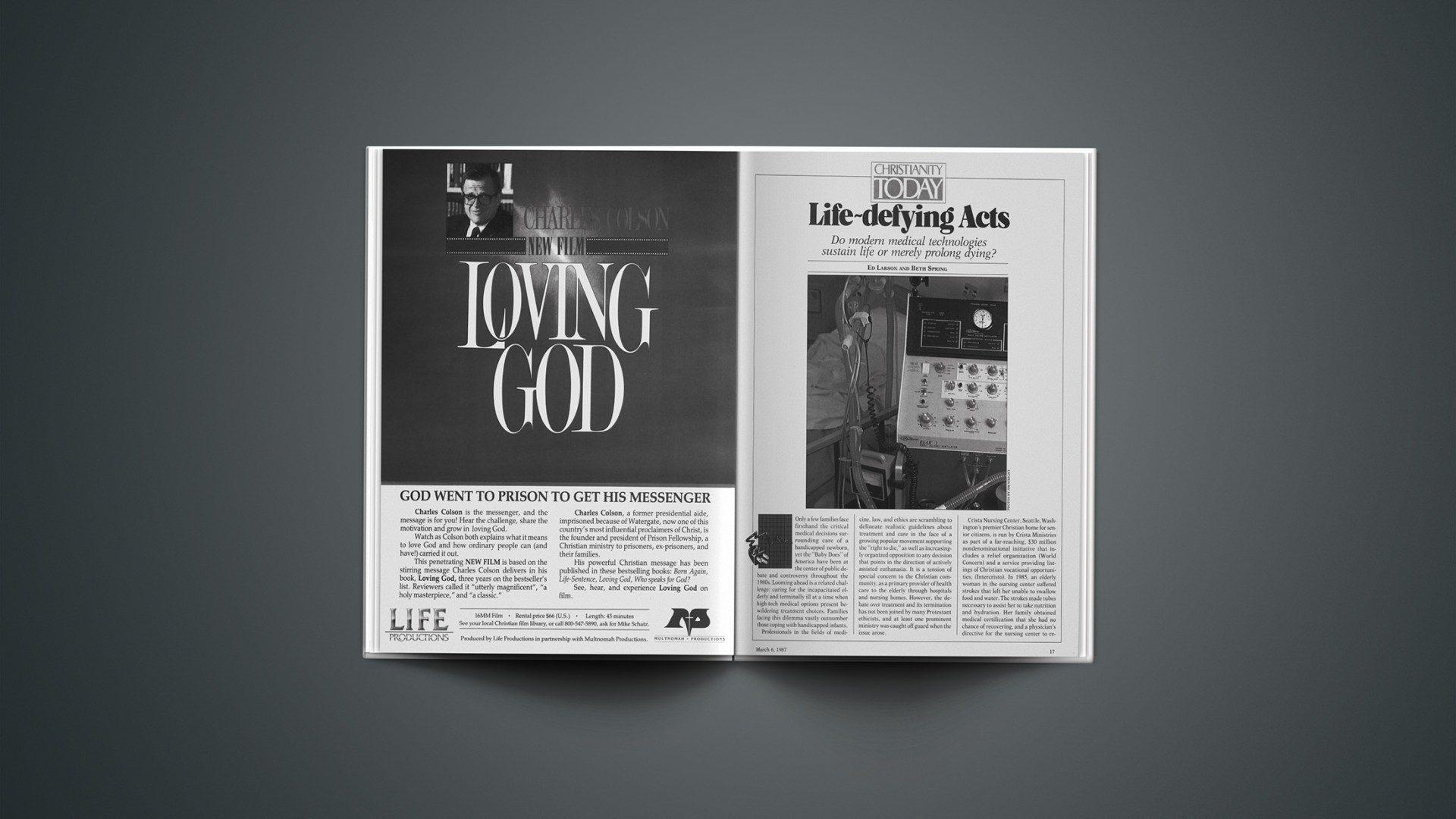
Life-Defying Acts

Do modern medical technologies sustain life or merely prolong dying?

Only a few families face firsthand the critical medical decisions surrounding care of a handicapped newborn, yet the “Baby Does” of America have been at the center of public debate and controversy throughout the 1980s. Looming ahead is a related challenge: caring for the incapacitated elderly and terminally ill at a time when high-tech medical options present bewildering treatment choices. Families facing this dilemma vastly outnumber those coping with handicapped infants.

Professionals in the fields of medicine, law, and ethics are scrambling to delineate realistic guidelines about treatment and care in the face of a growing popular movement supporting the “right to die,” as well as increasingly organized opposition to any decision that points in the direction of actively assisted euthanasia. It is a tension of special concern to the Christian community, as a primary provider of health care to the elderly through hospitals and nursing homes. However, the debate over treatment and its termination has not been joined by many Protestant ethicists, and at least one prominent ministry was caught off guard when the issue arose.

Crista Nursing Center, Seattle, Washington’s premier Christian home for senior citizens, is run by Crista Ministries as part of a far-reaching, $30 million nondenominational initiative that includes a relief organization (World Concern) and a service providing listings of Christian vocational opportunities, (Intercristo). In 1985, an elderly woman in the nursing center suffered strokes that left her unable to swallow food and water. The strokes made tubes necessary to assist her to take nutrition and hydration. Her family obtained medical certification that she had no chance of recovering, and a physician’s directive for the nursing center to remove her feeding tube.

Three nurses refused on ethical and religious grounds to go along with the decision. The nurses who objected were asked to resign. This demand was soon withdrawn and Crista refused the family’s instructions. A court order was obtained by the family and the patient was moved to another facility and died shortly thereafter.

Five months later, another patient’s family also ordered an end to artificial feeding. This time the patient was moved to another unit within the Crista facility where the nurses did not have any ethical or religious objection to the removal of the naso-gastric feeding tube. That patient lingered for a week.

Extensive media coverage followed, and contributions to Crista’s many ministries temporarily dropped. One nurse later resigned over the incident and filed an employment lawsuit against Crista that is still pending.

Despite the controversy, long waiting lists remain for admission to the nursing home. No patients have complained about the decision, according to Derrill Meyer, who is the executive director of Crista Senior Ministries. “Our patients and their families want to retain control over decisions about discontinuing life-sustaining treatment,” Meyer says.

Crista’s decision regarding food and water as “treatment” rather than “care” conforms to a position the Amerian Medical Association took in March 1986. Their policy statement includes “nutrition and hydration” in a list of life-prolonging medical treatments that may be discontinued “even if death is not imminent.”

Events at the quiet nursing home situated among the tall firs on Crista’s suburban campus portend disputes that are sure to rock other Christian medical facilities. Christian health-care providers increasingly will be forced to decide when to use life-sustaining treatments and when to turn them off.

Crista is attempting to ward off future disputes through extensive care conferences involving patients who are still able to make decisions for themselves. But as Crista has learned from experience, the patient and physician are not the only persons involved. Ultimately, Christians need to ask: On what basis do we decide to administer life-sustaining treatment?

Prolonging Versus Providing

Answering that question requires a concerted effort to untangle the misunderstandings that are rife in discussions of medical ethics. U.S. Surgeon General C. Everett Koop, long a champion of the right to life, has clarified the issue by drawing a distinction between providing a patient “all the life to which he or she is entitled,” and artificially “prolonging the act of dying.” This distinction involves the attitude of the care giver as well as the actual condition of the patient, so it is necessarily subjective.

Koop explains this distinction with an example of a mythical patient: “Suppose your daughter, age two, had a neuroblastoma, the most common tumor of childhood. I operated on her, gave her radiation therapy, and for two years she received chemotherapy. She did so well initially that you doubted the diagnosis could be cancer. But now you are seeing her slip, and we have to come to a decision. We can’t operate, she can’t take any more radiation, and I suggest we stop the chemotherapy.

“Why? Because if we continue the chemotherapy, she’ll live about three months. She will have severe pain we can control, but will be like a zombie and probably become blind and deaf. If we stop the chemotherapy, she will die in only six weeks, but will not have the pain or become blind and deaf. I think discontinuing treatment is good medicine for this patient, for her family, and for society.”

However, Koop is exceedingly cautious about granting anyone other than the patient (and perhaps the patient’s closest family members) the right to make such a decision. He is particularly concerned about the inroads made in professional medical circles and in the popular press by proponents of the “right to die.” Here Koop draws another crucial distinction. The language being used by advocates of “death with dignity” is eminently reasonable and compassionate. But their underlying ethical framework is considerably different from traditional understandings of a patient’s worth and a physician’s responsibility.

A publication from the New York-based Society for the Right to Die, The Physician and the Hopelessly Ill Patient, declares unequivocally that “the patient’s role in decision making is paramount.” When it comes to a patient who wants to kill himself, the publication states, “the physician cannot participate by assisting in the act (of suicide), for this is contrary to law. On the other hand, the physician is not obligated to assume that every such wish is irrational and requires coercive intervention.” The publication includes food and water in its list of treatments that may be withdrawn from a hopelessly terminal patient.

There is little in the society’s statement that would excite controversy. Yet, when it is read in light of statements made by its founder, Joseph Fletcher, the implications of its positions raise a host of ethical questions. Fletcher, best known for defining and defending “situation ethics,” is a proponent of assessing a patient’s “personhood” in light of perceived quality of life rather than the simple biological fact of life. This concept of conditioning full personhood on the quality of life stands in contrast to the more traditional Christian principle asserting the sanctity of all human life regardless of its “quality.”

For instance, according to Fletcher, a baby born with Down’s syndrome may not be entitled to all the civil rights and spiritual dignity of personhood because of his or her impaired ability to reason and think. Fletcher contends there should be no guilt associated with allowing such a baby, like Baby Doe in Indiana, to starve to death.

Richard M. Gula, a Catholic seminary professor of moral theology, places Fletcher at the far end of the “consequentialist” school of thought with regard to euthanasia. In his book What Are They Saying About Euthanasia?, Gula says Fletcher “places the highest good in personal integrity and human well-being.” Moreover, he erases the commonly held distinction between allowing a patient to die and deliberately causing a patient to die, because the “consequences” are the same in either case. He argues in favor of direct euthanasia for incurable, suffering patients, but stops short of promoting euthanasia for people determined to be burdens on society.

Gula, in assessing Fletcher’s position, notes that Fletcher’s advocacy of selective mercy killing “remains arbitrary, it is too risky, and it erodes the character of a helping community of trust and care.” It assigns no positive value to individual suffering, sets a precedent for far broader application of euthanasia, and releases society from its task of exploring other alternatives.

Ethicists who emphasize the sanctity of life include leading Protestant thinker Paul Ramsey, an emeritus religion professor at Princeton University. Ramsey bases his approach to the issue on God’s covenantal love for mankind. “To choose to assist the dying process actively is to throw the gift of life back in the face of the Giver,” he states.

Ramsey draws a clear distinction that says once a patient is beyond the reach of care and comfort, measures to prolong his dying may cease. “To stop some futile medical intervention does not of itself cause or hasten anyone’s death,” he observes. Ramsey is quick to add, however, that “nourishment is not a medical treatment. Death must be the aim of stopping food and water. Here, omission can only mean we intend death,” which Ramsey believes is always wrong.

Opponents of euthanasia tend to reject arguments that draw a distinction between physical life and personhood. In their view, writes Gula, physical bodily life is “intrinsic to human persons and contributes directly to human fulfillment.” Fletcher, on the other hand, would say the body is merely the means, or vehicle, a person uses to achieve his or her chosen goals and activities. Presupposing this division between physical life and personhood allows Fletcher and others to say that physical beings who lack the ingredients of cognitive personhood need not be kept alive.

These abstract ethical positions influence life-and-death decisions and serve to justify actions that once would have been kept secret. Betty Rollin, a national television news correspondent, wrote a best seller about how she actually assisted in her mother’s suicide. Last Wish is a compelling, matter-off-act description of Rollin’s aging mother being ravaged by uterine cancer. In extreme pain, she wants to kill herself. But because she is too weak to leave her bed, the mother convinces Rollin to assist her in her death wish by finding out how she can kill herself with pills.

Assisted suicide is illegal in the United States, so Rollin telephones a physician in Holland, where euthanasia is permitted. Obtaining the name of a drug and the necessary dosage, she and her mother carry out the plan. As her mother drifts into a medicated death, Rollin quotes her as saying, “Remember, I am the most happy woman. And this is my wish.”

Life, Death, And The Courts

Positions staked out by ethicists and accepted by individuals are applied in court cases pitting personal tragedy against the need for impartial societal guidelines. The legal debate begins with a clear but fine distinction that opens the way to confusion and controversy in many actual cases.

On the one hand, patients traditionally have the legal right to control their own medical treatment, including the right to refuse care. “Every human being of adult years and sound mind has the right to determine what should be done with his own body,” wrote American jurist Benjamin Cardozo 75 years ago in ruling against a doctor for performing a medically necessary operation on a patient who did not want it.

On the other hand, all states retain laws against helping people kill themselves. These two potentially conflicting rules of law are reconciled by barring doctors from assisting patients to commit suicide, such as by supplying poison, but by allowing patients to refuse medical treatment necessary to keep them alive. However, the case of Elizabeth Bouvia in California shows how hard it can be to draw this line.

Now 28 years old, Bouvia was born with cerebral palsy and is quadriplegic. Her handicaps have progressed to the point where she is completely bedridden and able to move only her head and a few fingers. She is physically helpless and wholly unable to feed, wash, or even turn herself. Suffering continual pain from crippling arthritis, Bouvia lies flat in bed and is expected to do so for the rest of her life.

Despite her severe physical handicaps, Bouvia is intelligent and mentally competent. She has earned a college degree, was married (her husband left her), and has suffered a miscarriage. Bouvia lived with her parents until her father told her they could no longer care for her. She now lives in a Los Angeles public hospital without financial means to support herself.

Since 1983, Bouvia has said she wants to kill herself. Since she cannot perform any act to take her own life, she resolved to starve herself to death. Fearful for her life, her physicians inserted a life-saving nasogastric feeding tube against her will. Bouvia then filed suit to have the tube removed.

The trial court refused her request, ruling that Bouvia was illegally trying to commit suicide with the hospital’s assistance. The appeals court reversed this ruling last April, declaring “a patient has the right to refuse any medical treatment, even when such treatment is labeled ‘furnishing nourishment and hydration.’ ”

Since the court ruling, Bouvia has yet to invoke her right to end tube feeding, so she continues to live with her hard-won freedom to die. But the question remains: Which court was right?

Concluding she could live 15 to 20 years with feeding, the trial court ruled that the preservation of Bouvia’s life outweighed her right to choose. The appellate court, in contrast, gave primary importance to Bouvia’s right to refuse treatment. “We do not believe it is the policy of this State that all and every life must be preserved against the will of the sufferer,” Judge Beach wrote. “It is incongruous, if not monstrous, for medical practitioners to assert their right to preserve a life that someone else must live, or, more accurately endure, for 15 to 20 years.”

This case is somewhat unusual, however, because Elizabeth Bouvia could express her own choice. Usually patients receiving life-sustaining medical treatment are comatose, brain damaged, or otherwise unable to refuse care. Traditionally, treatment would be provided to these patients. Recently, however, new laws and court decisions have pointed toward controversial means to end treatment for patients unable to decide for themselves.

How Much Treatment Is Too Much?

At the forefront of change are “living wills,” in which healthy people can authorize physicians not to use life-sustaining treatment if they become terminally ill and cannot participate in treatment decisions.

In 1976, California became the first state to authorize living wills. Thirty-five states have followed suit, including 13 in 1985 alone, so two-thirds of all Americans may now execute valid living wills. “As a result,” Koop states, “living wills can no longer be viewed as a temporary legislative experiment in the field of death and dying.”

While most people support the concept of a living will as applied to truly extraordinary medical treatment, many right-to-life advocates fear that such documents go too far. “By using vague or broadly defined terms, living will legislation typically provides the physician with significant latitude to withdraw even ordinary and beneficial treatment and food and water for patients in noncritical situations,” observes attorney James Bopp, Jr., general counsel for the National Right to Life Committee.

Some statutes, such as the Indiana Living Wills Act, state that food and water should be administered to all patients, but most leave this key issue up to the doctor. Statutes also vary greatly in defining the “terminal condition” under which the living will takes effect, ranging from Maryland’s narrow requirement that death be imminent even with treatment, to Montana’s broader clause requiring death “within a relatively short time” without treatment. Of course, individuals may specify in their own living will that food and water never be discontinued. They may also try to tighten the definition of terminal condition, but some ambiguity is inevitable.

“You have no idea, when you write that living will, what sort of death you will face,” Koop says. “Most people envision cancer with intractable pain. Even if that is the case, a lot can happen between now and the future concerning treatment.” If an elderly person with cancer, such as noted Christian author Francis Schaeffer, had been knocked unconscious in a car accident, Koop says a living will could have meant an earlier death. Yet, during the years Schaeffer was treated for cancer, he lectured extensively and wrote a dozen books.

A second statutory method of terminating treatment for incompetent persons is known as a “durable power of attorney.” States that adopt this approach authorize individuals to name someone else to make future treatment decisions for them, in case they become incompetent to do so. Here too, James Bopp objects, claiming a durable power of attorney is very dangerous since there is no real limitation on the right of the named party to withdraw treatment or care when the patient is incompetent.

Living wills and durable powers of attorney only cover the relatively few patients who have actually signed such documents. The vast majority of terminally ill patients are left under the newly developing judicial doctrine of substituted judgment. Under this doctrine, a court seeks to determine an incompetent person’s wish regarding medical treatment, and then implement it. Substituted judgment gained public notice ten years ago with the famous case of Karen Ann Quinlan. Quinlan’s father had requested court authority to disconnect a respirator from his comatose 21-year-old daughter, who was diagnosed as living in a “persistent vegetative state.”

Observing that Quinlan would have a legal right to refuse treatment if she were competent, the New Jersey Supreme Court empowered her father (as next of kin) to render his “best judgment as to whether she would exercise this right in these circumstances.” Even after the removal of the respirator at the father’s direction, however, Quinlan survived in a coma until June 1985.

While most state courts routinely allow family members and guardians to remove respirators and other intrusive medical treatment in certain situations, legal uncertainity remains on many key points, such as discontinuing food and water. Two current cases illustrate the confusion.

Paul Brophy was a 46-year-old Massachusetts firefighter when he underwent emergency brain surgery in 1983. He never recovered consciousness after the operation, and entered a vegetative state unable voluntarily to control his muscles or respond to verbal statements. Medical experts considered Brophy’s condition irreversible.

Apart from severe brain damage, Brophy’s health was good. He was not in danger of imminent death, and could have lived for years with continued feeding through a gastrostomy tube. Such a tube is not painful and is easily operated by a nurse or family member. All of his automatic bodily functions, such as digestion, breathing, and blood circulation, operated normally without mechanical assistance.

After Brophy persisted in this vegetative state for over a year, his wife requested that tube feeding end because he “had no quality of life remaining.” Mrs. Brophy is a practicing Catholic who attends mass daily and belongs to a prayer group. She made the decision to terminate care after extensive church counseling. Brophy’s four adult children, seven brothers and sisters, and elderly mother supported the decision. However, his doctor and the hospital staff refused the request on the basis that withdrawal of food and water constituted the willful taking of human life.

The family then sought a court order to end tube feeding. The trial court refused, acknowledging that, based on his earlier comments, Brophy would have wanted to end tube feeding. Nevertheless, Justice David Kopelman wrote, “It is ethically inappropriate to cause the preventable death of Brophy by the deliberate denial of food and water, which can be provided to him in a noninvasive, nonintrusive manner which caused no pain and suffering, irrespective of the substituted judgment of the patient. The proper focus should be on the quality of treatment furnished to Brophy, and not on the quality of Brophy’s life.”

A bitterly divided state supreme court recently reversed this ruling by shifting the focus from the quality of treatment to the patient’s own perception of his quality of life. Stressing the finding that Brophy would have wanted to end tube feeding, the majority based its decision on “an individual’s right to avoid circumstances in which the individual himself would feel the efforts to sustain life demean or denigrate his humanity.”

Three of seven justices dissented, noting, “If nutrition and hydration are terminated, it is not the illness which causes death but the decision (or act in accordance therewith) that the illness makes life not worth living.” Brophy died after eight days without food.

The majority relied heavily on a 1985 New Jersey Supreme Court decision granting a similar request in the case of Claire Conroy, an 84-year-old single retiree. Conroy was placed in a nursing home by her only relative, a nephew, in 1979. By 1983, she was confined to her bed in a semi-fetal position. She suffered from heart disease, hypertension, diabetes, eye infections, and bed sores. Her left leg was gangrenous. She could not speak, properly swallow, or control her bowels. And she received food and water through a nasogastric tube.

Yet Conroy could move her upper body somewhat, and would scratch herself or pull on her bandages. She moaned when moved or fed. And despite her greatly diminished mental capacity, her eyes sometimes followed individuals in the room, and she smiled when her hair was combed or her body rubbed.

Based on a medical diagnosis that Conroy’s physical and mental condition could never improve, her nephew asked for the tube feeding to end. Believing the resulting death would be painful, her doctor refused.

The nephew then sought court authorization to remove the nasogastric tube. Conroy died before the final court decision, but it ruled on the case anyway to clarify the doctrine of substitute judgment as applied to incompetent but not comatose patients whose life expectancies are relatively short. According to the ruling, where there is clear indication that an incompetent patient would have refused treatment, including tube feeding, then a family member or guardian can make the same decision on the patient’s behalf.

However, if there is no indication of the patient’s wish, then treatment should continue unless it is inhumanly painful. The court ruled that treatment must never be withdrawn from a patient who previously expressed a wish that it continue.

Fifteen Thousand “Granny Does”

These rulings underscore the need for decisions regarding future medical treatment to be made, whenever possible, before a final illness leaves a patient incapable of expressing his or her wishes. Not to decide may allow a substitute to decide instead, who may opt to discontinue food and water. On the other hand, a physician fearing malpractice litigation could decide to proceed with every available treatment. A publication of the Society for the Right to Die says, “Physicians do not easily accept the concept that it may be best to do less, not more, for a patient.”

For individuals, treatment choices can be made in advance by personalized living wills or other declarations specifying the desired care as precisely as possible. This declaration could spell out when treatment should be continued as well as when it should be ended. Another option is choosing the substitute decision maker by a durable power of attorney. By doing so, a person with similar values, such as a minister or relative, can be chosen rather than a court-appointed substitute.

After its difficult experience, Crista Nursing Center continues to sponsor individual care conferences involving the patient, family members, physicians, and spiritual counselors. The process allows the patient to make treatment decisions in advance. It has also convened a special committee to review the appropriate role for Crista. Guidelines have been recommended that include the creation of an ethics committee and use of the term “imminent death.”

Such treatment decisions will increasingly confront society and consequently the church. As Surgeon General Koop notes, “For every Baby Doe born today, there will be 15,000 Granny Does by the end of the 1990s.” What is now called for is compassionate guidance for both the infirm and the people making life-and-death decisions. As the church becomes involved, it can model a spirit of acceptance toward death and dying missing from the wider debate.

Ed Larson is a lawyer in Washington, D.C., with the U.S. House of Representatives subcommitte on education and labor.

Ideas

The Boesky Touch

When business is no longer conducted under public scrutiny, honesty lacks the protection of human contact.

We should not underestimate the aftereffects of the tremors still shaking Wall Street following the recent insider trading scandal. The stock market itself appears to have withstood the disaster. The Dow Jones index topped the once-invulnerable 2,000 barrier barely a month after the initial revelations, and the principle figure in the scandal, Ivan Boesky, will no doubt follow the way of all such white-collar criminals (crime, fame, tell-all book, oblivion). Yet there seems to be more than the usual amount of gnashing of teeth and calls for reform.

Most fascinating is the language being used to describe the crime and the needed reforms. Critics note that this was not a crime of violence, but of “broken trust.” Boesky allegedly developed a surreptitious network of informers to gain knowledge of corporate affairs, giving him illegal advantage in his business of taking over struggling corporations. And reformers calling for sharp restrictions on corporate raiders and insider trading are bandying about words like ethics, faith, and values in prescribing corrections.

Predictably, their solutions are for tighter laws rather than crash courses in the Sermon on the Mount. Tighter laws are not a bad idea. Obviously, existing restrictions are inadequate to control the burgeoning corporate raiding business. Many have suggested ways of abolishing the mysterious-sounding financial practices that corporate raiding has created: “greenmail” on the raider’s part, and “golden parachutes” or “poison pills” for the corporate managers.

Yet increased legislation has never successfully dealt with ethical problems. Indeed, the Boesky case is a symptom of an increasingly dangerous situation that continues to sap the moral strength of our business community. It is a symptom of the creeping individualism and lack of accountability that has made business dealings in our country an amoral, long-distance exchange between computers, with only form-letter assurances and inadequate laws to regulate the transactions.

Accountable To Money?

This lack of accountability creates many negative consequences. For example, it elevates our medium of exchange—money—to the impossible role of an ethical policeman. Instead of ethics being the controlling force in our business dealings, money (or more accurately, profit) has become the standard by which we measure a transaction’s goodness. Corporate raiders justify their actions by saying the power of money (or its threatened loss) is the only thing that will shake the lethargy out of corporate America. Money, they say, is the universal language of business. When money speaks, E. F. Hutton (itself a victim of scandal) and the others listen.

Yet money is wholly inadequate to this role. Money is a medium of exchange, and a representation of what happens in a business deal. But as the definer of a good business relationship? Hardly. “The more money, the less virtue,” said Henry David Thoreau. At best, money is amoral, like the computer. “Money,” Philo said, “is the cause of good things to a good man and of evil things to a bad man.” Making money the measure of an honest business deal is like putting a mouse in charge of the cheese. We can always expect the worst.

Of course, there is nothing new in this warning. Money has always been a mixed blessing. The Bible warns that the love of money is a root cause of all kinds of evil, and history proves a fertile hunting ground for illustrations of that verse. Money’s allure has consistently brought out the worst in people. Only rarely do we see human beings, when tempted with the prospect of great riches, rise above the level of basic greed.

But greed has been with us always. Why, then, does it appear to be an increasingly dangerous force in the marketplace?

Money As Simplifier

Clearly, greed ripens as the power of money grows, and if anything, money has become almost omnipotent. Never before in our history have man’s needs been so monochromatic—money buys all. There is no need to forage for food, no need to chop firewood, no need to cooperate with the neighbors to build a log cabin for protection.

The loser in this simple-for-complex transaction is human contact. We can buy clothes by mail, jewelry by computer, food by phone, land by proxy. Gone is the sense of community involvement in business transactions that act as a natural curb on excess. With the loss of human contact goes a sense of accountability. In the business community, this means the entire weight of ethical responsibility is thrown on the deal itself. There are fewer and fewer chances to factor basic human decency into transactions. If anything, such abstraction is encouraged by business institutions.

Although the Bible is not an economics textbook, one aspect of business transactions described there is worth noting. Legal and economic transactions were carried out at the main gateway of the city, where the whole town could gather in the adjacent square and act as witnesses to the agreement. It was not uncommon for the community to help set the price of a purchase to ensure fair treatment of both parties. The impact of seeing firsthand the effects of a business deal on a neighbor stimulated honesty.

Of course, a wholesale change in the abstract, high-tech advances in modern monetary policy may be beyond our reach. On balance, computer technology has enhanced our business capabilities and will continue to do so. But technology will not solve our ethical problems.

It is also futile to think that increased legislation alone can reinject the sense of trust into today’s business transactions. As much as we need new laws, they must be accompanied by a new moral climate. In a recent interview, social philosopher Sissela Bok, commenting on the current state of public values, longs for a time when we all must “take moral principles into account” in order to develop the trust missing in so many of our interpersonal dealings.

Technology and the complexity of modern business make it impossible to return to the accountability of conducting business at the city gates for all to see. Instead, we must lobby for value-laden legislation. As citizens and stockholders in public corporations, we must press for business institutions to move ethics back to the top of their priority lists.

As a church, we must continue to train Christians who take biblical values seriously; to reinstate God, not money, as our simplifying principle in a complex world; and to individually, intentionally, view any transaction as if it were a community priority.

Wall Street reformers may be rediscovering the language of trust, values, and ethics. But only the church can give it lasting meaning.

By Terry Muck.

Home-Grown Kids Need a Full-Time Mom

A few years ago, my wife Katie and I made a decision: she would stay home to care for our children rather than work outside the home. We have stuck by that decision, but it has not been easy. The difficulty is not just financial. True, one income has not allowed us to match the lifestyles of our two-career friends. But we knew that would be the case and were prepared to accept the financial limitations of our choice.

The real difficulty is the loneliness. Our commitment to having one parent at home finds little support in the Christian community. Ever since our grandmothers went off to the factories to help make the world safe for democracy, the pressure on mothers to work outside the home has increased. So while three generations of women progressively moved into the marketplace, it has become easier to believe that a woman cannot be happy if she stays home. That the world buys this idea I can accept; that the Christian community has bought it, I cannot.

Married women are encouraged to guide or manage their households (1 Tim. 5:14). Scripture also appears to suggest that it is honorable for a married woman to be a stay-at-home wife and mother (1 Tim. 2:15). And older women are instructed to teach younger women to remain in the home and take care of their families (Tit. 2:3–5). In fact, the Bible says many things that are difficult to reconcile with our perception that women can only be fulfilled if they work outside the home.

And yet, I honestly wonder how many working mothers actually find fulfillment in their work away from home. Katie often hears other mothers say, “I’d go absolutely crazy if I had to stay home all day with my children.” They seldom say, “I need a career to be fulfilled.” Perhaps that is because their work is little more than a job to make enough money to make ends meet. They do not have rewarding careers. They just have jobs.

Perhaps I am being too harsh. Perhaps many Christian women would be willing to forgo a few luxuries if the Christian community gave some indication that full-time mothering was worthwhile. Or perhaps I am being too simplistic. Economic pressures make it difficult for families to survive on a single income. For some Christian families, a working mom is a necessity.

But when a family decides to brave it on one income, they receive little encouragement. In fact, they are offered subtle (and not-so-subtle) reminders that what they are doing is, at best, odd. Consider the actions and attitudes that regularly confront Christian couples:

  • Children are described biblically as blessings from God, but they become “accidents” if they delay or alter our personal career or economic goals.
  • Christian organizations often pay low salaries, expecting the family to have two incomes (even offering to find work for the wife).
  • Churches spend thousands of dollars on day-care centers, but little or nothing on services or ministries for women who choose to stay home. And if a woman who stays home does suffer economic calamity—if her husband leaves, dies, divorces her, or becomes disabled—the church helps her find a job (keeping her away from her children when they may need her the most).
  • Seminars for Christian women generally focus on how to balance a home and career, not on how to lower our expectaions so we can live on one income. Likewise, workshop leaders tell my wife that the Proverbs 31 woman ran a department store and a real estate agency (and that she can, too, if she would just use her time wisely).

Though society views her differently, Katie believes her current career as a mother is noble and fulfilling. She wants to be a Titus 2 woman. She wants to live in such a way that younger women can watch her life and decide it is okay to stay home. And some days, when it is raining and the kids are on her nerves, she would like to believe someone else thinks it is okay too.

Both of us like to dream about a church day-care center that offers one day of free child care each week to women who are not generating a pay check. Or a Christian school that offers discounts or scholarships to single-income families. We see how the church does its best to care for two-income families, and we support that. We just wish it would also find ways to support those of us who choose to do otherwise.

It would especially help if people quit assuming that because Katie does not have a “job” she can take on every volunteer position in the church, school, and community. And it would be nice not to feel as though everyone thinks I am a chauvinist and she is crazy.

But pity is not what we want. What we want is for the Christian community to act as if what we are doing is worth doing. And to respect it because God does.

Wally Metts, Jr., is an assistant professor of communication at Spring Arbor College (Mich.).

SPEAKING OUT offers responsible Christians a forum. It does not necessarily reflect the views of CHRISTIANITY TODAY.

Apple PodcastsDown ArrowDown ArrowDown Arrowarrow_left_altLeft ArrowLeft ArrowRight ArrowRight ArrowRight Arrowarrow_up_altUp ArrowUp ArrowAvailable at Amazoncaret-downCloseCloseEmailEmailExpandExpandExternalExternalFacebookfacebook-squareGiftGiftGooglegoogleGoogle KeephamburgerInstagraminstagram-squareLinkLinklinkedin-squareListenListenListenChristianity TodayCT Creative Studio Logologo_orgMegaphoneMenuMenupausePinterestPlayPlayPocketPodcastRSSRSSSaveSaveSaveSearchSearchsearchSpotifyStitcherTelegramTable of ContentsTable of Contentstwitter-squareWhatsAppXYouTubeYouTube