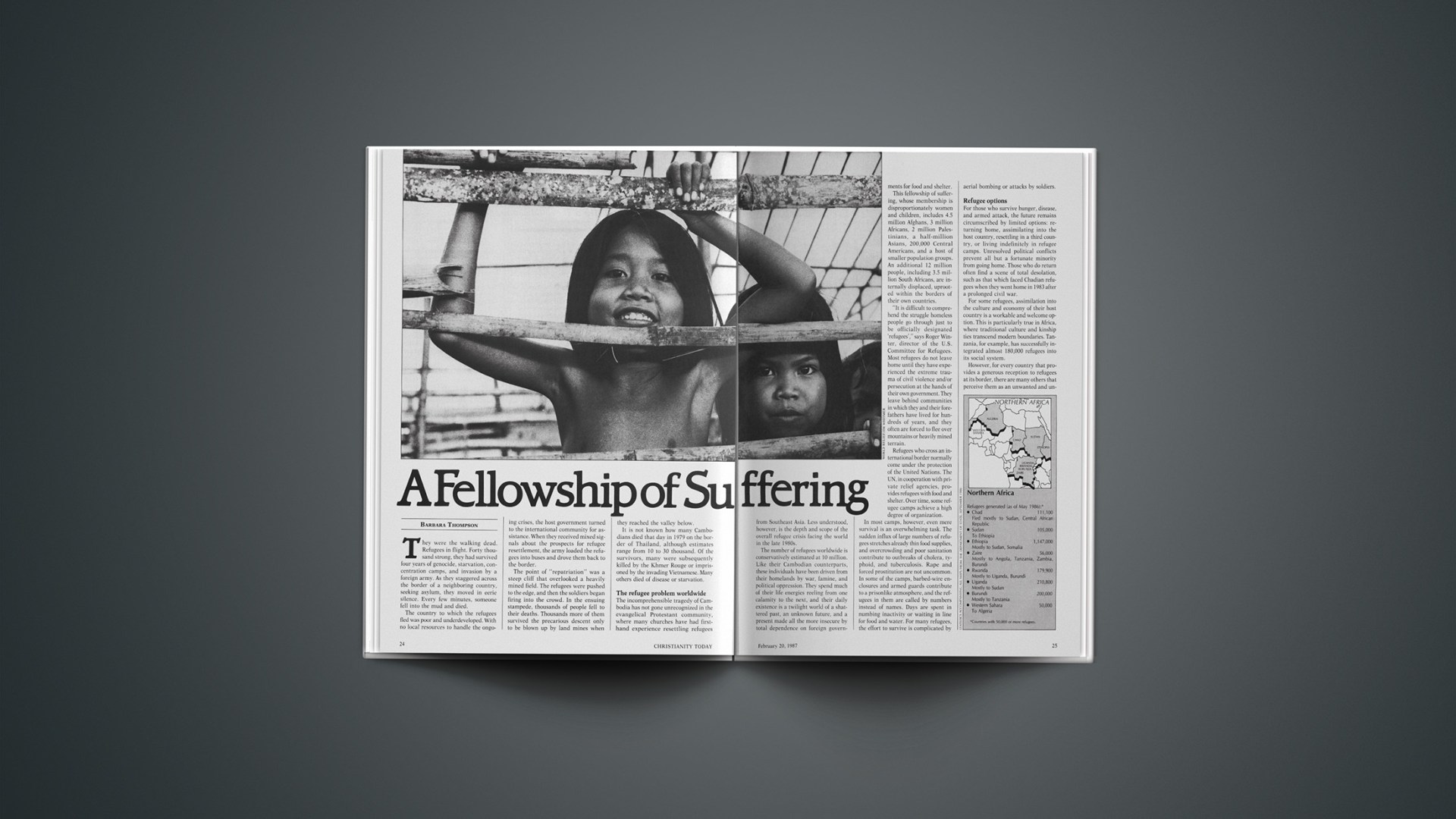
A Fellowship of Suffering

They were the walking dead. Refugees in flight. Forty thousand strong, they had survived four years of genocide, starvation, concentration camps, and invasion by a foreign army. As they staggered across the border of a neighboring country, seeking asylum, they moved in eerie silence. Every few minutes, someone fell into the mud and died.

The country to which the refugees fled was poor and underdeveloped. With no local resources to handle the ongoing crises, the host government turned to the international community for assistance. When they received mixed signals about the prospects for refugee resettlement, the army loaded the refugees into buses and drove them back to the border.

The point of “repatriation” was a steep cliff that overlooked a heavily mined field. The refugees were pushed to the edge, and then the soldiers began firing into the crowd. In the ensuing stampede, thousands of people fell to their deaths. Thousands more of them survived the precarious descent only to be blown up by land mines when they reached the valley below.

It is not known how many Cambodians died that day in 1979 on the border of Thailand, although estimates range from 10 to 30 thousand. Of the survivors, many were subsequently killed by the Khmer Rouge or imprisoned by the invading Vietnamese. Many others died of disease or starvation.

The Refugee Problem Worldwide

The incomprehensible tragedy of Cambodia has not gone unrecognized in the evangelical Protestant community, where many churches have had firsthand experience resettling refugees from Southeast Asia. Less understood, however, is the depth and scope of the overall refugee crisis facing the world in the late 1980s.

The number of refugees worldwide is conservatively estimated at 10 million. Like their Cambodian counterparts, these individuals have been driven from their homelands by war, famine, and political oppression. They spend much of their life energies reeling from one calamity to the next, and their daily existence is a twilight world of a shattered past, an unknown future, and a present made all the more insecure by total dependence on foreign governments for food and shelter.

This fellowship of suffering, whose membership is disproportionately women and children, includes 4.5 million Afghans, 3 million Africans, 2 million Palestinians, a half-million Asians, 200,000 Central Americans, and a host of smaller population groups. An additional 12 million people, including 3.5 million South Africans, are internally displaced, uprooted within the borders of their own countries.

“It is difficult to comprehend the struggle homeless people go through just to be officially designated ‘refugees’,” says Roger Winter, director of the U.S. Committee for Refugees. Most refugees do not leave home until they have experienced the extreme trauma of civil violence and/or persecution at the hands of their own government. They leave behind communities in which they and their fathers have lived for hundreds of years, and they often are forced to flee over mountains or heavily mined terrain.

Refugees who cross an international border normally come under the protection of the United Nations. The UN, in cooperation with private relief agencies, provides refugees with food and shelter. Over time, some refugee camps achieve a high degree of organization.

In most camps, however, even mere survival is an overwhelming task. The sudden influx of large numbers of refugees stretches already thin food supplies, and overcrowding and poor sanitation contribute to outbreaks of cholera, typhoid, and tuberculosis. Rape and forced prostitution are not uncommon. In some of the camps, barbed-wire enclosures and armed guards contribute to a prisonlike atmosphere, and the refugees in them are called by numbers instead of names. Days are spent in numbing inactivity or waiting in line for food and water. For many refugees, the effort to survive is complicated by aerial bombing or attacks by soldiers.

Refugee Options

For those who survive hunger, disease, and armed attack, the future remains circumscribed by limited options: returning home, assimilating into the host country, resettling in a third country, or living indefinitely in refugee camps. Unresolved political conflicts prevent all but a fortunate minority from going home. Those who do return often find a scene of total desolation, such as that which faced Chadian refugees when they went home in 1983 after a prolonged civil war.

For some refugees, assimilation into the culture and economy of their host country is a workable and welcome option. This is particularly true in Africa, where traditional culture and kinship ties transcend modern boundaries. Tanzania, for example, has successfully integrated almost 180,000 refugees into its social system.

However, for every country that provides a generous reception to refugees at its border, there are many others that perceive them as an unwanted and unbearable burden. When economic and political tensions increase, some refugees are forcibly returned to their homelands. (Forced repatriation is in violation of the United Nations Protocol of 1951, to which most Western nations, including the United States, are signatories.)

For a small percentage of refugees, there is the prospect of resettlement in a third country, usually in the West. Since 1975, this dream has become a reality for over 2 million refugees, half of whom have found permanent homes in the United States. “The U.S. and the Western world have participated in the most dramatic rescue operation in the history of mankind,” says Roger Winter. “There are political leaders who talk about the refugee ‘situation’ as if it is a never-ending problem, but in reality, solutions for individual refugees are found every day of the year.”

The Role Of The Churches

Catholic and Protestant churches, as well as synagogues, have played a major role in the rescue effort, assisting in the resettlement of more than 90 percent of refugees accepted by the United States. The U.S. Catholic Conference alone places approximately half of all refugees, while World Relief leads evangelical Protestant agencies with 62,000 refugees resettled since 1979. Over 2,500 churches have participated in the World Relief program, and many congregations have sponsored more than one family.

The people who sponsor refugees come from every socio-economic level of society. “They run the spectrum from rich to poor, ultraconservative to liberal”, says Dennis Ripley, director of World Relief’s U.S. Ministries. “what they have in common is a willingness to reach out and touch the life of another human being in need.”

Sponsoring churches and families help refugees find jobs and homes, adjust to language differences, and make accommodation to American culture. They also have a unique opportunity to participate in the deep joys and sorrows of the refugee experience. Don Mosley, a member of Jubilee Partners, an intentional Christian Community in Comer, Georgia, that has helped over 950 refugees, remembers a unique worship service with a new group of Cambodian refugees. “We asked everyone to draw a picture of something for which they were grateful to God,” says Mosley.

“The children drew flowers and rainbows. One woman drew a picture of soldiers shooting a man, while in the background a woman and three children ran away.” The woman explained to the group that she and her family had been found by the Khmer Rouge when they tried to leave Cambodia. “My husband stood up and said to the soldiers, ‘shoot me and let my family go.’ This is what the soldiers did. And this is what I’m grateful for—that I had such a husband.”

Human Triumphs And Barbed Wire

Refugees face cultural and language barriers when they resettle in the West, but refugee workers are unanimous in their positive assessment of the resettlement program. They point out that in less than a decade, the first wave of Southeast Asian refugees has achieved an employment rate in the U.S. equal to that of the larger population. Studies also show that, in the long run, refugees pay more into the national coffers in taxes than they take out during their first years in the U.S.

“People sometimes think refugees are the losers of the world,” says Susan Goodwillie, executive director of Refugees International, a refugee advocacy organization. “But in a sense, they are the winners. They have survived the worst. They are human triumphs among the wreckage of other people’s politics.” Unfortunately, the success of the resettlement program represents only a part of the total refugee story in the 1980s. The vast majority of refugees have lived outside of their homeland for at least five years, and have no hope of resettling in a Western country, or in any country. Instead, they and their children will live out their lives in refugee camps, much as the Palestinians have done for generation after generation.

Refugee analysts predict that the number of children growing up behind barbed wire is likely to increase. Current refugee situations remain unresolved, and the political, economic, and social pressures that create new refugees are on the rise. More than 20 percent of the Earth’s surface is under direct threat of desertification, and this land is home to more than 80 million people.

Africa, which produces more refugees than any other continent, now imports a fourth of its grain, although as late as 1970 it was essentially self-sufficient in food production. Throughout the Third World, the high price of loans and the low price of raw materials force governments to give priority to export crops, while local food production is pushed to the infertile margins of available farmland.

Ironically, as the number of refugees grows and the need for asylum increases, the availability of safe haven is decreasing. A general weariness in well-doing has settled over the West, and refugee admissions are dropping accordingly. In the United States, for example, refugee admissions have fallen from a high of 280,000 in 1980 to 67,000 in 1986.

According to Don Bjork, associate executive director of World Relief, this decline does not reflect a corresponding decline in the ability of church-related agencies to resettle refugees. “The consistent position of these agencies is that we can handle higher admission ceilings,” says Bjork. “On any given day, we might have trouble finding a sponsor for a particular family, but over-all, when there is a need, churches rise to meet it.”

Despite the sustained interest of church groups in resettlement programs, refugee analysts detect a growing cynicism in political circles toward the plight of refugees and a general backing away from the worldwide relief system coordinated by the United Nations.

“Refugee protection is one of the few areas in which the world community has developed a structure that works,” says Roger Winter. “And if anything will translate into real trouble for the little people of this world, it will be when the U.S. and its Western allies begin to walk away from refugee problems. We don’t even have to wash our hands 100 percent. We just have to stay on our present path and it will mean a setback in refugee doctrine and practice.”

Policy Problems

Winter and other refugee advocates point to three problem areas in U.S. refugee policy: the interdiction (or legal prohibition) of Haitian refugees, the long-term detention of asylum seekers; and discrimination against Central American refugees. Since interdiction began in 1981, over 6,000 Haitians have been stopped at sea and involuntarily returned to their homeland.

Technically, these refugees are allowed to apply for asylum at the time of interdiction, but no Haitian “boat people” have received asylum since the program began. “It’s not the case that all Haitians qualify for refugee status,” says Winter. “But the average American would be morally offended to know that, in the flood of people fleeing from Duvalier’s regime, not a single individual was granted asylum in the United States.”

Haitians who make it to shore are faced with the prospect of incarceration in one of nine immigration detention centers in the United States. The United States is one of the few Western countries that practices long-term detention of asylum applicants, and refugees from Haiti, Cuba, Afghanistan, Ethiopia, Guatemala, El Salvador, and Nicaragua have been detained for up to six years. Currently an estimated 4,000 asylum seekers are being detained in the United States.

Central American Refugees

Perhaps the most controversial aspect of U.S. refugee policy concerns the status of refugees from El Salvador and Guatemala. Since 1945, 90 percent of all refugee admissions into the United States have been persons fleeing from Communist countries. Refugee advocates argue that persons fleeing from right-wing governments, particularly those with which the United States has political ties, have unwarranted difficulty proving their refugee eligibility.

Although the Refugee Act of 1980 provides ideologically neutral standards for determining refugee admissions, of 70,000 spaces available in 1985, 59,000 were allocated to persons fleeing from the Soviet Union, Eastern Europe, and Indochina. In the first eight months of 1986, of 3,000 spaces allocated to Latin Americans, none were given to Salvadorians or Guatemalans.

Sen. Mark Hatfield, immediate past-chairman of the Senate Appropriations Committee, is among those who believe that the Refugee Act of 1980 has not been fairly applied to Central Americans. In January 1986, Hatfield went to Guatemala to oversee elections and witnessed firsthand some of the conditions that cause Guatemalans to flee their homeland. “There are grave human rights abuses that the U.S. will not acknowledge,” says Hatfield. “And these abuses are producing refugees that the U.S. will not recognize.”

U.S. asylum policy for El Salvador has generated similar criticism. Currently less than 3 percent of Salvadorians who apply for political asylum receive it. Since 1979, over 65,000 Salvadorians have been killed in their homeland (a figure proportionate to over 3 million political assassinations in the United States). An estimated 38,000 have been deported from the U.S.

Hatfield, among others, believes many of these deportations represent inequitable application of the Refugee Act of 1980. This discrimination, he adds, is one reason why the Sanctuary Movement has taken hold in the United States. The Sanctuary Movement, which involves some 270 churches, attempts to provide refugees from El Salvador with safe haven in the United States.

“The Old and New Testaments are full of people who had to choose between the law of God and the law of human beings,” says Don Mosley, who supports the Sanctuary Movement. “But ironically, with respect to Central American refugees, it is not the law itself [the Refugee Act of 1980] that is at fault, but the biased way in which U.S. officials abuse it. In a real sense, the government is breaking the law.”

Laura Dietrich, deputy assistant secretary of the Bureau of Human Rights and Humanitarian Affairs at the State Department, believes that members of the Sanctuary Movement are motivated primarily by their desire to undermine Reagan administration policies in Central America. She also takes issue with the claim that Salvadorians have been treated unfairly. “Conditions in El Salvador are improving, and numerous people are going home,” she says. “Civilian deaths are way down, and there has been reform in the military.”

Dietrich adds that relatively few Salvadorians have been able to demonstrate that they are individually targets of persecution by their government, and that the vast majority who come to the United States are economic immigrants looking for work.

Don Bjork of World Relief believes both the Sanctuary Movement and the U.S. government are falling short of an adequate assessment of the Central American refugee problem. “We aren’t going to change government policy by breaking the law,” says Bjork. “But the current definition of ‘refugee’ needs to be broadened to include people fleeing both persecution and economic hardship. As it is now, when persons trying to enter the U.S. mention that they are starving and can’t get a job, under our law they disqualify themselves for refugee status.”

Against “Compassion Fatigue”

Whatever the future of Central American refugees in the United States, it is likely that U.S. refugee policy will remain highly controversial and politically charged for many years to come. The politicization of refugee matters will affect most deeply that segment of humanity that has already suffered enormously for other people’s politics—refugees themselves.

In the face of the great need of the world’s homeless and the current wave of “compassion fatigue” in the West, the role of the church with respect to refugees becomes all the more critical.

“Our Lord himself was a refugee,” says Ted Engstrom, president of World Vision. “The Bible has a great deal to say about the plight of displaced people, and we know they have a special place in God’s heart.”

Engstrom’s hope is that church leaders and pastors will begin to identify with the suffering of refugees and bring their plight to the attention of their congregations. “We as Christian people in the West are going to face the judgment of God,” says Engstrom soberly. “Thank God for the grace of Christ, but when we have wealthy churches spending $100 million on their buildings without allocating an equal amount for the poor, it is time we rethink our priorities.”

In the upper middle-class suburb of Edina, Minneapolis, a group of five churches representing evangelical and mainline Protestant denominations as well as the Catholic church have followed Engstrom’s advice. In cooperation with World Vision, they have formed a community coalition that sends up to 20 people a year from Edina to famine areas in Kenya and Ethiopia. Volunteers participate in construction, reforestation, dam building, and well digging.

“World Vision took a chance on us, inviting a bunch of naive middle-class Americans to African famine areas,” says Dr. Arthur Rouner of the Colonial Church of Edina. “And in the beginning, we were only thinking of a small, one-time project. But seeing is believing, and our encounter with Third World poverty changed our lives. Now we can say, with John Wesley, that the world is our parish.”

Meanwhile, as Christian leaders attempt to awaken many more churches to the plight of refugees, 10 million men, women, and children wait expectantly for some sign of hope for their future. Each day, many of them will receive a notice from a foreign government, turning down their application for asylum and suggesting that they seek resettlement elsewhere. The realization that there is no elsewhere will be a bitter one. Across the water, those who listen carefully may hear an echo of the plea made by a young Vietnamese girl: “Help us to stand. And we will walk by ourselves.”

Barbara Thompson is a freelance writer living in Brevard, North Carolina. Her latest book is Dying for a Drink (Word, 1985), written with Anderson Spickard, Jr., M.D.

Democracy as Heresy

Reconstructionists anticipate a day when Christians will govern using the Old Testament as the law book.

In the early 1960s, a small cadre of American Christians began calling for a second Reconstruction, one even more radical than the post-Civil War renovation of Southern society. Their white-bearded patriarch, Rousas John Rushdoony, found very few listeners then. But today, Rushdoony and his compatriots are regular guests on religious television shows, hobnob with a potential candidate for the presidency, testify in dozens of church-state education trials, and gain burgeoning numbers of adherents in the charismatic wing of evangelicalism.

Newsweek has labeled Rushdoony’s Chalcedon Foundation as the think tank of the Religious Right. Last fall, for the first time, major Christian presses released Reconstructionist literature. Crossway copublished with Dominion Press George Grant’s The Dispossessed and Gary North’s Conspiracy. Thomas Nelson copublished (also with Dominion) four titles in the Biblical Blueprint Series, edited by North, and endorsed by Jerry Falwell as “a tool Christians need” for the difficulties “that confront society.”

The late Francis Schaeffer’s A Christian Manifesto relied on Rushdoony’s social analysis. The younger Schaeffer, Franky V, freely cited Rushdoony in one of his early books, and listed the Chalcedon Report as one of four periodicals all concerned Christians should read. And the prominent conservative attorney and author, John Whitehead, has called Rushdoony one of two major influences on his thought.

More startling than any degree of influence, however, is what Reconstructionists actually propose for society: the abolition of democracy and reinstitution of slavery, for starters. Comments Douglas Chismar, a professor at Ashland Theological Seminary (Ohio), ignoring the Reconstructionists is no longer an option. “They haven’t been taken seriously enough.”

What Reconstruction Is

There are clearly sensational elements to Reconstruction. But it is a serious attempt to provide intellectuals and activists a “biblical” alternative for cultural reform. Although the major Reconstructionist thinkers differ on the details, attention must be paid to the three foundational points underlying all Reconstructionist thought: presuppositional apologetics, theonomy (literally, “God’s law”), and postmillennialism.

Presuppositional apologetics. Reconstructionists look to retired Westminster Theological Seminary professor Cornelius Van Til for their philosophy of truth and reality. Van Til, who is said to be opposed to the Reconstruction agenda, is nonetheless intensely admired by his disciples. They consider his theological contribution one of “Copernican dimensions,” call his thought “life-transforming and world-transforming,” and compare his intellect to Einstein’s.

In Van Til’s view, a person’s faith in ultimate truth is not something subject to historical or scientific investigation (see CT, Dec. 30, 1977, pp. 18–22). We can only approach reality with a presupposed understanding of the wide sweep of truth. What makes all the difference is the presupposition adopted. Christians, of course, turn to the Bible.

Rushdoony displayed his reliance on presuppositional apologetics at a conference last March, saying that without the Bible and God’s law there is no mathematics, science, or law and order. He said it is blasphemous to try to prove there is a God or that the Bible is true. Although isolated facts may be observed by any person, Christian or not, such facts are finally confusing outside a biblical framework. “Without the Bible,” Rushdoony insisted, “every fact from atoms to man is unrelated to all others.” Apart from the Bible, there is “no knowledge at all—only chance and universal death.”

Theonomy. Theologians as diverse as Helmut Thielicke and Paul Tillich have said Christians should be theonomic—that is, live by God’s law. Yet these theologians did not define God’s universal law as strictly and exactly as that revealed to ancient Israel. Reconstructionists do, taking cues from certain strands of New England Puritanism.

In the magisterial, 619-page explication of Reconstructionist theonomy (Theonomy in Christian Ethics), Greg Bahnsen argues that Old Testament Law applies today in “exhaustive” and “minutial” detail. “Every single stroke of the law must be seen by the Christian as applicable to this very age between the advents of Christ.”

Reformed Christians understand law as a compatible servant of the gospel and look for the enduringly valid, underlying moral purposes of Old Testament Law. But Reconstructionists take this several steps further. While they believe Christ’s coming altered ceremonial law, ending the need for animal sacrifice, they do not see ancient Israel as a unique theocratic state. It is a “blueprint” for the theocracy all nations should be. And that leads to the most controversial feature of Reconstruction.

Rushdoony, Bahnsen, and their peers anticipate a day when Christians will govern, using the Old Testament as their lawbook. True to the letter of Old Testament Law, homosexuals, incorrigible children, adulterers, blasphemers, astrologers, and others will be executed.

Postmillennialism. Only a little less controversial is the Reconstructionist eschatology, or view of the end times. Reconstructionists believe the church will triumph and claim the “crown rights” of Jesus Christ before the Second Coming. This optimistic eschatology, common to evangelicalism up through much of the nineteenth century, was widely discredited by the horrors of two world wars. Yet the Reconstructionists remain undaunted. In a telephone interview, Rushdoony said, “I hold to postmillennialism not because I look at the world, but because I look at the Bible. And the Bible tells me all things shall be put under Christ’s feet before the end.”

Reconstructionists are the eschatological equivalents of geologists: human lifetimes are nearly insignificant periods of time in their schema. The long-term perspective is what matters—200, 500, 2,000 years. There are periods of decline and growth, but in the final analysis, the church is winning over the world, just as a glacier ultimately crawls forward. In fact, Bahnsen believes the church is still in its infancy.

Postmillennialism is important on the practical level because it emboldens its proponents. If D. L.

Moody thought the world was a sinking ship from which souls should be rescued, the Reconstructionists want to commandeer the ship, repair it, and sail it toward their own destination.

What Reconstruction Would Do

That destination is very clear for the Reconstructionists, at least in outline. They have attempted to design their political, economic, and legal agendas by relying solely on the details of Old Testament Law (with New Testament modifications; they are, for instance, not polygamists).

Politically, in Rushdoony’s terms, the Reconstructionists are “Christian libertarians.” As Rushdoony writes in The Institutes of Biblical Law, “The state is limited to a ministry of justice, and free enterprise and individual initiative are given the freedom to develop.”

In the Reconstructed society, there will be no federal government. Nor will there be a democracy, which Reconstructionists regard as a “heresy.” Rushdoony is opposed to pluralism since, “in the name of toleration, the believer is asked to associate on a common level of total acceptance with the atheist, the pervert, the criminal, and the adherents of other religions” (Institutes). In a Reconstructed society, government will be republican, with the Bible as the charter and constitutional document.

Government will occur at the state and local level, and society will center on families. The family will be ordered in a patriarchal fashion. Rushdoony’s Institutes approvingly cite a theologian’s judgment that woman cannot claim “priority or even equality” with man. (Accordingly, Rushdoony is suspicious of any blurring of sexual distinctions, insisting “there is no evidence to support the usual portrayal of Christ and the apostles as long-haired men.”)

Parents will be responsible for the education of their children. Public, or “government,” education robs the family of the right to shape its children by biblical beliefs. It thereby “emasculates” men, detracting from their leadership of the family and rendering “women either fluffy luxuries for men or aggressive competitors to men” (Institutes).

Economically, the Reconstructed society will return to a gold or silver standard. Reconstructionist David Chilton voices the theonomic view on this matter, citing Leviticus 19:35–37 and saying that “ ‘hard money’ is a strict limitation on government’s ability to grow beyond biblical boundaries.” Money not based on a set standard is “counterfeit,” and the inflation resulting from manufacture of currency is “theft.”

Nations that do not follow these and other biblical “blueprints” deservedly suffer economically. Writes Gary North, “The so-called underdeveloped societies are underdeveloped because they are socialist, demonist, and cursed.… The Bible tells us that the citizens of the Third World ought to feel guilty, to fall on their knees and repent from their Godless, rebellious, socialist ways. They should feel guilty because they are guilty, both individually and corporately.”

Reconstructionists also grapple with the Old Testament laws condemning usury. Rushdoony believes interest should be permissible on commercial lending, but with only short-term loans allowed. The Chalcedon Foundation’s Journal of Christian Reconstruction argued in one edition that the 30-year mortgage on a home is an unbiblical practice, citing Deuteronomy 15 and suggesting debts be limited to 6 years.

The Reconstructed society will reinstitute a “biblical” form of slavery (not chattel slavery) to allow impoverished persons to labor away their indebtedness, or criminals to make restitution for damages. Arguing that “even Southern slavery was not as unbiblical as many have charged,” Chilton says the slave should be cared for, educated in civic responsibility, and (if Christian) freed after set periods of time. Inclusive of such boons as “job security,” slavery is to be regarded as among “the most beneficent” of biblical laws.

The Reconstructed society will have no property tax, since such taxes supposedly imply that the state, not God, owns the Earth. Tithing will substitute for income tax, and “tithe agencies” will take over the services currently provided by the welfare state. Such Old Testament practices as gleaning will also assist the poor. In an interview with CT, Rushdoony was happy to note that “gleaning is now reviving in some parts of California.” He reported, “A large tonnage of apples is gleaned in northern California by elderly people, the fruit sold and proceeds used for those who are not able to work in the fields.”

Legally, the Reconstructed society will form and administer law directly from the Old Testament.

As Bahnsen writes in Theonomy, “The follower of Christ should teach that the civil magistrate is yet under moral obligation to enforce the law of God in its social aspect.” The inscripturated law must be held in the highest regard because it is “the transcript of God’s eternal holiness and the permanent standard for human righteousness.”

Bahnsen lists 15 crimes that deserve capital punishment in the Reconstructed society. These include not only murder and rape, but sodomy, Sabbath breaking, apostasy, witchcraft, blasphemy, and incorrigibility in children. Following the list he writes, “Christians do well at this point to adjust their attitudes so as to coincide with those of their Heavenly Father.”

In a telephone interview, Bahnsen protested that the Reconstructionist view on capital crimes is often misconstrued. Incorrigible children, for instance, are not impetuous five-year-olds who refuse to go to bed on time. “The Law deals with someone who is drunken and a glutton, the 18-year-old who repeatedly gets drunk and beats up his mother and father,” Bahnsen said. And those to be executed for homosexual practice must be engaged in “outward acts” with at least two witnesses. (The two witnesses might be two lines of confirmatory evidence and not literal observers.)

The Reconstructed society will have no prisons—the modern prison system, in Rushdoony’s estimation, is “an important aspect of the defilement of our times” (Institutes). Under biblical law, “men either died as criminals or made restitution.” Career criminals will be executed and occasional lawbreakers will pay for the damages of their actions, possibly as slaves.

How do Reconstructionists believe such bold political, economic, and legal changes will occur? They disavow violent revolution. Rushdoony said Christians will take over gradually, sphere by sphere: education, the arts, communication, law, and so on. “Too many churchmen have no sense of time, no sense of history,” he said. “They expect everything to be accomplished overnight.”

Bahnsen expects gradual change indeed, suggesting his children and probably his grandchildren will not see the Reconstructed society. He too is impatient with critics or sympathizers who believe Reconstruction will be sudden, downplaying the harsher effects of implementing Levitical law by saying nearly everyone will be a Reconstructionist Christian by the time it is put into effect. He denies the possibility that “blood will run in the streets of San Francisco tomorrow.”

Joseph Kickasola, now teaching at CBN University, wrote in The Journal of Christian Reconstruction, “We do not believe in revolution or in massive and rapid social change.… What is important is bottom-up-ism, grassroots—transforming, moral and spiritual change. This will require the salvation of souls and world mission, as well as legislative reform, for we cannot allow our social base and religious liberty to deteriorate in the meantime.”

Reconstruction’s Influences

Armed with a comprehensive strategy for the betterment of the Republic, Reconstructionists are having an effect in several areas. Their distaste for “statist” schools is shared by fundamentalist private-and home-schoolers. Rushdoony—frequently in court as an expert witness on behalf of church-affiliated schools—has become especially well known in their circles. Anti-income tax organizations such as the New York Patriots also appreciate Reconstruction’s “Christian libertarianism,” and reprint articles by Rushdoony and associate Otto Scott in their newsletters.

Ecclesiastically, the Reconstructionists have some appeal with independent Baptist churches, and more within small denominations with fundamentalist and Reformed roots. Although Morton Smith, stated clerk for the Presbyterian Church in America, recently said Reconstruction “is not really a major item bothering the church,” the denomination saw enough fuss over Reconstruction that it issued a statement on the subject in 1978. While not endorsing it, the general assembly then decided the Reconstructionist position was not heretical.

The most significant ecclesiastical effect may be among charismatics. Rushdoony believes as many as 20 million charismatics worldwide are part of the Reconstruction movement. This is so, he thinks, because one cannot be a consistent charismatic, insisting on the continuing exercise of miraculous gifts, and remain dispensational.

In the introduction to Backward, Christian Soldiers, Gary North reported that the controversial charismatic campus ministry Maranatha is “forthrightly proclaiming the ‘crown rights of King Jesus’ ” and boldly challenging humanism. In addition, Rushdoony praises the ministry of author and evangelist Bob Mumford, and served as a contributing editor to the now defunct charismatic magazine New Wine. Last October’s theme edition of New Wine, “The Church at War,” evidenced militant Reconstruction motifs.

Yet Reconstruction’s effect is not most distinct in education, tax resistance, or churches. The perceived deterioration of America’s social base and religious liberty is a fear common to Reconstructionists and the wider New Religious Right. And that shared fear is probably the point of Reconstruction’s most powerful influence.

At precisely the time fundamentalists and conservative evangelicals re-entered the political arena, the Reconstructionists pumped out a body of seemingly sophisticated political philosophy. This philosophy is appealing religiously (Rushdoony and his peers are strict inerrantists) and politically (theologian Clark Pinnock criticizes Reconstructionists as “the liberation theologians of the Right”). As Michael Cromartie of the Ethics in Public Policy Center comments, the Reconstructionist system “provides an immediate alternative” for religious and political conservatives “who aren’t going to take it anymore.”

Some Reconstructionists, in fact, will take credit for the rise of the Religious Right. Gary North, writing in the debut issue of Christianity and Civilization, claimed that when Rushdoony’s “fusion of theology and conservative social and political concerns finally became available, the fundamentalists could then develop the intellectual leadership needed to actualize their movement.”

Yet it would be a distortion to categorize the Religious Right as a passel of converted Reconstructionists. In fact, few of those who have relied on Reconstructionist literature buy the entire philosophy. Many are premillennialists and balk at Reconstruction eschatology; and obviously many avoid the radical Reconstructionist version of theonomy.

In Bahnsen’s words, “The people who contact me are looking for somebody who wants to support the Christian school movement over against government intervention, or they’re looking for an argument why homosexual rights should not be written into the law.” Such people are attracted to the Reconstructionst articulation on a particular issue. Like Herbert Schlossberg, author of the critically acclaimed Idols for Destruction, they appreciate certain aspects of the Reconstructionist system and close their eyes to the rest. (Says Schlossberg, “The real contribution of the theonomists is in economics. I don’t read that much theology.”)

The most interesting Reconstructionist political ties are to television evangelists Pat Robertson and D. James Kennedy.

Rushdoony and North have appeared a number of times on Robertson’s “700 Club,” but the relation to Reconstruction extends beyond the television show. As mentioned earlier, professing Reconstructionist Joseph Kickasola teaches in CBN University’s School of Public Policy. More remarkably, the dean of the Schools of Law and Public Policy is Herbert Titus. Fifteen years ago Titus was a “left-wing atheist” law professor at the Unversity of Oregon. Tired and disillusioned, he began attending a small Orthodox Presbyterian church in Eugene, Oregon. One of the elders of the church was Gary North’s father, and Titus was nurtured in his fledgling faith by Reconstructionists.

Titus is now premillennial and looks to the Adamic and Noahic covenants, not the Mosaic, for guidance as to universal law. He disagrees with the execution of homosexuals and implementation of other Levitical laws, but continues to have a “great respect” for the Reconstructionists. (In turn, Reconstructionists cite Robertson’s creation of a television network and CBN University as a model of effective Christian organization.) Titus said the school has used six or seven Rushdoony and North titles for textbooks.

Asked about his own convictions, presidential contender Robertson said he has not embraced Reconstruction. “The Lord intends his people to exercise dominion in his name,” Robertson said. Consequently, “I admire many of these [Reconstruction] teachings because they are in line with Scripture. But others I cannot accept because they do not correspond with the biblical view of the sinful nature of mankind or the necessity of the second coming of Christ.” Robertson said he is premillennial and does not “expect some kind of reconstructed utopia here on earth.”

Rushdoony and North have also been repeat guests on the “D. James Kennedy” television program, which often calls America to return to its Christian base. In an interview with CT, Kennedy said he obviously does not agree with every single contention of every guest. Kennedy denied that he is “a theonomist as such.” It would be “impractical” for every nation to go theonomic. But would that be desirable? “Well, I think it would be presumptuous for me or anyone else to disagree with God, don’t you?” Kennedy replied.

Some practicing politicians have been very close to the Reconstructionists. One was Georgia Democratic Congressman Larry McDonald, a member of the Moral Majority and former president of the John Birch Society. McDonald, who was killed on the ill-fated Korean Air Lines Flight 007, teamed with Rushdoony and Bahnsen to present seminars on Christian political involvement.

McDonald developed ties with the Chalcedon Presbyterian Church (a suburban Atlanta body) and with its Reconstructionist pastor, Joseph Morecraft. In turn, Morecraft was an unsuccessful Republican nominee for a congressional seat last fall, pulling 33 percent of the vote in his district.

Conclusions

Some evangelical theologians praise Reconstructionists for their stauch affirmation of biblical authority. John Frame, professor of theology at Westminster Theological Seminary’s California campus, has commented approvingly on the “considerable breadth and depth” of Rushdoony’s knowledge of Scripture. Evangelicals may also appreciate the Reconstructionist call away from a largely privatistic faith to one that is socially creative and responsible.

At the same time, there is clearly much cause for concern and disagreement. One is Reconstruction’s sometimes breathtaking and scathing arrogance.

North evidences a glee for polemical bloodshed, writing that Bahnsen’s clash with a critic resulted in an outcome no more favorable for the critic than if Bambi had met with Godzilla. Under these conditions, North claims, the numbers of opponents to Reconstruction are “thinning even more rapidly than their hair.” Rushdoony is free of italicized and capitalized venom, but he still finds the audacity to accuse no less than John Calvin of “silly, trifling reasoning” and “heretical nonsense.”

This invulnerable confidence is bolstered by the Reconstructionists’ theonomic conviction that the Old Testament laws, more or less as they stand, can be transferred to the present-day situation. The Reconstructionists are frequently criticized for not adequately appreciating the historical and cultural distance between nomadic, agricultural Israel and modern technological America. Most biblical interpreters would compare this hermeneutical gap to the Grand Canyon; the Reconstructionists treat it like a crack in the sidewalk.

The Reconstructionists are also a distinct minority in their conviction that Israel was not the only nation God intended to be a theocracy. In a paper criticizing Bahnsen’s Theonomy, Columbia (S.C.) Graduate School theologian Paul Fowler states the commonly accepted interpretation that “God set Israel apart to be a model of righteousness in an unrighteous world, and numerous judicial laws were given to keep her pure as a nation.” Israel was divinely elected and given a special vocation; her theocratic relationship to God was unique, for one time and one nation.

Reconstruction’s presuppositional apologetic causes Rushdoony and company to lean all the harder on specific biblical laws. As Westminster’s Frame has written, “One suspects at times that although to Rushdoony Scripture is not a ‘textbook of physics or biology’ it is indeed a textbook of statecraft in the sense that it includes all the statutes that will ever be needed for any sort of culture.”

Reconstructionists are not predisposed to trust the common grace or general revelation said, from Augustine onward, to be available to all humanity. As Messiah College political scientist Dean Curry points out, if one believes there is no reliable general revelation, one cannot believe there may be a reasonably just non-Christian government. The logical next step is to work for a theocracy.

In fact, however, the biblical “blueprints” are not as transparently obvious as the Reconstructionists would have them. There is considerable disagreement about the application of many laws within Reconstructionist circles. North suggests the instructions of the Sermon on the Mount were intended for a “captive” people, and that when Christians come to dominate a culture they no longer need turn the other cheek to the aggressor but may “bust him in the chops.” This is not an interpretation convincing to every Reconstructionist. Rushdoony holds to kosher dietary laws, but Bahnsen considers that unconvincing exegesis.

Should illegitimate children and eunuchs be denied the rights of full citizenship? Should grooms resume the payment of dowries to their bride’s father? Should Christians allow the use of lie detectors, or should they oppose them, as Rushdoony does, on the basis of biblical hedges against self-incrimination?

The point is that there are hundreds of such details to be sorted out and applied to the contemporary situation. Reconstruction does not actually provide the clear, simple, uncontestably “biblical” solutions to ethical questions that it pretends to, and that are so attractive to many conservative Christians. Reconstructed society would appear to require a second encyclopedic Talmud, and to foster hordes of “scribes” with competing judgments, in a society of people who are locked on the law’s fine points rather than living by its spirit.

Bahnsen argues this will not be the case because the citizens of a Reconstructed society will be the descendants of generations of persons nurtured in the study of, and submission to, biblical law. That, of course, is potentially convincing only on the condition that one adopts Bahnsen’s optimistic postmillennial eschatology.

This side of that eschaton, the proposal of a theocracy that would, among other things, impose the death penalty on practicing homosexuals, rashly ups the ante in the already tense church-state poker game. In a recent telephone interview, Everett Sileven, a Reconstructionist pastor in Louisville, Nebraska, said he expects Reconstruction to occur in his lifetime.

Sileven expects the economy to crumble before 1992, soon to be followed by democracy, the judicial system, and the Internal Revenue Service. He wants to be considerate of such offenders as homosexuals: “We can give them six months to stop, offer them help from clinics and churches.” And if they don’t stop—the death penalty.

Both Bahnsen and Rushdoony lament such talk. Bahnsen, in addition, insists that there will be no violent indiscretions because the wider society will never allow it. It is ironic, then, that he relies on un-Reconstructed, godless society to curb the potential abuses of the incipient Reconstructed society.

He also points out that every idea is liable to abuse. But such potentially dangerous ideas require equal caution in their deployment. As the Chalcedon Foundation is fond of repeating, “Ideas have consequences,” and it is not exactly plausible that caution and chastened self-confidence are strong suits in Reconstruction circles.

In the end, for all their bravery and ingenuity in putting forth such alien and socially unacceptable ideas, we are left to wonder if the Reconstructionists’ proposal does what they so badly want it to do. Does it really restore and convey the world-transforming fullness of biblical Christianity?

Reconstructionists never make the mistake of saying the law can justify, but they do make it practically the sole means of sanctification. As Westminster’s Frame notes, Rushdoony in his Institutes nowhere suggests that “the love-ethic of Scripture requires godly emotions, a renewed conscience, a renewed sensitivity to the concerns of others.”

Is God really nothing more than the abstract, impersonal dispenser of equally abstract and impersonal laws? And is the objective of the Christian church, and its hope for the world, to concentrate on the Law itself—or to come to know the Lawgiver?

Ideas

Problems Inerrancy Doesn’t Solve

When true believers gather, agreement on social issues remains elusive.

Evangelicals are an independent lot, as evidenced at the recent meeting of the International Council on Biblical Inerrancy. The purpose of this gathering was to thresh out ethical guidelines for the church’s public and institutional life. It would be difficult to find a group more dedicated to conservative Protestant theology. Yet no one seemed to agree with anybody. Every issue became a battleground.

On war and peace, some were pacifists (and not all the same kind of pacifists, either). Others were nuclear pacifists; still others defended a just war. Those espousing the last position disagreed on whether the American government ought to cut or increase its military budget. On social justice, some argued that God sides with the poor. Others hesitated even to use such words as injustice or repression, saying they have become code words for an anti-Christian “liberation theology.”

On the sanctity of life issue, some argued that all abortions represent murder. Others were willing to allow abortions in order to save the life of the mother, or in the case of rape and incest. And each of these positions disagreed as to the extent Christians should impose their views on a non-Christian society.

On marriage and the family, some were adamant that the wife belonged in the home. The husband is the head of the family, and his wife is to submit to him in all things not requiring disobedience to God. Others argued for a basic equality of rights and roles in society, including the freedom of women to be ordained to Christian ministry and to teach and exercise authority over men.

And so it went.

Age-Old Arguments

Some of those attending the conference experienced a severe case of shock. How could Christians, all of whom believed the Bible to be the infallible guide for faith and life, find themselves in such chaotic disagreement?

Yet most realized such pluralism among like-minded brethren should surprise no one. From the beginning of Christianity, the church has arrived at no mutual agreement over many doctrines. The mode and meaning of baptism, infant baptism, the nature and significance of the Lord’s Supper, predestination, perseverance of the saints, the relationship between the millennium and the second coming of Christ, and a host of other doctrines have divided the church.

If on these broader doctrinal issues the church has been unable to agree, is it so surprising that we were at loggerheads in trying to apply biblical teaching to current social issues? It is one thing to interpret the meaning of relevant scriptural passages. Explaining how one should apply those biblical principles becomes especially troublesome.

Application, moreover, adds at least two new factors beyond those involved in the interpretation of the text. First, the Bible does not purport to give specific guidance on all issues for all Christians living in every age. Second, the world is constantly changing. Even if the Bible did give us explicit directions for one situation, new societal structures and new problems would require continuous re-adaptation and re-application of the Scripture.

Yet if Scripture details no clear and specific guidance for our problems, how can evangelicals become salt and light in our society as Jesus has commanded us? The world is not interested in our pious guesses; it has quite enough of its own (though they are seldom pious). Unbelievers will simply set one evangelical opinion against another and blithely ignore any Christian contribution to the moral guidance of society.

Unless, of course, they see our disagreements (and how we handle them) as a sign of vitality and maturity. And that can only happen when Bible-believing Christians are able to engage each other in honest, civil dialogue on the difficult issues confronting society. Some encouraging aspects of this conference suggest that might be happening.

Learning From The Fray

First, the inerrantists at this conference learned to debate serious matters without becoming enemies. They argued passionately, yet with civility and, indeed, with a love for those with whom they disagreed. In fact, most who attended do not think the debating was all that heated.

Second, those who participated in the lively give-and-take of the disputes found that such disagreements broadened their horizons. They recognized that other believers were not arguing simply out of a careless attitude toward the Word of God or a selfish desire to escape from its force. Rather, the debates grew out of each individual’s strong commitment to the inerrant Word and a clear conviction that the Spirit of God had guided their thinking. Sometimes convictions were deepened. On other occasions, the participants were led to rethink some aspects of their positions. In the process, one thing became clear: True tolerance among Christians requires a wrenching of the soul in which one seriously considers another’s views, even when he or she sharply disagrees with those views.

Third, inerrantists learned their diversity is not as great as it first appears. Commitment to the Bible as the infallible rule of faith and practice does make a difference. The Bible sets forth unmistakable teaching about the nature of God, man, and the world. This framework gives shape and boundary to all other issues, including troublesome applications of Scripture to the ethical problems of our day. Though it was impossible to have unanimity on the specific issues, the group signed a statement committing them to the belief that the Bible provides answers to society’s problems.

Even in those areas of sharpest contention, there was clear agreement as to the basic thrust of how the Bible is to be applied. For example, those who allow for divorce and remarriage consider it a tragic breakdown in personal relationships and in society. They are unutterably opposed to the easy divorce and careless approach to remarriage so prevalent in society.

Holy Scripture is, indeed, infallible; but our interpretations and our applications are not. To confuse scriptural infallibility with human fallibility robs Christians of their ability to work effectively both with other believers for the kingdom of God and with unbelievers for the good of humankind.

So perhaps the best lesson we can learn from this conference is that commitment to biblical inerrancy does not guarantee agreement on how we are to apply biblical principles to today’s social problems. Yet the process of looking at the Word with other believers, wrestling with the diverse interpretations, and supporting one another in Christian love nudges us nearer what is truly right and just.

By Kenneth S. Kantzer.

An Evening with Trevor’s Dad

The van lurches through the dark, narrow streets of Philadelphia, past familiar landmarks now shrouded with thick mist from steam vents and sidewalk grates. Ten people huddle inside, warmed by foil tubs of chicken casserole, pork and beans, and an industrial-size coffee pot.

These Christians from the suburbs are venturing downtown to feed those in need: homeless friends of Trevor Ferrell, the Philadelphia teenager whose campaign to help the indigent has received national attention.

The campaign began on a Friday night in December 1983, when 11-year-old Trevor saw a TV news report on the inner city. He could not believe people lived on the streets so close to his suburban home. Frank and Janet Ferrell reluctantly agreed to broaden their son’s sheltered horizons—and their own. The three headed downtown in the family station wagon, Trevor clutching a favorite yellow blanket.

A block past city hall, a thin man lay crumpled on a sidewalk grate. While his parents watched uncertainly, Trevor approached him. “Sir,” he said with dignity, “here’s a blanket for you.” The man woke and stared at Trevor. “Thank you,” he said softly. “God bless you.” Frank didn’t realize it, but that brief confrontation was to make his son a celebrity and alter the Ferrell family’s lives forever. They returned downtown night after night, emptying their home of extra blankets, old clothing, and dozens of peanut butter sandwiches. Someone donated a van; volunteers charted nightly distribution routes. To the Ferrells’ surprise, “Trevor’s Campaign” somehow began.

Trevor found himself explaining first to local media what the Ferrells were doing, then to others: Pat Robertson, Merv Griffin, Mother Teresa, Ronald Reagan. He also told them why: “It’s Jesus inside of me that makes me want to do this.”

But on this cold February night, Trevor is at home catching up on homework; Frank Ferrell sits without him in the back of the van. Usually he drives, but tonight a Philadelphia church group has volunteered to take over, so Frank is content to take a back seat.

He is an agreeable-looking man with fine blond hair and thin gold-rimmed glasses. “You know, our social life has changed a lot since the campaign began,” he says. “Our church is behind us 100 percent, but some of our old friends don’t understand why we’re messing with the homeless. They just tolerate our ‘eccentricities’ ”

Perhaps they don’t understand why Frank would give up his electronics business, painstakingly built for nearly 20 years, to devote himself to street people. To Frank himself, selling his business was at first unthinkable: it was the security that had allowed him an expensive home and private schools for his kids. But gradually it became the hindrance keeping him from devoting himself full-time to the campaign. With characteristic hesitancy, he says he now has a new strength—and a new freedom—that comes from doing what he feels God wants him to do.

The van stops at Trevor’s Place, the campaign’s home for street people. The living room air is thick with stale smoke; random holes punctuate the walls. “You should have seen it before we fixed it up,” Frank grins. A National Geographic featuring the “treasure houses of Britain” sits on a stained coffee table.

Miss Lois, a kind-eyed black woman, watches an inquisitive white toddler with tiny crescents of dirt under her fingernails; the youngster’s mother stares out a window and chain-smokes.

Ralph, a large, red-haired man, used to live on the streets, usually wearing women’s clothing, until Frank and Trevor became his friends.

Big Joe, one of the Ferrells’ “success stories,” has a steady job and is proudly working on his high school equivalency certificate.

And the house supervisor for the evening is a “graduate” of the campaign—a young woman who formerly slept in the subway. She lived at Trevor’s Place; then, with the Ferrells’ help, found a job and a home of her own. She’s now in college; her Phi Beta Kappa pin is prominently pinned to her neat blue jumper.

As Frank circulates, the residents tease him good naturedly. “Hey, Frank, you know that kid of yours? He hit me with a snowball last night—you gotta do something about that kid.” Frank laughs and shakes his head; it’s clear that even in his absence, Trevor brings this disparate group together.

Some observers see the focus on Trevor as a platform for Frank’s agenda. A British reporter once asked him, “Isn’t this really Frank’s Campaign?” The question bothered Frank immensely. “No,” he said firmly. “And it’s not really Trevor’s Campaign. It’s God’s.” But inside he wondered. Do people think I’m some kind of egomaniac, just into this thing for the publicity? He decided it didn’t matter. Trevor’s idea had become something he had to continue—because it was actually helping people.

All theorizing about the campaign’s motivation is put aside for now, and the van leaves Trevor’s Place for its nightly rounds. At the first stop, volunteers seek out a woman surrounded by bags on a wooden bench. “Thank you,” she says. “But I don’t need any food. There are some fellas around the corner who could sure use some, though.”

Before the volunteers leave, a pavement-worn paw emerges from what had looked at first like an old coat wedged behind the woman; the “coat” is a large, gangly mutt. “Bless you,” the woman says to the volunteers, “but if the dog smells it, she’ll be all over it in a minute.”

Around the corner, a young man with a reddish beard takes a paper plate of chicken casserole. “Thank you,” he says. “I was starving.” He points down to a man lying comfortably on a grate. “That’s Bob,” he says. “He’s my friend. He’s one of the most honest human beings you’ll ever meet.” The volunteers wave down at Bob, who takes a cup of coffee and waves cheerily back. As he does so, an almost palpable odor rolls up from the grate.

As the group drives on, the van has trouble turning corners. The men in the front agree it needs power steering fluid.

“Would some coffee work?” a volunteer calls out.

“This coffee might,” Frank responds dryly from the back.

How has it all changed since the beginning, when he and Trevor would drive this route without volunteers, occasional TV crews, and journalists? “I miss the old days,” Frank sighs. “Now we’ve become an organization. But as more people become involved, the more help we can give those who need it.”

“We’re trying to meet short-term needs and figure out ways to bring long-term changes to these people’s lives. Sometimes these feedings seem like just a Band-Aid. But this is how we build relationships. And as these people become our friends, they trust us to help them in bigger ways.”

He pauses for a moment, looking at the landscape of broken bottles and bodies on steam grates. “There are plenty of struggles. But I know one thing. Giving has made all the difference in my Christian life. I used to just read the Scriptures. Now I feel like I’m living them.”

By Ellen Santilli Vaughn, editorial director for Prison Fellowship, living in Wayne, Pennsylvania.

Short-Order Sexuality

A good test of any culture is found in how it handles sacred mysteries. Our own society seems to know only one way: coldly expose them to a blatant public scrutiny. And nowhere is this modus operandi more evident than in the way we deal with our sexuality.

Recently the lead editorial in a major daily in my locale expressed a deep concern over the problem of teenage pregnancy. In the course of his argument, the editor made a proposal: the immediate repeal of a state law that limits the sale of condoms to “drug stores, licensed pharmacies and physicians/medical practitioners.” Furthermore, he suggested these contraceptives be made readily available wherever teenagers congregate, at hangouts such as “video arcades, cheap restaurants or multiplex movie houses.”

“Our” editor feels this kind of access would make for “safe sex, if not smart or moral sex between teens.” This is needed, he said, while “their intellects catch up with their raging hormones.” Needless to say, I was uneasy reading all of this. Yes, I know I am getting old. And, of course, there is my “evangelical prudishness.” But there is also my concern about differentiating “safe sex” and “smart sex” from “moral sex.”

The thought of Burger King and McDonald’s nobly rushing to solve this great social problem with short-order contraceptives bothers me. I do not question their ability to make almost any product accessible. But what we are dealing with here is something more than a burger, shake, and “raging hormones.”

Take the Kinlaw family, for example. It has been enlarged recently with the birth of Elisabeth Grace. She is our sixteenth grandchild.

A new life is always awesome when it makes its appearance, but Elisabeth Grace’s advent was even more so. You see, all three pregnancies for Elisabeth’s redheaded mother have had complications and have flirted with death itself. But right there on a videotape for our family to see was that redhead of ours smiling as she (and we) saw for the first time little Elisabeth Grace in all her wrinkled glory. Death had been cheated again. Life and love had won!

Neither video arcades nor the local Burger King are quite the proper ambients for dealing with the mystery and miracle of human sexuality and the creation of human life.

Why is it, as Mike Mason reminds us in his book The Mystery of Marriage (Multnomah, 1985), that only the human creature can be naked? And that the human body under the right circumstances, if not flaunted, can reveal a glory that is unique in all the Earth? There is something here that is more than physical.

The whole question of easy access brings me to another mystery: the glory of God as revealed in Scripture. As a Hebrew student I was surprised to learn that the God of light, Yahweh of Israel, dwells in deep darkness. In fact, Hebrew has a special word for that impenetrable thick cloud. This is the same God who was married to Israel and chose to live in her midst. But he was not readily accessible.

The structure of the tabernacle and temple reveal there were stages of proximity—each stage physically limiting the numbers who could approach the Almighty. The final step of access was available only to one person, the high priest, and that on only one day of the year.

Was this because Yahweh was afraid Israel would find him? Oh, no. His fear was that Israel, like its neighbors, would find a substitute and think it had found the real thing. Could that say something to us when we contrast “safe sex” and “smart sex” with “moral sex?”

Perhaps there is a parable here.

DENNIS KINLAW

Letters

The Right Stuff

From the perspective of working hard at a wonderful marriage of 15 years, in raising four girls, and in having a deep concern for society’s values, I found Tim Stafford’s article “Intimacy: Our Latest Sexual Fantasy” [Jan 16] extremely helpful and reassuring. Without his larger foundation of knowledge and statistics, we’ve been doing the right things!

LISA WIENS

Minneapolis, Minn.

Thank you for Tim Stafford’s expose of the Ethic of Intimacy. His penetrating analysis shows why the church and her leaders must uphold what the Bible teaches about marriage and divorce. One possible “lion” on the loose: the increasing number of ministers who erode the sanctity of lifelong monogamous marriage by remarrying themselves and/or presiding over remarriages after divorce. Might we not ultimately help many more than we hurt if we would uphold the absolute of Scripture that marriage is an inviolate commitment between husband and wife and “as long as both shall live”?

REV. LARRY ALLEN

Presbyterian Church of the Covenant

Houston, Tex.

Treaties that work

I endorse the general thrust of Terry Muck’s editorial [“Promises, Promises,” Jan. 16] that treaties are contracts between nations that ought to be encouraged. Common sense ought to tell us that if a nation repeatedly failed to live up to its committed word, no other nation would likely enter into new treaties with it. If the Soviets were half as unreliable as some American commentators assert, it would be criminal negligence even to consider a new treaty with them!

There are fundamental treaties that establish weights and measures, money exchange rates, time zones and date lines, radio and television frequencies, national borders, and many other matters over which there is no disagreement. Treaties make the world civilized.

DONALD L. WHITE

Louisville, Ky.

The joy and soul of Dixieland

Thanks to J. I. Packer for his little gem, “All That Jazz” [Dec. 12]. The joy and soul of Dixieland was a triumph of the spirit over oppression, and Mr. Packer’s spirit finally won over the niggling legalists who could not understand this glorious and truly original American art form and didn’t want anyone else to. Three cheers for Packer’s touching disclosure, the sweet spirit of Dixieland, and for Christian freedom to listen to our own hearts.

MARILYN KANICH

Munster, Ind.

I have the impression there are a significant number of Christians out there who tend to view art in a certain way. Packer’s article reflects that “certain way,” reinforcing the stereotype of Christians who have little or no affinity for art if it doesn’t have certain “Christian” values, attitudes, forms, etc.

Dixieland jazz expresses a certain style that he obviously enjoys. (I enjoy it, too.) Good jazz, for him, exists as a dated form of music. The rest of jazz is written off as, might I say, “unchristian.” There is an element of truth to his comments on “modern jazz.” But his aversion to anything that might “mirror life’s endless tensions” in favor of that which “energizes you and relaxes you,” suggests a Christian interpretation of jazz laden with value judgments. The article is a sad commentary on what this art form, at least, means to a certain and significant segment of Christendom.

JOHN SYMINGTON EPHLAND

Oak Park, Ill.

J. I. Packer on jazz! WOW! I really liked it. I’d like to see a full-blown article on modern jazz.

DON CASWELL

Goleta, Calif.

A prayer answered

Your recent article highlighting the situation in Oradea, Romania, was an answer to prayer [“The Largest Baptist Church in Europe: A Case in Point,” Dec. 12]. For the past year and a half, our church has participated in a fund-raising drive to help with the expenses of erecting a new building for this vibrant Baptist church. During November we held ten days of prayer meetings concerning the Romanian government’s decision to retract their earlier promise to let the church build an adequately large sanctuary to meet their needs. We were thrilled to read the article a month later in your magazine. Thank you for informing Christians all over the world about this situation.

REV. LARENCE CHEWNING

REV. DON WHITESEL

Marlboro Christian Fellowship

Marlboro, Mass.

Strange Propositions

Last month, I attended my first pornography conference. Frankly, I was confused. I’ve been to seminars on alcoholism, and we didn’t sample any liquor. I’ve been to conferences on child abuse, and we didn’t beat children. But at the porn conference, we felt curiously obligated to experience what we were protesting, to see what we say people shouldn’t see.

Conference organizers supplied some triple-X literature. Every ten seconds or so, almost in unison, we would all glance at one another, shake our heads mechanically, and mumble, “This is sick.”

But we kept looking. Sometimes from several angles. (I guess we wanted to be thorough to make sure it was sick.)

Some believe everyone should attend at least one of these things for the shock value. But I’m not so sure. Frankly, I came away thinking that pornography conferences are strange propositions. Other people, to the contrary, claimed all that skin had little if any ill effect on them. And certainly not enough to have them avoid temptation by canceling their reservations for the next porn conference. Or even the one after that.

As for me, one was enough. I think.

EUTYCHUS

Defining Mary

I really appreciated the fine article by Kenneth Kantzer, “A Most Misunderstood Woman” [Dec. 12]. Kantzer rightly observed that the phrase “Mother of God” is especially objectionable to many Protestants. It helps a little to know that the “early references to Mary as the Mother of God were intended only to glorify Christ.” The problem comes, however, with the implications of the phrase. It suggests (1) precedence, as a mother precedes the child, and (2) preeminence, as a mother is preeminent over the child. The phrase that avoids these problems and yet maintains the scriptural teaching of the deity of Christ is “Mother of the God-Man.”

DOUGLAS A. BUTLER

San Francisco, Calif.

Another reason I believe we have abandoned Mary to an evangelical limbo is because she is a woman, and most evangelical articles are written by males. The males ignore, by and large, the women of Scripture. My woman’s heart yearns for expositional studies on these women. I applaud you for publishing Luci Shaw’s article [“Yes to Shame and Glory”], for she is a woman of extraordinary gifts and insights. Please give us more articles by godly women.

DEE BRESTIN

Kearney, Neb.

Kenneth Kantzer’s article shows serious misunderstandings of Catholic teachings. Obviously Saint Alphonsus intended the devotional passages Kantzer quotes to be understood in the context of, and in a manner consistent with, other statements that clearly and unambiguously affirm the absolute supremacy of God and of the God-Man Jesus Christ.

In denying the perpetual virginity of Mary, Kantzer says the Greek word translated “until” in Matthew 1:25 indicated the end of a period of time. However, it does not always indicate a change in status at the end of that period. The same Greek word is used in Matthew 22:44: “The Lord said unto my Lord, Sit thou on my right hand, till I make thine enemies thy footstool.” Surely no one would claim that when Christ’s enemies have been made his footstool he will be ejected from his place at the right hand of the Father.

MARTIN W. HELGESEN

Malverne, N.Y.

Mary is just one area of disagreement between Protestants and Catholics. As a former Protestant fundamentalist, now Roman Catholic, I’ve seen enough of both sides of these arguments to make the following observation: In general, Catholics don’t care what Protestants think or say about their practices.

PATRICK CASEY

West Point, N.Y.

A deeper appreciation for the traditions of the Eastern church, which have remained foreign to the influences of scholasticism, reformation, and sixteenth to eighteenth-century rationalism, can give us Western Christians, both Roman Catholic and Protestant, a greater insight into the development of our theological traditions. Instead of dwelling on the “infidelities” of our spiritual fathers, perhaps we should praise God that the Western church survived as well as she did—the church did not fare nearly so well in India and Northern Africa. Hopefully, our descendants will not judge our response to the challenges of secularism and a renewed Islam too harshly.

CAROL A. DWROKOWSKI

Annapolis, Md.

About Mary, the mother and disciple of Jesus, let us also consider the following facts and observations: The Protestant Reformers Luther, Calvin, and Zwingli all affirmed their belief in Mary’s perpetual virginity. (They obviously concurred with the interpretation of “brothers and sisters” to be spiritual ones or cousins. Your article clearly stated that all conservative Protestants deny this doctrine.)

Luther’s writings are replete with Mary’s honor. Here’s one of his statements: “After Christ, she [Mary] is the fairest gem in all Christendom.” Although this is not a solely “Catholic” doctrine, neither is it a recent one as you implied. The Second Council of Constantinople (A.D. 553–54) twice referred to Mary as “ever-virgin.”

JANE TERWILLIGER

Ypsilanti, Mich.

What’s a Reconstructionist?

Over the past year we have talked once or twice about our commitment to advance planning: giving authors and deadline-weary editors the extra time needed to do a thorough and thoroughly credible job. Well, the idea for this issue’s cover story has been circulating through these offices for at least two years. Stimulated and spurred on by inquisitive readers and friends asking such questions as: “Do reconstructionists really want to trade the freedoms of American democracy for the strictures of Old Testament theocracy?” and the more basic “Who are these people and should I be concerned?” we finally turned the idea (and the writing of the article) over to associate editor Rodney Clapp.

Rodney has been with CT for more than five years, and his early training as a news editor proved invaluable here. He asked Reconstructionist kingpins hard questions about a political agenda that would, among other things, reinstate a form of indentured slavery, and execute homosexuals—not to mention incorrigible children.

In addition, Rodney read. And read. And read (ending up with one of the more complete libraries on this topic in the Midwest).

“Actually, I came to appreciate their serious attempt at seeing what kind of impact Christians can have on society,” Rodney said. “But I found they have a curious way of expressing their nonprivatistic faith.”

Rodney also found other interesting and disturbing elements of this movement just simmering under the surface of public awareness, but getting hotter with each new call to use the political system for setting up God’s kingdom.

HAROLD SMITH, Managing Editor

World Scene From February 6, 1987

FRANCE

A Safe Abortion Pill?

A French pharmaceutical company hopes to begin marketing a drug in Europe that ends early pregnancies by inducing abortions.

The Roussel-Uclaf Company, the firm that developed the drug, tested it on 100 women. The women had been pregnant from two to four days before being given the drug, known as RU 486. Within four days of beginning the medication, uterine bleeding began in all 100 women. The drug induced miscarriages in 85 of the women. The other 15 obtained suction abortions.

The drug is expected to be approved this year for sale in Europe, but it has not been approved for use in the United States. Louise Tyrer of the Planned Parenthood Federation of America said she doubted the drug would ever become available in the United States because of regulatory obstacles, opposition from prolife groups, and the insurance problems that pharmaceutical companies would face.

As many as 50 million abortions are performed worldwide every year, with some 1.6 million abortions carried out annually in the United States.

SOVIET UNION

Alcohol Sales Drop

The official Soviet news agency, Tass, reported that sales of alcoholic beverages dropped significantly in 1986. A corresponding decrease in crime, traffic accidents, and absenteeism from work made up for the 40 percent cut in state revenues from alcohol sales, the news agency reported.

Production of spirits was cut substantially after Soviet leader Mikhail S. Gorbachev instituted an antidrinking campaign in 1985. Last year, sales of “cheap wines” fell 75 percent, and vodka sales declined by more than one-third. At the same time, Tass reported, sales of soft drinks and fruit juices rose.

“The antidrinking drive brought about a number of benefits, with the crime rate declining 25 percent and the number of road accidents 20 percent,” Tass reported. “Working time lost to absenteeism also decreased by about a third.”

Meanwhile, The Economist reported that alcohol consumption in Great Britain has nearly doubled in the last 20 years. Young people and women are affected most, with the number of women admitted to hospitals with alcohol-related problems rising sharply. Britain’s young people are starting to drink at a younger age. Today’s 18 to 25-year-olds typically began drinking at age 16, while their parents began after age 20.

INDIA

Efforts Against Conversions

Indian President Zail Singh has urged Christian missionaries in his country to declare a “self-imposed moratorium” on efforts to convert Hindus. The president’s call was issued amid increasing Hindu demands for a government ban on conversions from one religion to another.

Singh praised Indian Christians for their work in education and medical care. But he called on churches to suspend their evangelistic work voluntarily, saying there is enough for them to do “in terms of service to the country’s poor and destitute.”

The latest Hindu demand for an end to conversion efforts was made in the state of Bihar. Thousands of Hindus attended a conference at which politicians and Hindu religious leaders voiced concern over an increasing trend of Hindus converting to Christianity or Islam.

The state government of Maharashtra is considering legislation similar to that already in effect in five Indian states. The laws impose fines and prison terms on persons attempting to convert anyone by use of “force, inducement, deceit, or any fraudulent means.” The laws do not penalize the converts.

ROMANIA

Building Application Denied

Romanian authorities have told the large Seventh-day Adventist congregation in Bucharest that no site is available to rebuild its church. The Adventist church building was demolished in August, after local authorities said the site was needed for “redevelopment.” Nothing has been built on the site, but apartments were built adjacent to it.

Since the demolition, the congregation has divided into at least two smaller assemblies. They meet in different parts of Bucharest on premises that have not received official approval for church meetings. The largest group, numbering about 400, meets in a tent erected on a member’s property.

PAPUA NEW GUINEA

A Return To Tradition?

The church in Papua New Guinea, representing 95 percent of the population, is facing new cultural resistance, according to a missions expert.

“Many have been baptized and taken a Christian name, and that is the extent of their Christian understanding,” said R. Daniel Shaw of Fuller Theological Seminary’s School of World Mission. Shaw worked in Papua New Guinea from 1969 to 1981 with the Summer Institute of Linguistics.

“Due to the ‘pay back’ system, some groups now feel they have been Christians for a period of time and have therefore paid God back for Christ’s suffering,” Shaw said. As a result, some groups are exploring materialism and communism or returning to their preconversion belief system. “There is a lot of syncretism, a co-mixture of Christian ideas and animistic beliefs.”

This drift from Christian belief, Shaw said, has fostered a revival of traditionalism, including tribal fighting, cannibalism, and ancestor veneration in parts of the South Pacific island nation.

Ennio Montavini, a Catholic priest who directed research on marriage and family life in Papua New Guinea, said the people seem to be in a state of transition. A migration to urban areas has left many unemployed and without their family support systems. Research indicates that divorce is on the increase, that children are more rebellious, and that marriage is entered into without the support of communities.

The Down Side of Civility

Evangelical Protestants may be too polite for their own good—or for the good of the United States. According to University of Virginia sociologist James Davison Hunter, American evangelicals are blessed by (and suffer from) an “ethic of civility.” Hunter, whose recent study of evangelical college and seminary students is being published this month (Evangelicalism: The Coming Generation, Univ. of Chicago Press), explains that conservative Protestants have developed a cultural coping mechanism in order to survive in modern society—a commitment both to tolerating others and to being tolerable to others.

In our desire to engage modern culture rather than retreat from it, we have developed an uneasy willingness to cooperate with colleagues of distinctly different stripes—mainline Protestants, Jews, and those “secular humanists” with whom we need to live and work. This ethos of toleration is certainly laudable, even essential. Yet not all the results have been positive. On two fronts, evangelical courtesy has seriously watered down its witness.

First, Hunter reports that among the coming generation of evangelical leaders the ethic of civility has enfeebled the doctrine of salvation through faith in Christ alone. His survey contains the percentages to prove his point, but still more disturbing is the anecdotal evidence: seminarians saying they would never talk to a non-Christian about the dangers of hellfire, because such a witness could alienate the potential convert.

Second, evangelical niceness has meant evangelical ineffectiveness on the political front. While there is not the absolute cohesion on political issues among conservative Protestants that the Religious Right has claimed in the past, there is nevertheless a strong consensus on many key political issues—abortion and equal time for creation and evolution theory in public schools being two current examples. Nevertheless, come election day, the solid evangelical vote is not there. Why? The ethic of civility considers the confrontational style of the New Right “tasteless” and therefore not worth supporting. Says one (not atypical) undergraduate student: “I like [the Moral Majority’s] platform, but I don’t think they should go about pressuring people the way they do. If they want to say that they are against abortions … they should just make their opinions known.”

Since all good medicine has side effects, wise physicians prescribe it in just the right doses. Perhaps in our bid for social acceptance, we have abused the drug of civility.

As the political engines of the 1988 campaign warm up, one can only hope that conservative Protestants will not hesitate to make themselves heard on key issues of ethical importance (although, one hopes, always in good taste). And at all times, we must guard against civility breeding timidity and cancelling the compelling message of salvation through the one and only Way, Truth, and Life.

By David Neff.

Education of the Heart

What Robert Coles called his “return to the Sermon on the Mount” has also been characterized by Emory University president James T. Laney as an “education of the heart.” While the following remarks were directed toward secular colleges and universities, they nevertheless express the challenge—and distinctives—of Christian institutions of higher education: the teaching of truth within a biblical and moral framework.

Until a few decades ago, it was generally agreed that the most important part of the legacy from one generation to another consisted in a kind of wisdom: In what does the good life consist? What is worthy of one’s commitment? What is more important than self-gratification? What is good or honorable or true?

The second part of that legacy consisted of knowledge and skill; teaching a younger generation how to make a living, how to master a profession, how to become a productive citizen. But through it all, education was seen as a moral endeavor, not because it sought to indoctrinate but because it was a sharing of things that people held to be important. Teachers had authority not only because they were experts in their disciplines, but because they had common commitments and took seriously the important questions and the responsibility of their answers before a younger generation.

The collegiate tradition in this country grew out of such an understanding of education. In the colleges that were founded in the eighteenth and nineteenth centuries, there was an ethos, an atmosphere of expectation, embodied in ceremonies, traditions, and courses, in which all of these things were fused and passed on. Education was the institutionalization of what we as a people deemed to be important. And through that process, we sought to prepare oncoming generations for their role and responsibility in society.

The wisdom that underlay such preparation was a distillate of the Bible and of the classical tradition, and it included a strong dose of literature. Through those courses and subjects one encountered life vicariously. Reality was served up not in piecemeal fashion but in and through the larger conflicts and tensions, aspirations and dichotomies, hypocrisies and hopes of the people portrayed in that literature. Virtue had a role—not in a preening self-regarding sense, but as the embodiment of certain qualities of life and of their importance for the body politic, qualities such as fidelity, good will, patience, discipline, restraint, promise keeping.

This was a legacy that took precedence over self.

But times have changed. We have lost the confidence to share those dimensions of life, to express those opinions, to give vent to our deepest longings in behalf of others as our own mentors once did.

The result is that authority has retreated to that which is more certain, known, and demonstrable. A more comprehensive and holistic view of life has given way to specialization. The shared outlook which that wisdom represented has fragmented. And in many academic disciplines there has been a retreat from the attempt to relate values and wisdom to what is being taught.

Obviously, in all of this something is missing. Education no longer seems to be the institutionalization of what we think is important to society. Instead, what we are emphasizing today, largely by default, is careerism. We seem to be turning out people who are bent upon exploiting careers for their own ends rather than upon service through their professions for the sake of society.

And that is exactly what we are bound to do if we do not educate the heart. Without virtue, without the education of the heart, expertise and ambition easily become demonic. How can society survive if education does not attend to those qualities that it requires for its very perpetuation? Witness the decline of the sense of service in the field of medicine or law or nursing or even the ministry.

More and more people are acknowledging the need for a new wisdom, a wisdom that is compatible with contemporary knowledge and our new pluralism, and that grows out of an appreciation of our common heritage. There is a growing realization that we can no longer operate under the popular conceit that the mere aggregation of individual pursuits and successes will somehow redound to the best interests of our commonweal.

To speak of virtue in education does not necessarily entail being ideological or doctrinaire. Nor does it imply being moralistic. But in our concern to avoid these excesses and intrusions we have tended to evacuate the field of value and meaning altogether. And in our understandable honoring of the freedom of others we have allowed our students to conclude that we don’t much care.

By James T. Laney, president of Emory University, Atlanta.

Apple PodcastsDown ArrowDown ArrowDown Arrowarrow_left_altLeft ArrowLeft ArrowRight ArrowRight ArrowRight Arrowarrow_up_altUp ArrowUp ArrowAvailable at Amazoncaret-downCloseCloseEmailEmailExpandExpandExternalExternalFacebookfacebook-squareGiftGiftGooglegoogleGoogle KeephamburgerInstagraminstagram-squareLinkLinklinkedin-squareListenListenListenChristianity TodayCT Creative Studio Logologo_orgMegaphoneMenuMenupausePinterestPlayPlayPocketPodcastRSSRSSSaveSaveSaveSearchSearchsearchSpotifyStitcherTelegramTable of ContentsTable of Contentstwitter-squareWhatsAppXYouTubeYouTube