How Democratic Is the Sandinista Government?

Stabilizing democracy in Latin America is a goal shared by Latin governments as well as the United States. But definitions of democracy, and ways to achieve it, provoke deep differences of opinion. The flashpoint of the discussion is Nicaragua—a country whose leaders claim to be consolidating a system of government freely chosen by its people. Critics say the Nicaraguan government is betraying the 1979 revolution that toppled dictator Anastasio Somoza, charging that the Sandinista leaders are Marxists.

At an Atlanta consultation sponsored by the Carter Presidential Center of Emory University, Nicaraguan vice-president Sergio Ramirez faced off with critics from at home and abroad. He sharply criticized President Reagan’s support for anti-Sandinista counterrevolutionaries, known as contras. “The U. S. simply imposed a military dictatorship [on Nicaragua] for over half a century,” Ramirez said. “Now the U. S. government, in perhaps the greatest conspiracy against democracy we’ve known in the western hemisphere, is trying to put the reins of power back in the hands of the henchmen of the Somoza regime.”

Ramirez called democracy a “tool for economic change out of backwardness” and said it can prosper in Latin America only “without outside interference.” He pointed to this month’s scheduled ratification of a new Nicaraguan constitution as a sign of the Sandinistas’ good faith.

Issuing A Challenge

He was challenged, however, by former U.S. President Jimmy Carter, U.S. House Majority Leader James Wright (D-Tex.; now House speaker), and two Nicaraguans attending the consultation. Carter noted his personal opposition to Reagan’s support for the contras, but also pointed out his deep disappointment in the Sandinista regime. After Somoza left the country in 1979, Carter tried to influence the selection of new political leaders to ensure a democratic order. But, he said, “most of those have left Nicaragua and some have joined the contras, creating deep concern in this hemisphere about trends [toward a one-party political system] in Nicaragua.”

Carter said human-rights abuses under the Sandinistas have equalled or exceeded Somoza’s, and added, “Nicaragua still has to prove itself as far as establishing free and fair elections with strict adherence to human rights [and] a free press.”

Wright scolded Ramirez about a change in emphasis from the early days of the revolution. When the House majority leader visited Nicaragua soon after Somoza was overthrown, he saw huge billboards proclaiming “Literacy is liberty.” He said when he returned in 1982, the billboards had been replaced by ones with the message “Triumph over imperialist Yankees.” Wright concluded that “the great goal of literacy was sublimated to fighting the enemy of imperialism rather than ignorance.”

Ramirez’s toughest challenge, however, came from two fellow Nicaraguans who expressed frustration at the Sandinistas’ apparent unwillingness to tolerate political opposition. Antonio Ybarra-Rojas, a Nicaraguan sociologist teaching in Dubuque, Iowa, said he is concerned about Nicaraguan refugees crowding the borders of neighboring countries. “The issue is simple,” he said in an interview. “Nicaraguans don’t want to live under the Sandinistas and don’t want a military solution. One hundred fifty thousand refugees are in Honduras, and 150,000 in Costa Rica. The resources of Catholic Charities and the United Nations are overwhelmed. The Sandinistas ignore the refugees because they are bad press. And the contras try to get them to take up guns and fight.”

Daniel Oduber, president of Costa Rica from 1974 to 1978, agreed that the concern over refugee flight is valid. “We can’t keep receiving refugees in direct proportion to the amount of aid dollars sent to contras from the United States,” he said. “If the war continues, the northern border of Costa Rica will be Lebanonized with armed refugees. This is the biggest threat to Costa Rican democracy.”

Finally, Alfredo Cesar, a Nicaraguan opposition leader who formerly served with the Sandinistas, said Nicaraguans do not accept a “double standard” of ties to the Soviet Union but not to the United States. “We do not want military victories, because they are not solutions,” he said. “We want dialogue and negotiations between Nicaraguans.”

Both at home and abroad, a stalemate continues for the Sandinistas. Ramirez confirmed his government’s stated intention to lift its emergency laws only after getting a guarantee of nonaggression from the United States. But Carter pointed out that dialogue with the United States is out of the question until the emergency measures are lifted. Carter urged both sides to search for alternatives, and encouraged the Sandinistas to adopt without equivocation the proposed Contadora principles for a negotiated settlement. At that point, he suggested, contra aid from the United States could be terminated and the Sandinistas could be persuaded to lift their state of emergency. Said Carter: “I think this would break the deadlock.”

By Beth Spring in Atlanta.
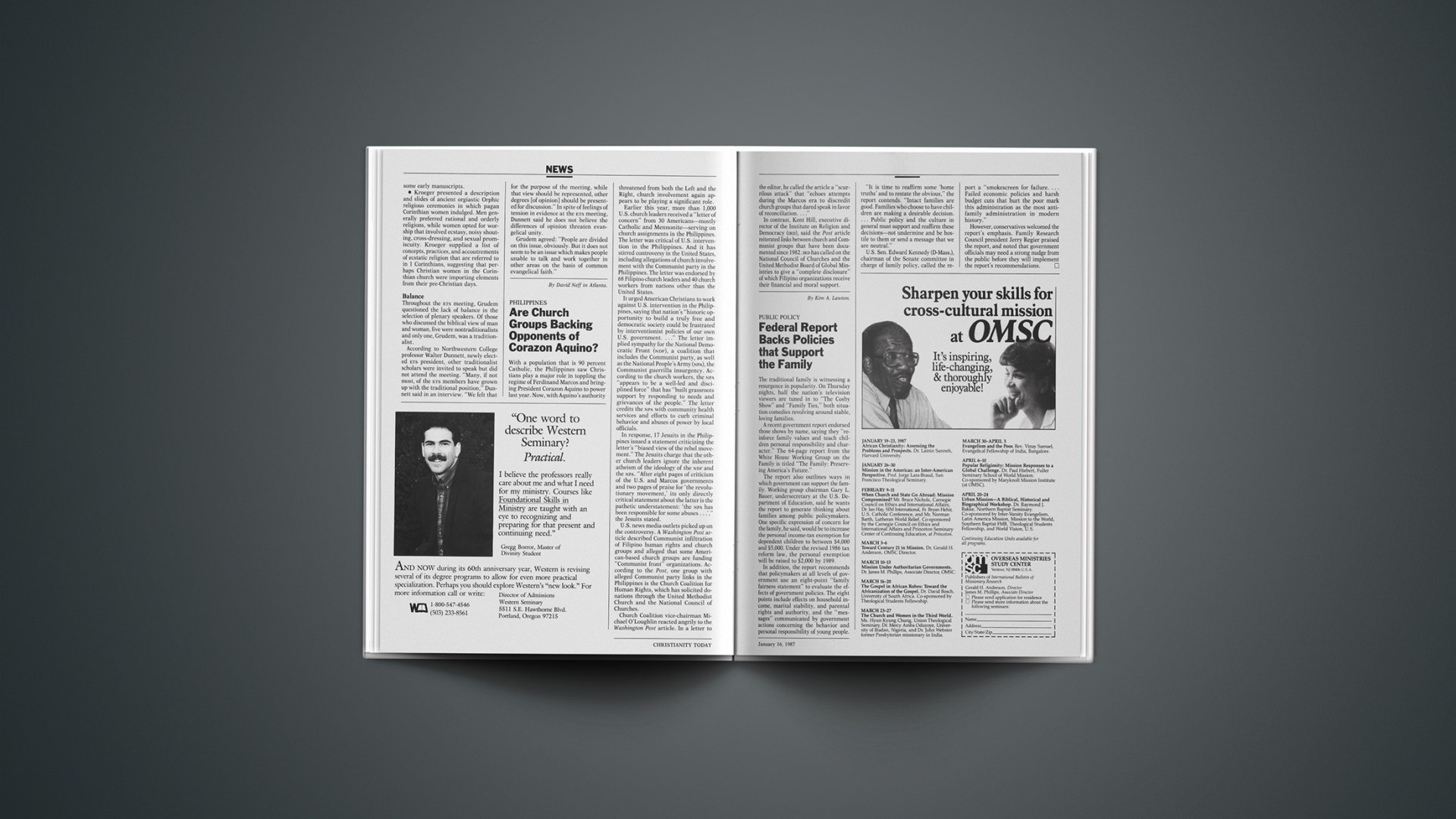
Federal Report Backs Policies that Support the Family

The traditional family is witnessing a resurgence in popularity. On Thursday nights, half the nation’s television viewers are tuned in to “The Cosby Show” and “Family Ties,” both situation comedies revolving around stable, loving families.

A recent government report endorsed those shows by name, saying they “reinforce family values and teach children personal responsibility and character.” The 64-page report from the White House Working Group on the Family is titled “The Family: Preserving America’s Future.”

The report also outlines ways in which government can support the family. Working group chairman Gary L. Bauer, undersecretary at the U.S. Department of Education, said he wants the report to generate thinking about families among public policymakers. One specific expression of concern for the family, he said, would be to increase the personal income-tax exemption for dependent children to between $4,000 and $5,000. Under the revised 1986 tax reform law, the personal exemption will be raised to $2,000 by 1989.

In addition, the report recommends that policymakers at all levels of government use an eight-point “family fairness statement” to evaluate the effects of government policies. The eight points include effects on household income, marital stability, and parental rights and authority, and the “messages” communicated by government actions concerning the behavior and personal responsibility of young people.

“It is time to reaffirm some ‘home truths’ and to restate the obvious,” the report contends. “Intact families are good. Families who choose to have children are making a desirable decision.… Public policy and the culture in general must support and reaffirm these decisions—not undermine and be hostile to them or send a message that we are neutral.”

U.S. Sen. Edward Kennedy (D-Mass.), chairman of the Senate committee in charge of family policy, called the report a “smokescreen for failure.… Failed economic policies and harsh budget cuts that hurt the poor mark this administration as the most antifamily administration in modern history.”

However, conservatives welcomed the report’s emphasis. Family Research Council president Jerry Regier praised the report, and noted that government officials may need a strong nudge from the public before they will implement the report’s recommendations.

Are Church Groups Backing Opponents of Corazon Aquino?

With a population that is 90 percent Catholic, the Philippines saw Christians play a major role in toppling the regime of Ferdinand Marcos and bringing President Corazon Aquino to power last year. Now, with Aquino’s authority threatened from both the Left and the Right, church involvement again appears to be playing a significant role.

Earlier this year, more than 1,000 U.S. church leaders received a “letter of concern” from 30 Americans—mostly Catholic and Mennonite—serving on church assignments in the Philippines. The letter was critical of U.S. intervention in the Philippines. And it has stirred controversy in the United States, including allegations of church involvement with the Communist party in the Philippines. The letter was endorsed by 68 Filipino church leaders and 40 church workers from nations other than the United States.

It urged American Christians to work against U.S. intervention in the Philippines, saying that nation’s “historic opportunity to build a truly free and democratic society could be frustrated by interventionist policies of our own U.S. government.…” The letter implied sympathy for the National Democratic Front (NDF), a coalition that includes the Communist party, as well as the National People’s Army (NPA), the Communist guerrilla insurgency. According to the church workers, the NPA “appears to be a well-led and disciplined force” that has “built grassroots support by responding to needs and grievances of the people.” The letter credits the NPA with community health services and efforts to curb criminal behavior and abuses of power by local officials.

In response, 17 Jesuits in the Philippines issued a statement criticizing the letter’s “biased view of the rebel movement.” The Jesuits charge that the other church leaders ignore the inherent atheism of the ideology of the NDF and the NPA. “After eight pages of criticism of the U.S. and Marcos governments and two pages of praise for ‘the revolutionary movement,’ its only directly critical statement about the latter is the pathetic understatement: ‘the NPA has been responsible for some abuses …,’ ” the Jesuits stated.

U.S. news media outlets picked up on the controversy. A Washington Post article described Communist infiltration of Filipino human rights and church groups and alleged that some American-based church groups are funding “Communist front” organizations. According to the Post, one group with alleged Communist party links in the Philippines is the Church Coalition for Human Rights, which has solicited donations through the United Methodist Church and the National Council of Churches.

Church Coalition vice-chairman Michael O’Loughlin reacted angrily to the Washington Post article. In a letter to the editor, he called the article a “scurrilous attack” that “echoes attempts during the Marcos era to discredit church groups that dared speak in favor of reconciliation.…”

In contrast, Kent Hill, executive director of the Institute on Religion and Democracy (IRD), said the Post article reiterated links between church and Communist groups that have been documented since 1982. IRD has called on the National Council of Churches and the United Methodist Board of Global Ministries to give a “complete disclosure” of which Filipino organizations receive their financial and moral support.

By Kim A. Lawton.

The Battle of the Lexicons

Scholars debate biblical roles of men and women.

The thirty-eighth annual meeting of the Evangelical Theological Society (ETS), held in suburban Atlanta, was officially titled “Male and Female in Biblical and Theological Perspective.” But Aida Besançon Spencer, of Gordon-Conwell Theological Seminary, dubbed it “the battle of the lexicons” in her response to discussion of a paper by University of Minnesota classics scholar Catherine Kroeger. Kroeger’s paper was titled “The Classical Concept of ‘Head’ as ‘source’. ”

Gilbert Bilezikian, of Wheaton College (Ill.), and Wayne Grudem, of Trinity Evangelical Divinity School, joined Kroeger in debating the meaning of kephal, the Greek word normally translated “head” in such Pauline statements as 1 Corinthians 11:3 (“the head of every man is Christ; and the head of the woman is the man …”) and Ephesians 5:23 (“For the husband is the head of the wife, even as Christ is the head of the church …”).

Grudem and other traditional interpreters suggest that in New Testament Greek, kephal carried the connotation of authority, as in ancient Latin and Hebrew where head can mean “boss” or “chief.”

Since not all languages use head as a metaphor for authority, Kroeger, Bilezikian, and other feminist interpreters suggest kephal means “source,” as in English usage where the source of a river may be called its “head.”

Kroeger also documented the ancient view of the head of the human body as the source of bodily moisture, including tears, mucous, and semen. Indeed, semen was thought to be produced in the brain and to run down the spinal column to the genitals. Thus the head was considered to be the source of life.

Kroeger applied this notion of head as “source” to Paul’s assertion that man is the head of woman, commenting that the biblical phrase reinforces the Genesis story of the creation of woman from the substance of man. This contrasts with pagan notions that the gods perpetrated a sneaky trick on man by making woman from inferior material. Kroeger called the teaching that man and woman were made of the same substance “a positive affirmation of heterosexual marriage,” since the low pagan view of women led some ancient philosophers to consider the love of boys to be superior to the love of women.

In his response to Kroeger’s paper, Grudem noted the time lapse between the writing of Paul’s epistles and the comments of Greek-speaking church fathers that Kroeger had quoted to support her understanding of kephal. Grudem also cited a number of Greek dictionaries (lexicons) that do not support Kroeger’s interpretations.

The debate over kephal was further heated by Bilezikian’s presentation, which attacked a previously published paper in which Grudem used a computer to search an exhaustive listing of ancient texts for occurrences of kephal. According to Grudem, his search of 2,336 sources showed 49 instances where kephal referred to a ruler or person of superior rank. Grudem’s sources included nonbiblical writings as well as ancient Greek translations of the Old Testament. Bilezikian examined each of the 49 instances, arguing in each case that kephal meant either source or the physical head of a human being or animal.

Beyond Kephal

Other presentations moved the debate beyond the definition of just one key term:

  • Grudem described prophecy in the New Testament as a spontaneous utterance in response to an external spiritual influence. Thus, he said, it was far less normative than Old Testament prophecy and less authoritative than the teaching function exercised by New Testament elders. Such a view of prophecy, said Grudem, allows Christians to read Paul’s commendation of women’s prophesying and condemnation of women’s teaching as a consistent view. Grudem claimed that this view of prophecy should increase women’s role in public worship while limiting authoritative teaching to men.
  • Walter Liefeld, of Trinity Evangelical Divinity School, said the contemporary ministry at issue may not be the same as that described in the New Testament, since there was no formal “office” of the minister in New Testament times and authority is not actually vested in the minister in many evangelical churches.
  • Regent College professor Gordon Fee suggested that 1 Corinthians 14:34–35 (“Let your women keep silence in the churches …”) was not part of Paul’s original text, but was instead a scribe’s marginal comment that was mistakenly incorporated during the copying of some early manuscripts.
  • Kroeger presented a description and slides of ancient orgiastic Orphic religious ceremonies in which pagan Corinthian women indulged. Men generally preferred rational and orderly religions, while women opted for worship that involved ecstasy, noisy shouting, cross-dressing, and sexual promiscuity. Kroeger supplied a list of concepts, practices, and accoutrements of ecstatic religion that are referred to in 1 Corinthians, suggesting that perhaps Christian women in the Corinthian church were importing elements from their pre-Christian days.

Balance

Throughout the ETS meeting, Grudem questioned the lack of balance in the selection of plenary speakers. Of those who discussed the biblical view of man and woman, five were nontraditionalists and only one, Grudem, was a traditionalist.

According to Northwestern College professor Walter Dunnett, newly elected ETS president, other traditionalist scholars were invited to speak but did not attend the meeting. “Many, if not most, of the ETS members have grown up with the traditional position,” Dunnett said in an interview. “We felt that for the purpose of the meeting, while that view should be represented, other degrees [of opinion] should be presented for discussion.” In spite of feelings of tension in evidence at the ETS meeting, Dunnett said he does not believe the differences of opinion threaten evangelical unity.

Grudem agreed: “People are divided on this issue, obviously. But it does not seem to be an issue which makes people unable to talk and work together in other areas on the basis of common evangelical faith.”

By David Neff in Atlanta.

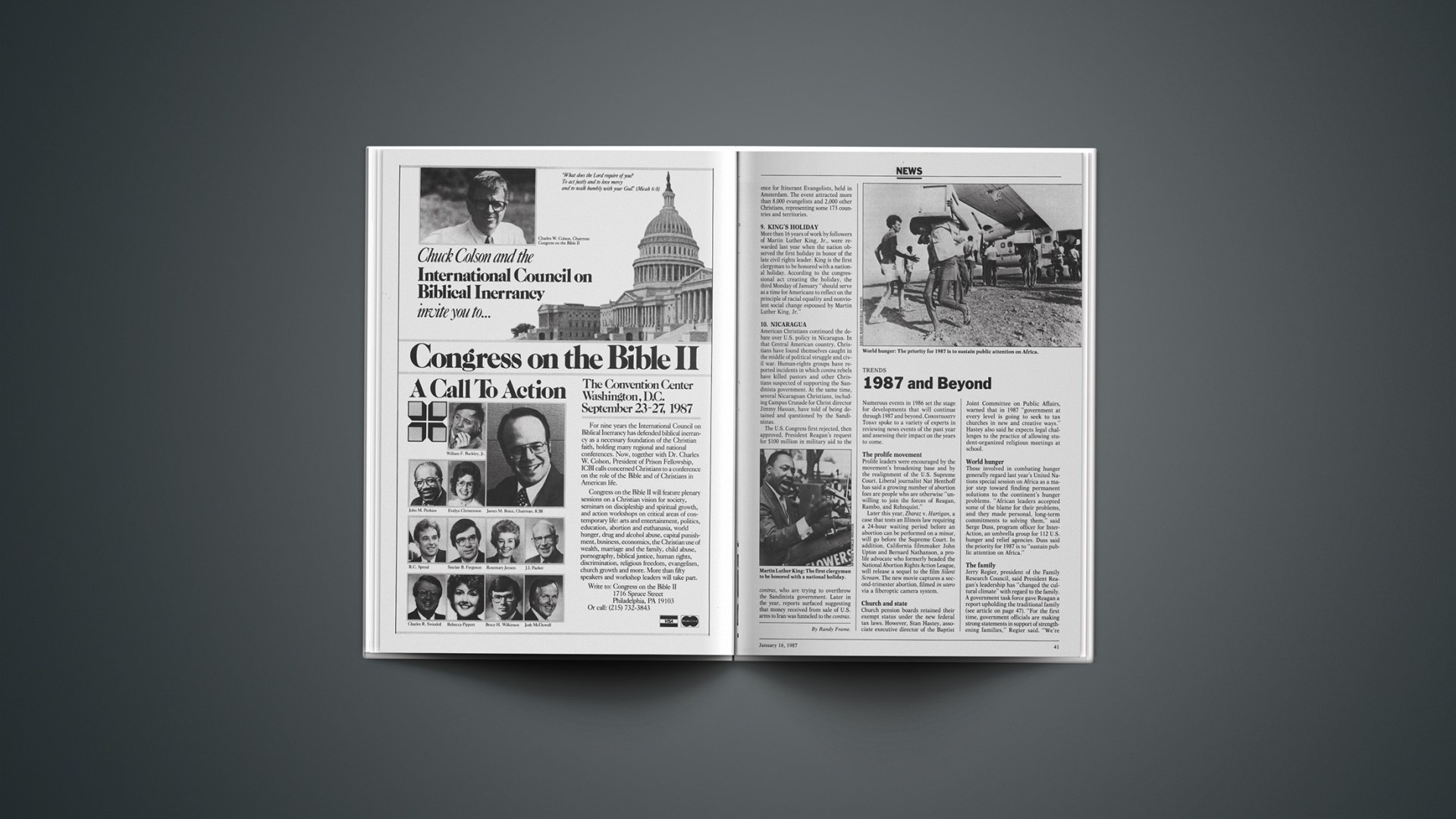
1987 And Beyond

Numerous events in 1986 set the stage for developments that will continue through 1987 and beyond. CHRISTIANITY TODAY spoke to a variety of experts in reviewing news events of the past year and assessing their impact on the years to come.

The Prolife Movement

Prolife leaders were encouraged by the movement’s broadening base and by the realignment of the U.S. Supreme Court. Liberal journalist Nat Henthoff has said a growing number of abortion foes are people who are otherwise “unwilling to join the forces of Reagan, Rambo, and Rehnquist.”

Later this year, Zbaraz v. Hartigan, a case that tests an Illinois law requiring a 24-hour waiting period before an abortion can be performed on a minor, will go before the Supreme Court. In addition, California filmmaker John Upton and Bernard Nathanson, a prolife advocate who formerly headed the National Abortion Rights Action League, will release a sequel to the film Silent Scream. The new movie captures a second-trimester abortion, filmed in utero via a fiberoptic camera system.

Church And State

Church pension boards retained their exempt status under the new federal tax laws. However, Stan Hastey, associate executive director of the Baptist Joint Committee on Public Affairs, warned that in 1987 “government at every level is going to seek to tax churches in new and creative ways.” Hastey also said he expects legal challenges to the practice of allowing student-organized religious meetings at school.

World Hunger

Those involved in combating hunger generally regard last year’s United Nations special session on Africa as a major step toward finding permanent solutions to the continent’s hunger problems. “African leaders accepted some of the blame for their problems, and they made personal, long-term commitments to solving them,” said Serge Duss, program officer for Inter-Action, an umbrella group for 112 U.S. hunger and relief agencies. Duss said the priority for 1987 is to “sustain public attention on Africa.”

The Family

Jerry Regier, president of the Family Research Council, said President Reagan’s leadership has “changed the cultural climate” with regard to the family. A government task force gave Reagan a report upholding the traditional family (see article on page 47). “For the first time, government officials are making strong statements in support of strengthening families,” Regier said. “We’re seeing the beginning of a turnaround in cultural values.”

The Persecuted Church

Religious rights organizations will be watching as some 150 Nepalese believers are brought to trial on such charges as distributing Christian literature. They will also be eyeing Romania, which had its Most Favored Nation trade status renewed in 1986 when it appeared that religious persecution had eased. However, according to Steve Snyder of Christian Response International, conditions for Christians in Romania are as bad as ever.

The news from China is better, Snyder said, citing an easing of tension between the government and unregistered house churches. “We expect that 1987 will be a good year for the gospel of Christ to flourish in China.”

Social Justice

Last year, evangelical leaders played key roles in the formation of Just Life, a political action committee (PAC) that opposes abortion and the arms race as a consistent prolife ethic. Just Life secretary Ronald Sider said Democratic control of the U.S. Senate will do little to reverse the conservative political tide of the past decade, since several of the new Democratic committee chairmen are more conservative than the Republicans they replaced. He added, however, that it will be “more difficult for President Reagan to have his way in many areas, including free trade, aid to the contras, and Star Wars.”

Missions

Two trends—a growing number of both tent-making missionaries and short-term workers—are likely to continue gaining momentum in 1987, according to James Reapsome, executive director of the Evangelical Missions Information Service. More and more Christians are becoming “tentmakers” in restricted-access countries such as Communist bloc and Muslim nations. Tent-making missionaries work in those countries as teachers, business professionals, or students.

The other trend is toward short-term missionaries, who now make up nearly 40 percent of the total U.S. missionary force. Reapsome said the aggressiveness of Islamic fundamentalists worldwide has been accompanied by a growing commitment among young Christian missionaries to evangelize among Muslims.

The Charismatic Movement

“The American charismatic movement has gotten a world vision in the last three months that will carry over till the end of the century,” said Pentecostal Holiness leader Vinson Synan, who is helping plan a major event for July that is expected to draw some 70,000 charismatics to New Orleans. Synan said 1986 witnessed a “reawakened unity among Pentecostals and charismatics.”

The Black Church

The black church has awakened to the role of black Christians in the task of world evangelization. A conference called Destiny ‘87, which is scheduled for July, is designed to “enable black Christians to meet their personal responsibility to fulfill the Great Commission.…” In addition, an unprecedented national gathering of black Catholics scheduled for May is aimed at helping black Catholics deepen their spiritual lives.

Protestants And Catholics

This year, the Christian and Missionary Alliance will celebrate its one hundreth anniversary, and three Lutheran denominations will hold a constituting convention for the new 5.3 million-member Evangelical Lutheran Church in America.

The Vatican took disciplinary actions last year against Seattle archbishop Raymond Hunthausen and Catholic University theologian Charles Curran. Both incidents raised controversy among Catholic leaders over the relationship between church authority and individual conscience. Over the last two decades, the U.S. Catholic church has leaned toward giving more responsibility to the individual, while Rome has pushed for a centralized moral authority focused on local bishops and, ultimately, the pope.

Some have interpreted the U.S. bishops’ statement of loyalty to the pope as an attempt to diffuse a head-on confrontation between the Vatican and U.S. Catholics on the issue of individual freedom. This tension could become more evident during the current Pope’s U.S. visit in September.

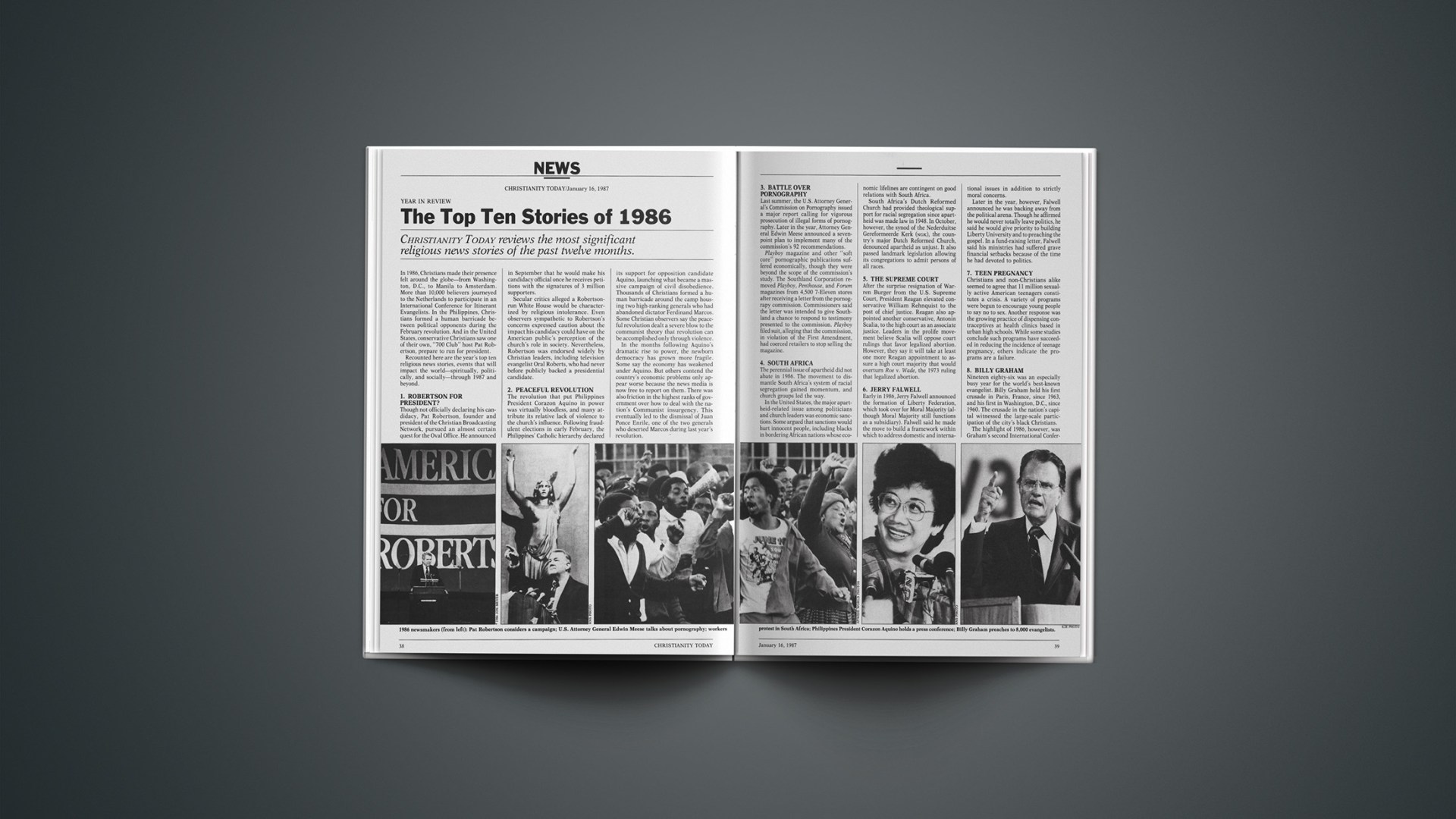
The Top Ten Stories of 1986

CHRISTIANITY TODAY reviews the most significant religious news stories of the past twelve months.

In 1986, Christians made their presence felt around the globe—from Washington, D.C., to Manila to Amsterdam. More than 10,000 believers journeyed to the Netherlands to participate in an International Conference for Itinerant Evangelists. In the Philippines, Christians formed a human barricade between political opponents during the February revolution. And in the United States, conservative Christians saw one of their own, “700 Club” host Pat Robertson, prepare to run for president.

Recounted here are the year’s top ten religious news stories, events that will impact the world—spiritually, politically, and socially—through 1987 and beyond.

1. Robertson For President?

Though not officially declaring his candidacy, Pat Robertson, founder and president of the Christian Broadcasting Network, pursued an almost certain quest for the Oval Office. He announced in September that he would make his candidacy official once he receives petitions with the signatures of 3 million supporters.

Secular critics alleged a Robertson-run White House would be characterized by religious intolerance. Even observers sympathetic to Robertson’s concerns expressed caution about the impact his candidacy could have on the American public’s perception of the church’s role in society. Nevertheless, Robertson was endorsed widely by Christian leaders, including television evangelist Oral Roberts, who had never before publicly backed a presidential candidate.

2. Peaceful Revolution

The revolution that put Philippines President Corazon Aquino in power was virtually bloodless, and many attribute its relative lack of violence to the church’s influence. Following fraudulent elections in early February, the Philippines’ Catholic hierarchy declared its support for opposition candidate Aquino, launching what became a massive campaign of civil disobedience. Thousands of Christians formed a human barricade around the camp housing two high-ranking generals who had abandoned dictator Ferdinand Marcos. Some Christian observers say the peaceful revolution dealt a severe blow to the communist theory that revolution can be accomplished only through violence.

In the months following Aquino’s dramatic rise to power, the newborn democracy has grown more fragile. Some say the economy has weakened under Aquino. But others contend the country’s economic problems only appear worse because the news media is now free to report on them. There was also friction in the highest ranks of government over how to deal with the nation’s Communist insurgency. This eventually led to the dismissal of Juan Ponce Enrile, one of the two generals who deserted Marcos during last year’s revolution.

3. Battle Over Pornography

Last summer, the U.S. Attorney General’s Commission on Pornography issued a major report calling for vigorous prosecution of illegal forms of pornography. Later in the year, Attorney General Edwin Meese announced a seven-point plan to implement many of the commission’s 92 recommendations.

Playboy magazine and other “soft core” pornographic publications suffered economically, though they were beyond the scope of the commission’s study. The Southland Corporation removed Playboy, Penthouse, and Forum magazines from 4,500 7-Eleven stores after receiving a letter from the pornograpy commission. Commissioners said the letter was intended to give Southland a chance to respond to testimony presented to the commission. Playboy filed suit, alleging that the commission, in violation of the First Amendment, had coerced retailers to stop selling the magazine.

4. South Africa

The perennial issue of apartheid did not abate in 1986. The movement to dismantle South Africa’s system of racial segregation gained momentum, and church groups led the way.

In the United States, the major apartheid-related issue among politicians and church leaders was economic sanctions. Some argued that sanctions would hurt innocent people, including blacks in bordering African nations whose economic lifelines are contingent on good relations with South Africa.

South Africa’s Dutch Reformed Church had provided theological support for racial segregation since apartheid was made law in 1948. In October, however, the synod of the Nederduitse Gereformeerde Kerk (NGK), the country’s major Dutch Reformed Church, denounced apartheid as unjust. It also passed landmark legislation allowing its congregations to admit persons of all races.

5. The Supreme Court

After the surprise resignation of Warren Burger from the U.S. Supreme Court, President Reagan elevated conservative William Rehnquist to the post of chief justice. Reagan also appointed another conservative, Antonin Scalia, to the high court as an associate justice. Leaders in the prolife movement believe Scalia will oppose court rulings that favor legalized abortion. However, they say it will take at least one more Reagan appointment to assure a high court majority that would overturn Roe v. Wade, the 1973 ruling that legalized abortion.

6. Jerry Falwell

Early in 1986, Jerry Falwell announced the formation of Liberty Federation, which took over for Moral Majority (although Moral Majority still functions as a subsidiary). Falwell said he made the move to build a framework within which to address domestic and international issues in addition to strictly moral concerns.

Later in the year, however, Falwell announced he was backing away from the political arena. Though he affirmed he would never totally leave politics, he said he would give priority to building Liberty University and to preaching the gospel. In a fund-raising letter, Falwell said his ministries had suffered grave financial setbacks because of the time he had devoted to politics.

7. Teen Pregnancy

Christians and non-Christians alike seemed to agree that 11 million sexually active American teenagers constitutes a crisis. A variety of programs were begun to encourage young people to say no to sex. Another response was the growing practice of dispensing contraceptives at health clinics based in urban high schools. While some studies conclude such programs have succeeded in reducing the incidence of teenage pregnancy, others indicate the programs are a failure.

8. Billy Graham

Nineteen eighty-six was an especially busy year for the world’s best-known evangelist. Billy Graham held his first crusade in Paris, France, since 1963, and his first in Washington, D.C., since 1960. The crusade in the nation’s capital witnessed the large-scale participation of the city’s black Christians.

The highlight of 1986, however, was Graham’s second International Conference for Itinerant Evangelists, held in Amsterdam. The event attracted more than 8,000 evangelists and 2,000 other Christians, representing some 173 countries and territories.

9. King’S Holiday

More than 16 years of work by followers of Martin Luther King, Jr., were rewarded last year when the nation observed the first holiday in honor of the late civil rights leader. King is the first clergyman to be honored with a national holiday. According to the congressional act creating the holiday, the third Monday of January “should serve as a time for Americans to reflect on the principle of racial equality and nonviolent social change espoused by Martin Luther King, Jr.”

10. Nicaragua

American Christians continued the debate over U.S. policy in Nicaragua. In that Central American country, Christians have found themselves caught in the middle of political struggle and civil war. Human-rights groups have reported incidents in which contra rebels have killed pastors and other Christians suspected of supporting the Sandinista government. At the same time, several Nicaraguan Christians, including Campus Crusade for Christ director Jimmy Hassan, have told of being detained and questioned by the Sandinistas.

The U.S. Congress first rejected, then approved, President Reagan’s request for $100 million in military aid to the contras, who are trying to overthrow the Sandinista government. Later in the year, reports surfaced suggesting that money received from sale of U.S. arms to Iran was funneled to the contras.

By Randy Frame.

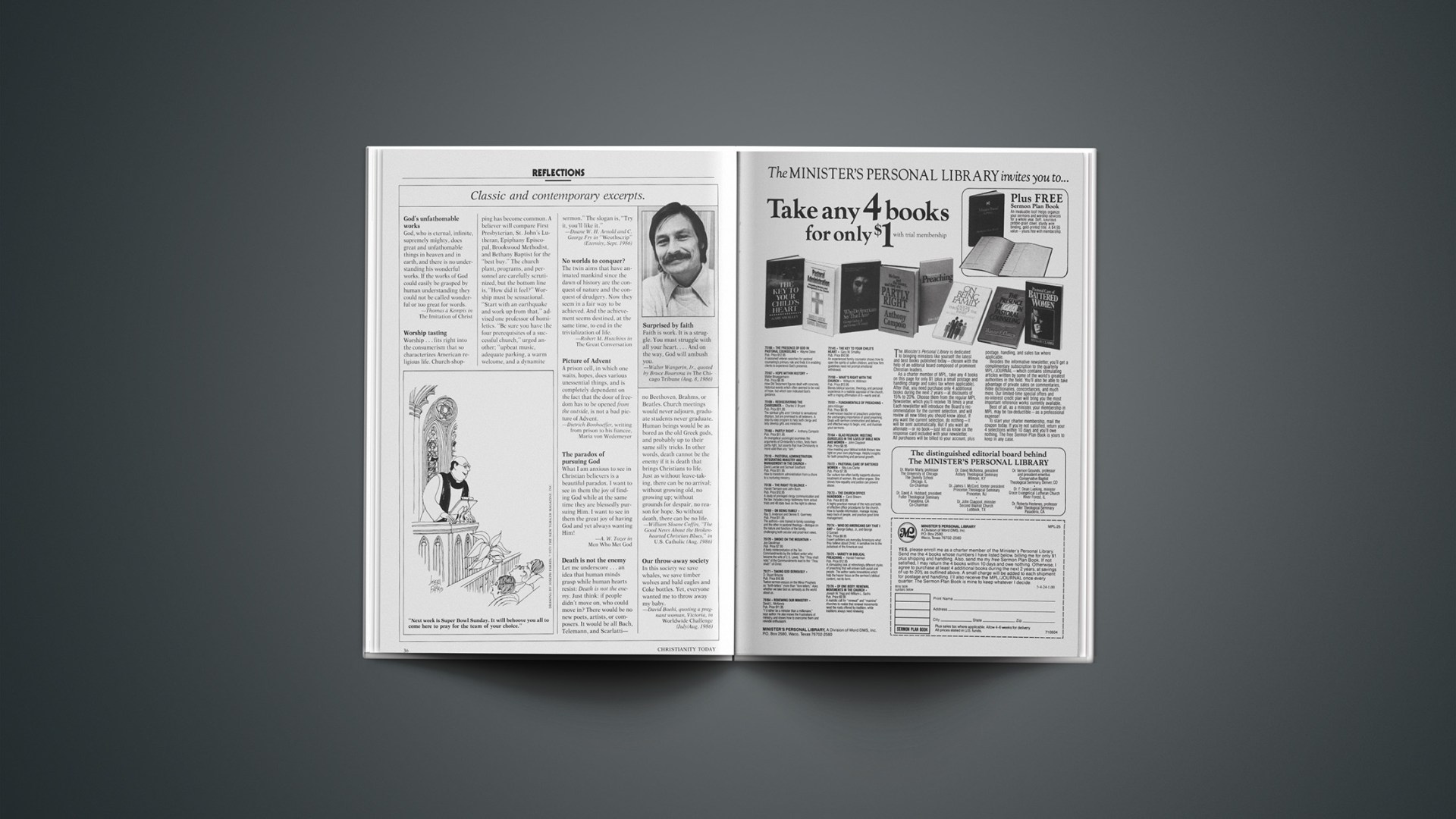
Classic & Contemporary Excerpts from January 16, 1987

God’s unfathomable works

God, who is eternal, infinite, supremely mighty, does great and unfathomable things in heaven and in earth, and there is no understanding his wonderful works. If the works of God could easily be grasped by human understanding they could not be called wonderful or too great for words.

—Thomas a Kempis in

The Imitation of Christ

Worship tasting

Worship … fits right into the consumerism that so characterizes American religious life. Church-shopping has become common. A believer will compare First Presbyterian, St. John’s Lutheran, Epiphany Episcopal, Brookwood Methodist, and Bethany Baptist for the “best buy.” The church plant, programs, and personnel are carefully scrutinized, but the bottom line is, “How did it feel?” Worship must be sensational. “Start with an earthquake and work up from that,” advised one professor of homiletics. “Be sure you have the four prerequisites of a successful church,” urged another; “upbeat music, adequate parking, a warm welcome, and a dynamite sermon.” The slogan is, “Try it, you’ll like it.”

—Duane W. H. Arnold and C. George Fry in “Weothscrip”

(Eternity, Sept. 1986)

No worlds to conquer?

The twin aims that have animated mankind since the dawn of history are the conquest of nature and the conquest of drudgery. Now they seem in a fair way to be achieved. And the achievement seems destined, at the same time, to end in the trivialization of life.

—Robert M. Hutchins in

The Great Conversation

Picture of Advent

A prison cell, in which one waits, hopes, does various unessential things, and is completely dependent on the fact that the door of freedom has to be opened from the outside, is not a bad picture of Advent.

—Dietrich Bonhoeffer, writing from prison to his fiancée,

Maria von Wedemeyer

The paradox of pursuing God

What I am anxious to see in Christian believers is a beautiful paradox. I want to see in them the joy of finding God while at the same time they are blessedly pursuing Him. I want to see in them the great joy of having God and yet always wanting Him!

A. W. Tozer in

Men Who Met God

Death is not the enemy

Let me underscore … an idea that human minds grasp while human hearts resist: Death is not the enemy. Just think: if people didn’t move on, who could move in? There would be no new poets, artists, or composers. It would be all Bach, Telemann, and Scarlatti—no Beethoven, Brahms, or Beatles. Church meetings would never adjourn, graduate students never graduate. Human beings would be as bored as the old Greek gods, and probably up to their same silly tricks. In other words, death cannot be the enemy if it is death that brings Christians to life. Just as without leave-taking, there can be no arrival; without growing old, no growing up; without grounds for despair, no reason for hope. So without death, there can be no life.

William Sloane Coffin, “The Good News About the Brokenhearted Christian Blues,” in

U.S. Catholic (Aug. 1986)

Our throw-away society

In this society we save whales, we save timber wolves and bald eagles and Coke bottles. Yet, everyone wanted me to throw away my baby.

—David Boehi, quoting a pregnant woman, Victoria, in

Worldwide Challenge

(July/Aug. 1986)

Two Kinds of Thanks

Three hours in a women’s shelter taught me the difference.

Spending an evening at a shelter for homeless women was not my idea, but when a friend asked, I was perfectly willing to tag along.

Although the winter was still young, the cold was harsh. I nearly ran from the comfort of our car to the warmth of the church annex that had, for years, opened its doors as a refuge from the night.

The director, Christy, efficiently assigned tasks—to set the floor with foam mats and blankets as one would set a table, to lay out on a buffet table plastic forks, paper plates, and the donated leftovers that filled the refrigerator. When the women arrived, we would help serve the food.

Christy assured me that most of the women, the “regulars,” had spent the day inside at one of several centers, but there were always the few who just appeared—seeming to have no history more concrete than their names.

My three hours at the shelter were not filled with dramatic scenes. From a corner of the large sleeping area, I helped serve dinner to 30 women who ate their substantial but bland meal, sitting cross-legged on their sleeping mats. Except for two boisterously irrational women, they talked little. By nine o’clock, many were bedding down for the night.

“Homeless.” As I did the dishes, still within sight of the women, the word took on a personal meaning. These women slept here, but every morning when they left, they had to carry their possessions with them.

Suddenly I was overwhelmed with gratitude for my nightgowns, for my very own pillow, for my hand-picked dining room chairs. “Lord,” I silently prayed as I walked to Christy’s office to say good night, “thank you. Thank you—that I’m not one of them.”

Christy met me in the hallway and interrupted my pharisaical thoughts with her own gratitude for my help. I asked her about certain women who had caught my attention.

Routy Rachel, Christy explained, had a Ph.D. in art history. Gradually her mind had slipped out of her own grasp. Esther, who had talked to herself all evening, was the mother of five children. She was a midwestern farmer’s wife—until her life crumbled around her. Christy didn’t know much about Carol, who had lain on her back for more than an hour, reading her King James Bible. Marla, who had seemed sullen, was a trained soprano who occasionally enjoyed serenading the rest of the group.

Only after I walked back out into the night air did the women’s stories unsettle me. Their paths had too much in common with mine. In a sense, I was one of them—a mother’s daughter. Vulnerable. A sinner in need of grace.

I remembered hearing an interview with Mitch Snyder, who was director of a large shelter for the homeless. I hadn’t liked what I had heard and had put it out of my mind until this particular cold night. Snyder had said that, in years past, he had been interviewed by more than one reporter who had later shown up on his doorstep—jobless, penniless, homeless.

Since then I have been more aware of the uprooted Vietnamese, Cambodian, and Latin American refugees who live in my neighborhood, who ride my bus. War, political change, economic collapse—conditions over which they had no control—destroyed their lifestyle and stole their ability to communicate easily and thus to work efficiently. My thoughts have frightened me. My comfortable world, my secure home, is not guaranteed.

At the sight of the outstretched hand of a city beggar, I have always grown uncomfortable. Until recently, I have thought it was because of Jesus’ warning in Matthew 25:45: “Whatever you did not do for one of the least of these [the hungry, thirsty, unclothed, homeless], you did not do for me.”

But since I spent an evening at the women’s shelter, I see that Matthew 25 is only the partial cause of my discomfort. I am uncomfortable because I see the beggar as myself—or my very own brother or mother or father. And I cannot think of a homeless or hungry woman in such personal terms without a reversal in the way I give my thanks.

The difference between “Thank you that I’m not one of them” and “Thank you for the grace you have shown to me, and help me to mirror your grace to others” may, at first, seem slight. But the second is for me a wholly new mindset that makes me want to reach out, that reduces my discomfort around those who have less than I, and, surprisingly, that reduces my fear of a future that is unknown. Why? Because even though I know I have no insurance policy against war or famine or sickness, I know I have a God who does not forget his own.

For that, I thank him also.

Evelyn Bence is a free-lance writer living in Arlington Virginia. Her books include Leaving Home (Tyndale, 1986) and Growing (C.R. Gibson, 1985).

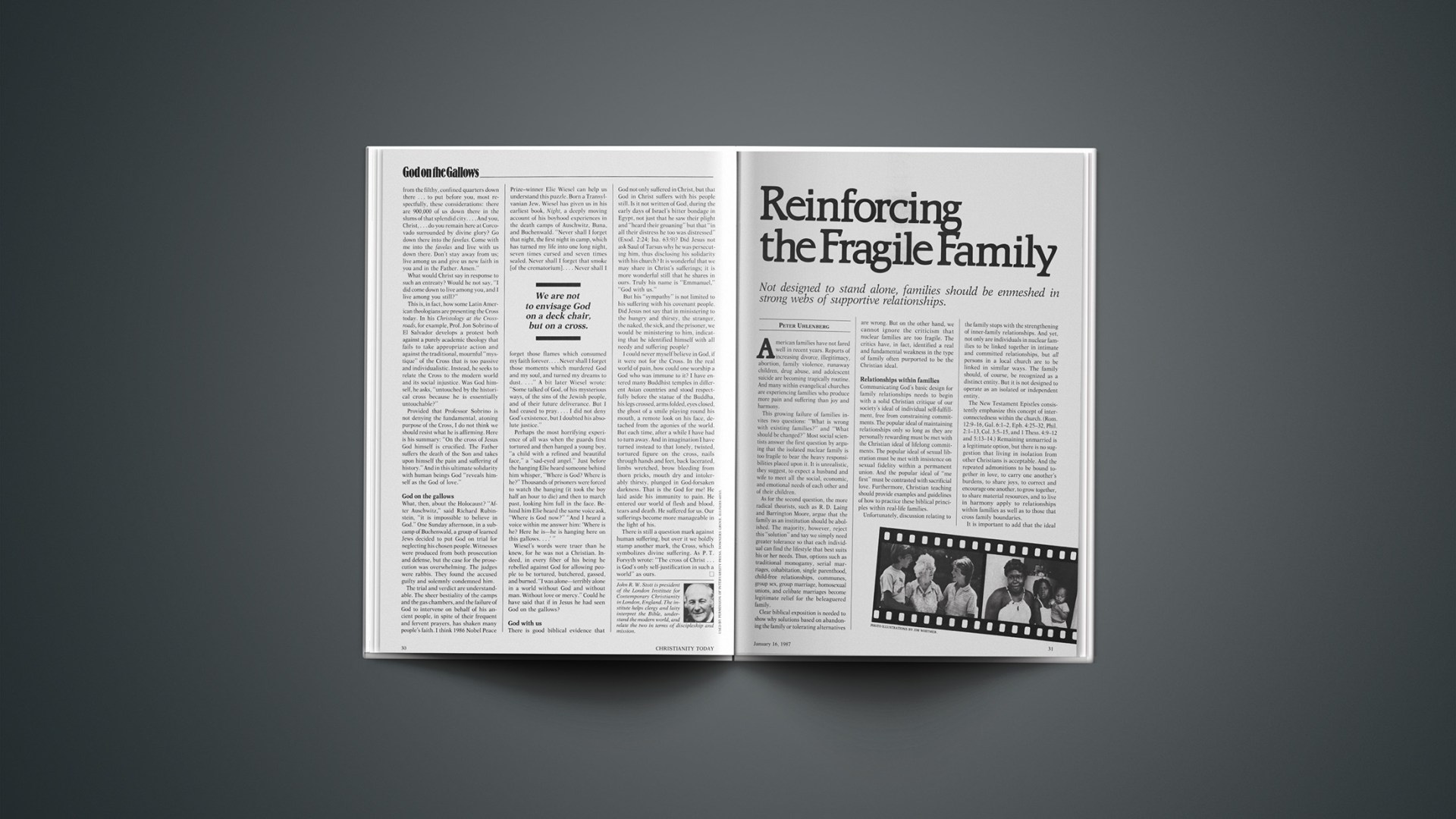
Reinforcing the Fragile Family

Not designed to stand alone, families should he enmeshed in strong webs of supportive relationships.

American families have not fared well in recent years. Reports of increasing divorce, illegitimacy, abortion, family violence, runaway children, drug abuse, and adolescent suicide are becoming tragically routine. And many within evangelical churches are experiencing families who produce more pain and suffering than joy and harmony.

This growing failure of families invites two questions: “What is wrong with existing families?” and “What should be changed?” Most social scientists answer the first question by arguing that the isolated nuclear family is too fragile to bear the heavy responsibilities placed upon it. It is unrealistic, they suggest, to expect a husband and wife to meet all the social, economic, and emotional needs of each other and of their children.

As for the second question, the more radical theorists, such as R. D. Laing and Barrington Moore, argue that the family as an institution should be abolished. The majority, however, reject this “solution” and say we simply need greater tolerance so that each individual can find the lifestyle that best suits his or her needs. Thus, options such as traditional monogamy, serial marriages, cohabitation, single parenthood, child-free relationships, communes, group sex, group marriage, homosexual unions, and celibate marriages become legitimate relief for the beleaguered family.

Clear biblical exposition is needed to show why solutions based on abandoning the family or tolerating alternatives are wrong. But on the other hand, we cannot ignore the criticism that nuclear families are too fragile. The critics have, in fact, identified a real and fundamental weakness in the type of family often purported to be the Christian ideal.

Relationships Within Families

Communicating God’s basic design for family relationships needs to begin with a solid Christian critique of our society’s ideal of individual self-fulfillment, free from constraining commitments. The popular ideal of maintaining relationships only so long as they are personally rewarding must be met with the Christian ideal of lifelong commitments. The popular ideal of sexual liberation must be met with insistence on sexual fidelity within a permanent union. And the popular ideal of “me first” must be contrasted with sacrificial love. Furthermore, Christian teaching should provide examples and guidelines of how to practice these biblical principles within real-life families.

Unfortunately, discussion relating to the family stops with the strengthening of inner-family relationships. And yet, not only are individuals in nuclear families to be linked together in intimate and committed relationships, but all persons in a local church are to be linked in similar ways. The family should, of course, be recognized as a distinct entity. But it is not designed to operate as an isolated or independent entity.

The New Testament Epistles consistently emphasize this concept of interconnectedness within the church. (Rom. 12:9–16; Gal. 6:1–2; Eph. 4:25–32; Phil. 2:1–13; Col. 3:5–15, and 1 Thess. 4:9–12 and 5:13–14.) Remaining unmarried is a legitimate option, but there is no suggestion that living in isolation from other Christians is acceptable. And the repeated admonitions to be bound together in love, to carry one another’s burdens, to share joys, to correct and encourage one another, to grow together, to share material resources, and to live in harmony apply to relationships within families as well as to those that cross family boundaries.

It is important to add that the ideal Christian community is an open community, not a self-serving clique. The “good news” that the church possesses is meant to be shared. It is first of all a message of spiritual hope, but it goes on to encompass all of life.

How Community Support Works

My wife and I have had a rather unusual experience in learning how community support rewards the family. Our two sons by birth were eventually joined by four other children whom we adopted. By any reasonable calculation, we had a larger family than we could afford. But we felt affirmed in what we had done—so much so that we adopted five more children, stretching the total to eleven.

We did not begin with a clear vision of how things would develop, and we have not been immune to difficulties and struggles. Nevertheless, we have welcomed each new child with the confidence that God would faithfully supply the resources our family needs. It has become increasingly clear that one major way God has chosen to provide for us has been through the community of believers.

Money is, for many, the area of greatest need. How do you feed and clothe 11 children, let alone provide them with music lessons and skateboards? Sharing economic resources appears to have been common in New Testament churches; it still occurs today. Without any request for financial assistance, a number of brothers and sisters have chosen to give us support. Used clothes, camp scholarships, occasional groceries, free eye care, and a number of other special gifts have come at opportune times.

We thank God for the cheerful ministry of those who wash dishes, clean bathrooms, cook meals, and provide other services for us. There is an enormous variety in the specific types of assistance given, reflecting both the multiple needs we have and the unique interests and abilities of each person choosing to enter into our family.

(It is important to point out that there is a very crucial, qualitative difference between our relationship to our children as “mom and dad,” and their relationship to other “friends.” Parents—ourselves included—need to retain primary responsibility for each child’s emotional development and for major decisions involving medical care, education, and religious training. In very practical terms, this means if someone who befriends one of our children decides to take him or her to a movie that we cannot approve, we do not hesitate to say no.)

Initially, it was difficult to accept offers for help around the house. When someone volunteered to clean, my wife would swiftly “pick up” before the person arrived. That early embarrassment has been replaced now with a sense of real gratitude. We have realized that friends who observe the “back stage” of our family life learn something positive about what it means to function as a unit where each individual is committed to the others.

What has this support of our family from a community of caring persons accomplished? Obviously it has enriched our family. Our physical, emotional, and economic resources have been strengthened. Our children have developed intimate relationships with other adults, gaining valuable exposure to adult role models beyond those of my wife and me. And our faith in God has grown as we have witnessed his faithful care for us.

Those who sacrificially support our family are also rewarded. This should not be surprising, since Jesus taught that we find our lives by losing them. A large proportion of the young adults in our church grew up in non-Christian homes and have never experienced close involvement with a Christian family. Their own faith and vision of how God might use their families grows as they see close up what God is doing in our family.

Some who previously have had only superficial relationships with children are gaining insights into Christian parenting that cannot be gained from reading books. Those who have unreasonably idealized our family have gained a more realistic understanding that a Christian marriage and family involves hard work, disappointments, and challenges. No church family, whether it has ten children or two, should function as a closed, isolated entity.

Opportunities For Churches

There are many ways in which families can join together in supportive community, and the forms that develop will be unique to each church. In addition to the more familiar ministries such as shared child care, the pooling of resources, and family support groups, here are some positive steps the church can take to strengthen the family:

Instruction on healthy relationships. The special unity that should characterize the marriage relationship needs to be recognized and emphasized. But nowhere does Scripture teach that this bond should exclude other close relationships. Complete teaching on marriage needs to point out that the marriage relationship can be strengthened by relationships with others who support the husband and wife in genuine ways. Sharing ideas, concerns, prayers, and dreams with friends should not subtract from a marriage, but rather increase its vitality.

Instruction on child rearing. Parents benefit from regular teaching on parenting. But such valuable learning experiences should not be limited to parents—others in the church family should be significantly involved in the lives of the children. Making a congregation more aware of the biblical model of community can encourage people to minister in this way.

Breaking down age segregation. There are times when it is useful to organize activities specifically for particular age groups. The problem is that churches tend to follow the culture by age-segregating most activities. When this occurs, older people lack contact with families who have children, singles have little contact with families, parents of infants do not interact with parents of adolescents, adolescents have little contact with infants or old people, and so on. A variety of activities can be age-integrated so the unique contributions of each age group can benefit the others. Perhaps most important are occasions that encourage social interacting rather than sitting and listening.

Interaction with other parents. Great benefits come from sharing ideas and concerns with other parents. An increasing number of home-school parents know the encouragement and stimulation of meeting together as they share in the education of one another’s children. Similar benefits are possible to parents whose children attend more structured schools.

Weekly family night at home. Mormons are well known for reserving one night a week for families to be together. Evangelical churches should support such an idea wholeheartedly. Activities can vary: reading good books, playing games, putting on family plays, eating ice cream, and enjoying an occasional home movie.

Retreats or festivals for families. Whole day or weekend retreats can remove us from the usual time crunch, allowing people to talk and interact and begin to develop relationships. Rather than separating children from adults and singles from marrieds, use these special events to bring families and singles together. Careful planning may be needed to break down the barriers that tend to channel individuals into homogeneous groupings.

Matching children with adults. I have seen wonderful and meaningful relationships develop when youngsters are matched with older pals. A church could structure this annually so that every child is matched with an adult outside of his or her family. Priority in matching might be given to children in single-parent families, but there is no need to stop there. There are numerous things these pairs could do together over the course of a year: dinners out, hikes, trips to an art museum, swimming, playing ball, or reading.

Ministering in family groups. Rather than challenging individuals to engage in outreach ministries that compete with family time, why not find creative ministries that whole families can do together? Families could visit the elderly, adopt missionaries, or maintain and beautify the church building and grounds. Focusing upon ways of helping others often brings a family closer together, and churches can help them move in this direction.

Counseling family units. In addition to providing individual counseling, churches might consider the possibilities of family therapy. Much is being written on this, and churches should take advantage of the insights that have been gained. By meeting with a whole family, a counselor can identify patterns of interaction and assist family members to develop positive ways of relating to one another. Problems experienced by individuals are often located less within the individual than within family relationships.

Will The Family Survive?

Most church leaders are aware of how difficult family life has become in late twentieth-century America. But simply preaching about the evils of our culture will be of little help to persons struggling with family life. As we face this challenge honestly, it will do us well to consider how Christian fellowships can best support families. Churches will find numerous ways to be positively involved in strengthening families. By modeling, by teaching, and by facilitating the growth of a community, the church can play a vital role in countering the antifamily forces in our society.

It is a mistake to expect individuals to experience the rewards of strong families without sincere prayer and effort. It is an even greater mistake to expect their needs to be met through an emphasis upon individualism that bypasses families and communities. Individuals and families need to discover the strength that comes only from being embedded within a meaningful Christian community.

Peter Uhlenberg is professor of sociology at the University of North Carolina in Chapel Hill.

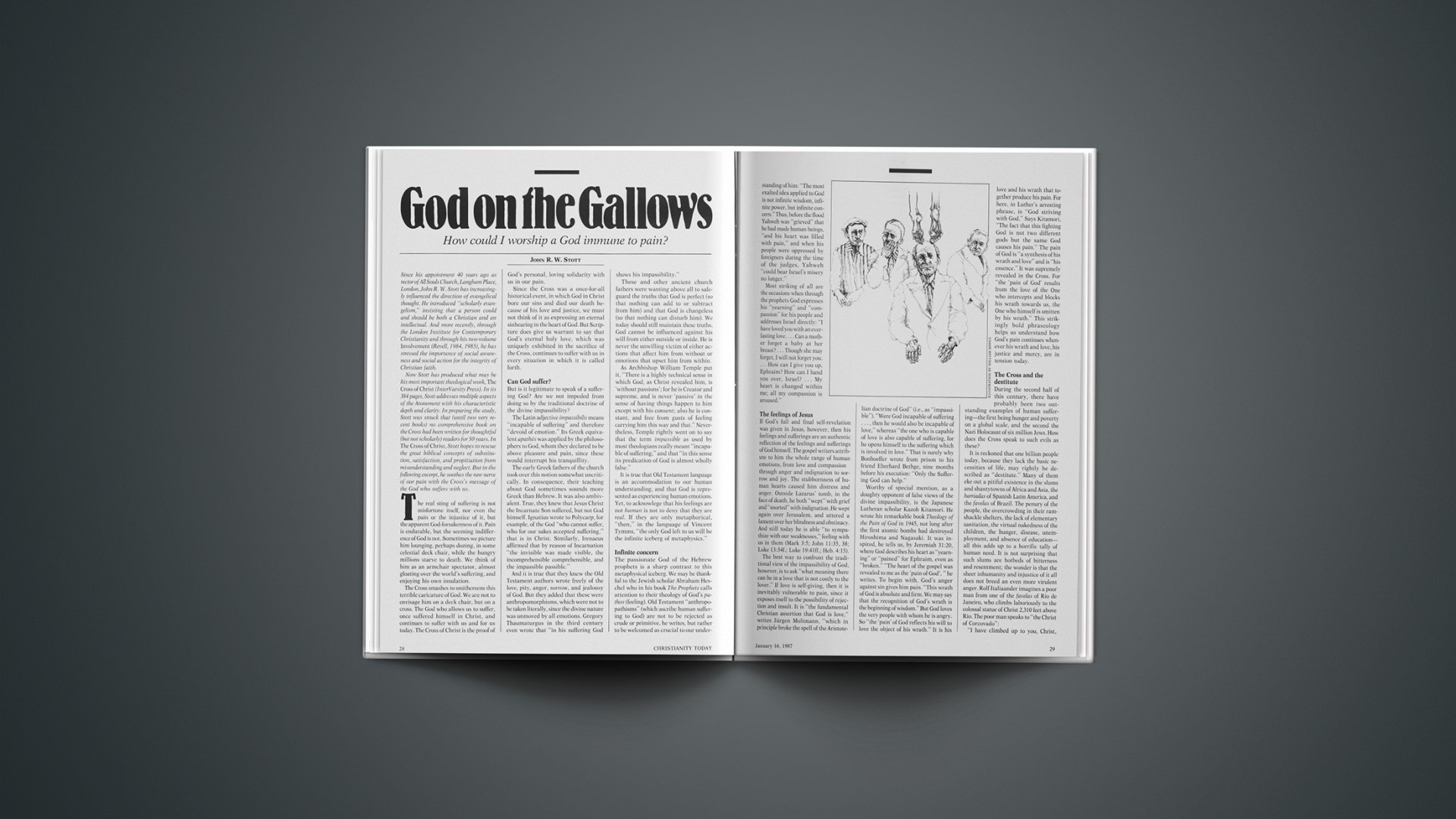
God on the Gallows

How could I worship a God immune to pain?

Since his appointment 40 years ago as rector of All Souls Church, Langham Place, London, John R. W. Stott has increasingly influenced the direction of evangelical thought. He introduced “scholarly evangelism,” insisting that a person could and should be both a Christian and an intellectual. And more recently, through the London Institute for Contemporary Christianity and through his two-volume Involvement (Revell, 1984, 1985), he has stressed the importance of social awareness and social action for the integrity of Christian faith.

Now Stott has produced what may be his most important theological work, The Cross of Christ (InterVarsity Press). In its 384 pages, Stott addresses multiple aspects of the Atonement with his characteristic depth and clarity. In preparing the study, Stott was struck that (until two very recent books) no comprehensive book on the Cross had been written for thoughtful (but not scholarly) readers for 50 years. In The Cross of Christ, Stott hopes to rescue the great biblical concepts of substitution, satisfaction, and propitiation from misunderstanding and neglect. But in the following excerpt, he soothes the raw nerve of our pain with the Cross’s message of the God who suffers with us.

The real sting of suffering is not misfortune itself, nor even the pain or the injustice of it, but the apparent God-forsakenness of it. Pain is endurable, but the seeming indifference of God is not. Sometimes we picture him lounging, perhaps dozing, in some celestial deck chair, while the hungry millions starve to death. We think of him as an armchair spectator, almost gloating over the world’s suffering, and enjoying his own insulation.

The Cross smashes to smithereens this terrible caricature of God. We are not to envisage him on a deck chair, but on a cross. The God who allows us to suffer, once suffered himself in Christ, and continues to suffer with us and for us today. The Cross of Christ is the proof of God’s personal, loving solidarity with us in our pain.

Since the Cross was a once-for-all historical event, in which God in Christ bore our sins and died our death because of his love and justice, we must not think of it as expressing an eternal sinbearing in the heart of God. But Scripture does give us warrant to say that God’s eternal holy love, which was uniquely exhibited in the sacrifice of the Cross, continues to suffer with us in every situation in which it is called forth.

Can God Suffer?

But is it legitimate to speak of a suffering God? Are we not impeded from doing so by the traditional doctrine of the divine impassibility?

The Latin adjective impassibilis means “incapable of suffering” and therefore “devoid of emotion.” Its Greek equivalent apaths was applied by the philosophers to God, whom they declared to be above pleasure and pain, since these would interrupt his tranquillity.

The early Greek fathers of the church took over this notion somewhat uncritically. In consequence, their teaching about God sometimes sounds more Greek than Hebrew. It was also ambivalent. True, they knew that Jesus Christ the Incarnate Son suffered, but not God himself. Ignatius wrote to Polycarp, for example, of the God “who cannot suffer, who for our sakes accepted suffering,” that is in Christ. Similarly, Irenaeus affirmed that by reason of Incarnation “the invisible was made visible, the incomprehensible comprehensible, and the impassible passible.”

And it is true that they knew the Old Testament authors wrote freely of the love, pity, anger, sorrow, and jealousy of God. But they added that these were anthropomorphisms, which were not to be taken literally, since the divine nature was unmoved by all emotions. Gregory Thaumaturgus in the third century even wrote that “in his suffering God shows his impassibility.”

These and other ancient church fathers were wanting above all to safeguard the truths that God is perfect (so that nothing can add to or subtract from him) and that God is changeless (so that nothing can disturb him). We today should still maintain these truths. God cannot be influenced against his will from either outside or inside. He is never the unwilling victim of either actions that affect him from without or emotions that upset him from within.

As Archbishop William Temple put it, “There is a highly technical sense in which God, as Christ revealed him, is ‘without passions’; for he is Creator and supreme, and is never ‘passive’ in the sense of having things happen to him except with his consent; also he is constant, and free from gusts of feeling carrying him this way and that.” Nevertheless, Temple rightly went on to say that the term impassible as used by most theologians really meant “incapable of suffering,” and that “in this sense its predication of God is almost wholly false.”

It is true that Old Testament language is an accommodation to our human understanding, and that God is represented as experiencing human emotions. Yet, to acknowlege that his feelings are not human is not to deny that they are real. If they are only metaphorical, “then,” in the language of Vincent Tymms, “the only God left to us will be the infinite iceberg of metaphysics.”

Infinite Concern

The passionate God of the Hebrew prophets is a sharp contrast to this metaphysical iceberg. We may be thankful to the Jewish scholar Abraham Heschel who in his book The Prophets calls attention to their theology of God’s pathos (feeling). Old Testament “anthropo-pathisms” (which ascribe human suffering to God) are not to be rejected as crude or primitive, he writes, but rather to be welcomed as crucial to our understanding of him: “The most exalted idea applied to God is not infinite wisdom, infinite power, but infinite concern.” Thus, before the flood Yahweh was “grieved” that he had made human beings, “and his heart was filled with pain,” and when his people were oppressed by foreigners during the time of the judges, Yahweh “could bear Israel’s misery no longer.”

Most striking of all are the occasions when through the prophets God expresses his “yearning” and “compassion” for his people and addresses Israel directly: “I have loved you with an everlasting love.… Can a mother forget a baby at her breast?… Though she may forget, I will not forget you.… How can I give you up, Ephraim? How can I hand you over, Israel?… My heart is changed within me; all my compassion is aroused.”

The Feelings Of Jesus

If God’s full and final self-revelation was given in Jesus, however, then his feelings and sufferings are an authentic reflection of the feelings and sufferings of God himself. The gospel writers attribute to him the whole range of human emotions, from love and compassion through anger and indignation to sorrow and joy. The stubbornness of human hearts caused him distress and anger. Outside Lazarus’ tomb, in the face of death, he both “wept” with grief and “snorted” with indignation. He wept again over Jerusalem, and uttered a lament over her blindness and obstinacy. And still today he is able “to sympathize with our weaknesses,” feeling with us in them (Mark 3:5; John 11:35, 38; Luke 13:34f.; Luke 19:41ff.; Heb. 4:15).

The best way to confront the traditional view of the impassibility of God, however, is to ask “what meaning there can be in a love that is not costly to the lover.” If love is self-giving, then it is inevitably vulnerable to pain, since it exposes itself to the possibility of rejection and insult. It is “the fundamental Christian assertion that God is love,” writes Jürgen Moltmann, “which in principle broke the spell of the Aristotelian doctrine of God” (i.e., as “impassible”). “Were God incapable of suffering …, then he would also be incapable of love,” whereas “the one who is capable of love is also capable of suffering, for he opens himself to the suffering which is involved in love.” That is surely why Bonhoeffer wrote from prison to his friend Eberhard Bethge, nine months before his execution: “Only the Suffering God can help.”

Worthy of special mention, as a doughty opponent of false views of the divine impassibility, is the Japanese Lutheran scholar Kazoh Kitamori. He wrote his remarkable book Theology of the Pain of God in 1945, not long after the first atomic bombs had destroyed Hiroshima and Nagasaki. It was inspired, he tells us, by Jeremiah 31:20, where God describes his heart as “yearning” or “pained” for Ephraim, even as “broken.” “The heart of the gospel was revealed to me as the ‘pain of God’, ” he writes. To begin with, God’s anger against sin gives him pain. “This wrath of God is absolute and firm. We may say that the recognition of God’s wrath is the beginning of wisdom.” But God loves the very people with whom he is angry. So “the ‘pain’ of God reflects his will to love the object of his wrath.” It is his love and his wrath that together produce his pain. For here, in Luther’s arresting phrase, is “God striving with God.” Says Kitamori, “The fact that this fighting God is not two different gods but the same God causes his pain.” The pain of God is “a synthesis of his wrath and love” and is “his essence.” It was supremely revealed in the Cross. For “the ‘pain of God’ results from the love of the One who intercepts and blocks his wrath towards us, the One who himself is smitten by his wrath.” This strikingly bold phraseology helps us understand how God’s pain continues whenever his wrath and love, his justice and mercy, are in tension today.

The Cross And The Destitute

During the second half of this century, there have probably been two outstanding examples of human suffering—the first being hunger and poverty on a global scale, and the second the Nazi Holocaust of six million Jews. How does the Cross speak to such evils as these?

It is reckoned that one billion people today, because they lack the basic necessities of life, may rightly be described as “destitute.” Many of them eke out a pitiful existence in the slums and shantytowns of Africa and Asia, the barriadas of Spanish Latin America, and the favelas of Brazil. The penury of the people, the overcrowding in their ramshackle shelters, the lack of elementary sanitation, the virtual nakedness of the children, the hunger, disease, unemployment, and absence of education—all this adds up to a horrific tally of human need. It is not surprising that such slums are hotbeds of bitterness and resentment; the wonder is that the sheer inhumanity and injustice of it all does not breed an even more virulent anger. Rolf Italiaander imagines a poor man from one of the favelas of Rio de Janeiro, who climbs laboriously to the colossal statue of Christ 2,310 feet above Rio. The poor man speaks to “the Christ of Corcovado”:

“I have climbed up to you, Christ, from the filthy, confined quarters down there … to put before you, most respectfully, these considerations: there are 900,000 of us down there in the slums of that splendid city.… And you, Christ, … do you remain here at Corcovado surrounded by divine glory? Go down there into the favelas. Come with me into the favelas and live with us down there. Don’t stay away from us; live among us and give us new faith in you and in the Father. Amen.”

What would Christ say in response to such an entreaty? Would he not say, “I did come down to live among you, and I live among you still?”

This is, in fact, how some Latin American theologians are presenting the Cross today. In his Christology at the Crossroads, for example, Prof. Jon Sobrino of El Salvador develops a protest both against a purely academic theology that fails to take appropriate action and against the traditional, mournful “mystique” of the Cross that is too passive and individualistic. Instead, he seeks to relate the Cross to the modern world and its social injustice. Was God himself, he asks, “untouched by the historical cross because he is essentially untouchable?”

Provided that Professor Sobrino is not denying the fundamental, atoning purpose of the Cross, I do not think we should resist what he is affirming. Here is his summary: “On the cross of Jesus God himself is crucified. The Father suffers the death of the Son and takes upon himself the pain and suffering of history.” And in this ultimate solidarity with human beings God “reveals himself as the God of love.”

God On The Gallows

What, then, about the Holocaust? “After Auschwitz,” said Richard Rubinstein, “it is impossible to believe in God.” One Sunday afternoon, in a subcamp of Buchenwald, a group of learned Jews decided to put God on trial for neglecting his chosen people. Witnesses were produced from both prosecution and defense, but the case for the prosecution was overwhelming. The judges were rabbis. They found the accused guilty and solemnly condemned him.

The trial and verdict are understandable. The sheer bestiality of the camps and the gas chambers, and the failure of God to intervene on behalf of his ancient people, in spite of their frequent and fervent prayers, has shaken many people’s faith. I think 1986 Nobel Peace Prize-winner Elie Wiesel can help us understand this puzzle. Born a Transylvanian Jew, Wiesel has given us in his earliest book, Night, a deeply moving account of his boyhood experiences in the death camps of Auschwitz, Buna, and Buchenwald. “Never shall I forget that night, the first night in camp, which has turned my life into one long night, seven times cursed and seven times sealed. Never shall I forget that smoke [of the crematorium].… Never shall I forget those flames which consumed my faith forever.… Never shall I forget those moments which murdered God and my soul, and turned my dreams to dust.…” A bit later Wiesel wrote: “Some talked of God, of his mysterious ways, of the sins of the Jewish people, and of their future deliverance. But I had ceased to pray.… I did not deny God’s existence, but I doubted his absolute justice.”

Perhaps the most horrifying experience of all was when the guards first tortured and then hanged a young boy, “a child with a refined and beautiful face,” a “sad-eyed angel.” Just before the hanging Elie heard someone behind him whisper, “Where is God? Where is he?” Thousands of prisoners were forced to watch the hanging (it took the boy half an hour to die) and then to march past, looking him full in the face. Behind him Elie heard the same voice ask, “Where is God now?” “And I heard a voice within me answer him: ‘Where is he? Here he is—he is hanging here on this gallows.…’ ”

Wiesel’s words were truer than he knew, for he was not a Christian. Indeed, in every fiber of his being he rebelled against God for allowing people to be tortured, butchered, gassed, and burned. “I was alone—terribly alone in a world without God and without man. Without love or mercy.” Could he have said that if in Jesus he had seen God on the gallows?

God With Us

There is good biblical evidence that God not only suffered in Christ, but that God in Christ suffers with his people still. Is it not written of God, during the early days of Israel’s bitter bondage in Egypt, not just that he saw their plight and “heard their groaning” but that “in all their distress he too was distressed” (Exod. 2:24; Isa. 63:9)? Did Jesus not ask Saul of Tarsus why he was persecuting him, thus disclosing his solidarity with his church? It is wonderful that we may share in Christ’s sufferings; it is more wonderful still that he shares in ours. Truly his name is “Emmanuel,” “God with us.”

But his “sympathy” is not limited to his suffering with his covenant people. Did Jesus not say that in ministering to the hungry and thirsty, the stranger, the naked, the sick, and the prisoner, we would be ministering to him, indicating that he identified himself with all needy and suffering people?

I could never myself believe in God, if it were not for the Cross. In the real world of pain, how could one worship a God who was immune to it? I have entered many Buddhist temples in different Asian countries and stood respectfully before the statue of the Buddha, his legs crossed, arms folded, eyes closed, the ghost of a smile playing round his mouth, a remote look on his face, detached from the agonies of the world. But each time, after a while I have had to turn away. And in imagination I have turned instead to that lonely, twisted, tortured figure on the cross, nails through hands and feet, back lacerated, limbs wretched, brow bleeding from thorn pricks, mouth dry and intolerably thirsty, plunged in God-forsaken darkness. That is the God for me! He laid aside his immunity to pain. He entered our world of flesh and blood, tears and death. He suffered for us. Our sufferings become more manageable in the light of his.

There is still a question mark against human suffering, but over it we boldly stamp another mark, the Cross, which symbolizes divine suffering. As P. T. Forsyth wrote: “The cross of Christ … is God’s only self-justification in such a world” as ours.

John R. W. Stott is president of the London Institute for Contemporary Christianity in London, England. The institute helps clergy and laity interpret the Bible, understand the modern world, and relate the two in terms of discipleship and mission.

Apple PodcastsDown ArrowDown ArrowDown Arrowarrow_left_altLeft ArrowLeft ArrowRight ArrowRight ArrowRight Arrowarrow_up_altUp ArrowUp ArrowAvailable at Amazoncaret-downCloseCloseEmailEmailExpandExpandExternalExternalFacebookfacebook-squareGiftGiftGooglegoogleGoogle KeephamburgerInstagraminstagram-squareLinkLinklinkedin-squareListenListenListenChristianity TodayCT Creative Studio Logologo_orgMegaphoneMenuMenupausePinterestPlayPlayPocketPodcastRSSRSSSaveSaveSaveSearchSearchsearchSpotifyStitcherTelegramTable of ContentsTable of Contentstwitter-squareWhatsAppXYouTubeYouTube