Ideas

Promises, Promises

What we can (and cannot) expect in a treaty.

Sometimes world events make us wonder if there is any hope of injecting Christian values into the political process. Such incidents raise tough questions about loyalty, honesty, and relationships with other nations. In recent months, for example, we have learned how the U.S.:

  • made proposals at the Reykjavik summit that took our NATO allies in Europe by surprise and could compromise their defense;
  • deliberately falsified information about Libyan leader Muammar Kaddafi in order to gain support for our anti-Libyan policies;
  • went behind the backs of our allies with a weapons-for-hostages deal with Iran, a move that could dangerously shift the balance of power in the Middle East.

Such events lead Christians to believe their values will never be an essential ingredient in foreign policy. That is unfortunate, because biblical standards deserve their rightful place in the international arena. But in the modern context, we will better understand the role of our faith in international politics if we recognize one simple distinction: the difference between a contract and a covenant.

Confusion

Both contracts and covenants can be good, of course. One is a human accommodation to the bottomless depravity of man, the other a human approximation of the unfathomable goodness of God. One operates with the vocabulary of law, using words such as verifiability, control, self-interest, division, defense, and deterrence. The other operates with the vocabulary of love, using words such as trust, respect, sacrifice, unity, vulnerability, and encouragement. Contracts are made between men with God as witness. Covenants are made between men and God, who is a participant.

Consider the difference between marriage vows and a marriage contract. Traditionally we choose to speak vows of undying devotion to our loved one, pledging fidelity, faithfulness, and permanence no matter what the circumstances. We use the language of love and consider our marriages as transcending the law, something too sacred to be exhausted by a marriage license and a judge. Some, though, prefer a marriage contract, a written agreement stipulating property rights and conditions under which new arrangements may be necessary. The unexpected and disastrous are seen not as trials to be worked through, but semi-predictable events that can be planned for. Worse, contracts in marriages may become a convenient way to end the relationship.

Yet, in the case of marriage, we need both covenant and contract. Though covenants designate a relationship to God, they do not—on their own—serve the practical and legal interests of earthly society. So we sign a marriage license and register with the state. The license alone, however, is insufficient. It only guarantees a civil, sterile relationship.

We are made in the image of God, and we long for relationship with both God and man. Thus, the more realistic option is to operate in both realms at once, but with eyes wide open about which is which.

Contracts

How does this apply to goals for foreign policy? Take, for example, our relationship with our allies. On the contractual level, we have a responsibility that is part self-interest and part moral responsibility. We are concerned with what is efficient for us and our allies. But we also want to do what is right, for even on the contractual level, there is a morality that plays an important part in our interaction.

The North Atlantic Treaty Organization (NATO) came into being because Western Europeans recognized the need to band together after World War II and take away whatever temptation existed in the minds of Soviet leadership simply to overrun the impossible-to-defend continent. For the United States, Europe is a convenient buffer separating the two superpowers, and a treaty assures that. The treaty also assures those nations of our support should they face an attack. Thus, our interest in mutual military security headed the list of concerns in the drafting of the NATO contract.

But the NATO pact creators felt agreement that was based solely on military interests lacked the glue that would stand the tests of time. So part of the basis of the treaty was “the common heritage and civilisation of their peoples, founded on the principles of democracy, individual liberty and the rule of law.” The theory is this: The more the member countries have in common in terms of economic, moral, and cultural values, the easier it will be to work together on the primary aim of the alliance, military security.

The theory seems to have some validity. Of the four major military treaties entered into by the United States since World War II, NATO and RIO (with countries of Central and South America) have endured. Much of the difficulty we face in negotiating with countries outside the orbit of these treaties, such as the Soviet Union, comes from the lack of common moral and cultural ground on which to stand. There are too many things on which we do not agree, indeed do not even understand about one another, making even the simplest of military and economic agreements tortuous to consummate. Still, we work at treaties, buying the time needed to know one another better. (Agreements with those who do not hold to law are fruitless, thus we maintain a policy of not negotiating with terrorists.)

Though two treaties have held, two have not: SEATO and ANZUS. Such failures only confirm our view of treaties as mundane entities, created to solve temporary problems, doomed to a short life by the changing, shifting nature of political realities. Yet the failure of a treaty should not discourage us from trying to create better ones and improve those in effect. (When compared with the alternatives of war and anarchy, they are good indeed.)

Covenants

Because contracts contain this moral dimension, there is always the temptation for Christians to confuse them with covenants. Usually disaster results, as we interchange Christian ideals and judgments (such as those embodied in the Sermon on the Mount) for realistic political goals. This is characterized by the mixing of covenant language with the language of contracts. Several years ago, President Reagan called the Soviet Union an “evil empire,” a statement by a politician using spiritual language. That same President once alluded to Armageddon in assessing the potential for nuclear war. President Reagan has a right to his spiritual evaluation of the USSR and the possibility of going to war against that nation. But to confuse these issues with his political responsibilities is inappropriate.

A covenant cannot be codified and put on a political agenda. It serves man’s eternal goals, not his temporal ones. The spiritual does not serve the human, but complements it. It recognizes the shared value of not just a political peace, but a transcendent peace born of God. It represents a peace taught by Jesus Christ, a peace that goes beyond the time and space of our negotiating tables. Christian politicians do not use this peace as a bargaining chip. As politicians, they rarely talk about it. At most it salts and peppers our discussions, not determining the words as much as the attitudes brought to the endeavor.

We long desperately for this peace to make a difference in our world. Face-to-face meetings of our leaders, like the ones at Geneva and Reykjavik, raise those longings, make them seem almost possible, be cause it is only in the fleeting moments of those encounters that the contractual and the covenantal have any chance to influence one another while two human beings, both made in the image of God, have the possibility of living in both realms, one seasoning the other. At other times, the negotiations tend toward the legal, the prosaic, the mundane, the human.

At the covenantal level we have a right to hope and pray for peace everlasting—but we dare not let it replace the need to practice the politics of balance of power, détente, and deterrence.

The Church’s Responsibility

The relationship of the U.S. with its allies is special, but not transcendent. The church needs to recognize our treaties and agreements for what they are—arrangements of limited scope in specialized spheres. They will not last forever. They will last only as long as they serve the military, economic, and cultural goals we have set for them. As Christian citizens, we need to support them. We need to do what we can through our vote and other avenues of influence to make the arrangements as effective as possible.

But we must always recognize that contracts are imperfect—light years away from the ideal of the brotherhood of man. They are guarantees, grudgingly given, laboriously produced, that provide a peaceful venue where the real issues of life—spiritual issues—can be explored.

Political philosopher Hans Morgenthau recalled that Abraham Lincoln was once asked how he could make tough political decisions in a fallen world. Lincoln’s reply: “I do the very best I know how, the very best I can, and I mean to keep doing so until the end. If the end brings me out all right, what is said against me won’t amount to anything. If the end brings me out wrong, ten angels swearing I was right would make no difference.”

And so in the light of Reykjavik, Libya, and Iran, it might be easy for Christians to minimize the value of treaties. While that is a natural expression of our frustration—frustration that God-honoring covenants between nations just will not work—we must entrust our leaders with the task of returning to the bargaining table. Imperfect though they are, we desperately need contracts prescribing the conditions for peace.

But the state, or the individual acting on behalf of the state, must never forget the universal law of justice, and must always be looking, if even only out of the corner of his eye, for the chance to move closer, inch by inch, to fulfilling our covenant with God here on earth.

By Terry C. Muck.
Upstairs, Downstairs in a House of Peace

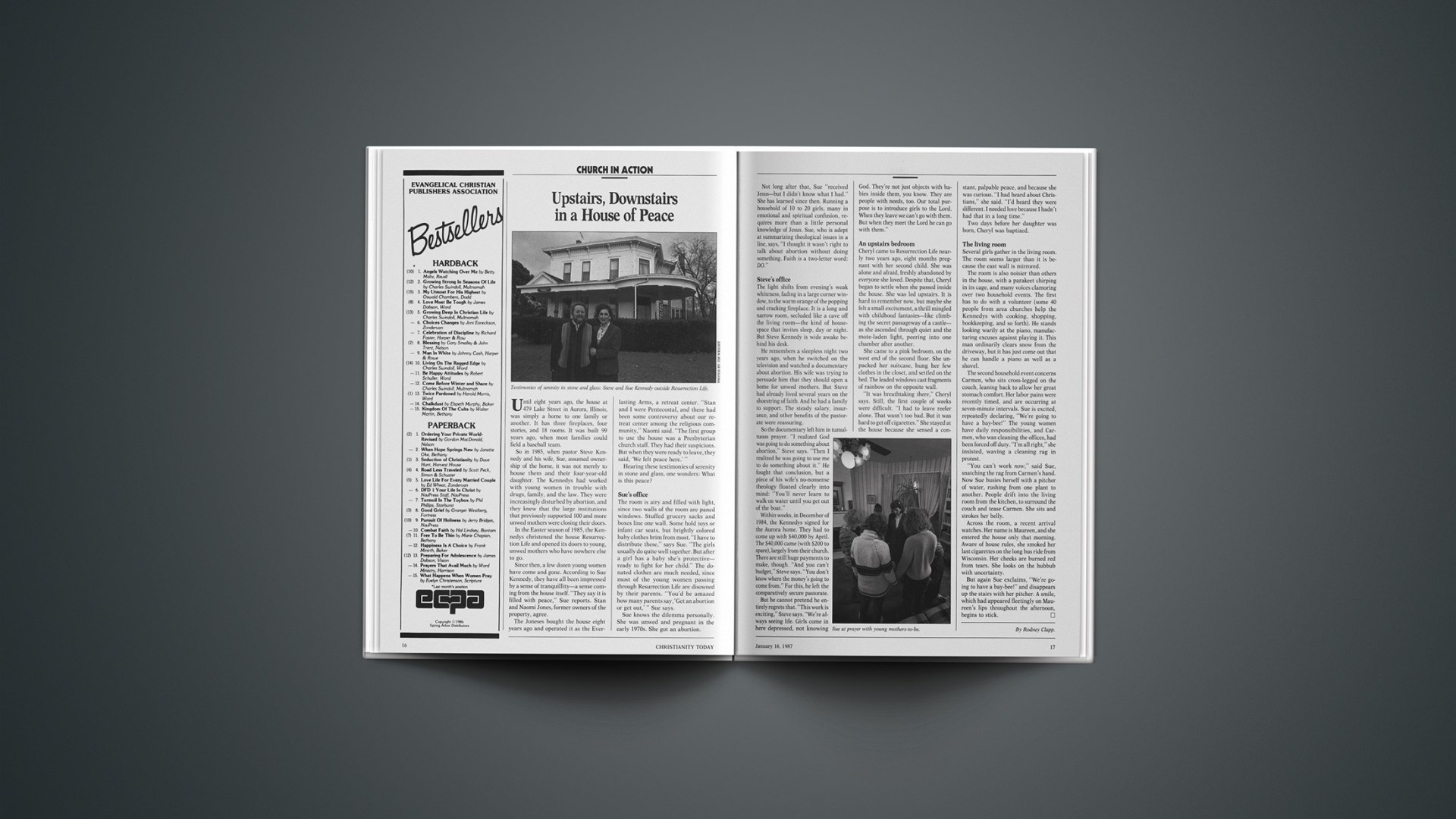
Until eight years ago, the house at 479 Lake Street in Aurora, Illinois, was simply a home to one family or another. It has three fireplaces, four stories, and 18 rooms. It was built 99 years ago, when most families could field a baseball team.

So in 1985, when pastor Steve Kennedy and his wife, Sue, assumed ownership of the home, it was not merely to house them and their four-year-old daughter. The Kennedys had worked with young women in trouble with drugs, family, and the law. They were increasingly disturbed by abortion, and they knew that the large institutions that previously supported 100 and more unwed mothers were closing their doors.

In the Easter season of 1985, the Kennedys christened the house Resurrection Life and opened its doors to young, unwed mothers who have nowhere else to go.

Since then, a few dozen young women have come and gone. According to Sue Kennedy, they have all been impressed by a sense of tranquillity—a sense coming from the house itself. “They say it is filled with peace,” Sue reports. Stan and Naomi Jones, former owners of the property, agree.

The Joneses bought the house eight years ago and operated it as the Everlasting Arms, a retreat center. “Stan and I were Pentecostal, and there had been some controversy about our retreat center among the religious community,” Naomi said. “The first group to use the house was a Presbyterian church staff. They had their suspicions. But when they were ready to leave, they said, ‘We felt peace here.’ ”

Hearing these testimonies of serenity in stone and glass, one wonders: What is this peace?

Sue’s Office

The room is airy and filled with light, since two walls of the room are paned windows. Stuffed grocery sacks and boxes line one wall. Some hold toys or infant car seats, but brightly colored baby clothes brim from most. “I have to distribute these,” says Sue. “The girls usually do quite well together. But after a girl has a baby she’s protective—ready to fight for her child.” The donated clothes are much needed, since most of the young women passing through Resurrection Life are disowned by their parents. “You’d be amazed how many parents say, ‘Get an abortion or get out,’ ” Sue says.

Sue knows the dilemma personally. She was unwed and pregnant in the early 1970s. She got an abortion.

Not long after that, Sue “received Jesus—but I didn’t know what I had.” She has learned since then. Running a household of 10 to 20 girls, many in emotional and spiritual confusion, requires more than a little personal knowledge of Jesus. Sue, who is adept at summarizing theological issues in a line, says, “I thought it wasn’t right to talk about abortion without doing something. Faith is a two-letter word: DO.”

Steve’s Office

The light shifts from evening’s weak whiteness, fading in a large corner window, to the warm orange of the popping and cracking fireplace. It is a long and narrow room, secluded like a cave off the living room—the kind of house-space that invites sleep, day or night. But Steve Kennedy is wide awake behind his desk.

He remembers a sleepless night two years ago, when he switched on the television and watched a documentary about abortion. His wife was trying to persuade him that they should open a home for unwed mothers. But Steve had already lived several years on the shoestring of faith. And he had a family to support. The steady salary, insurance, and other benefits of the pastorate were reassuring.

So the documentary left him in tumultuous prayer. “I realized God was going to do something about abortion,” Steve says. “Then I realized he was going to use me to do something about it.” He fought that conclusion, but a piece of his wife’s no-nonsense theology floated clearly into mind: “You’ll never learn to walk on water until you get out of the boat.”

Within weeks, in December of 1984, the Kennedys signed for the Aurora home. They had to come up with $40,000 by April. The $40,000 came (with $200 to spare), largely from their church.

There are still huge payments to make, though. “And you can’t budget,” Steve says. “You don’t know where the money’s going to come from.” For this, he left the comparatively secure pastorate.

But he cannot pretend he entirely regrets that. “This work is exciting,” Steve says. “We’re always seeing life. Girls come in here depressed, not knowing God. They’re not just objects with babies inside them, you know. They are people with needs, too. Our total purpose is to introduce girls to the Lord. When they leave we can’t go with them. But when they meet the Lord he can go with them.”

An Upstairs Bedroom

Cheryl came to Resurrection Life nearly two years ago, eight months pregnant with her second child. She was alone and afraid, freshly abandoned by everyone she loved. Despite that, Cheryl began to settle when she passed inside the house. She was led upstairs. It is hard to remember now, but maybe she felt a small excitement, a thrill mingled with childhood fantasies—like climbing the secret passageway of a castle—as she ascended through quiet and the mote-laden light, peering into one chamber after another.

She came to a pink bedroom, on the west end of the second floor. She unpacked her suitcase, hung her few clothes in the closet, and settled on the bed. The leaded windows cast fragments of rainbow on the opposite wall.

“It was breathtaking there,” Cheryl says. Still, the first couple of weeks were difficult. “I had to leave reefer alone. That wasn’t too bad. But it was hard to get off cigarettes.” She stayed at the house because she sensed a constant, palpable peace, and because she was curious. “I had heard about Christians,” she said. “I’d heard they were different. I needed love because I hadn’t had that in a long time.”

Two days before her daughter was born, Cheryl was baptized.

The Living Room

Several girls gather in the living room. The room seems larger than it is because the east wall is mirrored.

The room is also noisier than others in the house, with a parakeet chirping in its cage, and many voices clamoring over two household events. The first has to do with a volunteer (some 40 people from area churches help the Kennedys with cooking, shopping, bookkeeping, and so forth). He stands looking warily at the piano, manufacturing excuses against playing it. This man ordinarily clears snow from the driveway, but it has just come out that he can handle a piano as well as a shovel.

The second household event concerns Carmen, who sits cross-legged on the couch, leaning back to allow her great stomach comfort. Her labor pains were recently timed, and are occurring at seven-minute intervals. Sue is excited, repeatedly declaring, “We’re going to have a bay-bee!” The young women have daily responsibilities, and Carmen, who was cleaning the offices, had been forced off duty. “I’m all right,” she insisted, waving a cleaning rag in protest.

“You can’t work now,” said Sue, snatching the rag from Carmen’s hand. Now Sue busies herself with a pitcher of water, rushing from one plant to another. People drift into the living room from the kitchen, to surround the couch and tease Carmen. She sits and strokes her belly.

Across the room, a recent arrival watches. Her name is Maureen, and she entered the house only that morning. Aware of house rules, she smoked her last cigarettes on the long bus ride from Wisconsin. Her cheeks are burned red from tears. She looks on the hubbub with uncertainty.

But again Sue exclaims, “We’re going to have a bay-bee!” and disappears up the stairs with her pitcher. A smile, which had appeared fleetingly on Maureen’s lips throughout the afternoon, begins to stick.

By Rodney Clapp.

Who Pays for the Roof?

When God works in a human heart, there is a cost. But who, exactly, pays?

“Of course,” you say, “sinners must pay a price when they repent and are converted from their wicked ways. No longer can they continue to enjoy the ill-gotten gains of their former ways.

“Look at Zacchaeus, the tax collector, who became rich through graft and extortion. When the power of God worked in his life, it cost him plenty. ‘Lord,’ he said, ‘I’ll give half of my possessions to the poor, and if I have cheated anyone, I will pay back four times the amount.’ ”

It does seem fitting that those who come to Christ for forgiveness and reconciliation should pay some penalty for their former lives, God’s grace notwithstanding. Among celebrity conversions, for instance, that of Chuck Colson has the solid ring of authenticity, in part because he paid and continues to pay a price for his involvement in Watergate.

On the other hand, we are understandably more suspicious and cynical of other notable conversions when, instead of faith costing something, it actually becomes a tool for commercial success replete with status and profit.

Still, I’ve found that when God works in a person’s heart and life, it is not always that person, but someone else, who pays a price.

Jesus, upon entering the territory of the Gerasenes, freed and restored a man from his demon possession. The exorcised spirits were granted permission to enter a herd of 2,000 swine and promptly rushed headlong into the sea. It is unlikely the pig farmer was very appreciative of Jesus’ ministry in the life of the former demoniac.

Mark gives us no reason to believe the farmer’s loss was indemnified. There was no government agriculture department to provide disaster aid in the form of low-cost emergency loans. The farmer was simply out a lot of money. It cost him a great deal when God worked in the life of someone else.

And so it sometimes is today. The fallout from the work of God may come in unexpected ways and require those not even remotely involved to pay a price.

Recently a gifted and successful businessman who employed nearly 50 people acknowledged a clear and certain call to the pastoral ministry. He determined to enter seminary to prepare for a full-time church vocation; in so doing he was forced to lay off many valuable employees, causing them considerable hardship and loss of income.

Some may wonder if this new seminarian should not have delayed or resisted his call to ministry in order to spare his employees such pain. But he—and I—believe God has been working in his life. It is simply hard to accept that God’s sovereign work in one person’s life has been so costly to so many innocent others.

Bystanders, if you please, paid a price.

Of course, such “price paying” may be even harder to accept when God’s work is costly for those who are seeking to be his faithful helpers. Sometimes it does not seem fair when we, our church, or our ministry, must pay a price.

Jesus’ host in Capernaum generously opened his home to the Master, and immediately found his place overrun by a surging crowd. Four men, impatient and determined, ripped up his roof in order to lower a paralytic friend down to Jesus who, in turn, forgave the man’s sins and restored him to health. Everyone present was amazed and gave praise for this demonstration of the power of God. Well, maybe everyone except the host: who do you suppose paid to have the roof repaired?

When God works in someone else’s life, we may well be hit in the pocket-book. Or our church facilities may suffer some wear and tear. Or our close-knit, comfortable fellowship may be invaded by unfamiliar faces, speaking or behaving “out of turn.” Or our way of doing things may be challenged.

Building God’s kingdom costs. Are we willing to pay the price?

GEORGE K. BRUSHABER

Letters

Responsible “Witch Hunters”

The editorial “Open Season” [Nov. 21] raises a number of appropriate points. It tended, however, to underemphasize a necessary awareness—relative to those purporting to elevate our spiritual perceptions—of a number of vulnerabilities attendant to such endeavors. For example, in The Healing of Memories, David Seamands creates an association between himself and his work with the much-longer established school, which views occultic Eastern mysticism, regressive hypnosis, etc., as legitimate adjuncts to the Christian faith. In such cases, the energetic “witch hunter” must bear responsibility for the lack of an adequate objectivity and his own lack of discretionary responsibility. It is then that a healthy skepticism becomes the last resort of stability in the pursuit of orthodoxy.

REV. BURL RATZSCH

First Baptist Church

Akron, Iowa

The editorial employed the very approach it decried. Of over 400 quotes used in The Seduction of Christianity, James Dobson was quoted only once. Why did your editorial identify that particular one as “typical”?

REV. TIMOTHY L. MUNYON

Big Spring, Neb.

I am impressed with the balanced and mature Christian approach to “heresy hunting” in the Christian community. I feel that everyone who has written on this subject lately has left out one pertinent issue: Authors of such best-selling Christian books are paid money for the books that are sold. I am almost afraid to say it, but perhaps the motivation behind such hurried publishing of current books is the financial factor.

REV. CHARLES FOWLER

Las Animas, Colo.

I honestly think your remarks about The Seduction of Christianity were vindictive and grossly unfair. The book gave me a better understanding of the cults and how those demon lies can influence our own faith.

WILLIAM GRADE

Midland Park, N.J.

Three cheers and an amen for your editorial. I have no illusions that you will call off the heresy hounds, but perhaps you will help some Christians to be less gullible in following both teachers and accusers.

REV. J. S. CARLETON

McFarland, Wis.

Thinking Christians had better rely on God’s Word instead of “new ideas” when seeking answers in today’s haystack of “Christian” teaching. That’s the real answer in safeguarding the church against heresy.

GARY SHINN

Broomfield, Colo.

Dear Pat: Run for Congress

Charles Colson’s half-baked endorsement of Pat Robertson’s candidacy is premature [“Dear Pat: Winning Isn’t Everything,” Nov. 7]. Robertson has no proven ability; therefore, let him first run for Congress. Then I might vote for him. In the meantime, I’ll back someone for President who, like Colson, is adept at political arm twisting.

DOUGLAS FOSTER

Missoula, Mont.

Human rights abuses are not new

Thank you for the insightful articles on South Africa [CT Institute, Nov. 21]. Finding a peaceful means to dismantle “apartheid” is clearly a crucial issue for the South African church and one all Christians should be concerned about. I am troubled, however, that many Christians appear to see human rights abuses in South Africa as unique. Denial of basic human rights is a way of life for governments throughout black Africa, the Soviet bloc, and other parts of the world. American evangelicals need not imitate the selective indignation characteristic of our media and politicians.

REV. DAN ERICKSON

Lakeside Baptist Church

Wentworth, Wis.

Spiking The Altar Candle

With pregame chapels and postgame prayers, there is plenty of religion in pro football. What we need is more football in religion. We’ve already borrowed the 60-minute time clock. But think of the momentum that could be established during a worship service if choir members would exchange high fives after the anthem. Or if the pastor would spike an altar candle after scoring a few points with the congregation.

And how much more interesting services would be if we booed when pastors fumbled an illustration or decided to punt on a tough text. We could liven up sermons by using slow-motion instant replay to highlight and diagram key pastoral gestures. The two-minute warning would stifle unnecessary elaboration on the final point in the sermon. And close theological calls could be reviewed instantly. A committee could decide either to let the ruling stand or penalize the pastor. In down times during the service, ushers could lead everyone in a congregational wave.

These changes certainly will make people less anxious to rush home and turn on their TV sets. And of course, we would always leave the service having rooted for the winning side.

Cross-cultural missions: Still needed

K. P. Yohannan, in advocating the infusion of foreign money to assist national believers in evangelism [“Americans Can’t Win the World for Christ,” Speaking Out, Nov. 7], nowhere recognizes—in the words of the Lausanne Covenant—that “a reduction of foreign missionaries and money [italics mine] … may sometimes be necessary to facilitate the national church’s growth in self-reliance.…” In presenting the advantages of national workers over missionaries, he overlooks the fact that the majority of the world’s unreached will only be evangelized by cross-cultural missions—no matter what their origin. Yohannan’s fallacious contrast is like affirming that a Boeing 747 is cheaper and more efficient than a spacecraft. It all depends on where you have to go and what it takes to get there.

JOHN GRATION

Wheaton College

Wheaton, Ill.

That the church has grown as much as it has in mainland China since 1949 verifies Yohannan’s theory regarding the effectiveness of indigenous evangelism.

REV. THOMAS D. SUTTER

Santa Rosa Baptist Church

Pattonsburg, Mo.

Yohannan is unclear about what he means by a native missionary. If the word “missionary” has any meaning unique from pastor, or evangelist, it is that a missionary carries the gospel across cultural and often linguistic lines. Does he mean, then, that native missionaries are going to carry on this kind of ministry? The question is not just semantic, because if this is not what he means, then he must mean that these native missionaries are really national leaders trained in evangelism and church planting who will go to their own people to evangelize and establish local congregations.

This is a thorny issue for which no simple answers exist. There must be circumstances under which support from America can be given to national ministers without creating problems. Yohannan is right. We’ve got to find new ways to get the job done. But what he suggests isn’t so simple as it sounds.

DAVID W. WRIGHT

Vancleve, Ky

This is not an either/or situation but both/and. Our North American missionaries are increasingly being joined by missionaries from other countries and are serving in the capacity of evangelists as well as trainers of national missionaries. To suggest this is new strategy is not entirely true; it is an old strategy that has been implemented for years.

REV. DENNIS L. GORTON

The Christian and Missionary Alliance

Nyack, N.Y.

There is growing evidence that a substantial percentage of Two-Thirds World missionaries are having great difficulties adjusting to cross-cultural challenges. Not a few are returning home heartbroken. And is it true that there are few American missionaries working in evangelism-discipleship-church planting-leadership training? Yohannan is partially right—Americans can’t win the world for Christ. But then they never were solely responsible in the first place. The world church is.

WILLIAM D. TAYLOR

World Evangelical Fellowship

Wheaton, Ill.

About Christian Voice …

As chairman and founder of Christian Voice, I read the featured news story in the November 17 issue of CT with dismay and disbelief. To be attacked by one’s enemy is one thing. To be attacked by one’s brethren is worse. As the article stated, I am an evangelical Christian out of the Fuller and Wheaton camp. I consider myself to be in the mainstream of evangelical Christianity. Alleged ties to the Unification Church are distortions and simply not true—but the mere raising of this issue leaves the impression of truth.

The article was slanted, biased, and factually incorrect. It was out of balance in its heavy focus on one of my consultants, Gary Jarmin. It struck me rather strange that even though I am the head of Christian Voice and its founder, the article focused on a consultant and, only in passing, on myself.

America is facing its most critical time in history. Now is the time for Christians to work together, not to continue divisiveness and sniping that only brings pleasure to Satan.

REV. ROBERT G. GRANT, PH.D.

Christian Voice

Washington, D.C.

Surely the body of Christ is so badly fragmented, our ability to cooperate in contending with evil so rare, and our self-righteous finger pointing so common that the last thing Christ’s church needs is more self-serving back stabbing as represented by this article. Those who wish to “stand in the gap” and combat Satan are more than welcome in Christian Voice’s ranks. For those misguided “brethren” critical of Christian Voice’s ministry, we ask only two favors: one, please stand aside and let us be about our Father’s business; and two, judge us by our fruit.

GARY L. JARMIN, PRESIDENT

Jar-Mon Consultants, Inc.

Washington, D.C.

The contention that Christian Voice is a lone ranger organization, and the implication that it is on the fringe of—or outside of—true Christian faith, is unfounded. The men and women at Christian Voice work indefatigably to promote Christian values. They deserve appreciation, not scorn.

DORE SCHUPACK

Fort Washington, Pa.

True union—as Christ intended

As a born-again Catholic Christian, I received the November 7 issue on the Catholic church with mixed emotions. On the one hand, it was extremely informative (and accurate). On the other hand, I had misgivings at being singled out as different from other evangelicals and referred to as a “neighbor.” I am a regular subscriber to CT, and I am not a neighbor. I am one of you—a Christian first, who happens to be Catholic.

It has always seemed incredible that the learned leaders of all denominations are fully committed to the Lord and faithful to all of his teachings but one—that we are to be one body in Christ. We worship the same Lord and Savior, live by the same Holy Scripture, have the same promise of salvation, and have been given the same commission to spread the gospel. These are the fundamental truths to which we are all committed. Why can we not, then, put aside all these other differences, which are so less significant, and unite as Christ intended?

JEANNETTE WILLIAMS

Vienna, Va.

Are there two Roman Catholic churches? Avery Dulles is certainly not speaking for the Roman church of history. If you think he does, you’ve been taken.

LOWELL SAUNDERS

Biola University

LaMirada, Calif.

Recent events further underline not only the diversity, but also the turbulence and division in Catholicism. The Second Vatican Council (1962–65) forged a new direction and a wide-ranging challenge to the traditional tenets and practices of the church and its followers. The implications for a strong and expanding ecumenical spirit were also expressed. Certainly this fresh spirit of renewal and hope is what is most needed in Christianity and the world.

JAY ALLAIN

Northampton, Mass.

Arguing about “faith” and “works” “does seem to me like asking which blade in a pair of scissors is most necessary” (C. S. Lewis, in Mere Christianity), especially since “it is God who, in his good will toward you, begets in you any measure of desire or achievement” (Phil. 2:13).

DON SCHENK

Allentown, Pa.

Works are not enough

Kenneth Kantzer’s editorial “Church on the Move” [Nov. 7] was well done. However, there is one major misunderstanding. You say traditional Roman Catholics’ “understanding of salvation places works over faith.” This is not what the church teaches. Although some individual Catholics may think or act otherwise, the church teaches that you cannot buy your way into heaven with good works. Faith is necessary for salvation, faith is a gift from God, and God commanded us to do good works.

EDWARD C. FREILING

Fredericksburg, Va.

Recently, Theological Students Fellowship, OMSC, and Princeton Seminary jointly sponsored “Evangelical-Roman Catholic Dialogue on Missions.” I participated, as an evangelical, for the reasons so clearly articulated by Kantzer. The spirit of God is moving—ecumenically—in a fresh way today. It should not surprise us that the most exciting development is the combining of evangelical fervor with the richness of the liturgy. This is a movement of mutual exhortation and edification.

WILLIAM L. MANGRUM

Theological Students Fellowship

Madison, Wis.

Hurrah for certain certainty

As a former public school teacher who now works extensively with home and Christian school organizations in Iowa, I was intrigued by the review of Alan Peshkin’s book, God’s Choice: The Total World of a Fundamentalist Christian School [Books, Nov. 7]. The reviewer, Paul F. Parsons, like Peshkin and most Americans (Christian and non-Christian alike), has a severely mistaken notion about the nature of most public education. The only real difference between fundamentalist and public schools is the nature of absolute truth. The former advocates certain certainty, the latter certain uncertainty. The intolerance of relativism in fundamentalist schools is no greater than the intolerance of absolutism in public schools. The difference is the fundamentalist school is honest about its position.

GUY RODGERS

Shenandoah, Iowa

Schaeffer: He knew where the wind blew

In reference to “The Judgment of Francis A. Schaeffer” [Books, Nov. 7]: History may well come to show all of the things Schaeffer was not. He was not a historian, he was not an artist, nor was he a philosopher in the strictest sense of the word. But neither was he a weatherman, yet he certainly knew which way the wind was blowing.

LARRY PAVLICEK

Richfield, Minn.

What’s in … initials?

My reaction to Eutychus’s column on November 7 [“Initial Impressions”] initially was that the writer is obviously a man of letters. How ingenious to capitalize on the initials of some of our celebrated Christian leaders! Perhaps you could sponsor a contest in which readers identify the names the initials stand for. The prize would be to borrow those initials for a day. You could call the contest, “Name It and Claim It.”

ROGERT J. TAMASY

Chattanooga, Tenn.

Don’t show me Eutychus!

Through the years I’ve enjoyed, endured, been provoked—and perhaps another score of emotions—by the contribution of Eutychus. I have, however, been horrified to see that [artist John] Lawing has been portraying him. Ironic, isn’t it? I like Lawing’s work, but I detest his—or anyone’s—efforts at portraying what Eutychus looks like.

It should be apparent that everyone has his or her own image of that impish probing … whatever he is. He surely doesn’t, can’t, wouldn’t look the way Lawing depicts him.

GLENN MATHEWS

Charleston, W.V.

The church in action

Initially, I was pleased to find that Church in Action had done an article on [my home church] Fourth Presbyterian Church in Pittsburgh [Oct. 17, “The Church that Gambled”]. However, my pleasure soon turned to disappointment as the article really was about the current pastor. The fact is, the people of Fourth Church had already made many and repeated conscious decisions in these areas; some even before James Stobaugh started seminary. Most of the ministries mentioned were going before he arrived. What Stobaugh has done is what the church hired him to do as their teaching elder. I am glad he is helping the congregation to progress in their chosen direction. I know of their struggles and commitments to serve God and his people, even though it means accepting lots of changes and working very hard together. Is this not what is meant by the “church in action” rather than implying that much is due primarily to (and is on the shoulders of) one man?

DEBRA T. DELIVUK

St. Louis, Mo.

Who said it first?

Much as I enjoy your Reflections page, one of its recent entries should not go uncorrected. The passage from C. John Weborg [Oct. 3] attributes a well-known quotation about the Jews to A. E. Housman. According to both The Oxford Dictionary of Quotations and Bergen Evans’s Dictionary of Quotations, the author is William Norman Ewer. The verse has often been attributed to Hilaire Belloc, but this is the first time I have seen it attributed to Housman.

WILLIAM WEISS

New York, N.Y.

Clarifying a position

Following the CT News story [“Gay Rights Resolution Divides Membership of Evangelical Women’s Caucus,” Oct. 3], I was asked to clarify my postion on Christianity and lesbianism. Though I did not vote for the three resolutions of the caucus, I believe in the civil rights of all persons regardless of race, color, creed, gender, or sexual preference. However, I cannot endorse any sexual activity outside of marriage as a biblically sanctioned lifestyle.

CATHERINE KROEGER

University of Minnesota

St. Paul, Minn.

Oil, Airbrush, or Colored Pencil

Most Monday mornings, a group of opinionated CT editors and artists get together to discuss the layout and design of a coming issue of CHRISTIANITY TODAY. And one of the larger graphic challenges usually addressed and debated during this hour (or two, or three) concerns the cover.

Deciding how a cover should be illustrated (and what it should illustrate) is about as subjective a process as any in editorial work. But fortunately for all of us, deciding who should do the cover illustration has rarely proved a dilemma, thanks to a select group of artists who have worked closely with art director Joan Nickerson over the past three years. In this group of “regulars” are Nathan Greene (last month’s cover artist), Dwight Walles, Joe VanSeveren, Myron Sahlberg, and this month’s cover artist, Paul Turnbaugh.

Paul’s work has been on more CT covers than that of any other recent illustrator. In 1986 alone he illustrated nine covers, including caricatures of Donald McGavran (Feb. 21) and John Wimber (Aug. 8), the genetic Tower of Babel (Feb. 7), and America’s Catholics (Nov. 7). His “high-brow” caricature work has also added a much-appreciated touch to the special supplements of the Christianity Today Institute.

Not tied to one particular style, Paul, 30, is an artistic adventurer. All media are fair game—oil, airbrush, colored pencil, whatever. And he works well with each. So well, in fact, that his illustrations have been featured in such prestigious publications as The American Illustrator.

With such talent and exposure, Paul is in high demand. But he is commited to CT—to its editorial purpose and graphic direction. Which means the question of “Who?” should not pose a great problem to us editors for quite a few Mondays to come.

HAROLD SMITH

Managing Editor

History

What Children Owe to Comenius

In this series

“Quickly! Pleasantly! Thoroughly!…” called out Comenius to the frustrated teachers of his day. “Schools should not be places of torture, slaughter-houses of the mind!”

Is it possible to teach pleasantly, yet quickly and thoroughly at the same time? Most schools of that day could not have conceived of such an idea. Though not many in the 17th century heard this call for educational reform, today we consider Comenius the first modern educator. We are still trying to implement the basic principles that he set forth in his Great Didactic. For he laid he foundations for teaching according to Scripture and according to God’s “second book,” nature. The young child as God made him actively examine the world around him, using all his senses, eager to learn all he can. Too often in school he has been confined to memorization and meaningless words that dull his interest and initiative.

While educators through the century have tended to go either to the extreme of overemphasizing the disciplines of knowledge or the experience of the learner, Comenius kept these two essentials of teaching in balance. The schools of Comenius’s day furnished pupils with classical Latin verbiage, but did not train them to observe or to think. He lacked the advantage of psychological studies, but he drew analogies of growth from nature. (Scripture often compares spiritual growth with natural growth.) “Development comes from within,” Comenius observed from watching the processes of nature. “Nature compels nothing to advance that is not driven forward by its own mature strength.” He proceeded to work with the processes of nature rather than against them. Teachers and books may help or hinder growth, but the learner must do his own growing. “Outward ceremonies without inward truth are an abomination to God,” said Comenius.

If a child is to engage in valuable learning activities, he must have a desire to learn, intrinsic interest, and attention rather than artificial incentives. His whole person must be enlisted. His native curiosity will be directed into constructive channels rather than repressed. Why isn’t he encouraged to discover what he can for himself? The classroom can breathe an inductive spirit. Then things and examples would precede pleasantly from the concrete to the abstract, from the easy to the difficult, from the near to the remote. On the foundation of the pupils’ firsthand experience, teaching would be imparting and guiding rather than storing the memory, as had been the custom.

Essential knowledge is provided for the learner when he is ready for it, when he sees the need for it, when he can use it for gaining his goals. So the place of teacher and content is not minimized. Comenius’s goals of piety, morality and knowledge could not be attained by unguided self-expression. The learner continually needs :new facts and insights to interpret his daily ’experiences and to lead to advanced problems and solutions.

Comenius also sensed the significance of individual differences and individual needs. When he was a student. individual recitation had been the order of the day. Each pupil had to wait his turn to recite to the teacher. “This is a waste of time,” thought Comenius as he developed a truly democratic class spirit that was not much appreciated in his day of power politics. “Pupils can work in a group without losing their individuality.” In a group they could not only learn new truth, but also practice the character traits of self-control and concern for the other fellow, rather than simply be exposed to a superficial veneer of morality. Comenius graded the school into four levels, and wrote Latin texts for these levels. He felt that if pupils learned their lessons more quickly and easily, the time saved could be utilized to give a thorough grounding in morality and religion.

It was Comenius who popularized the picture book for educational purposes, who wrote the first textbook to employ pictures as a teaching device. Whenever he could not bring into the classroom the actual object that was to be the subject of discussion, he used pictures, charts, diagrams, maps and models.

What revolutionary ideas! Universal compulsory education for the youth of both sexes! Teaching all things to all people—a truly liberal concept that would broaden perspectives after a narrow Latin curriculum! For the present and for the future life! All this was not just theory, for Comenius practiced it himself in Moravia and in Poland. Today we are still trying to train “teachers to teach less so that learners may learn more.”

Dr. Lebar is professor emerita of Christian education at Wheaton College, Wheaton, IL, where she taught 1945-1975. Along with her twin sister, Mary, she was a pioneer of modern C.E. practices. Her book, Education That is Christian, is a popular college text

Copyright © 1987 by the author or Christianity Today/Christian History magazine.Click here for reprint information on Christian History.

History

Between Hus and Herrnhut

This article was a collaboration of Bernard Michel, and the editor, working from notes by Eve Bock and Josef Smolik, whose work appears elsewhere in this issue.

Comenius and the Unity of the Brethren

The Reformation started by John Hus (1369–1415) in Bohemia did not die when he was burned at the stake. A number of small communities spun off from the Hussites, each rebelling against Rome in its own ways. The first “Brethren” moved to a remote village called Kunvald in 1457 to live together as the early church did, and follow the law of Christ.

From the start, the Unity of the Brethren, as they became known, had contacts with the Waldensians, a communal group that preserved the teachings of Peter Waldo from the twelfth century, promoting equality of believers and opposing ecclesiastical hierarchy. Significant also for the Unity’s founding was the thought of Peter Chelcicky, who condemned the use of force in matters of faith and the participation of Christians in political power struggles, especially in war. Chelcicky dared to call the Pope and the emperor “whales who have torn the net of true faith,” since they had established the Church as the head of a secular empire.

These ideas, denial of material aspirations and refusal of secular power, as adopted by the Unity, did not sit well with the authorities. The Unity was outlawed and persecuted by secular and religious powers alike, but its numbers grew, new communities were formed, and its influence went far beyond its ranks.

Despite their commitment to Christlike poverty, the Brethren presented the Czech nation with a wealth of spiritual resources. They translated the Scriptures into Czech; they composed hymns that are still sung in Czech churches today; they published a confession of faith praised by Luther, and left an unmistakable mark on the Confessio Bohemica (Czech Confession)—the first ecumenical confession the world had seen.

The Exile

Jan Amos Comenius stands as the most notable figure in the Unity, though the church was dying out during his lifetime. The death blow was their banishment from their homeland, Bohemia, after the Battle of White Mountain in 1620.

Leading a group of exiles over the mountains into Poland, Comenius prayed that a “hidden seed” of this faith would grow and bear fruit. But that prospect looked dim in the ensuing years, as the Brethren dispersed throughout Europe. Some fled with Comenius to Poland; some to Transylvania (now part of Hungary); some to Germany. Wherever they went, they found persecution, caught between Lutherans, Calvinists, and Catholics.

The Hidden Seed Did Grow

By 1650, Comenius had written a treatise entitled “The Bequest of a Dying Mother, the Unity of Brethren, by which, ceasing to exist in her own nation and her separate individuality, she distributes among her sons, daughters, and heirs the treasures which God entrusted to her.

In this bequest for his “dying church,” Comenius called for reformation in the Bohemian and Polish Unity, in the “beloved sisters, Protestant communions,” and in “our mother who has borne us, thou Church of Rome.”

In what sounds like the ecumenical language of today, Comenius wrote: “To all Christians together I bequeath lively desire for unanimity of opinion and for reconciliation among themselves, and for union in faith, and love of the unity of spirit.”

In 1660 Comenius published the Ratio Disciplinae, a Latin book containing a history of the Brethren’s church and the essentials of their faith. He dedicated the book to the Church of England and urged that communion to care for his beloved Unity. “If there is no help from man, there will be help from God,” he wrote in hoping against hope for the church’s faith to be preserved.

Herrnhut

In 1722, a few Moravian pilgrims went across the border from Bohemia and Moravia to the estate of Count Zinzendorf in Silesia, Germany. There they found refuge and encouragement from the Lutheran nobleman. They called their settlement Herrnhut. These new Brethren adopted much of Zinzendorf’s pietism, but the legacy of the old Unity remained alive among them.

On August 13, 1727, there was a revival in Herrnhut, a spiritual explosion of sorts which prompted widespread missionary fervor. The Herrnhut community sent missionaries to the Americas, and eventually throughout the world.

The preparation for that August 13th renewal came from the count’s reading of a copy of Comenius’ Ratio Disciplinae at a library in Zittau earlier that year. It helped Zinzendorf understand the depth of the Moravian faith and the reason why the refugees were saying, “God has brought us here so that He might restore our Church.” Zinzendorf used the Ratio Disciplinae as the basis for a new “Brotherly Agreement” which he developed as the standard for the faith and life of the Herrnhut community. This document (revised many times) continues to be the “Brotherly Agreement” or the “Covenant for Christian Living” for the Moravian Church today.

There was also a personal tie between Comenius and the renewed church. On November 5, 1662, Peter Jablonsky (Comenius’s son-in-law) was consecrated a bishop of the Unity. His son, Daniel Ernest Jablonsky, was also consecrated a bishop, and when the renewed Moravian Church sought the consecration of its first bishop, David Nitschmann, in 1735, it was Daniel Ernest Jablonsky who officiated at the service.

The Discipline

A part of the discipline of Bishop Comenius which was bequeathed to the Moravian Church was his hope and prayer that all the world should come to know the saving Word of God. Comenius struggled all his life to educate all people. With his Janua Linguarum, he unlocked languages so that the rich and poor could learn to read. He prayed earnestly for the day when “peace would come” to all lands, but he knew that the only true peace came from knowing Jesus Christ, the Savior.

In his Labyrinth of the World, Comenius’s pilgrim finally is taught to know Christ, and the Christ tells the pilgrim: “Thou hast seen, when among the scholars, how they strive to fathom all things. Let it be summit of thy learning to seek me in all my works, and to see how wondrously I rule thee and everything… But thou must seek all this learning, not that thou mayest please others, but that thou mayest come nearer to me.”

In the band of Brethren who came to Herrnhut, Zinzendorf sensed a community dedicated to one concept: “serving the Savior to save the world.” The seed grew in Herrnhut, but it did not stay there. The strength of the church which was renewed came when it reached out from the small Silesian community into the world with the simple gospel message. David Nitschmann and Leonard Dober became the first missionaries to the West Indies. Others followed to Greenland, to Africa, to Asia, to North America. The “hidden seed” came to life and bore fruit for the Savior throughout the world.

Copyright © 1987 by the author or Christianity Today/Christian History magazine. Click here for reprint information on Christian History.

History

Seeking a Better Way

The pain and damage of Christian divisions and international warfare affected Comenius and his church both directly and disastrously: His prodigious energy and gifts were obsessively employed to change the way the world and church worked.

In this series

Born March 28, 1592, orphaned early, educated at the universities of Herborn and Heidelberg, Comenius began working as a pastor and parochial school principal in 1618, the year the Thirty Years war began. After the defeat of the Protestant armies in the Battle of White Mountain— one of the most disastrous events in Czech history—he barely escaped with his life while his house was burned down by enemy soldiers. Later, his young wife and two small children died of the plague. For seven years he lived the life of a fugitive in his own land, hiding in deserted huts, in caves, even in hollow trees. Early in 1628 he joined one of the small groups of Protestants who fled their native Moravia to await better times in neighboring Poland. He never saw his homeland again.

For 42 years of his long and sorrowful life he roamed the countries of Europe as a homeless refugee. He was always poor. His second wife died, too, leaving him with four children to care for. The political allies of the Czech nation either died or were killed in the war. The beloved fatherland lay in total desolation. The scattered, impoverished church whose bishop he had become was in danger of disintegrating after years of exile. The Polish city of Leszno, his home for a number of years, was burned to the ground by the enemy. His treasured library and numerous manuscripts— some of them results of decades of work— were totally destroyed in the fire, leaving Comenius, an old man of 64, with virtually nothing but the clothes on his back. Homeless and penniless, he made it to Amsterdam, Holland, where friends took him in and cared for him until his death in 1670.

Such was the life of this great man. And yet, under these adverse circumstances, he never failed to serve his Lord and his fellow men. During his years as a fugitive, he wrote not only a number of small tracts and homilies, but also one of his most famous works, The Labyrinth of the World. He pictures in it a pilgrim who seeks peace and happiness in a deceptive world and finds them at last in union with Christ. The book was a great source of comfort to other fugitives, and many of them, fleeing their homeland, took it along as one of their few prized possessions. In exile, Comenius ministered faithfully to the needs of his scattered congregation, supporting it with the proceeds from his writings. Strangely enough, these came mostly from his books on education—a field which he himself considered secondary to his pastoral ministry.

How did Comenius become an authority on education? He was a minister, and later a bishop, of a church commonly known as Unitas Fratrum (The Unity of Brethren), which attained great theological, literary and cultural achievements immediately preceding the Thirty Years War. While small in numbers, it spurred the whole Czech nation to great cultural advancement. Not only religious freedom and political independence, but also a rich cultural life perished in the Battle of White Mountain. The exiled Brethren rightfully saw themselves as guardians of Czech spiritual treasures. Hoping that one day they would return home, they were trying to prepare for the great task of rebuilding the land and the society devastated by war, and they knew that education would play a vital part in it. Comenius had this task in mind when he began to write a comprehensive book on education, Didactica Magna. He wrote it originally in Czech and kept postponing its publication until the expected return; but as the years passed and the situation did not change, he rewrote it in Latin so the rest of Europe could read it.

Unity and the Brethren

The idea of Christian unity was a very important part of the Brethren’s theology. There were very few churches in those times of religious fanaticism which did not proclaim themselves to be the only true church. Yet the Brethren stated in an official proclamation,

Thus believing according to the Holy Writ in a Holy Church, we do not hold that we alone compose the Holy Catholic Church, or that salvation is obtained only among us, or that we alone shall be saved.

Comenius supported his church’s position from the very beginning of his ministry and carried on a crusade for interchurch co-operation and understanding all his life. Faithful to his church’s teaching, he stressed purity of life more than theology, and showed a remarkable broadmindedness about the two main matters of dispute among the various Protestant groups of his time—the Lord’s Supper and predestination. About the Lord’s Supper he wrote,

Whether this sacrament is received by mouth or by faith alone, why do ye quarrel about it? Why do ye wish to discuss that about which the Scriptures are silent? … Remember that we all know only in part, and especially remember that this mystery was ordained not that the hearts of believers may be torn asunder thereby, but rather that they be bound together into one.

As for predestination, he advocated searching the Scriptures. Since they furnish grounds for both sides, he contended that there must be some truth in both views. He also suggested that all religious communities drop their identification labels—Lutherans, Calvinists, Hussites, Waldensians—and proclaim Christ to be their leader by calling themselves simply Christians.

Comenius not only worked toward Christian unity himself, he also supported the work of other ecumenical workers. He befriended John Dury, son of a Presbyterian minister at Edinburgh, Scotland, who traveled all over Europe in the cause of church unity. Dury was well received in the Unity, which ordered public prayers in all congregations for the good outcome of his work. His cause failed, though, for lack of interest from other denominations. Comenius also supported the work of Georg Calixtus, professor of dogmatic theology at the University of Helmstedt, who even called an ecumenical conference in 1645 for a dialogue between representatives of various Protestant denominations and Roman Catholics. Because of his great tact, patience and gentleness, Comenius was asked to try to bring the Lutherans and Calvinists into a united front in negotiations with the Catholics. He did not succeed. He complained bitterly about some Lutherans, that they “know nothing, but call fire from heaven on both the papists and the Calvinists.”

The most moving expression of Comenius’s longing for Christian unity is expressed in a small book called The Bequest of the Dying Mother, the Unity of Brethren. He wrote it when the Treaty of Westphalia, which ended the Thirty Years War, put an end to all hopes of returning to the native land and reestablishing the perishing church. He pictures the Unity as a dying mother who, “if the Lord should confirm what men do,” must prepare for her last sleep and who therefore bequeaths “the treasures that God entrusted to her” to various nations, churches, or groups. Having distributed most of them to churches in Germany, Poland, and elsewhere where the Brethren were kindly received, she makes the following bequest,

To all Christian churches together I bequeath a lively desire for unanimity of opinion and for reconciliation among themselves, and for union in faith, and love of the unity of spirit. May the spirit which was given to me from the very beginning by the Father of spirits be shed upon you all, so that you would desire as sincerely as I did the union of all who call upon the name of Christ in truth!

Though Comenius saw his church as a dying mother, he continued to serve her—and to serve mankind—for the rest of his earthly life. Matthew Spinka, the translator of The Bequest into English, writes aptly in his introduction to the book,

Having lost his native land,… he became a citizen of the world. His courage and deathless hope for the future proved that a man who believes in God can never despair of the ultimate victory of the forces of righteousness.

Eve C. Bock is Associate Professor of German at Doane College in Crete, NE.

Copyright © 1987 by the author or Christianity Today/Christian History magazine.Click here for reprint information on Christian History.

History

Jan Amos Comenius: Recommended Resources

The Angel of Peace, Pantheon Books, New York 1944.

John Amos Comenius on Education, Introduction by Jean Paiget, Teacher’s College Press, Colombia University, New York 1967.

The Labyrinth of the World, National Union of Czechoslovak Protestants, Chicago 1942.

The School of Infancy, University of North Carolina Press, Chapel Hill 1956.

Vladimir Jelinek. The Analytical Didactic of Comenius, University of Chicago Press, Chicago 1953.

Wilhelmus Rood. Comenius and the Low Countries, Abner Schram, New York 1970.

Matthew Spinka. John Amos Comenius, that Incomparable Moravian, University of Chicago Press, Chicago 1943.

G. H. Turnbull. Samuel Hartlib. A Sketch of His Life and His Relations To J. A. Comenius, Oxford University Press, London 1920.

R. F. Young. Comenius in England 1641/2, Oxford University Press, London 1932.

Copyright © 1987 by the author or Christianity Today/Christian History magazine. Click here for reprint information on Christian History.

History

Principles Comenius Observed in Nature Applicable to Education

1. Nature observes a suitable time.

2. Nature prepares the material, before she begins to give it form.

3. Nature chooses a fit subject to act upon, or first submits one to a suitable treatment in order to make it fit.

4. Nature is not confused in its operations, but in its forward progress advances distinctly from one point to another.

5. In all the operations of nature, development is from within.

6. Nature, in its formative processes, begins with the universal and ends with the particular.

7. Nature makes no leaps, but proceeds step by step.

8. If nature commences anything, it does not leave off until the operation is completed.

9. Nature carefully avoids obstacles and things likely to cause hurt.

Copyright © 1987 by the author or Christianity Today/Christian History magazine. Click here for reprint information on Christian History.

Apple PodcastsDown ArrowDown ArrowDown Arrowarrow_left_altLeft ArrowLeft ArrowRight ArrowRight ArrowRight Arrowarrow_up_altUp ArrowUp ArrowAvailable at Amazoncaret-downCloseCloseEmailEmailExpandExpandExternalExternalFacebookfacebook-squareGiftGiftGooglegoogleGoogle KeephamburgerInstagraminstagram-squareLinkLinklinkedin-squareListenListenListenChristianity TodayCT Creative Studio Logologo_orgMegaphoneMenuMenupausePinterestPlayPlayPocketPodcastRSSRSSSaveSaveSaveSearchSearchsearchSpotifyStitcherTelegramTable of ContentsTable of Contentstwitter-squareWhatsAppXYouTubeYouTube