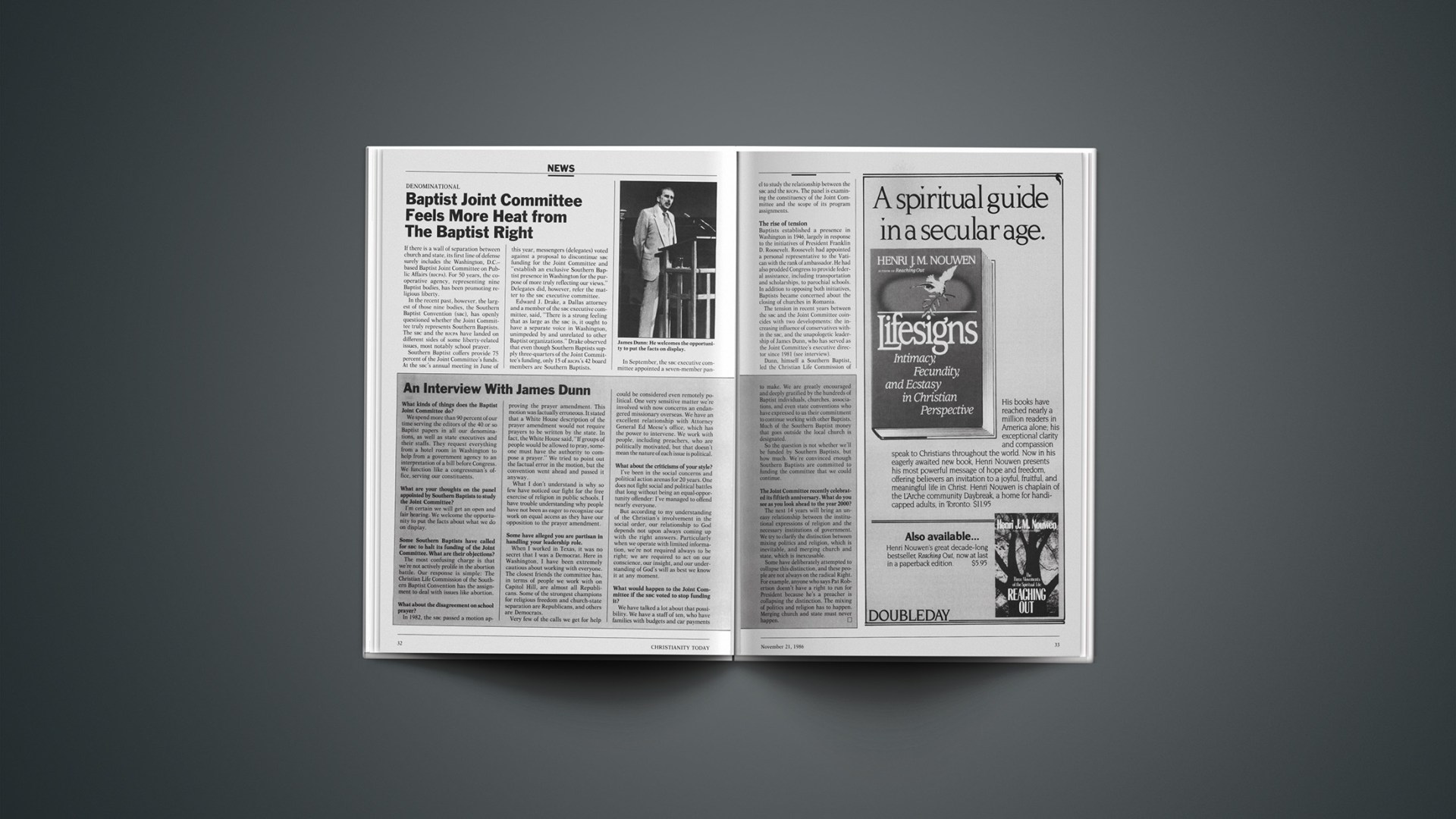
Baptist Joint Committee Feels More Heat from the Baptist Right

If there is a wall of separation between church and state, its first line of defense surely includes the Washington, D.C.—based Baptist Joint Committee on Public Affairs (BJCPA). For 50 years, the cooperative agency, representing nine Baptist bodies, has been promoting religious liberty.

In the recent past, however, the largest of those nine bodies, the Southern Baptist Convention (SBC), has openly questioned whether the Joint Committee truly represents Southern Baptists. The SBC and the BJCPA have landed on different sides of some liberty-related issues, most notably school prayer.

Southern Baptist coffers provide 75 percent of the Joint Committee’s funds. At the SBC’s annual meeting in June of this year, messengers (delegates) voted against a proposal to discontinue SBC funding for the Joint Committee and “establish an exclusive Southern Baptist presence in Washington for the purpose of more truly reflecting our views.” Delegates did, however, refer the matter to the SBC executive committee.

Edward J. Drake, a Dallas attorney and a member of the SBC executive committee, said, “There is a strong feeling that as large as the SBC is, it ought to have a separate voice in Washington, unimpeded by and unrelated to other Baptist organizations.” Drake observed that even though Southern Baptists supply three-quarters of the Joint Committee’s funding, only 15 of BJCPA’s 42 board members are Southern Baptists.

In September, the SBC executive committee appointed a seven-member panel to study the relationship between the SBC and the BJCPA. The panel is examining the constituency of the Joint Committee and the scope of its program assignments.

An Interview With James Dunn

What kinds of things does the Baptist Joint Committee do?

We spend more than 90 percent of our time serving the editors of the 40 or so Baptist papers in all our denominations, as well as state executives and their staffs. They request everything from a hotel room in Washington to help from a government agency to an interpretation of a bill before Congress. We function like a congressman’s office, serving our constituents.

What are your thoughts on the panel appointed by Southern Baptists to study the Joint Committee?

I’m certain we will get an open and fair hearing. We welcome the opportunity to put the facts about what we do on display.

Some Southern Baptists have called forSBCto halt its funding of the Joint Committee. What are their objections?

The most confusing charge is that we’re not actively prolife in the abortion battle. Our response is simple: The Christian Life Commission of the Southern Baptist Convention has the assignment to deal with issues like abortion.

What about the disagreement on school prayer?

In 1982, the SBC passed a motion approving the prayer amendment. This motion was factually erroneous. It stated that a White House description of the prayer amendment would not require prayers to be written by the state. In fact, the White House said, “If groups of people would be allowed to pray, someone must have the authority to compose a prayer.” We tried to point out the factual error in the motion, but the convention went ahead and passed it anyway.

What I don’t understand is why so few have noticed our fight for the free exercise of religion in public schools. I have trouble understanding why people have not been as eager to recognize our work on equal access as they have our opposition to the prayer amendment.

Some have alleged you are partisan in handling your leadership role.

When I worked in Texas, it was no secret that I was a Democrat. Here in Washington, I have been extremely cautious about working with everyone. The closest friends the committee has, in terms of people we work with on Capitol Hill, are almost all Republicans. Some of the strongest champions for religious freedom and church-state separation are Republicans, and others are Democrats.

Very few of the calls we get for help could be considered even remotely political. One very sensitive matter we’re involved with now concerns an endangered missionary overseas. We have an excellent relationship with Attorney General Ed Meese’s office, which has the power to intervene. We work with people, including preachers, who are politically motivated, but that doesn’t mean the nature of each issue is political.

What about the criticisms of your style?

I’ve been in the social concerns and political action arenas for 20 years. One does not fight social and political battles that long without being an equal-opportunity offender: I’ve managed to offend nearly everyone.

But according to my understanding of the Christian’s involvement in the social order, our relationship to God depends not upon always coming up with the right answers. Particularly when we operate with limited information, we’re not required always to be right; we are required to act on our conscience, our insight, and our understanding of God’s will as best we know it at any moment.

What would happen to the Joint Committee if the SBC voted to stop funding it?

We have talked a lot about that possibility. We have a staff of ten, who have families with budgets and car payments to make. We are greatly encouraged and deeply gratified by the hundreds of Baptist individuals, churches, associations, and even state conventions who have expressed to us their commitment to continue working with other Baptists. Much of the Southern Baptist money that goes outside the local church is designated.

So the question is not whether we’ll be funded by Southern Baptists, but how much. We’re convinced enough Southern Baptists are committed to funding the committee that we could continue.

The Joint Committee recently celebrated its fiftieth anniversary. What do you see as you look ahead to the year 2000?

The next 14 years will bring an uneasy relationship between the institutional expressions of religion and the necessary institutions of government. We try to clarify the distinction between mixing politics and religion, which is inevitable, and merging church and state, which is inexcusable.

Some have deliberately attempted to collapse this distinction, and these people are not always on the radical Right. For example, anyone who says Pat Robertson doesn’t have a right to run for President because he’s a preacher is collapsing the distinction. The mixing of politics and religion has to happen. Merging church and state must never happen.

The Rise Of Tension

Baptists established a presence in Washington in 1946, largely in response to the initiatives of President Franklin D. Roosevelt. Roosevelt had appointed a personal representative to the Vatican with the rank of ambassador. He had also prodded Congress to provide federal assistance, including transportation and scholarships, to parochial schools. In addition to opposing both initiatives, Baptists became concerned about the closing of churches in Romania.

The tension in recent years between the SBC and the Joint Committee coincides with two developments: the increasing influence of conservatives within the SBC, and the unapologetic leadership of James Dunn, who has served as the Joint Committee’s executive director since 1981 (see interview).

Dunn, himself a Southern Baptist, led the Christian Life Commission of the Baptist General Convention in Texas before moving to Washington. He has been criticized both for the issues he has emphasized and for his combative style. The SBC’s Drake said Dunn is “perceived to be politically and theologically liberal in his thinking.”

Dunn has deliberately confined the work of the Joint Committee to matters of church-state separation. BJCPA championed “equal access” for high school students, helping successfully to shepherd legislation through Congress in 1984 that guarantees the right of students to hold Bible studies on school property. The Joint Committee has opposed tuition tax credits, the appointment of a U.S. ambassador to the Vatican, and organized school prayer.

The Joint Committee first challenged school prayer in the 1960s; it drew criticism from Southern Baptists for defending Supreme Court actions banning state-sponsored prayer in classrooms. In 1982, the SBC passed a resolution affirming a prayer amendment. The Joint Committee disapproved, again coming under fire largely because of Dunn’s admittedly “outspoken, vigorous opposition.”

The Baptists’ official press service notes that 1986 is the fourth consecutive year the SBC executive committee has heard criticism of the Washington group. In 1983, the committee encouraged BJCPA “to be sensitive to the concerns of Southern Baptists.” In 1984, critics called for the defunding of the Joint Committee; the SBC executive committee declined to act. Last year, the committee rejected a move to set up a separate Southern Baptist office in Washington.

Staying The Course

Dunn’s conflicts with those who view church-state matters differently seem to have made him more adamant about defending religious liberty. In an article released to Baptist newspapers, he wrote, “The theology that fuels our missionary fires and ignites our evangelistic warmth is predicated upon our belief that all persons come to God freely, voluntarily, one at a time or not at all.… In matters of faith, any coercion—any force, however subtle or small—is out of bounds. The business of blessing religion, conducting worship, supporting any church or all churches is not Caesar’s.”

Dunn said of the Joint Committee: “This agency has never been as needed as it is now. I think it’s very important that Baptists of all sorts have one meeting place where they get together and communicate with one another.”

By Beth Spring.
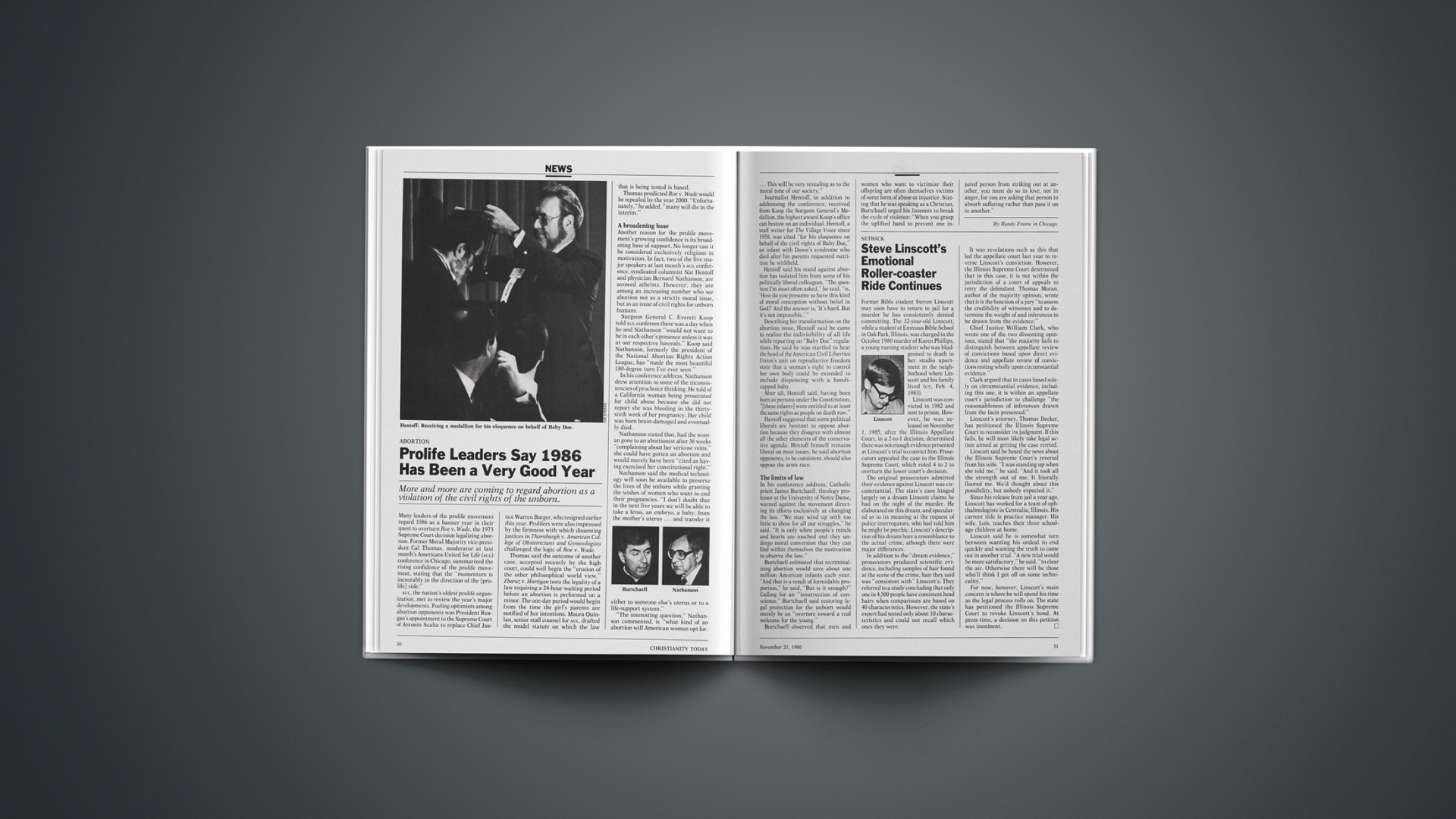
Steve Linscott’s Emotional Roller-Coaster Ride Continues

Former Bible student Steven Linscott may soon have to return to jail for a murder he has consistently denied committing. The 32-year-old Linscott, while a student at Emmaus Bible School in Oak Park, Illinois, was charged in the October 1980 murder of Karen Phillips, a young nursing student who was bludgeoned to death in her studio apartment in the neighborhood where Linscott and his family lived (CT, Feb. 4, 1983).

Linscott was convicted in 1982 and sent to prison. However, he was released on November 1, 1985, after the Illinois Appellate Court, in a 2-to-1 decision, determined there was not enough evidence presented at Linscott’s trial to convict him. Prosecutors appealed the case to the Illinois Supreme Court, which ruled 4 to 2 to overturn the lower court’s decision.

The original prosecutors admitted their evidence against Linscott was circumstantial. The state’s case hinged largely on a dream Linscott claims he had on the night of the murder. He elaborated on this dream, and speculated as to its meaning at the request of police interrogators, who had told him he might be psychic. Linscott’s description of his dream bore a resemblance to the actual crime, athough there were major differences.

In addition to the “dream evidence,” prosecutors produced scientific evidence, including samples of hair found at the scene of the crime, hair they said was “consistent with” Linscott’s. They referred to a study concluding that only one in 4,500 people have consistent head hairs when comparisons are based on 40 characteristics. However, the state’s expert had tested only about 10 characteristics and could not recall which ones they were.

It was revelations such as this that led the appellate court last year to reverse Linscott’s conviction. However, the Illinois Supreme Court determined that in this case, it is not within the jurisdiction of a court of appeals to retry the defendant. Thomas Moran, author of the majority opinion, wrote that it is the function of a jury “to assess the credibility of witnesses and to determine the weight of and inferences to be drawn from the evidence.”

Chief Justice William Clark, who wrote one of the two dissenting opinions, stated that “the majority fails to distinguish between appellate review of convictions based upon direct evidence and appellate review of convictions resting wholly upon circumstantial evidence.”

Clark argued that in cases based solely on circumstantial evidence, including this one, it is within an appellate court’s jurisdiction to challenge “the reasonableness of inferences drawn from the facts presented.”

Linscott’s attorney, Thomas Decker, has petitioned the Illinois Supreme Court to reconsider its judgment. If this fails, he will most likely take legal action aimed at getting the case retried.

Linscott said he heard the news about the Illinois Supreme Court’s reversal from his wife. “I was standing up when she told me,” he said. “And it took all the strength out of me. It literally floored me. We’d thought about this possibility, but nobody expected it.”

Since his release from jail a year ago, Linscott has worked for a team of ophthalmologists in Centralia, Illinois. His current title is practice manager. His wife, Lois, teaches their three school-age children at home.

Linscott said he is somewhat torn between wanting his ordeal to end quickly and wanting the truth to come out in another trial. “A new trial would be more satisfactory,” he said, “to clear the air. Otherwise there will be those who’ll think I got off on some technicality.”

For now, however, Linscott’s main concern is where he will spend his time as the legal process rolls on. The state has petitioned the Illinois Supreme Court to revoke Linscott’s bond. At press time, a decision on this petition was imminent.

Pro-Life Leaders Say 1986 Has Been a Very Good Year

More and more are coming to regard abortion as a violation of the civil rights of the unborn.

Many leaders of the prolife movement regard 1986 as a banner year in their quest to overturn Roe v. Wade, the 1973 Supreme Court decision legalizing abortion. Former Moral Majority vice-president Cal Thomas, moderator at last month’s Americans United for Life (AUL) conference in Chicago, summarized the rising confidence of the prolife movement, stating that the “momentum is inexorably in the direction of the [prolife] side.”

AUL, the nation’s oldest prolife organization, met to review the year’s major developments. Fueling optimism among abortion opponents was President Reagan’s appointment to the Supreme Court of Antonin Scalia to replace Chief Justice Warren Burger, who resigned earlier this year. Prolifers were also impressed by the firmness with which dissenting justices in Thornburgh v. American College of Obstetricians and Gynecologists challenged the logic of Roe v. Wade.

Thomas said the outcome of another case, accepted recently by the high court, could well begin the “erosion of the other philosophical world view.” Zbaraz v. Hartigan tests the legality of a law requiring a 24-hour waiting period before an abortion is performed on a minor. The one-day period would begin from the time the girl’s parents are notified of her intentions. Maura Quinlan, senior staff counsel for AUL, drafted the model statute on which the law that is being tested is based.

Thomas predicted Roe v. Wade would be repealed by the year 2000. “Unfortunately,” he added, “many will die in the interim.”

A Broadening Base

Another reason for the prolife movement’s growing confidence is its broadening base of support. No longer can it be considered exclusively religious in motivation. In fact, two of the five major speakers at last month’s AUL conference, syndicated columnist Nat Hentoff and physician Bernard Nathanson, are avowed atheists. However, they are among an increasing number who see abortion not as a strictly moral issue, but as an issue of civil rights for unborn humans.

Surgeon General C. Everett Koop told AUL conferees there was a day when he and Nathanson “would not want to be in each other’s presence unless it was at our respective funerals.” Koop said Nathanson, formerly the president of the National Abortion Rights Action League, has “made the most beautiful 180-degree turn I’ve ever seen.”

In his conference address, Nathanson drew attention to some of the inconsistencies of prochoice thinking. He told of a California woman being prosecuted for child abuse because she did not report she was bleeding in the thirty-sixth week of her pregnancy. Her child was born brain-damaged and eventually died.

Nathanson stated that, had the woman gone to an abortionist after 36 weeks “complaining about her vericose veins,” she could have gotten an abortion and would merely have been “cited as having exercised her constitutional right.”

Nathanson said the medical technology will soon be available to preserve the lives of the unborn while granting the wishes of women who want to end their pregnancies. “I don’t doubt that in the next five years we will be able to take a fetus, an embryo, a baby, from the mother’s uterus … and transfer it either to someone else’s uterus or to a life-support system.”

“The interesting question,” Nathanson commented, is “what kind of an abortion will American women opt for.… This will be very revealing as to the moral tone of our society.”

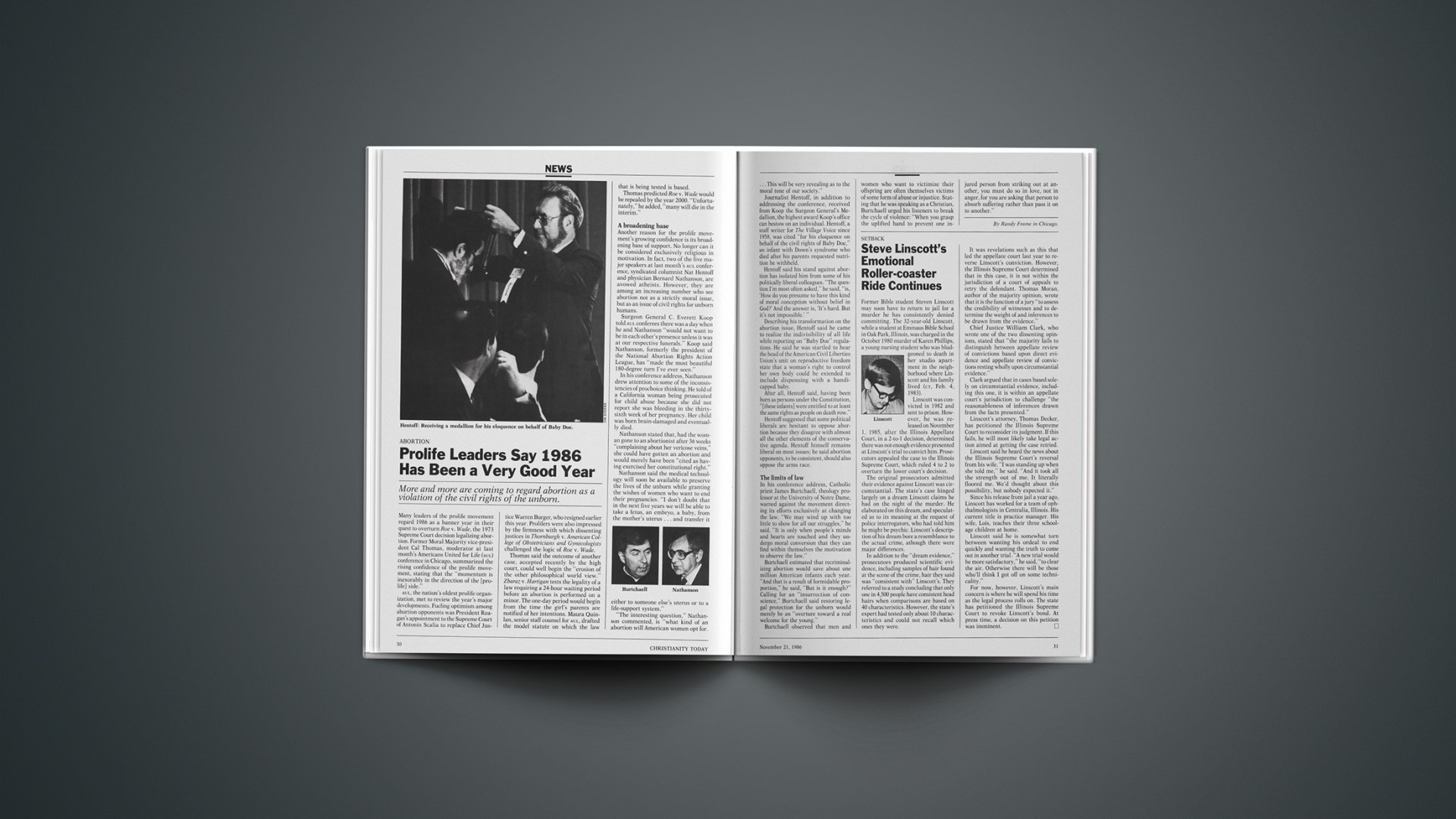
Journalist Hentoff, in addition to addressing the conference, received from Koop the Surgeon General’s Medallion, the highest award Koop’s office can bestow on an individual. Hentoff, a staff writer for The Village Voice since 1958, was cited “for his eloquence on behalf of the civil rights of Baby Doe,” an infant with Down’s syndrome who died after his parents requested nutrition be withheld.

Hentoff said his stand against abortion has isolated him from some of his politically liberal colleagues. “The question I’m most often asked,” he said, “is, ‘How do you presume to have this kind of moral conception without belief in God?’ And the answer is, ‘It’s hard. But it’s not impossible.’ ”

Describing his transformation on the abortion issue, Hentoff said he came to realize the indivisibility of all life while reporting on “Baby Doe” regulations. He said he was startled to hear the head of the American Civil Liberties Union’s unit on reproductive freedom state that a woman’s right to control her own body could be extended to include dispensing with a handicapped baby.

After all, Hentoff said, having been born as persons under the Constitution, “[these infants] were entitled to at least the same rights as people on death row.”

Hentoff suggested that some political liberals are hesitant to oppose abortion because they disagree with almost all the other elements of the conservative agenda. Hentoff himself remains liberal on most issues; he said abortion opponents, to be consistent, should also oppose the arms race.

The Limits Of Law

In his conference address, Catholic priest James Burtchaell, theology professor at the University of Notre Dame, warned against the movement directing its efforts exclusively at changing the law. “We may wind up with too little to show for all our struggles,” he said. “It is only when people’s minds and hearts are touched and they undergo moral conversion that they can find within themselves the motivation to observe the law.”

Burtchaell estimated that recriminalizing abortion would save about one million American infants each year. “And that is a result of formidable proportion,” he said, “But is it enough?” Calling for an “insurrection of conscience,” Burtchaell said restoring legal protection for the unborn would merely be an “overture toward a real welcome for the young.”

Burtchaell observed that men and women who want to victimize their offspring are often themselves victims of some form of abuse or injustice. Stating that he was speaking as a Christian, Burtchaell urged his listeners to break the cycle of violence: “When you grasp the uplifted hand to prevent one injured person from striking out at another, you must do so in love, not in anger, for you are asking that person to absorb suffering rather than pass it on to another.”

By Randy Frame in Chicago

Signs and Wonders in New Orleans

CHRISTIANITY TODAY/NOVEMBER 21, 1986

Charismatics are overcoming the rifts that have divided them.

Looking out into the crowd of some 7,600 charismatic Christians seated in the Louisiana Superdome in New Orleans last month, Pentecostal Holiness leader Vinson Synan posed a rhetorical question: “Wouldn’t it be wonderful,” he asked, “if on Jesus’ 2,000th birthday, we could present to him a majority of the world?”

Winning the world to Christ by the millenium was the oft-repeated theme of the New Orleans ‘86 Leaders’ Congress. And the means to accomplish the task, speakers said, are the miraculous gifts of the Holy Spirit”—healing, prophecy, speaking in tongues, words of knowledge—collectively known as “signs and wonders.”

Synan chaired the four-day event, which included a generous mixture of Catholics, Protestants, and Pentecostals, all with a common denominator: the belief in a baptism of the Holy Spirit as an experience apart from conversion.

Last month’s gathering was just a beginning. Synan, along with a 40-member steering committee, is now planning the main event: the General Congress on the Holy Spirit & World Evangelization, expected to bring 70,000 charismatics to the same Superdome next July. This meeting will mark the tenth anniversary of the landmark 1977 Conference on Charismatic Renewal in the Christian Churches, which drew some 50,000 to Arrowhead Stadium in Kansas City, Missouri.

The leaders’ conference in October served in part as a dry run for next summer. It was also an inspirational rally to urge charismatic leaders to return next July with their flocks.

The Dominant Figure

Some well-known television evangelists did not attend last month’s event, including Kenneth Hagin and Kenneth Copeland, both of whom had schedule conflicts. Conference organizers criticized evangelist Jimmy Swaggart, stating that Swaggart opposed the conference because of the presence of Catholics.

Tulsa evangelist Oral Roberts was on hand. He asked his audience to pray for the struggling Oral Roberts University Medical School, pleading, “Help me kick the Devil in the head.”

Without a doubt, however, the pulse of the conference was John Wimber founder of Vineyard International Ministries and the catalyst for the “signs and wonders” movement in Southern California (CT, Aug. 8, 1986, p. 17) Though still recovering from an angina attack he suffered in June, Wimber was at center stage for much of the meeting. He conducted healing services all three afternoons of the conference.

Wimber later said he felt vindicated by the fact that his often-criticized signs-and-wonders message had so thoroughly permeated the charismatic renewal. “This conference has been an affirmation for me,” he said. “There’s a sense that there’s now a credibility to what I’ve been saying.”

Overcoming Division

Despite a growing unity, there remain signs of conflict in the charismatic renewal movement. Synan observed that some of the disunity that characterized the 1977 meeting still exists. This was signaled in part by the presence of anti-Catholic protestors outside the Superdome.

“There’s joy and pain in an event like this,” said Bill Beatty, chairman of the National Service Committee for the Catholic Charismatic Renewal/Charis-center USA and a member of the conference steering committee. “We’re one in so many ways, and yet we’re not. We have to pray and fast for the Lord to solve our differences.”

Historically, divisions between Pentecostals and charismatics have been deep-rooted. When they began using spiritual gifts in the early 1900s, Pentecostals were ejected from mainstream churches. But charismatics, who began using spiritual gifts in the early 1960s, tended to remain in the churches of their upbringing.

Pentecostals looked askance at charismatics who drank wine or used tobacco. They were shocked at Catholics who claimed their baptism in the Spirit deepened their experience of the rosary and the Mass, and increased their devotion to Mary and the church.

There was also a fundamental theological difference. Pentecostals generally maintained that baptism in the Spirit must be accompanied by tongues, whereas charismatics believed that speaking in tongues, though important, is not the only authenticating gift of the Spirit. The two groups still disagree on this issue, but it is no longer a major obstacle to unity.

The presence of Synan, a Pentecostal, as chairman of last month’s and next year’s events, both reflects and advances the easing of tension between Pentecostals and charismatics. Several Pentecostal denominations that did not take part in the 1977 conference have representatives on the steering committee of the 1987 meeting. Among them are the Church of God (Cleveland, Tenn.), the Church of God of Prophecy, the Pentecostal Holiness Church, and the International Church of the Foursquare Gospel. Though the Assemblies of God has yet to endorse the 1987 conference, three pastors represent the denomination on the steering committee.

Catholics, who made up one-third of the conferees, led last month’s conference in attendance. Episcopalians also were well represented, as were Maranatha Christian Churches, which sent 600 people. Maranatha, based in Gainesville, Florida, has drawn critical reviews in both secular and Christian media for its aggressive New Right politics and alleged authoritarian structure.

Representatives of the 14.5-million member Southern Baptist Convention (SBC) also came to the Superdome. America’s largest Protestant denomination, the SBC has no organized charismatic fellowship. In New Orleans, SBC representatives asked for prayer as they seek to introduce charismatic renewal to Southern Baptists.

Looking Ahead

New Orleans provided an arena for charismatics to outline their ambitious plans to bring the world’s nearly 5 billion people to Christ. Perhaps the most amazing proposal came from Catholic priest Tom Forrest. The former director of the International Catholic Charismatic Renewal Office at the Vatican is leaving in January for the Vatican to head up a worldwide evangelistic effort.

Forrest said the project will cost billions of dollars. In 14 years time, he said, Catholics hope to have three satellites in place for a worldwide Christmas Day broadcast in the year 2000 “to all of humanity saying ‘Jesus Christ is Lord.’ ”

Synan summarized the predominant feeling of charismatics: “We’ve been in the upper room with our spiritual gifts. But we are supposed to go to the streets with our tongues and healings and prophecies. We believe the Pentecostals and charismatics have been raised up by God as the shock troops for the greatest final assault on the enemy.”

Already, 3,000 from last month’s gathering are preregistered for next year’s mega-conference. Donations taken last month not only wiped out the $100,000 debt from the 1986 conference, but gave the steering committee $100,000 in seed money for the 1987 meeting. At that meeting, charismatics will again discuss taking their signs and wonders from the Superdome to Canal and Bourbon streets and to the world beyond.

By Julia Duin in New Orleans.

NORTH AMERICAN SCENE

CHURCH AND STATE

Parents Win Textbook Trial

Fundamentalist Christian parents in Tennessee who objected to some of the textbooks their children were required to read in school have won their federal court case.

The parents maintained the books advanced ideas contrary to Christian teaching. Among the objectionable teachings, they said, were black magic, astrology, pacifism, and male-female role reversal. The books at issue are part of a basic reading series published by Holt, Rinehart & Winston.

Federal District Judge Thomas Hull ruled that the parents may allow their children to skip the reading class, provided they learn to read at home.

Judge Hull said there was nothing wrong with the books themselves. He allowed that many “might find the plaintiffs’ beliefs inconsistent, illogical, incomprehensible, and unacceptable,” but said the plaintiffs’ objections were based on sincerely held religious convictions.

Even though Hull limited the scope of his judgment to the plaintiffs, Anthony Podesta, president of People for the American Way (PAW), called the decision “a recipe for disaster for public education, PAW contributed financially to the defense of the school board sued by the parents.

Michael Farris, lead counsel for the plaintiffs, agreed with Podesta that the case could eventually lead to basic changes in public school policy. “For those school districts that have shown religious tolerance and cooperation, there’s no change,” said Farris. “For those districts that have had the position that there is only one way to teach, it’s going to be a rude awakening.”

AIDS

A Baby’s Death

The death of a 20-month-old child from AIDS spawned a tremendous outpouring of grief from the congregation of the Oak Grove Presbyterian Church in the Minneapolis, Minnesota, suburb of Bloomington.

Jessica Hazard contracted the disease through blood transfusions she was administered in 1984 at the Minneapolis Children’s Hospital, where she was born 12 weeks premature. After her parents announced she had AIDS, Jessica was temporarily banned from the Oak Grove church’s nursery. However, many Oak Grove parishioners took an active interest in her condition. The church conducted a series of meetings on AIDS and related problems, and made information available, including counseling advice, on the disease.

The disease reduced the baby’s functioning level from nine months to three. Jessica’s mother, Dorothy, said her daughter “never walked and didn’t talk. But you knew the Spirit moved in her. She smiled a lot, and she loved to be hugged and cuddled. Jesus worked miracles in her.”

PEACE

NAE Issues Guidelines

The National Association of Evangelicals (NAE) has published a set of guidelines for its Peace, Freedom and Security Studies program. The NAE launched this program more than two years ago, when it “committed itself to a more serious and sustained entry into the organizational, educational and public opinion arenas in which America’s role in world affairs is shaped,’ according to an organizational press release. The new guidelines seek to provide a framework to improve the knowledge and skill of evangelical leadership “in supporting religious liberty, promoting the security of free societies and encouraging progress toward the non-violent resolution of international conflict.”

NAE president Ray Hughes said the publication “could be a historic, watershed document in the life of the evangelical church.” Hughes said the guidelines put the NAE “in the position of influencing the moral direction of our country’s policy.”

Billy Melvin, NAE’s executive director, said, “Our program offers a different focus, analysis, and prescription for work in the pursuit of peace. Alternatives to violence in world politics must be developed. We will challenge both ends of the political spectrum.…

NAE represents more than 46,000 churches from some 78 Protestant denominations.

PEOPLE AND EVENTS

Briefly Noted

Named: John J. Davis as the president of Grace College and Grace Theological Seminary in Winona Lake, Indiana. He replaces Homer A. Kent, Jr., who will return to full-time classroom teaching. Davis, who has written 13 books, is the fourth president in the institution’s 50-year history.

Died: Clyde S. Kilby, who established and was for 15 years the curator of the Marion E. Wade Collection at Wheaton College (Ill.). The collection today is a renowned research center containing the writings of Owen Barfield, G. K. Chesterton, C. S. Lewis, George MacDonald, Dorothy L. Sayers, J. R. R. Tolkien, and Charles Williams. Kilby died in his sleep at his Columbus, Mississippi, home on October 20. He said in a 1977 interview published in CHRISTIANITY TODAY, “Imagination provides the willingness and possibility to get on the other side of the fence.”

Rose Warmer, whose missionary career took her to the concentration camps of World War II; September 19 in Haifa, Israel, at age 77, of a massive heart attack. Warmer was born and reared in a Jewish family in Hungary. She became a Christian in 1939 and was free from the danger of arrest because of her church membership. In 1944, however, she allowed German police to arrest her. She spent the last year of the war in Auschwitz and several other prison camps, sharing her faith among prisoners. For the last 36 years of her life she distributed Bibles in Israel. Though formally affiliated with Hebrew Christian Fellowship in Philadelphia, she was also sponsored by the Pocket Testament League, the Million Testament Campaign, and Bible Literature International.

Dismissed: By a federal judge, allegations by Lutheran and Presbyterian congregations in Phoenix, Arizona, that undercover government officials violated their constitutional rights. The congregations objected specifically to the use of bugging devices by federal agents seeking evidence related to the churches’ illegal harboring of undocumented aliens. Judge Charles Hardy said the First Amendment protects religious freedom for individuals, but not for the corporate expression of the church.

Classic & Contemporary Excerpts from November 21, 1986

It’s Hard To Hear

Miniature tape players are no doubt traffic hazards, and they certainly feed the hedonism that is the fate of America in the late 20th century. But perhaps their greatest danger is to call into existence still one more competitor to the voice of God.

Mark Noll, “The Walkman Cometh,” in The Reformed Journal (July 1986)

No More Fugues

The idea that one would build a chair or write a fugue for the sake of making the best chair or music one can is foreign to our culture, even our religious culture. When we ask “Will it fly?” we mean “Will it sell, will it catch on?” If we are being idealistic, we may translate that into “Does it have a message?” Either way, it is taken for granted that the work must have some purpose outside itself.…

Which is why hardly anyone writes fugues anymore. Last year we celebrated Bach’s 300th birthday and loaded him with all sorts of meretricious accolades—all because he was one of us and an aesthetic feather in the cap of the Protestant church. Yet Bach … certainly could not make it at all today in the Amy Grant market. What kind of “message” does a fugue have, after all, except the precision and balance of its own form?

Virginia Stem Owens, “On Eating Words” in The Reformed Journal (June 1986)

Separation From God

What gnashing is not a comfort, what gnawing of the worm is not a tickling, what torment is not a marriage bed to this damnation, to be secluded eternally, eternally, eternally from the sight of God?

John Donne in Sermons (No. 76)

Created By Love

The beasts of the field say: “Love made me.” The birds of the air say: “Love made me.” The creatures that swim in the rivers and the sea say: “Love made me.” Only man, his back turned to the sun, does not say “Love made me.” But when he turns round in the light of Christ, then he too knows in his heart “Love made me” and he cries out with every living creature, “Love made me! My Father in heaven loves me.”

Michael Sellers in The Word of God and the Wisdom of Man

Rot Begets Rot

I have no potency to influence for good in the “things that are touched” [Hag. 2:12–14], but am capable of influencing for evil.… This is a strange principle—rot will encourage rot, but one ripe piece of fruit will not allay rottenness in another. Surely righteousness has the power to make righteous, if it be found in strong enough proportions; but in Israel it was not so. God was not satisfied with their carelessness regarding His house and made their work profitless.

Jim Elliot in The Journals of Jim Elliot

What Good Is Pain?

Sometimes it is spiritual pain which makes us aware that we need a transfusion. Just as physical pain is a marvel for the human body, an early warning system, so is spiritual pain.… We are all part of this battered, bleeding bride, struggling to regain beauty and purity. And there is nothing, nothing but a transfusing love, which will make any difference at all.

We need our pain warnings before we can turn to love. Yet if we watch television or read magazines, we often come across a different attitude toward pain: avoid it, deaden it. But when we take a pill, when we kill the pain, we don’t heed its warning.

Madeleine L’Engle in A Stone for a Pillow

Making Life Worthwhile

Either life is always and in all circumstances sacred, or intrinsically of no account.

Malcolm Muggeridge, quoted by David Boehi in Worldwide Challenge (JulylAug. 1986)

Whatever Happened To Sacrifice?

Sacrifice is a word a power-hungry church just doesn’t understand. A church that cares about power—the power of a large membership, power in the world, political power, television power or persuasive opinion power—doesn’t know the principle of sacrifice. [Far too many Christians have neglected and even repudiated the example of Jesus Christ, who eschewed coercion in favor of quiet persuasion and whose] method of acting was his willingness to die for those who would not die.… [When Christianity seeks to] arrogate power to enforce its righteous principles upon the whole world, it is in no way dying. This is in no way sacrifice.

Walter Wangerin, Jr., quoted by Bruce Buursma in the Chicago Tribune (Aug. 8, 1986)

Cover Story

Can the Church Mend the Anguish of a Nation?

The question of South Africa looms large. How long can a relative handful of whites rule a nation of blacks and colored?

For the Christian, a second question looms larger: What is the South African church doing to prevent injustice and bloodshed?

Seventy-seven percent of the South African population adhere to Christian denominations. Many of them would say the church, through its actions, seasons and lights the world. They would assert that only the church holds the solution to the civil strife caused by an official government policy of racial discrimination. But what flavor is the South African church adding to the boiling pot of an apartheid-torn society? What light is it shedding on the frantic attempts to dismantle apartheid before bloody revolution destroys the country?

As the world watches South Africa’s struggle, Christians realize the witness of the church may be on the line. Has God allowed an opportunity for the church to demonstrate to the world that the unsolvable can be resolved?

To find out what the church is doing, the Christianity Today Institute sent a team of four researchers to visit Christian leaders, denominational officials, pastors, and active lay Christians in South Africa.

Frederick Hale, currently a visiting professor at Luther Northwestern Seminary in St. Paul, Minnesota, took one of his two doctorates at the University of South Africa in Pretoria; Irving Hexham, assistant professor of religious studies at the University of Calgary, studied for a year at Potchefstroom University in South Africa; Terry Muck is executive editor of CHRISTIANITY TODAY magazine; and Paul Robbins is chief operating officer of Christianity Today, Incorporated.

The research team spent three weeks touring the country, taping over 100 hours of face-to-face conversations. The question was simple: What is the church doing in the face of civil and social unrest?

Like the complexity of the apartheid problem itself, the answers ranged widely in terms of hope and fear, optimism and pessimism, energy and exhaustion. The following report reflects those contrasting attitudes, yet uncovers a common thread: God’s enduring presence in a country on the brink of disaster.

Mention South Africa, and most Americans think of some nameless, televised shantytown. Black South Africans run through the streets—either toward an angry knot of protesting people, or away from helmeted riot police. The surreal crack of rifle fire punctuates the confusion. A human being is killed. “That brings the total number of blacks killed since the South African government instituted a state of emergency two years ago to 2,750,” intones the news reporter.

Sometimes, such frequent reports of horror become cliches. Their repetition desensitizes us. The South African visual cliche, however, has not. Perhaps the image recalls days from our own turbulent sixties—after all, the red clay streets of Soweto are not all that different from the red dirt of Georgia. And the scenes remind us of other blacks and policemen from a time we would like to forget.

The South African cliche has become a spur to action, a single-pointed irritant that keeps stabbing at us to do something. Seeing the same offensive image over and over simplifies the issues: South Africa equals apartheid. Apartheid equals killing. The killing must stop. And while truisms of this sort may galvanize action against injustice, the South African paradox is this: The cliche of apartheid-induced violence has effectively stimulated action in people two continents away, but it has only widened the gap between blacks and whites in South Africa.

Most Americans would agree to this truth: Apartheid is an immoral system of social organization. For those who live in an apartheid-run country, however, that truth bumps up against several nagging realities:

  • From a white South African point of view, apartheid has “worked,” economically. The standard of living for white South Africans rivals that of any Westernized, capitalistic culture. And the blacks in South Africa live on a higher economic scale than blacks in other African countries.
  • Most South Africans never see and rarely hear about the violence we see on television.
  • Disagreement over how to change the apartheid system does not break cleanly along black/white lines but cuts across every demographic line imaginable. It is a situation that confuses foreign visitors who visit South Africa convinced that apartheid is a simple case of black versus white. Coretta Scott King, widow of U.S. civil-rights activist Martin Luther King, Jr., recently visited South Africa and came away bewildered by the issue: “It’s far more complex than I initially thought.”

For South Africans, apartheid-created separation and even violence is not a cliche, but a confusing, frightening, and frustrating way of life that seems impossible to solve.

The Complexities

What factors make apartheid so confusing, even for members of South African churches who share Christian concerns for human rights? We asked the faculty of the Cape Evangelical Bible Institute near Cape Town to convene a group of interested Christians, and at that meeting we raised the question, “What should be done about apartheid?” We heard the following:

From a colored (mixed race) lecturer at the institute: “Let’s just get together. We need to integrate this country now.”

From a white Baptist businessman: “We all know that integration by unnatural means will never work. We can’t just bring a busload of blacks from a township 20 miles away to a worship service in our church. We need to change the laws first. Then churches can be integrated naturally.”

From a white Lutheran pastor: “If the laws change, fine. But I’m tired of having guilt laid on me for things the National party did in 1948.I didn’t vote for them then and haven’t voted for them since.”

From a white Anglican pastor: “But surely repentance must be an ongoing thing for all Christians. That’s the way to change things.”

From a colored pastor: “The only thing that can possibly save us is the imminent return of Christ. We need to pray for him to come quickly.”

From a white lecturer at the college: “The Scriptures clearly point out what’s wrong with apartheid. We must teach biblical truth to as many people as we can.”

From a black student: “The government only understands one language: force. We must hurt them in the pocketbook through sanctions.”

Asking South Africans what they think should be done to end apartheid (and the majority of South African Christians—50 percent of the whites and most of the blacks—will at least say it should be done away with) is like asking the American man on the street how to end war. A consensus will never emerge from such a poll.

Similarly, it is almost impossible for the individual South African, black or white, to see how apartheid can be dismantled without enormous cost, both in bloodshed and economic loss. They have lived with, and many have suffered under, this system for almost 40 years. Such a drastic change requires a great deal of momentum.

The Divisions

Consider the following divisions among blacks:

  • Young blacks are far more likely than older blacks to favor active resistance. Young black leaders, some calling themselves comrades, control many townships, those government-created reservations on the outskirts of the major cities where blacks who work in urban areas must live. (In South Africa, the black ghettos tend to ring the cities, like human handcuffs, while the exclusive white areas generally are in the cities themselves, the reverse of the American suburban/urban system.)
  • Poor blacks regularly chastise their middle-class brethren who join the army, police, government bureaucracy, and business community (not all South African blacks are poor). These “collaborators” face verbal harassment, attacks on their homes and businesses, and in some cases “neck-lacing”: having a tire forced over their heads and shoulders, filled with gasoline, and set on fire.
  • Blacks of different tribes, such as the Zulus and Xhosas, frequently disagree on whether their resistance to the white government should be conciliatory or confrontive. Since tribal loyalties are strong, this difference in opinion about strategy can revive centuries-old conflicts clothed in the apartheid issues of the day. There are at least nine major black tribes.

Whites are almost as divided in their solutions to apartheid. One can find Afrikaners (the Dutch-, German-, and French-descended rulers of the country) who agree apartheid must go. They support the current government’s self-proclaimed policy of gradually reducing the restrictive laws that discriminate against nonwhite races. But a growing group of reactionary whites vow to fight for the policies of apartheid. For them, all the old defenses of apartheid still seem valid: the need, indeed desirability, of races to remain separate; the effectiveness of apartheid-inspired economics; and the hopelessness of trying to change things now.

Representative of this group politically is Daan van der Merwe, a member of Parliament for 20 years and a former minister of the Dutch Reformed Church. Until 1982 he belonged to the ruling National party. When it began gradually to reduce some apartheid policies, many Afrikaners and some English-speaking whites felt their interests were being abandoned. They formed the Conservative party (CP) and van der Merwe joined: “Most of the Afrikaners I know are moving our direction. President Botha is going to lose the next election in South Africa. He is doing what he calls broadening the democracy, but most Afrikaners don’t know what he means by that. Whites feel frustration, uncertainty, and doubt about their future as a race. The current government has no respect for the real cultural identities. We think we have a right to survive as a group.”

Beyond the question of survival, conservative South African whites genuinely see no wrongdoing on their part. The closest most will come to admitting some kind of culpability is to say they did not do enough to promote black economic and cultural development in the fifties and sixties. But even then they hedge. Van der Merwe exemplifies this when he says, “The Afrikaners have never dominated the business community. The British are more responsible for whatever economic exploitation was done of blacks.”

Yet the growing political strength of conservative whites is real. Although many of the political party leaders, such as van der Merwe, would not advocate unprovoked violence against blacks, they are certainly in favor of defending their interests by using force even more extensive than the current government uses. Political science professor P. J. J. S. Potgieter sees the fringes of this group (represented by the radical African Resistance Movement) creating more interracial violence: “The real danger is increased white resistance, … white vigilantes shooting black people, driving through black areas and throwing bombs, sending warnings to blacks that they won’t give up their places of power easily.”

Separation

From a distance, the injustices of apartheid offend our sense of justice and fair play. Are there not significant numbers of decent whites willing to work against the problem? The problem is, they do not see it—both literally and figuratively. Physically, apartheid has effectively kept the races separate. It is quite possible to visit South Africa, tour the major metropolitan areas of Pretoria, Johannesburg, Cape Town, and Durban, and never realize anything unusual is happening. It is also quite possible to take excursions along the major highway systems to smaller towns such as Rustenburg, Potchefstroom, Stellenbosch, and Pietermaritzburg and still not see the problems. Unless one makes a special effort to visit townships such as Mamelodi and Soweto, homelands such as Zululand and Bophutatswana, and the leaders from all the churches and ethnic groups, it is quite possible to come away from brief visits to South Africa and think the problem is blown way out of proportion.

It is equally possible to live in South Africa and think the same thing. Such isolation should not surprise us. Upon returning to America, one of our group asked his Sunday school class of suburban Chicagoans how many of them had ever been to the ghettos of Chicago. Fewer than 25 percent had. The question was not raised to point up their lack of concern but to show how our living habits are patterned and restricted. In South Africa, where residential areas have long been set up specifically to separate the races, the problem is even worse.

One South African Dutch Reformed minister told of a phone call he received from a parishioner whose black servant had died suddenly.

“Have you notified the servant’s relatives?” asked the minister.

“I don’t know where he lived,” replied the parishioner.

“Then check with the government registration office.”

“But we don’t know his name. We only knew him by his first name.”

“How long did he work for you?”

“Thirty years.”

This depersonalization of the blacks is exacerbated by the governmental restrictions on the news media. Until two years ago it was possible to report on riots and disturbances in black townships. When the government realized, however, the impression this was leaving on world opinion, it put severe limitations on news coverage of South African internal affairs. It is currently illegal for news agencies to be near disturbances or to report, by name, people arrested by the government for antiapartheid offenses. News agencies must comply with these restrictions or face the possibility of losing their reporters’ visas.

The problem is even worse for South African news media. Only a small percentage of problems in the townships are reported in the media, and then in little detail. Consequently, it is possible for long-time residents to say, “I don’t think it’s as bad as you Americans make it out to be.”

The Complexity For The Church

For South African churches, the problem is both simple and complex. To the majority of South Africans who find apartheid morally objectionable, the church clearly has a prophetic role: It must speak out against the injustices and work to dismantle the system.

However, up close it again gets complicated. We met with a group of five black pastors of churches of varying sizes. One of the men characterized the agony of trying to minister to divided congregations:

“We are standing between the church and the politicians. We stand for a message of reconciliation, but many people accuse us of being sellouts. They don’t appreciate a message of reconcilation. The younger ones especially want a message of revolution. But they are young politicians, and we are ministers of the gospel.”

The minister continued: “As a minister, you cannot side with any organization whatsoever. Groups in my church come to me and ask me to conduct a funeral. I go, sympathetic, wanting to preach reconciliation. But it ends up that I am identified with the political agenda of the group at the funeral. Another group asks to use the church building for a meeting. I must say no, or the police will consider us accomplices; but when I say no, the group considers me a traitor. They are politicians and I am a minister, but they don’t see the difference.

“But my resolve to stay out of politics and preach reconciliation is severely tested sometimes. Three weeks ago a 66-year-old woman from our church was shot by a policeman for no reason at all. Our church mourned for a long time. But I was asking myself, Am I really a pastor if I shut up while my members are being killed?”

Ironically, many of the whites behind the weapons are also church members. How did the body of Christ become so divided?

The Church’S Historical Role

When representatives of the Dutch East India Company planted their Dutch Reformed Church (DRC) at the Cape of Good Hope in 1652, it began a Christian tradition of separation. Later in the seventeenth century, Huguenot refugees from Catholic France settled at the Cape and were assimilated into the Dutch Reformed Church, or Nederduitse Gereformeerde Kerk (NG Kerk).

Other denominations were initially forbidden, but in 1779 the numerous German Lutherans in the colony were allowed to construct a chapel. Owing to intermarriage and general assimilation, much of the German element joined the Huguenot strain in the Calvinist, Dutch-dominated culture that eventually became Afrikanerdom. Originally responsible to the mother church in the Netherlands, the NG Kerk at the Cape became autonomous in 1824, and 35 years later it began educating its own clergymen at Stellenbosch near Cape Town.

In the 1850s, Afrikaners who had migrated from the Cape to the Transvaal formed two smaller Dutch-dominated denominations: the Nederduitsch Hervormde Kerk (NH Kerk) and the Gereformeerde Kerk. This triad of church bodies remains today the religious cornerstone of Afrikanerdom, and is most often referred to as the Dutch Reformed Church.

When the British gained control of the Cape early in the nineteenth century, immigrants added not only Anglicans, but also Presbyterians, Methodists, Baptists, Congregationalists, and Roman Catholics to the denominational constellation. The discovery of diamonds and gold (1870s and 1880s) brought even more forms of Christianity along with the prospectors and seekers of instant wealth. After the turn of the century, various kinds of Pentecostalism and sects on the periphery of Protestantism became the final chips in the kaleidoscope of South African white Christianity.

Ironically, nineteenth-century evangelistic efforts created an integrated church. What do you do with all the coloreds who got saved? In 1829, the synod of the NG Kerk decreed that Communion was to be administered “simultaneously to all members without distinction of color or origin.” The Lord’s Table was thus temporarily more unified than society. However, given the general social segregation of the races and the European attitude of cultural superiority, these early attempts to integrate the church did not remain unchallenged.

By 1857, the synod conveniently handled the problem of coloreds and whites worshiping together. While emphasizing the scriptural desirability of racially integrated congregations, it allowed, in a frequently quoted proviso, that “where this measure, as a result of the weakness of some, impedes the furtherance of the cause of Christ among the heathen, the congregation from the heathen … shall enjoy its Christian privileges in a separate building or institution.” By 1881, a separate Dutch Reformed denomination was created for the coloreds. With more than 500,000 members, this Sendingkerk, or Missionary Church, became one of the largest denominations in South Africa.

By contrast, the missions of the Dutch Reformed churches to blacks yielded separate congregations from the outset. This was inescapable because of linguistic differences, a factor that had not set apart the coloreds (who spoke Dutch and later Afrikaans) from their white confessional fellows. Called the NG Kerk in Afrika, the black Dutch Reformed body numbers over 1,100,000 adherents and relies heavily on the white parent body. It is less critical of the white church than is the colored Sendingkerk.

The two smaller Afrikaner denominations, the NH Kerk and the Gereformeerde Kerk, have also conducted missionary work among nonwhites. They, too, have branches for those believers who do not belong to the Afrikaner volk. Indeed, Article III of the former denomination’s constitution expressly bars nonwhites from membership in the main body, ostensibly on the grounds that Matthew 28:19 (“Go therefore and make disciples of all nations”) mandates separate churches for the individual nations, or ethnic groups. Again, confessional similarity is subordinated to racial and cultural differences.

While the Afrikaner denominations were institutionalizing segregation within themselves, the Anglophone churches were also pursuing missionary work and, to a limited extent, advocating the legal equality of the races. But they, too, have always been composed of whites holding attitudes leading to racial separation. Until very recently, multiracial worship was a rare phenomenon among them, and it is still far from common. “In this respect,” notes Prof. Charles Villa-Vicencio, a Methodist theologian at the University of Cape Town, “the English-speaking churches are almost as racially divided as the Afrikaans Reformed churches.” This seemed not to bother Anglophone parishioners any more than it did most Afrikaners. Until well into the twentieth century, missionaries complained frequently about white settlers’ opposition to evangelism. This hostility led to the formation of separate churches for indigenous converts and settlers.

De facto segregated churches could hardly be expected to raise a prophetic voice against segregation. Churchmen rarely protested against the restriction of blacks to “locations” at that time, or the implementation of the “pass” system that, until this year, regulated the movement of black migratory labor. Whether by commission or omission, practically all the white churches contributed to the institutionalization of racial segregation long before “apartheid” became a political rallying cry during the 1940s.

In the wake of massive black urbanization during World War II, the Afrikaner-dominated National party adopted apartheid as the key plank of its platform. The result? It was rewarded with a watershed victory in the parliamentary elections of 1948 and has been in power without interruption for 38 years. As critics have often pointed out, the Afrikaner denominations began as early as 1932 to lobby for increased racial legislation. In 1948 Die Kerkbode, the periodical of the NG Kerk, could boast that “as a church we have always worked intentionally for the separation of the races. In this respect, apartheid can justifiably be called a church policy.”

Until quite recently, many NG and NH theologians vigorously defended this position and repeatedly attempted to bolster it with biblical proof texts. Among their favorites were the scattering of peoples from the Tower of Babel in Genesis 11 and Paul’s sermon to the Athenians in Acts 17, in which he declared that God had “made every nation of men, that they should inhabit the whole earth; and he determined the times set for them and the exact places where they should live.”

Theological Underpinnings Of Apartheid

Popular wisdom suggests apartheid is Dutch Calvinism run wild. Calvinists did influence apartheid, but that influence is usually exaggerated. In a book called The New Faces of Africa, University of South Africa (UNISA) professor David Bosch discusses the “Calvinist paradigm,” and refutes the view that Calvinism alone forms the ideological underpinnings of apartheid. Bosch maintains that Calvinism was not the primary factor in early Akrikaner religious/political convictions.

During the Afrikaners’ political struggles for power with the British in the late nineteenth and twentieth centuries, however, they needed an ideological framework to support the nationalistic loyalties of their people. Calvinist theology, with its doctrine of election, adapted easily to Afrikaner nationalism. Abraham Kuyper’s Dutch Calvinist revival, with its slogan, “In Isolation Lies Our Strength,” helped renew an interest in Calvinism in the Netherlands; on South African soil, Kuyper’s ideas were adapted to local circumstances. In the face of British chauvinism, the Afrikaners identified themselves as a chosen people, justifying their status as a separate ethnic group in power.

Although the process of self-identification took many years, one incident welded incipient Afrikaner nationalism with the idea of a divine destiny. When the British gained control of the Cape Town area, the Afrikaners undertook the “Great Trek,” a mass migration inland and northeast. It was a very difficult journey, but created a sense of unity and solidarity that they were a people in the process of creating their own destiny. Prior to a major battle near the end of the trek, the Afrikaners vowed to build a church if God granted victory over the 10,000-strong Zulu army. With only 500 men, Andreis Pretorius defeated the Zulus in the Battle of Blood River.

The covenant of Blood River sealed Afrikaner history with the Old Testament image of a chosen people. Afrikaners began to view their history as sacred. As F. A. van Jaarsveld notes in The Awakening of Afrikaner Nationalism, Afrikaners began to refer to themselves as “a medium … in God’s hand” to prevent robbery, murder, and violence, and to promote “Christian civilization.”

Specific biblical support for apartheid gradually grew in the thirties through the fifties. In addition to the passages already cited, an elaborate religious/political parallel between the Afrikaner and Israel was developed by such people as the Afrikaner poet Totius (J. D. DuToit), who referred to Afrikanerdom as another Israel. His poetry was read by many thousands of school-children, fixing in the minds of several generations the divinely chosen character of their nation. Theology in South Africa fell from its reign as the queen of the sciences to serving as the handmaiden of politics.

Although few modern proponents of apartheid feel comfortable with much of this self-serving use of Scripture, the residue among Afrikaner nationalists remains strong. Even when specific passages are not marshaled to support apartheid, many Afrikaners do not see it as incompatible with the teachings of Scripture. Many still see their role as a favored race unchanged. Thus, a great deal of fundamental theological retraining needs to be done to demonstrate apartheid’s heretical nature.

Few prominent Afrikaner theologians still express support of apartheid, though until recently, many have not explicitly disavowed it. In 1982, both the NG Kerk and the NH Kerk were suspended from membership in the World Alliance of Reformed Churches for “not only accepting, but also justifying the apartheid system by misusing the Gospel and the Reformed confession.…” The NH Kerk subsequently withdrew from the WARC. The NG Kerk reversed its position at its October 1986 synod, though that action still allows local churches to remain segregated if they so choose.

What The Churches Are Doing

As vigorously as the two largest Dutch Reformed denominations championed apartheid in the forties and fifties, so some churches today—both DRC and others—hack away at the roots of racism. Some action comes from denominational bodies. More, though, comes from individuals and Parachurch organizations dedicated to eradicating apartheid.

Foes of apartheid use either theological arguments, interpersonal techniques, political tactics, or combinations of all three. Likewise, unusual alliances of different denominations, disparate ethnic groups, and a variety of theological viewpoints join hands for the common fight. The ideological revolution against an archaic form of social organization has mobilized the church into bands of justice seekers with a common goal: the establishment of a new social system in South Africa.

The strategies. Theologians and ethicists are attacking on several different fronts. Some, like Klaus Nürnberger, a theologian and professor of social ethics at the University of South Africa (UNISA), call for retraining the South Africans’ views of social relationships. The need for reconciliation is clear, he says, but moving too quickly toward trying to reconcile black and white is putting the cart before the horse: “If you look closely at the social structure of the country, you have two distinct levels: people of privilege (the whites) and people of no privilege (the blacks). The relationship between the two groups is vertical. That is, the people of privilege can only look down on blacks or despise them. The people of no privilege have only two choices also: they can either be submissive or rebellious. Biblical relationships like love, forgiveness, and honor, however, require a horizontal relationship between people. Before true reconciliation can take place, we must build these people up so they’re in a horizontal relationship. Then they can reconcile.”

Other South African theologians focus on relating the kingdom of God to the South African situation. They would like to see Christians place their hope in God rather than in a new government or cultural order. Prof. B. J. van der Walt, director of the Institute for Reformational Studies at Potchefstroom University, characterizes this approach. In addition to scholarly publication and classes at the university, the institute holds conferences for pastors and laymen with this purpose: “We encourage a broader vision of the kingdom so that people see how the Bible and faith in God relate to everyday living. First we show the relevance of the kingdom of God to South Africa today. Second, we show the relevance of this kingdom for integration. It is a kind of missionary effort to show people that their religion is not for churches only, but has relevance for all society. We are trying to combat apartheid of the mind as well as apartheid of races.”

Prof. J. A. Heyns, a systematic theologian at the University of Pretoria and a prominent minister in the NG Kerk, still sees hope for working through the traditional institutions of church and denomination. He is currently helping to rework a denominationally published booklet called Human Relations in the Light of Scripture, a biblical corrective to apartheid-inspired racial hatred. He says, “We must not overlook the power of the pulpit to change people’s minds. Sunday to Sunday we have thousands of people sitting in our pews. We must liberate our people from our own history and ideological fixation of being a privileged people in this country.

“What does it mean to be created in the image of God? Does that mean some races are and some aren’t? Of course not. It means that human beings, irrespective of race, are created in the image of God. Our people need to hear that over and over.”

A key scriptural passage needing special attention is Romans 13. Many South African Christians, both in the Dutch Reformed churches, and other conservative Protestant churches, have never been able to dislodge themselves from a traditional, limited understanding of the passage—that one submits uncritically to the government. The result, says Michael Cassidy, president of Africa Enterprise, is that “in the areas of socio-political concern and insight, evangelicals are Johnny-come-latelies. We are probably where evangelicals in the United States were 30 or 40 years ago.” Cassidy advocates regularly teaching a more comprehensive understanding of Romans 13, so that evangelicals can confidently challenge the injustices of apartheid without losing the biblical sense of supporting the government.

The Activists

Antiapartheid activists believe you can not only lead a horse to water, but that you can make him drink if you apply the right kind of pressure. For them, the agenda calls for relentless pushing and pulling until South Africa drinks deeply from the well of racial equality.

Although these activists do not denigrate the careful theological work needed to counter the heresy of apartheid, they have little patience for it. Why write fire prevention rules in a building already on fire? Likewise, they do not minimize the interpersonal training needed to seed the grassy meadow of friendship and love.

But when it comes right down to it, they have little tolerance for slowness and trust building in a country where breaking promises has become a political art.

We met with 25 black seminary students at Marang Lutheran Seminary near Bophutatswana, a recently created independent homeland within the borders of South Africa. The government has created these “nations” (which no other country in the world recognizes as nations) so that the millions of blacks within them cease to be a financial drain on the economy (and perhaps so they have no hope of becoming a future voting bloc in South African politics).

We asked a simple question: What would you like to say to the people of America? After a moment or two of silence, they began to speak. Their comments were full of hostility toward America, President Reagan, and U.S. policies toward South Africa. “Reagan is just a cowboy who somehow has become president of the world’s most powerful country. He can’t imagine what it’s like for us here.”

Their recommendation: sanctions (which have since been imposed by the U.S.). “We know we will suffer. But we are suffering now. It could not be much worse.” They spoke with feeling and eloquence. Their logic was sometimes thin, but the intensity of their feeling never flagged.

That feeling characterizes many blacks in South African churches. They sense the time for talk is past. It is time for action, something the government will understand. Some have only recently come to this conviction.

Charles Villa-Vicencio followed this route. After starting out as a good Afrikaner child, “God got hold” of him, and his perspectives changed. He undertook theological training at Rhodes University in Grahamstown, then went overseas to study at Yale and Drew. He returned to pastor several churches in Cape Town. “Eventually I passed over a divide that exists in the institutional church in South Africa. The divide is this: when you finally come to believe that obedience to Jesus Christ means being on the side of the poor, the oppressed, the widows, the marginalized people of society. That is my belief, but that is not every church member’s belief, and that is what divides the church.”

From his current post as professor of religious studies at the University of Cape Town, Villa-Vicencio sees part of his actions as reducing the time gap inherent in a conservative church: “The church always lags behind the needs of society. The African National Congress is where the action is; the church is way behind what it is doing. The black churches are closer, perhaps only a year or two behind. Most white churches are five or ten years behind. Many will never catch up.

“Christians in this country are being compelled to reassess their own identity as Christians. What are my fundamental loyalties? What are my fundamental values as a Christian? Property? Wealth? Culture? Or is it something else? It is truly taking up the cross and following Christ. It’s out of that situation and decision that my theology has begun to grow and emerge.”

What is the shape that theology has taken for Villa-Vicencio and others like him? For one thing, it has meant the production of several important documents calling for reform. Like all such statements, most of these efforts are quickly forgotten. A recent one, the Kairos Document, seems to have grabbed the attention of the church more than most, even though many who signed it recognize its weaknesses. The document challenges the church to stand up to what its drafters see as an immoral government: “A church that takes its responsibilities seriously [toward the moral illegitimacy of the apartheid regime] will sometimes have to confront and disobey the State in order to obey God.” Using the Greek word kairos, meaning a special moment of truth, the document calls for immediate action.

This treatise was produced in Soweto, the strife-torn black township southwest of Johannesburg. Though it is the work of theologians, church leaders, and ordinary Christians, many Christians opposed to apartheid did not sign it, citing language that advocates physical force.

Notably absent from the signatories was Archbishop Desmond Tutu, for many years associated in various roles with the South Africa Council of Churches (SACC). Under the leadership of Tutu and others, the SACC has worked hard to walk a fine line between the radical fringe of the church calling for violence and the more moderate, nonviolent core of the activists.

The SACC is one of the most frequently quoted organizations in South Africa. When the “church’s position” in South Africa is sought, Desmond Tutu is the willing and quotable voice most often heard. Some have questioned whether he indeed represents the majority of South African Christians. Obviously, he does not speak for the Afrikans-dominated white denominations. Nor is he the voice of tribal Christian religions like the Zion Christian movements. Neither Tutu nor the SACC represents the Pentecostal or Baptist churches. But the SACC does represent those in the Methodist, Anglican, Lutheran, and other churches. And this is an active group in South Africa.

Peter Storey, pastor of the Central Methodist Church in Johannesburg and past-president of the SACC, outlined the latter’s program as he saw it: “First, proclaim the Christian doctrine of man and show its incompatibility with apartheid; second, bind up the broken; third, the church must live the alternative to apartheid in its community life; fourth, develop Christian strategies to actually bring about change.

“This is where most Christians differ. Some feel violence is an acceptable strategy; I don’t, and I would say the majority don’t. Others, a growing group, favor more economic strategies, such as sanctions and divestment. I would say our church, the Methodist church, is moving strongly in that direction. We’ve explored everything else and nothing happens. The only thing that has shifted the South African government has been pressure.”

The communist threat. Charges of being sympathetic to communism fly around the most visible leaders of the SACC. Most observers agree they are ill-founded charges, but because the rhetoric and strategies used by the SACC often overlap some of the same ones used by the political Left, the charges remain.

It does not help that the banned African National Congress (ANC), which many think the SACC tacitly endorses, reportedly operates on a high-octane mixture of communist idealists and black South African nationalists who are indifferent to communism. The fear of communism usually lurks on the edges of destabilized social settings, fueled by Lenin’s famous comment to revolutionaries: “We will find our most fertile group by bringing Marxism through the religious sector of any country because religious men are easily bluffed and will accept almost anything if it is clothed in religious terminology.”

Yet the Christian commitment of the activists in South African churches is apparent. Their willingness to act forthrightly, sometimes flying in the face of civil law, reveals a church that is unafraid of pursuing justice. And while we may not like the willingness of some to use force, we can understand it. We visited Mamelodi, a township outside Pretoria. The overwhelming impression of this township and others is not necessarily that of poverty. The townships are indeed poor, made up of largely substandard housing. But the dominating impression is hopelessness. Residents of townships must live there—either that or return to equally bleak homelands. The option of force seems tempting indeed when a caged look stares heavily from the faces of South African blacks.

The Reconcilers

Facts are facts: South African blacks have few political rights. They want more. Blacks vastly outnumber whites in South Africa. Inevitably, blacks will get their rights. The question is not whether they will get them, but how and when.

One staunch band of Christians does not deny the logic of this frequently voiced argument. Yet, instead of spending their time arguing the likelihood of bloody revolution, this branch of the church preaches the power of the Holy Spirit to change people’s lives. It is almost as if they have taken to heart Tertullian’s phrase, “I believe because it is impossible.”

They attack the impossible from widely divergent settings:

Piet Meiring, pastor of the Lynnwood Ridge Dutch Reformed Church in Pretoria, commented on the loveliness of all South African peoples and he believes deeply in the effectiveness of simply getting them together: “Our major problem is not hateful, spiteful people, but people of different races who simply don’t know one another.”

David Bosch, professor of missiology at the University of South Africa, warned us not to discount the power of the supernatural: “Humanly speaking, I don’t see any hope of ever persuading the majority of Afrikaners to change. But a Christian should never believe in nonconversion. The Holy Spirit can change lives. It has happened, and it is happening.”

Denis Hurley, Roman Catholic archbishop of Durban, talked about the power of prayer to change things: ‘ “I’d like to see plenty of great prayer that brings people of all races together.”

Michael Cassidy, founder of Africa Enterprise, and one of the principal spokespersons for evangelicals in South Africa, said: “We need the intervention of God. Unless the Lord intervenes, we are going to lose the day here.”

The operative word for this part of the church is reconciliation, and they preach the concept as if the past can be forgiven, the present sanctified, and the future made whole.The program. Although the power of reconciliation is available to all, it lies unused by most. To encourage its use, the reconcilers say, we must show people that it works. They offered practical suggestions:

In the church. Integrating worship services is a start. Few churches have written laws against blacks and coloreds attending, but fewer still have actually integrated their worship services. Social and economic barriers make integration difficult, but that has not stopped many from trying.

Piet Meiring has had limited success in his congregation, in spite of practical limitations. “In our community, nonwhites are servants of the whites, and they feel awkward worshiping with their employers. We must break through that. One step would be to reunite our Dutch Reformed denomination into one body for whites, blacks, coloreds, and Indians. Then at least the structure would not discourage integrated worship.”

One-on-one meetings. Most whites have little meaningful personal contact with blacks, socially or otherwise. A major project in uniting the country is simply providing a venue for personal interchange where the word “black” comes to equal “person.”

The goal is to move blacks and whites into mutual circles, then guide the inevitable interchange and impact. As one pastor said, “You can’t take 20 million blacks into your heart, but you can take one or two or three.”

Some churches match black couples with white couples and arrange dinner dates in each other’s homes. Africa Enterprise sponsors weekend retreats that bring blacks and whites together. It often takes arm twisting and cajoling to get them together. But once they meet, the results surprise the participants. Says David Richardson, of Africa Enterprise, “Sharing cups of coffee, meals, and rooms, and interacting in classes and seminars creates an almost miraculous effect. Suddenly, there is nothing between you and this quite foreign being. Gone is the newspaper bias, the television slant, the state rhetoric about the mutual advantage of separation. In its place a black or white becomes a real person, a brother or sister in Christ, perhaps even a friend.”

Training church leaders. For reconciliation to become a reality, current church leaders must believe the Holy Spirit can change attitudes. Thus, strategies for retraining these leaders are crucial. Africa Enterprise has sponsored three such events in the past years: the Pan African Christian Leadership Assembly (PACLA) held in Nairobi in 1976; the South African Christian Leadership Assembly (SACLA), in 1979; and last year’s National Initiative for Reconciliation (NIR). The NIR called South African Christians to form teams to travel for 15 days in some part of the country, working to reconcile black and white through prayer, fellowship, and one-on-one encouragement.

Similar conferences have been called with good success by other groups: last April the Dutch Reformed Church (NG Kerk) held a Rally of Christians in Pretoria, attended by 9,000 people.

Prayer. National days of prayer coordinate the thoughts and hopes of millions. Some churches have taken up the practice of holding daily prayer meetings. Day after day people come to pray—often at predawn meetings—for the country and its leaders, both religious and civil.

The problem. If South Africa’s Christian activists are accused of being too political, the reconcilers are viewed as being not political enough. One official of a reconciling group put it this way: “Conservative white theology in this country has always taught that the role of the church is to stay out of politics. Thus, some black Christians in the country aren’t sure that a white conservative Christian group can really help them with their political agenda.

“We have avoided the radicals’ calls to violence, but we very much see the apartheid issue as one the church must face, political or not. So we are involved, not as politicians, but as seekers of justice. Fortunately, by and large the blacks have seen our commitment to dismantling apartheid and have joined us.”

The prognosis. The reconcilers believe the Holy Spirit can change things in their country. Many have committed their lives to that belief. David Bosch has worked faithfully in his academic career championing the rights of blacks in the face of an unfair system.

Bucking that system for all those years has been rough for Bosch. The temptation to bail out nags, and at times dominates the thinking of even the most committed. Thus, a year ago when a prestigious American university called and offered a faculty appointment, the kairos of decision had come for David and Annemarie Bosch. “It seemed as if God was offering us a way out. But prayer and reflection said differently. We decided not to accept. It was a stupid decision, but the right one, because one way or another, this is where God has put us. And here we will work, hoping against hope that a sufficient number of whites will strain against the odds and make enough difference to avoid a total disaster.

“It’s not heroic, by any means. It is simply a matter of obedience.”

Future Leadership

Recent research in the DRC gives reason to be uneasy about the future. The study, related to us by a DRC pastor, showed that nearly every congregation can be subdivided into three distinct parts. One part is conservative and prefers the status quo. A second segment is progressive, open to the possibility of reform. The last group is undecided. They end up going the direction the leader takes them. This means that the leadership is usually crucial in determining the direction of the churches—and will become even more so in the future. Yet young white leaders continue to be trained in institutions not involved in antiapartheid activities.

The leadership is equally important for blacks. Although pastors still exert a moderating influence, much of the leadership has passed to a younger generation. Young blacks already control many townships. At 16, 17, and 18 years of age, tomorrow’s leaders are already in place—and most appear to be growing steadily more radical.

The lack of suitable training facilities for blacks complicates the problem. Apartheid not only divides races, it creates substandard and disjointed training programs. If apartheid were dismantled tomorrow, many doubt the black community would have the trained cadre of upper-level and middle managers to cope with a free society.

Consequently, many of the groups we interviewed are trying to meet the challenge of leadership training. Theological colleges are working hard to train young blacks and whites in the multiracial settings of an ideal South Africa. But government controls on multiracial residences and other rights are immense hurdles to overcome. If the church is unable to provide solid leadership training, any gains won through reform or revolution will quickly be lost in the aftermath.

Plea For Unity

At least two perspectives on the church in South Africa are possible. From the United States we see only escalating cycles of violence and suppression, and we ask, “Why doesn’t the church do something?”

From inside South Africa, we see church leaders hammering away on dozens of different fronts. Each exciting church activity makes the first question moot, and raises a second: “Why aren’t these activities making more of a difference?” The proper answer, of course, is that God has his own timetable for bringing justice to South Africa. We accept that, as do the South African church leaders that we interviewed.

But God expects us to leave no stone unturned in making his church the positive force that he intends it to be. So the question must be asked daily: What more can we do to maximize the church’s antiapartheid efforts? The answer we kept hearing from South African church leaders themselves was a plea for church unity, a unity that will guard against apartheid within the church.

Diversity makes this task difficult. Ethnic, theological, historical, and interpersonal forces contribute to a South African ecclesiastical scene as complex as any on earth. Apartheid has accentuated that complexity by encouraging differences to remain differences.

“What we have in South Africa is the setting for a Greek tragedy,” said David Bosch. “The actors may each oppose apartheid. But all are caught inescapably in webs of their own little worlds and prejudices. They can’t do anything about it. As with all tragedies, you know it must end in disaster.”

This division within the antiapartheid camp surfaced with the question of sanctions (now moot as a result of recent congressional action). Some argued that the government only understands the language of force. Unless financial pressure threatens economic health, reforms will never come. Others said sanctions are futile and would bring too much suffering. They cited the Institute for International Economics study that showed only a 40 percent chance of success through sanctions.

Such disagreement in the church can only please proapartheid forces. They use every opportunity to encourage and exploit such divisions. But even when the politicos are not informed enough to recognize and exploit differences, the church itself cannot completely rise above them. The Kairos Document and the National Initiative for Reconciliation movement are a case in point. Authors of Kairos accused the reconcilers of promoting “cheap grace.” The result: instead of two groups attacking two parts of the same problem, the groups end up criticizing each other. Can the church avoid that costly leakage of energy in a time of acute crisis?

The answer, of course, is no. The fact of diversity is simply not enough of an excuse for the church not to pool its efforts and act.

Voices from a Troubled Land

“He Didn’t Notice the Color of My Skin”

Eddie Mhlanga’s story has three angles: the heritage of being a Xhosa (South Africa’s second-largest black tribe), the pilgrimage of being a Christian, and the perseverance in becoming a physician. The convergence of these angles make his story a textbook case of what is good and bad about South Africa.

Mhlanga comes from a poor homelands family. His first contact with white people came through foreign missionaries who offered education, medical care, occasional employment, and the gospel. They were good people who faithfully practiced all the virtues and vices of colonial missions. Mhlanga recalls how his benefactors prayerfully led him to Christ and then refused to pay more than 25 cents for 30 days of work in their garden.

Eddie Mhlanga flourished in mission schools. The faculty encouraged him as he achieved both in and out of the classroom. But he grew increasingly uncomfortable with the discrepancies between what was taught and what was practiced by his white patrons. He remembers the occasion of the all-school musical. The first performance was scheduled for “family,” the parents and friends of the students. The second was reserved for Afrikaner families who farmed the area. Family night was a great success as students “played and sang their hearts out,” dressed in well-pressed clothes and carefully polished shoes. Parents and teachers crowded around the students offering congratulations while sharing refreshments each family had purchased from nearby tables. The next night students were told the second concert was to be performed in bare feet. Personal humiliation turned to anger when the students saw affluent Afrikaner families served free refreshments—the same refreshments their parents had paid for the night before. After prayerful thought, Eddie and his classmates protested this blatant discrimination. Their missionary educators responded harshly and swiftly. Eddie and his friends were charged with insubordination, labeled as agitators, and expelled from the school.

At least one white missionary stood out from the rest. Mhlanga remembers him only as Dr. Howard, a medical missionary from Germany. He took a personal interest in Eddie, arranging for him to continue his education and do odd jobs around the hospital. More than anything else, Dr. Howard did not discriminate. “He didn’t seem to notice the color of my skin and treated me like a member of his own family.” Eddie’s fondest memory is sitting at the doctor’s table among family members and invited guests as they celebrated his sixteenth birthday. “No joy was ever sweeter than the joy of being accepted as an equal,” he recalls.

Mhlanga made it through university and medical school with Dr. Howard’s generous assistance. While his academic prowess impressed everyone, his Christian testimony was constantly challenged by fellow medical students committed to the black consciousness movement. They kept asking why a Christian country forced black students to live in a cramped, former army barracks next to an oil refinery, while their white counterparts lived in spacious, on-campus facilities. When Mhlanga sought answers from a local black minister, he was warned not to ask too many questions and to stay out of politics. The church is to spread the gospel, not resist the laws of the land, they told him. Rather than argue, Mhlanga invited his colleagues to a weekly meeting of the Student Christian Fellowship where they could share their frustrations and pray for one another. Many of them found Christ through his efforts.

Currently, Mhlanga serves as a staff physician at the University of Natal hospital. He and his wife and young daughter live in a small apartment between the barracks and the refinery. A fully licensed medical doctor, he commands the admiration of his colleagues and patients—both black and white. But too often he is reminded that he is a black Xhosa living in a nation where discrimination is public policy. About a year ago, Eddie started toward his boyhood home to visit his parents. Along the way, police were checking passbooks, a registration document the law required all blacks to carry until very recently. Eddie always kept his passbook scrupulously up to date, but had written some scriptural references on the last page. When his turn came for inspection, Eddie politely answered the officer’s questions: Yes, he was headed upcountry to visit his parents; yes, he was a licensed physician working at the University of Natal hospital; yes, it was his handwriting on the last page. He attempted to explain why he had written in the passbook, knowing the officer probably believed his explanation. Security officers are usually chosen from Afrikaner young men who have been raised in church.

“Did anyone give you permission to write on this page?” asked the officer. When Eddie admitted he had no such permission, the officer arrested him. He was transported to a local jail where he spent the weekend behind bars, unable to inform anyone of his whereabouts. He applied for a new passbook—requiring another fee—and was released to return to the university hospital.

Despite such encounters, Mhlanga feels remarkably positive about the forces that have shaped his life. Knowing Christ has liberated him from bitterness and given him faith in the future. Professional achievement has given him status and position in the black community. But he quickly points out, “God hasn’t called me to be successful, only faithful.” Being Xhosa challenges him to work for the liberation of his black brothers and sisters.

Eddie Mhlanga has hope—and is part of the reason to hope—for South Africa.

Voices from a Troubled Land

“I’ve Become Pretty Pessimistic”

Dr. Elaine Botha is a determined, hardworking Afrikaner. She loves her country and is fiercely loyal to it. Like so many Afrikaners, she was born into an undistinguished family and spent her early years in government-subsidized housing. Through academic achievement and borrowed money, she earned numerous degrees and made her way to the prestigious position of university professor.

Botha understands discrimination—not the racial kind, but the discrimination that comes from being a single, professional woman in a male-dominated society. When she pointed out that, with two doctorates, she received one-third the salary of a younger man with an undergraduate degree, the principal of the university told her, “Look, you have 15 years to prove whether you can find a husband; if you haven’t found one by then we’ll consider giving you equal pay as a bona fide breadwinner.”

A committed Christian, Botha serves her local church (a Dutch Reformed NG church) and various community organizations. Recently she helped launch a regional chapter of the National Initiative for Reconciliation (see page 17-I). Currently, the chapter is trying to help 150 rural blacks with legal aid, housing, education, and employment.

Following a discussion with several university colleagues, which she hosted, Botha shared her own views on the issues gripping South Africa:

On the government: Last night as I watched one of our cabinet ministers on TV I felt irritation, the feeling I often experience with people who take absolute positions. He could not admit he was wrong or that the government is pursuing a policy that isn’t working. He believes he’s right, absolutely right, and the only wrong people are we little folk trying to scratch out a living. If I, a white woman, feel this way, what must a black person feel who has spent his life saying, “Yes, Boss”?

On social structure: We’re very authoritarian over here. People in positions of subordination have very little say; even worse, they are regarded as not having the ability to say anything. At times, my own feelings as an “emancipated woman” in an authoritarian society have become so incensed I can understand why black people throw stones. There’s no other way to get your message across to people who regard their positions as God given. Polite, civilized methods like talking and writing letters don’t work. It seems there is only one way to break through this authoritarian structure, and that’s with some sort of physical or psychological violence.

On the role of women in South Africa: Afrikaner women see their role as being submissive, subordinate, and obedient. In a society so conscious of Scripture, they have been taught that this is biblical. What it comes down to is that women are so accustomed to the idea of men taking leadership they never learn to think for themselves. They don’t know how to contribute to the social changes that must come. This is compounded by the fact that white women have inadequate recourse to law. Black women have practically none. In one of the most legally sophisticated societies of the Western world, our laws hardly recognize a black woman as human. It’s pitiful, a situation that must be reformed.

On women being involved: On the whole, I don’t think Afrikaner women understand the implications of apartheid or think much about it. We have produced a woman in blinders. However, once our women do become aware of the problem, they get involved on a grassroots level. I know a woman who saw the need for feeding a few black children. Because of her energy and enthusiasm, this program now feeds thousands of children. She just did it. She didn’t spend months developing plans and policies, she just got busy and fed hungry children.

On the future: I have a sinking feeling that the future role of the church will be to pick up the pieces. Positions are hardening. Whites are becoming more arrogant and blacks are becoming more militant. On the human level, I’ve become pretty pessimistic. Even now, white vigilantes are driving through the streets shooting blacks. Churches are becoming more divided. Take the educational issue: Do you think Christian whites are going to open the doors of their schools to blacks when they firmly believe the standards of education will drop? Not the kind of white people I know. It will probably take another generation to work things out. I hope we can keep the country stable until then.

On reconciliation: The time has come for us to take God seriously and seek out what the Scripture means when it says, “See how much they love one another.” This is the only way to reconciliation. We don’t need another statement or paper or covenant. We’ve had enough of that. It’s time to reach out to each other, even though it won’t be easy or simple. I’ve found that as soon as you stop talking and start doing, like our regional initiative is trying to do, you generate a lot of mistrust and suspicion—often from other Christians. But it is the only way. I remember David Bosch (prominent South African theologian) saying that South Africa’s hope is in the hands of the people of the Cross, God’s alternative society. He said we are called to extend our arms and grasp opposing people and bring them together, knowing full well we, like the crucified Christ, may be tom apart in the process.

Voices from a Troubled Land

“What Am I Doing Here?”

Dr. Gerrie Lubbe looks like a Pennsylvania Dutch farmer. Short, stocky, and big-shouldered, he could be easily mistaken for one of his ancestors, the stereotypic Afrikaner who trekked the veldt seeking a home far from English landlords. Visual images deceive; Lubbe (pronounced Lu-bay) is a professor of religious studies at the University of South Africa, a university of some 60,000 students. But for him, teaching pays the bills. His first love is parish ministry, a love that has taken him down a most unusual road for one whose lineage dates back to the settlers of 1600.

Newly ordained in 1969 by the white Dutch Reformed Church, Lubbe and his young wife accepted an invitation to pastor a congregation of the black—predominantly Asian—Reformed Church in Africa (RCA) in the Johannesburg suburb of Lenasia. As a white missionary in the RCA, Lubbe was responsible to an Asian mission church, yet he was paid a generous salary by the white church. He plunged deeply into parish ministry and, to identify more totally with his congregation, requested that his church membership and ordination credentials be transferred from the white church to the black branch of the church, the RCA.

Lubbe’s ministry gifts brought growth and vitality to the 200-member congregation and elevated him to leadership positions among his denominational peers. Following the 1976 Soweto riots, the South African Council of Churches singled him out to draft a theological response to the crisis. In his statement, Lubbe charged that God was by-passing the institutional church for failing to confront an unjust society. Further, he asserted, God was raising up prophets among striking miners and school-boycotting children.

His comments infuriated white denominational officials, prompting them to demand an accounting before the mission board. Lubbe refused, arguing that his membership and credentials in the RCA made him accountable only to the black branch of the denomination. However, he and his church council invited the white church to meet with them and discuss their differences. The church never responded.

Still, a deeper problem troubled Lubbe. Although he was no longer a member of the white church, he relied upon them for his salary and for funds necessary to run his church. This led many blacks to view the church as a “government church.”

Even more troubling to Lubbe was the matter of principle. “How can you accept the financial help from those with whom you so clearly disagree?” he asked himself. The answer came clearly. The young pastor went to his local elders and asked them to “free me of denominational money.” They decided to go it alone. Lubbe resigned his ordination, and told the DRC they could stop supporting the church with their money. Eventually the white church accepted his resignation but then pressured black church officials to strike his name from their pastoral roster. Even today, the church is officially listed as “without a pastor.”

Without external aid, Lubbe’s congregation was unable to support Lubbe, his wife, and their three small children. Though employment opportunities were meager, he finally found a job as a security guard. For eight hours a day he checked people in and out of a large Johannesburg office block. It was a hard time for the Lubbes. Crossing sharply drawn political lines involved more than economic risks. Even extended family members became distant and limited their conversation to sports, weather, and occasional jokes about Bishop Tutu.

One Friday afternoon as he walked back to his security station, the thought occurred to him, “What on earth are you doing here? Why aren’t you in your study preparing for Sunday’s ministry?” And then as though a voice from heaven spoke, he thought, “But I’m free; my flock and I are free.” He went to his church’s elders, who called a congregational meeting and reviewed the situation with the people. They explained that to have a full-time pastor would require sacrificial financial support, making their church only one of a few self-supporting mission churches. More important, the members would need to shoulder increased responsibility for ministry.

From this meeting, someone coined a phrase that instantly caught on with the congregation: “If the pastor becomes a worker, the workers must become pastors.” Within a week of Lubbe’s denominational defrocking, the church decided they could provide the necessary financial support. At the close of the meeting, the elders called the Lubbe family to the front of the church, and the people surrounded them in an unprecedented demonstration of solidarity. As they embraced Lubbe and his family, they said, “We support you; we will never let you perish.”

The church has been true to its promise. Since the decision to forgo white financial support, the congregation has experienced slow but significant growth. Moreover, the predominantly Asian congregation decided to include their African servants in the worship services. The church now holds regular services in both English and the African language Sesotho.

Two years after quitting his job as a security guard, Lubbe was offered an academic post at the University of South Africa. His academic work in Islam, a major force among South African blacks, provides yet another opportunity to minister.

Lubbe is no longer a lonely prophetic voice. Others are calling the church to repentance. But he is not optimistic about the future of South Africa. He sees a “long, drawn-out scene of ugliness for 20 to 30 years.” He feels that all racial groups—blacks, Indians, coloreds, and whites—face a catastrophe greater than the trauma of Zimbabwe. Regardless of what happens, Lubbe and the church he pastors plan to help “the displaced, the disabled, the deposed, and the defrocked” through the trouble of the times.

Voices from a Troubled Land

“Politics Is a Hard World”

To some, he is a highly admired person. To others, he is a contributor to the political system that holds South Africa hostage. The object of these opposing views is the Reverend Ernst van der Walt, pastor of the 750-member Dutch Reformed church in Rondebosch, a beautifully landscaped suburb of Cape Town. During the six months of the year Parliament is in Cape Toepherds several ministers of government and their families, including State President P. W. Botha.

Van der Walt is a handsome, well-dressed man in his forties. He looks relaxed in any setting—conversing with cabinet members or pouring tea for visiting journalists. A pastor at heart, he takes his task (though not himself) seriously. While appropriately cautious about his unique relationship with powerful people, van der Walt responded to our questions with openness:

What’s it like to be the president’s pastor?

It’s different. I’m challenged by the opportunity to offer spiritual guidance during this time of political upheaval. I see my role as teaching biblical truth and providing spiritual support for all the members of my congregation.

Are you ever drawn into politics?

Occasionally, but only in a behind-the-scenes way.

Would you give us an example?

A few weeks ago, I was approached by the KwaZulu government (one of the black homelands) about helping to bring President Botha and Chief Buthelezi together, something for which our Afrikaner people have been praying. Soon I will be meeting with Chief Buthelezi’s spiritual mentor to lay some groundwork that could be helpful to both men. I don’t aspire to political involvement; these opportunities come because I’m the president’s pastor.

What kind of man is President Botha?

He’s someone I hold in high esteem. Like everyone else, he has his plus and minus points. Intellectually, he’s brilliant. He uses humor effectively. Politics is a hard world, and after 50 years he isn’t known for being soft. But there aren’t many in South African politics who have achieved as much. He attends church regularly and confesses to a personal relationship with Jesus Christ. I believe Mr. Botha’s relationship with Christ is a very real one. Recently, it stirred me to see him stand at our special service and offer a spontaneous prayer for the needs of the country. I know he suffers the agony of being misunderstood by people here at home as well as abroad, but I suppose that’s inevitable. He painfully realizes what so few comprehend: our problems are too complex to be solved with simplistic formulas.

Are there vastly different political points of view in your congregation?

Oh, yes!

Then how do you exercise your prophetic responsibility?

I feel I must preach biblical truth, not political programs. If the Scripture conflicts with someone’s political program there will be tension. For example, a member of the Conservative party, a former minister, is on our church board. When the board discussed a racial issue, he and I found ourselves on opposite sides of the question. We never did agree. When the vote was taken, I voted yes and he voted no. My pastoral responsibilities require me to be true to the Scripture. So far, I haven’t gotten in hot water with my people over political issues.

Please give an example of a biblical truth that overlaps political issues and how you would handle it.

A question that keeps surfacing in our congregation is, “What does the Bible say about the different races?” My first problem with this question is that the Bible doesn’t say much about race. Race is not a significant biblical term. Second, those who have tried to develop a theology of race mistakenly base it on the Old Testament concept that God’s people are forbidden to mix with the surrounding nations. The third problem I have is with the desire to link Afrikaner history with Old Testament Israel. I believe Old Testament Israel can only teach us something about the body of Christ. It doesn’t address racial or ethnic matters. Therefore, we shouldn’t use Israel as justification for discriminating against another race. The irony is, Afrikaners are mixed peoples themselves. If we pushed the analogy of Israel to its extreme, we would be living in sin ourselves, because we are an amalgamation of the Dutch, English, German, and French. Fortunately, more and more Christians understand that we don’t have any biblical foundation for keeping the races apart. My people are starting to realize that the principle of righteousness requires us to see people as individuals and treat them accordingly. They are becoming more open to biblical truth, which makes me acutely aware of the responsibility I carry as their pastor.

How do you feel about the future of the Dutch Reformed Church?

There’s a coming generation of pastors who are rethinking biblical interpretation and application. They are far more committed to direct application of Scripture than to long debates over the implications of Scripture. The danger we face is moving faster than our people. As church leaders, we could be many kilometers down the road, but we would lose our people in the process. Our people must take this journey with us, and only the Holy Spirit can help us make this happen.

Voices from a Troubled Land

“Their Anger Blinds Them”

South African born and Cambridge educated, Michael Cassidy caught a vision for African evangelism while attending a Billy Graham crusade. The vision grew when, as a student at Fuller Theological Seminary, he toured Africa, studying its people, meeting its leaders, and preparing for a postseminary evangelism ministry he named Africa Enterprise.

The embryonic ministry escalated rapidly with the addition of Festo Kivengere, a highly respected East African religious leader. The occasion was a city-wide crusade in Nairobi, Kenya. Cassidy asked Kivengere, whom he had just met, to join him for the crusade, and Kivengere accepted. It birthed a new kind of African evangelism, joining “white, self-conscious South Africans and black, independent East Africans in a most unlikely (what many called impossible) team relationship.”

Since 1970, Africa Enterprise has impacted the continent: integrated teams have held crusades in most major cities; a Pan African Christian Leadership Assembly of 800 leaders created a “Cape Town to Cairo” network of Christian leaders; a South African Christian Leadership Assembly brought 6,000 local black and white leaders together to “find lasting answers for our society”; a 150-acre Christian Leadership Training Centre has been established near Pietermaritzburg.

But Cassidy’s greatest challenge looms ahead. Last September he launched the National Initiative for Reconciliation (NIR), an effort to break the political, social, and religious gridlock paralyzing South Africa. Like other Africa Enterprise initiatives, the NIR began as a gathering of 400 South African church leaders committed to calling the nation to repentance and reconciliation. In the past 14 months, rapidly multiplying regional chapters have been taking this message to the South African church and society through five programs: (1) a monthly day of prayer and fasting; (2) a pulpit exchange between black and white churches; (3) a home visitation exchange between black and white families; (4) provision for the physical needs of black township churches; and (5) lobbying of local universities to open their doors to black undergraduates.

In the spacious, breezy dining room of a house he built himself, Cassidy talked about the massive task facing the NIR. He shared these insights:

Government reforms: The government’s initiatives are all too late. They carry very little political or moral weight with the blacks. If these reforms had been implemented five years ago, they would have given the government a great moral advantage. Now every reform is seen by blacks as a concession coming from an ever-weakening political base. Instead of stemming the tide of revolution, the government is actually accelerating it.

The failure of the white church: White evangelicals, including Dutch Reformed Christians, are locked into a nineteenth-century mindset. They teach that to support apartheid, right up to telling people how to vote on election day, is working out Romans 13; it is being subject to the state as God’s servant for good. The idea that the state might see itself as an autonomous political power without regard for the good of all its citizens has not crossed the average evangelical’s mind.

A selective black gospel: Many black churches are in danger of abandoning certain dimensions of the biblical gospel-truths like loving your enemy, forgiving your enemy. Their anger blinds them to truths that point to nonviolence, the way of the Cross, the way of Jesus. Biblical truth becomes increasingly more important as everything else becomes more polarized and confusing. We must stand together as the body of Christ, regardless of what may come, and keep our theological head straight during the process.

Right-wing backlash: A lot of Afrikaners are starting to talk as though civil war is on the way. They say they are not going to let blacks pressure them into a situation that becomes more and more chaotic. This may be 80 percent bravado and posturing, but we need to realize that an angry right-wing backlash is under way, and its focus is the black townships. This country cannot be saved without the help of the Dutch Reformed Church, the Christians of South Africa’s history. Their influence over the right wing is the only hope of moderating the backlash.

Hope for a nation: I think God is speaking to the church through Isaiah 51 where he says, “Awake, awake! Clothe yourself with strength, O arm of the Lord; awake, as in days gone by, as in generations of old” (NIV). This is a great call to break through the walls of complacency. Last week I was in a white, suburban church near Cape Town. At the closing service, with 1,500 in the sanctuary and an overflow crowd watching on closed-circuit television, I said, “I’m going to challenge you to take to your hearts the colored and black townships around you. I am calling you to join a task force from this church to stand in the gap for God, because he’s saying, ‘Whom will I send? Who will go for us?’ And you need to say, ‘Here am I, send me.’ ” At the end of my sermon I gave a public call, and about 70 people came forward to be commissioned. So maybe, even at this eleventh hour, people are getting mobilized and into action. That’s God’s call to the South African church: Mobilize, get up, get moving, don’t wait!

Voices from a Troubled Land

“Pray Until We Love Our Enemies”

Eight of us sat in a circle. Through drapery-trimmed windows of the suburban white church near Durban came the sound of children playing. In a few hours four of us—the white journalists—would return to comfortable homes in a quiet neighborhood. The other four—the black pastors—would go back to the conflict and carnage of the black townships. It was an incongruous setting for our interview, but like so much in South Africa, there was no choice; since it was too dangerous for us to go to them, they came to us.

“What’s it like to pastor a black township congregation?” In hesitant sentences, they told of ministry literally under fire: houses burning to the ground, charred vehicles blocking streets, armored troop carriers confronting stonethrowing children, and suspected police informants “necklaced” to death (a gasoline-filled tire is placed around the victim’s neck and set afire). The battle lines created by the inequities between 27 million tribally divided blacks and 3 million ethnically divided whites run through the heart of their parishes.

The first to speak explained how pastors are caught in no-win situations. He told of pressure to use his church sanctuary for illegal political gatherings, knowing if he agreed, government troops could raid the meetings, jailing him and his family. If he refused, young militant blacks would mark both the church and his home for fire bombing. He described the difficulty of explaining this dilemma to a congregation polarized along generational lines. Conditioned by apartheid, the older, illiterate Christians are horrified by both white military force and black-upon-black violence. They yearn for “peace and order,” willing to give up the fight if it would end the bloodshed. Their sons and daughters—the better educated and more politically alert Christians—demand a church that aggressively resists the government regardless of the price.

That price is high for everyone. The pastor told of visiting the hospital room of an elderly parishioner caught in a confrontation between white troops and the neighborhood young people. As he stepped up to her bed, she began to weep while describing the atrocities performed by the soldiers. “All I could hear her saying was ‘white, white, white’! And I remembered the armed, young, white men, peering over the tops of troop carriers roaming the Sunday morning streets. If they hadn’t been on duty, they would have been in church services somewhere with their families. How could churchgoing young men do such terrible things to their elderly black sister? How could one of our own denominational missionaries’ sons shoot black children in the streets?” While he prayed with his elderly parishioner, she kept praising the Lord that she hadn’t been killed. Others in the hospital weren’t so fortunate. A black woman on the next bed was shot in the spine and would never walk again. As the pastor left the hospital, he noticed a young black man who kept staring at him through swollen eyes from a face that had been beaten with rifle butts. “He seemed to be asking me for answers, but I had none.”

The senior member of the group, a graying man in his sixties, described the impact of township ministry upon his seven children, a family raised in the Christian faith. His eldest son, a bright, gifted leader, slowly shifted from serving the church to serving political organizations as he struggled to reconcile Christian theology with township conditions. Declared an enemy of the state, he was arrested, incarcerated, brutally interrogated, and sentenced to a 23-year prison term. Amid choking tears, the pastor tried to tell us what it’s like to visit an imprisoned son and see the marks left by mutilation and torture. He told how his own home as well as the church were repeatedly ransacked by security police looking for accomplices and incriminating evidence. He, too, was arrested and detained until he could prove he wasn’t connected to his son’s political activities.

The youngest member of the four was a trim, taut man in his thirties. He tried to explain the feelings of loneliness and despair that overwhelm his soul when nothing makes sense, and attempts to comfort seem so inadequate. He described efforts to exorcise his own bitterness by writing a pamphlet called Please Don’t Call Me Pastor after being confronted by an inconsolable mother who had just lost her 12-year-old son in security police crossfire. He struggled to explain the frustration of being brushed aside by his own generation who see the gospel as indefensible and irrelevant. He wondered how different it might be if the white members of his denomination understood what was happening in the townships and could offer encouragement and support.

When we asked what hope the church offered to its people, they said the only hope was prayer—the mobilization of their own people and Christians everywhere to pray. One of them has already established a number of parish prayer centers where people meet between four and six in the morning. Another described all-night prayer services where people “get on their knees and call upon God to help us through these times and provide a solution for our country.” They pleaded for prayer: “Pray until we love our enemies. Pray until we can look into the eyes of the white Christian soldier, that man who would gun us down, and say, ‘I love you in the name of Jesus.’ Pray until God changes the hearts of our countrymen.”

The resources. Despite the diversity of the South African churches, they have resources that position them favorably for cooperation. In the case of the Kairos Document, one church leader noted that many of the signatories of Kairos were active and supportive of the NIR meeting two weeks earlier. “You have to understand Africa before you call that schizophrenic. For the African, if you and he are talking and he agrees with 40 percent of what you are saying, he will say without reservation he supports you. This means church groups that fully agree on antiapartheid, but disagree on rationale and methodology, will work together. Nitpicking goes against the grain for most Africans. It’s not a desire to run with the hare and run with the hounds at the same time. It is a desire to be at peace with a brother.”

This desire for brotherhood and fellowship makes differences in theology less divisive than in other parts of the world. “In some ways South Africa has the most ecumenically advanced church I’ve seen anywhere,” said Michael Cassidy. “We are fractured in many ways. The racial issue does divide us. But the church here does not live in nearly such watertight compartments as I see in other parts of the world.

“We broke all the rules in our recent Durban conference. We can get mainline activists, evangelicals, charismatics, Dutch Reformed, Catholics, black independents, and others together to attack this problem. It’s tough, and we do have our disagreements, but we have done it.”

The opportunity. Will the South African church be the active agent in peacefully dismantling apartheid? We believe it will. The church has something the political parties don’t have: a centuries-old foundation of action. The church’s commitment to the gospel bases human rights not on ethnic power blocks or coalitions of special-interest groups, but on every person’s right to exercise the gifts God has given him or her. It is the only absolute, enduring basis for justice.

“The church already has the network,” said David Bosch. “It’s a network that crosses all boundaries. Thus we can lead in negotiations; we can lead in reconciliation; we can even lead in picking up the pieces after the revolution if it comes to that. The question for South Africans black and white is, ‘Where do you fit in the network? What can you do?’

“It means working with ethnics, politicians, and religious traditions we’ve never worked with before. That can be uncomfortable. But it’s the only answer, our only task.”

It is a task not only for the South African church. The network extends beyond the borders of South Africa, beyond the continent of South Africa. It covers the world and breaks down the walls of time.

The question “Where do you fit in?” speaks to all believers and begs an answer. God’s justice moves where men and women of courage and hope move. His breath of peace is our breath when we dedicate ourselves to speak his Word.

Breakdowns & Breakthroughs: Notes from Busy Days with God

At any given moment, the individuals who make up a church include some who are suffering and some who are celebrating. It is easy for most of us to forget the drama in the “ordinary” life of fellow churchgoers; but one person who sees it every day is the pastor. What follows are glimpses of the real church, outside Sunday’s sanctuary, as seen by a particularly insightful minister.

Surprise

My friend said, “My wife came after me with a butcher knife. My son decked her. She tried to drown the baby when it was nine months old. She kidnaped the two smallest children. I didn’t know where they were for eight months. One day they appeared on my doorstep.”

My friend is asking for a blessing. He wants to be able to see God in the horror of his life. I am the one he has come to. I pray before he comes and after he leaves. Although I may not feel up to it, I know it is up to me.

People seek out their pastors because of a need for God. They want the transcendent to interdict the spiral of their lives. My friend’s life is off course. He knows that. And he knows, unconsciously if not consciously, that he needs something as powerful as God to get him back on track.

The question then becomes how best to discover God in the dialogue. The answer is for both of us to be sensitive enough in the moment to be surprised by God, and then to share our surprise. Either of us could make the discovery first. It is the priesthood of all believers.

In this instance, the discovery does not come easily. We will meet many times. And we may never discover God. That is the risk we take. It is a risk worth running, however. As Blanche says in Tennessee Williams’s A Streetcar Named Desire, “Sometimes there is God—so quickly.” We are counting on that.

Senior “Punk” Highs

Bob

We spent a lot of time trying to clean your office but every time we moved it just got worse—well do it again if you want us to!

Love, the Senior “Punk” Highs

P.S.—Your office is cleaner than it’s ever been except it’s a little bit glittery.

The note was on my desk after the Wednesday night “Bob Talk.” Twenty or so senior highers gather in my office during Youth Club, and we talk about whatever comes into our heads. On this particular night they had festooned themselves in “punk” glitter, and after our time together was over, the evidence of their presence was everywhere. Several stayed behind to clean up while I went on to a board meeting.

I love them. I know, it sounds mawkish, but there it is. Our meetings each week are bedlam, but something seems to happen. Like the time we all prayed for one of the group who was going to have an operation. Like the time we listened to another one tell of a home conflict that seemed irreconcilable. It grew quiet. No one who was there will forget those moments, or the happy chaos either.

Two of my glittering friends are at the moment in the jungles of Panama. A third is in Paraguay. One wrote me that a deadly snake had just been killed in front of his hut. Another that the food was so bad and the climate so hot and the accommodations so miserable that one or another of the group might not make it. The group is called Amigos (“Friends”). They dig latrines and teach people how to clean their teeth and other matters of basic hygiene.

What impresses me is not only that they are there but that they are there, in part, because of the Senior “Punk” Highs. They are getting something there they don’t get anywhere else. Yes, it’s a social life that cuts across the usual cliques in high schools. Yes, it’s a lot of fun, as they do everything from amusement parks to lock-ins. Yes, they have fine, young professional leadership.

But none of that quite says it. None of that quite describes what you can get in a church youth group that you don’t get anywhere else. Maybe it’s the Holy Spirit.

The kids would be “blown away” if you told them they were there because of the Holy Spirit. There’d be that happy chaos for a moment. But then it would get strangely quiet. It just might be one of those moments they wouldn’t forget. The Holy Spirit is why one of the boys in Panama could write: “I miss the church and the youth group a lot.” And then he signed his letter, “Love.”

Coma

“Are you his father?” the nurse asked as I looked down on his prostrate form. He stared blankly ahead, seeing no one, hearing nothing. He had been in a coma for months, and the doctors had said there was no hope. But every day someone was there from the church praying beside him. Would he ever wake up?

His parents came from another state to be with him as long as they could. His wife, who had just had their third child, was with him each day. His children came. They were just old enough to realize what was happening, and it scared them.

Every week in church we would pray. People would come up to his wife after worship. Food was brought into the home. Babysitters appeared.

The church is the people who pray for each other. “Pray for one another,” wrote the author of James, “that you may be healed.”

So often prayer is the last resort when it should be the first. The mystery of faith is that we often do not come to Christ until we have been through an upheaval. An even greater mystery is that we can come close to Christ through someone else’s upheaval. Her reports to the congregation on her husband’s progress and regress were remarkable. She was soft-spoken, radiant. She was being used to communicate a faith that is stronger than death.

If it were my son, as it once was God’s son, I would hope that I, too, could be used to brighten lives with such faith. As the pastor of Saint Augustine’s mother said of him as she wept and prayed, at the lowest point in Augustine’s life, long before he became a Christian: “It is impossible that the child of such prayers and tears should perish.”

On the day she told us he woke up, the congregation burst into applause.

Whistler

We have a church secretary who whistles.

“Who is that who just answered the phone?” I have been asked. It is our whistler. Sales people and repair people love her. She treats them as equals. Church people love her. She treats them as equals, too. Everyone gets a joke, an offer of coffee, often a hug.

She dances. Yes, I have “caught” her doing a jig in the middle of the hall. And for what reason? No reason. She doesn’t need “reasons.” It was a beautiful day? Perhaps. It was a terrible day? Why not? She had more work than she could possibly get done that day? Of course, time for a jig.

Imagine my surprise, then, when my whistler announced she was leaving. She had accepted a call to mission work. She would go to be with the poor wherever her church needed her. Needless to say, I was devastated.

But could I not be a whistler, too? Could I not dance with delight at this greater call to service? Could I not hum her on her way? It was hard, but eventually, after she gave me a severe talking to, I was able. Whistlers are contagious.

Serene

She fell on the basement stairs. It took her an hour to get to the phone. She had broken her hip and her wrist. It is now two weeks and two operations later. Her husband calls to thank the church. “She will be fine,” he says.

It is hard to believe such resilience. She was 12 hours in the emergency room, much of it just waiting for attention. Then they set the wrist wrong, and it had to be broken again. She laughs as she tells me.

It was three years ago that she first called. We would get together from time to time. Out of one of those times came the idea of a prayer group. She has been meeting with a dozen or so women every week since. It is impossible to say how many lives she has touched. She has her anxieties, which she shares with the others, but she is also, if you can believe such a paradox, serene. Not even her Parkinson’s does her in.

Some day I will ask her to what she attributes her tranquility. But she will not be able to tell me. It is the nature of faith that it cannot explain itself.

Nor is that necessary. What we have in the hospital bed is someone at peace. The nurses sense it. Small wonder that when I arrived one day she was insisting they take some of her flowers. Small wonder that she had so many flowers in the first place. When the nurses know that the spirit is healing the body, you can sense it. There is a lift to the hospital air.

So good night, good lady. You are fine, all right.

Twenty-Fifth Anniversary

Dear Bob,

I’m sure you don’t remember us after so many years. On this date, 25 years ago, you married us under the grape arbor at my parents’ home. I believe ours was the first wedding you performed after your ordination.

We wanted to write you, on the occasion of our 25th anniversary, to thank you for starting it all. We also thought you might be gratified to know that the first couple you married is still married, and looking forward to the next 25 years.

We have five sons, ages 16 to 24. John is a research physicist. I went to law school in 1976 and have been practicing now for five years.

We assume that you recently celebrated the 25th anniversary of your ordination, and we offer our congratulations.

Sincerely,

Robert K. Hudnut is pastor of the Winnetka (Ill.) Presbyterian Church. His latest book is This People, This Parish (Zondervan, 1986), from which the above passages are excerpted with permission.

Healing the Victims of Crime

A new strategy for criminal justice Is as near as our Bibles.

Virtually no one thinks our criminal justice system works. Victims complain that defendants have guaranteed rights while they themselves have none. Prisoners complain that their conditions are intolerable, and the courts agree. Taxpayers chafe at increased spending to support growing law enforcement agencies that are, in turn, frustrated by public indifference.

And all of them are right. Crime has become a national epidemic, and our response to it is a national disgrace. Yet clear insights that can help the United States address these problems are as near as our Bibles.

Victims, Offenders, And Taxpayers

Ten years ago, I came home from work one night to discover that our front door had been kicked in, our home ransacked, and possessions stolen. Although I had taken criminal law courses in law school, represented criminal defendants in my inner-city law practice, and had watched “Perry Mason” for years, the experience of being a victim dramatically changed how I viewed crime.

Crime is an intensely personal violation. This is why we fear it and find it hard to talk about when we have been victimized. But our silence simply masks how pervasive a problem crime has become.

Most of us think we have never talked to a victim of crime, but it is likely we do every day. According to the Census Bureau, one out of four households is touched by crime every year.

The financial cost of these crimes is incredible—$10.9 billion in 1981, the most recent year for which information is available. And most of that loss is never recovered.

But there are other costs as well. One study found that 40 percent of us fear we will be victims of violent crime. The fear of crime has changed our lifestyles. We lock our doors, we teach our children not to talk to strangers, and one out of four of us is afraid to walk in our own neighborhood.

And victims of crime suffer the process—sometimes long and difficult—of resolving the emotional crisis crime creates. An offender deliberately injures a victim. Whether this happens face-to-face (as in a rape or robbery) or indirectly (as in burglary when no one is home), a person is harmed.

The criminal justice system never addresses that harm. If the offenders are arrested, they are charged with violating the law, not with hurting their victims. If the victims are needed as witnesses for the prosecution, they may be called and informed of the trial date. But if their testimony is not needed, or if the defendants plea bargain, victims in most states are usually not even informed of the case’s result.

Things are bad for offenders, too. Those sent to prison will join the more than half-million men and women who jam our nation’s correctional facilities beyond capacity (another 150,000 are in local jails). The prison population has doubled since 1976, and continues to grow at the astonishing rate of ten times that of the general population.

Prison construction has not kept pace with the exploding population, in spite of the $4 billion building program currently under way. In addition, states are spending $7.5 billion each year just to run existing prisons.

Although expensive, prisons are hardly luxurious. Many fail to meet even minimal health and safety standards. In 32 states, simply sending a person to certain prisons violates his constitutional protection against cruel and unusual punishment. In at least two states, men are spending up to 23 hours per day in cells that fail to pass local ordinances regulating kennels for dogs and cats.

Perhaps this is why so many prisoners get into trouble when they leave. The FBI reports that 74 percent of those released from prison are re-arrested within four years. Living in overcrowded facilities, in which nonviolent offenders are forced to survive alongside the violent and dangerous, is more likely to debilitate rather than rehabilitate.

And when ex-offenders do return to prison, taxpayers again shoulder the burden for their support. The average cost of maintaining one prisoner is more than $17,000 per year—more than it costs to send a student to Harvard or Yale (or Wheaton). Increasingly, the public is asking whether there isn’t some way to punish criminals without punishing ourselves.

Shalom

Part of the problem is in how we view crime itself, or more precisely, the absence of crime. Our notions of peace, and of how to obtain it, are fundamental to how we deal with criminals and their victims.

The Hebrew word for peace is shalom. This rich word connotes completeness, fulfillment, wholeness—whole relationships. It decribes the relationship God wanted with his people, and wanted them to have with one another.

The classical Greeks defined peace as the absence of conflict. But to the Old Testament Israelites, shalom meant much more. It included notions of harmony, contentment, and reconciliation. It described the ideal state of the community. It was not simply the absence of crime or war; it was also the security, prosperity, and blessing that result from corporate righteousness.

Crime breaks that peace. The biblical understanding of crime acknowledged that a relationship—albeit a destructive one—was created when an offender harmed a victim. The responsibility of the justice system, then, was to hold the offender responsible, make good the victim’s losses, and through reconciliation restore shalom to the community.

Restitution was integral to this process. In fact, the Hebrew word for restitution is shillum, from the same root as shalom. Restitution was a fundamental part of restoring the right relationship of offender to victim in the larger context of the community.

Two familiar stories, one from the Old Testament and the other from the New, show the importance of this feature of the law. After David had committed adultery with Bathsheba and murdered Uriah, the prophet Nathan told David of a wealthy landowner who had stolen the only lamb of a poor man in order to feed a guest. Although David was furious, saying that such a man deserved to die, he ruled that the rich man should pay the poor man four sheep (2 Sam. 12:1–14; cf. Exod. 22:1–2). He then learned that the “case” had actually been a parable, and that he himself was the guilty party.

The second story is about Zacchaeus, the dishonest tax collector. When he met Jesus, he repented and promised to repay fourfold anyone he had cheated. Thus he conformed to the requirement of the law that a thief must make restitution to his victims (Luke 19:1–10).

Restitution was a form of punishment that required the offender to restore the financial loss of the victim. The Hebrews believed punishment was appropriate as a deterrent (Deut. 13:6–11), as a way of separating those who posed a danger to the community (Deut. 13:1–5), and as a method of restoring not only the victim but also, if possible, the offender (Jer. 29:10–14). And, as C. S. Lewis demonstrated in his essay “The Humanitarian Theory of Punishment,” retributive punishment recognized the dignity of individuals as free moral agents and gave them a way to “pay their debt to society” and to their victims. Restitution, in particular, was appropriate because it recognized both the damage caused by crime and the need for the community to hold the offender accountable.

This emphasis on the offender’s responsibility to the victim was not unique to Israel. In fact, all early legal systems that form the foundation of contemporary Western law featured restitution. While the common welfare had been harmed, and the community therefore had a responsibility to address the wrong and punish the offender, the offense was considered a violation principally against the victim, not against the state.

King Henry Grabs Control

The Norman Conquest of Europe marked the end of this approach. After William the Conqueror became king of England, he and his descendants struggled with the local barons for control of the legal process. They also competed with the growing influence of the church over secular matters. The church had issued canon law, which regulated every dimension of life. The secular authorities responded by creating similar law codes.

In this struggle for control of the courts, the English kings used a mechanism called the “king’s peace.” In 1161, William’s son Henry I issued the Leges Henrici. These laws established 30 judicial districts and gave them jurisdiction over “certain offenses against the king’s peace, arson, robbery, murder, false coinage, and crimes of violence.”

Anything that jeopardized this peace came under the king’s jurisdiction, giving the king control over criminal cases as breaches of that peace. Criminal punishments were no longer viewed primarily as ways of restoring the victims, but instead as means of redressing the “injury” to the king.

Not only did the king gain power by this legal fiction, but his treasury was enriched as well. Over time, restitution gave way to fines, and the king kept the financial penalties imposed on the offender.

Thus, the purpose of punishment changed. Whereas for the Hebrews, punishment was primarily a part of the process of restoring shalom, now the emphasis had shifted to discouraging future crime. Rather than focusing on the victim, as the Old Testament did, criminal justice now focused on the offender: Why did he break the law, and how can he be punished so that he and others will not do it again?

Prisons In America

This new approach eventually led to the invention of the penitentiary in 1790. Although prisons had been used for centuries to hold people awaiting trial or punishment, some Philadelphia Quakers conceived a new philosophy of incarceration. Believing that an offender committed crimes because of bad influences, they postulated that removing him from his environment and placing him in a solitary cell with a Bible and regular visits from a minister would produce penitence and a reformed life.

They were wrong. Many of the prisoners went mad. The new penitentiary was soon overcrowded and, when riots erupted, it was closed down. According to a leading prison official at the beginning of this century, the Quakers “showed a touching faith in human nature, although precious little knowledge of it.”

Still, the Quaker notion of isolation and rehabilitation led to the widespread use of prisons. These have been justified by successive generations as places of penitence, of work and discipline, of general reformation, and of treatment for the criminal. None of these approaches has succeeded.

But this redirection of the purpose of criminal justice has had profound significance. Whereas offenders were once required to restore victims financially, now society undertook to restore offenders morally. Neither the offenders nor the state recognized their responsibility to the victims.

In the last 25 years, criminologists and criminal justice professionals have grown increasingly skeptical of rehabilitation as the guiding principle of punishment. It has not worked. In addition, the prisoner-rights movement of the 1960s raised serious ethical questions about the legitimacy of using state power to coerce changes in individual behavior. And the growing victims’-rights movement of the last decade has drawn attention to the unfairness of removing the victim from the criminal justice process.

What is beginning to emerge may be a new strategy against crime: Offenders must be held responsible for their criminal acts. Victims must have their losses restored. The community must be protected.

Responding To Crime

Communities have begun working to prevent crime in several ways.

Neighborhood Watch programs have been highly effective, in part, because criminals are deterred when the chances of getting caught are high. They also establish a neighborhood norm that dissuades young people from viewing criminal activity as simply a normal part of growing up.

Norms and values are a key to long-term crime reduction. Studies show a connection between higher church attendance and lower crime rates.

But what should we do when prevention efforts fail? How do we punish the guilty in a way that restores victims’ losses and protects the community? Spurred largely by prison overcrowding, several states have taken experimental approaches to criminal punishment, with encouraging results.

Restitution is returning to our courts. Increasingly judges are ordering offenders to repay their victims, and are insisting that probation officers enforce those payments. The Earn-It program in Quincy, Massachusetts, is a model program that is being successfully imitated across the country.

Community service is a form of restitution that is useful when no victim is identified. The defendant performs free work for the government or a local charity. This recognizes that the offender has harmed the community and provides a tangible way for him to pay his debt. Community service is also ordered when the defendant cannot pay restitution. The Probation Department for the District Court in Washington, D.C., has operated an excellent program since 1977, with more than 150 agencies participating.

Even reconciliation is being incorporated into our adversarial criminal justice system. It is especially popular with victims. Under these programs, the victim, the offender, and a trained mediator meet to discuss the crime, its effects on the victim, and a possible sentence agreement involving a restitution payment. These meetings take place either before formal charges are filed (as in the Cleveland Prosecutor Mediation Program), after the defendant is found guilty but before sentencing (as in the Elkhart Victim-Offender Reconcilation Program), or after the defendant is in prison serving his sentence (as in the Oklahoma Supervised Offender Accountability Program).

When these programs are coupled with appropriate supervision of the offender, the results are impressive. Florida, for example, established the Community Control Program in 1983, creating a state-wide network to enforce community service and restitution orders. It is, in effect, the nation’s largest house-arrest program. More than 14,000 offenders have been involved in the program, and four out of five of them were clearly prison bound had it not been for Community Control. State officials estimate the program has saved the state the equivalent of seven-and-a-half prisons. Fewer than 7 percent of the participants have committed new crimes.

Restoring Victims

Only 10 percent of all crimes result in an arrest. About half of those arrested are charged and convicted. Since the median loss in crimes is $160, restitution is a viable method of restoring those victims’ losses.

But what about the other 90 percent of the victims? How can they be paid back? The answer for victims of violent crimes in 44 states is through victim compensation funds. These state-operated programs reimburse victims for medical expenses, lost wages, mental-health counseling, and other specified costs. In 1984, the federal government enacted legislation to provide funds for qualifying state programs. The money comes from fines collected from federal offenders, forfeited bail money, and all income received by federal offenders from books or movies based on their crimes.

Victims often need more than financial compensation in the aftermath of a crime. In response to this need, victim-assistance programs have been established in every state. These range from rape crisis centers, to programs helping victims and witnesses deal with the complex criminal justice process, to shelters for battered women. Some of these are privately funded, but many receive state funds or are part of a state agency. The federal legislation that authorized funding of compensation programs aids qualifying victim-assistance programs. These have proven to be tremendously helpful to victims.

Real Life

The story of 18-year-old Stephen Williams illustrates how beneficial these experimental programs can be.

Steve and some of his school friends broke into houses, stealing an estimated $150,000 worth of goods. When the police finally caught one of the burglars, who implicated the others, they discovered that the teenagers committed the crimes because they wanted to buy cars and maintain a high standard of living. They could make more money with less work by breaking into people’s houses than by getting jobs.

There was considerable community pressure on the judge to give Steve and his friends substantial prison sentences. People were angry and wanted a forceful message sent to other students.

The experienced judge, however, noted that this was Steve’s first arrest. “But you did break the law,” he said, “and you must be punished. My sentence has three parts.”

First, Steve was required to perform community service every Saturday. Second, he was ordered to pay restitution to his victims. And third, he was to sit down with the victims who wanted to talk with him about the crime. Steve said later that this was the toughest part of the sentence. He would rather have done anything than meet with the people he had robbed. But he did it.

The victims were angry. One couple had been collectors of antique oriental furniture, and what Steve had taken was very valuable. But they had lost more than expensive furniture and art. The antiques were also souvenirs of trips that the couple had taken. One of the stolen items was a Ming vase they had purchased ten years earlier at the end of a month-long trip to Europe.

“Do you understand what you took from us?” they asked. “It was more than a beautiful vase. It was a reminder of our trip. Guests at our home would see the vase and admire it. We could tell them how we got the vase in a small shop in London, and then talk about our trip to Europe.”

The young man was genuinely remorseful. He wanted to make it up to them somehow. The victims came up with a fascinating idea: As a down payment on his restitution, he should go to an antique store and find something he thought they would like. If they agreed, he would buy it for them.

So Steve went to several stores and finally found an oriental coffee table painted with black lacquer and a delicate flower design. He had found something that suited them and had showed them he was a sensitive young man, not simply a criminal.

The three of them have become friends. Steve mows their lawn. They talk to each other on the street. The young man has a sentence that will take him several years to complete, but it is one that has meaning to him. The victims have been able to work through their fear and anger, and they are gradually having their losses restored. And although they lost one memento, they have gained another. Now when visitors come to their house and admire their coffee table, one of them says, “There is an interesting story about this coffee table.…”

An offender held responsible for his action; victims restored financially and emotionally; the community restored through the reconciliation of the offender and victims—this is a glimpse of shalom, a vision of what our communities can be.

Daniel W. Van Ness is president of Justice Fellowship, a national criminal justice reform advocacy organization with members in 45 states. The organization is affiliated with Prison Fellowship. Van Ness is author of Crime and Its Victims: What We Can Do (InterVarsity Press, 1986), which details the theses in this article. Before joining Justice Fellowship, Van Ness practiced law at the Cabrini-Green Legal Aid Clinic, Chicago, Illinois.

Ideas

Open Season

When heresy hunters move from discovery to conquest, thoughtful believers become an endangered species.

It would be nice if heresy hunting were unnecessary. We would get our theology straight, and each succeeding generation would simply inherit the Truth. No more tinkering; no more heresy.

Unfortunately, theology does not work that way. Although we can learn much from previous scholarship, each generation must “mitigate the strangeness of the proclaimed Word,” as Otto Weber put it, making it possible for us to hear what God is saying in light of our unique, fallen world. The problem is, this open-ended process of relating the gospel to our age could lead us to change the message.

Why We Must Hunt

Historically, heresy has occurred more often than we would like to think. Second-century gnostics denied any true Incarnation, reducing Christianity to a sophisticated cult of wisdom. Twentieth-century liberation theologians sometimes elevate their desire for economic equality over God’s desire for our obedience, limiting Christianity to a political/sociological movement. Thousands of other errors, large and small, have dotted the church’s historical landscape.

The inevitability of such errors leads us to cast a critical eye on efforts to make the biblical message contemporary and relevant. The task of theology is not to find a new message, but to make sure the old, unchanging one is clear to a shifting, sometimes-decaying, sometimes-progressing, always-sinning world. Thus, the task of doing theology is governed by the demand for doctrinal purity.

Purity, a concept full of light and love, can only be assured by invoking a concept of confrontation: heresy hunting. We recoil from the phrase. It conjures up images of inquisitions, witch trials, and burnings at the stake. And yet, careful scholarship tempered by honest criticism prepares the church for effective ministry.

So the dilemma is this: heresy hunting is something we must do, but how can we do it without overstepping the bounds of Christian love? In short, how do we do it with both effectiveness and integrity?

Arguing for integrity in heresy hunting is a little like advocating proper arm and wrist motion in the spanking of one’s children. Discipline (of either believers or children) is already such a distasteful task, that to have to spend time talking about the right and wrong ways to do it smacks of priggishness. Yet, like it or not, technique is important to discipline.

Seductive Stalking

Two recent heresy-hunting books seem to have ignored proper technique altogether and gone straight to striking the Christian community below the belt. In 1984, Franky Schaeffer V, son of populist theologian Francis Schaeffer, published Bad News for Modern Man, a book the author admitted in an afterword is not scholarly, not theological, nor even good literature. He called it a “blunt instrument” designed to “redress evil through activist means.” More recently, Dave Hunt and T. A. McMahon wrote The Seduction of Christianity, a book that, in their words, is “not a hairsplitting theological treatise but a handbook for spiritual survival.”

Both books decry the state of the church. Schaeffer argues that the leadership of the church is guilty of accommodation and inaction in the face of a rapidly deteriorating respect for the sanctity-of-life ethic. Hunt and McMahon warn that syncretistic views from the New Age movement are creeping into the teachings of many Christian leaders and authors.

The rough formula for each book is threefold:

1. Focus on topics of genuine concern to the Christian community: abortion, cults, weak-kneed (and weak-minded) theology. Briefly paint the danger in graphic terms, a relatively easy task since the issues are already emotionally supercharged in the minds of many Christians.

2. Associate the issue with a Christian author or theologian by quoting, often out of context, statements that sound unorthodox. Pick out the easiest marks: the creative thinkers and theological pioneers who are on the front lines of doing theology, those who are stretching our thinking in the biblically mandated quest of preaching God’s revelation to a godless society.

3. Ignore the obvious noble intentions of the writers or speakers in order to make them seem as radical as possible.

The formula works. Both books have sold well. Heresy hunting has always attracted a crowd, especially when the canons of Christian fellowship and love are ignored. But popularity is not an accurate measure of truth. In these two cases, the goals of these well-intentioned writers—Christian activism and perspicacity—are consumed in the fire of rhetoric. The issues themselves are not really engaged, the people who are our best hope of dealing with the issues are enervated, and the unity of the body of Christ is endangered.

This broadsword approach is typified by the way The Seduction of Christianity refers to Dr. James Dobson, an author and speaker who has ministered to millions of Christian parents. Hunt and McMahon use a quotation from Dobson’s Hide or Seek to suggest Dobson elevates man’s innate goodness over the biblical conviction of sin and repentance. According to Hunt and McMahon, Dobson’s emphasis on self-esteem encourages pride and an unwillingness to repent of our sins. Yet their case rests solely on an isolated quotation taken out of context.

Dobson’s response makes perfect sense: “Of course, the Bible condemns self-will, self-importance, and self-aggrandizement. I have never taught people to be self-oriented. The theme of Hide or Seek is prevention of self-hatred in adolescents—not haughtiness and pride.” Yet the damage done by Hunt and McMahon’s book cannot easily be repaired.

Charges of heresy inflict harm even when they do not name personalities.

David Seamands, professor of pastoral care at Asbury Theological Seminary, wrote a theologically impeccable book, Healing of Memories. Hunt and McMahon skillfully attacked the technique of healing memories, letting the reader jump to his own conclusions. And even though Seamands was not named, his publishers reported an immediate drop in the sales of his book.

In some ways, it is ironic that we shoot our own in this way. Conservative Christianity has long been accused of anti-intellectualism. But in the past 30 years we have developed scholars and programs to address the pressing theological, cultural, and political issues of the day. Our theologians think, write, and advocate. The Christian community reads and evaluates their ideas, often resulting in revisions and restatements. The give and take of the endeavor eventually produces the fruit of the Spirit we all seek.

But for this community task to work, trust must exist on both sides—without it, the community becomes suspicious, the scholar fearful and tentative. We do not kill off our aerodynamic engineers and test pilots when their machines fail; we redesign the plane. Similarly, when we have questions about new ideas, we should not immediately charge the teacher in question with apostasy.

Speaking The Truth In Love

What, then, are the standards of ethical heresy hunting?

First, follow the normal canons of good scholarship. Although this should be obvious, heresy hunters frequently fail to verify the suspicious statements, making sure the material was not taken out of context. In the case of The Seduction of Christianity, the authors appear to have decided that uncontrolled mysticism is the problem of the day, then went looking for books and articles that included statements to prove their bias. Such “wishful scholarship” is not unique to heresy hunting, but it is most dangerous there.

Second, recognize that by its very nature, heresy contains partial truth. Heresy is truth gone wrong—that is part of its appeal. The temptation for the heresy hunter is to throw the baby out with the bath water. Instead of focusing on the questionable parts of an idea, the unethical heresy hunter pronounces it all untrue, thus trivializing truth and destroying otherwise valuable ministries.

The effective way to deal with heresy is to show where the truth (not the author) is twisted. The attitude must always be one of discovery, not conquest. Our task is to rediscover the fundamentals of the faith in a new day. We must rest in the knowledge that the gospel will always prevail under our serious scrutiny.

Third, get second (and third and fourth) opinions. No one is wise enough to pronounce final judgment on another person’s work. If parts of an author’s work are indeed heresy, many will soon notice.

Fourth, deal with the matter privately. Heart-to-heart conversations, liberally laced with prayer and humility, are far more enlightening than public attacks.

Fifth, if private conversation fails and public statement becomes necessary, make the correction fit the potential for harm:

  • Do not be tone deaf. A good rule of thumb is to match the tone of correction to the tone of the material presented. If possible, use positive statements rather than negative statements. We thrive on encouragement and chafe under the unfair criticism of friends.
  • Be sensitive to timing. For the heresy hunter, procrastination usually is a virtue. Many nights of reflection and prayer should precede any action. Sometimes, though, swift action is the only alternative. When the integrity of the gospel or the body of Christ is in immediate danger, we must have the courage to pronounce anathema, regardless of cost.

Poor models of the past must not prevent us from the serious and necessary business of guarding against heresy. Heresy hunting—the careful testing of new ideas—is one of the safeguards of our church. But to have it done so irresponsibly, so unconvincingly, so tiresomely, is a threat to us all.

By Terry C. Muck.

Compassion at 6,500 Feet

Harvey Engen reaches beneath the wing of the Cessna 421C and collects a sample of fuel in a glass vial. “No water bubbles. Looks good,” he says.

The plane’s engine could misfire if there is condensed water in the fuel line. And there was good reason to suspect it: the night before, temperatures had dipped near to zero. Engen and a friend had worked for hours to remove ice from the wings and control surfaces. This morning there is a chilling north wind. But with a fuzzy purple haze softening the hard-edged blue sky, it’s a good day for flying.

Another pilot strides out to the plane with last-minute instructions. “Remember, Harvey,” he shouts into the wind, “if the houses start getting bigger, pull up.”

Harvey smiles: it’s an old joke for the two pilots, who together have logged some 39,000 hours in the air.

But this flight is different from most. Harvey settles into the cockpit, starts the Cessna’s twin engines, and waits for them to warm up. He taxis the craft to the runway.

“Baltimore, clearance delivery. Cessna 421 Romeo Alpha at Gaithersburg, ready to copy, IFR Pittsburgh.”

In Pittsburgh, a welfare mother and her baby, born three months premature, are waiting for Harvey to fly them back to their home in Washington, D.C. As Harvey takes the plane up to a cruising altitude of 6,500 feet, he consults the air map in his lap and sets his bearings. He seems intense. “Compared to flying 747s,” he says, “this is hard work. You’ve got to do everything yourself.”

For 34 years Harvey has flown commercial planes all over the world. In less than a month he will retire to devote full time to flying smaller planes (with names like Golden Eagle, Baron, and Bonanza) around the country.

Harvey is one of 18 veteran pilots who fly with Washington Aviation Ministry (WAM), an organization that began as a service to Christian leaders who needed to make quick trips from one speaking engagement to another, WAM still makes those flights, but lately it has begun responding to other, more pressing concerns—the needs of people who must be transported because of a medical emergency but cannot afford the steep bill of commerical air ambulances.

With good reason, WAM’s volunteer pilots have been dubbed “high-tech Good Samaritans.” Just the week before, WAM flew an 18-year-old girl with an inoperable brain tumor from Baltimore to Charleston. She wanted to die at home with her family. Earlier, a 47-year-old burn patient had been transported from Wilmington, Delaware, to Lexington, Kentucky, for treatment.

Harvey found out about WAM last year through his son, Steve, who was looking for a ministry in which he could use his skills as a pilot or airplane mechanic. The organization was short on pilots and planes and asked Steve and his father to help out.

Harvey recalls with a smile, “I had never heard of WAM. I thought they might be crooks. So we decided to give ’em ten days.” Ten days turned into a month as father and son flew Harvey’s Beech Baron on WAM flights. The next step seemed obvious: Harvey sold the Baron and bought the largest twin-engine plane he could find. Then he leased it back to WAM at cost to be used mostly for medical emergencies. “It was God’s plan,” Harvey says. “I certainly couldn’t have planned it.”

The plane that Harvey bought bumps onto the runway in Pittsburgh and taxis toward an ambulance waiting with its headlights on. As Harvey parks the plane, paramedics open the back of the ambulance. Icy gusts tugging at their white pants legs, they slowly pull out a 350-pound portable life-support system called an Isolet. Inside the mechanical womb, a tiny, dark-brown infant lies on its stomach, warm and unperturbed.

A young black woman, Shauna, steps from the ambulance. Shivering in a short jacket, she talks shyly about her son’s birth. In the Pittsburgh area visiting relatives, she had gone into labor the day before she was to return to Washington. At first, doctors had been doubtful her son would live—his weight had dipped below two pounds—but seven weeks after his birth he was up to 2.6 pounds. Still, doctors have been unable to wean him from the respirator.

“His name is Kwan,” Shauna says softly. “I’ve taken pictures of him so when he grows up he’ll know how he started. When they struggle for their lives, they’re stronger later on.”

Shauna is told that a Christian businessman in Washington is paying the cost of transporting her and Kwan back to Washington. She looks surprised. “Can I write to him? Please tell him, thank you very much.”

She watches as two paramedics lift the Isolet into the plane and climb in after it. Then Shauna gets in along with her social worker and a reporter. Harvey is already in the cockpit—silent, concentrating. Directly behind his pilot’s seat is the Isolet. The paramedics hover over the miniature infant, no longer than a man’s foot. They check the tubes that run from his mouth and nose and the wires taped with circular patches to his tiny chest. There is a quiver beneath the skin: his heartbeat.

He is crying, or appears to be. The top of the Isolet is open but because of the respirator tubes, Kwan makes no sound. A paramedic’s large hands reach in to massage Kwan’s wrinkled skin, aiding circulation. Shauna, seated in the back of the plane, looks on intently.

Harvey talks into the radio as the plane nears Washington’s National Airport. He brings the Cessna down gently, with scarcely a bump. Another ambulance sits waiting near the door of the terminal, along with local news reporters who had learned of WAM’s unusual ministry. A reporter presses forward to interview Shauna as she climbs down from the plane. “So how does it feel to finally be home?”

“At one point, I didn’t know how my son would get back home,” Shauna says, smiling. “I still can’t believe it.”

Harvey slips out of the crowd, but a reporter from a suburban newspaper finds him. “This is a Christian group, right? You must be a very religious person to do this,” the reporter says. Harvey replies simply, “I think we should help people, especially hurting families.”

Kwan is being loaded into the back of the ambulance, and his mother begins to move away from the reporters. Shauna climbs in the front seat and pulls the door closed against the questions and the cold. As the ambulance pulls away, she turns and waves.

Postscript: One day after the flight from Pittsburgh, doctors at Children’s Hospital in Washington succeeded in getting Kwan off the respirator. His mother reports, “He’s breathing on his own, eating fine, and growing to be big.”

By Kelsey Menehan, a free-lance writer living in Bethesda, Maryland.

Apple PodcastsDown ArrowDown ArrowDown Arrowarrow_left_altLeft ArrowLeft ArrowRight ArrowRight ArrowRight Arrowarrow_up_altUp ArrowUp ArrowAvailable at Amazoncaret-downCloseCloseEmailEmailExpandExpandExternalExternalFacebookfacebook-squareGiftGiftGooglegoogleGoogle KeephamburgerInstagraminstagram-squareLinkLinklinkedin-squareListenListenListenChristianity TodayCT Creative Studio Logologo_orgMegaphoneMenuMenupausePinterestPlayPlayPocketPodcastRSSRSSSaveSaveSaveSearchSearchsearchSpotifyStitcherTelegramTable of ContentsTable of Contentstwitter-squareWhatsAppXYouTubeYouTube