The Underestimated Bible

He was a tiny man, frame so small he appeared almost fragile. But the passion with which he spoke revealed a forcefulness that contradicted both his frame and fragility. He was pleading with me, a Christian college president, to send some of our young people to his African nation as missionaries.

“Is there really a place for white missionaries in black Africa today?” I asked.

His answer was an affirmative—but with a qualification: “There is a great need for the right kind of white missionaries.”

“And what kind is the right kind?” I queried.

“Those who believe the Bible. If they don’t believe the Bible, we don’t need them.”

“And why should that make such a difference?” I asked knowingly.

“When the white men first came,” he said, “they brought with them a book, the Bible. They taught some of us to read it, and we found there was only one God, the Creator of all. We read of Christ and his passion. And it dawned on us that his blood was shed for black men just as it was for white. God had paid the same price for all.

“For the first time,” my friend continued, “we knew the universal equality of all men—our universal brotherhood and sisterhood. We discovered our eternal worth!

“If you wanted to enslave us, you should never have brought us that Book.”

More quietly now, he brought our conversation to an end. “Yes,” he said, “there is still a place for white missionaries in black Africa—but only ones who really believe the Bible.”

It has been ten years since that conversation, but I recall the passion still. It deepened a conviction in me that has intensified over the intervening years: That wherever twentieth-century thought is genuinely revolutionary, it has been in touch with the Bible.

It does not matter whether the agenda is political, economic, social, or religious. Nor does its packaging matter: Ideologies that promote genuine justice and equality find their roots in Scripture.

Consequently, when missionaries take the gospel to beleaguered nations, they are taking not only a personal message of salvation, but introducing values that may clash with those of the surrounding culture. Once man views his personhood in the light of God’s love, he can no longer be content with the dehumanization of poverty, oppression, racism, and tyrrany.

Lesslie Newbigin alluded to this in the sixties, a period the United Nations declared the Development Decade. He pointed out that development to the UN meant promoting new values in developing nations. And such values (which Newbigin said ultimately stem from the Bible) would inevitably lead these nations to revolutionize their understanding of right relationships between other races and nationalities.

All of which takes us back to my African friend. Do you suppose the whites who took the Bible to his people (or, for that matter, the blacks who received it) understood the inevitable political and social impact of their act? Probably not.

A friend just returned from the World Methodist Council in Nairobi; Bishop Desmond Tutu was there. He told me how the bishop recounted the story of the whites going to South Africa. The blacks had the land, Tutu said, and the whites had the Bible.

Then, said Tutu, the whites wanted to teach the blacks to pray. “When they opened their eyes,” Bishop Tutu continued, “the whites had the land and the blacks had the Bible.”

The bishop raised his Bible and tenderly kissed it. “We will see,” he said, “who got the better deal.”

If the Bible is wholly understood, there can be little doubt about the answer.
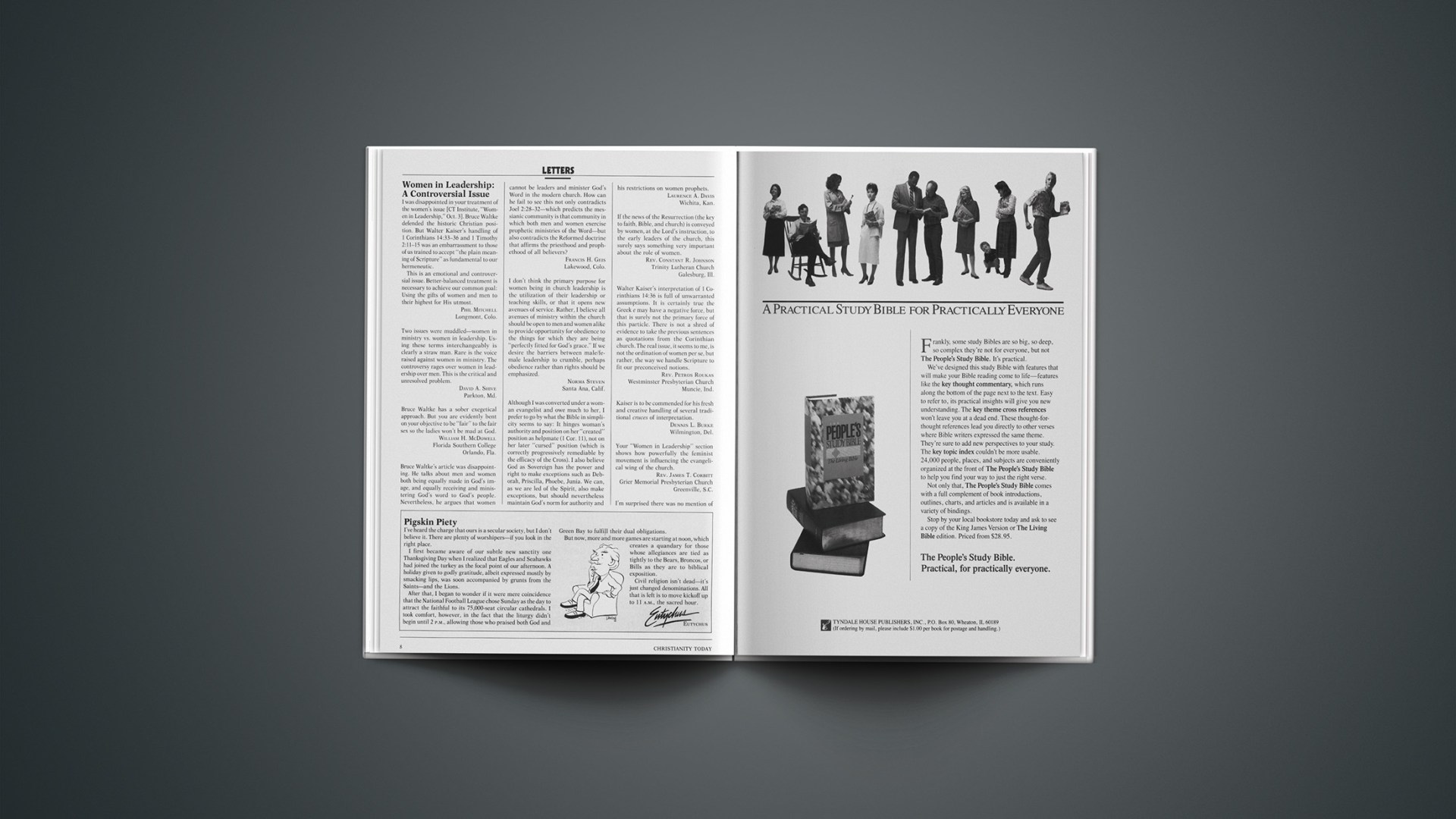
Letters

Women In Leadership: A Controversial Issue

I was disappointed in your treatment of the women’s issue [CT Institute, “Women in Leadership,” Oct. 3], Bruce Waltke defended the historic Christian position. But Walter Kaiser’s handling of 1 Corinthians 14:33–36 and 1 Timothy 2:11–15 was an embarrassment to those of us trained to accept “the plain meaning of Scripture” as fundamental to our hermeneutic.

This is an emotional and controversial issue. Better-balanced treatment is necessary to achieve our common goal: Using the gifts of women and men to their highest for His utmost.

PHIL MITCHELL

Longmont, Colo.

Two issues were muddled—women in ministry vs. women in leadership. Using these terms interchangeably is clearly a straw man. Rare is the voice raised against women in ministry. The controversy rages over women in leadership over men. This is the critical and unresolved problem.

DAVID A. SHIVE

Parkton, Md.

Bruce Waltke has a sober exegetical approach. But you are evidently bent on your objective to be “fair” to the fair sex so the ladies won’t be mad at God.

WILLIAM H. MCDOWELL

Florida Southern College

Orlando, Fla.

Bruce Waltke’s article was disappointing. He talks about men and women both being equally made in God’s image, and equally receiving and ministering God’s word to God’s people. Nevertheless, he argues that women cannot be leaders and minister God’s Word in the modern church. How can he fail to see this not only contradicts Joel 2:28–32—which predicts the messianic community is that community in which both men and women exercise prophetic ministries of the Word—but also contradicts the Reformed doctrine that affirms the priesthood and prophethood of all believers?

FRANCIS H. GEIS

Lakewood, Colo.

I don’t think the primary purpose for women being in church leadership is the utilization of their leadership or teaching skills, or that it opens new avenues of service. Rather, I believe all avenues of ministry within the church should be open to men and women alike to provide opportunity for obedience to the things for which they are being “perfectly fitted for God’s grace.” If we desire the barriers between male/female leadership to crumble, perhaps obedience rather than rights should be emphasized.

NORMA STEVEN

Santa Ana, Calif.

Although I was converted under a woman evangelist and owe much to her, I prefer to go by what the Bible in simplicity seems to say: It hinges woman’s authority and position on her “created” position as helpmate (1 Cor. 11), not on her later “cursed” position (which is correctly progressively remediable by the efficacy of the Cross). I also believe God as Sovereign has the power and right to make exceptions such as Deborah, Priscilla, Phoebe, Junia. We can, as we are led of the Spirit, also make exceptions, but should nevertheless maintain God’s norm for authority and his restrictions on women prophets.

LAURENCE A. DAVIS

Wichita, Kan.

If the news of the Resurrection (the key to faith, Bible, and church) is conveyed by women, at the Lord’s instruction, to the early leaders of the church, this surely says something very important about the role of women.

REV. CONSTANT R. JOHNSON

Trinity Lutheran Church

Galesburg, Ill.

Walter Kaiser’s interpretation of 1 Corinthians 14:36 is full of unwarranted assumptions. It is certainly true the Greek e may have a negative force, but that is surely not the primary force of this particle. There is not a shred of evidence to take the previous sentences as quotations from the Corinthian church. The real issue, it seems to me, is not the ordination of women per se, but rather, the way we handle Scripture to fit our preconceived notions.

REV. PETROS ROUKAS

Westminster Presbyterian Church

Muncie, Ind.

Kaiser is to be commended for his fresh and creative handling of several traditional cruces of interpretation.

DENNIS L. BURKE

Wilmington, Del.

Your “Women in Leadership” section shows how powerfully the feminist movement is influencing the evangelical wing of the church.

REV. JAMES T. CORBITT

Grier Memorial Presbyterian Church

Greenville, S.C.

I’m surprised there was no mention of the United Church of Christ in your article. Our forebears ordained our first woman minister in the 1870s! For us it is a nonissue. Women continue to be in the leadership in all aspects of church life.

DR. KENNETH CLAUS

Port Orange United Church

Port Orange, Fla.

So tragic to see Kenneth Kantzer and CT reverse the time-honored stand on ordination of women. You began as a prophetic voice and leading light. Now I see doctrinal drift and running after liberalism with a little “me too, me too.”

FRED KERR

West Columbia, S.C.

My dry, parched lips drank up your thoughtful coverage of “Women in the Church.” Can we, the church, be at our best until we truly begin to recognize our “other” great asset—our women?

RUTHIE WEBER

Nampa, Idaho

It was refreshing to see you base all discussion and argumentation surroundianing the traditionalist versus egalitarian/partnership paradigms where it properly belongs—on the Bible, not anecdotal experience or personal prejudice. It was equally refreshing to hear from outstanding Christian women exercising their gifts of leadership within the church and being blessed by God in the process.

JOHN LINDELL, M.D.

Shoreview, Minn.

Affirmative Action Through Guilt?

Is it possible Paul R. Spickard’s belief in affirmative action [Speaking Out, Oct. 3] comes not from his exegesis of Philippians 2:3–6 but rather from a sense of guilt over his ancestors’ prosperity? This Scripture doesn’t even remotely suggest a social experiment in which less-qualified minorities are preferentially hired due to past discrimination. Affirmative action hurts society because we lose the services of those (white or minority) who will do the best job. But more specifically, it reinforces a permanent sense of inferiority among minorities who are left feeling they can’t make it unless the rules are slanted in their favor. Here is a classic case of two wrongs not making a right.

ROBERT MCGREEVEY

Austin, Tex.

Spickard’s defense of quotas was unconvincing. How can discrimination on the basis of sex or race be unacceptable if it harms minorities and women but acceptable if it harms only white males? By Spickard’s logic, if blacks ever become a majority, then it will once again be acceptable to discriminate against them in hiring and promotions. So-called affirmative action is nothing more than old-fashioned racism and sexism in a new, liberal guise.

LUCY ELIZABETH RUDENBORG

Menomonie, Wis.

Many people have worked hard to achieve their reward, and it is not fair for them not to be able to receive it just because they were not the right race or gender.

KHALIL HAZOURY

Miami, Fla.

Karl Barth’S Orthodoxy

Yes, “Thank God for Karl Barth” [Editorial, Oct. 3]. His orthodoxy was tested and established before God and man in the Barmen Declaration, which he drafted and, with other believers, made in the teeth of a triumphant, anti-Christian Nazi state. His confession of Jesus Christ was clear, biblical, bold, and, costly. He risked his life, lost his job, and had to flee Germany because of it. This should be remembered by all who would evaluate his orthodoxy from a place of safety in a land where believers have not yet been faced with persecution from an anti-Christian government.

ROBERT W. MEARS

Laconia Christian Fellowship

Laconia, N.H.

No matter what Karl Barth’s system’s limitations, on the anniversary of his birth he deserves more than a cavalier cataloging of his “heterodox” tendencies.

PETER HUFF

Bloomington, Ind.

North Dakota: Not “Main Street”

I was somewhat startled and disappointed by “On the Road with Kenneth Kantzer” [Oct. 3]. North Dakota is not “main street” U.S.A. Getting lost on a gravel road is not unusual in any mid-western state. Kantzer is an excellent writer and communicator, but I believe he showed lack of tact and common courtesy to rural people in general, and the North Dakota farmer in particular.

THORNTON A. JANSMA, PRESIDENT

Inland Empire School of the Bible

Spokane, Wash.

Where Relief Giving Is Up

Your article, “Relief Agencies Confront a Major Crisis of Their Own” [News, Sept. 19], did not differentiate between World Vision U.S. and World Vision Canada. The figures reported are those of World Vision U.S. only. Be advised that in cash donations, World Vision Canada has shown a 3 percent increase over the unprecedented response of ’84–’85.

WILLIAM J. NEWELL

World Vision Canada

Mississauga, Ont., Canada

Is God Triune?

J. I. Packer [“What Do You Mean When You Say ‘God’?” Sept. 19] summarizes ingredients of historic Christian theism as “plainly biblical.” If so, the councils of Nicea (A.D. 381) and Constantinople (A.D.325) and the theological turmoil that accompanied them would never have occurred. The “plainly biblical” theism of God is one and only one. There is not a single Scripture that declares God is triune, three persons, a trinity.

FORREST H. SCOTT

Middletown, Ohio

Thank you for Packer’s excellent article on God. It is a rare and refreshing experience to read or hear a message concerning the nature of God. Give us more about God.

RAYMOND G. JOHNSON

Vidalia, Ga.

Pigskin Piety

I’ve heard the charge that ours is a secular society, but I don’t believe it. There are plenty of worshipers—if you look in the right place.

I first became aware of our subtle new sanctity one Thanksgiving Day when I realized that Eagles and Seahawks had joined the turkey as the focal point of our afternoon. A holiday given to godly gratitude, albeit expressed mostly by smacking lips, was soon accompanied by grunts from the Saints—and the Lions.

After that, I began to wonder if it were mere coincidence that the National Football League chose Sunday as the day to attract the faithful to its 75,000-seat circular cathedrals. I took comfort, however, in the fact that the liturgy didn’t begin until 2 P.M., allowing those who praised both God and Green Bay to fulfill their dual obligations.

But now, more and more games are starting at noon, which creates a quandary for those whose allegiances are tied as tightly to the Bears, Broncos, or Bills as they are to biblical exposition.

Civil religion isn’t dead—it’s just changed denominations. All that is left is to move kickoff up to 11 A.M., the sacred hour.

EUTYCHUS

Hope in a Hopeless Situation

When art director Joan Nickerson unveiled the cover art for this issue, the nods of approval from staff signaled the successful end of a project that had taken the Christianity Today Institute halfway around the world and back again.

Preparations for the trip to South Africa began in December 1985, when initial visa applications were made. At about the same time, however, racial tensions were reaching a new fever pitch, and the government’s own wariness of foreign journalists witnessing violence firsthand delayed document processing for what was an anxious three months. Travel plans were in a continual state of flux, waiting for Johannesburg to give final visa approval—or denial. Then in March, visas were approved for an April visit, and CT executive editor Terry Muck; CTI’s chief operating officer, Paul Robbins; and two others from the CT Institute began making final plans.

Ably assisting with those plans was editorial coordinator Marty White. Her assignment was to set up the visiting group’s schedule, which eventually consisted of over 80 individual meetings and interviews. Of course, such arrangements had to be made during normal South African business hours—or between 10 P.M. and 6 A.M. Chicago time! By departure day, a slightly weary Marty had meticulously mapped out each day’s agenda. (Special thanks to a patient husband, Chad.)

As for the trip itself, the foursome lived with the multiple tensions and dilemmas of this tinderbox situation for nearly three weeks. And their report is both a recounting of those tensions and a personal, often poignant, look at men and women in the church holding forth the only hope in what, humanly speaking, is a hopeless situation.

Harold Smith, Managing Editor

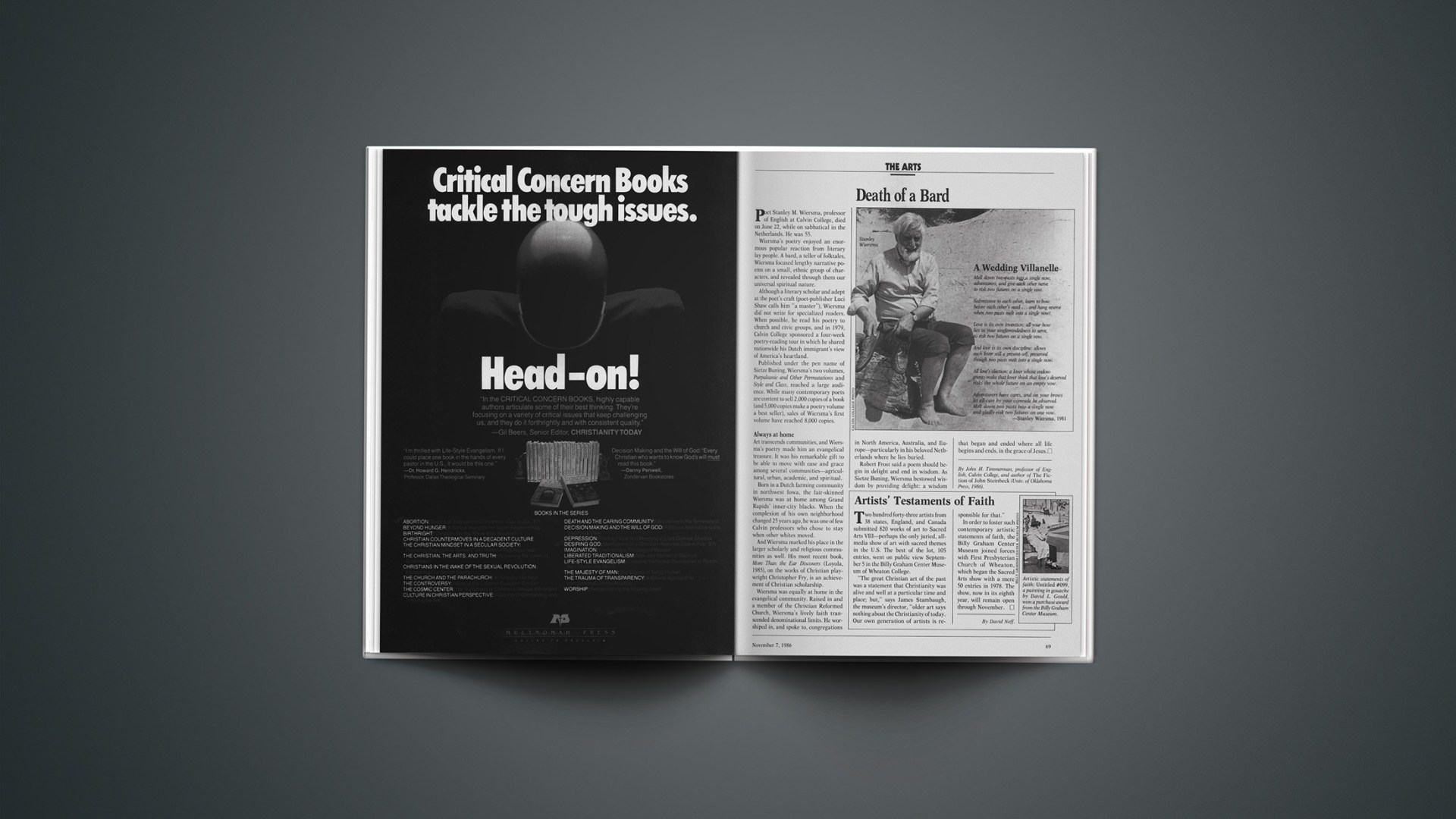
Death of a Bard

Poet Stanley M. Wiersma, professor of English at Calvin College, died on June 22, while on sabbatical in the Netherlands. He was 55.

Wiersma’s poetry enjoyed an enormous popular reaction from literary lay people. A bard, a teller of folktales, Wiersma focused lengthy narrative poems on a small, ethnic group of characters, and revealed through them our universal spiritual nature.

Although a literary scholar and adept at the poet’s craft (poet-publisher Luci Shaw calls him “a master”), Wiersma did not write for specialized readers. When possible, he read his poetry to church and civic groups, and in 1979, Calvin College sponsored a four-week poetry-reading tour in which he shared nationwide his Dutch immigrant’s view of America’s heartland.

Published under the pen name of Sietze Buning, Wiersma’s two volumes, Purpaleanie and Other Permutations and Style and Class, reached a large audience. While many contemporary poets are content to sell 2,000 copies of a book (and 5,000 copies make a poetry volume a best seller), sales of Wiersma’s first volume have reached 8,000 copies.

Always At Home

Art transcends communities, and Wiersma’s poetry made him an evangelical treasure. It was his remarkable gift to be able to move with ease and grace among several communities—agricultural, urban, academic, and spiritual.

Born in a Dutch farming community in northwest Iowa, the fair-skinned Wiersma was at home among Grand Rapids’ inner-city blacks. When the complexion of his own neighborhood changed 25 years ago, he was one of few Calvin professors who chose to stay when other whites moved.

And Wiersma marked his place in the larger scholarly and religious communities as well. His most recent book, More Than the Ear Discovers (Loyola, 1985), on the works of Christian playwright Christopher Fry, is an achievement of Christian scholarship.

Wiersma was equally at home in the evangelical community. Raised in and a member of the Christian Reformed Church, Wiersma’s lively faith transcended denominational limits. He worshiped in, and spoke to, congregations in North America, Australia, and Europe—particularly in his beloved Netherlands where he lies buried.

Robert Frost said a poem should begin in delight and end in wisdom. As Sietze Buning, Wiersma bestowed wisdom by providing delight: a wisdom that began and ended where all life begins and ends, in the grace of Jesus.

By John H. Timmerman, professor of English, Calvin College, and author of The Fiction of John Steinbeck (Univ. of Oklahoma Press, 1986).

Artists’ Testaments of Faith

Two hundred forty-three artists from 38 states, England, and Canada submitted 820 works of art to Sacred Arts VIII—perhaps the only juried, allmedia show of art with sacred themes in the U.S. The best of the lot, 105 entries, went on public view September 5 in the Billy Graham Center Museum of Wheaton College.

“The great Christian art of the past was a statement that Christianity was alive and well at a particular time and place; but,” says James Stambaugh, the museum’s director, “older art says nothing about the Christianity of today. Our own generation of artists is responsible for that.”

In order to foster such contemporary artistic statements of faith, the Billy Graham Center Museum joined forces with First Presbyterian Church of Wheaton, which began the Sacred Arts show with a mere 50 entries in 1978. The show, now in its eighth year, will remain open through November.

By David Neff.

A Wedding Villanelle

Melt down two pasts into a single now, adventurers, and give each other nerve to risk two futures on a single vow.

Submissive to each other, learn to bow before each other’s need … and hang reserve when two pasts melt into a single now!

Love is its own invention: all your how lies in your singlemindedness to serve, to risk two futures on a single vow.

And love is its own discipline: allows each lover still a present-self, preserved though two pasts melt into a single now.

All love’s election: a lover whose endowments make that lover think that love’s deserved risks the whole future on an empty vow.

Adventurers have cares, and on your brows let all care by your comrade be observed. Melt down two pasts into a single now and gladly risk two futures on one vow.

—Stanley Wiersma, 1981

The Human Animal at a High School Reunion

If I were a diehard evolutionist seeking to discredit the Christian doctrine of man, I would not spend my time digging with Dr. Leakey in Africa, but rather roaming the halls of America’s high schools. They offer science a showcase for what Phil Donahue calls “the human animal” at its most animalistic. I say that having just returned from my twentieth-year high school reunion.

In biology class we had to learn an impressive-sounding formula that none of us understood: Ontogeny recapitulates phylogeny. It means, among other things, that individual organisms will act out the characteristics of their type. In other words, biology is destiny. And high school surely illustrates that principle.

At the reunion, the subspecies still showed the characteristics they had displayed so prominently 20 years before. The group we called “jocks” still walked with a peculiar swagger, despite the potbellies and receding hairlines. Another group, cheerleaders, were the best preserved. They had learned early that face and body were their best tickets to success in the world, and thus they disguised facial wrinkles and extra pounds better than anyone else. In stocking feet, rather sheepishly, those career women and housewives led us all in half-remembered high school cheers.

One high school grouping has gone through several mutations in the last 20 years, from “hood” to greaser to punk. None of them came to the reunion sporting hair slicked down with butch wax or wearing a white T-shirt with a cigarette pack rolled up in the sleeve, but the former hoods still huddled together on the sidelines, holding up the fringe of society.

One of my most vivid high school memories involves a colossal clash between the number one hood (I suppose he would be a gang leader today) and the number one jock, the school quarterback. At least 300 students blocked a hallway, keeping frantic teachers away, as the two fought over a girlfriend.

I will never forget how abruptly the spirit of the cheering mob changed when the hood grabbed the quarterback and bashed his head against a sharp water fountain nozzle—once, two times, three times. The crowd melted away in sickened silence, letting teachers through at last to tend to the quarterback, now writhing on the floor in a widening pool of blood. The girl who had inspired the combat sat hunched in a tiny ball by a locker, sobbing.

A behaviorist could view such a scene as the human version of Rocky Mountain sheep lowering their heads and colliding with a force that echoes through the canyons. The humans, like sheep, were establishing a tribal and sexual dominance, a status won through brute force.

But there is another side to the human animal. G. K. Chesterton said, “Man is not a balloon going up into the sky, nor a mole burrowing merely in the earth; but rather a thing like a tree, whose roots are fed from the earth, while its highest branches seem to rise almost to the stars.” And Tolstoy added this pungent observation: “Materialists mistake life for that which limits life.” Both were expressing the most basic fact of all Christian anthropology, that the human animal was created to be more than animal.

As I reflected on my high school experience, it struck me that the gospel often calls us to cast off the simple “biology is destiny” formula and to reach farther and higher toward spiritual reality. In short, we are asked to transcend biological destiny and prove that we are more than animals.

High school amply demonstrates our drives toward self-preservation, a “survival of the fittest” of the most primal kind. Like animals, we compete with each other on the basis of power and appearance. A beautiful face, a famous name, or an impressive physique can guarantee success, and it is that kind of success that high school so lavishly rewards with its homecoming crowns and sports trophies. High school shows what happens when, untrammeled by the polite artifice of “maturity,” we express the base instincts we inherited as members of the human race.

But our Christian calling asks us to defy those instincts. Jesus announced a great reversal of values in his Sermon on the Mount, when he elevated not the rich or attractive, but rather the poor, the persecuted, and those who mourn. Instead of admiring such traits as wealth, political power, and physical beauty, he warned against their grave dangers. A passage like Luke 18 shows the kind of people who impressed Jesus: an oppressed widow, a despairing tax collector, a small child, a blind beggar.

Instinctually, animals mark the weak for quick destruction; we are commanded to value them. We are also told that fulfillment comes not in the “pursuit of happiness,” but rather in the pursuit of submission and service. We are asked to respond to our most grievous failures not by covering them up, but by repenting of them openly. When you are wronged, says the gospel, extend forgiveness, not vengeance. And don’t cling to the valuable things, for the kingdom of heaven is a pearl of great price, worth all that you own.

Christians have long worried that science, especially evolutionary theory, might reduce humanity to a status lower than that the Bible assigns it. But what if, instead of trying to prove that homo sapiens is not an animal, we concentrated on demonstrating that we are far more? Instead of challenging the age of fossils or disputing the results of genetic engineering, we could determine to prove that biology is not destiny. What would happen in the national consensus if these nine words came to mind when you said the word “Christian”: love, joy, peace, patience, kindness, goodness, faithfulness, gentleness, and self-control?

I know for a fact that no one in my high school gave out awards for the nine qualities listed above, a list known to most Christians as “the fruit of the Spirit.” But I believe that the effect of those qualities will endure long after all high school yearbooks have turned to dust, long after the solar system itself has grown cold and still. And perhaps, just perhaps, exhibiting the fruit of the Spirit may be our very best defense against a materialist view of mankind here on earth.

Advocates for the Homeless

The United States prides itself on its concern for human rights. It also strives to keep Israel, its major ally in the Middle East, politically stable and militarily strong. These two foreign policy objectives clash when it comes to the issue of Palestinian people living under Israeli rule.

The Palestine Human Rights Campaign (PHRC) met recently in Chicago to discuss the plight of Palestinians living in the occupied territory. PHRC is the only Palestinian advocacy group in the United States whose primary focus is human rights, and not politics (though the two sometimes overlap). Conference speakers detailed a variety of injustices, including arbitrary arrests, convictions without due process of law, harassment, restrictions on travel, and torture in prisons.

Reaching The Church

Though PHRC is not a Christian organization, its national director, Donald Wagner, says it is often perceived as one, partly because of its leadership. Several Christians serve on PHRC’s board, including Calvin College philosophy professor Nicholas Wolterstorff, who chairs the board. Wagner, a Presbyterian clergyman, identifies himself as an evangelical and considers his work with PHRC a ministry.

Wagner said a subtantial portion of PHRC’s financial support comes from the church, adding that Christians are among the most responsive to the Palestinian cause. “Both the mainline and evangelical churches are far ahead of the American public and the media on this issue,” he said.

PHRC generally holds that U.S. foreign policy in the Middle East favors Israel at the expense of justice for the Palestinians. Conference speaker Eqbal Ahmad, of the Washington, D.C.—based Institute for Policy Studies, said, “We need the support of the American people before we can get it from the American government.”

Advocates for Palestinians generally believe that garnering such support entails challenging commonly held interpretations of biblical prophecies linking the State of Israel to Christ’s return. One conference speaker called the alliance between Zionist agencies and the Religious Right the “most fateful development of the the last ten years.”

In addition to reaching out to the church, PHRC has taken its message to America’s black community. Yale Divinity School theologian Cornel West said American blacks have been slow to recognize the Palestinian plight partly because of blacks’ “profound identification with underdogs,” including Jews during World War II. West added, however, that “the oppressed [Israelis] … have become the oppressors.”

Striving For Progress

Northern Baptist Seminary professor Ray Bakke, who is active with the Lausanne Committee for World Evangelization, and Wagner led a workshop on outreach to churches. Among other things, they said Christians should oppose U.S. legislative efforts that could escalate violence in the Middle East.

Wagner credited letters to Congress with aiding in the successful opposition to a recent attempt to move the U.S. embassy from Tel Aviv to Jerusalem. He encouraged churches to invite Arab Christians to speak, and said Christians should visit Arab churches while touring the Holy Land.

PHRC opposes violence as a solution to problems in the Middle East. Ahmad credited the Palestinian Liberation Organization (PLO) with having maintained Palestinians’ national consciousness. But he said the PLO has failed to understand the strategy of its adversary, explaining, for example, that terrorist violence only engenders support for Israel. “Militant, nonviolent struggle will go much farther than armed struggle in [defeating] … the Israeli militants,” he said.

Rabbi Stephen Schwarzschild, a PHRC board member and a pacifist, said he does not hold out much hope that pacifism—or any other strategy—will lead to peace in the short term. “I don’t see a resolution or even progress toward a resolution in my time or in my children’s time,” he said. “We must fight for peace and justice, not because we will succeed, but because if we don’t fight, we will have failed morally.”

God Is Working inside ‘America’s Toughest Prison’

A recent Newsweek cover story took a look inside what the magazine called America’s toughest prison.” The article detailed the history and the horrors of Eastham Prison in east Texas. CHRISTIANITY TODAY asked Houston journalist Edward Fudge to interview Vance Drum, the prison’s Protestant chaplain, about how God is working in the lives of inmates at Eastham Prison.

How accurate is the Newsweek article that describes Eastham as “America’s toughest prison”?

The article is fairly accurate as far as it goes. This prison has been particularly brutal. Since I started working here in February 1985, there have been two murders and three suicides, and one guard was stabbed. What the Newsweek article doesn’t say is that God is doing many great things inside Eastham prison.

This prison houses 2,500 maximum-security inmates, almost all repeat offenders. Although they don’t realize it, many of them are looking for God, and some have found him. God is changing lives at Eastham.

How do you minister to the inmates?

I try to facilitate steady spiritual progress among them. I supervise a Sunday school program and three weekly services, teach a Bible study and classes for those scheduled to be baptized, and lead a weekly evangelism workshop. I also provide group and individual counseling and direct a weekly leadership meeting for 15 inmates who serve as elders and deacons in the prison church.

Describe the prison church.

The church is made up of a cohesive fellowship of believers with its own servant leaders. Approximately 100 men—black, white, and Hispanic—attend Sunday morning services. This alone demonstrates Christ’s power to tear down walls of racial prejudice and hatred in a depraved environment.

There is widespread public suspicion of “jailhouse religion.” Are these men really sincere about their faith?

A majority of the men have genuinely turned to God. Some hypocrites come to church here, just as they do outside prison walls. I don’t mind, though. When they get there, God might speak to them. I try to help each man gain an awareness of what God has done in Christ, and to prepare each one to live a Christian life inside prison and also when he gets out.

How have you seen God’s Spirit at work in inmates’ lives?

A spirit of generosity has come over men who before were only takers. This summer, one of our believers who is serving a life sentence for murder suggested an offering box to benefit indigent prisoners. Donors contribute such items as soap, deodorant, stamps, combs, or toothpaste. Any truly needy inmate can take items from the box for his personal needs.

I have also seen God work to resolve church squabbles. Some weeks ago, two deacons had a loud shouting match. I could do little except urge them to work out their problem. That night, one of the men told me he had gone to the other brother and asked his forgiveness. In prisons, forbearance and forgiveness are rare.

What price do these Christians pay for following Jesus?

Before the Texas prison reforms of 1983, I understand there was more violent, outward persecution of believing inmates. Today the persecution is more subtle. Some unbelievers might deride a Christian for attending church, or laugh at him for reading the Bible. On the whole, though, most committed Christians have earned respect at Eastham.

When do you sense God’s presence the most at Eastham?

On Sunday morning. Inmates lead the church service, except for the chaplain’s prayer and message. The service begins with hearty worship choruses, accompanied by drums, tambourine, organ, and electric guitar. Those are followed by traditional hymns. The meeting climaxes with Communion, which uses an ancient liturgy adapted to the prison situation.

Worshipers come to the altar for Communion, where they also receive a hug or handshake from me or a church leader. This is a joyful time that celebrates reconciliation with God and each other. The interracial fellowship demonstrates the unity of Christ’s body. It is a real example to the prison that these Christians love each other.

Former Staff Pastor Says Faith Assembly Is a Cult

Hobart Freeman, founder of a controversial faith-healing sect called Faith Assembly, died nearly two years ago (CT, Jan. 18, 1985, p. 48). But his Indiana-based sect has continued under the guidance of a few of Freeman’s handpicked leaders. One of those leaders, Jack Farrell, resigned last year. He served directly under Freeman as a full-time associate pastor for 10 of the 11 years he was with Faith Assembly.

Farrell declined to comment on his resignation until earlier this year when he was interviewed by the Warsaw (Ind.) Times Union. He has called Faith Assembly a “cult” and a “cancer to the rest of the church.” He also has accused Freeman of using deceptive tactics to build Faith Assembly into a thriving organization, with a 2,000-member congregation near Wilmot, Indiana, and smaller satellite groups in a number of states and a few foreign countries.

Faith Assembly has received national attention because its faith-healing practices have been linked to nearly 100 deaths. Freeman, whose teachings included the shunning of all medications, died in 1984 from untreated diabetes and other complications. At the time of his death, he had been indicted in the death of a youth whose parents attended Faith Assembly (CT, Nov. 23, 1984, p. 38). The indictment charged that Freeman, through his teachings, contributed to the death of Pamela Menne. The 15-year-old girl died of chronic kidney failure after her parents failed to seek medical treatment for her illness. The parents, James and Ione Menne, later received suspended sentences and were ordered to obtain semiannual physicals for their remaining two minor children. The Mennes have since left Faith Assembly.

A Warning

“God’s people must be warned,” said Farrell, who talked with CHRISTIANITY TODAY about his departure from the sect. “Death follows the message of Faith Assembly.” He said Freeman taught that Faith Assembly was a unique church raised up for a special end-time ministry. At first that teaching appealed to Farrell, who was searching for a deeper spiritual experience. He left his Church of the Brethren pastorate in 1974 to join Faith Assembly.

According to Farrell, Freeman believed he had received a special commission from a “prophetess” named Anna Shrader to “raise a monument of faith.” Freeman’s teachings changed and often superseded biblical doctrines and teachings, Farrell said. In the early days, Freeman “would tell us to check out his teachings in the Bible. Later on, he said, ‘If you don’t believe the teachings, then you have no business being here.’ ”

Faith Assembly was established in the mid-1960s, and in its early years members were told to seek medical care if they did not have the faith for supernatural healing. But by the early 1980s, Freeman’s teachings on faith healing, which stressed the doctrine of making a “positive confession,” emphasized that medications were actually demonic in nature.

“We were going through what Dr. Freeman called ‘the deeper deliverance,’ ” Farrell said. “Everybody had to go through demonic deliverance for any medication they had used. He was teaching that the names of medicines were the names of demons. We had to name the medication to receive deliverance. We actually had people who were calling their out-of-state parents to find out what medications they had taken when they were small children.”

According to Farrell, Freeman’s strong influence over his congregation has continued even after his death because of the fear he built into his ministry. “There are people who would like to leave,” Farrell said, “but they can’t because they believe they would lose their salvation.”

Freeman was quick to use his educational background to impress people, Farrell said. Freeman earned a doctorate in Old Testament and Hebrew from Grace Theological Seminary in Winona Lake, Indiana. He taught there from 1961 to 1963, when he was dismissed because of doctrinal differences with the school.

Farrell said a sermon preached by another Faith Assembly pastor convinced him and his wife that the sect was not a part of the true church. “The message … dealt with the sin of pride,” Farrell said. “… Many of the things that were said applied to my life. I had used the sword of the Spirit not on the enemy, but to cut up the lives of people, even Christians. That’s when my wife and I began to see that things were wrong with Faith Assembly. The ministry there was harsh, not loving.”

Now working as a night watchman and attending two Church of the Brethem congregations, Farrell said he wants to warn Christians about the dangers of Faith Assembly and similar groups. “When you’re confronted with something that you’ve never heard before, don’t believe it until you can prove from the Bible that it is true.”

In recent weeks, Faith Assembly has experienced at least three deaths among its members. No lawsuits or indictments have been filed in any of those deaths. A civil suit filed against Faith Assembly by David and Nigal Oleson of Genoa, Illinois, is still awaiting trial. The Olesons claim that Faith Assembly’s teachings contributed to the death of a relative and nearly destroyed their marriage.

By Chris Lutes.

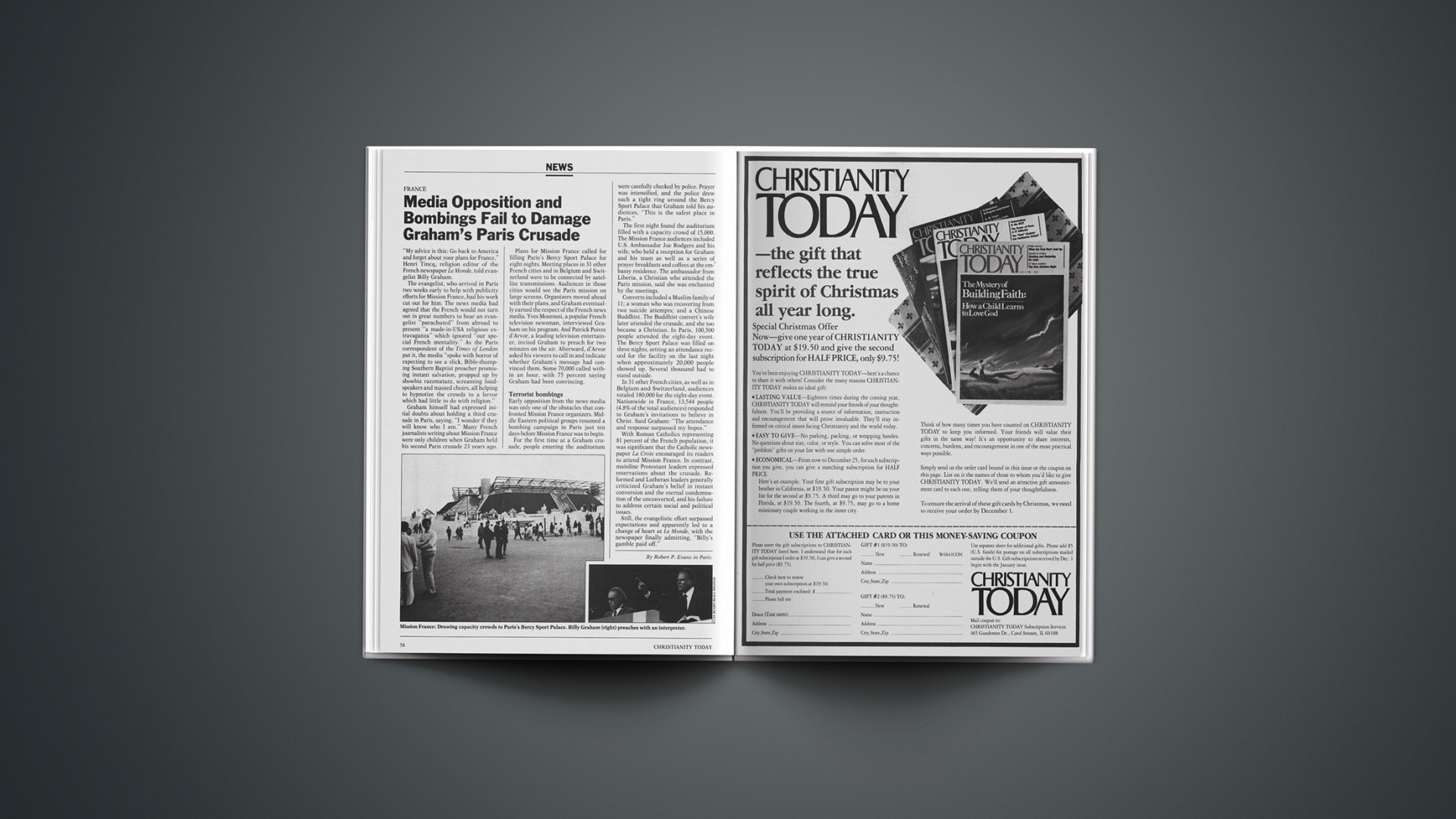
Media Opposition and Bombings Fail to Damage Graham’s Paris Crusade

“My advice is this: Go back to America and forget about your plans for France,” Henri Tincq, religion editor of the French newspaper Le Monde, told evangelist Billy Graham.

The evangelist, who arrived in Paris two weeks early to help with publicity efforts for Mission France, had his work cut out for him. The news media had agreed that the French would not turn out in great numbers to hear an evangelist “parachuted” from abroad to present “a made-in-USA religious extravaganza” which ignored “our special French mentality.” As the Paris correspondent of the Times of London put it, the media “spoke with horror of expecting to see a slick, Bible-thumping Southern Baptist preacher promising instant salvation, propped up by showbiz razzmatazz, screaming loudspeakers and massed choirs, all helping to hypnotize the crowds to a fervor which had little to do with religion.”

Graham himself had expressed initial doubts about holding a third crusade in Paris, saying, “I wonder if they will know who I am.” Many French journalists writing about Mission France were only children when Graham held his second Paris crusade 23 years ago.

Plans for Mission France called for filling Paris’s Bercy Sport Palace for eight nights. Meeting places in 31 other French cities and in Belgium and Switzerland were to be connected by satellite transmissions. Audiences in those cities would see the Paris mission on large screens. Organizers moved ahead with their plans, and Graham eventually earned the respect of the French news media. Yves Mourousi, a popular French television newsman, interviewed Graham on his program. And Patrick Poivre d’Arvor, a leading television entertainer, invited Graham to preach for two minutes on the air. Afterward, d’Arvor asked his viewers to call in and indicate whether Graham’s message had convinced them. Some 70,000 called within an hour, with 75 percent saying Graham had been convincing.

Terrorist Bombings

Early opposition from the news media was only one of the obstacles that confronted Mission France organizers. Middle Eastern political groups resumed a bombing campaign in Paris just ten days before Mission France was to begin.

For the first time at a Graham crusade, people entering the auditorium were carefully checked by police. Prayer was intensified, and the police drew such a tight ring around the Bercy Sport Palace that Graham told his audiences, “This is the safest place in Paris.”

The first night found the auditorium filled with a capacity crowd of 15,000. The Mission France audiences included U.S. Ambassador Joe Rodgers and his wife, who held a reception for Graham and his team as well as a series of prayer breakfasts and coffees at the embassy residence. The ambassador from Liberia, a Christian who attended the Paris mission, said she was enchanted by the meetings.

Converts included a Muslim family of 11; a woman who was recovering from two suicide attempts; and a Chinese Buddhist. The Buddhist convert’s wife later attended the crusade, and she too became a Christian. In Paris, 100,500 people attended the eight-day event. The Bercy Sport Palace was filled on three nights, setting an attendance record for the facility on the last night when approximately 20,000 people showed up. Several thousand had to stand outside.

In 31 other French cities, as well as in Belgium and Switzerland, audiences totaled 180,000 for the eight-day event. Nationwide in France, 13,544 people (4.8% of the total audiences) responded to Graham’s invitations to believe in Christ. Said Graham: “The attendance and response surpassed my hopes.”

With Roman Catholics representing 81 percent of the French population, it was significant that the Catholic newspaper La Croix encouraged its readers to attend Mission France. In contrast, mainline Protestant leaders expressed reservations about the crusade. Reformed and Lutheran leaders generally criticized Graham’s belief in instant conversion and the eternal condemnation of the unconverted, and his failure to address certain social and political issues.

Still, the evangelistic effort surpassed expectations and apparently led to a change of heart at Le Monde, with the newspaper finally admitting, “Billy’s gamble paid off.”

By Robert P. Evans in Paris.

WORLD SCENE

ITALY

The Age of the Shroud

Pope John Paul II has authorized scientific tests to determine the age of the Shroud of Turin, believed by many to be the cloth in which Christ was wrapped after his crucifixion.

Laboratories in England, France, Switzerland, and the United States will test small samples of the cloth using carbon-14 dating techniques. Backers of carbon-14 dating say the tests will make it possible to determine the shroud’s age within a margin of 250 years.

“The integrity of the cloth and of the shroud image will be guaranteed to a maximum degree,” said Anastasio Cardinal Ballestrero, archbishop of Turin, Italy, and custodian of the shroud. Experts say little more than a thread of the cloth will be needed to undergo carbon-14 testing.

The shroud, which measures more than 14 feet long and three feet wide, bears front and back negative images of a crucified man. The cloth contains stains left by wounds corresponding to biblical accounts of the crucifixion of Christ.

Previous studies have been unable to determine how the image was produced on the linen cloth. Tests conducted in 1978 established that some of the stains on the cloth were made by blood. And a microscopic examination in 1973 determined that the cloth’s fibers contain pollen grains from plants indigenous to the Middle East.

The shroud’s recorded history dates back only to 1357, and skeptics have suggested the cloth was produced as a counterfeit during the Middle Ages. Results of the carbon-14 tests are expected to be published in 1988.

VIETNAM

Pastors Released

Three Vietnamese pastors imprisoned since 1983 have been released, according to information received by Reg Reimer, executive director of World Relief, Canada. At least 14 additional pastors are still being held in Vietnamese prisons.

Reimer was part of an interchurch delegation that raised the issue of imprisoned pastors with Vietnamese government officials earlier this year (CT, Sept. 5, 1986, p. 50). There is no indication whether the delegation’s appeal influenced the government’s decision to release the three pastors.

Reimer received word of the release of Doan Trung Tin directly from Doan’s brother. Doan, whose father is vice-president of the Evangelical Church of Vietnam, was jailed for distributing evangelical literature, Reimer said. The two other pastors released are Chau Van Sang and Nguyen Van Minh. It is not known why the three were released at this time.

World Evangelical Fellowship, which last summer passed a resolution appealing for the release of pastors being held in Vietnamese prisons, has been working on their behalf through Vietnam’s embassy in India.

WORLDWIDE

AIDS Cases Increase

The World Health Organization (WHO) has reported a sharp increase in the number of cases of Acquired Immune Deficiency Syndrome (AIDS) recorded worldwide.

During the first nine months of 1986, WHO recorded 31,646 cases in 74 countries, up from 20,476 cases reported at the beginning of the year. The largest concentration of AIDS is in the United States, which reported some 25,500 cases by mid-September, up from 17,400 at the beginning of 1986. WHO also reported increases in 22 European countries. In West Germany, France, and Italy, officials are reporting 6 to 12 new cases every week. More than 1,000 cases have been reported in 10 African countries.

Jonathan M. Mann, director of WHO’s program to combat the disease, said few AIDS victims have survived longer than five years. He added that the number of people infected with the virus, but still not suffering from its effects, could be from 25 to 100 times higher than the number of currently diagnosed cases.

The disease, which is spread primarily through an exchange of blood, destroys the body’s ability to fight off infection. It is especially prevalent among homosexual and bisexual men and intravenous drug users.

SOVIET UNION

Christian Musician Freed

Christian rock musician Valeri Barinov has been released from a Soviet labor camp after completing his two-and-one-half year sentence.

Barinov and a fellow musician were arrested in 1984 and charged with trying to cross the Soviet border illegally. They denied the charges, but both were sentenced to labor camp.

While serving his sentence, Barinov suffered a heart attack. “My body is weak, but I feel good in myself,” he said after being released from prison. “I’m so thankful to God for this time at home.”

The musician was held in an isolation cell for six months of his prison term, apparently because of his witnessing efforts inside the labor camp. “Many people came to believe in Jesus,” he said. “It’s very strange and unbelievable. I became a missionary in the camp, and it was good for me to be there.” Now that he is free, Barinov is seeking permission from the Soviet government to emigrate to the West. “I want to work for Jesus’ glory, and it’s not possible for me here in the USSR,” he said.

Before he was sentenced to labor camp, Barinov composed a Christian rock opera about the second coming of Christ. A recording of the work, called “The Trumpet Call,” is available in the United States on the I Care record label.

How Did U.S.A. for Africa Help Christian Relief Agencies?

The work of relief-and-development agencies consists essentially of two things—raising money to relieve human suffering and spending it where it will do the most good. Raising money is difficult, but using it wisely can be much harder and more time consuming.

A single recording session coordinated by an organization called U.S.A. for Africa early last year resulted in millions of dollars to combat hunger in Africa. Including sales of the record “We Are the World” and ancillary products such as T-shirts, more than $51 million has poured into the organization’s coffers.

Spending the money, however, has not been so easy. U.S.A. for Africa spokesman David Fulton said the original plan was to disburse the money quickly and dissolve the organization. “Nobody foresaw the success of the record,” Fulton said. The event’s immense popularity, he added, brought with it an “accountability factor.” Today, more than $10 million remains to be spent.

The publicity that surrounded the “We Are the World” campaign stimulated contributions to Christian relief-and-development organizations, helping them achieve record-setting years in 1985 (CT, Sept. 19, 1986, p. 36). In addition, some Christian organizations benefited directly from the U.S.A. for Africa effort. World Relief received nearly $200,000 of the funds and World Vision more than $1 million for projects in Africa. Christian artists who piggybacked on the success of their secular counterparts by producing a record of their own (“Do Something Now”) have thus far raised about $130,000.

Not only did “We Are the World” make a profit, but it was a faithful steward’s dream. Fulton said figures tallied on U.S.A. for Africa’s first anniversary revealed overhead expenses of only 1.2 percent. (Among Christian agencies, 15 percent overhead is considered good.)

U.S.A. for Africa’s low overhead is largely attributable to the many who donated resources, including time, to the effort. Also, because of the participation of well-known recording stars such as Lionel Richie, Kenny Rogers, and Harry Belafonte (all of whom serve on U.S.A. for Africa’s board), media coverage provided the advertising.

Inspired by the success of “We Are the World,” organizers’ thoughts turned to expanding the effort rather than dissolving it. Thus came last summer’s Hands Across America, intended to call attention to domestic hunger and homelessness. Fulton said U.S.A. for Africa plans to stage similar media events for humanitarian purposes.

Financially, Hands Across America was somewhat of a flop. Organizers hoped to raise $50 million. But because of unfulfilled pledges and the tremendous expense of staging the event—which attempted to create an unbroken human chain from New York to California—it has netted only about $16 million. Corporate and individual donors gave a total of some $32 million to the effort, but about half that amount was spent promoting and staging the event.

Fulton concedes the effort will likely fall far short of its financial goal, though money is still trickling in. But he said the project succeeded in making people aware of poverty in America. He cited the avalanche of publicity for Hands Across America, and pointed out that many local efforts to address the hunger problem were modeled after it.

The Cost Of Raising Money

Christian relief-and-development agencies are still analyzing secular humanitarian efforts like “We Are the World.” Bill Kliewer, executive vice-president of World Vision, said such efforts “touch a part of the American audience” that Christian organizations can never reach.

Jerry Ballard, executive director of World Relief, said donors to his agency expect overhead expenses not to exceed 15 percent. But in analyzing Hands Across America, he observed that donors in general may be “less concerned about the quality of the expenditure of their gifts than they are about the [financial] bottom line.”

Ballard said World Relief recently turned down an opportunity to raise several million dollars because of the overhead expenses it would have entailed. But he said an argument could be made for giving priority to the net profit, even if the cost of raising the money exceeds normal levels. He summarized the argument like this: “Is it more moral or ethical to have $5 million or $10 million to help hungry people?”

Kliewer said there are “certain crisis situations such as the one we saw in Africa that call for allowing overhead figures to go up in order to bring in more money.… It would be immoral for an organization to allow hundreds of thousands to die so it could brag about its low overhead at the end of the year.”

In general, the most cost-effective means of fund raising have the least “bottom line” potential. Conversely, while purchasing television time may not be cost effective in terms of overhead, it generally holds more revenue-producing potential.

Partly because of news coverage of Hands Across America’s high overhead costs, Ballard is skeptical about the future success of staged media events. Kliewer said he hopes U.S.A. for Africa will thrive. “They have a very real and strong commitment to help the poor,” he said, “and they have gained a unique expertise in an area of communication no other organization has gained.”

By Randy Frame.

Apple PodcastsDown ArrowDown ArrowDown Arrowarrow_left_altLeft ArrowLeft ArrowRight ArrowRight ArrowRight Arrowarrow_up_altUp ArrowUp ArrowAvailable at Amazoncaret-downCloseCloseEmailEmailExpandExpandExternalExternalFacebookfacebook-squareGiftGiftGooglegoogleGoogle KeephamburgerInstagraminstagram-squareLinkLinklinkedin-squareListenListenListenChristianity TodayCT Creative Studio Logologo_orgMegaphoneMenuMenupausePinterestPlayPlayPocketPodcastRSSRSSSaveSaveSaveSearchSearchsearchSpotifyStitcherTelegramTable of ContentsTable of Contentstwitter-squareWhatsAppXYouTubeYouTube