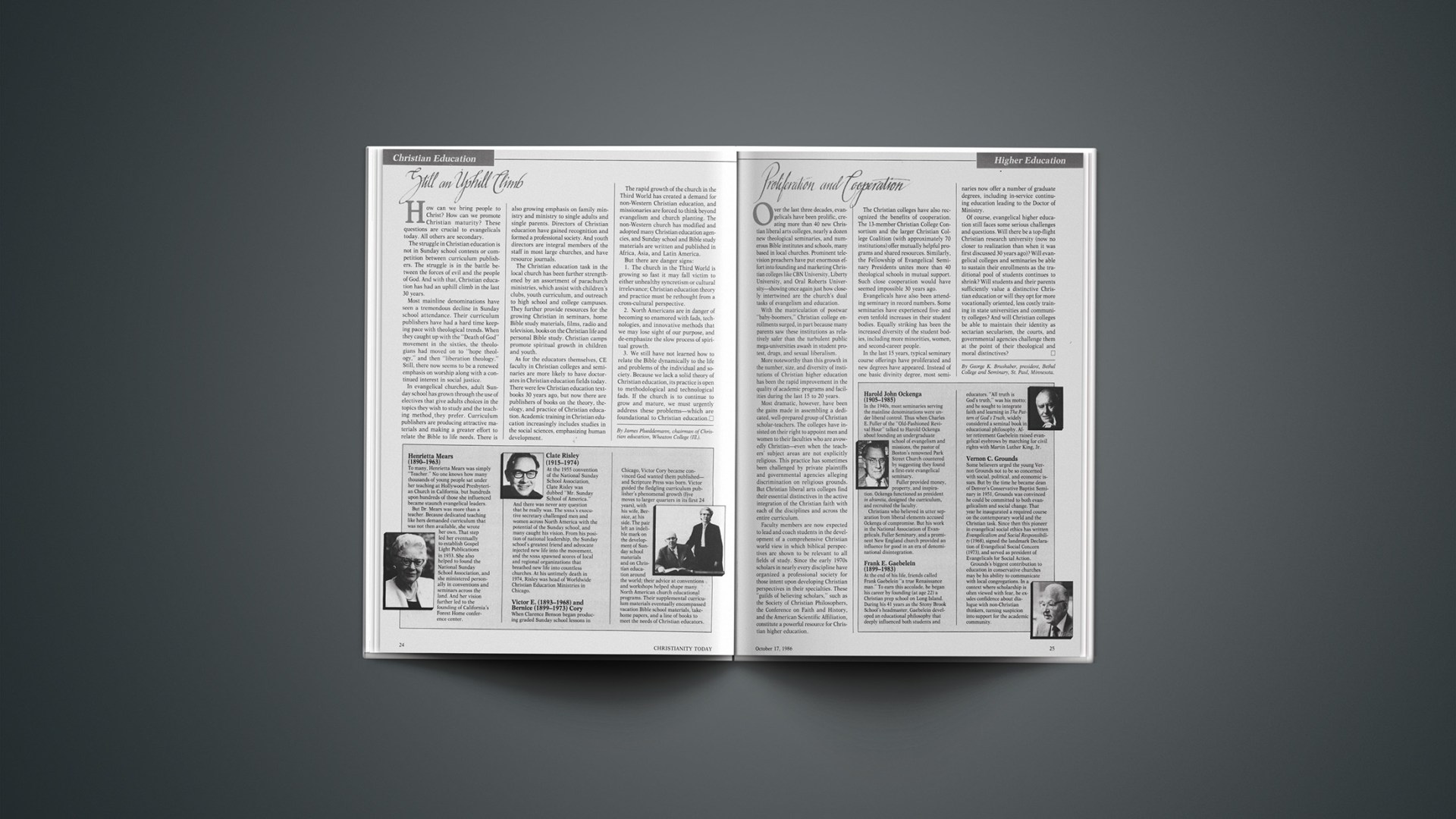
Higher Education: Proliferation and Cooperation

Over the last three decades, evangelicals have been prolific, creating more than 40 new Christian liberal arts colleges, nearly a dozen new theological seminaries, and numerous Bible institutes and schools, many based in local churches. Prominent television preachers have put enormous effort into founding and marketing Christian colleges like CBN University, Liberty University, and Oral Roberts University—showing once again just how closely intertwined are the church’s dual tasks of evangelism and education.

With the matriculation of postwar “baby-boomers,” Christian college enrollments surged, in part because many parents saw these institutions as relatively safer than the turbulent public mega-universities awash in student protest, drugs, and sexual liberalism.

More noteworthy than this growth in the number, size, and diversity of institutions of Christian higher education has been the rapid improvement in the quality of academic programs and facilities during the last 15 to 20 years.

Most dramatic, however, have been the gains made in assembling a dedicated, well-prepared group of Christian scholar-teachers. The colleges have insisted on their right to appoint men and women to their faculties who are avowedly Christian—even when the teachers’ subject areas are not explicitly religious. This practice has sometimes been challenged by private plaintiffs and governmental agencies alleging discrimination on religious grounds. But Christian liberal arts colleges find their essential distinctives in the active integration of the Christian faith with each of the disciplines and across the entire curriculum.

Faculty members are now expected to lead and coach students in the development of a comprehensive Christian world view in which biblical perspectives are shown to be relevant to all fields of study. Since the early 1970s scholars in nearly every discipline have organized a professional society for those intent upon developing Christian perspectives in their specialties. These “guilds of believing scholars,” such as the Society of Christian Philosophers, the Conference on Faith and History, and the American Scientific Affiliation, constitute a powerful resource for Christian higher education.

The Christian colleges have also recognized the benefits of cooperation. The 13-member Christian College Consortium and the larger Christian College Coalition (with approximately 70 institutions) offer mutually helpful programs and shared resources. Similarly, the Fellowship of Evangelical Seminary Presidents unites more than 40 theological schools in mutual support. Such close cooperation would have seemed impossible 30 years ago.

Evangelicals have also been attending seminary in record numbers. Some seminaries have experienced five-and even tenfold increases in their student bodies. Equally striking has been the increased diversity of the student bodies, including more minorities, women, and second-career people.

In the last 15 years, typical seminary course offerings have proliferated and new degrees have appeared. Instead of one basic divinity degree, most seminaries now offer a number of graduate degrees, including in-service continuing education leading to the Doctor of Ministry.

Of course, evangelical higher education still faces some serious challenges and questions. Will there be a top-flight Christian research university (now no closer to realization than when it was first discussed 30 years ago)? Will evangelical colleges and seminaries be able to sustain their enrollments as the traditional pool of students continues to shrink? Will students and their parents sufficiently value a distinctive Christian education or will they opt for more vocationally oriented, less costly training in state universities and community colleges? And will Christian colleges be able to maintain their identity as sectarian secularism, the courts, and governmental agencies challenge them at the point of their theological and moral distinctives?

By George K. Brushaber, president, Bethel College and Seminary, St. Paul, Minnesota.

Harold John Ockenga (1905–1985)

In the 1940s, most seminaries serving the mainline denominations were under liberal control. Thus when Charles E. Fuller of the “Old-Fashioned Revival Hour” talked to Harold Ockenga about founding an undergraduate school of evangelism and missions, the pastor of Boston’s renowned Park Street Church countered by suggesting they found a first-rate evangelical seminary.

Fuller provided money, property, and inspiration. Ockenga functioned as president in absentia, designed the curriculum, and recruited the faculty.

Christians who believed in utter separation from liberal elements accused Ockenga of compromise. But his work in the National Association of Evangelicals, Fuller Seminary, and a prominent New England church provided an influence for good in an era of denominational disintegration.

Frank E. Gaebelein (1899–1983)

At the end of his life, friends called Frank Gaebelein “a true Renaissance man.” To earn this accolade, he began his career by founding (at age 22) a Christian prep school on Long Island. During his 41 years as the Stony Brook School’s headmaster, Gaebelein developed an educational philosophy that deeply influenced both students and educators. “All truth is God’s truth,” was his motto; and he sought to integrate faith and learning in The Pattern of God’s Truth, widely considered a seminal book in educational philosophy. After retirement Gaebelein raised evangelical eyebrows by marching for civil rights with Martin Luther King, Jr.

Vernon C. Grounds

Some believers urged the young Vernon Grounds not to be so concerned with social, political, and economic issues. But by the time he became dean of Denver’s Conservative Baptist Seminary in 1951, Grounds was convinced he could be committed to both evangelicalism and social change. That year he inaugurated a required course on the contemporary world and the Christian task. Since then this pioneer in evangelical social ethics has written Evangelicalism and Social Responsibility (1968), signed the landmark Declaration of Evangelical Social Concern (1973), and served as president of Evangelicals for Social Action.

Grounds’s biggest contribution to education in conservative churches may be his ability to communicate with local congregations. In a context where scholarship is often viewed with fear, he exudes confidence about dialogue with non-Christian thinkers, turning suspicion into support for the academic community.
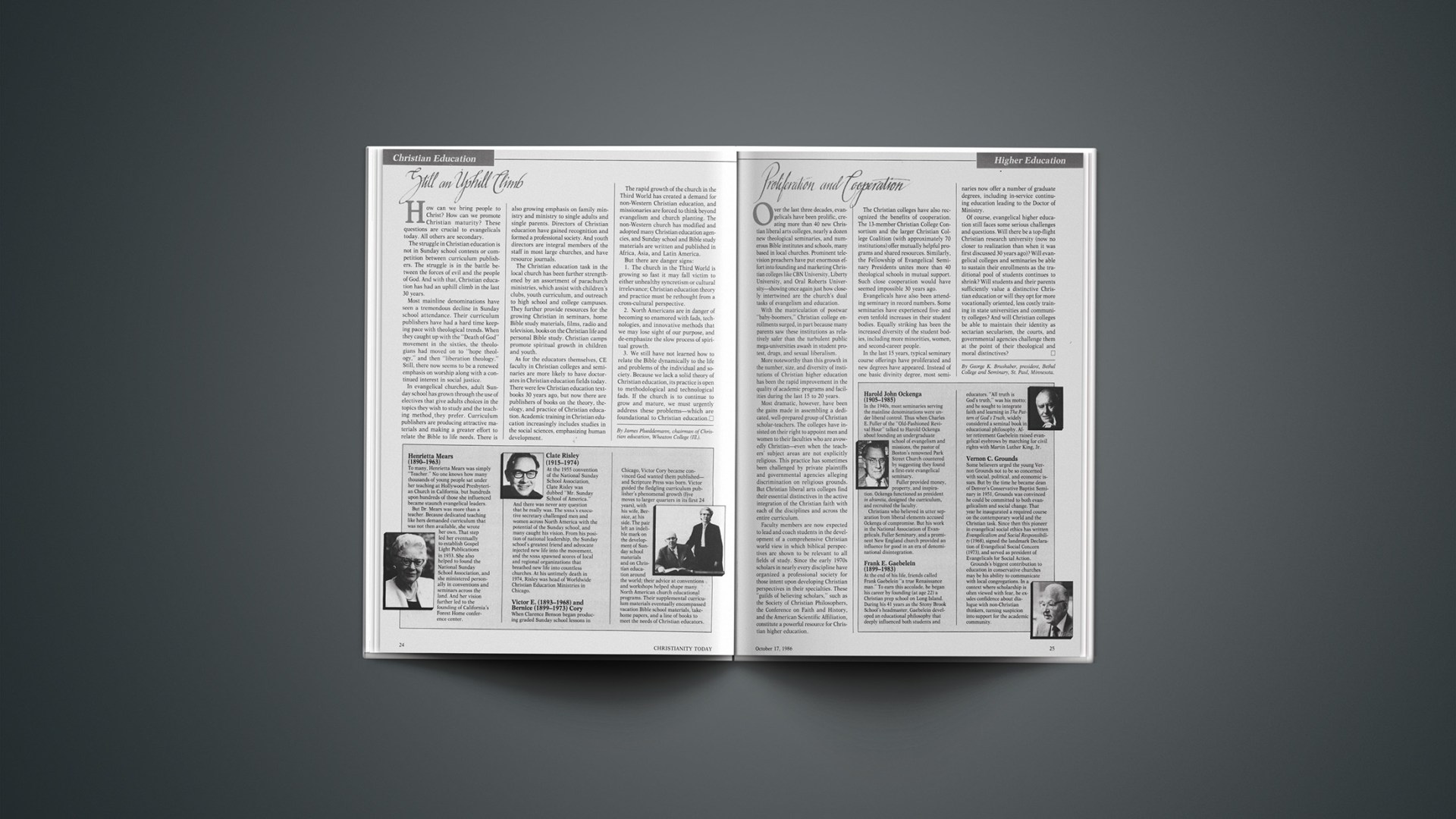
Christian Education: Still an Uphill Climb

How can we bring people to Christ? How can we promote Christian maturity? These questions are crucial to evangelicals today. All others are secondary.

The struggle in Christian education is not in Sunday school contests or competition between curriculum publishers. The struggle is in the battle between the forces of evil and the people of God. And with that, Christian education has had an uphill climb in the last 30 years.

Most mainline denominations have seen a tremendous decline in Sunday school attendance. Their curriculum publishers have had a hard time keeping pace with theological trends. When they caught up with the “Death of God” movement in the sixties, the theologians had moved on to “hope theology,” and then “liberation theology.” Still, there now seems to be a renewed emphasis on worship along with a continued interest in social justice.

In evangelical churches, adult Sunday school has grown through the use of electives that give adults choices in the topics they wish to study and the teaching method, they prefer. Curriculum publishers are producing attractive materials and making a greater effort to relate the Bible to life needs. There is also growing emphasis on family ministry and ministry to single adults and single parents. Directors of Christian education have gained recognition and formed a professional society. And youth directors are integral members of the staff in most large churches, and have resource journals.

The Christian education task in the local church has been further strengthened by an assortment of Parachurch ministries, which assist with children’s clubs, youth curriculum, and outreach to high school and college campuses. They further provide resources for the growing Christian in seminars, home Bible study materials, films, radio and television, books on the Christian life and personal Bible study. Christian camps promote spiritual growth in children and youth.

As for the educators themselves, CE faculty in Christian colleges and seminaries are more likely to have doctorates in Christian education fields today. There were few Christian education textbooks 30 years ago, but now there are publishers of books on the theory, theology, and practice of Christian education. Academic training in Christian education increasingly includes studies in the social sciences, emphasizing human development.

The rapid growth of the church in the Third World has created a demand for non-Western Christian education, and missionaries are forced to think beyond evangelism and church planting. The non-Western church has modified and adopted many Christian education agencies, and Sunday school and Bible study materials are written and published in Africa, Asia, and Latin America.

But there are danger signs:

1. The church in the Third World is growing so fast it may fall victim to either unhealthy syncretism or cultural irrelevance; Christian education theory and practice must be rethought from a cross-cultural perspective.

2. North Americans are in danger of becoming so enamored with fads, technologies, and innovative methods that we may lose sight of our purpose, and de-emphasize the slow process of spiritual growth.

3. We still have not learned how to relate the Bible dynamically to the life and problems of the individual and society. Because we lack a solid theory of Christian education, its practice is open to methodological and technological fads. If the church is to continue to grow and mature, we must urgently address these problems—which are foundational to Christian education.□

By James Plueddemann, chairman of Christian education, Wheaton College (Ill.).

Henrietta Mears (1890–1963)

To many, Henrietta Mears was simply “Teacher.” No one knows how many thousands of young people sat under her teaching at Hollywood Presbyterian Church in California, but hundreds upon hundreds of those she influenced became staunch evangelical leaders.

But Dr. Mears was more than a teacher. Because dedicated teaching like hers demanded curriculum that was not then available, she wrote her own. That step led her eventually to establish Gospel Light Publications in 1933. She also helped to found the National Sunday School Association, and she ministered personally in conventions and seminars across the land. And her vision further led to the founding of California’s Forest Home conference center.

Clate Risley (1915–1974)

At the 1955 convention of the National Sunday School Association, Clate Risley was dubbed “Mr. Sunday School of America.” And there was never any question that he really was. The NSSA’s executive secretary challenged men and women across North America with the potential of the Sunday school, and many caught his vision. From his position of national leadership, the Sunday school’s greatest friend and advocate injected new life into the movement, and the NSSA spawned scores of local and regional organizations that breathed new life into countless churches. At his untimely death in 1974, Risley was head of Worldwide Christian Education Ministries in Chicago.

Victor E. (1893–1968) and Bernice (1899–1973) Cory

When Clarence Benson began producing graded Sunday school lessons in Chicago, Victor Cory became convinced God wanted them published—and Scripture Press was born. Victor guided the fledgling curriculum publisher’s phenomenal growth (five moves to larger quarters in its first 24 years), with his wife, Bernice, at his side. The pair left an indelible mark on the development of Sunday school materials and on Christian education around the world; their advice at conventions and workshops helped shape many North American church educational programs. Their supplemental curriculum materials eventually encompassed vacation Bible school materials, take-home papers, and a line of books to meet the needs of Christian educators.

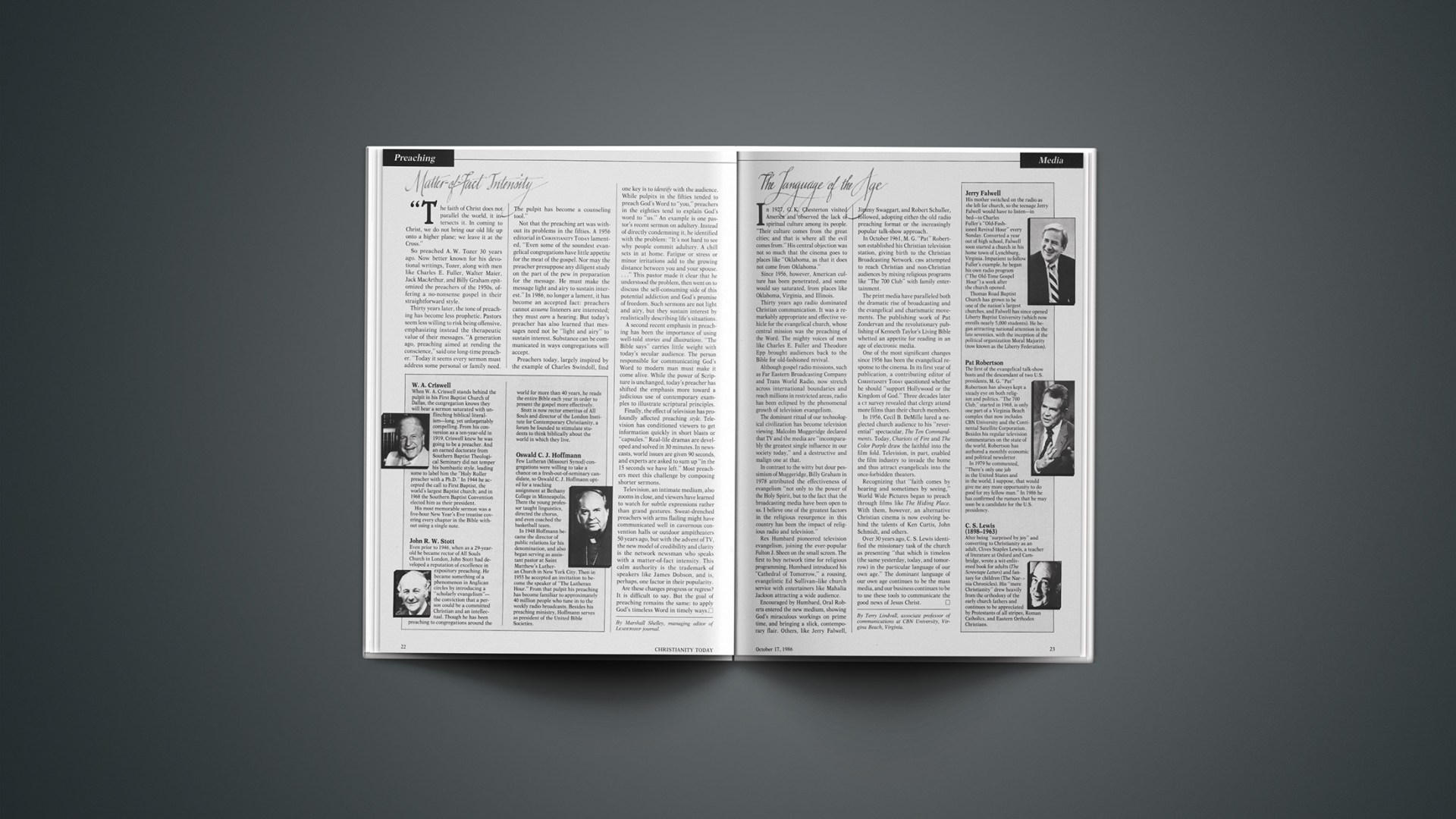
The Language of the Age

In 1927, G. K. Chesterton visited America and observed the lack of spiritual culture among its people. “Their culture comes from the great cities; and that is where all the evil comes from.” His central objection was not so much that the cinema goes to places like “Oklahoma, as that it does not come from Oklahoma.”

Since 1956, however, American culture has been penetrated, and some would say saturated, from places like Oklahoma, Virginia, and Illinois.

Thirty years ago radio dominated Christian communication. It was a remarkably appropriate and effective vehicle for the evangelical church, whose central mission was the preaching of the Word. The mighty voices of men like Charles E. Fuller and Theodore Epp brought audiences back to the Bible for old-fashioned revival.

Although gospel radio missions, such as Far Eastern Broadcasting Company and Trans World Radio, now stretch across international boundaries and reach millions in restricted areas, radio has been eclipsed by the phenomenal growth of television evangelism.

The dominant ritual of our technological civilization has become television viewing. Malcolm Muggeridge declared that TV and the media are “incomparably the greatest single influence in our society today,” and a destructive and malign one at that.

In contrast to the witty but dour pessimism of Muggeridge, Billy Graham in 1978 attributed the effectiveness of evangelism “not only to the power of the Holy Spirit, but to the fact that the broadcasting media have been open to us. I believe one of the greatest factors in the religious resurgence in this country has been the impact of religious radio and television.”

Rex Humbard pioneered television evangelism, joining the ever-popular Fulton J. Sheen on the small screen. The first to buy network time for religious programming, Humbard introduced his “Cathedral of Tomorrow,” a rousing, evangelistic Ed Sullivan-like church service with entertainers like Mahalia Jackson attracting a wide audience.

Encouraged by Humbard, Oral Roberts entered the new medium, showing God’s miraculous workings on prime time, and bringing a slick, contemporary flair. Others, like Jerry Falwell, Jimmy Swaggart, and Robert Schuller, followed, adopting either the old radio preaching format or the increasingly popular talk-show approach.

In October 1961, M. G. “Pat” Robertson established his Christian television station, giving birth to the Christian Broadcasting Network, CBN attempted to reach Christian and non-Christian audiences by mixing religious programs like “The 700 Club” with family entertainment.

The print media have paralleled both the dramatic rise of broadcasting and the evangelical and charismatic movements. The publishing work of Pat Zondervan and the revolutionary publishing of Kenneth Taylor’s Living Bible whetted an appetite for reading in an age of electronic media.

One of the most significant changes since 1956 has been the evangelical response to the cinema. In its first year of publication, a contributing editor of CHRISTIANITY TODAY questioned whether he should “support Hollywood or the Kingdom of God.” Three decades later a CT survey revealed that clergy attend more films than their church members.

In 1956, Cecil B. DeMille lured a neglected church audience to his “reverential” spectacular, The Ten Commandments. Today, Chariots of Fire and The Color Purple draw the faithful into the film fold. Television, in part, enabled the film industry to invade the home and thus attract evangelicals into the once-forbidden theaters.

Recognizing that “faith comes by hearing and sometimes by seeing,” World Wide Pictures began to preach through films like The Hiding Place. With them, however, an alternative Christian cinema is now evolving behind the talents of Ken Curtis, John Schmidt, and others.

Over 30 years ago, C. S. Lewis identified the missionary task of the church as presenting “that which is timeless (the same yesterday, today, and tomorrow) in the particular language of our own age.” The dominant language of our own age continues to be the mass media, and our business continues to be to use these tools to communicate the good news of Jesus Christ.

By Terry Lindvall, associate professor of communications at CBN University, Virgina Beach, Virginia.

Jerry Falwell

His mother switched on the radio as she left for church, so the teenage Jerry Falwell would have to listen—in bed—to Charles Fuller’s “Old-Fashioned Revival Hour” every Sunday. Converted a year out of high school, Falwell soon started a church in his home town of Lynchburg, Virginia. Impatient to follow Fuller’s example, he began his own radio program (“The Old-Time Gospel Hour”) a week after the church opened.

Thomas Road Baptist Church has grown to be one of the nation’s largest churches, and Falwell has since opened Liberty Baptist University (which now enrolls nearly 5,000 students). He began attracting national attention in the late seventies, with the inception of the political organization Moral Majority (now known as the Liberty Federation).

Pat Robertson

The first of the evangelical talk-show hosts and the descendant of two U.S. presidents, M. G. “Pat” Robertson has always kept a steady eye on both religion and politics. “The 700 Club,” started in 1968, is only one part of a Virginia Beach complex that now includes CBN University and the Continental Satellite Corporation. Besides his regular television commentaries on the state of the world, Robertson has authored a monthly economic and political newsletter.

In 1979 he commented, “There’s only one job in the United States and in the world, I suppose, that would give me any more opportunity to do good for my fellow man.” In 1986 he has confirmed the rumors that he may soon be a candidate for the U.S. presidency.

C. S. Lewis (1898–1963)

After being “surprised by joy” and converting to Christianity as an adult, Clives Staples Lewis, a teacher of literature at Oxford and Cambridge, wrote a wit-enlivened book for adults (The Screwtape Letters) and fantasy for children (The Narnia Chronicles). His “mere Christianity” drew heavily from the orthodoxy of the early church fathers and continues to be appreciated by Protestants of all stripes, Roman Catholics, and Eastern Orthodox Christians.

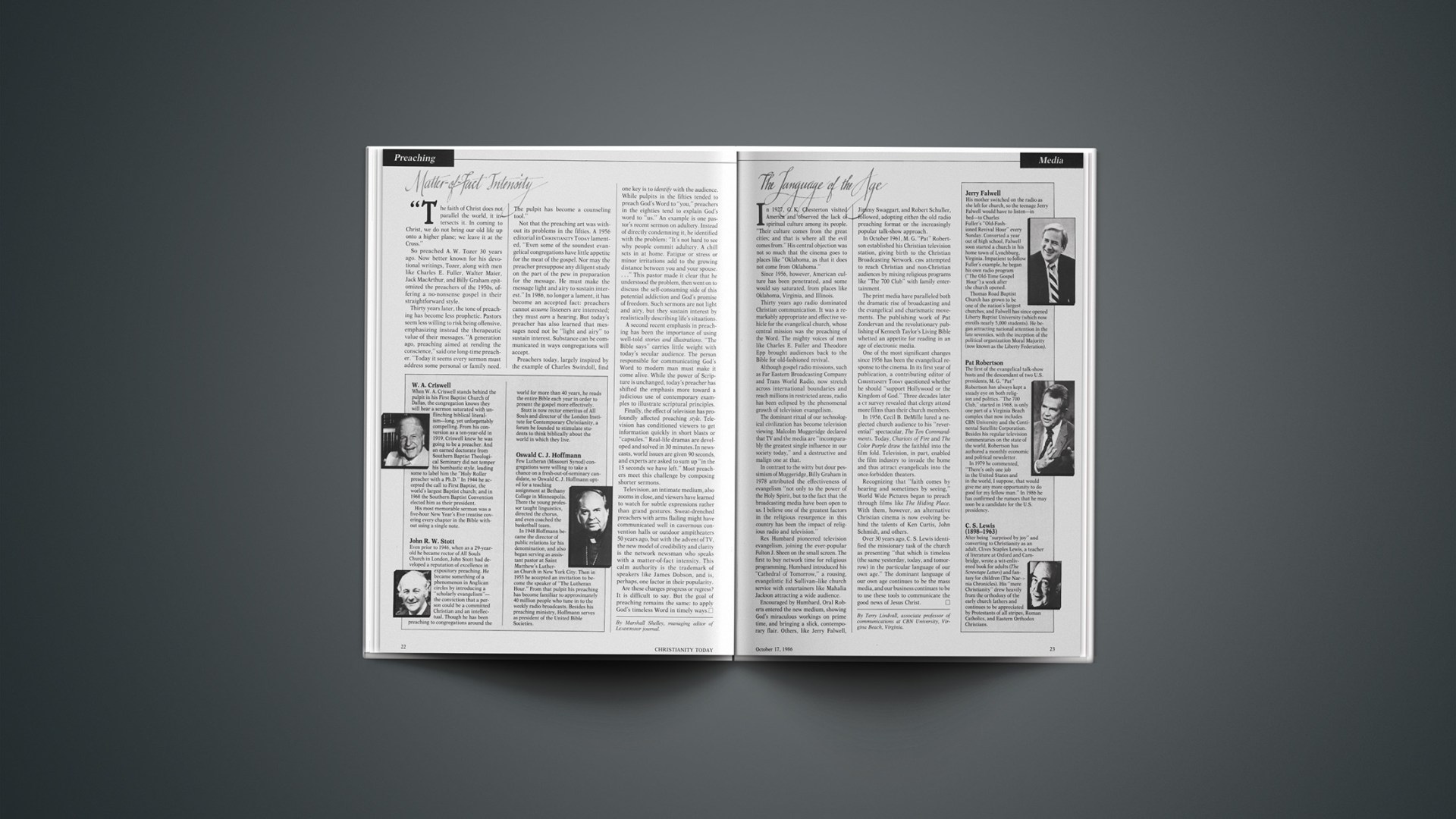
Preaching: Matter-of-Fact Intensity

“The faith of Christ does not parallel the world, it intersects it. In coming to Christ, we do not bring our old life up onto a higher plane; we leave it at the Cross.”

So preached A. W. Tozer 30 years ago. Now better known for his devotional writings, Tozer, along with men like Charles E. Fuller, Walter Maier, Jack MacArthur, and Billy Graham epitomized the preachers of the 1950s, offering a no-nonsense gospel in their straightforward style.

Thirty years later, the tone of preaching has become less prophetic. Pastors seem less willing to risk being offensive, emphasizing instead the therapeutic value of their messages. “A generation ago, preaching aimed at rending the conscience,” said one long-time preacher. “Today it seems every sermon must address some personal or family need. The pulpit has become a counseling tool.”

Not that the preaching art was without its problems in the fifties. A 1956 editorial in CHRISTIANITY TODAY lamented, “Even some of the soundest evangelical congregations have little appetite for the meat of the gospel. Nor may the preacher presuppose any diligent study on the part of the pew in preparation for the message. He must make the message light and airy to sustain interest.” In 1986, no longer a lament, it has become an accepted fact: preachers cannot assume listeners are interested; they must earn a hearing. But today’s preacher has also learned that messages need not be “light and airy” to sustain interest. Substance can be communicated in ways congregations will accept.

Preachers today, largely inspired by the example of Charles Swindoll, find one key is to identify with the audience. While pulpits in the fifties tended to preach God’s Word to “you,” preachers in the eighties tend to explain God’s word to “us.” An example is one pastor’s recent sermon on adultery. Instead of directly condemning it, he identified with the problem: “It’s not hard to see why people commit adultery. A chill sets in at home. Fatigue or stress or minor irritations add to the growing distance between you and your spouse.…” This pastor made it clear that he understood the problem, then went on to discuss the self-consuming side of this potential addiction and God’s promise of freedom. Such sermons are not light and airy, but they sustain interest by realistically describing life’s situations.

A second recent emphasis in preaching has been the importance of using well-told stories and illustrations. “The Bible says” carries little weight with today’s secular audience. The person responsible for communicating God’s Word to modern man must make it come alive. While the power of Scripture is unchanged, today’s preacher has shifted the emphasis more toward a judicious use of contemporary examples to illustrate scriptural principles.

Finally, the effect of television has profoundly affected preaching style. Television has conditioned viewers to get information quickly in short blasts or “capsules.” Real-life dramas are developed and solved in 30 minutes. In newscasts, world issues are given 90 seconds, and experts are asked to sum up “in the 15 seconds we have left.” Most preachers meet this challenge by composing shorter sermons.

Television, an intimate medium, also zooms in close, and viewers have learned to watch for subtle expressions rather than grand gestures. Sweat-drenched preachers with arms flailing might have communicated well in cavernous convention halls or outdoor ampitheaters 50 years ago, but with the advent of TV, the new model of credibility and clarity is the network newsman who speaks with a matter-of-fact intensity. This calm authority is the trademark of speakers like James Dobson, and is, perhaps, one factor in their popularity.

Are these changes progress or regress? It is difficult to say. But the goal of preaching remains the same: to apply God’s timeless Word in timely ways.

By Marshall Shelley, managing editor of LEADERSHIP journal.

W. A. Criswell

When W. A. Criswell stands behind the pulpit in his First Baptist Church of Dallas, the congregation knows they will hear sermon saturated with unflinching biblical literalism—long, yet unforgettably compelling. From his conversion as a ten-year-old in 1919, Criswell knew he was going to be a preacher. And an earned doctorate from Southern Baptist Theological Seminary did not temper his bombastic style, leading some to label him the “Holy Roller preacher with a Ph.D.” In 1944 he accepted the call to First Baptist, the world’s largest Baptist church; and in 1968 the Southern Baptist Convention elected him as their president.

His most memorable sermon was a five-hour New Year’s Eve treatise covering every chapter in the Bible without using a single note.

John R. W. Stott

Even prior to 1946, when as a 29-year-old he became rector of All Souls Church in London, John Stott had developed a reputation of excellence in expository preaching. He became something of a phenomenon in Anglican circles by introducing a “scholarly evangelism”—the conviction that a person could be a committed Christian and an intellectual. Though he has been preaching to congregations around the world for more than 40 years, he reads the entire Bible each year in order to present the gospel more effectively.

Stott is now rector emeritus of All Souls and director of the London Institute for Contemporary Christianity, a forum he founded to stimulate students to think biblically about the world in which they live.

Oswald C. J. Hoffmann

Few Lutheran (Missouri Synod) congregations were willing to take a chance on a fresh-out-of-seminary candidate, so Oswald C. J. Hoffmann opted for a teaching assignment at Bethany College in Minneapolis. There the young professor taught linguistics, directed the chorus, and even coached the basketball team.

In 1948 Hoffmann became the director of public relations for his denomination, and also began serving as assistant pastor at Saint Matthew’s Lutheran Church in New York City. Then in 1955 he accepted an invitation to become the speaker of “The Lutheran Hour.” From that pulpit his preaching has become familiar to approximately 40 million people who tune in to the weekly radio broadcasts. Besides his preaching ministry, Hoffmann serves as president of the United Bible Societies.

Biblical Scholarship: Small Beginnings Rapid Progress

In 1956 evangelical Bible scholars had just begun to emerge from the intellectual wilderness. The public defeat of “fundamentalism” in the 1920s had meant conservative views on the Bible almost disappeared from the American academic landscape. At Westminster Theological Seminary in Philadelphia, theologically orthodox scholars like Ned Stonehouse continued to interact rigorously with academic literature. Stonehouse played a particularly important role in the 1940s, showing how cautious acceptance of certain procedures in modern scholarship could coexist with, even enrich, evangelical faith. But this was an exception for the evangelical world, which focused almost all its attention on devotional uses of the Bible.

Several sources contributed to a rejuvenation of evangelical Bible scholarship in the 1940s and 1950s. First in time were developments in Britain under the umbrella of Inter-Varsity Fellowship, which had been under way since the 1920s. Scholars from Scotland (such as F. F. Bruce), England (John Wenham), and from the British Commonwealth (Australia’s Leon Morris) put university training to work in their efforts to understand the Scriptures. The publication of Bruce’s Acts of the Apostles: The Greek Text with Introduction and Commentary (1951), and soon thereafter of Inter-Varsity’s New Bible Commentary, marked the visible return of first-rate evangelical work on Scripture. Soon Bruce and a number of other individuals not prejudiced against orthodox convictions were directing doctoral studies by American evangelicals at several major British universities.

Another source of renewal came from the “new evangelical” movement, which inspired, among other things, the founding of Fuller Theological Seminary. By the mid-1950s several Fuller scholars, especially George Ladd, were pointing the way to a restrained, yet academically responsible engagement with modern criticism. The series on Contemporary Evangelical Thought, edited by Carl Henry (1957), as well as J. I. Packer’s “Fundamentalism” and the Word of God (1958), showed how a high view of biblical authority could coexist with honest scholarship.

Soon evangelical publishers began to solicit scholarly volumes. In the forefront was Eerdmans in Grand Rapids, which published not only individual works by scholars such as Bruce, Ladd, Henry, and Morris, but also sponsored the New International Commentary on the New Testament, the first academic series under evangelical auspices since the fundamentalist era.

From small beginnings, evangelical Bible scholarship has made rapid progress. Now the major evangelical seminaries employ Bible faculties with training from the best universities in the world. Evangelicals contribute roughly 10 percent of the articles to the major New Testament journals and till about the same proportion of slots at the annual meetings of the Society of Biblical Literature. Organizations such as the Evangelical Theological Society, the Institute for Biblical Research, and the Wesleyan Theological Society also encourage detailed work.

With progress, of course, come also new problems. In the 1980s evangelical organizations and institutions have had to struggle with the degree to which believing perspectives can accommodate the latest results from the academic establishment. Old Testament scholars still find it harder to reach common ground with non-evangelicals than do those who study the New Testament. As always, evangelical scholars face the twin dangers of compromising the church by the indiscriminate acceptance of academic fashion, and compromising the solid results of research for fear of offending traditionalists in the church. However, unlike the situation in 1956, a large corps of professionally capable scholars exists today to offer guidance for work on these knotty matters.

By Mark A. Noll, professor of history at Wheaton College, and author of the forthcoming book Between Faith and Criticism: Evangelical Bible Scholarship Since 1880.

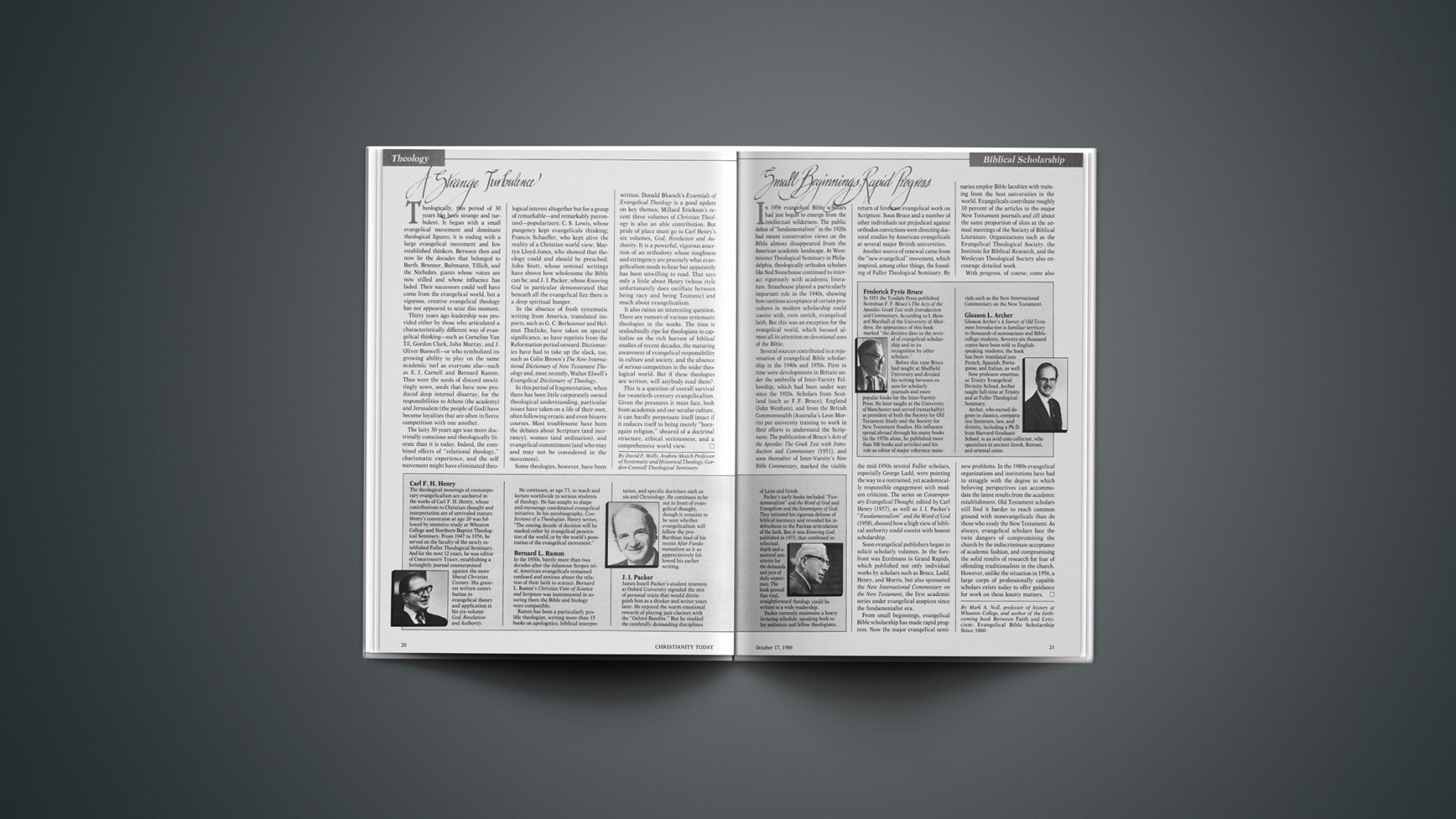
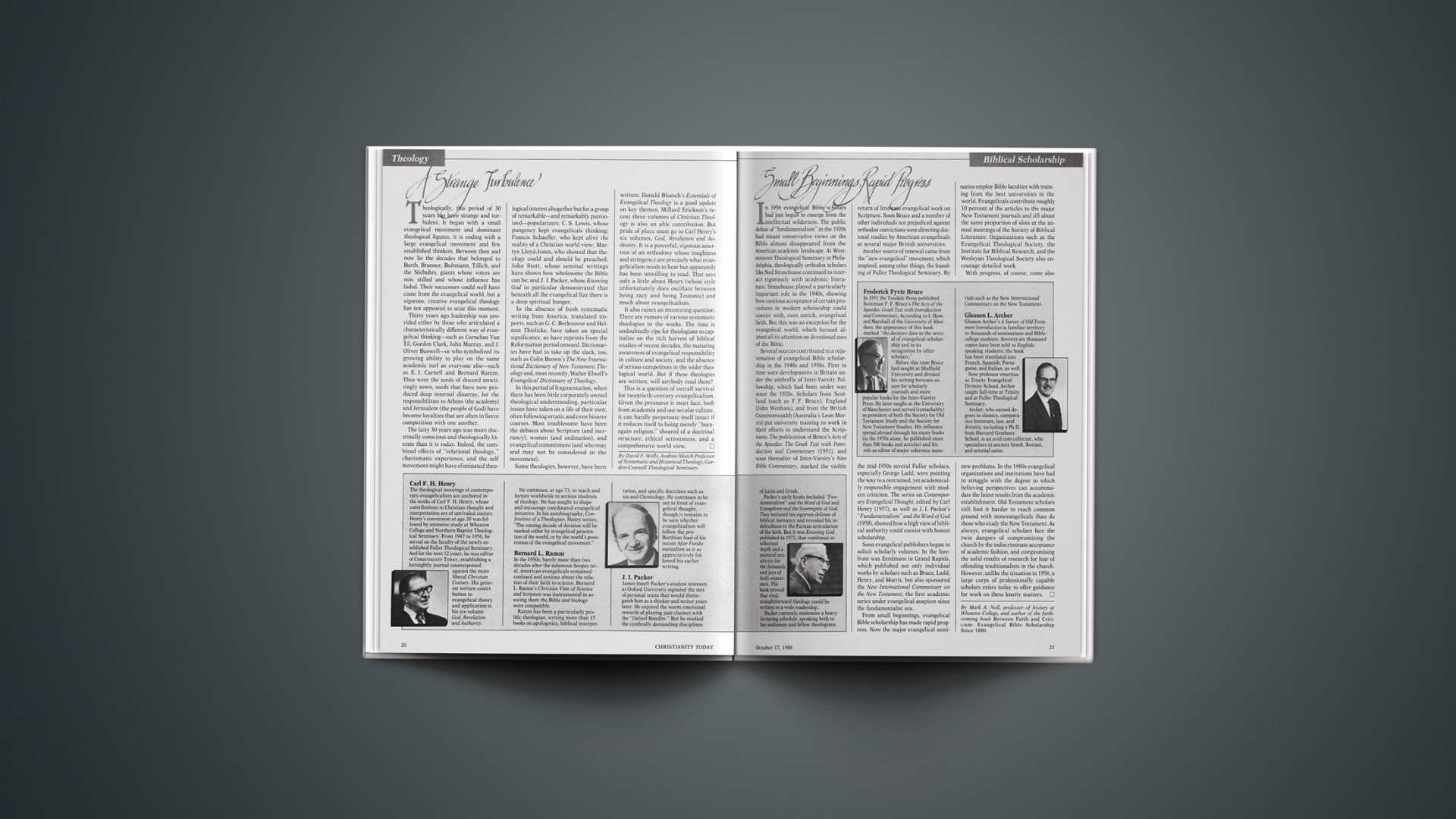
Theology

A Strange Turbulence

Theologically, this period of 30 years has been strange and turbulent. It began with a small evangelical movement and dominant theological figures; it is ending with a large evangelical movement and few established thinkers. Between then and now lie the decades that belonged to Barth, Brunner, Bultmann, Tillich, and the Niebuhrs, giants whose voices are now stilled and whose influence has faded. Their successors could well have come from the evangelical world, but a vigorous, creative evangelical theology has not appeared to seize this moment.

Thirty years ago leadership was provided either by those who articulated a characteristically different way of evangelical thinking—such as Cornelius Van Til, Gordon Clark, John Murray, and J. Oliver Buswell—or who symbolized its growing ability to play on the same academic turf as everyone else—such as E. J. Carnell and Bernard Ramm. Thus were the seeds of discord unwittingly sown, seeds that have now produced deep internal disarray, for the responsibilities to Athens (the academy) and Jerusalem (the people of God) have become loyalties that are often in fierce competition with one another.

The laity 30 years ago was more doctrinally conscious and theologically literate than it is today. Indeed, the combined effects of “relational theology,” charismatic experience, and the self movement might have eliminated theological interest altogether but for a group of remarkable—and remarkably patronized—popularizers: C. S. Lewis, whose pungency kept evangelicals thinking; Francis Schaeffer, who kept alive the reality of a Christian world view; Martyn Lloyd-Jones, who showed that theology could and should be preached; John Stott, whose seminal writings have shown how wholesome the Bible can be; and J. I. Packer, whose Knowing God in particular demonstrated that beneath all the evangelical fizz there is a deep spiritual hunger.

In the absence of fresh systematic writing from America, translated imports, such as G. C. Berkouwer and Helmut Thielicke, have taken on special significance, as have reprints from the Reformation period onward. Dictionaries have had to take up the slack, too, such as Colin Brown’s The New International Dictionary of New Testament Theology and, most recently, Walter Elwell’s Evangelical Dictionary of Theology.

In this period of fragmentation, when there has been little corporately owned theological understanding, particular issues have taken on a life of their own, often following erratic and even bizarre courses. Most troublesome have been the debates about Scripture (and inerrancy), women (and ordination), and evangelical commitment (and who may and may not be considered in the movement).

Some theologies, however, have been written. Donald Bloesch’s Essentials of Evangelical Theology is a good update on key themes; Millard Erickson’s recent three volumes of Christian Theology is also an able contribution. But pride of place must go to Carl Henry’s six volumes, God, Revelation and Authority. It is a powerful, vigorous assertion of an orthodoxy whose toughness and stringency are precisely what evangelicalism needs to hear but apparently has been unwilling to read. That says only a little about Henry (whose style unfortunately does oscillate between being racy and being Teutonic) and much about evangelicalism.

It also raises an interesting question. There are rumors of various systematic theologies in the works. The time is undoubtedly ripe for theologians to capitalize on the rich harvest of biblical studies of recent decades, the maturing awareness of evangelical responsibility in culture and society, and the absence of serious competitors in the wider theological world. But if these theologies are written, will anybody read them?

This is a question of overall survival for twentieth-century evangelicalism. Given the pressures it must face, both from academia and our secular culture, it can hardly perpetuate itself intact if it reduces itself to being merely “born-again religion,” sheared of a doctrinal structure, ethical seriousness, and a comprehensive world view.

By David F. Wells, Andrew Mutch Professor of Systematic and Historical Theology, Gordon-Conwell Theological Seminary.

Carl F. H. Henry

The theological moorings of contemporary evangelicalism are anchored in the works of Carl F. H. Henry, whose contributions to Christian thought and interpretation are of unrivaled stature. Henry’s conversion at age 20 was followed by intensive study at Wheaton College and Northern Baptist Theological Seminary. From 1947 to 1956, he served on the faculty of the newly established Fuller Theological Seminary. And for the next 12 years, he was editor of CHRISTIANITY TODAY, establishing a fortnightly journal counterpoised against the more liberal Christian Century. His greatest written contribution to evangelical theory and application is his six-volume God, Revelation and Authority.

He continues, at age 73, to teach and lecture worldwide to serious students of theology. He has sought to shape and encourage coordinated evangelical initiative. In his autobiography, Confessions of a Theologian, Henry writes, “The coming decade of decision will be marked either by evangelical penetration of the world, or by the world’s penetration of the evangelical movement.”

Bernard L. Ramm

In the 1950s, barely more than two decades after the infamous Scopes trial, American evangelicals remained confused and anxious about the relation of their faith to science. Bernard L. Ramm’s Christian View of Science and Scripture was instrumental in assuring them the Bible and biology were compatible.

Ramm has been a particularly prolific theologian, writing more than 15 books on apologetics, biblical interpre tation, and specific doctrines such as sin and Christology. He continues to be out in front of evangelical thought, though it remains to be seen whether evangelicalism will follow the pro-Barthian lead of his recent After Fundamentalism as it so appreciatively followed his earlier writing.

J. I. Parker

James Innell Packer’s student interests at Oxford University signaled the mix of personal traits that would distinguish him as a thinker and writer years later. He enjoyed the warm emotional rewards of playing jazz clarinet with the “Oxford Bandits.” But he studied the cerebrally demanding disciplines of Latin and Greek.

Packer’s early books included “Fundamentalism” and the Word of God and Evangelism and the Sovereignty of God. They initiated his rigorous defense of biblical inerrancy and revealed his indebtedness to the Puritan articulation of the faith. But it was Knowing God, published in 1973, that combined intellectual depth and a pastoral sensitivity for the demands and joys of daily experience. The book proved that vital, straightforward theology could be written to a wide readership.

Packer currently maintains a heavy lecturing schedule, speaking both to lay audiences and fellow theologians.

Frederick Fyvie Bruce

In 1951 the Tyndale Press published Scotsman F. F. Bruce’s The Acts of the Apostles: Greek Text with Introduction and Commentary. According to I. Howard Marshall of the University of Aberdeen, the appearance of this book marked “the decisive date in the revival of evangelical scholarship and in its recognition by other scholars.”

Before this time Bruce had taught at Sheffield University and divided his writing between essays for scholarly journals and more popular books for the Inter-Varsity Press. He later taught at the University of Manchester and served (remarkably) as president of both the Society for Old Testament Study and the Society for New Testament Studies. His influence spread abroad through his many books (in the 1970s alone, he published more than 500 books and articles) and his role as editor of major reference materials such as the New International Commentary on the New Testament.

Gleason L. Archer

Gleason Archer’s A Survey of Old Testament Introduction is familiar territory to thousands of seminarians and Bible-college students. Seventy-six thousand copies have been sold to English-speaking students; the book has been translated into French, Spanish, Portuguese, and Italian, as well.

Now professor emeritus at Trinity Evangelical Divinity School, Archer taught full-time at Trinity and at Fuller Theological Seminary.

Archer, who earned degrees in classics, comparative literature, law, and divinity, including a Ph.D. from Harvard Graduate School, is an avid coin collector, who specializes in ancient Greek, Roman, and oriental coins.

Cover Story

CT at Thirty: Looking Back at the Forces and Faces of American Evangelicalism

Thirty years ago, evangelicals had a President with whom they could identify (Dwight D. Eisenhower), several trustworthy seminaries (Fuller and Dallas, to name two), a world-renowned evangelist (Billy Graham), and a sense they represented the grassroots religious values of the country.

What they did not have was a magazine. The liberals had The Christian Century. But where could the evangelical pastor go to see his viewpoint expressed with intellectual credibility and depth?

That was the question Billy Graham and L. Nelson Bell first asked themselves in 1954. “We need,” Graham said later, “a new strong vigorous voice to call us together that will have the respect of all evangelicals of all stripes within our major denominations. It has come to me with ever increasing conviction that one of the great needs is a religious magazine … that will reach the clergy and the lay leaders of every denomination.”

Thus, in 1956 the first issue of CHRISTIANITY TODAY came off the presses and was delivered gratis to nearly 200,000 pastors. The premier issue had an article by Carl F. H. Henry, editor of CHRISTIANITY TODAY for its first 12 years, on the difference between the concept of freedom in the West and in Communist countries. G. C. Berkouwer, systematic theologian from the Free University of Amsterdam, wrote about the changing climate of European theology. And evangelist Billy Graham contributed an article on biblical authority in evangelism.

In the over 500 issues that have been published since then, the editorial purpose of CHRISTIANITY TODAY has remained essentially the same: To disciple the evangelizers by offering concerned Christians insightful commentary on the critical social, political, and theological issues affecting the church in the twentieth century. Or, as Henry put it in Volume 1: “To articulate historic Christianity and its contemporary relevance.”

Keeping the magazine true to this purpose were Henry’s successors, the editors of CHRISTIANITY TODAY: Frank Gaebelein (co-editor 1963–66), Harold Lindsell, Kenneth Kantzer, and V. Gilbert Beers. Coming under their watchful eyes were issues as diverse, yet uniformly important to evangelicals, as the problems of racism and sexism, the trustworthiness of Scripture, the role of social action in evangelization, and the separation of church and state.

To be sure, “the look” of CT changed over the years—but only to keep up with a movement no longer in its infancy. American evangelicalism has positioned itself as a viable force for change in both the religious and secular worlds, adding new dimensions to Henry’s mandate of “contemporary relevance.” Its sphere of influence has broadened to include television and radio; politics; social action; as well as increased numbers of mission agencies and missionaries, Parachurch agencies, and institutions of higher education. And thus there is the ongoing need to carefully, clearly, and in a contemporary way, communicate biblically oriented thoughts and ideas to an ever-expanding evangelical leadership.

This special anniversary section is devoted to documenting briefly how the face of evangelicalism has changed over the last 30 years. We have commissioned ten writers to take a critical look at specific areas of evangelical involvement, noting both accomplishments and the many challenges that remain. Along with the analyses of biblical scholarship, higher education, theology, media, Christian education, missions, evangelism, preaching, and Parachurch ministries, we have included short biographies of a few of the people influential in each of these categories. (Space did not permit us to recognize all who have distinguished themselves.) Helping us in the selection of these names were CHRISTIANITY TODAY’s senior editors and contributing editors, along with fellows and resource scholars of the CT Institute.

Not mere sentimental retrospective, the overviews and profiles offered here serve as a guide to the next 30 years—exhibiting in a historical context those practical lessons and personal qualities that may keep the evangelical movement from suffering a midlife crisis, and which, instead, may help it become a more vital instrument of spiritual and societal change.

Ideas

Time to Look Ahead

As the twenty-first century beckons, the church faces a dual challenge.

Anniversaries and other milestones often lead us to ask questions about the future. Birthdays not only bring celebration and merriment, but also the inevitable question, “What lies ahead?” One can hardly reflect on the past without imagining what awaits us in the years to come. So permit us, just this once, to prognosticate.

Unfulfilled Promises

When CHRISTIANITY TODAY made its debut 30 years ago, theological liberalism had become discredited and no clear successor had arrived on the scene. After 30 years, we can agree that the older liberalism is indeed in shambles. And while it might be safe to predict there will be no single dominant theology within the next generation, theological conservatism will continue to gain respectability.

Perhaps, too, the founders of this magazine already saw the demise of an earlier hope that technology would destroy disease and want on planet Earth. Already the atomic bomb had destroyed, once and for all, the fond hopes of social Darwinists. Social critic Bernard Iddings Bell gave the world not ten decades or even ten years, but at best a few months to solve the threat to mankind created by nuclear warfare. And the greatest optimist of the preceding generation, H. G. Wells, had produced his Mind at the End of Its Tether, reversing all his glorious predictions of a coming utopia—false prophecies that now sound strangely unreal.

Thirty years later, there is little to suggest we should be less pessimistic. Regardless of one’s position on nuclear arms, the bomb is merely buying us a little more time. Though the superpowers have managed to deploy only words and sanctions in their battle (aside from an occasional misguided missile or bullet), other nations have been less fortunate. More than 90 wars have been fought during the last 30 years. And in spite of breakthroughs in disease control, and giant strides in food production, nearly half of this planet’s inhabitants face a daily struggle against hunger and sickness. If that’s not enough gloom and doom, some astronomers tell us there may be a runaway star or black hole that could wander into our path, snuffing us out of existence.

Faced with a threatening universe (and a more threatening social structure), modern humans flee to the safe nest of their own private worlds. At the beginning of our modern era (1611), John Donne declared with foresight: “ ’Tis all in peeces, all cohaerence gone … and all relation; / For every man alone thinkes he hath got / To be a Phoenix, and that then can bee / None of that kinde, of which he is, but hee.”

During the past three decades we have watched man isolate himself from the concerns of his personal and global neighbors. Responsibility for others is rejected. Personal freedom, rather than commitment, characterizes marriage and family issues. As a result, divorce is the option of choice when relationships falter. Unwanted pregnancies have become less of a problem because abortion, once a taboo, is now respectable. And though most parents would like to turn back the clock, permissiveness reigns when it comes to rearing children. This freedom from responsibility to all but oneself is growing and will continue to afflict our society. It will be fostered by a secularism that rejects religion and knows no alternative.

The Church Of The Future

But evangelicalism, likewise, will continue to grow. As people find no enduring grounds for meaning in their secularistic philosophies and no eschatology that provides any ultimate hope, they will turn to other sources. Many will look to the cults, and many more to Eastern religions, largely due to the influx of Asians in America. Outreach-minded Protestant denominations and Parachurch agencies will experience solid growth as they meet the needs of a searching public.

American Catholicism will also grow for the same reason: it offers an alternative to an ultimately bankrupt secularism. The rapid and immense immigration across the southern border will give the Catholic church tremendous potential for growth. Roman Catholicism of the future, however, will never be the same Catholicism that dominated Europe for so many centuries. It is rapidly becoming a pluralistic religion—more like its Protestant alternative.

Rapprochement between conservative Protestants and charismatic Roman Catholics will continue at a more rapid rate. It will come in politics first, already foreshadowed by the unthinkable (but practical) union between the Moral Majority and American Catholics (Catholics are the largest single religious group within that body).

If the separatists and fundamentalists can make common cause with Roman Catholics, we can similarly expect the more conservative elements among evangelicals and Roman Catholics to discover common values. As they do, they will work together to achieve mutual goals in government and society.

Other social movements affecting the church will continue in directions already set. Racism will not disappear entirely. Yet the consciences of evangelicals have been ignited, and they know racism is wrong. The church will support efforts to bring harmony through equal opportunity and fair treatment of racial minorities.

The role of women in the church will become increasingly important. We cannot expect over one-half of the church to remain graciously patient with their second-class status. We predict more denominations will open their doors to women in leadership positions, though the debate over ordination will continue.

As the population ages, so will the church. Retirement age will creep up to 75. Youth pastors will be supplemented or even replaced by senior citizen pastors. Retired members of the congregation will take over the labors formerly cared for by married “unemployed” women. As with the question of women in leadership, the church will recognize its need to use every Christian’s gifts if it desires to carry out the Great Commission.

The threat of nuclear war will continue to hang over planet Earth, intensified by the Vietnams, Central Americas, and Afghanistans that will surely continue. Just as World War II was followed by a continuous train of lesser wars that have never ceased, they will not stop in the next 30 years. We can hope that Russia and the United States and their uneasy partners will work out a modus vivendi. Yet someday another conflagration will come. No doubt it will begin as a conventional war. The unanswered question is: “Can it remain on that level?” And if it does not, what then? The church has struggled with the nuclear question and will remain divided on the issue of disarmament.

It is against this backdrop that the church must function during the decades to come. But the lessons of history give us reason to be optimistic. Adversity always strengthens the people of God as they depend more fully on him. Specifically, we believe the next 30 years will present tremendous challenges in missions, education, and evangelism.

Into The Next Century

The nations of the Third World will grow in national pride as well as in poverty, making more difficult than ever the entrance of American missionaries. However, missionaries from the Third World will increase in number and find greater acceptance around the world. Missionary sending agencies will concentrate on teaching and equipping Third World Christians who will become the global evangelists of the next century.

A great danger evangelicals face in the next 30 years is penetration from secularism. This will come partly through secular control of the power structure of the Western world and partly from the growth of the church through successful evangelism. Secularism will affect the church by its antagonism to a biblical supernaturalism and by its insistence upon a false freedom from responsibility that is so devastating to moral life. Ironically, the more successful the church is in its evangelistic program, the greater the threat from the materialistic secularism that has permeated our society.

The key to meeting this challenge is doctrinal and moral instruction of its converts. Here evangelicalism can be grateful for strong and growing seminaries across the land. Unfortunately, its colleges have not done so well, enrolling scarcely 100,000 of the 12,000,000 college students today. Unless there is a radical change in government support of private college education through tuition rebates or other devices, Christian private colleges cannot compete with the public community colleges and universities dominated by secular materialism. If Christian colleges close their doors (many will), and if we do not find ways to strengthen Christian students on secular campuses, the growth in evangelical churches will be mere froth. Eventually, the movement will be weaker than before.

The greatest challenge to the church during the next 30 years, therefore, is the need for both evangelization and discipleship. We are surrounded by a materialistic, self-centered, pleasure-seeking society of individuals. As Christian witnesses, we must enter that environment to reach the lost. To the degree that we are successful in introducing them to the Savior, our task of discipleship becomes all the more urgent. It will be wonderful to fill our churches with new believers. But it is equally important to nurture them in the faith. If we win the battle for evangelism but lose the battle for discipleship, we have lost the church of the next generation. If we win the battle for evangelism, but lose the battle for discipleship, we have lost the church of the next generation.

Thus, on this occasion of celebrating the past, we call on the church to look ahead. For the past 30 years, this magazine has chronicled a movement that, in spite of occasional setbacks, has met the needs of its age. We look forward to continuing the story.

By Kenneth S. Kantzer

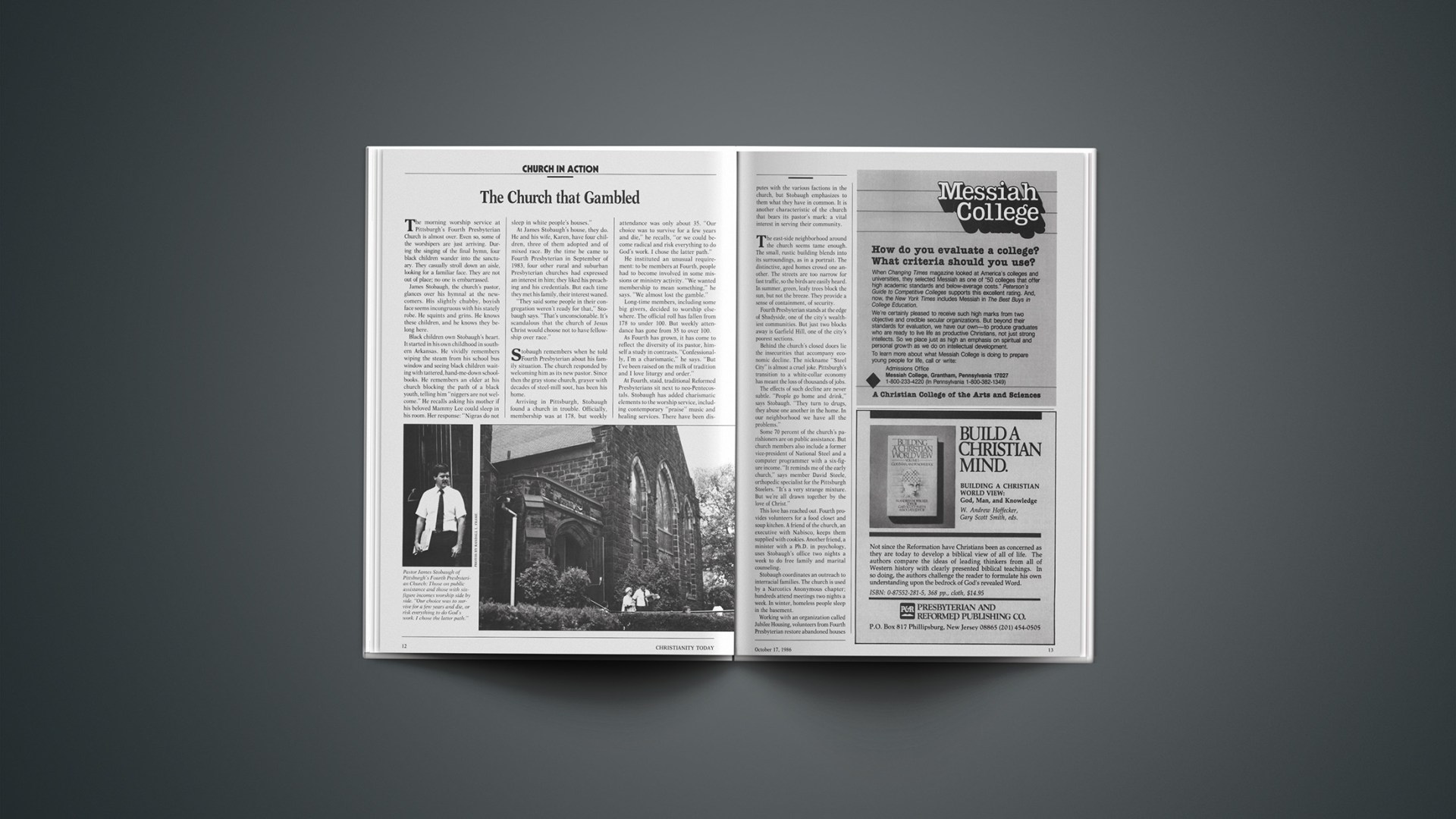
The Church that Gambled

The morning worship service at Pittsburgh’s Fourth Presbyterian Church is almost over. Even so, some of the worshipers are just arriving. During the singing of the final hymn, four black children wander into the sanctuary. They casually stroll down an aisle, looking for a familiar face. They are not out of place; no one is embarrassed.

James Stobaugh, the church’s pastor, glances over his hymnal at the newcomers. His slightly chubby, boyish face seems incongruous with his stately robe. He squints and grins. He knows these children, and he knows they belong here.

Black children own Stobaugh’s heart. It started in his own childhood in southern Arkansas. He vividly remembers wiping the steam from his school bus window and seeing black children waiting with tattered, hand-me-down schoolbooks. He remembers an elder at his church blocking the path of a black youth, telling him “niggers are not welcome.” He recalls asking his mother if his beloved Mammy Lee could sleep in his room. Her response: “Nigras do not sleep in white people’s houses.”

At James Stobaugh’s house, they do. He and his wife, Karen, have four children, three of them adopted and of mixed race. By the time he came to Fourth Presbyterian in September of 1983, four other rural and suburban Presbyterian churches had expressed an interest in him; they liked his preaching and his credentials. But each time they met his family, their interest waned.

“They said some people in their congregation weren’t ready for that,” Stobaugh says. “That’s unconscionable. It’s scandalous that the church of Jesus Christ would choose not to have fellowship over race.”

Stobaugh remembers when he told Fourth Presbyterian about his family situation. The church responded by welcoming him as its new pastor. Since then the gray stone church, grayer with decades of steel-mill soot, has been his home.

Arriving in Pittsburgh, Stobaugh found a church in trouble. Officially, membership was at 178, but weekly attendance was only about 35. “Our choice was to survive for a few years and die,” he recalls, “or we could become radical and risk everything to do God’s work. I chose the latter path.”

He instituted an unusual requirement: to be members at Fourth, people had to become involved in some missions or ministry activity. “We wanted membership to mean something,” he says. “We almost lost the gamble.”

Long-time members, including some big givers, decided to worship elsewhere. The official roll has fallen from 178 to under 100. But weekly attendance has gone from 35 to over 100.

As Fourth has grown, it has come to reflect the diversity of its pastor, himself a study in contrasts. “Confessionally, I’m a charismatic,” he says. “But I’ve been raised on the milk of tradition and I love liturgy and order.”

At Fourth, staid, traditional Reformed Presbyterians sit next to neo-Pentecostals. Stobaugh has added charismatic elements to the worship service, including contemporary “praise” music and healing services. There have been disputes with the various factions in the church, but Stobaugh emphasizes to them what they have in common. It is another characteristic of the church that bears its pastor’s mark: a vital interest in serving their community.

The east-side neighborhood around the church seems tame enough. The small, rustic building blends into its surroundings, as in a portrait. The distinctive, aged homes crowd one another. The streets are too narrow for fast traffic, so the birds are easily heard. In summer, green, leafy trees block the sun, but not the breeze. They provide a sense of containment, of security.

Fourth Presbyterian stands at the edge of Shadyside, one of the city’s wealthiest communities. But just two blocks away is Garfield Hill, one of the city’s poorest sections.

Behind the church’s closed doors lie the insecurities that accompany economic decline. The nickname “Steel City” is almost a cruel joke. Pittsburgh’s transition to a white-collar economy has meant the loss of thousands of jobs.

The effects of such decline are never subtle. “People go home and drink,” says Stobaugh. “They turn to drugs, they abuse one another in the home. In our neighborhood we have all the problems.”

Some 70 percent of the church’s parishioners are on public assistance. But church members also include a former vice-president of National Steel and a computer programmer with a six-figure income. “It reminds me of the early church,” says member David Steele, orthopedic specialist for the Pittsburgh Steelers. “It’s a very strange mixture. But we’re all drawn together by the love of Christ.”

This love has reached out. Fourth provides volunteers for a food closet and soup kitchen. A friend of the church, an executive with Nabisco, keeps them supplied with cookies. Another friend, a minister with a Ph.D. in psychology, uses Stobaugh’s office two nights a week to do free family and marital counseling.

Stobaugh coordinates an outreach to interracial families. The church is used by a Narcotics Anonymous chapter; hundreds attend meetings two nights a week. In winter, homeless people sleep in the basement.

Working with an organization called Jubilee Housing, volunteers from Fourth Presbyterian restore abandoned houses in Garfield. Poor people then buy these houses for whatever monthly payments they can afford. A lot of the work is done by young people Stobaugh refers to as “Joe’s kids.”

“Joe” is Joe Bellante, Fourth Presbyterian’s “street worker.” He was formerly employed by organized crime—“an enforcer type,” he says. “I made sure people paid their bills.” He once held the barrel of a gun in another man’s mouth and considered it routine.

Bellante now supervises weightlifting clubs at local high schools. He holds Bible studies with students. On Wednesday evenings more than a hundred of “Joe’s kids” gather to sing, worship, and pray.

Stobaugh says Bellante’s unorthodox and disorganized style “bugs the dickens out of the Presbyterian in me. But I have to understand that I like to go by the book and he’s a street person. I can’t argue with results.”

He and Bellante, with the other people who make up Fourth Presbyterian Church, worship and work in less than ideal conditions. Sometimes Stobaugh wonders if he’s “been there” too long. He struggles with his own attitudes of cynicism and sarcasm about comfortable suburban churches. He craves fellowship with other urban pastors. But his commitment has stayed firm. Twice in its history, Fourth Presbyterian has relocated away from urban dilapidation, toward suburban comfort. Stobaugh doesn’t want it to happen again. “We’ll die before we move out, if I have anything to do with it.”

By Randall L. Frame

Homecomings Can Be Dangerous

It’s homecoming time on many campuses, including the one where I serve as president.

These are wonderful, long-awaited days, with graduates and former students greeting friends, reminiscing about college experiences, and sharing news of life since the last reunion.

Occasionally the successes of these graduates astound their former teachers (“failures” seldom attend homecoming events). Almost every year I hear a colleague say something like, “What a surprise! Who would ever have thought she would accomplish so much.” Or, “I never expected he would amount to much of anything, but just think what great things he’s been able to achieve!”

Such talk bothers me. After all, these former students were young people gifted and committed to Jesus Christ when we admitted them. We gave them an education. And, with God’s blessing and guidance, they should have done well!

There should have been no surprises.

Jesus, too, put in a homecoming appearance. But, oh, how he shocked and surprised his former classmates and teachers.

Actually “shocked” is too mild a word. The home-town folk in Nazareth were outraged (Luke 4:14ff.). In fact, Jesus’ remarks at his one and only homecoming so provoked his listeners that they turned into a lynch mob bent on killing him.

But why? What had he said or done?

As he sat down to deliver his homecoming sermon at the synagogue that Sabbath day in Nazareth, Jesus took his text from the fifty-eighth and sixty-first chapters of the prophecy of Isaiah, passages popularly understood to refer to the expected Messiah. He challenged the commonly held notions of a sociopolitical messiah with military might and political power, one who would mete out vengeance on the Roman oppressors, restore wealth and prosperity, and establish a chauvinistic international dominance for Israel.

Instead, Jesus dwelt on the spiritual and redemptive aspects of the Messiah’s work. He spoke of the Messiah’s compassion for the poor and the oppressed. He identified with the needy. He stood the messianic expectations of the synagogue leadership upside-down.

But even more to the point, and in an unmistakable and inflammatory way, Jesus asserted his claim to be that divine Messiah. Insistently, he made his own claim central—he sought to be the focal point of God at work in human history right then and there. And that, the home-town crowd could not handle from the carpenter’s kid. All homecoming hospitality vanished. Murderous hatred rose within them.

It was not his miracles and other accomplishments that turned them against him. It wasn’t even his revisionist notions about the kingdom of God. It was his messianic claim that was so blasphemous and so infuriating. Death was what he deserved.

Some homecoming!

We must judge the citizens of Nazareth harshly. They were spiritually blind, morally outrageous, and murderously impetuous.

However, I must pause to examine carefully my own response to Jesus’ homecoming claims. Of course I affirm the orthodox Christological formulas—but am I properly responsive to his lordship? Is my own understanding of the kingdom free of my own carnal agenda and self-serving preconceptions?

In many ways, I too can say: “All these things I have kept from my youth.” Yet what is there that I may still lack?

Am I ready to give a positive and obedient reception to him and to his claims?

By his grace I want to be able to say an enthusiastic yes!

Apple PodcastsDown ArrowDown ArrowDown Arrowarrow_left_altLeft ArrowLeft ArrowRight ArrowRight ArrowRight Arrowarrow_up_altUp ArrowUp ArrowAvailable at Amazoncaret-downCloseCloseEmailEmailExpandExpandExternalExternalFacebookfacebook-squareGiftGiftGooglegoogleGoogle KeephamburgerInstagraminstagram-squareLinkLinklinkedin-squareListenListenListenChristianity TodayCT Creative Studio Logologo_orgMegaphoneMenuMenupausePinterestPlayPlayPocketPodcastRSSRSSSaveSaveSaveSearchSearchsearchSpotifyStitcherTelegramTable of ContentsTable of Contentstwitter-squareWhatsAppXYouTubeYouTube