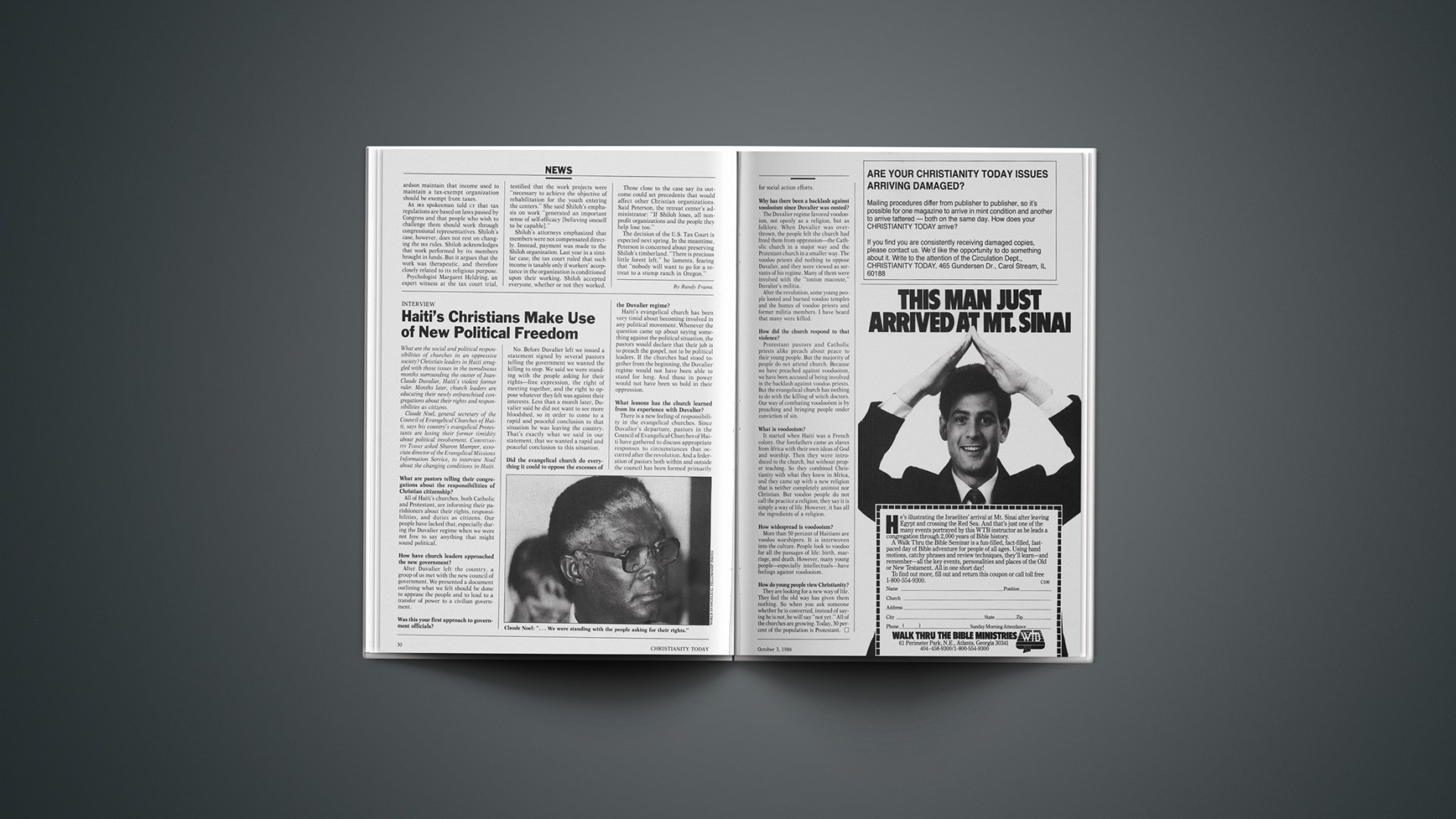
Haiti’s Christians Make Use of New Political Freedom

What are the social and political responsibilities of churches in an oppressive society? Christian leaders in Haiti struggled with those issues in the tumultuous months surrounding the ouster of Jean-Claude Duvalier, Haiti’s violent former ruler. Months later, church leaders are educating their newly enfranchised congregations about their rights and responsibilities as citizens.

Claude Noel, general secretary of the Council of Evangelical Churches of Haiti, says his country’s evangelical Protestants are losing their former timidity about political involvement. CHRISTIANITY TODAY asked Sharon Mumper, associate director of the Evangelical Missions Information Service, to interview Noel about the changing conditions in Haiti.

What are pastors telling their congregations about the responsibilities of Christian citizenship?

All of Haiti’s churches, both Catholic and Protestant, are informing their parishioners about their rights, responsibilities, and duties as citizens. Our people have lacked that, especially during the Duvalier regime when we were not free to say anything that might sound political.

How have church leaders approached the new government?

After Duvalier left the country, a group of us met with the new council of government. We presented a document outlining what we felt should be done to appease the people and to lead to a transfer of power to a civilian government.

Was this your first approach to government officials?

No. Before Duvalier left we issued a statement signed by several pastors telling the government we wanted the killing to stop. We said we were standing with the people asking for their rights—free expression, the right of meeting together, and the right to oppose whatever they felt was against their interests. Less than a month later, Duvalier said he did not want to see more bloodshed, so in order to come to a rapid and peaceful conclusion to that situation he was leaving the country. That’s exactly what we said in our statement, that we wanted a rapid and peaceful conclusion to this situation.

Did the evangelical church do everything it could to oppose the excesses of the Duvalier regime?

Haiti’s evangelical church has been very timid about becoming involved in any political movement. Whenever the question came up about saying something against the political situation, the pastors would declare that their job is to preach the gospel, not to be political leaders. If the churches had stood together from the beginning, the Duvalier regime would not have been able to stand for long. And those in power would not have been so bold in their oppression.

What lessons has the church learned from its experience with Duvalier?

There is a new feeling of responsibility in the evangelical churches. Since Duvalier’s departure, pastors in the Council of Evangelical Churches of Haiti have gathered to discuss appropriate responses to circumstances that occurred after the revolution. And a federation of pastors both within and outside the council has been formed primarily for social action efforts.

Why has there been a backlash against voodooism since Duvalier was ousted?

The Duvalier regime favored voodooism, not openly as a religion, but as folklore. When Duvalier was overthrown, the people felt the church had freed them from oppression—the Catholic church in a major way and the Protestant church in a smaller way. The voodoo priests did nothing to oppose Duvalier, and they were viewed as servants of his regime. Many of them were involved with the “tonton macoute,” Duvalier’s militia.

After the revolution, some young people looted and burned voodoo temples and the homes of voodoo priests and former militia members. I have heard that many were killed.

How did the church respond to that violence?

Protestant pastors and Catholic priests alike preach about peace to their young people. But the majority of people do not attend church. Because we have preached against voodooism, we have been accused of being involved in the backlash against voodoo priests. But the evangelical church has nothing to do with the killing of witch doctors. Our way of combating voodooism is by preaching and bringing people under conviction of sin.

What is voodooism?

It started when Haiti was a French colony. Our forefathers came as slaves from Africa with their own ideas of God and worship. Then they were introduced to the church, but without proper teaching. So they combined Christianity with what they knew in Africa, and they came up with a new religion that is neither completely animist nor Christian. But voodoo people do not call the practice a religion; they say it is simply a way of life. However, it has all the ingredients of a religion.

How widespread is voodooism?

More than 50 percent of Haitians are voodoo worshipers. It is interwoven into the culture. People look to voodoo for all the passages of life: birth, marriage, and death. However, many young people—especially intellectuals—have feelings against voodooism.

How do young people view Christianity?

They are looking for a new way of life. They feel the old way has given them nothing. So when you ask someone whether he is converted, instead of saying he is not, he will say “not yet.” All of the churches are growing. Today, 30 percent of the population is Protestant.


Oregon Retreat Center Battles the IRS

CHRISTIANITY TODAY/October 3, 1986

The agency seeks more than $1 million in a case that could affect other nonprofit ministries.

The Shiloh Retreat Center occupies 90 acres of meadow and timberland in the foothills of the Oregon Cascades, 20 miles southeast of Eugene. In the book Organized Miracles, sociologist James T. Richardson described the area as “beautiful fir-tree covered land interspersed with open meadows, and watered by a beautiful stream.”

But the trees are disappearing. In the last few years, more than 50 acres have been hewn to raise money for Shiloh’s long-standing legal battle with the Internal Revenue Service (IRS). Since 1980, the tax-exempt Shiloh Retreat Center has paid more than $65,000 in attorneys’ fees, and it still owes $45,000.

For all practical purposes, the IRS is challenging an organization that no longer exists. Shiloh was incorporated in 1969 as Shiloh Youth Revival Centers, part of what came to be known as the Jesus people movement. Court documents chronicle its rise in less than a decade from a “small group of penniless hippies” to a “multi-million dollar nationwide network of religious communes.”

By 1977, Shiloh was established in more than 30 states, Canada, and the Virgin Islands, with income that year surpassing $3 million. But in 1978 things began to fall apart. Thousands of wandering youths who had been Shiloh’s primary recruits were re-entering mainstream society. And the organization’s internal schisms began taking a toll.

“From the beginning, the Jesus people thought they were living in the last days,” said Joe Peterson, administrator of the Shiloh Retreat Center. “We never thought we’d be living on earth in 1976. And when we were, it put a strain on the imagination of many in the movement.” Shiloh’s experiment in Christian communal living ended by mid-1979. Today only the retreat center remains.

Problems With The Irs

The organization’s integrity was never an issue with the IRS. At a trial in May before the United States Tax Court, IRS attorney Larry Johnson said, “One can’t help but have both curiosity and respect for the organization.… There’s little doubt [Shiloh] accomplished many good works and affected the lives of many people.” However, the IRS contends that income earned by Shiloh members in 1977 and 1978 and paid directly to the Shiloh organization should have been taxed. Shiloh contends its outside work projects were an integral part of its rehabilitative ministry.

Richardson, a sociology professor at the University of Nevada in Reno, testified as an expert witness for Shiloh at the tax court trial. His 1979 book, Organized Miracles, is a detailed sociological analysis of the Shiloh organization. In it, he wrote that Shiloh’s leaders “could be successes at about any endeavor they chose.”

Evangelism was the primary purpose of Shiloh Youth Revival Centers. The organization reached out to the thousands of disenfranchised young men and women of the Vietnam War era. An estimated 100,000, many of them drug addicts, became Christians through Shiloh’s ministry. To help maintain the Christian community in which they lived, members sold goods and services, especially menial labor.

Without prior knowledge of canning, they built a cannery, learned to can, and became licensed canners. They hired skilled craftsmen for construction projects, worked with them, and then went on to form their own contruction company, which was licensed to do outside projects.

Shiloh’s Oregon commune grew much of its own food. It had its own medical clinic and fleet of vehicles, including a twin-engine airplane with ground mechanics to service it. Most of the outside work done by members was unskilled labor, such as painting, planting trees, picking apples, and landscaping. Local farmers sometimes requested Shiloh’s entire available work force. Richardson wrote: “They successfully supplanted migrant laborers, partially because the young Jesus people are such hard workers.”

Perhaps they worked too hard. It is the work done outside the Shiloh community in 1977 and 1978 that the IRS has deemed objectionable. The federal agency contends this work was not “substantially related” to the purposes for which Shiloh was declared tax-exempt and that the income is therefore taxable. According to the IRS, Shiloh workers had an unfair competitive advantage over other laborers in the free market. It contends Shiloh owes the government well over $1 million, including interest. If the IRS wins, it will take possession of the retreat center property.

Defining Religious Activity

In an interview, sociologist Richardson said such a development would be “unbelievably ironic.… This group did not go out begging and distributing literature in airports. Instead, they worked very hard to build up a base of assets, and now it may have to hand whatever’s left over to the IRS. In terms of social policy, this is ludicrous.

“Because of the way the [tax] regulations are written,” Richardson said, “the IRS has more to say about what is and what is not religion than anyone else in society.”

Sociology professor David Bromley, of Virginia Commonwealth University, observed that government agencies like the IRS have “this kind of clout” because the U.S. Supreme Court has never clearly defined religion. Bromley and Richardson maintain that income used to maintain a tax-exempt organization should be exempt from taxes.

An IRS spokesman told CT that tax regulations are based on laws passed by Congress and that people who wish to challenge them should work through congressional representatives. Shiloh’s case, however, does not rest on changing the IRS rules. Shiloh acknowledges that work performed by its members brought in funds. But it argues that the work was therapeutic, and therefore closely related to its religious purpose.

Psychologist Margaret Heldring, an expert witness at the tax court trial, testified that the work projects were “necessary to achieve the objective of rehabilitation for the youth entering the centers.” She said Shiloh’s emphasis on work “generated an important sense of self-efficacy [believing oneself to be capable].”

Shiloh’s attorneys emphasized that members were not compensated directly. Instead, payment was made to the Shiloh organization. Last year in a similar case, the tax court ruled that such income is taxable only if workers’ acceptance in the organization is conditioned upon their working. Shiloh accepted everyone, whether or not they worked.

Those close to the case say its outcome could set precedents that would affect other Christian organizations. Said Peterson, the retreat center’s administrator: “If Shiloh loses, all nonprofit organizations and the people they help lose too.”

The decision of the U.S. Tax Court is expected next spring. In the meantime, Peterson is concerned about preserving Shiloh’s timberland. “There is precious little forest left,” he laments, fearing that “nobody will want to go for a retreat to a stump ranch in Oregon.”

By Randy Frame.

Contents

Women in Leadership: Finding Ways to Serve the Church

by Roberta Hestenes

From the Forum

Five women respond to the issue

Profiles in Leadership

by Carolyn Gifford

Shared Leadership or Male Headship?

by Walter Kaiser, Jr., and Bruce Waltke

Women in Leadership: Proceed with Care

by Kenneth S. Kantzer

Roberta Hestenes1Roberta Hestenes is associate professor and director of Christian formation and discipleship at Fuller Theological Seminary, Pasadena, California. This article is adapted from her forthcoming book, The Next Step: Women in a Divided Church, to be published by Word Books in the spring of 1987.

For most of the twentieth century, the majority of evangelicals operated under the assumption that women should not be ordained for ministry or become church leaders. That assumption is being challenged now from all quarters within the church. Many denominations previously closed to women as pastors and elders have now changed to allow women in these roles. Denominations and movements historically open to women but recently closed have begun to rediscover their heritage. Symbolic of this is the 1986 election of a woman as the commanding general of the Salvation Army. Women are entering and graduating from seminaries in record numbers (see “Women in Seminary: Preparing for What?” CT, Sept. 5, 1986, p. 18).

Such changes have caused strong reaction and polarization within the evangelical community. Whether in individual congregations, denominations, seminaries, parachurch organizations, or missions agencies, questions about appropriate roles for women keep coming up. The women’s issue seems here to stay.

The Evangelical Consensus

Even though Pentecostal and Holiness movements had affirmed full partnership for women in ministry from the 1880s onward, after World War II the evangelical movement largely affirmed traditional roles for women in the church. Women were to be quiet supporters, working behind the scenes as enablers of the men who filled the visible and formal leadership positions. They could use their gifts for leadership in ministries to women and children but not in ministries that involved men. Women could plant churches and preach on the mission field, but they were not to preach in their home churches. Conservative Christians in the ’50s and ’60s assumed that Christian teaching forbade women from entering seminary, seeking ordination, or expecting to serve in salaried leadership positions within the church. Ironically, these same Christians seemed unaware of the number of early leaders like John Wesley, A. J. Gordon, Charles Finney, and B. T. Roberts who affirmed full freedom for women in all areas of ministry.

This is not to say that women could not actively serve in the church. It is just that the mindset of men and most women directed women to serve the church as volunteers or as low-paid and part-time directors of Christian education. If young women became staff members in one of the growing parachurch movements, it was assumed they would leave the ministry upon marriage. Faculties of seminaries were male as were the vast majority of the student body. The evangelical establishment, it seemed, was a man’s world.

Of course, there were a few exceptional women who did not fit this consensus. One was Henrietta Mears who founded Gospel Light Publications and the Forest Home Conference Center while teaching men like Bill Bright and discipling dozens of future Presbyterian pastors. Still, during much of the twentieth century, women were discouraged from taking an active, visible role in Christian leadership.

Changing Views

Today, many evangelical Christians are re-examining their views on the role of women in the church. Denominations, parachurch agencies, and other ministry groups are exploring ways to involve women at a more meaningful level. Publications like The Daughters of Sarah and The Other Side, along with other groups are calling the church to seek new directions in their attitudes toward women. The recent resurgence of interest in spiritual gifts has brought men and women face to face with the question of what to do when a woman is gifted in leadership. In a world in which women serve as prime ministers, ambassadors, bankers, and executives, as well as in roles involving home and family, some in the church question the narrowly prescribed limits within which women must often serve. Men who watch their wives, daughters, and sisters stretching out to discover new talents and abilities have begun to challenge some of their previously held assumptions. The questions are often painful. Should men support and encourage women in their new aspirations or should they counsel them to seek fulfillment in the traditional ways? Are efforts to bring women into the full life of the church a by-product of secularism or a gentle nudging of the Spirit?

Denominational Patterns

The last decade marks a major turning point in the centuries-long discussion about appropriate roles and functions for women in the Christian community. For the first time since the earliest centuries of Christianity, significant numbers of women are taking up new roles of leadership in local congregations and denominational structures. The United Presbyterian Church is just one example. Voting to ordain women in 1956, the denomination had just over 160 ordained women in 1975. By 1985 the number had grown to more than 1,000, with women serving in virtually every position, including executive presbyter. The controversial vote in 1977 of the General Convention of the Episcopal Church to ordain women as priests was a turning point in opening new doors for women in the church.

The mainline denominations have historically opposed the ordination of women. Between 1956 and 1977, however, five of the largest major denominations—Methodists, Presbyterians, National Baptists, Lutherans, and Episcopalians—reversed their stand on this issue. Dozens of smaller denominations, such as the Reformed Church of America and the Evangelical Covenant Church, had likewise changed their constitutions and bylaws to allow for the ordination of women as elders and pastors. One count lists more than 80 Protestant denominations in America that allow the ordination of women. These include such churches as the African Methodist Episcopal Church, American Baptist Churches, Christian Church (Disciples of Christ), the Free Methodist Church, the Lutheran Church in America, the Salvation Army, and the Assemblies of God. The largest number of women in pastorates is in the United Methodist Church, where the placement system has provided more opportunities for women.

While the overall number of women holding pastorates in Protestant churches was minuscule during the 1950s and 1960s, there are now thousands of women serving in a variety of church leadership positions. These include solo pastorates, clergy couples, associate and assistant staff positions, as well as deacons and elders and the whole panoply of lay ministry. Although salary levels run lower than those for men in comparable positions, acceptance of these women has been surprisingly positive. Careful research in both the United Methodist and the United Presbyterian churches shows that any initial opposition fades quickly once congregations experience a woman as their pastor.

Four Factors Influencing Change

At least four factors have had a major impact on Christians as they confront this issue: (1) the reexamination of Scripture; (2) awareness of the changing lifespan and social patterns (education, work outside the home) affecting women; (3) the feminist movement; and (4) personal experience. (A woman who has attempted to exercise her gift of leadership in the midst of a divided church will look at this issue differently from a woman who has no aspirations for leadership. Likewise, a man’s perspective will be affected by interaction with his wife, daughter, female and male colleagues.) The remainder of this discussion will focus on the first three of these factors.

Re-Examining Scripture

Because Scripture is so central to the evangelical identity, issues of biblical interpretation have been of critical importance for those wrestling with women’s issues. A common pattern in almost all denominations and parachurch groups that examine issues related to women is to go back to the Bible. Individual scholars, task groups, and committees have studied and restudied the relevant biblical passages. When familiar texts like 1 Timothy 2:8–15 and 1 Corinthians 14:34 (women’s silence) are placed alongside of less-familiar texts like 2 Kings 22:13–20 (Huldah speaking the word of the Lord) and Acts 2:17–18, 21:9 (women’s ministry of prophecy), a reappraisal often begins to occur.

Evangelical scholars with strong commitments to a high view of Scripture at Gordon-Conwell Theological Seminary, North Park Theological Seminary, Wheaton College, Regent College, and Fuller Theological Seminary, among others, have all published articles and books supportive of broader roles for women in the church. Some of this fresh scholarship was triggered by a major work by Paul Jewett, Man As Male and Female, published in 1975. Controversial in his hermeneutical approach to Paul, Jewett stirred up enormous interest in re-examining the biblical material and the church’s view of women. A second major book, leading to further inquiry (and controversy) into the issue, was Eternity magazine’s Book of the Year in 1974, All We’re Meant to Be, by Letha Scanzoni and Nancy Hardesty. Almost every Christian publisher has since published one or more books on the subject.

Two Paradigms

One helpful way to understand the present debate about Scripture and the role of women is to see the present time as a period of paradigm shift. A paradigm is a picture of reality that incorporates all the known data. People holding the two major contrasting paradigms concerning women often have similar or identical doctrines of Scripture. They have a high regard for biblical authority, but they interpret the overarching patterns in Scripture differently. Different evangelical scholars work with different presuppositions as they interact with the theological and anthropological perspectives that influence biblical interpretation.

A common accusation 10 or 20 years ago was that supporters of the ordination of women did not believe in the full inspiration and authority of the Bible. As more evangelical scholars and leaders have adopted interpretations of Scripture supportive of broader roles for women while maintaining their high doctrine of Scripture, this argument is heard less frequently.

Let us, then, look briefly at the two major opposing views of Scripture and women: the traditional or hierarchical paradigm, and the partnership or egalitarian model. Each view at its best seeks to deal with all the available biblical material. Although there are common elements in both models, the disagreements between them are substantial and unlikely to be resolved in the near future. The summary of the traditional viewpoint is briefer because it is the more familiar. A bit more detail is included in the summary of the partnership viewpoint because it is less familiar to most readers. Both models are representative arguments of the two positions, since details on each may differ.

The Traditional Paradigm

The traditional viewpoint affirms the legitimacy and importance of hierarchy in the relationship between men and women. Male predominance is not an aberration but was originally decreed by God in Creation as part of God’s order. Woman was created from man and for man. This hierarchy was heightened and distorted by the Fall. In the new creation in Christ, there is a restoration of the proper order to fulfill God’s original intention in Creation. Although there is a fundamental spiritual equality between men and women, men rightly have authority over women.

Older forms of the traditional model spoke of the inferiority of women to men because of irrationality, sexual temptation, or physical weakness. Recent writings speak of hierarchy as good simply because this is what God intended. Both women and men will be most fulfilled when they reflect the pattern that God desires between them. This requires male leadership and female submission.

In addition to particular interpretations of Genesis 1–3, hierarchical supporters can cite the lack of women priests and kings in Israel, the absence of women from among the 12 disciples of Jesus, and the Pauline teaching in 1 Timothy 2:8–15 and 1 Corinthians 11:3–6, 14:34, instructing women to be silent in the church and not to teach or exercise authority over men. These texts are viewed as determinative for the church for all times. Passages in 1 Peter 3:1–6 and Ephesians 5:22, which speak of wives’ submission to their husbands, are also cited, along with passages from the Pastorals listing credentials for male elders and deacons in the church.

Susan Foh and James Hurley are two authors who ably support the traditional viewpoint with care and thoroughness. Both see “headship” in 1 Corinthians 11 and Ephesians 5:23 as indications of God’s intention that men should lead and rule while women in turn are to be submissive to and supportive of men. Thus women as pastors and elders would clearly violate God’s order.

The Partnership Paradigm

On the other hand, a large number of evangelical scholars in recent years have rejected all or part of the traditional hierarchical paradigm. They believe that Scripture is better interpreted by a model that stresses partnership between men and women rather than hierarchy. Drawing on passages like 1 Corinthians 7:3–5 (where decision making by husband and wife is by mutual consent or agreement), they argue for equality between men and women in marriage and in the church. They understand Genesis 1 and 2 as revelatory of God’s creation of both women and men in the divine image. The texts stress the similarity and unity between man and woman along with their mutual responsibilities to rule and exercise dominion over the rest of creation. Male domination and female acquiescence come as a result of the Fall in Genesis 3.

Crucial considerations for the partnership paradigm are the tradition of women as prophets and judges in Israel and the fulfillment of the Aaronic priesthood in the high priesthood of Jesus Christ leading to the priesthood of all believers. The sign of acceptance for the Old Testament people of God was male-oriented—circumcision. On the other hand, the sign of entrance into the New Covenant is baptism, which is open to women and men alike.

Where the traditionalists tend to stress continuity between the old and new age, those espousing the partnership paradigm tend to stress discontinuity. For support, they cite Pentecost with its promise of the gift of prophecy for both men and women. Proponents of the partnership paradigm also point to Christ’s appearance to women after his resurrection, and the visible leadership of women in the earliest Christian communities (Acts and the narrative portions of Paul’s letters). They understand Ephesians 5:21–32 to teach mutual submission where the sacrificial self-giving of the husband corresponds to the submission and respect enjoined on the wife.

1 Timothy 2:8–15 (women should not teach) is generally understood as a specific instruction for the Ephesus church rather than a permanent injunction against all women. This model focuses on the instruction in verse 11 (“Let a woman learn”), suggesting that at a later period such learned women might have gained Paul’s approval as teachers much as Priscilla and Aquila did when they expounded the Scriptures to Apollos.

The partnership paradigm draws heavily on Galatians 3:27–28 with its resounding affirmation “There is neither Jew nor Greek, slave nor free, male nor female, for you are all one in Christ Jesus.” Those committed to partnership between women and men reject the interpretation of this passage as speaking only of spiritual reality. They believe the context clearly speaks of human relationships within the historical, earthly church in the present age. This view tends to emphasize that the church is ordered by the spiritual gifts given by God (1 Cor. 12). These gifts are given to women as well as men. Thus, women should be given freedom to use all of their gifts for the common good. If these gifts include preaching and teaching, they should be exercised to the greatest extent possible as the Spirit leads. Thus, the church should encourage women to use any and all gifts that God has given. This will be good not only for the women, but for the church as well.

Even this brief survey shows the enormous gap between these two positions. Each key biblical text has occasioned numerous articles, books, and sermons. Major work in church history is being done to discover more about the actual participation of women in the first centuries of the Christian movement. Much more biblical, theological, and historical study needs to be done.

A Second Factor: The Changing Lives Of Women

Perhaps the major factor causing the church to rethink its views about women is the changing reality of women’s physical and social lives. In 1900, American women had an average life expectancy of about 45 years. In 1986, a female infant can expect to live past the age of 80. If nothing else has changed, this increased life span, especially when combined with smaller families and an urbanized technological culture, raises major new questions. If a woman totally adopts the traditional role of wife and mother, she will find herself extremely busy for perhaps 20 years. When the last child has left home, she still has 30 to 40 years of life expectancy remaining. What is she supposed to do with her time, her energy, and her gifts? Age discrimination may well combine with financial discrimination to limit the contribution of Christian women to the church.

A related factor leading the church to change its view of women is the advent of the working woman. Many women never marry. Others remain childless in spite of their desire to have or adopt a child. Working outside the home may not be a choice but an urgent necessity. Approximately 50 percent of all American women are gainfully employed. Only 21 percent consider themselves full-time homemakers. As churches have recognized this, they have had to reconsider their traditional approach to women’s ministries. It can no longer be assumed that each household within a congregation includes a wife/mother who is in the home all day. Church programs oriented only to traditional families often neglect the needs of single women and women who work outside the home.

Moreover, today’s woman is highly educated. Previous generations could deny women leadership because they did not have the formal credentials that many positions require. In 1970, 41 percent of college graduates in America were women. In 1982, that percentage climbed to 52, so that women now outnumber men in college. As women acquire formal credentials for leadership and service, the Christian community has had to determine whether or not their skills should be used in the church.

A Third Factor: The Feminist Movement

Committed feminists are both a result and a cause of major changes in the way in which the culture treats women. Many Christians are highly critical of the women’s movement, seeing it as hopelessly hostile to traditional values of home and family. There is no question that some of the more radical feminists with their agendas of lesbian advocacy and abortion on demand attack many things that Christians value highly. Yet, some conservative Christians have reacted so strongly against the movement that they have created a backlash. Possibilities once open to women (assisting in worship leadership or directing educational programs involving men) have now been closed.

That is unfortunate, because feminism is a diverse and multi-faceted movement that includes many Christians in it. It should not be totally rejected by Christians. Without it, the question of women’s opportunities might not have come so strongly to the church’s attention. Moreover, feminists and Christians share at least one common concern: pornography’s exploitation of women and children. Finally, the more moderate advocates of the women’s movement provide great encouragement to many Christian women as they try to fulfill their sense of call in church and society. Still, responses to the feminist movement are seldom neutral.

The Next Step

Where will the evangelical movement go from here? It is difficult to say. Many people have been surprised at the amount of change that has already taken place. It is interesting that even in the midst of a conservative political era when all movements for social change are coming under attack, more and more evangelical women are choosing to attend seminary. More women are becoming pastors each year, and more clergy couples are being called to churches. It is apparent that churches are viewing this as more of a biblical issue rather than a liberal/conservative issue.

One of the focal points of conflict in the immediate future is likely to be language issues. Calls for changing language are less controversial when they do not call for changing the language about God. When the call to change language becomes a denial of the authority of Scripture, evangelicals will (and should) resist. A danger is that this unity in refusing to change the language about God distracts the church from its need to include women in the language of hymns, prayers, and sermons. The use of exclusively male language in these areas leads women to feel excluded from full membership in the community of faith.

There will be other issues as well. As more women graduate from seminary and become ordained, more churches will face the prospect of a woman pastor. Related to that is the issue of equal salaries. Still another issue is the growing number of evangelical women leaving their denominations because of the barriers to ministry. Though well intentioned, they may suffer in an environment of unorthodoxy.

Yet the church is a marvelously dynamic organism. It has its deadness and its newness. The issue of women seeking a more active role in the church is an opportunity for the church to discover how God wants to minister to this culture.

Women in Leadership

Open Doors

Jill Briscoe: The current status of women in the church depends a lot on how a particular church or denomination views its mission. If the church sees itself as an equipping agency that encourages all of its members to minister in their communities, then women are taken seriously and are allowed to exercise their gifts. But when the church is primarily a programming agency—basically concerned with performing weddings and baptisms and preaching sermons on Sunday—women and men tend to be excluded from leadership. In that situation, leadership is limited to the pastor.

From my perspective, I’ve noticed considerable movement in the parachurch missions agencies like Wycliffe, but less movement in some of the other areas of the church. In my own church, we’ve begun using laypersons—men and women—in leadership roles during the worship service. As we’ve used more women in a public, visible function, attitudes toward women have been changing, and I think this is what many other churches have experienced. Women in church leadership is still a new idea for many conservative churches, but I’m sensing a growing openness to it.

Roberta Hestenes: We’ve seen a lot of movement in the mainline denominations. These churches are getting used to seeing women as pastors and leaders. In some of the other denominations and agencies, I haven’t noticed as much movement toward encouraging women to exercise gifts of leadership. For example, in some of the Holiness and Pentecostal denominations where the issue of women’s ordination was settled positively a long time ago, I see almost no women in executive positions in these bodies. On paper, they believe in women serving at the highest levels of leadership, but in practice, women don’t find many opportunities to lead. Generally, the more conservative denominations still have not opened the door for women to serve in leadership positions.

Miriam Adeney: Another thing I’ve noticed is that when the church has been reaching out with new ministries, women have had very important roles. Often, they have served as informal and even formal leaders because there was no one there to certify them or give them permission to lead. In these situations, women preach, teach, plant churches, and really serve as leaders. But once the pioneer work matures, the positions of power become more formalized. When that happens, the men have tended to take over the positions of leadership.

Marilyn Kunz: In our Neighborhood Bible Study groups, we have not started as many men’s groups as women’s groups, but in our leader’s seminars, 70 percent of those attending are men. The majority of our leadership training is with men. Generally, they are denominational leaders and missionaries who come for special training in small group Bible studies. For whatever reasons, men are still the leaders in the church.

Women in the Church

Restrictions

Hestenes: It’s not always a case of somebody saying, “Let’s leave women out of the picture.” We have a Christian culture that is constantly raising the credentials for ministry. When the credentials become formal—when more education is required—women can be shut out. Initially, a woman could provide informal leadership in a church organization. But then, she needed a college education. Then a bachelor’s degree wasn’t enough, you needed a master’s. Then that wasn’t enough: a doctorate was required. Each time that happened, women became more and more excluded from the movement. It was hard enough for her to tend to her family and also lead the organization. It was next to impossible for her to go back to school and receive the necessary degree to allow her to continue what she was already doing. So now, you see hundreds of women going the formal credentialing route in hopes of being able to play an active role in the life of the church.

Mary Van Leeuwen: Somewhat related to that is the whole concept of parenthood. Evangelicals have a very high view of parenthood, but in extremely traditional terms. Men are the providers. They are the ones who work for a living, while the woman takes responsibility for the children. So of course women won’t assume leadership roles in the church: they are too busy with their families. If a woman wants to have a career, she must juggle it around her parenting responsibilities. Her husband, on the other hand, has his career without having to spend a lot of time with his children. People like James Dobson are telling men to put their families first and to assume more of the parental responsibilities. We’re learning that the psychological absence of the father from the home is detrimental to the family structure.

Kunz: As women move into positions of leadership in the secular world, there’s a danger among Christians of thinking the church ought not to follow the world’s example. In other words, it’s okay for the world to endorse women as leaders, but it’s wrong for the church to do it. I’m afraid many capable Christian women refuse to use their gift of leadership because they feel it is worldly and unbiblical. They have been taught that good Christian women do not aspire to positions of leadership in the church. Yet some of these same Christian women serve as executives in large businesses.

Women in Unity

Feminists

Van Leeuwen: We need to think of the feminist movement the same way we would like nonbelievers to think of us as Christians. That is, we don’t like it when someone observes questionable I activities in a sect or cult and jumps to the conclusion that all Christians must be like that. Yet Christians often look at some of the disturbing things coming out of Marxist and liberal feminism and conclude that all feminism is bad. Yes, we ought to be alarmed at a kind of androgenous feminism that says sex differences are the product of socialization and that men and women must be clones of one another. That just is not biblical. But that doesn’t mean everything coming out of the feminist movement is bad. One of the things the movement has done for Christians is to point us back to our own rich heritage of women who have been leaders in such noble causes as the abolitionist movement, the temperance movement, and the child labor law movement.

Briscoe: I think we need to be wary of the emotionalism that’s involved in this entire issue. Frankly, the most hostile reactions against women in leadership come from women, not men. The average Christian woman isn’t really interested in what we’re talking about; she’s more worried about the possibility of her marriage and family breaking down. And many think that the feminist movement has caused marriages to fail. So they really aren’t interested in becoming feminists. They’re holding on to their marriages by their fingernails, and the feminist movement scares them. As Christians, we need to provide an alternative to the secular view. We need to affirm an honorable tradition of families as well as an en lightened view of women. That will take an education of the mind rather than dealing with this issue so emotionally.

Hestenes: I’m leery of any feminism that becomes the center of your reality. Christ must be the center for any Christian. When feminism fills the whole horizon of an individual, it becomes idolatry—another religion. This can be a danger for Christian or biblical feminists. There are some feminists who believe that if feminism and Christianity come into conflict, Christianity must change. That’s wrong. I’m a feminist because I believe the Bible teaches the full partnership of women alongside men in the church. For me, feminism is crucial, but it is one among many things the gospel has called me to.

Women in the Home

Male Headship

Hestenes: Many Christian men and women have this feeling that there is only so much strength to go around. If a woman is strong, her I marriage partner must be weak. I believe that’s unbiblical. Christian strength builds and enables strength in others. The question of headship in marriage revolves around mutual submission. Husband and wife seek the best for each other, not their own selfish interests. But I don’t see anything in Scripture that says men are to handle the money and make all the important decisions. Instead, I see a much more dynamic obedience to each other and to God. The Christian husband and wife look to the Lord as their hope. That’s the ideal. But when all the praying is done, we are still fallen creatures. We will not always come to the same conclusions. In that case, the wife submits to the husband, who is called to sacrifice on behalf of his wife. It’s a beautiful alternative to the secular view of husband and wife.

Adeney: You really have to be careful with how you define submission. I don’t think submission should be translated to mean subservience, yet many people make that mistake. It is the subservient mentality that fosters so many negative abuses in marriages. On the other hand, I believe submission is a biblical concept, one that must be held on to. Husbands and wives are not autonomous individuals who can easily negotiate every decision in their marriage. A proper understanding „ of biblical submission should strengthen the marriage relationship.

Briscoe: I believe in male headship in marriage. I think Ephesians 5 teaches that quite clearly. This biblical pattern for the marriage relationship doesn’t bother me at all. I’m required, as a wife, to be in proper submission to my husband, and I don’t see that in conflict with his responsibility to nurture and cherish me. He will help me find the gifts that God has given me and will insist that I exercise those gifts. If one of those gifts is leadership, my husband, as head of our home, will encourage me to use that gift. So though I believe in male headship in marriage, I don’t think this biblical concept is limiting to women in any way.

Women in the Pulpit

Ordination

Briscoe: The jury is still out for me on this topic, largely because I don’t have a very high view of ordination, and I’m still studying all sides of this complex issue. Now, if you had asked me if women should be encouraged to exercise their spiritual gifts within the context of the hierarchy of the church, then I would say yes, the leadership of the church should invite women to exercise these gifts—even if they include teaching and preaching. I don’t think it’s necessary for a person to be ordained in order to provide leadership.

Van Leeuwen: I would agree that leadership should not be limited to those who have a piece of paper saying they are ordained. The Holy Spirit will have his way in spite of our efforts to formalize leadership. On the other hand, ordination gives us something specific that we can count. It gives us hard statistics indicating what the church feels about women in ministry. Thus, ordination becomes sort of a barometer for the church. I’m in favor of ordaining women, but I don’t want ordination to draw our concern away from other issues regarding women. It’s possible for ordination to be approved as an effort to silence women—I to placate them.

Hestenes: Since I am an ordained minister, naturally I believe women should be ordained. If there is to be ordination at all, women should be included. Biblically, you can make a pretty good case against having any form of ordination. All believers are to minister to one another and to the world. But since we have ordination, it should be open to women as well as men, and the criteria for ordination should be the same for both. Should women teach or preach? If they are called by God and are gifted to do so, why not?

Women in the Future

Direction

Van Leeuwen: Somehow, we need to get away from the idea that you’re either a traditional or a nontraditional woman. One of the unfortunate results of the feminist movement is that women who choose to have children and remain in the home are considered less important than a woman who has chosen a career. No strategy that says the traditional roles are not valued will enhance the role of women in the church.

Along the same lines, I would like to see the church lead the way in promoting coparenting. In recent years, we have allowed men to believe their only contribution to the family is financial. Their children do not need their money as much as they need their presence in the home.

Adeney: I would like to see Christian women develop a sisterhood mindset that would provide encouragement to one another. We need to tap into biblical role models and recover the characteristics of a Mary, Hannah, or Esther. We need to encourage the woman who holds a Bible study in her home as well as others who may feel a little lonely as they use their gift of leadership. There are thousands of women who are not exercising their gift of leadership. The church needs to tap into that valuable resource to be more effective in proclaiming the gospel.

Kunz: I couldn’t agree more. I meet with a small group of women. We’re all about the same age, and work at different professions. Though it’s hard for us to get together, we make it a priority because we need the encouragement that comes from fellowship. We are almost like a family, and I think that’s important.

Briscoe: If the church does nothing else, I would like it to look seriously at the concept of women ministering to women. To me, this is an exciting possibility, one that could prove to be an indispensable part of the church program. At the same time, I would like to see women become willing to serve the church at any level, and do it with a good spirit. You have to accept people where they are, not where you wish they would be. In my own church, we took an entire year to examine Scripture on this issue, and another two or three years before the church allowed women to serve as deacons. The point is, change doesn’t always mean you are going to get everything you want. Our overarching goal is not to solve the women’s issue, but to preach the gospel. As the church wrestles with this issue, women need to continue seeking ways to serve Christ.

Hestenes: I’m hopeful about the future. The church is changing more rapidly than I thought it would. I am seeing women find opportunities that I did not think would be open for them. Yes, there are still barriers, but there is always suffering and hardship in ministry. At the same time, the church needs to develop an affirmative action program to make sure it doesn’t overlook other women who could use their leadership gifts within the framework of the church. Moreover, there is a great need for prayer, for careful listening to the different voices speaking up, and for diligent study of the Scriptures.

Profiles of Leadership

Frances E. Willard, president of the Women’s Christian Temperance Union (WCTU) from 1879 to 1898, was the most famous woman in the United States during the closing years of the nineteenth century. As the head of the largest women’s organization of the period, Willard led the WCTU membership (composed mainly of evangelical women) in a wide range of reform activities, including prohibition and women’s rights.

Willard grew up on a Wisconsin farm where little formal education was available. Her parents encouraged her to develop intellectually by reading, but she yearned for further schooling. After much persuasion, her father moved his family to Evanston, Illinois, in 1858 so his two daughters could enter the North Western Female College. After graduating, Willard taught at various Methodist preparatory schools for young women.

In 1871, Willard was invited to become the president of the newly established Evanston College for Ladies, an institution closely connected with Northwestern University. But two years later a movement began that would give her the opportunity of fulfilling a lifelong ambition to “work for the women and girls of America.” It started with groups of churchwomen marching into saloons, and in 1874 became the WCTU, an organization devoted to reforming drunkards and working for legislation to prohibit the sale of alcoholic beverages.

Frances Willard was a delegate from Illinois to the first national WCTU convention. She was chosen corresponding secretary with the immense task of developing state and local WCTUS. In 1879 she was elected president, and led members to fight many social ills besides alcohol.

Evangelist Amanda Berry Smith (1837–1915) spent her childhood in Maryland and Pennsylvania amidst camp meetings and revival services. Her father bought his family’s freedom from slavery and became a farmer whose home served as a station on the Underground Railroad.

Her autobiography is filled with instances in which she prayed for guidance and God revealed his will in a variety of ways. Yet during the first third of her life the presence of Satan was no less immediate to her than the presence of God. Satan, she felt, continually tried to persuade her to ignore God’s will, causing her to pay attention to mundane worries when she should have been trusting in the Lord. After she received the “second blessing,” that experience of sanctification or indwelling of the Holy Spirit that she so earnestly sought, Satan’s distressing temptations appeared to end. She then set about to become an evangelist.

After the death of her husband in 1869, Smith began to preach in the New York area. Early in her evangelistic career she bore the double burden of prejudice because she was both black and a woman (even among blacks, who shared with whites the prevailing opinion that women should not be preachers).

By 1878 friends had convinced Smith to sail for England to speak at meetings of the British Holiness movement. Although she intended to stay only three months, she extended her British tour for two years because she was so popular there. She spent two more years as a missionary to India, then set out for Africa. For the next eight years, she preached and established temperance societies in Sierra Leone and Liberia. In 1889 she returned to England, and after several months of evangelism set sail for the United States.

Worn out by years of work and travel, she settled in Chicago, hoping to retire and write her autobiography. But she was soon involved in founding a home for black orphans, a task that sent her back into preaching to raise funds for her orphanage.

In her dual roles as evangelist and missionary, Amanda Berry Smith provided a model for nineteenth-century American churchwomen.

It probably didn’t surprise her contemporaries when Carrie Judd Montgomery (1858-ca. 1931) became a leader in the faith-healing and Pentecostal movements of the turn of the century. Bedridden due to a fall and plagued with poor health, she was healed by a woman whose faith-healing ministry had caught the attention of her parents.

Judd claimed to have been the first to establish the phenomenon of faith healing on a firm biblical basis, citing New Testament verses that referred to the power of Jesus and his followers to heal the sick. As a further outgrowth of Judd’s healing ministry, she conducted regular Thursday meetings at her home to discuss faith healing.

During a speaking engagement at an Illinois camp meeting, Judd met her future husband, George S. Montgomery, a California businessman. He invited her to Oakland to speak, and proposed shortly after. Following their marriage in 1890, the couple began a joint ministry in the Oakland area, which included a training school for Christian workers and an orphanage. They also held weekly healing meetings in Oakland.

While the Montgomerys were building up their ministry in northern California, the Pentecostal movement sprang up, centered by 1906 in the great Azusa Street Revival in Los Angeles. George Montgomery went down to investigate and came back with a glowing report, assuring his wife that this was indeed a contemporary outpouring of the Holy Spirit, a “latter rain” manifested chiefly by speaking in tongues. She remained cautious toward the new movement, viewing much of it as self-serving and unbiblical. But as Pentecostalism spread over the country, the Montgomerys made occasional visits to a Pentecostal mission in Oakland. After several of their dear friends received the gift of speaking in tongues, Mrs. Montgomery decided to seek actively for a new outpouring of the Holy Spirit. Finally, in 1908, first Montgomery and then her husband began to speak in tongues.

Vignettes by Carolyn DeSwarte Gifford, coordinator of the Women’s History Project of the United Methodist Church’s Commission on Archives and History.

Walter C. Kaiser, Jr.2Walker Kaiser, Jr., is the academic dean and professor of Semitic languages and Old Testament at Trinity Evangelical Divinity School, Deerfield, Illinois. and Bruce Waltke3Bruce Waltke is professor of Old Testament at Westminster Theological Seminary, Philadelphia, Pennsylvania. He holds doctorates in Greek and Hebrew from Dallas Theological Seminary and Harvard University, respectively.

Editor’s note: Christian scholars do not always agree on what the Bible says regarding the role of women in the church. The following articles represent two strands of thinking among evangelicals today. The authors do not necessarily represent their seminaries’ views.

Like Tevye in Fiddler on the Roof many evangelicals support male authority in the church because “we’ve always done it that way.” They have deferred to tradition rather than take Scripture at face value. As a result, great numbers of women have been unable to use their gifts in service to the church.

Where in Scripture have we fiddled with the meaning of the text? First, let’s take 1 Corinthians 11:10: “For this cause ought the woman to have power on her head because of the angels.” Since the days of the gnostic heretic Valentinus (d. A.D, 160), the church has incorrectly agreed with him on insisting that the “power” or “[active] authority” placed on the head of a woman by our Lord be revised to read a “veil,” substituting the Coptic ouershoun, “veil,” for the proper word ouershishi, “power, authority.” Almost every modern translation perpetuates this gnostic myth in verse 11, saying, “a veil which is the sign of authority.” However, God has given a unique sphere of authority to women; not a veil nor even a sign! This is straightforward exposition; all else is oral tradition.

The second text is 1 Corinthians 14:33b–36: “… women should remain silent in the churches … as the law says.” Some are willing to risk Paul contradicting himself by forbidding women to do exactly what he had given permission for them to do in 1 Corinthians 11:5: “… every woman that prayeth or prophesieth.…” This price is too high—just to maintain a traditional view of women.

But the heart of the passage is the Greek term e, which introduces 1 Corinthians 14:36. This particle startles us with its vivid forcefulness and its strong negative reaction. As J. H. Thayer pointed out in 1889 (A Greek-English Lexicon), e with the grave accent may appear “before a sentence contrary to the one preceding [it].…” Thayer then listed 1 Corinthians 14:36 as an illustration. Therefore, 1 Corinthians 14:36 is hardly a summation of verses 33b–35. Consequently, Paul rejects the quotation of verses 33b–35, apparently cited from the Corinthian letter and rabbinic law: “What! Did the word of God originate with you, or are you [men = masculine form] the only ones it has reached?”

What irony! The very text that has been used for centuries to silence women from joining in the worship of the church, Paul used to establish their equality.

One more sample of the fiddler’s work must be raised for gentle admonition: 1 Timothy 2:9–15, where Paul says, “I do not permit a woman to teach or have authority over a man; she must be silent” (v. 12, NIV). The imperative verb, however, is in verse 11: “A woman must be taught.…” The prohibitions cited in verse 12 follow and are subordinate to it. But the problem is that few pause to listen for the reasons given in verses 13 and 14 where Paul tells us why he “would rather not permit a woman to teach or exercise authority.” It is mainly because Eve had been tricked, deceived, and easily entrapped (v. 14).

But how could Eve so easily have been duped unless she previously had been untaught? Adam had walked and talked with God in the Garden during that sixth “day,” thus he had had the educational and spiritual advantage of being “formed first” (v. 13). The verb is plasso, “to form, mold, shape” (presumably in spiritual education) not, “created first” (which in Greek is ktizo). Paul’s argument, then, is based on the “orders of education,” not the “orders of creation.”

Thus, when the women have been taught, the conditions raised in the “because,” or “for” clauses (vv. 13–14) will have been met and the ban removed even as the Bible illustrates in the lives of Miriam, Deborah, Huldah, evangelist Philip’s daughters, Phoebe, Priscilla, Junias, Tryphena, Tryphosa, Persis, Euodia and Syntyche. Joel 2:28–29 bluntly tells us such a day was coming, and Psalm 68:11 enthuses, “The Lord gives the command; the women who proclaim the good tidings are a great host” (NASB).

In Acts 10, Peter had to have a sheet let down from heaven to help him get over his traditional hang-ups. We have lived with similar hang-ups by allowing tradition to dictate the status of women in the church. Evangelicals rightly insist on the primacy of the words as the only basis for yielding orthodoxy and orthopraxis. So isn’t it time we stopped deferring to the fiddlers on our roofs?

Harvie Conn, in the Westminster Theological Journal, identifies three evangelical positions in the growing discussion of admitting women to the teaching and ruling function of the church. Those classifications are egalitarianism (i.e., equality in the male-female relationship); hierarchism: subordination (i.e., men alone govern); and centrism (i.e., egalitarianism while maintaining the interpendence of the sexes).

Here I will briefly defend hierarchism, with the label hierarchism: servant-leadership, a view that holds three truths to be self-evident in Scripture. By self-evident, I mean that the position rests on the presupposition that although God communicates himself through texts historically conditioned, they all reflect his “world view” (i.e., “truth”).

First, the sexes are equal—both individually and interdependently—in bearing the image of God, in their standing before God, and in their spiritual gifts for service from God. God created man and woman in his image. Man’s only words before his fall affirms his wife as equal and adequate to himself (Gen. 2:18, 23). All saints are children of God regardless of sexual, social, or economic differences (Gal. 3:26–29). In both Testaments women pray (cf. 1 Sam. 1:10; 1 Tim. 5:5), receive and deliver the word of God (2 Kings 22:14; Acts 21:9), consecrate themselves fully to God (Num. 6:2; 1 Cor. 7:34), and stand equally with the father before the children (Exod. 20:12; Eph. 6:2). If women did not have equal spiritual gifts, there would be no issue.

Second, husbands authoritatively lead their wives both in the home, the micro-social unit, and in the church, the macro-social unit. A hierarchy exists eternally in the Godhead and is ordained of God on earth prior to the Fall. Though equal in substance, the Father is the head (i.e., has chronological and hierarchical priority) of the incarnate Son (1 Cor. 11:3) and is greater than him (John 14:28). As the Son does what pleases the Father, so also the Spirit does what pleases the Son (John 16:13f.). Before the Fall, God created Adam first and then created woman to “help” him (Gen. 2:18; 1 Tim. 2:12–13). God stands behind the husband’s leadership in the home by granting him veto power over his wife’s and/or daughters’ vow (Num. 30). As Christ is the Head of his church, so the husband is head of his wife (1 Cor. 11:3). The egalitarian and centrist views unwittingly undermine the headship of both God and Christ.

Church government must be consistent with the government of the home, for if a woman had headship in the church (the higher institution), of necessity she would have headship in the home. Not surprisingly, the Old Testament (in contrast to other religions) did not provide for women to become priests who taught the Law. Likewise, Christ, who was a revolutionary for the equality of women as God’s image, did not appoint women as apostles, and the apostles did not allow women to rule or teach men in the church.

In discussing how people ought to conduct themselves in God’s household—the church of the living God—Paul does “not permit a woman to teach or have authority over the man; she must remain silent” (1 Tim. 2:12), not for cultural reasons, but rather because of the unchanging order of creation, “for Adam was formed first, then Eve,” and because of the historical order of the Fall. His instruction echoed his earlier ruling that “when you come together [1 Cor. 14:26] … women should remain silent” (1 Cor. 14:34f.). (In 1 Cor. 11:5–16 Paul makes provision for women to pray and prophesy, but he is not expressly speaking about either ruling or teaching when the church officially met.)

Third, the model of servant portrays the manner of leadership. Re-creation in Christ does not seek to remove social hierarchies but to redeem the tarnish of sin’s subordinating drives. The mindset undergirding social relationships in God’s economy is humility, considering others better than oneself (Phil. 2:2–4). Its spiritual energy is devoted to serving one another (Eph. 4:12). Christ modeled this leadership when he took up a towel and washed his disciples’ feet the night before he died. The Christian symbol of hierarchy is not the scepter but the cross. This model of government stands in stark contrast to that of the world, where men and women seek self-fulfillment and want to dominate. The Bible offers a better alternative.

Evangelicals need to transform the definition of hierarchy so that it is not conformed to this world but transformed by a renewed mind. Male leadership that is not self-serving will convict the world.

Kenneth S. Kantzer

After attending a particular church for almost one year, a woman in her early thirties decided it was time to get involved. As the chief operating officer of a large business, she was a gifted administrator with special skills in communication. But when she approached the pastor, he directed her to the church nursery.

In another city, a successful and well-liked pastor had just finished one of his finest sermons. He felt he had ministered effectively, and breathed a prayer of thanks as he left the platform. While greeting the congregation in the narthex, three angry members rebuked him for repeatedly using male language when referring to the people of God.

Both incidents represent the troubling tension that has arisen in the church over the role of women. Many women are justifiably becoming frustrated at their church’s lack of sensitivity in dealing with the issue. Church leaders experience similar turmoil as they seek biblical solutions to the problem. They recognize that even if their previous exegesis of Scripture referring to women was wrong, any change would be uncomfortable for their congregations. And if they conclude that Scripture really does forbid women from assuming an active role in the life of the church, adhering to the Word may initially alienate many in their congregations. Add to this the fact that according to a 1980 survey, only 5 to 10 percent of all men genuinely support women’s efforts toward equality, and one understands why the church cannot ignore the issue.

The role of women in church leadership poses three crucial areas of concern for Christians:

1. What do the Scriptures say? Do they explicitly prohibit women from leadership roles in the church? If so, how can we apply these prohibitions faithfully?

2. If the Scriptures do not prohibit a leadership role for women, are there practical and cultural conditions that would justify such a limitation?

3. If there are legitimate restrictions, either commanded by Scripture or permitted by Scripture and justified on cultural and practical grounds, how can women legitimately exercise their gifts of teaching, leadership, and administration for the advancement of Christ’s kingdom?

Biblical Guidance

In the first area of concern, the older and established churches have traditionally refused to ordain women and have argued that the Bible does not permit a woman to preach or teach. Within the last two decades, however, these mainline denominations have moved more in the direction of ordaining women for pastoral ministry. Newer churches—the early Methodists, many Anabaptist sects, the revivalist churches on the frontier in America, Holiness churches, the Pentecostal movement, several parachurch ministries, and overseas missions carried on by evangelical churches—have historically made provisions for women to assume positions of leadership. Yet in many of these groups, few women have actually risen through the ranks to become leaders.

The biblical case against women preachers and teachers generally rests on the well-known passages in 1 Timothy 2 and 1 Corinthians 14 (see pp. 12–I and 13–I). We believe that neither of these passages rules out the ordination of women as preachers, teachers, or leaders in the church. For one thing, neither mentions ordination nor remotely hints that the biblical author has ordination in mind. Ordination is the formal recognition by a church of God’s call to ministry. To refuse ordination to women is to maintain that God does not call women to ministry, and we believe the Bible disproves that.

The Timothy passage is a plea for teachers and leaders who are instructed. Women are told not to teach because, as the apostle spells it out explicitly, like Eve they were uninstructed. Because Eve was uninformed, she was easily led astray; and women who are untaught in the things of the Spirit can easily lead the church into error. The restriction does not apply to educated women.

In 1 Corinthians 14:35 we are caught in an intricate interplay between quotations from a missing letter from the Corinthians and Paul’s solutions to problems the letter had raised. The verse is clearly not repeating a law of Scripture and cannot be taken as a universal command for women to be silent in church. That interpretation would flatly contradict what the apostle had just said three chapters earlier.

In fact, the remainder of Scripture provides a conclusive case against taking either the 1 Timothy 2 or 1 Corinthians 14 passage as a prohibition against women in leadership. From Miriam and Deborah in the Old Testament, to Priscilla who taught doctrine to a man (Apollos) and the many women who “prophesied” in the New Testament, women have shared ministry responsibilities with men. The Bible simply cannot be construed as universally forbidding women to teach, to teach in the church, or to teach men.

Some scholars have adduced 1 Corinthians 11:3–9 to support the prohibition against women teachers and leaders. However, the passage is irrelevant to this issue. Though scholars hotly dispute its exact meaning, at best it refers to the relation a married woman bears to her husband. It does not even say a wife cannot teach her husband or exert leadership in the home. Therefore, it does not bear at all upon a woman’s role in the church where, the apostle asserts, there is neither male nor female. We believe the subservience of women is a part of the curse (Gen. 3:16) from which the gospel seeks to free us.

Practical Limitations

But what about the second question? Granted, Scripture makes no universal rule against women teachers and leaders. Yet is it ever wise to deny such roles to women just because they are women? Yes. Though “all things are lawful, not all things are expedient.” Sometimes, for the sake of the “weaker” brother, we must forgo using legitimate freedoms. Christians have often practiced such self-restraint, especially in missionary efforts where cultural customs must be respected. It is seldom wise or expedient to run roughshod over another’s values or beliefs, especially in areas of biblical interpretation. In order not to offend others who are convinced (mistakenly, we believe) that the Bible forbids women to teach, in certain situations we must choose not to ordain women for the sake of the gospel.

This does not mean we set aside our concern for the status of women in the church. If anything, we must intensify our efforts to bring others to a proper understanding of Scripture. But we do this with grace and sensitivity. We must consistently teach what the Scriptures really say on this important point. Further, it is the special responsibility of men to make the church aware of this teaching and to give solid support to women who possess gifts of teaching and leadership.

Resolving Conflicts

The most difficult problem of all remains yet to be addressed: What shall we do about the increasing number of highly gifted and well-trained women seeking to use their gifts and to minister in the church?

The answer would seem to be very simple: If Scripture does not forbid, ordain them and encourage them to teach in the church.

Unfortunately, we do not live in an ideal world where simple answers are always the best ones. We live with the baggage of history. For centuries the church has allowed its view of women to I be warped by the society around it. Generally it has not overthrown the social structures in which it carries on its witness, but it seeks to alleviate their worst features and influence them for good.

So it has been with the role of women. American women are among the most liberated women in the world. Many Christian women (as well as men) sincerely believe that this new-found freedom will destroy the home and damage the Christian nurture of our young. Others (like Bruce Waltke) are convinced that the Bible flatly prohibits women from teaching men. Still others (like my wife) argue that, for cultural reasons, a woman ought not to be given senior roles in teaching and leadership in the church.

We must not disregard these sincerely held views. But neither dare we ignore the immense potential of the divinely given skills that many women possess to teach and lead the church. On the contrary, we must encourage them in their exercise of those gifts. Where necessary, we must urge them to seek avenues that are less disturbing to the peace of the church. As women exercise their gifts and confirm their divine call to ministry, the church profits. It loses its fears and becomes more receptive to the leadership of women in additional areas. It is then driven to re-examine its exegesis to see if its universal prohibition of women teachers and leaders is not more derived from ancient prejudices than from the biblical texts.

While we support this approach, we urge the church to do all it can to resolve this issue, and to proceed in earnest. The church suffers from a dearth of solid, scripturally sound teaching and from a dangerous void of leadership. Women could supply more and more of these crucial services were we more open to their ministry.

Our failure to utilize their skills becomes more and more irrational in the light of the role of women in the society around us. Throughout society, women are proving that they have the ability to teach and to lead. Margaret Thatcher can instruct and guide millions of citizens—men and women alike—throughout Great Britain and the Commonwealth; but even if she possessed a vital Christian experience, she could not be a deacon in many of our evangelical churches. And the church is the loser. It loses not only because it cannot avail itself of the tremendous gifts God has given to women like Margaret Thatcher. It loses also because increasingly it is turning our finest women away from a church that they see not as the body of Christ where we are all one in the Lord, but as a male preserve that selfishly seeks to cling to worldly power in the name of Christ. Like the ancient Pharisees, we twist the Scripture to suit our own ends.

What shall we then say? “To the Law and to the Testimonies!” We must continue to turn to the infallible Holy Scriptures that instruct us so we may wisely and faithfully serve Christ and his church in our day.

Further Reading …

The following selection of books was compiled and annotated by Mary Stewart Van Leeuwen.

Earlier Works

God’s Word to Women: One Hundred Bible Studies on Woman’s Place in the Divine Economy, by Katherine C. Bushnell (originally published early 20th century, place and date uncertain. Reprinted ca. 1975 by Ray B. Munson, Box 52, North Collins, N.Y. 14111). This was an influential book in its time that is now enjoying renewed consideration. It argues that the more pervasive Pauline evidence for women in ministry must mean that 1 Timothy 2:11–12 was a temporary prohibition addressing a specific local problem.

The “Magna Charta of Women” According to the Scriptures, by Jessie Penn-Lewis (Bournemouth, U.K.: Overcomer Books, 1919; reprinted Minneapolis: Bethany Fellowship, 1975). This is a summary and popularization of Bushnell’s more academic work.

Are Women Human? by Dorothy Sayers (Downers Grove, Ill.: InterVarsity Press, 1971). This reprint of two essays from Sayers’s 1947 collection entitled Unpopular Opinions offers pointed and witty arguments for treating women as individuals, not as a homogeneous class. Sayers was a British Christian scholar.

Historical and Sociological Treatments

A Lesser Life: The Myth of Women’s Liberation in America, by Sylvia Hewlitt (New York: Wm. Morrow, 1986). A British-born economist, wife, and mother now working for the United Nations Association, Hewlitt compares social and family policy in the U.S. with that of three European nations. She concludes that American feminism, by trying to make working women “clones of men,” has failed to encourage social policies providing adequate wage protection, maternity leave, and early child care—all of which are taken for granted in European countries of varying political and religious stripes.

Dilemmas of Masculinity: A Study of College Youth, by Mirra Komarovsky (New York: Norton, 1976). The distinguished Columbia University sociologist reports on a study of male college students of varying religious backgrounds, and reveals serious problems caused by the survival of ideals of masculinity that are no longer adaptive in late twentieth-century society.

What’s Right With Feminism, by Elaine Storkey (Grand Rapids: Eerdmans, 1985). Storkey, an evangelical sociologist, philosopher, spouse, and parent makes essential distinctions among types of feminism. She separates wheat from chaff according to a biblical world view, and defends a biblical “third way” between the extremes of Christian rejection of all feminist causes on the one hand and uncritical acceptance of them on the other.

Women at the Crossroads: A Path Beyond Feminism and Traditionalism, by Kari T. Malcolm (Downers Grove, Ill.: InterVarsity Press, 1982). A missionary to the Far East returned to America, Malcolm expresses deep shock at the passive, “total woman” orientation of most American evangelical women and at their indifference to becoming biblically literate, evangelistic, and socially concerned. The author traces women’s contributions to the church from Christ’s time to the present, and applies her conclusions to today’s single and married women.

Exegetical and Theological Works

The Battle for the Trinity: The Debate over Inclusive God-Language, by Donald G. Bloesch (Ann Arbor: Servant Publications, 1985). Bloesch, an evangelical theologian, argues on doctrinal grounds for a retention of primarily masculine terms when referring to God (while acknowledging that there is also a feminine dimension to the sacred), but supports fully inclusive language in all references to the people of God.

Woman in the Bible: An Overview of All the Crucial Passages on Women’s Roles, by Mary J. Evans (Downers Grove, Ill.: InterVarsity Press, 1985). British scholar Evans concludes from her survey that the New Testament relationship between men and women can be expressed in terms of diversity, unity, and complementarity. She suggests that contemporary Christianity, in its fearful misogyny, may have missed out on the way God intends men and women to work together.

Women, Authority, and the Bible, edited by Alvera Mickelsen (Downers Grove, Ill.: InterVarsity Press, 1986). Fourteen papers from a recent evangelical colloquium on women and the Bible. A star-studded cast of evangelical scholars debate not only the meaning of the crucial scriptural passages, but larger hermeneutical issues as well. This is an excellent orientation to the current range of positions, from traditionalist to egalitarian. It shows that it is possible for equally well-trained scholars, equally committed to biblical authority, to come to differing conclusions on ambiguous or less-than-clear passages.

Beyond the Curse: Women Called to Ministry, by Aida B. Spencer (Nashville: Thomas Nelson, 1985). Spencer focuses on the teachings and attitudes of Jesus and Paul towards women, and examines their implications for leadership roles. The book includes a lengthy and interesting afterword by the author’s husband on the challenges and satisfactions of “equalling Eden” in his egalitarian marriage to an ordained woman minister.

God and the Rhetoric of Sexuality, by Phyllis Trible (Philadelphia: Fortress Press, 1978). Trible’s fascinating and readable Old Testament biblical scholarship on women remains a valuable (and compassionate) classic.

Useful Works on the Psychology of Male-Female Relationships

Split Image: Male and Female After God’s Likeness, by Anne Atkins (London: Hodder and Stoughton, 1986; also Grand Rapids: Eerdmans, available 1987). Atkins offers a perceptive, lively, and often witty analysis of equality, interdependence, and authority in male-female relationships. She draws on both the biblical data and her wide experience as a Christian counselor, speaker, and Anglican rector’s wife. Her well-placed sense of humor makes this book something of an oasis in an often overly serious genre.

In a Different Voice: Psychological Theory and Women’s Development, by Carol Gilligan (Cambridge, Mass.: Harvard University Press, 1982). This is a scholarly yet readable analysis of the differences in men’s and women’s moral development and conceptions of maturity. It shows both how male-oriented psychologies have ignored or distorted the female experience, and how it is possible to have a psychology of women in which “differences” do not become “deficits.”

Work and Love: The Crucial Balance, by Jay B. Rorhlich (New York: Harmony Books, 1980). A Wall Street psychiatrist specializing in the treatment of high-powered executives examines the problems of workaholism and failures of intimacy in men and women. He argues that both sexes need both achievement and intimacy to lead a balanced life, but that both must understand how the “work mode” may conflict with the “intimacy mode,” and how to reconcile them.

Intimate Strangers: Men and Women Together, by Lillian B. Rubin (New York: Harper Colophon, 1983). Drawing on her research and clinical experience, Rubin theorizes both about the origins of male-female differences and their effects on how each approaches issues of intimacy, sexuality, dependency, work, and parenting. This is a candid, compassionate, and insightful book.

The Gift of Feeling, by Paul Tournier (Atlanta: John Knox Press, 1981). The well-known Swiss Christian physician argues the need, in our overly technological society, for the qualities of subjectivity, tenderness, and interest in the person. Since such gifts are more often female-associated, Tournier uses historical, biblical, and psychological evidence to urge the expanded inclusion of women in all spheres of life.

Classic and contemporary excerpts

Two Mysteries

Poets have a way of stating mysteries in such a fashion as to make them both memorable and a permanent part of human reflection. A. E. Housman queried,

How odd

Of God

To choose

The Jews.

To which it has been added:

But not so odd

As those who choose

The Jewish God

And spurn the Jews.

Housman has identified the mystery of divine election. The other has identified the mystery of iniquity.

C. John Weborg in Covenant Companion (July 1986)

Where Is God Seen?

There will always be artists whose experience is not necessarily Christian but whose gifts, through common grace, enables them to tell as much truth as they know. There are also artists whose vision is distorted, whose purposes may even be debased, whose art is thereby twisted and maimed. Yet from them too, in spite of decadence and corruption, we may obtain momentary vestiges of truth.… We can’t tell God where he can or can’t be seen.

D. Bruce Lockerbie in The Timeless Moment

Glory Or Pragmatism?

I’m afraid that for us the notion of writing, or doing anything, ad Dei gloriam, to the glory of God, has been swallowed up by the pragmatic concept of “ministry.”

Virginia Stem Owens, “On Eating Words” in The Reformed Journal (June 1986)

Suspicions Of The Religious

Many religious people are deeply suspicious. They seem—for purely religious purposes, of course—to know more about iniquity than the unregenerate.

Rudyard Kipling, Watches of the Night, in Plain Tales from the Hills

Bankrupt Belief

The science to which I pinned my faith is bankrupt. Its counsels, which should have established the millennium, led instead directly to the suicide of Europe. I believed them once. In their name I helped to destroy the faith of millions of worshippers in the temples of a thousand creeds. And now they look at me and witness the great tragedy of an atheist who has lost his faith.

George Bernard Shaw, quoted by C. Ray Stedman in Spiritual Warfare

Love and hurt

My son-in-law, Alan Jones, told me a story of a Hassidic rabbi, renowned for his piety. He was unexpectedly confronted one day by one of his devoted youthful disciples. In a burst of feeling, the young disciple exclaimed, “My master, I love you!” The ancient teacher looked up from his books and asked his fervent disciple, “Do you know what hurts me, my son?”

The young man was puzzled. Composing himself, he stuttered, “I don’t understand your question, Rabbi. I am trying to tell you how much you mean to me, and you confuse me with irrelevant questions.”

“My question is neither confusing nor irrelevant,” rejoined the rabbi. “For if you do not know what hurts me, how can you truly love me?”

Madeleine L’ Engle in Walking on Water

Only A Little Pencil

Mother Teresa … and her sisters devote their lives to God’s service and are known throughout the world. When asked about her work, Mother Teresa’s reply is: “I am just a little pencil in God’s hands.… Doing something beautiful for God.”

Kitty Muggeridge in Gazing on Truth

Better Or Best?

Any housewife knows that the best way to remember the things she meant to do and forgot is to start praying. They will come to her mind to divert her from prayer. The devil will let a preacher prepare a sermon if it will keep him from preparing himself.

Vance Havner in On This Rock I Stand

God’S Humor

Some people think it’s difficult to be a Christian and to laugh, but I think it’s the other way around. God writes a lot of comedy—it’s just that he has so many bad actors.

Garrison Keillor at Goshen College (Ind.), quoted by Melanie A. Zuercher in Festival (Spring, 1986)

God’S Marvels

God creates out of nothing. Wonderful, you say. Yes, to be sure, but He does what is still more wonderful: He makes saints out of sinners.

—Søren Kierkegaard’s Journals, translation by Alexander Dru

Finding Ways to Serve the Church

“Who knows what women can be when they are finally free to become themselves?”

When Betty Friedan asked that question in The Feminine Mystique, scarcely half of the American population seemed to care about an answer. But the questions raised by Friedan and her colleagues in 1963 would not go away. Within a year, Congress passed Title VII of the Civil Rights Act, banning sex discrimination in employment. A year later, the President’s Commission on the Status of Women concluded that women were indeed victims of discrimination in the marketplace. And by 1966, Friedan founded the National Organization of Women (NOW), and a movement that would change the nature of American society had begun.

Like most movements, the struggle spilled over into the church. Within a year of the publication of Friedan’s book, the Presbyterian Church in the U.S. voted to ordain women, an action that caused considerable alarm among its more conservative members (as well as among onlookers from other denominations). Gradually, women began to look beyond the traditional opportunities for service to which they had become accustomed.

Evangelicals were divided on the extent to which women should participate in the leadership of the church. Most agreed that women represented a valuable resource of ministry for the kingdom, and that the task of spreading the gospel belonged to all believers. Many believed women should be given greater opportunities for service within the church, but should not be ordained. Others felt ordination offered women but another avenue for expressing their unique brand of spiritual leadership.

The ongoing process of looking deeply into this issue has brought about noticeable changes in the church: the home Bible-study movement (led primarily by women), the attendance of more women at evangelical seminaries, and the emergence of women in executive positions in the church.

Are these changes a healthy sign of maturity within evangelical circles? More important, is the church seeking a biblical solution to the question of sexual equality, or is it following the lead of a secular culture? For this presentation of the Christianity Today Institute, we posed these and other questions to five women who have become respected leaders in various areas of the evangelical world: Miriam Adeney, an anthropologist currently teaching at Seattle Pacific University and Regent College; Jill Briscoe, an author and speaker with a special interest in women ministering to women; Roberta Hestenes, a minister and educator now serving on the faculty at Fuller Theological Seminary; Marilyn Kunz, cofounder of Neighborhood Bible Studies; and Mary Stewart Van Leeuwen, a psychologist on the faculty of Calvin College.

We also asked Bruce Waltke of Westminster Theological Seminary and Walter Kaiser of Trinity Evangelical Divinity School to summarize conflicting exegetical treatments of biblical passages related to this subject.

And finally, Kenneth Kantzer, dean of the Christianity Today Institute, rounds out the discussion with insights into how the church can continue to explore this issue in an honest and redemptive manner.

High Hopes: What’s Wrong (and Right) with Ambition

JOHN THROOP1John Throop is associate rector of Christ Episcopal Church, Shaker Heights, Ohio. He has written for several magazines and is the author of Shape Up from the Inside Out (Tyndale House, 1986).

“You certainly are ambitious!” the woman told me. Her tone of voice, facial expression, and bearing told me that it is wrong to be an ambitious Christian.

But are ambition and the urge to achieve sinful traits that the godly Christian must abandon? Many Christians, especially those in the marketplace, cannot escape this question.

There appears to be an unwritten—and untested—assumption that ambition is incompatible with Christian faith. One text that pastors and teachers use to back this position is from the Letter of James: “Who is wise and understanding among you? Let him show it by his good life, by deeds done in the humility that comes from wisdom. But if you harbor bitter envy and selfish ambition in your hearts, do not boast about it or deny the truth. Such ‘wisdom does not come down from heaven but is earthly, unspiritual, of the devil. For where you have envy and selfish ambition, there you find disorder and every evil practice” (3:13–16, NIV).

But is all ambition selfish? Is all achievement carnal? If so, the faith is utterly irrelevant to the marketplace. Perhaps that is why so many Christians in business separate their work lives and their spiritual lives. The underlying attitudes and assumptions of the marketplace are alluring to those who are immersed in that system of values day in and day out. One stockbroker, a leader in his church, told me, “When I make my stock trades and deal in millions and millions, when I make money, I sometimes have to wonder, ‘Can Jesus really be Lord of the marketplace?’ ”

The dissonance between the drive to achieve and the free grace of Jesus Christ can become acute for the sensitive Christian around promotion time. Ted, a 33-year-old banker, was promoted to manage the loan department of a major midwestern bank. It meant a $15,000 per year raise, a larger office, more support staff, greater responsibility, and direct decision-making authority. It was clear to Ted and his friends that he was on the fast track to the bank presidency.

But Ted felt torn. He said, “I feel guilty for working toward that position. Must it be sinful to want a higher position and work for it?”

Jesus: Lord Of The Marketplace

We must test the assumption that faithfulness and ambition are contrary. If Jesus is Lord of all life, then he is Lord of the marketplace. Christian values must infuse and transform secular values such as ambition, achievement, competition, and the desire to excel.

The Christian can begin to discern the nature of unselfish ambition by becoming aware of the goals of that ambition, being able to state them honestly. God desires that we be truthful with ourselves about our inward attitudes and goals. But we need the guidance of God’s Spirit as we test our ambition. We may discover that ambition does not always serve to glorify egos.

According to Ted Engstrom, president of World Vision International, “It all comes down to a matter of attitude. God frowns upon the man who is lazy and slothful—he has a lot to say about that in Scripture. The opposite of being lazy and slothful is to be aggressive, ambitious, and to do everything we can to honor the Lord in our living.” As Engstrom says in The Pursuit of Excellence, “Striving for excellence in our work, whatever it is, is not only our Christian duty, but a basic form of Christian witness.”

Thus the right use of ambition can reveal a God who made us in his creative and dynamic image. Ambition can be a way of honoring God and celebrating his purpose for life. Inward attitude is a key to ambition that is faithful both to God’s intent for creation and to the call of the gospel.

Second, ambition can be faithful when exercised in concert with the ambition of others towards a common goal. The talents and abilities of others are brought forward along with one’s own, and all benefit from the desire to excel. Teamwork is the key concept, and service to and with others is the norm.

“Ambition is good if a person uses it for the common good of every one with whom they work,” says Frederick F. Broda, a vice-president of Swiss Bancorporation and a leader in his church. “The way we channel ambition, which I think is a good Christian witness as well, is to foster a team spirit. Everybody gets credit if there’s success.”

In a team effort, each member realizes that his well-being and achievement is tied to that of others. Individual abilities are called out and improved only in relation to others using their gifts for a common goal. Similarly, the apostles and the disciples of the early church worked as a team to promote the gospel of Christ and to build the church in his name. They were not out for their own advancement, but for the good of one another and the kingdom.

Faithful Ambition

Faithful ambition is to be a servant. Engstrom believes that is the key to Christian witness in the marketplace.

“Even for a Christian in business, there has to be a servant heart,” he says. Yet the presence of ego needs make the blend of ambition and servanthood tenuous indeed. Executives admit it is difficult to be a leader and maintain a servant attitude.

Since leaders are often in positions where they can be served, rather than serve, there can be a spiritual conflict between the drive to achieve and the gospel call to serve. The disciples James and John wanted to ascend to positions of power and influence in the kingdom of God, where Jesus would reign. But Jesus called all of his disciples together to tell them, “You know that those who are regarded as rulers of the Gentiles lord it over them, and their high officials exercise authority over them. Not so with you. Instead, whoever wants to become great among you must be your servant, and whoever wants to be first must be slave of all” (Mark 10:42–44, NIV).

The specter of Jesus’ certain death on the cross loomed over this passage. In order for you to understand that position of leadership you want, you must understand the cup that I must drink, said Jesus. If you want to be ambitious and excel as my follower, you must be prepared not only to serve, but also to suffer.

Ambition, if it is to be true to the gospel, must be purified in the fire of suffering. Ambition’s true purpose is not merely to achieve our own ends or to perfect our own gifts. Rather, it is to witness to the power of God to mend broken lives and rekindle the desire to live creatively and fully. Only then can one achieve and excel in a way that does not have self-exaltation as its first priority. Although one ought not seek the painful, ambition may bring suffering as well as success. Service, the principal orientation of the ambitious Christian, is surely not the easy way to climb the ladder.

The Ambitious Christian

Christian ambition seeks not only to maximize one’s God-given potential, but to call out the potential in others. The ambitious Christian realizes that positions of power and influence are not to be sought after for glamour and glory. Rather, the ambitious Christian will find the awe of responsibility and the pain of decision—suffering that a Christian can accept, relying on the power of God.

Ambition and competition are transformed from marketplace values to supremely Christian values when they are directed to the raising up of others. In that way, the Christian gives God glory. As the apostle Paul says of Christ’s ambition, “Your attitude should be the same as that of Christ Jesus: Who, being in very nature God, did not consider equality with God a thing to be grasped, but made himself nothing, taking the very nature of a servant, being made in human likeness. And being found in appearance as a man, he humbled himself and became obedient to death—even death on a cross! Therefore God exalted him to the highest place and gave him the name that is above every name, that at the name of Jesus every knee should bow, in heaven and on earth and under the earth, and every tongue confess that Jesus Christ is Lord, to the glory of God the Father (Phil. 2:5–11, NIV).

The ambitious Christian strives after the example of Christ, whose ambition was to serve; who, in serving, suffered; who, in suffering, was exalted. Then, and only then, can our ambition be God’s exaltation—hardly a small, selfish, human goal.

Interrogating the Bible: It’s Supposed to Be the Other Way Around

JOHN H. STEK1John Stek is associate professor of Old Testament, Calvin Theological Seminary, Grand Rapids, Michigan. He was a member of the translation committee for the New International Version and an associate editor of The NIV Study Bible.

Some years ago, a father of ten children deserted his family to become an evangelist. His warrant for doing so? Luke 14:26: “If any man come to me, and hate not his father, and mother, and wife, and children, and brethren, and sisters, yea, and his own life also, he cannot be my disciple.”

The man had obviously isolated this verse from the whole of Luke’s testimony and so had convinced himself of the rightness of an action Jesus would have abhorred.

I have seen a condolence card that does less damage but betrays the same misuse of Scripture. It quotes Job 11:16–18 under the heading “To Comfort You”: “You will surely forget your trouble, recalling it only as waters gone by …” The promise has the ring of comfort until you read the rest of the passage. It is part of Zophar’s not-so-subtle accusation: “If you put away the sin that is in your hand and allow no evil to dwell in your tent, then …”

The Voice Of God

Many of us do not know how to listen to the voice of God in Scripture, because we were trained to view the Bible as a series of verses strung together like pearls on a string, each having its own meaning in itself. We were trained to resort to that treasure trove whenever we felt a need for something from it, plucking the gem that satisfies our quest at the moment.

Ideally, we respond receptively to God’s message. But usually we do not come to the Word ready to listen. Isolated verses have become “God’s will” for us in the circumstances, or they serve as magic words that we use on God to try to manipulate him, or as levers that we employ to get what we want from God. When this is done to rationalize hate-filled motives, the gospel itself is violated. But even when it is done with good intentions, we hamper ourselves from truly hearing God’s Word.

Ironically, a long-standing tradition in Bible publishing and certain popular Christian practices has contributed to this “string of pearls” notion of the Bible.

About the time of the Reformation, with its great renewal in Bible study, a numerical grid of chapters and verses was imposed on the biblical text for the sole purpose of facilitating quick and accurate reference. Unfortunately, this tool eventually created misunderstanding. Many who did not know the origin and purpose of the chapter and verse numbers got the impression that they belonged to the original manuscripts and indicated actual units of composition.

When Bible publishers began printing each verse as a paragraph, readers were further misled into believing that each verse is self-contained. These editorial and layout judgments—originally made at a publishing house and then perpetuated through publishing tradition—have contributed to incorrect notions about the text.

Interrogating The Bible

Some common practices of pastors and Christian teachers have probably had even more impact in creating the “string of pearls” view: the widespread practice of preaching on a single verse, creating devotional readings that jump off from a verse for the day, memorizing individual verses in Sunday school, devising Bible studies that move through the text verse by verse as if each were a separate unit for study, and studying the Bible topically.

Single-verse memorization has contributed to the problem by giving both Christians and cultists handy tools for propping up their preconceptions. “The truth shall make you free” (John 8:32) is one of the most widely quoted lines in the Bible. I have heard it quoted by sectarians, claiming that their particular notions are the “truth” that sets people free. I have even heard it on the lips of agnostics, asserting that science provides the “truth” that frees people from the shackles of religion.

And the well-known proverb, “Train up a child in the way he should go; and when he is old, he will not depart from it” (Prov. 22:6), has troubled many godly parents. They forget that it comes from Proverbs and understand it as though it came from the Law or the Prophets. They mistakenly hear the “Train …” clause as a commandment and the “when he is old …” clause as a prophecy. They forget that as a proverb this verse offers godly counsel that adults usually reflect the training they received as children.

Topical study has also been enormously influential. “What does the Bible say about …” is the way people often come to Scripture. They use a concordance to find biblical references to the topic under investigation. Then the verses supposedly pertaining to the topic are plucked from their contexts and assembled, and conclusions are drawn.

The misuse of Bible dictionaries and encyclopedias and topical study aids such as chain-reference Bibles has contributed to the problem. Most theological books are also topically oriented. Theologians want to present what the Bible says about the Trinity, providence, or whatever their special interest is. Having used the topical method of interrogating the Bible, they furnish “proof texts” to warrant their theological assertions. Thus a topical grid as artificial as the numerical one is imposed on the Bible—often with the same misleading results.

We rightly view the Bible as an authoritative book, offering us knowledge of God and his will. But we then tend to use it as we use other authoritative texts, such as the Encyclopaedia Britannica, rather than as a unified narrative of the story of salvation.

Are we interested in information on drunkenness? We turn topically to Bartlett’s Familiar Quotations to find what various wits have uttered. We turn topically to Roget’s Thesaurus to find synonyms crude and clever. We turn topically to the Merck Manual to discover alcoholism’s physical symptoms and some suggested treatments.

And we turn to a Bible concordance to find God’s opinion on drink and drunks. But the result of topical investigation is that the authentic message of the Bible’s authors is sometimes suppressed.

We Set The Agenda

Every time we turn to Scripture to ask “What does the Bible say about …” (and almost every time a preacher searches the Bible for “a text about …”) we set the agenda for Scripture’s speaking. We raise the questions. We control the dialog, allowing the Word of God to speak only to our momentary interests. We do not shut our mouths before God and open our hearts to listen to what God’s Spirit has to say to us.

We can also silence Scripture by the counterfeit kind of listening practiced in too many “Bible study” groups. I read a verse (or a few verses) and ask myself (or someone else): “What does that verse say to you—right now as you hear it?” Most answers provide little more than data for a psychological study of the answerer. The verse triggers in the hearer an association or a whole cluster of associations that reveal more of the respondent than of the Spirit. Our spirits speak, and the Spirit of God is shut off.

I sometimes ask my students in a seminary course on the Former Prophets, “For what might you turn to the Book of Joshua?” The responses usually include “to find out what the Bible has to say about war”; “to learn the boundaries of the various Israelite tribes”; “to read about the life of Joshua”; “to find illustrations of the sovereign working of God”; “to glean some biblical examples of obedience and disobedience and their consequences.”

Indeed, one can find in Joshua materials in some way relevant to these questions. But to assume that the author wrote Joshua to serve such purposes is for the reader to control the Bible’s speaking. To use Joshua in this manner is indeed to use it, not to listen to it.

I then ask my students to do something shocking in its simplicity. I tell them to read Joshua from beginning to end in one sitting, to listen closely as the author weaves his narrative, to note how his story begins and how it ends, to pay close attention to the episodes he includes and how each of them contributes to the outcome, to observe the narrator’s art and the subtle clues he gives to his message, to consider at each stage of reading what the author perceives to be at stake.

I advise them that if they would be hearers of the Word they must let the author of Joshua have his whole say before they presume to know whereof he speaks. And they must all the while be silent and open, letting the author lead them where he will. They must not try to anticipate what he will say.

(Preachers who rummage through the Bible to find texts on which to hang topical or biographical sermons are often guilty of substituting their word for the biblical Word. That such erroneously conceived sermons may motivate people to do good is not an argument against the patient listening to Scripture. Instead, it only confirms an old Dutch proverb that “God can strike a straight blow even with a crooked stick.”)

The translators and editors of most contemporary translations of the Bible seek to achieve a style and layout that invites extended reading of the Bible. As one of the translators of the New International Version, I hoped that many readers would do what they had never done before, namely, read even the longer books of the Bible in one sitting—especially the narrative books (including Job), the Epistles, and Revelation. Only thus would they be reading these books as the authors intended.

To be sure, after a thorough reading of a book, one may focus on smaller passages for close study, meditation, and memorization. Afterward, one may come with questions. Afterward, one may assemble “what Scripture has to say about …” But one should do all this only after having heard the authors out. Let the authors of Scripture set the agenda.

Should no study aids be used—Bible dictionaries, encyclopedias, concordances, commentaries, study Bibles? Surely they should. But they are to be aids for informed reading. They may not, they cannot, become substitutes. There can be no topical summaries that can serve in place of the Bible—not even if the topics assembled are all “theological.” Whatever study tools one employs, they must be used solely to illumine “what the Spirit has to say to the churches” (Rev. 2–3) through the biblical texts.

Too often we have interrogated the Bible. Too often we have used the Bible. If we would hear the voice of God, we must assume the attitude, and learn the art, of listening to the text the way the authors wrote it.

Recovering the Erased Gospels: Scholars Are Using High-Tech Methods to Study the Earliest Translation of Matthew, Mark, Luke, Ana John

In the fall of 1976, James Charlesworth was watching television when an idea struck him. He could use space-age techniques to read an almost unreadable ancient manuscript of the Gospels.

The flickering, fuzzy televised images of Neil Armstrong walking on the moon in 1969 had seemed so far away. But these images sent back by the Viking probes gave this Princeton Theological Seminary professor the impression that Mars was in his back yard. The successful application of computer-enhancement to space photography turned his thoughts to a 1,500-year-old pile of parchment in the Sinai desert—an ancient manuscript of the Gospels that had been erased by an unknown scribe in the eighth century and rewritten with The Lives of the Female Saints. Could the computer read what the scribe had erased?

“When a scribe wrote,” explains Charlesworth, “he would make tiny, virtually invisible lines on the leather. I thought that through this new technique, it would be possible to magnify and enhance the lines that we could see very faintly, but could not read.”

So Charlesworth began a project that would take him and two space-age scientists 7,000 miles to the ancient site where Moses heard the voice of God.

Long Before King James

What is the ancient document for which this scholar would take such pains? Four characteristics make it particularly intriguing.

First, the document is old. It is the oldest known copy of the earliest known translation of the four Gospels, and therefore a witness to early links in the transmission of the Gospels’ text. (The manuscript also contains fragments of several early apocryphal writings, including The Ascent of Mary and The Acts of Thomas.)

The Sinaitic Syriac (known in scholarly shorthand as Syrs) dates from the late fourth century or early fifth century. It contains a translation of the Gospels into Syriac, a dialect of Aramaic, the native tongue of Jesus. Scholars think the translation on which the manuscript is based may go back as far as A.D. 100, and was definitely complete before another century had passed. (The Old Syriac translation is available in one other major manuscript, but the Sinaitic Syriac is perhaps a hundred years closer to its source.)

The thought of being able to read the sayings of Jesus in words close to those he actually spoke, of hearing the cadences and rhythms of his speech, and of entering his ancient thought world by climbing inside his language, excited Charlesworth, a teacher of Syriac.

Second, the Sinaitic Syriac is intriguing because it was erased. It is a “palimpsest,” a scraped and reused parchment. The eighth-century scribe who erased this manuscript probably thought this Old Syriac translation out of date and felt free to use the parchment for something else.

Unlike papyrus (a paper made from reeds that grew along the banks of the Nile), parchment was durable. This writing material was made from animal skins, scraped, soaked in quicklime, and rubbed with chalk and pumice stone to produce a thin, but durable writing surface. Since leather writing material was expensive, a manuscript that was judged outdated would be scraped with pumice and treated with a liquid to remove the ink.

Often, palimpsests were so poorly erased that much of the lower writing was still legible. In the case of the Sinaitic Syriac, however, the ink of the lower writing had almost disappeared entirely. Fortunately for Charlesworth and his colleagues, the original ink’s components included an acid that had eaten a shallow track into the leather, creating a haven for a few particles of iron-sulfite-rich pigment. Today the lower writing looks like faint rust stains.

Third, the form of the document is intriguing. Unlike many ancient books, the document is a codex, sheets of parchment folded and fastened together, resembling our modern books. Literary productions were usually copied onto papyrus rolls or scrolls. However, early Christians seemed to favor the codex form for the Scriptures. Perhaps, some have suggested, this was because of their desire to compare Old Testament prophecies with New Testament fulfillments. Unrolling various scrolls to compare them was much more cumbersome than flipping back and forth among the pages of a codex.

This 364-page codex measures about six-to eight-inches high. The parchment leaves are so fragile, Charlesworth told the Princeton Seminary Alumni/ae News, that “the slightest jarring would have turned them into fragments like confetti.”

Fourth, the location of the Sinaitic Syriac heightens the intrigue: it is part of the venerable collection of over 3,000 ancient manuscripts housed in the fortresslike monastery of Saint Catherine, at the base of Mount Sinai’s steep slopes. Western scholars have long known that manuscript treasures including the Sinaitic Syriac were housed in this sixth-century monastery built by the Emperor Justinian. But although the treasures of Saint Catherine’s have been known or suspected, the monks often would not allow Western scholars to examine them. Sometimes they even denied that certain manuscripts existed. Thus the mystery and the lure of the Sinaitic Syriac were doubled.

Suspicious Characters

The monks had good reason to be suspicious of Western visitors. In 1844, the ambitious German scholar Constantin Tischendorf returned from Saint Catherine’s with 43 leaves of parchment obtained under false pretenses. And in 1859, he “borrowed” the trusting monks’ most precious manuscript, Codex Sinaiticus, which contains the only existing complete Greek New Testament in uncial (an early rounded capital script) along with parts of the Old Testament and some early Christian books.

Tischendorf promised to return the codex within a month and a half. After two months of copying the manuscript, Tischendorf suggested to the monks that he take it to Russia and offer it to Tsar Alexander II as a gift of appreciation. They would not agree, but reluctantly allowed him to take it on loan to Russia in order to produce a photographic facsimile. That was the last they saw of their beloved codex, for in a desperate effort to raise money in the 1930s, the Soviet government sold the codex to the British Museum. The monks still have Tischendorf’s letter promising the return of Codex Sinaiticus—framed and hanging on Saint Catherine’s library wall.

The monastic community has a long memory. So it took several visits by Professor Charlesworth before he fully gained the monks’ trust. Unlike visitors of earlier centuries, who scorned the monastery’s culture and liturgy, Charlesworth entered into the life of the community, worshiping with them every morning from 3 to 7. How did he persuade them to let him work with the Old Syriac codex, one of their most important remaining treasures? “I am able to show them how these precious manuscripts can be of benefit to others who are interested in understanding the origins of Christianity,” says Charlesworth. “And I’ve emphatically said that neither I nor any member of my team will ever profit financially from studying Syrus Sinaiticus.”

Facing The Unknown

Once Professor Charlesworth gained the monks’ confidence, he knew he would need top-flight technical help to insure the best possible results. Previous attempts to read the manuscript using chemical agents and photography (in the 1890s and the 1920s) had yielded inferior results. And Charlesworth had to succeed the first time: His agreement with the monks stipulated that after his team photographed the codex, it would be locked away and inaccessible to scholars from that time forward.

Bruce Zuckerman, director of the West Semitic Research Project at the University of Southern California (use), was recruited to do the photography and to participate in the scholarly analysis of the text. Considered by experts the best manuscript photographer in the world, Zuckerman is more than a technically expert photographer. He holds the Ph.D. from Yale in Near Eastern Languages and is an expert epigrapher, a specialist in reading ancient inscriptions.

Zuckerman faced several unknowns in accepting the assignment. “At the time,” he says, “Jim could not tell me the precise dimensions of the manuscript or whether we would have electricity or running water at the monastery. We had no idea what we were facing.”

So Bruce Zuckerman took two steps. First, he decided to take enough equipment to face any contingency—four different types of cameras and a wide assortment of films, lenses, and filters. He also decided to bring along his brother Ken, a remarkably resourceful technician and photographic expert whose achievements include photographing individual particles of moon dust while he was a graduate student at CalTech.

When the adventurous party reached Cairo, they filled a rented van with luggage and equipment, and strapped even more on top. Bruce Zuckerman had brought only one suitcase, but that was half-filled with film, and he had 11 cases of camera equipment in addition. Because of all the equipment, he rode the seven hours across the desert crammed into a tiny corner at the back of the van. It was worth it, for when they arrived he had what he needed.

Films And Filters

Their first day at the monastery, the team experimented. They began with infrared film. When they processed that, they discovered that it made the upper writing beautifully clear, but it obscured the lower writing entirely. Next, the Zuckermans tried ultraviolet light.

Hauling a large blacklight into the monastery (with its limited electrical resources) was out of the question. So Ken Zuckerman had located a company that produced ultraviolet-passing filters about the size of an open hand. By mounting these filters on their battery-powered electronic flash units, they were able to achieve their goal—partially. When the Zuckermans made some test shots with Polaroid film, they saw that the lower writing appeared much darker. But it looked fuzzy.

If at first you don’t succeed.…

The Zuckermans knew that ultraviolet light might stimulate the molecules in the ink, causing them to fluoresce. However, determining exactly where in the light spectrum this fluorescence might occur was the problem. After further testing, they discovered that the fluorescence they were looking for only occured in the visible-light spectrum. So they decided the best results could be obtained if they filtered out the ultraviolet light before it reached the camera, leaving only the visible-light fluorescence to expose on the film.

Because the double filtering of the flash and the camera cut down significantly on the light intensity, they had to double the battery power that fed the electronic flash equipment. This drained their batteries so rapidly that they had to use every outlet in the monastery during the three hours each day that the generators were operated.

Although the ultraviolet light filter combination gave the best view of the lower writing, the team made multiple exposures of each page in order to record as much information as possible. For example, the ultraviolet light made any water-spotted portion of a page appear as a black blotch, so visible light black-and-white photographs were taken as well. And color photographs of the page were taken to provide a key with which all other photographs could be correlated. The entire process was tremendously wearing. All told, each of the pages containing the Gospels was photographed 13 times. Each cycle of 13 exposures took 20 minutes. And each workday lasted 8 to 11 hours.

Realizing The Dream

Charlesworth’s dream of seeing the Sinaitic Syriac as clearly as he saw Viking’s pictures of Mars on his television set is only beginning to come into focus. Working with computer experts Philip Borden and his team from Micro Expert Systems, Charlesworth and the Zuckermans are using an ITEX/PC’s image-processing functions to clarify and clean up the images on the first few pages of the codex.

The first step in computer enhancement of a photograph is to digitize it. The computer divides the image up into very tiny squares like the squares on graph paper. For a black-and-white photograph, each square is assigned a number representing how dark or how light it is, where, say, 0 is pure white and 10 is solid black. (For a color photograph, the image must be digitized three times, once each for red, green, and blue.)

Once each picture is in the form of numbers, a technician can begin to enhance the picture. If, for example, the upper writing is very black with numbers in the range of 9 and 10, the computer can suppress the upper writing by changing every square with those numerical values to 0. And if the lower writing is of a medium density, say in the range of 5 or 6, that writing can be darkened by changing the value of all those squares to 10.

Since each of the 13 photographs of each page shows some letters better than others, the team will have to pick up pieces of the under writing from the various photographs. The computer can then create a composite of the best parts of all the photographs.

Nevertheless, wherever the ink in the upper writing obscures the ink in the lower writing, there will be a “hole” in the composite photograph. Thanks to the ancient scribe, however, our intrepid scientists are not at a loss. The scribe who wrote the Sinaitic Syriac had a very regular handwriting. Every aleph is very much like every other aleph. Every beth like every other beth.

By creating a template program, the scientists will be able to teach the computer to recognize not only the letters in the lower writing, but also characteristic parts of letters. Thus the computer will be able to fill in the blanks created by the dense upper writing.

Next month, Charlesworth, the Zuckermans, and their computer team will be working to develop a formula that will allow the computer to do at high speed what now requires careful and cautious human judgment. Once that formula is developed, things will proceed rapidly toward publication. In spite of full academic teaching and administrative loads, the researchers should be able to clarify and reproduce all the photographs within a year. Then if all goes well (and the necessary grants are received), the Gospel of Mark, the first of four volumes containing photographs, transcription, and translation, should be ready to go to press within two to three years.

The Meaning Of It All

Although the project is still at the technical stage, scholars (including Professor Charlesworth) are beginning to speculate about the potential significance of a restored Old Syriac New Testament and of computer-enhanced manuscript photography.

One of the first places Charlesworth looked in the new photographs of the Sinaitic Syriac was the end of the Gospel of Mark. Previous work with this manuscript had made it clear that it ended with Mark 16:8—omitting, like many other ancient manuscripts, verses 9–19, which include “Mark’s” account of Jesus’ postresurrection appearances.

Charlesworth wanted to see if 16:8 fell at the bottom of a page, suggesting perhaps that the missing traditional verses were on a missing leaf of the codex. He also wanted to see if the ancient scribe had left space between the end of Mark and the beginning of Luke, perhaps suggesting at the very least that the scribe knew of the existence of verses 9–19.

“Finally the photograph was before my eyes,” Charlesworth recounts, “and I read the ending of Mark. I came down the right column to the bottom; and then I went over to the left column. (You read from right to left in Aramaic.) Half-way down the left column, Mark ended. Mark 16:8 was in the middle of the left column. Then there were nine little circles that the scribe had written from right to left, then a space and the statement, ‘The Beginning of the Gospel of Luke.’ So it was clear that a page hadn’t been lost.”

Scholars have long known that Mark 16:9–19 is a later addition to the Gospel. But scholars have also long debated how Mark should end, since somehow, “And [the women] said nothing to any one, for they were afraid,” does not sound like the conclusion to the Book—especially in its Greek form. The Sinaitic Syriac does not solve the mystery of Mark’s ending. It does, however, strengthen a long-standing scholarly judgment.

While the general public may expect an ancient manuscript like this to contain some big surprises, most scholars do not think it will. Because there are so many manuscripts of the New Testament, many of them fragmentary, and because those manuscripts are in very substantial agreement, the Sinaitic Syriac is unlikely to shake the scholarly world.

Says D. A. Carson, professor of New Testament at Trinity Evangelical Divinity School, “The more wild the text actually appears, the less credible it will seem in the light of all the other textual evidence. The more conservative or mainstream the text appears, the less change it will effect.” Either way, says Carson, the manuscript will not have a profound impact.

But Carson suspects that scholars will inherit a dozen or two dozen interesting readings that they will then have to weigh with the other evidence in order to assess their value. The Sinaitic Syriac can be used to judge the value of including or excluding a particular word or phrase from the text. However, since it is a translation of the Gospels, it cannot easily be used to judge which of two Greek synonyms is the original reading (unless the translator very consistently translated one Greek synonym with one Syriac word and the other synonym with another Syriac word).

Most New Testament scholars study Greek. A few study Aramaic. Still fewer specialize in Syriac—James Charlesworth is among them. As a result, he is understandably enthusiastic about reading the sayings of Jesus in a close cousin to our Lord’s native tongue. In this he joins the venerable scholar Joachim Jeremias, who advocated using the Old Syriac version to reconstruct the Palestinian Aramaic words of Jesus.

Notwithstanding the lack of enthusiasm exhibited by Greek-oriented New Testament scholars, Charlesworth believes that reading Jesus in a Semitic language will help resolve some common questions. For example, did Jesus think that the kingdom of God was entirely future (as Albert Schweitzer taught)? Or did he believe it was fully realized in the present (as C. H. Dodd thought)?

Charlesworth points out that to the speaker of Aramaic or Hebrew, such a question is beside the point. For, unlike Greek and English, those Semitic languages lack any clear way of expressing past, present, or future. And people do not think in categories their languages lack. Through an understanding of the Hebrew mind, scholars have already concluded that neither Schweitzer nor Dodd was right. Perhaps, says Charlesworth, other false tensions will be resolved when more scholars read the Gospels in a Semitic tongue.

Whatever the theological and textual value of the Sinaitic Syriac, the technical value of this experiment is undeniable. Ancient manuscripts and inscriptions are located in museums and libraries all over the world, making it difficult for most scholars to study them firsthand.

Bruce Zuckerman, whose West Semitic Research Project at USC has already amassed 10,000 negatives and transparencies of such inscriptions, plans to apply computer-enhanced photography to the hardest-to-read. And the technology will be especially useful in carrying out the project Bruce Zuckerman and James Charlesworth began this summer: a comprehensive photographic edition of the Dead Sea Scrolls, some of which have heretofore been illegible. Whether the manuscripts are famous or obscure, the work of Charlesworth and the Zuckermans will offer scholars the next best thing to being there.

Their story is one of striking contrasts. James Charlesworth’s dream has taken him from the 1,500-year-old monastery of Saint Catherine (built on the traditional site of Moses’ encounter with the burning bush) to the high-tech world of Pasadena’s Jet Propulsion Laboratory. He has worshiped in the age-old liturgy of the Greek-speaking monks and worked cheek-by-jowl with a man who photographs moon dust. The primitive and the state-of-the-art are combined: the old, old story meets tomorrow’s newspaper.

Ideas

Thank God for Karl Barth, but …

we need to read him with our eyes open.

During his lifetime, Karl Barth was a very controversial figure. In 1986, 100 years after his birth, he is still a controversial figure. One contemporary lauded him as the greatest theologian since the apostle Paul—greater than Augustine, Aquinas, Luther, or Calvin. Another deplored his contribution to theology as a rehash of liberal neo-Christianity, and highly deceptive to boot since he tried to pawn his theology off as a new evangelicalism.

My own acquaintance with the thought of Karl Barth traces back to 1935. I had just found Jesus Christ, but I didn’t have much faith, and I was hanging on for dear life. Everyone whose intelligence I respected seemed to think that faith in Jesus Christ as divine Lord and Savior was a piece of foolishness. I was reading voraciously to bolster my shaky Christian faith, but pickings proved mighty slim.

Then I ran across a book by a man called Karl Barth entitled The Word of God and the Word of Man. Rumor had it that almost single-handedly he had set liberalism back on its haunches and moved the Western church back toward orthodoxy. With ecstatic delight I read: “It is not the right human thoughts about God which form the contents of the Bible, but the right divine thoughts about men. The Bible tells us not how we should talk with God, but what he says to us; not how we find the way to him, but how he has sought and found the way to us; not the right relation in which we must place ourselves to him, but the covenant which he has made with all who are Abraham’s spiritual children, and which he has sealed once and for all in Christ Jesus. It is this which is within the Bible.”

Here was a new Luther and Calvin—risen from the dead to call my generation to repentance and faith.

Then I went to seminary! There I heard the arguments later recorded in Cornelius VanTil’s The New Modernism. The teachers under whom I studied accepted his understanding of Barth and of Barth’s followers in Europe and America, and so did I. The title of the book tells the whole story: Barth’s theology was the same old liberal baloney, repackaged and dressed up in evangelical verbiage to sound like traditional Protestant orthodoxy. That became almost the official evangelical “case” against the new modernism.

I am greatly indebted to VanTil and other evangelical interpreters of this movement. They were honest students who may have misinterpreted Barth, but they were convinced that his teaching was harmful to the church; and therefore, the church must be warned against it. Moreover, they pointed out valid weaknesses in his thought where he had been overly influenced by the liberalism that had dominated theological scholarship for almost a century and had caused him to warp both biblical revelation and Reformation theology. For example, Barth’s total rejection of natural revelation is a perversion not only of the teaching of Luther and Calvin but of the Bible as well.

But the evangelical seminaries of that day did not simply hand down a party line to be swallowed without examination. They insisted that we must read the writings of these new modernists and decide for ourselves whether they were orthodox.

I did. And in spite of what I owe my evangelical teachers (and I gladly acknowledge that I owe my very faith to them), they were wrong in their understanding of Karl Barth. Most of them had never used the untranslated tomes of the Swiss theologian (though VanTil had); and consequently, they tended to interpret him in light of his more liberal European and American colleagues like Bultmann and Niebuhr. In addition, they invariably faulted him for the logical conclusions of his teachings—conclusions that could validly be drawn from his premises and that represented clear-cut contradictions of biblical faith. The problem was, Barth himself did not draw these logical conclusions, but in fact, explicitly repudiated them in favor of more biblical and orthodox positions. For example, Barth would repeat from Søren Kierkegaard the “infinite qualitative difference” between God and man. That may have served a useful apologetic purpose in the battle against liberals who tried to reduce God to man’s size, but evangelicals were put off by it. If God is really totally different from everything we know, then all our words about God really mean nothing. And in any case, the Bible says man was created in God’s image, and that image has not been obliterated by the Fall.

A second example of what proved very disturbing to evangelicals was Barth’s insistence that Jesus Christ is unknown and unrecognizable as far as human history is concerned. A photographic plate would have showed no image of the resurrected Christ. Barth seemed to deny a real Incarnation in real human history.

But of course, this represents only one side of his thought. Barth was trying to make a distinction between a Jesus known about from the study of history (historically attested) and an actual Jesus who really did walk up and down the land of Palestine as God Incarnate, but whose incarnate life we learn about only by faith. Evangelicals believe that we become convinced that Jesus Christ is our Lord and Savior only when the Holy Spirit creates faith in our hearts. But they also believe that after his death, Jesus “gave many convincing proofs that he was alive” (Acts 1:3; cf. 1 Cor. 15).

Barth was neither an angel of light standing heroically in defense of orthodox faith once delivered to the saints, nor was he a sneaky wolf in sheep’s clothing seeking to destroy the true church. Karl Barth is best understood as a man in revolt against nineteenth-century rationalism and the liberal reconstruction of Christianity that dominated the German church at the turn of the last century.

Bit by bit he turned from his optimistic liberalism back to the miracles of Christmas and Easter and to his childhood faith in Jesus Christ as God Incarnate. He gave his life and his first-class mind to the sorting out of the strands of religious thought that surrounded him—nineteenth-century rationalism, liberal neo-Christianity, traditional Reformed piety, and Reformation theology. His monumental opus Church Dogmatics betrays the presence of each of these strands woven into a remarkable whole.

Evangelical Christians find much to disturb them in the theology of Karl Barth. His well-known repudiation of natural revelation and the uneasy relationship between the incarnate Christ and ordinary history are just the beginning. Clearly related to these positions is his total rejection of any reasonable defense of Christian faith. He was a true fideist—that is, he believed that God simply creates faith. No grounds may be adduced either to instigate faith or to confirm it. While evangelicals agree that God creates saving faith, the Bible and the whole history of the evangelical church, including the Reformers Luther and Calvin, repudiated his radical fideism.

Even more serious was Barth’s acceptance of a kind of modal trinity that sets forth the Godhead as a single person (“not three ‘I’s’,” he declares in his Church Dogmatics, but “one I thrice repeated”). Barth never really came to terms with the interpersonal relationship displayed in the Gospels between Jesus the Son and his heavenly Father. And even Rudolf Bultmann chided him for failing to delineate the person of the Holy Spirit.

Most serious of all is Barth’s unorthodox doctrine of salvation. He rejected the penal substitutionary atonement in favor of Christ’s overcoming of sin and evil. We who are sinners identify with this overcoming, therefore sharing in his victory. Coupled with this “Irvingite” theory of the Atonement is Barth’s “hope-so universalism.” He wrote that all humans are predestined to be saved in Christ. Indeed, belief in Christ is not so much the condition for our justification as for our becoming aware of what is true for all. So Barth felt that we may confidently hope for the salvation of all, even including Judas and those who, throughout their entire lives, remained active opponents of the gospel.

Finally, Barth argues against the infallibility of the Bible not only in matters of history and science, but of theology and ethics as well. The Bible is not so much a guide to truth as a guide to what we should say in our witness to the gospel. It is the witness God honors by freely choosing to meet us personally as we listen to the message of Holy Scripture.

Evangelicals may well ask: If Karl Barth departs from an orthodox and biblical faith on all these crucial points, can his theology be of any value to us?

There is a broad stream of solid biblical and Reformation theology in Karl Barth from which evangelicals can greatly profit. His mastery of post-Reformation and especially nineteenth-century theology is superb. His treatises abound with long and excellent excursuses providing careful exegesis of biblical passages relevant to each issue. In spite of his rejection of biblical infallibility, he always takes the biblical text with dreadful seriousness as the authoritative witness to the Word of God. For half a year I sat through his lectures in systematic theology in two seminars. Always his appeal was: “What does the text say?” Evangelicals have much to learn from his constant and faithful appeal to the written text.

In spite of the amazing assiduity with which Karl Barth pursued his theological task, his theology represents a complex of alien and unreconciled strands of thought lying together in uneasy union. This very inconsistent mixture of orthodox and unorthodox elements in Barth made it possible for evangelicals—looking at the orthodox elements—to find so much profit in his thought. Had he been more consistent, he would, like Reinhold Niebuhr, have been only another liberal with a broken heart. Or a twentieth-century successor to Luther and Calvin.

As it was, God used him to break the backbone of liberal neo-Christianity that dominated the theological world in the late nineteenth and early twentieth century.

As my old Hebrew professor Allan A. MacRae taught me: Only the Bible is infallible, but we can learn a lot from fallible and sinful humans.

So thank God for Karl Barth. But read him with your eyes open.

Why I Believe in Affirmative Action

Speaking Out offers responsible Christians a forum. It does not necessarily reflect the views of CHRISTIANITY TODAY.

Since the late 1960s, the federal government has required those with whom it does business to act positively to hire and promote people from groups that have been discriminated against. And affirmative action has helped bring a noticeable improvement in the life chances of many blacks, Hispanics, Asians, and white women.

More recently, Attorney General Edwin Meese mounted a campaign against affirmative action, calling it “reverse discrimination.” Although the Supreme Court handed him a defeat in July, Justice Sandra Day O’Connor’s concurring opinion and the justice department’s hedging comments show that Meese is unlikely to surrender.

I, a white male, have suffered from affirmative action. In 1976, with degrees from Harvard and the University of California, and a teacher’s credential, I applied to teach the history of China and Japan. I was told, “I think we’ll hire an Asian-American.” That stung. I was highly qualified: I spoke Japanese, had lived in Asia, and had studied Asian history for years. What would an American of Asian descent know about Asian history that I did not? The school could not find a qualified Asian, and I drove a truck for a living.

Five years later it happened again. A major university told me they would love to hire me. But the department was all white and all male, and they were looking to hire a minority woman.

I have been denied the chance to make a living because I am white and male. Yet I remain convinced that affirmative action is good social policy.

It is also a scriptural imperative in our social situation. Why? My understanding begins with Philippians 2:3–6, where Paul reminds us that Jesus did not look to his own benefit but spent himself for us, and he tells us that as Christians we have a responsibility to look out for other people’s welfare before our own. Affirmative action is an appropriate way to do that.

America’s initial push for equal opportunity resulted in very little progress. Blacks and others had not just been shut out of jobs, but had also been shut out of the education necessary to qualify for jobs.

Then Lyndon Johnson argued that an equal race is not necessarily a fair one. You don’t starve somebody for a month, break both his legs, put him at the starting line and say, “May the best man win.” The long history of oppression had left some categories of people unable to compete.

Fortunately, the federal government’s commitment to affirmative action created a mentality in society that it was valuable to hire minorities. This wider conviction has played an important part in improving the life chances of some women and minorities.

Isn’t all this unfair? It felt like discrimination to me. But consider: I come from generations of moderate wealth. My family came over on the Mayflower and made money in the slave trade. Doctors, lawyers, judges, and comfortable business people go back several generations in my clan. I was never wealthy, but I could not have devoted myself to college and graduate school without support from my family and a timely inheritance. I am standing on the shoulders of my ancestors and their discriminatory behavior.

Contrast my experience with that of a Chicano friend, whose immigrant father had a fourth-grade education and ran a grocery store. Without affirmative action and the social commitment it symbolizes, my friend might not have gone to Amherst, nor to Stanford law school. He might not have found a job with a major law firm, nor as a congressional aide. He is talented and has worked hard. But without affirmative action he might well be back in Modesto pumping gas. Our society would be poorer for the loss of his skills.

Affirmative action’s job is not yet done. Black men still earn only about 76 percent as much as white men in the same job categories. The gap between white males and others is far from closed.

Everything costs something. In the 1960s, when the economy was expanding, affirmative action seemed painless. But in the middle 1970s we realized that if some were to gain then others must lose. That was when affirmative action began to be called “reverse discrimination” (implying that there is a normal, proper direction for discrimination), and we white males began to defend our privileges.

Of course, affirmative action cannot do the whole job. It can do little about residential, religious, and educational segregation. But if genuine equal opportunity is to be achieved, affirmative action must be part of the picture. Some white males will get the short end of the stick, just as we have given the short end to others for dozens of generations.

Affirmative action may not always be fair. But I’m willing to take second best if overall fairness is achieved. After all, for biblical Christians, fairness—often translated in our Bibles as “justice” or “righteousness”—is a fundamental principle by which God calls us to live. And affirmative action is an appropriate part of a larger program aimed at achieving the godly goal of putting others’ welfare before my own.

By Paul R. Spickard, associate professor of history at Bethel College, St. Paul, Minnesota.

On the Road with Kenneth Kantzer

At Christianity Today we are always delighted to learn that people read our magazine. In addition to being pleased, we learn a great deal from knowing how many of you read the magazine, what you read, and your reaction to various articles. We gather this information in several different ways.

One way is through letters to the editor. In each issue, we publish excerpts from a small portion of the mail we receive. Readers tell us they enjoy reading these condensations too.

The only problem with letters to the editor is that many people never write them. So we resort to other means to gauge your readership.

Several months ago a student attending a large eastern divinity school told me in conversation that the current issues of CHRISTIANITY TODAY were invariably the most dog-eared and badly worn magazines in the entire divinity school library. That was good news.

When I visit a library I always try to see if they take CHRISTIANITY TODAY and check for signs of its use. I have discovered that quite a number of libraries don’t place the current copy of CHRISTIANITY TODAY on the regular shelf with other magazines but keep it carefully guarded at the checkout desk. I once asked a librarian who had adopted this policy if readers of CHRISTIANITY TODAY were more dishonest than readers of other magazines.

“Oh, no,” she smiled, “they’re really more honest than the average. The trouble is, the demand for CHRISTIANITY TODAY is so heavy we try to keep an exact track of it to make sure it doesn’t get misplaced on the reference shelf. And by checking it out from this desk, it gets more careful use than it would otherwise.”

Last month I was scheduled for a series of messages at a Bible conference not too far from the Canadian border in rural North Dakota. The campsite was way out in the boonies. Paved roads stopped long before we got there, and the county commissioner for roads apparently had not bothered to put the route numbers on the by-paths we were traveling. Wandering around through the countryside on graveled roads, we managed to get lost several times. Finally, we observed a farmer with his truck parked alongside the road. We stopped and asked our way.

“No problem! Just take the next right-hand fork, cross a bridge, and turn left at the crossroads. If you cross another bridge, you’ve gone too far. You’ll soon be there.”

Then my informant looked at me quizzically: “Are you by any chance the editor of CHRISTIANITY TODAY?” he asked.

“I used to be,” I admitted. “I still have a shirttail relationship to the magazine,” I said. And I marvelled that a North Dakota farmer would ever have heard of CHRISTIANITY TODAY, let alone recognize the former editor.

“I read CHRISTIANITY TODAY regularly,” he continued. “It’s my favorite magazine. It keeps me in touch with what’s going on in the religious world, and I appreciate the editorials.”

That made my day. I no longer noticed the blistering heat or felt the sting of the mosquitoes. This was a report straight from the grassroots.

The moral of all this is very simple: Please write us what you like and what you don’t like about CHRISTIANITY TODAY. I can’t make a trip after every issue into the far-off boonies of North Dakota, so your letters are the next best thing.

KENNETH S. KANTZER

Apple PodcastsDown ArrowDown ArrowDown Arrowarrow_left_altLeft ArrowLeft ArrowRight ArrowRight ArrowRight Arrowarrow_up_altUp ArrowUp ArrowAvailable at Amazoncaret-downCloseCloseEmailEmailExpandExpandExternalExternalFacebookfacebook-squareGiftGiftGooglegoogleGoogle KeephamburgerInstagraminstagram-squareLinkLinklinkedin-squareListenListenListenChristianity TodayCT Creative Studio Logologo_orgMegaphoneMenuMenupausePinterestPlayPlayPocketPodcastRSSRSSSaveSaveSaveSearchSearchsearchSpotifyStitcherTelegramTable of ContentsTable of Contentstwitter-squareWhatsAppXYouTubeYouTube