Relief Agencies Confront a Major Crisis of Their Own

CHRISTIANITY TODAY/September 19, 1986

Contributions plunged after the news media shifted its attention from the African famine.

Everyone knows Africa has waged war against famine over the last few years. But few realize that more people died of hunger and hunger-related diseases in Bangladesh than in Africa during the time the drought was at its peak.

What facts are available to citizens of the Western world depends largely on the priorities of the news media. “We are media-driven in our compassion,” laments Jerry Ballard, executive director of World Relief. “Our whole concept of where need is depends on where the cameras are aimed.”

Cameras aimed at the suffering caused by drought in Africa, earthquakes in Mexico City, and a volcano in Colombia helped spur relief agencies to recordsetting years in 1985 (CT, Jan. 17, 1986, p. 32). But this year has seen a dearth of mass-media coverage of problems in developing nations, called the Two-Thirds World because of its population. And organizations established to address crises in those countries are undergoing crises of their own.

Declining Donations

Contributions to some relief agencies have dropped to levels below where they were in 1984. Giving to World Vision is some $30 million under the organization’s original projection for this year. That projection was based largely on a significant increase in World Vision’s donor base, from 892,000 in 1984 to 1,300,000 in 1985. The donor base has fallen to 878,000 this year.

“There is a very strong perception in America that the problems in Africa and in the [rest of the] Two-Thirds World are over,” says Bill Kliewer, World Vision’s executive vice-president. “The American mentality says you can put a quick fix on a problem and be done with it.” Experts say highly publicized efforts to address domestic hunger, including Hands Across America and Farm Aid, gave millions of Americans the impression that Africa had recovered from the famine.

World Vision anticipates receiving only $5 million in U.S. government funds next year, as compared to $20 million in 1986. Last month the U.S. Senate voted to divert $300 million from an African relief fund to provide economic aid for rebel soldiers in Nicaragua.

Parachurch organizations are not the only ones feeling the pinch. In the first half of 1986, Southern Baptists gave just $3.4 million to combat world hunger, compared to more than $5.5 million in the first half of 1985. UNICEF’s emergency appeal for Africa has netted only about $15 million so far this year, compared to $102 million last year.

The decline in giving has forced relief agencies to take major steps to reduce costs. By next month, World Vision will have cut its U.S. staff from 750 in January to 600. About half the reduction is being achieved through layoffs. Food for the Hungry has reduced its staff by 12 percent through attrition.

World Relief has reduced its overhead costs from 18 percent in 1984 to 12 percent this year. World Vision reports its overhead expenses are lower than they have been in years. Almost across the board, relief and development agencies have cut back on advertising and fund-raising expenses, which could have damaging long-range effects on their financial health.

Meanwhile, typhoons in densely populated Bangladesh have made food hard to come by. There has been drought in India, and severe flooding in parts of Peru and Bolivia. “We’ve had to abandon some desperately needed, life-and-death projects, even though we try to give them priority,” says World Relief’s Ballard.

Improved But Precarious

The situation in Africa is improved, but still precarious. A short-term drought could return millions to the brink of starvation. Also, a widespread locust infestation threatens to offset much of the progess achieved since rains ended the drought. World Vision sent only $50,000 to help control the locusts.

Relief experts agree that Africa and other parts of the Two-Thirds World need long-term development efforts. But development attracts neither media attention nor major donor dollars. “To some degree, we [relief agencies] have brought it on ourselves,” says Scott Rodin, director of resource development for World Concern. “We can’t expect to attract donors through guilt and then expect them to get excited about development.”

Compassion International, primarily a child-sponsorship organization, has bucked the trend toward financial decline. Wess Stafford, executive director of development, attributes this to the agency’s goal of “getting donors involved intellectually.… Compassion International has sponsored a four-part seminar in 1,500 churches that is designed to answer such questions as “What is poverty?” Thus, Stafford says, donors are not tied into a “crisis-of-the-week” mentality.

“What we need badly,” says World Concern’s Rodin, “is a nationwide education effort that addresses the real problems and solutions of poverty.” Ballard adds that donors must learn to respond in a more systematic way in order to avoid being used as “emotional pawns in the hands of mass media.”

Relief experts say the resources exist to meet human needs around the world. World Relief’s slogan for its 1986 Thanksgiving campaign is “There is enough, if we care enough.” The challenge lies before relief organizations to find the people who care and help them discover a reality beyond their own lives.

By Randy Frame.

Classic & Contemporary Excerpts from September 19, 1986

Classic and contemporary excerpts

Salt Or Honey?

Sometime in my ministry, the church I served changed from being a church desiring to be salt to a church desiring to be honey to help the world’s solutions go down a bit easier. At first I thought it was a problem of liberal vs. conservative, or peacemaking vs. war-making. But lately I’ve decided it reflects the more fundamental problem of the church and the world.

William Willimon, “A Crisis of Identity,” Sojourners (May 1986)

Wise Counsel

I have heard often that it is safer to accept counsel than to give it. It can even happen that each one’s opinion is good, but to be unwilling to listen to others, when reason or occasion demands, betokens pride and wilfulness.

Thomas a Kempis in The Imitation of Christ

God’S People

When disaster strikes and innocent people suffer, or especially when something bad happens to a good person, Christians often ask, “Where was God?” But if Christians accept that they are People of God, it may be better to ask, “Where were the People of God?”

Father Henry Fehren in U.S. Catholic (May 1986)

Experiencing Experience

We ought not permit the meaning of the term “experience” to be confined within the brackets of one’s own existence.… I’m annoyed by those who define experience by saying, “Well, I haven’t met it yet; it hasn’t happened to me. Therefore, it has no authority.” I would be a poor person if the only things I knew were what I have found out for myself.

Joseph Sittler, “Provocations on the Church and the Arts,” The Christian Century (March 19–26, 1986)

The Wisdom Of Obedience

The true pupil, say of some great musician or painter, yields his master a wholehearted and unhesitating submission.

In practicing his scales or mixing the colors, in the slow and patient study of the elements of his art, he knows that it is wisdom simply and fully to obey.

It is this wholehearted surrender to His guidance, this implicit submission to His authority, which Christ asks. We come to Him asking Him to teach us the lost art of obeying God as He did.…

The only way of learning to do a thing is to do it. The only way of learning obedience from Christ is to give up your will to Him and to make the doing of His will the one desire and delight of your heart.

Andrew Murray in With Christ in the School of Obedience

Bumper-sticker religion

The more I think about it, the more I believe that we Christians are a lot like bumper-stickered cars. Some of us behave outrageously in the traffic of life and fully expect one sign to render us acceptable.

Some of us crowd our statement of Christian faith in with all the other areas of our enthusiasm and wonder why the world does not recognize the singularity of the one true God.

Jeanette Clift George in Decision (July–Aug. 1986)

False Foundations

No belief system can be faulted by the fact that it rests on unproved assumptions; what can and must be faulted is the blindness of its proponents to the fact that this is so.

Lesslie Newbigin in Foolishness to the Greeks

Genuine Prayer

Far away from the Bible’s example are most people when they pray! Prayer with earnestness and urgency is genuine prayer in God’s account. Alas, the greatest number of people are not conscious at all of the duty of prayer. And as for those who are, it is to be feared that many of them are very great strangers to sincere, sensible, and affectionate—emotional—pouring out of their hearts or souls to God. Too many content themselves with a little lip-service and bodily exercise, mumbling over a few imaginary prayers. When the emotions are involved in such urgency that the soul will waste itself rather than go without the good desired, there is communion and solace with Christ. And hence it is that the saints have spent their strength, and lost their lives, rather than go without the blessings God intended for them.

John Bunyan in Pilgrim’s Prayer Book, edited by Louis Gifford Parkhurst, Jr.

Making Truth Desirable

The Gospel cannot be preached … tangibly enough. A truly evangelical sermon must be like offering a child a fine red apple or offering a thirsty man a cool glass of water and saying: “Wouldn’t you like it?”

Dietrich Bonhoeffer in a letter to another pastor

Church Growth, Church Depth

I heard of a preacher the other day who was asked, “What’s the size of your pastorate?”

He said, “Twenty-five miles wide and one inch deep.” That is what bothers a lot of preachers these days.

Vance Havner in On This Rock I Stand

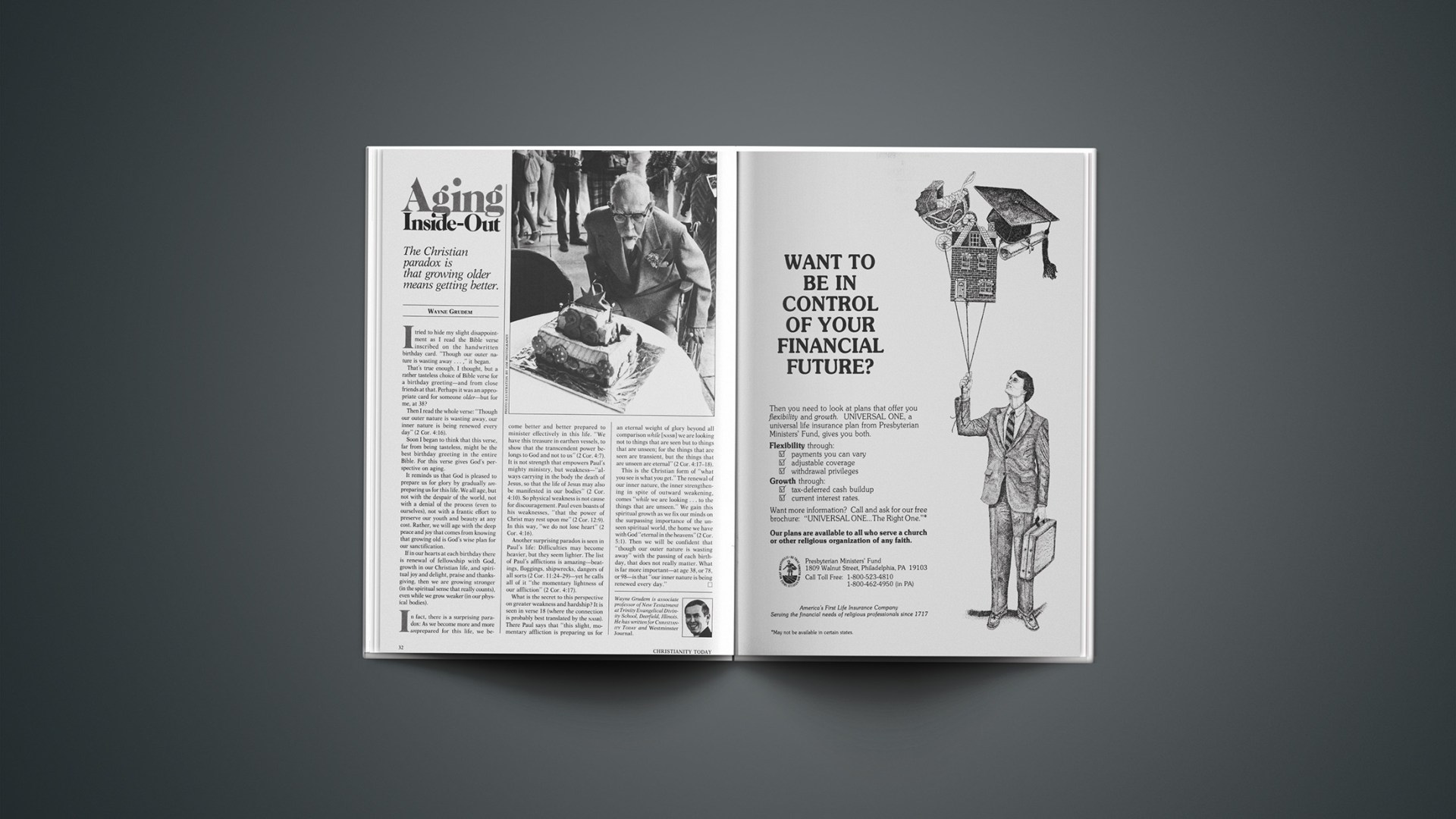
Aging Inside-out: The Christian Paradox Is that Growing Older Means Getting Better

WAYNE GRUDEM1Wayne Grudem is associate professor of New Testatment at Trinity Evangelical Divinity School, Deerfield, Illinois. He has written for Christianity Today and Westminster Journal.

I tried to hide my slight disappointment as I read the Bible verse inscribed on the handwritten birthday card. “Though our outer nature is wasting away …,” it began.

That’s true enough, I thought, but a rather tasteless choice of Bible verse for a birthday greeting—and from close friends at that. Perhaps it was an appropriate card for someone older—but for me, at 38?

Then I read the whole verse: “Though our outer nature is wasting away, our inner nature is being renewed every day” (2 Cor. 4:16).

Soon I began to think that this verse, far from being tasteless, might be the best birthday greeting in the entire Bible. For this verse gives God’s perspective on aging.

It reminds us that God is pleased to prepare us for glory by gradually unpreparing us for this life. We all age, but not with the despair of the world, not with a denial of the process (even to ourselves), not with a frantic effort to preserve our youth and beauty at any cost. Rather, we will age with the deep peace and joy that comes from knowing that growing old is God’s wise plan for our sanctification.

If in our hearts at each birthday there is renewal of fellowship with God, growth in our Christian life, and spiritual joy and delight, praise and thanksgiving, then we are growing stronger (in the spiritual sense that really counts), even while we grow weaker (in our physical bodies).

In fact, there is a surprising paradox: As we become more and more unprepared for this life, we become better and better prepared to minister effectively in this life. “We have this treasure in earthen vessels, to show that the transcendent power belongs to God and not to us” (2 Cor. 4:7). It is not strength that empowers Paul’s mighty ministry, but weakness—“always carrying in the body the death of Jesus, so that the life of Jesus may also be manifested in our bodies” (2 Cor. 4:10). So physical weakness is not cause for discouragement. Paul even boasts of his weaknesses, “that the power of Christ may rest upon me” (2 Cor. 12:9). In this way, “we do not lose heart” (2 Cor. 4:16).

Another surprising paradox is seen in Paul’s life: Difficulties may become heavier, but they seem lighter. The list of Paul’s afflictions is amazing—beatings, floggings, shipwrecks, dangers of all sorts (2 Cor. 11:24–29)—yet he calls all of it “the momentary lightness of our affliction” (2 Cor. 4:17).

What is the secret to this perspective on greater weakness and hardship? It is seen in verse 18 (where the connection is probably best translated by the NASB). There Paul says that “this slight, momentary affliction is preparing us for an eternal weight of glory beyond all comparison while [NASB] we are looking not to things that are seen but to things that are unseen; for the things that are seen are transient, but the things that are unseen are eternal” (2 Cor. 4:17–18).

This is the Christian form of “what you see is what you get.” The renewal of our inner nature, the inner strengthening in spite of outward weakening, comes “while we are looking … to the things that are unseen.” We gain this spiritual growth as we fix our minds on the surpassing importance of the unseen spiritual world, the home we have with God “eternal in the heavens” (2 Cor. 5:1). Then we will be confident that “though our outer nature is wasting away” with the passing of each birthday, that does not really matter. What is far more important—at age 38, or 78, or 98—is that “our inner nature is being renewed every day.”

What Do You Mean When You Say ‘God’?

Understanding who and what God is continues to be a challenging question for theologians and other believers.

What does it mean to say “God”? Many today would have to answer this question as Augustine did when asked for a definition of time: “When I am not asked I know very well, but when I am asked I do not know at all!”

The doctrine of God is a confused area in Western theology. Each of its three departments—the divine attributes, the Trinity, and God’s relation to the world—is disputed territory. This is basically because agreement is lacking as to how the doctrine should be constructed and defended. Different intellectual methods for doing this naturally produce different theological results.

Hybrids often prove unstable, and the Western heritage of theism is a hybrid. It grew out of the apologetic theology of the early centuries, in which much was made of the thought that Greco-Roman philosophy was a providential preparation for the gospel.

This theism, which found its fullest statement when Thomas Aquinas formulated it in Aristotelian terms, was a blend of reasoning from philosophy and the Bible, the former appearing to provide the frame into which the latter has to fit. But that changed with the Kuyperian, Barthian, and neo-Lutheran movements of this century. Each of these, in its own way, drew on Luther’s and Calvin’s criticisms of natural theology. But they pushed Luther’s and Calvin’s arguments to the point where it seemed that any appeal to reason to support or confirm scriptural revelation would be out of place. As a result, some aspects of theism in its traditional form have become widely suspect among mainstream theologians.

This means that when facing challenges to theism, Protestant theologians have not always known what to say. They have sometimes been tempted to take up panicky and defeatist slogans like that fathered by the late John Robinson: “Our image of God must go.” But that is not the way of wisdom. Certainly some rethinking is called for, but it is minor modification, not abandonment of traditional theism, that we need.

The Anatomy of Theism

It will help us to review the ingredients that make up historic Christian theism. Here is a check list of the usual items, expressed in as simple a way as the thoughts allow.

1. God is personal and triune. God is as truly three personal centers in a relationship of mutual love as he is a single personal deity. God is always Three-in-One and One-in-Three, and in all divine acts all three persons are involved. “He” when used of God means “the”—the Father, the Son, and the Holy Spirit

2. God is self-existent and self-sufficient. God does not have it in him, either in purpose or in power, to stop existing. He exists necessarily. The answer to the child’s question “Who made God?” is that God did not need to be made, since he was always there. He depends on nothing outside himself, but is at every point self-sustaining.

3. God is simple, perfect, and immutable. This means he is wholly and totally involved in everything that he is and does, and his nature, goals, plans, and ways of acting do not change, either for the better (for, being perfect, he cannot become better than he is) or for the worse.

4. God is infinite, without body, all-present, all-knowing, and eternal. God is not bound by any of the limitations of space or time that apply to us, his creatures, in our present body-anchored existence. Instead, he is always present everywhere, though invisibly and imperceptibly. He is at every moment cognizant of everything that ever was, or now is, or shall be.

5. God is purposeful and all-powerful. He has a plan for the history of the universe, and in executing it he governs and controls all created realities. Without violating the nature of things, and without at any stage infringing upon the human free will, God acts in, with, and through his creatures to do everything that he wishes to do exactly as he wishes to do it. By this sovereign, overruling action he achieves his goals.

6. God is both transcendent over and immanent in his world. On the one hand he is distinct from the world, does not need it, and exceeds the grasp of any created intelligence that is found in it. Yet on the other hand he permeates the world in sustaining and creative power, shaping and steering it in a way that keeps it on its planned course.

7. God is impassible. This means that no one can inflict suffering, pain, or any sort of distress on him. Insofar as God enters into an experience of suffering, it is by empathy for his creatures and according to his own deliberate decision. He is never his creatures’ victim. This impassibility has not been taken by the Christian mainstream to mean that God is a stranger to joy and delight. Rather, it has been construed as an assertion of the permanence of God’s joy, which no pain clouds.

8. God is love. Giving out of good will, for the recipient’s benefit, is the abiding quality both of ongoing relationships within the Trinity and of God’s relationship with his creatures. This love is qualified by holiness (purity), a further facet of God’s character that finds expression in his abhorrence and rejection of moral evil.

9. God’s ways with mankind, as set forth in Scripture, show him to be both awesome and adorable by reason of his truthfulness, faithfulness, grace, mercy, patience, constancy, wisdom, justice, goodness, and generosity. For these glorious qualities God is eternally worthy of our praise, loyalty, and love. The ultimate purpose of human life is to render to him worship and service, in which both he and we will find joy. This is what we were made for, and are saved for. This is what it means to know God, and to be known by him, and to glorify him.

10. God uses his gift of language, given to mankind, to tell us things directly in and through the words of his spokesmenprophets, apostles, the incarnate Son, the writers of Holy Scripture, and those who preach the Bible. God’s messages all come to us as good news of grace. They may contain particular commands, even threats or warnings, but the fact that God addresses us at all is an expression of his good will and an invitation to fellowship. And the central message of Scripture, the hub of the wheel whose spokes are the various truths about God that the Bible teaches, is and always will be God’s unmerited gift of salvation, freely offered to us in and by Jesus Christ.

Traditional Theism Under Fire

Now, what are the present-day problems with this venerable understanding of God? They come down to its sources and method. The positions themselves, as stated above, are plainly biblical. But the Platonist-Augustinian-Thomist tradition of philosophical theism has persistently held that knowledge of God’s reality and of several of the above facts about him can and should be gleaned by rational analysis apart from the Bible’s witness. This is where the uncertainty centers.

Karl Barth, in the powerful, Bible-based reassertions of trinitarian theism of his Church Dogmatics, spurned the help of this kind of rational theology. (It has traditionally been called natural theology.)

This did more than any other twentieth-century contribution to produce a pendulum swing against attempts to wed theology to philosophy. To be concerned lest philosophy becomes the dominant partner in this marriage is right and proper. Barth, however, wanted to go further, and divorce them—a different agenda altogether.

Barth himself would use philosophical concepts as tools to help investigate biblical teaching. But he would not let these concepts become grids limiting in advance what God is free to say to us through Scripture.

Barth’s protest, though justified within limits, threw the doctrine of God into great confusion. It opened the door to a selective reading of the Bible, free of coherent rational control, and operating without regard for any of the traditional fixed points. That is what we face today in many quarters. The pendulum still swings between Thomist and Barthian extremes, and shows no sign of coming to rest.

Augustine’s God


Following the inclinations of Greek philosophy, the early Christian fathers tended to highlight the contrast between God and his world. The effect was to play up the truth that God is holy and separate from sinners, and to play down the equal truth of his personal presence in people’s lives.

Augustine (354–430) was Western theology’s classic exponent of this account. He stressed God’s sovereignty. God predestines us according to his own will, and God’s grace restores the hearts of those whom he chooses. Augustine diagnosed evil as good gone wrong, which, though God overrules and uses, he does not cause.

Augustine also adapted from the neo-platonists their model of the mind’s ascent to knowledge. He claimed that understanding of God, who can only be known through the incarnate Son, comes solely as God illumines the willing minds of those who have already taken Christian truth on trust. “Believe in order to understand” was Augustine’s principle.

Karl Barth’s Theism

Barth’s contribution, though disruptive in the way just described, paves the way for some clarifications of the doctrine of God that we badly need.

Granted, his attack on the basis of natural theology—that is, the recognition that our existence and God’s have something in common—was certainly overdone. Granted, too, Barth’s denial of general revelation through the created order was a mistake. (His refusal to recognize general revelation, apart from the gospel, in Romans 1:18–32 and 2:9–16, seems little short of perverse.)

Neverthelss, his polemic against the claim of natural theology, to establish for us foundation truths about God as a kind of runway for revelation, now appears as a largely justified attack on nineteenth-century attempts to domesticate God. (Barth’s break with liberal theology began around 1915, when prominent German theologians blithely spoke of “using” the Christian faith “for purposes of conducting” World War I.) And Barth’s insistence that all our doctrine of God must come from the Bible was healthy and right.

So it will not be enough to dismiss Barth as eccentric and then slump back into traditional postures and parrotings. If Barth with his type of biblicism did not do well enough, we must try with ours to do better. To that end I now venture some comments on the doctrine of God as today’s evangelicals have received it.

Three Important Purgings

There are three important respects in which the traditional doctrine needs purging. It needs to be purged of elements of natural theology, elements of mystification, and elements of rationalism. Let me explain.

First, elements of natural theology need to be purged. Against Barth, I affirm that general revelation is a fact, and its impact will again and again produce thoughts about God that, so far as they go, are right. (Like those of Epimenides and Aratus that Paul cites in Acts 17:28.) Many are confident that rational apologetics (a form of natural theology) can, under God, trigger and crystallize such thoughts and insights. Unlike Barth, I see no reason to doubt their confidence.

Yet I contend that natural theology needs to be eliminated from our attempts at theological construction. There are five reasons.

First, we do not need natural theology for information. Everything that natural theology, operating upon general revelation, can discern about the Creator and his ways is republished for us in those very Scriptures that refer to the general revelation of these things (see Ps. 19; Acts 14:17, 17:28; Rom. 1:18–32, 2:9–16). And Scripture, which we rightly receive on the grounds that it is God’s own word of testimony and law, is a better source of knowledge about God than natural theology can ever be.

Second, we do not strengthen our position by invoking natural theology. On the contrary, claiming that biblical truths rest on philosophical foundations can only give the impression that the biblical message about God’s redemption is no more certain than is the prior philosophical assertion of God’s reality. And God’s reality, on this scenario, must be established by reason—unaided by revelation. Thus revelation becomes distinctly dependent on philosophy.

Third, all expositions of the analogy of being, and all attempts to show the naturalness of theism—all “proofs” for God’s existence and goodness, in other words—are logically loose. They state no more than possibilities (for probabilities are only one kind of possibilities) and can all be argued against indefinitely. This will damage the credit of any theology that appears to be building and relying on these arguments.

Fourth, the speculative method for building up a theology is inappropriate. As Louis Berkhof has observed, such a method takes man as its starting point, and works from what it finds in man to what is found in God. “And in so far as it does this,” Berkhof writes, “it makes man the measure of God.” That, of course, does not “fit in a theology of revelation.”

Fifth, there is always a risk the foundations that natural theology lays will prove too narrow to build all the emphases of Scripture upon. Thus, for instance, in Thomas Aquinas’s Summa Theologica, natural theology purports to establish that there is one God, who is the first cause of everything. But nothing is said about the personal aspects of God’s being. This personal dimension is central to the biblical revelation of God, setting it in stark contrast with (for instance) the divine principle in Hindu thought.

Thomas’s approach, however, encourages the theologian to downplay the biblical stress on it, to treat God as an impersonal object rather than a personal subject, and to see himself as standing over God to study him rather than under God to obey him.

It seems right to limit our use of natural theology to the realm of supportive apologetics (showing biblical faith to be reasonable), and not to give it any place in our attempts to state what the biblical faith actually is.

Aquinas’s God


Thomas Aquinas (1225–74) took as his basis the orthodox theological heritage, particularly as interpreted by Augustine. But he recast it to fit a different philosophical mold—that of Aristotle. Thus, Thomas conceived God not as a static essence, but as a dynamic being who is the First Cause of everything that is not himself.

Aristotle examined everything in terms of causes. This prompted Thomas to develop natural theology—supposedly real and sure knowledge of God gained by reason alone. His method was to note respects in which, as he thought, this world can be shown to be the effect of a First Cause, and then to reflect on what the First Cause must be to produce such effects.

Is Thomas’s natural theology logically and psychologically sound? Is his distinction between natural and supernatural realms of being and knowledge good or bad theology? These questions are disputed to this day.

Exit Mystification

In retooling traditional theism for today, we need, secondly, to purge elements of mystification. By “mystification” I mean the idea that some biblical statements about God mislead as they stand, and ought to be explained away. A problem arises from a recurring tendency in orthodox theism to press the legitimate and necessary distinction between what God is in himself and what Scripture says about his relation to us.

To be specific, sometimes God is said to change his mind and to make new decisions as he reacts to human doings. Orthodox theists have insisted that God did not really change his mind, since God is impassible and never a “victim” of his creation. As writes Louis Berkhof, representative of this view, “the change is not in God, but in man and man’s relations to God.”

But to say that is to say that some things that Scripture affirms about God do not mean what they seem to mean, and do mean what they do not seem to mean. That provokes the question: How can these statements be part of the revelation of God when they actually misrepresent and so conceal God? In other words, how may we explain these statements about God’s grief and repentance without seeming to explain them away?

Surely we must accept Barth’s insistence that at every point in his self disclosure God reveals what he essentially is, with no gestures that mystify. And surely we must reject as intolerable any suggestion that God in reality is different at any point from what Scripture makes him appear to be. Scripture was not written to mystify, and therefore we need to ask how we can dispel the contrary impression that the time-honored, orthodox line of explanation leaves.

Three things seem to be called for as means to this end.

First, we need exegetical restraint in handling Scripture’s anthropomorphisms (phrases using human figures to describe God). Anthropomorphism is characteristic of the entire biblical presentation of God. This is so not because God bears man’s image, but because man bears God’s, and hence is capable of understanding God’s testimony to the reasons for his actions. The anthropomorphisms are there to show us why God acted as he did in the biblical story, and how therefore he might act towards us in our own personal stories. But nothing that is said about God’s negative or positive reactions to his creatures is meant to put us in a position where we can tell what it feels like to be God. Our interpretation of the Bible must recognize this.

Second, we need to guard against misunderstanding of God’s changelessness. True to Scripture, this must not be understood as a beautiful pose, eternally frozen, but as the Creator’s moral constancy, his unwavering faithfulness and dependability. God’s changelessness is not a matter of intrinsic immobility, but of moral consistency. God is always in action. He enters into the lives of his creatures. There is change around him and change in the relations of men to him. But, to use the words of Louis Berkhof, “there is no change in his being, his attributes, his purpose, his motives of action, or his promises.” When one conceives of God’s immutability in this biblical way, as a moral quality that is expressed whenever God changes his way of dealing with people for moral reasons, the biblical reference to such change will cease to mystify.

Third, we also need to rethink God’s impassibility. This conception of God represents no single biblical term, but was introduced into Christian theology in the second century. What was it supposed to mean? The historical answer is: Not impassivity, unconcern, and impersonal detachment in face of the creation. Not inability or unwillingness to empathize with human pain and grief, either. It means simply that God’s experiences do not come upon him as ours come upon us. His are foreknown, willed, and chosen by himself, and are not involuntary surprises forced on him from outside, apart from his own decision, in the way that ours regularly are.

This understanding was hinted at earlier, but it is spelled out here because it is so important, and so often missed. Let us be clear: A totally impassive God would be a horror, and not the God of Calvary at all. He might belong in Islam; he has no place in Christianity. If, therefore, we can learn to think of the chosenness of God’s grief and pain as the essence of his impassibility, so-called, we will do well.

Karl Barth’s God


Karl Barth (1886–1968) rejected all natural theology and philosophical speculations about God. He insisted that God speaks to humanity in gracious, sovereign freedom through the Bible alone. This means we have to disown our theological fancies, and listen in humble faith to what God says.

The themes of Reformation theology, with the gospel promise of God’s “yes” to sinners at the center, were Barth’s constant concern. This, he held, is what the Bible proves to be about, when it is allowed to speak. There were, however, some differences. One was that Barth so stressed the discontinuity of the realms of nature and grace that he was never able to state clearly in exactly what way Jesus Christ is a totally historical person. But his assertions of the Trinity and Incarnation, and of God’s transcendent freedom, lordship, and power are certainly among the strongest in twentieth-century theology.

Problems of Rationalism

The final step needed to spruce up traditional theism is to purge it of elements of rationalism. Just as the two-year-old son of a man with a brain like Einstein’s could not understand all that was going on in his father’s mind if his father told him, so it would be beyond us to understand all that goes on in the all-wise, and not in any way time-bound mind of God.

But, just as the genius who loves his boy will take care to speak to him at his own level, even though that means reducing everything to baby talk, so God does when he opens his mind and heart to us in the Scriptures. The child, though aware that his father knows far more than he is currently saying, may yet learn from him all that he needs to know for a full and happy relationship with Dad. Similarly, Scripture, viewed as torah (God’s fatherly law), tells us all that we need to know for faith and godliness.

But we must never forget that we are in the little boy’s position. At no point dare we imagine that the thoughts about God that Scripture teaches us take the full measure of his reality. The fact that God condescends and accommodates himself to us in his revelation certainly makes possible clarity and sureness of understanding. Equally certain, however, it involves limitation in the revelation itself.

But we forget this, or so it seems; and then appears the rationalism of which I am speaking. It is more, I think, a temper than a tenet, but it produces a style of speech that in effect denies that there is anything about God we do not know. By thus failing to acknowledge his incomprehensibility beyond the limits of what he has revealed, we shrink him in thought down to our size. The process is sometimes described as putting God in a box.

It is certainly proper to stress, as against the sleep of reason in the world and the zaniness of subjectivism in the church, that scriptural revelation is rational. But the most thorough-going Bible believers are sometimes required, like Job, to go on adoring God when we do not specifically understand what he is doing and why he is doing it.

We should avoid like the plague any talk that suggests that we have enlisted him on our side, and now have him in our pockets. Confidence in the teaching of God’s written Word is to be maintained all the time. But this stance of theological triumphalism is something quite different, and is to be avoided.

God the Image Maker

This review of traditional theism, and suggestions for its possible refinement, has been heavy sledding. How can it all be pulled together? Can we focus our theism in a phrase? I welcome the suggestion that we should speak of God as the image maker.

This phrase binds together the main theistic thrusts that our secular world needs to face. Say “God,” and you point to the infinite, eternal, self-existent, self-revealing Father, Son, and Holy Spirit. Say “Maker,” and you point to the fundamental relationship between God and us. He is the Creator, we are his creatures.

Say “Image Maker,” and you point to the basis and presupposition of our knowledge of God—namely, the fact that he made us like himself. Included in that image are rationality, relationality, and the capacity for that righteousness that consists of receiving and responding to God’s revelation. We are able to know God because we are thinking, feeling, relating, loving beings, just as he is himself.

I am no prophet, nor a prophet’s son, but it seems fairly clear to me that pressure on conservative theology is still building up from exponents of religious relativism and pluralism. This is so both within the church (where some think that the more theologies there are, the healthier and merrier we shall be) and outside it.

I expect over the next few decades to see the quest for a synthesis of world religions gain impetus, with constant attempts to assimilate Christianity into other faiths. We may expect a generation of debate on the program of moving through and beyond syncretism to a nobler religion than any that has yet been seen. That notion, which has emerged more than once in liberal circles, looks like an idea whose time, humanly speaking, has come; and countering it, I predict, will be the next round in the church’s unending task of defending and propagating the gospel. If this guess is right, we shall be badly at a disadvantage if we have not taken pains to brush up our theism, since the question of theism—whether or not we are going to think about God the Christian way, or some other way—will be at the heart of the debate. So I hope we shall take time out to prepare ourselves along the lines suggested—just in case.

Sidebar vignettes also by. J. I. Packer; used with permission from Eerdman’s Handbook to Christian Belief (1982).

Putting First Things First: The Problems of Black Youth Demand Spiritual Solutions

BUSTER SOARIES1Buster Soaries is head of Conquerors International, an urban youth ministry dedicated to assisting the black church in the evangelization and discipling of youth. An evangelist and motivational speaker, he was formerly national coordinator of Operation PUSH (founded by Jesse Jackson); a community organizer for the National Urban League; and, for ten years, a Harlem pastor.

The year 1970 roughly marked the end of legal, formal, and institutional cruelty aimed at American blacks. Certainly, racism is not dead! But the overt manifestation of racism is illegal.

In this respect the America of today is different—not perfect, but different. And the black church must now consider new responsibilities. In the more oppressive past, the black church never needed to be actively evangelistic. The limited social options of blacks made the church a magnet that naturally attracted generation after generation.

Unfortunately, the primary messages and values of the black community today are no longer coming from the Bible and the church. They are coming from television and radio. Also, because this is an era of inherited rights, the post-1970 generation does not possess the sense of struggle that every other generation knew. It is without the determination that can result from adversity.

In many respects this is true of the youth of all races. The current generation knows little about obstacles of the type faced by its forefathers. With that, and the fattening and softening influence of the media, young people have a warped perspective on survival and success. Somehow they have been convinced that if people simply continue to breathe long enough, they will obtain the desires of their hearts.

The grim irony is that this lax attitude has formed at a time when an energetic attitude is greatly needed. Technology has reduced the world to a small village, and this generation must compete with the entire world unlike any previous generation. America cannot produce world leaders if its youth continue to be plagued with lassitude and moral degeneracy.

New Circumstances And A New Role

Under these changed circumstances, what is the role of the black church? Certainly the church must support those organizations and institutions that provided for the victories of social justice. But the foremost challenge that is facing the black church today is to evangelize the new generation. It is only in this way that the church can retain its significance and insure the endurance of its previous victories.

An entire country is hypnotized by television, mesmerized by music, and anesthetized by drugs and alcohol. It is being scandalized by divorce, pornography, teen pregnancy, suicide, abortion, and crime. The nation’s schools are failing primarily because its families have abdicated their responsibility to raise their own children. While technology grows theology shrinks, and God is reduced to a convenience item for casual use.

To the American community at large, the overall degeneracy constitutes a greater threat than terrorism or communism. No community or nation can be considered great while its citizens destroy themselves with drugs and alcohol. No community can demand respect from without while its senior citizens are afraid to walk the streets within.

In the black community this epidemic of reckless abandonment has become as formidable a foe as organized racism ever was. Black Christians (and all other Christians) must unapologetically rise to the occasion and challenge this new generation with the primary message of the church: “You must be born again!”

The Problem At Heart

Critics of this proposal say it is a simplistic and cowardly response to a complex predicament. Yet there can be no successful contradiction of a primary reality: Though social progress does not guarantee spiritual growth, spiritual growth guarantees social progress. There is no legislation that will lower the rate of teenage pregnancy—the problem is spiritual. There is no government program that can keep fathers at home to help their wives raise their children—the problem is spiritual. There is no assignment that can give students the desire to learn—the problem is spiritual.

Unless there is a revival of spiritual values and an understanding of divine principles, people will never maximize the use of what they do have, but will continue to complain about what they do not have. Civil rights issues like affirmative action, busing, quotas, and voting rights are all moot issues to a generation that can dance better than it can read, and can cuss but can’t pray. The souls and the lives of an entire generation are at stake, and no one can refute the need for the black church to put first things first.

The Whole Of Evangelism

In order for the black church to make a difference in black culture, it is necessary to understand all the implications of evangelism:

1. The black church must get the attention of youth. The church must pool its resources, expand its programs, and utilize nontraditional means to preach the gospel to young people. The gospel of Jesus Christ has been powerful enough to make an impact on every generation, and it can make the same impact on this one if it is preached. The reason children know the latest songs is because they hear them. The church must do new things—such as community-wide youth crusades, interdenominational youth outreach, after school midweek youth Bible studies—so that the gospel will be heard.

2. The church must minister to the entire family. Young people are products of their environment. The church must be prepared to minister to and treat damaged families as it attempts to save black communities. The absence of the traditional church influence has left many families without guidelines for successful nuturing and functioning. Emphasis will have to be placed on family life, and models of successful family life will have to be promoted by the churches.

3. The church must mobilize for spiritual renewal as it did for civil rights. The civil rights movement was successful because people were committed and sacrificially gave of themselves to create change. When a trouble spot was identified, people spontaneously converged on it to demand respect and justice. The same level of intense mobilization is necessary for a spiritual awakening in black America. Only this will rid communities of drugs, illicit sexual behavior, and the cloud of death that hovers over their heads. There must be a spiritual revolution!

4. The church must develop and rebuild neighborhoods. Urban decay is on the one hand a great American nemesis, and on the other hand a great opportunity. Those who serve the spiritual needs of the black community must also rebuild the physical and economic infrastructure of that community

This can be done without relying solely on the government. The black community’s collective economic strength affords it leverage over institutional and individual assets for the private financing of various projects. As blacks have organized and put companies out of business because of their unfavorable policies, they can also organize and put people in business that will stabilize the community. Most aid will not come from government but rather from self-help and the private sector.

Happily, much of the above is already happening. Leaders in every major denoimination, and blacks in parachurch ministries, are responding to the need for a new formula for ministry. Conferences are being held to discuss evangelism, and materials are being developed for personal and group growth. Specialized ministries committed to family life, youth, discipleship, and evangelism are being born every day. There are summit meetings of black Christian leaders. And the major emphasis of fast-growing black churches is spiritual growth.

The Role Of The White Church

Cultural circumstances place white and black Christians in a more similar situation than ever before. Accordingly, there are many ways the white church can correlate efforts with the black church.

1. Recognize and understand the history of the relationship of the white and black churches. In other words, realize the unique struggle black Christians have had in “embracing the religion of their oppressors.”

2. Join forces with the black movement as it attempts to reach this new generation. Every ounce of talent and commitment that can be mustered is needed to win this generation of black and white youth.

3. Pray about the racial attitudes that still exist and have never been confessed. If racial reconciliation is to occur in America, it will only be through the church. Whites and blacks seem to be so satisfied with the division between them that they see no need to work toward healing and unity. The goal should be the elimination of distinct separation between black and white Christians.

4. Respect the presence and authenticity of the traditional black church. Too often white Christians talk about the black community as if there are no churches there. True enough, the black church is not perfect—but neither is the white church. Sincere efforts to assist the black community will not circumvent the black church. They will assist that church, the only institution that has stood for blacks through the years.

The Hope

Ultimately, the new generation cannot be saved if the old generation is uncertain about itself. When youth are their evangelistic target, adults will have to practice what they preach. The number one reason teenagers give for not attending church is the hypocrisy that exists among adults. Adults cannot teach what they do not know and cannot lead where they will not go.

A few hundred years ago, God sent some Africans to North America to suffer human indignation, to be prepared in a special way for a special ministry. The black church today has a unique challenge—but God has provided it with unique credentials. Not only does it have a moral and historical mandate to generate a consciousness of God’s will for black America, but it has a profound opportunity to share, in a spirit-filled way, the power and joy realized through Christ-centered living.

Black Americans have come up the rough side of the mountain with faith as their only weapon. They must share this faith and continue to contribute to the building of a great nation. Surely God has chosen them for this great calling and has placed them in this position for just such a time.

The Black Lifestyle: Framed by Scripture

The living reality of God and the experience of worship have both been manifest from the beginning of the black North American experience. The reality of life in a bondage situation provided great impetus to maintain closeness to God. The Bible has no shortage of people and themes that represent the underdog, and black America received its spiritual formulae from biblical exposition.

Black Americans generally did not have social clubs, vacations, schools, political parties, and other societal options. Consequently, church-related activities were spiritual, social, recreational, and educational. The sum total of the black lifestyle was framed by Scripture and its teachings.

Finally, the constant recognition of the black social situation reminded blacks they did not have the “luxury” of living an immoral life. Not only would it lead to eternal destruction, but blacks knew they would never achieve equality or greatness in this country unless they had impeccable moral character. This, too, was based on the authority of Scripture, the example of Christ, and a desire to please God.

The press (religious as well as secular) has chosen to highlight the sensational political aspects of the church. But in the midst of the protest and the marching there was always Sunday school, worship, prayer meetings, baptisms, funerals, counseling, and all the other basic activities of spiritual nurturing. The black social movement was an outgrowth of this vital spirituality—not the poisoning of liberal theology.

By Buster Soaries.

A Separate Altar: Distinctives of the Black Church

HIAWATHA BRAY1Hiawatha Bray is a free-lance writer living in Chicago. A graduate of Wheaton Graduate School, he has written for Christianity Today, Essence, and Computerpeople Monthly.

There is no “black church”; there are only black churches: thousands of them, ranging from great African Methodist Episcopal congregations, to tiny storefront gatherings of Pentecostals.

And yet, there is a “black church,” for a common tradition of shared culture and shared oppression binds together all black congregations, distinguishing them from their white counterparts. There is a unique style of black worship, and political concerns that are unique to black pastors and congregants. So important is the black church to black society that you cannot make sense of one without understanding the other.

Segregated Christianity

Ebony magazine estimated in 1984 that there are 18 to 20 million nominal black Christians in the United States, of whom approximately one-fourth are regular churchgoers. Of America’s professing black Christians, about 80 percent belong to denominations founded and controlled by blacks. Despite all the societal efforts made to ensure that whites and blacks work and study together, the races continue to worship in segregation.

Perhaps it could not have been otherwise. The same Europeans who introduced Africans to the gospel shackled them in slave ships for the grim voyage to the Americas. They never meant to worship God on an equal footing with their slaves.

The founding of the first great black denomination, the African Methodist Episcopal Church (AME), was a response among free blacks to the bigotry of white Christians. It was the time of the Second Great Awakening, and fervent preachers, mainly Methodists and Baptists, challenged the religious indifference that existed after the Revolution. The new religious passion affected blacks, both slave and free. In free states, growing numbers of blacks sought spiritual communion in Baptist and Methodist congregations. But the white Christians in them would not allow it.

In 1787 Richard Allen was forcibly prevented from praying with white worshipers at Saint George’s Methodist Episcopal Church in Philadelphia. Shortly thereafter, he founded the Free African Society. Society members at first maintained fellowship with whites, where allowed, but eventually began to hold their own religious services. In 1794 a minority of the society, under Allen’s leadership, founded the African Methodist Episcopal Church.

The AME church was more than a place for blacks to worship in dignity. It was an expression of the bedrock principle of black theology. Blacks knew that white racism was more than earthly injustice; it was sin, as deep and grave as idolatry. “It is theologically significant that since the AME church was founded, it has never practiced institutional racism,” says Gregory Ingram, pastor of the Quinn Chapel AME Church in Chicago. “Our doors have always been open for those who want to worship God freely. Part of our creedal statement is ‘God our Father; Christ our Redeemer; Man our Brother.’ ”

Black churches are more than a refuge for oppressed Christians. Their existence is a positive affirmation of Christian truths white Americans often forget.

The Spiritual Lives Of Slaves

Understanding the black church, present and past, requires some knowledge of the spiritual lives of its original members.

Few slaves had become Christians by the 1800s (almost no one had preached the gospel to them). This began to change as evangelists persuaded slaveholders that a Christian slave was a better slave. At first the evangelists were often staunch abolitionists. But to gain permission to preach to slaves, they were forced to modify their position. In time, much of the Southern clergy became the staunch defenders of slavery. The Methodists, for example, created a new catechism for slaves. “What did God make you for?” the catechism asked. Answered the good slave, “To make a crop.”

By the mid-nineteenth century, hundreds of thousands of slaves had become believers. But in 1822 it was discovered that Denmark Vesey, a black sailor, had planned to lead a slave revolt with the aid of leading black Methodists. Nine years later the slave preacher Nat Turner led a bloody revolt. These and other incidents eventually led whites to apply strict controls on religious activity among slaves.

It was no use, however. Throughout the South, Christian faith and political freedom had become linked in the minds of blacks. Slaves gathered at night for secret religious services where the white gospel was taught and prayers offered to a God who wanted them free.

Thus, from the beginning, black people have associated Christianity with social and political freedom as well as spiritual salvation. They have not been as prone as white American Christians to speak of the faith in dichotomies such as soul versus body and political versus spiritual. This tradition was reinforced in the aftermath of slavery because of the unique position of the church in the black community.

“The black church antedates the black community. Until the black church there was no black community,” says C. Eric Lincoln, professor of religion and culture at Duke University. With their African traditions denied them, and with social and political interaction strictly controlled even after emancipation, the church was for decades the only strong black institution in America.

After the brief political freedoms of the Reconstruction period, black participation in politics was almost totally eliminated. As a result, says Professor Lincoln, “The church, being the only institution blacks had that was reasonably impervious to white control, obviously became the place where black secular politics would also have its nurture. There was nowhere else for a political consciousness to develop.”

Pastor Maceo Woods of Chicago’s Christian Tabernacle Church thinks spiritual and political concerns are both vital to the mission of the church. “I feel the church is the hub of political aspirations.” But politics, he warns, “should not become the text of the morning. The Word of God should take pre-eminence. Our political actions should come out of the Word of God.”

The political consciousness of black Christians is often very different from that of their white brethren. David Edwin Harrell, Jr., in his book White Sects and Black Men, referred to fundamentalist groups when he wrote, “Sectarian preachers have frequently been among the most vocal supporters of segregation in the South since World War II.”

The Battle For Survival

Most conservative Christians now categorically condemn racism. But there remain significant differences between the white and black understanding of politics and faith. White evangelicals and fundamentalists, in their denunciations of liberalism and secular humanism, tend to take a negative view of the state. In the rhetoric of the New Right, the federal government (except for military power) has become an enemy of freedom (too much power). Government social programs are wasteful and encourage sloth and dishonesty. And liberal court decisions undermine the true meaning of the Constitution.

There may be some truth in these claims. But for blacks, the power of the federal government has allowed them to get decent jobs and send their children to decent schools. With millions of blacks in poverty, social programs are often the difference between life and death. And the Supreme Court, by striking down discriminatory laws, has made the Constitution a living document for blacks.

But many black Christians, while rejecting the political conservatism whites often embrace, do share the theological conservatism of white evangelicals. Edward Freeman, a leader in the National Baptist Convention (America’s third-largest Protestant denomination), stated that black Baptists differ with Jerry Falwell politically, but agree on such doctrinal matters as “belief in God, the Holy Spirit, the deity of Jesus Christ, the fall of man, the doctrine of sin, salvation, redemption, et cetera.”

In 1963, black churchmen formed the National Black Evangelical Association to deal with the special concerns of black evangelicals. Executive director Aaron Hamlin says the organization is still necessary. “There are still needs that are not being addressed by the white evangelical community, in relation to jobs, poverty programs, and the racism that still exists.”

Christian political activism grows out of the social condition of the community, conditions very different from those faced by whites. Pastor Ingram says, “The AME church grew out of a sense of protest, so we were closely involved with the survival issues of our people.” Survival for blacks does not mean a battle against an abstract secular humanism. It means a battle for voting rights, jobs, better housing.

The Style Of Worship

A positive factor that separates black and white Christians is the difference in worship styles. For one thing, black worship demands emotional as well as intellectual agreement with religious truth. Some have supposed that the preaching in black churches has little intellectual content. But to many black Christians, an understanding of the gospel should mean more than mere intellectual assent. It should be an intensification of the white evangelical tradition—demanding heartfelt faith in the truths of the gospel.

Larry Murphy directs the Institute for Black Religious Research at Garrett-Evangelical Theological Seminary. “The commonalities in black worship,” says Murphy, “have to do with the very strong focus on an expressiveness which picks up on the evangelical Protestant tradition of experiential piety, and you find that running fairly commonly throughout black churches.”

Another common theme is the crucial importance of the pastor and his preaching in black churches. Says Clay Evans, pastor of Chicago’s Fellowship Baptist Church and chairman emeritus of Operation PUSH, “The power comes from the pulpit down, as it did with the prophets of old. In most black churches, the power remains in the pulpit. Pastors lead the congregation, the congregation doesn’t lead them.”

And the pastor leads by preaching. This preaching—emotional, biblical, and prophetic—is at the core of black worship. It is no accident that most of the greatest black leaders have been preachers. From Nat Turner to Martin Luther King, black Christian preaching has always stood for social as well as religious leadership.

Will The Churches Integrate?

Only a minority of white or black Christians worship in integrated churches. Could this change? Pastor Woods thinks there have been superficial improvements: “I feel there has certainly been an attempt to break down the barriers, but it’s just external. There’s got to be an internal change.” C. Eric Lincoln says, “The thing that would most likely make it change would be a different view of black people on the part of white people. I lay the problem frankly at the door of white Christianity, and I think that white Christianity will have to rethink its perspectives about people if we are going to have anything that approaches a common Christian front.”

But, Lincoln adds, many black Christians are no longer interested in church integration. “As we went through the sixties and the seventies we saw less and less reason to believe that the white church had brotherhood on its mind. So, in my opinion, it will be increasingly difficult to persuade blacks that they ought to be particularly concerned about the white church.”

But contempt for white racism is only part of the story. In the last two decades, blacks discovered a new sense of pride and self-respect. To Larry Murphy of Garrett-Evangelical Seminary, the black church tradition has a special strength born of the historical agonies and victories of African-Americans. It speaks to him as no other religious tradition can. “I don’t attend a white church, although I work in a white community. But I find my greatest level of comfort in a church that reflects my own traditions, my own biological identity. I see that as nothing negative.”

But for Christians, the final issue must be whether our traditions and practices are pleasing to God. Does the Lord who calls the church his body intend that its various limbs be separate from one another? Perhaps for a time. Perhaps the racial division of the American church is a peculiar message from God to his people. Willie White, a black Baptist preacher, described it in the Christian Century: “It is precisely God’s purpose that stands opposed to any thoroughgoing ecumenical approach between the black and white churches of America.… [T]he black church is the instrument of God in this world, not just a group [of people] who are separated unto themselves.… [T]he black church is the instrument of God in this world, not just a group [of people] who are separated unto themselves until the good graces of white [people] call them back into fellowship.… [T]he establishment of the black church was not the work of a mere man; it was the work of Christ.”

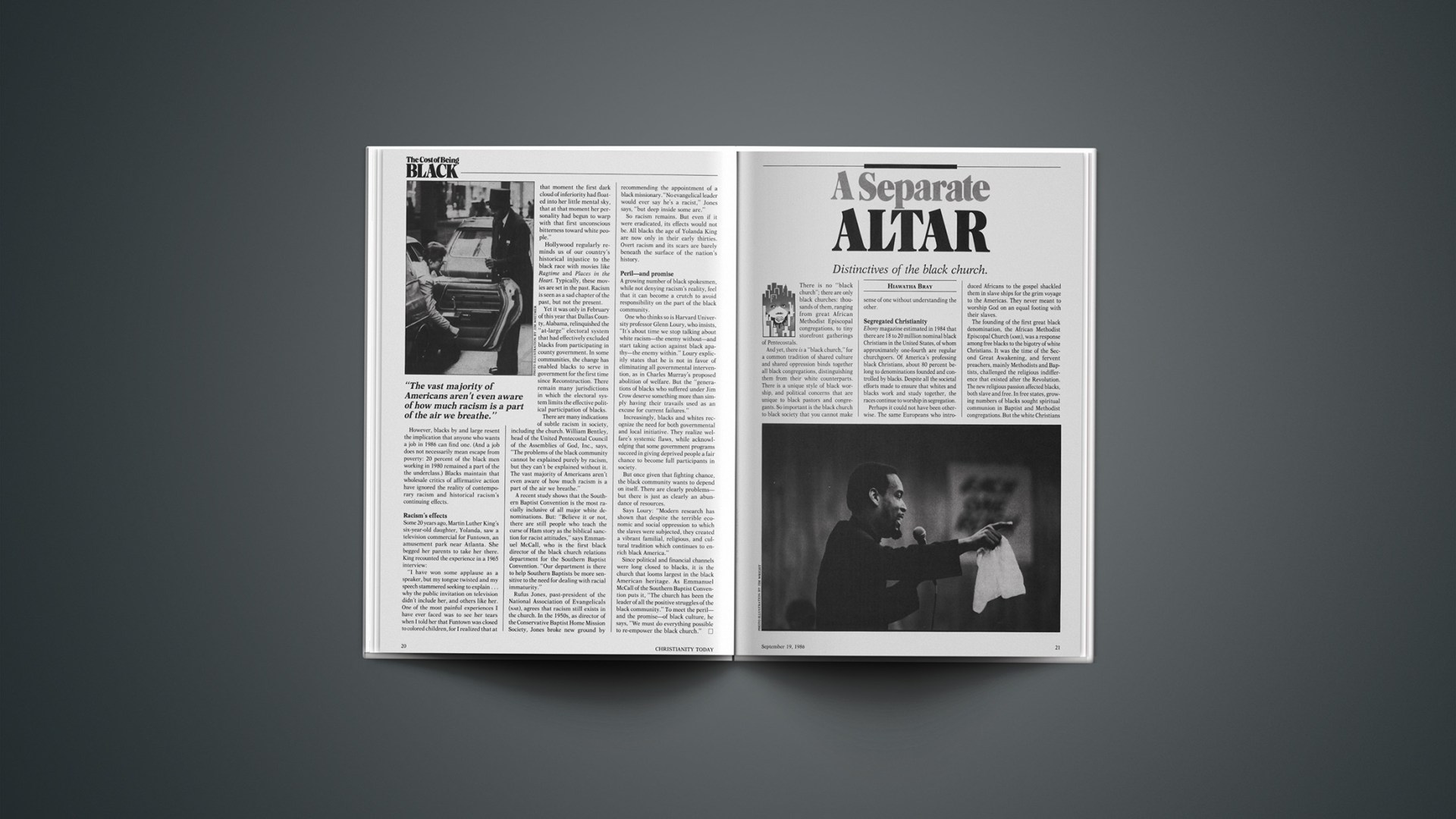
The Cost of Being Black: Out of Work, out of Money, and out of Favor: A Culture at Risk

RANDALL FRAME

Jesse Jackson’s son has had the unfortunate duty of being a pall bearer at 12 funerals over his three high school years. All of them were for fellow students. “These boys can’t lose,” Jackson quoted his son in a recent television interview. “If they rob a bank and get the money, they win. If they get caught, they go to jail. It’s warm, they’re with their friends, they can eat, get medicine if they’re sick. If they get killed, they’re out of their misery.”

It is hard to conceive of human beings reduced to such reasoning. Yet this desperation testifies to the degree of the problem America’s black community faces.

Poverty and unemployment rates for blacks are at their highest levels since the Civil Rights Act of 1964. In 1984, according to the Census Bureau, 34 of every 100 black persons were living in poverty; and the black unemployment rate is near 15 percent—more than 40 percent among teenagers of working age. In 1984, the median black family had about 56 cents to spend for every one dollar for white families. And the infant mortality rate is about twice as high among blacks as whites.

The black family, by all estimates, is disintegrating. Some 60 percent of black children have no father living in the home. More than half the births among blacks are out of wedlock, and 87 percent of those are to teenagers. According to a University of Chicago study, if things continue as they are, the turn of the century will see 70 percent of all black families headed by single women and less than 30 percent of all black men employed.

The current struggles of the black community, of course, must be under stood within the context of an abandonment of traditional values across racial lines. After all, rates of teen unemployment, drug and alcohol abuse, school dropout, homicide, and suicide are at record highs for whites as well as blacks.

Yet America’s black culture is especially hard hit by these widespread social changes. It is a segment of American society that historically knew the immense suffering of slavery, and still suffers from the effects of racism. And just as the pain of this community is not contrived within racial boundaries, it cannot be contained within those boundaries. As sociologist Lee Rainwater has written, “The lower the level of resources available to an individual … the higher the risk to his sense of well-being and the higher the risk to the rest of society of his engaging in ‘deviant’ behavior that is destructive to the well-being of others.”

All Americans (and Christians especially, who profess a concern for others) have a stake in seeing black culture recover. Central to the task of reversing its dissolution is the question of responsibility. Is it the fault of society, of the system? Is it fair to blame slavery and racism? To what extent are poverty’s victims themselves responsible?

Losing Ground: But Why?

Charles Murray’s book Losing Ground has fundamentally altered the debate on these issues (CT, June 14, 1985, p. 26). Murray essentially argues that American social policy, including affirmative action and welfare, has functioned to reward laziness and to break up families, resulting in the virtual institutionalization of poverty. Many black commentators agree there is something wrong with a system that pays a father to live apart from his family or to refrain from pursuing gainful employment

However, blacks by and large resent the implication that anyone who wants a job in 1986 can find one. (And a job does not necessarily mean escape from poverty: 20 percent of the black men working in 1980 remained a part of the the underclass.) Blacks maintain that wholesale critics of affirmative action have ignored the reality of contemporary racism and historical racism’s continuing effects.

Racism’S Effects

Some 20 years ago, Martin Luther King’s six-year-old daughter, Yolanda, saw a television commercial for Funtown, an amusement park near Atlanta. She begged her parents to take her there. King recounted the experience in a 1965 interview:

“I have won some applause as a speaker, but my tongue twisted and my speech stammered seeking to explain … why the public invitation on television didn’t include her, and others like her. One of the most painful experiences I have ever faced was to see her tears when I told her that Funtown was closed to colored children, for I realized that at that moment the first dark cloud of inferiority had floated into her little mental sky, that at that moment her personality had begun to warp with that first unconscious bitterness toward white people.”

Hollywood regularly reminds us of our country’s historical injustice to the black race with movies like Ragtime and Places in the Heart. Typically, these movies are set in the past. Racism is seen as a sad chapter of the past, but not the present.

Yet it was only in February of this year that Dallas County, Alabama, relinquished the “at-large” electoral system that had effectively excluded blacks from participating in county government. In some communities, the change has enabled blacks to serve in government for the first time since Reconstruction. There remain many jurisdictions in which the electoral system limits the effective political participation of blacks.

There are many indications of subtle racism in society, including the church. William Bentley, head of the United Pentecostal Council of the Assemblies of God, Inc., says, “The problems of the black community cannot be explained purely by racism, but they can’t be explained without it. The vast majority of Americans aren’t even aware of how much racism is a part of the air we breathe.”

A recent study shows that the Southern Baptist Convention is the most racially inclusive of all major white denominations. But: “Believe it or not, there are still people who teach the curse of Ham story as the biblical sanction for racist attitudes,” says Emmanuel McCall, who is the first black director of the black church relations department for the Southern Baptist Convention. “Our department is there to help Southern Baptists be more sensitive to the need for dealing with racial immaturity.”

Rufus Jones, past-president of the National Association of Evangelicals (NAE), agrees that racism still exists in the church. In the 1950s, as director of the Conservative Baptist Home Mission Society, Jones broke new ground by recommending the appointment of a black missionary. “No evangelical leader would ever say he’s a racist,” Jones says, “but deep inside some are.”

So racism remains. But even if it were eradicated, its effects would not be. All blacks the age of Yolanda King are now only in their early thirties. Overt racism and its scars are barely beneath the surface of the nation’s history.

Peril—And Promise

A growing number of black spokesmen, while not denying racism’s reality, feel that it can become a crutch to avoid responsibility on the part of the black community.

One who thinks so is Harvard University professor Glenn Loury, who insists, “It’s about time we stop talking about white racism—the enemy without—and start taking action against black apathy—the enemy within.” Loury explicitly states that he is not in favor of eliminating all governmental intervention, as in Charles Murray’s proposed abolition of welfare. But the “generations of blacks who suffered under Jim Crow deserve something more than simply having their travails used as an excuse for current failures.”

Increasingly, blacks and whites recognize the need for both governmental and local initiative. They realize welfare’s systemic flaws, while acknowledging that some government programs succeed in giving deprived people a fair chance to become full participants in society.

But once given that fighting chance, the black community wants to depend on itself. There are clearly problems—but there is just as clearly an abundance of resources.

Says Loury: “Modern research has shown that despite the terrible economic and social oppression to which the slaves were subjected, they created a vibrant familial, religious, and cultural tradition which continues to enrich black America.”

Since political and financial channels were long closed to blacks, it is the church that looms largest in the black American heritage. As Emmanuel McCall of the Southern Baptist Convention puts it, “The church has been the leader of all the positive struggles of the black community.” To meet the peril—and the promise—of black culture, he says, “We must do everything possible to re-empower the black church.”

Ideas

Rest? Never on Sunday

Seven days of work make one weak.

A friend of W. C. Fields once walked into his dressing room unannounced and caught him reading the Bible. Knowing Fields’s cynical attitude toward religion, he was surprised. Fields himself seemed embarrassed and quickly shut the book: “Just looking for loopholes,” he explained.

That captures some of the ambivalence most Christians I know have toward the Sabbath—looking for loopholes. They know it is special, and to be observed, but they don’t really know why or how. Frankly, attending religious services comes out a poor and distant second place to all the other things one can do with a weekend, like going fishing, playing golf, or just sleeping in and enjoying the Sunday paper over several cups of coffee. Or the Sabbath looms up as a barrier to getting some necessary work done, whether piled up in the office from the week before or waiting in the yard from the month before. So they always seem to be looking for loopholes: ways to get credit for keeping the Sabbath, without actually having to keep the Sabbath.

Some play the percentages loophole: “Well, two out of four Sundays isn’t too bad. In baseball, that would make me a 500 hitter.” Others attempt the “Have your cake and eat it too” loophole: they attend worship services, and then proceed to cram the day full of what they really want to do. The earlier the service the better for these folks.

The more theologically sophisticated go for the “You deserve a break today” loophole. They stay away from church, explaining, “I’ve had a tough week. I’m exhausted. This is the one day I have to rest up or do some things around the house that just have to be done. Didn’t Jesus say that the Sabbath was made for man, not man for the Sabbath?”

Indeed, Jesus did say it was for our sakes that God gave the command to observe the Sabbath and to keep it holy (Mark 2:27). But that’s the point, isn’t it? In the Sabbath command God has said to us, “Here it is, I give it to you for your own health and happiness. Keep it and you win. Violate it and you lose.” If something is given for our sakes, and we refuse to receive it, then we hurt ourselves. The Pharisees, to whom Jesus directed that famous statement, were violating the Sabbath. They were piling up so many rules defining how one should keep the day holy that the day was lost under the pile. But they violate it no more than we do when we commit the equal and opposite error and set no rules at all. They are guilty of the legalist sin, we of the antinomian sin. We both violate the Sabbath, and in the process hurt ourselves, the violators.

Grace

What do we lose when we lose the Sabbath? We lose grace. This seems to lie behind the explanation for the Sabbath command given in Exodus 20:11: “For in six days the Lord made the heavens and the earth, the sea, and all that is in them, and he rested on the seventh day. Therefore the Lord blessed the Sabbath day and made it holy.” There is a rhythm and pattern built into creation from the beginning. It proceeds from the very character of God himself. He works and he rests. Not even with God is there ceaseless production; there is also rest from production. He has left that stamp of himself on his creation. We do well to imitate him.

Work, this side of the Fall, has a way of pressing us all down and burying us under its weight. Studs Terkel, after interviewing scores of men and women from a wide variety of occupations, concluded in his best-seller Working: “This book, being about work, is, by its very nature, about violence—to the spirit as well as to the body.” But the Sabbath, even this side of the Fall, is a word of grace spoken into the lives of driven, harassed workers. It says to housewives and to account executives, to welders and to attorneys, “You may stop now—no, you must stop now—at least for a day.” Even to non-Christians it says, “Your life is not all law and necessity. The Lord of creation who causes his sun to shine on both the good and the evil, has also given you this grace and this freedom from work.”

Freedom

In the Sabbath God gives us freedom. In Deuteronomy another reason is given Israel for keeping the Sabbath holy: “Remember that you were slaves in Egypt and that the Lord your God brought you out of there with an outstretched arm. Therefore the Lord has commanded you to observe the Sabbath day.” Keeping the Sabbath is a powerful way of remembering that we are freed people.

The beauty of the command to keep the Sabbath holy is that it empowers us to deflate all of the imperial claims that work would make on our lives. It enables us to look it in the eye and say, “No! I am not your slave! I’m stopping for the next 24 hours. In Christ I am free. My future well being is in his hands, not in how well my hands serve you.” The beauty of the command is that it is a command. We would rarely rest if we were given the choice. We need to be ordered by the Almighty to rest, or else well keep on obeying the orders of almighty work.

The Sunday edition of the Los Angeles Times classified section has row after row of ads reading, “Job pressures too much? Overworked? Harassed at work? Headaches? Poor sleep? Stomach aches? Depressed?” They start off sounding a lot like our Lord when he looked at a weary crowd and said, in effect, “Are you burdened and weighed down with cares? Come to me and learn from me and I will give you rest.” But these ads are for work-trauma hotlines and work-injury and stress-evaluation centers; and they promise legal aid and disability benefits, not rest.

The grace and freedom of rest on the Sabbath has a way of shedding grace and rest on the other six days of the week. Stephen Winward was right when he said, “If all of our days are to be holy, then we must keep the Lord’s day holy.” I would add, if all of our days are to be restful, then we must rest on the Lord’s Day. We sanctify a part for the sake of the whole.

Hope

The Sabbath also gives us hope. In many ways it is a window in this world that gives us a peek into the next. The weekly Sabbath has an eschatological character to it. It points to the eternal Sabbath of Hebrews 4, in which we will all rest forever in the celebration of God’s mercy. Poet George Herbert wrote of the Sabbath, “O day most calm, most bright / The fruit of this, the next world’s bud.”

If it is true that a day of rest in this world is the “bud” of the world to come, then we can truly rest in hope the rest of the week! If rest is the “bud” of the future, then the future is not in our hands, but in God’s. That hope saves us from the pride that gives idolatrous significance to the work we do through the week. If the Lord does not build the house, then whatever we do is done in vain. The future is in his hands, not ours.

But that hope also saves us from the despair that says nothing we do matters. Since the future is in his hands, he can take what we do and make it matter as he both weaves it into his grand scheme of redemption and gives us our daily bread, to boot.

The Sabbath should not be regarded as a petty legalism to be circumvented, but as a positive witness of the grace, freedom, and hope that animates Christian existence. If we are burdened by the anxiety and struggle of work, it may be just the approach we need to set forth the gospel in its redeeming clarity.

BEN PATTERSON

Contributing Editor

One need only read the favorite magazines of America’s intellectual community to discover that this group generally views Christian conservatives with ill-concealed disdain. Yet, on most issues of personal morality no group has been so frequently vindicated over the past 25 years.

For example, religious conservatives have never had much tolerance for porn, and so were ridiculed. Now a strong faction of the feminist movement has risen up against it, and the antiporn movement is suddenly more respectable among intellectuals.

A more significant observation on the moral front concerns the most important moral development of this century: the sexual revolution of the ’60s and ’70s. Polls show that in 1967, 85 percent of the nation disapproved of premarital sex; by 1979 that percentage had dropped to 37.

The consequences of this trend include the mushrooming of female-headed families, many of the high school dropouts and abortions, much of the poverty cycle—consequences that are now everywhere discussed and deplored.

Religious conservatives, seeing the connection with irresponsible sexual conduct, fought that revolution more stubbornly than any other group. Youth from these homes are likely to reject the notion that current cultural norms are superior to the teachings of Jesus.

With regard to substance abuse, no social group has viewed alcohol with more misgiving than religious conservatives; they have advocated abstinence, or at least a very austere view of drinking. Now the perils of drinking are getting attention. Ten to 13 million alcoholics, marital breakups, perhaps $135 billion of economic costs, the traffic fatalities and injuries—these are helping the nation realize that the consumption of alcohol causes enormous social tragedy.

The list could go on. Homosexual practice, the use of tobacco, marijuana, cocaine, et cetera—these are other issues where events have shown the wise judgment of the moral conservative. We concede that religious conservatives were slow to support racial integration, and are sometimes overeager to impose their moral convictions upon society by law. But their overall record deserves something better than the darts and jibes that regularly come their way. Recent history offers considerable proof.

REO CHRISTIANSEN

Professor of political science, Miami University (Ohio)

The Good News, Brick by Brick

Forty people stood in a circle holding hands, in demeanor and dress wearing the signs of poverty. All eyes focused on a man in blue jeans and a wool plaid shirt, who appeared to be in his late thirties.

“What are we thankful for tonight?” he asked.

• “That I’m still alive.”

• “That when you’re down, people are there to help out.”

• “That I’ve been sober five years.”

• “Amen! I’m just thankful I’m not drunk right now.”

The last speaker, a black woman missing a few teeth, sounded convincing, but her body swayed suspiciously as she spoke. In the course of the evening she demonstrated her true state to everyone in the room. She bit people, stomped on a visitor’s foot, threatened to “rape” a young white man, and made a general nuisance of herself. Clara was drunk again. What else was new?

Most of the group ate dinner in a side room off a hotel lobby. Plaster was dangling from the ceiling, cigarette butts covered the floor like a carpet, and the acrid smell of urine hung in the air. The food, however, was delicious: ham, sweet potatoes, green beans, rolls, even a roasted turkey.

Bud Ogle, who had led the group in thanksgiving and prayer, loaded a plate and settled in next to a newcomer. “You should have seen this place before we rehabbed it,” he said proudly, looking around. “We haven’t finished this room yet, but, believe me, it was one of the nicer ones.”

The ministry at the Jonquil Hotel had its origin at, of all places, Northwestern University, a prestigious school on Chicago’s North Shore. Northwestern and the gritty neighborhood around the Jonquil could not be more different. Nevertheless, a small band of students and faculty met to pray about what they could learn from the poor. The neighborhood around the Jonquil, an island of poverty and crime next to affluent Evanston, seemed a logical place to start.

By first organizing games for the kids who roamed the streets, the students gradually gained acceptance in the community. But need for a building became obvious, because many neighborhood folks were street people without shelter.

Ogle’s Good News Ministries paid $125,000 for the Jonquil Hotel—an enormous leap of faith. The necessary plumbing repairs alone cost $250,000. Still, the Jonquil’s physical problems paled before the spiritual challenges. As one example, customers of the hotel still expected the services of a prostitute to be included in the $15 room rate.

Early in his ministry at the Jonquil, Bud met a woman named Sissy Olden. She had run away from home at 12 to the big city, Chicago. She could not get a job at that age, of course, so she became a prostitute. She bore her first child at 14, and three more not long after that. She became addicted to cocaine and heroin.

When Bud met Sissy, she was horribly strung out on drugs. She could think of only one thing: how to get a fix today. The Christian community worked with her, calmed her down, and got her a job operating the switchboard.

Bud had one memorable conversation with Sissy in which the young woman spilled out her entire, sordid life story. “I listened in silence and in tears as she told me about her incredible past. When she finished, I asked her this: ‘In all those terrible times, did you ever think of going to a church?’ I will never forget the way her eyes widened in instant and unbelieving shock.

“The church would tell her not to be a prostitute. ‘Do you think I enjoy being a prostitute?’ she said. The church would tell her to take better care of her children. But no one had to tell her that—she knew what a miserable mother she had been.

“To Sissy Olden, the church represented only Bad News, and it represents Bad News to most of the people I meet in this neighborhood each day. If I have one mission, it is to change that—to let the poor people around the Jonquil see the gospel for what it really is: as Good News. God wants to heal the blind, and set free the captive, and feed the hungry, and bring Good News to the poor, and God will indeed do that if we are faithful to his commands.”

In the last six years Ogle has gotten a crash course on a side of life he had not known before. He had worked as Presbyterian campus minister at Northwestern. His training was theological and academic: a B.D. from Yale Divinity School and a Ph.D. in history from the University of Virginia. He is a mountain climber, an outdoorsman who has studied Native American spirituality. Yet he now spends almost all his time in an utterly urban environment, the underbelly of Chicago’s lower class.

Bud smiles easily and laughs often when he talks about his work. He has a pleasant face, outlined by a bushy, salt-and-pepper beard. When he laughs, his eyebrows arch upward sharply, forming facial exclamation points. Despite the unsolvable human problems around him, he genuinely seems to love what he is doing, and the people he is working with.

To Bud Ogle, a ministry to the poor works two ways. Not only the poor, but also those who help them, come away changed. “Actually, if I had to choose one area in which I feel most successful,” he says, “it would not be in this community at all. I feel best about what I’ve accomplished in the affluent suburbs of Winnetka, Evanston, and Northbrook, and among the students at Northwestern.

“People there now know a side of the city they had not known before. They have begun to understand that the gospel should mean Good News for the poor also. They have begun to see another dimension of the world, through God’s eyes,” says Ogle.

A walk around the neighborhood north of Howard Street showed what form faithfulness to God’s commands might take. Bud’s spirits seemed to rise as he conducted a tour through the darkened streets. As he dodged puddles of slush and dog droppings, he pointed out various landmarks of buildings reclaimed in Christ’s name: an alternative Christian school, an English/Spanish church, an emergency shelter for the homeless.

But he ended the tour in a back alley, standing before a burned-out shell of a building. “And that,” he said with pride, ‘is Phoenix House. We’re going to rebuild it, brick by brick, and try a new approach. We’ll build in co-op ownership from the first day. And we’ll hand pick the first dozen couples who move in: stable Christian families who can offer the support and encouragement the others need.”

As he talked, he was standing in an alley littered with bottles and cans and shredded mattress stuffing. He was pointing to a dismaying sight: a crumbling, blackened pile of bricks where a building had once stood. Some walls were standing, but most major floor joists had burned through, and sky was visible from the ground, through five stories of wreckage.

His companion must not have responded with quite the excitement that Bud expected, for he looked concerned and asked what was wrong. “Nothing,” came the reply. “It’s a great plan. I hope it works. I guess it’s just hard to picture what you’ve described when I look at that pile of bricks.”

Bud stared at the pile for a minute. It was obvious he was struggling to see another point of view. He was envisioning a thriving inter-racial community of mixed income families, a haven for the “graduates” of the Jonquil. He had to force himself to run the reel backwards in his mind until it came to the scene where he now stood: a pile of rubble in a muddy alley.

Then he grinned, sympathetically. “I can see what you mean. Well, it’s like a friend once said about me: If it looks possible, he probably won’t be interested.”

By Philip Yancey

Great George

This year Christians in Gloucester, England, celebrated one of the city’s noblest sons, George Whitefield. Oxford Methodist, Puritan Calvinist, and roving evangelist, Whitefield was for over 30 years the acknowledged spearhead of revival on both sides of the Atlantic. Wesley extolled him after his death for having preached the gospel more widely and fruitfully than anyone since the apostles.

Nineteen eighty-six was the two-hundred-fiftieth anniversary of Whitefield’s ordination. Gloucester made much of it, with a commemorative service, lectures, exhibitions, and a specially written play. I was involved. (Why? Because I am a Gloucester boy who went to Whitefield’s old school, that’s why.)

I reconstructed Whitefield’s gospel, an exercise that proved a tonic to my soul. To Vaughan Williams, John Barbirolli was Glorious John; to me, George Whitefield is Great George.

Not everyone understood Whitefield in his own day; not everyone understands him now. Said the program note on the 1986 play: “Whitefield underwent a sudden conversion at Oxford, the exact nature of which it is now impossible to determine.” Impossible? Horse feathers! Whitefield’s own narrative explains everything.

In 1944, by God’s grace I too underwent a sudden conversion in Oxford, not 50 yards from the site of his; and when soon after I read Tyerman’s life of Whitefield I resonated with his conversion story and evangelistic zeal. As Jesus said, those born of the Spirit are a mystery to those who are not; they are, however, no mystery to each other!

With his huge, sweet voice and overwhelming expression of concern for his hearers (honest tears usually marked his pulpit references to hell), Whitefield was and remains in a class by himself among British evangelists. Only the Baptist Charles Spurgeon, who took Whitefield as a role model, ever came close to him.

Both were pastoral Calvinists of genius, marked by tremendous inner intensity, vividness of imagination, freshness of vision, and sublimity of rhetoric. But Spurgeon’s tincture of country-boy truculence and his obtrusive melancholy streak put him behind Whitefield. Mesmeric speaker, superior writer, and generally better brain that he was, Spurgeon neither roared nor soared in the pulpit as Whitefield did. As a preacher, Whitefield was supreme.

You could call him a sanctified barnstormer. God gave him actor’s gifts as his resource for communicating Christ. Garrick, England’s leading player, once said, “I’d give a hundred guineas to be able to say ‘Oh!’ like Whitefield,” and added that Whitefield could move a crowd to tears of joy just by his way of prounouncing “Mesopotamia.”

Communication was his life. For many years he spoke in public an average of 50 hours a week. He recorded himself as having preached over 18,000 sermons of one to two hours each. “I love those that thunder out the Word!” he said; and in evangelistic application he thundered it out in a way that not only great churchfuls but open-air crowds of up to 30,000 (Ben Franklin vouched for the number) found convincing and electrifying to the last degree. Yet for more than half his ministry he was asthmatic, and vomited after preaching!

What kept him going? “Christ’s laborers must live by miracle,” he wrote, and maybe that is the answer.

I look at Whitefield, and love him. He restores my faith in biblical preaching and my hope of church revival. And his dictum, “Let the name of Whitefield perish, if so be that Christ is glorified,” does me no end of good. One of life’s richest blessings, so I find, is to be kept in sight of Great George.

Tailpiece: Whitefield, who signed his letters “less than least of all,” would certainly dislike this article.

Apple PodcastsDown ArrowDown ArrowDown Arrowarrow_left_altLeft ArrowLeft ArrowRight ArrowRight ArrowRight Arrowarrow_up_altUp ArrowUp ArrowAvailable at Amazoncaret-downCloseCloseEmailEmailExpandExpandExternalExternalFacebookfacebook-squareGiftGiftGooglegoogleGoogle KeephamburgerInstagraminstagram-squareLinkLinklinkedin-squareListenListenListenChristianity TodayCT Creative Studio Logologo_orgMegaphoneMenuMenupausePinterestPlayPlayPocketPodcastRSSRSSSaveSaveSaveSearchSearchsearchSpotifyStitcherTelegramTable of ContentsTable of Contentstwitter-squareWhatsAppXYouTubeYouTube