Letters

One Body: Many Members

It was good to see an article on John Wimber and the movement arising around him [“Testing the Wine from John Wimber’s Vineyard,” Aug. 8], He is having a great influence on the church. Tim Stafford did an admirable job of pointing out the dangers that may come from this world view if it becomes unbalanced, dangers not too unsimilar in any Christian world view. We are still subject to the temptations of pride, “putting God in a box” (no matter what its color, size, or shape), and loving doctrine and ideas more than God.

I have heard Wimber speak several times. His sincerity is obvious, as are God’s call and working through his life. It seems to me he fosters first and foremost an intimate relationship with God through Jesus. While there is a danger of seeing only the healings and narrowly defined “miraculous” as the presence and manifestation of God, we should not “throw out the baby with the bathwater.” The church needs to hear what God is trying to say through us, his imperfect servants. We must always measure by the written Word, but fairly and with honesty. We need a body of many members, each ministering.

REV. STEVEN CHRISTY

First Christian Church

Greensburg, Ind.

Having attended Wimber’s church a number of times and been exposed to other healing ministries, I am always struck by the way they limit God’s power. One never sees a healing of serious permanent things like paraplegia, quadraplegia, or Down’s syndrome. If God is in the healing business, he certainly would not limit himself.

JAMES E. CARLSON

Santa Ana, Calif.

Stafford’s account gives me the impression of a harvest of sour grapes rather than an expert sampling of the latest vintage. It’s axiomatic that churches relying upon charismatic gifts such as healing to move the masses into the kingdom tend to develop lopsided ministries. The apostle Paul had much to say in this regard. The Scriptures exhort Vineyardists and their critics to understand that the message is not whether we could, or can, or must do what Jesus did. Rather, it tells us we must do as Jesus did. We who claim to walk in the Spirit aren’t supposed to be looking to exalt our own efforts in any way that puts another down or causes division (Gal. 5:25–26).

MIKE BALLAI

Astoria, N.Y.

Thank you for the excellent, balanced article. As one engaged in a ministry of deliverance (not “exorcism”—a false, pejorative term), I support Wimber’s belief that Christians may have demons that Christ needs to expel (ekballō, never exorkizō in the NT).

REV. GRAYSON H. ENSIGN

Overcoming Ministries, Inc.

Amarillo, Tex.

Wimber’s approach does not discredit men like Moody, Sunday, Wesley, or Graham. It only points out they did not use all that was available to them. What disturbs me is Wimber’s willingness to lump all “healers” together without discerning the true from the counterfeit. We need discernment. No one counterfeits $19 bills! The genuine has to exist for counterfeits to appear.

Wimber is right on the church’s need to confront the demonic in people’s lives. This is an area of great neglect in the church. If one examines the Gospel of Mark, one finds about one-third to be about Jesus’ dealing with the demonic realm in people’s lives. If we wish to be Christlike, should we do less?

DEAN HOCHSTETLER

Nappanee, Ind.

To have included (and highlighted) the quote by J. I. Packer is nothing more than a cheap shot that seeks to discredit those who believe in the Pentecostal revival. I am a Pentecostal pastor of 17 years. I have always believed that the miraculous is normative in the Christian life, and have never considered Wesley, Moody, Sunday, or Graham sub-biblical.

REV. GREGORY L. FISHER

Ponca City Foursquare Gospel Church

Ponca City, Okla.

Excellent article! One characteristic I have noted of the Vineyard is its aggressive proselytizing from other churches through home Bible studies.

REV. KENNETH D. HARRIS

Calvary Bible Church

Placerville, Calif.

A Court Dictatorship?

Thank you for Charles Colson’s “Is the Constitution Out of Date?” [Aug. 8], It ought to be evident that, apart from the original intent of the document’s author, the Constitution can have no “essential meaning.” The Court’s “power to give meaning” to the Constitution has effectively destroyed it as a governing document. If this principle becomes firmly established, we may as well dismiss Congress and acknowledge we are under a dictatorship of nine justices appointed for life.

HAROLD FOX

The battle between judicial activism and revisionism, a la Justice Brennan, and judicial restraint and “jurisprudence of original intent,” a la Attorney General Meese, is of great importance. Sadly, it is largely neglected by evangelicals. Had our law schools not been overrun by hermeneutical relativism, our courts would not have been. Had our courts not been overrun by it, many egregious court decisions (like Roe. v. Wade and Engel v. Vitale) would have come out opposite the way they actually did.

A question for pastors and theologians: Had pulpits—which have a shot at forming legal minds before most law schools do—not turned to hermeneutical relativism, would law schools have done so anyway? And a challenge for Christian associations of professionals in law: Can you prepare a workable philosophy of jurisprudential hermeneutics similar to the Chicago Statement on Biblical Hermeneutics adopted by the International Council on Biblical Inerrancy, and then strive to implement that in your own legal teaching, practice, and decisions from the bench?

E. CALVIN BEISNER

Pea Ridge, Ark.

Bedside Manners

A pastor friend of mine, Larry, thought he had hospital calling down pat—until the other day when the convalescing Bud Bratski interrupted his customary hospital intercession.

“You know, Preacher,” said Bud, “you don’t need to pray about my hernia. The does have that under control. If you want to pray about something, pray about my hospital bill.”

Larry was speechless. He’d been reading Psalm 23 and praying about hernias and hysterectomies for 40 years. Never had he been asked to pray over a statement of account.

Later that afternoon, Mildred Peterson, recovering from an infection, told Larry she identified with the woman in Mark 5. Like that ailing sister, Mildred “had suffered much under many physicians and had spent all she had.” How her doctor expected her to pay for all her tests was beyond her.

That evening at home, Larry discussed updating his bedside manner with his wife, Melody. He could, he joked, perform the laying on of hands for patients’ purses and wallets. Considering the costs of hospitalization, they need more help t h an the patients.

EUTYCHUS

Christians Are “Visual Aids”

A footnote to Wayne Grudem’s “The Unseen World Is Not a Myth,” [July 11]: Everyone who has ever encountered a shock from the cold wires of our electrical system or been injured in a fall has experienced two forces of the “unseen world of nature.” We come to respect the dozens of abstract realities as they are registered on one or more of our five senses (or/and a “sixth,” that which is born of the spirit,” Jesus said). Ignorance and carelessness, not defiance, alter the consequence. The born-again Christian is the “visual aid” of spirituality.

DR. VERNON G. DAVISON

Samford University

Birmingham, Ala.

More Questions For Yancey

Yancey’s thought-provoking questions will result in an avalanche of letters crowding you out of your office! However, the Bible is a supermarket of ideas of all kinds. Modern-day preachers and prophets, like Bible writers of old, spout a lot of words from their various pulpits. Bible verses (thought-bombs) can be found to blast one free of the very Bible itself and all fundamentalist doctrines, while others depend on what verses one reads and thinks about. It’s all there in the supermarket.

CLEO HALLE

Honolulu, Hawaii

Philip Yancey’s questions, “I Just Thought I’d Ask” [July 11], were insightful and provocative. I hope the editors will ask him to write an article giving his own answers.

WAYNE K. CLYMER

Wayzata, Minn.

Yancey prophetically probes our carefully protected shibboleths of Christian ignorance. Too often we blindly assume shibboleths to be the divinely ordained program for our lives. I would add a few more questions:

If Jesus calls us to a lifelong pilgrimage toward godliness and servanthood, why are so many Christians looking for quick-fix solutions to their problems? Why don’t we question and challenge modern psychology’s assumption that we must remove obstacles and difficulties and stress from people’s lives when Jesus and Paul call us to carry our cross, endure hardship, and expect persecution? And how is it that so many people have time to read books, go to small group discussions, and attend seminars on the disciplines of prayer and contemplation, yet have so little time to put it into practice?

FRED PRUDEK

The Covenant Church

Kennewick, Wash.

Why does God call more and more people into the ministry of book writing, magazine article writing, song writing, and so on here in the U.S., yet we see so little growth of the church? Is God reading all this stuff? Is anyone? Why, after 2,000 years of attempts, do we want a Christian government, and actually believe we’ll do better than the Holy Roman Empire? Now that we’ve acknowledged our former convictions were wrong, why are we so sure our new set of convictions is right?

JIM INGALLS

Philadelphia, Pa.

I appreciated Yancey’s questions concerning guilt still carried by Christians after grace should have worked a miracle. If our concept of grace isn’t working, could our concept be lacking? We would never ask a friend to forgive us without first attempting to repay, as much as possible, and resolving to treat them better. Why should we suppose God is content with less? Or that we can forgive ourselves with less? If our faith produces no fruit, is it really alive? Jesus taught us to pray for forgiveness “as we forgive our debtors.” Could it be that grace sometimes waits until we add our part?

STEVEN C. BARROWES

Bloomington, Ill.

Interesting that Yancey should begin with Walker Percy. Why do so few Christians read Percy? I suspect you know that a whopping percentage of people don’t read anything. Also, most of us prefer fluffy nonfiction or light entertainment.

But here is one man’s view: I checked out a couple of Percy’s books from the library. Fifty pages into The Moviegoer I paused to ask, “Why am I having no fun? Why does this seem like hard work?” Did I have to prove my intellectual stamina by finishing the blasted book? I decided not. On to The Second Coming I went. Nothing in it seemed the least bit believable. I jumped to the last page where Will is still crazy but asking profound questions of God and himself. Good for Will—but how many readers are left to cheer him on?

Presumably I lack some gift of appreciation. It may be irreversible, like tone deafness. But if it can be developed, how do you enjoy Percy? How do you get absorbed in caring for and identifying with his characters? Did I start with his two least palatable works? I, too, just thought I’d ask.

REV. GARY HARDAWAY

Greenhaven Neighborhood Church

Sacramento, Calif.

Nowhere Else To Go

In the July 11 Speaking Out, James Robb argues persuasively that Christians need to develop greater interest and take action to stop the oppression of religious freedom occuring overseas [“The Real Religious Persecution Is Not in Nebraska”]. Robb deliberately (hopefully, out of ignorance) minimizes threats to religious freedom faced by American Christians, characterizing them as “marginal.” I agree that many American Christians are uneducated about the hardships faced by Jews in Russia or Baha’is in Iran, but I vehemently disagree that problems faced by American Christians are no “greater” than those involving “prayer in public schools.”

Many legal tactics used to restrict religious freedom overseas are being utilized in America today. Licensing of church ministries, over-broad and vague zoning regulations, discrimination against Christians in the work place—these methods are increasingly being employed here in America.

Robb is looking through rose-colored glasses. American Christians have a responsibility, not only to assist those suffering for religious convictions overseas, but to maintain this nation as an example of one where individuals are given the widest possible latitude to exercise religious beliefs free of excessive or unnecessary government entanglement. Let’s face it, there is nowhere else to go.

DONALD N. SILLS, PRESIDENT

Coalition for Religious Freedom

Washington, D.C.

Robb is quite right saying real religious persecution is taking place in other countries, but to his suggestions for action should be added the creation of a broad international interfaith organization that can investigate, publicize, and stimulate action to end persecution.

Robb also errs when he claims that the freedom of children to pray in public schools is threatened. Not so. All U.S. students are free to engage in personal prayer in school pretty much whenever they feel like it. The only “freedom” the courts have inhibited is that of government and its agents to prescribe, mandate, or regiment prayer for our children.

EDD DOERR, EXECUTIVE DIRECTOR

Americans for Religious Liberty Washington, D.C.

As a native Nebraskan, I know the educational system in that state has always been considered among the better in the country. The state wants all of its children to read, write, and calculate. To do this they believe, as do I, that there must be qualified teachers. Just because a person is a Christian is no reason to assume he or she is so qualified. To demand such qualification is not persecution; it is only making as certain as possible that all children have adequate instruction.

I cannot understand why Christian teachers would not want certification—or do they think that subject matter is not as important as the Bible. It is not, in my judgment, persecution to require teachers to pass tests for certification. But making a fuss about it, I think, puts the church on the defensive in an area in which they do not have to be.

PAUL F. KEIM

Los Angeles, Calif.

Is The U.S. Abraham’S Home?

Bravo for Mark Noll [“Is This Land God’s Land?” Editorial, July 11]! Too many North American Christians act as though Abraham looked forward to a home in the United States (Heb. 11:10, 14–16).

ERIC ROBERTS

Mesa, Ariz.

Noll’s editorial is unrealistically critical of our country. We generously came to the financial aid of our enemies, Germany and Japan, after World War II, and poured billions of dollars into their bankrupt economies. Name another country in history that ever did that! And what other nation is as fast as we are to send relief supplies and personnel when disaster strikes in some other land? Let’s ask the 100,000 Hindus and 300,000 Moslems living in New York City if our record is “shameful” in assisting and sheltering the weak, the outcast, the persecuted.

No, we’re not perfect, but we live in a fallen world and struggle on—with all of our failures wide open for the rest of the world to see.

WILMA B. MITCHELL

Iowa City, Iowa

“Amen” to Noll’s editorial. His balanced presentation of American patriotism and of first loyalty to Christ should be required reading for all Christians.

REV. ALFRED D. SUNDERWIRTH

South Presbyterian Church Syracuse, N.Y.

Noll’s editorial is a step in the right direction of stemming ignorance, and you would do well to print more pieces like his.

DALE GLASS-HESS

Mesa, Ariz.

Spiritual Growth and Social Progress

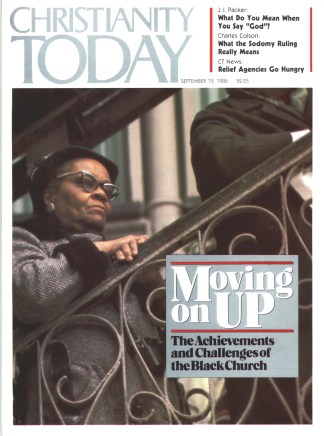
Plans for an issue focusing on the black church were well under way when Buster Soaries of Conquerors International came into our offices one day. He was in town to see CAMPUS LIFE staff, and, having a few free minutes, he came upstairs to discuss some of his concerns for the black community.

“The problem’s a spiritual one,” he said, describing the moral abandonment and deterioration of a culture—his culture—in crisis. “What’s called for is a spiritual solution.” Time did not allow him to flesh out what all that meant; but we were intrigued, and asked him to develop this vision more fully in the closing article of our series.

There is a temptation to call the “Soaries solution” on page 23 too simplistic in the wake of the enormous problems facing the black community. But the appeal of his argument lies both in its scriptural foundation and in the fact that Soaries has been “in the trenches” working for civil rights since the sixties—first as a young, black radical, then as a co-worker with Jesse Jackson at Operation PUSH, then as a Harlem pastor, and now as an encourager of black youth through his urban-focused ministry. He knows what works and what does not.

“Though social progress does not guarantee spiritual growth,” he writes, “spiritual growth guarantees social progress. And key to that growth is the black church.

“The black church has a unique challenge,” Soaries writes, “but God has provided it with unique credentials. Not only does it have a moral and historical mandate to generate a consciousness of God’s will for black America, but it has a profound opportunity to share the power and joy realized through Christ-centered living.”

HAROLD B. SMITHManaging Editor

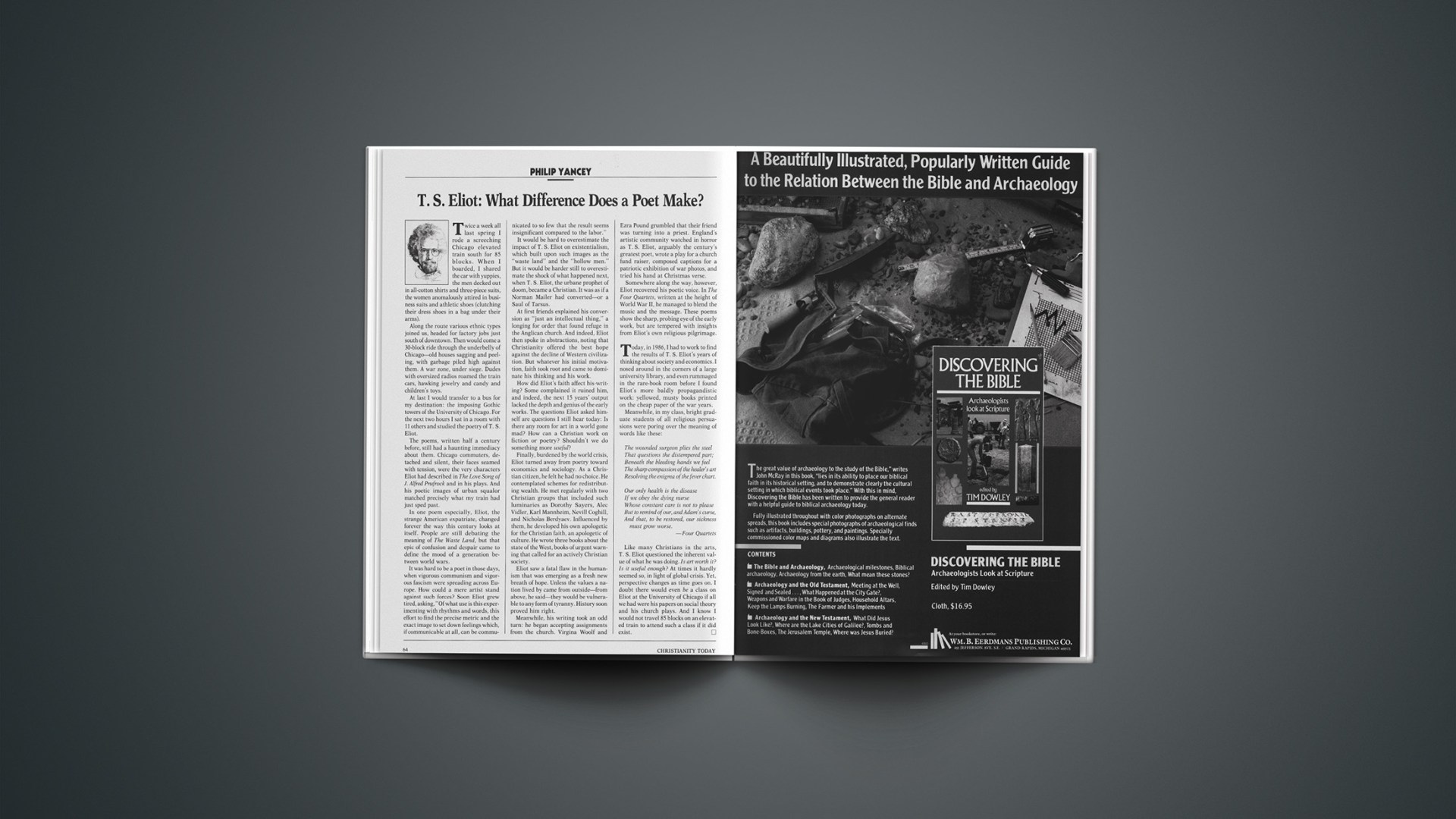
T. S. Eliot: What Difference Does a Poet Make?

Twice a week all last spring I rode a screeching Chicago elevated train south for 85 blocks. When I boarded, I shared the car with yuppies, the men decked out in all-cotton shirts and three-piece suits, the women anomalously attired in business suits and athletic shoes (clutching their dress shoes in a bag under their arms).

Along the route various ethnic types joined us, headed for factory jobs just south of downtown. Then would come a 30-block ride through the underbelly of Chicago—old houses sagging and peeling, with garbage piled high against them. A war zone, under siege. Dudes with oversized radios roamed the train cars, hawking jewelry and candy and children’s toys.

At last I would transfer to a bus for my destination: the imposing Gothic towers of the University of Chicago. For the next two hours I sat in a room with 11 others and studied the poetry of T. S. Eliot.

The poems, written half a century before, still had a haunting immediacy about them. Chicago commuters, detached and silent, their faces seamed with tension, were the very characters Eliot had described in The Love Song of J. Alfred Prufrock and in his plays. And his poetic images of urban squalor matched precisely what my train had just sped past.

In one poem especially, Eliot, the strange American expatriate, changed forever the way this century looks at itself. People are still debating the meaning of The Waste Land, but that epic of confusion and despair came to define the mood of a generation between world wars.

It was hard to be a poet in those days, when vigorous communism and vigorous fascism were spreading across Europe. How could a mere artist stand against such forces? Soon Eliot grew tired, asking, “Of what use is this experimenting with rhythms and words, this effort to find the precise metric and the exact image to set down feelings which, if communicable at all, can be communicated to so few that the result seems insignificant compared to the labor.”

It would be hard to overestimate the impact of T. S. Eliot on existentialism, which built upon such images as the “waste land” and the “hollow men.” But it would be harder still to overestimate the shock of what happened next, when T. S. Eliot, the urbane prophet of doom, became a Christian. It was as if a Norman Mailer had converted—or a Saul of Tarsus.

At first friends explained his conversion as “just an intellectual thing,” a longing for order that found refuge in the Anglican church. And indeed, Eliot then spoke in abstractions, noting that Christianity offered the best hope against the decline of Western civilization. But whatever his initial motivation, faith took root and came to dominate his thinking and his work.

How did Eliot’s faith affect his writing? Some complained it ruined him, and indeed, the next 15 years’ output lacked the depth and genius of the early works. The questions Eliot asked himself are questions I still hear today: Is there any room for art in a world gone mad? How can a Christian work on fiction or poetry? Shouldn’t we do something more useful?

Finally, burdened by the world crisis, Eliot turned away from poetry toward economics and sociology. As a Christian citizen, he felt he had no choice. He contemplated schemes for redistributing wealth. He met regularly with two Christian groups that included such luminaries as Dorothy Sayers, Alec Vidler, Karl Mannheim, Nevill Coghill, and Nicholas Berdyaev. Influenced by them, he developed his own apologetic for the Christian faith, an apologetic of culture. He wrote three books about the state of the West, books of urgent warning that called for an actively Christian society.

Eliot saw a fatal flaw in the humanism that was emerging as a fresh new breath of hope. Unless the values a nation lived by came from outside—from above, he said—they would be vulnerable to any form of tyranny. History soon proved him right.

Meanwhile, his writing took an odd turn: he began accepting assignments from the church. Virgina Woolf and Ezra Pound grumbled that their friend was turning into a priest. England’s artistic community watched in horror as T. S. Eliot, arguably the century’s greatest poet, wrote a play for a church fund raiser, composed captions for a patriotic exhibition of war photos, and tried his hand at Christmas verse.

Somewhere along the way, however, Eliot recovered his poetic voice. In The Four Quartets, written at the height of World War II, he managed to blend the music and the message. These poems show the sharp, probing eye of the early work, but are tempered with insights from Eliot’s own religious pilgrimage.

Today, in 1986, I had to work to find the results of T. S. Eliot’s years of thinking about society and economics. I nosed around in the corners of a large university library, and even rummaged in the rare-book room before I found Eliot’s more baldly propagandistic work: yellowed, musty books printed on the cheap paper of the war years.

Meanwhile, in my class, bright graduate students of all religious persuasions were poring over the meaning of words like these:

The wounded surgeon plies the steel

That questions the distempered part;

Beneath the bleeding hands we feel

The sharp compassion of the healer’s art

Resolving the enigma of the fever chart.

Our only health is the disease

If we obey the dying nurse

Whose constant care is not to please

But to remind of our, and Adam’s curse,

And that, to be restored, our sickness must grow worse.

Four Quartets

Like many Christians in the arts, T. S. Eliot questioned the inherent value of what he was doing. Is art worth it? Is it useful enough? At times it hardly seemed so, in light of global crisis. Yet, perspective changes as time goes on. I doubt there would even be a class on Eliot at the University of Chicago if all we had were his papers on social theory and his church plays. And I know I would not travel 85 blocks on an elevated train to attend such a class if it did exist.

Excellence for Artists

John Reid was unloading sacks of cement when I arrived at the New York Arts Group (NYAG) office in Greenwich Village. Reid brushed his hands on his jeans and gave my hand a hearty shake. Then the new administrator of the eight-year-old fellowship of Christian artists turned to guide the truck dumping a load of sand on the sidewalk.

The arrival of the cement and sand heralds changes for the artists’ group, beginning with the creation of a rehearsal studio in the unfinished basement. (The cement will be the new floor.) The studio will only be 400 square feet. But, says Reid, “in Manhattan, a lot of people would kill for 400 square feet.”

The main-floor office will be remodeled too, making room for “a small East Village-type gallery where different members’ work can be circulated.” Reid is intent on making the NYAG office a hub of activity for Christian artists and would-be artists. The studio and gallery space are steps in that direction.

At present, the group has a general meeting monthly, and more frequent peer-group meetings for writers, musicians, and others who share a common discipline. These are not prayer meetings—because Reid is committed to the idea that NYAG is not a church: “We want everyone to be part of a normal church, because that’s where they find the connection they need in the Christian life. Our emphasis is more to challenge each other professionally.”

Significant Commitment

Reid himself is another change. Former NYAG administrator Irma Levesque began working for NYAG part-time, and then became full-time. But Reid sees the group’s decision to support a full-time administrator with a wife and four children as a significant commitment to fulfill its potential in the New York arts community.

Reid brings a varied background to his work with NYAG. Most recently director of development for Christian Aid Mission of Charlottesville, Virginia, he has done everything from playing jazz and blues guitar to being a building contractor.

When he became a Christian, Reid tried playing his music in church, “but it really was not relevant,” he says. However, several years ago when he again began playing professionally in nightclubs, restaurants, and bars, Christian friends were shocked and dismayed. “I understood—but I felt a freedom before God I had never felt trying to be a church musician.”

Did he approach his nightclub work with an evangelistic message? “No, I didn’t try,” he says. “For me the important thing is how I can be real and be good enough as an artist to capture the attention of the people who are listening. If, through excellence, people are drawn to you and say, ‘There’s some depth to what you’re doing,’ that’s the business of building relationships with people.”

Challenging NYAG’s members to excellence is Reid’s main goal. “Unless there is a standard of excellence, it would be better if we weren’t identified as Christian artists,” he says. That challenge to excellence is at the heart of a ten-year scenario he is working on “to build a strong community of Christians who are artists, arts-related professionals, and patrons of the arts, working together to encourage and support one another to live lives that will glorify God and bring excellence into their work.”

Art behind Bars

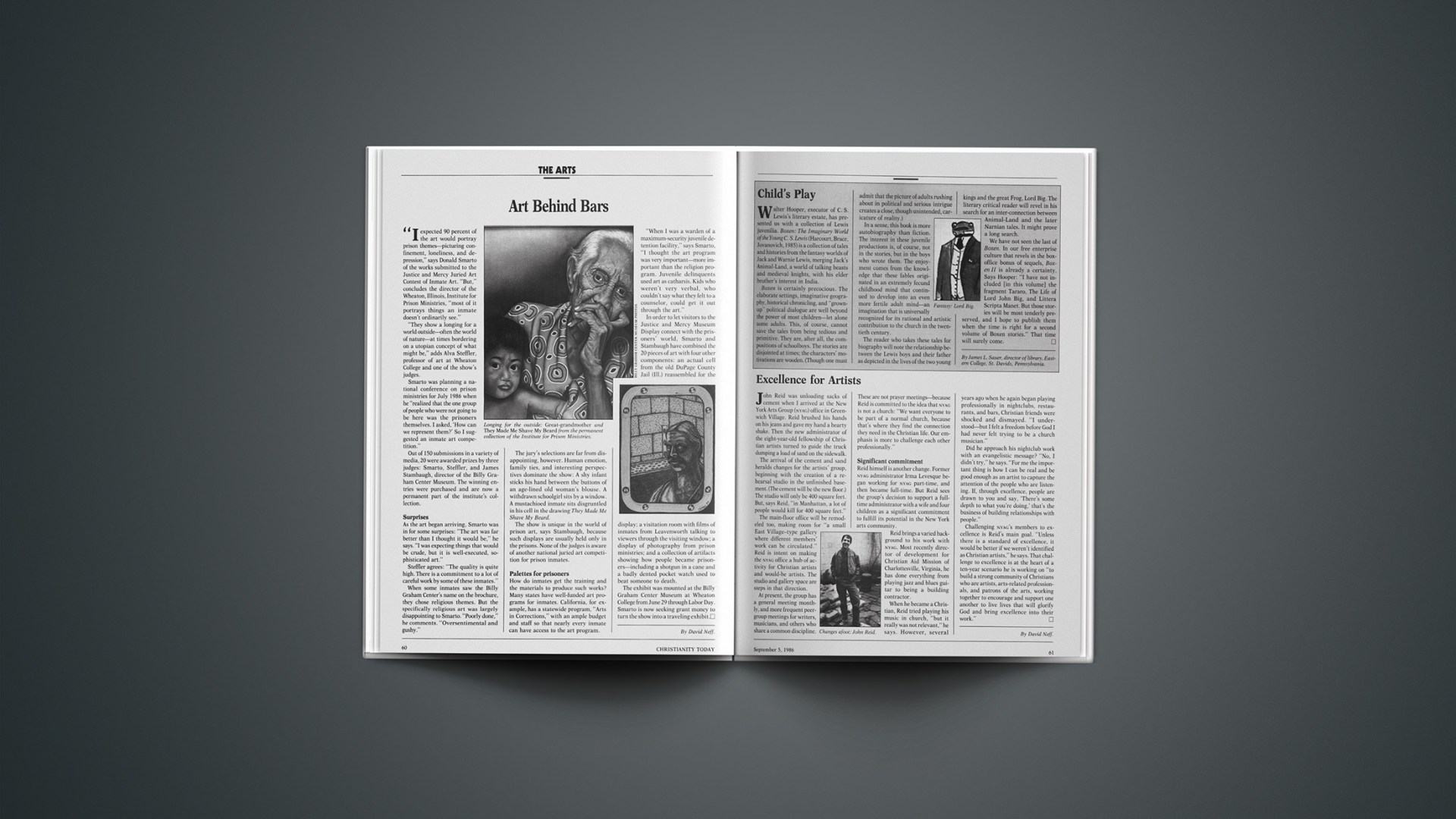
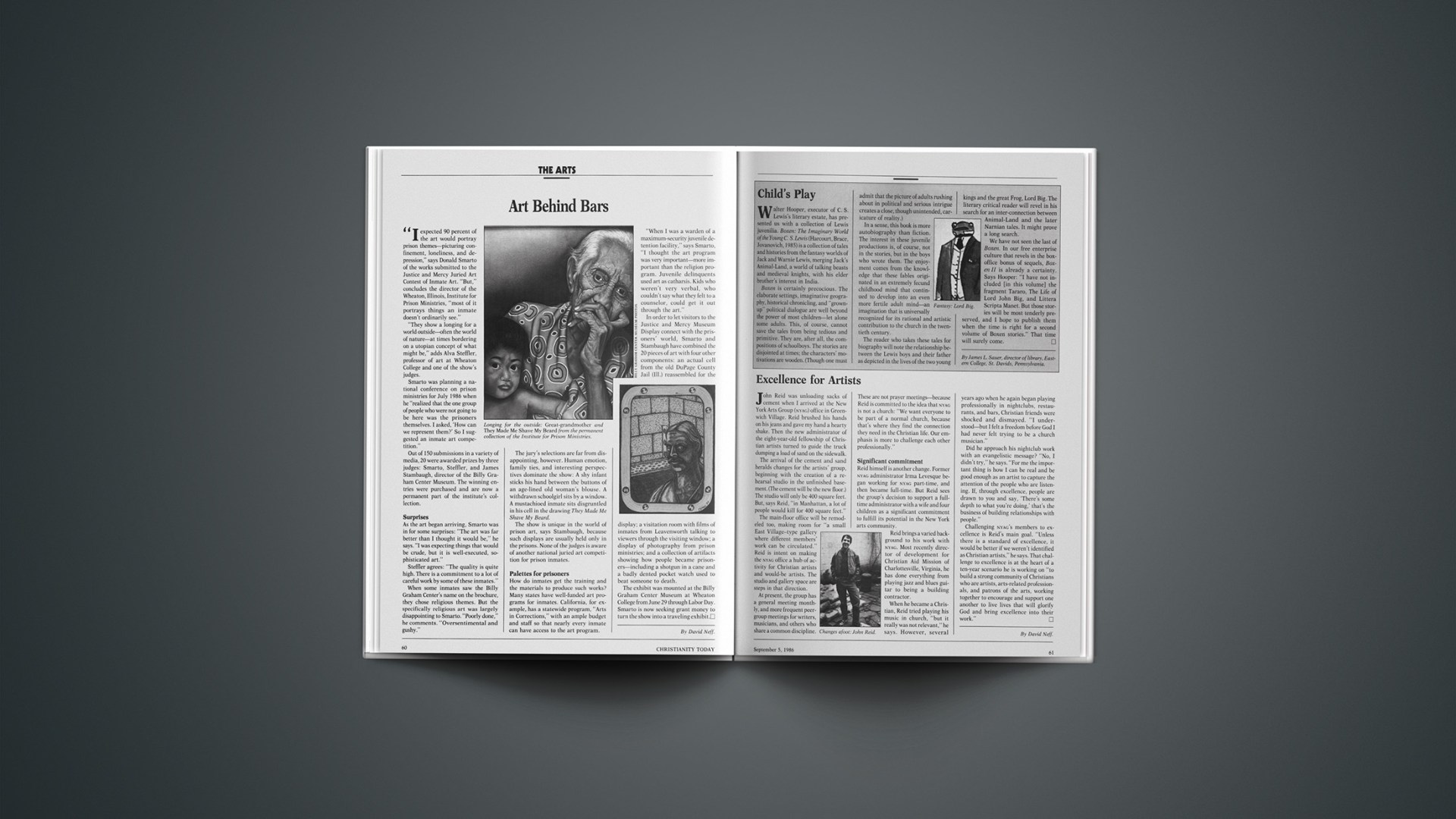
“I expected 90 percent of the art would portray prison themes—picturing confinement, loneliness, and depression,” says Donald Smarto of the works submitted to the Justice and Mercy Juried Art Contest of Inmate Art. “But,” concludes the director of the Wheaton, Illinois, Institute for Prison Ministries, “most of it portrays things an inmate doesn’t ordinarily see.”

“They show a longing for a world outside—often the world of nature—at times bordering on a utopian concept of what might be,” adds Alva Steffler, professor of art at Wheaton College and one of the show’s judges.

Smarto was planning a national conference on prison ministries for July 1986 when he “realized that the one group of people who were not going to be here was the prisoners themselves. I asked, ‘How can we represent them?’ So I suggested an inmate art competition.”

Out of 150 submissions in a variety of media, 20 were awarded prizes by three judges: Smarto, Steffler, and James Stambaugh, director of the Billy Graham Center Museum. The winning entries were purchased and are now a permanent part of the institute’s collection.

Surprises

As the art began arriving, Smarto was in for some surprises: “The art was far better than I thought it would be,” he says. “I was expecting things that would be crude, but it is well-executed, sophisticated art.”

Steffler agrees: “The quality is quite high. There is a commitment to a lot of careful work by some of these inmates.”

When some inmates saw the Billy Graham Center’s name on the brochure, they chose religious themes. But the specifically religious art was largely disappointing to Smarto. “Poorly done,” he comments. “Oversentimental and gushy.”

The jury’s selections are far from disappointing, however. Human emotion, family ties, and interesting perspectives dominate the show: A shy infant sticks his hand between the buttons of an age-lined old woman’s blouse. A withdrawn schoolgirl sits by a window. A mustachioed inmate sits disgruntled in his cell in the drawing They Made Me Shave My Beard.

The show is unique in the world of prison art, says Stambaugh, because such displays are usually held only in the prisons. None of the judges is aware of another national juried art competition for prison inmates.

Palettes For Prisoners

How do inmates get the training and the materials to produce such works? Many states have well-funded art programs for inmates. California, for example, has a statewide program, “Arts in Corrections,” with an ample budget and staff so that nearly every inmate can have access to the art program.

“When I was a warden of a maximum-security juvenile detention facility,” says Smarto, “I thought the art program was very important—more important than the religion program. Juvenile delinquents used art as catharsis. Kids who weren’t very verbal, who couldn’t say what they felt to a counselor, could get it out through the art.”

In order to let visitors to the Justice and Mercy Museum Display connect with the prisoners’ world, Smarto and Stambaugh have combined the 20 pieces of art with four other components: an actual cell from the old DuPage County Jail (Ill.) reassembled for the display; a visitation room with films of inmates from Leavenworth talking to viewers through the visiting window; a display of photography from prison ministries; and a collection of artifacts showing how people became prisoners—including a shotgun in a cane and a badly dented pocket watch used to beat someone to death.

The exhibit was mounted at the Billy Graham Center Museum at Wheaton College from June 29 through Labor Day. Smarto is now seeking grant money to turn the show into a traveling exhibit.

By David Neff.

Child’s Play1By James L. Sauer, director of library, Eastern College, St. Davids, Pennsylvania.

Walter Hooper, executor of C. S. Lewis’s literary estate, has presented us with a collection of Lewis juvenilia. Boxen: The Imaginary World of the Young C. S. Lewis (Harcourt, Brace, Jovanovich, 1985) is a collection of tales and histories from the fantasy worlds of Jack and Warnie Lewis, merging Jack’s Animal-Land, a world of talking beasts and medieval knights, with his elder brother’s interest in India.

Boxen is certainly precocious. The elaborate settings, imaginative geography, historical chronicling, and “grownup” political dialogue are well beyond the power of most children—let alone some adults. This, of course, cannot save the tales from being tedious and primitive. They are, after all, the compositions of schoolboys. The stories are disjointed at times; the characters’ motivations are wooden. (Though one must admit that the picture of adults rushing about in political and serious intrigue creates a close, though unintended, caricature of reality.)

In a sense, this book is more autobiography than fiction.

The interest in these juvenile productions is, of course, not in the stories, but in the boys who wrote them. The enjoyment comes from the knowledge that these fables originated in an extremely fecund childhood mind that continued to develop into an even more fertile adult mind—an imagination that is universally recognized for its rational and artistic contribution to the church in the twentieth century.

The reader who takes these tales for biography will note the relationship between the Lewis boys and their father as depicted in the lives of the two young kings and the great Frog, Lord Big. The literary critical reader will revel in his search for an inter-connection between Animal-Land and the later Narnian tales. It might prove a long search.

We have not seen the last of Boxen. In our free enterprise culture that revels in the box-office bonus of sequels, Boxen II is already a certainty. Says Hooper: “I have not included [in this volume] the fragment Tararo, The Life of Lord John Big, and Littera Scripta Manet. But those stories will be most tenderly preserved, and I hope to publish them when the time is right for a second volume of Boxen stories.” That time will surely come.

Churches Debate Divestment, Women’s Ordination, and Mergers at Summer Meetings

Summer is prime time for conducting denominational business, and the past few months were no exception. Church bodies met to consider issues ranging from women’s ordination to denominational mergers.

After two days of debate, delegates from the 18,000-member Orthodox Presbyterian Church (OPC) voted 78 to 68 in favor of joining the Presbyterian Church in America (PCA). However, this fell 20 votes short of the two-thirds majority needed to send the proposal to the denomination’s 12 presbyteries.

The OPC was founded in 1936 when some 5,000 lay people, elders, and pastors—led by New Testament scholar J. Gresham Machen—withdrew from what was then the Presbyterian Church in the U.S.A. Some church members said this year’s fiftieth anniversary celebration made it difficult for OPC delegates to vote for a merger that would eliminate the denomination’s separate identity. The OPC and the 160,000-member PCA have had close relations since the PCA was established in 1973. OPC delegates kept the prospect for union alive, however, by adopting resolutions calling for meetings between PCA and OPC representatives.

Meanwhile, the PCA voted to join the National Association of Evangelicals. Some opposed this move because NAE is not a Reformed organization. The assembly also selected pastor Frank M. Barker, Jr., of Birmingham, Alabama, as its new moderator, and reelected Morton H. Smith as stated clerk.

In other denominational meetings:

• Missouri Synod Lutherans reelected Ralph Bohlmann as president despite an effort by ultraconservatives in the 2.6 million-member denomination to defeat him. Critics said Bohlmann had failed to discipline those in the denomination who want closer fellowship with other Lutheran bodies. They maintained also that decision making in the denomination had become too centralized.

Missouri Synod delegates reaffirmed a ban on women’s ordination. But they beat back an effort to rescind a 1969 decision allowing women to be voting members of congregations and to serve on boards and commissions.

• The 160,000-member Church of the Brethren adopted a policy of divestment from companies doing business in South Africa. Delegates also called for strategies to eliminate South Africa’s policy of apartheid. In March, the church’s general board divested more than $400,000 from companies active in South Africa. The church also elected its first black moderator, William Hayes, pastor of First Church of the Brethren in Baltimore.

• The Christian Reformed Church rejected an attempt by a regional church body to reverse the denomination’s 1984 action opening the office of deacon to women.

• The Presbyterian Church (U.S.A.) narrowly rejected a call from prolife advocates to reexamine the abortion issue. The church reaffirmed the stand it has held since 1970, which allows abortion to be considered ethical in cases where a fetus has serious genetic problems or the mother has inadequate emotional or financial resources.

In other actions, the 3.2 million-member denomination voted to recognize the ministries and sacraments of the American Lutheran Church, the Lutheran Church in America, and the Association of Evangelical Lutheran Churches. It elected former Lebanon hostage Benjamin Weir moderator, and reported a loss of nearly 44,000 members in 1985. Sixteen Presbyterian members of Congress issued an open letter to the general assembly stating that “many Presbyterians are profoundly disturbed to see their church deeply involved in leftist political causes.”

• Delegates from the 700,000-member Christian Methodist Episcopal Church voted to continue working toward a proposed 1992 merger with the 1.1 million-member African Methodist Episcopal Zion Church.

• The Conservative Baptist Association of America reaffirmed the doctrine of scriptural inerrancy; affirmed a policy against acceding to ransom demands for missionaries abducted by terrorists; affirmed women in ministry, although not as pastors; and affirmed Creation as an “act of God” rather than an evolutionary process. Messengers (delegates) also issued a challenge for the denomination to combat the spread of pornography.

• The general board of the 1.3 million-member American Baptist Churches in the U.S.A. urged the U.S. Senate to support economic sanctions against South Africa. The board also passed a policy statement on church and state in which it opposes government-mandated prayers, tuition tax credits for religiously sponsored activities, and government surveillance of religious activities. Delegates voted to postpone considering whether to join the Religious Coalition for Abortion Rights.

By Randy Frame.

NORTH AMERICAN SCENE

PORNOGRAPHY

Debate in the Mainstream

Meeting in New York City, religious leaders from various backgrounds have requested a White House meeting for 200 denominational leaders on the issue of pornography. The leaders also announced plans for a much larger meeting to work for the elimination of “illegal obscene” pornography, defined as pornography that involves children or promotes rape or the degradation of women.

Joseph Cardinal Bernardin of Chicago and John Cardinal O’Connor of New York hosted last month’s meeting. Protestant, Jewish, Greek Orthodox, and Mormon leaders participated, as did representatives from the National Association of Evangelicals and the National Council of Churches. The group asked Presbyterian pastor Jerry Kirk, president of the National Coalition Against Pornography, to chair its steering committee. Kirk asserted that “for everyone, pornography has become a public safety issue.”

Catholic priest Bruce Ritter said the meeting’s impact might overshadow the importance of the recent report issued by the U.S. Attorney General’s Pornography Commission. “The debate on pornography has now been mainstreamed,” he said.

SEATTLE

Sexual Harassment?

Three former members of Seattle’s Community Chapel and Bible Training Center have filed suit against the church’s pastor, charging him with attempting to coerce them into having sex with him, according to the Seattle Times.

Kathy Lee Butler, Sandi Lee Brown, and Christine Hall filed the suit in King County Superior Court. They allege that pastor Donald Barnett tried to coerce them into having sex with him by saying it was sanctioned by God. Loren Krenelka, Community Chapel’s official spokesman, was unavailable for comment.

Many have left the church in recent months because of its unusual teachings and practices. Barnett has encouraged church members to develop “spiritual connections,” close relationships with others in the church (CT, Aug. 8, 1986, p. 32). These relationships typically occur outside the marriage bond, and critics charge infidelity is often the result.

CHURCH AND STATE

Challenging an Ambassador

A coalition of religious and other interest groups has asked the U.S. Supreme Court to cut diplomatic ties between the United States and the Vatican.

The groups charged that diplomatic ties with the Vatican, established by the Reagan administration in March 1984, violate the U.S. Constitution by conferring special privileges on one religious faith and by entangling the U.S. government in church affairs. The legal action was first filed in 1984, but two lower courts ruled that the groups did not have adequate legal standing to challenge an executive-branch decision on state affairs.

“We strongly believe that Americans have a right to take this matter to the bar of justice,” said Robert Maddox, executive director of Americans United for Separation of Church and State, one of the plaintiffs. “The First Amendment forbids the government to establish a special relationship with one religious faith. The Supreme Court has a duty to correct the Reagan administration’s mistake.”

In addition to Americans United, plaintiffs include the National Association of Evangelicals; American Baptist Churches in the U.S.A.; the American Humanist Association; the Church of the Brethren; the Presbyterian Church (U.S.A.); the National Council of Churches; the Unitarian Universalist Association; and the National Association of American Nuns. The Baptist Joint Committee on Public Affairs also endorsed the efforts by filing a friend-of-the-court brief.

Vatican Ambassador William A. Wilson resigned his post in July, but opponents say they expect a replacement to be appointed soon.

PEOPLE AND EVENTS

Briefly Noted

Appointed: Richard L. Baker as president and chief executive officer of Baker Book House in Grand Rapids, Michigan. He succeeds his father,

Herman Baker, who founded the company in 1938.

Completed: A three-and-one-half-year walk across America by legless Vietnam veteran Bob Weiland. Weiland walked on his hands from Orange County, California, to Washington, D.C., to focus attention on the plight of the poor around the world. He presented $30,000 of the $315,000 he raised to World Vision, whose former president, Stanley Mooneyham, inspired the feat.

Died: Clifford Bjorklund, 65, secretary of the Evangelical Covenant Church since 1967; August 2, in suburban Chicago, of leukemia. Bjorklund’s ministry was characterized by a special concern for less-fortunate people in the Third World.

Elected: By the 86,000-member Evangelical Covenant Church, Paul Larsen, a 52-year-old pastor from Redwood City, California, to succeed Milton Engebretson as president. Engebretson retired after 20 years in the post.

Michael Geoffrey Peers, to head the 900,000-member Anglican Church of Canada. Peers succeeds E. W. Scott, who had held the office for 15 years.

Thomas Wang, as international director of the Lausanne Committee for World Evangelization. Wang, general secretary of the Chinese Coordination Centre of World Evangelism for the past 10 years, is the first Asian to be elected international director of the Lausanne committee.

Sold: To Guidepost Associates by the Zondervan Corporation, two book publishing subsidiaries: Fleming H. Revell Company and Chosen Books. Guidepost Associates publishes Guideposts magazine, the country’s most widely read inspirational monthly.

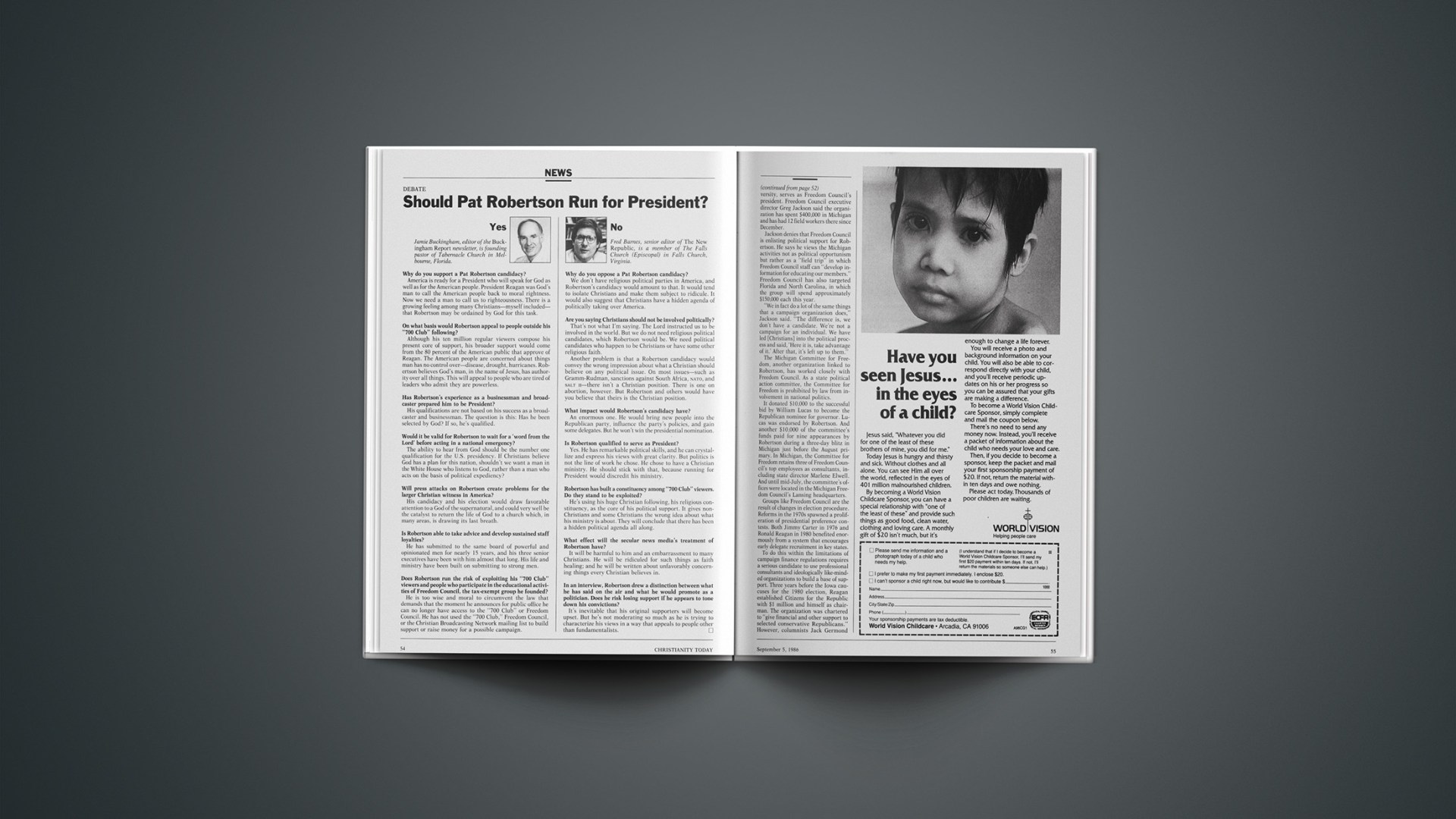
Should Pat Robertson Run for President?

Why do you support a Pat Robertson candidacy?

America is ready for a President who will speak for God as well as for the American people. President Reagan was God’s man to call the American people back to moral rightness. Now we need a man to call us to righteousness. There is a growing feeling among many Christians—myself included—that Robertson may be ordained by God for this task.

On what basis would Robertson appeal to people outside his “700 Club” following?

Although his ten million regular viewers compose his present core of support, his broader support would come from the 80 percent of the American public that approve of Reagan. The American people are concerned about things man has no control over—disease, drought, hurricanes. Robertson believes God’s man, in the name of Jesus, has authority over all things. This will appeal to people who are tired of leaders who admit they are powerless.

Has Robertson’s experience as a businessman and broadcaster prepared him to be President?

His qualifications are not based on his success as a broadcaster and businessman. The question is this: Has he been selected by God? If so, he’s qualified.

Would it be valid for Robertson to wait for a ‘word from the Lord’ before acting in a national emergency?

The ability to hear from God should be the number one qualification for the U.S. presidency. If Christians believe God has a plan for this nation, shouldn’t we want a man in the White House who listens to God, rather than a man who acts on the basis of political expediency?

Will press attacks on Robertson create problems for the larger Christian witness in America?

His candidacy and his election would draw favorable attention to a God of the supernatural, and could very well be the catalyst to return the life of God to a church which, in many areas, is drawing its last breath.

Is Robertson able to take advice and develop sustained staff loyalties?

He has submitted to the same board of powerful and opinionated men for nearly 15 years, and his three senior executives have been with him almost that long. His life and ministry have been built on submitting to strong men.

Does Robertson run the risk of exploiting his “700 Club” viewers and people who participate in the educational activities of Freedom Council, the tax-exempt group he founded?

He is too wise and moral to circumvent the law that demands that the moment he announces for public office he can no longer have access to the “700 Club” or Freedom Council. He has not used the “700 Club,” Freedom Council, or the Christian Broadcasting Network mailing list to build support or raise money for a possible campaign.

Why do you oppose a Pat Robertson candidacy?

We don’t have religious political parties in America, and Robertson’s candidacy would amount to that. It would tend to isolate Christians and make them subject to ridicule. It would also suggest that Christians have a hidden agenda of politically taking over America.

Are you saying Christians should not be involved politically?

That’s not what I’m saying. The Lord instructed us to be involved in the world. But we do not need religious political candidates, which Robertson would be. We need political candidates who happen to be Christians or have some other religious faith.

Another problem is that a Robertson candidacy would convey the wrong impression about what a Christian should believe on any political issue. On most issues—such as Gramm-Rudman, sanctions against South Africa, NATO, and SALT n—there isn’t a Christian position. There is one on abortion, however. But Robertson and others would have you believe that theirs is the Christian position.

What impact would Robertson’s candidacy have?

An enormous one. He would bring new people into the Republican party, influence the party’s policies, and gain some delegates. But he won’t win the presidential nomination.

Is Robertson qualified to serve as President?

Yes. He has remarkable political skills, and he can crystallize and express his views with great clarity. But politics is not the line of work he chose. He chose to have a Christian ministry. He should stick with that, because running for President would discredit his ministry.

Robertson has built a constituency among “700 Club” viewers. Do they stand to be exploited?

He’s using his huge Christian following, his religious constituency, as the core of his political support. It gives non-Christians and some Christians the wrong idea about what his ministry is about. They will conclude that there has been a hidden political agenda all along.

What effect will the secular news media’s treatment of Robertson have?

It will be harmful to him and an embarrassment to many Christians. He will be ridiculed for such things as faith healing; and he will be written about unfavorably concerning things every Christian believes in.

In an interview, Robertson drew a distinction between what he has said on the air and what he would promote as a politician. Does he risk losing support if he appears to tone down his convictions?

It’s inevitable that his original supporters will become upset. But he’s not moderating so much as he is trying to characterize his views in a way that appeals to people other than fundamentalists.

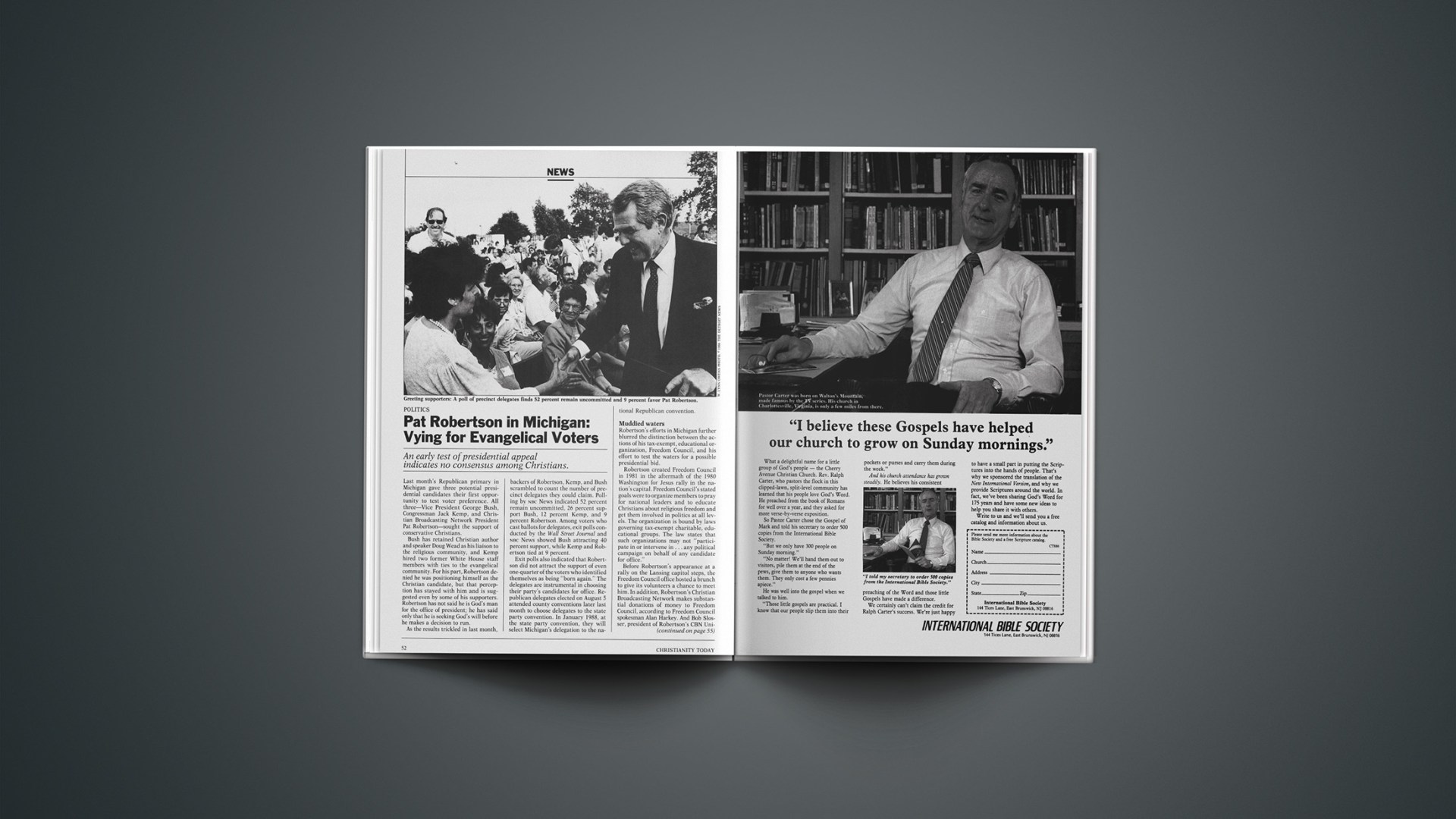
Pat Robertson in Michigan: Vying for Evangelical Voters

An early test of presidential appeal indicates no consensus among Christians.

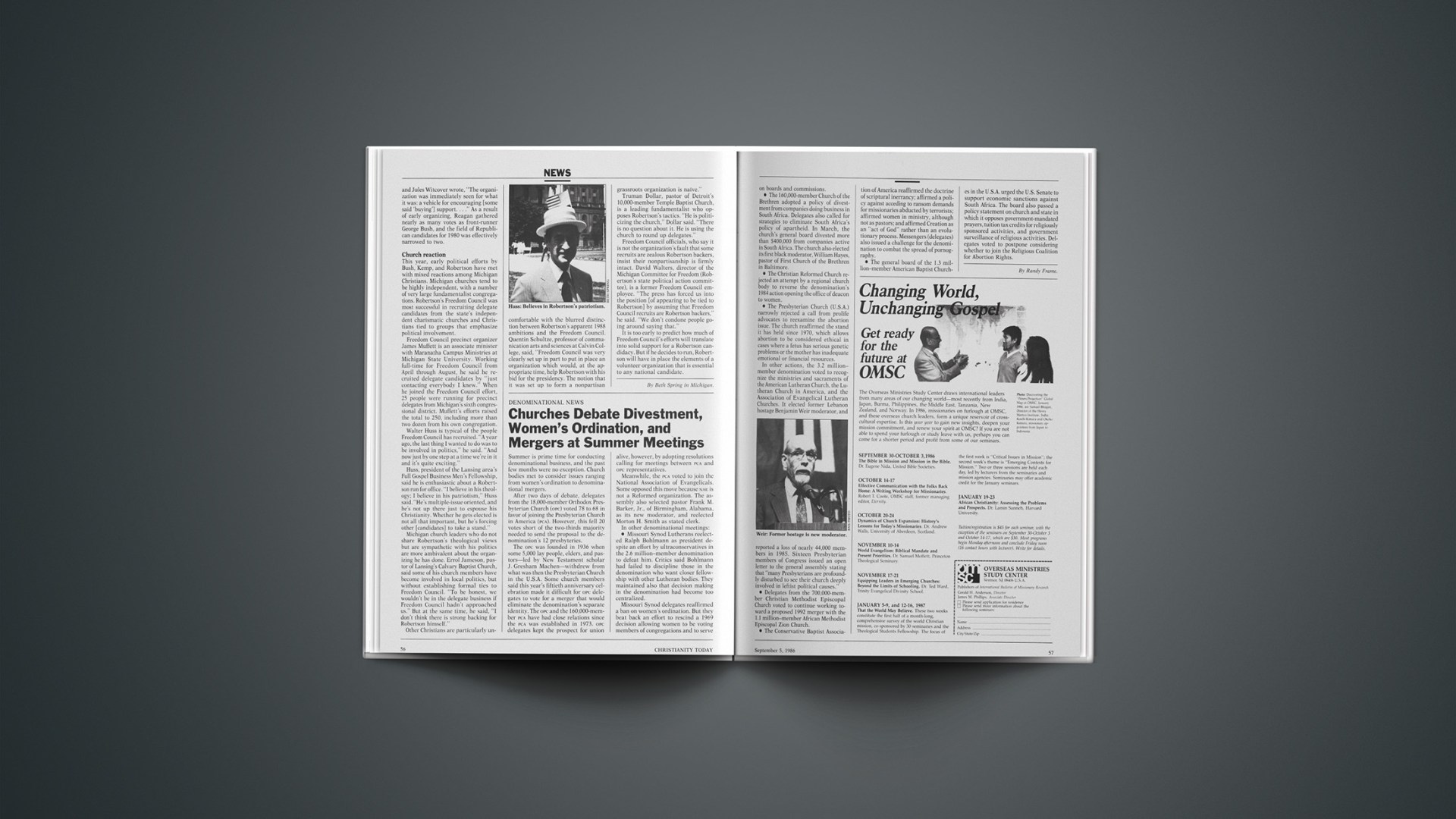
Last month’s Republican primary in Michigan gave three potential presidential candidates their first opportunity to test voter preference. All three—Vice President George Bush, Congressman Jack Kemp, and Christian Broadcasting Network President Pat Robertson—sought the support of conservative Christians.

Bush has retained Christian author and speaker Doug Wead as his liaison to the religious community, and Kemp hired two former White House staff members with ties to the evangelical community. For his part, Robertson denied he was positioning himself as the Christian candidate, but that perception has stayed with him and is suggested even by some of his supporters. Robertson has not said he is God’s man for the office of president; he has said only that he is seeking God’s will before he makes a decision to run.

As the results trickled in last month, backers of Robertson, Kemp, and Bush scrambled to count the number of precinct delegates they could claim. Polling by NBC News indicated 52 percent remain uncommitted, 26 percent support Bush, 12 percent Kemp, and 9 percent Robertson. Among voters who cast ballots for delegates, exit polls conducted by the Wall Street Journal and NBC News showed Bush attracting 40 percent support, while Kemp and Robertson tied at 9 percent.

Exit polls also indicated that Robertson did not attract the support of even one-quarter of the voters who identified themselves as being “born again.” The delegates are instrumental in choosing their party’s candidates for office. Republican delegates elected on August 5 attended county conventions later last month to choose delegates to the state party convention. In January 1988, at the state party convention, they will select Michigan’s delegation to the national Republican convention.

Muddied Waters

Robertson’s efforts in Michigan further blurred the distinction between the actions of his tax-exempt, educational organization, Freedom Council, and his effort to test the waters for a possible presidential bid.

Robertson created Freedom Council in 1981 in the aftermath of the 1980 Washington for Jesus rally in the nation’s capital. Freedom Council’s stated goals were to organize members to pray for national leaders and to educate Christians about religious freedom and get them involved in politics at all levels. The organization is bound by laws governing tax-exempt charitable, educational groups. The law states that such organizations may not “participate in or intervene in … any political campaign on behalf of any candidate for office.”

Before Robertson’s appearance at a rally on the Lansing capitol steps, the Freedom Council office hosted a brunch to give its volunteers a chance to meet him. In addition, Robertson’s Christian Broadcasting Network makes substantial donations of money to Freedom Council, according to Freedom Council spokesman Alan Harkey. And Bob Slosser, president of Robertson’s CBN University, serves as Freedom Council’s president. Freedom Council executive director Greg Jackson said the organization has spent $400,000 in Michigan and has had 12 field workers there since December.

Jackson denies that Freedom Council is enlisting political support for Robertson. He says he views the Michigan activities not as political opportunism but rather as a “field trip” in which Freedom Council staff can “develop information for educating our members.” Freedom Council has also targeted Florida and North Carolina, in which the group will spend approximately $150,000 each this year.

“We in fact do a lot of the same things that a campaign organization does,” Jackson said. “The difference is, we don’t have a candidate. We’re not a campaign for an individual. We have led [Christians] into the political process and said, ‘Here it is, take advantage of it.’ After that, it’s left up to them.”

The Michigan Committee for Freedom, another organization linked to Robertson, has worked closely with Freedom Council. As a state political action committee, the Committee for Freedom is prohibited by law from involvement in national politics.

It donated $10,000 to the successful bid by William Lucas to become the Republican nominee for governor. Lucas was endorsed by Robertson. And another $10,000 of the committee’s funds paid for nine appearances by Robertson during a three-day blitz in Michigan just before the August primary. In Michigan, the Committee for Freedom retains three of Freedom Council’s top employees as consultants, including state director Marlene Elwell. And until mid-July, the committee’s offices were located in the Michigan Freedom Council’s Lansing headquarters.

Groups like Freedom Council are the result of changes in election procedure. Reforms in the 1970s spawned a proliferation of presidential preference contests. Both Jimmy Carter in 1976 and Ronald Reagan in 1980 benefited enormously from a system that encourages early delegate recruitment in key states.

To do this within the limitations of campaign finance regulations requires a serious candidate to use professional consultants and ideologically like-minded organizations to build a base of support. Three years before the Iowa caucuses for the 1980 election, Reagan established Citizens for the Republic with $1 million and himself as chairman. The organization was chartered to “give financial and other support to selected conservative Republicans.” However, columnists Jack Germond and Jules Witcover wrote, “The organization was immediately seen for what it was: a vehicle for encouraging [some said ‘buying’] support.…” As a result of early organizing, Reagan gathered nearly as many votes as front-runner George Bush, and the field of Republican candidates for 1980 was effectively narrowed to two.

Church Reaction

This year, early political efforts by Bush, Kemp, and Robertson have met with mixed reactions among Michigan Christians. Michigan churches tend to be highly independent, with a number of very large fundamentalist congregations. Robertson’s Freedom Council was most successful in recruiting delegate candidates from the state’s independent charismatic churches and Christians tied to groups that emphasize political involvement.

Freedom Council precinct organizer James Muffett is an associate minister with Maranatha Campus Ministries at Michigan State University. Working full-time for Freedom Council from April through August, he said he recruited delegate candidates by “just contacting everybody I knew.” When he joined the Freedom Council effort, 25 people were running for precinct delegates from Michigan’s sixth congressional district. Muffett’s efforts raised the total to 250, including more than two dozen from his own congregation.

Walter Huss is typical of the people Freedom Council has recruited. “A year ago, the last thing I wanted to do was to be involved in politics,” he said. “And now just by one step at a time we’re in it and it’s quite exciting.”

Huss, president of the Lansing area’s Full Gospel Business Men’s Fellowship, said he is enthusiastic about a Robertson run for office. “I believe in his theology: I believe in his patriotism,” Huss said. “He’s multiple-issue oriented, and he’s not up there just to espouse his Christianity. Whether he gets elected is not all that important, but he’s forcing other [candidates] to take a stand.”

Michigan church leaders who do not share Robertson’s theological views but are sympathetic with his politics are more ambivalent about the organizing he has done. Errol Jameson, pastor of Lansing’s Calvary Baptist Church, said some of his church members have become involved in local politics, but without establishing formal ties to Freedom Council. “To be honest, we wouldn’t be in the delegate business if Freedom Council hadn’t approached us.” But at the same time, he said, “I don’t think there is strong backing for Robertson himself.”

Other Christians are particularly uncomfortable with the blurred distinction between Robertson’s apparent 1988 ambitions and the Freedom Council. Quentin Schultze, professor of communication arts and sciences at Calvin College, said, “Freedom Council was very clearly set up in part to put in place an organization which would, at the appropriate time, help Robertson with his bid for the presidency. The notion that it was set up to form a nonpartisan grassroots organization is naïve.”

Truman Dollar, pastor of Detroit’s 10,000-member Temple Baptist Church, is a leading fundamentalist who opposes Robertson’s tactics. “He is politicizing the church,” Dollar said. “There is no question about it. He is using the church to round up delegates.”

Freedom Council officials, who say it is not the organization’s fault that some recruits are zealous Robertson backers, insist their nonpartisanship is firmly intact. David Walters, director of the Michigan Committee for Freedom (Robertson’s state political action committee), is a former Freedom Council employee. “The press has forced us into the position [of appearing to be tied to Robertson] by assuming that Freedom Council recruits are Robertson backers,” he said. “We don’t condone people going around saying that.”

It is too early to predict how much of Freedom Council’s efforts will translate into solid support for a Robertson candidacy. But if he decides to run, Robertson will have in place the elements of a volunteer organization that is essential to any national candidate.

By Beth Spring in Michigan.

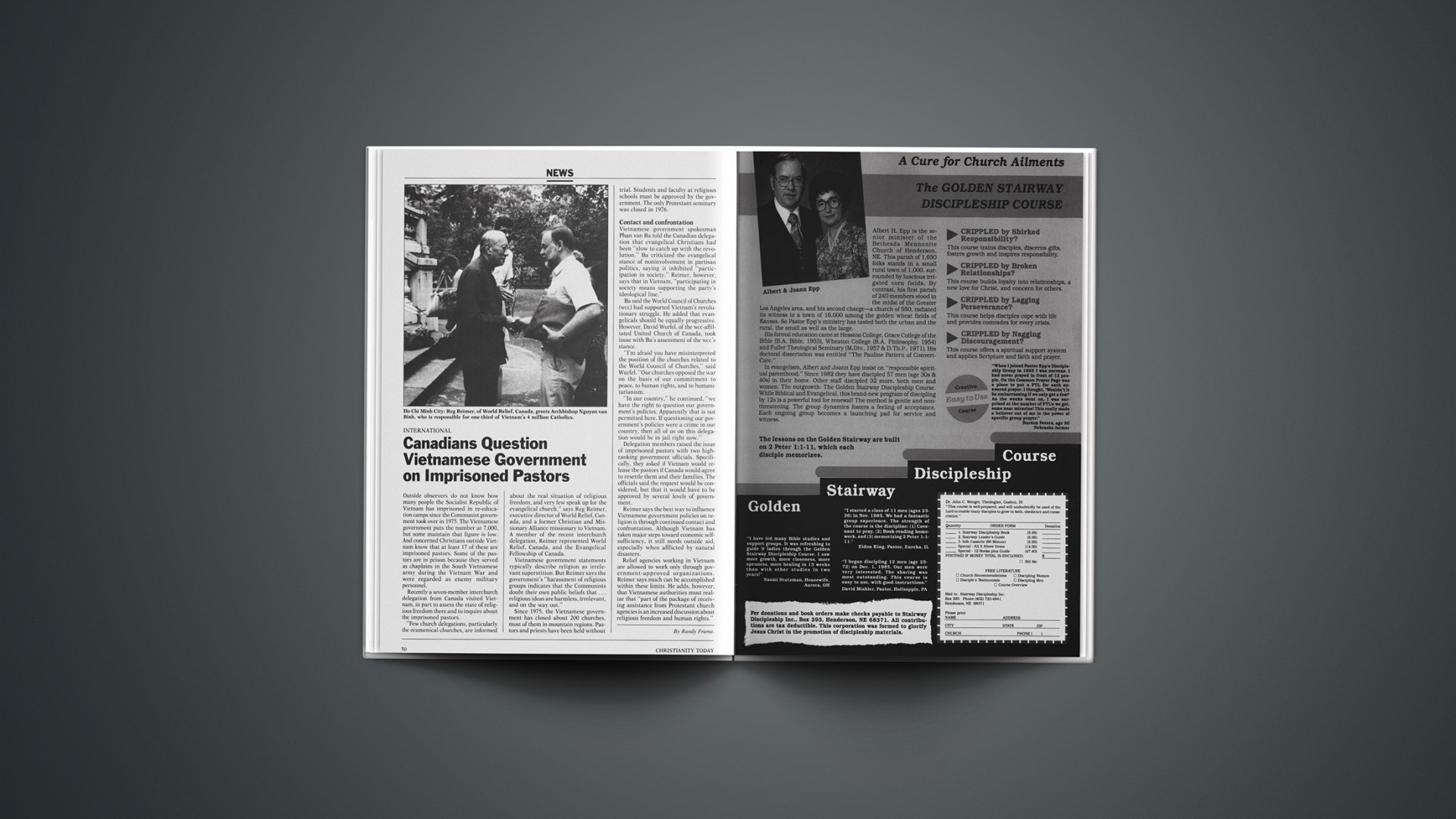
Canadians Question Vietnamese Government on Imprisoned Pastors

Outside observers do not know how many people the Socialist Republic of Vietnam has imprisoned in re-education camps since the Communist government took over in 1975. The Vietnamese government puts the number at 7,000, but some maintain that figure is low. And concerned Christians outside Vietnam know that at least 17 of these are imprisoned pastors. Some of the pastors are in prison because they served as chaplains in the South Vietnamese army during the Vietnam War and were regarded as enemy military personnel.

Recently a seven-member interchurch delegation from Canada visited Vietnam, in part to assess the state of religious freedom there and to inquire about the imprisoned pastors.

“Few church delegations, particularly the ecumenical churches, are informed about the real situation of religious freedom, and very few speak up for the evangelical church,” says Reg Reimer, executive director of World Relief, Canada, and a former Christian and Missionary Alliance missionary to Vietnam. A member of the recent interchurch delegation, Reimer represented World Relief, Canada, and the Evangelical Fellowship of Canada.

Vietnamese government statements typically describe religion as irrelevant superstition. But Reimer says the government’s “harassment of religious groups indicates that the Communists doubt their own public beliefs that … religious ideas are harmless, irrelevant, and on the way out.”

Since 1975, the Vietnamese government has closed about 200 churches, most of them in mountain regions. Pastors and priests have been held without trial. Students and faculty at religious schools must be approved by the government. The only Protestant seminary was closed in 1976.

Contact And Confrontation

Vietnamese government spokesman Phan van Ba told the Canadian delegation that evangelical Christians had been “slow to catch up with the revolution.” Ba criticized the evangelical stance of noninvolvement in partisan politics, saying it inhibited “participation in society.” Reimer, however, says that in Vietnam, “participating in society means supporting the party’s ideological line.”

Ba said the World Council of Churches (WCC) had supported Vietnam’s revolutionary struggle. He added that evangelicals should be equally progressive. However, David Wurfel, of the WCC-affiliated United Church of Canada, took issue with Ba’s assessment of the WCC’s stance.

“I’m afraid you have misinterpreted the position of the churches related to the World Council of Churches,” said Wurfel. “Our churches opposed the war on the basis of our commitment to peace, to human rights, and to humanitarianism.

“In our country,” he continued, “we have the right to question our government’s policies. Apparently that is not permitted here. If questioning our government’s policies were a crime in our country, then all of us on this delegation would be in jail right now.”

Delegation members raised the issue of imprisoned pastors with two high-ranking government officials. Specifically, they asked if Vietnam would release the pastors if Canada would agree to resettle them and their families. The officials said the request would be considered, but that it would have to be approved by several levels of government.

Reimer says the best way to influence Vietnamese government policies on religion is through continued contact and confrontation. Although Vietnam has taken major steps toward economic self-sufficiency, it still needs outside aid, especially when afflicted by natural disasters.

Relief agencies working in Vietnam are allowed to work only through government-approved organizations. Reimer says much can be accomplished within these limits. He adds, however, that Vietnamese authorities must realize that “part of the package of receiving assistance from Protestant church agencies is an increased discussion about religious freedom and human rights.”

By Randy Frame.

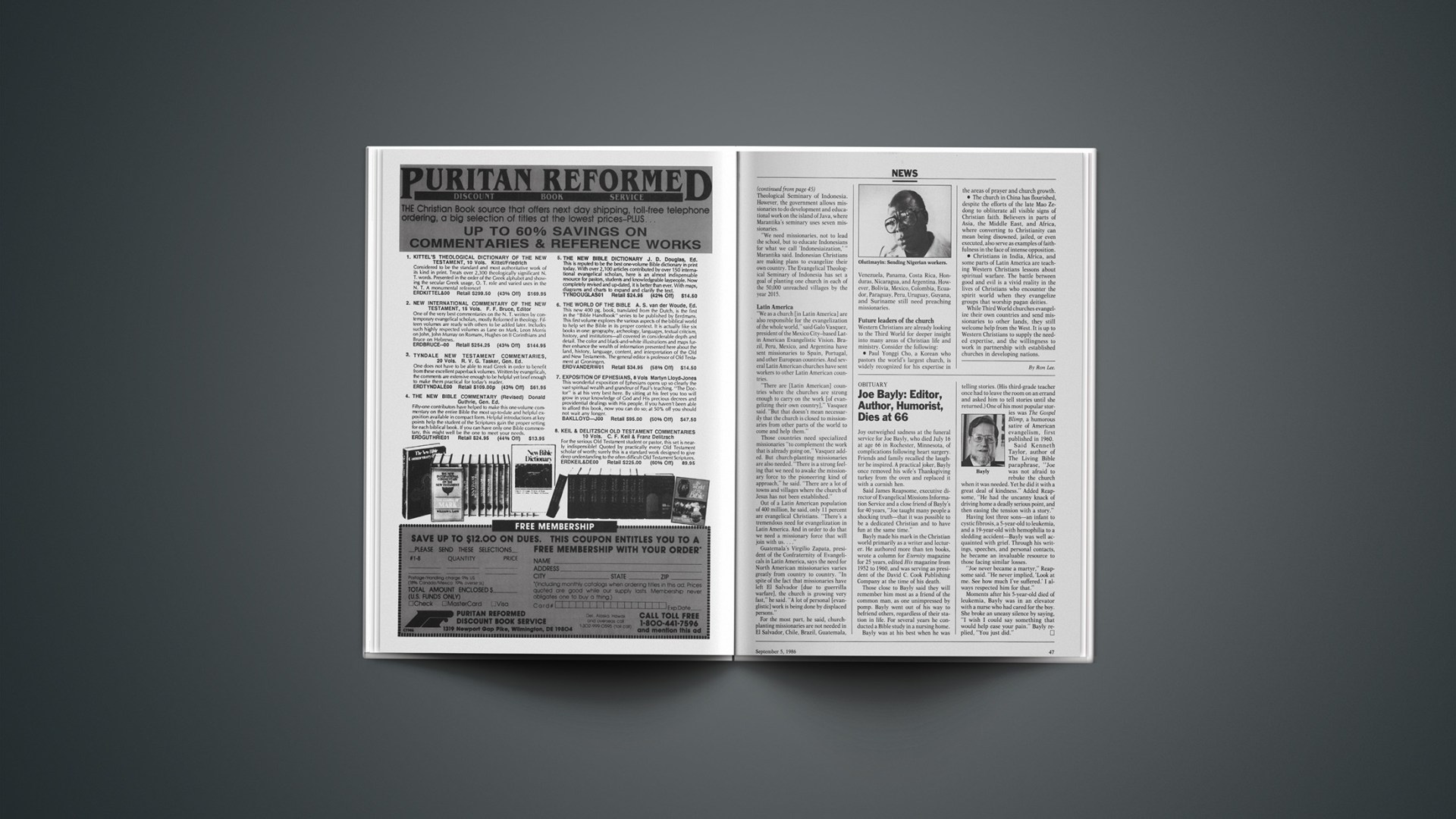
Joe Bayly: Editor, Author, Humorist, Dies at 66

Joy outweighed sadness at the funeral service for Joe Bayly, who died July 16 at age 66 in Rochester, Minnesota, of complications following heart surgery. Friends and family recalled the laughter he inspired. A practical joker, Bayly once removed his wife’s Thanksgiving turkey from the oven and replaced it with a cornish hen.

Said James Reapsome, executive director of Evangelical Missions Information Service and a close friend of Bayly’s for 40 years, “Joe taught many people a shocking truth—that it was possible to be a dedicated Christian and to have fun at the same time.”

Bayly made his mark in the Christian world primarily as a writer and lecturer. He authored more than ten books, wrote a column for Eternity magazine for 25 years, edited His magazine from 1952 to 1960, and was serving as president of the David C. Cook Publishing Company at the time of his death.

Those close to Bayly said they will remember him most as a friend of the common man, as one unimpressed by pomp. Bayly went out of his way to befriend others, regardless of their station in life. For several years he conducted a Bible study in a nursing home.

Bayly was at his best when he was telling stories. (His third-grade teacher once had to leave the room on an errand and asked him to tell stories until she returned.) One of his most popular stories was The Gospel Blimp, a humorous satire of American evangelism, first published in 1960.

Said Kenneth Taylor, author of The Living Bible paraphrase, “Joe was not afraid to rebuke the church when it was needed. Yet he did it with a great deal of kindness.” Added Reapsome, “He had the uncanny knack of driving home a deadly serious point, and then easing the tension with a story.”

Having lost three sons—an infant to cystic fibrosis, a 5-year-old to leukemia, and a 19-year-old with hemophilia to a sledding accident—Bayly was well acquainted with grief. Through his writings, speeches, and personal contacts, he became an invaluable resource to those facing similar losses.

“Joe never became a martyr,” Reapsome said. “He never implied, ‘Look at me. See how much I’ve suffered.’ I always respected him for that.”

Moments after his 5-year-old died of leukemia, Bayly was in an elevator with a nurse who had cared for the boy. She broke an uneasy silence by saying, “I wish I could say something that would help ease your pain.” Bayly replied, “You just did.”

WORLD SCENE

ISRAEL

An Embassy in Jerusalem?

A number of Christian groups helped resist a proposal in Congress that opponents said would lay the groundwork for moving the U.S. Embassy in Israel from Tel Aviv to Jerusalem.

The proposal was introduced by U.S. Sen. Jesse Helms (R-N.C.) as an amendment to the Diplomatic Security and Anti-Terrorism Bill. The bill was passed last month without the amendment, which proposed funds to build a U.S. “chancery and residence” in Jerusalem, within five miles of the building where the Israeli Parliament meets.

Critics said the amendment would have been the first step in moving the U.S. Embassy from Tel Aviv to Jerusalem. They said moving the embassy would imply U.S. government recognition of Jerusalem as the official capital of the Jewish state.

Ray Bakke, professor of ministry at Northern Baptist Theological Seminary and urban coordinator for the Lausanne Committee on World Evangelization, said the move would be “contrary to U.S. policy and would jeopardize Christian missions” in the area. Bakke, who testified against a similar proposal in 1984, said moving the embassy to Jerusalem would be “disastrous to missionaries in the Islamic world [who are] working to build reconciliation with Muslims.”

CUBA

A New Attitude

Cuban leader Fidel Castro’s book Fidel and Religion is a best seller in Cuba, having sold more than 600,000 copies. Some say the book’s mere existence reflects change in Cuba’s religious scene.

Christians were targeted for persecution after the Cuban revolution. In 1959, about 15 percent of all Cubans attended mass regularly; today the figure is at 1 percent. Many observers say visits to Cuba by Jesse Jackson in 1984 and a delegation of Catholic bishops in 1985 planted the seeds of change in the government’s view on religion.

In his book, Castro said he regretted Cuba’s “subtle discrimination” against Christians. Last year he met with Catholic and Protestant leaders, the first such meetings in more than two decades.

Observers say Castro regards closer ties with the Roman Catholic Church as one way to extend his influence throughout Latin America. Jose Felipe Corneado, director of the Communist party’s Office of Religious Affairs, said Cuba’s new official attitude is that “Christians won’t be free without socialism, and socialism won’t be built on this continent without Christians.”

INDIA

Untouchable Christians

A delegation of Roman Catholics has appealed to officials in the Indian state of Kerala to take steps toward allowing “untouchables” who have converted to Christianity to once again receive government aid.

Last September, India’s highest court declared untouchable Christians ineligible for such aid. The court reasoned that Christianity does not observe Hindu caste laws and that the sole criterion for receiving aid is untouchability, a concept confined to Hinduism. The Catholic delegation, headed by Archbishop Benedict Mar Gregorios, informed Kerala officials of government studies showing that untouchables suffer the same social and economic hardships whether or not they are Christians.

SOUTH AFRICA

The Sanction Debate

The U.S. Catholic Conference, the social-action arm of the nation’s Catholic bishops, has endorsed limited economic sanctions against the government of South Africa.

In a letter to U.S. senators, the church agency said that if there is no significant progress in abolishing apartheid by January, the United States should impose limited sanctions on South Africa’s white majority government. Proposed steps include bans on new commercial investments and the importation of coal.

In related developments, a report in the Baltimore Jewish Times indicates that South Africa’s Jewish leaders oppose international economic sanctions. Israeli journalist Charley J. Levine writes that South Africa’s 110,000-member Jewish community is united in opposing sanctions against the nation.

Also, an influential black Episcopal bishop recently launched a campaign to increase U.S. corporate involvement in South Africa. Bishop John Walker, of Washington, D.C., maintains that penalizing U.S. businesses operating in South Africa is not the answer. He does, however, urge U.S. companies to violate South Africa’s apartheid laws in order to test them in court. Walker also encourages corporations to focus on training blacks to assume economic, social, and political leadership.

BURKINA FASO

Counting the Cost

Several children and teenagers in the West African village of Kotoura, Burkina Faso, recently had to choose between following Christ and remaining in their families.

Conversions to Christianity began in Kotoura about three years ago, largely through the work of Mennonite linguistic missionaries. A witnessing fellowship developed among youth, and village leaders eventually determined these young people would have to renounce Christianity in order to stay with their families. Most of the villagers practice traditional religions.

Three teenagers left Kotoura for the Ivory Coast, where they hope to find work. Younger children remained with their families, where their Christian beliefs will likely be suppressed.

In some African cultures, personal identity and significance are closely related to the extended family, making it difficult for family members to express differing religious beliefs. Mennonite worker Gail Wiebe said Christians in Kotoura fear they will be targets of sorcery.

Apple PodcastsDown ArrowDown ArrowDown Arrowarrow_left_altLeft ArrowLeft ArrowRight ArrowRight ArrowRight Arrowarrow_up_altUp ArrowUp ArrowAvailable at Amazoncaret-downCloseCloseEmailEmailExpandExpandExternalExternalFacebookfacebook-squareGiftGiftGooglegoogleGoogle KeephamburgerInstagraminstagram-squareLinkLinklinkedin-squareListenListenListenChristianity TodayCT Creative Studio Logologo_orgMegaphoneMenuMenupausePinterestPlayPlayPocketPodcastRSSRSSSaveSaveSaveSearchSearchsearchSpotifyStitcherTelegramTable of ContentsTable of Contentstwitter-squareWhatsAppXYouTubeYouTube