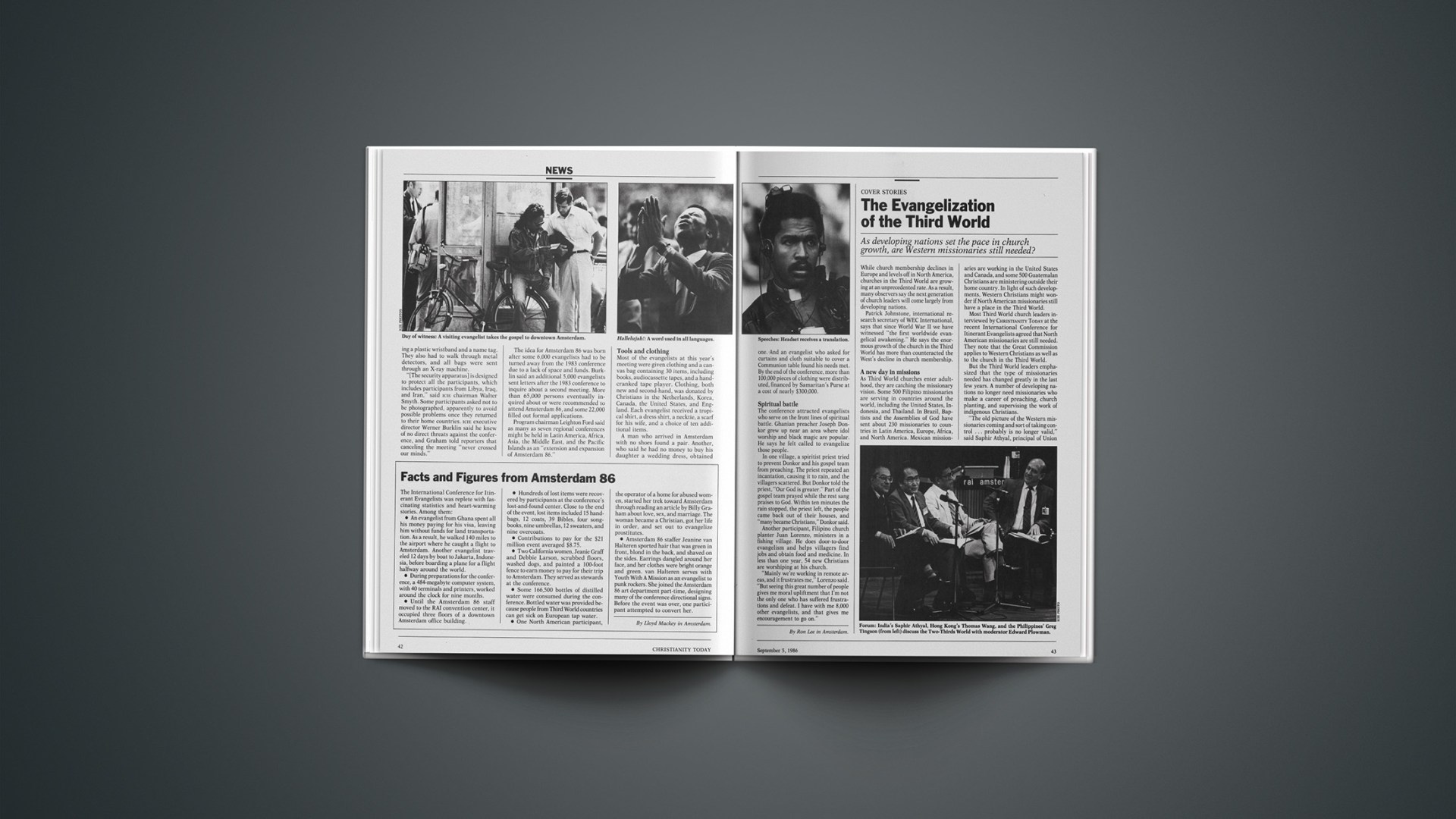
The Evangelization of the Third World

As developing nations set the pace in church growth, are Western missionaries still needed?

While church membership declines in Europe and levels off in North America, churches in the Third World are growing at an unprecedented rate. As a result, many observers say the next generation of church leaders will come largely from developing nations.

Patrick Johnstone, international research secretary of WEC International, says that since World War II we have witnessed “the first worldwide evangelical awakening.” He says the enormous growth of the church in the Third World has more than counteracted the West’s decline in church membership.

A New Day In Missions

As Third World churches enter adulthood, they are catching the missionary vision. Some 500 Filipino missionaries are serving in countries around the world, including the United States, Indonesia, and Thailand. In Brazil, Baptists and the Assemblies of God have sent about 230 missionaries to countries in Latin America, Europe, Africa, and North America. Mexican missionaries are working in the United States and Canada, and some 500 Guatemalan Christians are ministering outside their home country. In light of such developments, Western Christians might wonder if North American missionaries still have a place in the Third World.

Most Third World church leaders interviewed by CHRISTIANITY TODAY at the recent International Conference for Itinerant Evangelists agreed that North American missionaries are still needed. They note that the Great Commission applies to Western Christians as well as to the church in the Third World.

But the Third World leaders emphasized that the type of missionaries needed has changed greatly in the last few years. A number of developing nations no longer need missionaries who make a career of preaching, church planting, and supervising the work of indigenous Christians.

“The old picture of the Western missionaries coming and sort of taking control … probably is no longer valid,” said Saphir Athyal, principal of Union Biblical Seminary in Pune, India. “There is a younger generation of missionaries in North America who have an entirely different attitude.… Their whole attitude toward [Christians in the] Two-Thirds World [is to view them] as partners, and they’re willing to learn from Christians in the Two-Thirds World.” Athyal’s perception is shared by other Asian churchmen, as well as by leaders in Latin America and Africa.

Africa

“We need co-workers, not case workers,” said Isaac Ababio, who heads an evangelistic association in Ghana. In West Africa, many American missionaries already work in partnership with local ministries. Ababio said ministries in Ghana could use additional co-workers from the West, including Bible school teachers.

Nathaniel Olutimayin, president of the 2 million—member Evangelical Churches of West Africa (ECWA), says a partnership between American and African Christians presents a stronger witness to the lost. The ECWA, based in Nigeria, has sent missionaries to Ghana, Niger, and Chad.

Olutimayin said Nigeria needs self-supporting Christian professionals (tentmaking missionaries) from the West, as well as teachers in its seminaries and Bible colleges. The country also needs help from Americans trained in radio and television work. Church planters are needed in Niger, Chad, and Ghana, Olutimayin said. However, for the cost of bringing in and supporting two American missionaries, he said his denomination could send out five Nigerians.

It is clear that the church in Africa takes the challenge of world evangelization seriously. Said René Daidanso Djongwe, associate general secretary of the Association of Evangelicals in Africa and Madagascar: “Christians [in Africa] have the Great Commission on their heart.… In 1982 I was in Korea, and our Korean brothers told me they were preparing to come to Africa. And I told them, ‘Don’t you know we are planning to come and evangelize you?’ ”

Asia

Rapid church growth came to Asia in the 1970s, about a decade after widespread revival broke out in Africa and Latin America.

“[In India, Christians] have to look at the world and be responsible for missions,” said Athyal. More than 3,000 Indian missionaries have learned new languages to do cross-cultural work inside their own country. In addition, Indian missionaries are working in other Asian countries and in Africa. In the next 15 to 20 years, Athyal expects to see more of an exchange of personnel and ideas between East and West.

In mainland China, the church is growing faster than ever before, according to Thomas Wang, who grew up in Beijing but now lives in Hong Kong. He estimates the church in China has grown from 1 million in 1949 to as many as 70 million today. Chinese Christians have also made a significant impact on the rest of the world.

When Mao Zedong came to power in 1949, Chinese were scattered in more than 20 countries, said Wang, who serves as general secretary of the Chinese Coordination Centre of World Evangelism. Today, some 5,000 Chinese congregations are scattered around the world. Overseas Chinese churches have not yet sent missionaries to the United States, but Wang cited a need for “cross feeding.”

“America has been sending missionaries to us,” he said. “While we have gradually grown up, we should also pay back our debt.… I think the East/West missionary movement is going to have a cross-sending movement in the future more and more.”

Western missionaries are already on the “second line of service,” providing technical support to national churches in countries such as Singapore, Hong Kong, South Korea, and to a lesser extent, Taiwan and Japan, Wang said. “Missionaries still have to bear at least part of the burden in pioneering work” in other countries, including Thailand, the Philippines, and Indonesia, he added.

In Indonesia, the government restricts the entry of new missionaries and has refused to renew the visas of some long-time missionaries, said Chris Marantika, president of the Evangelical Theological Seminary of Indonesia. However, the government allows missionaries to do development and educational work on the island of Java, where Marantika’s seminary uses seven missionaries.

“We need missionaries, not to lead the school, but to educate Indonesians for what we call ‘Indonesiaization,’ ” Marantika said. Indonesian Christians are making plans to evangelize their own country. The Evangelical Theological Seminary of Indonesia has set a goal of planting one church in each of the 50,000 unreached villages by the year 2015.

How Can North Americans Help Evangelize Mexico?

A native of Ecuador, Galo Vasquez is a former crusade director for evangelist Luis Palau. Today he heads a Mexico City-based organization called Vision Evangelizadora Latino Americana (Latin American Evangelistic Vision). CHRISTIANITY TODAY asked Vasquez to describe how Christians in the United States can help evangelize Mexico.

Does Mexico grant visas to career missionaries?

No. Mexico’s constitution does not allow for full-time missionaries. But there are ways to do missionary work in Mexico. The most common way is to come as a tourist. A tourist can stay for as long as 180 days, then leave Mexico for a couple of days, and return for another 180 days.

Another way is to come as a professional who assists a local organization that is doing Christian work. A professional can obtain a two-year visa, which is renewable.

What are the professions of most foreign missionaries who are working in Mexico?

Most of them are teachers, researchers, and media specialists. But that doesn’t mean they are limited to that type of work. Many foreign workers are involved in theological education, evangelism, and church planting. But legally they cannot run the mission work. If you are invited by a Mexican organization, and you come on a professional visa, you have to work under a Mexican leader. That government policy has helped develop our national Christian leadership more quickly.

Within the last five years I have noticed that mission organizations are sensing a stronger call to Mexico. And there is a new openness in Mexico toward missionaries.

Is new openness being shown on the part of the Mexican government, the church, or society in general?

All three, in varying degrees. Mexico tries to present an image that it is capable of handling its own matters. But that is beginning to change due to a number of circumstances, including an internal political crisis, the world’s second-largest foreign debt, and the double earthquake that almost destroyed downtown Mexico City in 1985. These circumstances have created a new attitude in Mexican society. Also, the church is more willing to join efforts with outside groups. And there is a new attitude at the official level. Some people in government have become Christians, and there is a new dialogue going on.

Is there a strong evangelical church in Mexico?

It’s not very strong when you think of the 125 years the gospel has been preached in Mexico. Evangelical Protestants make up 3.5 percent of the national population.

Mexico City has only 700 to 900 churches, Catholic and Protestant, to serve the needs of 22 million people. In contrast, Guatemala City, with a population of 800,000, has 1,200 churches. The greatest church growth in Mexico has taken place in the southeastern part of the country, mainly because of the influence of the rapidly growing Guatemalan church.

My organization is doing research to determine exactly how many churches are in Mexico City, where they are located, their sizes, how many pastors, how many Sunday schools, how many missionaries, and how many theological institutions. We are also trying to identify factors that contribute to church growth.

How great is the missionary challenge in Mexico?

Mexico represents the greatest challenge for missions today, in part because Mexico City is the largest urban area in the world. If we want to learn how to reach urban areas, Mexico City is the place to build our model.

We have to approach evangelism differently in Mexico. It is illegal to broadcast religious programs on radio and television. And we can’t publish religious articles in the newspapers and magazines. So we have to find new ways to conquer urban areas. We need missionaries by the hundreds who will join forces with the national church.

My organization is trying to recruit 40 couples, both Latin American and North American, to work in Mexico City. They would help us reach our goal of establishing 10,000 evangelistic home Bible studies in Mexico City by the year 2000. These Bible studies would be the seed for new churches. There’s no time to plant churches the traditional way.

Latin America

“We as a church [in Latin America] are also responsible for the evangelization of the whole world,” said Galo Vasquez, president of the Mexico City-based Latin American Evangelistic Vision. Brazil, Peru, Mexico, and Argentina have sent missionaries to Spain, Portugal, and other European countries. And several Latin American churches have sent workers to other Latin American countries.

“There are [Latin American] countries where the churches are strong enough to carry on the work [of evangelizing their own country],” Vasquez said. “But that doesn’t mean necessarily that the church is closed to missionaries from other parts of the world to come and help them.”

Those countries need specialized missionaries “to complement the work that is already going on,” Vasquez added. But church-planting missionaries are also needed. “There is a strong feeling that we need to awake the missionary force to the pioneering kind of approach,” he said. “There are a lot of towns and villages where the church of Jesus has not been established.”

Out of a Latin American population of 400 million, he said, only 11 percent are evangelical Christians. “There’s a tremendous need for evangelization in Latin America. And in order to do that we need a missionary force that will join with us.…”

Guatemala’s Virgilio Zapata, president of the Confraternity of Evangelicals in Latin America, says the need for North American missionaries varies greatly from country to country. “In spite of the fact that missionaries have left El Salvador [due to guerrilla warfare], the church is growing very fast,” he said. “A lot of personal [evanglistic] work is being done by displaced persons.”

For the most part, he said, church-planting missionaries are not needed in El Salvador, Chile, Brazil, Guatemala, Venezuela, Panama, Costa Rica, Honduras, Nicaragua, and Argentina. However, Bolivia, Mexico, Colombia, Ecuador, Paraguay, Peru, Uruguay, Guyana, and Suriname still need preaching missionaries.

Future Leaders Of The Church

Western Christians are already looking to the Third World for deeper insight into many areas of Christian life and ministry. Consider the following:

• Paul Yonggi Cho, a Korean who pastors the world’s largest church, is widely recognized for his expertise in the areas of prayer and church growth.

• The church in China has flourished, despite the efforts of the late Mao Zedong to obliterate all visible signs of Christian faith. Believers in parts of Asia, the Middle East, and Africa, where converting to Christianity can mean being disowned, jailed, or even executed, also serve as examples of faithfulness in the face of intense opposition.

• Christians in India, Africa, and some parts of Latin America are teaching Western Christians lessons about spiritual warfare. The battle between good and evil is a vivid reality in the lives of Christians who encounter the spirit world when they evangelize groups that worship pagan deities.

While Third World churches evangelize their own countries and send missionaries to other lands, they still welcome help from the West. It is up to Western Christians to supply the needed expertise, and the willingness to work in partnership with established churches in developing nations.

By Ron Lee.
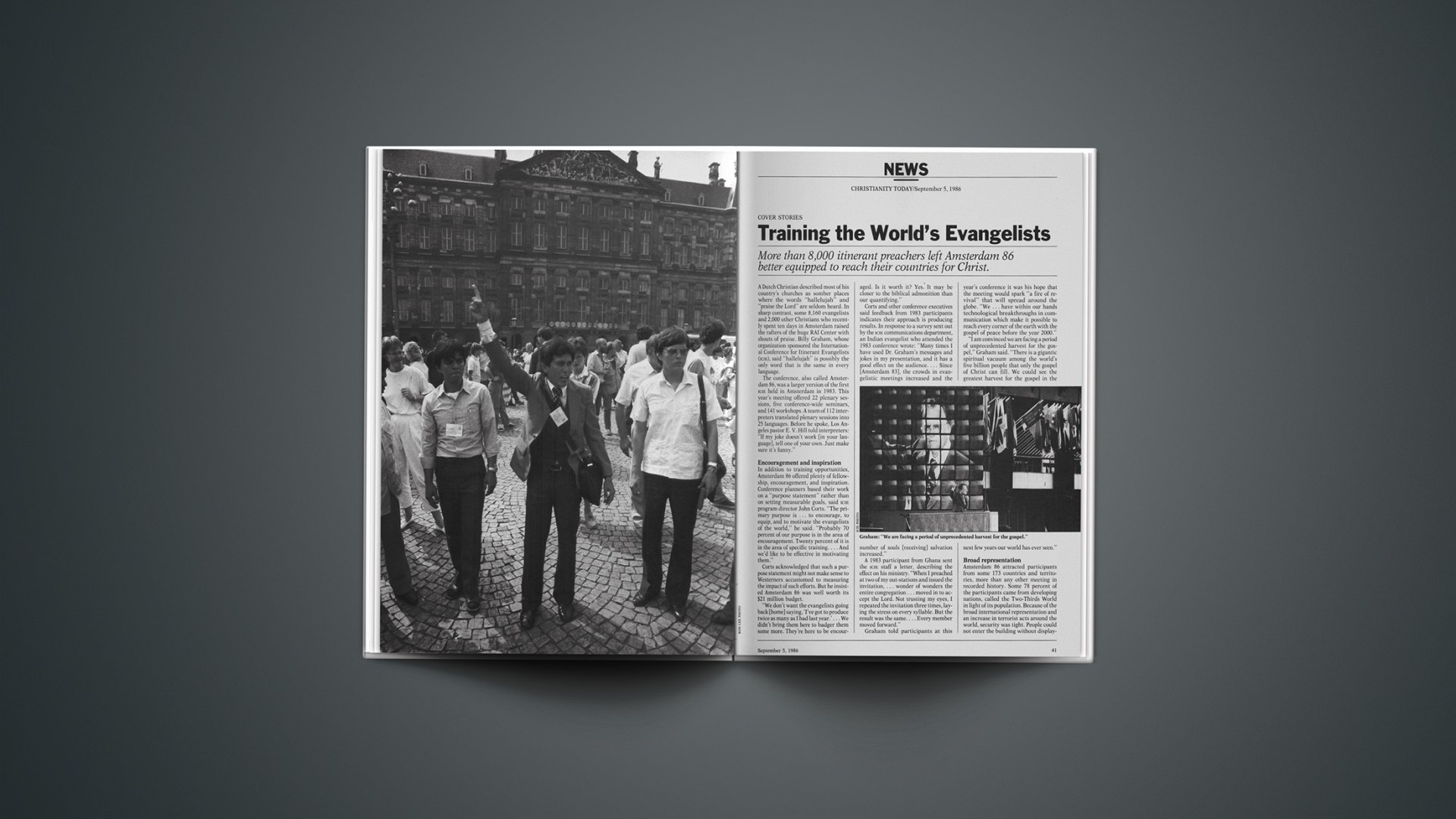
Training the World’s Evangelists

CHRISTIANITY TODAY/September 5, 1986

More than 8,000 itinerant preachers left Amsterdam 86 better equipped to reach their countries for Christ.

A Dutch Christian described most of his country’s churches as somber places where the words “hallelujah” and “praise the Lord” are seldom heard. In sharp contrast, some 8,160 evangelists and 2,000 other Christians who recently spent ten days in Amsterdam raised the rafters of the huge RAI Center with shouts of praise. Billy Graham, whose organization sponsored the International Conference for Itinerant Evangelists (ICIE), said “hallelujah” is possibly the only word that is the same in every language.

The conference, also called Amsterdam 86, was a larger version of the first ICIE held in Amsterdam in 1983. This year’s meeting offered 22 plenary sessions, five conference-wide seminars, and 141 workshops. A team of 112 interpreters translated plenary sessions into 25 languages. Before he spoke, Los Angeles pastor E. V. Hill told interpreters: “If my joke doesn’t work [in your language], tell one of your own. Just make sure it’s funny.”

Encouragement And Inspiration

In addition to training opportunities, Amsterdam 86 offered plenty of fellowship, encouragement, and inspiration. Conference planners based their work on a “purpose statement” rather than on setting measurable goals, said ICIE program director John Corts. “The primary purpose is … to encourage, to equip, and to motivate the evangelists of the world,” he said. “Probably 70 percent of our purpose is in the area of encouragement. Twenty percent of it is in the area of specific training.… And we’d like to be effective in motivating them.”

Corts acknowledged that such a purpose statement might not make sense to Westerners accustomed to measuring the impact of such efforts. But he insisted Amsterdam 86 was well worth its $21 million budget.

“We don’t want the evangelists going back [home] saying, ‘I’ve got to produce twice as many as I had last year.’ … We didn’t bring them here to badger them some more. They’re here to be encouraged. Is it worth it? Yes. It may be closer to the biblical admonition than our quantifying.”

Corts and other conference executives said feedback from 1983 participants indicates their approach is producing results. In response to a survey sent out by the ICIE communications department, an Indian evangelist who attended the 1983 conference wrote: “Many times I have used Dr. Graham’s messages and jokes in my presentation, and it has a good effect on the audience.… Since [Amsterdam 83], the crowds in evangelistic meetings increased and the number of souls [receiving] salvation increased.”

A 1983 participant from Ghana sent the ICIE staff a letter, describing the effect on his ministry. “When I preached at two of my out-stations and issued the invitation, … wonder of wonders the entire congregation … moved in to accept the Lord. Not trusting my eyes, I repeated the invitation three times, laying the stress on every syllable. But the result was the same.… Every member moved forward.”

Graham told participants at this year’s conference it was his hope that the meeting would spark “a fire of revival” that will spread around the globe. “We … have within our hands technological breakthroughs in communication which make it possible to reach every corner of the earth with the gospel of peace before the year 2000.” “I am convinced we are facing a period of unprecedented harvest for the gospel,” Graham said. “There is a gigantic spiritual vacuum among the world’s five billion people that only the gospel of Christ can fill. We could see the greatest harvest for the gospel in the next few years our world has ever seen.”

Broad Representation

Amsterdam 86 attracted participants from some 173 countries and territories, more than any other meeting in recorded history. Some 78 percent of the participants came from developing nations, called the Two-Thirds World in light of its population. Because of the broad international representation and an increase in terrorist acts around the world, security was tight. People could not enter the building without displaying a plastic wristband and a name tag. They also had to walk through metal detectors, and all bags were sent through an X-ray machine.

“[The security apparatus] is designed to protect all the participants, which includes participants from Libya, Iraq, and Iran,” said ICIE chairman Walter Smyth. Some participants asked not to be photographed, apparently to avoid possible problems once they returned to their home countries, ICIE executive director Werner Burklin said he knew of no direct threats against the conference, and Graham told reporters that canceling the meeting “never crossed our minds.”

The idea for Amsterdam 86 was born after some 6,000 evangelists had to be turned away from the 1983 conference due to a lack of space and funds. Burklin said an additional 5,000 evangelists sent letters after the 1983 conference to inquire about a second meeting. More than 65,000 persons eventually inquired about or were recommended to attend Amsterdam 86, and some 22,000 filled out formal applications.

Program chairman Leighton Ford said as many as seven regional conferences might be held in Latin America, Africa, Asia, the Middle East, and the Pacific Islands as an “extension and expansion of Amsterdam 86.”

Tools And Clothing

Most of the evangelists at this year’s meeting were given clothing and a canvas bag containing 30 items, including books, audiocassette tapes, and a hand-cranked tape player. Clothing, both new and second-hand, was donated by Christians in the Netherlands, Korea, Canada, the United States, and England. Each evangelist received a tropical shirt, a dress shirt, a necktie, a scarf for his wife, and a choice of ten additional items.

A man who arrived in Amsterdam with no shoes found a pair. Another, who said he had no money to buy his daughter a wedding dress, obtained one. And an evangelist who asked for curtains and cloth suitable to cover a Communion table found his needs met. By the end of the conference, more than 100,000 pieces of clothing were distributed, financed by Samaritan’s Purse at a cost of nearly $300,000.

Facts and Figures from Amsterdam 86

The International Conference for Itinerant Evangelists was replete with fascinating statistics and heart-warming stories. Among them:

• An evangelist from Ghana spent all his money paying for his visa, leaving him without funds for land transportation. As a result, he walked 140 miles to the airport where he caught a flight to Amsterdam. Another evangelist traveled 12 days by boat to Jakarta, Indonesia, before boarding a plane for a flight halfway around the world.

• During preparations for the conference, a 484-megabyte computer system, with 40 terminals and printers, worked around the clock for nine months.

• Until the Amsterdam 86 staff moved to the RAI convention center, it occupied three floors of a downtown Amsterdam office building.

• Hundreds of lost items were recovered by participants at the conference’s lost-and-found center. Close to the end of the event, lost items included 15 handbags, 12 coats, 39 Bibles, four song-books, nine umbrellas, 12 sweaters, and nine overcoats.

• Contributions to pay for the $21 million event averaged $8.75.

• Two California women, Jeanie Graff and Debbie Larson, scrubbed floors, washed dogs, and painted a 100-foot fence to earn money to pay for their trip to Amsterdam. They served as stewards at the conference.

• Some 166,500 bottles of distilled water were consumed during the conference. Bottled water was provided because people from Third World countries can get sick on European tap water.

• One North American participant, the operator of a home for abused women, started her trek toward Amsterdam through reading an article by Billy Graham about love, sex, and marriage. The woman became a Christian, got her life in order, and set out to evangelize prostitutes.

• Amsterdam 86 staffer Jeanine van Halteren sported hair that was green in front, blond in the back, and shaved on the sides. Earrings dangled around her face, and her clothes were bright orange and green, van Halteren serves with Youth With A Mission as an evangelist to punk rockers. She joined the Amsterdam 86 art department part-time, designing many of the conference directional signs. Before the event was over, one participant attempted to convert her.

By Lloyd Mackey in Amsterdam.

Spiritual Battle

The conference attracted evangelists who serve on the front lines of spiritual battle. Ghanian preacher Joseph Donkor grew up near an area where idol worship and black magic are popular. He says he felt called to evangelize those people.

In one village, a spiritist priest tried to prevent Donkor and his gospel team from preaching. The priest repeated an incantation, causing it to rain, and the villagers scattered. But Donkor told the priest, “Our God is greater.” Part of the gospel team prayed while the rest sang praises to God. Within ten minutes the rain stopped, the priest left, the people came back out of their houses, and “many became Christians,” Donkor said.

Another participant, Filipino church planter Juan Lorenzo, ministers in a fishing village. He does door-to-door evangelism and helps villagers find jobs and obtain food and medicine. In less than one year, 54 new Christians are worshiping at his church.

“Mainly we’re working in remote areas, and it frustrates me,” Lorenzo said. “But seeing this great number of people gives me moral upliftment that I’m not the only one who has suffered frustrations and defeat. I have with me 8,000 other evangelists, and that gives me encouragement to go on.”

By Ron Lee in Amsterdam.

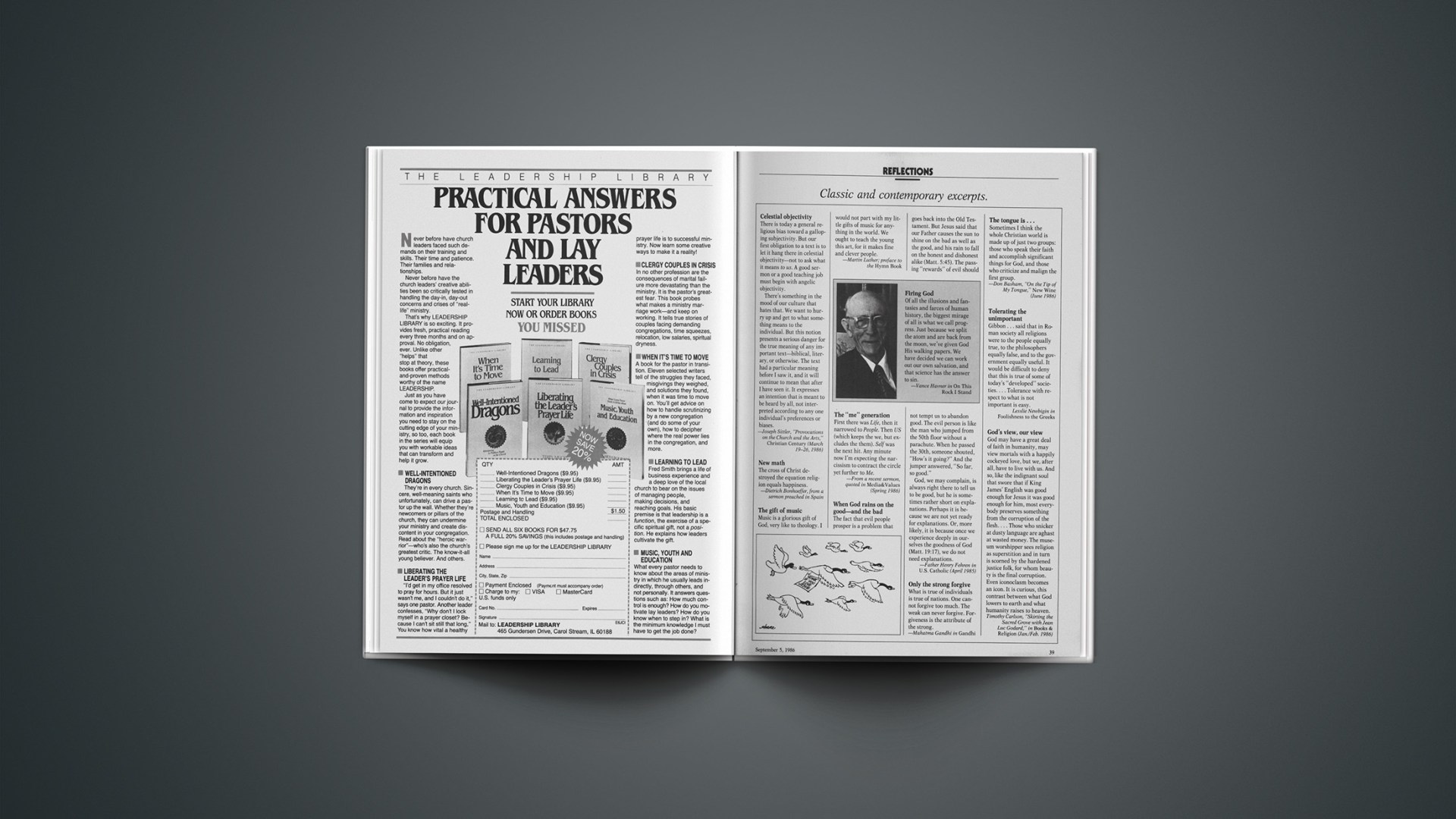
Classic & Contemporary Excerpts from September 05, 1986

Classic and contemporary excerpts

Celestial Objectivity

There is today a general religious bias toward a galloping subjectivity. But our first obligation to a text is to let it hang there in celestial objectivity—not to ask what it means to us. A good sermon or a good teaching job must begin with angelic objectivity.

There’s something in the mood of our culture that hates that. We want to hurry up and get to what something means to the individual. But this notion presents a serious danger for the true meaning of any important text—biblical, literary, or otherwise. The text had a particular meaning before I saw it, and it will continue to mean that after I have seen it. It expresses an intention that is meant to be heard by all, not interpreted according to any one individual’s preferences or biases.

Joseph Sittler, “Provocations on the Church and the Arts,” Christian Century (March 19–26, 1986)

New Math

The cross of Christ destroyed the equation religion equals happiness.

Dietrich Bonhoeffer, from a sermon preached in Spain

The Gift Of Music

Music is a glorious gift of God, very like to theology. I would not part with my little gifts of music for anything in the world. We ought to teach the young this art, for it makes fine and clever people.

Martin Luther; preface to the Hymn Book

Firing God

Of all the illusions and fantasies and farces of human history, the biggest mirage of all is what we call progress. Just because we split the atom and are back from the moon, we’ve given God His walking papers. We have decided we can work out our own salvation, and that science has the answer to sin.

Vance Havner in On This Rock I Stand

The “Me” Generation

First there was Life, then it narrowed to People. Then US (which keeps the we, but excludes the them). Self was the next hit. Any minute now I’m expecting the narcissism to contract the circle yet further to Me.

From a recent sermon, quoted in Media&Values (Spring 1986)

When God Rains On The Good—And The Bad

The fact that evil people prosper is a problem that goes back into the Old Testament. But Jesus said that our Father causes the sun to shine on the bad as well as the good, and his rain to fall on the honest and dishonest alike (Matt. 5:45). The passing “rewards” of evil should not tempt us to abandon good. The evil person is like the man who jumped from the 50th floor without a parachute. When he passed the 30th, someone shouted, “How’s it going?” And the jumper answered, “So far, so good.”

God, we may complain, is always right there to tell us to be good, but he is sometimes rather short on explanations. Perhaps it is because we are not yet ready for explanations. Or, more likely, it is because once we experience deeply in ourselves the goodness of God (Matt. 19:17), we do not need explanations.

Father Henry Fehren in U.S. Catholic (April 1985)

Only The Strong Forgive

What is true of individuals is true of nations. One cannot forgive too much. The weak can never forgive. Forgiveness is the attribute of the strong.

Mahatma Gandhi in Gandhi

The Tongue Is …

Sometimes I think the whole Christian world is made up of just two groups: those who speak their faith and accomplish significant things for God, and those who criticize and malign the first group.

Don Basham, “On the Tip of My Tongue,” New Wine (June 1986)

Tolerating The Unimportant

Gibbon … said that in Roman society all religions were to the people equally true, to the philosophers equally false, and to the government equally useful. It would be difficult to deny that this is true of some of today’s “developed” societies.… Tolerance with respect to what is not important is easy.

Lesslie Newbigin in Foolishness to the Greeks

God’S View, Our View

God may have a great deal of faith in humanity, may view mortals with a happily cockeyed love, but we, after all, have to live with us. And so, like the indignant soul that swore that if King James’ English was good enough for Jesus it was good enough for him, most everybody preserves something from the corruption of the flesh.… Those who snicker at dusty language are aghast at wasted money. The museum worshipper sees religion as superstition and in turn is scorned by the hardened justice folk, for whom beauty is the final corruption. Even iconoclasm becomes an icon. It is curious, this contrast between what God lowers to earth and what humanity raises to heaven.

Timothy Carlson, “Skirting the Sacred Grove with Jean Luc Godard,” in Books & Religion (Jan./Feb. 1986)

Unity over Individuality

Tough Marriage: How to Make a Difficult Relationship Work, by Paul A. Mickey with William Proctor (Morrow, 1986, 224 pp.; $14.95, cloth).

Counselor and pastor Paul Mickey is convinced that only a “lean and mean” relationship can weather the trials of modem society.

Citing Scripture and using examples from his own counseling sessions, Mickey offers 12 commandments for a “tough marriage,” including such upbeat themes as “Speak the Truth in Love,” “Break Bread Together,” “Master New Tricks,” and “Kiss Mom and Dad Goodbye.”

Mickey does not mince words. He urges sacrifice over narcissism, calling today’s “l” orientation “the death knell of a marriage.” He identifies the “Messiah Complex” often found in persons of the cloth—and provides an apt solution. He lists the differences between passive living and “fallow time,” and says that even “fantasizing about divorce is an act of aggression.”

Marriage indeed is “tough.” But a strong, resilient relationship, idealized by both husband and wife, can negotiate hurdles and bypass the loosely considered, almost trendy idea of “commitment” for a more hard-hitting state of “obligation.”

Unity must triumph over individuality, Mickey instructs, for, according to Galatians 3:28, “There is neither male nor female … you are all one in Christ Jesus.”

Book brief by Cathy Luchetti, coauthor of Woman of the West (Antelope Island)

The Democratic Evangelists

John Wesley and the Methodists, by Cyril Davey (Abingdon, 1985, 48 pp.; $6.95, hardcover).

Young John Wesley, returning to England from an unsuccessful preaching tour of America, met a group of Spirit-filled Moravians on board ship. Envious of their visible faith, he cried out: “I went to America to convert the Indians, but, oh, who shall convert me?”

In 1738 his prayer was answered. An intense spiritual conviction changed his life, reframed his evangelistic style, and, indirectly, altered the path of American democracy for years to come. The thrust of his new-found conviction led to Methodism, an offshoot of the Church of England that helped lay the groundwork for American social reform in the nineteenth century.

John Wesley and the Methodists captures Wesley’s life—and that of his hymn-writing brother Charles—in a brief, richly illustrated text particularly accessible to the student. Davey s study abounds in personal detail—Wesley’s homey manner of scribbling sermons on the backs of bills and letters; his skill in staying mounted while reading during many of the quarter-million miles he traveled on horseback.

With its “saddlebag preachers” proclaiming free will, free grace, and individual responsibility, Methodism’s Arminian doctrine was as democratic as the frontiersmen to whom it appealed. Infants together, Methodism and America were intricately bound in a network of discovery, belief, and adventure as relevant today as it was in 1738.

Grassroots Christians

The Expectation of the Poor—Latin American Basic Ecclesial Communities in Protestant Perspective, by Guillermo Cook (Orbis, 1985, 316 pp.; $13.95, paper). Reviewed by Alice-Catherine Carls, assistant professor of political science, Lambuth College, Jackson, Tennessee.

Protestant theologian René Padilla defines basic ecclesial communities (CEBS) as “small groups of poor and oppressed Christians who seek to understand and to respond to their concrete problems in the light of Scripture.”

CEBS were born in the wake of Vatican II and the 1968 Medellín Conference of Latin American Catholic bishops that focused church attention on social concerns. Although an ideological elite tied to the liberation theology movement helped to start some CEBS, most began as biblical circles, following the strong pietist tradition brought by the first Protestant churches in Brazil, says Guillermo Cook in The Expectation of the Poor.

Because of an endemic shortage of priests, CEBS have been multiplying rapidly among the rural campesinos and the residents of the urban slums of Latin America, especially in Brazil. Today there are an estimated half-million CEBS, averaging 30 members in each.

Involved in everything from holding political discussions to building roads, wells, and hospitals, CEBS challenge the traditional conception of Christian life. They go beyond traditional Bible studies and affirm the desire of the people to participate in the life of the church, to live out their faith in everyday life, and to create a new sense of solidarity among their members.

Tame Liberation Theology

On April 5, a chapter in the controversy about the role of Marxist ideology in Latin American Christians’ struggle against poverty and oppression came to a close when the Vatican released a document entitled Instruction on Christian Freedom and Liberation. The document has been perceived by some as the doctrinal stamp of approval on a “tame” brand of liberation theology. Cook, general director of the Latin American Evangelical Center for Pastoral Studies in Costa Rica, substantiates the claim that fears of an overpoliticized Latin American Catholic church (and in particular the Brazilian church) have been greatly exaggerated.

Cook, who holds the Ph.D. in intercultural studies from Fuller Theological Seminary, distinguishes between grassroots Christians and “pastoral theologians”—liberation theologians who work daily within religious communities. He argues convincingly that “authentic” liberation practiced by CEB Christians has little to do with “pastoral theology” and very much corresponds to the definition agreeable to Vatican authorities.

Faith, not ideology, is the dynamic force behind social change for CEB Christians, since only faith cleanses the “old man” of sin, and stops the spiral of oppression and violence. Such an attitude results in the daily practice of faith and works—reconciled, not pitted against one another as so often happens in First World Christian doctrine.

Protestant Perspective

Cook, who is also a church-growth consultant to the Brazilian Baptist Convention, speaks from a Protestant perspective. He reviews early Protestant grassroots communities both in Europe and the Americas. His comprehensive case studies and rigorous analysis enable him to answer essential questions regarding the challenges posed by today’s religious renewal in Brazil.

From among these challenges, two emerge as central: First, while the CEBS place too much emphasis on man’s sin against man, says Cook, they remind us that it is vitally important to recognize this aspect of sin beside our sins against God. Second, unlike the traditional view of conversion as a one-time illumination and turning-away-from, the CEBS define conversion as an ongoing process.

From these two tenets emerges the notion that the CEBS’ emphasis on the role of the Holy Spirit and its real presence in daily actions could be and should be the living link between doctrinal orthodoxy and renewal.

The Expectation of the Poor suffers from an overdose of meticulousness and compartmentalization. Repetition impedes the progress of the argument. Guillermo Cook has written a scholarly book that will be difficult reading for those without prior knowledge of liberation theology. Yet such a book needs to be read widely, for we First World Christians need to understand these decisive developments in the Christian world.

Book Briefs

And Then There Were Three: An Ode to Parenthood, Sara Wenger Shenk, (Herald, 1985, 224 pp.; $8.95, paper).

“Liberation through diapers” would be far too glib a summary for this thoughtful and often lyrical testimony to parenting, marriage, and the proper place of professional pursuits. Yet author Shenk found liberation—and spiritual maturity—through the endless and humble parental chores she once viewed with suspicion.

Hardly a format for “glamour Christianity,” motherhood became a steppingstone to increased faith for this erstwhile secular feminist. As a “world citizen” (she spent half her life in Africa and Eastern Europe) and a beginning professional, Shenk believed that “self-sufficiency and intellectual prowess” identified the liberated woman. After her son’s birth, she slowly came to realize that career development did not “equal or produce” liberation; that came only with an “unparalleled relationship” with Christ that grew daily through the mutual servanthood of husband and wife to one another, and together to their children.

Nurtured on radical feminism and beckoned by academic success, she found nursing a colicky baby through the night in a tiny apartment in Yugoslavia antithetical to her dreams. Yet the magic of motherhood grew, and she determined to experience the fullness of every moment instead of yearning for professional pursuits—even though her marriage was as “precarious as a high wire act.”

And Then There Were Three is not a how-to book for ordering the Christian home. Instead, it urges self-discovery through honesty, acceptance of God, ministry to others, and above all the emergence of “tenderness … and person-centered sensitivity” as a feminist model—rather than “power and dominance.”

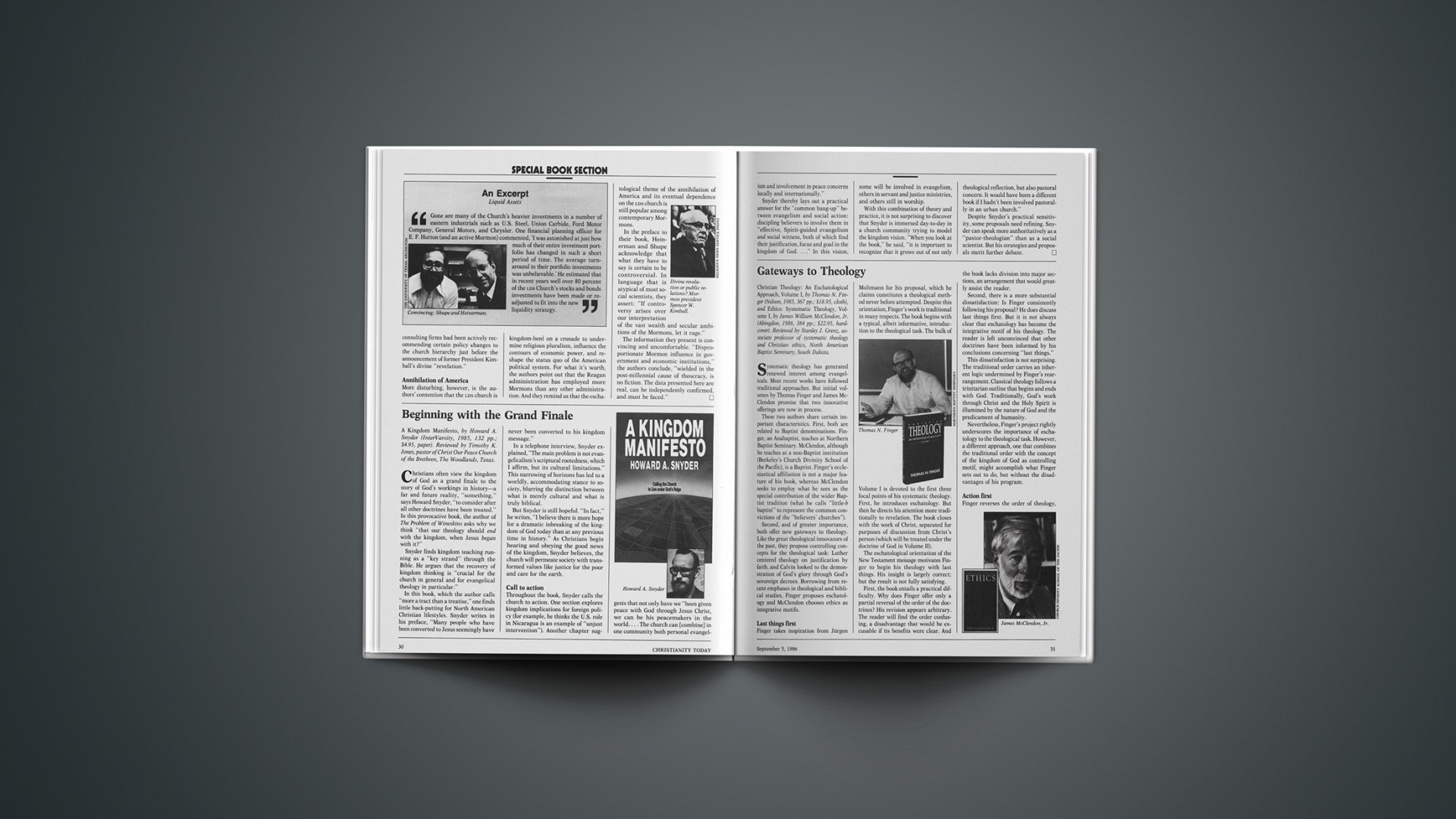
Gateways to Theology

Christian Theology: An Eschatological Approach, Volume I, by Thomas N. Finger (Nelson, 1985, 367 pp.; $18.95, cloth), and Ethics: Systematic Theology, Volume I, by James William McClendon, Jr. (Abingdon, 1986, 384 pp.; $22.95, hardcover). Reviewed by Stanley J. Grenz, associate professor of systematic theology and Christian ethics, North American Baptist Seminary, South Dakota.

Systematic theology has generated renewed interest among evangelicals. Most recent works have followed traditional approaches. But initial volumes by Thomas Finger and James McClendon promise that two innovative offerings are now in process.

These two authors share certain important characteristics. First, both are related to Baptist denominations. Finger, an Anabaptist, teaches at Northern Baptist Seminary. McClendon, although he teaches at a non-Baptist institution (Berkeley’s Church Divinity School of the Pacific), is a Baptist. Finger’s ecclesiastical affiliation is not a major feature of his book, whereas McClendon seeks to employ what he sees as the special contribution of the wider Baptist tradition (what he calls “little-b baptist” to represent the common convictions of the “believers’ churches”).

Second, and of greater importance, both offer new gateways to theology. Like the great theological innovators of the past, they propose controlling concepts for the theological task: Luther centered theology on justification by faith, and Calvin looked to the demonstration of God’s glory through God’s sovereign decrees. Borrowing from recent emphases in theological and biblical studies, Finger proposes eschatology and McClendon chooses ethics as integrative motifs.

Last Things First

Finger takes inspiration from Jürgen Moltmann for his proposal, which he claims constitutes a theological method never before attempted. Despite this orientation, Finger’s work is traditional in many respects. The book begins with a typical, albeit informative, introduction to the theological task. The bulk of Volume I is devoted to the first three focal points of his systematic theology. First, he introduces eschatology. But then he directs his attention more traditionally to revelation. The book closes with the work of Christ, separated for purposes of discussion from Christ’s person (which will be treated under the doctrine of God in Volume II).

The eschatological orientation of the New Testament message motivates Finger to begin his theology with last things. His insight is largely correct; but the result is not fully satisfying.

First, the book entails a practical difficulty. Why does Finger offer only a partial reversal of the order of the doctrines? His revision appears arbitrary. The reader will find the order confusing, a disadvantage that would be excusable if its benefits were clear. And the book lacks division into major sections, an arrangement that would greatly assist the reader.

Second, there is a more substantial dissatisfaction: Is Finger consistently following his proposal? He does discuss last things first. But it is not always clear that eschatology has become the integrative motif of his theology. The reader is left unconvinced that other doctrines have been informed by his conclusions concerning “last things.”

This dissatisfaction is not surprising. The traditional order carries an inherent logic undermined by Finger’s rearrangement. Classical theology follows a trinitarian outline that begins and ends with God. Traditionally, God’s work through Christ and the Holy Spirit is illumined by the nature of God and the predicament of humanity.

Nevertheless, Finger’s project rightly underscores the importance of eschatology to the theological task. However, a different approach, one that combines the traditional order with the concept of the kingdom of God as controlling motif, might accomplish what Finger sets out to do, but without the disadvantages of his program.

Action First

Finger reverses the order of theology, but McClendon reverses method. Traditional theology, he claims, begins with thought and then moves to action. In so doing, however, theology often stops short of ethics.

McClendon prefers to begin with the common life of the people of God and then move to the teaching that sanctions and supports it. Since this community life is narrative (it constitutes a continuing saga), story—and not decision—lies at the center of his ethics. These two beginning points—ethics and narrative—promise a new, and explicitly Baptist approach to theology, McClendon claims.

In keeping with this claim, Volume I centers not on specific abstract doctrines, but on ethics. After offering helpful insight into the definitions and relationship between ethics and theology, the author delineates three strands of ethics that must be integrated in Christian life: the organic (body ethics—especially sexuality), the communal (social ethics), and the anastatic (resurrection ethics—how believers live in the unique light of Christ). These three arise out of the believers’ situation as part of the natural order, a social fabric, and the kingdom of God.

The narrative approach to theology is apparent in each section as well. For each ethical sphere, a paradigm person is used as an extended illustration: Sarah and Jonathan Edwards, Dietrich Bonhoeffer, and Dorothy Day. These life histories underscore the “lived-out” nature of ethics/theology.

McClendon’s volume is a challenging work. His contention that community life and action rightly precede theological reflection is worth careful consideration. However, one wonders if the classical approach to the relation between theology and ethics, while rightly criticized by the author, nevertheless has some merit. At its best, theological statements, as reflections on our faith commitments, provide needed insight, motivation, and guidance for community life. McClendon’s reversal in method may tend to dislodge action from theological reflection.

Since both books are but the first installments of multivolume works, final evaluation must be withheld until the sets are complete. At this stage, however, one may safely conclude that both will offer significant challenges to traditional approaches. And both will constitute important contributions to the ongoing theological enterprise.

Beginning with the Grand Finale

A Kingdom Manifesto, by Howard A. Snyder (InterVarsity, 1985, 132 pp.; $4.95, paper). Reviewed by Timothy K. Jones, pastor of Christ Our Peace Church of the Brethren, The Woodlands, Texas.

Christians often view the kingdom of God as a grand finale to the story of God’s workings in history—a far and future reality, “something,” says Howard Snyder, “to consider after all other doctrines have been treated.” In this provocative book, the author of The Problem of Wineskins asks why we think “that our theology should end with the kingdom, when Jesus began with it?”

Snyder finds kingdom teaching running as a “key strand” through the Bible. He argues that the recovery of kingdom thinking is “crucial for the church in general and for evangelical theology in particular.”

In this book, which the author calls “more a tract than a treatise,” one finds little back-patting for North American Christian lifestyles. Snyder writes in his preface, “Many people who have been converted to Jesus seemingly have never been converted to his kingdom message.”

In a telephone interview, Snyder explained, “The main problem is not evangelicalism’s scriptural rootedness, which I affirm, but its cultural limitations.” This narrowing of horizons has led to a worldly, accommodating stance to society, blurring the distinction between what is merely cultural and what is truly biblical.

But Snyder is still hopeful. “In fact,” he writes, “I believe there is more hope for a dramatic inbreaking of the kingdom of God today than at any previous time in history.” As Christians begin hearing and obeying the good news of the kingdom, Snyder believes, the church will permeate society with transformed values like justice for the poor and care for the earth.

Call To Action

Throughout the book, Snyder calls the church to action. One section explores kingdom implications for foreign policy (for example, he thinks the U.S. role in Nicaragua is an example of “unjust intervention”). Another chapter suggests that not only have we “been given peace with God through Jesus Christ, we can be his peacemakers in the world.… The church can [combine] in one community both personal evangelism and involvement in peace concerns locally and internationally.”

Snyder thereby lays out a practical answer for the “common hang-up” between evangelism and social action: discipling believers to involve them in “effective, Spirit-guided evangelism and social witness, both of which find their justification, focus and goal in the kingdom of God.…” In this vision, some will be involved in evangelism, others in servant and justice ministries, and others still in worship.

With this combination of theory and practice, it is not surprising to discover that Snyder is immersed day-to-day in a church community trying to model the kingdom vision. “When you look at the book,” he said, “it is important to recognize that it grows out of not only theological reflection, but also pastoral concern. It would have been a different book if I hadn’t been involved pastorally in an urban church.”

Despite Snyder’s practical sensitivity, some proposals need refining. Snyder can speak more authoritatively as a “pastor-theologian” than as a social scientist. But his strategies and proposals merit further debate.

The Empire Strikes Gold

The Mormon Corporate Empire, by John Heinerman and Anson Shupe (Beacon, 1986, 293 pp.; $19.95, cloth). Reviewed by Ronald Enroth, professor of sociology, Westmont College, Santa Barbara, California.

A 1983 Gallup poll concluded that the Mormon church, while constituting only 1 percent of the adult population in the United States, is having a “profound impact” on American society. If you doubt the validity of that finding, you need to read The Mormon Corporate Empire.

The authors, an anthropologist and a sociologist, focus on the secular, not the doctrinal, aspects of Mormonism in what turns out to be an incredibly well-researched, scholarly expose of a rapidly growing social movement. One of the coauthors, anthropologist Heinerman, is himself a Mormon. But leaders in his church will surely not rise up and call him blessed after they have read this volume.

Heinerman and Shupe describe the Church of Jesus Christ of Latter-day Saints (LDS) as a “corporate religion” with a rigid, pyramidal authority structure that is unfriendly to critics—both inside and outside “Zion.” Despite an impressive public relations effort, the LDS church is still characterized by a “garrison mentality” that the authors manage to penetrate successfully. Consider some of the facts they present:

• The current wealth of the Mormon empire is conservatively estimated at eight billion dollars.

• The LDS church is the fastest-growing sect in the United States. (Although the authors identify the church as “Protestant” and “Christian,” many CT readers would regard it as neither.)

• The LDS church has become the largest private satellite video network owner in the world.

• The Mormon church currently is the largest religious media owner in the world.

• Mormon adherents worldwide numbered 5.7 million as of 1985 with membership projections calling for 12 to 14 million people by the year 2000. (In Latin America, Mormons are averaging 8,400 converts per month.)

• Brigham Young University (BYU) is the largest privately owned university in the United States.

• The LDS church is the single largest ranching enterprise in America.

• The largest concentration of LDS members east of the Mississippi is in Washington, D.C.

• Both the CIA and the FBI recruit heavily from Mormon ranks.

Obedience

A fascinating and sobering segment of the book examines the authoritarian style of Mormon leaders, using their own pronouncements as documentation. A 1945 publication illustrates the Mormon practice of unquestioning submission: “When our leaders speak, the thinking has been done. When they propose a plan, it is God’s plan. When they point the way, there is no other which is safe.” In 1981 the Church News warns: “God will do nothing regarding His work except through His own duly anointed prophets.… They will give us the Lord’s word in no uncertain terms as God makes it known.… Let us follow them and avoid being led astray.” A BYU dean is quoted as saying, “All good LDS, including scholars, must accept the judgment of the Church’s General Authorities. If it is what the brethren want, then good LDS must say it is appropriate. This may be difficult for scholars, but obedience is an important concept of the Mormon Church.”

The book also contains an intriguing discussion of the behind-the-scenes dynamics of the events leading up to the church’s widely publicized decision to admit black males to the Mormon priesthood. It seems that several professional consulting firms had been actively recommending certain policy changes to the church hierarchy just before the announcement of former President Kimball’s divine “revelation.”

An Excerpt

Liquid Assets

“Gone are many of the Church’s heavier investments in a number of eastern industrials such as U.S. Steel, Union Carbide, Ford Motor Company, General Motors, and Chrysler. One financial planning officer for E. F. Hutton (and an active Mormon) commented, ‘I was astonished at just how much of their entire investment portfolio has changed in such a short period of time. The average turn around in their portfolio investments was unbelievable.’ He estimated that in recent years well over 80 percent of the LDS Church’s stocks and bonds investments have been made or readjusted to fit into the new liquidity strategy.”

Annihilation Of America

More disturbing, however, is the authors’ contention that the LDS church is kingdom-bent on a crusade to undermine religious pluralism, influence the contours of economic power, and reshape the status quo of the American political system. For what it’s worth, the authors point out that the Reagan administration has employed more Mormons than any other administration. And they remind us that the eschatological theme of the annihilation of America and its eventual dependence on the LDS church is still popular among contemporary Mormons.

In the preface to their book, Heinerman and Shupe acknowledge that what they have to say is certain to be controversial. In language that is atypical of most social scientists, they assert: “If controversy arises over our interpretation of the vast wealth and secular ambitions of the Mormons, let it rage.”

The information they present is convincing and uncomfortable. “Disproportionate Mormon influence in government and economic institutions,” the authors conclude, “wielded in the post-millennial cause of theocracy, is no fiction. The data presented here are real, can be independently confirmed, and must be faced.”

Apple PodcastsDown ArrowDown ArrowDown Arrowarrow_left_altLeft ArrowLeft ArrowRight ArrowRight ArrowRight Arrowarrow_up_altUp ArrowUp ArrowAvailable at Amazoncaret-downCloseCloseEmailEmailExpandExpandExternalExternalFacebookfacebook-squareGiftGiftGooglegoogleGoogle KeephamburgerInstagraminstagram-squareLinkLinklinkedin-squareListenListenListenChristianity TodayCT Creative Studio Logologo_orgMegaphoneMenuMenupausePinterestPlayPlayPocketPodcastRSSRSSSaveSaveSaveSearchSearchsearchSpotifyStitcherTelegramTable of ContentsTable of Contentstwitter-squareWhatsAppXYouTubeYouTube