When Christians Speak up in Public: Four Biblical Truths Help Us Apply the Faith to Public Policy

CHARLES L. GLENN1Charles L. Glenn is director of Equal Educational Opportunity for the Commonwealth of Massachusetts. This article represents his personal opinions and in no sense reflects the position of the Massachusetts Department of Education.

Christians who work “in the world”—in government or professions such as public-school teaching—are familiar with the awkwardness of applying their faith to their work.

This tension is part of my own life. I have been an Episcopal parish priest for more than 20 years. I have also been a state government official for more than 15 of those years, committed to uphold a Constitution that forbids the use of public position to advance private religious convictions. In a sense, I live the tension of church and state every day, and in a most sensitive area—public education.

But I am not unique. All of us, if we so much as visit a school board meeting or care about the passage of a city ordinance, wonder how we go about applying our faith to public policy. Do we patch together Scripture verses that seem relevant? Do we attach Christian labels to ideas that are fashionable in the conservative or liberal circles in which we move?

No. Christian thinking about any issue can only begin at one place, with “Jesus Christ, and him crucified.” Only in him can we come to know God, or ourselves. Only in him can we hope for either the power or the wisdom with which we can confront our calling in the world.

Let me, therefore, suggest four scriptural truths that come to life if we know Christ Jesus: our ungovernable propensity to sin; our gracious, unmerited redemption by God through Jesus Christ; the sustaining power of the Holy Spirit to lead us into all truth; and God’s graciousness to “all flesh,” even those outside of the covenant of grace who may (but of that we are not to judge) have no ultimate share in the kingdom. Here is how I apply these four aspects of revealed truth to the calling of public life.

A Sense Of Sin

A lively sense of our own sinfulness should encourage a certain caution about how we embrace causes and solutions. Utopian visions or instant solutions for difficult problems cannot stand before the understanding of the human heart we gain at the foot of the cross.

By “caution” I do not mean we should be less than wholehearted in working, even struggling, for what seems in accordance with God’s will. But we need to retain some perspective, a certain mental objectivity, even a sense of humor, about our efforts. Sometimes we will make the wrong choice, and we need to remember that only those who repent can be forgiven. Above all, we cannot be so sure of our own righteousness that we fail to perceive the harm we may be doing to others in the name of an ultimate good.

Also, we need to be careful how we claim God’s authority for our own plans and programs. By all means let us show how we have been led to a particular position by our understanding of Scripture and through prayer. But let us do so in such a way that it is clear that our own human judgment has made the application. Our confession of sinfulness should inhibit us from overconfidence in our own momentary strategies, and should assure that we “do justice and love mercy”—even with our opponents. The stereotype of Christians as grim and humorless fanatics should not apply to anyone who can weep and laugh, and do so over his own shortcomings and those of his fellow believers.

The Significance Of Redemption

The second scriptural truth, that Jesus Christ has won the victory for us through no merit on our part, is of course intimately related to the first. Indeed, only that knowledge allows us to laugh as we weep over our fallenness. A firm grasp on that truth enables us to see that the final victory will be God’s. The Israelites fell before the Philistines, but the idol Dagon was powerless to stand in the presence of the ark of the Lord—and lay at last broken in pieces. So the false ideologies, the “principalities and powers” of our own time, will at last be revealed for the lifeless idols they are.

This is not an invitation to passivity—we are called to cooperate in the mighty work of God. But it should strengthen the fainting heart to know the victory is not in question.

An awareness of how our redemption was won will deepen our appreciation of how important it is to give a faithful witness to God’s love in the midst of human life, in which God himself chose to dwell and to suffer. How often I have steeled myself to another difficult struggle with urban issues by remembering that Jesus came down from the mountain after the Transfiguration.

Sometimes, indeed, I wonder whether I couldn’t be more “spiritual” if I withdrew from the daily turmoil of my work as a public official. Then I remember how Jesus went up to Jerusalem to die, in all the confusion and crowds of Pass-over; how he was shuffled from one official to another in an endless mockery of fair process. No man of the city, he endured that for me, knowing it was in the city—not in Galilee or on the mountain top—that the victory must be won.

The Sustaining Spirit

Our conviction of the sustaining power of the Holy Spirit gives us the courage not only to be faithful but to expect a deepening understanding of our calling. Jesus promised the Spirit would “lead us into all truth,” and we experience this as an ongoing process of sanctification and growth.

My own years of discipleship in public service have involved a continual evolution in my understanding of what educational justice requires and how it is best pursued. Many of the solutions that seemed to me clear and simple a decade ago now are far less self-evident, requiring qualification.

Some of us may be called to a “prophetic” ministry, but most of us are not. For every Amos to denounce social evil, the church—and the world it serves—needs a hundred Ezras to build up the community of faith, and a thousand Nehemiahs to rebuild the ruined cities. Most of us give our best witness not by what we say but by how we live and serve. That also is a work of the Holy Spirit; remember that God told Moses the craftsman Bezalel was “filled with the Spirit of God” to do his work (Exod. 31:3).

Graciousness To “All Flesh”

My fourth principle is the reality of God’s “common grace,” which causes the rain to fall on the just and the unjust and creates the essential condition for our cooperation with nonbelievers in seeking the common good.

This is a delicate matter. Too often I have seen Christians concede their distinctive understanding of issues in order to maintain alliances of convenience with partners who, in fact, despised and used them. The social witness of the “mainstream” churches has too often fallen into this error, out of a sort of apologetic eagerness to please.

In avoiding that, however, we must not run to the opposite extreme. An exaggerated purity reflects a lack of confidence in the power of the gospel. Christians should be prepared to serve as honest partners and allies of non-Christians who share the same convictions about the demands of justice and love. We are not called to impose the distinctives of our faith, though it should be our daily prayer that they will come to be accepted voluntarily by all the world. Christianity is not imperialistic, but evangelistic. We need to help our nonbelieving allies understand the difference.

I have grown bolder, in recent years, about articulating the connection between my position on some aspect of my work and my convictions as a Christian. Several times, for example, when meeting with an urban school committee over some issue of educational justice for minority students, I have mentioned Jesus’ counsel about “coming to terms with your adversary before you are before the judge” in support of a negotiated solution.

On one occasion a committee member approached me afterwards and said he had changed his position—and thereby swung the vote—because of what I had said. He figured if a “blankety-blank” state official could try to abide by what Jesus said, the school committee could do as much! Now, of course, I was using the gospel saying out of its context, but it was clear to him that I took the gospel seriously, and it opened the door to reconciliation and a peaceful solution to a serious problem.

In such situations, it is important that our certainty in Christ not be confused with the much lesser assurance that we are correct on a particular issue. Christians have no monopoly on ethical sensitivity, and more than once I have been put to shame by a non-Christian who has cut through my own calculations with a blunt insistence on doing what was obviously right.

God’S Cause And Effects

Belief in Christ will cause the Christian concerned with public service and public justice to have a modest view of his own favorite cause and program, knowing that we still bear about us the distorting marks of sin. It will, nevertheless, sustain a deep hopefulness about the final victory, based upon the assurance that it will be God’s alone and will not depend upon our power.

The work of the Holy Spirit in the Christian will be a continual source of growth and of new understanding of the demands of justice and love. Without any apology for or blurring of the radically different perspective that we have in Jesus Christ, the Christian will cooperate wholeheartedly with nonbelievers in doing what love and justice require.
Doing What Comes Naturally: Christian Actions Flow from Christian Character

Terry, a college friend of mine, lived in the dorm room next to two self-professed “freaks”—people who worked at being bizarre. Mark and Bob woke up to blaring Frank Zappa music. They wore shoulder-length hair long after most men had trimmed their sideburns. And they pinned dead tarantulas to their door.

One day Bob told my friend Terry he had noticed Terry was “different.” There was nothing specific. He was simply intrigued by Terry’s character, the way he responded to situations in general. Terry, who had never suspected Bob was even slightly interested in religion, was presented with a natural opportunity to discuss his faith.

Now aroused by stories like Terry’s, as well as hints in Scripture and the lives of the saints, several influential Christian thinkers are studying the foundational importance of character and character formation. Perhaps, they say, the Christian life is less fundamentally keeping rules—doing (or not doing) specific things—than it is possessing, by grace, certain steady and reliable inclinations, or virtues, including compassion, peace, gentleness, and patience (Gal. 5:22–23). And whether or not we possess such virtues, these thinkers argue, determines how we will respond to moral dilemmas—including those less-dramatic ethical questions that face us week after ordinary week. As the Gospels affirm many times (see, for example, Matt. 5:27–28, Mark 7:1–7, and Luke 6:43–45), Christian actions flow from Christian character.

James Gustafson was one of the first ethicists to consider the contemporary meaning of the virtues. John Westerhoff III and Craig Dykstra explore the potential of church education to shape the Christian community for living Christianly in a non-Christian world. James McClendon has devoted sustained attention to the role of character. And Wheaton College philosopher Robert C. Roberts employs Kierkegaardian insights to gauge the Christian significance of virtue (see his Spirituality and Human Emotion, Eerdmans, 1982).

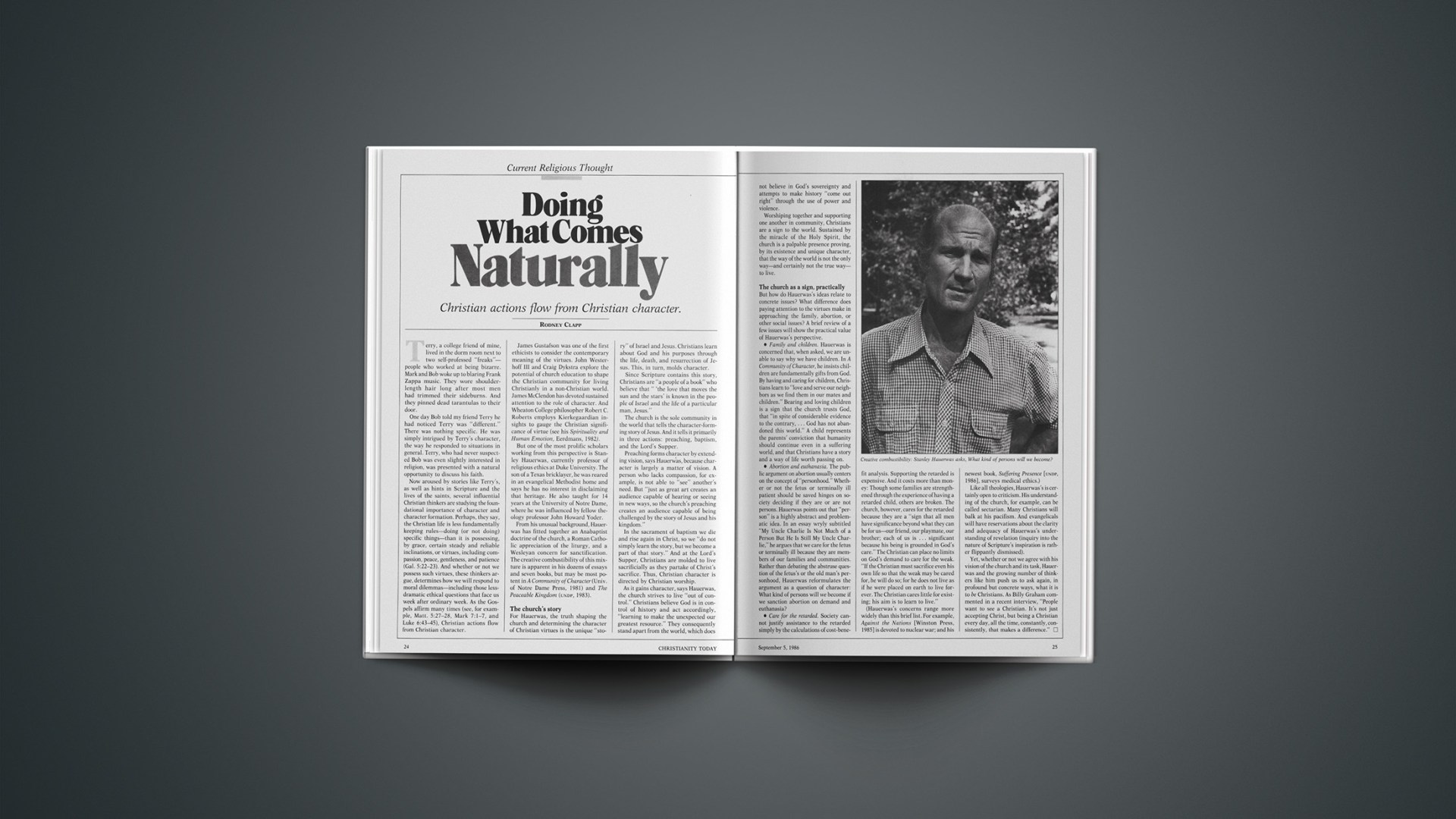
But one of the most prolific scholars working from this perspective is Stanley Hauerwas, currently professor of religious ethics at Duke University. The son of a Texas bricklayer, he was reared in an evangelical Methodist home and says he has no interest in disclaiming that heritage. He also taught for 14 years at the University of Notre Dame, where he was influenced by fellow theology professor John Howard Yoder.

From his unusual background, Hauerwas has fitted together an Anabaptist doctrine of the church, a Roman Catholic appreciation of the liturgy, and a Wesleyan concern for sanctification. The creative combustibility of this mixture is apparent in his dozens of essays and seven books, but may be most potent in A Community of Character (Uni v. of Notre Dame Press, 1981) and The Peaceable Kingdom (UNDP, 1983).

The Church’S Story

For Hauerwas, the truth shaping the church and determining the character of Christian virtues is the unique “story” of Israel and Jesus. Christians learn about God and his purposes through the life, death, and resurrection of Jesus. This, in turn, molds character.

Since Scripture contains this story, Christians are “a people of a book” who believe that “ ‘the love that moves the sun and the stars’ is known in the people of Israel and the life of a particular man, Jesus.”

The church is the sole community in the world that tells the character-forming story of Jesus. And it tells it primarily in three actions: preaching, baptism, and the Lord’s Supper.

Preaching forms character by extending vision, says Hauerwas, because character is largely a matter of vision. A person who lacks compassion, for example, is not able to “see” another’s need. But “just as great art creates an audience capable of hearing or seeing in new ways, so the church’s preaching creates an audience capable of being challenged by the story of Jesus and his kingdom.”

In the sacrament of baptism we die and rise again in Christ, so we “do not simply learn the story, but we become a part of that story.” And at the Lord’s Supper, Christians are molded to live sacrificially as they partake of Christ’s sacrifice. Thus, Christian character is directed by Christian worship.

As it gains character, says Hauerwas, the church strives to live “out of control.” Christians believe God is in control of history and act accordingly, “learning to make the unexpected our greatest resource.” They consequently stand apart from the world, which does not believe in God’s sovereignty and attempts to make history “come out right” through the use of power and violence.

Worshiping together and supporting one another in community, Christians are a sign to the world. Sustained by the miracle of the Holy Spirit, the church is a palpable presence proving, by its existence and unique character, that the way of the world is not the only way—and certainly not the true way—to live.

The Church As A Sign, Practically

But how do Hauerwas’s ideas relate to concrete issues? What difference does paying attention to the virtues make in approaching the family, abortion, or other social issues? A brief review of a few issues will show the practical value of Hauerwas’s perspective.

Family and children. Hauerwas is concerned that, when asked, we are unable to say why we have children. In A Community of Character, he insists children are fundamentally gifts from God. By having and caring for children, Christians learn to “love and serve our neighbors as we find them in our mates and children.” Bearing and loving children is a sign that the church trusts God, that “in spite of considerable evidence to the contrary, … God has not abandoned this world.” A child represents the parents’ conviction that humanity should continue even in a suffering world, and that Christians have a story and a way of life worth passing on.

Abortion and euthanasia. The public argument on abortion usually centers on the concept of “personhood.” Whether or not the fetus or terminally ill patient should be saved hinges on society deciding if they are or are not persons. Hauerwas points out that “person” is a highly abstract and problematic idea. In an essay wryly subtitled “My Uncle Charlie Is Not Much of a Person But He Is Still My Uncle Charlie,” he argues that we care for the fetus or terminally ill because they are members of our families and communities. Rather than debating the abstruse question of the fetus’s or the old man’s personhood, Hauerwas reformulates the argument as a question of character: What kind of persons will we become if we sanction abortion on demand and euthanasia?

Care for the retarded. Society cannot justify assistance to the retarded simply by the calculations of cost-benefit analysis. Supporting the retarded is expensive. And it costs more than money: Though some families are strengthened through the experience of having a retarded child, others are broken. The church, however, cares for the retarded because they are a “sign that all men have significance beyond what they can be for us—our friend, our playmate, our brother; each of us is … significant because his being is grounded in God’s care.” The Christian can place no limits on God’s demand to care for the weak. “If the Christian must sacrifice even his own life so that the weak may be cared for, he will do so; for he does not live as if he were placed on earth to live forever. The Christian cares little for existing; his aim is to learn to live.”

(Hauerwas’s concerns range more widely than this brief list. For example, Against the Nations [Winston Press, 1985] is devoted to nuclear war; and his newest book, Suffering Presence [UNDP, 1986], surveys medical ethics.)

Like all theologies, Hauerwas’s is certainly open to criticism. His understanding of the church, for example, can be called sectarian. Many Christians will balk at his pacifism. And evangelicals will have reservations about the clarity and adequacy of Hauerwas’s understanding of revelation (inquiry into the nature of Scripture’s inspiration is rather flippantly dismissed).

Yet, whether or not we agree with his vision of the church and its task, Hauerwas and the growing number of thinkers like him push us to ask again, in profound but concrete ways, what it is to be Christians. As Billy Graham commented in a recent interview, “People want to see a Christian. It’s not just accepting Christ, but being a Christian every day, all the time, constantly, consistently, that makes a difference.”

Roberta Hestenes: “Were All Called”

Roberta Hestenes is associate professor of Christian formation and discipleship at Fuller Theological Seminary in Pasadena. She is herself a graduate of the school, and has been a member of the faculty since 1975. She is also an ordained Presbyterian minister, and has firsthand knowledge of changes seen in recent years as more and more women have entered seminary and ministry. In an interview, she discussed her experience and views.

How have you seen opportunities for women in the church change over the past 25 years?

I was a student with my husband at Fuller from 1959 to 1961, and at that time we had very few women on campus. When I returned to Fuller as a faculty member in 1975, there were about 50 women in the student body. This year, we have over 700 women in in all the programs we offer. That is an enormous change. These women are entering a variety of church roles, many of which were not open to them 25 years ago.

What do you see happening in the next 15 years?

The fundamental issue facing the mainline churches will involve women serving as senior pastors. Women are being well accepted as assistant and associate pastors in team ministries, and there are hundreds of women serving as solo pastors, mainly in small, rural churches. Clergy couples are becoming common. There are now over 1,000 clergy couples serving denominations all over the country. We have not yet seen women emerging as senior pastors in larger, multiple-staff situations. What we have out there in the churches are women in their first jobs. Eventually, we will be faced with a phenomenon I call “all dressed up with no place to go.” Where are they going to go to find their second and third and fourth jobs?

Could you explain some of the history behind these recent changes?

I believe that this contemporary change in the role of women in the church lies in the Radical Reformation, the Quakers, and in the first feminist movement, which arose out of the movement to abolish slavery in the early and midnineteenth century. Many mainline, holiness, and Pentecostal churches had been ordaining women as elders and ministers for decades before the contemporary feminist movement began in the 1960s and ’70s. In the Presbyterian church, for instance, the movement to ordain women came in the 1930s through the 1950s. I think we have seen both progress and reaction as a result of the recent feminist movement, and now we have a polarized church.

When a church rejects the idea of women in leadership, is it because of theological issues or is it cultural?

It depends on the congregation, and particularly on what the pastor is teaching the congregation. In conservative churches, of course, there is always a concern for what Scripture says. The dividing line has been between those who assume that 1 Timothy 2 settles the issue forever and those who believe that interpretation of 1 Timothy 2 alongside Acts 2, Galatians 3, and 1 Corinthians 11 allows for the leadership of women as well as men in the church. This is the basic biblical issue.

Culturally, there has been a temptation to take a particular form of the nuclear family as it emerged in America after World War II and make it the “biblical norm” for all Christian families. The image of the ideal suburban family, with the woman as full-time homemaker, is a model of very short duration throughout church history. Scripture gets used, in this case, to support a view of the family that is shaped by culture. For instance, black women have always worked, and the church has never really debated whether the poor black woman must work. Ruth worked. Priscilla made tents alongside of Aquila. The biblical patterns are much more varied.

How do men respond to women in ministry?

I have found men, by and large, surprisingly accepting. They are uncomfortable in the face of the unknown, but, very often, when they come to know women in ministry, there is collegiality and support. Within very conservative parts of the church, there can be hostility. And in many churches there is a tendency to ignore women and not take them as seriously as men. My own experience is different. I came to Fuller as the only woman on the faculty of the school of theology. We now have six women faculty. I serve as the chairperson of the board of World Vision International, which was an all-male board. I travel the world, and I have been amazed and pleased that Christian men, when they are exposed to Christian women as partners in ministry, are much more accepting than the stereotypes would suggest.

How do you hope to see women in leadership contribute to the work of the church?

I hope for better evangelism. As more and more women work outside the home and move into leadership roles in the secular culture, I am convinced that a church that will not take them seriously will lose its ability to evangelize among them. You simply cannot say to a woman who is a senior vice-president of a bank and handles millions of dollars daily that women cannot handle money and that to be an obedient Christian woman, she must not use these abilities.

We’re all called to ministry. As the church takes seriously its women and the diversity of their gifts and calling, that is part of taking seriously the ministry of all of the people of God, to accomplish the task that desperately needs to be done. Both their résumés were sent to a church to which only David had planned to apply. The search committee was open to the idea—even excited about it. So the couple went there as a team and split church duties “right down the middle,” Dereen says. “It worked very well until we had children and needed extra income.” (She has now relinquished most of her pulpit responsibilities.)

The advantages of having copastors were readily recognized by the Vanderlinde-Abernathys’ congregation. “People had options—a choice of two personalities, two sets of gifts. Or they could come to both of us for counseling.”

But churches with the numbers and the budget to support two pastors are few and far between. In addition, some denominational structures work against the team approach. In the United Methodist hierarchy, new pastors are placed in small parishes with two or three other churches tied into the same “circuit.” If a husband and wife are both ordained, Methodist district superintendents face a tricky placement problem.

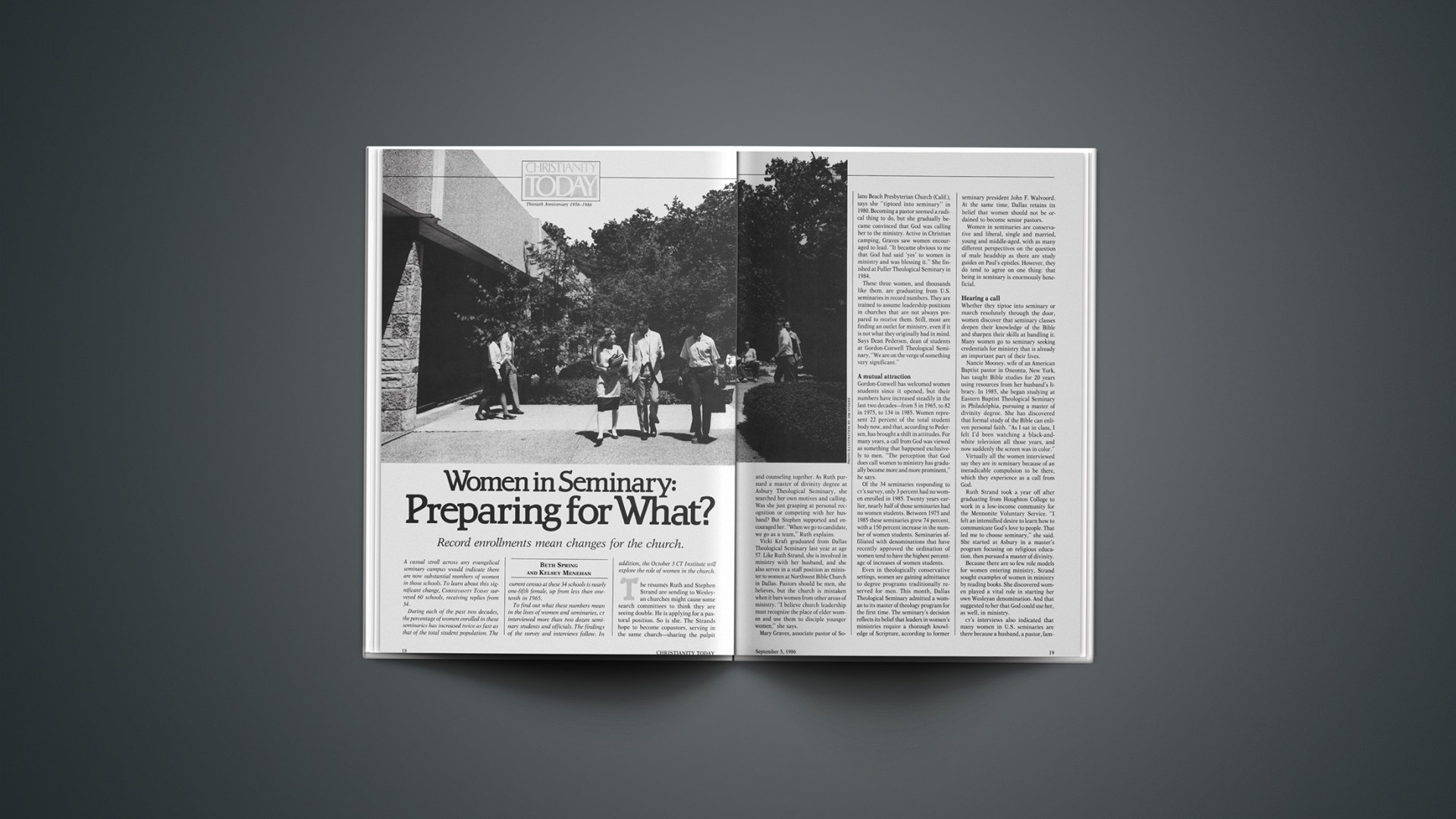
Women in Seminary: Preparing for What?: Record Enrollments Mean Changes for the Church

BETH SPRING AND KELSEY MENEHAN1Kelsey Menehan is associate editor of Today’s Christian Woman and a free-lance writer, living in Bethesda, Maryland.

A casual stroll across any evangelical seminary campus would indicate there are now substantial numbers of women in those schools. To learn about this significant change, CHRISTIANITY TODAY surveyed 60 schools, receiving replies from 34.

During each of the past two decades, the percentage of women enrolled in these seminaries has increased twice as fast as that of the total student population. The current census at these 34 schools is nearly one-fifth female, up from less than one-tenth in 1965.

To find out what these numbers mean in the lives of women and seminaries, CT interviewed more than two dozen seminary students and officials. The findings of the survey and interviews follow. In addition, the October 3 CT Institute will explore the role of women in the church.

The résumés Ruth and Stephen Strand are sending to Wesleyan churches might cause some search committees to think they are seeing double. He is applying for a pastoral position. So is she. The Strands hope to become copastors, serving in the same church—sharing the pulpit and counseling together. As Ruth pursued a master of divinity degree at Asbury Theological Seminary, she searched her own motives and calling. Was she just grasping at personal recognition or competing with her husband? But Stephen supported and encouraged her. “When we go to candidate, we go as a team,” Ruth explains.

Vicki Kraft graduated from Dallas Theological Seminary last year at age 57. Like Ruth Strand, she is involved in ministry with her husband, and she also serves in a staff position as minister to women at Northwest Bible Church in Dallas. Pastors should be men, she believes, but the church is mistaken when it bars women from other areas of ministry. “I believe church leadership must recognize the place of elder women and use them to disciple younger women,” she says.

Mary Graves, associate pastor of Solano Beach Presbyterian Church (Calif.), says she “tiptoed into seminary” in 1980. Becoming a pastor seemed a radical thing to do, but she gradually became convinced that God was calling her to the ministry. Active in Christian camping, Graves saw women encouraged to lead. “It became obvious to me that God had said ‘yes’ to women in ministry and was blessing it.” She finished at Fuller Theological Seminary in 1984.

These three women, and thousands like them, are graduating from U.S. seminaries in record numbers. They are trained to assume leadership positions in churches that are not always prepared to receive them. Still, most are finding an outlet for ministry, even if it is not what they originally had in mind. Says Dean Pedersen, dean of students at Gordon-Conwell Theological Seminary, “We are on the verge of something very significant.”

A Mutual Attraction

Gordon-Conwell has welcomed women students since it opened, but their numbers have increased steadily in the last two decades—from 5 in 1965, to 82 in 1975, to 134 in 1985. Women represent 22 percent of the total student body now, and that, according to Pedersen, has brought a shift in attitudes. For many years, a call from God was viewed as something that happened exclusively to men. “The perception that God does call women to ministry has gradually become more and more prominent,” he says.

Of the 34 seminaries responding to CT’s survey, only 3 percent had no women enrolled in 1985. Twenty years earlier, nearly half of those seminaries had no women students. Between 1975 and 1985 these seminaries grew 74 percent, with a 150 percent increase in the number of women students. Seminaries affiliated with denominations that have recently approved the ordination of women tend to have the highest percentage of increases of women students.

Even in theologically conservative settings, women are gaining admittance to degree programs traditionally reserved for men. This month, Dallas Theological Seminary admitted a woman to its master of theology program for the first time. The seminary’s decision reflects its belief that leaders in women’s ministries require a thorough knowledge of Scripture, according to former seminary president John F. Walvoord. At the same time, Dallas retains its belief that women should not be ordained to become senior pastors.

Women in seminaries are conservative and liberal, single and married, young and middle-aged, with as many different perspectives on the question of male headship as there are study guides on Paul’s epistles. However, they do tend to agree on one thing: that being in seminary is enormously beneficial.

Hearing A Call

Whether they tiptoe into seminary or march resolutely through the door, women discover that seminary classes deepen their knowledge of the Bible and sharpen their skills at handling it. Many women go to seminary seeking credentials for ministry that is already an important part of their lives.

Nancie Mooney, wife of an American Baptist pastor in Oneonta, New York, has taught Bible studies for 20 years using resources from her husband’s library. In 1985, she began studying at Eastern Baptist Theological Seminary in Philadelphia, pursuing a master of divinity degree. She has discovered that formal study of the Bible can enliven personal faith. “As I sat in class, I felt I’d been watching a black-and-white television all those years, and now suddenly the screen was in color.”

Virtually all the women interviewed say they are in seminary because of an ineradicable compulsion to be there, which they experience as a call from God.

Ruth Strand took a year off after graduating from Houghton College to work in a low-income community for the Mennonite Voluntary Service. “I felt an intensified desire to learn how to communicate God’s love to people. That led me to choose seminary,” she said. She started at Asbury in a master’s program focusing on religious education, then pursued a master of divinity.

Because there are so few role models for women entering ministry, Strand sought examples of women in ministry by reading books. She discovered women played a vital role in starting her own Wesleyan denomination. And that suggested to her that God could use her, as well, in ministry.

CT’s interviews also indicated that many women in U.S. seminaries are there because a husband, a pastor, family, or friends recognized undeveloped ministry gifts in them and urged them to go. Joan Friesen, an American Baptist, has seen her calling unfold over a long period of time. A business major, she worked as an accountant for a small gasoline company in Eugene, Oregon. She became active with her young adult group at church, and as a result, wrote away for seminary catalogues that wound up forgotten in desk drawers.

“I gave myself a year to decide whether to get an M.B.A., move to another company, or go to seminary. My boss took me out to lunch and offered an opportunity for advancement. When I told him of my interest in seminary, he said, ‘That’s what you should do.’ ” Further discussions with family and friends confirmed the leading, and she enrolled at a branch of American Baptist Seminary of the West.

What Women Experience At Seminary

Even though the women interviewed find seminary to be an ideal environment for nurturing their gifts, they are not always prepared for the reactions their presence provokes: perplexity, curiosity, skepticism, and occasionally, outright opposition.

Faculty members have challenged women students about their call to the ministry. Women in such situations experience “a real internal struggle, soul-searching, and anger,” Ruth Strand says.

Being “an issue” on campus catches some women by surprise. Many women “grew up in churches and just want to serve the Lord,” according to a Denver Seminary official. “Their first experience of opposition really shakes them, because they take it personally.” A woman seminarian at Gordon-Conwell was told by a male student that she could not post a notice on a student bulletin board called “Iron Sharpens Iron,” because the board’s namesake Bible verse concludes, “as one man sharpens another.” A young male student told Vicki Kraft at Dallas that seminaries should not be coed because “women are distracting.”

Several seminary administrators acknowledged to CT that much of the opposition is almost comical and has little to do with scriptural issues. Says James Sweeney, dean of students at Western Baptist Seminary, “In the past there was a high level of chauvinism expressed as biased views often are—in spiritual clothing. Some of the early women who bore the brunt of that were superior students, so that may well have threatened male students.”

Mike Eurit, a third-year student at Asbury, came there with questions of his own about women in ministry. But after interacting with women students, he says, “I ’ve changed my mind. I believe their call is true. They are not confused.” Mike may be characteristic of the majority of male seminarians who have had little or no exposure to women in ministry. Their questions stem more from curiosity than rigidly held doctrinal beliefs.

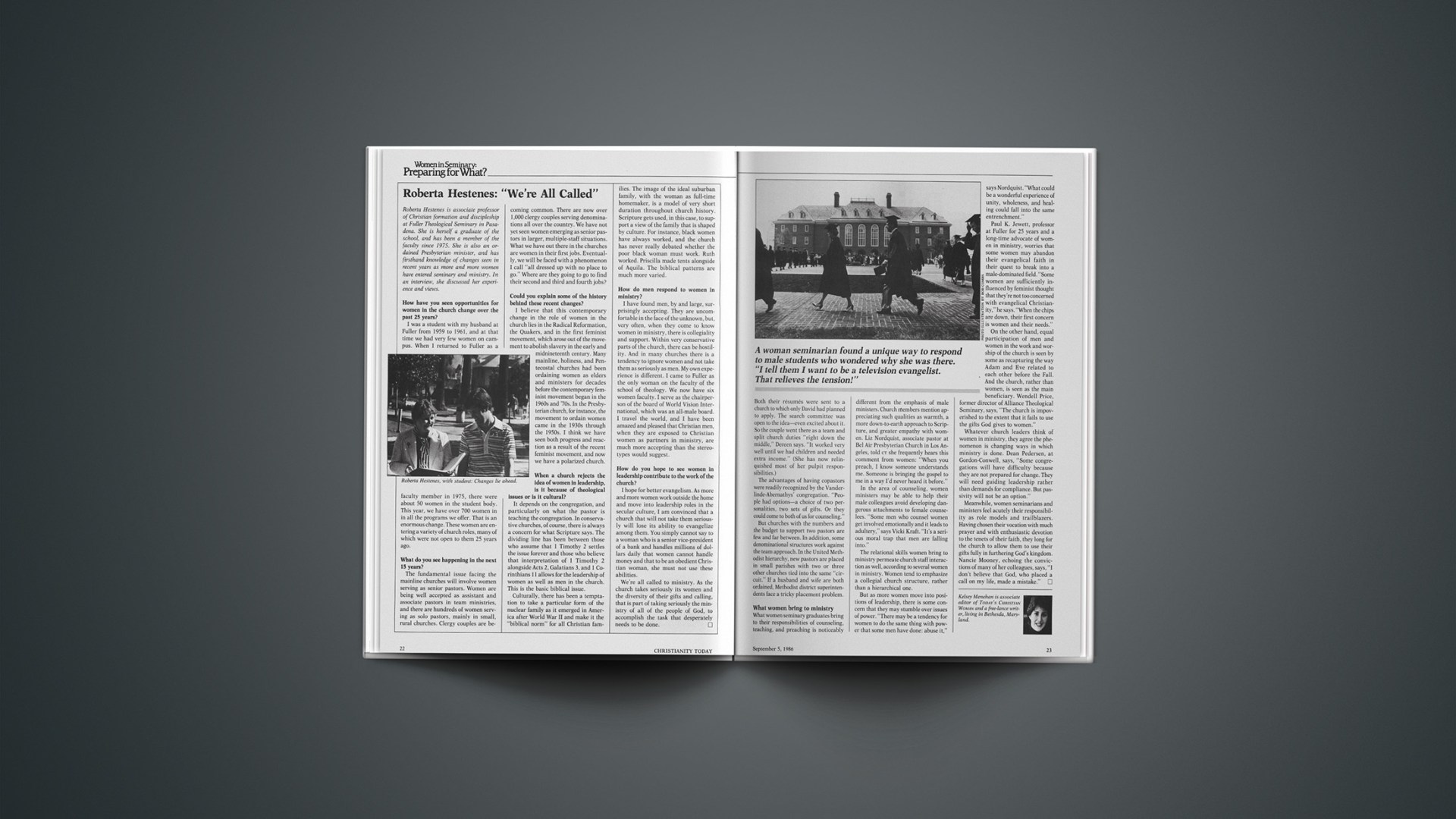
For her part, Lisa Christian, a first-year counseling major in the master of divinity program at Western Conservative Baptist Seminary, found a unique way to respond to inquisitive male students. “I tell them I want to be a television evangelist. That relieves the tension!”

Male and female students in seminaries learn to live with a degree of tension, however, in forming relationships with one another. Gordon-Conwell’s Pedersen asks, “Are women and men here to study or find a mate? Are they colleagues, scholars, or friends? Where does that end and the romantic begin?” That ambiguity often continues when women leave seminary and enter ministry positions. Mary Graves, 32 and single, has discovered “there are lots of moms who would love to have their daughters marry a pastor, but it’s not true in the reverse.”

Ambiguity about relationships and a lack of role models can compound feelings of isolation on campus. Dereen Vanderlinde-Abernathy, a 1978 graduate of Gordon-Conwell, copastors a Congregational church with her husband, David. “In my basic preaching class, it was 63 men and me,” she recalls. “I’m the first woman I’ve ever heard preach.”

How Seminaries Are Responding

CT learned that increasing numbers of seminaries are taking steps to address the needs of women students—from hiring female professors to restructuring courses to reevaluating administrative policies. And in so doing, seminaries are testing traditional understandings of what it means to be a minister.

Haddon Robinson, president of Denver Seminary, says he wants to hire more women faculty members, but “it is still true that the husband’s job determines where the family will move.” At Asbury, officials are convinced the seminary will have to nurture its own “homegrown” female professors by identifying qualified individuals and shaping their development as they work toward doctoral degrees.

Curriculum changes have come more easily. At Trinity Evangelical Divinity School, a course entitled “Homiletics for Women” has evolved from teaching pastors’ wives to evaluate sermons to a preaching lab for women. Practical theology professor Jim Westgate said he changed the class focus three years ago, because women persuaded him that they, too, needed to know how to teach and handle the Bible correctly.

Nearly every seminary now has at least one course related specifically to women in ministry, and often these courses draw large enrollments. Several schools have designated an administrator to handle “women’s concerns.” But the most significant soul-searching has revolved around the master of divinity program (M.Div.): What is its purpose? Who is the program designed to train?

The issue came to a head five years ago at Western Conservative Baptist Seminary when women were enrolling primarily in master’s programs other than the M.Div. Questions arose about women attending the seminary, and, forced to take a stand, the faculty reaffirmed that the M.Div. degree was open to women with the understanding that they were not being trained to become senior pastors.

At Fuller Seminary, where the most significant struggles regarding women occurred a decade ago, a new set of concerns has come into focus. In response to a course, “Women in Transition,” a new course, “Men in Difficult Times,” is being offered. “It never occurred to men that if women changed, that means something for them, too,” says Libbie Patterson, director of career placement. “Both men and women are asking, ‘What does it mean to be a minister, to be created male and female?’ ”

Beyond Seminary: Women And The Church

Outside seminary walls, such questions are not being asked with the same regularity or urgency. For many Christians in the church pew, “minister” means “male.” In mainline Protestant denominations, the question has for the most part been officially settled, although not all lay church members accept the verdict of their leaders. In evangelical circles, the question is very much alive, and it cropped up at denominational meetings this summer. These perceptions may squeeze women seminary graduates into a placement bottleneck.

“Search committees inevitably ask, ‘Will her husband be willing to quit his job when she moves to another church?’ and ‘Who will take care of the children?’ ” says Haddon Robinson. For these and other reasons, theologically conservative churches intent on supporting the family are often hesitant to hire a woman for a full-time staff position.

Even in churches where women are accepted as staff pastors, there is a growing concern that they will have trouble moving on to more challenging second and third positions. The senior pastorate, a logical career goal for male ministers, has yet to open up to women.

On the other hand, husband and wife pastoral teams are gaining increased acceptance, perhaps signaling a new ecclesiastical trend. Such an arrangement helps diminish congregational questions of headship and authority.

David and Dereen Vanderlinde-Abernathy became copastors of a Congregational church (UCC) because of a mix-up.

What Women Bring To Ministry

What women seminary graduates bring to their responsibilities of counseling, teaching, and preaching is noticeably different from the emphasis of male ministers. Church members mention appreciating such qualities as warmth, a more down-to-earth approach to Scripture, and greater empathy with women. Liz Nordquist, associate pastor at Bel Air Presbyterian Church in Los Angeles, told CT she frequently hears this comment from women: “When you preach, I know someone understands me. Someone is bringing the gospel to me in a way I’d never heard it before.”

In the area of counseling, women ministers may be able to help their male colleagues avoid developing dangerous attachments to female counselees. “Some men who counsel women get involved emotionally and it leads to adultery,” says Vicki Kraft. “It’s a serious moral trap that men are falling into.”

The relational skills women bring to ministry permeate church staff interaction as well, according to several women in ministry. Women tend to emphasize a collegial church structure, rather than a hierarchical one.

But as more women move into positions of leadership, there is some concern that they may stumble over issues of power. “There may be a tendency for women to do the same thing with power that some men have done: abuse it,” says Nordquist. “What could be a wonderful experience of unity, wholeness, and healing could fall into the same entrenchment.”

Paul K. Jewett, professor at Fuller for 25 years and a long-time advocate of women in ministry, worries that some women may abandon their evangelical faith in their quest to break into a male-dominated field. “Some women are sufficiently influenced by feminist thought that they’re not too concerned with evangelical Christianity,” he says. “When the chips are down, their first concern is women and their needs.”

On the other hand, equal participation of men and women in the work and worship of the church is seen by some as recapturing the way Adam and Eve related to each other before the Fall. And the church, rather than women, is seen as the main beneficiary. Wendell Price, former director of Alliance Theological Seminary, says, “The church is impoverished to the extent that it fails to use the gifts God gives to women.” Whatever church leaders think of women in ministry, they agree the phenomenon is changing ways in which ministry is done. Dean Pedersen, at Gordon-Con well, says, “Some congregations will have difficulty because they are not prepared for change. They will need guiding leadership rather than demands for compliance. But passivity will not be an option.”

Meanwhile, women seminarians and ministers feel acutely their responsibility as role models and trailblazers. Having chosen their vocation with much prayer and with enthusiastic devotion to the tenets of their faith, they long for the church to allow them to use their gifts fully in furthering God’s kingdom. Nancie Mooney, echoing the convictions of many of her colleagues, says, “I don’t believe that God, who placed a call on my life, made a mistake.”

Ideas

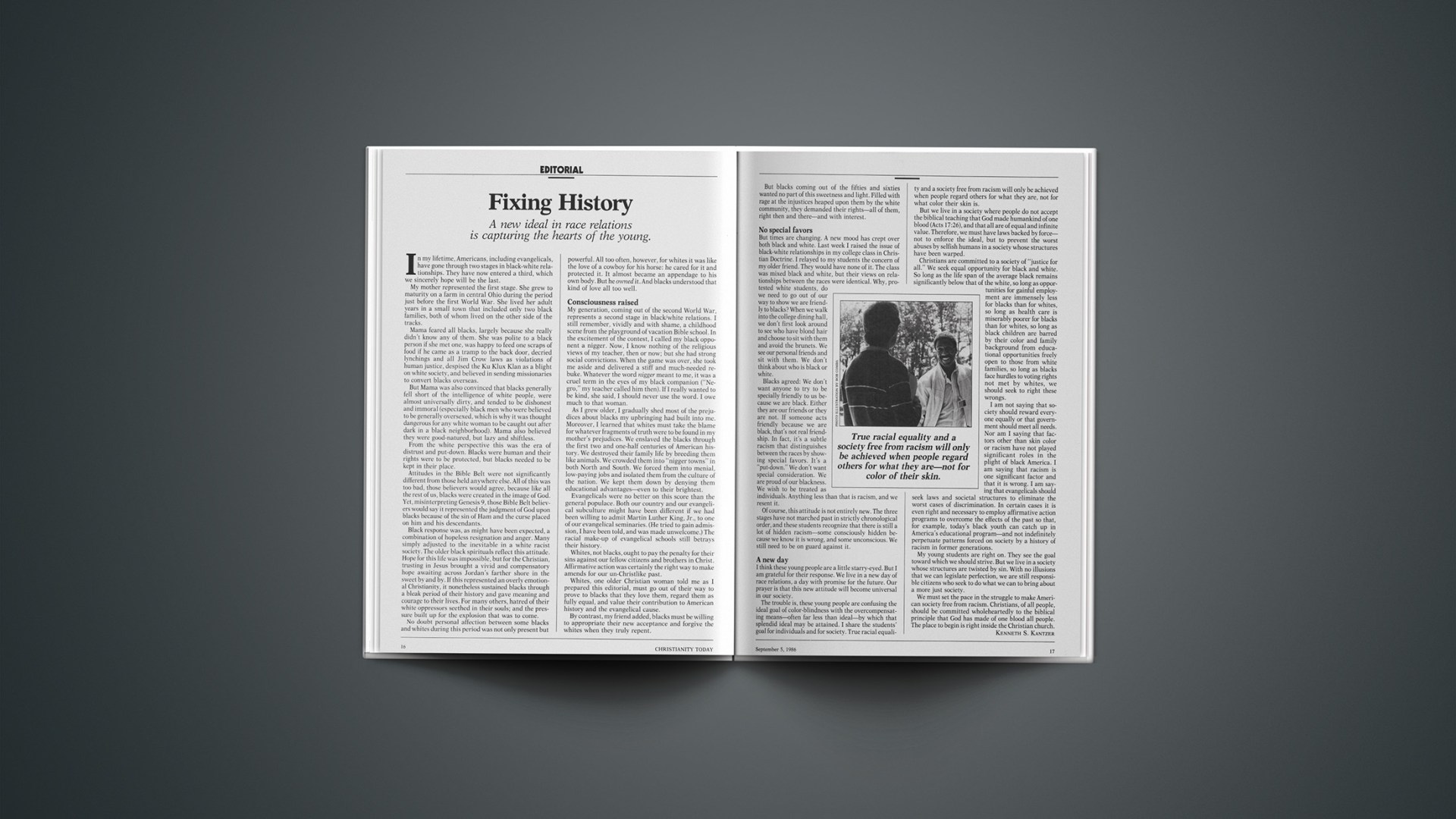
Fixing History

A new ideal in race relations is capturing the hearts of the young.

In my lifetime, Americans, including evangelicals, have gone through two stages in black-white relationships. They have now entered a third, which we sincerely hope will be the last.

My mother represented the first stage. She grew to maturity on a farm in central Ohio during the period just before the first World War. She lived her adult years in a small town that included only two black families, both of whom lived on the other side of the tracks.

Mama feared all blacks, largely because she really didn’t know any of them. She was polite to a black person if she met one, was happy to feed one scraps of food if he came as a tramp to the back door, decried lynchings and all Jim Crow laws as violations of human justice, despised the Ku Klux Klan as a blight on white society, and believed in sending missionaries to convert blacks overseas.

But Mama was also convinced that blacks generally fell short of the intelligence of white people, were almost universally dirty, and tended to be dishonest and immoral (especially black men who were believed to be generally oversexed, which is why it was thought dangerous for any white woman to be caught out after dark in a black neighborhood). Mama also believed they were good-natured, but lazy and shiftless.

From the white perspective this was the era of distrust and put-down. Blacks were human and their rights were to be protected, but blacks needed to be kept in their place.

Attitudes in the Bible Belt were not significantly different from those held anywhere else. All of this was too bad, those believers would agree, because like all the rest of us, blacks were created in the image of God. Yet, misinterpreting Genesis 9, those Bible Belt believers would say it represented the judgment of God upon blacks because of the sin of Ham and the curse placed on him and his descendants.

Black response was, as might have been expected, a combination of hopeless resignation and anger. Many simply adjusted to the inevitable in a white racist society. The older black spirituals reflect this attitude. Hope for this life was impossible, but for the Christian, trusting in Jesus brought a vivid and compensatory hope awaiting across Jordan’s farther shore in the sweet by and by. If this represented an overly emotional Christianity, it nonetheless sustained blacks through a bleak period of their history and gave meaning and courage to their lives. For many others, hatred of their white oppressors seethed in their souls; and the pressure built up for the explosion that was to come.

No doubt personal affection between some blacks and whites during this period was not only present but powerful. All too often, however, for whites it was like the love of a cowboy for his horse: he cared for it and protected it. It almost became an appendage to his own body. But he owned it. And blacks understood that kind of love all too well.

Consciousness Raised

My generation, coming out of the second World War, represents a second stage in black/white relations. I still remember, vividly and with shame, a childhood scene from the playground of vacation Bible school. In the excitement of the contest, I called my black opponent a nigger. Now, I know nothing of the religious views of my teacher, then or now; but she had strong social convictions. When the game was over, she took me aside and delivered a stiff and much-needed rebuke. Whatever the word nigger meant to me, it was a cruel term in the eyes of my black companion (“Negro,” my teacher called him then). If I really wanted to be kind, she said, I should never use the word. I owe much to that woman.

As I grew older, I gradually shed most of the prejudices about blacks my upbringing had built into me. Moreover, I learned that whites must take the blame for whatever fragments of truth were to be found in my mother’s prejudices. We enslaved the blacks through the first two and one-half centuries of American history. We destroyed their family life by breeding them like animals. We crowded them into “nigger towns” in both North and South. We forced them into menial, low-paying jobs and isolated them from the culture of the nation. We kept them down by denying them educational advantages—even to their brightest.

Evangelicals were no better on this score than the general populace. Both our country and our evangelical subculture might have been different if we had been willing to admit Martin Luther King, Jr., to one of our evangelical seminaries. (He tried to gain admission, I have been told, and was made unwelcome.) The racial make-up of evangelical schools still betrays their history.

Whites, not blacks, ought to pay the penalty for their sins against our fellow citizens and brothers in Christ. Affirmative action was certainly the right way to make amends for our un-Christlike past.

Whites, one older Christian woman told me as I prepared this editorial, must go out of their way to prove to blacks that they love them, regard them as fully equal, and value their contribution to American history and the evangelical cause.

By contrast, my friend added, blacks must be willing to appropriate their new acceptance and forgive the whites when they truly repent.

But blacks coming out of the fifties and sixties wanted no part of this sweetness and light. Filled with rage at the injustices heaped upon them by the white community, they demanded their rights—all of them, right then and there—and with interest.

No Special Favors

But times are changing. A new mood has crept over both black and white. Last week I raised the issue of black-white relationships in my college class in Christian Doctrine. I relayed to my students the concern of my older friend. They would have none of it. The class was mixed black and white, but their views on relationships between the races were identical. Why, protested white students, do we need to go out of our way to show we are friendly to blacks? When we walk into the college dining hall, we don’t first look around to see who have blond hair and choose to sit with them and avoid the brunets. We see our personal friends and sit with them. We don’t think about who is black or white.

Blacks agreed: We don’t want anyone to try to be specially friendly to us because we are black. Either they are our friends or they are not. If someone acts friendly because we are black, that’s not real friendship. In fact, it’s a subtle racism that distinguishes between the races by showing special favors. It’s a “put-down.” We don’t want special consideration. We are proud of our blackness. We wish to be treated as individuals. Anything less than that is racism, and we resent it.

Of course, this attitude is not entirely new. The three stages have not marched past in strictly chronological order, and these students recognize that there is still a lot of hidden racism—some consciously hidden because we know it is wrong, and some unconscious. We still need to be on guard against it.

A New Day

I think these young people are a little starry-eyed. But I am grateful for their response. We live in a new day of race relations, a day with promise for the future. Our prayer is that this new attitude will become universal in our society.

The trouble is, these young people are confusing the ideal goal of color-blindness with the overcompensating means—often far less than ideal—by which that splendid ideal may be attained. I share the students’ goal for individuals and for society. True racial equality and a society free from racism will only be achieved when people regard others for what they are, not for what color their skin is.

But we live in a society where people do not accept the biblical teaching that God made humankind of one blood (Acts 17:26), and that all are of equal and infinite value. Therefore, we must have laws backed by force—not to enforce the ideal, but to prevent the worst abuses by selfish humans in a society whose structures have been warped.

Christians are committed to a society of “justice for all.” We seek equal opportunity for black and white. So long as the life span of the average black remains significantly below that of the white, so long as opportunities for gainful employment are immensely less for blacks than for whites, so long as health care is miserably poorer for blacks than for whites, so long as black children are barred by their color and family background from educational opportunities freely open to those from white families, so long as blacks face hurdles to voting rights not met by whites, we should seek to right these wrongs.

I am not saying that society should reward everyone equally or that government should meet all needs. Nor am I saying that factors other than skin color or racism have not played significant roles in the plight of black America. I am saying that racism is one significant factor and that it is wrong. I am saying that evangelicals should seek laws and societal structures to eliminate the worst cases of discrimination. In certain cases it is even right and necessary to employ affirmative action programs to overcome the effects of the past so that, for example, today’s black youth can catch up in America’s educational program—and not indefinitely perpetuate patterns forced on society by a history of racism in former generations.

My young students are right on. They see the goal toward which we should strive. But we live in a society whose structures are twisted by sin. With no illusions that we can legislate perfection, we are still responsible citizens who seek to do what we can to bring about a more just society.

We must set the pace in the struggle to make American society free from racism. Christians, of all people, should be committed wholeheartedly to the biblical principle that God has made of one blood all people. The place to begin is right inside the Christian church.

KENNETH S. KANTZER

Don’t Ask Me What I “Do”

Speaking Out offers responsible Christians a forum. It does not necessarily reflect the views of CHRISTIANITY TODAY.1By Steve Jolley, pastor of Santa Barbara Community Church (Calif.). He is currently cowriting a book on the Christian and work.

When I go to a party, meet a neighbor, or am introduced to anyone, the inevitable question rears its ugly head: “What do you do?”

I resent that question. “Who are you?” or “What are your interests?” would be better questions. To be defined by how I earn my living bothers me.

In our society, work defines who we are. Work is no longer just work; it is an extension of our very being. No longer do we have jobs; we have “careers.” No longer do people find satisfaction in providing for their families; they now need “fulfillment” from their work. Some, the unlucky ones, even feel they have found “meaning” in their places of employment. For these, salvation is found in a well-placed resume.

This is a sad state of affairs for anyone, but especially for Christians, who should be defined by their relationship to Christ.

Christians who allow their employment to define them become trapped in hierarchies of power, prestige, and pedigree. The pernicious effects on the unity of the body of Christ, especially in its local manifestation, are pronounced. All too often, leadership in a local church is based upon financial success, rather than spiritual maturity.

Consider how often we find that serving on a church board or in other positions of leadership is contingent upon accomplishment in the workplace. Further, consider how many local churches take pride in the number of community leaders who are members.

I understand why so many people seek “fulfillment” or “meaning” in their jobs. Jobs can meet legitimate ego needs. But Christians—who ought to know better—are meeting their primary needs for self-esteem, meaning, and fulfillment in their jobs, rather than through kingdom ministry. The vast majority of Christians spend more emotional energy compiling a business plan than in laying strategies to affect the world for Christ. They find more personal satisfaction if their sales figures are up than if their next-door neighbor responds to the gospel. They somehow feel more “secure” after they have received a raise than because they have been raised with Christ.

The Temporal And The Eternal

There are at least two critical reasons why this troublesome scenario exists:

First, Christians have failed to distinguish between temporal and eternal labor. The purpose of temporal labor is clearly seen in Scripture. For example, Paul says, “If any one does not provide for his relatives, and especially for his own family, he has disowned the faith and is worse than an unbeliever” (1 Tim. 5:8). Paul again affirms the value of temporal labor in Ephesians 4:28: “Let the thief no longer steal, but rather let him labor, doing honest work with his hands, so that he may be able to give to those in need.” Temporal labor is good and has value in that, at minimum, it provides for the physical needs of ourselves and others. With Calvin and the other Reformers, we must strongly assert that temporal labor is good and ordained by God at Creation. However, our temporal labor must be understood in relation to our eternal labor.

Scripture delineates the value of eternal labor. In evaluating his own life, Paul muses on his reason for being: “For to me to live is Christ, and to die is gain. If it is to be life in the flesh, that means fruitful labor for me” (Phil. 1:21–22a).

Put simply, labor has value when we know its purpose. When Christians confuse temporal labor with eternal labor, there is a distinct probability that temporal labor will begin to usurp the place of kingdom work.

Stroking Egos

Second, Christians place an inappropriate amount of importance on their jobs because of their real needs for self-esteem. Secular employers have done a better job of stroking ego needs than most local churches. Compare the salesman who makes the big sale and receives both hearty congratulations from higher-ups and a hefty check for the effort, to the Christian who faithfully leads a Bible study, shares Christ with a neighbor, or disciples a brother or sister. Business offers immediate, tangible rewards, while the church lets labor go unnoticed and unrewarded. Add the meeting of ego needs to the tremendous importance our culture places on what you “do,” and it is little wonder that Christians have such difficulty distinguishing the relative value of temporal and eternal labor.

I am not worried because believers find importance in their jobs. I am worried by the inappropriate amount of importance that work occupies in the Christian life. At life’s end, I don’t want to be like the disgruntled writer of Ecclesiastes, “Sol … gave my heart up to despair over all the toil of my labors under the sun” (2:20). I want to find meaning in my life in Christ, not in my sales figures or corporate status. I want to find my primary needs for self-esteem and fulfillment met through service to the risen Lord.

By Steve Jolley, pastor of Santa Barbara Community Church (Calif.). He is currently cowriting a book on the Christian and work.

Evangelicalism’s Lost Cross

There are certain advantages to growing old. One’s memory, for instance, is so much longer. And memories of the past provide data for interpreting and understanding the present. (That, apparently, is why we associate wisdom with the older—or at least with some of those who are older!)

Age also makes possible a bit more detachment. A person can look at life, and even those things loved or detested, a bit more objectively. Perhaps that is why after living through almost two-thirds of the twentieth century I find myself looking reflectively at the greatest single passion of my life since my teens—evangelicalism.

Sometimes one can sum up an age in a phrase. Just a line seems to catch the essential thrust of a movement or an era. I wonder if that is true of twentieth-century American evangelicalism. And I wonder, too, if the movement’s descriptive phrase is not the simple exhortation, “Receive Christ.”

After all, who among us has not known the burden of guilt and found that Christ alone brought absolution. We have experienced that existential loneliness that so marks modem man. What a delight, then, to think of the living Christ and his ability to surprise us with joy. And as a result of that joy, we want to commend the Savior who has made life more bearable to a world with which we empathize.

Still, the command “receive me” is not Jesus’ most common call to discipleship. His word to Philip, John, James, Matthew, and the like was not “receive me” but “follow me.” And there is a difference between these two.

“Receive me” has an element of narcissism. The connotation is one of personal trouble, emptiness, and burden that Christ can relieve to our delight. We gain and are soothed.

But “follow me” has Christ, not me, at the center. The appeal is not what I will get but where I will have to go and what I will need to give. The shadow of a cross becomes a part of the landscape. Such an exhortation is a bit more radical, certainly more frightening, even if the prospective company seems alluring.

It is not easy for fallen man to see the gospel whole—to understand that “receiving” is only the beginning. So it is possible for whole generations to miss crucial aspects of biblical truth. (We Protestants do not hesitate to say that the age before Luther missed a good bit of it.)

Perhaps that is why we are not finding in the evangelical world a cry for discipleship, spiritual formation, and holiness. Our hearts in their better moments do tell us that it is not enough to get what Christ has to offer, that the call to be holy is as biblical a theme as the call to be saved. But how soon we forget that the development of the scriptural theme of sacrifice not only speaks of his sacrifice for us but of our sacrifice of self for him. Perhaps he did mean that we should follow him.

Could this be at least part of the reason the midtwentieth-century evangelical church has been so reluctant to take on the evils of our world and challenge the hostile powers that lay claim to his creation? That would threaten our security, our success, and our peace of mind. But it might produce a quality of Christian more worthy of identification with the one on that cross.

The last century may have been more primitive than ours, but at least it produced heroes. If there was an evil perceived, there was someone to challenge it. Whether it was the entrenched social institution of slavery, a difficult-to-reach unevangelized world, an industry like the liquor traffic, a social injustice like the oppression of women, or the Iostness of the needy in the slums of the teeming cities, there was someone to challenge. General Blucher stood atop Saint Paul’s Cathedral in London looking at the teeming city below and said, “What a city for loot.” But Gen. William Booth said, “What a city for God,” as he walked its slums.

But to take it he had to follow Christ, not just receive him.

Letters

Is The U.S. God’S Land?

Thank you for Mark Noll’s balanced and thoughtful editorial, “Is This Land God’s Land?” [July 11]. It was a much needed statement. The view held by so many Christians that America is God’s chosen nation has caused great harm, both in the church and in the political arena. Of all people, Christians should have a broader world view that extends beyond nationalistic loyalties.

CYNTHIA BENSON

Andover, N.H.

Thanks for your editorial. On July 4th, our family enjoyed cooking out, eating watermelon, watching the New York gala on TV, and viewing a nearby fireworks display. But this year there was a patriotic “plus”: I took time out for a quiet hour of reading the entire U.S. Constitution. That’s one way all Americans can approach next year’s bicentennial of our Constitution.

The statue in New York is a symbol of our liberty; the Constitution is the substance of our liberty.

DICK JENSEN

Memphis, Tenn.

Noll’s editorial wisely steers between two simple-minded views about America and its place in the world. The messianic view is clearly unscriptural, although God may well intend different roles for different nations. The view that America is the epitome of evil is simply dishonest. Both views have forgotten that all people are sinners and have fallen short of God’s standards. Both views seem to expect exalted moral behavior from this nation of mere mortals. The difference is that the simpletons on the Right seem to believe that we have in fact reached exalted status, while the simpletons on the Left seem to believe that our failure to live up to perfection somehow condemns everything about America.

To the extent America does reflect and practice biblical principles, it is because the past generations tried to bring the nation into line with those principles. That some Christians have confused Americanism with Christianity is in one sense a tribute to the partial success of past efforts. Lincoln was right about America having a special role. But the proper response to that role is not pride, but stewardship.

WAYNE SHOCKLEY

Brooklyn, Wis.

As a Christian and patriotic Canadian, I appreciated Noll’s editorial. It seems to me that American messianism, linked as it is to nationalism, implies that the national aspirations of all other countries are subservient to those of the U.S.A. Indeed, other countries’ aspirations could easily become labeled demonic, and hence, targets for military intervention.

Any messianism, other than that of Christ, is heretical.

REV. TOM BROWNLEE

Saskatoon, Sask., Canada

How Do Churches Grow?

I found Sharon Mumper’s article “Where in the World Is the Church Growing?” [July 11] interesting and exciting. But I was somewhat troubled by the implications of her analysis of the rapid growth of the Pentecostal churches, particularly in Brazil. Paraphrasing Peter Wagner, she writes: “These people can be reached only by those who know how to handle the supernatural.” If the gospel itself does not concern the supernatural, what is its point? On what basis are the other churches growing?

J. PHILIP BAYS

Niles, Mich.

As an Anglican (and therefore within the Catholic tradition), though I find myself in sympathy with believers in the fundamentals of the Christian tradition, I am constantly repulsed by the arrogance of articles like this one. If my experience in this community is any indication, the “church” of which you speak grows not by adding former unbelievers to the ranks of those united to Christ by baptism, but by proselytizing those already within the body of Christ.

FR. WINSTON, F. JENSEN

Church of Saint Alban the Martyr

Superior, Wis.

Honest Tidings

Ever since that seminar last spring, “Confronting in Love,” our church has been on an openness and honesty kick. Abigail Abbott, our “Sunshine Sister,” is leading the way. She’s in charge of sending greeting cards on behalf of church officers to associates who are sick, tired, or otherwise in need of attention. But Abby’s been having some trouble finding cards that are truly open and honest. So she’s been buying blank cards and trying her own hand at poetic sentiment.

Here’s a sampling:

From the choir director:

I’m glad your operation Went off without a hitch.

But please don’t hurry back, friend

The choir’s now on pitch.

From the board chairman:

We heard about your mishap.

It was a true disaster.

But since you’ve been away we find

Our business goes much faster.

From the church treasurer:

Good luck with your malpractice suit, We hear that it’s a honey.

And just a quick reminder:

You still need to tithe the money.

Please feel free to use these fine poems in your own “Sunshine” ministry. No need to give Mrs. Abbott credit. In fact, the less you say, the better.

EUTYCHUS

Asking Questions

Philip Yancey’s suggestions echo my frustrations [“I Just Thought I’d Ask,” July 11]. Sadly, I am discovering that many in our churches don’t want to hear such questions. And heaven forbid that they should have to wrestle with possible answers! What are believers afraid of? Why do they avoid confrontational questions? Why do so many seem unwilling to conform to the biblical call to obedience? Why do societal concepts of status quo shape our theology when our theology should be shaping our lifestyles? I was just wondering.

DOUGLAS L. ANDERSON

Worthington, Minn.

Each of Yancey’s questions was like a probe (or a goad, almost!), daring the mind to grapple with the issue, to think further.

REV. JIM A. BRANNEN

Free Methodist Church

Santa Cruz, Calif.

Why do I find Yancey so refreshing and unique? Why have we forgotten Jehovah’s first reaction to the corrupting of his world (Gen. 3:9–13)? I, too, am just wondering.

PETE HAMMOND

Madison, Wis.

If Yancey really wants to know why our churches warn about human sexuality or why so many cases of church discipline involve sexual sin, let him ask a child who has been molested, a woman who has been raped, or simply read the Commission on Pornography’s Report. This area of sin leaves some particularly searing scars. May our churches never adopt the world’s accommodating attitude toward it!

ANNE CUMMINGS

Phoenix, Ariz.

I was especially pleased with those questions pertaining to the Song of Solomon and human sexuality. As a human sexuality educator in the church, I was delighted to see these questions in a widely read and respected Christian magazine. And, thank you, thank you, thank you (forgive my excess, but such is my delight) for noticing the inordinate amount of attention Christians give to sexual sins, while many other types go unaddressed.

MICHAEL S. HAHN, CHAPLAIN

Lutheran Social Services of Michigan

Saginaw, Mich.

I question Yancey’s putting forth such “avowedly Christian” authors as Tolstoy and Auden as examples of high Christian achievement in the arts. Tolstoy’s highly eclectic faith was as much influenced by nineteenth-century humanist philosophers and Eastern religion as it was by the Gospels. Auden was avowedly homosexual, openly living in sin most of his adult life. Faith certainly played a major part in both men’s writing, but I don’t think they are the ones today’s Christian artists should seek to emulate.

ROB WRIGHT

Norwalk, Conn.

Will The Real C. S. Lewis Stand Up?

A “review” where the writer gives his opinion is one thing, but a misrepresentation of the facts is another. That is what P. Allen Hargis has done in his article about Shadowlands [The Arts, July 11], The movie never purports to be a biography about Lewis, but a portrayal of his romance with Joy David man. Neither does it seem to me that Lewis talking about Jesus with his Cambridge faculty colleagues gives the impression of a “somber academic” nor that this movie ignores the spiritual dimension of Lewis’s life. Neither is there anything to suggest an “adversarial” relationship between Lewis and his priest “throughout the film.” Hargis seemed to have some kind of axe to grind, and it is unfortunate he did it on this fine film.

DAVID E. SUMNER

Episcopal Diocese of Southern Ohio

Cincinnati, Ohio

Persecution In Nebraska

While rightly deploring persecution beyond our American doorstep [“Religious Persecution Is Not in Nebraska,” Speaking Out, July 11] let us not overlook the fact that such persecution does exist in Nebraska—and in our country. The religious press played up the Everett Sileven case in 1982 until it became almost an international event, while entirely overlooking a much worse and much more insidious affair: the persecution of several Amish families from Ohio and Pennsylvania who migrated to the Pawnee County area in southeastern Nebraska in the mid-1970s to farm and raise their children.

For every possible reason, from their shunning of public school education to their refusal to mechanize their small dairy operations, these Amish were harassed, jailed, and intimidated into going back to the East. As a pastor in southeast Nebraska at the time, I looked on in utter amazement and asked what many were asking: “What have we come to in this state?”

REV. EDWARD A. JOHNSON

Batesville, Ind.

Robb has written “off the top of his head.” He is better informed about international persecution than in the United States. Using the jailing of Pastor Sileven as an illustration, he says, “All the state wanted was assurance that Sileven’s pupils would learn to read and write.” Well, they could have checked the National Test Scores and saved thousands of dollars for the state and many thousands of dollars for Sileven and his parishoners.

He further states that “the predicament of Pastor Silevan was exaggerated.” Sileven and seven of his men spent weeks in jail, while the wives and children fled the state. I never heard this on national news. Who exaggerated the injustice of this predicament?

W. B. MUSSELMAN

White Pigeon, Mich.

Journalists like Robb compound the difficulty by not being fully informed. In speaking of religious persecution in mainland China, of which there has been undoubtedly a great deal, he made a misstatement: “During the Cultural Revolution [1966–77], no regular churches were allowed to stay open [true]. Now there are only several hundred.” The latter statement is grossly untrue. The Three Self Movement recently announced that the number of open churches now exceeds 4,000—with approval and permission of the government-sponsored Religious Affairs Bureau.

HENRY H. BUCHER, SR.

Santa Fe, N.M.

Pacifism And Political Liberty

Two salient difficulties came to my mind as I read Kenneth Kantzer’s “One Cheer for Carl Sagan” [Senior Editor, June 13]. First, he misconstrues the biblical motivation for pacifism. The implication is that unqualified preservation of life forms the basis of pacifism. It springs, instead, from obedience to Christ’s unconditional call for love and reconciliation.

A second lacuna results from a logical fallacy constructed by Kantzer, making a spurious either/or position: it is either life or liberty. He then asserts that biblically, liberty always takes precedence. While this is true in some cases, it is not in others. Christ never told his disciples to rebel against oppressive Roman rule, because they lacked genuine political liberty. Instead, they were to go the extra mile. Kantzer also fails to distinguish between taking life and laying it down. Coupled with his ambiguity regarding liberty, it engenders a false dichotomy between the two by removing them from an accurate and necessary context of obedience.

DOUGLAS L. STEVICK

Mechanicsburg, Penn.

Kantzer seems to assume all the major social gospel foundational premises historically associated with theological liberalism. Today’s evangelical political-social activist will use the term “biblical” merely as an appealing label—not to denote actual exegesis. Conversely, “anti-biblical” is used to castigate a “pie in the sky” attitude—notwithstanding the absence of social-political goals in the ministry of Christ and the New Testament church and the biblical admonition to set our minds on heavenly things.

WILLIAM O. RHOAD, JR.

Alexandria, Va.

Yancey’S Straight Stick

Thank you for Philip Yancey’s insightful article “When the Facts Don’t Add Up” [June 13]. It lies as a straight stick of biblical reality beside so many crooked rods of sociological expediency. My tendency has sometimes been to try to straighten out others’ crooked sticks, rather than laying down a straight one and letting people choose between the two.

REV. GREG DAVID

Jupiter, Fla.

I agree: If Job is “about” the problem of pain, it’s a very unsatisfactory book, for no answer to the problem is presented that bears the Master’s seal of approval. If, on the other hand, it’s about faith, then it is one of the most pertinent books in the Bible for these angst-ridden times.

JANIE B. CHEANEY

Vancouver, Wash.

I must take issue with Yancey’s first stated principle—that “God did not directly cause Job’s problems.” That principle, though attractive, is directly contradicted by direct statement and by implication throughout the text itself. It seems to me that, as we suffer through affliction, we must wrestle, as Job did, with this uncomfortable conclusion—that even affliction often comes from the hand of God. It must be agreed that Satan had a part in Job’s suffering. But I believe we must be careful not to stray too far from the text in our desire not to charge God with evil.

DICK ROLLINS

Adonai Fellowship, Inc.

Durango, Colo.

Feeding The Hungry Or Saving Souls?

Charles Colson rightly raises significant questions about the razzle-dazzle of celebrity hype in raising funds to feed the hungry in “We Aren’t The World” [June 13]. The church will be feeding the hungry and fostering community and agricultural development that chip away at the root causes of hunger long after many of the celebrities have overdosed on their affluent lifestyle.

However, I would raise the question of whether the phenomenon of celebrity fund raising for the hungry and the poor of the world may be a finger directed at the church in shame for her inadequate concern and action of commitment to the world’s poor. I am certain that saving souls costs less than feeding them!

REV. ELLIS B. CROYLE

Zion Mennonite Church

Archbold, Ohio

Aids: A Medical Issue

Regarding Tim Stafford’s editorial “Pardon My Morality” [June 13], it is important to distinguish medical issues from moral ones. From a medical point of view, which is, I presume, Dr. Dowdies field of expertise, reducing the number of sex partners and practicing safe sex will reduce the likelihood of becoming infected. The number of sex partners is a secondary consideration; safe sex is a primary consideration, AIDS is not a moral issue per se; it is a medical issue. That is not to say one ought not discuss the morality of sex, but they are two distinct issues. Joining them together has resulted in terrible discrimination that is absolutely un-Christian.

I also resent the implied analogy between persons with AIDS and muggers. Perhaps a truer analogy would be to compare persons with AIDS with lepers, for that is how they are so often treated. Surely we all remember how Jesus treated the lepers of his day.

REV. BARNARD HEALY

AIDS Resource Center, Inc.

New York, N.Y.

Ready for Anything—Almost

When CT news editor Ron Lee stepped off the 747 in Holland last July to cover Amsterdam ’86, he was ready: His two cameras and four lenses would photographically document the event for CT readers; his state-of-the-art pocket recorder would take down the words of Third World evangelists as they shared their vision for evangelizing the non-Westem world.

Yes, Ron was, journalistically speaking, ready for anything—except for what happened within the first 24 hours of his arrival.

“Hello, Marty,” Ron said to CT’s editorial coordinator back in Carol Stream, Illinois. “I’ve been mugged.”

A nervous silence preceded the inevitable “You’ve got to be kidding!” followed by Ron telling how a leisurely stroll down an Amsterdam street had resulted in his losing both cameras, his lenses, and his recorder—not to mention his passport, airline tickets, and wallet.

Ron himself was unharmed, but he now faced the prospect of wading through significant amounts of red tape in securing the travel documents necessary to get home.

And then, of course, there was his assignment—a cover story and photo.

“My story outlines and interview questions were also taken” (they were in his camera bag), Ron said later, “which meant all the planning that had gone into our coverage had to be reconstructed—and quickly. Time was of the essence.”

Fortunately, enough time was found not only to replace lost equipment but successfully carry out the assignment: you hold in your hands the proof. When Ron boarded his plane for home eight days after arriving in Amsterdam (and after having spent ample portions of five of those days bouncing from the American consulate, to American Express and KLM airline offices, to countless camera stores), he did so with this issue’s cover shot and all the handwritten and electronic notes needed for his insightful report beginning on page 40.

HAROLD B. SMITH, Managing Editor

Is the Constitution out of Date?

In this high-tech age, it may not be unfair to compare American journalism with a fast-food restaurant. Every issue, no matter how weighty, is served up in neat packages with catchy labels; an impatient public may get instant gratification but little nourishment.

A good example exists in coverage of the simmering dispute between Attorney General Edwin Meese and Supreme Court Justice William Brennan over constitutional interpretation.

Mr. Meese champions a “jurisprudence of original intention,” meaning that judges should rely on the intent of the document’s authors in deciding constitutional questions. Brennan and allies respond that since it is often impossible to discover original intent, judges must determine the Constitution’s “essential meaning.”

Judging by the 30-second newsburgers, this is merely another Washington political squabble: a right-wing attorney general out to overturn permissive court decisions, while embattled court liberals defend the rights of the oppressed.

But the news media have missed it altogether. Meese versus Brennan raises fundamental questions about both American government and the values by which we live.

The most obvious relates to the role of the court. Meese believes that when judges “find” in the Constitution rights and obligations nobody ever put there, they move from interpreting law to making law. As Franklin Roosevelt said, “We want a Supreme Court which will do justice under the constitution—not over it.”

Justice Brennan counters that the Court’s “power to give meaning” to the Constitution has produced the social progress of the last 50 years. To adopt Meese’s “narrow” position, he says, would undo it.

Brennan may be right when he claims the Supreme Court has acted when Congress should have, but did not; desegregation is a good example. But does social expediency warrant the judiciary taking on legislative powers?

The Founding Fathers didn’t think so. They understood that the courts, far from being legislators themselves, should serve as restraints on the potentially dangerous passions of the democratic majority. Tocqueville saw this clearly: “Courts of law should act as the final brake upon extremes of popular opinion and should protect the public from their own temporary following after the false gods of extreme sentimentalism and fashionable theorism.”

The conflict between Mr. Meese and Mr. Brennan also raises a second, even more crucial question: What is the nature of law itself?

From a Christian perspective, law has always been understood as an attempt, however incomplete, to reflect God’s objective order in the universe. Moses and his appointed judges sought to administer judgment not according to some arbitrary notion of fairness, but according to an objective standard of justice.

The Constitution framers inherited this same tradition from Reformation philosophy: lex rex, which holds that law, based on objective truth, rules over man. In writing the Constitution, the founders assumed the existence of an objective body of principles, largely Judeo-Christian in origin, that would serve as the foundation for the legal framework of the new nation. For two centuries, this value consensus has served to legitimize the law.

In contending that law must be interpreted in this historical framework, Mr. Meese is not simply a hidebound traditionalist, as he is often portrayed. Rather, he is arguing that law must be based on moral authority, not on sociological expediency. The choice that he presents is a stark one: At the bottom line, law not supported by moral authority can be enforced only at the point of a bayonet.

In arguing that law rests on absolutes—which presupposes there are absolutes—Mr. Meese is exposing a raw nerve in this relativistic age. Among other things, he is challenging the belief that since there is no objective truth, human language has no objective meaning. Extremists of this position champion what one Yale law professor has called “critical legal studies,” the rather cheerless proposition that since words have no objective meaning, neither do laws—or the Constitution.

This mindset is alien to the Christian, who believes that a sovereign God created man with a capacity to understand unchanging truth conveyed in human terms. Human language is thus God’s ordained instrument for communicating truth.

One of the ironies of the current debate is that Mr. Brennan argues that his view best protects minorities. True, recent liberal court decisions may have helped the poor and powerless. But that is a consequence of the convictions particular judges have brought to the bench—not a result of the system Brennan advocates. In fact, the judicial subjectivism he advances would do just the opposite: When skepticism about meaning infects our legal system, all “brakes upon extremes of popular opinion” give way. Should popular opinion shift, the tyranny of unrestrained majority passion is inflicted first upon the powerless. The rule of law affords the only certain protection of the individual.

We will be indebted to Messrs. Meese and Brennan if their ongoing debate causes us to reexamine the peculiar nature of our Constitution. It is not historic free verse, the interpretation of which lies in the eye of the beholder. It took its shape 200 years ago out of the radical idea that men could band together to be governed not by a monarchy, but by their own social compact. The Constitution was the contract between the people and the government they established.

Today the issue before us is whether we continue to honor the terms of the contract—whether our society holds itself accountable to transcendent values, or regards its laws as merely subjective.

At root that is a religious question. As Washington pastor Myron Augsburger reminds us, the church’s duty is “to hold government morally accountable before God to live up to its own claims.” The church must be the conscience of America’s social contract.

We Christians should thus be parties of first interest in Meese versus Brennan.

Apple PodcastsDown ArrowDown ArrowDown Arrowarrow_left_altLeft ArrowLeft ArrowRight ArrowRight ArrowRight Arrowarrow_up_altUp ArrowUp ArrowAvailable at Amazoncaret-downCloseCloseEmailEmailExpandExpandExternalExternalFacebookfacebook-squareGiftGiftGooglegoogleGoogle KeephamburgerInstagraminstagram-squareLinkLinklinkedin-squareListenListenListenChristianity TodayCT Creative Studio Logologo_orgMegaphoneMenuMenupausePinterestPlayPlayPocketPodcastRSSRSSSaveSaveSaveSearchSearchsearchSpotifyStitcherTelegramTable of ContentsTable of Contentstwitter-squareWhatsAppXYouTubeYouTube