Calvin: Still Basic after All These Years

A number of anniversaries have come and gone in 1986, not the least of which is the four-hundred-fiftieth anniversary of the first edition of Calvin’s Institutes of the Christian Religion, one of the most important theological works of the Western church.

Since Christians continue to read and appeal to this clear and systematic treatment of doctrine to this day, CT asked Donald McKim, associate professor of theology at the University of Dubuque Theological Seminary and editor of Readings in Calvin’s Theology (Baker, 1984), to survey recent studies of the Genevan Reformer that put new and significant Calvin resources into the hands of American readers.

This year’s biggest news in Calvin publishing is Eerdmans’s reprinting of the 1536 Institutes. This is the English translation by Ford Lewis Battles, whose masterful rendering of the 1559 Institutes (Westminster Press) is now the standard edition. Calvin’s textbook on theology grew from 6 chapters in 1536 to 80 chapters by 1559. But the first edition is very useful for seeing the initial stages of Calvin’s theological ideas and for feeling the freshness and clarity of his thought soon after his conversion to Protestantism.

Women And Freedom

Among the most interesting recent Calvin-related titles is Jane Dempsey Douglass’s Women, Freedom, and Calvin (Westminster, 1985). Douglass examines Calvin’s views of women and their role in the church in the context of Calvin’s understanding of Christian freedom.

Calvin made a distinction between those things eternally established by God as part of the divine order of creation and those things in Christian freedom that are “adiaphora” or “indifferent,” things that are subject to change in the church’s mode of life from time to time. Douglass argues that Calvin’s views on women must be seen in light of this distinction. According to Douglass, Calvin treated the New Testament passage concerning the silence of women in the church as part of the adiaphora and thus as a matter that is culturally conditioned.

On a wider level when considering other passages where Calvin dealt with women, Douglass perceives that the public subordination of women in Calvin’s time was something he accepted as a matter of public decorum. Nevertheless, says Douglass, Calvin fundamentally saw this perception of women as “historically conditioned and therefore subject to change.”

This did not mean, Douglass points out, that Calvin completely upset cultural patterns of his own day with regard to the roles of women in churches. But she does describe him as “ ‘an old freedom fighter’ who has been able to transmit Luther’s commitment to Christian freedom to later generations even though Calvin himself and his secular and clerical colleagues in Geneva did not see the same implications of that freedom for practical decisions about the life-style of the church or the city which modern people would see.”

Thus, claims Douglass, Calvin should not be invoked as an authority by those who categorically oppose the ordination of women today. After all, in his own context Calvin was strong on the spiritual equality of men and women and did not in principle exclude a woman’s right to preach the gospel.

Douglass’s study is important, not only for the light it sheds on Calvin’s views of freedom and women, but also as a model of how to read Calvin in his own historical and Reformation context so his views are not transferred literally from one time period to another.

Christian Living

Two other recent books provide us with selections from Calvin’s writings themselves: The Christian Life (Harper & Row, 1984), edited and introduced by John H. Leith, includes portions from Calvin on the Christian life, Christian freedom, prayer, election, life in the church, and the chief end of human life. And A Calvin Reader: Reflections on Living (Westminster, 1985), edited by William F. Keesecker, provides glimpses from Calvin’s personal life, but mainly short excerpts from his writings on topics from “Abraham” to “Zeal.” Both books may be read devotionally as a way of coming to know Calvin through his own words. They also present a side of Calvin that is too little known and appreciated—his personal piety and spirituality. Together with Ford Battles’s The Piety of John Calvin (Baker, 1978), these works present Calvin’s enormous concern with the Christian life and show how movingly he could write about it.

Calvin Scholarship: Alive And Well

Recent titles featuring solid Calvin scholarship include the following:

• Two books that provide significant studies of Calvin’s understandings of the major theological doctrines: Readings in Calvin’s Theology (Baker, 1984) draws together 18 essays by major Calvin scholars on the chief topics in Calvin’s theology, from election to eschatology. And François Wendel’s Calvin: The Origin and Development of His Religious Thought, for 25 years one of the major expositions of Calvin’s life and teachings (originally published by Harper & Row), has been reprinted by Labyrinth Press.

• A scholarly study that will be an important help for those considering the role and function of deacons in the church, John Calvin on the Diaconate and Liturgical Almsgiving by Elsie McKee (Librairie Droz, 1984). McKee has given us an illuminating portrait of how Calvin perceived the office and tasks of deacons by studying his exegesis of major scriptural passages. What emerges is the conviction that Calvin had a coherent view of the diaconate as servants of God in the church who carry out an all-important ministry of service in the world.

• A set of papers (Calvin Studies I, II, III, available from the Davidson College Presbyterian Church, Davidson, N.C.), which addresses Calvin’s views on many topics that pertain to Christian ministry today, such as church, preaching, and Christian community. These were delivered by scholars and pastors at three colloquia for Calvin studies from 1982–86.

Those who wish to keep abreast of current Calvin studies can do no better than to consult the annual bibliographies prepared by Peter De Klerk in the Calvin Theological Journal. But in this anniversary year, there are important new resources at hand for the appreciation and appropriation of John Calvin. These studies show the significance of Calvin’s legacy. But they also represent an attempt to integrate Calvin’s insights into the Christian church of today—for it was the church that Calvin loved and through which he believed God was at work for the good of the world.
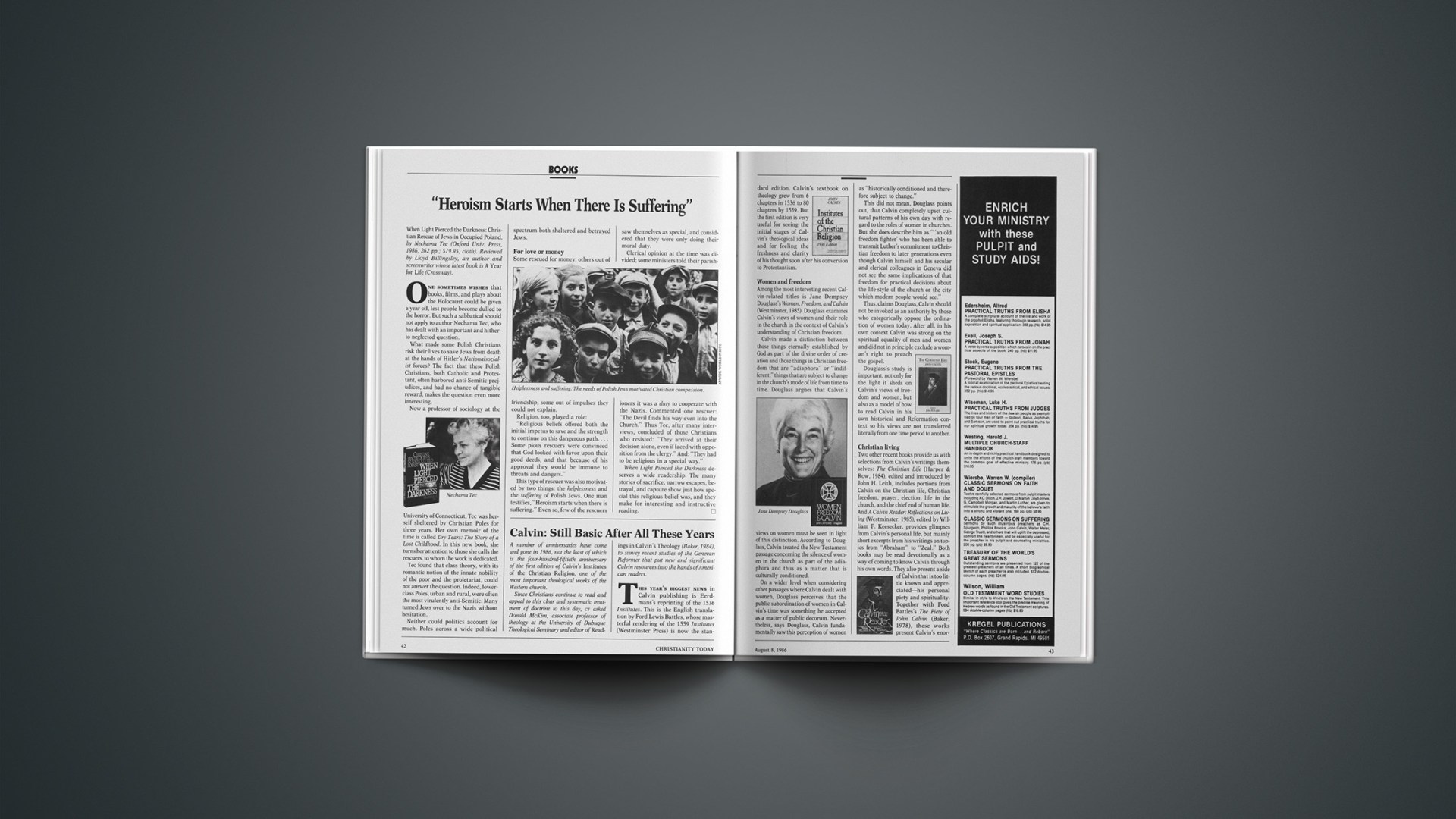

Book Briefs: August 8, 1986

When Light Pierced the Darkness: Christian Rescue of Jews in Occupied Poland, by Nechama Tec (Oxford Univ. Press, 1986, 262 pp.; $19.95, cloth). Reviewed by Lloyd Billingsley, an author and screenwriter whose latest book is A Year for Life (Crossway).

One sometimes wishes that books, films, and plays about the Holocaust could be given a year off, lest people become dulled to the horror. But such a sabbatical should not apply to author Nechama Tec, who has dealt with an important and hitherto neglected question.

What made some Polish Christians risk their lives to save Jews from death at the hands of Hitler’s Nationalsozialist forces? The fact that these Polish Christians, both Catholic and Protestant, often harbored anti-Semitic prejudices, and had no chance of tangible reward, makes the question even more interesting.

Now a professor of sociology at the University of Connecticut, Tec was herself sheltered by Christian Poles for three years. Her own memoir of the time is called Dry Tears: The Story of a Lost Childhood. In this new book, she turns her attention to those she calls the rescuers, to whom the work is dedicated.

Tec found that class theory, with its romantic notion of the innate nobility of the poor and the proletariat, could not answer the question. Indeed, lower-class Poles, urban and rural, were often the most virulently anti-Semitic. Many turned Jews over to the Nazis without hesitation.

Neither could politics account for much. Poles across a wide political spectrum both sheltered and betrayed Jews.

For Love Or Money

Some rescued for money, others out of friendship, some out of impulses they could not explain.

Religion, too, played a role: “Religious beliefs offered both the initial impetus to save and the strength to continue on this dangerous path.… Some pious rescuers were convinced that God looked with favor upon their good deeds, and that because of his approval they would be immune to threats and dangers.”

This type of rescuer was also motivated by two things: the helplessness and the suffering of Polish Jews. One man testifies, “Heroism starts when there is suffering.” Even so, few of the rescuers saw themselves as special, and considered that they were only doing their moral duty.

Clerical opinion at the time was divided; some ministers told their parishioners it was a duty to cooperate with the Nazis. Commented one rescuer: “The Devil finds his way even into the Church.” Thus Tec, after many interviews, concluded of those Christians who resisted: “They arrived at their decision alone, even if faced with opposition from the clergy.” And: “They had to be religious in a special way.”

When Light Pierced the Darkness deserves a wide readership. The many stories of sacrifice, narrow escapes, betrayal, and capture show just how special this religious belief was, and they make for interesting and instructive reading.

Classic & Contemporary Excerpts from August 08, 1986

Classic and contemporary excerpts

Heavenly Cargo

Do not try to make the Bible relevant. Its relevance is axiomatic … Do not defend God’s Word, but testify to it.… Trust to the Word. It is a ship loaded to the very limits of her capacity.

Dietrich Bonhoeffer: advice he gave his seminary students

Real Christianity

The main distinction between real Christianity and the system of the bulk of nominal Christians chiefly consists in the differing place given to the Gospel. To the latter, the trues of the Gospel are like distant stars that twinkle with a vain and idle luster. But for the real Christian these distinctive doctrines constitute the center in which he gravitates like the sun of his system and the source of his light, warmth and life.

William Wilberforce in Real Christianity

Evil In Good Intentions

Again and again we’ve been forced to note that the evils that we face are not the work of bad men only, but of good as well. The gravest of our disasters have been brought upon us not by men desiring to make trouble for mankind, but by those who thought they did their best in the circumstances surrounding them. We do not know the man wise enough to have saved the world from its present sufferings—and we do not know the man wise enough to deliver us now.

from the International Missionary Council in Madras, India, 1938

Loving God

Oh, sweet it is to know, most simply, that the soul loves Him; not as it should love Him, truly, and not “more than these,” with a glance of self-consciousness around; but that indeed it does love Him.

Bishop Handley G. C. Moule in Jesus and the Resurrection

Getting The Right Perspective

When we are too young, we do not judge well; so, also, when we are too old. If we do not think enough, or if we think too much on any matter, we get obstinate and infatuated about it. If one considers one’s work immediately after having done it, one is entirely prepossessed in its favor; by delaying too long, one can no longer enter into the spirit of it. So with pictures seen from too far or too near; there is but one exact point which is the true place wherefrom to look at them: the rest are too near, too far, too high, or too low.

Blaise Pascal, Pensées, 381

A free will

People say: “Yes, certainly, God has given us a free will.” To this I reply: “To be sure, He has given us a free will; why then will you not let it remain free but make it your own will?” If you do with it what you will, it is not a free will. It is your own will. But God has given neither you nor any man your own will, for your own will comes from the devil and from Adam. They made the free will which they received from God into their own will. For a free will desires nothing of its own. It only cares for the will of God, and so it remains free, cleaving and clinging to nothing.

Martin Luther, exposition of the Lord’s Prayer; taken from

Day by Day We Magnify Thee

The Abundant Secret Life

Religion does not lie open to all the eyes of men. Observed duties maintain our credit, but secret duties maintain our life. They are enclosed pleasures in religion which none but renewed spiritual souls do feelingly understand.

John Flavel in Touchstone of Sincerity

Grits Without Salt

For years the Bible was a dead book to me … like grits without salt. But after I gave my life to Jesus Christ, it became alive. I saw that the Bible was God’s way of talking to me.

Steve Bartkowski, quarterback for the Atlanta Falcons, quoted by Jamie Buckingham in Power for Living

The Hurt Of Healing

The old original wounds must first be probed in their depth before there can be healing. The Scripture compares sin with the wound of the soul, and says that an attempt to heal this wound without examining it first is vain and deceitful. It is God’s message to show men how awful their state is before he brings the comfort of deliverance and healing. The gospel must be revealed as bad news before it can be good news.

Jonathan Edwards in Religious Affections

The Bible’S Real Players

Perhaps the way our teachers treat the Bible does not have the same effect on everyone, but I have learned through the years that by trying to make the biblical actors superhuman, we who teach often make them non-human and inhuman, and hence uninteresting, to those who are human. Such, of course, was not the intent of the Evangelists, but we often distort their intent to suit our purposes and our fears.

Andrew M. Greeley’s introduction to The Robe, by Lloyd Douglas, paperback edition

The Edge of Disaster

The threat of famine provides Christian relief agencies with a major challenge.

Africa needs help. It needs about $128 billion worth of help between now and 1990, according to the five-year plan presented at a recent United Nations special session by the Organization of African Unity (OAU). African and Western delegates agreed at the session that struggling African countries must look toward developing the agricultural sector.

India’s population density is more than ten times that of Africa’s; China’s is more than five times. But unlike in those two countries, Africa’s food production has declined (by 20 percent) over the last two decades, and this has spelled disaster.

African states have asked for $46 billion in direct aid and debt relief from the international community; they hope to provide the other $82 billion themselves. They propose targeting up to 25 percent of public investment for agriculture.

A major contributor to the continent’s agricultural problems is desertification. In recent years, Africa has lost 27,000 square miles annually to deserts. That is the equivalent of New Hampshire, Vermont, and New Jersey.

War, economic mismanagement, and political instability make it difficult to prepare for drought-triggered famines, such as the one that struck from 1983 to 1985, afflicting 150 million people and stealing nearly a million lives in Ethiopia and Sudan alone.

International generosity has helped reduce the number of people threatened by famine to about 18 million, 80 percent of whom live in Angola, Ethiopia, Mozambique, or Sudan. Favorable weather has also helped alleviate starvation. Four of the 12 dry-ration stations set up by relief organizations in southwest Ethiopia have been closed because they are no longer necessary.

But the future may not be so bright. Said Bill Kliewer, executive vice-president of World Vision, “Unless the mood of the world’s nations changes toward Africa, we will not come anywhere near the requests made by the African nations.” Kliewer fears this could lead to “a holocaust by neglect.”

Giving trends support his concerns. The United Nations reports a deficit of nearly $500 million in food and nonfood emergency requirements for Africa in 1986. Also, many Christian relief and development agencies serving Africa are experiencing financial shortfalls, attributable, they say, to “compassion fatigue.”

In addition to those still needing relief assistance, countless others are fighting to recover from the effects of hunger, destitution, and dislocation. The weather has been good, but as Charles Morton, executive director of World Concern, observed, “You can’t eat rain.”

Averting further disaster will require long-term efforts to revitalize Africa’s agricultural sector. Christian relief and development organizations plan for large investments in agriculture in the next few years. World Vision reports that a new kit distribution program has already helped 125,000 families, mostly in Ethiopia, regain agricultural self-sufficiency. The kits include seeds, tools, fertilizers, and pesticides.

Also, World Relief has established a credit bank allowing women in the country of Burkina Faso to borrow money for grain mills. Women workers account for about 70 percent of Africa’s food production. The mills serve entire villages, freeing women to invest time in other aspects of production. Otherwise, they would have to spend hours each day pounding grain into flour.

Don Stilwell, physical ministries coordinator for SIM, believes the focus on agricultural policies could make a difference. But he said the crucial question is whether African nations will be willing and able to follow through with the new ideas. “Without policy changes,” said Stilwell, “I would see the future as bleak.”

Whether Christian relief and development agencies can rise to the African challenge depends largely on the attitude individual Christians take toward development. The continent’s problems call for long-term assistance, as opposed to dramatic, highly publicized relief efforts. As World Vision’s Kliewer said, “Development requires everything America has a hard time giving.”

By Gail C. Bennett.

WORLD SCENE

INDIA

Hidden Missionaries

More than half of the 2,200 participants in a recent meeting of Indian church workers committed themselves to starting new congregations during the next year. The All-India Christian Ministers Conference attracted pastors, evangelists, and church workers from more than 200 denominations and Christian organizations.

The conference was organized by the Evangelical Church of India and sponsored by the U.S.-based mission organization Samaritan’s Purse. “The believers who attended this conference are India’s hidden missionaries,” said Franklin Graham, president of Samaritan’s Purse. “God has raised up a mighty force of nationals to do the work of evangelizing India.” Graham noted that career missionaries from outside India are denied visas to enter the predominantly Hindu nation.

IRELAND

Voting Against Divorce

Voters in the Irish Republic have rejected by more than a three-to-two margin a proposed amendment to the nation’s constitution that would have legalized divorce in limited cases.

Prime Minister Garret FitzGerald supported the amendment, which would have allowed divorce in cases where a marriage had failed for at least five years. The Roman Catholic church, which claims 90 percent of the Irish population, opposed the measure.

“It is a God-given eternal law that marriage is indissoluble,” said Alice Glenn, a member of Ireland’s Parliament who led the opposition. “Why should a minority expect society to stand on its head for them?” The referendum upheld a constitutional provision that declares, “No law shall be enacted providing for the grant of a dissolution of marriage.” In calling for a constitutional amendment legalizing divorce, FitzGerald asked voters to “show compassion” for some 70,000 estranged couples in Ireland.

NICARAGUA

Expelling a Bishop

Nicaragua’s Sandinista government last month expelled a Roman Catholic bishop, accusing him of supporting anti-government rebels.

“Given the reiterated anti-patriotic and criminal attitude of Bishop [Pablo Antonio] Vega, it has been decided to indefinitely suspend the right to remain in the country to those who, like Bishop Vega, do not deserve to be Nicaraguans …,” announced presidential spokesman Manuel Espinoza. Vega, vice-president of the Nicaraguan Bishops Conference, earlier had charged the Sandinistas with “constant pressure for systematically silencing the church.” He also had criticized the government for refusing to allow Bismarck Carballo, an aide to Miguel Cardinal Obando y Bravo, to return to Nicaragua.

The government said that Vega, during two visits to the United States, helped President Reagan persuade the U.S. House of Representatives to approve $100 million in aid to the anti-Sandinista rebels. Espinoza said the bishop would be banished from his country “until North American aggression ceases against Nicaragua.”

Pope John Paul II said he “strongly deplored” the Sandinista action. Vega’s expulsion “disturbed all children of the church and, even futher, it also disturbs all people sensitive to the needs of freedom and the respect owed to the fundamental rights of man …,” the Pope said.

ISRAEL

Reluctant Approval

An eight-member government committee has decided to abide by the legal opinion of Israel’s attorney general that the Church of Jesus Christ of Latter-day Saints (Mormon) has the right to build a study center on the Mount of Olives.

The committee has opposed the construction, saying the branch campus of Brigham Young University would be used as a center for Mormon missionary efforts. Thousands of Orthodox Jews also oppose the campus. However, Israel’s attorney general said construction of the multi-million-dollar facility does not violate any law.

Brigham Young University officials have issued a written guarantee to Jerusalem Mayor Teddy Kollek that any student caught proselytizing in Israel will be expelled from the school. Members of the government committee studying the school’s construction said they might seek ways to enforce guarantees against Mormon proselytism.

SINGAPORE

Palau Attracts 337,500

Argentine-born evangelist Luis Palau preached to 337,500 people during a seven-day crusade in Singapore. Some 11,826 people made public Christian commitments during the meetings.

“The Asian and especially the Chinese mindset is ready for the message of Jesus Christ as revealed in the Bible …,” Palau said. “There is a tremendous interest among Chinese people in knowing the Jesus of the Bible, not Western Christianity.”

The crusade, held in a 60,000-seat sports stadium, represented the first evangelistic meetings Palau has conducted in Asia. During each of the meetings, his sermons were translated into Mandarin Chinese and 14 other Asian dialects. More than 350 churches and 13,000 volunteers cooperated in the Singapore crusade. Some 8,500 counselors and follow-up workers were trained. “Singapore never has experienced stronger Christian unity than it is [experiencing] now as a result of the Singapore Palau mission,” said Benjamin Chew, chairman of Singapore’s Evangelical Fellowship.

Bishop Festo Kivengere of Uganda Discusses

Winston Churchill called Uganda the “pearl of Africa.” But the nation of 14 million has been plagued in recent years by political turmoil and staggering inflation. Four years ago, 14 Ugandan shillings were worth an American dollar. Today the figure is 15,000 shillings. In addition, political power struggles have led to some 2 million deaths in the last two decades.

Yet, during this time, Uganda has experienced a major religious revival. And Christian leaders say there is new hope for political stability under Uganda’s current leader, Yoweri Museveni, who gained power in January. CHRISTIANITY TODAY recently interviewed Anglican Bishop Festo Kivengere of Uganda, who discussed the issues facing his country and the African continent.

What has caused Uganda’s unrest of the past few decades?

In 1962 we inherited a democracy similar to America’s—government of, by, and for the people. The problem was that the people were not involved. And without a grassroots foundation, the government fell apart.

Leaders manipulated the constitution to give us oligarchy, government of the few. Then Idi Amin got tired of the few and gave us a government by and for himself. There was a feeling among the people that what came to power by the gun must be overthrown by the gun. Massacres since Amin’s departure have been worse than they were when he ruled the country.

How much did the church suffer under Amin?

People think Amin stopped everyone from preaching, stopped churches from functioning. That’s not true. I conducted evangelistic missions in his barracks with his permission. Yet in 1977 he murdered my archbishop, and I narrowly escaped. Christians were not the primary target of persecution, but we had more than our share because the church was the voice of the silent people. Like all dictators, Amin was very insecure. Any potential enemy of his regime was eliminated.

Some maintain Africa is a battleground in the struggle between East and West. Is Marxism a threat?

In America, there is a certain fanaticism about communism in Africa. In Uganda, our problems have never had anything to do with Marxism. I know our present leader personally. I’ve prayed with him, looked him in the eye, and said, “You have been accused of having Marxist leanings.” He said to me, “If Marxism had worked on this continent, perhaps I would fall for it. But I can never think of imitating that which has never succeeded. Critics confuse my socialist ideas with Marxism.”

Does the problem of apartheid in South Africa require complex solutions?

No. I see this as a very simple issue. Apartheid is immoral. It takes away the dignity of a human being.

Many feel that change in South Africa must come slowly to avert violence. Blacks there differ not only with whites, but with each other. If blacks do come to power, which blacks would rule?

This line of thinking is pure rationalization. People say, “The tribes are hostile. We’re keeping them from killing each other.” That is a nice explanation to justify an awkward policy. Some Christian friends in South Africa told me blacks there are better off economically than most blacks on the continent, and so they’re happy. I said to them, “You must have a special type of African who is happy in indignity.”

We have heard a lot about revival in East Africa. What has been happening there?

The term ‘revival’ is not our term. We did not know it was revival until some people came over and told us. All we knew was the Lord had come alive. People were looking to the Bible and sharing their faith. There was joy in the churches.

Many of the denominational leaders in East Africa came to Christ through this movement. Sometimes it seems like the fire has died, but conversions and renewal continue through the ups and downs.

What can the church in America learn from this?

In America there is a feeling that God revives people when churches are sound in doctrine, teaching is biblical, and preaching is good. Isaiah was a good preacher. But when he looked to the Lord, he saw in himself things he had never seen before. So too must the church see itself.

It is easy to say we should be humble. But when the church is humbled, it’s a tough experience. Revival is not full churches and good feelings. These are accompaniments. Revival is the living Lord working among his people. When this happens, people see things they don’t like to see. Repentance begins not only when a sinner comes but when a saint is growing.

In what other ways is the African church different from the church in America?

Because of the availability of information and the fact that people from all over the world live in America, many expect the American church to be international in approach. Instead, it tends to be provincial and denominationally oriented. I know of hundreds of people who want to go to seminary to be trained biblically, but not on denominational lines. Those who do not belong to a certain denomination cannot apply for help. In a Third World country, denomination is not important.

What can American churches do to support the church in Africa?

In Uganda today, I can spend from January to December preaching in government high schools, where the Bible is accepted. The greatest response is among young people. There is a thirst for the Word of God. Yet we are short of Bibles to give people, short of teachers to make the Bible live for them. Some pastors who can hardly buy a bicycle look after thousands of Christians. Churches in America can help such pastors to get a bicycle or motor bike. We don’t ask for people to do church planting. We do our own church planting.

Africans have faced famine and violence. How do you minister among the suffering?

We don’t claim to know how to cope with bewilderment. Christ alone can pierce the gloom of terror, fear, and insecurity. He is the one who gives new hope. The only way to minister in heartbreaking situations is to be closer to Jesus, who died and rose again. I find it more difficult to minister to those who are suffering from prosperity. With prosperity comes a kind of deadening façade that numbs sensitivities.

Nonprofit Mailers Protest Study Group’s Findings

The results of a Postal Rate Commission (PRC) study on nonprofit postage are in. And the Nonprofit Mailers Federation (NMF), a Washington, D.C.-based lobby representing some 600 churches and charities, has voiced disapproval.

The federation is bothered primarily by proposed restrictions on organizations now receiving a subsidy for fund-raising and educational mailings. If Congress adopts the PRC’s proposals, organizations offering a premium in return for a contribution would lose nonprofit mailing privileges.

Specifically, the PRC recommends that parachurch organizations pay the commercial third-class rate if premiums offered are not manufactured by the organization. This would work against groups that send books, records, tapes, and other items to donors. “We’re talking about a huge amount of money that will be lost forever in Washington’s bureaucratic maze instead of going into ministry projects,” said Carolyn Emigh, NMF’s chief economist.

Opponents of preferred rates for religious and charitable groups maintain the government should not subsidize sectarian causes. At a PRC public hearing last spring, John Stapert, postal liaison for the major Protestant press groups, listed publications or mailings serving as “vehicles for news and information,” or for “morally and ethically enhancing articles” among the proper beneficiaries of preferred rates. But he added he opposes preferred rates “for commercial purposes or for mailing promotional materials for insurance, travel, or some product.”

Emigh emphasized the role of churches and charitable groups in “promoting the well-being of … society as a whole without regard to a profit motive.” She said the postal service should not be allowed to rob “America’s Good Samaritans to finance its own inefficiencies.”

By Brian Bird.

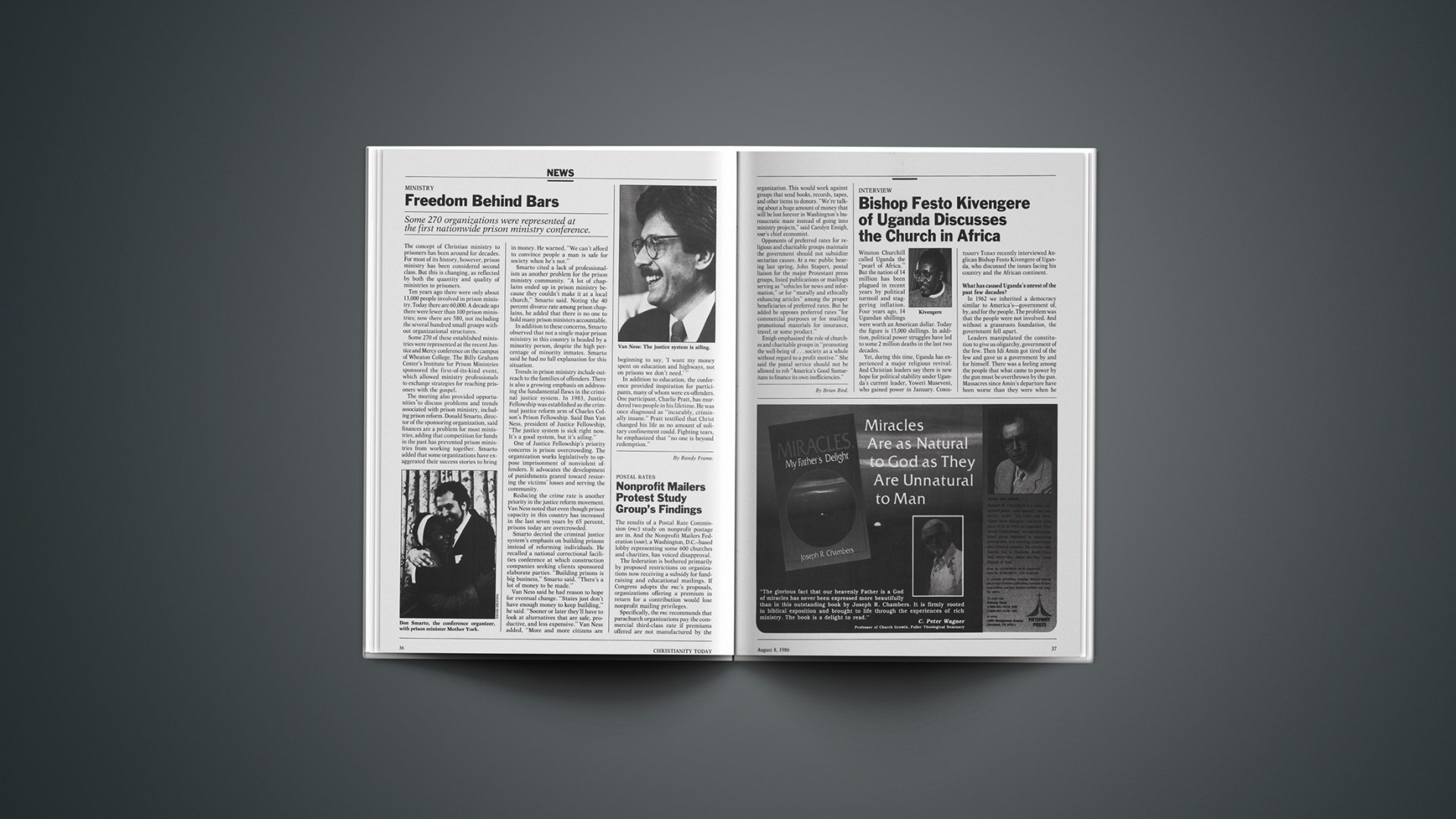
Freedom behind Bars

Some 270 organizations were represented at the first nationwide prison ministry conference.

The concept of Christian ministry to prisoners has been around for decades. For most of its history, however, prison ministry has been considered second class. But this is changing, as reflected by both the quantity and quality of ministries to prisoners.

Ten years ago there were only about 13,000 people involved in prison ministry. Today there are 60,000. A decade ago there were fewer than 100 prison ministries; now there are 580, not including the several hundred small groups without organizational structures.

Some 270 of these established ministries were represented at the recent Justice and Mercy conference on the campus of Wheaton College. The Billy Graham Center’s Institute for Prison Ministries sponsored the first-of-its-kind event, which allowed ministry professionals to exchange strategies for reaching prisoners with the gospel.

The meeting also provided opportunities to discuss problems and trends associated with prison ministry, including prison reform. Donald Smarto, director of the sponsoring organization, said finances are a problem for most ministries, adding that competition for funds in the past has prevented prison ministries from working together. Smarto added that some organizations have exaggerated their success stories to bring in money. He warned, “We can’t afford to convince people a man is safe for society when he’s not.”

Smarto cited a lack of professionalism as another problem for the prison ministry community. “A lot of chaplains ended up in prison ministry because they couldn’t make it at a local church,” Smarto said. Noting the 40 percent divorce rate among prison chaplains, he added that there is no one to hold many prison ministers accountable.

In addition to these concerns, Smarto observed that not a single major prison ministry in this country is headed by a minority person, despite the high percentage of minority inmates. Smarto said he had no full explanation for this situation.

Trends in prison ministry include outreach to the families of offenders. There is also a growing emphasis on addressing the fundamental flaws in the criminal justice system. In 1983, Justice Fellowship was established as the criminal justice reform arm of Charles Colson’s Prison Fellowship. Said Dan Van Ness, president of Justice Fellowship, “The justice system is sick right now. It’s a good system, but it’s ailing.”

One of Justice Fellowship’s priority concerns is prison overcrowding. The organization works legislatively to oppose imprisonment of nonviolent offenders. It advocates the development of punishments geared toward restoring the victims’ losses and serving the community.

Reducing the crime rate is another priority in the justice reform movement. Van Ness noted that even though prison capacity in this country has increased in the last seven years by 65 percent, prisons today are overcrowded.

Smarto decried the criminal justice system’s emphasis on building prisons instead of reforming individuals. He recalled a national correctional facilities conference at which construction companies seeking clients sponsored elaborate parties. “Building prisons is big business,” Smarto said. “There’s a lot of money to be made.”

Van Ness said he had reason to hope for eventual change. “States just don’t have enough money to keep building,” he said. “Sooner or later they’ll have to look at alternatives that are safe, productive, and less expensive.” Van Ness added, “More and more citizens are beginning to say, ‘I want my money spent on education and highways, not on prisons we don’t need.’ ”

In addition to education, the conference provided inspiration for participants, many of whom were ex-offenders. One participant, Charlie Pratt, has murdered two people in his lifetime. He was once diagnosed as “incurably, criminally insane.” Pratt testified that Christ changed his life as no amount of solitary confinement could. Fighting tears, he emphasized that “no one is beyond redemption.”

By Randy Frame.

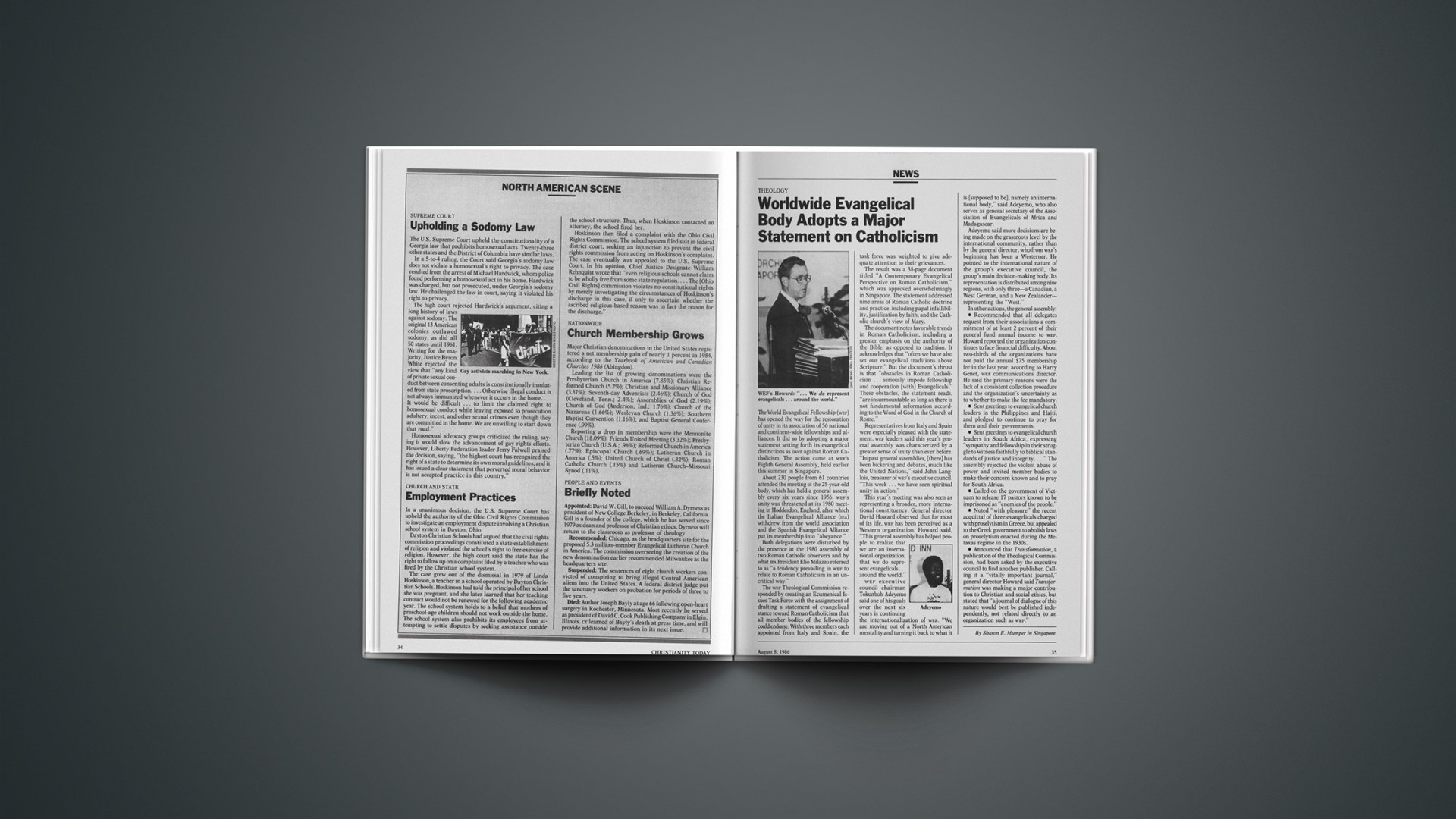
Worldwide Evangelical Body Adopts a Major Statement on Catholicism

The World Evangelical Fellowship (WEF) has opened the way for the restoration of unity in its association of 56 national and continent-wide fellowships and alliances. It did so by adopting a major statement setting forth its evangelical distinctions as over against Roman Catholicism. The action came at WEF’s Eighth General Assembly, held earlier this summer in Singapore.

About 230 people from 61 countries attended the meeting of the 25-year-old body, which has held a general assembly every six years since 1956. WEF’s unity was threatened at its 1980 meeting in Hoddesdon, England, after which the Italian Evangelical Alliance (IEA) withdrew from the world association and the Spanish Evangelical Alliance put its membership into “abeyance.”

Both delegations were disturbed by the presence at the 1980 assembly of two Roman Catholic observers and by what IEA President Elio Milazzo referred to as “a tendency prevailing in WEF to relate to Roman Catholicism in an uncritical way.”

The WEF Theological Commission responded by creating an Ecumenical Issues Task Force with the assignment of drafting a statement of evangelical stance toward Roman Catholicism that all member bodies of the fellowship could endorse. With three members each appointed from Italy and Spain, the task force was weighted to give adequate attention to their grievances.

The result was a 38-page document titled “A Contemporary Evangelical Perspective on Roman Catholicism,” which was approved overwhelmingly in Singapore. The statement addressed nine areas of Roman Catholic doctrine and practice, including papal infallibility, justification by faith, and the Catholic church’s view of Mary.

The document notes favorable trends in Roman Catholicism, including a greater emphasis on the authority of the Bible, as opposed to tradition. It acknowledges that “often we have also set our evangelical traditions above Scripture.” But the document’s thrust is that “obstacles in Roman Catholicism … seriously impede fellowship and cooperation [with] Evangelicals.” These obstacles, the statement reads, “are insurmountable as long as there is not fundamental reformation according to the Word of God in the Church of Rome.”

Representatives from Italy and Spain were especially pleased with the statement. WEF leaders said this year’s general assembly was characterized by a greater sense of unity than ever before. “In past general assemblies, [there] has been bickering and debates, much like the United Nations,” said John Langlois, treasurer of WEF’s executive council. “This week … we have seen spiritual unity in action.”

This year’s meeting was also seen as representing a broader, more international constituency. General director David Howard observed that for most of its life, WEF has been perceived as a Western organization. Howard said, “This general assembly has helped people to realize that we are an international organization; that we do represent evangelicals … around the world.”

WEF executive council chairman Tokunboh Adeyemo said one of his goals over the next six years is continuing the internationalization of WEF. “We are moving out of a North American mentality and turning it back to what it is [supposed to be], namely an international body,” said Adeyemo, who also serves as general secretary of the Association of Evangelicals of Africa and Madagascar.

Adeyemo said more decisions are being made on the grassroots level by the international community, rather than by the general director, who from WEF’s beginning has been a Westerner. He pointed to the international nature of the group’s executive council, the group’s main decision-making body. Its representation is distributed among nine regions, with only three—a Canadian, a West German, and a New Zealander—representing the “West.”

In other actions, the general assembly:

• Recommended that all delegates request from their associations a commitment of at least 2 percent of their general fund annual income to WEF. Howard reported the organization continues to face financial difficulty. About two-thirds of the organizations have not paid the annual $75 membership fee in the last year, according to Harry Genet, WEF communications director. He said the primary reasons were the lack of a consistent collection procedure and the organization’s uncertainty as to whether to make the fee mandatory.

• Sent greetings to evangelical church leaders in the Philippines and Haiti, and pledged to continue to pray for them and their governments.

• Sent greetings to evangelical church leaders in South Africa, expressing “sympathy and fellowship in their struggle to witness faithfully to biblical standards of justice and integrity.…” The assembly rejected the violent abuse of power and invited member bodies to make their concern known and to pray for South Africa.

• Called on the government of Vietnam to release 17 pastors known to be imprisoned as “enemies of the people.”

• Noted “with pleasure” the recent acquittal of three evangelicals charged with proselytism in Greece, but appealed to the Greek government to abolish laws on proselytism enacted during the Metaxas regime in the 1930s.

• Announced that Transformation, a publication of the Theological Commission, had been asked by the executive council to find another publisher. Calling it a “vitally important journal,” general director Howard said Transformation was making a major contribution to Christian and social ethics, but stated that “a journal of dialogue of this nature would best be published independently, not related directly to an organization such as WEF.”

By Sharon E. Mumper in Singapore.

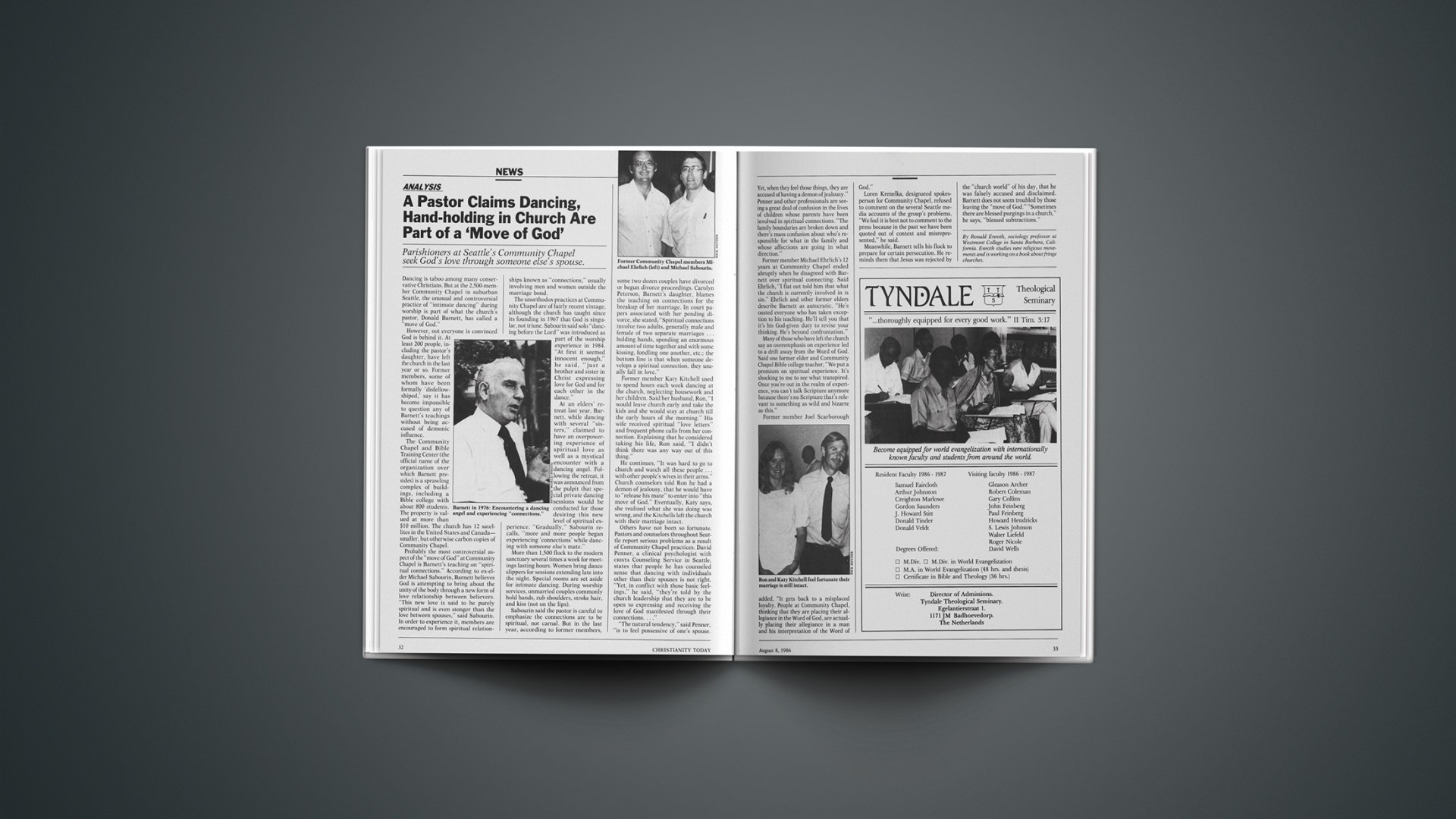
A Pastor Claims Dancing, Hand-Holding in Church Are Part of a ‘Move of God’

Parishioners at Seattle’s Community Chapel seek God’s love through someone else’s spouse.

Dancing is taboo among many conservative Christians. But at the 2,500-member Community Chapel in suburban Seattle, the unusual and controversial practice of “intimate dancing” during worship is part of what the church’s pastor, Donald Barnett, has called a “move of God.”

However, not everyone is convinced God is behind it. At least 200 people, including the pastor’s daughter, have left the church in the last year or so. Former members, some of whom have been formally ‘disfellowshiped,’ say it has become impossible to question any of Barnett’s teachings without being accused of demonic influence.

The Community Chapel and Bible Training Center (the official name of the organization over which Barnett presides) is a sprawling complex of buildings, including a Bible college with about 800 students.

The property is valued at more than $10 million. The church has 12 satellites in the United States and Canada—smaller, but otherwise carbon copies of Community Chapel.

Probably the most controversial aspect of the “move of God” at Community Chapel is Barnett’s teaching on “spiritual connections.” According to ex-elder Michael Sabourin, Barnett believes God is attempting to bring about the unity of the body through a new form of love relationship between believers. “This new love is said to be purely spiritual and is even stonger than the love between spouses,” said Sabourin. In order to experience it, members are encouraged to form spiritual relationships known as “connections,” usually involving men and women outside the marriage bond.

The unorthodox practices at Community Chapel are of fairly recent vintage, although the church has taught since its founding in 1967 that God is singular, not triune. Sabourin said solo “dancing before the Lord” was introduced as part of the worship experience in 1984. “At first it seemed innocent enough,” he said, “just a brother and sister in Christ expressing love for God and for each other in the dance.”

At an elders’ retreat last year, Barnett, while dancing with several “sisters,” claimed to have an overpowering experience of spiritual love as well as a mystical encounter with a dancing angel. Following the retreat, it was announced from the pulpit that special private dancing sessions would be conducted for those desiring this new level of spiritual experience. “Gradually,” Sabourin recalls, “more and more people began experiencing ‘connections’ while dancing with someone else’s mate.”

More than 1,500 flock to the modern sanctuary several times a week for meetings lasting hours. Women bring dance slippers for sessions extending late into the night. Special rooms are set aside for intimate dancing. During worship services, unmarried couples commonly hold hands, rub shoulders, stroke hair, and kiss (not on the lips).

Sabourin said the pastor is careful to emphasize the connections are to be spiritual, not carnal. But in the last year, according to former members, some two dozen couples have divorced or begun divorce proceedings. Carolyn Peterson, Barnett’s daughter, blames the teaching on connections for the breakup of her marriage. In court papers associated with her pending divorce, she stated, “Spiritual connections involve two adults, generally male and female of two separate marriages … holding hands, spending an enormous amount of time together and with some kissing, fondling one another, etc.; the bottom line is that when someone develops a spiritual connection, they usually fall in love.”

Former member Katy Kitchell used to spend hours each week dancing at the church, neglecting housework and her children. Said her husband, Ron, “I would leave church early and take the kids and she would stay at church till the early hours of the morning.” His wife received spiritual “love letters” and frequent phone calls from her connection. Explaining that he considered taking his life, Ron said, “I didn’t think there was any way out of this thing.”

He continues, “It was hard to go to church and watch all these people … with other people’s wives in their arms.” Church counselors told Ron he had a demon of jealousy, that he would have to “release his mate” to enter into “this move of God.” Eventually, Katy says, she realized what she was doing was wrong, and the Kitchells left the church with their marriage intact.

Others have not been so fortunate. Pastors and counselors throughout Seattle report serious problems as a result of Community Chapel practices. David Penner, a clinical psychologist with CRISTA Counseling Service in Seattle, states that people he has counseled sense that dancing with individuals other than their spouses is not right. “Yet, in conflict with those basic feelings,” he said, “they’re told by the church leadership that they are to be open to expressing and receiving the love of God manifested through their connections.…”

“The natural tendency,” said Penner, “is to feel possessive of one’s spouse. Yet, when they feel those things, they are accused of having a demon of jealousy.” Penner and other professionals are seeing a great deal of confusion in the lives of children whose parents have been involved in spiritual connections. “The family boundaries are broken down and there’s mass confusion about who’s responsible for what in the family and whose affections are going in what direction.”

Former member Michael Ehrlich’s 12 years at Community Chapel ended abruptly when he disagreed with Barnett over spiritual connecting. Said Ehrlich, “I flat out told him that what the church is currently involved in is sin.” Ehrlich and other former elders describe Barnett as autocratic. “He’s ousted everyone who has taken exception to his teaching. He’ll tell you that it’s his God-given duty to revise your thinking. He’s beyond confrontation.”

Many of those who have left the church say an overemphasis on experience led to a drift away from the Word of God. Said one former elder and Community Chapel Bible college teacher, “We put a premium on spiritual experience. It’s shocking to me to see what transpired. Once you’re out in the realm of experience, you can’t talk Scripture anymore because there’s no Scripture that’s relevant to something as wild and bizarre as this.”

Former member Joel Scarborough added, “It gets back to a misplaced loyalty. People at Community Chapel, thinking that they are placing their allegiance in the Word of God, are actually placing their allegiance in a man and his interpretation of the Word of God.”

Loren Krenelka, designated spokesperson for Community Chapel, refused to comment on the several Seattle media accounts of the group’s problems. “We feel it is best not to comment to the press because in the past we have been quoted out of context and misrepresented,” he said.

Meanwhile, Barnett tells his flock to prepare for certain persecution. He reminds them that Jesus was rejected by the “church world” of his day, that he was falsely accused and disclaimed. Barnett does not seem troubled by those leaving the “move of God.” “Sometimes there are blessed purgings in a church,” he says, “blessed subtractions.”

By Ronald Enroth, sociology professor at Westmont College in Santa Barbara, California. Enroth studies new religious movements and is working on a book about fringe churches.

NORTH AMERICAN SCENE

SUPREME COURT

Upholding a Sodomy Law

The U.S. Supreme Court upheld the constitutionality of a Georgia law that prohibits homosexual acts. Twenty-three other states and the District of Columbia have similar laws.

In a 5-to-4 ruling, the Court said Georgia’s sodomy law does not violate a homosexual’s right to privacy. The case resulted from the arrest of Michael Hardwick, whom police found performing a homosexual act in his home. Hardwick was charged, but not prosecuted, under Georgia’s sodomy law. He challenged the law in court, saying it violated his right to privacy.

The high court rejected Hardwick’s argument, citing a long history of laws against sodomy. The original 13 American colonies outlawed sodomy, as did all 50 states until 1961. Writing for the majority, Justice Byron White rejected the view that “any kind of private sexual conduct between consenting adults is constitutionally insulated from state proscription Otherwise illegal conduct is not always immunized whenever it occurs in the home.… It would be difficult … to limit the claimed right to homosexual conduct while leaving exposed to prosecution adultery, incest, and other sexual crimes even though they are committed in the home. We are unwilling to start down that road.”

Homosexual advocacy groups criticized the ruling, saying it would slow the advancement of gay rights efforts. However, Liberty Federation leader Jerry Falwell praised the decision, saying, “the highest court has recognized the right of a state to determine its own moral guidelines, and it has issued a clear statement that perverted moral behavior is not accepted practice in this country.”

CHURCH AND STATE

Employment Practices

In a unanimous decision, the U.S. Supreme Court has upheld the authority of the Ohio Civil Rights Commission to investigate an employment dispute involving a Christian school system in Dayton, Ohio.

Dayton Christian Schools had argued that the civil rights commission proceedings constituted a state establishment of religion and violated the school’s right to free exercise of religion. However, the high court said the state has the right to follow up on a complaint filed by a teacher who was fired by the Christian school system.

The case grew out of the dismissal in 1979 of Linda Hoskinson, a teacher in a school operated by Dayton Christian Schools. Hoskinson had told the principal of her school she was pregnant, and she later learned that her teaching contract would not be renewed for the following academic year. The school system holds to a belief that mothers of preschool-age children should not work outside the home. The school system also prohibits its employees from attempting to settle disputes by seeking assistance outside the school structure. Thus, when Hoskinson contacted an attorney, the school fired her.

Hoskinson then filed a complaint with the Ohio Civil Rights Commission. The school system filed suit in federal district court, seeking an injunction to prevent the civil rights commission from acting on Hoskinson’s complaint. The case eventually was appealed to the U.S. Supreme Court. In his opinion, Chief Justice Designate William Rehnquist wrote that “even religious schools cannot claim to be wholly free from some state regulation The [Ohio Civil Rights] commission violates no constitutional rights by merely investigating the circumstances of Hoskinson’s discharge in this case, if only to ascertain whether the ascribed religious-based reason was in fact the reason for the discharge.”

NATIONWIDE

Church Membership Grows

Major Christian denominations in the United States registered a net membership gain of nearly 1 percent in 1984, according to the Yearbook of American and Canadian Churches 1986 (Abingdon).

Leading the list of growing denominations were the Presbyterian Church in America (7.85%); Christian Reformed Church (5.2%); Christian and Missionary Alliance (3.37%); Seventh-day Adventists (2.46%); Church of God (Cleveland, Tenn.; 2.4%); Assemblies of God (2.19%); Church of God (Anderson, Ind.; 1.76%); Church of the Nazarene (1.66%); Wesleyan Church (1.36%); Southern Baptist Convention (1.16%); and Baptist General Conference (.99%).

Reporting a drop in membership were the Mennonite Church (18.09%); Friends United Meeting (3.32%); Presbyterian Church (U.S.A.;.96%); Reformed Church in America (.77%); Episcopal Church (.69%); Lutheran Church in America (.5%); United Church of Christ (.32%); Roman Catholic Church (.15%) and Lutheran Church-Missouri Synod (.11%).

PEOPLE AND EVENTS

Briefly Noted

Appointed: David W. Gill, to succeed William A. Dyrness as president of New College Berkeley, in Berkeley, California. Gill is a founder of the college, which he has served since 1979 as dean and professor of Christian ethics. Dyrness will return to the classroom as professor of theology.

Recommended: Chicago, as the headquarters site for the proposed 5.3 million-member Evangelical Lutheran Church in America. The commission overseeing the creation of the new denomination earlier recommended Milwaukee as the headquarters site.

Suspended: The sentences of eight church workers convicted of conspiring to bring illegal Central American aliens into the United States. A federal district judge put the sanctuary workers on probation for periods of three to five years.

Died: Author Joseph Bayly at age 66 following open-heart surgery in Rochester, Minnesota. Most recently he served as president of David C. Cook Publishing Company in Elgin, Illinois, CT learned of Bayly’s death at press time, and will provide additional information in its next issue.

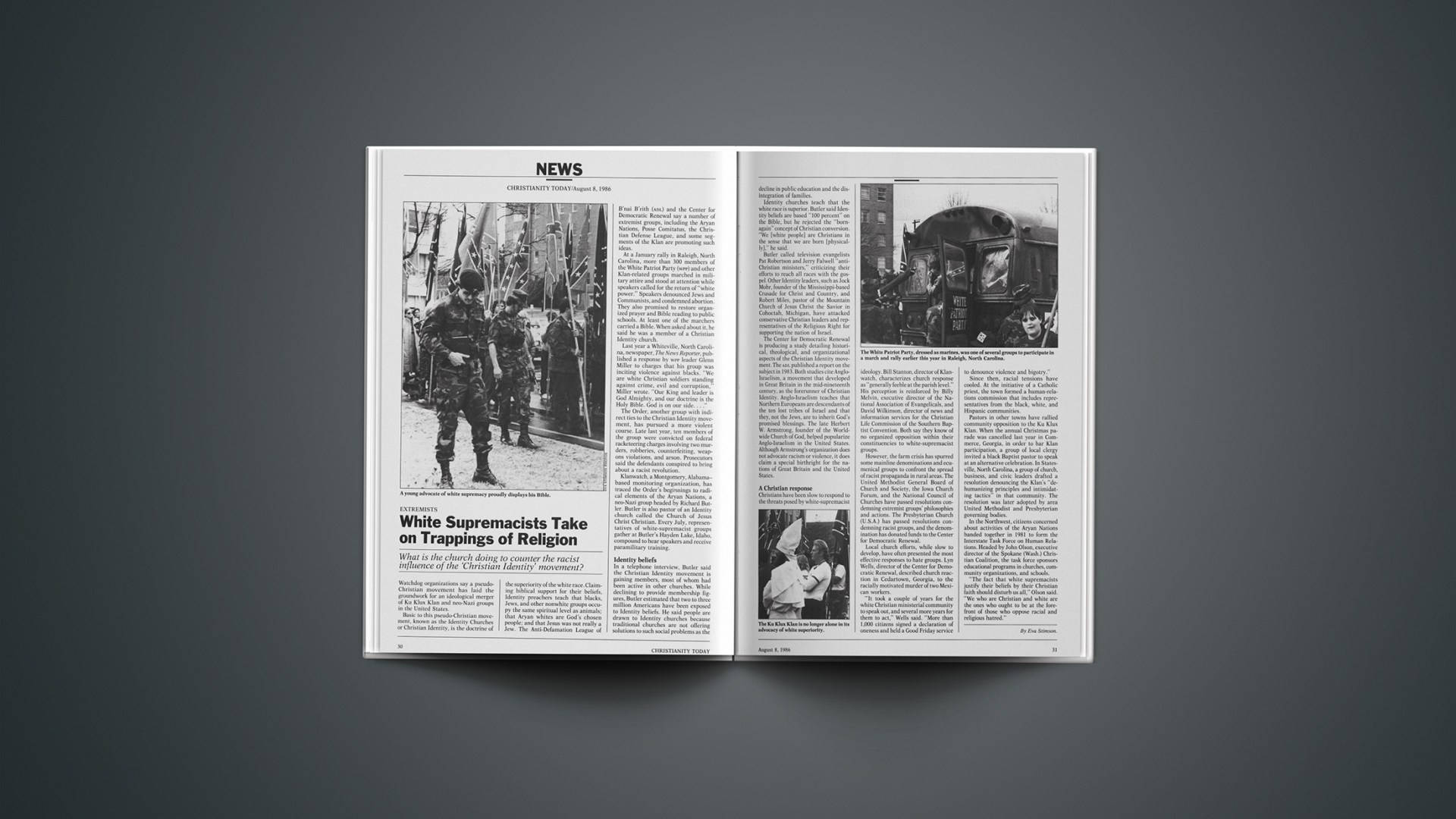
White Supremacists Take on Trappings of Religion

CHRISTIANITY TODAY/August 8, 1986

What is the church doing to counter the racist influence of the ‘Christian Identity’ movement?

Watchdog organizations say a pseudo-Christian movement has laid the groundwork for an ideological merger of Ku Klux Klan and neo-Nazi groups in the United States.

Basic to this pseudo-Christian movement, known as the Identity Churches or Christian Identity, is the doctrine of the superiority of the white race. Claiming biblical support for their beliefs, Identity preachers teach that blacks, Jews, and other nonwhite groups occupy the same spiritual level as animals; that Aryan whites are God’s chosen people; and that Jesus was not really a Jew. The Anti-Defamation League of B’nai B’rith (ADL) and the Center for Democratic Renewal say a number of extremist groups, including the Aryan Nations, Posse Comitatus, the Christian Defense League, and some segments of the Klan are promoting such ideas.

At a January rally in Raleigh, North Carolina, more than 300 members of the White Patriot Party (WPP) and other Klan-related groups marched in military attire and stood at attention while speakers called for the return of “white power.” Speakers denounced Jews and Communists, and condemned abortion. They also promised to restore organized prayer and Bible reading to public schools. At least one of the marchers carried a Bible. When asked about it, he said he was a member of a Christian Identity church.

Last year a Whiteville, North Carolina, newspaper, The News Reporter, published a response by WPP leader Glenn Miller to charges that his group was inciting violence against blacks. “We are white Christian soldiers standing against crime, evil and corruption,” Miller wrote. “Our King and leader is God Almighty, and our doctrine is the Holy Bible. God is on our side.…”

The Order, another group with indirect ties to the Christian Identity movement, has pursued a more violent course. Late last year, ten members of the group were convicted on federal racketeering charges involving two murders, robberies, counterfeiting, weapons violations, and arson. Prosecutors said the defendants conspired to bring about a racist revolution.

Klanwatch, a Montgomery, Alabama—based monitoring organization, has traced the Order’s beginnings to radical elements of the Aryan Nations, a neo-Nazi group headed by Richard Butler. Butler is also pastor of an Identity church called the Church of Jesus Christ Christian. Every July, representatives of white-supremacist groups gather at Butler’s Hayden Lake, Idaho, compound to hear speakers and receive paramilitary training.

Identity Beliefs

In a telephone interview, Butler said the Christian Identity movement is gaining members, most of whom had been active in other churches. While declining to provide membership figures, Butler estimated that two to three million Americans have been exposed to Identity beliefs. He said people are drawn to Identity churches because traditional churches are not offering solutions to such social problems as the decline in public education and the disintegration of families.

Identity churches teach that the white race is superior. Butler said Identity beliefs are based “100 percent” on the Bible, but he rejected the “born-again” concept of Christian conversion. “We [white people] are Christians in the sense that we are born [physically],” he said.

Butler called television evangelists Pat Robertson and Jerry Falwell “anti-Christian ministers,” criticizing their efforts to reach all races with the gospel. Other Identity leaders, such as Jock Mohr, founder of the Mississippi-based Crusade for Christ and Country, and Robert Miles, pastor of the Mountain Church of Jesus Christ the Savior in Cohoctah, Michigan, have attacked conservative Christian leaders and representatives of the Religious Right for supporting the nation of Israel.

The Center for Democratic Renewal is producing a study detailing historical, theological, and organizational aspects of the Christian Identity movement. The ADL published a report on the subject in 1983. Both studies cite Anglo-Israelism, a movement that developed in Great Britain in the mid-nineteenth century, as the forerunner of Christian Identity. Anglo-Israelism teaches that Northern Europeans are descendants of the ten lost tribes of Israel and that they, not the Jews, are to inherit God’s promised blessings. The late Herbert W. Armstrong, founder of the Worldwide Church of God, helped popularize Anglo-Israelism in the United States. Although Armstrong’s organization does not advocate racism or violence, it does claim a special birthright for the nations of Great Britain and the United States.

A Christian Response

Christians have been slow to respond to the threats posed by white-supremacist ideology. Bill Stanton, director of Klanwatch, characterizes church response as “generally feeble at the parish level.” His perception is reinforced by Billy Melvin, executive director of the National Association of Evangelicals, and David Wilkinson, director of news and information services for the Christian Life Commission of the Southern Baptist Convention. Both say they know of no organized opposition within their constituencies to white-supremacist groups.

However, the farm crisis has spurred some mainline denominations and ecumenical groups to confront the spread of racist propaganda in rural areas. The United Methodist General Board of Church and Society, the Iowa Church Forum, and the National Council of Churches have passed resolutions condemning extremist groups’ philosophies and actions. The Presbyterian Church (U.S.A.) has passed resolutions condemning racist groups, and the denomination has donated funds to the Center for Democratic Renewal.

Local church efforts, while slow to develop, have often presented the most effective responses to hate groups. Lyn Wells, director of the Center for Democratic Renewal, described church reaction in Cedartown, Georgia, to the racially motivated murder of two Mexican workers.

“It took a couple of years for the white Christian ministerial community to speak out, and several more years for them to act,” Wells said. “More than 1,000 citizens signed a declaration of oneness and held a Good Friday service to denounce violence and bigotry.”

Since then, racial tensions have cooled. At the initiative of a Catholic priest, the town formed a human-relations commission that includes representatives from the black, white, and Hispanic communities.

Pastors in other towns have rallied community opposition to the Ku Klux Klan. When the annual Christmas parade was cancelled last year in Commerce, Georgia, in order to bar Klan participation, a group of local clergy invited a black Baptist pastor to speak at an alternative celebration. In Statesville, North Carolina, a group of church, business, and civic leaders drafted a resolution denouncing the Klan’s “dehumanizing principles and intimidating tactics” in that community. The resolution was later adopted by area United Methodist and Presbyterian governing bodies.

In the Northwest, citizens concerned about activities of the Aryan Nations banded together in 1981 to form the Interstate Task Force on Human Relations. Headed by John Olson, executive director of the Spokane (Wash.) Christian Coalition, the task force sponsors educational programs in churches, community organizations, and schools.

“The fact that white supremacists justify their beliefs by their Christian faith should disturb us all,” Olson said. “We who are Christian and white are the ones who ought to be at the forefront of those who oppose racial and religious hatred.”

By Eva Stimson.

Apple PodcastsDown ArrowDown ArrowDown Arrowarrow_left_altLeft ArrowLeft ArrowRight ArrowRight ArrowRight Arrowarrow_up_altUp ArrowUp ArrowAvailable at Amazoncaret-downCloseCloseEmailEmailExpandExpandExternalExternalFacebookfacebook-squareGiftGiftGooglegoogleGoogle KeephamburgerInstagraminstagram-squareLinkLinklinkedin-squareListenListenListenChristianity TodayCT Creative Studio Logologo_orgMegaphoneMenuMenupausePinterestPlayPlayPocketPodcastRSSRSSSaveSaveSaveSearchSearchsearchSpotifyStitcherTelegramTable of ContentsTable of Contentstwitter-squareWhatsAppXYouTubeYouTube