Personal Meaning and Company Mission

The Firm Bond—Linking Meaning and Mission in Business and Religion, by Robert Lawrence Kuhn and George T. Geis (Praeger, 1984, 207 pp.; $21.95, cloth). Reviewed by Joseph M. Hopkins, professor emeritus of religion, Westminster College, New Wilmington, Pennsylvania, and author of The Armstrong Empire (Eerdmans).

Two ex-members of the late Herbert W. Armstrong’s Worldwide Church of God (WCG) have written an important book about commitment. Robert Kuhn, former administrative assistant to Garner Ted Armstrong, left the controversial sect in 1979, several months after the younger Armstrong’s ouster by his father. George Geis was summarily dismissed from the faculty of wcG-related Ambassador College, from the ministry, and from the church in January 1985, after the hierarchy learned he co-wrote this book (CT, Feb. 15, 1985, p. 44).

The Armstrong connection aside, The Firm Bond is a significant study for leaders in business and academia as well as in organized religion.

The authors hold impressive credentials. Kuhn’s include degrees from Johns Hopkins (Phi Beta Kappa), UCLA (Ph.D. in neurophysiology), and MIT (Sloan Fellow). He has published widely, edits Texas Business magazine, and teaches at both New York University and the University of Texas at Austin. Geis, a summa cum laude graduate of Purdue with a Ph.D. in educational psychology from the University of Southern California, is research coordinator for UCLA’s Institute of Industrial Relations.

Commitment

By “the firm bond” the authors mean commitment—“the link between personal meaning and organizational mission. Mission is the heart of group existence just as meaning is the soul of member devotion. Each is driving energy and directing force—groups seek to achieve objectives, members strive to fulfill purposes. Personal meaning and company mission are the two poles of our axis, and around them the book revolves.”

The authors contend that “understanding the fidelity of church members” can “improve the loyalty of factory workers.” Asked how employee commitment can help companies, Kuhn replied, “Efficiency, creativity, and productivity work together. Motivation is the key.… Personal fulfillment and company success are targets, with religion our guide and business our goal.” When “the firm bond” is weakened, church members and company employees cease to perform at high efficiency levels, and corporate achievement declines.

Numerous real-life case studies illustrate this thesis throughout the book. Most of the “religious” examples are drawn from Armstrong-type authoritarian churches. The stories tell of individuals who affiliate with a particular body, become increasingly committed, then (in some instances) become disillusioned and alienated when “commitment breakers” intervene to weaken or sever “the firm bond.”

An Amazing Understatement

The Creation of Wealth: A Christian’s Case for Capitalism, by Brian Griffiths (InterVarsity, 1984, 160 pp.; $5.95, paper). Reviewed by James L. Sauer, director of library, Eastern College, St. Davids, Pennsylvania.

Is capitalism Christian? In his recent book by that title, evangelical polemicist Franky Schaeffer brought together a collection of authors to address Christian economics. To no one’s surprise, they answered with a resounding yes.

Griffiths, a British economist, business school dean, and former director of the Bank of England, asks a similar question in his book. His answer is also affirmative, albeit qualified. Like neoconservative writer Irving Kristol, Griffiths finds himself a procapitalist cheerleader who can only manage two cheers. He defends capitalism with elegance and reason, but he cannot help looking askance at some of his ideological teammates.

The argument of the book can be easily summarized:

First, the socialist command economy is an abysmal failure; while the free-enterprise market economy works well at producing wealth. Proof is everywhere to be seen.

Second, capitalism contains an inherent temptation toward gross materialism, affluent pride, and an indifference to injustice. But this same capitalism provides the ladder out of poverty and gives the greatest alms to relieve poverty.

Third, Christianity places strictures on economic sins—fraud, stealing, unfair business practices—but not against the economic enterprise of “private property, profit and inequality of income and wealth resulting from freedom of choice exercised within the bounds of justice.”

Finally, the Renaissance, Enlightenment, and contemporary libertarian defense of capitalism are mechanistic, and deny the personal nature of the created universe. Christianity must avoid these secular defenses and forge a biblical apologetic for free enterprise. Griffiths argues for Christian economic separatism.

My mechanic’s world view

Griffiths’s fear that secular ideologies will taint our Christian moral capitalism seems overstated. The laws of supply and demand are not different for Christians and non-Christians. Profits are needed by socialist or Randian capitalist to overcome the law of scarcity. I do not need to know whether my car mechanic agrees with Voltaire; all I need to know is if he can fix my brakes. The genius of capitalism as an economic system, like democratic constitutionalism in the political sphere, is that it can operate to everyone’s satisfaction regardless of the beliefs they hold.

Griffiths’s “conclusion is not that capitalism is Christian. Neither is it that the market economy is the only economic system compatible with Christianity. It is simply that wealth creation within a market economy bounded by a concern for justice is compatible with Christian faith.” These are reasonable words, articulately spoken; but considering the alternative dictatorial command economy, the moral and rational arguments presented within this book for the justice of capitalism, and the fecundity of the free enterprise system—it is an amazing understatement.

Just how do people come to identify emotionally with institutions, submit to their authority, and devote themselves to furthering their goals? And what factors cause commitment to deteriorate? The authors analyze both positive and negative aspects with compelling logic and clarity. But there is a significant omission: Christian conversion, when the new-born child of God is compelled by the Holy Spirit to devote his or her life to God and others, more than any other factor, generates “firm bond” commitment. Ideally, Christ’s “constraining love” (2 Cor. 5:14) is then channeled into every activity.

Nevertheless, The Firm Bond provides an excellent manual for institutional self-study. It convincingly demonstrates that the same personal and organizational factors operate in both businesses and churches. The authors’ analysis will be helpful not only to business leaders but also to church executives, pastors, and boards.

Book Briefs: July 11, 1986

The Future of Religion: Secularization, Revival, and Cult Formation, by Rodney Stark and William Sims Bainbridge (Univ. of Calif. Press, 1985, 571 pp.; $14.95, paper). Reviewed by Robert Webber, professor of theology, Wheaton (Ill.) College, and author of the forthcoming book Celebrating Our Faith (Harper & Row).

During the past decade, we have heard much about the secularization of the West. And both religious and nonreligious forecasters have proclaimed the impending death of religion.

In this detailed and provocative work, Rodney Stark and William Sims Bainbridge pose serious questions about this supposed dawn of a religionless society.

Their starting point does not proceed from any religious bias. They are not saying, “We want religion to be preserved in the West, and here’s how to do it.” Instead, they approach the future of religion with the tools of social science. And their conclusions (based on surveys, consensus, historical case studies, and ethnographic field expeditions) run counter to the social theorists who predict the death of religion in our time.

Stark and Bainbridge do not deny that secularization has occurred in the West. Nor do they deny that the revolutions of science, reason, technology, and new world views based on naturalistic assumptions are not formidable foes to religion.

But their underlying thesis is that secularization stimulates religious innovation. Consequently, history is cyclical—a reciprocal action takes place between the erosion of old religion on the one hand and the rise of new religious institutions on the other.

The Need For Transcendence

Stark and Bainbridge define religion as human organizations primarily engaged in providing general compensators based on supernatural assumptions. By this definition, of course, they purposely include all religious faiths (including Christianity) that have some kind of otherworldly belief. They make no attempt to distinguish between the truth content of religions. The issue they address is not the truth, but the persistence of religion. Thus, they argue, religion will survive, not because it is true, but because there is a universal human need to experience transcendence.

Two of their findings are of special interest to CT readers:

First, the recent popularity of occult beliefs and movements does not stem from the rise of new kinds of “consciousness,” but from weakness in conventional religions. This conclusion highlights the need to maintain healthy churches and evangelistic outreaches. While exposes of cults and sects will always have their place, a church with the gospel at its center and a community of people living in a mutually supportive relationship is most effective.

Second, secular meaning systems cannot provide general explanations about life that replace religion. This is good news for those who are given to hand wringing over the pervasive influence of secularism. It supports the scriptural assertion that the gates of hell will not prevail against the church.

The thesis of Stark and Bainbridge seems to explain the phenomenal rise of evangelical Christianity and the charismatic movement in this country. The more the secularists proclaim the absence of God, the greater is the recovery of the presence of God. As the authors themselves put it—“We explore the meaning of the aphorism that trying to drive out religion is like driving a nail—the harder you hit, the deeper it goes.”

A Compassionate Vision

If I Should Die Before I Wake by Jerry Falwell (Nelson, 1986, 219 pp.; $12.95, cloth). Reviewed by LaVonne Neff, special projects editor for the publishing division of Youth for Christ.

Six years ago, I was asked to lead a discussion following an antiabortion film then making the rounds of college campuses. Watching the film for the first time along with the young adult audience, I grew more and more concerned.

The film’s content was not the problem. It was well documented, biblical, and scientific. What troubled me was what the film did not say.

I knew that, by the law of averages, there would be girls in the audience who had had abortions, pregnant students who did not know which way to turn, and boys who had persuaded their girlfriends to terminate a pregnancy. For these hurting young people, the film showed no compassion and offered no hope of forgiveness. Sin was denounced, and sinners were left out in the cold.

When the news media have caricatured antiabortion crusaders as caring more for an inch-long fetus than for an adult woman, they have been interpreting early films, speeches, and writings that paid more attention to the intellectual than to the human aspects of abortion. In early chapters of If I Should Die Before I Wake …, Jerry Falwell admits that he too once paid scant attention to the needs of young women who were pregnant and terrified.

Jerry’s vision; Jennifer’s story

His new book could not be more compassionate. Chapters alternate between “Jerry,” who summarizes his antiabortion work and outlines his new plan to set up a network of homes for unwed mothers, and “Jennifer,” who tells her own gripping story.

It is Jennifer’s story that will sell the book. A likable young woman from a middle-class suburban home, Jennifer had already had an abortion (at the request of her churchgoing parents) when she became pregnant a second time. Her experience of pregnancy at a group home and then at a private home, both sponsored by Falwell’s ministry, is the heart of the book.

The small beginnings of a national network: Liberty Godparent Home in Lynchburg, Virginia, cares for women with unwanted pregnancies and provides an alternative to abortion. Inset: writer Jennifer Simpson.

It would be a shame, however, for readers to skip Falwell’s chapters, because his vision of a national network of caring, nonjudgmental, supportive homes for pregnant girls and young women deserves a serious reading and a widespread response.

Six years ago, the antiabortion movement was young. In its immaturity, it may have alienated some young people who most needed to face their sin so they could go on to forgiveness and healing. If I Should Die Before I Wake … reflects the movement’s coming of age. Without compromising its stand against taking human life, it seems to be turning to compassion and reconciliation. Law is supplanted by gospel. Falwell’s—and Jennifer’s—book is a big step in the direction of grace.

Classic & Contemporary Excerpts from July 11, 1986

Classic and contemporary excerpts

A Man’S Books

Reading on wise and virtuous subjects is, next to prayer, the best improvement of our hearts. It enlightens us, calms us, collects our thoughts, and prompts us to better efforts. We say that a man is known by the friends he keeps; but a man is known even better by his books.

William Law, Christian Perfection (a contemporary version by Marvin D. Hinten)

The Celebrity Syndrome

Bible-signing can be very humbling. On occasion, when I have spoken at the same church several times, I have had to tell a child that my name is already in his Bible. This is a painful reminder to us both that he does not really know me.

I am not even sure what these signatures mean. I don’t think they are endorsements.… I always sign Bibles when asked because I don’t want to look like some reluctant, pompous athlete, but I feel stupid, and I always want to preach a sermon to those who ask. I really can’t see Paul autographing a parchment of Isaiah!

Truman Dollar in Fundamentalist Journal (April 1986)

A Noisy Horn

A Pharisee’s trumpet shall be heard to the end of the town but simplicity walks through the town unseen.

Thomas Shepard in The Parable of the Ten Virgins

Touching Hearts, Not Turning Heads

An increase in speculative knowledge in divinity is not what is so much needed by our people as something else. Men may abound in this sort of light and have no heat.… Our people do not so much need to have their heads turned as to have their hearts touched, and they stand in the greatest need of that sort of preaching which has the greatest tendency to do this.

Jonathan Edwards in Religious Affections

What’S Our Fog Index?

Two Indians who had been watching a lighthouse go up came over to see the thing open on the big day. It was all set up with the lights and the bell and the horn; but the day it was due to open, the worst fog of all fogs came in.

One Indian said to the other, “Light shine, bell ring, horn blow, but fog come in just the same.” We’ve never had more lights shining, and bells ringing, and horns blowing in the church than we have today. We’ve never had more fog.

Vance Havner in On This Rock I Stand

Prayer’S Relationships

Real prayer is a serious concern, for we are speaking to the Sovereign Lord of all the universe, who is willing to move heaven and earth in anwer to sincere and reasonable prayer. Prayer is not a mechanical duty, but a wonderful opportunity to develop a loving and caring relationship with the most important Person in our lives.

John Bunyan in Pilgrim’s Prayer Book, edited by Louis Gifford Parkhurst, Jr.

Where Does Intolerance Begin?

Our society wrestles with many passionate social movements, including pleas for tolerance. But the capacity to know the difference between tolerance and intolerance seems in short supply. Most of us cannot think far past our provincial interests and pet theorems. We need intolerance for our troublesome biases and tolerance for whatever is straight, though it may come from our most needling adversaries. We are often dragged, kicking and screaming, into enlightenment by the Spirit who best mends our slothful thinking.

It is not intolerant to reject falsehood, neither are we tolerant when we warmly appraise and accept screwy ideas. But in our wise intolerance we must not lose our love; and in our tolerance we must not give away our souls.

Lloyd H. Ahlem in The Covenant Companion (April 1986)

Getting what we have

Some luck lies in not getting what you thought you wanted but getting what you have, which once you have it you may be smart enough to see is what you would have wanted had you known.

Garrison Keillor in Lake Wobegon Days

Life Without Christ

Herein lies the Christian motive; it is simple. We cannot live without Christ and we cannot bear to think of men living without him.… We believe in a Christlike world. We know nothing better; we can be content with nothing less.

from the International

Missionary Council,

Jerusalem, 1928

Real Christianity

The main distinction between real Christianity and the system of the bulk of nominal Christians chiefly consists in the differing place given to the gospel. To the latter, the truths of the gospel are like distant stars that twinkle with a vain and idle luster. But to the real Christian these distinctive doctrines constitute the center in which he gravitates like the sun of his system and the source of his light, warmth, and life.

William Wilberforce in

Real Christianity

Protestants Acquitted of Proselytism Charges

A Greek appeals court has overturned a lower court’s conviction of three Protestant Christians on charges of proselytism. However, the court upheld the constitutionality of Greek laws that limit the activities of religious minorities.

Greek pastor Costas Macris and missionaries Don Stephens and Alan Williams were found guilty of proselytism in 1984 and were sentenced to three-and-one-half years in prison. Their sentences were postponed pending the outcome of their appeal. Stephens, a U.S. citizen, and Williams, a Briton, work for Mercy Ships, a California-based maritime relief agency. Macris is president of the Hellenic Missionary Union.

The proselytism charges grew out of a friendship between the defendants and a young Greek named Kostas Kotopoulos. In 1981, Stephens and Williams befriended Kotopoulos, then 16. They eventually gave him a modern-language Greek New Testament and directed him to a youth ministry headed by Macris. The youth responded to the gospel, but he maintained his membership in the Greek Orthodox Church.

Charges were brought against the defendants by Kotopoulos’s mother, Katerina Douga. During the appeals court trial, Douga testified that the defendants saturated her son with ideas contrary to the teachings of the Greek Orthodox Church. However, the court found insufficient evidence to uphold the proselytism conviction against the men.

The court’s ruling represents “a major breakthrough on behalf of religious freedom for minority religious groups in Greece,” Macris said. “It sets a precedent that the handing out of Bibles can no longer be construed as an illegal means of proselytism.”

Virginia Tsotherou, a member of the Greek Parliament, testified on behalf of the defendants. She said the Greek Orthodox Church should not feel threatened by the ministries of Protestant Christians. She also criticized the law under which the three men were prosecuted.

“It’s embarrassing to us and we must change it,” she said. “If you bring down a guilty sentence on these men because of this law, it will be a shameful day for Greece.”

In contrast, a priest and a Greek Orthodox theologian testified that the differences between Eastern Orthodoxy and Protestantism are fundamental and that there is no ground for cooperation.

Greece’s laws against proselytism, enacted in 1938, make it difficult for non-Eastern Orthodox Christians to carry out any ministries away from church properties. Critics say the proselytism laws violate religious freedom clauses in several human rights declarations signed by Greece.

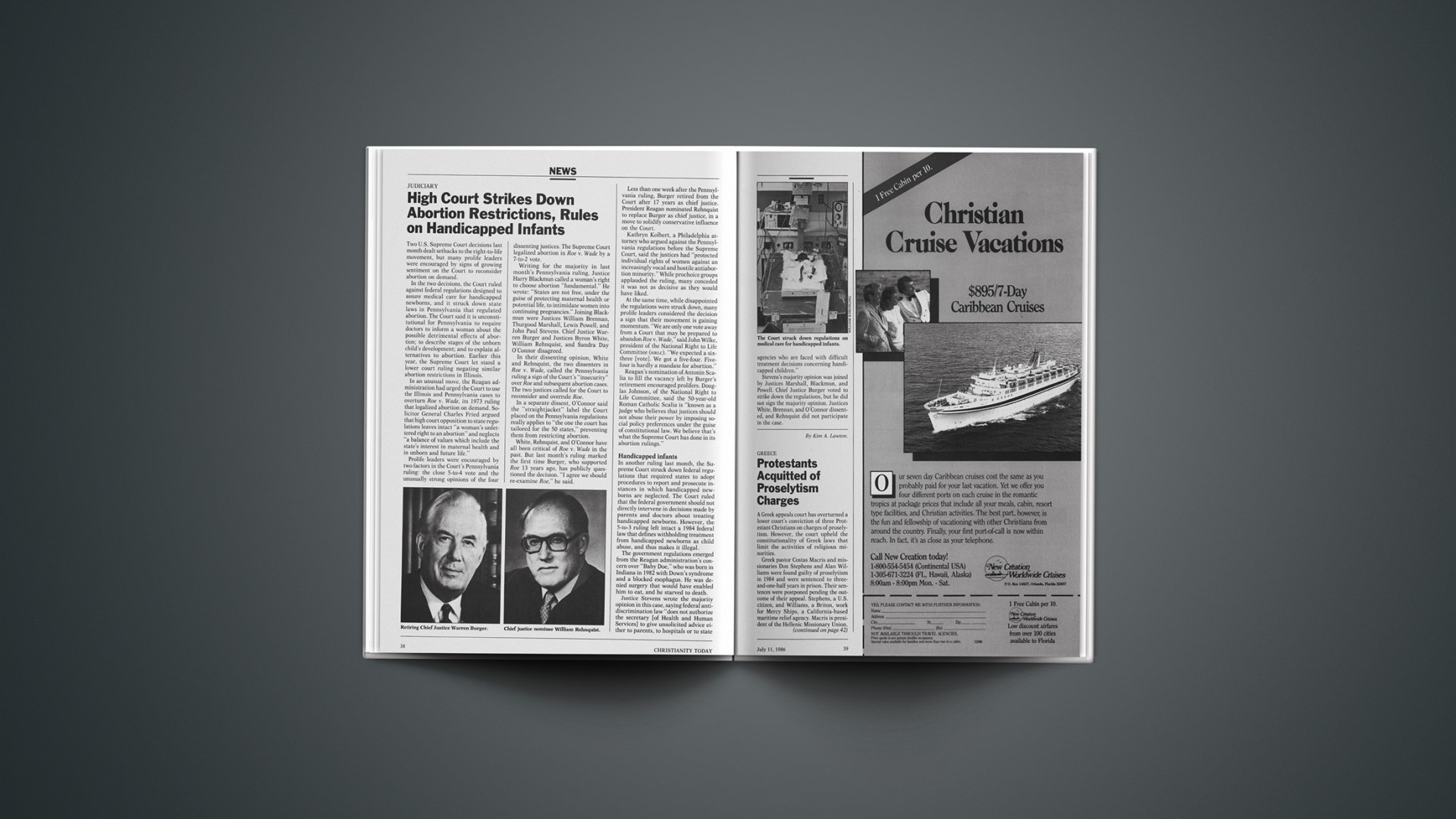
High Court Strikes down Abortion Restrictions, Rules on Handicapped Infants

Two U.S. Supreme Court decisions last month dealt setbacks to the right-to-life movement, but many prolife leaders were encouraged by signs of growing sentiment on the Court to reconsider abortion on demand.

In the two decisions, the Court ruled against federal regulations designed to assure medical care for handicapped newborns, and it struck down state laws in Pennsylvania that regulated abortion. The Court said it is unconstitutional for Pennsylvania to require doctors to inform a woman about the possible detrimental effects of abortion; to describe stages of the unborn child’s development; and to explain alternatives to abortion. Earlier this year, the Supreme Court let stand a lower court ruling negating similar abortion restrictions in Illinois.

In an unusual move, the Reagan administration had urged the Court to use the Illinois and Pennsylvania cases to overturn Roe v. Wade, its 1973 ruling that legalized abortion on demand. Solicitor General Charles Fried argued that high court opposition to state regulations leaves intact “a woman’s unfettered right to an abortion” and neglects “a balance of values which include the state’s interest in maternal health and in unborn and future life.”

Prolife leaders were encouraged by two factors in the Court’s Pennsylvania ruling: the close 5-to-4 vote and the unusually strong opinions of the four dissenting justices. The Supreme Court legalized abortion in Roe v. Wade by a 7-to-2 vote.

Writing for the majority in last month’s Pennsylvania ruling, Justice Harry Blackmun called a woman’s right to choose abortion “fundamental.” He wrote: “States are not free, under the guise of protecting maternal health or potential life, to intimidate women into continuing pregnancies.” Joining Blackmun were Justices William Brennan, Thurgood Marshall, Lewis Powell, and John Paul Stevens. Chief Justice Warren Burger and Justices Byron White, William Rehnquist, and Sandra Day O’Connor disagreed.

In their dissenting opinion, White and Rehnquist, the two dissenters in Roe v. Wade, called the Pennsylvania ruling a sign of the Court’s “insecurity” over Roe and subsequent abortion cases. The two justices called for the Court to reconsider and overrule Roe.

In a separate dissent, O’Connor said the “straightjacket” label the Court placed on the Pennsylvania regulations really applies to “the one the court has tailored for the 50 states,” preventing them from restricting abortion.

White, Rehnquist, and O’Connor have all been critical of Roe v. Wade in the past. But last month’s ruling marked the first time Burger, who supported Roe 13 years ago, has publicly questioned the decision. “I agree we should re-examine Roe,” he said.

Less than one week after the Pennsylvania ruling, Burger retired from the Court after 17 years as chief justice. President Reagan nominated Rehnquist to replace Burger as chief justice, in a move to solidify conservative influence on the Court.

Kathryn Kolbert, a Philadelphia attorney who argued against the Pennsylvania regulations before the Supreme Court, said the justices had “protected individual rights of women against an increasingly vocal and hostile antiabortion minority.” While prochoice groups applauded the ruling, many conceded it was not as decisive as they would have liked.

At the same time, while disappointed the regulations were struck down, many prolife leaders considered the decision a sign that their movement is gaining momentum. “We are only one vote away from a Court that may be prepared to abandon Roe v. Wade,” said John Wilke, president of the National Right to Life Committee (NRLC). “We expected a six-three [vote]. We got a five-four. Five-four is hardly a mandate for abortion.”

Reagan’s nomination of Antonin Scalia to fill the vacancy left by Burger’s retirement encouraged prolifers. Douglas Johnson, of the National Right to Life Committee, said the 50-year-old Roman Catholic Scalia is “known as a judge who believes that justices should not abuse their power by imposing social policy preferences under the guise of constitutional law. We believe that’s what the Supreme Court has done in its abortion rulings.”

Handicapped Infants

In another ruling last month, the Supreme Court struck down federal regulations that required states to adopt procedures to report and prosecute instances in which handicapped newborns are neglected. The Court ruled that the federal government should not directly intervene in decisions made by parents and doctors about treating handicapped newborns. However, the 5-to-3 ruling left intact a 1984 federal law that defines withholding treatment from handicapped newborns as child abuse, and thus makes it illegal.

The government regulations emerged from the Reagan administration’s concern over “Baby Doe,” who was born in Indiana in 1982 with Down’s syndrome and a blocked esophagus. He was denied surgery that would have enabled him to eat, and he starved to death.

Justice Stevens wrote the majority opinion in this case, saying federal anti-discrimination law “does not authorize the secretary [of Health and Human Services] to give unsolicited advice either to parents, to hospitals or to state agencies who are faced with difficult treatment decisions concerning handicapped children.”

Stevens’s majority opinion was joined by Justices Marshall, Blackmun, and Powell. Chief Justice Burger voted to strike down the regulations, but he did not sign the majority opinion. Justices White, Brennan, and O’Connor dissented, and Rehnquist did not participate in the case.

By Kim A. Lawton.

Prolife Groups Press Opposition to Upjohn’s Abortion Drugs

Prolife activists are stepping up their campaign against the Upjohn Company’s production of prostaglandin drugs used in abortions.

Upjohn is the only American manufacturer of prostaglandins used in second-trimester abortions. The pharmaceutical company also is a leading international supplier of the drugs. According to the Centers for Disease Control, prostaglandins are used in some 10,000 abortions each year during the middle months of pregnancy.

A nationwide boycott of Upjohn products, including Nuprin, Motrin, and Unicap vitamins, has been in effect for more than a year. To promote the boycott and call attention to Upjohn’s continued production of prostaglandins, 15 prolife organizations recently sponsored a rally at Upjohn’s headquarters in Kalamazoo, Michigan. The rally attracted some 1,000 demonstrators.

“Hopefully, the people in the community had their consciences pricked and will be able to effect change within the company,” said Constance Anders, president of Kalamazoo Right to Life. Upjohn is the largest employer in the Kalamazoo area.

As the Kalamazoo rally was taking place, the Christian Action Council sponsored smaller protests at 14 of Upjohn’s 21 regional offices across the country. Curt Young, executive director of the Christian Action Council, said his organization wants Upjohn to realize the boycott has national support. In a related effort, several stockholders attending Upjohn’s recent stockholders’ meeting asked the company to stop producing abortion drugs.

The National Right to Life Committee and other prolife groups say the protest has assumed a greater urgency because Upjohn is researching a new drug called Meteneprost. The drug is a prostaglandin-tipped suppository that could induce an abortion in the first months of pregnancy.

The Upjohn company says it plans to continue producing prostaglandins, emphasizing the drugs have been approved by the federal Food and Drug Administration. According to a company publication, “Upjohn naturally recognizes the subject as controversial, but it has proceeded … for reasons of scientific obligation; belief in basic rights of choice for individuals, physicians, and society in general; and competitive thrust in research, discovery and development.” The publication also noted that despite “varying levels of disapproval by some anti-abortion groups,” Upjohn has backed the production of prostaglandins for more than 12 years.

By Kim A. Lawton.

Reconciliation and Economic Development in South Africa

Getman1Tom Getman, former top aide to U.S. Sen. Mark O. Hatfield (R-Oreg.), directs World Vision’s Washington, D.C., office. He has traveled extensively in South Africa, where World Vision participates in 180 development projects. In an interview with Christianity Today, Getman explained the purpose and scope of those efforts.

Why does World Vision invest in development projects in South Africa?

World Vision seeks to go in Christ’s name wherever the poorest of the poor exist, regardless of the national political situation. In South Africa, development projects were needed in part because medical, educational, agricultural, and business resources traditionally have been withheld from the poor. Many black wage earners have to leave home at 4:00 or 5:00 in the morning to get to work. Often, it takes a quarter of their daily salary to pay for transportation, and they don’t get home until 8:00 or 9:00 at night.

How much of World Vision’s budget is allocated for South Africa?

Last year we spent $4 million there, much of which was raised in South Africa. Our development projects—in both rural and urban communities—are designed to make the participants renewed in their spirits and financially independent. We don’t do the work, but we facilitate the efforts of people in the communities, working in partnership with civic associations and local churches.

How can private organizations make a difference in South Africa?

Development organizations, both American private voluntary groups and black-led indigenous groups, are concentrating on developing structures that will survive a political transition. The projects include nursery schools, primary education facilities, clinics, and garden and water projects. They enable people to produce a product and earn a living so they can feel some human dignity. A person who is starving has no power at all. But a person who is feeding himself and is feeling productive has a good deal of self-worth. The dignity that comes with that kind of power is what will make the political transition a more peaceful one rather than an increasingly violent one.

Are you saying revolution in South Africa is inevitable?

Everyone I talk to in South Africa feels there are many more changes to come. But it is as much a revolution of the spirit as it is an armed conflict. The people know the fire power of the South African government is so incredible there is no way they can fight it. Instead, opponents of apartheid are discovering the power of organized, interracial resistance to violence.

Is this revolution of the spirit reaching any of the nation’s thought leaders or policy makers?

A growing number of theologians and pastors have been touched personally by the pain of their black and mixed-race brothers. The National Initiative for Reconciliation moved that process forward, because for the first time many Afrikaners and blacks heard each other tell stories of suffering. Apartheid has been so successful that people have become anonymous to one another.

A revolution of the spirit is taking place at the point where people are getting to know one another as friends. A number of South African Christians are bringing people together across racial lines. Pastors of different racial groups have been exchanging pulpits and inviting one another into their homes. I believe the shooting will stop when white Afrikaners and the English become so concerned about black mothers and children that they actually stand between the warring parties.

You recently spent a month in South Africa. How are things changing?

Everywhere we went in South Africa, the example of Christian “people power” in the Philippines kept ringing in our ears. It looks as though it’s all coming apart, yet there is a confidence, a graciousness, and a spirit-filled demeanor in people that we didn’t see two years ago.

Is this true even for people who have been directly affected by violence?

Yes. I talked to mothers who had lost their children, and as they told me their stories they had beatific looks on their faces. There was deep sadness, but it was infused with a sense that God was working out his purposes even though the sacrifice was great. They were willing to talk to me because they wanted to give witness to the fact that in their suffering, God was sufficient for their needs.

Another example is Allan Boesak, a mixed-race pastor and president of the World Alliance of Reformed Churches. He is a transformed person since he was imprisoned for six weeks. The Holy Spirit has settled on-him and transformed his relationships. He is focused, peaceful, and more powerful than ever in his preaching.

Do you see economic development as a channel to dismantle apartheid?

Yes. Bringing people to the point where they are no longer demeaned and no longer enslaved in their spirits tears away at the fabric of apartheid. The most effective covert action Christians can undertake is to give power away to the black majority without just taking it from the Afrikaners. As Americans continue to withdraw corporate investment from South Africa, we must replace it with development funding and black enterprise. Because the National party has oppressed people of color, it is legitimately scared about what’s going to happen to whites in return.

The only way peaceful transition to an interracial political system can come about is if those who have been oppressed can, by God’s grace, extend forgiveness. Some people within the Afrikaner establishment are coming to grips with the need for repentance in a dynamic and sacrificial way. But time is running very short.

WORLD SCENE

ROMANIA

Most Favored Nation

President Reagan has renewed Most Favored Nation (MFN) trade status for Romania. The President took the action last month despite requests from several members of Congress and a Christian human rights organization to suspend the special trade benefits.

Before Reagan’s decision, Christian Response International (CRI) organized a march in Washington, D.C., to call attention to Romania’s imprisonment and torture of Christian leaders and its bulldozing of church buildings. More than 250 people from 15 states participated in the demonstration.

CRI executive director Jeffrey Collins said the demonstrators gathered to “express solidarity with Romanian Christians who constantly face persecution from their atheistic government.” Collins said he hoped the march would encourage Reagan to suspend MFN trade status to the Communist nation. Several members of Congress and the National Association of Evangelicals joined CRI in calling for a temporary halt to Romania’s favored trade position.

However, the U.S. State Department recommended that Reagan renew Romania’s MFN status as a result of the country’s stepped-up emigration policy and the release from prison of some religious leaders. Romania, China, and Hungary are the only three Communist countries that enjoy MFN status.

INDIA

Outlawing Conversions

The Indian state of Tamil Nadu has announced plans to outlaw “mass religious conversions” and conversions by “foul and fraudulent means.” The proposed legislation would be aimed primarily at the conversions of Hindus to Christianity.

The state government said it wanted to find a “lasting solution” to violent clashes between militant Hindus and Christians. The Hindu Service Society has openly opposed evangelistic efforts by harassing Christians.

The proposed statute is similar to existing laws in four other Indian states. It would impose fines and imprisonment on those responsible for converting anyone from “one religious faith to another” by use of “force, inducement, deceit or any fraudulent means.” The law would not penalize converts.

SOUTH AFRICA

Keeping a Whites-only Policy

The proapartheid Nederduitse Hervormde Kerk in Africa (NHK) has voted to retain a policy that prevents nonwhites from joining the 200,000-member South African denomination.

The church’s membership policy states there is danger in mixing blacks and whites, and thus each racial group should have its own church, NHK moderator J. P. Oberholzer said his denomination is trying to be “the church of Christ on earth.” He said that could best be accomplished if the NHK remains exclusively white.

ENGLAND

Anglican Beliefs

The Church of England’s House of Bishops has released a statement that affirms a literal belief in the Resurrection and the Virgin Birth.

Archbishop of Canterbury Robert Runcie said the bishops’ 39-page report “stresses that Christianity is a house built on the rock of actual events.” Runcie said the document reflects the Church of England’s view that “the resurrection is objective reality” and that “the second person in the blessed Trinity [Jesus] is incarnate …, that is, God in human flesh.”

David Jenkins, the bishop of Durham, criticized the report for not being “more open, relaxed, and creative.” Jenkins, who was consecrated as the Church of England’s fourth most-senior bishop in 1984, raised a stir when he voiced doubts that Jesus’ resurrection and virgin birth are historical facts.

While the bishops’ document holds that literal interpretations of the Resurrection and Virgin Birth are intellectually defensible, it leaves the door open to more liberal interpretations. “… The divergent views to be found among scholars of standing are reflected in the thinking of individual bishops.” In addition, the document welcomes “the responsible pursuit of historical criticism,” but states there are “severe limits to what critical study can achieve.”

SCOTLAND

Reassessing Abortion

The Church of Scotland has overturned a 1985 policy statement asserting that abortion is justified only when giving birth would endanger the life of a pregnant woman.

The denomination’s general assembly voted to return to an earlier policy statement that permits abortion when giving birth would endanger a woman’s life or present a serious risk to a woman’s mental or physical health.

Frank Gibson, secretary of the church’s Board of Social Responsibility, backed the more restrictive policy, which was approved last year. However, that policy statement was criticized by several hospital chaplains. David Lyle, chaplain at Edinburgh Northern Hospital, said his colleagues perceived the policy as “moralistic, judgmental, and out of touch with real life.”

In other action, the denomination’s general assembly:

• Officially dissociated itself from statements against Roman Catholicism contained in the Westminster Confession. Those statements include a reference to the pope as the Antichrist and a warning against Protestants marrying Catholics. Previously, church office holders had to agree to accept the statements.

• Heard a plea for congregations in the Church of Scotland to give a high priority to evangelism. A pastor told the general assembly that if the denomination continues its current loss of 19,000 members a year, it will all but cease to exist by the year 2030.

Christians Tackle the Task of Racial Reconciliation

Last year, 400 South African clergymen met to explore ways they could cooperate in calling for peaceful political change in their nation. Known as the National Initiative for Reconciliation (NIR), the meeting was organized by Africa Enterprise, an interdenominational South African group headed by Michael Cassidy, an Anglican layman (CT, Nov. 8, 1985, p. 69).

That initiative has shifted focus in recent months, concentrating on building fragile bonds of trust between individuals across racial and denominational lines. It has attracted broad support from white churches and cautious endorsement from some black church leaders in the racially segregated country.

NIR’s task has grown increasingly urgent this summer, as the South African government declared a nationwide state of emergency and detained thousands of apartheid opponents, including many church leaders. Cassidy’s approach to ending apartheid, South Africa’s system of maintaining racial separation, is biblically oriented. Six stated goals and purposes include mandates to proclaim Christ, pray and fast for renewal within the church, create opportunities for transracial worship and fellowship, and get Christian leaders talking to one another.

It has brought together conservative Dutch Reformed whites and well-known black opponents of apartheid, such as Anglican Archbishop Desmond Tutu. Its inclusiveness is made possible because supporters agree to differ, at times, over strategies of protesting against the system.

Caesar Molebatsi, a regional NIR chairman in Johannesburg, says the initiative gives Christians a chance to develop a public witness to influence opinion and create a climate conducive to political change. The difficulties of getting the intiative moving are immense, he said during a recent interview in Washington, D.C. But the potential benefits may help minimize violent outbursts that threaten South Africa’s citizens from left-wing and right-wing extremists alike.

Challenges

The challenge begins with the very concept of reconciliation. “White people are still asking for time,” Molebatsi explained, “and we are saying, as blacks, that we don’t have time. We are standing at the edge of a precipice. What is required of blacks [to participate in NIR] is a tremendous leap of faith; and on the part of whites, to go for broke, to take what appears to be a fatal step.”

After the initial NIR meeting last September, difficulties arose because the agenda of many black Christians appeared to be in direct conflict with white interests. Blacks, for instance, have organized effective consumer boycotts. White pastors, invited to join NIR, ask how they can be expected to support an effort that will hurt church members who own businesses targeted by protesters.

Another challenge to NIR came just after the September meeting, when a group of 150 South African Christian leaders issued the Kairos Document, offering a critique not only of apartheid, but also of church efforts at reconciliation. Without making specific reference to NIR, the Kairos Document states, “There are conflicts that can only be described as the struggle between justice and injustice, good and evil, God and the devil. To speak of reconciling these two is not only a mistaken application of the Christian idea of reconciliation, it is a total betrayal of all that Christian faith has ever meant.”

NIR leaders carefully critiqued the document. One commentator wrote in an NIR publication, “The effect of this document may be to rule out dialogue and reconciliation, to damn the political status quo, to pronounce it irredeemable and to sanctify the black political struggle.”

Developing Relationships

Because of deep divisions within Christian groups and between them, NIR organizers have moved toward ways of introducing black and white Christians to one another and encouraging relationships to develop. In Johannesburg, Molebatsi has been organizing interracial teams of Christian leaders to travel together to trouble spots.

Much of today’s conflict in South Africa involves young people, so Molebatsi also sponsors a “Day in the Life” program in which black and white teenagers describe their daily experiences to one another in small groups. “The only contact most of the whites have had with blacks has been with servants in their homes or with a gardener they call ‘boy’ even if he is 45 years old,” he said. “That’s the hard reality we have to deal with. Black kids … are very sophisticated, very politicized.”

Molebatsi, a graduate of Wheaton (Ill.) College’s graduate school, directs a nondenominational organization in South Africa called Youth Alive. Participation in NIR has cost him support from both black and white donors.

To the extent NIR has tried to hold Dutch Reformed conservatives in its orbit, it is criticized by blacks for accommodating the status quo of apartheid. On the other hand, Molebatsi said, efforts to keep black leaders involved provokes whites who say, “We don’t want anything to do with Communists.”

As a result of such tensions, NIR or ganizers call their movement “fragile and vulnerable.” Said Molebatsi: “Very few blacks understand how determined the white people are to preserve what they have.” Black youth, too, are indicating unmovable resolve. “You hear it in their songs and see it in their lifestyles,” Molebatsi said. “Some say they will not comb their hair until liberation.”

Working to mobilize the church in such a way that South Africans of all races bear witness to one Lord, despite differing political positions, is NIR’s formidable task. The initiative’s chief organizer, Michael Cassidy, wrote, “If when all is said and done, it is only a remnant which responds to this challenge, then so be it. God has used remnants before.” What may work in their favor is the shared Christian faith many South Africans continue to profess, in the midst of a rapidly deteriorating political system.

By Beth Spring.

Facing an Uphill Battle, Black Christian Leaders Meet to Discuss Strategy

Historically, the church has been the most influential institution in America’s black community. Today the black church is feeling a responsibility to use its influence to address the struggles facing black America.

Some of black America’s more prominent Christian leaders met last month at the National Summit on Black Church Development to exchange ideas for addressing such issues as teen pregnancy and economic empowerment. Said Matt Parker, organizer of the Detroit meeting, “If there is any hope for us as a people, it lies with the church.”

Evangelist/theologian Anthony Evans acknowledged there are major problems facing America’s black community. But he added that “the primary crisis is that in [the black community], the church is the number one institution.… The great failure is the failure of the church to be the church in that community.”

Black Christian leaders from a variety of denominational backgrounds and traditions participated in the four-day meeting. Most of the approximately 100 who attended function in the black culture, but many work for predominantly white institutions, including Inter-Varsity Christian Fellowship, Campus Crusade for Christ, the Southern Baptist Convention, and Liberty University. One participant voiced the frustration of many blacks who are unable to “dream outside the structures established by white boards of directors.”

Dialogue

The conference produced frank dialogue indicating that relationships between black and white Christians are in need of repair. Generally, participants felt that problems facing black America are not a priority for white Christians. “Realistically, we cannot expect whites to put this on their agenda,” said Joy Lovett, of the Afro-American Mennonite Association. “If we don’t evangelize black America, it won’t get done.”

Evangelist Tom Skinner said there is little dialogue between black and white church leaders. “When we do get together,” he said, “it’s always our generals working with their corporals.” Skinner welcomed any help white Christians can offer. But he said for genuine progress to be made, the agenda and programs would have to be black initiated.

While some believe black Christians should found their own schools and publications, others said that approach would take too much time. Abraham Davis, of Philadelphia’s Center for Urban Theological Studies, proposed that black Christians ask established white evangelical colleges and universities for “flexibility in testing and teaching” in order for more blacks to take advantage of existing educational resources.

Evans said the black church, because of its history of oppression, has something unique to offer white Christians. “[The] integrating point for theology is no longer philosophy, but sociology …,” he said. “We need to strategize on how to package what [white Christians] need, and give it in love, so there’s a mutual dependence.”

William Shoemaker, president of William Tyndale College, one of the summit’s sponsors, said white Christians have a lot of growing to do in the area of black-white relations. “For too long we have assumed that white, suburban organizational structures and processes are biblical,” said Shoemaker, who is white.

Revival

Most participants agreed there is revival going on in the black church, including the traditional church, which has had little contact with white institutions. “I’m seeing a tremendous thirst for the study of the Scriptures and for developing the ‘how to’s’ of evangelism and discipleship,” Parker said.

Dolphus Weary, who heads a ministry to the poor in Mendenhall, Mississippi, said the “traditional black church has lacked a national approach to reach people with the gospel.” He added, however, that “more and more blacks in traditional churches are getting turned on to this concept of evangelism and how people can be discipled.”

Black preachers once regarded as liberal are now being understood as lacking in educational tools. But today, more black leaders have access to formal theological education. After Evans delivered a provocative biblical exposition, one participant remarked, “I never thought I’d live to hear a black man open up the Word of God like that.”

Others said many black preachers have been “opening up the Word of God” for years, but there has been no way for most black Christians to find out about it. “We have no way to inform and encourage each other,” said Willie Richardson of the Christian Stronghold Baptist Church in Philadelphia. “Our white brothers and sisters control the media, the publications. I say this not to be negative. It’s just a fact.”

The Detroit summit gave black Christians an opportunity to compare notes on the problems they face, and to learn about one another’s ministries. Many black churches, for example, have benefited from an evangelistic program that originated at Richardson’s church. The program is designed specifically to attract black men into the church. Black pastors are finding it increasingly difficult to tell their young women not to marry non-Christians when there are so few black men in the pews.

Revival in the black church includes a growing concern for worldwide missions. “It’s only in recent years that mission boards have been open to taking blacks,” said Bob Harrison, a pioneer in black missionary evangelism. Plans are under way for Destiny ’87, a national conference designed to spark a new movement of black Christian missionary involvement in the United States and other nations. The conference is scheduled for next summer in Atlanta.

By Randy Frame in Detroit.

Conservatives Tighten Their Hold on the Southern Baptist Convention

Last month, Georgia Governor Joe Frank Harris welcomed 40,889 Southern Baptist messengers (delegates) to the state where the Southern Baptist Convention (SBC) was born in 1845. And within minutes the battle was renewed between conservative and moderate factions seeking to control America’s largest non-Catholic denomination.

The primary battle involved the election of a new SBC president. Conservative Adrian Rogers, pastor of Bellevue Baptist Church in Memphis, defeated Texas pastor Winfred Moore, the candidate favored by SBC moderates. Rogers, first elected in 1979 to a one-year term, received 54.2 percent of the vote. Supporters said his election would speed the restoration of “doctrinal integrity” to the 14.5 million-member denomination’s agencies and institutions.

The SBC president carries appointive powers that lead each year to the nomination of a portion of the denomination’s agency trustees. Having won the presidential election eight years in a row, conservatives saw this year’s victory as a giant step forward in their ten-year plan to achieve dominance.

Peace Committee

Last year, a 22-member Peace Committee was appointed to study the political and theological issues dividing the denomination. The committee reported to the Atlanta convention, citing examples of theological diversity at SBC seminaries. Those examples include:

• Some faculty members affirm the direct creation and historicity of Adam and Eve, while others view them as merely representative of the human race in its creation and fall.

• Some professors understand the historicity of every event in Scripture as reported by the original source, while others hold that the historicity can be clarified and revised by the findings of modern historical scholarship.

• Some hold to the stated authorship of every book in the Bible, while others hold that in some cases such attribution may not refer to the final author or may be pseudonymous.

• Some hold that every miracle in the Bible is intended to be taken as a historical event, while others hold that some miracles are intended to be taken as parabolic.

Regarding policital activity in the SBC, the Peace Committee said some spokesmen on both ends of the political spectrum have used “intemperate, inflammatory, and unguarded language.” The committee also said some denominational newspapers have shown prejudice against conservative activists, while independent journals have shown prejudice against both conservatives and moderates. The committee is scheduled to present a second report at next year’s convention in St. Louis.

Factional Struggle

Representatives of both camps were outspoken about the denominational struggle. Kenneth Chafin, a moderate who teaches at Southern Baptist Theological Seminary in Louisville, Kentucky, said, “[SBC President Adrian] Rogers is so strong he’ll try to get a number of us [professors] fired.” Chafin called Rogers “a pit bulldog who never gives up.”

In response, Rogers declared: “There are some things I want to be ‘bull-dogmatic’ about. One is defending the Word of God.” Rogers said he hopes “to create a climate of love, truth, trust, and openness.” But he added, “we do have some theological problems with which trustees will be dealing. I’m for soul freedom, but we do have something to say about what is taught.…”

Defeated presidential candidate Moore said he knew of “no theological problems” that call for “anyone to be excluded” from SBC agencies. “If they’d let me draw the perimeter, there would be a lot more people inside the circle,” he said.

Moderates at the Atlanta convention did not speak of leaving the denomination, but a rift was evident. Peace Committee chairman Charles Fuller was both frank and hopeful. “The question still is ‘how diverse can we be and still work together?’ The Peace Committee is still proceeding on the premise that we can remain together.”

By James C. Hefley in Atlanta.

Apple PodcastsDown ArrowDown ArrowDown Arrowarrow_left_altLeft ArrowLeft ArrowRight ArrowRight ArrowRight Arrowarrow_up_altUp ArrowUp ArrowAvailable at Amazoncaret-downCloseCloseEmailEmailExpandExpandExternalExternalFacebookfacebook-squareGiftGiftGooglegoogleGoogle KeephamburgerInstagraminstagram-squareLinkLinklinkedin-squareListenListenListenChristianity TodayCT Creative Studio Logologo_orgMegaphoneMenuMenupausePinterestPlayPlayPocketPodcastRSSRSSSaveSaveSaveSearchSearchsearchSpotifyStitcherTelegramTable of ContentsTable of Contentstwitter-squareWhatsAppXYouTubeYouTube