How Harmful Is Pornography?

CHRISTIANITY TODAY/July 11, 1986

A federal commission cites the dangers of obscenity and calls for stricter enforcement of existing laws.

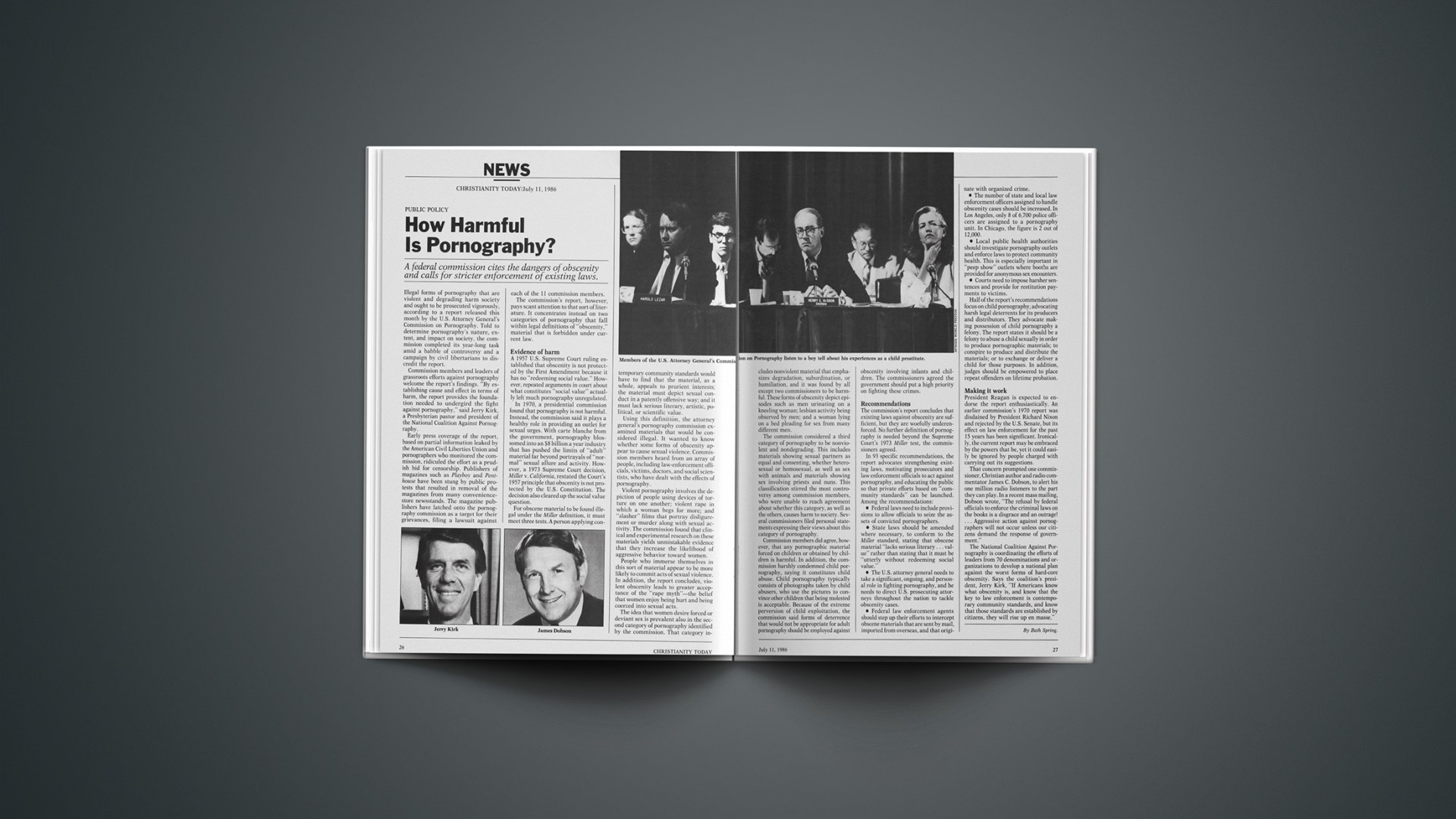
Illegal forms of pornography that are violent and degrading harm society and ought to be prosecuted vigorously, according to a report released this month by the U.S. Attorney General’s Commission on Pornography. Told to determine pornography’s nature, extent, and impact on society, the commission completed its year-long task amid a babble of controversy and a campaign by civil libertarians to discredit the report.

Commission members and leaders of grassroots efforts against pornography welcome the report’s findings. “By establishing cause and effect in terms of harm, the report provides the foundation needed to undergird the fight against pornography,” said Jerry Kirk, a Presbyterian pastor and president of the National Coalition Against Pornography.

Early press coverage of the report, based on partial information leaked by the American Civil Liberties Union and pomographers who monitored the commission, ridiculed the effort as a prudish bid for censorship. Publishers of magazines such as Playboy and Penthouse have been stung by public protests that resulted in removal of the magazines from many convenience-store newsstands. The magazine publishers have latched onto the pornography commission as a target for their grievances, filing a lawsuit against each of the 11 commission members.

The commission’s report, however pays scant attention to that sort of literature. It concentrates instead on two categories of pornography that fall within legal definitions of “obscenity,” material that is forbidden under current law.

Evidence Of Harm

A 1957 U.S. Supreme Court ruling established that obscenity is not protected by the First Amendment because it has no “redeeming social value.” However, repeated arguments in court about what constitutes “social value” actually left much pornography unregulated

In 1970, a presidential commission found that pornography is not harmful. Instead, the commission said it plays a healthy role in providing an outlet for sexual urges. With carte blanche from the government, pornography blossomed into an $8 billion a year industry that has pushed the limits of “adult” material far beyond portrayals of “normal” sexual allure and activity. However, a 1973 Supreme Court decision. Miller v. California, restated the Court’s 1957 principle that obscenity is not protected by the U.S. Constitution. The decision also cleared up the social value question.

For obscene material to be found illegal under the Miller definition, it must meet three tests. A person applying contemporary community standards would have to find that the material, as a whole, appeals to prurient interests; the material must depict sexual conduct in a patently offensive way; and it must lack serious literary, artistic, political, or scientific value.

Using this definition, the attorney general’s pornography commission examined materials that would be considered illegal. It wanted to know whether some forms of obscenity appear to cause sexual violence. Commission members heard from an array of people, including law-enforcement officials, victims, doctors, and social scientists, who have dealt with the effects of pornography.

Violent pornography involves the depiction of people using devices of torture on one another; violent rape in which a woman begs for more; and “slasher” films that portray disfigurement or murder along with sexual activity. The commission found that clinical and experimental research on these materials yields unmistakable evidence that they increase the likelihood of aggressive behavior toward women.

People who immerse themselves in this sort of material appear to be more likely to commit acts of sexual violence. In addition, the report concludes, violent obscenity leads to greater acceptance of the “rape myth”—the belief that women enjoy being hurt and being coerced into sexual acts.

The idea that women desire forced or deviant sex is prevalent also in the second category of pornography identified by the commission. That category includes nonviolent material that emphasizes degradation, subordination, or humiliation, and it was found by all except two commissioners to be harmful. These forms of obscenity depict episodes such as men urinating on a kneeling woman; lesbian activity being observed by men; and a woman lying on a bed pleading for sex from many different men.

The commission considered a third category of pornography to be nonviolent and nondegrading. This includes materials showing sexual partners as equal and consenting, whether heterosexual or homosexual, as well as sex with animals and materials showing sex involving priests and nuns. This classification stirred the most controversy among commission members, who were unable to reach agreement about whether this category, as well as the others, causes harm to society. Several commissioners filed personal statements expressing their views about this category of pornography.

Commission members did agree, however, that any pornographic material forced on children or obtained by children is harmful. In addition, the commission harshly condemned child pornography, saying it constitutes child abuse. Child pornography typically consists of photographs taken by child abusers, who use the pictures to convince other children that being molested is acceptable. Because of the extreme perversion of child exploitation, the commission said forms of deterrence that would not be appropriate for adult pornography should be employed against obscenity involving infants and children. The commissioners agreed the government should put a high priority on fighting these crimes.

Recommendations

The commission’s report concludes that existing laws against obscenity are sufficient, but they are woefully underenforced. No further definition of pornography is needed beyond the Supreme Court’s 1973 Miller test, the commissioners agreed.

In 93 specific recommendations, the report advocates strengthening existing laws, motivating prosecutors and law enforcement officials to act against pornography, and educating the public so that private efforts based on “community standards” can be launched. Among the recommendations:

• Federal laws need to include provisions to allow officials to seize the assets of convicted pornographers.

• State laws should be amended where necessary, to conform to the Miller standard, stating that obscene material “lacks serious literary … value” rather than stating that it must be “utterly without redeeming social value.”

• The U.S. attorney general needs to take a significant, ongoing, and personal role in fighting pornography, and he needs to direct U.S. prosecuting attorneys throughout the nation to tackle obscenity cases.

• Federal law enforcement agents should step up their efforts to intercept obscene materials that are sent by mail, imported from overseas, and that originate with organized crime.

• The number of state and local law enforcement officers assigned to handle obscenity cases should be increased. In Los Angeles, only 8 of 6,700 police officers are assigned to a pornography unit. In Chicago, the figure is 2 out of 12,000.

• Local public health authorities should investigate pornography outlets and enforce laws to protect community health. This is especially important in “peep show” outlets where booths are provided for anonymous sex encounters.

• Courts need to impose harsher sentences and provide for restitution payments to victims.

Half of the report’s recommendations focus on child pornography, advocating harsh legal deterrents for its producers and distributors. They advocate making possession of child pornography a felony. The report states it should be a felony to abuse a child sexually in order to produce pornographic materials; to conspire to produce and distribute the materials; or to exchange or deliver a child for those purposes. In addition, judges should be empowered to place repeat offenders on lifetime probation.

Making It Work

President Reagan is expected to endorse the report enthusiastically. An earlier commission’s 1970 report was disdained by President Richard Nixon and rejected by the U.S. Senate, but its effect on law enforcement for the past 15 years has been significant. Ironically, the current report may be embraced by the powers that be, yet it could easily be ignored by people charged with carrying out its suggestions.

That concern prompted one commissioner, Christian author and radio commentator James C. Dobson, to alert his one million radio listeners to the part they can play. In a recent mass mailing, Dobson wrote, “The refusal by federal officials to enforce the criminal laws on the books is a disgrace and an outrage!… Aggressive action against pornographers will not occur unless our citizens demand the response of government.”

The National Coalition Against Pornography is coordinating the efforts of leaders from 70 denominations and organizations to develop a national plan against the worst forms of hard-core obscenity. Says the coalition’s president, Jerry Kirk, “If Americans know what obscenity is, and know that the key to law enforcement is contemporary community standards, and know that those standards are established by citizens, they will rise up en masse.”

By Beth Spring.

NORTH AMERICAN SCENE

FUND RAISING

An Alternative to Bingo

Joseph Cardinal Bernardin has recommended that the churches in the Chicago archdiocese find an alternative to bingo and “Las Vegas Nights” to fund their schools and other ministries.

The cardinal said gambling “is not immoral.” But he said he has “serious reservations about whether this is the most appropriate way” for the church to finance its programs.

As an alternative to games of chance, Bernardin suggested a form of tithing. But he did not specify a percentage amount that Catholics should contribute from the family paycheck. Families in the Chicago archdiocese contribute an average of $245 per year to their parishes.

MAINE

Rejecting a Pornography Law

In a statewide referendum, Maine voters rejected a proposed law that would have imposed criminal penalties for producing, selling, and promoting obscene materials. The Christian Civic League was the measure’s primary supporter.

The proposed statute would have used “contemporary community standards” to define obscenity. It would have punished violators with a fine of up to $10,000 and/or a prison sentence of up to five years.

“The crucial issues raised in this campaign have yet to be resolved,” said Jasper Wyman, executive director of the Christian Civic League. “It would be a serious error to interpret these results as an indication of the people’s lack of resolve in combating the serious and growing problem of pornography.”

Barry Lynn, of the American Civil Liberties Union, praised the outcome of the referendum. “It’s one of the most resounding defeats for censorship in American history,” he said, “because rarely do U.S. citizens have a chance to decide whether they want their government to tell them what they can read.”

Charles Devoe, director of Maine Citizens Against Government Censorship, also praised the measure’s defeat. He said voters rejected the law in part because they were “worried about the intrusion of the church into a political problem.” But he added that “all the voters, whether they voted yes or no, still reject pornography and see it as a social problem.”

TRENDS

Sex and Single Women

Eighty percent of single American women in their twenties have engaged in sex, according to a new government study. One-third of those women have become pregnant at least once, the study says, and 40 percent ended their first pregnancies by abortion.

The report, financed by the National Institutes of Health, is the first federal study of the sexual practices of women in their twenties. According to the study, single American women in their twenties have had sex with an average of 4.5 men, and one-third of them have lived with a man.

“Pregnancy and childbearing are as common among single women in their twenties as … among adolescents,” said Temple University demographer Koray Tanfer, who conducted the survey. The study was based on face-to-face interviews with 1,314 never-married women across the country. During 1983, the year the interviews were conducted, 400,000 of the 8.1 million single American women in their twenties gave birth, and 660,000 had abortions, according to the study.

PEOPLE AND EVENTS

Briefly Noted

Appointed: Michael Green, as professor of evangelism at Regent College in Vancouver, British Columbia. Green is rector of Saint Aldate’s Church in Oxford, England. A leading British evangelist and apologist, he will assume his new position in January.

Arrested: Joseph Scheidler, executive director of the Pro-Life Action League, for a Florida abortion clinic burglary. Scheidler said he believes he was arrested to prevent him from participating in last month’s National Right to Life Committee convention.

Died: Irwin Moon, 78, founder of the Moody Institute of Science and producer of award-winning films that use science as an evangelistic tool; May 7, in Placentia, California, following a stroke.

Founded: Leighton Ford Ministries, an international organization headed by evangelist Leighton Ford. The organization will focus on evangelism and the development of young Christians to assume leadership positions in the church. Ford will continue to hold city-wide evangelistic campaigns and will teach evangelism in seminaries and colleges.

Paid: Child support, under a Wisconsin law that holds grandparents liable for the cost of caring for their unmarried children’s offspring. Jean Mayberry, of Beaver Dam, Wisconsin, and her ex-husband are required to pay a total of $310 per month to support their grandson until their unmarried daughter turns 18. The child support payments are required under a state law designed to reduce the number of teenage pregnancies.

Removed: Daniel N. Solberg, from the clergy roster of the Lutheran Church in America (LCA). Solberg is a member of Denominational Ministry Strategy, a group that uses controversial tactics to draw attention to the plight of the unemployed. The LCA’s Western Pennsylvania-West Virginia Synod voted to defrock Solberg for conduct incompatible with the ministerial office and with willful disregard of the LCA constitution.

Resigned: H. L. (Renny) Scott, as rector of Saint Philip’s Episcopal Church in Charleston, South Carolina. Scott, well known in the Episcopal Church’s renewal movement, announced his decision from the pulpit. He cited an unspecified “pattern of bondage” that emerged following his acquaintance, in college, with someone involved in occult activity. He is former rector of Church of the Apostles in Fairfax, Virginia.
The Unseen World Is Not a Myth

WAYNE GRUDEM

Thinking about the unseen spiritual world is so foreign to our culture that many contemporary scholars—Rudolf Bultmann being the most prominent—have declared we should abandon any insistence that there is such an unseen world, in order to make the gospel acceptable to modern man.

But while there are many excellent arguments against Bultmann and his friends, I wonder if the battle is not lost anyway—by our forgetting this unseen spiritual world about 231/2 hours a day. We say the unseen spiritual world exists, but we act as though it did not. If a gigantic computer could read our thoughts and print them out, with any awareness of the unseen spiritual world in red and all our other thoughts in black, would there be much colored ink on our pages at the end of each day?

In contrast, if we look over the entire scope of the New Testament, we find that the idea of living each moment with an awareness of the reality of this unseen world is so central, so much a part of the ordinary Christian life, that it is hard to imagine a Christian life without it.

In the synoptic Gospels it is laying up “treasures in heaven” (Matt. 6:20). It is giving alms “in secret” so that “your Father who sees in secret may reward you” (Matt. 6:4).

In John’s gospel this unseen world is the world “above,” from which Jesus came, to which he ascended, and where he has now gone “to prepare a place” for us (John 3:31; 14:2).

In the Book of Acts, the unseen world includes heaven, where Jesus is now at the right hand of the Father (Acts 7:55–56).

In Paul’s epistles, part of this world is “the heavenlies” or the “heavenly places” (Eph. 1:20; 2:6; 3:10). This is the arena of the spiritual battle against “principalities” and “powers,” against the “spiritual hosts of wickedness” (Eph. 6:12).

In Hebrews, the unseen world is the truest reality—the permanent, final, eternal creation of God. There it is that we find the true dwelling place of God (Heb. 9:24), the “kingdom that cannot be shaken” (Heb. 12:28).

In James, this unseen world is the place in which the Lord of Hosts has heard the cries of the unpaid laborers (James 5:4), and the place from which he will soon come in judgment, “for behold the Judge is standing at the doors” (James 5:9).

In the First Letter of Peter, the unseen is the place where we have “an inheritance imperishable, undefiled and unfading” (1 Pet. 1:4). This unseen spiritual reality is the perspective from which we see one another as church members built together into a “spiritual temple” to offer “spiritual sacrifices acceptable to God” (1 Pet. 2:5).

In Jude, we find that this world contains the place where rebellious angels are being kept by God “in the nether gloom until the judgment of the great day” (Jude 6).

And finally, in the Book of the Revelation, the full glory of the unseen world explodes into view. We catch glimpses of the heavenly city and final judgments and rewards yet to come. We hear glory being given to him who sits upon the throne and to the Lamb, and we long to join with those already there who even now are ascribing to God and to the Lamb “blessing and honor and glory and power for ever and ever” (Rev. 5:13).

The unseen spiritual world is real. As we are mindful of it, it will quicken and intensify our prayer, it will deepen our worship, it will purify our speech, it will reform our conduct, it will deepen our love for our Lord Jesus, “whom not having seen,” we love (1 Pet. 1:8).

Our modem society—and Rudolf Bultmann—are not partly right and partly wrong. They are wrong on both counts: The unseen world is not a myth or legend—it is real. And our present world is not eternal or abiding—it is temporal. To miss this point is to miss New Testament Christianity altogether. To believe it each moment is to have New Testament faith.

Billy Graham and the Barefoot Evangelists

An interview on Amsterdam ’86 and the future of world evangelism

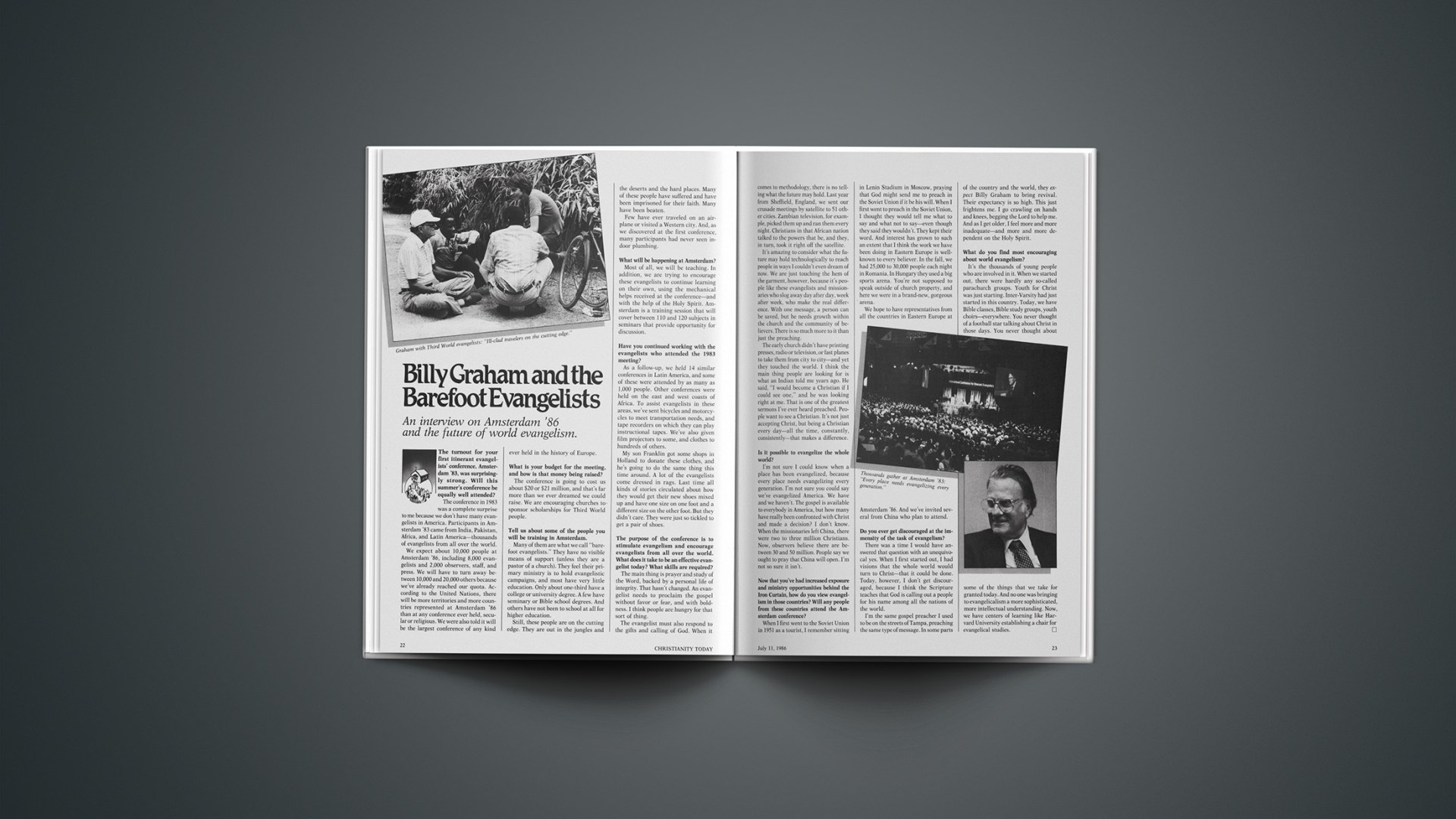
The turnout for your first itinerant evangelists’ conference, Amsterdam ’83, was surprisingly strong. Will this summer’s conference be equally well attended?

The conference in 1983 was a complete surprise to me because we don’t have many evangelists in America. Participants in Amsterdam ’83 came from India, Pakistan, Africa, and Latin America—thousands of evangelists from all over the world.

We expect about 10,000 people at Amsterdam ’86, including 8,000 evangelists and 2,000 observers, staff, and press. We will have to turn away between 10,000 and 20,000 others because we’ve already reached our quota. According to the United Nations, there will be more territories and more countries represented at Amsterdam ’86 than at any conference ever held, secular or religious. We were also told it will be the largest conference of any kind ever held in the history of Europe.

What is your budget for the meeting, and how is that money being raised?

The conference is going to cost us about $20 or $21 million, and that’s far more than we ever dreamed we could raise. We are encouraging churches to sponsor scholarships for Third World people.

Tell us about some of the people you will be training in Amsterdam.

Many of them are what we call “barefoot evangelists.” They have no visible means of support (unless they are a pastor of a church). They feel their primary ministry is to hold evangelistic campaigns, and most have very little education. Only about one-third have a college or university degree. A few have seminary or Bible school degrees. And others have not been to school at all for higher education.

Still, these people are on the cutting edge. They are out in the jungles and the deserts and the hard places. Many of these people have suffered and have been imprisoned for their faith. Many have been beaten.

Few have ever traveled on an airplane or visited a Western city. And, as we discovered at the first conference, many participants had never seen indoor plumbing.

What will be happening at Amsterdam?

Most of all, we will be teaching. In addition, we are trying to encourage these evangelists to continue learning on their own, using the mechanical helps received at the conference—and with the help of the Holy Spirit. Amsterdam is a training session that will cover between 110 and 120 subjects in seminars that provide opportunity for discussion.

Have you continued working with the evangelists who attended the 1983 meeting?

As a follow-up, we held 14 similar conferences in Latin America, and some of these were attended by as many as 1,000 people. Other conferences were held on the east and west coasts of Africa. To assist evangelists in these areas, we’ve sent bicycles and motorcycles to meet transportation needs, and tape recorders on which they can play instructional tapes. We’ve also given film projectors to some, and clothes to hundreds of others.

My son Franklin got some shops in Holland to donate these clothes, and he’s going to do the same thing this time around. A lot of the evangelists come dressed in rags. Last time all kinds of stories circulated about how they would get their new shoes mixed up and have one size on one foot and a different size on the other foot. But they didn’t care. They were just so tickled to get a pair of shoes.

The purpose of the conference is to stimulate evangelism and encourage evangelists from all over the world. What does it take to be an effective evangelist today? What skills are required?

The main thing is prayer and study of the Word, backed by a personal life of integrity. That hasn’t changed. An evangelist needs to proclaim the gospel without favor or fear, and with boldness. I think people are hungry for that sort of thing.

The evangelist must also respond to the gifts and calling of God. When it comes to methodology, there is no telling what the future may hold. Last year from Sheffield, England, we sent our crusade meetings by satellite to 51 other cities. Zambian television, for example, picked them up and ran them every night. Christians in that African nation talked to the powers that be, and they, in turn, took it right off the satellite.

It’s amazing to consider what the future may hold technologically to reach people in ways I couldn’t even dream of now. We are just touching the hem of the garment, however, because it’s people like these evangelists and missionaries who slog away day after day, week after week, who make the real difference. With one message, a person can be saved, but he needs growth within the church and the community of believers. There is so much more to it than just the preaching.

The early church didn’t have printing presses, radio or television, or fast planes to take them from city to city—and yet they touched the world. I think the main thing people are looking for is what an Indian told me years ago. He said, “I would become a Christian if I could see one,” and he was looking right at me. That is one of the greatest sermons I’ve ever heard preached. People want to see a Christian. It’s not just accepting Christ, but being a Christian every day—all the time, constantly, consistently—that makes a difference.

Is it possible to evangelize the whole world?

I’m not sure I could know when a place has been evangelized, because every place needs evangelizing every generation. I’m not sure you could say we’ve evangelized America. We have and we haven’t. The gospel is available to everybody in America, but how many have really been confronted with Christ and made a decision? I don’t know. When the missionaries left China, there were two to three million Christians. Now, observers believe there are between 30 and 50 million. People say we ought to pray that China will open. I’m not so sure it isn’t.

Now that you’ve had increased exposure and ministry opportunities behind the Iron Curtain, how do you view evangelism in those countries? Will any people from these countries attend the Amsterdam conference?

When I first went to the Soviet Union in 1951 as a tourist, I remember sitting in Lenin Stadium in Moscow, praying that God might send me to preach in the Soviet Union if it be his will. When I first went to preach in the Soviet Union, I thought they would tell me what to say and what not to say—even though they said they wouldn’t. They kept their word. And interest has grown to such an extent that I think the work we have been doing in Eastern Europe is well-known to every believer. In the fall, we had 25,000 to 30,000 people each night in Romania. In Hungary they used a big sports arena. You’re not supposed to speak outside of church property, and here we were in a brand-new, gorgeous arena.

We hope to have representatives from all the countries in Eastern Europe at Amsterdam ’86. And we’ve invited several from China who plan to attend.

Do you ever get discouraged at the immensity of the task of evangelism?

There was a time I would have answered that question with an unequivocal yes. When I first started out, I had visions that the whole world would turn to Christ—that it could be done. Today, however, I don’t get discouraged, because I think the Scripture teaches that God is calling out a people for his name among all the nations of the world.

I’m the same gospel preacher I used to be on the streets of Tampa, preaching the same type of message. In some parts of the country and the world, they expect Billy Graham to bring revival. Their expectancy is so high. This just frightens me. I go crawling on hands and knees, begging the Lord to help me. And as I get older, I feel more and more inadequate—and more and more dependent on the Holy Spirit.

What do you find most encouraging about world evangelism?

It’s the thousands of young people who are involved in it. When we started out, there were hardly any so-called parachurch groups. Youth for Christ was just starting. Inter-Varsity had just started in this country. Today, we have Bible classes, Bible study groups, youth choirs—everywhere. You never thought of a football star talking about Christ in those days. You never thought about some of the things that we take for granted today. And no one was bringing to evangelicalism a more sophisticated, more intellectual understanding. Now, we have centers of learning like Harvard University establishing a chair for evangelical studies.

Where in the World Is the Church Growing?

Head counts help us fulfill the Great Commission.

SHARON E. MUMPER1Sharon E. Mumper is associate director of Evangelical Missions Information Service in Wheaton, Illinois. In her travels, she has observed missions in Asia, South America, and Israel.

A sick peasant woman who lived in the hills of Zhejiang Province in eastern China had never heard the name of Jesus. So she was mystified when the strange white-robed “doctor” told her his name. He touched her head and seemed to remove the inoperable brain tumor that had troubled her for years.

“You can find me in the nearest town,” he said, and then he disappeared. After the woman regained her strength, she walked to the nearby town, where a group of Christians were able to tell her the true identity of her “doctor,” and lead her to faith in Christ.

Joyfully, she returned to her family, friends and neighbors, many of whom became Christians.

The experience of the Zhejiang villagers is not unusual. Healings, exorcisms, and other supernatural signs and wonders have accompanied phenomenal growth of the church not only in China, but in many other surprising parts of the world. In fact, the church around the world is growing in ways that have seldom before been seen.

Awed Observers

The spectacular growth of the Chinese church in the last five to ten years has awed church observers. In God Reigns in China (OMF Books), Leslie Lyall, a former missionary to China, estimated that in the three years following 1980, as many as 27,000 people per day may have become Christians.

“The most massive church growth in the world is in China,” says C. Peter Wagner, professor at Fuller Seminary School of World Missions in Pasadena, California. “There is a quarter of the world’s population, and one of the highest rates of Christian growth that has ever been seen.”

Accurate statistics on the numbers of Christians in China are unavailable, and estimates range from 5 million to 100 million. Christian Communications Limited of Hong Kong says estimates of 35 million to 50 million are “credible”; and the Chinese Church Research Center in Hong Kong says Christians now constitute nearly 5 percent of the total population of the country.

This may be the most remarkable church-growth phenomenon in recent history, especially given the government’s hostility toward the church. It is not, however, an isolated case.

“The last ten years has been the most dramatic harvest the world has ever seen,” says Patrick J. Johnstone, international research secretary, Worldwide Evangelization Crusade, and author of Operation World (STL Books).

Although in many places all segments of the church are growing, evangelical churches have made especially significant gains.

“The number of evangelical adherents in the world today is probably between 245 to 262 million,” he says. “Possibly 5.3 or 5.4 percent of the world’s population would be evangelical now, which in the last ten years is an increase of possibly 1½ percent of the world’s population. That means there has been enormous church growth—which very few have realized.”

Where The Growth Is

The body of believers is growing fastest outside of the so-called Christian West—North America and Western Europe. Because of the extraordinary growth of the church in China, Johnstone reckons there may now be nearly as many evangelical Christians in Asia as in the West.

A sampling of evangelical growth in developing countries:

• South Korea has seen phenomenal church growth. Bob Waymire, general director of Global Mapping Project, Inc., estimates that 24 percent of South Koreans are part of the Christian community. Korea boasts the largest churches in the world, including the largest Pentecostal, United Methodist, and Presbyterian churches. It may soon have the largest Baptist church as well, according to Wagner.

• The Protestant church in the Philippines has been growing at 10 percent per year since 1975, when church leaders decided to add 46,000 churches by the year 2000. At this rate, the church expects to double every seven years.

• “Africa south of the Sahara has seen tremendous church growth … especially among animistic groups,” says Donald McGavran, founder of Fuller School of World Mission in Pasadena, California. “It is becoming a Christian land mass, just as Europe did between the years 200 and 1000.”

• Ethiopia has the Lutheran church’s fastest-growing body worldwide, according to Wagner. Despite the hostility of a Marxist government, tribal peoples are being converted by the thousands.

• The Protestant church in Latin America has grown considerably in the last few decades, gaining millions of converts from among nominal Roman Catholics and Christo-pagans, Amerindians who syncretize folk Catholicism with traditional pagan religions.

• Costa Rica’s evangelical churches have increased over 100 percent in four years, according to Norm Mydske, director of Latin American ministries for the Billy Graham Evangelistic Association. “Similar growth is reported in El Salvador,” he said. “Believers are multiplying in Brazil more rapidly than leaders can be trained.”

Kindled Fire

Amsterdam ’83 and follow-up conferences held in Latin America “have kindled … [a] fire in the hearts of evangelists and pastors in every country,” said Mydske (Decision, September 1985).

Anibal Valle Pascual, an Assemblies of God pastor who attended the 1983 Amsterdam conference for evangelists, said that after his return from the conerence, membership in his church tripled in only 12 months.

“At Amsterdam, I learned I must involve the church in evangelism rather than trying to do it all myself, and I learned how to do it,” he said.

Quechua Indian pastor Victor Laguna Giraldo said that the fruit of Amsterdam ’83 was evident in churches throughout Peru.

“There is mounting evidence that the ripple effect of Amsterdam has become a tidal wave of sorts in Latin America,” says Edward E. Plowman, communications director for the International Conference for Itinerant Evangelists.

Hard Numbers

Major church researchers use thousands of sources in their attempts to get accurate, up-to-date statistics. Even with these sources, however, it is often necessary to extrapolate on the basis of the best information available.

In view of the difficulty of getting hard data on the church, some people wonder whether it is worth the effort.

“Until you get real data, you are talking in a vacuum about what should be done,” says Jim Montgomery, president of Dawn Ministries. “We refer to it sometimes as the Nehemiah effect. Nehemiah was happy to be in the palace of the king … until he got the data.

“That is what we try to do with research. Until the church understands the situation, they are not going to be working realistically or effectively in their own situation.”

“Research is desperately needed,” says McGavran. “We need to get hard facts as to what percent are nominal Christians and practicing Christians and those who are not Christians at all. This information is not available. A good many Christians are afraid to get it because it would not be very flattering to the church.”

Despite all the effort, there is often disagreement on the numbers themselves and on what they tell us about the state of the church around the world. Zaire is a case in point. A predominantly Roman Catholic country with a sizable Protestant minority (constituting about 28 percent of the population), Zaire is a notable example of church growth, according to McGavran. A study he did about six years ago showed that at least 63 percent of Zairians had their name on some church roll, whether Roman Catholic or Protestant. Another 25 percent would also call themselves Christians, he says.

But other missionaries are frustrated by the common perception that Zaire is evangelized. “There are more than 30,000 villages in Zaire,” says Dawn Ministries’ Montgomery. “At the most, 10,000 have Protestant village churches. That means there are 20,000 villages without a single Protestant church. In the cities, there are 10,000 people for every one Protestant church.”

A key problem in identifying degrees of church growth is establishing what people make up “the church.” Premier church statistician David Barrett, editor of the World Christian Encyclopedia (Oxford Univ. Press), asserts that those who chart church growth must look at the complete spectrum of the Christian church, including every branch of the visible church.

Other statisticians narrow their focus to the Protestant church or to evangelical denominations. This is one reason for the wide discrepancies in church-growth figures. Many church leaders praise the growth of the Protestant church in Guatemala, which in the last 25 years has rocketed from 3 percent of the population to 20 percent, according to figures compiled by Johnstone. According to Barrett’s World Christian Encyclopedia, Guatemala is already 99 percent Christian. Most of the Protestant converts previously considered themselves Catholics. “This isn’t church growth,” says Barrett. “This is one part of the visible church transferring to another part.”

But not everyone would agree.

“It’s important, at least from our standpoint, to understand what we mean by ‘Christian’ in the growth of the church,” says Montgomery, “because we really need to see what is actually happening among the born-again, Bible-believing people.”

Montgomery goes even further. “We tend to take the emphasis of Matthew 28 to go and make disciples. So, we are concerned not just about Christianity, but those who are truly disciples. It is hard to imagine someone who is truly a follower of Christ, who isn’t in a church. That is why actual church-membership and church-growth rates are so crucial for us.”

Even church rolls, however, are not a foolproof source of information. Apart from sloppy church record-keeping (the bane of all researchers), there is the problem of churches like those in Finland or West Germany, where well over 90 percent of the population professes Christianity.

In Finland, nearly 94 percent consider themselves Lutherans, but only 5 percent attend church on Sunday, and less than 1 percent take Communion.

“In West Germany, the average Lutheran church has 3,000 members, but average weekly attendance is slightly over 100,” says Wagner.

A Delayed Harvest

Panya Baba, director of the Evangelical Missionary Society of Nigeria, would later call it an “outbreak of the Holy Spirit.” But at the time, it was apparent only that something unprecedented was happening in the north of Nigeria. The Maguzawa people were turning to Christ by the hundreds, and the few missionaries in the area were desperately calling for help.

For decades, Western missionaries had preached nearly fruitlessly to the animistic Maguzawa people. Independent and industrious, they needed no one else’s religion—neither the Islam of their Hausa neighbors nor the Christianity of the missionaries.

But since the late seventies, some 6,000 people have declared their faith in Christ. Some 200 churches have been planted, and hundreds attend Bible training, including 145 couples who are enrolled in four-year Bible schools. Despite this, EMS faces continuing demand for workers to come and teach increasing numbers of new converts.

By Sharon E. Mumper.

Components Of Church Growth

Often those who chart church growth look primarily at conversion rates. However, Barrett says, there are six components of church growth:

1. Conversion from non-Christian religions or atheism is a major factor in the growth of the church in China, South Korea, and the Soviet Union.

2. Apostasy—the flip side of conversion—is a factor in countries such as West Germany and Austria, in which taxes are levied for the support of the church. In these countries, about 1 percent defect annually in order to avoid paying the church tax.

3. Natural increase is a major factor in places like Africa. At 5 percent a year, Kenya’s birth rate is one of the highest in the world. This kind of population growth naturally affects church totals.

4. Death rates also affect the size of the church. In Uganda, at least 300,000 church members were murdered by Idi Amin. Despite this fact, during the ten-year period that included the reign of Amin, the church grew at a rate faster than that of the population.

5. Immigration is also a factor: for example, the large-scale influx of Mexicans to the United States has increased the Roman Catholic church in the Southwest.

6. Emigration has dramatically affected Algeria, a country that once boasted a thriving Roman Catholic community among the Berbers. After the French left the country, most of the Christians elected to leave as well. Today, there are huge Berber communities in Paris and Marseille. The Catholic population in Algeria hovers at less than 1 percent, and Protestants number even fewer.

Automatic Church Growth?

Most church growth worldwide is biological growth, or natural increase. Perhaps as much as 80 to 90 percent of growth is due to increase in Christian populations, according to Wagner.

In many places, however, the church is growing rapidly by conversion from non-Christian populations. In those areas, all churches and denominations are growing, according to Barrett.

“It becomes ludicrous when one church claims to be growing because their methods or theology are right in some way,” he says. “Countries with the largest Christian growth are all experiencing the same sociological, missiological, political, economic, psychological, theological, and religious factors.”

Wagner disagrees, stating that in every country, some churches are growing and others are not: “There is no such thing as automatic church growth. You can blow it, which many people do.”

“This is true,” Barrett responds. “But in the same area, more than one church will be growing, often churches at opposite ends of the theological spectrum. You can’t simplistically say that those that are growing have correct theology, while those that are not growing do not. It is much more complex than that.”

Megachurches and Misunderstandings

On the privately owned buses of Seoul, commuters are entertained by music and messages broadcast over loudspeakers. On many of those buses, the message is a sermon.

At work, at home—or while commuting—Korean Christians are constantly alert for opportunities to witness to their faith. This zeal for witnessing is probably a major factor in the phenomenal growth of the church in Korea.

In 1960, some 6 percent of Korea’s population were Christians. Today, nearly a quarter of the population are Christian, and over a million continue to be added to the church each year.

In Seoul, a city of megachurches, congregations of less than 2,000 are scorned. Christian leaders from around the world have come to Korea to study church-growth methods and to admire the enormous churches.

Yet the church in Korea faces knotty problems, including serious strife and misunderstanding between leaders and a tendency to denominational schism.

By Sharon E. Mumper.

Ferment And Flight

According to Wagner, some common sociological factors contribute to church growth.

He noted that immigrant populations are generally more receptive to the gospel than those that are more stable. “When the Vietnamese came to America in 1976, there was tremendous openness to the gospel,” he says. “Now, ten years later, that has largely passed. The Buddhist temples are probably growing faster among the Vietnamese than the Christian churches.”

“When a society is in ferment, the church is ripe for growth,” says Mont gomery. For 75 years, missionaries working in Cambodia were able to produce only 5,000 to 10,000 converts, he says. Within a few short years, since thousands of Cambodians fled to refugee camps, as many as 20,000 have become Christians.

“Wars, earthquakes, strife, refugees, famines—all can make people more responsive to the gospel.” Montgomery noted that churches in Mexico City have found greater opportunities for ministry since the earthquake of 1985. Colombians in volcano-stricken areas have been more open since that disaster.

In Argentina, the Protestant church has grown nearly 7 percent a year since 1980, according to figures compiled by Johnstone. Those who chart church growth say much of that growth has occurred since the country’s defeat in the Falkland/Malvinas Islands war of 1982.

“The Falkland Islands crisis changed the whole national social psychology of Argentines and opened them to the gospel like never before,” says Wagner. Today, people in Argentina are “falling all over each other to become Christians.”

Social ferment may also develop when people feel their expectations have not been met by their society. This is the case in Japan, where missionaries report that people who have been disillusioned by the emptiness of materialism are now investigating Christianity.

“When there is any kind of trauma, the troubles of society open the way,” says Montgomery. “That is when we need to rush resources in.”

“Of course,” Montgomery continues, “there is trauma in countries all over the world. For that reason, Donald McGavran says, ‘There are vastly more winnable people in the world now than ever before.’ ”

Spirit Powers Vs. Gospel Power

There is often greater responsiveness to the gospel in animistic societies than in Westernized, industrialized cultures. “These people are aware of a real spiritual world, with real powers,” says Montgomery. “They are afraid of the spirits; they have to appease them. So, when they see the power of the gospel to change lives through miracles or just through changing habits, they respond.”

Even those who have been removed from their tribal backgrounds by a generation or two continue to be influenced to some degree by the animistic world view. This was a major factor in the great responsiveness in Guatemala, where 50 percent of the population may be considered tribal, and another 40 percent have tribal ancestry.

The ability to deal with the spirit world is a major reason for the rapid growth of Pentecostal churches in many countries.

“The Pentecostal world view takes the area of the demonic and supernatural very seriously,” says Wagner. “It matches the world view of most people out there in the Third World. They know how to handle the supernatural dimensions of Christianity better than most other groups.”

For this reason, Pentecostals have been on the cutting edge of church growth in countries like Brazil, where Protestants in the last 25 years have gone from 6 percent of the population to nearly 20 percent.

“The church is growing in Brazil like very few other places in the world,” says Wagner. He notes that some 80 percent of Brazilians are nominal Catholics heavily influenced by spiritism. Although 40 years ago only 8 percent of Brazilian adults were practicing spiritists, today 60 percent practice spiritism. These people can be reached only by those who know how to handle the supernatural, he says.

With accelerated Third World church growth, non-Western Christians are beginning to make an impact on the world scene. Today, some 20,000 non-Western missionaries work in scores of nations. By the year 2000, non-Western missionaries could far outnumber those from Western countries, according to Larry Pate, Overseas Crusades’ coordinator of emerging missions.

Such Christians are already making an impact on the traditional churches. “In Europe, a lot of older churches that have been moribund are now getting an influx of people from the Third World,” says Barrett. “They are bringing a dynamism and holy turmoil into the churches.”

Mixed Blessing

Rapid church growth may be a mixed blessing. “In some cases, the growth is out of control,” Barrett says. “Churches cannot be properly organized and new converts tended to. One result is that in Africa, there is great apostasy.”

“We need to remind God’s people of the tremendous responsibility … to nurture and shepherd these people,” says John A. Gration, professor of missions and coordinator of the missions/intercultural program at Wheaton College. “Otherwise, we could be facing wholesale syncretism in a generation down the road. We are not beginning to keep pace with the development of spiritual shepherds to do this kind of work.”

In China, where millions have turned to Christ in recent years, the need for teaching and Bibles is acute. “Pastors in China are crying for help,” writes Paul Kauffman, editor of Asian Report (January 1986). “In some areas there are only three or four workers to several tens of thousands of believers spread across the countries. The workers labor literally day and night to minister and teach.”

The village in Zhejiang Province now has a church, but no pastor. Their faith is vibrant and infectious, but largely unschooled. Many of those who watch the growth of the church around the world are concerned about the millions who, like these villagers, have rushed through the open gates of the kingdom of heaven.

The very success of the gospel may have thrust upon the church the greatest responsibility it has ever faced.

Ideas

Is This Land God’s Land?

A genuinely Christian patriotism has important qualifications.

Exuberant centennial celebrations for the Statue of Liberty this Independence Day raise an important question: What is a proper Christian patriotism for U.S. citizens who love both their God and their country?

History provides one straightforward answer. There we see how natural it is for people to cherish their own lands. Just as obvious is the way this love broadens out into loyalty to their political symbols and structures.

The Scriptures seem to take for granted this attachment to our native places. It was second nature for Old Testament writers to identify Israelites by tribe, thus testifying to bonds of both geography and history. The Bible also explicitly mandates loyalty to political institutions. God has established the ruling powers (Rom. 13:1–7). Prayer should be offered for heads of state and other civic officials (1 Tim. 2:1–2). Caesar deserves his due (Mark 12:17).

So of course American Christians can justifiably be patriotic. It is the path of nature, and it accords with Scripture. But the question about patriotism in America is more complicated than the question about patriotism in general. Throughout its history our nation has enjoyed the presence of many influential groups of Christians. For over 300 years believers have tried in various ways to construct their public and private lives in accord with Scripture. And many of these efforts have been successful, at least in the eyes of those who made the effort. Furthermore, the claim is often heard that American structures of government and patterns of economic organization approximate the norms set forth in the Bible.

In light of this conspicuous Christian presence in American history, some believers have concluded that the story of our land is in some sense an extension of the history of salvation. Since the Puritans felt that God had established a special covenant with their New World settlement, it is felt that the United States continues as a nation in special covenant with God. Since the United States won its independence from Britain against great odds, God must have providentially intervened in that conflict on the side of “his people,” the Americans. And so today some believe we are an anointed land set apart by a divine plan.

For Christians who hold such views, patriotic loyalty to America is more than the common affection that all peoples exercise toward their native lands. It is divine worship as well as national loyalty.

Parenthetically, it should be noted that some Christians overseas and a small group in America hold an exactly opposite opinion. The United States is not a paragon of righteousness, but a fountain of hypocrisy and selfishness. In moral terms, it is an individualistic, capitalistic equivalent to statist communism. The pious language of God and country only masks a lust for wealth, self-interest, and security. Believers holding this view feel that the record of America at home and abroad has been most shameful at precisely those points where the Scriptures speak most clearly with injunctions to care for the weak, the outcast, the slave, the persecuted. With such a vision, the only true Christian patriotism is one that calls America to repent of its sins and its idolatrous self-exaltation.

Both these views—the more common assumption about America’s providential uniqueness, and the less frequent claim about its exceptional evil—force us to go further in clarifying the nature of a proper patriotism for Christians today. For that clarification, two questions are relevant.

American Messianism

First, is America unique in the economy of God? Though the answer here may call us to re-examine cherished readings of national history, the Bible is clear. Only one nation in the history of the world has enjoyed unique divine favor—Old Testament Israel. And it enjoyed its special status in order to prepare the entire world for the reception of God’s saving grace. Since the full revelation of God’s glory in Christ, “God’s country” has been made up of the Christians “from every tribe and tongue and people and nation” (Rev. 5:9).

No nation, including the United States, can be God’s “new Israel.” Much else may be said about the relative good and evil accomplished by America. But it is in fact idolatry to think that our nation has received those special dispensations Scripture declares God has reserved for the church.

The consequences of this are plain. Patriotic loyalties—whether to “the land of the free and the home of the brave,” or to Mother Russia, or to this or that People’s Republic—must always be subordinate to a Christian’s first loyalty. That highest patriotic loyalty belongs to the blood-bought “nation” of the redeemed.

The New Testament is clear that Christians owe political loyalty to their properly constituted governments. At the same time, however, that loyalty is subordinate to other loyalties.

The apostles use much stronger language to describe loyalty to the church (Gal. 3:27–28), to humanity in general (Acts 17:26), and even to the family (1 Tim. 4:8) than they do for loyalty to country. However important our loyalty to government, nation, economic system, or particular culture might be, that loyalty may never compromise our higher loyalties to the communion of saints, the universal scope of humanity, or (under normal circumstances) our families.

Judgment Call

The second question in clarifying a proper American patriotism for Christians is more complicated: Might we not still conclude that the governmental structures and history of some nations come closer to embodying biblical principles than that of others? In asking this, let us admit that the United States is not messianic, that its history is not a part of the history of salvation. Let us also admit that our first loyalties on earth are to the church for which Christ died, and to humanity.

If we can say yes to our second question, a Christian note may be appropriate for American patriotism. Abraham Lincoln’s phrases might still, in some sense, be true, that America is “the last, best hope of the earth” and her people the “almost chosen people.”

It is important to recognize, however, that when we reach such a conclusion, we are not standing on the statements of Scripture. We are working with inferences. We are reading the signs of the times, not resting on “thus saith the Lord.”

Nonetheless, if we make some very important qualifications, it is possible to affirm a kind of Christian patriotism for America. And it is appropriate to pray for special national wisdom to use wisely the wealth, power, and inherited political principles that God has given the nation.

Americans have played a large role in the modern missionary movement, which has brought the gospel to millions around the world. At their best, the nation’s traditions of democratic liberty comport well with biblical teachings on the dignity of all people under God. In living memory, the United States was the key factor in liberating Europe and Asia from the tyranny of the Axis powers. And many people overseas still look, with considerable justice, to America as a promised land of economic, political, and religious freedom. For these and other reasons, American believers can thank God for his special hand of blessing on this land.

At the same time, qualifications of this statement are important. First, the conclusion that God has blessed America in unusual ways cannot be based primarily on the nation’s military might or its material prosperity. In Scripture, national strength resided with the Babylonians more spectacularly than it ever did with the Hebrews. And the simple equation of divine blessing and material prosperity is an especially precarious mistake for those who confess a religion of the Cross.

Second, an acknowledgment of God’s blessing on the land must not blind us to the crimes against humanity carried out by our nation. The record includes the effective genocide of Native Americans, and the enslavement of blacks (including man stealing, family destruction, and dehumanization so explicitly condemned in Scripture). It also includes the recent promotion of materialistic consumerism, the Dresden-type fire bombings of World War II, atrocities against civilians in the Vietnam conflict, and more. Whatever we may conclude about divine blessing on the United States, we may never forget the scandals for which our nation is responsible.

Finally, a Christian affirmation of the providential history of the United States must be willing to consider alternative deductions from Scripture and references from history. Mennonites and some other Christians believe that biblical teaching rules out any sort of “Christian patriotism.” Even the best states, in such a view, can do no more than restrain evil; and their use of coercive violence is wrong.

On a different level, black Christians who still experience the destructive effects of slavery and systematic national discrimination may not come to the same conclusions about God and the nation as their white fellow citizens. They may argue that a biblical assessment of history shows the United States to be as exploitative as other societies.

Christians must tolerate, and even encourage, such divergent applications of scriptural standards to America. Even if we disagree, they remind us of the inferential nature of conclusions about God and the nation. And they are necessary for recalling where our ultimate loyalties lie.

Much more could be said to define precisely the nature of divine blessing upon the United States and to qualify the ways we are to understand it. For this Fourth of July, it will be enough for American Christians to love their land with a godly love, one that gives thanks for the progress of the gospel here, and for the nation’s historic commitments to responsible freedom under God. But it should also be a love that is realistic about the country’s past, and faithful to the teachings of Scripture.

MARK NOLL, Contributing Editor

Dr. Noll is professor of history, Wheaton College (Ill.).

The Serious Business of Ransacking

Ransacked! Not just searched idly—but totally ransacked.

That is what happened to a friend’s home when burglars broke in during her absence.

Determined to find cash, jewels, or, perhaps, prescription narcotics, the intruders went through every closet, cupboard, dresser, cabinet, and shelf in the house.

Drawers were removed, turned upside-down, and emptied out.

Rugs were rolled up and draperies pulled back.

Upholstered pieces were poked and probed.

And the pictures and mirrors were not just peered behind, but were tom from the walls and their frames pried open.

Nothing in the house, absolutely nothing, escaped the intense and exhaustive search of these thorough ransackers. Upon closer inspection of the chaos so completely wrought, one could almost sense an urgency and determination to their search—an intensity that left nothing hidden and everything exposed.

For my friend, the ransacking of her home was traumatic because she felt there had been a total invasion of her private space. If she had had any secrets, surely none could have remained hidden from the ransackers.

“Ransack” is a strong and vivid term. It conjures up a more powerful image than a word like “search.” Imagine, then, my surprise when a fellow Minnesotan told me that in the Swedish language a single word can convey both the meaning of search and ransack.

That revelation started me on my own search, and I mused over the assorted Scripture passages that describe God as searching human hearts. Could it be that his thoroughness is the equivalent of a ransacking?

Suppose King David, in passing his throne on to Solomon, had said to his son, “Serve the Lord your God with a whole heart and a willing mind; for the Lord ‘ransacks’ all hearts and understands every intent of the thoughts” (1 Chron. 28:9). What an awesome exposure to an omniscient God! Could that be the reason why Solomon wisely went on to ask the Lord for a heart capable of discerning between good and evil? (I know I must pray regularly for the same capacity of discernment in my personal as well as my professional life.)

A colleague said recently that Christian leaders must learn to sharpen the dividing line between right and wrong. Our leadership and shepherding depends on it in a world of constantly shifting relativism that is always encroaching on the church. Such discernment must begin with me.

And I believe the psalmist uttered a similar prayer when he said, “Ransack me, 0 God, and know my heart; test me and know my innermost thoughts” (Ps. 139:23). The attitude does not appear to be one of a cowering fear of God. Rather, the psalmist seems to welcome the searching as a necessary condition for divine blessing and guidance.

Ransacking is a serious and unpleasant business as my friend will attest. But Paul told the Romans that the One who “ransacks” hearts also intercedes for his own. And in all things he works for the good of those who love him (Rom. 8:27–28). In that we can rest our trust.

Only when the Holy Spirit probes the deepest recesses of my being can I fully know myself as I am known by God. And only then can I discern what is good and, more important, what is the best. Only then can I be led unhesitantly in the way of life eternal.

It is very tough to have your heart and mind ransacked by a Holy God. But it’s worth it.

I realize that more and more.

GEORGE BRUSHABER

The Real Religious Persecution Is Not in Nebraska

James Robb1James Robb is executive editor of Good News magazine in Wilmore, Kentucky.

Speaking Out offers responsible Christians a forum. It does not necessarily reflect the views of CHRISTIANITY TODAY.

Late in 1982 the state of Nebraska put fundamentalist pastor Everett Sileven in jail. And much of the evangelical community became alarmed—all because Pastor Sileven wanted to run his Christian school without the benefit of teachers accredited by the state.

His arrest was no different from what happens in Russia, Sileven bitterly charged. Many pastors and “religious freedom” advocacy groups agreed. Persecution! they cried. State officials were acutely embarrassed by the situation, and Sileven was eventually released.

Of course, the state had no desire to interfere with the religious nature of the school. All the state wanted was assurance Sileven’s pupils would learn to read and write.

While marginal religious freedoms, like prayer in public schools, are threatened in America, basic freedoms such as worship and evangelization are well secured.

Yet while exaggerating the injustice of Pastor Sileven’s predicament, most of us were ignoring an epidemic of genuine persecution. This century may earn the distinction of having the worst religious persecutions in history, but we’ve been looking for them in the wrong places.

Those interested in exposing persecution should look overseas, where there is plenty. Consider these examples:

Believers of every stripe in the Soviet Union continue to suffer unrelenting pressure from their government to abandon their faith. Few methods of intimidation are overlooked. To accommodate approximately 50 million Soviet believers, the government allows only 14,000 worship facilities. (Compare that to the 300,000 religious facilities in the United States.) Before the 1917 revolution there were several times the present number, but the authorities soon learned religion could be better contained if people could not go to church. In Moscow, a quarter-million Jews must make do with two synagogues. Evangelicals have exactly one Moscow church. Scarcity of facilities is just the beginning: constant atheistic propaganda, and bans on out-of-church evangelism and children’s Sunday schools keep Christians nervous.

Other Communist regimes are rarely better. Consider China. Since becoming friendly with Washington a decade ago, China has escaped close scrutiny as a persecutor of religion. The last missionaries were expelled 35 years ago, yet the Christian population of China has exploded without us. Most Chinese Christians now meet in barely tolerated house churches. Considering recent history, perhaps that is just as well. During the period of Mao’s Cultural Revolution (1966–77), no regular churches were allowed to stay open. Now there are only several hundred.

Of course, not all persecution is by Marxists or against Christians. Iran’s Khomeini has targeted the gentle Baha’i faith for extinction. Sixty of their top leaders have been murdered by the regime in six years.

Saudi Arabia, an American ally, is one of the most religiously closed nations on earth. Following the dictates of the Quran, the Saudis tolerate no changes of religion. A citizen who admits to Christian conversion faces severe punishment, perhaps death.

In early 1985, generous American Christians poured millions of dollars into Ethiopian hunger relief—undoubtedly the right thing to do. Yet while Ethiopia’s ten-year-old Marxist regime took Christian help, it viciously repressed Christianity. Fully one-third of Ethiopia’s churches may have been razed. As many as 10,000 Christians may be imprisoned for their faith.

American evangelicals have shown only slight interest in all of this. Why the apathy?

While most Americans have little patience with international affairs, surely evangelicals should be different. They presently field tens of thousands of missionaries around the globe at a cost approaching a billion dollars. If converting foreign nationals is important, surely it makes sense to protect the resulting believers from persecution.

As Pastor Sileven’s case shows, we can make waves when we want to. There are things we can do for believers overseas.

• We can bring pressure on foreign governments to respect the religious freedom of their citizens.

• We can launch letter-writing campaigns to besieged believers, assuring them of our support. We can also send some of our people on tours to make informal, thus nonregulated, contacts with believers.

• We can take time to set up secure channels, and then send money to hard-pressed brethren.

• Not least, we can pray—seriously and fully informed.

Many religious groups need American help. We should become active on behalf of fellow Christians—and get interested in someone else’s religious freedom for a change.

Letters

New Age Religion

Robert Burrows’s article [“Americans Get Religion in the New Age,” May 16] begs comment. He fails to mention self-discipline in describing New Age religions; anything goes is not the attitude or lifestyle of a warrior. Truth, as the Bible states, is like a sharp sword that will cut right through deceit. The truth will be recognized regardless of the source, whether it be the Bible or Oriental religions.

ROBERT D. WILLIAMS

Dennison, Tex.

Burrows’s references to offbeat occultists as if they were respected leaders of this “movement,” his inclusion of the sensationalist nonsense of Dave Hunt and Constance Cumbey as a legitimate point of discussion, and the lumping of pop stars Yoko Ono, John Denver, and Shirley MacLaine alongside committed, idealistic thinkers—all undermine his thesis. At the same time he paints traditional Christians as rigid, closed-minded people suspicious of any and every philosophical statement that uses “non-Christian” terminology.

BARRY SCOTT RAEBECK

Charlottesville, Va.

After reading Burrows’s article and the comments of Douglas Groothuis, “Is It Conspiracy?” I wonder what we are trying to protect, and from whom. Dr. Charles Stanley, recent head of the Southern Baptist Convention, has a new tape in which he endorses Christian meditation; obviously he is a dangerous man. Dave Hunt may want to add him to the hit list. I don’t believe that and neither do you, but that’s the climate our satanic accusations are creating.

REV. WILLIAM T. DONAHUE

The Christian Village Church

Forked River, N.J.

Let us reclaim the rainbow! It was given as a symbol to the people of Yahweh.

E. L. BARNHART

Los Angeles, Calif.

Many of the Christians whom “New Agers” have encountered have been fundamentalists who are obnoxious about their Christianity, or liberals who don’t know how to talk about Jesus. Between the two is where we need to plant seeds of faith and hope. Many “New Agers” are really asking, How can I be saved?

JOE V. PETERSON

Dexter, Oreg.

Who’S Seducing Whom?

Three cheers for Robert Wise’s “Welcome to the Inquisition” [Speaking Out, May 16]. I was recently asked by a local Christian library to review The Seduction of Christianity, it was producing much controversy because some individuals had decided to ban all of the books and authors Hunt and McMahon label as seduced. In correspondence with the Christian Information Bureau, which Hunt is associated with, I found a great lack of concern for the divisions they may be creating and the great emotional, mental, and spiritual damage they may cause people. Hunt and McMahon have done a great disservice to the Christian community.

RICHARD C. VOORHEES

Serenity Counseling Center

Mexico, Ind.

I wonder if Wise and others like him realize a minister’s task is not to combine God’s Word with the speculations of fallen man, but rather to “contend for the faith once delivered to the saints.”

ROBERT MCGREEVY

Austin, Tex.

There is a saying “what goes around, comes around.” How long are evangelicals/charismatics going to anathematize one another and make a mockery of Christian charity and long-suffering?

It is spiritual folly to continue this debate. When reputable men are “driven to their knees” by the contents of a book, when emotionally laden pictures of inquisition revenge insinuate that the brethren are on a witch hunt, how in the name of unity and communication can anything good come out of Christendom?

REV. GEORGE. R. CALLAHAN

New Covenant Church

Pompano Beach, Fla.

Having just spent three weeks at the hands of the inquisitors, I was especially appreciative of Wise’s clear thinking as well as the comfort he brought in knowing that perhaps there were 7,000 out there who had been falsely accused of bowing the knee to Baal.

DR. CLYDE COOK

President, Biola University

LaMirada, Calif.

The Problem With Alcohol

I believe the statistics Kenneth Kantzer quotes on the desirability of raising the drinking age to 21 may be somewhat misleading [“Tough Is Not Enough,” May 16]. It is true that the number of deaths among the 18-to 20-year-old age group declined in states that raised the drinking age, but the percentage did not. The number of alcohol-related deaths has declined in all age groups, the primary reason being tougher drunken-driving laws.

REV. EDWARD G. OLSON

Stetsonville, Wis.

Healthy Body Life

The “health and fitness” craze has invaded the churches. It started innocently enough, with a few churches building gymnasiums or hosting meetings for Weight Watchers. But now we have regular nutrition classes, Christian aerobics, and even sweatsuits with embroidered doves or fishes.

As long as this health fad was kept at arm’s length, in optional programs, I was willing to mind my own business. But last week at Communion, when I was offered a regular, whole wheat, or rye wafer, I had to consult the church bulletin to make sure I wasn’t in a Christian health club. There was a listing of the wafers’ various ingredients, how many calories were involved, and the percentage of recommended daily allowances of vitamins and minerals. I read on to discover that I next was to be offered my choice of regular grape juice, grape juice lite, or a natural, unsweetened fruit juice blend.

After the service, I was so upset that I decided to bring it up with the pastor at our regular Thursday morning meeting. I just need to decide whether to do it while we’re jogging, or on the racquetball court.

EUTYCHUS

A New Comprehension

Philip Yancey’s odyssey through the Bible told in “God, the Jilted Lover” [May 16] is the best summary of the Old Testament I have ever seen. If he will add God’s solution to the problem—wooing us back through Jesus—he will have the whole Bible in a nutshell. It’s really profound.

FRANK VOSLER

New Albany, Ohio

Yancey has taken the first steps along a road I have been traveling for several years. Reading the Bible more and the theologians less, I have been discovering a loving, compassionate God participating in every moment of history.

REV. LEROY DAVIS

First Baptist Church

Troy, Kan.

Instead of appreciating the harmony between our personal relationship with God through Jesus Christ and our knowledge of God through doctrine, Yancey seems to set these two aspects of Christianity in opposition. Why must personal faith and theology be contrasted as an either/or proposition?

Yancey writes, “… God does not care so much about being analyzed.” True, he commands us to love him, which comes from knowledge—revealed to us in the Bible, which gives us the doctrine of Christ. Thank God for those who help us know God better by setting down the grand doctrines of the Scriptures in an orderly and systematic way.

EDWARD W. OJAROVSKY

New Rochelle, N.Y.

In Praise Of Artistry

I was initially drawn to artist Marcus Uzilevsky’s work purely on the basis of its artistic quality. In the selection process of poring over his prints, I was impressed by the many biblical themes reflected in his titles. I knew there was something special about this artist. Thanks to CT’s Refiner’s Fire [“Total Clarity: An Artist’s Pilgrimage,” May 16], I now know what it is.

PETER KUSHKOWSKI

Haddam, Conn.

Away From The Melée

I only write to editors when I’m mad or delighted. This time, I am delighted. Please let me stand at the end of the line with Unspectacular J. I. Packer [Senior Editor, May 16]. So many are pushing and pulling on the way to the Father’s house. I don’t want to be part of the melee.

I won’t even look to see if this letter is published (or will I?).

MURIEL DENNIS

President, Good News Publishers

Westchester, Ill.

Editor’s Note: July 11, 1986

In a matter of days, Amsterdam ’86 will bring together an estimated 10,000 itinerant evangelists from over 150 countries. It will equip men and women with practical tools to carry out Christ’s commission in nations that are little more than hard-to-pronounce oddities to most Westerners.

These mostly ill-clad faithful are the key to church growth at the close of the twentieth century. (See the interview with Billy Graham on page 22.) All of which prompted us to ask what remains to be done in reaching the world for Christ. Where in the world is the church growing? And where is it, in truth, nonexistent?

We posed these questions to missions-watcher Sharon Mumper. A frequent contributor to our News section, Sharon is associate director of Evangelical Missions Information Service (EMIS), and in touch with Christian “catalysts” worldwide. (She’ll not see this story in print until she returns from an assignment in the Far East.)

Sharon’s concern for accuracy in reporting “slippery” church-growth statistics (and finding the stories behind those statistics) was evident right from the start, and no better seen than in the development of the full-color map on pages 18 and 19.

Working to insure no stat or story was left unturned, Sharon kept in constant contact with numbers expert Patrick Johnstone, who resides in England. Map revisions were handled by art director Joan Nickerson as she was notified of still newer church-growth data.

Finally (and fortunately before our production department could cry, “Enough!”), Johnstone and the people at Global Mapping Project in Pasadena, California, were satisfied the map was “up-to-the-minute”—and Joan could put down her colored pencils. Until the next time.

Beginning with this issue, “The Arts” (formerly “Refiner’s Fire”) will offer some thought-provoking—and we hope entertaining—quick takes on the creative expressions of our culture. This month: a docudrama about C. S. Lewis’s last years, and the controversial film Hail Mary.

HAROLD SMITHManaging Editor

History

What Shall I Do to Be Saved?

The opening scene of The Pilgrim’s Progress presents a solitary figure crying out in anguish. His distress expresses Bunyan’s own tormenting struggle with sin—yet not his alone. Throughout the book’s history, readers have seen themselves in the man with the great burden on his back, and recognized their own spirtual pilgrimages in Christian’s journey to the Celestial City.

As I walked through the wilderness of this world I lighted on a certain place where was a Den, and I laid me down in that place to sleep: and as I slept I dreamed a dream. I dreamed, and behold, I saw a man clothed with rags, standing in a certain place, with his face from his own house, a book in his hand, and a great burden upon his back. I looked, and saw him open the book and read therein; and as he read, he wept and trembled; and not being able longer to contain, he brake out with a lamentable cry, saying, “What shall I do?”

In this plight, therefore, he went home and refrained himself as long as he could, that his wife and children should not perceive his distress; but he could not be silent long, because that his trouble increased. Wherefore at length he brake his mind to his wife and children; and thus he began to talk to them: O my dear wife, said he, and you the children of my bowels, I, your dear friend, am in myself undone by reason of a burden that lieth hard upon me; moreover, I am for certain informed that this our city will be burned with fire from heaven; in which fearful overthrow, both myself, with thee my wife, and you my sweet babes, shall miserably come to ruin, except (the which yet I see not) some way of escape can be found, whereby we may be delivered. At this his relations were sore amazed; not for that they believed that what he had said to them was true, but because they thought that some frenzy distemper had got into his head; therefore, it drawing towards night, and they hoping that sleep might settle his brains, with all haste they got him to bed. But the night was as troublesome to him as the day; wherefore, instead of sleeping, he spent it in sighs and tears. So, when the morning was come, they would know how he did. He told them, Worse and worse: he also set to talking to them again: but they began to be hardened. They also thought to drive away his distemper by harsh and surly carriages to him; sometimes they would deride, sometimes they would chide, and sometimes they would quite neglect him. Wherefore he began to retire himself to his chamber, to pray for and pity them, and also to condole his own misery: he would also walk solitarily in the fields, sometimes reading, and sometimes praying: and thus for some days he spent his time.

Now I saw, upon a time when he was walking in the fields, that he was, as he was wont, reading in his book, and greatly distressed in his mind; and as he read, he burst out, as he had done before, crying, What shall I do to be saved?

Copyright © 1986 by the author or Christianity Today/Christian History magazine. Click here for reprint information on Christian History.

Apple PodcastsDown ArrowDown ArrowDown Arrowarrow_left_altLeft ArrowLeft ArrowRight ArrowRight ArrowRight Arrowarrow_up_altUp ArrowUp ArrowAvailable at Amazoncaret-downCloseCloseEmailEmailExpandExpandExternalExternalFacebookfacebook-squareGiftGiftGooglegoogleGoogle KeephamburgerInstagraminstagram-squareLinkLinklinkedin-squareListenListenListenChristianity TodayCT Creative Studio Logologo_orgMegaphoneMenuMenupausePinterestPlayPlayPocketPodcastRSSRSSSaveSaveSaveSearchSearchsearchSpotifyStitcherTelegramTable of ContentsTable of Contentstwitter-squareWhatsAppXYouTubeYouTube