Unlikely Allies in a Common War

Conservative groups cosponsor a pornography conference with the United Methodist Church.

In recent years, conservatives have been critical of some of the theological and political positions taken by the United Methodist Church. Nevertheless, the 9.3 million-member church has become the first denomination to hold a national conference on pornography—a problem listed near the top of the conservative Christian agenda.

United Methodism’s theological diversity was clearly in evidence at a conference held recently at Asbury College in Wilmore, Kentucky. Called “Pornography, Violence and Christian Values,” the meeting’s primary sponsor was the United Methodist General Board of Church and Society. Cosponsors included Asbury College, the National Federation for Decency, and Good News, the evangelical caucus within the United Methodist Church.

Feminist speakers linked pornography to women’s civil rights. “The image of male dominance is … at the root of all forms of sexual violence,” said United Methodist minister Beth Ann Carey in the conference’s opening sermon. “Creating and keeping a system of inequality is where we, the church, have invited pornography and sexual violence to come sit in our sanctuaries.” She said the root problem is that “we make our God into a man.”

Theological conservatives, of course, found this untenable. Liberals and conservatives were divided also on how to define pornography. Marie Fortune distinguished between violent pornography, which she said “shows abuse, violence, and degradation for the purpose of [sexual] arousal,” and erotica, which she defined as sexually explicit materials that do not depict violence and abuse. The director of Seattle’s Center for the Prevention of Sexual and Domestic Violence, Fortune said she supports the incorporation of “good erotica” into adolescent sex education programs.

But drawing a line between violent and nonviolent sexually explicit materials might not be that simple. Clinical psychologist Victor Cline, of the University of Utah, told conference participants that pornography is addictive and has an “escalation effect,” wherein increasingly deviant and explicit materials are needed to achieve a “sexual high.” Cline said this ultimately leads to desensitization—materials once regarded as shocking or immoral become acceptable.

Beyond this, some at the conference objected on grounds of personal holiness to what Fortune called “good erotica.” Asbury College President John Oswalt told conferees the Bible frequently defines holiness in terms of sexual behavior. Oswalt challenged Fortune’s view that consent is the primary basis for sexual morality. He emphasized that sex is moral only in the context of “heterosexual, faithful monogamy,” implying that pornography chips away at these moral restrictions.

Significant areas of agreement surfaced. Conference participants acknowledged a growing connection in the visual media between sex and violence. University of Wisconsin research psychologist Ed Donnerstein said violent pornography espouses a theme of “enjoyment,” promoting the myth that “women enjoy rape and abuse and … sexual assault.”

Conference speakers agreed the problem is serious. In fact, an impromptu survey of conference participants revealed that 44 percent of the women and almost 14 percent of the men under the age of 50 had been “sexually abused and/or molested” at some point in life.

In addition, everyone agreed that the First Amendment does not give pornography free reign. “We must protect the First Amendment because it protects us,” said James Wall, editor of Christian Century magazine. But he emphasized that this does not rule out establishing guidelines for the dissemination of pornography.

Perhaps the most fundamental point of agreement was that both churches and families have failed to provide adequate sex education, thereby turning the task over to pornographers. The United Methodist Church is developing a curriculum for use in churches and public schools to warn young people of the adverse influence of visual media. Nelson Price, of United Methodist Communications, said the goal is to “reeducate and resensitize” youth.

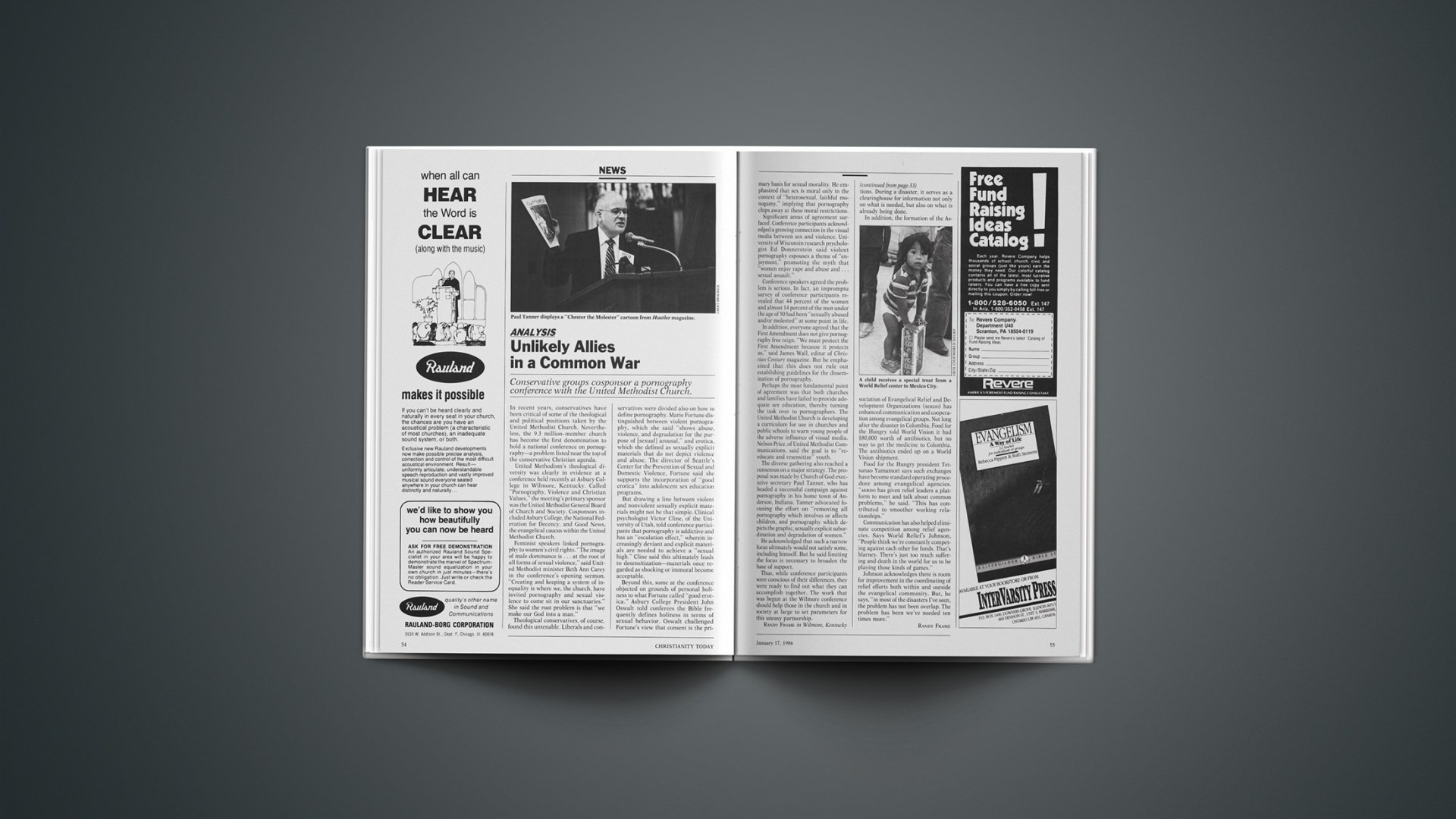
The diverse gathering also reached a consensus on a major strategy. The proposal was made by Church of God executive secretary Paul Tanner, who has headed a successful campaign against pornography in his home town of Anderson, Indiana. Tanner advocated focusing the effort on “removing all pornography which involves or affects children, and pornography which depicts the graphic, sexually explicit subordination and degradation of women.”

He acknowledged that such a narrow focus ultimately would not satisfy some, including himself. But he said limiting the focus is necessary to broaden the base of support.

Thus, while conference participants were conscious of their differences, they were ready to find out what they can accomplish together. The work that was begun at the Wilmore conference should help those in the church and in society at large to set parameters for this uneasy partnership.

RANDY FRAMEin Wilmore, Kentucky

What Can Government Do to Prevent Teen Pregnancy?

At the U.S. Department of Health and Human Services, Jo Ann Gasper serves as deputy assistant secretary for population affairs. It is her responsibility to coordinate the government’s family-planning and teen-pregnancy prevention programs, administered through private agencies. Funded at the discretion of Congress, these programs are at the center of a controversy.

By law, private organizations that offer family-planning services cannot use government funds to provide abortions. But many of those organizations endorse abortion as an option and offer abortion services.

On Capitol Hill, Sen. Orrin Hatch (R-Utah) and Rep. Jack Kemp (R-N.Y.) say the “wall of separation” between funding for abortions and funding for contraceptives and counseling is being violated. They want money for Gasper’s family-planning grant program—known in Washington as Title X—to be given only to groups that do not offer abortion counseling and referral. Their measure, known as the Kemp-Hatch Amendment, is supported by Gasper and the Reagan administration. But spokesmen for Planned Parenthood, the American Public Health Association, and numerous other groups say the Kemp-Hatch Amendment would violate their ethical duty to tell a woman with an unwanted pregnancy about all options, including abortion.

A second program administered by Gasper is called Title XX. It began in 1981 after Congress passed a bill derisively called the “chastity law.” Sponsored by Sen. Jeremiah Denton (R-Ala.), Title XX provides government grants to people who are researching teenage pregnancy, with an emphasis on prevention through sexual abstinence. Money from Title XX also goes to groups that provide care and educational services to unmarried young women who are pregnant. The American Civil Liberties Union has filed a lawsuit against the program because of its slant toward decreasing teen sexual activity and because some grant recipients are church-related groups.

In an interview with CHRISTIANITY TODAY, Gasper explained what the government intends to accomplish by providing funds for these programs.

What is the Title X program designed to accomplish?

Title X provides a full range of contraceptive services, including natural family planning, to low-income women and girls. We also do some research and provide some infertility services.

Can organizations that deliver Title X services provide abortions?

No. They are prohibited by statute from providing abortion services. We are permitted to provide counseling for abortion and referral to abortion services. But the Kemp-Hatch Amendment would prohibit such counseling and referral. Also, it would prevent us from funding any organization that does offer abortion services or counseling.

Planned Parenthood has vigorously opposed the Kemp-Hatch Amendment. How much of the $142.5 million available through Title X does it receive?

Planned Parenthood receives about 22 percent of the funds as a direct grant recipient. It receives other funds from state health departments.

The Kemp-Hatch Amendment would prevent Planned Parenthood from advising women of all their options. However, the organization says it cannot ethically withhold information about abortion.

The choice is theirs. We have a group of people who would be willing to provide services, but they are unable to do so now because they consider it unethical to offer counseling or referral for abortion.

How do you respond to Planned Parenthood’s criticism that the Kemp-Hatch Amendment would also keep the organization from being honest about contraception? Planned Parenthood says the measure is a back-door effort to curtail the availability of contraceptives.

To make a clear separation between contraceptive services and abortion services would help family planning, because contraception is not abortion. Our laws specify that abortion may not be used as a method of family planning. The Hyde Amendment, already in effect, prohibits the use of federal funds for abortion services. Passage of the Kemp-Hatch Amendment would improve the program.

Can Title X grant recipients counsel against abortion?

Our guidelines say the counseling must be done in the context of an unintended pregnancy, and the woman must ask what her options are. If she asks, she is supposed to be told that the options include keeping the child, having the child adopted, or terminating the pregnancy by abortion. The counseling is supposed to be nondirective. If a woman chooses to have an abortion, our counselors are permitted to tell the woman where she can obtain an abortion.

If she is interested in adoption, can the counselor refer her to an adoption agency?

Yes. We don’t have the authority to provide adoption services. But Sen. Gordon Humphrey (R-N.H.) has offered an amendment that would require us to operate an adoption clearing-house, and would permit us to provide adoption services.

How many teenagers are served by Title X?

Approximately one-third of the 4 million people being served are teenagers. We provide contraceptive services to about 60 percent of the teens who are receiving contraceptives. So although they constitute a small part of the total program, they are a significant portion of the adolescents who seek contraceptive services.

The existence of the Title X program assumes that those teens are sexually active. Another program you administer, known as Title XX, tackles the problem of teen pregnancy by promoting abstinence. How is that working?

Title XX provides two things. First, it encourages teens and preteens not to become sexually active. Second, we assist young girls who are pregnant by helping them through that pregnancy and encouraging adoption.

Only about 25 percent of teens under 17 are sexually active. It makes sense to encourage responsible sexual behavior as a solution and not simply pass out contraceptives. We know teenagers are not good at using any contraceptive method.

Can you quantify whether teenagers are changing their behavior as a result of the efforts of Title XX grant recipients?

We don’t have solid numbers indicating pregnancies that have been averted. Because we are working with very young people, it’s going to take a long time for the impact of the prevention program to show up. If it is effective among 12-year-olds now, they will delay sexual activity until they’re married.

Is Title XX aimed at preteens?

It is aimed at people 17 and younger. Some very young people are sexually active. In some inner-city communities, researchers have difficulty finding 10-year-old boys who are not sexually active. It’s not unusual to have children as young as 11 and 12 coming into our Title X clinics with a pregnancy scare. But this is only a small percentage of all young people.

Does it make a difference when parents talk to their children about sex?

That is a very important part of preventing adolescent pregnancy. Where there is good parent-child communication, the likelihood that a child will be sexually active is greatly decreased. It’s not just a result of verbal communication, but also seeing how the parents act—whether the relationship between the mother and father is a good relationship and whether they are caring and sensitive and respecting of other people. That goes a long way toward building self-esteem and good communication patterns in their children. It also decreases sexual activity.

A New Study Says Religion Is Being Excluded from Public School Textbooks

In a recent study, a New York University professor says religion and traditional values have been “misrepresented or seriously underrepresented in public school textbooks.”

The study was prepared by psychology professor Paul C. Vitz for a National Institute of Education project on equity in values education. Vitz, a Catholic, reviewed 60 textbooks for grades one through six. Included were all the social studies books from California and Texas, states that lead the nation in textbook selection. All of the books used in the study were published between 1982 and 1984.

Among 40 social studies books used in grades one through four, the report finds a lack of references to religious activities in contemporary American life. Religion is covered historically with the Pilgrims and the early Southwest missions. “The closest any book comes [to covering current religious activities],” the report states, “is a reference to the life of the Amish, … not representative of today’s Protestant Christian life.”

“Keep in mind,” Vitz says, “these social studies books are supposedly aimed at introducing the student to American society as it is today, plus a little of how it existed in the past.”

Pictures of religious activities fare little better. In books for grades one through four, Vitz found four images of contemporary Jewish life, two of contemporary Catholic life, three representing clergymen, and two of families praying during a Thanksgiving dinner.

Vitz’s study reports a similar pattern in the grade-five textbooks, which provide an introduction to American history. Apart from the colonial period and the Southwest missions, Vitz found little mention of religion. His report says the treatment of the last 100 years of American history is almost devoid of references to religion.

With grade-six books, which cover world history and cultures, the report finds a neglect of Jewish history, with much broader coverage given to Egypt and Greece. Also slighted is the life of Christ. “In some of the books,” Vitz says, “Muhammad’s life gets much more coverage than that of Jesus.” The study also describes a neglect of the first thousand years of Christianity, the Reformation, and Christianity in the modern world.

“Those responsible for these books appear to have a deep-seated fear of any form of active, contemporary Christianity, especially serious, committed Protestantism,” Vitz says.

The report contends that textbook authors attempt to “distance” committed Protestant Christianity. For example, when the books mention religion, emphasis is given to Judaism, Mormonism, Catholicism, and the Amish. Vitz suggests these groups are distant enough from fundamentalist Protestantism to pose less of a threat to textbook writers.

The study says textbook authors also try to make religion less threatening by “washing it out.” For instance, one book describes Pilgrims as “people who make long trips.” Another describes Thanksgiving as a time the Pilgrims could give thanks for all they had. However, no mention is made of God.

“The Pueblos can pray to Mother Earth,” the report states, “but Pilgrims can’t be described as praying to God—and never are Christians described as praying to Jesus … in the present or even in the past.…”

The report says textbooks use the passage of time to distance religion from the present. Religion in history is given much more prominence than religious expression in contemporary life.

In reviewing the books, Vitz also examined the portrayal of family values. He says he found a fairly strong representation of the family, especially in textbooks written for grades one through three. However, he says most of the definitions of the family are “seriously deficient or disturbing.” One book calls a family “a group of people.”

The notion that marriage is the origin and foundation of the family is never presented, the report says, and families are often shown without a father and sometimes without a mother.

“We are telling our children religion and traditional values aren’t important,” Vitz said in an interview. “We are removing our religious heritage from their education so they are both ignorant of religion and uninterested in it because they don’t know anything about it.”

Football Teams Declare ‘Gospel Banners’ out of Bounds

Rollen Stewart is not a household name. But if you watch sports on television, you’ve probably seen him. He wears a “John 3:16” T-shirt to professional golf tournaments and displays “gospel banners” in football stadiums (CT, May 18, 1984, p. 82).

The unconventional evangelist has attracted plenty of attention, not all of it positive. Stewart’s banners have been declared out of bounds by all but one of the 28 National Football League (NFL) teams. The prohibition of his signs at home games of the Washington Redskins is being challenged in a lawsuit. Attorneys affiliated with the Rutherford Institute in Manassas, Virginia, are challenging the prohibition in federal district court in Washington, D.C.

The suit was filed after the management of Washington’s RFK Stadium prevented Stewart and an associate, Stephen Francis, from displaying their signs at two games. At a January 1984 playoff game, Francis hung two 15-foot banners—reading “John 3:16”—on a railing near the 20-yard line. Both banners were torn down.

When Francis attempted to rehang them, he was threatened with arrest by security officers employed by the stadium management. After Stewart and Francis protested, a new stadium policy was enacted allowing the display of all signs except those that are “obscene or provide free advertisement of products or services.” However, the lawsuit alleges, when Stewart and Francis subsequently hung three banners at a November 1984 Redskins game, the stadium’s new general manager ordered security guards to remove the signs.

Rutherford Institute president John Whitehead calls the prohibition “clear-cut unconstitutional censorship of religious expression.” He pointed out that stadium security guards did not remove banners with nonreligious messages.

“Having opened the stadium as a public forum in which patrons express their views or comments through a particular form of speech,” the lawsuit argues, “the defendants cannot discriminate against plaintiffs on the basis of their religion.…” Rutherford Institute attorneys are asking the federal court to recognize the constitutional rights of Stewart and Francis to display their signs, and to issue a permanent injunction prohibiting further interference by stadium officials.

Meanwhile, Stewart and another associate, Bill King, are trying to outwit the NFL by wearing a new type of gospel banner to football games. The new banners are worn like a poncho. Scripture references appear when King and Stewart spread their arms. Says Stewart: “They’d have to undress us to take away our gospel signs.”

At other events, they still wear gospel T-shirts. “People often tell us they’ve seen our message,” Stewart says. “We are seed sowers.”

Hispanic Christians in the United States

A conference focuses on the task of evangelizing a rapidly growing ethnic group.

With a Hispanic population estimated at 23 million, the United States is the fifth-largest Spanish-speaking nation in the world. Many researchers expect that population to swell to 40 million in less than 20 years. If that happens, the United States would be the second largest Spanish-speaking nation (behind Mexico, with a current population exceeding 72 million).

Such statistics were of great interest to the nearly 2,100 participants, the majority of them Hispanic pastors, at the recent Hispanic Congress on Evangelization (HCE), held in suburban Los Angeles.

The number of Hispanic evangelicals is not growing as quickly as the population—in sharp contrast with what is happening in much of Latin America. Evangelicals comprise only about 2 percent of America’s Hispanic population, said Juan Carlos Miranda, HCE executive secretary and director of the Charles Fuller Institute of Evangelism and Church Growth at Fuller Theological Seminary. He said nearly all Hispanic Protestants would be classified as evangelicals, noting that some 5,000 Hispanic churches in the United States claim 500,000 members.

In plenary sessions and workshops at the five-day event, and in interviews with Hispanic church leaders, several points emerged:

• Immigrants from Latin America often drop out of church when they reach the United States, reflecting the impact of new cultural and sociological patterns, secularization, materialism, and affluence. Most Hispanics working at low-paying jobs in the United States are better off financially than their peers back home.

• The majority of Hispanic churches in the United States have shied away from aggressive outreach. Pastored in many cases by immigrants without advanced education who are struggling to fit into a new culture, these churches seem unable or unwilling to devise strategies and programs designed to deal with new Hispanic realities. Unbending conservatism in such areas as music, worship styles, and leadership structures have discouraged young Hispanics away from many churches.

• For long-term growth and effectiveness, Hispanic churches must adopt a bilingual approach to ministry. To care for both second-generation Hispanics and new arrivals, for example, the churches might need to conduct side-by-side programs in Spanish and in English.

• Some Hispanic churches are awakening to the needs and opportunities facing them. “Many of our churches are coming alive,” says Daniel DeLeon, senior pastor of the 2,000-member Calvary Temple (Assemblies of God) in Santa Ana, California, the largest bilingual Protestant Hispanic church in the United States. “This congress is a witness to the new interest and unity we have. I expect to see a revival such as we’ve never seen before sweep across this country, with Hispanics and Koreans in the vanguard.”

Evangelist Alberto Mottesi of Los Angeles organized HCE as a follow-up to Billy Graham’s Amsterdam ’83 conference for itinerant evangelists. A number of leaders credit Mottesi with almost single-handedly forging the new unity evident among Hispanic evangelicals. He has held campaigns in several Latin countries, including one in Sandinista-ruled Nicaragua that attracted more than 80,000 to a Managua stadium. He has scheduled six major campaigns for the United States this year and says he hopes to reach two million U.S. Hispanics within the next two years.

The HCE program featured a “who’s who” in Hispanic Christian work, including evangelists Mottesi, Paul Finkenbinder, and Luis Palau. Puerto Rican theologian Jose Camacho presented a paper on liberation theology. While acknowledging the vast need for social reform throughout the Latin world, Camacho warned against liberationists who are bent on reducing the Christian’s ultimate hope to a Marxist-oriented political solution tied to economic justice. This confusion, he asserted, often leads to advocacy of the use of force in establishing the kingdom of God, denying the true liberating power of the gospel.

A number of Hispanic recording artists and broadcasters also participated in the conference. The National Religious Broadcasters has a large Hispanic chapter, and a Hispanic Christian television network was launched recently in San Diego. “Because of this conference, we now know we have the manpower, the talent, the intelligence, and the unity, as well as the resources of the Holy Spirit, to get the job done,” said veteran Latin missionary John Williams.

Several denominational leaders at the conference cited increasing numbers of South American churches that are sending missionaries to help reach Hispanics in the United States. They also noted stirrings among U.S. Hispanic evangelicals to send missionaries not only to Latin America and Spain, but also to other parts of the world.

EDWARD E. PLOWMANin Los Angeles

NORTH AMERICAN SCENE

UNITED METHODISTS

New Church Growth Plan

The United Methodist Council of Bishops has approved a plan designed to reverse a 20-year membership decline in the 9.2 million-member denomination.

The plan calls for a 50,000-member increase next year, and an additional gain of 100,000 in 1988. Specifically, it calls for retaining members who move to another area; compiling an inventory of local church evangelistic efforts; holding consultations led by pastors whose congregations are growing; and developing new congregations, especially among ethnic minorities. Each United Methodist congregation will receive an inventory form for use in evaluating its evangelistic efforts and setting goals for membership and attendance.

Bishop Richard B. Wilke, of Little Rock, Arkansas, said a survey indicated that 42 percent of United Methodist congregations kept no records of nonmembers who attend regularly. Sixty percent had no confirmation or membership training classes, and 38 percent had not received a new member “by profession of faith” in a year’s time.

DEATHS

William Ayer; Morton Hill

William Ward Ayer, founding president of National Religious Broadcasters, died November 18 in St. Petersburg, Florida. He was 93.

Ayer was converted in 1916 through the ministry of evangelist Billy Sunday. He was ordained in the former Northern Baptist Convention, and in 1936 became pastor of New York’s Calvary Baptist Church. While there, he pioneered the radio broadcast “God’s Truth Marches On.” After he retired from the Calvary pastorate in 1950, he preached on the weekly radio program “Marching Truth.”

Morton A. Hill, a Jesuit priest who founded Morality in Media, died November 4 in the Bronx, New York, following an extended illness. He was 68.

Hill served as president and administrative director of Morality in Media from its inception in 1968. The organization fights pornography through public education and by working for the strict enforcement of obscenity laws.

TEEN PREGNANCY

Grandparents Are Liable

The state of Wisconsin has enacted a law making parents financially liable if their children under the age of 18 have a baby. The law enables welfare agencies to take either pair of grandparents to court for payment of expenses of raising the baby.

State representative Marlin Schneider said the law is intended to reduce teenage pregnancy by increasing discussions between parents and teenagers about sex. Gov. Anthony S. Earl said the law underscores that “all of us, parents and young people, have a responsibility for our acts.”

The law also allocates $1 million for pregnancy counseling; repeals restrictions on the advertising and sale of contraceptives; and bars a hospital or clinic from notifying parents of a girl’s plan to obtain an abortion unless she consents. Barbara Lyons, a lobbyist with Wisconsin Citizens Concerned for Life, opposed the law, saying it would encourage teenagers to have abortions.

MINNESOTA

Fetus Not Legally a Human

The Minnesota Supreme Court has ruled that under state law a fetus cannot be considered a “human being,” even if it could survive outside its mother’s womb.

The ruling came in the case of a man who had been charged under Minnesota’s vehicular-homicide law. The man’s car was involved in a collision, resulting in the death of an eight-and-one-half-month-old fetus.

In its ruling, the Minnesota Supreme Court joined 23 other states in accepting the definition of human being as someone born alive. Only South Carolina and Massachusetts have included fetuses in the definition of “human being.”

NATIONWIDE

Cocaine Use Rises

The U.S. Drug Enforcement Administration (DEA) reports that cocaine use in the United States rose 11 percent in 1984. Supplies of the drug were so plentiful in many cities that the wholesale price at one point actually dropped, the agency reports.

Colombia, Peru, and Bolivia continued to be the largest suppliers of cocaine. However, the DEA says trafficking and production of cocaine has moved substantially into other South American countries, including Ecuador and Brazil.

The DEA says heroin use dropped by 1 percent in 1984, and marijuana use dropped by 3 percent. However, use of drugs such as the stimulant methamphetamine and the hallucinogen PCP rose 15 percent. Nearly all of those drugs are manufactured in illegal laboratories in the United States, the DEA reports.

EDUCATION

Hiring Practices Upheld

The U.S. Equal Employment Opportunity Commission (EEOC) has affirmed the right of Seattle Pacific University to continue its hiring policies. The Free Methodist institution restricts employment to those who share the university’s evangelical faith and mission.

The EEOC said federal law allows religious educational institutions such as Seattle Pacific University to exercise a preference on the basis of religion in employment decisions. The commission said that preference is allowed even if the employee’s work is not directly related to the institution’s religious activities.

The ruling was issued in the case of a woman who applied for one of two nonfaculty job openings at the university. She filed a complaint with the EEOC after the school did not interview her for either position. In her complaint, the woman alleged she was discriminated against because she had indicated on an application form that she is not an evangelical Christian.

Focus on the Family Starts an Organization in Canada

Focus on the Family, through its radio broadcasts and publishing efforts, attempts to help American evangelicals become more aware of public policy issues. With the recent formation of the Focus on the Family Association of Canada, the organization is exploring a similar role north of the border.

The Canadian affiliate of Focus on the Family will help identify and research issues in Canada that fall within the organization’s area of interest, said Canadian board member James Dobson Doug Sauer. The “Focus on the Family” radio program, hosted by psychologist and Christian author James Dobson, already is carried by 31 stations in Canada.

If there is sufficient interest, a separate track of radio programming could be developed to address Canadian public policy issues, said Focus on the Family vice-president Peb Jackson. One possible format would have Dobson interview Canadian Christian leaders about profamily issues.

A pilot program was broadcast on Canadian stations last year. On that program Dobson interviewed Gwen Landolt, president of Real Women of Canada, a group that promotes a traditionalist response to radical feminism. Sauer said the program received strong mail response.

Public policy issues addressed in Canada might differ from those highlighted in the United States, Jackson said. He stressed, however, that Canadian programming would fit the Focus on the Family objectives. Those objectives include emphases on the permanence of marriage; the bearing and raising of children; the right of every human to life, freedom, and fulfillment; and faith in Christ.

LLOYD MACKEYin Canada

Books

A New Bible Dictionary Finds a Receptive Audience

Harper’s Bible Dictionary, the first major reference work undertaken by the Society of Biblical Literature (SBL), enjoyed healthy sales immediately after publication. Most of the initial printing of 75,000 was sold out in a few days, and a second printing of 26,000 was ordered. SBL members celebrated the dictionary’s completion late last year at the society’s annual meeting.

Published by Harper & Row, the 1,088-page dictionary is SBL’s attempt to communicate to a popular audience the generally accepted findings of biblical scholarship. Paul Achtemeier, Jackson Professor of Biblical Interpretation at Virginia’s Union Theological Seminary and the dictionary’s general editor, said SBL feels a responsibility to counter misinformation about the Bible. “It’s not that if we don’t do it, who will?” Achtemeier told his SBL audience. “It’s that if we don’t do it, somebody else will—and that’s the problem.”

Because some scholars have criticized any attempt at popularization, Achtemeier and representatives of Harper & Row emphasized the speed and accuracy with which the project was carried out. The 30-month time span during which the dictionary was written, edited, and published allowed for little historical or archaeological information to become outdated. And the 180 representative scholars—including teachers at evangelical seminaries and colleges—were selected to insure that only majority viewpoints among biblical scholars were presented.

Although the editors attempted to present only “consensus scholarship,” most evangelical readers will disagree with some of the information presented. The dictionary’s article on inspiration contains nothing objectionable to those who believe in the inerrancy of Scripture. However, the article on biblical criticism asserts without support that chapters 40 through 66 of Isaiah were not written by Isaiah, and that the letters to Timothy and Titus were not written by Paul—a position not generally held by evangelical and fundamentalist scholars.

Harper & Row has brought SBL’s scholarship to the general public by gaining the attention of major secular book marketing channels—chain stores such as Waldenbooks and B. Dalton Bookseller, and major book clubs such as Book-of-the-Month Club and Literary Guild. Cheered by the success of its first venture into popularizing its expert knowledge, SBL is working on a follow-up project, the one-volume Harper’s Bible Commentary, to be released in the fall of 1987.

Magazine Says Tim LaHaye Received Help from Unification Church

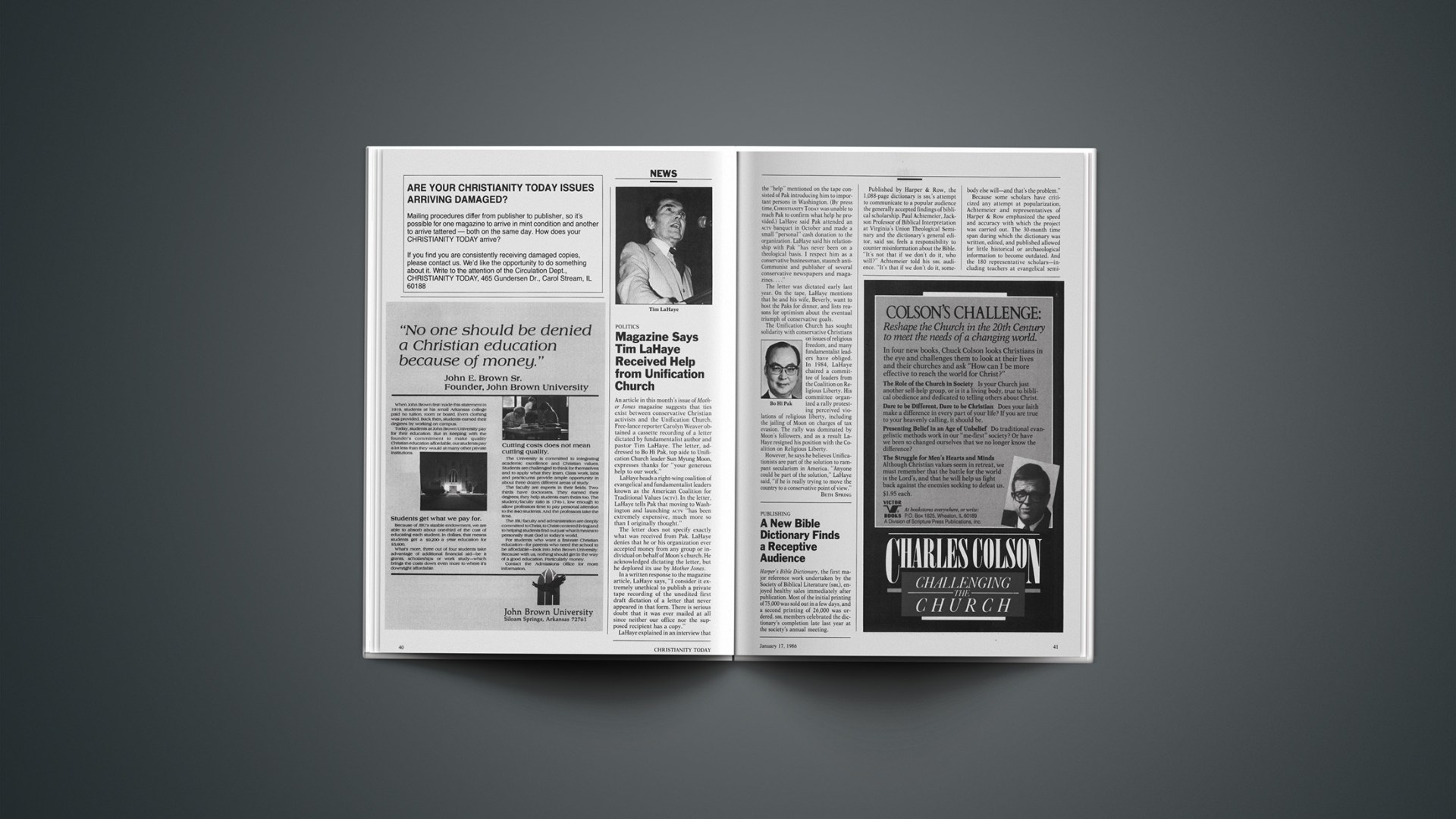
An article in this month’s issue of Mother Jones magazine suggests that ties exist between conservative Christian activists and the Unification Church. Free-lance reporter Carolyn Weaver obtained a cassette recording of a letter dictated by fundamentalist author and pastor Tim LaHaye. The letter, addressed to Bo Hi Pak, top aide to Unification Church leader Sun Myung Moon, expresses thanks for “your generous help to our work.”

LaHaye heads a right-wing coalition of evangelical and fundamentalist leaders known as the American Coalition for Traditional Values (ACTV). In the letter, LaHaye tells Pak that moving to Washington and launching ACTV “has been extremely expensive, much more so than I originally thought.”

The letter does not specify exactly what was received from Pak. LaHaye denies that he or his organization ever accepted money from any group or individual on behalf of Moon’s church. He acknowledged dictating the letter, but he deplored its use by Mother Jones.

In a written response to the magazine article, LaHaye says, “I consider it extremely unethical to publish a private tape recording of the unedited first draft dictation of a letter that never appeared in that form. There is serious doubt that it was ever mailed at all since neither our office nor the supposed recipient has a copy.”

LaHaye explained in an interview that the “help” mentioned on the tape consisted of Pak introducing him to important persons in Washington. (By press time, CHRISTIANITY TODAY was unable to reach Pak to confirm what help he provided.) LaHaye said Pak attended an ACTV banquet in October and made a small “personal” cash donation to the organization. LaHaye said his relationship with Pak “has never been on a theological basis. I respect him as a conservative businessman, staunch anti-Communist and publisher of several conservative newspapers and magazines.…”

The letter was dictated early last year. On the tape, LaHaye mentions that he and his wife, Beverly, want to host the Paks for dinner, and lists reasons for optimism about the eventual triumph of conservative goals.

The Unification Church has sought solidarity with conservative Christians on issues of religious freedom, and many fundamentalist leaders have obliged. In 1984, LaHaye chaired a committee of leaders from the Coalition on Religious Liberty. His committee organized a rally protesting perceived violations of religious liberty, including the jailing of Moon on charges of tax evasion. The rally was dominated by Moon’s followers, and as a result LaHaye resigned his position with the Coalition on Religious Liberty.

However, he says he believes Unificationists are part of the solution to rampant secularism in America. “Anyone could be part of the solution,” LaHaye said, “if he is really trying to move the country to a conservative point of view.”

Why Is Pat Robertson Considering a Race for the Oval Office?

An interview with the CBN host and founder.

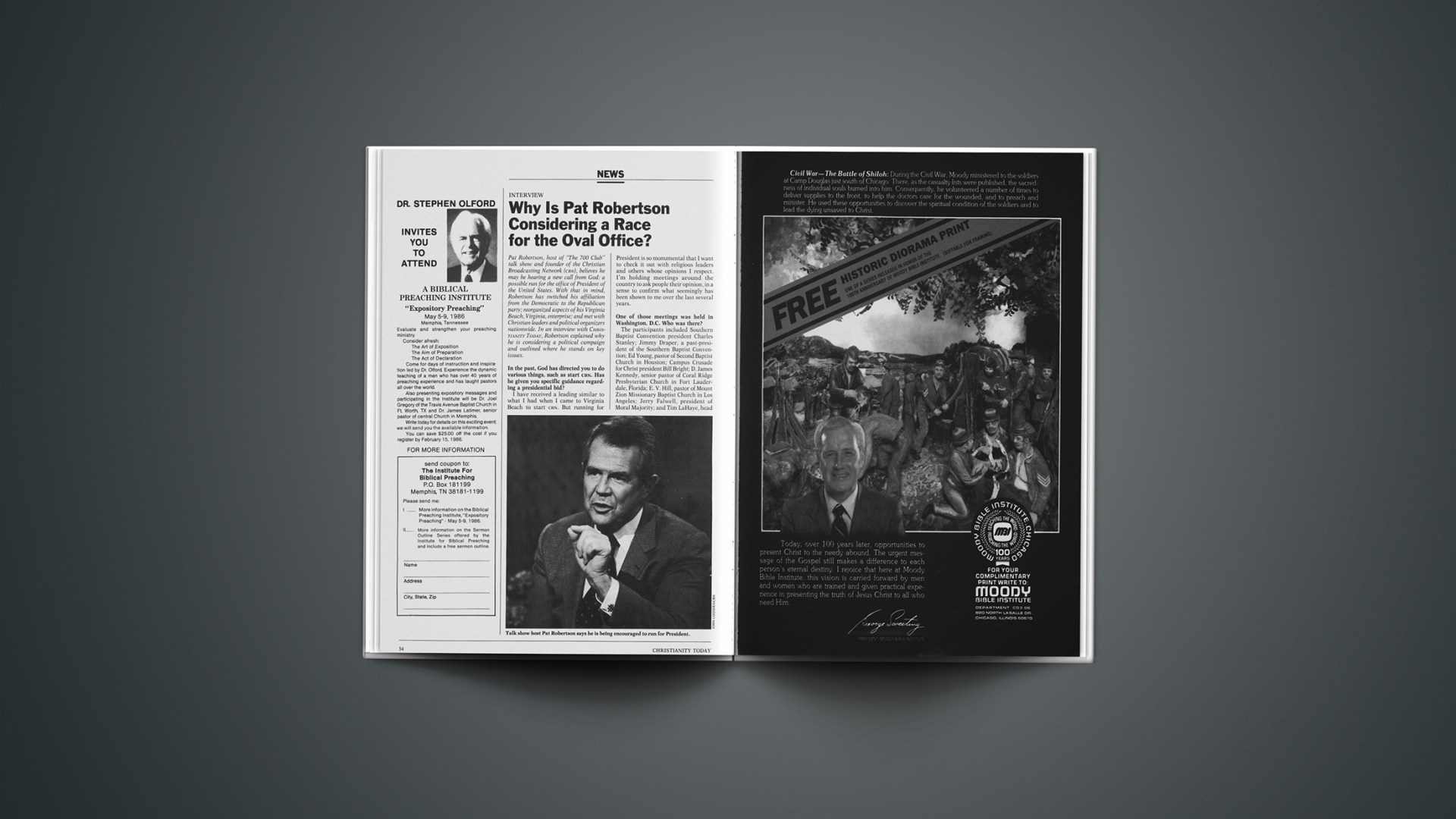
Pat Robertson, host of “The 700 Club” talk show and founder of the Christian Broadcasting Network (CBN), believes he may be hearing a new call from God: a possible run for the office of President of the United States. With that in mind, Robertson has switched his affiliation from the Democratic to the Republican party; reorganized aspects of his Virginia Beach, Virginia, enterprise; and met with Christian leaders and political organizers nationwide. In an interview with CHRISTIANITY TODAY, Robertson explained why he is considering a political campaign and outlined where he stands on key issues.

In the past, God has directed you to do various things, such as startCBN.Has he given you specific guidance regarding a presidential bid?

I have received a leading similar to what I had when I came to Virginia Beach to start CBN. But running for President is so monumental that I want to check it out with religious leaders and others whose opinions I respect. I’m holding meetings around the country to ask people their opinion, in a sense to confirm what seemingly has been shown to me over the last several years.

One of those meetings was held in Washington, D.C. Who was there?

The participants included Southern Baptist Convention president Charles Stanley; Jimmy Draper, a past-president of the Southern Baptist Convention; Ed Young, pastor of Second Baptist Church in Houston; Campus Crusade for Christ president Bill Bright; D. James Kennedy, senior pastor of Coral Ridge Presbyterian Church in Fort Lauderdale, Florida; E. V. Hill, pastor of Mount Zion Missionary Baptist Church in Los Angeles; Jerry Falwell, president of Moral Majority; and Tim LaHaye, head of the American Coalition for Traditional Values. We also had a couple of representatives from Hispanic churches.

Did they encourage you to run?

The emotion was mixed. The only negative feeling expressed was that going from the job I now hold into any secular, political job would be a demotion.

The consensus was that evangelicals urgently need a voice to represent their point of view. They felt it was a “win-win” situation. If something happened to bring about a presidential campaign, it would be good for evangelicals and for the nation. If it did not result in receiving a nomination or winning the general election, then it would still bring unity in the body of Christ and give Christians a focus of discussion in the councils of leadership in our nation.

Would you anticipate broad support from evangelicals if you were to run for President?

I’m amazed at the unanimity. I am being encouraged from every sector, from very conservative fundamentalists to centrist evangelicals to charismatic Pentecostals. I’m being encouraged both in white and in black church groups. It seems there is a hunger in the hearts of millions of religious people for a voice to represent conservative, traditional, moral family values in our country. However, that doesn’t imply a decision on my part.

Some say you might wind up playing a “Jesse Jackson” role—one who raises issues and gains a power-broker position. How do you respond to that?

I don’t want to be a power broker. I have a wonderful job now, and I’m able to influence millions of people for good and to help millions of people through our outreach ministries. I wouldn’t jeopardize that just to be a power broker. I’m a team player. I have strong, conservative points of view, but I try to bring harmony to those who disagree with me.

You have a significant ministry at CBN. Would a presidential candidacy impair the work of that ministry?

We have capable executives, and “The 700 Club” has a cohost and cohostess who are extremely capable, CBN could go on with or without me. According to Gallup, 69 percent of Americans have heard of “The 700 Club,” and only 33 percent have heard of me. The thrust has been the ministry as opposed to Pat Robertson. If I were off the scene, I don’t think it would be the blow that some people think.

Would you have to be replaced as host of “The 700 Club”?

Not until I was a declared candidate, and that could be held off at least two years. I would not have to remove myself from management of the organization. But once a person is a declared candidate, he either has to go off the air or give equal time to every other candidate every time he appears.

In 1984, there was a thorough investigation of the finances of Geraldine Ferraro and her husband. Would you personally, and CBN corporately, be willing to disclose your finances?

We already disclose them. Our 990T Internal Revenue Service tax return is on file in every public library. An independent auditor issues quarterly statements and yearly or semiannual audits on our operations. We’re also under the scrutiny of the Federal Communications Commission.

As far as my personal finances are concerned, I would not mind releasing my income tax statements.

Your board structure and corporate financial statements don’t qualify CBN for membership in the Evangelical Council for Financial Accountability. Do you anticipate any changes?

Our board has been essentially a prayer board. We haven’t had a lot of outside businessmen. We’ve had CBN executives and people who were intimately associated with the ministry. The Evangelical Council for Financial Accountability requires a majority of the board members to be outside directors. In the event that I get into politics, we would probably expand our board by at least two members.

You have said you would not impose your beliefs on others since we live in a pluralistic society. And yet you advocate specific moral values. How do you reconcile these two positions?

The fear is that an evangelical Christian would use the power of government to force people to accept certain religious values. I have no intention of doing that. I’m a great believer in personal freedom and the nonintervention of government in people’s private lives.

However, all law represents somebody’s value structure. The moral values of our schools will either be based on Judeo-Christian values, humanism, or communism. It will either be the values that made this country great, or the values of those who supplanted them over the last several decades.

You often speak about a supernatural insight from God called a “word of knowledge.” How much do you rely on such insights in your own decision making, and how would that influence public policy making if you were to hold office?

In 1 Corinthians 12, the apostle Paul said the word of knowledge is for the church. The apostle Peter said that as each has received a gift, let him use it to benefit others (1 Peter 4:10).

When someone is hurting, the Lord sometimes shows another person what the problem is. I have had this experience when I’m trying to help people with psychological or physical problems. It helps me know what’s going on in their lives so I can help them. But God doesn’t give me words of knowledge in my own life.

Let’s discuss some issues. If you had the opportunity to appoint justices to the U.S. Supreme Court, what criteria would you use?

I studied constitutional law at Yale Law School. I respect the tradition that brought our Constitution into being and the interpretation of it through the early decades of our government. I would look for judges who have a similar respect for the historical basis of this document.

The Constitution is a living document because we can amend it through political processes that take a long time. Five unelected officials (a majority of the Supreme Court justices) should not have the power to amend the Constitution.

Would you push for a constitutional amendment to allow spoken prayer in public schools?

Yes. But I would prefer to see the mortality tables do their work in relation to 80-year-old Supreme Court justices. If two new justices were appointed, we wouldn’t need constitutional amendments regarding abortion or school prayer.

As President, how would you encourage Israel to deal with Arab Palestinians in its occupied territory?

Israel has to live within secure borders. The United States can’t force Israel to give up what Prime Minister Begin called Judea and Samaria. The only intelligent solution would be a confederation of an Arab entity on the West Bank within Israeli perimeters. That entity would not be an independent Palestinian state. It would be allied with Israel.

Should the United States pursue nuclear superiority over the Soviet Union?

We should go ahead with technical superiority. Some believe the Soviets are so paranoid that if they feel the United States is gaining superiority it could trigger nuclear war. Some kind of parity might accomplish our end without trying to go for major superiority.

If the United States continues such things as the strategic defense initiative, we can overcome any mass advantage the Soviets may have—even in missile warhead capabilities. The strategic defense initiative is forcing the Soviets to scrap $200 billion or $300 billion of spending and go into a whole new level of technology. Their economy is not prepared for that. We should continue to force them into an unequal race where we stress our technological advantage and reestablish some kind of equilibrium.

We must get out from under mutually assured destruction, where we hold our civilians captive to their assaults and they hold theirs captive to our assaults. A defensive shield in space against nuclear aggression that could be shared by both parties is appealing. However, the best solution would be to eliminate all nuclear arms on both sides.

WORLD SCENE

CHINA

A Printing Press for Bibles

A printing plant is scheduled to be built this year in Nanjing, China, to produce at least 250,000 Bibles and 500,000 New Testaments annually. The press also will print hymnbooks, Christian literature, and other educational literature.

The printing plant is a joint project of Nanjing Normal University and the Amity Foundation, a social service organization initiated by Chinese Christians. With financial assistance from the United Bible Societies, the foundation will supply new printing and binding machinery. Nanjing Normal University will extend its existing printing facility to provide room for the new equipment. Construction work, shipment of equipment, and hiring of staff will continue through this year.

In a separate development, 100,000 Bibles and more than 60,000 New Testaments have been printed in China on paper supplied by the United Bible Societies. One hundred tons of paper was donated to the Amity Foundation last year. The foundation’s general secretary said nearly all the Bibles have been sold.

The United Bible Societies is a fellowship of 102 national Bible societies with work in more than 180 countries and territories.

ISRAEL

A Letter-writing Campaign

A Baptist congregation in Jerusalem is organizing an international letter-writing campaign to try to persuade the Israeli government to allow it to rebuild its church with expanded facilities. The Narkis Street Baptist Church was destroyed by fire in 1982.

Last fall, the Jerusalem district planning commission rejected the church’s plans for a new facility encompassing a 400-seat auditorium, several Sunday school rooms, and office space. The commission invited the congregation to submit a new plan to build facilities about half as large as those proposed earlier.

Robert Lindsey, the Southern Baptist representative who pastors the church, said it is “almost certain” that pressure from extremist Orthodox Jewish groups prompted six of the nine commission members to reject the rebuilding plan. “A kind of subtle permission is being granted to those who would violently attack Christian institutions by the refusal of authorities to speedily grant permits to rebuild and enlarge,” he said.

The 300-member congregation is organizing a letter-writing campaign to urge Israeli Prime Minister Shimon Peres to intervene. The church is also preparing a legal appeal to the High Court, Israel’s highest judicial body.

ROMANIA

Most Favored Nation?

Two bills introduced in Congress would suspend Romania’s Most Favored Nation (MFN) trade status in hopes of pressuring the country to cut down on its repression of Christians.

“Churches are being bulldozed, Bibles have been recycled into toilet paper, and Christian leaders from various churches have been harassed, arrested, and tortured,” said Rep. Chris Smith (R-N.J.). Smith, along with Representatives Tony Hall (D-Ohio) and Frank Wolf (R-Va.), are challenging Romania’s MFN status in the House of Representatives. In the Senate, a similar bill is being sponsored by Sens. William Armstrong (R-Colo.), Paul Trible (R-Va.), and Paul Simon (D-Ill.).

The bills would suspend MFN status for six months or until President Reagan feels the country’s human rights situation has improved. However, the Reagan administration supports MFN status to encourage Romania’s relative independence from the Soviet Union in its foreign policy. Because Romania relies heavily on trade with the Smith, left, in Romania. United States, supporters of the bill say suspension of MFN status might pressure the government to lessen its persecution of the church.

THE NETHERLANDS

Denominations Plan to Unite

The Evangelical Lutheran Church in the Kingdom of the Netherlands plans to unite with two large Reformed bodies in the next few years. The merger plan comes after several years of shrinking membership in the Lutheran denomination.

In the last two years, the 30,000-member denomination lost some 2,000 members. Attendance at worship services is declining, and youth activities have decreased. Fifteen of the church’s 60 congregations are too small to support a pastor.

Sam Dahlgren, of the Lutheran World Federation’s department of church cooperation, said the planned merger might be a “mirror for the future of churches in a secularizing Europe.”

ENGLAND

Christian School Controversy

Government school inspectors have served a “notice of complaint” on four church-run schools in England. If the complaints are upheld, the schools will be forced to close. A fifth school already has been closed.

The complaints involve schools operated primarily by Pentecostal churches. The schools use a curriculum called Accelerated Christian Education (ACE). Some 30 church-related schools in England use the ACE program, created in the 1970s by a Texas pastor.

Inspectors from England’s Ministry of Education say the schools place too much emphasis on religion and not enough on English, math, science, and social studies. They say the schools are failing to educate students to a minimum standard in basic secular subjects.

“I have a wider concern than government minimum school standards,” said Arthur Roderick, an ACE representative. “As a Christian, I am here to serve God in encouraging a school’s curriculum to be biblically based.”

A Year of Major Tests for Evangelical Relief Agencies

How did Christian organizations respond to two of the world’s most severe disasters?

Relief organizations were glad to see 1985 come to an end. Two of history’s most devastating disasters came less than two months apart—earthquakes in Mexico City in September and a volcanic eruption in Colombia in November. More than 30,000 people died in those two disasters.

This one-two punch on the heels of mass famine in Africa tested the resiliency of the disaster-relief community. Private organizations, denominational agencies, and national governments responded. But in many cases the collective response lacked coordination. The perennial problems of large-scale relief efforts surfaced, including duplication of services and the accompanying waste of material and human resources.

Within a week of the Mexico City earthquakes, for example, Mexico’s capital was inundated with supplies that could not be used. “We saw plane after plane unloading what was, literally, junk,” said Larry Glass, director of national health programs for MAP International, a Christian global health agency.

Likewise, following the eruption of the Nevada del Ruiz volcano in Colombia, individuals and organizations sent so many clothes the government made a formal request that no more be sent. “Organizations feel an obligation to respond because their donors expect them to respond,” Glass said, “even if it’s not needed.”

This is not to say that all of Colombia’s needs have been met. An overabundance of short-term emergency supplies is often followed by a scarcity of resources needed for long-term rehabilitation. The rebuilding does not begin in earnest until well after the disaster has ceased grabbing headlines and donor interest has waned.

From a public relations standpoint, however, it is important to take action while a disaster is in the news. Thus, says Stanley Mitton, director of international disaster response for Church World Service, “there is the temptation to get something on the plane and to [publicize] … it in a news release.”

Sometimes getting something on a plane quickly is exactly what is needed. MAP, for example, rushed $800,000 worth of antibiotics into Colombia. (The drugs were not available in the country.) But in most cases donors and organizations help best by providing financial support.

Explains World Concern spokesman Craig Shuck: “Not only is it less expensive to purchase supplies in the country where the disaster has occurred, but it helps stimulate that country’s economy.” Mitton notes, however, that some donors are not content simply to give money. “People like to visualize something tangible flying into the disaster-stricken area.”

The mere climate of a disaster-stricken area works against reasoned judgment and contributes to inefficiency. “In those first few days, people are in a panic,” says World Vision’s Brian Bird. “They may not know what they need. So they say, ‘Give us anything.” But Bird says the biggest reason services are duplicated is lack of coordination among relief organizations—due largely to poor communication.

Unique Challenges

Effective communication is important because each disaster brings its own set of problems. Needs range from clean water to heavy machinery. In some countries, governments monitor relief operations more heavily than in others. Without reliable contacts in a stricken area, a relief effort can be doomed. When they do not have a staff person at the site of the disaster, it is standard procedure for organizations that can afford it to fly somebody in to assess needs and determine how to meet them.

Some maintain that this in itself is wasteful, that organizations should use information already available. But reports coming out of a country are often contradictory. Church World Service got word on November 19, six days after the Colombia earthquake, that foreign medical personnel, tents, blankets, and food were not needed. On November 25, however, World Vision sent a shipment of blankets, tents, and cooking supplies.

Bird explained that World Vision had seven projects in and around Armero, including a child-care project where 156 people were killed. He said that other organizations may have had enough supplies for their relief projects, but that World Vision’s shipments were a direct response to requests from people it knew, including its own staff.

The New York Times reported on November 24 that some volunteer workers said the Colombian government had mishandled the rescue operation. They told of shortages of manpower, medicines, stretchers, and other basic supplies the government allegedly had said it did not need. In the midst of conflicting information, relief organizations operate on reports from their own sources.

Coordinated Efforts

Organizations operate independently to preserve their distinct philosophies of ministry. For example, World Relief, the relief arm of the National Association of Evangelicals, gives evangelism a high priority, and thus works within evangelical church structures wherever possible. “A lot of people in Colombia have come to know the Lord through our efforts,” says Jim Johnson, a World Relief official who oversees donor development. “You just won’t get that with secular organizations.”

In contrast, the goals of Church World Service are not as directly tied to evangelism. “We make it clear that we are the church,” says Mitton, “and we show witness by helping, but we don’t try to convert.”

More and more, however, the disaster-relief community is seeing the merits of a coordinated effort. Evangelical relief experts regard the formation of InterAction in 1984 as a major step forward. InterAction is an umbrella group for private relief organizations, including major evangelical organizations. During a disaster, it serves as a clearinghouse for information not only on what is needed, but also on what is already being done.

In addition, the formation of the Association of Evangelical Relief and Development Organizations (AERDO) has enhanced communication and cooperation among evangelical groups. Not long after the disaster in Colombia, Food for the Hungry told World Vision it had $80,000 worth of antibiotics, but no way to get the medicine to Colombia. The antibiotics ended up on a World Vision shipment.

Food for the Hungry president Tetsunao Yamamori says such exchanges have become standard operating procedure among evangelical agencies. “AERDO has given relief leaders a platform to meet and talk about common problems,” he said. “This has contributed to smoother working relationships.”

Communication has also helped eliminate competition among relief agencies. Says World Relief’s Johnson, “People think we’re constantly competing against each other for funds. That’s blarney. There’s just too much suffering and death in the world for us to be playing those kinds of games.”

Johnson acknowledges there is room for improvement in the coordinating of relief efforts both within and outside the evangelical community. But, he says, “in most of the disasters I’ve seen, the problem has not been overlap. The problem has been we’ve needed ten times more.”

RANDY FRAME

Apple PodcastsDown ArrowDown ArrowDown Arrowarrow_left_altLeft ArrowLeft ArrowRight ArrowRight ArrowRight Arrowarrow_up_altUp ArrowUp ArrowAvailable at Amazoncaret-downCloseCloseEmailEmailExpandExpandExternalExternalFacebookfacebook-squareGiftGiftGooglegoogleGoogle KeephamburgerInstagraminstagram-squareLinkLinklinkedin-squareListenListenListenChristianity TodayCT Creative Studio Logologo_orgMegaphoneMenuMenupausePinterestPlayPlayPocketPodcastRSSRSSSaveSaveSaveSearchSearchsearchSpotifyStitcherTelegramTable of ContentsTable of Contentstwitter-squareWhatsAppXYouTubeYouTube