Books

Classic & Contemporary Excerpts from November 22, 1985

Classic and contemporary excerpts.

Others In Me

A hundred times a day I remind myself that my inner and outer life depends on the labors of other men, living and dead, and that I must exert myself in order to give in the measure as I have received and am still receiving.

—Albert Einstein

quoted in Family Concern

Sex And Happiness

Perhaps one of the most persistent and obviously invalid assumptions of our civilization is that sexual behavior brings happiness. The media trumpet the message, “Sex brings happiness.” If this were true, we would indeed live in an earthly paradise, and the world would be “Happy Valley.”

I suppose that half the people you meet on a bus, or in a shopping center, or even at church on Sunday have had some genital sexual experience during the preceding few days. It is the observation of an old celibate from way back that they are not all so very happy. If sex brought happiness, the world would shine like the sun, at least half the time. Celibates need not try to convince themselves that chaste celibacy is the road to earthly bliss, but on the other hand they need not feel deprived of the key to happiness. If there is a single key to contentment, it cannot be sexual experience.

—Benedict J. Groeschel,

O.F.M. Cap.

The Courage to Be Chaste

Doubt Is Natural …

We are born questioners. Look at the wonderment of a little child in its eyes before it can speak. The child’s great word when it begins to speak is why. Every child is full of every kind of question, about every kind of thing that moves, and shines, and changes, in the little world in which it lives. That is the incipient doubt in the nature of man. Respect doubt for its origin. It is an inevitable thing. It is not a thing to be crushed. It is a part of man as God made him.… Doubt is the prelude of knowledge.

—Henry Drummond

from Listening to the Giants

… But Use It

Your doubt can become a good quality if you train it.… Ask it, whenever it wants to spoil something for you, why something is ugly, demand proofs from it, test it, and you will find it perhaps bewildered and embarrassed, perhaps also protesting. But don’t give in, insist on arguments, and act in this way, attentive and persistent, every single time, and the day will come when, instead of being a destroyer, it will become one of your best workers—perhaps the most intelligent of all the ones that are building in your life.

—Rainer Maria Rilke

Letters to a Young Poet

Right Gone Wrong

There are areas in our lives where in our effort to be right we may go wrong, so wrong as to lead to spiritual deformity. To be specific let me name a few:

1. When in our determination to be bold we become brazen.

2. When in our desire to be frank we become rude.

3. When in our effort to be watchful we become suspicious.

4. When we seek to be serious and become somber.

5. When we mean to be conscientious and become overscrupulous.

A. W. Tozer

from That Incredible Christian

Love A Sinner?

I remember Christian teachers telling me long ago that I must hate a bad man’s actions, but not hate the bad man: or, as they would say, hate the sin but not the sinner.

For a long time I used to think this a silly, straw-splitting distinction: how could you hate what a man did and not hate the man? But years later it occurred to me that there was one man to whom I had been doing this all my life—namely myself. However much I might dislike my own cowardice or conceit or greed, I went on loving myself. There had never been the slightest difficulty about it. In fact the very reason why I hated the things was that I loved the man. Just because I loved myself, I was sorry to find that I was the sort of man who did those things. Consequently, Christianity does not want us to reduce by one atom the hatred we feel for cruelty and treachery. We ought to hate them. Not one word of what we have said about them needs to be unsaid. But it does want us to hate them in the same way in which we hate things in ourselves: being sorry that the man should have done such things, and hoping, if it is anyway possible, that somehow, sometime, somewhere, he can be cured and made human again.

C. S. Lewis

Mere Christianity

Our Circuitous World View

The production of art and entertainment for commercial reasons is an old story; what may be new is the elevation of this practice into a principle, and the establishment of a system based on it.…

In classical political theory, the marketplace was a forum in which anyone who had anything on his mind could express it. According to this theory, the chain of events by which the public found out about the world began with the individual person looking out upon the world and reflecting on what he saw; then, perhaps after much labor, the person brought the product of his thought to the marketplace, there to be displayed with the work of others; and then the public picked and chose what it liked. But in the new system the ends of the chain have been joined to form a closed loop. The individual, instead of looking out upon the world, looks out upon public opinion, trying to find out what the public would like to hear. Then he tries his best to duplicate that, and brings his finished product into a marketplace in which others are competing to do the same. The public, turning to our culture to find out about the world, discovers there nothing but its own reflection. The unexamined world, meanwhile, drifts blind into the future.

—Talk of the Town

The New Yorker

Books

THe News from Lake Wobegon

Public radio’s small town has a spiritual dimension.

Lake Wobegon Days, by Garrison Keillor (Viking Penguin, 1985, xi + 337 pp.; $17.95, cloth). Reviewed by J. Alan Youngren, a communications consultant for Christian organizations and coauthor of Your Money, Their Ministry.

Garrison Keillor recently told the Wittenburg Door he was “semi-famous.” But I’ve known for a long time that he is more than that.

I first knew he was famous when I saw ABC-TV’s Ted Koppel—the same Ted Koppel who handles notables like Henry Kissinger the way Clyde Beatty handled the big cats—earnestly court his favor.

But Garrison Keillor is not famous because he is a great writer (which he is). Keillor earned his celebrity as the creator and host of public radio’s most popular program, “A Prairie Home Companion.” Thus B. Dalton was able to advertise Lake Wobegon Days as a best seller before the book’s release date.

Keillor’s blend of music, humor, and social comment is broadcast live on over 250 public radio stations in the unlikely time slot of 5:00 to 7:00 P.M. (CST) Saturdays. But about 15 minutes into the program’s second hour, the nation hears the heartbeat of “Prairie Home.” Keillor tells his audience, “It’s been a quiet week in Lake Wobegon, my hometown.” And for the next 20 minutes, he relates the past week’s goings-on in this mythical (and archetypical) rural Minnesota settlement.

Keillor speaks softly in a remarkably compelling delivery punctuated by silences and audible inhalations during which one can feel the audience anticipating the next words.

He does not deal in mere events during his weekly monologue, but in people and their internal histories. His audience flocks to these performances because Keillor regards the simplest events as sources of meaning—often with a substantial spiritual dimension.

A Listener’S Dream

Keillor’s first book, a collection of short stories that had appeared previously in the New Yorker and the Atlantic, was published in 1982 when his radio program was just into its second year of national syndication. Happy to Be Here quickly became a best seller, though it never mentioned Lake Wobegon. Radio fans hoped in vain to be taken to the places they loved to hear about: the Chatterbox Cafe, Ralph’s Pretty Good Grocery, or the Sons of Knute Lodge.

Now, however, in his second book, Keillor the writer definitely works for Keillor the radio host. Lake Wobegon Days fulfills a “Prairie Home” listener’s dream: a Saturday night monologue that goes on and on.

Lake Wobegon Days begins with a warm-up chapter: Lake Wobegon today, and a glimpse of Keillor’s childhood.

Then, Keillor conjures up the history of the town: Lake Wobegon was settled by Unitarian missionaries. Their leader, Priscilla Alcott of Boston, was called of Providence to bring Christianity to the Indians through interpretative dance. This little shtick serves as a soup course for a couple of short but sweet send-ups of liberal theology that appear later in the book. The Boston folk even build a college, all the time calling the town New Albion.

After the historical chapters, we get into vintage monologue material skillfully woven into a continuing saga of farmers resisting modernity, regulars at the Sidetrack Tap, and the annual revival meetings held by Brother Bob and Sister Verna of the World-Wide Field of Harvest Ministry of Lincoln, Nebraska. Keillor’s people react in ways we know we might to circumstances we all recognize. In them, we see ourselves as others see us.

Keillor’s oral style is relaxed, unhurriedly gracious. His writing shares this atmosphere, meandering from subject to subject with that sort of homey comfort with which one would naturally move between tales of home and school and church. At the end of each tale another begins. Like life. Keillor creates the life of a village in the way we might relive it before the fireplace. Chapter headings are little more than a concession to convention.

Economy and simplicity characterize Keillor’s writing: not economy for economy’s sake (as if he were Minnesota’s Hemingway), but an economy that signals a homespun lack of pretension and yields a simple power of expression.

Separated But Secure

“Prairie Home” observers wonder how Keillor gets away with such explicitly God-oriented material on public radio and in this new book.

One week nearly two years ago he spent almost the entire 20 minutes on the love of God. More often, the subject is mundane. But certainly, Garrison Keillor is making Judeo-Christian values, a Christian world view, and the pursuit of the spiritual dimension of life more credible and interesting than almost anyone in the public eye today.

When the Wittenburg Door asked Keillor how he felt about his fundamentalist upbringing, he replied: “Different. Conspicuously different.… But I also felt very secure. We were so separated from the world with our restrictions and discipline that it encouraged us to have a greater love for each other.…”

Many listeners whose evangelical backgrounds have made them feel like outsiders identify with Keillor. When he created Lake Wobegon, Minnesota, Keillor made it half Norwegian Lutheran and half German Catholic—almost. Young Garrison and 16 others, all relatives, are portrayed as Sanctified Brethren, a group not unlike the Plymouth Brethren among whom he was actually reared in Anoka, a Minneapolis suburb.

The fictionalized Keillor dearly wants to join with the Lake Wobegon Catholics, especially on the feast day of Saint Francis when Father Emil of Our Lady of Perpetual Responsibility blesses the animals. When the Lake Wobegon Catholics go public with their pageantry on that day, they really show their numbers. To the boy Keillor they represent an institution others won’t ridicule, something big enough to belong to.

And when Keillor goes off to university and makes Catholic friends—named Franz Josef and Maria Theresa, no less—he tells them how much he wants to be part of the blessing of the animals. Ironically, they in turn deny their heritage. “Oh, that’s part of the immigrant church,” they say. “We never do that here at the Newman Club.”

Separatist Christianity creates a tension between feelings of isolation and security. Believers may be in anguish because they are fundamentally unlike their companions at school or work. But believers are also comforted by the close-knit kinship of faith and the sense of assurance that comes from knowing the truth. The comfort makes it possible for Keillor to appreciate his fundamentalist heritage while he anesthetizes the pain of separation through humor.

Although Keillor claims to be born again, he does not regularly attend church services. Why? Being “semi-famous,” Keillor “felt conspicuous” going to church. Thus the tension continues in his adult life. Whereas his religion made him feel conspicuous in the larger society when he was a youth, his worldly celebrity now makes him feel conspicuous among the religious.

Evangelical author Joseph Bayly has followed Keillor’s career with interest since 1979 when he received a letter from Keillor commenting on a column Bayly wrote for Eternity (in which he quoted Keillor from the New Yorker). Bayly suspects that intellectuals and media heads may be looking to Keillor for the sort of interpretation of the evangelical experience in America that Isaac B. Singer and Chaim Potok have provided of the Jewish experience.

American Humorist

The bespectacled Keillor is fundamentally an American humorist. Not all his humor comes out of his Lake Wobegonish past or his religious experience. Some of the best is current social comment. Years before many metropolitan public radio stations carried “Prairie Home,” I was driving with the radio on when a man began reading a memorandum from a school principal describing in detail which traditional Christmas activities would be permissible that year. It was Keillor, sending up the ACLU mentality on religion’s place in American life.

More recently, Keillor contended that Ted Turner’s attempted takeover of CBS would fail and that he, Keillor, would instead take over the network and move it to Columbia, Missouri—just to offset the New York and Los Angeles influences. He and his finance man, Fred, had met for coffee that morning and put together a package. Keillor had learned that you need hardly any of your own money in these deals. Matching Turner’s cheeky style, he admitted: “I’ve got only two hundred bucks in this thing.”

To Keillor’s followers, “Prairie Home” is more than entertainment—it is a group experience. That is why they place so much importance on being part of the live broadcast—whether in the studio or at home.

Chicago’s WBEZ, knowing that the program’s devotees were its main source of pledge money, wanted to make the program more convenient, and delayed the broadcast one hour. But the fans made it clear—“We want it live!”

Genuine, current, and nostalgic, Garrison Keillor is a writer of the people: a Mark Twain without the bitter aftertaste. Thus, whether for the promise of a significant insight, a moment of recognition, or the chance to hear a polka again, millions of Americans put aside whatever they’re doing for two hours each week to hear what life is really about from Garrison Keillor.

An Excerpt

“Lake Wobegon people die in … hospitals [thirty-some miles away], unless they are quick about it; and their relations drive to sit with them. When Grandma died she had been unconscious for three days. She was baking bread at Aunt Flo’s and felt tired, then lay down for a nap and didn’t wake up. An ambulance took her to the hospital. She lay asleep, so pale, so thin. It was August. We held cool washcloths to her forehead and moistened her lips with ice cubes. A nun leaned over and said in her ear, ‘Do you love Jesus?’ We thought this might lead to something Catholic, involving incense and candles; we told her that, yes, she did love Jesus. Eight of us sat around the bed that first afternoon, taking turns holding Grandma’s hand so that if she had any sensation, it would be one of love. Four more came that evening. We talked in whispers, but didn’t talk much; it was hard to know what to say. ‘Mother always said she wanted to go in her sleep,’ my mother said. ‘She didn’t want to linger.’ I felt that we should be saying profound things about Grandma’s life and what it had meant to each of us, but I didn’t know how to say that we should. My uncles were uneasy. The women saw to Grandma and wept a little now and then, a few friendly tears; the men only sat and crossed and uncrossed their legs, slowly perishing of profound truth, until they began to whisper among themselves—I heard gas mileage mentioned, and a new combine—and then they resumed their normal voices. ‘I wouldn’t drive a Fairlane if you give it to me for nothing,’ Uncle Frank said. ‘They are nothing but grief.’ At the time (twenty), I thought they were crude and heartless, but now that I know myself a little better, I can forgive them for wanting to get back onto familiar ground. Sumus quod sumus. [We are what we are.] She was eighty-two. Her life was in all of us in the room. Nobody needed to be told that, except me, and now I’ve told myself.”

Who Sent The Message?

Grammatical Man: Information, Entropy, Language, and Life, by Jeremy Campbell (Simon & Schuster, 1982, 319 pp.; $9.95, paper), reviewed by Virginia Stem Owens, author of And the Trees Clap Their Hands: Faith, Perception, and the New Physics.

Entropy is the bad news of classical physics. As propounded in the second law of thermodynamics, entropy is that state of muddle toward which all physical systems inevitably slide. Clumps of exploding gases we call stars will eventually burn to cinders, and even gravity and the “strong force” holding atomic nuclei together will dissipate. With its energy evenly distributed, the ultimate state of the universe will be a uniform, homogeneous goo.

At least this is the sad story science has been telling us for a couple of centuries, and it has cast a pall over the imagination of the Western world with its grim determinism.

But as journalist Jeremy Campbell records in Grammatical Man, the tide began to turn around 1948 when Claude Shannon, working for Bell Telephone Laboratories, introduced to the world a new concept called “information theory,” a concept that, among other things, enabled biologists Crick and Watson only five years later to unravel the intricacies of DNA’s double helix by understanding it as an information system.

Before Shannon, science had been concerned with only two entities—matter and energy. Now the two were shown to be incomplete without a third—information. Now, only a few decades later, information (along with its communication) has become one of our primary cultural values, attaining almost to a spirituality of its own.

Shannon’s work began with the same questions that have always generated fresh insights into reality: How are order and disorder related? Why is there something rather than nothing? Since the most statistically probable state of the cosmos is chaos, how did any structure ever arise from undifferentiated energy? If the second law of thermodynamics is absolute, we are living in a theoretically impossible world.

Noise

In exploring this conundrum, Shannon investigated how a message can persist in the midst of haphazard disorder or “noise.” How, for example, can the ear distinguish the sound of a conversation from the other noises also assaulting it and then integrate words and phrases into a meaningful message? How can your eye do the same thing with the print you are now reading?

He discovered the answer in the critical balance achieved between two factors: redundancy and uncertainty.

The structure of language is redundant and repetitive. We expect words to come in certain sequences in a sentence, not at random. Our vocabulary does not consist of 26 letters randomly distributed into groups we call words; instead, they appear in predictable clusters according to contexts. For example, we can predict the occurrence of a good many more e’s than g’s or z’s. Repetition is an information system’s protection against error.

But just as necessary is uncertainty. If you were completely able to predict what I was going to say next, there would be no point in my saying it. The very certainty would make the message worthless.

The human mind must have a certain degree of order to work with; it cannot comprehend pure chaos. Presented with random figures—say, cloud formations or ink blots—the brain will immediately set to work imposing order on them, imagining they look like umbrellas or elephants. But the brain must also have a certain looseness to work with, some uncertainty, some unexpectedness, or it shuts down altogether. Too much predictability, like a dripping faucet, becomes unbearable.

Improbable Odds

Campbell does a fine job of presenting not only Shannon’s information theory but its implications for other branches of science. Perhaps the most fascinating aspect of the book is the way he traces the history of the idea of information. His afterword on “Aristotle and DNA,” for example, locates the root of information theory where almost every physical and metaphysical concept of the Western world is grounded—in the early Greeks.

Campbell falters, however, when it comes to considering the most fundamental implications of information theory. Biologists are currently using it to explain how, despite improbable odds, organisms ever appeared in an entropic universe. Yet one of the questions left glaringly unasked is: If there are indeed codes, such as DNA, embedded in the universe, where did the message come from? Surely information presumes an informer; and a message, a sender. Otherwise, we had better find some other vocabulary to describe what is going on here.

Ilya Prigogine, a Nobel laureate in chemistry, specializes in thermodynamic systems he now calls “self-organizing,” a term that is growing in popularity in several sciences. But what is the origin of this mysterious self? It seems that scientists are not paying enough attention to their own language. Even Campbell can speak without a blush of “nature at her most inventive,” an unexamined mythological epithet.

Still, the value of the book should not be disparaged simply because it was not written out of a Christian cosmology. (If we wait for that, we shall have precious few works of this ilk to read.) Campbell presents his material so that one is not only free, but stimulated to ask one’s own questions. How do our own lives emerge out of the balance between choice and constraint? How is probability related to providence? When do events become history—a message—rather than entropy—random sequence? Information theory may provide us with a new way of understanding how being human entails both freedom and necessity, not only biologically, but spiritually.

And it might also goad us to consider our own assumptions about the message entrusted to Christians. Can the good news overcome the bad news of entropy? Not, certainly, through sheer mechanical repetition. Redundancy is essential to the reliability of a message, but that is only half the task. The other half is freedom. To be good news, the gospel must be new, even to those who have heard it all their lives. Indeed, we have all experienced the freshening of a well-worn text when a phrase suddenly unfurls a whole new dimension of its nature. What makes it new is the context of that moment. The human situation is endlessly rich. Just as out of a finite number of words in the English vocabulary an infinite variety of sentences can be generated, so out of the unique arrangement of events that make up a person’s life, a message emerges, a message necessarily new and unexpected.

The Word of God is living, and therefore unpredictable. His evangel invades our own small histories and saves them from entropy, delivering them from determinism into its own unexpectedness. And we become bodily incorporated into its message; or, as George Macdonald put it, “The long tale of us God to himself doth say.”

An Astronomical Pilgrimage

The Soul of the Night, by Chet Raymo (Prentice-Hall, 1985, 208 pp.; $15.95, cloth). Reviewed by Dennis Chamberland, a nuclear engineer and former science editor for Oklahoma Public Radio.

There are two ways to look at the universe—the physical and the spiritual. Many Christians accommodate both by keeping them distinct and separate. Others cannot. Astrophysicist Chet Raymo of Stonehill College does not want them separate. “The night sky is the hunting ground of the mystic and the philosopher, the scientist and the theologian,” he says. Although God is mere metaphor for Raymo, he looks for spiritual meaning in the physical vastness of the universe. He seeks the soul of the night.

Wonder

Raymo’s book is about wonder. It is well nigh impossible for the reader not to share his awe of the universe. Yet the Christian reader walks alone through The Soul of the Night, keeping a skeptical eye on the author. As the reader wanders open-mouthed at the incredible complexity of God’s handiwork, Raymo stops occasionally to express his detachment from religion and to applaud modern physics as a vastly improved set of explanations over traditional beliefs in a God-created universe.

An Excerpt

The Silence

“Yesterday on Boston Common I saw a young man on a skateboard collide with a child. The skateboarder was racing down the promenade and smashed into the child with full force.… The child’s body simply lifted up into the air and, in slow motion, as if in a dream, floated above the promenade, bounced twice like a rubber ball, and lay still.

How are we to understand the silence of the universe?… Beyond the Earth’s skin of air the sky is silent. There are no voices in the burning bush of the Galaxy.… Millions of solar systems are sucked into black holes at the centers of the galaxies; they fall like feathers. The universe fattens and swells in a Big Bang, a fireball of Creation exploding from a pinprick of infinite energy, the ultimate firecracker; there is no soundtrack.…

In Catholic churches between Good Friday and Easter Eve the bells are stilled.… Wooden clackers … remind the faithful of the terrifying sounds that were presumed to have accompanied the death of Christ. It was unthinkable that a god should die and the heavens remain silent.… The Earth quaked and rocks split. Stars boomed in their courses.…

Yesterday on Boston Common a child flew through the air, and there was no protest from the sky. I listened. I turned the volume of my indignation all the way up, and I heard nothing.”

Raymo admits that the probability of the universe existing at all from chance molecular encounters following the Big Bang is one in 1,000,000,000,000,000. Yet, Raymo rationalizes:

“There are those who will applaud this information and say ‘Ah, you see, the physicist has proved that God exists.’ And I say ‘No such thing’; the physicist has proved nothing. He only observes that this wildly improbable universe exists and it is the only universe that we could possibly observe. If that is a mystery that holds us in awe, then so be it … but I will not for a moment assume that the language of my forefathers encompasses this new knowledge of the infinite.… What the physicist has learned enriches and deepens those venerable mysteries; it neither proves them or negates them.”

Though Raymo frequently broaches the topic of God, alternately invoking him and abandoning him, he does it without malice, almost as an innocent plea for God to show himself.

And so Raymo walks the line, neither acknowledging nor denying God’s participation. Throughout The Soul of the Night, he uses God as a metaphor in order to deepen the beauty of his prose and heighten the sense of profound emotion that the nightly vision of the universe should elicit from us all.

Raymo likens his early belief in God to a plover, a shore bird that inhabits his New England beaches. Says Raymo:

“My lapse of faith occurred not long after my graduation from college, at the end of a period of intense belief during which His face seemed palpably near.… I turned to my science books and got on with the business of life. But something was missing—‘The thing with feathers.’ In God’s absence I have tried to make a sort of theology of ornithology.… But the sacred plover continues to reside in the uplands with the wind and the rain, and something deep inside me knows that it is gone forever.”

But even Raymo acknowledges the risk of this metaphoric association: “Only a daredevil makes metaphors. To make a metaphor is to walk a tightrope, to be shot out of a cannon, to do aerial somersaults without a net. The trouble with metaphors is that you never know when they’ll let you down. You turn a somersault in mid-air, you reach for the trapeze, and suddenly it isn’t there.”

How ironic, from the Christian perspective, that Raymo should fall victim to his own intimation.

There is no deceit in Raymo’s approach. His view of the universe is not Christian, but neither is it atheist, agnostic, or pantheist. He seems to run from labels. His devotion to Thoreau’s detachment from materialism manifests itself in his aversion to the “baggage” of responsibility that accompanies organized philosophy. Thus the book is refreshingly guileless, clearly defining the author’s philosophy but leaving readers a place of their own. Believers can read it without feelings of rejection, anger, or intimidation.

A Thing Of Beauty

After Raymo’s approach is understood, The Soul of the Night emerges as a rich, uncluttered thing of beauty, delighting the senses and teasing the limits of the mind to comprehend the magnificent splendor and scope of creation.

On this astronomical pilgrimage, Raymo tells of an awful star-eating beast at the center of our own galaxy that has devoured one hundred million suns and their planets, perhaps much like our own: “The monster at the heart of the Milky Way deepens and darkens night and casts upon the constellation a spell of magic.”

Readers are allowed to celebrate the universe as they are guided through the silent, patchy, near empty darkness sprinkled with the dusty glow of a trillion suns and the muted colors of infinitesimal pinpoints of light.

The size and power of the universe defy words. But Raymo has managed to load his precise but surprisingly literate style with sensitive and compelling emotion. And Michael McCurdy’s brooding wood engravings convey what words cannot.

Raymo speaks of chance encounters in physics, incredible coincidences that have produced the universe. Perhaps he himself is such a remarkable coincidence: The wedding of astrophysics with a personal appreciation for literature, art, and nature is not the norm in science literature.

For those accustomed to the sterile language of science accompanied by computer-enhanced photographs from the outer reaches of the solar system, Raymo’s book is a breath as sharp and clean as the New England sky that inspired its birth. The Soul of the Night will almost certainly emerge as a classic in astronomy, as Silent Spring is in environmental science.

Watchtower World View

Apocalypse Delayed: The Story of Jehovah’s Witnesses, by M. James Penton (University of Toronto Press, 1985, xvii + 400 pp.; $24.95, cloth). Reviewed by Marvin Millis, who writes from Vancouver, British Columbia, Canada.

“I believe” wrote Carl Sagan, “we should understand the world views from which differing religions derive and seek to understand what human needs are fulfilled by those differences.” M. James Penton, professor of history and religious studies at Lethbridge University, now reveals the derivations of the world view of Jehovah’s Witnesses as never before.

As a loyal Witness, Penton produced a study of the movement in Canada, promoting the group as “champions of freedom of speech and worship” (1976). Then, in 1981, came his much-publicized excommunication. Hence, in his current work, he has taken a more candid view of Watch Tower history, admitting that, while the Witnesses are a much persecuted minority, there is corruption and scholastic dishonesty within the walls.

In keeping with the scholarly approach of his book, Penton strives for objectivity. Hence, tales that some Witness critics retell about C. T. Russell (who founded Zion’s Watchtower Tract Society after a schism with associates) are brought into question. But the original sources of his doctrine and exegesis are not brought to light. Curiously, Penton concludes that Russell was sincerely self-deceived in accepting and promoting the date settings of his mentors.

J. F. Rutherford, the society’s second president and a veritable dictator, became an ambitious theocracy builder with himself as its leading earthly representative. Penton describes his successful takeover bid in which he revamped most of Russell’s eschatology; explains how Russell’s major apocalyptic date—1914—was given new status; and recounts the belief that 1925 would commence the resurrection of “the ancient worthies.”

This study discloses Rutherford’s luxurious living, his problems with alcohol, his estrangement from his wife, and his loss of a $50,000 lawsuit brought by an expelled member. Penton supplements the account of his attacks on ‘religion’ with select cartoons from official literature. Most shocking is the documentation of his attempt to placate Hitler by professing loyalty to the principles of the Third Reich.

Under the next administration—“a close-knit band whose most outstanding qualities were administrative ability”—began an era of global expansion and rapid growth during which apocalyptic date setting was abandoned, until the mid-sixties. Then, when a 1975 target date for the start of the millenial kingdom passed, a period of dissent and significant membership loss began.

Penton’s unique position—a well-traveled, fourth-generation member who served in various capacities—makes him a reliable informant. He aptly gives insight into major doctrines, past and recent prophetic speculation, the authority structure of the Witness organization, and the harshness of the total ban upon those who attempt open discussion of any differing exegetical view.

Canterbury Tales

Evangelicals on the Canterbury Trail, by Robert Webber (Word, 1985, 174 pp.; $12.95, cloth). Reviewed by Dan E. Nicholas, director of community relations for Reno (Nev.) Professional Counseling Center, and a member of the Evangelical Orthodox Church.

Wheaton theology professor Robert Webber has taken a back seat as editor for at least half of his new book. Five chapters are written by six defectors from nonliturgical and Bible church traditions to the Episcopal church.

These spiritual travelers, old and young, tell of their pilgrimage to liturgy and the sacraments. They speak honestly about their struggles and the price they have had to pay in their decisions to become Episcopalians.

Liturgy has been, until recently, a foreign tongue to all of these writers. A partial list of their backgrounds is sure to evoke curiosity: Bob Jones University, Wheaton College, Prairie Bible Institute, Moody Bible Institute, Gordon College, Campus Crusade for Christ, and several different independent and Bible church traditions.

Webber opens with six chapters on his own journey, explaining how an emptiness within kept him longing for mystery in worship—a desire for sacramental reality. He speaks of his evangelical amnesia, his discovery of the whole church through the ages, his inner need for a holistic spirituality that acknowledges the sacramentality of the physical.

Missing Chapter

There is something obviously missing from this book: the chapter written by Thomas Howard, the evangelical turned Anglican who strongly influenced several of these writers. When Howard converted to Roman Catholicism just months ago, the publisher was obliged to pull his chapter.

This raises a disturbing question: Is Anglicanism’s Canterbury really home for these seven writers? Or is it merely a rest stop down the historic trail to Orthodoxy’s Constantinople or papal Rome?

Webber’s other books are aimed at leaders and serious students. Canterbury Trail, however, is table talk that tells with first-person stories why many formerly nonliturgical and even anti-liturgical evangelicals are willing to endure strained relationships with family and friends in choosing the warm embrace of “the smells and bells” of eucharistic worship: incense, icons, the sign of the cross, kneeling, confession, and chant. Here is the kind of anecdotal fare that moves a book beyond the scholastic interests of walnut-desked theologians into the world of the lay reader.

Book Briefs

Spirited Sermons

Those Preachin’ Women: Sermons by Black Women Preachers, Ella Pearson Mitchell, editor (Judson, 1985, 126 pp.; $7.95, paper).

After telling of the souls who have come to Christ through her preaching, editor Ella Pearson Mitchell of Virginia Union University writes: “God said that he would pour out his Spirit on all flesh, and he has dumped the bucket on a whole lot of women a whole lot of times.”

Sermons from 14 black women illustrate Professor Mitchell’s thesis. Some of them sound academic. Others ring with the cadences of the living, worshiping black community. Some are tinged with the flavor of liberation theology, but it is a seasoning in the stew rather than the substance of the whole dish.

All of them make good resources for preachers and challenging devotional reading for ordinary Christians. Reading these sermons will put white readers into the pew next to black men and women, and help them hear the gospel with different ears.

J. B. Phillips’s Warning

The Price of Success: An Autobiography, by J. B. Phillips (Harold Shaw, 1984, 222 pp.; $7.95, paper).

In 1941 J. B. Phillips began translating the letters of Paul into modern English for the benefit of the youth club in his bombed-out parish in Southeast London. The epistles were written to Christians in danger, he reckoned, and his parish certainly qualified.

The translation of the New Testament that grew from those early efforts brought the Reverend Mr. Phillips a great deal of fame and many opportunities.

“I was well aware of the dangers of sudden wealth and I took some severe measures to make sure that, although comfortable, I should never be rich,” Phillips wrote. “I was not nearly so aware of the dangers of success. The subtle corrosion of character, the unconscious changing of values and the secret monstrous growth of a vastly inflated idea of myself seeped slowly into me.”

Phillips’s “one man kingdom of power and glory” stopped in the early 1960s when, exhausted, he entered a severe depression. It is difficult to tell from Phillips’s own account whether he ever completely recovered from his breakdown. This moving book was his last writing and a warning to church leaders of the price of success.

No-nonsense Chastity

The Courage to be Chaste, by Benedict J. Groeschel, O.F.M.Cap. (Paulist, 1985, viii + 114 pp.; $3.95, paper).

Father Groeschel talks to single people who have a moral obligation to live a life of chastity—priests and nuns, adults with no prospect of marriage, homosexuals. He gives them no out. Unmarried Christians are called to celibacy. Period. But he does give them wise advice, strongly put: “Many lonely people fail to realize that friendships have to be cared for and cultivated like plants in a garden. If you think you should be loved just because you are you, you missed your vocation. You should have been God.”

Groeschel does not speak an evangelical’s lingo. He relies on official Catholic teaching rather than biblical revelation to make his case for chastity. But it will warm many evangelical hearts—and even give them courage—to hear this man talk tough. As a psychologist, he understands human behavior. But as a Christian he knows God expects purity—and provides the strength to muddle through.

Study Aids

The Land of the Bible and Public Life in Bible Times, edited by Packer, Tenney, and White (Thomas Nelson, 1985, 170 pp. & 168 pp.; $6.95 each).

What are coneys? The Land of the Bible can help you identify this animal, and also insects, gems, and herbs (such as spikenard) mentioned in Scripture. Public Life in Bible Times addresses trade, transportation, and tools for starters. There is even half a page on catapults. (They sometimes used mule gut to create the tension.) Adapted from The Bible Almanac, these handbooks are convenient for personal or family use.

Are We Asking Too Much?

Some say we do not have the right to offer forgiveness on another’s behalf.

Simon Wiesenthal, premier Nazi-hunter, has been much in the news lately. First he showed up on TV networks to protest President Reagan’s visit to the Bitburg cemetery, and then to comment on reports of the death of Josef Mengele. Wiesenthal had a lot at stake in the Mengele question; he has committed much of his life to tracking “the butcher of Auschwitz.” Although Wiesenthal himself survived the German concentration camps, he lost 89 family members to the Nazis.

Wiesenthal is often asked about his obsession: Why hunt down men in their seventies and eighties for crimes committed half a century ago? Is there no forgiveness? No reconciliation with such people? Wiesenthal set down his personal answers to such questions in a slim, powerful book called The Sunflower. It begins with a haunting story, a remembrance of a true event that occurred during his imprisonment.

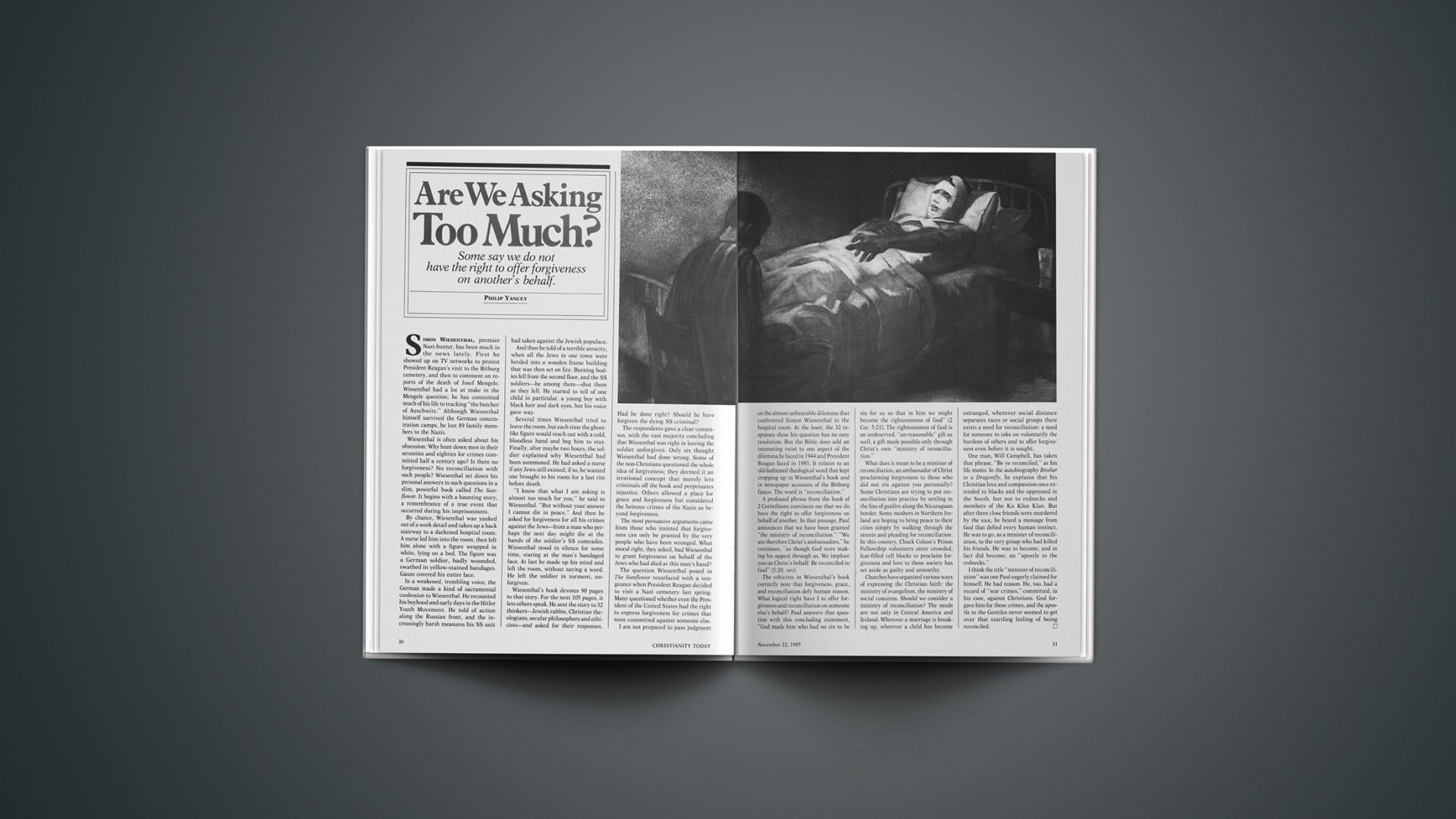
By chance, Wiesenthal was yanked out of a work detail and taken up a back stairway to a darkened hospital room. A nurse led him into the room, then left him alone with a figure wrapped in white, lying on a bed. The figure was a German soldier, badly wounded, swathed in yellow-stained bandages. Gauze covered his entire face.

In a weakened, trembling voice, the German made a kind of sacramental confession to Wiesenthal. He recounted his boyhood and early days in the Hitler Youth Movement. He told of action along the Russian front, and the increasingly harsh measures his SS unit had taken against the Jewish populace.

And then he told of a terrible atrocity, when all the Jews in one town were herded into a wooden frame building that was then set on fire. Burning bodies fell from the second floor, and the SS soldiers—he among them—shot them as they fell. He started to tell of one child in particular, a young boy with black hair and dark eyes, but his voice gave way.

Several times Wiesenthal tried to leave the room, but each time the ghostlike figure would reach out with a cold, bloodless hand and beg him to stay. Finally, after maybe two hours, the soldier explained why Wiesenthal had been summoned. He had asked a nurse if any Jews still existed; if so, he wanted one brought to his room for a last rite before death.

“I know that what I am asking is almost too much for you,” he said to Wiesenthal. “But without your answer I cannot die in peace.” And then he asked for forgiveness for all his crimes against the Jews—from a man who perhaps the next day might die at the hands of the soldier’s SS comrades. Wiesenthal stood in silence for some time, staring at the man’s bandaged face. At last he made up his mind and left the room, without saying a word. He left the soldier in torment, unforgiven.

Wiesenthal’s book devotes 90 pages to that story. For the next 105 pages, it lets others speak. He sent the story to 32 thinkers—Jewish rabbis, Christian theologians, secular philosophers and ethicists—and asked for their responses. Had he done right? Should he have forgiven the dying SS criminal?

The respondents gave a clear consensus, with the vast majority concluding that Wiesenthal was right in leaving the soldier unforgiven. Only six thought Wiesenthal had done wrong. Some of the non-Christians questioned the whole idea of forgiveness; they deemed it an irrational concept that merely lets criminals off the hook and perpetuates injustice. Others allowed a place for grace and forgiveness but considered the heinous crimes of the Nazis as beyond forgiveness.

The most persuasive arguments came from those who insisted that forgiveness can only be granted by the very people who have been wronged. What moral right, they asked, had Wiesenthal to grant forgiveness on behalf of the Jews who had died at this man’s hand?

The question Wiesenthal posed in The Sunflower resurfaced with a vengeance when President Reagan decided to visit a Nazi cemetery last spring. Many questioned whether even the President of the United States had the right to express forgiveness for crimes that were committed against someone else.

I am not prepared to pass judgment on the almost unbearable dilemma that confronted Simon Wiesenthal in the hospital room. At the least, the 32 responses show his question has no easy resolution. But the Bible does add an interesting twist to one aspect of the dilemma he faced in 1944 and President Reagan faced in 1985. It relates to an old-fashioned theological word that kept cropping up in Wiesenthal’s book and in newspaper accounts of the Bitburg fiasco. The word is “reconciliation.”

A profound phrase from the book of 2 Corinthians convinces me that we do have the right to offer forgiveness on behalf of another. In that passage, Paul announces that we have been granted “the ministry of reconciliation.” “We are therefore Christ’s ambassadors,” he continues, “as though God were making his appeal through us. We implore you on Christ’s behalf: Be reconciled to God” (5:20, NIV).

The ethicists in Wiesenthal’s book correctly note that forgiveness, grace, and reconciliation defy human reason. What logical right have I to offer forgiveness and reconciliation on someone else’s behalf? Paul answers that question with this concluding statement, “God made him who had no sin to be sin for us so that in him we might become the righteousness of God” (2 Cor. 5:21). The righteousness of God is an undeserved, “un-reasonable” gift as well, a gift made possible only through Christ’s own “ministry of reconciliation.”

What does it mean to be a minister of reconciliation, an ambassador of Christ proclaiming forgiveness to those who did not sin against you personally? Some Christians are trying to put reconciliation into practice by settling in the line of gunfire along the Nicaraguan border. Some mothers in Northern Ireland are hoping to bring peace to their cities simply by walking through the streets and pleading for reconciliation. In this country, Chuck Colson’s Prison Fellowship volunteers enter crowded, fear-filled cell blocks to proclaim forgiveness and love to those society has set aside as guilty and unworthy.

Churches have organized various ways of expressing the Christian faith: the ministry of evangelism, the ministry of social concerns. Should we consider a ministry of reconciliation? The needs are not only in Central America and Ireland. Wherever a marriage is breaking up, wherever a child has become estranged, wherever social distance separates races or social groups there exists a need for reconciliation: a need for someone to take on voluntarily the burdens of others and to offer forgiveness even before it is sought.

One man, Will Campbell, has taken that phrase, “Be ye reconciled,” as his life motto. In the autobiography Brother to a Dragonfly, he explains that his Christian love and compassion once extended to blacks and the oppressed in the South, but not to rednecks and members of the Ku Klux Klan. But after three close friends were murdered by the KKK, he heard a message from God that defied every human instinct. He was to go, as a minister of reconciliation, to the very group who had killed his friends. He was to become, and in fact did become, an “apostle to the rednecks.”

I think the title “minister of reconciliation” was one Paul eagerly claimed for himself. He had reason. He, too, had a record of “war crimes,” committed, in his case, against Christians. God forgave him for those crimes, and the apostle to the Gentiles never seemed to get over that startling feeling of being reconciled.

Theology

The Holy Art of Prayer

Dr. Olin Hallesby, a seminary professor in Oslo until his death in 1961, was one of Norway’s leading Christians, active with Inter-Varsity and other evangelical causes. The following is drawn from his classic, Prayer, which has sold very widely and is still in print (Augsburg).

When we seek only the glorification of the name of God in prayer, then we are in complete harmony with the Spirit of prayer. Our hearts are at rest. And we can wait for the Lord. We have learned to leave it to him to decide what will best serve to glorify his name—either an immediate or a delayed answer to our prayer.

Permit me to cite an example to show how bold, even importunate, prayer can become when the one who is praying desires nothing but the glorification of the name of God.

In 1540 Luther’s good friend Frederick Myconius became deathly sick. He himself expected to die within a short time. One night he wrote with trembling hand a fond farewell to Luther, whom he loved very much.

When Luther received the letter, he immediately sent back the following reply: “I command thee in the name of God to live because I still have need of thee in the work of reforming the church.… The Lord will never let me hear that thou art dead, but will permit thee to survive me. For this I am praying, this is my will, and may my will be done, because I seek only to glorify the name of God.”

Myconius had already lost the faculty of speech when Luther’s letter came—yet in a short time he was well again. And, true enough, survived Luther by two months!

Nothing makes us so bold in prayer as when we can look into the eye of God and say to him, “Thou knowest that I am not praying for personal advantage, nor to avoid hardship, nor that my own will in any way should be done, but only for this, that thy name might be glorified.”

The Forms Of Prayer

As we have seen above, prayer is really an attitude of our hearts toward God. As such, it finds expression in words and, at times, in quiet.

One day my little boy stuck his head into the doorway of my study. Now he knew that he was not supposed to disturb me during working hours, and his conscience troubled him. But he looked at me nevertheless with his kind, round baby eyes and said, “Papa, dear, I will sit still all the time if you will only let me be here with you!”

That he received permission when he approached my father-heart in that way, every father knows.

Is not that just the way we often feel with regard to our heavenly Father? We do so love to be with him, just to be in his presence! (Moreover, we never disturb him, no matter when we come nor how often we come!)

We pray to God. We speak to him about everything we have on our minds both concerning others and ourselves. There come times, not so seldom with me at least, when I have nothing more to tell God. If I were to continue to pray in words, I would have to repeat what I have already said. At such times it is wonderful to say to God, “May I be in thy presence, Lord? I have nothing more to say to thee, but I do love to be in thy presence.”

It is not necessary to maintain a conversation when we are in the presence of God—with someone we know well. We can come into his presence and rest our weary souls in quiet contemplation and tell him better than words how dependent we are upon him.

As evening drew nigh, and our little fellow had played until he was tired, I noticed that he drew closer and closer to his mother. At last he found the place he was longing for—mother’s lap. He did not have a great deal to say then either. He simply lay there, and let his mother caress him into sleep.

We, too, become tired, deathly tired, of ourselves, of others, of the world, of life, of everything! Then it is blessed to know of a place where we can lay our tired head and heart, and say to our Heavenly Father: “I can do no more. And I have nothing to tell you. May I lie here a while and rest? Everything will soon be well again if I can only rest in your arms a while.”

The School Of Prayer

One of the tenants of my father’s farm was a faithful intercessor. His name was Jørn.

Our Lord had imposed severe limitations upon him from birth. His eyes were weak, and as a result it was always difficult for him to earn a living. Trials and tribulations became Jørn’s lot, and many a day was dark and dreary.

But he humbled himself beneath the mighty hand of God, and little by little, in the school of difficult experiences, he learned the holy art of prayer. He would pray for his home community day and night. And, in due time, God exalted him. He became the spiritual counselor of the whole parish. People came to his little hut from the whole vicinity to get advice and help. And if Jørn could not help them in any other way, he could give them some of the unfeigned love of his own tender heart. As the years passed, many a soul left his humble dwelling with a lighter tread and a happier heart.

Two elderly Christian women, who were with him and cared for him, told me that he would be awake a great deal at night, at which time they could hear him pray for all the people of the parish. He mentioned each one of them by name, as in his thoughts he went from house to house. Even children whom he had not seen, but who he knew had been born, were carried to the throne of grace.

How much such people do mean to us! How empty their places become when they are gone!

There was something remarkable about the way Jørn left us. Everyone thought that his passing would be like a beautiful ascension, and believers vied with one another for the privilege of being with him and watching over him. And when he died, they stood at his casket and wept as though they had lost a father. Even ungodly people, who had never cared to hear the Word of God, came to his funeral. And they, too, wept.

Even in death, Jørn was a blessing to others. Both his life and his death were a fulfillment of the words of Scripture, “Ask, and ye shall receive.”

Homosexual Marriage

Why same-sex partnerships are not a Christian option.

Why same-sex partnerships are not a Christian option.

An increasingly more vocal Christian gay community (characterized by such groups as Evangelicals Concerned and the Metropolitan Community Churches) is actively challenging the church’s traditional understanding of homosexual behavior and its sinfulness. More specifically, the contention that both homosexuality and heterosexuality are equally from God and are, therefore, to be celebrated, calls upon individual believers to search the Scriptures again for what they have to say about the purpose and nature of human sexuality.

With this in mind, theologian John R. W. Stott addresses the critical arguments set forth by the Christian gay community in the second volume of his book, Involvement: Social and Sexual Relationships in the Modern World (Revell, 1985). With his assistance, CHRISTIANITY TODAY presents the following adaptation.

Because of the explosive nature of this topic, let me begin by setting the proper context for our discussion.

First, we are all human beings. That is to say, there is no such phenomenon as a “homosexual.” There are only people—human persons—made in the image and likeness of God, yet fallen. However strongly we may disapprove of homosexual practices, we have no liberty to dehumanize those who engage in them.

Second, we are all sexual beings. Our sexuality, according to both Scripture and experience, is basic to our humanness. God made us male and female.

Moreover, not only are we sexual beings, but we have a particular sexual orientation. Alfred C. Kinsey’s famous investigation into human sexuality led him to conclude that 4 percent of white American males are exclusively homosexual throughout their lives, 10 percent are homosexual for up to three years, and as many as 37 percent have some kind of homosexual experience between adolescence and old age. Kinsey found the percentage of homosexual women to be lower.

Third, we are all sinners. The doctrine of total depravity asserts that every part of our human being has been twisted by sin, and this includes our sexuality. Dr. Merville Vincent, of the Department of Psychiatry at Harvard Medical School, was correct when he wrote: “In God’s view I suspect we are all sexual deviants. I doubt if there is anyone who has not had a lustful thought that deviated from God’s perfect ideal of sexuality.”

Fourth, in addition to being human, sexual, and sinful creatures, I take it my readers are all Christians—not people who reject the lordship of Jesus Christ, but rather those who earnestly desire to submit to it and who believe that he exercises it through Scripture; who want to understand what light Scripture throws on this topic, and have a predisposition to seek God’s grace and follow his will when it is known.

Necessary Distinctions

Our context set, are homosexual partnerships then a Christian option? I phrase my question advisedly. It introduces us to three necessary distinctions.

First, we have learned to distinguish between sins and crimes. Adultery has always (according to God’s law) been a sin, but in most countries it is not an offense punishable by the state. Rape, by contrast, is both a sin and a crime. In 1967, England established the Sexual Offenses Act, which declared that a homosexual act performed between consenting adults over 21 in private should no longer be a criminal offense. “The Act did not in fact ‘legalize’ such behavior,” wrote Prof. Sir Norman Anderson, “for it is still regarded by the law as immoral, and is devoid of any legal recognition; all the Act did was to remove the criminal sanction from such acts when performed in private between two consenting adults.”

Second, we distinguish between homosexual orientation or “inversion” (for which people are not responsible) and homosexual practices (for which they are). The importance of this distinction goes beyond the attribution of responsibility to the attribution of guilt. We may not blame people for what they are, though we may for what they do. In every discussion of homosexuality we must be rigorous in differentiating between “being” and “doing”—that is, between a person’s identity and activity, sexual preference and sexual practice, constitution and conduct.

But we now have to come to terms with a third distinction, namely between homosexual practices that are casual (and probably anonymous) acts of self-gratification and those that (it is claimed) are just as expressive of authentic human love as is heterosexual intercourse in marriage. No responsible homosexual person (Christian or not) is advocating promiscuous “one night stands,” let alone violence or the corruption of the young. What some are arguing, however, especially in the so-called gay Christian movement, is that a heterosexual marriage and a homosexual partnership are “two equally valid alternatives,” being equally tender, mature, and faithful.

The question before us, then, does not relate to casual homosexual practices, but it asks whether homosexual partnerships—lifelong and loving—are a Christian option. Our concern is to subject prevailing attitudes (whether total revulsion or equally uncritical endorsement) to biblical scrutiny. Is our sexual “preference” purely a matter of personal “taste”? Or has God revealed his will regarding a norm? In particular, can the Bible be shown to sanction homosexual partnerships, or at least not to condemn them?

What, in fact, does the Bible condemn?

The Biblical Prohibitions

The late Derrick Sherwin Bailey was the first Christian theologian to re-evaluate the traditional understanding of the biblical prohibitions regarding homosexuality. His famous book—of which all subsequent writers on this topic have had to take careful account—Homosexuality and the Western Christian Tradition, was published in 1955. Although many have not been able to accept his attempted reconstruction (in particular his reinterpretation of the sin of Sodom), other writers, less cautious in scholarly standards, regard Bailey’s argument as merely a stepping stone to a much more permissive position.

There are four main biblical passages that refer (or appear to refer) to the homosexual question negatively: (1) the story of Sodom (Gen. 19:1–13), with which it is natural to associate the very similar story of Gibeah (Judges 19); (2) the Levitical texts (Lev. 18:22; 20:13), which explicitly prohibit “lying with a man as one lies with a woman”; (3) the apostle Paul’s portrayal of decadent pagan society in his day (Rom. 1:18–32); and (4) two Pauline lists of sinners, each of which includes a reference to homosexual practices of some kind (1 Cor. 6:9–10 and 1 Tim. 1:8–11).

1. The stories of Sodom and Gibeah. The Genesis narrative makes it clear that “the men of Sodom were wicked and were sinning greatly against the Lord” (13:13), and that “the outcry against Sodom and Gomorrah” was “so great and their sin so grievous” that God determined to investigate it (18:20, 21). In the end, God “overthrew those cities and the entire plain, including all those living in the cities” (19:25). There is no controversy about this background to the biblical story. The question is: What was the sin of the people of Sodom that merited their obliteration?

The traditional view has been that they were guilty of homosexual practices, which they attempted (unsuccessfully) to inflict on the two angels Lot was entertaining. But Sherwin Bailey challenged this interpretation on two main grounds. First, it is a gratuitous assumption (he argued) that the demand of the men of Sodom, “Bring them out to us, so that we may know them,” meant “so that we can have sex with them” (NIV).

The Hebrew word for “know” (yádha‘) occurs 943 times in the Old Testament, of which only 10 occurrences refer to physical intercourse, and even then only to heterosexual intercourse. It would therefore be better, Bailey maintained, to translate the phrase “so that we may get acquainted with them.” We can then understand the men’s violence as based on their feelings that Lot had exceeded his rights as a resident alien, for he had welcomed two strangers into his home “whose intentions might be hostile and whose credentials … had not been examined.” In this case, the sin of Sodom was to invade the privacy of Lot’s home and flout the ancient rules of hospitality. Lot begged them to desist because, he said, the two men “have come under the protection of my roof” (v. 8).

Bailey’s second argument was that the rest of the Old Testament nowhere suggests that the nature of Sodom’s offense was homosexual. Instead, Isaiah implies that it was hypocrisy and social injustice; Jeremiah—adultery, deceit, and general wickedness; and Ezekiel—arrogance, greed, and indifference to the poor. Then Jesus himself (though Bailey does not mention this) on three separate occasions alluded to the inhabitants of Sodom and Gomorrah, declaring that it would be “more bearable” for them on the day of judgment than for those who reject his gospel. In all these references there is not even a rumor of homosexual malpractice!

It is only when we reach the Palestinian pseudepigraphical writings of the second century B.C. that Sodom’s sin is identified as unnatural sexual behavior. And this finds a clear echo in the letter of Jude, in which it is said that “Sodom and Gomorrah and the surrounding towns gave themselves up to sexual immorality and perversion” (v. 7), and it similarly appears in the works of Philo and Josephus, Jewish writers who were shocked by the homosexual practices of Greek society.

Bailey handled the Gibeah story the same way. Another resident alien (this time an anonymous “old man”) invites two strangers (not angels, but a Levite and his concubine) into his home. Evil men surround the house and make the same demand as the Sodomites: that the visitor be brought out “so that we may know him.” The owner of the house first begs them not to be so “vile” to his “guest,” and then offers his daughter and the concubine to them instead. The sin of the men of Gibeah, it is again suggested, was not their proposal of homosexual intercourse, but their violation of the laws of hospitality.

But Bailey’s case is not convincing for a number of reasons: (1) the adjectives “wicked,” “vile,” and “disgraceful” (Gen. 18:7; Judges 19:23) do not seem appropriate to describe a breach of hospitality; (2) the offer of women instead does look as if there is some sexual connotation to the episode; (3) although the verb yádha‘ is used only ten times of sexual intercourse, Bailey omits to mention that six of these occurrences are in Genesis and one in the Sodom story itself (about Lot’s daughters, who had not “known” a man, verse 8); and (4) for those of us who take the New Testament documents seriously, Jude’s unequivocal statement cannot be dismissed as merely an error copied from Jewish pseudepigrapha. To be sure, homosexual behavior was not Sodom’s only sin; but according to Scripture, it was certainly one of them.

2. The Leviticus texts:

“Do not lie with a man as one lies with a woman; that is detestable” (18:22).

“If a man lies with a man as one lies with a woman, both of them have done what is detestable. They must be put to death; their blood will be on their own heads” (20:13).

Both these texts belong to the “Holiness Code,” which challenges the people of God to follow his laws and not copy the practices of Egypt (where they used to live) or Canaan (where they were going). These practices included sexual relations within the prohibited degrees, a variety of sexual deviations, child sacrifice, idolatry, and social injustice of different kinds.

“It is hardly open to doubt,” wrote Bailey, “that both the laws in Leviticus relate to ordinary homosexual acts between men, and not to ritual or other acts performed in the name of religion.” Others, however, affirm the very point that Bailey denies. They rightly point out that the two texts are embedded in a context preoccupied largely with ritual cleanness, and Peter Coleman adds that the word translated “detestable” or “abomination” in both verses is associated with idolatry. “In English the word expresses disgust or disapproval, but in the Bible its predominant meaning is concerned with religious truth rather than morality or aesthetics.”

Are these prohibitions merely religious taboos, then? Are they connected with that other prohibition, “No Israelite man or woman is to become a temple prostitute” (Deut. 23:17)? Certainly the Canaanite fertility cult did include ritual prostitution, and therefore provided both male and female “sacred prostitutes” (even if there is no clear evidence that either engaged in homosexual intercourse). The evil kings of Israel and Judah were constantly introducing them into the religion of Yahweh, and the righteous kings were constantly expelling them. The homosexual lobby argues, therefore, that the Levitical texts prohibit religious practices that have long since ceased, and have no relevance to homosexual partnerships today.

3. Paul’s statements in Romans 1:

“Because of this, God gave them over to shameful lusts. Even their women exchanged natural relations for unnatural ones. In the same way the men also abandoned natural relations with women and were inflamed with lust for one another. Men committed indecent acts with other men, and received in themselves the due penalty for their perversion” (vv. 26–27).

All are agreed that the apostle is describing idolatrous pagans in the Greco-Roman world of his day. They had a certain knowledge of God through the created universe (vv. 19–20) and their own moral sense (v. 32), yet they suppressed the truth in order to practice wickedness. Instead of giving to God the honor due him, they turned to idols, confusing the Creator with his creatures. In judgment, “God gave them over” to their depraved mind and their decadent practices (vv. 24, 26, 28), including “unnatural” sex.

It seems at first sight to be a definite condemnation of homosexual behavior. But two arguments are advanced to the contrary. They emphasize that although Paul knew nothing of the modern distinction between “inverts” (those who have a homosexual disposition) and “perverts” (who, though heterosexually inclined, indulge in homosexual practices), nevertheless it is the latter he is condemning, not the former. This must be so, because they are described as having “abandoned” natural relations with women, whereas no exclusively homosexual male would ever have had them. Second, Paul is evidently portraying the reckless, shameless, profligate, promiscuous behavior of people whom God has judicially “given up.” What relevance has this to committed, loving homosexual partnerships?

4. The other Pauline texts:

“Do you not know that the wicked will not inherit the kingdom of God? Do not be deceived: Neither the sexually immoral, nor idolaters nor adulterers nor male prostitutes [malakoi] nor homosexual offenders [arsenokoitai] nor thieves nor the greedy nor drunkards nor slanderers nor swindlers will inherit the kingdom of God” (1 Cor. 6:9–10).

“We also know that law is made not for good men but for lawbreakers and rebels, the ungodly and sinful, the unholy and irreligious; for those who kill their fathers or mothers, for murderers, for adulterers and perverts [arsenokoitais], for slave traders and liars and perjurers—and for whatever else is contrary to the sound doctrine that conforms to the glorious gospel of the blessed God.…” (1 Tim. 1:9–10).

Here are two ugly lists of sins that Paul affirms to be incompatible with the kingdom of God and with either the law or the gospel. It will be observed that one group of offenders is called malakoi and the other (in both lists) arsenokoitai. What do these words mean?

To begin with, it is extremely unfortunate that in the original Revised Standard Version translation of 1 Corinthians 6:9, both words were combined and translated “homosexuals.” Bailey was right to protest, since the use of the word “inevitably suggests that the genuine invert, even though he be a man of irreproachable morals, is automatically branded as unrighteous and excluded from the Kingdom of God.”

Fortunately, the revisers heeded the protest, and the second edition (1973), though still combining the words, rendered them “sexual perverts.” The point is that all ten categories listed in 1 Corinthians 6:9–10 (with the possible exception of “the greedy”) denote people who have offended by their actions—idolators, adulterers, and thieves, for example.

The two Greek words malakoi and arsenokoitai should not be combined, however, since they have precise meanings. The first is literally ‘soft to the touch,’ and metaphorically, among the Greeks, it meant males (not necessarily boys) who played the passive role in homosexual intercourse. The second means literally ‘male in a bed,’ and the Greeks used this expression to describe the one who took the active role. The Jerusalem Bible follows James Moffatt in using the ugly words “catamites and sodomites,” while among his conclusions Peter Coleman suggests that “probably Paul had commercial pederasty in mind between older men and post-pubertal boys, the most common patterns of homosexual behavior in the classical world.”

If this is so, then once again it can be (and has been) argued that the Pauline condemnations are not relevant to homosexual adults who are both consenting and committed to one another. Not that this is the conclusion that Peter Coleman himself draws. His summary: “Taken together, St. Paul’s writings repudiate homosexual behavior as a vice of the Gentiles in Romans, as a bar to the Kingdom in Corinthians, and as an offense to be repudiated by the moral law in 1 Timothy.”

Because there are only these four biblical references to homosexual behavior, must we then conclude that the topic is marginal to the main thrust of the Bible? Must we further concede that they constitute a rather flimsy basis on which to take a firm stand against a homosexual lifestyle? Are those protagonists right who claim that the biblical prohibitions are “highly specific”—against violations of hospitality (Sodom and Gibeah), against cultic taboos (Leviticus), against shameless orgies (Romans), and against male prostitution or the corruption of the young (1 Corinthians and 1 Timothy); and that none of these passages alludes to, let alone condemns, a loving partnership between genuine homosexual inverts? Indeed, such is the conclusion reached by Letha Scanzoni and Virginia Mollenkott in their book Is the Homosexual My Neighbor? They write:

“The Bible clearly condemns certain kinds of homosexual practice (… gang rape, idolatry and lustful promiscuity). However, it appears to be silent in certain other aspects of homosexuality—both the ‘homosexual orientation’ and ‘a committed love-relationship analogous to heterosexual monogamy.’ ”

But we cannot handle the biblical material in this way. The Christian rejection of homosexual practices does not rest on “a few isolated and obscure proof texts” (as is sometimes said), whose traditional explanation can (perhaps) be overthrown. For the negative prohibitions of homosexual practices in Scripture make sense only in the light of its positive teaching in Genesis 1 and 2 about human sexuality and heterosexual marriage. Without the wholesome positive teaching of the Bible on sex and marriage, our perspective on the homosexual question is bound to be skewed.

Sex And Marriage In The Bible

Since gay Christian activists deliberately draw a parallel between heterosexual marriages and homosexual partnerships, it is necessary to ask whether this parallel can be justified.

God has given us two distinct accounts of Creation. The first (Genesis 1) is general, and affirms the equality of the sexes, since both share in the image of God and the stewardship of the earth. The second (Genesis 2) is particular, and affirms the complementarity of the sexes, which constitutes the basis for heterosexual marriage. In this second account of Creation, three fundamental truths emerge.

First, the human need for companionship. “It is not good for the man to be alone” (v. 18). True, this assertion was later qualified when the apostle Paul (surely echoing Genesis) wrote: “It is good for a man not to marry” (1 Cor. 7:1). That is to say, although marriage is the good institution of God, the call to singleness is also the good vocation of some. Nevertheless, as a general rule, “It is not good for the man to be alone.”

God has created us social beings. Since he is love, and has made us in his own likeness, he has given us a capacity to love and be loved. He intends us to live in community, not in solitude. In particular, God continued, “I will make a helper suitable for him.” Moreover, this “helper” or companion, whom God pronounced “suitable for him,” was also to be man’s sexual partner, with whom he was to become “one flesh,” so that they might consummate their love and procreate their children.

Second, Genesis 2 reveals the divine provision to meet this human need. Having affirmed Adam’s need for a partner, the search for a suitable one began. God first paraded the birds and beasts before him, and Adam proceeded to “name” them, to symbolize his taking them into his service. But (v. 20) “for Adam no suitable helper was found,” who could live “alongside” or “opposite” him, who could be his complement, his counterpart, his companion—let alone his mate. So a special creation was necessary.

Thus, a special work of divine creation took place. The sexes became differentiated. Out of the undifferentiated humanity of Adam, male and female emerged. And Adam awoke from his deep sleep to behold a reflection of himself, a complement to himself, indeed a very part of himself. Next, having created the woman out of the man, God himself brought her to him, much as a bride’s father today gives her away. And Adam broke spontaneously into history’s first love poem:

At last (in contrast to the birds and beasts), “This is now bone of my bones / and flesh of my flesh; / She shall be called ‘woman,’ / for she was taken out of man.”

There can be no doubting the emphasis of this story. According to Genesis 1, Eve, like Adam, was created in the image of God. But as to the manner of her creation, according to Genesis 2, she was made neither out of nothing (like the universe), nor out of “the dust of the ground” (like Adam, v. 7), but out of Adam.

The third great truth of Genesis 2 concerns the resulting institution of marriage. Adam’s love poem is recorded in verse 23. The “therefore” or “for this reason” of verse 24 is the narrator’s deduction: “For this reason a man will leave his father and mother, and be united to his wife, and they will become one flesh.”

Even the inattentive reader will be struck by the three references to “flesh”: “this is … flesh of my flesh … they will become one flesh.”

We may be certain that this is deliberate, not accidental. It teaches that heterosexual intercourse in marriage is more than a union; it is a kind of reunion. It is not a union of alien persons who do not belong to one another and cannot appropriately become one flesh. On the contrary, it is the union of two persons who originally were one, were then separated from each other, and now in the sexual encounter of marriage come together again.

It is surely this that explains the profound mystery of heterosexual intimacy, which poets and philosophers have celebrated in every culture. Heterosexual intercourse is much more than a union of bodies; it is a blending of complementary personalities through which, in the midst of prevailing alienation, the rich, created oneness of human being is experienced again. And the complementarity of male and female sexual organs is only a physical symbol of a much deeper spiritual complementarity.

In order to become one flesh, however, and experience this sacred mystery, certain preliminaries are necessary, which are constituent parts of marriage. “Therefore”:

• “a man” (the singular indicates that marriage is an exclusive union between two individuals)

• “shall leave his father and mother” (a public social occasion is in view)

• “and cleave to his wife” (marriage is a loving, cleaving commitment or covenant, which is heterosexual and permanent),

• “and they will become one flesh” (for marriage must be consummated in sexual intercourse, which is a sign and seal of the marriage covenant, and over which no shadow of shame or embarrassment had yet been cast).

Jesus himself later endorsed this teaching. He quoted Genesis 2:24, declaring that such a lifelong union between a man and his wife was God’s intention from the beginning, and added, “what God has joined together, let man not separate” (Mark 10:4–9).

Thus Scripture defines the marriage God instituted in terms of heterosexual monogamy. It is the union of one man with one woman, which must be publicly acknowledged (the leaving of parents), permanently sealed (he will “cleave to his wife”), and physically consummated (“one flesh”). Scripture envisages no other kind of marriage or sexual intercourse, for God provided no alternative.

Christians should not therefore single out homosexual intercourse for special condemnation. Every sexual relationship or act that deviates from God’s revealed intention is ipso facto displeasing to him and under his judgment. This includes polygamy and polyandry (which infringe the “one man-one woman” principle), clandestine unions (since these have involved no decisive public leaving of parents); casual encounters and temporary liaisons, adultery and many divorces (which are incompatible with “cleaving” and with Jesus’ prohibition “let man not separate”), and homosexual partnerships (which violate the statement that “a man” shall be joined to “his wife”).

In sum, the only “one flesh” experience that God intends and Scripture contemplates is the sexual union of a man with his wife, whom he recognizes as “flesh of his flesh.”

Contemporary Arguments Considered

Homosexual Christians are not, however, satisfied with this biblical teaching about human sexuality and the institution of heterosexual marriage. They bring forward a number of objections in order to defend the legitimacy of homosexual partnerships.

1. The argument about Scripture and culture. Traditionally, it has been assumed that the Bible condemns all homosexual acts. But are the biblical writers reliable guides in this matter? Were their horizons not bounded by their own experience and culture? The cultural argument, therefore, usually takes one of two forms.

First, the biblical authors were addressing themselves to questions relevant to their own circumstances, and these were very different from ours. In the Sodom and Gibeah stories, they were preoccupied either with conventions of hospitality in the ancient Near East that are now obsolete or (if the sin was sexual at all) with the extremely unusual phenomenon of homosexual gang rape. In the Levitical laws the concern was with antiquated fertility rituals, while Paul was addressing himself to the particular sexual preferences of Greek pederasts.

The second and complementary culture problem is that the biblical writers were not addressing themselves to our questions. Thus the problem of Scripture is not only with its teaching but also with its silence. Paul (let alone the Old Testament authors) knew nothing of post-Freudian psychology. They had never heard of “the homosexual condition”; they knew only about certain practices. The difference between “inversion” and “perversion” would have been incomprehensible to them. The very notion that two men or two women could fall in love with each other and develop a deeply loving, stable relationship comparable to marriage simply never entered their heads. So then, just as slaves, blacks, and women have been liberated, “gay liberation” is long overdue.

If the only biblical teaching on this topic were to be found in the prohibition texts, it might be difficult to answer these objections. But once those texts are seen in relation to the divine institution of marriage, we are in possession of a principle of divine revelation that is universally applicable. It was applicable to the cultural situations of both the ancient Near East and the first-century Greco-Roman world, and it is equally applicable to modern sexual questions of which the ancients were quite ignorant. The reason for the biblical prohibitions is the same reason why modern loving homosexual partnerships must also be condemned—namely that they are incompatible with God’s created order. And since that order (heterosexual monogamy) was established by Creation, not culture, its validity is both permanent and universal. There can be no “liberation” from God’s created norms; true liberation is found only in accepting them.

2. The argument about creation and nature. I have sometimes read or heard this kind of statement: “I’m gay because God made me that way. So gay must be good. I intend to accept, and indeed celebrate, what I am by creation.” Or again: “You may say that homosexual practice is against nature and normality; but it’s not against my nature, nor is it in the slightest degree abnormal for me.” Some argue that homosexual behavior is “natural” because: (a) in many primitive societies it is fairly acceptable, (b) in some advanced civilizations (ancient Greece, for example) it was even idealized, and (c) it is quite widespread in animals.

These arguments, however, express an extremely subjective view of what is “natural” and “normal.” We cannot agree, for example, that animal behavior sets standards for human behavior! God has established a norm for sex and marriage by creation. This was recognized in the Old Testament era. Thus, sexual relations with an animal were forbidden, because “that is a perversion” (Lev. 18:23)—in other words, a violation or confusion of nature, which indicates an “embryonic sense of natural law.”

This was also clearly in Paul’s mind in Romans 1. When he wrote of women who had “exchanged natural relations for unnatural ones,” and of men who had “abandoned natural relations,” he meant by “nature” (phusis), the natural order of things that God had established (as in 2:14, 27, and 11:24). What Paul was condemning, therefore, was not the perverted behavior of heterosexual people who were acting against their nature, but any human behavior that is against “Nature,” God’s created order.

3. The argument about quality of relationships. Gay Christian activists borrow from Scripture the truth that love is the greatest thing in the world (which it is) and from the “new morality” or “situation ethics” of the 1960s the notion that love is an adequate criterion by which to judge every relationship (which it is not).

In his Time for Consent, liberal theologian Norman Pittenger lists six characteristics of a truly loving relationship. They are: (1) commitment (the free self-giving of each to the other); (2) mutuality in giving and receiving (a sharing in which each finds his or her self in the other); (3) tenderness (no coercion or cruelty); (4) faithfulness (the intention of a lifelong relationship); (5) hopefulness (each serving the other’s maturity); and (6) desire for union.

If then a homosexual relationship, whether between two men or two women, is characterized by these qualities of love, surely (the argument goes) it must be affirmed as good and not rejected as evil. It rescues people from loneliness, selfishness, and promiscuity. It can be as rich and responsible, as liberating and fulfilling, as a heterosexual marriage.

But the biblical Christian cannot accept the basic premise on which this case rests, namely that love is the only absolute, that beside it all moral law has been abolished, and that whatever seems to be compatible with love is ipso facto good, irrespective of all other considerations. This cannot be so, for love needs law to guide it. In emphasizing love for God and neighbor as the two Great Commandments, Jesus and his apostles did not discard all other commandments. On the contrary, Jesus said, “If you love me you will keep my commandments,” and Paul wrote, “Love is the fulfilling [not the abrogating] of the law.”

On several different occasions a married man has told me that he has fallen in love with another woman. When I have gently remonstrated with him, he has responded in words like these: “Yes, I agree, I already have a wife and family. But this new relationship is the real thing. We were made for each other. Our love for each other has a quality and a depth we have never known before. It must be right.” But no, it is not right. No man is justified in breaking his marriage covenant with his wife on the ground of the quality of his love for another woman. Quality of love is not the only yardstick by which to measure what is good or right.

Similarly, I do not deny the claim that homosexual relationships can be loving (although a priori I do not see how they can attain the same richness as the heterosexual mutuality God has ordained). But their love quality is not sufficient to justify them. Indeed, I have to add that they are incompatible with true love because they are incompatible with God’s law. Love is concerned for the highest welfare of the beloved. And our highest human welfare is found in obedience to God’s law and purpose, not in revolt against them.

4. The argument about acceptance and the gospel. “Surely,” some people are saying, “it is the duty of heterosexual Christians to accept homosexual Christians. Paul told us to accept—indeed welcome—one another. If God has welcomed somebody, who are we to pass judgment on him (Rom. 14:1ff.)? Norman Pittenger goes further and declares that those who reject homosexual people “have utterly failed to understand the Christian gospel.” We do not receive the grace of God because we are good and confess our sins, he continues; it is the other way round. “It’s always God’s grace which comes first, … his forgiveness awakens our repentance.” He even quotes the hymn “Just as I am, without one plea,” and adds: “the whole point of the Christian gospel is that God loves and accepts us just as we are.”

This is a very confused statement of the gospel, however. God does indeed accept us “just as we are,” and we do not have to make ourselves good first—indeed we cannot. But his “acceptance” means that he fully and freely forgives all who repent and believe, not that he condones our continuance in sin. Again, it is true that we must accept one another, but only as fellow penitents and fellow pilgrims, not as fellow sinners who are resolved to persist in our sinning. No acceptance, either by God or by the church, is promised to us if we harden our hearts against God’s Word and will. Only judgment.

Faith, Hope, And Love

If homosexual practice must be regarded, in the light of the whole biblical revelation, not as a variant within the wide range of accepted normality, but as a deviation from God’s norm; and if we should therefore call homosexually oriented people to abstain from homosexual practices and partnerships, what advice and help can we give to encourage them to respond to this call? I would like to take Paul’s triad of faith, hope, and love, and apply it to homosexually oriented people.

The Christian call to faith. Faith is the human response to divine revelation. It is believing God’s Word.

First, faith accepts God’s standards. The only alternative to heterosexual marriage is sexual abstinence. Nothing has helped me understand the pain of homosexual celibacy more than Alex Davidson’s moving book, The Returns of Love. He writes of “this incessant tension between law and lust,” “this monster that lurks in the depths,” this “burning torment.”

The secular world says: “Sex is essential to human fulfillment. To expect homosexual people to abstain from homosexual practice is to condemn them to frustration and to drive them to neurosis, despair, and even suicide. It’s outrageous to ask anybody to deny himself what to him is a normal and natural mode of sexual expression.”

But no, the teaching of the Word of God is different. Sexual experience is not essential to human fulfillment. To be sure, it is a good gift of God. But it is not given to all, and it is not indispensable to humanness. Besides, God’s commands are good and not grievous. The yoke of Christ brings rest, not turmoil; conflict comes only to those who resist it.

So, ultimately, it is a crisis of faith: Whom shall we believe? God or the world? Shall we submit to the lordship of Jesus, or succumb to the pressures of prevailing culture? The true “orientation” of Christians is not what we are by constitution (hormones), but what we are by choice (heart, mind, and will).

Second, faith accepts God’s grace. If God calls us to celibacy, abstinence is not only good, it is also possible. Many deny it, however. It is “so near to an impossibility,” writes Norman Pittenger, “that it’s hardly worth talking about.”

Really? What then are we to make of Paul’s statement following his warning to the Corinthians that male prostitutes and homosexual offenders will not inherit God’s kingdom? “And that is what some of you were,” he cries. “But you were washed, you were sanctified, you were justified in the name of the Lord Jesus Christ and by the Spirit of our God” (1 Cor. 6:11). And what shall we say to the millions of heterosexual people who are single? To be sure, all unmarried people experience the pain of struggle and loneliness. But how can we call ourselves Christians and declare that chastity is impossible? Christ comes to us as he came to Paul and says: “My grace is sufficient for you, for my power is made perfect in weakness” (2 Cor. 12:9). To deny this is to portray Christians as the helpless victims of the world, the flesh and the Devil, and to contradict the gospel of God’s grace.

The Christian call to hope. I have said nothing so far about “healing” for homosexual people, understood not now as self-mastery but as the reversal of their sexual bias. Most agree that, lacking heterosexual outlets, and under cultural pressures, a large percentage of people would (or at least could) behave homosexually. Indeed, although there may be a genetic factor or component, the condition is more “learned” than “inherited.” Some attribute it to traumatic childhood experiences, such as the withdrawal of the mother’s love, inhibiting sexual growth. So, if it is learned, can it not be unlearned?

The possibility of change by the grace and power of God depends also on the strength of the person’s resolve, which itself depends on other factors. Those whose sexuality is indeterminate may well change under strong influence and with strong motivation. But many researchers conclude that constitutional homosexuality is irreversible. “No known method of treatment or punishment,” writes D. J. West, “offers hope of making any substantial reduction in the vast army of adults practicing homosexuality”; it would be “more realistic to find room for them in society.” He pleads for “tolerance,” though not for “encouragement,” of homosexual behavior. Other psychologists go further and declare that homosexuality is no longer to be regarded as a pathological condition; it is therefore to be accepted, not cured. In 1973 the trustees of the American Psychiatric Association removed homosexuality from the category of mental illness.

Are not these views, however, the despairing opinions of the secular mind? Christians know that the homosexual condition, being a deviation from God’s norm, is not a sign of created order but of fallen disorder. How, then, can we acquiesce in it or declare it incurable?

We cannot. The only question is when and how we are to expect the divine deliverance and restoration to take place. The fact is that, though Christian claims of homosexual “healings” are made, either through regeneration or through a subsequent work of the Holy Spirit, it is not easy to substantiate them.

Martin Hallett, who before his conversion was active in the gay scene, has subsequently founded the “True Freedom Trust,” an interdenominational teaching and counseling ministry on homosexuality and related problems. They have published a pamphlet entitled Testimonies. In it homosexual Christian men and women bear witness to what Christ has done for them. They have found a new identity in him, and a new sense of personal fulfillment as children of God. They have been delivered from guilt, shame, and fear by God’s forgiving acceptance. But they have not been delivered from their homosexual orientation, and therefore some inner pain continues alongside their new joy and peace.

Indeed, complete healing of body, mind, and spirit will not take place in this life. Some degree of deficit or disorder remains in each of us. But not for ever! The Christian’s horizons are not bounded by this world. Jesus is coming again; our bodies are going to be redeemed; sin, pain, and death are going to be abolished; and both we and the universe are going to be transformed. Then we shall be finally liberated from everything that defiles or distorts our personality.

Alex Davidson is one who derives comfort in the midst of his homosexuality from his Christian hope. “Isn’t it one of the most wretched things about this condition,” he writes, “that when you look ahead, the same impossible road seems to continue indefinitely? You’re driven to rebellion when you think of there being no point in it and to despair when you think of there being no limit to it. That’s why I find a comfort, when I feel desperate, or rebellious, or both, to remind myself of God’s promise that one day it will be finished.…”

The Christian call to love. At present we are living “in between times,” between the grace that we grasp by faith and the glory that we anticipate in hope. Between them lies love.

Yet love is just what the church has generally failed to show to homosexual people. Norman Pittenger describes the “vituperative” correspondence he has received, in which homosexuals are dismissed by professing Christians as “filthy creatures,” “disgusting perverts,” “damnable sinners,” and the like. Rictor Norton is yet more shrill: “The church’s record regarding homosexuals is an atrocity from beginning to end: it is not for us to seek forgiveness, but for the church to make atonement.”

“Homophobia,” or the attitude of personal hostility towards homosexuals, is a mixture of irrational fear, hatred, and even revulsion. It overlooks the fact that the great majority of homosexual people are not responsible for their condition (though they are, of course, for their conduct). Since they are not deliberate perverts, they deserve our understanding and compassion (though many find this patronizing), not our rejection. No wonder Richard Lovelace calls for “a double repentance,” namely “that gay Christians renounce the active lifestyle” and that “straight Christians renounce homophobia.” David Atkinson is right to add: “We are not at liberty to urge the Christian homosexual to celibacy and to a spreading of his relationships, unless support for the former and opportunities for the latter are available in genuine love.”

At the heart of the homosexual condition is a deep loneliness, the natural human hunger for mutual love, a search for identity, and a longing for completeness. If homosexual people cannot find these things in the local “church family,” we have no business using that expression. The alternative is not between the warm physical relationship of homosexual intercourse and the pain of cold isolation. There is a third alternative—namely, a Christian environment of love, understanding, acceptance, and support. I do not think there is any need to encourage homosexual people to disclose their sexual orientation to everybody; this is neither necessary nor helpful. But they do need at least one confidant to whom they can unburden themselves, who will not despise or reject them but will support them with friendship and prayer. They may also need some professional, private, and confidential pastoral counsel; possibly the support of a professionally supervised therapy group; and many warm and affectionate friendships with people of both sexes.

Same-sex friendships are to be encouraged, like those in the Bible between Ruth and Naomi, David and Jonathan, and Paul and Timothy. There is no hint that any of these was homosexual in the erotic sense, yet they were evidently affectionate and (at least in the case of David and Jonathan) even demonstrative. It is sad that our Western culture inhibits the development of rich same-sex friendships by engendering the fear of being ridiculed or rejected as a “queer.”

These relationships, both same-sex and opposite-sex, need to be developed within the family of God, which, though universal, has its local manifestations. He intends each local church to be a warm, accepting, and supportive community. By “accepting” I do not mean “acquiescing,” any more than in rejecting “homophobia” I am rejecting a proper Christian disapproval of homosexual behavior. No, true love is not incompatible with the maintenance of moral standards.

There is, therefore, a place for church discipline in the case of members who refuse to repent and willfully persist in homosexual relationships. But it must be exercised in a spirit of humility and gentleness (Gal. 6:1f.). We must be careful not to discriminate between men and women, or between homosexual and heterosexual offenses; and necessary discipline in the case of a public scandal is not to be confused with a witch hunt.

Perplexing and painful as the homosexual Christian’s dilemma is, Jesus Christ offers him or her (indeed, all of us) faith, hope, and love—the faith to accept his standards and his grace to maintain them, the hope to look beyond present suffering to future glory, and the love to care for and support one another. “But the greatest of these is love” (1 Cor. 13:13).

Ideas

Rock-Solid Relationships

The Pilgrims’ pastor lays the foundation for thanksgiving.

“I shall make them conform or I shall harry them out of the land, or else do worse.”

—James I of England

King James had been harassing the Puritans. One group, called Separatists, left the Church of England entirely, fleeing to Holland in 1607, where they lived in Leyden for 12 years. A leader among them, William Brewster, was to write, “They knew they were pilgrims,” and the name stuck.

In time, these supposed deviants would celebrate a kind of harvest home thanksgiving for God’s goodness in watching over them as they crossed the Atlantic to Plymouth, and in bringing them through that first harsh winter to the abundance of autumn, 1621.

About 40 of the Leyden congregation had gone to England with Brewster and William Bradford in order to set out for the Americas in 1620. Accompanying the 40 Pilgrims were 62 other colonists, whom they called “strangers,” an assortment of people aiming to make their fortunes in the New World.

As they prepared to leave England, they received a pastoral letter from John Robinson, the minister they had left in Leyden to look after the larger group. He was concerned about their relationships as they were jammed aboard ship for a long voyage, and as they faced the stress of life in the “hideous and desolate wilderness” of northeast North America.

The encouragement and warning set forth in Robinson’s letter (here paraphrased and condensed) are as relevant and insightful for us today as they were for the Pilgrims in the summer of 1620.

Leyden, Holland

July 27, 1620

Loving Christian friends,

I heartily salute you in the Lord. I am present with you in my heartfelt desire, though I am constrained for a while to be absent in body.…

Though I do not doubt your godly wisdom, I have thought it my duty to add some further stimulus, not because you need it, but because I owe it in love and duty.

Self-Examination

We know we are daily to renew our repentance before God, especially for the sins that we know, and generally for the trespasses that are unknown to us.

But beyond that, and at this time of such difficulty and danger, the Lord calls you specially to a thorough search and careful reformation of your ways. Otherwise he might call to mind sins we had forgotten or had not repented of. Then in judgment he might leave us to be swallowed up in one danger or another. But consider the case where a person’s sin is taken away by his earnest repentance and by the Lord’s pardon, and the result is sealed to his conscience by the Spirit. Then great shall be his security and peace in all dangers, pleasant his comfort in all distresses, with happy deliverance from all evil, whether in life or death.

Giving Offense

Next in importance to peace with God and our own consciences, we should carefully provide for peace with all people, so far as we are able. This applies especially in relations with our associates. We must be watchful so that we neither give nor easily take offense.

Considering the malice of Satan, and man’s corruption, it is inevitable that offenses come. Yet woe to the man or woman by whom they come. The apostle Paul teaches that, more than death itself, we are to fear giving offense by our inappropriate use of things that in themselves are neutral (1 Cor. 9:15). How much more should we fear those offenses arising from things simply evil, in which we do not attach enough importance either to the honor of God or to the love of man.

Taking Offense

Nor is it sufficient that we keep ourselves, by the grace of God, from giving offense. In addition, we need to be armed against taking offense at others. For, as the Scriptures point out, how imperfect and lame is the work of grace in a person who lacks the love to cover a multitude of offenses.

We can see several reasons for such forbearance. (Let us set aside for the moment arguments based on your own special circumstances.) Any Christian should be able to see that those who are ready to take offense lack either love to cover offenses, or wisdom to understand human frailty. Or else they are hypocrites, as Christ our Lord teaches (Matt. 7:1–3). Indeed, there are perhaps as many who easily take offense as there are those who give it. Those who have nourished this touchy attitude have not proved sound and profitable members of societies.

There is a variety of motives to stimulate you of all people to great care and conscience in this. For many of you are strangers to one another, and therefore do not know one another’s weaknesses. As a result, you need to be more watchful lest, when such unsuspected things appear in men and women, you should be inordinately affected by them. Much wisdom and love are demanded, if you are to control and even eliminate these incidental offenses.

Further, your plans to live closely together for mutual protection in the New World mean that the likelihood for offense will be greater. Your circumstances will fuel that fire unless you diligently quench it with brotherly forbearance.

If all this is true, how much more must we be careful not to take offense at God himself—something we do as often as we grumble at his providence or bear impatiently the afflictions he sends us. Therefore, store up patience against the evil day; without this we take offense at the Lord himself and his just works.

Seeking The General Good

You should see to it that you add to your mutual activities a mutual desire for the common good. Avoid, as a deadly plague on both group and private well-being, any secret scheming or self-absorbed way of doing things. How should you deal with self-seeking actions designed only for a person’s private benefit? Every man should suppress in himself these acts of rebellion. And the whole body should aid each person in this.

Men are careful not to have a new house shaken with any violence before it is well settled and its parts firmly knit. I beseech you, brethren, be much more careful that the house of God—which you are, and are to be—will not be shaken by unnecessary fads or other threats in its early stages of settling.

Yielding To Civil Authorities

You are forming a political body, with civil government. But there are among you no people who, because of their special eminence, are obvious choices for various offices. Use your wisdom and godliness to select those who entirely love the common good and will promote it. But let wisdom also guide you to yield to them all due honor and obedience as they do their lawful jobs.

Do not see in them the mere ordinariness of their persons, but rather recognize that God institutes government for your good. Do not be like the foolish crowd who honor the brightly colored coat more than either the virtuous mind of the man or the glorious teachings of the Lord. You know a better way: the image of the Lord’s power and authority, which the magistrate bears, is honorable, regardless of how common he may be in ability.

I earnestly commend these matters to your conscience. I am praying incessantly for you to the Lord who has made the heavens and the earth, the sea and all rivers. His providence is over all his works, and especially over all his dear children, for good. I pray that he will guide and guard you inwardly by his Spirit and outwardly by his hand of power. Then we will have cause to praise his name all our days. Farewell in the Lord in whom you trust, and in whom I rest.

A well-wisher of your success in this hopeful voyage,

John Robinson

The hopeful voyage was interrupted when the Pilgrims’ first ship, the Speedwell, began to leak like a sieve, forcing them back to port. Later, in the Mayflower, the Pilgrims made the voyage in 65 fierce days.

By spring half had died of scurvy or “general debility.” But then, a busy period of planting, hunting, fishing, and trading passed, and fall came. Bradford wrote, “Our harvest being gotten in, our governor sent four men on fowling so we might after a special manner rejoice together after we had gathered the fruit of our labours. They four in one day killed as much fowl as … served the company almost a week.”

About 90 Indians came to join the 50 colonists in that thanksgiving, and provided venison. During the days of the celebration they played games and enjoyed such fare as roast turkey, duck, and goose, plus eels and clams, as well as leeks “and other salad herbs,” and wild plums and dried berries. Pumpkin? Possibly. Cranberries? No.

Bradford tells us the spiritual basis of the Pilgrims’ celebration. Writing of their landing at Plymouth, he saw a parallel to Israel: “But may not and ought not the children of these fathers rightly say—Our Fathers were Englishmen which came over this great ocean, and were ready to perish in the wilderness, but they cried unto the Lord, and he heard their voice and looked on their adversities.”

PAUL FROMER

Don’t Start the Revolution without Me!

I’ve done it! I’ve gotten myself a computer and a printer—those “technojournalistic” wonders, which represent the third communications revolution that I have lived through.

Recording machines spawned the first. It began with wire recorders. I could save five hours recording “first drafts” orally instead of copying them—slowly and painstakingly—by pencil or pen. Of course, you then lost three of those hours (not to mention all of your patience) in the tedious job of untangling the snares that constantly beset this particular editorial convenience. Still, it was then that I made the momentous decision never to type again.

Photocopy machines, installed in every library and business office, marked the onset of a second revolution. “Xeroxing” transformed my methods of collecting data—although pocketsful of nickels gave my trousers an unprofessional baggy look.

There was no more laborious hand copying of notes and quotes from magazines, journals, and books! Even pictures and charts could be instantaneously recorded. Moreover, I could now have multiple copies of all my originals: Oh, the joy for students and unsuspecting editors!

And now comes this third revolution, complete with computers and word processors that spell, footnote, and print almost instantly.

It all sounds great. And it is. But at least for this editorial writer, there is more to getting copy down on paper than cassette recorders, a good copier, and so many megabytes.

Take writing editorials for CHRISTIANITY TODAY.

My hardest job is getting ideas—that is, ideas that are of interest to anyone besides myself and that deal with significant topics I know something about. I keep a folder of ideas constantly by my bedside and a pack of three-by-five cards in my vest pocket (for jotting a quick thought or two over lunch). I also keep manila folders, by topic, with photocopies of assorted articles (Revolution Two) to stimulate my thinking.

In writing editorials, I first string together my notes into what I like to think is some kind of logical sequence. Occasionally I write out a few paragraphs and drop them into the outline at appropriate spots. I then dictate a rough draft on my tape recorder. My wife (to whom I’ve been dictating since Revolution One) types this out triple-spaced on left-over syllabi.

My next job is to take the near nonsense of this rough draft and transform it into what makes some sense, cut it to appropriate length, and forge transitions that will bond it all together. Then it’s back to the word processor (Revolution Three) for a more exact line count and a final revision.

At this point, if I have time, I allow the manuscript to grow cold. That is, I forget about it. This enables me to edit it with more hard-headed realism. (It’s amazing how quickly you can fall in love with your own writing! In such a “stupor” I find it hard to see any ill-chosen words, unhappy phrases, or cases of twisted logic.)

From here on I am at the mercy of hard-nosed copy editors. They sieve out what appear to me to be brilliant jewels, elegant illustrations, and most of the solid, convincing logic. (Alas, only my wife is a true believer.) The residue they feed to you, the faithful reader.

Of course, when I review my past writings, I realize just how appreciative I should be to those blue-pencilers. Still, there is a part of me that says I would be a famous writer if only those editors permitted my unexpurgated copy to see the light of day.

But then, that would take Revolution Four.

Theology

Your Video System Can Seduce You

SPEAKING OUT offers responsible Christians a forum. It does not necessarily reflect the views of CHRISTIANITY TODAY.

Not long ago, several readers protested the reviewing of popular movies in a magazine for Christian parents and educators. Less than 30 years ago their denomination had taken a stand against the evils of worldly amusements—movie going, card playing, and dancing—and these readers now gagged to see how the magazine had fallen. The editor defended his practice. “See you at the movies,” he concluded with a smirk.

The editor’s self-assurance hints at a general change in the Christian community’s response to movies—easier access, more casual use, and less critical attitudes. The causes of change include the development of new technologies—videodiscs, videocassettes, mostly movies cable television networks, large-screen TVs, and satellite dishes for private use.

Producers and marketers typically aim mass movies, especially in summer, at passive consumers who seek escapist pleasure without consequence. Their name is legion. Now increasingly throughout the nation, the escapist mentality loves to nurse on its new hi-tech pacifier. Thus movies are moving: from the public theater to the living room, bedroom, or den.

The privatization of viewing has serious implications. First, the symbolism of viewing is changing. Protestant evangelicals used to regard the movie theater as a den of worldliness where the sanctified would not set foot. Theater attendance, a public act, was a kind of reverse profession of faith. A trace of that old stigma remains. But modern man tends to see the home as a safe haven, protected from view and, to an extent, from public canons of morality.

As the means of transmission shift to accommodate and stimulate the home market, the latent effect is that what is deemed tolerable and desirable in movies begins to change. Producers become more inclined to back financially the “home” movie, and directors look for scripts with home marketability. The production industry, if it knows little else, knows how to turn a buck.

Recent movies like Bolero and Body Double—soft porn billed as normal weekend fare—testify to this trend. If not actually aimed from their conception over the theater crowd and at the bedroom, they at least take advantage of a new permissiveness. These movies join Porky’s and the rest of its litter in transforming voyeurism from a crime and a perversion into a national pastime.

The second serious implication of home viewing is the greater possibility of moral anesthesia among viewers. Goodness does not sell movies. The movie industry must calculatedly scrape against social mores and ricochet off popular taboos in order to pique the viewers’ interest. Since profanity and nudity still offend, popular movies often present a world in which profanity and nudity are more prevalent, casual, or emphatic than in our own.

Shock soon loses its effect. As the audience grows jaded, the movie industry must either scout up new taboos to violate or find new markets to exploit. While the older popular audience ages and grows either more calloused or less patient, a new audience queues up at the younger end.

Movies will always be able to make an impact on this less-experienced cadre. Young people, flush with cash, low in discretion, hunger powerfully for new experiences. Along with records and TV shows, movies become the learning labs for those whose work and sexual experience is so long postponed. Thus the industry’s resources are heavily slanted toward youth, and movies like Kotch or Harry and Tonto, which a decade ago dealt sensitively with issues of old age, are rarities.

If the younger crowd should grow jaded through overstimulation, their powers of discrimination be dulled, their intellectual curiosity surfeited, and their moral orientation unimproved, the cost to our society, though hidden, must be incalculable.

Home viewing does not in itself threaten to dull the moral sense: the home and the company of Christian friends and family may provide a better milieu than a theater or restaurant for giving a movie a critical shakedown.

But as our lives become more awash with movies, we may lose awareness that movie viewing is a choice and a challenge. The real danger of anesthesia lies in the dynamics of production should the home viewer come to be perceived as more tolerant and hedonistic than the warier theater patron.

As movies are increasingly made to satisfy the taste for private luxury, will we spot the trends? Will we have courage to protest and the vision of a better way?

Perhaps. But a huge burden falls on the custodians of our consciences—parents, teachers, church leaders, and the movie reviewers in Christian periodicals. They must wake us if we doze.

RANDALL VANDERMEY1Mr. VanderMey, assistant professor of English at Dordt College, who is on leave completing his dissertation, wrote this article while a fellow of the Dordt Studies Institute.

Eutychus and His Kin: November 22, 1985

The Confronter’S Bible

Take heart, timid Christian. The next time you’re persuaded to confront a backslider but don’t know where to begin, help is available. Thanks to the new Confronter’s Bible you need no longer hem and haw with cryptic references, subtle hints, or suggestive innuendoes about the error of his ways.

Like the Eschatology Bible, with all the rapture verses shaded in premillennial purple, and the Social Justice Bible, with all references that produce guilt accented in oppressive orange, the Confronter’s Bible contains a color-coordinated system highlighting verses on relevant themes: rebuking (passion pink), sins to be avoided (stop-sign red), straying from the straight and narrow (off-white).

An index assists the confronter in deciding the best way to approach the erring brother or sister. Should you confront via telephone? Only if the offender is over six feet. Should you meet in a restaurant? Only if it has three stars.

In the event the rebukee does not respond to your “speaking the truth in love,” try any of these suggested alternatives: pull his hair (Neh. 13:25), set his fields on fire (Judg. 15:5), call out the she-bears (2 Kings 2:24).

What more can be said about the Confronter’s Bible, except: Backsliders beware!

EUTYCHUS

South Africa’S Standards

If the racism of the South African government is so heinous, why has it produced blacks who are better fed, better clothed, and better educated than their counterparts elsewhere in Africa? [“The Rationalization of Racism,” Oct. 4]. Any analysis of the problems should not ignore the fact that most of the rest of Africa is increasingly a wasteland of starvation, corruption, and the denial of fundamental freedoms.

RAYMOND G. BARHAM

Pickering, Ont., Canada

Tv Prayer As A Way Of Life

A hearty “amen” to Lloyd Billingsley for “TV: Where the Girls Are Good Looking and the Good Guys Win,” [Oct. 4]. I, too, have wondered how the major networks have managed to ignore faith in America and the church—or portrayed Christians in such negative fashion.

I offer a new program for Billingsley’s consideration: NBC’s “Hell Town,” starring Robert Blake as a hard-boiled priest. It has the obligatory curvy scenery and beer drinking, but at least there is one strong character on TV who engages in prayer as a way of life!

KATHY GLOVER

Austin, Tex.

Here in Hollywood many industry people are coming to saving faith in Jesus Christ. We desperately need [Christian] producers and directors, men and women who are concerned about the dearth of godly entertainment who have the bucks and clout to do something about it. If we could get some wealthy evangelicals caught up in this vision I think we will see the first simple and honest portrayal of a Christian character in prime time.

ROBERT PIERCE

Director, Los Angeles Arts Group

Los Angeles, Calif.

I was struck by the total absence of “the ground of all being” of the medium—the commercial. Discussing the content of commercial television without recognizing it as a totalitarian technology devoted to the economic interests of those who make and sell things is a little like rearranging the deck chairs on the Titanic.

JERRY SWEERS

Claremont, Calif.

An Incredible Message

The recent Speaking Out, “Alcoholism Is Not a Disease” [Oct. 4], made me sick. As a member of AA’s Al Anon with a family member a recovering alcoholic, I find this message incredible. It sounds as if he never came near AA. Nothing I have ever come in contact with has a more spiritual basis. Why is calling alcoholism a disease any different than our Lord’s statement, “Which is easier—to say your sins are forgiven or to pick up your bed and walk?”?

ALZINA STONE DALE

Chicago, Ill.

Rescue Missions Help, Too

I read “The Homeless Poor” [Oct. 4] right away. What a sensitive and impressive article! Perhaps there is a reason for not including work being done by the rescue mission movement. Member missions of the International Union of Gospel Missions are doing an outstanding work in many cities. They have maintained a strong evangelistic ministry while providing for physical needs.

CHARLES A. GIFFORD

Right to Life Rescue Mission, Inc.

Pittsburgh, Pa.

The Inheritance Is Still Lost

In Dale Bruner’s “A Tale of Two Sons” [Oct. 4], he fails to mention one lesson the parable teaches: that the return of the prodigal son to the father’s house did not restore the lost inheritance. The father’s words to the older son, “All that I have is thine” (Luke 15:31), remind us that the younger son had already received and wasted his share of the estate. The prodigal who returns will be poorer for all eternity than if he had never gone to the far country.

L. A. HARTMAN

San Jose, Calif.

Morbid Or Healthy Attitudes?

I wonder what point Philip Yancey is trying to make in “The Optimists’ Shell Game” [Oct. 4]. His conclusion seems to be that liberals today tend to be “morbid minded” and conservatives “healthy minded.” He implies that this places today’s liberals in the company of yesterday’s conservatives. The apostle Paul said, “What a wretched man I am! Who will rescue me from this body of death?” Morbid-minded? In the next breath Paul said, “Thanks be to God—through Jesus Christ our Lord!” Healthy-minded? Yancey would do better to search Scripture for his answers.

ROBERT H. GATES

Centerville, Mo.

Yancey judges liberals (political and religious) to be realists because they are concerned about South Africa—he says nothing about their favoring abortion. In contrast, he considers conservatives headless optimists, perhaps because of their fear of Soviet activity on a global scale. He freely mixes apples and oranges while indulging in logical fallacies in general and argument from silence in particular.

LLOYD F. DEAN

Community College of Rhode Island

Warwick, R.I.

Local Or National Interests?

Chuck Colson’s “Budget Cuts and Self-Denial” [Sept. 20] was right on target. It is indeed time that we in America give up our local interests for national ones. We must learn the same lesson in the church if we are going to reach our world for Christ. The church lacks vision to reach the lost when we become more concerned about what we want than what our world needs from us so we can share the gospel with them. Colson’s article goes to the heart of the issue.

REV. KENNETH E. HENES

Grand Traverse Church of Christ

Traverse City, Mich.

What amazed me was that Colson did not refer to military spending. The lowest estimate I have read of waste is about 20 percent. That is about 60 billion dollars annually. Let’s cut that out.

HOWELL O. WILKINS

District Superintendent

United Methodist Church

Easton, Md.

Vicarious Spirituality

I applaud Mark Roberts’s willingness to address the latest trend in Christianity [“Read All About It,” Sept. 20]. Vicarious spirituality is on the increase. Worse than the mere reading about experience—which has become a substitute for actual experience—is when spiritual literature is substituted for the original itself: the Bible. It is ironic that Roberts should fail to mention this more fatal trend.

BARBARA HUGHES

Columbus, Ohio

I believe there is a more sure way of obtaining the goal Roberts mentions: by aggressively witnessing for Christ Jesus our Lord.

JAMIE A. LITCHFIELD

Ooltewah, Tenn.

Not “Better Beethoven”

I have always appreciated the writings of Anthony Hoekema. His “Heaven: Not Just An Eternal Day Off” was no exception. He provides some good sermon material for the coming Advent season. I wish, however, in light of “He that believeth and is baptized shall be saved,” that he would have contented himself to remain with Bach rather than suggesting a “better Beethoven.”

REV. WALTER D. OTTEN

St. Paul’s Lutheran Church

Brookfield, Ill.

Hoekema pays lip service to God; but actually, in his view of heaven, God is secondary, not central, while man achieves prominence. Surely this suggests a serious deficiency in his understanding of heaven and in his theology.

M. A. MASTERS

Toronto, Ont., Canada

Hoekema’s references pertain only to our heaven, for no one has any sure information about the others. But the permanency of Jerusalem is assured. The presence of the glory of God will always be there. Most of the eschatological prophecies of Isaiah and the other prophets mention the everlastingness of Jerusalem. After Jesus has rid the world of corruption and delivered up the kingdom to God the Father shall come the eternal life that brings into view the New Jerusalem, so-called; not before.

THERON D. WILSON

Knoxville, Tenn.

Concrete Action

I want to compliment Paige Comstock Cunningham for her excellent and informative “Reversing Roe vs. Wade” [Sept. 20]. She seems to point toward concrete things we can do to end legalized abortion in our country.

MARK H. KILLINGER

Frederick, Md.

Why don’t you address the source of the problem behind the need for most abortions? Let’s face it, how many pastors are regularly teaching from the pulpit that when a man and woman become one in God’s eyes and create a child, both are responsible for that human being they created? It would appear we still accept a double human standard in which a man is permitted to sow his wild oats. Laws should be lobbied to insure that the man and woman are both responsible financially for supporting all of their offspring until they are of age. Abortion puts the onus on the woman. Conception holds the man as responsible as the woman.

MRS. MARILYN W. REED

Rio Vista, Calif.

Abortion was practiced before the decision and will be continued even if the decision is reversed. Christians must not be seduced into believing that morality can be legislated. Real change will result as individuals are confronted by individuals, in love, with the life-transforming claims of Jesus Christ.

REV. PHIL ELLROTT

First Baptist Church

Medford, Oreg.

Innocent, Until Guilty

Your three-part “special report” on Tony Campolo’s heretical or nonheretical status is quite good [Sept. 20]. I was relieved to witness CT spend time upholding the tradition of “innocent until proven guilty.” Another good man’s reputation saved—thank you.

BRYAN FOX

Los Angeles, Calif.

Ideas

A Sacramental Intrusion

Columnist; Contributor

Lifeguards in wooden boats row lazily in place, just hard enough to counter the gentle swells of Lake Michigan. A plane circles overhead, trailing a streamer advertising an auto dealership. Sailboats break the abutting blues of the horizon with triangles of white.

On the beach itself, Chicago’s ethnic life is splayed out for all to see. Four blocks north, where Latinos reign, English is spoken as a second language if at all. Four blocks south lies Oak Street Beach, where yuppies shed their designer clothes for designer bathing suits. But in between, at North Avenue, the melting pot simmers.

Dudes on roller skates are decked out with helmets and kneepads and stereo headphones. Bicycles honk for sidewalk space. A volleyball court puts shiny, sinewy bodies on display. More bodies, gorgeous bodies, stretched out in a random pattern on the beach, ironically call to mind one of those reenactments of the victims of Hiroshima. These bodies, however—with strips of cloth cut high over the hips—are taking their radiation in slow, buttery doses.

Near the “sixth light pole north of North Avenue,” a ceremony is about to begin. A few disgruntled sun worshipers mutter curse words and move away from the knot of 50 people gathering by the water’s edge. These too, most of them, are wearing bathing suits, though not cut quite so brief. They are from LaSalle Street Church near downtown Chicago, and they have come for a baptism.

The warm-up songs, “Amazing Grace” and a few others, sound thin. We can hardly compete with the ghetto blasters around us. Thirteen baptismal candidates line up to speak, digging their feet into the sand to search for cooler layers. We have to strain to catch their words.

Two young stockbrokers, married, want to “identify with Christ more publicly.” A woman of Cuban descent is dressed all in white. A tall, bronzed man says he was an agnostic until six months ago. An aspiring opera singer, who tells us she just decided to seek baptism this morning, asks for prayer because she hates cold water. (The air temperature is 93 degrees; Lake Michigan is 55 degrees.) An 85-year-old black woman says her doctor insisted she be sprinkled and not immersed. (“Strangest request I ever heard,” the doctor said.) A real estate investor, a pregnant woman, a medical student, and others are there. In turn, they all explain how they came to Christ and why they are here today, standing in a line-up on North Avenue Beach.

One of the candidates has converted to Christianity from a Hindu-type cult in Berkeley, California. To the passersby—the dog walkers, the cops, the strutting bodies—the ceremony itself must seem cultic. Hymns and prayers are rarely heard on Sunday afternoon at the beach.

The candidates respond to a liturgy:

“Do you renounce Satan and all the spiritual forces of wickedness that rebel against God?”

“I renounce them.”

“Do you renounce the evil powers of this world which corrupt and destroy the creatures of God?”

“I renounce them.”

“Do you renounce all sinful desires that draw you from the love of God?”

“I renounce them.”

After all is renounced and all is affirmed, they go, two by two, into the water. Goose bumps rise on their legs with the first few steps. The pastor waits, waist deep, rocking slightly back and forth with the waves. He says something to each, but those of us on the shore cannot hear. A Frisbee floats past his head. A baptismal candidate reaches over and tosses it back.

The bodies are dipped, quickly. Frosty Lake Michigan makes a memorable impression. When the people come out of the water, their hair is plastered down, their eyes bright and large from the cold.

Back on shore, they get hugs. Wet spots soon appear on all our chests.

“Welcome to the body of Christ,” some say.

How different from the scene that opens Mark’s gospel, I think. We have skyscrapers, not desert rocks, at our backs. Residents of Jerusalem traveled to John the Baptist’s performance—some to believe, some to see the show. We, however, are intruding, taking the ritual into the center, into the city. In our setting, would John have yelled something provocative and gotten himself arrested?

We live in a tolerant country, and no one gets arrested. There are merely a few stares and bemused smiles. We’re not harming anyone: just another religious group doing something weird.

After an hour, we all leave. The scene at North Avenue Beach goes on, filling in the space our church group took by the water’s edge. Our footprints are washed away, our spots on the sand now covered with towels and sunbathers. At the site where the new believers stood and renounced Satan and evil, children now form sand castles.

One thought lingers. As each baptismal candidate was presented, someone from the church prayed aloud for that person and his or her new walk with God. One, in his prayer, quoted Jesus’ promise that there is great rejoicing in heaven when a sinner repents. Seen from the lifeguard tower at North Avenue Beach, not much happened that Sunday afternoon. Seen from another viewpoint, that of eternity, a celebration sprang to life that will never end.

Apple PodcastsDown ArrowDown ArrowDown Arrowarrow_left_altLeft ArrowLeft ArrowRight ArrowRight ArrowRight Arrowarrow_up_altUp ArrowUp ArrowAvailable at Amazoncaret-downCloseCloseEmailEmailExpandExpandExternalExternalFacebookfacebook-squareGiftGiftGooglegoogleGoogle KeephamburgerInstagraminstagram-squareLinkLinklinkedin-squareListenListenListenChristianity TodayCT Creative Studio Logologo_orgMegaphoneMenuMenupausePinterestPlayPlayPocketPodcastRSSRSSSaveSaveSaveSearchSearchsearchSpotifyStitcherTelegramTable of ContentsTable of Contentstwitter-squareWhatsAppXYouTubeYouTube