The Sexual Hazards of Pastoral Care

More than a century ago, in 1850, The Scarlet Letter by Nathaniel Hawthorne was published—the story of an illicit maternity in colonial Boston. The consort of young Hester Prynne, of course, is the Reverend Mr. Arthur Dimmesdale, “considered by his more fervent admirers as little less than a heaven-ordained apostle.”

As a single man, he has no aggrieved wife to throw him out of the parsonage. No deacon discovers his sin; there is no call for his resignation.

But Dimmesdale is tormented nonetheless. After seven agonizing years of continuing to serve his congregation—often with brilliance despite his crumbling health and sanity—he meets Hester once again in the forest, and says:

What can a ruined soul, like mine, effect towards the redemption of other souls?—or a polluted soul, towards their purification? And as for the people’s reverence, would that it were turned to scorn and hatred. Canst thou deem it, Hester, a consolation, that I must stand up in my pulpit, and meet so many eyes turned upward toward my face, as if the light of heaven were beaming from it!—must see my flock hungry for the truth, and listening to my words as if a tongue of Pentecost were speaking!—and then look inward, and discern the black reality of what they idolize? I have laughed, in bitterness and agony of heart, at the contrast between what I seem and what I am! And Satan laughs at it!

She proposes a marvelously modern solution: They should run away to Europe together. That plan, however, is foiled, and the pastor, unable to bear his dreadful secret any longer, mounts the scaffold before his parishioners to tell all.

The Scarlet Letter did not come to be hailed as the greatest of American novels because it was far-fetched. Fiction endures because it reveals life as it is; we see ourselves in a mirror. The moral demise of a man of God is no stranger to our generation, either.

We tiptoe toward this as toward the subject of suicide, hesitant to discuss either for fear of making them more likely. We also guard the treasure of lay confidence and respect, knowing that ministry cannot flourish under clouds of suspicion. It is to everyone’s advantage, we say, not to stir up worry.

But that will not prevent the occurrences. The lure to unfaithfulness is perhaps greater for a pastor than even for the average person. Consider:

• Pastors are spiritual leaders whom the Enemy especially likes to trip.

• Pastors are attuned to the aesthetic, emotional, and interpersonal sides of life. They are people-persons, not thing-persons.

• Their work allows for a flexible schedule with little accountability.

• They are among society’s “certified listeners” (along with physicians, counselors, and bartenders), to whom people reveal their deepest woes and yearnings. According to one estimate, 55 percent of all those with emotional or mental struggles go first to see their minister or rabbi. Well over two-thirds of those who come are women.

• Pastors are not always trained in the sexual dynamics of such interchanges. They can be sitting ducks for the romantically starved.

• They are “givers,” expending tremendous amounts of energy and concern in the direction of others—and thus prone to feel depleted at times.

The research I did for the book Clergy Couples in Crisis (Leadership/Word, 1985) convinced me that moral failure in the ministry is often the result of inattention rather than intent, and the problem of overheated adulation in a congregation is nothing to treat lightly. Says Jim Smith, head of the counseling staff at Family Life Center, Highland Park Presbyterian Church in Dallas, “Beware the groupie syndrome in the church!” Based on more than 30 years in the ministry, Smith posts the following warning lights:

• Finding you look forward to someone’s visit—thinking, Let’s see, what shall I wear today?

• Rearranging your schedule to accommodate a certain appointment; “bumping” someone else.

• Meeting in less-than-standard locations: lunch, her home, and so on.

• Nurturing fantasy.

• Being secretive with your spouse about what’s happening.

“A lot of ministers are afraid to talk to their wife about this because they don’t want to freak her out. But a husband can at least say, ‘I need to tell you I’ve been having trouble controlling my thoughts about a certain counselee,’ without naming her. Just saying that much will bring the matter out, name it for what it is, and start dialogue.

“It’s true that some insecure wives may unleash a lecture about morality. Actually, there’s no need to trot out Bible verses on fornication; their husbands know the verses already. Instead, wives will defuse the situation by listening carefully, curbing their curiosity, but also making it clear the husband cannot have an extra woman in his affections. One is the maximum; who will it be?”

Such exchange is a painful but effective way to avoid the far deeper pain of Arthur Dimmesdale’s lament—and Satan’s laugh.

DEAN MERRILLMr. Merrill is senior editor of LEADERSHIP.

Culture

Refiner’s Fire: A Bright Light Off-Broadway

Could Jesus be a hit?

What many Christians might have wished to see in Jesus Christ Superstar they can get in Rabboni. With a distinctively Jewish flavor, Rabboni (pronounced Ra-BONE-ee) is an off-Broadway musical that is both an artistic and an evangelistic endeavor. The show was originally a California community theater ministry, but its creator, Jeremiah Ginsberg—a converted Jew and former entertainment lawyer—felt God calling him to take it to New York.

Rabboni came close to opening on Broadway, but financial frustrations interfered. The play finally found sufficient backing to open at the Perry Street Theater in Greenwich Village last June.

Ginsberg’s deep commitment to the artistic integrity of his music convinces him that he would feel he had failed had he not staged the musical with the best actors and talent available (the cast is made up largely of non-Christians), so he took the necessary steps to “get it on the stage in the purest, most artistically successful form possible.”

He seems to have succeeded. New York Times reviewer Richard F. Shepard called the 15-member cast engaging, enthusiastic, and buoyant, and said Rabboni “makes its pitch entertainingly, with an ebullient joy.”

Jewish Flavor

Rabboni stresses the Jewish environment of early Christianity, so the gospel presentation has a familiar feel to the large number of Jewish people in the audience—estimated to be about half. The melodies, humor, dance, and dialect all combine artfully to capture the flavor and ethnicity of Jewish life. Jesus’ mother, for example, whines a little in order to elicit from him a compliment on her cooking. And the wedding at Cana is everything one would expect at a Jewish wedding—including a dispute with the caterer.

A show highlight is a picnic in Galilee. The audience is captivated by the songs “I Found a Bright Shining Morning Star” and “A New Covenant,” which feature Rendé Rae Norman (Miriam of Magdala) and Scott Elliot (James). The scene perhaps best portrays the relaxed joy that pervades the community of disciples as they share a meal with Jesus.

Contrasting sharply with that scene is the one that immediately follows, which focuses on Beelzebub and his demons in the netherworld. Portrayed, ironically, by one of the few Christians in the cast, Beelzebub sits above his demons and accepts the praise his threats have forced out of them. Jesus, on the other hand, sits on the ground in the midst of his disciples, whose praise clearly bubbles up from the heart.

Beelzebub is constantly plotting, calculating, commanding his forces—activity broken only by an occasional outburst of boastful rage. But the audience finds him comical. In one scene, decked out as a sleazy nightclub entertainer—complete with white dinner jacket cum red carnation and an unbuttoned shirt, exposing a hairy chest—Beelzebub belts out a number celebrating the future fall of Rome. There are few better modern personifications of Satan.

The author, however, does not allow the audience to laugh at Satan for long. Seeing him in another scene screaming his hatred at God, one is reminded of Satan’s basic insanity, his desire to control and rule at all costs. It was he who incited men to put Jesus to death, and it is he who now blinds those who do not see that Jesus is the Messiah.

Ginsberg has fought charges that he is a representative of Jews for Jesus, and an important financial contact backed away from the project at an early stage because of the protests of a Jewish business associate. However, the large number of Jews in the audience has generally applauded the production as excellent theater. Occasionally someone will storm out during the crucifixion scene—but one Conservative rabbi gave Ginsberg a hug “that almost broke [his] ribs” after seeing the performance.

Ginsberg reports Rabboni will open on Broadway December 17 in the Nederlander Theater, and he talks of expanding the cast and hiring additional musicians. Of course, all plans are dependent upon investors—and that is a tricky business when you plan to put Jesus on Broadway.

KRISTINE AND TERRY CHRISTLIEB1Kristine and Terry Christlieb live in Syracuse, New York, where he is a candidate for the Ph.D. in philosophy.

We received a record in the mail the other day. That is not unusual at a magazine, but this record came with a bright red sticker on the jacket announcing: “The original Russian version recorded secretly in the USSR.”

The album, titled The Trumpet Call, is by Soviet rock musician Valeri Barinov and his band. Barinov composed the music to witness to Soviet youth, and for this crime he is now imprisoned somewhere in the Soviet Union. His testimony and the story of the persecution that began when he sought official recognition for the group (also called Trumpet Call), which led finally to his trial and sentencing, have been chronicled in CT News since 1983 when a tape of his rock opera was smuggled to the West.

The Trumpet Call owes its life, in part, to Jesus Christ Superstar: Barinov says the Lord used it to reproach him. It was, he says, as if God were saying, “What about you believers? You meet in church, you sing hymns and psalms and you preach, but … who will save the sinners?… Nonbelievers compose such an opera, but what are you doing?”

Barinov worked on his opera for six years, then produced the recording with the help of Christian professional musicians—who had to manage to get off work at the same time in order to rehearse and record in secret. It took them an additional year to complete the work.

According to Lorna Bourdeaux of Keston College, the English-based organization that studies religious affairs in Eastern-bloc countries, Barinov sent the tape to the West in order to have the music broadcast back to the Soviet Union over foreign radio stations. “He hoped that in this way the message … a call to repentance and belief in Jesus Christ and in his death and resurrection, would reach thousands who avidly listen to foreign radio broadcasts” (CT, Aug. 5, 1983, p. 43).

No Muted Sound

There is an urgency in the driving music of The Trumpet Call, an urgency that is missing from much Christian rock in the West. While the heavily synthesized style sounds more like rock of the seventies than the eighties, it is extremely listenable—even in Russian—and it obviously communicates. Though the Russian lyrics will be unintelligible to most American ears, they are clear and likely to be understood easily by those who do know the language.

How many musicians who perform Christian music in the West would be as willing to sacrifice their lives to communicate the gospel in song? Have our culture’s concerns with gate guarantees, recording contracts, agents, radio plays, and sophisticated equipment become more important than the gift God has entrusted to us?

The Trumpet Call was remixed in the U.S., and it is being marketed by I Care, an organization committed to using Christian music to help spread the gospel in countries whose governments restrict or limit its use. (If the album is not available locally, contact I Care at P.O. Box 1111, Franklin, Tenn. 37064.)

The record liner declares the album to be the fulfillment of Barinov’s vision to “share the Good News of Jesus Christ with millions of Soviet young people who ordinarily would never hear the gospel.” Funds from its sale go to support efforts to free Barinov and Sergei Timokhin, a member of Trumpet Call who has also been imprisoned, and to alleviate the plight of persecuted Christians behind the Iron Curtain.

CAROL R. THIESSEN

The Poetry of John Leax

In his foreword to John Leax’s recently published book of poetry (his first since 1974), fellow Houghton College professor Lionel Basney calls the spirit of Leax’s poems “so close to the flesh that you may have the sense that the two are changing places.… Leax’s work, like all good poetry, is a source of hope for poetry itself; and also for Christian culture.”

Following are some examples, from The Task of Adam (Markham Books, Zondervan; 1985):

The End of Labor

The end of labor will come

with the end of everything,

the earth spent,

a cinder circling

in the icy dark.

What good then

the daily order I make

laboring against

the decline of light?

And what good

the scribing of these poems,

local words

announcing faith

in worlds to come?

After the end,

what hope,

what renewal?

The end of labor.

Staying Put

Vanity dies hard.

When the letter, official and inviting,

asked me to drop all,

cross purposes and miles,

to take up another’s task,

I wanted to go.

But I have imagined

a here not present

except by my labor.

I am bound to friends,

to four apple trees,

a row of blueberries,

and a dream

of asparagus waving

in the wind.

I choose to stay.

Moments, part 6

No whitehaired Presbyterian

preaching Christ crucified

will scare me into blessing death.

I want to see

color invade

that chalky shell

that was his body

and see him swing

a hammer once again.

I want to see

in each set nail

God’s proof

that order is restored.

Books

The Hound of Hannibal

The unbelieving author of Huckleberry Finn had a bloodhound’s nose for the scent of hypocrisy.

In the centennial year of Mark Twain’s The Adventures of Huckleberry Finn, Daniel Pawley offers observations on the man and his masterpiece.

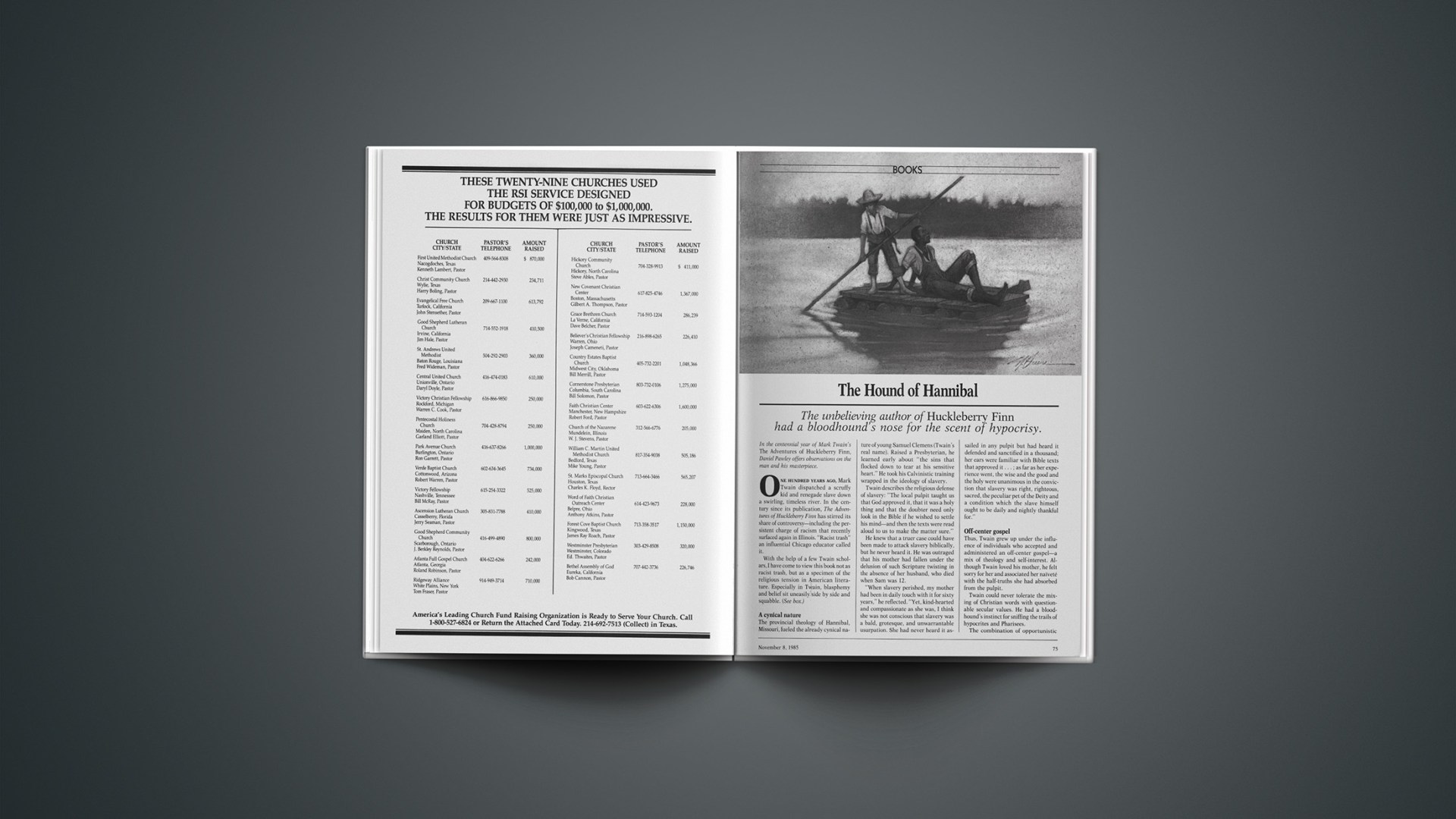
One hundred years ago, Mark Twain dispatched a scruffy kid and renegade slave down a swirling, timeless river. In the century since its publication, The Adventures of Huckleberry Finn has stirred its share of controversy—including the persistent charge of racism that recently surfaced again in Illinois. “Racist trash” an influential Chicago educator called it.

With the help of a few Twain scholars, I have come to view this book not as racist trash, but as a specimen of the religious tension in American literature. Especially in Twain, blasphemy and belief sit uneasily side by side and squabble. (See box.)

A Cynical Nature

The provincial theology of Hannibal, Missouri, fueled the already cynical nature of young Samuel Clemens (Twain’s real name). Raised a Presbyterian, he learned early about “the sins that flocked down to tear at his sensitive heart.” He took his Calvinistic training wrapped in the ideology of slavery.

Twain describes the religious defense of slavery: “The local pulpit taught us that God approved it, that it was a holy thing and that the doubter need only look in the Bible if he wished to settle his mind—and then the texts were read aloud to us to make the matter sure.”

He knew that a truer case could have been made to attack slavery biblically, but he never heard it. He was outraged that his mother had fallen under the delusion of such Scripture twisting in the absence of her husband, who died when Sam was 12.

“When slavery perished, my mother had been in daily touch with it for sixty years,” he reflected. “Yet, kind-hearted and compassionate as she was, I think she was not conscious that slavery was a bald, grotesque, and unwarrantable usurpation. She had never heard it assailed in any pulpit but had heard it defended and sanctified in a thousand; her ears were familiar with Bible texts that approved it …; as far as her experience went, the wise and the good and the holy were unanimous in the conviction that slavery was right, righteous, sacred, the peculiar pet of the Deity and a condition which the slave himself ought to be daily and nightly thankful for.”

Off-Center Gospel

Thus, Twain grew up under the influence of individuals who accepted and administered an off-center gospel—a mix of theology and self-interest. Although Twain loved his mother, he felt sorry for her and associated her naïveté with the half-truths she had absorbed from the pulpit.

Twain could never tolerate the mixing of Christian words with questionable secular values. He had a bloodhound’s instinct for sniffing the trails of hypocrites and Pharisees.

The combination of opportunistic business practice with outward Christian piety stuck in his craw. “Our public motto is ‘In God we trust,’ ” he once pointed out, “and when we see those gracious words on the trade dollar they always seem to whimper with pious emotion. That is our public motto. It transpires that our private one is, ‘When the Anglo-Saxon wants a thing he just takes it.’ ”

Twain’s pessimistic vision matured into bitter ruminations about the human race in general. Consistent with his ambivalence, such ruminations remained always one part religious and one part infidel. He once asked his friend William Dean Howells, “Why was the human race created? Or at least why wasn’t something creditable created in place of it?” Then, characteristically, he added: “God had his opportunity. He could have made a reputation. But no, he must commit this grotesque folly—a lark of which must have cost him a regret or two when he came to think it over and observe effects.”

Man On The Run

Twain’s spiritual revulsion kindled a constant desire to escape—just as his child-hero Huck Finn had.

The Adventures of Huckleberry Finn develops this theme—escape from civilization—by portraying middle western life as inhibiting and corrupting, and by painting Huck and Jim, the runaway slave, as naturally kind and generous. Church-related piety, superficial formal education, and vacant displays of middle-class manners are touchstones in a social system that plays havoc with an honest spirit.

At the beginning of the book, for instance, the infamous Widow Douglas and her sister, Miss Watson, try to “civilize” the barefoot waif, Huck. They dress him in new “cramped” clothes, forbid him to smoke and sit comfortably, read to him from the Old Testament, and inform him about the differences between people who go to heaven and those who go to hell.

Huck’s use of ungrammatical language epitomizes his rejection of civilizing influences. His is a language unaffected by dishonesty: a tongue connected directly to the heart.

The naturally tender camaraderie between Huck and Jim provides the substance of the book. As they leave society and inhabit the moral vacuum of the raft, a special fellowship develops between them.

Moral Vacuum

An even greater story unfolds, however, in the subtle, hairsplitting irony between what society has taught Huck about slavery and what he must accept as his moral responsibility: to remain true to Jim and help the runaway slave to freedom. Huck sees Jim’s fundamental decency, but he believes he is committing unpardonable sins by aiding Jim’s flight—an action that defies a social doctrine propounded from the pulpit.

The book’s climax rests in a few paragraphs that bring this irony into high relief. Huck, tormented by his conscience, tries to pray but feels he cannot because of his sin. He decides that the only way to purify his conscience and escape eternal damnation is to forsake his fondness for Jim and turn him in to the authorities. Huck writes a confession to Miss Watson, Jim’s owner, and later admits:

“I felt good and all washed clean of sin for the first time I had ever felt so in my life, and I knowed I could pray now. But I didn’t do it straight off, but … set there thinking … how near I come to being lost and going to hell.”

Huck goes on thinking about Jim, the black man’s kindness and their friendship. Then Huck notices the confession he’s written.

“I studied a minute, sort of holding my breath, and then says to myself:

“ ‘All right, then, I’ll go to hell’—and tore it up.

“It was awful thoughts, and awful words, but they was said. And I let them stay said; and never thought no more about reforming.”

Here, in one of the most famous passages in literature, one sees Twain’s purpose. By allowing Huck to tear up the letter and discard what he has been taught about morality, Huck makes a truly moral decision. Yet he has done so, says one scholar, “not by doing right [according to society] but by doing wrong.” Thus Twain returns to his original theme: that civilization, with its empty rules, vacant prejudices, gross inequalities, and phony pieties, can be a lie. It furnishes a person with a false morality: an artificial conscience that can make him think he is acting morally when he is not. Only by renouncing civilization’s morality can the individual begin to live a truly moral life.

The book was subversive. It undermined the social system of Twain’s time, shattering the concept of blind allegiance to rules and customs. Also, since such rules and customs came packaged and delivered through the pulpit, the book undermined institutional Christianity. Louisa May Alcott typified public reaction: “If Mr. Clemens cannot think of something better to tell our pure-minded lads and lasses he had better stop writing for them.”

Defenders

We might feel sympathy for Alcott and company, yet Twain has had his staunch defenders. In T. S. Eliot’s introduction to one edition of the classic, he called it “a much greater book than Twain could have known he was writing.” Behind its justified disparagement of temporal values, Eliot interpreted the river as being symbolic of God: a vital, controlling force without beginning or end. And “without some kind of God,” Eliot wrote, “man is not even very interesting.”

More a reader than a scholar, I am uncertain about the book’s symbolism. However, as one who reads theologically, I both agree and disagree with themes found in Huckleberry Finn.

I applaud the book’s disparagement of hypocrisy and the crippling influences of society, especially when they are wrapped in teachings from the pulpit. If a doctrine as fundamentally corrupt as slavery can find its mouthpiece “in a thousand pulpits,” it deserves subversion. I cheer any book that brings such issues to the surface, and I wonder what subtle ideologies have found their way into the pulpit today.

On the other hand, I challenge the book’s suggestion that moral rightness can arise in a vacuum. Perhaps when we see Huck willing to “go to hell” in order not to betray his friend, we hear faint echoes of the apostle Paul, who would willingly have chosen hell in exchange for the salvation of his beloved Jews (Rom. 9:3). Huck and Jim seem “good” because they are honest and without pretension. But our appreciation cannot negate the truth that human nature is sinful and that salvation must come from outside.

Shackled

This brings us back to Twain himself, who wanted to be a free thinker, unshackled by religion and society. However, because he could never divorce himself from his Christian upbringing, and because he daily inhaled the faith from his wife and closest friends, he found his free thinking always threatened by pangs of conscience.

A biographer asks: “What would he have become … if he had been raised in an atmosphere of free thought and science, instead of being surrounded by church influences and the constant pious ministrations of an orthodox mother?” One could as well ask what Twain would have become had he looked past the “religiosity” of his day, lived faithfully for Christ, and used his artistic gifts to point toward solutions to societal woes. (This is the great flaw in American literature: It is long on uprooting a multitude of sins, but short on pointing to solutions.)

Instead, Twain camped in the no man’s land between faith and doubt. “He threw out the Bible,” writes one biographer, “but it seemed to be attached to a rubber band, and was likely to bounce back into his lap at any time. The mythology of Christianity engrossed his imagination. He satirized it, to be sure, but that showed that it was always in his thinking.”

Twain spent much of his energy poking fun at the Bible. But Twain’s querulousness flowed from his pen with generous measures of humor. And he embodied many fine qualities. His oldest daughter wrote: “[Papa] is a very good man and a very funny man. He has got a temper, but we all of us have in this family. He is the loveliest man I ever hope to see.”

An American Tragedy

Ultimately, Twain was the iconoclast, and when a tidal wave of personal tragedy rolled over him late in life, his lighthearted satires turned cynical and morose. In a short interval, his wife and two of his daughters died from sudden illnesses. His infant son had died some years earlier, and his remaining daughter had moved to Europe.

In his autobiography, he wrote movingly about these losses: “How poor I am, who was once so rich.… I sit here—writing, busying myself, to keep my heart from breaking.”

Twain, who died four months later, wanted this passage to be the final chapter in his autobiography. But the last chapter in his final work of fiction expressed a different tone. In The Mysterious Stranger, published six years after his death, his infidel side railed again about “a God who could make good children as easily as bad, yet preferred to make bad ones; who could have made every one of them happy, yet never made a single happy one; who made them prize their bitter life, yet stingily cut it short; who gave his angels eternal happiness unearned, yet required his other children to earn it; who gave his angels painless lives, yet cursed his other children with biting miseries and maladies of mind and body.…”

The Annotated Huckleberry Finn, by Michael Patrick Hearn, records Twain’s intention of writing a sequel to Huckleberry Finn. The month is March; the year 1891. Twain, approaching 60, writes in his notebook: “Huck comes back, 60 years old, from nobody knows where—and crazy. Thinks he is a boy again, and scans always every face for Tom [Sawyer] and Becky [Thatcher], etc. Tom comes at last from … wandering the world and tends Huck, and together they talk the old times, both are desolate, life has been a failure, all that was lovable, all that was beautiful is under the mold. They die together.”

Twain never got around to writing this story. Perhaps he anticipated that the idea bore the too-real pain of his own experience.

Daniel Pawley is an assignment writer living in Minneapolis, Minnesota.

Blasphemy and Belief

Mark Twain grew up in a Christian home, rebelled, and spent the major portion of his life trying to reconcile belief and unbelief. Twain was a believer, suggests one biographer, in that he carried his Christian theology “like a ball and chain.” Yet he was an infidel in that he not only denied God, but he cursed him for allowing human suffering and folly.

Twain the believer freely acknowledged his Creator: “I believe in God the Almighty.… I think the goodness, the justice and the mercy of God are manifested in his works; I perceive that they are manifested toward me in this life; the logical conclusion is that they will be manifested toward me in the life to come.”

Twain the infidel, however, could switch tracks and rail against God, as he did one day to his friend, the Reverend Joseph Twichell: “I don’t believe in your religion at all. I’ve been living a lie right along when ever I pretended to. For a moment sometimes I have been almost a believer, but it immediately drifts away from me again. I don’t believe that one word of your Bible was inspired by God any more than any other book. I believe it is entirely the work of man from beginning to end, atonement and all.”

Twain the believer could suddenly soften, as when romantic love touched him at age 35. He wrote to his fiancée: “I bless you, and give honest gratitude to God that it is so. How easy it was to pray, when your letter came—for the heart naturally looks upward for something to thank When a great generous wave of gratitude sweeps over its parched and thirsty deserts.… I prayed at last you might come to love me freely and fully, and that he would prepare me to be worthy of it—which could only be in utter completeness, through my investment of his spirit.”

Twain the infidel could transform his praises into curses: “If God has a place prepared for us, and really wanted us to know it, he could have found some better way than a book so liable to alterations, and misinterpretations. God has had no trouble to prove to man the laws of the constellations and the construction of the world, … none of which agree with his so-called book. As to a hereafter, we have not the slightest evidence that there is any.”

Twain the believer could hope in God: “We shall never be separated on earth … and let us pray that we may not be in heaven,” he told his deeply spiritual wife. “I … shall try so hard to walk as you do, in the light and love of God.… Turn toward the Cross and be comforted—I turn with you—What would you more? The peace of God shall rest upon us, and all will be well.”

But, finally, Twain the infidel seemed to claim victory: “There seems to be nothing connected with the atonement that is rational. If Christ was God, he is in the attitude of one whose anger against Adam has grown so uncontrollable in the course of the ages that nothing but the sacrifice of life can appease it, and so without noticing how illogical the act is going to be, God condemns himself to death—commits suicide on the Cross, and in this ingenious way wipes off that old score.”

Church Leaders Work for Racial Reconciliation

During an unusual meeting, some 400 churchmen hammer out a proposal for reducing tensions.

A recent reconciliation meeting involving 400 clergymen in Pietermaritzburg, South Africa, brought together Dutch Reformed Church leaders and staunch opponents of apartheid. They organized a national day of prayer and repentance that was held last month, and issued a “Statement of Intent” calling on the South African government to take steps to end its official policies of racial separation.

Leading South African black churchmen, including Anglican Bishop Desmond Tutu, participated in the “National Initiative for Reconciliation.” A total of 47 denominations were represented. Most significant, according to participants, was the involvement of more than 60 Dutch Reformed churchmen.

Samuel Hines, pastor of the Third Street Church of God in Washington, D.C., was invited to the meeting because of his involvement in reconciliation efforts in South Africa since 1978. “From my perspective, the most hopeful sign was the openness and honesty of the Dutch Reformed Church people,” he said. “It’s the thing I’ve been praying for and hoping for, and still it took me by surprise.”

The Dutch Reformed Church in South Africa has been responsible for promoting government policies of apartheid and using Scripture to rationalize a system of keeping the races separate. Tutu, in an address to the participants gathered at Pietermaritzburg, said, “I doubt that anything significant can take place in South Africa without the white Dutch Reformed Churches.”

Their willingness to participate arose from increasing outspokenness against apartheid among some of their own theologians. Also, according to Hines, recent uprisings in South Africa and that country’s state of emergency “have become a kind of writing on the wall. The Afrikaner has never been more uncertain of the future than he is today. He realizes that the present system is not going to be allowed to continue. Blacks are at the end of their patience, and the business community is pressing for change.”

The meeting was arranged by Africa Enterprise, an evangelistic, interdenominational group headed by Michael Cassidy, a South African. By expressing unity among South African Christians across denominational, ethnic, and political boundaries, the reconciliation meeting offers “a sign of hope for our nation at this time,” according to the document it produced.

“We give thankful testimony to God that a deep thing has happened to us in this process as we have struggled under God with many hard and complex issues and found an astonishing measure of unity where formerly we knew little but division,” the letter continues. Six areas of activity were identified for a sustained reconciliation effort. They include evangelism; prayer and fasting for peace and justice; creating opportunities for interracial worship, fellowship, and discussion; preparing people to live in a “changed and totally non-racial land”; visiting with other Christians across designated residential boundaries; and convening regional gatherings of Christian leaders.

A delegation of participants presented requests to South African president P. W. Botha, asking for an end to the nation’s state of emergency, which has imposed harsh, police-state conditions throughout the country. The release of political prisoners, talks with authentic leaders of South African population groups, a commitment to developing a common educational system, and elimination of all forms of legislated discrimination were requested as well.

In his opening statement to the church leaders, Cassidy said, “God has called us here … to be a third race and a third force operating between a lethally dangerous and embattled white conservatism and an equally dangerous black revolutionary violence which could irreparably tear our social fabric into pieces.” He called on church leaders to be willing to “cross the political rubicons ahead of the political leaders and not expect politicians to cross rubicons even before the church has successfully done so.

“Once and for all,” Cassidy said, “the church has got to leave the wilderness of racism, discrimination, and prejudice and set its feet firmly on the path towards a single country and a single citizenship.”

Hines, of Washington, D.C., said the meeting reflected a sense of dependency on the Holy Spirit as “people were able to sit down and listen to each others’ stories and hear each other cry.” The church in South Africa, he said, “could become a model for the rest of us” in resolving racial discord.

Claims Went Unpaid: A Texas Judge Orders Insurer of Christian Groups to Stop Doing Business

A Texas judge has shut down an unlicensed insurance company that owes more than $3 million in outstanding claims to 122 churches and Christian organizations in 27 states.

In response to a suit filed by Texas Attorney General James Mattox, a district court judge issued a temporary restraining order closing down the Hurst, Texas-based Christian Organizations Medical Society, Inc., and related companies. All assets were frozen, and a temporary receiver was appointed to administer the companies.

Christian Organizations; its director, Robert E. Browning; and several related companies later filed Chapter 11 bankruptcy proceedings in federal court. Lawyers for the companies could not be reached for comment.

In California, the state insurance department is planning to prevent the companies from doing further business in that state. At the same time, the U.S. Postal Service is investigating Christian Organizations for mail fraud.

“Our investigation was initiated based on complaints of unpaid claims,” said postal inspector Michael Jones. “It started with one [claim] of $1 million from the United Pentecostal Church International in St. Louis.”

To prove mail fraud, Jones said, his office must prove that the insurance company devised a scheme to defraud its clients and then made false promises through the U.S. mail.

Sam Metcalf, president of Church Resource Ministries, based in Fullerton, California, said his company canceled its policy in February after nearly a year of trying to get payment on unpaid claims.

“We have somewhere between $30,000 and $40,000 in claims outstanding,” he said. Those unpaid claims affect the families of 20 Church Resource Ministries employees in seven states. Metcalf said his company is planning to sue the insurance company for unpaid claims.

Overseas Crusades, an interdenominational mission based in Milpitas, California, signed on with Christian Organizations Medical Society in 1984. “We started bargaining by holding back premiums because they owed us more than we owed them,” said Steve Grubb, financial manager for the mission that sponsors 125 workers in the United States and 15 foreign countries. “We haven’t suffered greatly except for the fact that our people have gotten a lot of nasty credit warning notices.” The mission canceled its policy last summer with about $8,000 in unpaid claims remaining.

The Texas attorney general’s office filed suit against Christian Organizations, its directors and trustees, and several related companies in September. The suit alleges that the companies were practicing the insurance business without authorization of the state of Texas.

The suit also claims the companies are in an “insolvent condition and that their liabilities greatly exceed their assets and they are unable to pay their debts as they become due.”

A Texas judge last month extended the temporary restraining order against Christian Organizations Medical Society. Other companies named in the court order are: Christian Organizations Medical Society Employee Benefit Trust; North American Risk Management Corporation; Browning Corporation International; Administration and Risk Consultants, Inc.; and International Religious Association, Inc.

A New Report Says Hunger Persists in the United States

Bread for the World recommends more federal spending to help alleviate the problem.

Reduced federal spending and recession in 1981 and 1982 caused many of America’s hungry to turn to private organizations for assistance. The Reagan administration encouraged stepped-up private efforts and assured critics that a federal safety net would catch the truly needy. Reagan banked on the theory that general economic recovery would pick up the slack, and as unemployment dropped and inflation receded, more and more poor people would be able to sustain themselves economically.

The economic portion of that equation has tended to work out as planned, but the needs of many poor persons still go unmet, according to organizers of private nutrition programs around the country. A survey of their efforts—conducted by Bread for the World (BFW), a Christian citizen’s lobby—reports that “the severe crisis of the early 1980s has become a stubborn problem that refuses to go away.”

A BFW report, titled “Unfed America ’85,” notes that “private food providers say they are seeing their role transformed from that of short-term emergency food provider to long-term, permanent supplement to public assistance.” Furthermore, BFW executive director Arthur Simon said, “The safety net has gaping holes, and many people are falling through it.” In the 36 areas surveyed by BFW, an estimated 1.5 million people are going hungry, the report says. Private food assistance programs in those areas experienced an average 16 percent increase in demand over the past year.

The solution, according to BFW, is to restore federally funded nutrition programs to the growth trajectories they were on before Reagan began to cut spending. “Where programs are working well and people demonstrably in need are not being reached,” Simon said, “we should fund them more adequately.”

The programs in question include food stamps; supplemental feeding for women, infants, and children; school breakfast and lunch programs; and meals for the elderly. Cuts in food stamps have displaced about 1 million people from the rolls, reduced benefits to others, and ended federally financed efforts to inform eligible people about the program. While demand at private feeding centers has increased, BFW reports that food stamp participation among people served by the communities surveyed declined 9.5 percent. In those areas, 41 percent of the people who are eligible for food stamps do not receive them.

BFW recommends increasing food stamp benefits by 10 to 25 percent. In addition, it says eligibility standards should be relaxed and an information campaign begun so more households below the poverty line could participate.

BFW’s report was released one day after the U.S. House of Representatives approved a farm appropriations bill restoring $1 billion in food stamp funds over three years. This reinstates about 20 percent of the benefits cut in 1981, according to an aide to U.S. Rep. Leon Panetta (D-Calif.), who sponsored the amendment.

In the U.S. Senate, a similar farm measure scheduled for debate contains no increases for food stamps. A spokesman for the Senate Agriculture Committee said BFW’s proposal for increased spending is “way out of line—beyond what even the most liberal members of Congress are willing to sponsor.” He said a 10 percent increase—the minimum suggested by BFW—would add between $2 billion and $3 billion to the program, and the Senate is unlikely to back any increase at all.

Debate in Washington about ways to meet the needs of the poor is focusing increasingly on questions of underlying causes. Evidence put forward by some social policy analysts suggests that welfare dependency traps the poor in an underclass where values of working for a living, maintaining family stability, and planning for the future are eroded. Instead of financing this process by increasing federal programs, they say long-range solutions must be emphasized to break a tragic cycle of poverty.

Leslie Lenkowsky, a social policy analyst and former deputy director of the United States Information Agency, points out that the increasing number of female-headed households places heavy demands on private and public welfare assistance. In an article in Public Opinion, Lenkowsky wrote: “When poverty was mostly a matter of working men who had lost their jobs, supporting them … temporarily could be justified. When the elderly, sick and disabled lacked enough money, providing assistance seemed reasonable. But when a large segment of the poor consists of women with children who were born out of wedlock, the issue is not so clear. To what extent is this kind of poverty due to individual choice rather than to circumstances over which a person would normally have little control? And how can society respond to this sort of need without encouraging it to become more widespread?”

Simon, of BFW, agrees with the need to seek long-term solutions that do not require increased spending. He suggests approaching the problem from the standpoint of providing full employment. “Overwhelmingly, people who can work prefer to be employed,” he said. “They must be paid above the poverty level.” For those who cannot work, he advocates a rigorously woven safety net that provides consistent relief to the poor.

Meanwhile, in view of pressure on Congress to cut the budget further, Simon is determined to keep the plight of the poor central to public policy development.

WORLD SCENE

CHINA

Concern Over a Cult

China watchers have received reports that members of the Children of God cult have entered the People’s Republic of China as English teachers. Cult members reportedly have found a ready market among young Chinese citizens who are eager to mix with foreigners and learn English. The Children of God itself reported that the son of founder David Berg last year led a rally in Shanghai that attracted 500 youth.

Evangelical Missions Information Service reported that some China watchers fear the group will harm the growth of the church in China. In addition, some say the group’s practices may so alarm Chinese authorities that they could curb the entry of other religious groups into the country. In the past, the Children of God allegedly used prostitution to recruit members.

NEPAL

‘Intimidation and Terror’

An evangelical leader from Nepal says his country’s Hindu government is waging a campaign of “intimidation and terror” against Christians. Charles Mendies, executive director of the David Evangelistic Outreach, said that since March, more than 50 Christians have been arrested and charged with “preaching Christianity; causing a disturbance to Hinduism.” Two U.S. citizens were among those arrested.

In one incident, Mendies says, Hindu militants attacked six Christians who were leading a funeral procession. The militants beat the Christians, stole the body of the deceased, and cremated it according to Hindu tradition. Mendies says the six Christians were arrested and released on bail after ten days of interrogation. Their case is still pending.

Mendies, along with Campus Crusade for Christ leader Adon Rongong, faces charges in Nepal for evangelizing Hindus. Each could receive a six-year prison sentence.

THE WORLD

AIDS Cases Surpass 15,000

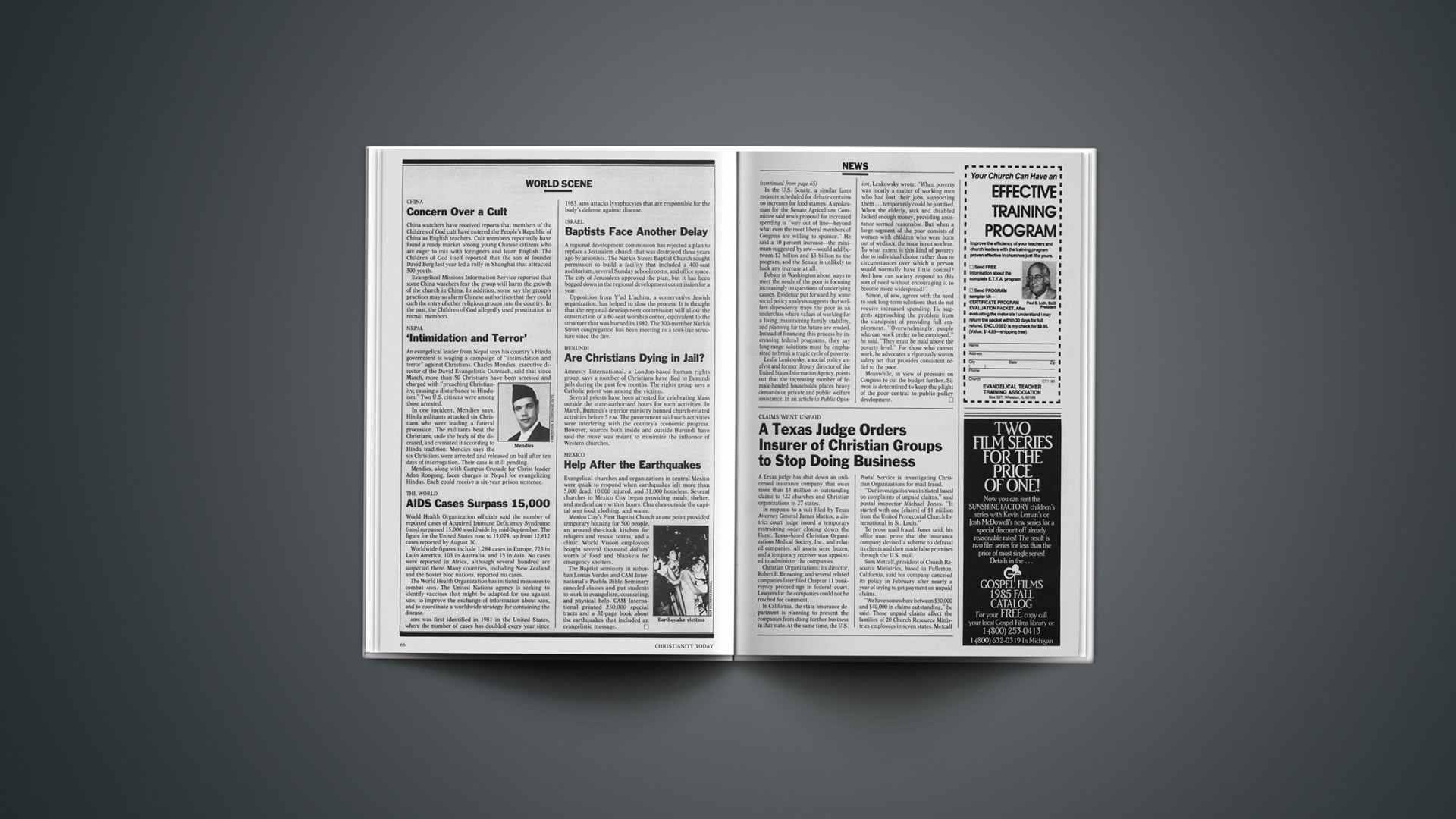
World Health Organization officials said the number of reported cases of Acquired Immune Deficiency Syndrome (AIDS) surpassed 15,000 worldwide by mid-September. The figure for the United States rose to 13,074, up from 12,612 cases reported by August 30.

Worldwide figures include 1,284 cases in Europe, 723 in Latin America, 103 in Australia, and 15 in Asia. No cases were reported in Africa, although several hundred are suspected there. Many countries, including New Zealand and the Soviet bloc nations, reported no cases.

The World Health Organization has initiated measures to combat AIDS. The United Nations agency is seeking to identify vaccines that might be adapted for use against AIDS, to improve the exchange of information about AIDS, and to coordinate a worldwide strategy for containing the disease.

AIDS was first identified in 1981 in the United States, where the number of cases has doubled every year since 1983. AIDS attacks lymphocytes that are responsible for the body’s defense against disease.

ISRAEL

Baptists Face Another Delay

A regional development commission has rejected a plan to replace a Jerusalem church that was destroyed three years ago by arsonists. The Narkis Street Baptist Church sought permission to build a facility that included a 400-seat auditorium, several Sunday school rooms, and office space. The city of Jerusalem approved the plan, but it has been bogged down in the regional development commission for a year.

Opposition from Y’ad L’achim, a conservative Jewish organization, has helped to slow the process. It is thought that the regional development commission will allow the construction of a 60-seat worship center, equivalent to the structure that was burned in 1982. The 300-member Narkis Street congregation has been meeting in a tent-like structure since the fire.

BURUNDI

Are Christians Dying in Jail?

Amnesty International, a London-based human rights group, says a number of Christians have died in Burundi jails during the past few months. The rights group says a Catholic priest was among the victims.

Several priests have been arrested for celebrating Mass outside the state-authorized hours for such activities. In March, Burundi’s interior ministry banned church-related activities before 5 P.M. The government said such activities were interfering with the country’s economic progress. However, sources both inside and outside Burundi have said the move was meant to minimize the influence of Western churches.

MEXICO

Help After the Earthquakes

Evangelical churches and organizations in central Mexico were quick to respond when earthquakes left more than 5,000 dead, 10,000 injured, and 31,000 homeless. Several churches in Mexico City began providing meals, shelter, and medical care within hours. Churches outside the capital sent food, clothing, and water.

Mexico City’s First Baptist Church at one point provided temporary housing for 500 people, an around-the-clock kitchen for refugees and rescue teams, and a clinic. World Vision employees bought several thousand dollars’ worth of food and blankets for emergency shelters.

The Baptist seminary in suburban Lomas Verdes and CAM International’s Puebla Bible Seminary canceled classes and put students to work in evangelism, counseling, and physical help. CAM International printed 250,000 special tracts and a 32-page book about the earthquakes that included an evangelistic message.

Hospitals Are Targeted: Pastors across the Country March against Abortion

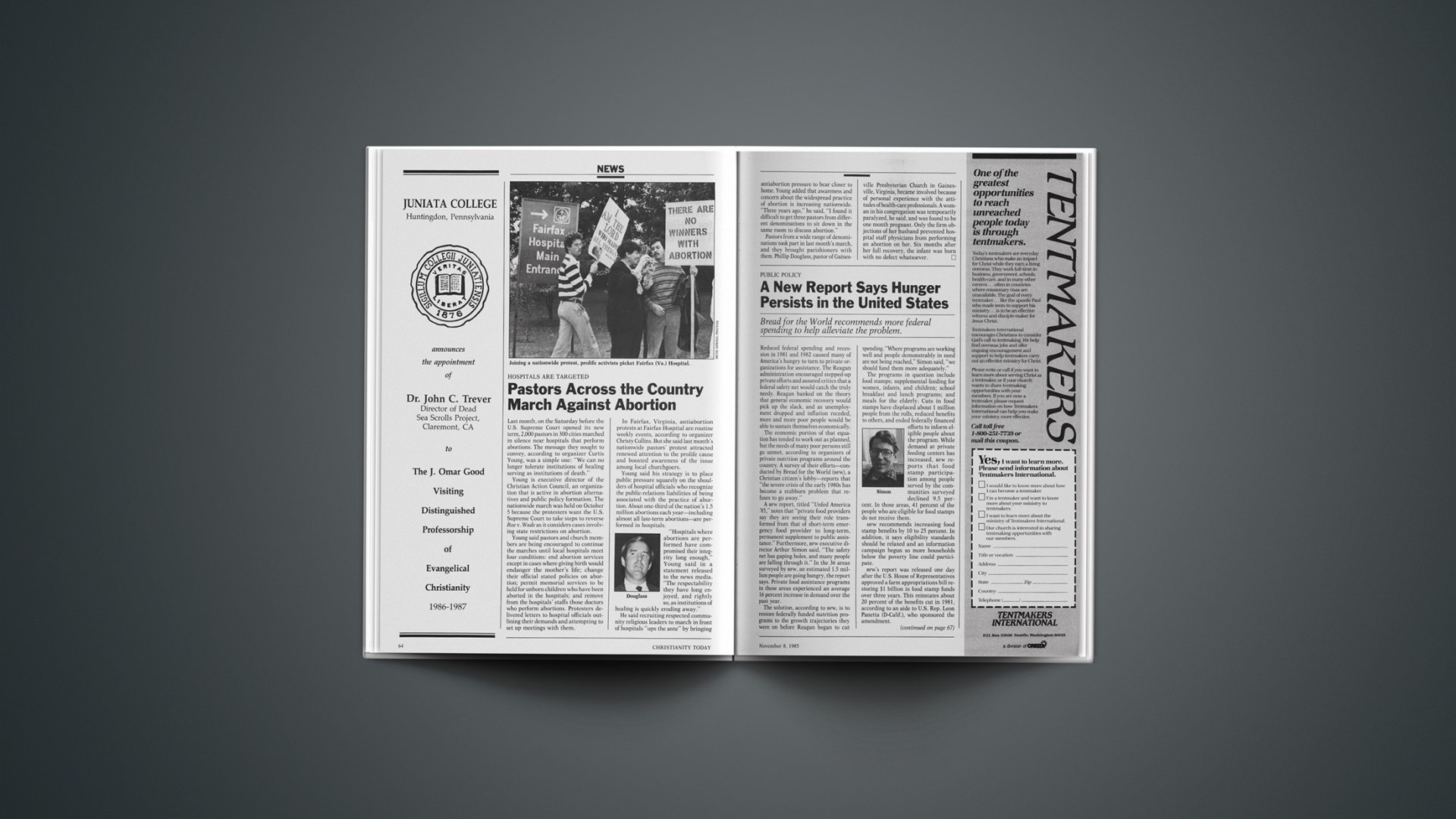
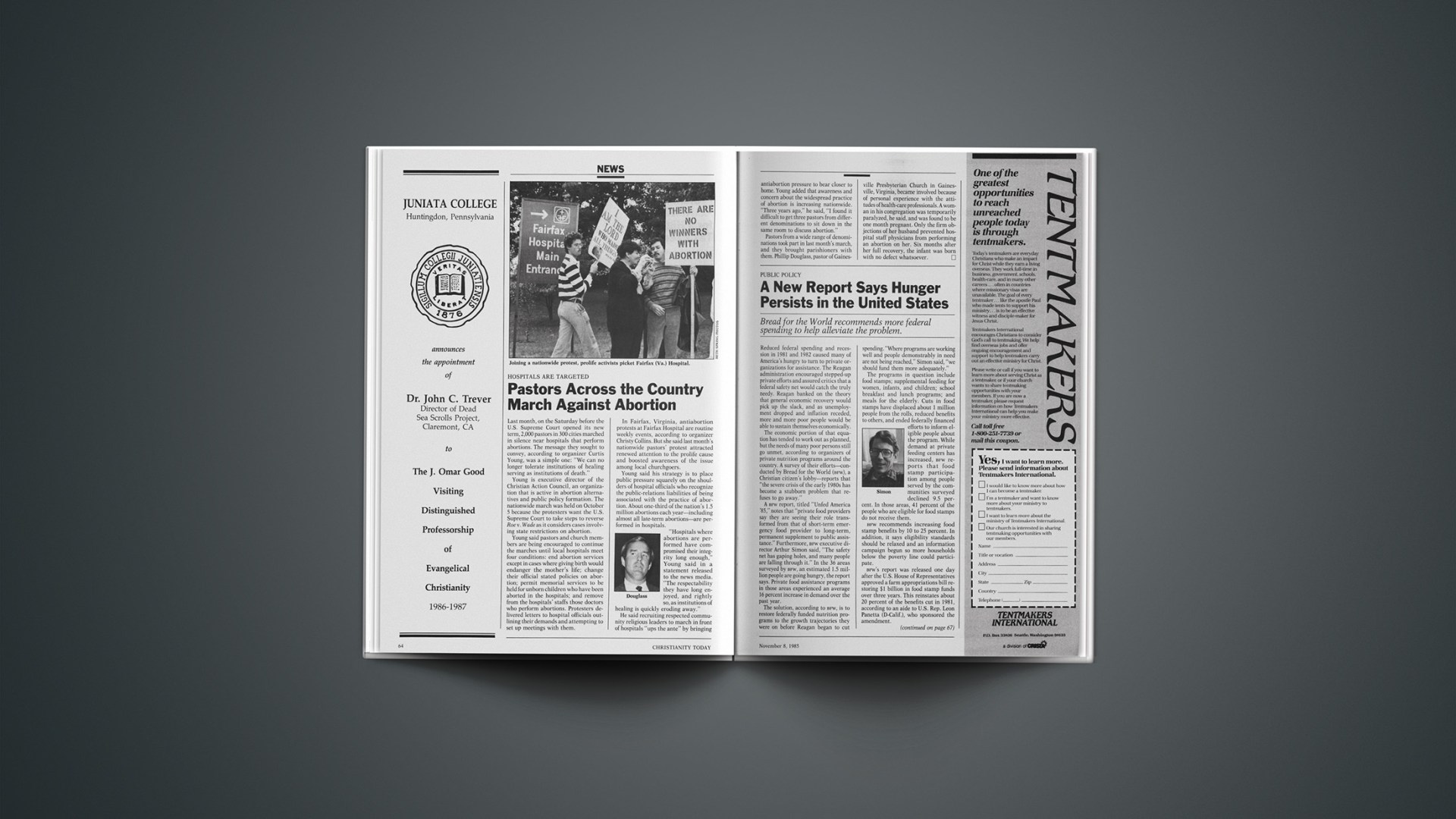
Last month, on the Saturday before the U.S. Supreme Court opened its new term, 2,000 pastors in 300 cities marched in silence near hospitals that perform abortions. The message they sought to convey, according to organizer Curtis Young, was a simple one: “We can no longer tolerate institutions of healing serving as institutions of death.”

Young is executive director of the Christian Action Council, an organization that is active in abortion alternatives and public policy formation. The nationwide march was held on October 5 because the protesters want the U.S. Supreme Court to take steps to reverse Roe v. Wade as it considers cases involving state restrictions on abortion.

Young said pastors and church members are being encouraged to continue the marches until local hospitals meet four conditions: end abortion services except in cases where giving birth would endanger the mother’s life; change their official stated policies on abortion; permit memorial services to be held for unborn children who have been aborted in the hospitals; and remove from the hospitals’ staffs those doctors who perform abortions. Protesters delivered letters to hospital officials outlining their demands and attempting to set up meetings with them.

In Fairfax, Virginia, antiabortion protests at Fairfax Hospital are routine weekly events, according to organizer Christy Collins. But she said last month’s nationwide pastors’ protest attracted renewed attention to the prolife cause and boosted awareness of the issue among local churchgoers.

Young said his strategy is to place public pressure squarely on the shoulders of hospital officials who recognize the public-relations liabilities of being associated with the practice of abortion. About one-third of the nation’s 1.5 million abortions each year—including almost all late-term abortions—are performed in hospitals.

“Hospitals where abortions are performed have compromised their integrity long enough,” Young said in a statement released to the news media. “The respectability they have long enjoyed, and rightly so, as institutions of healing is quickly eroding away.”

He said recruiting respected community religious leaders to march in front of hospitals “ups the ante” by bringing antiabortion pressure to bear closer to home. Young added that awareness and concern about the widespread practice of abortion is increasing nationwide. “Three years ago,” he said, “I found it difficult to get three pastors from different denominations to sit down in the same room to discuss abortion.” Pastors from a wide range of denominations took part in last month’s march, and they brought parishioners with them. Phillip Douglass, pastor of Gainesville Presbyterian Church in Gainesville, Virginia, became involved because of personal experience with the attitudes of health-care professionals. A woman in his congregation was temporarily paralyzed, he said, and was found to be one month pregnant. Only the firm objections of her husband prevented hospital staff physicians from performing an abortion on her. Six months after her full recovery, the infant was born with no defect whatsoever.

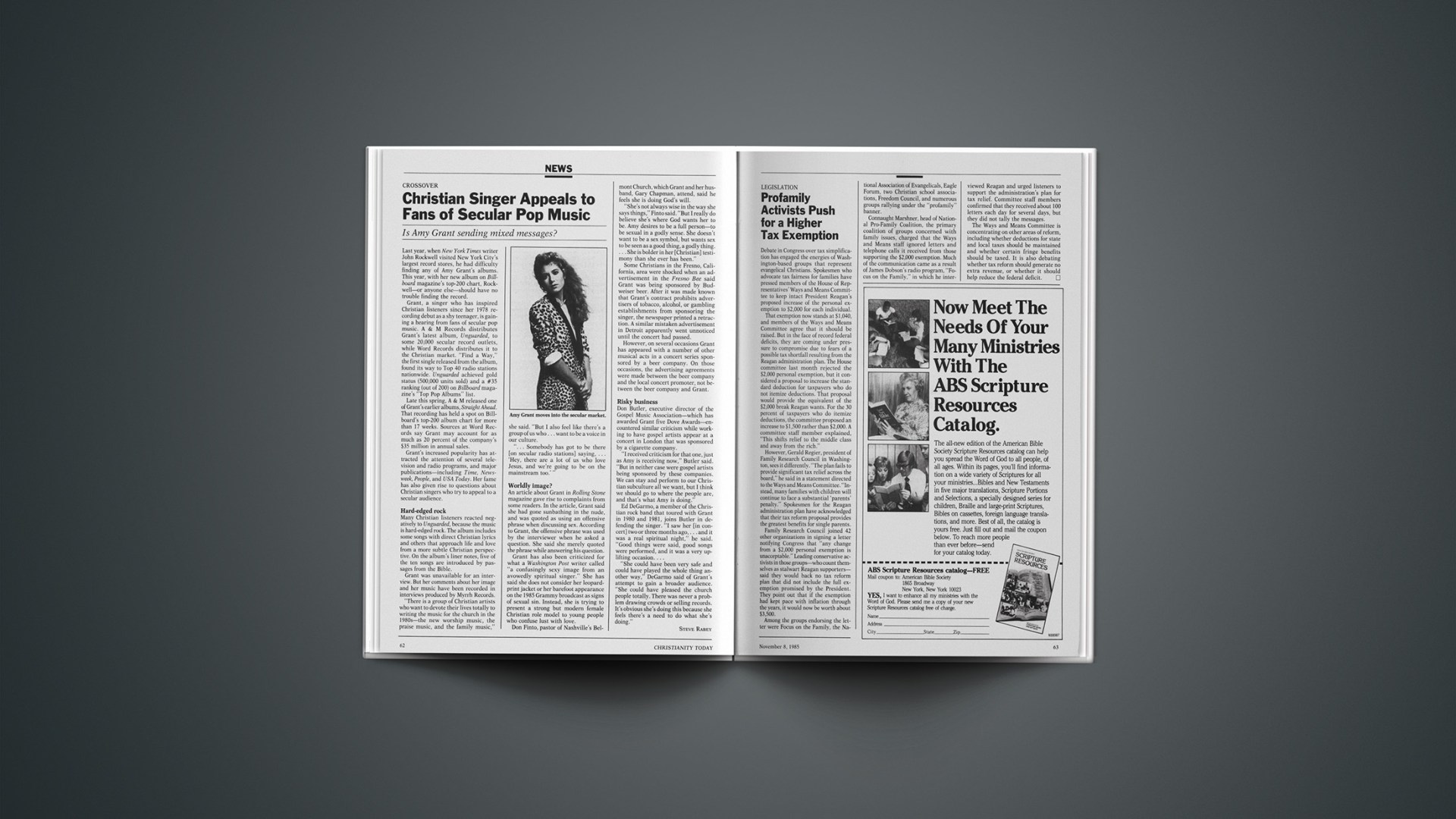
Legislation: Profamily Activists Push for a Higher Tax Exemption

Debate in Congress over tax simplification has engaged the energies of Washington-based groups that represent evangelical Christians. Spokesmen who advocate tax fairness for families have pressed members of the House of Representatives’ Ways and Means Committee to keep intact President Reagan’s proposed increase of the personal exemption to $2,000 for each individual.

That exemption now stands at $1,040, and members of the Ways and Means Committee agree that it should be raised. But in the face of record federal deficits, they are coming under pressure to compromise due to fears of a possible tax shortfall resulting from the Reagan administration plan. The House committee last month rejected the $2,000 personal exemption, but it considered a proposal to increase the standard deduction for taxpayers who do not itemize deductions. That proposal would provide the equivalent of the $2,000 break Reagan wants. For the 30 percent of taxpayers who do itemize deductions, the committee proposed an increase to $1,500 rather than $2,000. A committee staff member explained, “This shifts relief to the middle class and away from the rich.”

However, Gerald Regier, president of Family Research Council in Washington, sees it differently. “The plan fails to provide significant tax relief across the board,” he said in a statement directed to the Ways and Means Committee. “Instead, many families with children will continue to face a substantial ‘parents’ penalty.” Spokesmen for the Reagan administration plan have acknowledged that their tax reform proposal provides the greatest benefits for single parents.

Family Research Council joined 42 other organizations in signing a letter notifying Congress that “any change from a $2,000 personal exemption is unacceptable.” Leading conservative activists in those groups—who count themselves as stalwart Reagan supporters—said they would back no tax reform plan that did not include the full exemption promised by the President. They point out that if the exemption had kept pace with inflation through the years, it would now be worth about $3,500.

Among the groups endorsing the letter were Focus on the Family, the National Association of Evangelicals, Eagle Forum, two Christian school associations, Freedom Council, and numerous groups rallying under the “profamily” banner.

Connaught Marshner, head of National Pro-Family Coalition, the primary coalition of groups concerned with family issues, charged that the Ways and Means staff ignored letters and telephone calls it received from those supporting the $2,000 exemption. Much of the communication came as a result of James Dobson’s radio program, “Focus on the Family,” in which he interviewed Reagan and urged listeners to support the administration’s plan for tax relief. Committee staff members confirmed that they received about 100 letters each day for several days, but they did not tally the messages.

The Ways and Means Committee is concentrating on other areas of reform, including whether deductions for state and local taxes should be maintained and whether certain fringe benefits should be taxed. It is also debating whether tax reform should generate no extra revenue, or whether it should help reduce the federal deficit.

Culture

Crossover: Christian Singer Appeals to Fans of Secular Pop Music

Is Amy Grant sending mixed messages?

Last year, when New York Times writer John Rockwell visited New York City’s largest record stores, he had difficulty finding any of Amy Grant’s albums. This year, with her new album on Billboard magazine’s top-200 chart, Rockwell—or anyone else—should have no trouble finding the record.

Grant, a singer who has inspired Christian listeners since her 1978 recording debut as a shy teenager, is gaining a hearing from fans of secular pop music. A & M Records distributes Grant’s latest album, Unguarded, to some 20,000 secular record outlets, while Word Records distributes it to the Christian market. “Find a Way,” the first single released from the album, found its way to Top 40 radio stations nationwide. Unguarded achieved gold status (500,000 units sold) and a #35 ranking (out of 200) on Billboard magazine’s “Top Pop Albums” list.

Late this spring, A & M released one of Grant’s earlier albums, Straight Ahead. That recording has held a spot on Billboard’s top-200 album chart for more than 17 weeks. Sources at Word Records say Grant may account for as much as 20 percent of the company’s $35 million in annual sales.

Grant’s increased popularity has attracted the attention of several television and radio programs, and major publications—including Time, Newsweek, People, and USA Today. Her fame has also given rise to questions about Christian singers who try to appeal to a secular audience.

Hard-Edged Rock

Many Christian listeners reacted negatively to Unguarded, because the music is hard-edged rock. The album includes some songs with direct Christian lyrics and others that approach life and love from a more subtle Christian perspective. On the album’s liner notes, five of the ten songs are introduced by passages from the Bible.

Grant was unavailable for an interview. But her comments about her image and her music have been recorded in interviews produced by Myrrh Records.

“There is a group of Christian artists who want to devote their lives totally to writing the music for the church in the 1980s—the new worship music, the praise music, and the family music,” she said. “But I also feel like there’s a group of us who … want to be a voice in our culture.

“… Somebody has got to be there [on secular radio stations] saying, … ‘Hey, there are a lot of us who love Jesus, and we’re going to be on the mainstream too.’ ”

Worldly Image?

An article about Grant in Rolling Stone magazine gave rise to complaints from some readers. In the article, Grant said she had gone sunbathing in the nude, and was quoted as using an offensive phrase when discussing sex. According to Grant, the offensive phrase was used by the interviewer when he asked a question. She said she merely quoted the phrase while answering his question.

Grant has also been criticized for what a Washington Post writer called “a confusingly sexy image from an avowedly spiritual singer.” She has said she does not consider her leopard-print jacket or her barefoot appearance on the 1985 Grammy broadcast as signs of sexual sin. Instead, she is trying to present a strong but modern female Christian role model to young people who confuse lust with love.

Don Finto, pastor of Nashville’s Belmont Church, which Grant and her husband, Gary Chapman, attend, said he feels she is doing God’s will.

“She’s not always wise in the way she says things,” Finto said. “But I really do believe she’s where God wants her to be. Amy desires to be a full person—to be sexual in a godly sense. She doesn’t want to be a sex symbol, but wants sex to be seen as a good thing, a godly thing.… She is bolder in her [Christian] testimony than she ever has been.”

Some Christians in the Fresno, California, area were shocked when an advertisement in the Fresno Bee said Grant was being sponsored by Budweiser beer. After it was made known that Grant’s contract prohibits advertisers of tobacco, alcohol, or gambling establishments from sponsoring the singer, the newspaper printed a retraction. A similar mistaken advertisement in Detroit apparently went unnoticed until the concert had passed.

However, on several occasions Grant has appeared with a number of other musical acts in a concert series sponsored by a beer company. On those occasions, the advertising agreements were made between the beer company and the local concert promoter, not between the beer company and Grant.

Risky Business

Don Butler, executive director of the Gospel Music Association—which has awarded Grant five Dove Awards—encountered similar criticism while working to have gospel artists appear at a concert in London that was sponsored by a cigarette company.

“I received criticism for that one, just as Amy is receiving now,” Butler said. “But in neither case were gospel artists being sponsored by these companies. We can stay and perform to our Christian subculture all we want, but I think we should go to where the people are, and that’s what Amy is doing.”

Ed DeGarmo, a member of the Christian rock band that toured with Grant in 1980 and 1981, joins Butler in defending the singer. “I saw her [in concert] two or three months ago, … and it was a real spiritual night,” he said. “Good things were said, good songs were performed, and it was a very uplifting occasion.…

“She could have been very safe and could have played the whole thing another way,” DeGarmo said of Grant’s attempt to gain a broader audience. “She could have pleased the church people totally. There was never a problem drawing crowds or selling records. It’s obvious she’s doing this because she feels there’s a need to do what she’s doing.”

STEVE RABEY

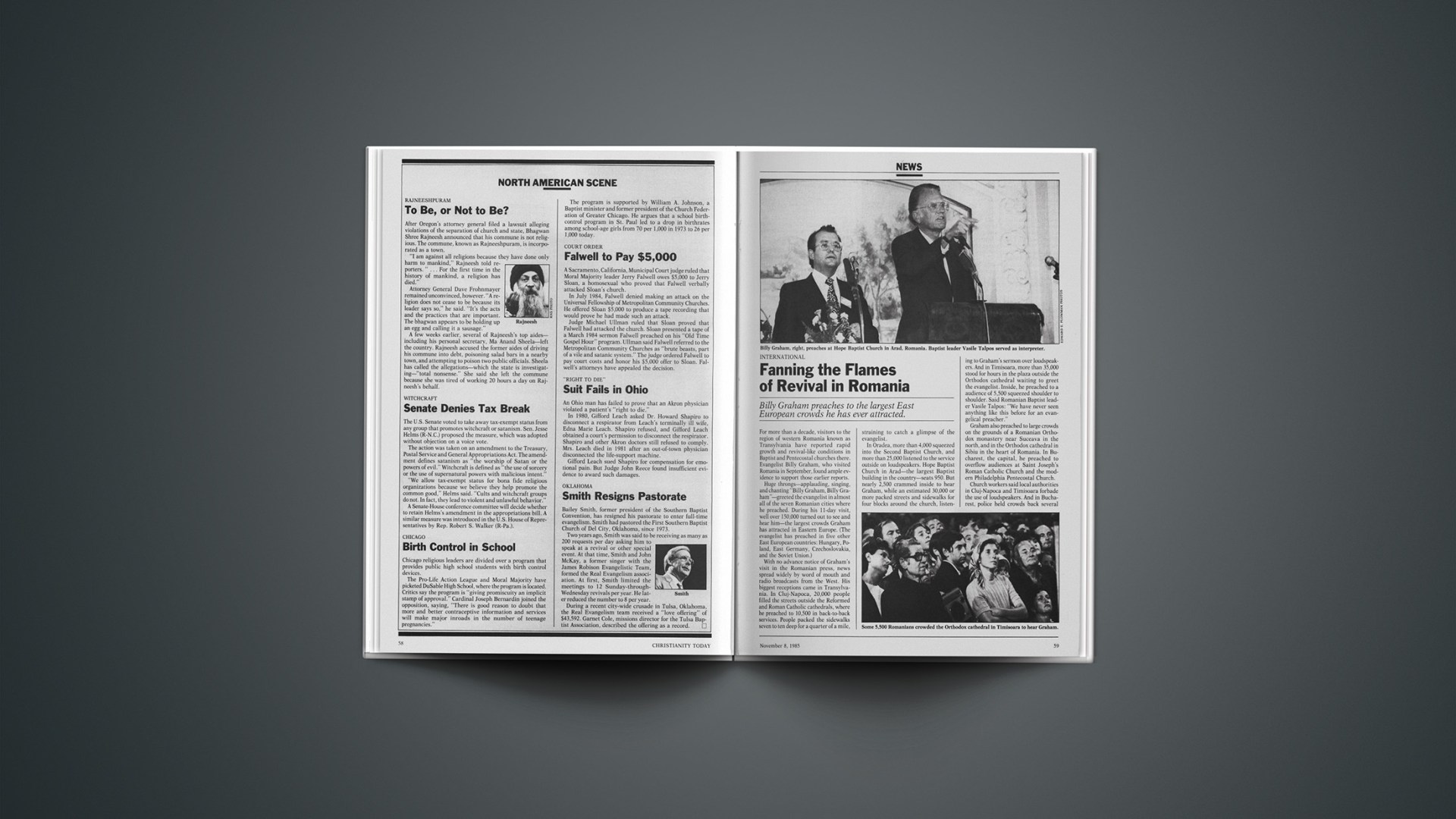
International: Fanning the Flames of Revival in Romania

Billy Graham preaches to the largest East European crowds he has ever attracted.

For more than a decade, visitors to the region of western Romania known as Transylvania have reported rapid growth and revival-like conditions in Baptist and Pentecostal churches there. Evangelist Billy Graham, who visited Romania in September, found ample evidence to support those earlier reports.

Huge throngs—applauding, singing, and chanting “Billy Graham, Billy Graham”—greeted the evangelist in almost all of the seven Romanian cities where he preached. During his 11-day visit, well over 150,000 turned out to see and hear him—the largest crowds Graham has attracted in Eastern Europe. (The evangelist has preached in five other East European countries: Hungary, Poland, East Germany, Czechoslovakia, and the Soviet Union.)

With no advance notice of Graham’s visit in the Romanian press, news spread widely by word of mouth and radio broadcasts from the West. His biggest receptions came in Transylvania. In Cluj-Napoca, 20,000 people filled the streets outside the Reformed and Roman Catholic cathedrals, where he preached to 10,500 in back-to-back services. People packed the sidewalks seven to ten deep for a quarter of a mile, straining to catch a glimpse of the evangelist.

In Oradea, more than 4,000 squeezed into the Second Baptist Church, and more than 25,000 listened to the service outside on loudspeakers. Hope Baptist Church in Arad—the largest Baptist building in the country—seats 950. But nearly 2,500 crammed inside to hear Graham, while an estimated 30,000 or more packed streets and sidewalks for four blocks around the church, listening to Graham’s sermon over loudspeakers. And in Timisoara, more than 35,000 stood for hours in the plaza outside the Orthodox cathedral waiting to greet the evangelist. Inside, he preached to a audience of 5,500 squeezed shoulder to shoulder. Said Romanian Baptist leader Vasile Talpos: “We have never seen anything like this before for an evangelical preacher.”

Graham also preached to large crowds on the grounds of a Romanian Orthodox monastery near Suceava in the north, and in the Orthodox cathedral in Sibiu in the heart of Romania. In Bucharest, the capital, he preached to overflow audiences at Saint Joseph’s Roman Catholic Church and the modern Philadelphia Pentecostal Church.

Church workers said local authorities in Cluj-Napoca and Timisoara forbade the use of loudspeakers. And in Bucharest, police held crowds back several blocks from the churches where Graham was speaking. The crowds remained orderly, often singing hymns.

Graham told his audiences, “I have come to preach the gospel and to build bridges of understanding and respect between our countries.” In each service, he preached on familiar Bible themes, appealing to his listeners to become committed followers of Christ. In all, thousands lifted their hands to indicate their response.

The evangelist also touched briefly on the issue of war and peace in each sermon and in talks with government officials. He declared repeatedly, “The world cannot know ultimate peace until it turns to the Prince of Peace.”

Graham was invited to Romania by leaders of the Communist-ruled country’s 14 religious bodies, with Sibiu-based Metropolitan Antonie of the Romanian Orthodox Church serving as chief host. The prelate, who has known Graham for years, heads the Romanian Orthodox international affairs department.

The Orthodox body claims an estimated 17 million of the nation’s 23.5 million citizens. The Hungarian Reformed Church, with about 700,000 members, is the largest Protestant body. Lutherans, decimated by the emigration of the German-speaking population, are thought to number fewer than 200,000. Meanwhile, Baptists surge ahead, their ranks said to be swollen with more than 300,000 adherents—up from 60,000 less than 20 years ago. Pentecostals number around 250,000.

Questions Of Religious Rights

For years, various monitoring groups have attacked Romania’s record on religious rights. And members of Congress who visited the country earlier this year warned they will seek an end to Romania’s favorable trade status with the United States if the rights violations continue. That is a consequence the economically strapped country can ill afford.

Romanian church leaders say privately that controversies between church and state must be judged almost on a case-by-case or issue-by-issue basis. For example, a church building may be earmarked for demolition as part of a local urban renewal program that will claim several hundred other buildings, and the authorities may be slow to approve replacement quarters. Or an effective evangelical pastor may suffer the displeasure of a local official who is motivated more by innate Romanian Orthodox loyalty than by Marxist ideology. The official may want to slow evangelical church growth, fearing that it comes at the expense of the Orthodox church. Prior to World War II, ethnic Romanian evangelicals suffered at the hands of the Orthodox church.

Other restrictions on religious freedom, however, do involve central government policies. For instance, Romania has been the home of a number of ethnic and linguistic minorities. But it now seems bent on forging greater national unity based on a common language and other factors. This has been especially hard for many in Transylvania, which was a part of Hungary until after World War I. It is also hard on the German minority, whose roots in the area date back several centuries. A Lutheran churchman suggested that within 15 years, virtually no Germans will be left in Romania. Many have gone to West Germany under an arrangement whereby Romania receives cash from Bonn for each emigre. Government officials insist that there are no national policies of religious repression, and they dismiss charges of ethnic discrimination.

Although Graham skirted controversial political issues during his visit, he alluded to the reports of religious repression during a press conference in Bucharest. “It must be acknowledged that believers in Romania live in a society that is governed by an atheistic ideology, and it is to be expected that there are tensions from time to time,” he said. “I have pointed out that Americans have a deep interest in the religious life of all denominations in Romania, and I have discussed the concerns many Americans have about specific issues on church-and-state relations in my private discussion with ranking officials.”

Some observers feel that Graham’s appearance at the Second Baptist Church in Oradea served to underscore his point. The Oradea church, home of one of Romania’s largest Baptist congregations, last year was ordered razed by local officials to make way for urban renewal (CT, Oct. 5, 1984, p. 100). Authorities recently postponed implementation of the action until next spring to give the congregation time to build a $1.5 million structure designed to accommodate nearly 3,000 persons. Perhaps mindful of foot-dragging by officials in other church relocation cases, pastor Nicolae Gheorghita invited Graham to attend the dedication of the church’s new building next year.

At the service in Arad, Graham alluded to the fact that many Romanians are attempting to emigrate to the West. He appealed for Christians to stay in Romania—“where God has placed you, and be a witness for Christ here.” It is difficult to be a true Christian in Romania, he said, but it is also hard to be one in America because of materialism and other temptations. Later, he told reporters his appeal was meant mostly for Christian leaders, whose presence is needed to nurture the rapidly growing numbers of Romanian believers.

Romanian Orthodox Metropolitan Nicolae of Timisoara said Graham’s visit had brought the denominations closer together; helped fuel a renewal movement in the Orthodox church; and taught many priests how to preach better. The metropolitan added that Graham had underscored the importance of evangelism in the church’s work.

The visit was timely, he said, because Romanian Orthodox believers are reading the Bible more than ever, despite a shortage of Bibles in most denominations, including the Orthodox church. They also are demanding more biblical preaching from their priests.

Metropolitan Nicolae predicted: “We will be feeling the effects of this visit for years.”

EDWARD E. PLOWMANin Romania

Apple PodcastsDown ArrowDown ArrowDown Arrowarrow_left_altLeft ArrowLeft ArrowRight ArrowRight ArrowRight Arrowarrow_up_altUp ArrowUp ArrowAvailable at Amazoncaret-downCloseCloseEmailEmailExpandExpandExternalExternalFacebookfacebook-squareGiftGiftGooglegoogleGoogle KeephamburgerInstagraminstagram-squareLinkLinklinkedin-squareListenListenListenChristianity TodayCT Creative Studio Logologo_orgMegaphoneMenuMenupausePinterestPlayPlayPocketPodcastRSSRSSSaveSaveSaveSearchSearchsearchSpotifyStitcherTelegramTable of ContentsTable of Contentstwitter-squareWhatsAppXYouTubeYouTube