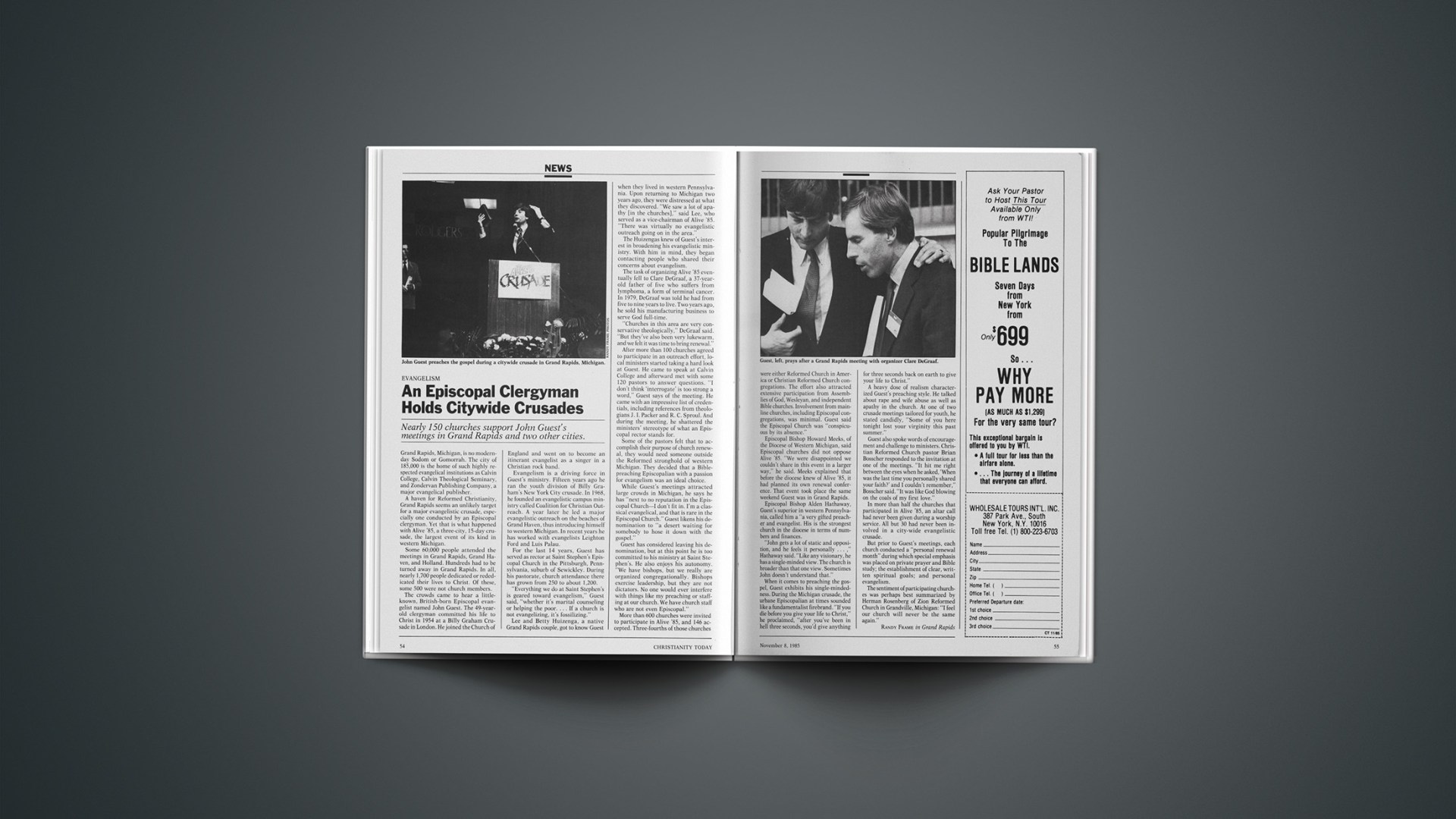
Evangelism: An Episcopal Clergyman Holds Citywide Crusades

Nearly 150 churches support John Guest’s meetings in Grand Rapids and two other cities.

Grand Rapids, Michigan, is no modern-day Sodom or Gomorrah. The city of 185,000 is the home of such highly respected evangelical institutions as Calvin College, Calvin Theological Seminary, and Zondervan Publishing Company, a major evangelical publisher.

A haven for Reformed Christianity, Grand Rapids seems an unlikely target for a major evangelistic crusade, especially one conducted by an Episcopal clergyman. Yet that is what happened with Alive ’85, a three-city, 15-day crusade, the largest event of its kind in western Michigan.

Some 60,000 people attended the meetings in Grand Rapids, Grand Haven, and Holland. Hundreds had to be turned away in Grand Rapids. In all, nearly 1,700 people dedicated or rededicated their lives to Christ. Of these, some 500 were not church members.

The crowds came to hear a little-known, British-born Episcopal evangelist named John Guest. The 49-year-old clergyman committed his life to Christ in 1954 at a Billy Graham Crusade in London. He joined the Church of England and went on to become an itinerant evangelist as a singer in a Christian rock band.

Evangelism is a driving force in Guest’s ministry. Fifteen years ago he ran the youth division of Billy Graham’s New York City crusade. In 1968, he founded an evangelistic campus ministry called Coalition for Christian Outreach. A year later he led a major evangelistic outreach on the beaches of Grand Haven, thus introducing himself to western Michigan. In recent years he has worked with evangelists Leighton Ford and Luis Palau.

For the last 14 years, Guest has served as rector at Saint Stephen’s Episcopal Church in the Pittsburgh, Pennsylvania, suburb of Sewickley. During his pastorate, church attendance there has grown from 250 to about 1,200.

“Everything we do at Saint Stephen’s is geared toward evangelism,” Guest said, “whether it’s marital counseling or helping the poor.… If a church is not evangelizing, it’s fossilizing.”

Lee and Betty Huizenga, a native Grand Rapids couple, got to know Guest when they lived in western Pennsylvania. Upon returning to Michigan two years ago, they were distressed at what they discovered. “We saw a lot of apathy [in the churches],” said Lee, who served as a vice-chairman of Alive ’85. “There was virtually no evangelistic outreach going on in the area.”

The Huizengas knew of Guest’s interest in broadening his evangelistic ministry. With him in mind, they began contacting people who shared their concerns about evangelism.

The task of organizing Alive ’85 eventually fell to Clare DeGraaf, a 37-year-old father of five who suffers from lymphoma, a form of terminal cancer. In 1979, DeGraaf was told he had from five to nine years to live. Two years ago, he sold his manufacturing business to serve God full-time.

“Churches in this area are very conservative theologically,” DeGraaf said. “But they’ve also been very lukewarm, and we felt it was time to bring renewal.”

After more than 100 churches agreed to participate in an outreach effort, local ministers started taking a hard look at Guest. He came to speak at Calvin College and afterward met with some 120 pastors to answer questions. “I don’t think ‘interrogate’ is too strong a word,” Guest says of the meeting. He came with an impressive list of credentials, including references from theologians J. I. Packer and R. C. Sproul. And during the meeting, he shattered the ministers’ stereotype of what an Episcopal rector stands for.

Some of the pastors felt that to accomplish their purpose of church renewal, they would need someone outside the Reformed stronghold of western Michigan. They decided that a Bible-preaching Episcopalian with a passion for evangelism was an ideal choice.

While Guest’s meetings attracted large crowds in Michigan, he says he has “next to no reputation in the Episcopal Church—I don’t fit in. I’m a classical evangelical, and that is rare in the Episcopal Church.” Guest likens his denomination to “a desert waiting for somebody to hose it down with the gospel.”

Guest has considered leaving his denomination, but at this point he is too committed to his ministry at Saint Stephen’s. He also enjoys his autonomy. “We have bishops, but we really are organized congregationally. Bishops exercise leadership, but they are not dictators. No one would ever interfere with things like my preaching or staffing at our church. We have church staff who are not even Episcopal.”

More than 600 churches were invited to participate in Alive ’85, and 146 accepted. Three-fourths of those churches were either Reformed Church in America or Christian Reformed Church congregations. The effort also attracted extensive participation from Assemblies of God, Wesleyan, and independent Bible churches. Involvement from mainline churches, including Episcopal congregations, was minimal. Guest said the Episcopal Church was “conspicuous by its absence.”

Episcopal Bishop Howard Meeks, of the Diocese of Western Michigan, said Episcopal churches did not oppose Alive ’85. “We were disappointed we couldn’t share in this event in a larger way,” he said. Meeks explained that before the diocese knew of Alive ’85, it had planned its own renewal conference. That event took place the same weekend Guest was in Grand Rapids.

Episcopal Bishop Alden Hathaway, Guest’s superior in western Pennsylvania, called him a “a very gifted preacher and evangelist. His is the strongest church in the diocese in terms of numbers and finances.

“John gets a lot of static and opposition, and he feels it personally …,” Hathaway said. “Like any visionary, he has a single-minded view. The church is broader than that one view. Sometimes John doesn’t understand that.”

When it comes to preaching the gospel, Guest exhibits his single-mindedness. During the Michigan crusade, the urbane Episcopalian at times sounded like a fundamentalist firebrand. “If you die before you give your life to Christ,” he proclaimed, “after you’ve been in hell three seconds, you’d give anything for three seconds back on earth to give your life to Christ.”

A heavy dose of realism characterized Guest’s preaching style. He talked about rape and wife abuse as well as apathy in the church. At one of two crusade meetings tailored for youth, he stated candidly, “Some of you here tonight lost your virginity this past summer.”

Guest also spoke words of encouragement and challenge to ministers. Christian Reformed Church pastor Brian Bosscher responded to the invitation at one of the meetings. “It hit me right between the eyes when he asked, ‘When was the last time you personally shared your faith?’ and I couldn’t remember,” Bosscher said. “It was like God blowing on the coals of my first love.”

In more than half the churches that participated in Alive ’85, an altar call had never been given during a worship service. All but 30 had never been involved in a city-wide evangelistic crusade.

But prior to Guest’s meetings, each church conducted a “personal renewal month” during which special emphasis was placed on private prayer and Bible study; the establishment of clear, written spiritual goals; and personal evangelism.

The sentiment of participating churches was perhaps best summarized by Herman Rosenberg of Zion Reformed Church in Grandville, Michigan: “I feel our church will never be the same again.”

RANDY FRAMEin Grand Rapids

NORTH AMERICAN SCENE

RAJNEESHPURAM

To Be, or Not to Be?

After Oregon’s attorney general filed a lawsuit alleging violations of the separation of church and state, Bhagwan Shree Rajneesh announced that his commune is not religious. The commune, known as Rajneeshpuram, is incorporated as a town.

“I am against all religions because they have done only harm to mankind,” Rajneesh told reporters. “… For the first time in the history of mankind, a religion has died.”

Attorney General Dave Frohnmayer remained unconvinced, however. “A religion does not cease to be because its leader says so,” he said. “It’s the acts and the practices that are important. The bhagwan appears to be holding up an egg and calling it a sausage.”

A few weeks earlier, several of Rajneesh’s top aides—including his personal secretary, Ma Anand Sheela—left the country. Rajneesh accused the former aides of driving his commune into debt, poisoning salad bars in a nearby town, and attempting to poison two public officials. Sheela has called the allegations—which the state is investigating—“total nonsense.” She said she left the commune because she was tired of working 20 hours a day on Rajneesh’s behalf.

WITCHCRAFT

Senate Denies Tax Break

The U.S. Senate voted to take away tax-exempt status from any group that promotes witchcraft or satanism. Sen. Jesse Helms (R-N.C.) proposed the measure, which was adopted without objection on a voice vote.

The action was taken on an amendment to the Treasury, Postal Service and General Appropriations Act. The amendment defines satanism as “the worship of Satan or the powers of evil.” Witchcraft is defined as “the use of sorcery or the use of supernatural powers with malicious intent.”

“We allow tax-exempt status for bona fide religious organizations because we believe they help promote the common good,” Helms said. “Cults and witchcraft groups do not. In fact, they lead to violent and unlawful behavior.”

A Senate-House conference committee will decide whether to retain Helms’s amendment in the appropriations bill. A similar measure was introduced in the U.S. House of Representatives by Rep. Robert S. Walker (R-Pa.).

CHICAGO

Birth Control in School

Chicago religious leaders are divided over a program that provides public high school students with birth control devices.

The Pro-Life Action League and Moral Majority have picketed DuSable High School, where the program is located. Critics say the program is “giving promiscuity an implicit stamp of approval.” Cardinal Joseph Bernardin joined the opposition, saying, “There is good reason to doubt that more and better contraceptive information and services will make major inroads in the number of teenage pregnancies.”

The program is supported by William A. Johnson, a Baptist minister and former president of the Church Federation of Greater Chicago. He argues that a school birth-control program in St. Paul led to a drop in birthrates among school-age girls from 70 per 1,000 in 1973 to 26 per 1,000 today.

COURT ORDER

Falwell to Pay $5,000

A Sacramento, California, Municipal Court judge ruled that Moral Majority leader Jerry Falwell owes $5,000 to Jerry Sloan, a homosexual who proved that Falwell verbally attacked Sloan’s church.

In July 1984, Falwell denied making an attack on the Universal Fellowship of Metropolitan Community Churches. He offered Sloan $5,000 to produce a tape recording that would prove he had made such an attack.

Judge Michael Ullman ruled that Sloan proved that Falwell had attacked the church. Sloan presented a tape of a March 1984 sermon Falwell preached on his “Old Time Gospel Hour” program. Ullman said Falwell referred to the Metropolitan Community Churches as “brute beasts, part of a vile and satanic system.” The judge ordered Falwell to pay court costs and honor his $5,000 offer to Sloan. Falwell’s attorneys have appealed the decision.

“RIGHT TO DIE”

Suit Fails in Ohio

An Ohio man has failed to prove that an Akron physician violated a patient’s “right to die.”

In 1980, Gifford Leach asked Dr. Howard Shapiro to disconnect a respirator from Leach’s terminally ill wife, Edna Marie Leach. Shapiro refused, and Gifford Leach obtained a court’s permission to disconnect the respirator. Shapiro and other Akron doctors still refused to comply. Mrs. Leach died in 1981 after an out-of-town physician disconnected the life-support machine.

Gifford Leach sued Shapiro for compensation for emotional pain. But Judge John Reece found insufficient evidence to award such damages.

OKLAHOMA

Smith Resigns Pastorate

Bailey Smith, former president of the Southern Baptist Convention, has resigned his pastorate to enter full-time evangelism. Smith had pastored the First Southern Baptist Church of Del City, Oklahoma, since 1973.

Two years ago, Smith was said to be receiving as many as 200 requests per day asking him to speak at a revival or other special event. At that time, Smith and John McKay, a former singer with the James Robison Evangelistic Team, formed the Real Evangelism association. At first, Smith limited the meetings to 12 Sunday-through-Wednesday revivals per year. He later reduced the number to 8 per year.

During a recent city-wide crusade in Tulsa, Oklahoma, the Real Evangelism team received a “love offering” of $43,592. Garnet Cole, missions director for the Tulsa Baptist Association, described the offering as a record.
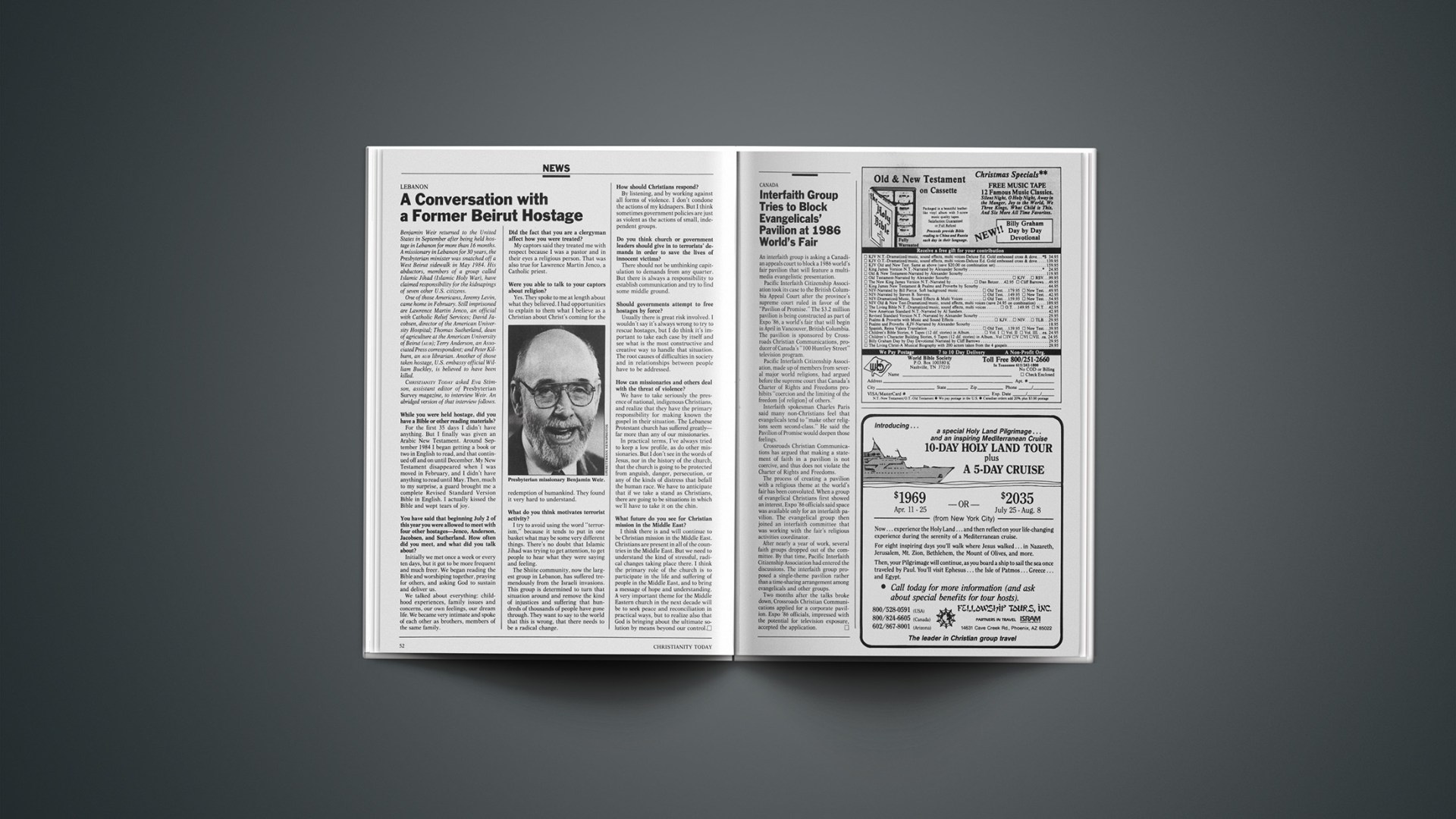
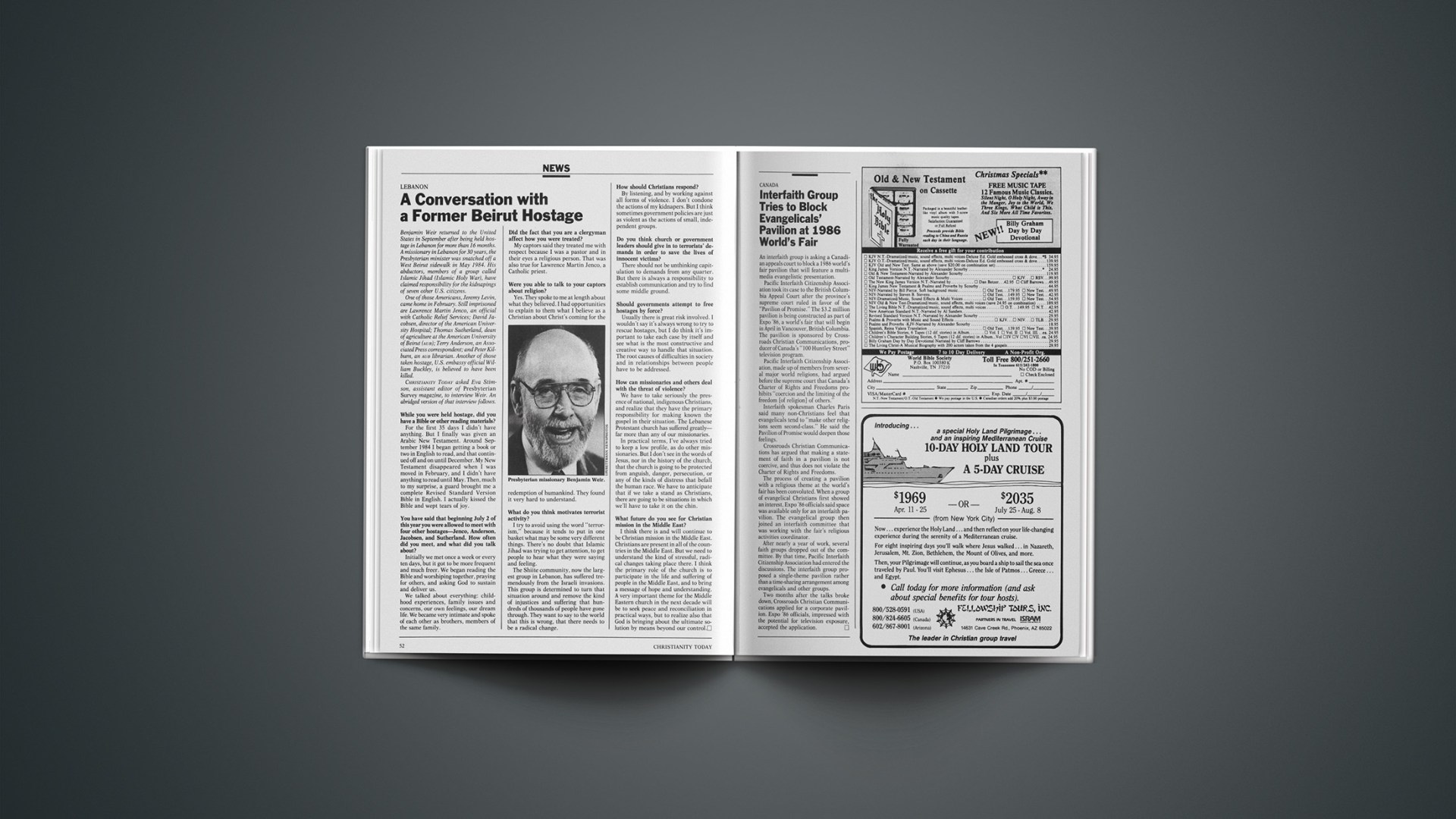
Interfaith Group Tries to Block Evangelicals’ Pavilion at 1986 World’s Fair

An interfaith group is asking a Canadian appeals court to block a 1986 world’s fair pavilion that will feature a multimedia evangelistic presentation.

Pacific Interfaith Citizenship Association took its case to the British Columbia Appeal Court after the province’s supreme court ruled in favor of the “Pavilion of Promise.” The $3.2 million pavilion is being constructed as part of Expo ’86, a world’s fair that will begin in April in Vancouver, British Columbia. The pavilion is sponsored by Crossroads Christian Communications, producer of Canada’s “100 Huntley Street” television program.

Pacific Interfaith Citizenship Association, made up of members from several major world religions, had argued before the supreme court that Canada’s Charter of Rights and Freedoms prohibits “coercion and the limiting of the freedom [of religion] of others.”

Interfaith spokesman Charles Paris said many non-Christians feel that evangelicals tend to “make other religions seem second-class.” He said the Pavilion of Promise would deepen those feelings.

Crossroads Christian Communications has argued that making a statement of faith in a pavilion is not coercive, and thus does not violate the Charter of Rights and Freedoms.

The process of creating a pavilion with a religious theme at the world’s fair has been convoluted. When a group of evangelical Christians first showed an interest, Expo ’86 officials said space was available only for an interfaith pavilion. The evangelical group then joined an interfaith committee that was working with the fair’s religious activities coordinator.

After nearly a year of work, several faith groups dropped out of the committee. By that time, Pacific Interfaith Citizenship Association had entered the discussions. The interfaith group proposed a single-theme pavilion rather than a time-sharing arrangement among evangelicals and other groups.

Two months after the talks broke down, Crossroads Christian Communications applied for a corporate pavilion. Expo ’86 officials, impressed with the potential for television exposure, accepted the application.

Lebanon: A Conversation with a Former Beirut Hostage

Benjamin Weir returned to the United States in September after being held hostage in Lebanon for more than 16 months. A missionary in Lebanon for 30 years, the Presbyterian minister was snatched off a West Beirut sidewalk in May 1984. His abductors, members of a group called Islamic Jihad (Islamic Holy War), have claimed responsibility for the kidnapings of seven other U.S. citizens.

One of those Americans, Jeremy Levin, came home in February. Still imprisoned are Lawrence Martin Jenco, an official with Catholic Relief Services; David Jacobsen, director of the American University Hospital; Thomas Sutherland, dean of agriculture at the American University of Beirut (AUB); Terry Anderson, an Associated Press correspondent; and Peter Kilburn, an AUB librarian. Another of those taken hostage, U.S. embassy official William Buckley, is believed to have been killed.

CHRISTIANITY TODAY asked Eva Stimson, assistant editor of Presbyterian Survey magazine, to interview Weir. An abridged version of that interview follows.

While you were held hostage, did you have a Bible or other reading materials?

For the first 35 days I didn’t have anything. But I finally was given an Arabic New Testament. Around September 1984 I began getting a book or two in English to read, and that continued off and on until December. My New Testament disappeared when I was moved in February, and I didn’t have anything to read until May. Then, much to my surprise, a guard brought me a complete Revised Standard Version Bible in English. I actually kissed the Bible and wept tears of joy.

You have said that beginning July 2 of this year you were allowed to meet with four other hostages—Jenco, Anderson, Jacobsen, and Sutherland. How often did you meet, and what did you talk about?

Initially we met once a week or every ten days, but it got to be more frequent and much freer. We began reading the Bible and worshiping together, praying for others, and asking God to sustain and deliver us.

We talked about everything: childhood experiences, family issues and concerns, our own feelings, our dream life. We became very intimate and spoke of each other as brothers, members of the same family.

Did the fact that you are a clergyman affect how you were treated?

My captors said they treated me with respect because I was a pastor and in their eyes a religious person. That was also true for Lawrence Martin Jenco, a Catholic priest.

Were you able to talk to your captors about religion?

Yes. They spoke to me at length about what they believed. I had opportunities to explain to them what I believe as a Christian about Christ’s coming for the redemption of humankind. They found it very hard to understand.

What do you think motivates terrorist activity?

I try to avoid using the word “terrorism,” because it tends to put in one basket what may be some very different things. There’s no doubt that Islamic Jihad was trying to get attention, to get people to hear what they were saying and feeling.

The Shiite community, now the largest group in Lebanon, has suffered tremendously from the Israeli invasions. This group is determined to turn that situation around and remove the kind of injustices and suffering that hundreds of thousands of people have gone through. They want to say to the world that this is wrong, that there needs to be a radical change.

How should Christians respond?

By listening, and by working against all forms of violence. I don’t condone the actions of my kidnapers. But I think sometimes government policies are just as violent as the actions of small, independent groups.

Do you think church or government leaders should give in to terrorists’ demands in order to save the lives of innocent victims?

There should not be unthinking capitulation to demands from any quarter. But there is always a responsibility to establish communication and try to find some middle ground.

Should governments attempt to free hostages by force?

Usually there is great risk involved. I wouldn’t say it’s always wrong to try to rescue hostages, but I do think it’s important to take each case by itself and see what is the most constructive and creative way to handle that situation. The root causes of difficulties in society and in relationships between people have to be addressed.

How can missionaries and others deal with the threat of violence?

We have to take seriously the presence of national, indigenous Christians, and realize that they have the primary responsibility for making known the gospel in their situation. The Lebanese Protestant church has suffered greatly—far more than any of our missionaries.

In practical terms, I’ve always tried to keep a low profile, as do other missionaries. But I don’t see in the words of Jesus, nor in the history of the church, that the church is going to be protected from anguish, danger, persecution, or any of the kinds of distress that befall the human race. We have to anticipate that if we take a stand as Christians, there are going to be situations in which we’ll have to take it on the chin.

What future do you see for Christian mission in the Middle East?

I think there is and will continue to be Christian mission in the Middle East. Christians are present in all of the countries in the Middle East. But we need to understand the kind of stressful, radical changes taking place there. I think the primary role of the church is to participate in the life and suffering of people in the Middle East, and to bring a message of hope and understanding. A very important theme for the Middle Eastern church in the next decade will be to seek peace and reconciliation in practical ways, but to realize also that God is bringing about the ultimate solution by means beyond our control.

Pat Robertson for President?

The Christian talk show host contemplates a ‘lateral move.’

The process of electing a U.S. President makes it certain that few individuals will ever attempt a run for the Oval Office. Those who do, need a sure-fire mix of fund-raising genius, proven administrative ability, a clear grasp of global issues, and a compelling personality suited to the electronic media.

Some say that Pat Robertson, host of television’s “700 Club” talk show, has all these and more. Consequently, the founder of the Christian Broadcasting Network (CBN) says he has been asked to consider running for President in 1988. He says he is praying about the decision and seeking counsel from trusted Christian friends.

Meanwhile, the machinery of Robertson’s Virginia Beach, Virginia, empire appears to be primed to propel Robertson into national public life. It is likely that he will not decide for another year or more. Nonetheless, speculation about his candidacy is energizing the Republican party’s right wing and fueling fears of a split between social-issue conservatives and the party’s moderates.

Speculation

The idea of a Robertson candidacy first appeared in a Saturday Evening Post article (March 1985), complete with a lengthy “agenda for public action” proposed by Robertson. Since then, articles in the Wall Street Journal, Conservative Digest, Washington Times, and elsewhere have reinforced the possibility of Robertson as a White House contender. He is the son of a former U.S. senator, A. Willis Robertson, Democrat, of Virginia. Pat Robertson, asked frequently why he does not run for the Senate himself, jokes that he would consider that office a demotion. “But the presidency would be a lateral move,” he has said in interviews as long ago as 1979.

Robertson resists the label “television evangelist.” Instead, he seeks to present himself as a Christian businessman, lawyer, and specialist in economics. His Christian identity remains undiluted, however, even in circles where that could be unpopular. In a speech to the United Republican Fund of Illinois, Robertson said spiritual revival is a major development in the world today. He described it as “a turning to God and desire for God that the world has never seen.”

He is intensely interested in educating Christians about public affairs and stirring their enthusiasm for political involvement. He believes America faces a crossroads where family values and faith in God could lose out to statism and hedonism. Running for President will not guarantee Robertson a term in the White House, but it will almost certainly mean that the presidential candidates in 1988 will not be able to dismiss moral issues that matter to Christians.

Robertson recently switched his party affiliation to Republican, and he is expected to frame a possible candidacy around themes of individual initiative; economic policies to reduce the federal deficit; judicial conservatism; opposition to Soviet adventurism in the Third World; and a return to moral values on the part of American citizens. In recent years, Robertson has warned of an impending economic disaster and has embraced an eschatology that relates Bible prophecy to current events in the Middle East. On television, and via a newsletter called “Perspective,” he has sounded “a warning to prepare” for recession and world crises, and offered “a message of hope” from the gospel. In 1983, Robertson discontinued the newsletter.

Today, however, he talks in terms of solutions to domestic and international difficulties. He has been visiting Capitol Hill more frequently to testify before Congress on issues, including the Civil Rights Restoration Act of 1985. That legislation was designed to overturn a U.S. Supreme Court decision allowing federally funded programs to continue at a Christian college that refused to sign a commitment to nondiscrimination based on sex. Robertson opposed the bill, terming it “a new and sizable extension of federal oversight into a vast area of American institutional life.”

Pro And Con

Robertson’s supporters say he is competent to hold high office. “When he confronts political dilemmas that our culture faces, he doesn’t approach them with a broad-stroke, shallow, naive perspective,” said Charles W. Jarvis. “He comes with a sophisticated understanding of domestic and international economics.” Jarvis, an evangelical who is acquainted with Robertson, is vice-president of the Legal Services Corporation in Washington, D.C., a federally funded office providing legal counsel to the poor.

Robertson’s backers also say that he, like President Reagan, is capable of articulating a highly developed image of America’s potential. “What we will be discussing in 1988,” Jarvis predicted, “are visions and countervisions of what America as a nation and as a set of communities can be.”

That is a process the Christian in politics needs to approach wisely, according to British evangelical author Os Guinness. “Christians tend to argue various positions pro and con,” Guinness said. “What is conspicuously lacking is any attempt to be more like the Founding Fathers and describe a setting—a precondition for debate that will not alienate Jews, secularists, and all others. If the setting of the debate makes others comfortable, then Christians can be as specific as they like about their own faith.”

Charles W. Colson, founder of Prison Fellowship and former aide to President Nixon, said he would caution Robertson to “be absolutely certain it is a calling from God. Subdue, wrestle to the ground, personal ambition. The presidency would not be something a Christian leader could run for, but something he’d be drafted for, and there is only one Person who could do the drafting.”

Colson said Robertson has the advantage of a widespread appeal to evangelicals. “Pat is a uniquely gifted public figure. It is not outrageous to consider his running, [but] it would have to be unmistakably obvious that the Holy Spirit was leading.”

A main area of concern expressed by Christians who are less enthusiastic about Robertson’s possible candidacy is the effect it could have on his ministry. Jerry Herbert, editor of the book America: Christian or Secular? (Multnomah), said Robertson would be distracted from his primary task of proclaiming the gospel, a task he performs in a more balanced manner than many preachers on television. “Some of us are called to public life, and some are called to articulate the gospel,” Herbert said. “Maybe he feels his call is changing, but it will lessen his ability to maintain the impact of the various CBN ministries.”

Also, Herbert warned, a prominent evangelical candidate for office could inadvertently have the effect of “isolating Christian voters and moving them away from effective involvement in the body politic. It would give secularists more opportunity to dismiss us and undercut the legitimacy of our concerns on issues such as the right to life.”

Doug Bandow, a syndicated columnist and senior fellow at The Cato Institute, a Washington think tank, said, “I fear he’d be humiliated. The biggest danger is that he will not be taken seriously, and that may hurt his ministry.”

Reorganization

The scope of that ministry has grown tremendously. And there are indications that the day-to-day operations of CBN and its related organizations are being streamlined to permit Robertson to disengage himself so he can pursue political life. Already, the major tasks of running CBN’s cable network, its graduate university, news bureaus, and outreach programs are delegated to lieutenants at the Virginia Beach headquarters, in Washington, D.C., and around the world.

James R. Whelan, former editor of the Washington Times and a veteran conservative journalist, has been named managing director of CBN News in Washington. In January, CBN will introduce a half-hour, weeknight news program called “CBN News Tonight.” CBN intends to compete with other cable-television news shows and eventually with network television.

Two organizations headed by Robertson but unrelated to CBN provide additional clues about how a run for the presidency might take shape. Robertson established the National Perspectives Institute, described in one of its publications as an organization “devoted to scholarly research and analysis of the practical problems of public policy in the areas of economics, government, foreign policy, and the general social sciences.”

NICARAGUA

Is Pat Robertson Raising Money for Anti-Sandinista Guerrillas?

Pat Robertson’s mild-mannered style doesn’t camouflage the depth of his political convictions. On his “700 Club” television program, he affirms his support of the Reagan Administration, including its policies in Central America. In reference to the armed conflict in Nicaragua, Robertson has prayed on the air that “the Lord will give aid to those people who are struggling against Communist rule.”

Some critics charge that Robertson’s political leanings affect much more than the content of his prayers, however. They say that Operation Blessing, the relief arm of Robertson’s Christian Broadcasting Network (CBN), is one of a handful of private organizations that supports the contras, guerrillas who are fighting against Nicaragua’s Sandinista government.

That and other allegations are summarized in the October issue of Sojourners, a politically Left-leaning evangelical magazine. Sojourners states that “millions of well-meaning U.S. Christians are donating money that is serving, directly or indirectly, to sustain Nicaraguan contras and to perpetuate … contra terrorism.”

Operation Blessing has given several million dollars’ worth of food, medicine, and other aid to Central America. One CBN news release announced a $20 million effort to send aid to Honduras, Guatemala, and El Salvador.

While no one has publicly accused the organization of supplying contras with direct military aid, some critics argue that in certain circumstances, the line between humanitarian assistance and military aid is easily blurred. They say guerrillas can spend more of their own resources on guns if their families are being supplied with food and medicine.

Critics, including Sojourners, maintain that Operation Blessing has done too little to ensure that aid does not fall into the hands of guerrillas. Sojourners alleges that Operation Blessing on occasion has worked with relief organizations that have explicit political goals. These include the Air Commandos Association, Friends of the Americas, and the Nicaragua Patriotic Association.

Perhaps Sojourners’ most serious charge involved a $3 million donation that Operation Blessing allegedly made to the Nicaragua Patriotic Association. That organization’s leader is known to have ties to the contras.

A Sojourners spokesman said the allegation was based on a report published in the Milwaukee Journal. The spokesman could not establish that Sojourners had verified the report independently.

In response, CBN spokesman Earl Weirich said Operation Blessing has had no contact with the Nicaragua Patriotic Association. In addition, he said he was unaware of any CBN connections with Friends of the Americas.

However, a Sojourners spokesman said one of the magazine’s reporters attended a meeting at which Friends of the Americas leader Louis Jenkins thanked Robertson for Operation Blessing’s support of refugees through Friends of the Americas. (Jenkins is a Louisiana state representative. He was quoted in The Nation as saying, “I want the Sandinistas kicked out of Nicaragua. That’s one of the main motivations for my work.” However, he also affirmed that “our role is to help refugees, not to get involved with combatants.”)

Weirich acknowledges that CBN has worked with the Air Commandos Association—a group of retired air force officers—on at least three occasions. Generally, aid delivered by groups like the Air Commandos Association is nonmilitary. However, those organizations do not abide by a United Nations policy that prohibits relief centers from operating within 50 kilometers of an armed conflict. That policy attempts to prevent humanitarian aid from being used to perpetuate fighting.

Sojourners also alleges that a CBN television news crew used a vehicle owned by the contras and lied about it to a representative of World Relief, the relief arm of the National Association of Evangelicals. Tom Hawk, formerly World Relief’s coordinator in Honduras, said he is “disappointed in [CBN’s] reporting on Central America.… It’s very, very one-sided.” He said the situation is so complex that “you can go down and prove just about any story you want.”

Given that politically conservative Americans generally feel the United States should be aiding the contras, the implication by Sojourners that CBN is misleading “millions of well meaning” financial supporters seems unfounded. Because Robertson is so candid about his political views, it is unlikely that many of those who donate to Operation Blessing are misled about what it is doing.

Nevertheless, critics charge that any aid to the contras would violate the U.S. Neutrality Act, which prohibits support for the overthrow of any government with which the United States is at peace. The tiff over CBN’s alleged relationship with the contras reflects a fundamental disagreement over how to interpret the strife in Central America. And on this issue, American evangelicals are far from a consensus.

RANDY FRAME

The institute is preparing position papers on a variety of concerns, such as the Communist threat in Central America. One observer, certain that Robertson will indeed run, described the institute as a “shadow cabinet.” Its president, Jerry Ralph Curry, is a retired major general in the army, with extensive overseas experience.

A second organization headed by Robertson, Freedom Council, has been reorganized to separate it completely from CBN. Robertson still serves as president, a post he has held since Freedom Council was formed three years ago. The organization began as an effort to educate local congregations about concerns related to religious freedom in America. Today, it is organizing state and precinct chapters led by church members who are interested in politics.

Bob Partlow, Freedom Council’s executive director, said the group employs 20 people in Virginia Beach, 50 field organizers, and two representatives in Washington who lobby and keep Freedom Council members informed about legislation.

Freedom Council has hired a former political assistant to Paul Weyrich, leading New Right organizer in Washington, as political director. In North Carolina, Freedom Council’s state coordinator is Carl Horn, a former U.S. Justice Department lawyer and former counsel to Wheaton (Ill.) College.

What Republicans Think

There is little doubt that many Freedom Council members would be inclined to support Robertson if he decided to run for office. That prospect invites mixed reactions from Republicans in Washington. Robertson is viewed as a catalyst for party building, yet he could siphon votes away from other conservative contenders, such as Jack Kemp (R-N.Y.). Robertson has already gained the backing of some New Right leaders in Washington, including Weyrich and Howard Phillips, because they object to Kemp’s support of sanctions against South Africa and his reluctance to speak up on the social issues they care about most.

A source in the Republican party said the Republican National Committee is taking Robertson seriously because “they understand the numbers. Evangelicals are increasingly active in politics, and eight out of ten voted for Ronald Reagan. Those are numbers they like.” At the very least, they expect Robertson to inspire millions of voters to register.

Whether his flirtation with politics develops into a courtship of American voters depends on Robertson’s interpretation of the Holy Spirit’s leading and the counsel he gathers from other Christians. The exercise of deciding seems likely to stir thought-provoking assessments of what it means to carry personal faith into every arena of public life—what benefits might be gained and what liabilities suffered.

BETH SPRING

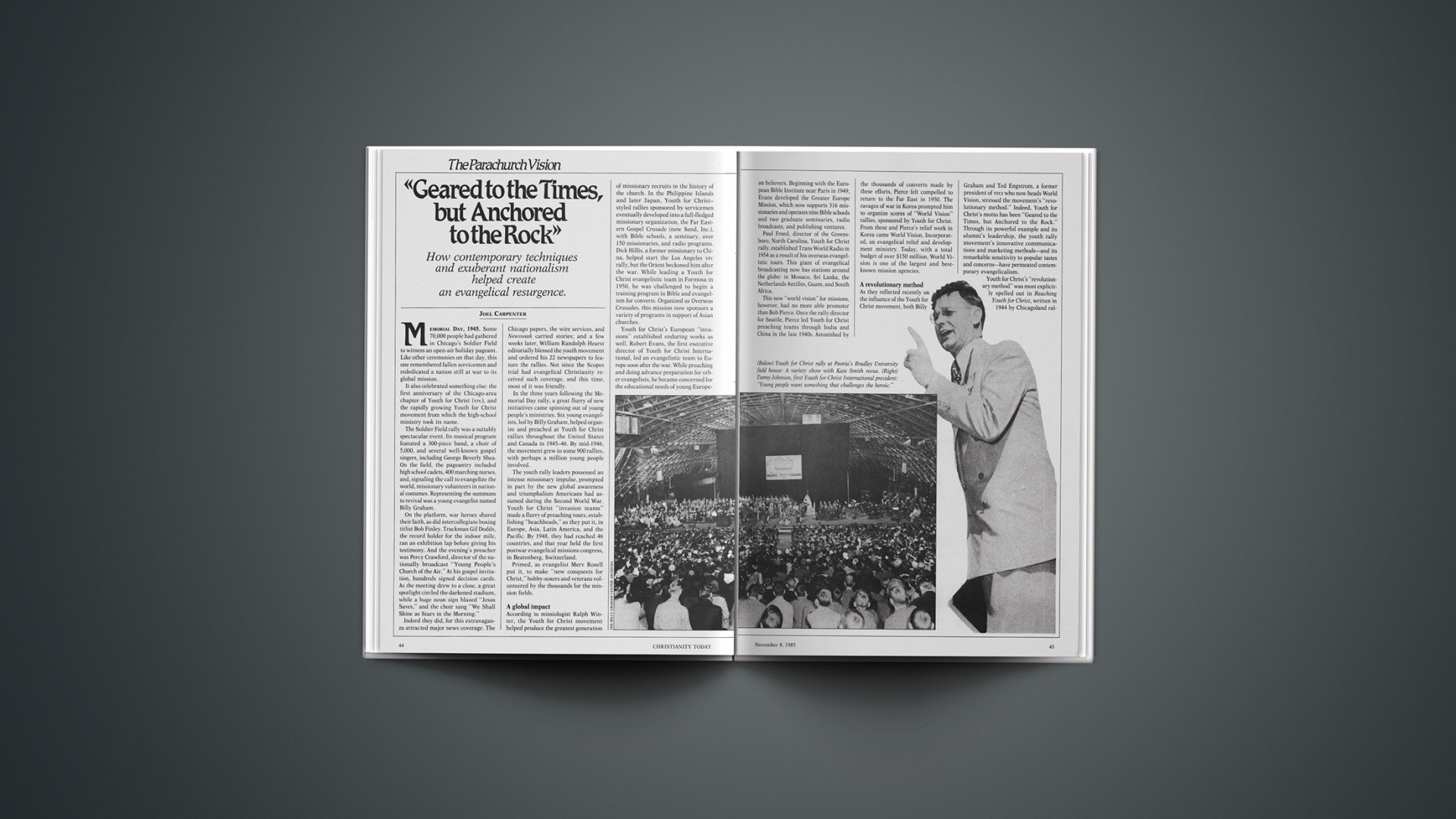
“Geared to the Times, but Anchored to the Rock”

How contemporary techniques and exuberant nationalism helped create an evangelical resurgence.

Memorial Day, 1945. Some 70,000 people had gathered in Chicago’s Soldier Field to witness an open-air holiday pageant. Like other ceremonies on that day, this one remembered fallen servicemen and rededicated a nation still at war to its global mission.

It also celebrated something else: the first anniversary of the Chicago-area chapter of Youth for Christ (YFC), and the rapidly growing Youth for Christ movement from which the high-school ministry took its name.

The Soldier Field rally was a suitably spectacular event. Its musical program featured a 300-piece band, a choir of 5,000, and several well-known gospel singers, including George Beverly Shea. On the field, the pageantry included high school cadets, 400 marching nurses, and, signaling the call to evangelize the world, missionary volunteers in national costumes. Representing the summons to revival was a young evangelist named Billy Graham.

On the platform, war heroes shared their faith, as did intercollegiate boxing titlist Bob Finley. Trackman Gil Dodds, the record holder for the indoor mile, ran an exhibition lap before giving his testimony. And the evening’s preacher was Percy Crawford, director of the nationally broadcast “Young People’s Church of the Air.” At his gospel invitation, hundreds signed decision cards. As the meeting drew to a close, a great spotlight circled the darkened stadium, while a huge neon sign blazed “Jesus Saves,” and the choir sang “We Shall Shine as Stars in the Morning.”

Indeed they did, for this extravaganza attracted major news coverage. The Chicago papers, the wire services, and Newsweek carried stories; and a few weeks later, William Randolph Hearst editorially blessed the youth movement and ordered his 22 newspapers to feature the rallies. Not since the Scopes trial had evangelical Christianity received such coverage, and this time, most of it was friendly.

In the three years following the Memorial Day rally, a great flurry of new initiatives came spinning out of young people’s ministries. Six young evangelists, led by Billy Graham, helped organize and preached at Youth for Christ rallies throughout the United States and Canada in 1945–46. By mid-1946, the movement grew to some 900 rallies, with perhaps a million young people involved.

The youth rally leaders possessed an intense missionary impulse, prompted in part by the new global awareness and triumphalism Americans had assumed during the Second World War. Youth for Christ “invasion teams” made a flurry of preaching tours, establishing “beachheads,” as they put it, in Europe, Asia, Latin America, and the Pacific. By 1948, they had reached 46 countries, and that year held the first postwar evangelical missions congress, in Beatenberg, Switzerland.

Primed, as evangelist Merv Rosell put it, to make “new conquests for Christ,” bobby-soxers and veterans volunteered by the thousands for the mission fields.

A Global Impact

According to missiologist Ralph Winter, the Youth for Christ movement helped produce the greatest generation of missionary recruits in the history of the church. In the Philippine Islands and later Japan, Youth for Christ-styled rallies sponsored by servicemen eventually developed into a full-fledged missionary organization, the Far Eastern Gospel Crusade (now Send, Inc.), with Bible schools, a seminary, over 150 missionaries, and radio programs. Dick Hillis, a former missionary to China, helped start the Los Angeles YFC rally, but the Orient beckoned him after the war. While leading a Youth for Christ evangelistic team in Formosa in 1950, he was challenged to begin a training program in Bible and evangelism for converts. Organized as Overseas Crusades, this mission now sponsors a variety of programs in support of Asian churches.

Youth for Christ’s European “invasions” established enduring works as well. Robert Evans, the first executive director of Youth for Christ International, led an evangelistic team to Europe soon after the war. While preaching and doing advance preparation for other evangelists, he became concerned for the educational needs of young European believers. Beginning with the European Bible Institute near Paris in 1949, Evans developed the Greater Europe Mission, which now supports 316 missionaries and operates nine Bible schools and two graduate seminaries, radio broadcasts, and publishing ventures.

Paul Freed, director of the Greensboro, North Carolina, Youth for Christ rally, established Trans World Radio in 1954 as a result of his overseas evangelistic tours. This giant of evangelical broadcasting now has stations around the globe: in Monaco, Sri Lanka, the Netherlands Antilles, Guam, and South Africa.

This new “world vision” for missions, however, had no more able promoter than Bob Pierce. Once the rally director for Seattle, Pierce led Youth for Christ preaching teams through India and China in the late 1940s. Astonished by the thousands of converts made by these efforts, Pierce felt compelled to return to the Far East in 1950. The ravages of war in Korea prompted him to organize scores of “World Vision” rallies, sponsored by Youth for Christ. From these and Pierce’s relief work in Korea came World Vision, Incorporated, an evangelical relief and development ministry. Today, with a total budget of over $150 million, World Vision is one of the largest and best-known mission agencies.

A Revolutionary Method

As they reflected recently on the influence of the Youth for Christ movement, both Billy Graham and Ted Engstrom, a former president of YFCI who now heads World Vision, stressed the movement’s “revolutionary method.” Indeed, Youth for Christ’s motto has been “Geared to the Times, but Anchored to the Rock.” Through its powerful example and its alumni’s leadership, the youth rally movement’s innovative communications and marketing methods—and its remarkable sensitivity to popular tastes and concerns—have permeated contemporary evangelicalism.

Youth for Christ’s “revolutionary method” was most explicitly spelled out in Reaching Youth for Christ, written in 1944 by Chicagoland rally leaders Torrey Johnson and Bob Cook, to help others set up meetings in their cities. This little book insisted that evangelism be “geared to the times.” Young people wanted to be “part of something big, live, and vital,” and their standard of comparison was the news and entertainment world. Johnson and Cook laid out four essential ingredients for a successful rally: radio coverage, a streamlined and entertaining program, slick promotion, and pungent preaching laced with current events.

This new approach had an electrifying effect. Thousands of younger evangelicals who had grown up with the radio (if not the movies) picked up the new format, and those with media tallents led the way.

The rallies themselves resembled radio variety shows and Kate Smith’s patriotic revues. They featured gospel music attuned to the “swing” and “sweet” styles then popular. Testimonies from war heroes, sports stars, and other “personalities” punctuated the programs. Rally publicists created mountains of advertisements, press releases, cards, posters, and tracts. Friendly contacts with a network of “born-again” journalists brought favorable coverage in newspapers, national magazines, and on the wire services. And the young preachers shaped their style after radio stars.

The adoption of the tools, tastes, and values of the marketplace by these pioneers prompted questions. These questions persist even today. Can the gospel be better packaged through market analysis and mass mailing? Do management efficiency and slick promotion aid spiritual growth? Are truth and leadership defined by popular appeal? And are the mass media adequate channels of grace to the lost?

Such questions epitomize the ongoing tensions faced by parachurch ministries in the multimedia eighties. With all the latest hardware (and software) for conveying their message, evangelicals are more tempted than ever to adopt secular attitudes in formulating their ministry’s “plan of attack.”

Thus there is the ongoing need for spiritual discipline. The parachurch pioneers spent much time on their knees—seeking God’s will and waiting upon him to show them their next step and give them new vision.” “What people often forget about us,” said Torrey Johnson, “was that we lived on prayer. We expected God to perform miracles.”

A Re-Engagement With America

But there was another side to Youth for Christ’s widespread appeal. During the war, and in the tension-filled years following, Americans seemed more hungry for religion than they had been for decades. In this changed climate, evangelicals found that their calls for religious and moral revival fell on sympathetic ears.

A major current of public worry in the war years was for morality, especially among the youth. When the country’s hopes and fears were already focused on its young adults off at war, it was plagued by reports of increased teenage crime and vice at home. Youth rallies took their place alongside other community efforts to channel young people’s restlessness and desire to do something important. Young people “want something that challenges the heroic,” Torrey Johnson insisted. “They want something that demands sacrifice, … that is worth living for and dying for.” Youth for Christ met these needs, he believed.

The movement’s publicity featured many accounts of teen rebels turned around by the gospel. This aspect of the movement prompted the praise of many civic leaders. Police chiefs, governors, newspaper editors, and reportedly, President Truman—all applauded the rallies’ wholesome contributions to community life. Such positive response encouraged evangelicals to shed some of their cultural isolation and to see what they could do to serve the American public. Their goal, as Torrey Johnson told a Time reporter, was to seek “the spiritual revitalization of America,” and “the complete evangelization of the world in our generation.”

These objectives were by then traditional ones for American evangelicals. But they took on a new significance during the war and in the postwar confrontations with the Soviet Union. Global intervention and victory reawakened Americans’ ideas of a divinely directed national destiny and faith in their own cultural and technological prowess. The United States, many now believed, was the free world’s leader in the struggle against totalitarianism. If America was to fulfill this role, her people must be rededicated to freedom and reformed in morals.

During the early stages of the Cold War, American political leaders echoed these warnings. The day after he heard Winston Churchill’s “Iron Curtain” speech in 1946, President Truman told a group of churchmen that without “a moral and spiritual awakening,” America would be lost. Gen. Dwight D. Eisenhower echoed him, suggesting that there was no hope of avoiding disaster “except through moral regeneration.” Likewise Gen. Douglas MacArthur, invoking the theme of Americans’ divinely ordained duty, invited Youth for Christ and other missionaries to Japan to “provide the surest foundation for the firm establishment of democracy.”

Such invitations made evangelicals feel more welcome to contribute to the mainstream of American public affairs than ever in their memory. A new generation of evangelical leaders, many inspired by the Youth for Christ movement, looked forward to a fresh start for conservative Christianity. University-trained scholars began to rechart the movement’s intellectual life. Preachers, publicists, and business managers, filled with hope for revival and world evangelization, built a massive web of publications, broadcast enterprises, and specialized ministries. And this parachurch network soon became the major source of identity and action for the “new evangelicalism” of our time.

Unfortunately, evangelicals’ vision for righteousness and spiritual renewal often became colored by the values of the “American Way of Life.” The American public’s welcome depended quite heavily on evangelicals’ tuning their message to what the audience wanted to hear. Thus the mandate for preaching the gospel and making disciples throughout the world became tinged with calls for saving Europe and the emerging nations for the “free world.” And the gospel’s promise of peace with God, self, and others often carried overtones of self-help, personal comfort, and national security.

As evangelicalism prospered, then, some began to notice that it had paid a price for success. Billy Graham revealed the painful chastening he and many of his generation experienced when at the Lausanne Congress on World Evangelization in 1974 he warned that: “To tie the gospel to any political system, secular program, or society is dangerous, and will only serve to divert the gospel. The gospel transcends the goals and methods of any political system or any society.” Graham now insists that “our gospel is not Americanism; our gospel is not America.” As a global ambassador of the gospel, Graham says that he asks himself: “How is this going to sound in India?… to my friends in Hungary or Poland?”

A Spiritual Resolve

For all their periodically naïve exuberance and uncritical adoption of new techniques, the early Youth for Christ campaigners were committed to remaining “Anchored to the Rock”: a spiritual resolve forged in the countless prayer meetings often lasting well into the night. Reflecting upon this legacy and its impact, Torrey Johnson said recently that “we were constantly humbled and amazed and surprised by what he [God] was doing.”

Indeed, Johnson and his colleagues seemed to understand a truth that is too often hidden these days, but that was a mainstay in the transformation of the late forties and early fifties: the Spirit blows where he wills.

The Pioneers at Fifty

A time to celebrate and ask crucial questions.

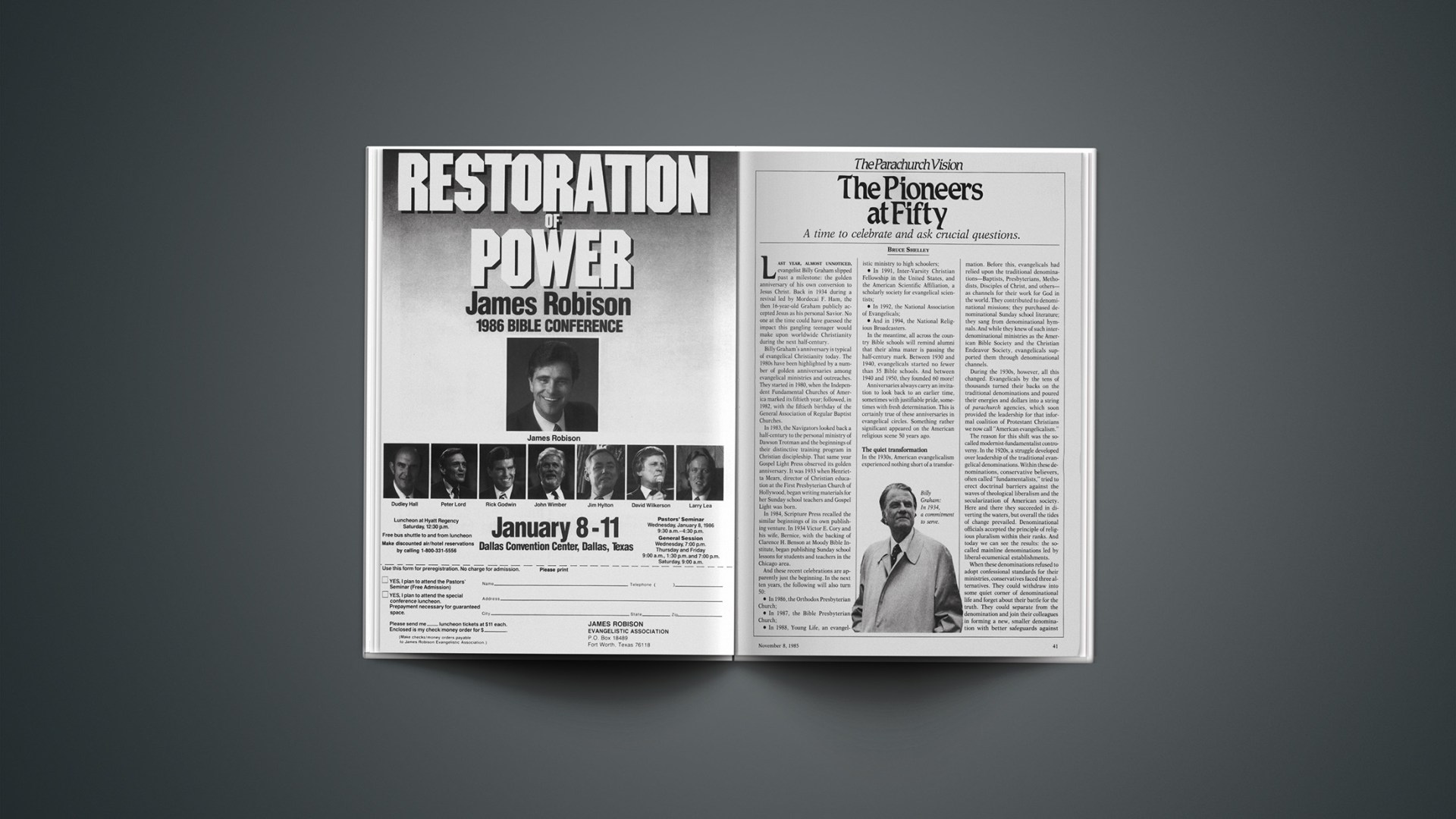
Last year, almost unnoticed, evangelist Billy Graham slipped past a milestone: the golden anniversary of his own conversion to Jesus Christ. Back in 1934 during a revival led by Mordecai F. Ham, the then 16-year-old Graham publicly accepted Jesus as his personal Savior. No one at the time could have guessed the impact this gangling teenager would make upon worldwide Christianity during the next half-century.

Billy Graham’s anniversary is typical of evangelical Christianity today. The 1980s have been highlighted by a number of golden anniversaries among evangelical ministries and outreaches. They started in 1980, when the Independent Fundamental Churches of America marked its fiftieth year; followed, in 1982, with the fiftieth birthday of the General Association of Regular Baptist Churches.

In 1983, the Navigators looked back a half-century to the personal ministry of Dawson Trotman and the beginnings of their distinctive training program in Christian discipleship. That same year Gospel Light Press observed its golden anniversary. It was 1933 when Henrietta Mears, director of Christian education at the First Presbyterian Church of Hollywood, began writing materials for her Sunday school teachers and Gospel Light was born.

In 1984, Scripture Press recalled the similar beginnings of its own publishing venture. In 1934 Victor E. Cory and his wife, Bernice, with the backing of Clarence H. Benson at Moody Bible Institute, began publishing Sunday school lessons for students and teachers in the Chicago area.

And these recent celebrations are apparently just the beginning. In the next ten years, the following will also turn 50:

• In 1986, the Orthodox Presbyterian Church;

• In 1987, the Bible Presbyterian Church;

• In 1988, Young Life, an evangelistic ministry to high schoolers;

• In 1991, Inter-Varsity Christian Fellowship in the United States, and the American Scientific Affiliation, a scholarly society for evangelical scientists;

• In 1992, the National Association of Evangelicals;

• And in 1994, the National Religious Broadcasters.

In the meantime, all across the country Bible schools will remind alumni that their alma mater is passing the half-century mark. Between 1930 and 1940, evangelicals started no fewer than 35 Bible schools. And between 1940 and 1950, they founded 60 more!

Anniversaries always carry an invitation to look back to an earlier time, sometimes with justifiable pride, sometimes with fresh determination. This is certainly true of these anniversaries in evangelical circles. Something rather significant appeared on the American religious scene 50 years ago.

The Quiet Transformation

In the 1930s, American evangelicalism experienced nothing short of a transformation. Before this, evangelicals had relied upon the traditional denominations—Baptists, Presbyterians, Methodists, Disciples of Christ, and others—as channels for their work for God in the world. They contributed to denominational missions; they purchased denominational Sunday school literature; they sang from denominational hymnals. And while they knew of such interdenominational ministries as the American Bible Society and the Christian Endeavor Society, evangelicals supported them through denominational channels.

During the 1930s, however, all this changed. Evangelicals by the tens of thousands turned their backs on the traditional denominations and poured their energies and dollars into a string of parachurch agencies, which soon provided the leadership for that informal coalition of Protestant Christians we now call “American evangelicalism.”

The reason for this shift was the so-called modernist-fundamentalist controversy. In the 1920s, a struggle developed over leadership of the traditional evangelical denominations. Within these denominations, conservative believers, often called “fundamentalists,” tried to erect doctrinal barriers against the waves of theological liberalism and the secularization of American society. Here and there they succeeded in diverting the waters, but overall the tides of change prevailed. Denominational officials accepted the principle of religious pluralism within their ranks. And today we can see the results: the so-called mainline denominations led by liberal-ecumenical establishments.

When these denominations refused to adopt confessional standards for their ministries, conservatives faced three alternatives. They could withdraw into some quiet corner of denominational life and forget about their battle for the truth. They could separate from the denomination and join their colleagues in forming a new, smaller denomination with better safeguards against theological liberalism (denominations that today are the fastest growing in America). Or they could redirect their zeal and their energies into new organizations for the spread of the gospel.

As it turned out, conservatives did all three. But the zeal to create new schools and parachurch ministries proved so great that the pursuit of this alternative—with the increasing strength of the new, theologically conservative denominations—changed the profile of American evangelicalism. While the mainline denominations fell into a membership decline and general spiritual malaise, conservative Christians showed amazing vitality. In the two decades between 1930 and 1950, evangelicals laid the foundations for the renovation of the gospel witness that caught national attention in the 1970s. The radio broadcasts, Bible schools, and youth movements of the thirties paved the way for the television programs, publishing houses, missions, and church-planting efforts of today.

The Parachurch “Partnership”

A fresh vision of the world without Christ blended with the disillusionment with the mainline denominations to contribute to the formation of a plethora of parachurch ministries in the 1940s.

Parachurch organizations, of course, had existed alongside and within official church organizations since the days of Justin Martyr’s ministry in Rome and Clement’s school in Alexandria. They were simply voluntary associations of Christians seeking to fulfill some distinctively Christian purpose and thereby extend the influence of the established churches.

But these new parachurch organizations were—and are—different. In spite of the fact that “para” in Greek means “alongside,” evangelical parachurch agencies are not, for the most part, “alongside” mainline denominations today. They do not have the approval of mainline leaders. And in many cases, denominational officials consider evangelical ministries as subversive outsiders and competitors. As a result, most parachurch agencies are “alongside the churches” only in the sense of sympathetic local churches.

This lack of approval from denominational headquarters has handicapped most evangelical parachurch ministries. The last 50 years have witnessed a sharp decline in mainline denominational loyalty all over the country. The South is the only possible exception to the rule, and even there many observers feel that appeals based on denominational loyalty alone are proving less effective. Most laymen today simply do not care about the decisions denominational officials make 500 miles away, especially those laymen who find significant expression of their Christian faith in some parachurch ministry.

In his recent book Mainline Churches and the Evangelicals—perhaps the most perceptive discussion of the denominational and parachurch “crisis” available—Richard G. Hutcheson, Jr., writes: “Mainline Protestantism today is in a serious state of disarray. These large, historic American denominations … are clearly in trouble. Almost without exception they have been declining in membership.… Virtually all are trying to cope with massive funding changes.… They have been faced with a loss of interest in denominational affairs and with growing localism.”

If we look intently, we can find some signs of a thaw in the cold war between parachurch agencies and mainline denominations. Most of these denominations have evangelical minorities, and some denominational officials have turned to these pastors and churches for a ray of hope in the deepening gloom of denominational life. For the most part, however, any sudden breakthrough in parachurch-denominational relations seems unlikely.

The Parachurch Witness

But doctrinal integrity was only one reason for parachurch growth. In the last 25 years, evangelical parachurch organizations have multiplied for another reason. The increasing secularization of American society has made the churches’ and denominations’ witness for truth and justice outside the walls of their sanctuaries increasingly difficult.

Secularists have applied the dogma of the separation of church and state to ever wider areas of public life. Most notably, the Supreme Court has ruled against prayer and the devotional reading of the Bible in the public schools. Consequently (and as recent organizations of the Religious Right show), a nonsectarian organization simply has a better chance of escaping the clutches of the Internal Revenue Service than do denominations or local churches engaged in the same activities. In the eyes of the IRS, Jerry Falwell’s Thomas Road Baptist Church is one thing; his Moral Majority is another.

The recent parachurch proliferation has also come in part because evangelicals can afford to support a string of causes. In a recent article, Prof. Thomas Askew of Gordon College linked the spread of parachurch evangelicalism with the economic prosperity in America over the last quarter of a century. “Anglo-American evangelical piety,” he writes, “has for generations tended to resemble middle-class values.… Two decades of material abundance inevitably shaped the perception of Christian discipleship.”

Askew’s observation is a clue to an important but subtle shift in parachurch evangelicalism. Many of the leaders in the ministries founded 50 years ago were gripped by a cause. The history of the early years of most of these organizations reveals how little anyone had to gain personally by throwing himself into the work. Their visions, moreover, were bathed in prayer. All-night prayer vigils were not an uncommon occurence, as men and women gathered to seek out God’s leading and direction in formulating their “new thing.”

We are not, of course, without our sacrificial ministries. Indeed, the spiritual legacy of the prayer-warring, parachurch pioneers is alive today in the many organizations committed to taking an unadulterated gospel message into all avenues of life. But this is the media generation. Television can create a superstar overnight and mailing lists can raise millions in a day. Thus the constant challenges of money and power remain the formidable obstacles facing any man, woman, or organization that is intent upon “fighting the good fight” in today’s world.

The Parachurch Challenge

Today, few parachurch agencies offer any opportunity for democratic participation in the oversight of their ministry. They usually follow a corporate style of operation, much closer to the “big business” management model than the traditional denominational style of annual conventions.

A few years ago, responsible parachurch agencies recognized the possibility of financial abuses, and they created the Evangelical Council for Financial Accountability. Member organizations of the council pledge to use contributions responsibly and to provide a regular accounting of the use of funds.

But as the parachurch years turn golden, perhaps their greatest challenges fall in the area of leadership. Since many of these ministries were launched by the gifts and vision of some individual, the inevitable changing of the guard—the moving from an entrepreneurial founder to a managerial leader—raises the question of continuity in leadership as well as organizational direction. The gifts and vision of a founder are often not repeatable. And while dynasties are a prominent feature of leadership “among the Gentiles,” what guarantees do Christians have that this all-too-human temptation is really from God?

These, then, are the questions that come with evangelical golden anniversaries. Most parachurch ministries can look to the past with a measure of pride. They have made a significant contribution to the work of God in the world. Since they are responsible today, however, for the management of billions of dollars and the selection of new leadership, we can also expect these parachurch ministries to look to the future with a measure of sobriety.

Spiritual Fighters

Bruce Shelley writes: “A fresh vision of the world without Christ blended with the disillusionment with the mainline denominations to contribute to the formation of a plethora of parachurch ministries in the 1940s.”

One ministry born of that vision was the National Association of Evangelicals (NAE), a fellowship of denominations, churches, schools, and individuals committed to biblical oneness. Its formation in 1942 highlighted those factors motivating much of the then-burgeoning evangelical movement: commitment to a cause, individual zeal, and a lot of corporate prayer.

The first director of the association’s Washington office, Clyde Taylor, reflected on these dynamics during NAE’s fortieth anniversary year.

The cause

Back in those early years, there were motivational factors galore.

For example, there was the old Federal Council of Churches’ attempt to monopolize all religious radio time. In the name of American religious life, they informed the Federal Communications Commission that they represented Protestants, Catholics, and Jews, and thus had the right to suggest that the commission give sustaining time to each of these groups in proportion to their size—and to the exclusion of evangelicals. The right to buy time to disseminate the gospel was, therefore, a catalyst to the forming of NAE and later to the forming of the NAE affiliate, National Religious Broadcasters.

In those early days we also had problems with a group called the International Council of Religious Education (ICRE), which has since been absorbed into the World Council of Churches. Then an agency of the old Federal Council of Churches, its purpose was to stimulate Sunday school programs. But what it did was kill them across the country. The executive director of ICRE “endeared” himself to evangelicals by saying that one of the most foolish things we believed was that Jesus wants to be worshiped. You can chalk up the creation of the National Sunday School Association, and later the National Christian Education Commission, to the actions of the ICRE.

And on it goes. The [federal] government was restricting the movement of missionaries overseas due to the war. Consequently, one of the early discussions in NAE focused on the need for a central office that could save mission executives from running back and forth from Washington to argue with the State Department about missionary travel, equipment, and so on. So the Office of Public Affairs and the Evangelical Foreign Missions Association were in the early stages of NAE planning and are still playing a pivotal role today.

The zeal

Back then we had people who would speak up. Spiritual fighters. Now understand, I wasn’t brought up to be a fighter. [But] some of us, when confronted by evangelicals hindering or harming a particular ministry, would say, “Forget my personal reputation, I’ll expose or oppose these attacks on God’s work.” And God honored that.

The prayer

[One of the things that left an] indelible mark on that first meeting in 1942 was the opening prayer meeting. It started around 7:30 one night and ended, I guess, around 11. There must have been at least five or six hundred men there representing 51 denominations. I know that for a fact because I parked myself by the main exit and shook hands with everyone who came out.

The praying was spontaneous—with enough of the holiness and Pentecostal people there to keep it alive with amens and hallelujahs. It was a dynamic prayer meeting, the likes of which I have not seen since. And it spelled spiritual unity about as well as anything could.

Adapted from United Evangelical Action magazine, Spring, 1982.

Theology

How We See Ourselves

We must base self-image on God’s love, not on our own good looks.

We must base self-image on God’s love, not on our good looks.

One of my daughter’s high-school friends used to say about herself, “I’m just a repulsive old bag!” I never found out whether she was serious. Perhaps she based her self-image (as many teenagers do) on her physical appearance. In any event, the statement reflected a miserably low opinion of herself.

Books on the self-image abound. Most are written from a secular point of view, with no reference to Christian principles. But does the Bible have anything to say about the self-image? Can we arrive at a distinctively Christian understanding of what our self-image ought to be?

Before the Fall, Adam and Eve had, we may presume, positive images of themselves. They were not aware of any guilt, since they had not sinned against God or each other. There would seem to be no reason why they would have either too high or too low an opinion of themselves.

The Perversion

At the time of the Fall, however, a twofold perversion of the self-image occurred. First, the Fall was preceded by an inordinate heightening of the self-image. Adam and Eve wanted to be like God. Speaking through the serpent, Satan told Eve that if she were to eat the forbidden fruit, her eyes would be opened, and she would be like God (Gen. 3:5). When they disobeyed God’s clear command, our first parents virtually put themselves above God, arrogating to themselves the privilege of deciding what was right and what was wrong. This act revealed sinful pride. This conceit, this upward perversion of the self-image, was the cause of the first sin.

After the first sin, a second, and downward, perversion of the self-image occurred. Adam and Eve felt ashamed; their self-image became negative. Genesis continues: “Then the eyes of both of them were opened, and they realized they were naked …” (v. 7). Awareness of their nakedness meant that they now had a sense of shame. They realized that they had done wrong, and their self-image plummeted.

Ever since the Fall, we have suffered from the same twofold perversion of the self-image: sometimes inordinately high (sinful pride), sometimes excessively low (feelings of shame or worthlessness).

Let’s begin with the first perversion: too high an opinion of ourselves. Augustine said it long ago: Pride is the root sin of man. Human beings have by nature no sense of dependence on God, but rather pride in their own achievements and an exaggerated sense of their own importance. This perversion is echoed and amplified in the words of King Nebuchadnezzar who, while walking on the roof of his royal palace, exclaimed, “Is not this great Babylon, which I have built by my mighty power as a royal residence and for the glory of my majesty?” (Dan. 4:30).

Now, the second perversion: an excessively low self-image. Because people realize that they fall far short of what they should be, they often look down on themselves, despise themselves, perhaps hate themselves; sometimes, in fact, they think of themselves as worthless.

Criminologists tell us that most criminals have negative self-images, hating themselves and society, and expressing their hatred in violent acts. But this phenomenon is not limited to felons. Psychiatrists, psychologists, and pastoral counselors report that many counselees come to them with inferiority feelings and negative self-images. Carl Rogers, the proponent of client-centered therapy, puts it this way: “The central core of difficulty in people as I have come to know them … is that in the great majority of cases they despise themselves, regard themselves as worthless and unlovable.”

Both deviations are perversions of the self-image God intended us to have. Pride and conceit are detestable in his sight, for “God opposes the proud, but gives grace to the humble” (1 Peter 5:5). Now the opposite perversion, an extremely negative self-image, might be thought of as more salutary than pride, since a low self-image is the necessary condition for repentance.

Indeed, we must first realize the magnitude of our sins against God (and this will certainly bring with it an unflattering self-image) before we will feel the need to repent of our sin and turn to Christ in faith. Paul makes this point in 2 Corinthians 7:10: “Godly grief produces a repentance that leads to salvation.…” All this is sound scriptural teaching, but God does not intend to keep his people in perpetual bondage to extremely low self-images.

The Renewal

When God redeems us by his grace, he renews our self-image, in both directions. First, he enables us to renounce sinful pride, the first perversion of the self-image. God helps us to cultivate true humility—that is, an honest awareness of both our strengths and our weaknesses (Rom. 12:3), a readiness to consider others better than ourselves (Phil. 2:3), the recognition that all our gifts and talents come from God (1 Cor. 4:7), and a willingness to use our gifts in the service of God and others.

When God by his Spirit renews us, he also enables us to correct the second perversion, the inordinately low self-image. Many evangelical Christians write their continued sinfulness in capital letters but their newness in Christ as fine as the print of a real estate contract. To associate this negative self-image with biblical Christianity is, however, a serious distortion. The Christian faith, when grasped in its totality, provides tremendous resources—scriptural teachings on both justification and sanctification—for a positive self-image.

Justification is the act by which God credits to the account of believers the perfect satisfaction and righteousness of Christ. When God looks at us who are in Christ, he no longer sees our sin and guilt, but he sees instead the perfect righteousness of Jesus Christ. Thus God forgives all the sins of those who are in Christ by faith. This truth of divine forgiveness is the foundation for a positive Christian self-image.

Sanctification is the work of God by which the Holy Spirit progressively delivers believers from the pollution of sin and makes them more and more like Christ. Because of this, believers are no longer the same people they were before conversion. They are changed—a second reason why Christians should have primarily positive self-images.

One aspect of this change involves the new self. Should a Christian look upon himself or herself as being both an “old self” (or “old man”) and a “new self” (or “new man”)? No, says Colossians 3:9–10: “Do not lie to each other, since you have taken off your old self with its practices and have put on the new self, which is being renewed in knowledge in the image of its Creator” (NIV). By “old self” Paul means the total person enslaved by sin, whereas by “new self” he means the total person ruled by the Holy Spirit. To these Colossian believers Paul is saying: Since you have become one with Christ you are no longer slaves to sin, having taken off the old self and put on the new. You should therefore look on yourselves not as both old and new selves, but simply as new selves.

This new self which has been put on, however, “is being renewed.” So the new self is not yet perfect, but is being continually renewed. (The Greek verb is in the present tense, suggesting continuing action.)

Believers should, therefore, look on themselves as genuinely new though not yet totally new.

A second aspect of this changed existence involves life in the Spirit. In Romans 8, after having contrasted the “mind of the flesh” with the “mind of the Spirit,” Paul tells his Christian readers: “But you are not in the flesh, you are in the Spirit …” (v. 9). By flesh here Paul does not mean the body, but rather the tendency within fallen humanity to disobey God in every area of life—mental and physical. Flesh in this sense is roughly equivalent to “indwelling sin.”

Though believers must still contend with “indwelling sin” as long as they are in this life, Paul here says plainly that they are no longer in the flesh (that is, enslaved to the flesh) but in the Spirit (that is, under the liberating regime of the Holy Spirit). Instead of still being totally dominated and controlled by the flesh, they are now being directed by the Spirit into a way of life that is pleasing to God and helpful to others. So once again a positive self-image emerges.

A third aspect of this change is the New Testament’s description of the believer as a new creature: “Therefore, if anyone is in Christ, he is a new creation [or new creature,KJV, NASB]: the old has passed away, behold, the new has come” (2 Cor. 5:17). According to this passage, the person who is in Christ is a member of God’s new creation. He or she belongs no longer to the old era of enslavement to sin but to the new era of salvation, joy, and peace inaugurated by Christ’s resurrection. The believer is therefore in a very real sense a new creature.

Commonly we apply the concept “the new creation” only to the life to come. To be sure, the full implications of this new creaturehood will not be revealed until we will have been raised in glory and will be living on the new earth. But 2 Corinthians 5:17 is in the present tense. Paul says, You are new creatures now! And we who are believers should see ourselves as those who have been created anew in Christ Jesus.

The Christian life involves not just believing something about Christ, but also believing something about ourselves. We must accept the fact that we are indeed part of Christ’s new creation. Our faith in Christ must include believing that we are what the Bible says we are.

The Implications

All this implies that the Christian believer may and should have a self-image that is primarily positive. Such a positive self-image does not mean “feeling good about ourselves” on the basis of our own achievements, good looks, or virtuous behavior. This would be sinful pride. And it is the way of the world. The Christian self-image requires looking at ourselves in the light of God’s loving work of forgiveness and renewal. It involves giving God all the praise for what he by his grace has done—and is still doing—in us and through us. It includes confidence that God can use us, despite our shortcomings, to advance his kingdom and to bring joy to others.

This Christian self-image is the opposite of spiritual pride. It goes hand in hand with a deep conviction of sin and a recognition that we are still far from what we ought to be. It means glorying not in self, but in Christ.

The Christian self-image is never an end in itself. It is always a means to the end of living for God and for others. It delivers us from preoccupation with ourselves and releases us so that we may happily serve God and love others.

Our self-image must, therefore, not be static but dynamic. Believers must never be satisfied with themselves. They must always be pressing on, in the strength of Christ, toward the goal of Christian perfection. Christians should see themselves as new persons who are being progressively renewed by the Holy Spirit.

Sometimes airplane pilots cannot be sure whether they are flying upside down or right side up. At such times, they can check their instruments to find out which way is up. When life’s flight is too smooth, or the ride is too rough, and Christians confuse up with down, they can get their bearings by looking at Scripture and remembering who they really are.

Theology

The Harpooner’s Calm

The metaphors that Jesus used for the life of discipleship are images of the small and the quiet.

In Herman Melville’s Moby Dick there is a violent, turbulent scene in which a whale boat scuds across a frothing ocean in pursuit of the great white whale, Moby Dick. The sailors are laboring fiercely, every muscle is taut, all attention and energy is concentrated on the task. The cosmic conflict between good and evil is joined: the chaotic sea and demonic sea monster versus the morally outraged man, Captain Ahab.

In this boat there is one man who does nothing. He does not hold an oar; he does not perspire; he does not shout. He is languid in the crash and the cursing. This man is the harpooner, quiet and poised, waiting. And then this sentence: “To insure the greatest efficiency in the dart, the harpooners of this world must start to their feet out of idleness, and not from out of toil.”

Melville’s sentence is a text to set alongside the psalmist’s “Be still, and know that I am God” (Ps. 46:10) and alongside Isaiah’s “In returning and rest you shall be saved; / In quietness and confidence shall be your strength” (Isa. 30:15). Anyone who knows the first thing about living intensely in grace knows that there must be quietness and leisure at the center. Christians throughout the centuries have protected and nurtured that center by meditating on Scripture and praying.

Persons who live by faith know that there is something radically wrong with the world. They are also engaged in doing something about it. The stimulus of conscience, the memory of ancient outrage, the challenge of biblical command involve us in the anarchic sea that is the world. The great whale, symbol of evil, and the crippled captain, personification of violated righteousness, are joined in battle. History is a novel of spiritual conflict.

In such a world, noise is inevitable, and immense energy is expended. But if there is no harpooner in the boat, there will be no proper finish to the chase. Or if the harpooner is exhausted, having abandoned his assignment to become an oarsman, he will not be ready and accurate when it is time to throw his javelin.

Somehow it always seems more compelling to assume the work of the oarsman, laboring mightily in a moral cause, throwing our energy into a fray that we know has immortal consequences. And it always seems more dramatic to take on the outrage of a Captain Ahab, obsessed with a vision of vengeance and retaliation, brooding over the ancient injury done by the Enemy. There is, though, other important and creative work to do: someone must throw the dart. The decisive thrust is Spirit directed. Some must be harpooners.

Every Christian is called to this aristocracy of the Spirit. Frequently, the metaphors that Jesus used for the new life of discipleship are images of the single, the small, and the quiet, which have effects far in excess of their appearance. Salt. Leaven. Seed. Jesus chose 12, a minority, to “be with him.” Lines from William Meredith’s poem “Chinese Banyan” are, in this regard, thoroughly biblical:

I speak of the unremarked

Forces that split the heart

And make the pavement toss

Forces concealed in quiet

People and plants …

Our culture publicizes an opposite emphasis: the big, the multitudinous, the noisy. It is, then, a strategic necessity that Christians deliberately ally themselves with the minority of the quiet, poised harpooners and not leap, frenzied, to the oars. There is far more need that in this hour Christians develop the skills of the harpooner than the muscles of the oarsman. It is far more desirable, and biblical, to learn quietness and attentiveness before God than to be overtaken by what John Oman named the twin perils of “flurry and worry”—for flurry dissipates energy and worry constipates it.

In the midst of the clamor and noise of the day, a line of Scripture can release God’s centering Word; a brief meditation on it can realize and assimilate its creativity; a moment of prayer can recover a graceful poise. The poise of the harpooner is not achieved by leaving the whale boat and lying on a sundrenched tropical beach far from the danger, but precisely by remaining quiet and ready in the midst of the chase.

Three Women out of Four

How the church can meet the needs of its widows

Moses wrote laws to protect them; the prophets thundered against those who abused them; and Paul set out policies for meeting their needs. Jesus had many among his followers; and the early church nearly split over them.

Who are they? Widows.

There are 11 million widows in the United States—one out of every six women over the age of 21. More astonishing, perhaps, is the fact that three out of four women will one day be widowed.

Yet, if you are not yourself a widow, chances are you don’t know many women well who are. A widowed friend of mine says she has many married friends whom she loves dearly—“but I don’t see them very often.”

“I’ve talked about this with my widowed friends,” she says, “and we’ve said, ‘What did we ever do for widows when we were married?’ I know I never thought much about it. I didn’t know too many widows. I never sought them out.”

“I do believe that married women don’t want to think about it,” she continues, offering her own explanation of this benign neglect. “I think some of them avoid widows. Perhaps it’s a reminder of what might happen to them.”

Widows In Scripture

The Christian church has a rich tradition of ministry to widows. The Old Testament prophets from Moses to Malachi continually repeated that the Lord “makes sure that orphans and widows are treated fairly” (Deut. 10:18). Widows were entitled to a part of Israel’s tithes (Deut. 14:29; 26:12). They were to participate in the annual feasts (Deut. 16:11, 14). And they were to be given their legal rights (Isa. 1:17) and were not to be reduced to abject poverty, even if they could not pay their debts (Deut. 24:17). Indeed, many a prophet cried out against those who “take advantage of widows and orphans” (Ezek. 22:7).

Jesus treated widows kindly, commending one widow for her sacrificial giving (Mark 12:42–43) and raising the only son of another widow back to life (Luke 7:11–15). And his parable of the widow and the judge (Luke 18:1–8) and his condemnation of the religious leaders (Mark 12:40) show that the treatment of widows was an ongoing problem.

Still, the early church took pains to care for its widows and created the office of deacon to carry out this responsibility (Acts 6:1–4). Years later, Paul outlined for Timothy a comprehensive system for seeing to the needs of widows in the church (1 Tim. 5:3–16); James included care for widows as one sign of pure and genuine religion (James 1:27).

The medieval church cared for widows (homeless and aged women along with younger widows who pledged not to remarry) in convents, where the widows, in turn, benefited the community with their prayers and works of mercy. But during the sixteenth-century Reformation, many convents were destroyed, and those that remained were never able to regain their earlier influence.

Today few churches have widows’ support groups; and few charge deacons to look after widows’ needs. Few, in fact, know what to do with the bereaved once the funeral is over.

A Time To Mourn

“I’m writing an article about widows,” I told a close friend who lost her husband just three years ago. “Tell your readers,” she said, “that widowhood has little to recommend it. I still miss my husband dreadfully.”

Her reaction would surprise the people who responded to one journalist’s newspaper poll taken right after the Vietnam War. “The overwhelming majority [of respondents] thought that individuals should be through mourning between 48 hours and two weeks after a death,” reported Glen W. Davidson in Understanding Mourning (Augsburg, 1984). “Even physicians and nurses who work with mourners on a regular basis assume that mourning ought to be short. They become very concerned if the mourner exhibits characteristics of grief much beyond the first month,” he observed.

“I believe that American society has forgotten how to mourn,” says Ingrid Trobisch, whose book Learning to Walk Alone recounts her coping with the loss of her internationally known husband, Walter. “About two weeks after a friend of mine lost her husband, someone said to her, ‘You’re all right now, aren’t you?’

“ ‘No, I’m not all right,’ she said, and the person didn’t know what to do.”

According to Ann Kaiser Stearns, author of the best-selling Living through Personal Crisis (Ballantine, 1984), “when a significant loss has us in its grip, a minimum of six months to a year is usually required for healing. Some aspects of the grieving process continue into the second year. Resolution may not come until even later” (p. 5).

Says Mrs. Trobisch, “three years is the time of grief if it’s a good death, and five years if there’s trauma, like suicide or murder.” Shirley Wheaton, widowed for four years and head proofreader at InterVarsity Press, concurs: “Some of my friends say that the second and third years are harder than the first.”

Stages Of Grief

“At first you’re in a state of shock and grieving heavily,” Mrs. Wheaton explained, “but you have a lot of attention that first year. Your friends invite you to dinner and call you, and they’re very attentive. But after a while they get tired of that—as they should—and then you’re on your own.”

Glen Davidson, chairman of the Department of Medical Humanities at the Southern Illinois University School of Medicine, Springfield, divides the grieving process into four stages. The first stage, numbness, lasts about two weeks. The widow feels stunned. She does not truly believe that her husband is dead. Everything seems unreal. This stage soon gives way to searching and yearning. She becomes restless and impatient. She may have feelings of anger and guilt that she does not understand. Mrs. Wheaton, although priding herself on her independence, made an appointment with her pastor when feelings of anger at God began to consume her.

“I thought my pastor would chastise me,” she says, “but he didn’t.” Instead he told her about a young couple who refused to admit their anger when their five-year-old daughter died. Within six months, the pastor said, they were divorced. Within a year the woman was in a mental hospital. “The point the minister was making,” Mrs. Wheaton says, “was that once I got my anger out, I would begin to heal. I still don’t understand why my husband had to suffer, but I’ve come to terms with it. My pastor said I would.”

Guilt can be even harder to handle than anger, because the past cannot be rewritten. Some guilt is for real sin and needs God’s forgiveness. Other guilt occurs even though the woman could not be expected to have done more than she did. Mrs. Trobisch felt both kinds of guilt. “There were sins that I felt I had to confess,” she says. “My pastor helped me with those.”

In about the fifth month, the widow enters the disorientation phase. She becomes disorganized, depressed, acutely aware of her loss. If she has not resolved her anger and guilt, they weigh her down. She may gain or lose many pounds. Actress Helen Hayes described her first two years of widowhood: “I was just as crazy as you can be and still be at large.” Author Lynn Caine (Widow, Bantam, 1974) says, “I was acting like an idiot.”

This distressing phase eventually—perhaps as late as two or three years after the death—gives way to reorganization. The widow finds she can concentrate better. Her judgment improves. Her energy increases, and she returns to normal eating and sleeping patterns. After three years, Mrs. Trobisch told me, “I could talk about Walter without weeping. When I weep now, it’s good tears of joy and not the terrible sadness I felt before.”

Needed: A Few Good Friends

It is one thing to begin to understand the grieving process that every widow must go through; it is another to know how to help. I asked Mrs. Trobisch what helped her get through the numbness stage—the first weeks after Walter’s sudden death at the age of 55.

“I think of a good friend who cooked a huge pot of stew that was enough to feed my family the day of the funeral and afterward,” she said. “That warmed my heart—much more than someone who gave me a little sermon saying I shouldn’t be sad.”

Sandra Hayward Albertson, whose husband died at 29 after a five-month illness, tells in Endings and Beginnings (Random House, 1980) of the comfort she gained from the Quaker memorial service held in Mark’s honor. “That time together was filled with love for Mark,” she recounts. “It was, strange as it may seem, a splendid occasion. Professional mourners we were not. It was like a great reunion of the best of friends.… Loving support and affirmation in such condensed measure was a high for me.”

Mrs. Trobisch remembers the gathering—in Austria, it is called a feast—after her husband’s funeral. “After the burial and the church service, our family and friends gathered for coffee. It turned into a two- or three-hour celebration,” she said. “People got up and told how they felt about Walter and how he had helped them. It just went on and on, and that was very healing for me.”

Of course, not everyone is comfortable talking with a widow about her deceased husband. Even family members may avoid mentioning his name. “Perhaps they hoped to spare me the pain of remembering, as if not talking about it would help me not to feel the loss,” suggests Mrs. Albertson. But such reticence may make facing life harder, not easier, for the widow. “Just thinking back on my great storehouse of loving experiences is a great comfort to me today,” says Mrs. Trobisch.

Nancy Sage, whose husband died after being bedridden with multiple sclerosis for 14 years, says, “Friends may hesitate to say anything because they think it will make you feel bad, but I love to remember things he said and did. I don’t think a man would be pleased to think his wife forgot him.”

Friends who do understand the grieving process and who are willing to support the widow through it are essential to her recovery. All of Davidson’s “five factors for healthy mourning” are facilitated by caring friends. Four of these factors have to do with physical health. The widow needs to maintain a nutritional balance, an adequate fluid intake, daily exercise, and daily rest—things most of us take for granted but that a widow may overlook without reminders from friends.

“One dear friend sat me down in her home where she fed me and gave me innumerable cups of tea,” Mrs. Trobisch said. “That helped both my nutritional balance and my fluid intake. And after ten days, with my son’s encouragement, I began swimming regularly. I found that in the pool I could dump all my responsibilities and grief for a short time, and then I could take it up again.”

It is not surprising, then, that Davidson’s first and most important factor is friendship itself. Mourners who are most likely to adapt, he says, “maintain a nurturing, supportive social network.” In Mrs. Trobisch’s words, “you need a circle of lovers—friends and family members that you can reach out and touch and talk to when the going gets very tough.”

Money Problems

To come to terms with her grief, then, a widow needs good physical health and good friends. She also needs financial security.

Sadly, many widows have never balanced a checkbook or even written a check. They may not know where the insurance policies and the will are kept, women who could easily have learned how the family finances were handled, but either they or their husbands did not see the need for them to do so. “I always thought my husband would outlive me,” one widow told me.

A husband’s death always requires financial adjustments. “The bulk of the expenses remain the same,” says Mrs. Sage, “but the salary goes down.” Twenty-two per cent of all widows are forced to live below the poverty line, and as Mrs. Sage notes, “unless you’re quite a bit above the poverty line, you’re not really comfortable.”

Stanley Cornils, author of Managing Grief Wisely (Baker, 1967), believes “a Christian husband is morally obligated, to the best of his ability, to insure the welfare of his wife and children after he has been removed from the scene.” He ties this in with Paul’s comment in 1 Timothy 5:8: “If anyone does not take care of … the members of his own family, he … is worse than an unbeliever.”

Many women who did not work before their husbands died must find jobs when they become widows. This is not all bad, because working forces them to spend some time every day focusing beyond themselves and their grief.

“Resuming a normal schedule of work activities as soon as possible is the best thing that you can do,” advises author Ann Stearns. “However, if you expect yourself to work with your normal energy level and ability to concentrate, you are placing an inhuman demand on yourself.… You may not resume your full powers of functioning for as long as two or three years.”

“I found I could go to pieces very easily if I neglected to structure my days,” says Mrs. Trobisch. “A friend said to me, ‘Thank God you are busy, because if you weren’t, it would be much harder.’ I had such a flow of things to take care of that I didn’t have the luxury of locking myself up and feeling sorry for myself.”

Still, feelings remain that no amount of companionship, healthful living, financial security, or work can take care of. “My times of grief were usually when I was going for a walk or driving alone,” Mrs. Trobisch says. “I have an aunt who lost her husband after 50 good years of marriage, and I asked her how she got through it. ‘Ingrid,’ she said, ‘about once a month I went into my coat closet and I screamed at the top of my lungs. Then I was all right.’ ”

A Time To Heal

Paul wrote, “Brothers, we do not … grieve like the rest of men, who have no hope” (1 Thess. 4:13, NIV). Says Mrs. Trobisch, “I don’t think I could have made it through this time of grief without my very personal relationship with my heavenly Father.” Mrs. Wheaton adds, “Life’s crises must be terrible for people who don’t have Jesus for a friend. He certainly got me through a very difficult time.”

“I don’t spend a lot of time theologizing,” says Mrs. Trobisch. “The Rapture is a mystery I’m leaving to the Lord. But I know we will be reunited, and my confidence in this grows stronger as the years go by.”

Still, she knows from experience that a strong hope and a deep commitment do not cancel grief. “I’ve heard of Christian widows who wear bright red at the funeral to show their belief in the resurrection,” she said. “I believe in the resurrection too, but it would be a rape of the soul to have to do that. I think Jesus wept with widows. I think he still does.”

The weeks, months, and even years slip by, and eventually the pain dulls and a new life begins. “I remember everything was gray those first weeks,” said Mrs. Trobisch. “But after a few months I found I was still alive. I could see colors, I could see children, I could realize that I had made peace with learning to live alone.” Not that she was forgetting Walter. “There will always be an empty place in my heart,” she says.

According to Steams, “one never completely recovers from a significant experience of loss.” But life goes on.

“I’ve learned a new kind of serenity,” Mrs. Trobisch says. “Now there’s nothing to be afraid of anymore. I’ve faced the one thing I was most afraid of, the death of my husband, and I survived.”

Silent Saturday

On the Saturday before Easter, “Silent Saturday” they call it in Germany, I went to the cemetery in Attersee. Pastor Fuchs, who married us and counseled us over the years, always advised us on this day to place in the grave all our resentments and our bitterness against those who may have wronged us. We were to take all our self-pity and leave it there.

I went to Walter’s grave and placed on it the burdens which were still with me. My heart was sore, like a child crying for comfort. I had not yet grown up as far as my grief went. As I dealt with one layer of it, yet another layer would be exposed and the “grief work” continued, like peeling the layers off an onion. As I stood at Walter’s grave the sun broke through the clouds and I sensed my risen Lord. The words I heard were simply: “Except a grain of wheat fall into the ground and die, it abides by itself alone. But if it dies, it bears much fruit.”

Many little trees were growing up from Walter’s careful and caring ministry. My task, now, was to be a gardener, to strengthen those that were weak, to cultivate, to cut and prune, and also to await the right time, God’s time. I wanted to be like Isaiah 61:3: “A tree of righteousness—a planting to his praise.”

Easter Sunday came and Betty, my daughter-in-love, wrote to me:

“May our Good Shepherd lead you / beside still waters, / pools of deep rest / and restore your life / greening the dark expanse of a grieving soul / caring and carrying you for His name’s sake.”

Theology

Where God Hides His Glory

It is the glory of God to conceeal his treasures in embarrassment.

“It is the glory of God to conceal a thing.”

Proverbs 25:2

This is not an isolated phrase; the idea runs all through the Bible, as in Deuteronomy 29:29; “The secret things belong unto the Lord our God, but the things which are revealed belong unto us and to our children for ever …” The purpose of mystery is not to tantalize us and make us feel that we cannot comprehend; it is a generous purpose, and meant to assure us that slowly and surely as we can bear it, the full revelation of God will be made clear.

It is the glory of God to conceal his teaching in obedience. It is only by way of obedience that we understand the teaching of God. Bring it straight down to the commonplace things: Have I done the duty that lies nearest? If not, I shall never fathom the mysteries of God, however much I may try. When once I obey there, I receive a revelation of the meaning of God’s teaching for me. How many of us have obeyed the bit of God’s truth we do know?

Experience is a gateway to understanding, not an end in itself. We can be bound by the limits of the very experience that was meant to lead us into the secrets of God. The faith of many really spiritual Christians is eclipsed today, and the reason it is eclipsed is that they tried to remain true and consistent to the narrow confines of their experience instead of getting out into the light of God. God wants to get us into the place where he holds absolutely, and experiences never bother us. Oh, the relief of it! The burden gone, the effort gone, no conscious experience left, because Jesus Christ is All and in All.

God has hidden the glory of his teaching in the experience of temptation. “Count it all joy, my brethren, when ye fall into manifold temptations,” says the apostle James. “To him that over-cometh, to him will I give of the hidden manna.” The feast is just beyond the fight; when you have been through the fight, there is the wondrous joy and triumph of the feast. We learn to thank God for the trial of our faith because it works patience. The thing that is precious in the sight of God is faith that has been tried. Tried faith is spendable; it is so much wealth stored up in heaven, and the more we go through the trial of our faith, the wealthier we become in the heavenly regions.

If we go on obeying God, we shall find that “light is sown for the righteous.” We are so impatient. We bring God to the bar of our judgment and say hard things about him—“Why does God bring thunderclouds and disasters when we want green pastures and still waters?” Bit by bit we find, behind the clouds, the Father’s feet; behind the lightning, an abiding day that has no night; behind the thunder a still small voice that comforts with a comfort that is unspeakable.

It is the glory of God to conceal his treasures in embarrassments; that is, in things that involve us in difficulty. “I will give thee treasures of darkness.” We would never have suspected that treasures were hidden there, and in order to get them we have to go through things that involve us in perplexity. There is nothing more wearying to the eye than perpetual sunshine, and the same is true spiritually. The valley of the shadow gives us time to reflect, and we learn to praise God for the valley because in it our soul was restored in its communion with God. God gives us a new revelation of his kindness in the valley of the shadow. What are the days and the experiences that have furthered us most? The days of green pastures, of absolute ease? No, they have their values; but the days that have furthered us most in character are the days of stress and cloud, the days when we could not see our way but had to stand still and wait; and as we waited, the comforting and sustaining and restoring of God came in a way we never imagined possible before.

God disciplines us by disappointment. Life may have been going on like a torrent, then suddenly down comes a barrier of disappointment, until slowly we learn that the disappointment was his appointment. God hides his treasures in darkness, and many a radiant star that was not seen before comes out. In some lives you can see the treasure, there is a sweetness and beauty about them. You wonder where the winsome power of God came from. It came from the dark places where God revealed his sovereign will in unexpected issues. “Thou hast enlarged me when I was in distress.”

“It is the glory of God to conceal a thing.” God will not have us come with an impatient curiosity. Moral or intellectual or spiritual insanity must result if we push down barriers which God has placed before our spiritual progress until it is fit for the revelation. This is a day of intolerant inquisitiveness. Men will not wait for the slow, steady, majestic way of the Son of God; they try to enter in by this door and that door. “And one of the elders saith unto me, Weep not: behold, the Lion that is of the tribe of Judah, the Root of David, hath overcome, to open the book and the seven seals thereof” (Rev. 5:5). The barriers are placed by a holy God, and he has told us clearly—“Not that way.” God grant we may accept his clouds and mysteries, and be led into his inner secrets by obedient trust.

The above, by the late evangelist, pastor, and educator Chambers, was adapted from The Place of Help, Christian Literature Crusade (Fort Washington, Pa.).

Apple PodcastsDown ArrowDown ArrowDown Arrowarrow_left_altLeft ArrowLeft ArrowRight ArrowRight ArrowRight Arrowarrow_up_altUp ArrowUp ArrowAvailable at Amazoncaret-downCloseCloseEmailEmailExpandExpandExternalExternalFacebookfacebook-squareGiftGiftGooglegoogleGoogle KeephamburgerInstagraminstagram-squareLinkLinklinkedin-squareListenListenListenChristianity TodayCT Creative Studio Logologo_orgMegaphoneMenuMenupausePinterestPlayPlayPocketPodcastRSSRSSSaveSaveSaveSearchSearchsearchSpotifyStitcherTelegramTable of ContentsTable of Contentstwitter-squareWhatsAppXYouTubeYouTube