Theology

People of the Dilemma

A handsome young graduate student in sociology was my seat mate, and I was the president of a Christian liberal arts college looking for someone who could teach that discipline with integrity. His willingness to talk about mutual interests brightened a long plane trip.

Knowing that a good social scientist must work (so they tell us) from a value-free model system, I inquired as to whether he as a sociologist could use such categories as good/evil or right/wrong in his work. With little hesitancy he assured me that a good social scientist does not use these categories. He must be objective.

I pushed the question a bit further by asking if that meant he must do his work as if there were no universal moral order. Again, his hesitation was only momentary. With commendable logic he affirmed that as a social scientist he had to work as if there were no universal moral order.

I then asked how he enjoyed his work, and whether he intended to devote his life to it. With fervor he assured me of his love for his discipline. I inquired as to why such commitment. His response: “There are so many blooming things wrong in this world.”

Taken aback by this seeming lapse in logic, I sat silent for a few moments. Then my companion’s neck began to redden. “You trapped me,” he said limply, “didn’t you?”

I really am not the type who can cleverly set up a stranger like that. So, the question remains, who did the trapping? The fellow himself? Or human nature? Or a holy God who made us in his own moral image? Even a social scientist is unwilling to see his own life as value free. Somehow he feels he is of worth, and value-free judgments are not appropriate when they existentially affect that worth.

It is fun for an outsider to watch the honest scientist struggle with such disharmony. Peter Berger endeared himself to me when he said of his own work, A Sacred Canopy, that, to his suprise, “it read like a treatise on atheism, at least in parts.” His conclusion: “For better or for worse, my self understanding is not exhausted by the fact that I am a sociologist” (A Rumor of Angels). In other words, Peter Berger the human being is bigger than Peter Berger the social scientist would make him out to be.

One wonders if this is a significant element in the fact that the social sciences today seem to be caught in an intellectual cul-de-sac. The model with which they work is not as big as the social scientist himself, to say nothing of the person or persons he is trying to explain.

In The Road Less Traveled, psychiatrist Scott Peck raises the question as to whether the healer can deal with the whole human person without the category of evil. Being convinced himself of the reality of good and evil, he notes that the science of psychology has acted, with a few minor exceptions, as if evil did not exist (p. 277).

Then Peck wrote People of the Lie, a frank attempt to introduce the category of evil into the ministry of healing. The book undoubtedly is difficult for most psychologists to accept. One can feel their horror over Peck’s suggestion that if we are really to deal with human hurt it may be necessary to go “even to the point of the creation of a science that is no longer value-free.” In our world it is not easy to think of a science that is not value free. It is almost as hard to think of a science that is not value free as it is to think of a scientist who does not see himself and his work as having value.

Perhaps more of us than my sociologist friend are trapped. It does seem that the model the scientist uses to explain us should explain him. Or is that too much to ask of a social science? One wonders if God looks on and smiles? If he does, it may well be because he sees that our “trap” could be the prelude to a thruway instead of a cul-de-sac.

How nice if the model were as big as the problem! The prospects then would be exciting.

Never on Monday

On Monday morning I don’t know if I’m “live or on tape.”

People responsible for any big event know the letdown that occurs when it is over. Athletes feel it the day after the game. Performers sense it for hours after the show. For pastors and other church leaders, it happens every Monday.

Archibald Hart, dean of Fuller Theological Seminary’s Graduate School of Psychology, contends that whenever we pump a lot of adrenalin (as pastors do on Sunday), we are going to have a letdown. On Mondays, my mind feels slower, my body aches, and because we are an integrated being of body, soul, and spirit, we tend to feel it everywhere. I feel depressed. God doesn’t seem close.

Pastors have traditionally taken Monday off; that is what I did for 30 years. But taking Monday off only compounded the post-Sunday letdown. Now my Sabbath falls on Friday. Instead of taking Monday off, I have turned it into a light work day with lots of variety—an upbeat schedule. The advantages:

• It is better for my family. On Monday my family got me at my worst and most irritable. My wife deserves better. The children, too. Ours are all grown, but for a pastor with school-age children, taking Saturday off rather than Monday offers much-needed family time.

• It is better for my friendships. Pastors need deep friendships inside and outside the church, and that means sharing leisure time. It is harder, however, to get together on Monday. One minister remembers “the difficulties I had trying to find persons in the cities where I pastored who could play golf on Mondays or Tuesdays.” Most lay people find it easier to get away from work later in the week; some can only get away on weekends.

• It makes it easier to identify with my congregation. One Monday morning I sat in the airport coffee shop with my wife and the moderator of our elder board. It was not yet 7 A.M. and we had already been together two hours. The day before had been especially heavy for me, and this morning my wife and I were beginning a ministry trip. The early start had cut into my disciplines. I was not starting very well.

But then I remembered Sunday had also been a big day for our moderator. He had spent all morning at the church, had a large family celebration that afternoon, and had attended our evening choir concert. Yet he, too, had risen before 4 A.M. to take us to the airport. He still faced an hour’s drive back to his office. Like me, he had pumped a lot of adrenalin on Sunday and still had to face a demanding schedule. While I need to learn to handle my heavy pressure periods, I also need to remember that mine are not unique.

Changing my day off has helped in many ways. But we still have to cope with the day that follows Sunday. Here’s what I am finding helpful.

Get additional exercise. Monday is no day to let up on the physical. One way to rebuild from emotional and mental stress is to get the body going. On Mondays I take longer and more vigorous walks than usual, preferably with my wife. If I can find a hill to climb, I like it even better. Sometimes I add a game of tennis. I want to come back dead tired.

Be with upbeat people. I enjoy people who make me laugh, even if it’s at myself. On Mondays I especially need humor. I also avoid counseling involving crises, divorce, or heavy family turmoil. On the other hand, premarital counseling, seeing a family about child dedication or baptism, or talking to someone who wants to join a Bible study are productive ways to spend Monday.

Do light detail work. Answering mail is easy for me, so I do it on Monday. I dictate staff memos for the rest of the week. By Monday noon it is good to feel I’m on top of my week.

I also begin going over my sermon for the following week. This is not heavy work; it becomes more intense later in the week. I also try to refine the order of worship for the coming Lord’s Day. This is important work but not burdensome. Sometimes I do background preparational reading for future messages.

I try to avoid board meetings on Monday evening. On Sundays I “max out” in terms of matching wits publicly. Monday needs to be a change of pace.

Intensify personal worship. I like to get ahead on my Bible reading schedule so the rest of the week does not feel pressed. It is especially important for me to pray with my wife in the morning about the week. To sing and use a hymnal helps the day blossom.

Obviously, I can’t do all these things every Monday. There will always be mornings like the one in the airport. That particular morning the conversation covered the life of our church, our trip, and the events of yesterday. Three times I made incoherent contributions. Finally my wife covered for me by saying, “On Monday morning …”

She’s right. Mondays are tough. But they’re even tougher when I take the day off and crash. Breaking a 30-year habit has not been easy, but I have found the benefits of changing my day off to be worth the effort.

DONALD L. BUBNA1Mr. Bubna is pastor of Salem Alliance Church in Salem, Oregon.

Not Enough Children

SPEAKING OUT offers responsible Christians a forum. It does not necessarily reflect the views of CHRISTIANITY TODAY.

Feminist Betty Friedan called for a second stage of feminism when she recognized that many women need to invest themselves in marriages and children (as well as in a career) in order to find fulfillment. Yet even Friedan may not be able to stop the forces unleashed by ideological feminism.

Because of abortion on demand and other social forces, Americans are now experiencing the “birth dearth.” Although it is not the sole cause for the dramatic drop in U.S. births, the 1.5 million abortions per year tremendously reduce the number of babies.

In the U.S., the average number of children per family has fallen below two. An average of 2.1 is needed for the present adult generation simply to reproduce itself. It is only because the older generation now passing from the scene has fewer members than the present crop of young adults that births still outnumber deaths.

Collective Suicide

The whole of the developed world faces the same problem. Noted French demographer Pierre Chaunu observes: “The rejection of [marriage and the family] is a recent phenomenon. For the moment, it is limited to the sixth of the world that constitutes the developed nations, the eight hundred million men and women who have decided to commit the strangest collective suicide of history.”

There are two dramatic social changes that contribute to this collective suicide: in France and Scandinavia, fewer people marry; in West Germany and the U.S., they marry but often remain childless.

While no Western nation now attains the average 2.1 children per family that is needed to maintain the population, the figures for West Germany are catastrophic: the average has dropped to 1.27 children per family. By the year 2020, if present trends continue, the population of West Germany will decline from over 60 million to 30 million.

The United States, France, and Switzerland remain comparatively better off. But, says Professor Chaunu, the difference between West Germany on the one hand and countries such as France, Switzerland, and the United States on the other, is the difference between imminent population collapse and slow death.

Facing The Future

The problems that the abandonment of reproduction will produce are certain to have an impact on us all within the next few years unless our social mores are transformed dramatically. (And over 50 percent of American families are now unable to work to reverse the trend because one or both partners are sterile.)

Within a few years it will become impossible for the shrinking U.S. work force to keep up social security payments for an increasing number of persons requiring retirement benefits. Pressure from the tax-paying young simply to do away with “useless eaters” (as Hitler called the aged and infirm) will become immense.

U.S. unemployment will be a continuing problem. Many naïvely suppose that a larger population would increase unemployment. But the 15 million babies aborted since 1972 would have created a vastly greater consumer demand. Schoolteachers, for example, would be highly sought after instead of being a low-paid surplus sector of the labor market. A shrinking population does not prevent unemployment; it creates new problems more difficult to handle.

More Christian Kids

Unfortunately, it is not only the activist proabortion minority that refuses to have enough children, but the nation as a whole. As a seminary teacher, I have often heard young Christian couples express the intention to have no children because of international uncertainty and the population explosion. But it is precisely Christians who should have the necessary confidence, based on trust in God, to reproduce and increase in number, while secular society despairingly commits collective suicide.

In a number of European nations, population experts have recognized the seriousness of the declining population trends. Only in France, as far as I can determine, has the alarm been sounded by a committed Christian, Professor Chaunu. In the United States, media attention still centers on the “population control” advocates—despite the obvious fact that the population is already too controlled.

American Christians should reread Genesis 1:28 and be fruitful and multiply. Multiplying Christians could only be salutary for society. And for once Christians could set a good trend, instead of complaining about bad ones.

HAROLD O. J. BROWN1Dr. Brown is interim pastor at the Evangelical Reformed Church of Klosters, Switzerland. He is on leave from Trinity Evangelical Divinity School, Deerfield, Illinois.

Eutychus and His Kin: October 18, 1985

The Church Pillow

I’ve often wondered why the group of people who govern and handle the business affairs of a church is called a “board.”

Admittedly, there are times when the members of a board are splintered in their opinions on a matter. They also are likely to face knotty problems on occasion. And once in a while, they may even beam.

There is probably some merit as well to the theory that the designation was first used by an indignant parishioner who couldn’t get the deacons to give ear to her proposal to paint the pulpit lavender and red.

“You’re all as deaf as a board,” she was heard to say.

Moreover, there are times when a board becomes so resolute and unyielding that it can be characterized as being as stiff as a board.

Considering all this, I’d like to propose a name change. “Pillow” would be nice. Can’t you imagine reading in your Sunday bulletin that the “pillow of elders will meet on Thursday night to discuss the church budget”? Doesn’t that have a relaxed, friendly, comfortable sound to it?

Besides, with a designation like that, they might even be a soft touch.

EUTYCHUS

Beyond Temporary Relief

The Arthur Simon (Bread for the World) interview on world hunger in CT’s September 6 issue [“ ‘Hunger Is No Longer Necessary’ ”] is most significant and important. Organizations like ours, and sister groups working in famine areas, recognize the vital importance of moving beyond temporary Band-aid relief to meaningful self-help development programs for hurting people in the Third World. The future for struggling, suffering nations must concentrate on the development process—and for evangelical agencies it becomes an integral part of our obedience to “go into all the world.”

Simon is right: the world hunger problem can be solved, if we have the will to make it happen. An even greater challenge is to reach the “hidden peoples,” who are a major part of the “hungry half,” with the gospel. God help us not to stop with relief and development programs, as important as they are, but use every means possible to present the ultimate answer to all of life’s struggles, our Lord Jesus Christ.

TED W. ENGSTROM

President, World Vision

Monrovia, Calif.

Using Animals For Culinary Pleasure

I find it incongruous that in the same issue of CT that portrays Wilberforce’s crusade against slavery, Boyce and Lutes argue in favor of killing animals for food [“Animal Rights: How Much Pain Is a Cure Worth?” Sept. 6].

I agree with the basic thesis of the article—that animals are on a lower level than man, and may be sacrificed when it is necessary to save human life. But that does not justify sacrificing them for mere culinary pleasure, particularly in a country where—unlike the world of Christ—fresh, nutritious food is abundant, and flesh is totally unnecessary as an article of diet.

TIM CROSBY

Ellijay, Ga.

Real Faith

Donald McCullough makes an excellent point in “The Pitfalls of Positive Thinking” [Sept. 6]. God’s people are, after all, people of faith. Like the ancients before us (Hebrews 11), we too may die “not having received the things promised.” What some positive thinkers call faith may actually be its direct opposite. Real faith can see “beyond the brokenness of the present” as McCullough suggests, all the way to God’s future.

REV. BOB PARKS

Goleta Baptist Church

Goleta, Calif.

One only wished McCullough had had space to mention (1) the 8 “don’ts” in the Decalogue and the 17 in the Sermon on the Mount; (2) that about half of Jesus’ parables end on a negative, not a positive, note; (3) that the great “Pessimist” from Nazareth also said, “Small is the gate and narrow the road that leads to life, and only a few find it” (Matt. 7:14, NIV).

We need a few more pieces on McCullough’s theme. The half-full glasses have been hoisted for quite a while; maybe it’s time to raise a few half-empty ones.

LON WOODRUM

Defuniak Spring, Fla.

A Wealth Of Direction

Paul Borthwick’s excellent article “Does Your Youth Ministry Measure Up?” [Ministries, Sept. 6] supplied much-needed biblical direction.

After also reading the review of Robert Webber’s book Worship Is A Verb, I am prompted to ask Borthwick for a final point. It could be “Are Youth Developing Biblical Patterns of Worship?” I desire to “prompt” our teenagers to worship God in our times together, to help them understand the difference between “pagan” and “Christian” worship, and to prepare them to be worship leaders in the church.

CAROL SCHMIEL

Tehachapi, Calif.

The theme of the title of Webber’s book and the agreement of the review make a significant point that is much needed in our times. Indeed, there is an all-too-common tendency for that which is called a worship service to be merely a program where the speakers and musicians are the performers and the people are the audience.

I seriously question, however, the validity of identifying God as the audience for worship, as attributed in the review to Kierkegaard and endorsed by the reviewer. Would it not be more consistent with Scripture to identify God as the object of the verb worship, and not as the audience for it? The process becomes blasphemous not when people are the audience, but when people who function as the subject of the verb substitute anyone or anything else for the one true God as the object of the verb.

ROBERT B. FISCHER

Provost and Senior Vice President

Biola University

La Mirada, Calif. 90639

I want to point out that it is the attitude (noun) of worship, not the actions (or verbs) that make it acceptable. “God is spirit, and those who worship him must worship him in spirit [noun] and truth [noun].” Both Cain and Abel offered (verb) sacrifices, but it was the spirit of the sacrifices that was different.

Changing slightly the analogy of a performance, which was used in the review, God is the performer, the center of attention, and the prime actor. We the audience respond to his creative activity and who he is by applauding or worshiping. However, it isn’t what we do that makes it worship: it’s our adoration, enthusiasm, and gratitude. The pastor is merely the emcee or cheerleader.

MARK BODETT

Burke, Va.

Following John And Paul

Thank you for “A Man Under Orders” [Editorial, Sept. 6]. It is a fine update on the Roman church. If Pope John Paul II would be “endeared to the hearts of evangelicals,” he would have to drop his title and follow John in his gospel (3:7) and Paul in his epistle to the Romans (5:1). He then could carry those names “John Paul II” with honor and pride and go down in history as a truly great man, endeared to the hearts of all true Christians.

REV. W. B. MUSSELMAN

Fulton Bible Church

Fulton, Mich.

The top line on page 15 ought to have read, “many Protestant leaders, as well as [instead of especially] many Anglicans, have expressed dismay …”; otherwise, to read it as written implies that Anglicans are Protestants, and we all know that there are three branches of the Church Catholic: Roman, Orthodox, and Anglican.

REV. W. FRISBY HENDRICKS III

St. Martin’s Episcopal Church

Richmond, Va.

When Kantzer says Mary’s role is meaningless except to have given birth, one may read Genesis 3:15 and Revelation 12, or perhaps consider the words of Jesus at the cross to John, “Behold thy mother.” When he says, “search the Scripture,” he may also consider 2 Peter 3:16. There are things here that are hard to understand, which the unlearned distort—as they do the rest of Scripture—to their own destruction.

You have some very good articles, but when it comes to my salvation, I’ll leave that to the truths of the one true Roman Catholic Church.

MARY ANN VALICENTI

Port St. Lucie, Fla.

Reconciling Christianity And The Arts

Your “tip of the hat” toward the reconciliation of Christianity and the arts has been tremendously refreshing. The recent reviews of Amadeus and The Christian, the Arts and Truth: Regaining the Vision of Greatness, as well as references to the power of Christianity through the arts in the Soviet Union, show a willingness on the part of CT to promote (or at least point others toward) Christian excellence in music, film, and serious literature for the glory of Jesus Christ. Thank you—and please continue!

MARK HIJLEH

Ithaca, N.Y.

A recently expanded Refiner’s Fire also now appears in most issues

Eds.

Second-Career Seminarians

Your editorial [“Winning Isn’t Everything”] in the August 9 issue hit home. Especially pertinent were your citations regarding the “dental surgeon with a six-figure income and a luxurious home [who] quits his practice to enter Princeton Theological Seminary at the age of 46” and the Wall Street Journal report “of a new trend” of “second-career seminarians.” At a Presbytery meeting I attended last June, I met an attorney, businessman, and engineer leaving established careers for seminary and the pastoral ministry.

In my own case, I discovered that leaving behind the “world’s expectations” is not so much a matter of what one gives up—though it may be substantial—as what one gains for the cause of our Lord Jesus. These “many second-career seminarians” are eliciting more credibility for the pastoral ministry, especially in the skeptical male who may feel his pastor is where he or she is because he can’t make it in other professions.

REV. G. TURNER HOWARD III

West Emory Presbyterian Church

Knoxville, Tenn.

Amen to Tom Minnery’s editorial. As Jesus said, it is what comes out of a person that defiles him. I am afraid that we would rather settle for a “Christianized” nation than for one that is evangelized.

REV. DAVID E. CARLSON

Evangelical Fellowship Chapel

Ridgewood, N.Y.

Letters are welcome. Brevity is preferred, for only a selection can be published. All are subject to condensation. Write to Eutychus, CHRISTIANITY TODAY, 465 Gundersen Drive, Carol Stream, Illinois 60188.

Ideas

The Optimists’ Shell Game

Columnist; Contributor

In 1902 William James, the American philosopher and psychologist, published a book that became a classic: The Varieties of Religious Experience. In it, he brought together vivid accounts of alcoholics, saints, evangelists, and ordinary people whose lives had been changed by a religious experience.

James classified believers as either “healthy-minded” or “morbid-minded.” Healthy-minded religion was booming in his day. The turn of the century had capped an era of unprecedented peace and prosperity. “Every day in every way the world is getting better and better” became a slogan for the times. Many believers thought Christ’s promised kingdom on earth had begun, or was about to begin.

Some of the most vigorous strains of healthy-mindedness flourished in the very back yard of Harvard University, where William James taught. Boston Brahmins added the plinth of religion to the liberal optimism of Ralph Waldo Emerson. A few strains, notably Christian Science, took hold and survive to this day. James contrasted those liberal optimists with morbid-minded “evangelicals” (represented by such revivalists as Jonathan Edwards, John Wesley, and Charles Finney), sin-brooders who described the world in apocalyptic terms and declared the only hope to be a “twice-born” experience that offered salvation to a fallen world.

After surveying both groups, the healthy-minded optimists and the morbid-minded revivalists, James came away surprisingly impressed with the latter. He fully understood the appeal of the healthy-minded: they discounted or denied evil, sickness, and death. But these faiths did not account for all the facts, he concluded. Even their greatest proponents committed evil, got sick, and died, just like everyone else. At least the revivalists described a world that actually existed, one riddled with sin and suffering.

As I read William James’s classic study recently, I could not avoid wondering what conclusions a similar survey today might produce. It seems a dramatic shift has occurred in the religious trends James described. Consider his two categories: healthy-minded and morbid-minded.

Who is morbid-minded today? It appears that liberal optimists have given way to liberal pessimists, almost across the board. In Congress, the political liberals shake their heads and wag their fingers over the budget deficit, the arms build-up, the use of American power overseas; their conservative counterparts echo President Reagan’s spirit of buoyant optimism. In religion, it is the mainline churches who keep bringing up the dark, troublesome issues of Central America and South Africa and nuclear weapons. Read a couple of issues of The Other Side and Sojourners and ask yourself who are the morbid-minded moderns.

While liberal optimists (forgive the labels—there is no other way to discuss these things) have abandoned optimism, a new breed of evangelicals has rallied to carry the flag. Now we have positive thinking and possibility thinking and health-and-wealth theology—more daringly optimistic than anything Emerson dreamed of—all being preached from evangelical pulpits and appearing on the evangelical publishers’ best-sellers list.

A stunning reversal has taken place since 1902. The healthy-minded have become morbid and the morbid have become healthy-minded. If you doubt that, simply turn on any of the top five Christian television programs and compare their message to the healthy-mindedness described by William James.

I ask myself what has happened in 83 years to cause such a reversal. Has the world improved so much? Few would say so. Have such remarkable breakthroughs of faith occurred that now Christians in America (though, oddly, not in Uganda, Iran, Vietnam, or Sri Lanka) are somehow exempted from “the slings and arrows of outrageous fortune”? Some would argue that a new and vigorous faith indeed has arisen in these latter days, but pastors I know report no sudden declines in cancer, divorces, and child abuse among the members of their congregations.

What then, has brought on such a reversal? Here, I confess, I must fight back a wave of cynicism. Has evangelical theology adapted, I wonder, to a rise in economic and social status? Has our faith become more healthy-minded because we happen to be more successful at this point in history, in this particular nation? Have we become conservative because, simply, we have more to conserve?

William James died in 1910, and before long most of the healthy-minded faiths around him passed away too. As James prophesied, they had not accounted for all the facts. They were crushed by the terrible weight of World War I, a monstrous fact that exposed the flaws in their vision of humanity and the world.

I hope and pray that an even more ominous fact does not arise to smother the healthy-mindedness sweeping evangelicalism today.

Theology

The Spiritual Morning Sickness of a Writer

The Creator of Zorba the Greek attracts Christians by the intensity of his struggle.

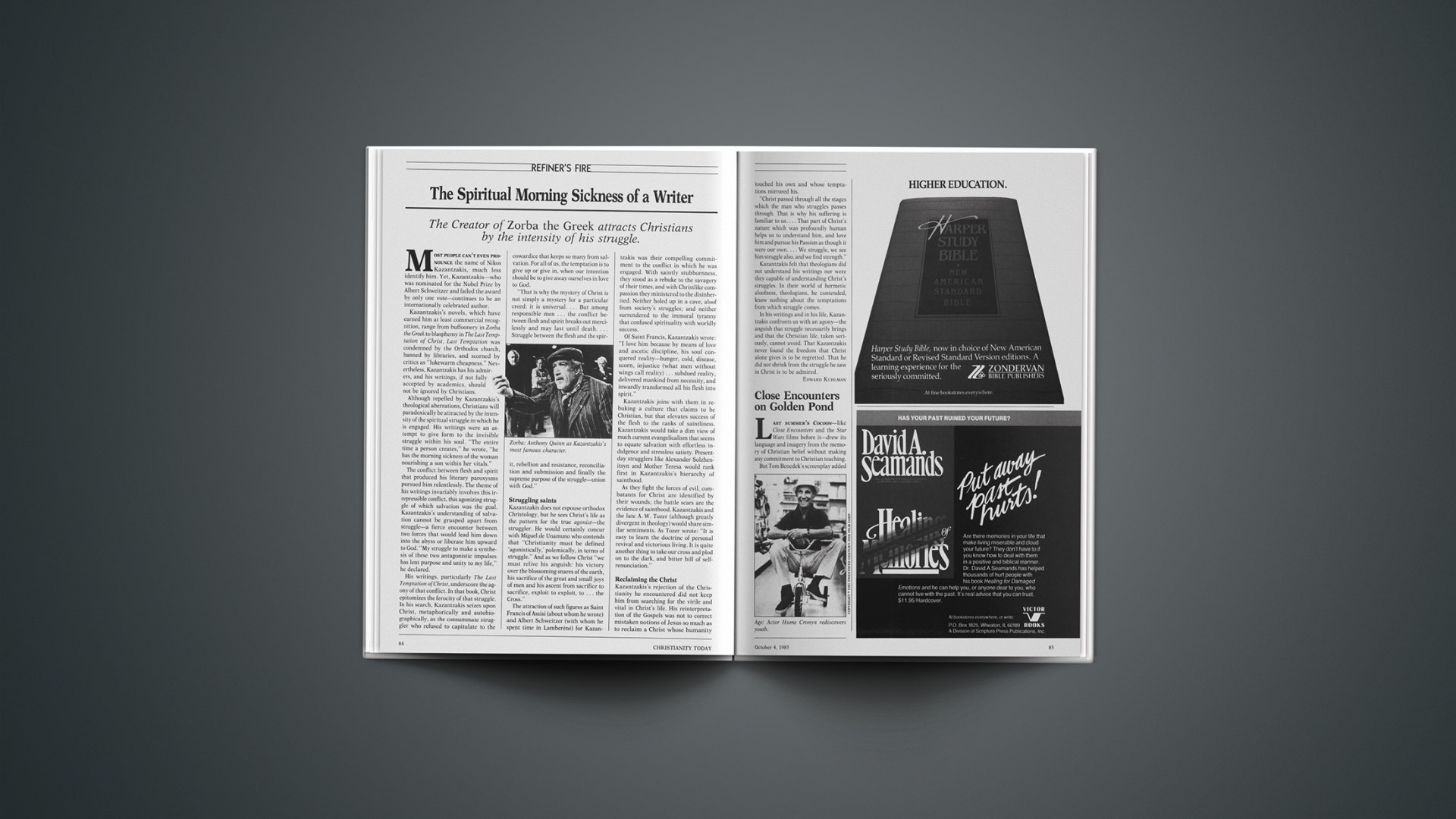
Most people can’t even pronounce the name of Nikos Kazantzakis, much less identify him. Yet, Kazantzakis—who was nominated for the Nobel Prize by Albert Schweitzer and failed the award by only one vote—continues to be an internationally celebrated author.

Kazantzakis’s novels, which have earned him at least commercial recognition, range from buffoonery in Zorba the Greek to blasphemy in The Last Temptation of Christ. Last Temptation was condemned by the Orthodox church, banned by libraries, and scorned by critics as “lukewarm cheapness.” Nevertheless, Kazantzakis has his admirers, and his writings, if not fully accepted by academics, should not be ignored by Christians.

Although repelled by Kazantzakis’s theological aberrations, Christians will paradoxically be attracted by the intensity of the spiritual struggle in which he is engaged. His writings were an attempt to give form to the invisible struggle within his soul. “The entire time a person creates,” he wrote, “he has the morning sickness of the woman nourishing a son within her vitals.”

The conflict between flesh and spirit that produced his literary paroxysms pursued him relentlessly. The theme of his writings invariably involves this irrepressible conflict, this agonizing struggle of which salvation was the goal. Kazantzakis’s understanding of salvation cannot be grasped apart from struggle—a fierce encounter between two forces that would lead him down into the abyss or liberate him upward to God. “My struggle to make a synthesis of these two antagonistic impulses has lent purpose and unity to my life,” he declared.

His writings, particularly The Last Temptation of Christ, underscore the agony of that conflict. In that book, Christ epitomizes the ferocity of that struggle. In his search, Kazantzakis seizes upon Christ, metaphorically and autobiographically, as the consummate struggler who refused to capitulate to the cowardice that keeps so many from salvation. For all of us, the temptation is to give up or give in, when our intention should be to give away ourselves in love to God.

“That is why the mystery of Christ is not simply a mystery for a particular creed: it is universal.… But among responsible men … the conflict between flesh and spirit breaks out mercilessly and may last until death.… Struggle between the flesh and the spirit, rebellion and resistance, reconciliation and submission and finally the supreme purpose of the struggle—union with God.”

Struggling Saints

Kazantzakis does not espouse orthodox Christology, but he sees Christ’s life as the pattern for the true agonist—the straggler. He would certainly concur with Miguel de Unamuno who contends that “Christianity must be defined ‘agonistically,’ polemically, in terms of struggle.” And as we follow Christ “we must relive his anguish: his victory over the blossoming snares of the earth, his sacrifice of the great and small joys of men and his ascent from sacrifice to sacrifice, exploit to exploit, to … the Cross.”

The attraction of such figures as Saint Francis of Assisi (about whom he wrote) and Albert Schweitzer (with whom he spent time in Lamberéné) for Kazantzakis was their compelling commitment to the conflict in which he was engaged. With saintly stubbornness, they stood as a rebuke to the savagery of their times, and with Christlike compassion they ministered to the disinherited. Neither holed up in a cave, aloof from society’s struggles; and neither surrendered to the immoral tyranny that confused spirituality with worldly success.

Of Saint Francis, Kazantzakis wrote: “I love him because by means of love and ascetic discipline, his soul conquered reality—hunger, cold, disease, scorn, injustice (what men without wings call reality) … subdued reality, delivered mankind from necessity, and inwardly transformed all his flesh into spirit.”

Kazantzakis joins with them in rebuking a culture that claims to be Christian, but that elevates success of the flesh to the ranks of saintliness. Kazantzakis would take a dim view of much current evangelicalism that seems to equate salvation with effortless indulgence and stressless satiety. Present-day stragglers like Alexander Solzhenitsyn and Mother Teresa would rank first in Kazantzakis’s hierarchy of sainthood.

As they fight the forces of evil, combatants for Christ are identified by their wounds; the battle scars are the evidence of sainthood. Kazantzakis and the late A. W. Tozer (although greatly divergent in theology) would share similar sentiments. As Tozer wrote: “It is easy to learn the doctrine of personal revival and victorious living. It is quite another thing to take our cross and plod on to the dark, and bitter hill of self-renunciation.”

Reclaiming The Christ

Kazantzakis’s rejection of the Christianity he encountered did not keep him from searching for the virile and vital in Christ’s life. His reinterpretation of the Gospels was not to correct mistaken notions of Jesus so much as to reclaim a Christ whose humanity touched his own and whose temptations mirrored his.

“Christ passed through all the stages which the man who struggles passes through. That is why his suffering is familiar to us.… That part of Christ’s nature which was profoundly human helps us to understand him, and love him and pursue his Passion as though it were our own.… We struggle, we see him struggle also, and we find strength.”

Kazantzakis felt that theologians did not understand his writings nor were they capable of understanding Christ’s struggles. In their world of hermetic aloofness, theologians, he contended, know nothing about the temptations from which struggle comes.

In his writings and in his life, Kazantzakis confronts us with an agony—the anguish that struggle necessarily brings and that the Christian life, taken seriously, cannot avoid. That Kazantzakis never found the freedom that Christ alone gives is to be regretted. That he did not shrink from the struggle he saw in Christ is to be admired.

EDWARD KUHLMAN1Edward Kuhlman is professor of education at Messiah College, Grantham, Pennsylvania. Jonathan D. Evans is assistant professor of English at the University of Georgia.

Close Encougners on Golden Pond

Last summer’s Cocoon—like Close Encounters and the Star Wars films before it—drew its language and imagery from the memory of Christian belief without making any commitment to Christian teaching.

But Tom Benedek’s screenplay added to the fairly routine plot of alien visitation several related social issues: the inordinate valuation of physical youth, concern for the social position of the aged, and the widespread desire to extend human life indefinitely.

Death and the aging process leading to it are problems faced by most of Cocoon’s characters. And the aliens offered a possibility that cannot fail to look attractive to the aged and to those who love them: to be taken up like Enoch to another plane where, as one character says, “We’ll never be sick, we won’t get any older, and we’ll never die.” Christians recognize this echo of scriptural promises.

Several characters think that averting normal human mortality is “cheating nature”: “Nature dealt us our hand of cards,” Bernie protests, “and now suddenly at the end of the game you want to reshuffle the deck.” But Ben later remarks to his wife, “I’ll tell you—the way nature’s been treatin’ us lately, I don’t mind cheatin’ her a little.”

As the mean age of the American populace advances and the leading edge of the post-World War II generation draws closer to retirement at the end of this century, films addressing aging and the inevitability of death will undoubtedly appear more frequently.

On Golden Pond heralded this trend several years ago; Cocoon explored the subject sensitively and imaginatively. Its quasi-spiritual answers borrowed Christian concepts but not the Christian message. Evangelicals can articulate this message as mortality becomes a more visible social and artistic issue. We know that our Redeemer lives.

JONATHAN D. EVANS

Religion in Russia

Reports of religion in Russia are full of contradiction: critics like Alexander Solzhenitsyn would have you believe that the leadership of the Orthodox church is mere show—and that like all good shows it is sold out. Others point to the apparent sincerity of Orthodox clergy and the genuine risks that they have chosen to live with just to keep the faith visible in an atheistic society.

Despite the inherent difficulties in knowing much of anything about Soviet life, producer Eugene Shirley has brought us a well-documented and profoundly moving account of the religious life of the Soviet people in Candle in the Wind.

Shirley’s documentary is a study in contrasts: the spiritless state-endorsed civil wedding and the Orthodox celebration for which bride and groom may risk their careers to be crowned queen and king of creation; the pallid lifelessness of Lenin’s corpse, preserved as a holy relic of the revolution, and the mysterious presence shining through the painted Orthodox icons; the grim determination of the secret kingdom of the gulag and the forced public smile of Soviet culture.

Candle in the Wind brings us rare sights: historical footage, never before shown in the West, of the Bolshevik revolution and Lenin’s burial, his picture carried icon-like behind his coffin; Jews celebrating a circumcision in secret; evangelicals conducting a clandestine baptism. (The secret religious meetings, the Soviets claim, were shot in Hollywood.)

And Candle in the Wind brings us rare insights: The power of the Muslim people. (By A.D. 2000, they will make up one-third of the Soviet population.) The yo-yo treatment of the Orthodox church, alternately persecuted and tolerated by the Soviet leadership.

Marred by the omission of references to the “registered” Protestant groups and by taking only the slightest notice of the 10 million Roman and Eastern Rite Catholics, Candle in the Wind is nevertheless worth the attention of church and school groups. It is available for purchase or rental from Pacem Productions, 110 S. D St., Suite 111, San Bernardino, California 92401. Watch for it sometime this fall on PBS television.

DAVID NEFF

Books

The Reformation Revisited

Reformation of Church and Dogma (1300–1700), Volume 4 of The Christian Tradition: A History of the Development of Doctrine, by Jaroslav Pelikan (University of Chicago, 1984, li + 424 pp.; $27.50).

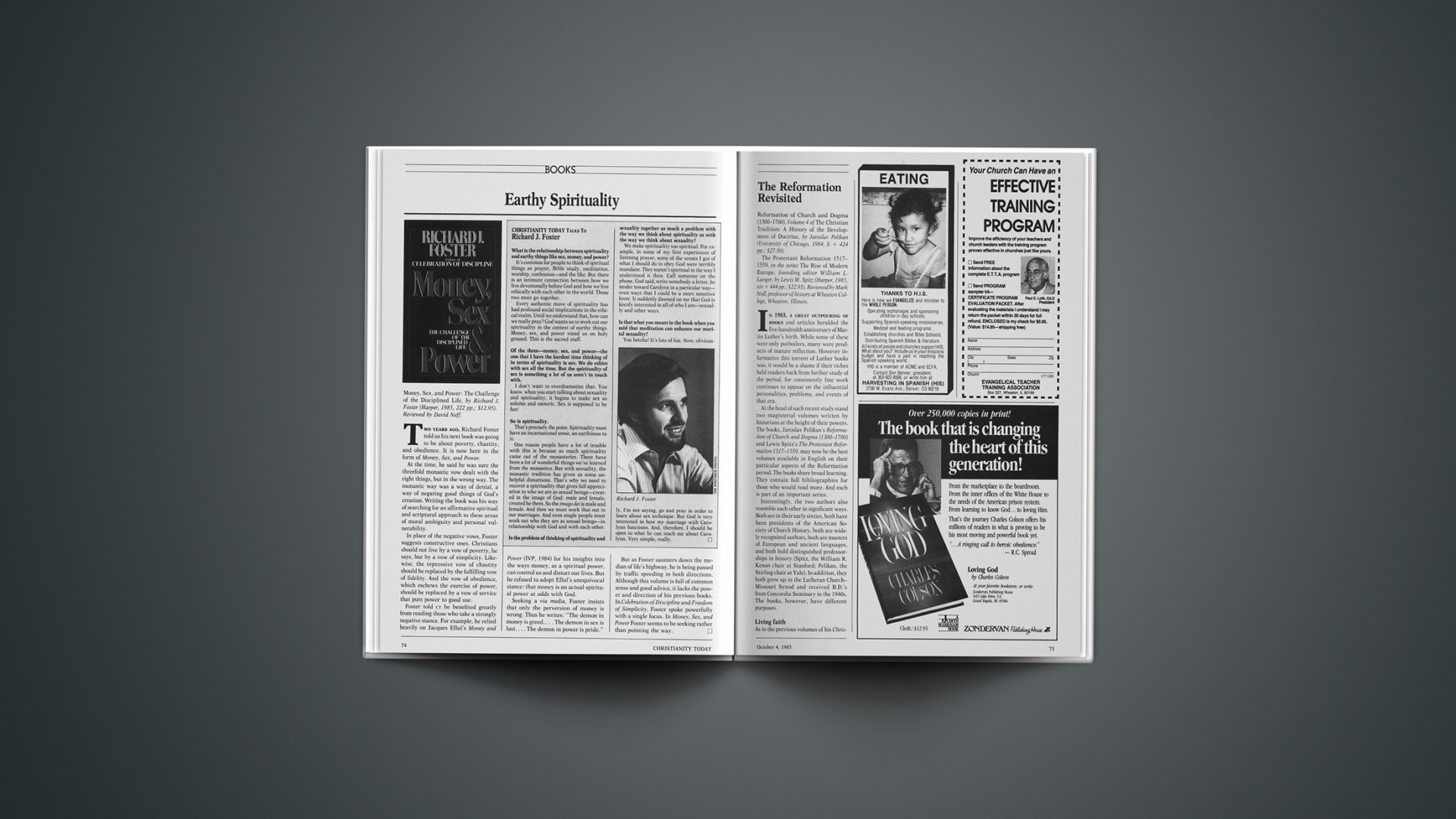
The Protestant Reformation 1517–1559, in the series The Rise of Modern Europe, founding editor William L. Langer, by Lewis W. Spitz (Harper, 1985, xiv + 444 pp.; $22.95). Reviewed by Mark Noll, professor of history at Wheaton College, Wheaton, Illinois.

In 1983, a great outpouring of books and articles heralded the five-hundredth anniversary of Martin Luther’s birth. While some of these were only potboilers, many were products of mature reflection. However informative this torrent of Luther books was, it would be a shame if their riches held readers back from further study of the period, for consistently fine work continues to appear on the influential personalities, problems, and events of that era.

At the head of such recent study stand two magisterial volumes written by historians at the height of their powers. The books, Jaroslav Pelikan’s Reformation of Church and Dogma (1300–1700) and Lewis Spitz’s The Protestant Reformation 1517–1559, may now be the best volumes available in English on their particular aspects of the Reformation period. The books share broad learning. They contain full bibliographies for those who would read more. And each is part of an important series.

Interestingly, the two authors also resemble each other in significant ways. Both are in their early sixties, both have been presidents of the American Society of Church History, both are widely recognized authors, both are masters of European and ancient languages, and both hold distinguished professorships in history (Spitz, the William R. Kenan chair at Stanford; Pelikan, the Stirling chair at Yale). In addition, they both grew up in the Lutheran Church-Missouri Synod and received B.D.’s from Concordia Seminary in the 1940s. The books, however, have different purposes.

Living Faith

As in the previous volumes of his ChristianTradition, Pelikan focuses on “what the church of Jesus Christ believes, teaches, and confesses on the basis of the word of God.” His concern is the internal development of Christian theology not as abstract speculation, but as the church’s living faith. This criterion of selection enables Pelikan to set aside many issues that often take up considerable space in other histories of doctrine; for example, matters relating to church and state, Christianity and other faiths, or merely academic theology. The result is sharply focused consideration of the major doctrinal beliefs that occupied the minds and hearts of Christians through the years.

The center of this volume is the theological tumult of the Reformation. Pelikan devotes four solid chapters to the sixteenth century. Although each ranges widely, it is organized around the major emphasis of one of the period’s four great movements—Lutheran reassertion of “the Gospel as the Treasure of the Church,” the Reformed or Calvinistic stress on “the Word and Will of God,” the Roman Catholic effort to define its own “particularity” in the face of Protestant challenge, and the various protests (humanist, Anabaptist, rationalist, Unitarian) against traditions accepted in common by the Catholics, the Lutherans, and the Reformed.

Pelikan brackets this central section with two chapters on the fourteenth and fifteenth centuries, and a concluding one on the seventeenth. The two chapters on late medieval theology emphasize the doctrinal pluralism of the period and the intense debates on the nature of the church that took place in the century before Luther. The book’s last chapter is a splendid account of how Lutherans, Reformed, and Catholics applied themselves to theological self-identification. This chapter also describes the important links between emphases of the Reformation and the crisis of faith brought on by the eighteenth-century Enlightenment.

Pelikan excels at weaving technical discussions of recondite topics into readily understandable patterns. He shows clearly, for instance, how many of the distinctive Protestant conceptions of the sixteenth century (such as views on biblical authority) were anticipated in earlier periods. He explains the constant quoting of Augustine, beyond doubt the most important theological influence after Scripture throughout the period. Why Luther cited Augustine on original sin, and his Catholic opponents cited Augustine on the church, is made clear.

A special strength of this book is its careful unraveling of complicated controversies on the sacraments. Debates over what the Lord’s Supper meant were especially intense during these centuries. From the relevant authors themselves—followers of Jan Hus in Bohemia and theologians in England and Scotland, as well as the major statements of the best-known leaders—Pelikan weaves a compelling account. Catholics insisted upon transubstantiation and the sacrifice of the Mass in part because of patristic traditions supporting those beliefs. But they also did so because these questions were stress points testing the teaching authority of the church. Lutherans and Calvinists battled each other over the Lord’s Supper in part because they held slightly different views about the relationship between Christ’s divine and human natures.

At several points, Pelikan makes clear how these divisions over the Lord’s Table led to other important doctrinal developments. This was especially so with Protestant efforts to define more precisely the nature of Scripture and its method of interpretation. Those who think that arguments over scriptural inerrancy or contextual hermeneutics are a new thing should read this book. Such vital matters were aired, and aired thoroughly, in painstakingly careful theologies of the sixteenth and seventeenth centuries.

There can be few criticisms of this book. Occasionally one wishes that Pelikan would conclude a learned discussion with an evaluation or a reflection about modern implications. And because of the way he has defined his task, Pelikan sometimes shunts aside important issues closely related to the story of dogma. But on the whole, it is nearly impossible to praise this book too highly. While it places reasonably severe demands upon a reader, it also rewards with rich, even moving, insights into the drama of Christian teaching.

Historical Connections

Although Lewis Spitz’s Protestant Reformation contains ample consideration of theology, this book is different from Pelikan’s. Rather than considering the internal theological life of the church over four centuries, it concentrates on the web of historical connections over just four decades. Among these connections, Christian developments receive careful attention, but always in the context of other matters. So besides discussing the theologies of Luther and Calvin, the church-state situation in England, the rise of the Anabaptists, and Protestant-Catholic competition. Spitz also considers the political tangles of the period. He clarifies conflict between the Muslim-Turkish East and the Christian West, the growth and dispersal of population, economic setbacks and advances, the social status of kings and merchants, and a wide range of issues involving education, science, and the role of women.

Vast as this canvass is, however, Spitz never loses sight of the fact that religious considerations dominated the age. So it is appropriate that the stories of Calvin, Zwingli of Zurich, leading Anabaptists, Knox in Scotland, Cranmer and associates in England, the conveners of the Catholic Council of Trent, and especially Luther are the book’s highlights.

Unlike other historians of early modern Europe, Spitz does not reduce the religious activities of these individuals to functions of class struggle, economic change, or social aspirations. The whole book is set out to show that these matters deserve primary consideration. Because he is writing for a general audience, Spitz does not pause to make religious points. Yet his belief in the importance of these religious developments is everywhere apparent. Although the Reformation does “defy final explanation, … it was a movement of the human spirit, broad in its historical dimensions, and of monumental importance for modern Europe, America, and all the world.”

(Spitz has elsewhere described how a Christian may engage in this kind of historical work while maintaining belief in God’s providential rule. See his “History: Sacred and Secular,” ChurchHistory, 47 [1978], pp. 5–22.)

Spitz takes full advantage of his narrow chronological focus to bring his subjects vividly to life. Thus, besides providing a fine summary of Luther’s theology, Spitz tells us something about the great Reformer’s wit—Luther could call his major theological opponent, John Eck, simply “Dreck” (German for “dirt”). And he can pause to illustrate Luther’s concern for Christian maturity—as early as 1524, for example, Luther was blasting the printers of his day for “publishing sensational profit-making books and pamphlets rather than serious history and decent literature.” Again, in a very few words, Spitz catches exactly the character of the English Catholic Reformer, Thomas More, whom later generations have made into a plastic saint. To Spitz, More was “a firm, hard, and consequential man who could whip and persecute heretics, deal out death, as, indeed, he could take it.”

Naturally a few questions remain about Spitz’s treatment. He may have overemphasized Luther’s influence, as when he sees the replacement of Luther’s influence by Calvin’s in France as the cause of the decline of Protestantism in that country. And his brief section on the Anabaptists may not give these important Reformers, who defended the free conscience before God, their just due. But in general, Spitz’s judgments on an immense range of subjects are forceful and persuasive. The book, in short, is history at its best—broadly researched, skillfully written, judiciously argued, and also spiritually insightful.

Required Reading

These two books should be required reading for evangelicals. It was, after all, soon after Luther posted his Ninety-five Theses that those who appreciated his insights began to call themselves “evangelicals.” They were ones for whom the most important thing had become “the true treasure of the church … the most holy gospel of the glory and grace of God.”

Spiritual benefits lie in store for those who, with the aid of Pelikan, Spitz, and other competent guides, seriously study the gospel that the Reformers proclaimed. To be sure, such an effort has its ambiguities. To understand the sixteenth century better means also to understand the force of Roman Catholic criticism—that Protestants had no fixed points of authority except their own subjectivity, or that if the Bible were as clear as the Protestants claimed, there should not be so much dissension among them.

But studying the sixteenth century also brings us closer to the heart of evangelical faith. Luther, more powerfully than almost anyone in the history of the church, defined the justifying mercy that God poured forth in Christ. Calvin illuminated masterfully the responsibilities and duties of those who professed to follow “the Bible alone.” Anglicans, Dutch Reformed, and leaders of the Scottish Kirk showed how to inspire entire cultures toward godliness. Anabaptists lived the way of the Cross. And individuals from all parties—Catholic as well as Protestant—illustrated what it meant to love the Lord with heart, strength, soul, and mind.

These are the treasures of the sixteenth century. They await Christians who have ears to hear what scholars like Spitz and Pelikan are saying to the churches.

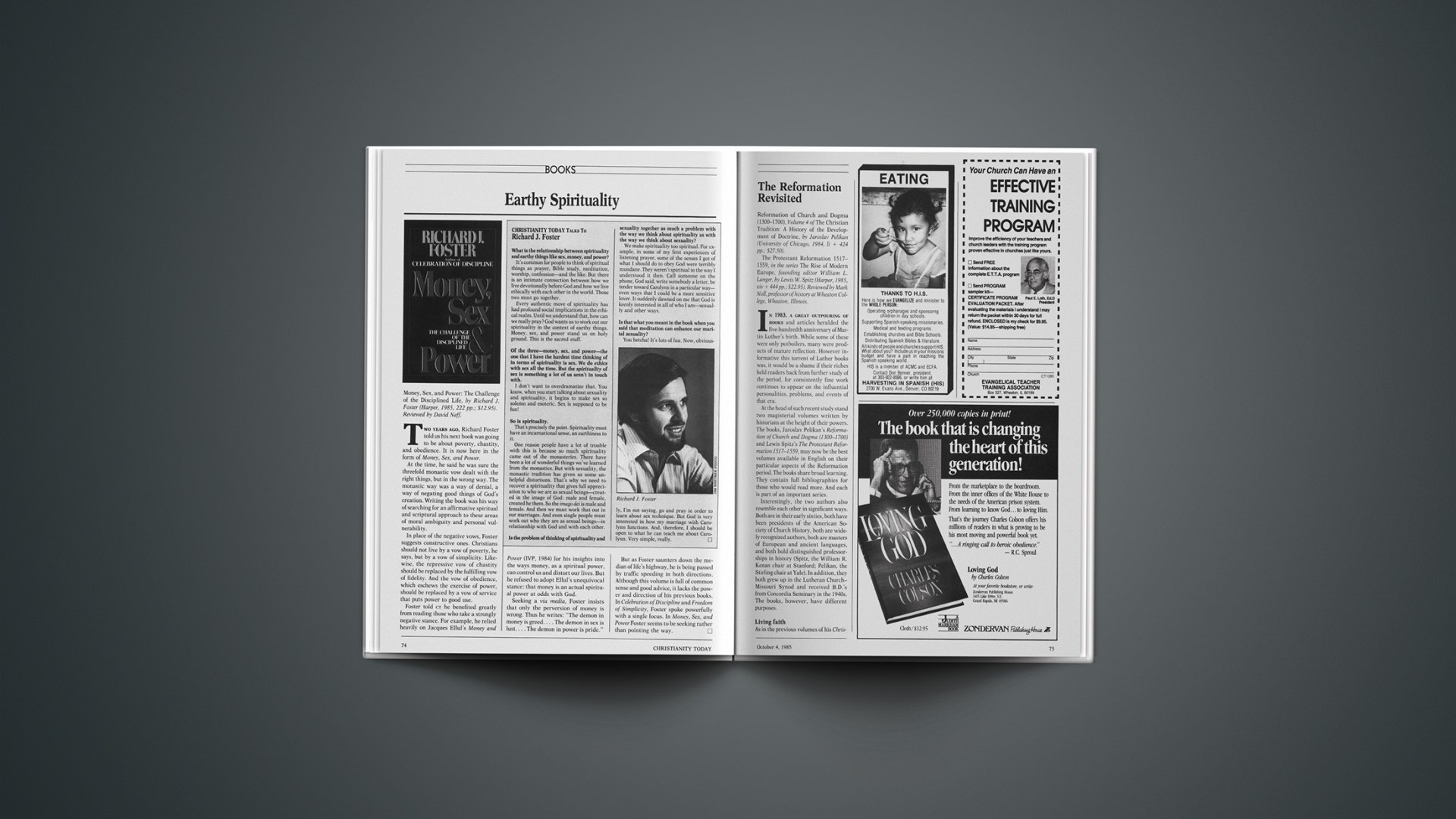
CHRISTIANITY TODAY TALKS TO Richard J. Foster

What is the relationship between spirituality and earthy things like sex, money, and power?

It’s common for people to think of spiritual things as prayer, Bible study, meditation, worship, confession—and the like. But there is an intimate connection between how we live devotionally before God and how we live ethically with each other in the world. Those two must go together.

Every authentic move of spirituality has had profound social implications in the ethical realm. Until we understand that, how can we really pray? God wants us to Work out our spirituality in the context of earthy things. Money, sex, and power stand us on holy ground. This is the sacred stuff.

Of the three—money, sex, and power—the one that I have the hardest time thinking of in terms of spirituality is sex. We do ethics with sex all the time. But the spirituality of sex is something a lot of us aren’t in touch with.

I don’t want to overdramatize that. You know, when you start talking about sexuality and spirituality, it begins to make sex so solemn and esoteric. Sex is supposed to be fun!

So is spirituality.

That’s precisely the point. Spirituality must have an incarnational sense, an earthiness to it.

One reason people have a lot of trouble with this is because so much spirituality came out of the monasteries. There have been a lot of wonderful things we’ve learned from the monastics. But with sexuality, the monastic tradition has given us some unhelpful distortions. That’s why we need to recover a spirituality that gives full appreciation to who we are as sexual beings—created in the image of God: male and female, created he them. So the imago dei is male and female. And then we must work that out in our marriages. And even single people must work out who they are as sexual beings—in relationship with God and with each other.

Is the problem of thinking of spirituality and sexuality together as much a problem with the way we think about spirituality as with the way we think about sexuality?

We make spirituality too spiritual. For example, in some of my first experiences of listening prayer, some of the senses I got of what I should do to obey God were terribly mundane. They weren’t spiritual in the way I understood it then. Call someone on the phone, God said, write somebody a letter, be tender toward Carolynn in a particular way—even ways that I could be a more sensitive lover. It suddenly dawned on me that God is keenly interested in all of who I am—sexually and other ways.

Is that what you meant in the book when you said that meditation can enhance our marital sexuality?

You betcha! It’s lots of fun. Now, obviously, I’m not saying, go and pray in order to learn about sex technique. But God is very interested in how my marriage with Carolynn functions. And, therefore, I should be open to what he can teach me about Carolynn. Very simple, really.

Books

Books: October 4, 1985

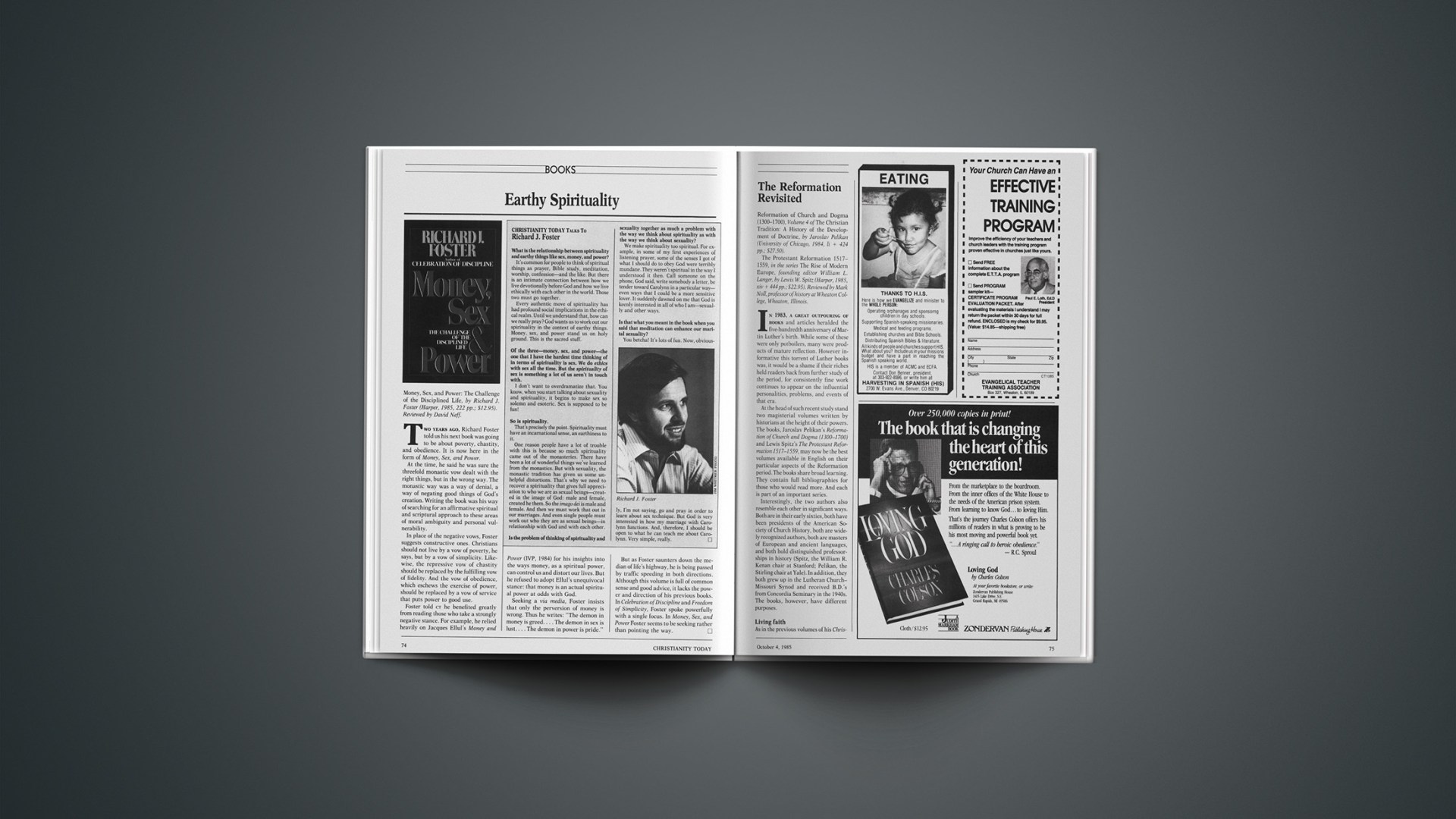
Money, Sex, and Power: The Challenge of the Disciplined Life, by Richard J. Foster (Harper, 1985, 222 pp.; $12.95). Reviewed by David Neff.

Two years ago, Richard Foster told us his next book was going to be about poverty, chastity, and obedience. It is now here in the form of Money, Sex, and Power.

At the time, he said he was sure the threefold monastic vow dealt with the right things, but in the wrong way. The monastic way was a way of denial, a way of negating good things of God’s creation. Writing the book was his way of searching for an affirmative spiritual and scriptural approach to these areas of moral ambiguity and personal vulnerability.

In place of the negative vows, Foster suggests constructive ones. Christians should not live by a vow of poverty, he says, but by a vow of simplicity. Likewise, the repressive vow of chastity should be replaced by the fulfilling vow of fidelity. And the vow of obedience, which eschews the exercise of power, should be replaced by a vow of service that puts power to good use.

Foster told CT he benefited greatly from reading those who take a strongly negative stance. For example, he relied heavily on Jacques Ellul’s Money and Power (IVP, 1984) for his insights into the ways money, as a spiritual power, can control us and distort our lives. But he refused to adopt Ellul’s unequivocal stance: that money is an actual spiritual power at odds with God.

Seeking a via media, Foster insists that only the perversion of money is wrong. Thus he writes: “The demon in money is greed.… The demon in sex is lust.… The demon in power is pride.”

But as Foster saunters down the median of life’s highway, he is being passed by traffic speeding in both directions. Although this volume is full of common sense and good advice, it lacks the power and direction of his previous books. In Celebration of Discipline and Freedom of Simplicity, Foster spoke powerfully with a single focus. In Money, Sex, and Power Foster seems to be seeking rather than pointing the way.

Ethiopia Continues to Impose Restrictions on the Church

However, congregations are growing in the famine-stricken African nation.

In October 1984, a curious paradox was about to begin in dust-swept Ethiopia. It was only weeks before the start of one of the greatest outpourings of world Christian concern ever to be lavished on a nation.

But such a possibility was far from the minds of provincial Communist leaders. A month earlier, the nation had celebrated the tenth anniversary of the revolution that brought Ethiopia’s Communist regime to power. With the intent of suppressing all antirevolutionary forces, provincial leaders set out to decimate the evangelical church. In a single week, 700 churches were closed in one province alone.

It was not the first time churches had been closed in Ethiopia. During the last five years, hundreds of Protestant churches in isolated provinces have been closed, and then, often, gradually allowed to reopen.

But October 1984 saw the beginning of more severe restrictions. Paradoxically, it also saw the beginning of the Ethiopian church’s greatest outreach to needy neighbors in drought-stricken regions.

Famine Relief

Both of the country’s largest Protestant denominations operate development agencies through which millions of dollars of famine relief have been channeled during the past year. The one million-member Word of Life church grew out of the ministry of SIM, International, which began working in Ethiopia in 1927. The nearly 700,000-member Ethiopian Evangelical Church Mekane Yesus is the second-largest Protestant denomination. That church traces its roots to Scandanavian Lutheran missions that came to Ethiopia in the mid-1800s.

Along with foreign volunteers, it is members of these denominations and other churches who administer and distribute food and other famine-related aid. Even in areas where church buildings are locked and leaders imprisoned, churches have been active in ministry.

“The efforts of the church in drought-affected areas have been seen as coming in the name of the church and in the name of Christ,” said Daniel Olson, secretary for Africa in the Lutheran Church in America’s Division of World Missions and Ecumenism. “The drought and famine has taken a lot of the energy and effort of the church, but it has not stopped other outreach, such as evangelism. The church has had phenomenal growth in the past, and it continues to grow.”

A Suffering Church

The unfortunate fact is that the church is suffering in many parts of Ethiopia. Although there is no official policy forbidding the practice of religion, local political cadres are allowed to suppress the church as they see fit.

Nearly 1,800 of the Word of Life’s 2,500 churches are closed. At various times during the last few years as many as 20 of the denomination’s leaders have been in prison at the same time. Arrested and held without charge, they have been confined for periods ranging from weeks to years.

Some 500 of the Mekane Yesus’ 2,000 churches have been closed. And during the last several years, hundreds of that church’s leaders and members have been imprisoned. Gudina Tumsa, the denomination’s former general secretary, disappeared in 1979 and is presumed dead. His wife has been in prison in Addis Ababa most of the time since his disappearance.

The Meserete Kristos church—which has been related to American Mennonite churches—has been even harder hit. The denomination’s top leaders have been in prison for years, and none of its congregations are allowed to function openly. Pentecostal churches were banned even before the 1974 revolution. Many of those congregations have disbanded, with members attending churches of other denominations.

Tenuous Freedom

The Ethiopian Orthodox Church has enjoyed a tenuous freedom. In 1974, it claimed a membership of 15.6 million—more than half the country’s population. At the time of the revolution, the atheistic government decided to tolerate the Orthodox church. Its influence has been reduced, however. The church lost its extensive land holdings in the land reforms that were instituted following the revolution. In addition, its heirarchy was reduced in size, and its associations for youth, women, and others were banned.

Few Orthodox churches have been closed. However, some observers say Ethiopia’s large Orthodox church and its small Roman Catholic church may soon face some of the same pressures experienced by the Protestant churches. The administration of most Protestant schools, hospitals, and clinics has been taken over by the government. And there is perhaps only one Protestant seminary that remains open.

Most missionaries were forced to leave Ethiopia shortly after the revolution. Today, perhaps 300 Protestant missionaries (not including temporary relief workers) continue to work in the country, primarily in education, relief, and development.

Meanwhile, the churches continue to grow. “It is interesting to note that while the number of missionaries has decreased dramatically since 1977, the number of churches has increased,” said John Cumbers, former East Africa director of SIM, International. He now serves as assistant to SIM’s general director.

“The general principle of Marxist ideology is that if anyone is seen as rebelling against it, they should be put down,” Cumbers said. “The church leaders with whom I have spoken feel that things will get worse before they get better.”

SHARON E. MUMPER

Apple PodcastsDown ArrowDown ArrowDown Arrowarrow_left_altLeft ArrowLeft ArrowRight ArrowRight ArrowRight Arrowarrow_up_altUp ArrowUp ArrowAvailable at Amazoncaret-downCloseCloseEmailEmailExpandExpandExternalExternalFacebookfacebook-squareGiftGiftGooglegoogleGoogle KeephamburgerInstagraminstagram-squareLinkLinklinkedin-squareListenListenListenChristianity TodayCT Creative Studio Logologo_orgMegaphoneMenuMenupausePinterestPlayPlayPocketPodcastRSSRSSSaveSaveSaveSearchSearchsearchSpotifyStitcherTelegramTable of ContentsTable of Contentstwitter-squareWhatsAppXYouTubeYouTube