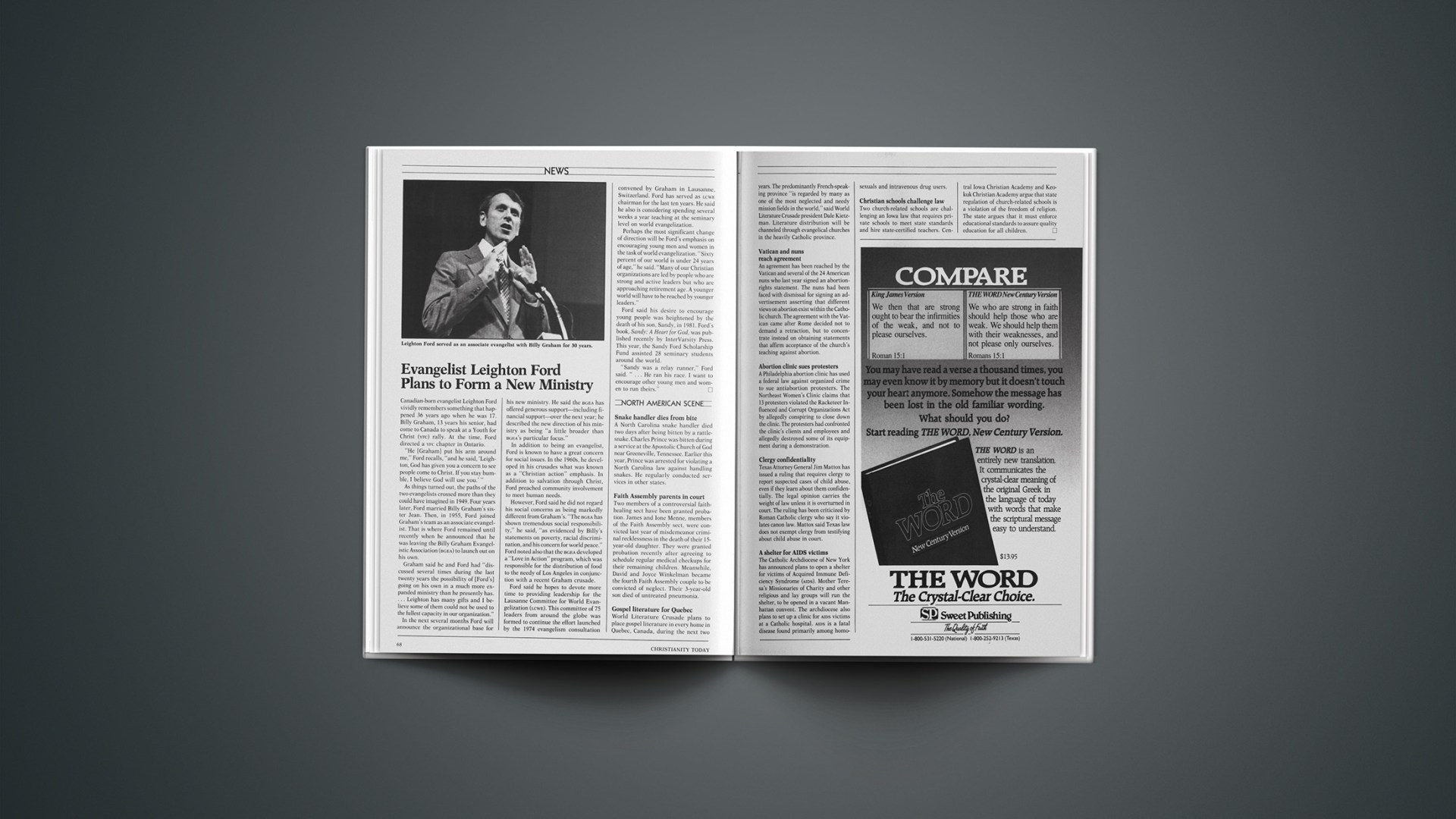
Evangelist Leighton Ford Plans to Form a New Ministry

Canadian-born evangelist Leighton Ford vividly remembers something that happened 36 years ago when he was 17. Billy Graham, 13 years his senior, had come to Canada to speak at a Youth for Christ (YFC) rally. At the time, Ford directed a YFC chapter in Ontario.

“He [Graham] put his arm around me,” Ford recalls, “and he said, ‘Leighton, God has given you a concern to see people come to Christ. If you stay humble, I believe God will use you.’ ”

As things turned out, the paths of the two evangelists crossed more than they could have imagined in 1949. Four years later, Ford married Billy Graham’s sister Jean. Then, in 1955, Ford joined Graham’s team as an associate evangelist. That is where Ford remained until recently when he announced that he was leaving the Billy Graham Evangelistic Association (BGEA) to launch out on his own.

Graham said he and Ford had “discussed several times during the last twenty years the possibility of [Ford’s] going on his own in a much more expanded ministry than he presently has.… Leighton has many gifts and I believe some of them could not be used to the fullest capacity in our organization.”

In the next several months Ford will announce the organizational base for his new ministry. He said the BGEA has offered generous support—including financial support—over the next year; he described the new direction of his ministry as being “a little broader than BGEA’s particular focus.”

In addition to being an evangelist, Ford is known to have a great concern for social issues. In the 1960s, he developed in his crusades what was known as a “Christian action” emphasis. In addition to salvation through Christ, Ford preached community involvement to meet human needs.

However, Ford said he did not regard his social concerns as being markedly different from Graham’s. “The BGEA has shown tremendous social responsibility,” he said, “as evidenced by Billy’s statements on poverty, racial discrimination, and his concern for world peace.” Ford noted also that the BGEA developed a “Love in Action” program, which was responsible for the distribution of food to the needy of Los Angeles in conjunction with a recent Graham crusade.

Ford said he hopes to devote more time to providing leadership for the Lausanne Committee for World Evangelization (LCWE). This committee of 75 leaders from around the globe was formed to continue the effort launched by the 1974 evangelism consultation convened by Graham in Lausanne, Switzerland. Ford has served as LCWE chairman for the last ten years. He said he also is considering spending several weeks a year teaching at the seminary level on world evangelization.

Perhaps the most significant change of direction will be Ford’s emphasis on encouraging young men and women in the task of world evangelization. “Sixty percent of our world is under 24 years of age,” he said. “Many of our Christian organizations are led by people who are strong and active leaders but who are approaching retirement age. A younger world will have to be reached by younger leaders.”

Ford said his desire to encourage young people was heightened by the death of his son, Sandy, in 1981. Ford’s book, Sandy: A Heart for God, was published recently by InterVarsity Press. This year, the Sandy Ford Scholarship Fund assisted 28 seminary students around the world.

“Sandy was a relay runner,” Ford said. “… He ran his race. I want to encourage other young men and women to run theirs.”

NORTH AMERICAN SCENE

Snake Handler Dies From Bite

A North Carolina snake handler died two days after being bitten by a rattlesnake. Charles Prince was bitten during a service at the Apostolic Church of God near Greeneville, Tennessee. Earlier this year, Prince was arrested for violating a North Carolina law against handling snakes. He regularly conducted services in other states.

Faith Assembly Parents In Court

Two members of a controversial faith-healing sect have been granted probation. James and Ione Menne, members of the Faith Assembly sect, were convicted last year of misdemeanor criminal recklessness in the death of their 15-year-old daughter. They were granted probation recently after agreeing to schedule regular medical checkups for their remaining children. Meanwhile, David and Joyce Winkelman became the fourth Faith Assembly couple to be convicted of neglect. Their 3-year-old son died of untreated pneumonia.

Gospel Literature For Quebec

World Literature Crusade plans to place gospel literature in every home in Quebec, Canada, during the next two years. The predominantly French-speaking province “is regarded by many as one of the most neglected and needy mission fields in the world,” said World Literature Crusade president Dale Kietzman. Literature distribution will be channeled through evangelical churches in the heavily Catholic province.

Vatican And Nuns Reach Agreement

An agreement has been reached by the Vatican and several of the 24 American nuns who last year signed an abortion-rights statement. The nuns had been faced with dismissal for signing an advertisement asserting that different views on abortion exist within the Catholic church. The agreement with the Vatican came after Rome decided not to demand a retraction, but to concentrate instead on obtaining statements that affirm acceptance of the church’s teaching against abortion.

Abortion Clinic Sues Protesters

A Philadelphia abortion clinic has used a federal law against organized crime to sue antiabortion protesters. The Northeast Women’s Clinic claims that 13 protesters violated the Racketeer Influenced and Corrupt Organizations Act by allegedly conspiring to close down the clinic. The protesters had confronted the clinic’s clients and employees and allegedly destroyed some of its equipment during a demonstration.

Clergy Confidentiality

Texas Attorney General Jim Mattox has issued a ruling that requires clergy to report suspected cases of child abuse, even if they learn about them confidentially. The legal opinion carries the weight of law unless it is overturned in court. The ruling has been criticized by Roman Catholic clergy who say it violates canon law. Mattox said Texas law does not exempt clergy from testifying about child abuse in court.

A Shelter For Aids Victims

The Catholic Archdiocese of New York has announced plans to open a shelter for victims of Acquired Immune Deficiency Syndrome (AIDS). Mother Teresa’s Missionaries of Charity and other religious and lay groups will run the shelter, to be opened in a vacant Manhattan convent. The archdiocese also plans to set up a clinic for AIDS victims at a Catholic hospital. AIDS is a fatal disease found primarily among homosexuals and intravenous drug users.

Christian Schools Challenge Law

Two church-related schools are challenging an Iowa law that requires private schools to meet state standards and hire state-certified teachers. Central Iowa Christian Academy and Keokuk Christian Academy argue that state regulation of church-related schools is a violation of the freedom of religion. The state argues that it must enforce educational standards to assure quality education for all children.
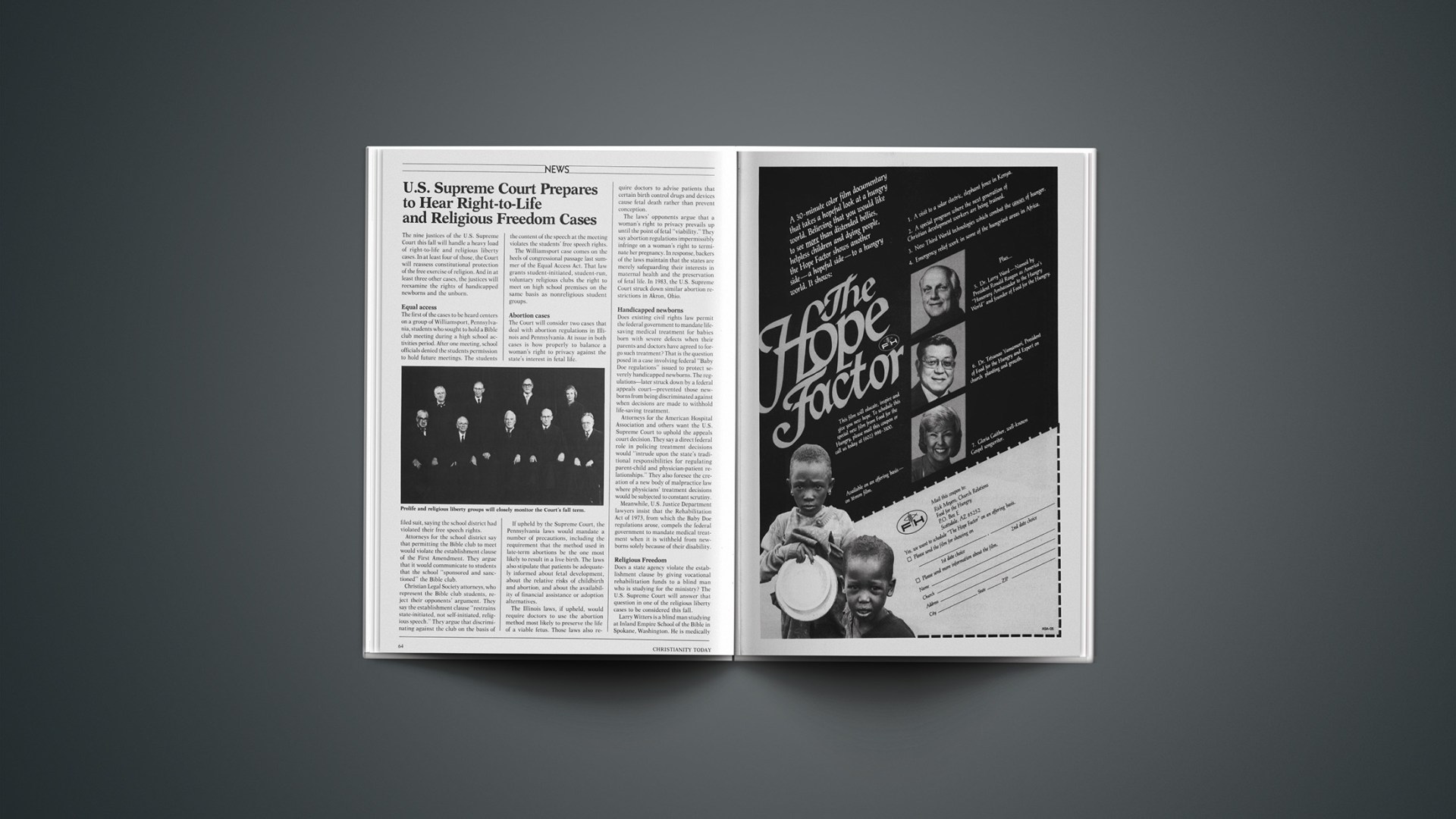
U.S. Supreme Court Prepares to Hear Right-to-Life and Religious Freedom Cases

The nine justices of the U.S. Supreme Court this fall will handle a heavy load of right-to-life and religious liberty cases. In at least four of those, the Court will reassess constitutional protection of the free exercise of religion. And in at least three other cases, the justices will reexamine the rights of handicapped newborns and the unborn.

Equal Access

The first of the cases to be heard centers on a group of Williamsport, Pennsylvania, students who sought to hold a Bible club meeting during a high school activities period. After one meeting, school officials denied the students permission to hold future meetings. The students filed suit, saying the school district had violated their free speech rights.

Attorneys for the school district say that permitting the Bible club to meet would violate the establishment clause of the First Amendment. They argue that it would communicate to students that the school “sponsored and sanctioned” the Bible club.

Christian Legal Society attorneys, who represent the Bible club students, reject their opponents’ argument. They say the establishment clause “restrains state-initiated, not self-initiated, religious speech.” They argue that discriminating against the club on the basis of the content of the speech at the meeting violates the students’ free speech rights.

The Williamsport case comes on the heels of congressional passage last summer of the Equal Access Act. That law grants student-initiated, student-run, voluntary religious clubs the right to meet on high school premises on the same basis as nonreligious student groups.

Abortion Cases

The Court will consider two cases that deal with abortion regulations in Illinois and Pennsylvania. At issue in both cases is how properly to balance a woman’s right to privacy against the state’s interest in fetal life.

If upheld by the Supreme Court, the Pennsylvania laws would mandate a number of precautions, including the requirement that the method used in late-term abortions be the one most likely to result in a live birth. The laws also stipulate that patients be adequately informed about fetal development, about the relative risks of childbirth and abortion, and about the availability of financial assistance or adoption alternatives.

The Illinois laws, if upheld, would require doctors to use the abortion method most likely to preserve the life of a viable fetus. Those laws also require doctors to advise patients that certain birth control drugs and devices cause fetal death rather than prevent conception.

The laws’ opponents argue that a woman’s right to privacy prevails up until the point of fetal “viability.” They say abortion regulations impermissibly infringe on a woman’s right to terminate her pregnancy. In response, backers of the laws maintain that the states are merely safeguarding their interests in maternal health and the preservation of fetal life. In 1983, the U.S. Supreme Court struck down similar abortion restrictions in Akron, Ohio.

Handicapped Newborns

Does existing civil rights law permit the federal government to mandate life-saving medical treatment for babies born with severe defects when their parents and doctors have agreed to forgo such treatment? That is the question posed in a case involving federal “Baby Doe regulations” issued to protect severely handicapped newborns. The regulations—later struck down by a federal appeals court—prevented those newborns from being discriminated against when decisions are made to withhold life-saving treatment.

Attorneys for the American Hospital Association and others want the U.S. Supreme Court to uphold the appeals court decision. They say a direct federal role in policing treatment decisions would “intrude upon the state’s traditional responsibilities for regulating parent-child and physician-patient relationships.” They also foresee the creation of a new body of malpractice law where physicians’ treatment decisions would be subjected to constant scrutiny.

Meanwhile, U.S. Justice Department lawyers insist that the Rehabilitation Act of 1973, from which the Baby Doe regulations arose, compels the federal government to mandate medical treatment when it is withheld from newborns solely because of their disability.

Religious Freedom

Does a state agency violate the establishment clause by giving vocational rehabilitation funds to a blind man who is studying for the ministry? The U.S. Supreme Court will answer that question in one of the religious liberty cases to be considered this fall.

Larry Witters is a blind man studying at Inland Empire School of the Bible in Spokane, Washington. He is medically eligible to participate in the state’s vocational rehabilitation program. But he was denied assistance on the grounds that the state constitution forbids the use of public money to subsidize religious study. That action was upheld by the Washington State Supreme Court.

Mike Farris, general counsel for Concerned Women for America, is representing Witters. In his brief to the U.S. Supreme Court, Farris says the primary effect of the state’s aid plan is not to advance religion, but “to help blind people obtain training and find employment … any effect upon religion is incidental.” Farris says the state’s denial of funds violates Witters’s freedom of religion.

The free exercise of religion figures prominently in two other cases before the U.S. Supreme Court. One involves an American Indian who objects on religious grounds to his daughter’s needing an identification number in order to receive welfare benefits. The other involves a U.S. Air Force psychologist who is Jewish. He contends that the First Amendment’s free exercise clause compels the air force to allow him to wear a yarmulke while he is on duty. In both cases, the high court will weigh an individual’s interest in religious liberty against the government’s interest in the efficient operation of its programs and departments.

PETE WYLIE

Sex Education Teacher Sues Her Critics

Concerned Women for America (CWA) has appealed for funds to provide legal defense for some 85 people who are being sued by a Pennsylvania high school teacher. Marlene Stein, who teaches health education at Red Lion High School near York, Pennsylvania, filed the lawsuit, claiming defamation of character and invasion of privacy.

The flap over Stein, who has taught at Red Lion for more than ten years, began early last year. Parents of high school students approached the Red Lion School Board with complaints about some of Stein’s methods and viewpoints expressed during the sex education segment of her health course. Parents and other citizens later formed the Red Lion Citizens for Decency Committee and petitioned the school board for Stein’s dismissal.

After the school board voted unanimously not to take any action, the citizen’s group took its case to court. The case was thrown out when a judge ruled that the proper remedy was for citizens to vote school board members out of office who were unresponsive to their petition.

Stein turned the tables early this year by filing suit against 113 parties, including a local newspaper, a Christian television station, and many citizens who had signed a petition against her. CWA is defending those who did not retain other legal counsel.

A fund-raising letter sent out by CWA president Beverly LaHaye listed 16 allegations of wrongdoing against Stein, who also has served as coach of the girls’ swimming team. The letter states that Stein required swimming team members to practice in the nude if they arrived late. The letter also states that Stein “encouraged the kind of relationship with the girls on her team where they bought her adult-oriented, sexually-deviant gifts.” It states further that in a coed sex education class, Stein “required boys and girls to hold hands and repeat slang expressions for sex acts.”

CWA staff attorney Cimron Campbell said he possesses signed statements from students and former students that substantiate the allegations against Stein. “This dispute is not over the teaching of sex education,” he said, “but over the way it is taught.”

One of Stein’s attorneys, Larry Markowitz, said the allegations generally are unfounded or are based on distortion. He said some of the allegations mentioned in the CWA letter were not even raised during the effort to have Stein fired.

“We have said all along,” Markowitz said, “that Mrs. Stein has done nothing to bring on these kinds of charges.”

If any of Stein’s lawsuits go to trial, the truth or falsehood of the allegations will be determined by a court of law.

WORLD SCENE

Socialist Priest Banned

An Italian priest has been banned from the Roman Catholic priesthood for disobedience and partisan political activity. The action came after the priest, Giovanni Baget Bozzo, was elected a Socialist deputy in the European Parliament. In the past, Bozzo had criticized his ecclesiastical superior and the Pope in newspaper articles. He was barred in 1981 from celebrating mass, preaching, and hearing confessions.

Christian Rock Musician In Russia

Keston College reports that Christian rock musician Valeri Barinov is seriously ill after being held in an isolation cell in a Soviet labor camp. He had been placed in the cell after beginning the latest of several hunger strikes in June. Barinov and his band secretly recorded a Christian rock opera, entitled The Trumpet Call, before he was sentenced to two-and-a-half years in a labor camp in 1984. The recording is available in the United States on the I Care Records label.

Priest Arrested In Honduras

Honduran military authorities have arrested an American Jesuit priest for “crimes against the state.” John R. Donald was arrested after saying mass in the town of Sava. He is known to oppose U.S. military aid to Honduras. A Catholic missionary spokesman said it is illegal for foreigners in Honduras to publicly criticize the government.

Mormon Temple In East Germany

A new Mormon temple has been consecrated in Freiburg, East Germany, in the presence of government officials. The Communist party newspaper reported the consecration, noting that there are some 5,000 Mormons in more than 40 East German congregations. Meanwhile in Israel, some Christian leaders are opposing a branch of the Mormon-owned Brigham Young University under construction in Jerusalem. Christians have been joined in their efforts by Jewish activists who oppose missionary activity in Israel.

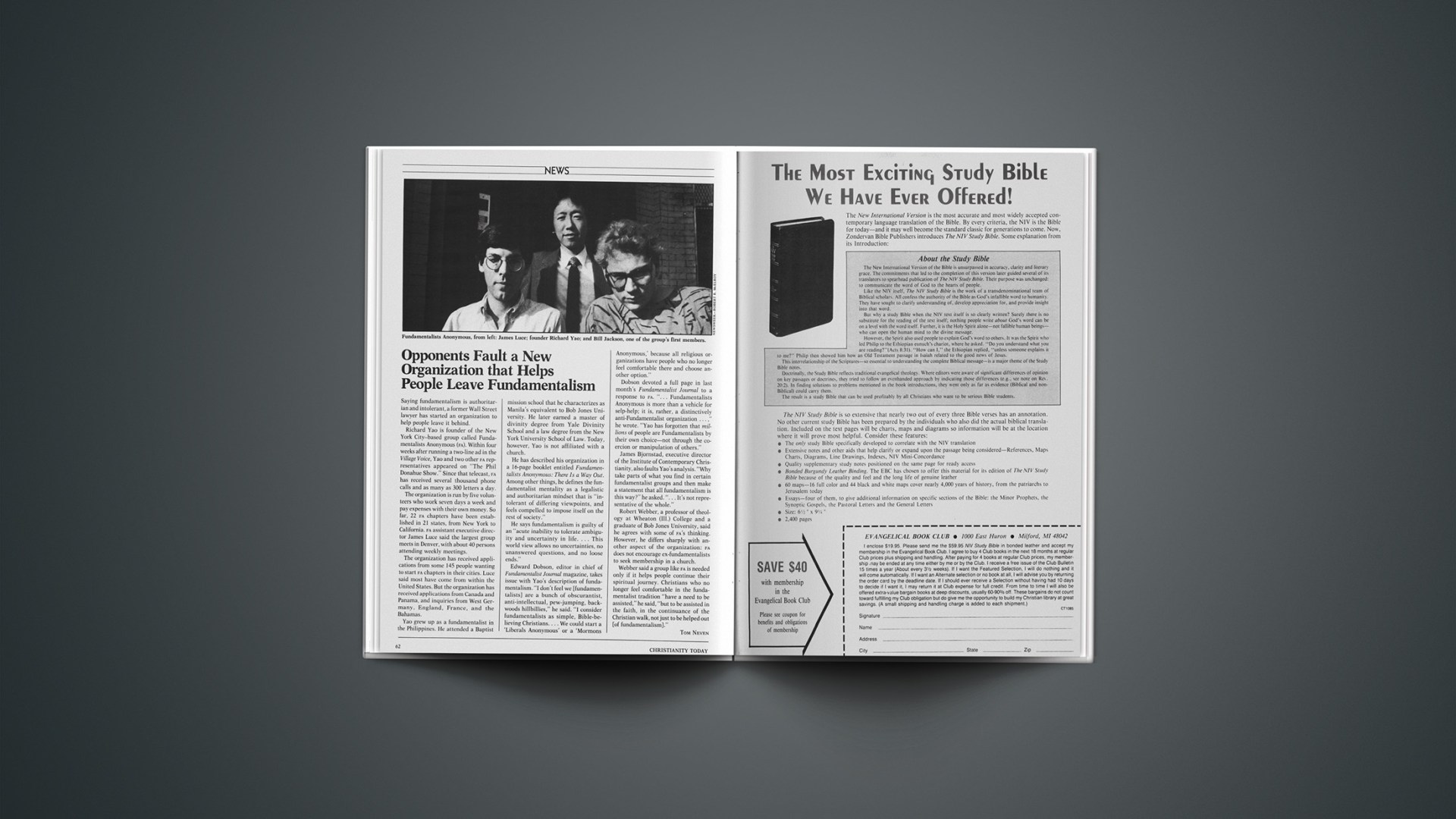
Opponents Fault a New Organization that Helps People Leave Fundamentalism

Saying fundamentalism is authoritarian and intolerant, a former Wall Street lawyer has started an organization to help people leave it behind.

Richard Yao is founder of the New York City-based group called Fundamentalists Anonymous (FA). Within four weeks after running a two-line ad in the Village Voice, Yao and two other FA representatives appeared on “The Phil Donahue Show.” Since that telecast, FA has received several thousand phone calls and as many as 300 letters a day.

The organization is run by five volunteers who work seven days a week and pay expenses with their own money. So far, 22 FA chapters have been established in 21 states, from New York to California, FA assistant executive director James Luce said the largest group meets in Denver, with about 40 persons attending weekly meetings.

The organization has received applications from some 145 people wanting to start FA chapters in their cities. Luce said most have come from within the United States. But the organization has received applications from Canada and Panama, and inquiries from West Germany, England, France, and the Bahamas.

Yao grew up as a fundamentalist in the Philippines. He attended a Baptist mission school that he characterizes as Manila’s equivalent to Bob Jones University. He later earned a master of divinity degree from Yale Divinity School and a law degree from the New York University School of Law. Today, however, Yao is not affiliated with a church.

He has described his organization in a 16-page booklet entitled Fundamentalists Anonymous: There Is a Way Out. Among other things, he defines the fundamentalist mentality as a legalistic and authoritarian mindset that is “intolerant of differing viewpoints, and feels compelled to impose itself on the rest of society.”

He says fundamentalism is guilty of an “acute inability to tolerate ambiguity and uncertainty in life.… This world view allows no uncertainties, no unanswered questions, and no loose ends.”

Edward Dobson, editor in chief of Fundamentalist Journal magazine, takes issue with Yao’s description of fundamentalism. “I don’t feel we [fundamentalists] are a bunch of obscurantist, anti-intellectual, pew-jumping, back-woods hillbillies,” he said. “I consider fundamentalists as simple, Bible-believing Christians.… We could start a ‘Liberals Anonymous’ or a ‘Mormons Anonymous,’ because all religious organizations have people who no longer feel comfortable there and choose another option.”

Dobson devoted a full page in last month’s Fundamentalist Journal to a response to FA. “… Fundamentalists Anonymous is more than a vehicle for selp-help; it is, rather, a distinctively anti-Fundamentalist organization he wrote. “Yao has forgotten that millions of people are Fundamentalists by their own choice—not through the coercion or manipulation of others.”

James Bjornstad, executive director of the Institute of Contemporary Christianity, also faults Yao’s analysis. “Why take parts of what you find in certain fundamentalist groups and then make a statement that all fundamentalism is this way?” he asked. “… It’s not representative of the whole.”

Robert Webber, a professor of theology at Wheaton (Ill.) College and a graduate of Bob Jones University, said he agrees with some of FA’s thinking. However, he differs sharply with another aspect of the organization: FA does not encourage ex-fundamentalists to seek membership in a church.

Webber said a group like FA is needed only if it helps people continue their spiritual journey. Christians who no longer feel comfortable in the fundamentalist tradition “have a need to be assisted,” he said, “but to be assisted in the faith, in the continuance of the Christian walk, not just to be helped out [of fundamentalism].”

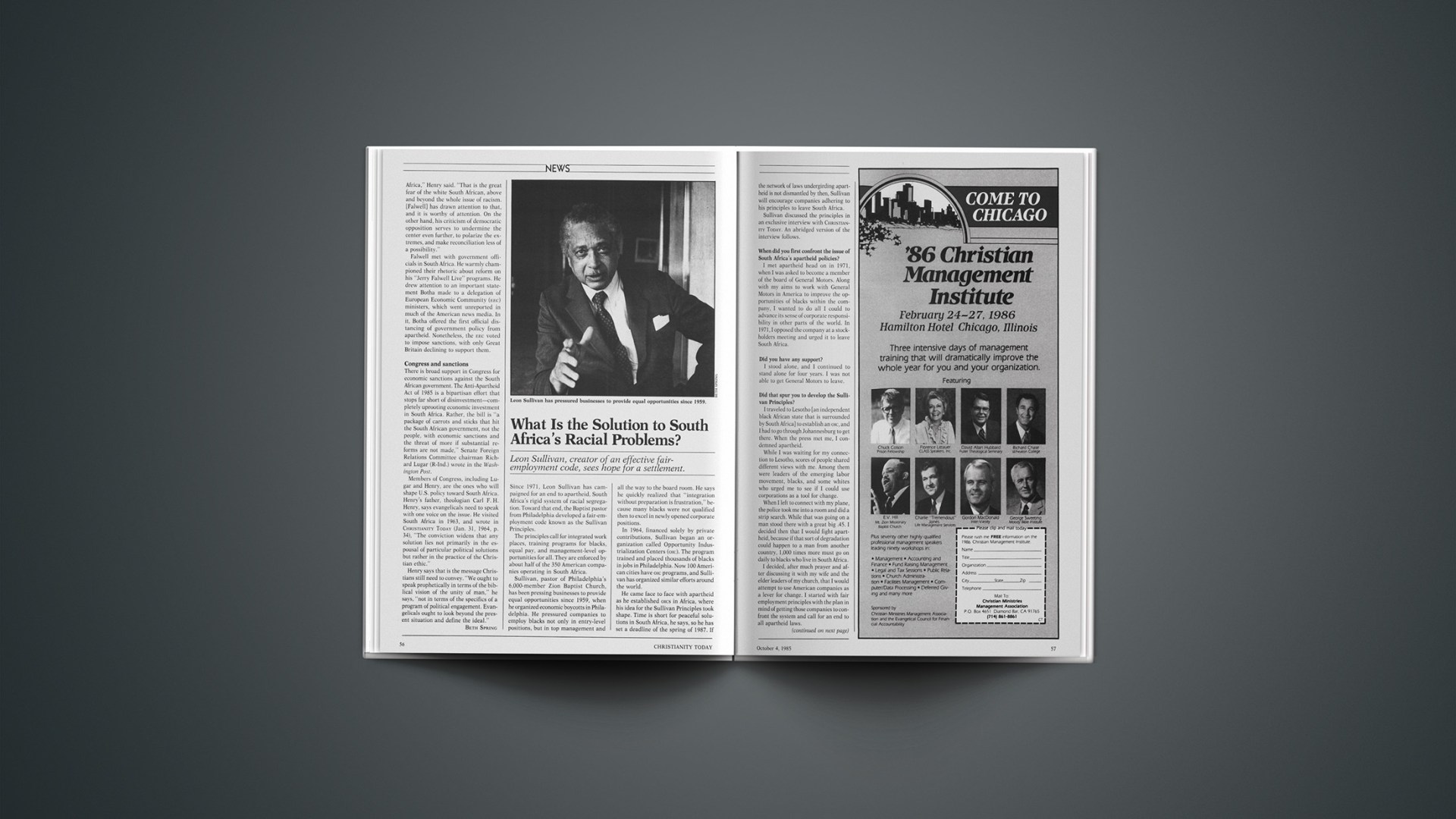
What Is the Solution to South Africa’s Racial Problems?

Leon Sullivan, creator of an effective fair-employment code, sees hope for a settlement.

Since 1971, Leon Sullivan has campaigned for an end to apartheid, South Africa’s rigid system of racial segregation. Toward that end, the Baptist pastor from Philadelphia developed a fair-employment code known as the Sullivan Principles.

The principles call for integrated work places, training programs for blacks, equal pay, and management-level opportunities for all. They are enforced by about half of the 350 American companies operating in South Africa.

Sullivan, pastor of Philadelphia’s 6,000-member Zion Baptist Church, has been pressing businesses to provide equal opportunities since 1959, when he organized economic boycotts in Philadelphia. He pressured companies to employ blacks not only in entry-level positions, but in top management and all the way to the board room. He says he quickly realized that “integration without preparation is frustration,” because many blacks were not qualified then to excel in newly opened corporate positions.

In 1964, financed solely by private contributions, Sullivan began an organization called Opportunity Industrialization Centers (OIC). The program trained and placed thousands of blacks in jobs in Philadelphia. Now 100 American cities have OIC programs, and Sullivan has organized similar efforts around the world.

He came face to face with apartheid as he established OICS in Africa, where his idea for the Sullivan Principles took shape. Time is short for peaceful solutions in South Africa, he says, so he has set a deadline of the spring of 1987. If the network of laws undergirding apartheid is not dismantled by then, Sullivan will encourage companies adhering to his principles to leave South Africa.

Sullivan discussed the principles in an exclusive interview with CHRISTIANITY TODAY. An abridged version of the interview follows.

When did you first confront the issue of South Africa’s apartheid policies?

I met apartheid head on in 1971, when I was asked to become a member of the board of General Motors. Along with my aims to work with General Motors in America to improve the opportunities of blacks within the company, I wanted to do all I could to advance its sense of corporate responsibility in other parts of the world. In 1971, I opposed the company at a stockholders meeting and urged it to leave South Africa.

Did you have any support?

I stood alone, and I continued to stand alone for four years. I was not able to get General Motors to leave.

Did that spur you to develop the Sullivan Principles?

I traveled to Lesotho [an independent black African state that is surrounded by South Africa] to establish an OIC, and I had to go through Johannesburg to get there. When the press met me, I condemned apartheid.

While I was waiting for my connection to Lesotho, scores of people shared different views with me. Among them were leaders of the emerging labor movement, blacks, and some whites who urged me to see if I could use corporations as a tool for change.

When I left to connect with my plane, the police took me into a room and did a strip search. While that was going on a man stood there with a great big .45. I decided then that I would fight apartheid, because if that sort of degradation could happen to a man from another country, 1,000 times more must go on daily to blacks who live in South Africa.

I decided, after much prayer and after discussing it with my wife and the elder leaders of my church, that I would attempt to use American companies as a lever for change. I started with fair employment principles with the plan in mind of getting those companies to confront the system and call for an end to all apartheid laws.

Did you prefer to see American companies leave altogether, or stay in South Africa and enforce the principles?

It was not important to me whether the companies stayed or not. But as long as they stay there, they must confront the system. Once the black worker is empowered, he will speak out for himself in the workplace and in the community and in the nation and in politics. And that is happening.

Did General Motors support your fair-employment code?

Yes. They didn’t leave South Africa, but they were the first company to endorse me, and they’ve been among my strongest supporters.

How many other American companies doing business in South Africa warmed up to the idea?

I wrote letters to all of them, and I received piles of letters back telling me they weren’t going to do it, or it was against their regulations, or they could not intrude in the policies of other governments. But I went all over the country to persuade them to sign these principles, and I got 12 to do so. Then others began to come along.

How has the movement favoring divestment—pulling investment out of companies in South Africa—affected your work on the Sullivan Principles?

The divestment movement became one of my greatest helps. Companies began to come around on the principles because I said that pension funds, members of state legislatures, investors, and schools should divest their holdings in companies that do not support the principles.

What difference have the principles made for the average black worker in South Africa?

The principles have started a revolution in industrial race relations. When they were initiated seven years ago, a black South African was not even regarded legally as a worker. When I started, there were no black managers or supervisors to speak of. Now about 30 percent of administrative supervisors are black. At first, no unions were recognized. Now all American companies must recognize independent free black trade unions. Companies have even built new buildings to facilitate integrated work places.

Are the principles evolving into a larger solution to the problem of apartheid, as you initially hoped?

The principles have served as a platform outside the work place for people who stand up for equal rights. The problem in South Africa is not unemployment or even equal opportunity in the work place, but freedom. The principles cannot solve the problems of South Africa. But they can be part of the solution—along with international trade unions, international churches, leaders of nations, governments, the United Nations, and most of all, the rising tide of black leaders within South Africa.

You have set a deadline of the spring of 1987 before you call for stronger action. Will that give South Africans enough time to resolve their conflicts?

That deadline holds even though it was established before the current state of emergency. If the companies of the world will take a stand and call for the ending of statutory apartheid, it can end in these following months.

If statutory apartheid is not ended by the spring of 1987, then in spite of the fact that it will mean the loss of jobs and the loss of American influence in South Africa, I’m saying that there should be a total U.S. embargo against South Africa, the withdrawal of all American companies, and the breaking of diplomatic relations.

Is a peaceful solution still possible?

I am hoping for a peaceful resolution, because a nonpeaceful resolution will mean millions of lives lost and the obliteration of a nation. It could mean the involvement of an entire continent and much of the rest of the world. If any way can be found for an end to apartheid without tremendous destruction, it must be tried. With the help of God, I think it is possible.

Since the beginning of the 1984–85 school year, friction between fundamentalist church schools in Nebraska and the state government has all but ceased. A regulation passed last year dropped the requirement that teachers in private schools be certified by the state (CT, Oct. 5, 1984, p. 85). Since that was the major point of conflict, the problem was solved for most church-related schools.

However, one Nebraska pastor is still caught in the grip of the conflict. Last year, Robert Gelsthorpe and his North Platte Baptist Church were each fined $200 every day their church-run school remained open in violation of what then was state law. A 14 percent interest rate is being charged against the debt, bringing the total amount owed by Gelsthorpe and his church to about $50,000.

Gelsthorpe and his church refuse to pay the fine. He also has declined to pursue a compromise that would require the pastor to pay only a small percentage of the fine.

“We’ve been fined for willingly disobeying a judge,” Gelsthorpe said. “We never willingly disobeyed anyone; we willingly obeyed our God.”

Judge John Murphy, who imposed the fine, said he did not have the legal authority to waive the penalty.

Lincoln County prosecutor Charles Kandt said he will take action against Gelsthorpe before moving against the North Platte Baptist Church. He said the first step will be to foreclose on Gelsthorpe’s house.

Kandt estimated that the money gained from selling the house would pay only about half of Gelsthorpe’s portion of the debt. By collecting the remainder of the fine, he said, he expects Gelsthorpe to lose everything he owns.

For Kandt, who has made public his Christian faith, this has been a difficult case to prosecute. Kandt said, however, that not to enforce payment of the fine would constitute an “undercutting of the court’s authority that would be dangerous.”

Falwell Raises a Stir by Opposing Sanctions against South Africa

Christian leaders in the United States criticize the Moral Majority leader’s approach to dealing with apartheid.

Christian leaders in the United States criticize the Moral Majority leader’s approach to dealing with apartheid.

Designing U.S. foreign policy toward South Africa has been a painstaking, uncertain process in Washington, D.C. No one knows whether economic pressures against the white minority government will hasten an end to its policy of racial separation, known as apartheid, or whether sanctions will backfire by alienating whites and harming blacks.

A bipartisan effort in Congress produced a bill proposing sanctions that President Reagan approved of only in part. He delayed a final U.S. Senate vote by imposing similar measures: banning new bank loans to South Africa, seeking to prohibit the sale of Krugerrands (South African gold coins) in the United States, and halting exports of computer technology that would be used to enforce apartheid.

Entering suddenly into the midst of the deliberations was Moral Majority leader Jerry Falwell. After a five-day fact-finding trip to South Africa, Falwell returned with a firm resolve to tell “the untold story.” He did so in a series of “Jerry Falwell Live” programs broadcast on WTBS, the nationwide cable station in Atlanta.

He also appeared on an hour-long edition of ABC-TV’s “Nightline,” heatedly debating the issue with Jesse Jackson. Falwell called on Christians to buy Krugerrands, just before Reagan sought to ban their sale in this country. Later, in response to Reagan’s sanctions, Falwell said, “It is despicable that President Reagan should be forced by a spineless Congress and a biased media into slapping the wrist of such a good friend as South Africa.” He added, however, that Reagan’s executive order “preempted most of the artillery of the [antiapartheid] South Africa lobby.”

Later this year, Falwell plans to take 70 ministers to South Africa and continue his effort to shed light on aspects of that country’s complicated politics that he says are ignored by the American news media.

Little Evangelical Support

There is little evidence in the American evangelical community that church leaders wholeheartedly endorse Falwell’s effort. Yet many credit him with raising legitimate questions about the diversity of South Africa’s nonwhite communities.

Asbury Seminary president David McKenna, in a commentary broadcast by International Media Service, said, “The Reverend Mr. Falwell has the right to speak, but not as my spokesman. In my opinion, Mr. Falwell is over his head in international affairs, out of bounds when he presumes to speak for evangelical Christians, and far from the pulpit which he claims to be his primary calling.”

Robert P. Dugan, Jr., director of the National Association of Evangelicals’ Washington office, worries that Falwell “may have diminished his influence on other important issues for some years to come. The opposition will be quick to use this to characterize him as a racist, unfairly to be sure, and thus dismiss him as a national influence.”

Clarence Hilliard, a Chicago pastor and resolutions chairman of the National Black Evangelical Association (NBEA), said Falwell will be a bellwether. “White evangelicals will either have to take a stand against him or be identified with him,” Hilliard said. “That may not be too promising, because white evangelicals have a tendency to be silent on these kinds of things.”

William Bentley, NBEA past-president and president of the United Pentecostal Council of the Assemblies of God, called Falwell a “gradualist.… [Falwell] would put the elimination of apartheid into an indefinite future. People who control the segregation process always say ‘wait.’ …

“Justice delayed is inseparable from justice denied,” Bentley said, “[and] South Africa may not have the luxury of time unlimited to open the doors of policies of equality and justice for all within the limits of human possibility.”

Falwell On Apartheid

When he returned from South Africa, Falwell stated his opposition to apartheid, saying it is “reprehensible, abhorrent, and must be discontinued.” On television, he confessed his own penchant for racial bias years ago, and said, “The Lord, in dealing with my heart, convinced me that segregation was wrong.”

While civil rights leaders and many mainline church officials have emphasized apartheid in discussing South Africa, Falwell presented a different set of concerns. He framed the issue in light of Communist encroachment throughout Africa. He criticized well-known South African opposition leaders and praised South African state president P. W. Botha as a reformer. And he urged Americans to oppose sanctions against South Africa.

Falwell opened his first WTBS telecast on the issue by saying he has been “studying the red river of communism as it has poured down on the continent of Africa for a number of years.” South Africa is the plum of the continent, he contends, which the Soviet Union is eager to pluck. He emphasizes the U.S. security interest in keeping sea lanes open around the Cape of Good Hope, at South Africa’s southern tip, as well as the need to preserve U.S. access to minerals available only in South Africa.

Maintaining support for the South African program of gradual reform is the best way to keep the Communists out, Falwell suggested. Others say support for the status quo plays into the Communists’ hands because of widespread discontent with government policies, which prevent blacks from voting, holding national office, or traveling freely through the country.

Bentley said Falwell “justly deplores the excesses of communism, but at the same time he has little or nothing to say about the long-term injustices within a ‘democratic’ country. The white minority in South Africa oppresses the people so savagely that it is an academic exercise to blacks under which ideology the suffering comes.”

Faulting Opposition Groups

Falwell’s critique of Communist influence in South Africa was not limited to external forces. He linked a moderate opposition group, the United Democratic Front (UDF), with the leftist African National Congress, suggesting that both are Marxist in orientation. He showed a dated film clip of UDF founder Allan Boesak speaking, with a Soviet flag in the background, and referred to that image throughout his television show.

In addition, Falwell attempted to discredit Desmond Tutu, the Anglican bishop of Johannesburg. He called Tutu a “phony” if he purports to speak for black South Africa—a claim Tutu has not made. Falwell later retracted the word “phony” and wired an apology to Tutu.

While he was in South Africa, Falwell sought a meeting with Tutu but was turned down. However, he met with nonwhites who are opposed to sanctions against their country. Falwell portrayed them as being critical of Tutu and Boesak. Church leaders in the United States say that perspective is a valuable one, but they express grave concern that Falwell may heighten tensions among South African factions and discredit moderate opposition leaders who oppose violence.

Evangelical political analyst Stephen Monsma befriended Boesak when the Reformed pastor taught at Calvin Seminary in Grand Rapids, Michigan. “As long as the white South African government throws into jail people like Allan, who is preaching nonviolence,” Monsma said, “[it] plays into the hands of more extremist, violence-prone elements.” He said Tutu and Boesak are “insistent voices of reason and moderation. If they’re unrepresentative, it’s that they do not represent the more radical element that is emerging.”

U.S. Congressman Paul Henry (R-Mich.), an evangelical Christian, pointed out a subtle danger of Falwell’s mixed message. “There is much criticism from the Left that fails to consider the difficulty of change in a country that views itself as being surrounded by a sea of political instability and tribal authoritarian regimes throughout black Africa,” Henry said. “That is the great fear of the white South African, above and beyond the whole issue of racism. [Falwell] has drawn attention to that, and it is worthy of attention. On the other hand, his criticism of democratic opposition serves to undermine the center even further, to polarize the extremes, and make reconciliation less of a possibility.”

Youth Ministry Shares Gospel Amid Unrest in South Africa

Unrest in South Africa has not stopped public evangelism. However, tensions resulting from a government crackdown on those who demonstrate against apartheid, South Africa’s system of racial separation, create a volatile atmosphere for Christian outreach.

Caesar Molebatsi, director of a ministry called Youth Alive, said his organization is taking advantage of opportunities to share the gospel. After the South African government declared a state of emergency, Youth Alive planned a rally in Soweto, a black township that had been plagued by demonstrations. “We weren’t sure the whole week before the rally whether we could hold it on Saturday,” a Youth Alive representative said. “Every day one of the staff members checked out the area where serious rioting had occurred. It was tense.”

Since no meetings can be announced under the country’s state of emergency, Youth Alive members advertised it by inviting friends and neighbors personally. More than 200 young people showed up to hear a speaker present the gospel. After his talk, electrical power was disrupted, preventing the scheduled musical groups from performing. However, 20 young blacks indicated their desire to become Christians.

In the face of growing frustration and public violence, Youth Alive staff members said they are finding great responsiveness to the gospel. High school students listen eagerly when staff members visit Soweto schools. Bible clubs are held in most of the township’s high schools, and many students have become Christians.

Molebatsi is no newcomer to massive social unrest. He returned to a riot-torn Soweto in 1976 after studying in the United States. Since then, he has been involved in a ministry of racial reconciliation.

“Caesar is one of very few evangelicals who openly articulates the feelings and frustrations of the Africans,” said one white South African. “Yet at the same time, [he] urges blacks and whites to try to understand and love each other.”

Molebatsi said he found most Soweto youths in 1976 rejecting Christianity as the “white man’s religion” and a weakening influence. Several factors indicate that the trend has changed in 1985, with many young people finding that the gospel transcends the racial hatred that is festering in strife-torn South Africa.

Falwell met with government officials in South Africa. He warmly championed their rhetoric about reform on his “Jerry Falwell Live” programs. He drew attention to an important statement Botha made to a delegation of European Economic Community (EEC) ministers, which went unreported in much of the American news media. In it, Botha offered the first official distancing of government policy from apartheid. Nonetheless, the EEC voted to impose sanctions, with only Great Britain declining to support them.

Congress And Sanctions

There is broad support in Congress for economic sanctions against the South African government. The Anti-Apartheid Act of 1985 is a bipartisan effort that stops far short of disinvestment—completely uprooting economic investment in South Africa. Rather, the bill is “a package of carrots and sticks that hit the South African government, not the people, with economic sanctions and the threat of more if substantial reforms are not made,” Senate Foreign Relations Committee chairman Richard Lugar (R-Ind.) wrote in the Washington Post.

Members of Congress, including Lugar and Henry, are the ones who will shape U.S. policy toward South Africa. Henry’s father, theologian Carl F. H. Henry, says evangelicals need to speak with one voice on the issue. He visited South Africa in 1963, and wrote in CHRISTIANITY TODAY (Jan. 31, 1964, p. 34), “The conviction widens that any solution lies not primarily in the espousal of particular political solutions but rather in the practice of the Christian ethic.”

Henry says that is the message Christians still need to convey. “We ought to speak prophetically in terms of the biblical vision of the unity of man,” he says, “not in terms of the specifics of a program of political engagement. Evangelicals ought to look beyond the present situation and define the ideal.”

BETH SPRING

Theology

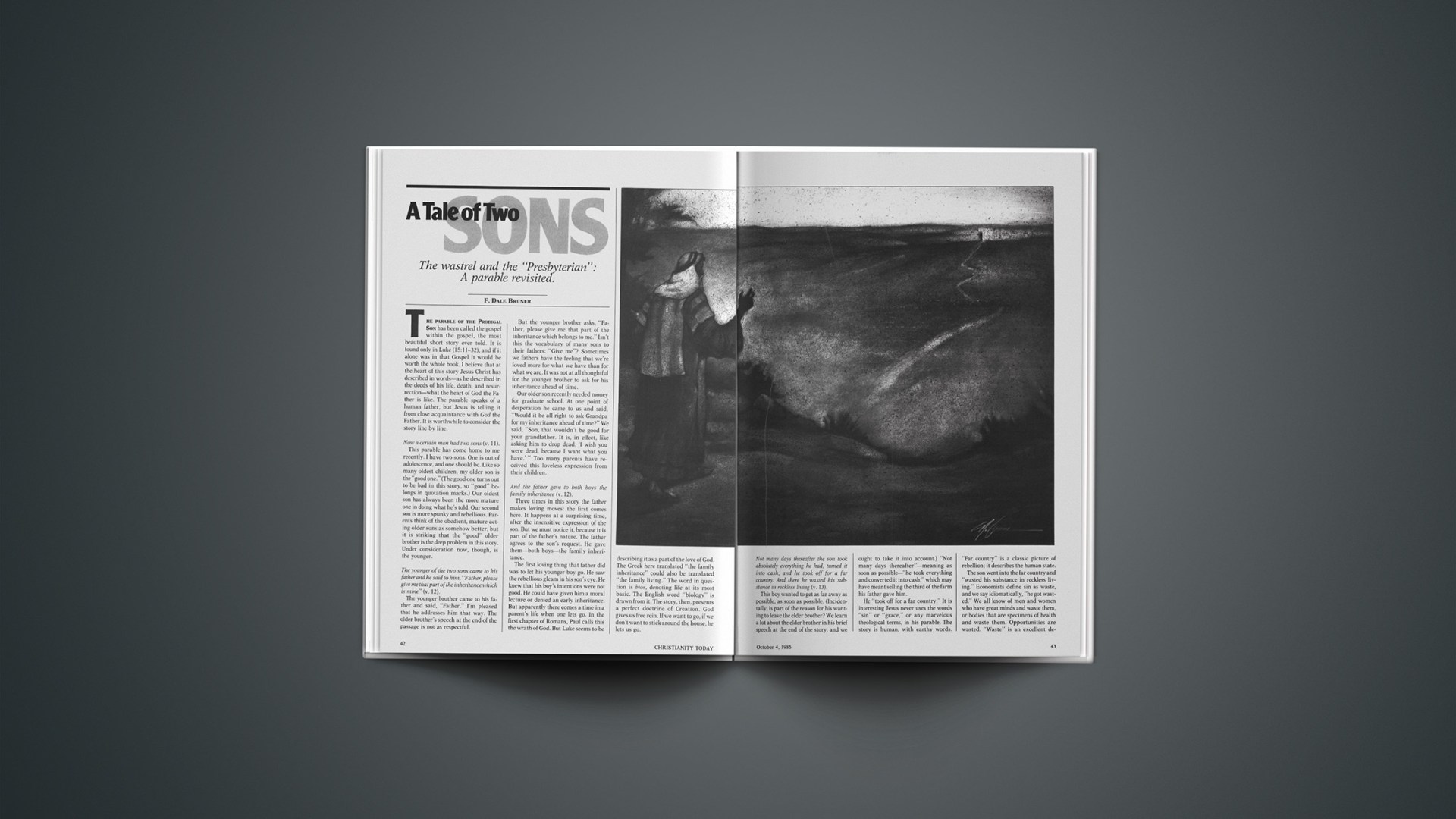
A Tale of Two Sons

The wastrel and the “Presbyterian”: A parable revised.

The parable of the Prodigal Son has been called the gospel within the gospel, the most beautiful short story ever told. It is found only in Luke (15:11–32), and if it alone was in that Gospel it would be worth the whole book. I believe that at the heart of this story Jesus Christ has described in words—as he described in the deeds of his life, death, and resurrection—what the heart of God the Father is like. The parable speaks of a human father, but Jesus is telling it from close acquaintance with God the Father. It is worthwhile to consider the story line by line.

Now a certain man had two sons (v. 11).

This parable has come home to me recently. I have two sons. One is out of adolescence, and one should be. Like so many oldest children, my older son is the “good one.” (The good one turns out to be bad in this story, so “good” belongs in quotation marks.) Our oldest son has always been the more mature one in doing what he’s told. Our second son is more spunky and rebellious. Parents think of the obedient, mature-acting older sons as somehow better, but it is striking that the “good” older brother is the deep problem in this story. Under consideration now, though, is the younger.

The younger of the two sons came to his father and he said to him, “Father, please give me that part of the inheritance which is mine” (v. 12).

The younger brother came to his father and said, “Father.” I’m pleased that he addresses him that way. The older brother’s speech at the end of the passage is not as respectful.

But the younger brother asks, “Father, please give me that part of the inheritance which belongs to me.” Isn’t this the vocabulary of many sons to their fathers: “Give me”? Sometimes we fathers have the feeling that we’re loved more for what we have than for what we are. It was not at all thoughtful for the younger brother to ask for his inheritance ahead of time.

Our older son recently needed money for graduate school. At one point of desperation he came to us and said, “Would it be all right to ask Grandpa for my inheritance ahead of time?” We said, “Son, that wouldn’t be good for your grandfather. It is, in effect, like asking him to drop dead: ‘I wish you were dead, because I want what you have.’ ” Too many parents have received this loveless expression from their children.

And the father gave to both boys the family inheritance (v. 12).

Three times in this story the father makes loving moves: the first comes here. It happens at a surprising time, after the insensitive expression of the son. But we must notice it, because it is part of the father’s nature. The father agrees to the son’s request. He gave them—both boys—the family inheritance.

The first loving thing that father did was to let his younger boy go. He saw the rebellious gleam in his son’s eye. He knew that his boy’s intentions were not good. He could have given him a moral lecture or denied an early inheritance. But apparently there comes a time in a parent’s life when one lets go. In the first chapter of Romans, Paul calls this the wrath of God. But Luke seems to be describing it as a part of the love of God. The Greek here translated “the family inheritance” could also be translated “the family living.” The word in question is bios, denoting life at its most basic. The English word “biology” is drawn from it. The story, then, presents a perfect doctrine of Creation. God gives us free rein. If we want to go, if we don’t want to stick around the house, he lets us go.

Not many days thereafter the son took absolutely everything he had, turned it into cash, and he took off for a far country. And there he wasted his substance in reckless living (v. 13).

This boy wanted to get as far away as possible, as soon as possible. (Incidentally, is part of the reason for his wanting to leave the elder brother? We learn a lot about the elder brother in his brief speech at the end of the story, and we ought to take it into account.) “Not many days thereafter”—meaning as soon as possible—“he took everything and converted it into cash,” which may have meant selling the third of the farm his father gave him.

He “took off for a far country.” It is interesting Jesus never uses the words “sin” or “grace,” or any marvelous theological terms, in his parable. The story is human, with earthy words. “Far country” is a classic picture of rebellion; it describes the human state.

The son went into the far country and “wasted his substance in reckless living.” Economists define sin as waste, and we say idiomatically, “he got wasted.” We all know of men and women who have great minds and waste them, or bodies that are specimens of health and waste them. Opportunities are wasted. “Waste” is an excellent description of the lost life. This boy wasted his substance, his inheritance, his being—his bios—on reckless living.

Now when he had spent everything, a famine hit that country and the boy began to go under. And he went out and he joined himself to one of the citizens of that country, who in turn sent him out to feed his pigs. And the boy was longing to fill his belly with the pods the pigs were eating. And no one gave him a blessed thing (vv. 14–16).

When it rains it pours. He has spent everything, and now the environment gives out. I have to be careful in stating this, but if it had gone well in the far country and if God’s providence had not allowed a famine there, maybe the son would not have eventually gone back home. Can we sometimes interpret our own catastrophes and our own famines through the love of God, not his wrath? Do the catastrophes sometimes bring us home?

When the son began to go under, “he went out and joined himself to one of the citizens of that country.” I admire this boy in that he at least looked for work. He didn’t wire home for money. He had a little initiative: he got a job feeding pigs. This, of course, is a mark of degradation for the Orthodox Jew.

And it was so bad that he was longing to fill his belly with the pods the pigs were eating. A lot of the longings of people in the “far countries” are about this high and about this noble. Our hearts go out to them, for that for which they long is not really substantial. It is way beneath their human dignity, what they actually should have in the sight of God.

The last thing to give out on the boy was other people. His own substance gave out and his environment gave out. His last illusion might have been that people are basically good. Proverbs 14:20 reads: “The poor man is an offense even to his neighbors, but the rich man has many friends.” When the boy had money, he had plenty of friends. But when he was not doing so well it was hard to find those friends. Nobody gave him a thing. The human race is not God and the human race finally does not come through in the clutch.

Now, when the boy came to himself he said, “How many hired hands of my father are swimming in bread and I’m here starving. I’m dying. I know what I’ll do. I’ll get up and I’ll go back to my father and I’ll say, ‘Father, I sinned against heaven and against you. I don’t deserve to be called your son anymore. Make me like one of your hired hands’ ” (vv. 17–19).

At this point comes the line that begins to depict the turnabout: “when the boy came to himself.” On the whole, the self does not get a good press in the New Testament. We are told to deny ourselves; the person who seeks his self will lose it, the person who loses his self will find it. But this is one of those few texts indicating that, when we consult our self, we are only one step from God.

Tertullian said the anima naturaliter Christianus, the human soul is naturally a Christian. It is a dangerous sentence. We don’t believe, like Unitarians, that there is a divine spark within, and all one needs is to gently fan the spark. But there is a sense in which the self is God’s creature, and when we really consult our very best personal interest we begin to think of the Father.

“When the boy came to himself he said, ‘How many of my father’s hired hands are swimming in bread.’ ” Pelagius and Augustine debated furiously on this text. Pelagius said it is the human person—not God—who must take the initiative, and until the son came back the father did nothing. Since the father here represents God, the human will comes first in conversion.

But notice what the son is thinking of: “How many of my father’s hired hands.…” It is the memory of a good father that beckons him back. If that father had not been just to his employees, if that father had not given decent food to those who worked for him, the son would never have gone back. The father had implanted the good memory of his own character in his son’s conscience, and it was the father, through that memory, beckoning the son. Augustine wins: God’s grace comes first and then our response. Without that grace we do not have the will, we do not have the power, we do not have even the desire to go after the Father.

The boy says he is starving. He is dying. When a person can say, “I’m dying,” he is not far from the Father. “I’m dying. I am not at all where I am supposed to be: I am a son, I am a daughter of God the Father, and yet I am dying. I know what I will do. I will get up, I will go back to my Father.…”

I admire the son for being absolutely straight. He invents no excuses. He is not blaming the weather or the famine, or saying that his friends didn’t come through. He is going to tell his father he sinned. And somehow that has its own power. When we come clean, when we confess our sins, “he is faithful, he is just, he will forgive us our sins, cleanse us from all unrighteousness” (1 John 1:9).

Notice Jesus’ realism at this point. The boy is not portrayed as having noble motives for his return. He is not going back because he broke his father’s heart. He is going back because he is not eating well and he wants a better meal. Jesus knows human beings. Our motives in coming to Christ are not always as high as they ought to be. But God will take us no matter how we come. He will use every secular, material, physical motive. Jesus does not describe the motive of the younger son as a bit more noble than wanting to have a good meal.

So the boy got up and he started back (v. 20).

This text was a deep help to my wife and me after ten years as missionaries in the Philippines. We were emotionally, physically, and spiritually exhausted. The ten years had not been happy or productive. I had not been a good missionary. And I did not want to have ten more years of not being good at whatever I was to be. But I didn’t have the physical or spiritual energy to fulfill whatever conditions were necessary for God to bless and help make my ministry better. This text helped me. It said, “Just start back. The Father does all the rest.” That is clear from the very next line.

Now when he was still a long ways off his father saw him and his heart went out to him and he ran and threw himself around his son. And he embraced him and kissed him much (v. 20).

This text says to all persons who are weary and not close to God, not renewed as we want to be: Just face the Father, he will do the rest. This second move is the greatest move of all the father’s three actions of love. “Now while he was still a long ways off …,” it reads. The Greek for “long ways off” is the same word used earlier in the text for “far” country. It conveys the idea that the father, every night after work, stood on the brow of the hill. He stood and looked out over the valley and hills, searching the distant far country for that dot.

And one day he could tell that one particular dot was his son, so “while the boy was still a long ways off the father saw his son and his heart went out to him. And he ran.…” Picture the father running down the valleys and up the hills, running to his son. And finally, he fell on the boy and “embraced him and kissed him much.”

The major theological criticism made of this parable is that there is no Cross in it, that it tends to be sentimental. It is said to depict a God who is so much a God of love that there is no justice, no holiness. The father’s run and unconditional forgiveness are thought to say to all the wayward, in effect, “You can run away and there won’t be any price, there won’t be any probation. Simply come back and we will wink at everything you have done.”

That is the criticism. But I submit that in the father’s run there is the intimation of Jesus Christ coming to the cross. The father’s run is that terrible sprint from heaven to the wood. There is holiness, there is justice. Someone had to pay a price, and the Father paid it. God was in Christ, reconciling the world to himself.

So the father ran to his son. And his next action was amazing. He did not wait for his son’s apology or confession. All he wanted was the son. He was thrilled that his son was there, and he threw himself around the boy before he could get more than a few words out. He embraced his son before the son completed a confession of sin.

The boy said, “Father, I have sinned against heaven and you, and I don’t deserve to be called your son.” The father interrupted him. He said to his servants, “Quick, get the best robe and put it on him. Put the ring on his finger, put sandals on his feet. And go, get the fatted calf, kill it, and let’s have a party because this my son was deadhe’s come back to life. He was lost and he’s been found” (vv. 21–24).

As if to suggest he is not interested in the confession, the father interrupts and tells the servants to get the boy a robe, ring, and sandals. Interestingly, the father never speaks verbally and directly to the younger son in this entire parable. He speaks, as it were, physically and sacramentally. The sacraments are God’s hugs—they are God physically approaching and touching us.

The main thing a father gives to his son, and the best way he communicates with his son, is by acting and touching. This father is saying many things about God the Father by what he does. The “best robe” he gives, for example, is a marvelous picture of absolute justification. As the Heidelberg Catechism puts it, God imputes and grants to us the perfect righteousness, satisfaction, and holiness of Jesus Christ, as if we had never ever sinned or committed any sin. But the robe of righteousness is not all.

The ring symbolized power. It was used as a kind of signature: with it the son had power to sign and validate official documents. This is an excellent symbol of the power and the gift of the Holy Spirit, who is given to us. We have power to act in God’s name. We are sanctified.

Lastly, the boy is given sandals. It is reminiscent of the slave spiritual, “I’ve got shoes, you’ve got shoes, / All of God’s children got shoes.” Slaves were not able to wear shoes, but shoes are given to the boy. He is treated as a son. The returned prodigal is indeed rich. He has the robe of righteousness, the ring of power, and the shoes of adoption.

We, too, are rich, though we sometimes fail to recognize it. We in the Reformed tradition neglect God’s hugs—the sacraments that are him touching and loving us. We need a deeper appreciation of baptism, for we receive many gifts in baptism. How much we should appreciate that open heaven, that dove Spirit, the voice saying “My son.” Jesus inaugurated baptism in his own person, and with it we were given the three gifts of justification, sanctification, and adoption.

Baptism is one great sacrament. The second one is the Eucharist, or the Lord’s Supper. I hope I am not overinterpreting the parable when I find in it that meal symbolizing fellowship and joy. The Eu in Eucharist means “good,” and charis is the root of our word “caress.” The Lord’s Supper is the good caress. In that sacrament God comes spiritually and physically and touches us, and he says, “I love you.”

Catholics call our Protestant church services “dry masses.” They say we get halfway there and then stop. We minister the Word but we don’t touch. It will be a good day if we again observe the sacrament every Sunday, as Luther and Calvin intended it. Then our words, our reading of Scripture and preaching, will be supplemented by the actual embrace—the good caress.

Now the elder brother was back in the field and as he came in toward the house he heard the music and the dancing and he summoned one of the servants. He said, “What’s going on in there?” The servant said, “Your brother is back and your father’s killed the fatted calf because he’s received him in one piece.”

The brother was furious. He would not go in, so the father came out and pled with him (vv. 25–28).

The older brother was back in the field. The Greek word for older here, believe it or not, is presbuterous. He is the “Presbyterian” son. The Presbyterian, naturally, was out in the field, dutifully working. He was doing what he ought to be doing, and as he approached the house he heard the sound of music and dancing. This is always suspicious to Puritan types. Remember H. L. Mencken’s definition of a Puritan: a person with a haunting fear that someone, somewhere is happy. So to the Presbyterian son it did not look good.

He summoned his servant and asked what was going on. The servant told him his brother was home and his father had killed the fatted calf to celebrate. The older brother, infuriated, won’t go into the house. And here it is actually easier to love the prodigal, who at least headed home. Not so the self-righteous elder brother.

Then comes the third and last great, loving move of the father in the parable. “The father came out and pled with him.” That little line means many things, but it means at least this: God also loves Christians. It is good news. I know he loves the sinner; the whole Scripture is filled with that message. But does he love self-righteous Presbyterians and other Christians? This text says much more than that but nothing less. He also loves us—“Amazing grace, how sweet the sound, that saves a self-righteous prig like me.”

But the boy said, “Look, I have slaved for you all these years. I’ve never broken one of your commandments. And yet what do I get for it? You’ve never even killed a shriveled-up old goat so that I could have a party for my friends. But when this, this son of yours comes back who has blown the family inheritance on whores, you kill a fatted calf for him” (vv. 28–30).

The father pled with the boy, and then the older boy gave a speech. But his opening words are not as respectful as those of the younger brother at the beginning of the story. Instead, he speaks as if his father can’t see, is in fact blind and stupid. “Look,” he says, and continues, “I have slaved for you all these years.” Slavery is how he conceives of his work with his father. “I have never broken your commandment,” he says (what about the commandment of love?).

“Yet,” the elder brother complains, “you’ve never even killed a shriveled-up old goat for me so that I could have a party with my friends. But when this son of yours.…” Notice that it is not “this brother of mine.” The same thing happens in our home. I say, “Kathy, do you know what your son did?” There is a shift in language, as if my son’s misdeeds are my wife’s responsibility or fault.

The angry son finishes, “When this son of yours comes back who has blown the family inheritance on whores, you killed a fatted calf for him.” The eldest is saying, in effect, “I don’t get you. I think you are weak.” Many husbands say this to their wives. I do. In a sense, then, the father in this story depicts a mother’s love more than a typical father’s love. I don’t intend to be sexist, but I think that a mother’s love is more unconditional than that of most fathers. It has been said that mothers understand home as a nest and fathers understand it as a boot camp. The fathers’ questions are usually, “Did you get a job? Do you have summer work?” The mother asks, “Are you happy? Are you loved?” So there is something unusual about the love of the father in this parable. But the oldest boy thinks his father lacks character and backbone. He thinks he lacks justice and is hurting the community.

The father said to his son, “My child, you are constantly with me. Absolutely everything I have is yours. But it was right for us to have this party because this your brother was dead. He’s alive. He was lost but he’s been found” (vv. 31–32).

The father replied gently, “My child.” There are two Greek words he could have used here, teknon or huios. He used teknon, the more tender of the two. “My child,” he said, “you are constantly with me.” Notice the present tense verbs: “You are constantly with me,” “everything I have is yours.” The angry speech the son has just given has made no difference in the father’s benevolence. “You are constantly with me. Absolutely everything I have is yours. But it was right for us to have this party because this your brother was dead. He’s alive. He was lost but he’s been found.”

This is the message of the story. To all prodigals and younger siblings, chronologically or spiritually: Come home, the father is good. And to all elder brothers and sisters, chronologically or spiritually: Come into the house, enjoy the feast—the father is good.

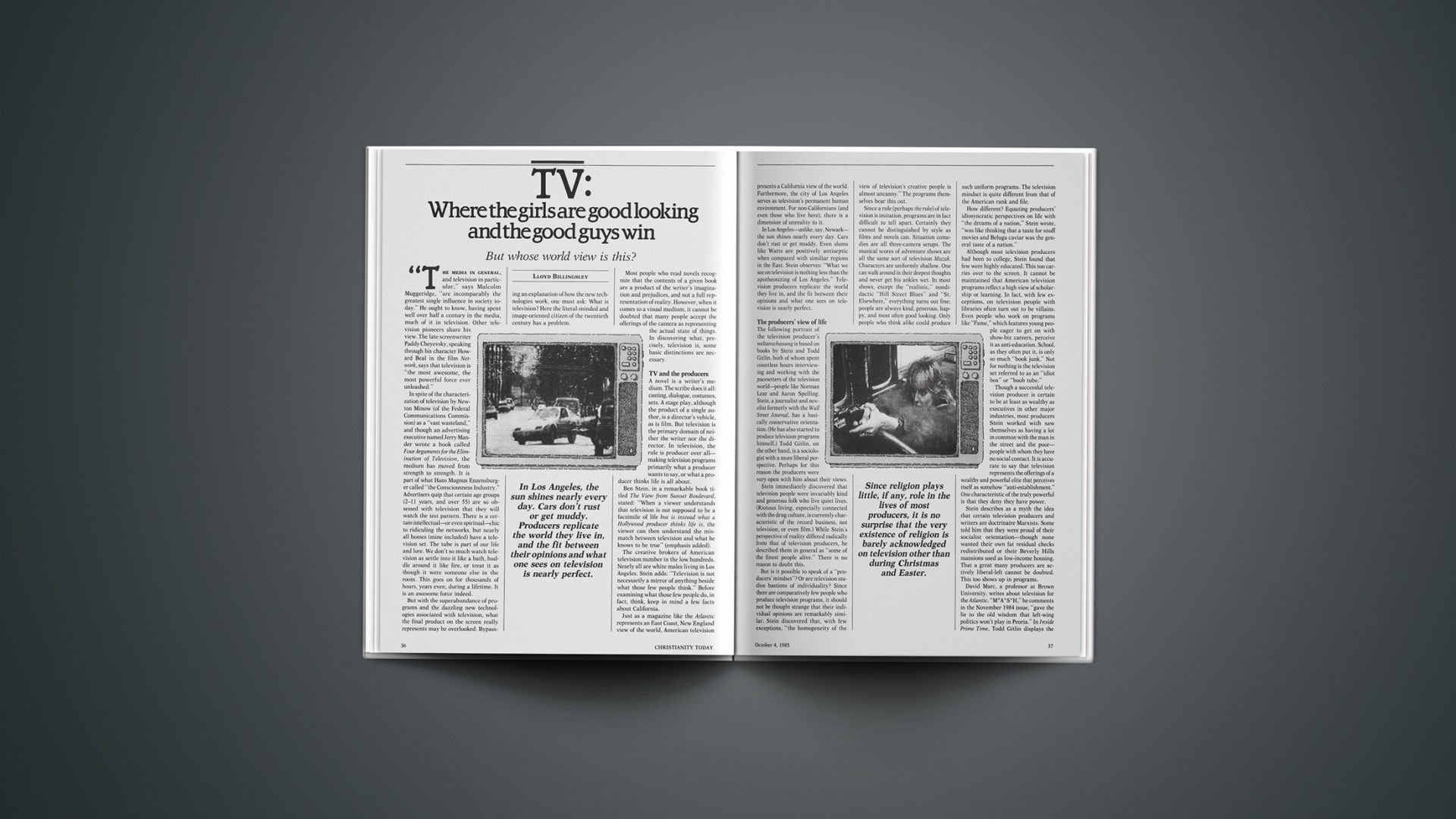
TV: Where the Girls Are Good Looking and the Good Guys Win

But whose world view is this?

“The media in general, and television in particular,” says Malcolm Muggeridge, “are incomparably the greatest single influence in society today.” He ought to know, having spent well over half a century in the media, much of it in television. Other television pioneers share his view. The late screenwriter Paddy Cheyevsky, speaking through his character Howard Beal in the film Network, says that television is “the most awesome, the most powerful force ever unleashed.”

In spite of the characterization of television by Newton Minow (of the Federal Communications Commission) as a “vast wasteland,” and though an advertising executive named Jerry Mander wrote a book called Four Arguments for the Elimination of Television, the medium has moved from strength to strength. It is part of what Hans Magnus Enzensburger called “the Consciousness Industry.” Advertisers quip that certain age groups (2–11 years, and over 55) are so obsessed with television that they will watch the test pattern. There is a certain intellectual—or even spiritual—chic to ridiculing the networks, but nearly all homes (mine included) have a television set. The tube is part of our life and lore. We don’t so much watch television as settle into it like a bath, huddle around it like fire, or treat it as though it were someone else in the room. This goes on for thousands of hours, years even, during a lifetime. It is an awesome force indeed.

But with the superabundance of programs and the dazzling new technologies associated with television, what the final product on the screen really represents may be overlooked. Bypassing an explanation of how the new technologies work, one must ask: What is television? Here the literal-minded and image-oriented citizen of the twentieth century has a problem.

Most people who read novels recognize that the contents of a given book are a product of the writer’s imagination and prejudices, and not a full representation of reality. However, when it comes to a visual medium, it cannot be doubted that many people accept the offerings of the camera as representing the actual state of things. In discovering what, precisely, television is, some basic distinctions are necessary.

Tv And The Producers

A novel is a writer’s medium. The scribe does it all: casting, dialogue, costumes, sets. A stage play, although the product of a single author, is a director’s vehicle, as is film. But television is the primary domain of neither the writer nor the director. In television, the rule is producer over all—making television programs primarily what a producer wants to say, or what a producer thinks life is all about.

Ben Stein, in a remarkable book titled The View from Sunset Boulevard, stated: “When a viewer understands that television is not supposed to be a facsimile of life but is instead what a Hollywood producer thinks life is, the viewer can then understand the mismatch between television and what he knows to be true” (emphasis added).

The creative brokers of American television number in the low hundreds. Nearly all are white males living in Los Angeles. Stein adds: “Television is not necessarily a mirror of anything beside what those few people think.” Before examining what those few people do, in fact, think, keep in mind a few facts about California.

Just as a magazine like the Atlantic represents an East Coast, New England view of the world, American television presents a California view of the world. Furthermore, the city of Los Angeles serves as television’s permanent human environment. For non-Californians (and even those who live here), there is a dimension of unreality to it.

In Los Angeles—unlike, say, Newark—the sun shines nearly every day. Cars don’t rust or get muddy. Even slums like Watts are positively antiseptic when compared with similiar regions in the East. Stein observes: “What we see on television is nothing less than the apotheosizing of Los Angeles.” Television producers replicate the world they live in, and the fit between their opinions and what one sees on television is nearly perfect.

The Producers’ View Of Life

The following portrait of the television producer’s weltanschauung is based on books by Stein and Todd Gitlin, both of whom spent countless hours interviewing and working with the pacesetters of the television world—people like Norman Lear and Aaron Spelling. Stein, a journalist and novelist formerly with the Wall Street Journal, has a basically conservative orientation. (He has also started to produce television programs himself.) Todd Gitlin, on the other hand, is a sociologist with a more liberal perspective. Perhaps for this reason the producers were very open with him about their views.

Stein immediately discovered that television people were invariably kind and generous folk who live quiet lives. (Riotous living, especially connected with the drug culture, is currently characteristic of the record business, not television, or even film.) While Stein’s perspective of reality differed radically from that of television producers, he described them in general as “some of the finest people alive.” There is no reason to doubt this.

But is it possible to speak of a “producers’ mindset”? Or are television studios bastions of individuality? Since there are comparatively few people who produce television programs, it should not be thought strange that their individual opinions are remarkably similar. Stein discovered that, with few exceptions, “the homogeneity of the view of television’s creative people is almost uncanny.” The programs themselves bear this out.

Since a rule (perhaps the rule) of television is imitation, programs are in fact difficult to tell apart. Certainly they cannot be distinguished by style as films and novels can. Situation comedies are all three-camera setups. The musical scores of adventure shows are all the same sort of television Muzak. Characters are uniformly shallow. One can walk around in their deepest thoughts and never get his ankles wet. In most shows, except the “realistic,” nondidactic “Hill Street Blues” and “St. Elsewhere,” everything turns out fine; people are always kind, generous, happy, and most often good looking. Only people who think alike could produce such uniform programs. The television mindset is quite different from that of the American rank and file.

How different? Equating producers’ idiosyncratic perspectives on life with “the dreams of a nation,” Stein wrote, “was like thinking that a taste for snuff movies and Beluga caviar was the general taste of a nation.”

Although most television producers had been to college, Stein found that few were highly educated. This too carries over to the screen. It cannot be maintained that American television programs reflect a high view of scholarship or learning. In fact, with few exceptions, on television people with libraries often turn out to be villains. Even people who work on programs like “Fame,” which features young people eager to get on with show-biz careers, perceive it as anti-education. School, as they often put it, is only so much “book junk.” Not for nothing is the television set referred to as an “idiot box” or “boob tube.”

Though a successful television producer is certain to be at least as wealthy as executives in other major industries, most producers Stein worked with saw themselves as having a lot in common with the man in the street and the poor—people with whom they have no social contact. It is accurate to say that television represents the offerings of a wealthy and powerful elite that perceives itself as somehow “anti-establishment.” One characteristic of the truly powerful is that they deny they have power.

Stein describes as a myth the idea that certain television producers and writers are doctrinaire Marxists. Some told him that they were proud of their socialist orientation—though none wanted their own fat residual checks redistributed or their Beverly Hills mansions used as low-income housing. That a great many producers are actively liberal-left cannot be doubted. This too shows up in programs.

David Marc, a professor at Brown University, writes about television for the Atlantic. “M*A*S*H,” he comments in the November 1984 issue, “gave the lie to the old wisdom that left-wing politics won’t play in Peoria.” In Inside Prime Time, Todd Gitlin displays the sociologist’s love for labels and divides shows into “left wing” (“Lou Grant”) and “right wing” (“The FBI”).

In a recent episode of “Fame,” a student meeting to benefit the nuclear freeze movement is cancelled by the faculty. The standoff is resolved in the best Deus ex machina style by Joan Baez showing up to lead the troops in sixties’ protest songs.

Though “All in the Family” was indeed funny and broke some television taboos that needed breaking, it was blatantly didactic along liberal lines. It was done like volleyball: Archie would set up an “establishment” attitude on, say, a subject like welfare, and Meat-head would spike it.

The picture that emerges of television producers, then, is a small group of very wealthy, powerful, white, liberal males whose shows consistently reflect their orthodoxy. On no question is this more apparent than religion.

The Separation Of Church And Screen

Studies show that nine out of ten Americans believe in God and seven out of ten belong to a church or synagogue. Church services are in fact more popular than sporting events. De Tocqueville’s dictum that America was a nation with the soul of a church is still true. But the situation in the conciousness industry is quite different.

A 1982 survey in Public Opinion magazine revealed that only 7 percent of 104 successful television professionals attended religious services. In addition, 45 percent stated that they had “no religion.” Stein’s findings confirm these statistics. Since religion plays very little, if any, role in the lives of most producers, it is no surprise that the very existence of religion is barely acknowledged on television other than during Christmas and Easter. In an article in TV Guide, Martin Marty pointed out that these constitute a sort of “Be Kind to God Week.” But things quickly revert to normal.

Like Ben Stein, I cannot remember any episode of any show in which a character was religiously motivated to do or not do some important act. Few characters ever question whether the unexamined life is the only one worth living. In the unwritten constitution of television, the separation of church and screen is strictly adhered to, even in family programs such as “The Cosby Show.” God is effectively written out of existence (except in repeated ejaculations like “Oh my God!”) and Judeo-Christian values on such things as adultery and divorce are disregarded. But religious people do have a standard role.

In the largely secular world view of the television producer, religion—particularly evangelical Christianity—forms a convenient demonology. This translates to the screen in the common practice of making the religious person the villain. Examples are many. In a “T. J. Hooker” episode, William Shatner hunts down a vicious, Scripture-spouting felon who leaves Bibles at the scene of his crimes. In television police shows, many an evangelist has been the front for a dope or prostitution ring. The message is that religion is institutionalized hypocrisy.

Comedy shows reflect this prejudice as well. On “All in the Family,” when Michael and Gloria’s child is born, it is the bigoted Archie Bunker who suddenly becomes a religious character, lobbying in his usual mumbling style to have the baby baptized. What do some television producers think religious people talk and act like? Watch reruns of Archie Bunker.

On “Sanford and Son,” Aunt Esther and her husband adopt a teenage boy. When he balks at going to church, Esther shrieks “heathen!” and “pagan!” at him, as she was in the habit of doing with just about everybody. The easy-going Fred Sanford then lectures Esther on the true meaning of love. In other words, religion is not necessary for values, and church people are all holier-than-thou types. It should be added that on this show, much of the humor revolved around Fred’s insults of Esther—insults often having to do with her religion. She and the ladies in her Bible class are stick-figure killjoys and hypocrites.

What this all means is that producers know that Christians are among the last people who can be regularly vilified with impunity. (Businessmen are another group.) This fact has been publicly acknowledged by such groups as the B’nai Brith Anti-Defamation League. Imagine their reaction if a popular show portrayed a crazed rabbi shouting “heathen!” at his son for not attending synagogue.

“A frequently identified Hollywood attitude,” says Stein, “is that the United States Army is the same as the Ku Klux Klan is the same as Protestant fundamentalism.” Remember that a sober Wall Street Journal writer, himself Jewish, is making this observation.

Complaints about this sort of thing are greeted with cries of “censorship,” even though perhaps the clearest example of television censorship is the banning of “Amos and Andy.” Television producers do go out of their way not to offend most people—but not Christians. Todd Gitlin relates a story about a television movie featuring a married woman who got involved in a lesbian affair only to return to her husband at the end, telling him, “It’s good to be home.” The in-house censors commented, “Don’t you realize that this will offend every lesbian in America?”

Earnest Kinoy, who wrote the screenplay for Roots, told Gitlin, “You can handle homosexuality—as long as you handle it in a lovely, tolerant fashion that will not upset the gay-liberation lobby.”

The same general absence of religion (and caricature of it when it does appear) is also true of television news, which is really a form of morbid entertainment, very often a snuff film. (How many times have you seen Kennedy and Oswald shot? Footage of gory accidents? Terrorist attacks?) News “anchormen” are really highly paid actors, hired for their looks, their voices, their ability to project seriousness and inspire trust.

Television news people do share the profession’s general orthodoxy as outlined by Prof. Robert Bellah of the University of California, Berkeley:

“Many journalists are simply blind to religion. They think it’s somehow slightly embarrassing, a holdover from the Dark Ages, something only ignorant and backward people believe in. This is not necessarily a conscious judgment on their part. It’s just part of their general world view in which religion is seen as an aberrant phenomenon.”

In Muggeridge’s The Fourth Temptation, Jesus is offered free prime-time television coverage by the Devil, but turns it down. He knew that through the miracle of editing, the network illusionists could make him appear however they chose, something they frequently do with his more outspoken followers.

But beyond the secular and liberal pieties of television lies another religion perhaps best described by the hackneyed phrase, “the almighty dollar.” If a show does not generate good ratings, and hence attract advertising revenues, it is dropped. Arnold Becker of CBS told Todd Gitlin: “I’m not interested in culture. I’m not interested in pro-social values. I have only one interest. That’s whether people watch the program. That’s my definition of good, that’s my definition of bad.”

Almost all television shows are done in a style that one might call Capitalist Realism. Characters wear the latest fashions, sport the latest hairstyles and makeup, use the latest gadgets, and drive the most expensive cars. Like the commercials, this all says with one voice, “buy this in remembrance of me.” There are many takers.

Capitalist Realism involves a merging of advertising and artistic (or editorial) content. As always, eroticism is the easiest attention getter. Nowhere is this merging of art and advertising more evident than on Music Television (MTV), which is little more than a nonstop parade of record commercials that make ample use of blatant sadomasochism, graphic violence, and even occultism, not to mention performers who sing as if being tortured with pliers. It is not far off the mark to see MTV as an ongoing advertising jingle for materialist paganism. But not only Christians feel this way. A secular satirical magazine (Mad) quipped that when American moms caught a glimpse of MTV, they knew television had worse things to offer their children than sex, drugs, and violence.

Since the general content of television is not going to change (in spite of cable) and may in fact get worse, what do we do about it? Is there any hope at all that things will improve?

Religion In The Sitcoms?

Martin Marty, church historian at the University of Chicago and a friend of Norman Lear, has lobbied for the inclusion of religion in sitcoms. In the TV Guide article alluded to earlier (Dec. 24, 1983), Marty wrote that Lear had a series “on the drawing boards” that would feature a sympathetic Christian. It was about a local news program and bore the rather bizarre title of “Good Evening, He Lied.” It was to feature someone who “can love Jesus without gabbing about it and be a complete and funny human being … who acts out of love for Jesus, but isn’t always nice or wishy-washy.” He or she was to be a “God’s-at-the-same-time-serious-and-merry-person.” Marty’s article bursts with optimism not only about Lear’s chances of success, but of the prospect of widespread industry imitation of the show. But the program apparently went the way of a hundred other stillborn projects.

Lear also attempted to strike a deal with Madeleine L’Engle for a show based on A Wrinkle in Time. Negotiations were dropped when L’Engle insisted on complete creative control. Had she relinquished this and made the deal, it is doubtful if she or anyone else would have recognized her work in televised form.

A major Hollywood studio is currently negotiating with the Committee for Creative Nonviolence for a show based on the life of high-profile religious social activist and poverty protester Mitch Snyder. Mike Farrell of “M*A*S*H” has been suggested for the lead role. This project is likely to be completed, since Snyder is a religious person who also shares the liberal-left social and political orthodoxy of the television elite.

Christians should recognize that, like the creative process, religious experience is for the most part internal and inherently undramatic. Simone Weil wrote: “Nothing is so beautiful and sweet as the good. No desert is so dreary, monotonous and boring as evil. But fictional good is boring and flat, while fictional evil is varied, intriguing and full of charm.”

The makers of television understand this. Crime, not goodness, has always been the most-treated subject on television. Even most evangelistic films concentrate on the preconversion antics of the central character. After the altar call, the excitement and drama are over. This is not to say that facets of Christian experience cannot be the subject of compelling drama, but the task is difficult. In drama, you must show, not tell. Hence, to expect overtly religious shows on television is unrealistic. One can sympathize with producers when they raise the question of which religion they would adopt if they did decide to try a pilot like the one outlined by Martin Marty in TV Guide.

A more reasonable expectation would be the simple, honest portrayal of the Christian character, however minor, in just about any format. In other words, a lack of distortion of Christianity and Christians—or even religion in general—would do. This is what Martin Marty and the rest of us would like to see, but we may wait a while.

In the meantime, producers are free to make television the way they see fit. Those who don’t like it—from the gay rights task force to the National Coalition on Television Violence to the Reverend Donald Wildmon—are free to proest or change the channel or turn it off. But Martin Marty’s experiences show that there can be a serious church/producer dialogue, and this can only help. As Churchill put it, jaw-jaw is better than war-war.

Since this is a free country, there is nothing to stop Christians from becoming network television producers, directors, and writers. Stein wrote that though the door is not exactly wide open, it is slightly ajar. But Christians have largely opted to form their own networks, effectively keeping the salt in their own shakers.

Some who have no hope for positive change may want to take the route of Muggeridge, who watches no television at all, not even the highly touted BBC. Others will want to cultivate the habit of watching, as James Sire puts it, “worldviewishly,” and subject programs to hard questions: What is this program saying? Is that the way things are? This is particularly helpful with children.

One can also learn to laugh at television, even when it purports to be serious. This can open the way for a wealth of unintentional comedy. One of the few legacies of the often stupid and sophomoric but sometimes incisive “Monty Python’s Flying Circus” is that after watching its spoofs of television, one can never again soberly view the genuine item. To this day, watching any newscaster, I always suspect that he or she is really being played by some professional clown like Steve Martin or Gilda Radner.

As much fun as this is, there can be no doubt of the negative effects of poor programming. The numerous sociological and psychological studies seem almost redundant. If well-written and flawlessly performed scenes of great power and beauty exalt us in spirit, as everyone admits, then it follows that poorly written, poorly acted scenes of squalor and stupidity degrade us. How can it be otherwise?

New technology such as video recorders can be a trap, helping to turn us into voyeurs; but used properly, they can also allow parents to tape and screen programs, and thus better judge their suitability for the family. The recorder can also free us to watch things when it is convenient, and make our own schedule. It goes without saying that one should opt for those rare, good offerings of television—like PBS’s “Masterpiece Theatre.”

On the question of priorities, Christians are word people before they are image people. In the beginning was the Word—not celluloid or video tape. John Fowles writes in his novel Daniel Martin: “… television was atrophying a vital function: the ability to imagine for oneself.” A perfect example of this is MTV. When we hear a song that was popular in our youth, there are certain scenes we associate with it. Music videos allow no such thing; they force a set of prefabricated images on us. Fowles’s character concludes about television that there is “something ominously stereotyping, if not positively totalitarian, in the machine and its servants.”

Television’S Mold

Entertainment is a legitimate human need. Only a killjoy would deprive the denizens of the pressure-packed twentieth-century world of occasional escapism, be it “Masterpiece Theatre,” “Mork and Mindy,” or Super Bowl XIX. But if, in J. B. Phillips’s phrase, we let television “squeeze us into its mold,” we are accepting the highly idiosyncratic and rigidly secular world view of a powerful elite to whom the passing away of Christianity would not be cause for alarm.

There is something to be said for the counsel of Howard Beal, Network’s mad prophet. Let him be an unofficial, off-the-record spokesman for television: “If you want truth,” he says, “don’t come to us. We’ll tell you anything but the truth. Go to God. Go to your gurus. Go to yourselves. But don’t come to us.” Beal reminds the television generation that “your lives are real, we are the illusion.” Too many people have it the other way around.

However true it is that television is on rare occasions a good servant, it remains certain that it is a much poorer master.

TV Guides

Thursday night. I sit mesmerized in front of “Hill Street Blues”—again. This time a man who has raped a nun gets away with it for lack of evidence. But one of the cops who knows the man is guilty decides to even the score. He refuses to protect the rapist from an angry mob outside the courthouse. (The cop and I think alike.)

Enter the cop’s wife. I’m afraid for this country if we start bypassing due process of law, she says. You can’t take justice into your own hands. (I feel rebuked.) The show ends, but I’m still pondering what justice means.

Whether we tune in once or seven times a week, TV helps shape what we think about and how we think about it. And because most of it is produced by non-Christians for non-Christians, some believers think we should pull the plug. But is TV all bad?

Ed McNulty, author of TV: A Guide for Christians (Abingdon) and When TV Is a Member of the Family (Abbey), doesn’t think so. “About 90 percent of what is on TV isn’t worthwhile,” he admits. “But there is enough good stuff on to justify keeping your set.” Peter Crescenti, the founder of RALPH, a national organization of “The Honeymooners” fans, agrees. “It’s as much a mistake for Christians to watch everything on TV as not to watch anything at all,” he says. Adds Kevin Perrotta, author of Taming the TV Habit (Servant): “There’s wheat out there with the chaff. But often Christians aren’t discriminating watchers, deliberately and clearly making use of TV as they should be.”

Quality

Most Christians who work in or have studied TV agree that there are some quality shows—without necessarily agreeing on the precise definition of quality.

“You can’t discuss TV solely on the basis of content,” says Crescenti. “TV will always handle morally degenerate topics because people are fascinated by evil. The evangelical community has gone wrong in ignoring the way something is produced when they speak of good TV and bad TV. Content is only half of a TV show—or anything. God is more pleased with a good Christian musician who writes a great song about backpacking than a poor Christian musician who writes a half-baked song about the Holy Spirit.”

One of Crescenti’s current favorites is “Murder, She Wrote,” starring Angela Lansbury. “While no one endorses murder, we can enjoy a program about how a murder is solved—and there’s nothing wrong with that.” So, what is right about the show? “Good scripts, suspenseful plots, excellent acting.” For Crescenti, that’s enough.

Possibilities

But others, like screenwriter David Evans, are looking for more. Evans, who has written scripts for “The Monkees,” “Love American Style,” a Marcel Marceau special, and a number of pilots, made a personal commitment to Christ several years ago—and now can’t find places to do what he wants. A handful of shows keep him from throwing out his set. “ ‘The Bill Cosby Show’ is wonderful,” he says. “The idea of casting a black in the important role of a doctor is astonishing. I keep thinking how it must enlarge possibilities for the little black kids watching. Beyond that, the family portrayed has good, though not expressly Christian, values. They’re involved in the hassles of everyday life, they talk through their problems, they love each other and even say so. As a Christian, I feel great about the show.”

Truth

Faye Thompson, who manages TV development at Ray Star Productions, agrees that good TV portrays a realism from which Christians can learn: “There are always talented people working on projects that bring truth to light.”

Says McNulty, who leads workshops on how to make connections between biblical truths and what hit TV shows, films, and songs are saying: “Because our culture is permeated with Christian values, an honest writer can’t help touching on biblical truths. As Christians, we should be able to connect the theological points made in church on Sunday with the real-life issues brought up on TV.”

Watch “Hill Street Blues” and learn something about commitment from how the characters approach their jobs, says McNulty. Or tune in “Cagney and Lacey” and learn something about relationships. Or listen to a father and daughter sensitively discuss death and the existence of God in an episode of “Family Ties.” McNulty’s list goes on.

“Christians should be in TV, but not of it,” says McNulty. “If we say no to TV too often, if we say no to the good shows out there, we end up supporting the garbage that comes back year after year.”

By Robert M. Kachur, assistant editor of HIS, Inter-Varsity Christian Fellowship’s magazine for college students.

The Homeless Poor

What is the church doing for America’s poor?

It is lunch time at McPherson Square in Washington, D.C. From office buildings surrounding the grassy park, young professionals walk at a brisk clip toward restaurants, shops, or a nearby subway station, weaving a path around the square’s permanent residents. On one park bench, a bearded man slumps under a heap of blankets, sleeping. At the busy corner of 15th and K, another “street person” sits in a doorway, asking passersby if they’ve got a quarter. A woman wearing old tennis shoes, a ragged print skirt, and an odd assortment of blouses and sweaters slowly lugs a bulging shopping bag and sings to herself.

Unlike the skid-row “derelicts” of the 1960s, these people living on America’s streets come from varied, but equally tragic, circumstances. There are the “new poor,” those who shared the American middle-class dream of a steady job and a home of their own until the company closed the plant and the bank foreclosed the mortgage. There are also mentally disabled people, drug abusers, alcoholics, elderly single people, hoboes, abused spouses, abused teenagers, and cast-off children.

No one claims to have an accurate count of their numbers, but government sources and private experts agree there are no fewer than 250,000 homeless people nationwide. Estimates as high as 2.5 million are considered realistic, and the number appears to be rising.

Why Homeless?

Through its Human Resources Administration, New York City identified four key causes of homelessness: unemployment, addiction to drugs or alcohol, deinstitutionalization, and gentrification.

Unemployment. Although the current unemployment rate has stabilized, the number of America’s homeless has not. The reason for this apparent “inconsistency” is that the government counts as “employed” those people who have to settle for part-time work even though they want a full-time job. Indeed, anyone who works for one hour or more during a survey period is considered “employed.” In addition, there are nearly 1,500,000 “discouraged” jobless who have found employment prospects so dim that they have stopped looking altogether. If one counts these two categories, the official number of unemployed—8,500,000—jumps to nearly 11,000,000.

Complicating matters is the fact that thousands of people living on urban streets or rural back roads lack the skills to “make it” in today’s high tech society. Victims of poor education, racial discrimination, inadequate health care, and poor nutrition, their opportunities diminish. Yesterday they might have been elevator operators, semi-skilled factory operatives, small service shop owners, copper miners and the like. Today they have lost their jobs to automation and factories that have moved away. And they have not received the training necessary to succeed in this rapidly changing world.

Moreover, after months of unemployment, people living on the streets are often unable to make use of job opportunities when they do become available. One of Philadelphia’s “street people,” a man with some college education, said: “You don’t have the money to prepare a fresh résumé, to make phone calls to employers, to ride the bus to an interview. You don’t have the clean, freshly pressed clothes you need to make an impression on an employer. The thought of presenting myself for a job, looking the way I did, scared me stiff.”

Addictions, abuse. Other factors, like alcoholism, drug abuse, and domestic violence, may also lead to homelessness, and are often intimately related to economics. Some unemployed husbands, unaccustomed to spending full days with boisterous children, take out their frustration on their families. Others seek refuge in drink or drugs.

Deinstitutionalization. Another leading cause of homelessness is nationwide deinstitutionalization of patients from mental hospitals. According to The New Republic (Mar. 18, 1985), the wards of state mental hospitals were emptied out two decades ago on the urging of politicians and psychiatrists who justifiably denounced the wretched conditions and the mistreatment of inmates, and who believed that the mentally ill had the right—and, with proper medication and counseling, the ability—to live productive lives in the community.

Theoretically, it sounded good. In reality, however, sufficient outpatient facilities for these deinstitutionalized people were never built. Thousands, therefore, have been discharged without a plan providing for ongoing treatment or even for such basic needs as housing and income maintenance. Often, the ex-patients roaming the streets (many of them veterans) do not know their rights and cannot find their way through the maze of the welfare system.

Gentrification. Displacement from housing is one of the most common causes of homelessness. As downtown urban renewal (or “gentrification”) brings convention centers, luxury hotels, and condominiums, families in low-income apartment buildings and elderly or disabled single persons in single-room occupancy hotels are shoved out. Rarely do the new corporate owners or city governments take responsibility to relocate these displaced “refugees.”

Since federal programs for low-income housing have been cut, apartments that poor families can afford are extremely hard to find. In some cities, waiting lists for public housing projects are ten years long and vacancy rates as low as one percent. And even if a family does find a “cheap” apartment, it can easily take up to 50 percent or more of a welfare check. (The latest survey, made in 1980, showed more than 7 million households paying over half their income for housing.) Hence, thousands of people are being evicted for inability to pay the rent.

Loss of social benefits is still another precipitating cause of homelessness. Many mentally and physically disabled persons who once qualified for social security disability or Supplemental Security Income (SSI) have been dropped from the rolls.

Life On The Streets

It is not hard to find out what life is like for these people. On streets, under bridges, beside boxcars, and in shelters, parks, Traveler’s Aid offices, and dilapidated autos, the homeless respond quickly (and with surprise) to expressions of genuine interest in their lives.

So varied are their backgrounds and experiences that it is difficult to make generalizations. Yet there are a few common threads. Many fear freezing to death. Others fear the police: in some communities they treat “those bums” roughly. Women and the elderly often fear younger men who take out their anger with the world on people who are even more powerless than themselves.

Frustration and despair are commonplace, the result of hunting for an unpoliced spot to sleep, standing for hours in soup lines, or waiting long hours at some welfare office (only to be told that still another paper needs to be brought). After a few weeks they lose faith in the future—and in themselves. As one man put it, “I began to see myself the way others saw me. I thought there was something wrong with me. After a while, I couldn’t look people in the eyes.” In the end, they feel forsaken.

Volunteer Friends

It is largely through the efforts of Christian groups that today there are hundreds of public and private shelters across the United States for these wanderers. A few congregations have opened their church basements as shelters. More often they use other church property or raise funds to rent or buy a building in the neighborhood. Most of the “public” shelters in the United States are actually run by voluntary private groups, either lay organizations like Traveler’s Aid, or church-affiliated ones. City governments usually prefer to contract with such groups because they almost always do a better job in operating these shelters. In the words of a minister’s wife who directs a day center for homeless women, “The church brings a dimension of compassion and caring, which you find much less often among city workers to whom this is just another job.”

Although shelters by themselves do not answer the need for permanent housing, jobs, mental health treatment, or income, such facilities can offer immediate refuge and food along with a warm welcome. And volunteers can make all the difference in how welcome and wanted the guests feel.

Buddy Gray was living in one of Cincinnati’s poor areas when he began to see that many of the people “living rough” were victims of street violence or were freezing in empty buildings. He decided to put some of the men up in his own place, carrying the exhausted ones up four flights of stairs. But that was not enough. Together with a Lutheran minister and a few other concerned people, Gray helped found the Drop-Inn Center, the first open shelter in the city. Today he is coordinator of the center—but refuses to be paid.

Such volunteers are the lifeblood of support for the homeless and hungry. Since private shelters always operate on a shoestring, few can get along without these people who donate their time. At Cincinnati’s Drop-Inn Center, prison chaplain Bill Schiesl volunteers several times a week to check in people waiting in the soup line and to watch over the men sleeping on floor mats. But most of the volunteers who ladle out food in the center are lay people from the neighborhood, or from schools, colleges, and churches. Teachers say they consider it an important experience for their pupils, and clergy say the same for their congregations.

Some volunteers have joined groups that patrol the streets dispensing hot food and taking those who want refuge to nearby shelters. Others go out regularly to talk with “bag ladies” and other hard-core street people. Their goal is not so much to persuade street people to come “inside” as to form warm ongoing relationships with them.

Still other volunteers drive vans, solicit food donations, write publicity, do office work, engage in fund raising, or join the referral service at the local Community Chest or affiliate of the National Coalition for the Homeless. Today there are so many opportunities that New York, for example, has a special phone line to provide information about volunteering and donations. It rings when S-H-E-L-T-E-R is dialed.

On another level, many people have become “friends of the homeless” by attending interfaith services to memorialize men and women who have died on the streets. These “friends” report that to stand beside homeless people in a church and to walk with them in a candlelight procession can be a rare experience in human solidarity and consciousness raising.

People who have no time to volunteer can still make a difference by offering odd jobs to men and women who have suffered despair and loss of self-confidence caused by months or years of joblessness.

Professionals often donate their skills. In Seattle, nurses and nursing students check residents of the Downtown Emergency Service Center and refer those who need treatment to clinics. In Chicago, Traveler’s Aid chief Les Brown devotes evenings and weekends to presiding over the Chicago Coalition for the Homeless.

Most volunteers find that if they work through a group such as a church, their effectiveness is multiplied. In New York, more than 6,000 volunteers belonging to 130 Partnership for the Homeless faith communities cooperate in running 50 private shelters, some of which are located within houses of worship. According to founder Peter Smith, religious leaders have been astounded at the number of people in their own flocks who have offered to help. Many clergy and lay volunteers have declared that the experience revitalized their congregations.

As concerned citizens have succeeded in convincing supermarkets to donate outdated but edible food for food banks, some communities have passed “Good Samaritan” laws legalizing and encouraging the practice. Volunteers are greatly needed at day centers where the homeless come in to escape the cold, collect mail, doze, have a shower and shave, write letters, watch TV, and talk. Most day centers have meager recreation facilities. They need books, magazines, records, games, sewing materials—and most of all, helpers who can gently encourage these dispirited people to engage in some meaningful activity. After relationships between volunteers and the guests of day centers or shelters have deepened, many of the latter are moved to talk of their spiritual needs.

Knowledge of community resources is helpful, since most people in shelters want jobs, more permanent housing, legal aid, or welfare assistance. Even more important is the ability simply to listen, not with pity, but empathy.

A Place To Stay Warm

There is a great lack of transitional housing—relatively small facilities where the homeless can stay while efforts are made to assist them in getting their lives in order. One of the most successful examples is the work of the Community of Hope, a mission church of the Church of the Nazarene in Washington, D.C. Tom Nees, the community’s quietly dynamic young minister, explains the program: “We take families with the ability to survive on their own and lodge them in this apartment building. In the same building we have a large room on the first floor that is used as a church on Sunday and as a place of refuge during the week. In the back, and on other floors, there is a community health clinic, a law office, a jobs program, and a program for children and youth, all offering services to help both homeless people and residents of the neighborhood.” The apartment building was rehabilitated by the community members’ own labor. Numbering only 50, the “renters” undergo a rigorous apprenticeship in order to join.

“The city pays us for the apartment rent—about $300 a month,” says Nees. “We hold the money in escrow, and give it to the family at the end of their stay here to help them meet the costs of moving and setting up an apartment.”

The Partnership for the Homeless is working with New York City officials to make permanent housing available by placing the homeless in buildings taken over by the city from landlords who fail to pay taxes. Partnership volunteers work directly with the homeless and with skilled laborers to rehabilitate the apartments. In New York, church groups, using many volunteers, have developed apartment buildings for use by lower-income families, the handicapped, and temporarily homeless families sponsored by churches. Once the projects are completed, all “co-operators” or their sponsors will become equal shareholders in the cooperatives.

Finally, groups of concerned citizens have begun to focus local, state, and national attention toward action that can help prevent homelessness. In San Francisco, for example, they have been working to strengthen loophole-ridden laws against conversion of low-income residential hotels to high-priced tourist facilities. They have fought for reinstatement of lost welfare and disability benefits. They have joined the California Homeless Coalition, which is working both to alleviate and prevent homelessness. Recently, the coalition rallied support for state legislation appropriating $10 million for assisting shelter operators and rehabilitating residential hotels. Says Dick Park, chair of San Francisco’s Central City Shelter Network: “None of the progress made in California—or the rest of the country—would be possible without the men and women who donate their time.”

Nees urges the creation of more nonprofit corporations like the Community of Hope that can enter the housing market and purchase apartment buildings at below-market value.

Nees speaks with gratitude of his ministry. “I’m learning more about love than I thought existed. In this neighborhood I am loved by people who have every reason to dislike me for what my white skin and privilege represent. I’m learning that it is just as important to receive Christ in those who come to see me as it is to offer faith to those who will listen. As Mother Teresa reminds us: Jesus comes to us disguised as the hungry Jesus, the naked Jesus, the homeless Jesus, the imprisoned Jesus.

“Many times I’ve heard people say that if Jesus should come to our world he would most likely be found in the forgotten quarters of the city where people suffer the most. The truth of the gospel is that Jesus has come to our world. But for those of us at the Community of Hope, indeed we have found the Lord together, here.”

Off-track Evangelism

Southern Baptist pastor Eddie Hernandez lives in a blue-collar neighborhood in South Broward County, Florida, just north of Miami. He commutes to his church in affluent Pembroke Pines. But the heart of his ministry is in a poorer section of the county: Hallandale’s Gulfstream Race Track, where Hernandez is race track chaplain.

Gulfstream, one of Florida’s busiest tracks, is home to dirt-poor walkers, trainers, stable hands, and transients from around the country who winter in Florida. And while the task of counseling, feeding, and housing these people has strained the resources of Hernandez’s 125-member church, still, the congregation gave away one-fifth of its 1984 budget to help.

“I was poor,” says Hernandez, who grew up in a one-room shack. “I know what it is like to go hungry, to go without a Christmas, and to go without a family. If God delivered me from that, the least I can do is bless others. You don’t forget where you come from.”

His church, Pembroke Lakes Community Church, meets in an elementary school building and operates on an annual budget of $31,000. It runs a drug and alcohol counseling ministry at the track and hosts holiday feasts for track employees during Thanksgiving, Christmas, and Easter.

“I’m a firm believer that the church should take over the responsibilities that the government is doing,” Hernandez says. “But I get more help from non-Christians than I do Christians. I don’t get the support (in money or food) from churches that I should. Everything involved with a race track is sin to them and they won’t support it.”

Pembroke Lakes has also opened a Christian coffee house and counseling ministry in a local shopping center. “The church is not to be the sphere of my ministry,” says Hernandez. “It’s to be my base.”

Melting Steel Hearts

When unemployment around Pittsburgh reached skyscraper heights around four years ago, Saint Stephen’s, a 1,500-member evangelical congregation in the affluent suburb of Sewickley, began Help Offer People Employment (HOPE), a temporary job service for people subject to layoff and recall. In its first year alone, HOPE received 1,200 calls for food, housing, child care, and money. Work was found for 130 people, and 9 accepted permanent jobs.

Later, the church founded Job Seekers, a seven-week course for the unemployed on how to regain dignity and self-esteem. In addition to learning about résumés, networking, and how to use their talents, 15 to 20 Job Seeker clients have accepted Christ. Church spokeswoman Charlotte Morris says these are people who, had it not been for their joblessness, might have never found Christ.

“Social action is part of evangelism,” says the Epsicopal church’s rector, the Reverend John Guest. “What’s great is when Christians tackle those issues with the love of Jesus, but with secular ingenuity.” Guest helped found the Pittsburgh Leadership Foundation, which raises money for slum renovation, fights pornography, and participates in alcohol and drug rehabilitation programs. Guest is a believer in the church taking over government social service functions.

“If you could give the money to the Christian church that would ordinarily go to government agencies, we’d get 20 times the amount done,” he says. “The church is genuinely geared toward serving people. The professional social worker is not that helpful, and more money goes to the bureaucracy than to the poor themselves.”

Saint Stephen’s also gets to the root of unemployment, part of which is traceable to traditional enmities between labor and management. It supports Value of a Person, a Christian labor relations ministry based in Pittsburgh. As labor and management representatives learn to trust one another through prayer breakfasts, seminars, and prayer groups, Christians on both sides plan together how to create new industry in the depressed mill towns north of Pittsburgh.

Vignettes by Julia Duin, religion writer for The Hollywood Sun-Tattler in Hollywood, Florida.

Young, Urban, and “Professionally” Poor

Serving the poor required some downward mobility for Bob Lupton, founder of the Atlanta-based Family Consultation Services (FCS), a Christian counseling service for the poor. FCS works with Georgia Avenue Church, an unusual American Baptist/Presbyterian Church (USA) congregation of “haves” and “have-nots” in Atlanta’s poor Grant Park neighborhood.

Lupton was all set to build a home in Stone Mountain, a well-to-do suburb east of Atlanta when, as he puts it, God told him to settle in Grant Park. Lupton built his new home down the street from the church, and discovered that his building caused local property values to rise. This brought the issue of gentrification (the rich displacing the poor) to the fore, and church members and the 17-member FCS staff decided to do something about it.

Gathering contributions and donated labor from suburban churches, FCS built and sold homes for $12,000 each to poor families at no profit and at no interest. Eight families have purchased these homes, managing to afford house payments of $100 per month. FCS also took over a 20-unit apartment building, LeMadre Arms, where church members and middle-class FCS staff live side by side. The rent ranges from $225 to $275 per month, and the apartments, which come with porches and oak wood floors, are comfortable.

“A lot of evangelicals may have this myth that the poor are poor because they’re sinful, and if they’d accept the Lord, they’d get out of poverty,” says psychologist Lupton. “But Christ has taken up residence among the poor, and there are deep roots of faith here. Evangelism flows out of this as you feed, clothe, and give dignity to people in the name of the Lord.”

FCS also operates The Family Store, a shop across from the church that sells inexpensive clothes and trains community members in retail merchandising.

The church verged on closing six years ago. American Baptist pastor Chad Hale talked its owners at the Presbytery of Atlanta out of selling it. He, his copastor Richard Dalton, and Lupton have since attracted a congregation from the neighborhood.

“We’re learning from those who are poor and least in this world,” Hale says. “We’re not trying to be paternal. Although as a pastor it’s always a desire to move to greater positions of influence, I felt the need to move toward the poor.”

Wednesday Withdrawals

In King County, Washington, people who are hungry can visit 43 food banks belonging to the Northwest Harvest network. Thanks to generous media coverage and a Seattle tradition of giving to the needy ever since the Boeing layoffs in the early 1970s, the public donates $1.3 million in cash and $3 million in food to the network each year.

One of these food banks belongs to Bethany Presbyterian Church in Seattle’s Queen Anne Hill district. The traditional red brick PC(USA) church is a popular spot Wednesday nights when refugees, the mentally ill, the unemployed, the disabled, the elderly, and the lonely line up outside the converted garage. They receive a box of food with no questions asked. The food bank opened in 1980 to help feed unemployed lumbermen and fishermen, but federal cutbacks have increased the clientele from 25 to 70 families per week.

“We anticipated that things would drop back when the economy picked up,” says Bruce Devereaux, the deacon in charge of the food bank, “but people who were not making it before are slipping further and further behind.” Fifteen to 17 church members each week help Devereaux order the food, take reservations for food boxes, pick up the food from distributors, box it, and hand it out.

Bethany Presbyterian, with about 300 members, also resettles Laotian refugees in rural Woodinville, east of Seattle. The church started sponsoring Laotian refugees five years ago, but no one could find jobs for them. The Laotians, who are farmers, could not compete with the more highly educated and skilled Vietnamese. Someone deduced that the Laotians would fare better on the land, so the Indochinese Farm Project was born. The Laotians invest 60-hour weeks on 22 acres of farmland in Woodinville, leased from King County. They sell their produce at Seattle’s Pike Place Market, at roadside stands, and at churches. Laotian women have set up a retail outlet at Pike Place to sell their intricate cross-stitch embroidery, appliqué, and batik.

The project has become a national model of refugee success. And project administrator Cal Uomoto has traveled to Washington, D.C., to advise government officials on just how to duplicate it nationwide.

The Bible: The Year in Review

Christianity Today reports on the recent burst of activity surrounding Scripture.

Ixil Indians who live in and around the Guatemalan village of Chajul traditionally celebrate their festive January holiday by getting drunk. This year, 185 of them did something different—they got baptized. Over the following three months, 100 more new Ixil believers were added.

After 20 years of apparently fruitless missionary work, civil war had prompted many Ixils to turn to God. The timing was right. Just months before the mass conversion, an Ixil translation of the Gospel of Mark was completed under the auspices of Wycliffe Bible Translators. Now these new believers can read Scripture for themselves.

During the last year, more and more people like the Chajul villagers have had their hunger for the printed Word of God satisfied. And ample evidence suggests a surge in the popularity of the Bible not just overseas, but also here in the United States. In the last year, Bible publishers have contextualized the Bible for children, youth, and other target audiences. They have simplified the Bible and redesigned it graphically to make it “user friendly.” “There has never been a period where so many new products have been introduced into the Bible market,” says Ted Andrew, executive director of the Evangelical Christian Publishers Association.

Around The World

In May of this year, Kenneth Taylor, author of The Living Bible paraphrase, met with President Daniel arap Moi of Kenya. Moi enthusiastically endorsed the Swahili New Testament that had been translated after the manner of The Living Bible, stating that he had been “blessed by the clarity and simplicity of the translation.”

This year in India, a new Bible was made available in the Punjabi language. And the success of Brazil’s $18 million Scripture distribution campaign encouraged the government of Ecuador to allow 2.5 million New Testaments to be distributed in public schools and universities over the next two years.

Behind the Iron Curtain, the Bible is now being translated or retranslated into more than 30 languages, including Czech, Estonian, Polish, Serbian, and Slovenian. In the last year, Moldavian, a Soviet language spoken by three million people, received its first translation of the Bible. The work was carried out by the Stockholm-based Institute for Bible Translation, which has a goal of providing by 1990 Scripture in all non-Russian Soviet languages spoken by at least one million people. American organizations, such as the Russian Bible Society in Asheville, North Carolina, and Word to Russia in Bryte, California, help support the institute’s work.

Through an agreement with the United Bible Societies (UBS), the Soviet Union in 1985 imported 10,000 Bibles. Soviet watchers say at least twice that many Bibles entered the country unofficially. But, says Anita Deyneka of Wheaton, Illinois-based Slavic Gospel Association, an extreme shortage of Bibles still exists in the Soviet Union, where generous estimates place the Christian population at 80 million. Nevertheless, she says, the situation is improving.

It is also improving in China. Earlier this year UBS, a worldwide partnership of about 100 national Bible societies, gave 100 tons of Bible paper to the Amity Foundation in the People’s Republic of China. The foundation had been established in March by the China Christian Council to promote health, education, and social service projects in the country. Some 100,000 Bibles are expected to be completed by the end of the year to help alleviate China’s Scripture shortage.

These are just samples. Around the globe in the last year, well over 500 million Scripture portions, and about 15 million complete Bibles, were distributed.

Translating: 1,800 Languages And Counting

The difficult work of providing Scripture to the remote corners of the globe has moved forward steadily. In the last year, at least one book of the Bible was translated into more than 20 new languages. The American Bible Society reports that portions of Scripture now exist in languages used by almost 98 percent of the world’s population. Philip Stine, world research coordinator for UBS, says that “Scripture translators have every reason to be proud that the language ‘count’ has reached over 1,800, and that most people now have some access to the Word of God.” But he adds that “if people are really to grow, they need the entire Bible in their own language.”

The task of translating Scripture, especially into obscure tribal languages, can be slow and tedious. But it is indispensable to the goal of letting all the earth hear God’s voice. Last December, Wycliffe translator Joanne Shetler told 18,000 delegates at the Urbana ’84 missions conference that the importance of the task hit her in 1962 when she first became familiar with Wycliffe. She said she had realized that “if you give people God’s Word in their own language, God himself could speak to them directly.” Shetler spent 20 years living among the Balangao mountain tribe in the Philippines and translating the New Testament into their language.

Perhaps only those who have seen the results of translation work can fully appreciate what it means to people to read the Bible in their primary language. David Wambaugh of the International Bible Society (IBS) observes that on the mission field the term for a people’s native language is “the language of the heart.” Says Wambaugh, “When people deal with things spiritual and eternal, they need to use the language of their birth. It is this language that speaks to the heart.”

The trend in Scripture translation is for nationals themselves to translate into their own languages. Simply put, they do a better job. UBS’s Stine observes that there is a big difference between how something could be said and how those who speak the language actually say it. The translation process requires far more than formal scholarly accuracy. It entails knowledge of cultural customs and language idioms. In parts of Africa, for example, the liver, not the heart, is viewed as the seat of emotions. In these places, a Christian strives to love God with all his liver, soul, and mind.

Training nationals in translation techniques has not only proved to be more effective, but in most cases it takes much less time and money than it takes for an expatriate to learn a new culture and language.

Perhaps as important as making the Bible available to a remote tribe is the powerful statement such activity makes. Scholars will continue to point to the Bible’s cohesion, its historical accuracy, and its wisdom. But there is no greater testimony to a high view of Scripture than a woman who spends 20 years of her life so that a few thousand people can have access to the Bible. This dedication speaks grandly of the immense, qualitative gulf between the Bible and any other piece of literature. Such commitment to Pilgrim’s Progress or to the works of C. S. Lewis is hard to imagine. Organizations like IBS and UBS are committed to translating Scripture into all the world’s languages, even though some projects would defy the logic of the business world.

Printed In The U.S.A.

The goal of overseas translation and distribution is to make the truth of the Bible accessible to people in their own language and thought forms. The same goal has characterized much recent Bible publishing in the United States.

One way to make the Bible more accessible is to make it less threatening to potential readers and to back it with a multimillion-dollar advertising campaign. This was the strategy behind The Book.

A joint effort of Tyndale House Publishers and the Christian Broadcasting Network, The Book is actually The Living Bible paraphrase with a contemporary design. Since its release just 13 months ago, The Book has sold nearly 1,500,000 copies. For more than a year it has been on the best-seller list of Waldenbooks, where it has been number one on two occasions. Four times it topped B. Dalton Booksellers’ best-seller list.

Tyndale president Mark Taylor said he was pleased but not surprised by the sales. “We had a lot of things going for it, including CBN’s thrust on ‘The 700 Club’ and the advertising. Also, the support we got from independent distributors made The Book show up in some unusual places. I was in a small town in northwest Michigan and saw The Book in a drugstore, right alongside all the usual pornography you see in these stores.”

This summer, Tyndale released The Book for Children, which consists of 200 Bible stories in large print along with colorful illustrations. Before its release, 225,000 copies were sold.

Several publishers have come out with children’s editions of Scripture, but Sweet Publishing’s 1983 release, the pioneering International Children’s Version (New Testament), remains the only translation done with children in mind. Thomas Nelson Publishers this year released a children’s edition as part of its Precious Moments Bible series, featuring the work of Sam Butcher, artist for Precious Moments greeting cards. And Holman Publishers has published the Read-to-me Bible, specially designed for preschoolers.

Both Sweet and Nelson have Bibles similar in concept to The Book. Sweet’s The Word (New Testament only), an upgraded edition of its children’s version, and Nelson’s The Bible came out in 1984. The Bible, which contains answers to often-asked questions about life and religion, has been marketed to churches for use as an evangelistic tool.

Publishers have also packaged the Bible to reach teenage youth. Holman’s DiscipleYouth Bible came out in April, and its 25,000-copy first printing was sold out within two months. Also in the spring, Nelson released The Transformer, a New King James translation interspersed with the commentary of experts, answering 40 questions commonly asked by youth.

Partly as an effort to address America’s rich ethnic diversity, American publishers are mass-producing more and more Bibles in languages other than English:

• Holman has printed eight million New Testaments to be used by Southern Baptist churches in evangelistic work. One million of these were Spanish editions.

• B. B. Kirkbride Bible Company has in the works a German translation of the New International Version. Spanish and French editions are on the drawing board.

• A Spanish edition of The Book is scheduled for release in February. Living Bibles International, which distributes The Living Bible, is currently working with Scripture in more than 100 major languages.

• Miami-based Life Publishers produced in the last year more than 200,000 study Bibles in Spanish for use overseas. Its Brazil office provided some 160,000 Bibles in Portuguese. Because Mexico has limited the importation of goods, Life is working with a publisher in that country to produce Spanish Bibles for Mexicans.

• This month, International Bible Publishing Company, Dallas, Texas, will publish a Bible in simple Chinese. The company has a goal of publishing simple-language Bibles in 31 major languages used by 75 percent of the world’s population. It also hopes to revise existing translations in these languages.

Focus Of Attention

Even though it has been in English for almost 600 years, the Bible remains the best-selling book. According to ECPA statistics, Bible sales were up during calendar year 1984 by almost 20 percent. (Total sales of all products available in Christian bookstores were up only about 10 percent.) Each week thousands of Bibles are purchased in the United States. “There is a very definite resurgence of interest in the Bible in our society,” says Old Testament scholar R. K. Harrison of the University of Toronto.

The last two U.S. Presidents have spoken forthrightly of their high regard for Scripture. President Reagan frequently quotes the Bible in public addresses. At the very least, this reflects, if it does not enhance, the Bible’s reputation in our society.

The Bible also continues to be the focus of regular celebrations and observances. The forty-fifth annual interfaith National Bible Week will take place from November 24 to December 1. Sponsored by the Laymen’s National Bible Committee, Inc., the event is designed to motivate people to read and study the Bible. Since 1966, one day each year has been set aside to honor Scripture translators. This year, September 30 was designated Bible Translation Day.

By presidential declaration, 1983 was the Year of the Bible. Then, in 1984, the Year of the Bible Committee became the Year of the Bible Foundation. Each year the foundation takes on a major project of free Bible distribution. This year’s goal was to deliver a New Testament or an entire Bible to every home in the state of Hawaii—which required copies in the 14 different languages spoken there.

Friends And Foes

In February, the Atlantic ran a cover story that brought more letters to the editor than any other article in the past three years. Newsstand sales of the issue far exceeded normal. The topic? Translating the Bible. C. Michael Curtis, a senior editor of the Atlantic, said the magazine ran this story because they “felt that the Bible is an important book and that it is of interest to a large number of [the Atlantic’s] readers.” Curtis said this was a good editorial judgment.

Not everyone would agree. In April, a group of scholars met at the University of Michigan, Ann Arbor, ostensibly to discuss historical evidence surrounding Jesus. Free Inquiry magazine was the primary sponsor of the conference. Press material stated that “tens of millions of people are exposed daily to exhortations about religion and the Bible” and alleged that this is causing an “undermining [of] traditional American freedom.” To combat the influence of “fundamentalist and conservative religious believers,” it continued, “it is necessary to question the validity of the Bible openly and publicly.”Free Inquiry also announced that the Academy of Humanism, an international group of 35 scholars and scientists, had formed a Committee for the Scientific Examination of Religion (CSER). Its purpose is to “submit religious claims to careful scientific and scholarly investigation and analysis.” The committee’s chairman, Gerald Larue of the University of Southern California, said it is unfortunate that most people are unaware of a “distinguished scholarly tradition … that is skeptical of virtually all claims made on behalf of the Bible or Jesus.” Larue said that “many religious leaders seek, on the basis of their reading of the Bible, to pass moral, social, or political judgments that affect the broader public.”

Those who met in Michigan had no exaggerated notions of the Bible’s influence. They perceived accurately that the Bible is inseparable from Christian practice. And they observed correctly that those who view the Bible as merely imaginative myth are in the minority. Such opposition testifies to the Bible’s influence in our society.

Kudos And Cautions

There can be little doubt that in 1985 the Bible’s reputation is strong in this country and growing worldwide. There is cause to celebrate the prominence of the Bible, cause to commend those whose dreams and hard work have greatly advanced the goal of taking Scripture to the ends of the earth. Yet a massive amount of work remains.

Usually when American evangelicals consider this nation’s prosperity, we think of material goods—like fine food, natural-fiber clothing, and suburban shelter. But for many people, reading a Bible is a greater luxury than a nutritious meal. When Cameron Townsend pioneered the field of Scripture translation in 1916, he estimated that there were about 1,000 languages spoken throughout the world. The most recent estimates put that number at around 5,500, and there are still new languages being discovered. More than 3,600 languages (representing only a small percentage of the world’s population) still have no Scriptures.

Because of the evolution of languages and the advances of scholarship, the translations that have been done need to be revised regularly. And the task of providing even basic resource materials in foreign languages remains colossal.

What is more, there are millions who have had Scripture translated into their primary language, but who are unable to read. During the “Year of the Disabled,” UNESCO cited illiteracy as being among the world’s most serious disabilities. Addressing the dehumanizing problem of illiteracy presents a tremendous opportunity for Christians to serve humanity while witnessing for Christ.

The tasks that remain, says UBS’s Stine, “are tasks of the whole church, not of any one organization.”

But even if everyone in the world had a Bible, the challenge of understanding and obeying it would remain. New Testament scholar Gordon Fee of Gordon-Conwell Theological Seminary expresses his hope that the increased accessibility of the Bible will not curtail the work of serious Bible study. “Anything that gets the Bible into the hands of people in a good way is a good thing,” he says, “but it’s wrong for people to think the Bible can be made simple in ten easy lessons.” Fee said he hopes that the increased accessibility of Scripture for lay people will not dissuade them from seeking scholarly expertise.

New Testament scholar Donald Carson of Trinity Evangelical Divinity School notes another challenge: “The number of Bible sales has no direct relationship to how the Bible is governing the nation’s life.” He cites Yankelovich polls indicating that despite increased interest in religion and the Bible, the general moral tone in our society has declined.

Says Tyndale’s Mark Taylor: “Ultimately, the objective of a Christian publisher is not just to get the Bible into homes, but to get people to read the Bible.”

Thus, in the wake of an impressive year, the challenge remains the same—not only to make the Bible accessible, but to strive to reach higher levels of understanding and life-changing obedience. Such striving testifies to the Bible’s uniqueness and authority.

Hi-tech Translation

Ten years of hard work reduced to ashes. That’s what Burmese translator Stephen Hre Kio thought when he received word that the entire manuscript of his translation of the Bible into Falam had burned in a fire at the Falam Baptist Association headquarters. Kio prepared to begin all over the task of translating into this northwestern Burmese language.

A few months later, the man who had typed the manuscript produced Kio’s handwritten draft, which he’d been storing at his home. The typist, who had left the country, had not been immediately aware of the disaster. The manuscript had to be retyped, but the results of Kio’s scholarship were preserved.

Today, translators like Kio can rest easier, thanks to modern technology on the mission field. Tools such as word processors and photocopiers promise to erase the potential for such disasters.

Technology has also streamlined dramatically the translation process, virtually eliminating the tedium. Small, battery-powered computers have become standard equipment for translators headed for remote villages.

In 1972, a Wycliffe translator working in West Africa discovered when she was two-thirds of the way through a New Testament translation that she had consistently made a few mistakes throughout. Back then, it took a team of translators several months of proofreading to correct the errors—and then the manuscript had to be retyped. Today, a computer can make the corrections in a single afternoon.

Some languages have unique alphabets, making it impossible for characters to be typed on a conventional typewriter. Letters displayed on a computer screen are nothing more than patterns of dots or pixels. By digitizing the shapes of unusual alphabets (that is, describing them as patterns of pixels) a programmer can make a computer display—and print—almost any written language.

Computer technology may have enabled translators to do in minutes and days what used to take months and years. But technology has not necessarily made the translator’s life any easier.

According to Wycliffe linguistic coordinator Eugene Loos, “Expectations of what the average translator will accomplish have also risen. The host government may want materials such as published texts, language descriptions, anthropological observations, and other by-products of the translator’s study. And scholars in the academic world have their expectations of what linguists working overseas ought to contribute to knowledge of the nature of human language.”

To paraphrase Parkinson’s Law: “A translator’s work expands to fill the computer memory available.”

By Randall L. Frame.

Archaeology Update

Progress in archaeology is a matter of inches and years—the dust of centuries scraped away from artifacts inch by careful inch, and the smallest hints of the past painstakingly pieced together over many years. Although archaeology usually gives us only a general picture of life in biblical times, several recent discoveries shed light on specific people and events mentioned in the Bible.

Joshua’s altar

Early this year Haifa University’s Adam Zertal reported that an expedition surveying the area around Mount Ebal had excavated “the earliest and most complete Israelite cultic center ever discovered and the prototype of all later ones.” After a dig during the summer of 1984, Zertal and other archaeologists had discovered evidence that this could be the altar Joshua built in connection with the covenant ceremony of blessings and cursings (Josh. 8:30–35; Deut. 27:1–10).

The altar was unearthed on the second terrace from the summit of Mount Ebal. It is isolated from other structures and surrounded by a thin, elliptical wall. A gateway through the wall is beautifully paved with large, flat stones.

Telltale “reed-hole” and “man’s face” decorations on pottery at the site date the altar to the early part of Iron Age I, in which some include the period of the judges. The ten-foot high, rectangular altar was made of large unhewn field stones as prescribed in Deuteronomy 27:5. The frame of stones enclosed deliberately laid strata of earth, ashes, and smaller stones. Animal bones in the ash proved to be from young male bulls, sheep, goats, and fallow deer—all but the last being animals listed in Leviticus for sacrifice. Most of the bones had been burned in open-flame fires.

Almost all Near Eastern altars are ascended by stairs, but the archaeologists uncovered a narrow ramp leading to the top of this altar, indicating a strict adherence to the law in Exodus 20:26 that prohibits steps.

The date, place, and nature of the Mount Ebal altar all point to this as the site where Yahweh’s covenant once thundered down on the hills of Canaan.

Jeremiah’s King Baalis

While excavating Tell el-‘Umeiri in Jordan during the summer of 1984, a team from Andrews University unearthed a small ceramic cone. The flat end of the cone was inscribed with the words “belonging to Milkom-’ur, minister [literally servant] of Ba’al-yasha’.” The style of writing dates this seal impression to ca. 600 B.C.

Project director Lawrence Geraty said, “In these Iron Age seals, the name which follows the one identified as ‘servant of’ is invariably royal.” This royal name Ba’al-yasha’ or Ba’al-yisha’, Geraty explained, “is the first extra-biblical confirmation of the Ammonite king Baalis mentioned in Jeremiah 40:14.”

The seal indicates that the Ammonite ruler had considerable power and prestige in the area by the sixth century. This further explains Jeremiah’s rebuke of the Ammonites for taking advantage of Judah’s misfortunes by moving into the territory of Gad (Jer. 49).

A survey of the Tell el-‘Umeiri area uncovered many small rectangular Iron Age towers, which command broad views of farm fields. Cisterns, wine presses, and heaps of stones from field cleaning were often found near the towers. These sites provide an illuminating background for Isaiah’s contemporary oracle about a husbandman who built a watchtower for his vineyard (Isa. 5:1–7).

Solomon’s fortresses

This summer Rudolph Cohen of Israel’s Department of Antiquities and Museums issued a report dating a string of fortresses that once dominated the barren desert landscape in the central Negev. Twenty of these stone fortresses have now been at least partially excavated. Their shared characteristics—fortification walls built of rough-hewn limestone blocks around a central courtyard—indicate they were probably all part of the same defensive network. Each fortress also contained a layer of ash, a sign of fiery destruction.

Cohen believes wheel-house pottery found in the ashes dates the fortresses to the tenth century—the time of King Solomon’s reign (ca. 971–31 B.C.). After Pharaoh Shishak conducted a devastating campaign against Palestine ca. 924 B.C. (see 1 Kings 14:25–26), the central Negev was virtually abandoned.

Excavations of the fortress sites suggest they were occupied for only about 50 years. Therefore, concludes Cohen, they must have been constructed sometime during the tenth century.

If Cohen’s dating proves to be correct, we will have gained a clearer picture of the extent of Solomon’s kingdom.

By Steven Mosley, a screenwriter living in Newbury Park, California.

Study Bibles

Evidence from the publishing industry suggests an increasing interest in Bible study among lay people. Ted Andrew, executive director of the Evangelical Christian Publishers Association, reports that in the latest 12-month period for which statistics are available, Bible commentaries accounted for more than 40 percent of Christian books sold. Another way Bible publishers have met this apparent market demand is with a wide variety of study Bibles:

• Since its 1984 release, Oxford University Press’s Oxford NIV Scofield Study Bible has become its best-selling Bible.

• Sales of AMG Publishers’ Hebrew-Greek Key Study Bible have reached the hundreds of thousands since its release last December. The Bible includes Hebrew and Greek dictionaries and provides commentary and cross-references for certain key passages.

• Last month, Zondervan released the NIV Study Bible, the culmination of a seven-year project by many of the same scholars who worked on the NIV translation.

• In July, Thomas Nelson released the New Catholic Study Bible, produced to support renewal and to encourage Bible study in the Catholic church.

• Also in July, Kirkbride came out with the New International Version Study Bible, which includes both the Scofield and Thompson notes. This study Bible is targeted for lay scholars, especially those committed to the Scofield notes.

• Last month, Moody Press released The Discovery Bible (New Testament only), the goal of which is to help readers recover what was lost in the translation from Greek to English. Its approach is unique—color and numerical codes accompany the text to indicate such things as verb tense and word emphasis. For example, in John 15:10, which reads, “If you keep My commandments, you will abide in My love; just as I have kept My Father’s commandments, and abide in His love” (NASB), a symbol appears by the word kept. A code informs the reader that the Greek word for kept refers not just to something that happened in the past, but to something whose results continue in the present. Thus, readers gain many of the benefits of studying Greek without having to learn the language.

The Narrated Bible from Harvest House Publishers simplifies Scripture for new readers. This Bible is a New International Version with the books of the Bible put into chronological order according to the events they discuss. The Psalms have been reorganized by theme, and the four Gospels have been integrated into a single account. Each major section is preceded by narrative that sets Scripture in cultural and historical context. Organized into 365 reading units, The Narrated Bible can be conveniently used for daily devotions.

Youth Bibles

Two study Bibles for youth will soon be available:

• Tyndale has in the works a “Life Application” study Bible scheduled for release in 1987. The Bible, which is being pursued jointly with Youth for Christ, will contain explicit notes of guidance for youth on how to apply Scripture in daily living.

• Next spring Zondervan, in cooperation with CAMPUS LIFE magazine, will release its own study Bible for youth. This NIV Bible, being prepared by Philip Yancey and Tim Stafford, is intended to make Scripture relevant and practical, particularly for high school and college aged students.

Electronic Bibles

The world of high tech has made its own contribution to Bible study:

• Bible Research Systems of Austin, Texas, has put both the King James and New International versions on floppy disks. With the right software, owners of THE WORD processor can readily access lists of words and word combinations found in the Bible, complete with chapter and verse citations. Special software finds and defines the Greek on which the English translation is based.

• Word Publishing, with its compuBIBLE, and Omega software, with the Scripture Scanner, have also put the KJV on floppy disk.

By Randall L. Frame.

Ideas

The Rationalization of Racism

South African unrest has its roots in faulty theology.

Christians have two urgent reasons to care about what is happening in South Africa. Intensifying violence is, of course, one of those reasons. Since late 1984, more than 500 blacks have died. At funerals, black anger erupts against other blacks, and the carnage swells.

But significant as the moral concern about violence is, there is a second, equally compelling reason for Christians to speak out about South Africa. Apartheid—the dominant social reality of that nation—is justified on faulty theological grounds.

Apartheid And Religion

In South Africa, the shade of a person’s skin determines where he may live, work, worship, and send his children to school. South Africans born black are not considered citizens of the country, but only of their artificially designated, tribal “homeland.” They do not vote or hold national public office, and they must carry a pass to travel within their own nation.

American opposition to apartheid runs deep, perhaps partly because of our own unhappy—and not-too-distant—oppression of native Americans and blacks in this country. As we condemn South African policies, we must at the same time acknowledge with humility our own inclination to read the Bible selectively, suiting our preconceived ideas. Considering our own history, Americans can approach South Africa with a unique understanding of the results of the sin of racial pride.

That said, apartheid remains unique in today’s world. It is officially sanctioned by the government and upheld by specific laws designed to keep the races separate. And it arises out of a world view shaped most explicitly by South Africa’s Dutch Reformed Church. Through the church, apartheid was brought into being as national policy in 1948. Many close observers of South Africa believe it is the church alone that holds the key to lasting change.

The Dutch Reformed Church in South Africa grew out of Dutch Calvinism, and it includes three branches for whites as well as three separate denominations for nonwhites (black, “colored,” and “Indian”). The largest and most influential of the white churches is known by its Afrikaans initials, NGK.

Afrikaner nationalists, founders of the NGK, interpreted Calvin’s doctrine of election to apply to nations as well as individuals. They identified their personal faith closely with national political goals, such as freedom from British rule and opening the country’s interior for the furtherance of the gospel and civilization. Thus, though the primary manifestations of apartheid are racial, we must understand the Afrikaner ideology as an all-encompassing—and religious—world view.

Theological Roots

Racial prejudice was not a cornerstone of NGK doctrine in its early years, but it evolved in response to demands from white churchgoers. In 1828, several white members of a Dutch Reformed congregation refused to share the Lord’s Table with the “colored” husband of a Malay slave. They argued, from 1 Corinthians 8:13, that if the presence of a dark-skinned person at the Communion table offended some whites, the “colored” one should stay away.

Church policy at the time stated just the opposite: that Communion for all without distinction was “an unshakable principle based on the infallible Word of God.” But the actual practice of many congregations reinforced a sense of white superiority. The controversy over integrated Communion persisted, and whites began to press further demands for congregations separated by race.

At a synod meeting in 1857, a compromise was attempted. The NGK said “heathen members” ought to be incorporated into congregational life when possible. However, in cases where, “as a result of the weakness of some,” this would hinder the work of the ministry, separate congregations should be established. In theory, the church held fast to its correct understanding of Scripture that differences of race and color do not matter in God’s sight. But in practice it caved in to intense white prejudice and, for the first time, officially sanctioned separation.

Biblical support for apartheid is relatively recent and uses Scripture to derive general principles that are seen to justify apartheid. A frequently cited chapter is Genesis 11, the account of the Tower of Babel. It is interpreted to mean that God wills mankind to maintain strict separation between people of various national origins and languages. Similarly, the NGK interprets the tongues of Pentecost as another affirmation that God desires ethnic homogeneity.

Evangelical orthodoxy offers a radically different interpretation of these passages: Pride in human accomplishment, broken at Babel, is replaced at Pentecost by reconciliation with God and with men of all sorts through the gospel of Jesus Christ. Spiritual unity among believers in Christ overrides any and all temporal differences. An unwarranted fixation with skin-deep variations among humankind is heresy.

Promoting Change

The Dutch Reformed Church in South Africa has developed apartheid and supported it, to the extent that racial separation has become an end in itself, not merely a means to keep order. But other Christians, including Catholics, Anglicans, and Methodists, as well as some outspoken Reformed scholars, have stood in steadfast opposition to it. They recognize that the compromised, politicized gospel being preached in their country undermines church credibility and alienates nonbelievers throughout all of Africa.

In 1966, a monthly publication of the Christian Institute, headed by the Reverend Beyers Naudé, contained this critique: “The NGK is embroiled in a titanic struggle for the retention of its identity as Church of Christ. Its essential being is at stake: it is being tempted to substitute another master for its own Lord.”

In response, the NGK has retreated deeper into its protective shell. Finding a way to break through the resentment and isolation that has built up over years of “circling the wagons” is a monumental challenge and a focus of intense policy debate in the United States.

Today, about 350 U.S. companies have plants in South Africa, employing about 1 percent of the nation’s work force. Proponents of divestment say the American corporate presence lends tacit approval to apartheid and inhibits criticism from our government. But being present gives Americans practical leverage they should not abandon lightly.

Tangible benefits for South Africa’s labor force have accrued from fair employment guidelines enforced by about half the U.S. companies active there. Known as the Sullivan Principles, they were developed eight years ago by a black Baptist pastor from Philadelphia, the Reverend Leon Sullivan. He serves on the board of directors of General Motors and devised the principles for that company’s use in South Africa.

The Sullivan Principles offer black South Africans a measure of human dignity they have never known. To us they seem elementary, calling for integrated work places, equal pay, improved training opportunities for blacks, and a commitment to increase the numbers of blacks and other ethnics in positions of management. Recently, they were strengthened to include an official denunciation of the policy of apartheid.

Splinters And Logs

The Sullivan Principles are based on a biblically sound view of human nature and equality. They are palatable to the South African government because they place responsibility for ensuring equality on those who claim to value it—the Americans. It is an object lesson in removing the splinter from our own eye before going after the log wedged in the eye of South Africa.

As equality in the work place begins to build trust and esteem between black and white employees, larger principles of civil rights may be communicated effectively to South Africa’s leaders. If blacks are capable on the job, able to supervise others, make decisions, and compete effectively in the marketplace, the continued denial of political and citizenship rights would no longer seem to make sense.

There was a time when the Dutch Reformed Church in South Africa adhered, officially, to a gospel of reconciliation and unity in Christ rather than artificial divisions arising out of fear. And Afrikaners on the whole want desperately to gain approval and acceptance among Western nations. Abandoned avenues for dialogue must again be established, and Christians outside the NGK must take the initiative. We must pursue contact with the NGK doggedly, regardless of whether or not they listen, because they are our brothers in Christ. Christian opponents of apartheid deserve our support and encouragement, particularly when they speak out with the eloquence of Willie Esterhuyse, a Dutch Reformed academician: “The Afrikaner who understands his Christian calling correctly will, on the one hand, strive for better relationships between the different racial groups. On the other hand, he will also strive toward political patterns, economic standards, and social systems which answer as closely as possible the demands of Christian charity.”

Time is short for South Africa, and Afrikaner appeals for patience ring hollow in light of their years of recalcitrance. Sullivan has called for a deadline for the abolition of statutory apartheid within 24 months. This need not mean a sudden shift that would disenfranchise—and perhaps endanger—whites, but rather the beginning of substantial reform that will, in turn, change attitudes.

How can it become any clearer that apartheid never has, and never will, work? That it misconstrues the fundamentals of God’s creation and flouts his true desire for human relationships? Desmond Tutu, the Anglican bishop of Johannesburg, has written that “apartheid … denies the central act of reconciliation which the New Testament declares was achieved by God in his son Jesus Christ.” That realization may begin to dawn on South Africa’s NGK—or may be forced upon it.

BETH SPRING

Apple PodcastsDown ArrowDown ArrowDown Arrowarrow_left_altLeft ArrowLeft ArrowRight ArrowRight ArrowRight Arrowarrow_up_altUp ArrowUp ArrowAvailable at Amazoncaret-downCloseCloseEmailEmailExpandExpandExternalExternalFacebookfacebook-squareGiftGiftGooglegoogleGoogle KeephamburgerInstagraminstagram-squareLinkLinklinkedin-squareListenListenListenChristianity TodayCT Creative Studio Logologo_orgMegaphoneMenuMenupausePinterestPlayPlayPocketPodcastRSSRSSSaveSaveSaveSearchSearchsearchSpotifyStitcherTelegramTable of ContentsTable of Contentstwitter-squareWhatsAppXYouTubeYouTube