Ideas

A Man Under Orders

Where is Pope John Paul II taking the Roman Catholic Church?

On October 16, John Paul II will celebrate his seventh anniversary as Pope and spiritual head of 750 million Roman Catholics spread around the world. At the time of his election, he was 58 years old. Now he is a strong and vigorous 65; and if he lives as long as most of his last nine predecessors, he will remain Pope well past the year 2000.

This son of a Polish army captain and a German-speaking Lithuanian schoolteacher has proved to be the most popular pope of this century. Already his firm hand has reversed the direction in which the Roman church was headed when he came to power. In the two decades that may well remain to him, what new directions may we expect of this powerful leader who is determined not to let things drift?

One thing we may say for sure: he will not restore the Roman church to its narrow isolation and rigid conservatism of the nineteenth and early twentieth centuries. Vatican II settled that. And Pope John Paul II not only helped formulate that new face of Catholicism, but time and again since becoming Pope, he has reaffirmed his commitment to its basic principles.

Has this Pope, then, joined the new wave of radical Catholicism set to modernize the Roman church and bring it into line with the twentieth century? By no means! Anyone who knew him as bishop of Kraków or as Polish Cardinal Wojtyla knows better. Like Churchill, who opined that he was not about to preside over the dismemberment of the British empire, John Paul II is determined not to sit idly by and watch the disintegration of the Catholic church. And this is just what he thinks would be the end of the road if the Catholic revisionists had their way.

With a faith forged in the hot battle against communism that fought the Polish church at every turn, he came to believe that only a confident church, tightly organized, rigorously disciplined, and united in the essential doctrines and traditional piety, can survive.

His goal, therefore, is to forge a united church, renewed spiritually, updated just enough to survive in a world of twentieth-century science, psychology, sociology, and biblical criticism, yet basically traditional in its adherence to Roman Catholic theology and morals. To John Paul II, that is the only church that can stand up to a militant atheistic communism or to an equally materialistic and hedonistic Western society.

On a far deeper level, moreover, that is the kind of church God has called the successor of Saint Peter to build. Consequently, the Pope sees himself as a man under orders. It is a matter of duty and obedience, and John Paul II is nothing if not a man of deep convictions and a sharp sense of duty.

Laying It On The Line

It is no accident that one of the new Pope’s first moves was to revive the Sacred Congregation for Doctrine of the Faith—formerly known as the Inquisition. Immediately charges were pressed against a French Dominican and then against the outstanding theologian of the Dutch church, Father Edward Schillebeeckx. Hans Küng was quickly stripped of his post as teacher of Catholic theology at the University of Tübingen. A number of lesser voices under deep suspicion for departures from orthodoxy were likewise called to account. Theologians, John Paul II declared, were not to go tooting off on their own to explore new ideas, but were to confine their efforts to the explication of the doctrine and morals set forth by the magisterium of the Catholic church—the teaching authority of the church’s hierarchy. He soon called the Dutch bishops to Rome, and among other things forbade them to engage in common communion with Protestants. He gave strong support to Opus Dei—an organization that seeks to preserve the most conservative aspects of traditional Roman Catholicism. Ecumenical dialogue, he declared, is not to be entered into with any “thought that the church renounces certain truth raised to the status of dogmas by the Magisterium or the infallibility of that papal Magisterium.”

While encouraging dialogue as a sacred duty of the church, he explained that “the church, in fact, uses the method of dialogue in order the better to lead people … to conversion.… We must relinquish our own subjective views and seek the truth where it is to be found, namely in the Divine Word itself, and in the authentic interpretation of that Word provided by the Magisterium of the church” (Apostolic Exhortation on Reconciliation and Penance). On October 16, 1979, he reissued Paul VI’s Credimus, which had incorporated the Nicene Creed with some additions such as papal infallibility and a rigorous slate of Mariology. All this he enjoined upon the church, urging it “to stay closer to a content that must remain intact.” In his messages, Pope John Paul II has again and again reiterated his strong theological commitment to transubstantiation, the adoration of the Sacrament, the ministerial priesthood, the supreme jurisdiction of the pope, propitiatory value of the Eucharist, and masses for the dead—and he has included them in lists of dogmas that “cannot be altered.” In ethics he has everywhere stressed his opposition to sexual relations outside marriage, homosexual practice, divorce on any grounds, and abortion from the moment of conception on.

Regarding Ecumenism

It is not surprising, therefore, that many Protestant leaders, especially many Anglicans, have expressed dismay at what they deem an insurmountable setback to ecumenical progress. They feel that they have been demoted from “separated brethren” to “kissing cousins,” and their dream of a worldwide united church fades farther into the distance.

Given his strong conservative leanings, it is not surprising that Pope John Paul II himself has shifted his ecumenical interests primarily to the Eastern Orthodox churches. However, union at a certain level within the World Council of Churches is possible. In that body no denomination needs to give up its distinctives. Nor would the Roman Catholic Church need to approve the doctrine of the more liberal denominations, but only accept those denominations as brethren in the faith.

John Paul II’s vigorous conservatism in theology and ethics has slowed down the ecumenical movement. But it is not at all inconceivable that the Roman church might yet join forces with the World Council by the year 2000. In this way John Paul could carry the witness of his church to the major Christian bodies and dialogue in good faith (albeit Roman style).

Toward Evangelicalism

How does all this affect evangelicals? It will strengthen the impetus to conservatism in the World Council of Churches, even if Rome does not join it, for the ecumenical movement knows that extreme liberal theology and ethics will only deter such union.

John Paul II’s personal appeal to evangelicals cannot be denied. Despite his Mariology, his adamant opposition to contraception, to all divorce on any grounds, his emphasis on priestly celibacy, his teaching on the role of women (which sometimes comes across as though the only legitimate place of women is in the home), and his strong clericalism, their enthusiasm has not been dimmed. Their appreciation is based on his strong support of certain fundamental doctrines of biblical faith; his willingness to discipline the most blatant opponents of evangelical faith; his biblical emphasis in which his messages are invariably sprinkled with scriptural teaching; his strong commitment to the family, to a biblical sexual ethics, and to prolife positions; his insistence upon justice and true freedom of religion everywhere; and his bold stand for the priority of the Christian message over political involvement. All these endear him to the hearts of evangelicals.

Yet evangelicals cannot blind themselves to other facets of this attractive Pope. He is, when all is said and done, a traditional Roman Catholic in doctrine and ethics. Like his predecessors—only with more enthusiasm and greater skills of communication—he stands for all those things that have, since the days of Luther and before, divided a biblically rooted evangelicalism from a Roman Catholicism based partly on biblical revelation and partly on human tradition. Grace alone, Christ alone, faith alone, Scripture alone—these great truths lie at the heart of evangelicalism and cannot be gotten around.

When John Paul II says, “It would therefore be foolish, as well as presumptuous, … to claim to receive forgiveness while doing without the sacrament of penance” (Apostolic Exhortation on Reconciliation and Penance), the evangelical remembers: “Whosoever believeth in him.” When the Pope says; “Mary is the source of our faith and our hope” (Homily at Mass at Cap de la Madeleine Shrine), the evangelical responds: “My faith and my hope are in Christ.” And when he declares that the magisterium of the Roman church is where we are to look for answers to all our questions about doctrine and life, the evangelical responds: “Search the Scripture,” for it is “useful for teaching, rebuking, correcting, and training in righteousness.”

When he tells us that the Roman bishops are infallible in their interpretation of Scripture and that we are justified by faith plus works of love, the evangelical replies that the bishops cannot be infallible for that is precisely what Scripture teaches is false. We are not justified by our good works. When he tells us that the pope infallibly interprets both Scripture and the apostles, and that they teach that the Virgin Mary was bodily translated to heaven, we marvel and reply that we can see all too clearly that Scripture and the genuine tradition of the apostles teach no such thing.

True, Rome has changed, and Pope John Paul II has moved many things in it toward the good. But on many other vital matters that affect the souls of men and their relationship to God, Rome is still Rome, and Pope John Paul II is simply its most effective voice.

Theology

Satan Scores Twice

It is distressing to see an old friend in trouble. It is doubly so when the trouble is of his own making. And since last year, my life has had in it one such source of distress—namely the doings of a man whom I had regarded as a spiritual ally ever since we were student counselors together at an evangelistic boys’ camp.

His name is David Jenkins, and he is the bishop of Durham, in the Church of England. He won his spurs professionally as a brilliant upholder of orthodox faith. He has written books on God, on man, and on Christ, which, despite their hectic and tortuous style, seemed to me to be top-class pieces of Christian exposition.

His recent pronouncements, however, reveal that he now thinks—and wants us all to know that he thinks—that when commending faith in the incarnate and risen Christ, it is best not to get hung up on the actuality of Christ’s virgin birth or his bodily resurrection. One should, he thinks, leave open the question of how, physically, Christ entered and left this world. Thus David finds it appropriate to sanction skepticism about what the opening and closing chapters of Matthew’s and Luke’s Gospels tell us on these points. He himself, he says, is uncertain here.

Naturally, he has been lumped in English Christian minds with the great army of liberals, radicals, and modernists who, denying supernatural explanations, have surrendered belief in the eternal deity of the Lord Jesus and thus reduced him to a historical memory with role-model force, like Socrates or Winston Churchill.

But Bishop Jenkins does not belong in this camp. His books show him to be a trinitarian according to Nicaea (one God, three coequal persons), and an incarnationalist according to Chalcedon (one person, two undiminished natures). Yet he still thinks it sensible to promote agnosticism on the virginal conception and the empty tomb. Why?

Assuming that nomination as a bishop did not alter his views, it looks as if he has simply not rethought a widespread assumption of our student days: namely, that by teaching some Christian facts (such as the Virgin Birth) as uncertain and smudging the outlines of your doctrines of God, Creation, sin, Christ, and salvation, you could speed the evangelistic task, for then the gospel would be easier to accept.

What such simplification does, however, is destroy credibility. It turns one’s faith more or less into a private oddity shaped by fashion and fancy and salesmen’s instincts rather than by facts. No one who thus debones Christianity for public consumption can escape the pincer effect of these two questions: Since you believe so much of the biblical message, why do you not believe more? And since you believe so little of that message, why do you not believe less? The effect of straining at the gnats of virgin birth and empty tomb after swallowing the camels of divine triunity, incarnation, and resurrection is to call in question whether God the Creator is really Lord of all, sovereign in and over the physical world that he made. I am sure David did not mean to do this, but he has done it.

So there is bitter irony in what has happened. Jenkins feels doubts that are a hangover from the bad old days. He thinks, as so many once did, that this skepticism enhances Christianity’s intellectual credentials. He fails to see that his own understanding of a pre-existent, all-powerful God makes these doubts unnecessary and unreasonable.

The Church of England, which during the past generation has experienced a significant conservative swing, is outraged, perceiving, as Jenkins does not, that his agnosticism challenges the truth of theism, the status of the catholic creeds, and the authority of the Bible, and, in the end, makes the task of evangelism not easier but harder. Bishop Jenkins’s credibility is now suspect across the board, and good things he says are unlikely to be taken seriously. Thus Satan scores again, twice over.

Do you wonder that I am distressed?

Eutychus and His Kin: September 6, 1985

Divine Help For The Weaker Sex

Last night around two A.M., I experienced a flash of insight: The prominence of males in the church has actually been God’s affirmative action program! Our society provides ramps for the handicapped and affirmative actions for the disadvantaged. Only now, after millenniums of church history, can we see the necessity of giving the weaker sex—males—an advantage in the church.

In recent years, the evidence has been rolling in: women not only live longer and can withstand more pain, but on the average they are more social, more verbal, and more skilled with people.

It starts early. Check any first grade and see who’s ahead verbally. In kindergarten, boys go “Bang, bang, ack, ack, ack, zoom, zoom!” Girls speak.

All the charts show men catching up in high school or college. But not in the church. Men may make better abstract theologians, but women are consistently “more religious.” A leading church consultant has said, “In denominations that ordain women, male pastors are scared to death. They know women can run circles around them: they can preach better, listen better, pastor better. Over the next 20 years, just watch—women pastors will become the key leaders in those denominations.”

Evidently God knew a strict meritocracy would result in males being upstaged. He must now look with much amusement at the paradox of men not realizing that it is the wheelchair ramp of affirmative action that put them up there behind the pulpit.

EUTYCHUS

Stimulating And Moving

Thank you for carrying “The Great Temptation” by Helmut Thielicke [July 12]. The article was most stimulating and moving.

DWIGHT SULLIVAN

Bisbee, Ariz.

Thielicke’s subtitle warned that we might be trapped by a similar temptation to that of Hitler’s Germany. I agree. In this decade the U.S. has experienced a surge of nationalism. This new patriotism, which seems to view the U.S. as above reproach, is alloyed with hatred. President Reagan’s rhetoric sounds too similar to ignore.

JEFF M. JONES

Wheaton, Ill.

Forgiveness: Not Mush

Thank you for a fine editorial, “Bitburg: Must We Forgive?” [July 12]. To me it was meat and a refreshing contrast from the mush many would feed us on the difficult issue of forgiving as our Lord forgave us.

LARRY PAVLICEK

Richfield, Minn.

As Christians, we must willingly receive by faith that forgiveness and reconciliation which God has provided through Jesus Christ. To translate that faith-salvation into the Christian giving honor to the Nazi dead at Bitburg is not quite what God’s Word has in mind.

Forgive, certainly! Be reconciled? Of course! But forgiveness and reconciliation are for the living. Paying honor and tribute to those dead at Bitburg has little to do with the biblical concept of forgiveness.

REV. HARVEY L. NOWLAND, JR.

Kennett Square, Pa.

Moishe Rosen has said that many Jews feel the hatred of their oppressors is what has sustained them throughout the centuries. He illustrates how this leads to etholatry. I’ve always seen forgiveness as good, but some parts of the Jewish culture do not agree with the basic premise of the virtues of forgiveness.

The end result of not dealing with “Why” we should forgive is the same as not dealing with “How” or “If.” I think the difference is an important one to realize in talking with someone who has cultural rules that are not the same as one’s own.

MARK A. WILKINS

Shawnee, Okla.

We all must forgive and forget. If not, world wars will continue forever. But to honor those who killed and tortured sadistically millions of people, for whatever political reasons that may benefit our country, is beyond charitable understanding. As I watched the proceedings on TV all I could think was: Hitler must be having a good belly laugh today.

CHARLES E. WHINNA

Wilmington, N.C.

Your editorial on Bitburg deals most effectively with the seemingly irreconcilable tension between justice and forgiveness. I commend you for the way in which you tackled this thorny issue.

In the 1960s I read a book by a Jew about the Holocaust. The single impact it had on me was the realization that for the Jew there is no hope for life after death. It was devastating! We become so accustomed to our Christian heritage with its assurance of eternal life and its opportunity for forgiveness that we expect outsiders to believe the same.

DORIS GRIERSON

Toronto, Ont., Canada

No? Ono!

Wayne Grudem in his Meditation “The Courage to Say No” [July 12] was looking for texts to support his point. He missed Nehemiah 6:2—living in the “plain of Ono.”

REV. JIM BAAR

Grand Rapids, Mich.

The Strategy Of Cross-Cultural Outreach

“Foreign Missions: Next Door and Down the Street” [July 12] took the words right out of my mouth. Especially impressive are the large numbers of internationals flooding to our neighborhoods. How accurate of Dr. Winter to remark that a “veritable Pentecost of nations” resides on our doorsteps.

No, we should not let up in sending our best troops overseas. But let us realize too how viable is the strategy of cross-cultural outreach among students, business and embassy personnel, many of whom return to establish and strengthen the church in their home countries.

SCOTT HAWKINS

Durham, N.C.

Where is the burgeoning U.S. church? Foreign mission societies have tremendous tasks overseas—the many immigrants coming to our shores and borders are but a drop in the bucket percentagewise of those left behind. Let us get the U.S. church out of prosperity row and into service! Jack Frizen is correct—the responsibility rests here.

JANICE SHOBER

Oshkosh, Wis.

Over the decade on which Bjork reports that ten million newcomers arrived in America, world population (especially in the homelands of these newcomers) grew by over 500 million. What kind of logic would suggest deploying the whole work force among the ten million?

RICHARD WINCHELL

General Director,

TEAM Wheaton, Ill.

Why would an immigrant, especially a refugee, want to turn around and leave America to return to his native country as an evangelist? In the minds of all of the refugees I have known and many of the international college students I have taught, a top priority is to get their family members to America and never go back.

RICK GRAY

Black Mountain, N.C.

One home missions leader said, “We have been working among Hispanics for over 40 years.” This is great, but where are the Hispanic leaders? Where are the Hispanic missionaries? Or if an Hispanic young man wants to go to seminary, he is asked, “Why?”

Unless our churches are willing to really accept all as brothers and sisters in Christ (when they are won to him), and realize that we all have something to offer, this great opportunity that the Lord is giving to us will be lost.

REV. RUBEN MARTINEZ

Denair, Calif.

Of Traditions And Stereotypes

The July 12 issue was one of the best I’ve ever read. Hardly a paragraph went untouched. In the article about Southern Baptists, W. A. Criswell said, “We have a hierarchy more dominating than the Episcopal Church.” He said it, not I.

He alluded to one of the stereotypes of the Episcopal Church among evangelicals that is not true. Particularly after reading some of the letters about Thomas Howard’s conversion to Catholicism, I am surprised at how little effort some evangelicals make to understand other Christian traditions. It’s like criticizing a book one has never read.

DAVID E. SUMNER

Episcopal Diocese of Southern Ohio

Cincinnati, Ohio

CT’s references to the SBC struggle as being between the conservatives and “moderates” is only echoing the nonevangelical bias. But foundational beliefs like the atoning death of Christ have been swept aside in many SBC schools and churches. What would the more deserving “moderates” have to do to qualify for a discerning and realistic label that does not mislead readers? The bottom line isn’t labels, but faithfulness to Jesus.

FRED KERR

W. Columbia, S.C.

A Flawed Application?

Kenneth Kantzer’s effort to limit God to the extent of traditional Christianity’s experience and perception is disturbing [“The Cut-rate Grace of a Health and Wealth Gospel,” June 14]. This worship of tradition holds the body of Christ from the power it needs for evangelism. The Bible must be held true regardless of human application. Just because some are not able to make a truth work does not invalidate the truth. It indicates a flaw in the application.

JAMES OVERREIN

Scottsdale, Ariz.

I was a part of this cheap grace movement—the health and wealth God who always pampers us. I thank God I joined those who want costly grace.

RODNEY BEASON

Knoxville, Tenn.

Surely extremes can develop when Bible texts are used out of context, or in an imbalanced way. The absorption of the American dream by the prosperity cult denies biblical repentance and Christ’s call to self-denial. But Kantzer’s mild distinction between the “wealth” and “health” portions of his article does not avoid guilt by association for those who do not hold to the propserity cult motif, but do hold to divine strength and healing so as to advance Christ’s kingdom in this day.

REV. JOHN K. JANNEY

The Firt Alliance Church

Greensboro, N.C.

Applause For Causa

It is sad to see a fine magazine step onto treacherous ground, as in the article on Sun Myung Moon’s anti-Communist CAUSA ministry (News, June 14). It failed to take note of the applause the ministry receives from thousands of pastors nationwide or attempt to consider its merits and potential to buttress traditional Christianity against the inroads of materialist thought, which is its purpose. As a newsman and a longtime Unification Church member, my hope and prayer is that such a story will never recur.

ROBERT SELLE

New York City Tribune

New York, N.Y.

CT’s story linked CAUSA with the Coalition for Religious Freedom by inference. Here is the truth about the Coalition:

(1) The Coalition has absolutely no ties with CAUSA. (2) The board is made up entirely of Christians; no members of the Unification Church or other Moon organization serve in any capacity. (3) No money has been given to the Coalition by the Unification Church. Some grants have been given by business organizations over which Moon has influence. (4) The Coalition is not a religious organization but a First Amendment one, controlled by Christians.

REV. ROBERT GORDON GRANT, PH.D.

Chairman, Corporate Board

Coalition for Religious Freedom

Washington, D.C.

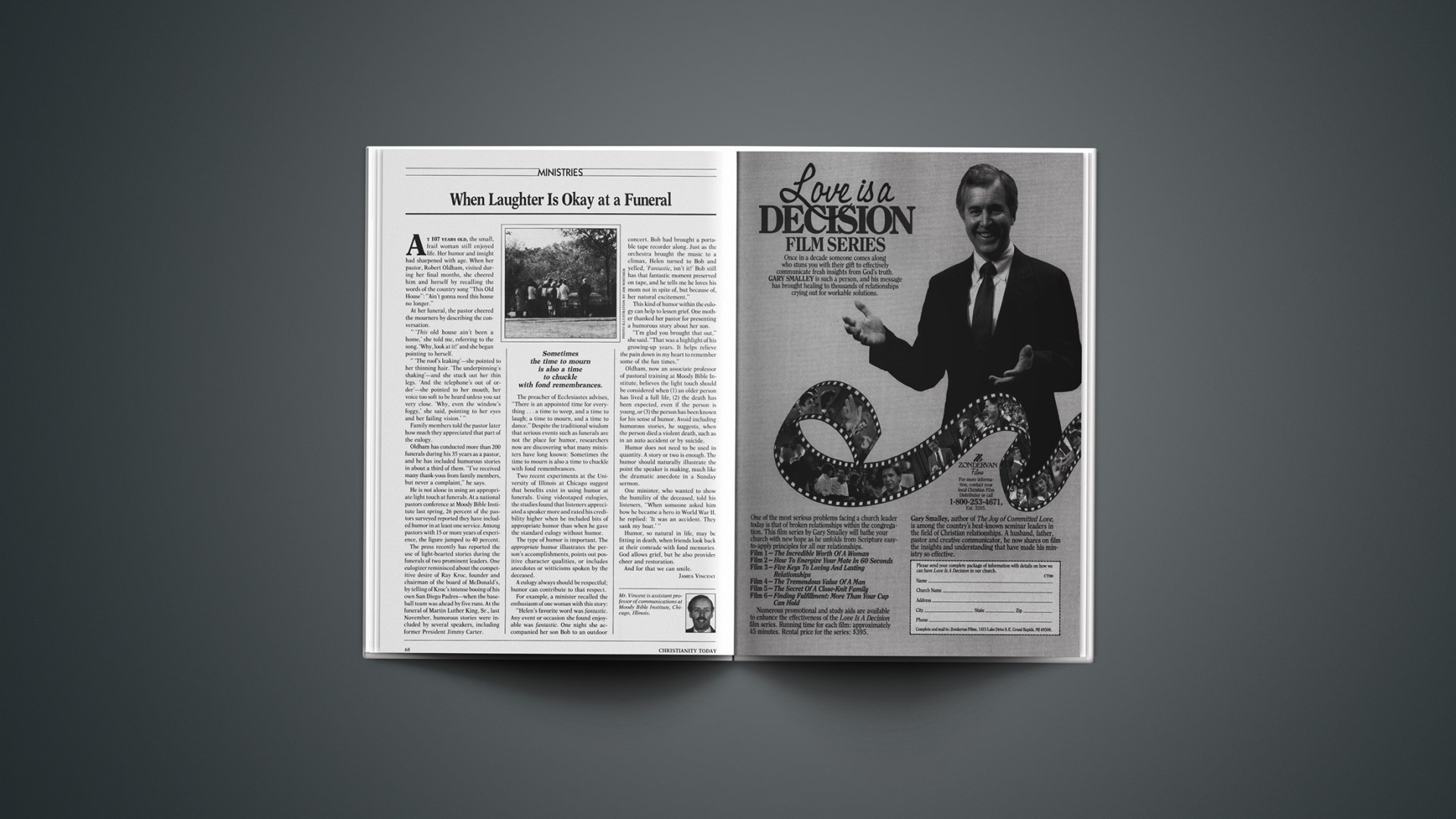
When Laughter Is Okay at a Funeral

At 107 years old, the small, frail woman still enjoyed life. Her humor and insight had sharpened with age. When her pastor, Robert Oldham, visited during her final months, she cheered him and herself by recalling the words of the country song “This Old House”: “Ain’t gonna need this house no longer.”

At her funeral, the pastor cheered the mourners by describing the conversation.

‘This old house ain’t been a home,’ she told me, referring to the song. ‘Why, look at it!’ and she began pointing to herself.

“ ‘The roof’s leaking’—she pointed to her thinning hair. ‘The underpinning’s shaking’—and she stuck out her thin legs. ‘And the telephone’s out of order’—she pointed to her mouth, her voice too soft to be heard unless you sat very close. ‘Why, even the window’s foggy,’ she said, pointing to her eyes and her failing vision.’ ”

Family members told the pastor later how much they appreciated that part of the eulogy.

Oldham has conducted more than 200 funerals during his 35 years as a pastor, and he has included humorous stories in about a third of them. “I’ve received many thank-yous from family members, but never a complaint,” he says.

He is not alone in using an appropriate light touch at funerals. At a national pastors conference at Moody Bible Institute last spring, 26 percent of the pastors surveyed reported they have included humor in at least one service. Among pastors with 15 or more years of experience, the figure jumped to 40 percent.

The press recently has reported the use of light-hearted stories during the funerals of two prominent leaders. One eulogizer reminisced about the competitive desire of Ray Kroc, founder and chairman of the board of McDonald’s, by telling of Kroc’s intense booing of his own San Diego Padres—when the baseball team was ahead by five runs. At the funeral of Martin Luther King, Sr., last November, humorous stories were included by several speakers, including former President Jimmy Carter.

The preacher of Ecclesiastes advises, “There is an appointed time for everything … a time to weep, and a time to laugh; a time to mourn, and a time to dance.” Despite the traditional wisdom that serious events such as funerals are not the place for humor, researchers now are discovering what many ministers have long known: Sometimes the time to mourn is also a time to chuckle with fond remembrances.

Two recent experiments at the University of Illinois at Chicago suggest that benefits exist in using humor at funerals. Using videotaped eulogies, the studies found that listeners appreciated a speaker more and rated his credibility higher when he included bits of appropriate humor than when he gave the standard eulogy without humor.

The type of humor is important. The appropriate humor illustrates the person’s accomplishments, points out positive character qualities, or includes anecdotes or witticisms spoken by the deceased.

A eulogy always should be respectful; humor can contribute to that respect.

For example, a minister recalled the enthusiasm of one woman with this story:

“Helen’s favorite word was fantastic. Any event or occasion she found enjoyable was fantastic. One night she accompanied her son Bob to an outdoor concert. Bob had brought a portable tape recorder along. Just as the orchestra brought the music to a climax, Helen turned to Bob and yelled, ‘Fantastic, isn’t it!’ Bob still has that fantastic moment preserved on tape, and he tells me he loves his mom not in spite of, but because of, her natural excitement.”

This kind of humor within the eulogy can help to lessen grief. One mother thanked her pastor for presenting a humorous story about her son.

“I’m glad you brought that out,” she said. “That was a highlight of his growing-up years. It helps relieve the pain down in my heart to remember some of the fun times.”

Oldham, now an associate professor of pastoral training at Moody Bible Institute, believes the light touch should be considered when (1) an older person has lived a full life, (2) the death has been expected, even if the person is young, or (3) the person has been known for his sense of humor. Avoid including humorous stories, he suggests, when the person died a violent death, such as in an auto accident or by suicide.

Humor does not need to be used in quantity. A story or two is enough. The humor should naturally illustrate the point the speaker is making, much like the dramatic anecdote in a Sunday sermon.

One minister, who wanted to show the humility of the deceased, told his listeners, “When someone asked him how he became a hero in World War II, he replied: ‘It was an accident. They sank my boat.’ ”

Humor, so natural in life, may be fitting in death, when friends look back at their comrade with fond memories. God allows grief, but he also provides cheer and restoration.

And for that we can smile.

Mr. Vincent is assistant professor of communications at Moody Bible Institute, Chicago, Illinois.

Books

Book Briefs: August 9, 1985

Good taste is every Christian’s responsibility.

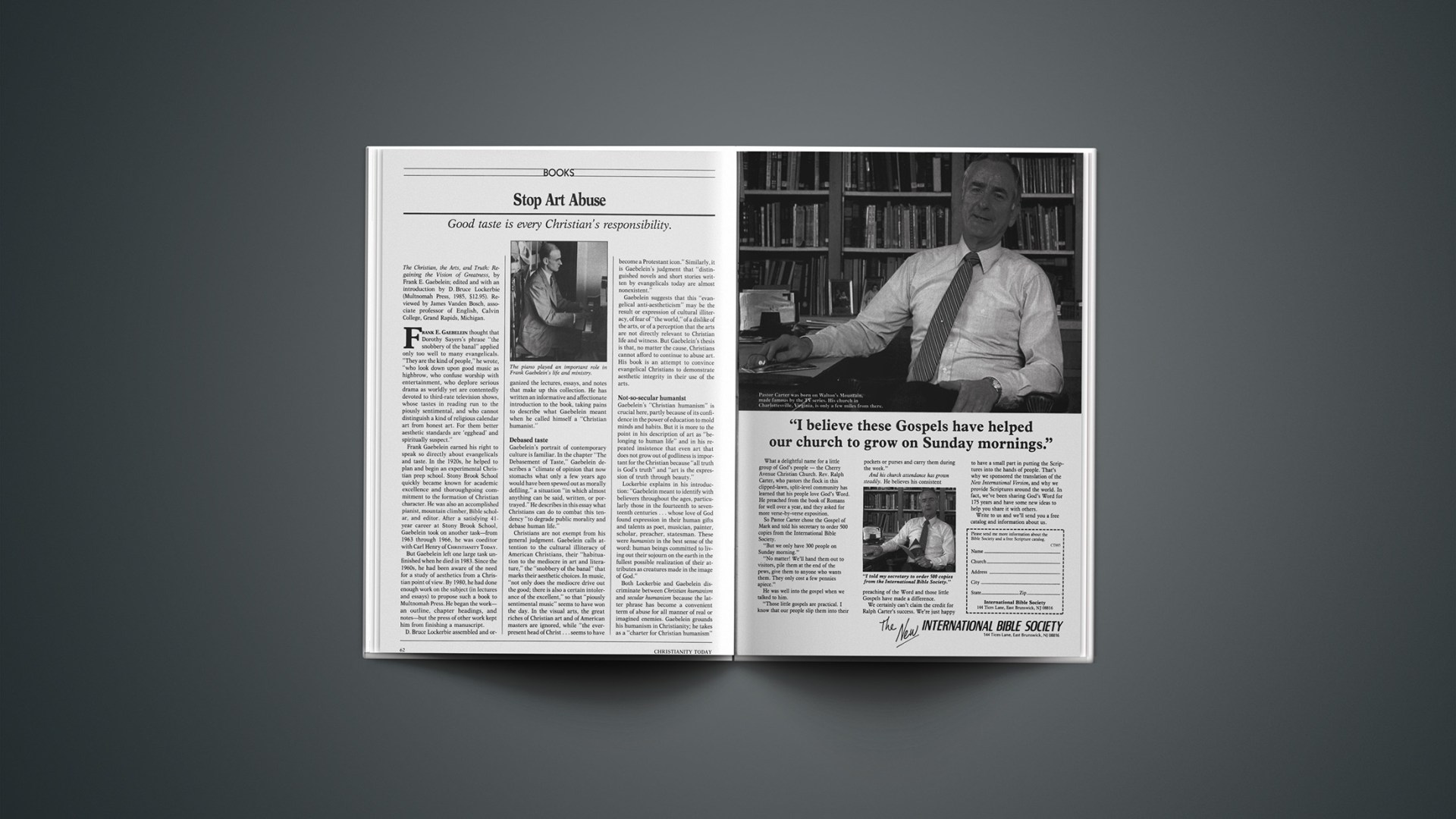
The Christian, the Arts, and Truth: Regaining the Vision of Greatness, by Frank E. Gaebelein; edited and with an introduction by D. Bruce Lockerbie (Multnomah Press, 1985, $12.95). Reviewed by James Vanden Bosch, associate professor of English, Calvin College, Grand Rapids, Michigan.

Frank E. Gaebelein thought that Dorothy Sayers’s phrase “the snobbery of the banal” applied only too well to many evangelicals. “They are the kind of people,” he wrote, “who look down upon good music as highbrow, who confuse worship with entertainment, who deplore serious drama as worldly yet are contentedly devoted to third-rate television shows, whose tastes in reading run to the piously sentimental, and who cannot distinguish a kind of religious calendar art from honest art. For them better aesthetic standards are ‘egghead’ and spiritually suspect.”

Frank Gaebelein earned his right to speak so directly about evangelicals and taste. In the 1920s, he helped to plan and begin an experimental Christian prep school. Stony Brook School quickly became known for academic excellence and thoroughgoing commitment to the formation of Christian character. He was also an accomplished pianist, mountain climber, Bible scholar, and editor. After a satisfying 41-year career at Stony Brook School, Gaebelein took on another task—from 1963 through 1966, he was coeditor with Carl Henry of CHRISTIANITY TODAY.

But Gaebelein left one large task unfinished when he died in 1983. Since the 1960s, he had been aware of the need for a study of aesthetics from a Christian point of view. By 1980, he had done enough work on the subject (in lectures and essays) to propose such a book to Multnomah Press. He began the work—an outline, chapter headings, and notes—but the press of other work kept him from finishing a manuscript.

D. Bruce Lockerbie assembled and organized the lectures, essays, and notes that make up this collection. He has written an informative and affectionate introduction to the book, taking pains to describe what Gaebelein meant when he called himself a “Christian humanist.”

Debased Taste

Gaebelein’s portrait of contemporary culture is familiar. In the chapter “The Debasement of Taste,” Gaebelein describes a “climate of opinion that now stomachs what only a few years ago would have been spewed out as morally defiling,” a situation “in which almost anything can be said, written, or portrayed.” He describes in this essay what Christians can do to combat this tendency “to degrade public morality and debase human life.”

Christians are not exempt from his general judgment. Gaebelein calls attention to the cultural illiteracy of American Christians, their “habituation to the mediocre in art and literature,” the “snobbery of the banal” that marks their aesthetic choices. In music, “not only does the mediocre drive out the good; there is also a certain intolerance of the excellent,” so that “piously sentimental music” seems to have won the day. In the visual arts, the great riches of Christian art and of American masters are ignored, while “the ever-present head of Christ … seems to have become a Protestant icon.” Similarly, it is Gaebelein’s judgment that “distinguished novels and short stories written by evangelicals today are almost nonexistent.”

Gaebelein suggests that this “evangelical anti-aestheticism” may be the result or expression of cultural illiteracy, of fear of “the world,” of a dislike of the arts, or of a perception that the arts are not directly relevant to Christian life and witness. But Gaebelein’s thesis is that, no matter the cause, Christians cannot afford to continue to abuse art. His book is an attempt to convince evangelical Christians to demonstrate aesthetic integrity in their use of the arts.

Not-So-Secular Humanist

Gaebelein’s “Christian humanism” is crucial here, partly because of its confidence in the power of education to mold minds and habits. But it is more to the point in his description of art as “belonging to human life” and in his repeated insistence that even art that does not grow out of godliness is important for the Christian because “all truth is God’s truth” and “art is the expression of truth through beauty.”

Lockerbie explains in his introduction; “Gaebelein meant to identify with believers throughout the ages, particularly those in the fourteenth to seventeenth centuries … whose love of God found expression in their human gifts and talents as poet, musician, painter, scholar, preacher, statesman. These were humanists in the best sense of the word: human beings committed to living out their sojourn on the earth in the fullest possible realization of their attributes as creatures made in the image of God.”

Both Lockerbie and Gaebelein discriminate between Christian humanism and secular humanism because the latter phrase has become a convenient term of abuse for all manner of real or imagined enemies. Gaebelein grounds his humanism in Christianity; he takes as a “charter for Christian humanism” the well-known words of Paul in Philippians: “Whatsoever things are true, whatsoever things are honest, whatsoever things are just, whatsoever things are pure, whatsoever things are lovely, whatsoever things are of good report; if there be any virtue, and if there be any praise, think on these things” (4:8). Gaebelein believes that the heritage of human artistic achievement provides much for the Christian to think on.

Gaebelein ranges freely through biblical theology to establish the rightful place for Christian aesthetics. Following Dorothy Sayers’s book The Mind of the Maker, Gaebelein uses the creation account to show God as a creator, whose “very good” suggests the beauty of God’s workmanship. The description of humanity made in the image of God allows Gaebelein to see humans being true to the divine image by the exercise of their own limited creativity. The account of the Fall requires full acknowledgement of the radical effects of sin upon human intention and achievement.

Genius Is Where You Find It

Gaebelein reverts regularly to the doctrine of common grace, that God’s grace extends beyond his saving grace toward the elect to include the illumination and blessing of all humankind.

Thus genius and creativity are to be valued and acknowledged wherever they manifest themselves—in an ancient Greek or in a contemporary atheist. Gaebelein takes this proposition seriously in the essays themselves: he borrows from a wide variety of sources. He quotes with approval a sentence from Alfred North Whitehead, a phrase and an orientation from Dorothy Sayers, a dictum from T. S. Eliot, and ideas from Jacques Barzun, Denis de Rougemont, Jonathan Edwards, and Emil Brunner. Gaebelein is catholic in his taste and generously admits his indebtedness to the great tradition that enriched his life.

From this variety of sources Gaebelein assembles standards for judging art. First, art must be true. For Gaebelein, the “truth” of art does not mean first of all propositional or doctrinal truth. Art is true when it exhibits four characteristics: durability, unity, integrity, and inevitability. He discovers these virtues both in the classical critical tradition and in scriptural precept and example.

Second, a work of art must be excellent. Gaebelein considers God’s “surpassing excellence in creation and beauty as in all else,” and insists that human work in the arts must also strive for perfection, “the unattainable.” All significant art will express truth through beauty, but art created by a Christian will have the added value of revealing the reality of God. The beauty of good art is a reflection of “something of God’s own beauty and glory.”

Gaebelein has taken on a job that very much needs to be done. His description of Christian anti-aestheticism rings true. And his goal is laudable—to urge upon Christians their responsibility to make appropriate use of the gifts of art.

Unfinished Symphony

But there are problems in Gaebelein’s work. The book is not, after all, a finished work but rather a collection of diverse expressions of Gaebelein’s thought. Several long passages are duplicated in the book, there are only a few instances in which it is possible to tell when and for what occasion an essay was produced, and there are very few notes for the many sources referred to.

These relatively minor problems, however, are part of a larger problem. Although the book has a single problem in view, it lacks the architecture and proportionality that would give the argument a sense of unity and inevitability. Perhaps such a problem is unavoidable in a project like this.

For many readers, however, the content of Gaebelein’s aesthetics will be problematic. His insistence upon an aesthetics based on the paired concepts of “truth” and “beauty” will make it difficult for many to follow him to his conclusions. He uses the terms in the riddling manner of Keats—what is beautiful is true; what is true is beautiful. Gaebelein’s reliance on “beauty” is part of the problem of the book. The term is too vague for some of the work that needs to be done and too narrow for naming what it is that marks a successful work of modern art. Modern aesthetics regards the concept of beauty as not very useful.

Gaebelein also seems to endorse many of the assumptions of the institution of high art, assumptions that restrict a work of art to being an object for aesthetic contemplation. Art properly has many functions, and to insist on restricting it to one use is to diminish all that art can be and do in entertainment, persuasion, and criticism.

Moreover, Gaebelein seems to accept the heritage of Western art without much struggle. Although he concedes that sin and man’s fallenness make it possible for art to corrupt and debase us, he is more likely to affirm the humanizing possibilities of exposure to the arts.

Many Christians working in the arts and criticism will find that Gaebelein has raised many questions that need more satisfactory answers. But these questions indicate the need for more Christian reflection on the arts. It would be uncharitable to blame Gaebelein for failing to accomplish in this book what evangelical Christianity has not achieved and yet so urgently needs to be done: the construction of a complete and compelling framework for a Christian approach to the arts. It is more consonant with the spirit of Gaebelein’s book for me to recommend his essays as making another contribution to that rich inheritance of things that are of good report, honest, and virtuous—essays that Christians should think on and be thankful for.

Act Like A CEO

Leaders: The Strategies for Taking Charge, by Warren Bennis and Burt Nanus (Harper & Row, 1985, 244 pp.; $19.95). Reviewed by Robert K. Johnston, dean of North Park Theological Seminary, Chicago, Illinois.

According to the authors to the authors of Leaders, “most organizations are managed, not led.” Yet the decline in credibility of those in authority makes leadership crucial as seldom before. Thus the importance of this book, which has insights relevant to business, church, and home alike.

Bennis, a management professor at the University of Southern California, and Nanus, director of USC’s Center for Futures Research, have interviewed and observed 90 top leaders—CEOs, orchestra conductors, coaches, labor leaders, among others—hoping to discover common characteristics of effective leadership. And what Tolstoy concluded concerning families—“All happy families resemble one another, each unhappy family is unhappy in its own way”—turns out to be true of leaders.

Key Strategies

Those who were queried employed four common leadership strategies:

First, a leader must be able to create a new and compelling vision. Leaders create focus, not arbitrarily or unilaterally, but through paying attention to their teams. Like conductor and orchestra, leader and organization must be one. Only as an organization has shared meanings and interpretations of reality can there be focus for new action.

Second, a leader must communicate his or her vision effectively, persuading and not coercing. And since corporate communication is more than words, the leader must also make the necessary changes in management processes, organizational structure, and management style to support the values called for by the new vision. When leaders’ actions are appropriate to their visions, followers discover their own roles and worth. Common pride, commitment, enthusiasm, and energy result.

Third, leadership is only possible in an atmosphere of trust. In fact, the accumulation of trust is a measure of the legitimacy of leadership. Not only must the leader articulate the vision clearly, there must be constancy, reliability, and predictability in both speech and action. Leaders will have to exercise “courageous patience” to overcome the corporate inertia and inevitable opposition to the changes needed in the “social architecture” of the organization.

Fourth, the positive self-regard of a leader induces positive self-regard in others. A leader’s knowledge of his or her strengths, together with the capacity to continue both to develop them and to exercise them, is contagious. Effective leadership empowers others “to translate intention into reality and sustain it.”

For Bennis and Nanus, “leadership is what gives an organization its vision and its ability to translate that vision into reality.” Effective leadership “knows what it wants, communicates those intentions, positions itself correctly, and empowers its work force.” It instills vision, meaning, trust, and self-regard.

Thoughts Provoked

The authors included a number of observations that are thought-provoking for Christian readers. Here is a sampling:

1. Leadership is recognized to be “not so much the exercise of power itself as the empowerment of others.” One thinks of Jesus’ redefinition of leadership in Mark 10—servanthood, not superiority.

2. Almost all 90 leaders interviewed were happily married and enthusiastic about the institution of marriage. (The authors were surprised.) Such findings are confirmed by George Valliant’s longitudinal study of Harvard graduates. Perhaps people with healthy relationships make the healthiest leaders.

3. The higher the leadership post, “the more interpersonal and human the undertaking.” The authors discovered that the top executives they interviewed spent roughly 90 percent of their time with people and virtually the same percentage of their time concerned with “the messiness of people problems.” Leadership, that is, has to do with enabling others to fulfill their full humanness better.

4. Although leading is a job (often a well-paid one), equal reward comes from the sense of adventure and play engendered by the task. Charles Garfield’s study showed that “optimal performers” work with “intention and delight” rather than “with determination and for relief.” And Jesus said that shepherds are more likely to be devoted to their work than are hirelings, whose only reward is their pay.

Christians need to continue to reflect theologically on such insights from our wider culture. As they do, Leaders: The Strategies for Taking Charge might prove to be a profitable source.

The Wallenda Factor

Being on the tightrope is living; everything else is waiting.

—Karl Wallenda, 1968

“Perhaps the most impressive quality of the leaders we studied was the way they respond to failure. Like Karl Wallenda—whose life was at stake each time he walked the tightrope—these leaders put all their energies into their task. They simply don’t think about failure, don’t even use the word, relying on such synonyms as ‘mistake,’ ‘glitch,’ ‘bungle.’ Never failure.

Shortly after Wallenda fell to his death in 1978, his wife recalled: ‘All Karl thought about for three straight months prior to it was falling. It was the first time he’d ever thought about that, and it seemed to me that he put all his energies into not falling rather than walking the tightrope.’

From what we learned from the interviews with successful leaders, it became clear that when Karl Wallenda poured his energies into not falling rather than walking the tightrope, he was virtually destined to fail.

Consider Ray Meyer, who led DePaul University to forty-two consecutive years of winning basketball. When his team dropped its first game after twenty-nine straight home court victories, we called to see how he felt. His response was vintage Wallenda: ‘Great! Now we can start concentrating on winning, not on not losing.’ Meyer reframed for us the Wallenda factor, the capacity to embrace positive goals, to pour one’s energies into the task, not into looking behind and dredging up excuses.

The Wallenda factor is basically about learning. And all learning involves some ‘failure.’ We propose a general rule for all organizations: ‘Reasonable failure should never be received with anger.’ Spinoza said that those who respond to failure of others by anger are themselves slaves to passion and learn nothing.

Tom Watson, Sr., IBM’s founder and guiding inspiration, put that principle to work. A promising junior executive was involved in a risky venture for the company and lost over $10 million. When Watson called the nervous executive into his office, the young man blurted out, ‘I guess you want my resignation?’ Watson said, ‘You can’t be serious. We’ve just spent $10 million educating you!’

Although leading is a ‘job’ for which leaders are handsomely paid, what they truly value is a sense of adventure and play. Like explorers and artists, they focus their attention on their task, forget personal problems, lose their sense of time, feel competent and in control. When these elements are present, leaders truly enjoy what they’re doing and stop worrying about whether what they are doing will work. They are walking the tightrope.”

Adapted from Leaders: The Strategies for Taking Charge,© 1985 by Warren Bennis and Burt Nanus.

Cult Specialists Assess Nontraditional Religions in the Mid-Eighties

A number of the nation’s leading cult watchers say nontraditional religions are on the increase. None of the 14 cult specialists who responded to an informal survey said the trend toward cultic aberrations is diminishing. Ten of the respondents said it is growing, and four said it is “about the same.”

“Some [cults] diminish, some grow, new ones are formed. It’s always here,” said Lowell D. Streiker, author of The Cults Are Coming (Abingdon). “Always a fringe in society seek out bizarre and novel groups.… As social problems arise, groups arise to address the issues.” Streiker said that Scientology, the Divine Light Mission, the Hare Krishna movement, and Sun Myung Moon’s Unification Church are “in decline.… The Children of God are stable. Shepherding is growing—as are deliverance/healing/prosperity groups.”

“The new cults … continue to expand,” said John E. Dahlin, editor of The Discerner, “but they are not matching any of the major cults in expansion and influence.”

Several respondents cautioned against being misled by a decrease in news media coverage of cults. “The phenomenon has become so common that it is no longer newsworthy unless ‘local color’ or tragedy [are involved],” said Betty McConahy of the Citizens Freedom Foundation.

John H. Gerstner, emeritus professor of church history at Pittsburgh Theological Seminary, said the upward trend is “traceable to the decline of authentic Christianity in the mainline denominations.” Dahlin agreed with Gerstner. “Cults will continue to expand, due to the lack of evangelical emphasis by most of the leading denominations,” he said. “People who have no solid moorings are easily detached and will join the cults.”

Said a representative of Spiritual Counterfeits Project: “People have lost the grounds for any type of spiritual discernment. For example, a 1982 Gallup Poll shows that 23 percent of the people believe in reincarnation. [Of those], 21 percent claimed to be Protestants, and 25 percent claimed to be Catholics.”

The survey asked researchers to record their predictions for 1985 and beyond. Said Eternity magazine editor William J. Petersen, author of Those Curious New Cults in the Eighties (Keats): “America has a religious hunger, and it is trying to satisfy it either at quick-food drive-ins or at exotic restaurants. This will continue and probably increase.” Said Westmont College sociology professor Ronald Enroth, author of Youth, Brainwashing, and the Extremist Cults (Zondervan): “Extremist fundamentalist/separatist sects will grow.” And James Bjornstad, executive director of the Institute of Contemporary Christianity, predicted “increasing interest in New Age [issues] and increasing diversity in aberrations [related to Christianity].” Robert E. Schecter, editor of The Cult Observer, said he forsees “more shepherding/discipleship and ‘pop’ therapy problems.” And Gordon R. Lewis, professor of systematic theology at Denver Conservative Baptist Seminary and author of Confronting the Cults (Baker), predicted “an increasing polarity between evangelical Christian groups holding to the Bible’s teaching as the highest authority, and new-consciousness, New Age groups holding to immediate experiences as a higher authority.”

Of the pre-1960 cults, survey respondents said the Church of Jesus Christ of Latter-day Saints (Mormons) is the “most dangerous” to mainstream Christian bodies. The Jehovah’s Witnesses finished a distant second. Personal Freedom Outreach warned: “Mormons and Jehovah’s Witnesses are dangerous because they are established, promote moral values and family unity, and appear to be [just another Christian denomination].… The Unification Church is working towards this same end.” Eternity magazine’s Petersen agreed: “Mormons model good old American values.… And the Unification Church is moving along the same course toward respectabilty that the Mormons have trod.”

Among post-1960 cults, the researchers cited the Unification Church, The Way International, and Rajneeshpuram as among the “most dangerous.”

The survey also solicited comments on brainwashing and deprogramming. Respondents were divided in their assessment of brainwashing. But they were unanimous in opposing physical restraint and verbal abuse in efforts to extricate young people from destructive cults. In the judgment of retired Pittsburgh Seminary professor Gerstner, “If a person is capable of either [brainwashing or deprogramming], he should be brought to psychiatrists. Otherwise, let Christians give reasons for their hope and show [the] lack of [similar reasons] in cults.”

Said Bjornstad: “I do not accept the programming claim that a person could not do otherwise but join, and thus I reject the strict opposite of programming, [which is] deprogramming.” He said he is concerned about an increase in deprogrammings of people from Christian groups.

Streiker rejected “the brainwashing hypothesis,” describing it as “the psychologizing of religious phenomena.” In his extensive study of former People’s Temple members, he said he discovered “only one or two” cases of zombie-like depersonalization. “Their bodies were controlled, but their minds were still functioning.”

What about the use of the term “cult”? Streiker said he dislikes the term because “the cult label justifies in the minds of many hate and oppression.” Petersen said he distinguishes between “cult” and “cultic.” “ ‘Cultic,’ authoritarian groups may be fundamental theologically, but dangerous socially and psychologically,” he said. “Some cults may not hurt a fly, but are spiritually devastating.”

How should Christians respond to cults? Most of the cult watchers agreed that appropriate responses include love, reconciliation, a positive Christian witness, biblical refutation of cultic teachings, and honest dialogue with cult members.

“The church has grown increasingly autistic,” said Dean Halverson, of Spiritual Counterfeits Project. “We seem to be more concerned about our own salvation than that of those in the cults.”

U.S. Catholic Church Sees Rise In Number Of Married Priests

If current trends continue, an increasing number of Roman Catholics may see their next priest arrive in town with a wife and children. Requests by married Episcopal clergymen to be reordained into the Catholic priesthood have doubled in the recent past.

In the last four years, 26 married Episcopalians have become Catholic priests. Fifteen cases are pending in Rome, and 40 additional contacts are on the books.

The numbers are small, but the trend is significant, said James Parker, an assistant to Boston Archbishop Bernard Law. Parker, a married man who was reordained as a Catholic priest in 1981, oversees the application and reordination process. The Vatican’s provisions for reordination apply only to Episcopalians in the United States.

“In the past … we would hear from one man every two or three weeks,” Parker said. “We now hear from perhaps three or four in a month. Now that may not sound like a lot, but it’s a very serious move.”

The married former Episcopalians make up a small percentage of the nearly 58,000 Catholic clergymen in the United States. Yet they are the most rapidly growing category of married Catholic priests. Those categories include:

• Married Orthodox or Protestant clergymen who petition Vatican officials directly for Catholic reordination.

• Married Catholic priests ordained by overseas bishops and accepted by U.S. bishops, including a Polish National Catholic priest recently hired by the Rochester, New York, diocese.

• Eastern Rite Catholic priests in the United States, including Byzantine, Melkite, and Ukranian Rite Catholics. Beginning in the twelfth century and as recently as 1936, at least 15 of the Eastern Rite communities asked for and were granted reunion with the Vatican. They were allowed to keep their customs, including married clergy. About 50 of the 700 Eastern Rite Catholic priests in the United States are married.

Overseas, it is common for Eastern Rite priests to be married. “I grew up [in Lebanon] among married priests …,” said Joseph Lahoud, pastor of Our Lady of the Cedars of Lebanon, Boston. “I don’t think the people questioned it.… They had no reservations, no problems at all. The community was just happy to have a priest.”

But problems can pester married Catholic priests in the United States. A bishop from Lebanon was scheduled to arrive at Lahoud’s church last month to ordain a married man into the priesthood.

“The response has been very negative, which is surprising to me,” said Lahoud, who is single. “People are calling up and asking questions. The minute he [the new priest] says a Mass people will be panicking.”

Such reluctance to accept married Catholic priests makes it difficult for those priests to find a job. Ronald Golini, director of communications for the Melkite-Greek Catholic diocese in West Newton, Massachusetts, said there is “a lot of pressure on the bishops not to hire them [married clergy]. So even if you manage to get ordained overseas, when you get back there’s not a job available.”

RELIGIOUS NEWS SERVICE

Canada’S Southern Baptists Form An Autonomous Denomination

Southern Baptists in Canada are the latest in a string of Protestant groups north of the border to declare their independence from parent bodies in the United States. Messengers (delegates) from 78 congregations in central and western Canada voted to form the Canadian Convention of Southern Baptists.

The autonomy move came nearly a year after the 14.3 million-member Southern Baptist Convention (SBC) voted against extending its denominational boundaries to include Canada. Most of the Canadian Southern Baptist churches were formed in the past 30 years and were affiliated with the SBC’s Northwest Baptist Convention, whose headquarters are in Portland, Oregon. Both the SBC’s Home Mission Board and its Foreign Mission Board will assist in the development of the new denomination. The Home Mission Board will lend support to church planting efforts, and the Foreign Mission Board will help the Canadian denomination found a seminary in Calgary, Alberta.

The Canadian Convention of Southern Baptists is the latest Canadian denomination to declare autonomy from an American parent body. During the past few years the Evangelical Free Church, Baptist General Conference, Christian and Missionary Alliance, and two Lutheran bodies have taken similar steps. The Lutheran action resulted in a merger known as the Evangelical Lutheran Church in Canada.

NORTH AMERICAN SCENE

Gay Nondiscrimination Order Struck Down

New York’s highest court has struck down a New York City executive order that prohibited city contractors from discriminating against homosexuals in hiring. The order, issued by New York Mayor Ed Koch, had been opposed by the Salvation Army, the Catholic Archdiocese of New York, and Agudath Israel of America. Those groups provide some $97 million worth of social services under contract to New York City. The New York Court of Appeals ruled that Koch, as mayor, does not have the authority to initiate such a hiring policy.

U.S. Church Membership Rises

Protestant church membership in the United States rose slightly less than 1 percent in 1983. Figures from 219 denominations, most of them Protestant, show a collective membership of 140,816,358, an increase of more than 1.2 million members. In 1984, the Roman Catholic Church in the United States saw a slight decline in membership. Last year’s U.S. Catholic membership stood at 52,286,043, a drop of 106,891 from 1983.

Court Strikes Down Creationism Law

A federal appeals court has struck down the nation’s only law requiring the teaching of creationism alongside evolution. The Fifth U.S. Circuit Court of Appeals upheld a district court ruling that said the Louisiana law was unconstitutional. The appeals court ruled that the statute violated the First Amendment’s ban against laws “favoring any particular religious belief or doctrine.”

Moon Leaves Prison

Unification Church leader Sun Myung Moon has been released from a federal prison in Connecticut after serving nearly 12 months for income tax evasion. As a condition of his release, Moon will be spending his nights through mid-August at a Brooklyn, New York, halfway house. He was convicted in 1982 of failing to report $162,000 in income on his federal tax returns.

Judge Denies Retrial In Clergy Malpractice Suit

A California superior court judge has denied a request for a retrial in the nation’s first clergy malpractice suit. A retrial was requested by the parents of a man who committed suicide after receiving counseling from pastors at Grace Community Church in southern California. In May, a superior court judge dismissed the suit, saying the court had no “compelling reason … to interfere with the counseling” at the church (CT, June 14, 1985, p. 49).

Activist Pastor Defrocked

Lutheran minister D. Douglas Roth has been removed as a clergyman in the Lutheran Church in America. The church’s Western Pennsylvania-West Virginia Synod upheld an earlier finding that Roth was guilty of “willful disregard and violation” of the denomination’s constitution. Last fall, Roth was removed as pastor of Trinity Lutheran Church in Clairton, Pennsylvania. He is a major supporter of Denominational Ministry Strategy, a group that used confrontational tactics to publicize the plight of unemployed steelworkers (CT, April 19, 1985, p. 52).

Scientology Settles A Lawsuit

The Church of Scientology has ended a Boston lawsuit against it by paying a $150,000 out-of-court settlement. The suit was filed by Lavenda Van Schaick, who said she had been harrassed by Scientologists since leaving the organization in 1979. Three weeks earlier the group lost a $39 million lawsuit in Oregon. In that suit, Julie Titchbourne charged that the Church of Scientology had not fulfilled its promises to improve her intelligence, eyesight, and study habits.

Lebanon’s Evangelical Church Survives Ten Years of Violence

Americans associate Lebanon with sectarian violence, including the taking of hostages and the suicide bombings of military and diplomatic installations. Few remember that before full-scale civil conflict broke out ten years ago, the country was a haven for Middle Eastern Christians and Muslims who wanted to coexist.

Evangelicals, representing perhaps 1.5 percent of the Christian community, have been hit hard by the suffering that accompanies civil war. But observers say the church is stronger as a result.

“The [evangelical] church in Lebanon has been vitalized and made to stand on its own two feet. The church is stronger spiritually now than it ever was before,” said Douglas Anderson, director of Middle East Christian Outreach, an interdenominational organization with field headquarters in Cyprus.

The Baptist church is the largest evangelical body in Lebanon. Before the fighting erupted, 15 Baptist congregations claimed a total membership of about 550, said Ghassen Khalif, a Baptist pastor in Beirut who serves as president of the Lebanon Baptist Convention. After the start of the civil war, he said, more than 200 Baptists left the country. “But the Lord was with us. We continued to witness, and now we are more than 800.”

Although evangelicals lost many of their seasoned leaders to mass emigration, a new wave of enthusiastic young leaders has taken the helm of the church. Today more young Lebanese than in previous years are attending seminaries. Evangelicals operate three seminaries in Lebanon, one of which opened just last year.

In addition, evangelical churches are cooperating more closely. “Christians have taken the initiative in self-help programs, general relief care, refugee work, and finding homes for displaced people,” Anderson said. “There has been a real outpouring of true Christian love.”

Financed in large part by overseas Christian relief organizations, congregations distribute goods to needy persons regardless of their religious affiliation. “This has opened many doors for witness,” Anderson said, “and has given some of the evangelical churches real credibility in the eyes of local people and authorities.”

While Lebanon’s evangelical churches have suffered and survived, evangelical publishing efforts could become a casualty of the war. For decades Lebanon has served as a center of Christian publishing, broadcasting, and educational outreach to the Middle East. At one time scores of mission organizations maintained headquarters or branch offices in the tiny country. Because Lebanon’s constitution guarantees religious freedom, Western mission agencies used the country as a launching point for Middle East outreach.

With the outbreak of sectarian violence, however, many organizations found it difficult, if not impossible, to carry on their work. During the last decade, the missionary force shrank from more than 100 to fewer than 30. Some expatriate organizations moved their Middle East head quarters to Cyprus, Egypt, Europe, or the United States. Some decentralized their Arab ministries, and others abandoned them altogether.

“Some have left good national works behind them,” Anderson said. “Among those who are left, there is more of a sense of cooperation.”

Some of the largest and best-established ministries remained in Lebanon. Production of literature has continued at normal levels, although publishers have found it necessary to distribute their materials through Cyprus.

Unless Lebanon’s situation changes for the better, the outlook for continued missionary activity in the country is dim. Many of the veteran missionaries who remain in Lebanon will retire in the next few years. New missionary candidates are understandably reluctant to volunteer for service in a war zone.

Nevertheless, the commitment of the evangelical organizations that continue to work in Lebanon is strong. “We are continually looking at the situation and discussing what can be done,” said Dale Thorne of the Southern Baptist Foreign Mission Board. “Our people will stay there and witness as long as they can.”

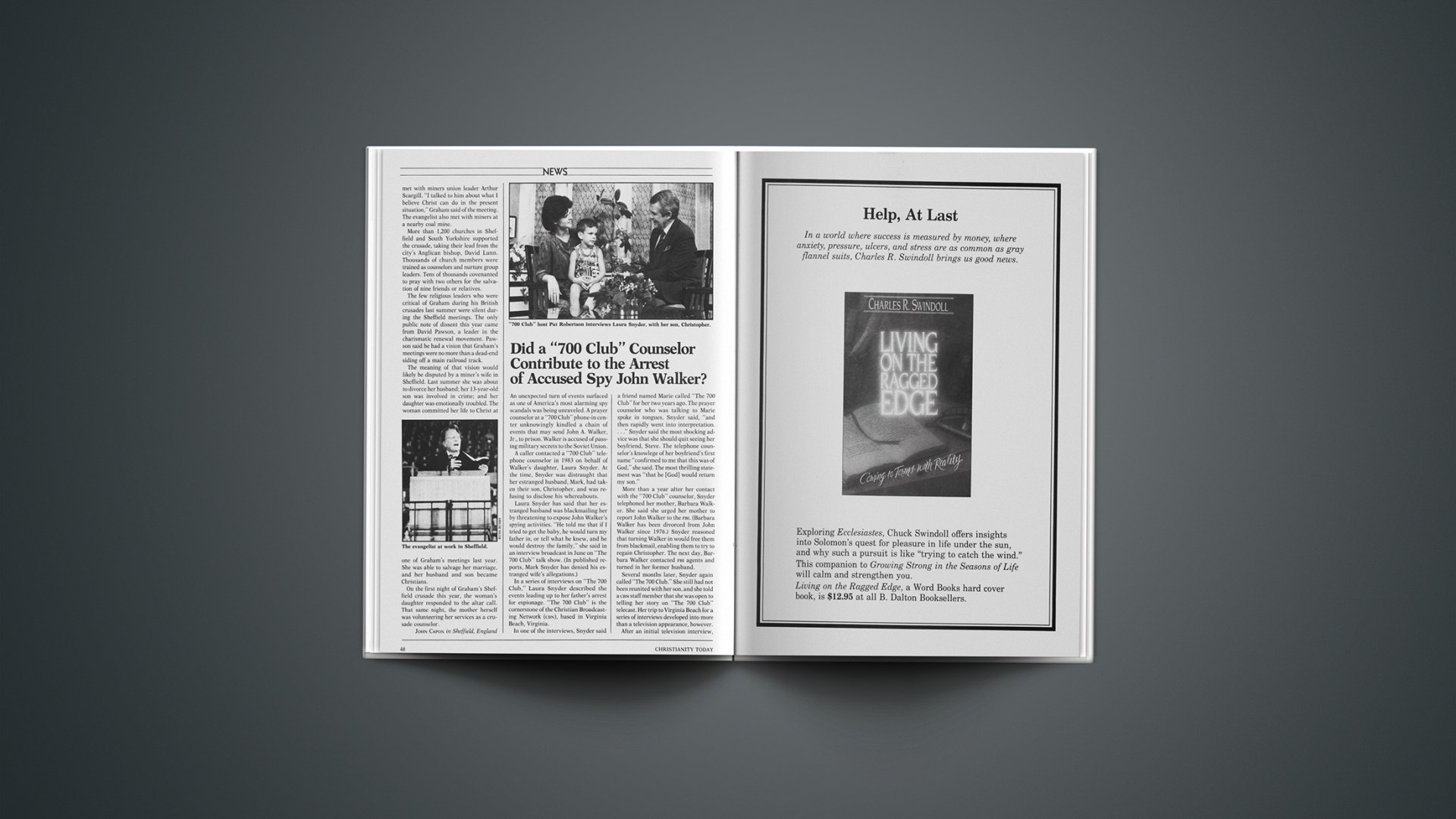
Did a “700 Club” Counselor Contribute to the Arrest of Accused Spy John Walker?

An unexpected turn of events surfaced as one of America’s most alarming spy scandals was being unraveled. A prayer counselor at a “700 Club” phone-in center unknowingly kindled a chain of events that may send John A. Walker, Jr., to prison. Walker is accused of passing military secrets to the Soviet Union.

A caller contacted a “700 Club” telephone counselor in 1983 on behalf of Walker’s daughter, Laura Snyder. At the time, Snyder was distraught that her estranged husband, Mark, had taken their son, Christopher, and was refusing to disclose his whereabouts.

Laura Snyder has said that her estranged husband was blackmailing her by threatening to expose John Walker’s spying activities. “He told me that if I tried to get the baby, he would turn my father in, or tell what he knew, and he would destroy the family,” she said in an interview broadcast in June on “The 700 Club” talk show. (In published reports, Mark Snyder has denied his estranged wife’s allegations.)

In a series of interviews on “The 700 Club,” Laura Snyder described the events leading up to her father’s arrest for espionage. “The 700 Club” is the cornerstone of the Christian Broadcasting Network (CBN), based in Virginia Beach, Virginia.

In one of the interviews, Snyder said a friend named Marie called “The 700 Club” for her two years ago. The prayer counselor who was talking to Marie spoke in tongues, Snyder said, “and then rapidly went into interpretation.…” Snyder said the most shocking advice was that she should quit seeing her boyfriend, Steve. The telephone counselor’s knowlege of her boyfriend’s first name “confirmed to me that this was of God,” she said. The most thrilling statement was “that he [God] would return my son.”

More than a year after her contact with the “700 Club” counselor, Snyder telephoned her mother, Barbara Walker. She said she urged her mother to report John Walker to the FBI. (Barbara Walker has been divorced from John Walker since 1976.) Snyder reasoned that turning Walker in would free them from blackmail, enabling them to try to regain Christopher. The next day, Barbara Walker contacted FBI agents and turned in her former husband.

Several months later, Snyder again called “The 700 Club.” She still had not been reunited with her son, and she told a CBN staff member that she was open to telling her story on “The 700 Club” telecast. Her trip to Virginia Beach for a series of interviews developed into more than a television appearance, however.

After an initial television interview, Snyder and a friend traveled to Mark Snyder’s Maryland apartment and whisked five-year-old Christopher away soon after he stepped outside. (A CBN attorney had secured Mark Snyder’s address.) Authorities said no charges would be filed against Laura Snyder because neither parent has legal custody of the child.

Snyder later appeared on “The 700 Club” with her son. She characterized her father as “arrogant, self-centered, egotistical.” She said he was motivated to spy by “money, greed, selfishness.… He wanted to live in the greatest country in the world and to have all the benefits, … but he didn’t want to be loyal to it. He would rather sell it.”

She said she supposes that Walker will “spend the rest of his life in jail.” At the same time, Snyder said, “it’s another thing to spend eternity in hell. I don’t want that for him.”

Catholic Bishops Closer To Associate Member Status In Canadian Council Of Churches

The Canadian Conference of Catholic Bishops is one step closer to becoming an associate member of the Canadian Council of Churches.

Delegates to the ecumenical council’s triennial convention unanimously approved a constitutional amendment that paves the way for admission of the Catholic bishops’ organization as an associate member.

The Canadian Council of Churches claims 13 member bodies, including most mainline Protestant denominations, two Orthodox bodies, the Salvation Army, and the Polish National Catholic Church of Canada. The Canadian Conference of Catholic Bishops already has applied for admission as an associate member. The application is expected to be approved by the required two-thirds vote of the ecumenical council’s members and ratified at the autumn meeting of its general board. Associate members will be eligible to vote on all council matters, except those related to the organization’s constitution and the admission of new members.

According to the 1981 Canadian census, Roman Catholics form 47 percent of the country’s population—compared to just over 41 percent for all Protestants. That ratio would give Catholics a majority in a truly representative ecumenical body.

The stipulations attached to the new associate member status are designed to offset that preponderance. An associate member, for instance, will be granted council representation based on only 20 percent of its membership. That restriction would give Catholics about the same representation as the Anglican Church of Canada, the second-largest member body in the Canadian Council of Churches.

In the United States, the National Conference of Catholic Bishops is not a member of the National Council of Churches (NCC). An NCC representative said that although the Catholic church never had applied, it is eligible for full NCC membership.

LESLIE K. TARR in Toronto

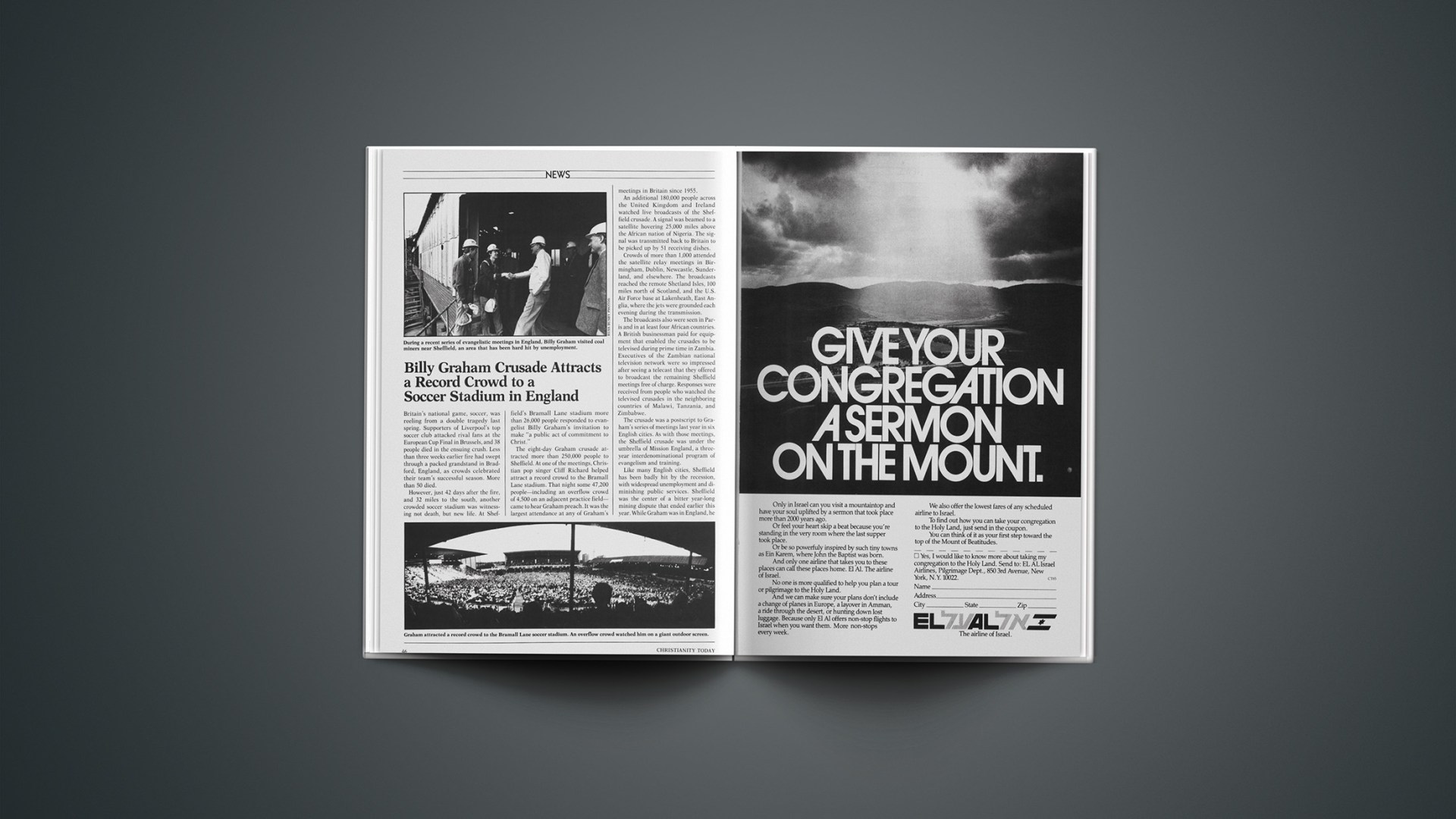
Billy Graham Crusade Attracts a Record Crowd to a Soccer Stadium in England

Britain’s national game, soccer, was reeling from a double tragedy last spring. Supporters of Liverpool’s top soccer club attacked rival fans at the European Cup Final in Brussels, and 38 people died in the ensuing crush. Less than three weeks earlier fire had swept through a packed grandstand in Bradford, England, as crowds celebrated their team’s successful season. More than 50 died.

However, just 42 days after the fire, and 32 miles to the south, another crowded soccer stadium was witnessing not death, but new life. At Sheffield’s Bramall Lane stadium more than 26,000 people responded to evangelist Billy Graham’s invitation to make “a public act of commitment to Christ.”

The eight-day Graham crusade attracted more than 250,000 people to Sheffield. At one of the meetings, Christian pop singer Cliff Richard helped attract a record crowd to the Bramall Lane stadium. That night some 47,200 people—including an overflow crowd of 4,500 on an adjacent practice field—came to hear Graham preach. It was the largest attendance at any of Graham’s meetings in Britain since 1955.

An additional 180,000 people across the United Kingdom and Ireland watched live broadcasts of the Sheffield crusade. A signal was beamed to a satellite hovering 25,000 miles above the African nation of Nigeria. The signal was transmitted back to Britain to be picked up by 51 receiving dishes.

Crowds of more than 1,000 attended the satellite relay meetings in Birmingham, Dublin, Newcastle, Sunderland, and elsewhere. The broadcasts reached the remote Shetland Isles, 100 miles north of Scotland, and the U.S. Air Force base at Lakenheath, East Anglia, where the jets were grounded each evening during the transmission.

The broadcasts also were seen in Paris and in at least four African countries. A British businessman paid for equipment that enabled the crusades to be televised during prime time in Zambia. Executives of the Zambian national television network were so impressed after seeing a telecast that they offered to broadcast the remaining Sheffield meetings free of charge. Responses were received from people who watched the televised crusades in the neighboring countries of Malawi, Tanzania, and Zimbabwe.

The crusade was a postscript to Graham’s series of meetings last year in six English cities. As with those meetings, the Sheffield crusade was under the umbrella of Mission England, a three-year interdenominational program of evangelism and training.

Like many English cities, Sheffield has been badly hit by the recession, with widespread unemployment and diminishing public services. Sheffield was the center of a bitter year-long mining dispute that ended earlier this year. While Graham was in England, he met with miners union leader Arthur Scargill. “I talked to him about what I believe Christ can do in the present situation,” Graham said of the meeting. The evangelist also met with miners at a nearby coal mine.

More than 1,200 churches in Sheffield and South Yorkshire supported the crusade, taking their lead from the city’s Anglican bishop, David Lunn. Thousands of church members were trained as counselors and nurture group leaders. Tens of thousands covenanted to pray with two others for the salvation of nine friends or relatives.

The few religious leaders who were critical of Graham during his British crusades last summer were silent during the Sheffield meetings. The only public note of dissent this year came from David Pawson, a leader in the charismatic renewal movement. Pawson said he had a vision that Graham’s meetings were no more than a dead-end siding off a main railroad track.

The meaning of that vision would likely be disputed by a miner’s wife in Sheffield. Last summer she was about to divorce her husband; her 13-year-old son was involved in crime; and her daughter was emotionally troubled. The woman committed her life to Christ at one of Graham’s meetings last year. She was able to salvage her marriage, and her husband and son became Christians.

On the first night of Graham’s Sheffield crusade this year, the woman’s daughter responded to the altar call. That same night, the mother herself was volunteering her services as a crusade counselor.

U.S. Supreme Court Restates Its Commitment to Separation of Church and State

A series of U.S. Supreme Court rulings on church-and-state issues this year calls into question whether there is a discernible trend toward government accommodation of religion in public life. But in each case, a split decision indicates the Court’s continuing reevaluation of how it should interpret the “sparse language and broad purposes,” as one justice wrote, of the First Amendment’s establishment clause.

Last month the Court handed down two decisions that struck down state aid to private school students. The justices were split five to four on both decisions. The rulings were based on rigorous applications of the Court’s traditional “three-part test”: whether a statute has a secular purpose; excessively entangles church and state; or advances religion. In Grand Rapids, Michigan, and in New York City, publicly funded educational programs involving church-affiliated school students flunked the three-part test.

In both cases, Justice Lewis F. Powell voted with the majority, providing a crucial swing vote that, in the last two terms, weighted several opinions in favor of greater accommodation of religion in public life. Recent Supreme Court rulings allowed chaplains to be paid by state legislatures, cities to permit nativity scenes on public land, and parents of parochial school students to take tax deductions for tuition.

This term, however, the Court reiterated its commitment to maintaining separation of church and state. In addition to the rulings involving private schools, the Court struck down an Alabama school-prayer law (CT, July 12, 1985, p. 52), prohibited states from requiring private employers to give employees a regular day off for religious observance, and ruled that private religious groups must abide by federal minimum-wage laws.

Two church-and-state cases resulted in tied votes because Powell was unable to participate due to illness. One tie vote accommodated the request of a Nebraska woman to obtain a driver’s license without having her picture taken because of religious belief. In the other, the Court sided with Scarsdale, New York, citizens who want a nativity scene displayed on town property.

The Court’s New York City aid to private schools ruling, known as Aguilar v. Felton, prevents federal funds from being used to pay salaries of public school employees who teach in parochial schools. The program being challenged, called Title I, authorizes federal financial assistance for school programs directed at students in low-income neighborhoods. In New York, the program included remedial reading and mathematics, English as a second language, and guidance services.

Public school employees volunteer to participate in the program, which takes place on private school premises, most of which are church related. The teachers are asked to avoid getting involved with any religious activities in the private schools and to steer clear of private school personnel. Classroom materials used for Title I programs are supplied by the government, and parochial schools hosting the programs are required to remove religious symbols from classrooms used by public school teachers.

The Court’s majority ruled that even if Title I does not advance religion directly, its administration “inevitably results in the excessive entanglement of church and state.” The program had to be monitored to assure that the public school employees did not teach religion.

“In short,” the opinion says, “the religious school, which has as a primary purpose the advancement and preservation of a particular religion must endure the ongoing presence of state personnel whose primary purpose is to monitor teachers and students in an attempt to guard against the infiltration of religious thought.… Despite the well-intentioned efforts taken by the City of New York, the program remains constitutionally flawed.”

The four justices who dissented—Chief Justice Warren Burger and Associate Justices Byron White, Sandra Day O’Connor, and William Rehnquist—attacked the majority for demonstrating hostility toward religion.

These same four justices filed dissenting opinions in the Grand Rapids case, although Burger and O’Connor concurred with a portion of the majority ruling. Known as School District of the City of Grand Rapids v. Ball, the case brought before the Supreme Court a pair of programs in which public and private school activities intersect.

One of the programs, called a shared time program, offers classes during the school day to supplement courses required by the state. They are taught by full-time employees of the public schools.

The other, called a community education program, makes classes available after school hours. The classes are taught primarily by teachers employed by private schools, but hired temporarily by the public schools during the duration of the program. In Grand Rapids, 40 of the 41 private schools that participated in the programs were sectarian.

Michigan education officials had gone to great lengths to clear the private school rooms used by these students of any religious symbolism. The public schools paid rent to private schools for the space used for the programs, and a sign saying “Public School Classroom” had to be posted. As in the New York case, the course offerings ranged from remedial reading and math to instruction in hobbies such as crafts, model building, and gymnastics.

The Supreme Court’s majority opinion discounts the absence of specific incidents of religious indoctrination. “After spending the balance of their school day in classes heavily influenced by a religious perspective,” the majority stated, “they [students] would have little motivation or ability to discern improper ideological content that may creep into a Shared Time or Community Education [course].”

The only church-and-state ruling in the term just ended that approached unanimity among the justices involved a Connecticut employee who refused to work on Sunday. The employee, Donald Thornton (who died in 1982 while the case was pending before the Connecticut Supreme Court) cited a state law that prevented employers from forcing employees to work on a day they observe as their Sabbath.

Thornton won in lower courts, then lost in the Connecticut Supreme Court. The U.S. Supreme Court, in an eight-to-one vote, agreed with the state’s highest court, ruling against Thornton. “The statute arms Sabbath observers with an absolute and unqualified right not to work on whatever day they designate as their Sabbath,” the majority wrote. This imposes on employers “an absolute duty to conform their business practices to the particular religious practices” of an employee. The Court ruled that the law advanced religion as its primary effect, making the statute unconstitutional.

Rehnquist dissented without comment, while O’Connor and Thurgood Marshall concurred. They said the Connecticut law “conveys a message of endorsement of the Sabbath observance” to the detriment of people who do not share belief in a Sabbath. “Endorsement” is a new yardstick O’Connor has mentioned in several rulings in an attempt to shed new light on the separation of church and state. That yardstick reflects dissatisfaction among several justices about the “wall of separation” they have fallen back on for so long. It will ensure another round of intriguing church-and-state rulings next term, which begins October 7.

Apple PodcastsDown ArrowDown ArrowDown Arrowarrow_left_altLeft ArrowLeft ArrowRight ArrowRight ArrowRight Arrowarrow_up_altUp ArrowUp ArrowAvailable at Amazoncaret-downCloseCloseEmailEmailExpandExpandExternalExternalFacebookfacebook-squareGiftGiftGooglegoogleGoogle KeephamburgerInstagraminstagram-squareLinkLinklinkedin-squareListenListenListenChristianity TodayCT Creative Studio Logologo_orgMegaphoneMenuMenupausePinterestPlayPlayPocketPodcastRSSRSSSaveSaveSaveSearchSearchsearchSpotifyStitcherTelegramTable of ContentsTable of Contentstwitter-squareWhatsAppXYouTubeYouTube