Experts on Nontraditional Religions Try to Pin down the New Age Movement

What is the New Age movement, and how should the church respond to it? Some have identified it as a conspiracy that intends to introduce the Antichrist mentioned in Revelation. However, others say that the movement is merely a recent expression of age-old paganism.

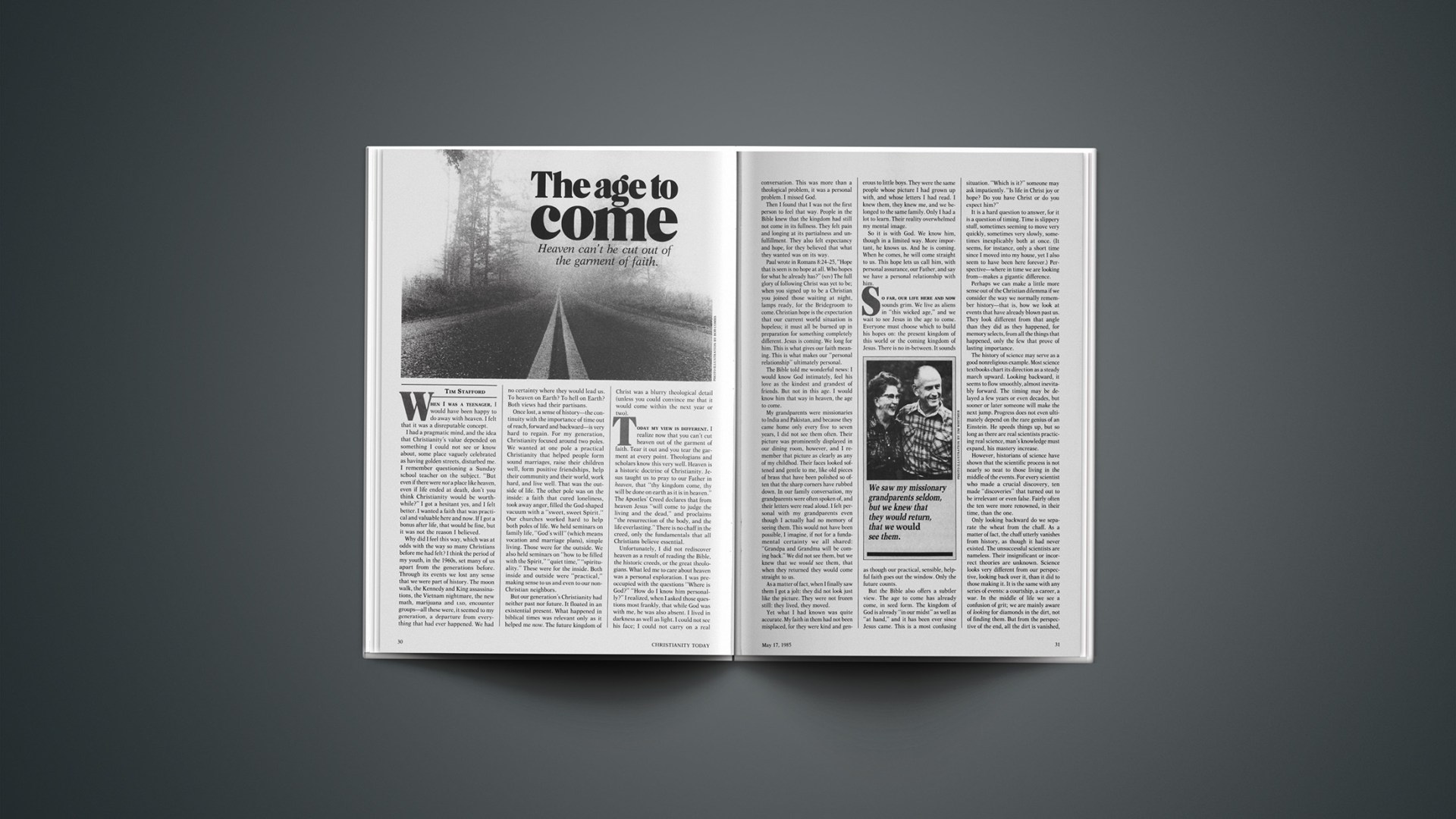
A recent conference in Denver attracted experts on nontraditional religions and some 300 others to try to put the New Age movement in perspective. The gathering was sponsored by Evangelical Ministries to New Religions (EMNR).

A statement prepared by EMNR and distributed at the close of the conference found no basis for an organized conspiracy behind the New Age movement. The statement defines the movement as “a spiritual, social, and political movement to transform individuals and society through mystical enlightenment, hoping to bring about a utopian era, a ‘New Age’ of harmony and progress. While it has no central headquarters or agencies, it includes loosely affiliated individuals, activist groups, businesses, professional groups, and spiritual leaders and their followers. It produces countless books, magazines, and tapes reflecting a shared worldview and vision. How that worldview is expressed, what implications are drawn, and what applications are made differ from group to group.”

The statement listed basic assumptions of New Age philosophy, including:

• God is an impersonal undifferentiated oneness, not separate from creation.

• Humanity, like all creation, is an extension of this divine oneness and shares its essential being. Thus, humanity is divine.

• Transformation of humanity is brought about through techniques that can be applied to mind, body, and spirit. Examples of such techniques include meditation, yoga, chanting, creative visualization, hypnosis, and submission to a guru.

“New Age teachers often use a common terminology …,” the statement read. “However, merely using a term popular among New Agers [such as consciousness, holistic, or global] no more indicates acceptance of New Age philosophy than use of the term ‘evangelism’ indicates acceptance of Christianity.”

Douglas Groothius, a doctoral candidate at the University of Wisconsin and author of a forthcoming book on the New Age movement, said the sixties’ counterculture rejected materialism and turned inward—and eastward—to Hindu mysticism. The resulting New Age world view added the dimension of divine power to humanistic thought, he said, producing a type of cosmic humanism.

Groothius said the agenda of New Age politics includes the following:

• A form of androgeny, making no distinction between male and female. Males are held responsible for the evils of human history. The neopagan return to the Wicca concept of Mother-God, holding male and female in her womb, he said, is a hallmark of New Age religion and politics.

• A view of ecology in which nature and God are merged, and the transcendence of God is rejected.

• A world order that applies an “all is one” theology to nations, making national boundaries obsolete, and taking a global approach to the world’s problems.

Walter Marlin, director of the Christian Research Insitute, defined the New Age movement simply as “occultism.” How should Christians approach New Agers? The key is found in Acts 17, Martin said. Paul deplored idolatry in Athens, but used the altar “to the unknown god” as common ground for preaching the gospel. In a similar way, he said, Christians should approach adherents of the New Age movement with love and concern.
Theology

Part III: Is Evangelical Faith Enough?

Church historian John D. Woodbridge evaluates Thomas Howard’s decision to become a Catholic.

Despite Thomas Howard’s conversion to Catholicism, his deep appreciation for his godly forbears and Protestant evangelicals in general remains. He lauds their commitment to many of the great tenets of the Christian faith, and he heartily commends their lifestyles and intrepid evangelism. Nonetheless, his analysis of the Christian faith encompasses an extensive critique of evangelical Protestant faith.

Howard faults evangelicalism on two fronts. First, he says, Protestantism does not have an infallible teaching office to guarantee an infallible understanding of the Christian faith. Second, he says, Protestantism is stricken by a poverty of authentic spirituality and meaningful worship.

It is true that many evangelicals sense a need for more meaningful worship in the life of their churches. Rather than clearing the mind’s eye to perceive more fully the resplendent glory of Almighty God, evangelical worship services on occasion can dim spiritual vision by focusing on displays of the trite, and even the tawdry.

Be that as it may, Howard misspeaks when he says “the soul can’t feed” on Reformation Protestantism. If comparisons must be made, the writings of many seventeenth-century Puritan divines reflect a profundity of spirituality that matches that of Catholic mystics of the same period. Many evangelicals have had their souls supremely well nourished by feasting on the Word of God. And the worship services in numerous evangelical churches throughout the world do not compare unfavorably for a sense of worship with services in Roman Catholic churches. The complaint that an overweening poverty of worship and spirituality has globally characterized Protestantism since the sixteenth century is not a judicious one.

Even though Howard faults evangelical worship, that criticism probably did not determine his decision to become a Catholic. He apparently was attracted by an almost-ethereal vision of the physical presence of the Catholic church evolving in time and yet remaining mysteriously constant.

He is particularly impressed by what he perceives to be the infallible doctrine that the pope and the teaching office of the church pronounce and defend. During an interview with CHRISTIANITY TODAY, he repeatedly indicated that his beliefs were in line with whatever the teaching office of the Roman Catholic Church ultimately affirmed. If he did not know how to answer a specific question or how to harmonize alleged descrepancies in Catholic tradition, he assured his questioner that somewhere a faithful Catholic teacher knew the correct response. Once attracted to the edifice of the church, he apparently could not envision how the claims of the church might ever be falsified. Whatever intellectual or spiritual objections might exist, in Howard’s thinking they yield before an important premise: essential church teaching is infallible. The question of how this premise is related to the obvious diversity of belief in contemporary Catholicism does not seem to trouble him.

Evangelicals should respect the sincerity of Howard’s convictions. But they undoubtedly will balk at his belief in the infallibility of the Catholic magisterium, based on apostolic authority passed through an unbroken physical continuity of papal ordinations. In the sixteenth century, a Catholic monk named Martin Luther balked at the magisterium, leading him to challenge the church’s teaching authority. Luther sought to have Scripture alone determine his beliefs, not the interpretations of the church fathers, the pope, or church traditions. For Luther, tradition was instructive but not determinative.

As Luther evaluated the Catholic church of his day, he could not square its teachings with its claim to represent authentic apostolic authority. If the church were genuinely apostolic, he reasoned, its teachings should have meshed more easily with those of the apostles as found in Holy Scripture. A notable student of the Bible, Luther began to draw up a list of items in Catholic doctrine and practice that he thought had no warrant in Holy Scripture. His list included the Catholic Mass as a re-enactment of the sacrifice of Christ’s death; the penitential system; purgatory; and the merits of the saints. He felt that the Catholic church had allowed many of its human, fallible traditions to supersede the teachings of God’s Word. Luther wanted to restore apostolic authority in the church by restoring true apostolic doctrine.

In contrast, by accepting the Catholic claim to infallible doctrine, Howard has been led to endorse a view of salvation mediated by the church’s priestly-sacramental system. Ironically, it was this teaching about salvation that grieved Luther, a fervent Catholic. Luther had been particularly troubled by the wrenching question of his own salvation. He tried to follow scrupulously what the Catholic church told him to do to find release from his sin and sense of guilt. He became a monk. He partook of the Eucharist regularly. He disciplined himself. But frustration greeted him at every turn. Some years later he found relief in Paul’s teaching about justification by faith alone.

Luther believed that many Catholic teachers of his day taught what amounted to a works-righteousness salvation. They did not sufficiently take into account the vitiating effects of sin upon man, disallowing his ability to earn his salvation. Luther struck out at the Catholic church as a mediating priestly-sacramental vehicle of salvation. According to widespread Catholic teaching, salvation depended not only on what God had done, but on how the faithful responded. They needed to dispose themselves to receive grace through the sacraments so that they could cooperate with God and earn their salvation through their faith and freely performed good works, including participation at the Mass.

Luther noted that in Romans and Galatians, Paul indicates that we are justified by faith through grace alone, not by our works. We are declared righteous because God sees us clothed in Christ’s righteousness. Good works will flow freely from our justification, but they are not an instrumental cause of our salvation.

If Christ’s righteousness has not been imputed to us, if we are not clothed in Christ’s righteousness alone, then we are left in our own righteousness, which the Bible describes as “filthy rags.” Sharp are the distinctions between a salvation teaching that extols the mediating role of the Catholic sacramental system and the teaching of evangelical Protestantism.

In lengthy dialogues between American Roman Catholic and Lutheran scholars ending in 1983, vigorous attempts have been made to overcome these differences. Luther’s insights regarding justification by faith alone received a sympathetic hearing from Catholic representatives. They acknowledged that much of his teaching does find warrant in Scripture. Differences did emerge, however, regarding how Christians appropriate justification by faith alone.

For some Protestants, the Catholic church’s capacity to accommodate even a Martin Luther may come as a surprise. But for Howard and other Roman Catholics, this capacity to expand its “infallible” traditions to encompass new thought without betraying old beliefs is another gift of the Holy Spirit to his church.

It is to be hoped that evangelical Protestants will not be viewed as churlish if they take serious exception with the Roman Catholic Church’s analysis of its own infallible developing tradition. Not only is it difficult to find convincing scriptural justification for Catholic doctrines such as the Immaculate Conception of Mary (1854), her bodily assumption into heaven (1950), and her redemptive role in our salvation, but it is difficult to track an unbroken tradition for these beliefs back to the apostolic generation. Moreover, in his careful study, Revolution in Rome (InterVarsity), David Wells demonstrates convincingly that several teachings of the Second Vatican Council, for example, were not merely adaptations of some previous beliefs of the church but outright doctrinal changes.

Is being an evangelical enough? When evangelical teaching reflects faithfully what the Bible teaches, then it is certainly enough. Does this mean that evangelicals have no regard for the communion of saints and the teachings of brothers and sisters in Christ who preceded them? Not at all. Many evangelicals find great instruction and spiritual solace in the writings of Luther, John Calvin, Menno Simons, John Wesley, and of several Catholic authors. But no thoughtful evangelical would want to elevate his or her own theology or tradition to the point where they are no longer fully subject to potential revision in accord with the teachings of God’s Word.

As evangelicals, we can understand several of Howard’s criticisms of worship practices and low levels of spirituality within our churches. These problems should be frankly acknowledged, and steps should be taken to remedy them. But they should not constitute grounds for an evangelical making the pilgrimage to Rome. The capacity to offer a feast of aesthetic and awe-inspiring delights through stately architecture or reverential worship services does not guarantee that a church has apostolic authority behind it, whether it be Catholic or Protestant. Instead, that characteristic is determined by another question: Are the church’s teachings in line with the teachings of the apostles? Once again, if evangelicals seek with the Holy Spirit’s help to make the gospel taught by the apostles their living faith, that is enough. They will warrant their name: “men and women of the gospel.”

NORTH AMERICAN SCENE

Three members of a family who were expelled from a Southern Baptist congregation have filed a $2.5 million lawsuit against the church and its pastor. Lloyd and Taye Ruth and their teenage daughter sued the First Baptist Church of Sunset, Louisiana, and its pastor, William M. Hill, Jr., for defamation, invasion of privacy, humiliation, and emotional distress. The Ruths claim that Hill knowingly made false accusations at a church meeting concerning their daughter’s character and sexual activities. Hill has said the suit questions “the right of a congregational church to discipline its members.”

The U.S. Supreme Court has decided not to review a North Carolina State University ban on religious solicitation in dormitories. The decision lets stand two lower federal court rulings that upheld the ban. In the suit, former student Scott Chapman claimed that his First Amendment rights had been violated, and that university officials had engaged in censorship.

The Lilly Endowment has given the Christian Church (Disciples of Christ) a $250,000 grant to help the denomination make plans for a new headquarters building. The 1.2 million-member denomination, based in eastern Indianapolis, has considered moving to the city’s downtown area. The Lilly Endowment has not made any commitments to six other Protestant denominations that city officials are trying to attract to Indianapolis.

The Book, a paperback edition of The Living Bible paraphase, has sold more than one million copies since August. An additional one million copies will be printed by this summer. The Book is selling well in major bookstore chains as well as in truck stops and supermarkets. Published by Tyndale House Publishers, 30 million copies of The Living Bible have been sold since its introduction 14 years ago.

A federal district judge has sentenced two persons convicted of helping Salvadorians illegally enter the United States. Jack Elder, director of a shelter for Central Americans in San Benito, Texas, was sentenced to 150 days in a halfway house. Stacey Lynn Merkt, a volunteer at the shelter, was sentenced to 269 days in prison. Elder and Merkt are free pending an appeal of their convictions.

The Assemblies of God has grown by more than 1,500 congregations in the last decade, with nearly a church per day being added during the 1980s. The Gulf Latin American District has led the growth of the denomination, adding 118 new churches since 1980. The Assemblies of God reported 10,582 congregations in the United States at the end of 1984.

A federal district court judge has struck down a resolution that banned “First Amendment activities” at Los Angeles International Airport. Jews for Jesus successfully challenged a Board of Airport Commissioners resolution that prohibited religious speech—including the distribution of religious tracts—within the airport’s central terminal area. Judge Edward Rafeedie ruled that the airport terminal is a public forum that is open to First Amendment activities.

WORLD SCENE

The Dutch Reformed Mission Church of South Africa has exonerated Allan Boesak of the charge that he had an extramarital affair. Boesak, president of the World Alliance of Reformed Churches, has resumed his official church duties. Allegations against the churchman were published in the Johannesburg Star earlier this year. Boesak is a leading opponent of apartheid, the South African government’s policy of racial separation.

The Chinese government has decided to allow overseas churches to send non-missionary teachers to China. Ten Christian teachers who are expected to arrive in China by September will teach English in state-run schools under the supervision of the Amity Foundation, an organization started by Chinese Christians. The American teachers are expected to enhance the church’s growing position of respectability in Chinese society.

An international human rights organization has identified 15 countries where religious believers face torture, imprisonment, and even death. Amnesty International cited Albania, Burundi, Bulgaria, Cuba, Czechoslovakia, China, Egypt, Ethiopia, Iran, Nepal, Pakistan, Rumania, the Soviet Union, Vietnam, and Yugoslavia. The human rights organization says a number of the countries grant more rights to atheists than to religious believers.

A United Nations (UN) official says one-half to two-thirds of the UN’S $1.5 billion in targeted emergency aid for Africa has been met.UN relief coordinator F. Bradford Morse said he is confident that the immediate needs of drought-stricken African countries will be met. The U.S. government has donated $1 billion worth of food. The American public has contributed an additional $75 million.

Churches around the world will observe a Day of Prayer for World Evangelization on May 26. The Lausanne Committee for World Evangelization proposed in 1977 that Pentecost Sunday of each year be a day of prayer. An increasing number of churches worldwide has adopted the proposal.

Critics Link A Fantasy Game To 29 Deaths

A fantasy game called Dungeons & Dragons (D&D), manufactured by TSR Hobbies in Lake Geneva, Wisconsin, has had its share of critics since it was first marketed in 1973. In recent months some of those critics, including the National Coalition on Television Violence (NCTV), have linked the game to 29 suicides and murders since 1979.

Earlier this year NCTV petitioned the Federal Trade Commission and the Consumer Protection Agency to require TSR Hobbies to put warnings on game books stating that the game has been linked to several deaths, NCTV also asked the Federal Communications Commission to require similar warnings during the airing of a Saturday morning cartoon show based on the game.

All three federal agencies rejected the request, NCTV chairman Thomas Radecki, a psychiatrist at the University of Illinois School of Medicine, said his organization has begun to ask members of Congress who oversee those agencies for “their cooperation in enforcing the laws” governing toy safety and fraudulent advertising.

Accompanying NCTV in this effort is an organization called Bothered About D & D (B.A.D.D.). The group was founded by Pat Pulling, the mother of a boy who played D&D at the time he killed himself. Pulling said D&D game manuals contain “detailed descriptions of killing, Satanic human sacrifice, assassination, sadism, premeditated murder, and curses of insanity.” She added that much of the material comes from “demonology, including witchcraft, the occult, and evil monsters.”

TSR estimates that as many as 4 million people, mostly teenagers and young adults, play D&D. Players rely on detailed game manuals and use their imaginations to create adventures under the direction of an experienced player known as the Dungeonmaster. The Dungeonmaster designs problems that other players will encounter and assigns to players strengths and weapons they can use to defeat enemies and achieve power and treasure.

“I don’t believe TSR … wants to do harm or promote violence,” Radecki said. “But this game is detrimental to millions of people.” A game can last for hours, weeks, even months. Radecki and other critics charge that for some players, intense involvement blurs the line between reality and fantasy. “A typical player may spend as much as 15 hours a week playing the game,” Radecki said. “An avid player will spend much more [time].”

TSR spokesman Dieter Sturm said 5,000 American teenagers commit suicide every year. “Maybe some of these people did play D&D,” he said, “but so do millions of others.”

NCTV and B.A.D.D. said that in at least 13 deaths linked to D&D, there is “very solid evidence”—including police reports, eyewitnesses, and documents left by the victims—that the game’s influence was a decisive factor. Sturm called such claims “misleading.” Subsequent investigations, he said, “found the game has nothing to do with the deaths.”

Personalia

John F. MacArthur, Jr., has been named president of The Master’s College, formerly Los Angeles Baptist College. The school previously was affiliated with the General Association of Regular Baptists. MacArthur will continue his ministries as senior pastor of Grace Community Church in California.

Gregg O. Lehman has resigned after four years as president of Taylor University in Upland, Indiana. “The presidency has placed a tremendous strain on me physically and emotionally,” he said, “and has caused strains on my family.” Lehman said he plans to study and write as an executive in residence at Vanderbilt University in Nashville.

Maxwell Meyers has succeeded Charles Bennett as president of Mission Aviation Fellowship. The evangelical agency coordinates some 300 pilots who provide flight services for missions and local churches in remote areas of the Third World.

George Erik Rupp, dean of the Harvard Divinity School, has been named president of Rice University in Houston. The Presbyterian clergyman is the first nonscientist to lead the university known for its science and engineering programs. Rupp succeeds Norman Hackerman, president of the school for 15 years.

The trustees of Fresno (Calif.) Pacific College have appointed Richard Kriegbaum as the school’s president. Kriegbaum has served as the college’s vice-president of administration. He formerly served as director of planning and marketing at Wheaton (Ill.) College. Kriegbaum will succeed college president Edmund Janzen in July.

Dennis M. Mulder has been named international director of the World Home Bible League. In his new position, Mulder will oversee the distribution of Scriptures in 73 countries. He succeeds William Ackerman, the organization’s director for 35 years.

The Christian Ministries Management Association, a professional association designed to assist managers of Christian organizations, has elected Lance Renault as president. Renault is director of administration for Compassion International.

Herbert H. Schiff has been named chairman of this year’s National Bible Week (Nov. 24 to Dec. 1). Schiff, chairman of SCOA Industries in Columbus, Ohio, was appointed by the interfaith Laymen’s National Bible Committee. National Bible Week is intended to remind Americans of the Bible’s importance and to encourage Bible reading and Bible study.

Planned Interfaith Cable Tv Network In Canada Faces Uncertain Fate

Canada’s evangelical denominations are taking an open-minded but cautious approach to plans for a religious cable television network.

Known as Canadian Interfaith Network (CIN), plans call for programming in two formats. One would feature programs produced by various religious groups. The other would include news, current affairs, and youth features based on broad, nonspecific religious values.

The proposal for CIN grew out of discussions begun three years ago between several religious groups and the Canadian Radio-Television and Telecommunications Commission (CRTC). Crossroads Christian Communication, producer of the Christian talk show “100 Huntley Street,” initiated the discussions. The CRTC soon invited a broad cross section of religious groups to participate. Crossroads, headed by Pentecostal minister David Mainse, later pulled out of the negotiations, saying it was a production company and not a religious denomination. However, Crossroads said it would support CIN’s formal application if the CRTC holds hearings. The next meeting between CIN and the CRTC is tentatively set for next month.

Dan Block, of Mennonite Brethren Communications, said his agency is concerned that a cable network could create a ghetto effect, limiting the exposure of Christian programming. In addition, he said his agency is concerned about possible CIN strictures on specifically evangelistic programming, CIN wants denominations to use the network “to speak to their own people,” he said.

Keith Hobson, general secretary of the Canadian Baptist Federation (CBF), said CBF members have not “thrown out” the possibility of CIN involvement. But he said they are concerned about the high financial costs required.

In 1981, the CRTC surveyed television viewing habits. The commission found that a program called “Man Alive” attracted the largest audience, with 900,000 viewers. Produced by the publicly owned Canadian Broadcasting Corporation (CBC), “Man Alive” is a public affairs program with light religious overtones. “Hymn Sing,” the CBC’s concession to the evangelical market, drew 400,000 viewers, about the same number as all Canadian evangelically produced programs combined. The survey indicated that Christian programs telecast from the United States attracted about 800,000 Canadian viewers.

In the past, the CRTC has been known to sidetrack evangelical attempts to make extensive use of the electronic media. Four years ago the commission gave a Christian group verbal permission to develop a family-oriented radio station in British Columbia. The CRTC later changed its mind after the media arm of Canada’s major Protestant denominations objected.

LLOYD MACKEY in Vancouver, British Columbia

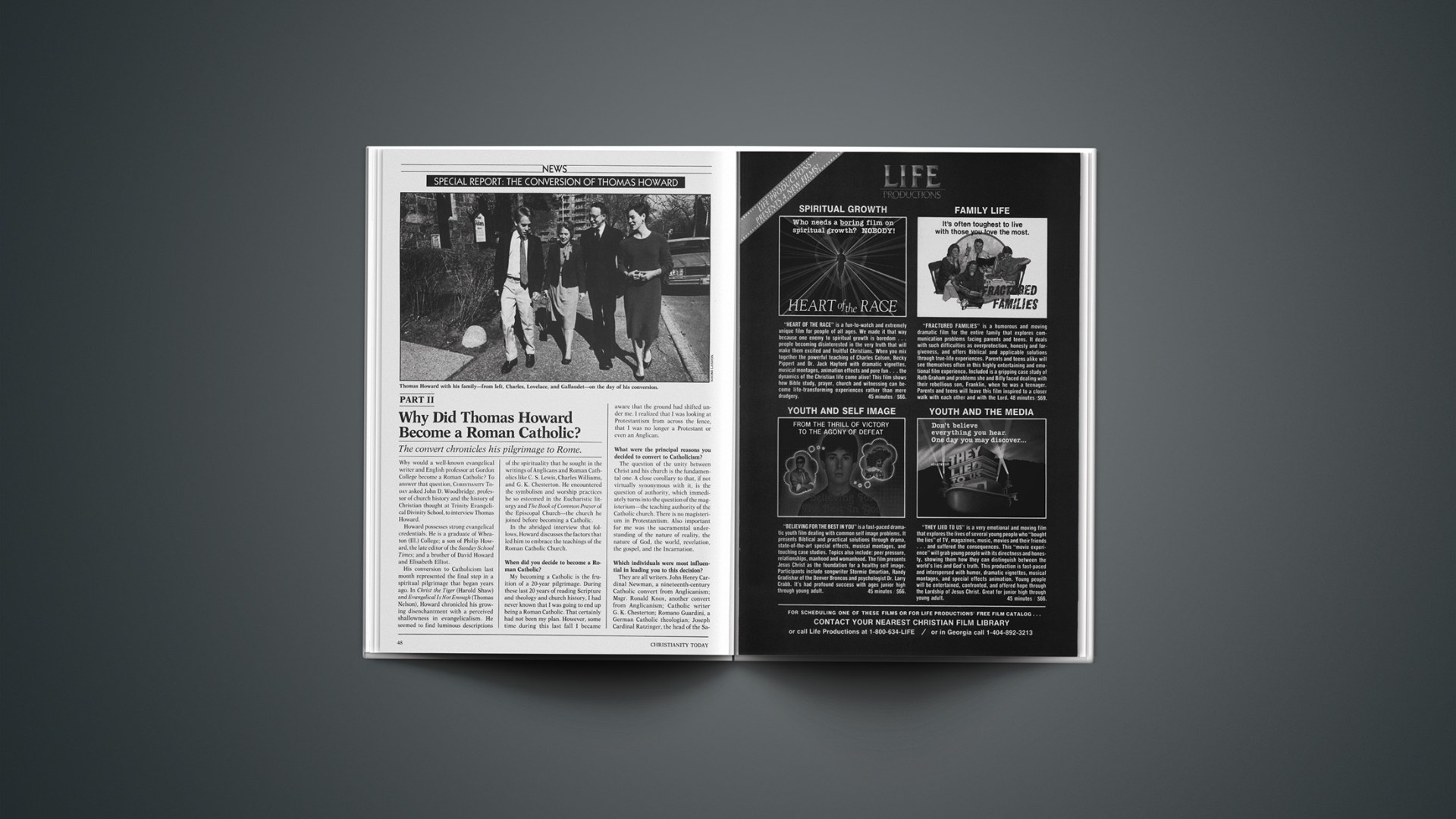
Part II: Why Did Thomas Howard Become a Roman Catholic?

The convert chronicles his pilgrimage to Rome.

Why would a well-known evangelical writer and English professor at Gordon College become a Roman Catholic? To answer that question, CHRISTIANITY TODAY asked John D. Woodbridge, professor of church history and the history of Christian thought at Trinity Evangelical Divinity School, to interview Thomas Howard.

Howard possesses strong evangelical credentials. He is a graduate of Wheaton (Ill.) College; a son of Philip Howard, the late editor of the Sunday School Times; and a brother of David Howard and Elisabeth Elliot.

His conversion to Catholicism last month represented the final step in a spiritual pilgrimage that began years ago. In Christ the Tiger (Harold Shaw) and Evangelical Is Not Enough (Thomas Nelson), Howard chronicled his growing disenchantment with a perceived shallowness in evangelicalism. He seemed to find luminous descriptions of the spirituality that he sought in the writings of Anglicans and Roman Catholics like C. S. Lewis, Charles Williams, and G. K. Chesterton. He encountered the symbolism and worship practices he so esteemed in the Eucharistic liturgy and The Book of Common Prayer of the Episcopal Church—the church he joined before becoming a Catholic.

In the abridged interview that follows, Howard discusses the factors that led him to embrace the teachings of the Roman Catholic Church.

When did you decide to become a Roman Catholic?

My becoming a Catholic is the fruition of a 20-year pilgrimage. During these last 20 years of reading Scripture and theology and church history, I had never known that I was going to end up being a Roman Catholic. That certainly had not been my plan. However, some time during this last fall I became aware that the ground had shifted under me. I realized that I was looking at Protestantism from across the fence, that I was no longer a Protestant or even an Anglican.

What were the principal reasons you decided to convert to Catholicism?

The question of the unity between Christ and his church is the fundamental one. A close corollary to that, if not virtually synonymous with it, is the question of authority, which immediately turns into the question of the magisterium—the teaching authority of the Catholic church. There is no magisterium in Protestantism. Also important for me was the sacramental understanding of the nature of reality, the nature of God, the world, revelation, the gospel, and the Incarnation.

Which individuals were most influential in leading you to this decision?

They are all writers. John Henry Cardinal Newman, a nineteenth-century Catholic convert from Anglicanism; Msgr. Ronald Knox, another convert from Anglicanism; Catholic writer G. K. Chesterton; Romano Guardini, a German Catholic theologian; Joseph Cardinal Ratzinger, the head of the Sacred Congregation for the Doctrine of the Faith; Karl Stern, an Austrian Jewish psychiatrist who became a Christian; Karl Adam, a German Catholic theologian; and Louis Bouyer, a French Catholic theologian. Towering above them all would be Saint Augustine (354–430).

Would you have become a Catholic if Julius II or Leo X, popes with unsavory reputations from Martin Luther’s day, had been in office rather than John Paul II?

I hope the answer is yes. The Catholic church does not stand or fall with the personality or adequacy of any given pope at any given time. I would want to say that my reasons for becoming a Catholic are because I became convinced that the claims of the ancient church are true.

Do you believe that evil deeds can disqualify popes as Christians?

God is the only one who knows who is a Christian and who is not. There were wicked popes, and there were saintly ones. No Catholic has any problem with the notion of popes being damned if they are unfaithful or if they are wolves in sheep’s clothing.

Have you ceased being an evangelical by becoming a Roman Catholic?

Quite the contrary. Evangelical and Catholic are, or ought to be, synonymous. I will never be anything but an evangelical.

But are you not now defining “evangelical” in a sense that would be different from what a Protestant evangelical deems that expression to mean?

I would say the burden of proof would be on the evangelical. As a Catholic, I can lay claim to the ancient connotation of the word “evangelical”—namely, a man of the gospel, referring to the gospel, the evangelical councils, and so on. If, however, by evangelical we mean the eighteenth- and nineteenth-century movements in the Church of England, or the Free Church movement, or if we’re speaking specifically of the American revivalist phenomenon, then I might find myself outside the circle that these people might like to draw.

Do you believe that evangelicals are Christians?

No question! How could anyone doubt it?

If that is the case, why did you need to become a Roman Catholic?

It’s a question of what the fullness of the faith is. I owe my nurture to evangelicalism. The evangelical wins hands down in the history of the church when it comes to nurturing a biblically literate laity. When we think of evangelism, evangelicals are the most resourceful, the most intrepid, and the most creative. But evangelicals themselves would say that they have never come to grips with what the whole mystery of the church is. I don’t know whether I’ve ever met an evangelical who does not lament the desperate, barren, parched nature of evangelical worship. They’re frantic over the evangelical poverty when it comes to the deeper reaches of Christian spirituality and what the mystery of worship is all about.

How do you account for a period in the late fourteenth and early fifteenth centuries when three men were vying for the office of pope?

I would refer you to a canon lawyer on that question.

What kind of Roman Catholic theology do you espouse? Do you see yourself as a Tridentine Catholic (accepting the teachings of the Council of Trent, 1545–63) or a Vatican II Catholic, or some other kind of Catholic?

I would try to be faithful to whatever definitions of doctrine the Roman Catholic Church has finally settled on. Certain things, of course, change. We saw huge changes at Vatican II (1962–65). Some of the emphases of the Council of Trent have at least been sequestered or sidelined, if not controverted. I would try to be faithful to what the magisterium is teaching. I would not understand the Vatican II documents as opening the door to perpetual and endless innovation—not only in discipline, but also in doctrine.

If I understood you correctly, you indicated that some doctrines of the Catholic church have been controverted?

I didn’t mean to say that doctrines had been controverted. What I was trying to say was that some of the emphases that marked the Council of Trent, if they have not been controverted, have at least been sidelined or deemphasized.

At the Second Vatican Council, the scope of the Bible’s inerrancy was limited especially to matters that deal with our salvation. That is a change from what those in the Augustinian tradition had argued earlier. The position of Vatican II appears to be more than a mere change of emphasis. It would seem to be an actual change in a doctrinal stance.

I would like to demur on highly specific questions about Vatican II. I am neither a canon lawyer nor a historical scholar. I can’t give you an answer about certain things because there are regions I simply haven’t traversed. These matters are not germane to the story of my conversion to Catholicism.

But several of these points are major stumbling blocks for Protestants when they consider the claims of Catholicism. If they were not stumbling blocks for you, is it because you did not encounter them or did not reflect upon them?

I think it would be somewhere in the middle. I have probably encountered and reflected on most of them. Secondly, if there is a Protestant who is seriously interested in those questions, he can find the answer when he finds what Rome teaches. Where there is an apparent discrepancy or contradiction, he can find out what the faithful Roman Catholic theologian says. Thirdly, in my mind, the titanic edifice which is the Roman Catholic Church in all of its radiance and superabundance really was the thing which I found inexorable.

What are the key doctrinal beliefs that distinguish an orthodox evangelical from yourself as a Catholic?

The taproot of the matter would be the nature of the union between Christ and his church—the sense in which the church embodies Christ to the world. Obviously, one can take a disembodied view of this, a totally spiritual view. But that does violence to the whole fabric of revelation, which has always been massively physical, material, embodied. A second issue would be the Eucharist. Somehow it drained off into the sand in the sixteenth century. Certainly nobody in the church preceding the Reformation had any notion of that happening.

How do you define the doctrine of justification by faith?

I would espouse the traditional Catholic view set forth at the Council of Trent, which loudly asserts justification by faith.

Some Catholics have acknowledged that Martin Luther was largely correct in his understanding of Romans and Galatians. But in Luther’s reading of Paul, we are justified by faith through grace alone. God declares us to be righteous, not because of our own righteousness, but because of Christ’s. But from the point of view of many Roman Catholics, justification is linked very closely to the grace received through the sacraments, through right living, through a cooperative effort with God. Nonetheless, Catholics claim that people are still saved by God’s grace alone.

Yes. There’s no question. A rigorous doctrine of imputation is not only limiting but ends up doing a disservice to the nature of grace and justification. It makes the transactions of the gospel basically juridical. In the Roman view, justification and sanctification are a seamless fabric. It is more than a question of God simply seeing us through a legal scrim of Christ’s righteousness. Righteousness actually begins to transform us.

Do not many Roman Catholics, at the popular level at least, assume that the acts that they perform constitute a sufficient way to gain salvation?

Yes. But the operative phrase in your question is the phrase “at the popular level.” If we’re going to speak of popular misconceptions, then we’re off and running.

But in his day, Luther was dealing not only with popular opinion, but with some Roman Catholic teachers who advocated what amounts to a works-righteousness salvation.

Yes. But the Council of Trent dealt with that. As you know, Luther is an extremely popular and influential theologian in Roman Catholic circles these days. I think the judicious Catholic response is that Luther fired off salvos which needed to be fired off because of the appalling and chaotic state of late medieval piety and pastoral practice. But what you ended up with was Protestantism. The soul can’t feed on that. If one reads what the Council of Trent says justification is, you get a very unabashedly biblical doctrine of justification by faith.

What is taking place at the sacrifice of the Mass?

The Roman Catholic Church—along with the Orthodox church and certain groups in the Anglican church—affirms that the Eucharist is simply the church entering into the sacrifice of Christ which is perpetually offered at the altar in heaven. Christ is not slain over and over again. The Catholic church is very insistent on teaching that there was never anything more than one priest, never anything more than one altar, never anything more than one sacrifice, once offered.

Catholic scholars generally acknowledge that in the New Testament, the directors or heads of the church are always noted in the plural as elders or as overseers, terms that are used almost synonymously. How does one move from this church order to a full-orbed papacy with the bishop of Rome being superior to the other bishops?

Simply by the developing understanding of the doctrine of the episcopacy. It’s clear historically why and how and when the doctrine of the papacy developed early on. The words of Christ to Peter were applicable then to the successor of Peter, and those successors turned out to be the bishops of Rome. It isn’t a mystery to anybody how the Roman Catholic understanding came into being.

What role did your family and your educational background play in leading you in the direction you have gone?

The Reformation is my nursing mother in the faith. My father and his fathers and my whole lineage are, to me, icons of true godliness. I have nothing but gratitude and indebtedness to my father and his fathers. So, of course, there’s a certain amount of anguish in having found myself a Roman Catholic. Insofar as my father and his fathers are conscious of my pilgrimage, I assume and hope that they’re applauding.

Part I: Well-Known Evangelical Author Thomas Howard Converts to Catholicism

Friends and family say the result of his 20-year spiritual pilgrimage comes as no surprise.

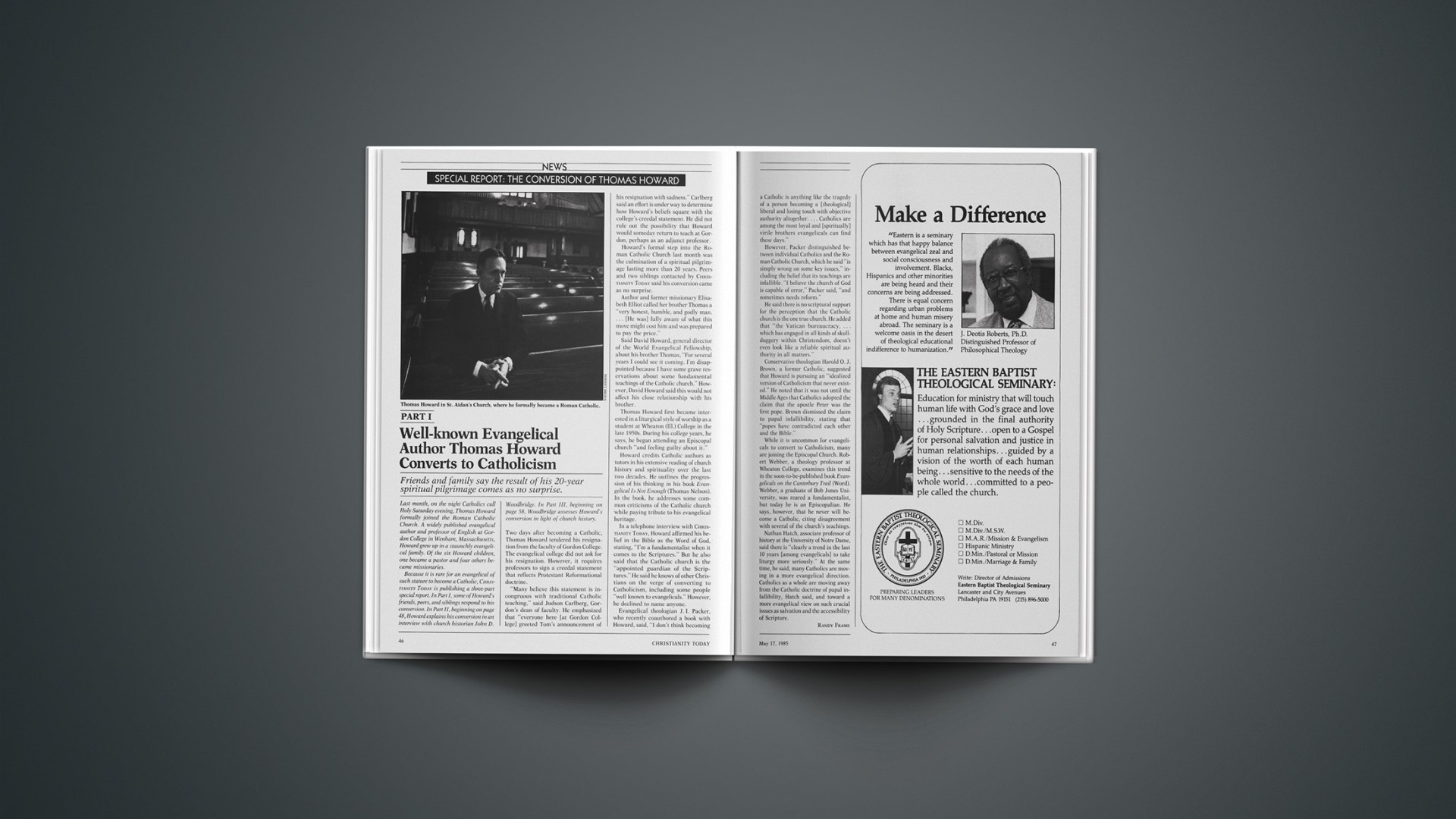
Last month, on the night Catholics call Holy Saturday evening, Thomas Howard formally joined the Roman Catholic Church. A widely published evangelical author and professor of English at Gordon College in Wenham, Massachusetts, Howard grew up in a staunchly evangelical family. Of the six Howard children, one became a pastor and four others became missionaries.

Because it is rare for an evangelical of such stature to become a Catholic, CHRISTIANITY TODAY is publishing a three-part special report. In Part I, some of Howard’s friends, peers, and siblings respond to his conversion. In Part II, beginning on page 48, Howard explains his conversion in an interview with church historian John D. Woodbridge. In Part III, beginning on page 58, Woodbridge assesses Howard’s conversion in light of church history.

Two days after becoming a Catholic, Thomas Howard tendered his resignation from the faculty of Gordon College. The evangelical college did not ask for his resignation. However, it requires professors to sign a creedal statement that reflects Protestant Reformational doctrine.

“Many believe this statement is incongruous with traditional Catholic teaching,” said Judson Carlberg, Gordon’s dean of faculty. He emphasized that “everyone here [at Gordon College] greeted Tom’s announcement of his resignation with sadness.” Carlberg said an effort is under way to determine how Howard’s beliefs square with the college’s creedal statement. He did not rule out the possibility that Howard would someday return to teach at Gordon, perhaps as an adjunct professor.

Howard’s formal step into the Roman Catholic Church last month was the culmination of a spiritual pilgrimage lasting more than 20 years. Peers and two siblings contacted by CHRISTIANITY TODAY said his conversion came as no surprise.

Author and former missionary Elisabeth Elliot called her brother Thomas a “very honest, humble, and godly man.… [He was] fully aware of what this move might cost him and was prepared to pay the price.”

Said David Howard, general director of the World Evangelical Fellowship, about his brother Thomas, “For several years I could see it coming. I’m disappointed because I have some grave reservations about some fundamental teachings of the Catholic church.” However, David Howard said this would not affect his close relationship with his brother.

Thomas Howard first became interested in a liturgical style of worship as a student at Wheaton (Ill.) College in the late 1950s. During his college years, he says, he began attending an Episcopal church “and feeling guilty about it.”

Howard credits Catholic authors as tutors in his extensive reading of church history and spirituality over the last two decades. He outlines the progression of his thinking in his book Evangelical Is Not Enough (Thomas Nelson). In the book, he addresses some common criticisms of the Catholic church while paying tribute to his evangelical heritage.

In a telephone interview with CHRISTIANITY TODAY, Howard affirmed his belief in the Bible as the Word of God, stating, “I’m a fundamentalist when it comes to the Scriptures.” But he also said that the Catholic church is the “appointed guardian of the Scriptures.” He said he knows of other Christians on the verge of converting to Catholicism, including some people “well known to evangelicals.” However, he declined to name anyone.

Evangelical theologian J. I. Packer, who recently coauthored a book with Howard, said, “I don’t think becoming a Catholic is anything like the tragedy of a person becoming a [theological] liberal and losing touch with objective authority altogether.… Catholics are among the most loyal and [spiritually] virile brothers evangelicals can find these days.”

However, Packer distinguished between individual Catholics and the Roman Catholic Church, which he said “is simply wrong on some key issues,” including the belief that its teachings are infallible. “I believe the church of God is capable of error,” Packer said, “and sometimes needs reform.”

He said there is no scriptural support for the perception that the Catholic church is the one true church. He added that “the Vatican bureaucracy, … which has engaged in all kinds of skullduggery within Christendom, doesn’t even look like a reliable spiritual authority in all matters.”

Conservative theologian Harold O. J. Brown, a former Catholic, suggested that Howard is pursuing an “idealized version of Catholicism that never existed.” He noted that it was not until the Middle Ages that Catholics adopted the claim that the apostle Peter was the first pope. Brown dismissed the claim to papal infallibility, stating that “popes have contradicted each other and the Bible.”

While it is uncommon for evangelicals to convert to Catholicism, many are joining the Episcopal Church. Robert Webber, a theology professor at Wheaton College, examines this trend in the soon-to-be-published book Evangelicals on the Canterbury Trail (Word). Webber, a graduate of Bob Jones University, was reared a fundamentalist, but today he is an Episcopalian. He says, however, that he never will become a Catholic, citing disagreement with several of the church’s teachings.

Nathan Hatch, associate professor of history at the University of Notre Dame, said there is “clearly a trend in the last 10 years [among evangelicals] to take liturgy more seriously.” At the same time, he said, many Catholics are moving in a more evangelical direction. Catholics as a whole are moving away from the Catholic doctrine of papal infallibility, Hatch said, and toward a more evangelical view on such crucial issues as salvation and the accessibility of Scripture.

Historic Peace Churches Seek a New Evangelistic Emphasis

Six Anabaptist denominations, known for their emphasis on peace and social justice, met last month to discuss evangelism. By the end of the four-day event, it was clear that traditional soul winning would have a higher profile in the historic peace churches.

The gathering, called “Alive … ’85,” drew more than 1,500 pastors, church executives, and laypersons to Denver. Represented were the Brethren Church, Brethren in Christ, Church of the Brethren, General Conference Mennonites, Mennonite Brethren, and the Mennonite Church. The denominations’ combined U.S. and Canadian membership approaches 400,000.

Conference speakers affirmed Anabaptist-Pietist distinctives. But conferees were urged to move beyond an emphasis on social compassion, nonviolence, believer’s baptism, and personal piety to proclaim the gospel unapologetically.

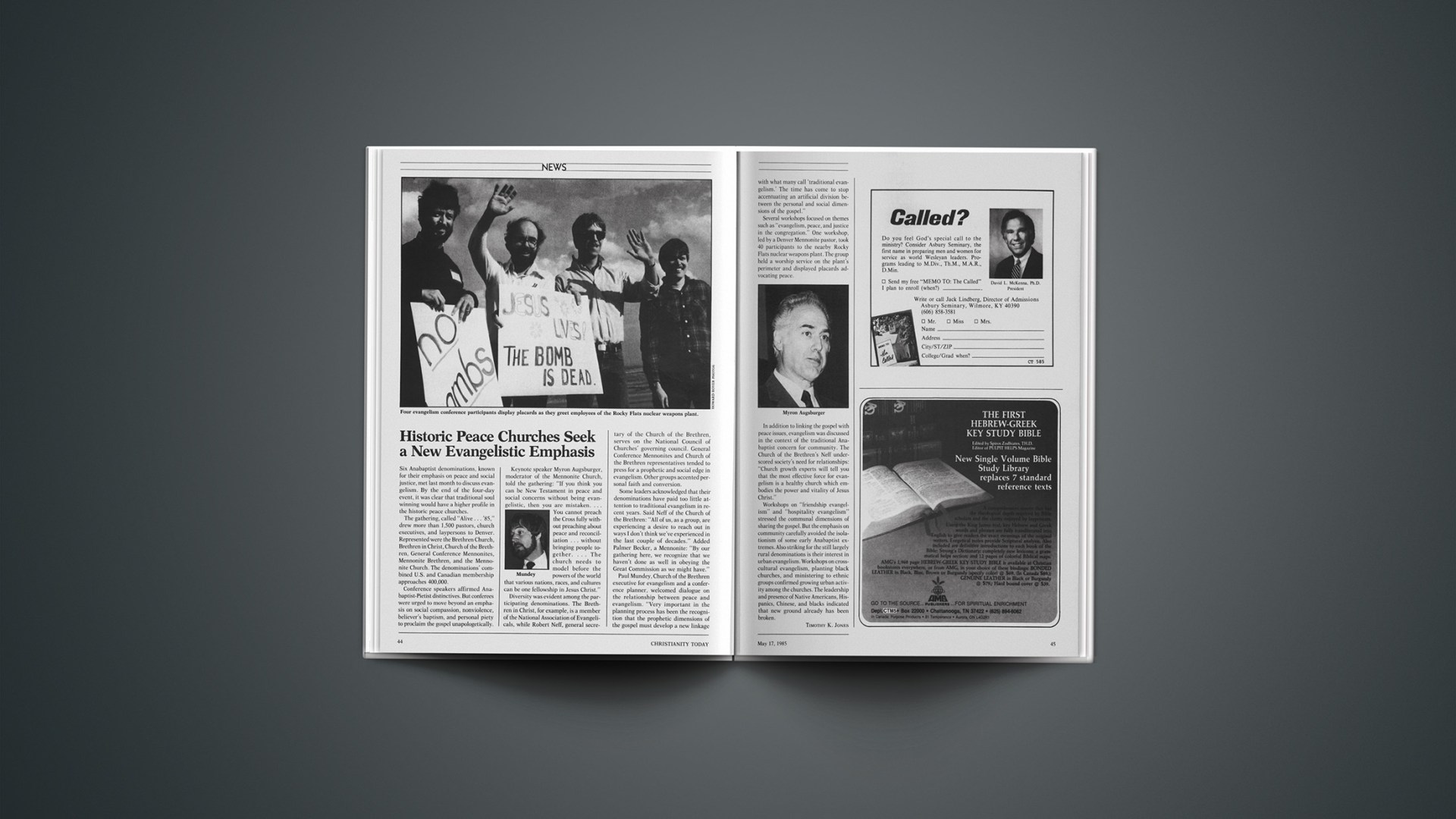
Keynote speaker Myron Augsburger, moderator of the Mennonite Church, told the gathering: “If you think you can be New Testament in peace and social concerns without being evangelistic, then you are mistaken.… You cannot preach the Cross fully without preaching about peace and reconciliation … without bringing people together.… The church needs to model before the powers of the world that various nations, races, and cultures can be one fellowship in Jesus Christ.”

Diversity was evident among the participating denominations. The Brethren in Christ, for example, is a member of the National Association of Evangelicals, while Robert Neff, general secretary of the Church of the Brethren, serves on the National Council of Churches’ governing council. General Conference Mennonites and Church of the Brethren representatives tended to press for a prophetic and social edge in evangelism. Other groups accented personal faith and conversion.

Some leaders acknowledged that their denominations have paid too little attention to traditional evangelism in recent years. Said Neff of the Church of the Brethren: “All of us, as a group, are experiencing a desire to reach out in ways I don’t think we’ve experienced in the last couple of decades.” Added Palmer Becker, a Mennonite: “By our gathering here, we recognize that we haven’t done as well in obeying the Great Commission as we might have.”

Paul Mundey, Church of the Brethren executive for evangelism and a conference planner, welcomed dialogue on the relationship between peace and evangelism. “Very important in the planning process has been the recognition that the prophetic dimensions of the gospel must develop a new linkage with what many call ‘traditional evangelism.’ The time has come to stop accentuating an artificial division between the personal and social dimensions of the gospel.”

Several workshops focused on themes such as “evangelism, peace, and justice in the congregation.” One workshop, led by a Denver Mennonite pastor, took 40 participants to the nearby Rocky Flats nuclear weapons plant. The group held a worship service on the plant’s perimeter and displayed placards advocating peace.

In addition to linking the gospel with peace issues, evangelism was discussed in the context of the traditional Anabaptist concern for community. The Church of the Brethren’s Neff underscored society’s need for relationships: “Church growth experts will tell you that the most effective force for evangelism is a healthy church which embodies the power and vitality of Jesus Christ.”

Workshops on “friendship evangelism” and “hospitality evangelism” stressed the communal dimensions of sharing the gospel. But the emphasis on community carefully avoided the isolationism of some early Anabaptist extremes. Also striking for the still largely rural denominations is their interest in urban evangelism. Workshops on cross-cultural evangelism, planting black churches, and ministering to ethnic groups confirmed growing urban activity among the churches. The leadership and presence of Native Americans, Hispanics, Chinese, and blacks indicated that new ground already has been broken.

Fund Will Benefit Minority Workers in Parachurch Groups

A Washington, D.C., affiliate of Campus Crusade for Christ International has raised $100,000 to supplement the support payments of minority staff members.

Beginning this spring, four married Campus Crusade staff members will receive up to $2,000 per month from interest earned on the fund. Called the Special Ministries Assistance Fund, it is targeted to reach $1 million. Two unmarried staff workers will receive as much as $1,000 per month. The funding supplement will be based on the gap between support raised by the staff member and the money needed by the staff member each month.

Spencer Brand, Washington area director of Here’s Life, Campus Crusade’s ministry to adults, originated the Special Ministries Assistance Fund. He said minority people face “insurmountable financial barriers” when they begin to raise support money in their own communities.

“One black staff woman is 33 years old, has been raising support for 23 months, and has $300 a month to go,” he said. “There are very few white men and women who would have that kind of perseverance.” He said most middle-class whites who join the staff raise their support in about six months.

Recognizing a need for more minority workers in Christian ministry, Brand said Here’s Life intends to make grants available to people in other parachurch organizations such as Inter-Varsity Christian Fellowship and the Navigators as well as to Campus Crusade staff members. He said fewer than 3 percent of the staff members of major U.S. parachurch groups are black.

Funds raised to date have come from two events, including a cruise on the Potomac River aboard a former presidential yacht. “One hundred percent of the money given goes into the fund,” Brand said. “There is no overhead.”

The six staff members selected as the fund’s first recipients include two blacks, two Hispanics, and two Southeast Asians. Austin and Shirley Smith, serving as associate lay ministers in Washington, D.C., hope to begin full-time ministry in Chicago’s inner city. Carol Smith will continue to work in Washington’s Here’s Life program with the boost she receives from the fund.

Melvin and Isabella Acevedo work in Los Angeles’s Hispanic community, along with another designated fund recipient, Mario Galeano. Hy Huy Do and his wife, Rose, help some of the 100,000 Vietnamese refugees in Southern California start churches and adjust to living in a new culture. Vek Huong and Samoeun Taing, of Long Beach, California, are involved with Cambodian refugee relief, leadership training, and discipleship.

Minority staff members involved in full-time ministry can apply for grant money by assenting to a statement of faith, demonstrating financial need, and providing three recommendation letters and a written narrative of plans and goals for one year. Other requirements and information for donors are available from Here’s Life Washington, 3030 N. Fairfax Drive, Suite 314, Arlington, Virginia 22201.

Church Leaders Challenge the Notion that America Is a Melting Pot

In Houston, missions specialists discuss ways to evangelize without ‘Americanizing’ the nation’s many ethnic groups.

In Hollywood, California, a fast-food establishment run by Koreans sells Kosher tacos. Students in the Los Angeles Unified School District collectively speak more than 100 languages. Miami is the world’s second-largest Cuban city, and Chicago is the second-largest Polish city. Further, more blacks live in the United States than in any country except Nigeria.

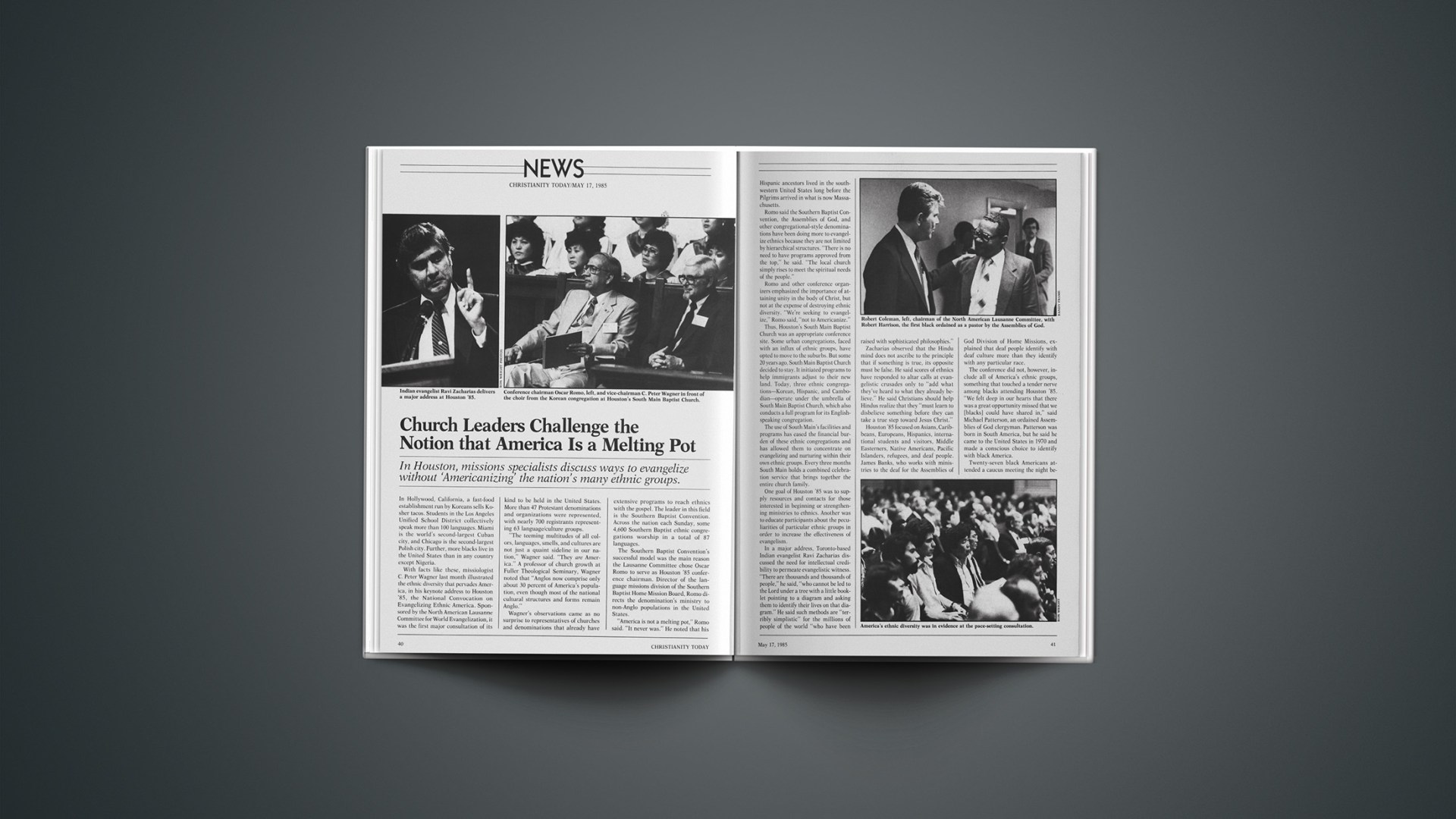
With facts like these, missiologist C. Peter Wagner last month illustrated the ethnic diversity that pervades America, in his keynote address to Houston ’85, the National Convocation on Evangelizing Ethnic America. Sponsored by the North American Lausanne Committee for World Evangelization, it was the first major consultation of its kind to be held in the United States. More than 47 Protestant denominations and organizations were represented, with nearly 700 registrants representing 63 language/culture groups.

“The teeming multitudes of all colors, languages, smells, and cultures are not just a quaint sideline in our nation,” Wagner said. “They are America.” A professor of church growth at Fuller Theological Seminary, Wagner noted that “Anglos now comprise only about 30 percent of America’s population, even though most of the national cultural structures and forms remain Anglo.”

Wagner’s observations came as no surprise to representatives of churches and denominations that already have extensive programs to reach ethnics with the gospel. The leader in this field is the Southern Baptist Convention. Across the nation each Sunday, some 4,600 Southern Baptist ethnic congregations worship in a total of 87 languages.

The Southern Baptist Convention’s successful model was the main reason the Lausanne Committee chose Oscar Romo to serve as Houston ’85 conference chairman. Director of the language missions division of the Southern Baptist Home Mission Board, Romo directs the denomination’s ministry to non-Anglo populations in the United States.

“America is not a melting pot,” Romo said. “It never was.” He noted that his Hispanic ancestors lived in the southwestern United States long before the Pilgrims arrived in what is now Massachusetts.

Romo said the Southern Baptist Convention, the Assemblies of God, and other congregational-style denominations have been doing more to evangelize ethnics because they are not limited by hierarchical structures. “There is no need to have programs approved from the top,” he said. “The local church simply rises to meet the spiritual needs of the people.”

Romo and other conference organizers emphasized the importance of attaining unity in the body of Christ, but not at the expense of destroying ethnic diversity. “We’re seeking to evangelize,” Romo said, “not to Americanize.”

Thus, Houston’s South Main Baptist Church was an appropriate conference site. Some urban congregations, faced with an influx of ethnic groups, have opted to move to the suburbs. But some 20 years ago, South Main Baptist Church decided to stay. It initiated programs to help immigrants adjust to their new land. Today, three ethnic congregations—Korean, Hispanic, and Cambodian—operate under the umbrella of South Main Baptist Church, which also conducts a full program for its English-speaking congregation.

The use of South Main’s facilities and programs has eased the financial burden of these ethnic congregations and has allowed them to concentrate on evangelizing and nurturing within their own ethnic groups. Every three months South Main holds a combined celebration service that brings together the entire church family.

One goal of Houston ’85 was to supply resources and contacts for those interested in beginning or strengthening ministries to ethnics. Another was to educate participants about the peculiarities of particular ethnic groups in order to increase the effectiveness of evangelism.

In a major address, Toronto-based Indian evangelist Ravi Zacharias discussed the need for intellectual credibility to permeate evangelistic witness. “There are thousands and thousands of people,” he said, “who cannot be led to the Lord under a tree with a little booklet pointing to a diagram and asking them to identify their lives on that diagram.” He said such methods are “terribly simplistic” for the millions of people of the world “who have been raised with sophisticated philosophies.”

Zacharias observed that the Hindu mind does not ascribe to the principle that if something is true, its opposite must be false. He said scores of ethnics have responded to altar calls at evangelistic crusades only to “add what they’ve heard to what they already believe.” He said Christians should help Hindus realize that they “must learn to disbelieve something before they can take a true step toward Jesus Christ.”

Houston ’85 focused on Asians, Caribbeans, Europeans, Hispanics, international students and visitors, Middle Easterners, Native Americans, Pacific Islanders, refugees, and deaf people. James Banks, who works with ministries to the deaf for the Assemblies of God Division of Home Missions, explained that deaf people identify with deaf culture more than they identify with any particular race.

The conference did not, however, include all of America’s ethnic groups, something that touched a tender nerve among blacks attending Houston ’85. “We felt deep in our hearts that there was a great opportunity missed that we [blacks] could have shared in,” said Michael Patterson, an ordained Assemblies of God clergyman. Patterson was born in South America, but he said he came to the United States in 1970 and made a conscious choice to identify with black America.

Twenty-seven black Americans attended a caucus meeting the night before the conference ended. With Fuller Seminary’s Wagner and North American Lausanne Committee chairman Robert Coleman sitting in, the blacks discussed some of the problems facing black America, including the dissolution of the family and a high rate of crime.

They lamented what they said was a lost opportunity at the conference to address these problems, and they asked for a formal apology. Patterson pointed out that he and others had voiced their concerns about the exclusion of blacks when the conference was still in the early planning stages.

In a statement released to the news media, conference officials explained that “[the] Central Planning Committee felt what the Lord wanted from Houston ’85 was a focus on the ethnic peoples ‘whose language and/or culure is other than English.’ ” The statement extended an invitation to those who felt excluded to participate “as evangelizers, not as evangelized.”

Robert Harrison, the first black pastor to be ordained by the Assemblies of God, said the exclusion of blacks at the conference was a symptom of the poor relationship between black and white Christians. “Historically, blacks have been invited to events that have already been organized and structured,” he said. “What we’d like is to be in on the ground level.”

At a news conference, Wagner said the Houston ’85 organizers “may well have made the wrong judgment. We knew that [our decision] would be somewhat controversial. I don’t think we realized it would be this controversial.”

Evangelist Leighton Ford expressed concern, during his closing address, that some feelings had been hurt, saying, “I am grieved and sorry for any misunderstanding.”

At the closing banquet, Patterson told the conferees, “We have had a problem here, and we must not deny it. We must not sweep it under the rug.” However, he said he wanted to stress possibilities, not missed opportunities. The black caucus selected Patterson to head up a task force aimed at assessing the state of black America, contexualizing the gospel for grassroots black America, and interfacing with the white church by providing input in the next major Lausanne Conference on World Evangelization, planned for 1989.

The Problems of Battered Pastors

Expectations of the minister’s role are increasingly demanding and unforgiving.

Having spent the past year researching the positive and negative dynamics at work within the church of Jesus Christ, author and editor Marshall Shelley offers some specifics to strengthen the relationships between pastor and parishioner.

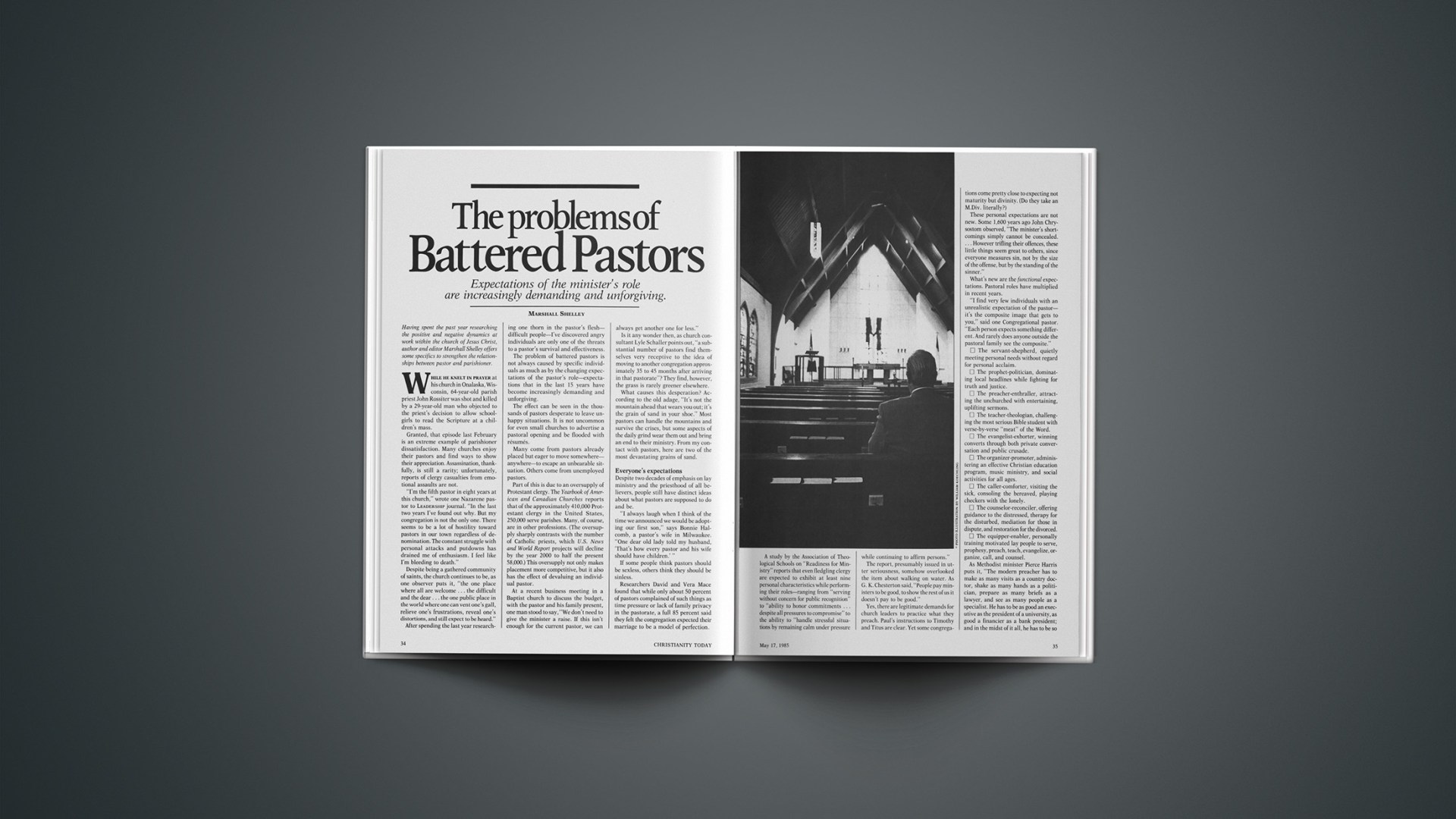
While he knelt in prayer at his church in Onalaska, Wisconsin, 64-year-old parish priest John Rossiter was shot and killed by a 29-year-old man who objected to the priest’s decision to allow school-girls to read the Scripture at a children’s mass.

Granted, that episode last February is an extreme example of parishioner dissatisfaction. Many churches enjoy their pastors and find ways to show their appreciation. Assassination, thankfully, is still a rarity; unfortunately, reports of clergy casualties from emotional assaults are not.

“I’m the fifth pastor in eight years at this church,” wrote one Nazarene pastor to LEADERSHIP journal. “In the last two years I’ve found out why. But my congregation is not the only one. There seems to be a lot of hostility toward pastors in our town regardless of denomination. The constant struggle with personal attacks and putdowns has drained me of enthusiasm. I feel like I’m bleeding to death.”

Despite being a gathered community of saints, the church continues to be, as one observer puts it, “the one place where all are welcome … the difficult and the dear … the one public place in the world where one can vent one’s gall, relieve one’s frustrations, reveal one’s distortions, and still expect to be heard.” After spending the last year researching one thorn in the pastor’s flesh—difficult people—I’ve discovered angry individuals are only one of the threats to a pastor’s survival and effectiveness.

The problem of battered pastors is not always caused by specific individuals as much as by the changing expectations of the pastor’s role—expectations that in the last 15 years have become increasingly demanding and unforgiving.

The effect can be seen in the thousands of pastors desperate to leave unhappy situations. It is not uncommon for even small churches to advertise a pastoral opening and be flooded with resumes.

Many come from pastors already placed but eager to move somewhere—anywhere—to escape an unbearable situation. Others come from unemployed pastors.

Part of this is due to an oversupply of Protestant clergy. The Yearbook of American and Canadian Churches reports that of the approximately 410,000 Protestant clergy in the United States, 250,000 serve parishes. Many, of course, are in other professions. (The oversupply sharply contrasts with the number of Catholic priests, which U.S. News and World Report projects will decline by the year 2000 to half the present 58,000.) This oversupply not only makes placement more competitive, but it also has the effect of devaluing an individual pastor.

At a recent business meeting in a Baptist church to discuss the budget, with the pastor and his family present, one man stood to say, “We don’t need to give the minister a raise. If this isn’t enough for the current pastor, we can always get another one for less.”

Is it any wonder then, as church consultant Lyle Schaller points out, “a substantial number of pastors find themselves very receptive to the idea of moving to another congregation approximately 35 to 45 months after arriving in that pastorate”? They find, however, the grass is rarely greener elsewhere.

What causes this desperation? According to the old adage, “It’s not the mountain ahead that wears you out; it’s the grain of sand in your shoe.” Most pastors can handle the mountains and survive the crises, but some aspects of the daily grind wear them out and bring an end to their ministry. From my contact with pastors, here are two of the most devastating grains of sand.

Everyone’s Expectations

Despite two decades of emphasis on lay ministry and the priesthood of all believers, people still have distinct ideas about what pastors are supposed to do and be.

“I always laugh when I think of the time we announced we would be adopting our first son,” says Bonnie Halcomb, a pastor’s wife in Milwaukee. “One dear old lady told my husband, ‘That’s how every pastor and his wife should have children.’ ”

If some people think pastors should be sexless, others think they should be sinless.

Researchers David and Vera Mace found that while only about 50 percent of pastors complained of such things as time pressure or lack of family privacy in the pastorate, a full 85 percent said they felt the congregation expected their marriage to be a model of perfection.

A study by the Association of Theological Schools on “Readiness for Ministry” reports that even fledgling clergy are expected to exhibit at least nine personal characteristics while performing their roles—ranging from “serving without concern for public recognition” to “ability to honor commitments … despite all pressures to compromise” to the ability to “handle stressful situations by remaining calm under pressure while continuing to affirm persons.”

The report, presumably issued in utter seriousness, somehow overlooked the item about walking on water. As G. K. Chesterton said, “People pay ministers to be good, to show the rest of us it doesn’t pay to be good.”

Yes, there are legitimate demands for church leaders to practice what they preach. Paul’s instructions to Timothy and Titus are clear. Yet some congregations come pretty close to expecting not maturity but divinity. (Do they take an M.Div. literally?)

These personal expectations are not new. Some 1,600 years ago John Chrysostom observed, “The minister’s shortcomings simply cannot be concealed.… However trifling their offences, these little things seem great to others, since everyone measures sin, not by the size of the offense, but by the standing of the sinner.”

What’s new are the functional expectations. Pastoral roles have multiplied in recent years.

“I find very few individuals with an unrealistic expectation of the pastor—it’s the composite image that gets to you,” said one Congregational pastor. “Each person expects something different. And rarely does anyone outside the pastoral family see the composite.”

  • The servant-shepherd, quietly meeting personal needs without regard for personal acclaim.
  • The prophet-politician, dominating local headlines while fighting for truth and justice.
  • The preacher-enthraller, attracting the unchurched with entertaining, uplifting sermons.
  • The teacher-theologian, challenging the most serious Bible student with verse-by-verse “meat” of the Word.
  • The evangelist-exhorter, winning converts through both private conversation and public crusade.
  • The organizer-promoter, administering an effective Christian education program, music ministry, and social activities for all ages.
  • The caller-comforter, visiting the sick, consoling the bereaved, playing checkers with the lonely.
  • The counselor-reconciler, offering guidance to the distressed, therapy for the disturbed, mediation for those in dispute, and restoration for the divorced.
  • The equipper-enabler, personally training motivated lay people to serve, prophesy, preach, teach, evangelize, organize, call, and counsel.

As Methodist minister Pierce Harris puts it, “The modern preacher has to make as many visits as a country doctor, shake as many hands as a politician, prepare as many briefs as a lawyer, and see as many people as a specialist. He has to be as good an executive as the president of a university, as good a financier as a bank president; and in the midst of it all, he has to be so good a diplomat that he could umpire a baseball game between the Knights of Columbus and the Ku Klux Klan.”

Not only are individual expectations different and sometimes mutually exclusive, but the basis for judging has changed in the last 15 years. Until the age of Christian mass media, pastors were compared, if at all, only with their predecessor or colleagues across town.

Today, however, standards have been elevated. Jerry Falwell has become the standard for measuring political involvement. Evangelistic effectiveness is judged against the most recent film series. Counseling techniques are compared with seminar leaders and authors of religious psychology. Preaching is stacked against Swindoll, Graham, or Schuller.

No longer are pastors allowed to be generalists, jacks of all trades; today is an age of specialization. It is not even enough to be a master of one area. Different church members expect pastors to be specialists in almost every area.

“I appreciate the Christian leaders who have become prominent in one field or another,” said one minister. “But some of their devoted followers in my congregation make life miserable by expecting me to duplicate the work of all the Christian achievers.”

One Colorado pastor has found that despite marching in several prolife rallies and emphasizing the sanctity of life regularly in sermons, some church members are not satisfied. “They tell me that abortion is the single most important issue of the day, and if I don’t condemn it at every opportunity, I’m selling out,” he said. “I support their cause, but I try to explain that God calls different people to different roles. As a pastor, I need to attend prolife rallies, but being prolife also means ministering to nursery workers, troubled junior highers, searching college students, harried young parents, and suffering older folks.

“Zealots can’t understand that … until their junior higher is the one with a problem.

“Too often they seem to think that because God called them to a specific task, he’s necessarily called me to it as well. Some friends of mine are called to be missionaries in the Philippines, and I support them; but that doesn’t mean I’m supposed to go there, too.”

In some ways, thanks to these expectations, the pastoral pedestal is higher and more precarious than ever.

Everyone’s Evaluations

In other ways, however, the pastoral pedestal has been removed. The office is no longer guaranteed respect. In a sense, pastors today must continually work against themselves: To the degree that they move laity toward more significant ministry, they remove some of the mystique of the pastoral profession and limit its power.

Today, few positions are so open to public evaluation as that of pastor. Like quarterbacks and presidents, pastors are fair game for second guessers. Often sermons are received not so much as a word from God to be obeyed but a suggestion from the pastor to be debated.

Everyone, regardless of training, has an opinion on what a church service should be. The dilemma for pastors is that they know these evaluations are often unfair, but they need feedback from the congregation. Even pastors who know faithfulness cannot be measured in quantifiable terms are desperate for encouragement.

“No matter how many times I tell myself not to, I always wind up asking my wife as we walk home from church, ‘Well, how was it?’ ” said one Presbyterian who has pastored his church 23 years. “I know I shouldn’t be so concerned what people think, but I can’t seem to help it. I have to know.”

Not only do pastors need the informal encouragement, but formal support as well. But sometimes, if poorly handled, feedback can actually hinder the ministry.

One pastor suddenly found his board wanting to operate in a more “businesslike” manner. For instance, they asked him to log his time so they could monitor his priorities. With detailed schedules in hand, they then began instructing him to “spend less time in sermon preparation and more in counseling.” They also wanted him to set “specific, measurable goals.”

“I don’t mind them being more organized,” the pastor said. “But if they’re going by business standards, I wish they had been consistent. Unlike a business, they offered no annual review, no pay raise, and no recognition of my ten-year anniversary with the church. Not wanting to seem petty, I didn’t bring these things up, but their new ‘efficiency’ has only made ministry a joyless and literally thankless task.”

How can pastors and churches develop expectations and evaluations helpful for both sides?

A Realistic Role

Obviously, a spirit of mutual appreciation and respect is the essential foundation. “With the right spirit, a clumsy church structure will work. Without the right spirit, an ideal structure won’t work,” says Malcolm Cronk, pastor of Camelback Bible Church in Paradise Valley, Arizona.

But in addition, three suggestions, while not providing the solution for every situation, may prove helpful in dealing with the realities of role confusion.

Look for gifts, not greatness. Congregations are rightfully concerned about the minister’s effectiveness. Unfortunately, their concern sometimes focuses solely on attendance or financial growth. A better test of a whether a pastor is effective is to look for signs of the pastoral gift.

Different churches have different emphases, but at bottom, they all need someone with a gift of pastoring. The signs of such a gift?

1. A mature understanding of God’s Word.

2. The ability to communicate that Word, whether through preaching or through interpersonal skills.

3. Growth in people’s lives. When a genuine gift is exercised, something happens; perhaps it is not seen in spectacular numbers, but the Word of God is having an effect.

If these are in evidence, the church probably does not need to be looking for someone “greater.”

This pastoral gift is different from other gifts—fund raising, for instance, or even evangelism.

Recently a Bible college that promoted itself as a training ground for pastors called as its president a well-known traveling evangelist. He has never pastored a congregation and as an evangelist has understandably focused on a successful but one-dimensional ministry. His priority for the school is to equip students to “win the 3 billion lost souls in the world.”

One of the school’s alumni, now a seminary professor, said, “I have no doubt [the new president] will succeed in his goal of equipping students to be evangelists. I also have no doubt that many congregations will suffer from the lack of priestly ministry necessary to sustain them in the celebrations and sorrows of life. There is a difference in the call of an evangelist from one who is a shepherd of souls.”

Some congregations thrive with a “pastor” who is an evangelist (or administrator or social activist or …), but they must recognize that the real pastoring will have to come from another source, either a lay person or pastoral staff member.

Let the pastor lead with personal strengths. The healthiest churches admit their pastors cannot be specialists in every area, so they let the pastor major on two or three areas of strength.

Building a Healthy Church

There are several keys to building a healthy church atmosphere, including:

A positive tone. This can be modeled personally:

  • By praising publicly the congregation’s strengths.
  • By enjoying and taking pride in the diversity among church members.
  • By thanking critics, at least initially, for their candor and concern.
  • By assuming anything uncomplimentary you say about anyone will be repeated—because it probably will be—and by trusting very few people with your private criticisms and suspicions.
  • By being slow to step into other people’s problems—balancing Paul’s instruction to carry, with some qualifications, each other’s burdens (Gal. 6:1–5) and Jesus’ refusal to intervene in the disputes of others (Luke 12:14).

One pastor who has seen his church transformed from a defeated, divided group to an enthusiastic, high-morale congregation says, “Obviously the Holy Spirit is responsible for this kind of change, but I think he honored some of our efforts in that direction, too. We began focusing on the joys of life rather than bemoaning our discouragements. You don’t cover up your disappointments, failed programs, and lost votes, but neither do you dwell on them or announce them from the pulpit.”

When the fruit of the Spirit becomes characteristic of the church’s daily life, it becomes painfully clear whenever someone violates that spirit (“That’s not the way we do things around here”), and the body itself will work to take care of the irritation.

Adapted from Well-Intentioned Dragons (LEADERSHIP/Word, 1985)

This means both the congregation and the pastor must admit something is being relinquished. Congregations must overcome their assumption that the pastor can do everything other pastors do. Pastors must overcome their desire to retain control over every area of church ministry. Relinquishing an area of personal weakness means entrusting it to someone else—not always an easy task.

But unless it is done, pastors find themselves increasingly ineffective, and both congregation and pastor grow increasingly dissatisfied.

In his book Ordering Your Private World, Gordon MacDonald, until recently pastor of Grace Chapel in Lexington, Massachusetts, says, “Because I had not adequately defined my sense of mission … because I had not been ruthless enough with my weaknesses, I found that I normally invested inordinately large amounts of time doing things I was not good at, while the tasks I should have been able to do with excellence and effectiveness were preempted. I know many Christian leaders who candidly admit they spend up to 80 percent of their time doing things at which they are second-best.”

Unless the congregation allows the pastor to focus on areas of strength, his or her time will inevitably flow in the direction of relative weakness, depriving the church of the best the pastor can offer.

Let commitment mean something. Too seldom is the relationship between pastor and congregation a happy marriage; more often it is a temporary live-in arrangement based on “as long as we both shall love” instead of “as long as we both shall live.”

Commitment can mean something, even in the church. Some congregations condemn divorce but sever their relationship with a pastor as soon as he displeases them. Yes, there are times for ministers to move, but the call of a pastor, like any other commitment, is not negated just because of differences, even serious differences. Perseverance is the ultimate test of commitment—whether to God or another human being.

Sooner or later, we all must accept the fact that there is no such thing as a perfect marriage—neither between husband/wife nor pastor/people. And if there is, it will not stay that way long. No relationship is static. In fact, it is doubtful that any marriage can even be called good unless it is continually growing, admitting the growing pains, and reaffirming a commitment to work together in the new circumstances.

David Schuller, an ordained Lutheran and associate director of the Association of Theological Schools, points out that our responses to tension and ambiguity are the essence of maturity: “A sense of peace and stability may be a delusion and a false expectation. Some clergy talk longingly of becoming personally ‘freed up’ in order to be able to serve more fully. Only slowly is the truth learned: Ministry ‘happens’ most authentically in the midst of suffering and ambiguity. One’s own human predicament forms part of the response of ministry.”

While we continue to long for the glorious ideal, it is faithfulness in the less than ideal that brings glory to God.

Theology

Is Heaven Any Earthly Good?

Heaven is a disreputable topic today partly because it came to be understood as a repressive doctrine of the status quo: the “opiate” that kept the masses in their submissive place. It is “pie in the sky” that supposedly makes no difference in the world here and now.

Indeed, let us admit that the good news of heaven seems to make no difference to many. They say that they believe that the kingdom of heaven is coming, and yet go right on living just as they always have. They neither go up on a mountain to wait for Jesus, nor do they work especially hard in the valley to prepare for his coming. They just go about their business.

A friend, Jack Crabtree, has illuminated this question for me with an illustration. Suppose, Jack says, that you are a 16-year-old practicing basketball in your driveway when an angel appears to you and delivers a message about the future. “Good news! You are destined to be a great basketball player. You will one day be Rookie of the Year in the NBA. You will go on to be recognized as one of the very greatest players who ever lived.”

“So what’s the catch?” you ask.

“Nothing. This is free, a gift from God.”

Suppose that the angel managed, as angels do, to convince you that he was a real angel, and that the message was absolutely unconditional and supernatural. You believed it. Would it make you practice basketball more, or less?

That would depend on what your heart longed for. If the angel had merely happened to find you practicing basketball due to boredom, if you didn’t care much for basketball, his message would make little impact. In fact, it might make you care for basketball even less. “Hey, great. That will be fun. I’ll look forward to it.” You would go off and do the things you really wanted to do, without any increased sense of duty to practice a game that took so much hard work to be good at. You could forget about practicing basketball: you were going to be a success whether you practiced or not.

But suppose you lived and breathed and dreamed basketball. Suppose the greatest joy you had ever dared imagine was to be NBA Rookie of the Year. Then how would the message affect you? It would, I believe, release you to work harder at your game. You would lose that sense of discouraged uncertainty that afflicts people at every game: “What’s the use? I’m just kidding myself.” Instead, you would know that every moment you practiced was preparation for the very thing you longed for. When you made a basket, you would say, “I’m on the way!” When you missed one, you could shrug your shoulders and say, “Well, I still have a way to go, don’t I?” Because you knew that mistakes were merely transitional, you could forgive yourself for them.

Plenty of people are in just this situation. They have been told they can go to heaven to be with God forever. They are mildly interested, and glad to hear the news. Now they have good insurance coverage for the future, whatever it may hold. They can stop thinking about it, and go on with an easy conscience over whatever they really care about—making money, or becoming admired, or outdressing the neighbors, or hunting and fishing. They do not really long for Jesus, so the promise to meet him has only an incidental effect on their lives.

But the news should have far deeper effects on those who long for God. It should catch and hold their attention, forming a burning, joyful expectation that overshadows everything else. It should make Christians devote themselves to love because they believe that the kingdom of love is coming, and that what they do today will shine brilliantly tomorrow. They should love their neighbors because they know that love (and their neighbors) will endure beyond the turning.

Not only does this have very practical implications here and now, it helps us as we deal with this significant question: How do we reconcile our longing for God with the real and dull facts of where we are, poor, deadened, unspiritual creatures? Now we can see that we cannot reconcile it, and ought not to try. God will reconcile it in his own time, but here and now we do not have Jesus as we want to have him.

Nor should we. Our unfulfilled desire has a point: it will motivate us to care about living faithfully. For only those who ache to be great basketball players will practice more, not less, as they see their greatness on the horizon. Only those who ache to be with Jesus will do his will more, not less, as they expect his arrival.

Theology

The Age to Come

Heaven can’t be cut out of the garment of faith.

Heaven can’t be cut out of the garment of faith.

When I was a teenager, I would have been happy to do away with heaven. I felt that it was a disreputable concept.

I had a pragmatic mind, and the idea that Christianity’s value depended on something I could not see or know about, some place vaguely celebrated as having golden streets, disturbed me. I remember questioning a Sunday school teacher on the subject. “But even if there were not a place like heaven, even if life ended at death, don’t you think Christianity would be worthwhile?” I got a hesitant yes, and I felt better. I wanted a faith that was practical and valuable here and now. If I got a bonus after life, that would be fine, but it was not the reason I believed.

Why did I feel this way, which was at odds with the way so many Christians before me had felt? I think the period of my youth, in the 1960s, set many of us apart from the generations before. Through its events we lost any sense that we were part of history. The moon walk, the Kennedy and King assassinations, the Vietnam nightmare, the new math, marijuana and LSD, encounter groups—all these were, it seemed to my generation, a departure from everything that had ever happened. We had no certainty where they would lead us. To heaven on Earth? To hell on Earth? Both views had their partisans.

Once lost, a sense of history—the continuity with the importance of time out of reach, forward and backward—is very hard to regain. For my generation, Christianity focused around two poles. We wanted at one pole a practical Christianity that helped people form sound marriages, raise their children well, form positive friendships, help their community and their world, work hard, and live well. That was the outside of life. The other pole was on the inside: a faith that cured loneliness, took away anger, filled the God-shaped vacuum with a “sweet, sweet Spirit.” Our churches worked hard to help both poles of life. We held seminars on family life, “God’s will” (which means vocation and marriage plans), simple living. Those were for the outside. We also held seminars on “how to be filled with the Spirit,” “quiet time,” “spirituality.” These were for the inside. Both inside and outside were “practical,” making sense to us and even to our non-Christian neighbors.

But our generation’s Christianity had neither past nor future. It floated in an existential present. What happened in biblical times was relevant only as it helped me now. The future kingdom of Christ was a blurry theological detail (unless you could convince me that it would come within the next year or two).

Today my view is different. I realize now that you can’t cut heaven out of the garment of faith. Tear it out and you tear the garment at every point. Theologians and scholars know this very well. Heaven is a historic doctrine of Christianity. Jesus taught us to pray to our Father in heaven, that “thy kingdom come, thy will be done on earth as it is in heaven.” The Apostles’ Creed declares that from heaven Jesus “will come to judge the living and the dead,” and proclaims “the resurrection of the body, and the life everlasting.” There is no chaff in the creed, only the fundamentals that all Christians believe essential.

Unfortunately, I did not rediscover heaven as a result of reading the Bible, the historic creeds, or the great theologians. What led me to care about heaven was a personal exploration. I was preoccupied with the questions “Where is God?” “How do I know him personally?” I realized, when I asked those questions most frankly, that while God was with me, he was also absent. I lived in darkness as well as light. I could not see his face; I could not carry on a real conversation. This was more than a theological problem, it was a personal problem. I missed God.

Then I found that I was not the first person to feel that way. People in the Bible knew that the kingdom had still not come in its fullness. They felt pain and longing at its partialness and unfulfillment. They also felt expectancy and hope, for they believed that what they wanted was on its way.

Paul wrote in Romans 8:24–25, “Hope that is seen is no hope at all. Who hopes for what he already has?” (NIV) The full glory of following Christ was yet to be; when you signed up to be a Christian you joined those waiting at night, lamps ready, for the Bridegroom to come. Christian hope is the expectation that our current world situation is hopeless; it must all be burned up in preparation for something completely different. Jesus is coming. We long for him. This is what gives our faith meaning. This is what makes our “personal relationship” ultimately personal.

The Bible told me wonderful news: I would know God intimately, feel his love as the kindest and grandest of friends. But not in this age. I would know him that way in heaven, the age to come.

My grandparents were missionaries to India and Pakistan, and because they came home only every five to seven years, I did not see them often. Their picture was prominently displayed in our dining room, however, and I remember that picture as clearly as any of my childhod. Their faces looked softened and gentle to me, like old pieces of brass that have been polished so often that the sharp corners have rubbed down. In our family conversation, my grandparents were often spoken of, and their letters were read aloud. I felt personal with my grandparents even though I actually had no memory of seeing them. This would not have been possible, I imagine, if not for a fundamental certainty we all shared: “Grandpa and Grandma will be coming back.” We did not see them, but we knew that we would see them, that when they returned they would come straight to us.

As a matter of fact, when I finally saw them I got a jolt: they did not look just like the picture. They were not frozen still: they lived, they moved.

Yet what I had known was quite accurate. My faith in them had not been misplaced, for they were kind and generous to little boys. They were the same people whose picture I had grown up with, and whose letters I had read. I knew them, they knew me, and we belonged to the same family. Only I had a lot to learn. Their reality overwhelmed my mental image.

So it is with God. We know him, though in a limited way. More important, he knows us. And he is coming. When he comes, he will come straight to us. This hope lets us call him, with personal assurance, our Father, and say we have a personal relationship with him.

So far, our life here and now sounds grim. We live as aliens in “this wicked age,” and we wait to see Jesus in the age to come. Everyone must choose which to build his hopes on: the present kingdom of this world or the coming kingdom of Jesus. There is no in-between. It sounds as though our practical, sensible, helpful faith goes out the window. Only the future counts.

But the Bible also offers a subtler view. The age to come has already come, in seed form. The kingdom of God is already “in our midst” as well as “at hand,” and it has been ever since Jesus came. This is a most confusing situation. “Which is it?” someone may ask impatiently. “Is life in Christ joy or hope? Do you have Christ or do you expect him?”

It is a hard question to answer, for it is a question of timing. Time is slippery stuff, sometimes seeming to move very quickly, sometimes very slowly, sometimes inexplicably both at once. (It seems, for instance, only a short time since I moved into my house, yet I also seem to have been here forever.) Perspective—where in time we are looking from—makes a gigantic difference.

Perhaps we can make a little more sense out of the Christian dilemma if we consider the way we normally remember history—that is, how we look at events that have already blown past us. They look different from that angle than they did as they happened, for memory selects, from all the things that happened, only the few that prove of lasting importance.

The history of science may serve as a good nonreligious example. Most science textbooks chart its direction as a steady march upward. Looking backward, it seems to flow smoothly, almost inevitably forward. The timing may be delayed a few years or even decades, but sooner or later someone will make the next jump. Progress does not even ultimately depend on the rare genius of an Einstein. He speeds things up, but so long as there are real scientists practicing real science, man’s knowledge must expand, his mastery increase.

However, historians of science have shown that the scientific process is not nearly so neat to those living in the middle of the events. For every scientist who made a crucial discovery, ten made “discoveries” that turned out to be irrelevant or even false. Fairly often the ten were more renowned, in their time, than the one.

Only looking backward do we separate the wheat from the chaff. As a matter of fact, the chaff utterly vanishes from history, as though it had never existed. The unsuccessful scientists are nameless. Their insignificant or incorrect theories are unknown. Science looks very different from our perspective, looking back over it, than it did to those making it. It is the same with any series of events: a courtship, a career, a war. In the middle of life we see a confusion of grit; we are mainly aware of looking for diamonds in the dirt, not of finding them. But from the perspective of the end, all the dirt is vanished,like a shadowy memory. The enduring product—the gemlike scientific theory, the martial victory, the marriage, the polished diamond—seems to have been sitting fully formed, waiting to be found. Looking back, it seems to have been inevitable.

Now let us try to apply this to our Christian dilemma. According to the Bible, Christ lives in us, and at the same time, we wait for him to come. From which perspective is the Bible speaking, the middle or the end? Scripture, I believe, mainly presents us with a view of life from the end—“the eternal perspective,” we might call it. It is a voice telling us, “This is how it will seem when it is all over.” This view separates what is real from what is unreal. What is real is what will last. Everything else, no matter how real it seems to us, is treated as insubstantial, hardly worth a snort. That is why Scripture can seem at times so blithely and irritatingly out of touch with reality, brushing past huge philosophical problems and personal agony. That is just how life is, when you are looking from the end. Perspective changes everything.

Even pain and sorrow are transformed by the view from the end. If you walk through a hospital, you can encounter a practical example of this. There is one ward where moans are most likely to assault your ears. Young women writhe in severe pain, but the doctors resist giving them sedatives. The problem is obvious to the eye: these women are suffering from gigantic growths that have swelled their stomachs to the size of beach balls. Their taut skin glistens; as the hours pass, the women’s faces grow increasingly worn with pain. If they were there with any other diagnosis, say cancer, the scene would cut your heart.

Instead, you may feel great joy in a maternity ward. The view from the end is a baby. Because they know this, the women rarely despair in their pain. They may feel as much pain as a woman in the same hospital with stomach cancer. But they look confidently toward the end—a joyful end. Later, they will not be able even to remember how the process felt. A mother may say, “Isn’t it strange how you can’t remember how much it hurt?” The pain that seemed so terrible simply fades away, especially because it came to its proper end: she holds her baby.

We Christians carry the embryonic kingdom of God. Christ is being formed in us, and from the perspective of heaven he is King of Kings and Lord of Lords. There is no other realism; everything leading up to it leads up to it, and thus is part of the reality. Anything else is shadowy and insubstantial.

From the perspective of the end, our struggles, pain, and confusion, if they are worth remembering at all, add relish to the triumph. The scientist hardly remembers, except as a joyful joke on himself, how he set up the apparatus wrong three times. The diamond miner barely recalls, except as a nostalgic aside, standing knee deep in cold mud. The Bible is constantly trying to get us to see things this way, problems erased by a greater understanding, pain eclipsed by a greater result.

Psalm 73 presents a frightening view of the wicked: “They have no struggles; their bodies are healthy and strong. They are free from the burdens common to man.… They say, ‘How can God know? Does the Most High have knowledge?’ ” (NIV). Materialism throws up an impressive facade of success and permanence. The psalmist, seeing the view from the middle, ponders this with a bitter spirit. Then, in an insight, he realizes the eternal value of God: “God is the strength of my heart and my portion forever.” The wicked will vanish like shadows: “You destroy all who are unfaithful to you.” The frustrations of life are solved by a glimpse of the future. From that perspective the real may be separated from the arrogant shadows. His bitterness is not contradicted:it is evaporated.

A great deal of Jesus’ teaching emphasizes the view from the end. How do you tell a good tree from a bad tree? By the harvest, which is not continuous but comes at the end of the growing season. Jesus tells us to store up treasure in heaven—treasure that is indestructible, that has lasting value in the perspective of history. He tells us to build our foundations on rock, not sand. Only a house that endures the flood is a good house. What seems important and valuable to us must be tested by the view from the end of time.

So how do we answer the original question? Is Christ here, or yet to come? He is here, coming. Amid the mess of our lives, amid the broken experiments and the mistaken theories, the joy and the sorrow, is a vein of pure gold. Sometimes it surfaces. Other times it lies buried. But the whole mess will be purified with fire, and when that furious burning is over we will look at the shining gold that is left and say, “So you were there all the time!”

The seed will grow into a tree. The baby will be born. The harvest will vindicate the patient farmers.

Apple PodcastsDown ArrowDown ArrowDown Arrowarrow_left_altLeft ArrowLeft ArrowRight ArrowRight ArrowRight Arrowarrow_up_altUp ArrowUp ArrowAvailable at Amazoncaret-downCloseCloseEmailEmailExpandExpandExternalExternalFacebookfacebook-squareGiftGiftGooglegoogleGoogle KeephamburgerInstagraminstagram-squareLinkLinklinkedin-squareListenListenListenChristianity TodayCT Creative Studio Logologo_orgMegaphoneMenuMenupausePinterestPlayPlayPocketPodcastRSSRSSSaveSaveSaveSearchSearchsearchSpotifyStitcherTelegramTable of ContentsTable of Contentstwitter-squareWhatsAppXYouTubeYouTube