The Wall of Adventism

John, a dedicated evangelical Christian, signed up for a religion class at a Seventh-day Adventist university. During an early session, he heard an unfamiliar term. “What do you mean by dark county?” he asked.

“Oh, that’s a county with no Seventh-day Adventists in it,” the teacher explained, pulling out a map of the United States with certain counties colored in brown.

John pointed to a dark spot in the Midwest and asked, “Do you mean that if I moved to this county, it would still be dark, but if you moved there, it would not?”

The Adventist professor, though embarrassed, nodded.

Both his assent and his embarrassment are typical of the Adventist church’s position with respect to the rest of the Christian world. For over 30 years, since the Seventh-day Adventist church first made overtures to the nascent evangelical movement, neither Adventists nor evangelicals have quite known which way Adventists are facing. “All I know about Adventists is that I’ve been warned against them all my life,” an evangelical from a conservative home told me. “Nonsense,” an eavesdropper retorted. “Adventists are evangelicals just like we are.”

Evangelicals Just Like Us?

Adventists themselves disagree as to whether they should be considered part of the evangelical movement. At one extreme are those who think it is impossible to maintain distinctive Adventist “truths” in an evangelical framework; many of these people are church administrators. At the other extreme are those who willingly scrap Adventist teachings if they appear to differ from evangelical doctrine; these people are largely pastors (or ex-pastors, if they have made their views known to administrators at the other extreme).

Adventists who claim to be evangelical point to the church’s official doctrinal positions as stated in the church manual. The “Fundamental Beliefs” include: the statement that Scripture is inspired, all-sufficient, and unerring; a thoroughly orthodox presentation of the Trinity and each of its members; and an evangelical view of new birth, the Second Coming, and justification by the blood of Christ.

By contrast, Adventists who do not wish to be identified with the evangelical movement point out that certain SDA teachings are held by few or no other Christian denominations. Fully half of the “Fundamental Beliefs” concern such teachings as the unchangeable seventh-day Sabbath, Christ’s function in the heavenly sanctuary since 1844, and the prophetic ministry of Ellen G. White (see box). To join forces with evangelicals, these Adventists fear, would be to compromise distinctive SDA teachings and to risk diluting the message they believe God has given them.

Evangelicals who look primarily at SDA statements about Scripture, the Trinity, and salvation tend to think of Adventists as fellow evangelicals, while those who focus on peculiar doctrines may wonder if Adventists are even Christian. Both groups should beware of quick generalizations. Within the SDA church are many Christians with a strongly evangelical orientation. There are also SDA fundamentalists and liberals, cultists (who elevate Ellen White’s writings above the Bible), mainstreamers, and even a few agnostics.

With such a variety of religious approaches within the Adventist church, it is often difficult to say with certainty, “This is what Seventh-day Adventists believe.” But it is not hard to say, “This is what it is like to be a Seventh-day Adventist,” because Adventists of all theological persuasions grew up in a subculture that, in the words of one evangelical observer, “out-Denny’s Denny’s” in its uniformity of style. This subculture effectively isolates Adventists from other Christians, both in daily life and in belief. The wall Adventists have built around themselves leaves many of them unaware of other Christian traditions and keeps them from rubbing shoulders with people who could stimulate their thinking and check their excesses. It may keep the Adventist church, in this time of transition, from coming down on the evangelical side.

What It’S Like To Grow Up Sda

Today the Sabbath is the favorite doctrine of almost all Adventists, the disaffected as well as the true-blue loyalists. “I’ve thought many times about leaving the Adventist church,” a young Adventist administrator told me, “but I value the Sabbath so much. I’m actually rather attracted to Judaism.” Perhaps she will eventually follow the example of our ex-Adventist friends who attend a Protestant church Sunday mornings and a Jewish synagogue Friday evenings.

For most of its history, the Adventist church has emphasized the seventh-dayness of the Sabbath. Pointing out that the commandment says “seventh” not “first,” and that the New Testament nowhere authorizes a change in day, Adventist evangelists and writers argued for the perpetuity of the law, the importance of exact obedience, and the danger of counterfeit religious systems. When an old-style Sabbatarian was through, he had demonstrated—at least to his own satisfaction—that Sabbath is the seal of the living God and that Sunday worship is the mark of the Beast.

This is still the official Adventist line. It is taught to Adventist schoolchildren and is earnestly believed at least by traditional Adventists. But it lacks a little warmth, and nowadays in Adventist circles you are likely to hear quite a different approach.

Samuele Bacchiocchi, a professor at the SDA Theological Seminary who did a doctoral dissertation on the history of the Sabbath at the Pontifical Gregorian University in Rome, is a popular weekend speaker at Adventist churches. Energetic and enthusiastic, he presents long lists of benefits the Sabbath brings: roots, rest, belonging, redemption, service. Adventist congregations lap it up; and since he emphasizes benefits rather than time of observance, even the Lord’s Day Alliance praises his work.

On a more sophisticated level, Niels-Erik Andreasen of Loma Linda University has written several scholarly books about the biblical Sabbath. He also emphasizes the day’s quality rather than its sequence in the week; the relationship of Sabbath to use of time, attitude toward work, care of the poor, and worship rather than belaboring the fate of those who fail to observe the Sabbath as Adventists do.

Bacchiocchi and Andreasen are the most prominent among a growing body of Adventist theologians who are turning their attention to the meaning of the Sabbath. Even Desmond Ford, leader of those Adventists who are pushing for a Reformed theology, extols seventh-day Sabbath keeping in his self-published book, The Forgotten Day. And the Association of Adventist Forums, a group of university-educated Adventists that is frequently reprimanded by the general conference, devoted an entire issue of their journal Spectrum to exploring the virtues of the Sabbath.

Holy Time

An Adventist Sabbath, like its Jewish predecessor, begins at sundown Friday night. The house is clean; the Sabbath dinner is cooked, Handiwrapped, and waiting in the refrigerator. The children have had their baths, and a traditional Friday-night supper may be on the table. The family gathers in the living room for worship. Sabbath has begun.

On the Sabbath, the secular world is shut out as much as possible. Money is handled only when the offering plate is passed. If you run out of milk, you go without; and if you plan to go to the zoo, you either get a season pass or buy your tickets in advance. Since Sabbath commemorates Creation, nature study is acceptable; you can walk on the beach or sort your butterfly collection. Sports and schoolwork are out, however; don’t take your surfboard to the beach, and leave your butterflies alone if they’re for a class project.

Unnecessary work is out. It is best to work for an Adventist company, because you will be let off work early on Friday. If you work for any other organization, you must ask to leave in time to be home by sundown, even in late December.

Reading should be restricted to God and nature; the Bible and Ellen White’s books are best. Children may play quiet games if they have a biblical emphasis. Some families have a special box of “Sabbath toys” that are brought out only once a week. I once asked if I might play “Bible Ping-Pong”; I promised to say a verse of Scripture with every serve. My parents did not fall for the idea.

Sabbath dinner is the best of the week. Guests are frequently invited. A typical company dinner includes a vegetarian entree, scalloped or baked potatoes, a vegetable or two, an individually molded Jello salad, rolls, fruit punch, and a dessert. After dinner the family and friends sit around the living room and spend the evening talking.

The Sabbath tradition permeates much more than 24 hours a week. Concern for proper Sabbath keeping motivates not only job choice but also choice of schools, recreation, friends, location. Sabbath is more than a day of rest; it is a way of life that for most Adventists is more fulfilling than restrictive. No wonder disenchanted Adventists hate to give it up. The rest of Christendom has nothing to put in its place.

But important as it is, Sabbath is only one aspect of the Adventist world. The SDA subculture wraps all of life in its protective blanket. Two distinctive features of the SDA lifestyle go beyond Sabbath observance in separating Adventists from other Christians: the church’s educational system and SDA eating habits.

Train Up A Child

“When I leave the Adventist church,” a friend told me, “I imagine my best friends will still be Adventists and ex-Adventists. They understand me. It’s too hard to have to explain myself all the time to everyone else.”

Anyone who has grown up in a close-knit subculture knows it is impossible ever to shake it off completely. Chaim Potok’s heroes agonize; Peter De Vries’s people repudiate; Mary McCarthy’s laugh—but nobody forgets. Adventists are like each other, and different from everyone else, in a pattern of observances and relationships that may go underground, but resolutely refuses to disappear.

For little Adventists, subcultural patterns are created and reinforced by the extensive SDA educational system. Six-year-olds act out eschatological dramas and 12-year-olds memorize proof texts along with other children who eat, drink, play, read, dress, worship, and witness very much as they do themselves. By the time an Adventist student graduates from academy (high school), he has piled up over 1,500 hours of formal religious instruction, not counting church time.

Religious education continues on Saturdays in the church’s well-organized Sabbath-school program, often called “the church at study.” Sabbath-school activities are carefully planned for all ages, and the children’s rooms are decorated like department store windows.

Although younger children are led in vigorous songs and activities, they do not spend Sabbath-school time on crafts, and few churches have nurseries that provide child care and nothing else. From infancy, children come to Sabbath school to learn.

The Adventist educational system does a lot more than teach theology to children. For one thing, it ensures that SDAS will be part of a network with connections everywhere. When I was 14 years old, a speaker gave a chapel talk at my academy on the topic, “What I like about being an Adventist.” She told about a round-the-world trip she had recently taken. At every port, she and her husband were met by Adventists who welcomed them, fed them, and showed them around. Other passengers watched, amazed, thinking a celebrity must be in their midst. Her experience was not unusual. It can happen to any Adventist affiliated with one of the church’s educational or medical institutions.

Another accomplishment of the SDA educational system is its perpetuation of the Adventist lifestyle. Like other Christian groups with roots in the nineteenth-century American holiness movement, Adventists are not supposed to dance, play cards, or go to movies. In one area, however, Adventists go far beyond their frontier for bears. No group but the Jews surpasses the Seventh-day Adventist church in its dietary requirements.

Touch Not, Taste Not

Adventists, like many other Christians, do not drink, smoke, or use recreational drugs. However, Adventists are also taught not to drink tea, coffee, or caffeinated soda pop; to avoid meat, fish, and poultry; and to stay completely clear of pork or shellfish. In addition, a few Adventists avoid eggs and dairy products, eat their main meal in the morning, and do not drink liquids of any kind with their meals.

These dietary habits derived from the recommendations and edicts of Ellen White, who was strongly influenced by nineteenth-century health-reform movements. They have led to an SDA-owned food industry specializing in imitation meats made from wheat gluten or soybean products; and they have changed American eating habits: both dry breakfast cereal and peanut butter were inspired by the health-reform teachings of the SDA sanitarium at Battle Creek, Michigan.

The hardest dietary rule for many Adventists to break is the prohibition against eating pork. Although based on Old Testament food laws (Lev. 11), their diet regulations, SDAS maintain, are not religious prohibitions but health measures. Nevertheless, one SDA seminary professor proudly told his students of relatives who died in a concentration camp rather than eat the daily stew, which always had pork in it.

For some Adventists, dietary beliefs seem more important not only than health but also than other moral standards. If SDA students are going to transgress, they are more likely to drink beer than to have pepperoni on their pizza. A high-school girl told my husband that she feels just as guilty when she eats a hot dog as when she goes to bed with her boyfriend. No doubt an Ellen White statement that is often quoted to SDA grade-school students is responsible for this elevation of dietary law to moral imperative: “Among those who are waiting for the coming of the Lord, meat eating will eventually be done away; flesh will cease to form a part of their diet” (Counsels on Diet and Foods, pp. 380–81).

Because of these food habits, Adventist students in public school can have a hard time. When the gang goes to McDonald’s, they settle for French fries and a carton of milk. Food intake is limited at parties; and accepting an invitation to a friend’s house can lead to embarrassment all around. Of course, for most Adventist kids this problem is purely academic—they don’t go to public school. As a five-year-old friend of ours explained, “I can’t go to public school, because I can’t eat meat.”

The apostle Paul recognized that dietary laws and enforced holy days can separate people for whom Christ died. Seventh-day Adventists don’t seem to mind the separation. In some cases, they invite it.

A Dividing Wall

Several years ago, leaders of the Inter-Varsity chapter at a private liberal arts college invited students from a nearby Adventist college to join them for Bible study. Administrators at the Adventist college considered the proposal.

On the one hand, it looked attractive. Adventist college students do not have much contact with the world beyond their campus. The Inter-Varsity students were obviously good kids, interested in the Scriptures. Perhaps some of them could even be won to Adventism. But on the other hand, college students are attracted to members of the opposite sex. What if one of the Adventist students began dating one of the Inter-Varsity students? What if a “mixed-marriage”—one between an Adventist Christian and a Christian of another denomination—should take place as the result of a college-sponsored program?

The Adventist campus chaplain sent his regrets to the Inter-Varsity Christian Fellowship leaders.

For all their talk about being evangelical Christians, Adventists still consider themselves superior to the others. “How can you leave the Adventist church?” someone asked me several years ago. “We have so much more than they do.” For an Adventist, the “something more” is not just a nice option. It is essential.

Officially, Adventists believe that other Christians can be saved—“if they are living up to the light they have,” one often hears. Only the Adventist church has “the truth,” but God understands that Satan has so distorted God’s requirements that most Christians, like ten-year-olds, cannot be held fully accountable for their misperceptions.

“The truth” usually means observance of the seventh-day Sabbath. According to Adventist mythology, almost all Christians kept Sabbath until the time of Constantine, when pagan Rome gave its authority to the Roman church. In the fourth and fifth centuries, Sabbath keeping died out in the official church. Only in remote areas did brave Christians continue to obey the commandments of God; these saints were persecuted whenever discovered. After more than a thousand years of neglect, the Sabbath did not make a general comeback with the Reformation. But the Word became once again accessible, and Bible students discovered for themselves the truth about the seventh-day Sabbath. In the nineteenth century, the Seventh-day Adventist Church arose to reestablish the Sabbath truth in order to prepare a people for the Second Coming. In the last days, the saints will keep all the commandments of God (Rev. 12:17).

Adventist historians no longer teach this version of early church history: they are well aware that seventh-day Sabbath observance was practically unknown among second-century Christians. But although the story has changed, the interpretation has not. Says Mervyn Maxwell, professor of church history at the SDA Theological Seminary, “The speed with which early Christianity tobogganed into apostasy takes one’s breath away.”

Apostate Protestantism

Maxwell did not say apostasy for effect only. Apostate Protestantism is Ellen White’s term for Protestant churches that worship on Sunday. According to Adventist eschatology, in time the Sabbath issue will be so clear that God’s people will swarm out of the apostate churches (“Babylon the great is fallen.… Come out of her, my people,” Rev. 18:2–4) and will join those who keep the seventh-day Sabbath. Until that day, God will overlook their ignorance unless they refuse to see truth when it is presented to them.

I do not think this view of Sabbath is strong among university-educated, lifetime Adventists under 50. It has a strong grip, however, on most other Adventists—the late-middle-aged and elderly, new converts of all ages, church administrators, rank-and-file church members. It is, after all, clearly and persistently taught by Ellen White. It forms the basis for the Adventist missionary effort.

In SDA terminology, a “convert” is a person who becomes an Adventist, even if he has been a Christian for years. It is possible to “witness” to other evangelical Christians, because they do not understand the “full message.” When I announced plans to work for an interdenominational Christian organization, several people said, “What a wonderful opportunity to do missionary work.” They were not thinking of the unchurched people to whom my organization reaches out, but of the Christians I would be working with.

After all, according to the SDA church manual, “in the last days, a time of widespread apostasy, a remnant has been called out to keep the commandments of God and the Faith of Jesus” (p. 37). Before baptizing a convert, the minister asks, “Do you believe that the Seventh-day Adventist Church is the remnant church of Bible prophecy?” The candidate is expected to say yes, and members are expected to continue saying yes. To leave the remnant church of Bible prophecy, in the minds of traditional Adventists, is to reject God’s offer of grace and, ultimately, salvation.

Leaving The Church

Says a former Adventist, now active in another Protestant church, “It was always presented to me in Bible Doctrines [the eleventh-grade religion course] that if you left the church, it was because you wanted to be a sinner. You either were in the true church or none at all, because you couldn’t find any other that would satisfy you. But the people I know who have left are now deeply committed to some other denomination.” Their families, though, often still operate according to the either-or mentality. This woman’s aunt commented to her cousin, “Isn’t it too bad they’re raising their child without any religious training.” (The child is actively involved in church educational programs.)

Most former Adventists, even if they are still committed Christians, collect comments from family members who sincerely fear for their salvation. “God will save people who live up to the light they have,” one mother said. “You know the truth, and you have rejected it.”

“Your leaving the church is harder for me to face than your father’s death,” another mother said.

A father wailed, “It’s just not possible to worship in another church when you know how the Devil has polluted their teachings and practices.”

In sum, as one parent said, “You surely don’t believe in the Bible anymore, because if you did you would know that Adventism is the only truth.” And in the words of another parent, “A cloud has settled down over our lives that can never be lifted.”

Can Adventists And Evangelicals Work Together?

The Seventh-day Adventist doctrines and subculture have isolated church members from the rest of Christendom. Many Adventists have so little contact with other Christians that they honestly believe the Adventist church alone has not bowed the knee to Baal. And even those Adventists who no longer believe the Adventist church to be “the remnant church of Bible prophecy” often find themselves at sea once they pass the borders of their subculture. As a middle-aged college religion teacher—recently fired for alleged lack of loyalty to denominational perspectives—said, “I don’t think I’ll leave the Adventist church. This is where I’ve spent my whole life. My family and friends are Adventists. I’m comfortable here. But I don’t know where I’m going to find a job.”

Yet there are more contacts between Adventist and other Christians today than there were several decades ago. A few SDA scholars have published books with Christian publishers who are not Adventists—for example, Gerhard Hasel on Old Testament theology, Walter Specht and Sakae Kubo on Bible translations, and Kubo on Greek vocabulary. In turn, Adventists are reading evangelical books. The Andrews University Bookstore, which serves an Adventist college, graduate school, and seminary, is one of InterVarsity Press’s top academic customers.

Although tenured professors at Adventist colleges are still required to be Adventist church members in good standing, occasionally an evangelical organization hires an Adventist. “We have no problem with your church affiliation,” the director of one such company recently told a newly hired Adventist, “so long as you don’t proselytize at work.” (He hasn’t.)

And although most people who leave the Adventist church wound their parents deeply, some parents surprise their children with their openness. One of the staunchest and strictest Adventist fathers I have ever met recently said to his daughter, who plans to join the Episcopal church in spring, “The denomination you belong to doesn’t matter. What matters is if you love Jesus.”

Committed to the Christ of the Scriptures, and to the authority of God’s Word, a growing number of “ecumenical” Adventists appears ready—if not entirely able—to move into a more open fellowship with the broader evangelical community. Such boldness demands our encouragement; and can ultimately enrich both groups.

However, the wall of Adventism is formidable. And we will not know if it is impregnable until SDA leaders and laity are willing to address critically the barriers of legalism in the context of a truly evangelical faith.

Tim Stafford is a free-lance writer living in Santa Rosa, California. He is a distinguished contributor to several magazines. His latest book is Do You Sometimes Feel Like a Nobody? (Zondervan, 1980).

The Myth of the Generation Gap: Surprising Findings about Adolescents and Their Faith Offer Hope to Parents and Youth Workers

This past spring, Search Institute, a 25-year-old organization specializing in youth research, released some astonishing results of a major national study titled “Listening to Early Adolescents and their Parents” (LEAP). This study of fifth through ninth graders followed up a similar study conducted with high school students ten years earlier. Because of the nature of the sample (mostly churched kids) and the significance of the findings, CHRISTIANITY TODAYasked Gregg Lewis, Scott Bolinder and Philip Yancey of theCAMPUS LIFEstaff to visit Minneapolis to talk with Merton Strommen, founder and long-time director of Search Institute.

Strommen’s first book, The Five Cries of Youth, has become a classic in youth ministry. His most recent book, to be released this fall, is titled, The Five Cries of Parents. Also participating in the interview were Father John Forliti, who was program director of the LEAP study, and Mark Wickstrom of Youth Leadership, Inc. Forliti is a 25-year veteran of Roman Catholic education and currently program director of a government-funded study of a unique values-based sex education program. Wickstrom has been a youth worker both with Young Life and the church, and currently teaches youth ministry at three seminaries in Minneapolis/St. Paul as part of his responsibilities with Youth Leadership, Inc.

While the LEAP study has turned up a wealth of information, we were surprised by what kids and parents had to say about family. Could you summarize your findings?

Strommen: Respondents in each grade from fifth to ninth ranked “to have a happy family life” highest among 24 values.

Forliti: This study of young adolescents also reconfirmed earlier studies that our kids are still pretty close to their parents. Parents are still of utmost importance to them in terms of values and beliefs. In fact, they outweigh peer influence.

Strommen: The people they most want to talk over their problems with are their parents. And a recent study conducted for the National Association of Secondary School Principals, without regard for secular or religious commitment, discovered that the same thing is true of high school kids.

Are you saying there is not as big a generation gap as we usually think?

Strommen: A chasm separates kids from parents for about one-fifth of the population. But to use “generation gap” as a broad generalization just isn’t accurate. I don’t even think a true generation gap existed in the sixties. It was a media term that became popular. Those who have done research on it have generally rejected the idea.

The one-fifth are those kids whose attitude is negative toward adults. We have always had these countercultural kids, and always will. But they simply aren’t typical of the total population.

Based on your research and your experience with young people, what other significant trends or characteristics do you see—factors the Christian church needs to take into account in helping youth?

Strommen: One trend is that younger and younger students live hectic schedules. I’m not certain who precipitates it. They may be learning it from watching their parents. Incidentally, I’m talking more of a suburban than an urban setting.

Last year a senior in a small group said, “Tomorrow night I’m going to have dinner at home; it’s the only time I can do it this week.” Two nights were for his church group, two were taken by regular school activities, and the other two were for something else. A lot of teenagers leave home in the morning for school and don’t get back until 10 at night.

Forliti: We listed 24 values in the LEAP study. While kids said their number one value was a happy family life, the next four values in importance had to do with achievement: finding a successful job, doing something important in life, making parents proud of them, doing well in school. So it may be that, more than we would like to admit, young people reflect the drive for achievement of their parents.

Also, many people don’t realize how many kids work, and how much.

To illustrate that, 61 percent of the readers of CAMPUS LIFE hold jobs. And many of those with jobs work morethan 20 hours a week.

Forliti: When I was a kid we worked to keep out of trouble and to save money for a good college education. And some kids today are working toward the same goal. But I think even more are working to survive till college while still having all the things they think they need to keep up their chosen image. I see kids spending a lot of money on things that were not essential a generation ago, but that have become “necessary” today. The wants have become needs. Acquiring these things takes work and a lot of time.

Kids are big consumers. Last year teenagers pumped billions of dollars into the U.S. economy.

What other significant trends do you see?

Wickstrom: Young people are becoming isolated. The Walkman makes it possible to have a group of people sitting at a table with one or two plugged into their own song and their own world. You could say it’s the greatest thing that ever happened for a youth retreat: radios and boom boxes on the bus aren’t blaring out eight different songs. But in another sense, this experience of personal media pretty much tunes out life as it’s going on right there.

The video movement does much the same thing. You have pizza places/video arcades with 200 people jammed in a room, but nobody is talking; they are riveted to their screens. Three people may be looking at the same game screen, but they aren’t talking to each other.

Modern dance symbolizes that too—on a dance floor full of people, nobody is touching. There are no partners; everyone is doing his own thing in the midst of a crowd doing the same.

Forliti: Cable television has added to this trend toward isolation. It reduces the need kids feel to go out. They can see movies and MTV in the basement without the crowds of a theater or concert. Parents gladly bring in the equipment so they at least know where their kids are, even if they don’t know what they’re watching.

Do you see this affecting young people’s ability to interact, respond, and take part in a group discussion?

Wickstrom: That often depends on personality and age of the kid. Naturally seventh, eighth, and ninth grade discussion groups are harder to pull off than those with high school seniors who have handles on some things.

Forliti: The ability to interact often-depends on what the kids’ experiences have been—primarily educational. If they’ve had extensive individual work where their opinions have been asked, they are used to speaking up.

When I was a kid, you were often looked down on by your friends if you volunteered anything in a group. Kids are generally more open today; they sense they have something worth saying.

Strommen: In one area it may be harder for young people to talk: the religious realm. So many lack the background or experience of having put their religious feelings and thoughts into words.

For 27 years my wife and I had a youth Bible study group in our home. Those who came represented the core group of the church’s young people. Yet as the years passed, we found less and less knowledge of the Scriptures. We’d bring up a character or book of the Bible they were completely unaware of. So they’d say, “Tell us the story,” and I might recount, say, the story of Esther.

The advantage to this lack of knowledge is, of course, that the Bible is no longer old hat. For today’s teenagers, even those who are churched, it’s a new book. So everything you say about it has a newness to it.

But it also means that many basic religious concepts—the foundations necessary for considering and expressing religious feelings and thoughts—are not there yet.

Does this mean we have to lay a good deal of groundwork in dealing with teenagers today?

Strommen: Somebody has to do it. In our young adolescent study, we asked young people in grades five through nine to answer this question: “Do your parents ever have you sit down to discuss the Bible, or God, or religious things?” Forty-three percent said this never happened. Yet 98 percent of these parents were identified members of a church. Thirty-two percent of the kids said it might happen once a month, and 13 percent said it might happen once a week. So only about 13 percent heard talk about religious matters at home. That means few see faith regularly related to life.

Is that an indictment of the state of religious education in the family?

Forliti: It is. But at the same time, the parents of those kids in our survey say that of all their values, fourth from the top is that “God should be at the center of my life.” And for the kids, eighth from the top of their 24 values is that “God should be at the center of my life.”

Sixty-eight percent of the parents indicate they’d like to learn to help their child grow spiritually. So I think the parents are probably as tongue-tied as their children in this area.

Wickstrom: We’ve done some informal things in the last couple of years using Kohlberg’s Moral Development model with several groups of seniors. Few of them correlated biblical principles with the moral choices they made. Consistently they made what looked like a Christian response, but when asked about its base in the Bible, they didn’t have the foggiest idea. They just thought it seemed Christian, or they’d vaguely heard that that was what Christians did.

Forliti: I don’t think a lot of Christians live by faith today. Reason or something else is taking its place. They have a pragmatic foundation for their morality rather than a biblical one. In talking about life after death, they’re more apt to quote Kubler-Ross than Christ.

What other trends does the church need to acknowledge about youth today?

Forliti: By and large, kids are more articulate than earlier generations—except when they are discussing spiritual subjects. They’re more personable. They talk more openly about their feelings than older generations. We’ll probably never get to the point where we do away with all adolescent tensions, so youth and adults will probably never be totally comfortable with each other. But I do see a much better relationship between the generations now than 20 years ago.

Wickstrom: Another characteristic of kids is that they tend to be the most honest audience within the church. Adults will listen to mediocre sermons for years, out of habit, or guilt, or because they think it’s good for the family. When it comes to faith, kids will respond more honestly.

That can be a refreshing characteristic. But does it present a serious challenge?

Forliti: If our message doesn’t scratch where they itch, kids are gone. They just aren’t hypocritical enough to show up and go through the motions. Where adults will try to be polite, kids will just move on.

It’s happening in massive numbers. When it comes to church, kids are voting with their feet.

We’ve talked about some of the characteristics of youth, and trends among them. Are there common misconceptions you think adults in the church hold—misconceptions that need to be corrected if there’s any hope for reaching and holding young people for Christ?

Wickstrom: Adults often believe that kids don’t pick up their attitudes toward them. For instance, a study has shown that most pastors don’t enjoy conducting confirmation classes for young people—they don’t like being there. Kids sense that; they have a built-in radar that gives them an accurate reading of adult feelings toward them.

Forliti: Another misconception is that kids are adults, as contradictory as that might sound. Adults often lay on too much responsibility.

For example, in my special field of adolescent sexuality and pregnancy, many parents would like to talk to their kids about sexual values and behavior. But they think their kids already have an adult knowledge of the subject. Frequently I will ask parent groups, “How many of you think kids today, your junior high kids, know more about sex than you do?” Unabashedly the majority will raise their hands.

Does that then get adults off the hook?

Forliti: It does. We assume kids are as informed as adults, so they’ll be protected, and make the right choices. Then the kids are left with an essentially adult responsibility. But we’ve gone overboard by giving too much responsibility too soon. David Elkind discusses this in The Hurried Child. This problem arises in other areas too—drinking, for instance. In a sense, it’s a denial that adolesence exists. In our attempt to be respectful, we try to treat them as adults. But it would be more respectful if we were to remember they were kids, and gave them the freedom and the time to learn to be adults.

Strommen: It’s another misperception that young people aren’t interested and won’t respond to a spiritual message. In fact, the very field of religious psychology began with Starbuck’s study in 1899. His findings on conversion indicated that, religiously, a person was most likely to flower between the ages of 13 and 17. Subsequent studies have come to the same conclusion—early and middle adolescence are times of special religious opportunity. Then people are more responsive to the issues of faith.

Though parents and other adults often assume young people aren’t interested, many kids long for spiritual understanding and discussion.

In the past, though the Christian message often came across as moralistic, adults were at least concerned that the young be saved. But it can be documented that this concern has been missing through the sixties and seventies.

Now, however, as I make the rounds of various mainline denominations, I hear a new old word: evangelism.

Young people need this. One of the most important developmental tasks of an adolescent is to answer the question, “Who am I?” And this is one reason young people are so open to search for the answer to: “Who am I in Christ?” Adults can help them discover a Person within, one who can be Lord and Savior. In this process, they are finding their true identity.

Suppose parents now say, “Okay, you’ve convinced us. We really can talk to our kids.” So they decide, “Tomorrow we’re going to start doing all this because the data say it will work.” What are the red flags that could thwart their good intentions? Or would you just tell them, “Give it a try, and don’t worry about well-intentioned mistakes”?

Wickstrom: In a recent article on early adolescence, a professor at the University of Minnesota pointed out that kids are drawn to competence. It’s true across the whole spectrum of life. And they’re also drawn to competence in faith. When they meet authentic people of faith—people who are competently living out their faith and talking about it—kids take notice.

Are you defining competence as knowledge or authenticity?

Wickstrom: Authenticity—demonstrating our knowledge with our lives.

The opposite is also true. Kids are turned off by incompetence, and phoniness. So my caution to the parent is, “Be yourself.” Don’t suddenly become a disciple of Rogers or Jung as if that’s the way to reach your child. The secret isn’t technique, it’s authenticity.

Strommen: I agree. I’m concerned about the information the parent communicates to his kids. But I’m more concerned about his learning to listen to his kids when they say where they are. Then as they raise questions the parent can get the information and pass it on.

Parents ought to be freed from feeling they have to be authorities on every subject. It’s almost always better to say honestly, “I really don’t know much about this topic, and I may not be able to give you much help. But I sure would like to hear where you’re at; I’m interested to know what your questions are.” Then parents and kids can look for some answers together.

Would this same advice apply to pastors and youth workers?

Strommen: Yes. Often so little good communication takes place because the moment a kid raises a question or expresses an opinion, we jump in with an explanation or admonition.

A number of years ago we sponsored five-day counseling seminars for pastors. To train them, we brought in young people for Thursday and Friday. At times pastors paired off with the kids: the kids were simply to talk, and the pastors were to listen. We found that several close friendships developed and continued with exchanges of letters for some time afterward. I asked one Detroit youngster, “Why do these kids respond so well to the pastors you were helping to teach to counsel?” He replied, “It’s the first time in my life an adult has listened to me talk for 45 minutes without … interrupting and trying to tell me what he thought.” Perhaps this kid had never known an adult who treated him as a significant person who had something to say worth listening to.

How is this related to respect?

Forliti: “Respect” is a key word. What does it mean for a parent or adult, youth worker or pastor, to respect kids? The word is usually pointed in the other direction—kids are to respect authorities. But what about the reverse?

For me, it means I first understand that they are creatures of God just as you and I are. In this sense we are equal. The Bible says there is “neither Jew nor Greek, slave nor free, male nor female.” Could we not add, “young nor old”? We have to believe that, and act like we believe it. There’s an equality between young and old as children of God. We’ve already said we shouldn’t expect them to be and act like adults, but we must treat them as equals by respecting their own development.

We have talked about families and interpersonal adult/teen relationships. But what about communication between the Christian community and young people? Are the principles the same?

Wickstrom: The church has heavily relied on information as the basis of Christian education. We provide a workbook to study on Sunday morning, and think that will change values, change life. Rather, nurturing a student means we must share not just information, but our lives and perceptions as well. We must weave all three together if we want authentic nuturing.

Forliti: We would provide one of the best strategies for Christian education, and one of the best services to society, if we reincorporated adolescents into life by inviting them along to share life experiences with us. I once asked a group of high school seniors how many had ever been to a wake. Out of 28, 2 raised their hands. We can all learn so much about faith and God if we just let them into kids’ lives.

Strommen: So often we want to make Christian education into a program simply aimed at disseminating information. But most people will learn a great deal experientially if we’re there with them to listen, to talk, and to react.

We know of a small Episcopal church that conducted an experiment in Sunday school with junior high kids. They had perhaps six in the class, and found six adults who, for the quarter, were willing to take the same kid out for breakfast every week during the Sunday school hour. Men on men, women on women. No agenda; they just went out for a danish and listened to the kids.

Strommen: I have a hearty respect for people who communicate their values through a congenial atmosphere and warm relationships. I’m afraid Christian education has bought into the public school model of putting kids into a grade. They are usually segregated, and seldom allowed to participate in church activities or spiritual learning in a family group or in a setting that includes people of all ages. Experiences like that could have a powerful effect on learning about faith and values.

This brings us back to something you have written, Dr. Strommen—that parents might just be the best built-in youth ministers the church has. They are the untapped resource of many youth programs.

Strommen: We have to take deliberate steps in the church to bring parents and kids together. It can be done.

It happened by happy accident in one study we carried out for the government. The purpose was to teach kids the skills of friendship. When we offered informational sessions for parents to explain what we’d been doing, several hundred came to say, “Whatever you’re doing, keep doing it.” Kids were taking the friendship training home and practicing it on their parents. And the parents said, “We love it.”

I think parents and kids will respond to this kind of training. It’s a need we haven’t addressed well enough in the church program.

The LEAP study (of fifth through ninth graders) should have a major impact on the way we minister to young people, because it shows the early age at which kids seem to be wrestling with “adolescent” issues.

Strommen: Many people are surprised that fifth and sixth graders are raising such questions. It was a surprise to me too. But I now see fifth and sixth grades as the time of golden opportunity to address issues like death, drinking, and sex. In the past I have always thought of high school as the time to do youth work. But now I see that it must start around fifth grade so that by the time kids hit adolescence there’s already a basis for trusting and talking with significant adults—before kids’ experiences get so deeply involved.

In your research, do you see some positive megatrends that should encourage or challenge those who are in formal Christian ministry?

Strommen: It’s very hopeful to know that when the parent takes encouragement and nurture seriously, young people tend to reflect good behavior and resist bad behavior. The continuing respect young people have for parents and family is an invaluable advantage the church needs to seize and use. And the church today can play an even more effective role to help hurting people.

In the past, the research profession I represent has never taken religion seriously. Religion is just not included in the studies. Researchers have not tried to measure moral values as they relate to beliefs. But we are finding that these beliefs are the most reliable indicators of who will be best able to take advantage of opportunities in life and become healthy, productive people. That’s a general statement, but it can be documented.

Wickstrom: One of the exciting things from my perspective is that students want to be treated as part of the kingdom of God now. We’ve treated students as the church of the future. They need to be the church now.

Churches should avoid the “tennie top” mentality, where expectations of what kids can do spiritually are about as high as the tops of their tennis shoes. At school, students are National Merit Scholars, disciplined and talented hockey players, or excellent musicians and actors. They hold jobs, show up on time, do good work, run a car. But when these same kids go to church, people want to entertain them and hold their hands, while telling them what to think and what words to say. A kid says, “What a comedown. Teachers and coaches expect a lot of us. But the church says, ‘Can we get you another bag of potato chips?’ ” There’s a serious problem in the underlying nonverbal message here.

Is this changing with an increased emphasis on discipling of teens and training in peer counseling?

Wickstrom: If we challenge them spiritually, 15-year-olds are capable of ministering to other 15-year-olds (or 12-year-olds). It’s exciting to watch this in a church. And it can happen if we equip students to be models and active ministers to their peers.

The research says they want that, and my experience says they can do it.

Forliti: It’s easier to work with kids today than it has been for 15 or 20 years. They are by and large more articulate than previous generations, and more personal; these are credits to the adults in their lives. Young people of the 1980s can talk more about feelings than older generations could have done, or would have been allowed to do. We’ll always see problems, and youth and adults will never feel completely comfortable with one another, but we are a lot better off today than we were 20 years ago. It’s a pleasure to be a youth worker now. It was tough 15 years ago; then, it was awful, almost crucifying.

If you could sound one warning to the Christian community about their youth today, what would it be?

Strommen: Commitment to youth work has been my life for 50 years. And I have to say that I’ve never witnessed a more lethargic attitude toward youth ministry than I see today. Despite signs of change, the urgency of the situation has to be stated so decisions can be made and the church can begin to move. In a “Readiness for Ministry” study involving clergy and laity of 47 denominations, we included a question on youth ministry. The laity ranked it high. The clergy ranked it much lower. The leadership must pick up an urgency for youth work.

Forliti: I’d sound the same warning. If there’s one thing I’d like to change in our churches it’s the attitude of pastors toward kids and youth work. Why is it so low on the order of priorities? The church could lose a whole generation unless we pay kids some attention, give them some respect, listen to them, love them, and give them opportunities for service. Many believe they will come back once they grow up; I’m not sure they will.

Wickstrom: My warning is that the church needs to broaden its definition of “youth ministry.” There’s the buddy role, getting to know kids individually. Then there’s a nurturer role—for instance, leading Bible studies. And there’s the advocacy role, where you’re working on behalf of kids.

I don’t know too many people who have spent a whole lifetime being a buddy. They probably aren’t going to be on the hayrides until they’re 90. But one can be concerned about kids, active in representing them, understanding them, and directing the youth ministry of others.

The ordinary church is looking for a buddy, but a buddy wears out. On the average, youth ministers last 16 to 18 months. If we’re going to make a lasting impact on kids, we’ll have to develop a broader definition of youth ministry.

Strommen: My warning is simply to point out what’s happened in Europe. I’m not saying the young people there are no longer interested in Christian matters, but generally they’re not looking to the church to provide any help for their lives. By contrast, in this part of the world, right now young people are eager for the church’s message. But if we don’t seize the opportunity, we may lose it.

“Us” and “Them” within the Church

“Us” And “Them” Within The Church

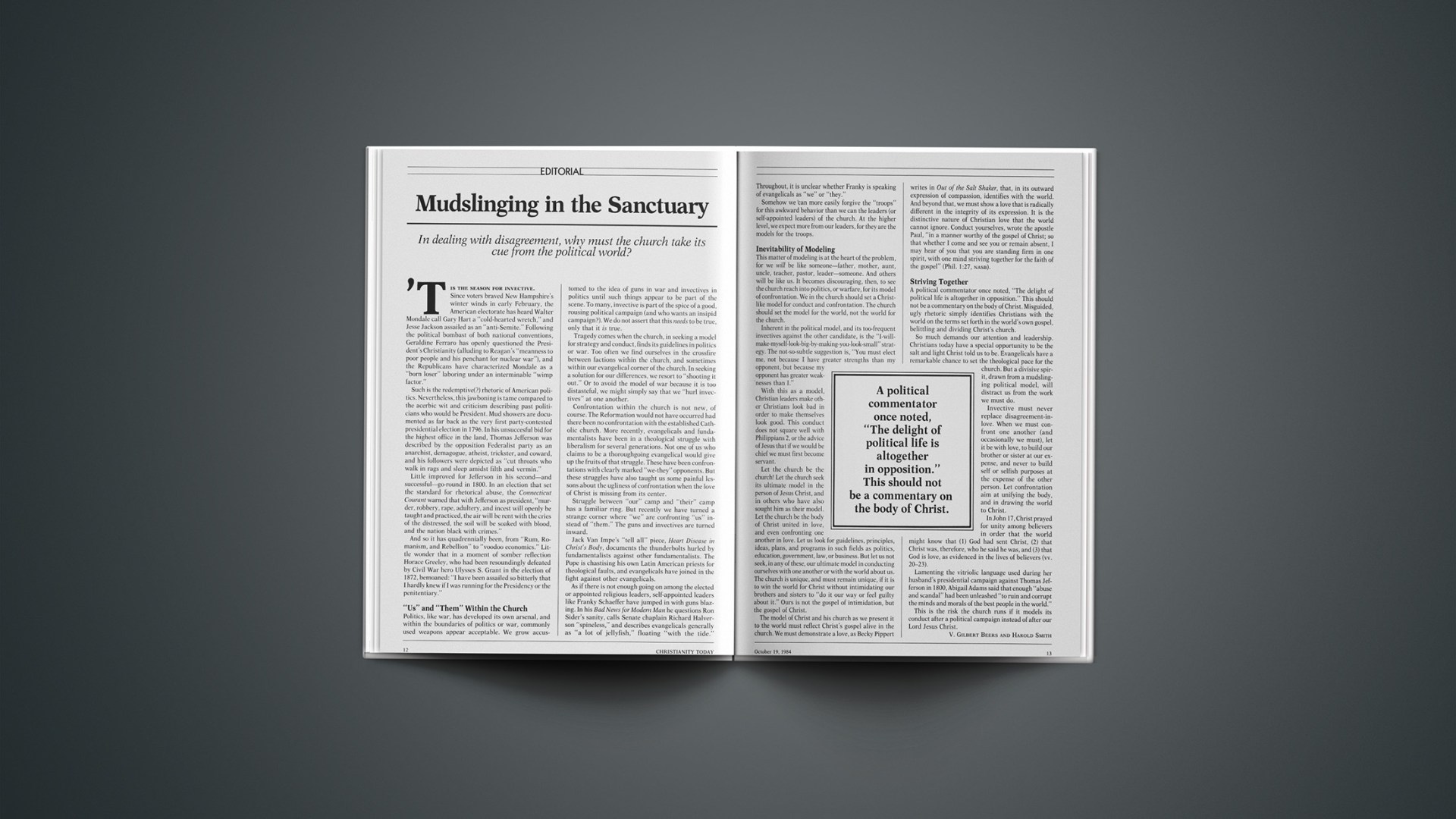
Politics, like war, has developed its own arsenal, and within the boundaries of politics or war, commonly used weapons appear acceptable. We grow accustomed to the idea of guns in war and invectives in politics until such things appear to be part of the scene. To many, invective is part of the spice of a good, rousing political campaign (and who wants an insipid campaign?). We do not assert that this needs to be true, only that it is true.

Tragedy comes when the church, in seeking a model for strategy and conduct, finds its guidelines in politics or war. Too often we find ourselves in the crossfire between factions within the church, and sometimes within our evangelical corner of the church. In seeking a solution for our differences, we resort to “shooting it out.” Or to avoid the model of war because it is too distasteful, we might simply say that we “hurl invectives” at one another.

Confrontation within the church is not new, of course. The Reformation would not have occurred had there been no confrontation with the established Catholic church. More recently, evangelicals and fundamentalists have been in a theological struggle with liberalism for several generations. Not one of us who claims to be a thoroughgoing evangelical would give up the fruits of that struggle. These have been confrontations with clearly marked “we-they” opponents. But these struggles have also taught us some painful lessons about the ugliness of confrontation when the love of Christ is missing from its center.

Struggle between “our” camp and “their” camp has a familiar ring. But recently we have turned a strange corner where “we” are confronting “us” instead of “them.” The guns and invectives are turned inward.

Jack Van Impe’s “tell all” piece, Heart Disease in Christ’s Body, documents the thunderbolts hurled by fundamentalists against other fundamentalists. The Pope is chastising his own Latin American priests for theological faults, and evangelicals have joined in the fight against other evangelicals.

As if there is not enough going on among the elected or appointed religious leaders, self-appointed leaders like Franky Schaeffer have jumped in with guns blazing. In his Bad News for Modern Man he questions Ron Sider’s sanity, calls Senate chaplain Richard Halverson “spineless,” and describes evangelicals generally as “a lot of jellyfish,” floating “with the tide.” Throughout, it is unclear whether Franky is speaking of evangelicals as “we” or “they.”

Somehow we can more easily forgive the “troops” for this awkward behavior than we can the leaders (or self-appointed leaders) of the church. At the higher level, we expect more from our leaders, for they are the models for the troops.

Inevitability Of Modeling

This matter of modeling is at the heart of the problem, for we will be like someone—father, mother, aunt, uncle, teacher, pastor, leader—someone. And others will be like us. It becomes discouraging, then, to see the church reach into politics, or warfare, for its model of confrontation. We in the church should set a Christlike model for conduct and confrontation. The church should set the model for the world, not the world for the church.

Inherent in the political model, and its too-frequent invectives against the other candidate, is the “I-will-make-myself-look-big-by-making-you-look-small” strategy. The not-so-subtle suggestion is, “You must elect me, not because I have greater strengths than my opponent, but because my opponent has greater weaknesses than I.”

With this as a model, Christian leaders make other Christians look bad in order to make themselves look good. This conduct does not square well with Philippians 2, or the advice of Jesus that if we would be chief we must first become servant.

Let the church be the church! Let the church seek its ultimate model in the person of Jesus Christ, and in others who have also sought him as their model. Let the church be the body of Christ united in love, and even confronting one another in love. Let us look for guidelines, principles, ideas, plans, and programs in such fields as politics, education, government, law, or business. But let us not seek, in any of these, our ultimate model in conducting ourselves with one another or with the world about us. The church is unique, and must remain unique, if it is to win the world for Christ without intimidating our brothers and sisters to “do it our way or feel guilty about it.” Ours is not the gospel of intimidation, but the gospel of Christ.

The model of Christ and his church as we present it to the world must reflect Christ’s gospel alive in the church. We must demonstrate a love, as Becky Pippert writes in Out of the Salt Shaker, that, in its outward expression of compassion, identifies with the world. And beyond that, we must show a love that is radically different in the integrity of its expression. It is the distinctive nature of Christian love that the world cannot ignore. Conduct yourselves, wrote the apostle Paul, “in a manner worthy of the gospel of Christ; so that whether I come and see you or remain absent, I may hear of you that you are standing firm in one spirit, with one mind striving together for the faith of the gospel” (Phil. 1:27, NASB).

Striving Together

A political commentator once noted, “The delight of political life is altogether in opposition.” This should not be a commentary on the body of Christ. Misguided, ugly rhetoric simply identifies Christians with the world on the terms set forth in the world’s own gospel, belittling and dividing Christ’s church.

So much demands our attention and leadership. Christians today have a special opportunity to be the salt and light Christ told us to be. Evangelicals have a remarkable chance to set the theological pace for the church. But a divisive spirit, drawn from a mudslinging political model, will distract us from the work we must do.

Invective must never replace disagreement-in-love. When we must confront one another (and occasionally we must), let it be with love, to build our brother or sister at our expense, and never to build self or selfish purposes at the expense of the other person. Let confrontation aim at unifying the body, and in drawing the world to Christ.

In John 17, Christ prayed for unity among believers in order that the world might know that (1) God had sent Christ, (2) that Christ was, therefore, who he said he was, and (3) that God is love, as evidenced in the lives of believers (vv. 20–23).

Lamenting the vitriolic language used during her husband’s presidential campaign against Thomas Jefferson in 1800, Abigail Adams said that enough “abuse and scandal” had been unleashed “to ruin and corrupt the minds and morals of the best people in the world.”

This is the risk the church runs if it models its conduct after a political campaign instead of after our Lord Jesus Christ.

V. GILBERT BEERS AND HAROLD SMITH

Ideas

Mudslinging in the Sanctuary

In dealing with disagreement, why must the church take its cue from the political world?

Tis the season for invective.

Since voters braved New Hampshire’s winter winds in early February, the American electorate has heard Walter Mondale call Gary Hart a “cold-hearted wretch,” and Jesse Jackson assailed as an “anti-Semite.” Following the political bombast of both national conventions, Geraldine Ferraro has openly questioned the President’s Christianity (alluding to Reagan’s “meanness to poor people and his penchant for nuclear war”), and the Republicans have characterized Mondale as a “born loser” laboring under an interminable “wimp factor.”

Such is the redemptive(?) rhetoric of American politics. Nevertheless, this jawboning is tame compared to the acerbic wit and criticism describing past politicians who would be President. Mud showers are documented as far back as the very first party-contested presidential election in 1796. In his unsuccesful bid for the highest office in the land, Thomas Jefferson was described by the opposition Federalist party as an anarchist, demagogue, atheist, trickster, and coward, and his followers were depicted as “cut throats who walk in rags and sleep amidst filth and vermin.”

Little improved for Jefferson in his second—and successful—go-round in 1800. In an election that set the standard for rhetorical abuse, the Connecticut Courant warned that with Jefferson as president, “murder, robbery, rape, adultery, and incest will openly be taught and practiced, the air will be rent with the cries of the distressed, the soil will be soaked with blood, and the nation black with crimes.”

And so it has quadrennially been, from “Rum, Romanism, and Rebellion” to “voodoo economics.” Little wonder that in a moment of somber reflection Horace Greeley, who had been resoundingly defeated by Civil War hero Ulysses S. Grant in the election of 1872, bemoaned: “I have been assailed so bitterly that I hardly knew if I was running for the Presidency or the penitentiary.”

Eutychus and His Kin: October 19, 1984

Election Day Meditation (Prayer Over Punch-Card Ballot)

The Solemnity of the Moment: As I stand, awkwardly, inside this undersized cubicle electing the most powerful servant in the land—not to mention at least 18 judges, city officials, and school directors I’ve never even heard of—please give me the wisdom needed to understand which end of the ballot is up, and to use the metal stylus and not the “write-in” pencil to punch out my selections. Help me ignore the fact that my infant son is screaming in the registrar’s arms, that my four-year-old is jumping from one booth to the next asking each citizen for gum, and that my spouse regards my presidential preference as a “wimp.”

The Significance of the Moment: Help me understand the awesomeness of the many decisions before me; that, contrary to popular opinion, You may indeed be a registered Independent; and that my single vote may help set the agenda for the next four years, not to mention send someone to the community college board of regents whose qualifications (whose name!) are known only to You.

Help me, when selecting a head of public works, a school district clerk, or a village omsbudsman, not to base my final decisions on what surname sounds like a “safer bet” (although an occasional “Johnson” or “Smith” would be appreciated).

And above all else, help me never lose sight of the fact that the clumsy punch card in front of me represents not just a two-minute exercise in manual dexterity, but a legacy of 200-plus years of freedom.

Amen.

EUTYCHUS

Too Many Deities!

Thank you for Elaine Herrin’s “Hello, Daddy God; Goodbye, Dignity” [Sept. 7]. Many of us in the evangelical world are beginning to realize that a distortion of God’s real person has developed from, and is being shaped by, a spirit of “I’ll think of God in any way I choose, and to give me the most pleasure and comfort possible.” The style of our music, the content of much public prayer, some versions of Scripture, and surely the architecture of most new church buildings reflect a view of God that suggests we may be worshiping several different deities.

Herrin’s article ought to be republished every two weeks or so!

DR. KENNETH A. MARKLEY

Camp Hill, Penn.

Needed: A New Vision of Heaven

Philip Yancey’s “Heaven Can’t Wait!” [Sept. 7] sounds a much-needed call. We Christians are neglecting a great motivation to prepare enthusiastically for participation in the eternal kingdom of our Savior.

It is true, as Yancey notes, that “older images of heaven … have lost their appeal”; but our present-day indifference more likely is due to “religious leaders” failing to grasp the significance of the images in Scripture rather than in their failure “to create … new images.” Periodical literature may lack articles on heaven—but some excellent books are available. Were religious leaders not so preoccupied with the flood of good, urgently needed literature on keeping Christian homes from falling apart, these books might attract their attention and stir a revival that would cause our view of heaven to eclipse for us anything this present world has to offer.

CHARLES NOTSON

Yakima, Wash.

Moon an Ally?

Although I am among the many Christians concerned over government encroachment into religious affairs, I believe it is a dreadful error for Tim LaHaye, Robert Grant, and others to consider Sun Myung Moon a “persecuted ally” [“With Their Leader in Prison, Moonies Pursue Legitimacy,” Sept. 7]. Since when may the people of God seek an ally in a false messiah? The nation of Israel was severely judged for entering into unholy alliances; we can ignore such lessons only at our peril.

LARRY PAVLICEK

Richfield, Minn.

Francis Schaeffer’s Legacy

Thanks to Steve Board for a fine tribute to Francis Schaeffer [“An Evangelical Thinker Who Left His Mark,” June 15]. Schaeffer was a mentor and friend of mine since 1959. More than any other person, his teaching and writing opened me up to the issues of Christianity and culture. My teaching and my writing were directly influenced by his keen insights and observations. My guess is that the same is true of many other Christian leaders of my generation. His presence will remain through those he helped to shape into constructive critics of evangelicalism and of culture.

ROBERT E. WEBBER

Wheaton College

Wheaton, Ill.

Today’s Children in Need

I have been so grateful to see two major articles on the plight of children in our culture in recent issues of CHRISTIANITY TODAY [“Vanishing Childhood,” May 18, June 15]. As one who ministers to children, this issue has captured my attention, and it pleases me to see others becoming aware of the crisis proportions of the problems children face. I think we have made some glaring wrong assumptions about our children’s ministries for too long. Now is the time to really begin caring for children when so few seem to care. I hope these issues will be raised again and again.

J. K. STEVENS

Lincoln, Ill.

More on Schuller

Thank you for the issue of CT that focused on the message and ministry of Robert Schuller [Aug. 10]. The articles and Schuller’s defense were insightful and thought-provoking. It is inevitable, in view of space limitations, that one need focus on points of contention.

To begin a theology with a concept of “self-esteem” is to begin with the self as foundational and pivotal for that theological system. Is this not very dangerous ground as Lewis pointed out in “The Poison of Subjectivism”? The creeds of the church do not begin with man but with God’s character, historical intervention, and continuing work in his church. To begin with the self is to be doomed to end with a sanctified solipsism that pursues happiness above holiness and gets neither. To begin with man, as Lewis points out, is not only to destroy Truth but also to destroy man.

REV. DAVID K. WEBER

Gamma Delta Campus Ministry

Montana State University

Bozeman, Mont.

Schuller says “stop” to the notion that his “self-esteem” could lead to self-exaltation, or the heresy of salvation by one’s “own merit.” But then, to his biblical credit, he adds, “I’m not happy with those words, I’d be delighted if someone could come up with better ones.…” Well, here are my offerings: “selfless-esteem” or “selfless-service.” Would the prefix “selfless” change Schuller’s definition of “self-worth”? Yes. It would: (1) define “worth” in terms of service for others rather than self; (2) eliminate his tortuous and questionable hermeneutics on self-worth and its accompanying paradox; (3) place his “esteem” well within Christ’s own nature, message method, and selfless works for man’s redemption.

LEO PETERS

Grand Rapids, Mich.

I found your treatment of Schuller to be shallow and petty, right down to the captions on the pictures. “Schuller’s old church” seems a picayune way to describe a beautiful and functional building that is today being used as fully as ever for the purpose it was designed for—education and caring ministries. If anything, this issue of CHRISTIANITY TODAY has given me a deeper appreciation for Schuller and his ministry.

REV. ARCHIE R. HOFFPAUIR

First Church of the Nazarene

Waco, Tex.

Your tough-questioned interview with Robert Schuller revealed even a tougher, hardened man whose gospel of secular shamanism has seduced some of the very elect of Christendom. It’s regrettable that someone of the caliber of Saint Paul was not with the esteemed members of the interviewing team.

WILLIAM H. CANTELON

Kirkland, Wash.

Thank you for a fair and surprisingly open look at Schuller. It is one which should help Christians rally around the central truths of the faith while gaining perspective on the unbelieving world around us.

JOHN MORRISON

Grace Theological Seminary

Winona Lake, Ind.

There is no question in my mind that Schuller is a modern-day apostle of humanism. He qualifies for verse 16 and fails verse 15 of 2 Timothy 2:15–16. His judgment is verse 17.

HUGH CANTELON

Bellingham, Wash.

We all have a lot to learn from Robert Schuller. The last time Christendom had a fund raiser this good, Pope Leo was building his not-so-crystal cathedral in Rome. Schuller offers self-esteem; back then they were hawking indulgences. Or is it vice versa? Either way, the best fund raisers may not be the best theologians.

REV. WILLIAM D. EISENHOSER

Hollister, Calif.

It was my inclination to believe Schuller to be a spiritual Cabbage Patch doll, and I welcomed your fine magazine’s courage to possibly prove this. But as I read, my unkind glee at finally exposing the man began to evaporate. I found his answers to be consistently disarming. He seems to have a simple, and very sincere, burden to bring what he has seen of the warmth and power of God to a hurting and dazed society.

Perhaps he is not complete in his message. Then, perhaps, we who have been led to see a broader picture should begin to complement rather than criticize the man.

REV. DAVID MCLAUGHLIN

Valley Bible Chapel

Neenah, Wis.

Maranatha’s Validity

The writer of CT’s article on Maranatha Campus Ministries [Aug. 10] needs to review Proverbs 5:16 and John 17:22. When God answered my prayers for my son through an outdoor campus meeting of MCM, it was the first I had ever heard of the group. I have since come to find the believers fervent for the Lord and his Word, their meetings joyful in exalting his name, and their study materials fresh and powerful.

DR. PATRICIA C. GORTON

Milwaukee, Wis.

Thank you for the excellent discussion on Maranatha. We hope this is to be followed from time to time by updates on the Maranatha situation—also by more frequent, timely reports on other heavy control groups.

K. SCHENK

Arlington Heights, Ill.

Letters are welcome; only a selection can be published. All are subject to condensation, and those of 100 to 150 words are preferred. Address letters to Eutychus and His Kin, CHRISTIANITY TODAY, 465 Gundersen Drive, Carol Stream, Illinois 60188.

A Soldier’s Story

A cinematic study of inner torment and men playing God.

As filmmakers have become occupied with special effects and expensive gimickry, their works have become less and less concerned with authentic human experience. Too often, what purports to be a serious film is at best a long music video, or a cartoon (Gremlins, for instance) that often fails to entertain, let alone challenge. Fortunately, there are some who resist these trends. “I just can’t make pictures about spaceships,” says director Norman Jewison, “I’m interested in people.”

Based on Charles Fuller’s Pulitzer Prize-winning play, A Soldier’s Story is a moving piece of human drama that not only draws the viewer into the interior life of the characters—the task of the dramatist—but makes him work as well.

The scene is southern Louisiana in 1944. Sergeant Vernon Waters of an all-black army division is murdered outside the base. It is assumed that the Klan or certain white officers are the culprits. Commanding officers fear reprisals by black soldiers against the white population. Enter Captain Richard Davenport, a black military attorney with a bearing like Douglas MacArthur, dispatched from Washington to investigate. Davenport must contend not only with racism and resentment, but widely conflicting versions of the facts.

But A Soldier’s Story is more than an effective murder mystery. As Davenport burrows into the case, a rather different picture of the victim emerges. In a series of flashbacks, we see the relationship between Sergeant Waters, a kind of black Vince Lombardi type, and his men. Each of these is a study of character, of inner torment, of the forces that can lead human beings to kill their fellows. We see how Waters, a man bent on improving himself and his race, both imposed his own values and used others to accomplish his ends. We see what happens when men play God.

Breaking up these heavy themes is some effective humor and some great musical scenes. What makes it all so special is that here blacks are playing themselves, not just the usual ethnic roles. “The whole point of A Soldier’s Story,” says writer Charles Fuller, is that black people are Americans.” When they get combat orders, the black troops are as eager to smack Hitler as anyone.

These men do, of course, talk like soldiers, but compared with the genuine article, the dialogue is mild. And there is more violence in ten minutes of Star Wars than there is in this entire film. None of it is gratuitous.

Concerning the segregation and racism of the day, Fuller’s script reminds, but doesn’t harangue. Rather, we see how these two evils affected the souls of men, black and white.

Ironically, the making of this film may say something about current attitudes toward blacks, not among rural southerners, but in the board rooms of the entertainment industry. It was made for a paltry $6 million and shot in ten weeks. The director (whose In the Heat of the Night garnered many Oscars) and others worked for minimum pay. Why? “I knew,” Jewison says, “that you’re not going to get the budget for an all-black picture that you would for another picture.”

But the sacrifice paid off in a fine film, full of strong performances; look for it in the Academy Awards. Anyone who cares more about people than spaceships will certainly appreciate A Soldier’s Story.

Reviewed by Lloyd Billingsley, a screenwriter and novelist living in Southern California.

Frozen Fire

For two of Russia’s greatest novelists, Siberia served as a kind of refiner’s fire.

A new biography, Dostoevsky: The Years of Ordeal, 1850–1859, focuses on the ten-year period that formed the character and spiritual outlook of one of the greatest novelists of all time.

As I read the account, I could not help thinking of many parallels between Feodor Dostoevsky, the literary giant of the nineteenth century, and Alexander Solzhenitsyn of our own century. The parallels are apt: Solzhenitsyn himself gave self-conscious tribute to Dostoevsky by naming the main characters in One Day in the Life of Ivan Denisovich after their archetypes in Dostoevsky’s The Brothers Karmazov.

Remarkably, both authors trace their crucial development to time spent in Siberia. For each, imprisonment unexpectedly led to a religious conversion and served as a kind of refiner’s fire.

Dostoevsky underwent a spiritual and almost literal resurrection. Fie had been arrested for belonging to a group judged treasonous by the czar. To impress upon the young parlor radicals the seriousness of their errors, Nicholas I had them sentenced to death and then staged an execution scene.

The conspirators were dressed in white execution gowns and led to a public square. Blindfolded, with their arms bound behind them, they were paraded before a gawking crowd and then tied to stakes to face a firing squad. At the last instant, a horseman galloped up with a prearranged message from the czar: he would mercifully commute their sentences to hard labor.

Dostoevsky never recovered. He had peered into the jaws of death, and from that moment life became precious beyond all calculation. Believing that God had given him a second chance to fulfill his calling, he pored over the New Testament and the lives of the saints. He emerged from prison with unshakable Christian convictions, writing in one famous passage, “If anyone proved to me that Christ was outside the truth … then I would prefer to remain with Christ than with the truth.”

Alexander Solzhenitsyn gives a moving account of his own religious awakening (Gulag, vol. 2, pp. 611–15). The love, patience, and longsuffering of persecuted Russian believers had always impressed him. One night, as Sozhenitsyn lay in a prison hospital bed, a Jewish doctor, Boris Kornfeld, sat up with him and told the story of his conversion to Christianity. That same night, Kornfeld was clubbed to death while sleeping. Kornfeld’s last words on earth, writes Solzhenitsyn, “lay upon me as an inheritance.” He began to believe again.

Like Dostoevsky, Solzhenitsyn also experienced a form of resurrection. Against all odds, he recovered from stomach cancer despite the harsh gulag environment. He came to believe God had performed a miracle so that he could bear witness through his work. To this day, he works 14- and 16-hour days to complete his task.

Prison offered the two authors other “advantages.” Besides shaping their religious outlooks, it provided the human environment they would later put to use in their writings. Dostoevsky was forced to live at close quarters with thieves, murderers, drunken peasants—men filled with hatred for the sophisticated gentry that he represented. His liberal view of the inherent goodness of the common man crumbled; it did not correspond to the reality of his cellmates. But over time, he began to see proof of the image of God mixed in with the evident evil.

Dostoevsky survived a world where melodrama was more than a literary convention. Biographer Frank notes, “Life in prison camp gave him a unique vantage point from which to study human beings living under extreme psychic pressure, and responding to such pressure with the most frenzied behavior” (p. 146). Such experience led to unmatched characterizations, such as that of the murderer Raskolnikov in Crime and Punishment.

Solzhenitsyn had an uncannily similar experience. Although initially he found the dark characters in prison repellent, later he saw them in a different light. “Now, when I have an urge to write about my neighbors in that room, I realize what its principal advantage was: never again in my life, either through personal inclination or in the social labyrinth, would I get close to such people.… However tardily, I nonetheless caught myself and realized I had always devoted my time and attention to people who fascinated me and were pleasant, who engaged my sympathy, and that as a result I was seeing society like the Moon, always from one side.”

He too emerged with a view of humanity that would inform all his writing. He concludes, “It was only when I lay there on rotting prison straw that I sensed within myself the first stirrings of good. Gradually, it was disclosed to me that the line separating good and evil passes, not through states, nor between classes, nor between political parties either, but right through every human heart—and through all human hearts.… Bless you, prison, for having been in my life.”

Finally, in different ways both authors came to oppose, by personal example and in their work, an accepted dogma of their day: that human beings are not autonomous, free, and individually responsible for their behavior.

Dostoevsky was imprisoned by an autocratic regime for the purpose of punishment, not rehabilitation. Yet paradoxically he emerged as an incurable Russophile, obeisant to his government and wise to the excesses of his earlier idealism.

Solzhenitsyn, on the other hand, supposedly suffered for rehabilitation. Scientific socialism had begun the gulag as a massive reprogramming effort, designed to purge society of nonsocialist elements. Instead, this graduate became the single most forceful, eloquent voice against the regime that tried to rehabilitate him. By irrefutably documenting a holocaust with no equal (he estimates that 70 million died in the Soviet camps—ten times Hitler’s total), he changed the course of intellectual history in the latter half of this century.

Solzhenitsyn entitled his literary biography The Oak and the Calf, alluding to a Russian fable about a calf that, with seeming futility, kept butting its head against a large oak tree. But the calf persisted for so long that it eventually toppled the tree. Materialism, utopianism, and behaviorism in their extreme forms, whether from the West or the East, offer formidable challenges to a Christian doctrine of the nature of mankind. Fortunately, a few stubborn calves have not given up the struggle.

Refiner’s Fire: Jane Fonda as Proverbs’ Virtuous Woman

True to Fonda form, the film expresses feminismbut this time in a context that is biblical

Christians have not recognized Jane Fonda as “one of us.” Indeed, there are those who still think of her as “Hanoi Jane.” But her performance as Gertie Nevels in the recent ABC television movie The Dollmaker may soften some opinions. She has rendered a realistic portrayal of a Christian working out her salvation.

The excellence comes in Fonda’s characterization of Proverbs 31:10–31. This passage has often been considered idealistic, a state of perfection unattainable short of glory. Not so, and Fonda’s portrait proves it. Gertie Nevels is as believable as the sunrise, and she should finally shed a lot of light on the traditional confusion over what makes a lady. As the Proverbs passage indicates, the term does not orient on title, wealth, or education. Gertie demonstrates, in terms as down-to-earth as Kentucky clay and Detroit dirt, that even an Appalachian hillbilly can be a noblewoman.

“She looks well to the ways of her household, and does not eat the bread of idleness.” Gertie not only cooks, washes, and sews, she tends a farm and educates her children in the ways of the land and of Scripture.

“She extends her hand to the poor.” At home among neighbors in Kentucky or in uncertainty among strangers in Detroit, she makes it a practice to help those in need. Even when standing in a Detroit winter dressed for an Appalachian fall, she gives her scarf to a mother with a freezing baby.

“She considers a field and buys it; from her earnings she plants a vineyard.” Gertie’s dream was to escape sharecropping and obtain a place the family could call home, someplace that would give a sense of place. She saved money a penny at a time and eventually was able to purchase an old farm. When her husband, who had gone to Detroit seeking better employment, called for her to move, she relinquished the homestead and moved. When it became certain that the move was destroying each of the family members, she again managed to find a place on the land.

“She works with her hands in delight.” Gertie is not afraid to sink her hands into either soil or blood, but, moreover, she is a woodcarver, an artist. She recognizes God’s creative image glowing within her, and she gives vent to that light. She makes toys for children, a crucifix for an old woman, and a sculpture of Christ for herself.

She works on the Christ sculpture for months, trying to find the face that is Christ’s. It is in the process of her caring for those around her that she comes to recognize that Face. His is one that looks upon those of all men and women in empathy and grace. His is one to be seen in those of all men and women.

In a beautifully wrought development of theme, Gertie finds herself in a jam. She must get the family back home. To do so requires money. A store in Detroit will pay good money for a number of carvings, but she has spent their down payment to pay a bill. She needs wood. She cannot buy any, so she decides to cut her image of Christ into pieces. Striking the work of art with an axe and a sledge is a virtual crucifixion, a criminal act. Yet it is the death of the Christ that brings salvation. The Christ is resurrected in the new works Gertie makes, bringing new life to her and her family.

Fonda’s portrait is far from romantic. Gertie gets tired. She gets anxious. She suffers extreme depression when a daughter is killed by a train. But faith is present, and Fonda makes it shine through. Her portrait is a sermon on Paul’s words: “We are afflicted in every way, but not crushed … struck down, but not destroyed … always carrying in the body the death of Jesus, so that the life of Jesus may also be manifested …” (2 Cor. 4:8–10).

True to Fonda form, the film expresses feminism, but even that is biblical. Gertie’s mother misquotes the Bible when she says, “Be ye in subjugation to your husband.…” Gertie responds by leaving her newly purchased homestead to join her husband in Detroit. She learns, painfully, that submission cannot be equated with abject surrender. There is a spirit within every human that cannot be repressed without suffering torment. Two of Gertie’s neighbors discover that and respond in unbiblical ways: one becomes an alcoholic, the other deserts her husband.

Gertie, on the other hand, responds with what can be called creative intervention. She contests her husband’s foolishness much the way the Bible’s Abigail contested that of her spouse. Both worked to save lives as well as marriages. Abigail’s husband refused to submit to his wife’s wisdom; he died a fool’s death. Mr. Nevels practices the biblical concept of mutual submission, and enhanced love and joy result.

The Dollmaker is a story of Christian faith put to work. Unlike many films that have come out of Parachurch production companies, this secular work shares a gospel that is elegant and cogent. Early in the film, Gertie’s mother essentially asks her daughter, “Don’t you want to be saved?” Gertie does not answer. Instead, she goes on to demonstrate a lifestyle that is truly evangelistic, one filled to overflowing with grace.

Since the film apparently came from outside the church, Christians may well ask, “How could this movie treat the Christian faith with such integrity and speak with such fluency?” Filmmakers within the church ought to ask such a question and let The Dollmaker serve as a model.

Mr. Wright is director of church communications at the Terrace Shores Evangelical Free Church in Green Lake, Wisconsin.

Protestants and Jews Debate the Merits of Tuition Tax Credits

Proposals for tuition tax credits continue to generate disagreement among religious bodies. The tax credits would benefit parents who send their children to nonpublic schools, including religious schools.

Religious groups with a strong involvement in private education—such as Roman Catholics and Orthodox Jews—usually support such tax relief. Groups that have fewer schools—such as United Methodists and Southern Baptists—have objected to the proposed legislation, saying it endangers public schools and violates the principle of the separation of church and state. President Reagan supports tuition tax credits. His Democratic opponent, Walter Mondale, opposes such aid.

The Roman Catholic Church, which has the largest parish-school system with an enrollment of 2.97 million, has the most at stake in the tuition tax credit fight. A recent report by the National Catholic Educational Association (NCEA) concluded that “the current sources of financial support for Catholic schools are not adequate to maintain them in the future.” Catholic school enrollment has declined since its peak school year of 1964–65. Meanwhile, tuition costs have risen 10 percent annually in the past decade.

With diminished parish and diocesan subsidies, “tax credits could provide new hope and stimulus in an orderly transition … to a revenue package reflecting more equitably an involvement of all interested parties,” the NCEA says.

The National Council of Churches (NCC), representing 31 mainline Protestant and Orthodox denominations, opposes tuition tax credits. The NCC says such tax relief would “drastically endanger public education by further fragmenting general education in the United States.”

However, some Protestant bodies support the proposed tax relief. Lutheran denominations enrolled 288,867 students in their schools last year, 2.4 percent more than the previous year. The Lutheran Church-Missouri Synod (LCMS), which enrolled 201,500 of those students, supports federal and state aid to private schools. Tuition tax credits “could benefit many, especially the poor,” suggests H. James Boldt, an LCMS school official.

The American Lutheran Church (ALC), enrolling 33,800 pupils, supports tuition tax credits in principle, but not the pending Reagan administration proposals. “The legislation supports middle-income families rather than lower income,” says Glen Bracht, the ALC’s director of Christian day schools.

Recent years have witnessed also the emergence of a fast-growing evangelical and fundamentalist school sector. The Association of Christian Schools International (ASCI), which represents many of the evangelical schools, reports an enrollment growth from 220,001 in 1979–80 to 364,000 last year.

ACSI executive director Paul Kienel calls tuition tax credits a “mixed blessing.” While ACSI is on record in support of the idea, such “legislation has the potential of becoming a major vehicle for the regulation of Christian schools,” Kienel wrote in a recent newsletter. “It may be difficult for our schools to retreat from the comfort of tuition tax credits if future public policies force spiritual compromise upon us.”

Among Jews, attitudes on tuition tax credits range from strong support to outright rejection. But support is growing, particularly among the Orthodox. Day schools—enrolling about 103,600 students—account for 28 to 29 percent of Jewish educational programs.

Since Jewish day schools usually are not synagogue-operated, tuition costs strain many family budgets, says Steven Prager, director of Agudath Israel, a New York-based advocacy group for Orthodox Jewish schools.

Tuition costs are increasing in Jewish high schools, where the average tuition has risen from $2,160 in the 1982–83 school year to $3,000 last year. This has led many in the Jewish day-school movement to join the battle for tuition tax credits. Both Agudath Israel and the Union of Orthodox Jewish Congregations in America support tuition tax credits.

The issue remains a source of dispute within Conservative Judaism. The Solomon Schechter Schools, with an enrollment of 15,000, have endorsed the idea, while the schools’ parent body, the United Synagogue of America, has “disfavored” government aid to private schools.

The Union of American Hebrew Congregations, representing Reform Judaism, opposes any form of governmental aid to religious schools.

RELIGIOUS NEWS SERVICE

All Active-Duty U.S. Soldiers Are Expected to See Dobson Film

Within the next two years, all of the U.S. Army’s 780,000 active-duty soldiers are expected to view a film featuring Christian author James Dobson.

Libraries at 225 Army bases around the world soon will be equipped with copies of Where’s Dad?, a film adapted from Dobson’s Focus on the Family series. Where’s Dad? features Dobson delivering a lecture on the need for strong bonds between fathers and their children. Just over half of the army’s active-duty soldiers are married.

Col. Edmond Solvmosy, director of the army’s Family Action Plan, called the film “a building block on which we’ve based our entire program. It is an instrumental part of our philosophy to provide wholesome, functional role models for our men.”

Maj. Jerry Taylor, of the army’s community and family policy office, calls the film a resource for base commanders to use in “creating an atmosphere of caring leadership.” Neither the army nor Word, Inc., which owns the rights to the film, would disclose the amount the army paid for Where’s Dad?

Portions of the film were edited out to broaden its appeal to soldiers who are not Christians. Peb Jackson, vice-president of Dobson’s organization, Focus on the Family, said the original version would have been relegated to use only by army chaplains. By adapting it to avoid charges that the army is pushing Christianity, it will receive much wider exposure. “Its basic truth and its basic impact remain intact,” Jackson said.

Dobson’s film attracted the attention of Pentagon officials when two congressmen, Frank Wolf (R-Va.) and Dan Coats (R-Ind.), began promoting it among government leaders. Dobson and Jackson met last year with the Joint Chiefs of Staff to explain the film series.

Romania Says It Will Demolish The Country’S Largest Church

The Romanian government last month gave that country’s largest church less than four weeks notice that its building would be demolished.

Local officials told leaders of the Second Baptist Church of Oradea, Romania, that demolition could begin as soon as the first of this month, according to Keston College, a center for the study of religion and communism.

The government did not guarantee new premises for the church and did not say if it would grant permission for the church to be rebuilt. A meeting between church representatives and government officials was scheduled for later last month.

More than 2,000 people attend Sunday services at the Second Baptist Church. The church has baptized more than 100 Christians this year, and an additional 100 new converts are awaiting baptism.

The church’s pastors, Nicolae Gheorghita and Paul Negrut, have been harassed and threatened during the past year. They are not officially licensed as ministers. The church’s previous pastor is Josif Ton, the Romanian Baptist leader now in exile in the West.

Apple PodcastsDown ArrowDown ArrowDown Arrowarrow_left_altLeft ArrowLeft ArrowRight ArrowRight ArrowRight Arrowarrow_up_altUp ArrowUp ArrowAvailable at Amazoncaret-downCloseCloseEmailEmailExpandExpandExternalExternalFacebookfacebook-squareGiftGiftGooglegoogleGoogle KeephamburgerInstagraminstagram-squareLinkLinklinkedin-squareListenListenListenChristianity TodayCT Creative Studio Logologo_orgMegaphoneMenuMenupausePinterestPlayPlayPocketPodcastRSSRSSSaveSaveSaveSearchSearchsearchSpotifyStitcherTelegramTable of ContentsTable of Contentstwitter-squareWhatsAppXYouTubeYouTube